Here’s the thing about Halloween, guys – it seems to happen every year. Funny at that. But despite the proliferation of Halloween comics out there, it’s harder to single out Superman-specific comics that focus on the holiday, especially since I covered a lot of the big ones last year during the original Year of Superman. This week, I decided to take a slight detour, then, to a Super Friends comic, in which the unlikely partnership of Jimmy Olsen and the Wonder Twins save Halloween!
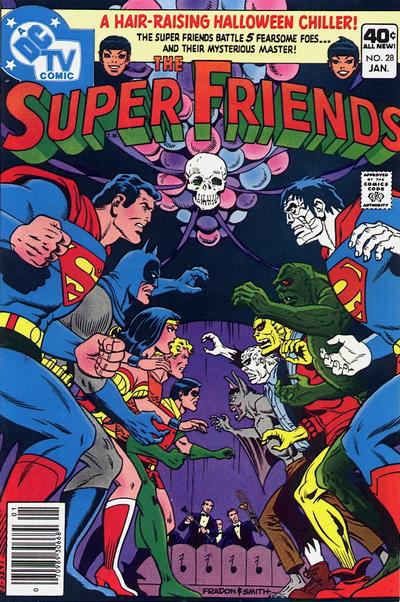
Super Friends #28 Title: Masquerade of Madness Writer: E. Nelson Bridwell Art and Cover: Ramona Fradon Inks: Vince Colletta
It’s a wild Halloween party in Gotham City, and Zan and Jayna – the Wonder Twins – are enjoying watching their friends have fun with the premise. As they walk around having used their powers to turn into an abominable snowman and a black cat (respectively), Bruce Wayne and Dick Grayson are having a little fun with their dates by dressing as Batman and Robin, and Jimmy Olsen has used the ol’ magic potion he’s used in the past to turn himself into a real werewolf for the party, with the promise from Jayna that she’ll kiss him after the party and end the curse. But when the clock strikes midnight and everyone is supposed to unmask, they find themselves trapped in the forms of their costumes, courtesy of the evil sorcerer Felix Faust.
Apparently, Bruce Wayne and several of the other guests each own ancient gems containing immense power that Faust wants to unlock, and he refuses to release the partygoers from their monstrous forms unless they surrender the gems to him. As most of the guests try fruitlessly to attack Faust, Jimmy lures the Wonder Twins away. Using the kind of logic that really only makes sense in cartoons like Super Friends, Jimmy explains that Faust’s magic only affected people wearing costumes – and since he’s a REAL werewolf, the spell didn’t work on him. The twins realize that the same spell prevents them from returning to their human forms, but they can affect SOME transformations, so Jayna turns into a cat-bat to fly off and find Wonder Woman and Aquaman while Jimmy summons Superman with his signal watch.
As the assembled heroes go on the attack, Faust forces the enchanted partygoers (dressed as Solomon Grundy, Bizarro, Swamp Thing, Man-Bat, and the Demon) to fight them back, raising some serious questions as to what kind of costumes you can find at Spirit Halloween in Gotham City. Like, is there a Joker costume? Would that be like a mass-produced outfit that lets you dress up like Charles Manson or something? The implication here is the creepiest thing about the issue. But anyway, what follows is several pages of the Justice League fighting Faust’s captives, in some amusing face-offs. Superman, naturally, fights “Bizarro,” Aquaman tackles “Swamp Thing” (whom he’s heard is pretty powerful), Batman fights “Grundy,” Robin takes “Man-Bat” and Wonder Woman lassos the “Demon.” You get the usual stuff about the heroes not wanting to actually hurt them, since they’re innocent people who have been transformed by magic, but the captives have all the powers of their costumes and none of the usual compunctions. In the end, though, it’s Jimmy and the Twins who finally get the drop on Faust, with Zan turning into an ice skeleton and freaking the villain out with a Grim Reaper routine long enough for Jimmy to get in and deliver a knockout punch.
I’m always amused by these old Super Friends comics. At the time these were being published, continuity was a fast and loose game, and even though DC Comics had pioneered the concept of a multiverse, it wasn’t something they used as vigorously as they do today. The result were Super Friends stories that tried to pretend they were part of the mainstream DC Universe with various references and callbacks that were probably wasted on the younger readers that the comic was aimed at. For instance, when the League is trying to come up with a plan to fight Faust, Superman suggests calling up the only Justice League member with magical powers, Zatanna, but unfortunately she’s busy on her own case. Jimmy’s werewolfism, as well as the cure (a kiss from a pretty girl) is a callback to one of the classic Silver Age Jimmy Olsen comics (in fact, I’m pretty sure I wrote about that one LAST Halloween), and there’s even a casual reference to the fact that Jimmy learned Batman’s secret identity on a previous adventure, which is a story I’ve never read or even heard of before, so I GOTTA find that one.
At the same time, the stories are light and simplistic, even compared to the DC Comics of the 1970s. They’re not making this comic for older kids, they’re trying to hook the younger ones. Those links are a neat way to do it, although a few footnotes indicating which issues they’re referencing would be nice.
As was often the case with Super Friends, the ending comes pretty abruptly and without much fanfare. Zan scares Faust, Jimmy punches his lights out, and as soon as he hits the floor the spell is broken and the people trapped in their costumes are set free. There’s also a quick beat at the end where the (unnamed) girls who came to the party with Bruce and Dick ask where they heck they’ve gotten to and the “real” Batman casually tells them that their dates have been placed out of harm’s way. It’s astonishing how often people in old comic books fell for that excuse.
It’s a fun little story, though, and I enjoyed reading it. With one Wednesday left until Halloween, though, I want to find something spookier. Hit me in the comments, guys – what’s the scariest Superman story you know?
Blake M. Petitis a writer, teacher, and dad from Ama, Louisiana. His most recent writing project is the superhero adventure seriesOther People’s Heroes: Little Stars, volume one of which is now available on Amazon.Don’t forget, you can check out earlier blogs in theYear of Superman/Superman Stuff Archive! Got a request for a future “Superman Stuff”? Drop it in the comments!
As always, October has got me in the mood for spooky novels, short stories about monsters that appear with no rational explanation, comics hosted by a decaying corpse with a wicked sense of humor, and undead cereal mascots with the most advanced case of rosacea you’ve ever seen. And if you’re a horror fan, we are in something of a golden age. Not only are we being inundated with a lot of horror movies, but many of them are REALLY GOOD. And if that wasn’t enough, they’re achieving CRITICAL AND COMMERCIAL ACCLAIM as well. As somebody who lived through the lean years of the early aughts, when almost every horror movie was a reboot, a sequel, or a remake of a Japanese film, it’s like a dream come true. Back on January 1st it probably wouldn’t have been hard to predict that Spider-Man: Brand New Day would be the highest-grossing movie of the year so far, but there are few people who would have suggested the likes of Obsession and Backrooms would also sit proudly in the top ten ahead of a new Star Wars film, a Steven Spielberg sci-fi epic, or Paw Patrol: The Dino Movie.
You’d be surprised how much this guy and Marshall have in common.
Even movies that didn’t score the box office heights of those two have been doing very well, relatively. Movies like Lee Cronin’s The Mummy and Buddy both generated all the chatter. Iron Lung may only have made $27 million at the box office, but with its shoestring budget and a self-released model that eschewed any sort of major studio backing it’s considered a massive success story. And it ain’t even over yet: this weekend brings us the aquatic thriller Whalefall and next week drops DC Studios’ body horror film Clayface, both of which are drawing fantastic early reviews. In an era where general audiences are starving for entertainment, horror movie fans feel like we’ve killed the fatted calf.
But as we are in this era of excellent and acclaimed horror, it still chafes me sometimes when I see the hoops that the mainstream has to leap through before they can accept that a horror movie is just…good.
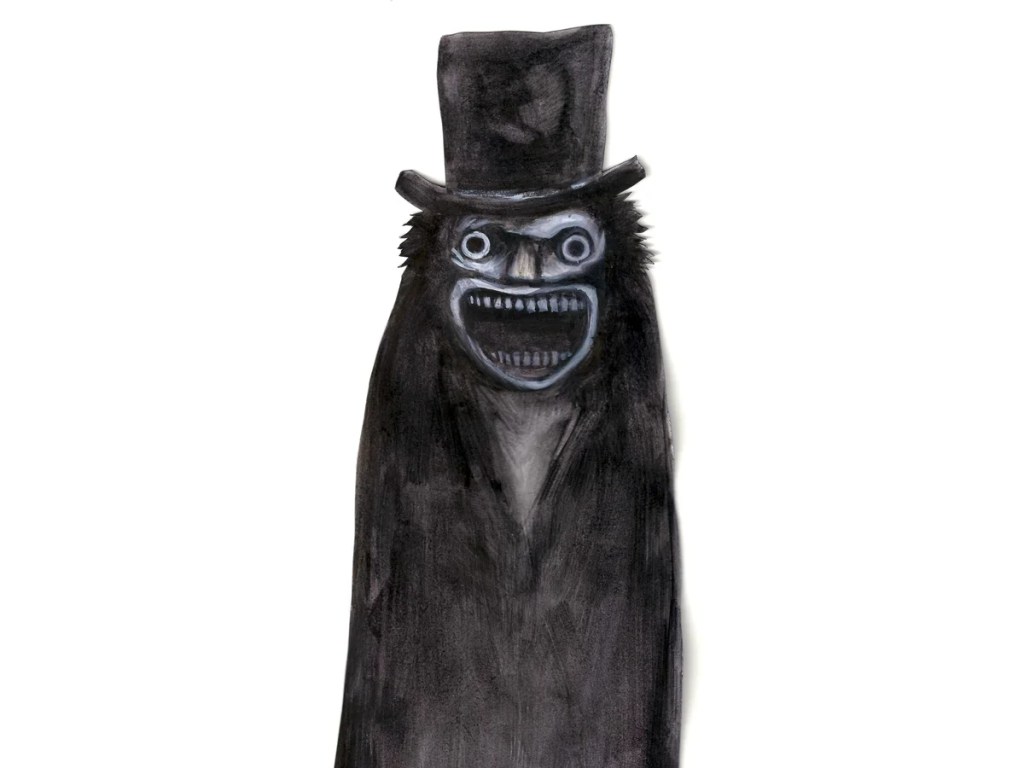
The term “elevated” horror has been around for some time now. I don’t remember exactly when I first began hearing it but I know it goes back at least to movies like The Babadook or It Follows, both from 2014, so it’s not a new concept. It is, however, kind of an insulting one. When I hear a movie described as “elevated” horror, the gist I get is that this is a horror movie that’s actually ABOUT something: some sort of crisis, some trauma, some dark aspect of the human condition that the movie is exploring. In The Babadook, for example, people who dissect these things point out that the monster itself is not actually a “traditional” monster, but rather a manifestation of the main character’s repressed grief over the death of her husband. It Follows, similarly, is about the anxiety of a teenager discovering her burgeoning sexuality. You see, these elevated movies aren’t REALLY horror, not like Freddy or Jason, they’re movies that use horror movie THEMES to actually EXPLORE something of artful depth.
Pictured: Repressed Grief
And some people may be nodding their heads along with this and saying, “Sure, what’s wrong with that?” And the answer is: there’s nothing wrong with it. That’s why horror writers have been doing it SINCE THE INVENTION OF THE GENRE.
One can easily make the argument that Frankenstein, specifically the second edition, is really about Mary Shelley wrestling with her anxieties over death after the loss of her husband and children. Bram Stoker’s Dracula is often seen as a metaphor for female liberation in an era before such a thing was a mainstream concept. How far back you wanna go? The folktale of Bluebeard is about women being afraid of the power of an overbearing man. In The Odyssey (Homer’s, not Nolan’s) it’s easy to view parts of Odysseus’s journey into the underworld as being about the terrors of war and the guilt of the people who survive it. Every werewolf legend is seated in a terror of a violent, animalistic urge that may be hiding in the person sitting next to you. When you say that horror that’s “about” something is “elevated,” you discount the fact that horror has ALWAYS been about something.
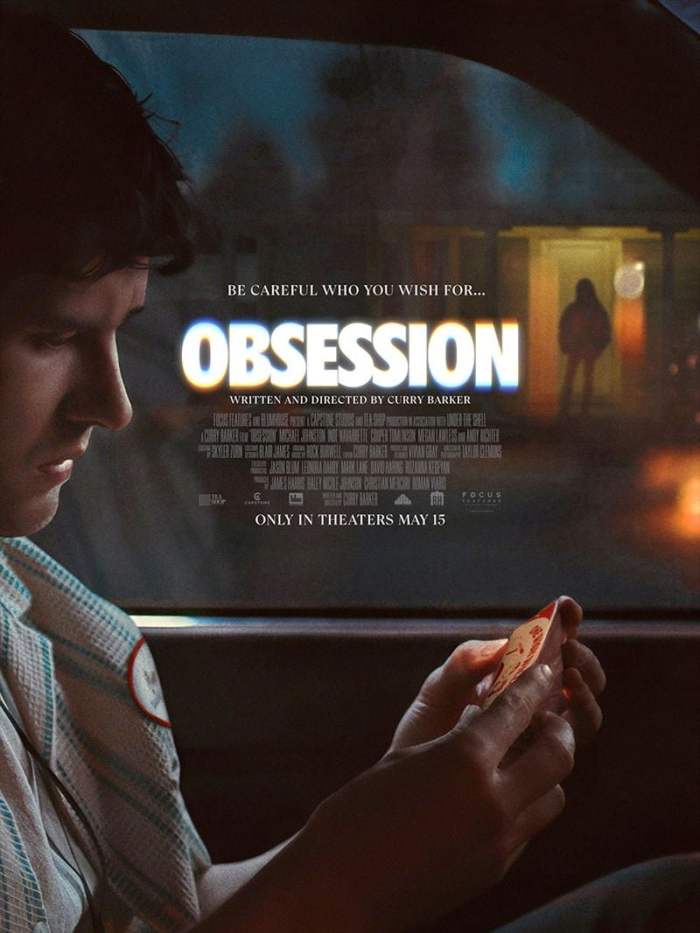
Let’s look again at some of this year’s big hitters: Obsession and Backrooms. I recently read an article on Substack (which I’m sorry to say I can’t find and link to, but if you’re interested – hey! – go ahead and subscribe to MY Substack and get a free short story in your mailbox) that argued both of these movies are, at least in part, about the “male loneliness epidemic.” That’s not a hard argument to make. In Obsession, every bad thing that happens can be traced to the fact that Bear is a pathetic, weak-willed creature who doesn’t have the courage to just admit to his actual feelings. Backrooms is fueled by the pain of a man who has lost his wife and is losing his company and has pretty much given up on his dreams. This same Substack writer, it should be noted, went on to argue that a lot of this year’s other box office winners — including Project: Hail Mary, Spider-Man, and even The Odyssey (Nolan’s, not Homers) — are about this same theme. I’ll let you decide for yourself if they all fit, but does that make Brand New Day an elevated superhero movie?
Tone is something else that frequently gets referenced when someone calls a horror movie “elevated.” If you look at the examples I’ve given so far, you’ll probably notice that all of these movies have kind of a slow burn. They start from a place of relative normalcy, although often a bleak, somewhat hopeless kind of “normal,” and then over the course of the movie the supernatural elements incrementally creep into the characters’ lives before finally reaching that point of maximum chaos and violence. I can accept movies with that tone as being a subcategory of horror, but there are a lot of non-horror movies that have that same kind of dour feeling: No Country For Old Men, Apocalypse Now, The Road, even Oppenheimer (Nolan’s, not Homer’s). If all it takes to be “elevated” is a general sense that everything sucks and it isn’t going to get any better, turn it on CNN. They’ve been trying to elevate the news for decades.
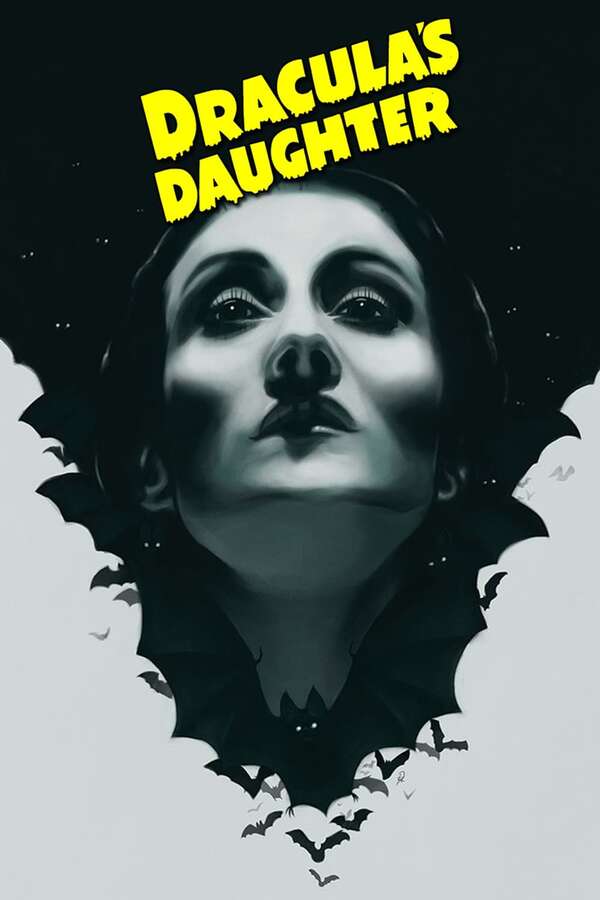
Even horror that’s “lowbrow” is about SOMETHING. People who talk about elevated horror as if that makes them some sort of Svengali are ignoring the fact that slasher movies of the 80s were predominately about “punishing” people for perceived sins like sex and drinking, that monster movies of the 50s were manifest versions of Cold War anxieties, or that even as early as 1936 Dracula’s Daughter took cues from Bram Stoker and painted the consequences of sexual repression as bloodthirsty monsters.
It’s basically a woman’s empowerment fable. Like Xanadu or something.
All of this is to say that “elevated” horror is nothing new, and pretending like it is doesn’t make you smart, it just makes you sound pretentious. I’m not disparaging any of the movies that are called elevated, mind you, I’m just disparaging the people who call them that. The filmmakers themselves will usually tell you that they weren’t making any effort at “elevation,” they were just making a scary movie…like people always have. If you think calling it “elevated” somehow gives you permission to appreciate something that you usually wouldn’t associate with, that’s a you problem, my friend. It’s not the genre. Horror has always lived in this area, and it’s not going anywhere.
This week’s “Superman Stuff” is going to be a little different – a review, yes, but also a bit of a personal reflection. This week we’re going to look at one of DC’s young reader graphic novels, and how awesome it was not just as a book, but as an experience for my family.
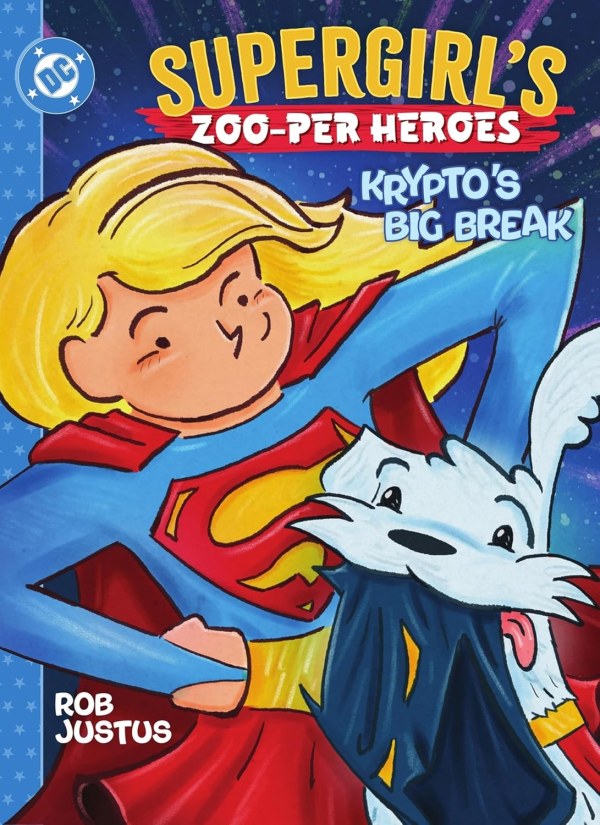
Supergirl’s Zoo-Per Heroes: Krypto’s Big Break Writer & Artist: Rob Justus
This young reader’s graphic novel starts with Supergirl and Krypto playing on the Justice League Satellite. Krypto is, of course, a good boy, but even good boys get into trouble sometimes, and his antics cause the Satellite to accidentally dump the Justice League’s laundry into space. Cosmic comic book physics happen on the way down and, when the costumes fall on some zoo animals, the animals find themselves possessing the powers of the hero whose costume they’re wearing. With the rest of the JLA trapped on the Satellite in their underwear, it’s up to Supergirl and Krypto to get their uniforms back.
It’s a silly story, with logic that wouldn’t even hold up in the goofiest of silver age comic books, and frankly, that’s kind of why I love it. The physics don’t make the slightest bit of sense, and the villain of the piece is a ridiculous caricature. There’s also a running gag about the fact that Krypto and the other animals can speak to each other, but the human characters don’t understand them, which makes Supergirl’s attempts to speak “animal” to them hilarious as they get exasperated with her gibberish barking. Justus’s characters have a simplicity that is absolutely charming, and there’s a sense of humor that appeals to the kids while winking at the parents who are reading along.
It’s that last part that makes this book particularly special to me. I didn’t read this book just for myself; I read it with my son, Eddie. Eddie is an ADHD kid, and while he’s capable of reading anything you put in front of him, he often doesn’t have the patience to do so for more than a page or two. My wife and I often try to get him to read with us, but it can be a struggle, as he’d rather be playing or watching football. But despite that, every other week I take him to the library and we check out a few books. Sometimes he reads them, sometimes he doesn’t. Picking up this one, though, turned out to be a great choice.
I sat with him and opened up the book last night (as I write this), and made a deal with him. “How about you read what Krypto is saying, and I’ll read the other characters, okay?”
And he did. He did it with zeal. He did it with APLOMB. Eddie jumped right into his role, barking and woofing when that’s what Kryto was doing, reading the lines in English when that was the case. He did it with vigour, acting out like everyone’s favorite hyperactive Kryptonian puppy, no doubt because he feels in our beloved Superdog something of a kindred spirit. As we sat together reading the book, he announced his parts gleefully to his mother, who was watching the whole thing with amusement.
I’ve been reading to my son since he was an infant. Getting him to read back to me has sometimes become a chore. But he LOVED this book.
It ended on a cliffhanger, and I’m eagerly awaiting book two. I also intend to try to track down some of Justus’s other work, including the two volumes of Superman’s Good Guy Gang, and share those with Eddie as well. It wasn’t just reading, it was sharing, and that made it all worthwhile.
Blake M. Petitis a writer, teacher, and dad from Ama, Louisiana. His most recent writing project is the superhero adventure seriesOther People’s Heroes: Little Stars, volume one of which is now available on Amazon.Don’t forget, you can check out earlier blogs in theYear of Superman/Superman Stuff Archive! Got a request for a future “Superman Stuff”? Drop it in the comments!
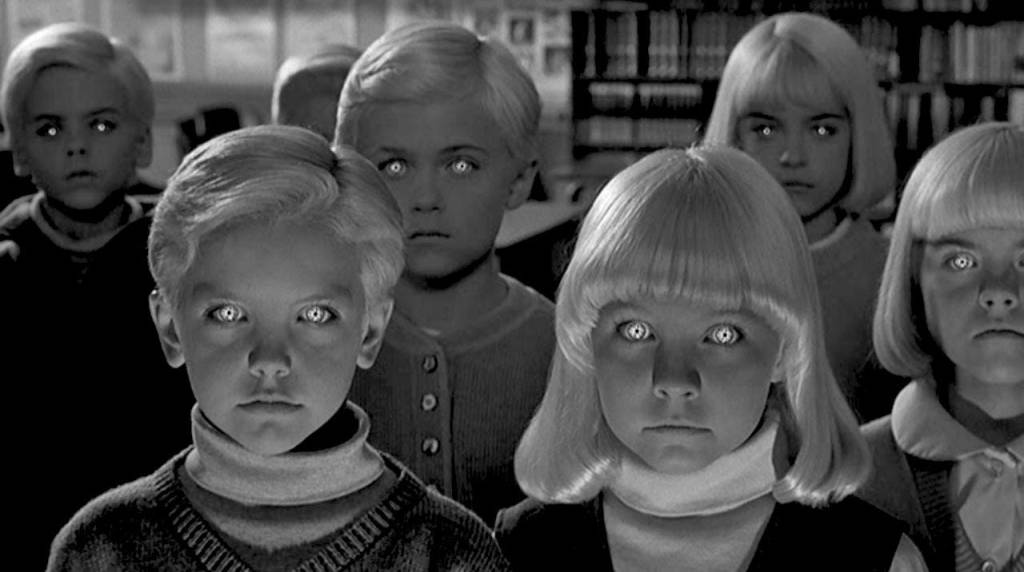
Halloween is coming up, so today I’m going to talk about the scariest thing I can think of: kids.
No, creepier.
Okay, not exactly. In my class we’re currently in a unit where students are reading up on and writing arguments about artificial intelligence, including its depiction in fiction. And as part of that unit, I demonstrate that we have had stories, fables, folklore, and myths that include things fitting our definition of AI far longer than we’ve actually had AI. We see it in Pinocchio, we see it in the Greek myth of Pygmalion, we see it going back to the ancient Hebrew legend of the Golem. And as we discuss these old stories, I ask my students for other examples of non-living creatures that are given life in order to fulfill some sort of need of its human creator. One kid brought up Astro Boy. Another mentioned Marvel’s The Vision™ (I include “Marvel’s” here for purposes of trademark). One kid asked if Toy Story counts, which gives me a chance to point out that A) we have never learned, in-universe, WHY the toys are alive, and B) despite the fact that Toy Story 5 was an excellent rebound from the mediocre Toy Story 4, I still think they should have stopped with 3.
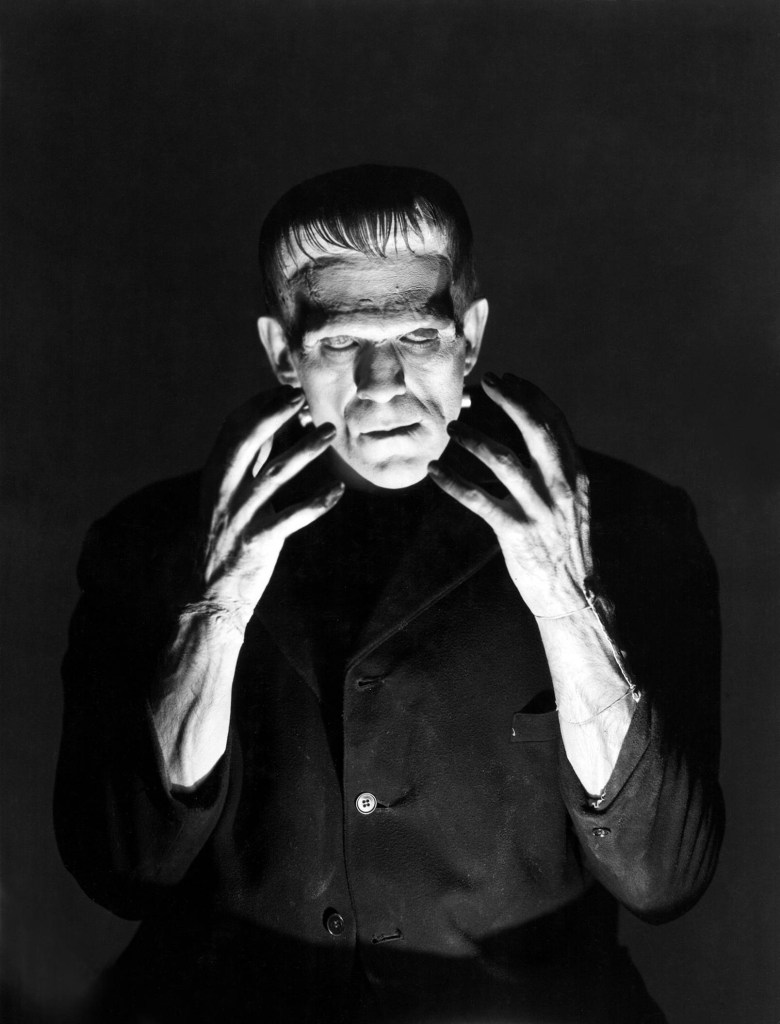
But one of the things that came up over and over again in this conversation is just how often the stories are about creations that turn against their creators. It’s not really October until I’ve mentioned Frankenstein at least 11 times, so let’s start there:
Okay, that’s ONE…
Victor Frankenstein is obsessed with conquering death, and thus creates a new lifeform by assembling parts of dead bodies. When his creation is too hideous for him to deal with, he abandons it and leaves the poor thing to exist on its own, which turns out to be a huge mistake, as the creature grows to resent his creator and turns against him. It’s the classic archetype, and we’ve seen it turn up over and over again. There are obvious, deliberate takes on the idea in things like The Rocky Horror Picture Show; there are more subtle but still clear allusions in movies like Edward Scissorhands, but they’re all portaging Mary Shelley’s idea when they tell their own story. Sometimes the creation is actively evil, sometimes it’s misguided, but the common thread is that pretty much all of them are dangerous.
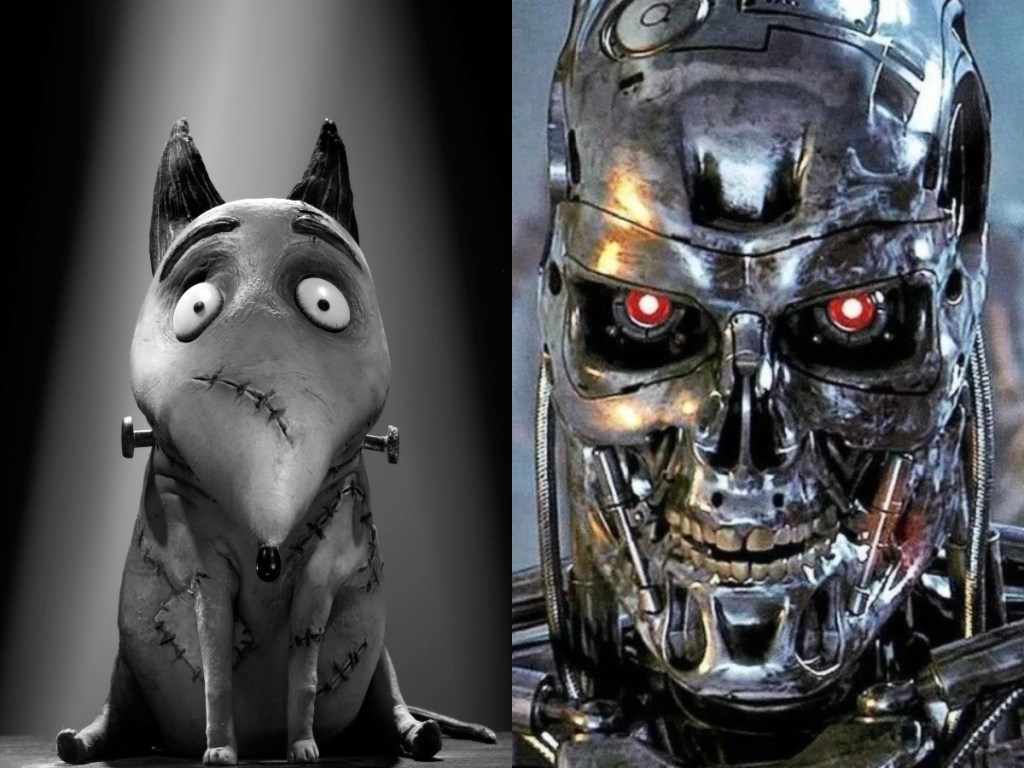
Except maybe Frankenweenie. He was a good boy.
But this idea is prevalent in modern sci-fi horror as well. Look at M3GAN, a franchise built around the idea of a robotic plaything that turns murderous. Chopping Mall is about a robotic security system that turns murderous. The entire Terminator franchise is predicated on the idea that the computer systems we humans have built will become murderous. WHY ARE WE SO OBSESSED WITH THESE MURDER BOTS?
You should definitely find one of these scarier than the other.
There is, of course, a reason. Fiction – good fiction, at least – reveals something about its creator, and in the case of horror, what it usually reveals are the things that people are afraid of. Why, then, have we been afraid of those things we create going bad for hundreds – perhaps thousands – of years? This question was always puzzling to me.
That is, until I became a dad.
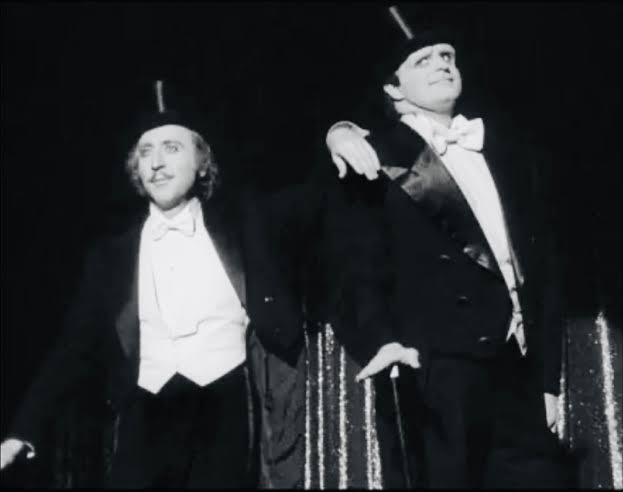
I’m no psychologist, I’m just a guy who reads a lot of books and watches a lot of movies, but I’m going to explain what I take away from what I think of as the Frankenstein complex that is revealed in fiction. I think that the Frankenstein monster and M3GAN and all the others come from a place of people being afraid of who their children will grow up to be, and THAT fear is rooted in a fear that we, as parents, won’t measure up. That’s literally the message that modern audiences get from Frankenstein, that the whole tragedy is caused by Victor’s egregiously lacking parenting skills. The supposition – and I think it’s a fair one – is that if he had not abandoned the monster and left him without guidance, structure, or even a name, then he may have been nurtured into a creature of value rather than the murderer he became. In fact, of all the various derivative versions of the Frankenstein story, the only ones that I can think of that have happy endings are the ones where the scientist character embraces the creature as he would a child, such as in Mel Brooks’s Young Frankenstein.
This was the tenderest depiction of fatherhood ever on film until the creation of Bluey.
I don’t know if this was what Mary Shelley was thinking when she wrote the book, and I’m not trying to argue that it is. I’m saying that this is what I take away from it (and the whole “Death of the Author” argument says that my interpretation is as valid as anybody else’s so nyeah). I’m also saying that I think this interpretation explains why this archetype has been so popular for two hundred years – no matter what other changes happen in culture, politics, art, science, or society, parents are always going to worry that they’re screwing up their kids.
This doesn’t mean, when I look at my darling, innocent son as he is watching YouTube videos of sports stadiums being imploded, that I’m worried he will grow up and frame innocent people for murder or throw small children into a river. But it doesn’t HAVE to mean that. Horror is a metaphor, it exaggerates our fears. I’m not afraid of having a dream so scary that I literally die from it either, but that doesn’t mean I don’t get what A Nightmare on Elm Street is about. No, I worry – like I think every well-intentioned parent does – that my kid will someday make a bad choice that could have been prevented if I had been a better parent. I feel that fear every time we get a message from his teacher that says he’s being too loud in class or every time I have to tell him not to shake a tree because we don’t know if there are wasps hiding in there or every time he wants to watch Blippi instead of literally anything else. Is there something I could have done, is there some way I could have prevented this? And with the exception of Blippi, none of these are really serious offenses…but what if some day it IS?
Sorry, but I’m writing about horror this week. There had to be at least one legitimately frightening image.
That primordial fear of parenting is what draws us to stories like Frankenstein and all the others. We are afraid of making something that goes out of our control and does something terrible. And obviously most parents are never going to have to deal with something like this, thank goodness, but wherever I see a true crime documentary, I find myself waiting for some sort of a conversation with the villain’s mother to see if he broke her heart or if she’s a classic example of what makes a kid go bad.
If you’ve never had kids, maybe this doesn’t make sense to you. But if you have, I guarantee you’re going to think about this the next time you watch Boris Karloff and Colin Clive working out their own issues in your gear-up for Halloween.
It’s time once again for a healthy helpin’ of reviews. Here are most (if not all) of the Superman-related comics that hit the stands in September, including the second half of Kingdom of Zod, a few journeys to alternate universes, the “Weirdest” co-star Superman and Batman have ever seen, and the newest incarnation of Superman’s ORIGINAL Super Friends.
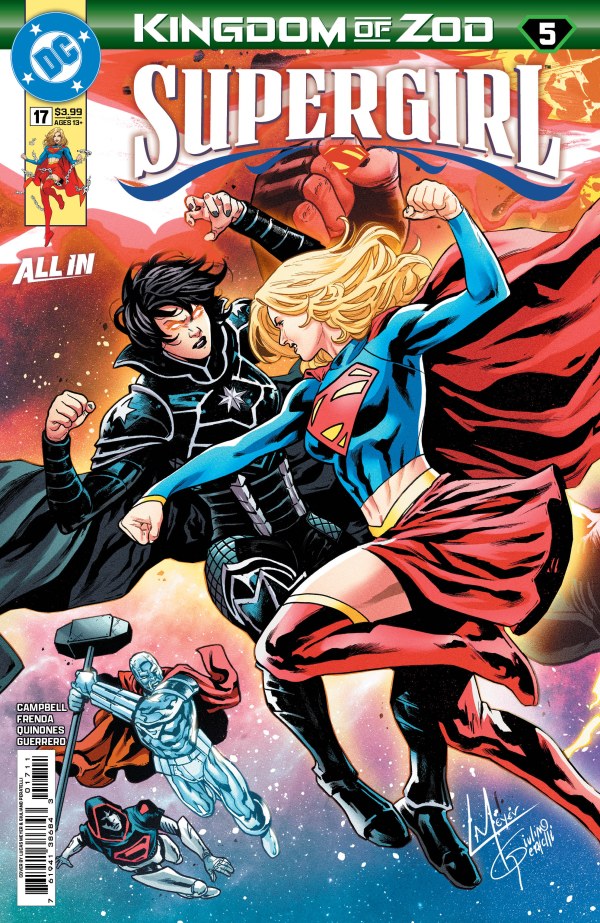
Supergirl #17 Title: Kingdom of Zod Part Five Writer: Sophie Campbell Art: Bruno Frenda & Joe Quinones Main Cover: Lucas Meyer & Guiliano Peratelli
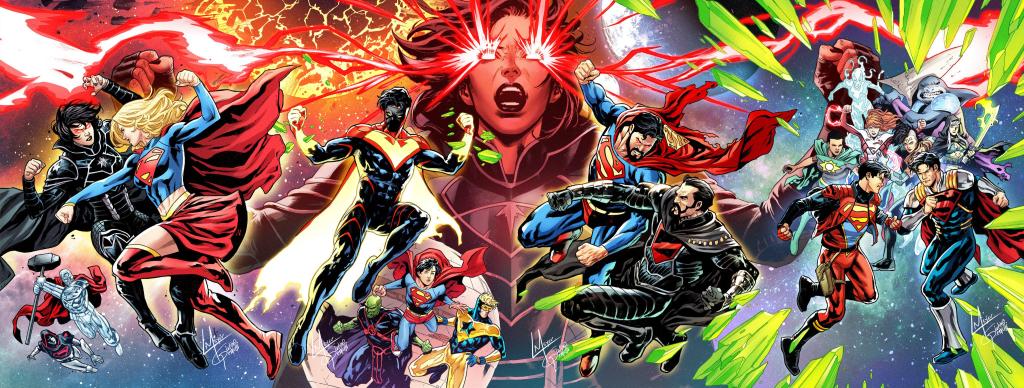
The second half of Kingdom of Zod kicks off with Supergirl and Superboy (the time-tossed Clark Kent from his teen years) getting caught in a time bubble with Ursa, who’s travelling to the past in an apparent attempt to save Krypton from discussion. The issue checks in briefly with the rest of our cast, including Lana and the Steels dealing with the Krytonite zombies, Superboy (Conner) and Superboy-Prime trying to help an injured Superman, and Lois doing the same with Jonathan. But each of these story threads is given no more than a page or two, with the bulk of the issue focusing on Kara and Clark’s adventures on Krypton.
There’s always a delicate balancing act with intra-family crossover events like this one. In the books where the “lead” character of the franchise (in this case, Superman) is the same as the lead of that title, there’s no real issue. When you have a chapter in an issue of a spinoff character – which Supergirl is, let’s be honest – you have to struggle between maintaining the focus on the person that the regular readers buy the book for and continuing the overall event that may have brought in new readers. Campbell accomplishes this really well. We spend most of the issue with Kara trying to teach a young, inexperienced Clark about the dangers of time travel while at the same time trying to prevent Ursa from making things worse. The interaction between the two of them is really entertaining, with Kara taking on the big sisterly role she thought she would have before she woke up on Earth that first time and discovered that her baby cousin was now older than her. I know that once this is all over Clark is going back to his own time, but I would love to see this dynamic played with more often.
More importantly, the time-travel arc doesn’t feel like a superfluous side-story here, but part of the large whole, and that’s what you really want most of all when you’re reading a story like this one. It needs to feel consequential, or the readers will feel cheated. I don’t think that’s going to happen with anybody here.
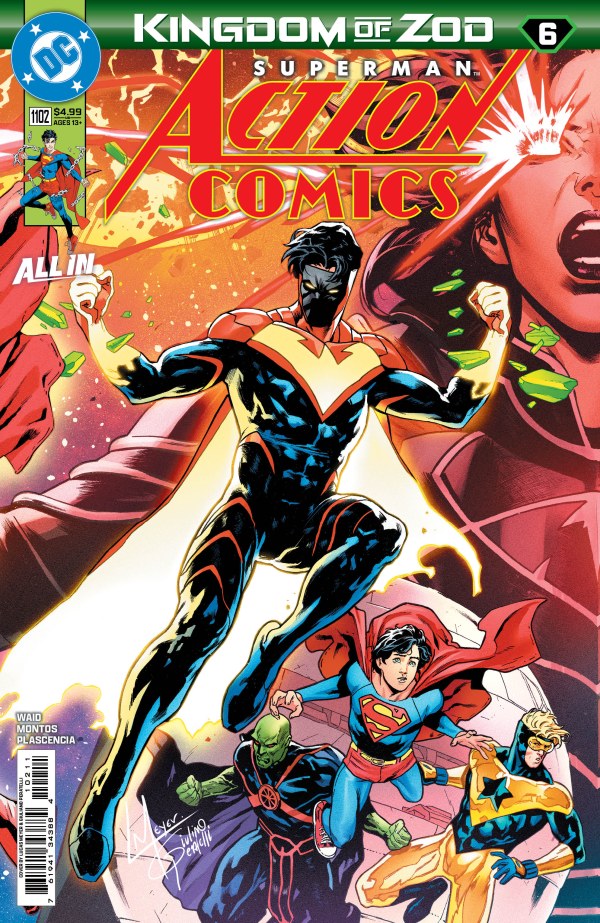
Action Comics #1102 Title: Kingdom of Zod Part Six Writer: Mark Waid Art: Montos Main Cover: Lucas Meyer & Guilano Peratelli
Like the Supergirl chapter, Action Comics this month focuses mostly on young Clark and Kara on Krypton, although the side-stories progress a little bit further. Of course, they progress to a point where it just seems like it can’t get any worse. The adult Superman and his group finally reunite with Lois and Jon, but the one person who may be able to protect them from the growing Kryptonite radiation that’s engulfing Earth may not be of help after all.
But back in the past, back on Krypton, young Clark is separated from his cousin as Kara and present-day Ursa are taken into custody by past-Zod. Man, time travel makes these recaps harder to write. The gist of it is this: in this issue we see the teenage Clark that’s been the star of this title since Mark Waid took over have to make some of the choices and learn some of the maturity that’s going to characterize him when he gets older and becomes a true Superman, and that’s a great thing. If you read the classic Superboy stories of the Golden and Silver Ages, there’s not a lot of difference between the character as a teenager and as an adult. He’s the stalwart, confident paragon that we want him to be right from the jump, and while that’s a good thing for a mature Superman, it doesn’t make as much sense when you see him as a kid. Waid’s Superboy is someone who is still learning, still capable of making mistakes, but with a core of purity and decency that you can see developing into the all-loving hero that Superman is. This issue makes for a nice focus on that, a great examination of who Clark was and who he’s going to become, all mixed up in the larger storyline. It’s deftly played.
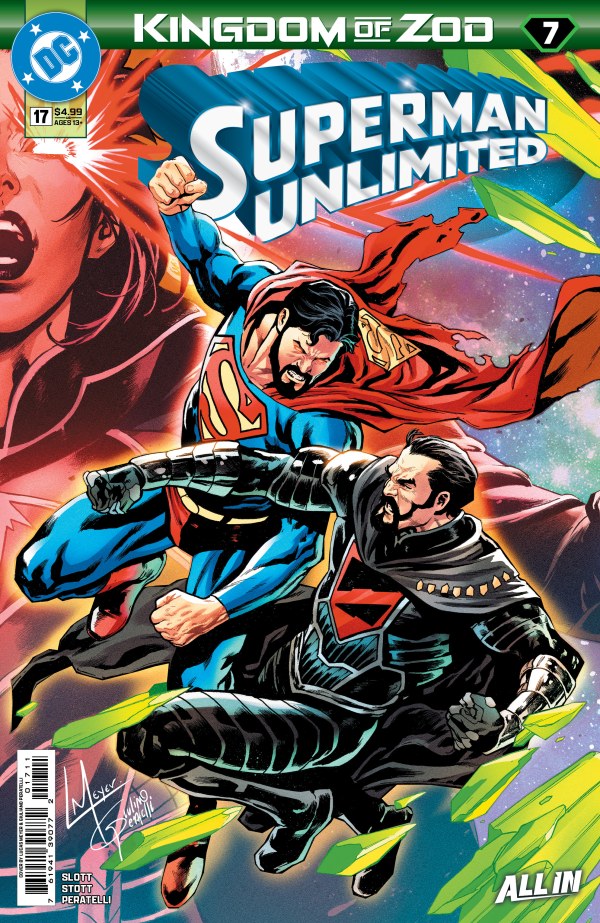
Superman Unlimited #17 Title: Kingdom of Zod Part Seven Writer: Dan Slott Art: Rachael Stott and Montos Main Cover: Lucas Meyer & Guiliano Peratelli
Part Seven of Kingdom of Zod flips the formula from the last two issues – a quick check-in with Clark and company back on Krypton, with most of the issue in the present, and the wave of El Caldero Kryptonite radiation that’s threatening the entire Earth. But here’s the thing: early in the run of this series, Dan Slott gave Superman a little boost that just may be the thing to save the day.
This is one of those issues where somebody with super-speed does a whole lot of stuff really fast, where things zip along in much less time than it takes to tell the story. I like issues like that, because a good writer can use them to give us quick glimpses at the hero being the hero. As Superman is racing to save the world from the Kryptonite, we see him take moments with friend and enemy alike that remind us of just what kind of a man our hero is. Not that we necessarily NEED that reminder, of course, but seeing Superman in action doing what Superman does is always a treat, and Slott really nails it here. In the midst of this huge storyline, it’s the small moments for Superman that really make this issue worth reading.
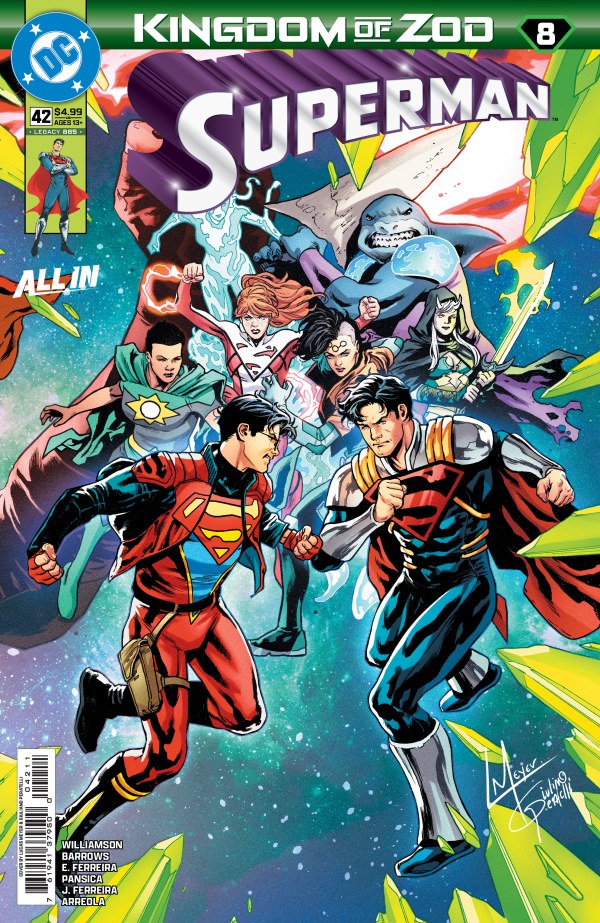
Superman #42 Title: Kingdom of Zod Part Eight Writer: Joshua Williams Pencils: Eddy Barrows & Eduardo Pansica Inks: Eber Ferreira & Julio Ferreira Main Cover: Lucas Meyer & Guiliano Peratelli
The penultimate chapter of “Kingdom of Zod” FINALLY brings all of our heroes together. Recovering from the Golden Mode adventure that cancelled out all of the El Calderan Kryptonite on Earth, Superman and his allies come together and learn (courtesy of Booster Gold) that Ursa stole his time-bubble, with Supergirl and young Clark going after her. This issue, they come back, along with a young Zod.
And all hell breaks loose.
Williamson, whose work on this title has made him one of my favorite Superman writers since the Triangle Era, is really showing how adept he is with these characters. Superboy-Prime meets up with Superman again for the first time since his self-proclaimed (and highly effective) Redemption Arc during the “Reign of the Superboys” storyline, and the moments where those two connect are really well-done. On the other hand, Conner Kent seems to be somewhat bitter about the whole thing, and I find myself desperately hoping that Prime’s redemption isn’t going to incorporate a heel turn for the other Superboy. I keep telling myself that Williamson is too good a writer for that. I am telling myself that very, very hard.
The huge cast that shows up in this issue comes together well, with good moments for Lois and Jon, Lena Luthor, and Superboy’s time-travel pals Mary Marvel and Martian Manhunter. Others are somewhat sidelined (I could always do with more Steel in this or any comic book), but that’s kind of the nature of the beast. The more characters there are in a story, the more likely some of them are going to ride the bench. And that’s especially true when you remember that, c’mon now, it IS Superman’s comic book.
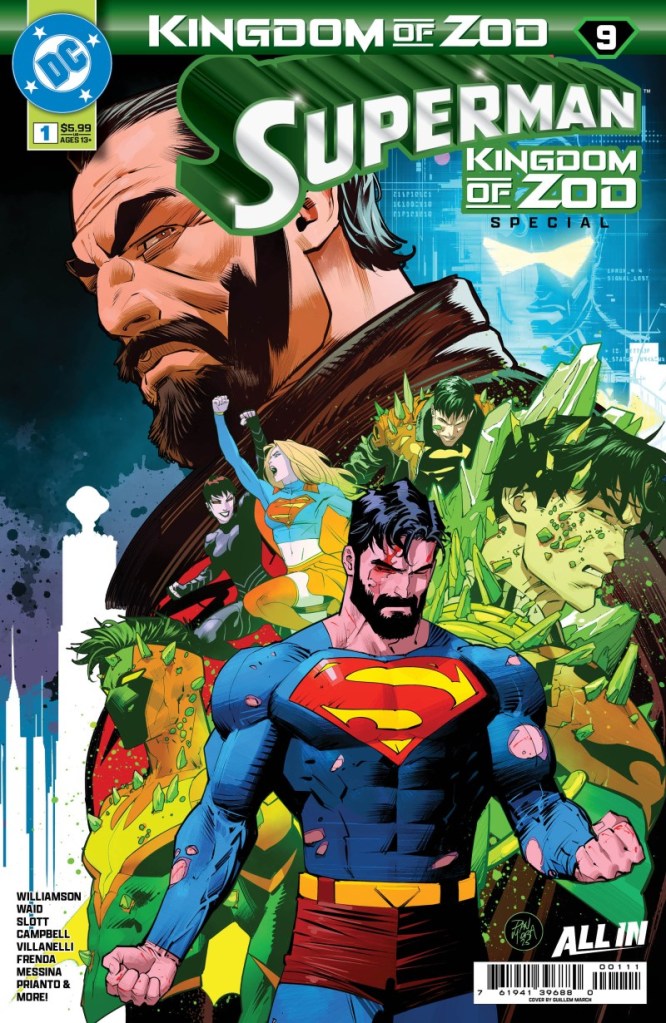
Superman: Kingdom of Zod Special Title: Kingdom of Zod Part Nine Writer: Joshua Williamson Art: Paolo Villanelli Main Cover: Dan Mora Supergirl Epilogue By: Sophie Campbell, Tamra Bonvillain & Josh Reed Action Comics Epilogue By: Mark Waid, David Messina, Ivan Plascensia & Josh Reed Superman Unlimited Epilogue By: Dan Slott, Rachael Stott, Giuliano Peratelli & Josh Reed Superman Epilogue By: Joshua Williamson, Bruno Frenda, Luis Guerra & Josh Reed
It’s hard to get too much into this without delving into spoilers. There’s a great fight scene, but it’s actually not the main focus of the book. A lot of the threads of this story have been tied off already in the previous chapters, so all that’s really left here is for Superman and his family to deal with the time-lost Zod who came back from the era before Krypton’s destruction. As they do so, our various heroes are each given something different to deal with: Supergirl gets an artifact of the past that seems poised to set up her future. Tomorrow Man and his dad have a heart-to-heart about Jon’s new direction. The time-travelling Superboy has to deal with the knowledge of his future that he’s picked up along the way. And the other two Superboys – Prime and Conner Kent – each have decisions about their own future to make.
The Conner stuff is, as I mentioned in one of the previous chapters, one of the few parts of this story that gives me concern. We’re seeing a bitterness in the character that doesn’t really suit him. At the same time, it’s understandable: with both Jon and Prime around, he feels like he’s been shunted aside, and honestly, that’s a fairly accurate metaphor for the way fans of his have felt all the way going back to the New 52 reboot. People have been in agreement for quite some time that Conner Kent is a character in need of a new direction, and it seems that Williamson is preparing to finally tackle that story. I’m trusting that he’s too good a writer to make that new direction follow the cliched path of turning him into a villain.
The actual confrontation with Zod is good, but over with surprisingly quickly. The bulk of this issue is concentrated more on putting pieces into place for the future. The creative teams of each of the four respective Superman-family titles each get an epilogue sequence focusing on their own core cast and giving a taste of what we presume will be the next story arc in each. I don’t mind them doing that, but I do feel a little as though it came at the expense of the conclusion of the actual Zod storyline.
As a whole, I’ve enjoyed Kingdom of Zod. Having a new chapter coming out every week made it feel just a little like the glory days of the Triangle Era again, and I miss that period greatly. The ending could have been a bit stronger, but I’m excited to see what comes next.
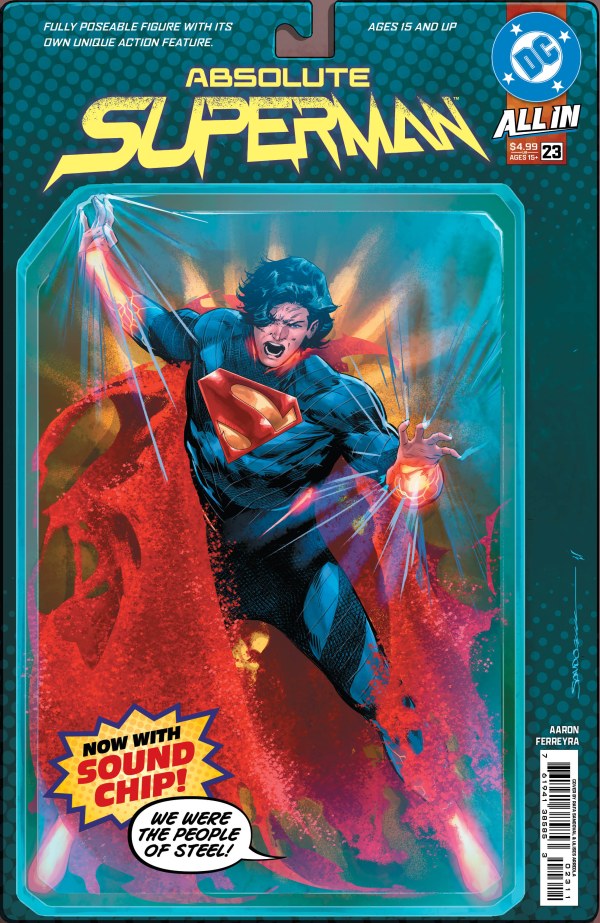
Absolute Superman #23 Title: The Toyman (Get Brainiac Part Two) Writer: Jason Aaron Art: Juan Ferreyra Main Cover: Rafa Sandoval
As the Toyman rears his head again, Kal flashes back to a harrowing childhood experience back on Krypton. And of course, Brainiac lingers in the background.
The A-plot here is about Superman seeking the Toyman, whose murderous playthings have been enhanced thanks to a collaboration with Brainiac. That’s all well and good, but honestly, it’s not the part of this book that I’m particularly interested in. It’s the flashback scenes that really get my attention this month. It’s easy to forget just how different this Kal-El is from the one we knew. He lived a whole childhood on Krypton before it was destroyed, he has memories of his birth parents (both good and bad) and an awareness of the culture of his home planet that the main timeline Superman lacks. And this is a very different Krypton than the one we know, a fact accentuated by the awful thing that young Kal-El stumbles upon and the explanation for it he receives from his mother. The main Superman comics have had so many stories and miniseries that explore life on pre-cataclysm Krypton that it’s practically become a cliche. This is one situation where I think an exploration of the world that was would actually be warranted. Come on, DC – Absolute Jor-El and Lara? Guaranteed seller.
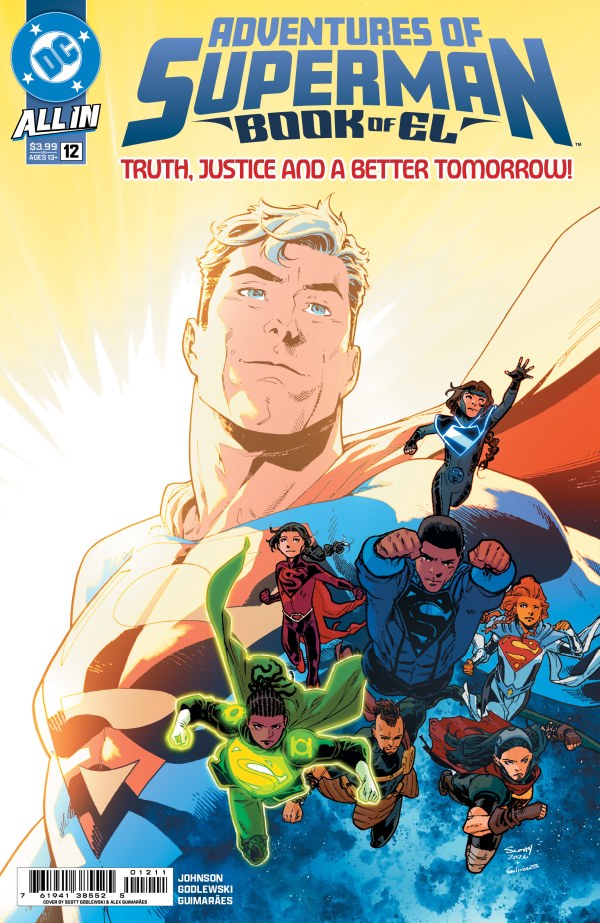
Adventures of Superman: Book of El #12 Title: Finale Writer: Philip Kennedy Johnson Art: Scott Godlewski Main Cover: Scott Godlewski
The House of El makes its final stand against Kryl-Ux, and with a Kryptonian carrying the power of a god, even an entire super-family has its work cut out.
I…don’t even know anymore. This series from the outset has felt so divorced, so removed from everything that engages me about the Superman mythos. Pulling him into the distant future, setting up a whole mystery that is predicated on him never coming home…it’s been hard to take it seriously. And the finale of the storyline doesn’t help with that. Ultimately, it still feels somewhat inconsequential.
I’ll give it credit for a few things. The heart of this series is definitely in the right place. Johnson gives the story a focus on all the good things about Superman: compassion, redemption, a belief in the best of us. Those elements are at the heart of all the best Superman stories, and we’ve got that here too. Also, I appreciate the fact that the book didn’t have as hard a reset as I came to expect, and that it wasn’t just an excuse to wipe Otho and Osul off the map. In the end, their story is still there and available. It does raise the question, of course, of where the hell they’ve been in the main Superman comics as of late. There’s an answer available in this issue, but it’s something they’re going to have to address sooner or later.
The best thing I can really say about this series, in the end, is that I’m quite certain it will read better as a whole instead of in chapters the way it’s been parcelled out over the past year. It’s certainly happened before. I was kind of underwhelmed at Supergirl: Woman of Tomorrow as a monthly series because of the slow burn, but when it was over and I read it as a single book I was deeply moved and impressed. I hope that will be the case here as well. I’m not going to do it anytime soon – I need a little time away from it to clean the slate – but perhaps some time next year I’ll go back and try to read it as one unified story. If I do, I’ll be sure to tell you what I think about it on the second go-around.
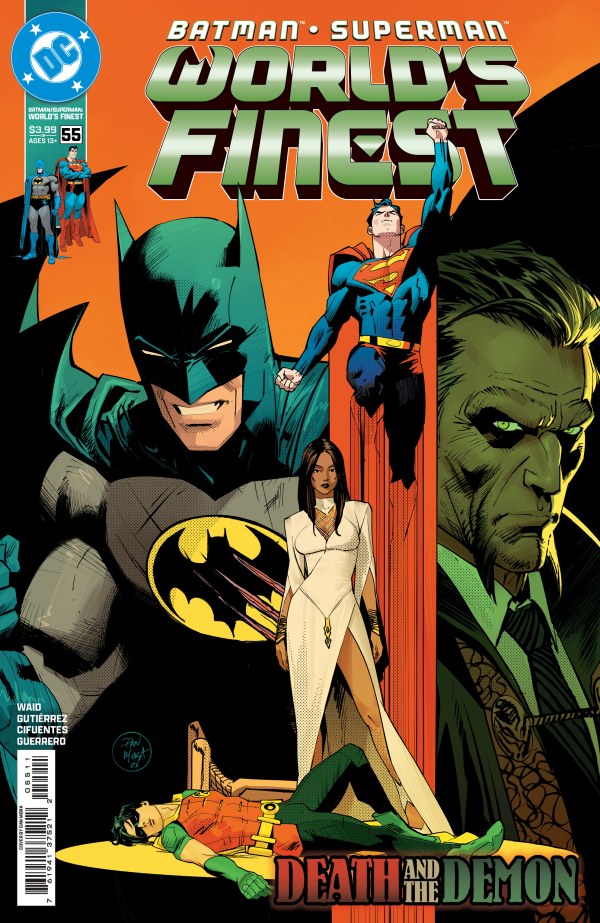
Batman/Superman: World’s Finest #55 Title: Extinction Event Part One Writer: Mark Waid Art: Adrian Gutierrez Main Cover: Dan Mora
With most of the Justice League off-planet, Ra’s Al Ghul assembles a group of villains who share his cause to exterminate most of human life. With his new harbingers of the apocalypse, he unleashes a devastating attack that begins spreading illness across the globe. Superman and Batman are among Earth’s remaining defenders, but when the sickness strikes too close to home, even the Dark Knight may be compromised.
One of the many things that makes Mark Waid’s run on this book is how well he straddles the line between huge storylines of global significance and small, character-focused stories. This issue, for instance, as if Queen Bee’s swarm of alien insects threatening an apocalypse wasn’t bad enough, one of the early victims is somebody that we – and the other heroes – care deeply about. It hurts a little that this book is set in the past and, as the stricken character is someone who is alive and well today, there’s not really a question of IF the heroes will succeed, but rather HOW. On the other hand, it’s still Batman and Superman we’re talking about here, so is there really any question as to whether they’re going to beat the bad guys in the first place?
Getting past that, Waid really explores the way these events affect our heroes. Batman is already approaching the story from a place of conflicted emotion, considering that his primary informant is Ra’s Al Ghul’s daughter Talia. This seems to be the first time Superman learns about the whole Batman/Talia thing as well, which puts him in a bit of a pickle. Bruce is his best friend, of course, but can he be counted on to be at his best? It’s a great way to get into the relationship between the two, with a degree of mutual trust that’s impaired just because Batman himself is too emotionally invested in the whole thing.
It’s another excellent issue. I’ve come to expect nothing less.
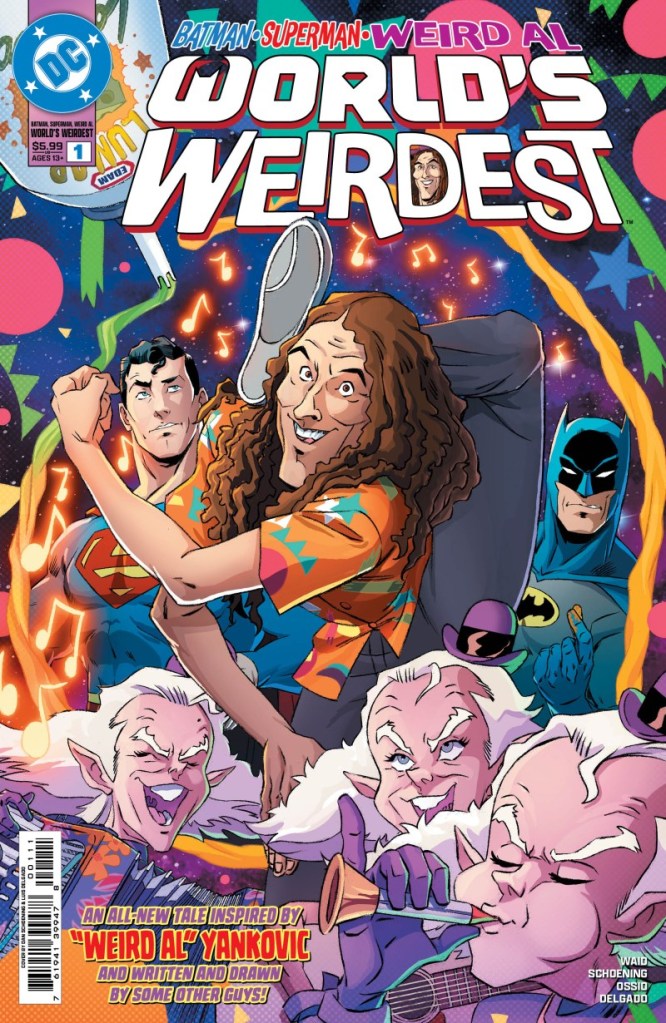
Batman/Superman/Weird Al: World’s Weirdest #1 Writers: Mark Waid & Tyrone Finch Vibes: “Weird Al” Yankovic Art: Dan Schoening & Fico Osso Main Cover: Dan Schoening
At last! My two favorite heroes in an adventure together with Batman!
In this deliciously absurd one-shot, Mr. Mxyzptlk’s cosy home in the Fifth Dimension is unsettled when everything strange in his world starts to become…normal. Terrified, he goes to Earth to find Superman for help, only to find the plague is striking there as well Mxy, Superman, and Batman quickly discover the key may be the one person who seems to be immune to the “Mundanity Wave” striking both worlds: “Weird Al” Yankovic.
This story is silly, absurd, totally inconsequential, and has no reason whatsoever to exist. I loved it. Look, I’m an easy sell. Obviously I read anything that has Superman in it, and “Weird Al” is perhaps the last remaining celebrity on Earth that everybody likes (now that we’ve lost Dolly Parton), so it wasn’t really an uphill battle to get me on-board for this one. But that doesn’t mean it’s not still a fun read. Seeing how different DC characters become “normal” when hit with the Mundanity Wave is as weird as anything that’s being turned mundane. (Somehow the Joker in a normal suit and with a normal skin tone is more unsettling than the psychotic clown we all know and love.)
The villain reveal is a great one, too. It’s not somebody that we see all that often, a relatively obscure villain to anyone but fans of the series that birthed him, but he’s absolutely perfect for this book. Mark Waid’s knowledge of the DCU remains unparalleled, even as he’s able to take a quick dig at himself at one meta-moment.
I haven’t seen a lot of Dan Schoening’s work since IDW’s Ghostbusters series wrapped up, but he’s a good choice for this book. After years of chronicling adventures of characters that looked almost, but not QUITE, like Bill Murray and the boys, he’s got a good eye for near-caricature that suits his depiction of Al very nicely. He also has a light touch with his line, crafting a book that looks almost like a cartoon, which is entirely appropriate.
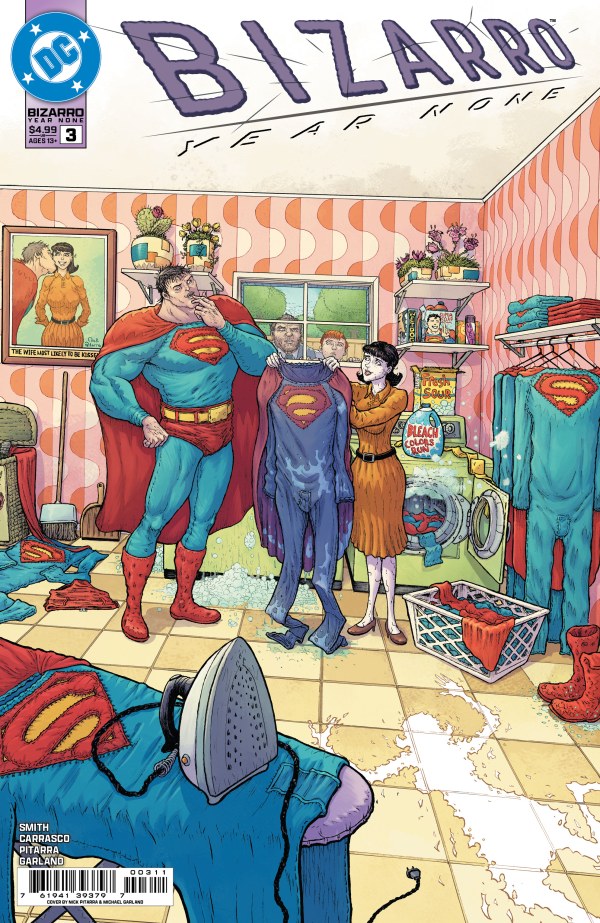
Bizarro: Year None #3 Title: How Do I Look? Writers: Eric Carrasco & Kevin Smith Art: Nick Pitarra Main Cover: Nick Pitarra
Jimmy Olsen spends a day with Bizarro on his Bizarro world, and the two of them each begin to realize just how different from Superman he actually is. In the meantime, Bizarro Lois and the others on her world began making their moves to change things about the planet they’re essentially trapped on.
You know, when they said “Kevin Smith is writing a Bizarro origin story,” I bet a lot of us were expecting a sort of goofy, silly exploration of a character that more often than not is played for a joke. We were wrong. Moments of humor in this issue have become few and far between, and the exploration of Bizarro has never been less amusing. It’s like we’ve delved into an exploration of the Bizarro from the first few scenes in Whatever Happened to the Man of Tomorrow?, a deeply troubling creature that’s every bit as strong as Superman but possesses none of his kindness or humanity. It’s actually a bit frightening.
The really baffling thing about the book is where it belongs, in a publishing respect. The solicits for this series have referred to it as the “official” origin of Bizarro, but those same solicits are written in Bizarro-speak, also calling the series “terrible.” So it’s not official, we got that. It’s also not labeled as an Elseworlds, although it could be. But honestly, as dark as this story has gotten, I’m wondering why the heck it’s NOT marked as a Black Label comic. It would fit there much more than most of the Superman books that have carried that particular sticker.
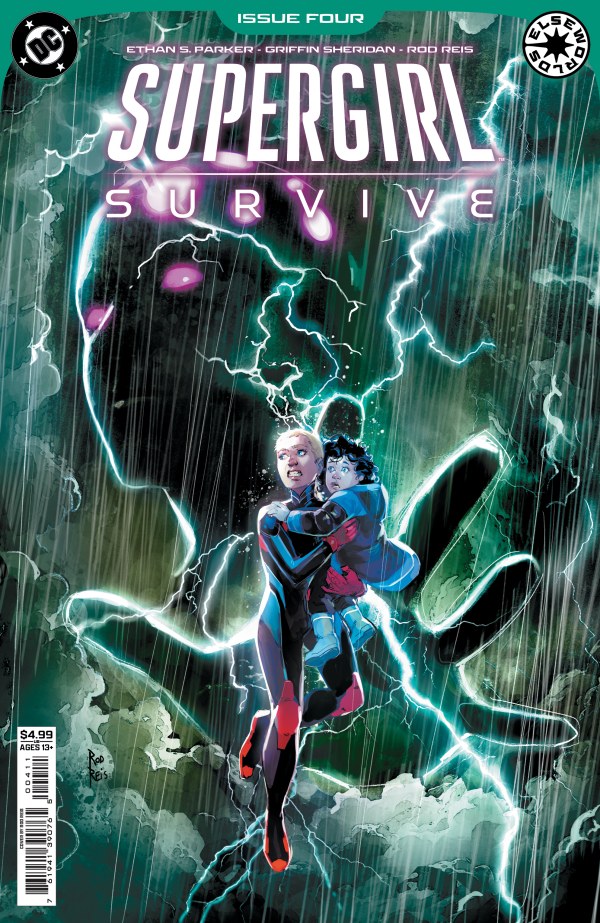
Supergirl: Survive #4 Writers: Ethan S. Parker & Griffin Sheridan Art & Main Cover: Rod Reis
Finally having reached a planet with a yellow sun, Kara and Kal-El are beginning to taste the power that being a Kryptonian truly brings with it. But despite their power they’re still stranded, with no way to get to the distant planet Earth that is their destination…until they encounter another visitor to this world who may be able to help them.
As they did with the Lantern Corps and Lobo in previous issues, this month Parker and Sheridan bring in another DC character to build out this other universe. This time, it’s one who has links to the Superman family to begin with, and he falls into his role quite naturally. As an Elseworlds, one is forced to wonder whether his gregarious nature is going to turn out to be a long con and he’s really up for some supervillainy, but so far there doesn’t seem to be any overt indication of that, and I’m glad. It would be a pretty tired trope for this character to go bad, and it’s about time poor Kara got a break.
Another couple of time skips in this issue and we’re watching as Kal-El grows from baby to child, with a personality beginning to develop. So far, he’s coming across as a fairly typical kid, albeit one with remarkable powers. He gets frustrated, he gets scared, and he turns to Kara – his protector, his only family – when that happens. Like this month’s guest star, Kal-El could go in many directions, but we’re definitely getting the sense that Kara is doing the best she can to steer him, which can’t be easy with a super kid.
Once more, I’m really impressed with this book, and I want to see this iteration of the DC Universe explored more and more.
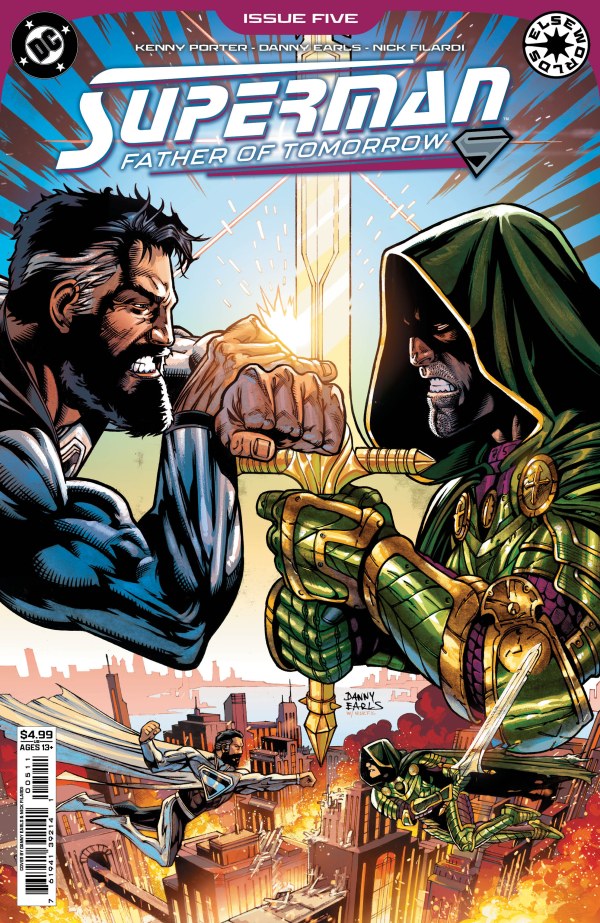
Superman: Father of Tomorrow #5 Title: Strife Writer: Kenny Porter Art & Main Cover: Danny Earls
One issue from the end, Father of Tomorrow takes another step in the right direction. As the sorcerer Lex Luthor makes his move on Metropolis, Jor-El confesses the events that led to his exile on Earth and why he came alone. Luthor, meanwhile, faces off against Lois Lane’s father Sam, who has become this world’s Captain Atom.
My favorite thing about this whole series has to be Luthor playing with magic. It’s intriguing to see him push his genius in this direction rather than science, but he avoids coming off as just a Dr. Doom clone. This is still Luthor through and through, with all the pettiness and ego that implies. He points out of the hypocrisy of Sam Lane’s anti-superhuman stance now that he’s turned himself into one of the world’s powerhouses. He is faced with an extremely real threat and shrugs it off because, you know, he’s LEX LUTHOR, so what could possibly touch him? It’s a great new angle for a classic villain.
The reveal about Jor-El’s past works well, and it gives his position on Earth a little added flavor of tragedy, although I feel like it’s something that could have come earlier in the series. It does explain his urge to “fix” things in a way that’s suitable. My big problem with this series to date has been people opposed to Jor-El “fixing” Earth without actually providing much evidence that there’s any downside to his changes. We still don’t get any of that this issue, but we don’t dwell on the idea that his changes are bad either, so on that front I’m gonna call this issue a draw and look forward to next month’s finale.
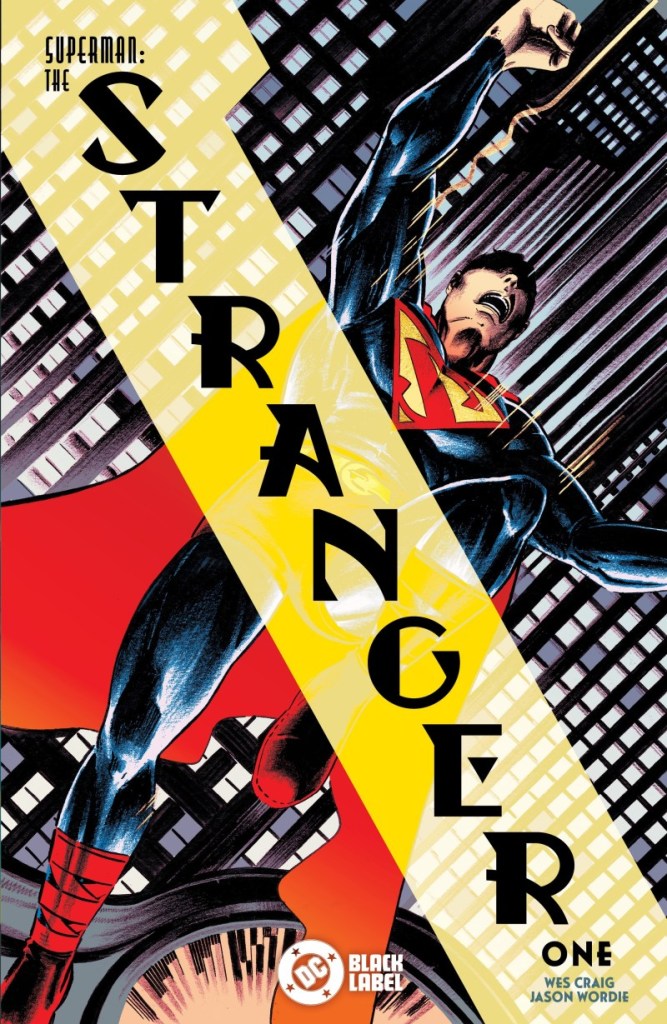
Superman: The Stranger #1 Writer, Artist, and Main Cover: Wes Craig
The newest “Black Label” series featuring the Man of Steel dives back to the Golden Age. In a Metropolis where people are struggling to get by, young Clark Kent is desperately trying to get a job as a reporter while, at the same time, using the bizarre powers he has to patrol the city at night as Superman, defender of the defenseless. But a chance encounter in an alleyway sends him questioning where the real villains may lie.
I’m very much on the fence about this book. First of all, the vagary of the Black Label imprint continues to be an issue. Ostensibly a line of “mature” comics featuring the DC heroes, the Superman books in this series have very rarely had any content that would mark them as such. The “17+” rating on the back cover in tiny little letters doesn’t seem appropriate, and I can’t find anything that makes me think this shouldn’t be an Elseworlds, since that imprint has returned from the dead.
That’s more of a fault of editorial than the comic itself, but the comic itself leaves me with concerns. Frankly, it feels like we’re just exploring some well-worn territory. A Golden Age Superman? Seen it numerous times since the Golden Age. Superman versus corporate greed and corruption (as embodied, of course, by Lex Luthor)? It’s so familiar you could draw it in your sleep. I need something more original to justify the $5 price point of this book.
That’s not to say there’s nothing promising. Clark, honestly, seems to have more to distinguish him from other incarnations of the character than Superman himself. His thirst to work at the Daily Planet has him settling for a job at the very bottom of the pole, and I’m not talking editorial. And despite the fact that his name is, as usual, “Clark Kent,” there are some ruminations in this book that call me to question whether he was actually raised by the Kents or if his Earthly origins are different than what we’re used to. That question remains dangling at the end of this issue, which is fair enough, but I’m hoping that we return to it in the future, because so far there’s little to set The Stranger apart.
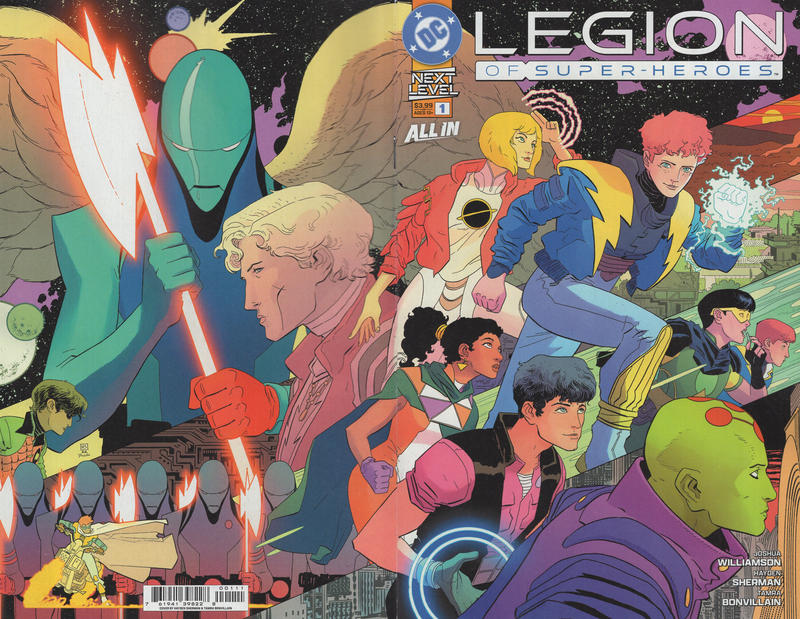
Legion of Super-Heroes #1 Title: Who Killed the Future? Writer: Joshua Williamson Art & Main Cover: Hayden Sherman
I wasn’t necessarily planning to write a review of this book. After all, this column is “Superman Stuff,” not “Superman’s Friends Stuff.” But the Legion is, in many ways, as much a Superman spinoff as Supergirl, Steel, or Krypto, and I don’t hesitate to write about those. Plus, even though Superman doesn’t actually appear in this issue…well, he’s all over it.
I am on the record as saying we do not need yet another reboot of the Legion of Super-Heroes, and I am standing by that statement. But if you’re gonna do it, Joshua Williamson has found a good way in. The book begins with the murder of R.J. Brande, a name familiar to Legion fans, whose death is being investigated by the unlikely duo of Brainiac 5 and Tenzil Kem. As they search for the facts behind Brande’s death we are introduced to this version of the future: how super-heroes are outlawed, how anybody who develops super powers is required to register them with a peacekeeping force called the Persuaders, and how many people don’t believe the legendary “Superboy” ever even existed. From there, we glimpse at the lives of three very familiar super powered young people, and the shape of this story begins to come into focus.
What’s making this story work for me, along with a healthy dollop of faith in Williamson as a writer, is Garth Ranzz. We see a Lightning Lad here with a thirst to be a hero, a craving for justice, and a locker whose contents could very well have been my own. A one-page glimpse into the legend of Superboy at the beginning serves to frame his desire for a different, better world, and even in one issue that craving feels infectious. It’s going to be rough on him when this issue’s last-page revelation hits home, but I feel like he’s going to be resilient.
And that drive, that thirst seems infectious. Imra and Rokk both appear here as well, and although none of our proto-Legionnaires interact in this first issue, we get the sensation that they’re already linked, and that the threads that link them and that will draw them together go back 1000 years to the age of heroes.
I liked this first issue very much, and I’m anxious to see how Williamson is planning to tie it into the revelations from this summer’s Superman Annual. But I don’t know if I’m planning to review every issue of this book. It’s not a Superman comic, after all. Except for in all the ways that matter.
Blake M. Petitis a writer, teacher, and dad from Ama, Louisiana. His most recent writing project is the superhero adventure seriesOther People’s Heroes: Little Stars, volume one of which is now available on Amazon.Don’t forget, you can check out earlier blogs in theYear of Superman/Superman Stuff Archive! Got a request for a future “Superman Stuff”? Drop it in the comments!
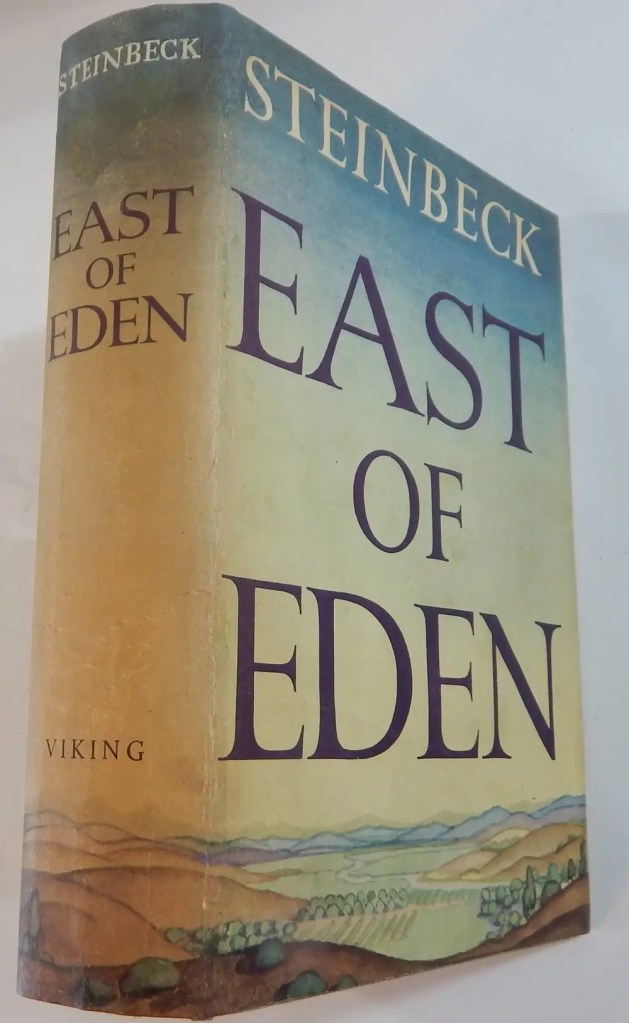
If you can remember back a full seven days to my previous Geek Punditry column (#194: Can We Just Let Bad Guys Be Bad?), you may recall that the discussion was spurred by the announcement of a new Netflix miniseries adapting John Steinbeck’s novel East of Eden. The book lovers among you will not be surprised to learn, then, that as I spent some time pondering the changes being made between the book and the show, I got a hair up my nose to give the book another read. This was a little difficult, however, when it came to my attention that I suffered from a chronic condition shared by over 7 billion people on this green planet of ours: I don’t actually own a copy of East of Eden.
And I feel like it’s judging me for that.
I own books, of course. I own a LOT of books. And the recent shenanigans by people like the bastards at Anthropic have made me more adamant than ever that owning as many books as possible is a good thing. That said, I DO have a limited amount of storage, and I’ve drifted more towards eBooks for most of my casual reading. I still love physical books, but unless it’s a keepsake (like a signed edition or something written by a friend of mine), something that’s unavailable in eBook format, or a book I need to complete a collection, I’m usually satisfied with the electronic version. So I decided to look into how much the eBook of East of Eden costs.
$12.99. And I looked at that $12.99 with the same sort of distrust that you look at the current prices at whatever gas pump is nearest to your house.
Look, I am a writer, and I believe wholeheartedly in paying writers what they’re worth. That said, I also believe that anyone charging more than ten bucks for an eBook is gouging you, because there are virtually none of the production, shipping, or storage costs involved with creating a print book. And when it’s a book that’s nearly 75 years old, the incredulity just rises.
That afternoon, I happened to be taking my son on our biweekly trip to the local library. While we were there, I thought, I should just check the book out. That’s what libraries are FOR, after all. They are a vital part of our community, and by NOT checking out books, I am doing them a disservice. It was such an obvious solution. So after convincing Edward that he actually had to follow ME through the stacks for a change, instead of me racing after him on a frantic search for the kitty pictures hidden around the children’s room as part of the library’s monthly scavenger hunt, I tracked the Steinbeck book down and looked at it.
I reeeeeally looked at it.
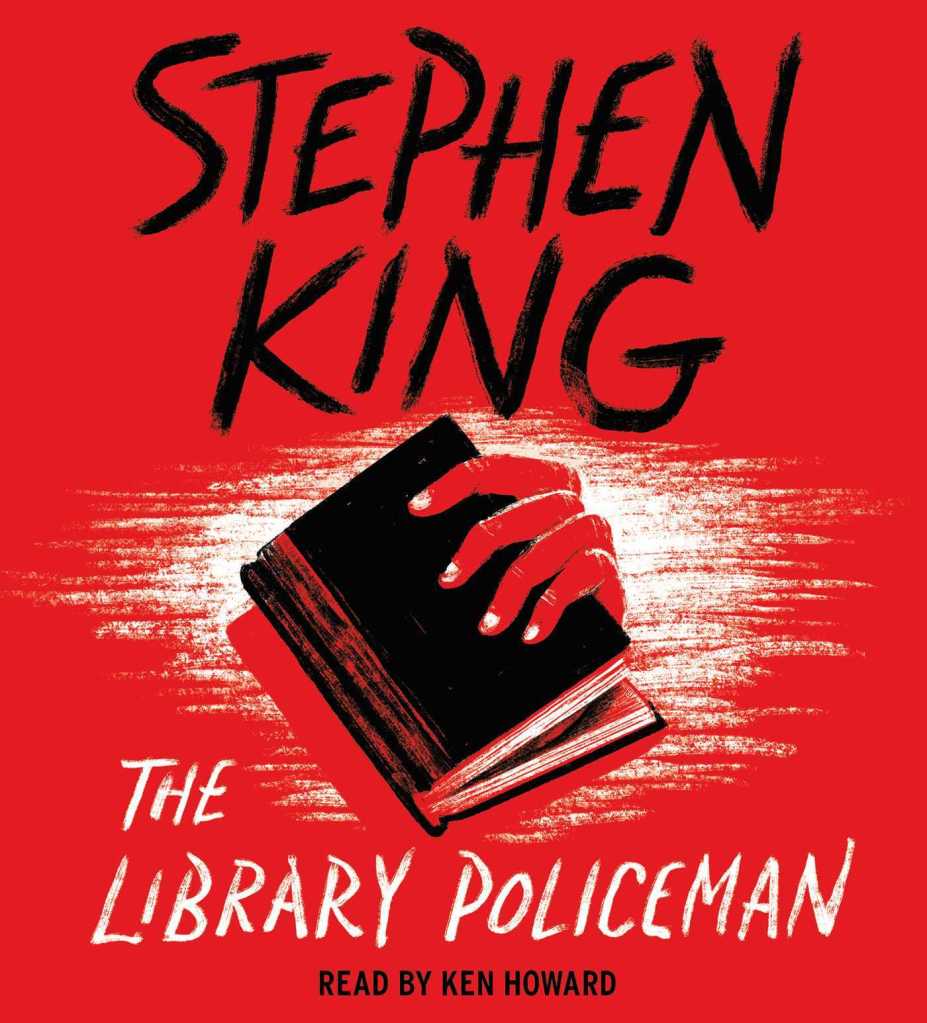
East of Eden is Steinbeck’s longest novel. And by “longest,” I mean it clocks in at about the same page count as Stephen King can turn out on a typical Sunday in October – it’s hefty. Let’s be clear about this: I do not mind a long book. I am by no means intimidated at the idea of reading a doorstopper. But I am also realistic, and I had serious doubts about my ability to finish the book and return it to the library in a timely manner. And even though the good people who work at the St. Charles Parish Public Library (Destrehan Branch) are uniformly kind, friendly, and helpful, I also reread Stephen King’s The Library Policeman a couple of months ago and I didn’t want to risk it.
Yeah, yeah, “it’s just a book” — SOME OF US CAN’T TAKE THAT CHANCE.
Anyway, I told myself, I’m an English teacher. I really should OWN a copy of such a seminal work in the canon of American literature. I should just get a paperback instead. So I looked it up: $20.
Then I went back outside to stare at the gas station again.
I remember a time – a time not all that long ago – when most paperback books fell in the $5.99 to $7.99 range. And sure, East of Eden is a huge book, clocking in at over 600 pages. But I started to look around at the NEW release paperbacks as well, many of which would take a full three or four whacks to kill a mouse, as opposed to the one thump that East of Eden would require, and I saw that $20 was about the average price these days. Part of that is because American publishing has all but abandoned the mass market paperback: the smaller sized and more affordable book that was ubiquitous for decades, small enough to fit into a largeish pocket, the glorious format upon which most people born before the turn of the century learned how to love books. Sadly, after making books accessible to the masses for nearly 100 years, this format has become almost nonexistent. If you ask publishers and distributors why that is, a lot of them will tell you that “the market” was no longer purchasing them, was no longer interested in them. As a member of “the market,” however, I can tell you that I was never surveyed about this decision. I never reached a point where I thought, “You know, I’m going to buy this larger version of the book that costs twice as much.” I just noticed that the smaller, less expensive versions were no longer being published for some reason.
Although I have no statistics, quotes, or data, I firmly believe that the push away from mass market was spurred almost entirely by a publishing industry that wanted an excuse to increase its prices. And again, writers deserve to be paid. But I don’t believe for a second that, in the vast majority of cases, the inflated price tag on these books has equaled an increased cut for the person who actually created the book. Almost universally, the added revenue being collected is going into the coffers of the publisher, which of course provides the invaluable service of deciding which books they want you to spend money on.
I also believe – without statistics or data – that this format shift is also at least partially responsible for the decline in literacy in America. Look, there are a lot of reasons that people might not want to read books: social media, video games, other media drawing their attention, being afraid of being labelled a “nerd,” difficulty finding books that match their interests, their mother read Danielle Steele that one time she got hit by an ice cream truck and there’s no WAY they’re taking THAT risk, and so forth. But I think the fact that books are no longer cheap enough to be an impulse purchase makes every single one of those problems even worse than it already is.
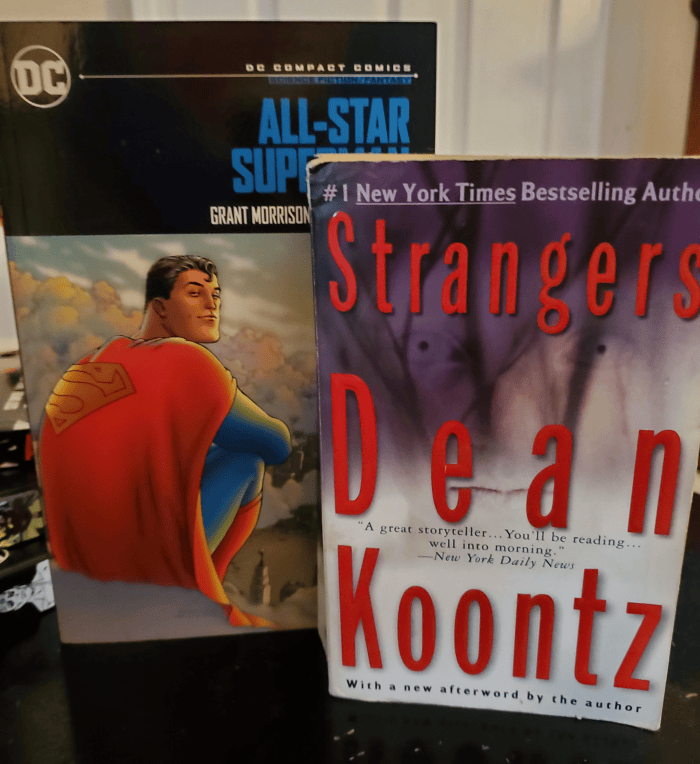
The funny thing is that while traditional publishing is doing everything it can to make it harder for people to become a part of their audience, comic book publishers are doing the OPPOSITE. I’ve written at length about DC Comics and their “Compact Comics” line, (In GP #119, GP #124, GP #164, and GP #178, but who’s counting?) so I’ll just do a quick recap here. DC now has a line of paperback editions of some of their most popular stories and graphic novels in a smaller format – ironically, about the same size as most of the paperback novels that have shoved mass market paperbacks into their grave. These Compact Comics collect the same stories that are published in traditionally-sized graphic novels, which usually have a price point ranging anywhere from $20 to $40, depending on the length. DC’s Compact Comics, however, have a uniform price tag of $9.99. And this format has proven to be a MASSIVE hit, selling out printing after printing not only in comic book stores, but in big box bookstores and other places that people buy books, like Walmart and Target. The line is so successful that nearly every other major comic book publisher has responded with their own line of smaller-sized bargain-priced paperbacks, and the result is an easily-accessible, affordable series of books that is appealing to both old and new readers alike.
Size-wise, these two books are everything you could want. Content-wise…well, one of them is.
Compact Comics also blow the argument for a $20 paperback out of the water. While a traditional book may have to pay a designer, a cover artist, and a few other people besides the author, a comic book has many, many more hands than that: multiple writers and artists, colorists, letterers, editors, and so forth. And while each of their pieces of the pie may be smaller than those of a single author who has written a single novel, the color pages and the paper that holds those images is also of a better stock than your usual paperback. The production cost for a Compact Comic is inarguably higher than that of a novel, and yet DC can afford to sell them for half the price.
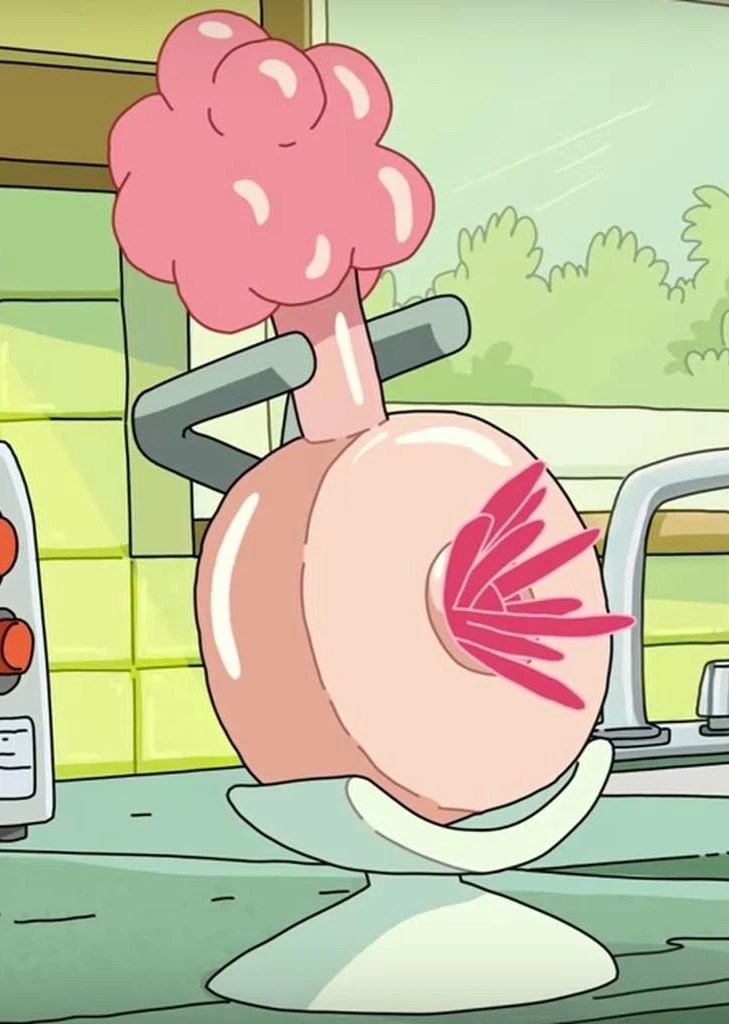
To put it another way, if I have $20 in my pocket, I can buy Steinbeck’s East of Eden, or I can buy a copy of Mark Waid and Alex Ross’s exquisite graphic novel Kingdom Come AND have enough money left over for compact anthology of comics from Oni Press’s Rick and Morty series. And I’m sorry, but Steinbeck never ONCE included a plumbus in any of his novels, so this isn’t even really a contest.
If you look hard enough, though, you can probably find one in Shakespeare.
As a teacher, a writer, and a reader, I hear the phrase “literacy crisis” thrown around on a daily basis. Authors are desperately hustling to try to get readers. Readers are finding themselves in a cultural wasteland as it becomes more difficult to find people in your daily life that you can share your love of books with. Teachers are crawling behind students on hands and knees BEGGING them to read just a chapter or two of The Great Gatsby, because there’s a scene where a woman gets hit by a car, maybe because she’d read a Danielle Steele novel, I dare you to prove that she HADN’T. In fact, EVERYBODY seems to be doing anything they can to try to get people reading again.
Everybody, that is, except for the companies that have established themselves as the de facto gatekeepers of the entire world of literature: the publishers. Rather than making books available and attractive to as many people as possible, they seem to be on a quest to identify micro-cohorts of potential readers and squeeze every drop of cash out of THEM, rather than make reading appealing to the masses.
It’s an insane practice, but that’s the world we live in.
I broke down and got the Kindle version of the Steinbeck book, by the way. At $12.99, it would take me almost three years of late fines at the library to offset the cost, but by then I should be almost finished reading it.