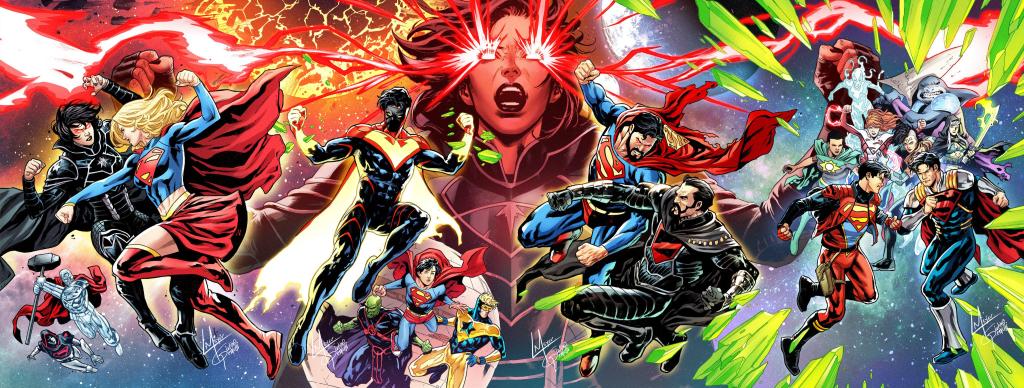
Superman Stuff #40: September Reviews

It’s time once again for a healthy helpin’ of reviews. Here are most (if not all) of the Superman-related comics that hit the stands in September, including the second half of Kingdom of Zod, a few journeys to alternate universes, the “Weirdest” co-star Superman and Batman have ever seen, and the newest incarnation of Superman’s ORIGINAL Super Friends.
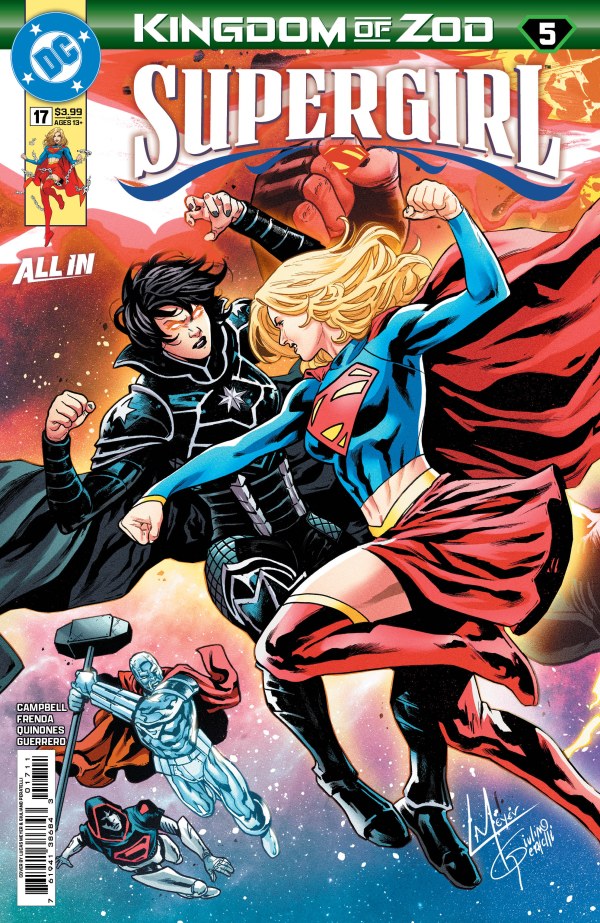
Supergirl #17
Title: Kingdom of Zod Part Five
Writer: Sophie Campbell
Art: Bruno Frenda & Joe Quinones
Main Cover: Lucas Meyer & Guiliano Peratelli

The second half of Kingdom of Zod kicks off with Supergirl and Superboy (the time-tossed Clark Kent from his teen years) getting caught in a time bubble with Ursa, who’s travelling to the past in an apparent attempt to save Krypton from discussion. The issue checks in briefly with the rest of our cast, including Lana and the Steels dealing with the Krytonite zombies, Superboy (Conner) and Superboy-Prime trying to help an injured Superman, and Lois doing the same with Jonathan. But each of these story threads is given no more than a page or two, with the bulk of the issue focusing on Kara and Clark’s adventures on Krypton.

There’s always a delicate balancing act with intra-family crossover events like this one. In the books where the “lead” character of the franchise (in this case, Superman) is the same as the lead of that title, there’s no real issue. When you have a chapter in an issue of a spinoff character – which Supergirl is, let’s be honest – you have to struggle between maintaining the focus on the person that the regular readers buy the book for and continuing the overall event that may have brought in new readers. Campbell accomplishes this really well. We spend most of the issue with Kara trying to teach a young, inexperienced Clark about the dangers of time travel while at the same time trying to prevent Ursa from making things worse. The interaction between the two of them is really entertaining, with Kara taking on the big sisterly role she thought she would have before she woke up on Earth that first time and discovered that her baby cousin was now older than her. I know that once this is all over Clark is going back to his own time, but I would love to see this dynamic played with more often. 

More importantly, the time-travel arc doesn’t feel like a superfluous side-story here, but part of the large whole, and that’s what you really want most of all when you’re reading a story like this one. It needs to feel consequential, or the readers will feel cheated. I don’t think that’s going to happen with anybody here.
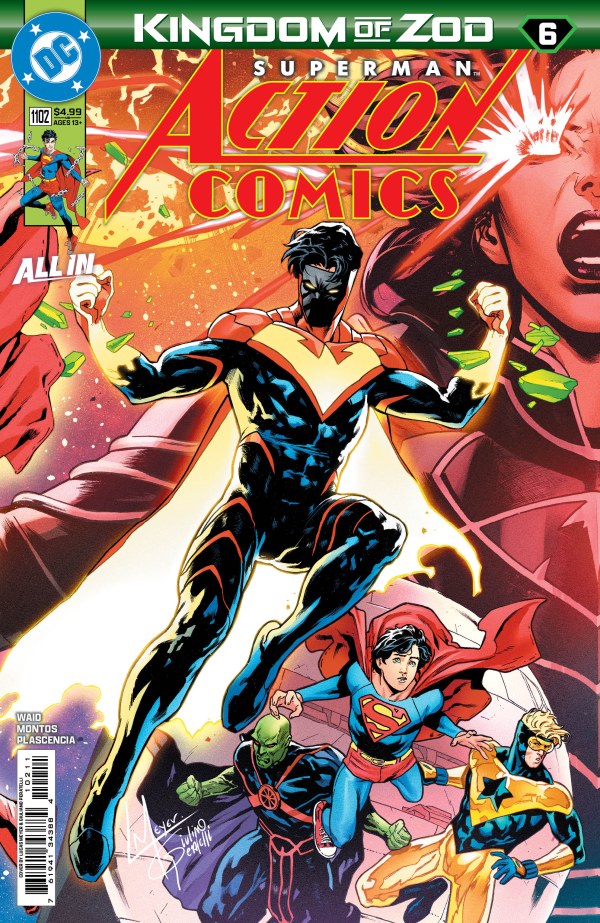
Action Comics #1102
Title: Kingdom of Zod Part Six
Writer: Mark Waid
Art: Montos
Main Cover: Lucas Meyer & Guilano Peratelli

Like the Supergirl chapter, Action Comics this month focuses mostly on young Clark and Kara on Krypton, although the side-stories progress a little bit further. Of course, they progress to a point where it just seems like it can’t get any worse. The adult Superman and his group finally reunite with Lois and Jon, but the one person who may be able to protect them from the growing Kryptonite radiation that’s engulfing Earth may not be of help after all.

But back in the past, back on Krypton, young Clark is separated from his cousin as Kara and present-day Ursa are taken into custody by past-Zod. Man, time travel makes these recaps harder to write. The gist of it is this: in this issue we see the teenage Clark that’s been the star of this title since Mark Waid took over have to make some of the choices and learn some of the maturity that’s going to characterize him when he gets older and becomes a true Superman, and that’s a great thing. If you read the classic Superboy stories of the Golden and Silver Ages, there’s not a lot of difference between the character as a teenager and as an adult. He’s the stalwart, confident paragon that we want him to be right from the jump, and while that’s a good thing for a mature Superman, it doesn’t make as much sense when you see him as a kid. Waid’s Superboy is someone who is still learning, still capable of making mistakes, but with a core of purity and decency that you can see developing into the all-loving hero that Superman is. This issue makes for a nice focus on that, a great examination of who Clark was and who he’s going to become, all mixed up in the larger storyline. It’s deftly played.
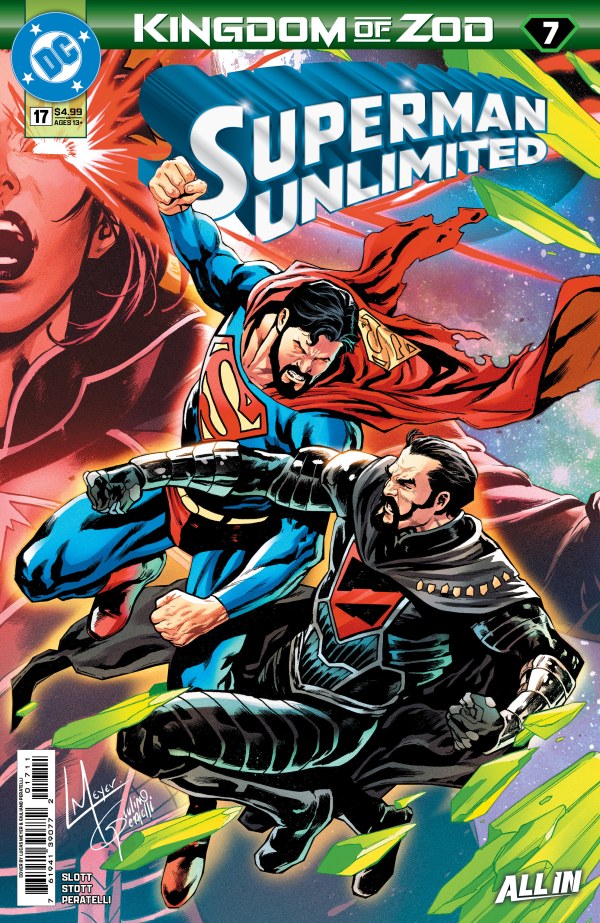
Superman Unlimited #17
Title: Kingdom of Zod Part Seven
Writer: Dan Slott
Art: Rachael Stott and Montos
Main Cover: Lucas Meyer & Guiliano Peratelli

Part Seven of Kingdom of Zod flips the formula from the last two issues – a quick check-in with Clark and company back on Krypton, with most of the issue in the present, and the wave of El Caldero Kryptonite radiation that’s threatening the entire Earth. But here’s the thing: early in the run of this series, Dan Slott gave Superman a little boost that just may be the thing to save the day.

This is one of those issues where somebody with super-speed does a whole lot of stuff really fast, where things zip along in much less time than it takes to tell the story. I like issues like that, because a good writer can use them to give us quick glimpses at the hero being the hero. As Superman is racing to save the world from the Kryptonite, we see him take moments with friend and enemy alike that remind us of just what kind of a man our hero is. Not that we necessarily NEED that reminder, of course, but seeing Superman in action doing what Superman does is always a treat, and Slott really nails it here. In the midst of this huge storyline, it’s the small moments for Superman that really make this issue worth reading.
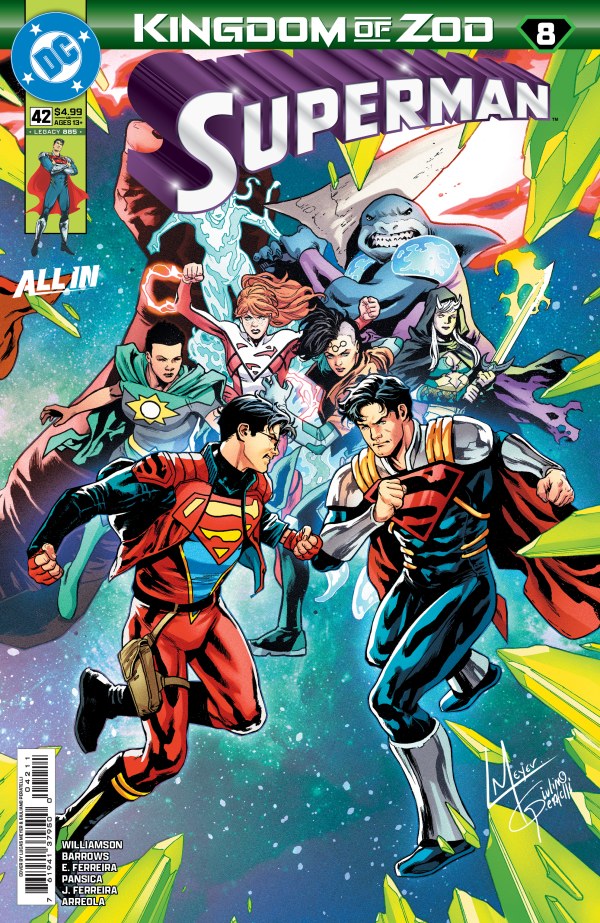
Superman #42
Title: Kingdom of Zod Part Eight
Writer: Joshua Williams
Pencils: Eddy Barrows & Eduardo Pansica
Inks: Eber Ferreira & Julio Ferreira
Main Cover: Lucas Meyer & Guiliano Peratelli

The penultimate chapter of “Kingdom of Zod” FINALLY brings all of our heroes together. Recovering from the Golden Mode adventure that cancelled out all of the El Calderan Kryptonite on Earth, Superman and his allies come together and learn (courtesy of Booster Gold) that Ursa stole his time-bubble, with Supergirl and young Clark going after her. This issue, they come back, along with a young Zod.

And all hell breaks loose.

Williamson, whose work on this title has made him one of my favorite Superman writers since the Triangle Era, is really showing how adept he is with these characters. Superboy-Prime meets up with Superman again for the first time since his self-proclaimed (and highly effective) Redemption Arc during the “Reign of the Superboys” storyline, and the moments where those two connect are really well-done. On the other hand, Conner Kent seems to be somewhat bitter about the whole thing, and I find myself desperately hoping that Prime’s redemption isn’t going to incorporate a heel turn for the other Superboy. I keep telling myself that Williamson is too good a writer for that. I am telling myself that very, very hard.

The huge cast that shows up in this issue comes together well, with good moments for Lois and Jon, Lena Luthor, and Superboy’s time-travel pals Mary Marvel and Martian Manhunter. Others are somewhat sidelined (I could always do with more Steel in this or any comic book), but that’s kind of the nature of the beast. The more characters there are in a story, the more likely some of them are going to ride the bench. And that’s especially true when you remember that, c’mon now, it IS Superman’s comic book.
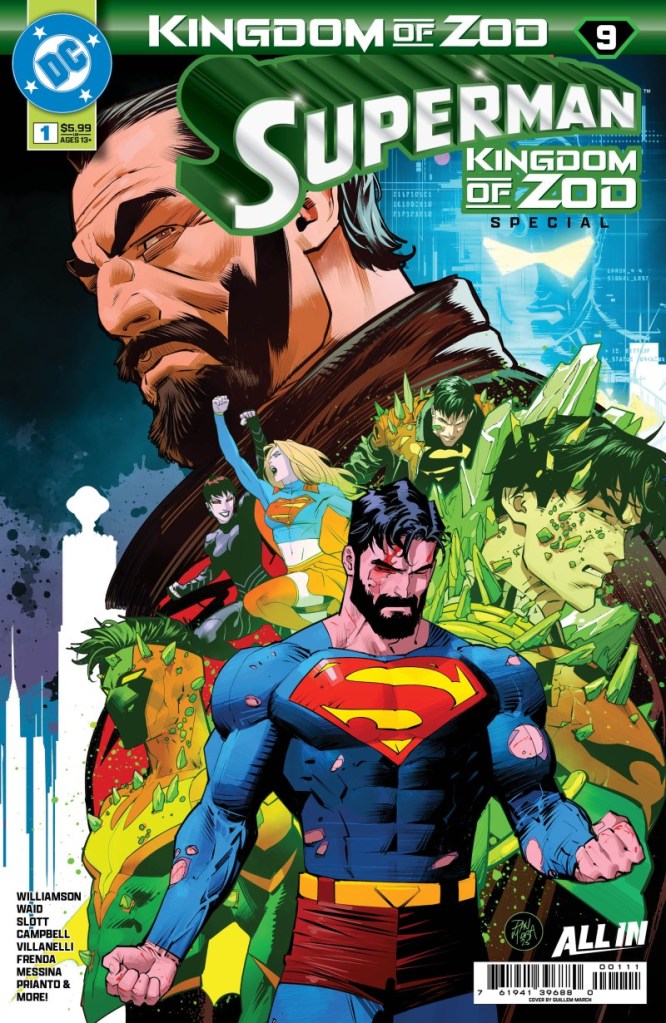
Superman: Kingdom of Zod Special
Title: Kingdom of Zod Part Nine
Writer: Joshua Williamson
Art: Paolo Villanelli
Main Cover: Dan Mora
Supergirl Epilogue By: Sophie Campbell, Tamra Bonvillain & Josh Reed
Action Comics Epilogue By: Mark Waid, David Messina, Ivan Plascensia & Josh Reed
Superman Unlimited Epilogue By: Dan Slott, Rachael Stott, Giuliano Peratelli & Josh Reed
Superman Epilogue By: Joshua Williamson, Bruno Frenda, Luis Guerra & Josh Reed

It’s hard to get too much into this without delving into spoilers. There’s a great fight scene, but it’s actually not the main focus of the book. A lot of the threads of this story have been tied off already in the previous chapters, so all that’s really left here is for Superman and his family to deal with the time-lost Zod who came back from the era before Krypton’s destruction. As they do so, our various heroes are each given something different to deal with: Supergirl gets an artifact of the past that seems poised to set up her future. Tomorrow Man and his dad have a heart-to-heart about Jon’s new direction. The time-travelling Superboy has to deal with the knowledge of his future that he’s picked up along the way. And the other two Superboys – Prime and Conner Kent – each have decisions about their own future to make.

The Conner stuff is, as I mentioned in one of the previous chapters, one of the few parts of this story that gives me concern. We’re seeing a bitterness in the character that doesn’t really suit him. At the same time, it’s understandable: with both Jon and Prime around, he feels like he’s been shunted aside, and honestly, that’s a fairly accurate metaphor for the way fans of his have felt all the way going back to the New 52 reboot. People have been in agreement for quite some time that Conner Kent is a character in need of a new direction, and it seems that Williamson is preparing to finally tackle that story. I’m trusting that he’s too good a writer to make that new direction follow the cliched path of turning him into a villain.

The actual confrontation with Zod is good, but over with surprisingly quickly. The bulk of this issue is concentrated more on putting pieces into place for the future. The creative teams of each of the four respective Superman-family titles each get an epilogue sequence focusing on their own core cast and giving a taste of what we presume will be the next story arc in each. I don’t mind them doing that, but I do feel a little as though it came at the expense of the conclusion of the actual Zod storyline.

As a whole, I’ve enjoyed Kingdom of Zod. Having a new chapter coming out every week made it feel just a little like the glory days of the Triangle Era again, and I miss that period greatly. The ending could have been a bit stronger, but I’m excited to see what comes next.
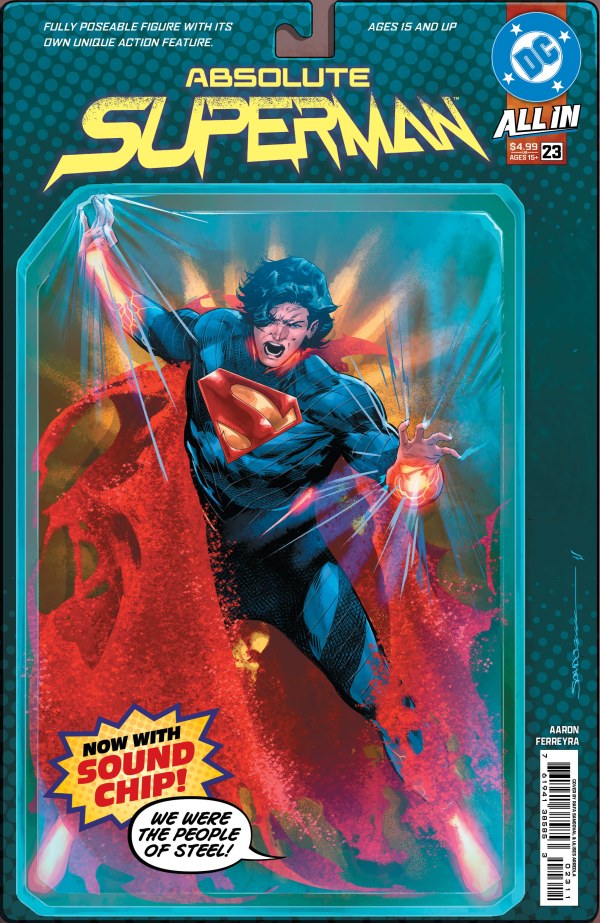
Absolute Superman #23
Title: The Toyman (Get Brainiac Part Two)
Writer: Jason Aaron
Art: Juan Ferreyra
Main Cover: Rafa Sandoval

As the Toyman rears his head again, Kal flashes back to a harrowing childhood experience back on Krypton. And of course, Brainiac lingers in the background.

The A-plot here is about Superman seeking the Toyman, whose murderous playthings have been enhanced thanks to a collaboration with Brainiac. That’s all well and good, but honestly, it’s not the part of this book that I’m particularly interested in. It’s the flashback scenes that really get my attention this month. It’s easy to forget just how different this Kal-El is from the one we knew. He lived a whole childhood on Krypton before it was destroyed, he has memories of his birth parents (both good and bad) and an awareness of the culture of his home planet that the main timeline Superman lacks. And this is a very different Krypton than the one we know, a fact accentuated by the awful thing that young Kal-El stumbles upon and the explanation for it he receives from his mother. The main Superman comics have had so many stories and miniseries that explore life on pre-cataclysm Krypton that it’s practically become a cliche. This is one situation where I think an exploration of the world that was would actually be warranted. Come on, DC – Absolute Jor-El and Lara? Guaranteed seller.
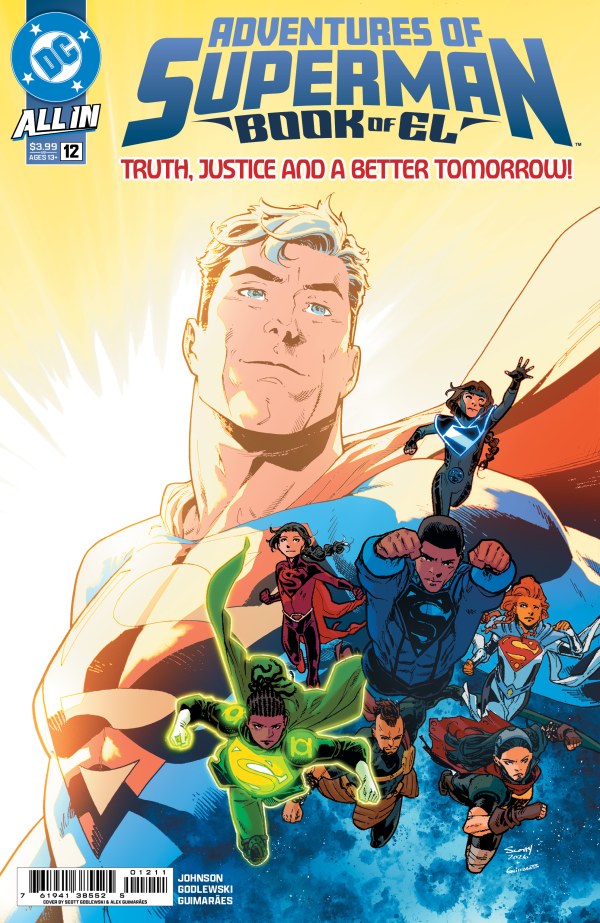
Adventures of Superman: Book of El #12
Title: Finale
Writer: Philip Kennedy Johnson
Art: Scott Godlewski
Main Cover: Scott Godlewski

The House of El makes its final stand against Kryl-Ux, and with a Kryptonian carrying the power of a god, even an entire super-family has its work cut out.

I…don’t even know anymore. This series from the outset has felt so divorced, so removed from everything that engages me about the Superman mythos. Pulling him into the distant future, setting up a whole mystery that is predicated on him never coming home…it’s been hard to take it seriously. And the finale of the storyline doesn’t help with that. Ultimately, it still feels somewhat inconsequential.

I’ll give it credit for a few things. The heart of this series is definitely in the right place. Johnson gives the story a focus on all the good things about Superman: compassion, redemption, a belief in the best of us. Those elements are at the heart of all the best Superman stories, and we’ve got that here too. Also, I appreciate the fact that the book didn’t have as hard a reset as I came to expect, and that it wasn’t just an excuse to wipe Otho and Osul off the map. In the end, their story is still there and available. It does raise the question, of course, of where the hell they’ve been in the main Superman comics as of late. There’s an answer available in this issue, but it’s something they’re going to have to address sooner or later.

The best thing I can really say about this series, in the end, is that I’m quite certain it will read better as a whole instead of in chapters the way it’s been parcelled out over the past year. It’s certainly happened before. I was kind of underwhelmed at Supergirl: Woman of Tomorrow as a monthly series because of the slow burn, but when it was over and I read it as a single book I was deeply moved and impressed. I hope that will be the case here as well. I’m not going to do it anytime soon – I need a little time away from it to clean the slate – but perhaps some time next year I’ll go back and try to read it as one unified story. If I do, I’ll be sure to tell you what I think about it on the second go-around.
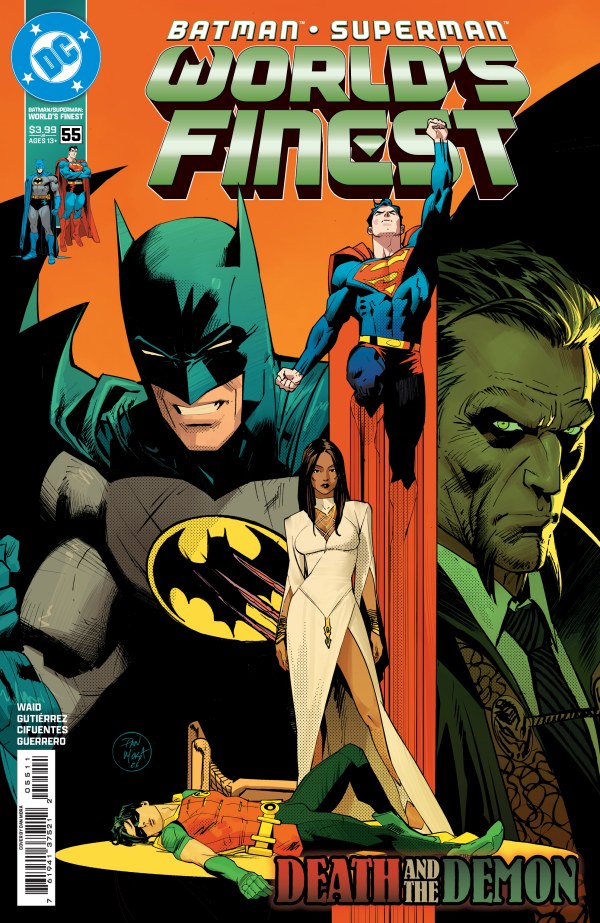
Batman/Superman: World’s Finest #55
Title: Extinction Event Part One
Writer: Mark Waid
Art: Adrian Gutierrez
Main Cover: Dan Mora

With most of the Justice League off-planet, Ra’s Al Ghul assembles a group of villains who share his cause to exterminate most of human life. With his new harbingers of the apocalypse, he unleashes a devastating attack that begins spreading illness across the globe. Superman and Batman are among Earth’s remaining defenders, but when the sickness strikes too close to home, even the Dark Knight may be compromised.

One of the many things that makes Mark Waid’s run on this book is how well he straddles the line between huge storylines of global significance and small, character-focused stories. This issue, for instance, as if Queen Bee’s swarm of alien insects threatening an apocalypse wasn’t bad enough, one of the early victims is somebody that we – and the other heroes – care deeply about. It hurts a little that this book is set in the past and, as the stricken character is someone who is alive and well today, there’s not really a question of IF the heroes will succeed, but rather HOW. On the other hand, it’s still Batman and Superman we’re talking about here, so is there really any question as to whether they’re going to beat the bad guys in the first place?

Getting past that, Waid really explores the way these events affect our heroes. Batman is already approaching the story from a place of conflicted emotion, considering that his primary informant is Ra’s Al Ghul’s daughter Talia. This seems to be the first time Superman learns about the whole Batman/Talia thing as well, which puts him in a bit of a pickle. Bruce is his best friend, of course, but can he be counted on to be at his best? It’s a great way to get into the relationship between the two, with a degree of mutual trust that’s impaired just because Batman himself is too emotionally invested in the whole thing.

It’s another excellent issue. I’ve come to expect nothing less.
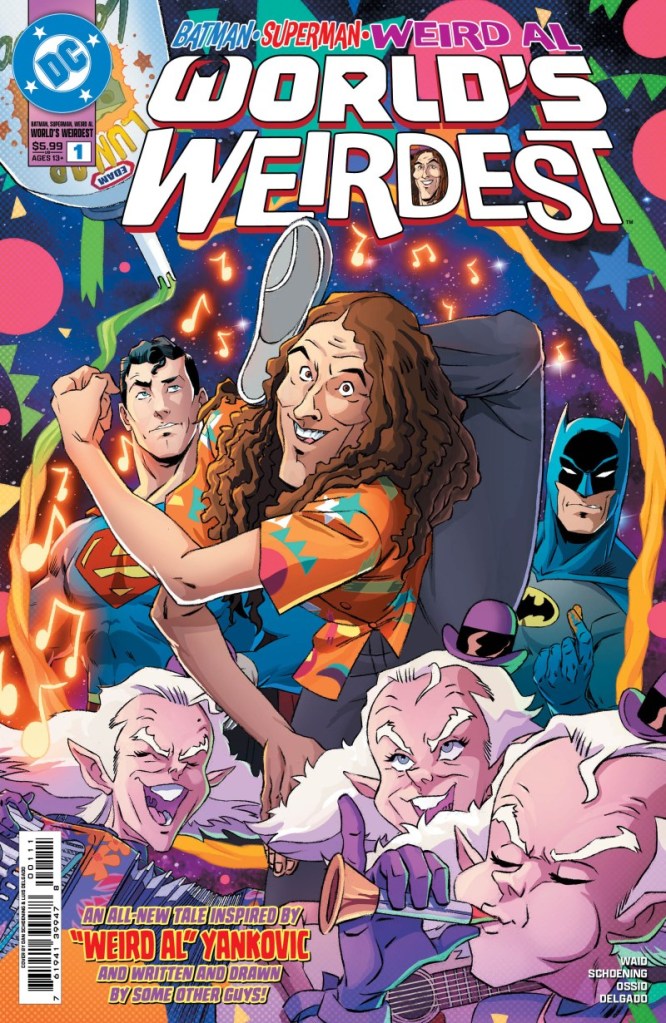
Batman/Superman/Weird Al: World’s Weirdest #1
Writers: Mark Waid & Tyrone Finch
Vibes: “Weird Al” Yankovic
Art: Dan Schoening & Fico Osso
Main Cover: Dan Schoening

At last! My two favorite heroes in an adventure together with Batman!

In this deliciously absurd one-shot, Mr. Mxyzptlk’s cosy home in the Fifth Dimension is unsettled when everything strange in his world starts to become…normal. Terrified, he goes to Earth to find Superman for help, only to find the plague is striking there as well Mxy, Superman, and Batman quickly discover the key may be the one person who seems to be immune to the “Mundanity Wave” striking both worlds: “Weird Al” Yankovic. 

This story is silly, absurd, totally inconsequential, and has no reason whatsoever to exist. I loved it. Look, I’m an easy sell. Obviously I read anything that has Superman in it, and “Weird Al” is perhaps the last remaining celebrity on Earth that everybody likes (now that we’ve lost Dolly Parton), so it wasn’t really an uphill battle to get me on-board for this one. But that doesn’t mean it’s not still a fun read. Seeing how different DC characters become “normal” when hit with the Mundanity Wave is as weird as anything that’s being turned mundane. (Somehow the Joker in a normal suit and with a normal skin tone is more unsettling than the psychotic clown we all know and love.) 

The villain reveal is a great one, too. It’s not somebody that we see all that often, a relatively obscure villain to anyone but fans of the series that birthed him, but he’s absolutely perfect for this book. Mark Waid’s knowledge of the DCU remains unparalleled, even as he’s able to take a quick dig at himself at one meta-moment.

I haven’t seen a lot of Dan Schoening’s work since IDW’s Ghostbusters series wrapped up, but he’s a good choice for this book. After years of chronicling adventures of characters that looked almost, but not QUITE, like Bill Murray and the boys, he’s got a good eye for near-caricature that suits his depiction of Al very nicely. He also has a light touch with his line, crafting a book that looks almost like a cartoon, which is entirely appropriate. 
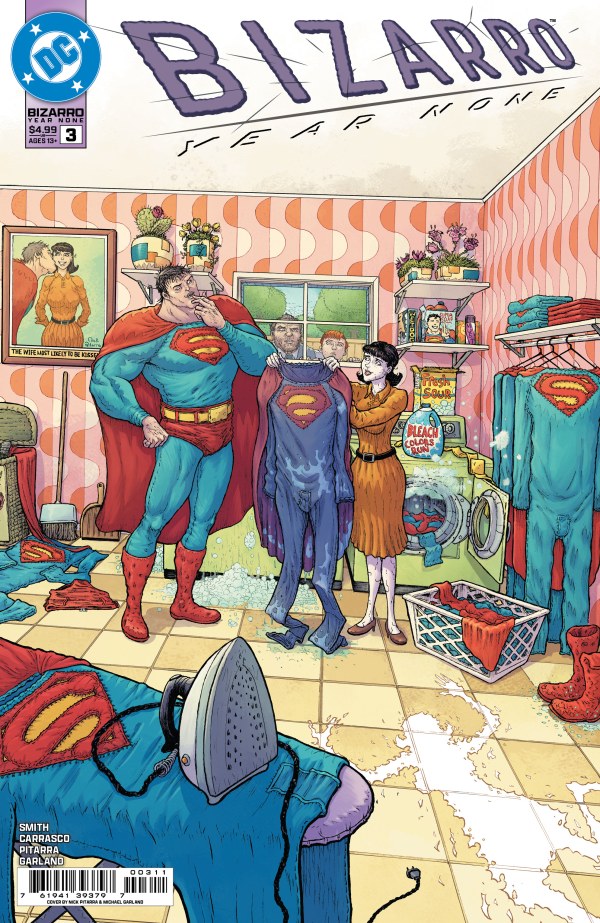
Bizarro: Year None #3
Title: How Do I Look?
Writers: Eric Carrasco & Kevin Smith
Art: Nick Pitarra
Main Cover: Nick Pitarra

Jimmy Olsen spends a day with Bizarro on his Bizarro world, and the two of them each begin to realize just how different from Superman he actually is. In the meantime, Bizarro Lois and the others on her world began making their moves to change things about the planet they’re essentially trapped on.

You know, when they said “Kevin Smith is writing a Bizarro origin story,” I bet a lot of us were expecting a sort of goofy, silly exploration of a character that more often than not is played for a joke. We were wrong. Moments of humor in this issue have become few and far between, and the exploration of Bizarro has never been less amusing. It’s like we’ve delved into an exploration of the Bizarro from the first few scenes in Whatever Happened to the Man of Tomorrow?, a deeply troubling creature that’s every bit as strong as Superman but possesses none of his kindness or humanity. It’s actually a bit frightening. 

The really baffling thing about the book is where it belongs, in a publishing respect. The solicits for this series have referred to it as the “official” origin of Bizarro, but those same solicits are written in Bizarro-speak, also calling the series “terrible.” So it’s not official, we got that. It’s also not labeled as an Elseworlds, although it could be. But honestly, as dark as this story has gotten, I’m wondering why the heck it’s NOT marked as a Black Label comic. It would fit there much more than most of the Superman books that have carried that particular sticker. 
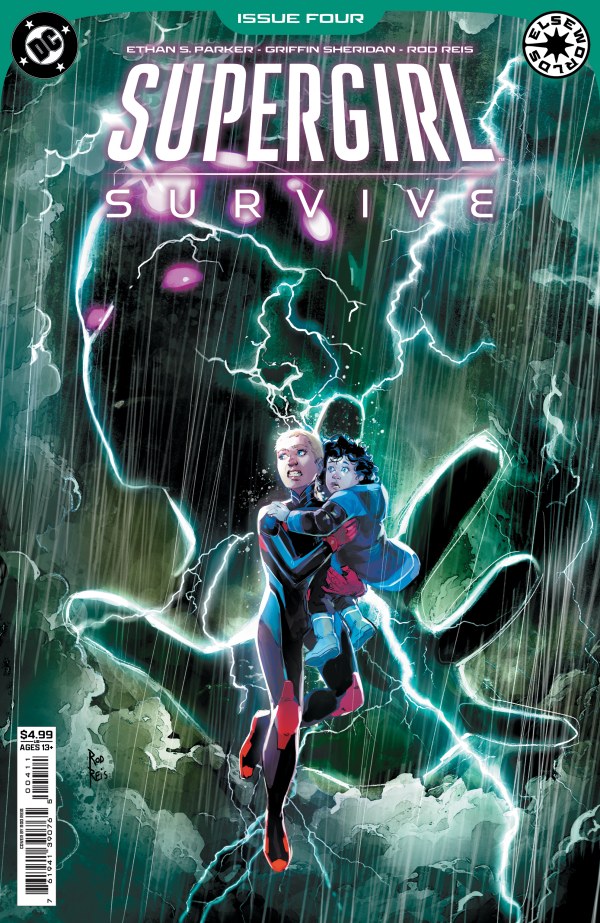
Supergirl: Survive #4
Writers: Ethan S. Parker & Griffin Sheridan
Art & Main Cover: Rod Reis

Finally having reached a planet with a yellow sun, Kara and Kal-El are beginning to taste the power that being a Kryptonian truly brings with it. But despite their power they’re still stranded, with no way to get to the distant planet Earth that is their destination…until they encounter another visitor to this world who may be able to help them.

As they did with the Lantern Corps and Lobo in previous issues, this month Parker and Sheridan bring in another DC character to build out this other universe. This time, it’s one who has links to the Superman family to begin with, and he falls into his role quite naturally. As an Elseworlds, one is forced to wonder whether his gregarious nature is going to turn out to be a long con and he’s really up for some supervillainy, but so far there doesn’t seem to be any overt indication of that, and I’m glad. It would be a pretty tired trope for this character to go bad, and it’s about time poor Kara got a break.

Another couple of time skips in this issue and we’re watching as Kal-El grows from baby to child, with a personality beginning to develop. So far, he’s coming across as a fairly typical kid, albeit one with remarkable powers. He gets frustrated, he gets scared, and he turns to Kara – his protector, his only family – when that happens. Like this month’s guest star, Kal-El could go in many directions, but we’re definitely getting the sense that Kara is doing the best she can to steer him, which can’t be easy with a super kid.

Once more, I’m really impressed with this book, and I want to see this iteration of the DC Universe explored more and more.
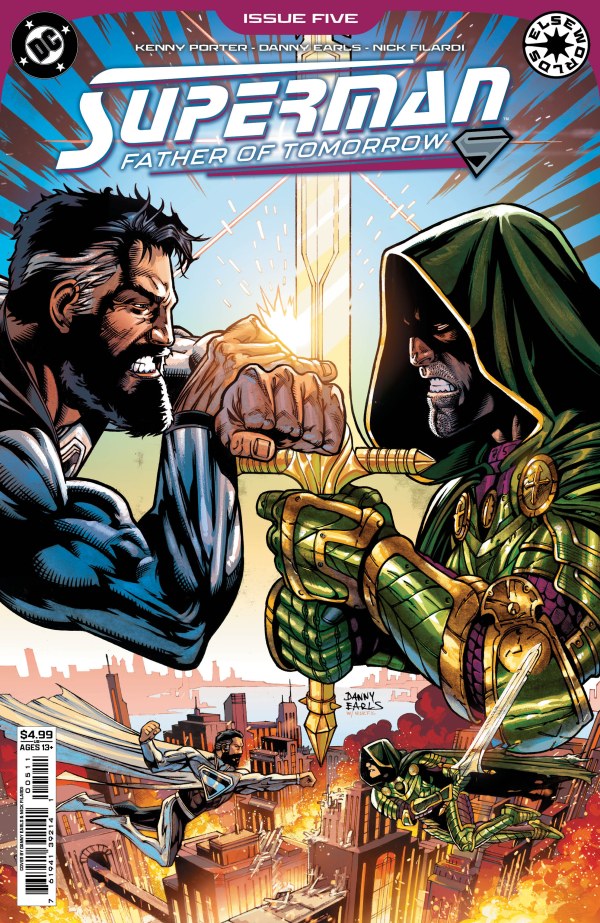
Superman: Father of Tomorrow #5
Title: Strife 
Writer: Kenny Porter
Art & Main Cover: Danny Earls

One issue from the end, Father of Tomorrow takes another step in the right direction. As the sorcerer Lex Luthor makes his move on Metropolis, Jor-El confesses the events that led to his exile on Earth and why he came alone. Luthor, meanwhile, faces off against Lois Lane’s father Sam, who has become this world’s Captain Atom.

My favorite thing about this whole series has to be Luthor playing with magic. It’s intriguing to see him push his genius in this direction rather than science, but he avoids coming off as just a Dr. Doom clone. This is still Luthor through and through, with all the pettiness and ego that implies. He points out of the hypocrisy of Sam Lane’s anti-superhuman stance now that he’s turned himself into one of the world’s powerhouses. He is faced with an extremely real threat and shrugs it off because, you know, he’s LEX LUTHOR, so what could possibly touch him? It’s a great new angle for a classic villain.

The reveal about Jor-El’s past works well, and it gives his position on Earth a little added flavor of tragedy, although I feel like it’s something that could have come earlier in the series. It does explain his urge to “fix” things in a way that’s suitable. My big problem with this series to date has been people opposed to Jor-El “fixing” Earth without actually providing much evidence that there’s any downside to his changes. We still don’t get any of that this issue, but we don’t dwell on the idea that his changes are bad either, so on that front I’m gonna call this issue a draw and look forward to next month’s finale. 
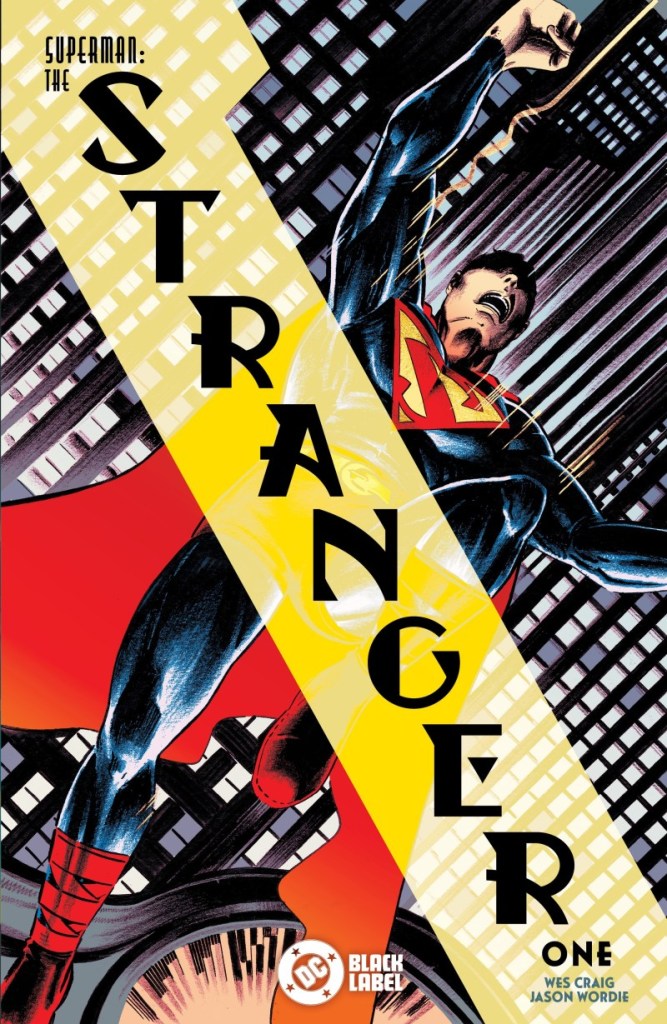
Superman: The Stranger #1
Writer, Artist, and Main Cover: Wes Craig

The newest “Black Label” series featuring the Man of Steel dives back to the Golden Age. In a Metropolis where people are struggling to get by, young Clark Kent is desperately trying to get a job as a reporter while, at the same time, using the bizarre powers he has to patrol the city at night as Superman, defender of the defenseless. But a chance encounter in an alleyway sends him questioning where the real villains may lie.

I’m very much on the fence about this book. First of all, the vagary of the Black Label imprint continues to be an issue. Ostensibly a line of “mature” comics featuring the DC heroes, the Superman books in this series have very rarely had any content that would mark them as such. The “17+” rating on the back cover in tiny little letters doesn’t seem appropriate, and I can’t find anything that makes me think this shouldn’t be an Elseworlds, since that imprint has returned from the dead.

That’s more of a fault of editorial than the comic itself, but the comic itself leaves me with concerns. Frankly, it feels like we’re just exploring some well-worn territory. A Golden Age Superman? Seen it numerous times since the Golden Age. Superman versus corporate greed and corruption (as embodied, of course, by Lex Luthor)? It’s so familiar you could draw it in your sleep. I need something more original to justify the $5 price point of this book.

That’s not to say there’s nothing promising. Clark, honestly, seems to have more to distinguish him from other incarnations of the character than Superman himself. His thirst to work at the Daily Planet has him settling for a job at the very bottom of the pole, and I’m not talking editorial. And despite the fact that his name is, as usual, “Clark Kent,” there are some ruminations in this book that call me to question whether he was actually raised by the Kents or if his Earthly origins are different than what we’re used to. That question remains dangling at the end of this issue, which is fair enough, but I’m hoping that we return to it in the future, because so far there’s little to set The Stranger apart. 
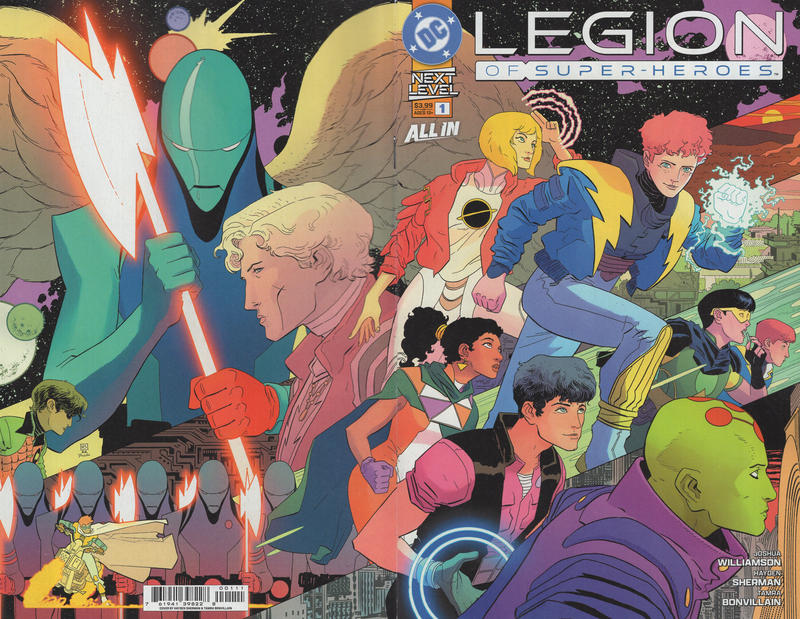
Legion of Super-Heroes #1
Title: Who Killed the Future? 
Writer: Joshua Williamson
Art & Main Cover: Hayden Sherman

I wasn’t necessarily planning to write a review of this book. After all, this column is “Superman Stuff,” not “Superman’s Friends Stuff.” But the Legion is, in many ways, as much a Superman spinoff as Supergirl, Steel, or Krypto, and I don’t hesitate to write about those. Plus, even though Superman doesn’t actually appear in this issue…well, he’s all over it.

I am on the record as saying we do not need yet another reboot of the Legion of Super-Heroes, and I am standing by that statement. But if you’re gonna do it, Joshua Williamson has found a good way in. The book begins with the murder of R.J. Brande, a name familiar to Legion fans, whose death is being investigated by the unlikely duo of Brainiac 5 and Tenzil Kem. As they search for the facts behind Brande’s death we are introduced to this version of the future: how super-heroes are outlawed, how anybody who develops super powers is required to register them with a peacekeeping force called the Persuaders, and how many people don’t believe the legendary “Superboy” ever even existed. From there, we glimpse at the lives of three very familiar super powered young people, and the shape of this story begins to come into focus.

What’s making this story work for me, along with a healthy dollop of faith in Williamson as a writer, is Garth Ranzz. We see a Lightning Lad here with a thirst to be a hero, a craving for justice, and a locker whose contents could very well have been my own. A one-page glimpse into the legend of Superboy at the beginning serves to frame his desire for a different, better world, and even in one issue that craving feels infectious. It’s going to be rough on him when this issue’s last-page revelation hits home, but I feel like he’s going to be resilient.

And that drive, that thirst seems infectious. Imra and Rokk both appear here as well, and although none of our proto-Legionnaires interact in this first issue, we get the sensation that they’re already linked, and that the threads that link them and that will draw them together go back 1000 years to the age of heroes. 

I liked this first issue very much, and I’m anxious to see how Williamson is planning to tie it into the revelations from this summer’s Superman Annual. But I don’t know if I’m planning to review every issue of this book. It’s not a Superman comic, after all. Except for in all the ways that matter. 

Blake M. Petit is a writer, teacher, and dad from Ama, Louisiana. His most recent writing project is the superhero adventure series Other People’s Heroes: Little Stars, volume one of which is now available on Amazon. Don’t forget, you can check out earlier blogs in the Year of Superman/Superman Stuff Archive! Got a request for a future “Superman Stuff”? Drop it in the comments!
Geek Punditry #195: Paperback Blues

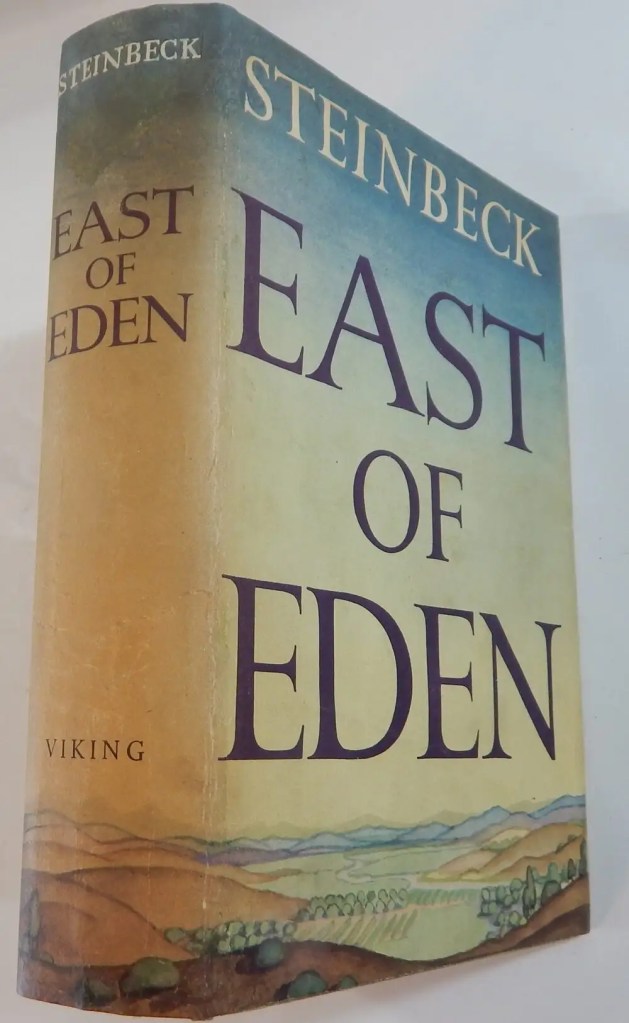
If you can remember back a full seven days to my previous Geek Punditry column (#194: Can We Just Let Bad Guys Be Bad?), you may recall that the discussion was spurred by the announcement of a new Netflix miniseries adapting John Steinbeck’s novel East of Eden. The book lovers among you will not be surprised to learn, then, that as I spent some time pondering the changes being made between the book and the show, I got a hair up my nose to give the book another read. This was a little difficult, however, when it came to my attention that I suffered from a chronic condition shared by over 7 billion people on this green planet of ours: I don’t actually own a copy of East of Eden. 

And I feel like it’s judging me for that.

I own books, of course. I own a LOT of books. And the recent shenanigans by people like the bastards at Anthropic have made me more adamant than ever that owning as many books as possible is a good thing. That said, I DO have a limited amount of storage, and I’ve drifted more towards eBooks for most of my casual reading. I still love physical books, but unless it’s a keepsake (like a signed edition or something written by a friend of mine), something that’s unavailable in eBook format, or a book I need to complete a collection, I’m usually satisfied with the electronic version. So I decided to look into how much the eBook of East of Eden costs.

$12.99. And I looked at that $12.99 with the same sort of distrust that you look at the current prices at whatever gas pump is nearest to your house.

Look, I am a writer, and I believe wholeheartedly in paying writers what they’re worth. That said, I also believe that anyone charging more than ten bucks for an eBook is gouging you, because there are virtually none of the production, shipping, or storage costs involved with creating a print book. And when it’s a book that’s nearly 75 years old, the incredulity just rises.

That afternoon, I happened to be taking my son on our biweekly trip to the local library. While we were there, I thought, I should just check the book out. That’s what libraries are FOR, after all. They are a vital part of our community, and by NOT checking out books, I am doing them a disservice. It was such an obvious solution. So after convincing Edward that he actually had to follow ME through the stacks for a change, instead of me racing after him on a frantic search for the kitty pictures hidden around the children’s room as part of the library’s monthly scavenger hunt, I tracked the Steinbeck book down and looked at it.

I reeeeeally looked at it.

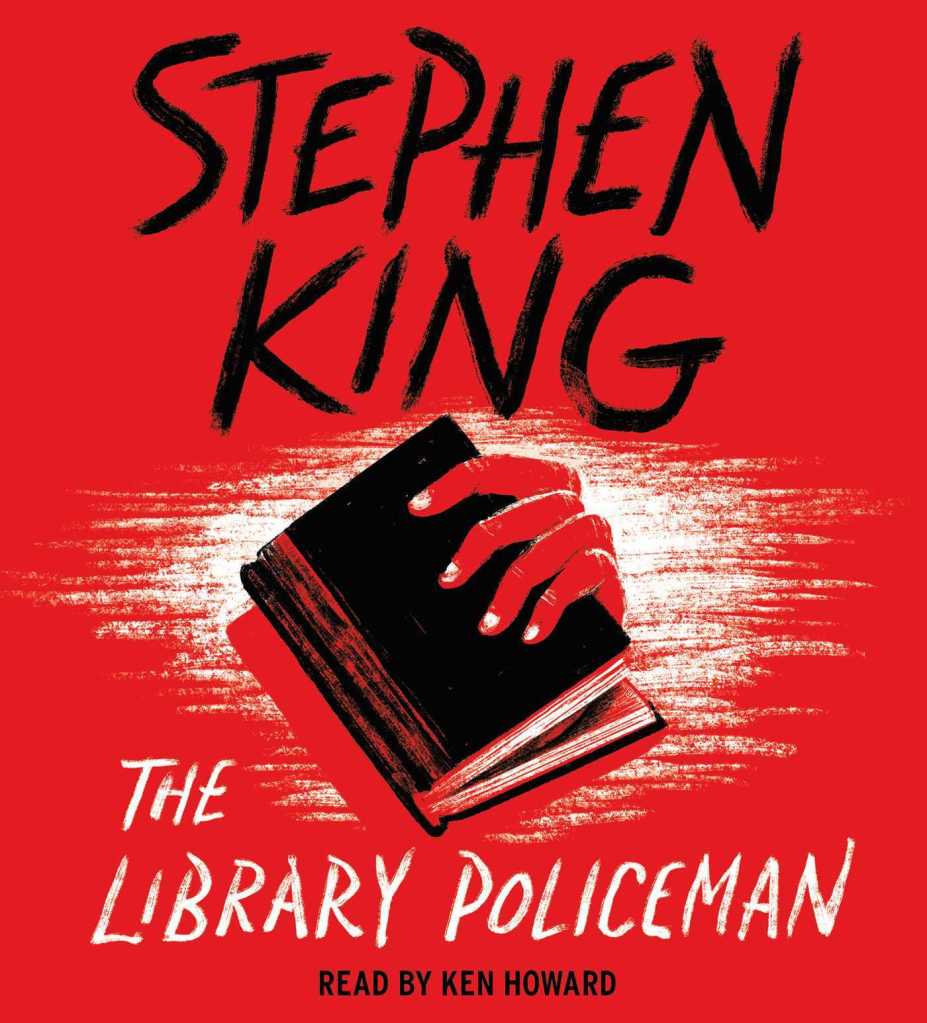
East of Eden is Steinbeck’s longest novel. And by “longest,” I mean it clocks in at about the same page count as Stephen King can turn out on a typical Sunday in October – it’s hefty. Let’s be clear about this: I do not mind a long book. I am by no means intimidated at the idea of reading a doorstopper. But I am also realistic, and I had serious doubts about my ability to finish the book and return it to the library in a timely manner. And even though the good people who work at the St. Charles Parish Public Library (Destrehan Branch) are uniformly kind, friendly, and helpful, I also reread Stephen King’s The Library Policeman a couple of months ago and I didn’t want to risk it.

Yeah, yeah, “it’s just a book” — SOME OF US CAN’T TAKE THAT CHANCE.

Anyway, I told myself, I’m an English teacher. I really should OWN a copy of such a seminal work in the canon of American literature. I should just get a paperback instead. So I looked it up: $20.

Then I went back outside to stare at the gas station again.

I remember a time – a time not all that long ago – when most paperback books fell in the $5.99 to $7.99 range. And sure, East of Eden is a huge book, clocking in at over 600 pages. But I started to look around at the NEW release paperbacks as well, many of which would take a full three or four whacks to kill a mouse, as opposed to the one thump that East of Eden would require, and I saw that $20 was about the average price these days. Part of that is because American publishing has all but abandoned the mass market paperback: the smaller sized and more affordable book that was ubiquitous for decades, small enough to fit into a largeish pocket, the glorious format upon which most people born before the turn of the century learned how to love books. Sadly, after making books accessible to the masses for nearly 100 years, this format has become almost nonexistent. If you ask publishers and distributors why that is, a lot of them will tell you that “the market” was no longer purchasing them, was no longer interested in them. As a member of “the market,” however, I can tell you that I was never surveyed about this decision. I never reached a point where I thought, “You know, I’m going to buy this larger version of the book that costs twice as much.” I just noticed that the smaller, less expensive versions were no longer being published for some reason. 

Although I have no statistics, quotes, or data, I firmly believe that the push away from mass market was spurred almost entirely by a publishing industry that wanted an excuse to increase its prices. And again, writers deserve to be paid. But I don’t believe for a second that, in the vast majority of cases, the inflated price tag on these books has equaled an increased cut for the person who actually created the book. Almost universally, the added revenue being collected is going into the coffers of the publisher, which of course provides the invaluable service of deciding which books they want you to spend money on.

I also believe – without statistics or data – that this format shift is also at least partially responsible for the decline in literacy in America. Look, there are a lot of reasons that people might not want to read books: social media, video games, other media drawing their attention, being afraid of being labelled a “nerd,” difficulty finding books that match their interests, their mother read Danielle Steele that one time she got hit by an ice cream truck and there’s no WAY they’re taking THAT risk, and so forth. But I think the fact that books are no longer cheap enough to be an impulse purchase makes every single one of those problems even worse than it already is. 

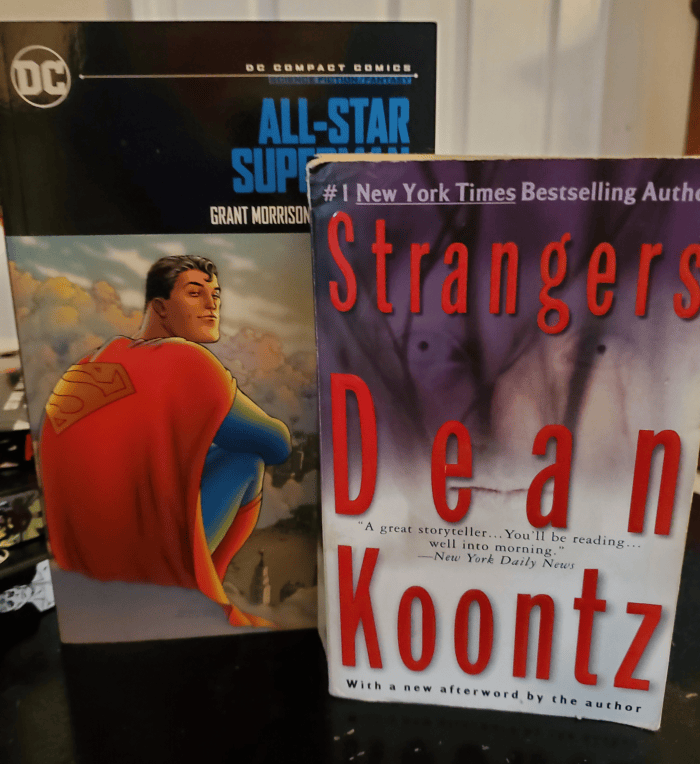
The funny thing is that while traditional publishing is doing everything it can to make it harder for people to become a part of their audience, comic book publishers are doing the OPPOSITE. I’ve written at length about DC Comics and their “Compact Comics” line, (In GP #119, GP #124, GP #164, and GP #178, but who’s counting?) so I’ll just do a quick recap here. DC now has a line of paperback editions of some of their most popular stories and graphic novels in a smaller format – ironically, about the same size as most of the paperback novels that have shoved mass market paperbacks into their grave. These Compact Comics collect the same stories that are published in traditionally-sized graphic novels, which usually have a price point ranging anywhere from $20 to $40, depending on the length. DC’s Compact Comics, however, have a uniform price tag of $9.99. And this format has proven to be a MASSIVE hit, selling out printing after printing not only in comic book stores, but in big box bookstores and other places that people buy books, like Walmart and Target. The line is so successful that nearly every other major comic book publisher has responded with their own line of smaller-sized bargain-priced paperbacks, and the result is an easily-accessible, affordable series of books that is appealing to both old and new readers alike.

Size-wise, these two books are everything you could want. Content-wise…well, one of them is.

Compact Comics also blow the argument for a $20 paperback out of the water. While a traditional book may have to pay a designer, a cover artist, and a few other people besides the author, a comic book has many, many more hands than that: multiple writers and artists, colorists, letterers, editors, and so forth. And while each of their pieces of the pie may be smaller than those of a single author who has written a single novel, the color pages and the paper that holds those images is also of a better stock than your usual paperback. The production cost for a Compact Comic is inarguably higher than that of a novel, and yet DC can afford to sell them for half the price.

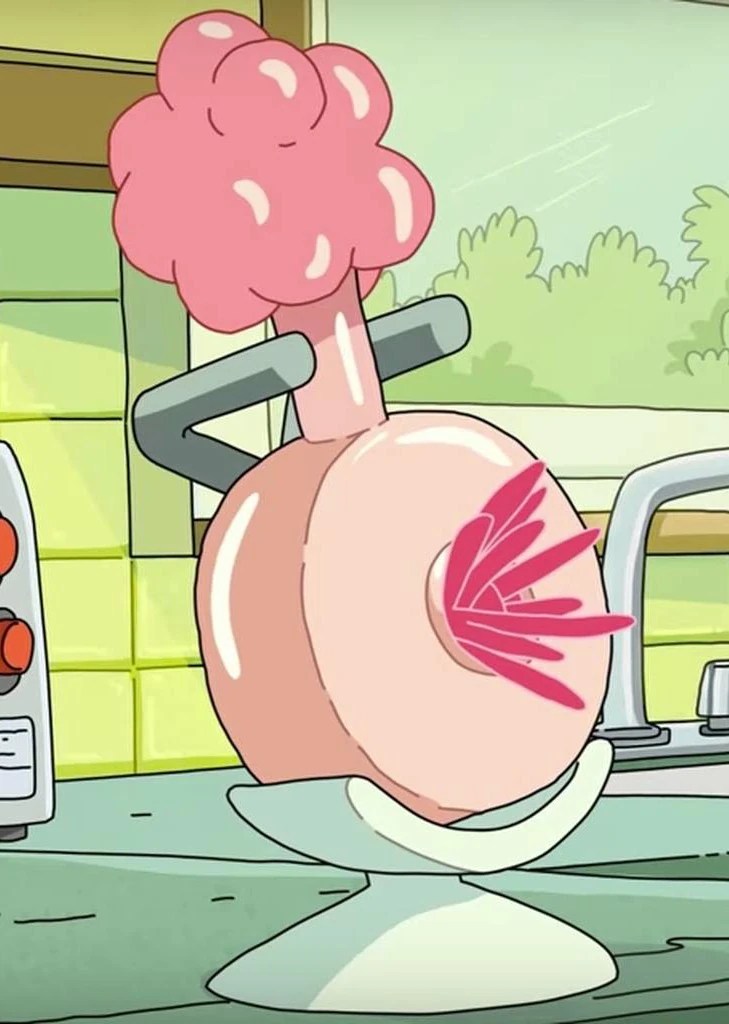
To put it another way, if I have $20 in my pocket, I can buy Steinbeck’s East of Eden, or I can buy a copy of Mark Waid and Alex Ross’s exquisite graphic novel Kingdom Come AND have enough money left over for compact anthology of comics from Oni Press’s Rick and Morty series. And I’m sorry, but Steinbeck never ONCE included a plumbus in any of his novels, so this isn’t even really a contest.

If you look hard enough, though, you can probably find one in Shakespeare.

As a teacher, a writer, and a reader, I hear the phrase “literacy crisis” thrown around on a daily basis. Authors are desperately hustling to try to get readers. Readers are finding themselves in a cultural wasteland as it becomes more difficult to find people in your daily life that you can share your love of books with. Teachers are crawling behind students on hands and knees BEGGING them to read just a chapter or two of The Great Gatsby, because there’s a scene where a woman gets hit by a car, maybe because she’d read a Danielle Steele novel, I dare you to prove that she HADN’T. In fact, EVERYBODY seems to be doing anything they can to try to get people reading again.

Everybody, that is, except for the companies that have established themselves as the de facto gatekeepers of the entire world of literature: the publishers. Rather than making books available and attractive to as many people as possible, they seem to be on a quest to identify micro-cohorts of potential readers and squeeze every drop of cash out of THEM, rather than make reading appealing to the masses.

It’s an insane practice, but that’s the world we live in.

I broke down and got the Kindle version of the Steinbeck book, by the way. At $12.99, it would take me almost three years of late fines at the library to offset the cost, but by then I should be almost finished reading it.

Blake M. Petit is a writer, teacher, and dad from Ama, Louisiana. His most recent writing project is the superhero adventure series Other People’s Heroes: Little Stars, volume one of which is now available on Amazon. You can view his LitReel videos on TikTok and read his writerly yammerings on his free Substack.

Superman Stuff #39: Kneel Before Zod!

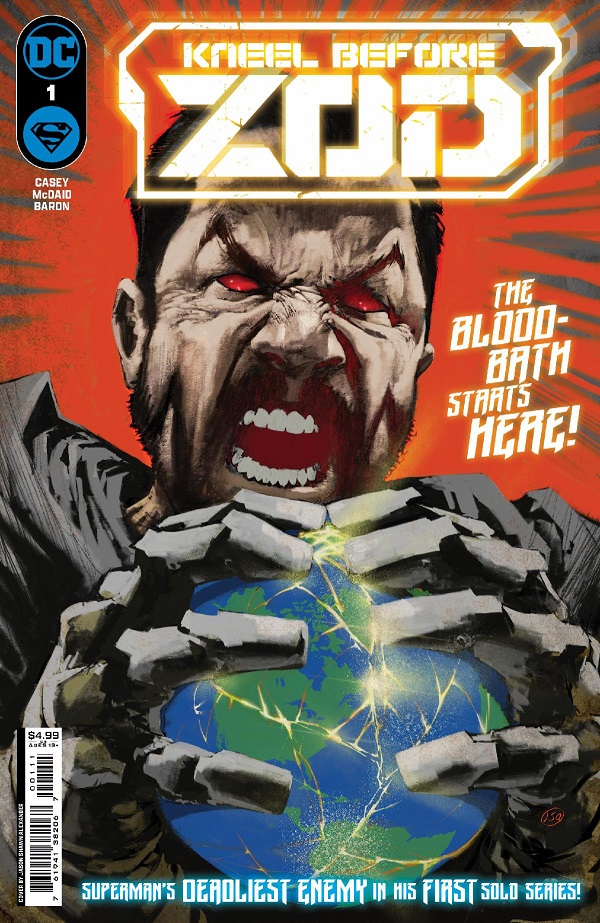
The conclusion of Kingdom of Zod drops today (assuming you read this on Sept. 30), but I won’t have time to get to the comic shop and write a review before my admittedly self-imposed deadline on this column, so it’s going to join the overall September wrapup you guys can expect next week. Today, I wanted to go back a couple of years to 2024, and the eight-issue Kneel Before Zod series written by Joe Casey with art by Dan McDaid. 

The series was touted as Zod’s first starring series, although it’s kind of unclear whether it was intended to be a miniseries or if it, like so many comic books in the modern marketplace, was structured in such a way that it could keep going if the sales permitted. Regardless, it’s one of the darkest stories in the main Superman continuity you’ll find. As the series begins, Zod has founded a “New Kandor,” a planet where he intends to restore the glory of Krypton with his wife Ursa and their son, Lor-Zod. But things fall apart almost immediately, as Zod finds himself forced to exile his child (who went off to share the Sinister Sons miniseries with Sinestro’s boy) and his new planet targeted by an alien invasion. 

The first half of this series places Zod in the unusual role of defender, trying to protect his world from the invading aliens. But Casey does it in an effective way, maintaining the general brutality and evil nature of the character. I’ve written recently (in Geek Punditry #194) about how modern media has a disturbing tendency to try to excuse villainy, something that I think is somewhat damaging to the culture as a whole. Casey doesn’t do that. Zod may be the protagonist here, but that doesn’t make him a hero. While the flashback scenes that showcase Zod’s past may help to explain the way he is today, these scenes are presented for the purpose of illumination, not justification, and that makes all the difference.

The reason I think this was probably intended to be an ongoing series is that it takes a drastic turn about halfway through, starting an entirely different storyline with Zod in space, alone, until he finds and takes command of an army of villains. It goes from a story of a man protecting his home to the origin of a sort of cosmic pirate clan, a drastically different story that feels as though it was intended to be the next stage in a longer arc that got cut short. As such, this second half of the series isn’t quite as engaging as the first, feeling less complete and more unfinished.

Dan McDaid’s artwork comes from the Keith Giffen school in many respects. The linework is detailed when need be, sparse when appropriate, and he usually incorporates the nine-panel grid that Giffed so often used. It helps with the pacing, and somehow (despite the fact that Giffen would use these techniques in silly books like Ambush Bug), McDaid’s use of it adds to the sense of menace.

I wish Casey had been given just one more arc on this book to try to tie things up more neatly. As it is, it just kind of ends, dangling Zod in space, where he remained until his reemergence following Absolute Power took him on a slow march to the story that’s happening in the Superman comics right now. There’s connective tissue here, but I feel like there was supposed to be more, and it’s a shame we didn’t get to see it all.  

Blake M. Petit is a writer, teacher, and dad from Ama, Louisiana. His most recent writing project is the superhero adventure series Other People’s Heroes: Little Stars, volume one of which is now available on Amazon. Don’t forget, you can check out earlier blogs in the Year of Superman/Superman Stuff Archive! Got a request for a future “Superman Stuff”? Drop it in the comments!
Geek Punditry #194: Can We Just Let Bad Guys Be Bad?

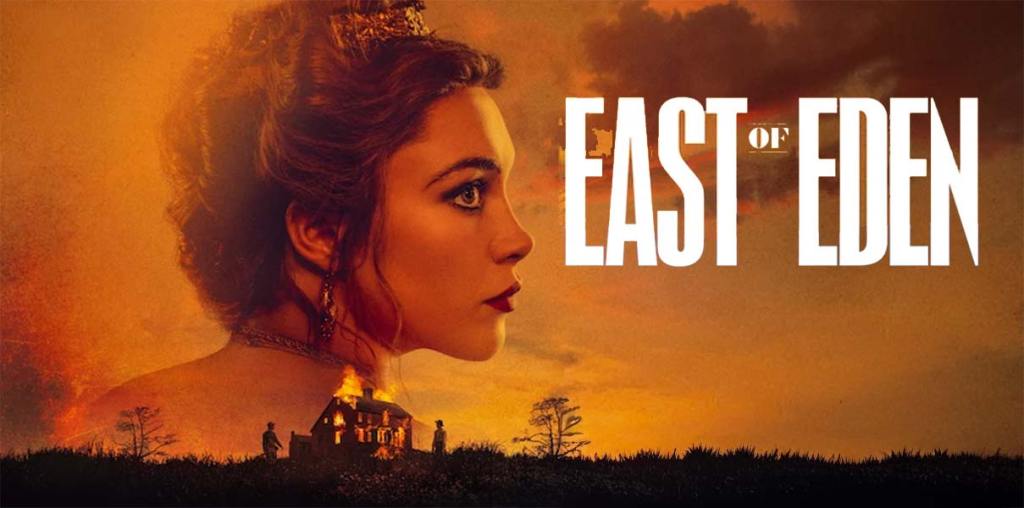
Item #295 on the list of “what are people on the internet in an uproar about THIS week?” is East of Eden, the new Netflix miniseries adapting the classic John Steinbeck novel, which is coming under fire for following along with a rather sizable trend in modern fiction: making the villain less…y’know…villain-y. 

Because nothing says “controversy” like an adaptation of a 74-year-old book that’s only read by English majors.

Now I am not a Steinbeck scholar, I should concede. I don’t have strict reverence for the novel or the original film version, adapted in 1955 by director Elia Kazan. I do, however, recognize trends, and some of the buzz around this miniseries concerns me. The series was produced by Zoe Kazan, granddaughter of the aforementioned Elia, and some of the things that are being done with the new version actually sound pretty good. East of Eden, the novel, is a complex generational saga tracking the history of two intertwined families in the decades between the American Civil War and World War I. Elia, in making his movie, trimmed out all but a single generation and made a film focusing on only about a third of the novel’s content. Expanding it into a miniseries to make it more faithful to the book is a logical idea, one that makes much more sense than a lot of remakes that seem to be fueled by the promise of “Well, we own the IP, so let’s do it again.”

The problem, though, comes in the character of Cathy Ames. In Zoe Kazan’s version of the film, Ames is played by Florence Pugh, which is an inspired choice. Pugh is a phenomenal actress, and I’ve got no doubt that she can nail the bitter rage of the character, who is very much the villain of the novel. The issue is that I’m not entirely certain Pugh IS going to be playing Steinbeck’s villain, at least not from the way Kazan keeps describing her. In a recent interview on Good Morning Washington, Kazan said, “What if we think about her not as the embodiment of evil, but as a person who does really bad things?…I think we can learn more about ourselves if we don’t think about evil people as being that different from us.”

This is a statement about Cathy Ames. This is a character who, as written by Steinbeck, is unabashedly violent, selfish, sadistic, and cruel. A character he referred to as representing “Satan himself.” A woman who – over the course of the novel — abandons her infant sons, burns her own parents to death in a fire, frames innocent boys for sexual assault, drives a man to suicide, and manipulates a woman (whom she then murders) into leaving her a brothel in her will, then turns the brothel into a den of sadism and torture.

Ms. Kazan, respectfully, I very much WANT to think about people like Cathy Ames as being different from us.

I obviously have not seen the Netflix series yet (it doesn’t drop until Oct. 1), and I have enjoyed a lot of Kazan’s work in the past, both as a writer and actor, in movies like Ruby Sparks and The Big Sick. I’m just a bit concerned that this may push East of Eden into the trending area of “Villain Justification.”

To be fair to Kazan, in an interview with Time magazine she said, of Ames, “I don’t think anything in her background excuses her behavior,” but then she comes right back around and says “there’s something really compelling about her insistence on her autonomy and selfishness, especially as a woman.” I can accept an evil person as being compelling. But that doesn’t mean I think a character like Cathy Ames should necessarily be RELATABLE. 

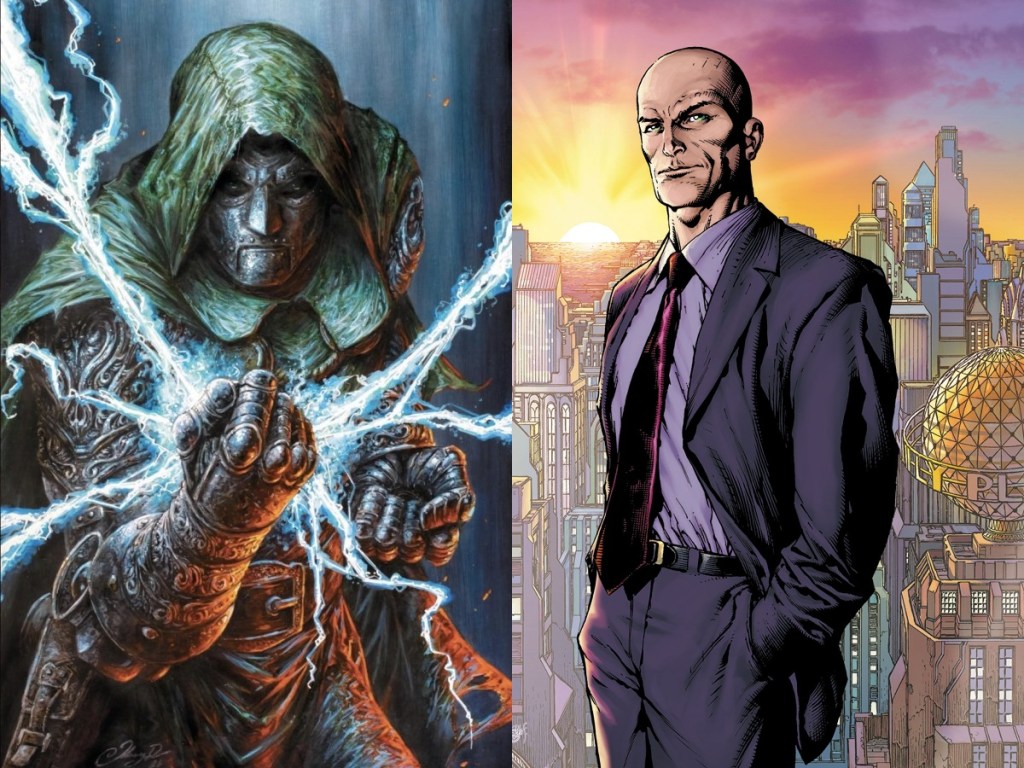
I’m not against a morally complicated villain. The BEST villains are morally complicated. But at the same time, sometimes evil is just evil. You can understand a villain without thinking that they’re “like us.” To go to comic books (because they’ve got the most dramatic examples of villains out there), let’s look at characters like Dr. Doom or Lex Luthor.

These aren’t guys you would ask to help you get something off the top shelf at Walmart, is what I’m saying.

These two villains – arguably the two greatest villains in comics – are similar in many ways. Their true danger comes from just how brilliant they are. Both of them have the intelligence to change the world and make it a better place, were they to choose to use their gifts in that way. But they don’t, and for very petty, very human reasons. In the case of Doom, he believes that his genius makes him the most suitable to rule the world and is willing to crush anybody who stands in his way. Luthor (modern Luthor, anyway) isn’t concerned with ruling the world per se, but he cannot overcome the unbearably obstinate jealousy he feels because the people of Earth love an alien more than they love him, so rather than channel his intelligence in a positive way he is intent on destroying Superman and “proving” he’s “better” than the Kryptonian. Both of these villains are fascinating, intriguing, and wonderfully complex…but that doesn’t mean I see myself in either of them, nor do I want to.

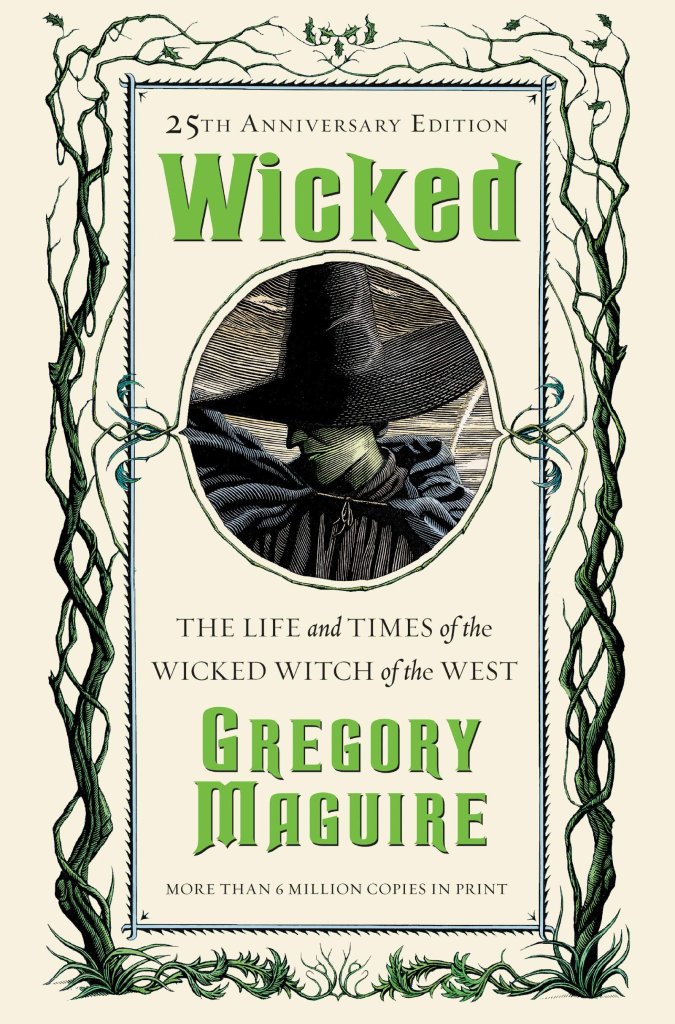
This has been a trend in fiction for many years now, the de-villainizing of villains. Gregory Maguire didn’t invent the concept when he wrote Wicked, retelling The Wizard of Oz from the perspective of the Wicked Witch of the West, but I think the smash hit Broadway musical is directly responsible for how pervasive that trend has become. Maleficent and Cruella are both movies built around showing how some of Disney’s most colorful villains ain’t all that bad. The ABC series Once Upon a Time made Snow White’s Evil Queen (eventually) one of the heroes, and did major rehabilitation work on characters like Rumplestiltskin and Captain Hook as well. Joaquin Phoenix’s Joker movie takes the sadistic, serial-killing clown of our dreams and shows us how he’s beaten down by society. Like many patterns, once you’re aware of it, it’s hard NOT to see it.

This novel launched a thousand ships, by which I mean fanfiction.

None of this should be construed as a CRITICISM of these movies, books, or TV shows. I’m not saying that they’re poorly-written, poorly-acted, or in any way invalid projects. I’m just saying that as a TREND, the sheer number of stories that seem to try to excuse evil behavior as opposed to explaining it kind of bothers me.

Another part of the issue, as many people have noticed online, is a severe lack of critical thinking from modern audiences. People seem to think that liking a fictional character is somehow an endorsement of their behavior, and that makes people try very, very hard to avoid making characters who are purely evil. The whole thing is preposterous. If I say Freddy Krueger from A Nightmare on Elm Street is my favorite 80s slasher, I’m not saying that I approve of murdering teenagers in their sleep, I’m saying that Robert Englund is entertaining to watch. Somehow people have started to view what fiction a person consumes as an entire component of their personality, and I think that’s dangerous. It comes back to something I wrote about a few weeks ago (in Geek Punditry #191), about how some people allow their fandoms to completely consume who they are. This is a side-effect of that – my fandom consumes who I am, and therefore I assume that yours does the same, and when you tell me you like Friday the 13th I’m worried you’re going to put on a hockey mask and terrorize a camp. Q.E.D.

Poppycock. 

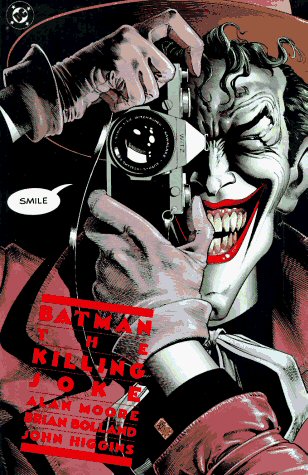
And finally, there are the moral relativists out there, the ones who have the opinion that there IS no good or evil, which is a mindset I fully reject. Some things are simply evil, like murdering innocent people or using Chat GPT to answer a math problem when you’ve got a calculator app on the same damned phone. And it’s possible to explore that darkness in fiction without trying to rationalize it. I’ll use the Joker as an example again, specifically Alan Moore and Brian Bolland’s Batman: The Killing Joke.

This is one guy who doesn’t need an LLM to hallucinate.

In this story, the Joker takes the position of that moral relativism – everybody out there is really just “one bad day” away from becoming a sadistic sociopath just like him. He sets out to prove this by hurting Batman and the people closest to him – specifically by shooting Barbara Gordon in the spine and torturing her father. His hypothesis is that even good men like James Gordon can be pushed over the edge. But the story rejects this notion; even after everything that has been done, Gordon insists that Batman takes in the Joker by the book, and that he not cross the line the Joker wants him to cross by killing him. Admittedly, the ending of the book is deliberately vague as to whether Batman chooses to cross that line or not (and if you accept it as an out-of-canon story as Moore intended, it remains vague), but the message here is that evil, ultimately, is a choice. 

I’m not saying that I don’t want villains to be fully-developed characters or have rich, intriguing backstories. I’m not even saying that I don’t want them to be sympathetic, because it can be pretty powerful to understand why somebody is doing something bad, even if you still condemn the action. But I’m kind of over seeing sympathy being confused with empathy – you can feel bad for somebody without feeling like you’re the SAME as them.

We’ve lost clarity in the name of complexity, and it doesn’t have to be an either/or proposition. Yes, I want interesting, intriguing villains. But that doesn’t always mean that they’ve got to be one step removed from the guy who lives next door. Good and evil are real things, and we’ve lost something by losing fiction that recognizes that fact. Sometimes good is just good. Sometimes bad is just bad. And if we can’t even concede that point in our fiction, how is that going to twist the way we think in life?

Blake M. Petit is a writer, teacher, and dad from Ama, Louisiana. His most recent writing project is the superhero adventure series Other People’s Heroes: Little Stars, volume one of which is now available on Amazon. You can view his LitReel videos on TikTok and read his writerly yammerings on his free Substack.

Superman Stuff #38: An Afternoon With Zod

With the whole “Kingdom of Zod” storyline in high gear over in the main Superman comics, I thought it might be interesting to take a look back at some of the more classic General Zod storylines over the years. This proved to be troublesome, though, when I realized that most of Zod’s characterization is actually based on the movies, specifically Terrence Stamp’s portrayal of the character in the first two Christopher Reeve films. Prior to the movies, Zod was a rather generic “evil” Kryptonian from the Phantom Zone. Since the movies, he’s gained much more depth, but that depth is all based on the cinematic portrayal. What’s more, I already covered some of the best Zod storylines back in the original “Year of Superman” project.

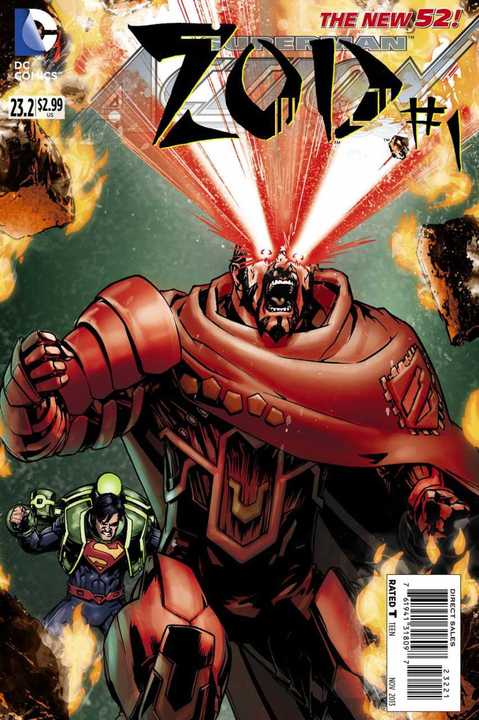
So I turned to the New 52 era, and that month about two years in when the regular titles were given over to “decimal” issues featuring not the heroes, but rather one of their traditional foes. Essentially, they were one-shots that weren’t TECHNICALLY one-shots. So let’s take a look at that era’s version of Zod from Action Comics (Vol. 2)

Action Comics (Vol. 2) #23.2, because integers know what they did.
Title: DC Comics Unleashes Zod
Writer: Greg Pak
Art: Ken Lashley
Main Cover: Gene Ha

This quick read is less a story and more of a series of snapshots from the life of Dru-Zod, beginning in his childhood and ending with his expulsion into the Phantom Zone. There’s interesting stuff here, showing young Zod with his parents, scientists, and how a cataclysm leaves him to fend for himself. A year later, a semi-feral Zod is found by Jor-El and Zor-El and reintegrated into society, but the damage, it seems, has been done.

From there we get to what I think is this issue’s primary failure: the biggest timeskip of out of several. We go straight from lil’ Zod playing Tarzan to a fully grown adult Zod already commanding an army. The rest of the book – the bulk of the issue, in fact – is made up of exploring Zod’s rise to power as a military leader on Krypton. Pak’s story is fine and Lashley’s art is great, but this is an era of Zod that has been covered extensively over the years. There are lots of different stories about “General” Zod, both before and after Krypton’s destruction. And look, I get it, the point of this issue was specifically to detail the history of the New 52 version of Zod. Technically speaking, it was uncharted territory. But is it really uncharted if you’re following a course set by people who just got there in a different way? What I’m getting at is that I wish Pak had spent more time in those in-between years, because the first two scenes of the book are some of the most interesting. We’re very used to seeing Zod as a fascist, a sociopath, and all of the other things that make him one of Superman’s most memorable villains. This is one of the few glimpses of him BEFORE that.

That said, the glimpse is pretty good. Those few scenes at the beginning are bookended with a flashback at the climax of the book, showing us the fate of Zod’s father that had previously been skipped over, and it’s a harrowing moment. It’s more demonstrative of who and what Zod is than any of the military stuff in the rest of the book. I don’t think this particular version of Zod is in continuity anymore (much of the New 52 stuff is of dubious canonicity at best), but either way I think there’s room to explore here.

Alas, explore they did not.

I think there’s room to pick at Zod a little more, though. In 2024, Joe Casey came in with an eight-issue series called Kneel Before Zod, which is far more relevant to what’s happening in the Superman books right now. I haven’t read that one since it first came out, and it feels like maybe next week would be a good time to go back and do that again.

Blake M. Petit is a writer, teacher, and dad from Ama, Louisiana. His most recent writing project is the superhero adventure series Other People’s Heroes: Little Stars, volume one of which is now available on Amazon. Don’t forget, you can check out earlier blogs in the Year of Superman/Superman Stuff Archive! Got a request for a future “Superman Stuff”? Drop it in the comments!
Geek Punditry #193: A Miraculous Return

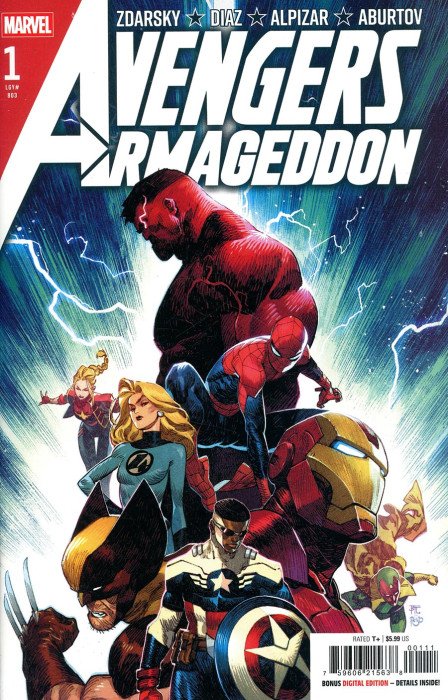
I’m going to drop a spoiler for the current Avengers: Armageddon miniseries, as well as the upcoming Avengers comic book reboot by Chip Zdarsky, so if you’re behind on those and you don’t want to know that Pepper Potts is the new Spider-Man, you may want to skip this week’s column.

She’s the big red guy.

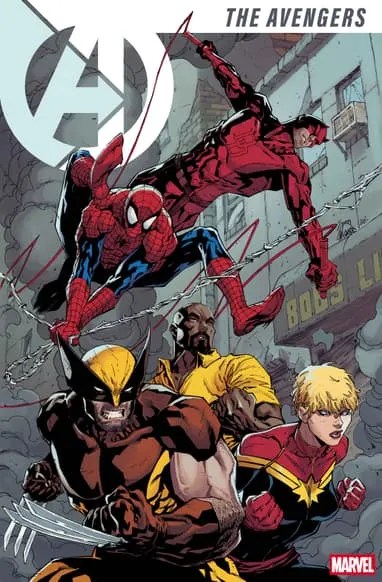
Just kidding about the Pepper Potts thing, but I’m not kidding about dropping a spoiler. Zdarsky’s miniseries has been building to his Avengers relaunch for a few months now, with a very different team being assembled in a world where the landscape has changed drastically. It seems as though the world is turning against the Avengers, and the reaction is an Avengers roster that is low on what we would think of as “Classic” Avengers. The team, as revealed in weeks past, will include Captain Marvel, Luke Cage, Wolverine, Spider-Man, and Daredevil. Not a one of the Avengers “Trinity” of Captain America, Iron Man, and Thor is lining up. It also doesn’t include any of the characters we think of as being “traditional” Avengers, such as the Vision, the Scarlet Witch, Black Widow, or Hawkeye. The most stable of the new lineup is Captain Marvel, who has had an almost-constant presence on the team for the better part of the last two decades. And each of these characters has been an Avenger at least once before (if only briefly), but if you showed me this roster without benefit of telling me what it was I probably would have guessed a new iteration of the Defenders before the Avengers. 

Or maybe, like Power Pack.

Some people are angry about this lineup, because EVERY announcement on the internet makes SOMEBODY angry. I could post that I found a dollar bill in the pocket of a jacket I haven’t worn since last year and I’d get twelve people pissed off about it. And to be fair, there are some legitimate concerns to be had here. I’ve never been one to be upset about new characters joining the Avengers. That’s been a constant on the team ever since Captain America joined about 800 issues ago. But to me, it never quite feels like the Avengers at all unless it has at least SOME of the mainstays, and I guess I’m old-fashioned enough that Captain Marvel doesn’t 100 percent satisfy that requirement by herself. 

The other thing that bothers some people is that many of these characters are reflective of the somewhat divisive “New Avengers” era by Brian Michael Bendis that began in 2005. This is a concern I can sympathize with. I am not a fan of Bendis’s work in general, and if I thought this book was just going to be a rehash of that, I wouldn’t be interested. But having Chip Zdarsky on the book makes me feel more comfortable – I am a fan of his work, with solid runs on comics like Daredevil, Batman, and Captain America under his belt, to say nothing of his own creator-owned work like the fantastic Image comic Public Domain. So if nothing else, he’s earned a story arc out of me before I decide if I’ll keep reading the book.

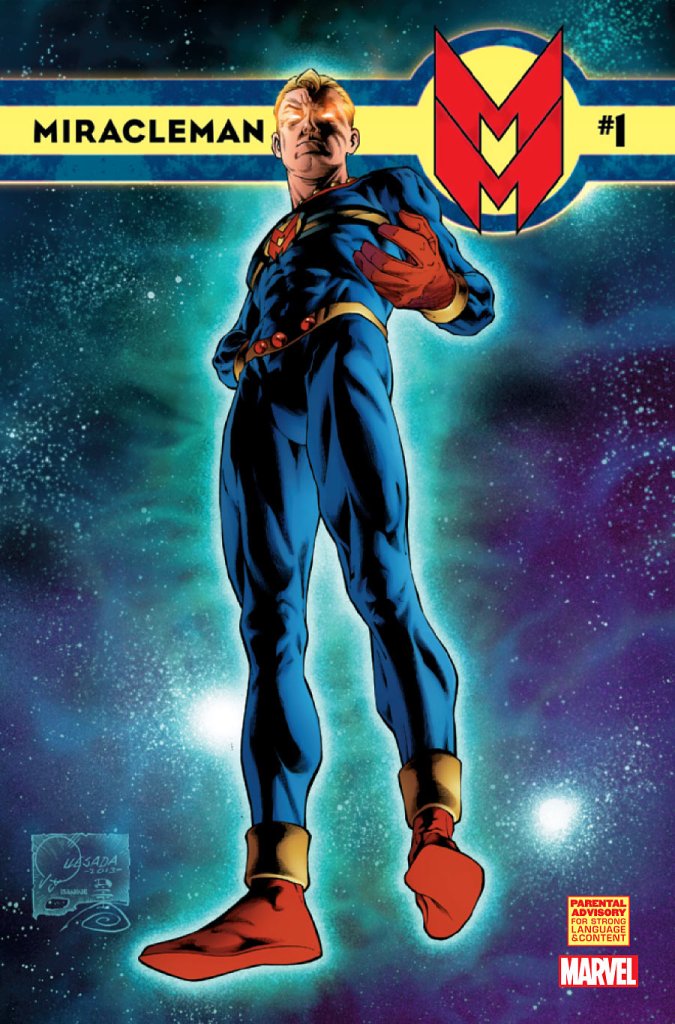
However, in the run-up to this, Marvel has played it coy about a secret final member of the team. There would be a member, they promised, who has never been an Avenger before. At this point, the number of heroes in the Marvel Universe who have NOT been a member of SOME Avengers team is pretty slim: it was pretty much down to Leapfrog, US-1, or Aunt May. But this week (and here’s the real spoiler, kiddies) the news dropped that the new member is somebody who has never BEEN in the Marvel Universe before: Miracleman.

‘Sup?

People complain sometimes about comic book characters having confusing or convoluted histories. But let me tell you, friends, there ain’t an X-Man on the planet with a backstory as twisted and bizarre as the REAL story behind Miracleman, and it’s kinda DC Comics’ fault.

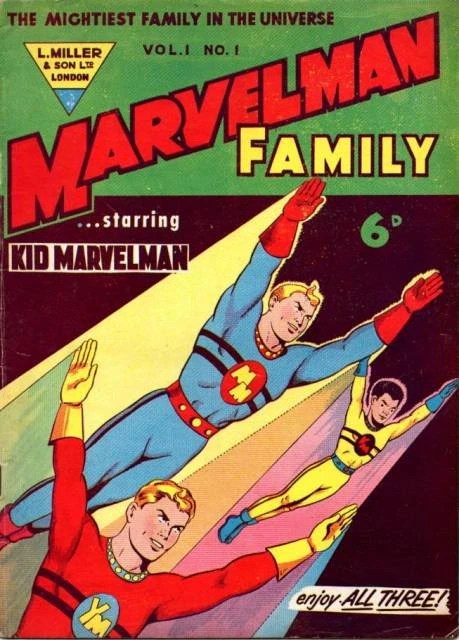
Back in the 1940s, Captain Marvel was one of the biggest names in comics. No, not that Captain Marvel, the other one. The guy published by Fawcett Comics who wore a red suit and these days is often called “Shazam.” But DC Comics sued Fawcett, claiming that Captain Marvel was too similar to their Superman. The court case dragged on for years until Fawcett eventually gave up the ship and quit publishing the Marvel Family comics – once superhero comics in general had declined in popularity, it should be noted. But this caused a problem for L. Miller & Son, the British publisher who reprinted the Fawcett Comics in the UK. With a hole in their publishing schedule, they hired cartoonist Mick Angelo to come up with a replacement. Angelo’s solution was “Marvelman,” a character who was…well, he was pretty much Captain Marvel. He was a kid who had a magic word that gave him super powers, teamed up with young friends who had the same powers, his arch-nemesis was a mad scientist…it was blatant. Angelo changed the costume, the magic word, and made Marvelman’s origin based on science (comic book science, at least) rather than sorcery, but other than that, it was pretty much Captain Marvel.

Look, kids! A familiar but legally-distinct intellectual property!

Marvelman lasted for about a decade and then faded away. Then in the 80s, Alan Moore came along and resurrected the character, making him a darker commentary on superhero comics in general. Most of the similarities to the old Captain Marvel evaporated, and the book was a hit. It was a precursor to the deconstruction of superheroes that Moore would become known for in books like Watchmen a few years later. Once he left the series, Neil Gaiman took over, but the book ended before Gaiman’s story could be finished. Before that happened, though, the series was popular enough to be transplanted to the United States by Eclipse Comics, who changed the name to Miracleman to avoid issues with Marvel Comics.

Here’s where it gets really complicated: there was a major legal dispute over who actually owned the rights to the character, with Gaiman, Eclipse Comics, and Mick Angelo all claiming pieces of (or in the case of Angelo, all of) it. Eventually, the courts decided that Angelo’s original copyright was still valid. Marvel Comics, whose editor-in-chief Joe Quesada had supported Gaiman in the dispute, stepped in and waved a lot of money at Angelo to acquire the character. They began reprinting the older comics, including the Moore and Gaiman runs, and had Gaiman continue the story he was never allowed to finish. The book was derailed again, though, when allegations of impropriety against Gaiman flared up a couple of years ago and, once again, the saga of Miracleman was left incomplete.

Now, though, it seems as if Miracleman’s future will not reside in his own story, but as part of the larger Marvel Universe. I haven’t read the new issue of Armageddon yet, so I don’t know if this is actually the Moore/Gaiman version of the character who has hopped over to the Marvel Universe or if it’s a multiversal variant showing up for the first time, but it doesn’t necessarily matter. A good writer can make either version work. The real question is whether anybody is going to CARE.

Bringing back older, obscure characters can be a tough sell. Any success Miracleman has had since coming to Marvel is largely because of older readers who wanted to finally get an ending to the saga that started back in the 1980s (and which it seems now will never actually end). Is taking that character, ANY version of him, and making him an Avenger going to win him any new fans? I’m not questioning Zdarsky’s story or his skill as a writer, I’m just saying I don’t know if it’ll be enough.

Comics, especially in the last couple of decades, are littered with the four-color corpses of older characters whose revivals fell flat. Marvel themselves have tried twice to bring back characters from the defunct CrossGen Comics (now owned by their corporate parent, Disney), but they failed to catch fire. Ever since the demise of the original Valiant Comics, those characters have been brought back time and again, only to fade back into obscurity with each attempt. Alien Books currently has the license to Zorro, a character who has changed hands among at least half a dozen publishers over the years, and they’re doing two series. One is a traditional series set in the old Spanish-occupied California. The other is a modern take, where a descendant of the original Zorro takes up the mantle in 2026. Both of them are really well done, but I don’t know if anybody on the PLANET is reading either of them except for me.

That’s not to say it’s IMPOSSIBLE for an older character to have a renaissance. The current Captain Marvel, Carol Danvers, is a perfect example of that. She’d fallen off the face of the Earth before Bendis brought her back for his Avengers (credit where credit is due) and now she’s one of the more recognizable characters in mainstream comics. Can Zdarsky pull off the same trick in bringing back Miracleman? I hope so. I like Zdarsky’s work and I like it when older characters come back. I would be happy to see this succeed, and I’d like to see the door open to other worthy characters that are sitting quietly on a shelf somewhere (coughULTRAVERSEcough).

But will it actually work?

A more cynical person would say it’d take a miracle.

But I’m saying it too, just because I like Dad jokes.

Blake M. Petit is a writer, teacher, and dad from Ama, Louisiana. His most recent writing project is the superhero adventure series Other People’s Heroes: Little Stars, volume one of which is now available on Amazon. He’s also started putting his LitReel videos on TikTok. 

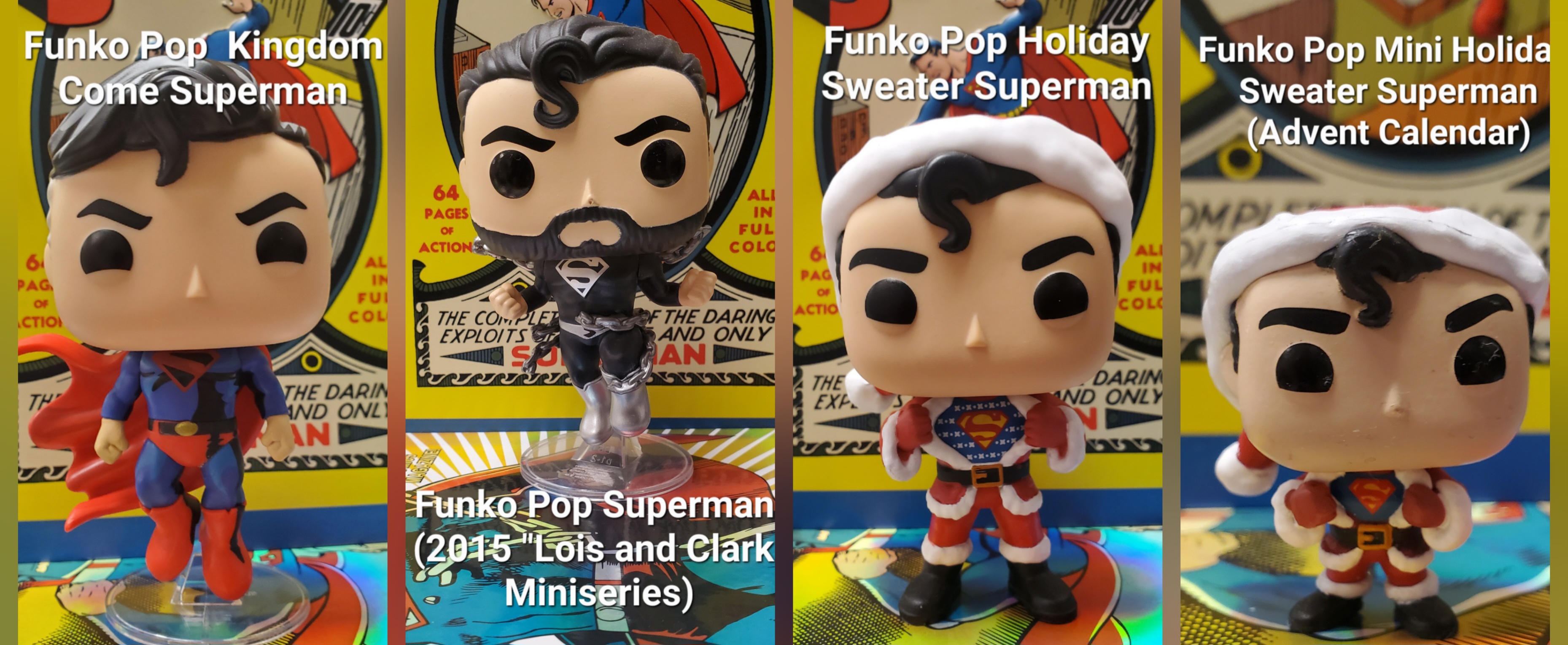
Superman Stuff #37: Superman Shelves-The Funko Edition Part I

In this day and age, if you collect anything related to pop culture, it’s almost inevitable that you’re going to wind up with some Funko Pops in your collection. Some people like to be derisive about them, others call them “Millennial Beanie Babies,” but the simple truth is that if it’s not something that hurts anybody, then whining about it says more about the person doing the whining than anything else. What I like about Funko is the fact that they cover such an incredibly diverse array of properties and characters all in the same line. When I was a kid, I was the sort who liked to mix and mash his action figures and make my own crossovers, and it always kinda bugged me that so many of them were in such vastly different scales from one another. Sure, G.I. Joe could interact with the Star Wars characters easily enough, but having them meet He-Man made it seem like the “Power of Grayskull” was nothing more than a massive overdose of steroids. Super Friends was a little better, although it always bugged me that Robin was taller than Snake-Eyes. And working in the Thundercats? The stuff of nightmares.

With Funko, though, any character from any universe is in the same scale as any other, and I admit, that’s what made me a fan. In recent years I’ve pulled back on collecting them just because of the sheer volume, but I still try to get my hands on any Superman or Superman-related characters I can find. It’s going to take a few posts to get through them all, so I’m going to start today with some of the more standard Superman figures in my collection.These are just the Funko Pops I’ve got of your basic Superman. You wouldn’t think one would need too many of those. You would be wrong. 

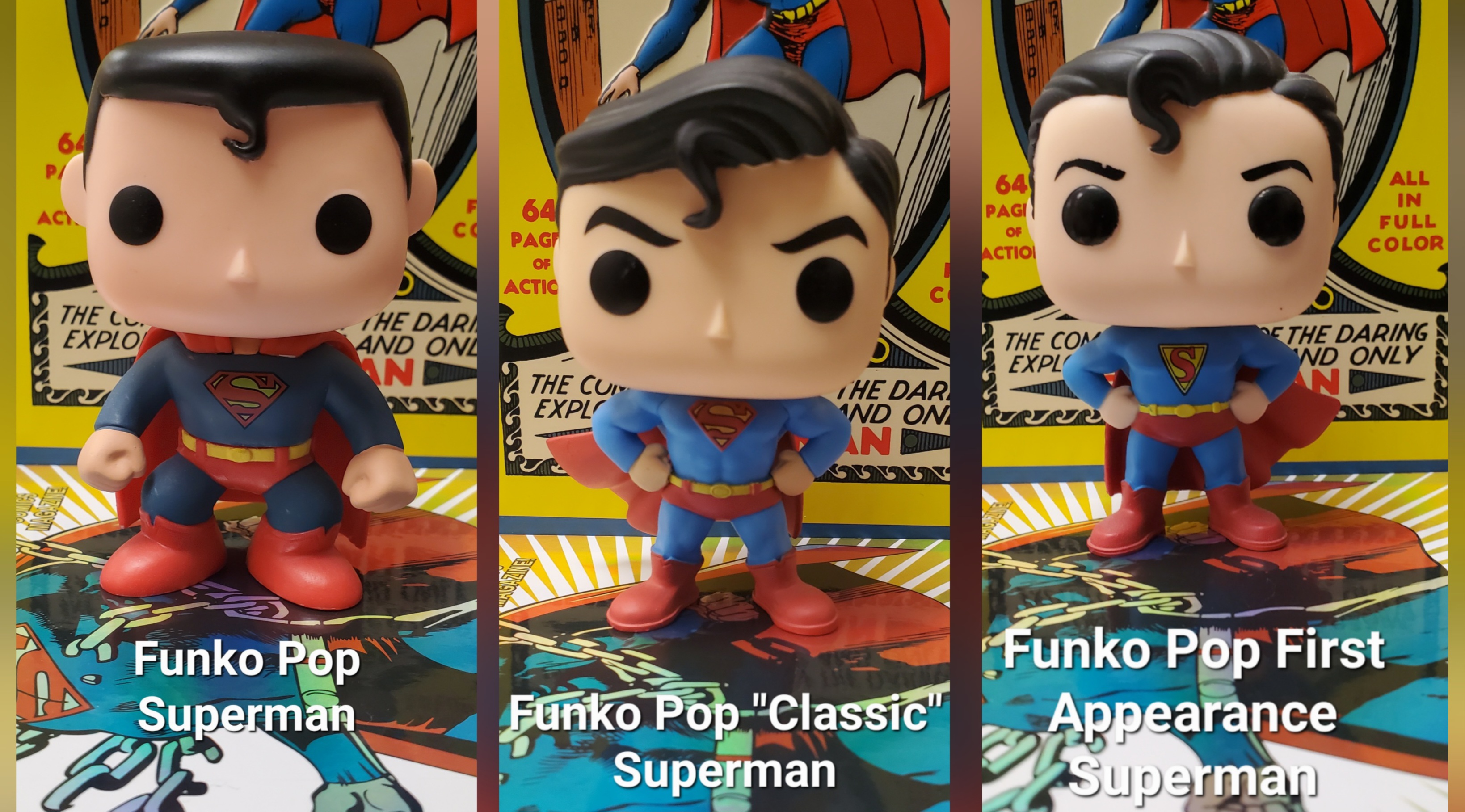
On this first row, we’re going to start with a sort of archetypical Superman. This was one of the first Superman Funkos ever produced, and I actually wound up with several of these in my possession when the TV show Krypton debuted. Prior to the beginning of the show there was a week-long trivia competition similar to the defunct HQ Trivia app with a cash prize each night and several runner-up prizes. I never won the top prize, but I got runner up multiple times, and each time I got the same package including a World of Krypton graphic novel, t-shirt that didn’t fit me, charging bank that looked like a Kryptonian crystal, and one of these Funko pops. I gave a couple to friends, one is in Eddie’s toys, and I kept one at home and one at work. Anyway, next to him is a figure labelled “Classic” Superman in our favorite “hands on hips” pose, and to the right is a “First Appearance” Superman, based on how the character was designed in Action Comics #1.

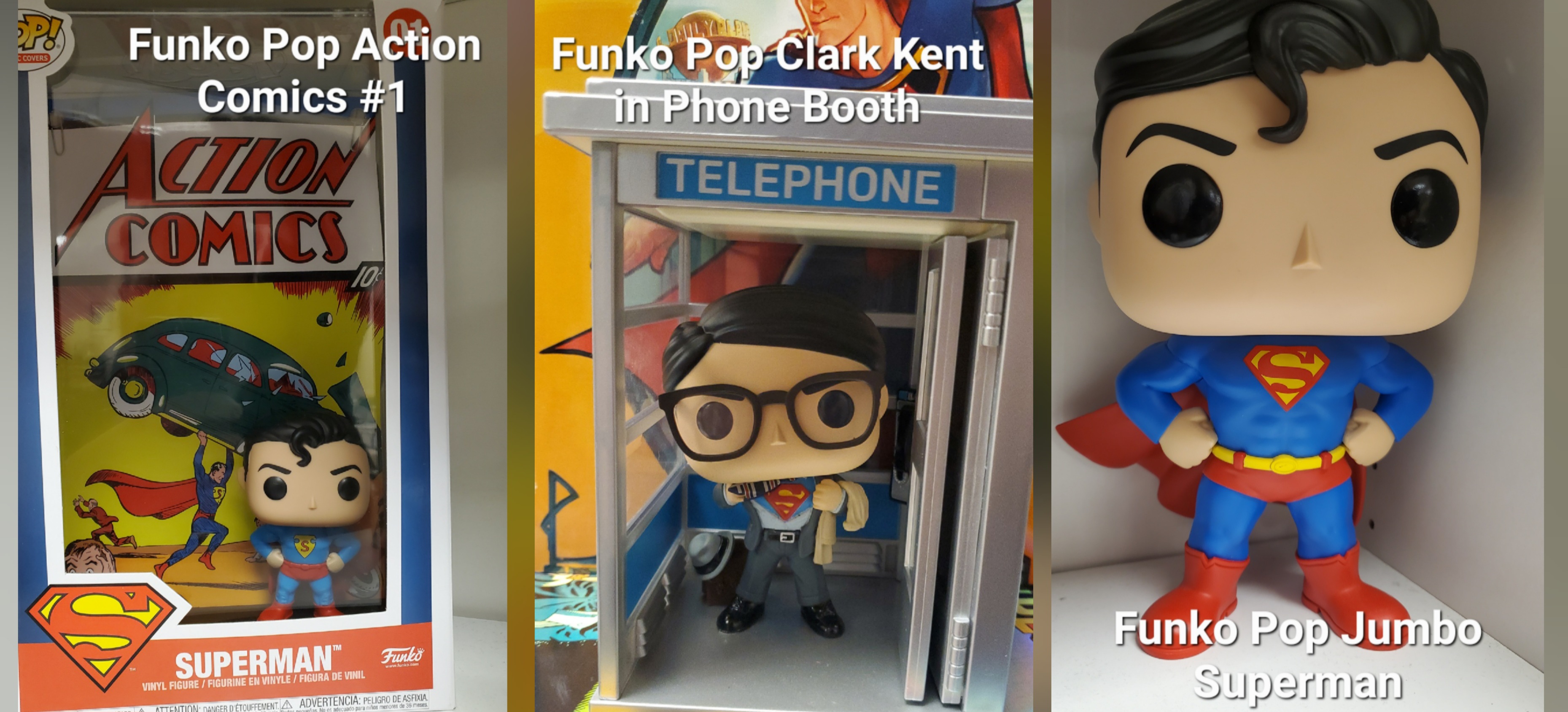
Speaking of Action Comics #1, that was also the subject of this Funko Pop Comic Cover figure. The s-shield is slightly different, as aficionados would be quick to point out. While I’m on the subject of oversized figures, there’s also this Clark Kent popping out of a phone booth, and the jumbo 12-inch Funko next to him. I believe there’s a variant of the jumbo figure with red eyes, like he’s using his heat vision, but I don’t have that one.

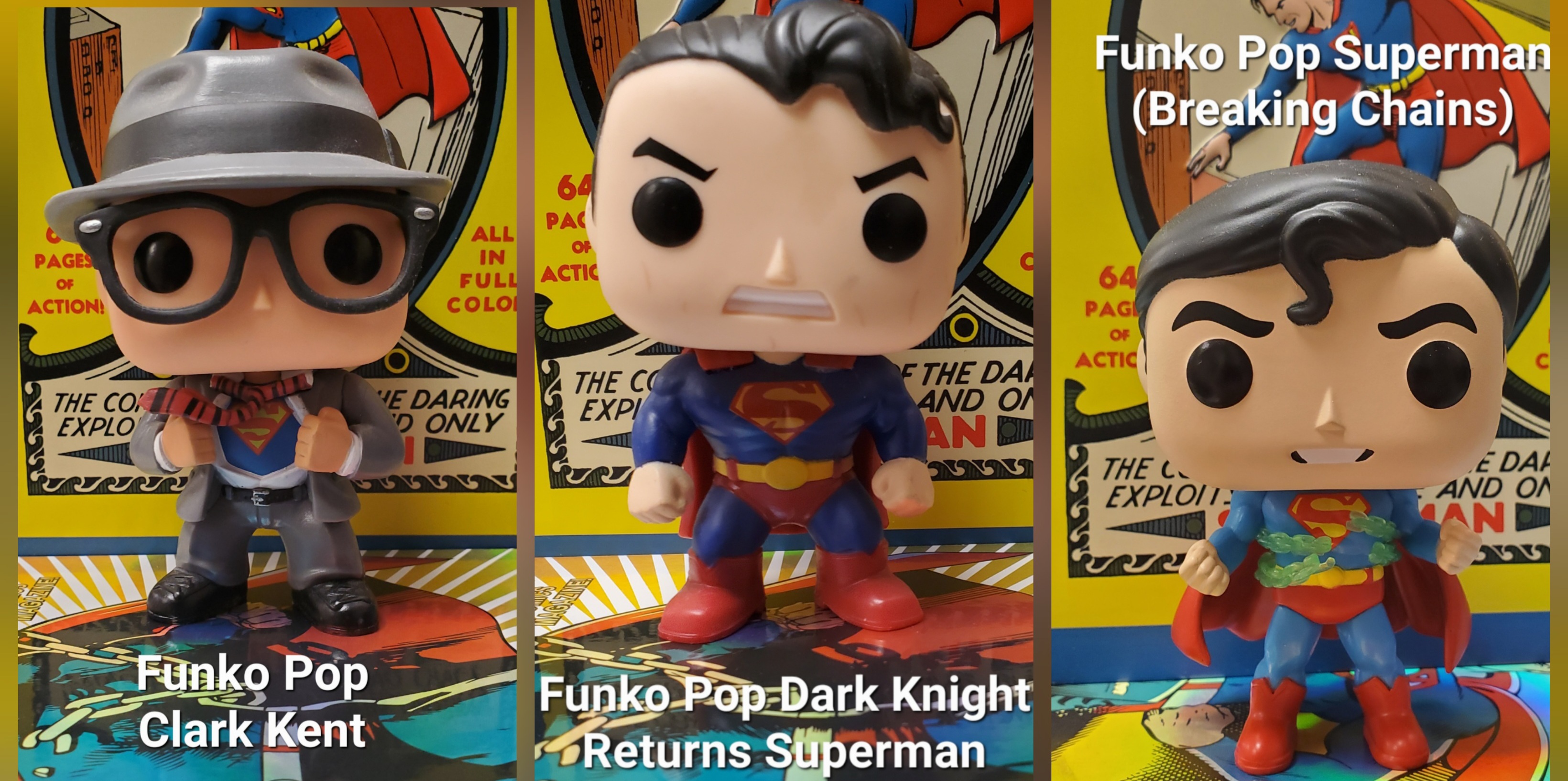
Here we have figures based on specific comics or scenes, starting with another Clark Kent in mid-transformation. That “Superman Pose” with the shirt being pulled open to reveal the S-shield is a classic for a reason. Next to him is a Superman based on Frank Miller’s Batman: The Dark Knight Returns. You can tell by the grimace. It’s not my favorite depiction of Superman, to be honest, but I do love having him on the shelf. I’m more enamored of the next one, Superman bursting chains in a tribute to the classic Neal Adams cover to Superman #233.

Some more story-specific figures here. We’ve got a Superman based on Mark Waid and Alex Ross’s Kingdom Come, which of course is one of the greatest Superman stories of all time. Next to him is the bearded, black suit Superman from the 2015 Lois and Clark miniseries by Dan Jurgens and Lee Weeks. I love this design, possibly because it’s just from such a great story, but I also think that the black suit and beard combo work well. And next I’ve got two versions of the holiday Superman: a full-size Funko and a miniature version that came from a DC Advent Calendar a few years back.

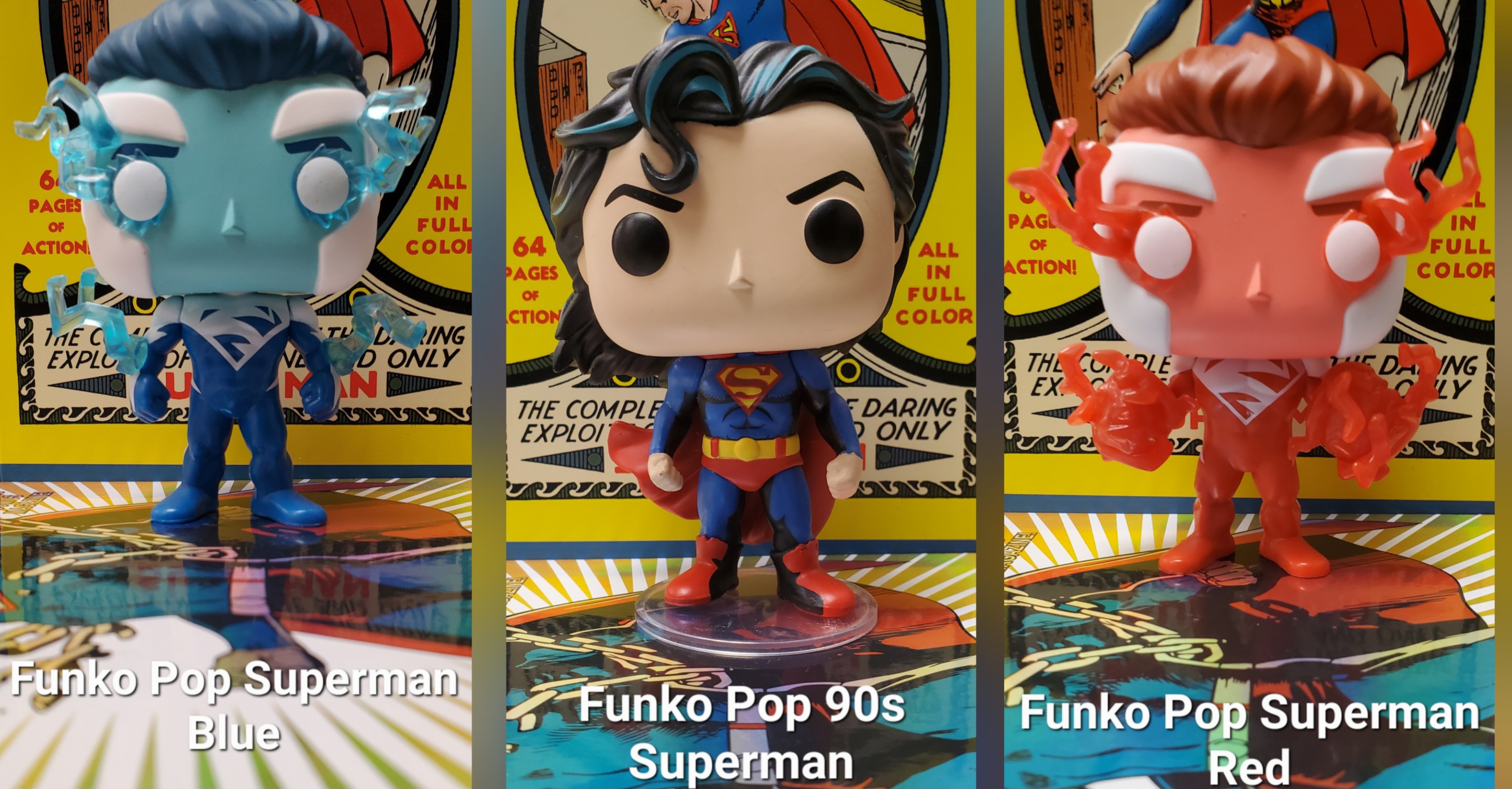
I call this next row the 90s Trilogy. In the middle we’ve got long-hair Superman, based on his appearance after the Death and Return of Superman. I’ve got him flanked by the versions of Superman from the story that came right after he finally got a haircut: Superman-Blue and Superman-Red. I just feel like these three all belong together, they’re so “of an era,” y’know?

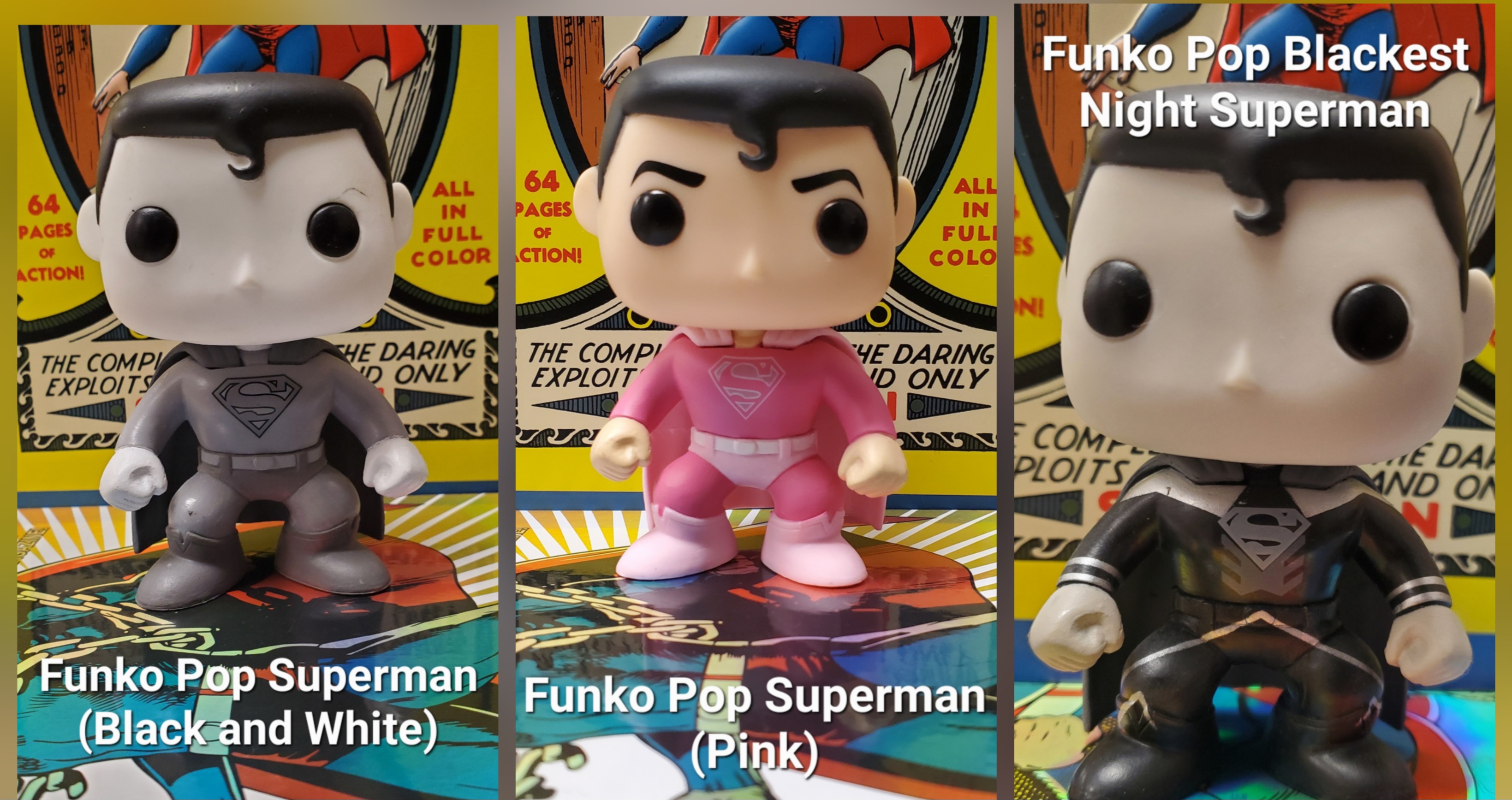
I’ll close off this part of the tour with a few color variations. First up there’s a nice little Black and White Superman. This is not the only Black and White figure in the collection, but some of the others will appear best in other sets. Pink Superman was part of a line of figures released for breast cancer awareness, and on the other side is the Blackest Night version of Superman from that classic scene in which he, and other heroes who had died and been resurrected over the years, were transformed into Black Lanterns. If you’ve never read that series, why not? It’s great.

As I said, this is just the first of several Funko shelves. In future installments we’ll look at alternate versions of Superman, versions from other media, and of course, his friends and foes. 

Blake M. Petit is a writer, teacher, and dad from Ama, Louisiana. His most recent writing project is the superhero adventure series Other People’s Heroes: Little Stars, volume one of which is now available on Amazon. Don’t forget, you can check out earlier blogs in the Year of Superman/Superman Stuff Archive! Got a request for a future “Superman Stuff”? Drop it in the comments!
Geek Punditry #192: A Cinematic Event

Today’s reflection begins – as so do many things in my life – with me being utterly horrified by something my 12th-grade students consider a common practice. As the teacher who puts all of my geeky tendencies on display, students often ask me if I’ve played a new video game (I have not), watched a new TV show (sometimes), or seen the newest movie (not as often as I would like). And I enjoy discussing movies with them, but I am sometimes baffled when I realize they’ve seen new movies, first-run movies that are still in theaters, not IN a theater, but on their PHONE.

This is not the same thing. IT IS NOT THE SAME THING.

The legality of how this is accomplished aside, I get an absolute quiver down my spine when I think about watching a movie like Spider-Man: Brand New Day on a screen that can fit in the palm of my hand. Movies, especially movies heavy on action and special effects, are intended to be an immersive experience, something that draws you into that world, and I just can’t see how that’s possible when you’re looking at a telephone screen. It gets even worse, though, when the student tells me that they watch these movies not on an app designed for such a thing like Netflix or Disney+, but broken down into 90-second segments on TikTok.

They even watch it vertically.

Excuse me, I just threw up a little in my mouth.

Studios are aware of this practice, of course, and many of them are trying to make content specifically to appeal to this audience: short-form videos have become more popular, “vertical dramas” are now a thing. Even major studio releases seem to be feeling the impact. For instance, there’s a theory floating around concerning Disney’s upcoming animated feature Hexed. When the trailer dropped, the kind of people who spend way too much time thinking about movie trailers noted that a greater-than-normal percentage of the action seems to be focused on the center of the screen, suggesting that Disney made the film with the intent of having the sides chopped off and shown vertically. Disney has not confirmed these suspicions, and honestly, I don’t know that I believe them either, but the fact that the question is even being asked says a lot about how people consume media these days.

I know I am marking myself as an old person when I say things like this. I know that younger generations do things in different ways and they have the right to do so. And most of the time I try to employ a “live and let live” attitude when it comes to things the kids do that don’t affect me. But I’m sorry, boys and girls, this is a time when you’re just flat-out wrong. Our field of vision was designed to be experienced in widescreen, not tallscreen, as demonstrated by this highly-detailed and especially scientific diagram:

They wanted to pay me big bucks to put this in a science textbook but I told them, “No, my readers get it first.”

It’s incredible to me that we are now making content that defies the millions of years of evolution that placed our eyes side-by-side on our face instead of stacked one on top of the other because people are too lazy to turn their phones 90 degrees. 

But that’s not even the point. The kids obviously still want to watch movies, as evidenced by the fact that they are watching them. But they’re not particularly interested in going to a theater, and that wounds me deeply, because they’re not getting the experience that was intended. 

This weekend I’m going to the movie theater for the ninth time this year. For some people that seems like an exorbitant amount, but I need to remind you that in my younger days, the days before I had a child to consider, I would go to the movies two or three times a week. I love movies. I love the movie theater experience. And while that experience was curtailed greatly first by parenthood and then by the pandemic shutting theaters down for most of a year, I spent all that time pining away for seat D11 in Auditorium 2 like a person in a long distance relationship. Some people had a girlfriend who lives in Canada, I had the Palace Theater calling out to me from Elmwood. 

My son Eddie is older now, and (thanks in no small part to my influence) he’s grown to enjoy going to the movies. He sees it as a special treat, and it’s been grand to have him reach a point where he specifically asks to see certain movies in a theater. This year we’ve taken him to see The SpongeBob Movie: Search For SquarePants, The Super Mario Galaxy Movie, Toy Story 5 and Paw Patrol: The Dino Movie, and every one of them was his pick. I would not necessarily have chosen all of these, but I love taking HIM, so I went regardless. We also brought him with us to see movies WE wanted to see that we thought he might enjoy: Supergirl, Spider-Man: Brand New Day, and Coyote Vs. Acme. His mom and I even got a rare childless movie experience to see Project Hail Mary when his spring break ended a day before mine, and I think he was a little offended when he learned we went to a movie without him, because he still brings it up.

This weekend it’s going to be a little different. We’re going to see the first episode of Mystery Science Theater 3000: The Rifftrax Experiments. This reboot of the classic franchise by some of the people who’ve been doing it for decades was announced earlier this year and, when they revealed that the first episode would be given a Fathom Events theatrical screening, I asked Eddie if he wanted to go. He’s grown up watching MST3K and Rifftrax with us, so I’m not surprised he was into it. Some of the jokes will go over his head, I know, but the jokes are so rapid-fire and diverse that EVERYBODY feels at least ONE of them whiz above their head. He will enjoy the robots and the guy in the monkey costume, and all will be right with the world.

Not since Dr. Frankenstein has such a chilling experiment come to the movie screen!

I think this is the way forward for movie theaters. The world has become so fragmented and content has become so diluted and spread out across so many platforms that there HAS to be something unique to convince a younger audience to go to a theater. Sure, lower ticket prices and lower concession prices would be great as well, but it’s also important to give people something they can’t get watching a movie even on a fancy home theater, let alone on a device that will interrupt the film every time Stacy sends a text asking if you saw the newest TikTok. In the case of The Rifftrax Experiments, the draw is getting to see the movie in a room full of like-minded fans, people who love the same thing that you do and who have come out to support it with you. 

That’s a great feeling, but more can be done to get people into theaters. Selling theater-exclusive merchandise like popcorn buckets and doing giveaways of exclusive comic books has been a bit of a draw. So have screenings with exclusive content like interviews with the creators or making-of features, the kind of thing that we used to get as DVD content before the companies gave up on it. Next week there will be a 40th anniversary screening of the original Transformers: The Movie that will be accompanied by a new short featuring what sadly shall be the final performance of the late Peter Cullen as Optimus Prime. If you’ve ever wanted to see a theater full of nerds weeping over a robot, here’s your chance. 

These kinds of retrospective screenings can be a lot of fun. A couple of years ago, Fathom Events did a special presentation of my favorite Alfred Hitchcock movie Rear Window, which my wife took me to as a birthday present. It’s a movie I’ve seen a half-dozen times, but never before on the big screen, and that made it worth getting a babysitter and heading out on a Sunday night. Family movies can do this too, of course. When I was growing up, Disney would routinely rerelease their classic movies like Peter Pan or Alice in Wonderland to theaters, and as a result kids got to see movies that were decades older than them on the big screen. Rereleases still happen, but on a much smaller scale and for a more limited time. Perhaps it’s time to widen those releases again.

Making the screening itself an event is also something that’s shown success. There are special events where a live orchestra will play the score alongside movies like Star Wars, Raiders of the Lost Ark, or Home Alone – honestly, any movie scored by John Williams will work here. Theaters that serve full food menus beyond just popcorn and candy have had success by pairing up special dinners with movies, serving the same food as (or food inspired by) films like Willy Wonka and the Chocolate Factory or Ratatouille. 

These are all fun, crowd-pleasing events, but I think we can go even farther. Holiday events, for example, could be really appealing. Every year TBS scores big with its “24 Hours of A Christmas Story.” Can you imagine doing that in a theater? Show the movie on a loop for 24 hours, let people wear pajamas and bring blankets, have a 20-minute intermission between each screening so people can get more food or go to the bathroom. You would sell out a theater in MINUTES. Or how about a screening of Planes, Trains, and Automobiles with a full Thanksgiving dinner? What if there was an October screening of John Carpenter’s Halloween where each on-screen death was accompanied by someone in costume lumbering into the theater and “killing” an audience member? Granted, that last one might not be fun for a Paw Patrol audience, but the RIGHT audience would eat it up like the popcorn they’d spill when getting fake stabbed. 

The point I’m getting at is that if we want audiences to come back to the theaters, the theaters are going to have to get creative. Earlier this year, Ryan Gosling got a lot of attention when he said to moviegoers “It’s not your job to keep [theaters] open, it’s our job to make things that make it worth you coming out.” He is absolutely right about that, and I think the phenomenal performance of certain movies this year prove that giving the audience what they want will pay off. But that’s only part of the equation. The other part is the theaters themselves giving the audience a reason to watch the movie in their auditoriums instead of on their phone. Because apparently the fact that watching it on the phone is a poor way to do it isn’t reason enough.

Blake M. Petit is a writer, teacher, and dad from Ama, Louisiana. His most recent writing project is the superhero adventure series Other People’s Heroes: Little Stars, volume one of which is now available on Amazon. He’s also started putting his LitReel videos on TikTok. 

Superman Stuff #36: Checking In With Peter David’s Supergirl

Back in June, just before the Supergirl movie dropped, I devoted a column to the first few issues of the longest-running series the girl of steel has had to date: Peter David’s 80-issue run from 1996 through 2003. At the time, I talked about the first five issues of the series, as well as the prologue short story from Showcase ‘96. Since then, I’ve been working issues of the series in my regular rotation of re-reads, and this week I wanted to check in on the series so far.

At this point, I’ve gotten through the first 24 issues of the series, along with its two annuals and the two issues of Resurrection Man that the title crossed over with in 1998. This is the first time I’ve read most of these issues since they first came out nearly 30 years ago, which is an appalling number that whoever is in charge of time should be immediately apologizing to me for. I find that, while I remember most of the broad strokes, it’s the little things that I’m really getting into this time around.

For example, the broad strokes in question include the fact that Peter David’s Supergirl is what’s called an “Earth-Bound Angel,” a sort of heavenly being that is created when someone who is utterly unselfish sacrifices themself to save the life of someone beyond redemption. In this case, the former is Supergirl (the Matrix version) and the latter is Leesburg resident Linda Danvers. The Earth-Bound Angel is created by fusing the two of them into a single being. Much of the story comes from Linda, whose past is far dirtier than you usually expect from a member of the Superman family, trying to navigate the fact that she’s now cast into the role of a hero, and attempting to reconcile two sets of memories that have become one.

This much I remember. The stuff I didn’t remember is where the book really shines: the conflict between Linda and her parents, particularly her mother, who struggles with the knowledge that her child has been irrevocably transformed, for example. Or the surprisingly large presence that Jonathan and Martha Kent have in these issues – surprising inasmuch as I didn’t remember them being in it quite so often, not surprising that they would want to take care of “Mae,” whom they raised as a daughter. 

I’d forgotten a lot of the supporting cast as well. I remembered the demonic Buzz and the bizarre reboot of Comet (the Silver Age “Superhorse”), but I had forgotten characters like Linda’s struggling journalist pal Cutter, his ex-wife Andrea (who winds up with a crush on Linda), Linda’s best friend Mattie Harcourt, and the odd little boy named Wally who claims to be God and who, frankly, you struggle trying to argue with. Peter David had an uncanny knack for bringing in societal concepts and big ideas, concepts that were hot button topics at the time (and in some cases, still are today), and approaching them in a way that treats them as components of a story rather than an effort to make any sort of statement on the writer’s part. While one can probably figure out David’s political and spiritual beliefs with a deep enough reading of his work, that’s always subtext, and he never comes across as though he’s standing on a soapbox.

What’s more, David does all of this while dodging and navigating one DC “event” intruding into his story after another. Issue #3 was part of the Final Night crossover, then issue #14 was interrupted for Genesis (and believe me, that’s the kindest word to use for Genesis), and in issue #20 Supergirl had to leave town to help Superman deal with the Millennium Giants in his own titles. Some writers allow their book to be derailed entirely, while others give a crossover only the cursory acknowledgement and then ignore the fact that the sky has turned red. David is one of the few who really succeeded in striking a balance. In all of these issues, while Supergirl is dealing with the larger threats that are encompassing the DC Universe, we see the excellent supporting cast handling the trauma on their own, with lasting repercussions for the ongoing storyline that make these issues feel relevant and not just a bump in the road.

It’s also worth noting that original artist Gary Frank left the book less than a year into his run, making way for the man who partnered with David for most of the series, Leonard Kirk. And with all due respect to Frank, I think it was a change for the better. Gary Frank comes from a very highly detailed school of art, which is all well and good, but David uses a softer line and a more classic school of character design, without ever giving up the ability of the characters to emote or “act” on the page.

A little more than a quarter of the way through David’s run, and I’m enjoying it thoroughly. With the news that Sophie Campbell intends to bring back the Matrix Supergirl in the current run of the series, I can only hope she’s studied these issues intently, because there’s a lot of gold to be mined here. I’ll check in again later, maybe once I round issue #50. 

Blake M. Petit is a writer, teacher, and dad from Ama, Louisiana. His most recent writing project is the superhero adventure series Other People’s Heroes: Little Stars, volume one of which is now available on Amazon. Don’t forget, you can check out earlier blogs in the Year of Superman/Superman Stuff Archive! Got a request for a future “Superman Stuff”? Drop it in the comments!
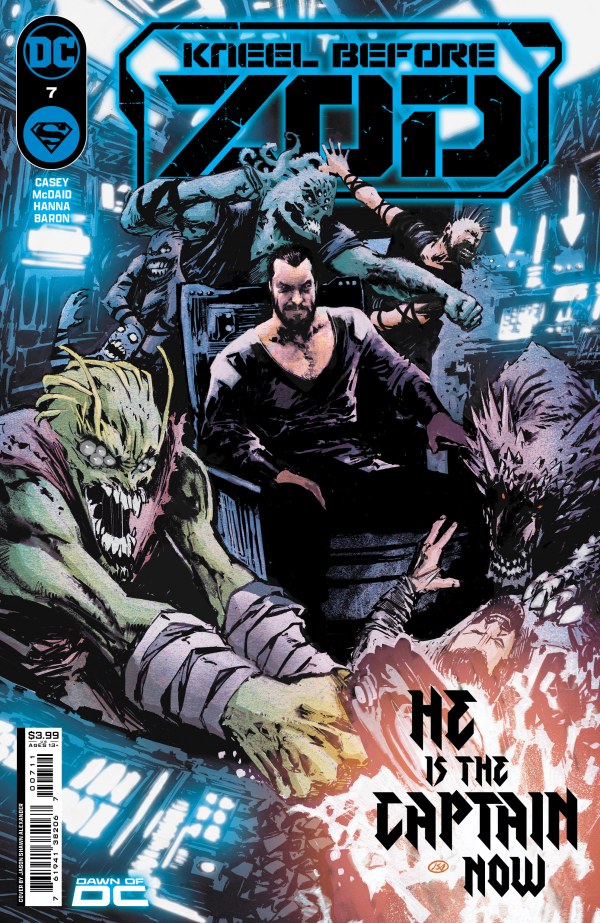
Geek Punditry #191: The Virtue of Balance

I am a big believer in cultural comfort food. There are certain TV shows and movies you turn to when you’re having a hard time, certain books you read to lift your spirits, certain songs or artists you listen to when you need a shot in the arm. They’re different for everybody, of course. I’ve mentioned before my love of things like The Princess Bride, Cheers, obviously Star Trek, and the works of the brilliant Don Rosa, particularly The Life and Times of Scrooge McDuck. I have others, of course, these aren’t the only ones, but they are things that I know I can consistently count on to make me feel at least a little better when I’m feeling down.

This is a good thing.

But some people take it WAY too far.

You don’t need me to explain to you how social media, the invention that was supposed to bring everybody together into a grand, unified human race, has instead caused problems of microdivision and tribalism unheard of in centuries past. A few decades ago, if you really liked watching Night Court, that just meant you really liked watching Night Court. These days, thanks to social media, you can create a unified front with people who also like Night Court and turn it into your entire personality, to the point where you’re convincing the tallest person in your friend group to shave his head and trying to decide who’s going to get kicked out and recast over the course of the first two or three seasons.

The most recent piece of media that I’ve seen taken by this frankly disturbing trend is the movie Project Hail Mary. And it wounds me to say that, because I love this movie. It is, in fact, my favorite movie of the year (so far, but looking at the slate of remaining releases I’m very skeptical that anything else will overtake it in my estimation). And as I dearly loved the film and mentioned it on Facebook multiple times, I wasn’t surprised when groups dedicated to it started being recommended to me. Looking forward to talking to other people who appreciated the remarkably sweet relationship between Grace and Rocky, the positive, optimistic outlook of the story, the beautiful special effects, or the triumphant package that was the film as a whole, I went ahead and joined such a group.

And man, I gotta tell you, that was a mistake.

These “superfans” of the movie are – there’s a clinical term incoming here, so be prepared to get out your medical dictionaries – “Goofy in their Goo-Goo Gibblets.” There are people who, and I am not exaggerating here, have absolutely no existence anymore beyond their passion for this film. There is an ongoing petition to have it re-released in movie theaters because they crave a fix like it was heroin. Just yesterday I saw a post from someone claiming that if you haven’t watched it at least five times you have no business calling yourself a fan. When the film was released digitally, someone noticed that the version on Prime Video was three or four minutes longer than the version she had purchased on another streaming service and was OUTRAGED that she was denied content, until somebody finally explained to her that the Prime Video runtime included the credits for the film’s assorted foreign language dubs at the end and the other one did not.

And these are the people on the LOW end of the Sanity Slippage Scale.

Look, there’s nothing wrong with loving a movie. If I thought there was, I wouldn’t have joined the group in the first place. But some of these people are straight-up unhinged. 

There’s an ongoing war between fans of this film and Christopher Nolan’s movie The Odyssey (a war, I suspect, that Odyssey fans remain blissfully unaware of). Why? Because the PHM fans have worked themselves into a stupor believing that next year The Odyssey is going to walk away with all of the Academy Award wins that Project Hail Mary so rightfully deserves. This is remarkably stupid for two reasons. First, it’s the Oscars, so who gives a crap? Second, it’s idiotic to think that because you love one thing, you’re not allowed to love something else as well. It’s not a marriage, you can be a fan of two movies without breaking any Commandments. I am known far and wide throughout my school as “The Superman Guy” (with good reason), but I don’t think I’m cheating on Clark Kent when I read an issue of Fantastic Four. 

Project Hail Mary fans are, of course, not the only group that fall into this category, a group that makes you start to be a little embarrassed to admit that you’re also a fan. Bob’s Burgers fans have a lot of this going on as well. I love the show. I love the adventures of the Belcher family. But I do not fathom the people who seem to have the show running on constant repeat on Disney+ 24 hours a day, who have a panic attack every time there’s a glitch on Hulu that skips to the end of an episode, or who stock up on gasoline, wine bottles, and greasy rags every September because Football Season is going to take away their Bob on Sunday nights. I’m only half-joking about that last one, by the way: their hatred of football borders on the pathological, because they seem to have somehow convinced themselves that were it not for the NFL the Fox Network would be producing a full 52 new episodes of the series each year instead of the 13 to 25 that particular season is actually contracted for. Football has never shortened a season of Bob’s Burgers, only delayed it for a while, but trying to explain that to a superfan is a good way to get your tires slashed.

“They like us, Bobby! Oh… Not THAT much.”

Then there’s Dungeon Crawler Carl, my most recent obsession. The adventures of Carl and Donut are already legendary, and the fan base is remarkably solid, especially considering that there’s no movie or TV show (yet – more on that in a second) and the legion of Crawlers is built entirely upon people who love BOOKS. That’s really a great thing. 

But as always, there are some people who take it too far.

Once they announced that Dungeon Crawler Carl had been picked up by the Peacock streaming service for a TV series, the fan base quickly reached the brink of civil war. People arguing about who should be cast as which character drew up lines started painting protest signs. The announcement that Seth MacFarlane’s company was going to be producing the show, similarly, caused a schism between people who think he’s perfect for the job and people who think he’s the antichrist. And of course, when it was confirmed that the show is going to be live action and not animated, you could practically hear the shotguns being cocked and shells dropping into the barrel. 

Can you imagine a group called the “Donut Holes” taking things too far?

And as much as fans were insulted when it first aired, that old Saturday Night Live sketch where William Shatner implored Star Trek fans to “get a life” is feeling more applicable than ever.

Guys, it’s okay to like something. It’s even okay to LOVE something. But ultimately it’s just a movie, just a TV show, just a book. If you are genuinely upset, to the point of dissolving friendships and threatening violence against people, something is seriously wrong with you. 

If Project Hail Mary doesn’t win best picture (and it almost certainly won’t – the Academy’s bias against genre films is legendary), is that going to make the movie worse?

If you get the same number of episodes of Bob’s Burgers, does it matter so much if they’re run from September through May with huge gaps or from January to June with fewer gaps?

If the Dungeon Crawler Carl TV series turns out to be a catastrophe, is that going to hurt the book? Someone once asked Raymond Chandler how he felt about Hollywood “ruining” his books with film adaptations, to which he replied, “Hollywood hasn’t ruined my books. They’re right there on the shelf, perfectly safe.”

Being a fan should make you happy. It should give you joy, because in this world we all need a little of that. And being part of a community that loves what you love is great, provided that it is reflected in a positive way. If you feel like you’re not allowed to love Movie X because you’ve fully devoted your life to Movie Y, it’s time to reassess your priorities. If somebody tells you they prefer one TV show over your favorite and you decide that you can never speak to that person again, the problem is yours. And if you’re so scared of a TV show or movie “destroying” a book that you love, you need to just unplug your set and go outside for a little while.

You can take your book with you. It’s okay. Maybe you’ll find somebody else who likes it too. And maybe they’ll even convince you that it’s okay to like other things as well. Balance is important, guys. Try a little sometime. 

Blake M. Petit is a writer, teacher, and dad from Ama, Louisiana. His most recent writing project is the superhero adventure series Other People’s Heroes: Little Stars, volume one of which is now available on Amazon. He’s also started putting his LitReel videos on TikTok.