Geek Punditry #171: You’ll Figure it Out On the Way

Recently, on the advice of – and this is a rough estimate so please forgive me if I leave somebody off this list – everybody, I picked up Matt Dinniman’s LitRPG novel Dungeon Crawler Carl. I’ve never read a LitRPG before, but a lot of people whose options I highly value told me over and over again what a great book this was and that I needed to check it out or watch my Geek Cred stats rapidly plummet. And I must concede, that first book really grabbed me.
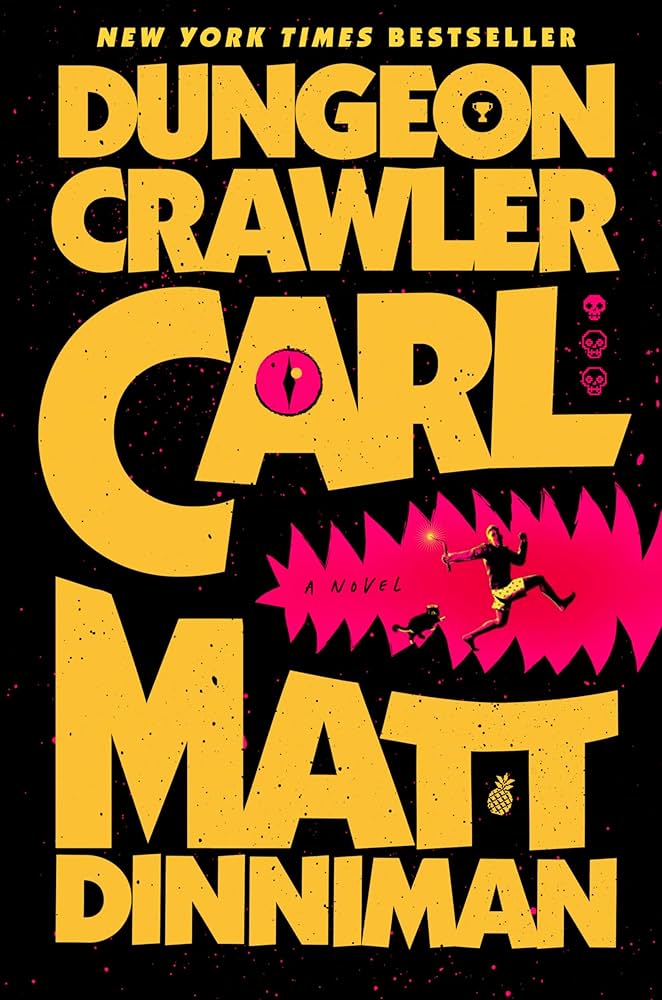
My friends just know how wild I go over “crawling” fiction.

From what I can tell, LitRPG is a subgenre of sci-fi and fantasy in which the story emulates traits of a typical roleplaying game, including having the characters’ stats and levels prominently featured and even included in the plot. In the case of Dungeon Crawler Carl, these stats and levels come as Carl and his ex-girlfriend’s cat, Princess Donut, are forced to risk their lives over and over again in a massive global dungeon with the entirety of the human race – at least those who are still alive – hanging in the balance. If that doesn’t sound like a riot, I should remind you all that Douglas Adams chose to begin his Hitchhiker’s Guide to the Galaxy series by blowing up Earth, so an apocalyptic comedy is by no means unexplored territory. And Dinniman handles it extremely well. I admit, when I started reading the book I expected the conclusion of the Dungeon Crawler story to come by the end of the first volume, and I wondered what the follow-up would be that would extend the series to seven installments (so far, at least – the latest word is that the series will wrap up in volume ten). I was quite surprised, then, as I progressed through the novel and realized, at the pace we were going, there was no way in hell the story would be finished in one book, and Carl’s singular quest through the dungeons would, so it appears, be the entire series.

After reading some massive doorstoppers early this year, I was pleasantly surprised not only by how entertaining the adventures of Carl and Donut turned out to be, but also by just how quickly I whipped through the first novel. After spending the better part of a month on Stephen King’s It, I finished the first Carl book in less than a week. I informed some of my friends who recommended it to me in a group chat the day after I finished reading book one, and one of them told me that book eight is scheduled for release next month, May.

“I doubt I’ll make it through seven books by May,” I said.

“Yeah, you will,” he replied.

And damned if it’s not possible. When I picked up the second volume this week, I got through roughly a quarter of it in the first day, an almost unheard of chunk of novel in a modern era in which my valuable reading time is often stolen by such frivolous things as going to work, driving a car, and parenting. But I quickly noticed something unusual about the second book, Carl’s Doomsday Scenario. Most of the time, when you get to the second installment of a series, there’s a bit of an effort to restack the world for the audience – reminding them of things that happened in part one, re-explaining the rules of the world, and otherwise attempting to bring them up to speed in case there’s anybody just joining in for the first time. This is pretty common in fiction of all types. TV shows with serialized storylines will frequently begin with a “Previously on…” segment. Movie sequels will usually have some brief lip service where the characters recap the events of the first film, even if doing so makes little sense in context. Comic books make frequent use of flashbacks. 

The idea here is that there’s always the chance that there’s someone joining the audience NOW – somebody who has not seen the earlier episodes or read the earlier books, and therefore needs a little help so they don’t get lost. There was a point in the 80s when Jim Shooter, then Editor-In-Chief of Marvel Comics, issued a company-wide rule that every character be referred to by name when they first appeared in each issue, just to make sure a theoretical new reader could tell who’s who. The spirit of the policy made sense, but in terms of writing, this would often result in clunky panels with inorganic dialogue. This was never demonstrated better than the infamous “Mouseketeer Roll Call” Shooter himself wrote in the pages of Marvel’s first major crossover event, Secret Wars, when dozens of heroes and villains who had just been kidnapped and brought to the other end of the universe by a cosmic deity stopped the action, stood in a line, and identified themselves.
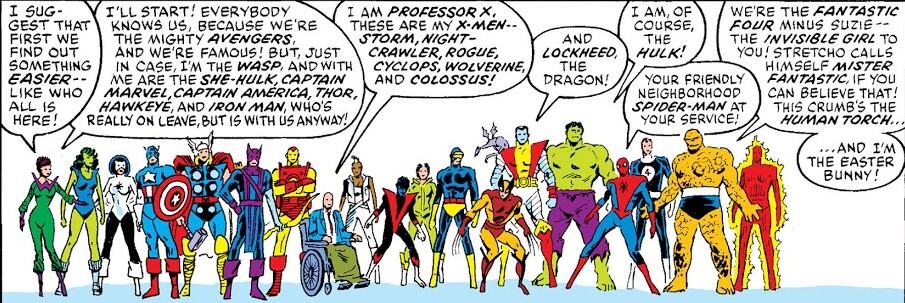
The Wasp and the Thing are at opposite ends, both of the panel, and in terms of the spectrum of humility.

Dinniman, however, makes absolutely zero attempt to recap the story for new readers. Although Carl’s Doomsday Scenario begins with a new Chapter One, it may as well have just continued the numbering from the previous book, because it picks up just seconds later and makes every presumption that the reader is up-to-date. It doesn’t recap part one, doesn’t explain the logic of this universe, and pretty much just goes on as if Dinniman is quite confident that anybody who is reading Doomsday Scenario will also have read Dungeon Crawler Carl, so why bother? It was temporarily jarring even for me, somebody who had just finished book one a week earlier, when Carl started getting messages from somebody named “Brandon” that had not been mentioned before in this book and I had to go back and remind myself who he was. 
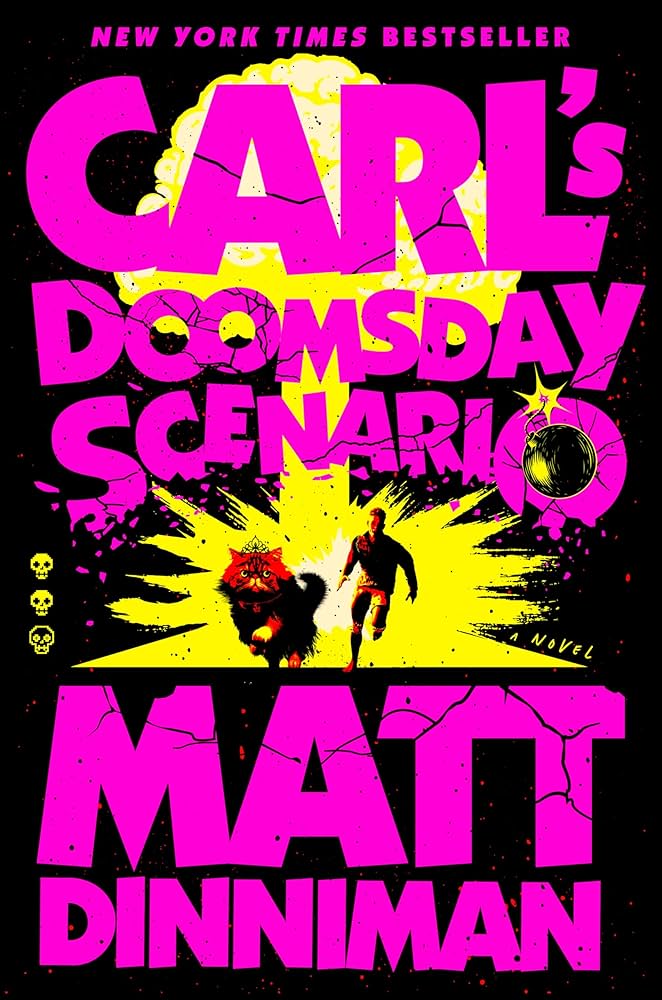
I defy anybody to find evidence in this image that this book is a sequel. You can’t, can you? Because you’re too busy looking at the cat in the tiara, that’s why.

The style of storytelling in which a recap is expected…in some ways, it’s kind of a relic of a bygone era. It made a lot of sense in the days when a TV series aired one episode a week and if you missed it, you just missed it and hoped you could catch a rerun over the summer. In these days of binge-watching, when you can start a series from episode one no matter how many episodes have been made, and when the streaming service will roll right into the next episode after you finish it, it’s not nearly as important as it used to be. It’s still a little more necessary in other forms of storytelling, but not always. In movies like those in the Marvel Cinematic Universe – particularly the upcoming Avengers: Doomsday – we should expect a certain amount of recap because it’s unreasonable to presume every audience member will be intimately familiar with the details of the past three decades of Marvel movies and television, especially since the former Fox X-Men universe is being folded into the multiverse of the MCU. But James Gunn’s Superman launched a whole universe in the middle of a story and figured – correctly – that there was no need to go over Superman’s origin yet again because everybody should be familiar with it at this point. A few title cards at the very beginning told us everything we could possibly need to know.

But what about episodic storytelling like comic books? Shooter’s rule – even when it was executed poorly – made a lot of sense in an era where it was presumed that every issue was potentially somebody’s FIRST issue. Comic books aren’t really written that way anymore. Most series – even so-called “ongoing” series – are given a certain number of issues to tell a story (although this exact number is often undisclosed to the reader it is typically low – maybe five or six issues at a time). If the series sells well enough, it will be renewed for another number of issues, then another, until either it becomes unprofitable or the creative team finishes all of the stories they had planned. With this structure, even as comic book sales are on the rise, it’s reasonable to assume that the number of people jumping into a series on issue #8 is relatively slim. But we WANT new readers, so there has to be a way to make it accessible without alienating the existing audience.

And there is, and it’s a simple way. Marvel Comics have long had a policy of including a “previously” page at the beginning of each issue, recapping the story to date and showing headshots of the major characters. It serves the same purpose as Shooter’s old rule, but it’s not intrusive into the story itself. Somebody who hasn’t been reading along can use the page to get into the saddle, but faithful readers can easily skip it if they wish. It’s a sensible policy, and other publishers (DC included) have slowly gotten into the habit of incorporating similar pages in their own comic books, although I wish it would become more standard. 
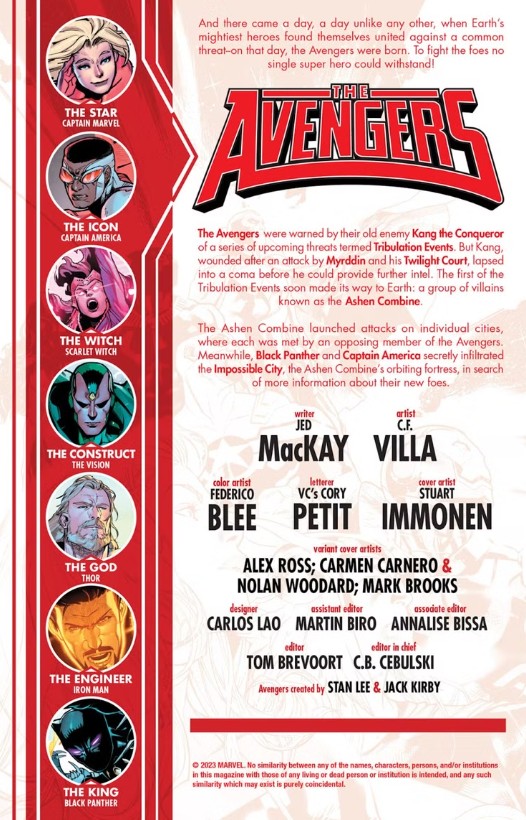
I mean, without this page how would you ever know the Scarlet Witch is a witch?

With prose books, we’ve got an interesting sort of mix of possible readers. On the one hand, if somebody is an ebook reader, it would make little sense to begin in the middle of a series. If you’re browsing the Kindle store and a book sounds interesting, it’s usually labelled as something like “Book 2 in the Dungeon Crawler Carl series,” with a handy link to look at all the books in the series at once so you can get them all and start from the beginning. But for a print reader who gets these books browsing a brick-and-mortar store, it’s not always as clear. Not every series is clearly labeled as such on the cover, and even if it is, there can’t always be a 100 percent guarantee that the store will have the earlier volumes in stock on the day you pick up volume three while you’re casually browsing. 

Many of us have fallen victim to this at some point or another. Back in middle school I was poking through the shelves at our Scholastic Book Fair (if you’re someone that just got a little thrill of excitement at those words, you are my kinda people) when I saw a book with the fascinating title The Restaurant at the End of the Universe. I picked it up and I read the back cover, and it sounded interesting. So I bought the book, brought it home, devoured it, loved it…and THEN I discovered that it was actually the sequel to a novel called Hitchhiker’s Guide to the Galaxy. Had I noticed that parts of it were a little confusing the first time I read it? Sure. But my seventh-grade self already was aware that there were jokes and references I didn’t quite understand (I did not have an encyclopedic knowledge of British politics and popular culture circa 1980, believe it or not), so when there seemed to be something missing I assumed that gaps in my knowledge could be attributed to that, rather than the fact that I’d skipped an entire book.
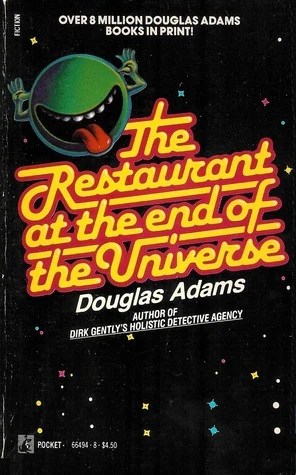
And even if I DID notice, based on this cover, I would have thought the book I missed was Dirk Gently’s Holistic Detective Agency.

In Dinniman’s case, the lack of recap makes more sense when you learn that the series originated on the online platform Royal Road, which allows writers to serialize their fiction. The Carl series was not originally written in book form, but in this more episodic format, and when the decision was made to publish it as a book series Dinniman basically chose where to end each volume based on a point where a logical pause happened rather than necessarily having it planned out as a ten-volume series. That kind of planning seems to have crept in later, as the book went from a popular online fic to a publishing juggernaut, but it wasn’t baked in from the beginning, and the book version reflects this. 

(Personal side-note: I’d never heard of Royal Road before I began digging into the backstory of Dungeon Crawler Carl and I feel the need to look deeper into this system. I’ve been thinking about looking for a new way to serialize my own work ever since the demise of Kindle Vella, and this seems like a far more stable outlet.)

The recap thing is a trope in storytelling, and although I can understand why it may be frustrating for people who are devoted followers of a particular series, I don’t think it’s a bad thing. It serves a purpose, and if it allows a story to be opened up to a larger potential audience, that’s a net positive. It just needs to be done in an unobtrusive way. “Previously” pages in comics or even in novels are a good way to do it, and although lacking one doesn’t hurt anyone’s enjoyment of the series at all, I’m surprised that Dinniman didn’t include one in Doomsday Scenario.

At the very least, publishers, make it damn clear on the cover or spine of a book if it’s part of a series. Numbers are your friends.

Blake M. Petit is a writer, teacher, and dad from Ama, Louisiana. His most recent writing project is the superhero adventure series Other People’s Heroes: Little Stars, volume one of which is now available on Amazon. He’s also started putting his LitReel videos on TikTok. Seriously, go read the first part of Little Stars, because he’s working on polishing part two. He needs people to stare at him and ask him when it will be finished. 

Geek Punditry #31: Cross-Evolution

The DC Universe is asleep right now.

This is not a commentary on the state of their cinematic universe. I’m talking about the good ol’ comic book DCU, which is in the second half of their two-month Knight Terrors event. A new villain calling himself Insomnia wants to get his hands on the Nightmare Stone, a powerful artifact that used to belong to the Justice League’s old enemy Dr. Destiny. Insomnia believes that Doc Dee has hidden the stone inside the dreams of somebody in the DCU, so he’s made everyone on Earth fall asleep, allowing him to search for it. It’s been an interesting story, diving into the dreams of DC’s greatest heroes and villains and getting a taste of their worst fears. (You should see what the Joker is afraid of.) Most importantly, though, Knight Terrors is the latest iteration of that thing that we comic book nerds both adore and fear: the crossover event.

The real Knight Terrors are the friends we made along the way.

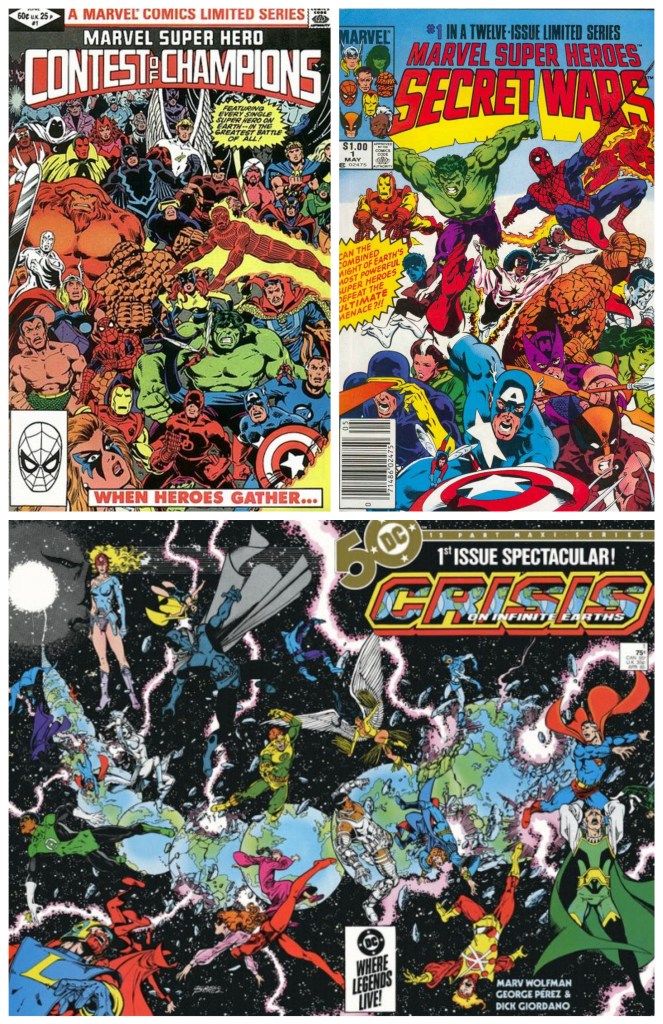
Most comic historians will agree that the “shared universe” conceit, in which most or all of the characters published by the same company are said to co-exist, can be traced back to 1940 and the first appearance of the Justice Society of America in All-Star Comics #3. In the early days, the JSA was little more than a framing device, in which the heroes would gather around a table and tell each other tales of their exploits, but eventually the stories would evolve to the point where they were having adventures together. Guest appearances in each other’s books became common, more teams were formed, and eventually both Marvel and DC Comics had sprawling worlds of interconnected characters. In a way, it’s baffling that it took 42 years for the next logical step in storytelling to happen: mashing everybody in the universe into a single story. That story was 1982’s Contest of Champions, a three-issue miniseries in which the Marvel Comics all-stars were abducted by a couple of the Elders of the Universe and forced to battle each other. It was a completely self-contained story that didn’t touch on any other book, but it was considered a precursor for the next step: the 12-issue Marvel Super Heroes Secret Wars in 1984. This time, we saw many of the Marvel heroes – in their own titles – encounter a mysterious device that whisked them away to parts unknown. They returned in the next issue after an absence of some weeks, many of them with changes. The maxiseries told the story of what happened to them in-between those two points.

“Okay, guys, let’s show ’em how it’s done.”

DC got into the game in 1985 with Crisis on Infinite Earths, and that’s when things really got wild. Contest of Champions and Secret Wars were both relatively self-contained stories. Although Secret Wars had repercussions for the regular series of the assorted characters (Spider-Man’s black costume, which would eventually become Venom; She-Hulk leaving the Avengers for the Fantastic Four; etc.) the story itself stayed in those 12 issues. In Crisis on Infinite Earths, for the first time, the story spilled out into the other comics being published by DC. While the heroes of the multiverse struggled to keep it together in the main series, most of the other books published by the company had side-stories that showed how the stars of that title were dealing with the collapse of reality. Green Lantern dealt with the destruction of an entire sector of space, DC Comics Presents booted Superman to an alternate reality where he met a young version of himself, and in Wonder Woman’s title she joined with the gods of Olympus to protect her home.  

Since then, the crossover has evolved again and again, with different forms that each have their own pros and cons. In some cases, a story in a single title or family of titles grew big enough that it only made sense to show the effects on other books. In Marvel’s Inferno (1989), the X-Men family of comics told the story of a demonic invasion of New York, and since most of Marvel’s heroes lived in New York it only made sense to show how Spider-Man, the Avengers, and the Fantastic Four were dealing with it as well. Later that same year we got Acts of Vengeance, a story wherein Loki plotted to destroy the Avengers by manipulating the Marvel Universe’s villains into attacking different heroes than those they usually fought. Yeah, I’m not entirely sure how that was supposed to work either, but it was a fun story: Spider-Man dealt with the X-Men’s enemy Magneto, while Daredevil’s foe Typhoid Mary set her sights on the Power Pack, and so forth. These kinds of crossovers work out fairly well, as it’s easy for readers to ignore any titles they don’t want to read. On the other hand, if they aren’t reading the core titles in which the story is taking place, they may be confused as to what is going on.

However, from a company standpoint, there’s one major problem with crossovers like that: there’s no extra books being sold. So the next level of crossover has a main miniseries, with stories touching on the heroes across the DCU. After the original Crisis, DC made this an almost-annual format for many years, with the likes of Legends, Millennium, Invasion!, Final Night, Genesis, and Underworld Unleashed all following suit. Marvel did it several times as well, with Secret Wars II, Infinity Gauntlet, and its assorted sequels. This is the kind of crossover I grew up with, and in many ways it’s still my favorite. The fact that it touches on the ongoing comics gives the story weight and makes it feel like it “matters” more than if the book is totally self-contained, and for the most part, you still only have to read the main title and any crossovers that you want, pushing aside those that you don’t.

There were…a LOT of these.

Later crossovers like Civil War and Fear Itself would expand on this concept: the main miniseries, crossovers into the ongoing books, and assorted miniseries and one-shots that spin off of the main book. This expands the story and allows the storytellers to touch on more elements of the event, and of course, it gives the publisher more books they can potentially sell. Publishers love that. Sometimes they love it so much that they’ll do a spinoff miniseries even if the characters involved currently have an ongoing. There are 97 X-Men titles at any given time, so was it strictly necessary to do a three-issue World War Hulk: X-Men miniseries instead of just putting the story in one of those? I say thee nay.

Then there’s the tier that we’re seeing more often these days, in which the crossover doesn’t touch the ongoing titles at all, but only features spinoffs and one-shots. There are, I think, two reasons this happens.

1: Money. 

2: Writers. 

I don’t think the first point needs much of an explanation, but let me tell you what I mean by the second one. The comic book industry has become increasingly writer-focused over the years, and while in many ways that’s a good thing, that does come with a degree of compartmentalization. Whereas in the past, editors would call up the writer of New Warriors and tell him to link his book to Infinity War whether he wanted to or not, today there’s more of a reluctance to disrupt the ongoing story. Al Ewing’s fantastic Immortal Hulk series was an excellent horror story that is perfect for binge-reading now that it’s over. But if you’re reading that story in a collected edition years later, it would be somewhat disconcerting to suddenly stop to deal with an invasion of symbiotes spilling over from the Spider-Man comics. So instead, there were Immortal Hulk one-shot specials when the title dealt with the events of the Absolute Carnage and King in Black crossovers, and the main book went unmolested.

The solution.

The benefit of this is that the crossover doesn’t impact the story when you’re reading it in a vacuum. There are two cons that come to mind, though. First, if a crossover is entirely self-contained, it’s easy to ignore it and decide it’s inconsequential to the meta-story of the shared universe as a whole. Second, it has a tendency to cause the main story to spill out into the spinoffs in a way that doesn’t happen as often with the other kinds of crossovers. Grant Morrison’s Final Crisis was a bit of a mindbender to begin with, but the ending is COMPLETELY out of the blue if you didn’t choose to read the Final Crisis: Superman Beyond two-issue miniseries that accompanied it.

A story like Knight Terrors is a relatively new variant on this format. The crossover is told entirely through crossover miniseries, but those miniseries are replacing the ongoing comics for the duration of the event. Instead of following June’s Nightwing #105 with July’s Nightwing #106, July and August give us Knight Terrors: Nightwing #1 and #2, with #106 saved for September. This is, by my count, the third time DC has done this, the previous times being Convergence in 2015 and Future State in 2021. It’s nice, in that it doesn’t disrupt the main book at all, but it also has a habit of making the event itself feel rather inconsequential. (Future State in particular has largely faded into irrelevance in the DCU.) 

Up until now, I’ve really only talked about format. I’m not making value judgments on any of these stories: there are both good and bad examples of every kind of crossover. What matters, I think, is what exactly you’re trying to accomplish with the story. Are you “just” telling a big story? Well, the first format I discussed is probably the right one. We mostly see that now with smaller crossovers, things like the Sinestro Corps War that only impacted the Green Lantern books (plus one issue of Blue Beetle). But even those “smaller” crossovers are starting to go the route of having one-shots or miniseries spinoffs: the upcoming Gotham War storyline will feature in the Batman and Catwoman ongoing titles but also have a few one-shots and a miniseries focusing on Jason Todd. 

Sometimes publishers label books as part of a crossover no matter how inconsequential they are, and that can irritate readers. People who picked up the Crisis on Infinite Earths issues of Swamp Thing were rightly irritated that the only connection seemed to be the skies turning red. Even when the book is objectively entertaining, it’s a bit frustrating. Geoff Johns and the late George Perez did a magnificent job on Final Crisis: Legion of Three Worlds (I would even argue that, to date, it was the LAST great Legion of Super-Heroes story), but pretending it had great significance to the Final Crisis storyline was something of a stretch. 

“Guys, when we said ‘Stop, you got it right,’ we didn’t mean that LITERALLY.”

Sometimes these crossovers are intended to reset things: DC has done that with Flashpoint and Dark Crisis on Infinite Earths, which led to the New 52 and Dawn of DC reboots, respectively. Sometimes these are intended not to re-set, but to set things up in the first place. That’s what the nascent Valiant Comics did in 1991 with Unity. When their universe was still young they tied together their six existing titles (four of which were less than a year old), launched two new titles, and introduced new characters and concepts that in turn would develop into more titles in the next year. It was a huge success and Valiant was the hot ticket, becoming so successful that only a few years later Acclaim bought the company and promptly ran it into the ground.

“Get ready, guys, it’s all downhill from here.”

People like to complain about “event fatigue” in comics the same way that many of them complain about “superhero fatigue” in movies, but the fact that people keep buying these books seems to indicate that they aren’t that exhausted. And as always, quality matters. People rarely complain about “too many comics” if they actually like the stories that they’re reading – it’s only when following a story gets to be a chore that they go to the internet and gripe. I don’t think crossovers are going anywhere, and honestly, I don’t really want them to. So I guess the important thing when planning them out, publishers, is to think really hard before you get into these storylines, and ask your doctor (Strange, not Doom) what kind of crossover is right for you. 

Blake M. Petit is a writer, teacher, and dad from Ama, Louisiana. His current writing project is the superhero adventure series Other People’s Heroes: Little Stars, a new episode of which is available every Wednesday on Amazon’s Kindle Vella platform. He knows that there are a LOT of crossover events he didn’t mention in this column, so before you reply with, “Hey, you forgot XYZ,” know that he didn’t. He just didn’t have room to make this comprehensive. Cut him some slack.