The end of the school year is approaching. Tomorrow is the last day for my 12th grade students, and my 10th graders will be wrapping it all up in about two weeks. So I’ve been busy tying up all the loose ends that come with being a teacher in May. That in mind, looking for something to read, I kind of drifted to stories of the younger heroes, and I decided this week to check in on the first issue of Superboy from 1949.
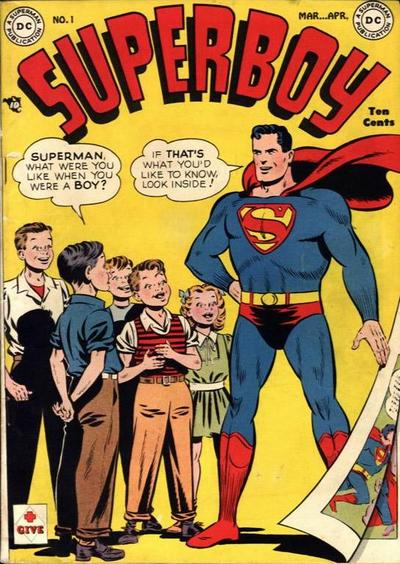
In the first story, “The Man Who Could See Tomorrow” (written by Don C. Cameron with art by John Sikela), Superboy encounters Brandar the Great, a mystic whose jewel stolen from an idol gives him the power to peer into the future. The story actually begins, though, in Metropolis, with an adult Clark Kent ducking out on Lois Lane after a movie date to check in on nearby gunfire. Superman finds an injured police officer and rushes him to a hospital where he encounters a nurse, Margo Griffiths, whom he knew when they were kids in Smallville. His mind drifts back to the day they each gave a report on what they wanted to be when they grew up (Margo and Clark each got their wishes, by the way), a day that ended with a party at Margo’s house. There they saw the mystic Brandar, who predicted that some day Clark Kent would be world famous (and you can’t tell him that he was wrong), but that Margo would “cease to exist” on her 21st birthday.
Of course, these distant predictions wouldn’t prove much, so Brandar uses his magic jewel to make three predictions for the next day: “1. Dr. Jekyll will turn into Mr. Hyde! 2. The first lady of the town will lose her crown! 3. East will meet west at sundown!” Clark brushes it off until the next day, when the newspaper reports that the mayor, whom everyone had thought was an honest man, had stolen funds from the town and fled. Worried about the rest of the predictions, Superboy checks in on a ship called the Queen Felice, also known as the “first lady” of the town. The crooked mayor nearly crushes the ship with a drawbridge in an effort to escape, but Superboy saves the Queen Felice and brings the mayor to justice.
With one prediction fulfilled and the second thwarted only by Superboy’s intervention, he seeks out Brandar to find the secret of his jewel. Brandar confesses that he stole the jewel and was given a prediction that he would meet an untimely death because of it. In fear, he leaves the jewel and runs into the street, where he’s promptly hit by a car and killed. That’s the thing about predictions, friends, if you try to prevent them from coming true you usually cause their fulfillment. Dude should have read MacBeth.
Superboy, meanwhile, finds his third prediction about to come true – an eastbound and westbound train on a collision course! He knocks down enough of a forest to build a second track and diverts one of them just in time. Then, returning Brandar’s jewel to its point of origin, the flashback ends. In the “present,” Superman reflects on the final prediction that hasn’t been fulfilled – that Margo would “cease to exist” when she turns 21, and she must be almost that age. He, of course, helps her figure that one out as well, giving her a happy ending. It begs the question, though – if Clark and Margo were in the same class, does that mean that the Superman of 1949 was only 20 or 21 years old? That seems awfully young for him to be an established reporter at the Daily Planet, much less have such an established career as Superman.
Of course, continuity wasn’t that big a deal back in the day, and people got out in the world younger than they do now. Still, it feels so odd that the writer would lock him in to such a tender age when all it would have taken to make it more plausible is to set the prediction for the day Margo turned THIRTY-one. Even a later year in her mid-twenties would have made more sense.
The second story, “The Boy Vandals” (written by Edmond Hamilton with art by Ed Dobrotka), abandons the flashback framing sequence and just takes us to times past to view a quick and unremarkable story about Superboy teaching a young gang the consequences of vandalism. The interesting thing here is that this is the story where I realized, at this point, they hadn’t actually established Superboy’s home town as Smallville yet. In fact, this story seems to imply that young Clark Kent was a student in a school in Metropolis. It always interests me when we see these older stories playing fast and loose with details that seem concrete to us, but that wouldn’t be codified until much later.
This issue also gives us “Superboy Meets Mighty Boy,” a William Woolfolk/George Roussos joint, in which our favorite boy of tomorrow seems to meet his match. A farmboy named Reuben is recruited for a scientific experiment to try to transform him into the strongest boy in the world. Reluctant at first, he goes along with it at the urging of his parents, whose farm is suffering and who could use the windfall if it works. The experiment is a success, granting Reuben remarkable power, and the recruiters challenge Superboy to a contest. At the circus, the two of them compete in various feats of strength, and as impressive as Superboy’s powers are, Mighty Boy outclasses him time and again. Returning to his tent, Mighty Boy overhears the promoters saying that the experiment was a fake and that they rigged all of the feats of strength to make it seem as though he had powers, fooling even Mighty Boy himself, as part of a criminal scheme. Superboy saves him just in time and together, they put the crooks under glass. Superboy brings Reuben back home and helps his family get their farm back on its feet, because that’s just what Superboy does. This was my favorite of the three stories in this one.
I haven’t read a lot of Super-stories from this particular era, that Post World War II time before the silliness of the Silver Age really kicked into gear. I enjoyed these stories, though, showing an interesting kind of prototype of the original Superboy that I’m far more familiar with. I’ll need to look out more stories from this period in the future.
Blake M. Petit is a writer, teacher, and dad from Ama, Louisiana. His most recent writing project is the superhero adventure series Other People’s Heroes: Little Stars, volume one of which is now available on Amazon. Don’t forget, you can check out earlier blogs in the Year of Superman/Superman Stuff Archive! Got a request for a future “Superman Stuff”? Drop it in the comments!

