154-Deck the Halls With Nerdy Baubles (Falalalala lala lala)

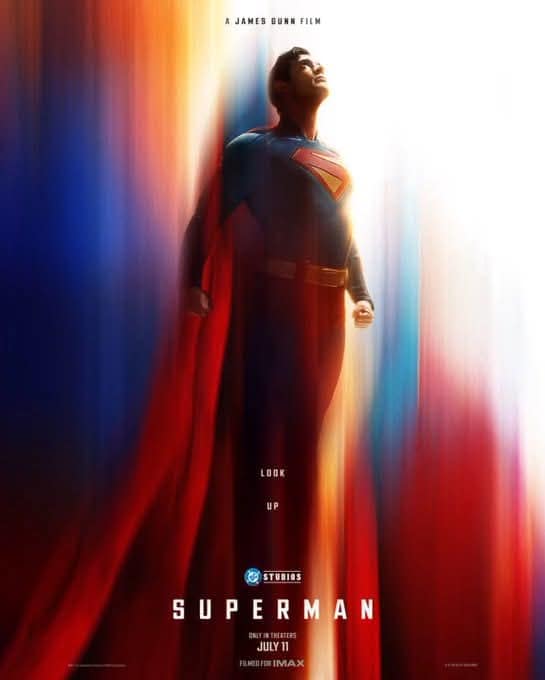
The other day when we decorated our Christmas tree, I opened up a few ornaments I bought weeks ago in preparation for this moment. One of them – it should be no surprise – was a Superman ornament from the new movie, poised to go on the tree in the midst of a half-dozen other Superman ornaments of various types and origin, including one of his s-shield, a LEGO Superman, and Krypto the Superdog, amongst others. The second newbie was from this year’s other great superhero movie, Fantastic Four: First Steps: a figure of my favorite Marvel character Benjamin J. Grimm, the ever-lovin’ blue-eyed Thing. And as I hung it on the tree, I was struck with a bit of a giggle as I realized that here I was, Baptised and confirmed Catholic, placing on my Christmas tree one of the most famously Jewish superheroes that ever existed.

“IT’S CAROLIN’ TIME!”

And I can’t help but think that Stan Lee would find that pretty amusing as well.

Stan Lee and Jack Kirby, Ben’s co-creators, were both Jewish, and although the classic comics never really made it explicit, there were a lot of things about Ben’s dialogue and backstory that coded him as a New York Jew. The comics didn’t deal with religion that much at the time, although by the 80s writers began to feel freer about incorporating religion as part of a character’s background. Kitty Pryde of the X-Men and Marc Spector, Moon Knight, were both marked as Jewish early in their careers, and existing heroes like Nightcrawler (also of the X-Men) and Daredevil had their own Catholic faith emphasized as major aspects of their characterization. The degree to which any character’s particular religious affiliation is relevant tends to wax and wane depending on the writer, but addressing these issues helped make the Marvel Universe as a whole feel more real in a way, as it was no longer ignoring such a major part of culture. All that said, it’s weird that it took 40 years, until the early 2000s, before Marvel published a story that specifically had the Thing make reference to his Jewish heritage.

Since then it’s come up far more often, including an intriguing story by Dan Slott where Ben got a Bar Mitzvah as an adult using the logic that becoming the Thing was sort of a second birth and the 13 years that had elapsed since then (in-universe, that is) allowed for that. I’m no Hebrew scholar so I’ve got no idea if that would fly in real life, but it was a great story all the same. At any rate, I think Stan would be fine with me putting Ben on the same tree as I put the little ornament that commemorated the 50th anniversary of our local Catholic church, the snowman bauble my son made for us in Kindergarten, the Peanuts gang, this weird Nicholas Cage ornament my wife thinks is absolutely hilarious, and the golden Enterprise Hallmark produced for Star Trek’s own 50th anniversary. Whether you yourself are religious or not, I feel like we nerds have embraced the holidays as another way to let our geek flags fly.

Guess which one of these is my wife’s favorite.

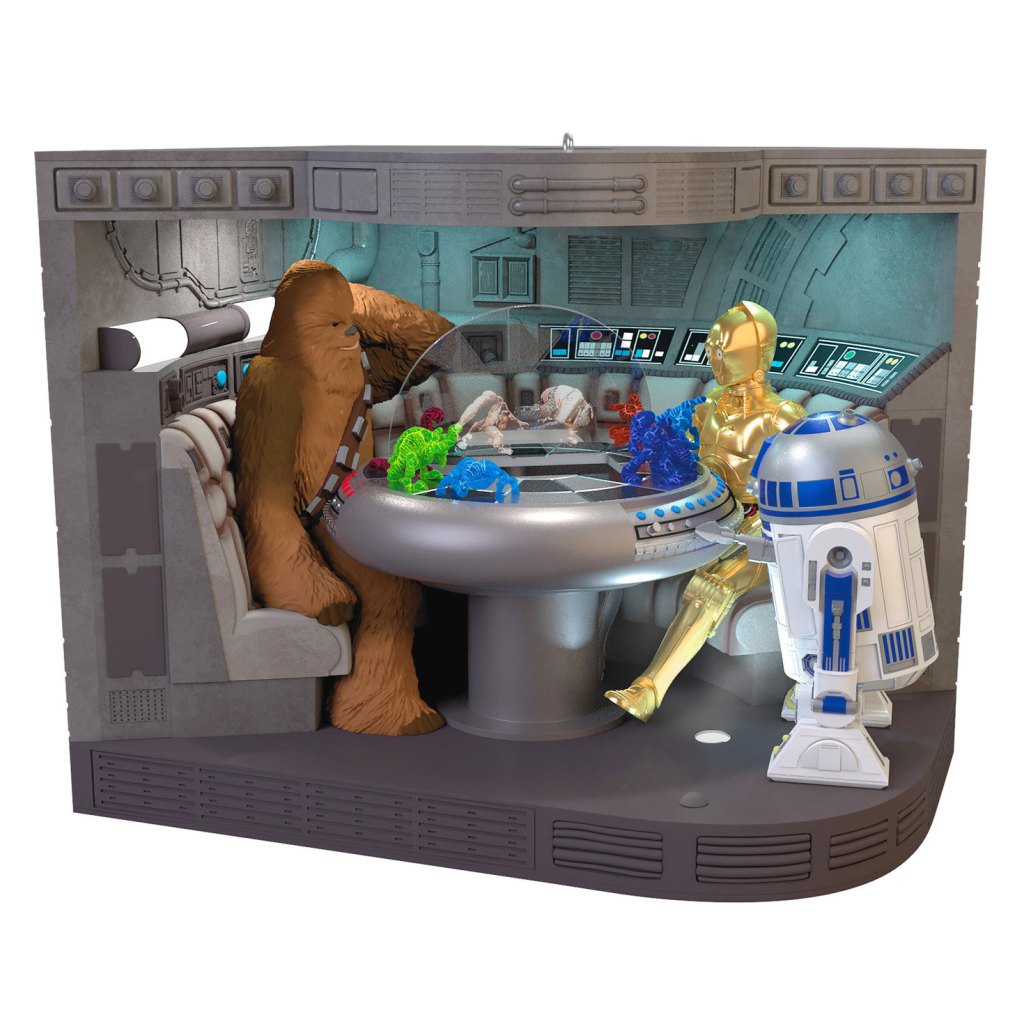
Hallmark is not the only company to have embraced this part of our culture, of course, but I feel like they’re probably the most recognizable. Every year, I have friends who eagerly await that moment – usually sometime in July – when Hallmark releases their catalogue of new ornaments that will be available for the holiday season. And there’s never any telling what you’re going to get, there are some things that are pretty reliable. That year’s big movies usually get a few ornaments, and there’s almost always stuff to be added to their collection of Star Wars and Star Trek decorations whether there was a new movie that year or not. And as they continue to milk those properties for every character, vehicle, and scenario they can possibly immortalize, they’ve gotten increasingly elaborate. This year’s offerings include a $100 ornament, full of lights and sound, of the scene in the first Star Wars movie where Chewbacca and R2-D2 are playing holographic chess, complete with an actual hologram function. And while that ornament may fall out of MY price range, I’ve got absolutely no doubt that they sold out.

It’s called “Let the Wookie Win.” “Wookie” is slang for “your desperate need to display your youth on a Douglas Fir.”

But Hallmark doesn’t stop at the usual. A cursory glance at their website reveals that this year’s offerings – in addition to the usual IP from Disney, Marvel, Star Wars, and DC Comics – also include the likes of Sonic the Hedgehog, Harry Potter, an XBox controller, Heinz Ketchup, Shrek, the NFL, Friends, and your favorite seasonal horror movie characters like M3gan, Chucky, and Michael Meyers – specifically from Halloween II. If you simply took every licensed ornament produced by Hallmark in the past two decades and put them on one enormous tree, you could show it to an alien as a perfect capsule summary of western culture in the 21st century. 

It’s not just Christmas trees, of course, but pretty much all aspects of holiday decorating allow for you to show off the kind of stuff that you’re into. We’ve always had Christmas inflatables in our yard, for instance. Over the years, those inflatables have included multiple Star Wars characters, sitting out there right next to the likes of Snoopy, Frosty the Snowman, Bluey, and a shark wearing a Santa hat. (My wife desperately tried to find oversized yellow Christmas light decorations to put behind the shark in an attempt to recreate the scene from Jaws in our yard, but she was unsuccessful before the shark’s motor failed and the inflatable decoration had to be retired. They don’t make ‘em like they used to.)

If you don’t have stuff like this on your lawn are you even really celebrating the birth of our Savior?

In my classroom, I’ve got a collection of geeky knickknacks (mostly – but not all – Superman-related) that I keep near my desk. Around the holidays, though, I break out specialized ones – monsters at Halloween, family groups for Thanksgiving. And now, at Christmas, my collectible display includes multiple DC and Marvel characters in Christmas outfits, Charlie Brown in his snow suit next to Snoopy sleeping on his decorated doghouse, and for a hint of traditionality, Santa Claus and Rudolph. Santa, although, is in New Orleans Saints gear, because we very much use the holidays as an excuse to mash together EVERYTHING we love. 

Harley is winking because she and Deadpool have shenanigans to get up to during my planning period.

And lest we forget, we don’t just decorate our environment, friends. We decorate ourselves. I’ve long prided myself on my collection of nerdy t-shirts, but at Christmas there’s a special subsection that gets broken out with Christmas-themed takes on the Flintstones, the Muppets, the Looney Tunes, Disney characters, and of course, my favorite superheroes. The “Ugly Sweater” trend gives us yet another opportunity to put ourselves on display. You can find designs dedicated to virtually any movie, TV show, or video game you can think of. Last year I broke down and ordered the Svengoolie Christmas sweater, wearing it any time it was cold enough outside to justify it. (I live in Louisiana, of course, so that only happened like twice. But still.) And of course, Santa hats are just one more excuse to customize the holidays. I’ve got a Superman Santa hat I’ve worn for many years, and just this week my wife got one in Harley Quinn colors. My friend Owen Marshall, who I know is reading this right now – hi, buddy! – has a collection of different Santa hats that could occupy an entire section of a Christmas museum. 

Only seven years old in this picture and he’s already looking away from his dad in embarrassment.

A few years ago, my brother introduced me to RSVLTS, a company that makes very cool, comfortable shirts in deliciously nerdy patterns, and those shirts have come to dominate my casual wardrobe. I often hold back on buying their seasonal shirts, as they’re kind of expensive for a shirt I can only wear a month of out of the year, but I eventually acquired a shirt of Mickey and Minnie ice-skating, a great pattern of the characters from Rankin and Bass’s Rudolph the Red-Nosed Reindeer, and last month my sweet wife got me my favorite Disney character, Scrooge McDuck, on a RSVLTS shirt celebrating his definitive performance as Ebenezer Scrooge from the motion picture Mickey’s Christmas Carol.

Imagine this shirt, but with my head sticking out of it.

RSVLTS does not pay me for my frequent endorsements, but damn it, they should.

The point is, we all celebrate the holidays in our own ways, and that’s as it should be. And one of the things I like about them the most is the opportunity for people to use them to show off who they are. Put out your geekiest ornaments and your nerdiest lawn decorations. Wear your wildest shirts and hats. And let your geek flag fly. Christmas should be a celebration of love, and while that should PRIMARILY be the people we love (you know who you are), I think there’s room in it for the things we love as well.

Blake M. Petit is a writer, teacher, and dad from Ama, Louisiana. His most recent writing project is the superhero adventure series Other People’s Heroes: Little Stars, volume one of which is now available on Amazon. You can subscribe to his newsletter by clicking right here. He’s also started putting his LitReel videos on TikTok. If Santa is listening, he’s still got his eye on that G.I. Joe aircraft carrier. Everybody reading this knows what he’s talking about.

Geek Punditry #132: The Things We Love

I’m a teacher who is off for the summer, and although that does not (as many presume) mean that I have nothing to do, it DOES mean that my schedule is much less regimented. In other words, I enjoy the fact that for two months out of the year, I’m allowed to sleep past sunrise. Until this morning, of course, when my precious son Edward bounded upon his mother and me at 6:23 in the morning to make sure that we were going to be ready in time for the movie we’re watching at 11: 30. 

“Why are you looking at me like that?” I ask my wife, as Eddie scuttles away to inform our Google Home Mini that we’re going to see Superman today. 

Shoot, was that TODAY? Totally slipped my mind.

I know why she looked at me that way, of course. This is probably my fault. Ever since the trailer dropped back in December, I’ve been working on the kid, showing him the clips online, watching the old movies and cartoons with him, getting him some of the new toys and t-shirts and a ridiculously cute pajama set with a cape. I have, in fact, gotten him excited. And moreso, for my little ADHD wonder, this may be the first time in his life he’s ever experienced anticipation that has lasted this long. I’m writing this before we’ve seen the movie, and I kind of feel the same. Eddie has been waiting for this movie since December. In a way, I’ve been waiting for it all my life.

Not because it’s a new Superman movie and not because it’s James Gunn doing Superman and not because I hated the Zack Snyder version. I’ve been waiting for this – and I didn’t even know it before 2017 – because I’m getting to take my SON to a Superman movie for the first time. And there’s nothing better than sharing what you love with the people you love.

Like this little nerd.

I know some people who have a bizarre relationship with their fandoms. When Star Wars became mainstream, for instance, they were disappointed. And not because of the content of any specific movie or TV show, they were disappointed because, in their minds, Star Wars was always this minor, niche thing that just belonged to THEM and not the normies out there. Star Trek doesn’t quite have the mainstream penetration of its Disney counterpart, but when New Trek adopted more polished special effects and started hiring big-name actors like Jason Isaac, I know Trekkies who had the same reaction. I don’t understand this point of view. I don’t get why anybody would be upset to learn that something they love is loved by other people.

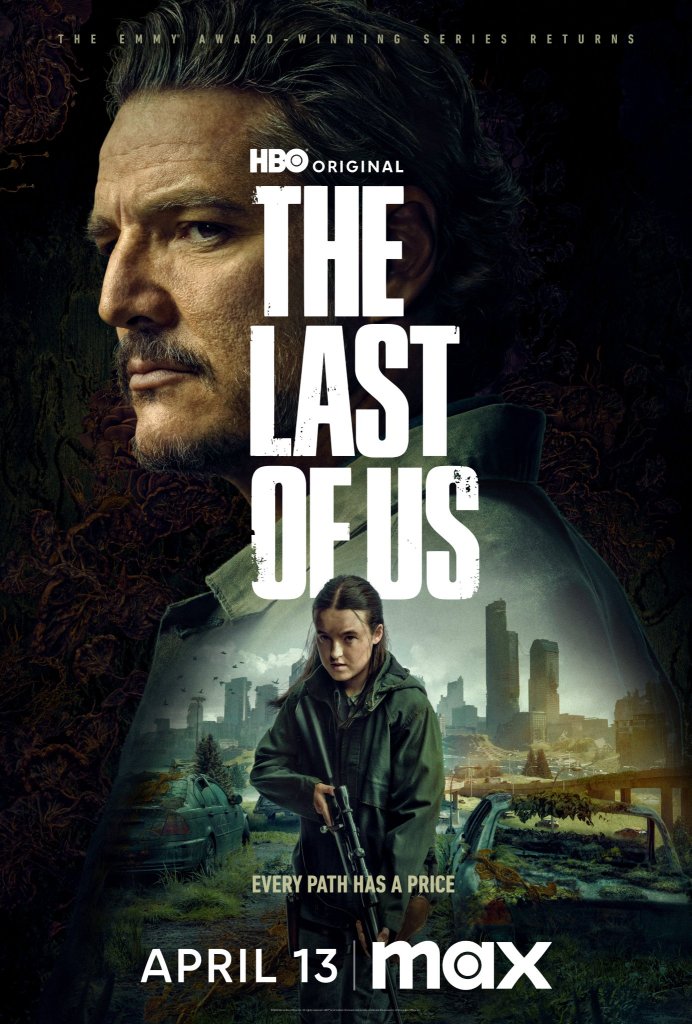
Loving a movie, a TV show, a comic book series, a video game…this is not like having a relationship with another human being. Nobody is requiring that The Last of Us be in a monogamous relationship with you, Jamie. Stories are placed out into the world with the hope of gathering as many lovers as possible. Some of them make it, some of them fail, and some of them are successful beyond anybody’s wildest dreams, but they all have the same goal: to be shared.

If you thought Pedro Pascal was all yours, I’ve got 17 different franchises with bad news for you.

The thesis of this column, from day one, has been to talk about the things that I love, and although that doesn’t mean I don’t occasionally lapse into criticism, I’ve done my best to abide by that. There is a percentage of any fandom – it’s a small percentage but, unfortunately, it’s usually the loudest – that exists only to fiercely express their hatred of whatever it is everyone around them is trying to enjoy. I can’t stand these people. It’s the same, to me, as listening to people talk about their significant others. When I hear a man gripe and pout and call his wife a harpy, a woman telling me how her husband is stupid and useless, I stare at them blankly, unable to relate. I actually love my wife, people, she’s my best friend. If you’re that miserable either go to counseling or end the relationship. Meanwhile, I’m gonna go sit at a table with Gomez Addams, Rick O’Connell, Bandit Heeler, and Clark Kent, and we’re all going to raise a glass and have a friendly but spirited debate over whose wife is the most awesome, all while vociferously agreeing with each other’s estimation of our respective partners.

Goals.

It’s the same with fandom. I don’t mean to say that Star Wars or anything else is beyond criticism, but how long can you listen to somebody complain about something before you come to the conclusion that they don’t actually love it, at least not anymore? And if you don’t love it anymore, that’s fine, but why don’t you just find something ELSE to talk about? I want to hear about the things you think are great and WHY you think they’re great, because love becomes better when it’s SHARED. I have seen every iteration of Star Trek and I’ve never watched a minute of, say, Outlander, but I’d rather listen to a three-hour symposium about what makes Outlander great than a 15-minute YouTube video whining about how they changed the shade of blue of the Andorians’ skin when they showed up on Strange New Worlds. 

Criticism should come from a place of optimism. The attitude should be “I want this to be  better,” not “I hate everything about this.” Even in the classic days of Siskel and Ebert, back when criticizing movies was something that could get you your own TV show if you were good enough at it, I doubt that Gene and Roger ever went into a movie theater thinking, “I hope this sucks.” Oh sure, there were plenty of times they EXPECTED a movie to suck — you watch enough of them and you start to develop a sixth sense for what’s going to be wrong just by watching the trailers – but they probably wished, somewhere in their hearts, to be proven wrong each and every time.

Oddly, also goals.

Some people revel in their hatred. They want to spread it like a virus. These are the people who harass a Star Wars actress until she has to quit social media, who shout obscenities at children on the street because they’re TOO good at playing a bad guy on Game of Thrones, who make plans to bomb a movie they haven’t seen with negative reviews because they’re bitter that the franchise was rebooted. This isn’t love, this is toxic. If you knew anyone in real life who treated their partner this way, you’d beg them to get out of that abusive relationship. And yet these False Fans just keep going and going, more emboldened than ever by the platform that social media has given everyone in the industrialized world. We’ve got a system that enables us to connect with more people than ever before and yet they choose to use it to gripe about the fact that Superman is friendly to children.

Fandom, like personal relationships, should be about love. And love should be shared. And while I wouldn’t ever try to force Eddie to like the things that I like, I expose  him to those things in the hopes that they’ll latch on and find purchase, because it makes me happy to share them with somebody I love so much. And – thank GOD – in the case of Superman, it has. So about four hours from the time I’m writing this, we’re going to sit down in that darkened theater, a bucket of popcorn between us and his Superman action figure on his lap (because Eddie has asked to bring him) and we’re going to watch the movie that so many people have already loved. And if I love it as they do (spoiler warning: I highly suspect that I will), I’m going to do my best to spread that love. 

That’s what being a fan really is. 

Blake M. Petit is a writer, teacher, and dad from Ama, Louisiana. His most recent writing project is the superhero adventure series Other People’s Heroes: Little Stars, volume one of which is now available on Amazon. You can subscribe to his newsletter by clicking right here. He’s also started putting his LitReel videos on TikTok. He does, in fact, believe a man can fly.

Geek Punditry #82: I’m Going to Go Back There Someday

It’s that time again, friends. Every year, as July races to a close, kids sharpen pencils for school, and teachers spend an inordinate amount of time and money getting their classrooms suitable to post on Instagram, the geeks of the world converge on San Diego, California for the annual bacchanalia officially known as Comic-Con International. And every year I sit here in Louisiana, gazing to the west, and wishing I could be there with ‘em.

Goals.

It’s a bucket list thing for me, guys. Some day, at least ONCE, I want to go to San Diego Comic-Con. I’ve got a lot of friends who have been – heck, with the pals I have who work in comics, I’ve got a lot of friends who go pretty much every year. I see the posts and I gaze at the photos shared on social media and I think about what it would be like to be there, even though I know it’s not going to happen any time soon. It’s expensive, first of all. Admission to the convention aside, I think about the costs of airfare, food, car rental or Ubers to get around, and hotel rooms (some reportedly going for over $1000 a night on this particular weekend) and I know there’s no way this can be swung on a teacher’s salary in the current economy. Then there’s the kiddo – making this trip would either require my wife to take time off work to stay home with our son or her take off work so all three of us could go together. Going together is my preference, but not really feasible at the moment. So it stays on that bucket list, unchecked, right next to “Play Benjamin Franklin in a production of 1776.

Also goals.

“Ah, it’s okay Blake,” say some of my friends. “Comic-Con isn’t what it used to be anyway.” And that, at least, is true. It’s been a really long time since Comic-Con was actually about comic books. The media empires have taken it over – movie and TV studios are the stars of the really big panels, and video game companies flock there to shill their upcoming games. And while I don’t begrudge any of them, comics are my real jam, and are what I’d really want to see. I’d rather go to a DC Comics panel than a Warner Bros. panel most days…although if it were James Gunn and company talking about the upcoming Superman movie, it’d be a heck of an internal battle. 

Still wanna go, though.

It also doesn’t seem to be quite as big in terms of making news as it used to be. For years in these waning days of July, I would refresh my web browser all day long, waiting for news reports coming from San Diego to tell me what was going to happen over the next year in the world of entertainment. Marvel would unveil whole slates of films there back when such a thing seemed like a wise thing to do, and fans like myself would teeter on the edge of Firefox to see what was coming next. I don’t feel like that happens as much anymore. Studios are so desperate to stay relevant that they squeeze out announcements all year long, often prematurely, very often promising things that wind up never happening. It’s frustrating, to be sure. But in terms of what it does to Comic-Con it’s even worse, as so many of the “big” panels have changed. There’s no longer an opportunity to blow our minds with announcements of what’s to come, but rather just a recap of the announcements that have been made since the last time they recapped their announcements. 
Yet I still wish I was there.

It’s not like I’ve never been to a convention, of course. When I was young, I went with my Uncle Todd to a few Star Trek conventions (these don’t really exist anymore, as Comic-Con and its many imitators have become a catch-all for pop culture and cons specific to a single franchise have become much rarer). When the Chicago Comic-Con was still a big deal I did a road trip with my buddies Mike and James. I’ve been to Philly and Houston, and many Wizard World-turned-Fan Expo shows here in New Orleans. And I’ve been to dozens of smaller shows, which are honestly better when it comes to the comic book side of things. Back in April, Erin and I took Eddie to a small show in Covington (right across Lake Pontchartrain from New Orleans) and it was honestly the BEST show I’ve been to in YEARS when it comes to the number of vendors selling comic books and comic paraphernalia, as opposed to thousands of headshots you could get signed by whatever actors are in attendance. I loved that little show, and I’m looking forward to the next one.

Observe the Native North American Geek in his natural habitat.

But I still feel that COMPULSION to go to the BIG one.

Why?

Because in a weird way it feels like home.

I don’t know if younger readers will get this, because the stigma about being into “nerdy” stuff seems to have largely gone away. With Marvel and Star Wars being so mainstream and things like Game of Thrones and The Boys becoming media juggernauts, things that we used to consider niche entertainment have become dominant parts of the cultural zeitgeist. But when I was in high school in the 90s, I was always made to feel like I didn’t belong because I read comics and watched cartoons. I clung to the things I loved, but often felt the need to hide them, lest I become even more of an outcast than I already was. I’d even quit Disney and Archie comics not because I didn’t like them anymore, but because I let people put it in my head that if I was in high school and reading Uncle Scrooge something must have been wrong with me. If I was seen with a Star Trek novel or an X-Men t-shirt, the reaction quite clearly elicited the same response every time: you do not belong here. High school was a bitch of a place, guys.

I’ve got a core memory of a time in 1993 when Superman: The Man of Steel #22 came out. This was during the whole “Death and Return of Superman” storyline, and John Henry Irons IMMEDIATELY became my favorite of the four potential heirs to the throne. I brought the comic to school with me and, on a break outside, I sat on a bench to read it. And within seconds, a jerk from my PE class yanked it out of my hands because I was such a “nerd,” threw dirt into the die-cut cover, and stomped away laughing.

I can’t help but feel that John Henry would have known how to deal with it.

I don’t remember the guy’s name. I couldn’t pick his face out of a lineup. But I’ll never forget what he did, because you CAN’T forget anything that makes you feel that small.

I look at my own students, and I don’t see that anymore. Oh sure, there are still cliques and groups, there will ALWAYS be cliques and groups, but they aren’t really based on things like what kind of pop culture a kid is into anymore. I see a lot of kids who read Manga (not enough into western comics, but that’s a separate issue), but I never see anyone get bullied for that. You want to pick on a kid for playing video games? Dude, that’s a club whose membership is EVERYBODY. Things have changed and, in this respect at least, have very much changed for the better.

But I come from a time BEFORE those changes, when I only knew two or three other kids in my school who were openly comic book fans, and most of them wound up moving away before we graduated. It was a lonely time.

The first time I walked into a comic book convention, it was like I had finally found my tribe. There were people here who not only wouldn’t MOCK me for reading Superman, but would join me in a spirited debate over the credentials of the Man of Steel, Cyborg, Superboy, and Eradicator, and which of them (if any) were the real deal. There were people here who could ALSO explain why some crew members on the Enterprise wore red while others wore gold or blue. There were people who not only wouldn’t mock me for loving Uncle Scrooge comics, but they would join me in line to get a print and comics signed by Don Rosa, perhaps the greatest artist ever to draw the Laird of the Clan McDuck. (Yeah, I love Carl Barks too, but I said what I said.)

If my house caught on fire I would save my son, and then this. My wife is faster than me, she’s already outside at this point, that’s why I didn’t mention her.

Nobody should ever have to feel the way I felt on that day back in 1993, certainly not because of what they like to read or watch. But I wish that EVERYBODY could have that experience of walking into a room and suddenly feeling like that’s where you’ve belonged all along.

I still get that when I walk into my local comic shop (BSI Comics in Metairie, Louisiana – and I’ll never be shy about giving them the shout-out). I feel that way on Free Comic Book Day, when hundreds of like-minded folks come together to see what’s new. And I feel that way when I attend a show full of people selling, drawing, reading, and talking about comics and movies and TV shows. And even the people who aren’t into the same comics and movies and TV shows as I am are still part of the same tribe, because we know that even if I’m into Star Trek and you’re into Star Wars, we’re still more alike than we are different.

Not like that Stargate weirdo.

So why would I possibly want to go to the big, bloated, past-its-glory-days Comic-Con International in San Diego? 

Because in a way that I don’t know if you can understand if you’re lucky enough to never have felt like an outcast, it’s where I feel like I belong. With my people. With my tribe. Just because I’ve never been doesn’t mean it doesn’t call to me like home.

Ah well. Maybe next year.

Blake M. Petit is a writer, teacher, and dad from Ama, Louisiana. His most recent writing project is the superhero adventure series Other People’s Heroes: Little Stars, volume one of which is now available on Amazon. You can subscribe to his newsletter by clicking right here. He believes the Great Gonzo said it best when he sang, “I’ve never been there, but I know the way,” and a tip of the hat to Steve J. Rogers for putting that bug in his ear. 

Geek Punditry #65: Howard the Hero?

I am kind of a nerd. I know, I know, I hide it well, but the truth is that I have certain areas of interest about which I am extremely passionate. And one of the aspects of my nerdity that one must be aware of is the fact that I’m a little obsessed with making lists. I’ve been doing it at least since middle school, when I distinctly remember making a paper bookmark upon which I kept a list of every book I read, a list which quickly became too large for a bookmark that fit in anything less than an unabridged dictionary. The list-making obsession hasn’t changed, only the medium. I’ve often said that there are four “quadrants” of pop culture I mostly talk about here in Geek Punditry: movies, TV shows, books, and comics. It should not surprise you that I have a separate app in which I track my activity and make ridiculously detailed lists for each of these quadrants. (That would be Letterboxd, Trakt TV, Goodreads, and League of Comic Geeks, respectively. If you’re on any of those platforms, feel free to follow/friend me.) My wife says that this list-making thing is because of an inherent desire to create some semblance of order and control because in most areas of my life I feel like everything is in a state of permanent chaos and there’s nothing I can do about it. I reply by telling her to shut up, which she understands to mean, “I love you and you’re right, now stop it.”

I might have a problem.

Anyway, on Letterboxd a few years back, I decided to whip up a list of every superhero movie I could find, part of my desire to eventually watch them all. You would think that this would be a relatively non-controversial endeavor, assuming that you’ve never been on the internet. Those of us who HAVE been online at some point, however, are acutely aware that there is NOTHING online so benign that you can’t find SOMEBODY ready to argue about it. In the comments of my list, some people complained that I decided to skip non-English language films (because odds are I’ve never heard of those and I don’t want to dedicate my entire life to tracking them down), fanfilms (because for some reason those are frequently deleted and re-added to the Letterboxd database and I don’t want to have to keep putting the same movies back on again), and “adult” films (because make your own list, you weirdo). 

But what took me by surprise is when someone decided to complain that I left off the movie Howard the Duck. The exclusion had nothing to do with quality, mind you. I included every superhero movie I am even vaguely aware of, even the worst one ever made, by which I mean the Josh Trank Fantastic Four. No, I skipped Howard because – despite the fact that the movie is based on a Marvel comic book – Howard the Duck is not a superhero. He’s a comedy character, usually used in satirical stories, and while he does have adventures and has been known to interact with other inhabitants of the Marvel Universe, that doesn’t make him a superhero any more than it does Peter Parker’s Aunt May. The person who disagreed with me told me that the title of the film in his native country (Brazil) translates in English to Howard the Superhero, which he says indicates that it should be considered a superhero movie, whereas in reality it just made me question what’s wrong with the Portuguese word for “Duck.”

Never forget that THIS was the first theatrical movie based on a Marvel comic book, nerds.

So I decided that, in order to quell debate (note: this is impossible), I should probably come up with an actual definition of “superhero.” This turned out to be more difficult than it seems. You would think it’s obvious – get five different people to make a list of 100 superheroes and chances are 75 names would appear on at least four of the lists. But what MAKES a superhero? I decided to check with Merriam-Webster, which gives me two totally useless definitions. The first is “a fictional hero having extraordinary or superhuman powers,” which fails as a definition because it excludes Batman, and nobody is ever allowed to exclude Batman. The other definition is “an exceptionally skillful or successful person,” which seems kind of dumb because, arguably, Genghis Khan was exceptionally successful at what he did. And let’s not get into John Wayne Gacy.

“Behold! A superhero!”
“Put a sock in it, Diogenes.”

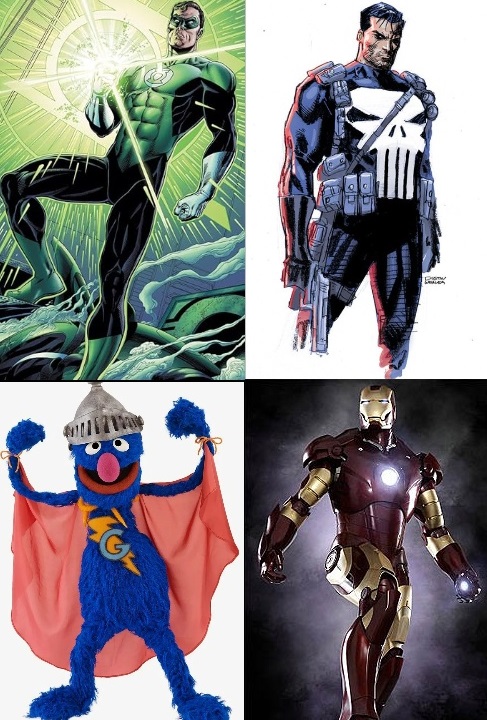
I needed something broad, but not too broad. I pondered, and I eventually came up with not a SINGLE definition, but a list of criteria. I would consider a character a superhero, I decided, if they fit at least TWO of the following criteria:

  1. Superhuman powers and abilities. These abilities need not be inherent, mind you. Green Lantern has no actual super powers, but he has a ring that gives him superhuman abilities, so he counts.
  2. A double identity, although this identity need not be secret. Everyone in the Marvel Cinematic Universe knows that Tony Stark is Iron Man – his ego wouldn’t allow them not to – but he still HAS that second identity.
  3. An identifiable (and toyetic, let’s not forget toyetic) uniform or appearance. This is, I admit, somewhat subjective. What’s identifiable to one person may not be identifiable to someone else. Think of it this way: if someone is cosplaying as a character and that cosplay is easily recognizable to someone familiar with the IP, that character probably meets this criteria.
  4. Fights crime or battles the forces of evil.
All basically the same thing.

What I like about this list is that none of these criteria make somebody a superhero by itself, but each time they’re combined you get closer to that superhero line. It also makes it easy to include anybody that I want, such as Zorro. People often say Superman (who first appeared in 1938) was the first superhero, and he is certainly the character who named the genre, but I don’t think it’s true that he’s the first. He was preceded by several characters who meet many of the criteria I’ve listed. Zorro (1919), the Lone Ranger (1933), and the Green Hornet (1936) all meet categories 2-4. The Shadow (1931) and the Phantom (also from 1936) meet all four. Even the Scarlet Pimpernel (1905) hits categories two and four. If anything, Superman is the first comic book superhero, and I’m sure even that is open for debate. As such, I included all of these “proto-heroes” on my cinematic superhero list.

Fun Fact: Canonically, the Lone Ranger is the Green Hornet’s great-uncle.
Less Fun Fact: Both of these movies are embarrassments that should never have been made.

Of course, even my criteria leaves a lot of room for debate. There are plenty of characters that one usually doesn’t think of as superheroes that fit at least two of the criteria. Harry Potter, for instance, has magical powers, fights evil, and has a very distinct appearance. The same can be said for Luke Skywalker. One could even argue that any Star Trek character from a race with psychic or shapechanging abilities would qualify. Are Spock, Odo, and Counselor Troi superheroes, or do their powers not count since they’re not unusual for members of their respective species? There are certainly people who would argue that all of these are superheroes, and while I wouldn’t put them on my personal list, I don’t know that I could effectively argue against their inclusion either.

Where, exactly, do we draw the line?

What about Indiana Jones? He fights evil. He’s easily cosplayable. And his real name is Henry Jones, Jr. Does his nickname qualify as a second identity? How about James Bond? He fights evil all the time. The uniform is a little harder to quantify – the most iconic Bond look is a tuxedo, but anybody can put on a tuxedo. And the second identity…does being Agent 007 count? Back in the day there was the fan theory that “James Bond” itself was a pseudonym passed down to whomever was Agent 007 at the time, which was a theory I liked and would most certainly qualify, until the film Skyfall quashed that theory for good.

Some people may ask what difference it even makes. We’re talking about fictional characters, after all. Who cares which ones do and do not count as superheroes? To those people I say, “Oh good for you, you’re far more well-adjusted than those of us who debate these sorts of things on the internet, please stay that way.” 

For the rest of us, I know that my attempt to define the term has probably caused more debate than it stopped. Sorry about that. If you’ve got a better definition than I do (or than Merriam-Webster does) I would love to hear it. And I’d even like to hear some unusual characters that you would say meet the criteria. But in the meantime, the only thing I can really say is that when it comes to a superhero, I know one when I see one.

And Howard, I’m sorry, it ain’t you. 

Blake M. Petit is a writer, teacher, and dad from Ama, Louisiana. His most recent writing project is the superhero adventure series Other People’s Heroes: Little Stars, now complete on Amazon’s Kindle Vella platform. He looked up the Portuguese word for “duck.” It’s “pato.” Why didn’t Brazil just call the movie “Howard o Pato”? 

Geek Punditry #64: Classics Are Better Big

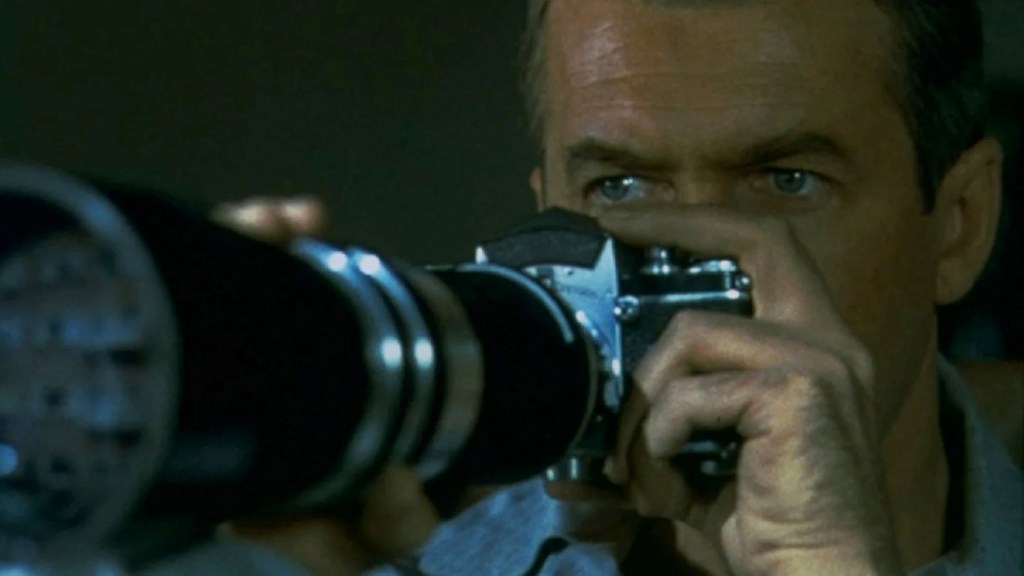
With all due respect to films like Psycho, Vertigo, The Birds, and North By Northwest, Alfred Hitchcock’s best movie is the Jimmy Stewart thriller Rear Window. In this taut little drama, Stewart plays a photographer who was injured in a car crash and is stuck in a wheelchair while he recovers. Unable to leave his apartment, he takes to observing the activities of his neighbors through the windows as a sort of perverse entertainment – entertainment that takes a chilling turn when he thinks he sees one of his neighbors commit murder.

“Mr. Gower, no! No, what are you doing?”

Sure, there are some elements that are kind of icky – Stewart is literally spying on his neighbors for most of the film, which isn’t exactly kosher. And how anyone could be so interested in what’s going on across the way when your girlfriend is Grace Kelly and she’s at your house every fifteen minutes seems almost beyond belief. But hey, it’s a movie. Suspension of disbelief is a thing. The thing that makes Rear Window so great is that virtually the entire film takes place in a single room, and despite that, Hitchcock is able to amplify the tension even more than when he had Cary Grant dangling from Mount Rushmore five years later. A single-room thriller is very difficult to pull off, but he did it TWICE, both in this masterpiece and in the underrated Rope. 

Pick up your pulse without ever leaving the room.

The reason I’m talking about Rear Window today, though, is not because I’m going to give you a list of confined space thrillers worth watching (Wait Until Dark, Phone Booth, Buried – that’s enough of a list to get started), but because I noticed a few days ago that this year marks the 70th anniversary of the film and, lo and behold, Fathom Events is holding a nationwide anniversary screening on August 25. This, of course, is a date of monumental significance because it also happens to be the birthdate of several notable figures, namely Sean Connery, Tim Burton, Regis Philbin, Billy Ray Cyrus, and myself. (Incidentally, if this doesn’t completely disprove astrology once and for all, I don’t know what will.) Anyway, whilst I’m sure I’ll be occupied with the customary parades, speeches, and address to the nation, the idea of seeing my favorite Hitchcock movie on my birthday IN A MOVIE THEATER is enticing as hell.

 Not long ago, I saw a Facebook conversation in which one person expressed an interest in an upcoming screening of Shrek at his local theater, and somebody else began to chastise him for buying a ticket to watch a movie he can watch at home for free. This is an all too common attitude, of course, especially with younger audiences. I know I’m about to sound like a curmudgeonly old man (because I, like Tim Burton and Billy Ray and our fellow August 25th baby Claudia Schiffer, AM a curmudgeonly old man). My high school students are perfectly happy watching everything on their phone screen. Of course, they’re also incapable of paying attention to anything longer than 37 seconds in length, which I assume is the maximum amount of time you can spend watching a film intended to be projected onto a 70-foot screen on a device smaller than a slice of bread. I wholeheartedly believe that a screen as small as a smartphone is a terrible way to watch any sort of longform entertainment and that is part of the reason that younger generations have such an abysmal attention span and, furthermore, I would like to invite you all to get the hell off my lawn.

I know it sounds like I’m blaming TikTok for this, but there’s a good reason for that: I am.

That aside, though, the larger question seems to be why one would pay for movie theater prices to see a movie that you’ve already seen. That, at least, is an argument I can comprehend. My answer to that, though, is that I’m not lining up to rewatch Mac and Me, I want to see Rear Freaking Window. As I wrote last year, I sincerely believe that every movie is more enjoyable if viewed in a theater with a receptive and enthusiastic audience. That’s true whether I’ve seen a movie five thousand times or zero times (and, truth be told, I bet that watching Mac and Me could actually be a hoot if you have the right people in the theater with you). 

Having the proper audience is important, of course. With new movies, this is a crapshoot – the studios tend to make every movie look as homogenous as possible to draw in every quadrant, and nobody knows for sure if what they’re going to watch is any good or not. I always HOPE a movie is going to be good, of course. I don’t understand “hatewatching.” I can honestly say I’ve never walked into a movie theater WISHING for a movie that disappoints me. But when it’s a movie that no one has ever seen before, you’re rolling the dice.

That said, the right audience is essential. My wife Erin and I saw this firsthand when RiffTrax did their live theater screening of the Doctor Who serial, The Five Doctors. RiffTrax, if you don’t know, is put on by classic cast members of Mystery Science Theater 3000, and they carry on the mission of cracking jokes at movies. It’s a blast, if you’re a fan.

IF you’re a fan.

If you don’t know what you’re getting into this poster is very confusing. Mathematically speaking.

When we arrived at the theater, we encountered a couple wearing heavy Who regalia who were very excited about a theatrical screening of the legendary story. They took a seat behind us and began to excitedly chatter…but in that chatter, it became quite obvious to Erin and I that while these two were major fans of Doctor Who, they didn’t seem to know WHAT RIFFTRAX IS. As the presentation started, the riffers launched into a short film about safety around electrical wires, cracking their usual jokes about the absurdity of the film, and I heard the man behind us tell his wife, “I hope they don’t do this during the whole movie.”

I turned into that emoji with the clenched teeth. 😬 

They lasted about 15 minutes into the Doctor Who serial and left, clearly irritated at the irreverence with which their beloved Doctor was being treated. And I felt bad for them, because they obviously didn’t know what they were getting into…but once they were gone, the rest of us had a grand old time. 

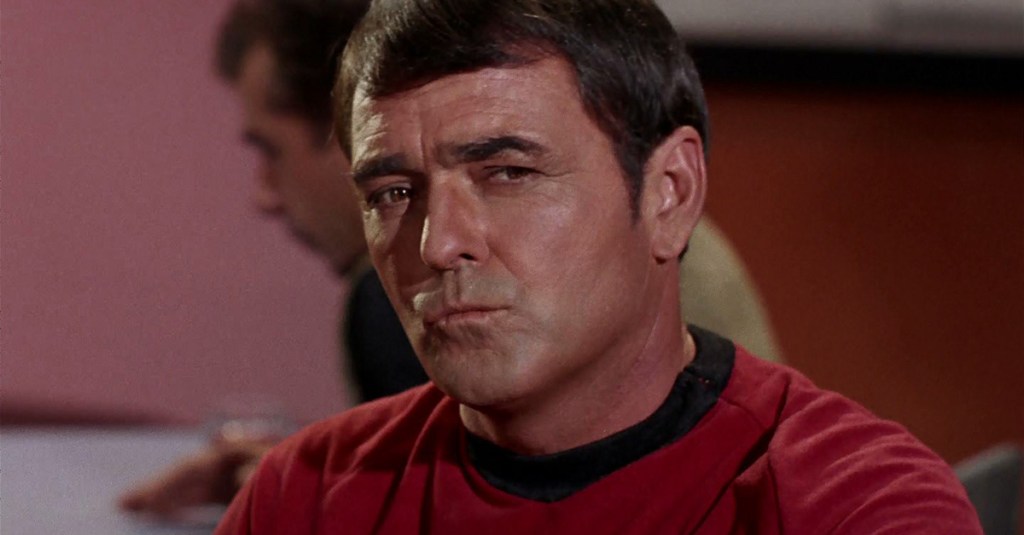
It’s about being with the right crowd. One of the most fun experiences I’ve ever had in a movie theater was when the Star Trek documentary Trekkies was released back in 1997. The film is a glimpse into the lives of Trek fans from across the country, a particularly niche subject matter, and it didn’t get a wide release. However, someone I knew happened to have a connection at the local UPN affiliate (home of Star Trek: Voyager) and scored some free passes to a screening they were hosting. The result was an entire theater full of people who LOVED STAR TREK, and there is no better atmosphere in which to watch this movie. We laughed at the people who went a little too far. We cracked jokes about the woman who dressed up her poodle as Spock. And we collectively shed a tear when James Doohan shared the beautiful (and now oft-told) story of how his connection with a fan saved them from committing suicide. 

AND he was shot six times on D-Day! The man didn’t need to go to outer space to be a hero.

That “right crowd” mindset works very well when going to see a classic movie in the theater. Odds are, the majority of the audience HAS seen the movie before and is excited to see it with a crowd, and those that HAVEN’T seen it before are there because they want to join in the fun. It’s the reason that interactive screenings of The Rocky Horror Picture Show have endured for such a long time. To give another example: Erin’s favorite movie is Jaws, and as it was released before either of us were born (we’re old, but we ain’t THAT old), when a special screening was announced at a Movie Tavern within an hour’s driving distance, we decided to make it a date night. (It goes without saying that this was before Eddie was born, although Erin was pregnant at the time.) Near us sat a father with his daughter, who I guessed was about 13 years old and who clearly had never seen the movie before. She was doing fine right up until the scene where Richard Dreyfuss finds Ben Gardner’s decapitated head drifting in the shipwreck underwater, at which point she jumped into her dad’s lap and stayed there for the rest of the movie. It was amazing.

This was a major bonding moment.

After Gene Wilder died, there were special screenings of Willy Wonka and the Chocolate Factory and Blazing Saddles, and we did a double feature. Saddles is – and I say this with firm conviction and damn the mobs who want to piss on everything older than 2008 – one of the funniest movies ever made, and seeing it for the first time in a theater was fun. But Wonka was downright magical. The screening was full of parents with kids, many of whom had never seen the movie before. Those kids were mesmerized, drawn into the magic and swept up in this 50-year-old film in a way that the 15-year-old remake by my birthday buddy Burton couldn’t hope to match.

Betcha he never would have used AI and charged kids fifty bucks for a half a lemonade, either.

And you know, I don’t think those kids would care if they HAD seen the movie before. Seeing it on the screen is DIFFERENT. It’s only adults that are too stupid to push that aside. If my son can watch the same YouTube video of the 2017 Times Square New Year’s Eve ball drop 47 times in a row, he sure as hell isn’t going to walk into a screening of Despicable Me and say, “Daddy, I’ve seen this before.”

When I was a kid, Disney used to frequently re-release their classic movies. I got to see films from decades before I was born like Snow White, Sleeping Beauty, and The Sword in the Stone. With the exception of one-night or short-term engagements, that doesn’t happen anymore (possibly because Disney is afraid people will remember how much better the original versions of these movies are than the lifeless remakes they’re turning out lately). But damn it, it should. My family doesn’t get to the movies much these days, but if I was at a movie theater right now and given a choice between seeing Fast and Furious 11 for the first time or watching Raiders of the Lost Ark for the twentieth time (but the first time in a theater), it wouldn’t even be close. 

With movie theater attendance struggling, there’s a desperate effort to create content that fills seats, but I feel like theaters are missing out on an obvious opportunity here. Doing a revival screening of Casablanca or The Wizard of Oz may not sell as many tickets as a Marvel movie, but it also costs a hell of a lot less to put back into theaters. Give us more classic family movies! Give us more events! When the Special Editions of the original Star Wars trilogy hit theaters in the 90s, we fans came out in FORCE (pun intended), not because we wanted to see Greedo shoot first, but because we wanted to see him in a room the size of a house and full of other people who loved the movie as much as we did. 

These screenings DO happen. Like I said, Fathom Events does anniversary and event screenings a lot. There was the aforementioned Gene Wilder double feature. And Disney just announced an all-day nine movie marathon of the Star Wars films on May 4th. But I don’t want to have to wait for an anniversary that ends in a 5 or 0 or for somebody to die before I get to see a classic.

Our only hope.

I wish there were a nearby, easily-accessible theater in my area that frequently did revivals or special screenings of classics, but alas, there aren’t a ton of options, especially if you don’t have a lot of opportunities to go into New Orleans proper. So I keep an eye on Fathom events and I cross my fingers for special screenings and I long for the day when the cinematic community figures out how to make this happen.

And I hope to see Hitch’s cameo the way it was meant to be seen: big enough to fall into his nostrils. 

Blake M. Petit is a writer, teacher, and dad from Ama, Louisiana. His most recent writing project is the superhero adventure series Other People’s Heroes: Little Stars, now complete on Amazon’s Kindle Vella platform. If anyone is available to babysit on August 25, let him know.

Geek Punditry #43: The Halloween Special Special

A few days ago I was watching TV with my six-year-old son and we happened to land on Disney+, where I saw something that got me excited. Something lovely. Something that was a true work of beauty, a rare creature that seems to always dance on the edge of extinction, only to be pulled back time and again. Something that I want to share with my child.

A new Halloween special.

“Mickey and Friends III: Season of the Witch”

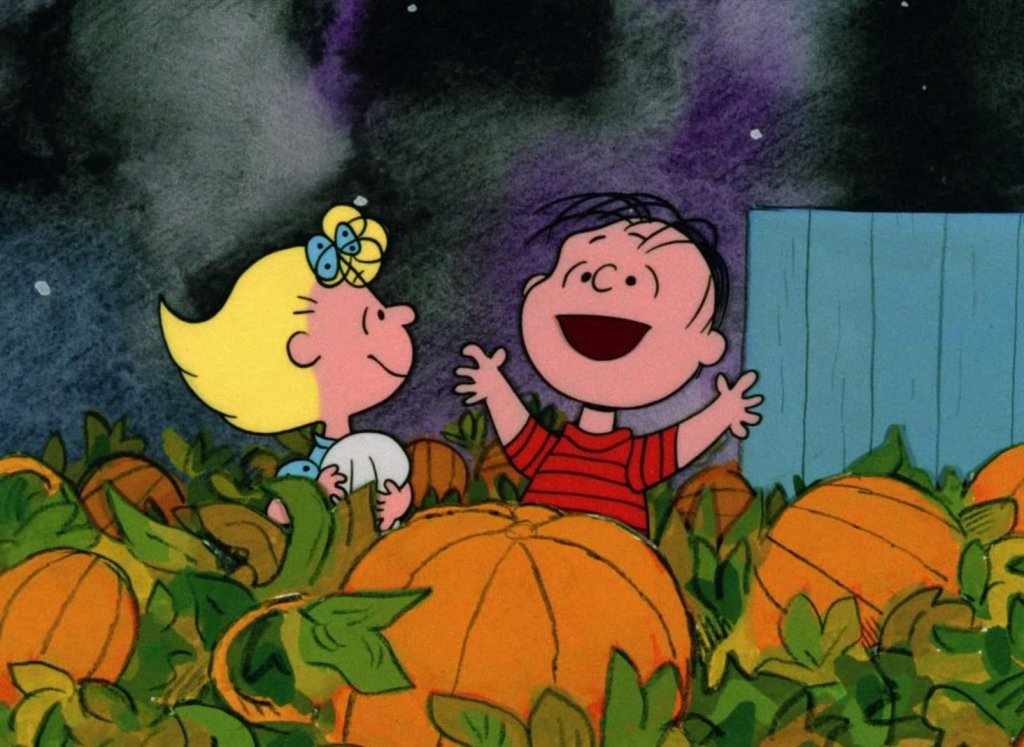
I grew up in the 80s, the apex of holiday specials on television. Oh sure, they weren’t new when I was a kid, but I’m from that generation where the classic specials from the likes of Rankin and Bass and Mendelson-Melendez were still in perpetual rotation and original specials were premiering every year, sometimes many of them. It was simplicity itself to mix the old specials with the likes of the Smurfs, Alvin and the Chipmunks, and the other Saturday Morning heroes of my youth. Like so many things when it comes to the pop culture landscape, it’s changed. And like so many things for those of us of a certain age, it doesn’t feel like it’s gotten better. They don’t show the classic specials on TV all that much anymore, first of all. As people have drifted to the streaming world, the days of everyone needing to be in front of the TV at the same time if they’re going to watch It’s the Great Pumpkin, Charlie Brown are pretty much over. And don’t get me wrong, it’s nice that I can watch the DVD any time I want, but it’s not the same as knowing that they’re watching it next door and down the street and somewhere in Cincinnati at the same time.
This is good, but somehow it’s even better if I’m watching it at the same time as someone I’ve never met in Patterson, New Jersey.

And while it’s true that specials are still being made, I don’t feel like we’re getting them with the frequency that we once did. Of course, part of that may be that they’re now all spread out amongst a thousand streaming services and you don’t even know that they’re there. And those that do exist haven’t broken into the cultural zeitgeist, again, probably because of the preponderance of sources. Even as I was typing this sentence I thought of nearly a half-dozen Halloween specials from the last few years that I’ve watched, but I haven’t re-watched most of them like I do the classics. Great Pumpkin was, and remains, essential viewing before Halloween. So was and is Garfield’s Halloween Adventure. But when I think about going back and watching, for example, LEGO Star Wars: Terrifying Tales from 2021, I know that if I skip it this year I’m not going to feel like I’ve missed anything.

One of these is a legendary piece of animation history based on a globally-beloved property and is appointment viewing every Halloween season. The other one is a Star Wars movie.

LEGO Star Wars, by the way, was also a Disney+ special, and I have to give them credit for turning out more things like this, especially for kids, than most of these streaming services. The new special Eddie and I watched this week was Mickey and Friends: Trick or Treat, in which Donald Duck (of COURSE it’s Donald’s fault) convinces the rest of the gang to trick or treat at a haunted house that happens to belong to a witch who doesn’t appreciate visitors. It isn’t a mind-blowing cartoon, but it’s cute and it’s new and – maybe best of all – it’s stop motion. If a new Halloween special is an endangered species, a stop motion special is a friggin’ unicorn. There was a stop motion Christmas special last year featuring Mickey and Friends as well, and while none of these are going to join the pantheon of the greats, I have to applaud their effort.

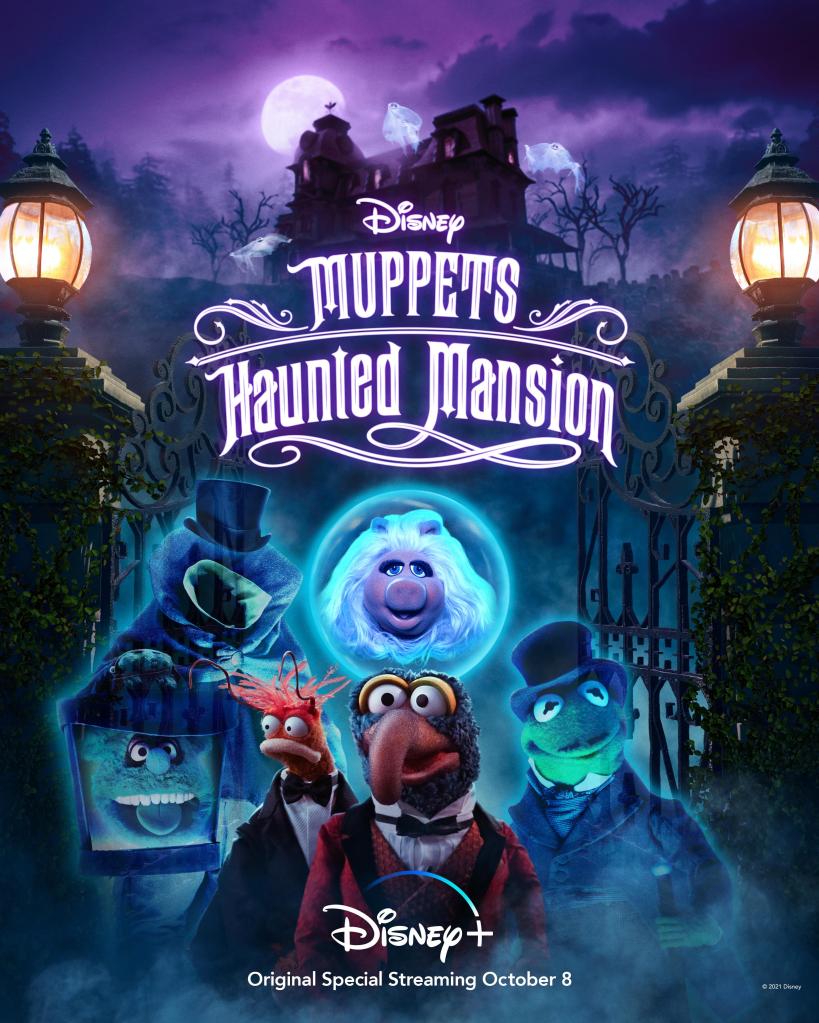
Disney+ is also responsible for Muppets Haunted Mansion, another 2021 special in which the Great Gonzo and Pepe the King Prawn spent Halloween the night in…well…Disney’s Haunted Mansion. It had the requisite music and celebrity cameos that one expects from the Muppets, and it was decent. I actually watched that one a second time last year, but I haven’t gotten around to it in 2023, and I’m okay with that. The difficulty here was that this not only had to live up to the great Halloween specials, but also had to live up to great Muppet movies, and in both categories it’s just middling. 

If “It’s okay, I guess” was a picture.

So the question has to be, where will the great Halloween specials of the future come from? Don’t get me wrong, I intend to watch Garfield and Charlie Brown every October for the rest of my life, but that doesn’t mean I don’t want more. (I feel like I need to get this put on a T-shirt because I seem to say it in this column at least once a month: What do fans want? MORE!) Is there anybody out there carrying the torch of Mendelson, Melendez, Rankin, or Bass?

There are some people doing Halloween content, fortunately. Movies, for example. Feature-length films are in no short supply. Prime Video this year gave us Totally Killer, a time-travel comedy about a girl who goes back to the 80s when her parents were teenagers to face off against the slasher that terrorized them then. Not a family movie, but it was original, and I liked it. Last year there was Spirit Halloween: The Movie, a film about kids who sneak into one of the ubiquitous Halloween pop-up stores overnight, unaware that this particular store is haunted for real. Disney+, again, gave us a sequel to the Halloween favorite Hocus Pocus, which is included here to prove that just because a movie is about Halloween doesn’t automatically make it good. 

But that’s not what I’m looking for. I love a good Halloween movie, but a holiday “special” is, to me at least, a different sort of beast. I’m talking about the one-off films, a half-hour to an hour at length, which take characters that we already know and give them a seasonally appropriate adventure. The classics mostly fit into this category – Garfield and the Peanuts gang, for example, spring from the pages of newspaper comics, and even most of the Rankin and Bass Christmas classics were based on preexisting stories. Many of their best specials (and here I’m thinking of Rudolph the Red-Nosed Reindeer, Frosty the Snowman, Santa Claus is Coming to Town and Here Comes Peter Cottontail) were based on popular songs. There were a few based on Bible stories, one on a novel by Oz creator L. Frank Baum, and so forth. There are a few Rankin and Bass classics based on entirely new ideas, but the truth is, those aren’t the ones we remember.

Even their one great foray into Halloween wasn’t wholly original – 1967’s Mad Monster Party was a stop motion feature film that featured characters they couldn’t technically call the Universal Monsters, but anyone who watches it knows they’re really the Universal Monsters. It was easy for the public domain characters – Dracula, the Frankenstein Monster, a generic werewolf – but they even managed to sneak in characters obviously based on copyrighted monsters like the Creature From the Black Lagoon and (people don’t lump him in with the Universal Monsters, but they SHOULD) King Kong. Hell, it even starred Boris Karloff as Baron Frankenstein. 

If you haven’t seen this movie, it counts as a character flaw.

Pulling out new specials that fit the mold of the classics depends largely on which characters you can use. Disney, as we said, is making use of the likes of Mickey and his pals, and they worked in their Star Wars and Muppets characters a couple of years ago, but there’s more that could be done. Could you imagine, for example, a Wreck-It Ralph Halloween Special in which Ralph and Vanellope have to make it through a (kid friendly) survival horror game like Silent Hill or Five Nights at Freddy’s? Or more Marvel content – last year they gave us the excellent MCU Halloween Special Werewolf By Night, based on a classic Marvel monster comic from the 70s, and I loved it. But why not an animated special featuring the Guardians of the Galaxy on a “Planet of Terror?” Have Doctor Strange fight some sort of Lovecraftian horror? Heck, tie it into the What If? brand and you could do virtually anything – there’s already a zombie universe out there in the MCMultiverse. 

Then across the metaphorical street (by which I mean one row over on the apps on my Roku), we’ve got Disney’s rival, Warner Bros. Their MAX service also has a new Halloween special this year, a Sesame Street show called Oscar’s Handmade Halloween. That’s not bad. I’ll take any Sesame Street content I can get for my kid. But considering the depth of Warner Bros’s catalog, what else have we got? Admittedly, last year there was a Scooby-Doo Halloween movie, and that’s all well and good, but how about the DC Universe? They brought in the Super Sons in an animated movie earlier this year – I would love to see a half-hour cartoon about Superboy trying to convince Robin to go trick-or-treating with him, with all the chaos that would inevitably ensue. How about a new Looney Tunes Halloween special? Witch Hazel is sitting right there in the catalog, guys. 

And what about other characters that aren’t necessarily tied into any huge IP farm like Warner Bros or the Walt Disney Pictures Shadow Government and Pedicure Emporium? In this year’s Halloween episode of the Totally Rad Christmas podcast (a show about Christmas in the 80s, except when it’s about things that aren’t from the 80s and/or aren’t about Christmas), the hosts talked about their love of Monster Cereals. After going after the hard questions (why is Frankenberry British?) they asked the obvious one – how is it possible that Count Chockula, Frankenberry, and Boo Berry never got their own animated special? That’s a great question. I suppose the answer is that, when those cereals were ascendant, there were laws in place that prevented children’s programming from being used as advertisements for a product, so they couldn’t make such a special. But those laws have been gone since the early 80s, since the birth and explosion of He-Man and the Masters of the Universe. Do you mean to tell me that, in the years since, nobody has thought to call up General Mills and get an animated special going?

Look me in the eye and tell me these guys are less deserving of a Halloween special than Raggedy Ann and Andy.

I know that I sound like an old man waxing nostalgically for things from his past that are gone and are never to return, but there’s a good reason for that. I am an old man waxing nostalgically for things from his past that are gone and are never to return. Except for that last part, actually, because I don’t think I’m ready to accept that things like this are gone forever. There are still children in the world – I’ve met at least seven of them – and those kids still watch TV and still like cartoons. And those kids have parents who would love to have new things to watch with them instead of watching that same Mickey Mouse special 17 times before Halloween. 

The audience is there. All we need is for somebody to step up and give us the content.

Blake M. Petit is a writer, teacher, and dad from Ama, Louisiana. His current writing project is the superhero adventure series Other People’s Heroes: Little Stars, a new episode of which is available every Wednesday on Amazon’s Kindle Vella platform. Three words, Disney: Encanto Vs. Freddy. C’maaaaaaaan, you know you wanna. 

Geek Punditry #23: The Next Star Wars?

Like most sane people, here’s a phrase I don’t say very often: Quentin Tarantino has a point. 

I know, but bear with me.

In a recent conversation with Deadline, Tarantino said that streaming movies – as opposed to movies that have a theatrical release – aren’t really a part of the cultural zeitgeist. “It’s almost like they don’t even exist,” Tarantino said, and I think he’s on to something there. Think about it – of all the movies that have gone straight to a streaming service over the last few years, bypassing a theatrical release, how many of them that weren’t already based on an existing Intellectual Property have had any sort of major cultural footprint? When’s the last time you heard someone talking about Netflix’s The Adam Project, Prime’s The Map of Tiny Perfect Things, or Shudder’s Blood Relatives? These are all good movies. They’re movies I would recommend to people. But they simply aren’t part of the cultural conversation. I’m not saying that Free Guy is a better movie for Ryan Reynolds than The Adam Project was, but based on the fact that one has 661,000 views on Letterboxd as opposed to 302,000 for the other, I AM saying that more people are aware of the former. 

This isn’t to say Tarantino is right about everything, of course. For one thing, I don’t care for feet. But more germane to the topic, later in the same interview he says that all television is “soap operas,” that he doesn’t think about a few weeks after he watched the last episode. That’s silly on the face of it – shows like The X-Files or Breaking Bad have been gone for some time, but still have huge fan bases. And some new streaming shows have cracked into the mainstream, like Stranger Things or Bridgerton. Somehow it’s easier for TV shows to build fan bases than movies, possibly for some of the reasons I discussed back when I was talking about the problem with binge-watching

“Why can’t I remember what happened on the last episode of The Goldbergs?”

Back to the movies, though. I thought about this, trying to come up with the most culturally significant streaming-first movie I could think of – even asked the question on a writer’s thread I’m a part of, and was given exactly one suggestion: the Netflix sci-fi thriller Bird Box. That’s a good example. It was a big hit, people really got into it when it came out, and it’s got a hefty 894,000 views on Letterboxd. But that was five years ago. Before you read this column, when’s the last time you thought about Bird Box? There was a discussion of a sequel when the film first came out, but it hasn’t happened yet, although Netflix DID announce a spin-off film, Bird Box Barcelona, which is going to drop in July and be forgotten by August. 

Early contender for “Best Picture you definitely watched this year but don’t remember anything about.”

There’s a permanence to theatrical movies that streaming films don’t enjoy, possibly because streaming is just easier. Going to the movies is a commitment. You have to drive down there, plan your snacks, buy a ticket or commit petty larceny to enter, and then devote your time. That guy you went to school with who saw Star Wars in the theater 27 times made it a LIFESTYLE CHOICE. Whereas watching something 27 times on streaming just requires you to click a button and be too lazy to look for something else.

But the more I thought about the problem, the more I realized that Tarantino wasn’t quite right. (What are the odds?) It’s true that streaming movies haven’t hit the way that blockbuster movies of the past have, but then again…have any theatrical movies hit that hard either? Sure, there are successful movies, but they’re all sequels, remakes, or based on existing IPs. When was the last truly original blockbuster movie?

As of this writing, Box Office Mojo lists the top ten movies of 2023 so far as:

1. The Super Mario Bros. Movie

2. Guardians of the Galaxy Vol. 3

3. Avatar: The Way of Water

4. Ant-Man and the Wasp: Quantumania

5. The Little Mermaid

6. John Wick Chapter 4

7. Spider-Man: Across the Spider-Verse

8. Creed III

9. Fast X

10. Puss in Boots: The Last Wish

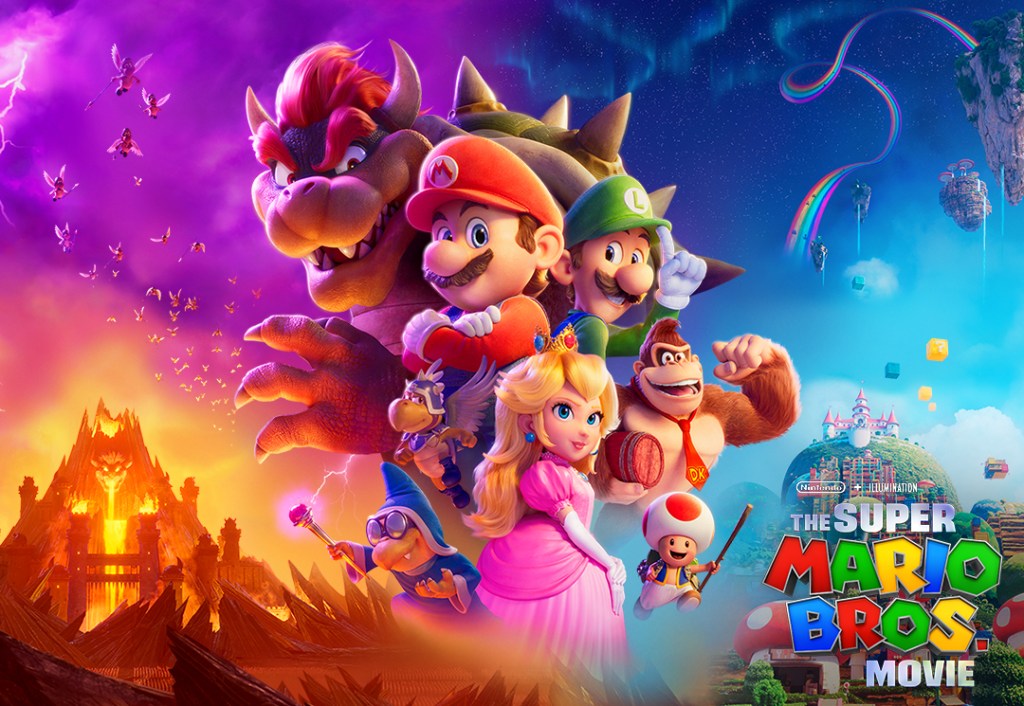
“It’s a-me, a license to print money!”

In other words, eight sequels, one remake, and one movie based on what is arguably the most famous video game franchise in human history. The top movie on the list that’s an actual original idea is M3GAN at #12, which is actually a holdover from 2022 that took in $95 million after the calendar flipped. The highest-grossing film released in 2023 with no previous IP to drawn on is Cocaine Bear at #16. 

I’m not saying anything negative about any of these movies, I want to stress that. I’m just saying that if you’re looking for something new to add to the cultural zeitgeist, this is not the place to look.

Several years ago, a friend of mine tried to argue that the then-upcoming Pirates of the Caribbean sequel Dead Man’s Chest would launch the film into a legitimate franchise, that it would turn it into that generation’s Star Wars. And while there were five Pirates films (with a sixth one occasionally teased by Disney), I don’t think there’s anyone that would argue it has had the level of cultural penetration that Star Wars has. You can see Star Wars shirts, toys, books, comics, and other assorted paraphernalia everywhere you look. If you say the phrase “May the Force be with you,” everybody immediately knows what you’re talking about. Hell, in certain company saying “I love you” without following it immediately with “I know” will feel strange. What’s the last new franchise you can say that about?

Star Wars, by the way, is an arbitrary metric. One could easily point to any number of franchises with deep cultural penetration – Star Trek, James Bond, A Nightmare on Elm Street… all things that are easily recognizable even if somebody isn’t a fan of that particular franchise. However, Star Wars is arguably the new franchise that has had the greatest impact worldwide in the last 50 years or so, so that’s what I’m going to use. People have been trying to make the next Star Wars for years, but it’s just not working.

People often argue that there are no new ideas in Hollywood, but that’s not true. The ideas are there, it’s just that – as I’ve pointed out before – the people who are in charge of the budgets are afraid to spend money on something that isn’t proven. That’s why they want sequels, remakes, or movies based on preexisting IPs. Comic books, in the past 20 years, have become very lucrative IP farms, which is why Disney bought Marvel in the first place. If a novel is really popular, it can break in. (Bird Box and Bridgerton, I should point out, were both novels before Netflix got them.) In VERY rare examples, a filmmaker may become a big enough name in his own right to get the budget to do something both new AND big, which is where the first Avatar movie came from, built not on any existing franchise but on the name of writer/director James Cameron.

This movie only exists because you saw Titanic 27 times.

Avatar is a really bizarre example. It looked, when the first movie was released in 2009, like it had that kind of Star Wars potential for cultural impact. The Way of Water is the sequel to the highest-grossing movie of all time, and like M3GAN it actually came out last year, but made so much money after Jan. 1 that it currently occupies the #3 spot for the 2023…but so what? For the 13 years in-between movies, nobody was talking about it. Nobody was wearing t-shirts or buying merch outside of Disney’s Animal Kingdom, and I defy anybody to give me one memorable quote from the first movie that isn’t just being used to mock the word “unobtanium.” The amount of money that a movie makes proves a lot of people see it, but it doesn’t necessarily demonstrate anything about the franchise’s longevity.

Many other sci-fi franchises have been attempted over the years, most of them falling flat for one reason or another. In 2012 Disney released John Carter, an adaptation of the Edgar Rice Burroughs novel that virtually invented the kind of planetary science fiction that has been a staple of the genre ever since. None of the major Star franchises could exist without it: not Wars, not Trek, not Search. But while I will defend that film to my dying breath (I think it was a great movie with loads of potential) it fell victim to terrible marketing and a Disney studio that simply didn’t know what to do with it. They even saddled it with a horribly bland title because they were afraid that boys wouldn’t want to watch a movie with the title of the original novel (A Princess of Mars) and that girls wouldn’t want to watch the proposed alternate title (John Carter of Mars). The movie bombed, the franchise died.

The next year Lionsgate tried to do the same thing with another of my favorite novels, Ender’s Game. Despite featuring Harrison Ford and a pre-stardom Hailee Steinfeld, though, the movie fell flat. It’s just as well – the sequels to the novel don’t at all lend themselves to a Star Wars-style franchise. The direct sequels dive into deeply philosophical and spiritual science fiction, meditations on the soul and the nature of sentience itself, with relatively few sci-fi “Pew Pews.” The spinoff Ender’s Shadow series DOES feature “Pew Pews,” but not in space, focusing on the geopolitical chaos left behind after humanity was temporarily united in the face of an alien invasion. 

The first rule of Dead Franchise Club is you do not talk about Dead Franchise Club.

So maybe sci-fi isn’t what’s going to bring us the next Star Wars. What about fantasy? There have been three pretty successful fantasy franchises since the turn of the millennium: Lord of the Rings, Harry Potter, and Game of Thrones. But all three of those are based on books that came out in the 20th century and spent years – decades in the case of Lord of the Rings – building up an audience that would carry over. And while there is certainly no shortage of references to those franchises in toys, clothing lines and other assorted paraphernalia, while nobody would look at you like an alien anymore for dropping a reference to any of them, are they Star Wars? They’re CLOSE, but follow-ups to the original series of Lord of the Rings and Harry Potter have been divisive (actually, that IS pretty Star Wars), while the follow up to Game of Thrones was pretty well received so far, but a lot of people are still angry over the ending of the original TV series or the lack of ending of the novels. They might make it there, but they aren’t there yet.

From left: the new Luke Skywalker, Han Solo, and Princess Leia.

I’m about to say something controversial, something that will infuriate certain people such as my sister…but I think the most original franchise in the last 23 years to truly make its way into the cultural consciousness is Universal’s The Fast and the Furious. Or Fast and Furious. Or The Fast Saga. Look, they can’t even really agree on a NAME for the franchise, but everyone knows what it is, and the fanbase is gargantuan.

“I don’t need the Force. I got FAMILY.”

The Fast and the Furious came out in 2001, and although it borrows its name from a mostly-forgotten 1954 film starring John Ireland, I’m not going to count it as a remake. First of all, the stories have absolutely nothing in common except that both include cars, and second, 99 percent of you had no idea the 1954 film even existed until you read this paragraph, so it’s clearly not cashing in on nostalgia the way most remakes do. 

Anyway, it’s been 22 years since the first Fast movie came out, and if the tenth movie that was released earlier this month is any indication, it’s not slowing down (bah-dump-bump!). It’s already cracked the top 10 films of the year, and although Vin Diesel says that Fast X is the first film in a story-ending trilogy, Universal Studios is very, very quick to remind people that this is the end of the story of Dominic Toretto and NOT the franchise as a whole. There’s already one spinoff and a Netflix cartoon, with at least two more spinoffs planned, including a second film about Dwayne Johnson’s Luke Hobbs character and another “female-centric” spinoff that is currently wandering Hollywood in search of a better title. 

Although the movies started out as mid-grade, clunky action films, somewhere around the fourth or fifth movie they hit some sort of power up and became high-grade clunky action films. Where we started with a story about a cop who was trying to bring down a group suspected of hijacking and robbing big rig trucks, we now have a franchise about ridiculously skilled street drivers being used as Mission: Impossible-level super spies, saving the world and looking good while doing it. At the point where the movies stopped making any attempt at having any logic or coherence behind them, they also became ridiculously fun to watch. And if nothing else, that’s what has made this preposterously unlikely franchise so endearing. It remembers something that most other attempts at world-building have forgotten: namely that blockbuster movies are supposed to be fun, dammit!

When I say “the next Star Wars” I hope there’s no confusion. I’m not trying to REPLACE Star Wars, or anything else for that matter. I love what I love, and I don’t want any of it to go away. But there’s always room for something new, and that’s what I’m hoping for. And when it comes to “new,” we need to do better.

Blake M. Petit is a writer, teacher, and dad from Ama, Louisiana. His current writing project is the superhero adventure series Other People’s Heroes: Little Stars, a new episode of which is available every Wednesday on Amazon’s Kindle Vella platform. He could not remember the title of Bridgerton while writing this, and wound up having to text some friends asking “What’s the name of that show you all watch that’s like a horny Downton Abbey?”

Geek Punditry #20: Prequel Pitfalls

If you haven’t heard, there’s a new Hunger Games movie coming out. “But how can that be?” you ask. “Didn’t the original trilogy of four movies end the story in a tidy, satisfying manner?” Eh, kinda. But this one isn’t another sequel, it’s a prequel, The Ballad of Songbirds and Snakes, based on the prequel novel by the creator of the series, Suzanne Collins. I was a big fan of the novels, and the movies were…okay. But I haven’t yet read the prequel novel and I’m honestly not feeling a huge need to do so. As I mentioned a few weeks ago during one of my almost-weekly Star Trek discussions, pulling off a satisfying prequel is tricky as hell, and not a lot of franchises have done a good job of it. So before you line up to see Songbirds and Snakes, let’s take a little time this week to discuss what it is that makes prequels difficult and a few franchises that have overcome that inherent degree of difficulty to give us a satisfying result. 

You know, by definition, ballads have words, so I’m expecting these birds and snakes to talk. Do it, you cowards.

Any time you return to a successful franchise, there is a compulsion to raise the stakes. There’s no reason to go back to familiar territory, after all, if you can’t enhance the next installment – greater spectacle, more blood, a more fervent tugging on the heartstrings. It’s the reason that horror movie sequels always have a higher body count and why the first Fast and Furious movie was about illegal street racing but in the most recent one they were literally driving cars into outer space. And while we usually think about this escalation issue in terms of sequelitis, we want the same thing out of a prequel.

Even sequels don’t always pull off the escalation in a satisfying way (in truth, the list of sequels that are better than the original film is relatively small when you consider how many sequels have been made), but it’s even more difficult to do so when rolling back in time because many of the things audiences usually want to discover about the characters and the world they live in have already been established by the original. Going back to Star Trek as my example (because this is my blog, dammit), when you sit down to watch an episode of Strange New Worlds, there is never any fear in your heart that Spock might die because you know he’s still alive during the original series. Not to say that death is the only challenge a character might face, but the same logic applies to most of the unanswered questions we usually cling to. No one cares about a “will they/won’t they” romance with characters who we’ve already seen having “willed” or “won’ted.” That invasion that’s happening is kind of dull if you know from the original movie that the aliens are, indeed, successful in conquering the world. And if a character that has no children in the original film gets pregnant in the prequel, get ready for bad things to happen. Bad prequels feel like watching somebody draw a connect-the-dots picture. We watch as the story goes from point 1 to point 2 to point 3, and no matter how many numbers you have in the image, you’re never surprised by what happens next.

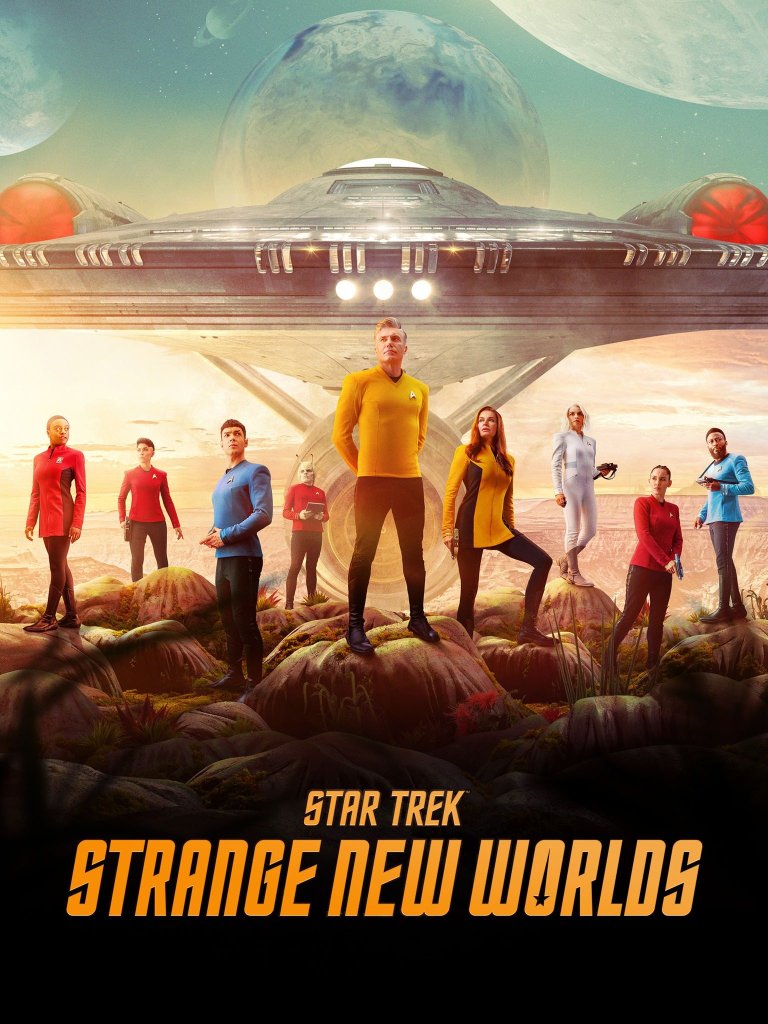
From left to right: Safe, At-Risk, Hella Safe, Don’t Get Too Attached, Gonna Survive the Series But Wind Up in a Space Wheelchair, Originally Played by Majel Barret Part 1, Originally Played By Majel Barret Part 2, Could Buy it at Any Time, and Bet You Forgot This Guy Was in TOS.

So how can you make a prequel work? Well, there are a few ways. One is to rely less on a story that just marches towards the original and instead try to tell a story that matches the original’s flavor in a satisfying way. You’re drawing on the same page, but you aren’t just playing connect-the-dots. This is what makes Strange New Worlds work. Yeah, I’m never worried that Spock is in mortal danger, but the truth is that we were never really worried when we watched the original series either, were we? This was a pre-Game of Thrones era, a time where series regulars didn’t get killed off randomly. It’s literally the reason that the redshirt trope came to exist: they needed to kill off SOMEBODY who wasn’t in the credits, so cannon fodder lined up in the casting office. Strange New Worlds takes the sort of episodic approach that the original series did, and while the stories are perhaps a bit more sophisticated than those that Shatner and Nimoy performed in, the tone is really spot-on perfect. That’s what makes the show so satisfying, even without the spectre of the Grim Reaper hovering over half of the cast.

Another way to make a prequel work is to use the setting of the original property, but an entirely (or almost-entirely) new cast of characters whose fates have not been determined. Star Trek has tried this approach as well. Enterprise was a series about the founding of the Federation, 200-ish years before Kirk. Even though you always felt the world we knew from the original series as the North Star that the Enterprise NX-01 was sailing towards, there was room for danger for these individual characters. They also tried this with Discovery, but this time set it only a decade pre-TOS and mingled in characters so hopelessly intertwined with Spock that it became a distraction to simply try figuring out how any of it meshed with the stories we already loved. The second season finale had a half-assed attempt at explaining why the events of Discovery had never come up in-universe before (especially Spock never mentioning an adopted sister that he was apparently quite devoted to, even when his rogue half-brother previously turned up in Star Trek V), but it just never properly landed.

Of course, no discussion of prequels would be complete without the franchise that popularized the term, and in fact includes one of the greatest prequels ever made. That franchise is Star Wars. The prequel? Rogue One.

No, not the other three. You see, another way to make a prequel work is to subvert the audience’s expectations – make them think they know what you’re going to do, but give it an unexpected twist. Since the audience knows how the story will end, you have to pull off some pretty big surprises to get there. This is both how the prequel trilogy failed and Rogue One succeeds. The trilogy is about the fall of Anakin Skywalker, the character everyone who saw the original films knows will eventually become Darth Vader. We know from the original series that Anakin was a Jedi who fell to the Dark Side of the Force and became an apprentice to the insidious Emperor Palpatine. It sounds like a story that’s ripe for tragedy. But in telling that story, George Lucas stuck painfully to the blueprints, with nothing particularly shocking or surprising about Anakin’s fall except for the sheer number of details that failed to mesh with the original series. (“Hey Leia, remember your mom?” “The one who died giving birth to me? Yeah, she was beautiful, but sad.”)

Rogue One, on the other hand, is not only the best Star Wars film of the Disney era, it’s one of the best examples ever of how to toy with an audience’s expectations. In the original Star Wars Leia delivers data to the Rebellion that will help them to defeat the Empire’s superweapon, the Death Star, with the only explanation of how it was obtained being the single sentence, “Many Bothans died to bring us this information.” (EDIT: I have been reminded that the Bothans line was actually about the second Death Star from Return of the Jedi. I deeply regret this error, but it does open a window to make a Rogue Two movie about the Bothans.) Rogue One tells the full story of how this vital information was secured, and director Gareth Edwards and his screenwriting team pulled off a damn magic trick in doing so. We, the audience, already know that the mission will ultimately be successful – it’s literally how the original trilogy begins. So how can you build suspense for that? Well, first you introduce a cast of interesting and sympathetic characters, characters that fit in the Star Wars universe but don’t fall cleanly into the cookie cutter shapes of the older films, and make the audience feel for them. Then – and I’m about to spoil a movie that came out seven years ago, so stop reading if you haven’t seen it – then after we grow to love and care about the characters that are on a mission we know beyond a shadow of a doubt will be successful…

This poster and caption provided as a public service buffer in case you haven’t seen the movie yet.

…THEY ALL DIE.

They succeed in transmitting the information, but every character we’ve come to love dies in the attempt. This kind of ending, where every major character dies and which TV Tropes calls a “Bolivian Army Ending” after the finale of Bonnie and Clyde, is dangerous for a writer. There’s a real risk of being accused of trying for shock value, upsetting the audience in a visceral way that may not be truly satisfying. Rogue One nails it, though. The characters die heroically, succeeding in their mission at the cost of their own lives, and even as the audience is left weeping for them we’re also left with the knowledge that their sacrifice was not in vain. The movie ends just seconds before the beginning of the original Star Wars movie, and even though they were made nearly 40 years apart, watching them together gives the original an added context and an added weight that actually makes it better.

That’s what a great prequel does, by the way. It recontextualizes the original property in such a fashion that you look at it differently. Let’s talk about Better Call Saul, the spin-off of AMC’s drama Breaking Bad. It’s not often that somebody creates what is perhaps the greatest dramatic TV series of all time, but somehow, Vince Gilligan managed to do it twice. The fact that the second time was a prequel is the TV equivalent of walking a tightrope blindfolded and then doing it again backwards.

Breaking Bad was a series about a high school chemistry teacher who winds up falling into the world of drugs and organized crime. Bryan Cranston’s Walter White starts off as a deeply sympathetic and wonderfully human character – beaten down by a life that didn’t go the way he expected, a marriage that has grown stale, struggling to connect with his son…and if that wasn’t enough, in the first episode he learns he has cancer. It begins in desperation, cooking methamphetamines in order to make money to take care of his wife and children after his death. Over the course of five seasons, though, we watch this man transform from a quiet, relatable antihero into a cold-blooded crime lord, somebody who is terrifying to watch, but the writing and performances are so compelling that you just can’t look away.

Not since Dan Fielding have you loved a sleazy lawyer so much.

One of the characters who gets pulled into Walter White’s web is Saul Goodman, a shyster lawyer whose services are provided to the criminal element of Albuquerque when they’re in a tight jam. Bob Odenkirk’s performance as Saul was an instant hit, providing comic relief at necessary moments while still having the emotional gravity that the show demanded. When Breaking Bad finished its run, Gilligan and Peter Gould spun off the Saul character into his own series that began some years earlier. On paper it doesn’t sound like a great idea – who cares how a shyster lawyer became a shyster? It turns out, everybody.

Better Call Saul premiered with Bob Odenkirk playing…well, not Saul Goodman, but Jimmy McGill, an attorney trying to get out of the shadow of his brother and struggling to make ends meet. Like Walter White, he makes an early decision out of desperation that pulls him into the criminal underworld of New Mexico, and from there, the story is about how Jimmy McGill transforms into Saul Goodman.

Aside from – again – the excellent writing and phenomenal performances of the cast, the thing that makes Better Call Saul so compelling is the way it acts as a PARALLEL to Breaking Bad. We know where Saul Goodman ends up, but like Walter White, we watch in impotent terror as he falls deeper and deeper into the chaos that surrounds him. Like Walter, sometimes he makes terrible choices. Like Walter, sometimes he is compelled to make these decisions by forces beyond his control. There’s a lovely contrast here, too. Walter begins doing bad things with the intent of helping his loved ones, but is eventually intoxicated by the criminal lifestyle. Jimmy/Saul, on the other hand, is a con artist who’s trying to stay on the straight and narrow but just keeps slipping until he surrenders entirely. 

Both shows are about someone who begins as a basically decent man becoming something much darker and losing himself in the process – Walter becomes the criminal kingpin “Heisenberg,” while Jimmy McGill becomes smooth-talkin’ Saul Goodman. When watching Breaking Bad the characters of White and Goodman couldn’t be further apart from one another. Watching Better Call Saul makes you realize maybe they aren’t that different after all.

Beyond just Odenkirk’s character, though, Better Call Saul features frequent appearances by other characters from the earlier series, and knowing that these characters are safe from death doesn’t hurt the show at all. Nowhere is this more evident than with Jonathan Banks’s character Mike Ehrmantraut, who was a major supporting player on Breaking Bad, but is so vital to the prequel that they almost could have titled it Better Call Mike. Mike is a rough character, a former cop turned criminal who is willing to and capable of doing very bad things in pursuit of his goals, and when we first see him in Better Call Saul he doesn’t seem very different than he does in the other show. Then we see his relationship with his daughter-in-law and granddaughter, a story that we knew from the previous series, but not in its entirety, and much like Saul Goodman and Walter White, he becomes more sympathetic. Mike, Saul, and Walter all do terrible things for the purpose of helping people they care about, and as an audience member, they force us to question how far we would go for the people we love. In the case of Saul and Mike, the knowledge that they’re eventually going to fail gives the show the air of a Shakespearean tragedy. Their fall is as guaranteed as that of Anakin Skywalker, but is far more compelling.

Going backwards in the timeline can be dangerous, and the truth is there are far more examples of franchises that have made the attempt and fallen flat. But as these few examples show, it is possible to make a prequel work.  

What I’m getting at is that my Decepticon Babies pitch is NOT any stupider than anything you let Michael Bay put on screen, Paramount, so dammit, return my calls. 

Blake M. Petit is a writer, teacher, and dad from Ama, Louisiana. His current writing project is the superhero adventure series Other People’s Heroes: Little Stars, a new episode of which is available every Wednesday on Amazon’s Kindle Vella platform. There are probably some people who thought he was joking about the “cars in outer space” crack. Heh. Just watch F9, guys. 

Geek Punditry #18: The Animation Hole

J. Michael Straczynsi is an accomplished storyteller, a phenomenal writer, and a little bit of a troll when it comes to teasing his fans with the promise of upcoming content. Among his other achievements, Straczynski is the creator of Babylon 5, which a lot of people consider one of the finest science fiction shows ever made, and which is in many ways a precursor to the current model of long-form storytelling that we enjoy on television. But while B5 is acclaimed, it’s obviously not as well known as the likes of Star Wars and Star Trek. Aside from the series itself, the universe has only enjoyed a few TV or direct-to-DVD movies, a spinoff series that lasted a single season, and a relative handful of novels, comic books, and short stories which are all long out of print and not even available digitally. Last week I told you guys how fans always want “more.” By that metric, Babylon 5 fans have been starving for a long time.

This week's news that Babylon 5 is going to return with a new movie should be met with joy -- but some fans are put off because the film will be animated. Why, in 2023, are we still looking down on animation?
But lunchtime is coming…

This week, though, we were finally promised a meal when JMS announced an upcoming Babylon 5 animated movie. Although we don’t yet know the plot, the title, or the release date, Straczynski told us the following: the film includes the voices of most of the surviving members of the original cast, the movie is already finished and will be released “very soon,” and it is – in his opinion – the best thing they’ve done with Babylon 5 since the original series ended. And as with most news announced to a group of starving genre fans, the reaction had two phases:

1: YES! New Babylon 5 content! FINALLY! The prophecy has been fulfilled!

Followed shortly thereafter by…

2: Pfft. 

Any time a popular franchise makes an announcement, there is a “Pfft” contingent, and while that contingent is usually small, it is extraordinarily vocal. One “Pfft” is capable of raising his voice on the internet above approximately 5,000 fans who are genuinely happy and excited about the project, and he does so in such a manner to indicate that the news is nothing to get excited about, and anyone who is excited is beneath him. These people have existed since the dawn of  civilization, the first recorded practitioner expressing their displeasure with a cave painting of a pack of wildebeest made by Hector “Ugg” Gutierrez, but which was clearly inferior to the one made by his arch-rival, Andy Warhol.

But back to the Babylon 5 announcement, specifically. The “Pfft” people usually latch on to a few key elements to fuel their derision, such as the cast or writing. In this case, though, since it’s almost all the original people involved in the new project, they have focused their spite on the medium: animation.

“Pfft. It’s a cartoon?”

“Pfft. I’ll wait for the real show to come back.”

“Pfft. Look at what happened to Star Wars.”

(That last one is the most perplexing to me, actually, since many of the Star Wars animated projects have been widely acclaimed, but it does demonstrate the phenomenon of cross-fandom “Pffting,” an activity that has always existed but which has become much more prevalent in this age of the internet.)

Look, I’m not here to tell anybody what to like. I’m not telling anyone they have to enjoy something, and I’m not telling anyone their opinions are invalid. I am, however, going to say that if your argument against a project is based solely on the fact that it’s animated, an opinion formed before even a single frame of the project has been seen by the public, then you’re kind of a dink.

“Come on, you don’t think anyone actually liked this, do you?”

The idea that animation is strictly a medium for children is a stupid one, and one that’s never made much sense to me. It certainly wasn’t the intention when it was invented. Early cartoons were made for a mass audience, with references to popular culture that would often go over the heads of children and plenty of double entendre that definitely wasn’t intended for the little’uns. It’s hard to watch classic Looney Tunes shorts with a discerning eye and think that bits like Bugs Bunny’s Clark Gable imitation were intended for kids even in the 1940s, or that the leggy girls the male toons would often chase after weren’t there for a little bit of grown-up fanservice. The people who made those cartoons were really trying to entertain themselves, and the fact that their work also entertained everybody else just showed how talented they were.

After my standard “I am not a historian” disclaimer, I’m going to say that I think the (largely American) perception of animation being strictly a medium for children probably is due to television. Once TV became more prolific and turned into a fixture in most American homes, content for every member of the family became a requirement, and cartoons became the preferred delivery system for the kids. Saturday morning cartoons blossomed, and they were glorious. They eventually migrated to weekday afternoons so kids had something to watch after school. And then, even older works (like the aforementioned Looney Tunes) were repackaged and shown during these children’s blocks, cementing them as kid stuff in the tightly-closed mind of the public. It’s a stigma that was set firmly, and while I think the last few decades have started to chip away at that mindset, things like the reaction to the Babylon 5 announcement prove that it’s still real for a lot of people. 

The thing is, none of the arguments for animation being only for kids hold up to even minimal scrutiny. Let’s break them down, shall we?

“Animation is childish.”

Sure, it can be. It can be a realm of crude humor and slapstick comedy and lowbrow jokes and goofy gags, just like the Three Stooges – who (although they did have a cartoon in their later years) were decidedly human. The things that people call “childish” are elements of the way the story is written or presented, not the medium. Animation can be mature and serious, and I’m not just talking about raunchy humor like South Park. I’m talking about things like the razor-sharp satire of early seasons of The Simpsons. I mean experimental films like Batman: Death in the Family. How about Isao Takahata’s Grave of the Fireflies, a story about two Japanese children surviving an American firebombing during World War II? It’s a transcendent film, but most definitely not something that any reasonable parent would show a small child.  

To call something “childish” derisively seems to mean that the content is not worthy for consumption by adults. And to be certain, there are kids’ shows that fall under that category. But even shows that are aimed at kids don’t necessarily lock out parents altogether. Bluey is the most current example of this – this Australian show ostensibly for preschoolers is a favorite among kids, but has been embraced by parents all over the world for portraying a loving mother and father (sure, they’re dogs, but so what?) who do their best with their children, fall short sometimes, but keep on going. The characters have become inspirational, role models even. Animated dads have far too often been cast in the mold of Peter Griffin. The truth is, every dad should aim to be a Bandit Heeler. 

Bluey is an instructional video on parenting disguised as a show for preschoolers.

And there are far more examples. The original Animaniacs series came out when I was in middle school, and it was a show my father actually enjoyed as well. It was part of the Fox Kids lineup, but like the Looney Tunes shorts that were their true parents, it had layers of satire and entendre that kids never would have understood. I was in college before I realized the episode “King Yakko” (which you may just know as “the Anvilania episode”) was a full-plot reference to the 1933 Marx Brothers’ movie Duck Soup. Yeah, that was a joke for kids in the 90s. 

How you make something does not determine the proper audience. What you make does. 

If you’re anywhere close to my age you know EXACTLY which joke this is.

“It’s just a cartoon, I can’t feel anything like I do for human actors.”

That’s a failure of the viewer, not the film. Animation can be deep, powerful, meaningful, and personal, and it all depends on the story you’re telling. If somebody came up to me and said that the saddest 60 seconds of television ever made came at the end of the Futurama episode “Jurassic Bark,” I would be utterly incapable of arguing against it. After a full episode about Fry, trapped 1000 years in the future, coming to terms with losing the dog he left behind but finding comfort in the fact that he had a full life without him, the viewer learns that Seymour, the dog in question, literally spent the rest of his life waiting for his master to return before quietly passing away in front of the pizza parlor where Fry worked. Even somebody who hates dogs has to feel something for that.

97 percent of you got a lump in your throat when you saw this picture. The other three percent are assholes.

“But Futurama is adult animation,” you say. “Not all animation is like that.” I’m going to ignore the fact that you just utterly shattered your own argument that animation is all for kids and move on to examples that are for children, but which are still deeply moving for adults. How about the Pixar film Up? As a teacher, there are occasionally days where we show films because of reasons, such as having a room full of standardized testers who have finished early and I need to kill time before we return to our normal classes. On days like that I have a strict rule to never show the movie Up, because I may have to teach some of these 9th graders when they become seniors and I don’t need them remembering that time I sobbed like an infant in front of them. The beginning of Up tells the story of a boy and girl who grow up, fall in love, marry, discover they cannot have children, and grow old together before the woman, Ellie, leaves her husband Carl as a widower, and utterly alone. It’s a powerful story and it’s told, after their initial meeting as children is over, completely without words. It’s entirely visual, requiring the viewer to infer what has happened to them at each stage, and causing their souls to crumble as the reality sets in. I admit, I’m a softie. I cry at movies. At TV shows. Whenever I heard the John Williams anthem from Superman. But this was the only time in my life a movie made me cry in the first ten minutes.

I’m gonna make you people cry before the end of this column.

Emotion is an intended byproduct of art, all art. Whether it’s a film, a poem, a painting, or a concerto, art is created for the express purpose of evoking an emotional response from the audience. And great animation can nail it just as much as live action.

“Animation is just a cheap way to tell the story.”

First off, buy a calculator. The price tag on rendering animation can be pretty staggering. But I’ll give you the benefit of the doubt here – maybe you mean that animation looks cheap. Sure. Sometimes. It’s hard to imagine that anyone involved in the 2012 magnum opus Foodfight! is particularly proud of what they have loosed onto an unsuspecting world. But that’s bad animation. Bad live action sucks too. So does bad writing, bad acting, bad special effects. If your argument is that “animation is bad,” you’re choosing to ignore the mountains of good animation that exist or the mountains of bad everything else you had to wade through to get there.

If Futurama and Up didn’t get a tear out of you, the existence of this abomination should do the trick.

Let’s go back to Babylon 5 for a second. Although very few details have been released, and everything I am about to say is speculation, the fact that Warner Bros. owns the property makes it reasonable to assume that the animated film is the work of the Warner Bros. Animation studio, the company whose history goes back to those magnificent Looney Tunes I keep bringing up. For a more recent example, and one that is thematically much closer to what the B5 movie will likely be, this is also the studio that has made the collection of DC Comics animated films that have come out over the last several years, movies like All-Star Superman, Batman: Under the Red Hood, Superman Vs. the Elite and Justice League Vs. the Fatal Five. The current unit is also responsible for many films featuring the likes of Scooby Doo and other Hanna-Barbera properties, Tom and Jerry, and…you guessed it! The Looney Tunes. And while people may debate the relative quality of any of those productions – they may dislike the story, the casting, the character design – one thing they rarely complain about is the quality of the animation itself. WBA knows what it’s doing.

And frankly, the notion of using animation for science fiction just plain makes sense. When you’re telling a story in a world beyond our own – be it sci-fi, fantasy, horror, or superheroes – the special effects are often make-or-break. The filmmakers have to convincingly create something that does not exist in the world and put it in front of an audience in a way that it appears real. Some people are great at this. Some people are not. Animation removes that requirement. Star Trek is often derided for its reliance on “rubber forehead aliens” – in other words, alien species that are created by slapping some prosthetics on human actors. Well what else were you supposed to do, especially with the budget and technological limitations of television in the 1960s? When the Star Trek animated series was created, for the first time, there were recurring alien creatures who were not wholly humanoid, such as the tripedal Edosian officer Arex. Even in modern times, where improved effects make it easier to show things that are less human, we still see a much wider variety of alien species on the animated series Lower Decks and Prodigy than we do on any of the live-action Treks, and you never hear anyone say that they look “fake”.

I mean, in live action this guy might look silly.

What about superhero movies? Since Marvel Studios changed the way blockbusters are made, the “Pfft” crowd has come out in force to complain about the overabundance of special effects that are used. “Did you see the new Ant-Man movie?” they say, ignorantly forgetting that the Wasp receives equal billing with her partner. “It’s just a couple of people in CGI suits in front of a green screen for two and a half hours.”

You know what movie they never say that about? The Incredibles.

In fact, after The Incredibles and the largely-forgotten but highly-enjoyable TMNT (an animated feature starring the Teenage Mutant Ninja Turtles that you likely didn’t know existed) I came to the opinion that animation is the perfect medium for superhero movies. I’m not saying that animating a huge action sequence is easy, but when literally the entirety of the universe is created digitally or on a drawing board, there are fewer limitations. The live action Marvel movies recognize this, which is the reason they’re so heavily reliant on CGI these days. And while their live action features have been a mixed bag, DC’s animated superhero projects have been a hallmark of quality ever since Batman: The Animated Series. Even non-superhero, non-science fiction movies do this these days. I’ll never forget the hilarious moment when Disney’s “live action” remake of The Lion King had so little live action that the Golden Globes nominated it for Best Animated Feature. I still laugh about that.

Superheroes and animation go together like ham and eggs, peanut butter and jelly, sauteed sea bass and rum raisin ice cream…

Animation is a medium. It’s a method of telling a story, and dismissing an entire medium because of what you perceive it to be is a kind of ignorance. If the Babylon 5 animated film comes out and underwhelms…well, that would suck. I love B5 and I want more stories in that universe, and I think that the success or failure of this film will impact the odds of that happening in the near future. But if it turns out to be a dud, there’s one thing I’m sure about: it won’t be because it was “just a cartoon.”

Blake M. Petit is a writer, teacher, and dad from Ama, Louisiana. His current writing project is the superhero adventure series Other People’s Heroes: Little Stars, a new episode of which is available every Wednesday on Amazon’s Kindle Vella platform. Thanks to his wife, Erin, for reminding him to include the Futurama example when he told her what this week’s column would be about. 

Geek Punditry #17: Fiction’s Fiction

If there’s one thing you can say about fandom, it’s that all fans of every stripe want the same thing: more. If we love a TV series, we want movie spin-offs. If we love a comic book, we want that hero to appear in multiple titles. If we love football, we feign interest in the XFL or USFL until August, because at least it’s something. Whatever it is fans want, the unifying element is that everybody wants more of it. 

The problem is that stuff takes time. The average TV season lasts for 13 episodes these days (sometimes 22, if you’re lucky), leaving well over two thirds of a year with no new content. Movie sequels can take from years to decades, and sometimes never happen at all no matter how badly you want them. Waiting for new books is a crapshoot – if you’re a Stephen King fan you’ll have three new novels to read by the time you get home from Burger King, whereas George R.R. Martin readers will have to inherit the fandom from their grandparents before they get any new content. Even comic books, which usually have a pretty standard schedule of once or twice a month, take you ten minutes to read and then you’re stuck sitting around waiting for the next installment.

Efficiency is the only reason the man on the left has a higher body count.

So in order to satiate the thirst of fans for “more,” something marvelous has happened. “Extended” Universes. Novels based on movies, comic books based on novels, TV shows based on comics, movies based on TV shows. There’s a weird, incestuous spiderweb of media that springs up around any sufficiently popular franchise, and it’s been happening for ages. Back in 1942 George F. Lowther wrote The Adventures of Superman, a novel based on the world’s most popular comic book character who, at the time, was only four years old. In 1910, Thomas Edison produced a short film based (very loosely) on Mary Shelley’s Frankenstein. Hell, way back in 1615, Miguel de Cervantes published the second volume of Don Quixote largely to spite an anonymous writer who, using the pseudonym “Alonso Fernandez de Avellaneda,” released his own unauthorized sequel to the first book, something that would have brought down a legion of Disney-owned lawyers were anyone to try that today. The point is, fans have been greedy for a long, long time.

Pictured: More.

The great thing is, if you love Star Trek and can’t wait for June 15 and the season premiere of Strange New Worlds, there are literally hundreds of novels, comic books, and video games you can consume to get your fix. And some of them are really good. And some of them have very devoted fans, and some of them have wonderfully complex and entertaining lore and mythologies all their own.

And this is where the problem comes in. When extended universes are really popular, a sort of strange conflict begins to arise when the time comes to figure out what is and what is not canon. What’s “official” to the main universe that you’re enjoying? What “counts” and what doesn’t?

It used to be relatively simple: the medium that birthed the franchise was king, and everything else could be a fun diversion, but was not considered relevant to the creation of a new “official” installment. It didn’t count, it wasn’t real, it was “Fiction’s fiction.” Because of this, at the time, these expanded works didn’t usually do anything that would have permanent repercussions to the main story. Sure, there were Star Wars comics while the original trilogy was being produced, but there was never any real danger of Han Solo dying because Lucasfilm needed him for the next movie. This did produce some “funny in hindsight” moments when early writers teased a Luke/Leia relationship because they didn’t know yet that the two of them were brother and sister. Of course, neither did George Lucas, so who can blame them?

It was Star Wars, I think, that started to change things for these extended worlds. In the early 90s, it had been years since Return of the Jedi and there did not seem to be any intent to make more movies, so a plan was hatched to continue the universe via novels and comic books. The first Timothy Zahn trilogy of novels introduced the new big bad, the fandom-beloved Grand Admiral Thrawn, while Dark Horse Comics’ Dark Empire series brought Emperor Palpatine back from the dead by revealing he had the ability to transmit his mind into cloned bodies he had ready for just such an occasion. With the success of these stories, the Star Wars universe grew exponentially, with hundreds of interwoven stories introducing new characters, heroes, villains, planets, and alien species that were as thoroughly entertaining as anything the fans had come to love in the original trilogy. Even once movies were being made again, films that sometimes contradicted elements of the extended universe, the creators did their best to pivot, explain away inconsistencies, and incorporate “official” elements into their own world. And for the most part, it worked.

Geeks in the 90s were required by law to read these books 74 times.

Then Disney bought Lucasfilm and designated everything except the six existing movies and Clone Wars TV series to be non-canon. Actually, they used the term “Star Wars Legends,” because that way they could keep reprinting and profiting off the work while usually failing to pay the creators any royalties, which is a different rant I’m not going to get into right now. There would still be an extended universe, of course, but now they were going to produce it themselves, with books, comics, and video games tied to the new “official” canon, and ostensibly, those works would be considered canon as well. So far it seems to have worked out, but that doesn’t mean I doubt for a second that Kathleen Kennedy would make a movie that  contradicted Marvel Comics’s War of the Bounty Hunters series if she so felt the urge. 

My favorite “Star,” Trek, has had its own issues with extended universes, particularly in the 80s when DC Comics held the license. Following Star Trek II: The Wrath of Khan, DC began publishing new stories assuming a status quo as it was at the end of that movie: Admiral Kirk commanding the Enterprise after the death of Spock. Then came Star Trek III: The Search For Spock, in which Spock…y’know…un-dies. Despite the fact that the movies clearly take place right after each other, chronologically, the comic writers wrote a story that dovetailed their few years of adventures into that movie best they could, then began a new status quo. The Enterprise was destroyed, so Kirk took over command of the Excelsior for reasons, while Spock became captain of a science vessel and had his own adventures. Then Star Trek IV: The Voyage Home further complicated things with a story that clearly happened immediately after the events of the previous film and did not fit the comic book canon in any conceivable way. The comic book writers flailed for a while until DC got the rights to do an ongoing series of the then-new Star Trek: The Next Generation series, at which point they rebooted the comic starring the original crew so it could start with a new first issue the same month that TNG #1 came out, and then they just pretended those other stories they told never happened.

Trek got better in the late 90s and aughts, taking a cue from Star Wars and moving into stories based on franchise installments that seemed truly “over” and therefore safe to expand upon. There was a series of novels following the Deep Space Nine characters after the conclusion of their show, another with the adventures of Captain William Riker on the Titan following the final TNG movie, and even some series featuring mostly-new casts like Peter David’s New Frontier or the Starfleet Engineering Corps books. When the J.J. Abrams films brought Trek back to the screen, it was no problem for the extended universe, since they explicitly took place in an alternate timeline. In fact, it just gave writers a whole new universe to play around in. Modern Trek does have a few clashes, though: IDW Comics (who currently holds the license) recently began an initiative to create a more tightly woven universe through a relaunched Trek series and its Defiant spin-off, both of which are good comics, but which feature versions of Data and Beverly Crusher that seem to flat-out contradict the canon of Star Trek: Picard, which seems like a bizarre choice.

One of these things is not like the others…

The “official” continuation game has been played with more and more franchises in recent years. Buffy the Vampire Slayer and Firefly continued their respective universes in comic books, while Smallville – a TV show based on a comic – had a fairly lengthy “Season 11” series that followed that show: a comic book based on a TV show based on a comic book. Then there was the film adaptation of Stephen King’s The Dark Tower, a desperate effort to squash the material of seven books into 95 minutes (that’s seven Stephen King novels, most of which are large enough to qualify for their own zip code). While most fans were disappointed in the result, the sting is mitigated slightly if people try to view the film not as an adaptation of the books, but as a sequel to them. That probably doesn’t make any sense if you haven’t read the books, but just take my word for it.

That brings us to the issue when printed media are translated to the screen. Books were first, gloriously first, but if we’re being honest here, the general public often accepts film or TV adaptations as more official. Just talk to any devotee of L. Frank Baum’s The Wonderful Wizard of Oz and its subsequent sequels about how much you love the Ruby Slippers and watch them die a little inside. James Bond was created as a hero for novels and short stories, but the films are obviously what most people are familiar with, and those are highly contradictory. Some of the movies are based on Ian Fleming’s stories, some of them use the titles of stories but very little else, and others are cut from whole cloth, but there’s just no way to pretend they share a canon. Most Bond fans don’t care, of course, and modern fans tend to see the movies as the “real” James Bond more than the novels that gave him birth. (He’s a more likable character in the movies, to be fair, so this is not necessarily a bad thing.)

As for comic books, there have been comic book movies for a very long time, but those have historically been ignored by the comics themselves. The first Batman serial from the 40s, for example, portrayed him as a government agent beating up spies, something that doesn’t sync with any canon comic book I can think of. Even really popular films, like the Christopher Reeve Superman or Tobey Maguire Spider-Man, had a negligible effect on the comic books. Then came the Marvel Cinematic Universe, and boy, things changed. With the gargantuan success of the MCU, there are now effectively two “official” Marvel Universes, and the cinematic one is by far the one that’s more recognizable to the general public. The MCU was the first time anyone had ever tried to create so intricate a universe of interwoven films and TV shows, something that made it feel more “real” than that scene in Batman Forever where Bruce Wayne casually mentions Dick Grayson’s circus is “halfway to Metropolis” but otherwise gave no indication of anything beyond the boundaries of the film. The Marvel Studios movies and shows all linked to each other and all mattered to each other, just like the comics, and the “cinematic universe” model is something everyone has been trying to replicate ever since.
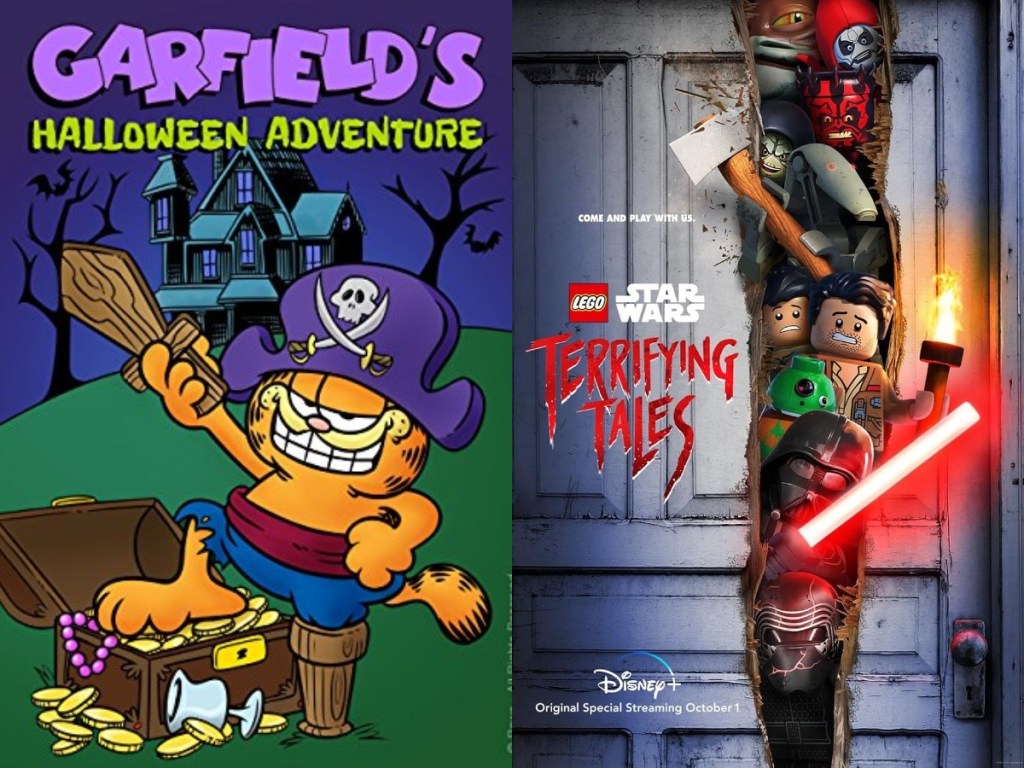
And of course, occasionally elements in these extended universes become popular enough that they can cross over into the “real” worlds. Harley Quinn was created in Batman: The Animated Series and was such a hit that she joined the official comic book universe, then spread out into live action. Superman’s pal Jimmy Olsen, almost as integral a character to the mythos as Lois Lane or the Kents, made his first appearance on Superman’s radio show. The aforementioned Batman serial, which is goofy and doesn’t feel like the same character at all, is responsible for the creation of the Batcave. And even though the Star Wars Legends stuff is no longer canon, Disney is starting to allow elements of that world to leak into the “official” world, such as bringing in Timothy Zahn’s Thrawn character and allowing the resurrection of Emperor Palpatine – although to avoid being accused of copying the Dark Empire comic book, they cleverly neglected to give any comprehensible reason for his return whatsoever. 

“I’m canon now, bitches!” –Thrawn, probably

The original question was that of what is “real” in these different universes. The newfound ubiquity of the multiverse concept in storytelling makes that easier. (It’s an old concept, I know, but in recent years it’s really experienced a boom in popular culture.) Marvel officially recognizes just about every version of its characters as “real” in one corner of the multiverse or another, with stories like Spider-Verse (the comic book) and Into the Spider-Verse (the movie) bringing them all into play together. DC has a similar policy and has officially declared that the Christopher Reeve Superman movies and Michael Keaton Batman movies are set in the same universe, although whether that will be contradicted by the upcoming Flash movie remains to be seen. The truth is that the people writing any version of these IPs in any medium will pick and choose those elements that they need to make their story work, and as that can be confusing if a fan is trying to reconcile everything, this is probably a good reason not to try that. What’s “real”? What “matters”? Whatever you need for the story you’re trying to enjoy right now.

The rest of it?

Just find that corner of the multiverse where a guy named Joel told us to repeat to ourselves “It’s just a show, I should really just relax.” 

Yep. Those guys got a comic book, too.

Blake M. Petit is a writer, teacher, and dad from Ama, Louisiana. His current writing project is the superhero adventure series Other People’s Heroes: Little Stars, a new episode of which is available every Wednesday on Amazon’s Kindle Vella platform. One of his favorite Star Trek novels is Federation, by Judith and Garfield Reeves-Stevens. Don’t try to read it and then watch First Contact. It doesn’t work.