It’s time once again for a healthy helpin’ of reviews. Here are most (if not all) of the Superman-related comics that hit the stands in July, beginning with an anniversary special.
Action Comics #1100 Title: Mission Failure/Superman Meets Superboy (A Reign of the Superboys tie-in) Writers: Mark Waid & Joshua Williamson Art: Skylar Patridge, Ryan Sook, & Daniel Sampere Main Cover: Ryan Sook
Action Comics turns the big 1-1-0-0, and it doesn’t look a day over 872. But the Reign of the Superboys continues here with Clark “Superboy” Kent facing the time-travelling villain Epoch, powerless, with his time-tossed allies from the Justice League missing. Even without powers, though, he proves his mettle, and he’s soon reunited with the Leaguers to finish the mission that started all this – finding the Superman who’s been missing since the end of DC KO. I guess this is technically two stories, but the creators put them together so seamlessly that you don’t even realize it until you get to the credits on the last page. It’s a great little tribute to the character, though, showing Superboy glimpses of his future and culminating in a grand reunion. It does, however, raise a few questions, including a glimpse of a Legion of Super-Heroes that doesn’t quite seem to gel with the reboot that Joshua Williamson is writing in a few months. Curiouser and curiouser.
The other creative teams of the current Superman comics are also in on the fun, contributing a few more back-up stories.
Title: Game Night Writer: Sophie Campbell Art: Dan Mora
The regular Supergirl writer and Superman team up for this story, in which we check in on Lois Lane and the rest of the family during Superman’s absence. The first thing I noticed about this story is that I probably should have read the other Reign of the Superboys finales before this one, because it seems to spoil certain things. Ah well. The important thing here is that we finally get a confrontation between Conner Kent and Superboy-Prime, whom you may remember KILLING Conner back in Infinite Crisis, way before his current redemption arc. It’s a confrontation I’ve been waiting for, honestly, and although it was a little abrupt, I was very amused that Campbell managed to sneak in a little self-deprecating humor via Prime’s fourth wall awareness. I do like jokes like that.
Title: End of Reign Writer: Dan Slott Art: Lucas Meyer
The final story in this issue is a neat little adjunct to the El Caldero story that’s happening over in Superman Unlimited. We get a little history of the country that’s building on the riches of its Kryptonite deposits, as well as a couple of chilling revelations.
Overall, the issue works fairly well in advancing and tying together the storylines that have been happening in all of the assorted Superman titles, and the upcoming Kingdom of Zod crossover looming between the four titles (a real one this time, not a thematic one like Reign of the Superboys), it feels perfectly timed.
Superman #40 Title: Prime Time: The End (A Reign of the Superboys tie-in) Writer: Joshua Williamson Art: Dan Mora Main Cover: Dan Mora
Superboy-Prime vs. Manchester Black is not what I expected to be the faceoff of the year, but this arc has been fantastic. With Prime trying his hardest to redeem himself, Manchester Black is hoping to use Prime’s unique status and awareness of his existence in comic books to give himself an upgrade and make the whole DC Universe as nasty and edgy as him.
This. Issue. Rocked.
It’s not just the fight, as good as it was. It’s the heart of the story behind it. Those of us who remember Prime’s first appearances back in the original Crisis on Infinite Earths have probably always felt a pang of regret that a character who seemed to have such potential would fall as far as he did. Williamson has done the impossible – he’s done the hard work to take a character who seemed indelibly tarnished and bring him back from the brink, making him sympathetic, even likable again. The Superboy-Prime in this issue may not truly be worthy of the S-shield that he wears, but he’s trying again. He wants to be. And that’s important.
What’s more, the battle between the two of them hinges on a meta-commentary about the state of comic books and comic book fandom as it exists today. It has something to say, and even the page where Prime gives us a speech doesn’t feel preachy or unearned. It’s a magnificent thing.
We also get a catchup with the rest of what Prime is now calling his own supporting cast, including Witchfire, and I can’t believe how much I hope we get to see these two together again. Prime even hints that it’s coming, but not before Supergirl swings by to pick him up for the upcoming crossover. Ah, a Kryptonian’s work is never done.
If you had told me a year ago that the Superboy-Prime redemption arc would be one of the best things to happen to comics in 2026, I would have thought you were crazy. But even without Superman appearing in this arc, Williamson has made it about Superman and who he is and what he means, and I love that so, so much.
Supergirl #15 Title: Hero of Kandor Finale (A Reign of the Superboys tie-in) Writer, Art, & Main Cover: Sophie Campbell
It’s the final battle for the fate of Kandor. Supergirl and Luminary face off against the Black Flame and – although I don’t want to spoil anything – I WILL say that, once again, Conner Kent’s presence here was completely superfluous. More than ever, I’m convinced that Campbell was asked to shoehorn him into a story that he didn’t belong in so that they could market this book as part of the “Reign of the Superboys.”
That said, once you get over that little hiccup, it’s a great finale. The ending comes naturally, playing off the character work that Campbell has been putting into this series since issue one. And while Luminary does something here that feels hopelessly naive, I can’t argue that it doesn’t feel appropriate to the character and the path that she’s been taking, so I have to respect that.
This issue also seems to set up a new status quo for the character and the title, although whether it’s going to be a long-term arrangement or something that’s done away with after an arc or two remains to be seen. I hope it sticks around at least for a little while, because there’s an interesting dynamic that I would like to see played with here. Although I worry that the whole thing might be derailed right off the bat since next issue is going to kick off the whole Kingdom of Zod crossover with the other books, so just how much Campbell is allowed to explore this new dynamic remains to be seen.
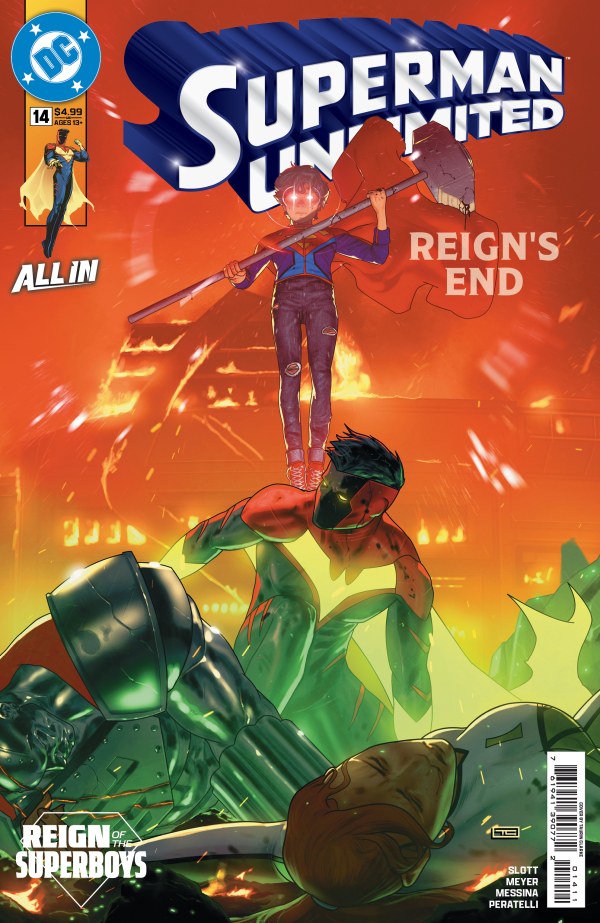
Superman Unlimited #15 Title: Save Yourself (A Reign of the Superboys tie-in) Writer: Dan Slott Art: Lucas Meyer Main Cover: Taurin Clarke
At the end of last issue, the truth about the time-tossed “Superboy” was revealed – he’s actually Ultraboy, son of Ultraman of the Crime Syndicate, who was trapped in the same volcano as Jon and tortured the same way. This issue, as Kryptonite threatens to overrun Smallville, the rest of Team Superman (namely Steel, Superwoman, Krypto, and Lois) try to save the day, while Batman and Robin join Tomorrow Man to face an Ultraboy who’s going out of control.
Lots to like here. Again, without giving away how the story ends, Slott pulls a very Superman-like play here, demonstrating that Jon – like his father – has the ability to see the inherent good in anybody, and will fight to bring that good out whenever possible. The confrontation between Damian and Ultraboy works well too. True, the Bat-family in no way suffers from a lack of exposure, but having Damian as part of this story actually makes sense. It doesn’t feel shoehorned in like some Bat-appearances. Jon is his best friend, and he’s taking this whole thing very personally.
One spoiler I WILL let through – I’m surprised but happy that Jon seems to be holding on to the Tomorrow Man name, at least for the time being. I never liked it when they took to calling him “Superman,” not because of the character himself, but because I really hate the modern practice of having multiple people running around using the same code name. I can accept it for the Green Lanterns, as that’s really more of a job description than an actual code name. And I’ll let it slide for the Flash, because how to do you tell any of those guys that they need to step down? Everybody else? Get yer own name, sparky. Anyway, “Tomorrow Man” works just fine.
Dark Knights of Steel II #1 Writer: Tom Taylor Art: Otto Schmidt Main Cover: Yasmine Putri
The original Dark Knights of Steel is one of the series that convinced DC it was time to bring back the Elseworlds imprint in the first place, so it’s nice to see that this sequel brings that universe into Elseworlds proper. This isn’t purely a Superman story, mind you, but the main thrust of this universe hinges on the Superman family: Jor-El and a pregnant Lara came to a medieval Earth together. Then…stuff happened. Look, just read the book, okay? There’s a nice little recap page here that tells you the high points of the original series and lets us jump to the main story: the three kingdoms of the League (Metropolis, Amazonia, and the Kingdom of Storms) are planning to defend themselves from an imminent threat by the shape-shifting creatures from Mars. A day of happiness for the three kingdoms turns to tragedy when a treacherous attack from beneath the seas reveals yet another kingdom – and leads them all potentially to war.
Tom Taylor does a great job of bringing new readers up to speed here. I’ve mentioned before that I wish DC Comics would include “previously” pages the way Marvel typically does, but it was really helpful here (I haven’t read the original series since it concluded in 2023 and, frankly, I needed the refresher). There’s a bit of expansion of the world here, but mostly what we get is a reminder of where the major players were at the end of the previous series (specifically Kal-El, Diana, Bruce, and Arthur), with their stories being reestablished and pushed forward incrementally, until the scene at the end changes everything. It’s a great way to begin a sequel, and while I would still recommend anybody interested in this series read the original first, if for some reason you can’t, this book will give you everything you need to know to jump in.
Absolute Superman #21 Title: Moon Fall (Reign of the Superman Finale) Writer: Jason Aaron Art & Main Cover: Rafa Sandoval
The epic battle between Superman and King Shazam comes to a conclusion this issue. With Superman and Hawkman facing the former Teth-Adam on the surface of the moon, their allies back on Earth are taking care of other business, particularly seeking retribution against Talia Al Ghul.
With a serialized story like this one – like most modern superhero comics, really – the end of an arc needs to accomplish two things. It needs to tie up the story that was told over the course of the previous however many issues in the arc, and it needs to lay the seeds for future storylines. Aaron really handles them both well here. The battles against King Shazam and Talia both come to very satisfying conclusions here, and while conclusions are indeed had, they’re the kind of the conclusions that open more doors than they close. A new threat looms on the last page, and Jimmy and Lois both experience shifts in their personal status that lays the framework for more stories in the future.
Superman himself, meanwhile, ends this issue in something of a darker place. Although Kal-El continues to be the bright spot in this Absolute world, as this issue reminds us quite adroitly, most of the people he’s surrounded with are darker than the versions we’re used to seeing in the main DC Universe. By the end of it, it feels as though that’s taken its toll on Superman, and that’s a logical place to bring this arc to a close.
Adventures of Superman: Book of El #10 Title: So Say the Dead Writer: Phillip Kennedy Johnson Art & Main Cover: Scott Godliewski
The members of the House of El face off against Kryl-Ux. Tamarind lies in the balance, and I can’t lie, I couldn’t care less. Ten issues now, we’ve been drifting through a future that has failed to engage me. It’s the same ol’ problem – the reset button is looming, and the idea that this will ultimately be a story of consequence will not take hold.
In an Elseworlds story, you think about the fate of the alternate reality that you’re dealing with. Here we’re dealing with a world that feels like it’s going to vanish as soon as Superman returns to his proper time. If that DOESN’T happen, then this whole thing will be invariably relegated to an alternate timeline, in which case it STILL will have no consequence. It would be different if I was interested in these characters, if I cared about them, if I felt like they mattered but…I just don’t.
I honestly feel bad being so negative about this book. I know other people are enjoying it, and I would never want to take that away from them, but I simply can’t see it. I don’t get what – if anything – I’m supposed to care about here. Maybe once it’s over, maybe once the final issue hits and the story can be viewed as a whole, I’ll feel differently. I sincerely hope so. But for the time being, all I can really bring myself to do is wait for the end.
Batman/Superman: World’s Finest #53 Title: Warlords Conclusion Writer: Mark Waid Art: Adrian Gutierrez Main Cover: Dan Mora
Our heroes’ epic journey to Skartaris comes to a conclusion this month. Tyrant Rex has not only ensorcelled Batman and Superman’s minds, but he has stolen Superman’s powers and distributed them among his minions, leaving Robin and Warlord to take them on. This whole story really has been sort of a Robin spotlight. He’s the one who has worked hardest to forge bonds with the people of Skartaris, he’s the one who has to step up with his mentors stolen and pulled to the other side of the chessboard. The story is a nice look at the young man who will eventually be the Nightwing we know today. There isn’t much action going on with either Superman or Batman here, but I don’t mind that. Seeing him get the spotlight is a nice change of pace that still fits well into the framework of this series.
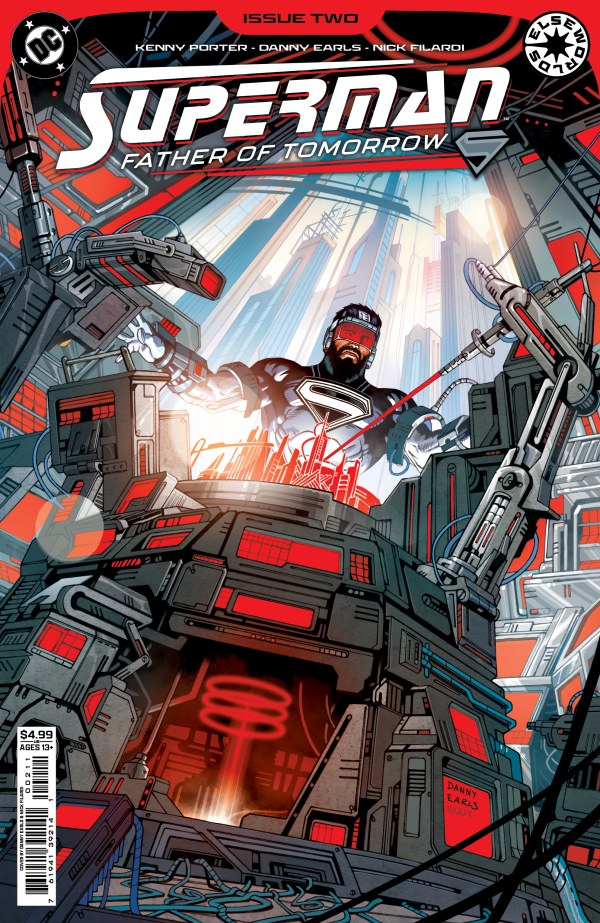
Superman: Father of Tomorrow #3 Title: Machinations Writer: Kenny Porter Art & Main Cover: Danny Earls
Having spent years sharing Kryptonian technology to improve life on Earth, Jor-El is beginning to feel pushback from people who feel like he’s going too far. Lex Luthor, as usual, being the most fervent adversary to the House of El, decides to seek magical help from the Tower of Fate. And General Sam Lane is putting together his own team to deal with the problem.
Such as it is.
I feel like the wheels are starting to come off this story a bit. The basic premise is fine – Jor-El is the one who comes to Earth rather than Kal-El. Traumatized from watching one world die, he decides to make his adopted home better by sharing the technology of his planet of birth. The idea that doing so somehow stifles humanity is the core of the conflict. The problem is that nothing in the story actually sells the idea that Jor-El’s shared technology is doing any damage. As presented, the world seems to be a demonstrably better place. Maybe I’m missing something, but the worst thing I can find anyone saying about this altered world is that despite the fact that Jor-El has improved medical technology, hospitals still aren’t free. And as much as it may enrage some people to hear this, that ain’t enough for me to accept that a fascist regime is taking over.
At one point, Martha Kent suggests that Jor-El is behaving like a parent who is doing everything FOR a child rather than teaching the child HOW to do it. Is that actually true? The Kryptonian technology is everywhere, and presumably SOMEBODY out there is manufacturing and maintaining it. Even Superman Jor-El can’t possibly be doing it all HIMSELF, so logically we have to assume that humans HAVE learned how to do it. The message of this book is collapsing rapidly, and barring some sinister secret that Jor-El is keeping that will be revealed in a later issue, I’m not sure how to reconcile the point the author is trying to make with the world that he’s presented us with.
Supergirl: Survive #2 Writers: Ethan S. Parker & Griffin Sheridan Art & Main Cover: Rod Reis
After the destruction of their homeworld, Kara and Kal-El are found by a new Corps made of Lanterns of every color. Their safety is short-lived, though, as Lobo and a squad of Czarnians are out for the baby, thirsty for the bounty of a survivor of Krypton.
I mean, with Lobo as the big guest-star in the Supergirl movie, it’s not surprising that they would bring him in here as an antagonist for this series. And the way he’s being used is pretty logical, making sense for what would happen in a world of this nature, where there are two known survivors of their planet’s destruction. What I’m really interested in, though, is what’s up with the Lanterns. The first issue gave us hints that there was more to the death of Krypton in this world than we were being presented with, and this issue’s conversation with the Guardians of the Universe pushes that narrative forward, spooling out a little more of this mystery as we go along and making me all the more curious as to what the real story is here. This story may be labelled as a Supergirl story, but like some of the best of the modern Elseworlds, it feels like there’s an entire universe here worth exploring, and lots of other characters and corners that are going to be worth looking into and playing with.
Batman/Superman: World’s Finest 2026 Annual Title: The Hero Trap Writer: Mark Russell Art: Clayton Henry Main Cover: Dan Mora
It’s Father’s Day, and Clark Kent and Bruce Wayne are having lunch with their respective adoptive fathers when a Justice League alert summons them away, leaving Jonathan Kent and Alfred Pennyworth to bond without them.
As a writer, Mark Russell is hit or miss with me. Sometimes I feel like he’s indulging in soapbox writing that starts to get tiresome, but on a story like this one, he knocks it out of the park. The story drifts between the heroes trying to solve the supervillain plot du jour and the conversation between the fathers, and it’s obvious to everyone that the second part is the most important. This is an emotional issue, it’s a story about fatherhood and what exactly that means, especially for fathers of particularly extraordinary sons. But while stories like this one often neglect the other half of the narrative, Russell has a clever trap laid for our heroes and some really entertaining moments as they struggle to puzzle a way out of it. Neither the superhero side nor the fatherhood side of the story is neglected or damaged by the other, giving us a story that’s an absolute joy to read.
Title: Date Night Writers: Mark Waid & Tyrone Finch Art: Pat Boutin
Regular World’s Finest writer Mark Waid teams up with Tyrone Finch for this issue’s back-up story, “Date Night.” A spat between Bat-Mite and Mr. Mxyzptylk leads to Bruce Wayne taking Lois Lane on a date to the state fair while a disgruntled Superman is forced to watch from afar. This one is…okay. It’s a silly, lighthearted story with no real stakes, as we all know that Lois will ultimately wind up with Clark Kent and that any flirtation with Bruce by necessity won’t go anywhere. There’s nothing wrong with a strange little story like this one once in a while, but it kind of pales in comparison to the main story in this book.
Superman 2026 Annual: Year One Thousand Title: The Return of Superman & Legion Found Writer: Joshua Williamson Art: Eddy Barrows & Yasmine Putri Main Cover: Eddy Barrows
As we all know by now, Superman went missing after taking on the mantle of King Omega at the end of DC KO. In Action Comics #1100, he was found by his Justice League teammates and his own younger self, because time travel. This annual tells us the story of what happened in-between, which means it’s that rarest of animals in this day an age: an annual that’s actually relevant to the ongoing story.
Shortly after the end of the tournament, Superman discovers that the death of the Time Trapper (whose powers have been added to his own) has left the timestream in turmoil, and something is using that chaos to feed on the destruction being created in its wake. In his attempt to repair the damage to the timeline, Superman finds himself once again encountering Darkseid’s Legion, but a very different Legion than he’s met before.
A few weeks ago, it was announced that the Legion was coming back in their own title, written by Joshua Williamson. As great as he’s been as the Superman writer, I was a bit put off when the description of the book made it seem like the Legion was being rebooted YET AGAIN. (This would be at least Legion Version Six, depending on how you want to count.) But I do have faith in Williamson, and this issue makes me feel like that faith is justified. Without getting into spoilers, it feels as though this newest reboot is part of the story, and that the previous iterations of one of my favorite teams are not being shunted into Comic Book Limbo after all, but may indeed have a part to play. I hope that’s right. I guess we’ll find out when Legion of Super-Heroes #1 hits in a few weeks.
Blake M. Petitis a writer, teacher, and dad from Ama, Louisiana. His most recent writing project is the superhero adventure seriesOther People’s Heroes: Little Stars, volume one of which is now available on Amazon.Don’t forget, you can check out earlier blogs in theYear of Superman/Superman Stuff Archive! Got a request for a future “Superman Stuff”? Drop it in the comments!
It’s time once again for a roundup of recent comic reviews! This time, we’re kicking it off with Supergirl’s return to Elseworlds, just in time for her new movie!
Supergirl: Survive #1
Writers: Ethan S. Parker & Griffin Sheridan Art & Main Cover: Rod Reis
The newest Elseworlds miniseries puts Kara Zor-El in the forefront. Ever since Jeph Loeb brought her back after her death in the original Crisis on Infinite Earths, one of my favorite bits of lore that was added to Supergirl is the idea that Kara is actually OLDER than Kal-El, but was in suspended animation for her trip to Earth, which took much longer for her than her cousin. The result is that when she arrived on Earth she was still a teenager, and now was in the position of seeking big brotherly guidance from the world’s greatest superhero, whose diapers she changed just a few relative months ago. Supergirl: Survive starts from that basic premise. The Elseworlds twist this time is that instead of Kal-El escaping Krypton’s destruction ALONE, older cousin Kara was placed into the rocket ship WITH him.
Then there’s another twist. But we’ll come back to that.
The destruction of Krypton is only in the last few pages of this issue, with most of the book taken up with Kara’s life on Krypton and a schism between her father, Zor-El, and his brother Jor-El. The friction between the brothers is explored, but they manage to come together in the end. We get a few pages focusing on some sort of political unrest on Krypton, although the actual source of it is somewhat unclear (and there’s a bit that feels like a heavy-handed attempt at a metaphor, which I hope isn’t where things are going, but you never know). There’s also a lot of stuff about Kara in school, her friendships, the boy she has a crush on…and to be honest, all of it is a little perplexing. If this was part of the main DC Universe, we’d get some backstory to emphasize the tragedy that’s coming, the dramatic irony of the reader knowing every character Kara is interacting with is doomed. But this is an Elseworlds, and there’s a definite possibility that these scenes are not just flavor to make the cataclysm more bitter. I may be wrong, although I won’t be certain until the series reaches its end, but a lot of this feels like groundwork for future plot points.
The other thing that makes this interesting is – without getting into too much detail – this is NOT a story about Kara and Kal-El growing up on Earth together, as many people would be tempted to tell with this starting point. No, remember, the title is “Survive,” and the struggle for survival seems like it’s going to take place in space. Although Earth was the intended destination, by the end of this first issue that’s already blown up in our faces, and that’s the thing that I find most interesting here. The writers are using a familiar starting point, but they take a wild left turn immediately afterwards, and I’m looking forward to seeing where it leads.
Adventures of Superman: Book of El #9
Title: The Battle For Tamaran Writer: Phillip Kennedy Johnson Art & Main Cover: Scott Godlewski
As we seem to be moving into the final act of this story, we’re digging still more into the future family of Kal-El, which – okay, it’s the title of the series. But man, there’s a lot going on here, and I wish more than ever that DC saw fit to preface their books with a recap page like Marvel does, because there are so many characters and so many things going on that it’s getting really difficult to keep track month-to-month.
All that said, there was probably more to like about this issue than I’ve seen in this series for quite some time. Although I often find his stories to be hit-or-miss, I cannot deny just how well Phillip Kennedy Johnson understands Superman’s character, the inherent goodness and optimism that makes the character what he is. And best of all, he portrays those traits as infectious. We don’t see too much of that from Superman himself this issue, but rather from Osul-Ra, who has taken his Papa’s lessons to heart and expresses them very well, even as he goes into battle.
I’m still more interested in Rowan Kent, the “Lantern in the Dark,” than I am in most of the other players in this story, and I again reiterate that I’d read a miniseries just about her. But the final page gives me a little more hope, bringing in a character that’s definitely more familiar and gives the whole story a more solid standing.
Supergirl #14
Title: Hero of Kandor Part Four (A Reign of the Superboys tie-in) Writer, Art & Main Cover: Sophie Campbell
When the cover for this issue was released it initially caused a bit of a stir. “Matrix Returns!” the artwork proclaims. And the cover is an homage to a classic Tom Grummet pin-up from the 90s. The return of the Matrix Supergirl, the one from the Death of Superman era and the amazing Peter David run! She was coming back!
Then Sophie Campbell said that the marketing department was being overzealous and the Matrix Supergirl is NOT returning…in THIS issue. But there are plans for her. So I’m excited and I’m not going to hold the marketing against Campbell any more than I’m going to blame her for the editorial-mandated “Reign of the Superboys” stamp that doesn’t really amount to much.
Here’s what happens: Lena reunites with Kara and Lesla-Lar, on the run from Black Flame, who has stolen the ring that allowed Supergirl to use her powers while in Kandor. Lena has a solution, though, a special suit she’s made that she calls an S-Matrix (get it?) that will boost Kara’s powers and make her a match for the villain. Conner Kent spends the issue unconscious.
But honestly, that’s gotta be because he was never intended to be in this story in the first place, and what we get with the girls works really well. Campbell’s earlier storylines, which have all been about Kara taking adversaries and enemies and turning them into friends, is really paying off here, with a lot of nice character work and an exciting last few pages that promise a heck of a finale. And if in the mixture Kara gets a new, temporary costume perfect for merchandising and Funko Pops just as her movie is in theaters? All the better for it. Tenuous link to the “Reign” notwithstanding, this has been a great storyline and I look forward to the end.
Superman Unlimited #14
Title: Hero Time (A Reign of the Superboys tie-in) Writer: Dan Slott Art: Lucas Meyer & David Messina Main Cover: Taurin Clarke
In case you couldn’t tell from the cover, things are really coming to a head with this issue. As the time-tossed Jon Kent and his older self (as Tomorrow Man) face a slew of their father’s old foes (Thaddeus Killgrave, Volcana, Dabney Donovan, etc.), Lois continues to investigate the mystery of her younger son and his missing older counterpart. Although it’s been apparent for some time that something was up with the younger Jon, the revelation this issue works out very well, tying this story in not only with the earlier stories of this run (with the mountain of Kryptonite in El Caldero) but also with a story in another recent Superman title that – at the time – I thought ended rather abruptly. I’m really happy to see that it was a setup for this story, and it promises a slam-bang ending.
The Lois scenes are actually my favorite stuff in this issue. Her gut is telling her that something is off, so she turns for counsel to the only people she can, Jonathan and Martha Kent, who prove that they’re just as great at being in-laws as they were parents to her missing husband. We also get to see not only Steel in action, but Lana as Superwoman, which we don’t get nearly enough of. She’s still got the powers, why doesn’t she use ‘em more often?
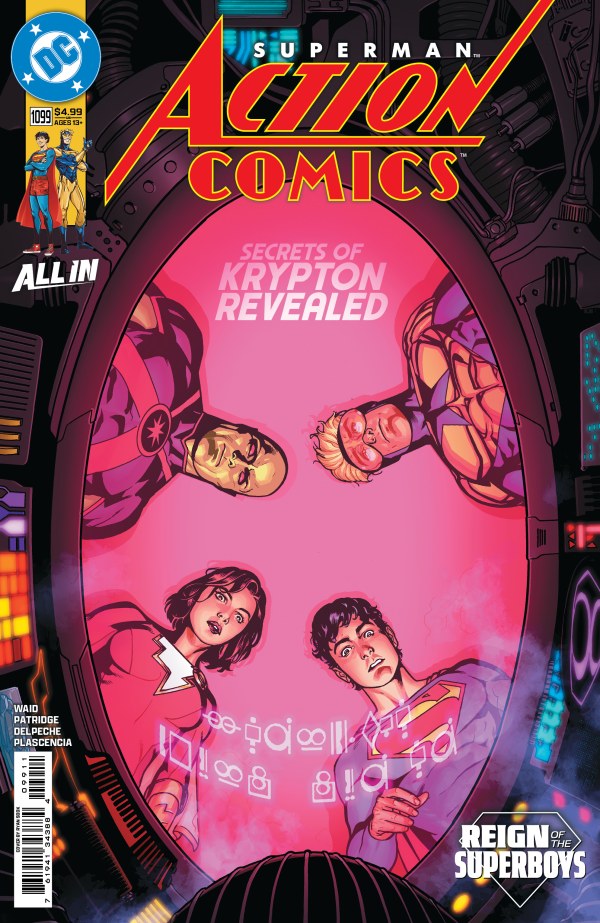
Action Comics #1099
Title: Powerless (A Reign of the Superboys tie-in) Writer: Mark Waid Art: Skylar Patridge & Patricio Delpeche Main Cover: Ryan Sook
A third Reign of the Superboys series hits its penultimate issue as the time-tossed Justice League tries to find a way to restore young Clark Kent’s powers. Epoch’s red-sun blast has stripped him to the level of a normal human, but for some reason, the yellow sun is not restoring his powers as it should. As they try to solve the mystery, the paradox of their presence in the past begins to catch up to them. Meanwhile, Lana makes an unsettling discovery.
Waid is really playing with the time-travel stuff here, and it appears as though in this story we’re playing by Back to the Future rules. A difficult part of time-travel is establishing exactly how the mechanics of it work. As such a purely hypothetical concept, I don’t really mind what the rules of time-travel are as long as they remain internally consistent. This becomes more difficult in a huge shared universe like DC Comics, where there are dozens of time-travel stories with mechanics that flatly contradict the way it’s being depicted in this story. That isn’t really Mark Waid’s fault, but it IS a consideration that creeps into my mind when I’m reading it.
That said, if you’re reading this book just because you want a time travel story, you’re getting it for the wrong reasons. It’s the character stuff that really works here, as we watch Clark go through various levels of grappling with his powerless state. We see him first frustrated at feeling so useless, then watch the pendulum swing in the other direction as he rediscovers the joy of just being a normal kid, then all the way back again when he realizes he’s denying the responsibility that he’s already accepted. It’s a fun sort of roller coaster to put the character on. He’s Superman, we know he’s going to grow up and accept who he is, but that doesn’t mean that he can’t struggle with it, especially at such a young age. It’s more realistic, more relatable.
The subplot with Lana gets more interesting here, and in more than one way. We see basic character stuff, which is nice and sweet. We also get a bit of a mystery that has me intrigued.
Next issue, #1100, has been touted as the return of Superman after being lost in time after the end of DC KO. I hope that doesn’t mean the end of Mark Waid’s adventures with Superboy, because it’s been a fun ride.
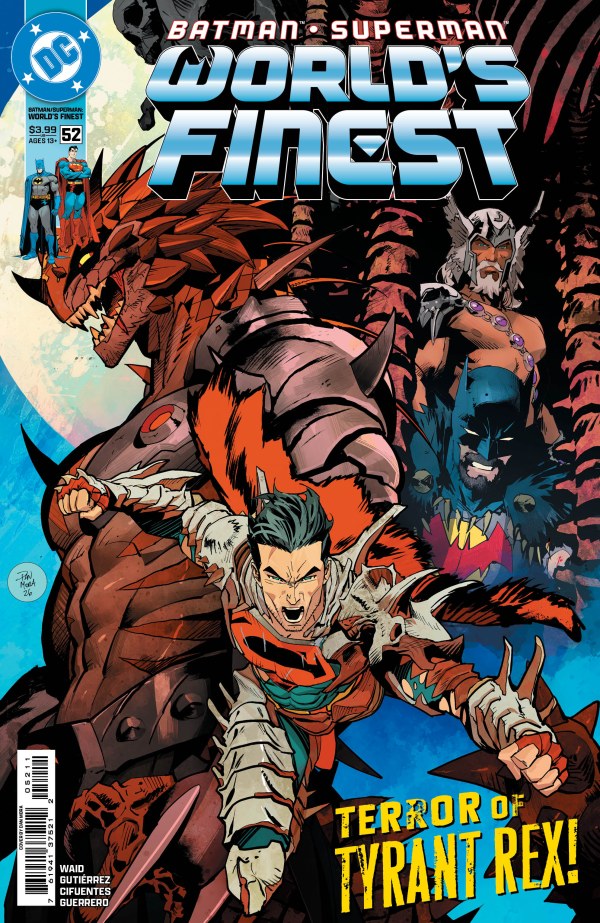
Batman/Superman: World’s Finest #52
Title: Warlords Part Two Writer: Mark Waid Art: Adrian Gutierrez Main Cover: Dan Mora
Last issue our heroes – Superman, Batman, and Robin – travelled to the lost world of Skartaris in search of a missing Air Force pilot. Upon arriving, they discover that due to timey-wimey stuff, the man they’re searching for has become an evil wizard, and in order to defeat him they’ll have to partner with ANOTHER missing pilot, Travis Morgan, the Warlord. With no defense against Tyrant Rex’s magic, Superman is quickly captured, sending Batman on a rescue mission, while Robin tries to piece together the villain’s ultimate goal.
As I’ve said before, Warlord is one of the corners of the DCU that I’ve never been able to really get into, but Waid is using it well here. Superman’s whole problem with magic is actually used appropriately here, rather than treating it as if it were Kryptonite like some people seem to assume, and it suits the story Waid is telling. The issue mostly focuses on Batman and Robin, as Superman is kind of off the table, but Robin serves nicely as an audience surrogate as we get a quick history of Skartaris, or at least as much of it as is relevant to this story. And it all wraps up with our two title heroes getting new looks that are RIPE for action figures.
Am I getting too cynical? I find myself assuming that every time a comic book gets a new look – even one that’s obviously temporary and only intended for the duration of the current storyline – there’s a marketing wonk somewhere pointing at the cover and saying, “That’s it, we’re gonna TOY that one right there.” I mean, I don’t think that assumption is WRONG, I’m just wondering if I’m cynical in that I constantly feel the need to point it out. Anyway, obviously I’ll get the Funko Pop of both this Superman and the Supergirl in the white-blue-and-yellow costume from above.
Summer of Supergirl Special #1
The Summer of Supergirl is upon us, and DC is treating us to this one-shot all-star special. I’ll take each story in this one individually.
Title: Man’s Best Friend Writer: Sophie Campbell Artist, Main Cover: Belen Ortega
The first story in the book, by regular Supergirl writer Sophie Campbell, picks up shortly after the chaos caused by Supergirl and her movie co-star Lobo (I’m sure that’s a total coincidence) over in Lobo #4. I haven’t actually read that book, but it’s pretty incidental – what you need to know is that there was some destruction and Lobo is sent to rehab, leaving his dog Dawg in the custody of Krypto. Supergirl and Lobo’s daughter Crush take the mighty mutt down to Midvale to hang out while Lobo serves his time. When he comes back looking for his dog, the chaos…well, it resumes.
It’s a simple story. It’s an oddly sweet story, considering the co-stars are Lobo and Crush. But it accomplishes two things very neatly. First of all, it showcases the difference between Superman and Supergirl. Although Superman is pretty much a paragon of hope, and that’s as it should be, Supergirl is less about hope and more about compassion. She feels for people so deeply, but in a different way than her cousin. In the main title, Campbell has spent over a year now telling stories of how Kara has an uncanny ability to turn enemies into friends, and this story showcases that wonderfully.
The other thing this story does is feed the readers into the main title. Although it began in Lobo’s book, the story that snakes through here promises to continue in the pages of Supergirl, and folks who picked this up just for Lobo will get a good taste of what to expect if they decide to follow the storyline into the main series, and that’s all to the good.
Title: Lost Girls Writer: Gail Simone Pencils: Emma Kubert Inks: Sandra Hope
In story #2, Supergirl is going toe-to-toe with a robot menace called Amazonia, one who has a little green friend that might keep Kara on the ropes. Fortunately there’s help nearby in the form of Mary Marvel. Gail Simone is telling a new version of the first meeting between these two girls, and here she leans hard into just how similar they are. Some of the similarities are obvious – they’re both incredibly powerful, both often overshadowed by their more famous relatives. Something that I don’t think anyone has ever really drawn on before, though, is the fact that both of them are orphans. And not in the way that Clark is an orphan either, having grown up on Earth with loving adoptive parents and no real memory of his origin. Nah, Kara and Mary are both girls who lost their families and were kicked around the foster system for a while. Now what with the way each of them have had their origins twisted and changed over the decades, this hasn’t always been true for both of them at the same time, but it is now, and Simone really draws the emotion out of it. The supervillain fight is really just the set-up, what this story is about is two lonely young women who find something they need in one another. It’s really a beautiful story, and I hope that future writers for both of these characters continue to build on the relationship the way it’s depicted here.
Emma Kubert – third generation of the Kubert comic book dynasty – handles the pencils here. I actually haven’t seen a lot of her work here, but I love it. She has a loose style that comes across not QUITE like a cartoon or anime, but not as tight as someone going for “realism” either. It’s the sort of artwork that works for characters like these two, giving us the fanciful but being full of emotion. It reminds me a lot of Campbell’s work on the main Supergirl series or Todd Nauck’s classic run on Young Justice, which is to say I think it’s great.
Title: Who Is Supergirl? Writer: Mark Waid Art: Cian Tormey
While the first story in this book is valuable for the ongoing series and the second story is the heart of it all, Mark Waid’s tale at the end is what’s going to make this book important for nerds like me. Supergirl’s history as a character has been…let’s say “tumultuous.” In the early days she was Superman’s “secret weapon,” operating from Midvale Orphanage. As she grew up, in the 70s and 80s, she bounced all over the country from one job to another. She died in that whole Crisis on Infinite Earths thing. And when she returned in the pages of Jeph Loeb’s Superman/Batman, she was treated as though she was a brand new character. How the hell do you reconcile all of that?
You call the man who literally wrote The New History of the DC Universe, that’s how.
Story-wise, what we have here is a case of Conner Kent, Jon Kent, and Natasha Irons cleaning up the Justice League’s files and, in the process, recapping Kara’s history. Functionally, we have a story that explains so much of the tumult. Was Superman REALLY so callous as to drop off Kara at an orphanage? (Waid explains it.) Why did she spend so long going from one job to another, one city to another, one COSTUME to another? (Waid explains it.) And Waid also slips in a tidy retcon, reframing the Jeph Loeb story to be that of Kara’s resurrection after the Crisis, rather than her introduction. If you’ve spent the last couple of decades wondering what the hell was going on with Supergirl, exactly, this is the story you absolutely need to read.
Superman #39
Title: Prime Time Part Four: Superboy-Prime Versus Infinite Crisis (A Reign of the Superboys Tie-In) Writer: Joshua Williamson Art andMain Cover: Dan Mora
Oboy, the main event is finally here! At the end of last issue Superboy-Prime discovered who’s been monkeying with him for the past three issues – Superman’s old foe Manchester Black. Black, as it turns out, wasn’t tooootally dead after Lex Luthor used his powers to wipe the memory of Superman’s secret identity from the world (back in Action Comics #1050) and as a disembodied intellect, he thinks Prime may be just the man to give him corporeal form again, if only he gets back to his reality-punching ways from Infinite Crisis. As readers of this title know, of course, Prime is in the middle of a redemption arc, and doing his best NOT to pull the sort of shenanigans Black needs from him. So to wrench what he needs from the boy, Black is sending Prime on a mental tour of his past and a meta-Odyssey through comic books.
It seems like most comic books that play with metafiction do it in one of two ways. Either they restrict themselves to snarky fourth-wall breaking comments (like Deadpool or She-Hulk) or, eventually, they build to a story where the landscape of comic books themselves become a sort of battlefield, whether that’s literal or metaphorical. (This is the literal kind – for the metaphorical version, go back and read Grant Morrison’s Animal Man again.) Since Black can read Prime’s mind, he knows about his medium awareness and weaponizes that against him.
Here’s the tricky part: you can’t just bounce around to a page that looks like Superman: The Animated Series and then take a left turn into Anime and then make some sort of commentary on reboots. I mean, you CAN, but ultimately that would be kind of shallow and unsatisfying. What you need to do – what Joshua Williamson does perfectly – is frame that journey in a true character piece. This is less a struggle of Superboy-Prime vs. Manchester Black and more a story about Prime doing being forced to face up to himself. That’s a damn sight more compelling. And honestly, if you’re not pulling for Superboy-Prime to come out of this a new kind of hero by now, I don’t know if there’s anything that could convince you at this point.
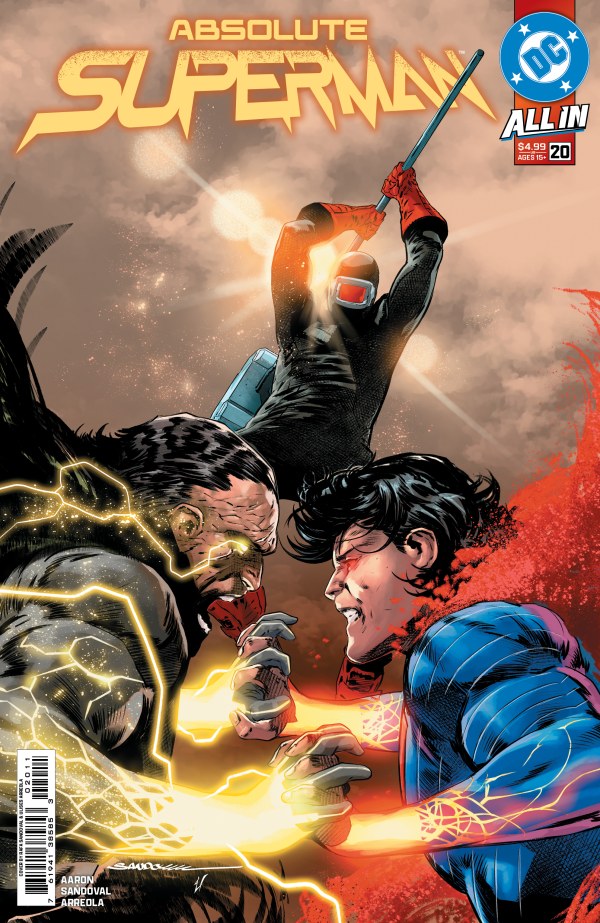
Absolute Superman #20
Title: Reign of the Superman Part Three: Up, Up, And… Writer: Jason Aaron Art: Rafa Sandoval & Vicente Cifuentes Main Cover: Rafa Sandoval
With King Shazam on the loose, an uneasy alliance forms between Superman, Hawkman, and Steel as they attempt to bring him down. But friction between the heroes makes them almost as dangerous to each other as they are to the villain, and if they can’t get it together, the world may belong to Teth-Adam.
This issue is almost pure brawl – the three heroes fighting King Shazam and, occasionally, each other, on an absolutely massive scale. Sandoval and Cifuentes do a great job of depicting the battle, giving it a scope and a power beyond your average comic book fight. People love to throw around the word “gods” when they talk about superhero comics, using the term to indicate how powerful the characters are supposed to be. This issue doesn’t need it – the art does the job.
The four combatants each get an interesting development here as well. We learn a little about them, we see even more how Superman is being poised to take a place as this universe’s premiere hero. Even the ending, a huge cliffhanger, is the kind of thing that makes him look like a giant among men. (And would make for a hell of an action figure – I’m sorry, I can’t help it.)
Bizarro: Year None #2
Title: Meet the Superfans Writers: Eric Carrasco & Kevin Smith Art & Main Cover: Nick Pitarra
Last issue, Jimmy Olsen and Perry White were whisked away by Bizarro to his strange duplicate Earth, there being forced to run his own Daily Planet, which Jimmy (naturally) being in charge, while Perry is tasked with getting coffee. But as they try to piece together the facts about this world that Superman’s imperfect duplicate has created, the two of them start asking questions that may lead to some very uncomfortable answers.
With Kevin Smith co-writing this story, it would be easy to expect a sort of goofy comedy, as we’ve seen from most of his movies. But people often forget that a good writer is rarely a one-note writer. There’s humor in this book, yes, but towards the end we take a startling turn, and this tale of Bizarro stops feeling quite so fun as we take a turn towards horror. When I reviewed the first issue of this book, I mentioned that it feels like a sort of Bizarro counterpart to Grant Morrison’s All Star Superman. In this issue that becomes even more pronounced – whereas that book is ultimately about the indelible power of hope, this issue is one that explores the potential for terror in a creature with the power of Superman, particularly one whose mind doesn’t work the way that Superman is supposed to.
Nick Pitarra’s Bizarro is really a striking figure. He’s massive, but more wide than we usually see from these characters. His shoulders are broad, but he’s a bit squat, once again contrasting him with the Superman Frank Quitely drew in All Star. I have to believe that all of these choices are deliberate, because they just come together far too neatly for it to be otherwise.
This book was pretty startling, which is a nice trick. It’s going in directions I didn’t expect, but that work nonetheless.
Superman: Father of Tomorrow #2
Title: Parasites Writer: Kenny Porter Art & Main Cover: Danny Earls
It’s been twenty years since Jor-El of Krypton was revealed to the world, and in that time, he’s made the Earth of this particular Elseworlds a very different place. Not only has he spent that time as Superman, Earth’s protector, but he’s also been shepherding the planet’s scientific advancements, sharing Kryptonian technology that has transformed the planet. And although he’s surrounded by familiar figures, the shape of this world is turning out to be something quite different than the world we know.
I like how Kenny Porter plays with the supporting cast in this issue. Rather than being “Superman’s Girlfriend,” in this world we see a Lois Lane who has grown to love Jor-El as a father figure, somebody markedly different from her own father, which of course is not a relationship that sits well with Sam Lane. Similarly, we see a Lex Luthor who has worked alongside Superman for years rather than standing as his enemy. Unfortunately, as the Superman of another Earth once observed, there’s just something about Luthor that makes him a poisonous snake, and that doesn’t seem to be any different here. Luthor’s storyline feeds us into the nicely-satisfying last-page cliffhanger, and sets things up for this miniseries to go in a different direction that I find intriguing.
I’m also fascinated with the title of this book and how it’s turned out to be a play on words. Putting “Father” in the title of a story that focuses on Jor-El calls to mind, of course, the fact that his son is Kal-El. But we never see Kal-El in this book, and at one point Jor-El even refers to somebody else as the “closest thing [he has] to a son.” Instead, this is a story about how Jor-El is guiding the future of Earth – he is literally the father “of tomorrow.” It’s a neat little play on words, and I’m a sucker for a good play on words.
Blake M. Petit is a writer, teacher, and dad from Ama, Louisiana. His most recent writing project is the superhero adventure series Other People’s Heroes: Little Stars, volume one of which is now available on Amazon. Don’t forget, you can check out earlier blogs in the Year of Superman/Superman Stuff Archive! Got a request for a future “Superman Stuff”? Drop it in the comments!
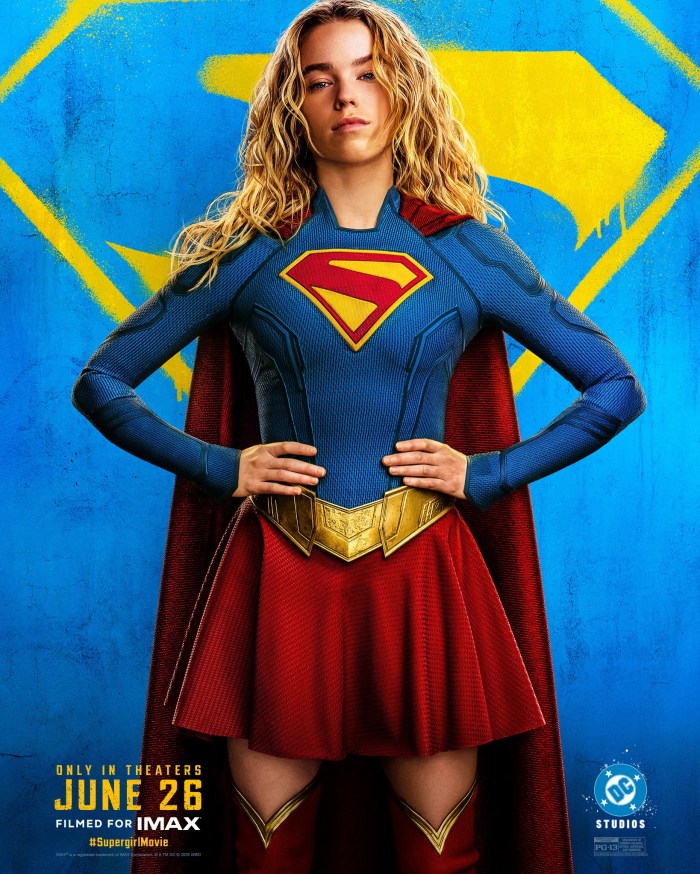
As the second feature film in the new DC Universe, the new Supergirl movie, starring Milly Alcock as Kara Zor-El and directed by Craig Gillespie, serves a double purpose. It’s out there to demonstrate that not everything in this universe will be the same, and it’s out to further the world as well. It succeeds at both.
Based largely on the comic book series Woman of Tomorrow by Tom King and Bilquis Evely, the movie features Kara in space on a birthday bender when she gets mixed up with an alien girl named Ruthye (Eve Ridley) whose family was murdered by a Brigand named Krem of the Yellow Hills (Matthias Schoenaerts). Kara reluctantly joins Ruthye and finds herself battling not only the aliens who have hurt her beloved Krypto, but to save Ruthye from succumbing to her thirst for revenge.
I’ve heard people compare this movie to Guardians of the Galaxy, but although there are a few similarities, I don’t think the comparison is apt. They both take place almost entirely in outer space, there are space pirates of a sort, and there are a few fight scenes choreographed to popular music, agreed. And in both cases, we’re dealing with a broken loner who finds themself transforming into a reticent hero. But as opposed to being about a found family coming together to fight yet another cosmic menace, this is a more singular, personal tale. It’s also widely set apart from the first film in this new franchise, last year’s Superman. Whereas David Corenswet’s Superman is proud and heroic from the jump, Kara is very different. Unlike her cousin, she was a young teenager when her home (Argo City, the last remnant of planet Krypton) died. She remembers the planet of her birth, she remembers her father and mother, and she’s clinging to the pain that she carries with her as she tries to find a new place in the universe. I’m not an expert on trauma, but if I were to hazard a guess, I would say that Kara is suffering from PTSD, and it’s turned this Supergirl into someone who doesn’t really click with Superman. She sees his optimism as naivete, and she makes choices that fit with this incarnation of the character, but that he would most definitely never make.
While Superman seeded several different characters for the DCU, Supergirl only introduces one new major player, Jason Momoa as Lobo. He’s got that nasty charm that you expect from the Main Main, coming across as grimy and angry. He’s not a hero, not even an anti-hero, but he does have something of a code, and Momoa gets that code across.
Eve Ridley’s Ruthye is, in a lot of ways, the heart of the film. It’s her tragedy that starts the plot, and it’s the way Kara keeps trying to pull her back that causes the arc for the titular character. Ruthye has an arc of her own, of course, but the way it reflects on Kara’s arc is what makes her work. When we’re first introduced to Kara she’s bar-hopping on planets with red suns, since she can’t feel the effects of alcohol on a world with a yellow sun like Earth. But even at this point, where all she seems to want to do is to drink the pain of her loss away, the first thing we see Kara do that’s not immediately related to her own trauma is step up to defend Ruthye. It becomes clear to everyone – even Ruthye herself – that Kara’s real goal with the girl is to try to save her from succumbing to her own pain and survivor’s guilt because, having gone through it herself, Kara wouldn’t wish it on another innocent.
The film changes the ending of the book in a rather surprising way, but again, I think it’s a choice that fits this version of the character. The most important thing, though, is the fact that it gives us a very different film, not only from Superman, but from most other superhero movies of the last few decades. For quite some time now – since the first Avengers movie, if not earlier – superheroes have always been about escalation. Each movie has to be BIGGER than the last, each villain has to be MORE powerful, each threat has to be MORE deadly. That’s not the case here. Krem is strong, yes, but the things he does are relatively minor in comparison to Lex Luthor’s machinations in the previous film (or, presumably, Brainiac’s in the next one).
That’s not the story we get here. Despite the fact that the movie takes place in outer space, going from planet to planet, encountering one alien race after another, it feels much smaller than the last Superman, than anything Marvel has done in over a decade, and that’s a positive. With those movies it’s always time to save the planet, save the universe, save the MULTIVERSE. In this one, the stakes are the life of a small dog and the soul of a grieving child. There’s a little more, and it’s layered in nicely in a way that basically serves to make Krem an even nastier bastard than he already was, but those are the two things that the audience is invested in.
What a lovely change of pace.
Man of Tomorrow can’t come soon enough.
I don’t want to spend a ton of time talking about the first weekend box office for the movie. It didn’t do as well as hoped, but the majority of the people who’ve actually seen it (as opposed to the trolls who tried to bury it before it was even filmed) seem to have had a very positive reaction. The good news is that the movie industry is shifting, and while opening weekend ticket sales still dominate the conversation, the truth is that it isn’t always the be-all and end-all that it was just a few years ago. Milly Alcock’s Supergirl is already filming new scenes for next summer’s Man of Tomorrow, which is getting highly positive buzz, and which I hope leads people who skipped this movie to go back and find it when it’s streaming on HBO Max/Paramount+/Whatever the Hell It’s Going To Be By This Time Next Year.
As for the potential for a sequel, that’s a bigger question mark. Masters of the Universe had a similarly weak opening weekend (at a substantially higher budget), but also had a fairly positive audience reaction, and Amazon/MGM is reportedly considering a sequel. The big difference is that Supergirl is part of the larger DCU, and as James Gunn has already demonstrated, he’s not going to go ahead with any project until he’s satisfied with the script, so virtually nothing is guaranteed. I think there’s certainly potential for future movies starring Kara Zor-El, but I’m not going to make any predictions. If nothing else, I can be satisfied that this isn’t the last we’ll see of her.
And if you’ve been put off by the talk about the box office, remind yourself that most film critics these days are like any other part of the media – there to push a narrative. Don’t let them sway you. Check this movie out and make up your own mind.
Blake M. Petit is a writer, teacher, and dad from Ama, Louisiana. His most recent writing project is the superhero adventure series Other People’s Heroes: Little Stars, volume one of which is now available on Amazon. Don’t forget, you can check out earlier blogs in the Year of Superman/Superman Stuff Archive! Got a request for a future “Superman Stuff”? Drop it in the comments!
As the chill finally returns to the air down here in southern Louisiana, I can feel the end of the year approaching. The last three months are always my favorite time of the year, although in this case they’re a little bittersweet. Spending this year with Superman has been fun for me, giving me something to look forward to…and while I have to admit I’m looking forward to finishing off the daily requirement, I also know I’m going to miss it. I’m thinking of ways to continue this blog without the daily stipulation into 2026 – no decisions yet, but there are things in my head.
At any rate, there are still a handful of themes I’ve got left that I want to do, but those are all anchored to specific times in one way or another, and none of them are this week. So get ready for another seven random days in the Year of Superman blog.
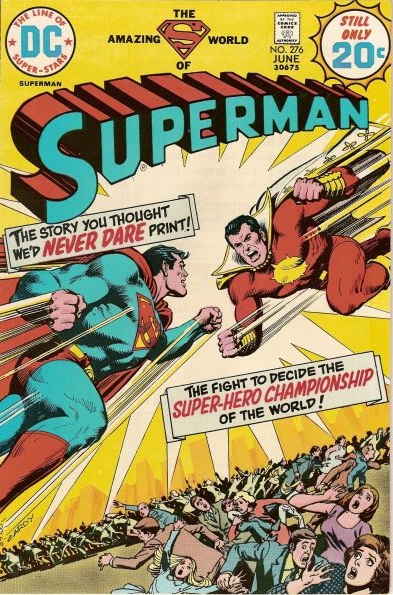
Notes: We’re going to start this week by looking at my list of stories that I wanted to hit this year at one point or another, but that didn’t fit into any particular theme. And if you’re not wise to the behind-the-scenes chaos that led to the writing of Superman #276, it seems as random as they come. Most comic book fans know the story behind the original Captain Marvel: originally published by Fawcett Comics, he was a smash hit and outsold pretty much every comic on the stands, including Superman at times. National Publications (the company that would later rebrand as DC) sued Fawcett, claiming Captain Marvel infringed on the Superman copyright due to the similarity in their appearance and powers. The case dragged on in court for years, until the post-World War II-era, in which superhero comics fell out of favor. Eventually, Fawcett settled the case, no longer making enough profit from the comics to continue to fight. Years later, DC would eventually license, then outright buy the characters from the Fawcett catalogue and bring them back to comics.
In 1974, DC Comics had been publishing Shazam! for over a year. His own title was set on “Earth-S,” home to the original Fawcett heroes, and although the multiverse was already very much in play at DC, for some reason editorial was wary of having him actually interact with the heroes of the DC Universe. Writer Elliot S! Maggin’s solution was this issue, “Make Way For Captain Thunder!” Using an early, rejected name for Captain Marvel, Maggin has Superman encounter a young boy – Willy Fawcett – who appears in the streets of Metropolis one day. Willie seems out of time, with a haircut that was popular 20 years earlier and expecting to pay a nickel for 35-cent bus fare. And the big clue that something isn’t kosher: he’s never heard of Superman before. Willie sees a helicopter about to rob an armored car, so he rubs his “magic belt buckle” and says the magic word “Thunder!” With a bolt of lightning (and the amusing sound effect “sha-boom!”) he transforms into…well, not Captain Marvel, but somebody who looks a hell of a lot like him.
As Captain Thunder swoops in to stop the robbery, something takes hold of his mind and, instead, he aids the crooks in stealing not only the contents, but the entire armored car. Superman comes in to save the car and Thunder turns back into Willie, who cannot remember anything that happened since his transformation. He decides to turn to Superman for help, and looks up his most famous “friend,” Clark Kent. (The notion that even a child from an alternate dimension can learn that Clark and Superman are pals within a few hours is perhaps the greatest strain on the credulity of Superman’s secret identity, by the way.) Willie tells Clark his origin – how, on a campout with his orphanage, he was summoned by an owl to follow it to a cave in the woods. There he encountered an ancient Native American medicine man, who bestowed on him the magic belt that would give him seven spiritual abilities: the power of a Tornado, the speed of a Hare, the bravery of Uncas, the wisdom of Nature, the toughness of Diamond, the flight of an Eagle, and the tenacity of a Ram!
Note to Maggin: If the editor needs to drop in a footnote explaining that Uncas was a warrior chief, you know that you’ve maybe stretched this bit to its limits.
Anyhoo, Willie became Captain Thunder, and – in my favorite page in the book – recounts his final battle with the Monster League of Evil, which was made of up, I kid you not, the Universal Monsters. The battle took place in a series of other dimensions (1953 of them, to be exact), but evidently, when Willie tried to get home he wound up on the wrong Earth, where he comes to understand that the League did something to Captain Thunder, making him turn evil when he transforms. Clark – an alien from another planet who hangs out with an Amazonian goddess and a guy from Mars and who routinely fights cyborgs and has traveled through time on countless occasions and more than once met an exact duplicate of himself from a world he calls Earth-2 – comes to the obvious conclusion that Willie is delusional.
Somehow THIS is the part that strained credulity.
Clarks recruit Lois to help him bring Willie to the police station for help, but another robbery summons his attention. He ducks away and becomes Superman, as Willie turns into his own alter-ego. But once again, as if he’s forgotten that he’ll turn evil, Captain Thunder turns evil. The crooks escape as Superman and Thunder battle it out in the skies over Metropolis. Superman manages to trick Thunder into turning back into Willie, because somehow he suddenly believes his story, and then holds him in a wrestling grip and tells Willie to change back, where he’ll somehow force Thunder to use his wisdom to overcome the Monster League’s brainwashing. There is absolutely no reason that this should work, but somehow it does, and Thunder furthermore figures out how to use his magic to return to his native dimension.
This is one of those stories that I like not in spite of how ridiculous it is, but BECAUSE of it. Details aside, there’s virtually no difference between Billy/Captain Marvel and Willie/Captain Thunder. If someone were to redraw his costume and the origin pages, it would fit perfectly as the first meeting between Big Blue and the Big Red Cheese. The incongruities also have a weird charm to it. The notion that Clark questions Willie’s story is laughable, the idea that he comes around so easily is absurd. The fight is…well, it’s an awful lot of fun. And I won’t lie, I would love to see the history of Captain Thunder’s battles against the likes of Boris Karloff, Bela Lugosi, and Lon Chaney Jr.
There were so many different one-off universes that peppered DC Comics in the years before the original Crisis. I kinda wish we could visit some of them again.
Thur., Nov. 13
Comics: Superman Vs. Lobo #1-3, Jon Kent: This Internship is My Kryptonite #19, Justice League of America #40
Notes: Today I’ve selected the three-issue Superman Vs. Lobo miniseries from 2021, written by Tim Seely and Sarah Beattie with art by Mirka Andolfo. Why? Because just like when they published this miniseries, it seemed like a good idea at the time.
That sounds snarkier than I intended. This isn’t a bad series, not at all, but it’s part of the ill-defined “Black Label” imprint at DC. When it was first announced, “Black Label” was supposed to be a more “mature readers’” imprint featuring the DC characters. Then it started to publish comics that were creator-owned and had nothing to do with the DCU Universe. Then they folded the Vertigo imprint and made those properties Black Label books. Then they brought BACK the Vertigo Imprint and moved some of the Black Label originals over there. And all the while, they were reprinting some books under Black Label that didn’t make any sense at all – such as Kingdom Come – while also publishing a few new properties that didn’t really have any content that marked them as “mature readers,” such The Last Days of Lex Luthor, which would probably be best as an Elseworlds. Then they brought back Elseworlds. What I’m getting at is, I’m not entirely certain what Black Label is supposed to be and, based on all available evidence, neither is DC Comics.
None of that, however, is the fault of the creative team of this miniseries, nor does that make it a bad story. The story kicks off with the Martian Manhunter sending Superman out into space to check on a space station that’s been damaged near the orbit of Jupiter, with astronauts in grave peril. As he’s saving them, everyone’s favorite Main Man Lobo has a vacation ruined when the resort planet he’s on is attacked by a kaiju-sized monster that turns out to be a microscopic tardigrade which has somehow been blown up to gargantuan proportions. He also meets “biologist and wildlife photography” Dr. Semedea Flik, who is an expert on single survivors of extinct species, and therefore is delighted to meet Lobo, who famously murdered his entire planet of Czarnia. Lobo, of course, doesn’t care about the destruction his fight with the tardigrade is causing, but Superman happens to be passing by in space and dives in to save both the creature and the people endangered by its rampage. Lobo, of course, sees Superman as a killjoy, ruining the fun of his fight, but Flik is thrilled to meet TWO “sole survivors” in one day. (Unless you count Supergirl or the Kandorians or Lobo’s daughter or…) When the news coverage of the fight starts painting Superman as a hero, Lobo is furious and decides to “ruin” him.
Lobo comes to Earth and gets on LexTube to begin slandering Superman. Lois (with a little help from Batman) begins a counter-offensive against Lobo online, and the vitriol online begins to fuel an army of robots that the Toyman created to prove that social media is toxic. (I guess even Winslow Schott can’t be wrong all the time.) Superman combats it by urging people to get online and post positive things and – this is far less realistic than the tardigrade kaiju – they actually start to do it. Speaking of the tardigrade, it comes to Earth, only much smaller and now demonstrating extreme intelligence. Its name, it says, is Numen, and like Superman and Lobo is the last survivor of his homeworld. Flik is THRILLED. Feeling a kinship to the two of them, Numen decides to use his vast power to give them a gift: restore and send them back to their homeworlds, but he makes a little boo-boo. On the last page, Superman finds himself on Czarnia and Lobo on Krypton.
Issue two kicks off with the Justice League searching for the missing Superman, with J’onn discovering that Krypton has somehow been restored and Green Lantern learning that Czarnia’s extinct population has come back. Numen, in a scene as funny as it is creepy, has learned that people on Earth communicate via “tweeting,” so it makes all the birds in the world explain to people that he sent Superman and Lobo back to their home planets. Of course, he’s wrong. On Czarnia, Superman – whose powers are dying under the planet’s red-tinted sun – learns that most of the population seems kind and pleasant, and Lobo was an anomaly. On Krypton, Lobo is frustrated at how “lame” the place is, but changes his tune when he realizes that there’s a sect of Kryptonians who blame their cold, sterile ways for the planet’s destruction and have decided to revert to a culture of hedonism and debauchery, his two favorite things. Flik has technology that allows her to bounce between worlds, viewing a civil war slowly brewing on Krypton between Lobo’s wild friends and the traditionalists, while Superman starts to find evidence that the Czarnians aren’t actually as nice as they pretend to be, with a deep paranoia and distrust underlying their apparent sweetness.
Lobo’s Kryptonian pals decide to expand the influence of Krypton into space, and begin by cloning an army of Lobos and sending it to Czarnia to start the genocide all over again. Superman, meanwhile, discovers that the kindly woman he’s been staying with has been leeching his blood and his powers, and manages to reverse the cell drain after she’s killed by one of the clones. As Lobo returns to Czarnia to kill his clones – and everybody else all over again – only to learn that the resurrection has turned many of them as bloodthirsty as he is. Superman makes it to Krypton and finds his parents, but is horrified to learn that Jor-El planted a killer parasite into the Lobo clones, which are still living beings. Flick finds Numen and convinces him that he’s screwed up by bringing back the dead worlds, and Numen collapses in self-pity. He removes the two worlds, but not before Jor-El tells his son how proud he is that he became a man of compassion, even for those who despise him. Flik then tells Superman and Lobo that she’s studied Numen and discovered that there are people seeking out Numen, whose birth destroyed their entire universe…Union! Zealot! Maul! Helspont! And the almost-Superman himself, Mr. Majestic! Some of the most powerful characters from the Wildstorm Universe!
Not that they CALLED it “the Wildstorm Universe” in the text, mind you, but it was still a hell of a surprise. Also a nice reminder that most Black Label comics are non-canonical. The Wildstorm heroes had been firmly integrated into the DCU at this point, so I guess that means we’re looking at two different worlds in the vast multiverse right now. I’m okay with that.
In the third issue, Flik tells us Numen’s origin. He’s part of a species that feeds on the fundamental forces of reality. When one of them is born, they consume an entire universe in order to survive. Flik begs Superman and Lobo to help her protect Numen from the “Revenge Squad” that’s after him. Superman agrees because he’s Superman, Lobo agrees because Flik agrees to pay him, and the fighting starts. While Lobo tears through half the team, Majestic and Zealot team up against Superman. In the heat of battle, Superman concedes that Majestic is more powerful than he is, but that’s not going to stop him from fighting to defend Numen with his last breath. Proving that he is, perhaps, more like Superman than he thought, Majestic is moved to put down his arms and talk. Lobo double-crosses Flik, though, setting up Numen to be killed and taking her technology and Numen’s energy to create a new universe where he’s the hero and Superman went mad after the murder of Jimmy Olsen. Lois, though, in a wonderful bit of meta-commentary, quickly figures out that the new universe they’re in is full of bad stereotypes and tropes, like so many “evil Superman” stories we’ve read, and concludes that they’re trapped in a “badly written story authored by an edgelord.” Lobo takes that personally and a battle ensues, but to everyone’s shock, he breaks down with the realization that he’s wasted the power he stole to rewrite the universe just so people would love him instead of thinking, “Maybe…I shoulda just not been a giant piece of $#*.” He expends the energy restoring the universe and integrating the orphaned Wildstorm heroes into it (so maybe it IS canonical?).
The series works on a few levels. It’s satirical, but pointedly so. First of all, it’s a bit of a deconstruction of Lobo himself. Created in the 80s as a PARODY of over-the-top, violent characters like the Punisher, his runaway popularity instead made him the poster boy, despite the fact that he exists only to exhibit all of their worst characteristics. This comic doesn’t flinch from that, reminding us over and over again that he’s a scuzzball who does not deserve admiration. The best line in the series, for example, is Superman calling Lobo “the worst person I’ve ever met, and I regularly have to spend time with Lex Luthor.” The second best, though, is directed at Lobo himself: “You think everyone is as terrible as you, and that makes you the loneliest man I’ve ever met.” Yes, Superman pities even Lobo. And all of this helps build towards a mild sort of redemption for the character in the end. He doesn’t ATONE for his awfulness, but at the very least he grows enough that he can recognize it and admit it, which – considering the place that he starts from – is not inconsiderable.
The other element of satire is pointed at the media and social media, how it tries to manipulate the narrative and how we’ve taken a piece of technology that should have brought everybody together and created greater understanding of us all and instead have decided to use it to be nasty to each other and create little echo chambers where we can sit in a virtual room and pretend that everybody who isn’t in the chamber with us is stupid and evil. It may sound a little hypocritical of me to talk this way about social media – I obviously use it all the time – but in my defense I do my best to keep my interactions online positive. I talk about the things I love, I try to steer clear of railing against things that I hate, because seriously, who needs to hear that? Even this whole “year of Superman” project is dedicated to that purpose, to me devoting 365 days to something that means something powerful and wonderful to me.
I’m not saying that everyone should use social media exactly the way that I do, I’m just saying that the world might not seem quite as terrible if they did.
Lobo included.
Fri., Nov. 14
Comic: Superman Vol. 4 #12-13,Aquaman Vol. 5 #53 (Guest appearance), Justice League of America #41-42, Adventure Comics #267
Notes: Although it wasn’t my original intention, after two days of comics that amounted to “Superman Vs. another hero,” it seems as though the universe has chosen a theme for this week for me. Who am I to argue? So today I decided to seek out another such story, landing on the two-part “Super Monster” from the Rebirth era, written by Peter J. Tomasi and Patrick Gleason with art by Doug Mahnke. In this, Superman faces off against Frankenstein. Not the kind we saw in Halloween week, though, but the actual Frankenstein’s monster, who in the modern DC Universe has taken the name “Eric Frankenstein” and joined the supernatural spy agency S.H.A.D.E. The story starts with Lois meeting a friend of hers named Candice, editor of the Hamilton Horn newspaper, who is trying to lure her away from the Planet (she had recently returned at this point – long story) only for Frankenstein to interrupt the interview and attack the editor, claiming he’s been chasing her for some time. Lois blasts Frankenstein with a weapon she’d recently “borrowed” from Batman and she and Candice flee. Superman, naturally, arrives to defend his wife, and he and Frankenstein get into it. The creature manages to get his hands on Candice and rips her face off, revealing an alien beneath.
In the second issue, Frankenstein explains that “Candice” is really a war criminal named Kroog who has been fleeing justice from several planets. Superman is glad to have captured a criminal, but admonishes Frankenstein for going after him in a way that caused destruction and potential injury to innocent people. Before they can take Kroog away, though, Frankenstein’s estranged Bride shows up. No longer with S.H.A.D.E., the Bride is now a bounty hunter and has come to take Kroog and collect the money for his head. In the scuffle over who’s going to bring Kroog in, the alien escapes. Superman has to break up the squabbling exes and together they track the alien down to bring him to justice.
The real meat of this two-parter comes towards the end of the second part. After Frankenstein and the Bride fight each other, there’s a short sequence where Lois asks the Bride about what happened to drive them apart. The answer is horrific – they had a son who became a monster (like, spiritually) and the Bride was forced to kill him to save the lives of innocents. From here we start to extrapolate that their divide is not actually based on hatred or even a lack of love between the two of them, but on the pain of their loss. As this was the era where Jon Kent was still a child, and still a relatively new addition to the Superman mythos, the story hits both Lois and the reader hard. The story ends with a quiet, wordless few pages of Lois and Clark returning home, tucking their son into bed, and giving him a goodnight kiss.
If you’re a parent, you get why this hits so hard. If you’re not, I’m not sure if I can explain it to you.
Notes: Once I realized I had accidentally stumbled into a theme, I got on the DC Universe app and just starting randomly seeking out different stories about Superman – for whatever convoluted reason – coming to blows with other heroes, because why not? That reminded me of these early comics in which Superman faces off against his future JLA teammate Booster Gold. In Booster Gold #7 from 1986, Dan Jurgens had his time-travelling hero encounter the man of steel for the first time. A year later, John Byrne and Jurgens collaborated on a two-part story that crossed over with Action Comics.
Booster Gold #7 begins with Booster, Superman, and a few hangers-on having just been abducted by an alien warlord called Galeb who is accusing them of treason, despite the fact that they don’t even know who he is. Galeb accuses them of conspiring with Ranzee, an alien who claimed to be marooned on Earth. They try to fight their way out, but Galeb’s wife – a self-proclaimed mystic – sends out a burst of mental energy that knocks all of them out, even Superman, because magic. They awaken in prison, and Ranzee tells them of how Galeb has ruled his people as a tyrant for years, leading him to steal a spaceship and go to Earth to ask the legendary Superman for help after Galeb personally tortured and murdered his wife and child. Booster wants to jump right in and take Galeb out, but the more experienced Superman cautions him about jumping into a political situation without all of the information. Galeb comes to their cell and says that he is willing to release everyone but Ranzee, who is to be executed. When Booster tries to attack, Superman steps in to stop him and the two come to blows. Superman holds back, hoping to cool Booster off, but Booster just keeps going. Eventually, Skeets shorts out Booster’s suit to stop the fight. Skeets has been investigating and learned that Ranzee lied to them – he is actually Galeb’s stepbrother and has been attempting to overthrow Galeb for years. Superman takes Booster back to Earth with his tail between his legs, arriving home at the same time as Lois Lane, who came by to interview Metropolis’s newest hero. Superman flies off, not at all impressed at his new rival.
This story, it should be noted, was published in the midst of Crisis on Infinite Earths and technically features the pre-Crisis Superman, although there is little to differentiate him from the character that would soon appear in the Byrne reboot. But it’s really interesting to me just how much Superman dislikes Booster in their first meeting. Of course, this early in his career, Booster didn’t really give him much to like. He’s cocky, hard-headed, and impulsive, and those qualities would have caused disaster had Superman not been there to get in his way. The way the character grew and evolved over the years is really remarkable, and he’s become one of my favorite DC characters.
John Byrne did one of his cover swipes (a lot of artists do cover swipes, but Byrne got the bug earlier than many – the man draws a Fantastic Four #1 swipe more often than I change my socks) to show Superman and Booster’s next encounter. Mayor Berkowitz has declared it to be Superman Day in Metropolis. The festivities are upset, though, when Booster Gold blows up the Superman statue that was supposed to be dedicated that day. He then calls a press conference where he accuses Superman of crimes against humanity for his recent incursion in the terrorist state of Qurac. Booster calls Superman down for taking political action that way, which comes off as particularly hypocritical if you just read Booster Gold #7, in which Superman stopped him from doing exactly that. Booster then decides to lure Superman into a fight by abducting the mayor’s daughter. Hearing her call for help, Superman zips in and Booster hits him way harder than Superman expected. Booster begins to pummel Superman, beating him with relative ease. With Superman on the ropes, though, a SECOND Booster appears, calling the first an imposter.
The story concludes in Booster Gold #23, once again by Dan Jurgens. A flashback informs us that this fake Booster has been in action for several days, smearing Superman, as Booster was in mourning over the recent loss of his sister and wasn’t even aware of his doppelganger. In the present, Booster manages to shred the fake’s outer covering, revealing a robot underneath. When Booster destroys it, a chunk of Kryptonite falls out, explaining how he was beating Superman. The reader learns that – surprise, surprise – the robot was sent by Lex Luthor, who was using it to gather as much data as possible on Superman for Luthor reasons. He sends a second armored operative – human this time – to attack Superman and retrieve the Kryptonite, and although his drone gets away with Luthor’s glowing rock, Superman easily captures the goon. He knows it’s Luthor’s handiwork, but the guy inside the armor claims to work for Booster Gold, is carrying Booster Gold International ID, and even the components of his armor were made by Booster’s company. Superman doesn’t buy the frame-up for a second. Booster gets the best of Luthor that night, but the epilogue brings in a new challenge for Booster that looks pretty bleak. But this ain’t the “Year of Booster Gold,” no matter how much he might wish it was, so I’m going to let you look all that up for yourself.
The antagonism between Superman and Booster continues here, although by this time Booster has become somewhat more integrated in life in Metropolis. There are even references to previous interviews with Lois, despite Booster and Superman not having encountered one another in the interim. It’s also funny to read these books by Dan Jurgens, who would of course eventually go on to be one of the most significant Superman creators of the post-Crisis era, before he was actually writing or drawing Superman on a regular basis. The character (especially in issue #7) doesn’t quite look like Jurgens’ Superman, it’s more like he was still trying to figure out how to draw him. He got Superman’s personality right away, though, with the character feeling like himself right out of the gate.
Sun. Nov. 16
Comic Books: Firestorm, the Nuclear Man #2, Justice League of America #179-180
Notes: Early in his career – in his second issue, in fact – Firestorm bumped into Superman. Makes sense, really, when you consider just how powerful “the nuclear man” actually is, Superman and the Justice League would clearly want to keep tabs on him. Let’s see how that turned out, shall we?
After a little showboating and reflecting on his origin, because back in the day a superhero was required to recap his origin once an issue, teenage superhero Ronnie Raymond goes about his day. His crush Doreen seems to be into his secret identity (nice), but his father isn’t impressed, nervous about that kind of power in the hands of an individual. And Ronnie can’t even ask his other half Professor Martin Stein for help, because in these early days of the character, Stein didn’t remember anything that happened when he and Ronnie were merged as Firestorm. (I’ve never tracked down the story where that particular tidbit was overturned. If anyone knows when it happened, let me know, would you?) Clark Kent, meanwhile, reporting on the new hero for WGBS, decides that this is exactly the sort of thing that Superman should be keeping an eye on. As he flies to New York to check in on the kid, Stein is attacked in his lab by Multiplex, the Duplicate Menace. (The much better “Multiple Man” was obviously already taken.) Fortunately for Stein, Ronnie discovers the atomic bond he shares with the older man allows him to feel it when Stein is hit and know when he’s in danger. He also discovers that they don’t need to be physically next to one another to trigger their transformation, and Firestorm arrives to take on Multiplex. As Firestorm and Multiplex trade blows, Superman arrives just in time to see the young hero get pummeled, dampening his notions of inviting Firestorm into the Justice League. Superman saves him, and despite a moment of being star-struck, Firestorm zips off in search of Multiplex. Superman follows him and watches as Firestorm captures Multiplex, promising the young hero that he may be Justice League material after all.
Okay, so it was 1978, but that last part feels WILDLY presumptuous on Superman’s part. Suggesting Justice League membership to somebody he literally has just met, who he saw fight ONE supervillain? Because he’s got drive and wants to prove himself? It would make a little more sense today, in this era of Justice League Unlimited, where pretty much everybody with a mask gets a card and a ticket to the Watchtower, but wow.
Just for funsies, I decided to follow this up with Justice League of America #179 and 180, the issues where Firestorm actually DOES join the League, published less than two (real-time) years later, a membership that I’m sure in NO way was influenced by the fact that Firestorm’s creator Gerry Conway was writing the JLA title at the time. Anyway, true to his word, Superman sponsors Firestorm’s membership in this issue, saying that the rookie hero’s “youthful exuberance” will be an asset to the team. Then once he zones out when Batman starts explaining the procedural stuff involved in being a JLA member, Ronnie gives the reader another recap of his origin (I told you, it was required). After a hearty congratulations from Superman, Firestorm returns to Earth and splits up. Ronnie sends Martin Stein (still unaware of his double life) home in a cab, then he meets his friends to check out the hot new disco in town. Seriously, disco. Who says comics from 1980 aren’t timeless? Anyway, it turns out that one of Ronnie’s friends who was supposed to meet him at the club is missing, supposedly in the clutches of a woman called “the Satin Satan.” Ronnie calls Stein back – again, and Firestorm confronts the witchlike woman, feeling her power overtake him just in time to hit his brand-new JLA signal device.
In the next issue, the League arrives in the penthouse where Firestorm was abducted, only to find the place wrecked and empty. A few minutes later, Ronnie Raymond’s friends arrive with a security guard, looking for him. Zatanna’s magic powers manage to track down Satin Satan and Firestorm, helping him get free. Together, the League fights off Satin’s demons and apparently free her from the demonic influence that’s gripping her, then everybody except Green Arrow congratulates Firestorm on a great first case.
Look.
Gerry Conway is a comic book legend, we can all agree on that, right? And Firestorm is a great character – he was really bold and unique when he was created, and he’s been someone I’ve always thought deserves to be a constant presence in the DCU in one form or another, even during the periods in which he lies fallow.
All that said, NOTHING in these three issues suggests that Firestorm is Justice League material. Sure, he comes through in the end, but he makes mistake after mistake, fumbles into traps, and generally acts like a rank amateur. I can see why Superman would want to keep an eye on somebody so powerful, and making him a member of the League in order to train him and help him get better would make a lot of sense. But it’s not framed that way, it all comes across as the League – Superman especially – getting starry-eyed at this new kid and all the neat toys he’s got and wanting him to stick around so they can play together. It comes across a little bit like Conway’s pet.
I also realize that these issues don’t QUITE fit into the “Superman Vs.” theme I’ve kinda been going for this week, but as I didn’t even really intend to do a theme this week at all, I’m not going to feel bad about that. Maybe I’ll call this week “Superman And…” instead.
The weirdest thing, though, is that the issue ends with the clear implication that Satin Satan hasn’t REALLY been set free of her demonic possession – that there is an impending danger that will come back to plague the Justice League again. But a quick check online seems to suggest that these two issues are the ONLY ONES in which she EVER APPEARED. Really? With an ending like THAT? Nobody has picked up on it and tried to do something with the MODEL-GORGEOUS DEMONIC VILLAIN in the past FOUR AND A HALF DECADES?
I’ve now read over 1,000 individual comic book issues for this Year of Superman project, and that may be the wildest thing I’ve discovered yet.
TV Episode: Superman and Lois Season 3, Ep. 3, “In Cold Blood”
Mon, Nov. 17
Comic: Captain Atom #46, Action Comics #587, Batman: Wayne Family Adventures #38 (Guest Appearance)
Notes: Like the first Firestorm comic I covered yesterday, I picked this one more or less because Superman was on the cover and I hadn’t read it before. Captain Atom wakes up on the moon, trapped in a crystalline crucifix along with several other heroes and villains, Superman included. He manages to free himself and Superman, and the two of them investigate their abduction, which turns out to be the work of a crystal alien called Kylstar (say it out loud). After a brief scuffle with their abductor, Kylstar’s translating droid tells them that his planet is ruled by an evil dictator, and he has been seeking sentient weapons – super-beings, in other words – to help him free his planet. He releases the other captives, one of whom is an alien who confirms his story (which is more than we had in the issue of Booster Gold the other day that had a lot of these same beats). Kylstar offers to return anyone who doesn’t want to go with him to their homeworld, but both Atom and Superman decide to return to Earth. After they’re gone, Kylstar casually reveals to Major Force – who agreed to accompany him – that he’s going to have to go ahead and conquer the entire galaxy to have a strong enough army to take on his enemy. Force is all about that. In the end, Superman does Cap a solid, helping him find his estranged daughter Peggy.
It’s an okay issue, and I wonder if the Kylstar storyline was picked up later on in the run. Major Force obviously made it back to Earth at some point, because he was available a few years later to commit the act that led to the “fridging” becoming a comic book-specific verb. But my appetite for a hero vs. hero fight hasn’t been satisfied. So I’ll go back to scratch that itch with another comic from John Byrne’s Action Comics team-up era, issue #587, featuring the Etrigan the Demon.
To be fair, it’s a little tricky to decide if this even counts as “hero vs. hero,” as Demon’s status is kind of flexible. Depending on the writer, he’s either a demon who tries to do good or an evil spirit FORCED to do go via his association with Jason Blood. Byrne writes Etrigran more on the good side, though, without any internal quandaries over wanting to do bad and just doing the good, so it’ll fit nicely.
The story starts with Jason Blood and his friend Glenda Mark in an antique shop in Gotham City, where she accidentally activates an old piece that suddenly captures her in a metallic column. The column expands, capturing the others in the shop as if it were trying to create a miniature city, and Jason only barely manages to summon the Demon in time to avoid being taken himself. Superman is returning to Earth from space when he spots the metal city growing and completely overtaking Gotham. He comes in and tries to wreck the expanding columns, but Etrigan attacks, telling Superman he must not harm the towers. The two of them fight for a few pages before Etrigan shows Superman that every time they break one of the columns it bleeds human blood. Etrigan explains that each column is a human who has been transformed, and the only way to stop them from dying is to do so before they are cursed, and he casts a spell to send Superman back in time. As Etrigan existed in that time, he couldn’t go with Superman (this was an old time travel rule in DC Comics that doesn’t seem to apply anymore) but he gives Superman one hour before the spell wears off and returns him to his own time, and tells him to seek out Jason Blood. Superman finds 12th Century Jason, and together they track down Morgaine le Fay in the process of creating the very artifact that started the mess. Superman dives in despite the magic and disrupts the spell, resetting the timeline. An epilogue replays the scene in the Gotham antique shop, bereft of the artifact, and all is well.
The fight between Superman and Etrigan is short, but really effective. And it’s actually nice to see one of these scuffles where Superman – however well-meaning – is in the wrong. It’s a good change of pace. This issue also has several elements that I always enjoy: time travel, doses of Arthurian legend, and John Byrne artwork. Overall, it’s a fun read.
TV Episode: Superman and Lois Season 3, Episode 4, “Too Close to Home.”
I’ve been trying to squeeze in episodes of this show again because I still want to try to finish it by the end of the year. I haven’t been writing about all of them, though, because I kind of feel like I’ve run out of things to say. I like Tyler Hoechlin and Elizabeth Tulloch. I love Wolé Parks as John Henry Irons. But the series as a whole hasn’t gripped me as much as I wanted it to. However, the scene in this episode of Clark – Clark, not Superman – in the diner, facing off against Emmitt Pergande? That’s absolute poetry.
Tues., Nov. 18
Comics: Superman/Shazam!: First Thunder #1-4
Notes: I started this inadvertent “Versus” week with Superman fighting the faux Captain Marvel, so it seems only appropriate that I end it with an early encounter with the real thing. And again, this isn’t actually a fight – Superman and Captain Marvel are never opposed to each other in this miniseries. But you know what? I don’t care. It’s still a good comic.
Published in 2005, this miniseries by Judd Winick and Josh Middleton was a contemporary take on the first meeting between Big Blue and Big Red. It begins with the wizard Shazam at the Rock of Eternity, early in “the second age of heroes,” observing the nascent members of the Justice League in action, then gives us a quick time skip to the rookie Captain Marvel averting a plane crash in Fawcett City. (It is amazing how often planes in comic book universes ALMOST crash. If it was as frequent in real life as it is in a comic book world, nobody would ever board an airplane ever again.) Meanwhile in Metropolis, Superman investigates a break-in at the Museum of Natural History that brings him into battle with a big, blue creature – a sign of that singular bane of his, magic. We also see Billy Batson homeless and refusing to go to yet another foster home, living in abandoned subway tunnels with some help from his friend, a kid named Scott. Looking at a recent newspaper, Billy sees a story about the museum robbery in Metropolis and decides to keep an eye on the Fawcett City museum. Sure enough, that night, there’s a break-in – the same crooks as in Metropolis, still trying to steal Russian artifacts. Once again, the crooks summon monsters and they hurl Captain Marvel out of the museum, where Superman is waiting to lend a hand.
In issue two, we start “one week ago,” with a summit between Dr. Thaddeus Sivana and Lex Luthor, where the two evil geniuses – despite their mutual dislike of one another – agree to cooperate, with Luthor giving Sivana use of an operative named Spec to trail Captain Marvel. Spec, we find out, managed to trail Marvel and witnessed his transformation into a child. Back in the “present,” Superman and Captain Marvel meet outside the museum for the first time and team up to fight the monsters summoned by the robbers. After fighting them off, Marvel asks Superman if they can “talk,” and the two of them have a casual conversation on the top of Mt. Everest, discussing their powers and what it’s like to be heroes. Their talk is disrupted when Superman hears a pair of dual threats coming from Fawcett – Sivana has summoned the demonic villain Sabbac via a spell which also creates a solar eclipse, and wouldn’t you know it? Dr. Bruce Gordon has once again been taken over by the spirit of Eclipso.
Yeah, he’s in this too.
Issue three kicks off with Spec finding his way to the homeless enclave where Billy Batson has been living, looking for information about “a little boy, about eleven years old, black hair,” and offering to pay handsomely. While Spec hunts Billy, Superman and Marvel take on Sabbac in Fawcett City. At the same time, Eclipso makes his move, using a satellite network to transform the people of Fawcett into – goodie! – more Eclipsos! Superman dismantles Eclipso’s machine, but still has to deal with a legion of innocent people who have been eclipsed and go on the attack, while Marvel is left to face Sabbac alone. Superman escapes and disrupts the coven that caused the Eclipse, breaking Eclipso’s hold on everyone, including Bruce Gordon, and Marvel tricks Sabbac into saying his own name, causing him to turn off his powers just like Billy uses the word “Shazam!” Superman and Marvel part as friends, but that night as Billy is reading about his own exploits in the newspaper, Sivanna (using Spec’s intel) sends an army of thugs to kidnap him.
In the final issue, Billy switches to Captain Marvel just before Sivanna’s goons open fire. He defeats them easily, but in the gunfire his friend Scott is mortally wounded. Marvel brings him to the hospital, but Scott succumbs to his injuries. Marvel bursts into the police station where Sivanna’s thugs have been taken and begins to brutalize one of them, demanding to know who hired him. Moments later, he’s ripped apart Sivanna’s corporate headquarters and has Sivanna’s throat in his hand. He chokes him, almost to death, but relents before Sivanna is killed and flees the scene. In Metropolis, Clark hears about the incident and finds Marvel again at Mt. Everest, where he plans to have him answer for attacking a police station, assaulting a prisoner, and destroying the top floor of the Sivana building…until he sees Marvel weeping. Superman is confused by Marvel’s sobbing about getting “his best friend killed,” until he says his magic word and becomes Billy Batson again. Superman demands that Billy take him to the Wizard Shazam, where he rips into him for putting a child in danger. “He’s just a boy,” he declares. Shazam replies, “He is. A boy who could use guidance.” In the last few pages, Clark Kent finds Billy in the abandoned building where he’s living now. He removes his glasses, unbuttons his shirt to reveal the “S,” and sits down to have a talk.
This is such a great story, all building up to the last few scenes, which are immensely powerful. At first, Superman sees Marvel as a contemporary, an equal, somebody who maybe can understand the burden of power that he carries because he shares it. When he discovers the truth about Billy Batson, the righteous anger that fills him is perfectly in keeping, although you have to wonder if he ever had a similar discussion with Batman about any of the Robins. In any case, this is such a great dynamic for the two of them. In a world where Superman and Billy Batson co-exist, Clark Kent would be a perfect mentor for the boy. Unfortunately, in all the reboots that have happened in the past 20 years, I’m fairly certain this story is no longer canon, and that’s a shame.
One other amusing thing I need to point out – Marvel defeats Sabbac by tricking him into saying his own name, which also happens to be the magic word that triggers his transformation. At this point, people had mistakenly been calling Captain Marvel “Shazam” for decades, since DC was using that word to secure the trademark. But Sabbac having a name that he can’t say is ridiculous, a problem Captain Marvel Jr. had since the beginning, and a problem that was exacerbated in the New 52 reboot when “Shazam” became Billy’s hero name. These days, in-universe, Billy’s alter ego is just “The Captain,” which sidesteps the problem, but it’s kind of lame as a superhero name. I dunno, maybe they should have just stuck with “Captain Thunder” in the first place.
Radio Program: The Adventures of Superman serial “The Clan of the Fiery Cross” episodes 1 and 2.