Geek Punditry #103: Blake’s Five Favorite Santa Claus Stories

Once again, it’s time for Five Favorites, that semi-regular feature here in Geek Punditry where I give you my five favorite examples of something. “Favorite,” of course, is a relative term, and is actually pretty fluid for me. I may think of something tomorrow that would supplant one of the choices on this list if I were to write this again. But for here, for today, I want to talk about five of my all-time favorite Santa Claus stories.

With Christmas only days away, the big guy is up north checking out his list, loading up the sleigh, and slopping the reindeer, so it only seems fair to me that I talk about some of the stories that have made him such a beloved icon to the young and the young at heart for centuries now. Let’s talk about the tales that make St. Nicholas so great.

The Autobiography of Santa Claus as told to Jeff Guinn. 

This book, which is celebrating its 30th anniversary this year, has long been a favorite of mine. You see, when Santa decided it was time to tell the truth about his life story, he recruited journalist Jeff Guinn to help him compose the book, a deep dive into the life of the man who was once known as Nicholas, Bishop of Myra. 

If you’ve been reading my stuff for a while you’ve probably heard me talk about this book before, because it’s one I return to every few years. Guinn’s book mines actual history, including the true life of Nicholas, and combines it with a sort of subtle, beautiful magic. People expecting a superhero-style origin story for Santa Claus will be disappointed, because the truth is that Nicholas was just sort of “chosen” by unexplained forces, and to this day still doesn’t know why…but he knows that his mission is to give the world the gift of hope. 

The story is lovely, and I love the way he mixes real history with fantasy. In fact, the history doesn’t stop with Nicholas’s life, but goes on to show Santa’s interaction with things like the composition of the song “Silent Night,” his influence on Charles Dickens and Clement Clarke Moore, and the lives of some of the very unusual and unexpected helpers he’s accrued in his many centuries on this Earth. 

The book has two sequels. How Mrs. Claus Saves Christmas gives us a dive into Oliver Cromwell and his war on Christmas, and how Santa’s wife saved the holiday. The Great Santa Search rounds out the trilogy with a story set in the modern day, in which Santa finds himself competing on a TV reality show to prove who is, in fact, the true Santa Claus. All of the books are great, but the first one is my favorite.

Santa Claus: The Movie

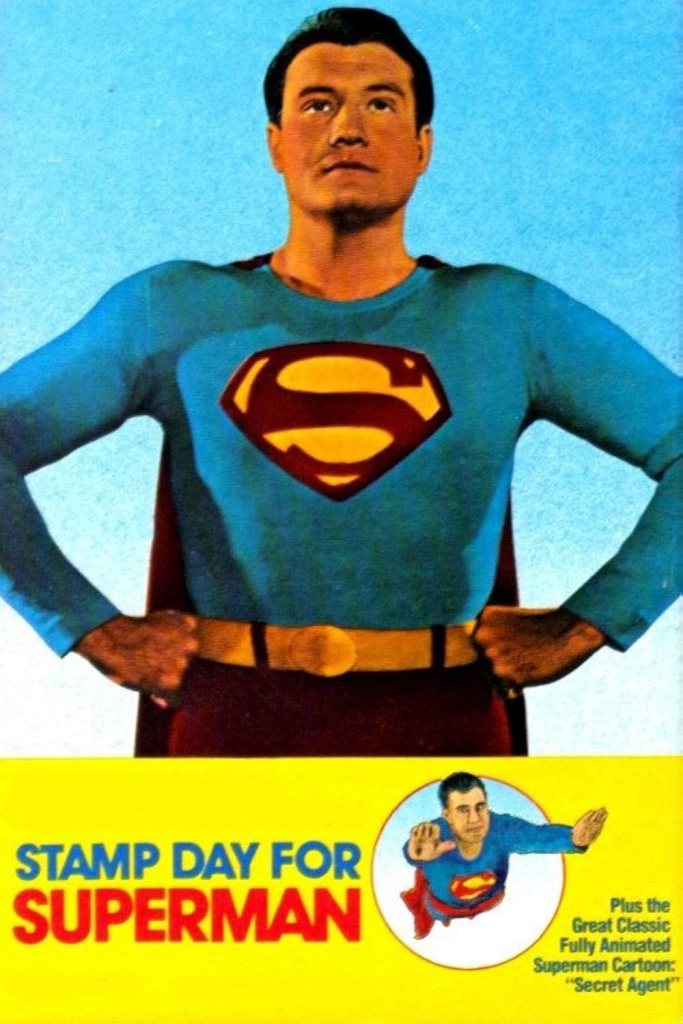
If it’s a superhero origin that you’re looking for, though, this 1985 movie is for you. It was produced by Alexander and Ilya Salkind, riding the success of their Superman movies starring Christopher Reeve. And in fact, this movie is pretty much a straight rip of the structure of the first Superman movie: it begins with the character’s origin story (Santa and his wife are saved from freezing to death by the elves, who are there to recruit him), spends about half the film showing the hero’s development, and then introduces the villain at about the halfway point. From there we get to the real story, Santa fighting for relevance in a modern world where a corrupt toymaker is stealing his thunder.

I was eight years old when this movie came out, and that was apparently the perfect time to fall in love with it. I still love it. And David Huddleston – aka the Big Lebowski himself – is still my Santa Claus. When I close my eyes and picture St. Nicholas, it’s the David Huddleston version – his smile, his charm, his warm laugh are indelible parts of the Santa Claus archetype in my head. John Lithgow fills in Gene Hackman’s role as the villain, playing a cost-cutting toy executive named B.Z. who sees Christmas as nothing more than a profit margin. Dudley Moore is also along for the ride as Patch, one of the elves who finds himself in a bit of a crisis of faith. 

It’s a shame that this movie never got any sequels, because it was set up in such a way that there were many more stories to tell, but it underperformed and apparently did major damage to Dudley Moore’s career. Before this he was a rising comedy icon, and afterwards he fell off the A-list. I still think it’s a fantastic movie, though, and I have to admit that when I watch it, I wonder what would have happened if John Lithgow had ever had a turn playing Lex Luthor.

The Life and Adventures of Santa Claus by L. Frank Baum

For a different take on Santa’s origin, let’s wind the clock back to 1902. L. Frank Baum is riding the high of his hit children’s book The Wizard of Oz and he’s looking for a new project. Rather than return to Oz, though, he goes in a different direction and a different fairy tale – that of a young child abandoned in the woods and raised by fairies to become the most giving man in the world.

This is a very different take on Santa than most modern versions. It’s light on the fancy and heavy on the fantasy, with Santa being forced to do battle with monsters and creatures that are out to stop his quest to bring toys to children, and a conclusion that feels like it could have fallen out of the likes of Tolkien or C.S. Lewis. It’s hard to remember sometimes that the way we think about Santa Claus today was sort of codified by lots of little things over the early part of the 20th century – influences from poems, books, songs, and even the original AI-free Coca-Cola Santa Claus ads. But Baum’s book was before most of those things, and although his Santa doesn’t exactly jive with the Santa we know and love (no North Pole workshop, ten reindeer instead of eight, different fairy creatures instead of elves, and so forth), it’s still a fascinating read. It’s especially interesting if you’re a fan of the Oz books, as I am. This was two years before Baum would go back to his most famous creation and transform Oz from a single novel into a franchise, but it feels like it belongs in that “universe.” In fact, in later books Baum would link many of his unrelated books to the world of Oz through the connections of characters, other fairylands, and creatures that would grow in prominence. If you want to consider this the origin of Santa Claus in the universe of Oz, it’s not hard.

The Year Without a Santa Claus

Let’s get away from origin stories, though. We all love the Rankin/Bass classics, and their Christmas specials are legendary. In the top two specials, namely Rudolph and Frosty, Santa is just a supporting character. But they did give Santa a few specials of his own, and this second one is my favorite. In this 1974 Animagic classic, Mickey Rooney voices a Santa Claus that’s down with a nasty cold. This, coupled with a feeling of apathy from the children of the world about his annual visit, brings him to the conclusion that he’s going to skip a year. As the world faces the prospect of a Year Without a Santa Claus, it’s up to Mrs. Claus and a couple of helper elves to convince the big guy to pop a Zyrtec and get his act together.

This is the best of Rankin/Bass’s Santa-centric specials, although the most memorable thing about this cartoon isn’t Santa itself. We have this special to thank for the introduction of the Heatmiser and Coldmiser, battling brothers and sons of Mother Earth. They’re the best original Rankin/Bass characters by far, they have the best original song from any Rankin/Bass special by far, and even now you see them showing up in merch and decorations every year. It’s not easy for a new character to break into the pantheon of Christmas icons, but the Miser Brothers made the cut thanks to this awesome special and the fantastic musical arrangement of Maury Laws. The boys are a delight.

DC Comics Presents #67: Twas the Fright Before Christmas

Let’s wrap things up with this comic book from 1984. DC Comics Presents was a series in which Superman would team up with a different guest-star in each issue. Usually it was his fellow superheroes like the Flash, Batgirl, or the Metal Men. On occasion he’d have to partner up with a villain like the Joker. On more than one occasion he had to pair off with different versions of himself like Superboy, Clark Kent, or his counterpart from Earth-2. And on one memorable occasion he met up with He-Man and the Masters of the Universe, characters who were still on the rise.

But my favorite issue of the book is this one. Written by Len Wein with art by the most iconic Superman artist of the era, Curt Swan, in this issue Superman stumbles upon a little boy who tries to hold up a sidewalk Santa with a toy gun. Superman whisks the child off to his Fortress of Solitude at the North Pole where he determines that the child was hypnotized by a device in the toy, made by his old foe the Toyman. Leaving the Fortress, the boy’s toy zaps Superman with a burst of “white dwarf energy” which knocks him from the sky and leaves them stranded in the Arctic Circle. Luckily, they’re saved by some of the pole’s other residents. Superman and Santa then team up to save Christmas from the machinations of the sinister Toyman.

It’s a pretty silly story, but silly in a fun way. This is towards the end of the era in which Superman was allowed to be a little goofy, just two years before John Byrne would reimagine the character in his classic Man of Steel miniseries. And although that depiction of Superman has largely informed the character in the years since, it’s nice to see that modern writers aren’t afraid to bring back the kinds of things that made this story so memorable every once in a while. It ends with one of my LEAST favorite tropes, especially in a Christmas story (the whole “It was all just a dream…OR WAS IT?” nonsense), but that doesn’t diminish my love for it at all. I tend to go back and read this comic again every Christmas

Once again, guys, ask me tomorrow and there’s a good chance I would pick five totally different stories to populate this list, but as I write it here on December 20th, these are five of my favorite Santa Claus stories of all time. But I’m always open for new ones – what are yours?

Blake M. Petit is a writer, teacher, and dad from Ama, Louisiana. His most recent writing project is the superhero adventure series Other People’s Heroes: Little Stars, volume one of which is now available on Amazon. You can subscribe to his newsletter by clicking right here. He’s also started putting his LitReel videos on TikTok. Honorable mention goes to a story John Byrne did for Marvel’s What The?! comic where Santa twists his ankle delivering to Latveria and Dr. Doom has to take over and finish his route for him. 

Geek Punditry #100: If I Were King of Comics

Here we are, my friends, 100 Fridays later. In the first week of January 2023, I was thinking of how much I missed the days of writing for Comixtreme and recording my podcast, and I wanted to find a regular way to get my voice back out there in the world. How could I do it? I asked myself. How can I reach out and gift humanity with my invaluable thoughts, insights,and trademark witticisms, in this era where the world clearly needs me more than ever before?

Then I remembered I had a blog that I was barely using, and maybe it would be a nice little challenge for me to find something – once a week, just find SOMETHING – that I liked enough to write a few paragraphs about. 

And of course, it has become the global phenomenon and world-altering sensation you see before you today. 

As I approached the 100th installment of the column hundreds of voracious readers have called “on the internet somewhere,” I tried really hard to decide what to write about. What, in the enormous global marketplace of popular culture that I had made my home, was worthy of dedicating the landmark 100th column to? Star Trek? Stephen King? Superman? Bluey? I feel like I’ve kind of talked about those various topics…well, “extensively” seems in some ways to be too mild a term, but we’ll roll with that right now. No, I needed something a little bit different.

Then I remembered an idea I’d had some time ago, but that I had pushed aside. Something I thought needed to percolate a little more. Something that the world would HAVE to sit up and take notice of. And it seemed perfect. So this week, ladies and gentlemen, allow me to explain to you what exactly I would do if I were in charge of comic books.

You all know I’m a comic book geek, and I have been since I was a small child. Not to discount my love of movies, TV, or novels…I’m a fan of storytelling in general. But comics are in many ways my medium of choice. I’m a regular Wednesday visitor at my local comic shop, I know all the members of the Legion of Super-Heroes, and I can tell you – in order – every publisher that has ever had the Star Trek license. (Gold Key, Marvel, DC, Malibu but only Deep Space Nine, back to Marvel, Wildstorm – which was by then a DC imprint – and currently IDW. Sorry, ladies. I’m taken.)

As much as I love comic books, though, there are certain practices in the industry that I’m not a fan of, certain things that I think could be done better. In this era, where there’s so much competition for the attention of an audience coming from virtually every region of our culture, it’s imperative that comic book publishers find ways to draw in new readers and retain existing ones. Ways to make the sometimes complex mythologies of American comic books a little less of a roadblock, and make the space a little more welcoming. For the 100th Geek Punditry, guys, here are some rules that would be implemented if I were King of Comics.

Numbering

As most people know, comic book series are numbered, and for many decades the numbering convention was simple. You started with issue #1, proceeded to #2, and so forth. You just put the numbers in order. Seemed like a simple idea. But at some point things started to get a little more convoluted. After World War II, many of the existing superhero comics had been cancelled. But in the 50s, looking for a new hit after public favor turned against things like horror comics, DC decided to bring back some of their defunct characters with a new incarnation. A new Flash was created – Barry Allen – and after a few tryout issues in the pages of Showcase, they gave him his own title. Barry took over the numbering of the Golden Age Flash, Jay Garrick, and his first issue was #104. Here’s where it gets confusing: they then did they same thing with Green Lantern. But in this case the new guy – Hal Jordan – did NOT pick up from Alan Scott’s title with issue #39, but instead got his own first issue, Green Lantern Vol. 2 #1.

Make it make sense.

It would not be the last time this happened. In the 80s they gave new first issues to Superman, Wonder Woman, and The Flash, and in those cases, the lapse in publishing between the previous volume and the new was not nearly as long as it had been in the silver age. Then in the 90s, Marvel did it with four of their flagship titles at once – Avengers, Fantastic Four, Iron Man, and Captain America – as part of a new initiative where the titles were essentially farmed out to Jim Lee and Rob Liefeld and set in a different world than the “regular” Marvel Universe. When the books were brought back to the “regular” Universe a year later, they were given a THIRD first issue…and then all hell broke loose.

Since then, virtually every comic book published by Marvel or DC Comics has been canceled and relaunched with a new first issue, most of them multiple times. Batman, at last count, is on its conservative third volume. Superman is at six. Punisher – if I’m counting correctly – has recently concluded volume FOURTEEN. The longest running comic book at either publisher that has not been restarted at least ONCE? Looney Tunes, which recently celebrated issue #281. (It should be noted, though, that even this is the fourth volume of Looney Tunes, having been published by various other companies before Warner Bros. wholly absorbed DC Comics.)

Winner of the gold medal in “not starting over for no reason.”

The conventional wisdom seems to be that a new first issue will bring in higher sales numbers than issue #482, and that might be true. But increasingly, it has proven that a tenth issue #7 does NOT have appreciably more readers than issue #489 would have. In other words, the restarting game gives a short-term sales bump, but does nothing to retain readers, which is what the goal should be.

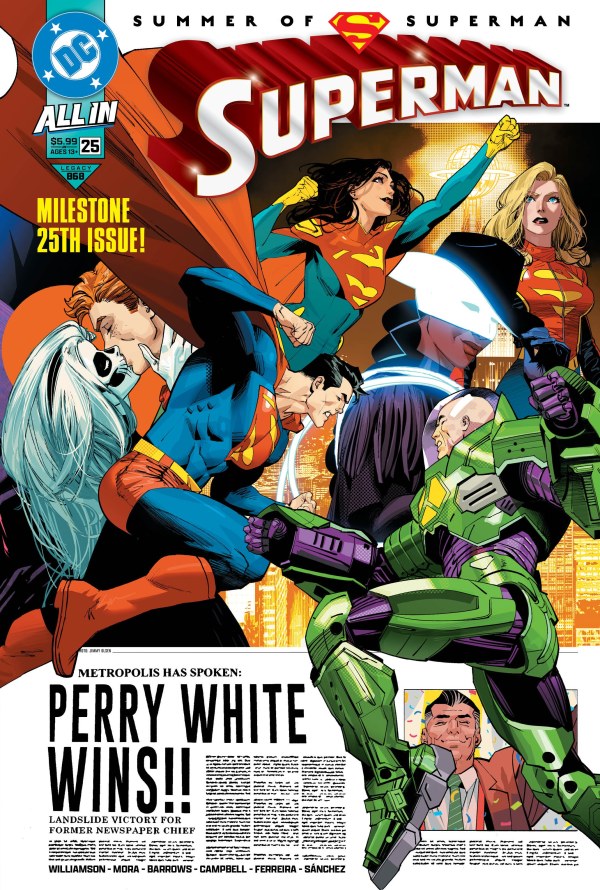
Anyway, to appease fans (such as myself) who prefer maintaining the original numbering rather than the constant restarts, Marvel and DC have begun featuring “legacy numbers” on the covers of their books – in other words, what issue would this be had the book never been restarted? Which is why the recent Superman Vol. 6 #20 also bears a little symbol indicating that the “Legacy Number” of this issue is #863.

Only long-time Superman fans will understand what I mean when I say “at least it’s in a triangle.”

Confused yet?

Making it even more confusing is the way that many series have changed titles over the years, and trying to figure out which is which. Thor started as Journey Into Mystery, one of Marvel’s assorted sci-fi titles. But after he made his debut, Thor quickly took over the comic book, and the title was changed from Journey into Mystery to The Mighty Thor with issue #126 When calculating the Thor legacy numbers, the original JIM numbers seem to count, but JIM itself has been re-started several times over the years. Journey Into Mystery Vol. 2 does NOT count, apparently, as it ran concurrently with Mighty Thor. And let’s not forget that the current series carrying the Legacy Number is actually called Immortal Thor, which has the same legacy numbers as did previous volumes like Mighty Thor, King Thor, Thor: God of Thunder, or the (at last count) six different series that have just been called Thor. 

According to the legacy numbers, these are all issues of the same title.

Then there’s the fact that it’s inconsistently applied, especially at DC. Superman (on Volume 6), Batman (Volume 3), Flash (Volume 6), and Green Arrow (Volume 7) all have Legacy Numbers on their covers. Nightwing (Volume 4), Harley Quinn (Volume 4), and Titans (Volume 4) do not, and I can see no particular reason why. 

It’s an absolute mess. True story: when the Captain Marvel movie came out in 2018 my wife – who is a geek but not as big a geek as I am – was interested in reading some of the comics to learn more about the character, but after several attempts to figure out which volume to start with, she gave up. If the plan here is to get MORE readers, it’s failing miserably.

So how do we fix this problem? 

Here’s what I would make the standard rule: first of all, the Legacy Numbers should be mandatory for any series that continues the title or star of a previous series. The editors would need to get together right away, decide which books count towards the “legacy” and then stick with it from then on. 

Second, I would have them stop with the constant relaunches. If a character is returning after ten years away…okay, a new first issue might be justified. If we’re going back to issue #1 because there’s a new inker, it’s not. It’s become a common practice to start over with a new first issue any time there’s a change of creative team, especially when there’s a new writer. It’s too much. So here’s the rule: there must be a minimum of three years since the previous volume before a new first issue is justified. If the final issue of Captain Dudeman was #47 and it came out eighteen months ago, then you either have to start with Captain Dudeman #48 or you have to change the title. 

That second stipulation, I think, would start to get used very frequently. One of the reasons that the renumbering has gotten so rampant is that every time a new writer is brought onto a series they want to make their own mark – which is fair. But in so doing, they often want a clean slate, a sort of “back-to-basics” approach for the character, which has resulted in several books in the last few years where the first issue shows the heroes in a wholly different situation than they were in when the previous volume ended, and then it’s not until several issues later that the reasons for the change are actually explained. Sometimes it works (Fantastic Four and Daredevil both did this effectively in their most recent relaunches) and sometimes it doesn’t (the current run of Amazing Spider-Man should be studied by scholars as a cautionary example of what NEVER to do).

I don’t want to take away a writer’s ability to tell the stories they way they see fit, that’s not what this is about. But if the plan is to tell a totally different story, changing the title of the series is a good way to reduce confusion. Telling somebody “You have to read Green Lantern – but not that one, or that one, or that one…” is a recipe for the kind of bafflement that drove my wife away. But saying “Green Lantern: Emerald Champions is a great series” is a HELL of a lot easier for the casual reader to comprehend. You can keep the legacy numbers that way, but having a subtitle or supertitle (that’s when you preface the main title with something else, such as Peter Parker, the Spectacular Spider-Man) makes it a lot easier to differentiate one run from another. 

What this really boils down to is that I never again want to see a comic book called Fantastic Four #1. When I was a kid, owning that book would have been a gold mine. Now I’ve got six different books called that, and it’s ridiculous. 

Cover Confusion

The way the comics industry handles its covers is also an issue, and there are two primary problems I want to tackle. First, let’s talk about pin-up covers. This isn’t as bad as it once was, but for a while there in the 00s and 10s, there was an awful trend of comic books having generic pictures of the main character or characters on the cover, something that may be a fabulous piece of art but doesn’t tell the reader anything about the story between the pages. The argument at the time, I believe, was that they wanted every issue to be an accessible first issue for a new reader. While that may be a noble goal, that doesn’t make a damned bit of sense. Anybody who picks up a comic because they like the picture of Spider-Man on the cover is going to have a hard time keeping up if they open up the comic and run into “Revenge of the Return of the Colonoscopy of the Sinister Six: Part Five of Seventeen.” Congratulations – you sold that one issue…but they aren’t coming back. 

“Wow, great cover!”
“Thanks!”
“What’s the story about?”
“What the hell is a story?”

Pin-up art is fine, but a great comic book cover should tell a story. Think about some of the all-time most memorable covers: Amazing Spider-Man #129 features the webspinner dangling in front of the faces of his friends, agonizing over which of them was going to die in that issue. Green Lantern (Vol. 3) #49 shows a power-mad Hal Jordan brandishing a set of rings stolen from his fallen comrades, a look of pure chaos in his eyes. Wolverine: Blood Hunt #2 shows the ol’ Canucklehead on a motorcycle with a French vampire babe being chased by a mob of vampire stormtroopers while fleeing an explosion that is also being escaped by an overhead passenger jet.

If just that description isn’t enough to make you pick up the book and look inside, I don’t think you actually like comic books.

Now THAT’S art.

These days it’s better, although many variant covers still have what I call the Pinup Problem. So here’s going to be the rule for this one: cover art MUST be relevant to the story inside. That doesn’t mean it has to be a depiction of an actual SCENE from the story. Thematic covers, like the above Amazing Spider-Man #129, are fine. Covers promising a twist or a mystery, anything like that is just dandy, provided it has SOMETHING to do with the story. The only exceptions, the only time a simple pin-up is acceptable, are when it’s the first issue of a series (and presumably a good jumping-on point anyway), if it’s the introduction of a new character, or for certain milestone issues, such as an issue number that ends in a double zero.  

Now that we’ve cleaned THAT little problem up, let’s talk about the REAL issue: variant covers. 

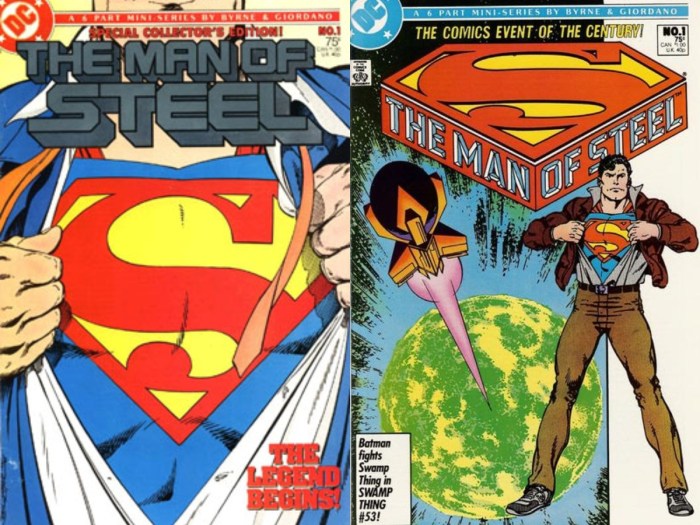
There’s debate over when, exactly, variant covers became a thing, although most people seem to agree that the first mainstream example of printing copies of the same book with two different covers was probably Man of Steel #1 in 1986, the John Byrne relaunch of the entire Superman mythos. That was an instance where it was novel and interesting and fun. People made an effort to buy both covers to make their collection “complete.” It was really cool.

You could get with this, or — alternatively — hear me out on this one…you could get with THAT.

But like so many good things, it got overdone. It didn’t happen overnight, mind you. It was quite some time before having two covers became a regular practice, and even longer before it reached the heights it has today. Even as late as ten years ago, having multiple covers was still more of an exception than a rule. But the rules have changed and HOW. 

If you pick up any random issue of a new comic from a mainstream publisher today, odds are that you will have between two and five covers to choose from. First issues are frequently more. For the first issue of this summer’s Uncanny X-Men relaunch, League of Comic Geeks (the website I use to track my own collection) lists 32 separate cover variants. And even THAT is chump change compared to the most recent relaunch of Teenage Mutant Ninja Turtles from IDW Publishing, which currently stands at – 

Are you sitting down? Are you sitting down in the sewer?

ONE HUNDRED AND SEVENTY-SEVEN DIFFERENT COVERS.

If you are the sort of person who feels the need to get every available cover and you’re a Ninja Turtles fan, I hope you can still afford your insulin.

I’M SAYING IT’S KIND OF A LOT.

The reason they do this, of course, is because people continue to BUY them. And when there are stories every other day about some comic shop or another closing down or a publisher being unable to pay its creators, I can’t fault them for looking for ways to increase revenue. But the problem is that this simply bleeds money out of the existing fans until they get fed up and walk away entirely. And like the renumbering problem, this doesn’t do anything to actually get NEW fans into reading, which is what the long-term goal should be.

This is not to say that I hate variants in their entirety. I rather like them when they do something CLEVER with them, such as what I call “theme” months, where all the variants have a different trend. For instance, DC recently did a run of variants covers that were mock-ups of the packaging of the old Super Powers action figures. (I should point out that other publishers, including Marvel, have been doing action figure variants for a long time, but this was the first time I recall them being used as a monthly theme.) In October, there were a series of variants by artist Kelley Jones showing the DC heroes as kids in Halloween costumes. Marvel did a series not long ago of variant “homage” covers based on some of their old vampire comics, and another run that showed their characters facing off against Godzilla. That kind of stuff doesn’t really bother me, except for the fact that they add to the preposterous number of variants on the shelf.

I don’t know art, but I know what I hate. And I don’t hate this.

I also really like the “sketch” covers that have become popular in recent years. These are blank covers printed on a different cardstock that fans can use to draw their own artwork or have an artist draw something for them. They’re popular for commissions at comic book conventions and events like Free Comic Book Day, and I don’t think the blanks really cause a lot of confusion on the racks compared to the 30-plus X-Men covers. 

The worst part, I think, is that so many of these “variants” are barely worthy of being considered a separate cover. You commission a piece of art from an artist and you’ve got a cover. Print it with no logo or trade dress and it’s a “virgin” variant. Print it without colors and it’s a “sketch” variant. Print it with metallic ink and it’s a “foil” variant. You can crank out a dozen different covers with one sketch and people will continue to buy them. It’s insane.

I recognize that there are a lot of people who LIKE these variants, even if they aren’t MY thing. So in my capacity as the benevolent overlord of comic books, I don’t want to ban them entirely. Here are the restrictions I’ll put in place:

  • A standard issue of a comic book shall have no more than three covers: the “main” cover, a variant cover, and a “theme” variant for that month. 
  • First issues will be limited to five covers, including the theme cover.
  • Milestone issues, such as anniversaries, will be allowed extra variants consisting of no more than one-tenth of the number of issues the book has run. For instance, the 50th issue will be allowed 5 variants, the 100th issue will be allowed 10 variants, and so on. 
  • Retailer-exclusive variants will not count against the total. These are covers commissioned by – and only available from – specific retailers, such as an individual comic shop, store chain, or online retailer.
  • There will be no restrictions on “sketch” covers, nor will they count against the number of variants allowed. 

See? I can be as flexible as the next guy, provided the next guy isn’t Plastic Man.

Anyway, there we have it, guys. Comic books are fixed!

Well…okay, maybe not. There are still plenty of other things in the world of my favorite medium that need to be addressed. Other problems to solve, other fires to put out…but I’ve already gone on for nearly 3500 words, which is pretty massive for one of these Geek Punditry columns. So I think it’s time to put this topic aside, at least for now.

But that’s okay. After all, I’ve got to save something to write about when Geek Punditry #200 rolls around.

Blake M. Petit is a writer, teacher, and dad from Ama, Louisiana. His most recent writing project is the superhero adventure series Other People’s Heroes: Little Stars, volume one of which is now available on Amazon. You can subscribe to his newsletter by clicking right here. He’s also started putting his LitReel videos on TikTok. His goal to take over all of social media after it has started to slide towards irrelevance continues. 

Geek Punditry #94: Four Color Terror

It’s October of course – glorious October, that precious time of year in which all the creepies crawl and the goblins gob and the gremlins grem. And at this time of year, many of us reach out and look for scary stories to cast to our televisions, books to fill our Kindles, and anything seasonal that might give us a little bit of a chill. A few days ago, for example, I saw someone on Facebook ask for recommendations for modern horror comics. While horror has long been a mainstay of the comic book medium – in fact, it was the biggest seller back in the 1950s, before the Comics Code strangled the life out of it – it’s not what most people think of when they think of comics these days. And that’s a shame, because like any other form of storytelling, there are plenty of scares to be had if only you know where to look.

Scary comics, of course, are different from scary movies or TV shows. Although they’re both visual mediums, comics don’t have some of the tools that filmmakers use to terrify people. There’s no creepy music, no way to rely on a jump scare, and even simple surprises can be difficult to pull off, as a shocking image can be spoiled if not carefully placed on the page to avoid allowing a major reveal before the creators are ready for it. (Robert Kirkman, who created The Walking Dead, is quite vocal about how aware he is of this sort of thing – he always tried to reserve majorly shocking moments for the first panel of a left-hand page to avoid a page-turn spoiler.) In terms of horror, comics have more in common with novels than film – they have to be reliant on mood and tone to pull off their scares. Sure, there ARE shock comics out there – even going back to the days of Tales From the Crypt and its blood-drenched contemporaries, there were plenty of comics that relied on gore. But these kinds of shock scenes are like slasher movies – good for a scare in the moment and plenty of fun, but they don’t necessarily create LASTING terror the way that a good book can. 

So here are a few comics from recent years that I think are particularly successful at delivering the scares, stories that are well worth tracking down and reading as part of your Halloween wind-up.

On that initial Facebook post that prompted this column, one of the respondents stuck his metaphorical nose in the air and replied, “WELL, you won’t find any good horror from MARVEL or DC, but…”

What a prick.

It’s true that Marvel and DC are known as superhero publishers, and that’s what most of their audience comes to the table for, but that doesn’t mean they aren’t capable of delivering in other genres, even within the confines of their existing superhero universes. The best horror comic Marvel has published in a long time is actually Immortal Hulk. This series, which ran for 50 issues from 2018 through 2021, was written by Al Ewing with art mostly by penciller Joe Bennett, and followed the “death” of the Hulk in Marvel’s Civil War II event. Comic book characters die and come back to life all the time, of course. It’s reached the point where it’s not just a cliche, it’s almost a JOKE to say you’re going to kill off a major character. But Ewing takes the old comic book concept of the “revolving door in Heaven” and turns it on its head, becoming a literal green “door” in Hell. 

“I bet this stuff never happens to Jean Grey.”

In this series, Ewing explores WHY characters like the Hulk seem to die and come back over and over again, drawing in most of the gamma-powered characters (hero and villain alike) in the Marvel Universe and telling a deeply unsettling story about Bruce Banner, the multiple personalities that co-exist inside his head, and a battle against his true greatest enemy. Despite being a part of the Marvel Universe and occasionally guest-starring characters like the Avengers and the Fantastic Four, this is a legitimately creepy story and probably one of my favorite runs of Hulk of all time, second only to Peter David’s legendary first run back in the 80s and 90s. If you don’t think there’s room in a shared universe for something truly scary and disturbing, I challenge you to check out this series right away.

On the DC side, there isn’t an awful lot of horror to be found in the modern DC Universe itself. Even those characters that use the trappings of horror, such as Dr. Fate or the Creature Commandos (coming soon to MAX!) aren’t usually used in legitimately frightening stories. But DC’s library doesn’t stop at the outskirts of Metropolis. From DC’s Black Label line, writer James Tynion IV and artist Alvaro Martinez brought us The Nice House on the Lake in 2021, a 12-issue sci-fi saga about a group of ten people who are invited by a mutual friend for a little getaway in the titular nice house on the lake. Some of them know each other, some are nearly strangers, and the only thing they all have in common is their buddy Walter. But on their first night in the house, something utterly heart-stopping happens that I’m not about to reveal because it would ruin the beginning of one of the best and most original horror comics in years. This 12-issue series was absolutely phenomenal, full of well-drawn characters and a concept that is creepy and compelling all at the same time. The creative team has reunited for a sequel, The Nice House By the Sea, the third issue of which was recently released. Grab the collected edition of the first series and come aboard.

“That’s it, we’re firing the pool guy.”

Speaking of Robert Kirkman, as I did that back in paragraph two, his Skybound Entertainment (published via Image Comics) has been giving us more horror lately as well. The house that The Walking Dead built has been branching out into licensed comics, including two pretty significant horror properties. First is Creepshow: what started as a George Romero/Stephen King movie that paid tribute to the likes of the old EC Comics has expanded into a franchise with the current anthology TV series on Shudder. Skybound has taken to publishing Creepshow comics now, with three miniseries and a few one-shots, including a Christmas special last year and another one-off adapting a story by King’s son, the prolific horror author Joe Hill. Most regular issues of the comic include two stories by assorted writers and artists, each of which includes the requisite amount of gore and most of which display the kind of twisted sense of justice that befits a tribute to the likes of Tales From the Crypt. As with any anthology, the quality of the individual stories can vary – in other words, some are better than others. But if you’re looking for the sort of tongue-in-cheek horror that we got from the Cryptkeeper back in the day, there’s no better place to look right now. 

“If you think this is safe, you’re GRAVE-ly mistaken! Hahahahahaaaaa, I’m no John Kassir.”

Kirkman has also acquired – to my shock and delight – the license to the classic Universal Monsters. While Dracula and Frankenstein may be public domain, this license includes the versions specific to the films of Bela Lugosi and Boris Karloff, as well as the original Universal creations. Even better, each of the series they’ve produced so far has been drastically different from all of the others, making for a very diverse and enjoyable reading experience. The line began last year with Universal Monsters: Dracula, a four-issue series by James Tynion IV (the Nice House on the Lake guy) and artist Martin Simmonds. Tynion and Simmonds retell the story of the movie through the perspective of a mental patient, with a heavy emphasis on the character of Renfield. Simmonds’ artwork is bizarre and scattershot, befitting the point of view of someone who is mentally unstable, and the whole thing is wonderfully creepy. 

“Look into my eyes…do you have any Kit-kats?”

The second miniseries, written by Dan Watters and Ram V with art by Matthew Roberts, is Universal Monsters: The Creature From the Black Lagoon Lives! This one is a straight-up sequel to the original film trilogy, set in the modern day as a woman decides to delve into the mystery of the swamp monster from decades ago. And like most great horror, it’s more about the humans that are wreaking havoc than the monster itself. It’s a fantastic, worthy sequel that could easily be made into a movie if Universal Pictures had any idea what it was doing with these classic creations. 

“Guillermo Del Toro was gonna do WHAT with me?”

Most recently, they’ve kicked off a series based on my favorite member of the Universal Pantheon with Michael Walsh’s Universal Monsters: Frankenstein. We all know that Henry Frankenstein (changed from the novel’s “Victor” for reasons I’ve never understood) stole the corpses of the dead to make his creature, but how often have we really thought about the people that the Karloff monster once was? This miniseries is told from the point of view of a young boy who, still in grief over his father’s death, discovers that his late father’s body is now part of Frankenstein’s monster. It’s a brilliantly original concept. As big a Frankenstein fan as I am, it’s not easy to find an angle on the story that I haven’t seen before, and Walsh nails it.

“The knee bone’s connected to the — HIP bone!
The hip bone’s connected to my — DAD’S bone…”

Sticking with Image Comics, let’s talk about their acclaimed ongoing series Ice Cream Man, written by W. Maxwell Prince with art by Martin Morazzo. The horror series tells a different story in each issue, with the only connective tissue at first seeming to be Rick, the titular Ice Cream Man, who rolls through each issue at some point. The series hits on all kinds of disturbing themes, dealing heavily with existential dread and frequently drifting into Kafkaesque body horror and other such things. It’s a bleak, nihilistic comic, which isn’t usually my thing, but Prince very slowly and subtly reveals that these seemingly one-off stories are, in fact, connected, and there’s a vast backstory of deep cosmic horror that Rick has spawned from. The stories delve into terrors that deal with the very nature of existence, taking very human fears and externalizing them the way that few other stories – comic books or otherwise – can do effectively. It’s remarkably disquieting horror.

If you hear the bells on THIS guy’s truck, RUN.

Rounding out our time with Image Comics, there’s a new series from Geoff Johns and Ivan Reis worth mentioning. Only one issue of Hyde Street has been published so far, but it’s already got its hooks into me. On Hyde Street, we see characters like “Mr. X-Ray” and a twisted Boy Scout going by the name of “Pranky” as they lead the unsuspecting residents and visitors of Hyde Street down dark paths of destruction. They’re in some sort of competition, reaping souls for a hidden gamemaster for purposes that have not yet been revealed. As I said, there’s only been one issue so far, but it hints at a vast and complex mythology, and there are few writers out there who do that better than Geoff Johns. I’m very excited to see where this series is going.

“You know, Clark never uses his X-Ray vision this way.”

Finally, I’m going to leave you with a lesser-known miniseries from Magma Comix that just recently wrapped, The Principles of Necromancy. Written by Collin Kelly and Jackson Lanzing with art by Eamon Winkle, this tale of horror is set in a world where magic has been ostensibly driven out by the “City King,” leaving in its wake a realm of reason and science. Not everybody subscribes to these beliefs, however. The miniseries features the ghastly Dr. Jakob Eyes, the man inventing the art of necromancy in an effort to conquer death itself. If body horror is your thing, this is a book to check out, as we watch Eyes’ gruesome experiments and deliciously twisted practices over the course of four issues which ends on a note that leaves things wide open for further exploration of this dark world. Kelly and Lanzing have become favorite writers of mine in the last few years, doing great work at Marvel, DC, and IDW (particularly with their run on Star Trek), and it was on their names that I decided to pick up this series. I’m very glad that I did.

This image just demonstrates how little I actually know about interior decorating.

So my point, friends, is that horror is out there. If you’re still looking for creepy comics to fill your bookshelf before Halloween ends, here are some fine suggestions for you, and I’m sure the folks down at your local comic shop can give you even more. Dive in and get ready for a chill on every page.

Blake M. Petit is a writer, teacher, and dad from Ama, Louisiana. His most recent writing project is the superhero adventure series Other People’s Heroes: Little Stars, volume one of which is now available on Amazon. You can subscribe to his newsletter by clicking right here. He misses the days of Friday the 13th and Nightmare on Elm Street comics, though. Those need to come back. 

Geek Punditry #88: Blake’s Five Favorite Superhero Movie Scenes

It’s time for a new Geek Punditry feature: Blake’s Five Favorites! In Five Favorites, I’m just going to talk about something that’s been on my mind and discuss my…well…my five favorite examples of that thing. Now keep in mind that this list is inherently subjective and not at all comprehensive. You may disagree with my choices, and that’s fine. And there may be other examples out there that I’d like even better, but I haven’t seen them yet. And if we’re being totally honest, if you asked me again tomorrow, my list may be totally different. I’m funny that way. But for now, as of the time I’m writing this, I want to tell you about my five favorite scenes from superhero movies. This is NOT a list of my five favorite superhero movies (although there would definitely be overlap), but a list of the five individual scenes in the history of superhero cinema that make me feel the happiest, proudest, most excited, or most touched. And obviously, these are going to be FULL of spoilers, so if you haven’t seen these movies by now, you may want to skip. Let’s see if any of your favorites make the list.

#5: James Gordon Lives (The Dark Knight, 2008)

Very few superheroes can really do their job alone, and those that try usually wind up learning early on that attempting to do so is a mistake. And for all his talk about being a lone wolf, decades of storytelling have built up a sizable contingent of heroes surrounding Batman. He’s got sons (biological, adopted, AND surrogate), daughter-figures, father-figures, friends, allies, lovers, and even frenemies. And of all the characters that have taken up arms with the Batman during the years of his crusade, my favorite is police commissioner James Gordon. There’s something inspiring about the one good cop trying to clean up a filthy, corrupt department and forging an alliance with an agent outside of the law to do it. I don’t really care for any version of Batman that casts Gordon as an incompetent, which is perhaps the most unforgivable of the many sins in the Joel Schumaker movies. 

Of all the actors who have played Gordon, Gary Oldman in the Dark Knight trilogy is hands-down my favorite. He really sells Gordon as a good man who recognizes that things are out of control and takes the necessary steps to set things right, and I absolutely LOVED how this film showed the pact between Gordon, Batman, and Harvey Dent that worked so well for all characters in The Long Halloween.

“I believe in Crystal Lig–I mean, Harvey Dent.”

So I was pretty darn startled when, partway through the film, Gordon is killed. I was shocked. I was stunned. And although the large part of me didn’t believe it could be true, I also recognized that director Chris Nolan had already taken some liberties with canon and I couldn’t be TOTALLY sure that he wouldn’t make that big of a turn. A while later, Batman and Dent hatch a plan to trick the Joker into attacking a convoy. The plan works, the Joker winds up on the ground with a gun to his head, and the cop holding that gun whips off his mask to reveal Gordon, alive, his faked death revealed to be all part of the plan.

Gordon: I’ve got you, you son of a bitch.
Me, in the back of the theater, screaming: YEEEAAH, YOU DO!!!

It is a testament to the love of my girlfriend at the time that, after I jumped and CHEERED in that movie theater, she still agreed to marry me. Someday I hope our son gets as thrilled at this scene as I am every time I watch it.

#4: You Are Who You Choose to Be (The Iron Giant, 1999)

Let’s get this out of the way before we go any further: Hell YES, The Iron Giant is a superhero movie. A childlike creature of immense power comes to Earth from outer space and chooses to use his powers to help people. There is no adequate definition of the term “superhero” that can justifiably exclude Brad Bird’s gargantuan guardian. As if that weren’t enough, the Giant befriends a young boy, Hogarth, who teaches him about being human using what is arguably the greatest possible source material: Superman comic books. (The argument, by the way, is whether or not these are a better source than Charles Schulz’s Peanuts, but the movie is set in 1957 and Schulz’s greatest philosophical work was still ahead of him.)

Plus, this looks a lot better than painting a zigzag stripe around his midsection.

Lost on Earth and with no memories, the giant goes through the usual sort of mishaps that ETs usually get into, only with fewer Reese’s Pieces, while the military picks up on his trail and tries to chase him down. Late in the film, the Giant’s true nature is revealed: he was created by some distant alien civilization as a weapon. As he struggles against his own programming, a panicked government agent orders a nuclear attack on the robot, one that will destroy not only the Giant, but an entire town of innocent people. The Giant, however, overcomes his programming and remembers something Hogarth told him earlier in the film: “You are who you choose to be.”

The Giant makes his choice. He is not a weapon. He is not a gun.

He blasts into the sky to intercept the missile, choosing to sacrifice himself to save the town full of innocents, and in the last second before impact, he whispers the name that he has chosen.

“Superman…”

If you can watch this scene without tears, I don’t know if I want to talk to you.

You can’t tell me that Clark wouldn’t be proud to see this guy wearing his shield.

In this scene the Giant proves he understands sacrifice, he understands selflessness, he understands choosing to believe in the fundamental goodness of humanity. He understands what being a hero actually is.

He understands Superman.

A hell of a lot better than most other people, I would argue.

#3: Peter One, Peter Two, Peter Three (Spider-Man: No Way Home, 2021)

Tom Holland, as I’ve often said, is my favorite of the actors who have played Spider-Man on the big screen. But that doesn’t mean I don’t have a fondness for the other two, Toby Maguire and Andrew Garfield. And it was immensely satisfying to me to see the three of them share the stage together in the final act of Spider-Man: No Way Home. In this film, the MCU version of Spider-Man has screwed up badly, breaking a spell Dr. Strange was trying to cast to wipe memory of his secret identity from the public, and drawing in people from alternate realities, destabilizing the very fabric of the multiverse back before people were doing that every other week. The whole thing builds to a battle against the nastiest rogue any live-action Spider-Man has ever faced, Willem DaFoe’s Green Goblin, who ups the ante in this film by (last time I’m warning you against spoilers) murdering Peter’s Aunt May. 

While the MCU never showed us Holland getting bitten by a radioactive spider or the death of Ben Parker, they found a different way to demonstrate Peter’s character development by spreading it across three films. Homecoming was about him learning how to be a hero. Far From Home was about him learning to be his OWN kind of hero, separate from Tony Stark. This film is about learning the COST of being a hero. It’s May’s death, not Ben’s, that really hammers that home for us all. 

But Holland doesn’t have to learn this lesson alone, because the multiversal rift hasn’t only brought in villains. Holland’s Peter finds himself allied with his previous incarnations, Maguire and Garfield, each of whom has some baggage to bring to the table, and each of whom is essential to the full development of Holland’s character.

“Wait, you’re the youngest, why are YOU Peter One? This is worse than when Barry Allen called Jay Garrick’s universe ‘Earth-2’.”

While Holland wrestles with his own failures, he sees Maguire, who is implied to have found a sort of stability and love with his version of Mary Jane Watson. In Maguire, Holland sees that there is hope for the future, even in the wake of seemingly unsurmountable tragedy. Garfield, meanwhile, has tortured himself over the death of Gwen Stacy ever since the end of Amazing Spider-Man 2 and become a darker, more broken Spider-Man because of it. But in perhaps the greatest moment of this movie, Garfield saves the MCU version of MJ from suffering the same fate. The look of simultaneous anguish and relief on Garfield’s face is tectonic: he has atoned for his failure. He hasn’t failed again. In him, Holland sees the hope for redemption.

We should all have a moment where we can find that kind of peace.

When the girl who just FELL OFF THE STATUE OF LIBERTY has to ask if YOU’RE okay, it’s an emotional moment.

Seeing what the other two have gone through and how they came out the other side is perhaps the most important part of Tom Holland’s journey in this movie, guiding him to the new life he has to lead at the end with no family and no friends who remember his existence. He’s striking out on his own – lonely, yes, but with the knowledge that hope and redemption are real and possible. And no matter what movie he shows up in next or who directs it, if Tom Holland swings again, that’s the Spider-Man I want to see…the one shaped by the lessons of his multiversal brothers. 

#2: Avengers…Assemble (Avengers: Endgame, 2019)

You want to know what makes Avengers: Endgame so great? You know what it does that so many other attempts at a “cinematic universe” (and even much of the MCU in the years since then) have failed at? Payoff. What’s the point in a cinematic universe if not to introduce long-term story threads that eventually are brought together in a satisfying way? Endgame pulled together the threads of eleven years of storytelling and almost two dozen movies to put together a finale that served as a powerful conclusion for every part of the Marvel Cinematic Universe, provided you pretended that there weren’t any TV shows that were related to it.

And the best part of that film, for me, was the final battle scene, probably the most thrilling such scene in the history of superhero movies. The Hulk has undone the “snap” from the end of the previous film, bringing back all of the people Thanos killed five years ago, and as he launches his attack on the broken Avengers, their friends start to filter in. 

It starts with “On your left.”

We remember this signal from the Falcon – one of the lost – and the rest of the heroes begin to arrive. The Avengers who were dusted in Wakanda. The Guardians of the Galaxy, along with Spider-Man and Dr. Strange, brought back from the far reaches of space. The armies of Wakanda, the acolytes from Wong’s temple. The battlefield is populated with more heroes than we’ve ever seen in a superhero movie before, and Captain America kicks it off with the words that fans have been waiting a DECADE to hear: 

Me, squeezing my wife’s arm: He’s gonna say it, HE’S GONNA SAY IT…

“Avengers…assemble.

But even that wasn’t the greatest part of the scene, wasn’t? Oh, no, as fantastic as that was, there’s still one more bit of payoff to come, when Thor and Thanos grapple on the battlefield and suddenly the mad Titan is struck by Thor’s hammer Mjolnir, scavenged from the past along with the Infinity Stones. The hammer smashes into Thanos’s face, flying through the air, hurtling back to the hand that threw it…but if not Thor, whose hand is guiding it?

It returns to the hand of Captain America, and the movie theater EXPLODED. At least, the theater where I was sitting did. In all my life, I have NEVER heard such an outpouring of cheers and excitement from a movie audience as I did in that moment, and I seriously doubt I ever will again. This, my friends, this was payoff for the entirety of the franchise. As we all know, Mjolnir is enchanted, and can only be lifted by someone who is “worthy.”

“I KNEW IT!!!” Thor shouts.

We all did, Thor. We all did.

I mean, this scene was amazing, but you know the Iron Giant could lift the hammer too, right?

#1: You’ve Got Me? Who’s Got You? (Superman, 1978)

But my favorite scene, guys…my single favorite scene in superhero movie history, the scene I would ask to have playing on the screen if they were strapping me down on one of those tables from Soylent Green, comes from the first Richard Donner Superman movie. We’ve spent half the film watching baby Kal-El become Clark Kent, watching him grow up into Christopher Reeve, watching him shape the persona he’s going to wear as a mild-mannered reporter, but we have not yet seen HIM. We have not yet seen more than a glimpse of the title character. Until Lois Lane – of course – is involved in a helicopter accident. The whirlybird falls and Lois falls OUT of it, and it’s curtains for the Daily Planet’s star reporter.

Until she falls harmlessly into a pair of waiting arms.

This strange visitor, this proud figure in red and blue, lifts Lois in one hand and catches the helicopter in the other, and he reassures her that everything will be fine by simply saying, “I’ve got you.”

And Lois, flabbergasted, shouts, “You’ve got me? Who’s got YOU?”

How anybody can call Romeo and Juliet a love story while this scene exists in the universe is beyond me.

I think we take for granted, in superhero stories, the miraculous things that these characters are supposed to be capable of. We’ve seen so many movies, read so many comic books with people who can fly and shoot lasers from their eyes and walk through walls that we forget how astonishing these things would be in the real world. But Superman was the first movie to attempt such a thing on this scale, and in-universe, it’s something that has never existed before. Up until this point, the world of this film is ostensibly our own. The astonishment that Margot Kidder brings to that moment is absolutely perfect, as is Christopher Reeve’s reaction. He gently places her (and the helicopter) back on the roof, but before he can leave, Lois asks him who he is.

And he gives the only answer that matters:

“A friend.”

There are two things, I think, essential to the character of Superman. One is the protector, the defender, the man who will stop at nothing to save the lives of everyone around him. The Iron Giant showed us that side of Superman. The other side, though, is the man of infinite compassion and kindness, a belief in the better angels of human nature if only there is someone to guide them. Superman is the hero who never gives up on anyone, even his bitterest enemy, because somewhere inside of them he KNOWS there is a flicker of good waiting to be fanned into a flame. Batman tries to strike fear into the hearts of criminals. Superman is there to show us all that there is a better way. 

And when he looks at you like this, can’t you actually BELIEVE it?

I’ve got high hopes for James Gunn and David Corenswet, but it’s hard to believe that anything they can do could ever capture that essence as simply and perfectly as the two words, “a friend.”

Blake M. Petit is a writer, teacher, and dad from Ama, Louisiana. His most recent writing project is the superhero adventure series Other People’s Heroes: Little Stars, volume one of which is now available on Amazon. You can subscribe to his newsletter by clicking right here. Next time: his five favorite McDonald’s breakfast sandwiches! (Spoiler alert: steak, egg, and cheese bagel.)

Geek Punditry #86: This is How We Do It Presents…Absolute Power

Hello, everybody, and welcome to This is How We Do It, the latest Geek Punditry feature-within-a-feature. In This is How We Do It, which I intend to be a recurring segment here, I’m just going to showcase a piece of storytelling that I think is being done exceptionally well and talk about why I think it’s so great. It is the antidote to Internet negativity. And the subject of the inaugural This is How We Do It is going to be the currently-ongoing DC Comics crossover event, Absolute Power. Fair warning, it’s not going to be possible to talk about why this is so great without spoiling some things, so this will be a spoilerful discussion. If you’re not up to date on reading this fantastic series, you may want to hold off on reading this at least until you get to issue #2 of the main title, because that’s the most recent issue as I write this.

Get ready, because this one ROCKS.

Comic crossovers are by no means a new thing, and I’ve talked before at length about them but I feel like I need to give a brief overview of what I mean here. In these “event” storylines, there is usually a main narrative that brings together the various characters of a publisher’s shared universe (in this case, DC Comics), while assorted spin-offs and special issues of the series that star the individual characters tell other angles of the story. The earliest such event I can find that followed this format is DC’s Crisis on Infinite Earths from 1985-86. (It’s true that Marvel Super Heroes Secret Wars came out first, guys, but there were no spin-offs of that book, which to me makes it more of an embryonic version of the crossover as it exists today.) DC has done dozens of them, as has Marvel. In fact, pretty much every publisher that has a shared universe (or even Multiverse) has dipped their toes in the format at one time or another – Image Comics, Valiant Comics, IDW, Dynamite, even Archie Comics has had crossover events. 

So what makes Absolute Power so good? In a word: construction. Some events seem to come out of nowhere and have little ongoing impact – last year’s DC summer event Knight Terrors, for instance, has made relatively few ripples after it was over. Others will sometimes take existing heroes and force them to behave wildly out of character for the purposes of the narrative (lookin’ at YOU, Marvel’s Civil War). And sometimes, they’re just so overblown and complicated that it’s impossible to keep track of what’s actually going on. Absolute Power suffers from exactly zero percent of these problems.

Mark Millar knows what he did.

A good crossover really needs to start with a good antagonist, and this story has one of the best: Amanda Waller, who has decided that superheroes are the biggest threat to the planet. Waller is an established character, best known for her role as being in charge of the various incarnations of the Suicide Squad (a group of supervillains that she forces to do jobs for the government in exchange for reduced sentences – with the caveat that if they step out of line she’ll set off an explosive device she had implanted in their NECK). Waller has always tread the line of what makes an anti-hero, usually using underhanded methods to accomplish goals that are more or less positive…ish. However, that placed her perfectly for her role of the villain in this story, being a natural extrapolation of who she has always been as a character. In fact, Waller is the BEST kind of villain – the sort that, in her own mind, is 100 percent justified in her actions. Waller COMPLETELY believes that what she’s doing is the right, moral, ethical thing to do, and that makes her both more interesting and more dangerous than any bad guy who’s just in it for the Evulz. 

What do you MEAN, she doesn’t look like a good guy?

The next thing that makes a crossover work, in my opinion, is setup. Before the original Crisis on Infinite Earths happened, there were months of stories from DC where a mysterious, shadowy figure was shown to be monitoring the heroes of Earth. (As it turned out, he wasn’t the bad guy, but you could certainly be forgiven for thinking he was.) Absolute Power has a more obvious setup, but a very effective one. Waller has taken the villains from two recent storylines – Queen Braniac from the House of Brainiac Superman story, and Failsafe, a robotic duplicate of Batman with all of his tactical genius and none of his morals and ethics. She has combined their respective tech with the work of the old Justice League villain Professor Ivo to create a set of androids who can steal superpowers, and sent them out to attack, depower, and capture both superheroes and villains alike. In the first issue of Absolute Power, dozens of heroes have their powers stolen and most of them are taken prisoner by Waller. By the time the second issue rolls around, those heroes who remain at large have begun assembling at Superman’s Fortress of Solitude to plan a counter-offensive.

Imagine how nasty a character Amanda has to be that THESE two are her MINIONS.

Another important element is that the characters be true to themselves, and here I’ve got to give it up to writer Mark Waid. Waid was a mainstay of DC Comics in the 90s and early 00s, with a legendary run on The Flash and turning out the best of DC’s Elseworlds line with Kingdom Come. After a long exile, he’s returned to DC and is crushing it with books like Batman/Superman: World’s Finest. In short, there are few people in comics who know the characters as well as Mark Waid, and he’s proving it again here. Aside from using Waller to her logical extreme, he’s showing perfectly who the various DC heroes are, such as a depowered but still dauntless Superman. When Batman and Mr. Terrific get into a squabble over who should be the leader of this little resistance group, it’s Nightwing who steps up, gives a rousing speech that would make Jean-Luc Picard stand and applaud, and takes command. The best part, though, is Batman’s reaction: watching Dick Grayson, the original Robin, take his place as the natural rallying point for a group of shattered, broken, and frightened heroes, Batman simply gives us a sly smile and says, “That’s my boy.”

For Batman, this is an almost shamefully embarrassing display of pride.

And I haven’t even talked about the artwork by Dan Mora, who is probably my favorite artist working at DC right now. It’s phenomenal, with real emotion and characterization displayed on the characters’ faces and mannerisms. A good artist can always make or break a book, and Mora – as he’s done with Waid on Batman/Superman – is doing an incredible job.

The next aspect that makes a crossover work is what happens in the spin-off books. In the original Crisis, the main story was supplemented by chapters in the various ongoing comics showing what was happening to those heroes during the Crisis itself, and that was the template for crossovers for a long time. Somewhere along the line, though, it became less likely for an individual series to be interrupted by a crossover and we’d get several – sometimes DOZENS – of spin-off one-shots and miniseries doing the job instead. I don’t think it’s a coincidence that this shift in how crossovers were told corresponded with the point where the comic book WRITERS became the stars of the show, their prominence somewhat overtaking the artists. If the guy writing, for example, Uncanny X-Men at the time didn’t want his X-Men storyline interrupted because of World War Hulk, then the main title would remain unmolested and a World War Hulk: X-Men miniseries would take its place. The far extreme of this policy was what DC did last year with Knight Terrors, where EVERY ongoing DC comic was replaced for two months with a two-part miniseries showing that character’s interaction with the event, and many of them were never touched upon again.

For the most part, I’m in favor of a writer getting to tell the story the way they want, but speaking as a READER, I prefer when the crossovers touch the regular title. To me, that gives them greater weight, makes them feel more “important” than putting them into a spin-off miniseries. Absolute Power has returned to form on this. The ongoing titles are picking up the story threads started in the main series and running with them. After Nightwing gives the heroes various assignments in Absolute Power #2, we see them start to carry out their missions in the pages of Superman, Batman, Wonder Woman and other titles. In other books, like Green Lantern, we get side stories of some of the heroes who have been captured or are still on the run. And then there’s Green Arrow, which deals with the most shocking development of the story to date: longtime Justice League member Green Arrow has inexplicably turned tables and joined Amanda Waller, fighting his friends! Obviously, anything this incredible has to be covered in the main Absolute Power title, so what’s going on in his book right now? We see how his supporting cast – his son Connor, various former sidekicks and so on – are reacting to the fact that their patriarch seems to have broken bad. 

Crossover chapters that are actually RELEVANT? Is that ALLOWED?

There are, I should concede, two spin-off miniseries for Absolute Power, but both are a bit more justified. Absolute Power: Origins is a deep dive into Amanda Waller’s backstory, showing how she went from a grieving mother who lost family members to violence (and how many heroes have had that same motivation?) to the magnificent bastard she is today. Absolute Power: Task Force VII, on the other hand, tells stories focusing on Waller’s seven power-stealing androids and their interactions with the heroes. Neither may be absolutely NECESSARY to the story, but I feel as though they both add something that otherwise we wouldn’t have, which is what a good spin-off should do. 

The last thing that I think makes for a solid crossover is the impact of the story after it ends. I hate to keep picking on Knight Terrors, because I don’t really think it was a bad story, but the overall impact on the DC Universe since then has been negligible. The only significant thread I can think of was increasing Waller’s paranoia, but she already had that in spades and, what’s more, the Beast World event that FOLLOWED Knight Terrors did that same job, but better. Obviously, it’s impossible to tell right now just how Absolute Power will shape the DCU going forward, but there are hints in the solicitations for upcoming comics. After the series ends we’re going to be treated to a new initiative called “DC All-In,” which will start with a one-shot before branching out. This isn’t going to be a continuity reboot as DC has done in the past, but it will launch several new titles and some of the existing books will get new creative teams and new directions. The one that I’m most excited for will be the newly-announced Justice League Unlimited, done by the Absolute Power team of Waid and Mora. Although they’re playing details close to the vest until the end of Absolute Power, preliminary artwork and buzz indicate that this comic will be taking its cue from the cartoon series of the same name, in which the League expanded to include virtually every hero in the DC Universe, with different ones called up as needed. This is honestly the way I’ve thought they should have run the League for the past twenty years, since the cartoon was launched, and the fact that it’s finally happening makes me giddy. The fact that it’s Waid and Mora taking the reigns makes me ECSTATIC. 

Holy crap, guys, Santa got my letter.

So even now, only halfway through the event, I feel as though Absolute Power has all the earmarks of one of the DC Universe’s classic storylines. All the pieces are in place and the right creative team is there. I haven’t enjoyed a book of this nature this much in years, and the fact that I’m equally excited for the stuff promised to come next makes it even better. So for the next creative team – from any publisher – who’s looking to do a multi-character, multi-title crossover epic event series, I can offer no better advice than to look to Mark Waid, Dan Mora, and Absolute Power.

Because THIS is how we do it.

Blake M. Petit is a writer, teacher, and dad from Ama, Louisiana. His most recent writing project is the superhero adventure series Other People’s Heroes: Little Stars, volume one of which is now available on Amazon. You can subscribe to his newsletter by clicking right here. Now if only the next event series were to bring back Captain Carrot to his deserved place of prominence in the DC Universe. 

Geek Punditry #82: I’m Going to Go Back There Someday

It’s that time again, friends. Every year, as July races to a close, kids sharpen pencils for school, and teachers spend an inordinate amount of time and money getting their classrooms suitable to post on Instagram, the geeks of the world converge on San Diego, California for the annual bacchanalia officially known as Comic-Con International. And every year I sit here in Louisiana, gazing to the west, and wishing I could be there with ‘em.

Goals.

It’s a bucket list thing for me, guys. Some day, at least ONCE, I want to go to San Diego Comic-Con. I’ve got a lot of friends who have been – heck, with the pals I have who work in comics, I’ve got a lot of friends who go pretty much every year. I see the posts and I gaze at the photos shared on social media and I think about what it would be like to be there, even though I know it’s not going to happen any time soon. It’s expensive, first of all. Admission to the convention aside, I think about the costs of airfare, food, car rental or Ubers to get around, and hotel rooms (some reportedly going for over $1000 a night on this particular weekend) and I know there’s no way this can be swung on a teacher’s salary in the current economy. Then there’s the kiddo – making this trip would either require my wife to take time off work to stay home with our son or her take off work so all three of us could go together. Going together is my preference, but not really feasible at the moment. So it stays on that bucket list, unchecked, right next to “Play Benjamin Franklin in a production of 1776.

Also goals.

“Ah, it’s okay Blake,” say some of my friends. “Comic-Con isn’t what it used to be anyway.” And that, at least, is true. It’s been a really long time since Comic-Con was actually about comic books. The media empires have taken it over – movie and TV studios are the stars of the really big panels, and video game companies flock there to shill their upcoming games. And while I don’t begrudge any of them, comics are my real jam, and are what I’d really want to see. I’d rather go to a DC Comics panel than a Warner Bros. panel most days…although if it were James Gunn and company talking about the upcoming Superman movie, it’d be a heck of an internal battle. 

Still wanna go, though.

It also doesn’t seem to be quite as big in terms of making news as it used to be. For years in these waning days of July, I would refresh my web browser all day long, waiting for news reports coming from San Diego to tell me what was going to happen over the next year in the world of entertainment. Marvel would unveil whole slates of films there back when such a thing seemed like a wise thing to do, and fans like myself would teeter on the edge of Firefox to see what was coming next. I don’t feel like that happens as much anymore. Studios are so desperate to stay relevant that they squeeze out announcements all year long, often prematurely, very often promising things that wind up never happening. It’s frustrating, to be sure. But in terms of what it does to Comic-Con it’s even worse, as so many of the “big” panels have changed. There’s no longer an opportunity to blow our minds with announcements of what’s to come, but rather just a recap of the announcements that have been made since the last time they recapped their announcements. 

Yet I still wish I was there.

It’s not like I’ve never been to a convention, of course. When I was young, I went with my Uncle Todd to a few Star Trek conventions (these don’t really exist anymore, as Comic-Con and its many imitators have become a catch-all for pop culture and cons specific to a single franchise have become much rarer). When the Chicago Comic-Con was still a big deal I did a road trip with my buddies Mike and James. I’ve been to Philly and Houston, and many Wizard World-turned-Fan Expo shows here in New Orleans. And I’ve been to dozens of smaller shows, which are honestly better when it comes to the comic book side of things. Back in April, Erin and I took Eddie to a small show in Covington (right across Lake Pontchartrain from New Orleans) and it was honestly the BEST show I’ve been to in YEARS when it comes to the number of vendors selling comic books and comic paraphernalia, as opposed to thousands of headshots you could get signed by whatever actors are in attendance. I loved that little show, and I’m looking forward to the next one.

Observe the Native North American Geek in his natural habitat.

But I still feel that COMPULSION to go to the BIG one.

Why?

Because in a weird way it feels like home.

I don’t know if younger readers will get this, because the stigma about being into “nerdy” stuff seems to have largely gone away. With Marvel and Star Wars being so mainstream and things like Game of Thrones and The Boys becoming media juggernauts, things that we used to consider niche entertainment have become dominant parts of the cultural zeitgeist. But when I was in high school in the 90s, I was always made to feel like I didn’t belong because I read comics and watched cartoons. I clung to the things I loved, but often felt the need to hide them, lest I become even more of an outcast than I already was. I’d even quit Disney and Archie comics not because I didn’t like them anymore, but because I let people put it in my head that if I was in high school and reading Uncle Scrooge something must have been wrong with me. If I was seen with a Star Trek novel or an X-Men t-shirt, the reaction quite clearly elicited the same response every time: you do not belong here. High school was a bitch of a place, guys.

I’ve got a core memory of a time in 1993 when Superman: The Man of Steel #22 came out. This was during the whole “Death and Return of Superman” storyline, and John Henry Irons IMMEDIATELY became my favorite of the four potential heirs to the throne. I brought the comic to school with me and, on a break outside, I sat on a bench to read it. And within seconds, a jerk from my PE class yanked it out of my hands because I was such a “nerd,” threw dirt into the die-cut cover, and stomped away laughing.

I can’t help but feel that John Henry would have known how to deal with it.

I don’t remember the guy’s name. I couldn’t pick his face out of a lineup. But I’ll never forget what he did, because you CAN’T forget anything that makes you feel that small.

I look at my own students, and I don’t see that anymore. Oh sure, there are still cliques and groups, there will ALWAYS be cliques and groups, but they aren’t really based on things like what kind of pop culture a kid is into anymore. I see a lot of kids who read Manga (not enough into western comics, but that’s a separate issue), but I never see anyone get bullied for that. You want to pick on a kid for playing video games? Dude, that’s a club whose membership is EVERYBODY. Things have changed and, in this respect at least, have very much changed for the better.

But I come from a time BEFORE those changes, when I only knew two or three other kids in my school who were openly comic book fans, and most of them wound up moving away before we graduated. It was a lonely time.

The first time I walked into a comic book convention, it was like I had finally found my tribe. There were people here who not only wouldn’t MOCK me for reading Superman, but would join me in a spirited debate over the credentials of the Man of Steel, Cyborg, Superboy, and Eradicator, and which of them (if any) were the real deal. There were people here who could ALSO explain why some crew members on the Enterprise wore red while others wore gold or blue. There were people who not only wouldn’t mock me for loving Uncle Scrooge comics, but they would join me in line to get a print and comics signed by Don Rosa, perhaps the greatest artist ever to draw the Laird of the Clan McDuck. (Yeah, I love Carl Barks too, but I said what I said.)

If my house caught on fire I would save my son, and then this. My wife is faster than me, she’s already outside at this point, that’s why I didn’t mention her.

Nobody should ever have to feel the way I felt on that day back in 1993, certainly not because of what they like to read or watch. But I wish that EVERYBODY could have that experience of walking into a room and suddenly feeling like that’s where you’ve belonged all along.

I still get that when I walk into my local comic shop (BSI Comics in Metairie, Louisiana – and I’ll never be shy about giving them the shout-out). I feel that way on Free Comic Book Day, when hundreds of like-minded folks come together to see what’s new. And I feel that way when I attend a show full of people selling, drawing, reading, and talking about comics and movies and TV shows. And even the people who aren’t into the same comics and movies and TV shows as I am are still part of the same tribe, because we know that even if I’m into Star Trek and you’re into Star Wars, we’re still more alike than we are different.

Not like that Stargate weirdo.

So why would I possibly want to go to the big, bloated, past-its-glory-days Comic-Con International in San Diego? 

Because in a way that I don’t know if you can understand if you’re lucky enough to never have felt like an outcast, it’s where I feel like I belong. With my people. With my tribe. Just because I’ve never been doesn’t mean it doesn’t call to me like home.

Ah well. Maybe next year.

Blake M. Petit is a writer, teacher, and dad from Ama, Louisiana. His most recent writing project is the superhero adventure series Other People’s Heroes: Little Stars, volume one of which is now available on Amazon. You can subscribe to his newsletter by clicking right here. He believes the Great Gonzo said it best when he sang, “I’ve never been there, but I know the way,” and a tip of the hat to Steve J. Rogers for putting that bug in his ear. 

Geek Punditry #74: Playing Favorites With Summer Part Two

It’s time for part two of Playing Favorites with Summer, folks! In case you missed part one, when I do a “Playing Favorites” column I ask my pals on social media to suggest categories related to a given topic, then I share what I think are the best examples of each from the worlds of movies, TV, books, and comic books. In part one of “Playing Favorites With Summer,” I talked about my favorite summer road trip movies, coming of age movies, and beach movies, as well as some of the best summer reads for students. Let’s delve into part two, shall we?

Baseball Movies

Lew Beitz wanted to know what I think are some of the best baseball movies out there. Although baseball season starts in the spring and ends in the fall, almost any great baseball movie will also qualify as a summertime movie, since that’s when most of the season falls and, frankly, we’ve all pretty much decided that baseball is the official sport of summer. Last week I mentioned The Sandlot when I was writing about coming-of-age movies, so let’s just take that one as a given.

Beyond that, there are plenty of great baseball movies out there. A League of Their Own is one that frequently comes up, for example. Penny Marshall directed this 1992 film loosely based on the real story of the All-American Girls Professional Baseball League, a  women’s baseball league that was founded during World War II, as too many of the male baseball players had joined the fight against the Axis powers to put on a baseball season. The league folded in 1954 because AAGPBL was far too unwieldy an acronym to compete with MLB, but the league still has its legacy today, by which I mean this movie. The film stars Geena Davis, Lori Petty, Rosie O’Donnell, and Madonna as members of the Rockford Peaches, with Tom Hanks doing a great turn as a washed-up coach trying to redeem himself with the girls’ team. There’s something about sports movies that lends itself really well to the “dramedy,” that hybrid film too serious to call a pure comedy but too funny to be called a drama, and A League of Their Own is one of the all-time great examples of that.

It’s a shame Jeter never wore that uniform.

If you want something more dramatic, there are a pair of numeric “true stories” well worth watching. 42 is the story of Jackie Robinson, the man who famously broke the color barrier by becoming the first African American to play major league baseball. The late Chadwick Boseman is phenomenal as Robinson, bringing the same sort of strength and dignity that defined not only his most famous role as Marvel’s the Black Panther, but also defined the man himself. Also well worth watching is 61*, directed by Billy Crystal, about the year that Roger Maris (Barry Pepper) and Mickey Mantle (Thomas Jane) raced one another in an effort to beat Babe Ruth’s single-season home run record. Crystal’s love of baseball is legendary, and he really puts every bit of that love on the screen in this film. 

You know what makes a great baseball movie, right? Math.

But my all-time favorite baseball movie, one that I have never grown even the slightest bit tired of, is the 1989 fantasy film Field of Dreams. Kevin Costner plays an Iowa farmer who is persuaded by a mysterious voice to turn his cornfield into a baseball diamond. Although it seems crazy to risk his livelihood in such a fashion, once the diamond is finished, it becomes populated by the spirits of lost baseball players, miraculously brought back into the game. It’s a beautiful story, with great performances by Amy Madigan, Burt Lancaster, Ray Liotta and James Earl Jones. However, I would be remiss not to point out that this movie is, at its heart, a story about a father and a son. That didn’t quite resonate with me when I was 12 years old. But like a lot of other stories that I’ve revisited since my own child was born, it hits differently now. I hope I don’t sound like a broken record with this kind of thing, but there’s an emotional component to parent/child stories that I don’t know that anyone can quite understand if they aren’t a parent themselves. I know I didn’t get it before 2017. I get it now, and it makes the movie all the better for it.  

If you show it on HBO 492 times a month in the early 90s, we will watch it.

Summer Annual Crossovers

Cameron James asked me what some of my favorite comic book “summer annual crossover events” were. Here’s a quick history lesson, for those of you who aren’t comic book fans. Comics, historically, have come out once a month, twelve times a year. Fairly early on, though, publishers started releasing giant sized special issues once a year, hence “Annual.” In the early days, these were often reprints of popular stories, but later they started to produce original stories, bigger stories. The first Amazing Spider-Man Annual, for example, was the issue where his greatest enemies first banded together as the Sinister Six. 

For a time in the late 80s and early 90s, Marvel and DC Comics both observed a tradition of using those annual editions – traditionally published throughout the summer – for a special crossover event, with one story that threaded throughout all of them. Marvel started this in 1988 with a storyline called The Evolutionary War, but I’ve always found their BEST summer annual storyline to be 1989’s Atlantis Attacks. In this story, a despotic ruler takes over the undersea kingdom of Atlantis and plans a war against the surface world – at first in secret, but later openly – as part of a master plan to resurrect the ancient Egyptian serpent god Set. The story serves as a sequel to several older Marvel stories in which Set had played a part, and in addition to the main story each issue had a back-up feature re-telling the story of Set with art by Mark Bagley, who would later become one of my favorite Spider-Man artists of all time. The story itself was really good, and the back-ups gave a lot of interesting insight into classic Marvel history that was pretty cool for a 12-year-old Blake who hadn’t been born yet when a lot of those stories were told.

The funny thing is that the world nearly ended because a bunch of people were fighting over a hat.

Since imitation is the sincerest form of flattery, DC followed suit in 1991 with their first – and, as it turned out best – annual event, Armageddon 2001. In a not-too-distant future, Matthew Ryder lives in a world controlled by a fascist dictator named Monarch who has shaped the world into his own Orwellian version of perfection. Nobody knows who Monarch is, although rumors persist that he was once one of Earth’s superheroes, before he killed the rest of them back in the year 2001. Ryder subjects himself to a time-travel experiment, gaining powers and taking the name Waverider. He travels back to the “present” of 1991, ten years before the rise of Monarch, to read the futures of DC’s heroes and stop the Monarch’s reign before it can happen.

He’s a 10 but he doesn’t use his power to see the future to tell you the Powerball numbers.

The practical result of this was that each issue told a story of a possible future for the hero, freeing the writers up to do wild stories free of the consequences of continuity. Like any crossover with lots of different writers taking part, the individual stories can be hit and miss, but I’ve always had a great affinity for certain ones in this crossover: the Flash retired and in the witness protection program, Batman incarcerated in Arkham Asylum, and Superman becoming President of the United States. The story was great, but the ending was derailed because somehow the identity of Monarch was leaked early. Fans found out that Monarch was going to be revealed as Captain Atom in the final issue of the story, and DC balked. It’s funny, since these days comic book publishers release spoilers to their OWN stories months in advance, but back in 1991 that was considered serious enough that they changed the ending, instead revealing Monarch to be Hank Hall, aka Hawk. The rationale here seemed to be that, since the comic Hawk starred in (Hawk and Dove) was being canceled anyway, no one would be upset. The problem, though, was that since Hawk wasn’t as popular as Captain Atom, it felt anticlimactic – not to mention confusing, since in the future that Waverider observed, Hawk was one of the few heroes shown to actively fight AGAINST Monarch, seeming to make it IMPOSSIBLE for him to be the despot. Every time I look back at that series I wonder what the original ending would have looked like.

The summer annual crossovers only lasted a few more years after that, although both DC and Marvel have brought them back every so often. With the modern compulsion to relaunch and renumber their titles every year and a half, though, it’s gotten pretty confusing to keep track of them all, and it’s just one of many things I’m going to fix when they all come to their senses and put me in charge of comics.

Summer Comedies

And finally, my wife Erin asked me to chime in with the best summer comedies. I knew I would have to save this for last because a lot of the best summer comedies also fall into one of the other categories that I’ve already covered. So let’s take it as a given that National Lampoon’s Vacation, Back to the Beach, The Sandlot, and A League of Their Own all belong on this list. 

That said, let’s get to some of the great summer comedies that haven’t already been covered in one of the other categories, shall we? And let’s start with the greatest summer comedy of all time, perhaps the greatest movie ever made, perhaps the yardstick against which all cinema – past, present, and future – shall invariably be measured. 

Project ALF.

The real Project ALF are the friends we made along the way.

My favorite summer comedy is, like many of the other movies on this list, a film that has been near and dear to me since my childhood: 1987’s Ernest Goes to Camp. I unironically and unapologetically love this movie. Jim Varney’s “Ernest” character, created originally as an ad pitchman that was hired out to assorted companies for regional commercials across much of the south (I remember him originally as a spokesman for the Louisiana Gas Service Company) has his first great adventure as a handyman at a summer camp who gets his shot at a dream job of being a camp counselor for a group of troubled young boys. The film has a lot of the staples of 80s comedy: the “slobs versus snobs” mentality, the bad guy is an evil land developer, and there’s a startling lack of supervision for the children in this story…but at the same time, Jim Varney is charming and endearing as the most iconic goofball with a heart of gold since Gomer Pyle. The world just didn’t deserve a star as bright as his, did it? 

If he had been the counselor at Crystal Lake, Jason wouldn’t have stood a chance.

Ernest has achieved a nice sort of renaissance in recent years. People sincerely love many of his movies (especially the Christmas and Halloween films), the camp where the movie was filmed hosts an annual Ernest Day celebration every summer, and a documentary about Jim Varney and Ernest is in the works. When the temperatures soar and school lets out, this is a movie that I have to return to just as surely as I watch him save Christmas in December and see him Scared Stupid in October. 

Summer camp, of course, serves as the setting for a lot of great comedies, such as Meatballs (the beginning of what I think of as the Bill Murray Summer Trilogy along with Caddyshack and What About Bob?), and last year’s indie darling Theater Camp, all of which are summer comedies I greatly enjoy. Of course, in the interest of fairness, I should point out that summer camps are also a popular setting for horror movies, like Sleepaway Camp, the Friday the 13th series, and the truly gruesome Wet Hot American Summer. 

Moving away from camp, though, let’s take a look at some other great summer comedies. When Erin proposed that I write about this category, she specifically asked if I’d ever seen the John Cusack movie One Crazy Summer. I told her that, no, I hadn’t. She acted shocked. I told her, “Yeah, well, you still haven’t seen The Rocketeer.” And she said, “Yes I have!” And I shot back, “No, you fell asleep while I was watching The Rocketeer, that doesn’t count.” And there’s your little glimpse into married life for this week, kids. 

But Erin, you’ll be happy to know that I DID watch your precious One Crazy Summer in preparation for this column, and I found it to be…okay. In this 1986 comedy, Cusack plays “Hoops” McCann, a fallen high school basketball star who takes off after graduation with his pal George (Joel Murray, meaning we’ve pulled off the Murray Hat Trick if you count Brian Doyle-Murray’s appearance in National Lampoon’s Vacation) to spend the summer on Nantucket Island. Hoops winds up getting involved in the efforts of a local girl (Demi Moore) to save a family home from some land developers, because in the 80s a full 87 percent of movie villains were land developers (as opposed to a mere 79 percent of villains in real life). 

Am I the only one who thought the sun in this poster was supposed to look like Jack Nicholson?

Like I said, I thought the movie was okay, and I imagine that I would have much warmer feelings for it if I had seen it in its intended context (that being 1986). The thing is, it doesn’t quite seem to know what it wants to be. There are moments, especially during the Bobcat Goldthwait antics, where it seems to be treading the line with the kind of surrealist slapstick we get in movies like Airplane! or History of the World Part I, but if that’s the intention it doesn’t quite go far ENOUGH. If you’re going for surreal comedy, it kind of needs to be over-the-top to land. In One Crazy Summer, though, the first real hint that it may be that kind of humor is when George denies being lazy just before the camera pulls pack to reveal a dead Christmas tree strapped to the roof of his car (this is in June, remember), then it’s several minutes before we get anything else that feels like that brand of comedy (some girls making faces at George’s sister who get stuck that way). If you’re trying to party with the Zuckers or Mel Brooks, you’ve gotta go all-in, and with all due respect to the great Savage Steve Holland, he doesn’t quite reach that peak.

Okay, this column is already getting super long, so let me throw out two more summer comedies that couldn’t be more different than each other. The first is a movie that STARTS as a summer camp film before leaving the camp for other family summer activities, the 1961 Disney classic The Parent Trap. Haley Mills plays a pair of identical girls who happen to meet at summer camp and figure out that they’re twin sisters, separated by their parents when they divorced years ago, and hatch a scheme to force them back together. The sheer cruelty of doing that to a pair of siblings aside, this is a movie I DID grow up watching over and over again, and it’s always held a warm place in my heart. Aside from growing up with a crush on Haley Mills despite the fact that she was some three decades too old for me, the movie features Maureen O’Hara at her loveliest as their mother, while Brian Keith does his best John Wayne impression. I am aware of the Lindsay Lohan remake, and while it has its good points, this is one of those times that nothing will ever conquer the original. 

Sassy sister films.

And finally, let’s bounce ahead to 2010 for the Alan Tudyk/Tyler Labine comedy Tucker and Dale Versus Evil. Tudyk and Labine play a pair of good-hearted rednecks on a camping trip who run into a pack of college kids on their own vacation. The guys in the college group, showing a shocking lack of genre awareness, mistakenly believe that Tucker and Dale are Wrong Turn-style psycho killers and go on the offensive, only to find themselves on the wrong side of the fight. The movie is kind of a horror/comedy, with Tudyk and Labine giving hilarious performances in a movie that upends the “Killer Hillbilly” subgenre of horror by turning the usual victims into the bad guys. Both of our stars are so sweet and charming that it’s incomprehensible anybody could think of them as dangerous, and you quickly find yourself rooting for the snobs to get their goofishly gory comeuppance. I dearly love this movie and, frankly, I don’t think it’s too late to give us a sequel. Tucker and Dale Save Christmas, anybody?

There are so many great summer movies out there. While writing this column, I wound up putting together a Letterboxd list (because that’s what I do), and I would welcome anyone to fill in any omissions I may have. Summer is long, my friends, and there’s plenty of time to spend indulging in the greats of cinema and comics while we wait for the chill of autumn to hit the air. Have a great summer, and I’ll see you next time when, once again, I decide it’s time to Play Favorites.

Blake M. Petit is a writer, teacher, and dad from Ama, Louisiana. His most recent writing project is the superhero adventure series Other People’s Heroes: Little Stars, volume one of which is now available on Amazon. You can subscribe to his newsletter by clicking right here. In response to his wife’s unspoken question, no, he hasn’t watched Better Off Dead yet, but he’ll try to get to it soon. Erin seemed to have a crush on young John Cusack that rivals Blake’s fondness for Haley Mills. 

Geek Punditry #71: Gimmie a Gimmick

As you may have heard me mention once or twice, last weekend was the annual Nerd Bacchanalia known as Free Comic Book Day, one of my favorite days of the entire calendar year. And on this day, as they always do, my friends at BSI Comics were kind enough to allow me to set up a table and sell a few copies of my new book (which you should have ordered by now). From the vantage point of my table, I was facing a wall that displayed several back issues from those halcyon days of the 1990s, which were among the most formative years of my comic book consuming lifetime. The wall was adorned with lots of those flashy “Enhanced” covers that were so popular at the time – holofoil covers, embossed covers, chromium covers, glow-in-the-dark covers…you name a goofy gimmick, comic book publishers from the 1990s slapped it on the cover of a book. And as I spent hours there looking at those books, an odd realization slowly came over me.

I kinda miss those days.

I stared at these covers for eight hours on Saturday. It does things to a man.

It’s weird. During that time gimmick covers became a glut. They seemed to be coming at an ever-faster pace with ever-weirder gimmicks, and at the time I remember getting sick and tired of them. These days, however, they have become scarce. They’re not extinct, but you don’t see them nearly as much. Instead, modern publishers have decided to go with the business model of publishing 37 different variant covers for every issue. Some of them still slip in an enhanced cover in the mix, usually holofoil or “metallic” covers (for instance, DC recently did a run of metallic covers for various books with artwork featuring only the character’s symbol on a solid background). But they are not the exception, not the rule. 

I’m not going to try to get into a comprehensive history of the gimmick cover, but I’m going to tell you a little bit about my personal experiences with them. The first cover enhancement I remember seeing was back in 1991 when DC Comics released their second Robin miniseries, Robin II: The Joker’s Wild, each issue of which had covers with holographic images. Holograms themselves weren’t anything new, of course – I even remember making them in my high school chemistry class – but this was the first time I saw one on the cover of a comic book. It was cool! It was new! It was fun! And it was – if I recall – only fifty cents more than the regular cover! SWEET!

The next time someone tells you they faked the moon landing, remind them that this was considered high tech in 1991.

Not to be outdone, the next year Marvel gave each of the four Spider-Man titles at the time a cover with a hologram to celebrate Spider-Man’s 30th anniversary. (If you, too, remember when these comics were published, don’t do the math. It’ll make you realize that Spider-Man is now in his 60s and make us all feel like that scene at the end of Saving Private Ryan.) The holograms were more elaborate than DC’s, and each issue was a giant-sized extravaganza back in the days when such a thing actually meant something, so while they were more expensive than the issues of Robin, they were inarguably awesome. 

THIS technology, on the other hand, could have taken us to Mars.

Not long after that, there was another set of four Spider-Man covers with “holofoil” enhancements – the background of the artwork was metallic and shiny and you know how much we like shiny objects, so those were also a huge hit. And thus the floodgates were opened. Actual holograms became less common (as, if I remember from my chemistry class, they were more complicated to produce), but holofoil became a popular choice. Then other enhancements started to arrive. Die-cut covers, which had long been a popular choice in the paperback book market, started to show up. It made sense, too – have Wolverine’s claws slash through the cover of the comic book and you’ve got an obvious thematic connection. Similarly, embossed covers with artwork raised and stamped into the cardstock in a 3-D fashion made the transition from horror and sci-fi novels to comic books. Glow-in-the-dark, another mainstay of other marketing strategies, became used both for spooky books like DC’s The Spectre and goofy books like the Bongo Comics Simpsons spin-off Radioactive Man. 

Valiant Comics launched Bloodshot with what I believe was the first “Chromium” cover: artwork printed on a metallic backing with some sort of plastic covering. The first two books with this process had a chromium panel embedded in cardstock, then DC upped the ante with a full chromium front cover on Superman #82 (the book that concluded the Death and Return of Superman cycle). Eventually, somebody realized that it was easier to do an entire chromium cover – front and back- – instead of just parts of one, and most chromium covers after that became full wraparound covers, with art that extended from the front to the back in one large image that was no doubt easier to produce than a chromium front and a traditional back which then somehow had to be affixed.

Most people agreed that Image Comics’ “Enriched Uranium” covers went too far.

There were a couple of really weird enhancements, too. DC’s 1992 crossover event Eclipso: The Darkness Within focused on a demonic villain that possesses people infected by a magical black diamond. To kick things off, DC published a special with a cover featuring Eclipso holding up the diamond – which was an actual plastic diamond glued to the cover. Kind of cool, until the time comes to put the comic book in a bag and store it without splitting the mylar or putting divots in the back of whatever book it’s stored next to.

My personal favorite from this era, in terms of sheer weirdness, comes from Malibu Comics. Malibu was a hot publisher at the time, and their comic Protectors kicked off a new shared universe with revamps of several Golden Age characters that had fallen into the public domain. In the fifth issue of that series, the character Night Mask was killed in an effort to show early on that being a superhero would be a dangerous path and that the untrained or inexperienced would be in grave danger. Malibu chose to communicate this message with cover art that featured a bullet hole in the character’s chest that was punched through not only the cover, but the entire comic book. I’ve often wondered if this was a last minute decision, as the hole punched straight through the art on every page, in some cases even taking out a small piece of a word balloon and making you try to guess what the dialogue was supposed to be. It’s such a weird little thing, though, that even people who barely remember that the Protectors ever existed will likely remember the comic with the hole through it. (A few years later Malibu would launch their Ultraverse line, overshadowing the Protectors universe. The publisher was later purchased by Marvel, and all of their properties would fade into obscurity except for a little IP called Men in Black.)

Historians have determined that this is the point when the Comics Code just threw up their hands and surrendered.

As tends to happen, of course, good things went too far. Whereas these sort of enhanced covers started off being used for special events – first issues, anniversaries, major storylines and so forth – they quickly became overused. Instead of a holofoil cover for a 100th issue, we were getting foil covers because it was Wednesday. An issue of Fantastic Four in which the Human Torch lost control of his flame was printed with an entirely white cover, the artwork embossed into the cardstock and almost impossible to see. They’d repeat this trick with metallic Avengers covers and, of course, other publishers would soon follow suit.

With this oversaturation, fans eventually got turned off and stopped buying them, which no doubt at least partially contributed to the late 90s collapse of the comic book speculator market, and the flow of gimmicks was reduced to a trickle. Instead, as I said before, the focus for most publishers has shifted to producing variants – the same book with lots of different covers. And these have gotten ridiculous as well: while some variants have completely different artwork, others just change the color or remove the logo and trade dress or print the uncolored artwork as a “sketch” variant. For a relaunch of Justice League of America, DC put out over fifty covers with the same artwork featuring the team raising the American flag in an Iwo Jima-like pose.  For the variants, they switched out the US flag to that of each individual state and, I think, a few territories. Easiest way to sell one guy fifty copies of the same book EVER. Marvel did something similar with a series called U.S. Avengers, putting out a different cover for each state with a different Avenger, proclaiming them the official Avenger of that state. (Some of these made perfect sense: as Monica Rambeau is the only Avenger FROM Louisiana, she is the natural choice to be the Avenger OF Louisiana. But I’m still waiting for someone to tell me why She-Hulk is the official Avenger of Idaho, with an explanation other than “Well, SOMEBODY’S gotta be.”) 

And don’t even get me started on the fact that Spider-Man, the most New York hero in any multiverse, is the Avenger of New Hampshire.

Whatever the case, the result with the variant wave is the same: they’re counting on completists to buy every cover variant of the book they can get their hands on. Which I suppose helps them sell comics, but it also burns out regular readers and does absolutely NOTHING to attract a NEW readership, which is where American comics are having such a difficult time right now. I’m sure it costs less to print a traditional cover than one with a hologram on it, but I’m really not a fan of the business model that says “convince one customer to buy the same book two dozen times” instead of the business model that says “make a comic book good enough that two dozen people will want to buy it instead of one.” 

These days you still see holofoil and metallic covers, usually when a smaller publisher does a run with 75 different variants and then doubles it by making holofoil versions of each. Marvel and DC have also each done runs of lenticular covers (an image where the artwork changes if you tilt the page or look at it from a different angle) in the last decade or so. But there hasn’t been much else. When Superman married Lois Lane in 1996, there was a special edition cover embossed and designed to resemble a wedding invitation. When the Thing from the Fantastic Four finally married his longtime girlfriend Alicia Masters in 2019, we got a bunch of covers showing the couple from every conceivable angle, but not the slightest hint of foil, nothing that glowed in the dark, and certainly nothing that could be scratched and, subsequently, sniffed. 

I don’t care what anybody says, Stan Lee’s epitaph does NOT count as a cover enhancement.

I know that if the enhancements came back they would quickly become overdone all over again. I know that after three months of Green Lantern covers where one glows and the next has a lantern shape cut out and the third glows AND has a lantern shape cut out I would probably start to get irritated because they’re charging an extra buck for each cover. But they’re doing that for a lot of the variants NOW, and while I am not someone who usually buys variants, I admit that I would be more inclined to do so if there was a little bit of an enhancement to sweeten the pot. 

The hard part is not doing covers like these, it’s doing them in such a way that people don’t get sick of them. Reserve them for important occasions. First issues are acceptable. Anniversary issues are acceptable. The beginning or end of a major storyline is acceptable. 

“Wednesday” is not.

I know that my yearning for these covers is tainted by nostalgia, but that’s not always a bad thing. Nostalgia is the only reason X-Men ‘97 exists on Disney+, and people seem to be pretty darn satisfied with it. (I haven’t watched it yet, so no spoilers.) 

I don’t know, maybe it’s just me. Maybe I’m just shouting into the wind and when you guys read this week’s column you’ll all think I’m crazy for feeling this way. Heck, even I think I’m a little crazy for feeling this way. All I know is this: when I go into BSI Comics to pick up some new books, I almost never want the variants…but once in a while, I wouldn’t mind getting my hands on an enhancement or two. 

Blake M. Petit is a writer, teacher, and dad from Ama, Louisiana. His most recent writing project is the superhero adventure series Other People’s Heroes: Little Stars, volume one of which is now available on Amazon. You can subscribe to his newsletter by clicking right here. If you go on eBay looking for some of these comics he’s talking about, don’t be fooled. The “coffee stains on page 17” variant is NOT an enhancement, no matter what the seller is telling you. 

Geek Punditry #62: Playing Favorites With Superheroes Part Two

We’re back again, folks, with the second round of PLAYING FAVORITES with superheroes. For those of you who are new, in “Playing Favorites” I choose a topic and ask my friends on social media to suggest categories for me to discuss my favorite examples. This time around the topic is superheroes, and in the first installment I discussed my favorite legacy superheroes, superhero logos, superhero TV shows, super-pets, and superhero costumes. This time I’m dipping into the list of suggestions and pulling out a few more topics to ramble about. Join me, won’t you?

Origin Stories

Lew Beitz is back, this time asking what my favorite superhero origin stories are. I’m running with this because it gives me a chance to share with you my personal feelings on origin stories, which are thus: in this day and age, origin stories are largely unnecessary. In the early days of the superhero, before all the tropes were codified and the rules established, it may have been a requirement to explain how Alan Scott became the Green Lantern or where that humanoid robot called the Human Torch came from, but when’s the last time you saw a truly ORIGINAL origin story? Most of them, even with good characters, are remakes and rehashes of origins we’ve seen before. As early as 1962 Stan Lee recognized that it was getting hard to come up with an origin that hadn’t already been done, so he just decided these five kids he was writing about were all BORN with their powers and called them the X-Men. This, of course, turned out to be a decision of almost obscene serendipity, which would also be a great name for a rock band.

“Metaphor, schmetaphor, I’m just out of ideas.”

Furthermore, in a world where even someone who’s never touched a comic book is intimately aware of superhero tropes through movies and TV, does it really matter anymore? Think about this – one of the best superhero movies ever made was Pixar’s The Incredibles. It’s a great film. It’s a great SUPERHERO film. But do you know how Mr. Incredible and Elasti-Girl got their powers? No. Do you care? No. No more than it matters what compelled every single character on a medical drama to be a doctor or every officer on a police procedural to become a cop. I’m not saying that we should never tell an origin story again, I’m just saying that unless you’ve got a really interesting and compelling take, do it away with it via a line or two of expository dialogue. The origin is almost never a character’s best story, and if it IS, then that’s not a character who’s going to be around very long. 

All that is to say that, like with the costume, Spider-Man probably has the best origin story in comics. Earlier characters usually had very clean origins – Superman is an alien from a dead planet, Captain America became a super-soldier through a government experiment, etc. Others had good motivation, like Batman wanting to avenge the deaths of his parents or Plastic Man being a criminal whose life was saved through an act of kindness and decided to join the side of angels. But with Spider-Man, the origin took a new level. No, not the part about being bitten by a radioactive spider – that’s how Peter Parker got his POWERS, that’s not what made him Spider-Man. What made him Spider-Man was the death of his uncle, Ben Parker. I don’t think I need to recount how it happened (there are three stories that NEVER need to be filmed again, no matter how many reboots happen: the explosion of Krypton, the deaths of Thomas and Martha Wayne, and the murder of Ben Parker), but WHY it happened matters. Ben died because his nephew did not take the opportunity to do the right thing when it was presented to him, and Peter has been trying to atone for that original sin ever since. Sure, there are a lot of heroes who are motivated by the death of a loved one, and I can’t even say for certain that Spider-Man was the FIRST hero who bore a personal sense of responsibility for his loss, but he is certainly the most notable.

The leading cause of death for male actors age 65-80 is “Playing Ben Parker.”

Incidentally, this is also the reason I think the Tom Holland trilogy of Spider-Man movies in the MCU is nearly perfect. Even though we never see how Pete got his powers in the MCU, the three movies do the job of the emotional component of his origin beautifully. In the first film, he has to learn what it really means to be a hero. In the second, after Tony Stark’s death, he has to learn how to be his OWN kind of hero. And in the third, which pulls a fantastically unexpected twist on the traditional Spider-Man origin, he learns the COST of being a hero. It’s not until the final moments of No Way Home, Tom Holland’s sixth film wearing the costume, that he truly, fully becomes Spider-Man.

Publisher Jump

Duane Hower asked an interesting question about my favorite superheroes who have changed publishers over the years. This has happened more often than you might think. There have been a lot of characters who have moved from one publisher to another, often because their original publisher went out of business and sold or licensed their characters to somebody else. DC Comics, for example, has absorbed the heroes from lots of defunct publishers, including Quality Comics (Plastic Man being the most notable of their characters), Charlton Comics (giving them the likes of Blue Beetle and the Question), Jim Lee’s Wildstorm (featuring the WildC.A.T.s and Gen 13) and Fawcett Publishing (original home of the Shazam family). Marvel has done this as well, buying the heroes of Malibu Comics, especially their Ultraverse line, but unlike DC they buried their purchase and still show no signs of doing anything with them nearly 30 years later.

If you go to the Marvel Comics commissary this picture appears on all of the milk cartons.

My favorite character from this category, aside from Shazam and the Blue Beetle, is probably Magnus: Robot Fighter. Originally published by Western Publishing’s Gold Key imprint, Western shut down their comic publishing in the 80s (although they have recently resurrected the brand, with a new Boris Karloff horror anthology now being published and a new kids’ comic in the crowdfunding stage). In the 90s, they licensed some of their characters to Valiant Comics, who used Magnus and Solar, Man of the Atom, as the cornerstones for their own superhero universe. Magnus was a hero from the distant future of 4000 A.D., a world where sentient robots were beginning to run wild and had to be battled, which means ChatGPT got here nearly 2000 years early. I loved that book, and when Valiant itself went under the license for Magnus and the other Western characters began to bounce to various publishers, including iBooks, Dark Horse, and Dynamite. None of those ever had the zing of the Valiant version, though. I don’t know who currently owns the license, but I kind of hope that now that Gold Key exists again, they’ll make an effort to bring back the original.

Pictured: The moderators of every comic book group on Facebook that’s trying to stop members from posting AI art.

The other way a hero can bounce publishers is if it is not owned by the publisher itself, but rather the creator, who moves to different publishers over time. For example, Matt Wagner’s titles Grendel and Mage were originally published by Comico, but after that publisher died he took them to Dark Horse and Image, respectively. Kurt Busiek’s Astro City started at Image Comics, moved to Jim Lee’s Wildstorm (published via Image), then moved to DC when DC bought Wildstorm. It was published under the Wildstorm imprint for years before moving to DC’s Vertigo line (perhaps the worst fit possible), and recently bounced back to Image.

But the best hero to play the publisher mambo is Mike Allred’s Madman, a character published by Tundra Comics, Dark Horse, Image, and Allred’s own AAA Pop over the years. Madman is a modern take on the Frankenstein story (he even uses the name “Frank Einstein”), a hero who was brought to life in a reanimated corpse and doesn’t remember his previous existence. The book is full of wild sci-fi concepts and can go from hilariously funny to deeply philosophical at the turn of a page. It’s been too long since there was a new Madman story, so if you’re listening, Mr. Allred, please bring him back. I miss him.

I know it’s hard to believe, but this comic is even cooler than it looks.

Cursed By Their Powers

My uncle Todd Petit, who gave me some Green Lantern and Legion of Super-Heroes comics when I was a kid and thus is largely responsible for half the things I write about, asked who my favorite characters are with powers that are “as much a curse as a blessing.” It’s an interesting trope, isn’t it, to have superpowers that ruin your life? It’s an idea that gets used again and again, because when it’s done well, it works like nobody’s business. The Hulk is probably the most well-known example, a man who transforms uncontrollably into a manifestation of his own Id and breaks tanks. Then there’s Rogue of the X-Men, whose power makes it impossible to have physical contact with another human being without stealing their powers, their memory, and potentially (if the contact is prolonged) their lives. It really makes Halle Berry’s Storm seem tone deaf in the first X-Men movie when she tells Rogue there’s nothing wrong with her, and every time I watch it I hope for the deleted scene where Anna Paquin tells her, “The hell there isn’t.” 

Anyway, I think there’s one story that expresses that concept better than any other. And that story?

Project: ALF.

If I ever go through a whole “Playing Favorites” column without posting this, consider it a signal that I have been abducted and am being held hostage.

No, of course, my favorite “cursed by his own powers” hero is Benjamin J. Grimm, the Thing, of the Fantastic Four. Put yourself in Ben’s position for a minute. Your best friend convinces you to help him steal a rocketship he built. He ropes his girlfriend and her kid brother into coming along for the ride. The four of you are bombarded with space-rays that give you all amazing powers, but transform your bodies as well. The kicker is, unlike your three teammates, you can’t turn your powers off. Reed Richards can stop stretching, Sue can become visible, and Johnny can quench the flames of the Human Torch, but Benjy is trapped in an orange rock shell 24/7. If anybody in comics has the right to complain that he lost the superhero lottery it’s him.

Instead, he became the ever-lovin’ blue-eyed idol o’ millions.

Too many writers would use this as an excuse to make him a bad guy. He would turn against the team, become the villain, try to exact revenge on Reed – and to be fair, for a long time he was the grouchy and often antagonistic member of the Fantastic Four. But over the 63 years since the characters were created, the opposite has happened. He has become kinder, tender, a beautiful spirit. He could have been the monster, but instead, he is the knight in stony armor. He’s smart, he’s funny, he’s compassionate, and he’s still never afraid to get his hands dirty when the situation calls for it. He made peace with his curse, reembraced his faith, found love, and in recent years has even become a husband and a father. The amazing thing about Ben is how he has persevered and grown despite his “curse.” I think writer Chris Claremont put it best in the Fantastic Four Vs. the X-Men miniseries from 1987, when Ben had his powers taken by the aforementioned Rogue. Claremont, perhaps the purplest prose penner whoever picked up a pen, describes the sensation thusly:

Instantly, as her body is flooded with the Thing’s awesome strength, her awareness is filled with the totality of his being – all he was and is and dreams/despairs of being. She thought she’d be attacking a toad. Instead, she’s touched the soul of a prince.

That’s actually Rogue on the left. She…had a standard MO.

Ben is one of the good ones, is what I’m saying.

Honorable mention goes to DC’s Firestorm. Firestorm has gone through several iterations over the years, but the original Firestorm was created when a nuclear accident (so, so many of those in superhero universes) fused two people together: physicist Dr. Martin Stein and teenage jock Ronnie Raymond. The accident merged them into a single, extremely powerful being who would go on to join the Justice League and then get sued by Ghost Rider for stealing his whole “flaming head” bit.

Clearly, this guy is miserable with his lot in life.

Here’s where the “cursed” part comes in: when Stein and Ronnie were originally fused together, Stein was unconscious. So whenever they merge into Firestorm, Ronnie is in charge and Stein becomes a voice in his head, offering advice but having no control. What’s more, in the early days of their partnership, Stein didn’t even remember being Firestorm whenever he and Ronnie were split, so he was constantly waking up with big chunks of his life missing and having no idea what happened. The reason it’s only an honorable mention is because the writers did away with that part relatively early, and I guess I can understand why. It must be hard to write around the fact that one of your main characters is constantly in fear of a blackout and the other has to find ways around it, and so Stein started retaining his memory of their partnership. Still, I think the idea of a superhero whose life keeps getting screwed up because he doesn’t KNOW he’s a superhero is pretty intriguing, and I bet somebody could do something really interesting with the concept.

Sidekicks

Jim MacQuarrie asks my favorite superhero sidekick. The sidekick is such a weird concept, isn’t it? Going back to the pre-superhero days of Sherlock Holmes and Watson (and certainly even earlier), the sidekick is a character who traditionally exists so that the hero has an audience surrogate to explain things to instead of having to talk to himself. For some reason, when the concept of the sidekick was incorporated into comic books, they got the idea that the best way to handle this was to make them all children or, at most, teenagers, thereby making a large number of superheroes guilty of multiple counts of child endangerment. Choosing a favorite sidekick is actually kind of tricky, because the best ones don’t usually become particularly compelling or interesting until they stop acting as sidekicks and become heroes in their own right – Dick Grayson is far more interesting as Nightwing than he ever was as Robin, Wally West is a better Flash than Kid Flash, and so forth.

I think the best of all time is Tim Drake, the third Robin. Part of it was because he had such a different motivation than his predecessors. Dick Grayson and Jason Todd each became Robins to help avenge their own personal tragedies, much as Batman did, but not Tim. Tim was, to put it simply, a Batman fanboy who figured out that Robin was Dick Grayson because they shared a move he saw Dick perform in the circus as a child. From there it was easy enough to figure out that Bruce was Batman, and he kept that secret until the death of Jason Todd, when he saw Batman begin to be swallowed by darkness and realized he needed a balance. Dick and Jason became Robins to avenge their parents. Tim became Robin to save Batman. 

Of course, being a great sidekick basically makes you “the best of the rest.”

He’s also the smartest of the Robins, with Bruce conceding that he’ll someday be a better detective than Batman himself. The trouble is, ever since Grant Morrison introduced Bruce’s biological son Damian Wayne to continuity and made him Robin, writers have struggled with Tim. Damian has won me over, mind you – he’s become an interesting and entertaining character in his own right – but very few writers in the years since have really known what to do with Tim, including the current writers of the Batman-associated titles. And that’s a shame, because he was such a great character for such a long time.

Different Interpretations

We’ll wrap up this installment with a question by Hunter Fagan, who asked about my favorite heroes with drastically different interpretations in the main continuity. (In other words, like how Batman went from lighthearted and child-friendly in the 50s to dark and brooding in the 80s while ostensibly still being the same character.) I think my answer for this one is going to be Jennifer Walters, the She-Hulk. Jennifer was a lawyer who was injured in a gang shooting and had to get a blood transfusion from her only available relative – who turned out to be her cousin Bruce Banner, the Hulk. The result is…well, it’s right there in the name, isn’t it?

Comic books reached their peak in 1989. Change my mind.

In the early years, Jen was kind of bland. She wasn’t AS angry as the Hulk, she kept her wits about her better than he did, she beat up bad guys, repeat. After her book got canceled, she wound up joining the Avengers and started to become a more well-rounded character. She joined the Fantastic Four for a while, temporarily replacing the Thing (he was really mad at Reed Richards during this period) and became a favorite of writer/artist John Byrne, who brought her back to her own series in 1989. This new series was where the She-Hulk I love was fully formed: smart, funny, constantly winking at the audience and knocking down that fourth wall with all the strength that would be implied by a Hulk. (It should be pointed out that this was two years before Deadpool was created and even longer before he began breaking the fourth wall himself.) Since Byrne’s She-Hulk most writers have kept the lighthearted tone, although few of them have had her speaking to the writer or expediting her travel by having the reader turn the comic book page the way Byrne did. And say what you will, I thought Tatiana Maslany’s portrayal of the character in the titular Disney+ miniseries was spot on, and I still hold out hope that she’ll be brought back in some capacity.

And thus we end another installment of Playing Favorites, guys. I didn’t get to every suggestion – some of them were a little too similar to others, some I just didn’t have much to say about, and some I just ran out of room. But it’s always a blast to do one of these, so if you aren’t following me on Facebook or Threads (@BlakeMP25), you should do that! Because it’s only a matter of time before a new category comes to mind and I ask you all to help me Play Favorites again.

Blake M. Petit is a writer, teacher, and dad from Ama, Louisiana. His most recent writing project is the superhero adventure series Other People’s Heroes: Little Stars, now complete on Amazon’s Kindle Vella platform. Barely a mention of Superman this week. There. Ya happy?

Geek Punditry #59: The Crossover Question

It was the kind of news that grinds the internet to a halt, sometimes for upwards of 17 seconds. After years, decades even, where some of the most sought-after comic books of all time were out of print and unavailable unless you wanted to pay crazy eBay prices, this week DC and Marvel Comics announced a pair of omnibus editions collecting most of the crossover comics that have been produced over the years featuring meetings between the two most famous superhero pantheons in the world.

This is not a drill, people!

I’m not sure if younger fans will realize exactly how big a deal this sort of thing is. From the moment that the two respective worlds solidified, there were fans who were anxious to see the Justice League meet the Avengers, the X-Men meet the Teen Titans, Brother Voodoo meet Brother Power: The Geek. It’s like when you have toys from multiple toy lines and try to play with them all together. I know that every kid my age, at some point, had their G.I. Joes face off against Darth Vader, the TransFormers clash with He-Man, and the Thundercats and Silverhawks grab a drink down at the bar. Those were the stories that spilled out of our imagination. But the idea of a “real,” “official” story in which such a thing happened was the stuff of dreams. So in 1975, when the two publishers announced their first joint venture, it was like a dream come true!

For Wizard of Oz fans, that is. Yes, because of some weird things like licensing agreements with MGM and the public domain status of the original novel, the first comic co-produced by Marvel and DC Comics was an adaptation of MGM’s The Wizard of Oz, hitting the stands a scant 36 years after the film’s debut. I was only around for the last few years of it, guys, but it really seems like the 70s were a bizarre time.

The part where Wolverine rips out the Cowardly Lion’s entrails, in retrospect, may have been a tad overboard.

But that collaboration seemed to grease the wheels between the two publishers and, in 1976, fans got Superman Vs. the Amazing Spider-Man. Like the Oz book, this was an oversized treasury edition featuring the clash of the respective publisher’s two most popular characters, and it was a hit. In 1981 there was a second Superman/Spider-Man meeting, followed by Batman Vs. the Incredible Hulk (or, as I like to call it, “Battle of the Bruces”), and in 1982 we got The Uncanny X-Men and the New Teen Titans. Then work began on an Avengers/Justice League crossover, a story that would surely be the crown jewel for the two publishers, but things kind of fell apart. Not only did that planned crossover never happen, but all crossovers between the two dried up for over a decade. 

Childhoods were defined in these books.

That changed in 1994, when the era of comic book excess was in full swing, and the two collaborated again with what would be the first of two Batman/Punisher crossovers. It wasn’t Bruce Wayne, though – this story took place during the Knightfall era, and the Punisher ran across the Jean-Paul Valley version of Batman. By the time the sequel rolled around, Bruce was back and Frank Castle learned what the real Batman is like. This pair kicked off a new wave of Marvel/DC crossovers including Batman/Spider-Man, Batman/Daredevil, Batman/Captain America – look, by the 90s it was clear who DC’s top seller was. But Superman got in on the fun too, meeting both the Hulk and the Fantastic Four. Green Lantern met up with the Silver Surfer, and then there was the villain-centric Darkseid Vs. Galactus: The Hunger by John Byrne. 

College years, on the other hand, were defined by THESE books.

The creme de la creme, of course, was 1996’s mega-event DC Vs. Marvel, where the two universes collided in a four-issue slugfest where the fans voted for the winners of the five top battles. This was a great gimmick from a sales standpoint but posed something of a creative challenge, as writers Peter David and Ron Marz had to figure out some way to have Lobo (an indestructible alien with Superman-level strength) lose a fight to Wolverine (a character who is considerably less powerful unless you count his mutant ability to sell a trillion copies and, in this case, garner a trillion extra votes). Their solution, hilariously, was to have the two of them duck behind a counter and only have Wolverine pop up, thereby avoiding the need to actually explain how he could possibly have won.

Nerds argued over this for almost 60 years before Marvel and DC decided to settle things. It didn’t stop nerds from arguing.

Specious battles aside (I also take issue with Storm of the X-Men beating Wonder Woman with a bolt of lightning and Batman beating Captain America because the latter got hit by a wave of water from a flooding sewer which threw off his aim), the book was a smash hit. It spawned two sequel miniseries, but the thing that fans remember most were the series of one-shots that came in-between issues three and four of the main storyline, the Amalgam Universe. Basically, the Marvel and DC Universes were merged, and we got 12 one-shots starring character mashups like Super Soldier (Superman fused with Captain America), Dark Claw (Batman and Wolverine), Speed Demon (Flash and Ghost Rider) and so forth. A year later there were another series of 12 one-shots, half of which were follow-ups to the original dozen and the other six introducing new mashups like the Lobo the Duck (Lobo and Howard the Duck) and Iron Lantern (Iron Man and Green La– look, do I have to spell out EVERYTHING?). 

The next time someone tells you that drawing doofy fan mashups won’t get you anywhere, show them this.

The Marvel/DC crossover craze ended in 2003 with the long-awaited JLA/Avengers crossover, and it came about in a sort of odd way. The legendary George Perez, whom everyone agreed was the only man alive who should draw this book, joined upstart publisher CrossGen Comics, and CrossGen made all of its talent sign exclusive contracts for the term of their employment. The only loophole allowed was in Perez’s contract, which stated he would be allowed to do JLA/Avengers if it ever happened. That seemed to be enough to get Marvel and DC to figure things out, and the four-issue miniseries finally came about. But that’s the last time any Marvel or DC characters met one another.

There were other crossovers in that era, of course. Marvel’s Iron Man met Valiant’s X-O Manowar, and Daredevil encountered Shi from Crusade Comics. DC and Dark Horse comics became besties: Superman crossed over with Michael Allred’s Madman, the Joker fought the Mask, and Batman met both Grendel and Hellboy (the latter with Starman in tow). But the two biggest games in comics stopped playing together at that point, possibly because of corporate chicanery and possibly because the always friendly rivalry between the two publishers became somewhat less friendly for a while. 

Marvel, in fact, seems to have quit crossovers altogether. A search on the Internet (which, as we all know, has never been wrong about anything) seems to indicate the last time Marvel characters crossed over with any other publisher was back in 2009, when the Avengers and Thunderbolts were featured with Top Cow Comics characters in a miniseries called Fusion. We’ve recently got a new crossover, though, with Wolverine fighting the Predator, but as both characters are now owned by the Walt Disney Corporation and IP Farm and Macaroni Grill, and therefore both published by Marvel, I don’t know that it technically counts. 

And it’s not like other publishers haven’t gotten into the game as well. Before Disney bought Fox, Dark Horse Comics held the rights to Aliens and Predator, and they fought EVERYBODY. Superman Vs. Aliens, Batman Vs. Predator, Green Lantern Vs. Aliens, Magnus: Robot Fighter Vs. Predator, WildC.A.T.S. Vs. Aliens, Archie Vs. Predator (no, I’m not kidding), Batman and Superman Vs. Aliens and Predator…it was a cottage industry.

Fellas, when THIS many people have trouble getting along with you, maybe it’s time to admit that the problem is YOU.

And their sparring partners often met other publishers’ characters as well. Archie Comics has crossed over with – among others – the Punisher, Batman ‘66, Harley Quinn and Poison Ivy, Vampirella and Red Sonja, and the Tiny Titans. They also crossed over with the Teenage Mutant Ninja Turtles when Archie was publishing THAT book, but since the Turtles have moved to IDW Publishing they’ve encountered the Mighty Morphin Power Rangers (twice), Batman (four times), and the characters from Stranger Things, which has also crossed over with Dungeons and Dragons, which has also crossed over with Rick and Morty. The Power Rangers have also met both the Justice League and Godzilla, and the Justice League and Godzilla are currently meeting each other – along with King Kong – in a crossover with the Legendary Monsterverse. 

While Marvel has pulled out of the crossover game (which is something I largely suspect is an edict from Disney, although I have nothing to back that up, it’s just a gut feeling), DC has kept it up. Besides the aforementioned TMNT, Power Rangers, and Godzilla/Kong crossovers, the Justice League has met the characters from Jeff Lemire’s Black Hammer, and enjoyed crossovers with corporate siblings the Looney Tunes and the Hanna-Barbera cartoon characters. Batman and Scooby-Doo, who have met in cartoons many times, now share an ongoing children’s comic. DC has also partnered with IDW for Star Trek/Green Lantern, Star Trek/Legion of Super-Heroes, and an inventive crossover between DC’s Sandman Universe and Joe Hill’s Locke and Key. IDW seems to love crossovers, even with different licensed properties in their own stable. While they owned the licenses to these assorted properties, they crossed over TransFormers with Ghostbusters, Back to the Future, and Star Trek: The Animated Series (making new Autobots out of the Ecto-1, the Delorean, and the Enterprise, respectively). Star Trek, by the way, also crossed over with the X-Men when Marvel owned that license, in two one-shot comics and a prose novel titled Planet X. And Valiant and Image Comics did the “universes merge” story three whole years before Amalgam Comics in a series called Deathmate, which is largely remembered today for the fact that Rob Liefeld’s issue of the series was hilariously late. 

IDW is the Nick Cannon of comic book crossover events. No, not musically.

In fact, there’s only one really major franchise that has significant comic book presence that – as far as I know – has never done an official crossover, and that’s Star Wars. Even before the Disney buyout and the comics moved to Marvel, Dark Horse never made an effort to have Luke Skywalker meet Barb Wire or something. The closest they’ve come was in an out-of-continuity story in the Star Wars Tales anthology comic from 2004, in which the Millennium Falcon gets lost in a galaxy far, far away and crash-lands on a primitive planet, only for the remains to be discovered centuries later by an archeologist strongly implied to be Indiana Jones. 

I know it can seem overwhelming if you’re a casual fan, trying to make all of these things work out. The good news is, you don’t have to. The vast majority of these crossovers are either considered non-canonical to the main properties or are of such little consequence to the ongoing story that they may as well be. There are rare exceptions (the WildC.A.T.S./Aliens crossover killed off several members of Wildstorm Comics’ Stormwatch team, for example), but for the most part, they can be read on their own, self-contained, without impacting the ongoing comics in any significant way.

So why do them at all?

Because they’re fun. They’re fun for the readers, who like seeing beloved characters interact, and they’re fun for the creators, who enjoy making them just as much. It’s true that there was a saturation point of crossovers in the early 2000s, but the solution to saturation is to slow down the flow, not cut it off entirely. 

So the announcement of the two DC/Marvel omnibus editions is welcome. The DC Versus Marvel: The Amalgam Age omnibus will collect the DC Vs. Marvel miniseries, its two sequels, and 13 of the 24 Amalgam books. The DC Versus Marvel omnibus will collect most of their other crossovers. But the exclusion of the remaining 11 Amalgam books is surprising and a little frustrating, and the DC Versus Marvel omnibus will exclude JLA/Avengers, which was reprinted in a very limited charity run two years ago after George Perez announced that he was suffering from terminal cancer. The fact that it was once again Perez being on a deadline that got that book off to the printer is a sad sort of cosmic convergence. 

No joke here. George Perez was one of the greatest comic book artists ever to pick up a pencil, and he deserves all the love and respect he gets.

I hope that there are plans to reprint the rest of the Amalgam books at some point, but even if there aren’t, the fact that they’re doing the omnibus editions at all is encouraging. It’s something fans have wanted for a very long time and we didn’t really think would ever happen. It also, of course, has everybody asking a couple of pertinent questions. First, why now? What has changed in the Marvel/DC relations that allows these books to finally see print again? A lot of the people responsible for the bad blood between the publishers are gone now, and that may indeed play a significant role. And if THAT has changed, let’s just ask the most obvious question of them all:

Could this be a precursor to more?

As I said, it’s been over 20 years since the Marvel and DC Universes connected in any official capacity and a lot has changed. I think there are a lot of fans who would be interested to see Miles Morales meet Damian Wayne or have Kamala Khan interact with Jon Kent. How would the Titans of today – now DC’s premiere super-team – react to the X-Men in the age of Krakoa? And come on, fans have been pining for a Deadpool/Harley Quinn crossover for ages. Such a book would be as good a license to print money as Wolverine was in the 90s. 

I’m not saying it will happen. I’m just saying that if it DID, it would be cool. 

I’m also saying that the two omnibus books are coming out in August, which also happens to be my birthday month. I’m just. Sayin’. 

Blake M. Petit is a writer, teacher, and dad from Ama, Louisiana. His most recent writing project is the superhero adventure series Other People’s Heroes: Little Stars, now complete on Amazon’s Kindle Vella platform. He’s always wanted to write the Captain Carrot/Spider-Ham crossover that America deserves.