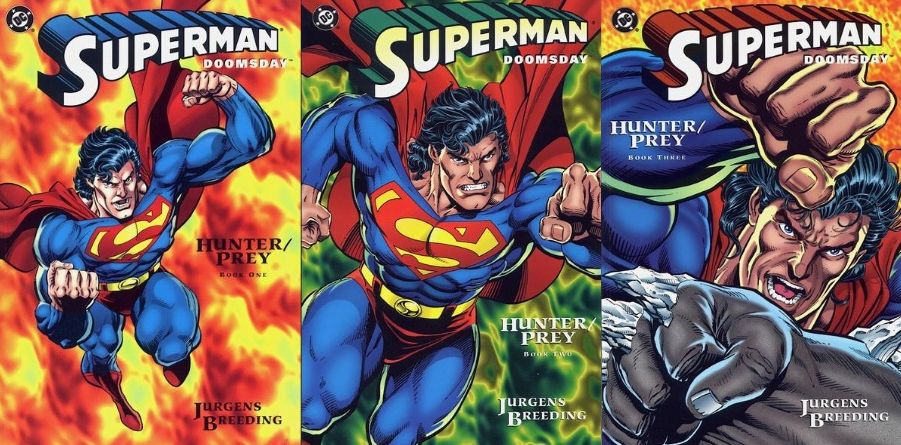
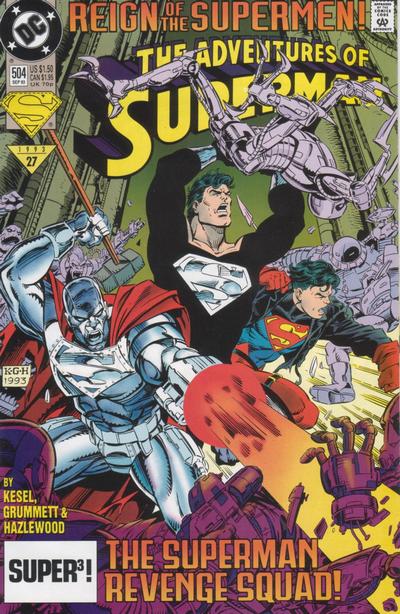
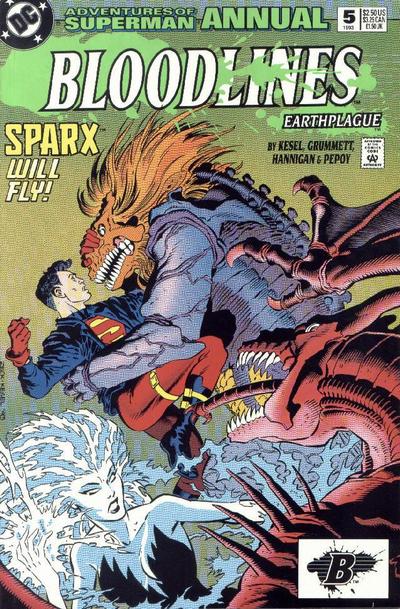
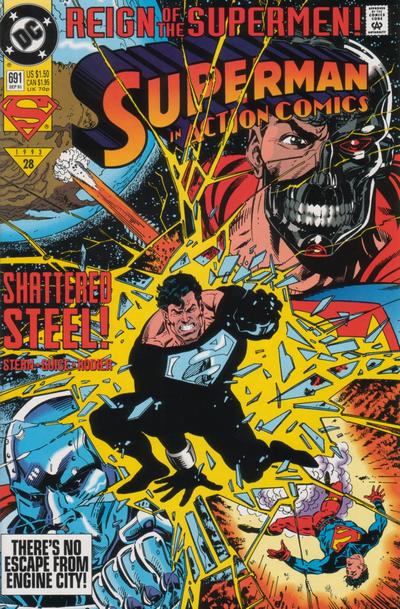
Another week, another round of the Year of Superman! It’s going to be another random week, a week where I’m not going to be adhering to any particular theme or category, and just reading or watching whatever catches my fancy. And there’s some fancy, fancy stuff coming down the pipe this week, from the big 25th issue of Joshua Williamson’s run on Superman to the completed three-part Last Days of Lex Luthor miniseries, and…well, I don’t even know what else will come up, because I’m writing this at the beginning of the week and I’ve got no idea where the solar winds of Rao will take me. Join me and let’s find out!
Wed., April 23
I feel like Perry is kinda burying the lede here…
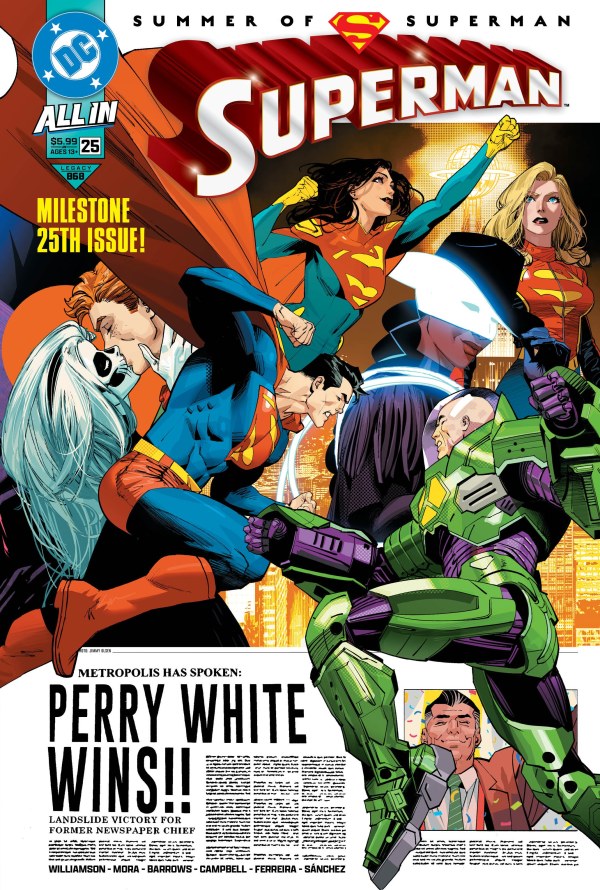
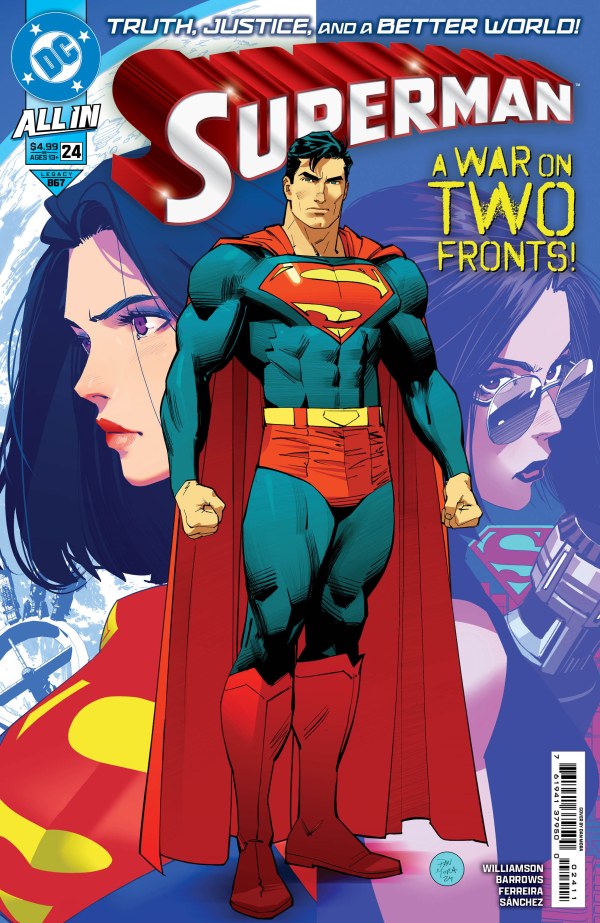
Comic:Superman Vol. 6 #25
Notes: Since Williamson kicked off his run on the main Superman comic about two years ago, he’s been building up a pretty epic storyline involving Lex Luthor. It began after Lex was taken into custody, turning over his company to Superman and making it “SuperCorp.” As one of the few people on Earth whose memory of Superman’s double identity remained (it was because of him that it was wiped out anyway), he decided that if he couldn’t destroy Superman, he would force him to work WITH him, and it was a strategy that worked pretty well for some time. Along the way, though, Lex lost his memory, leaving him a man who wasn’t quite as brilliant as before, but who had a genuine benevolence to him, seeming to want to atone for the crimes of his former self. It was a change for the better for everyone – except for Mercy Graves.
In this climactic issue, Mercy has let loose one of Lex’s failed experiments, X-El, a Luthor/Kryptonian hybrid clone, that she’s hoping to have supplant the “new” Luthor, and it’s Superman, Superwoman, and Lex vs. X-El. I loved this issue – it feels like a real culmination of the story so far, with everything that’s been happening building up to an incredible fight that lasts for most of the extra-sized issue. What’s more, the usual penciler Jamal Campbell (who has been doing a bang-up job on this series) is joined by a murderer’s row of talent, including Eddy Barrows, Eber Ferreira, and Dan Mora. Campbell and Alejandro Sanchez are credited as colorists as well, and although you don’t often discuss the colorists when you’re talking about comic books, this is one issue where it really stand out to me. Every page has at least one panel that could be turned into a poster I’d expect to see in any comic shop.
Although the issue is, like I said, kind of a culmination of the storyline in that it has brought everything together, it would be a mistake to imply that it’s the END of the story. In fact, this issue ends in a cliffhanger that’s really got me itching for issue #26. But man, I can’t say enough good things about this run and this creative team.
Thur., April 24
I just wish that Bryan Hitch would have the guts to put a little symbolism into his artwork.
Comics: Superman: The Last Days of Lex Luthor #1-3
Notes: About a month ago, when the long-delayed second issue of this miniseries finally came out, I decided to wait to read it until I had the third and final issue in my hands. I don’t know if the story would have been less impactful had I not chosen to wait, but I DO know that it would have driven me crazy to have to wait for the final installment, because ultimately, this is one of the finest Superman stories I have ever read.
And if you haven’t noticed, I’ve read a LOT of them.
In the first issue (which, again, came out nearly two years ago, and that’s the last time I’ll reference the delay), Superman is attacked once again by his greatest enemy…but this time, Luthor’s goal is not the death of the man of steel. No, for once, he needs his HELP. Lex Luthor, it seems, is dying. Some strange, exotic radiation is attacking his cells, and he knows that Superman is the one being in the universe who will stop at nothing to find a cure, because Superman…well…Superman is the man who saves everybody.
I don’t want to say too much more about the story, because there are some incredible twists and surprises throughout this miniseries. But that doesn’t mean there isn’t still a LOT to say. The reason Luthor turns to Superman, again, is because he knows that Superman will absolutely refuse to quit as long as there is a life in jeopardy, and the fact that the life in question belongs to his greatest enemy makes no difference whatsoever. Luthor sees this as foolishness, as a weakness on Superman’s part, but throughout this story, Mark Waid demonstrates why this is actually his greatest strength. Superman is confronted by friends who cannot fathom why he would risk so much to help Luthor. The quest to save his enemy becomes public knowledge, making some of the public turn against him. His quest takes him to Kandor, Atlantis, Themiscyra, and even the 31st Century, before the final reveal of what’s really going on turns everything on its ear and seals the fate of the two characters.
It’s an odd choice, to make this a Black Label book. Black Label is ostensibly a “mature reader’s” imprint, but there’s nothing in this book that warrants that marker. It’s out of continuity, to be certain, and I wonder if this would have been listed as Elseworlds, had that label been resurrected when the first issue appeared. But no matter what imprint this story falls under, it’s a masterpiece. It’s Mark Waid’s dissertation on who Superman is and why he has to be who he is. We learn the same things about Lex Luthor, in fact, and the relationship between these two characters has never been laid out so bare, so stark, so clean as in this story.
This story is brilliant. This is one of the best Superman stories I’ve ever read.
Fri., April 25
Comics: Justice League Unlimited Vol. 2 #6
Notes: The second part of “We are Yesterday” in Justice League Unlimited doesn’t have a ton of Super-action, but it’s a great issue nonetheless. In this issue, we see Grodd hatching his plan to infiltrate the past and collect purer versions of his former compatriots in the Legion of Doom to act as a countermeasure to the now-larger League. We also get a glimpse of the moment when Superman recruited Air Wave – who has become a surprisingly important character in this series – to join the League. Air Wave is an interesting character – a D-lister for years, and Waid has already found a way to make him compelling and sympathetic through a comparatively small number of pages in the first six issues of this title. I really hope that we get to see more of his story after this crossover with World’s Finest reaches its conclusion.
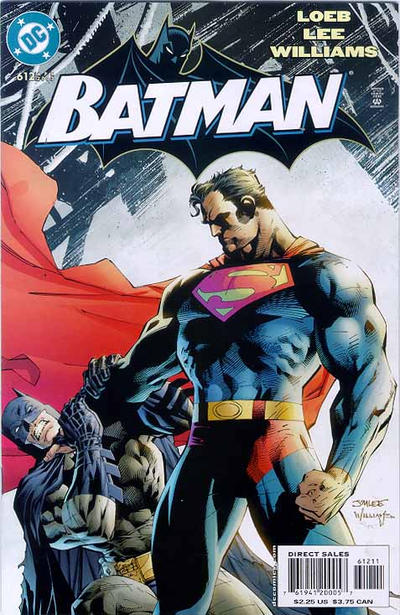
Graphic Novel:Batman: Hush (Collects Batman #608-619, Superman appears in #611, 612, and 619)
“Say it, Bruce! SAY THAT GLASSES ARE A PERFECTLY ADEQUATE DISGUISE!”
Notes: With “Hush 2” currently running in the ongoing Batman comic book, I wanted to go back and re-read the original, as it’s been a while. I’m not going to dig into it too deeply, as this ain’t the “Year of Batman,” and Superman’s appearances are brief. But brief or not, they ARE impactful, and I wanted to point out a few things.
First comes in Chapter 4 (issue #611 of the ongoing), in which Bruce Wayne visits Metropolis and, specifically, the offices of the Daily Planet. At this time, Bruce actually OWNED the Planet. I’m not sure if he still does or not. Hey, DC, give us a ruling. But regardless, in this issue he’s been finding himself growing more and more drawn to Catwoman, with whom he’s always had a “will they/won’t they” relationship. At the Planet office, he watches Lois and Clark together and marvels at how Clark has found someone with whom he’s willing to trust his greatest secret. A few chapters later (kinda spoilers, in case you’ve never read “Hush” before), Bruce reveals his own identity to Selina for the first time. It’s one of those rare status quo changes – like Lois and Clark getting married – that has stuck, and I find it very interesting that writer Jeph Loeb decided to use the Lois and Clark relationship as a way of sort of justifying that relationship upgrade for Selina and Bruce.
Superman has a bigger presence in Chapter 5 (issue #612), in which he’s being controlled by Poison Ivy and comes to blows with Batman in the sewers of Metropolis. (Side note: it’s VERY odd to see the way Catwoman fights both Ivy and Harley Quinn in this storyline, considering the way that the three of them would become the “Gotham City Sirens” just a few years later.) It’s a pretty good fight, all things considered. Bruce has his Kryptonite ring, and he’s counting on both that and the fact that he knows Superman is actively fighting against Ivy’s mind control to keep him alive. I think the most interesting thing about this fight, though, comes from a two-page spread in the middle, where Bruce’s inner narration makes a comment that the internet has elevated to meme status: “Deep down, Clark’s essentially a good person…and deep down, I’m not.” People love to use this quote, but I think a lot of them miss the point. The way I read it, this is something that Bruce sincerely believes…but he’s wrong. Not about Clark, of course, but about himself. And Clark would be the first one to tell him that.
Also, in this issue, Poison Ivy gets captured by Krypto, and that’s just adorable.
Superman then dips out of the rest of the story until the denouement in Chapter 12 (issue #619). The mysterious Hush has been defeated and Bruce turns once again to Superman…not just because he needs a friend, but also because he needs someone with X-Ray vision to make sure that Hush didn’t do anything inside of his head…and literally, not the way the Joker does it. The three appearances of Superman in this story really speak strongly towards the bond between these two heroes and the trust that they share. At the same time as this storyline was winding down, Loeb was launching the ongoing Superman/Batman series, and I don’t believe for a second that this was a coincidence. He writes both heroes well. He writes them TOGETHER excellently.
Sat., April 26
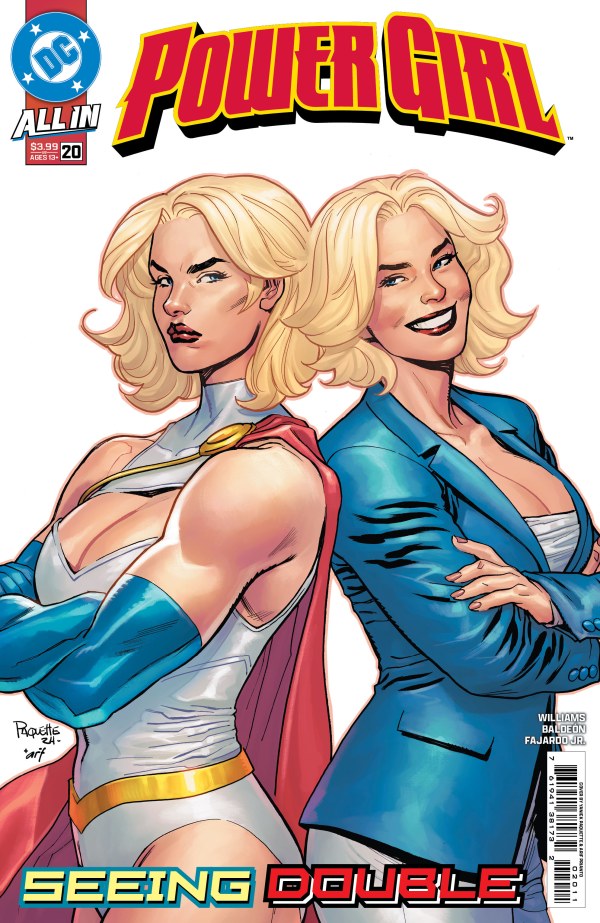
Comic: Power Girl Vol. 4 #20
“Meet Kara who’s never had a home From Argo City to the Phantom Zone But PAIGE HAS MADE FRIENDS LEFT AND RIGHT TO GO WITH HER KRYTPONIAN MIGHT! Whaaaat a crazy pair…”
Notes: This volume of Power Girl ends with this issue and, much as I hate to say it, I’m not really upset to see it go. It had a promising start, but the series seemed to be all about trying to figure out who Power Girl is and…frankly…I’m tired of that. A lack of identity has been Power Girl’s defining characteristic for the past 40 years, and that’s at least 39 years too long for that to be interesting in any individual character. At first, it seemed as though this series was going to lock her in to a true identity, but as evidenced by the cover of this last issue, it never really felt like it gelled. The book built up her world, built up her supporting cast, but didn’t really build up HER. I get it. It’s difficult. The elevator pitch of the character is “older Supergirl from Earth-2,” and since we’ve already got the “Prime” Supergirl, that doesn’t seem to leave room for her. But if all you do with the character is point out that she seems superfluous without redefining her in a satisfying way…well, what have you actually done? I hope somebody else gets their hands on Power Girl soon. I don’t care if it’s as a supporting player in the Superman titles or if she rejoins the Justice Society or what, but I want somebody, ANYBODY to take Kara Zor-L and finally, after all these years, say “This is who she is and this is what makes her unique, and can we please stop having the same conversation?”
Is that so much to ask?
Sun., April 27
Comics: Batman Vol. 3 #36-37
Part one: Bromance. Part two: Romance.
Notes: When I read Hush a few days ago, I noticed a scene in the chapter where Superman is controlled by Poison Ivy where Catwoman tries to break him out of it by threatening Lois Lane’s life. She didn’t mean it, of course, she did it because Batman told her that Superman was close to the people who worked at the Daily Planet and that endangering one of them would help him break from Ivy’s control. Nor did she know specifically that Lois was Clark’s wife – Bruce also told her that Jimmy Olsen and Perry White would have been suitable for this purpose. But the scene put me in mind of a more recent meeting between these four, and I wanted to read it today.
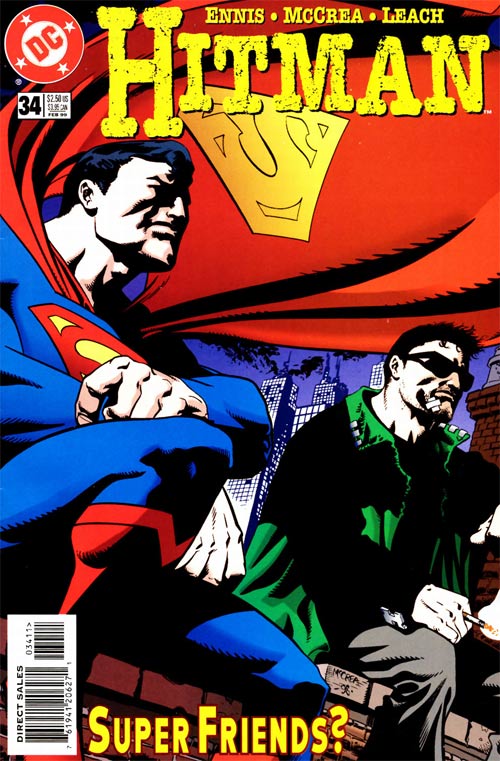
Tom King’s run on Batman is controversial for reasons I’m not going to get into here, but the two-part “Super Friends” story from Batman Vol. 3 #36 and 37 is one of the best stories about Superman and Batman I have ever read. Batman and Catwoman have recently become engaged, and in the first issue Bruce and Clark each have conversations with their respective significant others about the fact that they haven’t spoken to one another about the engagement yet. Clark is convinced that the fact that Bruce hasn’t called him is evidence that they’re not really that close, Bruce says he shouldn’t have to call Clark because his best friend is actually Jim Gordon (who doesn’t know his real name) or Alfred (who Selina points out is on his payroll, and therefore doesn’t count). The bulk of the issue is taken up with cutting back and forth between these two conversations, and the quick realization that Lois and Selina know Clark and Bruce far better than either of the world’s two greatest heroes know themselves. At the end of the first issue, the two couples come together in one of the most charming meet-cutes I’ve ever seen. You’ve probably seen the page on the internet even if you’ve never read the issue.
Yeah, that’s the stuff.
In part two, the foursome go on a double date to an amusement park which is celebrating “Superhero Night” – you have to have on a superhero costume to get in. Under the ladies’ suggestions, Bruce and Clark wear each other’s costumes and enter the park to enjoy an extremely rare night for themselves.
Tom King’s depiction of this relationship is spot-on. They’re best friends, even though neither one of them really wants to admit it. Their differences are what make them work together, not something that drives them apart. And the scenes of Lois and Selina bonding with one another are absolutely joyous. We fans talk quite a bit about how difficult it must be for superheroes to hide the secret of their dual lives, but we don’t talk enough about the toll it might take on those who love them. Giving Lois a new friend in Selina really feels natural. I was, I admit, disappointed when the Batman/Catwoman wedding didn’t go through, because I thought that DC would finally have the guts to push Batman’s status quo in a new direction permanently. I still think that it would have been better if they’d remained together. But mostly, I miss the chance to have more issues like this one, with Clark and Lois and Selina and (however begrudgingly) Bruce just being friends.
Don’t we all need that?
Mon., April 28
TV Episode: Superman and Lois, Season 2, Episode 7, “Anti-Hero”
Or the “Lana’s Trauma Conga Express.”
Notes: Superman has been taken into custody by the DOD, who are holding him under a red sun lamp to negate his powers. As Lois and Sam try to figure out a way to navigate his release, Jordan is still angry at his brother for lying about the source of his newfound powers, and Lana and Sarah are dealing with the fallout of Lana’s impending separation from her husband.
Did you notice how each plot point I recapped there got progressively less superhero-y and more soap opera-ish? To be fair, there has been overlap in the kind of storytelling done by superheroes and soap operas for a very long time. Even as far back as the Golden Age you had the occasional unrequited love runner that punctuated early superheroes. Then, once Stan Lee brought in the Marvel Age of comics, the greater emphasis of serialized storytelling made it virtually inevitable that elements like Spider-Man’s disastrous love life would become an ongoing story point. But at times, Superman and Lois feels far more like a teen drama than a superhero show. It’s not fair to criticize the show on that point – for what it’s doing, it seems to do it just fine. But it isn’t exactly what I’m looking for here.
Some of the soap opera stuff is done well. For instance, there’s a nice scene where Lois and Lana are bonding over their respective family struggles – Lana with the fact that her husband cheated on her, Lois with the fact that her son got caught with a backpack full of drugs. The odd thing is that they’re treating X-Kryptonite as if it was any other drug. Jonathan’s bag had 20 vials, each of which could turn a teenager into a walking weapon of mass destruction, but the conversation they have could have been ripped straight out of a 70s After School Special about a mom who caught her son with a joint.
That’s not to say that there’s no superhero stuff going on, of course. The story of Clark in custody, held under the red lamps with his half-brother Morgan Edge, is exactly what I’m hoping to see. The DOD even weaponizes Superman’s compassion, threatening to harm Edge if he doesn’t give them information that they want, which he does despite the fact that his brother is also his enemy. I even like the way the two of them put their differences aside and work together. The CW has a tradition of villains slowly reforming and joining the heroes that goes back to when they were the WB network and it happened every season on Buffy the Vampire Slayer, so if that turns out to be the long game with Morgan Edge’s character, I’m used to it. Once they meet up with the hologram of Lara and the Alternate-Superman (can we PLEASE just call him Bizarro?), there’s some good action stuff here.
But none of that addresses the real problem I’ve been having with this show in season two. I love Hoechlin’s Superman, but the problem here is that they’ve isolated him. The show is stronger when he’s paired with Lois or where he’s working with his sons and their struggles with Jordan’s powers and Jonathan’s typical lack thereof. If you’re not doing that kind of thing, if you have him segregated from the rest of the main cast, you may as well be watching two entirely different shows.
Clark, fortunately, returns to Lois at the end of the episode. But before that we get one more little scene I liked. Edge is still in custody, still the bad guy, but at the end of it Clark addresses him as “Brother.” This actually goes directly against something said earlier in the episode, when she tells Jonathan that his father would never forgive him for his involvement with X-K. But as the end of this episode shows you, Superman’s forgiveness is infinite. You mean to tell me, Lois, that you don’t think he would forgive his SON? Come on, you know him better than that.
Then again, the episode ends with Clark tearing into Jonathan and not allowing him the opportunity to talk, so what do I know?
When the dry cleaner at the Hall of Justice mixes up the bags.
Notes: I’ve got a new writing project I’m working on today, so I needed something quick to slip in to the Year of Superman. The classic Elseworlds one-shot Superman: Speeding Bullets seemed like just the thing. Written by J.M. DeMatteis with art by Eduardo Barreto, this is about as close to the old Marvel What If? format as Elseworlds got, basically asking the question, “What if Kal-El was found by Thomas and Martha Wayne instead of Jonathan and Martha Kent?” Thomas and Martha – childless in this universe – find the rocket ship and adopt the child much like the Kents did, naming him Bruce and raising him as their own. Kal-El’s life in Gotham is pretty similar to the mainstream Bruce Wayne until the night of his parents’ murder, when – seeing the people he loved most in the world gunned down in front of him – his head vision activated and he roasted Joe Chill to death. In shock, Bruce developed a mental block about that night, forgetting his powers until – as a young adult – robbers break into Wayne Manor. His heat vision – and memories – come back, and he becomes a much more brutal version of Batman and the one in our universe.
When I say this was close to a What If?, I don’t just mean in premise, but also in execution. The classic What If? stories tended to end in one of two ways: either the universe attempts to “course correct,” resulting in a world as close to the original as possible, or things go so dark and bleak that it may as well be the apocalypse, at least for the characters involved, if not literally. Some of the ways we see that here are Bruce deciding to buy the Gotham Gazette and hiring Perry White and Lois Lane, falling in love with the latter, and Lex Luthor suffering an accident in a chemical plant, transforming him into this world’s version of the Joker. Since this is a world that can’t have both a Superman and a Batman, we watch Bruce Wayne transform from one to another. Lois’s influence cools his rage, getting him to pull back on his bloodlust, and eventually abandoning the Batman identity to become his world’s Superman. It’s an interesting book, and it works well as an Elseworlds. I have to admit, though, I’m surprised that this version of Bat/Superman hasn’t turned up the way other Elseworlds versions like Red Son or the Vampire Batman have once the Multiverse was opened up again.
It’s a big week for Superman fans – DC’s “Summer of Superman” initiative is kicking off this week with the Summer of Superman Special. Not only that, but April 18th is the anniversary of the release of Action Comics #1 back in 1938, and therefore DC has declared it “Superman Day.” It also happens to be the first day of my spring break, so I’m intending to put my son in his Superman t-shirt (matching my own) and going down to BSI Comics that day to celebrate.
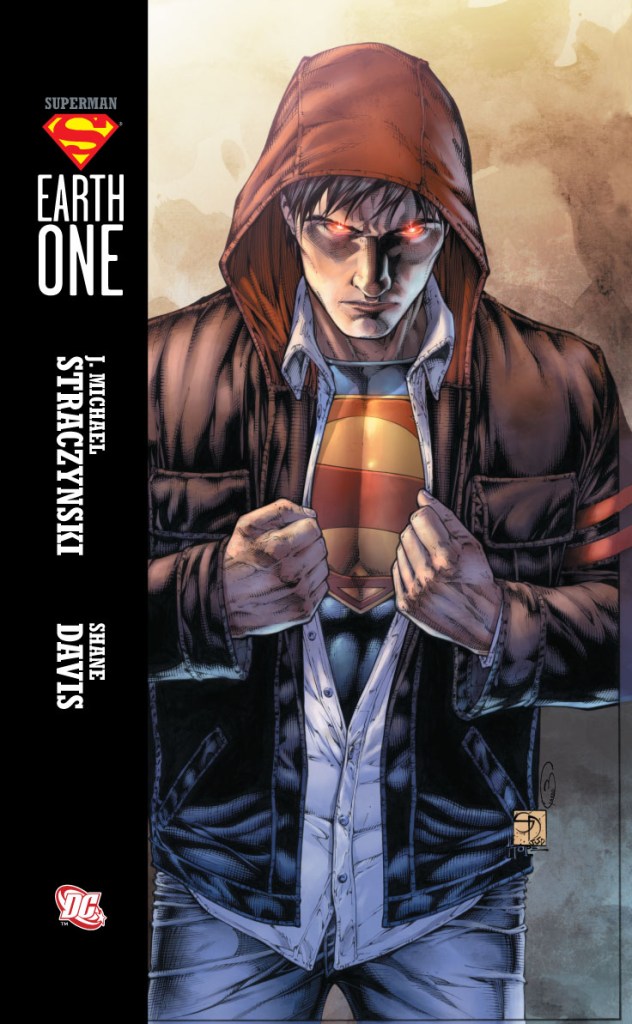
And since this week marks the Man of Steel’s anniversary, it feels like a good time for another one of those themes that I had marked off at the beginning of the year: it’s gonna be Origins Week. Superman’s origin has been told many, many times over the years, and in many different continuities. Last week, for instance, I read the first Earth One graphic novel, which was such a take on Superman’s origin. But I’m going to focus on the ways his origin has been told in-continuity. DC’s continuity has been retold and rebooted a ridiculous number of times over the years, of course, but this week I’m going to plant my flag on stories that were considered the definitive origin of the “Prime Universe” Superman at the time of publication. And even then, I’ve got plenty to choose from.
Wed., April 16
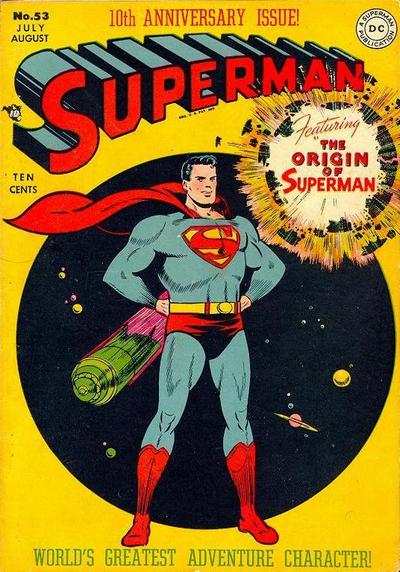
Comics:Superman #53, Superman #146, Challengers of the Unknown Vol. 5 #4 (Guest Appearance)
Notes: I read Action Comics #1 back on January 1st, so I’m not going to include it again in Origins Week. Besides, there wasn’t a lot of detail in that first iteration of the origin anyway – so many of the details, including the name of his home planet, weren’t filled in until later. The origin presented in Superman #1 wasn’t much better, expanding to a whopping two pages before jumping into the issue’s first story. So I’m going to look instead at a couple of later issues that filled out the story, beginning with Superman #53 from 1948, a special “tenth anniversary” story. To be honest, I’m not 100 percent sure that this is the first time the origin was told in full, but the text on the first page DOES say “Now, at last, you’ll know all the answers,” so at the very least not all of this stuff was yet common knowledge.
Don’t you love how quaint the old blurbs were? “World Greatest Adventure Character!” The Fantastic Four was just waiting to jump in on the hyperbole bandwagon.
The story begins on Krypton, with Jor-El warning that the planet’s uranium core is breaking down, transforming the planet into an enormous atomic bomb. The planet’s rulers, of course, don’t believe his warnings, and Jor-El makes it home just as the final cataclysm begins. He has room in his prototype rocket for his wife and child, but Lara insists her place is with her husband, and thus they send their baby to Earth alone. His rocket lands in the American heartland, where he is found by an elderly couple who bring him to an orphanage. The super baby causes chaos in the orphanage, and when the older couple returns hoping to adopt the child, the orphanage rushes through the paperwork to get rid of him quickly. Bringing them home, he is named Clark Kent. He grows up, gradually discovering more and more powers, until as a young adult his foster mother dies, followed by his father, who urges Clark on his deathbed to use his powers for good.
As you can see, the basic framework of Superman’s origin is all here, the skeleton which has provided the structure of his story for the past 87 years. But the story cuts off before he goes to Metropolis, joins the Daily Planet, first encounters Lois…in other words, a lot of the stuff that really helps make Superman who he is. There are also an awful lot of details that haven’t been filled in yet. Jor-El and Lara are both named, but their baby is not specifically called Kal-El in this story. The Kents’ first names aren’t mentioned until the scene where Clark stands by his graves, and then the names inscribed as “John” and “Mary,” before they were codified as Jonathan and Martha. And even though he clearly grows up in a small town, the location is not specified as Kansas, and the name “Smallville” is never mentioned.
You could honestly do this same experiment with any of the Golden Age heroes who have stood the test of time – go back and read their earliest stories and see which elements were missing, which pieces of their mythology that seem so critical to us now were in fact later additions. And “mythology” really is the appropriate word – you could do this same task with the stories of Thor, of Odysseus, of any character from classical mythology. Stories grow and build and evolve over time, and our modern stories are no different. It’s a process that honestly fascinates me, which is one of the reasons I’m approaching this week the way that I am.
And they didn’t even put the kid into a five-point harness? Kypton deserved what it got.
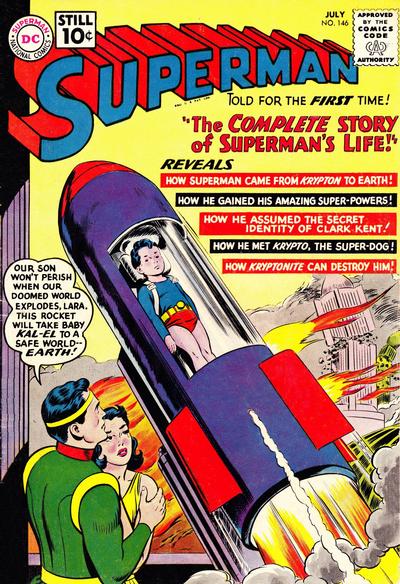
We got a more complete version of the origin in Superman #146 from 1961. In “The Story of Superman’s Life,” a lot of those little details that hadn’t solidified yet in ‘48 had come into focus. Once again we see Jor-El warning the people of Krypton of the planet’s impending doom, but only his brother, Zor-El, believes him. In this version, he first uses Krypto as a test subject, sending him into space first before the final cataclysm that causes him and Lara to send Kal-El (now named) to the stars. This version also covers how the nuclear reaction transformed the fragments of the planet into Kryptonite, then shows Kal-El’s rocket landing in Smallville, where he is found by Jonathan and Martha Kent. This time, the Kents leave the baby on the orphanage doorstep, coming back to adopt him after a few days of superbaby hijinks. He grows up, gaining power as he does, and the Kents eventually discover that the blankets he was wrapped in when they found him are just as invulnerable as their son.
As Clark gets older, Martha unravels the threads of the blankets (because they can’t be cut) and re-weaves them into his first Superboy costume. Clark adopts his glasses – made from glass from his rocket ship which is impervious to his head vision – to help protect his secret identity from the likes of his nosy next-door neighbor Lana Lang. In fact, he even builds his first robot duplicate in order to trick Lana. We get his reunion with Krypto and how he uses the information he learns to determine his true origin, coming from Krypton, and how the Earth’s yellow sun and lower gravity give him his powers. His first interaction with Kryptonite is rather benign – Jonathan brings home a rock for his son’s mineral collection that instead makes him sick. The next stage of his life comes when his foster parents again die, with his father again urging him to use his powers for good before he’s gone, and Superboy decides to leave Smallville to come to Metropolis.
Clearly, this is much more detailed than the previous version, including a lot of the bits and pieces that had become standard by then. However, because of this, the comic book doesn’t read so much as a story as a checklist ” here are the things that we know about Superman, so let’s make sure that we mark them off along the way. There are even a few elements that are covered in footnotes – such as how Zor-El (who would become Supergirl’s father) escaped Krypton’s destruction and how a pack of green Kryptonite meteors were transformed into red Kryptonite. And even though this story ends with Clark Kent working for the Planet, we don’t actually get the story of HOW that happened.
It’s more detailed, but honestly, I like the story from issue #53 better.
That said, this story pretty much laid out the important details, and it would be 25 years before there was any serious revision again. That would be John Byrne’s Man of Steel, and that’s what I’ll tackle next.
Thur., April 18
Comics: Man of Steel #1-6, Detective Comics #1095 (Guest Appearance), Justice League of America #21
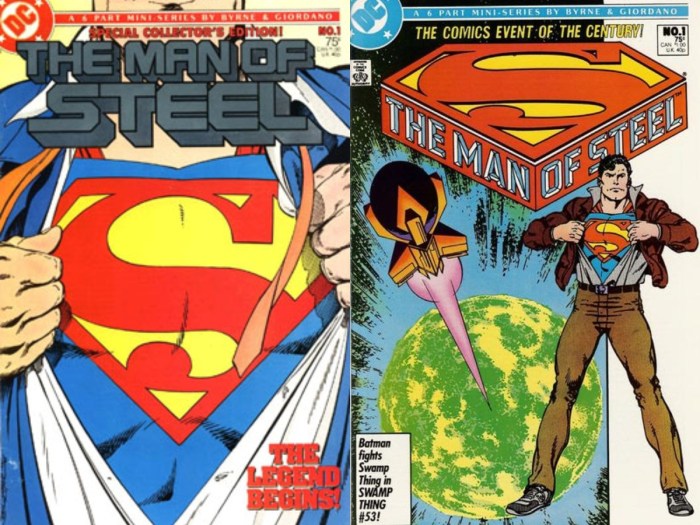
TWO! TWO! TWO covers in one!
Notes: If I were to take a guess as to which Superman comic I’ve read more than any other…well, it would be impossible to say for sure, but I would wager that Man of Steel #1 is a close contender. I don’t remember exactly when I got this first issue or how, but I know that it was in my collection even before I became an adamant Superman reader a couple of years later. I read that issue many times, I liked that first issue quite a bit, and I know that I’ve returned to it over and over again in the years since. Man of Steel was DC (via writer/artist John Byrne) attempting to update Superman for the 80s, and on that note, it succeeded beyond all measure. Superman was reinvigorated, given new life. It made Clark Kent the character’s heart and Superman the mask, as opposed to the reverse dynamic which most older stories had employed. It crumbled up and threw away the lovelorn man-chasing Lois Lane once and for all, replacing her with a fearless reporter who was every bit the equal of the Man of Steel – a portrayal more than a little inspired by Margot Kidder’s performance. And perhaps the greatest change, at least in my opinion, was that unlike every version of Superman that had come before, in this version Jonathan and Martha Kent were still alive, still able to be family and confidants to the adult Superman, giving him something he had never had before.
This isn’t to say that I love everything about his version of Superman. My biggest beef is the enforced notion that Kal-El be the ONLY survivor of Krypton, which did away with such things as Krypto, Supergirl, the bottled city of Kandor, and so forth. These elements would drip back in over the years, fortunately. But for the most part, this is the origin of Superman that is most firmly etched in my brain, and when I think of the architecture of Krypton or the clothing that Jor-El and Lara wore, this is still the version that comes to mind most fervently.
Let’s break it down, shall we?
Man of Steel #1 begins on a Krypton that is dying. Millions are succumbing to a plague they are calling the “green death,” but only Jor-El has been able to uncover the truth. A chain reaction in the core of the planet is transmuting the entire world into a new, radioactive metal that is killing them all, and what’s worse, that same reaction is soon going to destroy the planet. Jor-El takes the gestation matrix carrying his unborn son and outfits it with a hyperdrive to send it to another world, which he does so mere moments before Krypton’s death. With his final breath, he expresses his love to Lara, something that on this Krypton – a cold world devoid of emotion and feeling – is strictly forbidden.
Byrne skips ahead now to Clark Kent’s senior year of high school, where he wins the final football game of the season virtually singlehandedly. Slightly disappointed, Jonathan Kent reveals to his son that he is not their natural born child, but rather that he was found in a spacecraft 18 years prior. Clark decides to leave Smallville and begin using his gifts to help other people. Another time skip sends us ahead seven years, where Martha Kent has compiled a scrapbook of newspaper clippings of all manner of disasters that were averted – a puzzle solved when the newest headline reads “Mysterious Superman Saves Space Plane.” Clark comes home and tells his parents how he was forced to use his powers openly for the first time, preventing the crash of an experimental spacecraft that happened to include among its crew a reporter for the Daily Planet – one Lois Lane. Together, the Kents decide that in order to operate freely, Clark needs a new identity. They craft a costume, design a symbol, and Superman is born.
A few other things of note in this first issue: besides the dramatic change to Krypton, Byrne also canonizes the idea that Superman’s first public appearance is saving Lois Lane from an air disaster – in essence a much more dramatic version of the helicopter rescue from the first Richard Donner/Christopher Reeve movie – as well as that it is Lois who dubs him “Superman” in the press. There have been lots of revamps to Superman’s origin over the years, lots of versions that have bled into other media, but I always like it when they keep these two particular elements. It just feels right. It doesn’t quite work in versions where he was SuperBOY before he grew up, of course, but I’m willing to pick my battles.
This issue also set the tone for the rest of the five-issue miniseries that preceded Byrne’s runs on Superman and Action Comics. DC wanted a new Superman, but they didn’t want to have to tell an ongoing story where he’s still brand new and unknown to the world. So like this first issue, the rest of the miniseries skips ahead to high points in Superman’s career, important first encounters, that sort of thing, before finally catching up to a “modern day” at the end of issue six. This was, I think, probably the best way to handle it, and it left room for Byrne and future writers to fill in some blanks, which of course they did.
I’ve never thought about it before, but it must be hell for Lois Lane to get an insurance quote.
Issue two probably has the briefest time skip of the series, picking up shortly after Superman has gone public. As he makes his first appearances in uniform, Lois finds herself determined to get the story of this remarkable newcomer to Metropolis. She spends days following him from one encounter to another, always showing up just after he’s finished saving someone or thwarting a crime, but never getting close enough to talk to him. Lois decides to get his attention by driving her car off the pier, prompting him to swoop in and save her for the second time, and she manages to pressure him into an interview, although he isn’t too forthcoming. As he takes off, he casually asks her if she always drives around with an aqualung under the front seat of her car. Lois, clearly smitten, rushes the story of Superman, bringing it in to Perry White’s office, only to have all the wind blown out of her sails when Perry reveals that the Planet has already gotten the same story from their newest reporter: Clark Kent.
This issue nails the Lois Lane that I love – unflinching, brave, willing to do anything for her story. It also sets the gait for their relationship: Superman knowing full well that she was never in any danger but playing along anyway is just the perfect dynamic for the two of them. If anyone asks me who Lois Lane is, I can’t think of a better way to answer that question than to just show them this issue.
Man of Steel #3 reintroduces another of Superman’s most important relationships: that with Batman. But this isn’t the best friend he had in the Silver Age, or even the slightly strained friendship they enjoyed in the early 80s. Superman comes to Gotham City to round up the vigilante who has been making the news, only to be told by Batman that he’s rigged a device that will set off an explosion somewhere in Gotham City, killing an innocent person, if Superman touches him. With Superman temporarily helpless, Batman explains that Gotham requires a different approach – for example, he’s tracking down a thief and murderer called Magpie who has been terrorizing the city. Superman reluctantly goes along and helps capture Magpie, only to learn at the end that Batman’s “bomb” was in his utility belt the entire time – the “innocent” person in danger was himself. The two leave not as friends, but at least with a truce and the understanding that their different worlds require different methods.
This issue illustrates the other thing from this era of Superman that bothers me – the antagonistic relationship he had with Batman. Frank Miller loves to take credit for destroying their friendship (via The Dark Knight Returns), and DC ran with that dynamic for far too long. That’s not to say that this isn’t a good issue – Byrne does a fine job – but it set Superman and Batman at odds with one another for quite some time before the relationship finally began to soften, becoming allies again, and eventually the friends that they should be.
Issue four brings Superman, for the first time, in conflict with his greatest enemy. Byrne’s revamp of Lex Luthor transformed him from the evil mad scientist of the old days into a ruthless, brilliant, corrupt businessman. Rather than operating out of a secret lair, he’s got a huge building shaped like his own initials, and he controls Metropolis fairly openly – until Superman shows up. He hires thugs to fake a terrorist attack on his cruise ship, horrifying Lois and seemingly “killing” Clark Kent. (Spoiler alert: Clark isn’t really dead.) Superman rounds up Lex and arrests him for the first time, setting the tone for their relationship from then on. LexCorp (sometimes “LuthorCorp”) would become a permanent addition to the Superman mythology, and the current iteration of Lex is somewhere between this one and the old version – still a ruthless businessman, but ALSO with the incredible scientific mind that Superman mourns whenever he uses it for evil. One other element added here is Lex’s pursuit of Lois Lane. This is a bit that’s come and gone over the years, but for this version of Lex, it works just fine. This was the perfect Lex for the time, but I think the gestalt version we have these days is probably the ultimate form of Lex Luthor.
I hate it when my imperfect duplicate shows up and punches me in the face.
The fifth issue gives us another time skip, and this time, the creation of a new Bizarro. This time around, an effort by Lex to clone Superman results in a duplicate that is slowly deteriorating. Meanwhile, Lois’s sister Lucy is dire straits, contemplating the futility of her life as the result of a terrorist attack that left her blind. This is a really odd way to reintroduce Lucy Lane into continuity, although I suppose it does somewhat continue the trend of Lucy being treated like the universe’s punching bag. This is perhaps the oddest of the six issues. The others all have a specific point or person in Superman’s life that they focus on: his origin, Lois Lane, Batman, Lex Luthor, and in the final issue we’ll see him learn about his heritage. The creation of a new Bizarro – particularly one that doesn’t even survive the issue – is an odd choice. It does show a bit more just how crafty Lex can be, but issue four already established that pretty handily. There’s nothing wrong with it, of course, but it’s always felt a bit out of place among the other five chapters.
In the final issue of this miniseries, Superman returns to Smallville to visit his parents and comes face-to-face with Lana Lang. Lana had only been mentioned briefly back in issue one, so this is a pretty big deal – we learn that before Clark left Smallville, he told Lana about his powers. To him, he was confiding in a friend, but Lana – who had always harbored dreams of a future as Mrs. Clark Kent – saw it as the end of the future she had always imagined. This was a totally new dynamic for Clark and Lana, and it lasted for some years as Lana slowly evolved as a character. I like this as a chapter in her past, but I’m glad it’s behind her and she’s taken her place as one of Clark’s closest friends. In fact, she’s even – you know what? I’ll wait until tomorrow to talk more about what Lana is up to these days.
The other big thing about Clark’s return to Smallville is his interaction with the matrix that brought him to Earth. A hologram of Jor-El downloads the history of Krypton into Clark’s brain, telling him the truth of his origin for the first time. He knows the history of Krypton, can speak its languages, knows of its great literature…but in the end, decides that it isn’t important. He may be the last son of Krypton, but it is Earth that made him who he was.
Little bit louder for Quentin Tarantino and Max Landis.
Yeah, that’s pretty much my thesis on Superman too. Thanks for confirming, Mr. Byrne.
Fri. April 18
Feature Film: Superman III (1983)
The recasting of Lois Lane was controversial at the time.
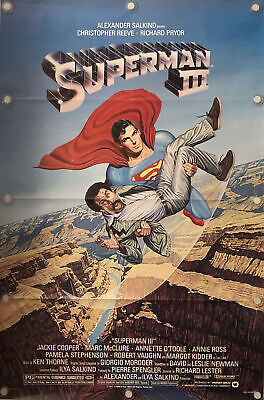
Notes: I decided to pause “Origin Week” just for today, Superman Day, so that I could celebrate it properly. I put a little video on TikTok explaining what’s so darn great about Superman. I put my son in his Superman T-shirt and I put on mine. (Well, I put on ONE of mine. I have…several.) We went out to our local comic shop, BSI Comics in Metairie, Louisiana, and we came home to watch a Superman movie. It may not be the most obvious choice for this most glorious of occasions, but I’ve already rewatched the first two Christopher Reeve Superman movies for this blog experiment, so I decided to continue on with the infamous Superman III. In this one, a man named Gus Gorman (Richard Pryor) struggling to keep employment suddenly finds a talent for computer programming . His skills – and the use of those skills to defraud the company – brings him to the attention of his boss (Robert Vaughn) who, rather than throwing Gus in jail, decides to use his skills for the benefit of them both. Meanwhile, Clark Kent returns to Smallville for a high school reunion, bringing him back into the orbit of Lana Lang (Annette O’Toole), the girl he left behind.
I hate to admit it, but I do have something of a soft spot for this movie. It’s not great, of course. Lois Lane is reduced to a cameo, the villain quite clearly SHOULD have been Brainiac – but for some reason, wasn’t – and the attempts to make it into a comedy so as to justify Richard Pryor’s presence are…well…strained.
But despite that, there are things about this movie I enjoy. Richard Pryor was funny. Even when the material he was working with wasn’t great, he had a talent to elevate it and make it more entertaining, and it’s fun to watch him on screen. Then there’s Annette O’Toole, an absolutely radiant Lana Lang. She’s sweet and gentle, the polar opposite of everything Margot Kidder’s Lois Lane is, and while everyone knows that Lois and Clark is the endgame, watching O’Toole as Lana for a few minutes is enough to make you believe he could be reconsidering it.
But the best thing about this movie comes after Gus hits Superman with a chunk of synthetic Kryptonite that slowly turns him bad. In what is honestly one of the best scenes in the entire Reeve Superman series, he splits into two people – an Evil Superman vs. a Good Clark Kent. The scene – a battle in a junkyard where Christopher Reeve battles himself – is well shot and has impressive effects, but it also really works thematically. Even in an era where “Clark” being the real guy and “Superman” the mask was perhaps a minority opinion, this movie kind of puts forth that thesis, and I love that about it.
Comics: Superman Day 2025: Jimmy Olsen’s Supercyclopedia Special Edition #1,DC X Sonic the Hedgehog #2, Batman/Superman: World’s Finest #38, Action Comics #1085, Summer of Superman Special #1
Notes: I also sat down this afternoon to read the last couple of weeks of Superman comics, so let’s run through those together, shall we?
I love the high holidays.
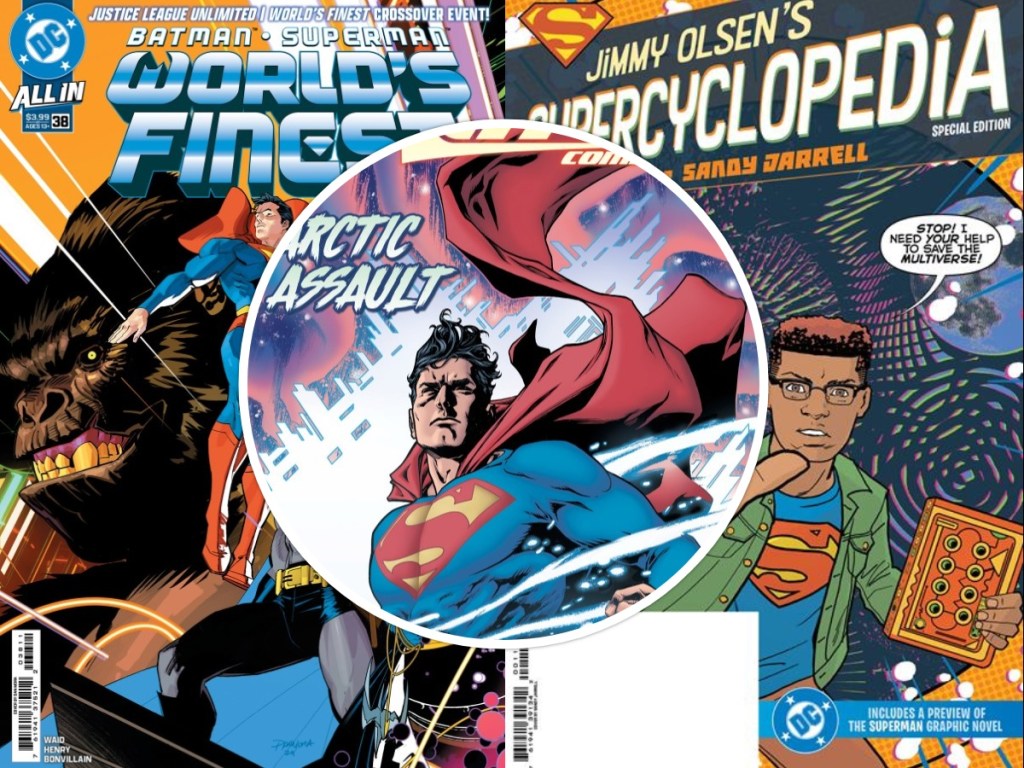
There were several free Superman comics available today, but I already had most of them (All-Star Superman #1, Superman For All Seasons #1, and so forth), so I passed on those in the hopes that they would pass into the hands of people who haven’t read them a dozen times before. I did, however, get the preview edition of Gabe Soria and Sand Jarrell’s graphic novel Jimmy Olsen’s Supercyclopedia. The hook of this graphic novel, it seems, is that Jimmy Olsen is getting a little tired of living in Superman’s shadow. Not that he blames the big guy, but it’s easy to get lost when the world only thinks of you as “Superman’s pal.” Then someone shows up who seems interested in Jimmy himself, and that changes things. It’s an interesting concept, but I have to admit, it didn’t totally grab me. Although I could see myself reading the rest of the book via DC Universe Infinite, I don’t know that I’d buy it.
DC X Sonic the Hedgehog #2: The crossover event of the century continues with Sonic and the Flash chasing after Darkseid to try to wrest the Chaos Emerald from him. When he manages to escape, the Justice League and Team Sonic manage to chase him down to the Ragna Rock for a fateful confrontation – with a shocking ending. I don’t have a lot more to say about this book other than what I said about the first issue – it’s so much fun to see these characters together, and really refreshing to have a crossover that bypasses the requisite “heroes fighting heroes” tropes and just gets to the fun stuff. Once this series is over, the collected edition is going to be a perfect book to get for my son and my nephew.
Batman/Superman: World’s Finest #38 begins the “We Are Yesterday” crossover in earnest. Clark Kent is covering the test flight of a Wayne Aeronautics jet plane – piloted by one Hal “Highball” Jordan – when the plane is destroyed and Jordan abducted by Gorilla Grodd. Superman, Batman, and the Flash take off to rescue Hal from the superintelligent simian, whose sights are higher than ever. This is the beginning of the time travel story Mark Waid is weaving between this series and Justice League Unlimited, with the modern-day Grodd interacting with his past self. It’s a great start to the story, full of superheroics, great artwork, and lots of monkeys. These are all good things.
Action Comics #1085 is the beginning of the two-part “Solitude” arc by G. Willow Wilson and Gavin Guidry (who previously did a great stint on the Superman ‘78 comic, and I’m happy to see him here). Clark is sent to the arctic to cover an experiment at a research station. Shortly after his arrival, though, the local wildlife takes undue interest in the station – they’re attacked by cyborg polar bears! And lemme tell ya, that sentence is as much fun to write as it is to read about. Anyway, it’s a good first half of the story, plus Guidry gets to design a new white and blue “polar” costume for Superman. It’s odd that Superman has so comparatively few variants, as opposed to Batman, but I have no doubt that we’ll be seeing this outfit in action figure or Funko Pop form sometime soon.
Yet there’s no scene where anybody says, “Cool suit, Superman!” What a waste.
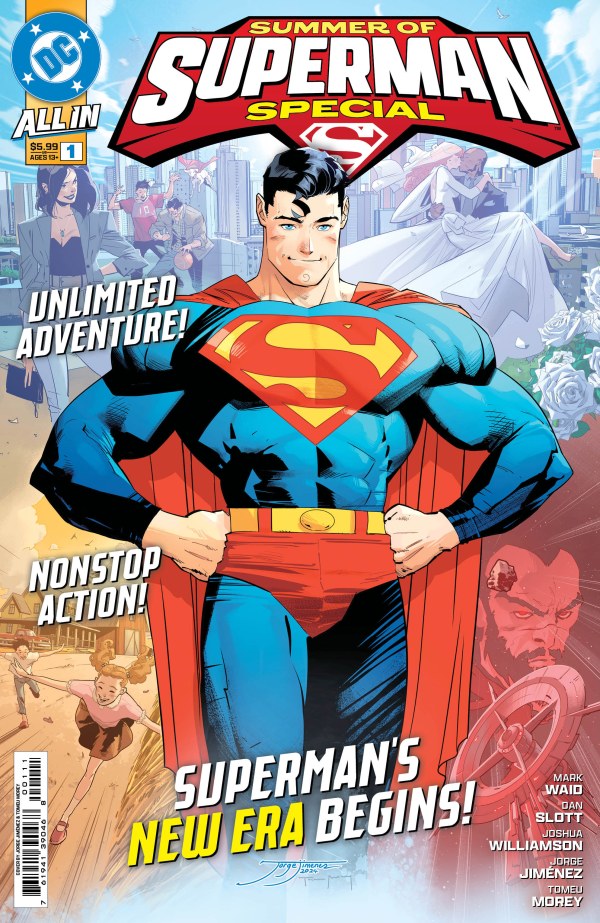
And of course, the big release this week was Summer of Superman Special #1, a one-shot that sets the stage for the next several months of Superman comics. The book is co-written by Joshua Williamson (regular writer on Superman), Mark Waid (who’s about to take over as the regular Action Comics writer), and Dan Slott (who will launch a third ongoing Superman title, Superman Unlimited, soon). “The Past, the Present, the Future,” begins in…well…the past. Validus, one of the foes of the Legion of Super-Heroes, is attacking Smallville, and Clark – as Superboy – and Krypto have to leap into action to stop him. There’s a really interesting bit here about how the Legion has placed a mental block to prevent Superboy from remembering things about his own future (this was well established in dozens of classic Legion stories, that’s not the clever bit), but nevertheless, he glimpses something that gives him a lingering memory that will change his entire life.
Summer, huh? (Glances at the title of the blog) Amateurs.
The story then jumps to the present day, and it’s a joyous day – it’s the wedding of Lana Lang and John Henry Irons. Lana is worried about some sort of super-chicanery messing things up, but that’s silly, right? RIGHT? Oh, no, Validus is back. This time, though, there’s a whole Superman family to take him on. The whole issue is great, and it’s highly successful at setting a tone for the upcoming storylines – especially the epilogue, which ties in to a story that started last year in the DC All-In Special and that we’ve been left dangling on for months now. The end of the issue also gives us the lowdown on several new books coming – not just Slott’s new title, but new books for Supergirl and Krypto, a treasury-sized one-shot by Dan Jurgens, and more.
The summer of 2025 is already shaping up to be a great time to be a Superman fan.
Sat., April 19
Comics: Superman: Birthright #1-12
When he flies in FRONT of Clark, you see, nobody suspects them of being the same dude.
Notes: By 2004, Superman had changed enough that DC decided it was time to revamp the origin again. That job went to the phenomenal writer Mark Waid, whom they paired off with a rising star named Leinil Francis Yu. The result, Superman: Birthright, is a solid Superman origin story that’s kind of been lost to time. A few years later, Geoff Johns would revamp the origin yet again (we’ll read his version in a couple of days), and then the New 52 hit and everything was upturned. But in these 12 issues, Waid did some really interesting things, a few of which have managed to stick.
The story begins – act surprised here – with the destruction of Krypton. This version is neither like the Silver Age version nor the cold, sterile world that John Byrne created. There’s a more modernistic sci-fi bent to it, and this time around it’s Lara who urges Jor-El to send their child to Earth when the latter begins to bend. Waid carries this theme forward after a time skip, when we see a Clark at age 25, covering news stories freelance in Africa and finding himself in a position to use his mysterious abilities to help people. Again, it’s Mom who turns out to be the impetus here – Martha pushes the creation of the Superman identity, while Jonathan is upset that Clark wants to hide his true name. Don’t worry, Jonathan comes around.
From there, from the point where Clark goes to Metropolis for the first time and saves Jimmy Olsen and Lois Lane from a helicopter disaster (NEVER get into an aircraft of any sort with Lois Lane, you’re just asking for trouble), the story takes a turn. While the elements of the Daily Planet staff are still there and still important, from here on out the story becomes largely about Superman vs. Lex Luthor. Waid brings back the Silver Age conceit of the character, in which Superboy and Lex had been friends, but he modernizes it. Since there never was a Superboy in this continuity, Lex was friends with Clark Kent (I feel like this was a deliberate effort to echo the popular Smallville TV show, which isn’t a bad thing). Waid puts a different light on the unique friendship – although Lex’s arrogance existed even then, both young men carried with them an air of alienation that made them bond. Lex, of course, didn’t know what exactly made Clark different from everybody else, but it was Lex’s intelligence that set HIM apart.
In the Silver Age, Lex had the worst supervillain motivation of all time – Superboy saved him from a failed experiment, but the fumes released made him lose his hair. So he decided to become a criminal mastermind. And that’s terrible. Waid brings back the basic idea of Lex’s villain turn coming from a disaster that involves Clark, but he does it in a much more believable way. The adult Lex in this story is the fusion of super scientist and super businessman that he still mostly is today, and he carries that brilliance and anger with him as he cracks the secret of Superman’s heritage – discovering that Superman is an alien from the distant planet Krypton, which even Clark doesn’t know yet. Lex decides to turn the world against its new hero by faking an invasion from Krypton to draw him out, culminating in a fantastic battle scene that includes, among other things, a fantastic moment where the S-shield becomes literally that.
“I dunno, Leinil, do you think anybody will get the symbolism here?”
Like I said, this origin has been largely pushed aside by DC, but there are a few elements that I think are worth mentioning, at least one of which has become a staunch part of canon. One is the explanation for Clark’s glasses. Waid clearly decided to address the old (tired) complaint that the glasses aren’t enough of a disguise by establishing that Clark’s eyes are a truly unearthly shade of blue, a color that no one not from Krypton would have seen before. Superman still has those eyes, but Clark’s glasses dull the color and make his eyes seem more mundane, helping with the disguise. I don’t know if that tidbit is still canon, but with Waid about to take over Action Comics, I hope he brings it back.
The other thing that we get here is – as far as I can tell – this is the story that first established the concept that the Superman symbol stands for hope. As Clark studies the holograms sent to Earth with him, he doesn’t understand the Kryptonian language, so he tries to unlock his past by watching the images and videos sent by his parents. The S-shield of the House of El is a persistent image, and it comes to represent hope to Clark, something he pushes forth when he adopts the symbol as Superman. The idea that it was literally the Kryptonian character for their word meaning “hope” isn’t there yet – that, I believe, came a few years later during DC’s 52 series (which Waid co-wrote), but I think that we’ve found the genesis of one of my favorite little details of Superman lore.
It’s a good story, and even if it isn’t canon anymore, it’s still an enjoyable read.
Sun., April 20
Comics: Secret Origins Vol. 3 #1
Superman HATES green cars.
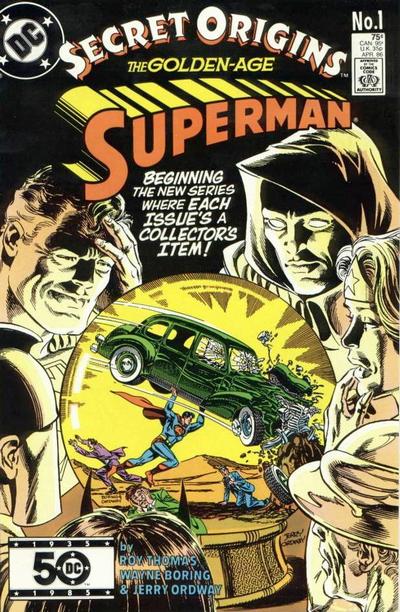
Notes: It’s Easter Sunday here, and Easter is a big family day for us, so I knew I would need something quick for today’s Origins Week installment. How handy, then, that back in 1985 DC Comics relaunched their old Secret Origins series, re-presenting the genesis of heroes from the Golden Age to the Bronze, and kicking it off with an issue dedicated to the Golden Age Superman. The series was the brainchild of Roy Thomas, who also wrote this issue, and frankly there couldn’t have been a better candidate. I don’t think there’s a human being on the planet with a greater love for Golden Age comics than Roy Thomas, as evidenced by his All-Star Squadron from DC, Invaders from Marvel, the Alter Ego miniseries he wrote for First Comics and the subsequent comic book magazine he produces that carries the same title. Mark Waid is kind of a spiritual successor to him, in that both men are walking encyclopedias of comic book history, and it shows through in their work.
This issue is a pretty straightforward adaptation of the “origin” story I mentioned from Superman #53 grafted together with the story of Superman’s first adventure from Action Comics #1. Thomas, along with classic Superman penciler Wayne Boring and inks by Jerry Orway, re-tells the story that we’re all intimately familiar with, and does so almost beat-for-beat. Even panel compositions and little tidbits like a ticking clock in the corner of the panel to count down to an innocent man’s execution are carried over from the original Siegel and Shuster panels to the new ones. As such, it’s a retelling of the original story, but not really an update. The oddest thing, though, is the fact that Thomas makes reference several times to the fact that this Superman and – in fact – his entire universe no longer even existed, following the events of the recently-concluded Crisis on Infinite Earths. It’s an odd take, to build a series built on what, at that point, had essentially been relegated to “imaginary” stories. Still, if you’re looking for an old-school origin of Superman with a slightly more modern bent, this issue is worth reading. The whole series is, actually. I was always a fan of Secret Origins, and it’s a shame that anthology books like this one just don’t seem to have legs in a modern market.
Mon., April 21
Comics: Superman: Secret Origin #1-6
It’s like a Christmas card with an alien from another planet on it.
Notes: Six years after Birthright, and following another reset in Infinite Crisis, DC handed Geoff Johns the reigns to do his own take on Superman’s origin. Johns was one of DC’s top writers at the time, having taken both The Flash and Green Lantern and expanded their respective corners of the DC Universe exponentially, making them more exciting and (frankly) more significant than they had been in years, if not decades. Johns had also cut his teeth working as an assistant to Richard Donner, director of the first Christopher Reeve movie (and most of the second), and the two of them even wrote a run of Action Comics together. It’s not really a surprise, then, that Johns’ version of the origin borrows as much from the classic movie as it does from the classic comics, right down to artist Gary Frank drawing a Clark Kent that looks so much like Reeve you’d think he was doing a straight-up adaptation of the film. In the scene in issue #3 where he first arrives at the Daily Planet, it’s even more pronounced. Frank draws Clark with Reeve’s physical mannerisms and characteristics, the bumbling fake persona that he wore in his “disguise.” It’s so effective that every line you read goes through your head in Reeve’s own voice.
Johns merges a lot of elements from the various Superman eras and blends in some of his own. His version was, in fact, Superboy, and had been a member of the Legion of Super-Heroes. His costume was made from his Kryptonian blankets, and Clark’s glasses were made from glass taken from the spacecraft to help him control his heat vision. To help reconcile some of the elements that work better with Superman making his debut as an adult, Johns has Clark keep “Superboy” a secret, operating as privately as possible and being considered little more than an urban legend in Smallville. That way he maintains the big moment of his public introduction later in Metropolis where he…oh, look at that. He saves Lois Lane from a helicopter accident.
NEVER. GO. NEAR. AN. AIRCRAFT. WITH. LOIS. LANE.
Unique to this version, Lana Lang knows about Clark’s powers since childhood, having been saved by him from a wheat thresher (a scene quite reminiscent of Superman saving Lana’s son from a similar fate in Superman III). Lex, once again, is from Smallville, and a few years older than Clark, but still friend-ish with him. I particularly like Lex’s introduction, where he asks Clark if he’s smart, reasoning that wearing glasses either means you’re genetically inferior or you read a lot.
I’ve read this series more than once, but reading it all together creates some interesting juxtapositions. In issue #2, for instance, when Superboy first meets the Legion, I’m struck by how Johns writes Brainiac 5. His intelligence leads to incredible arrogance and condescension towards everyone around him…which seems pretty darn familiar if you flip back a few pages to a scene where Clark is talking to Lex in the school library. Johns writes Brainiac as Lex Luthor with a fundamentally good core – but “good” doesn’t necessarily mean “nice.” It’s pretty funny, and really spot-on in terms of characterization.
It’s not just the people whose characterization changes, though, it’s the whole city of Metropolis. When Clark first arrives it’s a cynical place, a place where nobody ever looks up, where everybody is out for themselves, where the Planet is on the brink of ruin, and where people line up for hours in the hopes of catching a few scraps from their oh-so-benevolent top citizen, Lex Luthor. The presence of Superman chances the whole town, making it a bolder, more optimistic place, a town where the potential for the future seems real and not just a pipe dream. Lex, naturally, hates it. I love it.
Lois is Lois as Lois should be – smart unflinching. When given a chance, she goes for Lex’s throat without a second of hesitation. But what I really love is how she sees through Clark’s bumbling facade almost instantly. The same day he comes to work at the Planet, she sizes him up and calls him out on the false humility and ill-fitting clothes, declaring quite correctly that he obviously wants people to underestimate him. That insight is perfect for her…which actually makes it even funnier when she encounters Superman and fails to put two and two together. She continues being impressed by Clark throughout the miniseries, but even at the end she hasn’t dovetailed into the whole “is Clark really Superman?” bit from the Silver Age, and I’m glad for that.
In addition to Luthor, Johns brings in the Parasite, Metallo, and even Sam Lane as secondary antagonists, but when you get right down to it, this is a story about four characters: Superman, Lois, Luthor, and Metropolis herself. And Johns serves all four of them very, very well.
Tues., April 22
Comics: Action Comics Vol. 2 #1-8
This is the one time where Superman and I could literally wear the same outfit.
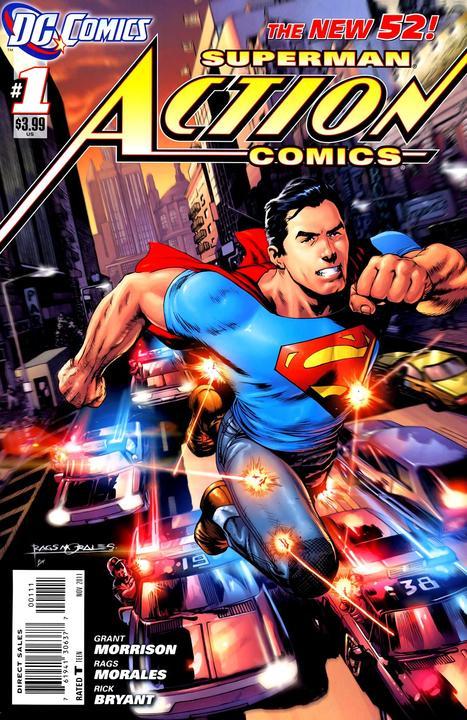
Notes: I’m going to close off Origin Week with what I believe is the most recent revamp of Superman’s full origin, from the New 52 reboot of the entire DC Universe that happened in 2011. Ironically, despite being the most recent, it’s also one that was sponged from continuity most completely. Still, it’s written by Grant Morrison, and I’ve never read anything by Grant Morrison that didn’t have at least SOME reading value in it. Let’s see how the New 52 handled our boy Clark.
Morrison’s Action Comics begins six months after Superman’s public debut in Metropolis (thus robbing us of the opportunity to see him save Lois Lane from a helicopter crash), and the inspiration here is clearly the earliest Superman stories of Siegel and Shuster. He’s not as powerful as he would become, he’s not flying yet, and he shows bruises and abrasions from some of his tougher battles. He’s also doing the “fighting for the little guy” thing that we saw so much of in the earliest tales, going after corrupt businessmen and politicians…which has made him the target of corrupt businessmen the likes of Lex Luthor. He’s not even wearing a proper costume at this point, prancing around the city in trousers, a t-shirt, and a cape. It’s a wild look, and if Morrison’s intention was to show that this was a Superman starting from scratch, it worked.
The story sees Superman being captured by Luthor and Sam Lane, fighting against them, and rescuing Metropolis from Brainiac. Along the way, we discover that – although Couluan – Brainiac had a presence on Krypton and has one here on Earth. Clark also gets his hands on the Kryptonian armor that became the uniform of the New 52 Superman, and by the end of the story, he’s made enough of a name for himself to take a job at the Daily Planet.
What also works is John Henry Irons – in a world where the Doomsday fight never happened (although this would be reversed, like most of the New 52 changes) they made John one of the scientists working on the project that studied Superman with Luthor, then had him show his heroic side by turning on Luthor and Sam Lane, building his suit of armor in the process. If there’s no “Death of Superman” in the continuity to contend with, this is a decent enough way to get a Steel.
But the thing is, there isn’t much else that works for me here. I get that the idea here was a whole new Superman, a whole new universe, but as turned out to be the case with much of the New 52, they threw out the baby with the bathwater. This is an origin that doesn’t just update the classic elements that make Superman who he is, it throws out many of them. We see only glimpses of Krypton, and we get more of the Kents through some of the back-up stories written by Sholly Fisch than the main stories written by Morrison. We only get a few pages each with Lois Lane and Jimmy Olsen, and although the attitude Morrison crafts for Superman works for a young man trying to find himself, ultimately, it’s somewhat unsatisfying.
I hate to say this, because Morrison has done excellent work with the Man of Steel. I’ve always enjoyed DC One Million and the Final Crisis tie-in Superman Beyond, and let’s be honest here, All-Star Superman absolutely deserves a place on the Mount Rushmore of Greatest Superman Stories Ever Told. But the New 52 Action Comics origin just falls flat for me. It would be one thing if this were an alternate universe – an “Ultimate” or “Absolute” Superman – but as the origin for the Prime DC Universe Man of Steel, it just doesn’t click. Out of all the different iterations of Superman’s origins I’ve read this week, I’m afraid I saved my least favorite for last.
This all begs the question, of course, of what exactly Superman’s origin is today. Like I said, I doubt that many remnants of the New 52 version have stuck with us. The Superman we read about in 2025 is kiiiiinda the New 52 Superman mashed together with the Post-Crisis John Byrne Superman, but even that Superman has had no less than three different versions of his origins over the years. And since DC Rebirth gave us the current iteration of Superman beginning in 2016, they haven’t really done a retelling of the origin again. But maybe Mark Waid will tackle that in his upcoming New History of the DCU. If he does, I’ll be sure to share with you my thoughts on his newest take.
It’s going to be another pretty random week in the blog, folks. Having put the finishing touches on Krypto Week, I don’t have a particular theme to adhere to for the next seven days – I’ll read or watch whatever strikes my fancy on the day.
Wed., March 12
Comics:Superman #285, Flash #158 (Cameo)
This guy went on to a promising career as a referee in the National Football League.
Notes: If you’re anything like me, you love going to comic book stores and conventions or scouring eBay for old comics. I dive into dollar bins, I get lots of old, random comics, because I love finding strange, unusual books, things that aren’t on the radar of the collectors. And, of course, I also snare any Superman-related content I can get my hands on. I get it faster than I read them, to be frank, so I have a substantial “To Read” pile at home. Today I’m going to randomly pull out a book from that pile to kick off the week.
The winner is Superman #285 from 1975. I haven’t ever read this one before, but it’s got the legendary team of Elliot S! Maggin and Curt Swan, so it’s at least got that much going for it. In the story, Superman is deeply engrossed in the mystery of the missing Roy Raymond, TV Detective. Raymond is an old DC character who, even by ‘75, had faded into obscurity, and sending Superman out to search for him is a decent story. There’s also a fun subplot regarding WBGS gossip maven Lola Barnett, a semi-regular of the supporting cast at the time (and let’s give the creators a hand for resisting the urge to make her one more of Superman’s legendary “Double-Ls”). When Lola is challenge to keep a big, juicy secret for an entire week, she selects one given to her by Clark Kent, a secret the reader can’t read the ending of: “I am not who I seem to be. I’m really…”
Obviously, nobody thought that Clark was going to out himself to a gossip columnist to win a bet, but the last-page reveal of what the secret actually WAS turned out to be fun.
I don’t know if the intent behind this issue was to bring Roy Raymond back as an ongoing concern for the DC Universe, but if it was, it didn’t quite work. Ol’ Roy remains pretty obscure to this day. But kudos to Maggin and Swan for giving it a try.
Well, not WITH Wonder Woman. That’s kinda the point of the story.
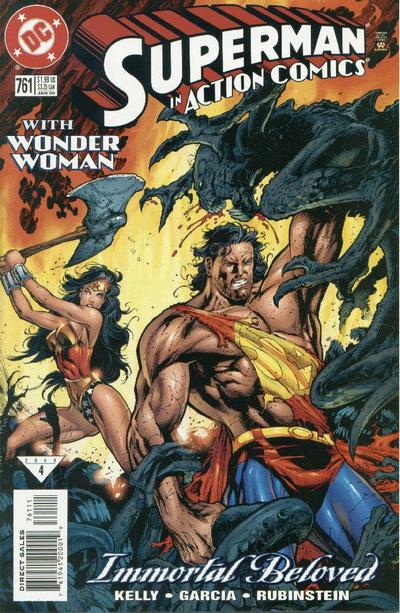
Notes: Joe Kelly is one of those writers who did a solid job on his tenure with Superman, and although I think few people would put him on their Mount Rushmore of Superman writers, he’s responsible for a couple of my favorite Superman stories of all time. The second one, Action Comics #775, will show up at some point this year when I pair it up with watching the movie that adapted it, Superman Vs. the Elite. But for today, I’m going to look at what I consider to be his second-best one-off story, a Superman/Wonder Woman story from Action #761. In a recent issue, a photographer caught a photograph of Superman in which he was clearly wearing a wedding band – Clark slipped up and forgot to take it off when switching identities – and the question of “Who is Mrs. Superman?” is dominating the celebrity news cycle. Lois and Clark are having a lazy morning, semi-joking about the situation, when Diana shows up and throws everything into turmoil.
Superman and Wonder Woman are whisked off to Asgard in this story, while Lois is stuck back on Earth, slightly smarting over the fact that her husband has been taken to another dimension with an Amazon princess. Clark and Diana are trapped in Asgard, helping the Aesir fight off an invasion of demons, for 1,000 years…their time. On Earth, only a day passes.
So much is written about the friendship of Superman and Batman, and with reason. But the Superman/Wonder Woman relationship is more complicated and, in a lot of ways, more interesting. Over the years there have been several stories that flirted with a romance between them. They even made their couplehood canonical during the New 52 era, and shared an ongoing series for a couple of years. But that pairing has never really sat right with me. Part of it, I guess, is that Lois and Clark are the permanent pairing in my brain. Nothing has ever been able to chip away at that, they were literally made for one another, and I reject any efforts to keep them apart.
But there’s also the fact that pairing off Superman and Wonder Woman seems, to a degree, too obvious. There have been plenty of superhero universes that do their own versions of these characters and make them a couple, and none of them have ever been particularly satisfying to me. Superman already has the perfect romantic partner, but what he doesn’t have is somebody with whom he can share the burden of being someone of immense power in a world that could crumble under his grip if he allowed it to do so. He doesn’t have someone else who understands what it means to control yourself and resist the urge to make things the way you believe they should be simply because you have the ability to do so. Even with the other members of the Superman family, like Kara, Conner, Jonathan, and so forth, he has to take on a role that is – if not fully parental – at least that of the fraternal authority. He’s either Dad or big brother to every other Kryptonian in his orbit.
Lois is his wife, and can be his confidante in many things. Batman is his partner in the neverending battle, and their friendship should be secure. But Wonder Woman is a peer that he needs. So the scene in this issue where, after a millennium of battle, Wonder Woman begins to crack and almost acts on her attraction to Superman, is one of my favorites ever written. Is the attraction mutual? Almost certainly. She’s Wonder Woman, for Zeus’s sake. But it cannot be acted on, for two very good reasons. First: even after 1,000 years apart, Clark’s devotion to Lois remains absolute. But second, and far more interesting, because he loves Diana so completely as – in his own words – “my best friend.”
There isn’t enough media out there that recognizes that friendship – genuine friendship – is possible between people, whether it’s members of opposite sex or any other compatible sexual orientation. It’s why slash fiction kind of gets on my nerves – it feels like a rejection of the notion that two people can be close without wanting to get down and dirty. These two characters seem awfully close – there MUST be something else going on, right? Or, “Oh, your wife’s friends with a dude? Obviously he’s trying to steal her from you.” Are there people like that? Sure. Even Lois feels a tinge of jealousy when Diana is around. But she needn’t, and that’s the point.
Friendship is real, and it’s important, and true friendship as an adult is something far too many people in this world live without. True love does not have to be romantic in nature to be true, and when I see a story that recognizes that fact, it always makes me want to celebrate it.
I tend to imagine Diana is giving Lois that speech you just read.
So yeah. I dig this issue very much. Reading it, in fact, put me in mind of another excellent Wonder Woman/Lois story, Wonder Woman Vol. 2 #170, which I wish I had read back in Lois Lane week. “A Day in the Life” was ALSO co-written by Joe Kelly, partnered here with magnificent Wonder Woman storyteller Phil Jimenez. In this one, Lois has requested an unexpected assignment from Perry White: a profile piece on Wonder Woman. After meeting up at the home of Steve Trevor and Etta Candy (married to one another in this continuity), Lois tags along with Diana over the course of a typical day. She goes to France where she gives a speech to a packed crowd of university students, zooms up to the Justice League Watchtower to check on an experiment, and zips down to Central City where Diana makes an appearance on the DC Universe equivalent of The View. She makes a stop with President Luthor in Washington, whisks away to disadvantaged areas all over the world, and visits with Donna Troy before making an appearance at the United Nations.
The gem of this issue is the final scene, which is just Lois and Diana in a bar, shooting pool, and kind of having it out. Although Diana has been nothing but gracious to her, something about her still rubs Lois the wrong way. This is a fantastic scene about each of the two women, as well as their respective relationship to Superman. The reporter in Lois is always looking at perfection and trying to find the flaws in it, which is one of the things that makes the flawless Diana so damned frustrating. But there’s also the fact, she admits, that her husband’s best friend is an Amazonian goddess, and not even Lois Lane is so secure that she isn’t at least a little rattled by that. Diana lays her cards on the table as well, talking about how much she respects Lois and how amazing a woman SHE must be for Superman to have chosen her (even, she points out, after their 1,000-year adventure in Asgard, which apparently Clark neglected to tell Lois about).
Relationships are a weird thing, and as a writer, you recognize that each person that becomes part of a relationship does not add to the complexity, it multiplies it. The Lois/Clark relationship is a thing, the Clark/Diana relationship is a thing, the Lois/Diana relationship is a thing. But this issue is about the gestalt of them all, the Lois/Clark/Diana relationship. It’s the best – and perhaps the only – comic I’ve ever read that is really about the THREE of them, and it’s really good.
And hell, Superman isn’t even IN it.
Fri., April 11
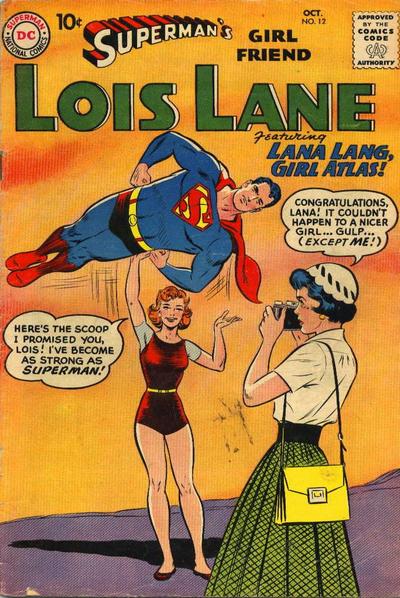
Comics: Justice League of America #20, Superman’s Girl Friend, Lois Lane #12, World’s Finest Comics #305
Based on the rules of Silver Age comics, I half-expected that the story would be Superman just flying in place to screw with Lana’s head.
Notes: In the Silver Age, if Lois wasn’t busy trying to get Superman to marry her, she was spending the remainder of her time flirting with his teammates in the Justice League. In Lois Lane #12, it was Aquaman’s turn. When a freak accident crushes Lois’s legs and lungs, Aquaman brings her to a surgeon who determines the only way to save her life is to turn her into a mermaid.
Yeah, you can read that sentence as many times as you want, it’s still crazy.
Lois attempts to adjust to her new undersea life while preventing Superman from finding out what has happened to her, although presumably if she’d known about his previous fling with Lori Lemaris she would know that “mermaid” apparently wasn’t a deal-breaker for Superman. While beneath the ocean, she starts to have feelings for Aquaman, but then rejects him, knowing that it’s truly Superman she loves in her heart. After a second freak accident again leaves her on the brink of death, Superman rushes to the hospital library, memorizes every medical book in existence, swiftly passes a series of examinations to prove his medical knowledge, and performs surgery to give Lois her legs and lungs back.
The questions, both ethical and existential, are enormous.
So Superman – Silver Age Superman, at least – has the medical knowledge to transform a mermaid into a human being. And a HUMAN doctor possesses the knowledge to turn a human into a mermaid in the first place. I am banging my head against the wall trying to wrap my brain around what I just read and I cannot make it work. It may be the single most insane story I’ve read yet in this entire “Year of Superman.”
Five stars.
In this issue’s second story, Lana Lang swipes a formula Lois is supposed to give to Superman that supposedly can give anyone super-strength and invulnerability. Lana is using it to try to steal Superman from Lois, and when Lois finds out, she hatches a devious scheme that winds up making both her and Lana look like absolutely horrible human beings, and I can only thank Rao that this isn’t canon anymore.
Finally, we have “Lois Lane Loves Clark Kent,” except that of course she doesn’t. She catches Clark surviving a fall and determines that she’s been right in all her years of suspecting he’s really Superman. This time, though, she decides to trap him by “falling in love” with Clark and not telling him she’s learned her secret until after the Honeymoon. Superman decides to teach her a lesson. Dickishness ensues.
Sat., April 12
Animated Shorts: Electric Earthquake (1942), Volcano (1942)
Notes: It’s been a minute. How about another Fleischer short or two today?
When I was a kid, all we had were wood-burning earthquakes.
In Electric Earthquake, a mad scientist has set up a device beneath Manhattan harbor that threatens to destroy the entire city with an earthquake. In and of itself, this shouldn’t be a huge surprise – from the cartoons I’ve watched so far it seems like at least 75 percent of the city’s population were mad scientists. But this particular scientist is a Native American, angry that the island was taken from his people and demanding it back. The cartoon leaves you with mixed feelings, honestly. On the one hand, it’s somewhat problematic to paint the Native American as the villain in this story. On the other hand, he’s oddly progressive in that he doesn’t wallow in any kind of stereotypes, and he’s obviously intelligent and crafty. If it weren’t for the whole “destroying the whole island and murdering everybody” thing, it would be one of the more positive portrayals of the time.
And as a Superman fan, I find it interesting that – at this point – it seems that the filmmakers at least still viewed Superman’s “Metropolis” as another name for New York, as the scientist quite clearly calls the island “Manhattan.” I wonder just when, exactly, they decided to definitively establish Metropolis as its own separate city.
“Dammit, for the last time, I am NOT doing an R. Kelly joke.”
Volcano, thankfully, breaks us free of the necessity of yet another mad scientist, and sets the man of steel loose against the danger of an erupting volcano. With word of an impending eruption making global headlines, Perry White sends Lois and Clark off to cover the event. Lois sneaks Clark’s press pass, though, leaving him frozen out of the danger zone so she can get the story herself – a decision that she may come to regret when the volcano begins to erupt before the scientists can blast the side of the mountain and divert the lava flow to an uninhabited area. Naturally, this looks like a job for Superman.
I’ve talked a lot about just how beautifully animated the Fleischer shorts are, and from that perspective, this may be one of the absolute best. The flowing lava, flickering flames, the waves crashing in the ocean…it’s all absolutely gorgeous to look at, and the movements of the characters all feel very realistic and authentic. When you think about how awfully stilted some animation was at the time, it’s astonishing that they pulled this off. Hell, there are cartoons being turned out today that don’t look this good. Plus, the lack of a human antagonist (especially yet another “mad scientist”) makes this cartoon a nice refresher from the others of the line.
Comics: Green Lantern Vol. 8 #20 (Guest Starring Superboy)
Sun., April 13
TV Episode: Superman and Lois Season 2, Episode 6, “Tried and True.”
“Golly, Blake, how nice of you to remember we exist.”
Notes: You see, this is why I never finished watching Superman and Lois when it was on the air. I start watching it, and I get into a pretty good rhythm for a few days, then I get distracted by something shiny and the next thing I know I haven’t watched an episode in two months. I’m not blaming anybody else, it’s my fault. I’ll try to do better.
Oh wow, this episode starts with creepy-ass Bizarro with his creepy-ass eyes fighting a bunch of DOD agents. It’s odd that this version of Bizarro is as surprising as it is. I mean, the concept of an imperfect Superman, with all of his power but an inverted sense of his morality, SHOULD be pretty frightening. But instead, the character is almost always played for laughs, with joke stories or full of silly misunderstandings. There have been attempts to make him a bit more serious over the years, but this “reverse Superman” from a parallel dimension is the most chilling incarnation of the character I’ve ever seen.
We’ve also got the usual dose of Superman and Lois drama – Jordan and Jonathan dealing with the powers the latter got from his dose of X-Kryptonite, Sam having to play referee between Lois and Lucy, Lana’s marriage falling apart, and the mother of one of the DOD agents killed by “Inverted Superman” demanding justice. It’s probably because it’s been a little while since I watched an episode, but it feels like there’s just an enormous number of plots and subplots going on in here, and I’m kind of hoping that things are whittled down a bit. I’m seeing the reason a lot of people have called Tyler Hoechlin the best on-screen Superman ever (I don’t know that I’d necessarily agree, but he’s definitely very good). The show itself, though, at least at this point in season two, feels like standard CW fare.
Mon., April 14
Comics: Superman: Earth One Vol. 1
It doesn’t matter the universe, this pose is a requirement.
Notes: Back in 2010, DC began this “Earth One” experiment, a series of original graphic novels re-imagining the characters from the ground up. It was similar to Marvel’s Ultimate Universe, with the big exception being the fact that the stories were being told in graphic novel format rather than monthly comics. It was interesting, and some of the books were very good, but the line petered off somewhat. I don’t think DC ever really established “Earth One” as a cohesive universe the way Marvel did with the Ultimate line. There was little – if any – cross-pollination between the graphic novels, and in fact, some of them didn’t feel like they belonged to the same universe as the others at all. It’s been quite some time since there were any new Earth One books, even though DC does keep them still in print, but as far as launching a whole new UNIVERSE, the current Absolute line seems to be doing the job much more successfully.
All that said, let’s look at the first of the Earth One graphic novels anyway. Written by J. Michael Straczynski with art by Shane Davis, this is a pretty solid way to recontextualize Superman in the early 21st century. We begin with young Clark Kent, fresh from Smallville Junior College, moving to Metropolis to find himself. The trouble is, he isn’t quite certain who he wants to be. He tries several different jobs, all of which he excels at, none of which he finds fulfilling…everything except for his attempt to get a job at the Daily Planet, where Perry White basically tells him he’s not good enough yet, but there’s a high turnover rate, so they may give him a call. The whole question may be moot, though, when an alien invasion force attacks Earth, searching for the last child of Kryton, whom they have been chasing across the stars for twenty years. They are the race responsible for Krypton’s destruction…and they are here to finish the job.
I don’t remember noticing it at the time, but I’m a little shocked at how similar the story here is to the movie Man of Steel, which of course came out three years later. It’s not exactly the same, of course – in the movie the antagonists are Kryptonians hoping to rebuild their planet, not a new race hoping to complete their extermination – but the aspect of the alien invasion drawing out Kal-El, but instead being a facade to hide their true intentions for Earth – is spot-on. It’s different tonally, and it ends things pointing in a very different direction than the film, but I am sorely tempted to go back into the credits for Man of Steel to see if Straczynksi and Davis were among the comic book creators given special “acknowledgements” in the film. (“Acknowledgements” is Hollywood talk for “we used ideas from these guys but we’re probably not going to pay them. Kind of like ChatGPT.)
One of the things I like about this book is the way Straczynski addresses the fact that Superman doesn’t wear a mask. People with no imagination constantly harp on how the glasses are a bad disguise, but they’re missing the point. There’s a nice conversation where Martha tells Clark that he can’t wear a mask, that someone with that much power would be terrifying to people if they thought he had something to hide, and thus he has to allow them to trust him. We’ve seen echoes of this in countless Superman stories over the years. Dozens of antagonists, from Lex Luthor to Sam Lane, have all feared or hated Superman because they can’t conceive of a man with his kind of power using it for good. It’s the reason he wears bright colors, it’s the reason he operates in the light instead of the darkness. Supposedly David Corenswet himself, our new Superman (July 11th can’t come soon enough) lobbied hard to include the trunks for the costume because the trunks look like a circus performer, and he wants his Superman to be someone that nobody is afraid of. That’s PERFECT. That’s EXACTLY who Superman should be, and this graphic novel explains that pretty succinctly in a single page.
I know I’ve read the second volume in this series, but I can’t quite recall if I ever got around to the third one. If the story of the death of Krypton and the mysterious force behind it was resolved before the Earth One line kind of faded away. But hey, this is the Year of Superman, and I’ve still got 36 whole weeks left to go – that’s plenty of time to dig into the last two books in this line. I’m sure this isn’t the last we’ll see of this particular version of Superman.
Tues., April 15
Comics: Superman: For Tomorrow (From Superman Vol. 2 #204-215), Superman’s Pal, Jimmy Olsen #137
Do you think Jim Lee knew he was designing DC fans’ favorite bookends when he drew these covers?
Notes: Coming pretty quickly on the heels of Batman:Hush, superstar artist Jim Lee (who would go on to be one of the heads of DC Comics) partnered up with writer Brian Azzarello for another year-long run on DC’s other flagship superhero. Lee and Loeb had turned out to be a magic team on Batman, but I wasn’t a huge fan of Azzarello’s take on Superman at the time. In truth, I don’t think I’ve re-read this story since it was first published in 2004, though, and it’s possible that the perspective of time – as well as reading it all at once instead of doling it out a month at a time – will make me more charitable towards it. Let’s find out together, shall we?
For Tomorrow begins with Superman visiting a Catholic priest, Daniel Leone, in a discussion that is clearly about absolution without ever actually using the word. We’re coming in after a year-long time-skip, and in that time something has happened called “The Vanishing.” Eventually, we determine that a year ago one million people across the globe simply disappeared, among them Lois Lane, and Superman is carrying great guilt over this event. However, it doesn’t seem like his guilt is the normal “wanting to save everybody” thing Superman carries with him, but rather something more specific.
I’m reminded immediately of why I struggled with this story the first time around. The entire first chapter is hints and veiled innuendo, not actually getting to what the story is about until the last couple of pages. That’s certainly something that works better in the collected format, but which can be infuriating if you’re waiting a month between installments. What’s more, Azzarello – who at the time was known for more noir comic books like 100 Bullets – brings that sensibility to Superman. We get glimpses of what’s going on, people talking AROUND the issue instead of actually discussing it, and while that works well for the style of story he’s accustomed to, it doesn’t really feel like a good fit for Superman, not to me at least.
As the story continues, Superman starts to regularly visit Father Leone, unburdening himself with the story of how he became embroiled in a conflict in the Middle East (obviously even more topical in 2004 than it is today) and his battles with a cybernetic monster called Equus, and of course, how these things tied into the Vanishing.
As the year goes on, Superman finds himself in conflict with the Justice League over the events that lead to the Vanishing, particularly Batman, in an exchange that I find particularly distasteful. This is in a period where tensions between DC’s Trinity were building up heavily, which eventually lead to Infinite Crisis, and while it fits in that context, that doesn’t make the scene where Superman says to Batman “You’re my friend, but I don’t like you” any more pleasant to read. Both heroes feel out of character here, Superman in particular. He even insists that Batman call him “Kal-El” instead of “Clark,” something that doesn’t feel natural or appropriate at all.
“Look, Cla–Kal…just tell us what name to put on your locker in the Watchtower.”
It goes on in the next chapter, when Wonder Woman attacks him at the Fortress of Solitude because he’s trying to do something about the Vanishing, which she calls “suicide.” Even Superman lampshades the fact that her using a deadly weapon against him (in this case, a magical sword) to prevent him from doing something that could kill him doesn’t make any damned sense. But like in the first chapter, Azzarello keeps dancing around exactly what IS going on, dodging the question of what Superman’s plan is and why Bruce and Diana oppose it. If you want to create conflict between heroes, fine, but that conflict works better when everybody has clear motivation – otherwise it’s just a frustrating fight that doesn’t seem to have any purpose other than to showcase Jim Lee’s (admittedly masterful) artwork.
But perhaps there’s no other moment so off the wall as the scene where Superman has a conversation with Clark Kent (for reasons) about retrieving Lois from whatever the Vanishing is. Clark tells Superman that Lois was “uncomfortable” seeing him because “I’m not the man she loves.”
The hell?
Granted, this isn’t really Clark, it’s a robot, but there’s a subtext here that’s painful and uncomfortable. There was an awful lot of shoe leather spent in the first 50 issues of this very title built around the fact that Clark Kent is EXACTLY the man that Lois Lane loves, and both characters are better for it than they ever were before. Furthermore, the notion that Superman and Clark are two different “people” is a similarly outdated Silver Age idea. Superman and Clark work best when they’re the same man wearing different clothes. Change my mind.
Azzarello delves heavily into musing about the nature of good and evil and what Superman’s place is in a world where these concepts are more concrete than abstract. In and of itself, there’s nothing wrong with that. There are some great Superman stories that have been written about that very topic. However, the style is far more ponderous than most Superman stories, with lines like “To be in the presence of evil is to be both utterly offended and absolutely afraid.” A line like this would feel right in place in a Vertigo comic book, but in Superman it gives the impression of someone working very hard to be serious. That’s not to say that a serious Superman story isn’t possible – in fact, I’ve got a week planned for later this year where I intend a deep-dive into Superman’s darkest hours – but at the same time, this isn’t math class. Azzarello is showing his work too much, and that distracts the reader from the story.
Once we finally get to the revelation of what the Vanishing was and why Superman is carrying around the responsibility for it…I’ll concede this much: it is a very Superman solution to a Superman problem. And it explains why the League was so antagonistic towards him. It doesn’t explain why Bruce and Diana were trying to prevent him from reversing it, though. And the truth is so massive that it should have left a stain on the character for years, but the story was rarely referenced after this, perhaps because of the way the world was reshaped relatively soon when Infinite Crisis kind of hit the reset button.
I wanted to like this story. I hoped that the years would have changed my perspective, but in the end I still just can’t feel it. But I’m glad I made the effort – there’s some fine artwork here, and I know that my perspective on some stories changes over time. It’s worth trying again, even if in the end, I land in the same place that I started.
Here at Geek Punditry Global Headquarters and Communications Hub and Lawn Care Emporium, we have five separate but equally important departments: the Department of Movie Stuff, the the Department of TV Stuff, the Department of Book Stuff, the Department of Comic Stuff, and the Jimmy John’s down on the third floor. And we try our best to balance those departments out, spending a little bit of time on each and not overwhelming our legion of adoring readers with any one topic above any other. But even though last week’s topic was about comic books, and I feel we’ve gotten a little comic book heavy lately, we’re going back to DC Comics again this week. There are two important reasons for this:
The topic we’re going to discuss is of great significance and, if studied properly, has the potential to turn into a great boon not only for DC Comics, but for the entire comic book landscape.
I couldn’t think of anything else to write about.
Last year, our friends at DC kicked off a publishing initiative called “Compact Comics.” This new line of paperback editions, all bearing a distinctive trade dress, collects some of DC’s most popular and important storylines in volumes smaller than the usual trade paperback design. At 8.5 by 5.5 inches, these full-color editions are almost exactly the size of a current fiction paperback that you might buy at any bookstore. They sell for $9.99, and have become a hit in both comic shops and in other retail outlets. And frankly, it couldn’t have come at a better time.
“You see, we call them COMPACT because they’re SMALL.” –Guy who paid $250,000 for his marketing degree.
Comics are in a bit of a crisis, although to be honest, there’s nothing new about that. I’ve been reading comic books for 40 years and I can’t remember a time when people didn’t fear that the industry was in the midst of some crisis or another. But we’re in a time where the distribution model is in absolute turmoil, with so many publishers abandoning Diamond Distribution (which had a monopoly on the comic book distribution market for decades) that the company had to declare bankruptcy earlier this year. As Diamond scrambled for a new owner to right the ship, all of the comic book publishers were flailing about, trying to make sure that they could still get their product into the hands of readers.
What does this have to do with Compact Comics? Nothing – at least not directly. DC abandoned Diamond some time ago, and they’re one of the few publishers big enough to weather this particular storm without any real chaos. But the issue here is how to get readers to pick up the comics, and what DC has done is found a format that is inherently appealing to those readers, something that will draw people in and get them not only to read one volume, but to go back to the shop and pick up another one. And that’s exactly what everybody in comic books should be trying to do.
I didn’t have a banana for scale so, as per FDA guidelines, I used Dean Koontz instead.
First of all, the size is important, and don’t let anybody tell you differently. Traditional graphic novels in the larger trade paperback format have been fine for a long time, but they’re not as portable as the Compact Comics. They’re good as archival editions, whereas Compact Comics are the sort of thing that will appeal to a casual reader – someone who is browsing the stacks at an airport bookstore or shuffling through the available volumes at Barnes & Noble looking for their next great read. It’s not a coincidence that the Compact Comics size is very similar to that of Japanese Manga, which is enormously popular. (The day I realized that Manga now had a section three times as large as the traditional graphic novel shelves at Barnes & Noble, I died a little inside.) Some may see this as an attempt by DC to court the Manga reader, and I think there’s at least a little truth to that. But I think it’s even more true that they simply recognized that the portability is one of the things that contributes to the success of Manga, so they decided to run with it.
This isn’t new, of course. Manga has been growing in popularity for decades, so why has it taken American comics so long to catch up to this smaller format? Honestly, I think it’s the printing technology. Most Manga is in black-and-white, and therefore easier and cheaper to print. Most American comics, on the other hand, are in color, making them not only more expensive, but more difficult to reduce in size to the smaller format without muddying the colors or losing detail in the artwork. But printing technology has improved, and anyone glancing through a Compact Comic will be able to tell you that the artwork looks just as good now as it did in the original printing – in the cases of some of the older stories that have been remastered, even better.
“He’s big! He’s blue! He’s right in front of you!”
The next thing, and this cannot be understated, is the price. TEN BUCKS for a complete graphic novel? These days, that’s the deal of the century. A full-size graphic novel of comparable length will usually go in the $25 to $30 range. In fact, most individual comic books these days sell for $3.99 or $4.99. That means that for the same price as two issues of Action Comics, I can get all twelve issues of Watchmen and have a complete story. It’s an incredible bargain, especially for somebody dipping their toes into comic books for the first time. Imagine a potential reader who, for example, is excited about James Gunn’s upcoming Superman movie and is interested in reading some of the comic books that inspired it. They may look at the trade paperback or hardcover editions of some of those books retailing for anywhere from $25 to $50 (depending on how fancy the edition is) and rightly blanch. Even four bucks for a 22-page comic book story is an awful lot. But over 250 pages of Grant Morrison and Frank Quitely’s All-Star Superman for $9.99? That, my friends, is the sweet spot. With everything in the universe getting more and more expensive, seeing such a low price point is absolutely going to get a reader’s attention.
And I think it’s also important to note which stories DC selected to include in the first wave of Compact Comics. Aside from the aforementioned All-Star Superman and Watchmen, both bona fide classics, DC also included two of the more successful Batman stories from the past couple of decades, The Court of Owls and Hush. They populated the line with stories featuring their most popular (and – let’s be honest – cinematic) characters, including Wonder Woman: Earth One, Harley Quinn and the Gotham City Sirens, Catwoman: Trail of the Catwoman, and Brian Azzarello and Lee Bermejo’s chilling Joker graphic novel. Then they tossed in a recent hit, the Green Lantern science fiction murder mystery Far Sector. And as the coup de grace (which is Latin for “a cooper full of grass”) they gave us the first volume of Scott Snyder’s horror series American Vampire. Why is that so significant? Well, Snyder had a co-writer for the backup stories in the first six issues of this excellent series, a little fella by the name of Stephen King.
And in case you didn’t know, King’s name on the cover of a book is the closest thing in the publishing world to a license to print money. For once, DC knew what they were doing.
Admittedly, his name is usually a bit larger.
The line was so popular that a second wave of Compact Comics will be hitting shops this over the course of this year, this time including Kingdom Come, Static Season One, DCeased, Batwoman: Elegy, Superman: Birthright, The Authority: Book One, Superman/Batman: Book One, DC: The New Frontier, Wonder Woman: Blood and Guts, Harley Quinn: Wild at Heart, Batman: The Long Halloween, Y: The Last Man Book One, V For Vendetta, and We3. As with the first wave, we have a good mix of perennial classics, more recent favorites, properties that are linked to upcoming DC Studios releases, and a few really strong comics from outside the DC Universe itself that have proven popular to folks who don’t read superheroes.
And of course, as the initiative has proven successful, it’s being imitated. A few months after it was clear that Compact Comics was a hit, Marvel Comics announced its own new “Premier Collection,” a similar-sized set of graphic novels (9 by 6 inches, just a half-inch larger per side) with a $14.99 price point (a bit higher than the Compact Comics, but still more palpable than a traditional graphic novel to a new reader). This line kicked off in February with a new edition of Daredevil: Born Again, which – what a co-inky-dink! – just happens to have the same title as the recent hit show on Disney+. Isn’t it nice how stuff like that just works out sometimes?
“Kevin? C.B. What’s the slate for 2025 again?”
But DC (and anyone who copies them) has to play it smart. So far they have, but it’s imperative that they make sure that the books they’re putting out fulfill the needs of the reader. For standalone books like We3 or The New Frontier, the task is done. Put out the book and keep it in print. Maybe throw out a new cover or a new afterword for an anniversary edition, but there’s not much else to think about. But go back and look at that list of titles again. Did you notice how many of them include the words “Book One?” And even several of them that don’t have “Book One” in the name have follow-ups (Batman: The Long Halloween was followed by Batman: Dark Victory, and Jeph Loeb is currently finishing his trilogy with The Last Halloween) or were originally released as part of an ongoing series that readers would like to continue reading (Wonder Woman: Blood and Guts was part of Brian Azzarello’s 2011 run on the character).
If the intent on DC’s part is that the readers will be drawn into the Compact Comics and then drift over to the standard-sized graphic novels for the rest of the series, that would be a huge mistake. Readers may like convenience, but we also like consistency. And if you don’t believe me, ask any book reader how they feel about a series of fantasy novels that doesn’t put the publisher’s logo, author’s name, or volume number in the same PLACE on the spine of every volume. Have a bucket handy when you do so, though, because just the thought of that may cause some bibliophiles to throw up.
No, if a reader STARTS reading Y: The Last Man in Compact Comics format, they’re going to want to CONTINUE reading Y: The Last Man in Compact Comics format. Yes, DC, that means selling all TEN volumes in this new size when it’s time to do a new printing. I concede, it wouldn’t have made sense to put out all ten volumes at once when the format was still new and untested. But once the format has demonstrated it has legs, you’ve got to stick with it. Will each individual volume make less money than the larger editions? Yes, it will. But I honestly think that what you gain in the number of sales will more than make up for any shortfall in the single unit profits.
“No, seriously, this thing is enormous. Where’s the real Volume 2?”
So what comes next for Compact Comics? Assuming the new wave (which will begin in May with Kingdom Come) is as successful as the first, I think we could see these books on the market for a very long time. In fact, outside of hardcore comic book collectors, I could see the compact size becoming the format of choice for the casual reader. I don’t have any trouble at all foreseeing a future where this becomes the standard way that people read collected editions and original graphic novels. And I don’t think that’s a bad thing at all. In truth, I think ANYTHING that makes comics easier to get in the hands of people who don’t have them there already is a good thing.
And so, so nice to look at.
I’ve got a few of the Compact Comics myself, and I couldn’t be happier with the format. They look good, they read great, and they look oh-so pretty on a shelf. If I had the money and space, I’d put up an entire bookcase with each of the ten that have been printed so far, leaving room for the next wave, Marvel’s Premier Editions, and anybody else who wants to play along. I sincerely believe that this is a great thing for comic books, and I hope that every publisher out there is paying attention to how well this line is doing. Because if you’re thinking about the future of comics, this just may be where we find it.
Blake M. Petit is a writer, teacher, and dad from Ama, Louisiana. His most recent writing project is the superhero adventure series Other People’s Heroes: Little Stars, volume one of which is now available on Amazon. You can subscribe to his newsletter by clicking right here. He’s also started putting his LitReel videos on TikTok. Yeah, he’s the kind of nerd who can write 2,000 words about a printing format, but YOU’RE the kind of nerd who READ 2,000 words about a printing format, so let’s not pretend we’re so different, all right?
It’s time for another theme week here in the ol’ Year of Superman blog, and once again, I’ve decided to spend seven days with one of the greatest characters in the Superman mythos. A trusted friend, a stalwart companion, a fearless champion of justice, and the goodest boy in the entire multiverse. That’s right – this week we’re going to focus on Krypto the Superdog!
Krypto is one of those concepts that, on the face of it, is kind of ridiculous. You mean to tell me that Krypton not only evolved a race of sentient inhabitants that are identical to Earth humans (a common enough trope in science fiction but highly improbable in real life), but also evolved a species of animals who, upon being domesticated, are indistinguishable from Earth DOGS? Not only that, but they also gain the same powers as the human Kryptonians when they get under a yellow sun? Utterly preposterous.
But I do not care in the slightest how unlikely it is. I love Krypto with every fiber of my being. No matter how silly the notion is, the inherent wholesomeness in his character, the way a Krypto story inevitably becomes one of those stories of a boy and his dog, elevates him to a point of true celebration. Krypto is one of the brightest spots in Superman’s galaxy. I think it’s telling that, no matter how many times various writers have tried a “Superman gone bad” story, I don’t think we’ve EVER seen a serious attempt at a grim, gritty Krypto. It’s not because it would be silly – it’s because he is simply too pure for such a thing. There’s a reason that the first trailer to James Gunn’s Superman featured Krypto so prominently, a clear message that he was sending to the fans: this is about someone GOOD.
Krypto stands for that.
Let’s check out some of his greatest hits, shall we?
Wed., April 1
Comics:Adventure Comics #210, Adventure Comics #293, Secret Six (2025) #1, Justice League of America #18
And all Superboy threw was a tennis ball.
Notes: We begin our journey through the life of Krypto the Superdog, appropriately enough, with his first appearance in Adventure Comics #210. We’re in Smallville, Kansas, in the era where Clark Kent is Superboy, and he is called upon to help deal with the most dangerous of crises – a dog catcher whose lot got loose. Superboy quickly rounds all the mutts up, with one exception – a white dog that apparently ripped a hole in the side of the truck. Later, a group of crooks (incredibly well-dressed crooks, in suits and ties) try to rob Kent’s General Store, only to be thwarted by the same dog. Clark later finds the pup chewing on one of the guns left behind by the robbers, and he takes off flying, with Superboy giving chase. The dog leads Superboy to a rocketship, where he discovers that Krypto (for that, of course, is his name) was sent into space in an experimental rocket by Superboy’s own father, Jor-El, and that the two of them are being reunited. The happy reunion is short, though, as Clark soon learns that even a super-dog is still a dog, and his antics (such as chasing an airplane or trying to play fetch with a steel girder) are apt to cause some problems. In the end, Krypto decides to roam his “backyard” – the galaxy. But Superboy hopes wistfully that he’ll come back to visit. Spoiler alert: he does.
Krypto becomes a semi-regular after this point, showing up whenever convenient for the story and eventually showing much more personality. In most of the Silver Age stories, in fact, he had thought balloons demonstrating full human-level intelligence, like Snoopy, only with a cape. That’s one aspect of Krypto I’m kind of glad hasn’t come back. I find that I have a greater appreciation for the character when he’s “just” a superpowered dog. Although to be fair, some of the stories I plan to visit before this week is over will very much go against that grain.
Krypto also became something of a trendsetter. After all, when something works once, why not try it again? So in his wake came a bevy of other superpowered animals, including Streaky the Supercat, Beppo the Supermonkey, and Comet the Superhorse. And they all converged in Adventure Comics #293, the first appearance of the Legion of Super-Pets!
The Legion’s hazing policy was still nebulous at this point.
Sometimes I wonder about the life choices that have led me writing things like the preceding paragraph. And then I realize that this is the result of choices that have gone RIGHT.
The story begins, again, in Smallville, when Superboy is summoned to rescue an airplane in trouble. But a strange urge overtakes him and, instead of rescuing the plane, he destroys one of its propellers. Fortunately, Krypto (by now sporting a cape and thought balloons) happens to be swooping in for a visit just as this happens, and he saves the plane himself. Superboy starts going through wild mood swings, briefly attempting to kill Krypto before regaining his senses. It gets worse when he’s suddenly attacked by his friends in the Legion of Super-Heroes, who attempt to kill him with Kryptonite. Turns out the whole thing is the scheme of the Brain-Globes of Rambat (there’s another sentence that could only come from the Silver Age), who are using their incredible mental powers to destroy the heroes so they can move Earth to a purple sun, allowing them to survive. But as it turns out, the Brain Balls can’t affect the minds of ANIMALS, and Krypto goes on the offensive…only to learn that if he goes after just ONE of the four Brains, the other three will destroy the Earth. The Legion uses their time machine to collect Streaky, Beppo, and Comet from Superboy’s future, and there’s some fun here in that this is actually Comet’s FIRST appearance, with the promise that “this is a preview glimpse of a super-pet Supergirl will own some day in the future!” It’s more complicated than that, but this ain’t “Comet Week.”
With Superboy out of commission, the Legionnaires team up with the super-pets to drive off the aliens, and make the animals an official branch of the Legion, then bring the other animals back home before Superboy can wake up and learn about the super-animals of the future. I suppose it’s okay for Krypto to know the future because he can’t talk, but the story isn’t really clear on that.
If Krypto was a silly concept, the Super-Pets take it to the extreme, but it’s so much fun. A cat, a dog, a horse, a monkey, all with super powers, all fighting the forces of evil. Nobody would EVER introduce such a thing in a serious comic book in 2025, and more’s the pity. It’s like somewhere along the line people forgot that comic books can be FUN. I really hope that the Krypto Renaissance we are currently experiencing helps people remember what it’s really about.
Notes: When I announced this as Krypto Week, I asked (as usual) for suggestions about the best Krypto stories out there. I was not surprised that my pal Lew Beitz stepped up. Lew is a good guy, a great beta reader, and the most effusive dog-lover I know, and his love extends to pooches both fictional and non. He pointed me towards some classic Krypto stories, and I’m checking a few of those out today.
In Metropolis, it really CAN rain cats and dogs! Ah? AAAAAH? I’ll see myself out.
Action Comics #266 kicks off with “The Captive of the Amazons,” a story about an alien princess who tries to force Superman into marrying her, and honestly, sometimes I wonder just where they got off putting stories like this into a magazine called “ACTION” Comics. No, I’m here for story number two, “The World’s Mightiest Cat.” This features the return of Supergirl’s cat, Streaky, an Earth cat with a lightning bolt-shaped patch of fur. Supergirl invented an isotope called X-Kryptonite in the hopes that it would act as a cure for Kryptonite poisoning. It didn’t, but when exposed to it, Streaky temporarily gains super powers. One of the other orphans in Midvale with Supergirl sees him performing super-feats, but is humiliated time and again when he brings other people in to witness them, only to find that Streaky’s powers have worn off in the interim. After several pages of the cat treating this poor kid like Michigan J. Frog, Supergirl figures out what’s going on and has Krypto come in to “help” Streaky with his super-feats, telling the boy that what he saw was Krypto playing pranks on the cat. It sounds kind of cruel to gaslight the kid, but everybody was starting to think he was a liar, so I guess it’s a bit more kind. Regardless, this is more of a Streaky story than a Krypto one, but it’s fun to watch the two of them involved in hijinks together.
It was this or get a couple of super-chickens to fight and…there were issues.
There were more Krypto and Streaky shenanigans 11 issues later in Action #277: “The Battle of the Super-Pets.” But first was “The Conquest of Superman,” in which Lex Luthor goes after the gold in Fort Knox, holding off Superman with a weapon that can synthesize different types of Kryptonite. As far as action stories go, it’s way better than Superman trying to avoid marrying a gorgeous alien Amazon princess. But that’s not why we’re here, is it? In the second story, Streaky gets jealous of Krypto when Supergirl praises him for helping her out of a jam that’s so preposterous it only could have happened in a Silver Age comic. But after Streaky gets his powers back from the X-Kryptonite in his ball of twine, he goes after Krypto with a vengeance. Superman decides to settle the dispute between the super-pets with a “contest of skills.” Supergirl takes the two of them to a planetoid where they can battle it out without causing any damage, but the planet…is not what it seems. This story is pure absurdity, and that’s really what I like about it. The stuff that happens on the planet is wild and goofy, and makes no sense until the reveal at the end, which in and of itself is even wilder and goofier. I find that DC stories of the Silver Age often fall into two categories – a kind of ridiculous that makes the characters look mean or stupid (sadly, most Lois Lane stories from the era kind of fall into this category) and those that are just absurdly delightful. This one most certainly falls into that latter category.
And “furry” culture immediately claimed him as their own.
Adventure Comics #310 takes us back to the Superboy days, following a dandy Legion of Super-Heroes story. By the way, have you noticed how often in these days it was the second – or even third – story that got the cover treatment? That wouldn’t happen today. The second story brings us “When Krypto Was Superboy’s Master.” Lana Lang’s father, a university professor, has a promotion jeopardized when he is accused of falsifying the translation of some ancient runes. When Superboy is called in to help verify the translation, the runes somehow swap his personality with Krypto’s, causing the dog to become the master and Superboy the pet. This is another of those silly stories that I enjoy, although it’s one where the ending turns out to be unnecessarily convoluted. I’ve mentioned in this blog before just how many of DC’s Silver Age stories were built on the backs of ridiculous misunderstandings or outright trickery that serves no logical purpose, and this turns out to be one of those.
Superboy gets the kick to the gut while Cosmic Boy just has to duplicate a Coppertone ad. Seems kinda lopsided.
The last classic story I’m going to dip into today comes from Adventure Comics #364, “The Revolt of the Super-Pets!” Yes, we’ve got Streaky, Beppo, and Comet back for this one. The pets are frolicking in space and then, for reasons, decide to recap their respective origins, including that of Chameleon Boy’s shapeshifting pet Proty II, who has joined them. As they talk about how great they respectively are, Beppo and Comet in particular start to resent being treated as pets (Comet, to be fair, was a Centaur in ancient Greece who is now trapped in the form of a horse – it’s a whole thing) and decide to abandon their masters. This is followed by some various betrayals and misunderstandings before they come back together to fight the issue’s bad guys. I like this story, but it actually does raise a good point – if the Super-Pets are, in fact, as intelligent as their humanoid masters, it seems pretty disrespectful to continue to treat them as pets. Modern stories usually avoid this – Krypto and Streaky don’t display human-level intelligence anymore, and Comet and Beppo are rarely, if ever seen these days. It’s another reason I like that iteration a little bit more. The “hero and pet” dynamic is more appealing to me than a “hero and another hero that they treat as a lesser being because they happen to be in the shape of an animal” dynamic.
Fri., April 4
Comics: Superman: The Man of Steel #112, Superman Vol. 2 #170, Action Comics #373
By this logic, shouldn’t Supergirl’s best friend by a super-diamond?
Notes: After the Man of Steel reboot in 1986, the decision was made that Superman would be the ONLY surviving Kryptonian – no more Supergirl, Phantom Zone criminals…and no more Krypto. Obviously, this edict was eventually relaxed, but even as Supergirl and Zod and the like came back, it took some time before Krypto made his triumphant return. By the early 2000s, though, he was making appearances again, such as this one in Man of Steel #112. In this story, Krypto has recently arrived on Earth, where the yellow sun is slowly ramping up his powers and causing a good bit of destruction in Lois and Clark’s apartment. Superman decides to take him out for a spin to burn off some steam, leading to a nice sequence in which he contemplates his new pal. This version of Krypto came to Earth via the Phantom Zone, after a story which cast a little bit of doubt as to the true nature of Krypton. It was from a period in which Superman’s history was kind of in flux, as though DC was attempting to determine which of the many, many iterations of Superman’s origin was the “real” one, and bringing Krypto back was emblematic of that. None of that is what I like about this issue, though. I like that short sequence, just a few pages, where Superman flies around Metropolis with his pal, thinking about how awesome it is to have a super-powered dog to romp with. Seriously, more stories should be like that.
He’s a good boy until you give him a reason not to be.
Krypto became kind of a B-plot in the Superman titles for a few months, a story that bubbled over in Superman #170. Mongul – you guys remember him, right? – comes back to Earth. (It’s actually not the Mongul we read about before, he’s dead. This time it’s his identical son, Mongul. But that’s not important.) He’s here to take out Superman, and he’s got help! His sister, Mongal! No, really! That is her given, Christian name! As Superman battles the Mongul siblings, the story has a runner of a “children’s book” about Krypto, a “good dog,” written by Clark Kent with art by Kyle Rayner (Green Lantern). The fight is going the way Superman fights usually do, until Mongul makes the mistake of threatening Lois Lane. Krypto leaps to her defense, and…well…he acts like a dog. He goes straight for Mongul’s throat, ripping it open and leaving the alien conqueror on the brink of death. Superman realizes just how dangerous it can be to have a dog with that kind of power, and makes the hard choice to bring him to the Fortress of Solitude and leave him in the care of his robots.
This is such a bittersweet story, and I give a ton of credit to writer Jeph Loeb for making it work. This is the Krypto I prefer – the one who acts like a super-powered dog as opposed to a super-human in dog shape. But that said, it DOES bring up the issue of how potentially dangerous it would be. Sure, not many people would mourn if he had actually succeeded in murdering a member of the Yellow Outer Space Genocide Family, but Superman has that whole no-kill thing, and he’s pretty strict about it. What’s more, just like if a dog in real life attacks someone, it immediately raises the question of who else could potentially be in danger. And at no point does the story imply that Krypto is anything less than a good boy – but he’s still a good boy who “did a bad thing.” It’s heartbreaking, and I mean that as a compliment. Krypto’s exile would eventually end, of course, and these days when he shows up it seems taken as a given that he’s been better trained and won’t pose that kind of danger anymore, but I’m actually really glad that they told this story the way they did back in 2002.
Sat., April 5
TV Episode: Krypto the Superdog, Season 1, Episodes 1-2, “Krypto’s Scrypto Parts 1 & 2”
This show is almost old enough to drink and I’m not okay with that.
Notes: I didn’t realize until I sat down to watch this cartoon that the Krypto the Superdog show on Cartoon Network debuted in 2005, a full twenty years ago. That is both absurd and wrong. But the show, aimed at a younger audience than the likes of Justice League Unlimited, was delightful then and it’s delightful now. In this pilot episode, Krypto recounts his origin – how he accidentally got sent to Earth in a rocket built by Jor-El, sadly leaving behind the child he loved. He lands on Earth and makes his way to the city of Metropolis, where he encounters a boy named Kevin. Kevin is new in town, struggling to make friends, and Krypto quickly befriends him. Kevin is startled to learn that the dog has powers just like Superman, that he’s even wearing a dog tag in the shape of Superman’s shield (that of the House of El, of course), and he’s carrying a device from his rocket that allows Kevin and Krypto to speak the same language. Kevin figures out that Krypto is from the same planet as Superman, telling him about their hero, and brings him home to live with his family. Things are going great until the news reports a cargo ship full of zoo animals is sinking, and Superman is off-planet on a mission. With no one else to rescue them (apparently there’s no Justice League in this universe), Krypto rushes off to save the day. Krypto’s rescue makes the news, and Superman soon tracks him down. The last sons of Krypton have a happy reunion, but Superman decides to allow Krypto to stay with Kevin. And thus, like any good pilot episode, the status quo is established.
While I would have preferred a cartoon about Krypto and Clark, I get why the producers did this. They wanted Krypto to be the star, and if he was actually living with Superman, it would have turned into a Superman show WAY too frequently. Krypto was a show for kids, and it hits those beats as expected. Krypto can talk, sure, but so can the Earth animals he encounters (at least to other animals), such as the squirrel who has a panic attack upon seeing his spaceship land. It’s a pretty standard pilot episode as well – seriously, how many cartoons have begun with a dog/cat/platypus/alien being taken in by a normal human family?
While the show isn’t a straight-up comedy, there are also a few good gags, too, such as when Krypto arrives on Earth and begins both exploring the world and discovering his powers simultaneously: “It’s so beautiful! So green! And the sun is so yellow! (GASP!) I can see in color!”
That’s an A-plus dog joke, friends.
This isn’t in the upper echelon of DC cartoons, but in terms of an entry-level show for younger viewers, it’s pretty good. Now if I can only convince my son to turn off YouTube long enough to watch a few more episodes with me.
Comic: Absolute Superman #6, Green Lantern Vol. 8 #19
Notes: Doesn’t matter what universe you’re in, Jonathan and Martha Kent are the best people in it.
Sun., April 6
Comics: Teen Titans Vol. 3 #7, Superman #712, Super Sons Annual #1
Notes: Today I decided to get back to the classic stories of a boy and his dog – specifically a Superboy. Not Clark, though, but the other people who have used that name, Conner Kent and Jon Kent. Both of them have had a history with the Dog of Steel, although in the case of Conner, it wasn’t exactly smooth at first.
Logo humor.
Conner, it should be noted, had previously owned a different Krypto, an Earth dog that was taken in by our old buddy Bibbo when Superman was “dead.” The dog wound up in Superboy’s possession for most of his original series, although he and the pooch often didn’t get along. But by 2003, the original Krypto from Krypton was back. In this era, the Teen Titans gathered on the weekends, spending their weeks at home, and Teen Titans #7 shows each of them wrestling with various struggles during a week apart from one another. We’re going to focus on the Superboy storyline. At this point, he was living with the Kents in Kansas and struggling with his recent discovery that half of his DNA comes from Lex Luthor. Superman takes him out for a talk and a surprise: the kid needs a friend, and Krypto (as we saw when he nearly killed Mongul) needs the grounding of a real home.
Superboy didn’t have his own series at the time, so the Teen Titans comic was his primary home and actually gave the character a lot of development, moving him away from the devil-may-care leather wearing Metropolis Kid we first encountered and into a young man with an identity crisis that, in some ways, he’s still wrestling with today. But having Krypto along in the mix was a good look for him. It ended too abruptly, when Superboy died in the Infinite Crisis crossover (he got better). However, some time after his death – even after his resurrection – Kurt Busiek and Rick Leonardi brought us the excellent “lost story’ of Superman #712. Superboy was dead and Superman, at the time, was missing. With his super sense of smell, Krypto sets out to find them.
Honestly, you might not be ready for this one.
Busiek is one of the greatest writers in comics, and if you don’t believe that, wait until we get to the week where I focus on “other” Supermen – the first issue of his Astro City series is a straight-up masterpiece. This issue hits some of the same notes in terms of melancholy. Krypto tracks down Conner’s scent and, in so doing, retraces the last few days before his death – getting wounded in battle, being saved by the Titans, sharing a tender moment with Wonder Girl, suffering a brutal thrashing at the hands of the maniacal Superboy-Prime. Krypto senses all of it, and the reader retraces those steps with him. When originally presented, these stories played out over several months (real time) and several different series, so seeing them all stacked together in this way paints a different picture of Conner’s final days than you would have had reading those books in context. “Lost Boy” has the same sort of bitter sadness as Futurama’s “Jurassic Bark,” the same sort of agonizing pain of watching a faithful dog waiting for a master who is not returning home. Fortunately, the Kent boys eventually had a happy ending.
The premature ending of this series was a crime.
Our last stop today comes from 2017 and Super Sons Annual #1. This is the era when Jonathan Kent was Superboy, he was ten years old, he was being written by Peter J. Tomasi, and basically, everything was right with the world. Little did we know how short that golden age would last. My love for Jon as a kid is matched only by my utter disinterest in him as a teenager…or young adult, or…I don’t even know how the hell old he’s supposed to be right now, and that’s only PART of the problem of his complete lack of identity ever since…
Sorry, sorry, this is supposed to be about Krypto.
Even though this title starred Jonathan and Damian Wayne, this issue is all super-pets. After Jon goes to bed, Krypto finds himself pondering a recent spate of missing animal reports across Metropolis. He sets out to round up his old teammates in the Super Pets – including Streaky, Titus and Ace the Bat-Hounds, Bat-Cow, Flexi (Plastic Man’s parrot), and a little nugget of Clayface. Together with an assist by Detective Chimp, the animal heroes are determined to find justice for their four-legged brethren. The issue is largely free of dialogue, save for the assorted grunts, growls, and tweets of the pets, but at no point is there any difficulty following the plot. Tomasi and artist Paul Pelletier perfectly create a charming story about animal heroes saving the day, but without going so far as to hit the “talking animal” trope of the silver age, or even of the cartoons. This, to me, is peak Super Pets, and if DC ever saw their way clear to bringing back this particular team, I would be the first to trample a path to the comic shop.
Mon., April 7
Comics: Superman #677-680, Justice League of America #19, Infinity, Inc. #4, Superman #8
Notes: “The Coming of Atlas,” by James Robinson and Renato Guedes, isn’t completely a Krypto storyline, but it does lead to one of the most famous Krypto moments in modern history, so I thought it would be worthwhile to take a look at it. Plus, it’s just a good story and worth reading. It does START with Krypto, though – specifically, with Superman and Green Lantern in space, playing fetch with the Superdog, while discussing the things life does to people with super powers. The problem is, they’re out in space when a kaiju attacks Metropolis. The monster is quickly dispatched, not by Superman, but by an old and somewhat forgotten Jack Kirby character, Atlas. He’s back, he’s in Metropolis, and he’s calling out Superman – and soon, the Man of Steel answers at the end of part one. Parts two and three are a fight, and one the likes of which Superman hasn’t seen since the battle with Doomsday. Atlas has been sent and is being manipulated by an outside force, but that doesn’t make it hurt any less as he pounds into Superman. Others come to his aid, but Supergirl, Steel, and even Bibbo are quickly dispatched. Then, at the end of part three, the REAL hero makes his debut, and the Dog of Steel is ready to defend his master.
“Regal” is the word for this dog. Just plain “regal.”
Superman #680 is, really, the reason I chose to read this story this week. Over the previous two issues, we were given a flashback to Superman and Lois debating the wisdom of keeping Krypto (remember, this is the Krypto who destroyed the Kent apartment, nearly killed Mongul, and so forth). But in issue #680, that debate is well and truly put to rest. As Krypto toes the line and holds off Atlas, Superman deduces that his foe is being enhanced by magic (which, you may recall, he has a little trouble with). After picking up a magical solar boost from Zatanna’s cousin Zachary, Superman finishes the fight, then declares to Metropolis that Krypto, his dog, is a hero, and “now he’s your dog too!”
And Metropolis cheers.
Because c’mon, Krypto is a good boy.
This was a complicated time in the history of DC Comics. That era between Infinite Crisis and the New 52 reboot was, for many titles (including the Superman books) a constant period of reintroduction and reinvention. Old concepts would be brought back, new concepts would be pushed aside, things were in a constant state of flux, and this story reflects that. Just the next month the Superman titles would become embroiled in the “New Krypton” storyline that would guide them for the better part of the next two years. But here, right now, we got a spotlight on Krypto, and it couldn’t have been a better one.
“CAN YOU SMELLLLL WHAT THE ROCK–“ “We’re dogs, Krypto. We can smell everything.”
Animated Feature: DC League of Super-Pets (2022)
Notes: There was a time when I hoped this movie, an animated feature starring Dwayne Johnson as Krypto and Kevin Hart as Ace, would be the first movie I took my son to a movie theater to watch. Unfortunately, that didn’t work out, but we’ve watched it at home since then, and we enjoy it. In this version, Krypto made it into baby Kal-El’s rocket as Krypton exploded, and the two of them have spent their lives together. Now, as Clark Kent is an adult on the verge of asking Lois Lane to marry him, Krypto is starting to feel some pangs of jealousy. A battle with Lex Luthor brings a chunk of orange Kryptonite to Earth, an isotope that Lex believes will give him super powers, but instead only works on animals. An evil Guinea Pig uses the Kryptonite to give herself and her minions incredible abilities, then goes on to capture the entire Justice League. Krypto and a group of rescue animals similarly dosed by the Kryptonite are all that’s left to save the world.
As far as kids’ entertainment goes, I really enjoy this movie. It’s similar, tonally, to other recent movies like Secret Life of Pets, with kid-friendly characters but plenty of jokes for the adults, such as when P.B. the pig discovers her powers and declares, “This is my origin story! And my uncle didn’t even have to die!” The Lois and Clark relationship is solid as well – they’re a young, loving couple, and the idea of the dog getting green eyes (metaphorically speaking) when he realizes his person now has a new person is actually a pretty realistic issue to throw in and complicate the Superman/Krypto relationship.
The voice cast is also really impressive. Dwayne Johnson puts just the right amount of naive energy into Krypto to suit his characterization as a good – but slightly simpleminded – dog. John Kracznyski’s Superman is solid as well, and if you’re not going to get Will Arnett (LEGO Batman) back, having Keanu Reeves deadpan the character is about the best way to make that character funnier. But Natasha Lyonne as Merton, the super-speedster turtle, absolutely steals the show. I’d watch a whole movie starring her.
My biggest beef with this movie is that it mostly uses brand-new characters rather than bringing in more of the actual super pets from DC canon. I get that they wanted them to all share the orange Kryptonite origin, but how great would it have been to see Wonder Woman’s Jumpa on the screen or something like that? Ah well – James Gunn clearly isn’t shying away from super pets on the screen. Maybe the day will come.
Tues., April 8
Comics: Scooby-Doo Team-Up #9, #18
I need to know where Shaggy found that shirt in green.
Notes: I thought I would end Krypto week with a few encounters between the pup of tomorrow and the world’s foremost Great Dane Detective, Scooby-Doo. There’s nothing like a good team-up, and I’ve been a real fan of how closely DC has tied Scooby to the DC characters in comics over the last few years. He’s most frequently associated with Batman and Robin, of course, owing to that whole “detective” thing, but he’s partnered up with Krypto on more than one occasion.
Scooby-Doo Team-Up #9 (or issues #17 and 18 of the digital version) brings the gang from the Mystery Machine to Metropolis. When Perry White encounters the actual Great Caesar’s Ghost in the office of the Daily Planet, Superman decides to call in some experts at busting ghosts – Mystery, Inc. The ghost turns out to be a gag by Superman’s old foe the Prankster, who doses him with Red Kryptonite, transforming him into a super-monster who goes on a rampage. Krypto rushes to the scene, along with the super-serums that have given Lois and Jimmy powers in the past, but the voracious Scooby and Shaggy drink them down instead, giving Shaggy the power of Elastic Lad and Scooby the power of Superwoman. Scooby and Shaggy have to team up with Krypto to bring Superman’s uncontrollable rampage to an end. There’s not too much “detecting” in this story, to be honest, but there’s fun to be had in seeing Scooby-Doo trying to fly or Shaggy freaking out about his limbs suddenly turning to rubber. Perhaps the best bit is when Krypto refers to Shaggy as Scooby’s “sidekick,” a label the dogs embrace with great glee.
I’m not saying that the writer of this book looked in my dream journal, but I’m not NOT saying it either.
Krypto made a return appearance in Scooby-Doo Team-Up # 18 (#35 and #36 of the digital version). The story begins with the Scooby gang wrapping up a case where they teamed up with Wonder Dog. Before they can part ways, though, they’re approached by Krypto, Ace the Bat-Hound, and the canine Green Lantern G’Nort. Gnort scoops up Scooby and the other Super-Dogs, taking them into space for help with a case on an entire planet of dogs, where their local superhero team is being haunted by the ghosts of the first dog superheroes, the Canine Commandos.
If I’m being honest, the main draw here is just the team-up aspect. Krypto is great and all, but having a story with him, and G’nort and Yankee Poodle and Rex the Wonder Dog…it’s like a smorgasbord of the sort of goofy characters I love so much. There’s even a neat little homage to the first JLA/JSA crossover in there. Writer Sholly Fisch and artist Dario Brizuela must have had the time of their lives putting this one together…or at least, I know I would have.
Krypto’s greatest super-feat? Saving this movie from the WB accounting department.
Animated Feature: Scooby-Doo! And Krypto, Too! (2023)
Notes: The Justice League is missing, and if that’s not bad enough, there’s a ghost haunting the Hall of Justice. Without her usual hero to save the day, Lois Lane calls in Mystery, Inc. to break the case. When they arrive in Metropolis, they find the entire city besieged by supervillains taking advantage of the heroes’ absence, but that’s a bit above their pay grade. Nobody is expecting them to thwart Brainiac, Giganta, or General Zod – Lois and Jimmy send them to the Hall of Justice to try to solve the mystery of what happened to the Justice League. When they find themselves targeted by a fiery phantasm in the Hall of Justice, Krypto arrives to defend the detectives and lock the building down. Now it’s up to Krypto and the Scooby gang to find the phantom hiding somewhere in the building.
There’s an unusual pedigree behind this film. For a hot minute, it looked it like it was going to be a victim of Warner Bros’s stupid rash of finished or nearly-complete products getting shelved as a tax break. Then something miraculous happened – SOMEBODY leaked the movie to the internet (nobody seems to know who, but I’m betting it was Scooby-Dum) and, lo and behold, it got a great response. Warner Bros somewhat reluctantly gave it the streaming and physical media release it deserved, and thank goodness, because it actually turned out to be good. I mean, it’s got the right kind of humor for a solid Scooby-Doo movie, first of all, but there are also of plenty of gags and in-jokes for the DC Comics fans as well, such as Lois and Jimmy being unable to recognize Velma when she takes off her glasses or Fred having an obvious crush on Harley Quinn. But perhaps the stupidest joke that made me laugh was Shaggy mistaking “Great Caesar’s Ghost” for a spectral salad.
For a comic fan, though, the prize of this movie is the tour of the Justice League’s trophy room, which is loaded with wall-to-wall comic book and cartoon Easter Eggs that will have fans hitting the “pause” button trying to identify them all. Even the audio is full of Easter Eggs – most of the sound effects seem to have been clipped straight from the old Super Friends cartoon.
It’s a Scooby-Doo mystery, so as required we get the usual slate of suspects, including a disgruntled French Fry vendor who wasn’t allowed to park her truck outside the Hall of Justice, the Justice League’s valet who resents them for their fancy and dangerous vehicles, and Lex Luthor himself. (The funny thing is that, since this movie operates on Scooby-Doo rules, you can rule out Lex as a suspect immediately because he’s far too obvious.) Despite working on Scooby logic, though, we get the kind of Krypto I prefer – the one who is intelligent and heroic, but non-communicative and still behaves (mostly) like a dog rather than a human intellect in dog form.
League of Super Pets was a good movie, but if I’m being honest, I like this one better. It’s funnier, first of all, and it’s got more going on in it for the fans of both the comic books and of the Scooby-Doo and Super Friends cartoons, and between the two of them that makes up roughly 20 percent of my childhood. If you haven’t checked this one out yet, track it down – the DVDs are already (absurdly) out of print, and it’s not streaming on MAX (even more absurdly), but you can still rent or buy the film digitally from all the usual retailers. With Krypto’s star rising thanks to the new movie, I really hope that they push this film a bit more as summer approaches.
That’s it for Krypto Week, guys, although it’s by no means the end for Krypto. We know he’s going to be in the movie this July, and DC has also announced a miniseries, Krypto: Last Dog of Krypton, launching in June. If I wasn’t excited enough, the miniseries is going to be by the team of Ryan North and Mike Norton. The latter is a great artist with a pedigree of doing swell comics about dogs (check out his Battlepug some time), but writer Ryan North has been absolutely CRUSHING Fantastic Four and Star Trek: Lower Decks for some time now. To have him joining the Superman family as well – well, it’s like he’s getting a chance to direct the fates of everything I love. And I couldn’t be happier about that.
A few days ago, at WonderCon 2025, prolific comic book writer Mark Waid said something that has DC Comics fans a-buzzin’. According to Waid, DC will be bringing back the Legion of Super-Heroes “soon,” and in a form that he is “confident everyone will embrace.” Those are bold words. If there’s one thing you can be certain about in comic books, it’s that there’s NOTHING that EVERYONE will embrace – there’s always some jackass out there willing to complain about something that everybody else loves. (For example, anyone who says something bad about Krypto in the Superman trailer.) But even if we’re accepting that Waid didn’t mean “everyone” literally, that he just meant it would satisfy the majority of readers, that’s still a pretty tall order. Because the Legion is kind of a tough nugget to crack these days.
Aw c’mon, how hard could it be?
Let’s do a little history lesson, shall we? Who exactly ARE the Legion of Super-Heroes?
The Legion first appeared in Adventure Comics #247 back in 1958, in the time when the headliner for that anthology series was Superboy (Clark Kent as a boy). In their first appearance, Superboy meets three super-powered teenagers like himself: Cosmic Boy, with power over magnetism! Saturn Girl, with telepathic abilities! Lightning Lad, amazing in that he is the only founding member whose name makes his powers obvious! The three of them are from 1000 years in the future. They were inspired by the stories of the legendary Superboy to become heroes in their own time, and they’ve come back to the 20th century to invite him to join their club.
Most kids in Smallville just joined the Mathletes.
The story turned out to be a hit, and Superboy’s time travel adventures with the Legion became a recurring feature. Pretty soon, DC realized that a team with just four members could hardly be called a “Legion,” and they started adding more and more characters: the shapeshifting Chameleon Boy, giant Colossal Boy, teeny-tiny Shrinking Violet, and more! Triplicate Girl, Bouncing Boy, Matter-Eater Lad – no, I am not making up those last two – and then eventually even characters who didn’t feel the need to announce their gender identity as part of their name like Wildfire, Dawnstar, and Blok. Even the descendent of one of Superman’s greatest enemies, Brainiac 5, became a heroic mainstay of the Legion. They spun out into their own feature and were a huge success for DC.
Then came 1986. Comic fans will remember this as the year that DC rebooted Superman entirely, and among the things that they changed was his history in Smallville. In the new continuity, Clark Kent’s powers didn’t fully develop until adulthood, and he had no career as Superboy. How, then, could Superboy have been the inspiration for – let alone a member of – the Legion of Super-Heroes?
And if there IS no Superboy, who keeps tearing up our damned billboards?
The answer came in a story where the Legion learned that the “Superboy” they knew was the inhabitant of a pocket universe created by their old enemy the Time Trapper, who had been playing a long con on them for the entirety of their existence. That Superboy, though, was still a hero through and through, and sacrificed his life to save the Legion from the Trapper. And the Legion continued.
But DC continuity started to get even more muddled, and in 1993 they decided to try to repair the timeline in their Zero Hour crossover, an effort to trim some of the more confusing contradictions in their history and make everything fit together. Although Zero Hour turned out to be a good story, I don’t know if anyone could claim it succeeded in making things easier to understand – Hawkman, for example, became more of a mess than ever. But in the case of the Legion, it was decided that the best way to clean things up was from a page-one reboot. The Legion started over from the beginning, this time without Superboy.
And billboards everywhere breathed a sigh of relief.
The history was wiped out and began anew. The characters – who had by now grown to adulthood – were teenagers again, and some of the names were “modernized.” (Lightning Lad became Live Wire, Colossal Boy became Leviathan, Matter-Eater Lad became…well, the team chef, with no superhero name, and so on.) This Legion again did pretty well for quite some time, and in fact, it’s the version that was dominant during my formative years, so it’s actually the one I remember most fondly. Eventually the current Superboy (Conner Kent, the one who spun out of the Reign of the Supermen storyline) would meet them and become a member.
Then in 2004, for reasons I’ve never quite understood, DC decided to reboot the Legion AGAIN. This “Threeboot” Legion, which was written by the aforementioned Mark Waid, again started from the ground-up. Waid brought back the more old-fashioned names, but this time it was a plot point. In this new continuity, galactic society had become stagnant and isolated. People kept to themselves and communicated mainly through electronics. (Waid was sadly prescient on that fact.)
Turns out Brainiac 5 was a big Beyonce fan.
This Legion was a sort of teenage rebellion story, about young heroes rising up against a culture that tried to keep them apart from one another, using the historical records (aka comic books) of the 20th and 21st century as their inspiration, hence the old-school names. Eventually, through still more timey wimey stuff, Supergirl became a member. While I didn’t WANT a reboot, I thought Waid did a good job, and I enjoyed the new version as long as it lasted…which was right up until 2007, when all of a sudden, the ORIGINAL version of the Legion started popping up again in places like the Superman and Justice League comic books.
I’m not being hyperbolic here — this is one of the greatest Legion stories of all time.
This eventually led to the Legion of Three Worlds miniseries by Geoff Johns and George Perez (which is technically a spinoff of the Final Crisis event, but can be read entirely independent of that larger story). This story revealed that each of the Legions was from a different world in the Multiverse – the original Legion, of which Clark Kent had been a member, was from the main DCU. Connor’s Reboot Legion was from a world that had been destroyed in one of the many, many crises that happen in DC Comics. Supergirl’s Legion – most interestingly of all – was actually from the distant future of Earth-Prime, ostensibly “our” universe, where all the stories of DC Comics are fictional. It turns out they misunderstood the ancient comic book stories and thought they were “real,” Galaxy Quest-style. I friggin’ love this miniseries. Aside from just being a great story, it also kind of “legitimized” all three Legions, and even when the Legion stories being told went back to focusing on the original, the other two were still “real.”
Then came the New 52 in 2011. :sigh: At this point, DC rebooted their ENTIRE universe, including the Legion. The newest version of the Legion (fourboot?) was pretty close to the original, although still perhaps a bit younger than they had been before their first reboot, and they were okay, but didn’t light the world on fire sales-wise. So in 2019 they decided to – you guessed it – reboot AGAIN.
In an effort to keep this blog as positive as possible, I shall simply confirm that this is in fact a comic book which was published, printed on paper made from trees, and then distributed to comic book stores for purchase by the general public.
This time Brian Michael Bendis took over, bringing in Superman’s son Jon Kent as a member. His was the wildest take on the Legion yet, making drastic changes and adding new characters alien to every previous version, such as a “Gold Lantern” and a future incarnation of Dr. Fate. Bendis’s Legion was…controversial. Many beloved characters were virtually unrecognizable, there was an uncomfortable emphasis on how everyone kept declaring that history would account Jon as the REAL Superman over his father. Perhaps most concerning of all, they turned popular member Mon-El into a Kryptonian descendant of Superman, which had never been the case in any previous continuity and didn’t really sit well with a lot of people.
Bendis’s Legion lasted only 12 issues, then a six-issue miniseries where they crossed over with the Justice League, and then they vanished. Since then, the Legion and its members have made only sporadic appearances, and there hasn’t really been a consistent version of “which” Legion showed up at any given time. But the fans, among whose number I enthusiastically include myself, want them back. The Legion may not have the largest fan base in comics, but I challenge you to find a more DEDICATED fan base. On average, I can’t think of a single character or IP in all of American comic books whose fans are more devoted than those of the Legion of Super-Heroes, so the fact that they’ve been sidelined for so long is really upsetting.
So how DO you bring the Legion back? What makes it work, as a property? What’s the core of the franchise that brings back the fans who are so, so dedicated? To a degree, I think the appeal of the Legion is similar to the appeal of Star Trek — it’s the promise of a better future, a hope that no matter how bad the world may seem at times, there will be days ahead where things aren’t quite so dark. What’s more, despite the fact that my formative era of the Legion is the Reboot era, which is the time that is least-connected to the Superman line, I still feel that the Legion is at its strongest with Superman at its core. It’s like the difference between your adult friends and the friends you grew up with. The Justice League are the friends Superman has as an adult, and you love those friends, but the Legion are the friends of his childhood, the ones who helped him become the man he would be. And that bond is unique, and irreproducible as an adult. One thing the 2006 animated Legion of Super-Heroes cartoon really got right was the notion that, although the Legion was inspired by the stories of Superman, it was joining them in their future that taught Clark Kent how to be a hero.
Whenever I see the Legion, that’s the dynamic that means the most to me.
Sometimes the adaptation just…GETS it, y’know?
Waid’s statement is particularly interesting in light of his own recently-announced project, a miniseries called The New History of the DCU. There was a History of the DC Universe miniseries back in the 80s, explaining how the timeline was changed in the wake of the original Crisis on Infinite Earths, but there have been so many reboots and changes since then that a new history is probably well overdue. I can’t think of anybody better to write it than Mark Waid. He’s not only one of the best superhero writers of all time, but he’s a walking encyclopedia of comic book history. He knows everything about everything, and if there’s ANYONE who can make sense of it all, it’s gotta be him. In fact, it was only in 2019 that he wrote the six-issue History of the Marvel Universe, doing the same job for DC’s favorite rival. He streamlined that universe and showed how everything fit in, including the future.
Presumably, this new series will do the same thing for DC. And if he goes so far as to show us the future, that means Waid knows what the new status quo is going to be for the Legion of Super-Heroes. As far as what exactly that means and how exactly that will take a form “embraced by everyone”… well, I have no idea. But I do have high hopes. Since DC’s “All In” initiative last year, I’ve been really happy with most of the stories in the DCU, and Waid has written some of the best, including Batman/Superman: World’s Finest and Justice League Unlimited, and he’s about to take over Action Comics full-time, something that has me thrilled.
No one is suggesting that Waid will be writing a new Legion series himself – in fact there are comments that suggest that he only KNOWS what the plan is, not that he’s directly involved. But if it has his approval, that gives me hope. Like I said, the Legion fans are the most dedicated in comics, and I believe that Waid is truly one of us. Whatever is coming down the pipe, if it’s good enough for him, I have every reason to believe it will be good enough for me.
Blake M. Petit is a writer, teacher, and dad from Ama, Louisiana. His most recent writing project is the superhero adventure series Other People’s Heroes: Little Stars, volume one of which is now available on Amazon. You can subscribe to his newsletter by clicking right here. He’s also started putting his LitReel videos on TikTok. He’s got his own idea for how to fix the Legion, but as usual, nobody asked him.
It’s a new week and, for the first time in a month, I’m NOT going to be spending it with the Death of Superman storyline. As much as I love that story, I’m happy to move on to something else…but I’m also not really interested in doing anything “structured” this week. I kind of want to bounce around, hit all quarters, and read lots of different things. To that end, I asked folks on Social Media to suggest their favorite single-issue Superman stories. I already have my own list of these, but I wanted to do a little crowd sourcing and maybe find some stories that I wouldn’t have thought of, or maybe have never even read before. There are some interesting choices in here, so I’m going to spend a few days sifting through them. This week, it’s SUPERMAN BY REQUEST!
Wed., March 26
Comics:Justice League of America #194, Superman Annual #11
Next time, stick to Go Fish.
Notes: I’m starting off with this suggestion, an issue of the original Justice League run I’ve never read before. This one intrigued me, because although many of those old Justice League comics are great, there are few that I’ve seen that I would specifically mark off as a great SUPERMAN story. Let’s see what it is about this one that makes it stand out.
It starts at a carnival in Metropolis, where Lois Lane is racking up prizes on the midway and forcing Clark to carry them. Clark encounters a fortune teller who reveals his double identity, then casts some sort of spell rapidly turning him into an old man. Over the course of the issue we check in on other members of the League – Flash, Elongated Man, Green Lantern, Black Canary, and Zatanna – each of whom has an encounter with a different figure ripped from a deck of tarot cards before they all converge on the Justice League Satellite and track down the source of their woes: their old foe Amos Fortune.
This is kind of perplexing. It’s a perfectly good issue, and I enjoyed reading it. Gerry Conway had a decent run on Justice League and this story, with lovely art and an eye-popping cover by George Perez, comes from the high point of the era. But I specifically asked for great single-issue Superman stories, and he only really appears in the first few pages and the last few pages. Sure, he’s the one that takes down Fortune at the end, but this isn’t so much a “great single-issue Superman story” as it is a “good single-issue Justice League story featuring Superman.” But y’know, when I decided to crowdsource, I knew that I would be seeing different people’s takes on what makes for a good Superman story. I imagine the person who recommended this one did so because of Superman’s good standing at the end.
Worst birthday since that time I didn’t get the G.I. Joe aircraft carrier.
Having gone with one of the Internet’s suggestions, I’m going to move on to one of the issues that was on my own list, a comic that is frequently cited among the greatest Superman stories ever told (and was, in fact, included in the trade paperback anthology of that name): Alan Moore and Dave Gibbons’ “For the Man Who Has Everything” from Superman Annual #11. It’s Superman’s birthday, and Wonder Woman, Batman, and Robin (Jason Todd) are meeting him at the Fortress of Solitude for a little party. When they arrive, though, they find Superman tangled in the snares of the Black Mercy, an alien parasite that traps its host in a hallucination of their own deepest desires. As they try to free him, they are attacked by Mongul, who sent the creature in the first place, and their only chance to survive is to free the Man of Steel.
There are a lot of layers here to peel apart, starting with Superman’s hallucination. The Black Mercy shows him a world where Krypton was never destroyed, where he grew up there, married, and had children…however, in the decades since, a movement has arisen protesting the use of the Phantom Zone as a punishment for criminals. And since the Phantom Zone was discovered by Jor-El, the House of El is the target of their ire. It’s an intriguing sort of political debate, and it’s kind of sad to see that in his “deepest desire,” Superman still has to watch Krypton self-destruct, even if it’s metaphorical this time. This is, however, very much a product of its time. In the early 80s, it’s easy enough to imagine that Superman’s greatest dream would be a world where Krypton never was destroyed. In the post-Byrne era, he didn’t have that nostalgic love for Krypton (which makes more sense, since he has no memories of it), and even through all the changes that the character has undergone over the years, that aspect has never really come back, at least not to the degree it was in the Silver Age. Were this story to be told today, I think it’s more likely Clark’s dream would be a perfect Earth, free of crime and disaster, where a Superman was no longer needed.
I also love the interaction of Mongul with the others. Moore gets some great little witticisms, like asking Batman to make the “yellow creature” stop shuffling, or the point where he recognizes that human society makes distinctions based on age and gender and, therefore, asks them to tell him which one of them is the polite one for him to kill first. If this story had never happened, I think Mongul would have been just one of many would-be alien conquerors that litter the DC Universe. This is what made him stand out, made him memorable.
Once Superman is released, the fight is great too. The rage that Gibbons places in his eyes is both righteous and frightening. He really cuts loose, telling Mongul to “burn” as he blasts him with his heat vision – which was rare at the time. Heat vision was almost never used as an offensive weapon then, certainly not directly against the bad guy. It’s something that became more common later, and I think this is most likely where that came from.
This is a brilliant comic book, and deservedly considered one of the greatest Superman stories ever. It’s even the source for the ONLY adaptation of Alan Moore’s work that the man himself signs off on – an episode of Justice League Unlimited. I should watch that soon.
Thur., March 27
Comics: Superman Vol. 6 #26, Justice League Unlimited Vol. 2 #5, Power Girl Vol. 3 #19, Shazam! Vol. 4 #20
Those two fronts, oddly enough, are a Nor’easter and the facade at the entrance to the Magic Kingdom at Disney World.
Notes: It’s another recent recap day for me. There were three Superman-adjacent books that his the stands this week, and I’m ready to pick into them, beginning with Superman #26, which I loved. Lex Luthor’s memory is slowly returning (since the events of the Lex Luthor Special, specifically). While this is good, in that he may be regaining the knowledge of how to deal with the stasis field holding Doomsday and the Radiant, it also opens us up to the danger of the old Luthor returning. Meanwhile, Lois “Superwoman” Lane goes on her first Justice League mission and winds up finding out something shocking about Supercorp. Everything builds up to a last scene and especially a last PAGE reveal that knocks your socks off. It’s the kind of issue that makes you want to go back and re-read the issues beforehand to admire how well the writer, Josh Williamson, has set everything up. I won’t be doing that today, exactly, but it feels like it may be in the cards before the 25th issue finale next month.
Mark Waid and Dan Mora come back for Justice League Unlimited #5, continuing the saga of the mysterious terrorist group called Inferno. The super terrorists attack globally at once, not only targeting power plants, but somehow kidnapping the attendees of the annual G20 summit, including dozens of world leaders and several members of the Justice League. And among the missing, only Supergirl has a clue where they’ve been taken. This issue kicks off the crossover event between this title and Waid’s Batman/Superman: World’s Finest, and it’s a story I’ve been looking forward to. It’s got time travel, it’s got oodles and oodles of heroes, and it’s linking two of the three best DC Universe books being published right now (the third being Superman itself).
Finally, Power Girl #19 shows us the missing heroes coming home just in time for Power Girl to get a pretty major surprise on the news. This issue, frankly, feels rushed, and I suspect that’s at least in part because next month appears to be the end of the series. There’s a sense here that Leah Williams was told the book was ending at issue #20 when she had a lot more planned, and she’s trying to race towards a satisfying conclusion. If that’s the case, I can’t really hold her accountable for that – it’s happened to a lot of good books over the years, and sometimes the first casualty of that kind of thing is coherence. That seems to be the case here.
Fri., March 28
I just have answer keys from old tests in MY file cabinet.
Comics: Action Comics #399
Notes: Action Comics #399 is an old favorite of mine. It’s one of those books that has a cover that can’t help but grab you – Superman in a morgue next to a guy in a suspiciously short skirt, with drawers containing two dead and pickled Supermen, telling him that the third empty drawer is waiting for him. This is a cover that DEMANDS answers. Why are there two other Supermen? Why is ours called “Superman III?” Why are they in jars? Where’s Richard Pryor?
Sometimes, you get a cover like this and wind up disappointed in the story inside. That happened frequently in the silver age – there was a period where the editor (usually the great Julius Schwartz) would have the cover artist whip up the wildest image he could think of, frequently involving some sort of monkey or gorilla, and then task the poor writer with coming up with some kind of story to justify that image. I don’t know that this is the case here, but where it was the script or the cover that came first, this is one where Leo Dorfman’s story lives up to the artwork.
It begins with Superman rushing off to stop a power generator explosion, something so volatile that is has the potential to ignite Earth’s atmosphere. Before he can deal with it, though, he is suddenly kidnapped, whisked away by a mysterious force and finding himself in a strange room with men who appear to be George Washington, Abraham Lincoln, and George Custer. Superman quickly realizes his fellow captives are not imposters, but that they – and he – have been transported through time. He escapes and confronts his abductors, who turn out to be historians that have taken each of them from a point in time immediately before their deaths for study. Superman is then given an even greater shock: he is, in fact, the third Superman. After Superman died battling a “space vampire,” he was cloned, with the duplicate having no memory of his death. The clone, then, met a similar fate, making our Superman, in fact, Superman III – but the cloning will no longer be stable if another copy is needed, thus Superman III will be the last, and he is destined to die stopping the power generator from destroying the world.
At first, Superman is reluctant to take the trip back, but concedes when he realizes that staying in the future would result in the destruction of the timeline and the deaths of billions…but he somehow survives the explosion. It is then that he discovers the truth – he was taken not only through time, but to an alternate universe, where his fate and those of his fellow captors was different than in our own world. He lives on, but somewhere in the multiverse, Superman III is lying in state.
Man, I still can’t get away from the death of Superman, can I?
Anyway, I read this story in Superman From the 30s to the 70s, a book that I used to check out from the library religiously as a child. A few years ago, I was lucky enough to find a copy at a used bookstore, and it’s a treasure to me now. It’s full of great stories like this one and, in fact, is probably responsible for the bulk of my exposure to Superman before I became a full-time reader in those nascent days just before the Triangle Era began. I haven’t read this story in years, but I find it just as entertaining now as I did back then – a great sci-fi concept with the expected twist (Superman wasn’t REALLY going to die, even as a child I knew that), but the twist is done in such a way that it still carries weight. A Superman died, just not our Superman.
Hmm. I wonder if that universe still exists out there somewhere in the oft-rebooted and rebuilt DC Multiverse? That would be a fun project – a story that looks in on some of these one-shot alternate worlds from the Silver and Bronze Ages. Who at DC do I pitch that idea to?
Sat., March 29
Comic: Hitman #34
They say you should never meet your heroes, but when your hero is Superman, I think it’s okay.
Notes: This is such an odd book, on the outside, to include in this project. Hitman is by far the most successful alumni of DC’s Bloodlines crossover, and he had an ongoing series that lasted quite a while and still has a large fan base. The thing is, Hitman was created – and his series was written – by Garth Ennis, creator of The Boys, who you may know has a pretty vocal and heated distaste for superheroes. He doesn’t like ‘em. He created The Boys specifically to tear them down. But the one exception to that rule seems to be Superman. And it’s obvious when you read this comic, because it’s as tender and effusive a love letter to the Man of Steel as any comic book I’ve ever read.
In this issue, Tommy Monaghan – the titular Hitman – is on a rooftop in Gotham City when suddenly, inexplicably, he comes across Superman, brooding into the night sky. Monaghan turns into a stumbling fanboy for a moment until he realizes that something is bothering Superman. He convinces the hero to open up and he tells a story about a mission in space, a tragic failure, and how it’s eating away at him.
And then the most improbable thing in comic book history happens: Tommy Monaghan helps Superman.
The vast majority of this issue is simply a conversation between the two men on the rooftop. Superman tells the story of a doomed space flight and he confesses how he struggles sometimes with living up to what people expect him to be. Then Monaghan turns it all around, explaining what the idea of Superman means to people and framing him as a metaphor for America itself. “You’re everything that’s great about this country an’ you don’t even know it,” he says, and then goes on to explain a pretty singular philosophy that is just as true today as it was when this issue came out in 1998. In the end, he’s shared what he thinks Superman – and America itself – is really about, and Earth’s greatest hero returns to the sky, his failure no longer weighing on him quite as heavily as it did a few moments before.
Then, because it’s still an issue of Hitman, Tommy murders somebody, but you don’t really mind so much.
People talk often about Superman For All Seasons and All Star Superman (specifically the issue where Superman talks the girl off the ledge) as some of the stories that most perfectly exemplify who and what Superman is, and they’re right. Those are amazing stories, brilliant stories, stories I fully intend to revisit before the movie hits screens this July. But if someone wants to know what there is to love about Superman, I can’t think of any single issue of any comic book more suited to the task than this one.
And the fact that the guy who understands Superman so incredibly well has such a deep hatred of every other superhero still makes me chuckle.
Sun., March 30
“I’m sorry…I can’t do that, Clark…” (It’s a 2001 joke. Get some culture, people.)
Comic: Superman #300
Notes: Ah, another beloved classic. Once again it’s an “imaginary story,” as one can probably tell by the cover, and one that is particularly indicative of its time. In this alternate world, the destruction of Krypton happened much later, and baby Kal-El’s rocket came to Earth in the “present” of 1976. And rather than landing in a Kansas cornfield, it made a splashdown in the ocean as both American and Soviet vessels raced to snag it. The rocket – and the baby inside – was claimed by the Americans, and thus did the Cold War enter a new stage on this planet.
The story takes us through two more “acts.” In 1990, the teenage Kal-El (called “Skyboy” by the US military) is revealed to the world and tensions between nations almost precipitate World War III, sparking the young man to flee and go into hiding. Then in 2001, an imposter makes a move, claiming to be the star-child, and the boy – now a man – has to come out of hiding to save the world.
Whether you call them Elseworlds or Imaginary Stories or something else entirely, it’s always interesting to me how often these DC stories tweak things, then twist them around to make them fit the original universe. For instance, the “Skyboy” costume the military gives Kal-El is, of course, identical to the traditional “Superman” uniform, right down to the S-shield, even though in these days the symbol wasn’t a Kryptonian glyph that came to Earth with him like it’s usually portrayed these days. Nope, just a crazy coincidence. Second, when Kal-El goes into hiding, he decides to borrow the names of two of his father-figures, one Thomas Clark and Kent Garrett, making him…oh, come on, you can guess, right? And as this Clark Kent grows up…well whaddaya know…he becomes a reporter. It’s almost like the philosophy of these stories is that there are just some constants in the multiverse, and no matter what details are changed, the end result will be kind of the same. When you consider the thesis of more recent stories like Doomsday Clock (I’ll probably read that again at some point this year) it actually makes sense. Superman is, not only metaphorically, but literally, the center of the DC Universe. Everything revolves around him in one way or another, and it seems kind of fitting that the universe itself will take pains to make that path consistent.
Mon., March 31
Comics: DC Comics Presents #83, Superman #127
Seriously, you’re never gonna guess who they’re all grimacing at.
Notes: Let’s kick off Monday with another recommended comic, DC Comics Presents #83. I think I’ve mentioned it before, but DC Comics Presents was, essentially, the Superman team-up book of the era. Every issue had Superman pair off with a different guest star, and in this one, he’s joining up with Batman and the Outsiders. That team has an interesting pedigree as well – Batman has quit the Justice League over its refusal to get involved in an international incident, and winds up leading a new team of offbeat characters: Black Lightning, Geo-Force, Katana, Metamorpho, and Halo. As a result of his actions, tensions between Batman and Superman were rather high at this period, with the two best friends finding themselves at odds. This issue kicks off with the return of the ORIGINAL Outsider – Alfred Pennyworth. The Outsider was an evil and powerful alter-ego of his that apparently can be unleashed to wreak havoc on the world due to a simple bump on the head. Ah, it was a simpler time.
When the Outsider turns himself into a tornado (seriously, he was freakishly powerful) and attacks a farming community, Superman joins in the hunt. He winds up joining the OutsiderS to battle the OutsideR in the Batcave, while Batman himself chases down the issue’s real villain, his foe Ira “I.Q.” Quimby.
I’d have to check the timeline, but this issue appears to take place after Superman and Batman have buried the hatchet. There’s no trace of that earlier animosity over Batman quitting the League, and I recall that they specifically addressed it and came to terms in the book that starred both of them, World’s Finest Comics. So what you have here is a simple team-up. In fact, considering that it’s written by Batman and the Outsiders creator Mike W. Barr, it really feels more like an issue of that comic that guest-stars Superman than the other way around. It’s a good issue, and I find it interesting that someone out there declared it their favorite.
Jack Black played Superman in the 2005 version.
Let’s dive further back in time to Superman #127 from 1959. This issue kicks off with “When There Was NO Clark Kent!” In this one, Superman recalls a time when an accident led Lois to believe that Clark Kent had been killed in an explosion. Superman decides that his life will be less complicated if he just does away with being Clark and remains Superman full-time… then he asks Jimmy Olsen if he can be his roommate.
What the hell was going on in 1959?
Anyway, Superman’s new address gets leaked to the public by means of Jimmy Olsen being stupid enough to put Superman’s name on the buzzer in the apartment building, and he’s soon inundated with the demands of his adoring public 24/7, to say nothing of the demands of his Kryptonite-bearing enemies. By the end of the story, he finds a convoluted way to bring Clark back to life. This is a really funny story from a modern perspective, from years of reading a Superman who understands and even CRAVES the normality of Clark Kent’s life and who will do anything to preserve it. It’s so bizarre that back then he would have considered Clark so disposable.
“The Make-Believe Superman” is story #2 in this issue. In this one, a suburban dad – embarrassed at his pedestrian life – decides to tell his son’s class at school that he’s really Superman, because there is absolutely no flaw in this plan. Except, of course, when he gets caught up in a scheme by some robbers who have taken Clark Kent hostage and threaten to kill him unless “Superman” goes along with their scheme.
Hilarity ensues.
It’s really the third story in this issue that’s most significant, the first appearance of Titano the Super-Ape. A gentle ape named Toto is sent into outer space, where a burst of strange radiation turns him into a giant and gives him the power to shoot Kryptonite rays from his eyes. In true King Kong fashion, he falls in love with Lois Lane, who somehow has the presence of mind to re-named him “Titano” even as she’s afraid she’s going to get killed. That Lois, she gives new meaning to the term “clear-headed.” Titano would become a recurring foil for Superman, although most of the time he’s portrayed in much the way that his obvious cinematic inspiration is – a force of nature, an animal acting out his own nature, and not specifically evil. As far as the story itself goes, it’s cute.
Tues., April 1
Comic: Superman #145, DC Comics Presents #70
Remember that time Superman fought a Robert Frost poem?
Notes: It seemed appropriate to read this particular issue today, although the pertinent reason doesn’t turn up until three stories deep. The first story, “The Secret Identity of Superman,” deals once again with Lois’s turmoil over the fact that Superman won’t marry her. (Really, they did Lois SO dirty in these stories.) This time, she thinks it’s because he’s afraid she couldn’t keep his secret identity a secret if she ever knew about it, so Jimmy Olsen decides to “help” by telling her Superman’s secret: he’s really science fiction writer Rock Stirling! Actually, Jimmy is just testing Lois to see if she CAN keep the secret, thinking that knowing the answer one way or another will be a favor to both of them. People who were alive in the 1950s – did you really pull this kind of crap on your friends back then?
Anyway, Lois turns out to be so hilariously bad at keeping the secret that four pages later, she’s inadvertently announced that Stirling is Superman on national television, prompting the real Superman to race to his rescue when some crooks come after the writer with Kryptonite. Stirling actually saves Superman by throwing his lead typewriter over the meteor, allowing Superman to melt it and get his strength back long enough to stop the crooks. In the end, Jimmy tells Lois to cheer up – “Superman thinks a lot of you! Maybe he’ll marry you some day even if you CAN’T keep a secret.”
There’s a reason the comic wasn’t called Superman’s Girl Friend Lois Lane’s Pal Jimmy Olsen.
Story #2 features Superman in “The Interplanetary Circus.” An alien circus comes to Earth to put on a show, and Lois and Clark head out to the big top. Lois – and virtually everyone else – thinks that the “alien” bit is just a gimmick and the fabulous creatures they see are all robots (which raises the question of just how good they thought robots could be at the time, because this is WAY beyond Pirates of the Caribbean), but Clark’s super-senses indicate that it’s all real. In fact, when Superman has to prevent a disaster at the circus, the ringmaster offers him a job. When he declines, he tries to take Superman by force, which of course works out about as well as you expect.
The Silver Age was such an odd time for Superman. After spending the Golden Age beating dangerous criminals, going into war zones, and stopping domestic violence, we got about a 20-year period where his major concerns seemed to be things like convincing aliens to leave Earth and preventing Lois Lane from marrying him. Different sensibilities, I suppose. These stories do have charm, but there’s a limit.
It’s the final story in this issue that made me decide to read it today. In “The Night of March 31st,” Clark Kent writers in his diary that “Nothing exciting happened today – will patrol Metropolis, as usual, tomorrow. Supergirl isn’t ready yet to have her existence revealed to the world.” Then, after writing all this stuff in a paper diary in plain English where anybody could read it, Clark goes to sleep. In the morning, he’s awakened by an urgent call from Perry White asking him to get Superman to meet him at the Daily Planet, only to find that Perry has somehow been transformed to a Bizarro. From there things only get wilder – he rushes to an oceanic observatory only to find his old girlfriend Lori Lemaris, the mermaid, with legs and drowning. Then Supergirl — at the time still acting as Superman’s “secret weapon” — shows up to put out a fire in broad daylight, revealing her existence to the world. Krypto and Streaky burst in at the Planet offices to play with Jimmy and Lois, Mr. Mxyzptlk shows up to take Lois out to lunch…every panel is full of strange occurrences and even stranger sight gags. We see Superman with no cape, wearing slacks over his costume, wearing Clark’s glasses, with a backwards S-shield, and dozens of other little visual oddities. Nothing about the story seems to make any sense whatsoever, even up to the point where Lex Luthor, Bizarro, and Brainiac team up to save him from a Kryptonite-wielding Lana Lang.
Why is all of this crazy stuff happening, you ask? It’s simple – we began with Clark writing his March 31st entry, then going to sleep, so then what day is it when he wakes up?
I personally hate April Fool’s Day, at least the way it exists today. It should be a day for gentle, harmless jokes and pranks, but far too many people use it as an excuse to pull mean-spirited gags and then brush it off with “Can’t you take a joke?” Social media has made it even worse – it’s hard enough these days to sort the truth from the nonsense online, and April Fool’s Day annually bombards us with an avalanche of garbage that gullible people panic over because they think it’s real. It’s gotten so bad that when Marvel Studios announced Spider-Man: Brand New Day as the title for the next movie, I went to Google and started looking for other sources to corroborate that it wasn’t just a joke.
All that said, though, this is actually a fun story. It’s completely ridiculous, and there’s a lot of fun to be had in going through it a panel at a time and picking out all of the ridiculous things that the writers and artists work in – things like the Leaning Tower of Pisa being in Metropolis, Lois’s hair changing from panel to panel, and Clark changing to Superman in front of a pair of onlookers that give off a kind of vibe that…well, see for yourself, I guess.
I honestly can’t decide which joke to go with here, friends, write one yourself.
Anyway, the story is utterly ridiculous, but it’s harmless fun, and that’s what April Fool’s Day SHOULD be.
The only kind of AI I’ll allow on this blog.
DC Comics Presents #70 has no seasonal contribution to make but it does have a personal connection for me. The Metal Men are some of my favorite B-list (or, even C-list, if we’re being honest here) DC characters, and this is the first story featuring them I ever read. I always just loved the concept – a team of robots, each of which is comprised of a single metal (Gold, Tin, Mercury, Lead, Steel, and Platinum), with personalities and powers associated with that metal. I suppose it was that I was also a huge Isaac Asimov fan, and as such anything with robots was really entertaining to me.
In this story, the robot heroes are abducted by a mysterious enemy and put through a series of trials, some of them being “eliminated” and removed along the way. Mercury and Tin, for example, can’t make the cut in severe cold, and Lead is bounced when he starts to melt in great heat. As their trials go on, an image flashes on Clark Kent’s computer at the Daily Planet, alerting him to their plight, and it’s Superman to the rescue…but the heat melting Lead is being powered by red solar energy, reducing Superman’s powers and making it a real fight.
I haven’t read this issue in quite a while, but I’ve always enjoyed this sort of “And Then There Were None” tale, where characters get picked off one by one. The only real strike against it comes when the villain finally stands revealed – a sort of standard mad scientist who is doing these trials out of fear of some ill-defined apocalypse that would eliminate the human race, hoping to find a way to preserve life. Superman himself points out how stupid his plan is, and that’s gotta smart.
And thus ends the first “Superman By Request” week. I may do more later in the year, especially if I need another break from longer storylines or themes as I did this week. But you know, I think I’m ready for a new theme next week…so in honor of the goodest boy in the universe and the REAL star of James Gunn’s first Superman trailer, I hereby declare April 2-April 8 to be KRYPTO WEEK. See you next Wednesday!
Another week, and finally some good news. For those of you who follow along in the blog and know about the car troubles that have been weighing me down the last couple of weeks, the car has been fixed and it’s on the road again. So I’m recharged and ready to get back into it. Let’s get started, shall we?
Wed., March 19
Animated Feature: Superman/Doomsday (2007)
Notes: Back in 2007, the big news was that Warner Bros. animation was starting a series of direct-to-DVD movies based on DC comics, starting with this one, the animated adaptation of the Death and Return saga. It was the first of an initiative that lasted (as far as I can tell) right up until last year, when the two-part Watchmen adaptation was released. I haven’t heard about any new films since then, though, save for a Japanese-produced sequel to Batman: Ninja. I hope that this series isn’t a casualty of the new James Gunn universe.
Anyway, when this movie first released, it was a big deal. We were psyched for it, excited to see a more adult animated version of the DC Universe. Don’t misunderstand, the Diniverse (home of Batman: The Animated Series, Superman: The Animated Series, Justice League Unlimited, Static Shock and more) was and remains a favorite…but within the constraints of a TV-PG rating. We wanted something a little more. The fact that it was a big deal that this movie was rated PG-13 is actually kind of quaint, considering we now live in a world where Wolverine drops F-bombs like Kanye West being dropped by his managers.
In 2007, we thought this was groundbreaking.
All that said, although I remember enjoying this movie at the time, it doesn’t hold up that well. Condensing the Death and Return trilogy into a scant 77 minutes was probably the first mistake. The battle with Doomsday is actually pretty well done, but it feels too brief considering the gravity of the situation. Then, the movie jettisons most of the “Funeral” and “Reign” storylines entirely, going from Superman’s death to a new Superman popping up to take in a bizarre version of Toman that even the great John DiMaggio can’t make entertaining. The result is that it feels like Superman is “dead” for about 20 minutes. Of course, it’s not the real Superman at this point, something that soon becomes evident as Lois realizes that he has none of Superman’s memories. Nope, this is a clone – but it ain’t Superboy. It’s a clone created by Lex Luthor (a clone he gets off on abusing under red solar lamps in one particularly squicky scene), crafted to give him the chance to ruin Superman’s reputation from beyond the grave. It starts to work when he begins getting more violent with the criminals he thwarts, going to extremes that even the Eradicator wouldn’t. But no problem, the REAL Superman wakes up in the Fortress of Solitude because…he can. Really, it’s just that on Earth, he can come back from death. That’s the only explanation we get.
The relationship between Superman and Lois is weird here too. The two of them are dating – he even takes her off at the beginning of the film for a romp at the Fortress of Solitude that, while not explicit, would certainly have strained the limits of a kid-friendly rating. But at the same time, she’s dating SUPERMAN, and still doesn’t know that he’s Clark Kent (although she has her suspicions). I guess it’s a more of a modernized take on the old Silver Age status quo, but that was a bad look then and it’s a bad look now. To be fair, they do work it into the plot, as she goes to seek out Martha Kent after Superman dies, trying to share her grief with the only person on Earth who MIGHT understand what she’s going through, but it could have been served just as well having a more traditional Lois/Clark relationship.
The casting has its ups and downs. Adam Baldwin is a decent Superman, and James Marsden is a great Lex Luthor, but Anne Heche is sorely miscast as Lois Lane. She doesn’t have the steel in her voice (excuse the pun) that Lois should have, and the way she goes after Superman to badger his secret identity out of him is an awful way to write the character. Plus, it makes HIM look bad for not trusting her with the secret. They even try to work around the fact that Clark goes missing after Superman dies because he was on assignment in Afghanistan, which is far too neat a solution.
I get it. It was their first attempt not only at adapting this storyline, but at making an animated DC superhero movie. There was a pretty steep learning curve that needed to be addressed. But man, am I glad that they came back a few years ago and took another swing at this storyline, because the two-parter was much, much better. I watched Part One, The Death of Superman, back in Week Nine of this project. I’ll try to tackle Reign of the Supermen before week 12 ends.
Comics:Black Lightning Vol. 4 #4 (Guest Appearances by Superman, John Henry & Natasha Irons), Jenny Sparks #7 (Guest Appearance)
Thur., March 20
I hear Spielberg used these covers as inspiration for that scene in Jaws.
Comics: Superman/Doomsday: Hunter/Prey #1-3
Notes: About a year after his return from the grave, Dan Jurgens gave us this three-issue miniseries featuring what fans were clamoring for: a rematch between Superman and Doomsday. Apparently, since he came back, Clark has been suffering from recurring nightmares about the battle with Doomsday, worried about the fact that the Cyborg threw his body into space and parts unknown. The fears are justified – a space cruiser picks up the rock the Cyborg strapped him to and Doomsday wakes up, resuming his quest of slaughter amongst the crew. The ship brings him to Apokalips, where he begins a rampage that causes even Darkseid’s minions terror, and then it gets worse – the Cyborg himself returns, having transferred his consciousness onto a device he slipped onto Doomsday, where he just bided his time until he had the opportunity to construct a new body.
On Earth, Superman hunts down Waverider and the Linear Men, hoping they will tell him Doomsday’s secrets, but all he gets is a cryptic clue that points him to Apokalips. Oberon of the Justice League hooks him up with a Mother Box, and he sets out, just in time to see the Cyborg and Doomsday causing untold destruction, even beating down the mighty Darkseid.
This is the series that gives us the origin of Doomsday, and it turns out to be as horrific as one would expect. Millennia ago, an alien scientist strove to create a “perfect” being. And what better way to do that then by going to a planet so violent and inhospitable that virtually nothing could survive on the surface, jettison an infant to be brutally slaughtered, and then cloning him over and over again to find new ways to survive? The ultimate result of this experiment, after decades of violence and torture, was Doomsday, a creature who has the ability to evolve and recover from any injury. In short, he can never be killed the same way twice. Unfortunately for the scientists, he also evolved to consider literally any form of life a threat. He kills them all, then hitches a ride into space to begin a reign of terror. Oh yes, and the planet where all this happened? It was in the ancient past of a little world called Krypton. Eventually he was defeated by the Radiant, an energy being from another world, and was “buried” on an asteroid that, after untold centuries, crash landed on Earth.
Ah, you know the rest.
Issue three of this series is almost pure fight scene. By the end of it, Darkseid has trapped the Cyborg’s consciousness in a little ball, and Superman and Waverider throw Doomsday through time to be swallowed up by the end of the universe itself. He got better.
Jurgens takes advantage of the “prestige format” of this miniseries, free from the constraints of the comics code. While still relatively mild compared to a “mature readers” comic book, he really amps up the violence this time around. We see Doomsday’s victims ripped in half, their heads pulled off, and all manner of gore that was pretty intense compared to the typical Superman comic of the Triangle Era. Keeping the bulk of the story on Apokalips also nicely sidesteps the consequences of fitting this story into the regular Triangle books. Had the rematch happened on Earth, there would have had to have been a whole new subplot about the destruction, the devastation, the PTSD everyone suffered from Doomsday’s return. This way, only a handful of people on Earth even know that it happened, and it’s taken care of with everybody none the wiser. It’s well-constructed.
It’s also a nice showcase of the way that Jurgens – like many creators – shows off his pet creations. There are a few characters that Jurgens created or co-created that he keeps coming back to time and time again. Booster Gold is probably the most famous of these, but he also loved to keep coming back to Waverider and the Linear Men. I’m a big fan of them as well – to this day, I think Waverider has one of the coolest designs of any character that came out of the 90s (not a single pouch or pocket, even), and I also like a good time travel story. He fits in nicely, and on those rare occasions he shows up nowadays, I always like seeing him.
Of course, this wasn’t the end for Doomsday. Even throwing him into the heat death at the end of the universe wouldn’t be enough to take such a lucrative character off the table forever. But it would be a little while before he showed up in continuity again. In fact, the next time we saw him, it wouldn’t be set in the regular timeline at all.
Literature.
Novel: The Death and Life of Superman by Roger Stern (finished)
Notes: I wrote about the bulk of this novel in last week’s blog recap, so I don’t have too much more to say, other than to note how Roger Stern tweaked the ending. He left out Green Lantern’s involvement in the finale, which seems like an odd choice, considering how meticulously he stuck to the story in the earlier scenes with the Justice League. There’s also a bit of a change at the end: in the comic book, Superman’s powers were restored when the Cyborg tried to hit him with Kryptonite, but the Eradicator dove in front of the beam. The mingling of the Kryptonite and the Eradicator’s energy was what it took to bring Superman back to full power. In the novel, though, the Eradicator chooses to pour his energy into Superman and recharge him. I have to say, I like the comic book version better. Either way the Eradicator gets his heroic sacrifice, but somehow it’s more satisfying if he dies trying to SAVE Superman, rather than dying just to give him back his powers. Even more than the Green Lantern omission, I’m not sure what spurred this change in the story. All that said, none of this ruins the book. It’s a fun read, especially for completists like myself, and I suggest you poke around and find yourself a copy if you’re so inclined.
Fri., March 21
Comic:Doomsday Annual #1
You know, technically, there’s no such thing as “first annual.” Something can’t be a yearly event until it happens twice. This one didn’t happen twice. Please enjoy “Doomsday Not-Really-An-Annual #1.”
Notes: By 1995, DC had stopped doing annual crossover storylines like Bloodlines and, instead, began doing annual THEMES instead. This year, the annual theme was “Year One,” with every annual telling an early story of the character in question. Not a bad way to do it, really, I wish that modern annuals had any sort of rhyme or reason to them. Over at Marvel their Annual editors don’t even know there are numbers higher than “one.” But most interesting was how they would occasionally drop an “annual” for a character who didn’t even have a regular series, such as this. On the anniversary of Superman’s death, people have made a pilgrimage to the site where the monster first broke free from his confinement. As it turns out, the gathering was arranged by our old friend Mitch Anderson, he whose home was destroyed by Doomsday during the original rampage. The crowd and a group of soldiers guarding the area nearly come to blows until Superman arrives, settling things down, and begins to regale the people with stories of Doomsday’s past. The anthology issue includes the creature’s first battle against Darkseid, an ancient encounter with the Green Lantern Corps, and an epilogue of sorts to Hunter/Prey. It’s not bad – the Darkseid story especially is good, no doubt bolstered by the writing and artwork of Dan Jurgens – but compared to most of the other appearances of Doomsday, it’s a little forgettable.
Sat. March 22
Comics: Absolute Superman #5, Action Comics #1084, Batman/Superman: World’s Finest #37, DC X Sonic the Hedgehog #1
Notes: It’s that time again, friends. Once again, I’m going to spend a Saturday afternoon checking in on the recent Superman comics – most of them, anyway. This week we got the long-delayed release of the second issue of Superman: The Last Days of Lex Luthor, a Black Label comic by Mark Waid and Bryan Hitch. The first issue, as I recall, was magnificent…but it came out nearly two years ago. I’ve got no idea what the cause was for the gargantuan wait, but I’ve frankly sort of forgotten what happened in issue one. I could go back and read it, but the third and final issue is supposedly going to come out next month. I think, instead, I’ll just hold off on reading #2 and hit all three of them when the final issue is released. So here are the other Superman and Superman-adjacent comics from the past few weeks:
The weird thing is that this image was originally drawn for a Pepto-Bismol commercial.
Absolute Superman #5: The newest DC Universe continues to reveal its secrets, with this issue telling the story of the last days of Krypton. I’ve said many times that I don’t really need origin stories anymore – we’ve seen them a billion times and there’s not really a need for them anymore, especially in terms of the most popular characters. I never again need to see the murder of Thomas and Martha Wayne, I never need to see Peter Parker get bitten by a spider, and I never need to see Krypton explode. The exception to this rule is the rare story that does it differently. In the Absolute Universe, Kal-El wasn’t sent to Earth as a baby. Here, as a child, he is one of a group of Kryptonians that Jor-El has gathered in an effort to escape Krypton’s destruction – not even a fraction of her population, but more than the sole survivor their son usually is. I’ve really been enjoying what they’ve done with the Absolute line. I wouldn’t want this to be the “main” DC Universe, but as an alternate reality, it works, and it’s working quite well.
Action Comics #1084: John Ridley’s “Force Majeure” arc ends this issue, and it does – to be fair – address my biggest issue with the arc. I’ve said before, I hate recidivism stories. No matter how realistic they may be, once I’ve watched a former villain go through a redemption arc I don’t like seeing them backslide, and Major Disaster is no exception. As this story ends, we at least get a slightly more palatable reason for his reversion to a crook. It helps, but it’s still just not the kind of story I want to read, especially in a Superman book. There’s enough darkness in the world, Action Comics is a place where I want to see the light shine through.
Batman/Superman: World’s Finest #37: Although this title is ostensibly a Batman/Superman book, there are times where Mark Waid really uses it as his playground to touch upon the entire DC Universe. Batman and Superman are almost side characters in this issue, with the bulk of the story landing on the shoulders of Aquaman, Swamp Thing, and Lori Lemaris. Lori kissed Superman at the end of last issue, her old feelings for him resurfacing, and in this issue her husband is understandably having issues dealing with it. They work through their issues while the heroes fight to, y’know, save the world, as they do. Nobody knows the DC Universe like Mark Waid does, and it’s great to know that they’ve tapped him to write the upcoming New History of the DC Universe miniseries.
DC X Sonic the Hedgehog #1: Man, do I love a ridiculous crossover event, and this most certainly qualifies. In this issue, Darkseid has invaded the world of Sonic the Hedgehog aboard his “Ragna Rock,” a mobile battlestation that can cross dimensions. The Justice League follows him, and join forces with Sonic and friends to take him down. This is surprisingly refreshing for one of these crossover events. For starters, whenever there’s a crossover between two universes that can’t mix as easily as, say, DC and Marvel, it’s usually the characters from the less-grounded world coming to the more-grounded one – the DC/Looney Tunes crossover from years back being a prime example. Here we get the reverse, which is a nice change of pace. Second, there’s never even an iota of the usual “heroes get into a misunderstanding and fight before they team up against the bad guy” nonsense that we see time and time again. The League and Team Sonic immediately recognize each other as heroes and quickly not only partner up, but pair off, with the members of each team gravitating towards their most logical counterpart on the other. Superman winds up with Knuckles, the “strongest” of the Sonic heroes, and while their personalities are very different, there’s a mutual respect from the outset. I suspect at least part of this is because the comic is written by longtime Sonic writer Ian Flynn, who probably knows those characters better than anybody alive, and finds it fairly easy to integrate them with the world-famous Justice League. It’s a silly book, to be certain, but you know what? I like silly.
Sun., March 23
These covers, on the other hand, inspired a scene from Paddington 2.
Comics: Superman: The Doomsday Wars #1-3
Notes: The second Superman/Doomsday rematch, once again a Dan Jurgens joint, came in 1998. In another three-issue miniseries, we see Superman wrestling with his failures – specifically the death of Cat Grant’s son Adam at the hands of the Toyman. He keeps flashing back to a failure of his as a teenager, in which his family’s entire herd of cows froze to death while he was helpless to save them, and the dual failures are eating at him. Things are compounded when he learns that Lana Lang – who at this point was married to Pete Ross – has given birth, but the baby came prematurely and is near death. As Superman races to bring the child to medical attention, Doomsday returns and begins tearing through the Justice League…and this time, he’s not the mindless brute Superman faced before.
I have to say, as a sequel to the original Doomsday fight, I actually prefer this one to Hunter/Prey. The stakes are much more personal here, with Lana and Pete’s child hanging in the balance, and with Doomsday himself (spoiler) being propelled by Brainiac’s intelligence, making him far more dangerous. The story also takes place during the Grant Morrison era of the Justice League, so Doomsday is fighting a far more experienced and more powerful team than he did the first time. We don’t see the entire fight, but the stuff we see is really good, and in some instances (such as what he does to Plastic Man) downright chilling.
The one thing I’m not really down with is the characterization of Pete Ross. In the classic Superboy stories from the Silver Age, Pete was Clark’s best friend and the only one outside of the Kents who knew his secret identity, although Clark didn’t know that Pete knew it. After the Man of Steel reboot, the Superboy years never happened and the role of secret-keeper was switched to Lana, which was fine, but there are moments where Pete just doesn’t feel right. He’s outraged at Lana when she asks to speak to Clark privately (so she can ask him to have Superman save her son), and while a little insecurity about her speaking to the man Lana was in love with for so many years may be understandable, the blind rage he shows when he finds out that Superman is trying to save his child doesn’t make any sense at all. To be fair, Pete comes around by the end of the miniseries, but it’s a journey he never should have really been on in the first place.
Mon., March 24
Imagine this guy showing up on the bridge of the Cerritos.
Feature Film: Reign of the Supermen (2019)
Notes: The sequel to The Death of Superman picks up six months after the end of the first film, which in and of itself is an improvement over Superman/Doomsday, which made it seem as though the big guy was dead for about the length of an episode of Bluey. Almost simultaneously, four different people show up wearing the s-shield, and…oh, what the hell am I doing? You know how this story goes by now.
Instead of wasting time on a recap, let’s just talk about how this animated film works as an adaptation. The changes, for the most part, seem to be in service of making the story fit the animated DCU they were working with at the time. For example, in the absence of both Cadmus and WGBS, Superboy is a creation of LexCorp, although he still maintains his essentially good heart. In fact, his debut is interrupted by the Eradicator, showing up to eliminate “known criminal” Lex Luthor and winding up fighting the Kid, Steel, AND the Cyborg. It works pretty well – if there was anybody watching this who somehow didn’t know the story, it’s a good misdirect as far as hiding the Cyborg’s true nature. They also tie Superboy’s origin into the reconned version from his Teen Titans era – making him a mix of Superman and Lex’s DNA – which works better in this universe. An odd tweak has Henshaw, the Cyborg, initially working for Darkseid (deliciously voiced by the late, great Tony Todd) as part of his status as this DCU’s Big Bad. Instead of an attack on Coast City, Henshaw builds an army by offering them the same technology that “resurrected” him – really Apokalips tech. The end of the story isn’t quite as dramatic – we don’t get anything like the devastation of Coast City – but they manage to make the battle deeply personal, with the Cyborg’s rage being a bit more focused and less megalomaniacal.
There’s really good stuff with Lois in here, such as a nice early scene where she and Wonder Woman commiserate over Superman’s absence. Later, she deduces John Henry’s secret identity, then teams up with him to uncover who the Cyborg is – funny for a character who, in her own words, is “the worst with secret identities.” But it makes Lois look smarter, more capable, and gives her an agency that she lacked even in the original story. She’s also present for the finale this time, taking an active role in the battle with the Cyborg, and I love seeing it.
There are also nice Easter Eggs in this movie as well, such as newspaper cover photos that are based on the covers to the Reign of the Supermen comics. It’s the sort of thing that only the hardcore fans might notice but…well, if you haven’t noticed by now, I’m a hardcore fan.
I don’t want to spend too much more time talking about the casting of this one, as there isn’t much more to say this time around than I said when I watched the first one a few weeks ago, but I do need to point out Rainn Wilson’s Lex Luthor again. While still slick and serpentine, Wilson plays him a bit funnier this time around. There’s a dismissive conversation with Superboy about how a clone is no different than a biological child that left me laughing, for instance, and he carries that same sensibility throughout the film.
This is a far superior adaptation of the story than the animated DC’s first attempt. It’s not totally faithful, but it works well for the world in which it is set, and that’s what I’m asking for here.
Tues., March 25
I bought a bunch of these balloons once. My niece said I ruined her sixth birthday.
Comic Books: Superman: Day of Doom #1-4
Notes: To all things there must come an ending…even the saga of Superman’s death and return. I’m going to wrap up this surprisingly long dive into that storyline with the four-issue miniseries Superman: Day of Doom from 2002, published to coincide with the 10th anniversary of the story, written by Dan Jurgens with art by Jurgens and Bill Sienkiewicz. It’s the anniversary of Superman’s death in the DCU too (which anniversary isn’t really made explicit) and Daily Planet newbie Ty Duffyis tasked with writing a piece about people’s feelings about that monumental event. Despite not seeing the newsworthiness in a story that’s been told time and again, Duffy starts to dig, beginning with an interview with Blue Beetle and Booster Gold. (Remember what I said about Booster being one of Jurgens’s pet characters? This isn’t a complaint, I love seeing Booster Gold.) From there he begins an Odyssey that takes him to all walks of life in Metropolis, finding the stories that haven’t been told before.
The strength of this series, honestly, comes in those scenes where we hear new perspectives. Duffy talks to Perry White and Jimmy Olsen, but we saw them on the day. We know how they felt. It’s far more impactful when he talks to a random bystander who was left in a wheelchair thanks to Doomsday’s rampage, a priest who ministered to the suffering after the Coast City disaster, or uncovers the undisguised glee the Prankster felt when he heard that Superman was dead.
There’s a running thread throughout the series as well, about someone causing disasters along a path that perfectly mirrors Doomsday’s trail of destruction. As the trail reaches Metropolis at the end of the third issue, the two storylines finally collide, with Duffy laying in to Superman with the truth about why he resents the hero’s return from the dead so much, just pages before he too is taken by the mystery villain.
The story is surprisingly open-ended. Superman is forced to confront the tragedies that so many other people suffered during the battle with Doomsday and beyond, but the villain gets away and his true nature goes unrevealed. Even Duffy, who is the crux of this story’s emotional journey, doesn’t seem to really get the catharsis one would expect at the end. There’s a bitterness here that’s surprising. Don’t misunderstand – it’s pretty realistic. Even at the time of the original Doomsday storyline, the writers made it a point to refer to how many people Doomsday had killed, but they’d never really dug into those stories before. Even the most prominent Doomsday victims in the comics of the time – Mitch Anderson and his family – survived the rampage with the loss of their home, but no loss of life. And the Justice League showed up and built them a new house at Christmas, so where was the tragedy?
I have to wonder if writing this was a kind of catharsis for Jurgens himself. It feels almost like the writer is performing an act of penance, trying to atone for all the hundreds of fictional people that he killed (to say nothing of the seven million of Coast City) in the service of the story of the life and death of one man. It’s certainly the way that Duffy views the event, and it’s so odd that the comic book gives you the impression that – at least on some level – Dan Jurgens feels the same way.
The story of Superman’s death was tragic. The story of his return was triumphant. Day of Doom is a somewhat dark attempt to reconcile the two. It’s probably not something to be read in the immediate aftermath of the Death of Superman – after the upbeat ending of that story, it’s something that’ll bring you right down.
But it is most certainly a story that should be read.
Other Comics: Superman’s Girl Friend, Lois Lane #11,
And thus, finally, we reach the end of the epic saga of the Death and Life of Superman, and I am reminded why I decided not to do TOO many of these extended storylines over the course of this year. I do have one more planned, but it’s going to be a few months before I’m ready to tackle it. Starting tomorrow I’m planning to get a little more random again…but I’m also looking for some help. I’m asking you, dear readers, to suggest some of the best single-issue Superman stories ever written for me to dig into. After spending nearly a month with one story, I want shorts. So hit me in the comments with your suggestions. They can come from any era, any continuity, any Superman you want. They don’t even have to be from a Superman comic book – if you can find a really great story from an issue of Blue Devil or something, I’m down for it. Preference will be given to stories available on the DC Universe Infinite app, but that doesn’t mean I’ll automatically reject stories that aren’t. Next week, it’s gonna be SUPERMAN BY REQUEST!
This week we’ll reach the end of the “Reign of the Supermen” storyline (probably – I’m writing this on the afternoon of March 12 before I start reading any of them, so I suppose anything might happen). After that, I intend to touch upon some of the stories that follow and some of the ways that the Death and Return storyline were reflected in other media. Being such a fundamental part of the Superman mythology at this point, it shouldn’t be surprising to anyone to see that it’s been revisited many times. We won’t get to them all, but there’s plenty coming up.
Wed., March 12
Comics:Action Comics #690, Superman: The Man of Steel #25, Superman Vol. 2 #81, Adventures of Superman #504, Adventures of Superman Annual #5
“Eradication”? Get It? GET IT?
Notes: Let’s start with Action Comics #690. The Last Son of Krypton, close to death, returns to the Fortress of Solitude only to learn that his “power source” is gone – he’d been using the real Superman’s body to generate the energy he needed. The process has helped to resurrect him, though, and now Superman is on his way to Metropolis, charging across the ocean floor in a Kryptonian mech. The Kryptonian, meanwhile, sends what amounts to a deep fake video to the Justice League, blaming Coast City’s destruction on the Eradicator and sending the League and their most powerful allies on a wild goose chase into outer space to track him down. After all, it won’t be great for his plans if Earth’s most powerful heroes are still on Earth.
Two things of note in this issue. First of all, the robots in the Fortress help repair the Eradicator’s damaged memory, revealing to him (and the reader) his true identity. It’s been a long time, but I’m pretty sure I figured this one out ahead of this issue. You see, at this time I voraciously re-read my favorite comics. I’d start with the Man of Steel miniseries, read every subsequent Superman comic in order (I had begun – but not completed – the process of filling in the gaps) until I reached the most recent, then go back and start from the beginning. So I’d read the Eradicator story maybe five or six times, it was pretty fresh in my memory, and Roger Stern dropped a LOT of clues (unlike Dan Jurgens, who was pretty good at holding the Cyborg’s true identity close to the vest). The other thing I want to point out concerns Superboy, captive of the Cyborg, struggling to get free and save Metropolis from being destroyed like Coast City. Up until this point, Superboy had been motivated largely by his thirst for fame and adoration. There were glimpses of the good core of Superman in him, but this is the point where it really starts to come out, when he REALLY starts to see the big picture and find himself willing to put himself on the line. It’s a good look for the Kid.
That’s a face only a Martha could love.
In Man of Steel #25 Superboy is still being held by the Cyborg in the enormous engine built over the ruins of Coast City, unable to figure out why his powers don’t work the way he expects them to. He manages to escape, rushing back to Metropolis just as Supergirl, Steel, Lex Luthor, and Lois all converge at the Metropolis airport, where the Kryptonian mech we’ve been following for a few issues now emerges from the ocean. After a brief fight, Lois holds the others back, recognizing the Kryptonian battlesuit. It cracks open and spills open its precious cargo: a black-clad Superman, ready to put his life on the line for Metropolis once again. There’s so much to love about this issue. We get Lois back, for one thing: after her creepy friend Jeb Friedman makes a move on her she has a moment of crisis and realizes she’s lost herself, then is determined to make her way to Coast City to blow the lid off the Cyborg. Superboy continues gaining more of an awareness of himself as well, and bringing all of our heroes (and Lex) together again leads up to a really inspiring last page. From here, it’s a roller coaster to the end of the story, and I’m there for it.
Lois: “Superman never wore black like some executioner.” DC: But this will sell a LOT of action figures. Lois: I withdraw my objection.
Superman #81 picks up right here, as the others face off against this newest guy wearing Superman’s face, with nobody sure what to make of him — especially since he has no powers. He’s saying the same thing as everyone else: Ms. Lane, you know me, you’re the one who gave me my name, so forth, and Lois is struggling until he pulls out To Kill a Mockingbird. The mention of Clark Kent’s favorite movie gives Lois pause – could this actually be the real deal? After a brief conversation, he borrows a pair of flight boots from one of Team Luthor and he, Superboy, and Steel take off for Coast City. Meanwhile, one of the Cyborg’s minions fills in another one of the truth about their master – the former Hank Henshaw, reduced to a computer intelligence, conquered Mongul and is using him to destroy Earth in Superman’s name. The wraparound sequences are best here, with Clark and Lois, all touching moments even now. The middle of the book, with the Cyborg’s origin, is less interesting once you already know the story. At the time, though, it was necessary – Henshaw had been a relatively obscure character who had only made a few prior appearances, and they were actually just before I became a regular Superman reader, so I had to go back and learn who he was after the fact. I wonder if I would have picked up on who Henshaw was earlier had I already read those comics. Probably not, if I’m being honest, but I’m still curious.
Does anyone else remember the action figure line that came out after this with the slogan “Don’t mess with the S”? Wasn’t that an AWFUL slogan?
In Adventures #504, the trio lands in Coast City, where the powerless Superman scavenges weapons from the Warworlders as they fight their way to the heart of the engine. Cyborg’s got another missile prepared, though, and Superman and Steel watch helplessly as it blasts off for Metropolis, realizing only after the launch that Superboy is clinging to the side. He rides the missile across the country, trying to take it apart, before deflecting it from Metropolis at the last second, arcing it into the air where it explodes…seemingly taking the Kid with it. Spoiler alert: Superboy survived, but man I love this issue. If the Kid was going to stick around (as he did) he really needed a Hero Moment in this story, something to show that he was worthy of wearing the shield. I would say saving Metropolis from total destruction, possibly at the cost of his own life, does the trick.
Fortunately Superboy’s sense of timing got better later.
Of course, this DOES take us to Adventures of Superman Annual #5, our final Bloodlines check-in. Superboy wakes up in the hospital, having just stopped the missile, and is approached by Maggie Sawyer for help in hunting down the alien serial killers from the previous three Superman (and a dozen other) annuals. Meanwhile we meet the improbably named Donna Carol “D.C.” Force, youngest of the Force family. Everyone in D.C.’s fam has the metagene, but hers hasn’t activated yet, and she comes to Metropolis with her Uncle Harry chasing rumors of the alien killers who are making new metahumans. She winds up getting attacked, of course, and a paramedic’s defibrillators seem to give her the final ingredient, activating her gene and giving her electrical powers. D.C. teams up with Superboy to fight the aliens as Sparx.
Sparx was easily the most successful of the four New Bloods that came from the Superman books, becoming a series regular in Superboy and the Ravers a few years later and having assorted appearances in the years since. I really like the concept of a kid who comes from a family of metas who just wants to be a superhero, too – it’s a nice, kind of sweet idea. The real issue with this book is TIMING. Superman and Steel are back in Engine City on the other side of the country trying to prevent the Cyborg from destroying the entire planet, and Superboy takes time out for a SIDE QUEST? You’ve gotta be kidding me.
Thur., March 13
Comics: Action Comics #691, Superman: The Man of Steel #26, Green Lantern Vol. 3 #46, Superman Vol. 2 #82
Dammit, Clark, stop breaking the covers. Do you have any idea how expensive these are?
Notes: As Superman and Steel fight their way to the heart of Engine City in Action Comics #691, we discover that Supergirl has been following them since leaving Metropolis, using her invisibility to act as Superman’s “secret weapon” (a nice little nod to the original status quo of the original Supergirl). In the Fortress of Solitude, the Eradicator drains the power from the Fortress’s devices, leaving both the systems and robots dead, in order to recharge himself enough to return to the fight. And in the heart of the Engine, Mongul finds himself planning to turn on the Cyborg, while revealing that the Engine is powered by a gargantuan piece of Kryptonite. Good stuff in here. The book leans heavily on “If Lois believes he’s really Superman, that’s good enough for me,” and the man in black’s actions back it up. By the end of this issue, Steel is fully convinced that it’s the real deal, and even Mongul recognizes that this new enemy has far greater honor than the Cyborg, whose version of events must be twisted.
Speaking of the “man in black,” I wanted to point out something regarding the covers for these issues. You notice how, although they had Superman in the black recovery suit (which has become a fan favorite alternate Superman look) they gave him his usual short hair instead of the long hair he came out of the Kryptonian mech with and would keep for the next few years? I’ve never quite understood that. I wonder if it was a case of the covers being drawn far enough ahead of time that the long hair hadn’t been decided upon yet when they were released. It’s an interesting little artifact though, isn’t it?
I would totally wear this cover on a T-shirt.
In Man of Steel #26, Mongul reveals his plan: since Superboy stopped the missile from turning Metropolis into a second engine, which would have made Earth into a new Warworld, he’s going to content himself with firing the existing engine and just, y’know, destroying the world. As a powerless Superman faces Mongul, Steel plunges into the heart of the engine. And in a moment that will change the DCU forever, Green Lantern returns from space to investigate what has happened to his city. There are two great bits in this issue for me. First of all, the Cyborg underestimating Steel’s ability to stop the engine. No way a mere human could possibly throw a wrench into his plans, right? But Mama Irons didn’t name him after the steel-drivin’ man for no reason. The allegory of John Henry vs the Machine may be a bit on-the-nose, but holy crap, is it a fantastic story beat. The other thing, which doesn’t really have a ton of significance but I’ve always thought was funny, was Lois’s scuzzy friend Jeb Friedman watching her concern over the battle in California and asking her if her late finance Clark Kent ever realized she was really in love with Superman.
That caption would prove to be far more prophetic than anybody would have guessed.
Green Lantern #46 is next. As Hal Jordan returns from space to see the wreckage of his home, he dives into the heart of the engine to do battle with Mongul. It’s a brutal fight, Hal hampered not only by Mongul’s yellow skin, but by the fact that if he really cuts loose he’ll unleash the Kryptonite powering the engine, but in the end there’s a hell of a beatdown. You don’t usually find this issue in the collected editions anymore, and for two reasons. One, the more important of the two, is because DC (and Marvel) are reluctant to reprint any of the work of this issue’s writer, who was convicted a few years back of some rather unsuperhero-like behavior. (I’m not going to elaborate – if you don’t already know, Google will tell you.) The other reason you don’t see it is a story reason – the issue runs concurrently with Superman #82, the end of the storyline, and reveals how the reign ends, which is kind of a problem if someone hasn’t read it yet.
You know it’s special because CHROMIUM.
And here we are, Superman #82, the grand finale of “Reign of the Supermen.” Superboy and the Eradicator return to Coast City to rejoin the battle, but the others are cut off by the Cyborg, leaving him to face Superman and the Eradicator alone. In the depths of the Engine, they battle the Cyborg to a standstill. In a last-ditch effort, the Cyborg unleashes the power of the Kryptonite engine, draining it entirely in a massive power-blast, but the Eradicator hurls himself in front of Superman. The Kryptonite kills the Eradicator, but as the radiation passes through his body it transforms, restoring Superman’s powers. The other heroes break into the engine room just in time to see him defeat the Cyborg, and the true Superman stands revealed once and for all.
This really is a fantastic end to this storyline. Sure, neither the Eradicator nor the Cyborg turned out to be truly dead, and even Superman says in this issue that he doesn’t think Henshaw really CAN die, but try to forget the 30 years of comic book history that have passed since then. It’s Dan Jurgens at his finest, writing and drawing a fight for the ages. Images like the Cyborg inhabiting Steel’s armor and turning it against him are striking, as is the sight of the jawless Cyborg staggering around in pain before the end. Even the Eradicator gets his hero moment, sacrificing himself to save Superman, having been transformed by their psychic bond and abandoning his previous goal of restoring Krypton in favor of restoring her last son. Even now, all these years later, having read this story a dozen times, it’s awesome.
But although this is the finale of “Reign of the Supermen,” it’s not the end of the Death and Life saga. The next few issues of the Superman books would all feature epilogues of one sort or another and there were several follow-up miniseries such as Superman/Doomsday: Hunter/Prey, which I’ll be tackling over the next several days. There’s still a lot of fun to come from our favorite hero biting the dust.
Fri., March 14
Comics: Adventures of Superman #505, Action Comics #692, Superman: The Man of Steel #27, Superman Vol. 2 #83, Adventures of Superman #506, Action Comics #693
You know it’s special because HOLOFOIL.
Notes: Now for what I’m gonna call “epilogue month” (and a half). After the Cyborg was defeated and the Reign of the Supermen ended, there were a LOT of loose ends left to tie up. Adventures #505 starts with Superman returning to Lois Lane, who had at this point spent several days worried about what was happening in Coast City. After a happy reunion, they start brainstorming – after all, Superman’s resurrection is one thing, but how are they going to explain Clark Kent being found alive after all this time? The issue continues with several other happy reunions – with Jimmy and Perry, Maggie Sawyer, and best of all, with Bibbo. There’s a good bit of set-up here, mapping out how things are going to go for Clark and Superboy in the coming months, but mostly it’s kind of a down issue in terms of action. Even the supervillain who briefly shows up, “Loophole,” is disposed of quickly and in a rather comical way. It’s like the writers knew that – after the emotional roller coaster we’d been on since Doomsday first cracked open his shell – we needed a break.
“It’s weird, when Clark was missing the broom closet was never locked…”
But just a week later, Action Comics #692 picks up right from that point, with Superman clearing away more Doomsday rubble and finding…CLARK KENT? Well no – not really. Turns out, Supergirl has used her shapeshifter powers to help complete the masquerade that brings Clark back from the dead. Although for everybody who ever complains about Clark’s glasses being an inadequate disguise, you have to wonder how nobody ever mentioned the fact that both he and Superman got long hair at the same time or how they both got it cut a few years later (comic book time) when Clark and Lois finally got married.
We also get more loose end-tying. Here we learn that the Eradicator’s body has been taken to STAR Labs, where a heartbeat is detected, and Steel is expected to make a full recovery. There’s also a really cute moment where Lex Luthor confronts Superman about how absent Supergirl has been lately. When Superman deftly tells him off for acting as if he owns the girl, even Lex Luthor has to smile, realizing the real Superman is back. Sure, it’s just because that means he’s still got a chance to kill him himself, but it’s still oddly sweet.
The issue ends with an unexpected visit from lesser-known DC Comics mystic Dr. Occult, whom Superman had met before. Occult is there to tell them just how close Superman got to dying, and that only a combination of several factors (including the efforts to revive him on the scene, the Eradicator’s interference, and Jonathan stopping his spirit from crossing over to the other side) managed to successfully bring about his resurrection. The point of this sequence is obviously to add back a little more dramatic tension in the future – DC no doubt felt that they HAD to convince the readers that Superman wasn’t immortal, even though later comics would pretty much say, “No, actually, he kinda is.” The issue ends with Occult dropping Lois and Clark off in Smallville for a joyful reunion with the Kents.
It’s just who he is, folks.
Man of Steel #27 shows us Clark’s welcome return to the Daily Planet, while Jonathan and Martha Kent go on a bit of a health kick that will ultimately redefine and modernize the characters a bit. Martha, from the John Byrne days onward, had been drawn as kind of a plumper version of Peter Parker’s Aunt May, and the makeover she soon undergoes makes her more youthful and vibrant, which was a welcome change. But the whole subplot is worth it for the panel where Jon Bogdanove draws Jonathan Kent pouting over the changes, hands stuffed in his pockets like a disappointed child. It’s like Power Pack, the Golden Years here. We also get the first hint that John Henry is going to relocate to Washington, D.C., which would be the setting when he got his own spinoff series later that year. Oh, and in the main plot, Lex throws a “Welcome Back” party for Superman that gets caught in the battle between the Underworlders (and their new leader) and Project Cadmus. This is set-up for future storylines that we won’t be covering from this blog, but it shows you how forward-thinking the writers were in this era.
“Yeah, this way we don’t have to do another cover design.”
Superman #83 is the most literal epilogue to the saga (it even says it on the cover) as the heroes of the DCU gather to mourn the devastation of Coast City. I’m really glad they did this issue – with the joy over the return of Superman, it would have been really easy to forget that seven million (fictional) people died, but they didn’t pull away from it here. Obviously it would become a much, MUCH bigger plot point in Green Lantern, but it needed to be addressed in the Superman titles as well. The memorial gets disrupted when Lex Luthor shows up and the heroes nearly come to blows over what to do with the Engine: Green Lantern wants to let the atrocity crumble into the ocean, but Aquaman points out that such a thing would be toxic to the seas. Oh yeah, and a few of the Warworld stragglers are still there, causing trouble. The ensuing battle causes the Engine to crumble, but the Lanterns use their powers to sterilize the remnants and make them safe to settle in the ocean. In the end, Superman uses pieces of the engine to construct an eternal flame in memorial to those lost.
Although the ramifications of the death and return storyline would be felt in the Superman books for a very long time, at this point they started to become a little less prominent as new storylines moved in and took their place. It only makes sense, of course, if you’re doing an ongoing serial like the four Superman titles were at the time, you never really get to call anything “the end.” More stuff always has to come in, and the Death and Return was, at this point, giving way to the stories of the future. But there are two last bits I want to mention. Adventures #505 brings back Superboy, where he learns the truth about himself and his powers. They’re based on Superman’s “aura” that gives him his invulnerability, but this causes Superboy’s powers to differ from the man himself in some interesting ways. The Kid finally accepts the Superboy name, and just like Steel, elements are put in place for his spinoff series. Finally, Action #693 brings Superman to STAR Labs, where the Eradicator’s body is still alive, but there is no spark of consciousness within him. A terminally ill doctor named David Connor is in charge of examining the body, but somehow (through comic booky science) winds up transferring his consciousness into it, thus making David Conner the new Eradicator. At this point, the status quo is more or less established for the foreseeable future – all of the remaining “Supermen” have a new lease on life and the cleanup of his death is more or less complete.
Sat., March 15
Essay: “The Superman Mythology: A Mini-Tribute to Edmond Hamilton by Jack Williamson” from The Krypton Companion
Notes: I don’t think I realized today was going to be a hard day earlier in the week. It’s been a rough few weeks for me, guys, the kind of period where having things like this blog to complete are what keeps me interacting with the universe instead of curling up into a ball, but March 15 is different even than that. March 15th is my mother’s birthday. We lost her in 2017, just ten days before Erin and I found out we were going to be parents. My son never knew his grandmother, and she never knew he was going to be born. I miss her a lot, and when times are bad I miss her even more. The point of all this is to say that I just did not have it in me to continue on today with “Death of Superman” stuff, even the aftermath.
Pictured: literature.
So instead, I turned to TwoMorrows’ excellent book of Superman minutia, The Krypton Companion and read a short piece about science fiction writer Edmond Hamilton and his connection to the Superman mythos. I’d heard of Hamilton before, but I’d never before connected him with our own Emil Hamilton, who Jerry Ordway confirmed was named for him. Emil was originally brought in as a one-off villain in Adventures of Superman, but Ordway pushed to rehabilitate him when John Byrne wanted a scientist-type friend for our hero. Ordway says he likes stories of bad guys being reformed. Me too – which is why it still ticks me off when they make Emil bad again.
Sorry I didn’t have more to say today, guys. I hope I’ll be in a better head space tomorrow.
March 16 & 17
Novel: The Death and Life of Superman by Roger Stern (Unfinished)
Notes: I’ve been riding the struggle bus lately. A few weeks ago I started having some car troubles and, frankly, the market ain’t great to replace it right now. This has had me under some greater-than-usual stress and, if I’m being honest, on those days when the stress gets particularly bad it’s been difficult to do even the things I want to do. One of the reasons behind “The Year of Superman” was to immerse myself in things that bring me joy, but when I’m in a bad headspace it’s hard to tackle that. All of that said, I haven’t missed a day of Superman content, I’ve just spent the last few days with Roger Stern’s novelization of The Death and Life of Superman, which was published back in 1993. I haven’t finished it yet – well, not this time around, anyway – but I’ve been enjoying it.
There are lots of novels based on comic book superheroes, but novels adapting specific storylines are a bit more rare. I guess once DC realized just how big an impact this storyline was having, they started looking for more ways to monetize it. So Stern wrote this novel, while Louise Simonson wrote a “Junior Novelization” called Superman: Doomsday and Beyond, which I’ve actually never found a copy of. This isn’t the first time I’ve read this book, of course. I got it when it first came out, and in fact, it was originally released on my birthday (a fact I remember because I still see the original ad for it when I look through comics of the time) so it’s likely I requested it as a birthday present that year. I remember enjoying it quite a bit at the time, and it must have sold pretty well because DC did another novelization the next year, this time Batman: Knightfall by Dennis O’Neil, which I also enjoyed. I’ve still got that hardback copy, but I also snagged a paperback last year in a used bookstore, having no notion at the time that I’d be using it for such a worthy cause as the Year of Superman. It’s my first time reading it in at least 20 years.
Totally not posting this just so that everyone knows when my birthday is.
Reading it concurrently with the comics has been a fun experience, and showcases just how closely Stern’s manuscript adheres to the originals. Much of the dialogue is left intact, and even minor scenes such as Lois seeing a man in a hat and mistakenly thinking it’s Clark back from the dead remain. The only large swaths Stern skips over (at least in the portion of the book I’ve read so far) are the subplots regarding the Underworlders and Keith from the Superman: The Man of Steel issues, which were great for ongoing readers of the books, but didn’t have any real impact on the story of Superman’s death, so their absence isn’t really felt.
Stern keeps the same Justice League lineup from the comics, even going into explanations of Superman’s history with the team (which, if you’ll recall, was relatively new at the time) and the backstory of Guy Gardner’s expulsion from the Green Lantern Corps. Most adaptations would gloss over these things, or change the team to a more “traditional” lineup (as was done in the Death of Superman animated film I watched not long ago), so there’s a sort of purity in this incarnation.
I also like how Stern brings in the backstory of the main cast – Superman, his relationship with Lois, and so forth. He plucks scenes from earlier comics, especially John Byrne’s Man of Steel miniseries, and uses them to fill in the world in which the story takes place. It’s really impressive how well the world is built up. Someone who has only a cursory knowledge of Superman can pick it up and pretty quickly get up-to-speed on everything they need to know about THIS incarnation of Superman. It’s pretty impressive, although I’m forced to wonder if anyone who isn’t familiar with the comics of the era would think it’s too much.
Like I said, I’m not quite done with the novel yet. I’ve got about a quarter of the book left to go, and I haven’t even gotten to the Cyborg’s big reveal yet, so I’ll have to come back when I get there to report on how well Stern sticks the landing. As of right now, I’m really quite happy with how good the adaptation has been.
Tues., March 18
Comic: Return of Superman 30th Anniversary Special
“Return” doesn’t look a day over 29, does it?
Notes: As they did with his death, in 2023 DC Comics came to us with an anniversary special for Superman’s return. And like that previous book, this one was a blend of then and now. The main story is set in the present, with Lois Lane adjusting to becoming the new editor of the Daily Planet, as Perry White was in a coma at the time. (Long story. It was Lex Luthor’s fault. Him and Brian Michael Bendis.) On the day of the frame story, Superman is occupied elsewhere, when the Cyborg Superman returns, once again attacking Metropolis. With the real deal out of the picture, Superboy, Steel, and the Eradicator return to clean up the pretender. Meanwhile, Lois and Ron Troupe go through Perry’s journals of the time when the would-be Supermen first appeared and reflect.
I really like the structure here. Perry White is, in my opinion, an underused character. We see Lois all the time, of course, and Jimmy had his own series that lasted a really long time, but I’ve always seen Perry as sort of a second (or third, depending on how you count) father figure to Clark and Lois both, and we don’t see his insights enough. Even though he was literally unconscious at the time of this story, using his journal for the frame to the flashback stories works really well to tap into his mindset.
The first of the four flashback sequences focuses on Steel and his effort to get the infamous Toastmaster guns off the streets of Metropolis. It’s a fine story, once again reuniting Louise Simonson and Jon Bogdanove to show off their character and what he came to mean to the less-affluent sections of Metropolis. In the Eradicator story, written and drawn by Jerry Ordway, Perry plays witness as he faces off against one of Ordway’s oft-used foes from his time on the Superman comics, mad scientist Thaddeus Killgrave. The story leaves Perry uncertain about the visored hero, and with good reason. Karl Kesel and Tom Grummett are together again for the Superboy story, and this may be my favorite of the bunch. The Kid is definitely playing the part he did back in 1993 – arrogant and thirsting for fame – but Perry is able to see the good in him. A sweet interlude at a skateboard park reveals the child inside, something few of the stories of the time bothered to do, and it works really well.
The last story, by Dan Jurgens, deals with Perry’s skepticism over the Cyborg Superman and how he tortured himself for publishing Ron Troupe’s story (from Superman #79) that indicated he was the real deal after the Cyborg’s true colors were shown. I love the angle we get here, how Perry never quite forgives himself for that mistake. He’s the editor of the Daily Planet, damn it, and his responsibility is to the truth. To have made such an egregious error eats at him. This is honestly pretty refreshing – the idea of a journalist in the modern day having the sort of integrity to take personal responsibility for what was an honest mistake…dang, when’s the last time you saw anything even close to that in the real world?
The special as a whole is fun. The thing that surprises me most of all is that, in the end, while it serves perfectly well as a spotlight on the four Supermen that rose up to take Clark’s place, it’s really kind of a celebration of Perry White.
Thus ends week 11. In week 12, I’ve still got some “Death of Superman” epilogues and odds and ends I intend to tackle, but I’m looking ahead to week 13. What I would like to do, friends, if you can help me, is try a sort of “Reader’s Choice” week. What are some of your favorite one-off stories about Superman? They can be from any time period, any continuity, and don’t even have to be from a Superman comic (maybe he makes a memorable guest appearance in Firestorm or something). I’d like to get a bunch of done-in-one stories to cover over a few days. Bonus points if the issue is available via the DC Universe app, but if it isn’t, that’s not necessarily a dealbreaker. I’ve got a pretty hefty collection, after all, and odds are that your favorites will be among mine as well. So head to the comments and hit me with your suggestions!
Last week, I spent most of my Superman time reading the story of his death from 1992. This week we’re jumping ahead over that gap in publication to look into the story that brought him back. Get ready for “Reign of the Supermen,” friends! But first…
It’s gonna get CRAAAAAAAZYYYYYYY…
Wed., March 5
Comics:Adventures of Superman #500
Supposedly, you could peel off the top layer of this cover and remove Jonathan’s hand. I never tried it. I don’t know why the hell anybody would want to.
Notes: The return of Superman begins right where Superman #77 ended with Jonathan Kent lying in a hospital in cardiac arrest. I think back to 1993, when we had to wait about three months in the relative hours that passed between these issues. It truly seemed, at the time, that Jonathan had died of grief over the death of his son, and unlike Clark, we didn’t really feel certain that Jonathan would necessarily be coming back. I think that’s one of the things that still makes this issue so damned good.
Before I get too deep into this I need to make something clear – if you have never read the “Reign of the Supermen” story before, I’m going to be spoiling stuff left and right, beginning in this little recap of this issue. I’m assuming that anyone reading this blog is a hardcore Superman fan and already knows the story pretty well, but on the off-chance that you don’t, consider this your spoiler warning. I didn’t worry quite as much about spoilers when it came to the Death of Superman because…well, it’s right there in the title. But there are a few twists coming in the story of his return, so if you don’t know (for example) who the four people who stepped up to fill Superman’s shoes are, this is your warning to go read the entire story first before you come back here.
Okay, back to Adventures #500. The first half of the issue follows Jonathan into a near-death experience. In a strange realm somewhere between the living and the dead, Jonathan sees Clark being taken away by a contingent of Kryptonian spirits. He charges after his boy, uncovering the truth – the “Kryptonians” are minions of Clark’s old foe, the demon Blaze, and it’s up to Jonathan to convince “Kal-El” to turn around and come back to Earth.
I wonder if there was ever a temptation to have Superman fight this battle himself, do the sort of “power of will” ending that so many of his stories have had in the past. Certainly, it would have been adequate, but…this is better. Having him saved by Jonathan is just better. Showing the father risking everything to save his child is always something that’s going to tug on my heartstrings, and the fact that the child in question is Superman himself somehow makes it even better. “Oh, my son is the most powerful man in the world? Man of steel? Man of tomorrow? His symbol literally means ‘hope’? Shut up, hand me a shovel, and get out of my way.”
I love Jonathan in this book.
The shovel, by the way, is a really nice callback to the last chapter of John Byrne’s Man of Steel, where Clark was mesmerized by a hologram of Jor-El and Jonathan broke him free by smashing it with a shovel. Here it’s not really Jor-El, but demon wearing his form, but the fact that Jonathan manages to summon a shovel out of the ether to save his boy just makes me want to jump up and cheer.
The main story ends with Lois and Inspector Henderson of the Metropolis PD going to Superman’s tomb to find that it empty, just in case the Christ allegory in the character wasn’t obvious enough. After that, though, we get into our first sightings of the four new characters who stepped up as the stars of the series for the next few months, and each of them has an introduction that is quite fitting for the person they would prove himself to be. John Henry Irons is first glimpsed pulling himself from rubble and proclaiming that he’s got to stop Doomsday – the hero inherent in him is already clear. The “Last Son of Krypton” first shows up dishing out a rather brutal brand of justice – the right intentions, but the wrong path. “The Kid” (who at this point had no name) is broken free from Cadmus by the Newsboy Legion and demonstrates the pigheadedness that defined his early years with a simple proclamation: “Don’t ever call me Superboy!” And finally, the Cyborg makes his first appearance in a wordless sequence in which he lands in front of the Daily Planet building and destroys the marker that designates the spot where Superman died, proclaiming simply “I’m back.” As the true villain of the piece, it’s a nice introduction. Would the real Superman necessarily destroy his memorial? Possibly…but a villain intent on destroying Superman’s good name would definitely do so.
I’m looking forward to reading the rest of this again, my friends.
Thur., March 6
“One of these things is not like the others…”
Comics:Action Comics #687, Superman: The Man of Steel #22, Superman Vol. 2 #78, Adventures of Superman #501
Notes: The return storyline begins in earnest today. Like I said yesterday, I’m not going to bother to try to hide the reveals for these books, but at the same time, I’m also going to try to recreate the thought process we went through as readers when these books were still fresh, still coming out one week at a time (except for these first four issues, which were all released on the same day). The story begins with the “Last Son of Krypton,” who would eventually be revealed to be the Eradicator, being reconstituted in the Fortress of Solitude by the very robots that he built. Ever since he was supposedly destroyed back in Action Comics #667, the energy that made up his essence had been trapped in the walls of the Fortress, finally restored here. Roger Stern structures it in such a way, though, that it’s not immediately obvious that we’re looking at the Eradicator. It’s possible, or so it seemed at the time, that this energy-being who then went to retrieve Superman’s body, was actually Superman’s soul. He’s less compassionate than our Superman, less personal with Lois, but this too could have been an artifact of his encounter in the afterlife from Adventures #500.
Man of Steel #22 gives us John Henry Irons’ first full appearance, and we first see him sitting on the stoop of an apartment building, telling kids the story of John Henry versus the machine. Again, subtlety was not a strong suit for these comics. Anyway, John – under the alias “Henry Johnson,” is horrified when a gang hit kills one of the neighborhood kids using a weapon he recognizes as a “Toastmaster,” something he designed in his previous life. He remembers how Superman once saved his life, and told him to “make it count,” inspiring him to make the Man of Steel armor to clean the streets of his weapons. I’ve made no secret of my love of John Henry, and how of the four Supermen, he was my favorite. I think it’s important to point out, though, that the idea of him being the “real” Superman wasn’t out of the question at the time. Although the other three all LOOKED like Superman, John Henry was the one who ACTED the most like Superman. What’s more, this first issue introduces us to John’s neighbor Rosie, the clairvoyant, who claims the Man of Steel is a “walk-in spirit,” the result of a soul whose body has been killed but who instead finds another body to inhabit. If that sounds ridiculous to you, keep in mind that this is part of a universe that includes Deadman and the Spectre. Although it didn’t turn out to be true, at the time the notion that Clark Kent’s spirit was somehow inside John Henry’s body was not something that we could safely rule out.
In Superman #78, the Cyborg makes his big splash, breaking into Cadmus to take Doomsday’s body. In order to prevent Westfield from attempting to clone the creature, he brings it into space and chains it to an asteroid, drifting – seemingly – aimlessly. The Cyborg then encounters Lois, who insists he visit Professor Hamilton for study. To everyone’s shock, Hamilton’s tests reveal that the Cyborg’s metallic parts are indeed Kryptonian, and his body is genetically identical to Superman. He is, to all appearances, Superman brought bac to life. The truth is that Hank Henshaw, in a computer consciousness, stole the Kryptonian Matrix that brought Kal-El to Earth as an infant, giving him the material to build a convincing body. He was also clever in that the parts of his body that were replaced with metal corresponded pretty well to the areas that seemed to suffer the most damage during the battle with Doomsday. This was the Superman that I remember finding the most plausible in that first month, for the aforementioned reasons. There is, however, one other clue that convinced me pretty well that turned out to be a cheat: in his internal monologue, the Cyborg looks at Doomsday and thinks, “They didn’t bother to wash MY blood off you.” That particular possessive pronoun makes no sense for anybody to use except Superman, and was one of the strongest arguments – among readers – for the Cyborg’s claim to the throne. It still doesn’t make sense that the Cyborg would think that way. That’s a little bit of narrative cheating that bugs me to this day.
Last, we get Adventures of Superman #501, the introduction of the Metropolis Kid. The lad who would one day be Superboy comes to town saving joggers, fighting crime, and proving just how arrogant a super-powered 15-year-old would be. He’s upfront from the beginning, though, telling the world that he’s Superman’s clone, although this would later turn out to only be part of the story, and that story itself would change more than once before it settled on its current status quo. Of the four Supermen, this was the one that I never once thought could be “our” Superman brought back to life…however, that didn’t necessarily mean he wasn’t “real.” After all, if Rosie was right about John Henry’s body containing Superman’s soul, he would need somewhere to go, right? Some comic book science aging the Kid could have made a perfect vessel to contain it, had the story gone in that direction.
I’m remembering the fun of this storyline now. For the last 30 years, any time I’ve read these comics again it’s been with that perspective of knowing the ending. While I can’t throw that lens away, I’ve kinda rediscovered the way I looked at the stories at the time, trying to measure all the possibilities…and that’s a fun way to read these.
Fri. March 7
The “telescope” is literally a giant horseshoe magnet. Trust me, this image is cooler.
Animated Short:The Magnetic Telescope (1942)
Notes: Unsure if I can get in any reading time today, I decided to squeeze in the next Fleischer short while I have a chance. In this one, a scientist (I’ll let you decide for yourself if there should be a “mad” in there) invents a telescope with an enormous magnet attached, with the intention of drawing celestial bodies closer to Earth for further examination. The problem with this, of course, is that he is DRAWING CELESTIAL BODIES CLOSER TO EARTH. It doesn’t help when the police shut down his machine, cutting off the power after he’s already pulled a comet towards Metropolis and robbing him of the ability to send it back. Superman, naturally, is going to have to get in there and save the day. The short is pretty standard, with the usual gorgeous animation and a story that is fairly predictable. The most interesting thing, I think, is the lack of common sense displayed not only by the scientist, but by Clark Kent, who is taking a TAXI to the observatory after Lois calls in to report the catastrophe. It isn’t until the cab gets stopped by falling meteor chunks that Clark decides to switch to his costume and fly there. Why is he wasting money on a cab in the first place?
Sat. March 8
Comics: Superman: The Man of Steel Annual #2, Action Comics #688, Superman: The Man of Steel #23, Superman Vol. 2 #79, Adventures of Superman #502
It was the 90s, you see, there was nothing more important than “Edge.”
Notes: The tricky part of reading the “Reign of the Supermen” and related comics is going to be working in the annuals. As they don’t carry the “Triangle” numbers the way the regular issues do, I’m going to cycle them into the reading order as close as I can figure to when they were released, relative to the other comics, and that means I’ll be starting with Superman: The Man of Steel Annual #2. Now in 1993, DC’s summer annual event was a story called Bloodlines, in which a group of aliens came to Earth to feed on humans. Some of the humans they attacked, however, didn’t die, but instead had their metagene awakened, giving them superpowers. The result was that each annual this year introduced a new superhero or villain. Some of them were pretty cool, others were kind of lame, and the only one who had any real lasting impact was Hitman. Edge, for instance, the character that John Henry Irons meets in this issue, hasn’t made an appearance since 1995. It’s pretty tertiary to the ongoing story, with the biggest contribution being that it shows how the Man of Steel is becoming accepted in the neighborhood.
They’re fighting over who has the better hairstyle.
Moving back to the regular issues, we’d entered an interesting time. Although the Triangle Numbers and weekly serialization continued, each of the four would-be Supermen had their own plots and stories that lasted for the first couple of months of “Reign” before the Cyborg played his hand and tied the four titles together again for the rest of the run. In Action #688, for instance, we see a confrontation between the Eradicator and Guy Gardner. In a move that’s surprisingly touching, Gardner is outraged to see four people wearing Superman’s symbol, having gained a new respect for Superman following the Doomsday battle. Guy sets out to put a stop to them, but when he sees how brutal the Eradicator is with criminals, he decides that maybe this fellow IS the Superman Metropolis needs. Ah well, it was fun while it lasted.
These two, on the other hand, are fighting over who has the goofier nickname on the cover.
Man of Steel #23 then gives us the first encounter between two of the would-be Supermen, Steel and Superboy. The kid makes a mistake that costs a Daily Planet helicopter pilot his life, and John Henry takes him to task for it, but considering that the weapon that dealt the killing blow was of his design, he grows into being more understanding. This is also the issue in which he meets Lois, who feels the same way about John as I always have – this is the only one of the pretenders who seems to have Clark’s spirit. In retrospect, I wonder if Lois’s endorsement was the reason I gravitated so strongly to John Henry, not only then, but in all the years since as well.
Schwarzenegger briefly considered copying this image for his Gubernatorial posters, but decided it was too low-key.
Superman #79 is told through a newspaper column written by Ron Troupe, who is trying to show himself worthy of replacing the (believed to be dead) Clark Kent at the Daily Planet. Perry White challenges him to bring in a story so big that he proves he deserves the job, and it’s hard to argue the SCALE of the story he brings in. Troupe lucks into being on the scene as the Cyborg thwarts a presidential assassination attempt, and in the process, uses a genetic scanner that seems to confirm that he is, in fact, the true Superman. There are two things about this issue that stick with me. First, although I don’t think I realized it at the time, it’s impressive how Dan Jurgens worked so hard to stay away from delving into the Cyborg’s life when he wasn’t in front of the public, and avoided giving us a glimpse into his thoughts (after that misstep in the previous issue). The other thing that stands out to me is that so many, so SO many comic book writers don’t have the slightest idea what a news article is supposed to read like. Even if I accept Ron’s writing as a column rather than a proper news article, the fact that he himself uses the genetic scanner on Superman makes the whole thing a gargantuan conflict of interests. I recognize the irony here, as Clark obviously made his career by writing about himself, but at least he tried to HIDE it.
All we need is Krypto! (Actually, there’s a version of him in this issue.)
Rounding out month two of “Reign,” in Adventures of Superman #502, Lex Luthor tries to lure Superboy away from WGBS by having Supergirl prance around in front of him in a slinky dress. I wish I was making that part up. But the kid sticks with WGBS when Vinnie Edge presents him with a new manager who also happens to have a teenage daughter…all while the kid is crushing on WGBS reporter Tana Moon. It’s odd, when these books came out I was roughly the same age as the kid is mentally, and I don’t remember being bothered by just how openly he’s manipulated through sex appeal. I suppose it’s the perspective of maturity, or whatever the hell you call it when you apply that particular characteristic to me. This issue is also the first in the “Reign” era to end on a cliffhanger, as Edge hires a villain called Stinger to attack the kid, and winds up blowing up a bridge, leaving Superboy and Supergirl shocked and unable to do anything because they’re out of pages! Man, I hope they figure out a way out of this in Action #689.
Sun., March 9
Comics: Superman Annual #5, Action Comics #689, Superman: The Man of Steel #24
“Myriad!” is Latin for “character who has made one appearance in the last 30 years.”
Notes: We’ve got another Bloodlines crossover for you this time. Unusually for this particular crossover, though, it actually picks up on threads from the ongoing comic book. Back in issue Superman #77, Lex Luthor murdered his martial arts instructor, partially because she embarrassed him in training, but mostly to prove he could still get away with it now that Superman was dead. In Superman Annual #5, one of the aliens gobbling up people left and right finds her discarded body in a landfill and makes her into a quick snack, inadvertently activating her metagene and resurrecting her. She wakes up with no memory of her life, but soon finds she can absorb the memories and personality of anyone she comes into contact with, and even control them. She clashes with Luthor and the Cyborg (which I suppose is appropriate, as it was technically his book at the time) before absorbing the memory and personality of one of Luthor’s assassins and vanishes. Myriad’s future, after the Bloodlines crossover, wasn’t much better than Edge. She popped up in an issue of Action Comics a few months later, then – as far as I can tell – nothing until a surprise appearance in a Batman one-shot, Legends of Gotham, in 2023. But you know, I’ve often believed that even the least-interesting characters can be made fascinating if you give them to the right writer and put them into the right story. Who knows? Maybe Myriad could have a comeback some day. At the very least, the next two newbies we’re going to meet stuck around a little bit longer than the first two.
This is exactly the way my brother watches March Madness.
Action Comics #689 picks up immediately after Adventures #502, and this is the point where the four books begin to really intertwine again. As Superboy and Supergirl rescue the victims of the bridge collapse, in the Fortress of Solitude a man crawls from the machinery that has been recharging him. At the time, it was intended to appear as though this was the Last Son of Krypton (aka the Eradicator) having rested up, but in retrospect, this was the issue where the real Superman actually came back, although we wouldn’t know it for some time. The Eradicator had taken his body from the tomb and was using it as a sort of power source in the Fortress, but in so doing, the machinery resurrected him, a process which – at the end of the storyline – they made damn sure to insist would never work again. Except that they kinda did it again years later when Superboy died. Ah well, who’s counting? Anyway, also in this issue we see Steel face off with the Eradicator over the latter’s more lethal techniques, something Steel vehemently opposes, once more proving that if any of these four EVER had a claim to the S-shield, it was John Henry Irons. Oh yeah, and Mongul is guiding a vast warship through outer space on a trajectory to Earth in order to exact his revenge on Superman. That couldn’t possibly be bad, though, right?
They were REALLY trying hard to make “Iron John” stick, weren’t they?
Man of Steel #24 follows this up as Steel and the Eradicator’s fight brings them to Coast City, California. Steel tries to convince the Kryptonian that his brutality is unbecoming of a Superman and, surprisingly, the Eradicator actually takes his words to heart. He promises to leave Metropolis to Steel, while he tackles injustice out on the west coast, a decision that would prove to be really, really unfortunate for an awful lot of people. The rest of the issue is concerned with John’s return to Metropolis and a battle with the White Rabbit, the source of the Toastmaster weapons plaguing the city and who also happens to be John’s ex. This issue – as well as most of the “Reign” issues – also briefly checks in with Lois, who is still struggling with Clark’s loss. As much as I like this storyline, I don’t care for how little of Lois we see. I get it – they need to tell the story of the four wannabes and, frankly, there isn’t too much to DO with Lois other than show her skepticism. Still, she’s as important to these books as Clark himself, and when she only shows up on two or three pages in an issue, I miss her.
Notes: I’m going to break with my effort to read the annuals in release order because I realized that, after this point, the Eradicator (at least in this form) doesn’t return to Metropolis for the remainder of the “Reign of the Supermen” storyline, however his Bloodlines annual is set in Metropolis, so even though it came out after, it must take place BEFORE the issues I’ve already read. Being a nerd is fun.
Note: nothing even remotely like this happens in the issue.
Anyway, Action Comics Annual #5 introduces us to Loose Cannon. Eddie Walker is a former Metropolis Special Crimes Unit officer whose reckless behavior (they always called him a “Loose Cannon” – GET IT???) leaves him partially crippled in an encounter with a metahuman perp. Maggie Sawyer calls him back into service to investigate the murders that are being carried out by the alien visitors , and he winds up becoming their next victim. Now, by night, he turns into a seven foot tall bruiser with blue skin that changes to different colors depending on his mood, because they had to make him at least a LITTLE different than the Hulk. He and the Eradicator throw down with the aliens, but they escape because the crossover was only halfway finished at this point. Loose Cannon fared slightly better than previous two “new bloods” we’ve read about, getting his own miniseries and sporadic appearances in the years since, but he’s never gonna be an A-lister. Not that this really sets him apart from the rest of the Bloodlines characters.
Superman #80 is where “Reign” REALLY takes a turn. Mongul’s warship arrives on Earth and heads to Green Lantern’s home of Coast City, which is conveniently where the Last Son of Krypton is currently operating. The Cyborg sweeps in to “investigate,” and riiiiight up until this point, you might still be thinking he’s the real Superman. Right up until the page where he blasts the Eradicator in the back and tells him, “You’ll be blamed for the deaths of millions.”
Oh. So HE’S the bad guy.
Three pages later, Mongul’s ship detonates 77,000 individual explosive devices, annihilating Coast City and murdering the seven million people who call it home.
I cannot stress this enough, the Cyborg really IS the bad guy.
The explosion reduces the Eradicator to his energy form and he retreats to the Fortress of Solitude, where again we get one of those fake-out scenes of “someone” piloting a Kryptonian mech, implied to be the Eradicator, but whom we who have read this story before know is our boy Clark. The issue ends with a wonderfully ominous page of Mongul kissing the Cyborg’s hand as he declares that Metropolis is his next target.
This issue was probably a bigger shocker back in the day than the actual death of Superman was. I mean, we all knew that Superman was going to die. It was on the NEWS. But nobody leaked word that Coast City – home of Hal Jordan and one of the more established fictional cities in the DCU after Metropolis and Gotham – was going to be wiped off the map. This wasn’t just something huge for the Superman books, it was going to have radical consequences for Green Lantern, which in turn would have consequences for the Justice League titles, Guy Gardner’s book, Flash…it was the beginning of a domino chain that reverberated for years. Even now, looking at the current status quo of the Green Lantern corner of the DC Universe, where Parallax is an entity that powers the Yellow Lanterns and each color has its own such entity…this is the book that led to the stories that led to that particular status quo years later. You have to wonder if, in that Superman retreat where the writers were trying to figure out what to do since Warner Bros made them delay the wedding of Lois and Clark because of the Dean Cain/Teri Hatcher TV show, they had any inkling of just how big the consequences of someone joking “Let’s just kill him!” would be.
Cyborg is really just envious of the leather jacket.
The Cyborg’s plot continues in Adventures of Superman #503. Having taken care of the Last Son of Krypton, he requests that Superboy be sent to the remains of Coast City to “assist” him, really planning to eliminate another of his rivals. He takes the Kid down fairly quickly, but not before making a grave mistake – talking about having powers like the Kid “when I was your age” on the WGBS news feed. Back in Metropolis, Lois hears this and knows for certain he’s an imposter – in this continuity, Clark’s powers hadn’t fully developed yet when he was 15. The real Superman, meanwhile, stumbles from the Fortress in his Kryptonian mech and begins the march back to civilization, and the Kid shows the first glimpse of the power that will later be called “tactile telekinesis,” further evidence that he is NOT – as Paul Westfield at Cadmus claimed – simply a clone of Superman. Without belaboring the point, because I don’t think it actually is clarified until after the “Reign” story ends, we eventually learn that Cadmus couldn’t totally crack Superman’s genetic code, so they manipulated a clone to LOOK like him and used what information they COULD get to give him similar – but different – powers. Years later Geoff Johns came in and further retconned the origins to its current status quo: Superboy is a clone whose DNA is a mix of Superman and Lex Luthor. But they co-parent like champs.
Tues., March 11
TV Episode: Justice League Unlimited Season 2, Episode 3: “The Doomsday Sanction”
“Okay, tell me when this starts to hurt…”
Notes: I didn’t have any reading time today, guys, and by the time I finally had a chance to sit down I was kind of exhausted. As much as I love reading, sometimes your brain just isn’t in that place, you know? So instead, I decided to dip into the excellent Justice League Unlimited cartoon to check out an episode centering around our old pal Doomsday.
Written by the late, great Dwayne McDuffie, this episode starts with Batman popping into Amanda Waller’s shower in a hell of a power move, confronting her over her activities with Project: Cadmus, which in the DCAU is a project dedicated to creating weapons capable of defeating the Justice League, including clones. One of the Cadmus doctors, Dr. Milo, is told his research is going to be defunded. Angry at being cut off, he goes to the cell where Doomsday is being held and tells the creature that he is an altered clone of Superman who was trained to hate the Man of Steel by Waller and Emil Hamilton, and it’s the two of them who should be his REAL target. Doomsday doesn’t care WHY he hates Superman, though, just that he does, and after dispatching Dr. Milo, he sets out, confronting Superman on a volcanic island the League is trying to evacuate. As the battle rages, Cadmus’s General Eiling sends a missile with a Kryptonite warhead to destroy both Superman AND Doomsday, not caring what it will do to the inhabitants of the island where the battle takes place…an attack that even Waller realizes is going too far. Batman stops the missiles while still over open ocean and Superman stops Doomsday by chucking him into the volcano. The League takes Doomsday into custody, and Superman exiles him to the Phantom Zone. That action doesn’t sit right with the recovering Batman, though, causing him to fear that maybe Cadmus has a point.
This was such a fantastic series. McDuffie’s handling of the characters was amazing, and the way he and the other writers pieced together all the different nuggets of the different DC heroes into a cohesive whole that made sense for this universe is nothing short of astonishing. They never did a real “adaptation” of the Death of Superman storyline, but they found interesting uses for Doomsday nonetheless. It’s a very different TYPE of Doomsday, I must say. He’s not a mindless beast – he’s intelligent and at least relatively verbose, able to exchange taunts with Superman and tell him he’ll live to regret exiling him before they send him off to the Zone. He is also clearly far less powerful than the Doomsday from the comics. Superman’s fight with him wasn’t EASY, don’t get me wrong, but considering that the only way he could be stopped in the comics was by the two of them killing each other, the fact that a mere volcanic eruption seems a little less impressive. Even more so the fact that he is held prisoner – both by Cadmus and by the League – with relatively little difficulty…this is a different Doomsday than the one who kills Superman in the comics. But for this world, for this universe, for a Saturday morning Cartoon Network series that was ostensibly aimed at children, it’s not a bad fit at all.
If there’s one thing I don’t like about this episode – this series as a whole, to be honest – it’s placing Emil Hamilton on the side of Waller’s Cadmus mad scientists. Hamilton is one of those characters from “my” Superman era – the good-hearted and sometimes absentminded scientist who, after making one mistake which Superman stopped before it could go TOO far, turned into one of Superman’s greatest allies. In the comics they eventually gave him a heel turn as well, and that’s something that has never sat right with me in all the years since. It’s been well over a decade since he’s made more than a token appearance anywhere, and honestly, I’m not even sure what his status even is anymore, vis-a-vis his relationship to Superman, after all the years of reboots both hard and soft. But they always say that comics are cyclical – it’s probably only a matter of time before somebody who loves Emil Hamilton the way I do steps into the shoes of writing Superman and finds a way to rehabilitate him and bring him back. At least, I sincerely hope so.