Once again, today we’re going to look at a few of the older Superman comics I rescued on a trip to an antique mall a few weeks ago. Let’s start with a trip back to 1977, then bounce forward a couple of years.
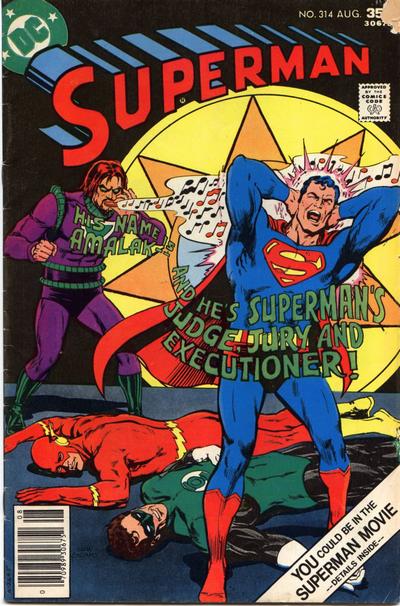
Superman #314 Title: Before This Night is Over, Superman Will Kill! Writer: Martin Pasko Pencils: Curt Swan Inker: Dan Adkins Cover: Neal Adams & Curt Swan
As I mentioned last week, picking up comics from bargain bins is a gamble, because you often will get an incomplete story without knowing it until you sit down to read. Such is the case here – the story starts right off with a child begging Superman not to kill his “dog,” only for next page to reveal that the boy is suffering from an alien germ called “Journalist’s Disease” which has apparently been plaguing Metropolis at least since Lois Lane caught it back in issue #311. (A four-issue arc? Rare at this time.) The “dog” is, in fact, an alien creature called Jevik that Superman believes is responsible for the disease. Jevik was sent by another alien – a pirate named Amalak – whose attack is intended as some sort of revenge against Superman as the last son of Krypton.
There were a LOT of aliens who hated Krypton back in the day. I wonder if James Gunn’s movie was on to something.
Anyway, Superman has a way to cure the disease, but needs equipment from the Justice League satellite. Arriving there, he finds Amalak, who claims to have killed Flash, Green Lantern, and Supergirl, and engages our hero in a final battle.
The story as a whole is interesting for two reasons. First, there’s the alien Jevik. Aliens in comics past often fell into one of two categories: either they were basically human, save for skin color or an odd extra growth and maybe some sort of racial superpower, or they were so bizarre that one can’t even fathom how such a thing could have evolved. Jevik falls into the latter category. Superman’s description of his life cycle is so strange that it makes almost no sense. Fortunately, making sense is by no means a requirement to enjoy a story of this nature.
The other thing that is noteworthy is how infuriating the last page of this issue is. I’m gonna spoil it for you here, because I want to talk about how mad it made me and I can’t do that without telling you what happens, so if you’re trying to remain pristine on a 49-year-old comic book, skip this. After Superman has engaged the cure to Journalist’s Disease and its many victims are on the mend, Clark Kent visits the recovering Lois Lane in the hospital. Shattered at the fact that he almost lost her, Clark asks Lois to marry him. She says she will – IF he will confess to her, right then and there, that he is Superman. And he says he can’t do that and walks away, leaving them both heartbroken.
It was the 70s, I get it. At this time period, the status quo was God and nothing could change. But Mr. Pasko – you expect me to buy that Clark Kent was willing to marry Lois Lane, but was not willing to tell her his identity?
And look, I know that 15 years later Clark would propose to Lois before she knew he was Superman, but the idea there was that he wanted her to love CLARK, and he would tell her the truth after they were engaged. There was never any doubt that he WOULD tell her. You can say that it may still have been problematic, but this? This is just absurd.
Loved it. Five-star issue.
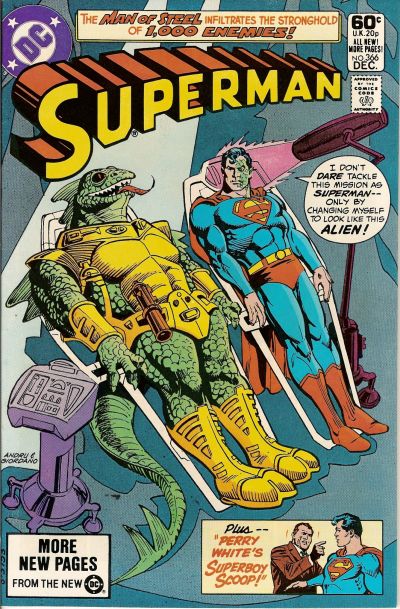
Superman #366 Title: Revenge, Superman-Style (Story 1), Perry White’s Superboy Scoop (Story 2) Writer: Cary Bates (1), Bob Rozakis (2) Pencils: Curt Swan (1), Kurt Schaffenberger (2) Inker: Frank Chiaramonte (Both) Cover: Ross Andru & Dick Giordano
An amazing thing about comics of this era is just how much time they spent recapping the story so far. This issue gives us no fewer than four pages to set up the story and recap what happened in the previous issue: Clark Kent is taking another week off work at WGBS-TV because Superman is needed on a mission in space that he fears he may not return from. Supergirl, meanwhile, is worried about him because last issue she was manipulated into attacking him as a plot by what they assume is the Superman Revenge Squad, and he’s off to fight them on his own. He disguises himself as an alien and allows himself to be “discovered” by the Revenge Squad, claiming that Superman recently thwarted him as well.
I love seeing the home of the Revenge Squad here. This isn’t a group of five or six bank robbers from Metropolis, friends, it’s a legion of evil aliens that Superman has thwarted time and again. They’ve got their own whole alien base. They even make a giant statue of Superman that they daily force to melt by shouting how much they HATE it. George Orwell would approve.
The aliens show off their various techniques to train while one of them secretly scans the newcomers brainwaves to make sure it’s not a trick…and he passes. What? How can this BE? The narrator even asks the same question. Unfortunately, the answer to that seems to come in issue #367, which I don’t have.
There’s a back-up story, though! A tale of “Superman: The In-Between Years,” which was a serial from that era that told stories of Superboy after the death of Jonathan and Martha Kent but before he began his career as Superman in Metropolis. In “Perry White’s Superboy Scoop,” the boy of steel has gone AWOL. Cities all over the country are claiming that he’s moved into town as various disasters are averted and crimes are thwarted anonymously. As people wonder where he’s gone now that he’s left Smallville, Daily Planet reporter Perry White is determined to prove that the kid has taken up residence in Metropolis. Clark Kent, of course, IS in Metropolis, attending college and carrying out good deeds in secret – deeds like saving Perry White from a mob boss.
Both Clark and Perry catch wind of the fact that some mobsters Perry recently reported on are meeting a rival gang from Gotham City in a baseball stadium, and both seek it out. Superman stops the gangland shooting and Perry White realizes that, despite the hail of bullets the two gangs unleashed upon one another, they were all knocked UNCONSCIOUS rather than killed. He demands Superboy show himself, and…well…he does. Pretty soon the Planet is formally announcing that Metropolis is the new home of Superboy.
Huh?
Okay, I can SORT OF buy that Superboy wanted to play his location close to the vest after leaving Smallville. Maybe he hadn’t totally settled on Metropolis as his new home yet. But first of all, these are the stupidest gangsters in history, so intent on shooting each other that none of them noticed the teenager in blue tights or the reporter with a camera taking pictures of them while they were standing on the baseball diamond of an otherwise empty stadium. And worse than that is Superboy just basically shrugging and giving Perry the scoop. There’s no change of heart, nothing that makes him sure that Metropolis will be his home, he just throws his hands up in the air and announces he’s in Metropolis now. Perry had no proof, just another freak occurrence such as those that had been happening since Superboy went into hiding. It makes no sense whatsoever.
Another timeless masterpiece.
Blake M. Petitis a writer, teacher, and dad from Ama, Louisiana. His most recent writing project is the superhero adventure seriesOther People’s Heroes: Little Stars, volume one of which is now available on Amazon.Don’t forget, you can check out earlier blogs in theYear of Superman/Superman Stuff Archive! Got a request for a future “Superman Stuff”? Drop it in the comments!
As I’ve mentioned many times, whenever my family takes a trip I like to do a little nerd shopping. Not only do I hit up comic shops whenever possible, but if I can find used bookstores, antique malls, or anything else of the sort, my wife knows that I’m going to want to immerse myself in some back-issue diving. There’s some relationship advice, folks, marry somebody who is willing to be patient with you when you’re elbow-deep in old copies of Donald Duck.
The interesting thing about doing this is that you never quite know what it is you’re going to find. I like the bargains, the dollar bins, the unsorted pot of gold at the end of the comic book rainbow. Sometimes you get complete sets. Sometimes long runs. But more often, I find, you get utterly random issues that don’t necessarily have anything else to do with anything else in the box. I always like to grab the weird comics when that happens, things that I’ve never heard of before, stuff that I’ve heard of but maybe have never read…and, of course, when I come across a Superman comic that I haven’t enjoyed, I rescue it from the bin.
Of course, this approach to collecting comes with a major complication – not knowing what I’m looking for and not even always knowing what I’m getting, Because I like to approach it this way, I often get incomplete stories. While it’s true that comics of the past were rarely serialized to the extent that they are today, even in the 70s and 80s it wasn’t unusual for a storyline to run for two or three issues, and at the time it was virtually unheard of for them to be labeled as such on the cover.
When that happens, when I read a comic that’s only a chunk of a story, I don’t necessarily feel like it’s fair to give it a full review. That doesn’t mean that it can’t be fun to talk about it, though. For example, a few weeks ago on a trip to the north shore of Lake Pontchartrain, we hit an enormous antique mall where I scored several cheap Superman books, virtually all of which turned out to be only a part of a story.
Bet you wanna know what’s going on here. Sucker.
Action Comics #507, for example. The lead story in this issue is “The Miraculous Return of Jonathan Kent” by Cary Bates and Curt Swan. Younger folks might not remember this, but until the John Byrne Superman reboot in 1986, most versions of Clark Kent’s adoptive parents had passed away by the time he began his career as Superman. So I’m sure you can imagine Clark’s shock in this 1980 comic when Jonathan shows up to visit him in Metropolis as if it were the most natural thing in the world. Clark is dumbfounded, of course, but is even more shocked when he discovers that Lana Lang, too, thinks it’s perfectly natural for the late Jonathan Kent to be there. Whooshing off to Smallville, Clark can’t find his father’s grave or any other evidence that he died – in fact, there is a preponderance of evidence that Jonathan has been alive and well in Smallville all this time. Superman even finds letters (people used to do that before email) written to Jonathan FROM Clark, in his own handwriting. How is such a thing possible?
What a great question! I assume the answer can be found in Action Comics #508. I didn’t get that issue, though, so I can’t be entirely certain.
Bet you wanna know how this started. Sucker.
Adventure Comics #455 from 1977 has the opposite problem – it’s the end of a story that began in the previous issue. In “I Can’t Go Home Again” by Bob Rozakis with art by Juan Ortiz and Vince Colletta, Superboy begins the issue in outer space looking down on a Smallville that seems to have been somehow inundated with Kryptonite. Although (in this Pre-Crisis era) Kryptonite is harmless to humans, Superboy is trapped outside of town, and a recap of last issue tells us that although he’d captured the Kryptonite Kid, thinking him responsible, the real culprit is Lex Luthor. Superboy switches back to Clark and tries to confront Lex, even though the Kryptonite has left him as weak as a kitten. It goes as well as you might expect, and let’s all be grateful that Pete Ross knew Clark’s secret, even if he didn’t want Clark to know that.
The story isn’t bad, but it makes me want to go back and read the first part which – needless to say – I don’t have. It probably also goes without saying that neither of the books I’m hoping to read are available on the DC Universe Infinite app. I’ve written before about how irritating it is that the “infinite” app has such huge swaths of comics missing from its catalogue. By what measure can we call it “infinite” if there are hundreds of comics featuring Superman that aren’t included in the database? (To say nothing of the missing comics featuring Batman, Wonder Woman, Green Lantern, the Flash, and all the rest?) I get that digitizing old comics takes time and money, but it’s been an embarrassingly long time since there were any more older comics added to the app.
I doubt that they’ll leap onto these two comics that I’ve mentioned here just because I happened to mention it – after all, I’ve been playing this particular song for a couple of years now and DC hasn’t made any real strides to start adding older comics again. But it’s something I find frustrating every time I open the app and look for a comic that turns out to be missing.
Not that this will stop me from picking up the random oldies whenever I come across them, of course. That, if nothing else, is part of the fun.
Blake M. Petitis a writer, teacher, and dad from Ama, Louisiana. His most recent writing project is the superhero adventure seriesOther People’s Heroes: Little Stars, volume one of which is now available on Amazon.Don’t forget, you can check out earlier blogs in theYear of Superman/Superman Stuff Archive! Got a request for a future “Superman Stuff”? Drop it in the comments!
We’re getting down to it, friends. As I write this, on July 2nd, the new Superman movie is a mere nine days away, and in case you haven’t noticed over the last six months, I’m kind of excited about it. So how, in this Year of Superman blog, do I commemorate this upcoming momentous occasion? Here’s what I’ve done: I’ve made myself a list of the stories that James Gunn has confirmed were used as inspiration for the new film. I’ve added a few other stories that I personally think are especially significant to demonstrating what kind of man Clark Kent is. And I’ve got a couple of surprises. But from now until July 11th, there’s gonna be no filler. For the next nine days I’ll be reading and watching some of the most important building blocks in making the Man of Steel.
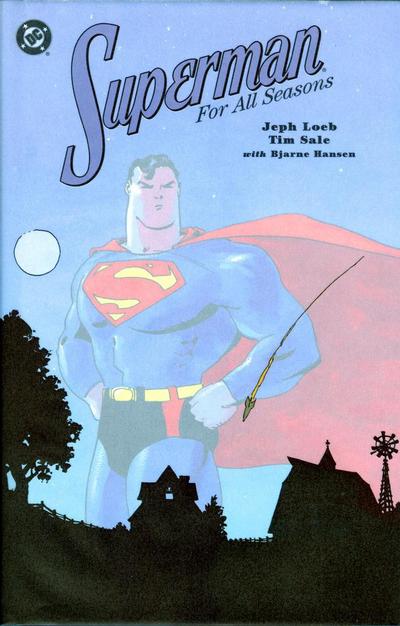
Graphic Novel:Superman For All Seasons (Collects issues #1-4)
Notes: In 1998, hot off the heels of their character-defining maxi-series Batman: The Long Halloween, writer Jeph Loeb and artist Tim Sale were given four prestige format issues to tell their quintessential Superman story. For All Seasons isn’t exactly an origin story, it’s not exactly the story of Superman coming to Metropolis, it’s not exactly anything but what it is: a glimpse of the Man of Steel. Rather than crafting an intricate mystery as they did with The Long Halloween or a high-octane thrill ride like Loeb would later do on the Superman/Batman ongoing, For All Seasons is like looking through a viewfinder at scenes of Superman, each of them capturing in a perfect crystalline moment just who Earth’s greatest hero actually is.
The first issue, “Spring,” focuses on young Clark Kent in Smallville. He’s different from his friends and he knows it, and we see a sort of struggle to maintain the balance between the idyllic small-town life he lives (Loeb even cribs a moment from the movie It’s a Wonderful Life, just in case we didn’t get the message that Smallville is the perfect little town) and the amazing, world-changing things he can do. He overhears his parents discussing his powers, he confides them to Lana, and in the end, the small-town boy decides to go to Metropolis. One of the last pages in this first issue, in fact, has become an iconic Superman moment, just as much as Krypton exploding or Superman catching Lois Lane falling from a building. It’s one of the sweetest, most Superman things I’ve ever seen on a comic book page:
Issue two, “Summer,” is narrated by Lois Lane early in Superman’s career, and she asks the question that I think makes the character so compelling: “He can do anything he wants to, and he decides to do what? Be a hero? Why?” Whenever someone tells me that they think Superman is boring or unrealistic, my response boils down to this same question. What kind of person would actually choose to use this kind of power for good? It’s crazy. It’s absurd. It doesn’t make sense.
That is, until you meet Clark Kent. And when you see who he is, that’s when you get it.
Superman saves Lois from a terrorist (in a glorious moment where Lois, rather than begging Superman to save her, instead asks him to make the obnoxious guy with a gun to her head SHUT UP because he’s getting on her nerves), but in so doing leaves Lex Luthor feeling somewhat impotent, something that Lex just can’t stomach.
My favorite part of issue two, though, is a return to Smallville. Clark catches up with Pete Ross, is dismayed to learn that Lana Lang has left town, and spends time with his parents merely because he’s lonely. This is another reason I love Lois Lane’s character – the responsibility of being Superman seems so gargantuan…he needs – even deserves – to have someone who can help him shoulder it. We’re not there yet in this issue, but Lois’s infatuation with Superman is already clear.
Issue three is “Fall.” It begins with Lex Luthor being arrested for some unspecified crime (although if you want to try to put it in context, this issue slots neatly after issue #4 of John Byrne’s Man of Steel series). Luthor quickly uses his influence to free himself, but his ire has grown even more. The people of Metropolis – beginning with the staff of the Daily Planet – suddenly fall ill and collapse, the victims of some mysterious viral agent. Although Superman is certain Luthor is responsible, he turns to him and asks him to use his resources to help. Fortunately, Lex already has a solution – he’s taken Jenny Vaughn, a woman Superman saved in issue two, and used her biochemical expertise to create an antidote. All Superman has to do is take her into the skies to seed the clouds above the city. She does so, and the people of Metropolis begin to wake up. But Jenny suddenly collapses and dies in Superman’s arms – overexposure to the very disease she had cured. Clark, broken, returns to his parents in Smallville, uncertain if he’ll ever come back.
“Winter” ends the series beautifully. Still in Smallville, in hiding, Clark reconnects with Lana Lang. Lana and his parents can see the pain he’s carrying with him, but rather than feed it, they remind him of who he is, what kind of a man they’ve known all his life. And when a flood threatens Smallville, Clark finds himself ready to put his uniform back on again.
There are so many amazing things about this series. It shows very clearly that the soul of Superman is not the city of Metropolis, but Smallville, Kansas. It’s where he begins, it’s where he returns in every issue. It is his home, it is the place that grounds him. When Superman needs help, he returns to the farm where he grew up and the people who know him better than anyone. Luthor, meanwhile, is never technically “defeated.” His scheme is built on his ego, his compulsion to hurt Superman, and he does it far more effectively than he ever could with Kryptonite or a red sun projector – he strikes not at his Kryptonian power but at his all-too-human heart. But in the end, Superman triumphs simply by returning to Metropolis, by deciding to move on. The best way for Superman to defeat Lex Luthor is by continuing to be Superman.
There are a lot of great Superman stories. I’ve read many of them this year, and I’ve got several more of the best lined up for the next nine days. But if you’re looking for the simplest, truest, purest expression of who Superman is at his core, I think Superman For All Seasons may just be the greatest of them all.
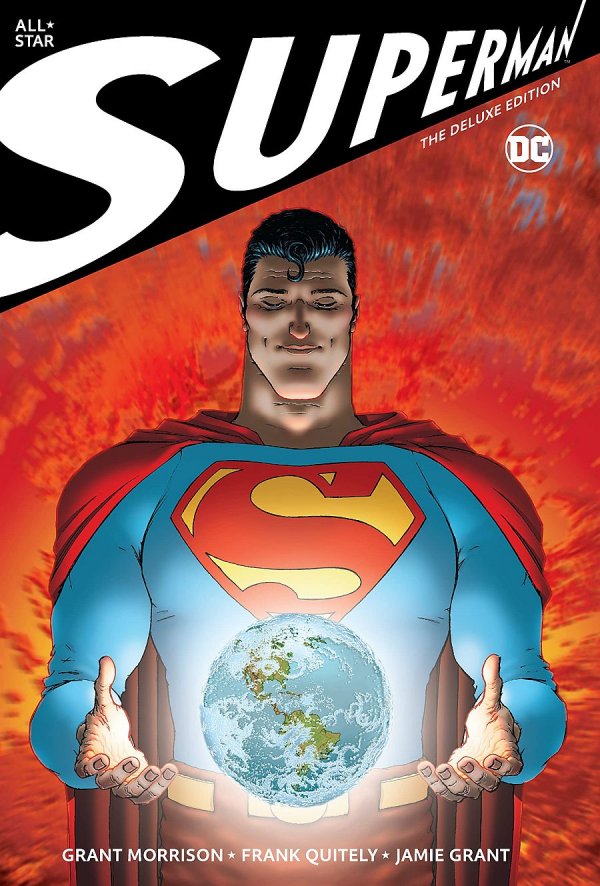
Notes: Next up on my tour of Superman’s greatest hits is this magnificent series from 2005 to 2008. DC announced their “All-Star” line as a chance for some of comics’ greatest creators to tell stories unhindered by continuity, their ideal versions of the character. To this day I don’t know what happened, really, but only two comics ever materialized from this effort, this one and All-Star Batman and Robin, the Boy Wonder by Frank Miller and Jim Lee, and that series was never even finished.
But Morrison and Quitely finished their story, and in the years since it has become acclaimed as one of the greatest Superman stories of all time. In a nutshell: while saving a scientific expedition in distress on the surface of the sun, Superman’s cells become overcharged with energy. Although he suddenly finds himself more powerful than ever, it is only a temporary boost – his cells are dying, and all the science in the world can’t save him. Knowing that his days are numbered, Superman sets out on an Odyssey to save the world as much as he possibly can before time runs out. A time-traveler tells him of 12 impossible tasks he will accomplish before his death, and he sets out to do them – while all the while being watched by a Lex Luthor who is sitting on Death Row.
What Morrison and Quitely do with this book is nothing short of miraculous. Morrison mines Superman’s entire history to pull out characters and pieces to play with: a rivalry with Samson and Hercules for the hand of Lois Lane, the mysterious “Unknown Superman” of the future, and even characters from one of Morrison’s own epics, the DC One Million crossover. Over the course of twelve issues, Superman spends time with several people of great significance to him, with spotlight stories on Lois Lane, Jimmy Olsen, Jonathan Kent, Bizarro, and Lex Luthor himself.
But the amazing thing is that none of these characters are exactly what this series is about. There are a great many good stories about what Superman means to other people. For All Seasons, for instance, had chapters narrated by Jonathan Kent, Lois Lane, Lex Luthor, and Lana Lang. We’ve seen how everyone feels about him, from Perry White to Batman to some random kid he pulled out of a school bus that was going over a bridge. But All-Star Superman is really about what SUPERMAN thinks it means to be Superman. And what that means is a relentless, unstoppable thirst to be better. Even when faced with his own certain death, Superman’s every breath is dedicated to making the world a better place, to bringing happiness to his friends, to saving as many people as he possibly can. There’s a famous single-page vignette – you likely have seen it online even if you haven’t read the comic book – of Superman talking someone out of jumping from a ledge. It’s a single page, removing it from the graphic novel would not impact the story in any way, but it is the perfect, crystalline embodiment of who Superman is.
At the end of the story (and here’s a spoiler, in case you haven’t read it), Luthor finds a way to temporarily give himself Superman’s powers. And Superman finds a way to weaponize that, manipulating Luthor’s enhanced senses to force him to perceive the fabric of the universe the way Superman does. Suddenly forced to change his perspective, Luthor has an absolute breakdown as he sees the connectedness of all things in a way that he’s never considered, making the most egotistical man on the planet realize the depths and futility of his own selfishness.
Despite such a dark premise, this story (like Superman himself) never falls to despair. It is quietly uplifting, awe-inspiring, and full of hope. It shows us how Superman sees himself, and how he wishes for the rest of us to see him as well. And if the movie is half as capable of depicting that feeling as the graphic novel, it will be magnificent.
Fri., July 4
Comic: Action Comics #775
Notes: It’s the Fourth of July and, of course, for those of us in the United States it’s our Independence Day. I’ll be spending most of the day at a family barbecue – it’s always been my favorite day of the summer, after all. But that doesn’t mean I can skip my Year of Superman obligations, and I can’t think of a better story to read today than Joe Kelly and Doug Mahnke’s classic “What’s So Funny About Truth, Justice, and the American Way?”
In this legendary tale, Superman is stunned by a new team of heroes who prove to be anything but. Calling themselves “The Elite,” this new squad bursts onto the scene and dispatches those they see as villains quickly, violently, and terminally. Superman is horrified when public opinion starts to tilt in favor of the Elite and their leader, the telekinetic menace called Manchester Black. Children want to be the Elite, saying that Superman is played out, others wish that the Elite would take steps like killing the Joker…and all the while, Clark finds the changing tide shocking and disturbing.
After Black calls him out, Superman agrees to face the Elite in battle. They take the fight to the surface of Jupiter’s moon, Io, where the Elite proceeds to pound Superman seemingly into oblivion. With nothing left but his cape, they think victory is in their grasp – until they hear Superman’s voice coldly “thanking” them for showing him the way. In seconds, Superman seems to kill all of Black’s associates one by one, and when an enraged and hysterical Black tries to force a final confrontation, Superman uses his heat vision to cut out the part of his brain that gives Black his powers without the man even feeling it. Weeping in despair, Black says that Superman has proven them right, that he’s no better than they are.
Except that he is. Because he’s Superman. The Elite are alive – beaten, incapacitated, but none permanently injured. Even Black’s powers will return after he heals from the concussion Superman gave him. But Superman had to show WHY he never takes the steps the Elite have taken – that it would be too easy, too ugly, too terrifying to give in to the temptation to kill, and once that step is taken, there is no going back.
Black has spent the issue telling Superman that he’s naive, that his perspective on the world is just a dream, a worthless ideal that holds the world back from progress. On the last page, Superman gives his perfect rebuttal to that stance:
“Dreams save us,” he tells Black. “Dreams transform us. And on my soul, I swear…until my dream of a world where dignity, honor, and justice becomes the reality we all share, I’ll never stop fighting. Ever.”
How good is this comic? How many other single-issue comic book stories have been adapted into a feature-length film? And even fewer have done it well. This is the one-book response to everybody who claims that Superman should be dark, should use his powers to shape the world as he sees fit, should take care of his adversaries permanently. This is not the world that Superman sees, and thank God that it’s not. In the few pages where Superman cuts loose and makes it clear that he COULD kill the Elite with minimal effort, he becomes absolutely terrifying. So at the end, when he reverts back to type and you realize it’s all been a ruse, the relief is tangible.
Kelly reportedly wrote this story as a response to the popularity of Wildstorm Comics’ The Authority, in which thinly-veiled expies of the Justice League decide to use their power in just this way, taking on threats to the world in a violent and permanent manner. (There is an irony to the fact that the Authority is now part of the DC Universe and that one of its members, the Engineer, is going to be among the antagonists of the new movie I’ll be sitting down to watch with my family exactly one week from today.) Those stories are fine for the likes of the Authority because – although obviously created to imitate the Justice League – they are NOT the Justice League. Apollo is their version of Superman, but he’s NOT Superman. These are stories that work as a deconstruction of our heroes, but don’t work as stories of the heroes themselves. In less than 40 pages, Joe Kelly and Doug Mahnke show us that the ideals that Superman stands for not only aren’t out of date, they’re more important than ever before.
What’s so funny about truth, justice, and the American way?
Nothing at all.
Sat., July 5
Movie: To Kill a Mockingbird (1962)
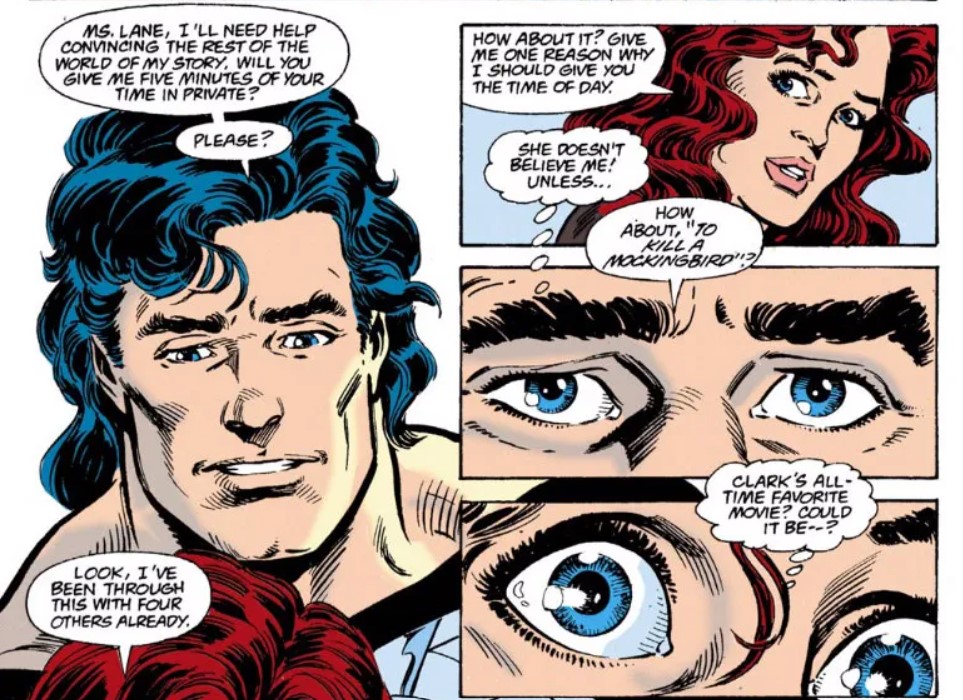
Notes: Some of you are scratching your heads right now. Some of you have no idea why I would choose To Kill a Mockingbird as an entry in the Year of Superman, especially in THIS week, which is about the stories that most make Superman who he is. But there’s actually a very simple explanation, friends: To Kill a Mockingbird is Clark Kent’s favorite movie. In fact, it was even the key phrase that Superman used when he returned from the dead to convince Lois Lane that he was the genuine article and not yet another imposter.
In and of itself, though, that wouldn’t be enough for me to include the movie. If Clark’s favorite movie was something like Caddyshack, Godzilla, or Dude, Where’s My Car?, it wouldn’t make the cut. But I believe very staunchly that the things a person loves can tell us an awful lot about a person, and in this case, that’s particularly profound. In the Marvel Cinematic Universe, Tom Holland’s Spider-Man is a big fan of what he calls “really old” movies like Aliens and Empire Strikes Back. In his case, they chose those movies for two reasons: to make a joke about what people of different generations consider “old” and to demonstrate that this Peter Parker is a geek like us. And it works for that character. But in the case of Superman, when Dan Jurgens declared To Kill a Mockingbird to be Clark’s favorite movie (or whoever – I assume that it was Dan Jurgens because he wrote the comics where I first saw it referenced), he could have picked anything. He chose a movie with a compelling and powerful message about justice, and when the film ends, it’s easy to see Atticus Finch as a cinematic mentor for Clark Kent.
In case you’ve never watched it (or, even better, read the book), To Kill a Mockingbird is the tale of a family in Alabama during the height of the Great Depression. Gregory Peck plays Atticus Finch, an attorney appointed by the court to defend a black man named Tom Robinson who has been accused of beating and raping a white woman. Although Tom maintains his innocence, in this time and this place, the mere fact of the color of the accused and the accuser is enough to make most people in town declare his guilt without even the benefit of a trial. But despite the town turning against him, Atticus stands firm in his conviction to do the right thing and defend the innocent – no matter the personal cost that he will have to pay.
Come on, people, do I have to spell it out for you? That’s who Superman is every day. Defender of the defenseless, protector of the innocent, willing to give even his own life for somebody else, and refusing to back down in the face of what he knows is right, no matter what anybody else says.
The Tom Robinson plot is the main story, but there are also several subplots and side moments that you can easily view as contributing to the development of Clark Kent’s moral core. One of the biggest is Boo Radley, son of Atticus’s neighbor. Atticus’s children Jem and Scout (the latter of whom narrates the story) are afraid of the mysterious Boo, who never leaves the house, leading to a lesson about making assumptions about people. Another scene features Scout learning to understand how to treat the less fortunate during an awkward dinner. A few minutes later, Atticus is forced – despite having no desire to do so – to put down a rabid dog to protect his family, shocking his son Jem when he realizes his dad is a crack shot.
The lessons permeate the story itself, too. One night, Atticus gets wind that a mob is planning to storm the jail and lynch Tom, so he sits outside the jail to wait for them. Jem, Scout, and their friend Dill sneak out of the house and arrive just as the mob is about to turn on Atticus, and although he tells them to go back home, the children refuse. Instead, as Scout asks the men in the mob – neighbors she’s known her entire life – how they’re doing, the men are shamed into retreating. It’s a beautiful moment of heroism for the little girl, and you see how Atticus has shaped his children in a time where society was working against him.
The funny thing to me is that Superman was created in 1938. To Kill a Mockingbird came out in 1962, a full 24 years later, and the novel it was based on was released only two years earlier than that. It’s more than likely that Harper Lee (born in 1926) had read Superman comics when she was young before writing the book. In comic book time, it doesn’t matter. Even in 1992, when Jurgens first mentioned that it was Clark’s favorite movie, it would have been 30 years old and easily could have been a movie that Clark watched when it was released during his childhood. Today (and I’m just realizing that more time has passed since that comic was published than had elapsed between that comic and the movie’s release – somehow this stings more than Tom Holland calling Alien “really old”) it would be a movie he saw on cable. A few years from now he’ll mention having caught it as a kid on Netflix. But it doesn’t really matter how old the movie is or what era little Clark first would have watched it in – the meaning is timeless and has never lost its relevance. It is the perfect choice for a film that shaped a Superman.
In 2003, the American Film Institute conducted a survey of its members where they voted for the 100 greatest heroes and villains in cinematic history. Christopher Reeve’s Superman made the heroes list at #26. Gregory Peck’s Atticus Finch? He was number ONE.
And I doubt that Clark Kent would have any issue with that.
Comics: Secret Six Vol. 5 #4 (Super-Son), Justice League: The Atom Project #6 (Cameo)
Sun., July 6
Graphic Novel: Superman: Up in the Sky (Collects issues #1-6)
Notes: Tom King and Andy Kubert’s Up in the Sky was not – to my knowledge – specifically listed amongst James Gunn’s inspirations for the new movie. However, King is working with Gunn – he’s one of the executive producers for the Lanterns series that’s in the works and, of course, his Supergirl: Woman of Tomorrow is the inspiration for HER upcoming movie – so it’s reasonable to assume that Gunn has read this book. And if he hasn’t, he should, because it’s one of those stories that cuts right to the heart of who Superman is.
Batman summons Superman to Gotham where he’s told of the murder of a pair of foster parents by what seems to be an alien presence, and the abduction of one of their children. The girl is named Alice, he learns, and she loves Superman. Everyone is put on alert – even the entire Green Lantern Corps is looking for Alice, but as Hal Jordan tells Superman, “it’s a big universe.” Although he is reluctant to leave Earth, worried that something will require him in his absence, Superman cannot allow this child to remain lost, waiting for him to save her, and know he’s done nothing. He takes off into space, determined to find her.
This story was originally serialized in 12 parts, in the Superman Giant series that was released through Walmart several years ago. It was repackaged as a six-issue series through comic shops, and now the graphic novel format we enjoy today. In these 12 parts, we watch Superman go to the end of the universe to find Alice. Each chapter, although part of the quest, is relatively self-contained. Superman goes into a boxing match with an alien stronger than him, but who can give him a clue to Alice’s location. A time anomaly tosses him to meet Sgt. Rock in World War II. Another anomaly splits Superman and Clark Kent into two people on a frozen alien planet. So forth. One chapter is even a story from Alice’s perspective, as she narrates the story of the one Superman/Flash race that Superman legitimately won. Remember waaaay back in Superman Vs. the Flash week, when I mentioned there was one other race I skipped? This is the one. And the reason Superman wins that race is…well, it’s not because he’s faster than the Flash. It’s because someone needed him.
That’s what this story, this entire, amazing, incredible epic, boils down to. Everything Superman does – everything he EVER does – is because somebody needs him. Lost in time? He’s got to get back to save Alice. Stuck in a stupid, alien bureaucracy for hours trying to get a call back home to hear Lois’s voice? A brief pit stop, because Alice needs him. Making a deal with Darkseid to violate one of his own sacred vows? He has no choice – Alice is still out there. Even in the chapter where Superman and Clark are two different people, it seems at first that we’re going to get the standard dichotomy of the human Clark and the cold, stoic Superman, which we’ve seen so many times. But as the story goes on, we realize that – although Clark is, of course, the soul of Superman – even without Clark there he’s STILL Superman and, illogical as it may be, he cannot fly away when somebody needs him. And Alice needs him.
The final chapter of this story is one of the most emotional, beautiful pieces of Superman storytelling you’ll ever read. We see him backtrack, revisiting some of the dangers he faced along the way, and we get added context to certain things. Most importantly, we see how Alice sees Superman, and we see why her faith in him – her belief that he would save her – never wavered, no matter how foolish or hopeless his quest might have seemed. I can’t imagine anyone who loves Superman being capable of reading this book without feeling a stirring in their chest. Despite its galactic scale, this is one of the most deeply personal Superman stories I’ve ever read, a story about a man who is incapable of giving up when someone else needs help. It’s about a man for whom saving just one child matters just as much as saving the entire universe.
It’s about Superman in his truest, purest form. It’s about Superman.
Mon. July 7
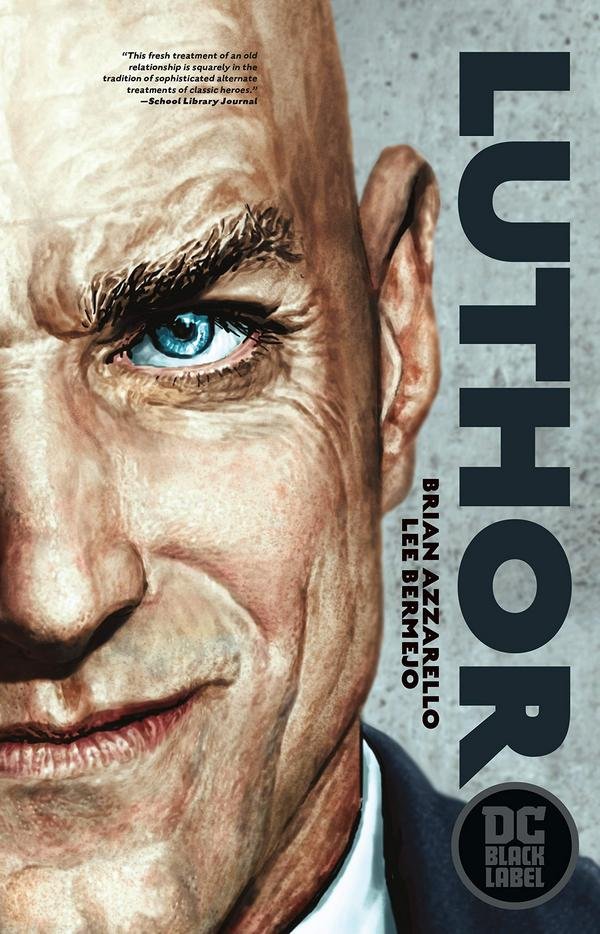
Graphic Novel: Luthor (originally published as Lex Luthor: Man of Steel #1-5).
Notes: This isn’t the first time Brian Azzarello’s name has come up in the Year of Superman, but you may recall I didn’t particularly care for his collaboration with Jim Lee on For Tomorrow. However, his and Lee Bermejo’s Lex Luthor: Man of Steel miniseries from 2005 was a different matter entirely. In this story, we see a Lex Luthor who is motivated not purely by arrogance or a thirst for power, but also by fear. Luthor is afraid that Superman – an alien – will undermine humanity, and decides to fight back by creating his own superhero, a woman he dubs “Hope.” In his game of chess against Superman, though, is Hope a pawn, or a queen?
They say that, in real life, nobody thinks of themself as a villain. After all, a villain is a bad guy, and if you think something is genuinely bad, you don’t do it. So the villains in the real world have justifications, moral and ethical gymnastics that they use to convince themselves that what they’re doing isn’t bad – “I deserve what I’m taking,” “the world isn’t fair, so I don’t need to play fair,” “I have to get him before he can get me,” and maybe most sadly, “God told me to do it.” That’s why it never quite made sense that, in the early days of the X-Men, Magneto called his group the Brotherhood of Evil Mutants. In Luthor’s case, he has convinced himself that Superman is a genuine threat against humankind, therefore anything he does – including murder – is justified in that his end goal is to save the world. Azzarello isn’t the first person to posit this characterization of Luthor, but he certainly is among the best to put it on the page.
The story is told exclusively through Luthor’s point of view. Although Superman is a constant presence in the tale, his appearances are brief and sparse, and he never speaks on-panel. (His one spoken line, a slap to the face of Luthor’s moralizing, comes at the very end, and is delivered from off-panel.) Instead, we have Lee Bermejo painting a Superman the way that Luthor sees him – cold, distant, with an anger in his eyes that an objective look at the Man of Steel would never show. In the end, we have a Luthor whose distrust and hatred of Superman is so great that he’s willing to cut out his own heart (metaphorically speaking) in the hopes of gaining the upper hand. It’s a harsh portrayal of the character and, although he is still brilliant and terrifying, you can’t help but feel pity for him.
Supposedly, this version of Lex Luthor was drawn on for Nicholas Hoult’s portrayal of the character in the movie, and I honestly can’t think of a better story to use to shape a Luthor that’s both chilling and entertaining. In the end, he’s the most dangerous kind of villain of all: the one convinced he’s right.
The story has been presented a few times: both under its original title of Lex Luthor: Man of Steel, and in a collected edition called simply Luthor, making it a sort of companion piece to Azzarello and Bermejo’s highly-acclaimed Joker original graphic novel that gives a similar portrayal to the Clown Prince of Crime. Both books are worth reading. But let’s be honest – you only need to read this one before Friday.
Special Presentation: Superman World Premiere
Notes: I’m breaking a lot of new ground here in the Year of Superman. Tonight I’m watching something I’ve never watched before: the livestream of a movie premiere. DC is streaming the world premiere of Superman on all the socials, so I’ve got it fired up on YouTube. I have also turned off the comments on YouTube, because good lord, people on the internet are morons.
The stream starts with clips from the various fan events that they’ve been holding over the last few weeks. I’ve already seen most of the footage on social media, but Eddie hasn’t, and he (being a child who loves logos) got particularly excited when he saw a group of fans standing in the shape of the Superman S-shield. Even now, after months of hyping it up, I’m get a little nervous about taking Eddie to see what is technically going to be his first “grown-up” movie in theaters (defined as “not a cartoon”). But his anticipation has been growing. He talks about going to the movie several times a day. And as the livestream begins, he plops down in front of the TV and watches in glee as we see clips of the fans in cosplay, the drone shows, the decorations, and the crowds that have come to celebrate the Man of Steel. He actually doesn’t turn away and go back to playing games on his tablet until we return to the two guys who are hosting the show as they try to vamp until someone shows up on the carpet. I can’t really blame him.
I can’t pretend the premiere event was particularly revelatory. Most of it was brief interviews with the cast who all said pretty much the same thing: “The movie is great, the cast is great, James Gunn is great, you’re all going to love it.” Gunn himself, I think, had the quote of the evening when he urged people to see the movie on the “biggest screen possible” so that they can catch all of the “Crazy-Clark-Kaiju-robot-flying-dog action you can get.” I mean, I was planning to do that anyway, but if I hadn’t been that would convince anyone.
I don’t begrudge them for sounding like hype men, of course – this is simply what you say and do during a red carpet event. Despite that, though, despite the repetitive nature of the conversation and the clips that we’ve already seen from the trailers 1000 times, I still had fun watching this. I guess I’m just that psyched – every little scrap of content pertaining to this movie is enough to energize me at this point. And I wouldn’t have it any other way.
Tues., July 8
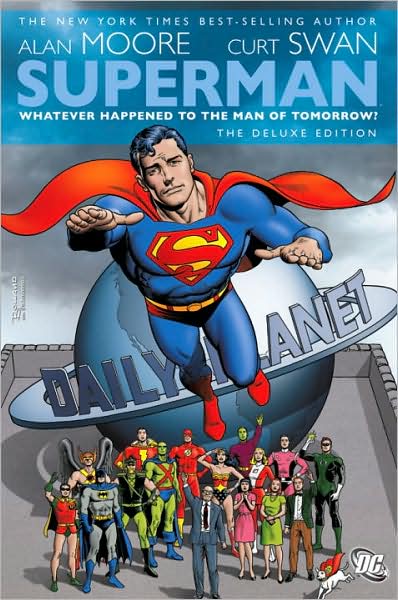
Graphic Novel: Superman: Whatever Happened to the Man of Tomorrow? (Collects Superman #423 and Action Comics #583).
Notes: Let’s talk again about the John Byrne Man of Steel reboot. You’ve heard of it, right? Well, with the knowledge that the Superman books were about to be restarted and given a clean slate, it was decided to end the current run with one last “Imaginary Story,” the Silver Age term for comics that were out of continuity. Written by Alan Moore with art by perhaps the most iconic Superman artist of the age, Curt Swan, this two-part story is the culmination of everything Superman was in the Silver and Bronze ages of comics. It begins in the future of 1997, where a retired Lois Elliott (née Lane) is being interviewed by a reporter for the Daily Planet about her experiences in the last days of Superman’s life. Lois recounts how, a decade prior, Superman’s enemies suddenly returned, much more violent and brutal than before. Bizarro goes on a killing spree before taking his own life with Blue Kryptonite, then the Toyman and Prankster torture and murdere Pete Ross, getting from him the secret of Superman’s dual identity. They are captured by Superman, but not before revealing that he is really Clark Kent to the entire world. Scared for the rest of his friends, Superman gathers those closest to him and takes them to the Fortress of Solitude in the Arctic, unaware that Brainiac has taken the body of Lex Luthor as his own, and is marching towards the Fortress with deadly purpose.
I have a complicated relationship with the work of Alan Moore. Without question, he’s responsible for some of the greatest comic books in the history of the medium: Watchmen, Swamp Thing, this one…all masterpieces. But in recent years I feel like he’s sort of started to buy into his own hype and taken on a sort of self-absorbed attitude, showing public disdain for comics in general. And when the creator of Lost Girls has the audacity to complain about other people touching his characters, it kind of drains my respect.
But separating the art from the artist here: this book is a phenomenal capstone for the nearly 50 years of Superman continuity that existed at that point. Moore uses an intriguing blend of Silver and Bronze age elements. From the latter, Clark Kent is a TV reporter whose identity is exposed on-the air thanks to the Prankster and Toyman. Supergirl is dead in this timeline, following Crisis on Infinite Earths, so for her cameo she visits with the time-travelling Legion of Super-Heroes. Even Kristin Wells, the mostly forgotten Superwoman of the 80s, makes a brief appearance in this story. But a lot of the bits and pieces come from the Silver Age – Lana and Jimmy both evoke some of the sillier stories in which they got super powers, this time weaponizing them on Superman’s behalf. The Legion we see is drawn to resemble the earliest days of the characters – young, with their original uniforms – but they also quite clearly know that they’re in a time period in which their teammate Supergirl is already dead and in which Superman’s days are numbered.
There’s a lot of tying off the old loose ends that Superman accumulated over the years, especially in terms of the Superman/Lois/Lana love triangle. For years, it appeared in the comics as though Superman was unable to decide which of the women he loved the most. In this issue, Moore deftly reveals that he’s known the obvious choice along, but has a suitably self-torturing reason for never acting upon it. It’s the kind of motivation that fits in perfectly with a Silver Age mindset, but it works well in the context of this “final” story, helping to bring closure to elements that had been around for decades.
That said, there’s plenty of Alan Moore’s signature deconstruction going on in this story. The reveal of the true villain of the piece is exactly the sort of thing he’s known for – taking an element that may have seemed silly or childish when originally conceived, but finding a way to make it terrifying. Other moments are simply heartbreaking – Superman trying to avoid letting the time-travelling Supergirl know that she’s dead in this time period, for example. Then there are the three friends of Superman who try to step up and fight alongside him, each of them showing a core of courage and love that makes you want to weep. As Lana Lang tells Jimmy Olsen at one point, “We’re only second-stringers, Jimmy, but we’ll show ’em. Nobody loved him better than us.” You even feel pity for Lex Luthor in this one, as his body is manipulated by Brainiac. The implications of that, the idea of having someone else invade your physical form, using your muscles, controlling your vocal chords as you are forced to watch and do nothing…not even Lex Luthor deserves that.
Having Curt Swan illustrate this story was a perfect choice for two reasons. First, it was just a fitting tribute for one of the greatest and most influential Superman artists of all time. Second, his pencils evoke a simpler, brighter time period, which makes for a harsh juxtaposition with the extremely dark story.
But dark as it is, the story ends – as befits Superman – with a symbol of hope. Not an S-Shield this time, but rather, a wink. The story has aged somewhat. A lot of the things that Moore draws upon have been evolved or removed to the point that someone who is only familiar with the post-Crisis incarnations of Superman would feel very confused, if not terminally shut out of understanding what’s happening. But if you have a love for the Superman who existed before John Byrne’s era, this story feels like the perfect ending, the ultimate culmination of that Superman. It’s a grand farewell to this version of the character. There will never truly be a “last” Superman story – the character will live on no matter what. As an attempt to end the legend, this is a good one.
But I still think there’s one better.
I’ll get to that today, as you read this…but I guess you’ll get my thoughts on it next week.