Geek Punditry #44: What’s Wrong With a Spider-Family?

Last week in a shocking announcement, Marvel Comics revealed it will be publishing a new Spider-Man series in which Peter Parker and Mary Jane Watson are (hold your horses, folks) – married.

I know, that’s probably a total stunner to you, possibly because you think it’s impossible to tell compelling stories with a married couple. Perhaps it’s even MORE shocking when you find out that they will have children, because as we all know, anybody who is married or a parent is clearly too old to be an engaging protagonist. No, these characters are now either relegated to supporting roles as their offspring take over as the primary character, or they must be made the subject of a traumatic domino chain that is the emotional equivalent of watching all 10 Saw movies in immediate succession, possibly preceding it with The Human Centipede as an aperitif. After all, the only characters capable of maintaining an interesting narrative are young and have no familial attachments, with the possible exception of an aunt whose death is a foregone conclusion that may be teased and waved in front of our hero for years as an additional piece of mental torment.

It would only be logical if that were your reaction. After all, that’s been more or less the official stance of Marvel Comics for a couple of decades now. 
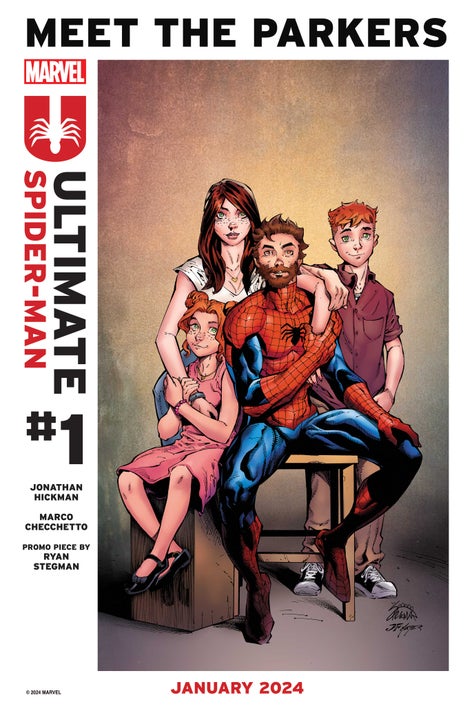
🎵”Spider-Dad, Spider-Dad,
Don’t you tell him his jokes are bad…”🎵

Okay, at this point I imagine the regular comic book readers out there are all nodding their heads in understanding, while those of you who only know Spider-Man as Tom Holland (or possibly Andrew Garfield or Tobey Maguire) are somewhat confused, so for the sake of that latter group, let me explain. First of all, the comic in question is a new version of Ultimate Spider-Man, written by Jonathan Hickman and explicitly set in an alternate universe than the mainstream Spider-Man. That’s right, thanks to the marvels of the multiverse, we can have that book coexisting with the “normal” Spider-Man, whose adventures will continue to be chronicled in The Amazing Spider-Man, where he remains childless, spouseless, joyless, and probably has had a puppy taken away from him in the last 15 minutes just to make sure he is constantly being beaten up by the universe.

The thing is, Peter Parker and Mary Jane Watson were married once, and for a long time. Their wedding took place in Amazing Spider-Man Annual #21, published in 1987, and it was the status quo for my formative years. I was a child when they married. I was a teenager when I read the books voraciously. And although I never once, in all that time, thought it was difficult to relate to a character who had a wife and stable family life, apparently former Marvel Comics Editor-In-Chief Joe Quesada disagreed with me. Quesada spent years after becoming Marvel’s EIC in 2000 teasing fans, talking about his distaste for the marriage and expressing his belief that it “aged” Spider-Man too much. Finally, after 20 years of having Peter and MJ as a married couple, Quesada gave us “One More Day,” a storyline in which Peter traded his marriage away to Mephisto, Marvel’s equivalent to Satan, in exchange for May Parker’s life.

You only imagined this. It’s a Mandela Effect or, like that black and blue/gold and white dress or something.

This will require a little more explanation, so buckle up: the reason Aunt May’s life was in jeopardy in the first place was because of the Civil War storyline, written by Brian Michael Bendis. This was one of those crossover storylines that involved virtually every Marvel comic being published at the time, but a lack of communication among the other writers about what was actually going on made it a garbled mess. In this story some of the Marvel Heroes began supporting a “Superhero Registration Act,” requiring superheroes to register with the government or become outlaws. Despite nearly 40 years of stories showing heroes standing up against measures such as this, many characters sided with the Pro-Registration side, led by Iron Man, as opposed to the Anti-Registration side, fronted by Captain America. 

Let’s take a moment to try to parse the fact that anybody – any damned person – in the Marvel Universe would for even a split second side with Iron Man over Captain America in any question of an ethical nature, let alone a question of government overreach. Let’s parse that.

Spider-Man, for reasons, took Iron Man’s side. Then, just to prove how much he agreed with the Pro-Registration side, he revealed his secret identity to the world. This proved how great Registering was, even though several books specifically said that nobody who registered would be forced to reveal their identities to the public. Even though it said that. Spider-Man did it anyway. To support the government.

Parse that too.

And then, after 40 years of stories demonstrating that superheroes revealing their identities to the world would put their loved ones at risk, Spider-Man’s revelation shockingly put his loved ones at risk, and May Parker was shot by a bad guy. 

If only someone could have predicted such an outcome.
Spider-Man being confronted by the consequences of his own actions (2007, colorized).

Finally, in order to save his aunt’s life – something that apparently was beyond medical science, the machinations of Dr. Strange, or even Disney’s in-staff physician Doc McStuffins – Peter cut a deal with Totally Not Satan: save May’s life and make everyone forget his secret identity. In exchange, Mephisto didn’t even want Pete’s soul. He just wanted to make everyone in the world forget that Peter and Mary Jane had ever been married. Even Peter and Mary Jane themselves. He wanted this for reasons.

If this whole story sounds unfathomably stupid to you there’s a good reason for it: it was. Even J. Michael Straczynski, the writer tasked writing with the story, tried to have his name taken off it. Although to be clear, he was still willing to write a story that would wipe out the marriage, he just thought this particular method of doing it was weak. I’m sure that his version would have been better, even if I personally find the planned outcome distasteful, because Straczynski is a great writer. And certain elements clearly COULD have worked, because the movies Captain America: Civil War and Spider-Man: No Way Home both borrowed select elements of that storyline and made great movies, disproving the old adage that you can’t polish a turd.

Anyway, fans were not happy, but Marvel has persevered with this new status quo. Over the years since then Peter and Mary Jane have been together and been apart, but the marriage has never been restored. Dan Slott, who wrote Spider-Man for a long time in this period, has said that people higher up the corporate chain than even Quesada (who is no longer with the company) don’t want Peter and Mary Jane to be married again, ever. And while that may be true, that just makes it crueler how often assorted writers have teased a reconciliation over the years. This teasing even included an earlier alternate reality series, Amazing Spider-Man: Renew Your Vows, which was good, but has been somewhat forgotten.
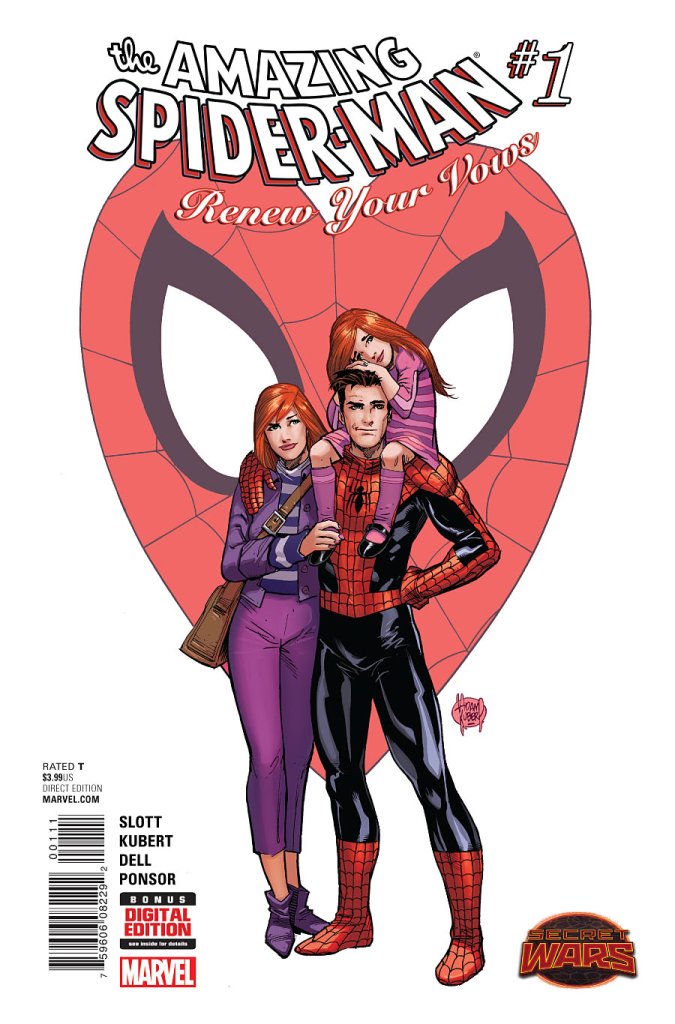
This, however, is totes canon. Well, somewhere in the Spider-Verse, anyway.

The most recent run of Amazing Spider-Man ended with Peter and Mary Jane together again (if not married) and it left them in a good place. Then came a new writer for the current run, which started with a six-month timeskip, everybody hating Spider-Man for reasons that went unexplained for a year, and Mary Jane having school-age children with another man. I stopped reading the book at this point, something I had only done once before: after “One More Day.” I have not returned, although I’ve read the explanation for everything we didn’t know in the timeskip, and the explanation this time is so egregiously stupid that it makes “One More Day” almost seem quaint by comparison.

I’m sorry if it sounds like I’m ranting, but this is important. Spider-Man is an iconic character, one that means a lot to a lot of people, including myself, and the way Marvel seems bound and determined to make him permanently miserable is, frankly, a source of real frustration to me. That’s why I was so excited when I heard about Hickman’s new Ultimate Spider-Man series. The fact that it’s set in a different universe is barely even significant at this point, as Multiverses now shoot out in pop culture like candy from a Pez dispenser. It’s a married Peter and MJ, something I have wanted to see return for 16 years. It would almost be hypocritical of me to not read this series. 

Hickman is probably my favorite writer who has done consistent, long-running titles at Marvel in the past decade or more, but he’s never done a long run with Spider-Man before. Giving him the character, even as part of the new Ultimate Universe, is something that excites me. That doesn’t mean I expect the book to be all sunshine and rainbows – Hickman is too good a writer for that. But I am hoping for stories that use the dynamic of a family to tell compelling, interesting stories that use the family as part of the tapestry instead of viewing it as a nuisance that needs to be brushed aside. 

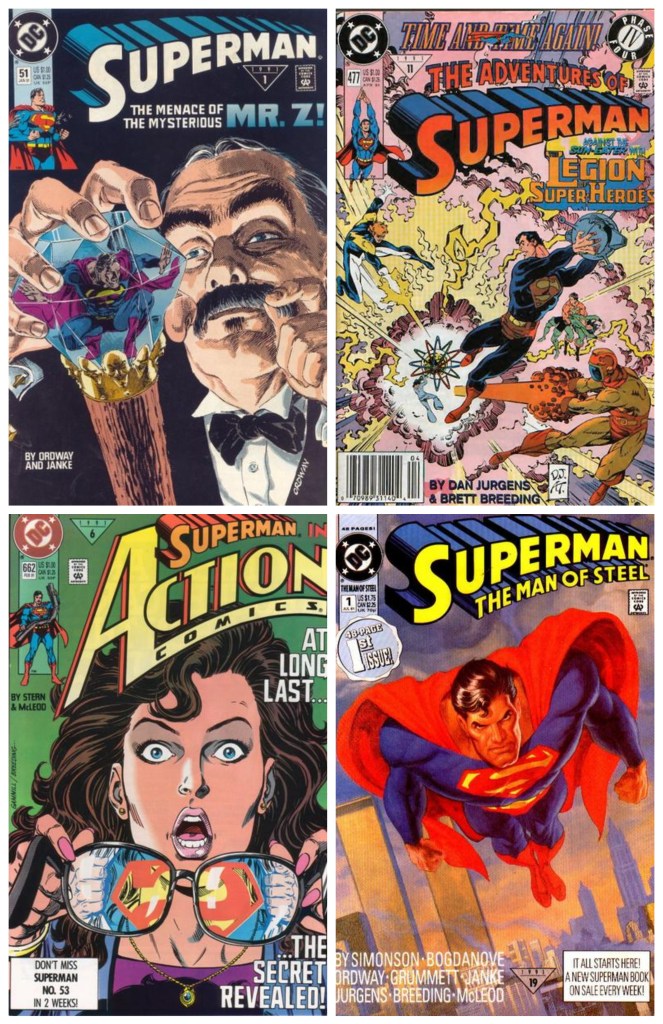
But the existence of this book still doesn’t address the fundamental problem – this baffling notion that there are no good stories to be told with a family. DC Comics ran into a similar stumbling block with Superman and Lois Lane, who married in 1996 after nearly 60 years of courtship. (Pete and MJ had a comparatively brief 20 years before they tied the knot.) In 2011, as part of the “New 52” relaunch, the characters were made younger and the marriage was dissolved. It only took DC a few years to realize the mistake, though, as fans were vocal about preferring the Lois and Clark dynamic. DC eventually played along by not only restoring the marriage to canon, but by giving Lois and Clark a child, Jon. 

Plenty of heroes have had long relationships. Barry Allen (the second Flash) and Iris West were together and married for quite some time before Iris’s death (which was later reversed). His protege Wally West, a character who had been around for about three years when Peter Parker was created, married Linda Park and they recently welcomed their third child. Both Flashes have had their relationships wax and wane and occasionally disappear via comic book-style reboots, but they’re back these days. (Well, Barry and Iris aren’t currently married, but they are together.) The first Flash, Jay Garrick, has similarly been married for decades, and DC even recently introduced his own daughter as part of a group of new characters who were previously “erased” from the timestream, opening up new avenues for storytelling. Elongated Man and Sue Dearbon-Dibney were a married couple for decades before falling into comic book limbo – and hey, DC, bring ‘em back. We love them. And of course, over in Marvel Comics we have Reed and Susan Richards, the prototypical comic book parents, with their children. They’ve been married for nearly 60 years now. 

I mean, who wants to read about a married superhero anyway?

But the argument, I suppose, is that having a family makes a character seem “older,” and most of these previous characters I mentioned were already older than Spider-Man. Fair point, but my contention that new, exciting stories can still be told with them as married couples still stands. In fact, adding Jon Kent to the Superman mythos gave the characters a welcome new dynamic that produced some fantastic stories before Civil War’s Brian Michael Bendis took over the series and screwed it up. Wally West’s children are pretty much co-leads of his comic book, and his daughter Irey has even become besties with Maxine Baker, daughter of Wally’s sometime Justice League teammate Animal Man, yet another married superhero. And let’s not forget about Batman – while no one has got him down the aisle yet (he almost took that walk with Catwoman, but she bailed), he’s been a dad pretty much since he adopted the first Robin back in 1940. And in recent years, it’s been literal, with the addition of Damian Wayne to the family.

And the thing is, the Clark and Jon stories are nothing like the Bruce and Damian stories, and neither of those have anything in common with the stories about Wally and his kids Irey and Jai (or the newborn Wade). Because – here’s the shocking part – children are people. They’re not all identical. And when you put an interesting, developed individual into the mix with another interesting, developed individual, you’re going to get an interesting, developed story. This isn’t even counting the thousands of stories outside of comic books that have successfully told tales of parents with children. 

But what about the other argument, that being married or a parent it makes it difficult for young readers to “relate” to Peter Parker? Let’s say that, just for a second, I actually believed that. (Spoiler: I don’t.) The thing is, there are two important factors that make that argument irrelevant.

First: the notion that an older Spider-Man might be a turnoff for young readers is dumb because there aren’t any younger readers. American comic books are in something of a crisis. Older readers have always drifted away, but in the past newer readers would come in and fill the void. That isn’t happening now, at least not in numbers significant enough to concern ourselves with. It’s absurd, because thanks to the success of Marvel Studios over the last decade and a half, Marvel characters are more popular than ever. But there has been approximately zero success at drawing in the kids watching those movies and getting them to read the comic books. Meanwhile, many of the strategies they’ve employed in an effort to get new readers (such as constant reboots or replacing classic characters with younger “legacy” versions) have only served to drive off the readers who have been around for years. It’s been a lose/lose situation, and comics have to admit that those “fixes” aren’t working before anything else they do is going to matter. This is a major problem in the industry, and it’s worth discussing, but preventing Spider-Man from growing as a character is not the solution. 

Pictured: new comic book readers

Second: if the goal actually is to have a Spider-Man that younger readers can relate to, MARVEL ALREADY HAS ONE AND HIS NAME IS MILES MORALES. Miles is one of the few new “legacy” characters that has actually taken off and found mainstream popularity, being the star of two incredibly successful and extremely well-made animated movies. Hell, Miles Morales’s first movie won the Oscar for best Animated Feature. If Marvel’s argument is “we need a young Spider-Man,” congratulations! You’ve got him! Do the “young guy” stories with Miles and stop torturing Peter by trying to force him back into a box he outgrew in the 1980s!

(In the interest of total fairness, I should point out that Miles Morales was co-created by Brian Michael Bendis.)
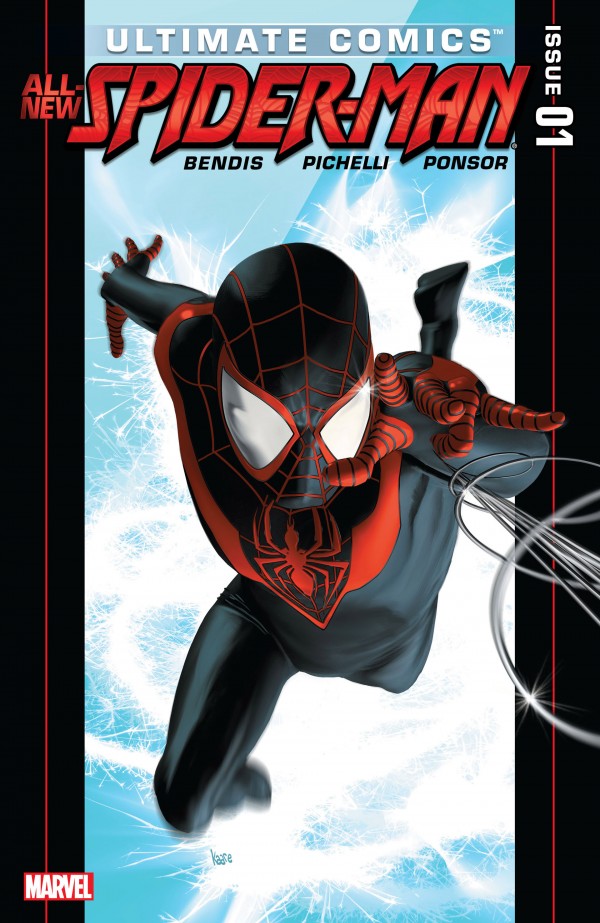
“Heard of me, Marvel? I won a friggin’ Academy Award.”

I no longer harbor any hope for the “mainstream” Peter Parker and Mary Jane actually getting a happy ending, at least not until the next editorial overhaul at Marvel. That’s the thing about comics, everything is cyclical. The people in charge now won’t be in charge forever, so if you’re unhappy with the direction of a book, there are two things you can do. Cross your fingers and hope the next creative team is better, and – far more importantly – stop buying it. And since there seems to be a Spider-Man on the horizon that does seem a better fit for my tastes, I choose to support that book, rather than the one that leaves a sour, spidery taste in my mouth.

Help us, Jonathan Hickman. You’re our only hope. 

Blake M. Petit is a writer, teacher, and dad from Ama, Louisiana. His current writing project is the superhero adventure series Other People’s Heroes: Little Stars, a new episode of which is available every Wednesday on Amazon’s Kindle Vella platform. He realizes that he may have some of the behind-the-scenes details incorrect in his dissertation on comic book history, but in his defense, he’s never pretended to be a journalist in this column. Which frankly gives him far greater integrity than anybody working – for example – at the New York Times. 

Geek Punditry #38: Whence Elseworlds?

Multiverses are big these days. What was once a relatively niche science fiction concept has become popularized by things like the Spider-Verse movies, Best Picture winner Everything Everywhere All At Once, and about seven thousand fanfics where the guy from the Avatar: The Last Airbender cartoon meets and beats up his counterpart from the live action movie. So it’s odd to think that one of the first fictional worlds to use the multiverse as a major concept once attempted to do away with it because it was deemed too confusing. DC Comics introduced its multiverse in 1961 with Flash #123, in which writer Gardner Fox had the Flash of that time period (Barry Allen) meet the Flash of the 1940s (Jay Garrick). The problem was it had been established earlier that, in Barry’s world, Jay Garrick was considered a fictional character that Barry had read about as a child. The fix was to declare Jay’s world an alternate universe, an “Earth-2,” even though he had been around first. Fox was even slick enough to write himself into the story, claiming that the writer “Gardner Fox” had some sort of telepathic link to the other world and didn’t realize the stories he was conjuring that he believed to be pure fiction were, in fact, reporting on actual events from Earth-2. It was a wild, crazy concept for the time, and it started an avalanche.

In the 90s, DC Comics gave us Elseworlds, a series of books set outside of the "real" DC Universe that fans quickly latched on to. This week in Geek Punditry, I take a brief look at the origins of the imprint, the history of DC'S multiverse, and explain how Elseworlds is back -- even if DC doesn't want to admit it.
“How long do you think we can keep this up?”
“Oh, I’d say at least 60 years.”

It wasn’t too long before the Silver Age Green Lantern, Hal Jordan, met his own Earth-2 counterpart, Alan Scott. Heroes who had been continuously published since the Golden Age and were not replaced by other characters (predominantly Superman, Batman, and Wonder Woman) discovered that they had almost identical doppelgangers on Earth-2, and eventually the Earth-1 Justice League of America met the Earth-2 Justice Society for an annual get-together. 

And once there are two universes. why not more? Earth-3 had villainous versions of the heroes: Superman became the evil Ultraman, Batman the crafty Owlman, Green Lantern the kinda lame and poorly-named Power Ring, and so forth. Then DC started adding worlds that included the characters they’d purchased from other defunct publishers: the heroes of Charlton Comics inhabited Earth-4, the Shazam! Family of Fawcett Comics fame was from Earth-S, and the heroes of Quality Comics were shifted off into Earth-X – a world where the Nazis won World War II! 

“Not gonna lie to you, Sam, this is kind of awkward.”

By the 80s, though, DC felt that things had gotten unwieldy, so writer Marv Wolfman gave us Crisis on Infinite Earths, their first mega-crossover event, in which all but one Earth was destroyed and the surviving heroes of many different worlds came to reside there. Both Green Lanterns and Flashes, otherworldly heroes like Plastic Man, the Blue Beetle, and Captain Marvel, and many more populated this “new” DC Universe. For the most part, I think this has worked to DC’s benefit over the years – it’s easier to build a cohesive world if all your main characters inhabit the same universe. Were it not for this, we never would have had the Blue Beetle/Booster Gold friendship, the Flash family wouldn’t have developed into the legacy it currently is, and people would have forgotten about Peacemaker long before John Cena showed up to actually make him interesting for a change. Despite that, though, I have always disagreed with the fundamental thesis that led to the writing of Crisis in the first place – that a multiverse storyline was too complicated for the casual reader. And if anything, the proliferation of multiverse stories in recent years, I think, has proven me to be correct.

What’s more, I think even many of the writers at DC Comics felt the same way, because it wasn’t too long before they started to branch out again and tell stories that didn’t fall into the canon of the one and only DC Universe. Just three years after Crisis ended, DC published Gotham By Gaslight, a one-shot story by Brian Augustyn and Mike Mignola, which featured a Victorian Batman doing battle with Jack the Ripper. The book was a hit, and the idea of telling stories of DC heroes in different worlds came back. Batman: Holy Terror by Alan Brennert and Norm Breyfogle, showed an alternate history in which the British Empire never fell out of favor and the colonies in North America are run by an oppressive government. In this version, Batman becomes a sort of Guy Fawkes-esque character, rebelling against British rule. This book was labeled an “Elseworlds” title, and the name became the brand under which DC stories from outside the continuity took place for the next decade and a half.

Original slogan:” Elseworlds-Because there can’t be too many different versions of Batman.”

Over the years we got some magnificent books, each casting the heroes of the DC Universe in different scenarios. In Superman: Speeding Bullets, Kal-El of Krypton crashed not in Kansas, but in Gotham City, where he was raised by Thomas and Martha Wayne. Batman: In Darkest Night showed us a world where Abin Sur crashed in Gotham City instead of Coast City (a LOT of alien spacecraft touch ground in Gotham in Elseworlds) and thus Bruce Wayne became Earth’s Green Lantern instead of Hal Jordan. Justice Riders casts the Justice League in a western yarn and The Golden Age tells a bittersweet ending to the saga of the Justice Society. Even crossovers with other companies occasionally bore the Elseworlds brand – Batman met both Marvel’s Captain America and Tarzan (published, at the time, through Dark Horse Comics) in Elseworlds stories.

Perhaps the high point of the imprint came in 1996, when Mark Waid and Alex Ross published their four-issue masterwork Kingdom Come. Set a few decades in the future, this is a DC Universe that has been disintegrating ever since Superman left humanity behind following the tragic death of his wife, Lois Lane, and the brutal murder of her killer, the Joker, before he could face justice. In his absence, the world has been overrun by a new breed of metahuman, heroes in name only, more interested in fighting each other than protecting the human race. In this story the Spectre takes a minister named Norman McCay on an Ebenezer Scrooge-type tour of this world as Superman is called back to action following a catastrophic event that pushes the entire Earth to the edge of annihilation. The story is largely a response to the sort of over-muscled, over-gunned, over-pouched heroes that were so popular in the 90s, and despite having a distinct dystopian flavor, it is ultimately one of the most beautiful and powerfully optimistic stories comics have ever produced.

You’re probably expecting some kind of joke here, but this is just straight-up one of the greatest comic book series ever made.

DC quietly pushed the Elseworlds brand aside in 2003, the argument being that it had become overused and was starting to grow stale. It’s hard to argue with that, too, especially when you start counting the number of Elseworlds that basically boiled down to “Kal-El landed somewhere other than Smallville, Kansas.” (Off the top of my head, we’ve got Superman: Red Son, Superman: The Dark Side, Superman: True Brit, JLA: The Nail, The Superman Monster, and even another Dark Horse collaboration, Superman/Tarzan: Sons of the Jungle, all of which hinge on that same basic point.) As the multiverse was slowly creeping back into the “real” DC Comics, Elseworlds was placed…well…elsewhere. It came back briefly in 2010 for a three-issue Superman miniseries, Last Family of Krypton (this time little Kal-El’s parents escaped Krypton with him), and the name was used for an Arrowverse crossover event on TV, but other than that, it’s been gone for a long time.

“Okay, so you’re kind of over Batman Elseworlds. How about 37 Superman Elseworlds that all have the same starting point?”

Or has it?

DC is not using the name anymore, no, but they certainly are using the same basic concept. There are a lot of DC books being published that feature versions of the DC heroes in different worlds. Sean Phillips’s Batman: White Knight and its various sequels and spinoffs are set in a world where the Joker goes sane. Since that series premiered in 2017, it’s built a small universe of its own. There’s also the world of DCEased, a universe in which Darkseid succeeds in gaining the Anti-Life Equation, unleashing a memetic virus that transforms its victims into a sort of techno-undead creature, but don’t you dare call them zombies. Jurassic League was a miniseries that re-cast the Justice League as anthropomorphic dinosaurs, because why the hell not? Dark Knights of Steel features a medieval world where Jor-El, Lara, and Kal-El came to Earth together and live in a sort of fantasy setting surrounded by analogues of the other DC heroes and villains. And then there’s the cleverly-named DC Versus Vampires, which is about the signing of the Magna Carta.

Pictured: Pope Innocent III and King John.

Kidding. No, it’s exactly what it says on the wrapper. 

The thing about these books is that none of them are self-contained. Most Elseworlds, back in the day, ran anywhere from one to four issues, but that was typically where it ended. White Knight and DCEased both had multiple series and one-shots. Vampires and Steel each ran for 12 issues plus spin-offs. And each of these worlds has been designated a number in the new, current, DC Multiverse. They are Elseworlds in all but name – in fact, in a more literal sense than many of the older (forgotten) Elseworlds books, as they are actually other worlds in the DC Multiverse. Many of the other Elseworlds of the past have been “imported” into the new DC Multiverse as well, especially the much-loved and highly-inspirational Kingdom Come, which has crossed over and interacted with the “Main” DC Universe on many occasions, including in Waid’s current run on Batman/Superman: World’s Finest.  

Since DC has once again embraced the concept, what I (and, I suspect, many of the fans who were reading comics in the 90s) would like is for them to once again embrace the brand. Bring back Elseworlds. When these books are reprinted, give them the label. When the inevitable sequels come out, give them the label. If anything, the label will only help. While it may be clear that Jurassic League isn’t the “real” DC Universe, a casual fan picking up DC Versus Vampires might be concerned about why Hal Jordan is doing his best Dracula impression in this series but it doesn’t seem to be affecting the regular monthly Green Lantern title. Having a specific brand would alleviate that problem.

The only difference between these and an Elseworlds is the label.

And since the current philosophy at DC seems to be “every story happened SOMEWHERE in the Multiverse,” I say they should run with it. Don’t just put the Elseworlds LABEL on the book, plop a NUMBER in it as well. When they print the Dark Knights of Steel omnibus, give it an Elseworlds logo with a little mark signifying that this is Earth-118. Instead of reprinting Kingdom Come under the “mature readers” Black Label imprint (where it is woefully misplaced), give it back the Elseworlds mark and label it as Earth-22. There are two more miniseries coming out this year set on Earth-789, the world shared by the Christopher Reeve Superman and Michael Keaton Batman movies – give THOSE the Elseworlds labels too!

It exists, it has fans, and it has a clear purpose now that’s more than just a grab bag of weird. It’s true that the label was overused in the 90s, but the solution to that isn’t to never use it again, it’s just to use it sparingly. There’s no fan of the books that currently exist that would be turned off by an Elseworlds label, and there are many fans who may be more inclined to pick them up if they saw that familiar, beloved brand again. If nothing else, I think, it’s worth the try. Nothing in comics ever really dies – Superman can come back from Doomsday, Barry Allen can come back from the Speed Force…let’s let the Elseworlds brand have its time back from the dead. 

Blake M. Petit is a writer, teacher, and dad from Ama, Louisiana. His current writing project is the superhero adventure series Other People’s Heroes: Little Stars, a new episode of which is available every Wednesday on Amazon’s Kindle Vella platform. Fingers crossed for the Elseworlds miniseries set on Earth-26, home of Captain Carrot. By now you should know he’s not joking.

Geek Punditry #31: Cross-Evolution

The DC Universe is asleep right now.

This is not a commentary on the state of their cinematic universe. I’m talking about the good ol’ comic book DCU, which is in the second half of their two-month Knight Terrors event. A new villain calling himself Insomnia wants to get his hands on the Nightmare Stone, a powerful artifact that used to belong to the Justice League’s old enemy Dr. Destiny. Insomnia believes that Doc Dee has hidden the stone inside the dreams of somebody in the DCU, so he’s made everyone on Earth fall asleep, allowing him to search for it. It’s been an interesting story, diving into the dreams of DC’s greatest heroes and villains and getting a taste of their worst fears. (You should see what the Joker is afraid of.) Most importantly, though, Knight Terrors is the latest iteration of that thing that we comic book nerds both adore and fear: the crossover event.

The real Knight Terrors are the friends we made along the way.

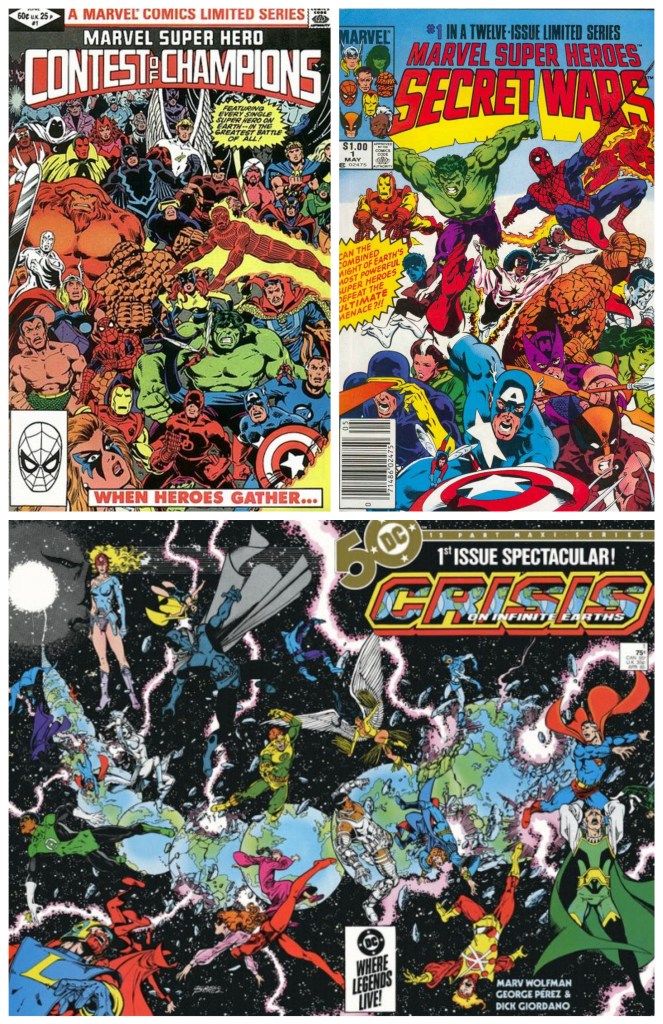
Most comic historians will agree that the “shared universe” conceit, in which most or all of the characters published by the same company are said to co-exist, can be traced back to 1940 and the first appearance of the Justice Society of America in All-Star Comics #3. In the early days, the JSA was little more than a framing device, in which the heroes would gather around a table and tell each other tales of their exploits, but eventually the stories would evolve to the point where they were having adventures together. Guest appearances in each other’s books became common, more teams were formed, and eventually both Marvel and DC Comics had sprawling worlds of interconnected characters. In a way, it’s baffling that it took 42 years for the next logical step in storytelling to happen: mashing everybody in the universe into a single story. That story was 1982’s Contest of Champions, a three-issue miniseries in which the Marvel Comics all-stars were abducted by a couple of the Elders of the Universe and forced to battle each other. It was a completely self-contained story that didn’t touch on any other book, but it was considered a precursor for the next step: the 12-issue Marvel Super Heroes Secret Wars in 1984. This time, we saw many of the Marvel heroes – in their own titles – encounter a mysterious device that whisked them away to parts unknown. They returned in the next issue after an absence of some weeks, many of them with changes. The maxiseries told the story of what happened to them in-between those two points.

“Okay, guys, let’s show ’em how it’s done.”

DC got into the game in 1985 with Crisis on Infinite Earths, and that’s when things really got wild. Contest of Champions and Secret Wars were both relatively self-contained stories. Although Secret Wars had repercussions for the regular series of the assorted characters (Spider-Man’s black costume, which would eventually become Venom; She-Hulk leaving the Avengers for the Fantastic Four; etc.) the story itself stayed in those 12 issues. In Crisis on Infinite Earths, for the first time, the story spilled out into the other comics being published by DC. While the heroes of the multiverse struggled to keep it together in the main series, most of the other books published by the company had side-stories that showed how the stars of that title were dealing with the collapse of reality. Green Lantern dealt with the destruction of an entire sector of space, DC Comics Presents booted Superman to an alternate reality where he met a young version of himself, and in Wonder Woman’s title she joined with the gods of Olympus to protect her home.  

Since then, the crossover has evolved again and again, with different forms that each have their own pros and cons. In some cases, a story in a single title or family of titles grew big enough that it only made sense to show the effects on other books. In Marvel’s Inferno (1989), the X-Men family of comics told the story of a demonic invasion of New York, and since most of Marvel’s heroes lived in New York it only made sense to show how Spider-Man, the Avengers, and the Fantastic Four were dealing with it as well. Later that same year we got Acts of Vengeance, a story wherein Loki plotted to destroy the Avengers by manipulating the Marvel Universe’s villains into attacking different heroes than those they usually fought. Yeah, I’m not entirely sure how that was supposed to work either, but it was a fun story: Spider-Man dealt with the X-Men’s enemy Magneto, while Daredevil’s foe Typhoid Mary set her sights on the Power Pack, and so forth. These kinds of crossovers work out fairly well, as it’s easy for readers to ignore any titles they don’t want to read. On the other hand, if they aren’t reading the core titles in which the story is taking place, they may be confused as to what is going on.

However, from a company standpoint, there’s one major problem with crossovers like that: there’s no extra books being sold. So the next level of crossover has a main miniseries, with stories touching on the heroes across the DCU. After the original Crisis, DC made this an almost-annual format for many years, with the likes of Legends, Millennium, Invasion!, Final Night, Genesis, and Underworld Unleashed all following suit. Marvel did it several times as well, with Secret Wars II, Infinity Gauntlet, and its assorted sequels. This is the kind of crossover I grew up with, and in many ways it’s still my favorite. The fact that it touches on the ongoing comics gives the story weight and makes it feel like it “matters” more than if the book is totally self-contained, and for the most part, you still only have to read the main title and any crossovers that you want, pushing aside those that you don’t.

There were…a LOT of these.

Later crossovers like Civil War and Fear Itself would expand on this concept: the main miniseries, crossovers into the ongoing books, and assorted miniseries and one-shots that spin off of the main book. This expands the story and allows the storytellers to touch on more elements of the event, and of course, it gives the publisher more books they can potentially sell. Publishers love that. Sometimes they love it so much that they’ll do a spinoff miniseries even if the characters involved currently have an ongoing. There are 97 X-Men titles at any given time, so was it strictly necessary to do a three-issue World War Hulk: X-Men miniseries instead of just putting the story in one of those? I say thee nay.

Then there’s the tier that we’re seeing more often these days, in which the crossover doesn’t touch the ongoing titles at all, but only features spinoffs and one-shots. There are, I think, two reasons this happens.

1: Money. 

2: Writers. 

I don’t think the first point needs much of an explanation, but let me tell you what I mean by the second one. The comic book industry has become increasingly writer-focused over the years, and while in many ways that’s a good thing, that does come with a degree of compartmentalization. Whereas in the past, editors would call up the writer of New Warriors and tell him to link his book to Infinity War whether he wanted to or not, today there’s more of a reluctance to disrupt the ongoing story. Al Ewing’s fantastic Immortal Hulk series was an excellent horror story that is perfect for binge-reading now that it’s over. But if you’re reading that story in a collected edition years later, it would be somewhat disconcerting to suddenly stop to deal with an invasion of symbiotes spilling over from the Spider-Man comics. So instead, there were Immortal Hulk one-shot specials when the title dealt with the events of the Absolute Carnage and King in Black crossovers, and the main book went unmolested.

The solution.

The benefit of this is that the crossover doesn’t impact the story when you’re reading it in a vacuum. There are two cons that come to mind, though. First, if a crossover is entirely self-contained, it’s easy to ignore it and decide it’s inconsequential to the meta-story of the shared universe as a whole. Second, it has a tendency to cause the main story to spill out into the spinoffs in a way that doesn’t happen as often with the other kinds of crossovers. Grant Morrison’s Final Crisis was a bit of a mindbender to begin with, but the ending is COMPLETELY out of the blue if you didn’t choose to read the Final Crisis: Superman Beyond two-issue miniseries that accompanied it.

A story like Knight Terrors is a relatively new variant on this format. The crossover is told entirely through crossover miniseries, but those miniseries are replacing the ongoing comics for the duration of the event. Instead of following June’s Nightwing #105 with July’s Nightwing #106, July and August give us Knight Terrors: Nightwing #1 and #2, with #106 saved for September. This is, by my count, the third time DC has done this, the previous times being Convergence in 2015 and Future State in 2021. It’s nice, in that it doesn’t disrupt the main book at all, but it also has a habit of making the event itself feel rather inconsequential. (Future State in particular has largely faded into irrelevance in the DCU.) 

Up until now, I’ve really only talked about format. I’m not making value judgments on any of these stories: there are both good and bad examples of every kind of crossover. What matters, I think, is what exactly you’re trying to accomplish with the story. Are you “just” telling a big story? Well, the first format I discussed is probably the right one. We mostly see that now with smaller crossovers, things like the Sinestro Corps War that only impacted the Green Lantern books (plus one issue of Blue Beetle). But even those “smaller” crossovers are starting to go the route of having one-shots or miniseries spinoffs: the upcoming Gotham War storyline will feature in the Batman and Catwoman ongoing titles but also have a few one-shots and a miniseries focusing on Jason Todd. 

Sometimes publishers label books as part of a crossover no matter how inconsequential they are, and that can irritate readers. People who picked up the Crisis on Infinite Earths issues of Swamp Thing were rightly irritated that the only connection seemed to be the skies turning red. Even when the book is objectively entertaining, it’s a bit frustrating. Geoff Johns and the late George Perez did a magnificent job on Final Crisis: Legion of Three Worlds (I would even argue that, to date, it was the LAST great Legion of Super-Heroes story), but pretending it had great significance to the Final Crisis storyline was something of a stretch. 

“Guys, when we said ‘Stop, you got it right,’ we didn’t mean that LITERALLY.”

Sometimes these crossovers are intended to reset things: DC has done that with Flashpoint and Dark Crisis on Infinite Earths, which led to the New 52 and Dawn of DC reboots, respectively. Sometimes these are intended not to re-set, but to set things up in the first place. That’s what the nascent Valiant Comics did in 1991 with Unity. When their universe was still young they tied together their six existing titles (four of which were less than a year old), launched two new titles, and introduced new characters and concepts that in turn would develop into more titles in the next year. It was a huge success and Valiant was the hot ticket, becoming so successful that only a few years later Acclaim bought the company and promptly ran it into the ground.

“Get ready, guys, it’s all downhill from here.”

People like to complain about “event fatigue” in comics the same way that many of them complain about “superhero fatigue” in movies, but the fact that people keep buying these books seems to indicate that they aren’t that exhausted. And as always, quality matters. People rarely complain about “too many comics” if they actually like the stories that they’re reading – it’s only when following a story gets to be a chore that they go to the internet and gripe. I don’t think crossovers are going anywhere, and honestly, I don’t really want them to. So I guess the important thing when planning them out, publishers, is to think really hard before you get into these storylines, and ask your doctor (Strange, not Doom) what kind of crossover is right for you. 

Blake M. Petit is a writer, teacher, and dad from Ama, Louisiana. His current writing project is the superhero adventure series Other People’s Heroes: Little Stars, a new episode of which is available every Wednesday on Amazon’s Kindle Vella platform. He knows that there are a LOT of crossover events he didn’t mention in this column, so before you reply with, “Hey, you forgot XYZ,” know that he didn’t. He just didn’t have room to make this comprehensive. Cut him some slack.  

Geek Punditry #26: Bargain Bin Gold

Last weekend I got to do one of my favorite things, and something I rarely get to indulge in anymore: comic book bargain bin diving. I’m a comic nerd, of course, and like any nerd I’ve got my favorites, both when it comes to modern comics and to the classics. I’m trying to fill a run of DC’s Star Trek comics (try to act surprised) and I’ll never turn up my nose at a Disney Duck comic or anything from Archie, pre-2010 or so. But in addition to those special things I’m searching for, I also like…weird stuff. I mean obscure comics, books that most people have probably never heard of before, things that remind me of my childhood, things that have a crazy title, movie adaptations for movies that you wouldn’t believe had ever been adapted, or even just anything that’s got a bizarre cover. If I can find it for under a buck, I’ll throw it into the cart.

This kind of bargain bin excavation is something I love, but it’s not something I get to do all the time, with a five-year-old son for whom “patience” is a foreign concept and a wife with a busy work schedule. But last weekend, with Erin’s blessing, I headed to a small local show in Slidell, Louisiana, where I spent a couple of hours bouncing from vendor to vendor, most of that time sifting through the dollar bins for some of this unexpected, bizarre gold. This week, I’ve decided to share with you some of the crazier finds that I made in this most recent hunt.

“But Freeeeed, I wanna be in the shooooooow!”

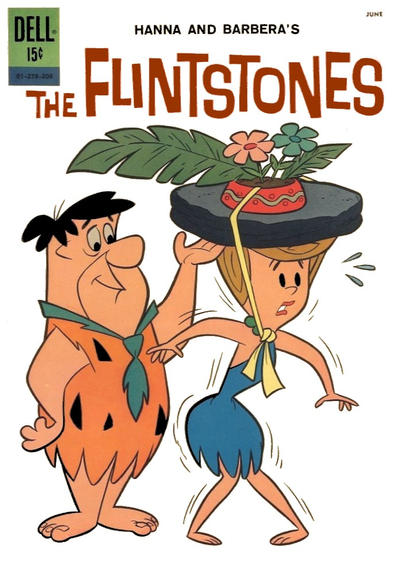
First off I’d like to turn your attention to Flintstones #5, published by Dell Comics way back in 1962. Comics based on cartoons are one of my go-to grabs in these bargain bin digs. I’ve always been a fan of the Flintstones, and these Dell comics were great – five full stories and a couple of one-pagers for twelve cents? Sign me up. Story #3 in this issue introduced me to “Perry Gunnite,” an old-fashioned detective comic strip set in the world of Bedrock. Perry appeared in a single episode of the cartoon but, evidently, spun off into his own series in the comics. That find enough would have made this book worth buying, but it was what I found in the fourth story that made this a comic I’ll never forget. 

In “The Champ Chowhound” we are introduced to Wilma Flintstone’s cousin Muncher, visiting from out of town and eating Fred and Wilma out of house and home. They want to get rid of him, but he can’t afford to go home and will not accept Fred’s “charity” offer to buy him a bus ticket. So the Flintstones embark upon a set of increasingly elaborate ruses to send him packing. First, Fred claims to have “found” a bus ticket back to Muncher’s home town, but rather than hopping on the bus Muncher sets out to find its rightful owner, turning it over to the first person to claim it. Next they try to guilt him into leaving, pretending that Fred has lost his job and they can’t afford to feed him, but Muncher’s general good nature won’t allow him to abandon them in their time of need. Finally, Muncher signs up for a hog-calling contest in the hopes of winning the money to get Fred back on his car-stopping feet and getting himself the cash to go home.

On the surface, admittedly, this doesn’t seem to be a particularly mind-blowing story…and it’s not. Except for one thing. Regular readers of Geek Punditry will recall a couple of months ago when I mentioned that my wife and I have been binging I Love Lucy on Pluto TV. Pluto shows the entire series in order over and over again, and with 180 half-hour episodes that means if you watch it a lot, there’s a good chance you’ll catch the same episodes every four days or so. Were it not for the fact that I’ve seen these episodes repeatedly and recently, this Flintstones comic would not stand out for me. But it does. Because I recognized that whoever wrote this comic completely ripped off a season three episode of I Love Lucy almost BEAT FOR BEAT. In the previous episode, “Tennessee” Ernie Ford came to visit the Ricardos. As this episode began, he was still crashing on their couch and tearing at their every last nerve. 

And from there, it is exactly the same story as the Flintstones comic. Ernie won’t take a bus ticket, so Ricky pretends to find one, but Ernie returns it to the “rightful” owner. Ricky pretends to be out of work, even going so far as to have the Mertzes pretend to be evicting them. (It’s a wonder that the writer of the comic book resisted the urge to have Barney and Betty fill this role, but as the comic was only five pages long I guess they couldn’t squeeze it in.) The biggest deviation is that, rather than have a contest to end the story, Ernie arranges for the crew to appear on the TV show Millikan’s Chicken-Mash Hour doing a hootenanny to get them out of the red. 

The Lucy episode is credited to the series’ prolific writing team of Bob Carroll Jr., Madelyn Pugh, and Jess Oppenheimer. Most Dell comics at the time had no credits given, although the Grand Comic Book Database credits the artwork to Kay Wright. The writer may have been lost to history, but I wish I knew the name of the person who had the audacity to steal a plot wholesale from an 8-year-old TV show for a comic book based on a cartoon, which makes me wonder if anybody overseeing the current IDW My Little Pony comics has double-checked to make sure nobody is knocking off the final season of Parks and Recreation. 

My favorite part is the end, where Moses shows up to talk to him about the Testament Initiative.

The next bizarre book I pulled from a bargain bin last weekend was an oddity called Jesus, the Man With the Miracle Touch. I’d never heard of this book before, nor its publisher (“Cosmics”), although a little time on Google indicated this publisher released just four comics, all religious-themed one-shots in the late 80s. The story is a fairly straightforward retelling of the Biblical life of Jesus, albeit highly condensed into 32 comic book pages. The book also doesn’t have any credits, which is a shame, because I really quite like the art style. Whoever did this book easily could have been working on Harvey or Archie Comics, or maybe something from Marvel’s Star line of young readers comics at the time. (More about that later.) Mostly, though, I bring this up because when I was at the convention and handed the stack of books to the guy at the booth, as he counted them, he looked over at his co-worker and yelled, “Hey! Somebody is buying the Jesus book!”

“Thanks, Blue Robin!”
“I’m not Robin.”
“How’s Alfred?”
“I’m not–fine. He’s fine.”

At one time, especially when I was a kid in the 80s, “public service announcement” comics were a fairly big thing. There’s an infamous Marvel comic where Spider-Man and Power Pack taught you about the dangers of child abuse and another where Spidey teamed up with Storm and Luke Cage because that’s the natural trio to warn you about ill effects of smoking. I, of course, have both of these in my collection. Meanwhile, DC farmed out the Teen Titans for three anti-drug specials. This weekend I picked up the second of the three, in which the Teen Titans and their pal “Protector” try to help Protector’s cousin, who has moved to Blue Valley, developed a crush on a friend of Wally West, and (gasp!) has fallen into the world of drugs. The Titans, of course, have to help get him out of it.

When I was a kid, I remember getting what turned out to be the third of the Teen Titans specials (although I didn’t know it at the time, as these books didn’t have traditional comic book numbering or anything), and I remember being baffled by it. I knew who the Teen Titans were, of course, but who was this guy in the blue costume and cape with no powers? He was…kinda like Robin, but he wasn’t. That same “Protector” is in this book, although here we find out he’s got an actual secret identity, Jason Hart…so my fifth-grade headcanon of Dick Grayson wearing a brown wig and using a different name for…reasons…I suppose has turned out to be inaccurate. Looking back as an adult, I wonder if Dick Grayson was tied up in some sort of licensing rights surrounding the Batman due to the movies or something. It might not be the case – after all, the first of these comics came out in 1983 and the first Tim Burton Batman movie wasn’t until 1989. Then again, some of these things have a long timeline. If there’s anyone with more information on this, I would be very anxious to hear it. 

(UPDATE: Reader Trey Ball has informed me that the licensing deal that prevented Robin being from used in the comics was actually due to the Superfriends, TV show, which for 1983 definitely makes more sense than the Batman movie. The anti-drug comic was produced in association with Keebler, but Nabisco had a licensing agreement with the Superfriends characters. Thanks, Trey!)

The last book I’m going to discuss today comes from Marvel Comics, specifically their Star Comics line from the 80s. (Have you ever noticed how many weird comic books have their roots in the 80s? Something in the air back then, I swear.) Star Comics was Marvel’s attempt to crack into comics specifically for young readers. The most famous alumnus of the line these days is Peter Porker, the Spectacular Spider-Ham, star of big screen movies, animated shorts, and my heart. But the line also included lots of licensed comics such as Heathcliff, Care Bears, Madballs, and ALF, as well as several original characters that were created and produced by writers and artists Marvel poached away from the likes of Harvey and Archie Comics. Royal Roy was a kind of Richie Rich knock-off, Top Dog was about a kid who found a talking dog who also happened to be a spy, and Planet Terry was an elementary school Flash Gordon with a clever pun in the title that I didn’t catch until some 20 years later. 

I love finding obscure, weird comics, and bargain bins are my favorite place to do it. This week I'm here to share some recent finds as Geek Punditry presents "Bargain Bin Gold!"
This is what happens when you pee swimming in the ocean one too many times.

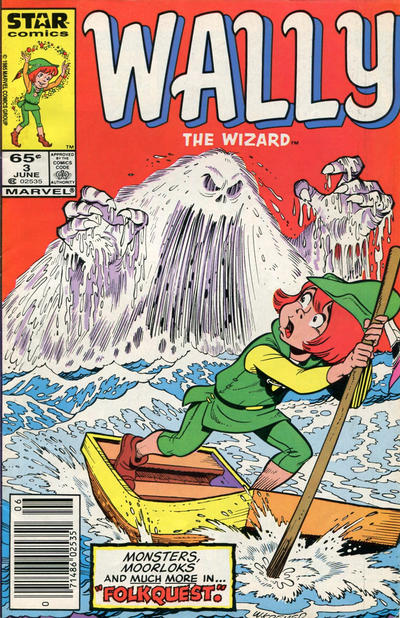
But the book I got this week was Wally the Wizard #3, written and drawn by Archie Comics superstar Bob Bolling. In this issue Wally, apprentice to the Wizard Marlin (Merlin had the power to know the future and thus trademarked his name in the 8th century specifically to avoid being portrayed in Star Comics), discovers that his parents are in the company of a pack of Vikings. He rounds up his buddy, the Viking orphan Vikk, and sets out to find them. Bolling did countless wonderful comics for Archie, especially lots of the Little Archie series, which is no doubt what Marvel had in mind when they picked him up to work on the Star line. This issue, though, makes it seem like he needed a nap. 

The truth is, none of the Star-original comics were all that great, although I do have a fondness for Top Dog. None of them lasted more than a couple of years, but some of the licensed books (Heathcliff and ALF, specifically) had long runs. But you know, that’s okay. In this day and age, when comic book publishers seem to think the solution to a dwindling readership is to publish 75 different covers of the same book to sell to the same readers they’ve had for decades, it’s nice to remember that there was at least a time when one of the major publishers was trying something to get kids reading comics again.

Some comic collectors are in it for investments. They spend all their time looking for flawless copies to slab and flip, speculating that a book is going to go up in price because someone announced a movie deal, treating it like a business. I do not understand these people. But I know I’m never going to encounter them sifting through a dollar bin, because the books in those boxes aren’t for them. They’re for people like me – people who see comics as fun, as a little escapist entertainment. And especially, people who like to uncover stuff that others have probably forgotten about. I may not get there often anymore, but the next time I get around to a convention or a used bookstore or anywhere I can sift for cheap, weird comics, I’ll come back with another installment of Bargain Bin Gold.

Blake M. Petit is a writer, teacher, and dad from Ama, Louisiana. His current writing project is the superhero adventure series Other People’s Heroes: Little Stars, a new episode of which is available every Wednesday on Amazon’s Kindle Vella platform. To date, the greatest thing he’s ever pulled from a bargain bin was the four issue run of Roy Thomas’s Alter Ego, a great comic from the 80s (of course) that you should totally hunt down if you can. 

Geek Punditry #14: Filling In the Gaps

I’ve been reading comic books pretty much since I learned to read. The hook caught me when I was still in elementary school and my dad brought home a box of Archie Comics from a co-worker, and it was set even more firmly when my uncle gave me some old issues of Green Lantern and Legion of Super-Heroes he had. And much like watching your favorite TV show over and over, rereading old comic books is a form of comfort entertainment for folks like me. Oh sure, I still read new stuff, but revisiting the classics is like a shot of dopamine straight to the ol’ cerebral cortex (or wherever dopamine goes). The digital revolution in media has made that easier. You can find old stories you lost years ago, voraciously read precious comics without the fear of damaging those pristine back issues in your collection, or FINALLY read that missing issue of Power Pack you could never find as a kid that explained why the hell all of the kids had suddenly traded super powers and how the Snarkwars ended. This was serious business, friends.

Imagine waiting 35 years for apps to be invented so you could finally read this.

Of course, not everything is available digitally, not yet anyway. With nearly a century of comic books to digitize before they can be made available (and rights issues tying up a lot of them in various ways), the dream of a single device from which you can read every comic book ever made is probably going to remain a dream. But with Marvel Comics boasting over 30,000 comics on its app and DC hosting a library of over 24,000, it could practically take a lifetime to go through the stuff that’s already out there. Psyched for the new Guardians of the Galaxy movie? You can read every issue of their series right now. Pumped for the Blue Beetle film? The history of Jaime Reyes awaits you! Want to go back to the beginning? Check out every appearance of Superm–

Oh, wait.

Actually, not every issue of the assorted Superman comics from the past 85 years is among the 24K titles DC Universe Infinite has waiting for you. As every American learns in first grade, Superman first appeared in Action Comics #1 in 1938 and appeared in nearly every one of the title’s 904 issues before DC’s line-wide relaunch in 2011. But of those 904 issues, only 463 of them are on DCUI as of this writing. There are similar gaps in the other long-running Superman titles such as Superman and Adventures of Superman. Clark’s buddy Bruce Wayne has a similar problem: of the 811 pre-reboot issues of his flagship Detective Comics, DCUI has 696 as of now, again, with similar gaps in his other titles. Not as bad as the voids in Superman’s history, but still frustrating.

You’re telling me THIS isn’t worth digitizing?

My favorite characters and stories, as you may have noticed, tend to lean more towards DC than Marvel, but I also believe in credit where credit is due, and when it comes to making their library available, Marvel is considerably ahead of DC. You can read almost the entire run of the main series of their flagship properties like Fantastic Four, Avengers, and X-Men, and any gaps that exist are far smaller than those of their rivals. They’re also filling in the gaps much faster, with an almost weekly addition of big chunks of missing books (the last couple of weeks have given us dozens of issues of Dazzler, for instance), whereas DC rarely puts more than five or six older issues up a week, and usually from five or six different series, making it take much longer to complete a run if it gets completed at all.

I know it’s not as simple as pushing a button, of course. For comics that were produced before computer technology became a standard part of the production process (which means practically every comic produced before the 90s and a lot of them after that), digitizing them is a process. You need to find quality prints, scan each page by hand, and remaster them to make for a solid digital reading experience. For many comics, that means completely recoloring them based on the original guides. This takes time and money, so I don’t mind the wait. What bothers me, and a lot of other fans, is the kind of haphazard nature of what gets added. For example, this week’s slate of older books being added to the app includes Creature Commandos #1 from 2000, the first issue of the 1991 update to Who’s Who in the DC Universe, the first issue of the Eclipso: The Darkness Within crossover from 1992, Superman: Day of Doom #1 (a four-issue miniseries from 2002 produced for the 10th anniversary of Superman’s “Death”), and Stormwatch #46 from 1997. They’ve been (slowly) adding Stormwatch for some time now, so that makes sense, and Creature Commandos was part of James Gunn’s big DC announcement from a few weeks ago, so I get that too. The rest of them…baffling. Not that I’m complaining about anything being added, I have no objection to any of these titles. I just can’t figure why they’re going to those books when they haven’t yet added, for example, issues #216-274 of The Flash.

Less important than Creature Commandos #1.

Some things will probably never get digitized, I know that. For example, I’ve got no idea who currently owns the rights to the Adventures of Bob Hope, Adventures of Dean Martin and Jerry Lewis, or Jackie Gleason and the Honeymooners series launched in the 50s, and I doubt anybody except me actually cares. There are issues of the old Showcase anthology series that featured licensed characters DC has no rights to, such as G.I. Joe and James Bond, and which will almost certainly never be seen on the app. Then there’s Sovereign Seven, a series by legendary X-Men writer Chris Claremont, set in the DC Universe and often guest-starring DC characters, but for which the copyright was held by Claremont and artist Dwayne Turner. It would probably take some sort of monetary agreement between all the parties involved to add that series, and with so many other books still waiting for their shot, it seems unlikely that DC will make the effort to do so any time soon.

Look me in the eye and tell me you don’t want to know what happens next.

Then there are long runs of Green Lantern and Justice League Europe from the 90s that now present serious problems because the writer, Gerard Jones, plead guilty to possession of child pornography in 2018. Here’s a case where it’s perfectly understandable that DC doesn’t want to do anything that looks like they’re promoting his work or having to pay him royalties, and I don’t blame them for that. But it sucks for the other writers and artists who worked on those comics and who, through no fault of their own, find their back catalogs throttled. It also leaves us a case where some pretty big storylines are missing or incomplete, both for DC and Marvel. (Most notably for Marvel, Jones wrote what is to date the only ongoing Wonder Man series. With that character slated to get a Disney+ MCU series, normally you would expect his comics to be fast tracked for inclusion on the app, but as of now the only issues available are a few that are chapters in the Avengers crossover series, Operation: Galactic Storm.) 

The reason I’m thinking about this right now is because DC recently held their first “Backlist Breakout” poll for users of the DCUI app. Users were presented with a slate of eight titles not currently available and were asked to vote on which ones we wanted to move to the front of the queue, with the top three promised to be added to the app beginning in June. My vote was for one of the eventual winners, DC Challenge, a miniseries from the 80s where an all-star group of writers and artists participated in a sort of “exquisite corpse” experiment: the first team produced an issue of a DC crossover and then handed it off to the next team to continue the story with no instructions or input, figuring it out as they went along. This kind of storytelling has been done in books and other forms of entertainment, and the result was a delightfully insane comic that went totally off the rails, leaving the creators of the last issue the unenviable task of trying to make sense of a plot that had ballooned to include time travel, Nazis, the planet Earth itself being moved to another galaxy, and Groucho Marx. I cannot wait to read it again.

The most important vote you’ll cast this year.

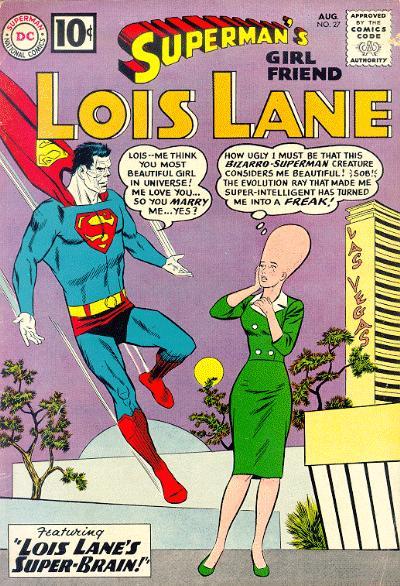
The other two winners in this round are books I’ve never read: the five issues of the 1967 Blue Beetle series (featuring Ted Kord, not Jaime, and published by Charleton Comics, but which DC owns the rights to) and the first 12 issues of the seminal fantasy series Warlord. The support for Warlord on the DC boards made its victory seem almost a foregone conclusion, and I look forward to it, since I’ve never read those issues. But it does open up another problem. Only the first 12 issues of Warlord have been promised. That’s 12 out of a series that ran for 133 issues plus six annuals. If fans want to see issues #13-24, Warlord is going to have come out triumphant again in the NEXT round of “Backlist Breakout” this summer. And then keep winning, every twelve issues, again and again, to finally make the whole series available. If it fails to win in even one round fans will be left dangling, their series put on a shelf with other unfinished titles like Adventure Comics, Doom Patrol, and Superman’s Girl Friend Lois Lane.

“Is this a joke to you?”

Again, I don’t mind waiting for everything to be digitized. And I even like the idea of “Backlist Breakout” making a game out of deciding what the next goodie added to DCUI will be. But there are some gaps that are so conspicuous that I just can’t figure out why DC isn’t doing anything to fix them right now.

Blake M. Petit is a writer, teacher, and dad from Ama, Louisiana. His current writing project is the superhero adventure series Other People’s Heroes: Little Stars, a new episode of which is available every Wednesday on Amazon’s Kindle Vella platform. He is admittedly thrilled that DC finally finished adding Captain Carrot and His Amazing Zoo Crew to the app a while back, but he’s quite put out that they haven’t gotten around to the three-issue Oz/Wonderland War miniseries that wrapped up the original Zoo Crew’s story yet. 

Geek Punditry #10: Shouldn’t Have Slept on This

There are a lot of comic books published every month. Like, at least four of them. And for someone who has been reading comics since childhood, there are times where the sheer volume of books being published can get overwhelming, even if you don’t read X-Men titles. The two biggest publishers, Marvel and DC, each have an intricate universe that carries on a complex interwoven meta-narrative that has run continuously, in one form or another, for decades, somehow subsisting even before variant covers were invented. And if you’re the sort of person who has things like a job or a family, or who enjoys eating food, there simply isn’t enough time to read everything that’s being published.

Fortunately, both Marvel and DC have in recent years launched online subscription services, where you can read a substantial portion of their respective libraries, with more books added each week. I’m a comic book collector, I can’t imagine a future where I didn’t want to get printed comics, but I consider myself a reader even more than a collector. And there’s a definite comfort to knowing that I don’t have to get all 1,124 books published a month (that’s 10,419 covers) in case there’s something I might want to read later. For books that I’m not enthusiastic about, things that I would be reading just to fill in a gap, it’s great to know that I can always go to the app a few months after release and it’ll be waiting there.

The best part about this system, though, is that when you go back and look at the stuff you missed, sometimes you find a gem that you may not have otherwise read at all. Since I’ve started reading these comics digitally, I’ve stumbled on several titles that I passed on in print, but really came to enjoy after the fact. So this week, for your edification, I’m going to share four comic series from the last few years that I didn’t read when they came out, but I’m sorry I slept on now.

Duo (DC/Milestone Comics)

Milestone Media, which has published through DC on and off for 30 years now, came back in 2021 in a big way, and while a lot of attention was given to the return of characters like Static, Icon, and Hardware, less attention was given to some of the new properties released in that universe. Duo, from writer Greg Pak and artists Khoi Pham and Scott Williams, focuses on David Kim and Kelly Sandborne, an engaged couple whose research in nanotechnology is on the verge of a breakthrough. With the right funding, David and Kelly believe they could revolutionize medicine: healing injuries, combating disease, even reversing the aging process itself. When they approach an investor to take their work to the next level, instead they find themselves under attack. Kelly is thought to be killed, but David soon discovers that she’s been saved by the nanobots the only way they could: transplanting her consciousness into his own mind. Now, sharing one body and immense power, David and Kelly have to stop her killers and find a way to separate.

Duo is a really great book. It takes elements from one of the old-school Milestone comics, Xombi, but also incorporates concepts and themes that feel more like the Starhawk/Aleta body-sharing dynamic from the old Guardians of the Galaxy or Valiant’s original Second Life of Doctor Mirage, about a married couple in which the husband was a literal ghost. The character beats between the two of them are great, with some surprisingly funny moments even turning up at Kelly’s memorial service, and the book deftly deals with the troubles of having the person you love literally living inside your mind. We don’t get a real grasp of what the villains are up to until the third issue, but the character building and questions raised by the story are more than compelling enough to pull us in even before that point. Modern Milestone is doing a lot of interesting stuff, but I’m surprised to discover that this book is my favorite of the pack.

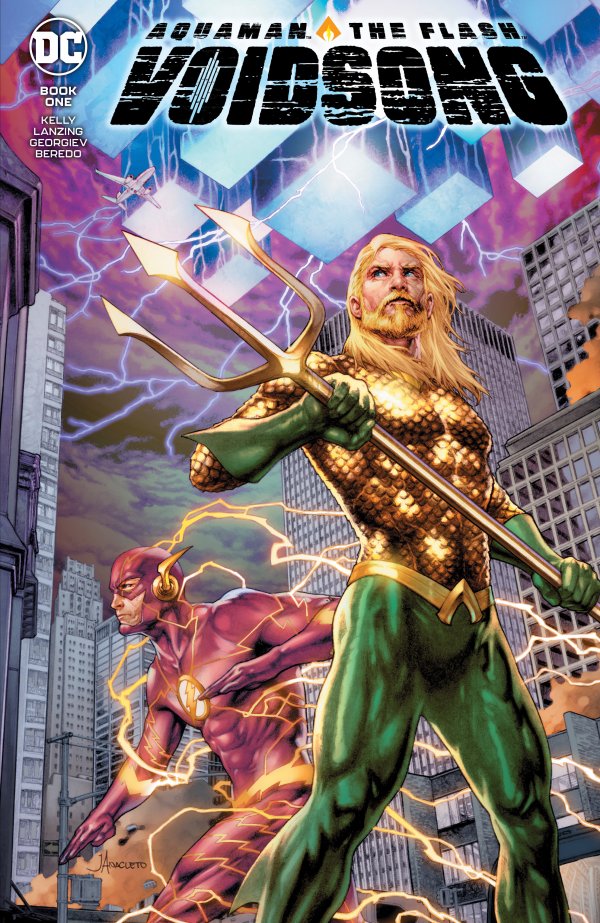
Aquaman and the Flash: Voidsong (DC Comics)

Ah, the miniseries. When the concept first really came to prominence in the 1980s, a comic book miniseries felt like an event, like something special. Now it almost feels inconsequential, with “ongoing” titles being relaunched every twelve minutes and proper miniseries feeling somewhat inconsequential. The idea of a miniseries starring the Flash and Aquaman facing an alien invasion felt like the sort of book that would never be referenced again, never have a serious impact on that “meta-narrative” I mentioned before, and therefore would be easy to skip. And I was wrong to feel that way.

The above description of the series, written by Jackson Lanzing and Collin Kelly and with art by Vasco Georgiev, is technically correct, but despite what Futurama would have us believe, that’s not always the best kind of correct. As the story goes, an invasion fleet immobilizes the entire planet with a sort of harmonic weapon (the titular “Voidsong”) that affects everyone except for the Flash and Aquaman – who were both insulated from the sound for Comic Book Reasons – leaving those two heroes as the only ones who can save the world. The great thing about this is that Aquaman and the Flash are not a traditional team-up pair. Sure, they’ve both been members of the Justice League since the very beginning, but when time comes for the heroes to pair off you’re more likely to see the Flash pal around with Green Lantern, while Aquaman hangs out with Wonder Woman or the Martian Manhunter. You almost never see these two, specifically, in a story together, and the story neatly moves from an early personality clash to a more respectful relationship in a very entertaining fashion. If you skipped this book because it wouldn’t “count,” I hear ya, but I’m telling you that we all missed out.

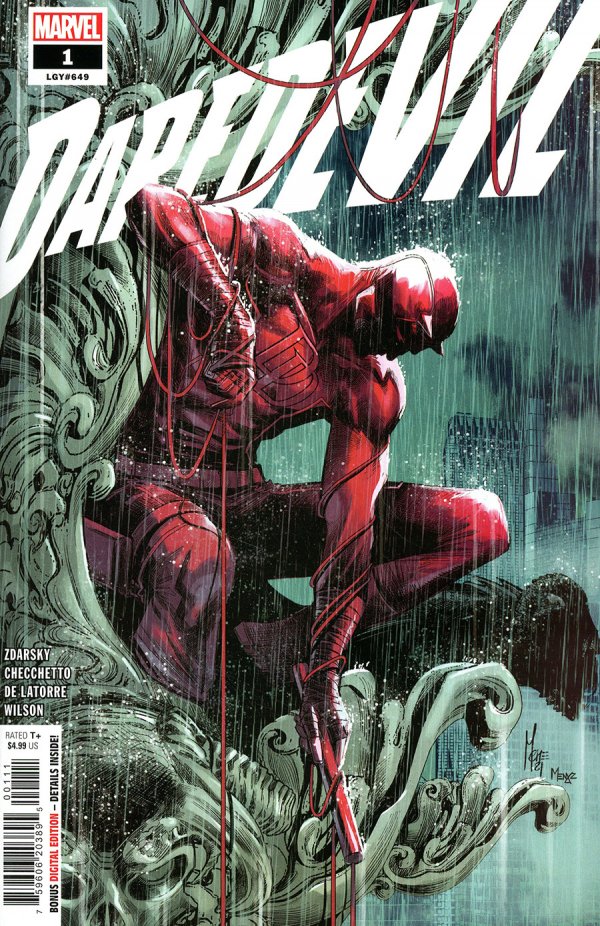
Daredevil by Chip Zdarsky (Marvel Comics)

Among Stan Lee’s Silver Age creations for Marvel Comics, Daredevil is probably the one I’ve read the least. It’s not that I dislike the character, but an awful lot of writers over the years have taken the approach that Daredevil is the hero that absolutely can never be allowed a single moment of joy. A lot of the modern runs on his book have had him suffer one tragedy after another without ever even a hope of peace or happiness. Years ago, when I was sent Marvel comics to review for the late, lamented Comixtreme website, I reached a point where I started to dread any new issue of Daredevil not because the book wasn’t good, but because I knew it would be so bleak I would need a shower afterwards.

Fortunately, Marvel seems to have decided that Spider-Man is now the character that will never be allowed anything resembling happiness, cheer, or entertainment, so Daredevil has lightened up a little bit. Chip Zdarsky, who is one of the more interesting writers working in mainstream comics today (under duress, it sometimes seems), took over the series in 2018. His version, admittedly, isn’t all rainbows and puppy dogs: early in the series, Daredevil accidentally kills a young man in the commission of a crime and eventually turns himself in to the police, getting sent to jail still wearing his mask. It’s a ridiculous concept, the masked hero in maximum security with a bunch of criminals, but once you accept the sheer lunacy behind it the story is fascinating. Zdarsky’s interpretation of Daredevil feels very in-character but, despite the dark inciting incident, manages to avoid the utter hopelessness so many writers have brought to the title.

Zdarsky’s run on the book went for 36 issues before it was restarted with a new #1 because it was a Wednesday. The current volume is on issue 11 and I don’t know how much longer it’s going to go, but I’m certainly along for the ride.

The Nice House on the Lake (DC/Black Label)

DC’s Black Label imprint is…well, I’ll be honest, it’s a mess. It was originally announced as a place for more “mature” versions of traditional DC heroes (“mature” here is being used in its traditional Latin definition, “more likely to drop an F-bomb”). The stories were also said to be out of continuity, except for the ones that aren’t. And sometimes they’re oversized and sometimes they’re not, sometimes they have characters formerly published by Vertigo and sometimes they have characters related to Batman. That’s about 90 percent of the time, actually. But sometimes they have absolutely nothing to do with established DC characters whatsoever. If you asked me to define what exactly the Black Label comics are supposed to be, the only consistent answer I could give you would be “something I would not give my eight-year-old nephew.”

Fortunately, it doesn’t matter what Black Label is, James Tynion IV and Alvaro Martinez Bueno’s The Nice House on the Lake is the gem in the crown. In this sci-fi/horror series (which I should stress has absolutely nothing to do with the DC Universe), ten people are invited for a week-long vacation by their mutual friend Walter at a…well, at a nice house on a lake. The cast is a very eclectic mix of people from Walter’s life – friends from high school, friends from college, friends from later. Some of the characters have a history with each other, others are nearly strangers, with Walter being the only link between them all. Before they can even settle into their vacation getaway, though–

Ah hell, I don’t want to tell you anything else, because this is a book built on mystery and surprise. There’s so much going on here, and almost all of it is built on character, which is fantastic. It’s a wild comic that takes a horrific turn at the end of the first issue, at which point it becomes virtually impossible to predict where things are going from one minute to the next. The book ends with a sequel hook, and I desperately hope that DC (or Black Label or whatever) is already well into working on the next volume, because while this series does come to a relatively definitive conclusion, there’s plenty more to explore and I can’t wait to do it. I won’t be sleeping on the sequel.

Blake M. Petit is a writer, teacher, and dad from Ama, Louisiana. His current writing project is the superhero adventure series Other People’s Heroes: Little Stars, a new episode of which is available every Wednesday on Amazon’s Kindle Vella platform. There are, of course, other books he slept on besides these. For example, if you didn’t read Justice League Vs. the Legion of Super-Heroes, you can consider yourself one of the lucky ones.

Geek Punditry #9: Pop Culture Comfort Food

Reportedly, there are studies that indicate people like rewatching old TV shows and movies because there is comfort to be found in familiarity. I don’t have those particular studies in front of me because I don’t feel like looking them up at the moment (this is a highly scientific approach), but I completely believe it. When the world is starting to be too much, I often find myself going back to movies, books, or comics that I have enjoyed before. There’s something about returning to old stories that makes it feel like you’re reconnecting with a friend. There’s an ease and a comfort that can be desperately needed when there’s a weight on your shoulders, when the anxiety begins sending the pins and needles across your skin, when every text or phone call makes you worry that the worst has happened. I go back to these things a lot, is what I’m saying.

And since I know I’m not alone in this, I thought that this week I would share with you some of my storytelling comfort food. I’m going to tell you one example from each of my preferred forms of media (movies, TV, books, and comics) that I can and have returned to more times than I can count, stories I know as well as the walk from my car to the front door, characters who are as close to me as family. When I’m feeling down or beat up or that nothing is going to be okay, these are the places I turn to so that I can be reminded…sometimes it can be.

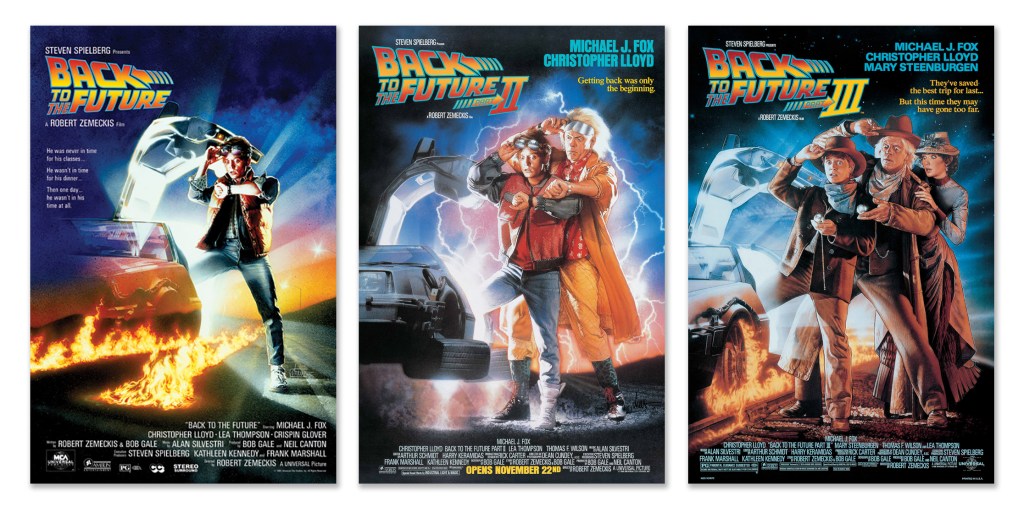
Movies: Back to the Future 

A series that never fails to take you back in time.

In the interest of clarity, I guess I should say the Back to the Future trilogy, because heaven knows I can never stop with one. The first movie came out when I was 8 years old, and I distinctly remember sitting down in front of the fireplace after my parents rented it and put the VHS tape in. I remember how quickly and deeply I fell in love with the film and how we went to the movies together to see Part II, and how we went out during a storm while out of town on a family vacation on the opening weekend of Part III to see just how the saga concluded. I even remember my father commenting on the weather and saying that anybody who went out in it to see the movie must have been a die hard fan. Which, of course, I was.

I know I don’t have to explain to anyone why these films are so great, and I’m certainly not going to waste any time on a recap, but I’m going to tell you what it is about them that makes me feel better. Part of it, like with all of the things I’m going to share with you, are the characters. There’s something about the unorthodox friendship between Doc Brown and Marty McFly that resonated with me even as a child. I had already spent years dreaming of being picked up by a tornado and thrown to Oz or finding a closet door with a passage to Narnia, but even at eight it was starting to seem like either of those would be a stretch. Finding an eccentric mentor who would bring me along on grand adventures seemed much more plausible. Even now, at a stage in life where I find myself relating more to Doc than Marty, that relationship seems pure and genuine. (Ironically, I think that’s part of the reason Rick and Morty became so popular so fast – it’s a parody of the Doc/Marty relationship, but that parody wouldn’t have worked as well if there was something foul or sordid about the original.)

Then there’s the basic fantasy of time travel, of being able to hop into a machine that can whisk you away to another place. The idea of seeing the past and the future is tantalizing, and I would be lying if I said I wouldn’t be tempted to use Gray’s Sports Almanac the same way Marty intended to. 

The other thing, which people may perhaps not think of immediately but I consider of utmost importance, is the music. The best movies often have memorable scores, but Alan Silvestri’s composition is one of the all-time greats. The sweeping tones automatically bring to mind the film, hit those triggers in your memory and pull you into the world of Hill Valley, and charge your heart with anticipation. The music moves from exciting to thrilling to, ultimately, triumphant. When you hear Alan Silvestri’s score to Back to the Future, you find yourself capable of believing that even when things are tough, like they were for Marty McFly, there is a solution that will make everything turn out okay in the end.

And c’mon. The car is really cool.

Television: Cheers 

Where people know troubles are all the same.

Bet you expected me to say Star Trek, didn’t you? Yeah, I know, Trek is my jam, but sometimes you wanna go where everybody knows your name.

Cheers, the sitcom about a little bar in Boston, has two distinct stages, and I love them both…but not equally, if I’m being honest. In the early years, the show was mostly a workplace romcom about Sam and Diane, with the rest of the characters there to add flavor. It was a fine show, it was a funny show, but I was a fairly young child at the time and, although my parents watched it, I didn’t really start paying attention to the series until I got older. This may be part of the reason that – although I would never skip the Diane years when doing a rewatch – it’s the Rebecca years that leave the most indelible mark on my memory.

But my relative age isn’t the only reason the second life of Cheers is my preferred era. Like I said, during the Shelley Long years, the show centered around Sam and Diane’s relationship. This was good. This made for some excellent television. But after Long left to become a major movie star (I recently watched her performance in 2012’s Zombie Hamlet, and I highly recommend it), they replaced her with the recently-deceased Kirstie Alley, and although there were the occasional flirtations with making her couple off with Sam like they did with Diane, the writers wisely realized that the same chemistry wasn’t there, and shifted the focus from a romcom to more of an ensemble comedy. The other characters grew in prominence, Rebecca Howe found a different niche to fill than the one vacated by Diane Chambers, and the show blossomed yet again. 

While the likes of Woody, Cliff, Carla, and Norm all had their moments in the pre-Rebecca days, post-Diane they had far more episodes in the spotlight. Frasier Crane was a Diane castoff who stuck around, but it was in the Rebecca era that he bloomed to one of the stars of the show, eventually spinning off into his own series (also a comfort watch for me), with a revival of the latter currently in the works. I’m not saying that the early years of Cheers weren’t GOOD, please don’t misunderstand me. It was a remarkable comedy, the character of Coach was sorely missed for the rest of the series, and the episode guest-starring John Cleese is perhaps one of the funniest half-hours of television ever put to film. It’s just that the pure love I feel for the series, the way I have affection for these characters as if they were personal friends of mine, the fact that I remember that Frasier’s first wife “Nanny G”’s phone number was 555-6792…that’s all a product of the Kirstie Alley years, and I’m fine with that.

Boy, I deserve some sort of trophy for THAT deep cut. 

Book: The Princess Bride by William Goldman. 

Skipping this would be inconceivable.

I may be cheating a little bit here, since much of what is wonderful about this novel is also applicable to the movie, which I also love and watch as comfort on many an occasion. But this is probably the novel I have read more times than any other (a feat which I insist is more impressive than the movie you’ve watched most often). It is the book I pick up when I’m sad. It’s the story I turn to when I’m depressed. It’s the tale I want to hear again when I feel like there is nothing good and beautiful in the world. I need this story at those times, because if it were true that there is nothing good and beautiful in the world, then how could a novel such as this even exist?

I know you’ve seen the movie, so I won’t bother to retell you the story. Instead, I’ll tell you about the elements unique to the book so that you can understand why it resonates with me so deeply. 

First of all the framing sequence. In the film, the tale of Westley and Buttercup is being read by a grandfather to his sick grandson. In the book, Goldman creates a metatextual story (this was before metatextual stories) about his own family, in which his father read the story to him as a child. It was not until adulthood that he tried reading it himself to his own son (a fictional son, by the way, as the real William Goldman had only daughters) and realized his dad skipped all the boring bits and just read him “the good parts.” The book is presented as adult Goldman abridging a classic novel by getting rid of all the flowery muck and bits of Elizabethan satire that modern audiences wouldn’t give a crap about. It’s a really funny conceit, and it’s executed so perfectly that a lot of people reading the book for the first time don’t realize the framing sequence is fiction as well. (It’s me. I’m a lot of people. I didn’t get it the first time.)

Second, the writing is simply marvelous. A lot of the great bits of dialogue made it into the film, which isn’t a surprise since Goldman wrote the screenplay himself, but there simply wasn’t room for everything, and many of those pieces left on the floor are absolutely priceless. For instance, the movie largely ignores Buttercup’s parents and their unending bickering, for which they keep score. It skips over the history of Fezzik entirely and leaves out all but the most essential parts of Inigo’s backstory, which makes an already amazing character so much richer. There’s more time spent with Humperdink, more time devoted to Vizzini, and much more to Westley and Buttercup’s burgeoning romance. Because yeah, it is a kissing book.

I don’t begrudge Goldman any of the cuts, of course. The very premise of the novel is that sometimes parts of a story don’t translate from medium to medium. But if you’ve only seen the movie you haven’t experienced the whole story.

The last thing about this book is perhaps the most important: the message. In the framing sequence, Goldman discusses a conversation with an old neighborhood woman who served as something of a mentor to him. This segment concludes with the child Goldman learning that life isn’t fair. Rather than being angry or hurt at the realization, though, he is utterly jubilant to hear the news, because once you accept that life ISN’T fair, isn’t SUPPOSED to be fair, then a lot of the crap the world throws around suddenly makes a LOT more sense. This is, I think, a very important message, and the great thing about it is how it is presented in a way that is joyful and positive rather than dour and depressing.

The point I’m getting at is that if you haven’t read this book, you should, and I’m envious that you’re going to get to experience it for the first time, which I will never have the chance to do again. But hey, that’s all right, because life isn’t fair.

Comics: The Triangle Era Superman.

This was MY Golden Age

Okay, this paragraph is just for the uber-nerds like myself who already know all about the “Triangle Era” of Superman. The rest of you can skip to the next paragraph. Ahem. I’m about to give a super-condensed history of the era. I know I’m leaving out a bunch of stuff. Like William Goldman, I choose to focus on the good parts rather than telling everybody the intricacies of comic book numbering and whatnot. Please don’t send me corrective emails.

In 1986, DC Comics hired writer/artist John Byrne to revitalize the Superman character. He took over both Superman and Action Comics, the two titles that starred the hero, and they added a third book to the line as well, Adventures of Superman, which was usually done by other creators such as Marv Wolfman. After a while, Byrne left the character in the hands of other writers and artists, and while he had done good work in his time, it was after his departure that a certain kind of alchemy began to happen. With Superman starring in three comic books a month, the writers and artists would have to collaborate to make sure they weren’t contradicting or causing problems for each other. This collaboration began to grow more intricate, and in time, the three different titles began to function almost as one. Stories that began in Adventures of Superman one week would continue in Action Comics the week after. Before long a fourth title was added, Superman: The Man of Steel, so that there were four monthly Superman books that worked almost as a single weekly title. Then someone noticed that 4×12=48, but there were 52 weeks in a year, so a fifth title (Superman: The Man of Tomorrow) was added to fill in the extra gaps. At some point, DC started to put a triangle on the cover of each issue demonstrating which week of the year it was to help readers keep track of what order the books went in, thus the “Triangle Era” was born.

The weekly nature of the serial was a great concept. Knowing that there would be a new chapter of an ongoing storyline each and every week forged hardcore loyalty and created a devoted fanbase that still exists today. What’s more, although the main story was ongoing, each individual series had its own subplots that made it stand out. Adventures, for example, was more often going to deal with the mad scientists of Project: Cadmus, while Man of Steel devoted time to a story about an orphanage and a young child who would eventually be adopted by Perry White. The books were part of a larger whole, but still had their own flavor and identity.

The Triangle Era lasted over ten years, but those early days happened just as I started reading the books and featured many of the writers, artists, and storylines that are still most dear to me: Lois learning Clark’s double identity, their engagement and marriage, the somewhat vindicated-by-history era of Superman Blue/Superman Red, the classic “Panic in the Sky” storyline, and of course, the legendary Death and Return of Superman were all products of the Triangle Era. Like all comfort media, part of my love for these books is no doubt because these were the comics I read in my formative years. But there’s also the fact that, for a very long time, these comic books were just really good. The world of Superman, which had not-undeservedly been called stale and out of date a decade earlier, was suddenly energetic, exciting, and full of new characters, concepts, heroes, and villains. Many people have made Superman comics over the years, but Dan Jurgens, Brett Breeding, Roger Stern, Bob McCleod, Jerry Ordway, Tom Grummett, Louise Simonson, and Jon Bogdanove remain the gold standard in my mind.

As the song goes, these are a few of my favorite things. These are stories, characters, and worlds that I never grow tired of. These are the things that mean something to me, things I flat-out refuse to let go of, things that come together and help make me who I am.

So what are yours?

Blake M. Petit is a writer, teacher, and dad from Ama, Louisiana. His current writing project is the superhero adventure series Other People’s Heroes: Little Stars, a new episode of which is available every Wednesday on Amazon’s Kindle Vella platform. He bets you thought he was kidding about Zombie Hamlet, didn’t you?

Pictured: the career worth leaving Cheers for.

Geek Punditry #5: Fandom: Why We Can’t Have Nice Things

I set a goal for myself about a month ago, to use this new Geek Punditry column to get back to writing about the movies, books, TV shows, and comics that I love. I felt like spending time on those things that bring me joy would reignite my writing chops and, just a month in, I feel like I’ve been successful. I’m looking forward to writing this each week. I’m excited to write this each week. But as early as week 3, my focus began to shift. What started as a celebration of things I love has already evolved, with the past two installments focusing on problems that I think need to be addressed. I bring this up because I’m going to do the same thing this week. I’m going to point out a problem that I think is perhaps the most insidious in all of pop culture. I mean, of course, fandom.

The Antichrist, according to Reddit User u/DeeSeeBlows42069

Earlier this week, James Gunn released a video announcing the new plans for the reinvention of the DC Universe in movies and television, and when I heard the news, that’s what I thought I would be writing about today. I figured I’d give you my feelings on what he has in the works for Superman, for Green Lantern, for Booster Gold (Booster freakin’ Gold!) and tell you why I’m excited and optimistic about it. But within hours, the excitement I felt was already being chipped away by people who, if you asked them to their face, would claim to love the very things they had begun whining about. But for people who say they’re acting out of love, their words painted another picture – venomous, vitriolic, and sometimes just plain nasty. Fans can be great, but every time a new movie is released, a new comic book creative team is announced, a new television series premieres, it becomes more and more clear that fandom can be absolutely toxic.

I’m not saying that criticism is bad. In times past, criticism itself was a legitimate form of literary discourse. But that was reasoned criticism, informed criticism. What we get today is a knee-jerk reaction that declares everything is terrible before it even sees the light of day, souring the joy for everybody. One need only look on any social media outlet, any of hundreds of Reddit pages, and one will find post after post, meme after meme, of people railing in anger against something they have not even seen. In fact, for the most part it’s criticism of things that do not yet exist. And while it’s true that the other extreme also exists – people who are happy about things they have not seen – that other extreme is a minority, and seems to me to be far healthier and joyful (or at the very least less pessimistic) and therefore is the side I would prefer to join.

Not pictured: A film that should be used as a medieval torture device.

Social media allows for no nuance, though. Everything is either the greatest thing ever made or (far more often) the worst thing ever made, with no degrees in-between. Last year’s Morbius movie is a good example of this. The film underperformed badly at the box office, even after a meme-inspired rerelease, and it has become a punchline. But this damage was not done by people who had watched the movie. The internet declared the film a failure long before its release – online hatred of Jared Leto combined with several COVID-related delays seemed to doom it before a single frame was released to the public. When I finally watched the movie, my response was, “That was okay.” It isn’t great, mind you, but it’s okay. Jared Leto is all right, Matt Smith seems to be having fun playing the bad guy, and the vampire effects – I’ll say it – were actually pretty impressive. But if you mention the title on Facebook you’ll get an avalanche of “IT’S MORBIN’ TIME!” posts and people slandering the movie, most of whom have never even watched it.

People who delight in someone else’s failure are nothing new, of course. It’s good old-fashioned schadenfreude (and thank the Germans for having an appropriate word for this), it’s as old as civilization itself, but the internet has given it voice that it didn’t have in ages past. The insidious thing is that this voice is not simply celebrating failure, but generating it. What’s worse, as the louder voices on the internet start to pretend that volume is consensus, too many people are starting to accept consensus as fact. I’m reminded of a conversation I overheard a few months ago between two of my high school students about the most recent Halloween movie. One student was declaring, in much the same voice you or I might use to declare that the bathroom is down the hall to the left, “It sucks. He’s barely in it.”

“Have you seen it?”

“No, but everyone says so.”

You’re not allowed to shout at your high school students for their opinions about movies. I looked it up.

Full disclosure: I didn’t particularly care for Halloween Ends, but A) my issues with it had nothing to do with the number of minutes Michael Myers appeared on screen, and B) I formed that opinion after watching the movie myself. 

This phenomenon is perpetuated online thanks to sites like Rotten Tomatoes, which is a brilliant example of a good idea gone horribly wrong. Rotten Tomatoes gives a movie two scores: a percentage based on film critic scores and the percentage based on viewer scores. The site has no authority, no personal judgment inherent in its functionality, but people have begun using that algorithm-generated number as if it were some sort of benchmark of quality. I can’t say this often enough, my friends: consensus does not equal quality

How many movie trailers have you seen declaring a movie’s Rotten Tomatoes score the way they used to tell us that Siskel and Ebert gave a movie two thumbs up? The difference is that Gene and Roger were actual critics, people who watched a movie first and then gave intelligent, nuanced critiques of the film. If they gave a movie a thumbs-down, they could explain to you why they disliked it. But if a movie gets a 35 percent on Rotten Tomatoes, all that means is that only 35 percent of the trolls on the internet had something positive to say. When I hear that number, the only response that makes sense to me is, “SO WHAT?” I accept the numbers as a consensus of the people who have posted to Rotten Tomatoes, but why in the hell should I care what they have to say? I disagree with random people all the time. I disagree with professional critics even more. Why should I accept their numbers instead of forming my own opinion? When they started to tease the upcoming announcement of a film’s Rotten Tomatoes score, I thought my brain was going to explode and squirt out of my ears like a Looney Tunes character, who would then get anxiety over its own upcoming Rotten Tomatoes score. 

I’m telling you, it’s okay with me if you like this movie.

And you know, I wanted to like Halloween Ends. I’ve never understood the concept of “hate-watching.” There are so many things I want to watch that I know it’ll be impossible to get to them all – why should I waste time watching something I expect to dislike? Will it happen sometimes? Of course. But that’s not my goal. And more importantly, if I decide not to watch something because I expect to dislike it, I don’t declare it bad, I declare it unseen. For instance: I didn’t care for the first James Cameron Avatar movie. (Yes, I know, it made all the money. I don’t care. Consensus does not equal quality, remember?) Because I didn’t care for the first one, I haven’t watched the second. So here’s a pop quiz: when someone asks me about Avatar: The Way of Water, what is the correct way for me to reply?

A: It sucks, James Cameron sucks, water sucks, everyone sucks.

B: I haven’t seen it.

If you answered “A,” please disconnect all of your devices from the internet immediately and never talk to anyone again.

The other thing that stokes this particular flame is an “us vs. them” mentality that pervades the internet. It’s as though if you’re a fan of Property A, you are beholden via blood oath to despise everything associated with Property B. You must hate the movies, you must hate the books, you must hate the fans, and if an actor happens to jump from one to the other they are a traitor and must be dealt with possibly with bamboo shoots no later than Tuesday afternoon

My God, is there any attitude in fandom stupider than that one?

Superman is my favorite superhero. He’s a DC character. Somehow that means I’m not allowed to say how great Spider-Man: No Way Home is? If I love Star Trek, is it a betrayal to express joy for The Mandalorian? If I’m a fan of Lord of the Rings, I have to hate Wheel of Time?

Shut up.

Pictured: Fandom

Storytelling isn’t sports. When I’m watching the New Orleans Saints play the Atlanta Falcons, the nature of sports means that I want one team to win and one team to lose. This is normal. But that same rule does not apply to movies, to TV shows, to books, to comics. In sports, somebody is gonna lose, but in storytelling, everyone can win. When I say that I want James Gunn’s Superman: Legacy to be a blockbuster movie, that is not the same thing as saying I hope Captain America: New World Order is a disaster. I firmly believe that great art of any kind will inspire great art from others, and that when one franchise I love is enjoying success it’s not an obstacle to anybody else. If anything, it’s a carrot to lure them to be better themselves. I think the people who make these properties understand this. It’s very common to see actors, directors, writers, or artists jump back and forth between publishers and studios and IPs and have positive things to say about all of them. It’s only the fans that view it as a competition. (Well, the fans and the corporate executives, but that’s a whole other conversation.)

This is not to say I’m blameless in this, of course. I certainly shared my criticisms of the original Avatar online, and lord knows I posted a “Morbin’ Time” meme or two, but as fandom has grown more toxic I’ve made a deliberate effort to pull back on that sort of thing. I’ve never been the sort of person who would get on Twitter and threaten an actor because I didn’t like a movie they were in, but I realize now that in the current internet climate even well-meaning criticism may sometimes give fuel to that sort of horrific person, and I don’t want to do that. The point of Geek Punditry is to talk about things I love, not things I hate. 

I’m not saying not to criticize. I’m just asking that criticism be informed, that it be based on the work itself and not because you hate somebody’s previous movie or because you’ve chosen lines in a meaningless civil war. And most importantly, that it be respectful, both to the people you disagree with and to those whose work you are criticizing. Nobody intentionally makes a bad movie, with the possible exception of the Sharknado franchise, so even if you don’t like the work, give credit for the effort that went into it. The only people who lose when you speak respectfully are the people who refuse to speak respectfully.

And go ahead and be respectful to them, too.

Drives ‘em crazy. 

Blake M. Petit is a writer, teacher, and dad from Ama, Louisiana. His current writing project is the superhero adventure seriesOther People’s Heroes: Little Stars, a new episode of which is available every Wednesday on Amazon’s Kindle Vella platform. If, at any point during this column, you thought to yourself, “Blake is talking about THOSE people,” that probably means he’s talking about YOU.