Year of Superman Week 34: Crossover Chaos Part III-The Final Amalgamation

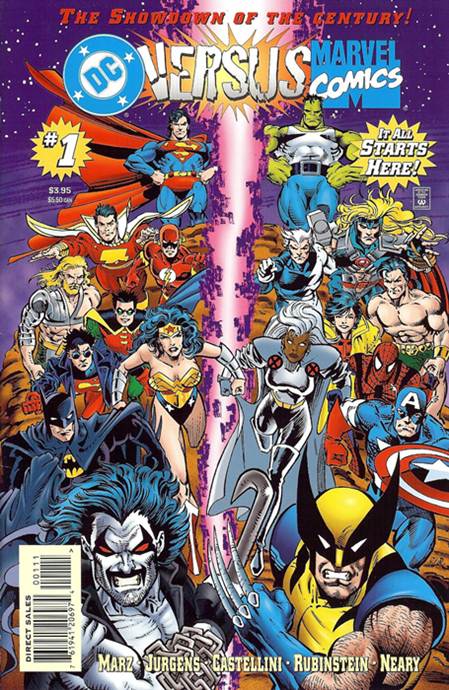
I spent last week dipping my toes into the DC Vs. Marvel crossover, as well as the first wave of Amalgam Comics titles. But I’m not done yet: I’ve still got over half the huge Amalgam Age Omnibus to get through, including two sequel miniseries and the second wave of Amalgam Comics. Not only that, but after a few weeks where the beginning of the school year has kept me busy, I finally get a chance to sit down and catch up on more recent Superman comics. Oh yeah – and Peacemaker season two drops this week, and while I don’t expect to see Superman to show up, James Gunn has promised that the story of this season follow on from the film, so there’s a pretty good chance I’ll have some thoughts to share about that. Let’s begin, shall we? 

And as always, you can check out earlier blogs in the Year of Superman Archive!

Wed., Aug. 20

Comics: DC/Marvel: All-Access #1-4
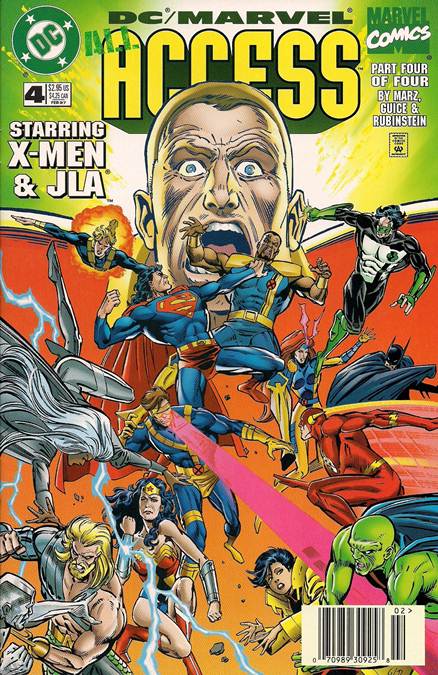
I had the same look on my face as Access when I read Civil War II.

Notes: I’m going to say something that may be controversial here. I actually like the follow-up miniseries, like DC/Marvel: All-Access, better than the DC Vs. Marvel event itself. DC Vs. Marvel was a fun experiment, but the plot was really just a flimsy excuse to show off fights between the characters and frame the Amalgam specials. All-Access, on the other hand, has an actual STORY to it, and I appreciate that. Written by Ron Marz with art by Butch Guice, whom you may remember passed away earlier this year, All-Access starts out with Axel Asher, the man who straddles the line between the Marvel and DC Universes as Access. A psychic flash warns him that Venom has somehow hopped universes, and if anyone from either universe stays in the other one for too long it could cause the worlds to fuse into the Amalgam Universe again, so the cosmic hall monitor has to get to work. He comes across Venom in Metropolis, where he’s throwing down with Superman, and so Access decides to get some backup by calling in someone who knows what Venom’s deal is: Peter Parker, the Amazing Spider-Man.

This is all in the first issue of the miniseries, by the way, which almost works very well as a standalone Superman/Spider-Man team-up. There’s no gratuitous hero-on-hero fighting here, just two good men teaming up to take down one bad one, and Marz plays them both perfectly. Re-reading this issue is where I started to realize that this is kind of what I had hoped DC Vs. Marvel would have been all along.

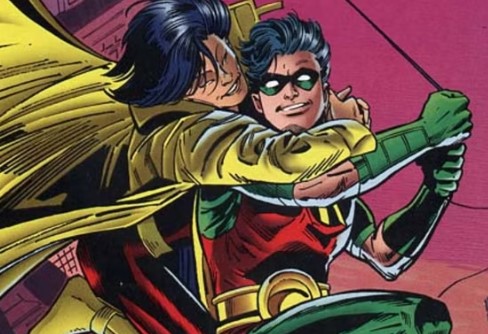
Superman doesn’t show up again until the last page of issue #3, but in the meantime, Jubilee convinces Access to take her back to the DC Universe because when she and Robin were supposed to be fighting each other, they kind of fell in love. (To this day, it’s probably the best relationship Tim Drake has ever had.) Their reunion is interrupted by an encounter with Two-Face, then again when the Scorpion appears, once again mysteriously having been pulled from the other universe. Access recruits Batman to help him solve the mystery of the “crossovers,” and Batman suggests that they track down the man who, in the combined universe, was supposed to be its defender: Dr. Stephen Strange. Batman approaches Strange, suspecting that he’s causing the crossovers somehow, and Jubilee calls in the X-Men to hold him off. Issue three ends with Access once again calling in the cavalry, bringing in the rest of the Justice League.

Issue four is X-Men vs. JLA, at least at first. Things change when Access discovers that Dr. Strangefate has been hiding in Strange’s subconscious ever since the merger and used him to cause the crossovers in an attempt to restore the Amalgam Universe. He fuses Wonder Woman and Storm once again into their Amalgam counterpart, Amazon, but when he realizes he doesn’t have the right parts to put together anyone else, he starts creating NEW Amalgams: Superman and Bishop! Iceman and Aquaman! Jean Grey and the Martian Manhunter! Things get wild!

The story ends with a nice little promise, the Amalgam Universe restored as a sort of pocket universe where Strangefate is locked away, and the Marvel and DC Universes get to remain separate. But this miniseries was so much fun, seeing the characters actually interact in ways that didn’t go straight to the fisticuffs. The Robin/Jubilee stuff in particular was fantastic, and I loved seeing Superman and Spider-Man working together again. 

It’ll never happen, but I’d love to see a longer Access series, say a 12-issue event in which he’s trying to solve some sort of mystery that encompasses both worlds. And I’d love if, during this year, he appears not only in his own series, but in the ongoing comics of both companies, bringing surprise guest stars with him. But seeing as how the original plan was for DC Vs. Marvel to end with She-Hulk and Martian Manhunter swapping universes for a year until that plan was nixed by the lawyers, it’s doubtful that anything like that could happen. It’s not like the world has gotten LESS litigious since 1996, after all. 

Thur., Aug 21

Comic Books: Super-Soldier: Man of War #1

The amalgamated Snyder Brothers fans get SO angry that they gave Super-Soldier his trunks back.

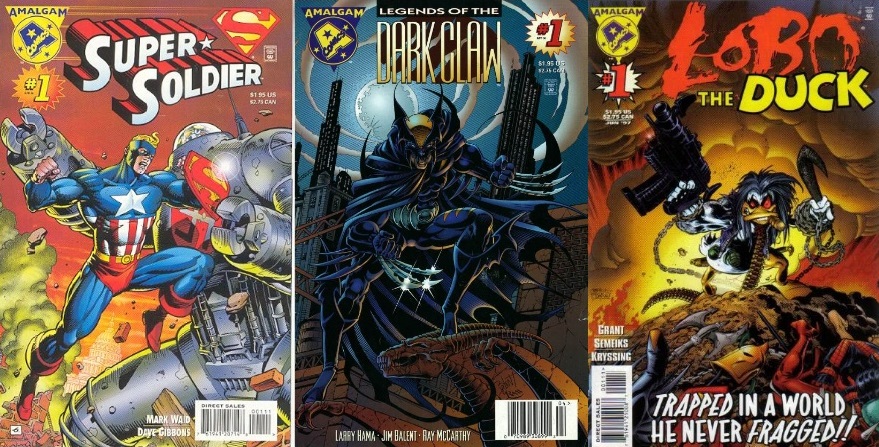
Notes: A year after DC Vs. Marvel, a second wave of 12 Amalgam one-shots were released, six of them continuing adventures of the characters from the first, six of them with all-new Amalgamations. What’s interesting is that even the books that carried over didn’t continue the STORIES from the original. Some of them were unrelated stories, some made brief reference to the previous, and some went REALLY wild, like Dark Claw Adventures giving us an adventure of the Amalgamated Batman/Wolverine combo in a Batman: The Animated Series style. For our first visit with the Super family, Super-Soldier: Man of War dipped back in time to give us an adventure of the character from World War II. Mark Waid and Dave Gibbons reunite for this story, which kicks off with Super-Soldier at a meeting of the All-Star Winners Squadron. But he’s only there long enough for us to notice some new Amalagams (such as the Human Torch/Green Lantern mashup Human Lantern) before it’s off to join Jimmy Olsen for a special undercover Daily Planet assignment overseas. 

On the ship to Europe, Clark and Jimmy make the acquaintance of Sgt. Rock and the Howling Commandos, and Clark is later chagrined to find that Winston Churchill has fallen for the do-gooder act of his arch-nemesis, Lex Luthor, husband of Lois Lane. In a way, Luthor’s involvement actually makes this a prequel to the previous story, as the issue ends with him unveiling the plans for the Ultra-Metallo that Super-Soldier fought the first time we read one of his adventures. Kinda makes you wonder why it took Luthor 50 years to get it together.

As before, Waid and Gibbons do a great job lacing together the Superman and Captain America characters, this time bringing in the World War II-era heroes of Easy Company and the Howlers as well. Peggy Carter, for instance, shows up here as a member of the French Resistance (although I couldn’t figure out which member of Easy Company she was supposed to be mashed up with). The appearance of Major Zemo and his War Wheel pushes this over the top – silly and gleeful. These Amalgam books, when done well, are just an enormous amount of fun. Is it too much to hope that the new DC/Marvel crossover books that are about to come out will open the door for the return of this mixed-up universe? 

Fri., Aug 22

No, you give YOUR dog an invisible bone!

Last night was the premiere of Peacemaker season 2. I thought that meant I would be able to watch it when I got home from work, but apparently, it dropped at 8 p.m. EST, by which time my sports fanatic son was engrossed in a preseason game between two teams that nobody in our house has any personal connection to. But that was okay, I figured that I would just watch it the next day. I guess that was pretty stupid of me, though, to assume that I could wait a whole 20 hours and not have anything spoiled for me. Before the game was even over, though, posts were appearing on social media that spoiled something that really pissed me off. You see, season one was made BEFORE James Gunn was given the job of revamping the DCU, and was intended as part of the previous iteration of the DC Extended Universe. With the new DCU that began in Creature Commandos and continued into Superman, though, there were questions as to which parts of the season were still canon. Gunn has been exploring that in the official podcast for the show, but there was a moment in the finale that they were going to have to work a little bit to reconcile. 

Naturally, looking at Facebook last night, I was spammed with different pages that I don’t even follow sharing a screenshot that ruined a pretty amusing moment. How dare I assume that people wouldn’t make it into a headline? It had been an entire 180 minutes since the show dropped! What are they, made of stone?

Here’s the rule: If you’re posting spoilers about a show on the day it airs, you’re an asshole. That goes for individuals as well as all of those pages that I have since blocked.

By the time you read this it will have been nearly a week since that episode, and I STILL wouldn’t talk about it without giving you a warning. So in the next paragraph I’m going to spoil a few things about the end of Peacemaker season one and the beginning of season two. If you haven’t watched them and want to remain pure, skip ahead to Saturday.

TV Show: Peacemaker Season 2, Episode 1: “The Ties that Grind.”

Season one of Peacemaker ended with the titular hero and his team, the 11th Street Kids, saving the world from an invasion of alien butterflies. It’s more impressive than it sounds. But in the battle, Emelia Harcourt was nearly killed. Towards the end of the episode, Peacemaker is carrying her to safety when, lo and behold, the Justice League appeared – too late to do any good. The League, in this case, included silhouettes of Superman and Wonder Woman, as well as Jason Momoa as Aquaman and Ezra Miller as the Flash. It was a funny scene, but as that Justice League doesn’t exist, that scene clearly was no longer canon.

Gunn promised to explain it away and he did at the very beginning of the episode, in the “Previously on…” montage, where the League was replaced by the Justice GANG from the movie. The silhouettes of Superman, Mr. Terrific, and Supergirl all appeared, as well as a quick and the cameos have been replaced by Isabela Merced’s Hawkgirl and Nathan Fillion’s Guy Gardner. It was a funny bit. But I bet it would have been funnier if not for the asshats on the internet posting it the night before I got to watch it.

Fillion and Merced appear later in the episode as well, alongside Sean Gunn as Maxwell Lord allowing Peacemaker to audition for the Justice Gang. Watching the episode, it’s clear why DC put out the digital version of Superman last week – there are a lot of things in this show that build directly on that movie, although it’s still Peacemaker’s story of course. Rick Flagg shows up, worried about another dimensional rift like the “Luthor Incident” that happened this summer. Besides the connections to Superman, the show also starts trickling in new characters, like a surprising cameo by White Rabbit and references to the likes of the Ultra-Humanite and Captain Triumph. Rick Flagg is even working with Sasha Bordeaux, a supporting character from Greg Rucka’s Batman comics. Gunn seems to be using this season of Peacemaker to lay in chunks of the history of the DCU that Superman only hinted at, and I’m really quite excited by that. 

Look, it’s not a HUGE Superman link, and it’s DEFINITELY not a show I’m gonna watch with my seven-year-old like the movie, but this show is starting to look like it’s going to be part of the fundamental fabric of the new DCU, and that would make it worth watching even if it WEREN’T really good. 

Comics: Jon Kent: This Internship is My Kryptonite #5

Sat., Aug 23

Comic Books: Superman: The Kryptonite Spectrum #1, Superman Unlimited #4, Supergirl Vol. 8 #4

This is why you don’t watch whites with colors.

Notes: The beginning of a new school year traditionally keeps me busy, and today was the first time I’ve made it in to pick up my new comics in a few weeks. As such, I’ve got a hefty nine Superman or Superman-related comics sitting in my stack, waiting to read and discuss, including the much-anticipated Superman: The Kryptonite Spectrum #1. This Black Label series is by W. Maxwell Prince and Martin Morazzo, the creative team behind Image Comics’ incredible existential horror series Ice Cream Man. That’s the only thing of theirs that I’ve read before, however, and while I’m a big fan, I’ve been curious ever since this was announced as to just how their sensibilities would translate over to the Man of Steel.

As it turns out, they translate wonderfully.

In this story, Superman discovers four new strains of Kryptonite beyond the usual colors we’re aware of, and recruits Batman to help him experiment with them and find out what they do. The first, a Purple K, distorts Superman’s perception of time – something that is especially concerning as Lex Luthor chooses just that minute to unleash Solomon Grundy in Metropolis.

It would be fair for someone to question whether a creative team best known for a cosmic mind-tripping horror comic would be an appropriate choice for a Superman story, but Prince and Morazzo acquit themselves right away. The Kryptonite Spectrum isn’t a horror story by any stretch, but when Superman’s concept of linear time is skewed, we get a story that drifts into the kind of psychological twists that make Ice Cream Man so compelling while skipping the actual terror. Prince uses this conceit to play with the reader’s concept of time as well, and the script even twists Superman’s interactions with his friends, with a few scenes with Lois Lane dipping into the very real anxieties that Ice Cream Man so frequently mines for pure horror. Here, though, rather than terror, Prince uses them for character drama, displaying things about the relationships between the characters that feel very true, very human. This may not have the “Elseworlds” label, but the story clearly isn’t set in the mainstream DC Universe, with Superman and Lois’s relationship framed in a way that doesn’t fit that world, but feels quite appropriate for the story that Prince and Morazzo are telling. This is a great first issue of a very different kind of Superman story, and I enjoyed it heartily. 
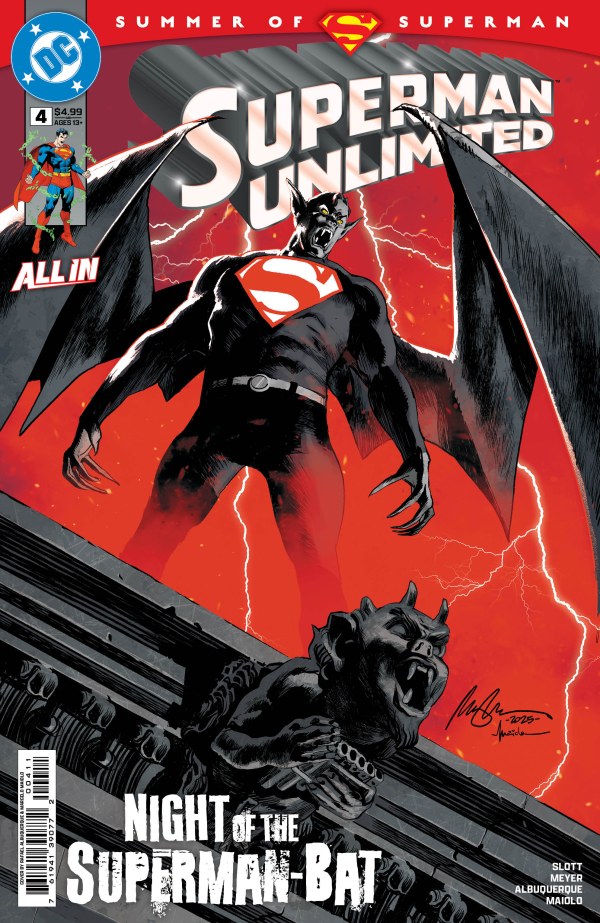
Remember this the next time one of you wants to give me grief for putting up my Halloween decorations in September.

Dan Slott and Rafael Albuquerque are back with Superman Unlimited #4. With the Daily Planet expanding to a global operation, Jimmy Olsen has been tasked with helping set up their Gotham City office. While he’s in town, he and his ape city sidekick Tee-Nah run across Man-Bat and wind up summoning Superman for help. What they don’t know, though, is that this is a new Man-Bat, one who can transmit its curse via a bite…and a chance encounter with all the Kryptonite on Earth these days has left Superman just vulnerable enough to get nipped. Soon it’s Robin and the Birds of Prey vs. Superman-Bat! 

This book is really turning out to be just what I wanted. There’s an ongoing storyline – that of the Kryptonite meteor that fell to Earth and the consequences of that – however, each issue feels like it’s telling a complete and self-contained story. The A-plot, the “Superman-Bat” thing, is done in one and it’s over. The background story of the Kryptonite and the expanded operations of the Planet continue. Although it’s a single monthly comic, in a lot of ways it feels like the structure of the glorious “Triangle Era” of the Superman comics, and I love it for that. Slott also works in some nice tidbits regarding Superman’s interaction with the Batman family, which – coming right on the heels of having read The Kryptonite Spectrum #1 – makes it feel as if DC is using the month of August to make sure everyone remembers that Superman and Batman are best buds. Which, of course, I approve of wholeheartedly.
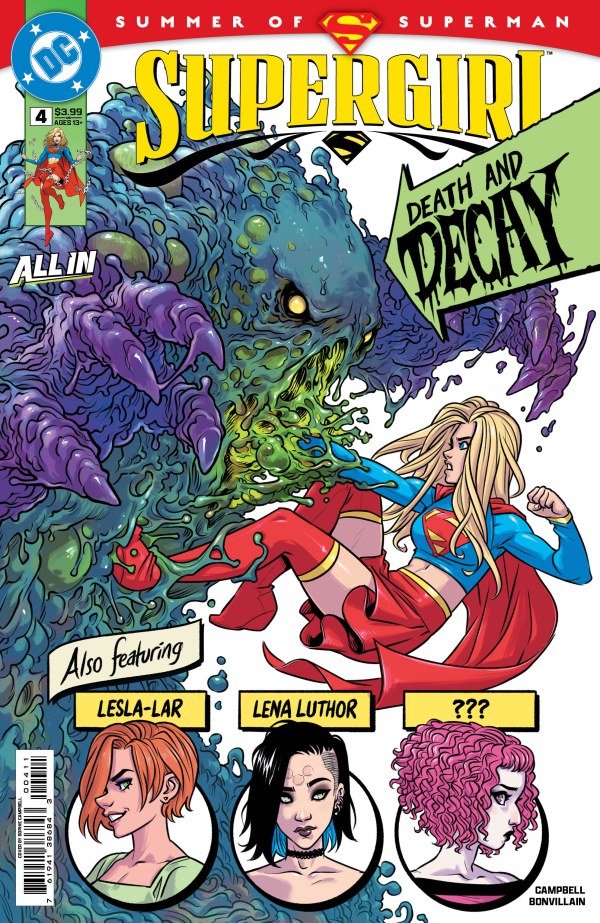
This is what happens when you don’t use fluoride.

Supergirl #4 continues Sophie Campbell’s new(ish) take on the Woman of Tomorrow. Having defeated her doppelganger Lesla-Lar last issue, this issue Supergirl takes her back to Kandor where she does something her cousin would most certainly approve of wholeheartedly: she goes to bat for her. Supergirl argues that Lesla has the drive to become a real hero, if only given the proper guidance, and volunteers to take that task upon herself. That’s the very beginning of the issue – afterwards we see Lesla make earnest attempts to prove her worth, leading up to a strange but entertaining encounter at a Goth club where she makes a mistake in judgment that winds up having the Supergirl squad face the forces of Decay. 

I just adore Campbell’s take on Supergirl. This issue in particular feels so true to the character – she comes off as someone who has demons in her past but, having largely conquered them, is sworn to help other people do the same. And following Lesla in this issue just magnifies that fact, demonstrating the effect that just being in proximity of someone like Supergirl can have on a soul that’s not truly evil, but merely lost. It’s such a good look for her and for the entire Superman family, and Campbell is nailing it in a delightful way. I also appreciate how Campbell is mining Supergirl’s past – the “new” villain, Decay, is a new version of an obscure character from Supergirl’s ‘80s series who, to the best of my knowledge, hasn’t reappeared since then. She knows this character’s history and she’s using it to her best advantage, which makes for a really rewarding read. 

Sun., Aug. 24

Comics: Krypto: The Last Dog of Krypton #3, Action Comics #1089, Justice League Red #1

Notes: After a busy Sunday of groceries, shoe shopping, making my weekly LitReel and, of course, a required stop at Spirit Halloween, it’s nearly 7 pm before I have a chance to sit down and read anything. Fortunately, I’ve still got six more new Superman-related books to dig into. Let’s see how many I get to this evening.

Beware the fetch.

Krypto: The Last Dog of Krypton #3 is first. Wandering alone after abandoning Lex Luthor, Krypto is stumbling through the woods when he comes across a little girl who’s as lost as he is. Roaming through the freezing woods, Krypto takes it upon himself to take care of the child, and in the process, proves just what a good boy he really is.

The first two issues of this miniseries blew me away. This one… DAMN it, Ryan North. Three issues in a row – THREE ISSUES IN A ROW – and you’ve got me in tears reading about KRYPTO THE SUPERDOG.

Honestly, if you’re not reading this comic book I don’t know what even is wrong with you.

When a teenager loses one of his contact lenses.

Action Comics #1089 may not have me sobbing over the adventures of a dog, but that doesn’t mean it’s not good. Last issue, young Clark Kent was surprised when his history teacher showed up on his doorstep and revealed that he knew Clark was Superboy. This issue, Mr. Blake has a reveal of his own and, frankly, I’m kind of irritated with myself for not picking up on who he was in the first place. Mark Waid is being Mark Waid here, tapping on his seemingly infinite awareness of the DC Universe to bring back a character who hasn’t been seen in a while and recontextualizing him in the world of Superboy’s Smallville. I can’t get much more specific without spoiling anything here, and in case you haven’t read the issue yet, I don’t want to do that But Waid is doing really interesting stuff in this issue.

My one complaint is actually the cover by Ryan Sook. It’s a great piece of art – evocative and certainly sure to get a reader’s attention…only it doesn’t seem to actually fit anything in the story. I hate when comic book covers are dull, generic pin-ups, but it may be even worse when the cover is of a scene that doesn’t even appear in the book.

Wait, some of these costumes need more red.

The last book I squeeze in before I’m alerted by my child that he’s hungry and he has expectations of something called “dinner” is the first issue of the latest DC All-In era Justice League spinoff, Justice League Red. Ever since the Justice League re-formed, Red Tornado has been serving as the computer intelligence running the operations for the team. This issue, Power Girl and Green Lantern Simon Baz get a red alert on their League ID cards that summon them to a satellite Red Tornado built without the knowledge of the rest of the League. His computer mind has been running millions of simulations and has determined that the new League is somehow going to lead to a catastrophe on Earth, and he needs a few trusted members to handle secret tasks the rest of the League cannot learn about in order to stop it.

Writer Saladin Ahmed is taking an interesting path in this book. The story leads us to believe that Red Tornado is unstable, and that all of these predictions and algorithms he’s run are unreliable. Even as Power Girl and Simon carry out their first mission, they’re skeptical as to whether they’re doing the right thing and whether they can trust their robot teammate. But to play that hand so early, to make it seem from the very beginning that Red Tornado may be going off the rails…it feels kind of like a feint to me. I’m willing to bet that we’re going to find out along the way that things are even worse than believing Red Tornado is wrong: we’re going to find out that somehow, he’s RIGHT. Interesting set-up, and I look forward to seeing where this goes. 

Mon. Aug. 25

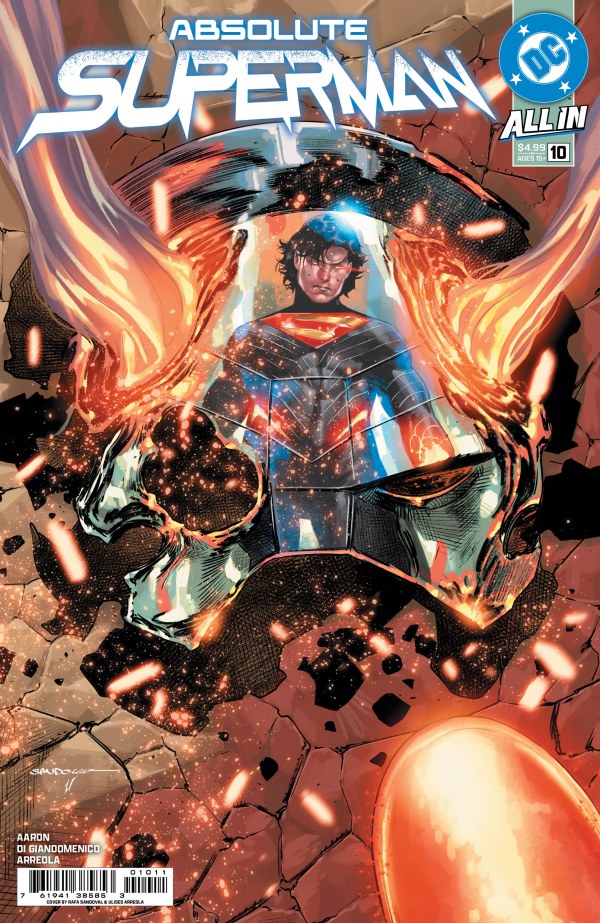
Comics: Absolute Superman #10, Batman/Superman: World’s Finest #42, Justice League Vs. Godzilla Vs. Kong 2 #3
Confirmed: I still can’t see John Cena.

Notes: Time to wrap up my catch-up weekend (plus one day) with the final three Superman-related comics from my visit to the comic shop. I’m kicking it off with Absolute Superman #10. The battle continues between the Omega Men and Ra’s Al Ghul’s Peacemakers, with Peacemaker Smith on the front line in the hunt for Kal-El. With a Kryptonite bullet in Smith’s gun, Kal-El is faced with a decision, and a reflection onto a hard choice his father once made brings about a surprising result.

The conceit of the Absolute comics is that this is an entire universe tainted by Darkseid, where hope is the eternal underdog and the sort of values that characterize the traditional DC heroes are absent. This issue, Kal-El is faced with the kind of choice that Superman inevitably comes down to at some point in his career, and it’s a testament to Jason Aaron’s writing that, right up until the choice is made, I’m not entirely certain which way I think he’s going to go. 

I like the way the Absolute world plays with characters as well. Concepts like the Omega Men, Peacemaker, and especially Ra’s Al Ghul are not traditional elements of the Superman corner of the DC Universe, but they work in the story we’re getting here. Overall, it’s a good chapter in this saga. 

This am bad serious book.

In World’s Finest #42, Superman and the Dynamic Duo have been summoned to Bizarro World to help with a plague. The Bizarros (including Bizarro Superman #1 and Batzarro) who are infected find their minds realigned to a more Earth-like way of thinking. Such a danger can’t be allowed to spread, so they’ve turned to our heroes to save them…but together, they find that the danger may be greater than even the plague seemed to be.

Mark Waid is doing some really interesting things with the Bizarros here. He plays with the notion of how science and physics don’t really allow for something like a square planet and what the consequences of such a world would be. At the same time, he tackles the Bizarro philosophy of things being “backwards” as well, in a way that makes me feel slightly abashed for my criticism of the Bizarro story in the recent Kal-El-Fornia Love summer special. There’s also a great moment for Batman here – Robin (understandably) questions why it would be such a bad thing if the Bizarros all had their minds reversed to what we think of as “normal.” Batman’s response is a little unexpected, at least until he gives his reasoning, displaying a depth of compassion that Batman isn’t often given credit for. It’s a good look on Bruce.

So they’re sitting around watching Japanese movies, so what?

I finally get to the end of the new Superman titles (less than 48 hours before this week’s comics go on sale) with Justice League Vs. Godzilla Vs. Kong 2 #3. At the center of the Earth, Superman and Lex Luthor are forced into an uneasy alliance as they come across a herd of giant gorillas. (A herd? A pride? What are a group of gorillas called? I should probably look that up.) On the surface, meanwhile, Supergirl and Wonder Woman get to work liberating a Monarch base being held captive by Task Force X, and Harley Quinn gets involved in a rather…unique therapy session. 

Obviously, I love crossovers, and seeing the League facing off against the Kaiju of the Legendary Monsterverse is a lot of fun. I particularly like bringing in the Suicide Squad as an alternative antagonist in this story. But it’s the sort of thing that’s a little hard to hold in your head from month to month. Waiting for the trade isn’t a practice I care for, but this is probably a situation where the story will read better in collected form than issue-to-issue. Once it’s over, I’ll have to re-read the whole thing in a lump. 

Tues., Aug. 26

Comics: Spider-Boy Team-Up #1, Unlimited Access #1-4

They don’t call ’em “Legion” for nothing.

Notes: We’re going to end our journey through the Amalgam Universe and the DC/Marvel Omnibus today with Spider-Boy Team-Up #1, and the subsequent Unlimited Access miniseries. The final one-shot, written by Roger Stern and Karl Kesel (cleverly Amalgamated into R.K. Sternsel) with art by Jose Ladronn, features the return of the Arach-kid with a special guest appearance by his pals in the Legion of Galactic Guardians 2099, and that in and of itself should tell you that at this point they were going WILD with the Amalgamations. At Cadmus, as preparations are made for the Kid’s upcoming nuptials to Mary Jane Watson, aka the Insect Queen, the Kid is plucked from the timestream and brought to the far-flung future, where the Legion is about to elect a new leader. Will it be Vance Cosmic? Martinex 5? Cannonfire? Multiple Mai–you know what, there’s too many, I’m not going to list them all. But it’s pretty interesting to note that there are so many Legionnaires that there aren’t enough Guardians to Amalgamate them all (or at least, there weren’t at the time) so they wind up mashing together with virtually any Marvel character that fits: Dream Girl and Destiny made up Dream Date, Matter-Eater Lad and the Trapster made Paste-Eater Pete, and my personal favorite, Bouncing Boy and Speedball mashed into Bouncing Ball. Unfortunately, Spider-Boy’s time displacement is causing stress on the time stream, and he winds up falling into different time periods, meeting different incarnations of the Legion.

The book turns out to be a real celebration and gentle parody of the Legion, poking some lighthearted fun at the various reboots the team has undergone over the years, a topic with which I have some passing familiarity. Even Ladronn’s artwork works really well, emulating the different styles of Keith Giffen’s Five Years Later era just as neatly as he does the Chris Sprouse-inspired Reboot Legion. The ending is a really nice touch, tying together the “2099” part of the melding with the only Legionnaire that it could possibly have been. Even divorced from the rest of the Amalgam comics, Spider-Boy was a glorious, joyful, wild experiment. Man, I hope the upcoming facsimile edition is just a precursor of things to come.
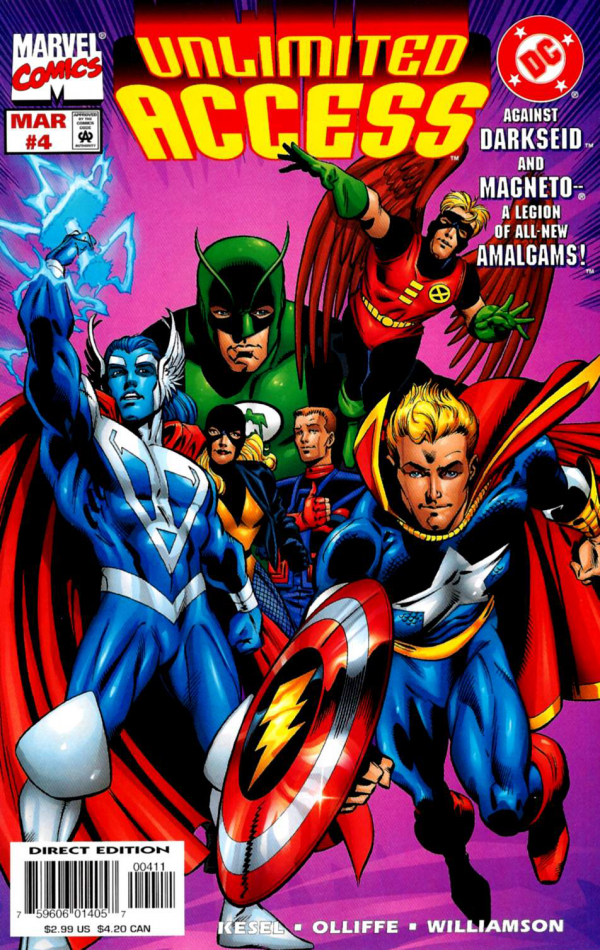
Something about Thor-El is kinda…compelling…

The last gasp – both for the Amalgams and for the Access concept of Marvel/DC Crossovers, came in the 1998 miniseries Unlimited Access by Karl Kesel and Pat Olliffe. The story starts with Access, the “Cosmic Hall Monitor,” popping back to his home in Marvel’s New York after sorting out a recent encounter between Spider-Man and Batman. Kesel implies here that this particular crossover had Access looking on from the background trying to keep things straight. As a concept, it actually would work to explain EVERY Marvel/DC crossover – Access, or someone like him, keeping an eye on temporary fusions between the worlds, which the respective heroes forget after the fact. If they decided to run with it that way.

Access has to untangle the appearance of Mantis – one of Darkseid’s lesser goons – in battle with Spider-Man, a fight that gets escalated when Juggernaut and Wonder Woman wind up in the mix. Things get even crazier when he takes Diana home only to find himself tangled in a fight between a still-savage Hulk and Green Lantern Hal Jordan…who is DEAD.

Superman doesn’t actually show up in the first few issues of this miniseries, so I’ll cut to the chase: as it turns out, Access doesn’t just bounce back and forth between universes, but discovers he can bounce back and forth in TIME as well, allowing him to meet the different versions of the Marvel and DC heroes from any point in the timestream (including the “Days of Future Past” X-Men from the distant year 2012). He’s also got the ability to create Amalgams, merging characters from the two worlds into one, which comes in handy when it turns out he’s being tracked by Darkseid, who wants his ability to traverse the worlds. By issue three, Amazing Grace has hypnotized the original Avengers and Justice League into battling each other, and Access decides to reach out for the only hero who stands a chance of fixing this mess: big blue himself, Superman. And I mean Superman during his electric blue era. It takes literally seconds for Superman to jolt everyone back to their senses, then he and Captain America mobilize the two teams to fight off Darkseid’s invasion of the Marvel Earth. But the crazy just keeps coming with the Brotherhood of Evil Mutants, the original X-Men, and a group of teen heroes who – just months later – would wind up getting their own title as Young Justice. 

By issue four, Darkseid and Magneto are teaming up to take over the world (this is early Magneto, when he was still into that kind of thing) and the heroes decide to combine their powers – literally – into a single strikeforce of Amalgams. Black Canary and Jean Grey: Jean Black! Giant-Man and Green Lantern: Green Goliath! Captain America and Captain Marvel Jr.: Captain America Jr.! I know, I didn’t write it. And of course, Superman and Thor are fused together as Thor-El. 

The fun part here is seeing these new Amalgams throw out casual references to help the reader to understand what they’re like in their own minds: Captain America Jr. possessing the “wisdom of Lincoln,” for example, or Thor-El referencing the Valhalla Zone. The series, and the history of Access, end with him accepting the truth about himself, beating Darkseid, and swearing to prevent a future he doesn’t want to experience. 

Reading this story again now, there’s so much potential left in this concept, and thanks to the nature of Access’s powers, there’s no reason that Marvel and DC couldn’t pick up on it again at any time. With new crossovers (finally) on the horizon between the two of them, the chance is right there. I don’t know if they’ll take it – I certainly hope so.

But for now, at least, our journey with Superman and the heroes of other worlds has come to an end. And I think it’s time to rededicate myself to stories focused around Clark Kent himself. That in mind, next week, I’m going to embark upon my re-read of the longest Superman saga I’ll have yet tackled for the Year of Superman blog. See you then!

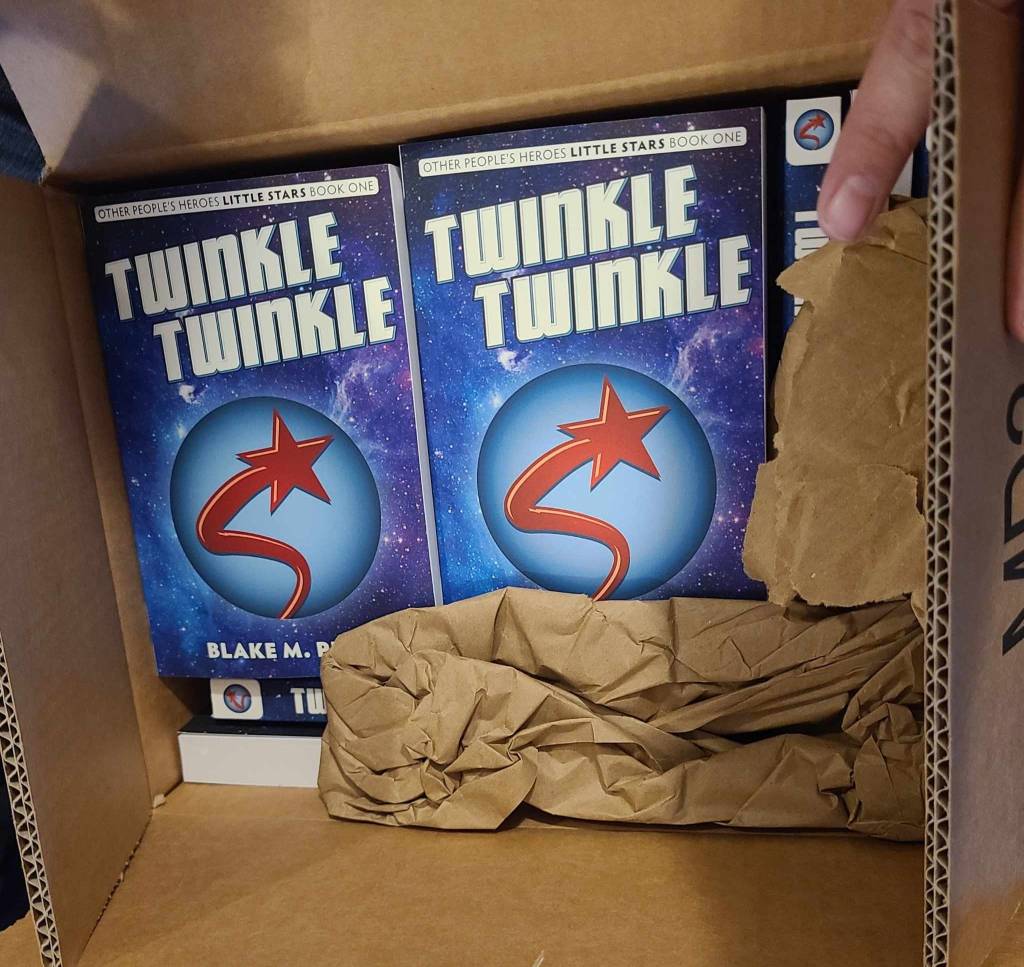
Blake M. Petit is a writer, teacher, and dad from Ama, Louisiana. His most recent writing project is the superhero adventure series Other People’s Heroes: Little Stars, volume one of which is now available on Amazon. You can subscribe to his newsletter by clicking right here. You can join in the Kryptonian Konversation every day in the Year of Superman Facebook Group!
Geek Punditry #109: Fanufactured Outrage

Allow me to preface this by saying this column is NOT about Superman. I’m gonna do my best to restrict that to the Wednesday blogs during this Year of Superman, which you all of course should be reading and sharing with your friends and joining the Facebook group. But the thing that triggered this week’s column came from the new “Icons” trailer for James Gunn’s upcoming Superman movie, so I gotta start there.

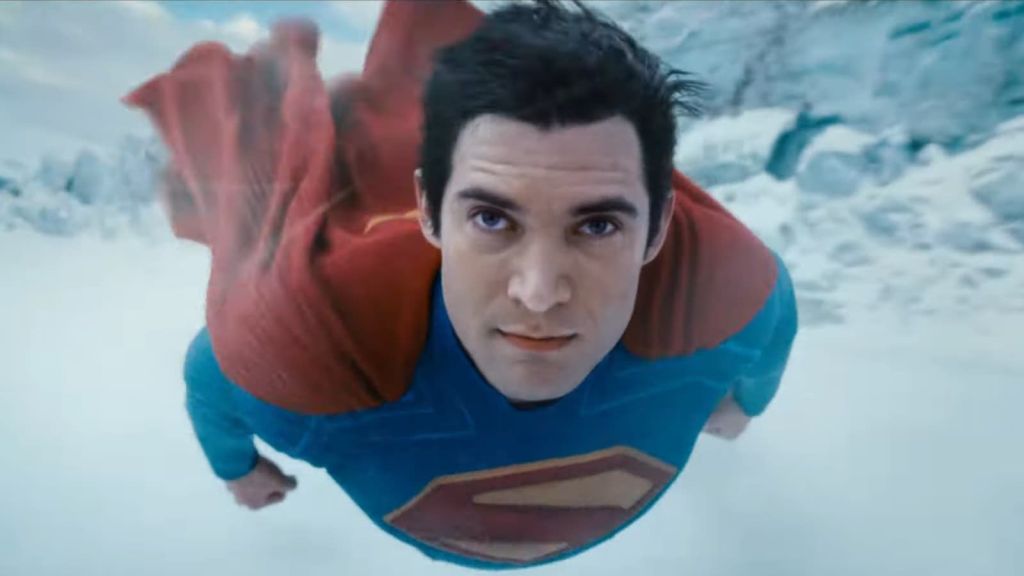
A few days ago, DC Studios released a new 30-second spot for the movie. There wasn’t a lot of new stuff in this one – most of it was footage that appeared in the first trailer, with a few new seconds of Nicholas Hoult as Lex Luthor and a final shot of David Corenswet as Superman flying directly at the camera, his full face clearly in view. I thought it was a great shot, and a lot of the Superman fans and groups I’m associated with started passing it around social media. Some people even used it as cover photos on Facebook and that sort of thing. But as is always the case there was a contingent of people – I hesitate to call them “fans” for reasons that will soon become abundantly clear – who started whining and complaining that the face had been altered via CGI. 

How could anyone hate this face?

First of all, I didn’t for a second think that it had. It looked perfectly natural to me. Second, the idea of complaining that CGI is being used in a movie where the main character is a flying alien, a woman with bird wings fights a kaiju, and there’s a character who can magically create anything he imagines with his glowing green ring is abundantly stupid. Of course there will be CGI. It’s only worth complaining if the CGI is bad, and nothing I’ve seen so far fits that pedigree. But the whining reached the point where Gunn himself on social media stated that there was no CGI altering done to Corenswet’s face, and pointed out something that anybody with a brain probably already knew – that pointing a camera directly in a person’s face might sometimes look slightly different than an angle captured from the side. 

But I have no doubt that the people who complained in the first place aren’t satisfied. Such people never are. These non-fans exist only to find things to get outraged about. These are the people who get up in arms over every casting announcement, declare a move a failure before a foot of film has been shot, and harass actors until they quit social media altogether. The word “fan” is short for “fanatic,” and these are the people who take the literal definition of the word to the extreme. They are not fans, but they are responsible for what I like to call Fanufactured Outrage.

Fanufactured Outrage is the phenomenon where people – usually, but not exclusively on social media – get angry over a problem that does not exist until they invent it in their heads. They’re the ones who hate a superhero costume that they haven’t even seen an official image of, the ones who despise any casting decision that doesn’t perfectly mirror the image they have of a character in their mind, and the ones who have decided that popular culture reached its zenith when they were approximately 13 years old and everything has been downhill ever since. 

A few days ago, for example, someone in a Svengoolie group brought up the Guillermo Del Toro Frankenstein movie that’s coming out later this year. I am on record as being very excited for this movie (not as much as Superman, but it’s probably #3 on my 2025 most-anticipated list, with Fantastic Four: First Steps coming in second). Del Toro is a phenomenal director, and I cannot think of a better choice to do a new version of Frankenstein. This is the man, remember, who won Best Picture and Best Director for what was essentially a reboot of Creature From the Black Lagoon. And while most of the fans were, indeed, excited, there were the naysayers. My favorite was the one who just whined “No more remakes, they’re never any good.”

Yeah, nothing interesting in this image at all.

So many problems with this, of course. First of all, the idea that there’s never been a good remake is patently false, and we can go back at least as far as The Maltese Falcon to prove that. Second, I don’t really consider Del Toro’s Frankenstein a remake any more than any of the 30,000 versions of A Christmas Carol are remakes of each other – it’s a new movie that draws on the same original source material, but not necessarily a remake of the Boris Karloff film or of any of the other hundreds of versions of Frankenstein that have been made. And finally, even if you do consider every version of Frankenstein since the first one a remake, this person disproved their own assertion, as the Karloff version was NOT the first film version of Frankenstein any more than the Judy Garland Wizard of Oz was the first version of that story, or the smash hit Dune films were the first adaptation of Frank Herbert’s novel. 

When that last bit was pointed out to the original complainer, though, his response was something along the lines of, “I mean nothing since 1970. It all sucks”

Write that down, folks. There hasn’t been any good movie made in the past 55 years. The only thing this guy has proven is that he’s built a little box for himself that he refuses to peek out of, and while I suppose he has the right to do so, none of the rest of us should feel any obligation to give a damn what he’s whining about from behind the cardboard flap.

Perpetrators of Fanufactured Outrage exist in every fandom and every medium, and while I do believe they are a minority group, they are also often the loudest such group, which can make them difficult to ignore no matter how hard we try. The “mute” button on most social media makes it a little easier, but it’s kind of like fighting the Hydra – you cut off one Fanatic and two more will sprout to take his place.

Their zeal to pick things apart isn’t helped by the news cycle, which runs with everything that is even remotely clickbaitable, regardless of whether they should or not. When the movie X-Men Origins: Wolverine was in post-production, for instance, a full-length cut of the movie was somehow leaked and began making its rounds on the internet. The problem was it was an unfinished work cut: rough, with no music, and without even any special effects. Of course, the fans hated it. But what did they expect? It wasn’t finished. It was still missing essential elements. It wasn’t even like reading the first draft of a book before it gets a polish, it’s like reading a book that hasn’t had any of the adjectives implanted yet, as we writers do at the Adjective Implantation Plant down on 45th and Broad. The film was excoriated before it was even given a chance. 

Somehow they didn’t see the GENIUS in this.

To be fair, the finished movie wasn’t exactly good either, but that doesn’t mean it deserved the treatment it got. 

Perhaps the worst is when they Fanufacture Outrage over something that doesn’t even exist, like the rumors that fly through the air of Hollywood at any given day. They’re impossible to escape, predicated on overheard snippets of conversation, someone wistfully explaining what they would do with a franchise, or leaked information that may have been under consideration at one point but has since been abandoned. The smog in Los Angeles, according to a recent Environmental Protection Agency survey, is estimated to be at least 76 percent Hollywood rumors, and the Fanatics will latch on to every one of them and get pissed about them.

It doesn’t help when the “news” sites run with this kind of information as if it has any weight. I find this is particularly true in terms of casting news. Sonic the Hedgehog star Ben Schwartz, for instance, recently made news when he said that he would like to play Plastic Man in a DC movie. Let me make something clear at the outset: this is an A+ casting idea. Schwartz would be absolutely perfect as Eel O’Brian. It would basically be someone with the heart of his Sonic character and the attitude of his Parks and Recreation character, plus he’s got the look.

Yeah, I can’t see this at ALL.

The only problem here is that neither James Gunn nor anybody else at DC has said anything about a Plastic Man movie, nor have they given any indication that the character is slated to appear in any of the other movies or TV shows that are in the works. This was just a case of someone asking Schwartz who he would want to play, if given the chance, and the sites running with it, and lots of stupid people getting angry about it. You see this sort of thing all the time. Just a few days after the Schwartz “news” we went through the same cycle again when Cynthia Erivo from Wicked said she would love to play Storm in the MCU X-Men reboot. Again, it would be a solid casting choice and it would sure as hell bring in a lot of fans who may otherwise not see the movie, but it’s still just her saying “I would like…” which isn’t news to me. 

If you need a third example, pick any Hollywood actor between the ages 20 and 50 and, odds are, you can find an article where they’ve said they want to play Batman. They’re everywhere.

And since these things aren’t even really news, it’s even stupider when the fanatics Fanufacture their Outrage over these. You’re getting mad over something that isn’t even happening

We can’t stop the fanatics from doing what fanatics do, sadly, but there are some things that we can do to mitigate the damage. First of all, the news sites need to actually report on news and not rumors. I know, I may as well be asking for a winning lottery ticket and a faucet in my house that dispenses hot and cold running root beer, but if it DID happen, it would keep things to a minimum. Ben Schwartz – or anybody else – wanting to play a character isn’t news unless they’ve actually had a conversation with James Gunn or somebody else associated with the studio. Stop telling us about it.

Second, we need to ignore anybody who has made up their mind about a film, TV show, book, video game, or anything else that they haven’t even seen yet. We especially need to ignore them if the content in question isn’t even finished being made. 

And finally, and most importantly friends, I implore you…don’t engage with these idiots. Don’t feed their Fanaticism. Use that mute button.

It’s there for a reason.

Blake M. Petit is a writer, teacher, and dad from Ama, Louisiana. His most recent writing project is the superhero adventure series Other People’s Heroes: Little Stars, volume one of which is now available on Amazon. You can subscribe to his newsletter by clicking right here. He’s also started putting his LitReel videos on TikTok. He’s still ticked about that leaked work print of Sausage Party that ruined the movie by being a completed and accurate depiction of the final film.

Geek Punditry #100: If I Were King of Comics

Here we are, my friends, 100 Fridays later. In the first week of January 2023, I was thinking of how much I missed the days of writing for Comixtreme and recording my podcast, and I wanted to find a regular way to get my voice back out there in the world. How could I do it? I asked myself. How can I reach out and gift humanity with my invaluable thoughts, insights,and trademark witticisms, in this era where the world clearly needs me more than ever before?

Then I remembered I had a blog that I was barely using, and maybe it would be a nice little challenge for me to find something – once a week, just find SOMETHING – that I liked enough to write a few paragraphs about. 

And of course, it has become the global phenomenon and world-altering sensation you see before you today. 

As I approached the 100th installment of the column hundreds of voracious readers have called “on the internet somewhere,” I tried really hard to decide what to write about. What, in the enormous global marketplace of popular culture that I had made my home, was worthy of dedicating the landmark 100th column to? Star Trek? Stephen King? Superman? Bluey? I feel like I’ve kind of talked about those various topics…well, “extensively” seems in some ways to be too mild a term, but we’ll roll with that right now. No, I needed something a little bit different.

Then I remembered an idea I’d had some time ago, but that I had pushed aside. Something I thought needed to percolate a little more. Something that the world would HAVE to sit up and take notice of. And it seemed perfect. So this week, ladies and gentlemen, allow me to explain to you what exactly I would do if I were in charge of comic books.

You all know I’m a comic book geek, and I have been since I was a small child. Not to discount my love of movies, TV, or novels…I’m a fan of storytelling in general. But comics are in many ways my medium of choice. I’m a regular Wednesday visitor at my local comic shop, I know all the members of the Legion of Super-Heroes, and I can tell you – in order – every publisher that has ever had the Star Trek license. (Gold Key, Marvel, DC, Malibu but only Deep Space Nine, back to Marvel, Wildstorm – which was by then a DC imprint – and currently IDW. Sorry, ladies. I’m taken.)

As much as I love comic books, though, there are certain practices in the industry that I’m not a fan of, certain things that I think could be done better. In this era, where there’s so much competition for the attention of an audience coming from virtually every region of our culture, it’s imperative that comic book publishers find ways to draw in new readers and retain existing ones. Ways to make the sometimes complex mythologies of American comic books a little less of a roadblock, and make the space a little more welcoming. For the 100th Geek Punditry, guys, here are some rules that would be implemented if I were King of Comics.

Numbering

As most people know, comic book series are numbered, and for many decades the numbering convention was simple. You started with issue #1, proceeded to #2, and so forth. You just put the numbers in order. Seemed like a simple idea. But at some point things started to get a little more convoluted. After World War II, many of the existing superhero comics had been cancelled. But in the 50s, looking for a new hit after public favor turned against things like horror comics, DC decided to bring back some of their defunct characters with a new incarnation. A new Flash was created – Barry Allen – and after a few tryout issues in the pages of Showcase, they gave him his own title. Barry took over the numbering of the Golden Age Flash, Jay Garrick, and his first issue was #104. Here’s where it gets confusing: they then did they same thing with Green Lantern. But in this case the new guy – Hal Jordan – did NOT pick up from Alan Scott’s title with issue #39, but instead got his own first issue, Green Lantern Vol. 2 #1.

Make it make sense.

It would not be the last time this happened. In the 80s they gave new first issues to Superman, Wonder Woman, and The Flash, and in those cases, the lapse in publishing between the previous volume and the new was not nearly as long as it had been in the silver age. Then in the 90s, Marvel did it with four of their flagship titles at once – Avengers, Fantastic Four, Iron Man, and Captain America – as part of a new initiative where the titles were essentially farmed out to Jim Lee and Rob Liefeld and set in a different world than the “regular” Marvel Universe. When the books were brought back to the “regular” Universe a year later, they were given a THIRD first issue…and then all hell broke loose.

Since then, virtually every comic book published by Marvel or DC Comics has been canceled and relaunched with a new first issue, most of them multiple times. Batman, at last count, is on its conservative third volume. Superman is at six. Punisher – if I’m counting correctly – has recently concluded volume FOURTEEN. The longest running comic book at either publisher that has not been restarted at least ONCE? Looney Tunes, which recently celebrated issue #281. (It should be noted, though, that even this is the fourth volume of Looney Tunes, having been published by various other companies before Warner Bros. wholly absorbed DC Comics.)

Winner of the gold medal in “not starting over for no reason.”

The conventional wisdom seems to be that a new first issue will bring in higher sales numbers than issue #482, and that might be true. But increasingly, it has proven that a tenth issue #7 does NOT have appreciably more readers than issue #489 would have. In other words, the restarting game gives a short-term sales bump, but does nothing to retain readers, which is what the goal should be.

Anyway, to appease fans (such as myself) who prefer maintaining the original numbering rather than the constant restarts, Marvel and DC have begun featuring “legacy numbers” on the covers of their books – in other words, what issue would this be had the book never been restarted? Which is why the recent Superman Vol. 6 #20 also bears a little symbol indicating that the “Legacy Number” of this issue is #863.

Only long-time Superman fans will understand what I mean when I say “at least it’s in a triangle.”

Confused yet?

Making it even more confusing is the way that many series have changed titles over the years, and trying to figure out which is which. Thor started as Journey Into Mystery, one of Marvel’s assorted sci-fi titles. But after he made his debut, Thor quickly took over the comic book, and the title was changed from Journey into Mystery to The Mighty Thor with issue #126 When calculating the Thor legacy numbers, the original JIM numbers seem to count, but JIM itself has been re-started several times over the years. Journey Into Mystery Vol. 2 does NOT count, apparently, as it ran concurrently with Mighty Thor. And let’s not forget that the current series carrying the Legacy Number is actually called Immortal Thor, which has the same legacy numbers as did previous volumes like Mighty Thor, King Thor, Thor: God of Thunder, or the (at last count) six different series that have just been called Thor. 

According to the legacy numbers, these are all issues of the same title.

Then there’s the fact that it’s inconsistently applied, especially at DC. Superman (on Volume 6), Batman (Volume 3), Flash (Volume 6), and Green Arrow (Volume 7) all have Legacy Numbers on their covers. Nightwing (Volume 4), Harley Quinn (Volume 4), and Titans (Volume 4) do not, and I can see no particular reason why. 

It’s an absolute mess. True story: when the Captain Marvel movie came out in 2018 my wife – who is a geek but not as big a geek as I am – was interested in reading some of the comics to learn more about the character, but after several attempts to figure out which volume to start with, she gave up. If the plan here is to get MORE readers, it’s failing miserably.

So how do we fix this problem? 

Here’s what I would make the standard rule: first of all, the Legacy Numbers should be mandatory for any series that continues the title or star of a previous series. The editors would need to get together right away, decide which books count towards the “legacy” and then stick with it from then on. 

Second, I would have them stop with the constant relaunches. If a character is returning after ten years away…okay, a new first issue might be justified. If we’re going back to issue #1 because there’s a new inker, it’s not. It’s become a common practice to start over with a new first issue any time there’s a change of creative team, especially when there’s a new writer. It’s too much. So here’s the rule: there must be a minimum of three years since the previous volume before a new first issue is justified. If the final issue of Captain Dudeman was #47 and it came out eighteen months ago, then you either have to start with Captain Dudeman #48 or you have to change the title. 

That second stipulation, I think, would start to get used very frequently. One of the reasons that the renumbering has gotten so rampant is that every time a new writer is brought onto a series they want to make their own mark – which is fair. But in so doing, they often want a clean slate, a sort of “back-to-basics” approach for the character, which has resulted in several books in the last few years where the first issue shows the heroes in a wholly different situation than they were in when the previous volume ended, and then it’s not until several issues later that the reasons for the change are actually explained. Sometimes it works (Fantastic Four and Daredevil both did this effectively in their most recent relaunches) and sometimes it doesn’t (the current run of Amazing Spider-Man should be studied by scholars as a cautionary example of what NEVER to do).

I don’t want to take away a writer’s ability to tell the stories they way they see fit, that’s not what this is about. But if the plan is to tell a totally different story, changing the title of the series is a good way to reduce confusion. Telling somebody “You have to read Green Lantern – but not that one, or that one, or that one…” is a recipe for the kind of bafflement that drove my wife away. But saying “Green Lantern: Emerald Champions is a great series” is a HELL of a lot easier for the casual reader to comprehend. You can keep the legacy numbers that way, but having a subtitle or supertitle (that’s when you preface the main title with something else, such as Peter Parker, the Spectacular Spider-Man) makes it a lot easier to differentiate one run from another. 

What this really boils down to is that I never again want to see a comic book called Fantastic Four #1. When I was a kid, owning that book would have been a gold mine. Now I’ve got six different books called that, and it’s ridiculous. 

Cover Confusion

The way the comics industry handles its covers is also an issue, and there are two primary problems I want to tackle. First, let’s talk about pin-up covers. This isn’t as bad as it once was, but for a while there in the 00s and 10s, there was an awful trend of comic books having generic pictures of the main character or characters on the cover, something that may be a fabulous piece of art but doesn’t tell the reader anything about the story between the pages. The argument at the time, I believe, was that they wanted every issue to be an accessible first issue for a new reader. While that may be a noble goal, that doesn’t make a damned bit of sense. Anybody who picks up a comic because they like the picture of Spider-Man on the cover is going to have a hard time keeping up if they open up the comic and run into “Revenge of the Return of the Colonoscopy of the Sinister Six: Part Five of Seventeen.” Congratulations – you sold that one issue…but they aren’t coming back. 

“Wow, great cover!”
“Thanks!”
“What’s the story about?”
“What the hell is a story?”

Pin-up art is fine, but a great comic book cover should tell a story. Think about some of the all-time most memorable covers: Amazing Spider-Man #129 features the webspinner dangling in front of the faces of his friends, agonizing over which of them was going to die in that issue. Green Lantern (Vol. 3) #49 shows a power-mad Hal Jordan brandishing a set of rings stolen from his fallen comrades, a look of pure chaos in his eyes. Wolverine: Blood Hunt #2 shows the ol’ Canucklehead on a motorcycle with a French vampire babe being chased by a mob of vampire stormtroopers while fleeing an explosion that is also being escaped by an overhead passenger jet.

If just that description isn’t enough to make you pick up the book and look inside, I don’t think you actually like comic books.

Now THAT’S art.

These days it’s better, although many variant covers still have what I call the Pinup Problem. So here’s going to be the rule for this one: cover art MUST be relevant to the story inside. That doesn’t mean it has to be a depiction of an actual SCENE from the story. Thematic covers, like the above Amazing Spider-Man #129, are fine. Covers promising a twist or a mystery, anything like that is just dandy, provided it has SOMETHING to do with the story. The only exceptions, the only time a simple pin-up is acceptable, are when it’s the first issue of a series (and presumably a good jumping-on point anyway), if it’s the introduction of a new character, or for certain milestone issues, such as an issue number that ends in a double zero.  

Now that we’ve cleaned THAT little problem up, let’s talk about the REAL issue: variant covers. 

There’s debate over when, exactly, variant covers became a thing, although most people seem to agree that the first mainstream example of printing copies of the same book with two different covers was probably Man of Steel #1 in 1986, the John Byrne relaunch of the entire Superman mythos. That was an instance where it was novel and interesting and fun. People made an effort to buy both covers to make their collection “complete.” It was really cool.

You could get with this, or — alternatively — hear me out on this one…you could get with THAT.

But like so many good things, it got overdone. It didn’t happen overnight, mind you. It was quite some time before having two covers became a regular practice, and even longer before it reached the heights it has today. Even as late as ten years ago, having multiple covers was still more of an exception than a rule. But the rules have changed and HOW. 

If you pick up any random issue of a new comic from a mainstream publisher today, odds are that you will have between two and five covers to choose from. First issues are frequently more. For the first issue of this summer’s Uncanny X-Men relaunch, League of Comic Geeks (the website I use to track my own collection) lists 32 separate cover variants. And even THAT is chump change compared to the most recent relaunch of Teenage Mutant Ninja Turtles from IDW Publishing, which currently stands at – 

Are you sitting down? Are you sitting down in the sewer?

ONE HUNDRED AND SEVENTY-SEVEN DIFFERENT COVERS.

If you are the sort of person who feels the need to get every available cover and you’re a Ninja Turtles fan, I hope you can still afford your insulin.

I’M SAYING IT’S KIND OF A LOT.

The reason they do this, of course, is because people continue to BUY them. And when there are stories every other day about some comic shop or another closing down or a publisher being unable to pay its creators, I can’t fault them for looking for ways to increase revenue. But the problem is that this simply bleeds money out of the existing fans until they get fed up and walk away entirely. And like the renumbering problem, this doesn’t do anything to actually get NEW fans into reading, which is what the long-term goal should be.

This is not to say that I hate variants in their entirety. I rather like them when they do something CLEVER with them, such as what I call “theme” months, where all the variants have a different trend. For instance, DC recently did a run of variants covers that were mock-ups of the packaging of the old Super Powers action figures. (I should point out that other publishers, including Marvel, have been doing action figure variants for a long time, but this was the first time I recall them being used as a monthly theme.) In October, there were a series of variants by artist Kelley Jones showing the DC heroes as kids in Halloween costumes. Marvel did a series not long ago of variant “homage” covers based on some of their old vampire comics, and another run that showed their characters facing off against Godzilla. That kind of stuff doesn’t really bother me, except for the fact that they add to the preposterous number of variants on the shelf.

I don’t know art, but I know what I hate. And I don’t hate this.

I also really like the “sketch” covers that have become popular in recent years. These are blank covers printed on a different cardstock that fans can use to draw their own artwork or have an artist draw something for them. They’re popular for commissions at comic book conventions and events like Free Comic Book Day, and I don’t think the blanks really cause a lot of confusion on the racks compared to the 30-plus X-Men covers. 

The worst part, I think, is that so many of these “variants” are barely worthy of being considered a separate cover. You commission a piece of art from an artist and you’ve got a cover. Print it with no logo or trade dress and it’s a “virgin” variant. Print it without colors and it’s a “sketch” variant. Print it with metallic ink and it’s a “foil” variant. You can crank out a dozen different covers with one sketch and people will continue to buy them. It’s insane.

I recognize that there are a lot of people who LIKE these variants, even if they aren’t MY thing. So in my capacity as the benevolent overlord of comic books, I don’t want to ban them entirely. Here are the restrictions I’ll put in place:

  • A standard issue of a comic book shall have no more than three covers: the “main” cover, a variant cover, and a “theme” variant for that month. 
  • First issues will be limited to five covers, including the theme cover.
  • Milestone issues, such as anniversaries, will be allowed extra variants consisting of no more than one-tenth of the number of issues the book has run. For instance, the 50th issue will be allowed 5 variants, the 100th issue will be allowed 10 variants, and so on. 
  • Retailer-exclusive variants will not count against the total. These are covers commissioned by – and only available from – specific retailers, such as an individual comic shop, store chain, or online retailer.
  • There will be no restrictions on “sketch” covers, nor will they count against the number of variants allowed. 

See? I can be as flexible as the next guy, provided the next guy isn’t Plastic Man.

Anyway, there we have it, guys. Comic books are fixed!
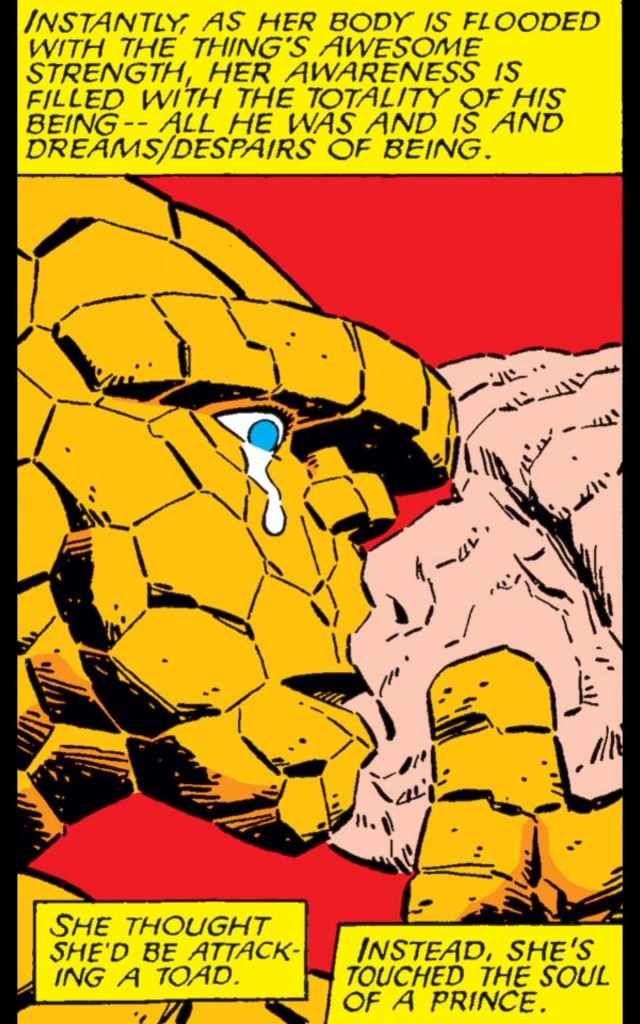
Well…okay, maybe not. There are still plenty of other things in the world of my favorite medium that need to be addressed. Other problems to solve, other fires to put out…but I’ve already gone on for nearly 3500 words, which is pretty massive for one of these Geek Punditry columns. So I think it’s time to put this topic aside, at least for now.

But that’s okay. After all, I’ve got to save something to write about when Geek Punditry #200 rolls around.

Blake M. Petit is a writer, teacher, and dad from Ama, Louisiana. His most recent writing project is the superhero adventure series Other People’s Heroes: Little Stars, volume one of which is now available on Amazon. You can subscribe to his newsletter by clicking right here. He’s also started putting his LitReel videos on TikTok. His goal to take over all of social media after it has started to slide towards irrelevance continues. 

Geek Punditry #98: Playing in the Kitchen Sink

I’ve never been much of a video gamer. Oh sure, I’ve played SOME, but the last time I owned a console was when my parents gave my brother, sister, and me a Sega Genesis for Christmas one year, to give you an idea of how long it’s been since I had regular access to any platforms. Still, I live in the year 2024, so even though I don’t PLAY video games, I get constantly bombarded with the advertising for them and have a basic knowledge of what at least the most popular ones are. Because of that basic awareness, there was a moment not that long ago where I felt a bit of an urge to get into a new game: when I heard about Multiversus. This is a video game that draws characters from dozens of properties owned by Warner Bros, including characters from Looney Tunes, Scooby-Doo, Rick and Morty, Steven Universe, Adventure Time, Game of Thrones, and of course, the DC Universe. A fighting game in and of itself doesn’t really appeal to me, but…a game where I can pit Superman against Bugs Bunny or Tom and Jerry? Where the Powerpuff Girls can take on Jason Voorhees or Beetlejuice? Where Gizmo from Gremlins can face off against Agent Smith from The Matrix

It’s like being a kid again.

And did I mention the Iron Giant? Did I mention the Iron Freaking Giant?

I didn’t play a ton of video games as a kid, but I DID have a lot of action figures, and while some kids are meticulous about keeping the different lines of figures separate, I always mashed mine together. I saw no contradiction in having my G.I. Joes interact with the Masters of the Universe even though, relative to Duke and Snake-Eyes, He-Man and his crew were giants with a serious thyroid problem. And although there was no way Lion-O from Thundercats could actually fit inside and ride Optimus Prime, that didn’t stop me from PRETENDING he could as they rushed off to tackle Darth Vader and his army of B-level DC and Marvel villains culled from the Super Powers and Secret Wars lines. (Side note: a personal dream of mine would be to begin a collection of those superhero figures from my youth. I don’t need them in the packaging or in mint condition, but I at least need them to have all the limbs and, when appropriate, capes. There was also a short-lived line based on Archie Comics’ Mighty Crusaders that I would like to include. Christmas is coming up, people.)

In a way, I think this is even why I like certain modern toy lines. Things like Funko Pops take characters from virtually any franchise you can imagine and recreate them in the same style and the same scale, something I would have been all over as a child. Even LEGO has appeal for that same reason, although LEGO’s appeal obviously goes much further.

Anyway, Multiversus seems to run with this idea in the same way that I would have when I was a kid, and although I still haven’t (and probably will not) play the game, I AM reading the comic book miniseries based on it, Multiversus: Collision Detected, written by Bryan Q. Miller with art by Jon Sommariva and covers by Dan Mora, who is perhaps my favorite artist working in comics today. The comic is fun and wild, with the characters from the different universes all spilling into the DCU as the Justice League tries to make sense of what’s going on. It gets really crazy when the bad guys show up, including the Wicked Witch of the West from The Wizard of Oz and, wildest of all, The Nothing from The Neverending Story. Obviously there was never a “Nothing” action figure back in the day, but you better believe this is the kind of story I would weave on the living room floor with mountains of figures from every conceivable IP of the 80s battling it out with one another.

“Yeah, a collision of FUN!”
“For the last time, Stuart, stop pitching taglines.”

There is a certain thrill that comes with combining characters that we don’t normally see together. Comic books do it all the time, with crossovers between different publishers and different universes. Marvel and DC just last month released the first of two giant omnibus hardcovers collecting most of their crossovers to date, a hefty volume that’s a testament to the fact that geeks like me love stuff like this. How would these characters who should never meet react to one another? Would they fight? Would they get along? Would they team up? Would they fall in love?

Considering the love lives of their respective mentors, only having an impermeable dimensional barrier between them is practically a win.

For some reason that last one is often a sticking point in crossovers. There’s a certain segment of the population that thinks that the best love story Tim Drake (the third Robin) ever had happened in the pages of the DC Vs. Marvel crossover, when he and the X-Men’s junior member Jubilee fell for each other in a tragically doomed romance that had to end when their universes were separated again. In the 90s, Valiant Comics and Image Comics based their Deathmate crossover on the fact that their nigh-omnipotent characters Solar and Void met and came together, causing their universes to merge. 

Other crossovers are based on how ridiculous the idea may be. Archie Meets the Punisher is a real comic that happened because their respective publishers recognized that the two properties couldn’t be more different from one another, but somehow turned into a story that was not only entertaining, but respectful of BOTH very diverse universes. Then there was the Star Trek/X-Men crossover, a story that you will NEVER convince me wasn’t conceived entirely around the page where Nurse Chapel calls for “Dr. McCoy” and both Leonard “Bones” McCoy of the USS Enterprise and Henry “Beast” McCoy of the X-Men answer at the same time, then look at one another incredulously.

“My work here is done.”
“Lobdell, we need 47 more pages.”
“I already wrote the only one that matters.”

I think this mashup madness is the main reason I’m still playing one of the few mobile games I play, Disney Magic Kingdoms. It’s an idle game, where you build up your theme park by adding rides and concession stands and the like, but the real appeal to me is the ability to “collect” characters from various Disney-owned properties, including not only the classic Disney characters and the films of the Disney animated canon, but also the characters from Pixar, the Muppets, Indiana Jones, and Star Wars. Earlier this year they started adding properties from the franchises they acquired in their absorption of 20th Century Fox as well, beginning with the heroes of the Ice Age movies. While I don’t expect them to add EVERY IP in their catalog (it’s hard to imagine the Xenomorph from Aliens running around outside Dumbo’s Flying Elephants), I’m really surprised that they have not yet started including Marvel characters, but I also suspect it’s only a matter of time.

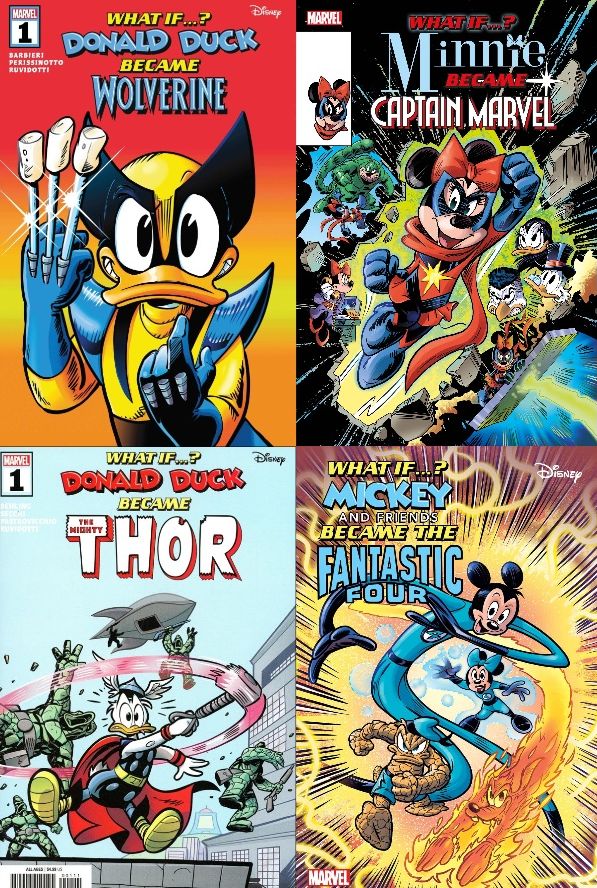
Marvel is slowly starting to take advantage of their corporate parentage as well. They’ve done crossovers where the Predator has fought Wolverine and Black Panther, and another where the Avengers deal with Aliens. Less likely but more fun, we’ve had a series of one-shots casting the Disney heroes as the Marvel superheroes. So far we’ve gotten Donald Duck as Wolverine and Thor, and upcoming specials will give us Minnie Mouse as Captain Marvel and the Fab Four (Mickey, Minnie, Donald, and Goofy) as Marvel’s Fantastic Four. They’ve also taken their popular “What If?” comic book and released an Aliens miniseries based on an alternate universe where Carter Burke, Paul Reiser’s character from Aliens, survived. And as a curious note, the comic book is co-written by Paul Reiser himself. No further miniseries have been announced yet, but I thought the Aliens comic was really entertaining, so I wouldn’t be surprised if we start seeing more “What If?”s based on Marvel’s corporate siblings like Predator, Planet of the Apes, or Star Wars either. 

Got my fingers crossed for “What if Goofy Became the Punisher.”

(That joke is WAY darker when you realize it has to be Goofy because, canonically, he’s the only father in the group.)

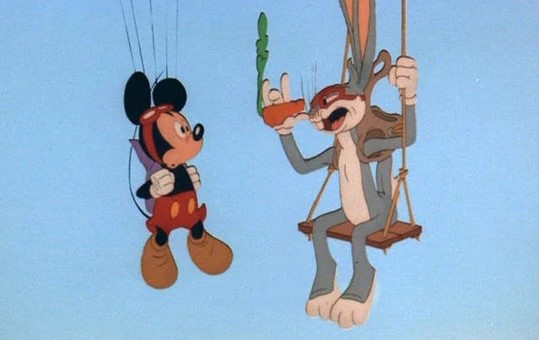
We don’t get these sort of “everything but the kitchen sink” crossovers much on TV or in the movies, though. Oh sure, we get the occasional crossover like Godzilla Vs. Kong, Freddy Vs. Jason, or Kramer Vs. Kramer, but real multi-universe mashups are kind of rare. I think it’s part of the reason that we all loved Who Framed Roger Rabbit? so much. Yeah, it’s a great movie, but it’s also the only place, canonically, where we’ve ever seen Mickey Mouse and Bugs Bunny together, or Donald Duck face off against Daffy Duck. The film also included Droopy Dog, Betty Boop, Woody Woodpecker, and a real Who’s Who of cartoon stars of the 30s and 40s – and as those are still the greatest cartoon stars of all time, we loved it. Wreck-It Ralph would do the same thing with video game characters, and the Toy Story films did a lot of that with the classic playthings of our youth, and yeah, we love them for it.

Eat your heart out, “DeNiro and Pacino in Heat.”

And of course, let’s not forget the greatest crossover event of all time, 1990’s Cartoon All-Stars to the Rescue, which combined the forces of the Smurfs, the Muppet Babies, Alvin and the Chipmunks, Garfield, Winnie-the-Pooh, Alf, the Looney Tunes, Slimer from The Real Ghostbusters, and Huey, Dewey, and Louie from Ducktales in a half-hour anti-drug special that’s so bizarre you have to imagine that they were actually ON drugs while making it. (This is a real special, people. Don’t take my word for it, you can watch it on YouTube.)

And yet, even THAT has a certain weird charm to it. 

It’s important to remember that the people who make cartoons, movies, comic books, and video games, were once children as well – at least, until they are all replaced by AI – and as such they enjoyed throwing their toys together just as much as we did. That’s why I’m digging the Multiversus comic, why I’m reading the “What If” specials in which the Disney stars become Marvel heroes. It’s not because I’m looking for something huge, something life-changing, something of great profundity.

It’s just fun.

And honestly, guys, shouldn’t that be enough?

Blake M. Petit is a writer, teacher, and dad from Ama, Louisiana. His most recent writing project is the superhero adventure series Other People’s Heroes: Little Stars, volume one of which is now available on Amazon. You can subscribe to his newsletter by clicking right here. If you’ve played Multiversus, he’s got a question for you: have they overpowered Shaggy in deference to his status as a meme? Because honestly, that would be kinda cool. 

Geek Punditry #80: If You Liked the Movie, You Should Read the Book

For some time now I’ve had the novelization of the TV show Charles in Charge sitting in my eBay searches, contemplating whether or not I should jump on it.

The first thing they teach you in blogger school is to start a column with a sentence that will compel the reader to continue in the hopes of making sense of what you’re saying. How am I doing?

You see, we live in a time when people like me (nerds) often go back and recapture things from our youth – things that we remember fondly or that tickle a nostalgic button somewhere in our soul. Often these things take the form of toys, but just as popular are other collectibles like trading cards, comics, vintage video games, and – of course – books. So the reason I’m thinking about getting this book, which is oddly enough a novelization of the opening episodes of the SECOND SEASON of Charles in Charge (I later learned that there is a novelization of the pilot I’ve never seen in person), is because I remember getting it at one of those glorious Scholastic Book Fairs that we used to anticipate with the same excitement and fervor as we would Christmas morning. It’s purely a nostalgia thing, friends.

Don’t tell the eBay seller I borrowed their picture for this, okay?

Eh?

Oh, you mean you were wondering why the hell there was a Charles in Charge novel in the first place, aren’t you?

That also goes back to the time period in which I grew up, a magical, halcyon time known as the 1980s. It was a heck of a time to grow up. We had the best music, sodas were clear sometimes, and cigarettes had only been bad for you for like 20 minutes. But that doesn’t mean everything was perfect. This was in an era before streaming services, an era before you could pull up popular entertainment on demand from your remote control without even having to get off your couch and look for clean pants. If you saw a TV show you liked, the only way to experience it again was hope for a rerun. If you loved a movie, you had to wait for it to come on HBO (if you had it) or rent it from these ancient temples that we called “video stores.” You couldn’t even just go out and BUY the VHS tape the way you later could the DVD, because in the early days of home video the studios made the movies prohibitively expensive (nobody in their right mind would – or should – have paid $120 for a VHS copy of The Land Before Time 2) so that most people couldn’t afford to build a home library and, instead, the studios made their money using the video stores as the middleman. Eventually, the prices of VHS tapes dropped and home libraries became a thing, but for much of my childhood if there was a movie you really loved, there was only one surefire way to experience it again whenever you wanted: buying the novelization.

When you need to hear Madonna as Breathless Mahoney, this is the next best thing.

Novelizations have been around almost as long as film, going back to the silent era. In 1966 Isaac Asimov was hired to novelize the film Fantastic Voyage. (He was so disappointed with the result that he came back years later with a “sequel” called Fantastic Voyage II: Destination Brain, which just used the premise of miniaturized scientists going into a human body and otherwise was completely independent). One of the most interesting examples, I think, is 2001: A Space Odyssey. Author Arthur C. Clarke and director Stanley Kubrick collaborated on the story, then Clark wrote the novel WHILE Kubrick worked on the film, so which of them technically is the adaptation of the other? If you ever figure it out, let me know.

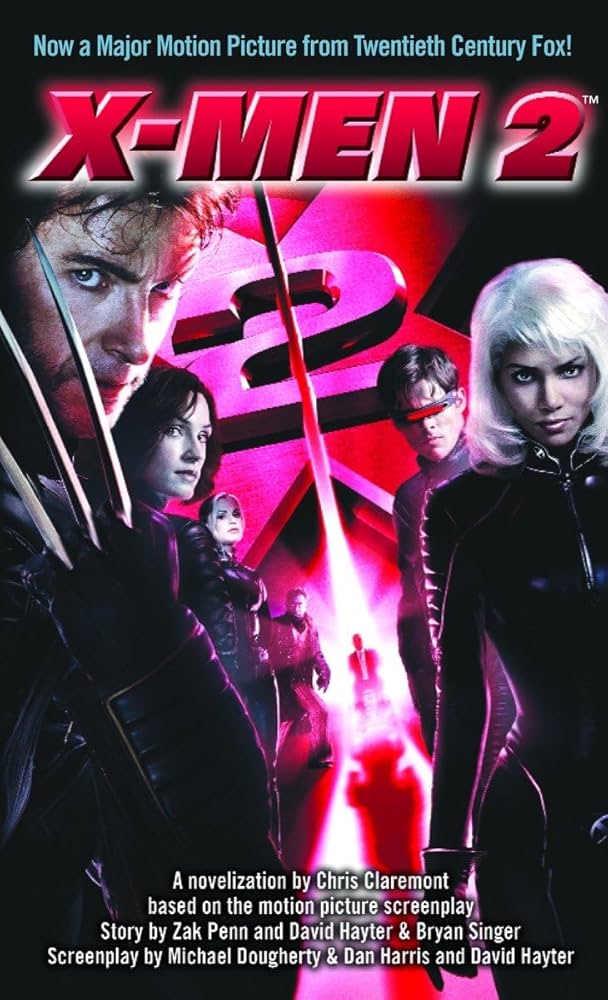
But in the 80s, the novelization was huge. I had stacks of them for the formative movies of my youth: E.T.: The Extra-Terrestrial, Batman, Dick Tracy, Back to the Future…not to mention the requisite Star Trek and Star Wars books. Not all of them were very good, of course. Some of them were downright terrible. But there was something interesting about reading these books, which were often based on early drafts of the film’s script. The novels had to be written quickly, usually while the film was still in production, in order to have them printed and on the shelves when the movie came out, so if things changed during the production, the novel would sometimes be based on the original version rather than the change. The novelization of the second X-Men movie, for example, is so different (up to which characters lived and died) that you’d be hard-pressed to believe the writer even KNEW anything about the X-Men…if it weren’t Chris Claremont, whose work on the characters in the 70s and 80s is pretty much the main reason that those characters survived past the 70s and 80s without falling into obscurity.

“Claremont! Who the hell is ‘Bolverine’?”

Screenplays often lack the detail that you get in a novel as well, and as such the authors had to conjure up a lot of the characters’ backstory, inner monologue, and other elements that wouldn’t have room to go into in a feature film. Goonies is a phenomenal example of this. It’s a movie that everybody my age grew up idolizing, that we watched over and over again, that became a fundamental part of our psyche. So we all know that the reason Josh Brolin’s character Brandon has to steal a child’s bicycle after his brother Mikey (Sean Astin) lets the air out of his own bike tires is because he flunked his driver’s test. But the novel tells us that the REASON Brand flunked his test is because he suffers from claustrophobia and freaked out about being the car with the driving instructor, a stranger. Overcoming his claustrophobia in the caves becomes an interesting running element through the novel. It also gives us a little insight into what happens to the characters after the movie ends – for instance, Chunk’s parents officially adopt Sloth and give him the name Jason Sloth Cohen at his Bar Mitzvah. It’s adorable. 

Not to mention the subtle suggestions that Mikey is actually the reincarnation of One-Eyed Willie.

And of course, these novelizations were turned out in large numbers, especially the ones for kids. The Charles in Charge book I mentioned before is only one of many such novelizations I got from a Scholastic imprint called Point, which specialized in middle grade books. This resulted in a lot of those aforementioned novelizations, plus an avalanche of the kind of kiddie horror books that would turn so many people into lifelong horror fans, such as the Goosebumps line. It got to a point (no pun intended) that I would actually look for that Point logo at the Scholastic Book fair, as I knew those were books for people like me. In fact, a while back I finally DID jump on eBay to snag one of those old Point books from my youth, their novelization of the Mel Brooks comedy Spaceballs. When I got the book I saw, to my surprise, that it was written by “Jovial Bob Stine.” This name meant nothing to me when the movie came out in 1987, but looking back on it now I realize that this was one of the various pen names used by someone who would soon become a Scholastic legend – R.L. Stine, creator of those Goosebumps novels I mentioned before.

It’s JOVIAL, see. Also hilarious. Says so right there.

Some of these books have become real collector’s items. If you look up the original novelizations of some of the 80s horror movies like Halloween, Friday the 13th, or A Nightmare on Elm Street, you see them going for hundreds of dollars now. Considering the demand, it’s actually really surprising to me that you don’t see them reissued more often, or at least offered digitally. In some cases, I suppose it’s a rights issue (the rights for Friday the 13th are notoriously complicated at the moment), but some are less understandable. DC Comics recently announced a new novel, Batman: Resurrection, which will serve as a direct sequel to the 1989 Batman movie. That sounds cool – but why not reissue the novelization of the original movie to go with it? 

Trust me, geeks will eat this stuff up.

Novelizations are still produced today, but not as many as there were back in the 80s and 90s. A lot of sci-fi movies still get them, but the odds of seeing a novel based on, for instance, the premiere of Abbot Elementary seems fairly remote. Obviously, with the streaming era, it’s not as necessary to have a book to get your hands on the story the way it was when I was a kid. More than that, though, I think that the streaming era has broken down the audience so that these things aren’t part of the cultural conversation the way they used to be. When something like the first few Star Wars movies came out, they were a phenomenon that EVERYBODY had to talk about, had to experience. They lingered in theaters for months, even years, before finally filtering out and making way for something new. That doesn’t happen anymore. A movie lives or dies based on its opening weekend. TV series dump an entire season at once and everybody has forgotten about it a week later. It’s a sad thing, I think, a change that I’m not fond of, but it’s the world we live in now.

So I’ll keep my eye on eBay and keep my finger over that “buy it now” button. I’m not saying I’ll get every old novel I see, of course. I’m just saying that if I COULD, I WOULD.

Blake M. Petit is a writer, teacher, and dad from Ama, Louisiana. His most recent writing project is the superhero adventure series Other People’s Heroes: Little Stars, volume one of which is now available on Amazon. You can subscribe to his newsletter by clicking right here. If you ever see a decent price for the novelization of Howard the Duck, let him know.

Geek Punditry #70: How to Use Your Noodle

Paramount clearly has no idea what they’re doing with Star Trek right now. They’ve announced the cancellation of Lower Decks, which scientific researchers at Harvard University have conclusively proven to be the best Trek series in the past 25 years. They still haven’t announced any plans for what to do with the crew of the Enterprise-G, as established in the fan favorite final season of Star Trek: Picard. They killed Star Trek: Prodigy only to surrender it to Netflix. They’ve announced a new movie set in the Kelvin timeline, only it’s a prequel, which doesn’t make a damn bit of sense since the timelines are supposed to be identical up until the day Jim Kirk is born. And they’ve gone ahead with a Starfleet Academy series that nobody seems to be interested in, except for those of us who were happy when it was announced that Lower Decks star Tawny Newsome was joining the writing staff. As you may expect, this irrational and erratic behavior has led to a lot of debate and hand-wringing on the internet, because that is exactly what the internet is for. People have launched dozens of (sadly competing) Save Lower Decks campaigns, people are begging for the further adventures of Captain Seven of Nine…all the things you would expect.

Today, my friends, we are all Boimler.

Until one guy on Facebook, in one of the trillion Star Trek groups I am a member of, loudly demanded a movie be made starring Worf and explaining the fate of the Enterprise-E. This ship, the main one used in the films Star Trek: First Contact, Star Trek: Insurrection, and Star Trek: Nemesis, was briefly alluded to in the final season of Picard when it someone made a comment that they obviously couldn’t use the Enterprise-E, then everybody turned to look at Worf, who gruffly proclaimed, “That was not my fault!” It was a hilarious moment in one of the most satisfying seasons of Trek in history, but what my fellow fan doesn’t seem to understand is that the thing that MAKES that moment satisfying is that we don’t know what happened. 

TV Tropes calls this sort of thing a “Noodle Incident.” This is an event from the past that the characters make a reference to without ever actually explaining it, forcing the audience to wonder. The term comes from Bill Watterson’s legendary comic strip Calvin and Hobbes, in which there was a running gag where Calvin furiously denies that anything happened with the noodles at school or, alternately, doesn’t deny that it happened but claims it wasn’t his fault. The question that lingers with the readers, of course, is: what could have POSSIBLY happened with the noodles that would be THAT BIG A DEAL? And the answer is: we never know. When asked about it once, Watterson said he decided against explaining what the Noodle Incident was because he knew there was nothing he could put on the page that would be as satisfying or entertaining as what the readers were imagining in their heads. And Bill Watterson was absolutely right.

…and they never did.

Since that episode of Picard dropped, there has been a LOT of furious speculation about what could have happened to the Enterprise-E and why, specifically, Worf would have been blamed. Was it lost in battle? Fell into a wormhole? Destroyed in a freak transporter accident? Did it get “Tuvixed” with the ol’ Excelsior? Did Worf lose it in a poker game with a Ferengi? There are a million theories, each wackier than the last, and while I have no doubt that some day someone will write either a novel or a comic book series about the tragic end of this ship, I personally hope that the story of its demise is never officially canonized, because I think it’s more satisfying that way.

Noodle Incidents are a staple of comedy. On Home Improvement there would be allusions to disasters caused by Tim Taylor with the implication that they somehow even surpassed the ones put on screen. How I Met Your Mother had an episode where Ted wakes up to find a pineapple in his bedroom with no idea how it got there, and it’s one of the few minor details left unexplained at the end of the series. The Golden Girls milked this trope like an over productive cow. Rose’s half-told St. Olaf stories and Sophia’s vague yarns in which one is to “Picture it: Sicily” would often leave out details that forced the viewer to close in the gaps with their mind…and in every case these episodes were all the funnier without filling in the blanks. It’s almost like watching Rick and Morty on Adult Swim, where all of the swear words are bleeped out, versus watching it on MAX, where the profanity is allowed. The truth is, it’s actually funnier when you don’t hear the curse words, even if the word being hidden is obvious.

Turns out, the unedited St. Olaf stories are way, way filthier than anything on Rick and Morty.

Noodle Incidents aren’t only good for comedy, though. They work well in more serious work, too. In Casablanca, the reason Rick can’t return to the United States is never explained, nor are all of the details of his previous relationship with Ilsa. In The Dark Knight, the Joker loves to tell conflicting stories about how he got his scars, but we never find out the truth. And it’s pretty common in action movies – especially those with ongoing characters – to make a reference to a prior incident without giving us details. We don’t know what happened to Indiana Jones in Honduras, we don’t know the truth about the “Rome affair” that James Bond was mixed up in, and we’re never gonna know what happened to Hawkeye and the Black Widow in Budapest. 

And that’s probably a good thing.

It works on the same principle as hiding the monster in a horror movie. One of the things that makes Jaws so great is that you don’t actually get a good look at the shark until the very end. In this case, it was a practical consideration: they couldn’t get the mechanical shark to work properly. But the effect was solid. Similarly, in Alien, none of the original posters or marketing revealed the look of the creature, nor did it appear in full until the end of the movie. It made for one of the best haunted house movies of all time, set in outer space. By the time the sequel rolled around the appearance of the Xenomorph had become iconic and director James Cameron knew he couldn’t possibly duplicate the suspense, so he decided instead to make the second film less of a horror movie and more of an action film – and it worked very well.

“But Blake, doesn’t that suggest you may get more mileage out of the characters if you explored these blank spaces in their history?” No, no it doesn’t, because those reveals were always planned and were done for thematic effect, not plot reasons. Fans claim they want Noodle Incidents explored, but when they are, the result is invariably disappointing. I’m going to give you the most famous example in history:

Wolverine.

Turns out those things are actually made of pasta. Rotini, specifically.

When Wolverine first appeared in the comic books in 1974, he was an agent of the Canadian government sent to take on the Hulk. We found out later that he was a mutant, what his powers were, and that those claws of his were actually embedded in his hands as opposed to attached to his gloves (which was what the original creators had intended). But we didn’t know his past. As it turned out, Wolverine didn’t know his past either. He had been the subject of an experiment that bonded the indestructible metal Adamantium to his skeleton, but the process had essentially destroyed his memory. Every so often we would get vague flashes, such as an encounter with Captain America back in World War II, that seemed to indicate Wolverine was much older than he appeared, but we knew nothing specific.

And it was great. I would argue that the mystery is one of the things that made Wolverine such a popular character throughout the 80s and 90s. Then, in 2001, Marvel’s then Editor-In-Chief Joe Quesada decided it was finally time for the story to be told in Origin. Quesada, Marvel vice president Bill Jemas, and scripter Paul Jenkins collaborated on a story that revealed Wolverine – who had always thought his name was “Logan” – was once James Howlett, a sickly child born to a wealthy plantation owner in 19th century Canada. The story shows James’s powers developing, including the first time painful time he extended his claws. It explored the backstory he shares with his arch-enemy Sabretooth. It even seems to offer a Freudian explanation for his obsession with redheads. And Origin was…well, it was okay.

Also the source of Wolverine’s legendary catch phrase: “OH MY GOD, THIS HURTS SO BADLY! AUGH! AAAAAAUGH! THIS IS SO MUCH MORE PAINFUL THAN YOU CAN POSSIBLY IMAGINE! AAUGH! CUT OFF MY HANDS! PLEASE!”

But here’s the thing, folks: if you’re going to take away a Noodle Incident, the resulting story should be a hell of a lot more than just “okay.” There have been a lot of Wolverine stories told in the 23 years since his origin was revealed, but I can’t say that there have been ANY that were better stories BECAUSE I know his origin now. And if it doesn’t make the stories better, then what was the point?

Noodle Incidents, these holes in the past, are a fun bit of writing. (Those are NOT “plot holes,” however. That’s an entirely different thing that people on the internet don’t actually understand. We’ll talk about those some other time.) You can dump all kinds of weird stuff in there, and leaving them open invites the readers to do the same thing. It’s a narrative device that allows the writers to seem more clever than they actually are and in a way makes the reader or viewer a participant in the backstory of their favorite characters. Once you’ve thought about an unrevealed piece of backstory for a while, you’re never going to have a revelation that’s going to live up to what’s going on in your head. It’s best that we all remember it.

Just like I had to do that time in Kansas City with the ocelot and the caprese salad. It was a wild night.

SPECIAL REMINDER:

As I’m sure you heard on the social media, the news, billboards, that Goodyear Blimp campaign, and in the hidden track on Taylor Swift’s new album, I’ve got a new book out! Twinkle Twinkle, the first volume of the Little Stars trilogy, is now available in print or eBook, and you can get your copy by going over to Amazon and giving them a designated amount of dollars, a percentage of which will then be given to me.

Not an enormous percentage, mind you, but a percentage.

But – BUT – if you happen to be in the New Orleans area tomorrow, May 4th, you’ve got a chance to get a SIGNED copy from yours truly. Tomorrow is Free Comic Book Day and I’ll be at BSI Comics in Metairie, Louisiana selling copies of the new book (plus all of the old ones). Come on down, say hello, meet the other great writers and artists who will be sharing a space with me, and get some free goodies as well. 

Blake M. Petit is a writer, teacher, and dad from Ama, Louisiana. His most recent writing project is the superhero adventure series Other People’s Heroes: Little Stars, volume one of which is now available on Amazon. You can subscribe to his newsletter by clicking right here. He thinks there’s a certain irony in using 1700 words to explain the benefit of something that is best left unexplained, but he’ll leave the rest of that joke to your own imagination. 

Geek Punditry #62: Playing Favorites With Superheroes Part Two

We’re back again, folks, with the second round of PLAYING FAVORITES with superheroes. For those of you who are new, in “Playing Favorites” I choose a topic and ask my friends on social media to suggest categories for me to discuss my favorite examples. This time around the topic is superheroes, and in the first installment I discussed my favorite legacy superheroes, superhero logos, superhero TV shows, super-pets, and superhero costumes. This time I’m dipping into the list of suggestions and pulling out a few more topics to ramble about. Join me, won’t you?

Origin Stories

Lew Beitz is back, this time asking what my favorite superhero origin stories are. I’m running with this because it gives me a chance to share with you my personal feelings on origin stories, which are thus: in this day and age, origin stories are largely unnecessary. In the early days of the superhero, before all the tropes were codified and the rules established, it may have been a requirement to explain how Alan Scott became the Green Lantern or where that humanoid robot called the Human Torch came from, but when’s the last time you saw a truly ORIGINAL origin story? Most of them, even with good characters, are remakes and rehashes of origins we’ve seen before. As early as 1962 Stan Lee recognized that it was getting hard to come up with an origin that hadn’t already been done, so he just decided these five kids he was writing about were all BORN with their powers and called them the X-Men. This, of course, turned out to be a decision of almost obscene serendipity, which would also be a great name for a rock band.

“Metaphor, schmetaphor, I’m just out of ideas.”

Furthermore, in a world where even someone who’s never touched a comic book is intimately aware of superhero tropes through movies and TV, does it really matter anymore? Think about this – one of the best superhero movies ever made was Pixar’s The Incredibles. It’s a great film. It’s a great SUPERHERO film. But do you know how Mr. Incredible and Elasti-Girl got their powers? No. Do you care? No. No more than it matters what compelled every single character on a medical drama to be a doctor or every officer on a police procedural to become a cop. I’m not saying that we should never tell an origin story again, I’m just saying that unless you’ve got a really interesting and compelling take, do it away with it via a line or two of expository dialogue. The origin is almost never a character’s best story, and if it IS, then that’s not a character who’s going to be around very long. 

All that is to say that, like with the costume, Spider-Man probably has the best origin story in comics. Earlier characters usually had very clean origins – Superman is an alien from a dead planet, Captain America became a super-soldier through a government experiment, etc. Others had good motivation, like Batman wanting to avenge the deaths of his parents or Plastic Man being a criminal whose life was saved through an act of kindness and decided to join the side of angels. But with Spider-Man, the origin took a new level. No, not the part about being bitten by a radioactive spider – that’s how Peter Parker got his POWERS, that’s not what made him Spider-Man. What made him Spider-Man was the death of his uncle, Ben Parker. I don’t think I need to recount how it happened (there are three stories that NEVER need to be filmed again, no matter how many reboots happen: the explosion of Krypton, the deaths of Thomas and Martha Wayne, and the murder of Ben Parker), but WHY it happened matters. Ben died because his nephew did not take the opportunity to do the right thing when it was presented to him, and Peter has been trying to atone for that original sin ever since. Sure, there are a lot of heroes who are motivated by the death of a loved one, and I can’t even say for certain that Spider-Man was the FIRST hero who bore a personal sense of responsibility for his loss, but he is certainly the most notable.

The leading cause of death for male actors age 65-80 is “Playing Ben Parker.”

Incidentally, this is also the reason I think the Tom Holland trilogy of Spider-Man movies in the MCU is nearly perfect. Even though we never see how Pete got his powers in the MCU, the three movies do the job of the emotional component of his origin beautifully. In the first film, he has to learn what it really means to be a hero. In the second, after Tony Stark’s death, he has to learn how to be his OWN kind of hero. And in the third, which pulls a fantastically unexpected twist on the traditional Spider-Man origin, he learns the COST of being a hero. It’s not until the final moments of No Way Home, Tom Holland’s sixth film wearing the costume, that he truly, fully becomes Spider-Man.

Publisher Jump

Duane Hower asked an interesting question about my favorite superheroes who have changed publishers over the years. This has happened more often than you might think. There have been a lot of characters who have moved from one publisher to another, often because their original publisher went out of business and sold or licensed their characters to somebody else. DC Comics, for example, has absorbed the heroes from lots of defunct publishers, including Quality Comics (Plastic Man being the most notable of their characters), Charlton Comics (giving them the likes of Blue Beetle and the Question), Jim Lee’s Wildstorm (featuring the WildC.A.T.s and Gen 13) and Fawcett Publishing (original home of the Shazam family). Marvel has done this as well, buying the heroes of Malibu Comics, especially their Ultraverse line, but unlike DC they buried their purchase and still show no signs of doing anything with them nearly 30 years later.

If you go to the Marvel Comics commissary this picture appears on all of the milk cartons.

My favorite character from this category, aside from Shazam and the Blue Beetle, is probably Magnus: Robot Fighter. Originally published by Western Publishing’s Gold Key imprint, Western shut down their comic publishing in the 80s (although they have recently resurrected the brand, with a new Boris Karloff horror anthology now being published and a new kids’ comic in the crowdfunding stage). In the 90s, they licensed some of their characters to Valiant Comics, who used Magnus and Solar, Man of the Atom, as the cornerstones for their own superhero universe. Magnus was a hero from the distant future of 4000 A.D., a world where sentient robots were beginning to run wild and had to be battled, which means ChatGPT got here nearly 2000 years early. I loved that book, and when Valiant itself went under the license for Magnus and the other Western characters began to bounce to various publishers, including iBooks, Dark Horse, and Dynamite. None of those ever had the zing of the Valiant version, though. I don’t know who currently owns the license, but I kind of hope that now that Gold Key exists again, they’ll make an effort to bring back the original.

Pictured: The moderators of every comic book group on Facebook that’s trying to stop members from posting AI art.

The other way a hero can bounce publishers is if it is not owned by the publisher itself, but rather the creator, who moves to different publishers over time. For example, Matt Wagner’s titles Grendel and Mage were originally published by Comico, but after that publisher died he took them to Dark Horse and Image, respectively. Kurt Busiek’s Astro City started at Image Comics, moved to Jim Lee’s Wildstorm (published via Image), then moved to DC when DC bought Wildstorm. It was published under the Wildstorm imprint for years before moving to DC’s Vertigo line (perhaps the worst fit possible), and recently bounced back to Image.

But the best hero to play the publisher mambo is Mike Allred’s Madman, a character published by Tundra Comics, Dark Horse, Image, and Allred’s own AAA Pop over the years. Madman is a modern take on the Frankenstein story (he even uses the name “Frank Einstein”), a hero who was brought to life in a reanimated corpse and doesn’t remember his previous existence. The book is full of wild sci-fi concepts and can go from hilariously funny to deeply philosophical at the turn of a page. It’s been too long since there was a new Madman story, so if you’re listening, Mr. Allred, please bring him back. I miss him.

I know it’s hard to believe, but this comic is even cooler than it looks.

Cursed By Their Powers

My uncle Todd Petit, who gave me some Green Lantern and Legion of Super-Heroes comics when I was a kid and thus is largely responsible for half the things I write about, asked who my favorite characters are with powers that are “as much a curse as a blessing.” It’s an interesting trope, isn’t it, to have superpowers that ruin your life? It’s an idea that gets used again and again, because when it’s done well, it works like nobody’s business. The Hulk is probably the most well-known example, a man who transforms uncontrollably into a manifestation of his own Id and breaks tanks. Then there’s Rogue of the X-Men, whose power makes it impossible to have physical contact with another human being without stealing their powers, their memory, and potentially (if the contact is prolonged) their lives. It really makes Halle Berry’s Storm seem tone deaf in the first X-Men movie when she tells Rogue there’s nothing wrong with her, and every time I watch it I hope for the deleted scene where Anna Paquin tells her, “The hell there isn’t.” 

Anyway, I think there’s one story that expresses that concept better than any other. And that story?

Project: ALF.

If I ever go through a whole “Playing Favorites” column without posting this, consider it a signal that I have been abducted and am being held hostage.

No, of course, my favorite “cursed by his own powers” hero is Benjamin J. Grimm, the Thing, of the Fantastic Four. Put yourself in Ben’s position for a minute. Your best friend convinces you to help him steal a rocketship he built. He ropes his girlfriend and her kid brother into coming along for the ride. The four of you are bombarded with space-rays that give you all amazing powers, but transform your bodies as well. The kicker is, unlike your three teammates, you can’t turn your powers off. Reed Richards can stop stretching, Sue can become visible, and Johnny can quench the flames of the Human Torch, but Benjy is trapped in an orange rock shell 24/7. If anybody in comics has the right to complain that he lost the superhero lottery it’s him.

Instead, he became the ever-lovin’ blue-eyed idol o’ millions.

Too many writers would use this as an excuse to make him a bad guy. He would turn against the team, become the villain, try to exact revenge on Reed – and to be fair, for a long time he was the grouchy and often antagonistic member of the Fantastic Four. But over the 63 years since the characters were created, the opposite has happened. He has become kinder, tender, a beautiful spirit. He could have been the monster, but instead, he is the knight in stony armor. He’s smart, he’s funny, he’s compassionate, and he’s still never afraid to get his hands dirty when the situation calls for it. He made peace with his curse, reembraced his faith, found love, and in recent years has even become a husband and a father. The amazing thing about Ben is how he has persevered and grown despite his “curse.” I think writer Chris Claremont put it best in the Fantastic Four Vs. the X-Men miniseries from 1987, when Ben had his powers taken by the aforementioned Rogue. Claremont, perhaps the purplest prose penner whoever picked up a pen, describes the sensation thusly:

Instantly, as her body is flooded with the Thing’s awesome strength, her awareness is filled with the totality of his being – all he was and is and dreams/despairs of being. She thought she’d be attacking a toad. Instead, she’s touched the soul of a prince.

That’s actually Rogue on the left. She…had a standard MO.

Ben is one of the good ones, is what I’m saying.

Honorable mention goes to DC’s Firestorm. Firestorm has gone through several iterations over the years, but the original Firestorm was created when a nuclear accident (so, so many of those in superhero universes) fused two people together: physicist Dr. Martin Stein and teenage jock Ronnie Raymond. The accident merged them into a single, extremely powerful being who would go on to join the Justice League and then get sued by Ghost Rider for stealing his whole “flaming head” bit.

Clearly, this guy is miserable with his lot in life.

Here’s where the “cursed” part comes in: when Stein and Ronnie were originally fused together, Stein was unconscious. So whenever they merge into Firestorm, Ronnie is in charge and Stein becomes a voice in his head, offering advice but having no control. What’s more, in the early days of their partnership, Stein didn’t even remember being Firestorm whenever he and Ronnie were split, so he was constantly waking up with big chunks of his life missing and having no idea what happened. The reason it’s only an honorable mention is because the writers did away with that part relatively early, and I guess I can understand why. It must be hard to write around the fact that one of your main characters is constantly in fear of a blackout and the other has to find ways around it, and so Stein started retaining his memory of their partnership. Still, I think the idea of a superhero whose life keeps getting screwed up because he doesn’t KNOW he’s a superhero is pretty intriguing, and I bet somebody could do something really interesting with the concept.

Sidekicks

Jim MacQuarrie asks my favorite superhero sidekick. The sidekick is such a weird concept, isn’t it? Going back to the pre-superhero days of Sherlock Holmes and Watson (and certainly even earlier), the sidekick is a character who traditionally exists so that the hero has an audience surrogate to explain things to instead of having to talk to himself. For some reason, when the concept of the sidekick was incorporated into comic books, they got the idea that the best way to handle this was to make them all children or, at most, teenagers, thereby making a large number of superheroes guilty of multiple counts of child endangerment. Choosing a favorite sidekick is actually kind of tricky, because the best ones don’t usually become particularly compelling or interesting until they stop acting as sidekicks and become heroes in their own right – Dick Grayson is far more interesting as Nightwing than he ever was as Robin, Wally West is a better Flash than Kid Flash, and so forth.

I think the best of all time is Tim Drake, the third Robin. Part of it was because he had such a different motivation than his predecessors. Dick Grayson and Jason Todd each became Robins to help avenge their own personal tragedies, much as Batman did, but not Tim. Tim was, to put it simply, a Batman fanboy who figured out that Robin was Dick Grayson because they shared a move he saw Dick perform in the circus as a child. From there it was easy enough to figure out that Bruce was Batman, and he kept that secret until the death of Jason Todd, when he saw Batman begin to be swallowed by darkness and realized he needed a balance. Dick and Jason became Robins to avenge their parents. Tim became Robin to save Batman. 

Of course, being a great sidekick basically makes you “the best of the rest.”

He’s also the smartest of the Robins, with Bruce conceding that he’ll someday be a better detective than Batman himself. The trouble is, ever since Grant Morrison introduced Bruce’s biological son Damian Wayne to continuity and made him Robin, writers have struggled with Tim. Damian has won me over, mind you – he’s become an interesting and entertaining character in his own right – but very few writers in the years since have really known what to do with Tim, including the current writers of the Batman-associated titles. And that’s a shame, because he was such a great character for such a long time.

Different Interpretations

We’ll wrap up this installment with a question by Hunter Fagan, who asked about my favorite heroes with drastically different interpretations in the main continuity. (In other words, like how Batman went from lighthearted and child-friendly in the 50s to dark and brooding in the 80s while ostensibly still being the same character.) I think my answer for this one is going to be Jennifer Walters, the She-Hulk. Jennifer was a lawyer who was injured in a gang shooting and had to get a blood transfusion from her only available relative – who turned out to be her cousin Bruce Banner, the Hulk. The result is…well, it’s right there in the name, isn’t it?

Comic books reached their peak in 1989. Change my mind.

In the early years, Jen was kind of bland. She wasn’t AS angry as the Hulk, she kept her wits about her better than he did, she beat up bad guys, repeat. After her book got canceled, she wound up joining the Avengers and started to become a more well-rounded character. She joined the Fantastic Four for a while, temporarily replacing the Thing (he was really mad at Reed Richards during this period) and became a favorite of writer/artist John Byrne, who brought her back to her own series in 1989. This new series was where the She-Hulk I love was fully formed: smart, funny, constantly winking at the audience and knocking down that fourth wall with all the strength that would be implied by a Hulk. (It should be pointed out that this was two years before Deadpool was created and even longer before he began breaking the fourth wall himself.) Since Byrne’s She-Hulk most writers have kept the lighthearted tone, although few of them have had her speaking to the writer or expediting her travel by having the reader turn the comic book page the way Byrne did. And say what you will, I thought Tatiana Maslany’s portrayal of the character in the titular Disney+ miniseries was spot on, and I still hold out hope that she’ll be brought back in some capacity.

And thus we end another installment of Playing Favorites, guys. I didn’t get to every suggestion – some of them were a little too similar to others, some I just didn’t have much to say about, and some I just ran out of room. But it’s always a blast to do one of these, so if you aren’t following me on Facebook or Threads (@BlakeMP25), you should do that! Because it’s only a matter of time before a new category comes to mind and I ask you all to help me Play Favorites again.

Blake M. Petit is a writer, teacher, and dad from Ama, Louisiana. His most recent writing project is the superhero adventure series Other People’s Heroes: Little Stars, now complete on Amazon’s Kindle Vella platform. Barely a mention of Superman this week. There. Ya happy?

Geek Punditry #59: The Crossover Question

It was the kind of news that grinds the internet to a halt, sometimes for upwards of 17 seconds. After years, decades even, where some of the most sought-after comic books of all time were out of print and unavailable unless you wanted to pay crazy eBay prices, this week DC and Marvel Comics announced a pair of omnibus editions collecting most of the crossover comics that have been produced over the years featuring meetings between the two most famous superhero pantheons in the world.

This is not a drill, people!

I’m not sure if younger fans will realize exactly how big a deal this sort of thing is. From the moment that the two respective worlds solidified, there were fans who were anxious to see the Justice League meet the Avengers, the X-Men meet the Teen Titans, Brother Voodoo meet Brother Power: The Geek. It’s like when you have toys from multiple toy lines and try to play with them all together. I know that every kid my age, at some point, had their G.I. Joes face off against Darth Vader, the TransFormers clash with He-Man, and the Thundercats and Silverhawks grab a drink down at the bar. Those were the stories that spilled out of our imagination. But the idea of a “real,” “official” story in which such a thing happened was the stuff of dreams. So in 1975, when the two publishers announced their first joint venture, it was like a dream come true!

For Wizard of Oz fans, that is. Yes, because of some weird things like licensing agreements with MGM and the public domain status of the original novel, the first comic co-produced by Marvel and DC Comics was an adaptation of MGM’s The Wizard of Oz, hitting the stands a scant 36 years after the film’s debut. I was only around for the last few years of it, guys, but it really seems like the 70s were a bizarre time.

The part where Wolverine rips out the Cowardly Lion’s entrails, in retrospect, may have been a tad overboard.

But that collaboration seemed to grease the wheels between the two publishers and, in 1976, fans got Superman Vs. the Amazing Spider-Man. Like the Oz book, this was an oversized treasury edition featuring the clash of the respective publisher’s two most popular characters, and it was a hit. In 1981 there was a second Superman/Spider-Man meeting, followed by Batman Vs. the Incredible Hulk (or, as I like to call it, “Battle of the Bruces”), and in 1982 we got The Uncanny X-Men and the New Teen Titans. Then work began on an Avengers/Justice League crossover, a story that would surely be the crown jewel for the two publishers, but things kind of fell apart. Not only did that planned crossover never happen, but all crossovers between the two dried up for over a decade. 

Childhoods were defined in these books.

That changed in 1994, when the era of comic book excess was in full swing, and the two collaborated again with what would be the first of two Batman/Punisher crossovers. It wasn’t Bruce Wayne, though – this story took place during the Knightfall era, and the Punisher ran across the Jean-Paul Valley version of Batman. By the time the sequel rolled around, Bruce was back and Frank Castle learned what the real Batman is like. This pair kicked off a new wave of Marvel/DC crossovers including Batman/Spider-Man, Batman/Daredevil, Batman/Captain America – look, by the 90s it was clear who DC’s top seller was. But Superman got in on the fun too, meeting both the Hulk and the Fantastic Four. Green Lantern met up with the Silver Surfer, and then there was the villain-centric Darkseid Vs. Galactus: The Hunger by John Byrne. 

College years, on the other hand, were defined by THESE books.

The creme de la creme, of course, was 1996’s mega-event DC Vs. Marvel, where the two universes collided in a four-issue slugfest where the fans voted for the winners of the five top battles. This was a great gimmick from a sales standpoint but posed something of a creative challenge, as writers Peter David and Ron Marz had to figure out some way to have Lobo (an indestructible alien with Superman-level strength) lose a fight to Wolverine (a character who is considerably less powerful unless you count his mutant ability to sell a trillion copies and, in this case, garner a trillion extra votes). Their solution, hilariously, was to have the two of them duck behind a counter and only have Wolverine pop up, thereby avoiding the need to actually explain how he could possibly have won.

Nerds argued over this for almost 60 years before Marvel and DC decided to settle things. It didn’t stop nerds from arguing.

Specious battles aside (I also take issue with Storm of the X-Men beating Wonder Woman with a bolt of lightning and Batman beating Captain America because the latter got hit by a wave of water from a flooding sewer which threw off his aim), the book was a smash hit. It spawned two sequel miniseries, but the thing that fans remember most were the series of one-shots that came in-between issues three and four of the main storyline, the Amalgam Universe. Basically, the Marvel and DC Universes were merged, and we got 12 one-shots starring character mashups like Super Soldier (Superman fused with Captain America), Dark Claw (Batman and Wolverine), Speed Demon (Flash and Ghost Rider) and so forth. A year later there were another series of 12 one-shots, half of which were follow-ups to the original dozen and the other six introducing new mashups like the Lobo the Duck (Lobo and Howard the Duck) and Iron Lantern (Iron Man and Green La– look, do I have to spell out EVERYTHING?). 

The next time someone tells you that drawing doofy fan mashups won’t get you anywhere, show them this.

The Marvel/DC crossover craze ended in 2003 with the long-awaited JLA/Avengers crossover, and it came about in a sort of odd way. The legendary George Perez, whom everyone agreed was the only man alive who should draw this book, joined upstart publisher CrossGen Comics, and CrossGen made all of its talent sign exclusive contracts for the term of their employment. The only loophole allowed was in Perez’s contract, which stated he would be allowed to do JLA/Avengers if it ever happened. That seemed to be enough to get Marvel and DC to figure things out, and the four-issue miniseries finally came about. But that’s the last time any Marvel or DC characters met one another.

There were other crossovers in that era, of course. Marvel’s Iron Man met Valiant’s X-O Manowar, and Daredevil encountered Shi from Crusade Comics. DC and Dark Horse comics became besties: Superman crossed over with Michael Allred’s Madman, the Joker fought the Mask, and Batman met both Grendel and Hellboy (the latter with Starman in tow). But the two biggest games in comics stopped playing together at that point, possibly because of corporate chicanery and possibly because the always friendly rivalry between the two publishers became somewhat less friendly for a while. 

Marvel, in fact, seems to have quit crossovers altogether. A search on the Internet (which, as we all know, has never been wrong about anything) seems to indicate the last time Marvel characters crossed over with any other publisher was back in 2009, when the Avengers and Thunderbolts were featured with Top Cow Comics characters in a miniseries called Fusion. We’ve recently got a new crossover, though, with Wolverine fighting the Predator, but as both characters are now owned by the Walt Disney Corporation and IP Farm and Macaroni Grill, and therefore both published by Marvel, I don’t know that it technically counts. 

And it’s not like other publishers haven’t gotten into the game as well. Before Disney bought Fox, Dark Horse Comics held the rights to Aliens and Predator, and they fought EVERYBODY. Superman Vs. Aliens, Batman Vs. Predator, Green Lantern Vs. Aliens, Magnus: Robot Fighter Vs. Predator, WildC.A.T.S. Vs. Aliens, Archie Vs. Predator (no, I’m not kidding), Batman and Superman Vs. Aliens and Predator…it was a cottage industry.

Fellas, when THIS many people have trouble getting along with you, maybe it’s time to admit that the problem is YOU.

And their sparring partners often met other publishers’ characters as well. Archie Comics has crossed over with – among others – the Punisher, Batman ‘66, Harley Quinn and Poison Ivy, Vampirella and Red Sonja, and the Tiny Titans. They also crossed over with the Teenage Mutant Ninja Turtles when Archie was publishing THAT book, but since the Turtles have moved to IDW Publishing they’ve encountered the Mighty Morphin Power Rangers (twice), Batman (four times), and the characters from Stranger Things, which has also crossed over with Dungeons and Dragons, which has also crossed over with Rick and Morty. The Power Rangers have also met both the Justice League and Godzilla, and the Justice League and Godzilla are currently meeting each other – along with King Kong – in a crossover with the Legendary Monsterverse. 

While Marvel has pulled out of the crossover game (which is something I largely suspect is an edict from Disney, although I have nothing to back that up, it’s just a gut feeling), DC has kept it up. Besides the aforementioned TMNT, Power Rangers, and Godzilla/Kong crossovers, the Justice League has met the characters from Jeff Lemire’s Black Hammer, and enjoyed crossovers with corporate siblings the Looney Tunes and the Hanna-Barbera cartoon characters. Batman and Scooby-Doo, who have met in cartoons many times, now share an ongoing children’s comic. DC has also partnered with IDW for Star Trek/Green Lantern, Star Trek/Legion of Super-Heroes, and an inventive crossover between DC’s Sandman Universe and Joe Hill’s Locke and Key. IDW seems to love crossovers, even with different licensed properties in their own stable. While they owned the licenses to these assorted properties, they crossed over TransFormers with Ghostbusters, Back to the Future, and Star Trek: The Animated Series (making new Autobots out of the Ecto-1, the Delorean, and the Enterprise, respectively). Star Trek, by the way, also crossed over with the X-Men when Marvel owned that license, in two one-shot comics and a prose novel titled Planet X. And Valiant and Image Comics did the “universes merge” story three whole years before Amalgam Comics in a series called Deathmate, which is largely remembered today for the fact that Rob Liefeld’s issue of the series was hilariously late. 

IDW is the Nick Cannon of comic book crossover events. No, not musically.

In fact, there’s only one really major franchise that has significant comic book presence that – as far as I know – has never done an official crossover, and that’s Star Wars. Even before the Disney buyout and the comics moved to Marvel, Dark Horse never made an effort to have Luke Skywalker meet Barb Wire or something. The closest they’ve come was in an out-of-continuity story in the Star Wars Tales anthology comic from 2004, in which the Millennium Falcon gets lost in a galaxy far, far away and crash-lands on a primitive planet, only for the remains to be discovered centuries later by an archeologist strongly implied to be Indiana Jones. 

I know it can seem overwhelming if you’re a casual fan, trying to make all of these things work out. The good news is, you don’t have to. The vast majority of these crossovers are either considered non-canonical to the main properties or are of such little consequence to the ongoing story that they may as well be. There are rare exceptions (the WildC.A.T.S./Aliens crossover killed off several members of Wildstorm Comics’ Stormwatch team, for example), but for the most part, they can be read on their own, self-contained, without impacting the ongoing comics in any significant way.

So why do them at all?

Because they’re fun. They’re fun for the readers, who like seeing beloved characters interact, and they’re fun for the creators, who enjoy making them just as much. It’s true that there was a saturation point of crossovers in the early 2000s, but the solution to saturation is to slow down the flow, not cut it off entirely. 

So the announcement of the two DC/Marvel omnibus editions is welcome. The DC Versus Marvel: The Amalgam Age omnibus will collect the DC Vs. Marvel miniseries, its two sequels, and 13 of the 24 Amalgam books. The DC Versus Marvel omnibus will collect most of their other crossovers. But the exclusion of the remaining 11 Amalgam books is surprising and a little frustrating, and the DC Versus Marvel omnibus will exclude JLA/Avengers, which was reprinted in a very limited charity run two years ago after George Perez announced that he was suffering from terminal cancer. The fact that it was once again Perez being on a deadline that got that book off to the printer is a sad sort of cosmic convergence. 

No joke here. George Perez was one of the greatest comic book artists ever to pick up a pencil, and he deserves all the love and respect he gets.

I hope that there are plans to reprint the rest of the Amalgam books at some point, but even if there aren’t, the fact that they’re doing the omnibus editions at all is encouraging. It’s something fans have wanted for a very long time and we didn’t really think would ever happen. It also, of course, has everybody asking a couple of pertinent questions. First, why now? What has changed in the Marvel/DC relations that allows these books to finally see print again? A lot of the people responsible for the bad blood between the publishers are gone now, and that may indeed play a significant role. And if THAT has changed, let’s just ask the most obvious question of them all:

Could this be a precursor to more?

As I said, it’s been over 20 years since the Marvel and DC Universes connected in any official capacity and a lot has changed. I think there are a lot of fans who would be interested to see Miles Morales meet Damian Wayne or have Kamala Khan interact with Jon Kent. How would the Titans of today – now DC’s premiere super-team – react to the X-Men in the age of Krakoa? And come on, fans have been pining for a Deadpool/Harley Quinn crossover for ages. Such a book would be as good a license to print money as Wolverine was in the 90s. 

I’m not saying it will happen. I’m just saying that if it DID, it would be cool. 

I’m also saying that the two omnibus books are coming out in August, which also happens to be my birthday month. I’m just. Sayin’. 

Blake M. Petit is a writer, teacher, and dad from Ama, Louisiana. His most recent writing project is the superhero adventure series Other People’s Heroes: Little Stars, now complete on Amazon’s Kindle Vella platform. He’s always wanted to write the Captain Carrot/Spider-Ham crossover that America deserves.