Year of Superman Week 37: The Big Split

The Year of Superman continues our journey through the Electric Superman era! This week we peek at the Pulp Heroes annuals, explore Superman’s activities during the Genesis crossover, and see that electric blue spark into crimson. Join me, why don’t you?

And as always, you can check out earlier blogs in the Year of Superman Archive!

Wed., Sept. 10

Comics: Superman Annual Vol. 2 #9, Superman: The Man of Steel Annual #6, Adventures of Superman Annual #9, Action Comics Annual #9, Batman: Gotham By Gaslight-A League For Justice #2.

Just like old times.

Notes: By 1997, DC had fallen off of the annual crossover events such as Armageddon 2001 and Bloodlines, instead shifting to a policy of doing annual THEMES, where the creative teams would tell one-off stories that fit into categories such as Elseworlds or Legends of the Dead Earth (which was also essentially Elseworlds, but post-apocalyptic, although one of the characters from these language later showed up as a member of the Legion of Super-Heroes). The 1997 theme was Pulp Heroes, in which each annual was tasked with placing the hero into a genre from classic pulp magazines – westerns, potboiler detective stories, old-fashioned sci-fi. The Supergirl annual for that year even did a romance comic, with a love story between Supergirl and Brainiac 5 (the Legion was still stuck in the 20th century at the time). It was a fun summer, with different types of stories that sported some gloriously painted covers that really evoked the time period they were paying tribute to. 

These stories were all self-contained and could really be inserted almost anywhere into the timeline before the Blue/Red split, so I’m going to punch through them all here since we’ve got a sort of hard stop before the Genesis crossover. And I’ll start off with Superman Annual #9 by Dan Jurgens and Sean Chen. Labelled “My Greatest Adventure” on the cover, this issue drew its inspiration from the same sort of globe-trotting adventure yarns that inspired the likes of Indiana Jones. In the country of Bhutran, a mysterious cult called the Black Crucible is setting its sights on Jimmy Olsen, because it’s been at least twelve minutes since his life was endangered. In this story, set before he was canned from WGBS over the “Superman’s Secret Identity” fiasco, Jimmy is undercover trying to get the scoop on a smuggling operation when Bibbo accidentally outs him to the same crooks he’s trying to catch. He finds himself being targeted by an assassin who – upon failing in his task – kills himself. What’s even stranger is that the assassin, save for an enormous dragon tattoo on his chest, is a perfect doppelganger for Jimmy. 

Jimmy and Bibbo assemble Lois, Clark, and lawyer Ed Drysdale at Professor Hamilton’s lab to try to get to the bottom of things, and the group uncovers a link to Bhutran. One plane ride later, they’re off to investigate. From here the story comes off as kind of a Doc Savage pastiche (with a bit of a lampshade to that fact in the end), with the hero operating alongside a team of specialists who each contribute something unique and invaluable to the mission (even Drysdale). We even get to see de-powered Clark using his own fists when he gets into a situation where Superman’s powers lose their advantage. It’s easily the best Jimmy story of the era, although that’s a low bar to jump considering the way he was being played in the main comics of the time.

Man of Steel Annual #6 bears the banner “Suspense Detective” for a story by Louise Simonson and Tommy Lee Edwards. In “Pierced,” SCU head Maggie Sawyer steps into the narrator’s box, agonizing over recent losses to her unit in their battles against the more unorthodox villains that seem to plague Metropolis. This time out it’s a telekinetic assassin with a face loaded with piercings, and Maggie gets understandably outraged when the FBI steps in and wrests control of the investigation away from the SCU. Lois, similarly, is frustrated with the lack of cooperation from law enforcement in getting her story out, with Maggie told not to talk to any reporters, ESPECIALLY Lois Lane. (Honestly, if you’re trying to keep something low-key  in Metropolis, that’s a sensible demand to make.) 

This isn’t a bad story at all. It feels like a chapter from the Metropolis SCU miniseries that guest-stars Superman in a prominent role, and that’s not a bad thing. I’ve often enjoyed the sort of “lower decks” storytelling we got from that comic and the brilliant Gotham Central. That said, I don’t think it’s as successful as the Superman Annual at capturing the feel of a pulp novel. The story is too contemporary, not really having the flavor of the kind of two-fisted cop stories that it seems to want to invoke. But if I didn’t know that was the goal, I wouldn’t give it that note, either. It’s a complete story, just a tad out of place.

Adventures of Superman Annual #9 brings us an absolutely gorgeous cover by Laurel Blechman with Electric Superman swinging into an old west saloon present a few Weird Western Tales. First is “Terror of the Sierra Madre” by John Rozum and artist Alcatena. Perry White sends Clark to New Mexico to look into a “major archaeological discovery” which promises to link the disappearances of three different tribes from the region. Joining the dig, Clark descends into an underground structure with iconography from the three different tribes all in the same place, suggesting that it was used for some sort of meeting between them all. As they investigate, strange spirits begin to inhabit the bodies of the archeological team – and then they come for Superman! This is one time where the Electric Superman particularly works, I think, causing an even sharper contrast with the western theme than it would if Superman had his conventional powers in this story. The bizarre juxtaposition of the energy man in a tale of the old west is a nice, zesty combination that I really enjoy.  

Mike W. Barr and Dale Eaglesham then pitch in for “The Return of Saganowahna,” a story of a town where native American residents are being compelled into selling land that has been in their families for generations by the ravages of a creature called Saganowahna, “Chief of All Chiefs.” (No, it has nothing to do with Perry White) If you think it sounds like the plot of an episode of Scooby-Doo, you’re not far off. Eaglesham, for absolutely no reason, draws Superman in a white cowboy hat and duster, which looks absolutely fantastic over his electric blue costume. I want a Funko Pop of this guy.

The third story in this one is “The Journey of the Horseman” by Paul Grist and Enrique Villagran. In this one, an alien comes to Earth just as a new experimental energy source is about to be tested. The alien sets out to destroy, which I’m sure you can imagine, causes him to run afoul of Superman. Of the three stories in the book, this is the one that strains the theme the most. There’s really nothing “western” here, except for possibly casting the alien in a sort of “Man With No Name” sort of role, where he’s under suspicion even though his motives may ultimately turn out to be benevolent.  

We’ll wrap up our Pulp Heroes journey with Action Comics Annual #9, a horror-inspired “Tale of the Unexpected” by David Michelinie and Vince Giarrano. Clark Kent is investigating a recent rash of museum thefts where ancient artifacts have been stolen – crimes that Clark believes are connected. The crooks are assembling pieces of a mystical stone, one which leaves Superman in the unenviable position of fighting an army of the dead. Of the four annuals, this is the one that feels most pertinent to the ongoing storyline of the regular comics. Ever since his shift to his energy powers, Clark says, he’s wondered if this has changed his vulnerability to magic. In this issue he’s forced to face it, along with dealing with the fear of forces that he can’t defeat, and he learns a little bit about the relationship between magic and energy that could definitely come in handy in later stories. That is, if any of the remaining stories from this era feature magic and if the writers of those stories actually remember that. 

Thurs., Sept 11

Comic Books: Genesis #1, Steel #43, Superman: The Man of Steel #72, Genesis #2, Supergirl Vol. 4 #14, Superman Vol. 2 #128, Genesis #3, Adventures of Superman #551, Genesis #4, Batman: Justice Buster #27 (Superman Cameo), Jon Kent: This Internship Is My Kryptonite #8

This crossover just wasn’t the same after Peter Gabriel left.

Notes: Superman’s power struggles started during DC’s 1996 summer crossover event Final Night. Now we’ve progressed through a solid year’s worth of comics and we’re colliding with their 1997 crossover series, Genesis, which spun out of the pages of John Byrne’s Jack Kirby’s Fourth World series. The concept here was that the “Godwave,” a cosmic phenomenon, was about to pass through the universe. It had gone through twice before, the first time creating gods on multiple planets, and the second time creating humans. This time, reality itself seems to be threatened by its approach. As I did for Final Night, here I’m going to read the main Genesis series and any of the crossover issues featuring Superman or a member of the Superman-family, starting off with Genesis #1.

In Genesis #1, written by Byrne with art by Ron Wagner and Joe Rubinstein, heroes and villains start to feel their powers going haywire. The Flash’s speed is drained, as is Green Lantern’s ring, and Captain Marvel simply falls out of the sky. Others find their powers enhanced: Ultra Boy (the Legion is still in the 20th century) can suddenly use multiple powers at once, and Superman’s electrical powers feel an unexpected surge of energy. There doesn’t seem to be any rhyme or reason to it – heroes may be affected whether they’re metahuman, alien, mutant, or just have a powerful weapon like Green Lantern’s ring, while others like Aquaman suffer no changes at all. Batman theorizes that people from other dimensions, such as (the Matrix version of) Supergirl are not affected, but that never explains Aquaman. And as they debate and discuss what’s happening, an alien armada shows up in the skies above Earth. I never got the hang of Thursdays either.

The first Superman-family crossover comes in Steel #43 by Christopher Priest and Denys Cowan. This is a weird one, with the first half of the book mostly devoted to the ongoing stories and subplots of the series before touching upon Genesis – John Henry flies into Metropolis to check on Superman when he hears about the power fluctuations, only to suddenly start suffering from wild bursts of anger. He talks to Superman, who asks him to keep an eye on Metropolis while he meets up with the League (something that happened in Genesis #1), but when he flies off his new electromagnetic powers act like an EMP burst, frying the circuitry in John Henry’s armor and causing him to plummet from the sky! Cliffhangered!

Next up is Man of Steel #72. Lois and Clark are hanging out at the Planet when Clark’s powers spontaneously create an image of a meteor striking the Earth, freaking out Perry White’s assistant Alice, who decides she’s been working too hard. As Allie goes home, she’s attacked by Baud and her crew called Mainframe. Superman dives in to save her, but his powers again cause him to freeze and start projecting images, and Mainframe captures him, bringing him to their hideout. Override, the leader, is trying to use Superman to power a dimensional window, but Superman manages to get free, busting up a barroom brawl at the Ace O’Clubs between Bibbo, Scorn, and some monsters. This issue really has little to do with the crossover, just Lois theorizing at the end about some of the wild power fluctuations that have been happening lately. I hate that.

Genesis #2 picks up where the first issue ended, with the heroes at the Justice League Watchtower seeing the alien armada arrive in Earth orbit. Meanwhile, on the fused world of New Genesis and Apokalips (it’s a Fourth World thing), Darkseid seems to have vanished, which one would usually consider good news, except in this case it’s making the New Gods believe he’s behind the power fluctuations. One of the oldest of them, Arzaz, chooses this moment to reveal his true form as one of the “Old Ones,” the first Gods, who warns that if they do not stop the Godwave the Fourth World will be destroyed and replaced by a Fifth World. The changes don’t seem to be limited to powers, though – it’s also creating crises of faith. For instance, in Gotham City Robin, Huntress, and Catwoman seem to find themselves beset by a plague of fear and doubt that they normally don’t have. The Earth is suddenly besieged by Darkseid’s armies of Parademons, while the fleet in the sky turns out to be lead by the Darkstars leading an assault on Earth. Highfather finally shows up and says there’s one chance – some of our heroes will have to ride into the Godwave with a set of special Mother Boxes to focus the waning power of the Source. And all it’ll take is a few volunteers to run a suicide mission. He has no shortage of volunteers, of course.

The story moves from there to Supergirl #14. The crux of this series is that Supergirl saved the life of a woman named Linda Danvers that caused the two of them to merge into one person. This issue she goes to both of her sets of “parents” – the Kents, who raised her as Matrix, and Linda’s parents the Danvers – to tell them about it. It goes considerably better with Kents, who are far more used to weird stuff. Again, though, while Peter David’s whole run was great, the relationship to the crossover is tangential at best.

Superman #128 is – wonder of wonders – a crossover chapter that actually has to do with the main storyline. Picking up seconds after Genesis #2 ended, Green Lantern has had our heroes draw straws to decide who’s going to go on Highfather’s suicide mission. Before they can act, though, Highfather receives a psychic burst alerting him to danger at the Source Wall, the barrier between the universe as the cosmic energy of the Source itself, in which everyone who has tried to penetrate the wall has instead become bonded with it. They send Superman to investigate while the others continue their plans to deal with the Godwave. Superman is briefly dazzled by the sheer brilliance of the Source Wall, but his astonishment is broken when the giants bound to the wall begin trying to grab him and pull him in. He is trapped in a sort of living bubble, surrounded by memories of a human who turns out to be Hank Henshaw, the Cyborg Superman! Cliffhangered AGAIN! 

In Genesis #3 the inevitable happens – Darkseid returns. He gives an infodump on the Godwave before noping out and having his army attack the heroes until the New God Takion breaks it up, before reverting to his human form and dying for some reason. Can you tell I’m getting tired of this crossover?

Adventures of Superman #551 apparently forgot that it was supposed to be part of Genesis, at least on the cover, since it’s missing the trade dress, despite being far more linked to the story than the Man of Steel or Supergirl issues. Picking up where Superman #128 left off, Superman is in the clutches of the Cyborg, who has been inside the wall for some time. They fight and Superman hurls the Cyborg back into the wall before returning to Highfather and the others, meaning this two-issue excursion apparently took place between two panels at the beginning of Genesis #3. Oh yeah – and although Superman doesn’t know it, the issue ends with a hint that Henshaw, who has the power to hop from one electronic device to another, is actually now riding around inside Superman’s new techno-suit.

In Genesis #4 Earth is in utter chaos, with people giving in to despair and rage all around. But it’s okay! Because the heroes save the universe by…holding hands and believing? I don’t even know at this point. I’m going to be blunt here – this is one of the most poorly-structured crossovers I’ve ever read in my life, and I’ve read a LOT of them. Things happen for no reason and the individual installments feel pointless. Too many of them have barely any connection to the main event, and even the main event itself is a complete mess. Why the hell did the Darkstars invade Earth? Why is Darkseid and his entire army just allowed to appear and disappear at will? The two-parter with Superman fighting the Cyborg isn’t even referenced in the main story, we just kind of have to ASSUME it happened somewhere between panels of issue three. And none of the characters have personality – even the strike force that is assembled to use Highfather’s special Mother Boxes never gets any real development. We only learn in a flashback which 13 characters were chosen, and the choices are pretty irrelevant – you could swap any of ‘em out with anybody else and there would be no impact on the story because they don’t DO anything except show up, shoot at things, and then come back with a dead Takion.

John Byrne has been responsible for some of the best, most memorable comic books of all time. His runs on X-Men, Fantastic Four, and indeed, Superman are legendary. This book? This is the platonic ideal of phoning it in. 

Ugh. Now I’m grouchy. Here’s hoping tomorrow is better. 

Fri., Sept. 12

Comic Books: Action Comics #738, Superman: The Man of Steel #73, Superman Vol. 2 #129, Adventures of Superman #552, Action Comics #739, Taste of Justice #9
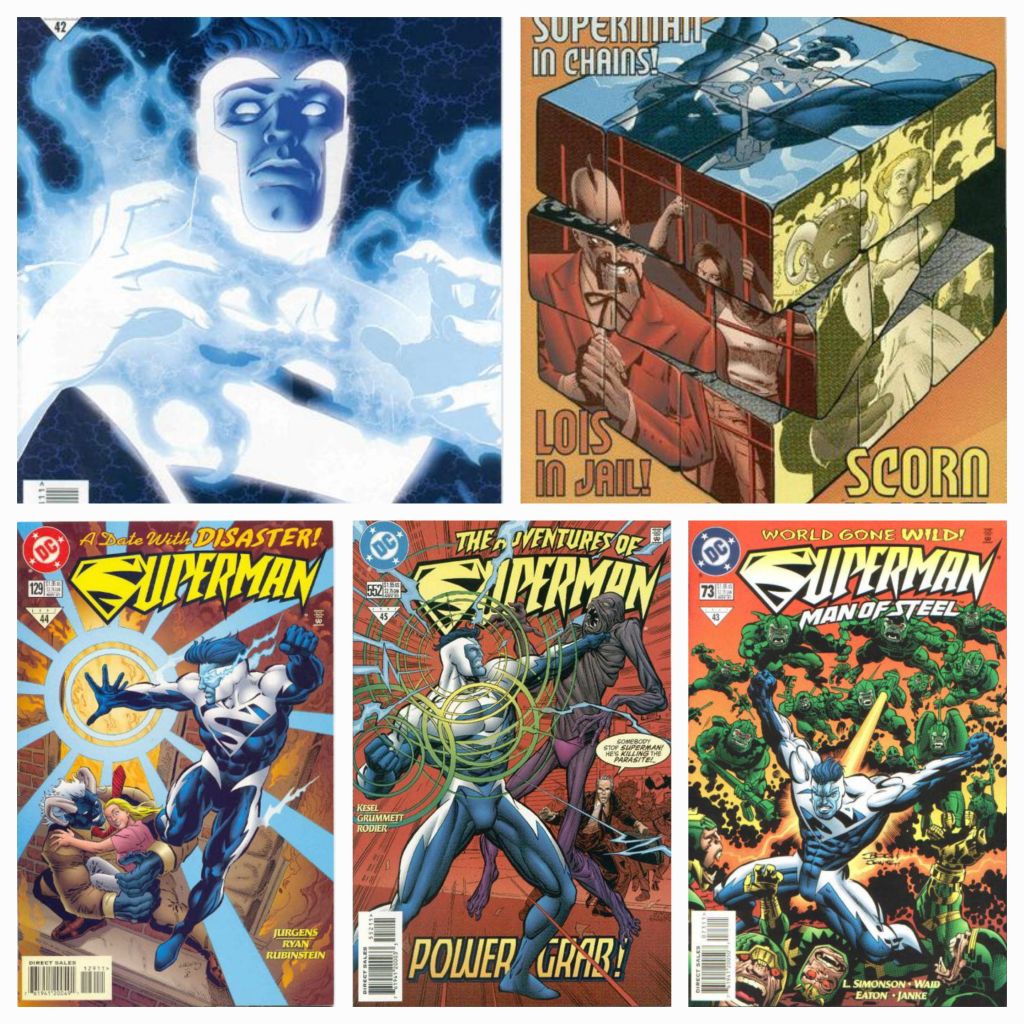
That’s more like it.

Notes: We start today with Action Comics #738, the one Superman title that dodged the bullet of having to tie in to Genesis. Superman returns to Metropolis following the crossover and almost immediately runs into a thief with the power to phase through solid objects. He escapes through an electronic store, where the Cyborg (hiding in Superman’s suit) jumps into the store’s computer system and begins plotting his revenge. This is a pretty-low key issue, mostly there to set things up and progress subplots like Clark and Lois dealing with the new circulation manager at the Planet who has the hots for Clark, and Jimmy – who has been on the run from Intergang for several issues now – finding himself in ever-hotter water. 

Man of Steel #73 picks up Jimmy’s predicament as Intergang finally catches up to him, just to run afoul of a group of high-powered hippie bikers that call themselves the Outsiders and who aren’t happy about Intergang’s encroachment on his territory. Meanwhile, Morgan Edge manages to convince Desaad (Edge works for Darkseid, by the way) to lend him some Parademons to help him wrest control of Intergang from Boss Moxie. Now Jimmy’s caught between three fighting factions. Superman finds himself in the unenviable position of defending Lex and his pregnant wife from them, and in Australia, Lois is on assignment to interview a native tribe whose Chief tells her “we are honored, for we have been chosen to witness the coming of the giants…and the end of all that is.” 

Nicely ominous, and I’m surprised that they started referencing the Millennium Giants – the story that would be the endgame of the Electric Era – so early. 

Superman #129 brings the focus back to Scorn and Ashbury, who has decided to start keeping a diary, beginning with the tale of bringing Scorn along with her to help decorate for her high school homecoming dance. Clark Kent also happens to be there (funny how that happens) working on a column when a fire breaks out. Fortunately, as Ashbury recounts, Superman ALSO shows up to help put it out. The issue mostly tracks Ash and her art teacher, Mr. Sormon, who it turns out isn’t a Superman fan. It also turns out there’s a reason for that. I have to admit, I got irritated with Sormon proselytizing in the classroom, which is the absolute last thing any decent teacher should do, until we got to the reveal that clarified it all. 

Adventures of Superman #552 has Big Blue face the Parasite again, for about two pages. Most of the issue is actually taken up with Lex Luthor and Intergang, as Lex makes his own play for control of Metropolis’s organized crime cartel. We also check in with Clark, missing Lois (she’s still in Australia) and trying to deal with things like getting tired in his human body, which has never happened before. 

And in Action #739, Ashbury takes Scorn to her homecoming dance, moved to a swanky hotel after the school caught on fire. Sounds nice – until an explosion rocks the hotel. Superman swoops in to save the day, only to discover the whole thing is a scheme by his old foe Carl Draper, now going by the name Locksmith. (Previously he was “Deathtrap.” In the pre-Crisis era he was the Master Jailer. And when he went to Smallville High with Clark, he was “Moosie.” The guy does not have a knack for good names.) As Scorn works on saving the kids at the dance, Superman works out his escape, getting back to the hotel just in time to stop it from collapsing. Back in Australia, though, Lois is kidnapped by Rajiv Naga, the guy who tried to kill Clark on their honeymoon. Fortunately for her, her dad gave her a GPS tracker before she left, which is why Clark is pretty surprised on the last page when Sam Lane shows up and demands Clark join him on a little trip down under to save her. 

I’m looking forward to the next few issues – Sam Lane and Clark Kent working together? Sounds wild. 

Sat., Sept. 13

Comic Books: Superman: The Man of Steel #74, Superman Vol. 2 #130, Adventures of Superman #553, Action Comics #740.

Faces. Faces are cool.

Notes: DC used to occasionally do these interesting events on their covers – one month every cover featured the hero on the top half of the cover with the title incorporated into the artwork at the bottom, for instance. This month was “Faces of the DC Universe”: each cover was a close-up of the face of the main character, or one of the main characters. I really liked these sort of mini-events – they had no bearing on the story inside, not disrupting the story like a Genesis-type crossover did, but it really made the books stand out on the racks in a pleasing, fun way. You still occasionally get cover themes like this, but they’re almost always restricted to variant covers these days, which isn’t nearly as much fun and don’t even catch the eye randomly. Ah, here I am getting nostalgic instead of talking about the comics. I guess I’ll do that now. I do it for YOU.

In Superman: The Man of Steel #74, Rajiv reveals his plan to the captive Lois. Back when he had Clark captured on their Honeymoon, he doused him with truth serum, during which Clark admitted to being Superman. Rajiv dismissed it at the time, but now he’s starting to wonder – so if Superman shows up to save Lois, he’ll consider it confirmation. Clark and Sam, meanwhile, are on their way to Australia, Clark lamenting the fact that he CAN’T get away and save Lois as Superman without Sam noticing something is up. There’s more “Clark’s Secret ID” stuff during this run than I remembered. Anyway, after a few close calls, Clark and Sam make it to Rajiv’s base, where Clark pulls off some quick-change shenanigans and figures out how to go invisible to save Lois without blowing his identity. This is the kind of stuff that works best in this period of Superman lore – forcing Clark to find alternative ways to pull off a rescue, while at the same time having to find new ways to protect his identity, since he can’t use his powers as “Clark” anymore. There have been several stories where the power change was really negligible – a few slightly rewritten panels and the stories would have worked just as well with “Classic” Superman. This time around, it’s a story where the different powers have a clear and measurable influence on the plot. 

In Superman #130, with art by the late, lamented Norm Breyfogle, it’s Halloween! Lois and Clark are on their way to a Halloween ball, but are briefly detoured to S.T.A.R.Labs, where Superman examines the recently-uneared Dragon’s Tooth artifact. This large rock formation has an unusual molecular structure, almost like DNA, as if it were alive. That can’t possibly mean anything, right? Anyway, at the party Lois and Clark stride in wearing Robin and Batman costumes and we go through a half-dozen subplots. Perry is feeling better and he ribs Clark on his recent weight gain (turns out that Mr. Perfect Kryptonian Metabolism is struggling with being a normal human half the time). Lex Luthor is still trying to play Metropolis Mayor Berkowitz, while Dirk Armstrong is on the anti-Berkowitz bandwagon. When Ashbury winds up getting into it with her dad, she and Scorn bounce from the party only to be picked up by a guy wearing Doctor Doom knock-off armor and riding a fancy motorcycle. It turns out to be Jimmy Olsen. The guy, I mean, not the motorcycle. Oh yeah – and apparently Superman’s energy caused something inside the Dragon’s Tooth to awaken, releasing a gigantic spirit that quite publicly kidnaps Clark from the party, leading to him switching to Superman and finding himself battling not one, but THREE of the giants as the issue cliffhangers.  

Adventures of Superman #553 picks up with Superman facing the three figures, who reveal themselves to be part of something called the “Millennium Guard.” He barely manages to escape, but they’re hot on his trail as he stumbles upon Jimmy, Scorn, and Ashbury – who’ve also picked up the Hairie called Misa (who not too long ago was part of Morgan Edge’s Superman Revenge Squad). They load the stunned Superman into Jimmy’s super-motorcycle and jet out of there to Cadmus. They manage to trick the Millennium Guard into thinking that Superman has been killed, at which point they each turn into a new Dragon’s Tooth. Well, at least that’s the end of it, right?

Nah, of course not. Also, Misa teleports Jimmy, Scorn, and Ashbury away before Superman can bring Ash back to her father or Guardian can arrest Misa. And in a subplot, Lucy Lane is terrorized by a super-powered serial killer that signs his name on walls as “The Ripper.” 

Action Comics #740, the police find some of Lucy’s things in the sewer, the first actual clue they’ve got in the Ripper case. Superman follows the trail into the sewer and winds up fighting an enormous beast. It gets away, but Superman finds Lucy trapped in a makeshift cage. The word “Ripper” is, again, inscribed on the wall, but this time there are more characters, leading Superman to theorize that the word isn’t actually English at all, but part of a different alien language, and that the creature – whatever it is – was trying to tell Lucy something. It’s an interesting idea, I suppose, but kind of a stretch. I mean…what are the odds of a symbol in some sort of alien language resembling a character from our English alphabet? Come on, Superman, think about it.  

Sun., Sept. 14

Comic Book: Superman: The Man of Steel #75

Wait, this looks…familiar.

Notes: 1998 began with Man of Steel 75 and a book that must have had Jon Bogdanove utterly delighted to draw – a spoof of Superman #75 on the front, and between the pages, a one-off story of Mr. Mxyzptlk. Lois and Clark happen to stumble upon a funeral procession of such size that they have to stop and check it out, only to find Mxyzptlk hamming it up over the casket. Mxy has decided that he wants to explore the concept of mortality, which (as a 5th dimensional imp) he’s never had to really think about…so he decides to die. Superman and Lois, as you can imagine, are not particularly concerned about this proclamation. Mxy whips up a new version of Superman’s killer to face – Bada Bing Bada Boomsday – and gives up his powers so he can REALLY die in battle.

Then it starts to get weird.

This is a really great little story. It’s goofy, silly, has no consequences and not even any real stakes. But Louise Simonson and Jon Bogdanove paint Mxyzptlk in a way that comes across more as a naive imp than the malevolent trickster he can be sometimes. He’s genuinely just there to experience something new, and the havoc he causes comes across not as the result of spite, but of genuine ignorance as to how we mere three-dimensional organisms live our lives. The whole thing boils down to a hilarious revelation as Mxy sees his version of the afterlife. You could skip this book. You could simply pluck it from the omnibus editions of the Electric Superman era. You could pretend it’s not there. But you’d be missing out on something that’s actually a lot of fun.  

Mon., Sept. 15

Comic Books: Superman Vol. 2 #131, Adventures of Superman #554, Action Comics #741, Superman: The Man of Steel #76, Superman Red/Superman Blue #1, Jon Kent: This Internship is My Kryptonite #9
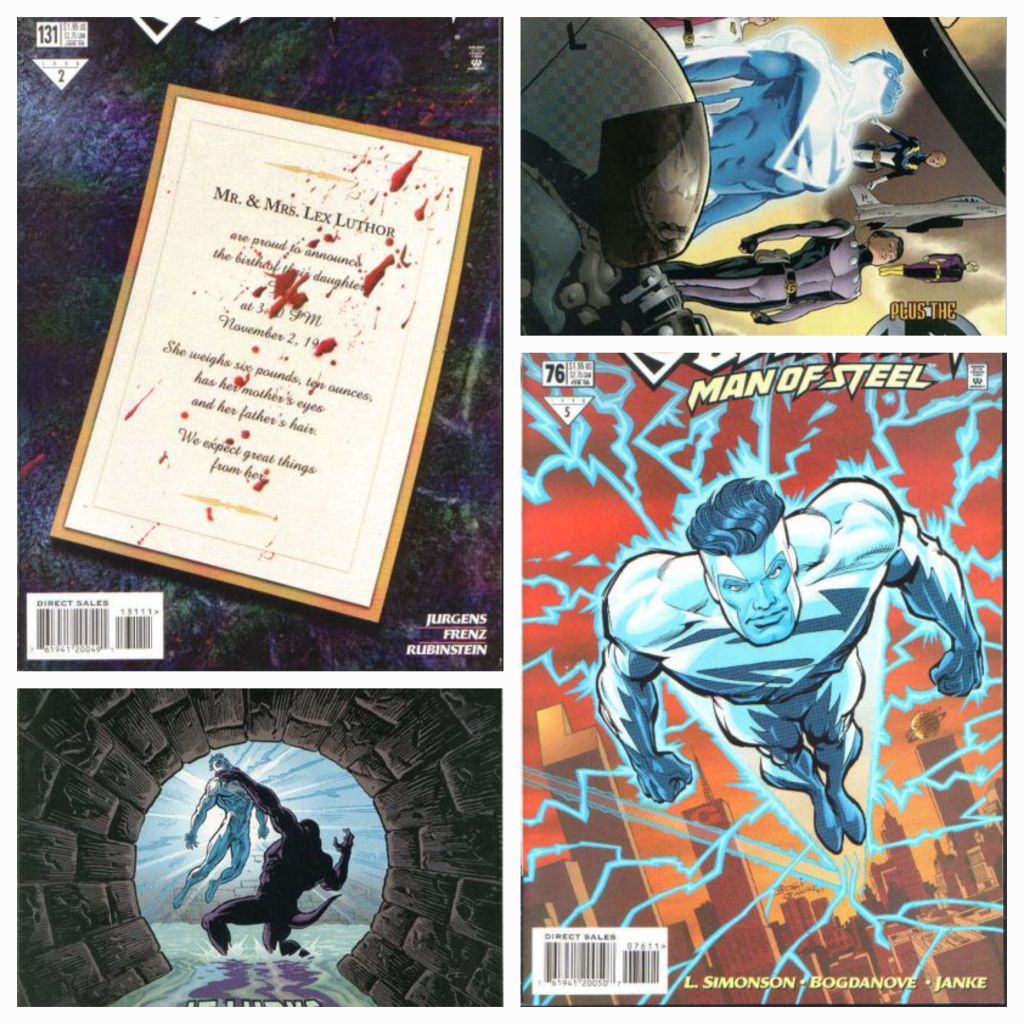
One last burst of blue…

Notes: It’s the big day! Lex’s wife, Erica, is about to give birth – so naturally, Lex is at a photo op with Mayor Berkowitz. He gets into it with Perry White over their shared history, which fills us in on a lot of things about this continuity’s version of Lex that had slipped my mind. I knew he hadn’t grown up in Smallville with Clark like so many versions of the character, but I’d forgotten he and Perry had taken on a similar dynamic: children of Suicide Slum that grew up as friends but broke apart. It’s also worth noting that Perry and Alice’s son, Jerry, had turned out to actually be Lex’s son – the product of an affair decades before. Although Perry and Alice had reconciled, the bitterness over Jerry’s death still lingered over Perry at this point. Perry gives Lois a reader’s digest version of Lex’s life – growing up in the slums, his parents dying in an “accident,” and being taken in by a foster family that was only interested in him because they suspected he had money. Lex fell in love with another of their fosters, a girl named Lena, who their foster father accidentally killed in a fit of anger. From then on, Perry says, any remnant of warmth in Lex Luthor was extinguished forever. 

The ending of this issue is pretty shocking, even for Lex Luthor, and is kind of disturbing to read in the current climate. But by the time it’s over, Lex has a new daughter, he’s thrown his wife aside, he’s gotten what to him no doubt seems like a satisfying revenge, and Metropolis is on the hunt for a new mayor.

Adventures of Superman #554 returns to the far more comic booky story of the Ripper, the monster patrolling beneath the streets of Metropolis, but not before a scene where Lex lords his new daughter – Lena Luthor – over Superman, gloating that his studies of Kryptonian DNA have suggested to him that it would be utterly impossible for him to ever have a child with a human. 

This is an example of what TV Tropes calls “Hilarious in Hindsight.” 

Anyway, Metropolis’s new mayor calls in a Kraven wannabe called Burton “Hunter” Thompson to try to track down the Ripper in the sewers, much to the chagrin of SCU head Maggie Sawyer, who is forced to work with him. At the Planet, Dirk is upset because he hasn’t heard from Ashbury in over a week. When Clark tries to comfort him, saying that Scorn will keep her safe, Dirk snaps back that he can’t understand because he’s not a father, a remark which visibly disturbs Clark. Damn, the Superman writers were REALLY leaning into that angle, weren’t they? It almost makes me wonder if they were planning to do a super-baby storyline way back then, but then it got sidelined for some reason. 

Superman joins the SCU and the Hunter in the sewers where they manage to find the Ripper. Hunter kills it while the creature is clearly trying to communicate, and Superman is left wondering what more there is to the Ripper that Hunter is trying to hide. 

Action Comics #741 brings back the time-tossed Legionnaires one last time. In their efforts to return home in their own comic, they’ve kinda sorta accidentally created a malevolent AI that’s taking control of tanks and other heavy machinery and causing havoc. Fortunately in the real world AI is totally benevolent and can only do good things. In the comic, though, they wind up struggling against out of control aircraft – which Brainiac 5 discovers aren’t being controlled by his C.O.M.P.U.T.O. after all, but from a signal coming from LexCorp Tower, because of course it is. They find Lex in the middle of telling his new daughter a rather slanted version of Chaucer’s tale of Chanticleer the Rooster (great segment there by the way) and end the issue with a particularly nice dig against Luthor. Superman doesn’t get petty often, but when he does, he finds a way to hit you where it hurts.

This would be the last time we saw the Legion before they went home, by the way. Their search for C.O.M.P.U.T.O. continued from this issue into issue #100 of their own series, which featured them finally returning to the 30th century. It was nice while it lasted, though.

In Man of Steel #76, Bogdanove does a nice take on his own over for Superman: The Man of Steel #1 (a trick he repeated a couple of years ago for the first issue of the Steelworks miniseries), and we pick up on Jimmy’s group, now on a quest. The DNAliens Simyan and Mokkari, meanwhile, are cooking up a new creation in a kind of weird meta-story. The two storylines collide with the release of a monster in midtown Metropolis. Superman takes care of it fairly easily and Ashbury is finally returned to her father…but Simyan and Mokkari are picked up by Morgan Edge, who hears they have a habit of creating monsters. It’s a really weird issue – visually fun, but it feels like they’re trying to cap off the Ashbury thing quickly to move on to what’s next.
Pictured: Next.

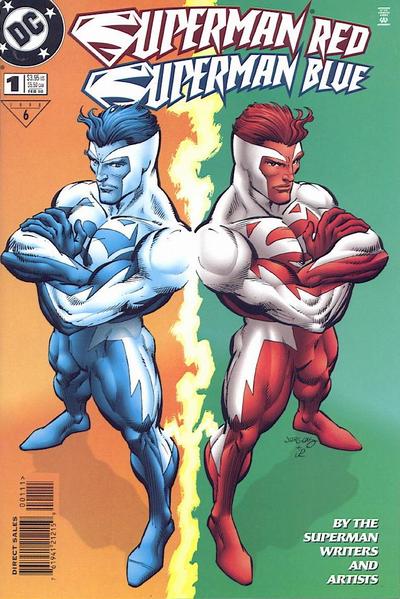
What’s next, you ask? Why, that would be Superman Red/Superman Blue #1, the beginning of the final act of the electric era. So important that it even had a 3-D variant cover! On Christmas, the Cyborg returns yet again, teaming up with the Toyman (who, at this time, was in his child-murdering phase) with a plan to destroy Superman. They capture him in a sort of energy bottle, with the Cyborg planning to rip his energy-body apart and store it in a thousand containers. At the same time, Toyman has Lois captive, and takes her away. As Superman’s body is dispersed he panics and explodes, the Cyborg’s machine splitting him into two – neither of which is aware of the other. “Blue” rushes off to save Lois from the Toyman, while “Red” brutally battles the Cyborg and traps his electronic consciousness inside an orbital antenna. The two villains disposed of, both Supermen return to the Planet office, switch to Clark Kent, and proceed to make an entrance…I gotta tell ya, that’s the way to do a cliffhanger that isn’t a life-or-death situation. The story itself is a little surprising, with such a big change in the status quo happening really quickly with absolutely no buildup. Unlike the transformation to Electric Superman, which was seeded and hinted at for months, this just HAPPENS. 

Even odder, this issue spends a lot of time on the ongoing subplots of the Superman saga. Scorn is captured by a hologram controlled by Lex Luthor, who wants to study him to learn more about Kandor. Jimmy returns to his ransacked apartment to find the medallion he got in the Pulp Heroes Superman Annual, which freaks Misa out. There’s really a shocking amount of stuff happening here that ISN’T directly related to the Red/Blue split, but that does help it to feel like a significant chapter of the ongoing saga, which is a good thing. 

Tues., Sept. 16

Comic Books: Superman Vol. 2 #132, Adventures of Superman #555, Superman: Man of Tomorrow #10, Action Comics #742, Superman: The Man of Steel #77, Jon Kent: This Internship is My Kryptonite #10

See what they did on those bottom two covers? Idn’t that NEAT?

Notes: We’ll finish up this week with the first month’s worth of the adventures of Red and Blue. I know I’ve been on this storyline for three weeks now, but it doesn’t feel like it to me – I feel like I’ve whipped through this much faster than I expected, and I think I’ll be able to finish it off next week. Fortunately I’ve still got several other themes lined up to get me to the end of the year.

We’re starting things with Superman #132, picking up right where the cliffhanger at the end of the Red/Blue special left off. The two Clark Kents both return to the Daily Planet building at the same time, with Blue coming down from the roof and Red entering from the ground level. Blue goes off to a lunch meeting with Perry, while Red finds Lois and effusively shows his joy that she’s okay, even though he doesn’t know how she escaped the Toyman. Most of the issue is taken up with Three’s Company style shenanigans, with the two Clarks narrowly missing each other at the Planet office, at the JLA Watchtower, or Dooley’s restaurant, but the JLA quickly discovers that there are two Supermen. Their genetic scanners, furthermore, confirm that BOTH of the men are genuine, something Blue doesn’t accept, leading to the two Clarks confronting each other in the alley behind the restaurant on the last page. 

It’s subtle, but this issue also lays the groundwork for the way these two are going to differentiate from one another, aside from the color. As we see Red bounding around Metropolis, he’s very energetic, free-wheeling, and emotional. He cracks jokes like Spider-Man and has no hesitation dropping a friendly put down on Green Lantern. Blue, on the other hand, is already coming across as colder and more stoic, with a short but clear moment of rudeness to a waiter who spills some coffee on his tie. There are a lot of stories about a character splitting into two that pull this same trick – each version gets PART of the character’s personality. In Superman’s case, Red is his emotional side, Blue the logical, and it’s going to be very clear soon that neither of them is as effective without the other.

Adventures of Superman #555 continues with the fight in the alley, both Clarks swearing to be the genuine article. As they argue, a lunatic with a pair of guns and dynamite strapped to his chest barges into Dooley’s. Red punches out Blue and rushes in to tackle the attacker, scared for Lois’s safety, without even changing to Superman. The bomb is still ticking, though, and Blue switches to his energy form to whisk the bomber out of the restaurant. He manages to contain the explosion and save the bomber, but winds up confronting Red again, each of them convinced that the other is the Cyborg pulling some new scheme. When they touch each other, though, something happens…

Meanwhile, Jimmy and Misa make their move to rescue the captive Scorn, a plan that gets slightly derailed when the Black Crucible – the cult Jimmy took the Medallion of the Damned from – shows up in an attempt to reclaim it. They get him free and the three of them, along with Ashbury, are on the road again.

Man of Tomorrow #10 picks up with Lois confronting her husbands at home. When they came into contact their minds temporarily fused together, making them realize how the Cyborg’s machine split them. Unfortunately, they don’t know how to merge into one again, prompting them to zip to the Fortress of Solitude to look for a solution. When they get there, though, they find that the Fortress has been invaded by Dana Dearden, aka Obsession, a highly-powered woman who is…well…obsessed with Superman. To make matters worse, Maxima shows up at the same time, hopefully convincing Superman that he’s gotta work harder in this continuity to hide the Fortress. The two women fight over him, trashing the Fortress and nearly destroying Kandor before Maxima tricks Dana into leaving via a telepathic trick, and the Supers capture Maxima and drop her off at Belle Reve. It’s a pretty good issue, but true to the Man of Tomorrow ethos, it doesn’t really have any major plot momentum in the Red/Blue saga, except for Maxima confirming that both Red and Blue are really Superman (which we already knew) and that Kryptonian tech isn’t going to fix the problem. 

Action Comics #742 is next. Red and Blue split up, Blue being more concerned with finding a solution to their problems, but Professor Hamilton is nowhere to be found. In the meantime, an eco-terrorist calling himself Kirichitan releases all the animals from the Metropolis petting zoo, with Blue zipping in to fight him. Meanwhile, the home where Luthor has been keeping his wife under sedation since the birth of their daughter mysteriously burns to the ground. Meanwhile, Man of Steel #77 shows us what Red is up to at the same time, zipping home to be with Lois, but being called to investigate the fire that seems to have consumed Erica. Red and Scorn wind up, through timey-wimeyness, fighting some dinosaurs and robots in Suicide Slum, and Scorn decides that his presence is too dangerous for Ashbury, leaving her behind and breaking her heart.

There’s a fun little trick with these two issues, taking place simultaneously and showing some of the same events from different perspectives. It’s not quite a Rashomon situation, but writers Stuart Immonen and Louise Simonson have a little fun with the conceit, as do Immonen and Jon Bogdanove on the two covers that match each other as a single image.

Oh yeah – also, at Cadmus, something is happening to the Dragon’s Tooth artifacts. We’re on the cusp of the Millennium Giants, and the end of this era.

Blake M. Petit is a writer, teacher, and dad from Ama, Louisiana. His most recent writing project is the superhero adventure series Other People’s Heroes: Little Stars, volume one of which is now available on Amazon. You can subscribe to his newsletter by clicking right here. You can join in the Kryptonian Konversation every day in the Year of Superman Facebook Group!
Superman (2025): The Review

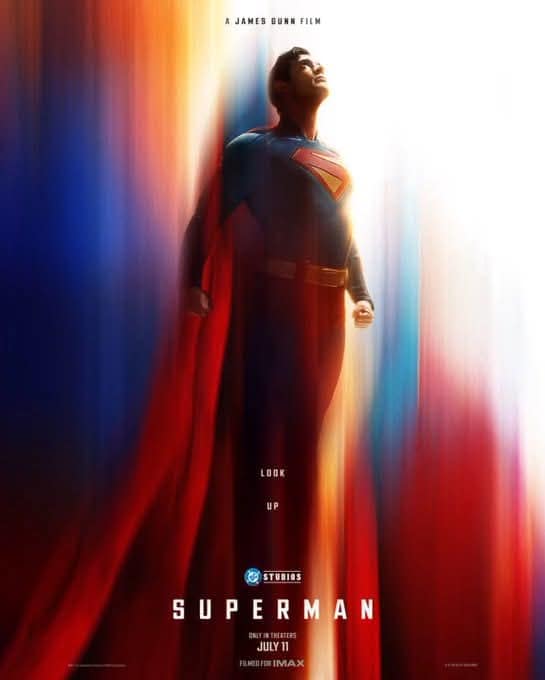
I never had any real doubt that James Gunn would make a good movie. After three Guardians of the Galaxy films, plus the holiday special, The Suicide Squad, Peacemaker, and even the little-remembered (but worth watching) film Super with Rainn Wilson, he’s proven he knows how to tell a superhero story. But the question, when it came to SuperMAN, is whether he truly understood the character and what we wanted from him.

James Gunn, I am thrilled to say, understood the assignment.

You might want to go get a snack before you read this review. We’re gonna be here a minute.

The launch film for the new DC Universe is everything I could have hoped for – exciting, thrilling, fun to watch, full of humor, full of heart, and – most importantly – carries its overt optimism like a torch leading the rest of the superhero universe in its direction. It’s like a calling card: superheroes can be fun and still mean something. And Superman, more than any other hero, should be the primary example of that.

This new DCU, we are told in the opening seconds of the film, is a world where metahumans have existed for three centuries. Superman has been active as a hero for about three years, and although he has garnered a great deal of goodwill in that time, a recent incursion into a hostile territory in Europe is causing international furor as some people question whether an alien should involve himself in human affairs. Lex Luthor, of course, leaps at the opportunity to use Superman’s actions to foment trouble, and it is the conflict between these two (who, at the beginning of the film, have yet to meet in person) that forms the core of the movie. It’s a solid foundation from which to explore the themes most important to Superman, specifically what it actually means to be human

The main plot also leaves room for exploration in the relationships that Superman and Clark Kent enjoy – with Lois Lane, Jimmy Olsen, the three members of the “Justice Gang,” and of course, with Lex Luthor himself. Each of these characters has an important role to play in the movie, nobody feels superfluous and all of them feel like they’ve been served incredibly well by James Gunn’s script. 

Krypto, of course, steals the show.

I want to talk in more detail about the characters and the actors who portray them, and I don’t know that I can do that without lapsing into spoiler territory, so consider this your warning. If you haven’t seen the movie yet, stop here, secure in the knowledge that I loved every moment of this movie and I can’t wait to see it again and again. This is the best Lois Lane we’ve ever had on screen. The best Jimmy Olsen. The best Lex Luthor. The best…

…damn, I love Christopher Reeve so much. Can I REALLY declare David Corenswet the best?

He’s definitely in the top two.

Spoilers begin after the graphic.

I’m going to go through this a character at a time, starting, of course, with David Corenswet as Clark Kent and Superman. Prior to this film, the only thing I’ve ever seen him in was Pearl, a violent slasher film in which he played a philandering movie projectionist – not exactly the sort of thing that automatically makes you think of Superman. (Thanks to Rachael Pearce for correcting me — I originally said Corenswet was in X, the film Pearl is a prequel to.) But from the first moment clips of this film started come out, he won me over. As Superman, he carries himself with strength and power, but not at the expense of his inherent humanity. He has moments as Superman where he feels weakened, and it never feels false. He expresses pain after being beaten by the Hammer of Boravia, moaning as his robots use solar rays to knit his broken bones. He crumbles in agony when exposed to Kryptonite. He takes punches during the climactic battle that you believe COULD kill him if they aren’t stopped. But far more importantly, he shows the kind of emotional vulnerability that we need in a role model. When public perception begins to go against him, his face shows the weight that comes with that. When Luthor murders an innocent man for the crime of believing in Superman, we see every ounce of the pain on Superman’s face.

That face.

And when he’s not doing that, he has a sweetness and a kindness to him. It’s no mistake that this movie goes out of its way to show us Superman saving lives even in the midst of chaos. When a kaiju is on a rampage, we see him protecting a little girl from a shockwave. He pauses in front of a series of shattered windows to make sure the people inside are okay. We even see him swoop down and rescue a squirrel – a moment that easily could have come across as silly, but in the context of the Superman we’re watching, feels perfectly in keeping with the kind of hero he is. His priority is life – all life – and he’ll not sacrifice a single one if he can help it.

Of the few faults I can find with this movie, most of them are in the category of wanting MORE. When it comes to Corenswet, I wish we had gotten a little more of him as Clark interacting with people who don’t know his dual identity. We get a few short scenes of him at the Planet office, scenes typically full of innuendo-laden conversation that only a fool would fail to pick up on (more on that later), but the rest of the time he’s either Superman or he’s around people who know his secret, such as Lois and his parents. In the few scenes where Corenswet puts on the glasses he’s so good at crafting his second identity that I wish we’d seen more of it.

The last journalist in America who remembers what integrity is.

I’d never watched anything with Rachel Brosnahan until I heard she’d been cast in this movie, at which point I decided to check out her TV series, The Marvelous Mrs. Maisel. By the end of the first episode, I was sold. Miriam Maisel is a force to be reckoned with in a time and place when women weren’t necessarily welcome, and the grit she showed in that series was exactly what I wanted in a Lois Lane. When this movie started, she carried all of that fire with her. 

Brosnahan’s Lois Lane is tough and fearless, never backing down from anything except, perhaps, the potential of a relationship she doesn’t believe she’s capable of having. The full version of the interview scene (the one from the trailer) is perhaps the single best scene of Lois as a reporter in the entire canon of live-action Superman media. Despite the fact that she’s interviewing her (kinda) boyfriend and, even more impressively, Superman, she doesn’t blink for a second. She hammers him with the kind of questions a reporter should use in a situation like this, and when the inevitable conflict between Lois and Clark comes up as a result, it doesn’t feel forced. Clark is upset because to him it is SO OBVIOUS that he’s done the right thing, and it frustrates him that others don’t see it that way. Lois has a reporter’s point of view – more nuanced, less black and white, thus the two of them come to a verbal sparring match that serves their relationship well. When they eventually reconcile, it comes about because he realizes she was doing her job correctly, but at the same time, Lois can appreciate the fact that sometimes right is simply right, and understands why Clark did what he did.

Llllllllllllllllllllladies.

Jimmy Olsen, as a character, has rarely been served well – and I don’t just mean in movies. Nothing against Marc McClure, who did his best in the 70s and 80s, but how many stories actually give Jimmy something to DO? Even when he had his own long-running comic book series in the Silver Age, the stories often involved him needing Superman’s help or doing something ridiculous that happened to work out in the end. Skyler Gisondo’s Jimmy, on the other hand, is funny and capable. He’s a legitimate reporter, and while he may not have the gravitas around the Planet office that Lois and Clark have, he’s good at what he does. There’s also a great running gag about Jimmy being, inexplicably, kind of a ladies’ man. We see several moments of girls checking him out and his desk is ornamented with photographs of him with women who, let’s be honest here, seem way out of his league. (No offense, Skyler Gisondo.) This joke gets a tremendous payoff when we find out that Eve Teschmacher, Lex Luthor’s girlfriend, is actually Jimmy’s EX and she wants him back.

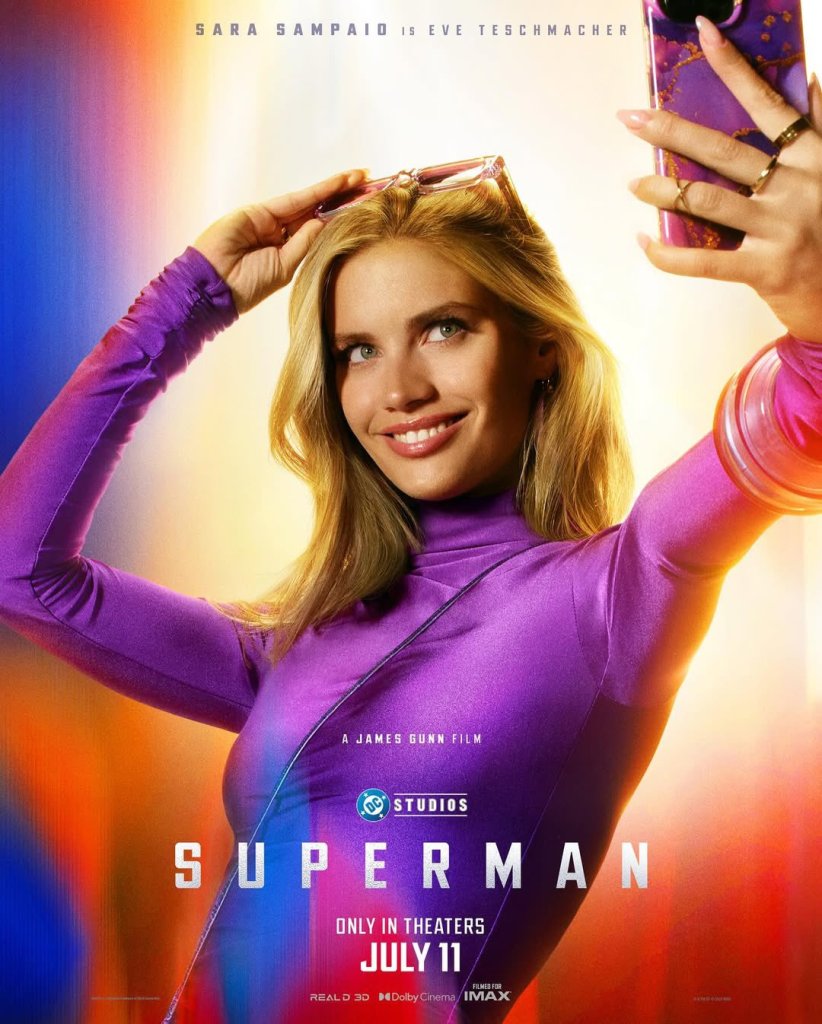
Honestly, I give them all the credit in the world for avoiding duckface in this poster.

Speaking of doing more with a character, let’s talk about Eve. Sara Sampaio plays Eve Teschmacher as a ditzy, selfie-obsessed product of a social media society. But the story completely redeems her when we learn that the avalanche of selfies she’s taken have been carefully done to capture evidence against Lex in the background – maps and charts that document his scheme and can be used to bring him down. The portrayal we get of the character fits well – she IS kind of ditzy and a little oblivious to the fact that Jimmy isn’t as into her as she is into him, but she is nowhere near as stupid as she pretends to be. That trope, of a character hiding their true intelligence until just the right moment, is one that I always enjoy, and Sampaio sells it hard.

STILL don’t call him “chief.”

Back to the Daily Planet for a minute – we also don’t get as much Perry White as I’d like, but from what we do see, Wendell Pierce nails the role. He’s got a sort of fatherly air to him, but also a dedication to doing his job. The best bit with him, though, comes right after the final battle, when Lois goes off to “interview” Superman. Perry just looks at Jimmy and asks “How long have they been hooking up?” I love the ambiguity of this scene and how it plays to the intelligence of the characters. Just before this, Perry was on a wild ride in the T-Craft with Lois and Jimmy, who broke the Luthor story. Then he brings along Cat Grant (the gossip columnist), Steve Lombard (the sports guy) and Ron Troupe (who I assume is a reporter but, as far as I can tell, never got an actual line in the movie). But at NO point does he look around and say “Where the hell is KENT?”

The only way this works is if you read that final scene the way I do: Jimmy and Perry not only know that Lois is hooking up with Superman, but they’ve figured out that Superman is Clark Kent. Hypno-glasses or not, they’re too smart not to have pieced it together. Plus, as we see elsewhere, this Clark is perhaps a little too loosey-goosey with guarding his secret – not only does he share it with Guy Gardner, of all people, but as I mentioned before, Lois and Clark keep having conversations that REALLY seem to hint at the fact that they’re hiding something. She may chastise him for not hiding his identity well enough, but if we’re being fair, she isn’t helping matters. If that is, in fact, what James Gunn intended, I love this shade for the characters. I love seeing them played to the height of their intelligence. 

So bald…so evil…

Let’s move on to the villain of the piece here: Nicholas Hoult as Lex Luthor. We’ve seen a lot of Lexes over the years, from Gene Hackman’s long-suffering rogue surrounded by incompetents to Jesse Eisenberg’s thinly-disguised Mark Zuckerberg impression. But this is the first Lex we’ve ever seen that I thought felt truly UNHINGED. He’s obsessed with Superman, as Lex Luthors often are, but Hoult’s interpretation takes it to the next level. Hoult’s Luthor is as petty and bitter as he is brilliant, his entire motivation boiling down to the fact that he cannot stand the fact that the world prefers Superman to him. To his credit, he’s not unaware: he knows perfectly well that he’s obsessed and bitter, but that doesn’t change anything. When his rage actually boils over, as it so often does, he can be legitimately frightening. He is, in fact, the perfect foil for Superman. Where Superman represents all of the goodness and nobility inherent in the human race – and, in fact, has specifically chosen to do so – Luthor is a perfect representative of all of our negative qualities: fear, anger, envy. I can only imagine how hard James Gunn must have been laughing when he wrote the scene in which we find out that the trolls who have been slamming Superman on social media are literally monkeys being mind-controlled by Luthor. It’s such a perfect picture of the people who live only to dispense hate online that you have to wonder if it’s even a fantasy.

Meet the gang.

Then there are the other heroes in this film. Edi Gathegi’s Mr. Terrific gets the most screen time, joining Lois in the rescue mission once Superman is caught in Luthor’s pocket dimension and fighting with Superman in Metropolis at the finale. He also comes across as the smartest (which is kind of his whole thing), most mature, and most responsible of the “Justice Gang.” He’s a leader and a man of conviction, although he does have a wry sense of humor and little patience for fools, which makes you wonder how he survives being on a team with Guy Gardner. Of all the gang, he’s the one I feel could most handily star in a movie of his own.

Speaking of Gardner, Nathan Fillion just KILLS it as our resident Green Lantern – funny, arrogant, and self-centered, but at the same time, absolutely fearless (which is one of the job requirements) and dedicated to doing what he thinks is right. It may not always be pretty, but Guy Gardner gets the job done. Isabela Merced’s Hawkgirl has the least to do out of the three of them, but even she manages to make a name for herself, showing just how tough she is and getting some really good moments, especially at the end.

How could you not fall in love with that face?

Although not technically a member of the “Justice Gang” until the very end, I effusively loved Anthony Carrigan’s Metamorpho. Introduced in a sort of antagonistic role, with Lex having him make Kryptonite to torture Superman in his pocket dimension prison, it quickly becomes clear that he’s doing it against his will. Luthor has his son, and if bombarding the world’s greatest superhero with toxic radiation was the only way to keep MY kid safe from a psychopathic billionaire, I have to admit I’d probably do the same thing. But when Superman convinces him that there’s a way out, he turns very quickly and becomes a valuable ally. In the final fight on the Boravian front, he quickly proves his value and his worth, and becomes a character that you root for wholeheartedly. 

Krypto?

Krypto is a very good boy.

The last thing I want to talk about is the world that Gunn is building. He is quite adamant that each DCU project be able to stand on its own, and this movie absolutely does that, but at the same time he’s laid enough seeds to have fans farming for months. For example, the opening narration tells us that in this universe, metahumans have been known to exist for 300 years. That’s a REALLY specific number. In most iterations of DC Comics, there have been larger-than-life figures throughout history: the Viking Prince, the Shining Knight, western heroes like Jonah Hex and so forth. But the modern metahuman usually doesn’t become a thing until roughly the World War II era. So why 300 years ago? Did something specific happen at that point that kicked off metahumans on the DCU Earth? Is it when the Starheart fell to Earth, does it have something to do with Nabu or the wizard Shazam? There isn’t nearly enough information to come up with an informed theory, but that’s not about to stop us from guessing.

We also get enough Easter Eggs to make me itch for the Blu-Ray release of this movie so I can pause it and peruse certain moments. The scene in the Hall of Justice, for example, has a mural of what appears to be the Justice Society of America in the background. I noticed Wildcat specifically, but I need to go back and see who else made the cut. I also feel like a careful examination of the people in the cells of Lex Luthor’s pocket prison will reveal certain things about who (or what) exists in this world. 

The final scene has two wonderful moments – one is a quick cameo by Supergirl (Milly Alcock) which is a BLATANT set-up for her own movie, especially if you’ve read Woman of Tomorrow. The second part is a lovely character moment for Clark. Early in the movie, when his robots healed him, they showed him the recorded message from Jor-El and Lara to “soothe” him. In the end, having learned that his Kryptonian parents weren’t quite who he thought they were and understanding that he has chosen to be human, he instead is soothed by the memories of his life with Jonathan and Martha Kent.

Every dad wants this moment.

The scene that made me most emotional in the entire film is the one where Pruitt Taylor Vance as Jonathan tells Clark that it’s his choices that make a person who he is, and then breaks down telling his son how proud he is of him. This hit me right in the Dad Place (that’d be the heart), and the fact that my own seven-year-old boy was sitting in the chair next to me no doubt was a contributing factor to how I had to scramble to see if there were any napkins left from the popcorn. People will want to pick apart this movie and apply their own messages and agenda to it, which is a stupid, tiresome pastime I never have any patience for. Here’s the message I took from it, and I don’t think this one requires any mental gymnastics to make it fit:

You are who you choose to be.

Superman is the best of us, not because of his powers and not because of what he CAN do. He’s the best because he chooses to do good. He’s a hero because he wants to help people. And this movie shows time and again how he inspires others to do the same, from the children raising flags on the battlefield to the way Guy and Hawkgirl change their minds and join in the final fight – and perhaps most importantly, in the form of a food truck vendor who spends his life trying to protect his hero. Superman raises up ordinary people, and if Lex could get out of his own damned head, he could do the same. 

It’s a message we all could stand to remember. 

You know, I’m worried I might have missed something. I think I need to see this movie again. 

Blake M. Petit is a writer, teacher, and dad from Ama, Louisiana. His most recent writing project is the superhero adventure series Other People’s Heroes: Little Stars, volume one of which is now available on Amazon. You can subscribe to his newsletter by clicking right here. You can join in the Kryptonian Konversation every day in the Year of Superman Facebook Group!

Geek Punditry #130: Three Wishes Presents Crossover Madness

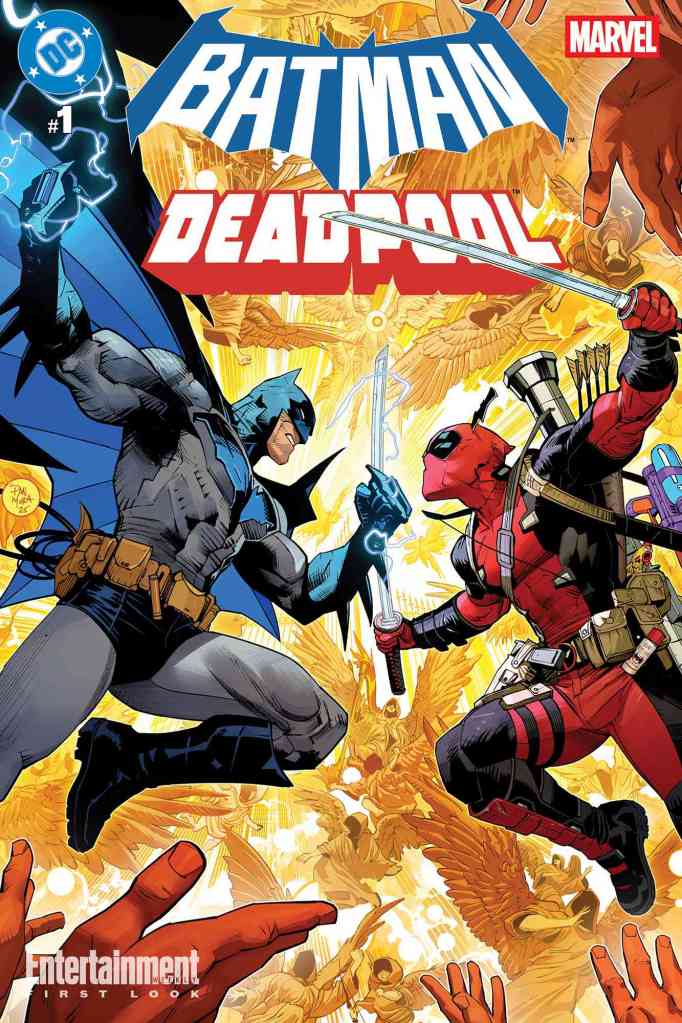
Well, my friends, once again the powers that be in the world of entertainment have proven that they turn to us here at Geek Punditry for their ideas. Last year, DC and Marvel Comics announced that they were going to be reprinting their classic crossovers of the past (stuff like Superman meeting Spider-Man, Batman fighting the Hulk, and the two universes actually merging as Amalgam Comics) in two hefty hardcover omnibus editions after two decades of the companies holding off on any kind of collaboration. At the time, I suggested that this project could potentially be a precursor for NEW crossovers to finally appear, and sure enough, earlier this year they announced a two-part event in which DC’s perennial cash cow Batman will meet Marvel’s insanely popular Merc with a Mouth, Deadpool. As this is clearly an idea that nobody else could have come up with had I not proposed it here on my blog, I am comfortable taking full credit for this world-changing news.

I expect Deadpool to thank me personally.

The fun will start in September, when Marvel’s Deadpool/Batman will arrive, written by Zeb Wells with art by Greg Capullo. In November it’ll be DC’s turn: Batman/Deadpool by Grant Morrison and Dan Mora. While this particular pairing wouldn’t have been my first choice for the new era of crossovers, I can’t pretend I don’t understand the reasoning behind it. You’re combining two of the most popular (and profitable) characters in comic books, and honestly, a fourth-wall breaking character like Deadpool is liable to be a laugh riot no matter who you partner him up with, so I’m looking forward to these two books. 

But the fun doesn’t end with Deadpool and Batman! Recently, Marvel announced that their half of the crossover – in addition to the Deadpool/Batman meeting – will include three back-up stories with other pairings. Chip Zdarsky and Terry Dodson will team up Captain America and Wonder Woman, Kelly Thompson and Gurihiru will bring us an encounter between Jeff the Land Shark and Krypto the Superdog, and perhaps most excitingly, Adam Kubert will draw a meeting between Daredevil and Green Arrow written by someone who had magnificent runs on both of those characters in the past, filmmaker and Geek Emeritus Kevin Smith. 

In many ways, I’m actually more excited for the back-ups. Not to say I don’t think that there’s fun to be had with Deadpool and Batman, but Captain America and Wonder Woman is such a natural matchup that it’s shocking it never happened in the past. Thompson and Gurihiru’s comics starring Jeff are delightful all-ages fare, and I think adding Krypto to the mix will be a blast. And again, having Smith return to the two characters with whom he arguably has done his best comics work is pretty darned exciting to me.

But let’s remember, these backups are coming in Marvel’s half of the event. DC’s book comes out two months later, so the solicitation information that tells us about the DC backups, if any, likely won’t be available until August. Considering the way these crossovers usually work, with the two publishers wanting equity for their characters, I think it’s almost certain that the DC book will give us three additional backup stories of their own. The question, then, becomes obvious: who will be the stars?

As we have already established that the two dominant publishers in the American comic book space are mining my little-known blog for their ideas (guys, just put me on the payroll, I work cheap), I’m going to take this opportunity to dust off my “Three Wishes” format, in which I throw out three things I would like to see. If it were up to me, these are the backups you would see in Batman/Deadpool come November, with an added bonus of which creators I would have handle the stories.

Booster Gold/TVA

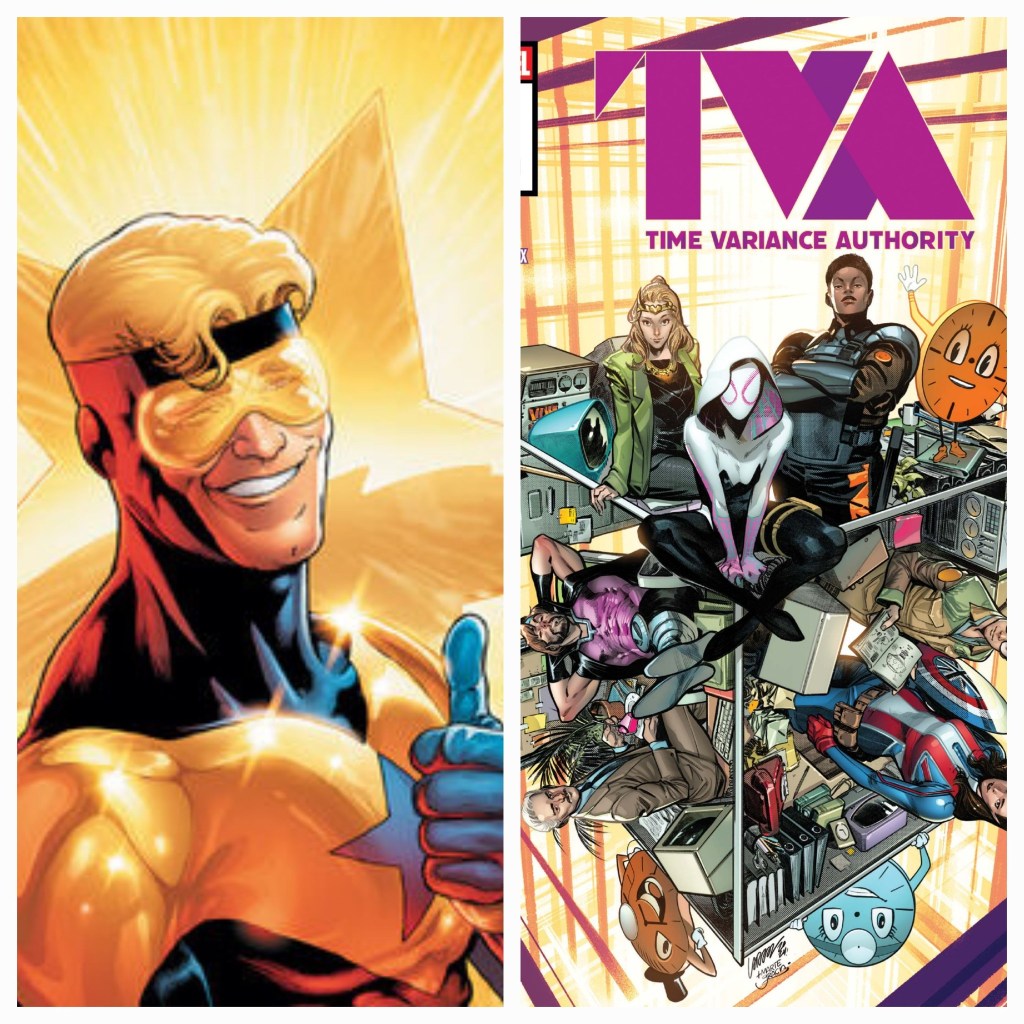
If you didn’t watch Loki on Disney+, I should explain that the Time Variance Authority, or TVA, is an entity in the Marvel Multiverse which is tasked with protecting the integrity of the timestream. In older stories, the TVA was literally made up of a legion of faceless bureaucrats and was a nice satire on corporate politics. The Loki TV series, though, fleshed out the concept quite a bit and made it an engine that could actually support stories of its own rather than just react to things happening in other comic books. They even got their own miniseries earlier this year, in which they built a task force of multiversal heroes including Spider-Gwen, Captain Carter, and an alternate dimension version of Gambit, among others. 

So for an organization dedicated to defending the timestream, who better to have them cross paths with than DC’s Booster Gold? Michael Jon Carter, a disgraced football star from the future, decided he would be better off in another time, so he stole various pieces of technology he knew would essentially make him a superhero and travelled back in time to our present day. Booster, as a character, started off very self-centered and egotistical, but as time went on, he grew and developed greatly, eventually accepting a role of defending the timestream, even though most other heroes (except Batman, who knows the truth) picture him as a jerk and a screw-up. 

The conflict would be that Booster and the TVA basically have the same job description, but from their perspective, the TVA would view Booster as one of the time anomalies they’re dedicated to preventing. There’s room for some great storytelling here, as this would be a far more believable misunderstanding than the usual hero vs. hero battle. As for who should tell this tale, I’d recruit Ryan North – a writer with a sharp sense of humor who has done work with the TVA in the past – and Booster’s creator Dan Jurgens as co-writer and artist. 

Captain Carrot/Spider-Ham

This would build off of the Krypto/Jeff story from the first volume – something that’s a little sillier. Both Marvel and DC have a world in their multiverse that’s basically full of living cartoon animals, so matching up those characters would be natural. DC’s Captain Carrot – a character longtime readers know I’ve loved since childhood – is the leader of his Zoo Crew, the primary heroes of his Earth. Spider-Ham, on the other hand, was originally a little spider named Peter who was bitten by a radioactive pig and transformed into a pig with the powers of a spider. It’s a ridiculous reversal of Spider-Man’s origin, and that’s what I love about it.

I’m not really sure what story I would tell with these two, to be perfectly honest, but it would be enough for me just to see them share a page together. You know who I think would be able to tell a good story with them, though? Comic scribe Gail Simone, who has not only a fantastic flair for comedy, but also tells some of the best character-driven stories in comics. As for the artist, it would have to be somebody who’s shown a proclivity towards more “cartoony” comic books in their artwork. Captain Carrot’s co-creator Scott Shaw wouldn’t be a bad choice, but I think he’s retired, so instead I’d hire somebody like Roger Langridge, who did a beautiful job on the Muppet comics several years ago and recently has done a little work on Dynamite’s Darkwing Duck – another comic about a cartoon animal superhero. 

Superman/Fantastic Four

Now I know what you’re thinking. “Blake, they already DID a Superman/Fantastic Four” crossover back in 1999. Dan Jurgens wrote AND drew it. You’ve been reading and watching Superman stuff every day this year, do you mean to tell us you didn’t KNOW that?”

Of course I knew that, you dork. I’m not talking about THAT Superman or Fantastic Four. I mean the ones from the movies. 

As you may have heard, this summer’s two big superhero movies are going to be Superman and Fantastic Four: First Steps. Both of these are relaunching the respective properties for their new cinematic universes. And both of them look absolutely wonderful. As a teacher, I usually don’t look forward to July – it’s like one big month-long Sunday afternoon before I have to go back to work. But this year, these two movies have me excited and thrilled for July to come. 

Some people, however, have to turn everything into a competition. Marvel fans who reflexively hate anything with the DC stamp on it, Superman fans who talk as though Clark is going to swoop in and beat up the FF…and all of that is ridiculous. The idea of the movies being in competition with each other is largely manufactured by loony fans rather than rationality. Marvel and DC have shared creators for decades in comic books, and even in the current cinematic landscape it’s still happening. (Don’t tell me you’ve forgotten that James Gunn directed Marvel’s Guardians of the Galaxy trilogy or that Reed Richards himself, Pedro Pascal, was in Wonder Woman 1984.) There is literally no reason not to root for BOTH of these films to be huge, massive, entertaining success stories. And what’s more, the characters themselves would feel that way as well.

So that’s the story I would tell. I’d have a story where an entity from each universe – let’s say, for example, Marvel’s Grandmaster and DC’s Superboy Prime– would encounter each other in the Multiverse and get into a debate about their respective heroes, then try to pit Superman and the FF against each other…but SPECIFICALLY, the David Corenswet Superman and the MCU version of the Fantastic Four. They would meet and be told to do battle, then the Grandmaster and Prime would be utterly BAFFLED when they refuse to fight each other, citing that there’s no reason to do so, and then teaming up to defeat their captors.

The meta commentary would make the more bloodthirsty “fan’s” heads EXPLODE. So worth it.

The creative team? Well, if they don’t let me write this one myself, I think it would be a nice project for Mark Waid, who knows and loves these characters better than just about anybody. As the artist, I would get somebody old-school, such as Jerry Ordway, to put his spin on it. 

There you go, friends – three epic crossover stories that are coming soon to a comic book near you…or at least, they would be if I had my way. But these are just MY picks. What about yours? Feel free to share your own “three wishes” for potential Marvel/DC crossovers in the comments!

Blake M. Petit is a writer, teacher, and dad from Ama, Louisiana. His most recent writing project is the superhero adventure series Other People’s Heroes: Little Stars, volume one of which is now available on Amazon. You can subscribe to his newsletter by clicking right here. He’s also started putting his LitReel videos on TikTok. This is usually where he’d make a joke about how much he loves Captain Carrot, but he already put that in the main article, so frankly, he doesn’t know how to end this. Hey, is that a rabbit over there? [Scurries away.]

Year of Superman Week Ten: The Reign Begins

Last week, I spent most of my Superman time reading the story of his death from 1992. This week we’re jumping ahead over that gap in publication to look into the story that brought him back. Get ready for “Reign of the Supermen,” friends! But first…

It’s gonna get CRAAAAAAAZYYYYYYY…

Wed., March 5

Comics: Adventures of Superman #500

Supposedly, you could peel off the top layer of this cover and remove Jonathan’s hand. I never tried it. I don’t know why the hell anybody would want to.

Notes: The return of Superman begins right where Superman #77 ended with Jonathan Kent lying in a hospital in cardiac arrest. I think back to 1993, when we had to wait about three months in the relative hours that passed between these issues. It truly seemed, at the time, that Jonathan had died of grief over the death of his son, and unlike Clark, we didn’t really feel certain that Jonathan would necessarily be coming back. I think that’s one of the things that still makes this issue so damned good.

Before I get too deep into this I need to make something clear – if you have never read the “Reign of the Supermen” story before, I’m going to be spoiling stuff left and right, beginning in this little recap of this issue. I’m assuming that anyone reading this blog is a hardcore Superman fan and already knows the story pretty well, but on the off-chance that you don’t, consider this your spoiler warning. I didn’t worry quite as much about spoilers when it came to the Death of Superman because…well, it’s right there in the title. But there are a few twists coming in the story of his return, so if you don’t know (for example) who the four people who stepped up to fill Superman’s shoes are, this is your warning to go read the entire story first before you come back here.

Okay, back to Adventures #500. The first half of the issue follows Jonathan into a near-death experience. In a strange realm somewhere between the living and the dead, Jonathan sees Clark being taken away by a contingent of Kryptonian spirits. He charges after his boy, uncovering the truth – the “Kryptonians” are minions of Clark’s old foe, the demon Blaze, and it’s up to Jonathan to convince “Kal-El” to turn around and come back to Earth.

I wonder if there was ever a temptation to have Superman fight this battle himself, do the sort of “power of will” ending that so many of his stories have had in the past. Certainly, it would have been adequate, but…this is better. Having him saved by Jonathan is just better. Showing the father risking everything to save his child is always something that’s going to tug on my heartstrings, and the fact that the child in question is Superman himself somehow makes it even better. “Oh, my son is the most powerful man in the world? Man of steel? Man of tomorrow? His symbol literally means ‘hope’? Shut up, hand me a shovel, and get out of my way.”

I love Jonathan in this book. 

The shovel, by the way, is a really nice callback to the last chapter of John Byrne’s Man of Steel, where Clark was mesmerized by a hologram of Jor-El and Jonathan broke him free by smashing it with a shovel. Here it’s not really Jor-El, but demon wearing his form, but the fact that Jonathan manages to summon a shovel out of the ether to save his boy just makes me want to jump up and cheer.

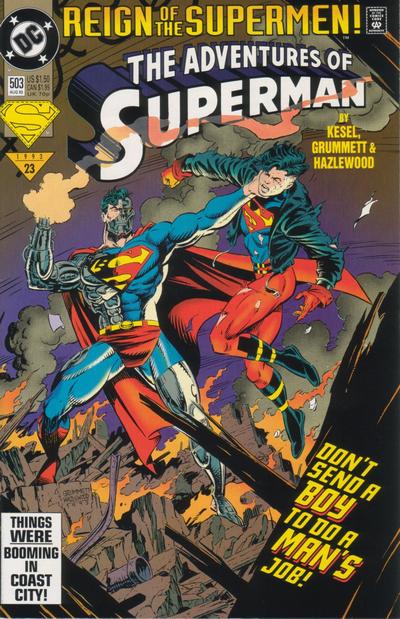
The main story ends with Lois and Inspector Henderson of the Metropolis PD going to Superman’s tomb to find that it empty, just in case the Christ allegory in the character wasn’t obvious enough. After that, though, we get into our first sightings of the four new characters who stepped up as the stars of the series for the next few months, and each of them has an introduction that is quite fitting for the person they would prove himself to be. John Henry Irons is first glimpsed pulling himself from rubble and proclaiming that he’s got to stop Doomsday – the hero inherent in him is already clear. The “Last Son of Krypton” first shows up dishing out a rather brutal brand of justice – the right intentions, but the wrong path. “The Kid” (who at this point had no name) is broken free from Cadmus by the Newsboy Legion and demonstrates the pigheadedness that defined his early years with a simple proclamation: “Don’t ever call me Superboy!” And finally, the Cyborg makes his first appearance in a wordless sequence in which he lands in front of the Daily Planet building and destroys the marker that designates the spot where Superman died, proclaiming simply “I’m back.” As the true villain of the piece, it’s a nice introduction. Would the real Superman necessarily destroy his memorial? Possibly…but a villain intent on destroying Superman’s good name would definitely do so.

I’m looking forward to reading the rest of this again, my friends. 

Thur., March 6

“One of these things is not like the others…”

Comics: Action Comics #687, Superman: The Man of Steel #22, Superman Vol. 2 #78, Adventures of Superman #501

Notes: The return storyline begins in earnest today. Like I said yesterday, I’m not going to bother to try to hide the reveals for these books, but at the same time, I’m also going to try to recreate the thought process we went through as readers when these books were still fresh, still coming out one week at a time (except for these first four issues, which were all released on the same day). The story begins with the “Last Son of Krypton,” who would eventually be revealed to be the Eradicator, being reconstituted in the Fortress of Solitude by the very robots that he built. Ever since he was supposedly destroyed back in Action Comics #667, the energy that made up his essence had been trapped in the walls of the Fortress, finally restored here. Roger Stern structures it in such a way, though, that it’s not immediately obvious that we’re looking at the Eradicator. It’s possible, or so it seemed at the time, that this energy-being who then went to retrieve Superman’s body, was actually Superman’s soul. He’s less compassionate than our Superman, less personal with Lois, but this too could have been an artifact of his encounter in the afterlife from Adventures #500. 

Man of Steel #22 gives us John Henry Irons’ first full appearance, and we first see him sitting on the stoop of an apartment building, telling kids the story of John Henry versus the machine. Again, subtlety was not a strong suit for these comics. Anyway, John – under the alias “Henry Johnson,” is horrified when a gang hit kills one of the neighborhood kids using a weapon he recognizes as a “Toastmaster,” something he designed in his previous life. He remembers how Superman once saved his life, and told him to “make it count,” inspiring him to make the Man of Steel armor to clean the streets of his weapons. I’ve made no secret of my love of John Henry, and how of the four Supermen, he was my favorite. I think it’s important to point out, though, that the idea of him being the “real” Superman wasn’t out of the question at the time. Although the other three all LOOKED like Superman, John Henry was the one who ACTED the most like Superman. What’s more, this first issue introduces us to John’s neighbor Rosie, the clairvoyant, who claims the Man of Steel is a “walk-in spirit,” the result of a soul whose body has been killed but who instead finds another body to inhabit. If that sounds ridiculous to you, keep in mind that this is part of a universe that includes Deadman and the Spectre. Although it didn’t turn out to be true, at the time the notion that Clark Kent’s spirit was somehow inside John Henry’s body was not something that we could safely rule out. 

In Superman #78, the Cyborg makes his big splash, breaking into Cadmus to take Doomsday’s body. In order to prevent Westfield from attempting to clone the creature, he brings it into space and chains it to an asteroid, drifting – seemingly – aimlessly. The Cyborg then encounters Lois, who insists he visit Professor Hamilton for study. To everyone’s shock, Hamilton’s tests reveal that the Cyborg’s metallic parts are indeed Kryptonian, and his body is genetically identical to Superman. He is, to all appearances, Superman brought bac to life. The truth is that Hank Henshaw, in a computer consciousness, stole the Kryptonian Matrix that brought Kal-El to Earth as an infant, giving him the material to build a convincing body. He was also clever in that the parts of his body that were replaced with metal corresponded pretty well to the areas that seemed to suffer the most damage during the battle with Doomsday. This was the Superman that I remember finding the most plausible in that first month, for the aforementioned reasons. There is, however, one other clue that convinced me pretty well that turned out to be a cheat: in his internal monologue, the Cyborg looks at Doomsday and thinks, “They didn’t bother to wash MY blood off you.” That particular possessive pronoun makes no sense for anybody to use except Superman, and was one of the strongest arguments – among readers – for the Cyborg’s claim to the throne. It still doesn’t make sense that the Cyborg would think that way. That’s a little bit of narrative cheating that bugs me to this day.

Last, we get Adventures of Superman #501, the introduction of the Metropolis Kid. The lad who would one day be Superboy comes to town saving joggers, fighting crime, and proving just how arrogant a super-powered 15-year-old would be. He’s upfront from the beginning, though, telling the world that he’s Superman’s clone, although this would later turn out to only be part of the story, and that story itself would change more than once before it settled on its current status quo. Of the four Supermen, this was the one that I never once thought could be “our” Superman brought back to life…however, that didn’t necessarily mean he wasn’t “real.” After all, if Rosie was right about John Henry’s body containing Superman’s soul, he would need somewhere to go, right? Some comic book science aging the Kid could have made a perfect vessel to contain it, had the story gone in that direction.

I’m remembering the fun of this storyline now. For the last 30 years, any time I’ve read these comics again it’s been with that perspective of knowing the ending. While I can’t throw that lens away, I’ve kinda rediscovered the way I looked at the stories at the time, trying to measure all the possibilities…and that’s a fun way to read these. 

Fri. March 7

The “telescope” is literally a giant horseshoe magnet. Trust me, this image is cooler.

Animated Short: The Magnetic Telescope (1942)

Notes: Unsure if I can get in any reading time today, I decided to squeeze in the next Fleischer short while I have a chance. In this one, a scientist (I’ll let you decide for yourself if there should be a “mad” in there) invents a telescope with an enormous magnet attached, with the intention of drawing celestial bodies closer to Earth for further examination. The problem with this, of course, is that he is DRAWING CELESTIAL BODIES CLOSER TO EARTH. It doesn’t help when the police shut down his machine, cutting off the power after he’s already pulled a comet towards Metropolis and robbing him of the ability to send it back. Superman, naturally, is going to have to get in there and save the day. The short is pretty standard, with the usual gorgeous animation and a story that is fairly predictable. The most interesting thing, I think, is the lack of common sense displayed not only by the scientist, but by Clark Kent, who is taking a TAXI to the observatory after Lois calls in to report the catastrophe. It isn’t until the cab gets stopped by falling meteor chunks that Clark decides to switch to his costume and fly there. Why is he wasting money on a cab in the first place? 

Sat. March 8

Comics: Superman: The Man of Steel Annual #2, Action Comics #688, Superman: The Man of Steel #23, Superman Vol. 2 #79, Adventures of Superman #502

It was the 90s, you see, there was nothing more important than “Edge.”

Notes: The tricky part of reading the “Reign of the Supermen” and related comics is going to be working in the annuals. As they don’t carry the “Triangle” numbers the way the regular issues do, I’m going to cycle them into the reading order as close as I can figure to when they were released, relative to the other comics, and that means I’ll be starting with Superman: The Man of Steel Annual #2. Now in 1993, DC’s summer annual event was a story called Bloodlines, in which a group of aliens came to Earth to feed on humans. Some of the humans they attacked, however, didn’t die, but instead had their metagene awakened, giving them superpowers. The result was that each annual this year introduced a new superhero or villain. Some of them were pretty cool, others were kind of lame, and the only one who had any real lasting impact was Hitman. Edge, for instance, the character that John Henry Irons meets in this issue, hasn’t made an appearance since 1995. It’s pretty tertiary to the ongoing story, with the biggest contribution being that it shows how the Man of Steel is becoming accepted in the neighborhood.

They’re fighting over who has the better hairstyle.

Moving back to the regular issues, we’d entered an interesting time. Although the Triangle Numbers and weekly serialization continued, each of the four would-be Supermen had their own plots and stories that lasted for the first couple of months of “Reign” before the Cyborg played his hand and tied the four titles together again for the rest of the run. In Action #688, for instance, we see a confrontation between the Eradicator and Guy Gardner. In a move that’s surprisingly touching, Gardner is outraged to see four people wearing Superman’s symbol, having gained a new respect for Superman following the Doomsday battle. Guy sets out to put a stop to them, but when he sees how brutal the Eradicator is with criminals, he decides that maybe this fellow IS the Superman Metropolis needs. Ah well, it was fun while it lasted. 

These two, on the other hand, are fighting over who has the goofier nickname on the cover.

Man of Steel #23 then gives us the first encounter between two of the would-be Supermen, Steel and Superboy. The kid makes a mistake that costs a Daily Planet helicopter pilot his life, and John Henry takes him to task for it, but considering that the weapon that dealt the killing blow was of his design, he grows into being more understanding. This is also the issue in which he meets Lois, who feels the same way about John as I always have – this is the only one of the pretenders who seems to have Clark’s spirit. In retrospect, I wonder if Lois’s endorsement was the reason I gravitated so strongly to John Henry, not only then, but in all the years since as well.

Schwarzenegger briefly considered copying this image for his Gubernatorial posters, but decided it was too low-key.

Superman #79 is told through a newspaper column written by Ron Troupe, who is trying to show himself worthy of replacing the (believed to be dead) Clark Kent at the Daily Planet. Perry White challenges him to bring in a story so big that he proves he deserves the job, and it’s hard to argue the SCALE of the story he brings in. Troupe lucks into being on the scene as the Cyborg thwarts a presidential assassination attempt, and in the process, uses a genetic scanner that seems to confirm that he is, in fact, the true Superman. There are two things about this issue that stick with me. First, although I don’t think I realized it at the time, it’s impressive how Dan Jurgens worked so hard to stay away from delving into the Cyborg’s life when he wasn’t in front of the public, and avoided giving us a glimpse into his thoughts (after that misstep in the previous issue). The other thing that stands out to me is that so many, so SO many comic book writers don’t have the slightest idea what a news article is supposed to read like. Even if I accept Ron’s writing as a column rather than a proper news article, the fact that he himself uses the genetic scanner on Superman makes the whole thing a gargantuan conflict of interests. I recognize the irony here, as Clark obviously made his career by writing about himself, but at least he tried to HIDE it. 

All we need is Krypto! (Actually, there’s a version of him in this issue.)

Rounding out month two of “Reign,” in Adventures of Superman #502, Lex Luthor tries to lure Superboy away from WGBS by having Supergirl prance around in front of him in a slinky dress. I wish I was making that part up. But the kid sticks with WGBS when Vinnie Edge presents him with a new manager who also happens to have a teenage daughter…all while the kid is crushing on WGBS reporter Tana Moon. It’s odd, when these books came out I was roughly the same age as the kid is mentally, and I don’t remember being bothered by just how openly he’s manipulated through sex appeal. I suppose it’s the perspective of maturity, or whatever the hell you call it when you apply that particular characteristic to me. This issue is also the first in the “Reign” era to end on a cliffhanger, as Edge hires a villain called Stinger to attack the kid, and winds up blowing up a bridge, leaving Superboy and Supergirl shocked and unable to do anything because they’re out of pages! Man, I hope they figure out a way out of this in Action #689.

Sun., March 9

Comics: Superman Annual #5, Action Comics #689, Superman: The Man of Steel #24

“Myriad!” is Latin for “character who has made one appearance in the last 30 years.”

Notes: We’ve got another Bloodlines crossover for you this time. Unusually for this particular crossover, though, it actually picks up on threads from the ongoing comic book. Back in issue Superman #77, Lex Luthor murdered his martial arts instructor, partially because she embarrassed him in training, but mostly to prove he could still get away with it now that Superman was dead. In Superman Annual #5, one of the aliens gobbling up people left and right finds her discarded body in a landfill and makes her into a quick snack, inadvertently activating her metagene and resurrecting her. She wakes up with no memory of her life, but soon finds she can absorb the memories and personality of anyone she comes into contact with, and even control them. She clashes with Luthor and the Cyborg (which I suppose is appropriate, as it was technically his book at the time) before absorbing the memory and personality of one of Luthor’s assassins and vanishes. Myriad’s future, after the Bloodlines crossover, wasn’t much better than Edge. She popped up in an issue of Action Comics a few months later, then – as far as I can tell – nothing until a surprise appearance in a Batman one-shot, Legends of Gotham, in 2023. But you know, I’ve often believed that even the least-interesting characters can be made fascinating if you give them to the right writer and put them into the right story. Who knows? Maybe Myriad could have a comeback some day. At the very least, the next two newbies we’re going to meet stuck around a little bit longer than the first two.

This is exactly the way my brother watches March Madness.

Action Comics #689 picks up immediately after Adventures #502, and this is the point where the four books begin to really intertwine again. As Superboy and Supergirl rescue the victims of the bridge collapse, in the Fortress of Solitude a man crawls from the machinery that has been recharging him. At the time, it was intended to appear as though this was the Last Son of Krypton (aka the Eradicator) having rested up, but in retrospect, this was the issue where the real Superman actually came back, although we wouldn’t know it for some time. The Eradicator had taken his body from the tomb and was using it as a sort of power source in the Fortress, but in so doing, the machinery resurrected him, a process which – at the end of the storyline – they made damn sure to insist would never work again. Except that they kinda did it again years later when Superboy died. Ah well, who’s counting? Anyway, also in this issue we see Steel face off with the Eradicator over the latter’s more lethal techniques, something Steel vehemently opposes, once more proving that if any of these four EVER had a claim to the S-shield, it was John Henry Irons. Oh yeah, and Mongul is guiding a vast warship through outer space on a trajectory to Earth in order to exact his revenge on Superman. That couldn’t possibly be bad, though, right? 

They were REALLY trying hard to make “Iron John” stick, weren’t they?

Man of Steel #24 follows this up as Steel and the Eradicator’s fight brings them to Coast City, California. Steel tries to convince the Kryptonian that his brutality is unbecoming of a Superman and, surprisingly, the Eradicator actually takes his words to heart. He promises to leave Metropolis to Steel, while he tackles injustice out on the west coast, a decision that would prove to be really, really unfortunate for an awful lot of people. The rest of the issue is concerned with John’s return to Metropolis and a battle with the White Rabbit, the source of the Toastmaster weapons plaguing the city and who also happens to be John’s ex. This issue – as well as most of the “Reign” issues – also briefly checks in with Lois, who is still struggling with Clark’s loss. As much as I like this storyline, I don’t care for how little of Lois we see. I get it – they need to tell the story of the four wannabes and, frankly, there isn’t too much to DO with Lois other than show her skepticism. Still, she’s as important to these books as Clark himself, and when she only shows up on two or three pages in an issue, I miss her. 

Mon., March 10

Comics: Action Comics Annual #5, Superman Vol. 2 #80, Adventures of Superman #503

Notes: I’m going to break with my effort to read the annuals in release order because I realized that, after this point, the Eradicator (at least in this form) doesn’t return to Metropolis for the remainder of the “Reign of the Supermen” storyline, however his Bloodlines annual is set in Metropolis, so even though it came out after, it must take place BEFORE the issues I’ve already read. Being a nerd is fun. 

Note: nothing even remotely like this happens in the issue.

Anyway, Action Comics Annual #5 introduces us to Loose Cannon. Eddie Walker is a former Metropolis Special Crimes Unit officer whose reckless behavior (they always called him a “Loose Cannon” – GET IT???) leaves him partially crippled in an encounter with a metahuman perp. Maggie Sawyer calls him back into service to investigate the murders that are being carried out by the alien visitors , and he winds up becoming their next victim. Now, by night, he turns into a seven foot tall bruiser with blue skin that changes to different colors depending on his mood, because they had to make him at least a LITTLE different than the Hulk. He and the Eradicator throw down with the aliens, but they escape because the crossover was only halfway finished at this point. Loose Cannon fared slightly better than previous two “new bloods” we’ve read about, getting his own miniseries and sporadic appearances in the years since, but he’s never gonna be an A-lister. Not that this really sets him apart from the rest of the Bloodlines characters. 

That Newstime ad I mentioned last week seems more prophetic now, doesn’t it?

Superman #80 is where “Reign” REALLY takes a turn. Mongul’s warship arrives on Earth and heads to Green Lantern’s home of Coast City, which is conveniently where the Last Son of Krypton is currently operating. The Cyborg sweeps in to “investigate,” and riiiiight up until this point, you might still be thinking he’s the real Superman. Right up until the page where he blasts the Eradicator in the back and tells him, “You’ll be blamed for the deaths of millions.”

Oh. So HE’S the bad guy. 

Three pages later, Mongul’s ship detonates 77,000 individual explosive devices, annihilating Coast City and murdering the seven million people who call it home.

I cannot stress this enough, the Cyborg really IS the bad guy.

The explosion reduces the Eradicator to his energy form and he retreats to the Fortress of Solitude, where again we get one of those fake-out scenes of “someone” piloting a Kryptonian mech, implied to be the Eradicator, but whom we who have read this story before know is our boy Clark. The issue ends with a wonderfully ominous page of Mongul kissing the Cyborg’s hand as he declares that Metropolis is his next target. 

This issue was probably a bigger shocker back in the day than the actual death of Superman was. I mean, we all knew that Superman was going to die. It was on the NEWS. But nobody leaked word that Coast City – home of Hal Jordan and one of the more established fictional cities in the DCU after Metropolis and Gotham – was going to be wiped off the map. This wasn’t just something huge for the Superman books, it was going to have radical consequences for Green Lantern, which in turn would have consequences for the Justice League titles, Guy Gardner’s book, Flash…it was the beginning of a domino chain that reverberated for years. Even now, looking at the current status quo of the Green Lantern corner of the DC Universe, where Parallax is an entity that powers the Yellow Lanterns and each color has its own such entity…this is the book that led to the stories that led to that particular status quo years later. You have to wonder if, in that Superman retreat where the writers were trying to figure out what to do since Warner Bros made them delay the wedding of Lois and Clark because of the Dean Cain/Teri Hatcher TV show, they had any inkling of just how big the consequences of someone joking “Let’s just kill him!” would be. 

Cyborg is really just envious of the leather jacket.

The Cyborg’s plot continues in Adventures of Superman #503. Having taken care of the Last Son of Krypton, he requests that Superboy be sent to the remains of Coast City to “assist” him, really planning to eliminate another of his rivals. He takes the Kid down fairly quickly, but not before making a grave mistake – talking about having powers like the Kid “when I was your age” on the WGBS news feed. Back in Metropolis, Lois hears this and knows for certain he’s an imposter – in this continuity, Clark’s powers hadn’t fully developed yet when he was 15. The real Superman, meanwhile, stumbles from the Fortress in his Kryptonian mech and begins the march back to civilization, and the Kid shows the first glimpse of the power that will later be called “tactile telekinesis,” further evidence that he is NOT – as Paul Westfield at Cadmus claimed – simply a clone of Superman. Without belaboring the point, because I don’t think it actually is clarified until after the “Reign” story ends, we eventually learn that Cadmus couldn’t totally crack Superman’s genetic code, so they manipulated a clone to LOOK like him and used what information they COULD get to give him similar – but different – powers. Years later Geoff Johns came in and further retconned the origins to its current status quo: Superboy is a clone whose DNA is a mix of Superman and Lex Luthor. But they co-parent like champs.  

Tues., March 11

TV Episode: Justice League Unlimited Season 2, Episode 3: “The Doomsday Sanction”

“Okay, tell me when this starts to hurt…”

Notes: I didn’t have any reading time today, guys, and by the time I finally had a chance to sit down I was kind of exhausted. As much as I love reading, sometimes your brain just isn’t in that place, you know? So instead, I decided to dip into the excellent Justice League Unlimited cartoon to check out an episode centering around our old pal Doomsday.

Written by the late, great Dwayne McDuffie, this episode starts with Batman popping into Amanda Waller’s shower in a hell of a power move, confronting her over her activities with Project: Cadmus, which in the DCAU is a project dedicated to creating weapons capable of defeating the Justice League, including clones. One of the Cadmus doctors, Dr. Milo, is told his research is going to be defunded. Angry at being cut off, he goes to the cell where Doomsday is being held and tells the creature that he is an altered clone of Superman who was trained to hate the Man of Steel by Waller and Emil Hamilton, and it’s the two of them who should be his REAL target. Doomsday doesn’t care WHY he hates Superman, though, just that he does, and after dispatching Dr. Milo, he sets out, confronting Superman on a volcanic island the League is trying to evacuate. As the battle rages, Cadmus’s General Eiling sends a missile with a Kryptonite warhead to destroy both Superman AND Doomsday, not caring what it will do to the inhabitants of the island where the battle takes place…an attack that even Waller realizes is going too far. Batman stops the missiles while still over open ocean and Superman stops Doomsday by chucking him into the volcano. The League takes Doomsday into custody, and Superman exiles him to the Phantom Zone. That action doesn’t sit right with the recovering Batman, though, causing him to fear that maybe Cadmus has a point.

This was such a fantastic series. McDuffie’s handling of the characters was amazing, and the way he and the other writers pieced together all the different nuggets of the different DC heroes into a cohesive whole that made sense for this universe is nothing short of astonishing. They never did a real “adaptation” of the Death of Superman storyline, but they found interesting uses for Doomsday nonetheless. It’s a very different TYPE of Doomsday, I must say. He’s not a mindless beast – he’s intelligent and at least relatively verbose, able to exchange taunts with Superman and tell him he’ll live to regret exiling him before they send him off to the Zone. He is also clearly far less powerful than the Doomsday from the comics. Superman’s fight with him wasn’t EASY, don’t get me wrong, but considering that the only way he could be stopped in the comics was by the two of them killing each other, the fact that a mere volcanic eruption seems a little less impressive. Even more so the fact that he is held prisoner – both by Cadmus and by the League – with relatively little difficulty…this is a different Doomsday than the one who kills Superman in the comics. But for this world, for this universe, for a Saturday morning Cartoon Network series that was ostensibly aimed at children, it’s not a bad fit at all. 

If there’s one thing I don’t like about this episode – this series as a whole, to be honest – it’s placing Emil Hamilton on the side of Waller’s Cadmus mad scientists. Hamilton is one of those characters from “my” Superman era – the good-hearted and sometimes absentminded scientist who, after making one mistake which Superman stopped before it could go TOO far, turned into one of Superman’s greatest allies. In the comics they eventually gave him a heel turn as well, and that’s something that has never sat right with me in all the years since. It’s been well over a decade since he’s made more than a token appearance anywhere, and honestly, I’m not even sure what his status even is anymore, vis-a-vis his relationship to Superman, after all the years of reboots both hard and soft. But they always say that comics are cyclical – it’s probably only a matter of time before somebody who loves Emil Hamilton the way I do steps into the shoes of writing Superman and finds a way to rehabilitate him and bring him back. At least, I sincerely hope so.

The Reign continues next time, friends!

Blake M. Petit is a writer, teacher, and dad from Ama, Louisiana. His most recent writing project is the superhero adventure series Other People’s Heroes: Little Stars, volume one of which is now available on Amazon. You can subscribe to his newsletter by clicking right here. You can join in the Kryptonian Konversation every day in the Year of Superman Facebook Group!

Year of Superman Week Four: Lois Lane Week

Today I’m going to start the first of the Theme Weeks I’m planning to do for this little project. It won’t be every week, nor will the content of those weeks be 100 percent dedicated to that theme. There’s still a lot of Superman and Lois to catch up on, after all. But on these theme weeks, I’m going to focus on a specific character, creator, or concept related to Superman. For this first week, I’m going to put the spotlight on the second-most important character in the entire Superman mythos, one of the best comic book characters ever created. Welcome, friends, to Lois Lane Week! Lois has been around since day one, appearing in Action Comics #1 along with Superman himself, and over the years has grown and evolved into one of the most complex and engaging characters in comics…when she’s written correctly. In the Golden Age, Lois was a tough-as-nails, courageous, crusading reporter. The modern incarnation has a lot of the same qualities. When written properly, Lois Lane is brilliant, fearless, and a force of nature. The only Lois I’m not crazy about, honestly, is the Silver Age Lois, a character who seemed more interested in marrying Superman or proving his secret identity (because somehow that would convince him to marry her). I’m going to try to look at all ages of Lois this week.

Wed., Jan. 22

Comics: Showcase #9

Notes: DC’s Showcase comic book, in the 50s, was essentially a try-out series. Every issue or two they would change the headliner, basically using the series to test the possibilities of a new character or new title, many of which eventually spun off into their own series. Most famously, this is the series that gave us the Barry Allen Flash and the Hal Jordan Green Lantern, but today we’re focusing on Showcase #9, the prototype for the series that would be called Superman’s Girl Friend, Lois Lane.

If you swapped Lois with Chili and Superman with Bandit, this is any given episode of Bluey.

This Showcase issue is pretty indistinguishable from the early years of Lois’s solo title, with three stories each dedicated to Lois’s love life with Superman, while he treated her in a way that would have pretty much everybody on Reddit telling her to dump him, and frankly, I can’t blame them. The first story is “The Girl From Superman’s Past.” Lana Lang – Superboy’s old flame from Smallville – moves to Metropolis, and she and Lois immediately wind up sparring for the affection of the now-adult Superman, up to and including placing themselves in danger to see which one he was going choose to rescue. At the end of the story, of course, Superman has refrained from making a decision, probably because both of these women are behaving like lunatics.

“The New Lois Lane” is even more bonkers. When Superman learns that a group of crooks are on the verge of unveiling his secret identity, he creates a new alter-ego, “Allen Todd,” and counts on Lois’s trademark snooping to reveal Mr. Todd as being the real Superman. Unfortunately for him, Lois recently used a Weight and Fortune Telling Machine (no, really) that told her to change her strategy to help get the man she loves – so instead of trying to reveal his secret, she starts going behind his back to “help” him HIDE it. I tell you, some of these Silver Age Lois Lane stories are positively Shakespearean, in that they’re predicated on absurd coincidences and ridiculous misunderstandings that could easily be cleared up if either of the people involved were capable of having a simple adult conversation, for God’s sake.

Finally, there’s “Mrs. Superman,” in which Lois gets a head injury and has a coma dream about her fondest wish: marrying Superman. To get her out of it, Superman sits by her bedside and feeds her “false” information to try to snap her out of the fantasy – you know, horrible things like Superman’s real identity being Clark Kent, or that he’s cheating on her with a woman named Lulu, because every woman in Metropolis is legally required to have a name beginning with the letter “L.” I guess in this one Superman is at least trying to help Lois. Technically.

The idea, I suppose, was to make a comic book that fit in with the popular romance comics of the time, although these stories were even sillier and more convoluted than a lot of those. I guess it was popular, though, as this series lasted for 16 years and 137 issues before being merged with the Jimmy Olsen title as Superman Family. But sitting from where I am, where my Loises are all strong, independent, and smart as a whip, it’s bonkers to me that this incarnation of the character lasted as long as she did. 

Articles: “A Fond Remembrance of Mort Weisinger By His Son” and “The Superman Mythos: Roots of the Superman Confluence,” both by Eddy Zeno, from The Krypton Companion

Thur., Jan. 23

Comics: DC Horror Presents… #3 (Cameo), Superman’s Girl Friend, Lois Lane #21, Action Comics #662, Superman Vol. 2 #53

Notes: Returning to the shockingly meager offerings on DC Universe Infinite for this series, I decided to check in on Lois Lane #21, featuring a pretty well-known cover with Lois and Lana somehow superpowered and slugging it out for Superman’s affections, but I don’t think I’ve ever read this one before. The first two stories in this issue, though, are a two-parter unrelated to the cover. In “Dolls of Doom” and “Trapped in Kandor,” Lois is tricked into posing for a Lois Lane doll by a gang of criminals planning to use her against Superman. This somehow winds up with her sent to the bottled city of Kandor where she falls in love with a Kandorian who is – shockingly – a dead ringer for Superman.

I’m sorry to not have a better synopsis for this story, but I refuse to take total blame for it, because the DC Universe app has the PAGES IN THE WRONG ORDER. The middle of chapter two appears in chapter one and vice-versa, and while it is theoretically possible to read the pages in the correct order by flipping back and forth in the app, by the time I realized what the problem was I was so angry about it that I stopped trying. Hey, DC Universe Infinite: FIX THIS CRAP. 

After all, with the pages scrambled, some people may find this confusing.

The last story is the one I was really interested in anyway. “The Battle Between Super-Lois and Super-Lana” features Superman’s two favorite girls, now rival reporters, who stumble upon a magic lake that conveniently gives super powers to anyone who bathes in it. Realizing they now have all of Superman’s powers, they decide that this is the perfect time to make him choose between them by doing things like cooking giant food, finding and wearing priceless jewelry that has been lost to antiquity, and carving their own faces into mountainsides. The story ends, predictably, with the magic water wearing off and Superman once again getting out of having to make up his mind. The most important part of the legacy of this issue is that the “magic water” came back into play decades later in Alan Moore’s “Whatever Happened to the Man of Tomorrow?” (which of course you can be certain I’ll read before this Year of Superman is over.) 

It’s unfathomable to me how the book lasted this long with stories that make the title character look like an obsessed stalker and make Superman look like an indecisive jackass. I think I need an palate cleanser, so I decide to read the issues I skipped between “Krisis of the Krimson Kryptonite” and “Time and Time Again” – the story of how Clark Kent finally revealed his secret identity to Lois Lane.

The face of “WHAT THE ACTUAL F@#??”

It happened in Action Comics #662, and before I get into the story, can we talk about the cover for a minute? This is a classic by Kerry Gammill and Brett Breeding, and it’s wild to me that this hasn’t made the echelon of often-homaged covers like Action Comics #1, Superman #1, or even Superman Vol. 2 #75 (the Death of Superman issue). The angle, from Clark’s point-of-view, is perfect, and the look of total amazement on Lois’s face just kills me every time I look at it. I love this cover.

As for the story itself, the issue begins with Lois and Clark having a comics code-approved romantic evening at home, with Clark about to tell Lois the big secret just as they’re interrupted by the Silver Banshee. Her magic told her that Superman was in that apartment, but all she finds there is this tall drink of water in a pair of glasses, so she dashes out. Clark goes after her, leaving Lois somewhat confused. The middle part of the issue is pretty standard for the time period – Superman fighting the Banshee (who, I should mention, has one of the coolest designs for any Superman villain ever) while in a subplot, a LexCorp employee digs into the mystery of the company CEO’s death and his potential heir. The Lois story doesn’t come back until the last couple of pages, where Clark gives the big reveal on a full-page splash panel at the very end of the issue, leading into Superman Vol. 2 #53. 

The first few pages of this issue are devoted to the Lois and Clark story, as she tells him that she thinks – on some level – she knew his secret for a long time, but had always dismissed it, then she (understandably) asks for a little time to process this major revelation. The rest of the issue deals with Superman being asked to help escort a political prisoner being brought from the Middle East back to the ol’ U.S. of A. It’s a perfectly fine issue, but it definitely illustrates the way the Superman comics were written in the 90s. Each issue had an A-plot (which may or may not continue next week) and several ongoing B-plots that were often specific to the individual titles and writers. Anything dealing with the Clark Kent side of his life was usually relegated to the B-plots, even something as monumental as this. If this story were being told today, the revelation would have been its own one-shot issue with a half-dozen miniseries spin-offs dealing with the fallout. In these two issues, it’s less than ten pages total.

All that said, I like how they dealt with Lois here. Rather than make her look or feel foolish for not having known Clark’s secret, she confesses to having had a gut feeling. In the Silver Age, that “gut feeling” was half of her reason for existence. This is a much smarter, more mature Lois Lane, and it’s a much better interpretation of the character. 

Fri., Jan. 24

TV Episode: Superman: The Animated Series, Season 2, Episode 7, “Target”

Notes: Except for Margot Kidder, I think Dana Delaney may just be my favorite Lois Lane. Her wit and sarcasm feels so completely perfect for the character – I love the way she knows she’s the smartest one in the room, but doesn’t lord it over anybody unless they’re asking for it. It’s like if Bugs Bunny were a reporter. One of the things I particularly liked about Superman: The Animated Series is that they wrote Lois the way she SHOULD have been written in an era before she and Clark were allowed to be together. This is a Lois who, like the Lois of the Golden Age, finds Superman more fascinating than Clark. However, she doesn’t spend all her time mooning over him or trying to crack the secret of his identity. She’s someone with a thirst for truth and, along with that, a hefty appreciation of justice.

And if we’re being totally honest, there’s just something about a gal with purple eyes.

In this episode, Lois is sent a death threat just seconds before receiving a prestigious journalism award. After a quick rescue by Superman (as per usual) she embarks upon a quest to find out who’s gunning for her, with more and deadlier attempts following her as she seeks out the truth. Although both Clark and Superman appear and factor heavily into the plot, we never actually see the transition from one to the other, aiding the conceit that this is an episode told from Lois’s perspective. It’s a great episode for showing how smart and, ultimately, dangerous she can be to the wrong people (the “corrupt” that she mentions in her acceptance speech), and I like the fact that she refuses sensible precautions like staying under house arrest when there are super criminals gunning for her. It’s the kind of reckless that is 100 percent indicative of Lois Lane. And it’s great that she cracks the mystery on her own, without Superman’s help or without even hearing the clue that tells him where to find her at the end. If I have any complaint, though, it’s that she doesn’t show herself quite as capable as I’d like. Every deathtrap is escaped, narrowly, by Superman’s interference. Sure, it’s part of the usual schtick for these two, but it would have been nice if just ONCE she managed to get herself out of trouble by herself. 

Comics: Superman Adventures #12, Batman/Superman: World’s Finest #35

This issue: Lois visits downtown Detroit!

Notes: Like the episodes of the cartoon, Superman Adventures #12 demonstrates ably who Lois Lane should be. Superman has been infected with a Kryptonian virus, and Lois and Professor Emil Hamilton are in the midst of a war zone trying to get an essential ingredient for an antidote. Once the cure for the man of steel is synthesized, it’s up to Lois to transport it back to Metropolis through battlefields, across oceans, and in the midst of an awful lot of criminal types who would be perfectly happy if the cure never makes it to its destination. The story, written by Scott McCloud, perfectly showcases the cartoon’s version of Lois. We see how strong and gutsy she is, every step of the way. The best thing is that she’s not doing it because she’s in LOVE with Superman, she’s doing it because the world NEEDS Superman. A+ Lois Laning in this issue, guys. 

Sat. Jan. 25

Answering the question, “What if we write Lois Lane, but for the Pretty Little Liars demographic?”

Novel: Fallout (2015) by Gwenda Bond

Notes: This is part of a larger push to put the DC characters into young adult novels, a practice that I think is a good idea. Get ‘em while they’re young, get ‘em reading, get ‘em loving the characters. In this version, Lois is a teenager in the modern day – or at least in the modern day of 2015, when this was published, which cannot possibly be 10 years ago, so this is just more proof that math is a liar. Young Lois and her family have recently moved to Metropolis, the latest in a long line of homes as befits her army brat lifestyle, but the Lanes are hoping to put down roots this time. At a new school, Lois struggles making friends until she’s recruited for a special initiative of the Daily Planet to bring in high school students with an interest in journalism. As Lois tries to acclimate to her new passion, she finds that a group of bullies at the school may be more than they seem, and the principal may be part of a larger conspiracy. 

This book, part of a trilogy by Gwenda Bond, gives me serious Nancy Drew vibes. This is not a criticism, mind you, I think that’s actually quite appropriate for a young Lois Lane. Although the story is structured to lead her towards her destiny as the world’s greatest reporter, for most of the plot she’s doing a detective’s job, trying to crack a mystery with the help of a few sometimes reluctant friends. In fact, the only one who’s totally on her side from the beginning is her online friend, who goes by the handle “SmallvilleGuy” and is shockingly hesitant to cough up details about himself. 

I liked this book a lot more than I expected to, if I’m being honest. I’ve read a lot of novels based on comic book characters and too many of them are sort of bland, lifeless retellings of a story that would be better served as a comic book. But Gwenda Bond has a fine voice for Lois, and the way she builds up the sometimes antagonistic nature of her relationship with her father works well. Bond’s Sam Lane hits all of the right beats for that character – he’s tough, he’s strict, and he wants things to be done his way. At the same time, though, he’s not an ogre. He’s a father who wants what’s best for his children, and the conflict stems from the fact that what he thinks is best is not necessarily what Lois wants, not because he’s evil. 

The interactions with “SmallvilleGuy” are fun, but maybe a little too much like the writer is winking at the camera. I don’t mind a little bit of that, but when you spin this whole mystery around a question that the audience already knows the answer to, it doesn’t necessarily hit right. It’s not like it makes Lois look stupid or anything (just because SmallvilleGuy’s in-game avatar is an alien is no reason Lois should suspect that he’s the real thing), but you do start to twirl your finger a little and say, “Okay, let’s get on with it.”

All that said, I did like this book. I did like this Lois. And while I don’t know if I’ll get around to them right away, I’m adding the other two books in this trilogy (Double Down and Triple Threat) to my massive to-be-read list. That’s not a promise that I’ll ever get to them, if I’m being 100 percent honest, but they’re definitely on the radar. 

Comics: Superman Vol. 6 #22, Justice League Unlimited Vol. 2 #3

I hate every villain has the same tailor.

Notes: The current run of the main Superman comic has been really good. Written by Joshua Williamson with art by Dan Mora – who, in case I haven’t mentioned it recently, is far and away the best Superman artist of the modern era – our heroes find themselves in a very precarious position. Doomsday, the creature who killed Superman once, is the target of an alien invading force, forcing Superman to work with the instrument of his own destruction. He’s not alone, though – Lois is currently Superwoman. I have to say “currently” because you know that, sooner or later, the status quo will reassert itself, but giving her Kryptonian powers (however temporary) is making for an interesting twist to the dynamic. The entire Superman family has sort of become a team, defending Metropolis together, and Super-Lois has essentially been made co-leader along with her husband. This isn’t the first time that Lois has gotten powers, of course, but this is a way of portraying that relationship that I’m pretty sure we’ve never seen before. With this being my “Year of Superman,” with the movie coming out in July, and with DC giving the Man of Steel a much bigger push than they have in recent years, I couldn’t be happier that this monthly comic is really good right now. 

Sun., Jan. 26

The After School Special of Lois Lore.

Comic Books: Lois Lane #1-2

Notes: The early 80s were a weird time for Lois Lane in the comics. After all those decades of chasing after him, she “broke up” with Superman, feeling as though the relationship wasn’t going anywhere (go figure). What’s more, Clark started dating Lana Lang, which was admittedly a nice change of pace, as she was now interested in Clark Kent rather than Superboy/man, and it changed things up for a while. But the problem was, then, what do you do with Lois?

The answer, it seems, is this miniseries: two double-sized issues of two chapters each which were clearly originally intended to be a four-issue miniseries, but they condensed it for some reason. Regardless, in this refreshingly Superman-free story, Lois is covering a police investigation that turns up the body of a child, a horrifying moment that sends her deep into the investigation of child abduction and trafficking. I would have been about nine years old when this miniseries was published, so I can tell you that the whole “stranger danger” scare was a big thing at the time, and this miniseries feels very much like an attempt to connect to the After School Special audience by telling a story with an important message. Not that the message isn’t important, of course – sadly, it’s possibly even more relevant today than it was almost 40 years ago. But the way they tell the story is a bit heavy-handed, as many of these “Very Special Episodes” tend to be. 

On the other hand, it’s good to see a story where Lois is being Lois – doing reporter work, digging into a story and trying to uncover the truth. The sad thing is that Lois comes off as awfully antagonistic throughout the story: she clashes with her editor, she clashes with her sister Lucy…she clashes with everybody. And there’s a point where it feels less like frustration about her serious story not being taken seriously and a bit more like Lois has some sort of chip on her shoulder. (It may have helped if the story at any point recapped just why she and Lucy were at each other’s throats at this period.) As it is, though, we get none of that. We learn nothing about why Lois is behaving the way she is, save for general sensitivity over the subject matter. It’s a pretty dark topic , but it’s hard to conceive of a seasoned reporter like Lois Lane suddenly lashing out at everybody around her over something like this. Half the characters assume she’s upset over her breakup with Superman, and while that too would be completely out of character for her, at least it would be an explanation. 

We DO get a shocking revelation about Lana Lang…a revelation that, to the best of my knowledge, was never referenced again, and certainly has been wiped out in the half dozen or so continuity reboots since then. And in the end, the story doesn’t really have a resolution. We just run out of threads to follow. That’s how stuff like this happens in reality, sadly. But this isn’t reality, it’s fiction, and as much as I enjoy seeing a spotlight on Lois Lane, this spotlight is given to a story that forever will seem incomplete. 

Mon., Jan. 27

Comics: Superman Vol. 2 #59, Superman Vol. 2 #168, Detective Comics #756, Superman: Lois Lane #1

Enjoy it now, kids. Once Jon is born, even this won’t be far enough to get some peace and quiet.

Notes: So after getting engaged, finding out her fiancé was really Superman, losing him to time-travel shenanigans, and dealing with a dozen other problems that cropped up in the course of the four Superman comics of the era, in this issue Lois FINALLY has a chance to stop and talk to Clark about what it would mean for the two of them to be married. I’ve always enjoyed this issue.

The first half is a series of events where Lois keeps getting left behind as Clark rushes off to deal with one emergency or another – a sunken submarine, a homeless man who’s gotten his hands on a super-villain’s discarded weapons stash…you know, typical stuff. But in the second half, Clark bundles Lois up and takes her off to the top of Mt. Fuji, one place where he doubts that an emergency will call him away, for a conversation. The scene itself only takes a couple of pages, but it’s powerful. Lois asks why Clark, with all his power, would choose to be Superman, and he gives the most Superman answer imaginable: “Because no one else can.” They talk about their relationship and what they mean to one another, and by the time they return to Metropolis, it feels like a hurdle has been passed. After this, the relationship in the comics was usually rock-solid (except for that brief period where they broke up, but which eventually led directly into their wedding, and for the New 52 reboot, but we can dismiss that for timey-wimey reasons). I hate when writers throw a breakup/makeup dynamic onto their characters just because they can’t think of a way to tell compelling stories about a couple without threatening their relationship (lookin’ at you, Spider-Man writers). I’m really glad that this issue ended that era for Lois and Clark in a satisfying way. 

Also of note: this issue is kind of an epilogue to the Time and Time Again storyline from last week as well. One of the Linear Men, Liri Lee, feels responsible for the months that Superman was lost in time, so she tries to make it up to him by pausing time for Lois and Clark (without their knowledge) and allowing them to discuss their relationship uninterrupted. It’s a nice little conceit and although I don’t think it was strictly necessary, it served the purpose of showing that the original Linear Man did not act alone (something that would become significant later) and perhaps gave a little more plausibility to the notion that Superman could go that long without picking up on a disaster somewhere that needed his attention. 

Geez, how many Robins does that guy NEED?

Next up is a dandy two-parter from Superman Vol. 2 #168 and Detective Comics #756. This story comes from the era in which Lex Luthor had been elected President of the United States, and things kick off when Lois learns from her father (Lex’s secretary of state) that he’s somehow regained possession of the Kryptonite ring we last mentioned back in the Dark Knight Over Metropolis storyline. Superman, being Superman, is reluctant to break into the White House to get the ring, so Lois decides to enlist the help of somebody somewhat less reluctant: Batman.

This is a great story. I love seeing Lois being proactive and using her husband’s ties to the superhero community to right a wrong. I also love how Superman winds up in conflict with his wife and best friend in a way that doesn’t seem convoluted or out of character. Of course Superman would refuse to break into the White House, no matter who’s sitting in that chair or what the provocation, and of course Lois and Bruce wouldn’t give a damn about all that when it comes to getting that sort of a weapon out of Lex Luthor’s hands. It’s a dandy little character play from writers Jeph Loeb and Greg Rucka (respectively) and it’s only slightly undermined by the ending. I don’t mind at all that Clark and Bruce hatched a scheme of their own, but I’m admittedly a tad disappointed that they didn’t let Lois in on it. That said, it’s a fine story that shows, as the best stories do, just how proactive Lois Lane can be. 

Just as grounded in reality as her ’86 miniseries.

I’ll wrap up today with Superman: Lois Lane, a one-shot from the New 52 era. I won’t get into the pros and cons of that time period at the moment – odds are at some point later this year I’ll get into it a little bit – but I will say one of my least favorite things about that period was the way DC erased pretty much every superhero marriage and returned to the old status quo of Lois not knowing Clark’s identity and, for most of the run, not having any sort of relationship with him either. In fact, Superman only makes a cameo in this issue, and Clark isn’t mentioned at all.

That said, if you just change the costume Superman wears in his cameo, this story could very easily be dropped into pretty much any continuity or any time period for Superman. It’s a self-contained story about Lois, starting with her sister Lucy showing up on her doorstep, injured, begging for help. Lucy’s roommate, Amanda, has been transformed into some sort of monster by a strange street drug, and she pleads with Lois to rescue her. Like a lot of the best Lois stories, this one showcases her detective skills, hunting down the origin of the drug that’s terrorizing Amanda and going to whatever lengths it takes to save her. It’s not a bad story, although it does showcase just how much Lucy Lane has become something of a punching bag over the years. That poor girl never seems to catch a break. 

Tues., Jan. 28

AKA Superman versus the Three Stooges

Movie: Superman II

Notes: The first Superman film, with Christopher Reeve and Margot Kidder, remains one of my favorite movies ever made, and by far my favorite superhero film. But ever since the release of the “Donner Cut” in 2006 I’ve harbored a belief that, had the film been completed as intended, Superman II would have surpassed it.

Not to say that the Superman II we have isn’t good. Quite to the contrary, it’s a great movie. Superman facing off against a trio of Kryptonian villains, Lex Luthor bouncing from enemy to ally to, at the end, a desperate attempt at becoming a frenemy before Superman deposits him with the police. And most importantly this week, this is the movie where I feel like Margot Kidder’s Lois Lane gets her best moments. In this film, Lois discovers the truth, that Clark Kent is Superman. They share a tender love story in which he decides to give up his powers, which his mother Lara (or rather, her approximation in a Kryptonian data crystal) tells him is the only way he can ever be with a human woman. But when Zod and company attack Earth, seeking the son of Jor-El, he has to find a way to restore himself and save the world. It’s a great superhero movie mixed up with a beautifully tragic love story. But there are two things about it I’ve never cared for. One is the end, where Superman erases Lois’s memory with a…well…a super-kiss. It’s a dumb power, one that we’ve never seen show up anywhere else except for a short gag in Scott Kurtz’s PVP comic strip, but the power itself isn’t the problem. It feels awfully cruel of Clark to do that to Lois, not unlike the stupid kinds of things that we saw from Superman throughout the Silver Age. Even if you couch it in the belief that Lois will be happier without knowing the truth, I don’t care for that.

The other problem is something that was much better in the Donner cut: the way that Lois discovers Clark’s secret. In the film, as completed, Lois hurls herself from Niagara Falls, expecting Superman to save her and finally prove her suspicion that he and Clark are one and the same. Clark manages to pull her out without divulging his identity, but only minutes later, he pointlessly trips and falls into a fireplace, allowing her to see that he isn’t harmed. It’s awful. Clark is way too experienced – not to mention way too smart – to give away the world’s greatest secret that way.

The Donner cut is SO. MUCH. BETTER. If you’ve never seen it, you can watch the pertinent scene on YouTube, and I urge you to do so if you haven’t. (I believe that the YouTube version was actually cobbled together from screen tests and was not intended for use in the final film, but that doesn’t matter.) If you don’t feel like watching it, allow me to explain what makes it so great.

As in the finished movie, Lois has failed in an attempt at proving Clark is Superman, and is discussing her suspicions with him. Suddenly, she pulls a gun. He goes into his usual blubbering Clark routine, trying to talk her out of doing something rash, but to his horror, she pulls the trigger. He starts for a moment, but then, realizing there’s no way out of this one, he stands up, straight as a board, glaring at her. He takes off his glasses, activating that Clark-to-Superman transformation that Christopher Reeve could pull off like nobody else, and says, “You realize, of course, if you’d been wrong Clark Kent would have been killed.”  Lois raises the gun and says, “Well, they’re blank.” Clark’s head falls to his chest, realizing just how deftly he’s been outsmarted.

A face that says, “God help me, I love this infuriating woman so, so much.”

No Lois Lane has ever Lois Laned as hard as Margot Kidder Lois Laned in this scene. 

Comics: Superwoman Special #1, DC Comics Presents #69, Supergirl Vol. 2 #21, Justice League of America #15, New Adventures of Superboy #31

She was always a woman of steel. She just has the jammies now.

Notes: I decided to close out “Lois Week” with a re-reading of Superwoman Special #1, which came out just over a month ago and is part of the current ongoing storyline in the Superman comics. A few months back, Lois suddenly started showing up in a Superwoman costume, displaying the same powers as her super-hubby and fighting alongside him, with no indication as to how this happened. This special finally gives us the skinny as Lois tells the other two super-women in Metropolis, Lana Lang and Kara, how she got her powers. In last fall’s Absolute Power crossover, Amanda Waller set out to steal the powers from the world’s heroes (and villains, but mostly the heroes). Waller was, of course, defeated, but when the powers were restored not everything went as planned. Some powers were altered and some went to the wrong people, including Lois suddenly having Kryptonian powers. An examination from Mr. Terrific and the Atom concludes that Lois does, indeed, have Kryptonian powers, but there seems to be a limit – every time she uses them, she is in danger of burning them out. Being Lois, she isn’t content to sit on the sidelines when people are in danger, hence the new Superwoman. The other thing the reader learns in this issue that the heroes don’t is where, exactly, her powers came from. She has inadvertently stolen the powers from one of Superman’s greatest enemies, General Zod, and it seems unlikely that he’s going to be happy when he finds out where his powers have gone.

This special is kind of a fill-in-the-blanks moment, revealing the backstory in the currently ongoing storyline, but there are a few moments I really like. The coffee klatch with Lois, Supergirl, and Lana Lang (who has also been a Superwoman for a few years now, if you haven’t kept up) works really well to help establish the relationship between these three women, arguably the most important ones in Clark’s life, except of course for Martha. Second, I love the scene where Lois reveals to Clark that she’s gained powers. There’s no moment of shock or disbelief – Clark has seen enough weird stuff that it doesn’t even phase him. They just decide to have a nice, romantic flight together before it’s time to get to the bottom of it all.

The last thing I really like is the one thing that I think may possibly be a permanent, or at least long-term change. Lois isn’t going to keep Zod’s powers forever, I don’t think anybody even remotely familiar with comic books thinks that’s going to happen. But her OTHER new job that is showcased in this issue MAY last for a good while. Perry White, in recent issues, stepped down as editor-in-chief of the Daily Planet to run for mayor of Metropolis, leaving Lois in charge. Once he won the election, her temporary position became less temporary. It’s actually been really fun to see Lois as the boss, particularly those moments where her journalistic integrity clashes with her knowledge as Superman’s wife. (There was a story in one of the other titles recently where she took Clark off of any Superman-related stories as they were a conflict of interest, even if the two of them are the only ones who know it.) I really love having Lois in charge, and as great a character as Perry White is, this new dynamic is one that I think has a lot of storytelling mileage in it, and I hope they don’t revert to status quo on this one any time soon. 

Blake M. Petit is a writer, teacher, and dad from Ama, Louisiana. His most recent writing project is the superhero adventure series Other People’s Heroes: Little Stars, volume one of which is now available on Amazon. You can subscribe to his newsletter by clicking right here. You can join in the Kryptonian Konversation every day in the Year of Superman Facebook Group!
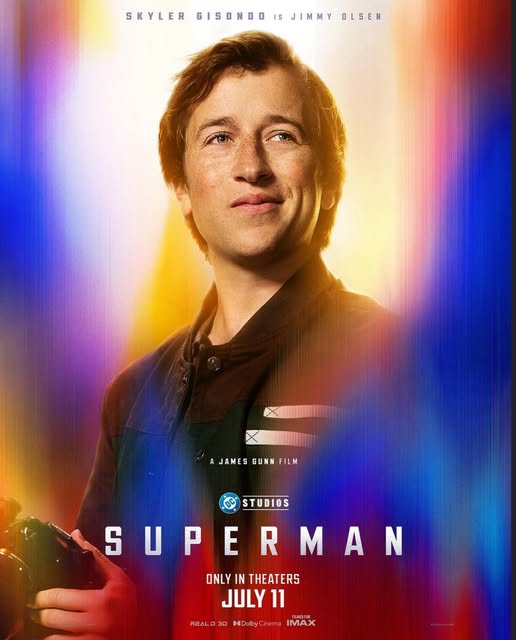
Geek Punditry #65: Howard the Hero?

I am kind of a nerd. I know, I know, I hide it well, but the truth is that I have certain areas of interest about which I am extremely passionate. And one of the aspects of my nerdity that one must be aware of is the fact that I’m a little obsessed with making lists. I’ve been doing it at least since middle school, when I distinctly remember making a paper bookmark upon which I kept a list of every book I read, a list which quickly became too large for a bookmark that fit in anything less than an unabridged dictionary. The list-making obsession hasn’t changed, only the medium. I’ve often said that there are four “quadrants” of pop culture I mostly talk about here in Geek Punditry: movies, TV shows, books, and comics. It should not surprise you that I have a separate app in which I track my activity and make ridiculously detailed lists for each of these quadrants. (That would be Letterboxd, Trakt TV, Goodreads, and League of Comic Geeks, respectively. If you’re on any of those platforms, feel free to follow/friend me.) My wife says that this list-making thing is because of an inherent desire to create some semblance of order and control because in most areas of my life I feel like everything is in a state of permanent chaos and there’s nothing I can do about it. I reply by telling her to shut up, which she understands to mean, “I love you and you’re right, now stop it.”

I might have a problem.

Anyway, on Letterboxd a few years back, I decided to whip up a list of every superhero movie I could find, part of my desire to eventually watch them all. You would think that this would be a relatively non-controversial endeavor, assuming that you’ve never been on the internet. Those of us who HAVE been online at some point, however, are acutely aware that there is NOTHING online so benign that you can’t find SOMEBODY ready to argue about it. In the comments of my list, some people complained that I decided to skip non-English language films (because odds are I’ve never heard of those and I don’t want to dedicate my entire life to tracking them down), fanfilms (because for some reason those are frequently deleted and re-added to the Letterboxd database and I don’t want to have to keep putting the same movies back on again), and “adult” films (because make your own list, you weirdo). 

But what took me by surprise is when someone decided to complain that I left off the movie Howard the Duck. The exclusion had nothing to do with quality, mind you. I included every superhero movie I am even vaguely aware of, even the worst one ever made, by which I mean the Josh Trank Fantastic Four. No, I skipped Howard because – despite the fact that the movie is based on a Marvel comic book – Howard the Duck is not a superhero. He’s a comedy character, usually used in satirical stories, and while he does have adventures and has been known to interact with other inhabitants of the Marvel Universe, that doesn’t make him a superhero any more than it does Peter Parker’s Aunt May. The person who disagreed with me told me that the title of the film in his native country (Brazil) translates in English to Howard the Superhero, which he says indicates that it should be considered a superhero movie, whereas in reality it just made me question what’s wrong with the Portuguese word for “Duck.”

Never forget that THIS was the first theatrical movie based on a Marvel comic book, nerds.

So I decided that, in order to quell debate (note: this is impossible), I should probably come up with an actual definition of “superhero.” This turned out to be more difficult than it seems. You would think it’s obvious – get five different people to make a list of 100 superheroes and chances are 75 names would appear on at least four of the lists. But what MAKES a superhero? I decided to check with Merriam-Webster, which gives me two totally useless definitions. The first is “a fictional hero having extraordinary or superhuman powers,” which fails as a definition because it excludes Batman, and nobody is ever allowed to exclude Batman. The other definition is “an exceptionally skillful or successful person,” which seems kind of dumb because, arguably, Genghis Khan was exceptionally successful at what he did. And let’s not get into John Wayne Gacy.

“Behold! A superhero!”
“Put a sock in it, Diogenes.”

I needed something broad, but not too broad. I pondered, and I eventually came up with not a SINGLE definition, but a list of criteria. I would consider a character a superhero, I decided, if they fit at least TWO of the following criteria:

  1. Superhuman powers and abilities. These abilities need not be inherent, mind you. Green Lantern has no actual super powers, but he has a ring that gives him superhuman abilities, so he counts.
  2. A double identity, although this identity need not be secret. Everyone in the Marvel Cinematic Universe knows that Tony Stark is Iron Man – his ego wouldn’t allow them not to – but he still HAS that second identity.
  3. An identifiable (and toyetic, let’s not forget toyetic) uniform or appearance. This is, I admit, somewhat subjective. What’s identifiable to one person may not be identifiable to someone else. Think of it this way: if someone is cosplaying as a character and that cosplay is easily recognizable to someone familiar with the IP, that character probably meets this criteria.
  4. Fights crime or battles the forces of evil.
All basically the same thing.

What I like about this list is that none of these criteria make somebody a superhero by itself, but each time they’re combined you get closer to that superhero line. It also makes it easy to include anybody that I want, such as Zorro. People often say Superman (who first appeared in 1938) was the first superhero, and he is certainly the character who named the genre, but I don’t think it’s true that he’s the first. He was preceded by several characters who meet many of the criteria I’ve listed. Zorro (1919), the Lone Ranger (1933), and the Green Hornet (1936) all meet categories 2-4. The Shadow (1931) and the Phantom (also from 1936) meet all four. Even the Scarlet Pimpernel (1905) hits categories two and four. If anything, Superman is the first comic book superhero, and I’m sure even that is open for debate. As such, I included all of these “proto-heroes” on my cinematic superhero list.

Fun Fact: Canonically, the Lone Ranger is the Green Hornet’s great-uncle.
Less Fun Fact: Both of these movies are embarrassments that should never have been made.

Of course, even my criteria leaves a lot of room for debate. There are plenty of characters that one usually doesn’t think of as superheroes that fit at least two of the criteria. Harry Potter, for instance, has magical powers, fights evil, and has a very distinct appearance. The same can be said for Luke Skywalker. One could even argue that any Star Trek character from a race with psychic or shapechanging abilities would qualify. Are Spock, Odo, and Counselor Troi superheroes, or do their powers not count since they’re not unusual for members of their respective species? There are certainly people who would argue that all of these are superheroes, and while I wouldn’t put them on my personal list, I don’t know that I could effectively argue against their inclusion either.

Where, exactly, do we draw the line?

What about Indiana Jones? He fights evil. He’s easily cosplayable. And his real name is Henry Jones, Jr. Does his nickname qualify as a second identity? How about James Bond? He fights evil all the time. The uniform is a little harder to quantify – the most iconic Bond look is a tuxedo, but anybody can put on a tuxedo. And the second identity…does being Agent 007 count? Back in the day there was the fan theory that “James Bond” itself was a pseudonym passed down to whomever was Agent 007 at the time, which was a theory I liked and would most certainly qualify, until the film Skyfall quashed that theory for good.

Some people may ask what difference it even makes. We’re talking about fictional characters, after all. Who cares which ones do and do not count as superheroes? To those people I say, “Oh good for you, you’re far more well-adjusted than those of us who debate these sorts of things on the internet, please stay that way.” 

For the rest of us, I know that my attempt to define the term has probably caused more debate than it stopped. Sorry about that. If you’ve got a better definition than I do (or than Merriam-Webster does) I would love to hear it. And I’d even like to hear some unusual characters that you would say meet the criteria. But in the meantime, the only thing I can really say is that when it comes to a superhero, I know one when I see one.

And Howard, I’m sorry, it ain’t you. 

Blake M. Petit is a writer, teacher, and dad from Ama, Louisiana. His most recent writing project is the superhero adventure series Other People’s Heroes: Little Stars, now complete on Amazon’s Kindle Vella platform. He looked up the Portuguese word for “duck.” It’s “pato.” Why didn’t Brazil just call the movie “Howard o Pato”? 

Geek Punditry #62: Playing Favorites With Superheroes Part Two

We’re back again, folks, with the second round of PLAYING FAVORITES with superheroes. For those of you who are new, in “Playing Favorites” I choose a topic and ask my friends on social media to suggest categories for me to discuss my favorite examples. This time around the topic is superheroes, and in the first installment I discussed my favorite legacy superheroes, superhero logos, superhero TV shows, super-pets, and superhero costumes. This time I’m dipping into the list of suggestions and pulling out a few more topics to ramble about. Join me, won’t you?

Origin Stories

Lew Beitz is back, this time asking what my favorite superhero origin stories are. I’m running with this because it gives me a chance to share with you my personal feelings on origin stories, which are thus: in this day and age, origin stories are largely unnecessary. In the early days of the superhero, before all the tropes were codified and the rules established, it may have been a requirement to explain how Alan Scott became the Green Lantern or where that humanoid robot called the Human Torch came from, but when’s the last time you saw a truly ORIGINAL origin story? Most of them, even with good characters, are remakes and rehashes of origins we’ve seen before. As early as 1962 Stan Lee recognized that it was getting hard to come up with an origin that hadn’t already been done, so he just decided these five kids he was writing about were all BORN with their powers and called them the X-Men. This, of course, turned out to be a decision of almost obscene serendipity, which would also be a great name for a rock band.

“Metaphor, schmetaphor, I’m just out of ideas.”

Furthermore, in a world where even someone who’s never touched a comic book is intimately aware of superhero tropes through movies and TV, does it really matter anymore? Think about this – one of the best superhero movies ever made was Pixar’s The Incredibles. It’s a great film. It’s a great SUPERHERO film. But do you know how Mr. Incredible and Elasti-Girl got their powers? No. Do you care? No. No more than it matters what compelled every single character on a medical drama to be a doctor or every officer on a police procedural to become a cop. I’m not saying that we should never tell an origin story again, I’m just saying that unless you’ve got a really interesting and compelling take, do it away with it via a line or two of expository dialogue. The origin is almost never a character’s best story, and if it IS, then that’s not a character who’s going to be around very long. 

All that is to say that, like with the costume, Spider-Man probably has the best origin story in comics. Earlier characters usually had very clean origins – Superman is an alien from a dead planet, Captain America became a super-soldier through a government experiment, etc. Others had good motivation, like Batman wanting to avenge the deaths of his parents or Plastic Man being a criminal whose life was saved through an act of kindness and decided to join the side of angels. But with Spider-Man, the origin took a new level. No, not the part about being bitten by a radioactive spider – that’s how Peter Parker got his POWERS, that’s not what made him Spider-Man. What made him Spider-Man was the death of his uncle, Ben Parker. I don’t think I need to recount how it happened (there are three stories that NEVER need to be filmed again, no matter how many reboots happen: the explosion of Krypton, the deaths of Thomas and Martha Wayne, and the murder of Ben Parker), but WHY it happened matters. Ben died because his nephew did not take the opportunity to do the right thing when it was presented to him, and Peter has been trying to atone for that original sin ever since. Sure, there are a lot of heroes who are motivated by the death of a loved one, and I can’t even say for certain that Spider-Man was the FIRST hero who bore a personal sense of responsibility for his loss, but he is certainly the most notable.

The leading cause of death for male actors age 65-80 is “Playing Ben Parker.”

Incidentally, this is also the reason I think the Tom Holland trilogy of Spider-Man movies in the MCU is nearly perfect. Even though we never see how Pete got his powers in the MCU, the three movies do the job of the emotional component of his origin beautifully. In the first film, he has to learn what it really means to be a hero. In the second, after Tony Stark’s death, he has to learn how to be his OWN kind of hero. And in the third, which pulls a fantastically unexpected twist on the traditional Spider-Man origin, he learns the COST of being a hero. It’s not until the final moments of No Way Home, Tom Holland’s sixth film wearing the costume, that he truly, fully becomes Spider-Man.

Publisher Jump

Duane Hower asked an interesting question about my favorite superheroes who have changed publishers over the years. This has happened more often than you might think. There have been a lot of characters who have moved from one publisher to another, often because their original publisher went out of business and sold or licensed their characters to somebody else. DC Comics, for example, has absorbed the heroes from lots of defunct publishers, including Quality Comics (Plastic Man being the most notable of their characters), Charlton Comics (giving them the likes of Blue Beetle and the Question), Jim Lee’s Wildstorm (featuring the WildC.A.T.s and Gen 13) and Fawcett Publishing (original home of the Shazam family). Marvel has done this as well, buying the heroes of Malibu Comics, especially their Ultraverse line, but unlike DC they buried their purchase and still show no signs of doing anything with them nearly 30 years later.

If you go to the Marvel Comics commissary this picture appears on all of the milk cartons.

My favorite character from this category, aside from Shazam and the Blue Beetle, is probably Magnus: Robot Fighter. Originally published by Western Publishing’s Gold Key imprint, Western shut down their comic publishing in the 80s (although they have recently resurrected the brand, with a new Boris Karloff horror anthology now being published and a new kids’ comic in the crowdfunding stage). In the 90s, they licensed some of their characters to Valiant Comics, who used Magnus and Solar, Man of the Atom, as the cornerstones for their own superhero universe. Magnus was a hero from the distant future of 4000 A.D., a world where sentient robots were beginning to run wild and had to be battled, which means ChatGPT got here nearly 2000 years early. I loved that book, and when Valiant itself went under the license for Magnus and the other Western characters began to bounce to various publishers, including iBooks, Dark Horse, and Dynamite. None of those ever had the zing of the Valiant version, though. I don’t know who currently owns the license, but I kind of hope that now that Gold Key exists again, they’ll make an effort to bring back the original.

Pictured: The moderators of every comic book group on Facebook that’s trying to stop members from posting AI art.

The other way a hero can bounce publishers is if it is not owned by the publisher itself, but rather the creator, who moves to different publishers over time. For example, Matt Wagner’s titles Grendel and Mage were originally published by Comico, but after that publisher died he took them to Dark Horse and Image, respectively. Kurt Busiek’s Astro City started at Image Comics, moved to Jim Lee’s Wildstorm (published via Image), then moved to DC when DC bought Wildstorm. It was published under the Wildstorm imprint for years before moving to DC’s Vertigo line (perhaps the worst fit possible), and recently bounced back to Image.

But the best hero to play the publisher mambo is Mike Allred’s Madman, a character published by Tundra Comics, Dark Horse, Image, and Allred’s own AAA Pop over the years. Madman is a modern take on the Frankenstein story (he even uses the name “Frank Einstein”), a hero who was brought to life in a reanimated corpse and doesn’t remember his previous existence. The book is full of wild sci-fi concepts and can go from hilariously funny to deeply philosophical at the turn of a page. It’s been too long since there was a new Madman story, so if you’re listening, Mr. Allred, please bring him back. I miss him.

I know it’s hard to believe, but this comic is even cooler than it looks.

Cursed By Their Powers

My uncle Todd Petit, who gave me some Green Lantern and Legion of Super-Heroes comics when I was a kid and thus is largely responsible for half the things I write about, asked who my favorite characters are with powers that are “as much a curse as a blessing.” It’s an interesting trope, isn’t it, to have superpowers that ruin your life? It’s an idea that gets used again and again, because when it’s done well, it works like nobody’s business. The Hulk is probably the most well-known example, a man who transforms uncontrollably into a manifestation of his own Id and breaks tanks. Then there’s Rogue of the X-Men, whose power makes it impossible to have physical contact with another human being without stealing their powers, their memory, and potentially (if the contact is prolonged) their lives. It really makes Halle Berry’s Storm seem tone deaf in the first X-Men movie when she tells Rogue there’s nothing wrong with her, and every time I watch it I hope for the deleted scene where Anna Paquin tells her, “The hell there isn’t.” 

Anyway, I think there’s one story that expresses that concept better than any other. And that story?

Project: ALF.

If I ever go through a whole “Playing Favorites” column without posting this, consider it a signal that I have been abducted and am being held hostage.

No, of course, my favorite “cursed by his own powers” hero is Benjamin J. Grimm, the Thing, of the Fantastic Four. Put yourself in Ben’s position for a minute. Your best friend convinces you to help him steal a rocketship he built. He ropes his girlfriend and her kid brother into coming along for the ride. The four of you are bombarded with space-rays that give you all amazing powers, but transform your bodies as well. The kicker is, unlike your three teammates, you can’t turn your powers off. Reed Richards can stop stretching, Sue can become visible, and Johnny can quench the flames of the Human Torch, but Benjy is trapped in an orange rock shell 24/7. If anybody in comics has the right to complain that he lost the superhero lottery it’s him.

Instead, he became the ever-lovin’ blue-eyed idol o’ millions.

Too many writers would use this as an excuse to make him a bad guy. He would turn against the team, become the villain, try to exact revenge on Reed – and to be fair, for a long time he was the grouchy and often antagonistic member of the Fantastic Four. But over the 63 years since the characters were created, the opposite has happened. He has become kinder, tender, a beautiful spirit. He could have been the monster, but instead, he is the knight in stony armor. He’s smart, he’s funny, he’s compassionate, and he’s still never afraid to get his hands dirty when the situation calls for it. He made peace with his curse, reembraced his faith, found love, and in recent years has even become a husband and a father. The amazing thing about Ben is how he has persevered and grown despite his “curse.” I think writer Chris Claremont put it best in the Fantastic Four Vs. the X-Men miniseries from 1987, when Ben had his powers taken by the aforementioned Rogue. Claremont, perhaps the purplest prose penner whoever picked up a pen, describes the sensation thusly:

Instantly, as her body is flooded with the Thing’s awesome strength, her awareness is filled with the totality of his being – all he was and is and dreams/despairs of being. She thought she’d be attacking a toad. Instead, she’s touched the soul of a prince.

That’s actually Rogue on the left. She…had a standard MO.

Ben is one of the good ones, is what I’m saying.

Honorable mention goes to DC’s Firestorm. Firestorm has gone through several iterations over the years, but the original Firestorm was created when a nuclear accident (so, so many of those in superhero universes) fused two people together: physicist Dr. Martin Stein and teenage jock Ronnie Raymond. The accident merged them into a single, extremely powerful being who would go on to join the Justice League and then get sued by Ghost Rider for stealing his whole “flaming head” bit.

Clearly, this guy is miserable with his lot in life.

Here’s where the “cursed” part comes in: when Stein and Ronnie were originally fused together, Stein was unconscious. So whenever they merge into Firestorm, Ronnie is in charge and Stein becomes a voice in his head, offering advice but having no control. What’s more, in the early days of their partnership, Stein didn’t even remember being Firestorm whenever he and Ronnie were split, so he was constantly waking up with big chunks of his life missing and having no idea what happened. The reason it’s only an honorable mention is because the writers did away with that part relatively early, and I guess I can understand why. It must be hard to write around the fact that one of your main characters is constantly in fear of a blackout and the other has to find ways around it, and so Stein started retaining his memory of their partnership. Still, I think the idea of a superhero whose life keeps getting screwed up because he doesn’t KNOW he’s a superhero is pretty intriguing, and I bet somebody could do something really interesting with the concept.

Sidekicks

Jim MacQuarrie asks my favorite superhero sidekick. The sidekick is such a weird concept, isn’t it? Going back to the pre-superhero days of Sherlock Holmes and Watson (and certainly even earlier), the sidekick is a character who traditionally exists so that the hero has an audience surrogate to explain things to instead of having to talk to himself. For some reason, when the concept of the sidekick was incorporated into comic books, they got the idea that the best way to handle this was to make them all children or, at most, teenagers, thereby making a large number of superheroes guilty of multiple counts of child endangerment. Choosing a favorite sidekick is actually kind of tricky, because the best ones don’t usually become particularly compelling or interesting until they stop acting as sidekicks and become heroes in their own right – Dick Grayson is far more interesting as Nightwing than he ever was as Robin, Wally West is a better Flash than Kid Flash, and so forth.

I think the best of all time is Tim Drake, the third Robin. Part of it was because he had such a different motivation than his predecessors. Dick Grayson and Jason Todd each became Robins to help avenge their own personal tragedies, much as Batman did, but not Tim. Tim was, to put it simply, a Batman fanboy who figured out that Robin was Dick Grayson because they shared a move he saw Dick perform in the circus as a child. From there it was easy enough to figure out that Bruce was Batman, and he kept that secret until the death of Jason Todd, when he saw Batman begin to be swallowed by darkness and realized he needed a balance. Dick and Jason became Robins to avenge their parents. Tim became Robin to save Batman. 

Of course, being a great sidekick basically makes you “the best of the rest.”

He’s also the smartest of the Robins, with Bruce conceding that he’ll someday be a better detective than Batman himself. The trouble is, ever since Grant Morrison introduced Bruce’s biological son Damian Wayne to continuity and made him Robin, writers have struggled with Tim. Damian has won me over, mind you – he’s become an interesting and entertaining character in his own right – but very few writers in the years since have really known what to do with Tim, including the current writers of the Batman-associated titles. And that’s a shame, because he was such a great character for such a long time.

Different Interpretations

We’ll wrap up this installment with a question by Hunter Fagan, who asked about my favorite heroes with drastically different interpretations in the main continuity. (In other words, like how Batman went from lighthearted and child-friendly in the 50s to dark and brooding in the 80s while ostensibly still being the same character.) I think my answer for this one is going to be Jennifer Walters, the She-Hulk. Jennifer was a lawyer who was injured in a gang shooting and had to get a blood transfusion from her only available relative – who turned out to be her cousin Bruce Banner, the Hulk. The result is…well, it’s right there in the name, isn’t it?

Comic books reached their peak in 1989. Change my mind.

In the early years, Jen was kind of bland. She wasn’t AS angry as the Hulk, she kept her wits about her better than he did, she beat up bad guys, repeat. After her book got canceled, she wound up joining the Avengers and started to become a more well-rounded character. She joined the Fantastic Four for a while, temporarily replacing the Thing (he was really mad at Reed Richards during this period) and became a favorite of writer/artist John Byrne, who brought her back to her own series in 1989. This new series was where the She-Hulk I love was fully formed: smart, funny, constantly winking at the audience and knocking down that fourth wall with all the strength that would be implied by a Hulk. (It should be pointed out that this was two years before Deadpool was created and even longer before he began breaking the fourth wall himself.) Since Byrne’s She-Hulk most writers have kept the lighthearted tone, although few of them have had her speaking to the writer or expediting her travel by having the reader turn the comic book page the way Byrne did. And say what you will, I thought Tatiana Maslany’s portrayal of the character in the titular Disney+ miniseries was spot on, and I still hold out hope that she’ll be brought back in some capacity.

And thus we end another installment of Playing Favorites, guys. I didn’t get to every suggestion – some of them were a little too similar to others, some I just didn’t have much to say about, and some I just ran out of room. But it’s always a blast to do one of these, so if you aren’t following me on Facebook or Threads (@BlakeMP25), you should do that! Because it’s only a matter of time before a new category comes to mind and I ask you all to help me Play Favorites again.

Blake M. Petit is a writer, teacher, and dad from Ama, Louisiana. His most recent writing project is the superhero adventure series Other People’s Heroes: Little Stars, now complete on Amazon’s Kindle Vella platform. Barely a mention of Superman this week. There. Ya happy?

Geek Punditry #61: Playing Favorites With Superheroes Part One

It’s time once again for PLAYING FAVORITES! It’s that semi-regular Geek Punditry mini-column in which I throw out a topic to you, my friends in the world of social media, and ask you to suggest different categories in which I discuss what I consider to be the best of the best. This time around, the topic is superheroes. Born in the pages of American comic books, but with roots in pulp magazines, myth, and thousands of other sources, the superhero is considered to be the modern mythology, with pantheons not only in comics, but in movies, TV, video games, and pretty much every other media you can name. And I am, it cannot be understated, a fan of the superhero. So what, then, are some of my favorites?

Legacy Heroes

Sandy Brophy is going to kick things off for us by asking for my favorite legacy heroes. A “legacy” hero, for those of you who may not have been reading comic books since you were six years old, is the term used when a superhero’s name and identity is passed on from one person to another. For example, in the early days of comics, the Flash was a college student by the name of Jay Garrick. After superheroes fell out of favor and stopped being published for a while, they were resurrected in the 1950’s with the creation of a brand-new Flash, this time a police scientist named Barry Allen. Barry was the Flash for a long time before dying in Crisis on Infinite Earths (it took longer than usual, but eventually he got better), and his nephew/sidekick Wally West, aka Kid Flash, took over as the new Flash.

And so on, and so on, and so on.

This also, by the way, is my answer to Sandy’s question. The Flash is undoubtedly my favorite legacy hero in comics. By the time I started reading comics Wally was the main Flash, and even decades later he’s still the one I feel is most compelling. He was young when he became the Flash, and thanks to the magic of comic book time I eventually caught up with him at the same time he was being written by Mark Waid, who turned him into a fully fleshed-out and wonderfully realized character in his own right. He got married, had kids, and he grew and matured. He was also – as Waid said – the first sidekick to “fulfill the promise,” in other words, to take over for his mentor. He’s also still, to the best of my recollection, the ONLY one to do so on a permanent basis. It’s true that Dick Grayson (the original Robin) became Batman for a while, and Captain America’s sidekick Bucky took up the shield when Steve Rogers was temporarily dead, but both of them reverted back to their other adult IDs (Nightwing and the Winter Soldier, respectively) when the original came back. Not so Wally. Barry returned and Wally stuck around, and although there’s been a lot of timey-wimey nonsense and attempts to sort of push him to the side, he’s bounced back. Wally is, again, the primary Flash, even in a world where Jay and Barry exist, and the nominal head of the Flash family. And he’s just the best.

There are other good legacy heroes, don’t get me wrong. I enjoy the Jaime Reyes version of the Blue Beetle (although my heart will always belong to Ted Kord, himself the second Blue Beetle following Dan Garrett), and there are few who will argue that Kamala Khan hasn’t done more with the Ms. Marvel title than either of her predecessors, but Wally West is the ultimate legacy hero in my book.

Superhero Logos

My buddy Owen Marshall wants to know what some of my favorite superhero LOGOS are – those titles that splash across the cover of a comic book to (hopefully) let you know what you’re about to read. I’ll talk about what I think makes a good logo in general, then get into specifics. I think a great logo is something that stands out in a way that evokes the hero in question. The Superman logo, for instance, is relatively simple – his name, slightly curved, with drop letters that give it a sense of weight, of solidity. Any time you see that logo you think that somebody could just grab it off the cover – and, in fact, there have been many covers where that very thing has happened.

You can’t beat a classic.

Spider-Man’s original logo is great for similar reasons. It’s solid, but it’s also easy to partner up with a web in the background to help get across the idea that you’re dealing with a wallcrawler. And, like Superman, it’s a short enough logo that it’s very easy to add an adjective to the title (as in the AMAZING Spider-Man, the SPECTACULAR Spider-Man), but just as easy to drop a subtitle underneath (Spider-Man: Renew Your Vows). There have been many attempts over the years to create a new Spider-Man logo, but frankly, there’s never been one I like as much as the original, and it seems it’s never anything but a matter of time before they return to it.

Yeah, that’s the stuff.

The Avengers also have a fantastic logo. They’ve had several, of course, but I’m specifically talking about the most famous version, the one that Marvel Studios used for the basis of its movie design. It’s clean and bold, and the arrow in the letter “A” gives it a sense of forward motion that sort of plants the idea that these are heroes who are about to go out and DO something.

The arrow is in case you forget and try reading it right-to-left.

Green Lantern has had a great many logos over the years, many of which actually include a lantern, but my favorite doesn’t. I like the logo that premiered in 2005 with Green Lantern: Rebirth and which remained the primary version of the logo until just a few years ago. This version has that tilt to one side and a cool roundness to it that…okay, just hear me out on this…it makes me think of classic cars from the 50s. Smooth, sleek, fast…and those are words that apply to Green Lantern, especially the Hal Jordan version. 

And it’s all spacey and stuff.

I could probably spend an entire month just going through different logos, but I’m just going to cap it off here by saying that there are hundreds of awesome logos and if you want to read more about them I highly recommend the blog of comic book letterer and designer Todd Klein, who frequently makes posts where he discusses the design and history of comic’s greatest (and worst) logos, which is like drinking mother’s milk to a nerd like me. 

Superhero TV (pre-2000)

My old friend Patrick Slagle wants to know my favorite superhero live action TV shows. Well that’s easy! There have been SO many to choose from – Stargirl was great, and I was deeply enamored of Legends of Tomorrow, and then there was–

Oh, wait.

He specified shows from BEFORE the year 2000. Well. That makes it a lot more difficult. We’ve been in a superhero renaissance in the last decade or so, guys, with such an abundance of shows that even I haven’t gotten around to watching them all yet. (Peacemaker, for example, is still warming my “to-watch” list.) But if I’m going to restrict myself to the cultural wasteland that was 1999 and earlier, I guess there’s only the obvious choice.

Project: ALF.

If I don’t do this at least once in every Playing Favorites column the Don said he was gonna break my thumbs.

The superhero shows of my formative years…let’s be honest guys, they weren’t that great. The two most fundamental ones are probably the Bill Bixby/Lou Ferrigno Incredible Hulk and Lynda Carter as Wonder Woman. And while those are both good shows, neither of them were series I would watch on repeat, the sort of thing that makes a TV series worm its way into my psyche and become a part of the vast tapestry that is your friendly neighborhood Geek Pundit. And the truth is, a lot of the other shows of that era don’t hold up. Look at the 70s Amazing Spider-Man or Shazam! shows and try to convince me that these are fundamental pieces of Americana. The Greatest American Hero is a show I know I used to watch, plus it’s got the most earwormy theme song in superhero history, but I couldn’t relate the plot of a single episode after the pilot. It got better later, with the surprisingly decent Superboy TV series (mostly after Gerard Christopher took over the role from John Newton) and the “fun but fluffy” era of Lois and Clark: The New Adventures of Superman.

There are some wild swings in quality happening in this picture.

If I have to pick (and I do, it’s my damn game), I guess I’m going to have to give props to the two shows that I think launched the genre on TV: George Reeves in The Adventures of Superman and the Adam West/Burt Ward Batman show from 1966. I’ve always had a complicated relationship with the West/Ward era. When I hit those peak teenage years of arrogance and knowitallitude that most of us go through, I began to actively dislike that show, blaming it for people treating comic books as childish and infantile for decades after it was off the air and tarnishing the reputation of the caped crusader. Fortunately as I got older, I got over myself, thus disqualifying myself from ever running for elected office, but at the same time getting a sense of perspective. Sure, it wasn’t MY Batman, but I learned to appreciate it for what it was. I’ve softened to the show now. I even watch the reruns on MeTV Saturday nights between Svengoolie and Star Trek.

There’s no school like the old school.

George Reeves, though, I’ve always appreciated. He was the Curt Swan Superman come to life – square-jawed, barrel-chested, friend to all the innocent. But at the same time, he had a wicked sense of humor, showing clear joy whenever he got to take down a bad guy and taking a sly sort of pleasure any time he thwarted Lois Lane’s attempts to one-up him. I love the Reeves Superman and I don’t think he gets the respect he deserves. DC has launched a series of comics featuring the Christopher Reeve Superman as Superman ‘78, and that’s great. I love ‘em. But am I really the only person who would pick up a comic book called The Adventures of Superman ‘52?

Superhero Animals

I really like Marvel’s Scarlet Witch. She’s had several costumes over the years, but the best is the one George Perez whipped up for her for the Heroes Return era. It was red, naturally, which helps you identify her via color-coding, but the design also drew on the character’s Romani heritage, with a rare long skirt and robes that make you think of a fortune teller. All of that builds together and links her to her mystical roots. I’m fairly certain that if I didn’t know who the Avengers were and someone asked me which one I thought was the Scarlet Witch, I’d say, “Well, gotta be the woman in red, and not the tiger girl in the bikini.”

Jim MacQuarrie asked for my favorite Super-Animal, while Lew Beitz wants to know my favorite Super-PET. These two categories are close enough that I’ll talk about them together. They’re not EXACTLY the same, but there’s plenty of overlap. The way I look at it, we can divide super-animals into two categories: the ones that serves as an animal sidekick to the main hero, such as Krypto the Superdog, and those that are distinct heroes in their own right, like Hoppy the Marvel Bunny. The former are characters in established universes, while the latter usually exist in a Disney-esque universe where there are no humans at all, but instead races of anthropomorphic animals running the show.

As far as super-pets go, the Superman family has the deepest – and weirdest – bench to draw from. Krypto the Superdog and Beppo the Supermonkey are both animals from Krypton who made their way to Earth and gained powers like Superman and Supergirl. Supergirl also has a cat named Streaky who gains and loses his powers on a rotating basis thanks to exposure to something called X-Kryptonite (it was the 50s, it was safe to give something a name like that because there was no internet). Then there was Supergirl’s horse, Comet, who was actually a centaur from ancient Greece named Biron that was cursed and trapped in the form of a full horse. He hung around for a couple of thousand years before he met Supergirl and started to assist her on her missions, fell in love with her, and learned he could briefly become human when an actual comet passed close to Earth, allowing him to date Supergirl without telling her who he really –

Stop looking at me like that, I’m not making this up.

Superman is surprisingly indiscriminate about who he gives a cape to.

Anyway, Krypto is kind of the gold standard of super-pets, but there are a few others outside of the Super-Family worth mentioning. Wonder Woman’s kangaroo, Kanga, for instance. Ace the Bat-Hound, who Batman gives a mask to cover the bat-shaped patch of fur on his face and thus protect his secret identity. Chameleon Boy’s pet Proty who, like Chameleon Boy, is a shapeshifter, and fully sapient, and who can and did occasionally impersonate full grown adults, which makes you ask where the hell the Legion of Super-Heroes gets off treating him like a pet. And of course Damian Wayne, the current Robin, has Bat-Cow.

The only superhero who’s a source of 50 percent of the food groups.

Then there are the other types of Super-Animals: anthropomorphic heroes in their own right. Everyone who has heard me talk for five minutes will know that my favorite of these is Captain Carrot and his Amazing Zoo Crew. Created by Roy Thomas and Scott Shaw!, this 80s phenomenon was about a group of superhero animals who got powers from meteors that fell to (their version of) Earth. After meeting a dimension-hopping Superman, they were inspired to become heroes in their own right. The art is cartoony and the premise is silly, but what I’ve always loved about Captain Carrot and company is that their stories – at least in the 80s – weren’t played like cartoons. The plots were straight out of the pages of Golden and Silver Age comics, facing giant monsters and villains with cold-rays and all kinds of classic tropes. They were funny, sure, but not at the expense of the characters, as many of the modern writers who have tried to use Captain Carrot have forgotten. When I say I want a revival of the old-school Captain Carrot, I say it unironically and with love.

By contrast, there’s perhaps the most famous super-animal of the day, thanks to his starring role in an Academy Award-winning motion picture. I refer, of course, to Peter Porker, the Spectacular Spider-Ham. Spider-Ham’s comic hit JUST when I stared reading comics in earnest, and I devoured it. In this hilarious take on the Spider-Man story, Peter was the pet spider of mad scientist May Porker, who accidentally irradiated herself and bit him. The spider turned into a pig while maintaining his spider-powers. When May recovered from the radiation, her memory was erased and she thought she was just a kindly old lady and Peter was her nephew.

Move over, “The Boys,” the REAL heroes are back in town.

I’m not making this up either, but I wish I could take credit for it. The early Spider-Ham comics were a lot of fun, then he disappeared for decades before experiencing a renaissance in recent years. Like Captain Carrot, his modern adventures are sillier and more “cartoony” than the earlier ones, but UNlike Captain Carrot, the cartoony interpretation fits better, and has made him a better character.

My favorite Spider-Ham story, though, is not from the comics and not from the cartoons, but from the mouth of his creator, Tom DeFalco, when I met him at a convention a few years ago. He was signing reprints of the first appearance of Spider-Ham and his other great Spider character, Spider-Girl. I bought them both and told him how much I loved Spider-Ham when I was a kid, and he told how surprised he was when Marvel Comics sent him an invitation to the premiere of Spider-Man: Into the Spider-Verse. He didn’t understand why he was getting an invitation, and someone said, “It’s probably because Spider-Ham is in it.” And DeFalco, shocked, exclaimed, “SPIDER-HAM is in a MOVIE?”

Timeless. 

Favorite Superhero Costumes

My wife Erin, who always cuts the line because nobody else who submits questions has ever made lasagna for me, wants to know what my favorite superhero costumes are, both male and female. I think it was Alex Ross who said that the test of a good superhero costume is whether you could identify the character based just on the name, even if you knew nothing about them. Batman, for example. Green Lantern. Captain America. The 90s was an era where this consistently failed, especially in the X-Men comics and those later characters created by former X-artists. If you showed someone who knows nothing about comics pictures of Gambit, Cable, Maverick, Shatterstar, and Deadpool, then asked them to match the names to the pictures, any correct answers would happen purely because of the law of averages.

But anyway, when I read Ross’s definition, he also used that definition to argue that the greatest superhero costume of all time belongs to Spider-Man. It’s hard to argue with him. Nobody who saw a lineup of the Marvel Comics all-stars would have any difficulty telling that this guy is Spider-Man and not, for example, Wonder Man. And while that’s true of MOST of Spider-Man’s assorted costumes over the years, the original is still my favorite. The black costume is cool-looking, but the ol’ red-and-blues have a brighter, more optimistic tone that suits Spider-Man better. Spider-Man is a hard luck hero, to be sure, but he should never be a depressing, brooding character like Daredevil. (Are you listening, current Marvel editorial?) He’s the guy who should never give up and always finds it in himself to do the right thing, and the red and blue color scheme says that better than any of his other assorted looks. 

I don’t even blame him for admiring his own reflection.

Using the same metric, I also think the Rocketeer has a phenomenal costume. He is literally a human rocket, with a rocket pack strapped to his back and a helmet that evokes the speed and energy of the burgeoning space age. The rest of the outfit, though, with the brown bomber jacket and the jodhpur pants brings in the idea of his aviator background and grounds him in the World War II era where he belongs. 

This picture makes me want to make swooshy noises.

Honorable mention goes to the Flash, Green Lantern (Hal Jordan costume, although I have a soft spot for the one John Stewart wore in the Justice League cartoon) and Marvel’s Nova.

Erin also asked about my favorite female costumes, which I find is a little harder to do going by Alex Ross’s metric. Too many female costumes are designed more for titillation rather than actually identifying the character. And even those that DO clearly identify them often do so via a logo or symbol that marks them, such as Wonder Woman.

I think “Morgan” was the screenwriter of Doctor Strange and the Multiverse of Madness.

Harley Quinn is another one that is pretty obvious, at least in her original costume. The red-and-black color scheme, white makeup, and bangled headpiece brings up the notion of a Harlequin, which of course is the inspiration for the character. She’s changed her look several times over the past few years, and while some of her looks have been pretty good, none of them draw their inspiration from her roots the way her first look does. On the other hand, they’ve come up with a pretty solid justification for her changing her look – once she got over the Joker and dumped his homicidal ass, she doesn’t want to wear the costume that identifies her as his sidekick anymore.

Let’s face it, I could have posted a picture of a random duck here and you still could have pictured Harley’s get-up.

Then there’s Supergirl. She’s had a lot of costumes, the most iconic look being the basic Superman outfit, only with bare legs and a skirt. That’s not her best look, though. For me, my favorite Supergirl costume came from the 1970s, when she wore a loose blouse with a small S-shield over her heart rather than the full-size shield most superfolks wear. I love that look – it still clearly marks her as a member of the Super-family, but it’s very different from anything any of the others wear. Being loose instead of skintight like most superhero costumes, it’s got a freeing quality that speaks to a lighter version of the character in a period where she was working to get out of her more famous cousin’s shadow. It’s such a great look and I never stop wishing they would bring it back.

What can I say? She’s got the look.

That’s about it for this week, guys, but there are plenty of other questions I haven’t gotten to yet. So be sure to come by next week for Playing Favorites With Superheroes Part Two, and if you have a suggestion that I haven’t covered, go ahead and drop in in the comments. Up, up, and away!

Blake M. Petit is a writer, teacher, and dad from Ama, Louisiana. His most recent writing project is the superhero adventure series Other People’s Heroes: Little Stars, now complete on Amazon’s Kindle Vella platform. He realizes he talks about the Superman family a lot whenever he gets on to a superhero discussion, but let’s be honest, people. It’s either gonna be this or Star Trek.

A little star falling to Earth…

I woke up to a strange world this morning. Strange to me at least. It’s a world that hasn’t existed since June of 2021. It’s a world where I did not get up and start thinking about what was going to happen next in Other People’s Heroes: Little Stars.

I guess I should back up a little bit. Several years ago, I had an idea. In and of itself, there is nothing special or unusual about this. This is what people who want to use AI to write or make art will never understand. This is what you simply can’t explain to someone who finds out you’re a writer and says, “Oh yeah? I got an idea. How about I tell it to you and you write it and we’ll split a bazillion dollars?” It doesn’t work that way. The ideas are the easy part. It’s doing something with them that counts.

And the period in which this idea came to me was, frankly, the most fallow period of my life in terms of productivity. For reasons I have gone into multiple times and don’t feel like rehashing now, I had an extended period where nothing was working, from a writing standpoint. Even in that barren era, the ideas were there. I had dozens of them that I started working on and simply abandoned because I couldn’t find any traction. Many of them clung to the themes of parents and their children – sometimes from the parents’ perspective, sometimes from that of the child, sometimes from someone in the middle generation dealing with both at the same time. I liked a lot of the ideas. It was the doing something at which I was failing.

Then an idea came to me for a new story in my Siegel City series. This one would not feature Copycat or any of the previous heroes as main characters (although Copycat would grow to more prominence in the story than I originally intended, it is still not HIS story) but a whole new generation of young heroes…plus one young woman who was desperately trying NOT to be a hero. The trouble with this particular idea was that…well…the Siegel City yarns were all novels and short stories, but this was neither. This was a longer tale, something that would be comprised of multiple mini story arcs that would build together into a larger tapestry before finally colliding in a grand finale. It was less like a novel and more like seasons of a television series or a longform comic book. I would have loved to turn it into a comic book, honestly. That’s my most fervent dream.. I even wrote most of the first issue for such an enterprise. But then it died off, as I am largely a one-man operation. It is possible, if not profitable, to write and publish novels and short stories on your own. But it is far more difficult to do so with comic books. I don’t have a publisher and I can’t draw anything so much as a stick figure, and even those look hideously malformed, so producing a comic book as a solo endeavor was out of the question. (Whenever I tell people this, someone inevitably points out how many friends I have who ARE professional comic book artists, and I reply that yes, they are PROFESSIONALS, and as such deserve to be paid for their work, which isn’t really possible for a guy on a public school teacher’s salary.) 

And so I pushed the story aside, thinking it would join a dozen others in this fallow period as a “nice idea, but didn’t go anywhere.”

In spring of 2021, though, the evil empire called Amazon actually kind of saved me. Amazon was launching a new platform called Kindle Vella, in which writers could serialize stories a chapter (or “episode,” as they called it) at a time. That…actually sounded pretty good. I would have the ability to do a longform story without having to pace it like a novel. I could do my arcs. I could take breaks in between, if necessary. And the chapters, as a constraint of the platform, could be no longer than 5000 words. Even in this awful, rudderless time, I thought, I could do 5000 words a week.

And so I did. In June of 2021, I dropped the first three episodes of what had become Other People’s Heroes: Little Stars. It was the story of Andeana Vargas, a high school senior whose mother, Carmelita, was secretly the world-famous and universally-beloved superhero called Shooting Star. Everyone who knew her mom’s secret also knew Andi, and expected her to grow up to be a hero herself, even though Andi had no intention of doing so. Then, at the end of that third chapter (this was important, because on Vella the first three chapters are free, so ya gotta have a hook), a video is leaked to the press that shows Andi’s mother removing her mask and revealing her true name to the world. Where did the video come from? Who made it? And what were they going to do now that their greatest secret was no secret at all?

This past Sunday afternoon, while the Detroit Lions were winning their way to their first NFC Championship game in three decades, I was doing something that was, frankly, much more remarkable: I finished writing Little Stars. The final two installments will both drop on Wednesday, because the final episode isn’t really a chapter in and of itself but more of an epilogue, and I didn’t think it would be fair to make people wait a week for it after the climax of the story. When I began, I thought the story would take maybe a year to get out of me. Of course, when I started writing the original Other People’s Heroes, I thought it would be a short story, too.

Shows what I know.

Two and a half years of my creative life went into this story, and while the journey isn’t quite over for me (more on that in a minute), I think this is a milestone worth sitting back and appreciating. I never thought it would take this long. I never thought it would be this long. But the final word count for all 119 episodes is a little over 400,000 words. That’s more than most people read in two and a half years, let alone write. For you non-writers who may be asking how many pages that is, it doesn’t matter. Page count is a little useless for a writer. It can change from one edition to the next, change because of page size or font size, and it’s impossible to keep track that way. It’s the number of words that matter to us, because word count is constant unless you revise. For comparison, for my own edification, I looked up the word counts of some of the most famous doorstoppers of literary history.

WAR AND PEACE: 587,287 
LORD OF THE RINGS (All three volumes combined): 579,459
LES MISERABLES: 545,925 
THE STAND (Uncut): 467,812
GONE WITH THE WIND: 418,053 
OTHER PEOPLE’S HEROES: LITTLE STARS: 409,206

I didn’t set out to write my Lord of the Rings, and of course I have no intention of comparing myself to Professor Tolkien (Little Stars, for instance, has considerably less food blogging), but just in terms of how much crap we’ve dumped on the page, I’ve actually chiseled out a spot among the giants here. And I feel like I’ve come out revitalized. I’ve done several short stories in the time since I started Little Stars. I started my weekly Geek Punditry columns right here. I feel like I can create again, and the memory of that time in which I couldn’t chases me like a wild bear I need to escape. I don’t want to go there again.

So the question is…what now?

Well, first I drop the end of the story on Wednesday, and I really hope you’ll all be there for it. This is something that clearly means a lot to me, and I hope I stick the landing. But after that, maybe a little break, and then the revision work will begin for the next iteration of Little Stars.

The thing is, guys, as grateful as I am that the Kindle Vella platform exists and allowed me to crawl out of that nonproductive pit of despair I was trapped in, it didn’t work out that well. Amazon was trying to capture the periodical audience that enjoys apps like Wattpad, but I don’t think it’s carried over like they hoped. Part of that is my own pitiful efforts at self-promotion, of course. I am the worst person on the planet in terms of promoting myself because my paralytic imposter syndrome makes me feel like a snake oil salesman if I try to tell anybody I’ve done something good. But another part is that I don’t think Amazon has done a good enough job selling people on the platform. The “token” system seems to confuse a lot of people, and for some inexplicable reason, when Vella launched it was only available on iOS devices – you couldn’t even read Amazon Kindle Vella stories on an Amazon Kindle. Thankfully they’ve fixed that problem and branched out to Kindle and Android, but the stories on Vella are STILL, last time I checked, unavailable outside of the United States. I didn’t know how many international readers I actually HAD until I started posting about Little Stars and got messages from people asking when it would be available in Australia or the UK. The answer to that, by the way, is, “Soon, I hope.”

So while I like the creative challenge of Vella, I don’t think I would do it again, at least not without some major changes to the platform. What does that mean for Little Stars? It means it’s time for me to revise and reformat. Even though the story wasn’t planned as novels, I’ve figured out what I think are the best places to break it down into three acts, three installments…a trilogy, in other words. I thought briefly about just putting out one ginormous mama-jama book with the entire thing in it, but some wise friends convinced me that the trilogy route was much better. Alexis Braud, if you’re reading this, thank you for pointing out that a 400,000 word book just doesn’t fit comfortably in a purse or bookbag. (There is, however, still just enough of a narcissist in me that I may do a custom printing of that mama-jama edition just so I can put it on my own bookshelf and admire the chunkiness of it all.) 

With this new version, there will have to be some changes to make it fit. So after a little bit of a break I’m going to start revising. I don’t intend to make any massive changes to the story itself, but I will probably tweak the details, fix any continuity snarls that I can find, tighten the story up, and hopefully improve the characters and themes that evolved as I went along. When it’s over, while the Vella version will remain, the novel version will be the “official” history of Andeana Vargas as far as Siegel City canon is concerned, and in any discrepancies between the two, the books will be triumphant.

And then?

I have other ideas, of course. I think I made it abundantly clear that ideas are easy. And two of them are fighting it out right now, both of which are stories I worked on in the past and can’t quite get rid of, which I think is a good sign that they deserve revisiting. One of them is a science fiction epic, a story about two sisters trying to hunt down an inheritance left for them on a distant planet known as Earth. This would technically be a YA novel (or series, if I’m being honest), although I currently have no plans for a love triangle involving a bland, Mary Sue protagonist and a pair of bland, interchangeable heartthrobs. No, this is a story about sisters. And their parents, to some small degree, because I really can’t escape that. But mostly the sisters.

The other story I’m considering would bring me back to Siegel City right away. It’s the story of the oft-discussed but mysteriously missing STAT. I mentioned a few weeks ago that I based STAT on an old City of Heroes character of mine and that I had a whole backstory of his that I wanted to put in a book some day. This is the book I’m talking about. I even found myself working in more frequent references to STAT and dropping some Easter Eggs in the final act of Little Stars, little story seeds that would grow in this hypothetical novel. And yes, once again, this would be a story about parents and children. It’s just THERE.

Or maybe I’ll wake up tomorrow with a totally different idea that I can’t help but get started on. I really don’t know.

But the gap between my last novel, The Pyrite War, and the beginning of Little Stars was nine years. Sure, in that time I kept producing my Christmas stories, a couple of novellas, and my humor book Everything You Need to Know to Survive English Class, but the narrative gap was simply too long. I don’t want that to ever happen again.

So on Wednesday, please enjoy the grand finale of Other People’s Heroes: Little Stars. And then keep coming back to see what I’m working on next. Hopefully you’ll be as surprised by it as I will.

One last note – a special and very sincere thank you to Lew Beitz. Lew and I are moderators on the Comic Book Collecting page on Facebook, and over the last couple of years he’s become not only a friend, but the best darn Beta reader I could ask for. And he may be the only person on Earth who loves Keriyon Hall more than I do. That’s saying something. 

Geek Punditry #54: The Little City That Could

My little Geek Punditry column is about pop culture, especially pop culture that I’m personally interested in. I tried writing about pop culture I wasn’t interested in once, but as it turns out, I found that really boring. Anyway, my pop culture awareness tends to have four quadrants, all of which have been frequent subjects of conversation here: books, movies, television, and comic books. These are the four ways I tend to consume stories, and I’m happy with them. There’s one major area of American pop culture where my awareness remains relatively low, though: video games. I’ve never been a huge gamer. The only video game console I’ve ever owned was one-third of the Sega Genesis my parents got for my brother, my sister, and me to share one Christmas. I play a few mobile games, but those are mostly in the genres of “tell this guy to do a job for 16 hours” or “put the red 5 on the black 6.” I’ve never Called a Duty, I don’t Halo, and whenever people start talking about “the new Madden” I get confused because he died in 2021 and I didn’t know they were planning to reboot him. In other words, I don’t video game much.

But there was a game, many years ago, that I got really into for a while. It was a hell of a game, one that crossed over into my “comic book” quadrant and appealed to me on that level. It was a game that allowed me to conjure up my own superheroes (something I had been doing since I was approximately seven years old anyway) and insert them into a world full of hundreds of other players, fighting alongside them in defense of the peaceful citizens of Paragon City. The game was City of Heroes, and I loved it.

This was, indeed, my jam.

City of Heroes was an MMORPG (massively multiplayer online roleplaying game) that launched way back in 2004. The appeal of the game was that, rather than playing as Superman or the X-Men or any of the superheroes that had scored their own video games over the years, players could create their OWN characters, live their OWN stories. The creation engine was pretty impressive, too – there was a decent array of power types to choose from, and lots of different body types, uniform templates, and colors. You could make a character that looked like pretty much anything you could imagine. At first, I made versions of my own pre-existing characters (my first main character was based on Lightman, a character I’d created back in high school and who later made brief appearances in the world of my novel Other People’s Heroes). I later branched out and made new characters, some of which I enjoyed so much that they stayed with me and made their way into my writing. The often-mentioned but little seen hero STAT from Little Stars was my healer character from City of Heroes. It was a name and visual I really liked, and I wound up writing an entire backstory for him. It was too much work to go to waste. (He’s got his own book in my head somewhere, and I hope to write it some day.)

STAT before and after his cape upgrade. This was a real thing, folks.

The city lasted for several years, and I played a lot – sometimes with friends with whom I had formed a Supergroup, sometimes with random characters I encountered wandering around the massive server. The game kept putting out new content and new stories, eventually expanding into a spinoff game called City of Villains. My main character from THAT game was Malefactory, a villain whose power allowed him to create robotic drones – and if you’re reading Little Stars like all people who are good of heart and statistically likely to win a large amount of money in the lottery next week, you may recognize that Malefactory followed STAT to Siegel City and became that story’s main antagonist. 

Admittedly, the ultimate evil could use more JPEGs.

Anyway, I loved the game. I loved the lore behind it. I loved the fact that a subscription to the game included a subscription to the Top Cow comic book series with stories featuring the game’s legendary NPC heroes like Statesman and villains like Lord Recluse. The comic even included work from some of my favorite writers and artists like Mark Waid, Dan Jurgens, and Troy Hickman (whose Common Grounds is still one of the most inventive and entertaining superhero comics I’ve ever read, and I wish it would come back). The world of City of Heroes just kept getting bigger and bigger, and I was enjoying it and more.

No, actual, physical comic books. They came in the mail. Ask your parents, kids.

And then, like an asshole, life happened.

When City of Heroes first launched I was in my twenties with no family of my own and few responsibilities that really demanded my time. A few years later, things had changed. I became a teacher, a job which you may famously remember was the point of a joke when Richard Dreyfuss said he thought teachers had a lot of free time in the motion picture Mr. Holland’s Opus. I became more active in my local theater company, with rehearsals four nights a week, and more in the last few weeks before a show. I launched a podcast with a friend who lived 90 minutes away, which in those pre-Skype days turned recording a couple of episodes on a Sunday into an all-day affair. I found myself spending less and less time in Paragon City, not because I wasn’t still enjoying the game, but because that time just wasn’t there anymore. 

In early 2011, City of Heroes took an even bigger hit – the launch of DC Universe Online. It was another MMORPG, another game that allowed you to design and play your own superhero characters, but now you could have your characters fight alongside the likes of Batman, the Flash, or Harley Quinn. There were even in-game events that corresponded to stories currently happening in the DC Comics. How could a nerd like me resist? I played DCU Online for almost a year…and then the same time constraints that drew me away from City of Heroes ended that avenue for me as well.

But not before I took this screenshot to prove to my friends that I met Superman and Wonder Woman and that guy in the flying mouse costume.

Even though I hadn’t played in ages at that point, I was sad when NCSoft announced that they were going to shut down City of Heroes in November of 2012. It really was a great game, one that I had always hoped to return to someday, and the knowledge that I wouldn’t have that chance was pretty depressing. But life went on – after all, November of 2012 was also the month I got engaged, and that resulting marriage led to the current little time-eater in my life, my son Eddie. Having a family is the best thing that ever happened to me, make no mistake about that, but it would be dishonest if I didn’t admit there are some things from my younger days that I sometimes miss, like having a quiet place to record a podcast or the free time to be Max Bialystock in The Producers

If parenthood effectively ended my podcasting and stage acting careers, how could I possibly play video games with a small child in the house? No, seriously, I’m asking. I know people who both have children AND an active video game profile, and I don’t know how the hell they can do it. Sure, as Eddie has gotten older I’ve been able to do more reading and writing, or watch more movies, but those are all things that have either a literal or metaphorical pause button that allows me to stop at a moment’s notice if the boy needs attention. That doesn’t work in an MMORPG – how am I supposed to tell my teammates that their healer is abandoning them to fight Lord Recluse without him because the kid just asked me if I wanted to guess how many Uncrustables can fit in the tank on the back of the toilet?

But even though I knew I had no opportunity to play, the fact that it wouldn’t be an option kind of sucked.

Last year, I was made aware that superfans of the game had created their own little outlaw servers to host clones of the game unofficially. Some of those servers had even united as City of Heroes: Homecoming, and were adding in content from the various official editions and updates of the late, lamented game. The servers were funded entirely by donations, and the game was free to play for everyone. When I heard about it, I thought about jumping in, but I hesitated. Time, of course, was still my primary concern, but there was also the fact that the game was unofficial. At any point, I knew, NCSoft could discover the existence of the rogue server, demand it be shut down, and all would be lost. It would be just my luck to find my way back to the game, get really into it again, and then immediately have it taken away. So while I tipped my hat to the heroes who were keeping City of Heroes alive, I stepped aside.

Last week, that changed.

On January 4, NCSoft announced that they were granting an official license to City of Heroes: Homecoming, legally allowing the servers to continue to host the game and add new content. What’s more, this resurrected City of Heroes is STILL funded only by donations and remains free to play.

Second best homecoming ever. Right after Spider-Man, but before the DHS game of ’98.

This is awesome.

It was awesome that there were people who loved Paragon City (and who, unlike me, are tech-savvy) enough to bring it back. 

It was awesome that the community survived and spread the word of something that they loved, looking for other people who loved it like they do, instead of just whining and complaining about its absence.

And it was especially awesome that the company which would have completely been within their legal rights to shut the whole thing down, even though it’s a property that they are not currently using and seem to have no intention of resurrecting, decided instead to make a deal with the fans to allow their project to continue to exist.

Everything about this story is awesome to me.

Nothing has changed about my life, of course. As I type this I’ve got a six-year-old sitting on my hip, bouncing up and down and cheering at a hockey game, so this isn’t a good time to fire up the portal and dive into Paragon City for my triumphant return. I don’t know if that time will ever come, if I’m being totally honest.

But it’s awesome to know that if that time DOES come, the City of Heroes will be there waiting for me. If you’re ever wandering around Paragon City and you happen to run into STAT, the Medical Marvel, that means I’ll have found my way back.

Say hi. Maybe we can save the world together some time. 

Blake M. Petit is a writer, teacher, and dad from Ama, Louisiana. His current writing project is the superhero adventure series Other People’s Heroes: Little Stars, a new episode of which is available every Wednesday on Amazon’s Kindle Vella platform. If any superfans of City of Heroes happen to read this and notice that he got some of the details of the game or the history wrong, go easy on him. Hell, he had to Google the game to remember that it was even CALLED “Paragon City.” It’s been a decade, peeps.