Geek Punditry #117: The Unexpected Virtue of Ignorance

If you teach for a while, you start to learn certain things that students like and dislike. For example, they usually like stickers. Even fully-grown high school seniors have a nigh-childlike reaction if you offer them a sticker for something. On the converse, they dislike when you use certain phrases, such as “please take your earbuds out before class” or “hey, remember when I told you to take out your earbuds?” or “I know you still have your earbuds in, nobody sits casually with their ear pressed against their shoulder at a 60-degree angle.”

I don’t know who invented wireless earbuds, but I guarantee they were not a classroom teacher.

Anyway, something else students tend to not like are unanswered questions. This isn’t a bad quality, in and of itself. Education is the pursuit of knowledge, and asking questions is the best way to gain knowledge. However, some kids take it to an extreme, with an almost pathological hatred for any question that doesn’t have a clear-cut, inarguable answer. This can be difficult when you’re teaching literature, because a lot of great works of literature deliberately leave unanswered questions. For example, I’ve seen kids walk away from the short story “The Lady or the Tiger?” with a harsh, bitter hatred of Frank Stockton. You probably read it in school yourself – it’s the story about a kingdom where an accused criminal’s guilt or innocence is determined by a random test. He chooses between two doors: behind one is a beautiful woman, behind the other a ravenous tiger. If he chooses the one with the woman, he is declared innocent and is allowed to take her for his wife. If he chooses the tiger, he is declared guilty and the tiger is rewarded with a very fresh meal. Of course, the accused has no way of knowing which fate lies behind each door. The story ends before the door is opened, and the reader is left wondering whether the character they’ve been following is going to be devoured or be sent off on his honeymoon.

The kids HATE this.

His editor rejected the original title of “The Babe or the Big, Thicc Chonky Boi?”

“That’s not an ending!” they will shout, and to be fair, they’re right. It’s a story that is famous for its lack of an ending. In fact, Stockton even wrote a far less-known SEQUEL to the story, “The Discourager of Hesitancy,” which is about people trying to find out the ending of the first story. Not only do they NOT learn the answer, though, but they are left with ANOTHER unanswered question at the end of THAT story.

If you’re the type of person who demands closure, this sort of thing will drive you up the wall.

The questions don’t have to be quite that dramatic to draw their ire, either. In act IV of Hamlet – and here I apologize for spoiling a 400 year-old-play – Ophelia drowns. However, her off-stage death is framed in such a way that it’s not entirely clear whether it is accidental or whether she – stricken with grief over the murder of her father by the man she loved – intentionally allowed herself to die. The play does not offer an easy answer to this question. Even the characters IN the play have a debate over it. And when a student asks me to clarify it for them, begs me to tell them if Ophelia’s death was an accident or not, they get really mad when I reply, “Well, what do YOU think?”
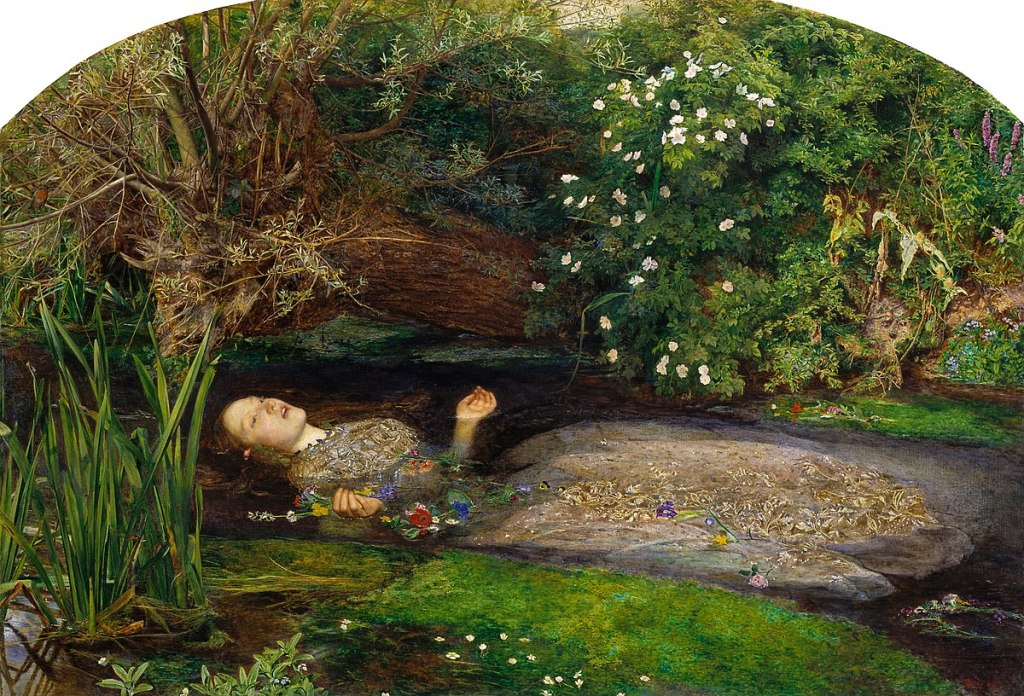
She watched a six-hour Marvel Studios feed of empty director chairs and was reduced to this.

The thing is, there are cases (especially in fiction) where the act of ASKING a question is more important than the answer itself. There is more value, I believe, in debating the nature of Ophelia’s character than there would be had Shakespeare given her a soliloquy before her death explaining her intentions to the audience. And had Stockton told us what came out of that door in “The Lady or the Tiger?”, the story would have been reduced to a rather unremarkable fairy tale, one that would no doubt be mostly forgotten today. 

This isn’t to say that solid endings aren’t important. You’ve no doubt read my diatribe against spoiler culture and why I hate so, so much the way social media devalues the ability of the audience to be surprised. When I say that sometimes it’s okay if a story doesn’t have an ending, that sometimes it’s the journey that matters, it may seem contradictory to that earlier rant. But the truth is, they both come from the same place: a desire to allow a storyteller to tell the story that they intend. If the story is structured in such a way that it builds up to some sort of powerful twist ending, then the polite thing to do is shut up about that ending and let them tell it. However, if a story is NOT intended to build towards a specific ending and, instead, is about exploring the ideas and questions that the story presents, it’s okay if some questions – even MOST of the questions – are left unanswered.

The reason I’m thinking about all this today is because I recently finished re-reading a novel that demonstrates this idea wonderfully, Stephen King’s 2005 book The Colorado Kid. It’s a fantastic book that so, SO many of my students would despise. Published by the Hard Case Crime imprint, The Colorado Kid has none of the trappings of horror or the supernatural that people often associate with King’s work. It is, as the name of the imprint implies, a crime drama, a mystery, but it is a mystery that is left unsolved at the end. If you pick up that book hoping to unravel the clues and decipher the ending, you’re going to be left disappointed. Despite that, I love this little book.

To be fair, though, in terms of misleading covers, it’s up there with the original The Princess Bride.

The story, such as it is, focuses on a young woman with an internship at a small-town newspaper, and an afternoon she spends with two much older gentlemen, the paper’s editor and owner, during which they tell her all about the greatest unsolved mystery they ever came across. Back in 1980, a dead body was found on the beach, propped up against a barrel, its previous occupant having choked to death on a piece of steak. His identity was a mystery, why he was on the beach was a mystery, even the piece of steak turned out to be a mystery. 

The entire book is a conversation between these three people, the two old men telling the girl about their investigation, the girl asking questions, and the discovery of one clue after another that led only to more questions. There are theories, but nothing definitive or convincing, and when you finish the book you’re no more certain about what really happened to the “Colorado Kid” than the old newspapermen are.

What, then, is the point of the book? It’s the obvious question to ask – why would you read a mystery novel with no solution?

Because in this case – and it’s an exceptionally rare case, for a mystery novel – finding the answer is not the point. The death of the Colorado Kid is not the point. The question of how and why he crossed the country in only a matter of hours, abandoning his life on the west coast for what turned out to be his death on the east, is not the point. The point of the story, and the lesson that the young reporter has to learn, is that even when life doesn’t supply us with answers, there’s still a virtue in just ASKING  the questions and seeking the truth. You might not always find the answer – and even if you do, the answer you find may not be the one you wanted – but there’s still satisfaction inherent in searching for them. 

Not everybody appreciates that. Many of my students wouldn’t. Even die-hard Stephen King fans I know found the book disappointing because of its lack of ending, even though no effort is made to hide the fact that it is left unresolved. The old men tell us at the very beginning of the book that the mystery is unsolved, we know that going in, but STILL people got angry. And I suppose I understand why – we’re so used to genre conventions that it’s hard to accept a book that subverts them this way. I’m sure a great many people picked up this book expecting some sort of brilliant insight at the end. Maybe the young reporter would suddenly ask a question that the two old men had never considered, maybe her perspective of time and distance would shed light that would reveal a clue that had gone unnoticed in a quarter of a century, and suddenly we would spiral headlong to the resolution of the mystery, finally tying things up in a neat little bow like we expect from a mystery novel.

But that doesn’t happen. That isn’t this novel. 

Like I said, it’s a book about an IDEA, not a book about a plot, and it’s an idea that I happen to really like.

If you’ve never read this one, give it a try. It’s one of the shortest books King ever wrote – the paperback printing comes in at a brisk 184 pages, and I know a lot of dedicated readers who could get through it almost in real time, spending the afternoon with the newspaper trio. And even if Stephen King isn’t the kind of writer you usually read, this one is so atypical of his usual output that I think a whole different audience can tap into it and enjoy it. 

Provided you go into it looking for the right things, of course.

Blake M. Petit is a writer, teacher, and dad from Ama, Louisiana. His most recent writing project is the superhero adventure series Other People’s Heroes: Little Stars, volume one of which is now available on Amazon. You can subscribe to his newsletter by clicking right here. He’s also started putting his LitReel videos on TikTok. He knows that some people can’t handle leaving something unfinished, but the thing to remember is

Geek Punditry #113: The Medium is Killing the Message

When you teach the same subject for long enough, there are certain topics and certain lessons you start to look forward to. One of my favorite things to cover with my 12th grade English students, for example, is Hamlet, and I particularly look forward to the famous “To be or not to be” scene. I always start by telling the kids that this is the big one, the grande supreme enchilada, the most famous speech that Willie Shakes ever wrote which, by proxy, also makes it one of the most famous speeches ever written in the entire history of the English language. Then I look at the kid who has already volunteered to read the speech out loud and say, “No pressure.”

Here’s a level three nerd joke. Ahem: “Took him 900 years to get this part right.”

After we read and discuss the speech together, I show them clips of several different film versions of Hamlet. We talk about how different actors play the role, how the different settings change their interpretation of the scene, and fun English class stuff like that. The most entertaining version – to me, at least – is when we watch Ethan Hawke’s depiction of the scene from 2000. In this version, director Michael Almereyda has changed the setting to the modern day (or at least, what was modern in 2000) and has Hamlet deliver this speech wandering the Action Movies section of a Blockbuster Video store. But I’m showing this to contemporary high school students. Even the oldest of them wasn’t born until 2007, and the vast majority of them have no idea what they’re looking at. Popular guesses include a gas station, a convenience store, and a bookstore. The ones that DO recognize Blockbuster Video, I assume, do so because they’ve seen Captain Marvel.

The weird thing is, after updating the setting, they kept the headgear 100 percent historically accurate.

It’s funny to me, to see the cultural disconnect between the film and the modern audience. No doubt Almereyda intended to make the movie contemporary, but in choosing that particular setting, this film feels even more dated than a traditional version of Hamlet set in the 7th century. And the percentage of my students who know where Hawke is before I explain it gets smaller with each passing year. These are kids who have never – and WILL never – browse the video section of a store.

And as entertaining as the lesson usually is, the fact that this is an artifact of times gone by makes me a little sadder each year.

I grew up in the 80s. I was in high school and college in the 90s. The peak of Video Store Culture is intertwined with the most important developmental years of my life. I remember as a kid, my parents taking us down to the video store and letting us roam the aisles looking for movies to watch. My younger brother and sister would gravitate towards the kids’ movies, and while they would pour over the shelves trying to make their own decisions, I found myself drifting to sections of the store I knew my parents would NEVER allow us to rent from, especially the horror section. Ghoulish monsters, blood dripping down faces, whatever the hell was going on with the box art for The Stuff…I was mesmerized. 

9-year-old me would have TRADED my brother to find out what was going on here.

VHS box art of the 1980s was a unique art form that has no peer in the history of pop culture, save perhaps for paperback book covers of the same era. Great box art could make even the lamest, cheesiest low-budget schlockfest seem tempting. But my folks weren’t the sort who would allow a 9-year-old kid to rent something like Creepshow no matter HOW enticing the box art was. So those movies found a home in my psyche only in poster form, which is how they remained until I was old enough to rent them and watch them myself. At which point – let’s be honest – I discovered that a great many of those movies were better as box art than they ever were as films. But that was okay.  

As I got older and went to video stores myself, I would gravitate to all kinds of movies, devouring things that I’d been curious about for years but had never been able to indulge in before. Not just horror, but classic sci-fi, old comedies, or indie darlings I’d heard good things about like Magnolia. It didn’t hurt that around the time I graduated college, my best friend Jason became the manager – and eventually owner – of the video store I most often patronized, so I got to sample an awful lot of movies for free. And as culture shifted from VHS to DVD, I went from being simply a viewer to a collector. I would go to Best Buy, Circuit City, Borders, or Barnes and Noble and spend hours walking through the shelves, examining the DVD cases, trying to find old favorites to add to my shelf or new movies I’d never heard of that were worth a watch. I could do this alone, but it was more fun to do it with Jason or our other friends. Either way, though, there was a tangibility to holding those cases in my hands, reading the description on the back, studying the list of special features to see if there was a good making-of featurette or commentary track that would be worth listening to or – of course – admiring the cover art.

This is a pleasure that has largely been lost to us. Netflix slaughtered the video store in its sleep, and of those retail stores I mentioned the only one that both still exists and has a physical media section at all is Barnes and Noble, and it’s nowhere near what it used to be. And while I know that we always lose certain cultural elements as time passes and culture evolves, this is one of those changes that has hurt not only the people who make these movies, but the consumers who watch them as well. 

It’s the streaming era I’m talking about, of course. That’s what killed the video store, that’s what has DVD and Blu-Ray sales on life support. (Thank God for horror movie fans, one of the last stalwart groups to demand physical media for their preferred art form. They’re the ones keeping the whole thing alive right now.) Sure, the convenience of streaming can’t be beat. I don’t need to go down to the video store anymore. I don’t need to HOPE that the movie I want to watch will be available. I don’t have to take the risk that I’ll get a disc with a scratch that has rendered it unplayable, and never again will I need to double-check that I’ve rewound a tape before I return it.

Was there anything worse than opening the DVD case at home and seeing THIS?

But this same convenience has made the entire movie-watching experience feel more disposable, like it doesn’t matter anymore. If I went down to Jason’s video store hoping to rent Scream 2 only to find that it had already been rented, that’s when I would look for something different and discover movies that I may otherwise have never watched, like Amelie. With streaming, you just have to hope that the movie you want is on a service you subscribe to, and if it is, there’s no need to roam.

But even if the movie you want ISN’T on your service, or even if you don’t know what you want to watch, the browsing experience isn’t the same. In a store, looking at a movie case, you had the opportunity to pick it up, read the back, gaze at that beautiful, beautiful cover art. Today, every movie is reduced not to art, but to a thumbnail. Most of the time it’s a still shot from the movie, probably a close-up of the biggest star in the film, with the title superimposed on top of it. It’s bland, lifeless. Just as the greatest box art could make me watch the worst movies, so can a cookie-cutter thumbnail cause me to scroll right past one of the best movies of the year, and I’ll never know. 

We’ve lost the community aspect as well. For people like me, TALKING about the movie after I’ve watched it is just as vital a part of the experience as actually watching it. Discussing what we liked, what we didn’t like, what did we think the sequel would be like, should there even be a sequel at all? At the video store, you can chat with other customers. “What are you getting? Oh, I’ve seen that one, that’s great. Say, I really liked From Dusk ‘Till Dawn but I’m not sure what to watch next. Any suggestions?” Sure, the streaming services TRY to do this, but I would take the suggestion of a random film geek in a video store over the Netflix algorithm every second of my life, and it wouldn’t even be a struggle.

Netflix has “We think you’ll love these.” Your local video store had “Vinnie’s picks.” Nobody ever saw Vinnie. No one knew who he was. But Vinnie introduced you to Boondock Saints and you LOVED him for it.

And with this, the respect given to a movie by the audience is being cut down. I know a lot of people who’ll stop a movie if they aren’t engaged in the first five minutes. And sure, that’s your prerogative, but there’s something to be said for a slow burn. Some movies need to be given time to get into the story, and sometimes that’s what makes it effective. In the video rental days, once we made it home with a movie we WATCHED the damn thing, no matter how bad the first five minutes were, because that was our only option. And I think we were better for it. I don’t want to tell you that you should sit around watching something you don’t like, but the disposability of entertainment has caused us to forget how to give a story a fair chance. I can spend twice as long scrolling through the options on Hulu than I ever did looking at the DVDs at Borders, but I’ll end up far less satisfied.

Then there’s the way movies are presented today. TVs have, for the most part, gotten substantially larger than they were when I was a kid. You would think that would make the viewing experience better, but somehow the opposite has happened. My students, my nieces and nephews, are more likely to watch a movie on their Chomebook, their tablet, or – worst of all – their PHONE. Not to say I’m not guilty of this at times – when my sports fanatic son is bound and determined to watch a lacrosse match between two colleges I’ve never heard of with an announcer who has all the life and energy of the sloth from Zootopia, minus the personality, I’m certainly not above pulling up an episode of Star Trek on my laptop. But it’s not my preferred method of watching anything, and the idea of watching an entire motion picture on a phone screen is giving me a migraine. But to kids today it’s common. I’ve had students tell me they’ve watched entire movies chopped up into two-minute segments and posted (in portrait mode for the love of God) to TikTok, a practice which I’m pretty sure is directly responsible for the sharp rise in instances of bird flu in the United States.

I took this picture myself just to illustrate my point and it STILL makes me want to punch me in the face.

The only thing that mitigates the sting for me is that I know I’m not alone. I have many friends – both in real life and on social media – who join me in bemoaning the decline of video store culture, and while there may not be enough of us to bring that culture BACK, it helps to know that other people feel the same way as you do. Coincidentally, on the same day this week my students were confused by the Blockbuster store in Hamlet, I listened to an episode of the Movie Crypt podcast in which filmmaker Alex Ross Perry discussed his new documentary Videoheaven, a “video essay” (in his own words) about the rise, influence, and fall of the video store told through clips of movies and TV shows featuring video stores. The movie is almost three hours long, he says, and frankly, it sounds amazing. I am very excited about this film and very anxious to get a chance to watch it.

I’ve never met Mr. Ross Perry, but just based on this poster, I suspect he’d be my kinda people.

Ironically, I’ll probably have to wait until it comes to streaming.

Blake M. Petit is a writer, teacher, and dad from Ama, Louisiana. His most recent writing project is the superhero adventure series Other People’s Heroes: Little Stars, volume one of which is now available on Amazon. You can subscribe to his newsletter by clicking right here. He’s also started putting his LitReel videos on TikTok. Yes, he’s old. You wanna make somethin’ of it?

Geek Punditry #85: Playing Favorites With School (Part Two)

It’s time for round two of Playing Favorites With School! For any newcomers out there who, perhaps, didn’t see last week’s life-changing exploration into pop culture effluvia, “Playing Favorites” is my recurring feature in which I ask my friends on social media to suggest categories related to a specific topic, then I expound upon what I think are some of the best examples of those categories. In part one of the “School” series, I talked about some of my favorite School Sitcoms, High School Superheroes, High School Horror movies, and shows where the actors were maaaaaybe a little too old to be playing teenagers. This week we’re returning to the pile of suggestions for a few more rounds!

Hero Schools

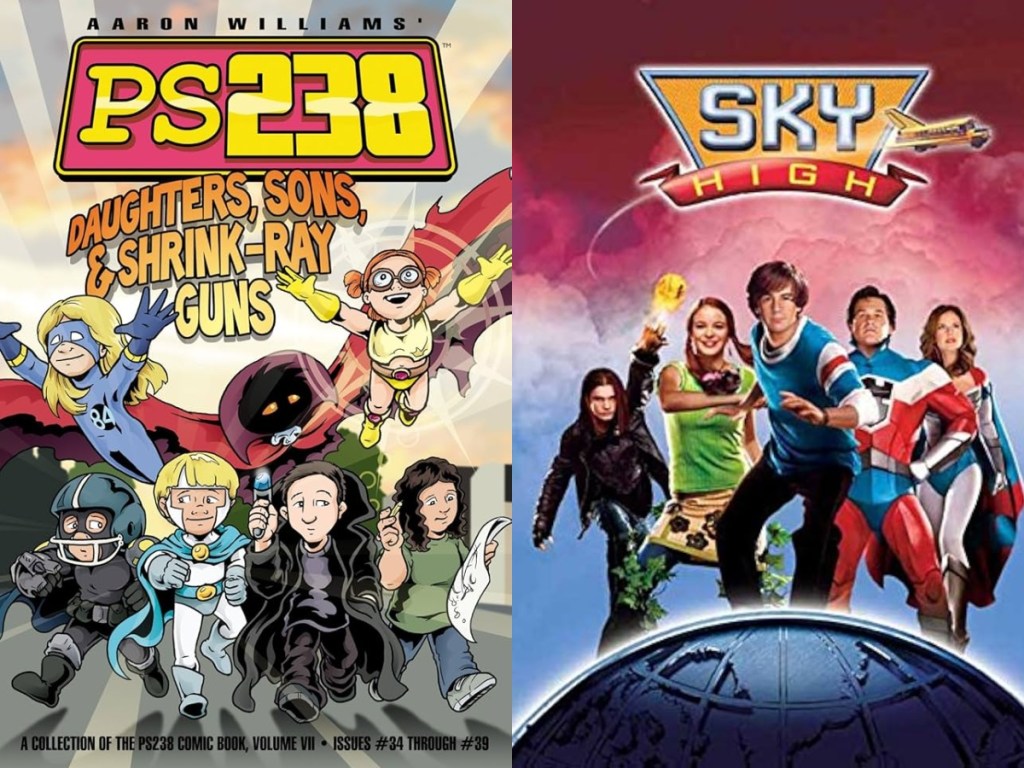
Sandy Brophy asked about my favorite “hero schools.” I’m interpreting this as a school that is intended to teach students to be heroes, so I’ll skip the obvious answer of Hogwarts, as that’s more of a general education facility in the setting and not specifically intended to turn out champions. There’s a little overlap with one of last week’s suggestions – in “High school superheroes,” I talked about the amazing Aaron Williams comic book/webcomic PS238, which is about an elementary school for superheroes. Not long after that, though, it became known among comic book readers as “the idea so nice Disney stole it twice,” as the House of Mouse released the films Sky High (2005) and Zoom (2006), both of which feature a very similar idea. Of the two, I find that Sky High is a better film. The characters are more memorable and the world is fleshed out in a much better way. The story focuses on Will Stronghold (Michael Angarano), the son of two of the world’s greatest superheroes, who is sent off to the local superhero academy despite the fact that he did not inherit any of their powers. This, by the way, is where the comparison to PS238 REALLY comes into play, since this is almost exactly the backstory of one the main characters in that comic’s ensemble. The story goes in a different direction, though, and it’s a fun, colorful movie that really uses Kurt Russell (as Will’s super-awesome superhero dad) to very good effect.

It’s the same picture.

Marvel Comics also has a pretty good series that only came out in recent years, Strange Academy, about a school specifically for magic-users in the Marvel Universe. Set in New Orleans (which always gives it extra points from me IF it’s done well), the series focuses on a group of magic-powered kids who have been gathered by the likes of Dr. Strange, the Scarlet Witch, Magik of the X-Men (herself a graduate of one of the all-time great superhero school comics, The New Mutants) and other powerful mystical faculty members to teach them to use their abilities in ways that won’t rip open a portal to the Dark Dimension or something. The comic, by Skottie Young and Humberto Ramos, is a wild look into the magic side of Marvel, and can go from a lighthearted school comedy to a blood-chilling cosmic horror story in the course of a single issue. The main series ended a while back, but the Academy has stuck around in assorted miniseries and one-shots since then.

Class picture day is a challenge.

The last one I’ll point to is one of my favorite science fiction novels of all time, Ender’s Game by Orson Scott Card. Following an alien invasion that was narrowly defeated, planet Earth has come together in a precarious alliance to prepare for another invasion that they are certain is imminent. As part of their preparations, they are finding the most brilliant children on the planet and taking them to an orbital Battle School where they are trained to fight the wars that will determine the fate of the human race. The novel focuses on Ender Wiggin, a five-year-old prodigy, who is brought to Battle School without knowing that many of the people observing him believe that he is humanity’s last hope. The book is an absolute masterpiece of characterization and world-building, and I’ll never forgive the film adaptation for falling so flat. 

I had a whole different joke planed for this caption until I saw the STUPID sticker on the cover.

Pep Rally Scenes

Duane Hower tossed out the clever suggestion of “movies with a pep rally scene.” I’m going to be honest, I actually had to turn to Google for this one, because although I feel like I’ve seen a hundred movies with a pep rally, for some reason those specific scenes didn’t click into my brain until I went back and started looking. A pep rally, of course, is that singularly high school phenomenon where the school gathers and cheers – usually, but not always – for the school’s athletes in order to get them psyched up for the Big Game. It’s a standard of American high schools, although I admit, I’ve wondered how well such things translate in other countries. DO any other countries have pep rallies? If you went to high school outside of the US, please, let me know if you ever went to a pep rally. 

Anyway, the best motion picture to ever encapsulate this singularly academic experience is the classic Alfred Hitchcock historo-religious drama…

Project ALF.

Bah-dump, TISSSSSSS

The first one that rings a bell to me is the Emma Stone comedy Easy A. I’ve always liked this movie, as it’s a very clever comedic modernization of Hawthorne’s The Scarlet Letter, featuring a high school girl who is scandalized when she lies about sleeping with a college guy, and before long the (false) story is turning up more places than Snoop Dogg at the Olympics. Olive (Stone’s character) leans into the lie at first, but as things spiral out of control she needs to find a way out. As part of that plan, she interrupts a pep rally with a musical performance of the song “Knock on Wood.” It makes sense in context. But the scene is goofy and wild, and utterly in character for Olive while using the tropes of a high school movie to advance the overall theme of the film. In other words, I like this silly scene because, in actuality, I think it’s pretty smart. 

It’s always fun to see fans of this movie get disappointed when they find out it’s actually based on literature.

Aaaand…I’m actually having trouble thinking of any other movies with a pep rally that I actually like. I could have sworn that there was one in Teen Wolf, but maybe I’m just thinking of the basketball games. Sorry, Duane, looks like yours is gonna be a one-and-done.

Movies based on high school reading lists

Rachel Ricks wants to know what are some of the best movies based on books that may be read in a high school English class. If Rachel and I hadn’t gone to college together, I would suspect that this question was posed by a student hoping to get suggestions for a movie to watch in order to get out of their homework and I would have to say, “Nice try.”

But the fact of the matter is, even the BEST movies adapted from books never match up 100 percent with the text. Writing and filmmaking are two very different disciplines, with different demands and different requirements, and what works in one medium does not always work in another. I like to think of movies as interpretations of a book – presenting the story in a way that, hopefully, maintains the spirit of the original while still standing on its own.

All of that is to say that I think To Kill a Mockingbird is perhaps the greatest movie ever made based on a book that I would assign to a student. The book is a masterpiece – a fable about a good man fighting a good fight against overwhelming odds. In this case, that good man is Atticus Finch, and that good fight is defending an innocent black man from charges of raping a white woman in a time and place where such an accusation not only puts the life of the accused on the line, but pushes the entire town onto the edge of a cliff that it may plunge off depending on how things go. It’s kind of sad how relevant that still is. The book is fantastic and the movie is just as good. Gregory Peck’s depiction of Atticus was once voted the best film hero of all time by the American Film Institute, and even though that was before any of the Deadpool movies were made, I think it’s a ranking that holds up.

Left: A masterpiece. Right: Also a masterpiece.

It’s a lot to get through (both the movie and the book), but I think Gone With the Wind deserves a place on this list as well. Margaret Mitchell’s novel of the Civil War is so iconic that it informs pretty much EVERYBODY’s mental image of Georgia in the 1800s, even if they’ve never read the book or seen the movie. The film itself is also a triumph of the art form, adapting a gargantuan novel into a mammoth film while still being engaging and compelling throughout. Plus, it’s indirectly responsible for one of the funniest sketches in the history of The Carol Burnett Show. 

And as an English teacher, I do have an unabashed love of the works of William Shakespeare. I’ve taught several of his plays Romeo and Juliet, Julius Caesar, Othello, but I think the best movie I’ve ever seen based on one of his works is the Kenneth Branagh version of Hamlet. The film clocks in at a hefty four hours long as Branagh – unlike most people who adapt Shakespeare – films the ENTIRE text of the play, making no edits or omissions. You’re left with a film that feels a little bloated in places but, at the same time, is an excellent tool for showcasing the bard’s words and has some dandy performances.

It’s not 100 percent accurate, of course. In the original Shakespeare Hamlet only frosted the tips of his hair.

Honorable mention goes to two classic movies that are based on classic works of literature: Frankenstein and The Wizard of Oz. The reason these two only get an honorable mention is because, as anyone who has both read the books and seen the movies can tell you, the movies are fantastic, thrilling, celebrations of the cinematic artform…but dang, they do a piss-poor job of actually adapting the story of the book. I love them both, but not as adaptations.

This brings us to the end of yet another installment of Playing Favorites, folks. Once again, I hope you’ve enjoyed this somewhat random peek into what rattles around inside my brain. What other column are you going to find that talks about both Strange Academy and To Kill a Mockingbird on the same page? If you want to participate in upcoming Playing Favorites columns, be sure to follow me on Facebook, Threads, or “Twittex” for the next time I toss out a topic and wait for your responses. Or even subscribe to my weekly newsletter, where I chat about what I’m working on and throw out my legendary “What’s Cool This Week?” recommendations. And in the meantime, have a great school year – or, alternately, appreciate the fact that you don’t have to go back.

Blake M. Petit is a writer, teacher, and dad from Ama, Louisiana. His most recent writing project is the superhero adventure series Other People’s Heroes: Little Stars, volume one of which is now available on Amazon. You can subscribe to his newsletter by clicking right here. Was there a pep rally in Buffy the Vampire Slayer? Damn it, this is hard. 

Geek Punditry #67: What Is Literature?

When you’re a high school teacher and spend most of your day around teenagers, you will overhear their conversations whether you like it or not. You hear about the TikToking, and you know who is dating who, and on frequent occasions you learn more about the way these kids spend their weekends than you ever want to know and you contemplate duct-taping your own children to a pool table from the time they’re 13 until they turn 27 or so. And on rare, extremely rare occasions, you’ll hear them discuss things that are actually relevant to your class. Earlier this week, for instance, I overheard a few girls talking about why so many people are using The Great Gatsby as themes for parties and dances these days. 

As always happens when there’s a conversation worth joining, I jumped in. “There are three reasons,” I said. “First of all, it’s the 20s again, so people are playing with that. Second, the book went into public domain a few years ago, so nobody has to pay to use these things. And third, there are a lot of people who think the movie is fun and didn’t actually pay attention when they were supposed to be reading the book.”

“Ain’t no party like a Gatsby party, ’cause a Gatsby party ends with three people dead and a complete loss of faith in the American dream!”

The Great Gatsby is, of course, a seminal work of American literature. It’s one of the best books ever written in this country, and it paints a complex and gripping narrative in a relatively short number of pages, but the book is about the unsatisfying nature of a decadent lifestyle and how pursuit of material things is shallow and destructive. Anybody who comes away from that book thinking that these characters are something to aspire towards is – and I’m going to be kind here – an utter moron.

I talked about this conversation with some of my English teacher friends (of course I have English teacher friends – we sit around and conjugate each other’s verbs and talk about which infinitives we’re crushing on) and discussed the fact that there aren’t a lot of books that we teach that provide role models or, for that matter, happy endings. Let’s face it, most books that are complicated enough for a really deep literary analysis tend towards tragic – or at best, bittersweet – endings. The least-depressing book I’ve ever used in my classroom is The Hitchhiker’s Guide to the Galaxy, and that book BEGINS with the complete destruction of the planet Earth. And one of my friends in this chat commented that this is why she sticks to reading lighthearted stuff on her own time – “literature” is too depressing.

Whaddaya gonna do? You’ve got to build bypasses.

I’ve always thought it was odd to use the word “literature” as a genre, the way I would “science fiction” or “horror.” What, exactly, qualifies something as a work of literature? Every time I walk into a bookstore with a “literature” section, I want to ask somebody who decides which books go on those shelves and which ones do not? Isn’t the very existence of a “literature” section sort of a low-key insult to all of the other books in the store that got shelved somewhere else? Ernest Hemingway’s The Old Man and the Sea goes on the literature shelves whereas William Goldman’s The Princess Bride doesn’t, but I could write you a whole dissertation on which one is a better book, and it ain’t the Hemingway.

One of these is one of the most incredible stories ever conceived by the human mind and the other one is what happens when Ernest Hemingway doesn’t go to therapy.

Is it just the age of the work? Everyone would agree that Lord of the Flies from 1954 is a great work of literature. But what about Robert Heinlein’s Rocket Ship Galileo, published in 1947? It’s not only a book that doesn’t enter the “great literature” discussion, it’s not even usually part of the conversation when you talk specifically about the work of Robert Heinlein. We got George Orwell’s 1984 in 1948, nearly twenty years after the first Nancy Drew novel, The Secret of the Old Clock, but nobody is citing the works of Carolyn Keene in the conversation of great writers. And that’s not just because she didn’t actually exist.

Is it just about the complexity of the work? Must a work deal with heavy ideas and deep themes to qualify? The Adventures of Huckleberry Finn gets my personal vote for the greatest American novel ever written (sorry, F. Scott Fitzgerald). Set 20 years before the Civil War but written about 20 years afterwards, the novel is a deep and fascinating analogy about the changes the country went through during that time period. Whereas Mark Twain’s earlier book with these characters (The Adventures of Tom Sawyer) was a simple boy’s adventure story, Huckleberry Finn is about a child struggling with the ethical quandary of whether it is morally right to help his friend Jim escape from slavery. Jim’s owner, Miss Watson, has taken care of Huck, and in the eyes of the law he is betraying her by helping in Jim’s escape. But eventually, he comes to the conclusion that he’s going to be loyal to his friend, even if it goes against the law, even if it goes against what he has been taught is morally right. The book deals with the destructive nature of bigotry, ignorance, and hypocrisy, and Huck himself becomes symbolic of the moral transmogrification that the United States was beginning to undergo. In other words, literature.

The thing is, though, a lot of these same ideas and themes can also be found in random episodes of Star Trek. If I pull out Oliver Crawford’s script for “Let That Be Your Last Battlefield,” I can get into a deep conversation about the folly of racism as we watch two aliens whose species has hunted itself to extinction because some of them are black and white whereas others are white and black. It’s a legendary episode, but could I justifiably call the script for it literature the same way I would Huck Finn or – to use the other best-known example of anti-racist literature – To Kill a Mockingbird? Most people would say no. 

“I dunno, Frank, are you sure the analogy isn’t too subtle?”

I posed this question, this “what is literature” question, to my English pals, and one of them said she once looked it up herself and read one of the characteristics that makes something literature is a focus on character and their development rather than plot. Does that really work, though? Gatsby is a very deep examination of the characters, but none of them actually CHANGE. By the end of the book, they (the ones that survive, anyway) are all the same shallow, soulless people they were when the story began and only the narrator – the criminally bland Nick Carroway – has shown any development at all, that development being disgust at the people around him. It’s like you’re left feeling when you watch the final episode of Seinfeld. 

On the other hand, my friend pointed out, the male lead in Fifty Shades of Grey seems to change by the end of that series, becoming actually devoted to the narrator. I’ll let you draw your own conclusion as to whether this qualifies as development or not, I haven’t read Fifty Shades. But if there’s one thing everyone in our English chat can agree on, it’s that Fifty Shades of Grey does NOT qualify as literature.

I want to be clear here: I haven’t seen the movies, nor read most of the books. I’ve read exactly one page, the first one, in a bookstore. I was curious as to what the big deal was, and after reading one page I said – out loud – “Oh good LORD,” and put it down. It’s not that the book is smut. If you want to read smut, go right ahead, I don’t judge you for it at all. I will, however, judge you for reading such POORLY WRITTEN smut when there is smut of much better quality readily available. I’m not telling you not to read Fifty Shades because it’s explicit, I’m telling you not to read it because you deserve better smut.

Not pictured: Literature.
Or believable characters, genuine titillation, or a functional understanding of the culture it purports to depict.

Is it the fact that something is “highbrow” what makes it literature? Well that comes with the same problem as designating something literature in the first place: who decides? To pull the Shakespeare card again, my students are ALWAYS intimidated when we start reading Hamlet because they think of Shakespeare as something for “thinky” people. Sure, that may be the way he’s considered today, but in his own time, Shakespeare was a popular writer. He was turning out play after play for the masses, and because he knew exactly what the people wanted, he loaded them with sex and violence. He was the J.J. Abrams of the 16th century. The kids don’t get that, though. If you understand what he’s actually saying, Hamlet’s line “Do you think I meant country matters?” is just as raunchy (and way more clever) than anything E.L. James wrote, but in all my years of teaching the play I’ve never had a student pick up on the subtext. Only a few of them get the later, more obvious line when Claudius is seeking Polonius’s corpse and Hamlet tells him Polonius is, “in heaven…if your messenger find him not there, seek him i’th’other place yourself.” Every so often I have a kid who asks, “Did he just tell the king to go to Hell?” and that student automatically becomes my favorite.

“I don’t look thoughtful enough. Give me 20 percent more confetti.”

The bar can’t be whether something makes you think. Last week I finished reading Liu Cixin’s novel The Three Body Problem, and that’s one of the thinkiest dang books I’ve ever read. The book follows a large cast of characters who discover a secret organization attempting to prepare Earth to be conquered by extraterrestrial invaders. This is, I must stress, an extremely barebones description of the plot, and deliberately so. This story is far deeper and more complicated than my pitiable attempt to summarize it. In fact, if someone tried to argue that it’s the best science fiction novel of the 21st century so far, I will have absolutely no ammunition with which to disagree with them. This Chinese novel was originally serialized in 2006, published as a novel in 2008, and first published in English in 2014, so no matter which edition you’ve read, it’s less than 18 years old. As such, it’s not something that I hear come into the conversation when people discuss “literature.” Not YET, anyway. Come back in 20 or 30 years and that may well change. But is it only the relative youth of the book that keeps it off the table?

Not pictured: Literature, but ask me again in 2056.

Maybe it’s a combination of all of these things. Maybe “literature” has to be deep AND intelligent AND kind of old. Maybe all these things that we now call “literature” are only in that category because they’re the best examples of their time period and we’ve forgotten 90 percent of the utter crap that was written around the same time. That’s not only possible, I think the further back in the history of storytelling you go it becomes almost undeniable. The poet W.H. Auden once said,“Some books are undeservedly forgotten; none are undeservedly remembered,” and by this I think he was trying to tell us that people will hopefully still be reading The Three Body Problem in the year 2100, whereas by then hopefully the only people who remember 50 Shades of Gray will be literary historians who cannot figure out why readers were so temporarily obsessed with a piece of mediocre Twilight fan fiction.

Increasingly, when it comes to the question of literature, I find myself using the late Supreme Court Justice Potter Stewart’s description of “obscenity.” Unable to actually define the term, he simply said, “I know it when I see it.” That’s how I feel about literature, too. But my opinion, of course, doesn’t count for more or less than anybody else’s.

Except for that guy shelving the “literature” section at Barnes and Noble. He apparently holds a little more sway than the rest of us.

Blake M. Petit is a writer, teacher, and dad from Ama, Louisiana. His most recent writing project is the superhero adventure series Other People’s Heroes: Little Stars, now complete on Amazon’s Kindle Vella platform. He doesn’t know if anyone would ever call the new trilogy version of that series, beginning with Little Stars Book One: Twinkle Twinkle, “literature,” but he DOES know it will be available in both paperback and ebook beginning on May 4, and he is CRAZY excited about it.

Geek Punditry #12: Nothing New Under the Sun

One of the most common criticisms of modern movies is that there aren’t any new ideas. People point to the nearly endless stream of sequels, prequels, remakes, and franchises as evidence that Hollywood has run out of creative juice, as if there’s somehow nothing original in seventeen movies about a robot that can turn into a jet ski. There are two problems with this, though. First, it’s not really true. There are thousands of scripts circulating in the movie industry at any given time – each year a “Blacklist” is released of the best unproduced scripts currently making the rounds, and some of them eventually find a studio or a director to take them on. The problem isn’t that original stories aren’t out there, it’s that the people holding the strings of the purses are afraid to spend money on them. You can take a chance on that period drama about a coal miner who discovers a secret that will topple a kingdom, or you can make the ninth installment of an action franchise that you know is going to make at least $200 million even if it’s terrible. I’m not saying I agree with this decision, mind you, but I certainly understand it.

Nothing original my shiny hiney.

The other problem with this complaint is the assumption that this is a recent phenomenon, that it’s only in the last few years that this mythical well of creativity has run dry. What happened to those great epic films of the past based on totally original ideas? Things like Jaws or The Wizard of Oz or The Ten Commandments? You know, things that were made from whole cloth. It’s nonsense, of course. People have been borrowing stories since the first story was told. And you know what? That’s okay.

I took a quick glance at IMDB’s top 100 narrative films and counted at least 40 movies that I know are based on books, plays, real life, or are sequels – and those are just the ones I’m aware of. I’m sure that there are more, but I don’t have time to read the trivia on all of them. This also doesn’t count those films that aren’t “official” adaptations, but borrow liberally from earlier stories (such as Star Wars taking elements from Buck Rogers and Hidden Fortress). A large chunk of our most acclaimed cinema is taken from other sources. And there’s nothing wrong with that. William Shakespeare himself “borrowed” from everybody. The histories, obviously, aren’t original ideas, but beyond that we have Romeo and Juliet based on an Italian poem, Othello was lifted from a collection of short stories, and Hamlet was a straight-up ripoff of The Lion King

Rosencrantz and Guildenstern are fed.

No, seriously, it’s based on an old Danish myth about a young man who has to seek revenge after his father is murdered by his uncle. There were, in fact, several versions of this story going back hundreds of years before Shakespeare cherry-picked his favorite parts of each of them, added a ghost, wrote the song “Hakuna Matata,” and BAM! made it the most famous play in the English language. 

Something else to consider is that as vast as the well of human creativity is, we’ve been exploring it for a really long time, and there aren’t a whole lot of corners left to excavate. Back in 1895, Georges Polti published his list of “The Thirty-Six Dramatic Situations,” in which he outlined what he believed was every possible plot that any writer can use. Granted, these 36 plots are incredibly simplistic (abduction, revolt, enmity of kin, Godzilla Vs. Mechagodzilla, etc.), but I first read about these plots in a writing book nearly 20 years ago and since then I’ve never come across a story that didn’t fit at least one of them, not even Space Jam. The point, then, is not to come up with an entirely original idea, because that seems to be virtually impossible. The point is to find the story you want to tell, and then tell your version in an entertaining and satisfying way. 

Too many writers get hung up on being original and freeze. A long time ago I had a friend read a story I wrote only to panic when she asked me when was the last time I read The Chronicles of Narnia. It had been years, but upon reflection I realized I used a device remarkably similar to an element from the Narnia novel The Magician’s Nephew. I hadn’t done it intentionally – I hadn’t read the book since elementary school and I had very little memory of it – but the device was so similar I have to concede that I was drawing on it subconsciously. Another time a friend of mine asked me if I’d heard of Rick Riordan’s Percy Jackson series, and because I trusted his recommendation, I picked up the first book. I loved it and I also got sick to my stomach, because the conceit of the Greek Gods in modern times was something I had been working on in a novel of my own that pretty much died on the vine. I obviously wasn’t stealing that idea, because at the time I had never read Percy before, but the knowledge that there was such a popular book out there that used some of the same ideas slaughtered my enthusiasm for the project. In retrospect, that was a mistake. The take I was planning really wasn’t at all similar to Camp Half-Blood, the only real similarity was that it was contemporary mythological characters, but I was so shaken that I lost the thread of that story and was never able to find it again. 

“Hello, literature police? I’d like to report a murder…of my hopes and dreams.”

Rather than abandoning a story with old roots, a writer should cultivate those roots and find a new way to grow. Stan Lee famously combined Frankenstein and Dr. Jekyll and Mr. Hyde to create the Incredible Hulk, after all. Kevin Williamson and Wes Craven bought stock in decades of slasher movies to give birth to the Scream franchise. George Lucas drew on Uncle Scrooge comics by Carl Barks when he conceived of Raiders of the Lost Ark. (I know that sounds like the kind of thing I would make a joke about, but it’s not. That one’s a straight-up fact.)

Let’s go back to Shakespeare. Everyone knows Disney borrowed from Hamlet when they made The Lion King, but that’s only the tip of the iceberg. Romeo and Juliet inspired West Side Story, MacBeth became Kurasowa’s Throne of Blood, The Taming of the Shrew became Ten Things I Hate About You. As of this writing, William Shakespeare is credited as a writer for 1746 projects on IMDB. That’s nearly 2000 movies and TV shows, stories told in mediums that were not invented until he had been dead for almost three centuries. (He’s also credited once under “music department” and a baffling SIX times as “additional crew.” I could click on those links for clarification, but I kind of prefer my headcanon, in which he was involved in craft services on the set of The Human Centipede.) 

What’s more, those 1746 credits are only the films that specifically list him as a writer, not those that borrow from him without applying the credit, nor does it account for the thousands of stories that use his work outside of the realms of film and television. I did college and community theater for many years and one the best shows I was ever in was The Complete Works of William Shakespeare [Abridged], a gut-busting comedy featuring three actors trying to perform parts of all 36 of Shakespeare’s plays in one evening. Then just yesterday I got Ryan North’s book To Be Nor Not to Be, in which he retells Hamlet as a Choose-Your-Own-Adventure story. I’ve read it through once so far, choosing the “original” path of the play before I branch out and test the wackier versions, but even the “original” is really funny. (North also seems to have a much greater fondness for Rosencrantz and Guildenstern than most people, treating them in a way that’s very much at odds with Tom Stoppard, who himself used Shakespeare for the basis of his play Rosencrantz and Guildenstern Are Dead, which in turn inspired the epic drama Bubble Guppies.)

“To suffer the slings of outrageous fortune, turn to page 32. To suffer the arrows, turn to page 19.”

A lot of writers wear their influences on their sleeves. Stephen King – who you should realize by now is a perennial favorite of mine – used Robert Browning’s poem “Childe Roland to the Dark Tower Came” as the launching pad for his own The Dark Tower, the series he calls his “magnum opus.” The series has feelers and roots in dozens of his own novels and short stories, but also in the works of other creators. Along the way he sprinkled in a visit to Oz, a riddle game that feels like Twisted Tolkien Theatre, robots stolen from Marvel Comics, and nuggets of Harry Potter to fill in the gaps. King, in turn, has inspired many other writers, among them his own sons Joe Hill and Owen King and the entire writing staff of the TV show Lost.

Mythology is another popular source to “borrow” stories from, which is why I tried to do it myself before Rick Riordan inadvertently kicked my teeth in. The Odyssey, for example, has been retold multiple times: the Coen brothers transplanted it into turn-of-the 20th Century Mississippi for their film O Brother, Where Art Thou?, DC Comics used it as the basis of the Adam Strange/Starfire/Animal Man section of their year-long experimental series 52, and a few years ago some schmuck from Louisiana replaced Odysseus with Santa Claus and tried telling his own version of the story

“My name? Nobody-El.”

DC is actually returning to the Homeric well beginning this week with a series called Superman: Lost. In the first issue of this 10-issue series by writer Christopher Priest and artist Carlo Pagulayan, Clark Kent and Lois Lane are hanging out at home one evening when he’s summoned away by the Justice League to deal with an emergency. He comes back only minutes later, but now he seems to be in a state of shock. After a few panels of Lois trying to figure out what’s happened, Clark drops the bomb that – from his perspective – he’s actually been gone for 20 years. The first issue is excellent, and I’m very much looking forward to the rest of the story to see why he’s been gone so long, what timey-wimey ball of phlebotinum is going to be applied to bring him back to the present, and how much is borrowed directly from The Odyssey. Priest is a writer whose work I’ve enjoyed for a long time, so I’ve got plenty of faith going in.

The point is, originality is not the be-all and end-all of storytelling. True, it’s always great to be genuinely surprised, but that doesn’t mean that there’s not room for good movies, TV shows, or books that have a familiar flavor. If you don’t like something, fine, that’s your prerogative, but if the only thing wrong with it is that you feel like you’ve seen it before, try to decide if it has other merits before you dismiss it entirely. You may find something worth experiencing after all. 

And if not, just go watch something original and brand-new. Like The Last of Us. Or Wednesday. Or that new show Night Court. Or…

Blake M. Petit is a writer, teacher, and dad from Ama, Louisiana. His current writing project is the superhero adventure series Other People’s Heroes: Little Stars, a new episode of which is available every Wednesday on Amazon’s Kindle Vella platform. Please do not mistake this “originality isn’t everything” position as an endorsement of plagiarism or, even worse, using AI to write a story. Both of these are crimes for which you should receive, at minimum, a toilet that won’t stop running all night long even after you take off the top of the tank and stick your hand in the water to try to adjust it. That’s what you’ve got coming to you. Jerk.