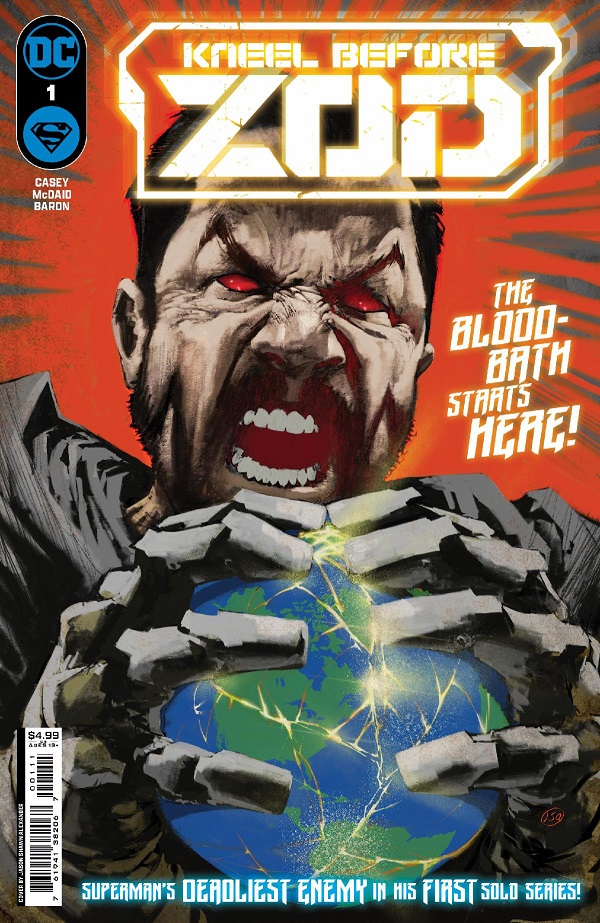
The conclusion of Kingdom of Zod drops today (assuming you read this on Sept. 30), but I won’t have time to get to the comic shop and write a review before my admittedly self-imposed deadline on this column, so it’s going to join the overall September wrapup you guys can expect next week. Today, I wanted to go back a couple of years to 2024, and the eight-issue Kneel Before Zod series written by Joe Casey with art by Dan McDaid.
The series was touted as Zod’s first starring series, although it’s kind of unclear whether it was intended to be a miniseries or if it, like so many comic books in the modern marketplace, was structured in such a way that it could keep going if the sales permitted. Regardless, it’s one of the darkest stories in the main Superman continuity you’ll find. As the series begins, Zod has founded a “New Kandor,” a planet where he intends to restore the glory of Krypton with his wife Ursa and their son, Lor-Zod. But things fall apart almost immediately, as Zod finds himself forced to exile his child (who went off to share the Sinister Sons miniseries with Sinestro’s boy) and his new planet targeted by an alien invasion.
The first half of this series places Zod in the unusual role of defender, trying to protect his world from the invading aliens. But Casey does it in an effective way, maintaining the general brutality and evil nature of the character. I’ve written recently (in Geek Punditry #194) about how modern media has a disturbing tendency to try to excuse villainy, something that I think is somewhat damaging to the culture as a whole. Casey doesn’t do that. Zod may be the protagonist here, but that doesn’t make him a hero. While the flashback scenes that showcase Zod’s past may help to explain the way he is today, these scenes are presented for the purpose of illumination, not justification, and that makes all the difference.
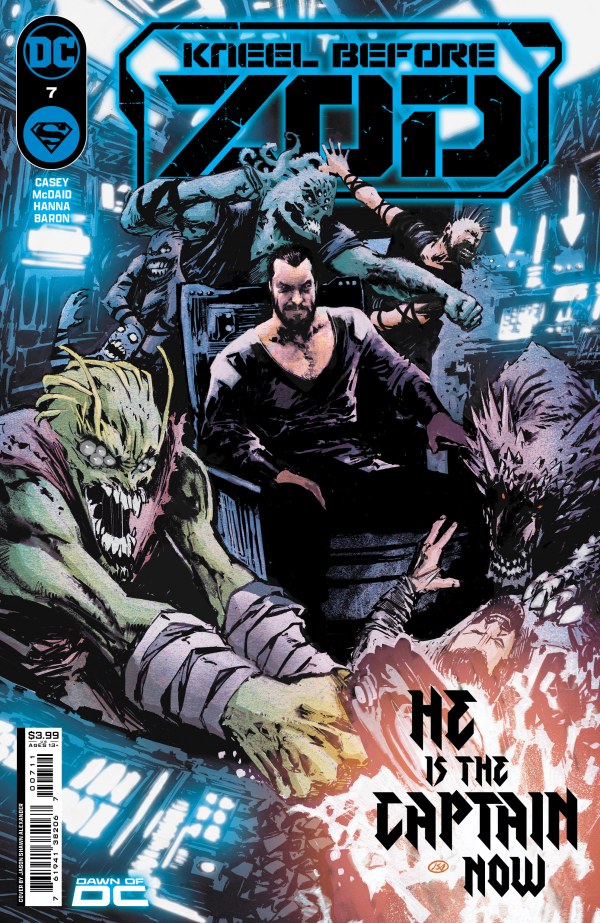
The reason I think this was probably intended to be an ongoing series is that it takes a drastic turn about halfway through, starting an entirely different storyline with Zod in space, alone, until he finds and takes command of an army of villains. It goes from a story of a man protecting his home to the origin of a sort of cosmic pirate clan, a drastically different story that feels as though it was intended to be the next stage in a longer arc that got cut short. As such, this second half of the series isn’t quite as engaging as the first, feeling less complete and more unfinished.
Dan McDaid’s artwork comes from the Keith Giffen school in many respects. The linework is detailed when need be, sparse when appropriate, and he usually incorporates the nine-panel grid that Giffed so often used. It helps with the pacing, and somehow (despite the fact that Giffen would use these techniques in silly books like Ambush Bug), McDaid’s use of it adds to the sense of menace.
I wish Casey had been given just one more arc on this book to try to tie things up more neatly. As it is, it just kind of ends, dangling Zod in space, where he remained until his reemergence following Absolute Power took him on a slow march to the story that’s happening in the Superman comics right now. There’s connective tissue here, but I feel like there was supposed to be more, and it’s a shame we didn’t get to see it all.
Blake M. Petit is a writer, teacher, and dad from Ama, Louisiana. His most recent writing project is the superhero adventure series Other People’s Heroes: Little Stars, volume one of which is now available on Amazon. Don’t forget, you can check out earlier blogs in the Year of Superman/Superman Stuff Archive! Got a request for a future “Superman Stuff”? Drop it in the comments!

