Geek Punditry #107: Big Cons, Small Rewards

Last weekend was one of the biggest nerd events that hits my neck of the woods every year: Fan Expo New Orleans. This is the single biggest media convention to come to southern Louisiana annually. I’ve gone almost every year, going back to its early days before Fan Expo took over, all the years it was Wizard World New Orleans, and even before that. I have attended with friends, with family, with my wife and son, and I’ve occasionally attended on my own. I’ve been there as a podcaster, I’ve been there as a panelist, and I’ve been there as just a fan. If I thought I could make back the booth fee by selling books, I would like to attend as a professional, but I don’t feel I’m quite there yet. And I fully intend to go to this show every time it comes to town for as long as the universe allows me to make it there.

How could I deny the world this face?

But at the risk of sounding like a grumpy old man, it’s not really the same as it used to be.

I know, this is always the refrain of people as they get older. “It’s not as good as it was, the stuff they did when I was young was better, your music is too loud, what’s a SnapChat?” It’s very much a cliche. But just because something is a cliche doesn’t mean that there isn’t an element of truth to it. Before it was Fan Expo it was Wizard World, and before that it was a relatively small comic book convention started by a local comic shop owner that slowly built up over a few years. That was in my podcasting days and I attended every one. In the last one, I even got to host a few panels and do an interview with artist Francis Manapul, which was a lot of fun. Then, after this little show started rolling, Wizard snatched it up and made it part of its ever-growing assortment of conventions, like Thanos collecting Infinity Stones. So when I say “it used to be about the comics,” I can say that with authority. 

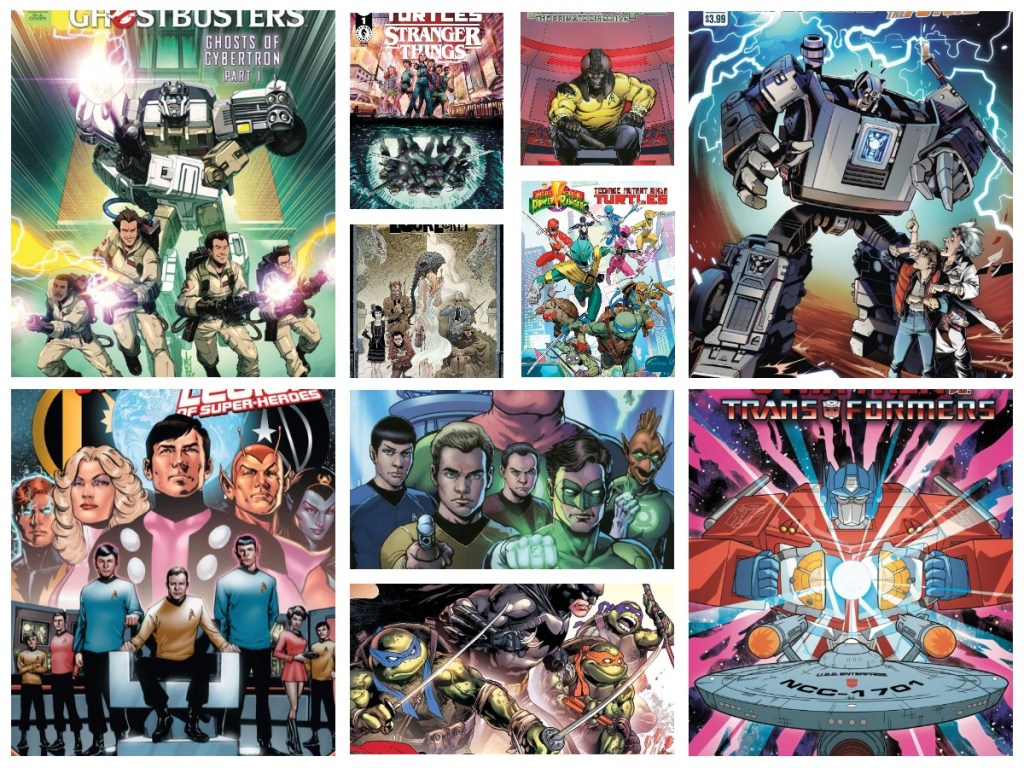
Over the years I’ve watched as the larger shows get more and more consumed by other media. It started with genre movies and television shows, which makes perfect sense. If you make a venn diagram of comic book readers and fans of things like Star Trek and Star Wars, it may not be a perfect overlap, but those circles will likely have very little hanging over the edges. As time went on, though, other things began to creep in. Dr. Who makes a lot of sense. And who doesn’t love things like Back to the Future? Game of Thrones started kind of niche, but it quickly went mainstream. Then you had things like Outlander, which is technically a fantasy show but traditionally serves a somewhat different demographic than most of the other fandoms that were being serviced. The same went for Twilight, but that never stopped actors from those films from appearing. And now, increasingly, we’re seeing the stars of video games like Five Nights at Freddy’s or the voice actors for popular anime when they’re translated into English. 

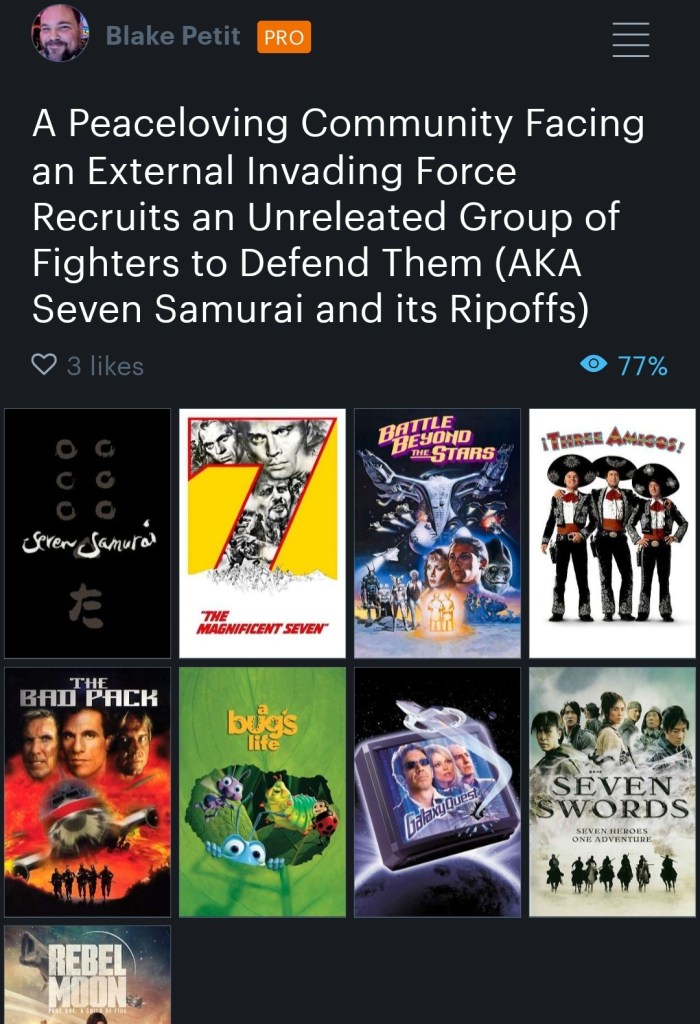
I’m almost certain the only person in this graphic who ever actually worked on a comic book is Kevin Smith. But he hasn’t finished yet.

I need to be clear about this: I do not object to any of these things being added to things like Fan Expo. I’m no gatekeeper. I have always had the mindset of the more the merrier. My sister has attended before, but this year she brought her husband and two kids with her for the first time, and they had a blast. My niece, who’s a huge FNAF fan, made her own costume and got to meet some of her favorite voice actors. My brother-and-law and nephew got to dress up like Ghostbusters and get their pictures taken with movie-quality proton packs. I love that they had so much fun, because I want there to be something for everybody. The problem is that all of this stuff seems to be coming at the EXPENSE of the things that brought me to shows like this in the first place, rather than being there in ADDITION to them.

In the early days, the comic book vendors were a vast swath of the shopping section at this show, but this year I could count the number of booths selling actual comic books on one hand. There’s plenty of people selling toys, of course. Prints. Funko pops. Stickers of dubious legitimacy, from a copyright standpoint. Swords. 3-D printed tchotchkes. Candy. Candles. Soap. And one booth where you could pay $40 to hold a snake, cash only of course. But if you’re there to try to fill in those last three issues of Green Lantern you need to complete your run…well, places like this USED to be where you would want to go, but this year you were kind of out of luck.

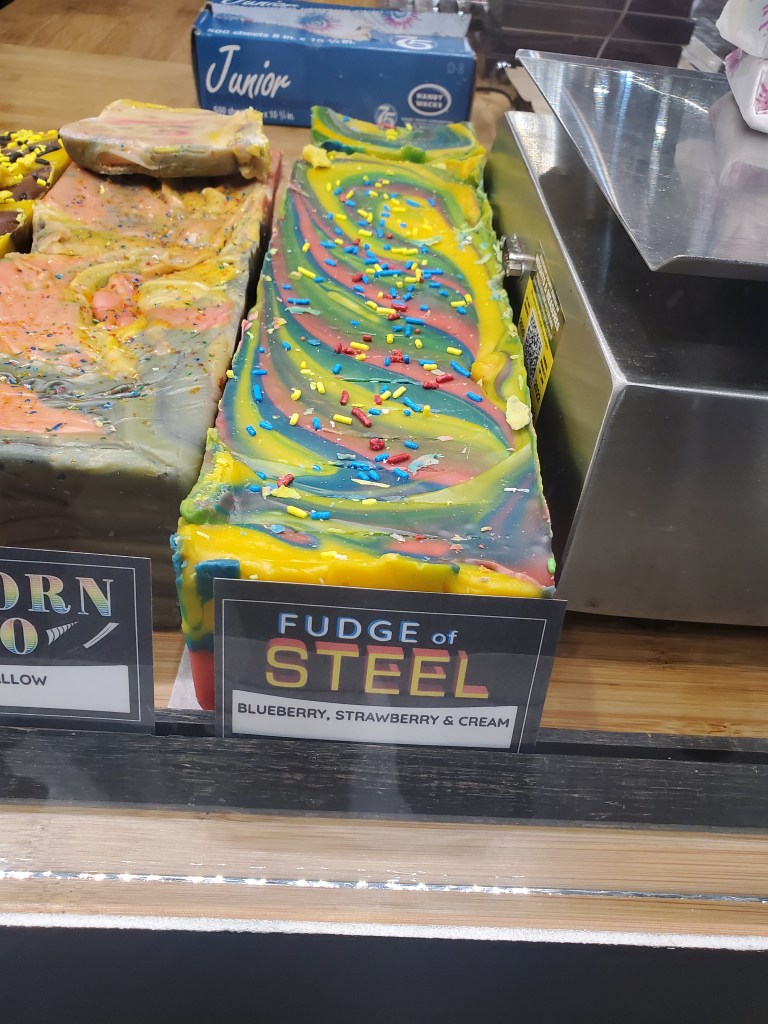
Still couldn’t pass up the Fudge of Steel, though.

Once there were publishers at these shows. Not often the big ones – Marvel and DC, I don’t think, ever had any official booth in New Orleans – but at least smaller publishers would make the journey. I don’t think I saw a single publisher booth this year. There were still a good number of creators in artist’s alley, but even there, I think the majority of them were local writers and artists, by which I mean friends of mine. I love seeing them, but I wish that there were other people too. 

I don’t want to give the impression that it was a total wasteland, mind you. The legendary Don Rosa was there, making his first appearance in New Orleans in several years, and it was fantastic to talk to him. And plenty of self-publishers were in attendance trying to draw eyes to their books and comics. But I know from experience how tough it can be to snare a potential reader’s eye wandering a convention floor, and for these kinds of comic creators it’s just going to get harder, because as there is less and less comic book content at these shows, there will be less and less reason for their potential audience to attend.

This was pretty darn sweet, though.

What, then, is the solution? Obviously the convention organizers are trying to draw in the guests that will get the most attendees, because that’s how they make their money. But I feel like more of an effort needs to be made to appeal to the comic vendors and creators that helped build these things in the first place. It’s kind of a self-fulfilling prophecy – they attract fewer comic vendors because fewer comic fans are attending because there are fewer vendors because there are fewer fans. Somebody’s gotta figure out a way to break that cycle.

Oddly enough, in recent years, I’ve found that the smaller the show, the better it is for people like me, people who are there for the comics. Last year, for instance, I went to one of the St. Tammany Collector’s Conventions that are held in Mandeville two or three times a year. They’ve been doing it for a few years now, but for one reason or another I hadn’t been able to attend until last spring, and I was amazed by how great a show it was. The venue was much smaller than Fan Expo, but it was packed to the edges with stuff. There were, of course, the vendors that sold toys and knick knacks, but there were comic books too – so many comic book vendors. I could have spent days digging through all the back issue bins there, and I walked away having spent more money and feeling more satisfied than I have in the last two or three Fan Expos. Not only that, but those local writers and artists, those friends of mine I saw last weekend at Fan Expo? Most of them were there too, along with some media guests, including folks like Five Nights at Freddy’s actors and others. They may not be as big as Fan Expo, of course – they’re never gonna get Michael J. Fox and Christopher Lloyd – but they can get Sgt. Slaughter, and that ain’t nothin’. 

And that’s just at that one show. There are plenty of smaller shows across the state all year long. I don’t get to go to all of them, of course. My attendance depends on a lot of things, not the least of which is my wife’s work schedule (because Eddie is a little too wild to take him to something like this on my own), but I know that there are smaller shows coming up in Slidell, Gonzales, Morgan City, and plenty of other places within driving distance. They’re all on my radar, and they’re all going on my calendar. 

I know this might sound weird, especially if you remember the column I wrote last summer about how badly I want to attend San Diego Comic-Con some day, but these smaller shows are much more of a haven for people like me than the big shows are. That’s not to say I’m abandoning the big shows. I still like them. I still have fun. I love getting to see the costumes and talking on the panels and hanging out with some of the finest geeks that have ever graced Southern Louisiana. But the smaller shows are better at scratching the itch that drew me to conventions in the first place. I hope Fan Expo and any other convention organizers out there realize this. I hope they understand that bringing in new fans doesn’t have to mean excluding the old ones. And I hope they figure it out before there’s nothing left for the people who brought them to the dance to begin with.

Blake M. Petit is a writer, teacher, and dad from Ama, Louisiana. His most recent writing project is the superhero adventure series Other People’s Heroes: Little Stars, volume one of which is now available on Amazon. You can subscribe to his newsletter by clicking right here. He’s also started putting his LitReel videos on TikTok. He hopes to see you at one of those smaller shows before the year is out.

Year of Superman Week Two: Fleischer and Fan Expo

It’s the second week of my year-long adventure in reading, watching, and generally enjoying all things Superman. This week, I take a look at the earliest Fleischer cartoons, I watch more of Superman and Lois, and I take my family to Fan Expo New Orleans!

Wed., Jan. 8

Comics: Krisis of the Krimson Kryptonite, story found in Superman Vol. 2, #49, Adventures of Superman #472, Starman #28, Action Comics #659, & Superman Vol. 2 #50; Black Lightning Vol. 4 #2 (Guest-appearance by Natasha Irons, aka Steel), Supergirl Vol. 2 #20 (Guest-appearance by Superman)

When you spell “red” with a K.

Notes: I’ve got to be careful with some of these comics. My goal, in this “Year of Superman,” is to spend a little time with ALL eras of the Man of Steel, but every time I go back and look at one of the comics from my formative years, I feel the urge to just go on reading them. I could very easily make this “my year of reading Superman comics from the 90s” if I didn’t show a little restraint and restrict myself to the high points. All that said, I couldn’t possibly do this without reading Krisis of the Krimson Kryptonite. As much as the first Christopher Reeve movie made me a fan of the character himself, this is the story that made me a fan of Superman COMICS.

I was relatively new into comics at the time, and if there was one character I followed more than others, at this point, it was Spider-Man. But then something happened which was pretty rare at the time – Superman turned up on the news. After over 50 years, they said, he was going to ask Lois Lane to marry him. I was intrigued and I sought out the five parts of this story to see what was going on. And then I got the next Adventures of Superman the week after. And then I came back for the next week’s Action Comics. And I haven’t missed an issue of any of the regular Superman comic books ever since. It’s a pretty darn impressive streak, if I do say so myself. I also eventually hunted down almost all of the previous comics since the reboot of the character in 1986, so when I say that this era is MY Superman, I mean that as literally as possible for anybody who didn’t actually create the books themselves.

What’s interesting is that the element of this story that got me – and presumably a lot of other people – to buy it is almost a throwaway moment. The bulk of the story involves the Red Kryptonite (only called “Krimson” on the covers) given to Lex Luthor by Superman’s old sparring partner, Mr. Mxyzptlk. Mxy is busy in another dimension – delightfully implied to be harassing the Fantastic Four as the Impossible Man – and he’s going to miss his scheduled tete a tete with Superman. Instead, he gives Luthor the Red Kryptonite – the first instance of such an element in the post-Crisis continuity, and promises it will make Luthor “Superman’s equal.” Instead of giving Luthor powers, though, the rock takes the power AWAY from Superman.

Most of the five issues – four issues of the Superman comics and a crossover with Starman, also written by Action Comics scribe Roger Stern – involve Superman either trying to figure out where his powers went, trying to get them back, or trying to compensate for their loss with things like a suit of powered armor. It’s a nice change of pace, watching a story where Clark has to rely on his brains, resources, and friends rather than the raw power of the Man of Steel. It also nicely showcases the supporting cast Superman had built up around him at the time. Besides the usual merry band at the Daily Planet, we also get to see him with the likes of Guardian, Gangbuster, and one of my favorite side-characters, Professor Emil Hamilton. They’re Superman’s supporting cast as much as the Planet staff is Clark’s, and they serve a similar function in the story. 

As for the engagement – it crops up in the last chapter, when Martha Kent calls Clark and asks if he’s bothered to unpack his suitcase since his last trip to Kansas, and there he finds the Kent family engagement ring. He shows it to Lois during a quick lunch at the cafe in the Planet building and proposes with all the romance of saying, “So, you wanna?” Then they get interrupted, he gets his powers back, and on the last page of the issue she accepts. It’s hardly the most memorable proposal in the world, but oddly enough, it feels somewhat appropriate for this version of the characters. These are people who never have time to slow down or stop, whether they’re acting as reporters or as superheroes, and even something as monumental as a marriage proposal has that same kind of mood and cadence. This was the first story where I really saw the character potential in Lois and Clark, beyond just the cookie cutter stereotypes of the Silver Age, and it’s what I’ve enjoyed about them ever since. 

TV Episodes: Superman and Lois, Season One, Episode 8, “Holding the Wrench”; Episode 9, “Loyal Subjekts.”

Thur., Jan. 9

Comics: Infinity, Inc. #2 (Power Girl-team member), Superman #5, New Adventures of Superboy #30

Next time, on Extreme Makeover Kryptonian Home Edition…

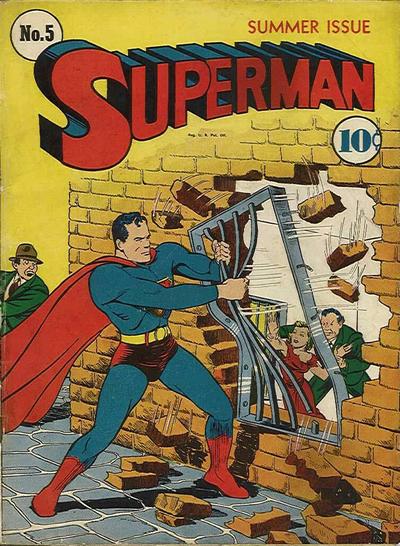
Notes: (On Superman #5) It’s a hoot to go back and read these early adventures of Superman. In the lead story of this comic, from 1940, Superman is out to cleanse Metropolis of the scourge of…drumroll please…slot machines. In this modern age, when every issue is about stopping a time-travelling alien telepathic computer intelligence from taking over the multiverse and plunging the entirety of humanity into perpetual mind-control and slavery, there’s something darn quaint about a comic where the stakes are “a racketeer is tricking kids into dropping pennies into this rigged game.” It couldn’t maintain an extended run, of course, but I think it would be fun to see a modern writer do a one-off story where Superman gets caught up in trying to solve some problem on a similar level…like an unscrupulous Girl Scout leader hoarding all the good streetcorners to sell Thin Mints or something. 

It’s also interesting to note that, while much has been made of the powers Superman GAINED over the years – flight, X-ray vision, freezing breath, and so forth – there are other powers that sort of vanished after a while. In one of the stories in this issue, Superman impersonates somebody by “contorting his features” until he looks like the man – which evidently also includes whitening his hair, getting a receding hairline, and growing a mustache. Thank goodness they eventually moved away from powers like this one in favor of more sensible abilities, such as “Rebuilding the Great Wall of China Vision.”

Fri., Jan. 10

Shorts: “The Mad Scientist” (aka “Superman”) & “The Mechanical Monsters,” Fleischer Studios, 1941

Old-School Cool

When I was a kid, my grandmother had a VHS tape full of old cartoons that she would put on whenever we went to her house. I didn’t realize it at the time, but it was one of those compilation volumes made up entirely of cartoons that were (or at least were thought to be) in the public domain, so the distributor could make a quick buck off of them. I didn’t care then and, honestly, I wouldn’t care now. This tape introduced me to the Looney Tunes short “A Tale of Two Kitties,” which I believe is the genesis of my lifelong love affair with Bud Abbott and Lou Costello.

But the tape also included several of the old Fleisher Superman shorts, meaning that this is another of my early encounters with the Man of Steel. Looking back on it now, over 80 years after it was made, it’s STILL a blueprint in how superhero stories should be told. The origin is done away with in the first minute of this cartoon, giving the audience everything they need to know to understand the story that’s about to unfold – and remember, this cartoon was made only three years after Superman’s comic book debut, so it wasn’t a given that everyone watching these shorts during their Saturday matinee would be familiar with his origin like we all are today.

Next we have an animation style that’s smooth, fluid, and gorgeous. It looks as good as the best work Disney or Warner Bros were putting out. I’ve heard that these cartoons were supposedly the most expensive animated shorts ever made at the time. I can’t confirm if that’s true or not, but looking at just how good the animation is, I can easily believe it. In one sequence, for example, the titular Mad Scientist shoots his superlaser at a target, only for Superman to swoop in and push back against it, actually punching the laser beam all the way back to the Scientist’s lair. In terms of how physics works, this doesn’t make the slightest bit of sense. But when the animation is this good, you just straight up don’t care.

Finally, let’s talk about Bud Collyer. We all know how good Christopher Reeve was, and George Reeves get a lot of love as well. Tim Daly and George Newburn are frequently talked about for the animated Supermen. But Bud Collyer – who voiced Superman here and on the radio show – doesn’t get nearly enough love, in my opinion. His Clark Kent is high-pitched and a little mealy-mouthed, whereas when he shifts to his Superman persona he drops his voice a full octave and suddenly fills the space with his presence. His Clark/Superman divide is every bit as impressive as that of Christopher Reeve, albeit in a totally different medium.

The second Fleischer Superman short, “The Mechanical Monsters,” is every bit as good as the first. The design of the robots is really impressive, capable of transforming into various configurations to carry out their master’s nefarious tasks. Like Bud Collyer as Superman, Joan Alexander is a wonderful early Lois Lane. She’s got a slight sultry tone at moments, then shifts into mild panic when the robots show up. Moments later, though, she’s going after the robots herself, having overcome her fear and showing us how tough as nails Lois Lane should be. 

This short also shows Superman using his X-Ray vision for the first time, and it’s WILD – the pupils of his eyes recede and are replaced by a weird energy. I’ve never seen X-Ray vision depicted this way anywhere else, and it’s crazy, and I love it.

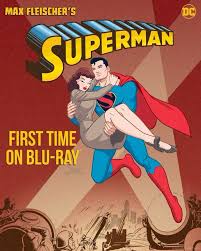
These cartoons are fundamental parts of Superman history. If anyone hasn’t watched them, especially these first two, get out there and find them. They’re all on YouTube, but watching this is making me thirst for the recently-released Blu-Ray remaster of them all.

Sat. Jan. 11

TV Episodes: Superman and Lois, Season 1, Episode 10, “O Mother, Where Art Thou?”, Episode 11: “A Brief Reminiscence In-Between Cataclysmic Events”, Episode 12: “Through the Valley of Death”

And to date, zero percent of the cast members of THIS show have been involved in a cult.

Notes on Episode 10: As I said, this is my first time watching through Superman and Lois, and I’m enjoying it. I’ve been told by many fine superfans of my association that Tyler Hoechlin is the best on-screen Superman since Christopher Reeve, and that’s a pretty massive statement to make. I’m not seeing it yet, but I definitely see the potential here, as I approach the end of the first season. He’s got the right temperament – he’s strong, but gentle, fearless, but kind. He hits all of the beats I want in a Superman, and all that remains is to see if he gets great stories to go with his great performance.

Episode 10, “O Mother, Where Art Thou?”, is not quite giving me those vibes. The show takes pretty wild swings with continuity, including having Kal-El’s Kryptonian mother, Lara Lor-Van, being a scientist behind a project that has the potential to destroy humanity if used the wrong way by her son – not Superman, but rather his heretofore unknown half-brother, who has been hiding on Earth under the name of Morgan Edge. I don’t actually mind the divergences from continuity. I mean, this is a show where Lois and Clark have twin sons and move back to Smallville to raise them, not to mention the fact that John Henry Irons comes from an alternate universe where he was married to Lois Lane. Like I said, wild swings aren’t a problem. The issue I’m having at the moment is that the show is employing two tropes that have been done to death: the Sibling Our Hero Never Knew About, and – a more Superman-specific one – the Evil Kryptonian Trying to Bring Back Krypton By Destroying Earth. Both of these are things that we have seen many, many times in the past, and I’m a little tired of them.

That said, even the most exhausted trope can be revived if the storytellers are good enough, and this show is doing a pretty good job. It may be Lara’s invention that has caused the danger, for instance, but they avoid making Lara herself a villain, showing that her technology has been abused. This episode has a good bit where Lara’s consciousness is “downloaded” into Lana Lang, giving her a chance to have some heartfelt conversations with both Clark and Lois that feel very genuine. As someone who has lost his own mother, I think a lot about the kind of conversations I would have with her if I could, if she was back in this world even just for an hour. I want to talk to her about my child, her grandson that she never met. I want to tell her what my life is like. And seeing Clark having those conversations with Lara – even a Lara riding shotgun in Lana’s body – hits me pretty deep. It’s a powerful scene, and it very much overcomes any reluctance I may have from the stuff that’s a bit more “it’s all been done.” 

Notes on Episode 11: As the title of this episode implies, we step aside from the Morgan Edge invasion of Earth storyline to show a flashback of Clark’s early days, including the creation of the Fortress of Solitude, his return to Smallville, and his arrival in Metropolis. I absolutely ADORE the fact that, in this continuity, Superman’s original costume is basically the Fleischer cartoon suit. Even more, I love seeing Tyler doing the “awkward Clark in the Big City” stuff that he doesn’t do as much with the show based in Smallville. And is there any other actor in the world who could get a compliment about the costume and actually sell the line, “Thanks, my mom made it for me”? 

This episode, fortunately, isn’t really an “origin of Superman” story, but more of an “origin of Lois and Clark” story. It’s less about him and more about THEM, and that’s what makes it work. Tyler Hoechlin and Elizabeth Tulloch are a fabulous pair, and this episode allows for a showcase on them as a couple rather than as parents – which, if there are any parents out there, you know is not exactly the same thing. But as I mentioned a few days ago, when I was reading Krisis of the Krimson Kryptonite, I prefer a dynamic where Lois falls in love with Clark rather than Superman. To me, I always see Clark as the real character and Superman just as a name he uses when he’s not using his own. This episode is just touching in a way we don’t always get to see. 

Notes on Episode 12: Aw, I was right about John Henry. He’s on our side now. Isn’t that the best?

Wait, what the hell do you mean, this wasn’t the season finale?

Sun. Jan. 12

Today I’m heading out to Fan Expo New Orleans, the biggest convention that hits my town and one of my favorite weekends of the year. It’s also something that will take up most of the day, and tonight there’s playoff football, so I squeeze in my Year of Superman viewing while my wife is taking a shower before we leave. With time being of the essence, I go with the next Fleischer short.

Short: “Billion Dollar Limited”

Notes: In this one, a bunch of gangsters with cool masks and a cooler car plan a heist of a moving train that’s carrying an enormous amount of cash. Lois Lane winds up on the train as well, because she’s Lois Lane and the laws of narrative causality declare that this is to be the case. Superman doesn’t show up until about halfway through the film, when Clark Kent intercepts a report of the train running wild on the Daily Planet teletype machine, and then he flies into action. 

Speaking of “flies,” this short leaves me wondering – are the Fleischer cartoons where it was established that Superman actually FLIES, rather than just leaping from place to place, as he does in the early comic books? I feel like I read that somewhere once. I suppose I could look it up, but I’m leaving for Fan Expo in a few minutes. Anyway, the short is great.

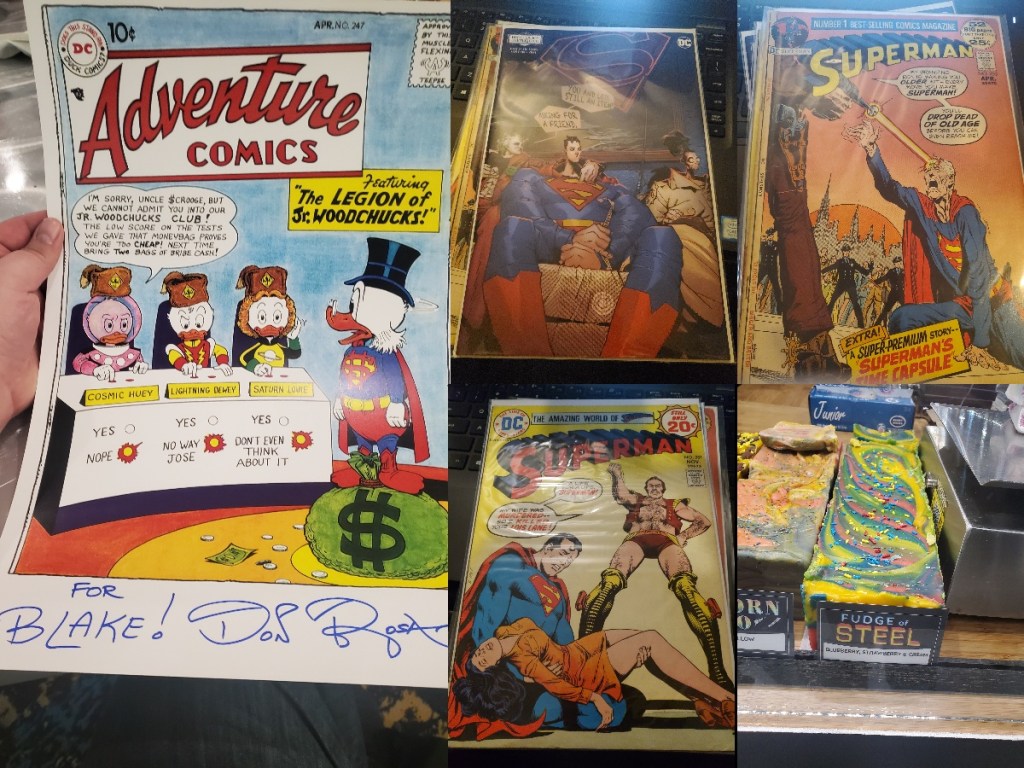
Notes Before Fan Expo: Like I said, this is the biggest show of the year in the New Orleans area, and I’m always excited to go, even though none of the things on my schedule are Superman-related. I’ve been invited – as I have for the past few years – to sit in on some panels, one about fantasy movies and another about why we love Star Trek. (In terms of fandoms, Star Trek is a close number two behind Superman on my list.) I was planning to wear a Superman shirt today, just to keep the branding that I’m trying to establish here, but that plan got derailed when I found out Don Rosa was going to be at the show. Rosa, if you don’t know, is a now-retired cartoonist who did some of the finest Uncle Scrooge and Donald Duck comics of all time, including the legendary story The Life and Times of Scrooge McDuck. I’m crazy excited to meet him today, even though I’ve met him before. And just so that this rambling isn’t completely bereft of Superman, I should point out that the last time I saw him at a convention I purchased from him this recreation of the Action Comics #1 cover starring our beloved ducks.

Ain’t it a beaut?

Notes After Fan Expo: I decided that for this convention – and any other shows I might happen to attend over the course of this year – I would document any Superman-related purchases or activities here in the blog. For this show, though, that was a relatively slim prospect. Sad as it makes me, it feels like the larger the convention, the less the actual comic book content, whether you’re talking about vendors or panels or guests. Everything is being consumed by movies, TV, and anime, which is something that makes me sad, and will most likely be a Geek Punditry feature in the near future. 

There were a lot of Superman-related guests at this show: assorted Clark Kents including Tom Welling, Brandon Routh, Dean Cain, Tyler Hoechlin, Tim Daly, and George Newburn all made appearances, plus several other actors from different supporting casts, but I’ve never been the sort to chase autographs or celebrity pictures. I did, however, get Don Rosa’s recreation of Adventure Comics #247, the first appearance of the Legion of Super-Heroes, with Scrooge McDuck taking Superboy’s place. From back issue bins, I pulled copies of Superman #250 and #281, and the recent Beetlejuice Beetlejuice variant cover for Superman Vol. 6 #17. And at one of the many candy-making booths, my lovely wife Erin got us a slab of the “Fudge of Steel,” which had a nicely Clark Kentian color scheme.  

This was worth the risk of getting hit by one of the many collapsing buildings on any given New Orleans streetcorner.

Mon., Jan. 13

Comics: Justice League of America #13

Trust me, Superman IS in there.

Notes: These early Justice League stories are always fun, in the silliest of Silver Age ways. When the JLA was first introduced, Superman and Batman were often sidelined to make room for the other, less-popular characters, which is pretty much the opposite of what happens in superhero team books today. (Anyone remember that era in the 00s when Wolverine was in four X-Men books and three Avengers titles a month?) Eventually they stopped doing that and began integrating them into the stories more, but that brought up another problem: how do you come up with a menace that challenges Superman without having a villain that could basically turn Green Arrow into putty on the bottom of his shoe? The result were silly stories like this one, where the Justice League is abducted by aliens and essentially made to compete in the Space Olympics against robot duplicates of themselves. This ostensibly has something to do with saving the universe. It’s a good time. 

Short Story: “Dateline: Metropolis” by Karen Haber (from The Further Adventures of Superman) anthology

Notes: Despite the unforgivably boring title, I really liked this little story. Lois Lane, her usual news-sniffing nose working overtime – has stumbled on the story of the century. The strange, evasive man in the glasses and bland suits has evaded her over and over again, but now she’s got him nailed to the wall. Now she’s finally going to prove that Superman’s true identity is…mysterious businessman Roger Gunn.

The story is told mostly though Lois’s point of view, with both Superman and Clark Kent playing a supporting role. (In fact, I’m pretty sure that Superman never actually appears in the story at all, but is only mentioned.) But Karen Haber takes the old status quo of Lois trying to ferret out Superman’s secrets and turns it on its ear by changing her target. There’s a devilishly funny charm to this story, as the reader sees Lois rushing from one false conclusion to another, completely oblivious to all the subtle clues that her fellow reporter – with whom she is sharing her “Gunn is Superman” theory – is just as likely a candidate as the weird businessman with a mysterious past and a temperament that doesn’t suffer the existence of a bully very well.

The voice of the story works very well for me too. I don’t know if it was intentional on the writer’s part, but reading this story, I could very much hear Margot Kidder reciting Lois’s lines, Christopher Reeve’s squeaky put-on Clark Kent voice as he tries to reason with her, and Jackie Cooper’s Perry White bellowing at her when she goes too far. This feels so much like a lost episode of the Superman ‘78 series, and there’s something really charming about that. 

Tues., Jan. 14

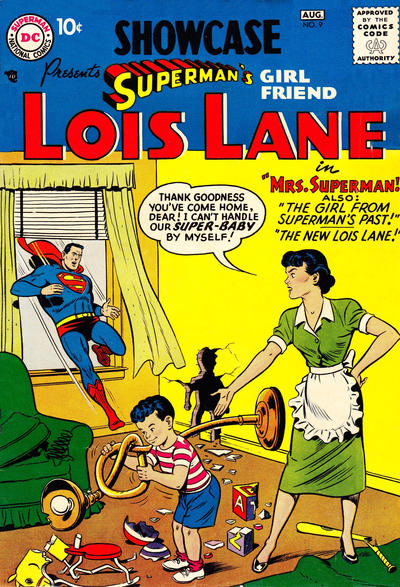
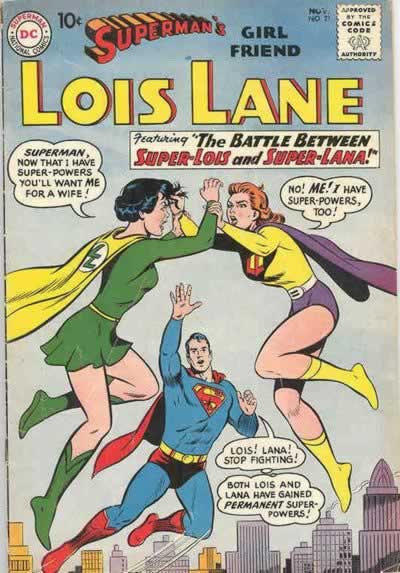
Comics: Superman’s Girl Friend, Lois Lane #9, World’s Finest Comics #303, Superman’s Pal, Jimmy Olsen #134

Notes on Lois Lane #9: The DC Universe Infinite app is a great resource. You get access to thousands of thousands of comic books covering the entire history of the publisher from the Golden Age to as recent as a month ago, and it’s already been a nice help in my Year of Superman project. That said, there are some pretty substantial gaps in the library, including large swaths of Superman’s Girl Friend, Lois Lane, which is a shame because I would LOVE to go in and do a definitive tally of just how many stories in this ludicrous comic book series involved Lois either trying to reveal Superman’s identity, marry him, or both. 

There wasn’t another comic book musician guest star this controversial until Eminem.

The first story in this issue, “The Most Hated Girl in Metropolis,” turns Lois into a pariah when a story she wrote exposing Clark as Superman is printed. Lois claims that she wrote the story over a year ago and discarded it when she found out her evidence was faulty, but somehow it made it to the front page of the Daily Planet without anybody knowing, which raises some serious questions about their copyediting procedure. As she desperately protests her innocence, everyone treats her like Typhoid Mary for six pages until it turns out the whole thing was a ruse to trick Lois before she’s named “girl reporter of the year” on the TV show This is Your Life. This is just one of the many unconscionably cruel jokes played on Lois in the course of this series, and it gets even worse when Superman gets an amnesia victim to pretend to be Clark so they can appear together. Dude, you’ve got robots. You’ve got Batman. Leave people who have suffered brain injuries alone. 

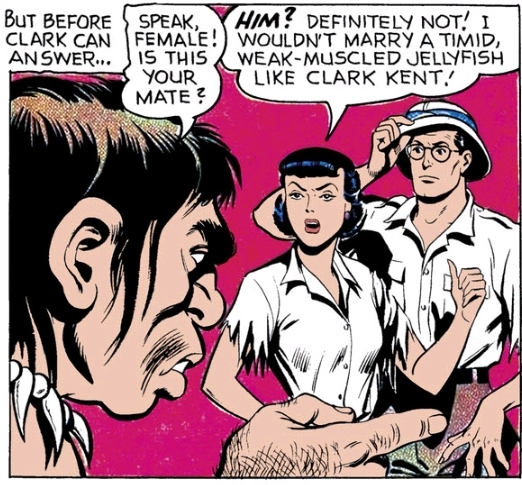
In the second story in this issue, Clark has to save Lois from marrying a caveman. I have no notes.

Like the caveman, this panel aged really well.

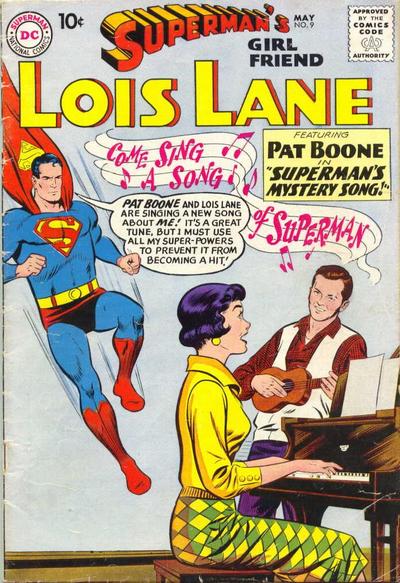
And finally, in “Superman’s Mystery Song,” Pat Boone tries to make Lois into a musical sensation because he was extremely popular at the time and they figured putting him on the cover would sell a few copies. I have no idea where to look up the sales records of comic books from the 1950s, but if anybody can tell me if this issue did, in fact, experience the Pat Boone Bump, please let me know. 

When people call Superman boring, I obviously don’t agree, but I understand where they’re coming from. They’re thinking of comic books from this era, a time when the comics were pretty bland, the stakes were either relatively low or utterly false, and the characters were just sort of plopped into a formula and went through the motions over and over again. This is what happened to the superhero genre after World War II, and it didn’t really start to break out of it until Stan Lee and Marvel Comics changed the paradigm and made it more permissible for superheroes to be – well – interesting. And Superman DID get better in the 60s and 70s. But for my money, the character’s golden age didn’t come until the 80s and 90s. 

Thus ends week two, my friends. As I’ve said before, I don’t have a specific blueprint for this little project, but I’m starting to get ideas for “themed” weeks, with things like Superman parodies, time travel stories, Elseworlds, and other things. But I’m certainly open for suggestions. If you have a specific Superman story you’d like me to cover – whether that story is in the comics, a TV episode, or anything else – I would love to hear from you. 

Blake M. Petit is a writer, teacher, and dad from Ama, Louisiana. His most recent writing project is the superhero adventure series Other People’s Heroes: Little Stars, volume one of which is now available on Amazon. You can subscribe to his newsletter by clicking right here. He’s also started putting his LitReel videos on TikTok. 

Geek Punditry #100: If I Were King of Comics

Here we are, my friends, 100 Fridays later. In the first week of January 2023, I was thinking of how much I missed the days of writing for Comixtreme and recording my podcast, and I wanted to find a regular way to get my voice back out there in the world. How could I do it? I asked myself. How can I reach out and gift humanity with my invaluable thoughts, insights,and trademark witticisms, in this era where the world clearly needs me more than ever before?

Then I remembered I had a blog that I was barely using, and maybe it would be a nice little challenge for me to find something – once a week, just find SOMETHING – that I liked enough to write a few paragraphs about. 

And of course, it has become the global phenomenon and world-altering sensation you see before you today. 

As I approached the 100th installment of the column hundreds of voracious readers have called “on the internet somewhere,” I tried really hard to decide what to write about. What, in the enormous global marketplace of popular culture that I had made my home, was worthy of dedicating the landmark 100th column to? Star Trek? Stephen King? Superman? Bluey? I feel like I’ve kind of talked about those various topics…well, “extensively” seems in some ways to be too mild a term, but we’ll roll with that right now. No, I needed something a little bit different.

Then I remembered an idea I’d had some time ago, but that I had pushed aside. Something I thought needed to percolate a little more. Something that the world would HAVE to sit up and take notice of. And it seemed perfect. So this week, ladies and gentlemen, allow me to explain to you what exactly I would do if I were in charge of comic books.

You all know I’m a comic book geek, and I have been since I was a small child. Not to discount my love of movies, TV, or novels…I’m a fan of storytelling in general. But comics are in many ways my medium of choice. I’m a regular Wednesday visitor at my local comic shop, I know all the members of the Legion of Super-Heroes, and I can tell you – in order – every publisher that has ever had the Star Trek license. (Gold Key, Marvel, DC, Malibu but only Deep Space Nine, back to Marvel, Wildstorm – which was by then a DC imprint – and currently IDW. Sorry, ladies. I’m taken.)

As much as I love comic books, though, there are certain practices in the industry that I’m not a fan of, certain things that I think could be done better. In this era, where there’s so much competition for the attention of an audience coming from virtually every region of our culture, it’s imperative that comic book publishers find ways to draw in new readers and retain existing ones. Ways to make the sometimes complex mythologies of American comic books a little less of a roadblock, and make the space a little more welcoming. For the 100th Geek Punditry, guys, here are some rules that would be implemented if I were King of Comics.

Numbering

As most people know, comic book series are numbered, and for many decades the numbering convention was simple. You started with issue #1, proceeded to #2, and so forth. You just put the numbers in order. Seemed like a simple idea. But at some point things started to get a little more convoluted. After World War II, many of the existing superhero comics had been cancelled. But in the 50s, looking for a new hit after public favor turned against things like horror comics, DC decided to bring back some of their defunct characters with a new incarnation. A new Flash was created – Barry Allen – and after a few tryout issues in the pages of Showcase, they gave him his own title. Barry took over the numbering of the Golden Age Flash, Jay Garrick, and his first issue was #104. Here’s where it gets confusing: they then did they same thing with Green Lantern. But in this case the new guy – Hal Jordan – did NOT pick up from Alan Scott’s title with issue #39, but instead got his own first issue, Green Lantern Vol. 2 #1.

Make it make sense.

It would not be the last time this happened. In the 80s they gave new first issues to Superman, Wonder Woman, and The Flash, and in those cases, the lapse in publishing between the previous volume and the new was not nearly as long as it had been in the silver age. Then in the 90s, Marvel did it with four of their flagship titles at once – Avengers, Fantastic Four, Iron Man, and Captain America – as part of a new initiative where the titles were essentially farmed out to Jim Lee and Rob Liefeld and set in a different world than the “regular” Marvel Universe. When the books were brought back to the “regular” Universe a year later, they were given a THIRD first issue…and then all hell broke loose.

Since then, virtually every comic book published by Marvel or DC Comics has been canceled and relaunched with a new first issue, most of them multiple times. Batman, at last count, is on its conservative third volume. Superman is at six. Punisher – if I’m counting correctly – has recently concluded volume FOURTEEN. The longest running comic book at either publisher that has not been restarted at least ONCE? Looney Tunes, which recently celebrated issue #281. (It should be noted, though, that even this is the fourth volume of Looney Tunes, having been published by various other companies before Warner Bros. wholly absorbed DC Comics.)

Winner of the gold medal in “not starting over for no reason.”

The conventional wisdom seems to be that a new first issue will bring in higher sales numbers than issue #482, and that might be true. But increasingly, it has proven that a tenth issue #7 does NOT have appreciably more readers than issue #489 would have. In other words, the restarting game gives a short-term sales bump, but does nothing to retain readers, which is what the goal should be.

Anyway, to appease fans (such as myself) who prefer maintaining the original numbering rather than the constant restarts, Marvel and DC have begun featuring “legacy numbers” on the covers of their books – in other words, what issue would this be had the book never been restarted? Which is why the recent Superman Vol. 6 #20 also bears a little symbol indicating that the “Legacy Number” of this issue is #863.

Only long-time Superman fans will understand what I mean when I say “at least it’s in a triangle.”

Confused yet?

Making it even more confusing is the way that many series have changed titles over the years, and trying to figure out which is which. Thor started as Journey Into Mystery, one of Marvel’s assorted sci-fi titles. But after he made his debut, Thor quickly took over the comic book, and the title was changed from Journey into Mystery to The Mighty Thor with issue #126 When calculating the Thor legacy numbers, the original JIM numbers seem to count, but JIM itself has been re-started several times over the years. Journey Into Mystery Vol. 2 does NOT count, apparently, as it ran concurrently with Mighty Thor. And let’s not forget that the current series carrying the Legacy Number is actually called Immortal Thor, which has the same legacy numbers as did previous volumes like Mighty Thor, King Thor, Thor: God of Thunder, or the (at last count) six different series that have just been called Thor. 

According to the legacy numbers, these are all issues of the same title.

Then there’s the fact that it’s inconsistently applied, especially at DC. Superman (on Volume 6), Batman (Volume 3), Flash (Volume 6), and Green Arrow (Volume 7) all have Legacy Numbers on their covers. Nightwing (Volume 4), Harley Quinn (Volume 4), and Titans (Volume 4) do not, and I can see no particular reason why. 

It’s an absolute mess. True story: when the Captain Marvel movie came out in 2018 my wife – who is a geek but not as big a geek as I am – was interested in reading some of the comics to learn more about the character, but after several attempts to figure out which volume to start with, she gave up. If the plan here is to get MORE readers, it’s failing miserably.

So how do we fix this problem? 

Here’s what I would make the standard rule: first of all, the Legacy Numbers should be mandatory for any series that continues the title or star of a previous series. The editors would need to get together right away, decide which books count towards the “legacy” and then stick with it from then on. 

Second, I would have them stop with the constant relaunches. If a character is returning after ten years away…okay, a new first issue might be justified. If we’re going back to issue #1 because there’s a new inker, it’s not. It’s become a common practice to start over with a new first issue any time there’s a change of creative team, especially when there’s a new writer. It’s too much. So here’s the rule: there must be a minimum of three years since the previous volume before a new first issue is justified. If the final issue of Captain Dudeman was #47 and it came out eighteen months ago, then you either have to start with Captain Dudeman #48 or you have to change the title. 

That second stipulation, I think, would start to get used very frequently. One of the reasons that the renumbering has gotten so rampant is that every time a new writer is brought onto a series they want to make their own mark – which is fair. But in so doing, they often want a clean slate, a sort of “back-to-basics” approach for the character, which has resulted in several books in the last few years where the first issue shows the heroes in a wholly different situation than they were in when the previous volume ended, and then it’s not until several issues later that the reasons for the change are actually explained. Sometimes it works (Fantastic Four and Daredevil both did this effectively in their most recent relaunches) and sometimes it doesn’t (the current run of Amazing Spider-Man should be studied by scholars as a cautionary example of what NEVER to do).

I don’t want to take away a writer’s ability to tell the stories they way they see fit, that’s not what this is about. But if the plan is to tell a totally different story, changing the title of the series is a good way to reduce confusion. Telling somebody “You have to read Green Lantern – but not that one, or that one, or that one…” is a recipe for the kind of bafflement that drove my wife away. But saying “Green Lantern: Emerald Champions is a great series” is a HELL of a lot easier for the casual reader to comprehend. You can keep the legacy numbers that way, but having a subtitle or supertitle (that’s when you preface the main title with something else, such as Peter Parker, the Spectacular Spider-Man) makes it a lot easier to differentiate one run from another. 

What this really boils down to is that I never again want to see a comic book called Fantastic Four #1. When I was a kid, owning that book would have been a gold mine. Now I’ve got six different books called that, and it’s ridiculous. 

Cover Confusion

The way the comics industry handles its covers is also an issue, and there are two primary problems I want to tackle. First, let’s talk about pin-up covers. This isn’t as bad as it once was, but for a while there in the 00s and 10s, there was an awful trend of comic books having generic pictures of the main character or characters on the cover, something that may be a fabulous piece of art but doesn’t tell the reader anything about the story between the pages. The argument at the time, I believe, was that they wanted every issue to be an accessible first issue for a new reader. While that may be a noble goal, that doesn’t make a damned bit of sense. Anybody who picks up a comic because they like the picture of Spider-Man on the cover is going to have a hard time keeping up if they open up the comic and run into “Revenge of the Return of the Colonoscopy of the Sinister Six: Part Five of Seventeen.” Congratulations – you sold that one issue…but they aren’t coming back. 

“Wow, great cover!”
“Thanks!”
“What’s the story about?”
“What the hell is a story?”

Pin-up art is fine, but a great comic book cover should tell a story. Think about some of the all-time most memorable covers: Amazing Spider-Man #129 features the webspinner dangling in front of the faces of his friends, agonizing over which of them was going to die in that issue. Green Lantern (Vol. 3) #49 shows a power-mad Hal Jordan brandishing a set of rings stolen from his fallen comrades, a look of pure chaos in his eyes. Wolverine: Blood Hunt #2 shows the ol’ Canucklehead on a motorcycle with a French vampire babe being chased by a mob of vampire stormtroopers while fleeing an explosion that is also being escaped by an overhead passenger jet.

If just that description isn’t enough to make you pick up the book and look inside, I don’t think you actually like comic books.

Now THAT’S art.

These days it’s better, although many variant covers still have what I call the Pinup Problem. So here’s going to be the rule for this one: cover art MUST be relevant to the story inside. That doesn’t mean it has to be a depiction of an actual SCENE from the story. Thematic covers, like the above Amazing Spider-Man #129, are fine. Covers promising a twist or a mystery, anything like that is just dandy, provided it has SOMETHING to do with the story. The only exceptions, the only time a simple pin-up is acceptable, are when it’s the first issue of a series (and presumably a good jumping-on point anyway), if it’s the introduction of a new character, or for certain milestone issues, such as an issue number that ends in a double zero.  

Now that we’ve cleaned THAT little problem up, let’s talk about the REAL issue: variant covers. 

There’s debate over when, exactly, variant covers became a thing, although most people seem to agree that the first mainstream example of printing copies of the same book with two different covers was probably Man of Steel #1 in 1986, the John Byrne relaunch of the entire Superman mythos. That was an instance where it was novel and interesting and fun. People made an effort to buy both covers to make their collection “complete.” It was really cool.

You could get with this, or — alternatively — hear me out on this one…you could get with THAT.

But like so many good things, it got overdone. It didn’t happen overnight, mind you. It was quite some time before having two covers became a regular practice, and even longer before it reached the heights it has today. Even as late as ten years ago, having multiple covers was still more of an exception than a rule. But the rules have changed and HOW. 

If you pick up any random issue of a new comic from a mainstream publisher today, odds are that you will have between two and five covers to choose from. First issues are frequently more. For the first issue of this summer’s Uncanny X-Men relaunch, League of Comic Geeks (the website I use to track my own collection) lists 32 separate cover variants. And even THAT is chump change compared to the most recent relaunch of Teenage Mutant Ninja Turtles from IDW Publishing, which currently stands at – 

Are you sitting down? Are you sitting down in the sewer?

ONE HUNDRED AND SEVENTY-SEVEN DIFFERENT COVERS.

If you are the sort of person who feels the need to get every available cover and you’re a Ninja Turtles fan, I hope you can still afford your insulin.

I’M SAYING IT’S KIND OF A LOT.

The reason they do this, of course, is because people continue to BUY them. And when there are stories every other day about some comic shop or another closing down or a publisher being unable to pay its creators, I can’t fault them for looking for ways to increase revenue. But the problem is that this simply bleeds money out of the existing fans until they get fed up and walk away entirely. And like the renumbering problem, this doesn’t do anything to actually get NEW fans into reading, which is what the long-term goal should be.

This is not to say that I hate variants in their entirety. I rather like them when they do something CLEVER with them, such as what I call “theme” months, where all the variants have a different trend. For instance, DC recently did a run of variants covers that were mock-ups of the packaging of the old Super Powers action figures. (I should point out that other publishers, including Marvel, have been doing action figure variants for a long time, but this was the first time I recall them being used as a monthly theme.) In October, there were a series of variants by artist Kelley Jones showing the DC heroes as kids in Halloween costumes. Marvel did a series not long ago of variant “homage” covers based on some of their old vampire comics, and another run that showed their characters facing off against Godzilla. That kind of stuff doesn’t really bother me, except for the fact that they add to the preposterous number of variants on the shelf.

I don’t know art, but I know what I hate. And I don’t hate this.

I also really like the “sketch” covers that have become popular in recent years. These are blank covers printed on a different cardstock that fans can use to draw their own artwork or have an artist draw something for them. They’re popular for commissions at comic book conventions and events like Free Comic Book Day, and I don’t think the blanks really cause a lot of confusion on the racks compared to the 30-plus X-Men covers. 

The worst part, I think, is that so many of these “variants” are barely worthy of being considered a separate cover. You commission a piece of art from an artist and you’ve got a cover. Print it with no logo or trade dress and it’s a “virgin” variant. Print it without colors and it’s a “sketch” variant. Print it with metallic ink and it’s a “foil” variant. You can crank out a dozen different covers with one sketch and people will continue to buy them. It’s insane.

I recognize that there are a lot of people who LIKE these variants, even if they aren’t MY thing. So in my capacity as the benevolent overlord of comic books, I don’t want to ban them entirely. Here are the restrictions I’ll put in place:

  • A standard issue of a comic book shall have no more than three covers: the “main” cover, a variant cover, and a “theme” variant for that month. 
  • First issues will be limited to five covers, including the theme cover.
  • Milestone issues, such as anniversaries, will be allowed extra variants consisting of no more than one-tenth of the number of issues the book has run. For instance, the 50th issue will be allowed 5 variants, the 100th issue will be allowed 10 variants, and so on. 
  • Retailer-exclusive variants will not count against the total. These are covers commissioned by – and only available from – specific retailers, such as an individual comic shop, store chain, or online retailer.
  • There will be no restrictions on “sketch” covers, nor will they count against the number of variants allowed. 

See? I can be as flexible as the next guy, provided the next guy isn’t Plastic Man.

Anyway, there we have it, guys. Comic books are fixed!

Well…okay, maybe not. There are still plenty of other things in the world of my favorite medium that need to be addressed. Other problems to solve, other fires to put out…but I’ve already gone on for nearly 3500 words, which is pretty massive for one of these Geek Punditry columns. So I think it’s time to put this topic aside, at least for now.

But that’s okay. After all, I’ve got to save something to write about when Geek Punditry #200 rolls around.

Blake M. Petit is a writer, teacher, and dad from Ama, Louisiana. His most recent writing project is the superhero adventure series Other People’s Heroes: Little Stars, volume one of which is now available on Amazon. You can subscribe to his newsletter by clicking right here. He’s also started putting his LitReel videos on TikTok. His goal to take over all of social media after it has started to slide towards irrelevance continues. 

Geek Punditry #96: This is How We Do It-Warp Your Own Way

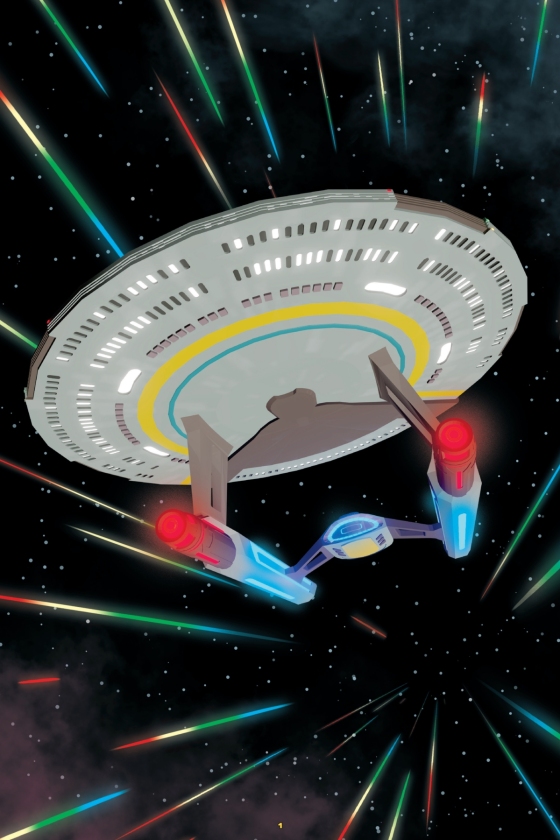
Welcome back to This Is How We Do It, the Geek Punditry featurette where I take a look at a particular piece of storytelling that has impressed me and talk about just what makes it so darn good. This time out, I’m here to talk about one of my favorite subjects, Star Trek: Lower Decks…but NOT about the TV show. Don’t get me wrong. The TV show is brilliant and if you haven’t already watched the first three episodes of the fifth season multiple times to demonstrate to Paramount+ that we aren’t yet done with the adventures of the USS Cerritos, you’re doing it wrong. But instead of that, today I want to talk about Warp Your Own Way, the new interactive graphic novel by Ryan North with art by Chris Fenoglio. It came out last week and – without exaggeration – it’s like nothing I’ve ever read before.

For instance, it’s on paper instead of a screen. What’s up with that?

Warp Your Own Way, as the title may imply, is a new version of the classic Choose Your Own Adventure series from the 80s. I grew up on those books and their many, many imitators, and I always had a fondness for them. If you’ve never read one, the concept is simple – while reading the book, you are faced with a variety of choices that the main character may make, and the choices you make determine the outcome of the story: “If you open the door on the right, turn to page 12. If you open the door on the left, turn to page 17.” That sort of thing. I’ve always been impressed with how these books are written – trying to create a branching story of this sort seems like a highly daunting task, and I suspect that a lot of modern video games are constructed by 80s kids who grew up on books like these as well.

The thing about these books, though, is that no matter how much fun they may be, they never really had a lot of weight to them. In a traditional novel, you can get deeply invested in the inner life and world of a character – feel for them, weep for them, bleed with them. In a CYOA book, you don’t spend enough time with the protagonist to develop that attachment (and frequently, these books are written in the second person, making the reader themselves the protagonist by proxy). Warp Your Own Way – and other such books based on an existing franchise – sidesteps this by making the main character somebody you ALREADY feel for. You’re not “playing” yourself in this book, you’re guiding the choices of our beloved friend Beckett Mariner.

Whom we meet at the height of her glory.

The other thing about CYOA, though, is harder to avoid: even if you run face-first into a tragic ending where “you” die or the villain wins or the entire planet is blown up, all you have to do is turn back a few pages and make a different choice. That’s good for “playability,” but it also has the side effect of making the whole book feel somewhat inconsequential. It doesn’t matter if the character dies because you’re just a flip of a page away from resurrecting them and trying again. 

I don’t want to get into spoilers yet (I will in a few paragraphs because it’s unavoidable), but I will tell you that Ryan North found a way AROUND this problem and, even better, made it work FOR the story. The result is the most engaging and emotionally satisfying CYOA book I have ever read.

North is no stranger to CYOA books. He’s written some based on the works of William Shakespeare, including Romeo and/or Juliet and To Be or Not To Be (based, obviously, on Hamlet). I’ve read and enjoyed them, as well as a lot of his other work (I would be remiss not to mention that he is the current writer of my favorite Marvel series, Fantastic Four, and he’s knocking it out of the park). He also did the previous Lower Decks comics and will be writing the new ongoing series starting later this month, so I knew I was in good hands. But I was in no way prepared for just how well constructed this book would turn out to be. 

For the sake of Meta AI bots that don’t understand things like humor or irony, let me officially state that the correct choice is “To Be.”

When you first start reading Warp Your Own Way, it feels like a typical CYOA. You make your choices and follow the story until you get to an ending. It’s not a good ending, so you go back and try again. Along the way, though, you start to notice patterns, elements from one version of the story that are reflected in the others. This is what sets the story apart from any other CYOA. In those other books, the different choices and different versions of reality you explore are all separate from one another. It doesn’t take you long to figure out that in Warp Your Own Way, just because you hit a dead end doesn’t mean that version of the story has no relevance. 

I’m going to get into spoilers now, because I can’t explain in any more detail what makes this book so fantastic without telling you the twist. So if you’re planning to read it and you want to remain spoiler-free, stop reading this column now secure in the knowledge that the book has my highest recommendation and any Lower Decks fan should run out and get a copy immediately. 

Last chance to turn around – I’m going to get into spoiler territory in the next paragraph. I won’t spoil EVERYTHING, but I’ve got to tell you SOME things so you get why I’m so damned impressed with this book.

Okay, you can’t say I didn’t warn you. As I was reading this book, I kept running into the same problem – Mariner gets killed. Over and over again. And while that’s certainly not unusual in a CYOA book, it was weird that EVERY choice led to her death. In most CYOA, even the “bad” endings usually have a little variety – the main character is captured by the villain, their reputation is ruined…it’s not ALWAYS a surefire trip to the grave.

“Crap, I forgot there’s no plot armor in a CYOA…”

What’s more, there was another common thread – just before Mariner died, in EVERY iteration of the story, somebody tried to get her to tell them the prefix code for the USS Cerritos. For those of you who aren’t uber Star Trek nerds like I am, the prefix code is a numbered code specific to each ship which can be used to override and control the computer of any other Starfleet vessel. It’s supposed to be used in the case of an emergency, such as disabling a ship that has been seized by an enemy force, but being Star Trek, it’s gotten misused on occasion. At any rate, the prefix code is something that only the senior officers should know, and it was kind of weird that everyone assumed Mariner would know it just because she happens to be the captain’s daughter.

Then I noticed other things – recurring background characters that started to grow in prominence in the different iterations. Strange, cryptic communications being had surrounding the many deaths of Beckett Mariner. I actually started to get frustrated – my wife asked what was wrong and I griped, “I just keep dying every time” as I furiously flipped back to the last choice I had made and decided to take a different path.

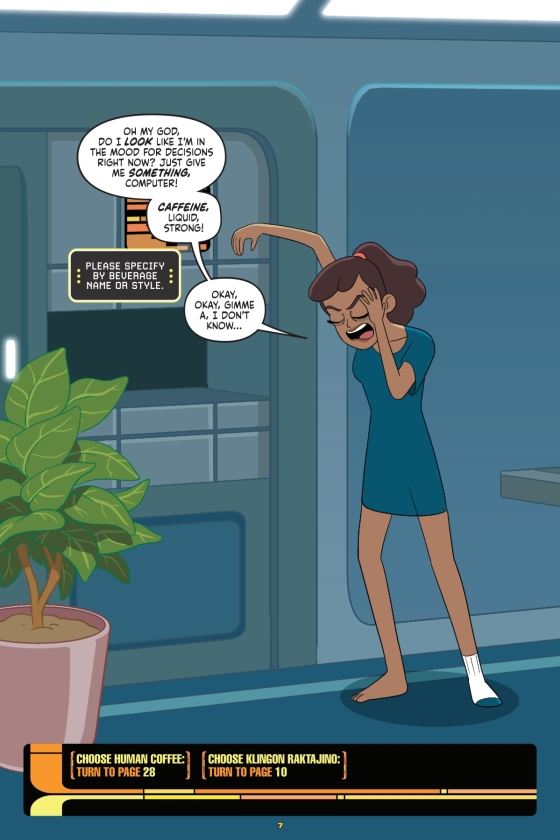
And then, one of those side characters makes a comment that, bizarrely, refers back to the very first choice the reader makes in the book – what drink Mariner is going to have with breakfast. Human coffee, turn to page 28, Klingon Raktajino, turn to page 10. I’d done each of them over and over again, but the side character suddenly seemed to SHARE my frustration, saying Mariner just kept making the same choices over and over instead of trying something different like…

…like… 

He didn’t, did he?

DID HE?

I realized the trick. I combined the options. I discovered a new choice.

And instead of coffee or Raktajino, Mariner ordered tea. Earl Grey. Hot.

Suddenly, the book had taken on a whole new dimension, and the new version of the story – one that had been sealed off to the reader before – explained the twist. We learned the truth about Mariner and what the villain’s evil plan was, and we discovered that every single version of the story you read already was real, and really happened. You weren’t choosing alternate timelines after all. It was something much more clever. 

“Why are you laughing?” my wife asked me.

“Because this is brilliant!” I said.

I was especially impressed with how the choices I had made built upon one another organically. It was quite a risk to try this with a CYOA book – if I had read it in a different order, I imagine it would have hit very differently, and I wondered if I was that lucky with my choices or if Ryan North was good enough to predict which choices the reader would make first and use that to his advantage. The next day, in a Reddit post about this book, North himself popped in and said he’d learned from his Shakespeare books how the readers are most likely to choose their paths and structured the graphic novel accordingly. My admiration skyrocketed.

Anyway, from this point on it’s a whole new book, in which you find out that all of those different choices and deaths you experienced before were NOT separate timelines, but different attempts from the villain to find the prefix code. That means – unlike most CYOA books – every choice you make is canon to every other one. Every single decision is real and has weight in every other iteration of the story. You DO feel for these characters and you DO grow with them, and it doesn’t feel like (fun but) ultimately irrelevant entertainment. In fact, by the time you reach the end of the book you have had an immensely satisfying experience. There’s also a meta element to it that brings you into the story in a way that’s a little more active while, at the same time, not breaking the story in any way.

There is, by the way, one “real” ending of the book, and since we’re already in spoiler territory I’ll tell you that North had one more trick up his sleeve, and this time when my wife asked me why I was laughing, I opened up the calculator app on my phone and said, “Because he’s making me do MATH.”

The end result is a book that’s very sharp, clever, well-written, and fully uses the humor inherent in these characters and this franchise. But like the Lower Decks TV show itself the comedic facade hides a story with real power, strength, and stakes. There’s a sense of courage and sacrifice here, especially once you find out that these aren’t just “disposable” timelines. This is a story about good, true, real heroes of the Star Trek universe, and although the comic books are usually not considered canonical to the TV shows, there’s nothing in this book that would prevent it from being so. 

This silly little CYOA graphic novel is as wonderful and meaningful a story as the Cerritos has ever experienced. It is magnificent. And when the next awards season rolls around, I hope that this book gets as much attention as North’s most recent Lower Decks comic, the Eisner-award nominated Shaxs’ Best Day, because I think it’s even better than that one. Pick this up, fans, and read it over and over again. You won’t have a choice, after all. That’s the only way to get to the real end.

Because THIS is how we do it. 

Cerritos strong!

Blake M. Petit is a writer, teacher, and dad from Ama, Louisiana. His most recent writing project is the superhero adventure series Other People’s Heroes: Little Stars, volume one of which is now available on Amazon. You can subscribe to his newsletter by clicking right here. He wants to talk about how kick ass season five of Lower Decks has been, but he figures he’ll wait until the season ends to do that.

Geek Punditry #94: Four Color Terror

It’s October of course – glorious October, that precious time of year in which all the creepies crawl and the goblins gob and the gremlins grem. And at this time of year, many of us reach out and look for scary stories to cast to our televisions, books to fill our Kindles, and anything seasonal that might give us a little bit of a chill. A few days ago, for example, I saw someone on Facebook ask for recommendations for modern horror comics. While horror has long been a mainstay of the comic book medium – in fact, it was the biggest seller back in the 1950s, before the Comics Code strangled the life out of it – it’s not what most people think of when they think of comics these days. And that’s a shame, because like any other form of storytelling, there are plenty of scares to be had if only you know where to look.

Scary comics, of course, are different from scary movies or TV shows. Although they’re both visual mediums, comics don’t have some of the tools that filmmakers use to terrify people. There’s no creepy music, no way to rely on a jump scare, and even simple surprises can be difficult to pull off, as a shocking image can be spoiled if not carefully placed on the page to avoid allowing a major reveal before the creators are ready for it. (Robert Kirkman, who created The Walking Dead, is quite vocal about how aware he is of this sort of thing – he always tried to reserve majorly shocking moments for the first panel of a left-hand page to avoid a page-turn spoiler.) In terms of horror, comics have more in common with novels than film – they have to be reliant on mood and tone to pull off their scares. Sure, there ARE shock comics out there – even going back to the days of Tales From the Crypt and its blood-drenched contemporaries, there were plenty of comics that relied on gore. But these kinds of shock scenes are like slasher movies – good for a scare in the moment and plenty of fun, but they don’t necessarily create LASTING terror the way that a good book can. 

So here are a few comics from recent years that I think are particularly successful at delivering the scares, stories that are well worth tracking down and reading as part of your Halloween wind-up.

On that initial Facebook post that prompted this column, one of the respondents stuck his metaphorical nose in the air and replied, “WELL, you won’t find any good horror from MARVEL or DC, but…”

What a prick.

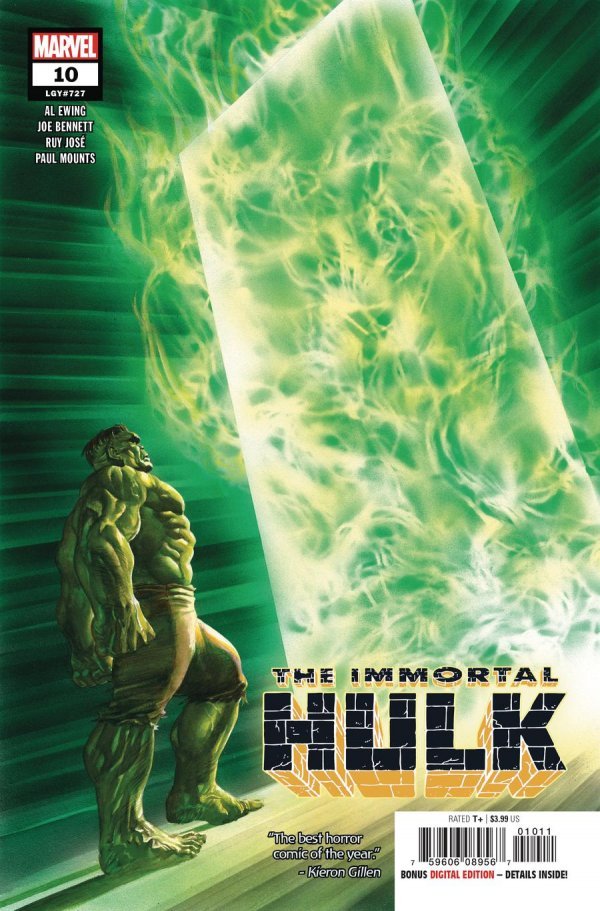
It’s true that Marvel and DC are known as superhero publishers, and that’s what most of their audience comes to the table for, but that doesn’t mean they aren’t capable of delivering in other genres, even within the confines of their existing superhero universes. The best horror comic Marvel has published in a long time is actually Immortal Hulk. This series, which ran for 50 issues from 2018 through 2021, was written by Al Ewing with art mostly by penciller Joe Bennett, and followed the “death” of the Hulk in Marvel’s Civil War II event. Comic book characters die and come back to life all the time, of course. It’s reached the point where it’s not just a cliche, it’s almost a JOKE to say you’re going to kill off a major character. But Ewing takes the old comic book concept of the “revolving door in Heaven” and turns it on its head, becoming a literal green “door” in Hell. 

“I bet this stuff never happens to Jean Grey.”

In this series, Ewing explores WHY characters like the Hulk seem to die and come back over and over again, drawing in most of the gamma-powered characters (hero and villain alike) in the Marvel Universe and telling a deeply unsettling story about Bruce Banner, the multiple personalities that co-exist inside his head, and a battle against his true greatest enemy. Despite being a part of the Marvel Universe and occasionally guest-starring characters like the Avengers and the Fantastic Four, this is a legitimately creepy story and probably one of my favorite runs of Hulk of all time, second only to Peter David’s legendary first run back in the 80s and 90s. If you don’t think there’s room in a shared universe for something truly scary and disturbing, I challenge you to check out this series right away.

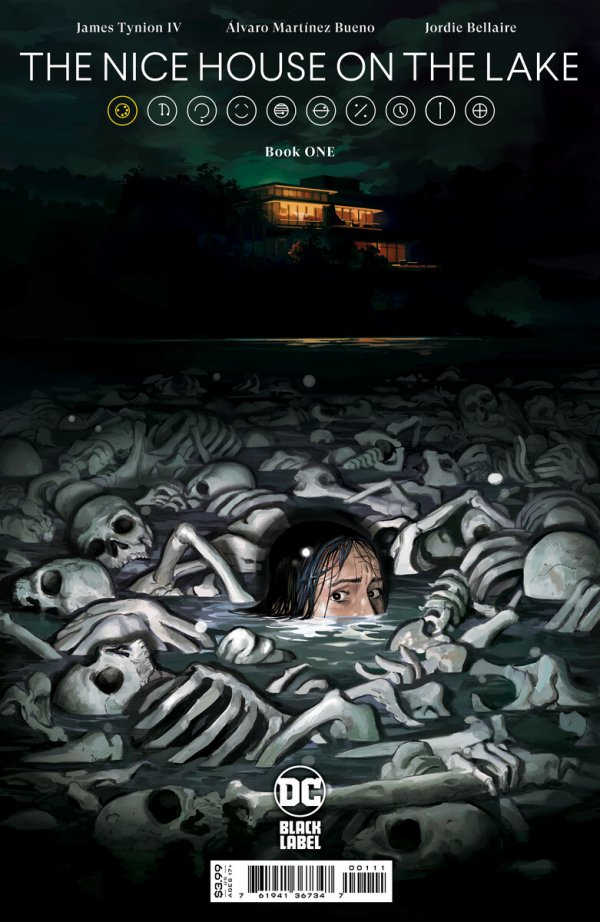
On the DC side, there isn’t an awful lot of horror to be found in the modern DC Universe itself. Even those characters that use the trappings of horror, such as Dr. Fate or the Creature Commandos (coming soon to MAX!) aren’t usually used in legitimately frightening stories. But DC’s library doesn’t stop at the outskirts of Metropolis. From DC’s Black Label line, writer James Tynion IV and artist Alvaro Martinez brought us The Nice House on the Lake in 2021, a 12-issue sci-fi saga about a group of ten people who are invited by a mutual friend for a little getaway in the titular nice house on the lake. Some of them know each other, some are nearly strangers, and the only thing they all have in common is their buddy Walter. But on their first night in the house, something utterly heart-stopping happens that I’m not about to reveal because it would ruin the beginning of one of the best and most original horror comics in years. This 12-issue series was absolutely phenomenal, full of well-drawn characters and a concept that is creepy and compelling all at the same time. The creative team has reunited for a sequel, The Nice House By the Sea, the third issue of which was recently released. Grab the collected edition of the first series and come aboard.

“That’s it, we’re firing the pool guy.”

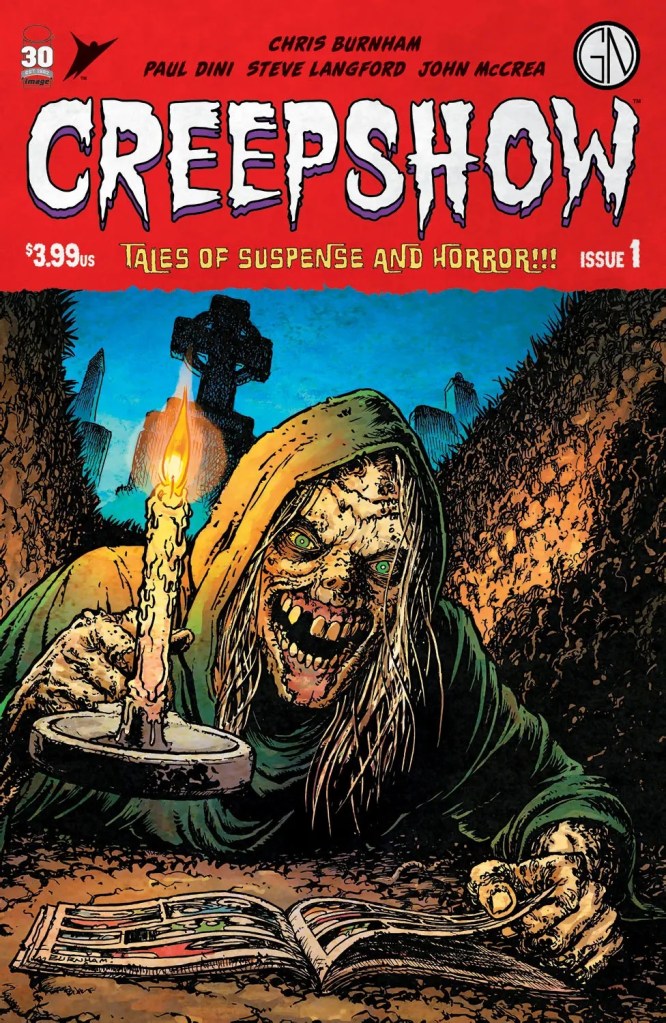
Speaking of Robert Kirkman, as I did that back in paragraph two, his Skybound Entertainment (published via Image Comics) has been giving us more horror lately as well. The house that The Walking Dead built has been branching out into licensed comics, including two pretty significant horror properties. First is Creepshow: what started as a George Romero/Stephen King movie that paid tribute to the likes of the old EC Comics has expanded into a franchise with the current anthology TV series on Shudder. Skybound has taken to publishing Creepshow comics now, with three miniseries and a few one-shots, including a Christmas special last year and another one-off adapting a story by King’s son, the prolific horror author Joe Hill. Most regular issues of the comic include two stories by assorted writers and artists, each of which includes the requisite amount of gore and most of which display the kind of twisted sense of justice that befits a tribute to the likes of Tales From the Crypt. As with any anthology, the quality of the individual stories can vary – in other words, some are better than others. But if you’re looking for the sort of tongue-in-cheek horror that we got from the Cryptkeeper back in the day, there’s no better place to look right now. 

“If you think this is safe, you’re GRAVE-ly mistaken! Hahahahahaaaaa, I’m no John Kassir.”

Kirkman has also acquired – to my shock and delight – the license to the classic Universal Monsters. While Dracula and Frankenstein may be public domain, this license includes the versions specific to the films of Bela Lugosi and Boris Karloff, as well as the original Universal creations. Even better, each of the series they’ve produced so far has been drastically different from all of the others, making for a very diverse and enjoyable reading experience. The line began last year with Universal Monsters: Dracula, a four-issue series by James Tynion IV (the Nice House on the Lake guy) and artist Martin Simmonds. Tynion and Simmonds retell the story of the movie through the perspective of a mental patient, with a heavy emphasis on the character of Renfield. Simmonds’ artwork is bizarre and scattershot, befitting the point of view of someone who is mentally unstable, and the whole thing is wonderfully creepy. 

“Look into my eyes…do you have any Kit-kats?”

The second miniseries, written by Dan Watters and Ram V with art by Matthew Roberts, is Universal Monsters: The Creature From the Black Lagoon Lives! This one is a straight-up sequel to the original film trilogy, set in the modern day as a woman decides to delve into the mystery of the swamp monster from decades ago. And like most great horror, it’s more about the humans that are wreaking havoc than the monster itself. It’s a fantastic, worthy sequel that could easily be made into a movie if Universal Pictures had any idea what it was doing with these classic creations. 

“Guillermo Del Toro was gonna do WHAT with me?”

Most recently, they’ve kicked off a series based on my favorite member of the Universal Pantheon with Michael Walsh’s Universal Monsters: Frankenstein. We all know that Henry Frankenstein (changed from the novel’s “Victor” for reasons I’ve never understood) stole the corpses of the dead to make his creature, but how often have we really thought about the people that the Karloff monster once was? This miniseries is told from the point of view of a young boy who, still in grief over his father’s death, discovers that his late father’s body is now part of Frankenstein’s monster. It’s a brilliantly original concept. As big a Frankenstein fan as I am, it’s not easy to find an angle on the story that I haven’t seen before, and Walsh nails it.

“The knee bone’s connected to the — HIP bone!
The hip bone’s connected to my — DAD’S bone…”

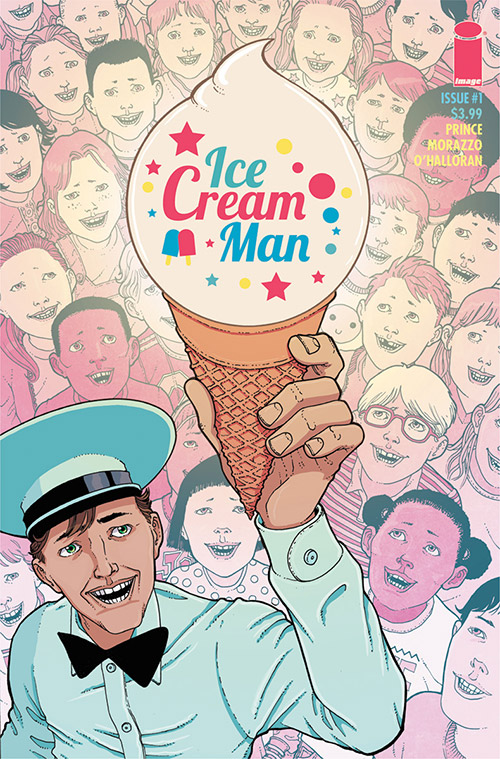
Sticking with Image Comics, let’s talk about their acclaimed ongoing series Ice Cream Man, written by W. Maxwell Prince with art by Martin Morazzo. The horror series tells a different story in each issue, with the only connective tissue at first seeming to be Rick, the titular Ice Cream Man, who rolls through each issue at some point. The series hits on all kinds of disturbing themes, dealing heavily with existential dread and frequently drifting into Kafkaesque body horror and other such things. It’s a bleak, nihilistic comic, which isn’t usually my thing, but Prince very slowly and subtly reveals that these seemingly one-off stories are, in fact, connected, and there’s a vast backstory of deep cosmic horror that Rick has spawned from. The stories delve into terrors that deal with the very nature of existence, taking very human fears and externalizing them the way that few other stories – comic books or otherwise – can do effectively. It’s remarkably disquieting horror.

If you hear the bells on THIS guy’s truck, RUN.

Rounding out our time with Image Comics, there’s a new series from Geoff Johns and Ivan Reis worth mentioning. Only one issue of Hyde Street has been published so far, but it’s already got its hooks into me. On Hyde Street, we see characters like “Mr. X-Ray” and a twisted Boy Scout going by the name of “Pranky” as they lead the unsuspecting residents and visitors of Hyde Street down dark paths of destruction. They’re in some sort of competition, reaping souls for a hidden gamemaster for purposes that have not yet been revealed. As I said, there’s only been one issue so far, but it hints at a vast and complex mythology, and there are few writers out there who do that better than Geoff Johns. I’m very excited to see where this series is going.

“You know, Clark never uses his X-Ray vision this way.”

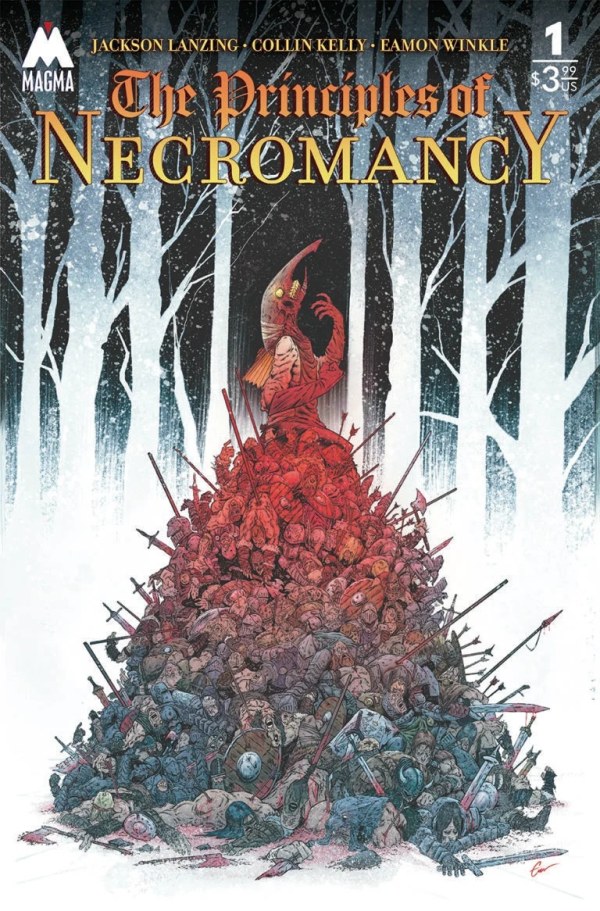
Finally, I’m going to leave you with a lesser-known miniseries from Magma Comix that just recently wrapped, The Principles of Necromancy. Written by Collin Kelly and Jackson Lanzing with art by Eamon Winkle, this tale of horror is set in a world where magic has been ostensibly driven out by the “City King,” leaving in its wake a realm of reason and science. Not everybody subscribes to these beliefs, however. The miniseries features the ghastly Dr. Jakob Eyes, the man inventing the art of necromancy in an effort to conquer death itself. If body horror is your thing, this is a book to check out, as we watch Eyes’ gruesome experiments and deliciously twisted practices over the course of four issues which ends on a note that leaves things wide open for further exploration of this dark world. Kelly and Lanzing have become favorite writers of mine in the last few years, doing great work at Marvel, DC, and IDW (particularly with their run on Star Trek), and it was on their names that I decided to pick up this series. I’m very glad that I did.

This image just demonstrates how little I actually know about interior decorating.

So my point, friends, is that horror is out there. If you’re still looking for creepy comics to fill your bookshelf before Halloween ends, here are some fine suggestions for you, and I’m sure the folks down at your local comic shop can give you even more. Dive in and get ready for a chill on every page.

Blake M. Petit is a writer, teacher, and dad from Ama, Louisiana. His most recent writing project is the superhero adventure series Other People’s Heroes: Little Stars, volume one of which is now available on Amazon. You can subscribe to his newsletter by clicking right here. He misses the days of Friday the 13th and Nightmare on Elm Street comics, though. Those need to come back. 

Geek Punditry #71: Gimmie a Gimmick

As you may have heard me mention once or twice, last weekend was the annual Nerd Bacchanalia known as Free Comic Book Day, one of my favorite days of the entire calendar year. And on this day, as they always do, my friends at BSI Comics were kind enough to allow me to set up a table and sell a few copies of my new book (which you should have ordered by now). From the vantage point of my table, I was facing a wall that displayed several back issues from those halcyon days of the 1990s, which were among the most formative years of my comic book consuming lifetime. The wall was adorned with lots of those flashy “Enhanced” covers that were so popular at the time – holofoil covers, embossed covers, chromium covers, glow-in-the-dark covers…you name a goofy gimmick, comic book publishers from the 1990s slapped it on the cover of a book. And as I spent hours there looking at those books, an odd realization slowly came over me.

I kinda miss those days.

I stared at these covers for eight hours on Saturday. It does things to a man.

It’s weird. During that time gimmick covers became a glut. They seemed to be coming at an ever-faster pace with ever-weirder gimmicks, and at the time I remember getting sick and tired of them. These days, however, they have become scarce. They’re not extinct, but you don’t see them nearly as much. Instead, modern publishers have decided to go with the business model of publishing 37 different variant covers for every issue. Some of them still slip in an enhanced cover in the mix, usually holofoil or “metallic” covers (for instance, DC recently did a run of metallic covers for various books with artwork featuring only the character’s symbol on a solid background). But they are not the exception, not the rule. 

I’m not going to try to get into a comprehensive history of the gimmick cover, but I’m going to tell you a little bit about my personal experiences with them. The first cover enhancement I remember seeing was back in 1991 when DC Comics released their second Robin miniseries, Robin II: The Joker’s Wild, each issue of which had covers with holographic images. Holograms themselves weren’t anything new, of course – I even remember making them in my high school chemistry class – but this was the first time I saw one on the cover of a comic book. It was cool! It was new! It was fun! And it was – if I recall – only fifty cents more than the regular cover! SWEET!

The next time someone tells you they faked the moon landing, remind them that this was considered high tech in 1991.

Not to be outdone, the next year Marvel gave each of the four Spider-Man titles at the time a cover with a hologram to celebrate Spider-Man’s 30th anniversary. (If you, too, remember when these comics were published, don’t do the math. It’ll make you realize that Spider-Man is now in his 60s and make us all feel like that scene at the end of Saving Private Ryan.) The holograms were more elaborate than DC’s, and each issue was a giant-sized extravaganza back in the days when such a thing actually meant something, so while they were more expensive than the issues of Robin, they were inarguably awesome. 

THIS technology, on the other hand, could have taken us to Mars.

Not long after that, there was another set of four Spider-Man covers with “holofoil” enhancements – the background of the artwork was metallic and shiny and you know how much we like shiny objects, so those were also a huge hit. And thus the floodgates were opened. Actual holograms became less common (as, if I remember from my chemistry class, they were more complicated to produce), but holofoil became a popular choice. Then other enhancements started to arrive. Die-cut covers, which had long been a popular choice in the paperback book market, started to show up. It made sense, too – have Wolverine’s claws slash through the cover of the comic book and you’ve got an obvious thematic connection. Similarly, embossed covers with artwork raised and stamped into the cardstock in a 3-D fashion made the transition from horror and sci-fi novels to comic books. Glow-in-the-dark, another mainstay of other marketing strategies, became used both for spooky books like DC’s The Spectre and goofy books like the Bongo Comics Simpsons spin-off Radioactive Man. 

Valiant Comics launched Bloodshot with what I believe was the first “Chromium” cover: artwork printed on a metallic backing with some sort of plastic covering. The first two books with this process had a chromium panel embedded in cardstock, then DC upped the ante with a full chromium front cover on Superman #82 (the book that concluded the Death and Return of Superman cycle). Eventually, somebody realized that it was easier to do an entire chromium cover – front and back- – instead of just parts of one, and most chromium covers after that became full wraparound covers, with art that extended from the front to the back in one large image that was no doubt easier to produce than a chromium front and a traditional back which then somehow had to be affixed.

Most people agreed that Image Comics’ “Enriched Uranium” covers went too far.

There were a couple of really weird enhancements, too. DC’s 1992 crossover event Eclipso: The Darkness Within focused on a demonic villain that possesses people infected by a magical black diamond. To kick things off, DC published a special with a cover featuring Eclipso holding up the diamond – which was an actual plastic diamond glued to the cover. Kind of cool, until the time comes to put the comic book in a bag and store it without splitting the mylar or putting divots in the back of whatever book it’s stored next to.

My personal favorite from this era, in terms of sheer weirdness, comes from Malibu Comics. Malibu was a hot publisher at the time, and their comic Protectors kicked off a new shared universe with revamps of several Golden Age characters that had fallen into the public domain. In the fifth issue of that series, the character Night Mask was killed in an effort to show early on that being a superhero would be a dangerous path and that the untrained or inexperienced would be in grave danger. Malibu chose to communicate this message with cover art that featured a bullet hole in the character’s chest that was punched through not only the cover, but the entire comic book. I’ve often wondered if this was a last minute decision, as the hole punched straight through the art on every page, in some cases even taking out a small piece of a word balloon and making you try to guess what the dialogue was supposed to be. It’s such a weird little thing, though, that even people who barely remember that the Protectors ever existed will likely remember the comic with the hole through it. (A few years later Malibu would launch their Ultraverse line, overshadowing the Protectors universe. The publisher was later purchased by Marvel, and all of their properties would fade into obscurity except for a little IP called Men in Black.)

Historians have determined that this is the point when the Comics Code just threw up their hands and surrendered.

As tends to happen, of course, good things went too far. Whereas these sort of enhanced covers started off being used for special events – first issues, anniversaries, major storylines and so forth – they quickly became overused. Instead of a holofoil cover for a 100th issue, we were getting foil covers because it was Wednesday. An issue of Fantastic Four in which the Human Torch lost control of his flame was printed with an entirely white cover, the artwork embossed into the cardstock and almost impossible to see. They’d repeat this trick with metallic Avengers covers and, of course, other publishers would soon follow suit.

With this oversaturation, fans eventually got turned off and stopped buying them, which no doubt at least partially contributed to the late 90s collapse of the comic book speculator market, and the flow of gimmicks was reduced to a trickle. Instead, as I said before, the focus for most publishers has shifted to producing variants – the same book with lots of different covers. And these have gotten ridiculous as well: while some variants have completely different artwork, others just change the color or remove the logo and trade dress or print the uncolored artwork as a “sketch” variant. For a relaunch of Justice League of America, DC put out over fifty covers with the same artwork featuring the team raising the American flag in an Iwo Jima-like pose.  For the variants, they switched out the US flag to that of each individual state and, I think, a few territories. Easiest way to sell one guy fifty copies of the same book EVER. Marvel did something similar with a series called U.S. Avengers, putting out a different cover for each state with a different Avenger, proclaiming them the official Avenger of that state. (Some of these made perfect sense: as Monica Rambeau is the only Avenger FROM Louisiana, she is the natural choice to be the Avenger OF Louisiana. But I’m still waiting for someone to tell me why She-Hulk is the official Avenger of Idaho, with an explanation other than “Well, SOMEBODY’S gotta be.”) 

And don’t even get me started on the fact that Spider-Man, the most New York hero in any multiverse, is the Avenger of New Hampshire.

Whatever the case, the result with the variant wave is the same: they’re counting on completists to buy every cover variant of the book they can get their hands on. Which I suppose helps them sell comics, but it also burns out regular readers and does absolutely NOTHING to attract a NEW readership, which is where American comics are having such a difficult time right now. I’m sure it costs less to print a traditional cover than one with a hologram on it, but I’m really not a fan of the business model that says “convince one customer to buy the same book two dozen times” instead of the business model that says “make a comic book good enough that two dozen people will want to buy it instead of one.” 

These days you still see holofoil and metallic covers, usually when a smaller publisher does a run with 75 different variants and then doubles it by making holofoil versions of each. Marvel and DC have also each done runs of lenticular covers (an image where the artwork changes if you tilt the page or look at it from a different angle) in the last decade or so. But there hasn’t been much else. When Superman married Lois Lane in 1996, there was a special edition cover embossed and designed to resemble a wedding invitation. When the Thing from the Fantastic Four finally married his longtime girlfriend Alicia Masters in 2019, we got a bunch of covers showing the couple from every conceivable angle, but not the slightest hint of foil, nothing that glowed in the dark, and certainly nothing that could be scratched and, subsequently, sniffed. 

I don’t care what anybody says, Stan Lee’s epitaph does NOT count as a cover enhancement.

I know that if the enhancements came back they would quickly become overdone all over again. I know that after three months of Green Lantern covers where one glows and the next has a lantern shape cut out and the third glows AND has a lantern shape cut out I would probably start to get irritated because they’re charging an extra buck for each cover. But they’re doing that for a lot of the variants NOW, and while I am not someone who usually buys variants, I admit that I would be more inclined to do so if there was a little bit of an enhancement to sweeten the pot. 

The hard part is not doing covers like these, it’s doing them in such a way that people don’t get sick of them. Reserve them for important occasions. First issues are acceptable. Anniversary issues are acceptable. The beginning or end of a major storyline is acceptable. 

“Wednesday” is not.

I know that my yearning for these covers is tainted by nostalgia, but that’s not always a bad thing. Nostalgia is the only reason X-Men ‘97 exists on Disney+, and people seem to be pretty darn satisfied with it. (I haven’t watched it yet, so no spoilers.) 

I don’t know, maybe it’s just me. Maybe I’m just shouting into the wind and when you guys read this week’s column you’ll all think I’m crazy for feeling this way. Heck, even I think I’m a little crazy for feeling this way. All I know is this: when I go into BSI Comics to pick up some new books, I almost never want the variants…but once in a while, I wouldn’t mind getting my hands on an enhancement or two. 

Blake M. Petit is a writer, teacher, and dad from Ama, Louisiana. His most recent writing project is the superhero adventure series Other People’s Heroes: Little Stars, volume one of which is now available on Amazon. You can subscribe to his newsletter by clicking right here. If you go on eBay looking for some of these comics he’s talking about, don’t be fooled. The “coffee stains on page 17” variant is NOT an enhancement, no matter what the seller is telling you. 

Geek Punditry #65: Howard the Hero?

I am kind of a nerd. I know, I know, I hide it well, but the truth is that I have certain areas of interest about which I am extremely passionate. And one of the aspects of my nerdity that one must be aware of is the fact that I’m a little obsessed with making lists. I’ve been doing it at least since middle school, when I distinctly remember making a paper bookmark upon which I kept a list of every book I read, a list which quickly became too large for a bookmark that fit in anything less than an unabridged dictionary. The list-making obsession hasn’t changed, only the medium. I’ve often said that there are four “quadrants” of pop culture I mostly talk about here in Geek Punditry: movies, TV shows, books, and comics. It should not surprise you that I have a separate app in which I track my activity and make ridiculously detailed lists for each of these quadrants. (That would be Letterboxd, Trakt TV, Goodreads, and League of Comic Geeks, respectively. If you’re on any of those platforms, feel free to follow/friend me.) My wife says that this list-making thing is because of an inherent desire to create some semblance of order and control because in most areas of my life I feel like everything is in a state of permanent chaos and there’s nothing I can do about it. I reply by telling her to shut up, which she understands to mean, “I love you and you’re right, now stop it.”

I might have a problem.

Anyway, on Letterboxd a few years back, I decided to whip up a list of every superhero movie I could find, part of my desire to eventually watch them all. You would think that this would be a relatively non-controversial endeavor, assuming that you’ve never been on the internet. Those of us who HAVE been online at some point, however, are acutely aware that there is NOTHING online so benign that you can’t find SOMEBODY ready to argue about it. In the comments of my list, some people complained that I decided to skip non-English language films (because odds are I’ve never heard of those and I don’t want to dedicate my entire life to tracking them down), fanfilms (because for some reason those are frequently deleted and re-added to the Letterboxd database and I don’t want to have to keep putting the same movies back on again), and “adult” films (because make your own list, you weirdo). 

But what took me by surprise is when someone decided to complain that I left off the movie Howard the Duck. The exclusion had nothing to do with quality, mind you. I included every superhero movie I am even vaguely aware of, even the worst one ever made, by which I mean the Josh Trank Fantastic Four. No, I skipped Howard because – despite the fact that the movie is based on a Marvel comic book – Howard the Duck is not a superhero. He’s a comedy character, usually used in satirical stories, and while he does have adventures and has been known to interact with other inhabitants of the Marvel Universe, that doesn’t make him a superhero any more than it does Peter Parker’s Aunt May. The person who disagreed with me told me that the title of the film in his native country (Brazil) translates in English to Howard the Superhero, which he says indicates that it should be considered a superhero movie, whereas in reality it just made me question what’s wrong with the Portuguese word for “Duck.”

Never forget that THIS was the first theatrical movie based on a Marvel comic book, nerds.

So I decided that, in order to quell debate (note: this is impossible), I should probably come up with an actual definition of “superhero.” This turned out to be more difficult than it seems. You would think it’s obvious – get five different people to make a list of 100 superheroes and chances are 75 names would appear on at least four of the lists. But what MAKES a superhero? I decided to check with Merriam-Webster, which gives me two totally useless definitions. The first is “a fictional hero having extraordinary or superhuman powers,” which fails as a definition because it excludes Batman, and nobody is ever allowed to exclude Batman. The other definition is “an exceptionally skillful or successful person,” which seems kind of dumb because, arguably, Genghis Khan was exceptionally successful at what he did. And let’s not get into John Wayne Gacy.

“Behold! A superhero!”
“Put a sock in it, Diogenes.”

I needed something broad, but not too broad. I pondered, and I eventually came up with not a SINGLE definition, but a list of criteria. I would consider a character a superhero, I decided, if they fit at least TWO of the following criteria:

  1. Superhuman powers and abilities. These abilities need not be inherent, mind you. Green Lantern has no actual super powers, but he has a ring that gives him superhuman abilities, so he counts.
  2. A double identity, although this identity need not be secret. Everyone in the Marvel Cinematic Universe knows that Tony Stark is Iron Man – his ego wouldn’t allow them not to – but he still HAS that second identity.
  3. An identifiable (and toyetic, let’s not forget toyetic) uniform or appearance. This is, I admit, somewhat subjective. What’s identifiable to one person may not be identifiable to someone else. Think of it this way: if someone is cosplaying as a character and that cosplay is easily recognizable to someone familiar with the IP, that character probably meets this criteria.
  4. Fights crime or battles the forces of evil.
All basically the same thing.

What I like about this list is that none of these criteria make somebody a superhero by itself, but each time they’re combined you get closer to that superhero line. It also makes it easy to include anybody that I want, such as Zorro. People often say Superman (who first appeared in 1938) was the first superhero, and he is certainly the character who named the genre, but I don’t think it’s true that he’s the first. He was preceded by several characters who meet many of the criteria I’ve listed. Zorro (1919), the Lone Ranger (1933), and the Green Hornet (1936) all meet categories 2-4. The Shadow (1931) and the Phantom (also from 1936) meet all four. Even the Scarlet Pimpernel (1905) hits categories two and four. If anything, Superman is the first comic book superhero, and I’m sure even that is open for debate. As such, I included all of these “proto-heroes” on my cinematic superhero list.

Fun Fact: Canonically, the Lone Ranger is the Green Hornet’s great-uncle.
Less Fun Fact: Both of these movies are embarrassments that should never have been made.

Of course, even my criteria leaves a lot of room for debate. There are plenty of characters that one usually doesn’t think of as superheroes that fit at least two of the criteria. Harry Potter, for instance, has magical powers, fights evil, and has a very distinct appearance. The same can be said for Luke Skywalker. One could even argue that any Star Trek character from a race with psychic or shapechanging abilities would qualify. Are Spock, Odo, and Counselor Troi superheroes, or do their powers not count since they’re not unusual for members of their respective species? There are certainly people who would argue that all of these are superheroes, and while I wouldn’t put them on my personal list, I don’t know that I could effectively argue against their inclusion either.

Where, exactly, do we draw the line?

What about Indiana Jones? He fights evil. He’s easily cosplayable. And his real name is Henry Jones, Jr. Does his nickname qualify as a second identity? How about James Bond? He fights evil all the time. The uniform is a little harder to quantify – the most iconic Bond look is a tuxedo, but anybody can put on a tuxedo. And the second identity…does being Agent 007 count? Back in the day there was the fan theory that “James Bond” itself was a pseudonym passed down to whomever was Agent 007 at the time, which was a theory I liked and would most certainly qualify, until the film Skyfall quashed that theory for good.

Some people may ask what difference it even makes. We’re talking about fictional characters, after all. Who cares which ones do and do not count as superheroes? To those people I say, “Oh good for you, you’re far more well-adjusted than those of us who debate these sorts of things on the internet, please stay that way.” 

For the rest of us, I know that my attempt to define the term has probably caused more debate than it stopped. Sorry about that. If you’ve got a better definition than I do (or than Merriam-Webster does) I would love to hear it. And I’d even like to hear some unusual characters that you would say meet the criteria. But in the meantime, the only thing I can really say is that when it comes to a superhero, I know one when I see one.

And Howard, I’m sorry, it ain’t you. 

Blake M. Petit is a writer, teacher, and dad from Ama, Louisiana. His most recent writing project is the superhero adventure series Other People’s Heroes: Little Stars, now complete on Amazon’s Kindle Vella platform. He looked up the Portuguese word for “duck.” It’s “pato.” Why didn’t Brazil just call the movie “Howard o Pato”? 

Geek Punditry #62: Playing Favorites With Superheroes Part Two

We’re back again, folks, with the second round of PLAYING FAVORITES with superheroes. For those of you who are new, in “Playing Favorites” I choose a topic and ask my friends on social media to suggest categories for me to discuss my favorite examples. This time around the topic is superheroes, and in the first installment I discussed my favorite legacy superheroes, superhero logos, superhero TV shows, super-pets, and superhero costumes. This time I’m dipping into the list of suggestions and pulling out a few more topics to ramble about. Join me, won’t you?

Origin Stories

Lew Beitz is back, this time asking what my favorite superhero origin stories are. I’m running with this because it gives me a chance to share with you my personal feelings on origin stories, which are thus: in this day and age, origin stories are largely unnecessary. In the early days of the superhero, before all the tropes were codified and the rules established, it may have been a requirement to explain how Alan Scott became the Green Lantern or where that humanoid robot called the Human Torch came from, but when’s the last time you saw a truly ORIGINAL origin story? Most of them, even with good characters, are remakes and rehashes of origins we’ve seen before. As early as 1962 Stan Lee recognized that it was getting hard to come up with an origin that hadn’t already been done, so he just decided these five kids he was writing about were all BORN with their powers and called them the X-Men. This, of course, turned out to be a decision of almost obscene serendipity, which would also be a great name for a rock band.

“Metaphor, schmetaphor, I’m just out of ideas.”

Furthermore, in a world where even someone who’s never touched a comic book is intimately aware of superhero tropes through movies and TV, does it really matter anymore? Think about this – one of the best superhero movies ever made was Pixar’s The Incredibles. It’s a great film. It’s a great SUPERHERO film. But do you know how Mr. Incredible and Elasti-Girl got their powers? No. Do you care? No. No more than it matters what compelled every single character on a medical drama to be a doctor or every officer on a police procedural to become a cop. I’m not saying that we should never tell an origin story again, I’m just saying that unless you’ve got a really interesting and compelling take, do it away with it via a line or two of expository dialogue. The origin is almost never a character’s best story, and if it IS, then that’s not a character who’s going to be around very long. 

All that is to say that, like with the costume, Spider-Man probably has the best origin story in comics. Earlier characters usually had very clean origins – Superman is an alien from a dead planet, Captain America became a super-soldier through a government experiment, etc. Others had good motivation, like Batman wanting to avenge the deaths of his parents or Plastic Man being a criminal whose life was saved through an act of kindness and decided to join the side of angels. But with Spider-Man, the origin took a new level. No, not the part about being bitten by a radioactive spider – that’s how Peter Parker got his POWERS, that’s not what made him Spider-Man. What made him Spider-Man was the death of his uncle, Ben Parker. I don’t think I need to recount how it happened (there are three stories that NEVER need to be filmed again, no matter how many reboots happen: the explosion of Krypton, the deaths of Thomas and Martha Wayne, and the murder of Ben Parker), but WHY it happened matters. Ben died because his nephew did not take the opportunity to do the right thing when it was presented to him, and Peter has been trying to atone for that original sin ever since. Sure, there are a lot of heroes who are motivated by the death of a loved one, and I can’t even say for certain that Spider-Man was the FIRST hero who bore a personal sense of responsibility for his loss, but he is certainly the most notable.

The leading cause of death for male actors age 65-80 is “Playing Ben Parker.”

Incidentally, this is also the reason I think the Tom Holland trilogy of Spider-Man movies in the MCU is nearly perfect. Even though we never see how Pete got his powers in the MCU, the three movies do the job of the emotional component of his origin beautifully. In the first film, he has to learn what it really means to be a hero. In the second, after Tony Stark’s death, he has to learn how to be his OWN kind of hero. And in the third, which pulls a fantastically unexpected twist on the traditional Spider-Man origin, he learns the COST of being a hero. It’s not until the final moments of No Way Home, Tom Holland’s sixth film wearing the costume, that he truly, fully becomes Spider-Man.

Publisher Jump

Duane Hower asked an interesting question about my favorite superheroes who have changed publishers over the years. This has happened more often than you might think. There have been a lot of characters who have moved from one publisher to another, often because their original publisher went out of business and sold or licensed their characters to somebody else. DC Comics, for example, has absorbed the heroes from lots of defunct publishers, including Quality Comics (Plastic Man being the most notable of their characters), Charlton Comics (giving them the likes of Blue Beetle and the Question), Jim Lee’s Wildstorm (featuring the WildC.A.T.s and Gen 13) and Fawcett Publishing (original home of the Shazam family). Marvel has done this as well, buying the heroes of Malibu Comics, especially their Ultraverse line, but unlike DC they buried their purchase and still show no signs of doing anything with them nearly 30 years later.

If you go to the Marvel Comics commissary this picture appears on all of the milk cartons.

My favorite character from this category, aside from Shazam and the Blue Beetle, is probably Magnus: Robot Fighter. Originally published by Western Publishing’s Gold Key imprint, Western shut down their comic publishing in the 80s (although they have recently resurrected the brand, with a new Boris Karloff horror anthology now being published and a new kids’ comic in the crowdfunding stage). In the 90s, they licensed some of their characters to Valiant Comics, who used Magnus and Solar, Man of the Atom, as the cornerstones for their own superhero universe. Magnus was a hero from the distant future of 4000 A.D., a world where sentient robots were beginning to run wild and had to be battled, which means ChatGPT got here nearly 2000 years early. I loved that book, and when Valiant itself went under the license for Magnus and the other Western characters began to bounce to various publishers, including iBooks, Dark Horse, and Dynamite. None of those ever had the zing of the Valiant version, though. I don’t know who currently owns the license, but I kind of hope that now that Gold Key exists again, they’ll make an effort to bring back the original.

Pictured: The moderators of every comic book group on Facebook that’s trying to stop members from posting AI art.

The other way a hero can bounce publishers is if it is not owned by the publisher itself, but rather the creator, who moves to different publishers over time. For example, Matt Wagner’s titles Grendel and Mage were originally published by Comico, but after that publisher died he took them to Dark Horse and Image, respectively. Kurt Busiek’s Astro City started at Image Comics, moved to Jim Lee’s Wildstorm (published via Image), then moved to DC when DC bought Wildstorm. It was published under the Wildstorm imprint for years before moving to DC’s Vertigo line (perhaps the worst fit possible), and recently bounced back to Image.

But the best hero to play the publisher mambo is Mike Allred’s Madman, a character published by Tundra Comics, Dark Horse, Image, and Allred’s own AAA Pop over the years. Madman is a modern take on the Frankenstein story (he even uses the name “Frank Einstein”), a hero who was brought to life in a reanimated corpse and doesn’t remember his previous existence. The book is full of wild sci-fi concepts and can go from hilariously funny to deeply philosophical at the turn of a page. It’s been too long since there was a new Madman story, so if you’re listening, Mr. Allred, please bring him back. I miss him.

I know it’s hard to believe, but this comic is even cooler than it looks.

Cursed By Their Powers

My uncle Todd Petit, who gave me some Green Lantern and Legion of Super-Heroes comics when I was a kid and thus is largely responsible for half the things I write about, asked who my favorite characters are with powers that are “as much a curse as a blessing.” It’s an interesting trope, isn’t it, to have superpowers that ruin your life? It’s an idea that gets used again and again, because when it’s done well, it works like nobody’s business. The Hulk is probably the most well-known example, a man who transforms uncontrollably into a manifestation of his own Id and breaks tanks. Then there’s Rogue of the X-Men, whose power makes it impossible to have physical contact with another human being without stealing their powers, their memory, and potentially (if the contact is prolonged) their lives. It really makes Halle Berry’s Storm seem tone deaf in the first X-Men movie when she tells Rogue there’s nothing wrong with her, and every time I watch it I hope for the deleted scene where Anna Paquin tells her, “The hell there isn’t.” 

Anyway, I think there’s one story that expresses that concept better than any other. And that story?

Project: ALF.

If I ever go through a whole “Playing Favorites” column without posting this, consider it a signal that I have been abducted and am being held hostage.

No, of course, my favorite “cursed by his own powers” hero is Benjamin J. Grimm, the Thing, of the Fantastic Four. Put yourself in Ben’s position for a minute. Your best friend convinces you to help him steal a rocketship he built. He ropes his girlfriend and her kid brother into coming along for the ride. The four of you are bombarded with space-rays that give you all amazing powers, but transform your bodies as well. The kicker is, unlike your three teammates, you can’t turn your powers off. Reed Richards can stop stretching, Sue can become visible, and Johnny can quench the flames of the Human Torch, but Benjy is trapped in an orange rock shell 24/7. If anybody in comics has the right to complain that he lost the superhero lottery it’s him.

Instead, he became the ever-lovin’ blue-eyed idol o’ millions.

Too many writers would use this as an excuse to make him a bad guy. He would turn against the team, become the villain, try to exact revenge on Reed – and to be fair, for a long time he was the grouchy and often antagonistic member of the Fantastic Four. But over the 63 years since the characters were created, the opposite has happened. He has become kinder, tender, a beautiful spirit. He could have been the monster, but instead, he is the knight in stony armor. He’s smart, he’s funny, he’s compassionate, and he’s still never afraid to get his hands dirty when the situation calls for it. He made peace with his curse, reembraced his faith, found love, and in recent years has even become a husband and a father. The amazing thing about Ben is how he has persevered and grown despite his “curse.” I think writer Chris Claremont put it best in the Fantastic Four Vs. the X-Men miniseries from 1987, when Ben had his powers taken by the aforementioned Rogue. Claremont, perhaps the purplest prose penner whoever picked up a pen, describes the sensation thusly:

Instantly, as her body is flooded with the Thing’s awesome strength, her awareness is filled with the totality of his being – all he was and is and dreams/despairs of being. She thought she’d be attacking a toad. Instead, she’s touched the soul of a prince.

That’s actually Rogue on the left. She…had a standard MO.

Ben is one of the good ones, is what I’m saying.

Honorable mention goes to DC’s Firestorm. Firestorm has gone through several iterations over the years, but the original Firestorm was created when a nuclear accident (so, so many of those in superhero universes) fused two people together: physicist Dr. Martin Stein and teenage jock Ronnie Raymond. The accident merged them into a single, extremely powerful being who would go on to join the Justice League and then get sued by Ghost Rider for stealing his whole “flaming head” bit.

Clearly, this guy is miserable with his lot in life.

Here’s where the “cursed” part comes in: when Stein and Ronnie were originally fused together, Stein was unconscious. So whenever they merge into Firestorm, Ronnie is in charge and Stein becomes a voice in his head, offering advice but having no control. What’s more, in the early days of their partnership, Stein didn’t even remember being Firestorm whenever he and Ronnie were split, so he was constantly waking up with big chunks of his life missing and having no idea what happened. The reason it’s only an honorable mention is because the writers did away with that part relatively early, and I guess I can understand why. It must be hard to write around the fact that one of your main characters is constantly in fear of a blackout and the other has to find ways around it, and so Stein started retaining his memory of their partnership. Still, I think the idea of a superhero whose life keeps getting screwed up because he doesn’t KNOW he’s a superhero is pretty intriguing, and I bet somebody could do something really interesting with the concept.

Sidekicks

Jim MacQuarrie asks my favorite superhero sidekick. The sidekick is such a weird concept, isn’t it? Going back to the pre-superhero days of Sherlock Holmes and Watson (and certainly even earlier), the sidekick is a character who traditionally exists so that the hero has an audience surrogate to explain things to instead of having to talk to himself. For some reason, when the concept of the sidekick was incorporated into comic books, they got the idea that the best way to handle this was to make them all children or, at most, teenagers, thereby making a large number of superheroes guilty of multiple counts of child endangerment. Choosing a favorite sidekick is actually kind of tricky, because the best ones don’t usually become particularly compelling or interesting until they stop acting as sidekicks and become heroes in their own right – Dick Grayson is far more interesting as Nightwing than he ever was as Robin, Wally West is a better Flash than Kid Flash, and so forth.

I think the best of all time is Tim Drake, the third Robin. Part of it was because he had such a different motivation than his predecessors. Dick Grayson and Jason Todd each became Robins to help avenge their own personal tragedies, much as Batman did, but not Tim. Tim was, to put it simply, a Batman fanboy who figured out that Robin was Dick Grayson because they shared a move he saw Dick perform in the circus as a child. From there it was easy enough to figure out that Bruce was Batman, and he kept that secret until the death of Jason Todd, when he saw Batman begin to be swallowed by darkness and realized he needed a balance. Dick and Jason became Robins to avenge their parents. Tim became Robin to save Batman. 

Of course, being a great sidekick basically makes you “the best of the rest.”

He’s also the smartest of the Robins, with Bruce conceding that he’ll someday be a better detective than Batman himself. The trouble is, ever since Grant Morrison introduced Bruce’s biological son Damian Wayne to continuity and made him Robin, writers have struggled with Tim. Damian has won me over, mind you – he’s become an interesting and entertaining character in his own right – but very few writers in the years since have really known what to do with Tim, including the current writers of the Batman-associated titles. And that’s a shame, because he was such a great character for such a long time.

Different Interpretations

We’ll wrap up this installment with a question by Hunter Fagan, who asked about my favorite heroes with drastically different interpretations in the main continuity. (In other words, like how Batman went from lighthearted and child-friendly in the 50s to dark and brooding in the 80s while ostensibly still being the same character.) I think my answer for this one is going to be Jennifer Walters, the She-Hulk. Jennifer was a lawyer who was injured in a gang shooting and had to get a blood transfusion from her only available relative – who turned out to be her cousin Bruce Banner, the Hulk. The result is…well, it’s right there in the name, isn’t it?

Comic books reached their peak in 1989. Change my mind.

In the early years, Jen was kind of bland. She wasn’t AS angry as the Hulk, she kept her wits about her better than he did, she beat up bad guys, repeat. After her book got canceled, she wound up joining the Avengers and started to become a more well-rounded character. She joined the Fantastic Four for a while, temporarily replacing the Thing (he was really mad at Reed Richards during this period) and became a favorite of writer/artist John Byrne, who brought her back to her own series in 1989. This new series was where the She-Hulk I love was fully formed: smart, funny, constantly winking at the audience and knocking down that fourth wall with all the strength that would be implied by a Hulk. (It should be pointed out that this was two years before Deadpool was created and even longer before he began breaking the fourth wall himself.) Since Byrne’s She-Hulk most writers have kept the lighthearted tone, although few of them have had her speaking to the writer or expediting her travel by having the reader turn the comic book page the way Byrne did. And say what you will, I thought Tatiana Maslany’s portrayal of the character in the titular Disney+ miniseries was spot on, and I still hold out hope that she’ll be brought back in some capacity.

And thus we end another installment of Playing Favorites, guys. I didn’t get to every suggestion – some of them were a little too similar to others, some I just didn’t have much to say about, and some I just ran out of room. But it’s always a blast to do one of these, so if you aren’t following me on Facebook or Threads (@BlakeMP25), you should do that! Because it’s only a matter of time before a new category comes to mind and I ask you all to help me Play Favorites again.

Blake M. Petit is a writer, teacher, and dad from Ama, Louisiana. His most recent writing project is the superhero adventure series Other People’s Heroes: Little Stars, now complete on Amazon’s Kindle Vella platform. Barely a mention of Superman this week. There. Ya happy?

Geek Punditry #59: The Crossover Question

It was the kind of news that grinds the internet to a halt, sometimes for upwards of 17 seconds. After years, decades even, where some of the most sought-after comic books of all time were out of print and unavailable unless you wanted to pay crazy eBay prices, this week DC and Marvel Comics announced a pair of omnibus editions collecting most of the crossover comics that have been produced over the years featuring meetings between the two most famous superhero pantheons in the world.

This is not a drill, people!

I’m not sure if younger fans will realize exactly how big a deal this sort of thing is. From the moment that the two respective worlds solidified, there were fans who were anxious to see the Justice League meet the Avengers, the X-Men meet the Teen Titans, Brother Voodoo meet Brother Power: The Geek. It’s like when you have toys from multiple toy lines and try to play with them all together. I know that every kid my age, at some point, had their G.I. Joes face off against Darth Vader, the TransFormers clash with He-Man, and the Thundercats and Silverhawks grab a drink down at the bar. Those were the stories that spilled out of our imagination. But the idea of a “real,” “official” story in which such a thing happened was the stuff of dreams. So in 1975, when the two publishers announced their first joint venture, it was like a dream come true!

For Wizard of Oz fans, that is. Yes, because of some weird things like licensing agreements with MGM and the public domain status of the original novel, the first comic co-produced by Marvel and DC Comics was an adaptation of MGM’s The Wizard of Oz, hitting the stands a scant 36 years after the film’s debut. I was only around for the last few years of it, guys, but it really seems like the 70s were a bizarre time.

The part where Wolverine rips out the Cowardly Lion’s entrails, in retrospect, may have been a tad overboard.

But that collaboration seemed to grease the wheels between the two publishers and, in 1976, fans got Superman Vs. the Amazing Spider-Man. Like the Oz book, this was an oversized treasury edition featuring the clash of the respective publisher’s two most popular characters, and it was a hit. In 1981 there was a second Superman/Spider-Man meeting, followed by Batman Vs. the Incredible Hulk (or, as I like to call it, “Battle of the Bruces”), and in 1982 we got The Uncanny X-Men and the New Teen Titans. Then work began on an Avengers/Justice League crossover, a story that would surely be the crown jewel for the two publishers, but things kind of fell apart. Not only did that planned crossover never happen, but all crossovers between the two dried up for over a decade. 

Childhoods were defined in these books.

That changed in 1994, when the era of comic book excess was in full swing, and the two collaborated again with what would be the first of two Batman/Punisher crossovers. It wasn’t Bruce Wayne, though – this story took place during the Knightfall era, and the Punisher ran across the Jean-Paul Valley version of Batman. By the time the sequel rolled around, Bruce was back and Frank Castle learned what the real Batman is like. This pair kicked off a new wave of Marvel/DC crossovers including Batman/Spider-Man, Batman/Daredevil, Batman/Captain America – look, by the 90s it was clear who DC’s top seller was. But Superman got in on the fun too, meeting both the Hulk and the Fantastic Four. Green Lantern met up with the Silver Surfer, and then there was the villain-centric Darkseid Vs. Galactus: The Hunger by John Byrne. 

College years, on the other hand, were defined by THESE books.

The creme de la creme, of course, was 1996’s mega-event DC Vs. Marvel, where the two universes collided in a four-issue slugfest where the fans voted for the winners of the five top battles. This was a great gimmick from a sales standpoint but posed something of a creative challenge, as writers Peter David and Ron Marz had to figure out some way to have Lobo (an indestructible alien with Superman-level strength) lose a fight to Wolverine (a character who is considerably less powerful unless you count his mutant ability to sell a trillion copies and, in this case, garner a trillion extra votes). Their solution, hilariously, was to have the two of them duck behind a counter and only have Wolverine pop up, thereby avoiding the need to actually explain how he could possibly have won.

Nerds argued over this for almost 60 years before Marvel and DC decided to settle things. It didn’t stop nerds from arguing.

Specious battles aside (I also take issue with Storm of the X-Men beating Wonder Woman with a bolt of lightning and Batman beating Captain America because the latter got hit by a wave of water from a flooding sewer which threw off his aim), the book was a smash hit. It spawned two sequel miniseries, but the thing that fans remember most were the series of one-shots that came in-between issues three and four of the main storyline, the Amalgam Universe. Basically, the Marvel and DC Universes were merged, and we got 12 one-shots starring character mashups like Super Soldier (Superman fused with Captain America), Dark Claw (Batman and Wolverine), Speed Demon (Flash and Ghost Rider) and so forth. A year later there were another series of 12 one-shots, half of which were follow-ups to the original dozen and the other six introducing new mashups like the Lobo the Duck (Lobo and Howard the Duck) and Iron Lantern (Iron Man and Green La– look, do I have to spell out EVERYTHING?). 

The next time someone tells you that drawing doofy fan mashups won’t get you anywhere, show them this.

The Marvel/DC crossover craze ended in 2003 with the long-awaited JLA/Avengers crossover, and it came about in a sort of odd way. The legendary George Perez, whom everyone agreed was the only man alive who should draw this book, joined upstart publisher CrossGen Comics, and CrossGen made all of its talent sign exclusive contracts for the term of their employment. The only loophole allowed was in Perez’s contract, which stated he would be allowed to do JLA/Avengers if it ever happened. That seemed to be enough to get Marvel and DC to figure things out, and the four-issue miniseries finally came about. But that’s the last time any Marvel or DC characters met one another.

There were other crossovers in that era, of course. Marvel’s Iron Man met Valiant’s X-O Manowar, and Daredevil encountered Shi from Crusade Comics. DC and Dark Horse comics became besties: Superman crossed over with Michael Allred’s Madman, the Joker fought the Mask, and Batman met both Grendel and Hellboy (the latter with Starman in tow). But the two biggest games in comics stopped playing together at that point, possibly because of corporate chicanery and possibly because the always friendly rivalry between the two publishers became somewhat less friendly for a while. 

Marvel, in fact, seems to have quit crossovers altogether. A search on the Internet (which, as we all know, has never been wrong about anything) seems to indicate the last time Marvel characters crossed over with any other publisher was back in 2009, when the Avengers and Thunderbolts were featured with Top Cow Comics characters in a miniseries called Fusion. We’ve recently got a new crossover, though, with Wolverine fighting the Predator, but as both characters are now owned by the Walt Disney Corporation and IP Farm and Macaroni Grill, and therefore both published by Marvel, I don’t know that it technically counts. 

And it’s not like other publishers haven’t gotten into the game as well. Before Disney bought Fox, Dark Horse Comics held the rights to Aliens and Predator, and they fought EVERYBODY. Superman Vs. Aliens, Batman Vs. Predator, Green Lantern Vs. Aliens, Magnus: Robot Fighter Vs. Predator, WildC.A.T.S. Vs. Aliens, Archie Vs. Predator (no, I’m not kidding), Batman and Superman Vs. Aliens and Predator…it was a cottage industry.

Fellas, when THIS many people have trouble getting along with you, maybe it’s time to admit that the problem is YOU.

And their sparring partners often met other publishers’ characters as well. Archie Comics has crossed over with – among others – the Punisher, Batman ‘66, Harley Quinn and Poison Ivy, Vampirella and Red Sonja, and the Tiny Titans. They also crossed over with the Teenage Mutant Ninja Turtles when Archie was publishing THAT book, but since the Turtles have moved to IDW Publishing they’ve encountered the Mighty Morphin Power Rangers (twice), Batman (four times), and the characters from Stranger Things, which has also crossed over with Dungeons and Dragons, which has also crossed over with Rick and Morty. The Power Rangers have also met both the Justice League and Godzilla, and the Justice League and Godzilla are currently meeting each other – along with King Kong – in a crossover with the Legendary Monsterverse. 

While Marvel has pulled out of the crossover game (which is something I largely suspect is an edict from Disney, although I have nothing to back that up, it’s just a gut feeling), DC has kept it up. Besides the aforementioned TMNT, Power Rangers, and Godzilla/Kong crossovers, the Justice League has met the characters from Jeff Lemire’s Black Hammer, and enjoyed crossovers with corporate siblings the Looney Tunes and the Hanna-Barbera cartoon characters. Batman and Scooby-Doo, who have met in cartoons many times, now share an ongoing children’s comic. DC has also partnered with IDW for Star Trek/Green Lantern, Star Trek/Legion of Super-Heroes, and an inventive crossover between DC’s Sandman Universe and Joe Hill’s Locke and Key. IDW seems to love crossovers, even with different licensed properties in their own stable. While they owned the licenses to these assorted properties, they crossed over TransFormers with Ghostbusters, Back to the Future, and Star Trek: The Animated Series (making new Autobots out of the Ecto-1, the Delorean, and the Enterprise, respectively). Star Trek, by the way, also crossed over with the X-Men when Marvel owned that license, in two one-shot comics and a prose novel titled Planet X. And Valiant and Image Comics did the “universes merge” story three whole years before Amalgam Comics in a series called Deathmate, which is largely remembered today for the fact that Rob Liefeld’s issue of the series was hilariously late. 

IDW is the Nick Cannon of comic book crossover events. No, not musically.

In fact, there’s only one really major franchise that has significant comic book presence that – as far as I know – has never done an official crossover, and that’s Star Wars. Even before the Disney buyout and the comics moved to Marvel, Dark Horse never made an effort to have Luke Skywalker meet Barb Wire or something. The closest they’ve come was in an out-of-continuity story in the Star Wars Tales anthology comic from 2004, in which the Millennium Falcon gets lost in a galaxy far, far away and crash-lands on a primitive planet, only for the remains to be discovered centuries later by an archeologist strongly implied to be Indiana Jones. 

I know it can seem overwhelming if you’re a casual fan, trying to make all of these things work out. The good news is, you don’t have to. The vast majority of these crossovers are either considered non-canonical to the main properties or are of such little consequence to the ongoing story that they may as well be. There are rare exceptions (the WildC.A.T.S./Aliens crossover killed off several members of Wildstorm Comics’ Stormwatch team, for example), but for the most part, they can be read on their own, self-contained, without impacting the ongoing comics in any significant way.

So why do them at all?

Because they’re fun. They’re fun for the readers, who like seeing beloved characters interact, and they’re fun for the creators, who enjoy making them just as much. It’s true that there was a saturation point of crossovers in the early 2000s, but the solution to saturation is to slow down the flow, not cut it off entirely. 

So the announcement of the two DC/Marvel omnibus editions is welcome. The DC Versus Marvel: The Amalgam Age omnibus will collect the DC Vs. Marvel miniseries, its two sequels, and 13 of the 24 Amalgam books. The DC Versus Marvel omnibus will collect most of their other crossovers. But the exclusion of the remaining 11 Amalgam books is surprising and a little frustrating, and the DC Versus Marvel omnibus will exclude JLA/Avengers, which was reprinted in a very limited charity run two years ago after George Perez announced that he was suffering from terminal cancer. The fact that it was once again Perez being on a deadline that got that book off to the printer is a sad sort of cosmic convergence. 

No joke here. George Perez was one of the greatest comic book artists ever to pick up a pencil, and he deserves all the love and respect he gets.

I hope that there are plans to reprint the rest of the Amalgam books at some point, but even if there aren’t, the fact that they’re doing the omnibus editions at all is encouraging. It’s something fans have wanted for a very long time and we didn’t really think would ever happen. It also, of course, has everybody asking a couple of pertinent questions. First, why now? What has changed in the Marvel/DC relations that allows these books to finally see print again? A lot of the people responsible for the bad blood between the publishers are gone now, and that may indeed play a significant role. And if THAT has changed, let’s just ask the most obvious question of them all:

Could this be a precursor to more?

As I said, it’s been over 20 years since the Marvel and DC Universes connected in any official capacity and a lot has changed. I think there are a lot of fans who would be interested to see Miles Morales meet Damian Wayne or have Kamala Khan interact with Jon Kent. How would the Titans of today – now DC’s premiere super-team – react to the X-Men in the age of Krakoa? And come on, fans have been pining for a Deadpool/Harley Quinn crossover for ages. Such a book would be as good a license to print money as Wolverine was in the 90s. 

I’m not saying it will happen. I’m just saying that if it DID, it would be cool. 

I’m also saying that the two omnibus books are coming out in August, which also happens to be my birthday month. I’m just. Sayin’. 

Blake M. Petit is a writer, teacher, and dad from Ama, Louisiana. His most recent writing project is the superhero adventure series Other People’s Heroes: Little Stars, now complete on Amazon’s Kindle Vella platform. He’s always wanted to write the Captain Carrot/Spider-Ham crossover that America deserves. 

Geek Punditry #44: What’s Wrong With a Spider-Family?

Last week in a shocking announcement, Marvel Comics revealed it will be publishing a new Spider-Man series in which Peter Parker and Mary Jane Watson are (hold your horses, folks) – married.

I know, that’s probably a total stunner to you, possibly because you think it’s impossible to tell compelling stories with a married couple. Perhaps it’s even MORE shocking when you find out that they will have children, because as we all know, anybody who is married or a parent is clearly too old to be an engaging protagonist. No, these characters are now either relegated to supporting roles as their offspring take over as the primary character, or they must be made the subject of a traumatic domino chain that is the emotional equivalent of watching all 10 Saw movies in immediate succession, possibly preceding it with The Human Centipede as an aperitif. After all, the only characters capable of maintaining an interesting narrative are young and have no familial attachments, with the possible exception of an aunt whose death is a foregone conclusion that may be teased and waved in front of our hero for years as an additional piece of mental torment.

It would only be logical if that were your reaction. After all, that’s been more or less the official stance of Marvel Comics for a couple of decades now. 

🎵”Spider-Dad, Spider-Dad,
Don’t you tell him his jokes are bad…”🎵

Okay, at this point I imagine the regular comic book readers out there are all nodding their heads in understanding, while those of you who only know Spider-Man as Tom Holland (or possibly Andrew Garfield or Tobey Maguire) are somewhat confused, so for the sake of that latter group, let me explain. First of all, the comic in question is a new version of Ultimate Spider-Man, written by Jonathan Hickman and explicitly set in an alternate universe than the mainstream Spider-Man. That’s right, thanks to the marvels of the multiverse, we can have that book coexisting with the “normal” Spider-Man, whose adventures will continue to be chronicled in The Amazing Spider-Man, where he remains childless, spouseless, joyless, and probably has had a puppy taken away from him in the last 15 minutes just to make sure he is constantly being beaten up by the universe.

The thing is, Peter Parker and Mary Jane Watson were married once, and for a long time. Their wedding took place in Amazing Spider-Man Annual #21, published in 1987, and it was the status quo for my formative years. I was a child when they married. I was a teenager when I read the books voraciously. And although I never once, in all that time, thought it was difficult to relate to a character who had a wife and stable family life, apparently former Marvel Comics Editor-In-Chief Joe Quesada disagreed with me. Quesada spent years after becoming Marvel’s EIC in 2000 teasing fans, talking about his distaste for the marriage and expressing his belief that it “aged” Spider-Man too much. Finally, after 20 years of having Peter and MJ as a married couple, Quesada gave us “One More Day,” a storyline in which Peter traded his marriage away to Mephisto, Marvel’s equivalent to Satan, in exchange for May Parker’s life.

You only imagined this. It’s a Mandela Effect or, like that black and blue/gold and white dress or something.

This will require a little more explanation, so buckle up: the reason Aunt May’s life was in jeopardy in the first place was because of the Civil War storyline, written by Brian Michael Bendis. This was one of those crossover storylines that involved virtually every Marvel comic being published at the time, but a lack of communication among the other writers about what was actually going on made it a garbled mess. In this story some of the Marvel Heroes began supporting a “Superhero Registration Act,” requiring superheroes to register with the government or become outlaws. Despite nearly 40 years of stories showing heroes standing up against measures such as this, many characters sided with the Pro-Registration side, led by Iron Man, as opposed to the Anti-Registration side, fronted by Captain America. 

Let’s take a moment to try to parse the fact that anybody – any damned person – in the Marvel Universe would for even a split second side with Iron Man over Captain America in any question of an ethical nature, let alone a question of government overreach. Let’s parse that.

Spider-Man, for reasons, took Iron Man’s side. Then, just to prove how much he agreed with the Pro-Registration side, he revealed his secret identity to the world. This proved how great Registering was, even though several books specifically said that nobody who registered would be forced to reveal their identities to the public. Even though it said that. Spider-Man did it anyway. To support the government.

Parse that too.

And then, after 40 years of stories demonstrating that superheroes revealing their identities to the world would put their loved ones at risk, Spider-Man’s revelation shockingly put his loved ones at risk, and May Parker was shot by a bad guy. 

If only someone could have predicted such an outcome.

Spider-Man being confronted by the consequences of his own actions (2007, colorized).

Finally, in order to save his aunt’s life – something that apparently was beyond medical science, the machinations of Dr. Strange, or even Disney’s in-staff physician Doc McStuffins – Peter cut a deal with Totally Not Satan: save May’s life and make everyone forget his secret identity. In exchange, Mephisto didn’t even want Pete’s soul. He just wanted to make everyone in the world forget that Peter and Mary Jane had ever been married. Even Peter and Mary Jane themselves. He wanted this for reasons.

If this whole story sounds unfathomably stupid to you there’s a good reason for it: it was. Even J. Michael Straczynski, the writer tasked writing with the story, tried to have his name taken off it. Although to be clear, he was still willing to write a story that would wipe out the marriage, he just thought this particular method of doing it was weak. I’m sure that his version would have been better, even if I personally find the planned outcome distasteful, because Straczynski is a great writer. And certain elements clearly COULD have worked, because the movies Captain America: Civil War and Spider-Man: No Way Home both borrowed select elements of that storyline and made great movies, disproving the old adage that you can’t polish a turd.

Anyway, fans were not happy, but Marvel has persevered with this new status quo. Over the years since then Peter and Mary Jane have been together and been apart, but the marriage has never been restored. Dan Slott, who wrote Spider-Man for a long time in this period, has said that people higher up the corporate chain than even Quesada (who is no longer with the company) don’t want Peter and Mary Jane to be married again, ever. And while that may be true, that just makes it crueler how often assorted writers have teased a reconciliation over the years. This teasing even included an earlier alternate reality series, Amazing Spider-Man: Renew Your Vows, which was good, but has been somewhat forgotten.

This, however, is totes canon. Well, somewhere in the Spider-Verse, anyway.

The most recent run of Amazing Spider-Man ended with Peter and Mary Jane together again (if not married) and it left them in a good place. Then came a new writer for the current run, which started with a six-month timeskip, everybody hating Spider-Man for reasons that went unexplained for a year, and Mary Jane having school-age children with another man. I stopped reading the book at this point, something I had only done once before: after “One More Day.” I have not returned, although I’ve read the explanation for everything we didn’t know in the timeskip, and the explanation this time is so egregiously stupid that it makes “One More Day” almost seem quaint by comparison.

I’m sorry if it sounds like I’m ranting, but this is important. Spider-Man is an iconic character, one that means a lot to a lot of people, including myself, and the way Marvel seems bound and determined to make him permanently miserable is, frankly, a source of real frustration to me. That’s why I was so excited when I heard about Hickman’s new Ultimate Spider-Man series. The fact that it’s set in a different universe is barely even significant at this point, as Multiverses now shoot out in pop culture like candy from a Pez dispenser. It’s a married Peter and MJ, something I have wanted to see return for 16 years. It would almost be hypocritical of me to not read this series. 

Hickman is probably my favorite writer who has done consistent, long-running titles at Marvel in the past decade or more, but he’s never done a long run with Spider-Man before. Giving him the character, even as part of the new Ultimate Universe, is something that excites me. That doesn’t mean I expect the book to be all sunshine and rainbows – Hickman is too good a writer for that. But I am hoping for stories that use the dynamic of a family to tell compelling, interesting stories that use the family as part of the tapestry instead of viewing it as a nuisance that needs to be brushed aside. 

But the existence of this book still doesn’t address the fundamental problem – this baffling notion that there are no good stories to be told with a family. DC Comics ran into a similar stumbling block with Superman and Lois Lane, who married in 1996 after nearly 60 years of courtship. (Pete and MJ had a comparatively brief 20 years before they tied the knot.) In 2011, as part of the “New 52” relaunch, the characters were made younger and the marriage was dissolved. It only took DC a few years to realize the mistake, though, as fans were vocal about preferring the Lois and Clark dynamic. DC eventually played along by not only restoring the marriage to canon, but by giving Lois and Clark a child, Jon. 

Plenty of heroes have had long relationships. Barry Allen (the second Flash) and Iris West were together and married for quite some time before Iris’s death (which was later reversed). His protege Wally West, a character who had been around for about three years when Peter Parker was created, married Linda Park and they recently welcomed their third child. Both Flashes have had their relationships wax and wane and occasionally disappear via comic book-style reboots, but they’re back these days. (Well, Barry and Iris aren’t currently married, but they are together.) The first Flash, Jay Garrick, has similarly been married for decades, and DC even recently introduced his own daughter as part of a group of new characters who were previously “erased” from the timestream, opening up new avenues for storytelling. Elongated Man and Sue Dearbon-Dibney were a married couple for decades before falling into comic book limbo – and hey, DC, bring ‘em back. We love them. And of course, over in Marvel Comics we have Reed and Susan Richards, the prototypical comic book parents, with their children. They’ve been married for nearly 60 years now. 

I mean, who wants to read about a married superhero anyway?

But the argument, I suppose, is that having a family makes a character seem “older,” and most of these previous characters I mentioned were already older than Spider-Man. Fair point, but my contention that new, exciting stories can still be told with them as married couples still stands. In fact, adding Jon Kent to the Superman mythos gave the characters a welcome new dynamic that produced some fantastic stories before Civil War’s Brian Michael Bendis took over the series and screwed it up. Wally West’s children are pretty much co-leads of his comic book, and his daughter Irey has even become besties with Maxine Baker, daughter of Wally’s sometime Justice League teammate Animal Man, yet another married superhero. And let’s not forget about Batman – while no one has got him down the aisle yet (he almost took that walk with Catwoman, but she bailed), he’s been a dad pretty much since he adopted the first Robin back in 1940. And in recent years, it’s been literal, with the addition of Damian Wayne to the family.

And the thing is, the Clark and Jon stories are nothing like the Bruce and Damian stories, and neither of those have anything in common with the stories about Wally and his kids Irey and Jai (or the newborn Wade). Because – here’s the shocking part – children are people. They’re not all identical. And when you put an interesting, developed individual into the mix with another interesting, developed individual, you’re going to get an interesting, developed story. This isn’t even counting the thousands of stories outside of comic books that have successfully told tales of parents with children. 

But what about the other argument, that being married or a parent it makes it difficult for young readers to “relate” to Peter Parker? Let’s say that, just for a second, I actually believed that. (Spoiler: I don’t.) The thing is, there are two important factors that make that argument irrelevant.

First: the notion that an older Spider-Man might be a turnoff for young readers is dumb because there aren’t any younger readers. American comic books are in something of a crisis. Older readers have always drifted away, but in the past newer readers would come in and fill the void. That isn’t happening now, at least not in numbers significant enough to concern ourselves with. It’s absurd, because thanks to the success of Marvel Studios over the last decade and a half, Marvel characters are more popular than ever. But there has been approximately zero success at drawing in the kids watching those movies and getting them to read the comic books. Meanwhile, many of the strategies they’ve employed in an effort to get new readers (such as constant reboots or replacing classic characters with younger “legacy” versions) have only served to drive off the readers who have been around for years. It’s been a lose/lose situation, and comics have to admit that those “fixes” aren’t working before anything else they do is going to matter. This is a major problem in the industry, and it’s worth discussing, but preventing Spider-Man from growing as a character is not the solution. 

Pictured: new comic book readers

Second: if the goal actually is to have a Spider-Man that younger readers can relate to, MARVEL ALREADY HAS ONE AND HIS NAME IS MILES MORALES. Miles is one of the few new “legacy” characters that has actually taken off and found mainstream popularity, being the star of two incredibly successful and extremely well-made animated movies. Hell, Miles Morales’s first movie won the Oscar for best Animated Feature. If Marvel’s argument is “we need a young Spider-Man,” congratulations! You’ve got him! Do the “young guy” stories with Miles and stop torturing Peter by trying to force him back into a box he outgrew in the 1980s!

(In the interest of total fairness, I should point out that Miles Morales was co-created by Brian Michael Bendis.)

“Heard of me, Marvel? I won a friggin’ Academy Award.”

I no longer harbor any hope for the “mainstream” Peter Parker and Mary Jane actually getting a happy ending, at least not until the next editorial overhaul at Marvel. That’s the thing about comics, everything is cyclical. The people in charge now won’t be in charge forever, so if you’re unhappy with the direction of a book, there are two things you can do. Cross your fingers and hope the next creative team is better, and – far more importantly – stop buying it. And since there seems to be a Spider-Man on the horizon that does seem a better fit for my tastes, I choose to support that book, rather than the one that leaves a sour, spidery taste in my mouth.

Help us, Jonathan Hickman. You’re our only hope. 

Blake M. Petit is a writer, teacher, and dad from Ama, Louisiana. His current writing project is the superhero adventure series Other People’s Heroes: Little Stars, a new episode of which is available every Wednesday on Amazon’s Kindle Vella platform. He realizes that he may have some of the behind-the-scenes details incorrect in his dissertation on comic book history, but in his defense, he’s never pretended to be a journalist in this column. Which frankly gives him far greater integrity than anybody working – for example – at the New York Times.