Before we start, I want to assure you that this column will NOT spoil the final season of Stranger Things. I do my best to avoid spoilers in general, but it will be particularly easy in this case because I have not yet watched the final season of Stranger Things. A lot of people around me have, though, and a lot of people have opinions about it. This week, as my students filtered back into my class after their Christmas break, I heard them discussing the series finale and I had to kindly request that they refrain from speaking about specifics in my presence. (I believe my exact words were “If you spoil anything for me I’m going to make it my mission to see to it that you never graduate.” It’s good to teach seniors sometimes.)
“These kids were in high school for ten years, don’t think I won’t do that to you, too.”
One of the non-spoiler things I heard them discussing, though, was something people were calling “Conformity Gate.” I don’t know exactly what this is a reference to or where the term comes from, other than the generic tendency ever since Nixon to append the -gate suffix to any sort of scandal or conspiracy because people are too lazy to come up with something original. From what I gathered, the “Conformity Gate” discussion centered around an internet theory that there was a SECRET NINTH EPISODE of the final season, that the episode that dropped on New Year’s Eve was NOT the actual series finale, and that on the evening of January 7th, Netflix would surprise us all by dropping the TRUE series finale of the epic and long-awaited sci-fi/horror series Stranger Things.
And I gotta tell ya, when I heard this theory, I lauuuuuuuuuuuuuuuuughed…
This isn’t the first time I’ve heard such a thing. Last fall, there was supposedly a secret episode of Peacemaker season two. At one point I recall hearing such a theory about Game of Thrones. I’m pretty sure I’ve heard it for certain series of Doctor Who. And just like with those other series, Jan. 7 came and went and there was nothing except an announcement for the (previously-announced) Stranger Things animated spin-off series.
These theories are simply never true. And honestly, the way that TV and movie production is handled in this day and age, such a thing would be virtually inconceivable.
Not impossible. In fact, it would be relatively easy to do. It’s just that the studios would never let ’em do it.
Now I’m going to preface this by saying that these theories are almost always spread by people who are upset about the final episode and unable to accept that what they just saw was the “real” ending. It’s a stubborn, childish insistence, and even in those cases where I happen to agree that the final episode was disappointing, it’s kind of an insult to the people who actually made the show. (I can only imagine what would have happened had this sort of speculation been common when How I Met Your Mother wrapped.) I’m not saying that it’s unfair to be disappointed in how a show ends – that is of course a matter of personal taste and nobody has the right to tell you that you’re right or wrong for your tastes. But it IS pretty darn childish to have the attitude that what you watched was somehow SO bad that it MUST have been an intentional misdirect.
Think about it just for a second: is anyone who works on TV – writers, directors, actors, showrunners – ever going to DELIBERATELY make a bad episode? Would they take such a risk? That’s not anyone’s goal. They want to build interest and anticipation with each installment, and having people trash your work doesn’t do that. There’s an old adage that the only “bad press” is “no press,” and I’m here to tell you, that’s a straight-up lie. Just ask the people who made the Spider-Man quasi-spinoff Morbius.
If you didn’t share 19 “It’s Morbin’ Time!” memes were you even ON the internet in 2022?
That movie was the talk of the town. Everybody was discussing it, making memes about it, and pushing it to the forefront of the conversation…but the buzz, deserved or not, was all BAD. And then the movie came out and completely bombed. Then when people kept talking about it, Sony took a shot at re-releasing it, and it bombed AGAIN. I’m not saying that without the bad buzz the movie would have been a hit, but it’s undeniable that heavy internet chatter surrounding the film did NOTHING to help its numbers.
Then there’s the other reason that such a thing would be virtually inconceivable today: the studios who make movies and television shows are utterly adverse to surprise. Everything – and I mean EVERYTHING – has to be dumped out onto the public far ahead of time. Casting news, romantic subplots, climatic battles, full songs are all spilled out onto the internet weeks, months, even years before the movie or TV show actually makes it to your screen. Movie trailers have become particularly bad about this. I love a good trailer. Making a good trailer – essentially a short film intended to get an audience interested in watching the FULL movie – is an art form in and of itself. But the studios seem to have forgotten that, and rather than doing something artful to engage the audience and make people want to head to the movie theater, their strategy seems to be to just give away every surprise and plot point in the hopes that it will accomplish the same thing.
I get why they do this, of course. Whether you’re talking about a theatrical release or a streaming show, in the 21st century it seems like the only numbers that matter are those that we get in the first few days of a release. Let’s use the recent slate of Avengers: Doomsday trailers as an example. In the last few weeks, we’ve started to get teaser trailers that show a glimpse of a character or two, followed by the announcement that “Steve Rogers will return in Avengers: Doomsday.” Or Thor. Or the X-Men. And by the time you read this, there will probably be teasers with everyone from the Fantastic Four to Spider-Ham to Millie the Model.
This is the one that broke the Internet.
None of these (except Millie) would be much of a shock. Last year Marvel had a huge streaming event which amounted to showing us – one at a time – director’s chairs with the names of assorted cast members, their way of telling us who was going to be in the movie. Some of them were a surprise at the time, and that was (I admit) kind of cool. But wouldn’t it have been cooler if we had NO IDEA that Patrick Stewart and Kelsey Grammar were going to be back as Professor X and the Beast until we were in the theater, watching it, and then they showed up out of the blue?
I think so, anyway.
Would in-theater surprises get people excited? Would it make them engaged? Absolutely. If an audience is excited and energized about a movie, they’ll walk out talking about it, they’ll tell their friends they have to see it, and the movie can grow legs. But the problem is that the studios no longer CARE about legs. This strategy – keep it a surprise and build word of mouth – is the way to get people excited about a movie in the long-term. That’s not how movies are evaluated anymore, unfortunately. All that matters is that opening weekend in a theater or the first 48 hours of streaming. If you don’t get massive numbers up front, a movie is declared a failure. There was a time when a movie might not have had an enormous opening weekend, but positive word of mouth would allow it to stay in a theater for weeks or even months until it became what they called a “sleeper” hit.
The studios don’t care about that anymore. An ad that says “the number one movie in America!” is way sexier than one that says “we made back our budget in the fifth week of release!” So they do everything they possibly can do to frontload the audience and get everyone to see the movie right away. This, by the way, is one of the approximately 3,972 reasons that I’m very nervous about the prospect of Netflix buying Warner Bros. Netflix is a streaming platform, and the head of the company has frequently expressed outright disdain for the theatrical release model that I personally hold so dear. I’m very much afraid that if this deal is eventually allowed to happen, it will be the final chokehold on the already-dying movie theater experience.
But that’s a whole different topic. What does this have to do with “Conformity Gate” and the potential for another episode of Stranger Things? It’s simply this: Netflix (any studio, really, but we’re talking about Netflix specifically at the moment) would simply never take the risk of hiding such a thing. They are ADDICTED to telling you EVERYTHING. Remember, this is the studio that tells its writers that the characters have to ANNOUNCE WHAT THEY ARE DOING OUT LOUD because they assume that most of the audience will be scrolling on their phones instead of really paying attention when they’re watching a show. Do you honestly think they’ve got a high enough opinion of you to drop a surprise like that?
The tragedy of it is that I actually think it WOULD be a great thing to attempt, kind of like a hidden track on a CD. (Those don’t really exist anymore either, so kids, ask your parents.) It would be amazing if Netflix, or anybody for that matter, was capable of keeping a secret of this magnitude and then executing it. Now they obviously couldn’t do it all the time. It would need to be used sparingly, and only for exactly the right project, a story for which that kind of surprise ending would be both structurally and tonally appropriate. And let’s be honest here: they would not hide the existence of the episode right up until the moment it drops. It’s far more likely that the episode we EXPECT to be the finale to end with a “To be continued” card or something to that effect. But if executed properly, it could be a really thrilling moment.
The funny part is that Netflix actually did do something like this once. Anybody remember the Super Bowl in 2018? Like most Super Bowls, the biggest draw was the commercials. I was there to see what Doritos was up to, or Pepsi, or something dot com that probably doesn’t exist anymore. And most of all, I’m there for the movie trailers. As far as I’m concerned, every Super Bowl commercial should either be really funny, or a kick-ass movie trailer. In 2018, one of those trailers hit us with the Netflix logo, then scrolled into scenes from some sort of outer space thriller that we hadn’t heard of before. It wasn’t like getting a Marvel or Star Wars trailer, where we knew that the movie was in production and we were just hoping for our first glimpse. This was something totally new.
And at the end of the trailer, we got the title: The Cloverfield Paradox. Holy crap. It was the new Cloverfield movie, the one that had been rumored ever since 10 Cloverfield Lane. And it wasn’t going to theaters, it was gonna be a Netflix movie.
Then came the biggest shock: the announcement that the movie was NOW STREAMING. It wasn’t telling us that the movie was dropping in a year or a month. It was ON NETFLIX AND WE COULD WATCH IT RIGHT NOW.
“If it’s HALF as good as the first two Cloverfield movies, this is gonna change everything!”
I thought then – and still think now – that it was one of the most brilliant marketing moves Netflix could ever have done. It was an incredible surprise and it got me more enthusiastic about watching that movie that I think would even have been possible otherwise. And it’s a shame, really, that as a movie The Cloverfield Paradox turned out to be…well…not great. Because if it had been, that would have been checkmate. This could have been an annual thing. We could sit down for the Super Bowl every year, wondering what movie Netflix was going to announce during the game that we would have the option to watch as soon as the game was over (as opposed to the random episode of Matlock that they usually show for some reason).
But it didn’t pan out that way, and now Netflix is more risk-averse than anybody. Remember, this is the studio that cancels entire series if they aren’t a smash hit in the week after the first episode drops. Do you really think they’d take a chance at a whole surprise episode?
It would be cool, don’t get me wrong.
I just don’t see it happening.
So the next time you’re unhappy with the finale of a Netflix show and someone floats the idea that there’s a special “hidden” episode waiting for you, ask yourself if the streamer that killed The Santa Clarita Diet would actually do such a thing before you pass that rumor along.
Blake M. Petit is a writer, teacher, and dad from Ama, Louisiana. His most recent writing project is the superhero adventure series Other People’s Heroes: Little Stars, volume one of which is now available on Amazon. You can subscribe to his newsletter by clicking right here. He’s also started putting his LitReel videos on TikTok. He’s planning to start his own Stranger Things conspiracy theory. Now that Netflix has Sesame Street, they’re doing a miniseries that will reveal the hidden connection between Eleven and all her siblings to the terrifying and legendary Count Von Count. You heard it here first.
Early in 2024, when DC and Marvel Comics announced that they were overcoming years of – let’s be frank – hostility with one another to release a pair of omnibus editions of their various crossovers from years past, I was excited. Not only that, but I was hopeful that this would lead to further collaborations between the two of them. Earlier this year, that hope was justified when the publishers released their first new crossover in almost 20 years, a pair of books teaming up Batman and Deadpool. Not only that, but each of those books would have several back-up stories featuring other team-ups, such as Green Lantern/Rocket Raccoon, Captain America/Wonder Woman, and Krypto the Superdog/Jeff the Land Shark. And it was nice.
Nice.
And then stuff started happening.
At first, it was stuff that wasn’t too difficult to see as an expansion of this new era of cooperation. Both Marvel and DC have been in the business of publishing “facsimile editions” of classic comics for a few years now – key issues reprinted in their entirety, including the original advertisements, letter columns, and other features that we don’t usually see when a story is reprinted elsewhere. In this spirit, they announced facsimile editions of the original Spider-Boy one-shot from the classic Amalgam Comics event, with a character that mashed up Spider-Man and Superboy (the Conner Kent version) into one hero. This is going to be followed by a facsimile edition of the first-ever meeting between Marvel and DC characters, 1976’s Superman Vs. the Amazing Spider-Man. And then the big magilla – although still not technically anything shocking – they announced that the two Batman/Deadpool comics would be followed some time in 2026 with two new Superman/Spider-Man events.
Awesome sauce, right?
But it didn’t end there, either.
Last week, totally out of the blue, subscribers to the Marvel Universe app (such as myself) got an email announcing a brand-new digital-only comic book…a crossover between Thor and Shazam! Not only that, but it was written by Al Ewing, who has been helming major books for both Marvel and DC for the past few years, including Thor’s ongoing series and DC’s Absolute Green Lantern, among others. Only minutes later, subscribers to the DC Infinity app (such as myself) ALSO got an e-mail, this time announcing a surprise digital crossover starring the Flash and the Fantastic Four, written by former Flash and current Green Lantern and Aquaman writer Jeremy Adams. Both of them were fun reads, totally unexpected, and available for free even if you didn’t have a subscription to the app.
It was like Christmas in November! Or, like every store in North America calls it, “Late Christmas.”
“What a nice surprise,” I thought to myself. It’s really rare that a comic book publisher these days would even change the color of Spider-Gwen’s shoelaces without putting out a press release about it, so a pair of totally unexpected crossovers was a delightful treat.
Then it really started to get weird.
Because the day after the crossovers dropped, Marvel and DC each sent out ANOTHER email. Marvel’s was a code for their subscribers to get a free 30-day trial of DC Infinity. And DC’s email? You guessed it – a code for 30 free days of Hello Fresh.
No, just kidding. Of course, it was a code for a free trial of the Marvel app. And at this point, I started to get uneasy. You see, Marvel and DC have historically been the two biggest competitors in the comic book game. And while there have always been creators who moved freely between the companies, working for one and then the other or even (such as is the case with Ewing) working for them both at the same time, the higher-ups have had a kind of bitter antagonism for the past few decades. Both Marvel and DC have undergone regime changes since the harshest days of the feud, though, and even the Omnibus editions were evidence that the temperature between them has cooled. Even so, seeing them shamelessly promoting each other is…unsettling. Imagine, for example, that you grew up in a household where your parents were fighting all of the time, and then suddenly without warning, the fighting just STOPPED. In some ways, the quiet would be even more disturbing than the fight.
That’s where comic book fans are at the moment. We’ve gone from “Isn’t it nice that Mom and Dad are being friendly again?” all the way around to “What in the HELL is going on?”
Because maybe it’s just me and the basic state of paranoia that exists hardwired right into my brain, but it feels like there’s more happening behind the scenes than the fans are being made aware of. And sure, it could just be more crossovers like Batman/Deadpool or Superman/Spider-Man. Maybe it will become a new annual event. Maybe even more than annual.
Or maybe it’s something else.
This is the only reasonable reaction.
The good thing is that I talk to a lot of comic nerds (shout out to my homies in the best Comic Book Collecting group on Facebook) so I know I’m not the ONLY one who feels this way. A few people have speculated that one of the publishers, or their parent companies, is considering buying the other one. I don’t really think this is the case, and I sincerely HOPE it isn’t, and for a few reasons. First, I think competition is healthy – putting the two biggest brands under a single umbrella would undercut that dramatically. Also, the odds of Warner Bros purchasing Marvel from Disney – one of Disney’s major cash cows, in a time when Warner Bros itself is on the market for a new owner – is virtually nonexistent. The possibility of the WB selling DC to Disney, on the other hand, feels more plausible, but that would be bad because…I’m going to be frank here…DC is crushing it right now. The comic book line’s sales and critical response are up and the movie and TV production is firing on all cylinders, despite what that one jackass who writes for “Cosmic Book News” is desperately trying to convince people. Handing that brand over to Disney and Marvel – whose works, let’s face it, have kind of been declining the last few years – would not be optimal for anybody.
Seriously, compared to “Cosmic Book News,” this thing is the Encyclopedia Britannica.
Another possibility, one that I would be far more open to, would be some sort of distribution partnership. Much has been made about the chaos behind the scenes of the comic book world with the slow death of Diamond Distribution this year, and seeing Marvel and DC cooperate on a new distribution venture would be not be out of the question and, frankly, would probably be a net benefit for the comic shops, although smaller publishers would justifiably be concerned about the two juggernauts creating a new distribution juggernaut before we’ve even buried the ashes of the old one. There’s also the possibility of the Marvel and DC apps perhaps being offered in a subscription bundle, not unlike many TV and movie streamers these days. As someone who has subscribed to both for quite some time, I wouldn’t hate that.
But what if it’s something else? What if the big thing they’re working on isn’t anything behind-the-scenes, but in the content? DC Studios boss James Gunn – whose rise to prominence came from helming the Guardians of the Galaxy movies for Marvel – has spoken more than once about liking the idea of some sort of crossover movie between the two, and Marvel head Kevin Feige has shown effusive support for Gunn himself.
You might even call this photo the smoking GUNN. Get it? GET IT?
And with both studios embracing the multiverse concept, it wouldn’t be that difficult from a story perspective. Can you imagine David Corenswet and Tom Holland in a Superman/Spider-Man movie? They would sell so many tickets that they’d have to bring in a third crossover character, such as the Count from Sesame Street, to keep track of them all.
BUT – and I hate to put a damper on things – Gunn’s DC Universe consists of exactly one movie and two seasons of television so far. There’s more on the horizon, of course – the Lanterns TV series and the Supergirl and Clayface movies are all on the schedule for 2026 – but I feel like Gunn probably needs more time to really establish his DCU before any sort of crossover becomes a real possibility.
The comics, on the other hand, are already well established. And they’ve played the crossover game many times before. But what if this time it was more than just this guy meets that guy? There have been larger crossovers in the past. DC Vs. Marvel not only pitted their entire universes against each other, but also included the Amalgam mashups. JLA/Avengers, famously, featured every character who had ever been a member of either team (at the time – if they did that these days the ways the rosters have expanded they would need another 16 issues). But these crossovers have almost NEVER been addressed in-canon. There have been only two exceptions that I’m aware of, both from DC. First was a random issue of Green Lantern that had a cameo by Access – a character introduced in DC Vs. Marvel with the power to move between the two universes – which happened to be written by Access’s co-creator Ro Marz. Second, an “egg” holding an embryonic universe that was created in JLA/Avengers later became a McGuffin in a JLA storyline written by that crossover’s writer, Kurt Busiek. References to the “other” universe have always been oblique outside of the crossovers themselves, which is understandable due to things like copyright and reprint considerations.
But what if they could get past all that and tell a story that REALLY impacts the two worlds?
They’ve wanted to do it for some time. In the 80s and 90s, there were infrequent appearances in the Marvel universe of a guy in a suit and glasses named “Clark,” always just for a panel or two, but a definite wink at the camera. Other Marvel multiverse storylines have often made vague references to the DC characters as well. DC has also played that game. In his Hawkman series, Robert Venditti heavily explored the fact that Hawkman is a character who has been reincarnated for thousands of years, not only on Earth but on other worlds such as Krypton. But he also dropped hints that some of Hawkman’s reincarnates may have included certain Marvel characters with “Hawk” in their name, such as Starhawk of the original Guardians of the Galaxy.
This is from an issue of Thor. Can you believe he’s using GLASSES as a disguise? What a dork.
Then there’s the big enchilada, Geoff Johns and Gary Frank’s Doomsday Clock, the series which brought the world of Watchmen into direct conflict with the DC Universe. In that story Dr. Manhattan, who lives outside of linear time and can see the past, present, and future as if it’s all happening now, looked ahead to an event he called the “Secret Crisis” happening in 2030. In that crisis, he foresaw Superman fighting Thor (as a character from Norse mythology, anyone is allowed to use the name “Thor” without a copyright issue, so long as they don’t have a picture of the Marvel version of the character), as well as a “green behemoth” who would sacrifice his own life to save Superman, a clear reference to the Hulk. By the way, the Hulk’s comic book, at the moment, is written by Phillip Kennedy Johnson, who is currently writing a miniseries at DC Comics about a character bouncing around in time…dang it, who is that again? Oh yeah…it’s Superman. In fact, the book is called Adventures of Superman: House of El, and it’s tying off plot threads leftover from Johnson’s run on the main Superman comics from a few years ago.
It’s prophecy, people!
Now Dr. M told us that the Secret Crisis would happen in 2030 and I don’t know that they would be making plans today for an event that wouldn’t see publication for another five years, but one of the major reveals of Doomsday Clock was an explanation of the elastic nature of time in the DC Universe, so skirting the exact date wouldn’t really be a problem. And both Marvel and DC are currently playing with the multiverse in various stories. So…y’know.
All of this, of course, is circumstantial evidence. None of it would hold up in court. But as far as pure speculation goes, I find it all AWFULLY interesting. Would it be possible, in this new spirit of cooperation between the two publishers, for them to go forth with a story that actually brings the two universes together in a way that is indisputably canonical? To tell a story that has actual weight and impact on the heroes of two worlds going forward? Would they actually kill the Hulk to save Superman? (I know they won’t kill the Hulk PERMANENTLY, this is comic book spiritualism, where Heaven is easier to escape than a prison in New Orleans. But that’s not the point.)
Ongoing comic books, especially the “Big Two,” exist in a state of what some writers call a “perpetual second act.” What that means is that although there are ongoing stories and things can change, at some point or another there’ll be another reset, because corporate characters like Superman, Spider-Man, Batman, or the X-Men are too valuable to ever take off the table. If the characters were allowed to truly have a “third act,” that would be the END of their story, and nobody REALLY wants that. With that mindset, is there any reason that the next “second act” couldn’t be a story that involves the two largest mythologies in American culture coming together for an event that would have lasting repercussions for them both? It’s worth noting that the original plans for DC Vs. Marvel included having She-Hulk and the Martian Manhunter stranded in each other’s universe for about a year after the crossover ended, but the lawyers at the time told them not to do it. A character swap right now sounds somewhat less impossible.
Is this what Marvel and DC are planning? Are they doing it right under our noses? Is the call coming from inside the house?
Maybe not.
But it’s sure a lot of fun to think about.
Blake M. Petit is a writer, teacher, and dad from Ama, Louisiana. His most recent writing project is the superhero adventure series Other People’s Heroes: Little Stars, volume one of which is now available on Amazon. You can subscribe to his newsletter by clicking right here. He’s also started putting his LitReel videos on TikTok. His own “permanent second act” involves a constant reset of where his son hid the remote control after watching YouTube.
I spent last week dipping my toes into the DC Vs. Marvel crossover, as well as the first wave of Amalgam Comics titles. But I’m not done yet: I’ve still got over half the huge Amalgam Age Omnibus to get through, including two sequel miniseries and the second wave of Amalgam Comics. Not only that, but after a few weeks where the beginning of the school year has kept me busy, I finally get a chance to sit down and catch up on more recent Superman comics. Oh yeah – and Peacemaker season two drops this week, and while I don’t expect to see Superman to show up, James Gunn has promised that the story of this season follow on from the film, so there’s a pretty good chance I’ll have some thoughts to share about that. Let’s begin, shall we?
I had the same look on my face as Access when I read Civil War II.
Notes: I’m going to say something that may be controversial here. I actually like the follow-up miniseries, like DC/Marvel: All-Access, better than the DC Vs. Marvel event itself. DC Vs. Marvel was a fun experiment, but the plot was really just a flimsy excuse to show off fights between the characters and frame the Amalgam specials. All-Access, on the other hand, has an actual STORY to it, and I appreciate that. Written by Ron Marz with art by Butch Guice, whom you may remember passed away earlier this year, All-Access starts out with Axel Asher, the man who straddles the line between the Marvel and DC Universes as Access. A psychic flash warns him that Venom has somehow hopped universes, and if anyone from either universe stays in the other one for too long it could cause the worlds to fuse into the Amalgam Universe again, so the cosmic hall monitor has to get to work. He comes across Venom in Metropolis, where he’s throwing down with Superman, and so Access decides to get some backup by calling in someone who knows what Venom’s deal is: Peter Parker, the Amazing Spider-Man.
This is all in the first issue of the miniseries, by the way, which almost works very well as a standalone Superman/Spider-Man team-up. There’s no gratuitous hero-on-hero fighting here, just two good men teaming up to take down one bad one, and Marz plays them both perfectly. Re-reading this issue is where I started to realize that this is kind of what I had hoped DC Vs. Marvel would have been all along.
Superman doesn’t show up again until the last page of issue #3, but in the meantime, Jubilee convinces Access to take her back to the DC Universe because when she and Robin were supposed to be fighting each other, they kind of fell in love. (To this day, it’s probably the best relationship Tim Drake has ever had.) Their reunion is interrupted by an encounter with Two-Face, then again when the Scorpion appears, once again mysteriously having been pulled from the other universe. Access recruits Batman to help him solve the mystery of the “crossovers,” and Batman suggests that they track down the man who, in the combined universe, was supposed to be its defender: Dr. Stephen Strange. Batman approaches Strange, suspecting that he’s causing the crossovers somehow, and Jubilee calls in the X-Men to hold him off. Issue three ends with Access once again calling in the cavalry, bringing in the rest of the Justice League.
Issue four is X-Men vs. JLA, at least at first. Things change when Access discovers that Dr. Strangefate has been hiding in Strange’s subconscious ever since the merger and used him to cause the crossovers in an attempt to restore the Amalgam Universe. He fuses Wonder Woman and Storm once again into their Amalgam counterpart, Amazon, but when he realizes he doesn’t have the right parts to put together anyone else, he starts creating NEW Amalgams: Superman and Bishop! Iceman and Aquaman! Jean Grey and the Martian Manhunter! Things get wild!
The story ends with a nice little promise, the Amalgam Universe restored as a sort of pocket universe where Strangefate is locked away, and the Marvel and DC Universes get to remain separate. But this miniseries was so much fun, seeing the characters actually interact in ways that didn’t go straight to the fisticuffs. The Robin/Jubilee stuff in particular was fantastic, and I loved seeing Superman and Spider-Man working together again.
It’ll never happen, but I’d love to see a longer Access series, say a 12-issue event in which he’s trying to solve some sort of mystery that encompasses both worlds. And I’d love if, during this year, he appears not only in his own series, but in the ongoing comics of both companies, bringing surprise guest stars with him. But seeing as how the original plan was for DC Vs. Marvel to end with She-Hulk and Martian Manhunter swapping universes for a year until that plan was nixed by the lawyers, it’s doubtful that anything like that could happen. It’s not like the world has gotten LESS litigious since 1996, after all.
Thur., Aug 21
Comic Books: Super-Soldier: Man of War #1
The amalgamated Snyder Brothers fans get SO angry that they gave Super-Soldier his trunks back.
Notes: A year after DC Vs. Marvel, a second wave of 12 Amalgam one-shots were released, six of them continuing adventures of the characters from the first, six of them with all-new Amalgamations. What’s interesting is that even the books that carried over didn’t continue the STORIES from the original. Some of them were unrelated stories, some made brief reference to the previous, and some went REALLY wild, like Dark Claw Adventures giving us an adventure of the Amalgamated Batman/Wolverine combo in a Batman: The Animated Series style. For our first visit with the Super family, Super-Soldier: Man of War dipped back in time to give us an adventure of the character from World War II. Mark Waid and Dave Gibbons reunite for this story, which kicks off with Super-Soldier at a meeting of the All-Star Winners Squadron. But he’s only there long enough for us to notice some new Amalagams (such as the Human Torch/Green Lantern mashup Human Lantern) before it’s off to join Jimmy Olsen for a special undercover Daily Planet assignment overseas.
On the ship to Europe, Clark and Jimmy make the acquaintance of Sgt. Rock and the Howling Commandos, and Clark is later chagrined to find that Winston Churchill has fallen for the do-gooder act of his arch-nemesis, Lex Luthor, husband of Lois Lane. In a way, Luthor’s involvement actually makes this a prequel to the previous story, as the issue ends with him unveiling the plans for the Ultra-Metallo that Super-Soldier fought the first time we read one of his adventures. Kinda makes you wonder why it took Luthor 50 years to get it together.
As before, Waid and Gibbons do a great job lacing together the Superman and Captain America characters, this time bringing in the World War II-era heroes of Easy Company and the Howlers as well. Peggy Carter, for instance, shows up here as a member of the French Resistance (although I couldn’t figure out which member of Easy Company she was supposed to be mashed up with). The appearance of Major Zemo and his War Wheel pushes this over the top – silly and gleeful. These Amalgam books, when done well, are just an enormous amount of fun. Is it too much to hope that the new DC/Marvel crossover books that are about to come out will open the door for the return of this mixed-up universe?
Fri., Aug 22
No, you give YOUR dog an invisible bone!
Last night was the premiere of Peacemaker season 2. I thought that meant I would be able to watch it when I got home from work, but apparently, it dropped at 8 p.m. EST, by which time my sports fanatic son was engrossed in a preseason game between two teams that nobody in our house has any personal connection to. But that was okay, I figured that I would just watch it the next day. I guess that was pretty stupid of me, though, to assume that I could wait a whole 20 hours and not have anything spoiled for me. Before the game was even over, though, posts were appearing on social media that spoiled something that really pissed me off. You see, season one was made BEFORE James Gunn was given the job of revamping the DCU, and was intended as part of the previous iteration of the DC Extended Universe. With the new DCU that began in Creature Commandos and continued into Superman, though, there were questions as to which parts of the season were still canon. Gunn has been exploring that in the official podcast for the show, but there was a moment in the finale that they were going to have to work a little bit to reconcile.
Naturally, looking at Facebook last night, I was spammed with different pages that I don’t even follow sharing a screenshot that ruined a pretty amusing moment. How dare I assume that people wouldn’t make it into a headline? It had been an entire 180 minutes since the show dropped! What are they, made of stone?
Here’s the rule: If you’re posting spoilers about a show on the day it airs, you’re an asshole. That goes for individuals as well as all of those pages that I have since blocked.
By the time you read this it will have been nearly a week since that episode, and I STILL wouldn’t talk about it without giving you a warning. So in the next paragraph I’m going to spoil a few things about the end of Peacemaker season one and the beginning of season two. If you haven’t watched them and want to remain pure, skip ahead to Saturday.
TV Show: Peacemaker Season 2, Episode 1: “The Ties that Grind.”
Season one of Peacemaker ended with the titular hero and his team, the 11th Street Kids, saving the world from an invasion of alien butterflies. It’s more impressive than it sounds. But in the battle, Emelia Harcourt was nearly killed. Towards the end of the episode, Peacemaker is carrying her to safety when, lo and behold, the Justice League appeared – too late to do any good. The League, in this case, included silhouettes of Superman and Wonder Woman, as well as Jason Momoa as Aquaman and Ezra Miller as the Flash. It was a funny scene, but as that Justice League doesn’t exist, that scene clearly was no longer canon.
Gunn promised to explain it away and he did at the very beginning of the episode, in the “Previously on…” montage, where the League was replaced by the Justice GANG from the movie. The silhouettes of Superman, Mr. Terrific, and Supergirl all appeared, as well as a quick and the cameos have been replaced by Isabela Merced’s Hawkgirl and Nathan Fillion’s Guy Gardner. It was a funny bit. But I bet it would have been funnier if not for the asshats on the internet posting it the night before I got to watch it.
Fillion and Merced appear later in the episode as well, alongside Sean Gunn as Maxwell Lord allowing Peacemaker to audition for the Justice Gang. Watching the episode, it’s clear why DC put out the digital version of Superman last week – there are a lot of things in this show that build directly on that movie, although it’s still Peacemaker’s story of course. Rick Flagg shows up, worried about another dimensional rift like the “Luthor Incident” that happened this summer. Besides the connections to Superman, the show also starts trickling in new characters, like a surprising cameo by White Rabbit and references to the likes of the Ultra-Humanite and Captain Triumph. Rick Flagg is even working with Sasha Bordeaux, a supporting character from Greg Rucka’s Batman comics. Gunn seems to be using this season of Peacemaker to lay in chunks of the history of the DCU that Superman only hinted at, and I’m really quite excited by that.
Look, it’s not a HUGE Superman link, and it’s DEFINITELY not a show I’m gonna watch with my seven-year-old like the movie, but this show is starting to look like it’s going to be part of the fundamental fabric of the new DCU, and that would make it worth watching even if it WEREN’T really good.
Comics:Jon Kent: This Internship is My Kryptonite #5
Notes: The beginning of a new school year traditionally keeps me busy, and today was the first time I’ve made it in to pick up my new comics in a few weeks. As such, I’ve got a hefty nine Superman or Superman-related comics sitting in my stack, waiting to read and discuss, including the much-anticipated Superman: The Kryptonite Spectrum #1. This Black Label series is by W. Maxwell Prince and Martin Morazzo, the creative team behind Image Comics’ incredible existential horror series Ice Cream Man. That’s the only thing of theirs that I’ve read before, however, and while I’m a big fan, I’ve been curious ever since this was announced as to just how their sensibilities would translate over to the Man of Steel.
As it turns out, they translate wonderfully.
In this story, Superman discovers four new strains of Kryptonite beyond the usual colors we’re aware of, and recruits Batman to help him experiment with them and find out what they do. The first, a Purple K, distorts Superman’s perception of time – something that is especially concerning as Lex Luthor chooses just that minute to unleash Solomon Grundy in Metropolis.
It would be fair for someone to question whether a creative team best known for a cosmic mind-tripping horror comic would be an appropriate choice for a Superman story, but Prince and Morazzo acquit themselves right away. The Kryptonite Spectrum isn’t a horror story by any stretch, but when Superman’s concept of linear time is skewed, we get a story that drifts into the kind of psychological twists that make Ice Cream Man so compelling while skipping the actual terror. Prince uses this conceit to play with the reader’s concept of time as well, and the script even twists Superman’s interactions with his friends, with a few scenes with Lois Lane dipping into the very real anxieties that Ice Cream Man so frequently mines for pure horror. Here, though, rather than terror, Prince uses them for character drama, displaying things about the relationships between the characters that feel very true, very human. This may not have the “Elseworlds” label, but the story clearly isn’t set in the mainstream DC Universe, with Superman and Lois’s relationship framed in a way that doesn’t fit that world, but feels quite appropriate for the story that Prince and Morazzo are telling. This is a great first issue of a very different kind of Superman story, and I enjoyed it heartily.
Remember this the next time one of you wants to give me grief for putting up my Halloween decorations in September.
Dan Slott and Rafael Albuquerque are back with Superman Unlimited #4. With the Daily Planet expanding to a global operation, Jimmy Olsen has been tasked with helping set up their Gotham City office. While he’s in town, he and his ape city sidekick Tee-Nah run across Man-Bat and wind up summoning Superman for help. What they don’t know, though, is that this is a new Man-Bat, one who can transmit its curse via a bite…and a chance encounter with all the Kryptonite on Earth these days has left Superman just vulnerable enough to get nipped. Soon it’s Robin and the Birds of Prey vs. Superman-Bat!
This book is really turning out to be just what I wanted. There’s an ongoing storyline – that of the Kryptonite meteor that fell to Earth and the consequences of that – however, each issue feels like it’s telling a complete and self-contained story. The A-plot, the “Superman-Bat” thing, is done in one and it’s over. The background story of the Kryptonite and the expanded operations of the Planet continue. Although it’s a single monthly comic, in a lot of ways it feels like the structure of the glorious “Triangle Era” of the Superman comics, and I love it for that. Slott also works in some nice tidbits regarding Superman’s interaction with the Batman family, which – coming right on the heels of having read The Kryptonite Spectrum #1 – makes it feel as if DC is using the month of August to make sure everyone remembers that Superman and Batman are best buds. Which, of course, I approve of wholeheartedly.
This is what happens when you don’t use fluoride.
Supergirl #4 continues Sophie Campbell’s new(ish) take on the Woman of Tomorrow. Having defeated her doppelganger Lesla-Lar last issue, this issue Supergirl takes her back to Kandor where she does something her cousin would most certainly approve of wholeheartedly: she goes to bat for her. Supergirl argues that Lesla has the drive to become a real hero, if only given the proper guidance, and volunteers to take that task upon herself. That’s the very beginning of the issue – afterwards we see Lesla make earnest attempts to prove her worth, leading up to a strange but entertaining encounter at a Goth club where she makes a mistake in judgment that winds up having the Supergirl squad face the forces of Decay.
I just adore Campbell’s take on Supergirl. This issue in particular feels so true to the character – she comes off as someone who has demons in her past but, having largely conquered them, is sworn to help other people do the same. And following Lesla in this issue just magnifies that fact, demonstrating the effect that just being in proximity of someone like Supergirl can have on a soul that’s not truly evil, but merely lost. It’s such a good look for her and for the entire Superman family, and Campbell is nailing it in a delightful way. I also appreciate how Campbell is mining Supergirl’s past – the “new” villain, Decay, is a new version of an obscure character from Supergirl’s ‘80s series who, to the best of my knowledge, hasn’t reappeared since then. She knows this character’s history and she’s using it to her best advantage, which makes for a really rewarding read.
Sun., Aug. 24
Comics: Krypto: The Last Dog of Krypton #3, Action Comics #1089, Justice League Red #1
Notes: After a busy Sunday of groceries, shoe shopping, making my weekly LitReel and, of course, a required stop at Spirit Halloween, it’s nearly 7 pm before I have a chance to sit down and read anything. Fortunately, I’ve still got six more new Superman-related books to dig into. Let’s see how many I get to this evening.
Beware the fetch.
Krypto: The Last Dog of Krypton #3 is first. Wandering alone after abandoning Lex Luthor, Krypto is stumbling through the woods when he comes across a little girl who’s as lost as he is. Roaming through the freezing woods, Krypto takes it upon himself to take care of the child, and in the process, proves just what a good boy he really is.
The first two issues of this miniseries blew me away. This one… DAMN it, Ryan North. Three issues in a row – THREE ISSUES IN A ROW – and you’ve got me in tears reading about KRYPTO THE SUPERDOG.
Honestly, if you’re not reading this comic book I don’t know what even is wrong with you.
When a teenager loses one of his contact lenses.
Action Comics #1089 may not have me sobbing over the adventures of a dog, but that doesn’t mean it’s not good. Last issue, young Clark Kent was surprised when his history teacher showed up on his doorstep and revealed that he knew Clark was Superboy. This issue, Mr. Blake has a reveal of his own and, frankly, I’m kind of irritated with myself for not picking up on who he was in the first place. Mark Waid is being Mark Waid here, tapping on his seemingly infinite awareness of the DC Universe to bring back a character who hasn’t been seen in a while and recontextualizing him in the world of Superboy’s Smallville. I can’t get much more specific without spoiling anything here, and in case you haven’t read the issue yet, I don’t want to do that But Waid is doing really interesting stuff in this issue.
My one complaint is actually the cover by Ryan Sook. It’s a great piece of art – evocative and certainly sure to get a reader’s attention…only it doesn’t seem to actually fit anything in the story. I hate when comic book covers are dull, generic pin-ups, but it may be even worse when the cover is of a scene that doesn’t even appear in the book.
Wait, some of these costumes need more red.
The last book I squeeze in before I’m alerted by my child that he’s hungry and he has expectations of something called “dinner” is the first issue of the latest DC All-In era Justice League spinoff, Justice League Red. Ever since the Justice League re-formed, Red Tornado has been serving as the computer intelligence running the operations for the team. This issue, Power Girl and Green Lantern Simon Baz get a red alert on their League ID cards that summon them to a satellite Red Tornado built without the knowledge of the rest of the League. His computer mind has been running millions of simulations and has determined that the new League is somehow going to lead to a catastrophe on Earth, and he needs a few trusted members to handle secret tasks the rest of the League cannot learn about in order to stop it.
Writer Saladin Ahmed is taking an interesting path in this book. The story leads us to believe that Red Tornado is unstable, and that all of these predictions and algorithms he’s run are unreliable. Even as Power Girl and Simon carry out their first mission, they’re skeptical as to whether they’re doing the right thing and whether they can trust their robot teammate. But to play that hand so early, to make it seem from the very beginning that Red Tornado may be going off the rails…it feels kind of like a feint to me. I’m willing to bet that we’re going to find out along the way that things are even worse than believing Red Tornado is wrong: we’re going to find out that somehow, he’s RIGHT. Interesting set-up, and I look forward to seeing where this goes.
Mon. Aug. 25
Comics: Absolute Superman #10, Batman/Superman: World’s Finest #42, Justice League Vs. Godzilla Vs. Kong 2 #3
Confirmed: I still can’t see John Cena.
Notes: Time to wrap up my catch-up weekend (plus one day) with the final three Superman-related comics from my visit to the comic shop. I’m kicking it off with Absolute Superman #10. The battle continues between the Omega Men and Ra’s Al Ghul’s Peacemakers, with Peacemaker Smith on the front line in the hunt for Kal-El. With a Kryptonite bullet in Smith’s gun, Kal-El is faced with a decision, and a reflection onto a hard choice his father once made brings about a surprising result.
The conceit of the Absolute comics is that this is an entire universe tainted by Darkseid, where hope is the eternal underdog and the sort of values that characterize the traditional DC heroes are absent. This issue, Kal-El is faced with the kind of choice that Superman inevitably comes down to at some point in his career, and it’s a testament to Jason Aaron’s writing that, right up until the choice is made, I’m not entirely certain which way I think he’s going to go.
I like the way the Absolute world plays with characters as well. Concepts like the Omega Men, Peacemaker, and especially Ra’s Al Ghul are not traditional elements of the Superman corner of the DC Universe, but they work in the story we’re getting here. Overall, it’s a good chapter in this saga.
This am bad serious book.
In World’s Finest #42, Superman and the Dynamic Duo have been summoned to Bizarro World to help with a plague. The Bizarros (including Bizarro Superman #1 and Batzarro) who are infected find their minds realigned to a more Earth-like way of thinking. Such a danger can’t be allowed to spread, so they’ve turned to our heroes to save them…but together, they find that the danger may be greater than even the plague seemed to be.
Mark Waid is doing some really interesting things with the Bizarros here. He plays with the notion of how science and physics don’t really allow for something like a square planet and what the consequences of such a world would be. At the same time, he tackles the Bizarro philosophy of things being “backwards” as well, in a way that makes me feel slightly abashed for my criticism of the Bizarro story in the recent Kal-El-Fornia Love summer special. There’s also a great moment for Batman here – Robin (understandably) questions why it would be such a bad thing if the Bizarros all had their minds reversed to what we think of as “normal.” Batman’s response is a little unexpected, at least until he gives his reasoning, displaying a depth of compassion that Batman isn’t often given credit for. It’s a good look on Bruce.
So they’re sitting around watching Japanese movies, so what?
I finally get to the end of the new Superman titles (less than 48 hours before this week’s comics go on sale) with Justice League Vs. Godzilla Vs. Kong 2 #3. At the center of the Earth, Superman and Lex Luthor are forced into an uneasy alliance as they come across a herd of giant gorillas. (A herd? A pride? What are a group of gorillas called? I should probably look that up.) On the surface, meanwhile, Supergirl and Wonder Woman get to work liberating a Monarch base being held captive by Task Force X, and Harley Quinn gets involved in a rather…unique therapy session.
Obviously, I love crossovers, and seeing the League facing off against the Kaiju of the Legendary Monsterverse is a lot of fun. I particularly like bringing in the Suicide Squad as an alternative antagonist in this story. But it’s the sort of thing that’s a little hard to hold in your head from month to month. Waiting for the trade isn’t a practice I care for, but this is probably a situation where the story will read better in collected form than issue-to-issue. Once it’s over, I’ll have to re-read the whole thing in a lump.
Notes: We’re going to end our journey through the Amalgam Universe and the DC/Marvel Omnibus today with Spider-Boy Team-Up #1, and the subsequent Unlimited Access miniseries. The final one-shot, written by Roger Stern and Karl Kesel (cleverly Amalgamated into R.K. Sternsel) with art by Jose Ladronn, features the return of the Arach-kid with a special guest appearance by his pals in the Legion of Galactic Guardians 2099, and that in and of itself should tell you that at this point they were going WILD with the Amalgamations. At Cadmus, as preparations are made for the Kid’s upcoming nuptials to Mary Jane Watson, aka the Insect Queen, the Kid is plucked from the timestream and brought to the far-flung future, where the Legion is about to elect a new leader. Will it be Vance Cosmic? Martinex 5? Cannonfire? Multiple Mai–you know what, there’s too many, I’m not going to list them all. But it’s pretty interesting to note that there are so many Legionnaires that there aren’t enough Guardians to Amalgamate them all (or at least, there weren’t at the time) so they wind up mashing together with virtually any Marvel character that fits: Dream Girl and Destiny made up Dream Date, Matter-Eater Lad and the Trapster made Paste-Eater Pete, and my personal favorite, Bouncing Boy and Speedball mashed into Bouncing Ball. Unfortunately, Spider-Boy’s time displacement is causing stress on the time stream, and he winds up falling into different time periods, meeting different incarnations of the Legion.
The book turns out to be a real celebration and gentle parody of the Legion, poking some lighthearted fun at the various reboots the team has undergone over the years, a topic with which I have some passing familiarity. Even Ladronn’s artwork works really well, emulating the different styles of Keith Giffen’s Five Years Later era just as neatly as he does the Chris Sprouse-inspired Reboot Legion. The ending is a really nice touch, tying together the “2099” part of the melding with the only Legionnaire that it could possibly have been. Even divorced from the rest of the Amalgam comics, Spider-Boy was a glorious, joyful, wild experiment. Man, I hope the upcoming facsimile edition is just a precursor of things to come.
Something about Thor-El is kinda…compelling…
The last gasp – both for the Amalgams and for the Access concept of Marvel/DC Crossovers, came in the 1998 miniseries Unlimited Access by Karl Kesel and Pat Olliffe. The story starts with Access, the “Cosmic Hall Monitor,” popping back to his home in Marvel’s New York after sorting out a recent encounter between Spider-Man and Batman. Kesel implies here that this particular crossover had Access looking on from the background trying to keep things straight. As a concept, it actually would work to explain EVERY Marvel/DC crossover – Access, or someone like him, keeping an eye on temporary fusions between the worlds, which the respective heroes forget after the fact. If they decided to run with it that way.
Access has to untangle the appearance of Mantis – one of Darkseid’s lesser goons – in battle with Spider-Man, a fight that gets escalated when Juggernaut and Wonder Woman wind up in the mix. Things get even crazier when he takes Diana home only to find himself tangled in a fight between a still-savage Hulk and Green Lantern Hal Jordan…who is DEAD.
Superman doesn’t actually show up in the first few issues of this miniseries, so I’ll cut to the chase: as it turns out, Access doesn’t just bounce back and forth between universes, but discovers he can bounce back and forth in TIME as well, allowing him to meet the different versions of the Marvel and DC heroes from any point in the timestream (including the “Days of Future Past” X-Men from the distant year 2012). He’s also got the ability to create Amalgams, merging characters from the two worlds into one, which comes in handy when it turns out he’s being tracked by Darkseid, who wants his ability to traverse the worlds. By issue three, Amazing Grace has hypnotized the original Avengers and Justice League into battling each other, and Access decides to reach out for the only hero who stands a chance of fixing this mess: big blue himself, Superman. And I mean Superman during his electric blue era. It takes literally seconds for Superman to jolt everyone back to their senses, then he and Captain America mobilize the two teams to fight off Darkseid’s invasion of the Marvel Earth. But the crazy just keeps coming with the Brotherhood of Evil Mutants, the original X-Men, and a group of teen heroes who – just months later – would wind up getting their own title as Young Justice.
By issue four, Darkseid and Magneto are teaming up to take over the world (this is early Magneto, when he was still into that kind of thing) and the heroes decide to combine their powers – literally – into a single strikeforce of Amalgams. Black Canary and Jean Grey: Jean Black! Giant-Man and Green Lantern: Green Goliath! Captain America and Captain Marvel Jr.: Captain America Jr.! I know, I didn’t write it. And of course, Superman and Thor are fused together as Thor-El.
The fun part here is seeing these new Amalgams throw out casual references to help the reader to understand what they’re like in their own minds: Captain America Jr. possessing the “wisdom of Lincoln,” for example, or Thor-El referencing the Valhalla Zone. The series, and the history of Access, end with him accepting the truth about himself, beating Darkseid, and swearing to prevent a future he doesn’t want to experience.
Reading this story again now, there’s so much potential left in this concept, and thanks to the nature of Access’s powers, there’s no reason that Marvel and DC couldn’t pick up on it again at any time. With new crossovers (finally) on the horizon between the two of them, the chance is right there. I don’t know if they’ll take it – I certainly hope so.
But for now, at least, our journey with Superman and the heroes of other worlds has come to an end. And I think it’s time to rededicate myself to stories focused around Clark Kent himself. That in mind, next week, I’m going to embark upon my re-read of the longest Superman saga I’ll have yet tackled for the Year of Superman blog. See you then!
Here we are, my friends, 100 Fridays later. In the first week of January 2023, I was thinking of how much I missed the days of writing for Comixtreme and recording my podcast, and I wanted to find a regular way to get my voice back out there in the world. How could I do it? I asked myself. How can I reach out and gift humanity with my invaluable thoughts, insights,and trademark witticisms, in this era where the world clearly needs me more than ever before?
Then I remembered I had a blog that I was barely using, and maybe it would be a nice little challenge for me to find something – once a week, just find SOMETHING – that I liked enough to write a few paragraphs about.
And of course, it has become the global phenomenon and world-altering sensation you see before you today.
As I approached the 100th installment of the column hundreds of voracious readers have called “on the internet somewhere,” I tried really hard to decide what to write about. What, in the enormous global marketplace of popular culture that I had made my home, was worthy of dedicating the landmark 100th column to? Star Trek? Stephen King? Superman? Bluey? I feel like I’ve kind of talked about those various topics…well, “extensively” seems in some ways to be too mild a term, but we’ll roll with that right now. No, I needed something a little bit different.
Then I remembered an idea I’d had some time ago, but that I had pushed aside. Something I thought needed to percolate a little more. Something that the world would HAVE to sit up and take notice of. And it seemed perfect. So this week, ladies and gentlemen, allow me to explain to you what exactly I would do if I were in charge of comic books.
You all know I’m a comic book geek, and I have been since I was a small child. Not to discount my love of movies, TV, or novels…I’m a fan of storytelling in general. But comics are in many ways my medium of choice. I’m a regular Wednesday visitor at my local comic shop, I know all the members of the Legion of Super-Heroes, and I can tell you – in order – every publisher that has ever had the Star Trek license. (Gold Key, Marvel, DC, Malibu but only Deep Space Nine, back to Marvel, Wildstorm – which was by then a DC imprint – and currently IDW. Sorry, ladies. I’m taken.)
As much as I love comic books, though, there are certain practices in the industry that I’m not a fan of, certain things that I think could be done better. In this era, where there’s so much competition for the attention of an audience coming from virtually every region of our culture, it’s imperative that comic book publishers find ways to draw in new readers and retain existing ones. Ways to make the sometimes complex mythologies of American comic books a little less of a roadblock, and make the space a little more welcoming. For the 100th Geek Punditry, guys, here are some rules that would be implemented if I were King of Comics.
Numbering
As most people know, comic book series are numbered, and for many decades the numbering convention was simple. You started with issue #1, proceeded to #2, and so forth. You just put the numbers in order. Seemed like a simple idea. But at some point things started to get a little more convoluted. After World War II, many of the existing superhero comics had been cancelled. But in the 50s, looking for a new hit after public favor turned against things like horror comics, DC decided to bring back some of their defunct characters with a new incarnation. A new Flash was created – Barry Allen – and after a few tryout issues in the pages of Showcase, they gave him his own title. Barry took over the numbering of the Golden Age Flash, Jay Garrick, and his first issue was #104. Here’s where it gets confusing: they then did they same thing with Green Lantern. But in this case the new guy – Hal Jordan – did NOT pick up from Alan Scott’s title with issue #39, but instead got his own first issue, Green Lantern Vol. 2 #1.
Make it make sense.
It would not be the last time this happened. In the 80s they gave new first issues to Superman, Wonder Woman, and The Flash, and in those cases, the lapse in publishing between the previous volume and the new was not nearly as long as it had been in the silver age. Then in the 90s, Marvel did it with four of their flagship titles at once – Avengers, Fantastic Four, Iron Man, and Captain America – as part of a new initiative where the titles were essentially farmed out to Jim Lee and Rob Liefeld and set in a different world than the “regular” Marvel Universe. When the books were brought back to the “regular” Universe a year later, they were given a THIRD first issue…and then all hell broke loose.
Since then, virtually every comic book published by Marvel or DC Comics has been canceled and relaunched with a new first issue, most of them multiple times. Batman, at last count, is on its conservative third volume. Superman is at six. Punisher – if I’m counting correctly – has recently concluded volume FOURTEEN. The longest running comic book at either publisher that has not been restarted at least ONCE? Looney Tunes, which recently celebrated issue #281. (It should be noted, though, that even this is the fourth volume of Looney Tunes, having been published by various other companies before Warner Bros. wholly absorbed DC Comics.)
Winner of the gold medal in “not starting over for no reason.”
The conventional wisdom seems to be that a new first issue will bring in higher sales numbers than issue #482, and that might be true. But increasingly, it has proven that a tenth issue #7 does NOT have appreciably more readers than issue #489 would have. In other words, the restarting game gives a short-term sales bump, but does nothing to retain readers, which is what the goal should be.
Anyway, to appease fans (such as myself) who prefer maintaining the original numbering rather than the constant restarts, Marvel and DC have begun featuring “legacy numbers” on the covers of their books – in other words, what issue would this be had the book never been restarted? Which is why the recent Superman Vol. 6 #20 also bears a little symbol indicating that the “Legacy Number” of this issue is #863.
Only long-time Superman fans will understand what I mean when I say “at least it’s in a triangle.”
Confused yet?
Making it even more confusing is the way that many series have changed titles over the years, and trying to figure out which is which. Thor started as Journey Into Mystery, one of Marvel’s assorted sci-fi titles. But after he made his debut, Thor quickly took over the comic book, and the title was changed from Journey into Mystery to The Mighty Thor with issue #126 When calculating the Thor legacy numbers, the original JIM numbers seem to count, but JIM itself has been re-started several times over the years. Journey Into Mystery Vol. 2 does NOT count, apparently, as it ran concurrently with Mighty Thor. And let’s not forget that the current series carrying the Legacy Number is actually called Immortal Thor, which has the same legacy numbers as did previous volumes like Mighty Thor, King Thor, Thor: God of Thunder, or the (at last count) six different series that have just been called Thor.
According to the legacy numbers, these are all issues of the same title.
Then there’s the fact that it’s inconsistently applied, especially at DC. Superman (on Volume 6), Batman (Volume 3), Flash (Volume 6), and Green Arrow (Volume 7)all have Legacy Numbers on their covers. Nightwing (Volume 4), Harley Quinn (Volume 4), and Titans (Volume 4)do not, and I can see no particular reason why.
It’s an absolute mess. True story: when the Captain Marvel movie came out in 2018 my wife – who is a geek but not as big a geek as I am – was interested in reading some of the comics to learn more about the character, but after several attempts to figure out which volume to start with, she gave up. If the plan here is to get MORE readers, it’s failing miserably.
So how do we fix this problem?
Here’s what I would make the standard rule: first of all, the Legacy Numbers should be mandatory for any series that continues the title or star of a previous series. The editors would need to get together right away, decide which books count towards the “legacy” and then stick with it from then on.
Second, I would have them stop with the constant relaunches. If a character is returning after ten years away…okay, a new first issue might be justified. If we’re going back to issue #1 because there’s a new inker, it’s not. It’s become a common practice to start over with a new first issue any time there’s a change of creative team, especially when there’s a new writer. It’s too much. So here’s the rule: there must be a minimum of three years since the previous volume before a new first issue is justified. If the final issue of Captain Dudeman was #47 and it came out eighteen months ago, then you either have to start with Captain Dudeman #48 or you have to change the title.
That second stipulation, I think, would start to get used very frequently. One of the reasons that the renumbering has gotten so rampant is that every time a new writer is brought onto a series they want to make their own mark – which is fair. But in so doing, they often want a clean slate, a sort of “back-to-basics” approach for the character, which has resulted in several books in the last few years where the first issue shows the heroes in a wholly different situation than they were in when the previous volume ended, and then it’s not until several issues later that the reasons for the change are actually explained. Sometimes it works (Fantastic Four and Daredevil both did this effectively in their most recent relaunches) and sometimes it doesn’t (the current run of Amazing Spider-Man should be studied by scholars as a cautionary example of what NEVER to do).
I don’t want to take away a writer’s ability to tell the stories they way they see fit, that’s not what this is about. But if the plan is to tell a totally different story, changing the title of the series is a good way to reduce confusion. Telling somebody “You have to read Green Lantern – but not that one, or that one, or that one…” is a recipe for the kind of bafflement that drove my wife away. But saying “Green Lantern: Emerald Champions is a great series” is a HELL of a lot easier for the casual reader to comprehend. You can keep the legacy numbers that way, but having a subtitle or supertitle (that’s when you preface the main title with something else, such as Peter Parker, the Spectacular Spider-Man) makes it a lot easier to differentiate one run from another.
What this really boils down to is that I never again want to see a comic book called Fantastic Four #1. When I was a kid, owning that book would have been a gold mine. Now I’ve got six different books called that, and it’s ridiculous.
Cover Confusion
The way the comics industry handles its covers is also an issue, and there are two primary problems I want to tackle. First, let’s talk about pin-up covers. This isn’t as bad as it once was, but for a while there in the 00s and 10s, there was an awful trend of comic books having generic pictures of the main character or characters on the cover, something that may be a fabulous piece of art but doesn’t tell the reader anything about the story between the pages. The argument at the time, I believe, was that they wanted every issue to be an accessible first issue for a new reader. While that may be a noble goal, that doesn’t make a damned bit of sense. Anybody who picks up a comic because they like the picture of Spider-Man on the cover is going to have a hard time keeping up if they open up the comic and run into “Revenge of the Return of the Colonoscopy of the Sinister Six: Part Five of Seventeen.” Congratulations – you sold that one issue…but they aren’t coming back.
“Wow, great cover!” “Thanks!” “What’s the story about?” “What the hell is a story?”
Pin-up art is fine, but a great comic book cover should tell a story. Think about some of the all-time most memorable covers: Amazing Spider-Man #129 features the webspinner dangling in front of the faces of his friends, agonizing over which of them was going to die in that issue. Green Lantern (Vol. 3) #49 shows a power-mad Hal Jordan brandishing a set of rings stolen from his fallen comrades, a look of pure chaos in his eyes. Wolverine: Blood Hunt #2 shows the ol’ Canucklehead on a motorcycle with a French vampire babe being chased by a mob of vampire stormtroopers while fleeing an explosion that is also being escaped by an overhead passenger jet.
If just that description isn’t enough to make you pick up the book and look inside, I don’t think you actually like comic books.
Now THAT’S art.
These days it’s better, although many variant covers still have what I call the Pinup Problem. So here’s going to be the rule for this one: cover art MUST be relevant to the story inside. That doesn’t mean it has to be a depiction of an actual SCENE from the story. Thematic covers, like the above Amazing Spider-Man #129, are fine. Covers promising a twist or a mystery, anything like that is just dandy, provided it has SOMETHING to do with the story. The only exceptions, the only time a simple pin-up is acceptable, are when it’s the first issue of a series (and presumably a good jumping-on point anyway), if it’s the introduction of a new character, or for certain milestone issues, such as an issue number that ends in a double zero.
Now that we’ve cleaned THAT little problem up, let’s talk about the REAL issue: variant covers.
There’s debate over when, exactly, variant covers became a thing, although most people seem to agree that the first mainstream example of printing copies of the same book with two different covers was probably Man of Steel #1 in 1986, the John Byrne relaunch of the entire Superman mythos. That was an instance where it was novel and interesting and fun. People made an effort to buy both covers to make their collection “complete.” It was really cool.
You could get with this, or — alternatively — hear me out on this one…you could get with THAT.
But like so many good things, it got overdone. It didn’t happen overnight, mind you. It was quite some time before having two covers became a regular practice, and even longer before it reached the heights it has today. Even as late as ten years ago, having multiple covers was still more of an exception than a rule. But the rules have changed and HOW.
If you pick up any random issue of a new comic from a mainstream publisher today, odds are that you will have between two and five covers to choose from. First issues are frequently more. For the first issue of this summer’s Uncanny X-Men relaunch, League of Comic Geeks (the website I use to track my own collection) lists 32 separate cover variants. And even THAT is chump change compared to the most recent relaunch of Teenage Mutant Ninja Turtles from IDW Publishing, which currently stands at –
Are you sitting down? Are you sitting down in the sewer?
If you are the sort of person who feels the need to get every available cover and you’re a Ninja Turtles fan, I hope you can still afford your insulin.
I’M SAYING IT’S KIND OF A LOT.
The reason they do this, of course, is because people continue to BUY them. And when there are stories every other day about some comic shop or another closing down or a publisher being unable to pay its creators, I can’t fault them for looking for ways to increase revenue. But the problem is that this simply bleeds money out of the existing fans until they get fed up and walk away entirely. And like the renumbering problem, this doesn’t do anything to actually get NEW fans into reading, which is what the long-term goal should be.
This is not to say that I hate variants in their entirety. I rather like them when they do something CLEVER with them, such as what I call “theme” months, where all the variants have a different trend. For instance, DC recently did a run of variants covers that were mock-ups of the packaging of the old Super Powers action figures. (I should point out that other publishers, including Marvel, have been doing action figure variants for a long time, but this was the first time I recall them being used as a monthly theme.) In October, there were a series of variants by artist Kelley Jones showing the DC heroes as kids in Halloween costumes. Marvel did a series not long ago of variant “homage” covers based on some of their old vampire comics, and another run that showed their characters facing off against Godzilla. That kind of stuff doesn’t really bother me, except for the fact that they add to the preposterous number of variants on the shelf.
I don’t know art, but I know what I hate. And I don’t hate this.
I also really like the “sketch” covers that have become popular in recent years. These are blank covers printed on a different cardstock that fans can use to draw their own artwork or have an artist draw something for them. They’re popular for commissions at comic book conventions and events like Free Comic Book Day, and I don’t think the blanks really cause a lot of confusion on the racks compared to the 30-plus X-Men covers.
The worst part, I think, is that so many of these “variants” are barely worthy of being considered a separate cover. You commission a piece of art from an artist and you’ve got a cover. Print it with no logo or trade dress and it’s a “virgin” variant. Print it without colors and it’s a “sketch” variant. Print it with metallic ink and it’s a “foil” variant. You can crank out a dozen different covers with one sketch and people will continue to buy them. It’s insane.
I recognize that there are a lot of people who LIKE these variants, even if they aren’t MY thing. So in my capacity as the benevolent overlord of comic books, I don’t want to ban them entirely. Here are the restrictions I’ll put in place:
A standard issue of a comic book shall have no more than three covers: the “main” cover, a variant cover, and a “theme” variant for that month.
First issues will be limited to five covers, including the theme cover.
Milestone issues, such as anniversaries, will be allowed extra variants consisting of no more than one-tenth of the number of issues the book has run. For instance, the 50th issue will be allowed 5 variants, the 100th issue will be allowed 10 variants, and so on.
Retailer-exclusive variants will not count against the total. These are covers commissioned by – and only available from – specific retailers, such as an individual comic shop, store chain, or online retailer.
There will be no restrictions on “sketch” covers, nor will they count against the number of variants allowed.
See? I can be as flexible as the next guy, provided the next guy isn’t Plastic Man.
Anyway, there we have it, guys. Comic books are fixed!
Well…okay, maybe not. There are still plenty of other things in the world of my favorite medium that need to be addressed. Other problems to solve, other fires to put out…but I’ve already gone on for nearly 3500 words, which is pretty massive for one of these Geek Punditry columns. So I think it’s time to put this topic aside, at least for now.
But that’s okay. After all, I’ve got to save something to write about when Geek Punditry #200 rolls around.
Blake M. Petit is a writer, teacher, and dad from Ama, Louisiana. His most recent writing project is the superhero adventure series Other People’s Heroes: Little Stars, volume one of which is now available on Amazon. You can subscribe to his newsletter by clicking right here. He’s also started putting his LitReel videos on TikTok. His goal to take over all of social media after it has started to slide towards irrelevance continues.
It’s time for a new Geek Punditry feature: Blake’s Five Favorites! In Five Favorites, I’m just going to talk about something that’s been on my mind and discuss my…well…my five favorite examples of that thing. Now keep in mind that this list is inherently subjective and not at all comprehensive. You may disagree with my choices, and that’s fine. And there may be other examples out there that I’d like even better, but I haven’t seen them yet. And if we’re being totally honest, if you asked me again tomorrow, my list may be totally different. I’m funny that way. But for now, as of the time I’m writing this, I want to tell you about my five favorite scenes from superhero movies. This is NOT a list of my five favorite superhero movies (although there would definitely be overlap), but a list of the five individual scenes in the history of superhero cinema that make me feel the happiest, proudest, most excited, or most touched. And obviously, these are going to be FULL of spoilers, so if you haven’t seen these movies by now, you may want to skip. Let’s see if any of your favorites make the list.
#5: James Gordon Lives (The Dark Knight, 2008)
Very few superheroes can really do their job alone, and those that try usually wind up learning early on that attempting to do so is a mistake. And for all his talk about being a lone wolf, decades of storytelling have built up a sizable contingent of heroes surrounding Batman. He’s got sons (biological, adopted, AND surrogate), daughter-figures, father-figures, friends, allies, lovers, and even frenemies. And of all the characters that have taken up arms with the Batman during the years of his crusade, my favorite is police commissioner James Gordon. There’s something inspiring about the one good cop trying to clean up a filthy, corrupt department and forging an alliance with an agent outside of the law to do it. I don’t really care for any version of Batman that casts Gordon as an incompetent, which is perhaps the most unforgivable of the many sins in the Joel Schumaker movies.
Of all the actors who have played Gordon, Gary Oldman in the Dark Knight trilogy is hands-down my favorite. He really sells Gordon as a good man who recognizes that things are out of control and takes the necessary steps to set things right, and I absolutely LOVED how this film showed the pact between Gordon, Batman, and Harvey Dent that worked so well for all characters in The Long Halloween.
“I believe in Crystal Lig–I mean, Harvey Dent.”
So I was pretty darn startled when, partway through the film, Gordon is killed. I was shocked. I was stunned. And although the large part of me didn’t believe it could be true, I also recognized that director Chris Nolan had already taken some liberties with canon and I couldn’t be TOTALLY sure that he wouldn’t make that big of a turn. A while later, Batman and Dent hatch a plan to trick the Joker into attacking a convoy. The plan works, the Joker winds up on the ground with a gun to his head, and the cop holding that gun whips off his mask to reveal Gordon, alive, his faked death revealed to be all part of the plan.
Gordon: I’ve got you, you son of a bitch. Me, in the back of the theater, screaming: YEEEAAH, YOU DO!!!
It is a testament to the love of my girlfriend at the time that, after I jumped and CHEERED in that movie theater, she still agreed to marry me. Someday I hope our son gets as thrilled at this scene as I am every time I watch it.
#4: You Are Who You Choose to Be (The Iron Giant, 1999)
Let’s get this out of the way before we go any further: Hell YES, The Iron Giant is a superhero movie. A childlike creature of immense power comes to Earth from outer space and chooses to use his powers to help people. There is no adequate definition of the term “superhero” that can justifiably exclude Brad Bird’s gargantuan guardian. As if that weren’t enough, the Giant befriends a young boy, Hogarth, who teaches him about being human using what is arguably the greatest possible source material: Superman comic books. (The argument, by the way, is whether or not these are a better source than Charles Schulz’s Peanuts, but the movie is set in 1957 and Schulz’s greatest philosophical work was still ahead of him.)
Plus, this looks a lot better than painting a zigzag stripe around his midsection.
Lost on Earth and with no memories, the giant goes through the usual sort of mishaps that ETs usually get into, only with fewer Reese’s Pieces, while the military picks up on his trail and tries to chase him down. Late in the film, the Giant’s true nature is revealed: he was created by some distant alien civilization as a weapon. As he struggles against his own programming, a panicked government agent orders a nuclear attack on the robot, one that will destroy not only the Giant, but an entire town of innocent people. The Giant, however, overcomes his programming and remembers something Hogarth told him earlier in the film: “You are who you choose to be.”
The Giant makes his choice. He is not a weapon. He is not a gun.
He blasts into the sky to intercept the missile, choosing to sacrifice himself to save the town full of innocents, and in the last second before impact, he whispers the name that he has chosen.
“Superman…”
If you can watch this scene without tears, I don’t know if I want to talk to you.
You can’t tell me that Clark wouldn’t be proud to see this guy wearing his shield.
In this scene the Giant proves he understands sacrifice, he understands selflessness, he understands choosing to believe in the fundamental goodness of humanity. He understands what being a hero actually is.
He understands Superman.
A hell of a lot better than most other people, I would argue.
#3: Peter One, Peter Two, Peter Three (Spider-Man: No Way Home, 2021)
Tom Holland, as I’ve often said, is my favorite of the actors who have played Spider-Man on the big screen. But that doesn’t mean I don’t have a fondness for the other two, Toby Maguire and Andrew Garfield. And it was immensely satisfying to me to see the three of them share the stage together in the final act of Spider-Man: No Way Home. In this film, the MCU version of Spider-Man has screwed up badly, breaking a spell Dr. Strange was trying to cast to wipe memory of his secret identity from the public, and drawing in people from alternate realities, destabilizing the very fabric of the multiverse back before people were doing that every other week. The whole thing builds to a battle against the nastiest rogue any live-action Spider-Man has ever faced, Willem DaFoe’s Green Goblin, who ups the ante in this film by (last time I’m warning you against spoilers) murdering Peter’s Aunt May.
While the MCU never showed us Holland getting bitten by a radioactive spider or the death of Ben Parker, they found a different way to demonstrate Peter’s character development by spreading it across three films. Homecoming was about him learning how to be a hero. Far From Home was about him learning to be his OWN kind of hero, separate from Tony Stark. This film is about learning the COST of being a hero. It’s May’s death, not Ben’s, that really hammers that home for us all.
But Holland doesn’t have to learn this lesson alone, because the multiversal rift hasn’t only brought in villains. Holland’s Peter finds himself allied with his previous incarnations, Maguire and Garfield, each of whom has some baggage to bring to the table, and each of whom is essential to the full development of Holland’s character.
“Wait, you’re the youngest, why are YOU Peter One? This is worse than when Barry Allen called Jay Garrick’s universe ‘Earth-2’.”
While Holland wrestles with his own failures, he sees Maguire, who is implied to have found a sort of stability and love with his version of Mary Jane Watson. In Maguire, Holland sees that there is hope for the future, even in the wake of seemingly unsurmountable tragedy. Garfield, meanwhile, has tortured himself over the death of Gwen Stacy ever since the end of Amazing Spider-Man 2 and become a darker, more broken Spider-Man because of it. But in perhaps the greatest moment of this movie, Garfield saves the MCU version of MJ from suffering the same fate. The look of simultaneous anguish and relief on Garfield’s face is tectonic: he has atoned for his failure. He hasn’t failed again. In him, Holland sees the hope for redemption.
We should all have a moment where we can find that kind of peace.
When the girl who just FELL OFF THE STATUE OF LIBERTY has to ask if YOU’RE okay, it’s an emotional moment.
Seeing what the other two have gone through and how they came out the other side is perhaps the most important part of Tom Holland’s journey in this movie, guiding him to the new life he has to lead at the end with no family and no friends who remember his existence. He’s striking out on his own – lonely, yes, but with the knowledge that hope and redemption are real and possible. And no matter what movie he shows up in next or who directs it, if Tom Holland swings again, that’s the Spider-Man I want to see…the one shaped by the lessons of his multiversal brothers.
#2: Avengers…Assemble (Avengers: Endgame, 2019)
You want to know what makes Avengers: Endgame so great? You know what it does that so many other attempts at a “cinematic universe” (and even much of the MCU in the years since then) have failed at? Payoff. What’s the point in a cinematic universe if not to introduce long-term story threads that eventually are brought together in a satisfying way? Endgame pulled together the threads of eleven years of storytelling and almost two dozen movies to put together a finale that served as a powerful conclusion for every part of the Marvel Cinematic Universe, provided you pretended that there weren’t any TV shows that were related to it.
And the best part of that film, for me, was the final battle scene, probably the most thrilling such scene in the history of superhero movies. The Hulk has undone the “snap” from the end of the previous film, bringing back all of the people Thanos killed five years ago, and as he launches his attack on the broken Avengers, their friends start to filter in.
It starts with “On your left.”
We remember this signal from the Falcon – one of the lost – and the rest of the heroes begin to arrive. The Avengers who were dusted in Wakanda. The Guardians of the Galaxy, along with Spider-Man and Dr. Strange, brought back from the far reaches of space. The armies of Wakanda, the acolytes from Wong’s temple. The battlefield is populated with more heroes than we’ve ever seen in a superhero movie before, and Captain America kicks it off with the words that fans have been waiting a DECADE to hear:
Me, squeezing my wife’s arm: He’s gonna say it, HE’S GONNA SAY IT…
“Avengers…assemble.”
But even that wasn’t the greatest part of the scene, wasn’t? Oh, no, as fantastic as that was, there’s still one more bit of payoff to come, when Thor and Thanos grapple on the battlefield and suddenly the mad Titan is struck by Thor’s hammer Mjolnir, scavenged from the past along with the Infinity Stones. The hammer smashes into Thanos’s face, flying through the air, hurtling back to the hand that threw it…but if not Thor, whose hand is guiding it?
It returns to the hand of Captain America, and the movie theater EXPLODED. At least, the theater where I was sitting did. In all my life, I have NEVER heard such an outpouring of cheers and excitement from a movie audience as I did in that moment, and I seriously doubt I ever will again. This, my friends, this was payoff for the entirety of the franchise. As we all know, Mjolnir is enchanted, and can only be lifted by someone who is “worthy.”
“I KNEW IT!!!” Thor shouts.
We all did, Thor. We all did.
I mean, this scene was amazing, but you know the Iron Giant could lift the hammer too, right?
But my favorite scene, guys…my single favorite scene in superhero movie history, the scene I would ask to have playing on the screen if they were strapping me down on one of those tables from Soylent Green, comes from the first Richard Donner Superman movie. We’ve spent half the film watching baby Kal-El become Clark Kent, watching him grow up into Christopher Reeve, watching him shape the persona he’s going to wear as a mild-mannered reporter, but we have not yet seen HIM. We have not yet seen more than a glimpse of the title character. Until Lois Lane – of course – is involved in a helicopter accident. The whirlybird falls and Lois falls OUT of it, and it’s curtains for the Daily Planet’s star reporter.
Until she falls harmlessly into a pair of waiting arms.
This strange visitor, this proud figure in red and blue, lifts Lois in one hand and catches the helicopter in the other, and he reassures her that everything will be fine by simply saying, “I’ve got you.”
And Lois, flabbergasted, shouts, “You’ve got me? Who’s got YOU?”
How anybody can call Romeo and Juliet a love story while this scene exists in the universe is beyond me.
I think we take for granted, in superhero stories, the miraculous things that these characters are supposed to be capable of. We’ve seen so many movies, read so many comic books with people who can fly and shoot lasers from their eyes and walk through walls that we forget how astonishing these things would be in the real world. But Superman was the first movie to attempt such a thing on this scale, and in-universe, it’s something that has never existed before. Up until this point, the world of this film is ostensibly our own. The astonishment that Margot Kidder brings to that moment is absolutely perfect, as is Christopher Reeve’s reaction. He gently places her (and the helicopter) back on the roof, but before he can leave, Lois asks him who he is.
And he gives the only answer that matters:
“A friend.”
There are two things, I think, essential to the character of Superman. One is the protector, the defender, the man who will stop at nothing to save the lives of everyone around him. The Iron Giant showed us that side of Superman. The other side, though, is the man of infinite compassion and kindness, a belief in the better angels of human nature if only there is someone to guide them. Superman is the hero who never gives up on anyone, even his bitterest enemy, because somewhere inside of them he KNOWS there is a flicker of good waiting to be fanned into a flame. Batman tries to strike fear into the hearts of criminals. Superman is there to show us all that there is a better way.
And when he looks at you like this, can’t you actually BELIEVE it?
I’ve got high hopes for James Gunn and David Corenswet, but it’s hard to believe that anything they can do could ever capture that essence as simply and perfectly as the two words, “a friend.”
Blake M. Petit is a writer, teacher, and dad from Ama, Louisiana. His most recent writing project is the superhero adventure series Other People’s Heroes: Little Stars, volume one of which is now available on Amazon. You can subscribe to his newsletter by clicking right here. Next time: his five favorite McDonald’s breakfast sandwiches! (Spoiler alert: steak, egg, and cheese bagel.)
It’s time for part two of Playing Favorites with Summer, folks! In case you missed part one, when I do a “Playing Favorites” column I ask my pals on social media to suggest categories related to a given topic, then I share what I think are the best examples of each from the worlds of movies, TV, books, and comic books. In part one of “Playing Favorites With Summer,” I talked about my favorite summer road trip movies, coming of age movies, and beach movies, as well as some of the best summer reads for students. Let’s delve into part two, shall we?
Baseball Movies
Lew Beitz wanted to know what I think are some of the best baseball movies out there. Although baseball season starts in the spring and ends in the fall, almost any great baseball movie will also qualify as a summertime movie, since that’s when most of the season falls and, frankly, we’ve all pretty much decided that baseball is the official sport of summer. Last week I mentioned The Sandlot when I was writing about coming-of-age movies, so let’s just take that one as a given.
Beyond that, there are plenty of great baseball movies out there. A League of Their Own is one that frequently comes up, for example. Penny Marshall directed this 1992 film loosely based on the real story of the All-American Girls Professional Baseball League, a women’s baseball league that was founded during World War II, as too many of the male baseball players had joined the fight against the Axis powers to put on a baseball season. The league folded in 1954 because AAGPBL was far too unwieldy an acronym to compete with MLB, but the league still has its legacy today, by which I mean this movie. The film stars Geena Davis, Lori Petty, Rosie O’Donnell, and Madonna as members of the Rockford Peaches, with Tom Hanks doing a great turn as a washed-up coach trying to redeem himself with the girls’ team. There’s something about sports movies that lends itself really well to the “dramedy,” that hybrid film too serious to call a pure comedy but too funny to be called a drama, and A League of Their Own is one of the all-time great examples of that.
It’s a shame Jeter never wore that uniform.
If you want something more dramatic, there are a pair of numeric “true stories” well worth watching. 42 is the story of Jackie Robinson, the man who famously broke the color barrier by becoming the first African American to play major league baseball. The late Chadwick Boseman is phenomenal as Robinson, bringing the same sort of strength and dignity that defined not only his most famous role as Marvel’s the Black Panther, but also defined the man himself. Also well worth watching is 61*, directed by Billy Crystal, about the year that Roger Maris (Barry Pepper) and Mickey Mantle (Thomas Jane) raced one another in an effort to beat Babe Ruth’s single-season home run record. Crystal’s love of baseball is legendary, and he really puts every bit of that love on the screen in this film.
You know what makes a great baseball movie, right? Math.
But my all-time favorite baseball movie, one that I have never grown even the slightest bit tired of, is the 1989 fantasy film Field of Dreams. Kevin Costner plays an Iowa farmer who is persuaded by a mysterious voice to turn his cornfield into a baseball diamond. Although it seems crazy to risk his livelihood in such a fashion, once the diamond is finished, it becomes populated by the spirits of lost baseball players, miraculously brought back into the game. It’s a beautiful story, with great performances by Amy Madigan, Burt Lancaster, Ray Liotta and James Earl Jones. However, I would be remiss not to point out that this movie is, at its heart, a story about a father and a son. That didn’t quite resonate with me when I was 12 years old. But like a lot of other stories that I’ve revisited since my own child was born, it hits differently now. I hope I don’t sound like a broken record with this kind of thing, but there’s an emotional component to parent/child stories that I don’t know that anyone can quite understand if they aren’t a parent themselves. I know I didn’t get it before 2017. I get it now, and it makes the movie all the better for it.
If you show it on HBO 492 times a month in the early 90s, we will watch it.
Summer Annual Crossovers
Cameron James asked me what some of my favorite comic book “summer annual crossover events” were. Here’s a quick history lesson, for those of you who aren’t comic book fans. Comics, historically, have come out once a month, twelve times a year. Fairly early on, though, publishers started releasing giant sized special issues once a year, hence “Annual.” In the early days, these were often reprints of popular stories, but later they started to produce original stories, bigger stories. The first Amazing Spider-Man Annual, for example, was the issue where his greatest enemies first banded together as the Sinister Six.
For a time in the late 80s and early 90s, Marvel and DC Comics both observed a tradition of using those annual editions – traditionally published throughout the summer – for a special crossover event, with one story that threaded throughout all of them. Marvel started this in 1988 with a storyline called The Evolutionary War, but I’ve always found their BEST summer annual storyline to be 1989’s Atlantis Attacks. In this story, a despotic ruler takes over the undersea kingdom of Atlantis and plans a war against the surface world – at first in secret, but later openly – as part of a master plan to resurrect the ancient Egyptian serpent god Set. The story serves as a sequel to several older Marvel stories in which Set had played a part, and in addition to the main story each issue had a back-up feature re-telling the story of Set with art by Mark Bagley, who would later become one of my favorite Spider-Man artists of all time. The story itself was really good, and the back-ups gave a lot of interesting insight into classic Marvel history that was pretty cool for a 12-year-old Blake who hadn’t been born yet when a lot of those stories were told.
The funny thing is that the world nearly ended because a bunch of people were fighting over a hat.
Since imitation is the sincerest form of flattery, DC followed suit in 1991 with their first – and, as it turned out best – annual event, Armageddon 2001. In a not-too-distant future, Matthew Ryder lives in a world controlled by a fascist dictator named Monarch who has shaped the world into his own Orwellian version of perfection. Nobody knows who Monarch is, although rumors persist that he was once one of Earth’s superheroes, before he killed the rest of them back in the year 2001. Ryder subjects himself to a time-travel experiment, gaining powers and taking the name Waverider. He travels back to the “present” of 1991, ten years before the rise of Monarch, to read the futures of DC’s heroes and stop the Monarch’s reign before it can happen.
He’s a 10 but he doesn’t use his power to see the future to tell you the Powerball numbers.
The practical result of this was that each issue told a story of a possible future for the hero, freeing the writers up to do wild stories free of the consequences of continuity. Like any crossover with lots of different writers taking part, the individual stories can be hit and miss, but I’ve always had a great affinity for certain ones in this crossover: the Flash retired and in the witness protection program, Batman incarcerated in Arkham Asylum, and Superman becoming President of the United States. The story was great, but the ending was derailed because somehow the identity of Monarch was leaked early. Fans found out that Monarch was going to be revealed as Captain Atom in the final issue of the story, and DC balked. It’s funny, since these days comic book publishers release spoilers to their OWN stories months in advance, but back in 1991 that was considered serious enough that they changed the ending, instead revealing Monarch to be Hank Hall, aka Hawk. The rationale here seemed to be that, since the comic Hawk starred in (Hawk and Dove) was being canceled anyway, no one would be upset. The problem, though, was that since Hawk wasn’t as popular as Captain Atom, it felt anticlimactic – not to mention confusing, since in the future that Waverider observed, Hawk was one of the few heroes shown to actively fight AGAINST Monarch, seeming to make it IMPOSSIBLE for him to be the despot. Every time I look back at that series I wonder what the original ending would have looked like.
The summer annual crossovers only lasted a few more years after that, although both DC and Marvel have brought them back every so often. With the modern compulsion to relaunch and renumber their titles every year and a half, though, it’s gotten pretty confusing to keep track of them all, and it’s just one of many things I’m going to fix when they all come to their senses and put me in charge of comics.
Summer Comedies
And finally, my wife Erin asked me to chime in with the best summer comedies. I knew I would have to save this for last because a lot of the best summer comedies also fall into one of the other categories that I’ve already covered. So let’s take it as a given that National Lampoon’s Vacation, Back to the Beach, The Sandlot, and A League of Their Own all belong on this list.
That said, let’s get to some of the great summer comedies that haven’t already been covered in one of the other categories, shall we? And let’s start with the greatest summer comedy of all time, perhaps the greatest movie ever made, perhaps the yardstick against which all cinema – past, present, and future – shall invariably be measured.
Project ALF.
The real Project ALF are the friends we made along the way.
My favorite summer comedy is, like many of the other movies on this list, a film that has been near and dear to me since my childhood: 1987’s Ernest Goes to Camp. I unironically and unapologetically love this movie. Jim Varney’s “Ernest” character, created originally as an ad pitchman that was hired out to assorted companies for regional commercials across much of the south (I remember him originally as a spokesman for the Louisiana Gas Service Company) has his first great adventure as a handyman at a summer camp who gets his shot at a dream job of being a camp counselor for a group of troubled young boys. The film has a lot of the staples of 80s comedy: the “slobs versus snobs” mentality, the bad guy is an evil land developer, and there’s a startling lack of supervision for the children in this story…but at the same time, Jim Varney is charming and endearing as the most iconic goofball with a heart of gold since Gomer Pyle. The world just didn’t deserve a star as bright as his, did it?
If he had been the counselor at Crystal Lake, Jason wouldn’t have stood a chance.
Ernest has achieved a nice sort of renaissance in recent years. People sincerely love many of his movies (especially the Christmas and Halloween films), the camp where the movie was filmed hosts an annual Ernest Day celebration every summer, and a documentary about Jim Varney and Ernest is in the works. When the temperatures soar and school lets out, this is a movie that I have to return to just as surely as I watch him save Christmas in December and see him Scared Stupid in October.
Summer camp, of course, serves as the setting for a lot of great comedies, such as Meatballs (the beginning of what I think of as the Bill Murray Summer Trilogy along with Caddyshack and What About Bob?), and last year’s indie darling Theater Camp, all of which are summer comedies I greatly enjoy. Of course, in the interest of fairness, I should point out that summer camps are also a popular setting for horror movies, like Sleepaway Camp, the Friday the 13th series, and the truly gruesome Wet Hot American Summer.
Moving away from camp, though, let’s take a look at some other great summer comedies. When Erin proposed that I write about this category, she specifically asked if I’d ever seen the John Cusack movie One Crazy Summer. I told her that, no, I hadn’t. She acted shocked. I told her, “Yeah, well, you still haven’t seen The Rocketeer.” And she said, “Yes I have!” And I shot back, “No, you fell asleep while I was watching The Rocketeer, that doesn’t count.” And there’s your little glimpse into married life for this week, kids.
But Erin, you’ll be happy to know that I DID watch your precious One Crazy Summer in preparation for this column, and I found it to be…okay. In this 1986 comedy, Cusack plays “Hoops” McCann, a fallen high school basketball star who takes off after graduation with his pal George (Joel Murray, meaning we’ve pulled off the Murray Hat Trick if you count Brian Doyle-Murray’s appearance in National Lampoon’sVacation) to spend the summer on Nantucket Island. Hoops winds up getting involved in the efforts of a local girl (Demi Moore) to save a family home from some land developers, because in the 80s a full 87 percent of movie villains were land developers (as opposed to a mere 79 percent of villains in real life).
Am I the only one who thought the sun in this poster was supposed to look like Jack Nicholson?
Like I said, I thought the movie was okay, and I imagine that I would have much warmer feelings for it if I had seen it in its intended context (that being 1986). The thing is, it doesn’t quite seem to know what it wants to be. There are moments, especially during the Bobcat Goldthwait antics, where it seems to be treading the line with the kind of surrealist slapstick we get in movies like Airplane! or History of the World Part I, but if that’s the intention it doesn’t quite go far ENOUGH. If you’re going for surreal comedy, it kind of needs to be over-the-top to land. In One Crazy Summer, though, the first real hint that it may be that kind of humor is when George denies being lazy just before the camera pulls pack to reveal a dead Christmas tree strapped to the roof of his car (this is in June, remember), then it’s several minutes before we get anything else that feels like that brand of comedy (some girls making faces at George’s sister who get stuck that way). If you’re trying to party with the Zuckers or Mel Brooks, you’ve gotta go all-in, and with all due respect to the great Savage Steve Holland, he doesn’t quite reach that peak.
Okay, this column is already getting super long, so let me throw out two more summer comedies that couldn’t be more different than each other. The first is a movie that STARTS as a summer camp film before leaving the camp for other family summer activities, the 1961 Disney classic The Parent Trap. Haley Mills plays a pair of identical girls who happen to meet at summer camp and figure out that they’re twin sisters, separated by their parents when they divorced years ago, and hatch a scheme to force them back together. The sheer cruelty of doing that to a pair of siblings aside, this is a movie I DID grow up watching over and over again, and it’s always held a warm place in my heart. Aside from growing up with a crush on Haley Mills despite the fact that she was some three decades too old for me, the movie features Maureen O’Hara at her loveliest as their mother, while Brian Keith does his best John Wayne impression. I am aware of the Lindsay Lohan remake, and while it has its good points, this is one of those times that nothing will ever conquer the original.
Sassy sister films.
And finally, let’s bounce ahead to 2010 for the Alan Tudyk/Tyler Labine comedy Tucker and Dale Versus Evil. Tudyk and Labine play a pair of good-hearted rednecks on a camping trip who run into a pack of college kids on their own vacation. The guys in the college group, showing a shocking lack of genre awareness, mistakenly believe that Tucker and Dale are Wrong Turn-style psycho killers and go on the offensive, only to find themselves on the wrong side of the fight. The movie is kind of a horror/comedy, with Tudyk and Labine giving hilarious performances in a movie that upends the “Killer Hillbilly” subgenre of horror by turning the usual victims into the bad guys. Both of our stars are so sweet and charming that it’s incomprehensible anybody could think of them as dangerous, and you quickly find yourself rooting for the snobs to get their goofishly gory comeuppance. I dearly love this movie and, frankly, I don’t think it’s too late to give us a sequel. Tucker and Dale Save Christmas, anybody?
There are so many great summer movies out there. While writing this column, I wound up putting together a Letterboxd list (because that’s what I do), and I would welcome anyone to fill in any omissions I may have. Summer is long, my friends, and there’s plenty of time to spend indulging in the greats of cinema and comics while we wait for the chill of autumn to hit the air. Have a great summer, and I’ll see you next time when, once again, I decide it’s time to Play Favorites.
Blake M. Petit is a writer, teacher, and dad from Ama, Louisiana. His most recent writing project is the superhero adventure series Other People’s Heroes: Little Stars, volume one of which is now available on Amazon. You can subscribe to his newsletter by clicking right here. In response to his wife’s unspoken question, no, he hasn’t watched Better Off Dead yet, but he’ll try to get to it soon. Erin seemed to have a crush on young John Cusack that rivals Blake’s fondness for Haley Mills.
As you may have heard me mention once or twice, last weekend was the annual Nerd Bacchanalia known as Free Comic Book Day, one of my favorite days of the entire calendar year. And on this day, as they always do, my friends at BSI Comics were kind enough to allow me to set up a table and sell a few copies of my new book (which you should have ordered by now). From the vantage point of my table, I was facing a wall that displayed several back issues from those halcyon days of the 1990s, which were among the most formative years of my comic book consuming lifetime. The wall was adorned with lots of those flashy “Enhanced” covers that were so popular at the time – holofoil covers, embossed covers, chromium covers, glow-in-the-dark covers…you name a goofy gimmick, comic book publishers from the 1990s slapped it on the cover of a book. And as I spent hours there looking at those books, an odd realization slowly came over me.
I kinda miss those days.
I stared at these covers for eight hours on Saturday. It does things to a man.
It’s weird. During that time gimmick covers became a glut. They seemed to be coming at an ever-faster pace with ever-weirder gimmicks, and at the time I remember getting sick and tired of them. These days, however, they have become scarce. They’re not extinct, but you don’t see them nearly as much. Instead, modern publishers have decided to go with the business model of publishing 37 different variant covers for every issue. Some of them still slip in an enhanced cover in the mix, usually holofoil or “metallic” covers (for instance, DC recently did a run of metallic covers for various books with artwork featuring only the character’s symbol on a solid background). But they are not the exception, not the rule.
I’m not going to try to get into a comprehensive history of the gimmick cover, but I’m going to tell you a little bit about my personal experiences with them. The first cover enhancement I remember seeing was back in 1991 when DC Comics released their second Robin miniseries, Robin II: The Joker’s Wild, each issue of which had covers with holographic images. Holograms themselves weren’t anything new, of course – I even remember making them in my high school chemistry class – but this was the first time I saw one on the cover of a comic book. It was cool! It was new! It was fun! And it was – if I recall – only fifty cents more than the regular cover! SWEET!
The next time someone tells you they faked the moon landing, remind them that this was considered high tech in 1991.
Not to be outdone, the next year Marvel gave each of the four Spider-Man titles at the time a cover with a hologram to celebrate Spider-Man’s 30th anniversary. (If you, too, remember when these comics were published, don’t do the math. It’ll make you realize that Spider-Man is now in his 60s and make us all feel like that scene at the end of Saving Private Ryan.) The holograms were more elaborate than DC’s, and each issue was a giant-sized extravaganza back in the days when such a thing actually meant something, so while they were more expensive than the issues of Robin, they were inarguably awesome.
THIS technology, on the other hand, could have taken us to Mars.
Not long after that, there was another set of four Spider-Man covers with “holofoil” enhancements – the background of the artwork was metallic and shiny and you know how much we like shiny objects, so those were also a huge hit. And thus the floodgates were opened. Actual holograms became less common (as, if I remember from my chemistry class, they were more complicated to produce), but holofoil became a popular choice. Then other enhancements started to arrive. Die-cut covers, which had long been a popular choice in the paperback book market, started to show up. It made sense, too – have Wolverine’s claws slash through the cover of the comic book and you’ve got an obvious thematic connection. Similarly, embossed covers with artwork raised and stamped into the cardstock in a 3-D fashion made the transition from horror and sci-fi novels to comic books. Glow-in-the-dark, another mainstay of other marketing strategies, became used both for spooky books like DC’s The Spectre and goofy books like the Bongo Comics Simpsons spin-off Radioactive Man.
Valiant Comics launched Bloodshot with what I believe was the first “Chromium” cover: artwork printed on a metallic backing with some sort of plastic covering. The first two books with this process had a chromium panel embedded in cardstock, then DC upped the ante with a full chromium front cover on Superman #82 (the book that concluded the Death and Return of Superman cycle). Eventually, somebody realized that it was easier to do an entire chromium cover – front and back- – instead of just parts of one, and most chromium covers after that became full wraparound covers, with art that extended from the front to the back in one large image that was no doubt easier to produce than a chromium front and a traditional back which then somehow had to be affixed.
Most people agreed that Image Comics’ “Enriched Uranium” covers went too far.
There were a couple of really weird enhancements, too. DC’s 1992 crossover event Eclipso: The Darkness Within focused on a demonic villain that possesses people infected by a magical black diamond. To kick things off, DC published a special with a cover featuring Eclipso holding up the diamond – which was an actual plastic diamond glued to the cover. Kind of cool, until the time comes to put the comic book in a bag and store it without splitting the mylar or putting divots in the back of whatever book it’s stored next to.
My personal favorite from this era, in terms of sheer weirdness, comes from Malibu Comics. Malibu was a hot publisher at the time, and their comic Protectors kicked off a new shared universe with revamps of several Golden Age characters that had fallen into the public domain. In the fifth issue of that series, the character Night Mask was killed in an effort to show early on that being a superhero would be a dangerous path and that the untrained or inexperienced would be in grave danger. Malibu chose to communicate this message with cover art that featured a bullet hole in the character’s chest that was punched through not only the cover, but the entire comic book. I’ve often wondered if this was a last minute decision, as the hole punched straight through the art on every page, in some cases even taking out a small piece of a word balloon and making you try to guess what the dialogue was supposed to be. It’s such a weird little thing, though, that even people who barely remember that the Protectors ever existed will likely remember the comic with the hole through it. (A few years later Malibu would launch their Ultraverse line, overshadowing the Protectors universe. The publisher was later purchased by Marvel, and all of their properties would fade into obscurity except for a little IP called Men in Black.)
Historians have determined that this is the point when the Comics Code just threw up their hands and surrendered.
As tends to happen, of course, good things went too far. Whereas these sort of enhanced covers started off being used for special events – first issues, anniversaries, major storylines and so forth – they quickly became overused. Instead of a holofoil cover for a 100th issue, we were getting foil covers because it was Wednesday. An issue of Fantastic Four in which the Human Torch lost control of his flame was printed with an entirely white cover, the artwork embossed into the cardstock and almost impossible to see. They’d repeat this trick with metallic Avengers covers and, of course, other publishers would soon follow suit.
With this oversaturation, fans eventually got turned off and stopped buying them, which no doubt at least partially contributed to the late 90s collapse of the comic book speculator market, and the flow of gimmicks was reduced to a trickle. Instead, as I said before, the focus for most publishers has shifted to producing variants – the same book with lots of different covers. And these have gotten ridiculous as well: while some variants have completely different artwork, others just change the color or remove the logo and trade dress or print the uncolored artwork as a “sketch” variant. For a relaunch of Justice League of America, DC put out over fifty covers with the same artwork featuring the team raising the American flag in an Iwo Jima-like pose. For the variants, they switched out the US flag to that of each individual state and, I think, a few territories. Easiest way to sell one guy fifty copies of the same book EVER. Marvel did something similar with a series called U.S. Avengers, putting out a different cover for each state with a different Avenger, proclaiming them the official Avenger of that state. (Some of these made perfect sense: as Monica Rambeau is the only Avenger FROM Louisiana, she is the natural choice to be the Avenger OF Louisiana. But I’m still waiting for someone to tell me why She-Hulk is the official Avenger of Idaho, with an explanation other than “Well, SOMEBODY’S gotta be.”)
And don’t even get me started on the fact that Spider-Man, the most New York hero in any multiverse, is the Avenger of New Hampshire.
Whatever the case, the result with the variant wave is the same: they’re counting on completists to buy every cover variant of the book they can get their hands on. Which I suppose helps them sell comics, but it also burns out regular readers and does absolutely NOTHING to attract a NEW readership, which is where American comics are having such a difficult time right now. I’m sure it costs less to print a traditional cover than one with a hologram on it, but I’m really not a fan of the business model that says “convince one customer to buy the same book two dozen times” instead of the business model that says “make a comic book good enough that two dozen people will want to buy it instead of one.”
These days you still see holofoil and metallic covers, usually when a smaller publisher does a run with 75 different variants and then doubles it by making holofoil versions of each. Marvel and DC have also each done runs of lenticular covers (an image where the artwork changes if you tilt the page or look at it from a different angle) in the last decade or so. But there hasn’t been much else. When Superman married Lois Lane in 1996, there was a special edition cover embossed and designed to resemble a wedding invitation. When the Thing from the Fantastic Four finally married his longtime girlfriend Alicia Masters in 2019, we got a bunch of covers showing the couple from every conceivable angle, but not the slightest hint of foil, nothing that glowed in the dark, and certainly nothing that could be scratched and, subsequently, sniffed.
I don’t care what anybody says, Stan Lee’s epitaph does NOT count as a cover enhancement.
I know that if the enhancements came back they would quickly become overdone all over again. I know that after three months of Green Lantern covers where one glows and the next has a lantern shape cut out and the third glows AND has a lantern shape cut out I would probably start to get irritated because they’re charging an extra buck for each cover. But they’re doing that for a lot of the variants NOW, and while I am not someone who usually buys variants, I admit that I would be more inclined to do so if there was a little bit of an enhancement to sweeten the pot.
The hard part is not doing covers like these, it’s doing them in such a way that people don’t get sick of them. Reserve them for important occasions. First issues are acceptable. Anniversary issues are acceptable. The beginning or end of a major storyline is acceptable.
“Wednesday” is not.
I know that my yearning for these covers is tainted by nostalgia, but that’s not always a bad thing. Nostalgia is the only reason X-Men ‘97 exists on Disney+, and people seem to be pretty darn satisfied with it. (I haven’t watched it yet, so no spoilers.)
I don’t know, maybe it’s just me. Maybe I’m just shouting into the wind and when you guys read this week’s column you’ll all think I’m crazy for feeling this way. Heck, even I think I’m a little crazy for feeling this way. All I know is this: when I go into BSI Comics to pick up some new books, I almost never want the variants…but once in a while, I wouldn’t mind getting my hands on an enhancement or two.
Blake M. Petit is a writer, teacher, and dad from Ama, Louisiana. His most recent writing project is the superhero adventure series Other People’s Heroes: Little Stars, volume one of which is now available on Amazon. You can subscribe to his newsletter by clicking right here. If you go on eBay looking for some of these comics he’s talking about, don’t be fooled. The “coffee stains on page 17” variant is NOT an enhancement, no matter what the seller is telling you.
It’s time once again for PLAYING FAVORITES! It’s that semi-regular Geek Punditry mini-column in which I throw out a topic to you, my friends in the world of social media, and ask you to suggest different categories in which I discuss what I consider to be the best of the best. This time around, the topic is superheroes. Born in the pages of American comic books, but with roots in pulp magazines, myth, and thousands of other sources, the superhero is considered to be the modern mythology, with pantheons not only in comics, but in movies, TV, video games, and pretty much every other media you can name. And I am, it cannot be understated, a fan of the superhero. So what, then, are some of my favorites?
Legacy Heroes
Sandy Brophy is going to kick things off for us by asking for my favorite legacy heroes. A “legacy” hero, for those of you who may not have been reading comic books since you were six years old, is the term used when a superhero’s name and identity is passed on from one person to another. For example, in the early days of comics, the Flash was a college student by the name of Jay Garrick. After superheroes fell out of favor and stopped being published for a while, they were resurrected in the 1950’s with the creation of a brand-new Flash, this time a police scientist named Barry Allen. Barry was the Flash for a long time before dying in Crisis on Infinite Earths (it took longer than usual, but eventually he got better), and his nephew/sidekick Wally West, aka Kid Flash, took over as the new Flash.
And so on, and so on, and so on.
This also, by the way, is my answer to Sandy’s question. The Flash is undoubtedly my favorite legacy hero in comics. By the time I started reading comics Wally was the main Flash, and even decades later he’s still the one I feel is most compelling. He was young when he became the Flash, and thanks to the magic of comic book time I eventually caught up with him at the same time he was being written by Mark Waid, who turned him into a fully fleshed-out and wonderfully realized character in his own right. He got married, had kids, and he grew and matured. He was also – as Waid said – the first sidekick to “fulfill the promise,” in other words, to take over for his mentor. He’s also still, to the best of my recollection, the ONLY one to do so on a permanent basis. It’s true that Dick Grayson (the original Robin) became Batman for a while, and Captain America’s sidekick Bucky took up the shield when Steve Rogers was temporarily dead, but both of them reverted back to their other adult IDs (Nightwing and the Winter Soldier, respectively) when the original came back. Not so Wally. Barry returned and Wally stuck around, and although there’s been a lot of timey-wimey nonsense and attempts to sort of push him to the side, he’s bounced back. Wally is, again, the primary Flash, even in a world where Jay and Barry exist, and the nominal head of the Flash family. And he’s just the best.
There are other good legacy heroes, don’t get me wrong. I enjoy the Jaime Reyes version of the Blue Beetle (although my heart will always belong to Ted Kord, himself the second Blue Beetle following Dan Garrett), and there are few who will argue that Kamala Khan hasn’t done more with the Ms. Marvel title than either of her predecessors, but Wally West is the ultimate legacy hero in my book.
Superhero Logos
My buddy Owen Marshall wants to know what some of my favorite superhero LOGOS are – those titles that splash across the cover of a comic book to (hopefully) let you know what you’re about to read. I’ll talk about what I think makes a good logo in general, then get into specifics. I think a great logo is something that stands out in a way that evokes the hero in question. The Superman logo, for instance, is relatively simple – his name, slightly curved, with drop letters that give it a sense of weight, of solidity. Any time you see that logo you think that somebody could just grab it off the cover – and, in fact, there have been many covers where that very thing has happened.
You can’t beat a classic.
Spider-Man’s original logo is great for similar reasons. It’s solid, but it’s also easy to partner up with a web in the background to help get across the idea that you’re dealing with a wallcrawler. And, like Superman, it’s a short enough logo that it’s very easy to add an adjective to the title (as in the AMAZING Spider-Man, the SPECTACULAR Spider-Man), but just as easy to drop a subtitle underneath (Spider-Man: Renew Your Vows). There have been many attempts over the years to create a new Spider-Man logo, but frankly, there’s never been one I like as much as the original, and it seems it’s never anything but a matter of time before they return to it.
Yeah, that’s the stuff.
The Avengers also have a fantastic logo. They’ve had several, of course, but I’m specifically talking about the most famous version, the one that Marvel Studios used for the basis of its movie design. It’s clean and bold, and the arrow in the letter “A” gives it a sense of forward motion that sort of plants the idea that these are heroes who are about to go out and DO something.
The arrow is in case you forget and try reading it right-to-left.
Green Lantern has had a great many logos over the years, many of which actually include a lantern, but my favorite doesn’t. I like the logo that premiered in 2005 with Green Lantern: Rebirth and which remained the primary version of the logo until just a few years ago. This version has that tilt to one side and a cool roundness to it that…okay, just hear me out on this…it makes me think of classic cars from the 50s. Smooth, sleek, fast…and those are words that apply to Green Lantern, especially the Hal Jordan version.
And it’s all spacey and stuff.
I could probably spend an entire month just going through different logos, but I’m just going to cap it off here by saying that there are hundreds of awesome logos and if you want to read more about them I highly recommend the blog of comic book letterer and designer Todd Klein, who frequently makes posts where he discusses the design and history of comic’s greatest (and worst) logos, which is like drinking mother’s milk to a nerd like me.
Superhero TV (pre-2000)
My old friend Patrick Slagle wants to know my favorite superhero live action TV shows. Well that’s easy! There have been SO many to choose from – Stargirl was great, and I was deeply enamored of Legends of Tomorrow, and then there was–
Oh, wait.
He specified shows from BEFORE the year 2000. Well. That makes it a lot more difficult. We’ve been in a superhero renaissance in the last decade or so, guys, with such an abundance of shows that even I haven’t gotten around to watching them all yet. (Peacemaker, for example, is still warming my “to-watch” list.) But if I’m going to restrict myself to the cultural wasteland that was 1999 and earlier, I guess there’s only the obvious choice.
Project: ALF.
If I don’t do this at least once in every Playing Favorites column the Don said he was gonna break my thumbs.
The superhero shows of my formative years…let’s be honest guys, they weren’t that great. The two most fundamental ones are probably the Bill Bixby/Lou Ferrigno Incredible Hulk and Lynda Carter as Wonder Woman. And while those are both good shows, neither of them were series I would watch on repeat, the sort of thing that makes a TV series worm its way into my psyche and become a part of the vast tapestry that is your friendly neighborhood Geek Pundit. And the truth is, a lot of the other shows of that era don’t hold up. Look at the 70s Amazing Spider-Man or Shazam! shows and try to convince me that these are fundamental pieces of Americana. The Greatest American Hero is a show I know I used to watch, plus it’s got the most earwormy theme song in superhero history, but I couldn’t relate the plot of a single episode after the pilot. It got better later, with the surprisingly decent Superboy TV series (mostly after Gerard Christopher took over the role from John Newton) and the “fun but fluffy” era of Lois and Clark: The New Adventures of Superman.
There are some wild swings in quality happening in this picture.
If I have to pick (and I do, it’s my damn game), I guess I’m going to have to give props to the two shows that I think launched the genre on TV: George Reeves in The Adventures of Superman and the Adam West/Burt Ward Batman show from 1966. I’ve always had a complicated relationship with the West/Ward era. When I hit those peak teenage years of arrogance and knowitallitude that most of us go through, I began to actively dislike that show, blaming it for people treating comic books as childish and infantile for decades after it was off the air and tarnishing the reputation of the caped crusader. Fortunately as I got older, I got over myself, thus disqualifying myself from ever running for elected office, but at the same time getting a sense of perspective. Sure, it wasn’t MY Batman, but I learned to appreciate it for what it was. I’ve softened to the show now. I even watch the reruns on MeTV Saturday nights between Svengoolie and Star Trek.
There’s no school like the old school.
George Reeves, though, I’ve always appreciated. He was the Curt Swan Superman come to life – square-jawed, barrel-chested, friend to all the innocent. But at the same time, he had a wicked sense of humor, showing clear joy whenever he got to take down a bad guy and taking a sly sort of pleasure any time he thwarted Lois Lane’s attempts to one-up him. I love the Reeves Superman and I don’t think he gets the respect he deserves. DC has launched a series of comics featuring the Christopher Reeve Superman as Superman ‘78, and that’s great. I love ‘em. But am I really the only person who would pick up a comic book called The Adventures of Superman ‘52?
Superhero Animals
I really like Marvel’s Scarlet Witch. She’s had several costumes over the years, but the best is the one George Perez whipped up for her for the Heroes Return era. It was red, naturally, which helps you identify her via color-coding, but the design also drew on the character’s Romani heritage, with a rare long skirt and robes that make you think of a fortune teller. All of that builds together and links her to her mystical roots. I’m fairly certain that if I didn’t know who the Avengers were and someone asked me which one I thought was the Scarlet Witch, I’d say, “Well, gotta be the woman in red, and not the tiger girl in the bikini.”
Jim MacQuarrie asked for my favorite Super-Animal, while Lew Beitz wants to know my favorite Super-PET. These two categories are close enough that I’ll talk about them together. They’re not EXACTLY the same, but there’s plenty of overlap. The way I look at it, we can divide super-animals into two categories: the ones that serves as an animal sidekick to the main hero, such as Krypto the Superdog, and those that are distinct heroes in their own right, like Hoppy the Marvel Bunny. The former are characters in established universes, while the latter usually exist in a Disney-esque universe where there are no humans at all, but instead races of anthropomorphic animals running the show.
As far as super-pets go, the Superman family has the deepest – and weirdest – bench to draw from. Krypto the Superdog and Beppo the Supermonkey are both animals from Krypton who made their way to Earth and gained powers like Superman and Supergirl. Supergirl also has a cat named Streaky who gains and loses his powers on a rotating basis thanks to exposure to something called X-Kryptonite (it was the 50s, it was safe to give something a name like that because there was no internet). Then there was Supergirl’s horse, Comet, who was actually a centaur from ancient Greece named Biron that was cursed and trapped in the form of a full horse. He hung around for a couple of thousand years before he met Supergirl and started to assist her on her missions, fell in love with her, and learned he could briefly become human when an actual comet passed close to Earth, allowing him to date Supergirl without telling her who he really –
Stop looking at me like that, I’m not making this up.
Superman is surprisingly indiscriminate about who he gives a cape to.
Anyway, Krypto is kind of the gold standard of super-pets, but there are a few others outside of the Super-Family worth mentioning. Wonder Woman’s kangaroo, Kanga, for instance. Ace the Bat-Hound, who Batman gives a mask to cover the bat-shaped patch of fur on his face and thus protect his secret identity. Chameleon Boy’s pet Proty who, like Chameleon Boy, is a shapeshifter, and fully sapient, and who can and did occasionally impersonate full grown adults, which makes you ask where the hell the Legion of Super-Heroes gets off treating him like a pet. And of course Damian Wayne, the current Robin, has Bat-Cow.
The only superhero who’s a source of 50 percent of the food groups.
Then there are the other types of Super-Animals: anthropomorphic heroes in their own right. Everyone who has heard me talk for five minutes will know that my favorite of these is Captain Carrot and his Amazing Zoo Crew. Created by Roy Thomas and Scott Shaw!, this 80s phenomenon was about a group of superhero animals who got powers from meteors that fell to (their version of) Earth. After meeting a dimension-hopping Superman, they were inspired to become heroes in their own right. The art is cartoony and the premise is silly, but what I’ve always loved about Captain Carrot and company is that their stories – at least in the 80s – weren’t played like cartoons. The plots were straight out of the pages of Golden and Silver Age comics, facing giant monsters and villains with cold-rays and all kinds of classic tropes. They were funny, sure, but not at the expense of the characters, as many of the modern writers who have tried to use Captain Carrot have forgotten. When I say I want a revival of the old-school Captain Carrot, I say it unironically and with love.
By contrast, there’s perhaps the most famous super-animal of the day, thanks to his starring role in an Academy Award-winning motion picture. I refer, of course, to Peter Porker, the Spectacular Spider-Ham. Spider-Ham’s comic hit JUST when I stared reading comics in earnest, and I devoured it. In this hilarious take on the Spider-Man story, Peter was the pet spider of mad scientist May Porker, who accidentally irradiated herself and bit him. The spider turned into a pig while maintaining his spider-powers. When May recovered from the radiation, her memory was erased and she thought she was just a kindly old lady and Peter was her nephew.
Move over, “The Boys,” the REAL heroes are back in town.
I’m not making this up either, but I wish I could take credit for it. The early Spider-Ham comics were a lot of fun, then he disappeared for decades before experiencing a renaissance in recent years. Like Captain Carrot, his modern adventures are sillier and more “cartoony” than the earlier ones, but UNlike Captain Carrot, the cartoony interpretation fits better, and has made him a better character.
My favorite Spider-Ham story, though, is not from the comics and not from the cartoons, but from the mouth of his creator, Tom DeFalco, when I met him at a convention a few years ago. He was signing reprints of the first appearance of Spider-Ham and his other great Spider character, Spider-Girl. I bought them both and told him how much I loved Spider-Ham when I was a kid, and he told how surprised he was when Marvel Comics sent him an invitation to the premiere of Spider-Man: Into the Spider-Verse. He didn’t understand why he was getting an invitation, and someone said, “It’s probably because Spider-Ham is in it.” And DeFalco, shocked, exclaimed, “SPIDER-HAM is in a MOVIE?”
Timeless.
Favorite Superhero Costumes
My wife Erin, who always cuts the line because nobody else who submits questions has ever made lasagna for me, wants to know what my favorite superhero costumes are, both male and female. I think it was Alex Ross who said that the test of a good superhero costume is whether you could identify the character based just on the name, even if you knew nothing about them. Batman, for example. Green Lantern. Captain America. The 90s was an era where this consistently failed, especially in the X-Men comics and those later characters created by former X-artists. If you showed someone who knows nothing about comics pictures of Gambit, Cable, Maverick, Shatterstar, and Deadpool, then asked them to match the names to the pictures, any correct answers would happen purely because of the law of averages.
But anyway, when I read Ross’s definition, he also used that definition to argue that the greatest superhero costume of all time belongs to Spider-Man. It’s hard to argue with him. Nobody who saw a lineup of the Marvel Comics all-stars would have any difficulty telling that this guy is Spider-Man and not, for example, Wonder Man. And while that’s true of MOST of Spider-Man’s assorted costumes over the years, the original is still my favorite. The black costume is cool-looking, but the ol’ red-and-blues have a brighter, more optimistic tone that suits Spider-Man better. Spider-Man is a hard luck hero, to be sure, but he should never be a depressing, brooding character like Daredevil. (Are you listening, current Marvel editorial?) He’s the guy who should never give up and always finds it in himself to do the right thing, and the red and blue color scheme says that better than any of his other assorted looks.
I don’t even blame him for admiring his own reflection.
Using the same metric, I also think the Rocketeer has a phenomenal costume. He is literally a human rocket, with a rocket pack strapped to his back and a helmet that evokes the speed and energy of the burgeoning space age. The rest of the outfit, though, with the brown bomber jacket and the jodhpur pants brings in the idea of his aviator background and grounds him in the World War II era where he belongs.
This picture makes me want to make swooshy noises.
Honorable mention goes to the Flash, Green Lantern (Hal Jordan costume, although I have a soft spot for the one John Stewart wore in the Justice League cartoon) and Marvel’s Nova.
Erin also asked about my favorite female costumes, which I find is a little harder to do going by Alex Ross’s metric. Too many female costumes are designed more for titillation rather than actually identifying the character. And even those that DO clearly identify them often do so via a logo or symbol that marks them, such as Wonder Woman.
I think “Morgan” was the screenwriter of Doctor Strange and the Multiverse of Madness.
Harley Quinn is another one that is pretty obvious, at least in her original costume. The red-and-black color scheme, white makeup, and bangled headpiece brings up the notion of a Harlequin, which of course is the inspiration for the character. She’s changed her look several times over the past few years, and while some of her looks have been pretty good, none of them draw their inspiration from her roots the way her first look does. On the other hand, they’ve come up with a pretty solid justification for her changing her look – once she got over the Joker and dumped his homicidal ass, she doesn’t want to wear the costume that identifies her as his sidekick anymore.
Let’s face it, I could have posted a picture of a random duck here and you still could have pictured Harley’s get-up.
Then there’s Supergirl. She’s had a lot of costumes, the most iconic look being the basic Superman outfit, only with bare legs and a skirt. That’s not her best look, though. For me, my favorite Supergirl costume came from the 1970s, when she wore a loose blouse with a small S-shield over her heart rather than the full-size shield most superfolks wear. I love that look – it still clearly marks her as a member of the Super-family, but it’s very different from anything any of the others wear. Being loose instead of skintight like most superhero costumes, it’s got a freeing quality that speaks to a lighter version of the character in a period where she was working to get out of her more famous cousin’s shadow. It’s such a great look and I never stop wishing they would bring it back.
What can I say? She’s got the look.
That’s about it for this week, guys, but there are plenty of other questions I haven’t gotten to yet. So be sure to come by next week for Playing Favorites With Superheroes Part Two, and if you have a suggestion that I haven’t covered, go ahead and drop in in the comments. Up, up, and away!
Blake M. Petit is a writer, teacher, and dad from Ama, Louisiana. His most recent writing project is the superhero adventure series Other People’s Heroes: Little Stars, now complete on Amazon’s Kindle Vella platform. He realizes he talks about the Superman family a lot whenever he gets on to a superhero discussion, but let’s be honest, people. It’s either gonna be this or Star Trek.
It was the kind of news that grinds the internet to a halt, sometimes for upwards of 17 seconds. After years, decades even, where some of the most sought-after comic books of all time were out of print and unavailable unless you wanted to pay crazy eBay prices, this week DC and Marvel Comics announced a pair of omnibus editions collecting most of the crossover comics that have been produced over the years featuring meetings between the two most famous superhero pantheons in the world.
This is not a drill, people!
I’m not sure if younger fans will realize exactly how big a deal this sort of thing is. From the moment that the two respective worlds solidified, there were fans who were anxious to see the Justice League meet the Avengers, the X-Men meet the Teen Titans, Brother Voodoo meet Brother Power: The Geek. It’s like when you have toys from multiple toy lines and try to play with them all together. I know that every kid my age, at some point, had their G.I. Joes face off against Darth Vader, the TransFormers clash with He-Man, and the Thundercats and Silverhawks grab a drink down at the bar. Those were the stories that spilled out of our imagination. But the idea of a “real,” “official” story in which such a thing happened was the stuff of dreams. So in 1975, when the two publishers announced their first joint venture, it was like a dream come true!
For Wizard of Oz fans, that is. Yes, because of some weird things like licensing agreements with MGM and the public domain status of the original novel, the first comic co-produced by Marvel and DC Comics was an adaptation of MGM’s The Wizard of Oz, hitting the stands a scant 36 years after the film’s debut. I was only around for the last few years of it, guys, but it really seems like the 70s were a bizarre time.
The part where Wolverine rips out the Cowardly Lion’s entrails, in retrospect, may have been a tad overboard.
But that collaboration seemed to grease the wheels between the two publishers and, in 1976, fans got Superman Vs. the Amazing Spider-Man. Like the Oz book, this was an oversized treasury edition featuring the clash of the respective publisher’s two most popular characters, and it was a hit. In 1981 there was a second Superman/Spider-Man meeting, followed by Batman Vs. the Incredible Hulk (or, as I like to call it, “Battle of the Bruces”), and in 1982 we got The Uncanny X-Men and the New Teen Titans. Then work began on an Avengers/Justice League crossover, a story that would surely be the crown jewel for the two publishers, but things kind of fell apart. Not only did that planned crossover never happen, but all crossovers between the two dried up for over a decade.
Childhoods were defined in these books.
That changed in 1994, when the era of comic book excess was in full swing, and the two collaborated again with what would be the first of two Batman/Punisher crossovers. It wasn’t Bruce Wayne, though – this story took place during the Knightfall era, and the Punisher ran across the Jean-Paul Valley version of Batman. By the time the sequel rolled around, Bruce was back and Frank Castle learned what the real Batman is like. This pair kicked off a new wave of Marvel/DC crossovers including Batman/Spider-Man, Batman/Daredevil, Batman/Captain America – look, by the 90s it was clear who DC’s top seller was. But Superman got in on the fun too, meeting both the Hulk and the Fantastic Four. Green Lantern met up with the Silver Surfer, and then there was the villain-centric Darkseid Vs. Galactus: The Hunger by John Byrne.
College years, on the other hand, were defined by THESE books.
The creme de la creme, of course, was 1996’s mega-event DC Vs. Marvel, where the two universes collided in a four-issue slugfest where the fans voted for the winners of the five top battles. This was a great gimmick from a sales standpoint but posed something of a creative challenge, as writers Peter David and Ron Marz had to figure out some way to have Lobo (an indestructible alien with Superman-level strength) lose a fight to Wolverine (a character who is considerably less powerful unless you count his mutant ability to sell a trillion copies and, in this case, garner a trillion extra votes). Their solution, hilariously, was to have the two of them duck behind a counter and only have Wolverine pop up, thereby avoiding the need to actually explain how he could possibly have won.
Nerds argued over this for almost 60 years before Marvel and DC decided to settle things. It didn’t stop nerds from arguing.
Specious battles aside (I also take issue with Storm of the X-Men beating Wonder Woman with a bolt of lightning and Batman beating Captain America because the latter got hit by a wave of water from a flooding sewer which threw off his aim), the book was a smash hit. It spawned two sequel miniseries, but the thing that fans remember most were the series of one-shots that came in-between issues three and four of the main storyline, the Amalgam Universe. Basically, the Marvel and DC Universes were merged, and we got 12 one-shots starring character mashups like Super Soldier (Superman fused with Captain America), Dark Claw (Batman and Wolverine), Speed Demon (Flash and Ghost Rider) and so forth. A year later there were another series of 12 one-shots, half of which were follow-ups to the original dozen and the other six introducing new mashups like the Lobo the Duck (Lobo and Howard the Duck) and Iron Lantern (Iron Man and Green La– look, do I have to spell out EVERYTHING?).
The next time someone tells you that drawing doofy fan mashups won’t get you anywhere, show them this.
The Marvel/DC crossover craze ended in 2003 with the long-awaited JLA/Avengers crossover, and it came about in a sort of odd way. The legendary George Perez, whom everyone agreed was the only man alive who should draw this book, joined upstart publisher CrossGen Comics, and CrossGen made all of its talent sign exclusive contracts for the term of their employment. The only loophole allowed was in Perez’s contract, which stated he would be allowed to do JLA/Avengers if it ever happened. That seemed to be enough to get Marvel and DC to figure things out, and the four-issue miniseries finally came about. But that’s the last time any Marvel or DC characters met one another.
There were other crossovers in that era, of course. Marvel’s Iron Man met Valiant’s X-O Manowar, and Daredevil encountered Shi from Crusade Comics. DC and Dark Horse comics became besties: Superman crossed over with Michael Allred’s Madman, the Joker fought the Mask, and Batman met both Grendel and Hellboy (the latter with Starman in tow). But the two biggest games in comics stopped playing together at that point, possibly because of corporate chicanery and possibly because the always friendly rivalry between the two publishers became somewhat less friendly for a while.
Marvel, in fact, seems to have quit crossovers altogether. A search on the Internet (which, as we all know, has never been wrong about anything) seems to indicate the last time Marvel characters crossed over with any other publisher was back in 2009, when the Avengers and Thunderbolts were featured with Top Cow Comics characters in a miniseries called Fusion. We’ve recently got a new crossover, though, with Wolverine fighting the Predator, but as both characters are now owned by the Walt Disney Corporation and IP Farm and Macaroni Grill, and therefore both published by Marvel, I don’t know that it technically counts.
And it’s not like other publishers haven’t gotten into the game as well. Before Disney bought Fox, Dark Horse Comics held the rights to Aliens and Predator, and they fought EVERYBODY. Superman Vs. Aliens, Batman Vs. Predator, Green Lantern Vs. Aliens, Magnus: Robot Fighter Vs. Predator, WildC.A.T.S. Vs. Aliens, Archie Vs. Predator (no, I’m not kidding), Batman and Superman Vs. Aliens and Predator…it was a cottage industry.
Fellas, when THIS many people have trouble getting along with you, maybe it’s time to admit that the problem is YOU.
And their sparring partners often met other publishers’ characters as well. Archie Comics has crossed over with – among others – the Punisher, Batman ‘66, Harley Quinn and Poison Ivy, Vampirella and Red Sonja, and the Tiny Titans. They also crossed over with the Teenage Mutant Ninja Turtles when Archie was publishing THAT book, but since the Turtles have moved to IDW Publishing they’ve encountered the Mighty Morphin Power Rangers (twice), Batman (four times), and the characters from Stranger Things, which has also crossed over with Dungeons and Dragons, which has also crossed over with Rick and Morty. The Power Rangers have also met both the Justice League and Godzilla, and the Justice League and Godzilla are currently meeting each other – along with King Kong – in a crossover with the Legendary Monsterverse.
While Marvel has pulled out of the crossover game (which is something I largely suspect is an edict from Disney, although I have nothing to back that up, it’s just a gut feeling), DC has kept it up. Besides the aforementioned TMNT, Power Rangers, and Godzilla/Kong crossovers, the Justice League has met the characters from Jeff Lemire’s Black Hammer, and enjoyed crossovers with corporate siblings the Looney Tunes and the Hanna-Barbera cartoon characters. Batman and Scooby-Doo, who have met in cartoons many times, now share an ongoing children’s comic. DC has also partnered with IDW for Star Trek/Green Lantern, Star Trek/Legion of Super-Heroes, and an inventive crossover between DC’s Sandman Universe and Joe Hill’s Locke and Key. IDW seems to love crossovers, even with different licensed properties in their own stable. While they owned the licenses to these assorted properties, they crossed over TransFormers with Ghostbusters, Back to the Future, and Star Trek: The Animated Series (making new Autobots out of the Ecto-1, the Delorean, and the Enterprise, respectively). Star Trek, by the way, also crossed over with the X-Men when Marvel owned that license, in two one-shot comics and a prose novel titled Planet X. And Valiant and Image Comics did the “universes merge” story three whole years before Amalgam Comics in a series called Deathmate, which is largely remembered today for the fact that Rob Liefeld’s issue of the series was hilariously late.
IDW is the Nick Cannon of comic book crossover events. No, not musically.
In fact, there’s only one really major franchise that has significant comic book presence that – as far as I know – has never done an official crossover, and that’s Star Wars. Even before the Disney buyout and the comics moved to Marvel, Dark Horse never made an effort to have Luke Skywalker meet Barb Wire or something. The closest they’ve come was in an out-of-continuity story in the Star Wars Tales anthology comic from 2004, in which the Millennium Falcon gets lost in a galaxy far, far away and crash-lands on a primitive planet, only for the remains to be discovered centuries later by an archeologist strongly implied to be Indiana Jones.
I know it can seem overwhelming if you’re a casual fan, trying to make all of these things work out. The good news is, you don’t have to. The vast majority of these crossovers are either considered non-canonical to the main properties or are of such little consequence to the ongoing story that they may as well be. There are rare exceptions (the WildC.A.T.S./Aliens crossover killed off several members of Wildstorm Comics’ Stormwatch team, for example), but for the most part, they can be read on their own, self-contained, without impacting the ongoing comics in any significant way.
So why do them at all?
Because they’re fun. They’re fun for the readers, who like seeing beloved characters interact, and they’re fun for the creators, who enjoy making them just as much. It’s true that there was a saturation point of crossovers in the early 2000s, but the solution to saturation is to slow down the flow, not cut it off entirely.
So the announcement of the two DC/Marvel omnibus editions is welcome. The DC Versus Marvel: The Amalgam Age omnibus will collect the DC Vs. Marvel miniseries, its two sequels, and 13 of the 24 Amalgam books. The DC Versus Marvel omnibus will collect most of their other crossovers. But the exclusion of the remaining 11 Amalgam books is surprising and a little frustrating, and the DC Versus Marvel omnibus will exclude JLA/Avengers, which was reprinted in a very limited charity run two years ago after George Perez announced that he was suffering from terminal cancer. The fact that it was once again Perez being on a deadline that got that book off to the printer is a sad sort of cosmic convergence.
No joke here. George Perez was one of the greatest comic book artists ever to pick up a pencil, and he deserves all the love and respect he gets.
I hope that there are plans to reprint the rest of the Amalgam books at some point, but even if there aren’t, the fact that they’re doing the omnibus editions at all is encouraging. It’s something fans have wanted for a very long time and we didn’t really think would ever happen. It also, of course, has everybody asking a couple of pertinent questions. First, why now? What has changed in the Marvel/DC relations that allows these books to finally see print again? A lot of the people responsible for the bad blood between the publishers are gone now, and that may indeed play a significant role. And if THAT has changed, let’s just ask the most obvious question of them all:
Could this be a precursor to more?
As I said, it’s been over 20 years since the Marvel and DC Universes connected in any official capacity and a lot has changed. I think there are a lot of fans who would be interested to see Miles Morales meet Damian Wayne or have Kamala Khan interact with Jon Kent. How would the Titans of today – now DC’s premiere super-team – react to the X-Men in the age of Krakoa? And come on, fans have been pining for a Deadpool/Harley Quinn crossover for ages. Such a book would be as good a license to print money as Wolverine was in the 90s.
I’m not saying it will happen. I’m just saying that if it DID, it would be cool.
I’m also saying that the two omnibus books are coming out in August, which also happens to be my birthday month. I’m just. Sayin’.
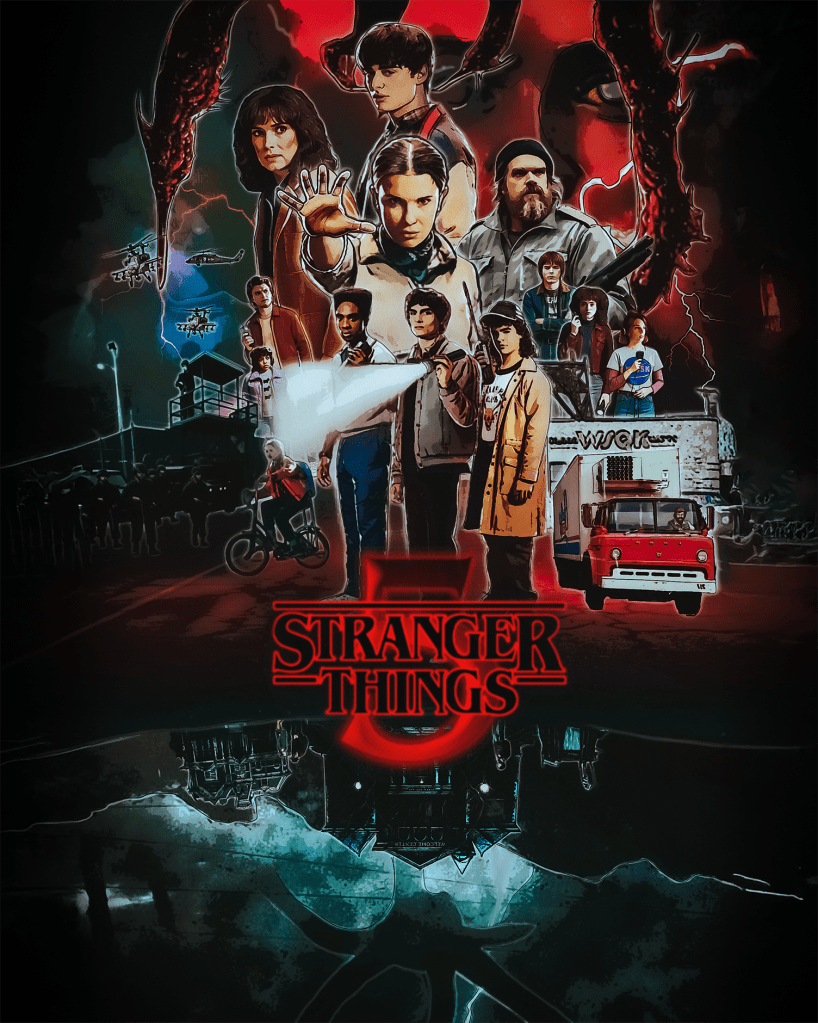

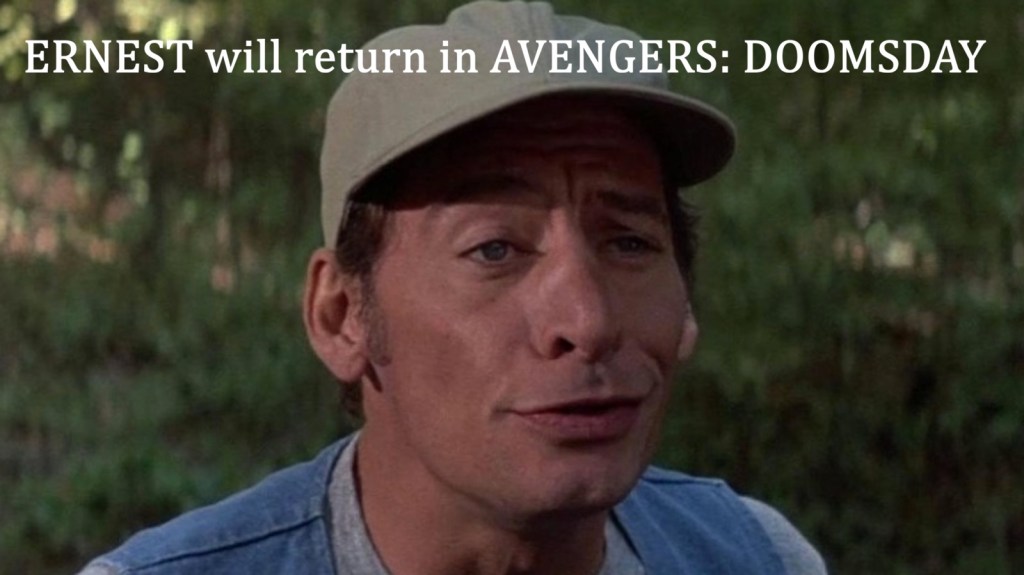

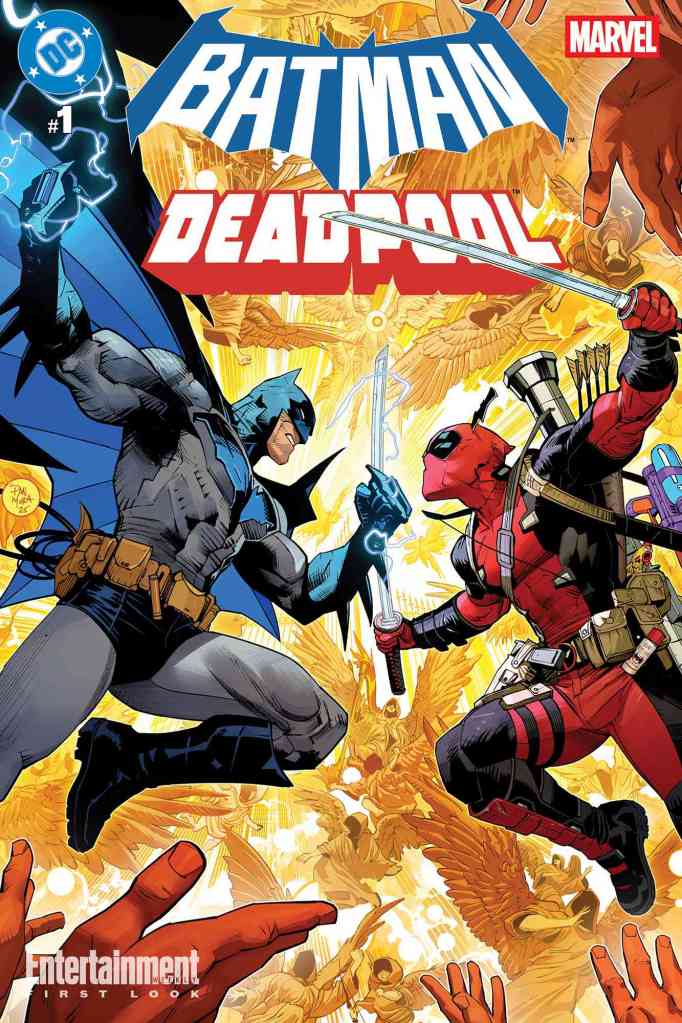


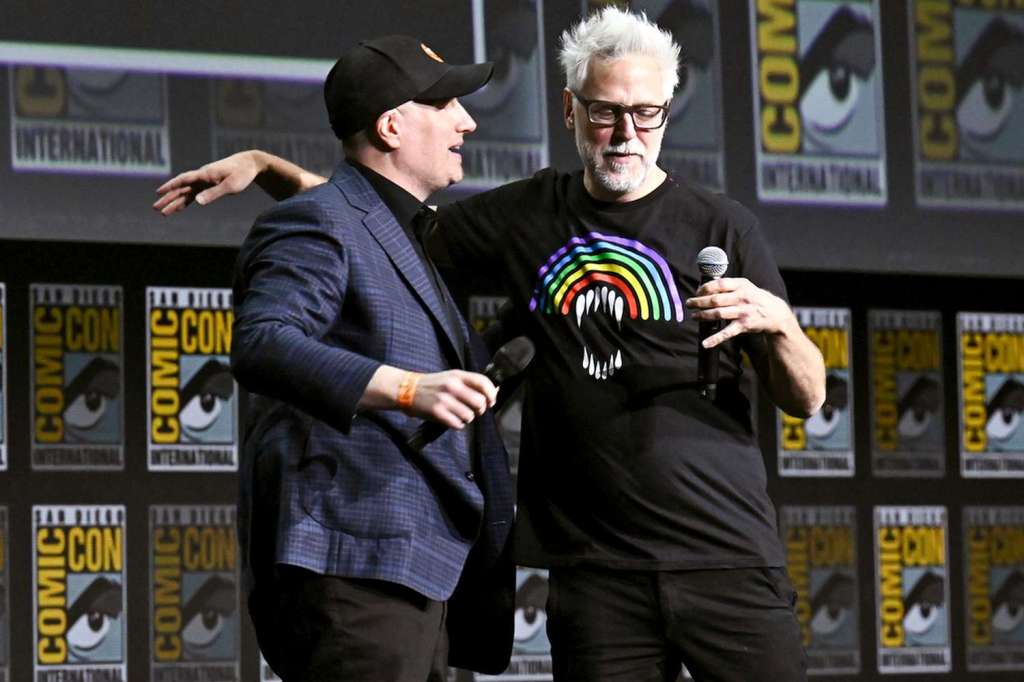


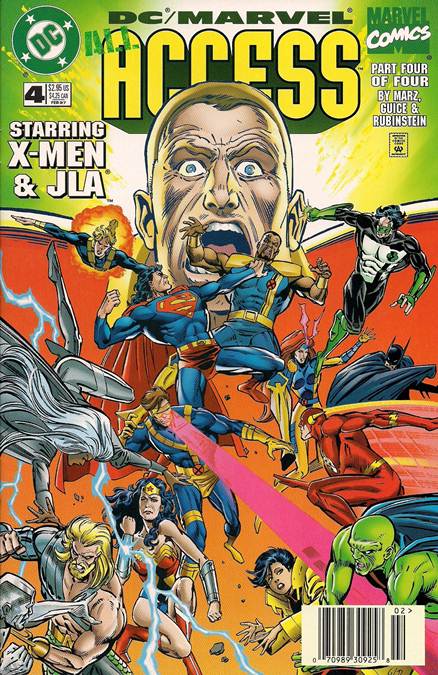


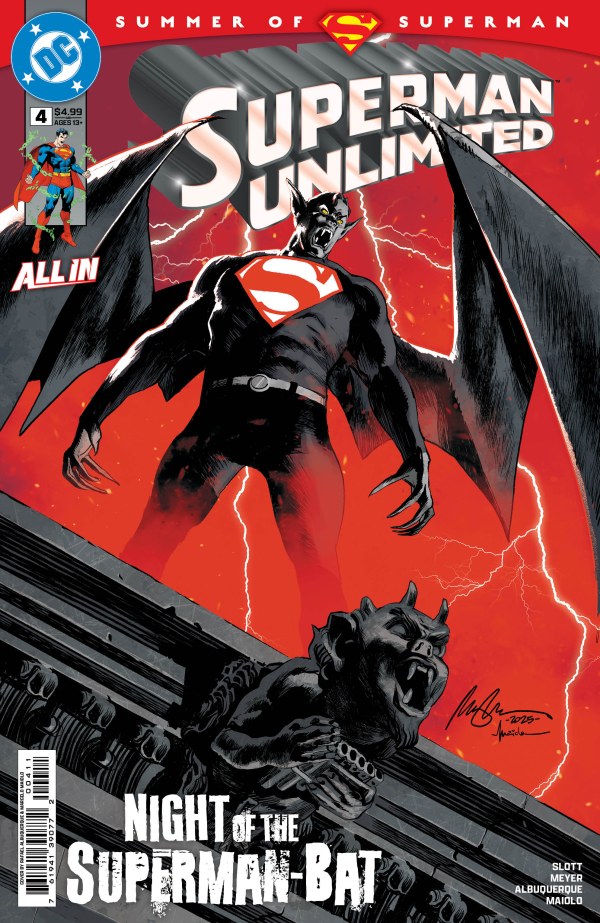
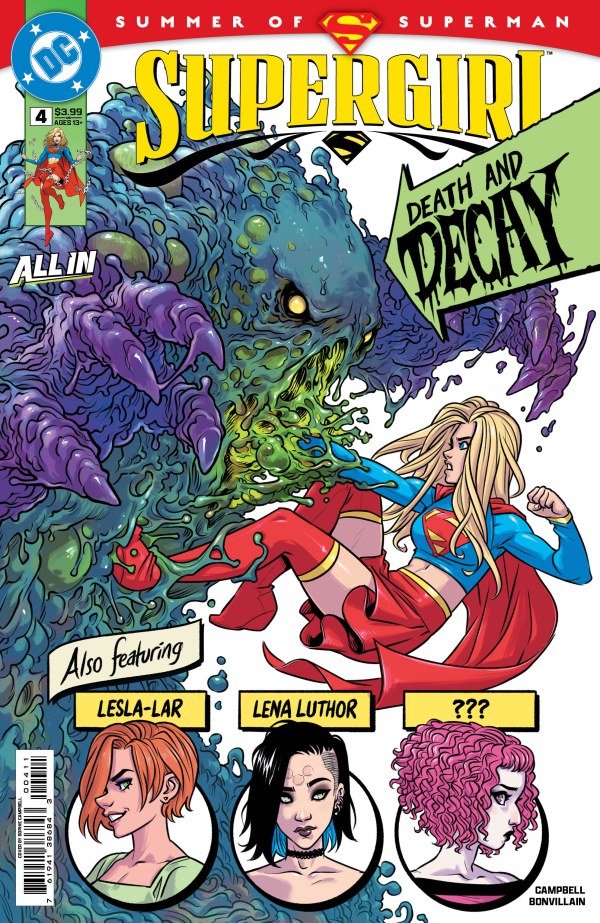


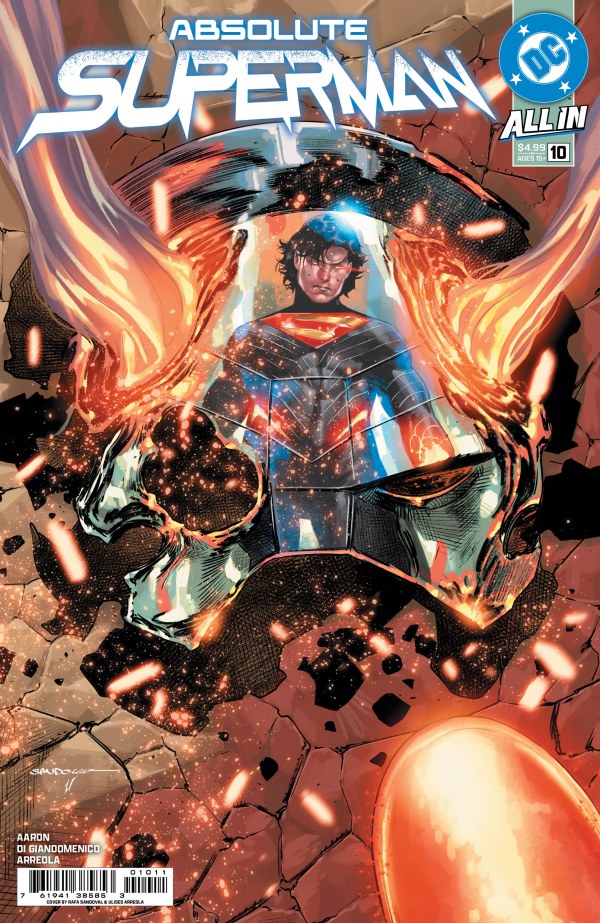


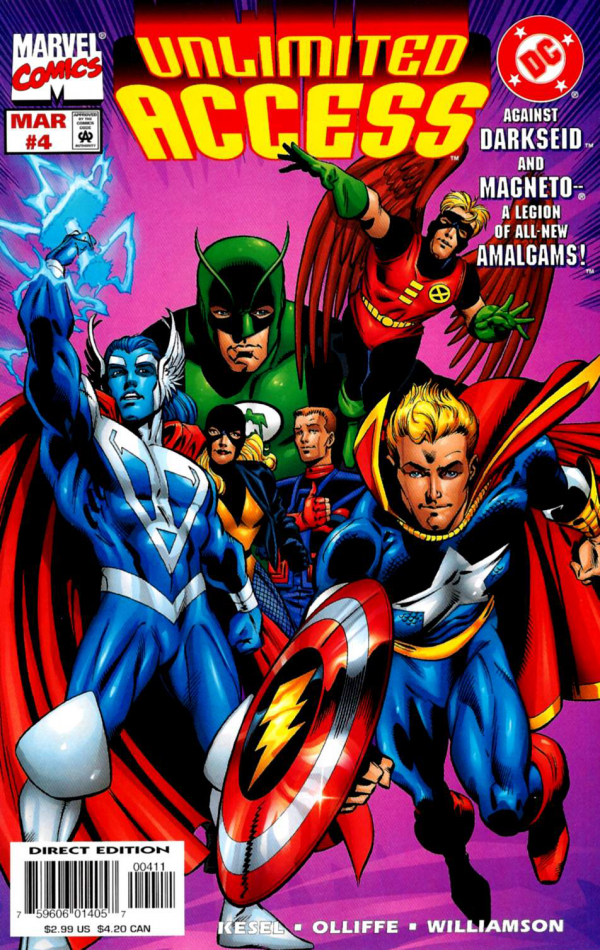


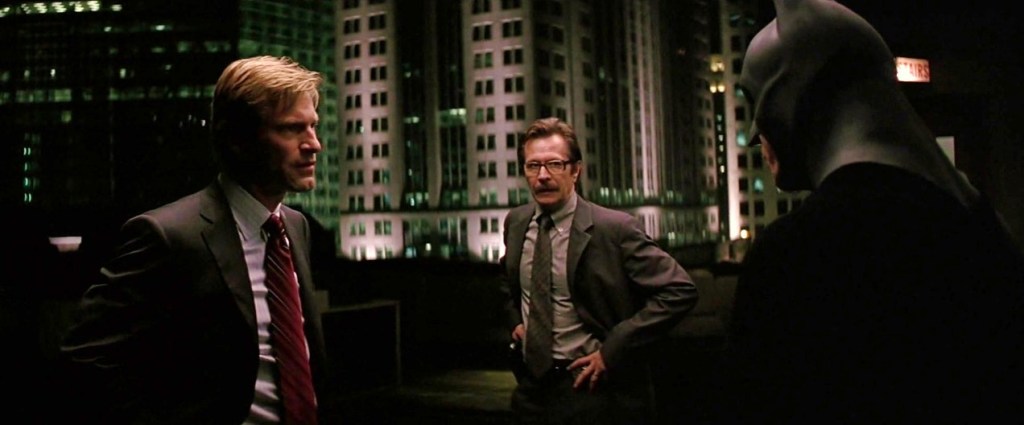
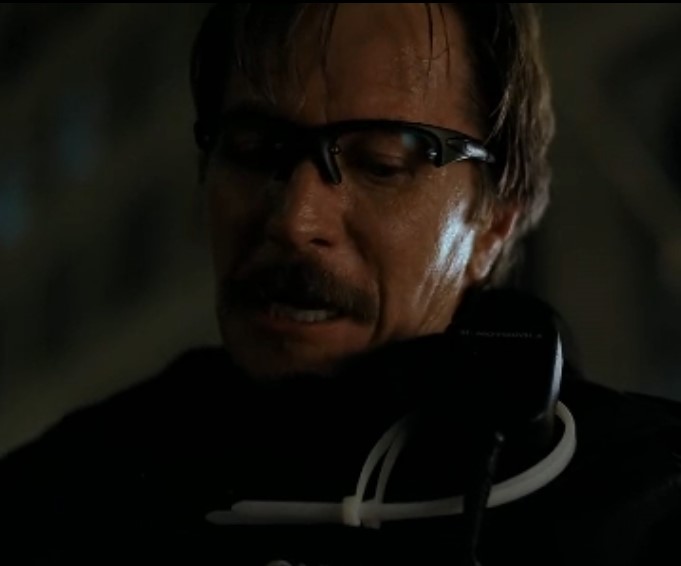



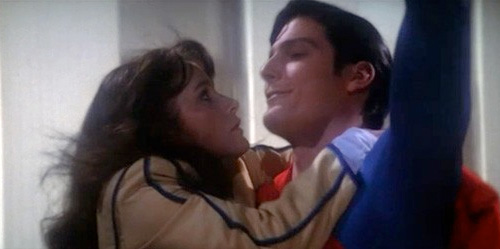
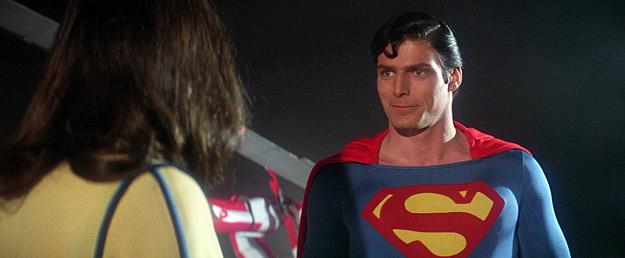


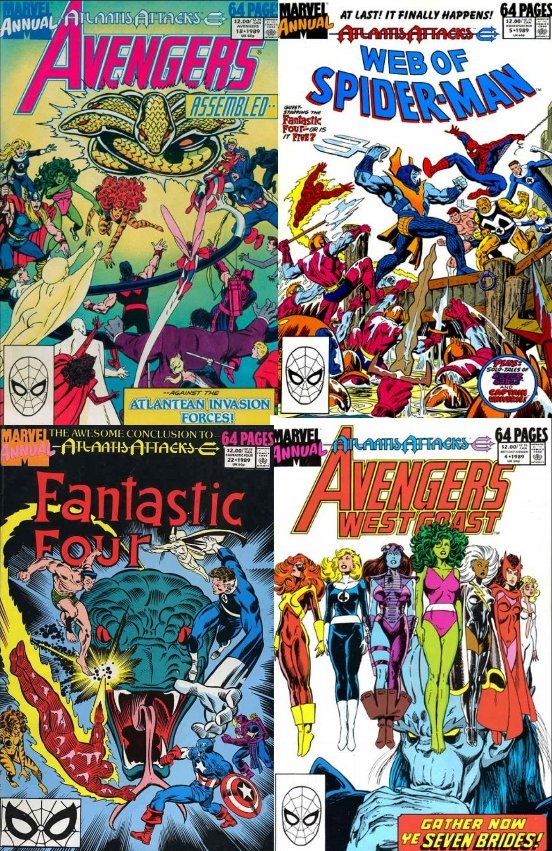
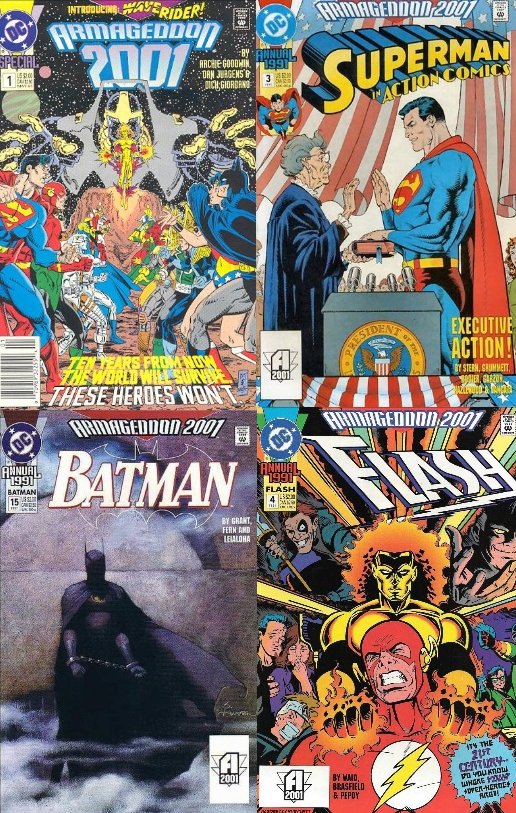
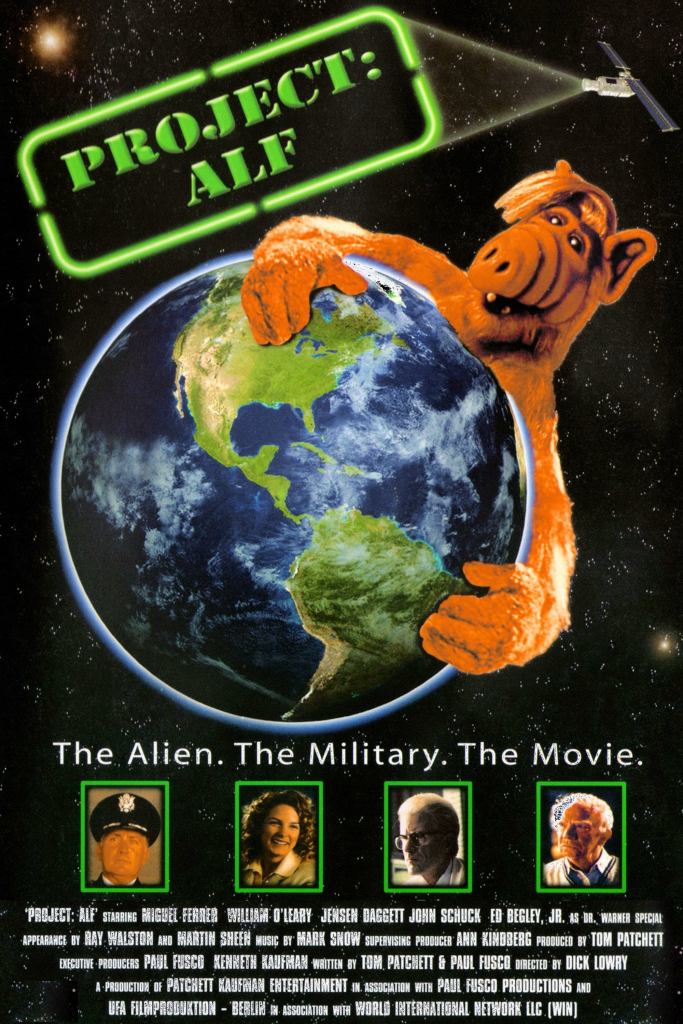


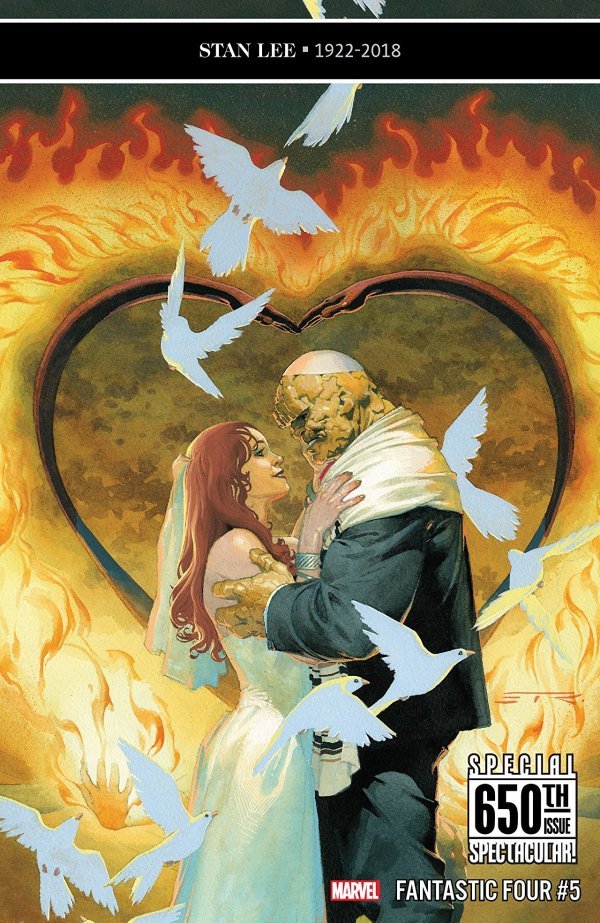




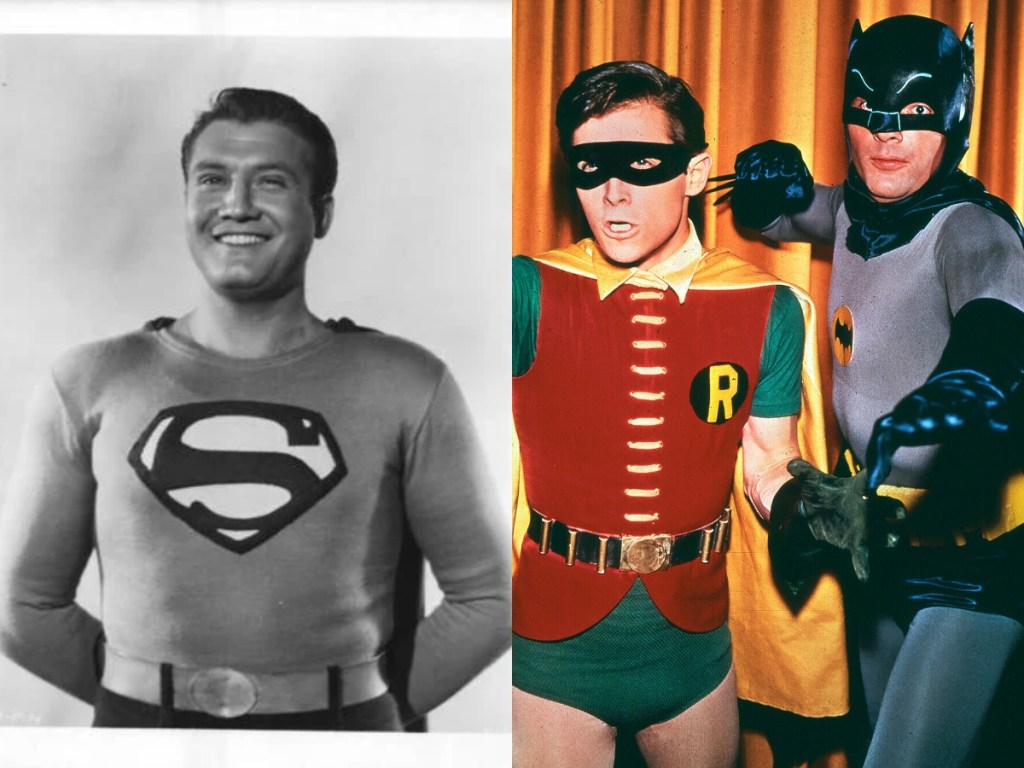


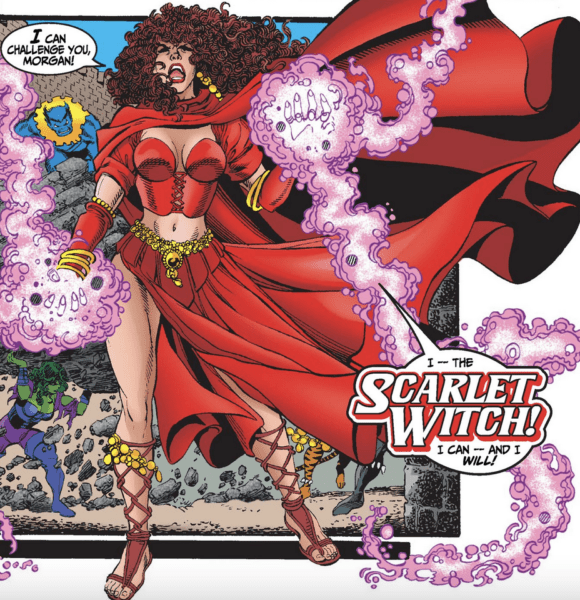


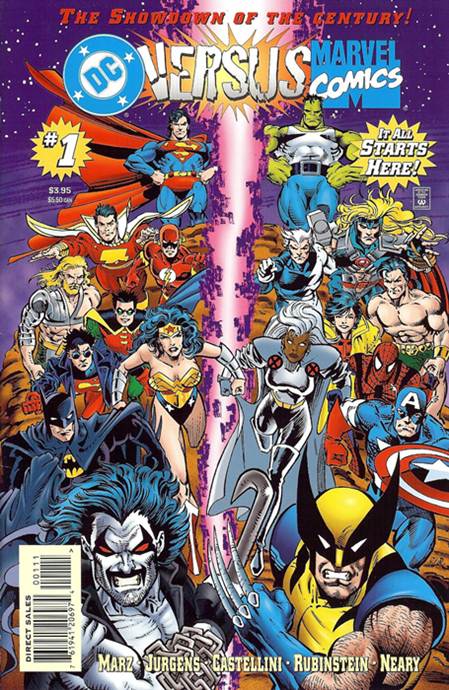
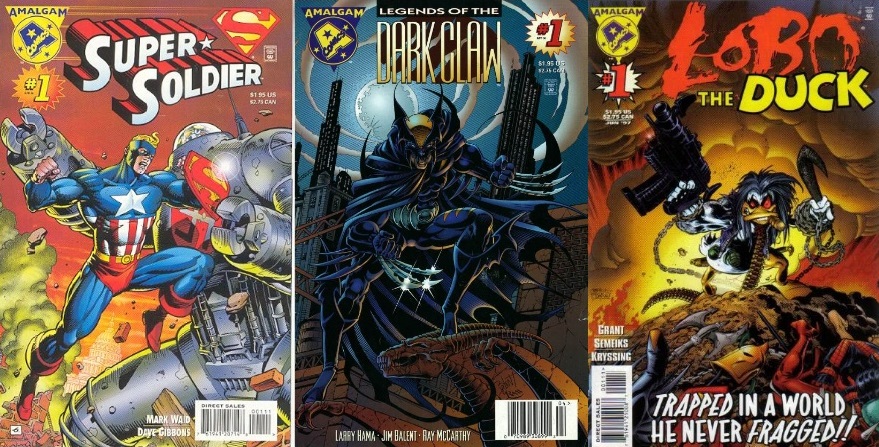

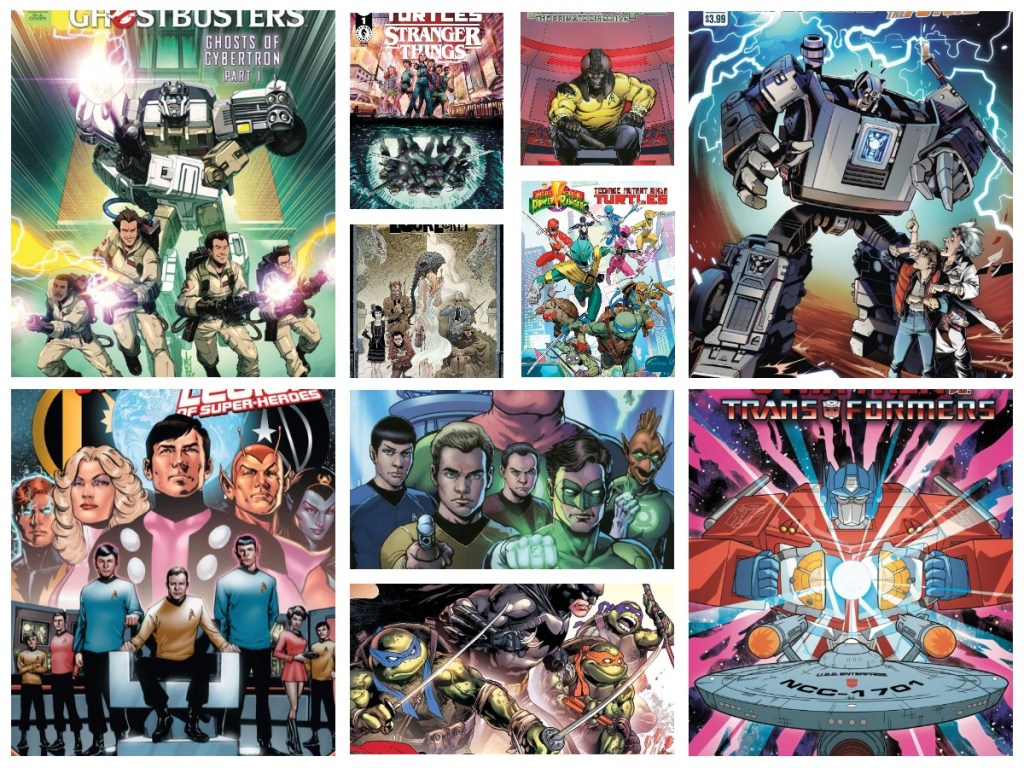

 Blake M. Petit