Geek Punditry #138: Riverdale in Crisis

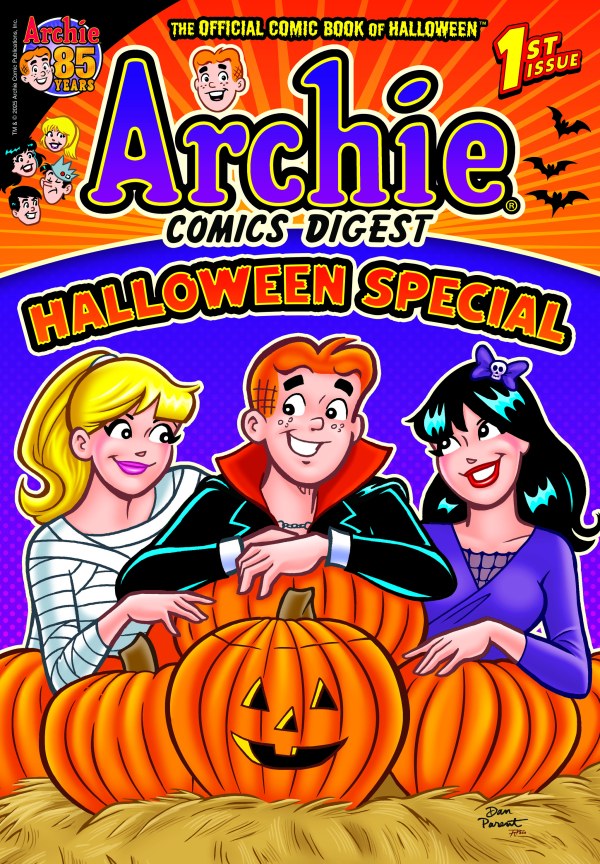
It’s a dark time for America’s Favorite Teenager. After 50 years of continuous publication, Archie Comics has ended its traditional digest comics program. Once a mainstay of supermarket and drugstore magazine racks, these little pocket-sized volumes were long considered the best value in comics, giving you hundreds of pages of Archie stories – usually a mixture of new stories and reprints – for a bargain price. Even when the price rose to $9.99 a few years ago, ten bucks for nearly 200 pages is a great deal compared to most other comics, which tend to run $3.99 or $4.99 for a page count that usually ends in the twenties. What’s worse is what the Archie digests have been replaced with: a new series of “seasonal” digests, beginning with a Halloween special, that are slightly taller than the previous digests and have half the pages, but maintain the $9.99 price point.
Surprisingly, this week’s column is not actually about Halloween.

Going from 196 pages down to 96 for the same price? It’s still more story than most comics, I grant you that, but it’s also a bit of a slap in the face to the readers.

I grew up reading Archie Comics. I loved the exploits of Archie and Jughead, I reviled the loathsome Reggie Mantle, I could not fathom why Archie wasted so much time on Veronica when Betty was clearly the better choice. And I was joining a long string of readers that went back to the 1940s, filling in all the eras in-between. My mom was never interested when I was reading X-Men or ShadowHawk, but she was an Archie reader from way back, and we even talked about them together sometimes. My sister only ever read two categories of comic books: Archie and Star Trek. This was a company with generations of fans and without the stigma of being “just for boys” that the superhero world often faced..

But that’s the problem, isn’t it? “Was.” There aren’t enough fans anymore. There was a time not too long ago when Archie Comics were the best-selling comics in America. The official sales numbers rarely reflected this, of course, as the comic book best-seller charts were based solely on the sales of Diamond Distribution to comic book stores and didn’t factor in sales in other markets, which is where Archie did the bulk of their business. But those newsstand sales have fallen precipitously, and the bankruptcy of Diamond itself has caused an upheaval in the comic book world that has many publishers flailing in an effort to figure out what to do next.

Archie has bigger problems than even that, though. With the exception of the digests, Archie hasn’t published monthly comics in several years, and their output of new stories has been reduced to a trickle. Most Archie comics these days come in one of three categories:

One-shot comics built around a theme (like sports or video games) or holidays (like Halloween and Christmas). These comics usually have one new story and several reprints. The biggest problem here is that the new stories are frequently a mere FIVE pages, hardly worth the asking price. What’s more, Archie has fallen into the speculator trap in two ways. First, they load these books up with an obscene number of variant covers. I’m not a huge fan of variants in general, but I particularly dislike them in comics that should theoretically be aimed at kids, because a kid might not realize they’re buying the same comic over and over again. The other issue is that Archie often touts these one-shots as being the “first appearance” of a new character – a relative of one of the existing characters, a new kid in school, two weird little apparitions that function as Halloween sprites, and so forth. The conventional wisdom here is that speculators will snap up “first appearances” in the hopes that the new character will take off, making their first appearance valuable on the secondary market. But with no new comics being published in which these new characters are allowed to grow and star in stories and build a fan base, who the hell is ever going to care where their first appearance was? 

“Introducing DAISY THUNDER! Wow, buy TWELVE copies!”

The second kind of book Archie is publishing is the (very) occasional “special” issue, such as the recent Archie Meets Jay and Silent Bob one-shot or last year’s Archie: The Decision. The former has the wholesome Riverdale gang meet the foul-mouthed denizens of Kevin Smith’s View Askew films, and in fact, the book was written by Smith himself. The clash of worlds is an amusing idea, but it’s something that primarily only appeals to existing fans of Kevin Smith, which is to say, people around my age. This isn’t a book you can – or should – give to your kids to get them into Archie. The Decision, meanwhile, was a special written by comic book superstar Tom King (he wrote the graphic novel that they’re making into a Supergirl movie right now, as a point of interest), and was advertised as being the story in which Archie FINALLY, after all these decades, would decide which girl he wanted to be with: Betty or Veronica. Spoiler alert: he didn’t decide.
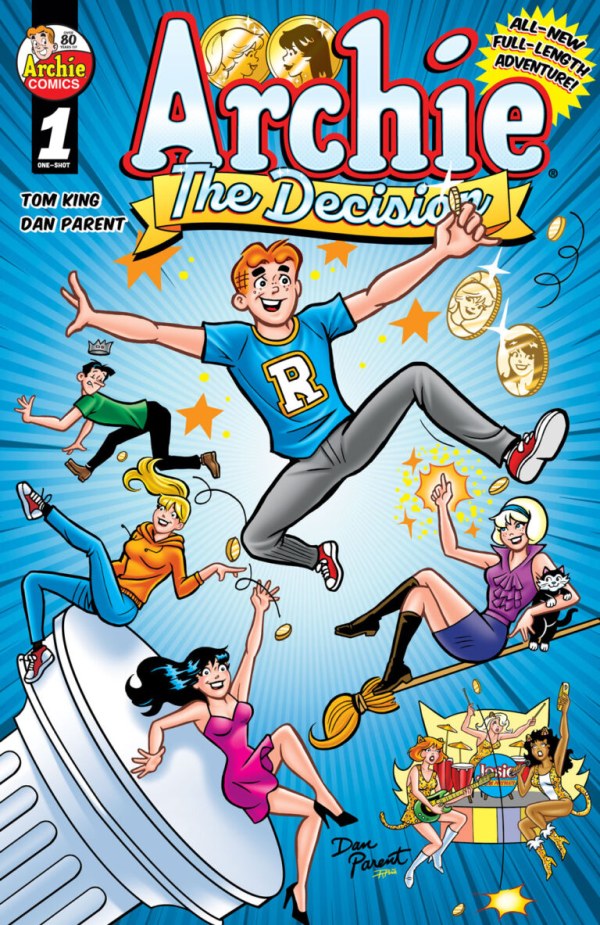
This was the biggest tease since that Craig Ferguson movie.

The last category of Archie comics is the facsimile editions, something that lots of other publishers have been doing. These reprint classic comics, complete with the original cover, letter columns, ads, and everything else. It’s a cute idea, and I really have no issue with Archie indulging in this, except for the problem I have with EVERYBODY’s facsimile editions: variant covers. What’s the point of a facsimile with a different cover than the original? It’s no longer a facsimile, is it? (That’s a facetious question, of course. All variants are done for the same reason: to get people to buy multiple copies, a short-term boost, rather than the healthier strategy trying to get more PEOPLE to buy at least ONE copy.) 

There are the occasional others – maybe one or two miniseries a year that come, go, and are quickly forgotten. But with this meager output, it’s no wonder that Archie’s fanbase has collapsed. There are a lot of people reading this right now who are probably surprised to find out that Archie is still in business AT ALL. As kids’ attentions have shifted from written material like comics to electronic entertainment like video games and YouTube, the original pool of fans that Archie was created for has evaporated. Pre-existing, older fans drift away because it’s just “kid stuff.” And nobody is filling the void.

Not to say Archie hasn’t had chances, but they’ve squandered them. In 2013, for example, they had a hit comic with Afterlife With Archie, a straight-up horror series featuring more “mature” versions of their classic characters in the midst of a zombie apocalypse. The book was huge and it spawned a whole line of Archie Horror, with other titles starring Jughead as a werewolf, Veronica as a vampire, and Sabrina the not-so-kid-friendly Teenage Witch. But the book that launched the line, Afterlife, frittered away, putting out only 10 issues over the next three years and then vanishing when the writer, Roberto Aguirre-Sacasa, moved his career focus from comics to writing for television. The series was left unfinished, and it’s hard to even recommend it to new readers, knowing that the story has no conclusion.

“This is great! Where’s the rest of it?”
“Remember when you told me to watch Firefly? Well now we’re even.”

Ironically, Aguirre-Sacasa’s TV career involved another missed opportunity for Archie, developing the TV show Riverdale. This was a much more adult soap opera type of story starring the Archie characters, and although I was never a fan, I could appreciate just how big of a hit it was. I routinely had students in my classroom during the years that the show was on the air who discussed Archie, Betty, and Veronica the same way they did the likes of any other popular series. But if they were even aware of these characters’ comic book heritage, they didn’t care. Once, when I bought one of those aforementioned digests while grocery shopping, the cashier saw an ad for Riverdale on the back cover and started talking about how much he loved the show, going on about which characters he hated and which ones he shipped. But when he flipped the book over and saw the more traditional Archie characters on the front cover, he may as well have been staring into outer space. As popular as the show was, Archie Comics did nothing to capitalize on that while it was on the air, and now the opportunity has passed.

The point of all this is that Archie is in serious trouble. Trouble that I don’t even know if they can get out of, at least not alone. But I do have a few ideas. Could any of them work? I really don’t know, I’m not a businessman or an expert on markets or anything like that. But I’ll tell you this much: they’re at least better than doing NOTHING.

The first thing Archie needs to do is rededicate itself to actually putting out new material. And I don’t mean the occasional one-shot, they need to get into the monthly comic book game again. I would start small, giving the line four comics a month: the stalwarts Archie, Jughead, and Betty and Veronica, with the fourth spot being left open for themed one-shots, holiday specials, crossovers and the like. But these should most definitely NOT be the reprint-fests that we’ve gotten the last few years. Reprints are okay, especially for a property like Archie where the classic stories are somewhat evergreen and can both entertain (potential) new readers and charm the older readers who enjoy seeing them again. But they should NEVER be the primary focus of a four dollar comic book. New material should make up at MINIMUM half of each issue, preferably more. 

As far as the stories themselves, I think Archie should split the difference between the old-school comedic quickies and the soap opera. Keep the comics fun and lighthearted, but allow for ongoing storylines and character growth as well. Make the stories a little more sophisticated, and you’ll hold on to readers longer. You can still do one-off gag comics as backups if you really need to scratch that itch. 

Second, I think Archie needs a partner. Over the last several years Valiant Comics went through similar problems as Archie is having, with mismanagement and poor decisions killing their brand. Valiant is in something of a rebuilding stage, which they accomplished by partnering with another publisher, Alien Books. Although still two different companies, Valiant publishes through Alien and the Alien logo appears with the Valiant logo on their covers. Valiant handles the production; Alien handles the publishing. So far it seems to be working fairly well. If Archie is struggling on this end, then a similar arrangement with another publisher might be beneficial for them.
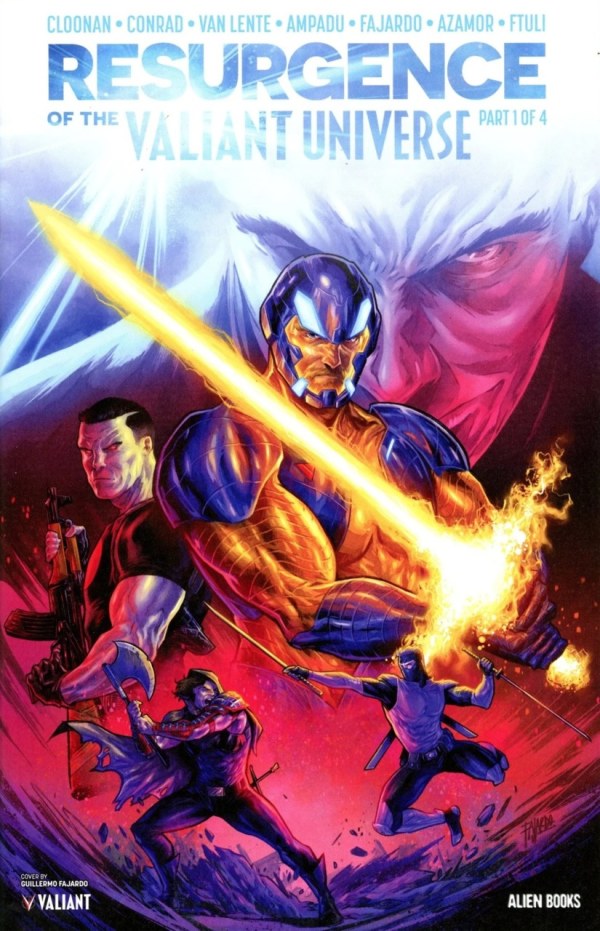
See? They had a resurgence and everything.

The Diamond bankruptcy hit everybody as well, making it harder to get comics on the racks, and those companies that had not done so already started to sign contracts with other publishers and distributors to get their books out again. Once again, Alien and Valiant found a lifeline by turning to another publisher, this time IDW, to utilize their distribution system. Now the Alien and Valiant comics appear in the IDW catalogue that comes out in comic shops every month. Partnering with a larger publisher, once more, would help Archie solve this distribution problem.

But what if the problems are deeper than that? Having never been around the Archie offices, I don’t really know what caused the domino chain that led to their current situation, and it’s possible that there needs to be a complete overhaul. So if things are THAT bad, here’s the nuclear option:

Sell Archie Comics to another publisher.

I know, that sounds huge, and it would be a last resort. But if it’s the only way for the characters to survive, I would find that preferable than letting them die. 

Way back in the days of the late, lamented Comixtreme website, I once wrote a column pondering – just in a “what if?” fashion – what would happen if Archie was purchased by DC Comics. Now I’m coming at this from the perspective that it may be exactly what Archie NEEDS. Why DC specifically? Well, DC has a long history of buying up characters from other publishers, and while the popularity of them may wax and wane, the characters from the former Fawcett Comics (such as the Shazam! family), Charlton Comics (Peacemaker, the Blue Beetle, the Question), Quality Comics (Plastic Man, Uncle Sam, the Freedom Fighters) and Wildstorm Comics (WildC.A.T.S., the Authority) all still show up on a fairly regular basis. They haven’t been utterly forgotten like SOME universes I could mention after they were purchased by OTHER publishers I could also mention, and here I would like you to imagine the sound of me coughing whilst squeezing in the words “Ultraverse” and “Marvel” into my hacking fit. 
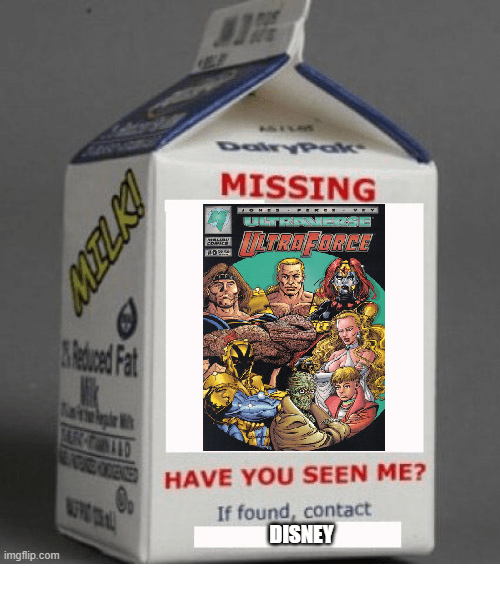
Why yes, I am too cheap to pay to remove the imgflip watermark, thanks for noticing.

Archie could also fill in a void in DC’s line. They’ve got a robust program of graphic novels for younger readers, which is awesome, but their regular comic books for kids have somewhat dried up. Last year they quietly cancelled their long-running Looney Tunes and Scooby-Doo comics, leaving only Teen Titans Go as a regular DC comic for kids. Archie could fill in there. Furthermore, DC’s multiverse is pretty healthy these days and could easily find room for all the different flavors of Archie. The “Classic” comics could be on one Earth, the more soap opera-y comics from the last decade or so could be another, the horror comics could fill a few more. Heck, they could even print Archie Horror under the Black Label umbrella.

Then there are the Archie superhero comics to consider, the Red Circle heroes. Archie has had superheroes for as long as anybody else, with characters like the Comet, the Fly, and the Black Hood. Hell, Archie even beat Marvel to the punch with the first patriotic superhero, the Shield. Those characters eventually faded after World War II like most other superheroes, but Archie has made many attempts to bring them back over the years, and some of them have been really good.

What’s more, DC has partnered with Archie TWICE in the past to revive the Red Circle heroes, with the Impact Comics universe in the 1990s, then by briefly incorporating them into the DC Universe itself in the late 00s. We could include those worlds as well: the “original” Red Circlers could have their own Earth, the Impact versions could have another, and new, updated versions could be introduced into the DCU. 
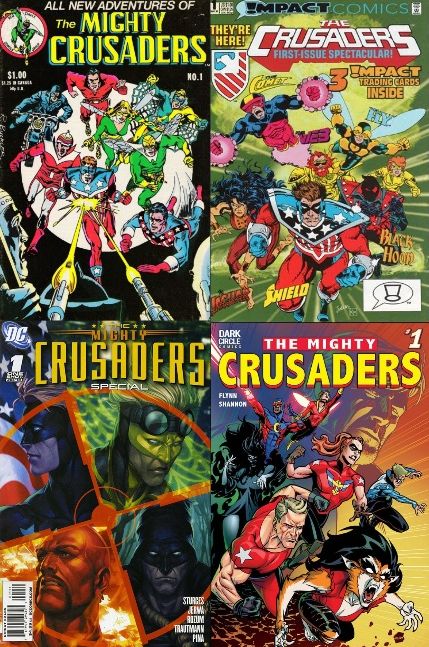
You got YOUR Multiverse, we got OURS.

Of course, not being a businessman (you can tell from all the business I fail to do), I haven’t got the foggiest notion how much money it would cost to purchase Archie Comics outright. I do know, however, that DC’s parent company Warner Bros. is in something of a chaotic state itself at the moment, so that’s probably not something that would be particularly high on their agenda. If a purchase is out of the cards, then perhaps a long-term licensing agreement like DC has with Milestone Media could accomplish the same purpose. 

And DC isn’t the only game in town (although I think it would probably be BEST for Archie, should it come to that). There are other publishers with whom they could work out similar arrangements. But it’s at a point where Archie fans are grasping at straws, hoping for anything to keep the characters alive. Something has to be done, and quickly, or Riverdale High School may finally close its doors for good.

And seriously, where is Mr. Weatherbee going to find a new job at his age?

ADDENDUM: After I finished writing this column but before I posted it, Archie Comics happened to make a fairly big announcement: the aforementioned Tom King is apparently working on a new Archie feature film with Universal Studios. This is good news, and I sincerely hope that the movie is a hit, but I don’t think it’ll alleviate any of the problems I’ve been talking about. Getting people to follow the characters to the comic books is the goal here, and historically, very few movies have actually done that. Then again, who knows? Maybe Mr. King’s Archie movie will be the exception. 

Blake M. Petit is a writer, teacher, and dad from Ama, Louisiana. His most recent writing project is the superhero adventure series Other People’s Heroes: Little Stars, volume one of which is now available on Amazon. You can subscribe to his newsletter by clicking right here. He’s also started putting his LitReel videos on TikTok. He’s still holding out hope for the Jughead Vs. Joey Chestnut one-shot. 

Geek Punditry #71: Gimmie a Gimmick

As you may have heard me mention once or twice, last weekend was the annual Nerd Bacchanalia known as Free Comic Book Day, one of my favorite days of the entire calendar year. And on this day, as they always do, my friends at BSI Comics were kind enough to allow me to set up a table and sell a few copies of my new book (which you should have ordered by now). From the vantage point of my table, I was facing a wall that displayed several back issues from those halcyon days of the 1990s, which were among the most formative years of my comic book consuming lifetime. The wall was adorned with lots of those flashy “Enhanced” covers that were so popular at the time – holofoil covers, embossed covers, chromium covers, glow-in-the-dark covers…you name a goofy gimmick, comic book publishers from the 1990s slapped it on the cover of a book. And as I spent hours there looking at those books, an odd realization slowly came over me.

I kinda miss those days.

I stared at these covers for eight hours on Saturday. It does things to a man.

It’s weird. During that time gimmick covers became a glut. They seemed to be coming at an ever-faster pace with ever-weirder gimmicks, and at the time I remember getting sick and tired of them. These days, however, they have become scarce. They’re not extinct, but you don’t see them nearly as much. Instead, modern publishers have decided to go with the business model of publishing 37 different variant covers for every issue. Some of them still slip in an enhanced cover in the mix, usually holofoil or “metallic” covers (for instance, DC recently did a run of metallic covers for various books with artwork featuring only the character’s symbol on a solid background). But they are not the exception, not the rule. 

I’m not going to try to get into a comprehensive history of the gimmick cover, but I’m going to tell you a little bit about my personal experiences with them. The first cover enhancement I remember seeing was back in 1991 when DC Comics released their second Robin miniseries, Robin II: The Joker’s Wild, each issue of which had covers with holographic images. Holograms themselves weren’t anything new, of course – I even remember making them in my high school chemistry class – but this was the first time I saw one on the cover of a comic book. It was cool! It was new! It was fun! And it was – if I recall – only fifty cents more than the regular cover! SWEET!

The next time someone tells you they faked the moon landing, remind them that this was considered high tech in 1991.

Not to be outdone, the next year Marvel gave each of the four Spider-Man titles at the time a cover with a hologram to celebrate Spider-Man’s 30th anniversary. (If you, too, remember when these comics were published, don’t do the math. It’ll make you realize that Spider-Man is now in his 60s and make us all feel like that scene at the end of Saving Private Ryan.) The holograms were more elaborate than DC’s, and each issue was a giant-sized extravaganza back in the days when such a thing actually meant something, so while they were more expensive than the issues of Robin, they were inarguably awesome. 

THIS technology, on the other hand, could have taken us to Mars.

Not long after that, there was another set of four Spider-Man covers with “holofoil” enhancements – the background of the artwork was metallic and shiny and you know how much we like shiny objects, so those were also a huge hit. And thus the floodgates were opened. Actual holograms became less common (as, if I remember from my chemistry class, they were more complicated to produce), but holofoil became a popular choice. Then other enhancements started to arrive. Die-cut covers, which had long been a popular choice in the paperback book market, started to show up. It made sense, too – have Wolverine’s claws slash through the cover of the comic book and you’ve got an obvious thematic connection. Similarly, embossed covers with artwork raised and stamped into the cardstock in a 3-D fashion made the transition from horror and sci-fi novels to comic books. Glow-in-the-dark, another mainstay of other marketing strategies, became used both for spooky books like DC’s The Spectre and goofy books like the Bongo Comics Simpsons spin-off Radioactive Man. 

Valiant Comics launched Bloodshot with what I believe was the first “Chromium” cover: artwork printed on a metallic backing with some sort of plastic covering. The first two books with this process had a chromium panel embedded in cardstock, then DC upped the ante with a full chromium front cover on Superman #82 (the book that concluded the Death and Return of Superman cycle). Eventually, somebody realized that it was easier to do an entire chromium cover – front and back- – instead of just parts of one, and most chromium covers after that became full wraparound covers, with art that extended from the front to the back in one large image that was no doubt easier to produce than a chromium front and a traditional back which then somehow had to be affixed.

Most people agreed that Image Comics’ “Enriched Uranium” covers went too far.

There were a couple of really weird enhancements, too. DC’s 1992 crossover event Eclipso: The Darkness Within focused on a demonic villain that possesses people infected by a magical black diamond. To kick things off, DC published a special with a cover featuring Eclipso holding up the diamond – which was an actual plastic diamond glued to the cover. Kind of cool, until the time comes to put the comic book in a bag and store it without splitting the mylar or putting divots in the back of whatever book it’s stored next to.

My personal favorite from this era, in terms of sheer weirdness, comes from Malibu Comics. Malibu was a hot publisher at the time, and their comic Protectors kicked off a new shared universe with revamps of several Golden Age characters that had fallen into the public domain. In the fifth issue of that series, the character Night Mask was killed in an effort to show early on that being a superhero would be a dangerous path and that the untrained or inexperienced would be in grave danger. Malibu chose to communicate this message with cover art that featured a bullet hole in the character’s chest that was punched through not only the cover, but the entire comic book. I’ve often wondered if this was a last minute decision, as the hole punched straight through the art on every page, in some cases even taking out a small piece of a word balloon and making you try to guess what the dialogue was supposed to be. It’s such a weird little thing, though, that even people who barely remember that the Protectors ever existed will likely remember the comic with the hole through it. (A few years later Malibu would launch their Ultraverse line, overshadowing the Protectors universe. The publisher was later purchased by Marvel, and all of their properties would fade into obscurity except for a little IP called Men in Black.)

Historians have determined that this is the point when the Comics Code just threw up their hands and surrendered.

As tends to happen, of course, good things went too far. Whereas these sort of enhanced covers started off being used for special events – first issues, anniversaries, major storylines and so forth – they quickly became overused. Instead of a holofoil cover for a 100th issue, we were getting foil covers because it was Wednesday. An issue of Fantastic Four in which the Human Torch lost control of his flame was printed with an entirely white cover, the artwork embossed into the cardstock and almost impossible to see. They’d repeat this trick with metallic Avengers covers and, of course, other publishers would soon follow suit.

With this oversaturation, fans eventually got turned off and stopped buying them, which no doubt at least partially contributed to the late 90s collapse of the comic book speculator market, and the flow of gimmicks was reduced to a trickle. Instead, as I said before, the focus for most publishers has shifted to producing variants – the same book with lots of different covers. And these have gotten ridiculous as well: while some variants have completely different artwork, others just change the color or remove the logo and trade dress or print the uncolored artwork as a “sketch” variant. For a relaunch of Justice League of America, DC put out over fifty covers with the same artwork featuring the team raising the American flag in an Iwo Jima-like pose.  For the variants, they switched out the US flag to that of each individual state and, I think, a few territories. Easiest way to sell one guy fifty copies of the same book EVER. Marvel did something similar with a series called U.S. Avengers, putting out a different cover for each state with a different Avenger, proclaiming them the official Avenger of that state. (Some of these made perfect sense: as Monica Rambeau is the only Avenger FROM Louisiana, she is the natural choice to be the Avenger OF Louisiana. But I’m still waiting for someone to tell me why She-Hulk is the official Avenger of Idaho, with an explanation other than “Well, SOMEBODY’S gotta be.”) 

And don’t even get me started on the fact that Spider-Man, the most New York hero in any multiverse, is the Avenger of New Hampshire.

Whatever the case, the result with the variant wave is the same: they’re counting on completists to buy every cover variant of the book they can get their hands on. Which I suppose helps them sell comics, but it also burns out regular readers and does absolutely NOTHING to attract a NEW readership, which is where American comics are having such a difficult time right now. I’m sure it costs less to print a traditional cover than one with a hologram on it, but I’m really not a fan of the business model that says “convince one customer to buy the same book two dozen times” instead of the business model that says “make a comic book good enough that two dozen people will want to buy it instead of one.” 

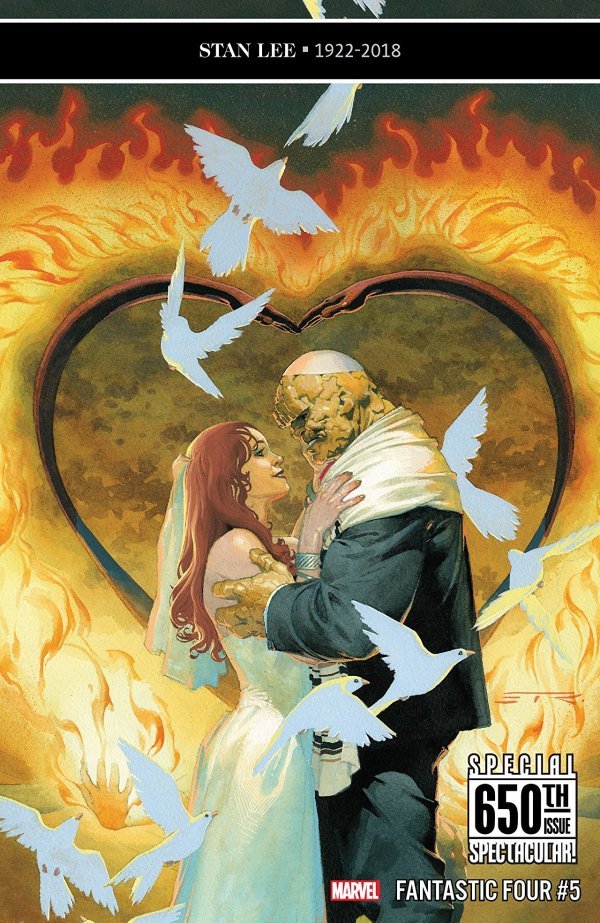
These days you still see holofoil and metallic covers, usually when a smaller publisher does a run with 75 different variants and then doubles it by making holofoil versions of each. Marvel and DC have also each done runs of lenticular covers (an image where the artwork changes if you tilt the page or look at it from a different angle) in the last decade or so. But there hasn’t been much else. When Superman married Lois Lane in 1996, there was a special edition cover embossed and designed to resemble a wedding invitation. When the Thing from the Fantastic Four finally married his longtime girlfriend Alicia Masters in 2019, we got a bunch of covers showing the couple from every conceivable angle, but not the slightest hint of foil, nothing that glowed in the dark, and certainly nothing that could be scratched and, subsequently, sniffed. 

I don’t care what anybody says, Stan Lee’s epitaph does NOT count as a cover enhancement.

I know that if the enhancements came back they would quickly become overdone all over again. I know that after three months of Green Lantern covers where one glows and the next has a lantern shape cut out and the third glows AND has a lantern shape cut out I would probably start to get irritated because they’re charging an extra buck for each cover. But they’re doing that for a lot of the variants NOW, and while I am not someone who usually buys variants, I admit that I would be more inclined to do so if there was a little bit of an enhancement to sweeten the pot. 

The hard part is not doing covers like these, it’s doing them in such a way that people don’t get sick of them. Reserve them for important occasions. First issues are acceptable. Anniversary issues are acceptable. The beginning or end of a major storyline is acceptable. 

“Wednesday” is not.

I know that my yearning for these covers is tainted by nostalgia, but that’s not always a bad thing. Nostalgia is the only reason X-Men ‘97 exists on Disney+, and people seem to be pretty darn satisfied with it. (I haven’t watched it yet, so no spoilers.) 

I don’t know, maybe it’s just me. Maybe I’m just shouting into the wind and when you guys read this week’s column you’ll all think I’m crazy for feeling this way. Heck, even I think I’m a little crazy for feeling this way. All I know is this: when I go into BSI Comics to pick up some new books, I almost never want the variants…but once in a while, I wouldn’t mind getting my hands on an enhancement or two. 

Blake M. Petit is a writer, teacher, and dad from Ama, Louisiana. His most recent writing project is the superhero adventure series Other People’s Heroes: Little Stars, volume one of which is now available on Amazon. You can subscribe to his newsletter by clicking right here. If you go on eBay looking for some of these comics he’s talking about, don’t be fooled. The “coffee stains on page 17” variant is NOT an enhancement, no matter what the seller is telling you. 

Geek Punditry #31: Cross-Evolution

The DC Universe is asleep right now.

This is not a commentary on the state of their cinematic universe. I’m talking about the good ol’ comic book DCU, which is in the second half of their two-month Knight Terrors event. A new villain calling himself Insomnia wants to get his hands on the Nightmare Stone, a powerful artifact that used to belong to the Justice League’s old enemy Dr. Destiny. Insomnia believes that Doc Dee has hidden the stone inside the dreams of somebody in the DCU, so he’s made everyone on Earth fall asleep, allowing him to search for it. It’s been an interesting story, diving into the dreams of DC’s greatest heroes and villains and getting a taste of their worst fears. (You should see what the Joker is afraid of.) Most importantly, though, Knight Terrors is the latest iteration of that thing that we comic book nerds both adore and fear: the crossover event.

The real Knight Terrors are the friends we made along the way.

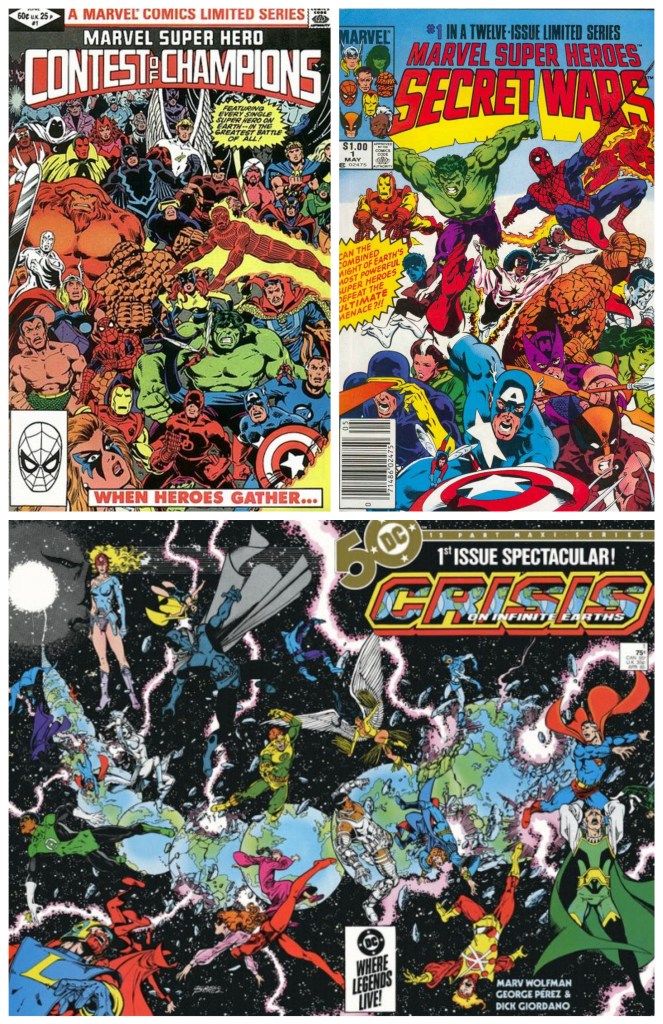
Most comic historians will agree that the “shared universe” conceit, in which most or all of the characters published by the same company are said to co-exist, can be traced back to 1940 and the first appearance of the Justice Society of America in All-Star Comics #3. In the early days, the JSA was little more than a framing device, in which the heroes would gather around a table and tell each other tales of their exploits, but eventually the stories would evolve to the point where they were having adventures together. Guest appearances in each other’s books became common, more teams were formed, and eventually both Marvel and DC Comics had sprawling worlds of interconnected characters. In a way, it’s baffling that it took 42 years for the next logical step in storytelling to happen: mashing everybody in the universe into a single story. That story was 1982’s Contest of Champions, a three-issue miniseries in which the Marvel Comics all-stars were abducted by a couple of the Elders of the Universe and forced to battle each other. It was a completely self-contained story that didn’t touch on any other book, but it was considered a precursor for the next step: the 12-issue Marvel Super Heroes Secret Wars in 1984. This time, we saw many of the Marvel heroes – in their own titles – encounter a mysterious device that whisked them away to parts unknown. They returned in the next issue after an absence of some weeks, many of them with changes. The maxiseries told the story of what happened to them in-between those two points.

“Okay, guys, let’s show ’em how it’s done.”

DC got into the game in 1985 with Crisis on Infinite Earths, and that’s when things really got wild. Contest of Champions and Secret Wars were both relatively self-contained stories. Although Secret Wars had repercussions for the regular series of the assorted characters (Spider-Man’s black costume, which would eventually become Venom; She-Hulk leaving the Avengers for the Fantastic Four; etc.) the story itself stayed in those 12 issues. In Crisis on Infinite Earths, for the first time, the story spilled out into the other comics being published by DC. While the heroes of the multiverse struggled to keep it together in the main series, most of the other books published by the company had side-stories that showed how the stars of that title were dealing with the collapse of reality. Green Lantern dealt with the destruction of an entire sector of space, DC Comics Presents booted Superman to an alternate reality where he met a young version of himself, and in Wonder Woman’s title she joined with the gods of Olympus to protect her home.  

Since then, the crossover has evolved again and again, with different forms that each have their own pros and cons. In some cases, a story in a single title or family of titles grew big enough that it only made sense to show the effects on other books. In Marvel’s Inferno (1989), the X-Men family of comics told the story of a demonic invasion of New York, and since most of Marvel’s heroes lived in New York it only made sense to show how Spider-Man, the Avengers, and the Fantastic Four were dealing with it as well. Later that same year we got Acts of Vengeance, a story wherein Loki plotted to destroy the Avengers by manipulating the Marvel Universe’s villains into attacking different heroes than those they usually fought. Yeah, I’m not entirely sure how that was supposed to work either, but it was a fun story: Spider-Man dealt with the X-Men’s enemy Magneto, while Daredevil’s foe Typhoid Mary set her sights on the Power Pack, and so forth. These kinds of crossovers work out fairly well, as it’s easy for readers to ignore any titles they don’t want to read. On the other hand, if they aren’t reading the core titles in which the story is taking place, they may be confused as to what is going on.

However, from a company standpoint, there’s one major problem with crossovers like that: there’s no extra books being sold. So the next level of crossover has a main miniseries, with stories touching on the heroes across the DCU. After the original Crisis, DC made this an almost-annual format for many years, with the likes of Legends, Millennium, Invasion!, Final Night, Genesis, and Underworld Unleashed all following suit. Marvel did it several times as well, with Secret Wars II, Infinity Gauntlet, and its assorted sequels. This is the kind of crossover I grew up with, and in many ways it’s still my favorite. The fact that it touches on the ongoing comics gives the story weight and makes it feel like it “matters” more than if the book is totally self-contained, and for the most part, you still only have to read the main title and any crossovers that you want, pushing aside those that you don’t.

There were…a LOT of these.

Later crossovers like Civil War and Fear Itself would expand on this concept: the main miniseries, crossovers into the ongoing books, and assorted miniseries and one-shots that spin off of the main book. This expands the story and allows the storytellers to touch on more elements of the event, and of course, it gives the publisher more books they can potentially sell. Publishers love that. Sometimes they love it so much that they’ll do a spinoff miniseries even if the characters involved currently have an ongoing. There are 97 X-Men titles at any given time, so was it strictly necessary to do a three-issue World War Hulk: X-Men miniseries instead of just putting the story in one of those? I say thee nay.

Then there’s the tier that we’re seeing more often these days, in which the crossover doesn’t touch the ongoing titles at all, but only features spinoffs and one-shots. There are, I think, two reasons this happens.

1: Money. 

2: Writers. 

I don’t think the first point needs much of an explanation, but let me tell you what I mean by the second one. The comic book industry has become increasingly writer-focused over the years, and while in many ways that’s a good thing, that does come with a degree of compartmentalization. Whereas in the past, editors would call up the writer of New Warriors and tell him to link his book to Infinity War whether he wanted to or not, today there’s more of a reluctance to disrupt the ongoing story. Al Ewing’s fantastic Immortal Hulk series was an excellent horror story that is perfect for binge-reading now that it’s over. But if you’re reading that story in a collected edition years later, it would be somewhat disconcerting to suddenly stop to deal with an invasion of symbiotes spilling over from the Spider-Man comics. So instead, there were Immortal Hulk one-shot specials when the title dealt with the events of the Absolute Carnage and King in Black crossovers, and the main book went unmolested.

The solution.

The benefit of this is that the crossover doesn’t impact the story when you’re reading it in a vacuum. There are two cons that come to mind, though. First, if a crossover is entirely self-contained, it’s easy to ignore it and decide it’s inconsequential to the meta-story of the shared universe as a whole. Second, it has a tendency to cause the main story to spill out into the spinoffs in a way that doesn’t happen as often with the other kinds of crossovers. Grant Morrison’s Final Crisis was a bit of a mindbender to begin with, but the ending is COMPLETELY out of the blue if you didn’t choose to read the Final Crisis: Superman Beyond two-issue miniseries that accompanied it.

A story like Knight Terrors is a relatively new variant on this format. The crossover is told entirely through crossover miniseries, but those miniseries are replacing the ongoing comics for the duration of the event. Instead of following June’s Nightwing #105 with July’s Nightwing #106, July and August give us Knight Terrors: Nightwing #1 and #2, with #106 saved for September. This is, by my count, the third time DC has done this, the previous times being Convergence in 2015 and Future State in 2021. It’s nice, in that it doesn’t disrupt the main book at all, but it also has a habit of making the event itself feel rather inconsequential. (Future State in particular has largely faded into irrelevance in the DCU.) 

Up until now, I’ve really only talked about format. I’m not making value judgments on any of these stories: there are both good and bad examples of every kind of crossover. What matters, I think, is what exactly you’re trying to accomplish with the story. Are you “just” telling a big story? Well, the first format I discussed is probably the right one. We mostly see that now with smaller crossovers, things like the Sinestro Corps War that only impacted the Green Lantern books (plus one issue of Blue Beetle). But even those “smaller” crossovers are starting to go the route of having one-shots or miniseries spinoffs: the upcoming Gotham War storyline will feature in the Batman and Catwoman ongoing titles but also have a few one-shots and a miniseries focusing on Jason Todd. 

Sometimes publishers label books as part of a crossover no matter how inconsequential they are, and that can irritate readers. People who picked up the Crisis on Infinite Earths issues of Swamp Thing were rightly irritated that the only connection seemed to be the skies turning red. Even when the book is objectively entertaining, it’s a bit frustrating. Geoff Johns and the late George Perez did a magnificent job on Final Crisis: Legion of Three Worlds (I would even argue that, to date, it was the LAST great Legion of Super-Heroes story), but pretending it had great significance to the Final Crisis storyline was something of a stretch. 

“Guys, when we said ‘Stop, you got it right,’ we didn’t mean that LITERALLY.”

Sometimes these crossovers are intended to reset things: DC has done that with Flashpoint and Dark Crisis on Infinite Earths, which led to the New 52 and Dawn of DC reboots, respectively. Sometimes these are intended not to re-set, but to set things up in the first place. That’s what the nascent Valiant Comics did in 1991 with Unity. When their universe was still young they tied together their six existing titles (four of which were less than a year old), launched two new titles, and introduced new characters and concepts that in turn would develop into more titles in the next year. It was a huge success and Valiant was the hot ticket, becoming so successful that only a few years later Acclaim bought the company and promptly ran it into the ground.

“Get ready, guys, it’s all downhill from here.”

People like to complain about “event fatigue” in comics the same way that many of them complain about “superhero fatigue” in movies, but the fact that people keep buying these books seems to indicate that they aren’t that exhausted. And as always, quality matters. People rarely complain about “too many comics” if they actually like the stories that they’re reading – it’s only when following a story gets to be a chore that they go to the internet and gripe. I don’t think crossovers are going anywhere, and honestly, I don’t really want them to. So I guess the important thing when planning them out, publishers, is to think really hard before you get into these storylines, and ask your doctor (Strange, not Doom) what kind of crossover is right for you. 

Blake M. Petit is a writer, teacher, and dad from Ama, Louisiana. His current writing project is the superhero adventure series Other People’s Heroes: Little Stars, a new episode of which is available every Wednesday on Amazon’s Kindle Vella platform. He knows that there are a LOT of crossover events he didn’t mention in this column, so before you reply with, “Hey, you forgot XYZ,” know that he didn’t. He just didn’t have room to make this comprehensive. Cut him some slack.