Year of Superman Week 49: Man of Steel, Kryptonite of Turquoise

In case you didn’t make it to the end of last week’s blog (I don’t blame you), I want to talk about what’s going on for the last month of the Year of Superman. I have plans for the last two weeks, including a week of holiday-themed stories and then wrapping it all up with a sort of “best of” week featuring classic stories I haven’t covered, as well as stories that kind of function as “endings” for the Man of Steel. In the last two weeks before then, it’s gonna be a free-for-all. I’m going to try to cross off as many things from my to-read and to-watch list as I possibly can, but there won’t necessarily be any rhyme or reason, pattern or theme. I’m going to get in whatever I can. As I write this, on Dec. 3, I know what I’m reading today, but I’ve got no idea what you’re going to get over the next six. Here’s hoping we can have some fun with it. 

And as always, you can check out earlier blogs in the Year of Superman Archive!

Wed., Dec. 3

Graphic Novel: Superman: Ending Battle (Collects Superman Vol. 2 #186-187, Adventures of Superman #608-609, Superman: The Man of Steel #130-131, and Action Comics #795-796)

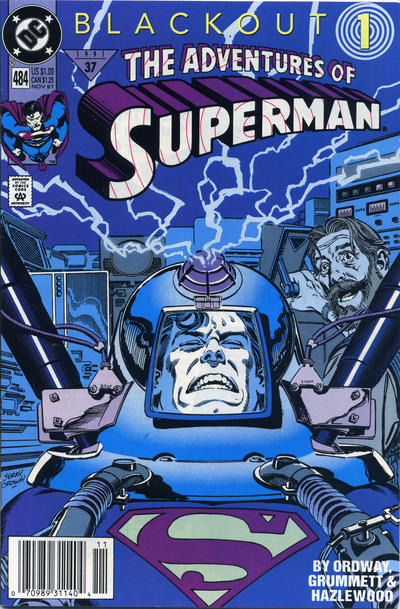
Notes: About two years after the legendary Action Comics #775, “What’s So Funny about Truth, Justice, and the American Way?”,  the four Superman titles came in with a sequel story that lasted for two months across eight individual issues. In “Ending Battle,” written in turn by Geoff Johns, Joe Casey, Mark Schultz, and Joe Kelly, Clark Kent is in Washington, DC visiting his old friend Vice President Pete Ross (this was during the President Luthor era), when the White House is attacked by the Master Jailer and Neutron. They’ve been hired to kidnap Pete and his wife, Lana Lang – but not because he’s the Vice President. Superman stops them, but they manage to escape, and Pete gets a very cryptic call from President Luthor, asking him to tell Clark “You’re faster than a speeding bullet.”

Later that day (in part two), the Atomic Skull arrives in Kansas where he quickly takes down Superboy and is about to go after Jonathan and Martha before Superman arrives to save them. As the day continues, more villains attack people close to Clark Kent: Riot goes after his old high school coach, Quakemaster his dentist, Hellgramite one of his college professors, and so on. Superman races from scene to scene, capturing one B-list villain after another, piecing together that someone is targeting not Superman, but Clark. He also realizes that the villains that are being sent are deliberately sub-par – whoever is behind this isn’t actually trying to harm anyone, but rather to send the message that nobody close to Clark Kent is safe. The stakes are raised when King Shark goes after Jimmy Olsen. After Superman stops him, Shark claims that a voice in his head told him a name and location, and he didn’t have a choice but to attack. While Superman is cleaning up the Shark attack, someone attacks the Daily Planet.

In Part Three Superman arrives at the Planet to see it besieged by Green Lantern’s old enemy Evil Star. No seriously, that’s his name. But despite having a moniker that sounds like a third grader came up with it, Evil Star is a lot more dangerous than the bad guys so far. He’s powerful, and in control of dozens of inhuman monsters that make him very dangerous – but he has no more idea of why he’s attacking than King Shark did. The attacks are coming faster now – Rock and Terra-Man attacking Steelworks, the Metropolis Special Crimes Unit fighting Dr. Killgrave, and Superman has Lois gather everyone close to them at Steelworks, where Superman tells them that “Clark Kent” is in danger and that they’ve been targeted due to their association with him. Although many of them want to get out there and stand their ground, Lois convinces them that it’s better for them to stay there, safe, instead of dividing Superman’s attention by trying to rescue them all…and Bibbo (ah, but I love Bibbo) volunteers to make SURE everybody stays put. As he prepares to fight, a mental wave knocks Steel out of the battle and tells Superman to go to Lex Luthor.

In Part Four Superman finds Luthor hiding in a secret lair of his own, where he confesses that he knows Clark Kent is Superman…but he also says that he’s not the one responsible for the attacks. He doesn’t know who sent him Clark’s identity, and refuses to be a pawn in somebody else’s game (which is pretty damned Lex Luthor of him, you gotta admit). In the midst of their discussion, they’re attacked by the Elite. Superman quickly realizes that even THEY are being mentally controlled, and finally tracks down the source to the living interdimensional spacecraft called Bunny, whose consciousness has been destroyed and whose body is controlled by the Cyborg Superman. As he leaves the Cyborg in ruins, Superman declares war on the man he knows now to be responsible: Manchester Black.

In Part Five, Superman finds that the Master Jailer has converted Metropolis into the “largest prison on Earth,” and Manchester Black is waiting for him. But he still has a gauntlet of villains to get through: Prankster, a random Bizarro, a newbie called Puzzler, Neutron and Terra-Man again. (And in a beautiful one-page vignette, Mr. Mxyzptlk shows up. He’s planning to pursue his usual mischief, but when he sees just how royally pissed off Superman is, he voluntarily says his name backwards and disappears, realizing that this is “not a good time.”) As part six begins, Superman knocks the Kryptonite out of Metallo, declaring he doesn’t have time for this, and makes his way through a literal army of low-tier villains before stumbling upon the A-team: Bizarro #1, Mogul, and Silver Banshee working with the Master Jailer. The power goes out in the city and Lois decides she can’t stand sitting around in Steelworks anymore, sneaking out to investigate, only to find herself in the clutches of the man himself, Manchester Black.

Part seven takes Superman to the “boiling point” (to quote the cover) as he discovers that his four remaining foes are more dangerous than he realized. Black has tampered with Bizarro’s twisted mind, “clearing” it and making him far more capable than ever before, and after a full day of Superman running Black’s villain gauntlet, Bizarro and Mongul beat the tar out of him. Banshee, meanwhile, is also more dangerous now that Black has revealed Superman’s “true, genetic” name of Kal-El, giving her magic greater efficacy against him. Superman takes the fight to the tropics, where the sun refuels him, but even there, the Master Jailer has set snares for him, even spreading Kryptonite into the sand. He manages to defeat them and tracks Black back to Metropolis, where the villain has been mentally torturing Lois (in a series of profoundly disturbing scenes). When Superman arrives, he finds Black standing over her dead body.

In the grand finale, Black smugly reveals that the government let him out of prison to do dirty jobs for them, and he used that freedom to investigate, finding Clark’s identity by observing his affection for Lois Lane. He taunts Superman, saying that he’s finally shown him how the world “really works” – sending him on a day-long battle to “save the world,” and the only loss of life was the person who means the most to him. The battle is quick and fierce, and Superman annihilates Black’s body with a burst of heat vision – until that part is revealed to be another illusion. Superman refuses to dishonor Lois’s memory by killing his enemy. “Vengeance is not justice,” he says. In stunned astonishment, Black finally realizes – finally ACCEPTS – that Superman’s the real deal, that even after everything that’s been done to him, the armor will not break, and he won’t kill him, ever. The realization makes Black drop his illusions: Lois is alive, of course, Black’s suicide plan being to make Superman kill him and then discover Lois was alive…but he failed. Superman cannot be broken. He slinks away and wipes the minds of everyone he told Superman’s identity to, including Luthor (who, to his absolute fury, remembers that he USED to know who Superman really is, but CANNOT REMEMBER THE NAME). Then, seeing that he has indeed become the villain Superman called him, Black kills himself with a telekinetic bullet. 

I don’t know if I’ve read this storyline through since it was originally published back in 2002, but holy hand grenades, it was a humdinger. This was one of the darkest Superman stories of the period, putting our hero through a physical and emotional wringer like he’s never been through before. The only thing I can think of to compare it to is the first half of the Knightfall storyline, when Bane breaks all of the villains out of Arkham Asylum and has Batman run himself ragged trying to defeat them all before he steps in and snaps his spine. But Black’s real goal wasn’t physical, it was emotional. It was about tearing down who Superman is at his core, making him betray his truest convictions, turning him into the monster that Black is convinced everybody is deep inside. It doesn’t happen, though. The story takes a very long, roundabout, and upsetting path to get there, but in the end the result is the same: Superman is Superman. And he cannot be compromised, no matter what. This story precedes Injustice, but in a way it almost feels like a rebuttal to that. Even in his darkest moment, even when he believes he’s lost everything, Superman doesn’t bend.

It’s the kind of climax that makes you smile and say, “Ya gotta respect that,” and in a way, that’s what Manchester Black does at the end. He sees that he was wrong, and he makes up for it as much as he can – restoring the status quo in regards to Clark’s secret identity, and then taking himself off the playing field. This being a comic book, of course, he eventually got better, but when he appears now he’s more of an anti-hero than the anti-villain he was in these storylines. “Ending Battle” changed him, and that’s quite a testament to the story.

The harshest part of the entire run comes in chapter seven, when Black tortures Lois. We see it – mentally he breaks her down, showing her her worst memories and her worst fears (such as Clark cheating on her with Wonder Woman) in a tremendously uncomfortable sequence that can only be described as mind rape. And frankly, it’s all unnecessary – as his plan depended on Lois being alive at the end of it, what the hell was the point of torturing her? 

Fortunately, things work out at the end, and this was even a turning point for the Superman titles at the time. Following the events of the “Our Worlds at War” storyline (which coincided with the real-world tragedy of Sept. 11), Superman had changed his costume slightly, putting a black background in his S-shield, a black shield on his cape, and generally showing up in darker tones that were reflected in the stories of that period. After Black’s defeat, after he and Lois take time to heal, he goes back to the classic yellow, signaling that the period of mourning has ended and Superman is, indeed, Superman once again. 

The only thing about this story that’s kind of confusing is just how isolated it feels. Granted, it takes place in a 24-hour period, but it spans the entire planet, and the only other heroes to actually appear are Superboy and Steel, neither of which turn out to be much of a factor. They reference the Justice League a few times, but it seems like the moment Superman realized someone was targeting Clark’s loved ones, he would have activated the entire JLA – have the Flash evacuating people, Green Lantern shielding them, Batman and Wonder Woman fighting at his side. This could almost be set in a world where Superman is the only superhero there is, and while I can understand that making the other characters a part of the story may have complicated it, leaving them out entirely feels like a tremendous oversight. 

Comic: Justice League of America #49

Thur., Dec. 4

TV Episodes: Smallville Season One, Episode One, “Pilot;” Superman and Lois Season Three, Episode 7, “Forever and Always.”

Notes: It’s been a minute since I watched this one, but it’s time to sneak it in. Because the thing is, even though this show never calls our hero “Superman,” even though Clark never puts on the iconic costume until the last shot of the last episode, for an entire generation this is the gold standard of Superman on TV. As much as Christopher Reeve was fundamental to me, I know that people who came of age in the early 2000s latched on to this show. In fact, both David Corenswet and Nicholas Hoult identified this as their earliest exposure to Superman. And it lasted ten seasons for a reason: it’s a good show.

The pilot begins with an origin – a rocket in space falls to Earth in the little town of Smallville, Kansas, in 1989. In this version, though, it doesn’t fall by itself – along with the rocket comes a shower of meteors that causes untold havoc to the town, destroying buildings, striking cars and setting them ablaze, and horrifically killing the parents of little Lana Lang right in front of her eyes. As this is going on, industrialist Lionel Luthor (John Glover) is forced to land the helicopter he’s travelling in with his son, Lex, who runs into a cornfield in a blind panic during the shower. He stumbles on a young man lashed to a scarecrow with an “S” painted on his chest – a football initiation ritual – when a meteor streaks overhead and lays waste to the entire cornfield. When Lionel finds his son, the fallout of the meteors has caused his bright red hair to fall out. Oh yeah, and Jonathan and Martha Kent (John Schneider and Annette O’Toole) are tossed upside-down in their truck, only to find a little boy stumbling towards them through the wreckage. Martha, who has been praying for a child of their own, convinces her husband to adopt the boy. Because it wouldn’t be a Superman story otherwise, would it?

Twelve years later, young Clark Kent (Tom Welling) is now a student at Smallville High and he nervously asks his parents permission to try out for the football team. But Jonathan is hesitant, worried that there might be an “accident.” Clark doesn’t take it well, and when he realizes he missed the school bus carrying his friends Chloe Sullivan (Allison Mack) and Pete Ross (Sam Jones III), he dashes ahead, racing through the cornfields at super-speed to meet them at school. Clark catches a glimpse of Lana Lang (Kristen Kreuk), whom he approaches sheepishly before stumbling and falling flat on his face, a common occurrence. While he watches Lana and her boyfriend Whitney, Clark feels a surge of pain beyond his teen angst, and his eyes fall on the necklace Lana wears all the time, the one with a green meteor rock in it. That afternoon, as Clark walks home moping about everything, Lex Luthor (Michael Rosenbaum) loses control of his car when looking at his phone – let that be a lesson kids – and hits a roll of barbed wire that fell off a truck. Lex hits Clark head-on and his car plunges over the side of a bridge. Clark, unhurt, manages to pull the unconscious Lex from the wreck and perform CPR, saving his life. Lex is baffled at how Clark wasn’t hurt, especially when he sees the remains of his car, but is grateful to Clark for saving him. That same night, a local body shop is attacked by the young man that Lex saw in the cornfield 12 years ago. He seems to have electrical powers now, and he hasn’t aged a day. 

Lex sends Clark a new truck as a “thank you,” but when Jonathan refuses to allow him to accept it, they get into an argument over how Clark feels like he’ll never be normal. Jonathan decides that it’s time to tell his son the truth of his origins and shows him the rocket that brought him to Earth  on the day of the meteor shower. He rushes away in anger, eventually finding himself in a graveyard, where Lana Lang is visiting her parents. For the first time in his life, Clark is able to have a conversation with Lana without making a fool of himself. (It MAY have something to do with the fact that she gave Whitney her green meteor rock necklace for luck in the homecoming football game.) Although Clark is terribly non-specific, the two bond over their mutual trauma and he walks her home, getting a kiss on the cheek for his efforts and promising to save him a dance, even though she’s dating Whitney. Clark visits Lex to return the truck, and in the conversation it comes out that Jonathan doesn’t trust the Luthors because of Lionel’s shady business dealings. Despite the animosity of their fathers, Lex offers Clark his friendship, believing that their generation is the future. 

Chloe, meanwhile, sees an odd bystander at the site of an attack on a former football player and tracks him down to a hospital where he’d been comatose since the day of the meteor shower, having recently escaped, identifying him as Jeremy Creek. Chloe shows Clark her “Wall of Weird,” an enormous catalogue of all the strange, inexplicable, and bizarre things that have happened in the town of Smallville since the day of the fateful meteor shower – dozens of news clipping and photos, including a Time magazine cover featuring a weeping three-year-old Lana Lang, and Clark suddenly feels guilty for the death of her parents. As he leaves school, Whitney grabs him, declaring that Clark has been targeted for the scarecrow initiation this year. Clark staggers in pain, seeing the green necklace around Whitney’s neck, and Whitney puts the necklace on Clark, saying, “This is as close as you’re ever gonna get to her.”  While string up in the cornfield, Clark is approached by Jeremy Creek. He begs Jeremy to cut him loose, but Jeremy declares he’s safer where he is and leaves. Lex catches a glimpse of Jeremy in the field while driving to his father’s plant, then hears Clark calling for help in the field and cuts him down. The necklace falls from Clark’s neck and he feels his strength return, running from the field, and Lex finds the necklace in the dirt. Clark finds Jeremy about to use his powers to attack the Homecoming dance, and the two fight. Jeremy smashes a truck, getting sprayed with water that seems to short-circuit his electrical powers. When he awakens, he has no memory of the last 12 years. Clark goes home, watching from a distance as Whitney brings Lana home from the dance.

I was a faithful viewer of this series the entire time it was on the air, but I haven’t revisited it very much since the original run ended, and watching the pilot again after all this time is making me consider a full rewatch. (NEXT year.) I’d forgotten a lot of the little beats – how they tied in Lex and Lana’s respective status quo to the same meteor shower that brought Kal-El to Earth, for example, or the rather naked and shameless way Lana’s Aunt Nell thirsted after the very married Jonathan Kent. 

The show did a great job of framing what is essentially a Superboy series (minus the costume) in the early 2000s. The characters all felt really true to the classic versions, as well, with the dynamics and relationships fitting the traditional mold while still feeling modern. One of the best things about the show, especially in the early seasons, was the dynamic between Clark and Lex. Although the notion of Lex being a friend of Clark’s who went bad was old, going back at least to the Silver Age, there had been precious few stories that actually EXPLORED that friendship prior to this part. Starting the show on the day they BECAME friends gave the show a nice element of tragedy to it. Lex insists to Clark that their friendship is sincere, and he honestly means it, but every single person watching the show knows that something is going to happen sooner or later to make it go terribly. 

The elements that were added to the show are hit and miss. Using the meteors (Kryptonite, in case you didn’t pick up on it) as a sort of catch-all to create metahumans for the show made for a good source of villains, but it caused a “freak of the week” formula that started to get stale quickly. And although it is difficult to separate the character from the actress, Allison Mack’s Chloe Sullivan was a great new character, giving Clark a sort of confidant that he didn’t traditionally have. She was a fantastic character that added a new element unique to this version of the character. At one point they even added her to the comic books, in a Jimmy Olsen serial that ran in the pages of Action Comics during a period when DC was doing a lot of those backup serials. Unfortunately, she never showed up again after the Flashpoint/New 52 reboot, and considering the controversy surrounding Allison Mack, it seems unlikely that she’ll come back again any time soon. 

It’s funny, really, how I am remembering now how much I liked this show back in the day. I don’t have time in December, that’s for sure, but I think when January rolls around I’m going to try to find time to pencil episode two into my viewing schedule. 

Fri., Dec. 5

Comic: DC K.O.: Superman Vs. Captain Atom #1.

Notes: The “tournament” part of DC K.O. is hitting this month. With issue #2 of the main series narrowing the field down to 16 combatants, this month we’re getting a series of eight issues (four one-shots and four issues of existing ongoing series) that will feature one-on-one fights, and it all kicks off with Superman Vs. Captain Atom. Although he’s never really been an A-lister, Captain Atom is one of those characters like Firestorm, whose true potential is almost limitless if he really cut loose, and that makes him a suitable opponent for Superman. I won’t go through the play-by-play of the battle, but I will say that I was particularly satisfied with this issue. The fight was brutal and intense, but suitably, it was just as much a battle of ideology as it was a physical one. Captain Atom is ready to do whatever it takes to win, whereas Superman is desperately trying to hold on to his ideals even as the battle rages around him. Along the way, the story starts to pick up on the feel of a video game, with a strict set of rules, power ups, and alternate forms being laid out for the heroes as they go head-to-head. It’s rare that you see an all-fight issue that actually feels worthwhile, like it has weight to it, but if this is any indication of what the rest of the month is going to be, we’re in for some epic slugfests. I’m particularly looking forward to the last issue – the one-shot that will pit the Joker against his former victim, Jason Todd, the Red Hood.

Sat., Dec. 6

Movie: Man of Steel (2013)

Notes: I have to confess, I have deliberately dragged my feet when it comes to watching this movie in the Year of Superman project. But that should not be construed as a commentary on the film itself. No, my reluctance has nothing to do with the movie and everything to do with the toxicity of the fanbase that seems to have grown around it. With the possible exception of Star Wars, I have never seen a group of purported fans more whiny, obnoxious, delusional, or self-absorbed than adherents to Zack Snyder’s version of the DC Universe in the time since it was announced that James Gunn was going to reboot it. And in truth, I wasn’t totally in favor of the reboot when it was announced. I did – and still do – like Henry Cavill’s Superman, and I thought that a page-one restart was unnecessary. But that in no way excuses the abhorrent behavior from a small – but astonishingly vocal – segment of the fan base. So let me just say that if you’re one of the people who has spent the last few years online harassing James Gunn or the new cast, or fans of the new movies, or have attempted to review bomb or spread false narratives about the success of the film – if you’re one of these people, then please understand without a doubt that you suck, that you have made the rest of us who DID like the Snyder movies embarrassed to say so out of fear of being associated with you, and that Superman wouldn’t like you either.

Although he, of course, would give you a chance to redeem yourself, because that’s who Superman is.

Okay, that’s the last I’m going to say about that subject. Let’s talk about the movie. There were then – and still are – a lot of things about this incarnation of Superman that I really liked. Although I don’t feel like origin stories are necessary anymore, the opening sequence on Krypton is really dazzling, with a fascinating version of this world that’s unique and – although inspired by versions like John Byrne’s Krypton – isn’t exactly like anything else. 

Snyder’s version of Superman leans into him as an alien: he is not of Earth, and although he strives to protect it he doesn’t feel as though he belongs. Every aspect of this version of Clark Kent emphasizes this – the early scenes where he’s struggling to contain his vision and hearing powers, the later scenes where he’s roaming the world before he settles in Metropolis, and of course, the main conflict in the second half of the movie that’s all about Zod calling him out, forcing him to be seen as an alien the very first time the human race glimpses him at all.

This is not, I should stress, my preferred version of Superman. I like it when the character is inherently human, with the fact of his birth on Krypton being incidental to the man he actually is. But like all legendary heroes going back to antiquity, there are different interpretations of the character, and for this particular “Superman is an alien” interpretation, the movie is very well-done. 

Similarly, Henry Cavill’s Superman is the perfect fit for THIS interpretation. There’s a sadness and a longing to him, as he looks out on a world that he seems desperate to be a part of, but cannot connect with fully. Michael Shannon’s Zod has the anger and disdain that you want from the character, and he’s fantastic at what he does. Amy Adams as Lois Lane doesn’t quite have the ferocity that I usually like in my Loises, but she trades it for an intellectualism and demeanor where nothing quite phases her, and like many of the other things I’ve mentioned, it works for this version of the character.

There’s the score by Hans Zimmer to talk about as well. I absolutely love the music in this film – strong, bold, classical. Nothing will ever top the classic John Williams theme, of course, that music is etched into my soul. But Zimmer’s work is great, in particular the anthem that plays when we see Clark learning how to fly for the first time. That’s a fantastic sequence, and I never get tired of it.

Among detractors of this film, there are two major points of contention, one of which I think is justified, while the other is missing the point. First, the criticism I agree with: the portrayal of Jonathan Kent. I’m not wild about the fact that Jonathan tries to prevent Clark from using his powers to help people in this movie, although I think it’s more acceptable when you filter it through the lens of a father trying to protect his child. It’s not that he doesn’t care about the school bus full of kids that Clark risks his secret to save, it’s that in his mind HIS child is more important than any other, and he cannot abide the thought of what might happen to him if his secret were to become public. Speaking purely as a dad, I totally understand that perspective. But Jonathan Kent – and I’m going to be frank here – has to be the greatest father in the universe in order to raise a kid with Clark’s power who becomes a Superman instead of a Zod. This problem is especially clear when Jonathan allows himself to be taken by a tornado rather than letting Clark save him. It’s supposed to come across as heroic, in that he considers Clark’s secret more important than his own life, but when you think of the number of ways Clark could have saved his father and still protected his secret, then it just seems…foolish.

The other major criticism is one I disagree with wholeheartedly, and that’s the scene where Superman kills Zod. “Superman doesn’t kill!” they shout, and they’re right. But that’s not the same as saying he NEVER has. Snyder, again, seems to be taking his cue from John Byrne here, specifically the “Supergirl Saga,” in which Superman killed Zod and the two other Phantom Zone criminals to prevent them from finding a way to his Earth and destroying it. Doing so devastated Superman, causing a mental break and eventually steering him to dedicate himself to the protection of life, and never its destruction. The fact that Superman refuses to kill is MORE believable due to the fact that he did it ONCE.

And this film actually does the Byrne story one better. Rather than executing three helpless prisoners out of the fear of what they MIGHT do, in this film Superman kills Zod as he is ACTIVELY threatening the lives of innocent people. Even in a court of law, his actions at that moment would stand up as justifiable. But the lesson he takes away from it is the same – the agony on his face after Zod’s death shows just how deep a wound he’s created in himself. 

The other two movies in which Cavill portrays Superman, similarly, have their ups and downs. I’m not going to get too deeply into either of them, except to say that I think Batman V Superman: Dawn of Justice gets more derision than it deserves and that Zack Snyder’s Justice League is vastly superior to the theatrical cut of the film. But all that said, although I didn’t feel like the reboot was necessary when it happened, I have since come around on that one wholeheartedly. This movie was good at what it did, but what the James Gunn/David Corenswet movie does is simply much more like the Superman that means so damn much to ME. 

TV Episode: Superman and Lois Season 3, Episode 8, “Guess Who’s Coming to Dinner”

Sun., Dec. 7

Comic: Superman: The Kryptonite Spectrum #4

Notes: The penultimate issue of W. Maxwell Prince and Martin Morazzo’s Black Label miniseries is just as triumphant as the first three. In this one, Superman and Batman have figured out that the strange new varieties of Kryptonite they’ve been studying are actually the work of Mr. Mxyzptylk. In and of itself, this isn’t that surprising. What IS a bit of a shock, though, is the revelation that Mxy sent them as a distress signal – the Fifth Dimension is in serious danger, and only Superman can save them! But while he and Batman are doing their thing, Lex Luthor has plans for the new Kryptonite in his possession.

This issue is just a JOY to read. While it’s just as weirdly surrealistic as fans of Prince and Morazzo would come to expect, the tone is one that celebrates imagination and storytelling, focusing on how important these elements are to a character like Superman. It’s not at all what I expected from the two of them, and I couldn’t be happier with what we’ve been given. I should say, though, that it furthers the problem of DC not really knowing what “Black Label” should be, because it doesn’t seem to fit with anything else in that line at all.

There’s only one issue left, scheduled to drop next week, and I can’t wait for the finale. 

Mon., Dec. 8

Comic: Batman/Superman: World’s Finest #45, Supergirl Vol. 8 # 7, Superman’s Pal Jimmy Olsen #144, Justice League of America #50
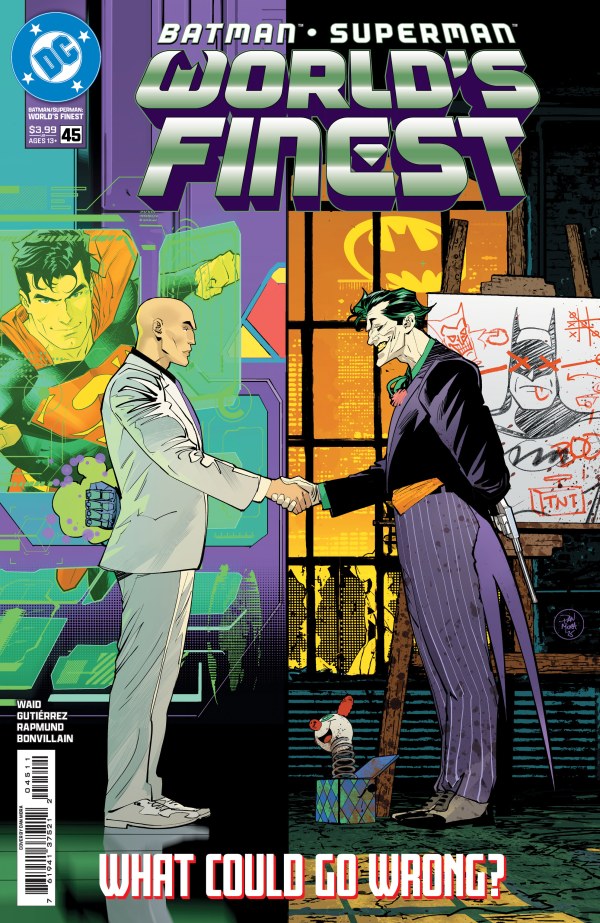
Notes: Mark Waid’s string of hits continues with World’s Finest #45, in which our two titular heroes actually take a mostly supporting role. This month, the Joker has gotten wind of Hawkman’s “Absorbascon,” a device that’s familiar to the readers, but which he sells to Lex Luthor on the promise that it can bring the user “infinite knowledge.” The two of them plot to get their hands on it, and the issue ends with their game being upped in a tantalizing and potentially deadly way.

What I really like here is that Waid is pushing forward the story while, at the same time, finding room to do a lot of great little character beats. Lots of people have written the Luthor/Joker partnership before, a team-up that makes little sense in reality, but that keeps happening mostly on the strength of having the arch-foes of the DC Universe’s top two hanging around together. The idea that someone of Luthor’s cold, rational nature would team-up with the Joker is ridiculous, so it’s always fun when a writer finds a way to make it make sense. The Joker of COURSE would love to hang out with Lex – poking holes in his logic is probably the next best thing to tormenting Batman – so having him bring a MacGuffin to Lex that the latter couldn’t possibly resist is a good excuse to force them together against Luthor’s wishes.

Although Superman and Batman take a back seat for most of this issue, we DO get some good moments with them, particularly the opening scene, which features Clark hanging out with Bruce at the Batcave, watching a football game between the Metropolis Meteors and the Gotham Goliaths. It’s incredibly rare to see the two of them doing something so utterly normal, just sitting around like any two ordinary guys, munching popcorn and rooting for their respective teams. It seems almost absurd for Superman and Batman to engage in such an afternoon…but for once, despite their clothes, they aren’t being Superman and Batman. They’re just Clark and Bruce. I can count the number of stories that pull that off effectively on one hand, and I’m not drawn by AI, so that’s a pretty low number. 

I also want to call out the artwork by Adrian Gutierrez. I’ve made no secret of my love of Dan Mora’s work across the DC Universe, but Gutierrez has really stepped up and made this book his own. He handles the quiet character moments – like showing Superman wearing a football jersey over his uniform – just as real and perfectly in-character as the Big Damn Hero moments that come later in the issue. In other words, I’m a fan. 
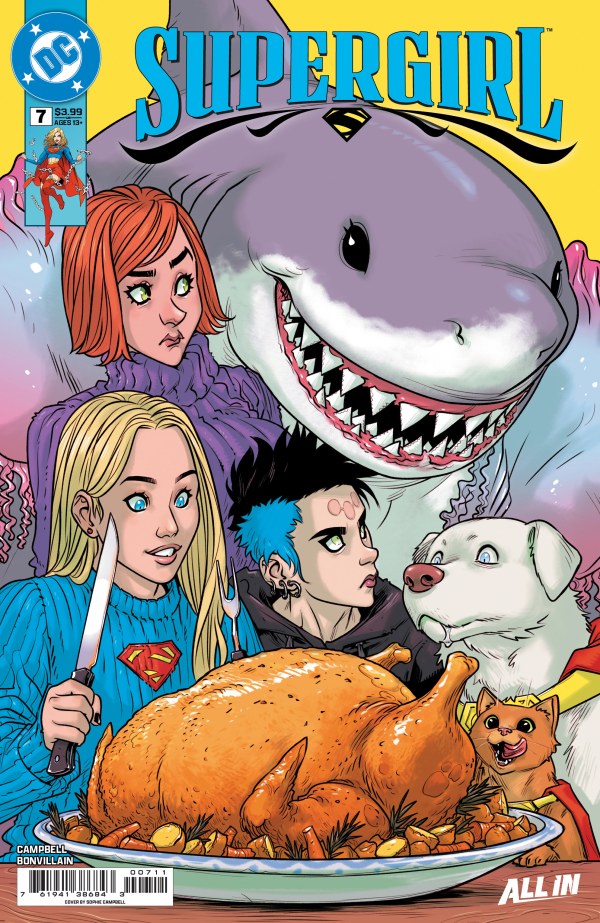
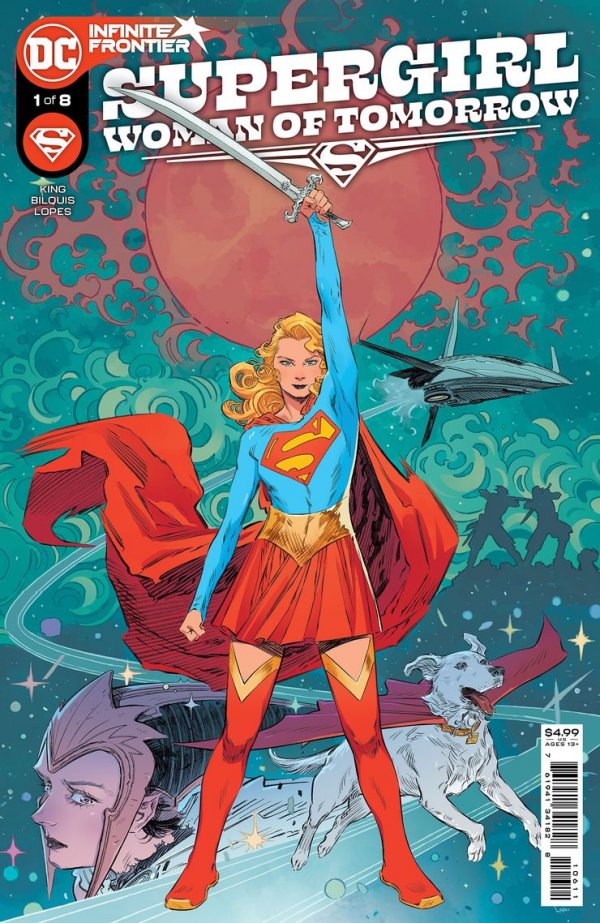
In Supergirl #7, it’s Thanksgiving in Midvale, and you know what that means! It means I should have read this comic book two weeks ago. But it ALSO means it’s Lesla’s first holiday on Earth. As Kara’s parents host a Thanksgiving dinner for all of Kara’s friends and family – including Superman and Lois – Lesla gets worried because Kara hasn’t shown up. Turns out she’s under the sea, trying to save herself from being turned into a mermaid by turquoise Kryptonite. You know, like you do.

My love for this book under Sophie Campbell’s stewardship continues unabated. On the one hand, we’ve got Supergirl herself tied up in a plotline that could have fallen straight out of the Silver Age, and Campbell is handling those adroitly. On the other hand, Lesla’s story carries most of the character weight in this issue, and it’s every bit as entertaining and meaningful as the superhero stuff. Lesla is trying to understand Thanksgiving, Lena hates it, Luna doesn’t celebrate it but just wants to be with her friends…the Double-L Squad that Kara has built up around her in this title is already one of the best supporting casts in comics. There’s so much happening with them, with the clashing personalities that somehow still make perfect sense as a group of friends, and it makes the book feel very real, very genuine, and very heartfelt. It’s honestly almost TOO perfect – I’ve been reading comic books for way too long and now I’m almost positive that something horrible is coming that’s going to break up this whole happy surrogate family. In my defense, though, the last page seems to be pointing to that as well, so it’s not just my hardwired paranoia.

I do have one question, though – having Superman show up for Thanksgiving dinner at the Danvers? That’s fine, everybody there knows Supergirl’s secret identity. Having him show up with LOIS, though…is that necessarily the best choice? Lex Luthor’s daughter is right across the table from them, is she not going to piece things together? I mean, I know she’s not the biggest fan of her dad, but still. Seems risky to me. 

TV Episode: Superman and Lois Season 3, Episode 9, “The Dress.”

Tues., Dec. 9

Graphic Novel: Superman: Lois and Clark-Doom Rising

Notes: Dan Jurgens, of course, is one of the architects of Superman and who he is for the past 30-plus years, and when the Pre-Crisis Superman and Lois were brought back during the end of the New 52 era, he was called on to write the Lois and Clark miniseries that brought them and their young son Jonathan into regular DC continuity again. A few years later, he contributed this story as one of a series of back-up features that were running in Action Comics, specifically appearing in issues #1051-1057 of that series, along with the story from the Death of Superman 30th Anniversary Special that I read earlier this year. I love Jurgens’ take on Superman, and I love any story with Jonathan back when he was still a kid and interesting, so reading the collected edition of this serial felt like a nice way to wrap up this week.

Following the fight with Doombreaker from the special, Lois and Clark take Jon back to the California farm where they lived while in hiding (the New 52 version of Superman being the main one at the time). Jon’s powers are still new and burgeoning, and Clark is hoping to spend some time guiding the boy. 

Back in Metropolis, though, the creature called Doombreaker (originally a construction worker named Lloyd Crayton who kept a piece of Doomsday’s bone and was later transformed by it) has escaped. The bone that caused his transformation has gone missing too, and what even Lois and Clark don’t know is that Jon has kept it, hiding it so that no one else could use it to turn themselves into a Doomsday monster. While he’s secreting it in his treehouse, a spacecraft lands and a young woman steps out, Glyanna of the planet P’Luhnn, asking Jon to take her to the man she assumes to be Earth’s king – Superman. The two are attacked by a robot enforcer. Jon calls for help and Clark, with his super-hearing, races away. Just then, though, Doombreaker arrives at the Kents’ doorstep, seeking the piece of Doomsday Jon took with him.

Superman finds Glyanna’s spacecraft, but no sign of her or Jon. Glyanna and Jon, meanwhile, are being held captive on the Enforcer’s spacecraft, where he plans to return Glyanna home to stand trial for treason. Jon fights the Enforcer, but causes the ship to crash, barely pulling Glyanna from the wreckage in time. He again calls his father for help, but Superman is embroiled in battle with Doombreaker, who’s found the piece of bone. When the Enforcer again comes after Jon, Glyanna reveals she’s been controlling it all along, and puts Jon in stasis to use him as a bargaining chip to force Superman to help her. Lois uses a weapon from Glyanna’s ship to stop Doombreaker, then shows Clark the alien’s message – her planet is in the midst of a revolution, and all Superman needs to do to get his son back is put it down for her. 

Superman arrives on Glyanna’s planet and is given an ultimatum – stop the uprising or she’ll kill Jon, who is hidden inside one of 120 lead cells all over the planet. As he tries to buy time by holding the mob back, Jon pounds on the walls of his cell (in a manner nicely reminiscent of Doomsday’s first appearance), counting on his father to hear the vibrations, even if he can’t see him. When Glyanna realizes what Jon is doing, she cuts off the oxygen to his cell, but Clark has already located him and breaks him out. Superman finds Glyanna’s parents, the rightful rulers who were overthrown by their daughter, who explain that she was led to turn against them by an outside force. The story ends with Glyanna in space, her mysterious advisor telling her that she’s got a weapon of her own for the future: Doombreaker is in their clutches. 

This is exactly the kind of story I loved when Jon was younger – Superman and his son, interacting AS father and son. The boy is still trying to learn about his powers and learn how to be a hero – all of this is territory that very few comic books have covered before, and virtually none of them with as high a profile a character as Superman. Nor has there been a mainstream hero so perfectly suited to this kind of story – it was Superman as a father, something that in the 75-plus years of his existence (at the time) had never really been done before. It was a change of pace that fit the characters and worked beautifully. 

Yeah. I’m still salty about Bendis aging Jon up and putting an end to that era prematurely. The Superman books are good right now, but Jon has been a weak link in the franchise ever since that point, and stories like Doom Rising just serve to demonstrate the inherent potential in this formula that was left largely unrealized. 

It also makes me remember that – to the best of my knowledge – the cliffhanger at the end of this issue has never been resolved. Glyanna and Doombreaker are theoretically still out there somewhere, waiting for a time to return. Somebody call Jurgens up and get him on that.

Comics: Batman: Wayne Family Adventures #51 (Guest Appearance), DC Go! Holiday Special 2025 #2 (Cameo)

Only three weeks left, friends, it hardly seems real. See you for Week 50 in seven days.

Blake M. Petit is a writer, teacher, and dad from Ama, Louisiana. His most recent writing project is the superhero adventure series Other People’s Heroes: Little Stars, volume one of which is now available on Amazon. You can subscribe to his newsletter by clicking right here. You can join in the Kryptonian Konversation every day in the Year of Superman Facebook Group!

Year of Superman Week 29: Parody Week!

With the movie (you know which one) so fresh in my mind, I thought quite a bit about what to do this week. I don’t know what Superman stories would be best to follow it. Certainly, anything that would be capable of TOPPING it is likely something I’ve already read. So rather than any of that, I decided to go in the opposite direction: parody. Parody is a classic format for stories, something that’s been around almost as long as storytelling itself. I’m pretty sure that after the first caveman, Ug, finished regaling his tribe with the story of how he singlehandedly took down a wooly mammoth, when he walked away his buddy Og stood up and started doing a mocking impression of Ug getting impaled by a tusk.

In the nearly 90 years of his existence, Superman has been parodied many times, and we’re going to look at those this week. We’ll look at his parodies from comics and magazines like Mad and Cracked, check out spoofs from shows like Saturday Night Live, and even delve into the times that the Looney Tunes did their own take on the Man of Steel. So this week, friends, let’s laugh.

And as always, you can check out earlier blogs in the Year of Superman Archive!

Wed., July 16

Comics: Mad #4, What The–?! #2

Notes: Everybody has heard of Mad Magazine, but if you’re not a hardcore comic book nerd like myself you may not know that Mad actually started out as a comic, published by EC Comics, the same company responsible for classics like Tales From the Crypt and Weird Science. When the anti-comic furor of the 50s led to the creation of the Comics Code of America, an organization that at times seemed intended solely to crush EC out of existence, they pivoted and made Mad a magazine instead, because evidently making the page size larger and switching to black-and-white was enough to exempt it from the Code. I didn’t say it made sense, people.

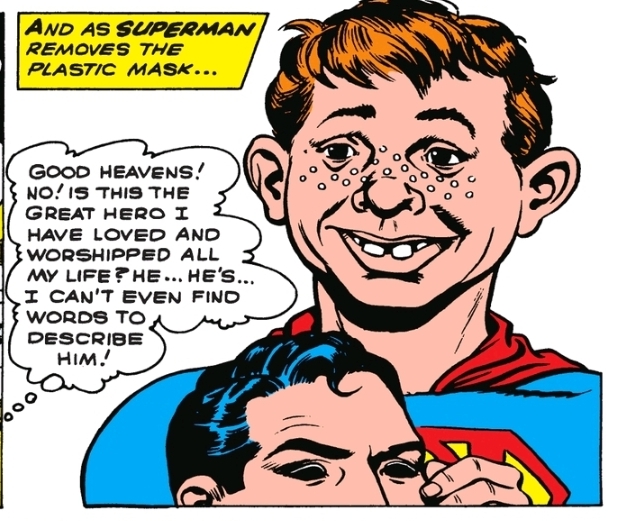
But anyway, the fourth issue of Mad (the comic book) brought us one of the first Superman parodies in print: “Superduperman” by Harvey Kurtzman and Wally Wood. Here we meet Clark Bent, assistant copy boy at the Daily Dirt, a pathetic creature who has spent the last ten years saving up his meager salary (seventy-five cents and a good bus token) in the hopes of buying a pearl necklace for “girl reporter” Lois Pain. The city of Cosmopolis is being plagued by an “Unknown Monster,” and Clark dives into a phone booth (then a second because the first was occupied) to change into Superduperman. To his shock, he discovers that the “Monster” is, in fact, Captain Marbles, who has gone rogue and decided he’s just in it for the money.

A few interesting things here: Mad #4 was published in 1953, just a few months before Fawcett Comics would throw in the towel in their years-long court battle against National Comics over their claim that Captain Marvel infringed on their Superman copyright. So there’s a meta level to having Superduperman slug it out with Captain Marbles that I find pretty amusing, but I have to wonder if the average kid in 1953 would have gotten that joke. The depiction of “Clark Bent” is pretty striking here, taking the “meek, mild” Clark Kent that we all know and love and making him even more pathetic, making Lois a cold, cruel harpy, and making Superduperman kind of a dunce. 

I think the biggest draw is Wally Wood’s artwork. He was one of the greatest comedic artists of the time, probably of ALL time, and the level of energy and fun he puts on every page is outstanding. The man was a giant and I’m so glad I included this story in the Year of Superman.

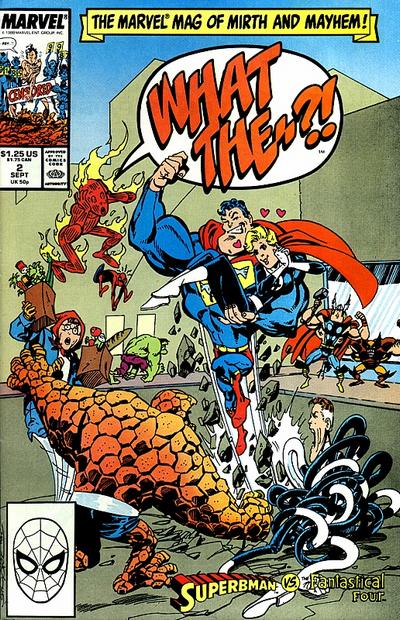
In 1988, Marvel Comics decided to get back into the parody game with What The–?!, the Marvel Mag of Mirth and Mayhem. I was 10 years old when this series started, and it was pretty much tailor-made for me. The second issue, though, was something that was actually more special than I realized at the time: Superbman versus the Fantastical Four in “My Badguy, My Enemy!” by none other than John Byrne. 

In 1988, Byrne was wrapping up his time on Superman for DC and returning to Marvel, where had previously done a legendary run on Fantastic Four, so I suppose the idea of having him parody his two greatest achievements in comics to date was a natural match. Byrne wrote and drew this story (with inks by another Superman laureate, Jerry Ordway), which has reporters Park Bench and Nosy Dame travel to New York from their home in Metropopolopolis to report on the newest bankruptcy of the Fantastical Four. When the Human Scorch carelessly causes Nosey’s hairdo to wilt, Superbman jumps into action.

I loved this incredibly goofy story as a kid and, as an adult, I appreciate it on an entirely different level. Byrne was doing something that I admire the hell out of: making fun of himself and having a grand time doing it. The story makes several references to the way Superman was changed in Byrne’s own reboot, including comments about how he’s not as powerful as he was previously, how he’s not as square as he used to be, and how his cape is no longer indestructible. The last one led to a joke that 10-year-old me thought was the funniest thing he’d ever read and, if I’m being honest, adult me still thinks is pretty hilarious:

Even a parody of Ben Grimm still sounds like Ben Grimm, and I think that’s beautiful.

But as the fight between our heroes rages, off to the side there’s a battle of wits between Doctor Bloom, sworn enemy of the Fantastical Four, and Rex Ruthless, sworn enemy of Superbman (the Keeper of the Comics Code actually has to step in at one point to tell them to cut down on the swearing). The two super-geniuses begin arguing over their plots, with Bloom revealing that he faked the FF’s bankruptcy to lure Park Bent to report on it, having deduced that Bent was Superbman. Ruthless finds this HILARIOUS, in a page that I now recognize as being the real pearl of this story. He gives Bloom a lecture on how impossible that would be, a page where Byrne is parodying his own treatment of Lex Luthor from Superman (Vol. 2) #2, in which Luthor rejected the same line of logic connecting Clark and Superman. Byrne even gets into making jokes about his own predilections in panel layout here, stuff that as a kid I didn’t catch on to at all. (I wasn’t reading Superman comics yet at that point, and even if I had been I don’t know if I would have caught on to all the nuances.)

But perhaps the greatest inside joke in the comic is the way Byrne draws Superbman’s s-shield. I remember reading an introduction Byrne once wrote for Man of Steel in which he discussed his history with Superman and how, as a child, he didn’t realize the symbol was supposed to be an “s.” To him, he said, the shapes looked like a pair of fish swimming at one another. So when he got the chance to do a parody, that’s what he drew. That’s a joke that I bet almost NOBODY got – I certainly didn’t get it at the time – but it’s one of my favorites now.

I wish Byrne had done more comedy comics like this one. He had a real flair for it. 

Thur. July 17

Magazines: Mad #208, Cracked #160

Notes: When I was younger I read Mad and Cracked pretty regularly, although I drifted away as I got older. This happened with a lot of stuff, but unlike other things I dropped as being “for kids” like Disney and Archie comics, I never really went back to Mad on a regular basis. At the risk of sounding pretentious, I think my sense of humor just grew in a different direction than those publications specialize in. Still, I’ve got a lot of them from when I was younger and I’ve tracked down others over the years that either featured or reprinted specific Superman comics – plus there are some available (you know where this is going) on the DC Universe Infinite app. So during Parody Week, I’m going to try to go through some of the ones that I’ve got in roughly the order of publication. 

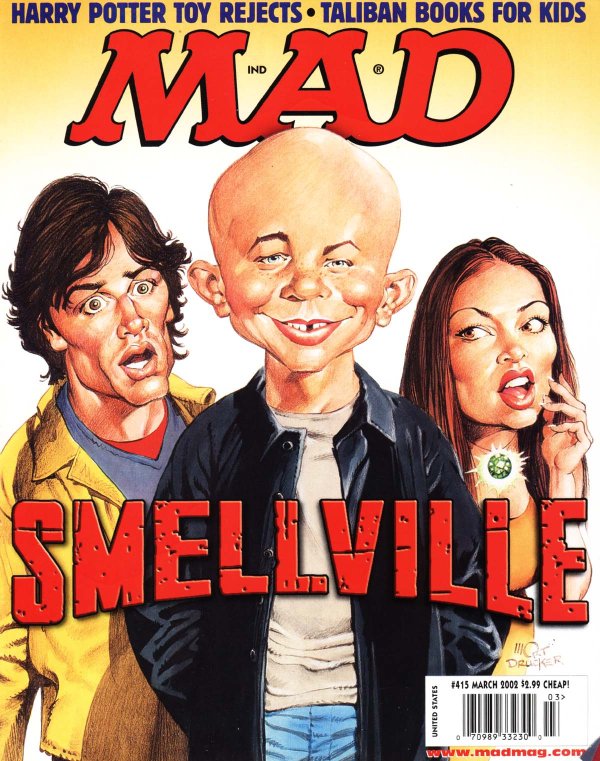
First up is Mad #208, which recycled the title “Superduperman” for its parody of the first Christopher Reeve movie. I can’t find a writer credit, oddly enough, but Mort Drucker’s signature appears on the first page and – let’s be frank – it would be pretty clear it was his art even without it. Drucker was a phenomenal caricaturist, the characters in his Mad parodies immediately recognizable as the celebrities he was spoofing, even when exaggerating or mocking their features. He even nails the design of Glenn Ford and Phillis Thaxter as Jonathan and Martha Kent in their brief appearance. 

I’m not going to bother to recap the story here, because as a parody it’s a fairly by-the-beat retelling of the story of the movie. How well, then, does it succeed as a comedy? 

Eeeeeeeh.

I think this is why I never quite got back to Mad once I got older. The comedy in many of these stories is dependent on straw man jokes and easy targets: a crack about how improbable it is that Lois can afford such an opulent apartment on a reporter’s salary, gags about how outrageously out-of-proportion Marlon Brando’s paycheck for this movie was, and of course, a joke about the glasses. Probably the best joke in the entire parody comes at the very end, after Superduperman spins time back to save “Lotus Lain.” As in the movie, Supes gets a vision of his father reminding him he’s not supposed to interfere with human history. In this version, though, there’s a second voice telling him to do it – it turns out to be the executives at Warner Bros. recognizing that they need Lotus alive for Superduperman II.

The same month that Mad’s parody came out, rival magazine Cracked gave us “Suped-Upman: The Satire.” Once again, there’s no credited creative team, but the artwork to me looks a hell of a lot like the great John Severin, who did stories for Cracked for decades. 

The Cracked story isn’t specifically parodying the movie, but rather just giving us a goofy look at a Superman-type character, and honestly, I think it’s better for it. Freed from trying to draw the actors, Severin’s characters have a life and expressiveness where other parodies sometimes fall short. Cluck Clone doesn’t leave his parents’ farm to become a reporter, but rather gets a job at a delicatessen called the Deli Planet where he meets a lovely girl named Lewis Paine – whose safety takes top priority over gunshot victims when Suped-Upman goes into action a few pages later.

After reading just these two parodies, I feel like I’m already starting to gel a sort of theory of satire, at least how I see it. Of the two, the Cracked story is honestly much funnier and a lot of fun to read, and I think the reason for that is because whoever wrote it wasn’t simply retelling the story of the movie. He took the broad strokes of the Superman legend, tweaked them in a humorous way, and then told his own story rather than just filling in the blanks of the existing plotline like a complicated Mad Lib. Cracked is doing its own thing, and it’s a better story for it.

And you know, the same is true for all the great satires out there. Compare something like Mel Brooks’s Spaceballs to a Friedberg/Seltzer movie such as Epic Movie. Brooks simply uses the CONCEPTS of science fiction (especially, but not exclusively Star Wars) to tell a funny story, whereas Friedberg and Seltzer rip out chunks of existing stories and patch them together like some horrific Frankenquilt that seems to think that simply REFERRING to another movie is enough to qualify as a joke. All of this is building my brain up to what I think I’m going to refer to as Petit’s Law of Satire: Satire is funnier in broad strokes than in specifics. The two stories I read yesterday, from Mad #4 and What The–?! #2, were both really funny, and neither of them was parodying a specific story. The Cracked satire is funnier than the Mad by-the-beat parody. 

I think I’m on to something here.

Let’s see if it holds up over the next few days. 

Comic Books: New Gods Vol. 5 #7 (Guest Appearance), Green Lantern Vol. 8 #23 (Guest Appearance, Conner Kent)

Fri., July 18

Short Films: Super-Rabbit (1943), Stupor Duck (1956), Superior Duck (1996)

Notes: Today I decided to peek in on the second greatest collection of characters in the Warner Bros. catalogue, after the DC superheroes. I’m talking, of course, of the Looney Tunes. I have a deep, abiding love of the likes of Bugs and Daffy, and as each of those stalwarts took their turns poking fun at Superman, I wanted to include them here in Parody Week, starting with Bugs Bunny in Super-Rabbit.

Directed by Chuck Jones, this cartoon starts off with a spoof of the Flesicher shorts, parodying the old “faster than a speeding bullet” intro before bringing us to Super-Rabbit’s origin. Bugs Bunny is a lab animal in this one, given some super-powered carrots that give him incredible powers. He decides the best way to use these powers is to head to Texas and take on a hunter called Cottontail Smith who has dedicated himself to wiping out all rabbits. Bugs does his usual number on Smith and his horse until a midair mishap causes him to lose his power carrots, which Smith and the horse gobble them up. Just before he’s about to be pummeled, Bugs declares, “This looks like a job for a REAL Superman!” Then, in a bit of standard-for-the-time patriotism, he ducks into a phone booth, joins the army, and marches off in the direction of a road sign that inexplicably points to both Berlin AND Tokyo. 

The superhero stuff in this cartoon is almost incidental. The opening sequence is where most of the tropes come in, with the Fleischer-specific parody, but once Bugs gets to Texas and comes to loggerheads with Smith the antics he pulls off are pretty standard for him. Could catching a cannonball and using it to play an impromptu game of basketball count as a feat of super-strength? Sure, but this is also BUGS BUNNY we’re talking about, a cosmic trickster with the ability to warp reality in any manner he deems the most amusing at the time, so I’m not convinced that the magic carrots are strictly necessary here. The only parts of the cartoon that seem specifically dedicated to a Superman parody, other than Bugs’s outfit, are the bits where he’s flying. That does, of course, give us the best joke in the entire short, as Bugs flies into the stratosphere and whips past a horse who is astonished to see a rabbit flying at 30,000 feet.

Think about that for a minute.

Anyway, it’s a good cartoon. Perhaps not the greatest parody in history, but it IS the cartoon that led to the awesome Super-Rabbit figure that adorns one of my Superman shelves, and it’s worth it for that alone. 

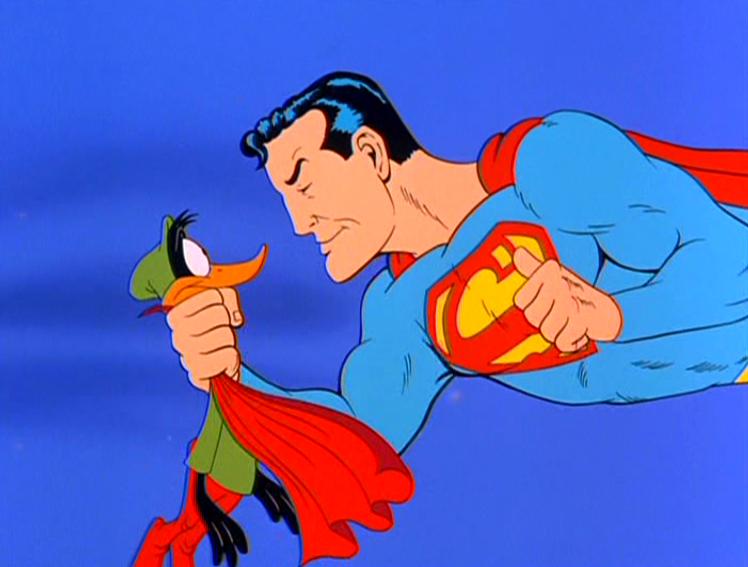
Next up, in 1956 Robert McKimson drafted Daffy Duck for another poke at the man of steel in Stupor Duck. This one is a much more direct parody of Superman than Super-Rabbit, beginning with Daffy in disguise as “mild-mannered reporter Cluck Trent.” Daffy overhears his editor watching TV but, true to form, mistakes the broadcast for the braggadocio of a supervillain and sets out to thwart him, only to get thwarted himself over and over. 

Bugs is a classic character, but in terms of parody, I think Daffy is actually more effective. A lot of the humor in this short comes from Daffy making a fool of himself in ways that just wouldn’t happen to Bugs. He saves a building from collapsing, for example, only to wind up getting punched out by the head of the demolition crew that was TRYING to demolish it. He saves a “sinking” ship and gets blasted by the cannon of the submarine he just pulled out of the water. It’s great, goofy stuff that is perfectly in keeping with Daffy Duck, but wouldn’t have worked with Bugs. I think I have to conclude, oddly enough, that although Super-Rabbit is a funnier cartoon, Stupor Duck is a better parody. 

Director Chuck Jones would take one more swing at superheroes more than five decades after Super-Rabbit, teaming up with Daffy for the 1996 short Superior Duck. This time out, Daffy is a sort of mashup between Superman and Duck Dodgers, setting out to save the day only to be constantly thwarted by…his narrator.

Seriously, that’s the entire cartoon. Daffy is out to do some superheroics, but the narrator (voiced by the immortal Thurl Ravenscroft) cannot get his lines right, forcing Daffy into one increasingly-preposterous situation after another. It’s a less direct Superman parody than some of the others, but they make up for it with a last-act cameo that left me in stitches. 

With Mel Blanc having left us by this point, we’re left with different voice actors, some of which work and others don’t. Frank Gorshin, TV’s Riddler, absolutely knocks it out of the park as Daffy and Foghorn Leghorn. Eric Goldberg does a good Porky and Marvin the Martian, but his Tweety left something to be desired. But this still feels like the same Chuck Jones who gave us the likes of Duck Amuck and One Froggy Evening. It’s a hoot. 

TV Episode: The Looney Tunes Show, Season 2, Episode 26: “SuperRabbit.”

Notes: But we’re not done yet! In 2011, the Cartoon Network brought us the highly-underrated cartoon The Looney Tunes Show. I loved this show – rather than simply aping the classic Looney Tunes shorts, they merged those sensibilities with a TV sitcom, casting Bugs and Daffy as roommates in a kind of Odd Couple situation, with Bugs playing the more sensible, straightlaced one to Daffy’s aimless vagabond. If I had heard the show described as such before I watched it, I probably would have dismissed it outright, but I really grew to love the series and to this day wish it had lasted longer than two seasons. 

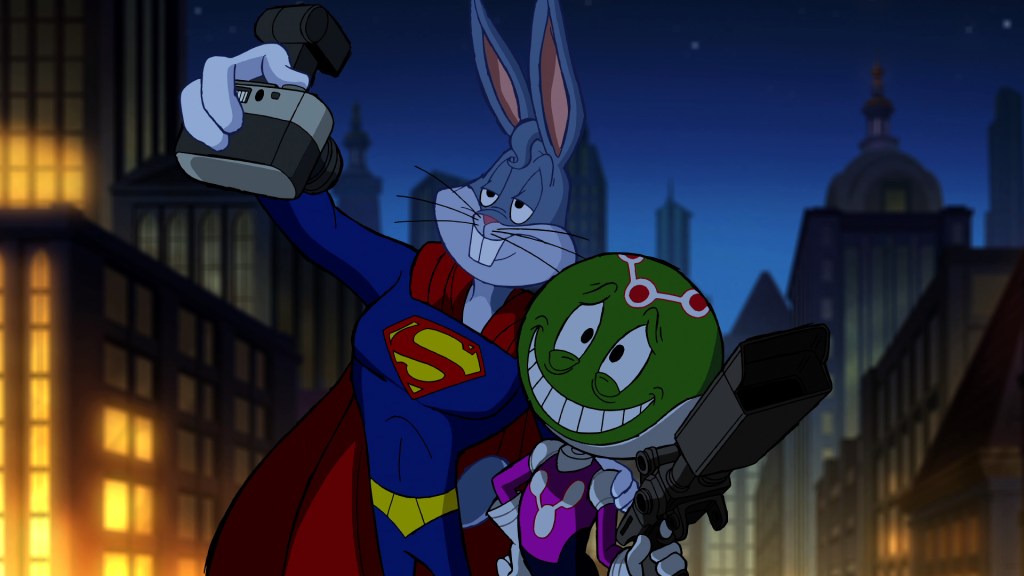
The episode I’m focusing on was the season two finale (which, sadly, turned out to be the series finale as well), “SuperRabbit.” In this one, as Daffy starts scrounging through Bugs’s belongings looking for stuff to sell (did I mention he was a vagabond?) he comes across a strange crystal carrot. Bugs tries to divert Daffy’s attention from the carrot with a tale of his “true” origins. He isn’t REALLY Bugs Bunny, he claims, but an alien from the planet Crypton. (With a “C.” Because Daffy is WAAAAY too smart to fall for Bugs ripping off Superman’s origin by spelling it with a “K”.”) From there, we actually get an adventure of Bugs as SuperRabbit facing off against some of his greatest enemies: Brainiac (aka Marvin the Martian)! Lex Luthor! (Elmer Fudd, naturally)! And General Zod (Daffy himself)!

I hate to say it, but this was actually one of the weaker episodes of The Looney Tunes Show. The strength of the cartoon came from putting Bugs and Daffy into very sitcom-esque tropes and then spinning them wildly out of control. This episode mostly avoids that, electing instead to do a full-episode parody of what could have been a fairly standard Superman story with a few added jokes (such as Elmer’s Lex Luthor telling people “I’m hunting SuperWabbits”). It’s an okay parody, but it’s nowhere near the level of entertainment that this show was usually capable of, and it makes me sad that the show ended on this note.  

Sat. July 19

Magazines: Mad #225, Cracked #183

Notes: Mad returned to the world of “Superduperman” with a parody of Superman II, with Mort Drucker once again providing artwork and Frank Jacobs writing it. For all I know, Jacobs wrote the first one as well, but as I said a couple of days ago, I couldn’t find a credit for that one. It certainly reads like it was written by the same author. Like the first one, “Superduperman II” is, in essence, a beat-for-beat retelling of the plot of the movie with added puns. Some of them, of course, land better than others. We have a very standard formula for a Mad parody: Jacobs and Drucker essentially break the movie down into single-panel moments; in each panel, the characters make wry observations about the situation they are currently in; and it ends with a punchline. Once you get used to it, the humor comes across as very staccato, with a rhythm that’s predictable, but not in a soothing way, so it’s not surprising that the funniest moments in the story are all things that are original to the comic. There’s a funny bit at the beginning, for example, where they mock the movie for opening up with flashbacks to the first film. Later, during the fight with the Phantom Zone criminals, Rocky Balboa randomly shows up for a panel to punch the Non parody, telling Superduperman that he’s there to get in shape for his own upcoming sequel. The funniest wholly original gag comes in a couplet where Superduperman is rushing off to Paris to save Lotus Lain, only to have to whip around because he forgot France is eastward.

Really effective comedy is based on surprise, and I think that’s pretty indicative of why I fell out of love with Mad parodies as I got older – they’re all pretty much the same, pretty predictable. Even at this point, in 1981, the good parts of the magazine were the things that didn’t parody a specific story, like Don Martin’s strips, Sergio Aragones’ marginals, and of course, “Spy Vs. Spy.”

Cracked, meanwhile, again chose not to do a direct parody of Superman II, instead choosing to run a three-page gag piece called “What Christopher Reeve (That Super Man) Will Be Like When He Gets Old.” The joke here is that, with Superman II being a huge hit, they assumed that they would go on to make dozens and dozens of sequels for decades to come, and the comic jokes about what an “old” Superman would be like: his powers being less impressive, using his strength to break a pound of spaghetti rather than bend steel, for example. The jokes were fair for the time – this was the era where movie sequels were just starting to get out of hand, and once popular movie franchise hit a certain point, there was an assumption that it would go on forever. (Remember the bit in Back to the Future Part II where Marty cringes from the holographic shark advertising Jaws 19, or the quick joke in Spaceballs in which a movie reviewer is about to talk about Rocky 5,000?) The problem here is obvious, and not at all the fault of anybody who worked on this comic: no matter how good the jokes may have seemed at the time, given what happened to Christopher Reeve, they’re just not funny anymore.

I want to note, briefly, that I’m going to try to cover as many Superman parodies as I can before this week is up, but that number is dependent on what’s actually available to me in my personal collection or the DC app, and also on my ability to locate them. I’ve scrouged up quite a few, but that doesn’t mean that I’ve identified them all. I bring that up because if Cracked did parodies of movies past Superman II, I either don’t have them or can’t find them. From here on out, the remaining print parodies on my list are all Mad.

Mad #243, for example, teamed Drucker with writer Stan Hart for “Stuporman ZZZ.” Changing up the writer didn’t change up the formula, though – it’s still your average beat-for-beat Mad parody. Each panel has that same ol’ rhythm, the same ol’ cadence, the same ol’ delivery. And once again, the funniest part is the stuff that’s NOT directly taken from the film: this time around, it’s a sequence after the “Kraptonite” makes Stuporman go bad, where he demonstrates this by using a joy buzzer to shake the Pope’s hand, giving a whoopee cushion to the UN Secretary-General, and mooning Ronald and Nancy Reagan at the White House. Reading these stories actually makes me feel sorry for Mort Drucker – he’s such a fantastic cartoonist and caricaturist, and I wish he’d been given better material to illustrate. Even the two-page “Don Martin’s Superman III Outtakes” strip is funnier than the main story. 

I’m starting to get a little burned out on the Mad formula now, to the point where I’m looking forward to the point where I get to the parodies that came out after I fell off as a reader. Hopefully by that point, they’ll have discovered a second way to tell a joke. 

Comics: Superman Unlimited #3, Krypto: The Last Dog of Krypton #2, Batman/Superman: World’s Finest #41

Notes: It ain’t all parodies, though, friends. There are still new Superman comics this week, and I’m getting into those today too, starting with Dan Slott and Rafael Albuqueque’s Superman Unlimited #3. Told largely through Krypto’s eyes, in this issue we see our best boy catch some bad guys, get taken for a walk by Jon, and then catch scent of an old foe of Superman’s that he decides to track down.

At first, the story seems like a charming but inconsequential chapter of the Unlimited storyline. The first two issues largely dealt with the enormous Kryptonite meteor that fell to Earth and the havoc it’s wreaking everywhere, but that plotline doesn’t show up here for quite some time. The Krypto story is lovely, and there’s a great scene where Lois and Clark ask Jon what exactly he’s doing with himself these days (a question a lot of the readers are asking too – the character has been painfully aimless for entirely too long, and I’m not shy about laying the blame for that on the stupid age-up foisted on him during the Bendis run). In the last third of the book, though, there’s a nice reveal where we come to understand how the Krypto story is fitting in. Some new wrinkles to the Kryptonite story are added and a new player is added to the game, and that makes this book – which was already fun to read – feel much more significant. 

Ryan North and Mike Norton are back for Krypto: The Last Dog of Krypton #2. I have no doubt that this miniseries owes its existence to the fact that Krypto has such a big role in the movie, and I honestly wouldn’t be surprised if DC didn’t even have any intention of publishing a Krypto series until after he showed up in the trailer last December and got such a huge response. If that’s true, then that trailer has given us one of the best comics of the year. 

In this second issue, Krypto has been taken in by – of all people – a young Lex Luthor. Having left his original home of Smallville, Lex is living with relatives he clearly despises and for some reason, decides to take in this stray dog he’s found. The ambition that will mark the adult Lex Luthor is already there, but in this early incarnation, he’s struggling with his morality. This would be a fascinating book even if it weren’t for Krypto. We’re seeing the kind of internal conflict that kind of determines who a character will eventually be – if given the chance for greatness at the expense of having to do something horrific, will they do it? Adult Lex, we know, wouldn’t hesitate, but seeing him at a young enough developmental stage where there’s still a last lingering shred of conscience is fascinating.

People who pick up this comic expecting to see the bounding, joyful Krypto of the movie might be a little put off, but if that’s not all you’re looking for, this comic is really phenomenal. 

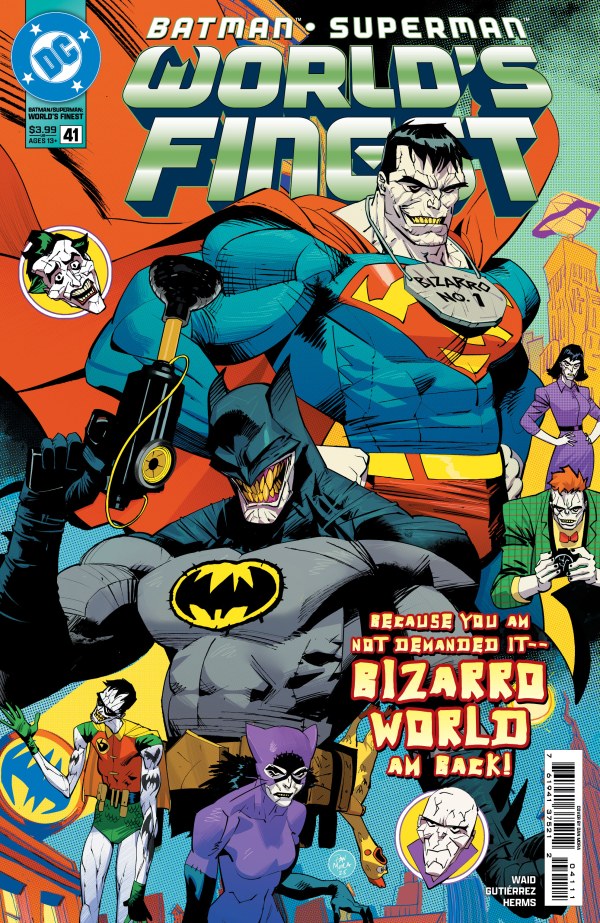
Finally, in Batman/Superman: World’s Finest #41, we start with Batman, Robin, and Superman inexplicably transported to Bizarro World. Bizarro World is actually kind of an appropriate element to bring in here in Parody Week, because bad Bizarro stories are kind of like a bad Mad satire: by-the-book tellings of an oaf doing things backwards. The good ones find new twists to put on it, and this one is pretty good. We start off with Robin as the point of view character, which is nice, as he’s never been to Bizarro World before and the sheer panic he goes through uses a normally unflappable character to show just how crazy it is. Then we get to the twist – there’s some sort of pandemic going through the Bizarros that warps their brains and makes them the worst thing a Bizarro can be: normal. Waid finds some fun ways to play with the Bizarro’s backwards nature in this issue, promising a fun story arc. 

Sun. July 20

Comedy Sketches: “Bicycle Repairman” from Monty Python’s Flying Circus Season One, Episode Three, Assorted Saturday Night Live sketches

Notes: Okay, so we’ve taken a look at Superman parodies in comics and cartoons, but what about live action? These, I think, can give us a broader view of how pop culture views the Man of Steel, at least at the time each parody was made. We’ll start off with Monty Python’s “Bicycle Repairman” sketch from 1969. In this bit, we peek in on an inverted world in which everyone is Superman. At least, everyone wears a Superman costume and has padded muscles – we never actually witness any of these Supermen doing anything super. But when trouble happens, in the form of Terry Jones Superman falling off his bicycle, another Superman (Michael Palin) makes a quick change and rushes to save the day as…BICYCLE REPAIRMAN!

The Pythons, of course, were masters of surreal comedy. It doesn’t matter if the sketch makes no logical sense, it’s about the gags and about the underlying subversion that they’re sneaking in. And while this particular sketch doesn’t make any grand political statements, it IS interesting in what it shows us about how superheroes were viewed in 1969. First of all, there’s no particular reason for this sketch to be about Superman. They could have put virtually any superhero costume on the cast and the joke would have been exactly the same. But in 1969, Superman was viewed as the default superhero among most people. It’s who you automatically thought of when you said the word, and so that’s what they went with.

The sketch is also intriguing in how it reflects on one other non-Superman element. In the bit where Bicycle Repairman is (spoiler) repairing the bicycle, we get treated to nonsensical “sound effects” such as “Clink!”, “Inflate!” and “Alter Saddle!” They’re done in the style of the “Bow! Bam!” shots from the 1966 Batman TV show. Between these two things, I think it gives us a fairly accurate depiction of just how the general public viewed superheroes at the end of the 60s.

The rest of the sketches I’ve found all come from Saturday Night Live, although thankfully, they’re sometimes decades apart, so I think that gives us an interesting overview of the topic. We’re starting with the “Superhero Party” sketch from 1979, starring Margot Kidder herself as Lois Lane and Bill Murray as Superman, hosting their first party together. 

We get an all-star roundup of comedians playing comic book characters in this one: Dan Akroyd as the Flash, John Belushi as the Hulk (who rotates being Grand Marshall of the St. Patrick’s Day Parade with Green Lantern) and Jane Curtain popping in as a delightfully catty Lana Lang who tries to convince Lois that Clark Kent is secretly the Flash (apparently Superman still hasn’t told her his secret identity, despite having been married for some time). Spider-Man, Spider-Woman, and the Thing all show up in off-the-rack costumes that conceal the presumed extras wearing them. The gem here is Garrett Morris as Ant-Man, a character who, at the time, was as D-list as you could get. I’m sure most of the audience watching this when it aired in 1979 assumed it was a fake character the SNL writers made up. Murray ducks out at one point and returns as “Clark Kent,” where Lois starts confiding to her old pal that life with Superman has become stiflingly dull. What really crushes his spirit, though, is finding out that Lois used to date the Hulk. 

This sketch is full of hilarious, little moments. Murray prances around, “flying” from one spot in the room to another. Lois briefly admonishes him to allow her to open a housewarming gift because “not all of us have X-Ray vision,” and so forth. Unlike the Monty Python example, which just uses a surface level awareness of Superman, the writers of this sketch pull some deep cuts that I’m sure would zip past a lot of people, especially the Ant-Man reference (which nonetheless was so memorable that it got Morris a cameo in the first Ant-Man movie). The ending of the sketch, I confess, is a little weak, but at least it HAS an ending, which is more than you can say for most SNL segments of the past 20 years or so.

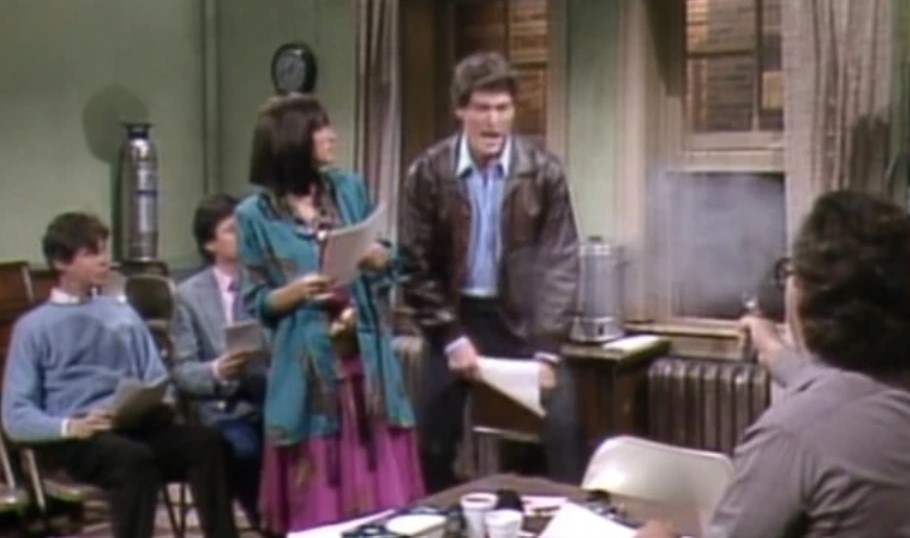
In 1985, Christopher Reeve hosted the show. Rather than actually parody Superman himself, though, they took the clever approach of telling the story of the “Superman Auditions.” Jim Belushi plays Richard Donner, auditioning the last three potential actors for the role of his Superman movie, including (of course) Christopher Reeve as himself. The three of them read sides opposite Donner’s assistant (Julia Louis-Dreyfuss). When they run the scene where Clark stops a mugger, Belushi suddenly fires a gun at Reeve. He’s angry when the bullet, rather than bouncing off his chest harmlessly, keeps bouncing off his chin and teeth and breaking windows. Reeve turns out to be at a serious disadvantage compared to the other two auditioners, one of whom catches the bullet in his teeth and the other of which is promptly shot dead. 

The concept is so utterly absurd that it’s actually kind of delightful, and while nothing about it makes the slightest bit of sense, I keep laughing every time I see it. In terms of mannerisms, Reeve plays his Superman lines just the way he always does, but he keeps bumbling the use of his authentic super powers in a way that seems appropriate for his Clark Kent. And this time the punchline at the end of the sketch lands nicely. 

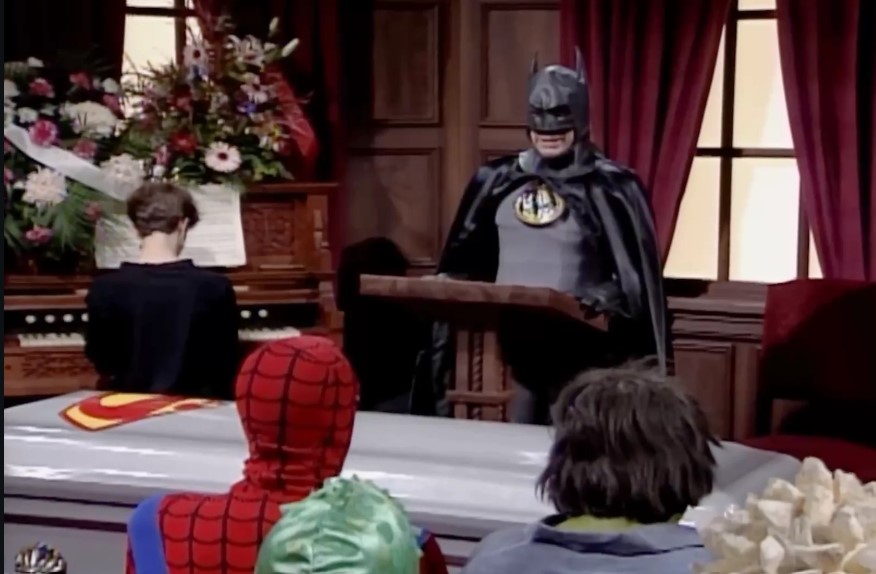
The next sketch is VERY much of its time, “Superman’s Funeral” from 1992. As I mentioned waaaay back when I did my reread of the Death of Superman for this blog, it was big news – so big that it even inspired an SNL sketch. You have to understand, the “Superhero Party” and “Superman Auditions” sketches were 100 percent done just because they had Kidder and Reeve hosting the show, and when that happens, they tend to play off of some of the actor’s best-known characters. But that doesn’t apply to “Superman’s Funeral.” They did this bit just because it was such an enormous part of the cultural zeitgeist at just that moment. (Also in the zeitgeist: that episode’s host, comedian Sinbad.)

Superman, as you may expect, doesn’t actually appear in this bit. We instead have Rob Schneider as Jimmy Olsen acting as host for Superman’s funeral. He talks to the other heroes as they arrive: Aquaman (David Spade), Adam Sandler (the Flash), Tim Meadows (Green Lantern). Dana Carvey’s Batman breaks down in tears during the eulogy, leading to Robin (Chris Rock) trying to comfort him on the dais. Lex Luthor (Al Franken) ultimately has to confess that he’s actually pretty happy about the whole thing. Perry White (the immortal Phil Hartman) gives a speech where he can do little more than burble “Great Caesar’s Ghost!” over and over again. Chris Farley as the Hulk (some people from Marvel Comics came by to pay their respects) hilariously switches from incoherent Hulk-speech to being an erudite speaker when he switches to his notecards. And then at the end, Jimmy rushes in and reports that the Legion of Doom is attacking the Metropolis Arena. Batman quickly mobilizes the rest of the heroes to rush off and thwart them. The surprisingly touching moment (“Let’s do it for Superman!”) is slightly undercut – in traditional SNL style – by showing Black Lightning (Sinbad) swiping food from the catering table.

Again, I’m impressed by some of the details in this bit. Tim Meadows, for instance, wears a costume that’s actually accurate to what John Stewart was wearing in the comics at the time, as opposed to the standard GL uniform. And Sinbad’s Black Lightning is incensed at the fact that nobody at the funeral seems to know who he is. (This was funnier in 1992, before the character had his own television series.) 

On the other hand, they weren’t married to modern continuity either. Lois Lane (Julia Sweeney) is confused that Clark Kent hasn’t shown up for the funeral. Given that most of the public, at this point, probably weren’t aware that Lois was in on the secret by now or that she and Clark were engaged, it’s a forgivable omission. I love this sketch. I remember watching it when it originally aired, being dumbfounded by the fact that stuff from comic books – from my comics, that I was reading – were actually being spoofed by SNL. And to be frank, this is what I consider their Golden Age, the era of Hartman, Carvey, Mike Myers and so forth. Once those guys left, the show fell off, and I’ve honestly never found it to be consistently funny ever since then. Does that make me sound like a grumpy old man? Well, what can I say? When you’re right, you’re right. 

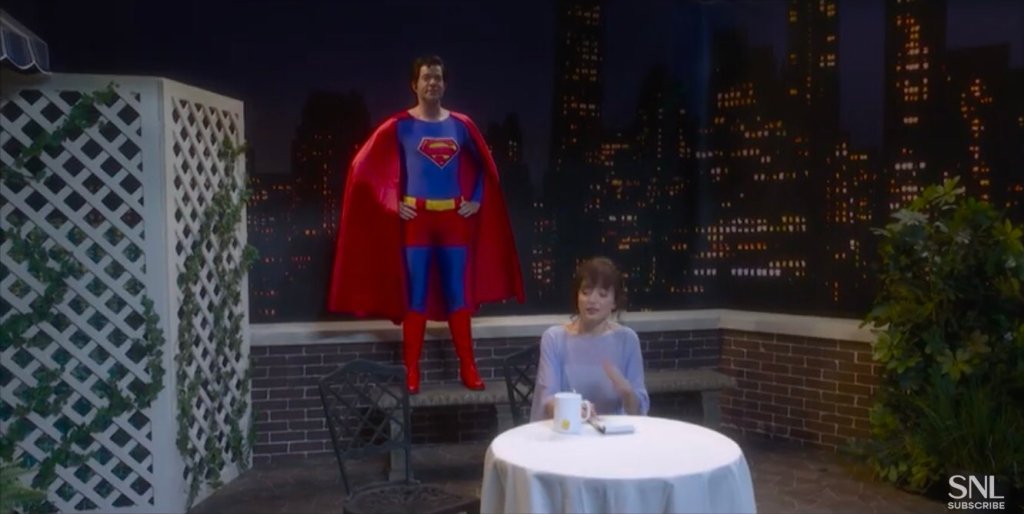
Future Black Adam Dwayne “The Rock” Johnson took on the Man of Steel in 2000 in a sketch called “Clark Kent.” (Oddly enough, unlike the other sketches, this one doesn’t appear to be available on YouTube. We’ll have to content ourselves with a random TikTok capture of it.) In this one, after Superman zips away from the Daily Planet, the newspaper staff (featuring Molly Shannon as Lois Lane, Jimmy Fallon as Jimmy Olsen, and Chris Parnell as Perry White) begrudgingly wait for Johnson’s Clark Kent to appear, like he always does. As he walks onto the scene, his Superman costume ridiculously poking out from beneath his suit, the others all crack up over how his pathetic attempts to conceal his secret identity. 

That’s the whole joke in this sketch – the rest of the Planet staffers are painfully aware that Superman and Clark are the same person and constantly mock him behind his back. It’s a funny bit, too – while I think people don’t give the character enough credit for how he pulls off the masquerade (shown most effectively by Christopher Reeve and in the All Star Superman series), the joke is actually kind of funny at first. It does lapse into being a little mean-spirited as the three of them delight in screwing with him, not to mention some seriously dated jokes where they try to rile “Clark” by claiming “Superman” might be gay. This whole sketch is kind of endemic of SNL, though – a premise that has some potential, but that quickly spirals into jokes that tend to be more nasty than funny, then falling short at the end.

Finally, late last year, SNL dropped a sketch on YouTube that had apparently been cut for time earlier in the season, John Mulaney and Sarah Sherman as Superman and Lois, in an “alternate version” of the famous interview from the 1978 film. The bit starts off the same as the scene from the film, with Superman arriving at Lois’s apartment in the hopes of answering some of the questions the public may have about him, only to be interrupted by the sudden appearance of Lois’s heretofore unmentioned roommate Glenn (Chloe Fineman). Fineman shows up wearing an awful wig and an oversized bikini t-shirt, then stumbles into mispronouncing “Superman” as though it were a last name. From there Fineman just gets more and more debauched and inappropriate as Superman and Lois desperately attempt to conduct the interview.

I’m a big fan of John Mulaney. He’s one of the best stand-up performers in the public eye these days, he’s a GREAT voice actor (I loved him as Spider-Ham in Into the Spider-Verse), and if you’ve never seen his routine about the fun he and a friend had with a jukebox when they were kids, stop right now and watch it on YouTube. But the sketch just doesn’t work. The joke – the ONLY joke – is that Lois’s roommate is a debaucherous idiot. Not a FUNNY idiot, just an idiot. The only thing resembling humor comes towards the end when Superman tries to fly Lois away and is surprised to find her heavier than he expected. (It’s funny, you see, because she’s seen him lift a tank with his little finger.) The rest of it…John Mulaney deserves better. Hell, everyone in this sketch deserves better. I don’t know who wrote this sketch or who approved it, but the only person at SNL who was doing their job that week is the person who decided to cut it for time. 

Animated Short: She-Sick Sailors (1944)

Notes: There’s one more cartoon I forgot to cover the other day, and as I doubt I’ll have a chance before this week ends, I’m gonna squeeze it in now. Seymour Kneitel, who directed several of the Fleischer Superman shorts, had one more shot at the character in 1944, in the Popeye cartoon She-Sick Sailors. When Popeye discovers that Olive Oyl is enamored of the Superman comic books (delightfully, complete with the Fleischer Superman anthem), Bluto decides to cut in on Popeye’s action by putting on a Superman costume, shaving his beard off, and impersonating the Man of Steel. From there, we get your average Popeye short, with the sailor and Bluto sparring over Olive’s affections, but with an added Superman element.

I love this short. It’s a perfect Popeye cartoon, using the formula to a tee, but at the same time it still manages to crack jokes about Superman himself and the expectations of the character, largely informed by the cartoons that the same studio had recently finished making. And it’s all worth it all just to hear Popeye deliver the line “Listen here, Stupidman! Ya still has ta proves ta ME that you’re a better man than I am!” 

Mon., July 21

Magazines: Mad #415, Mad #468, #524

Notes: I’m jumping ahead now to 2002, and a Mad parody of a piece of Superman lore we’ve only briefly touched upon here so far: Smallville. Their “Smellville” parody (with art, once more, by the great Mort Drucker, written by Dick Debartolo), starts with the usual Mad Magazine double-page spread where we get a Mousketeer Roll Call of the cast, each giving us a brief description of who they are, their function on the show, and the only joke that the magazine seems to think the character is capable of providing.

It’s funny to notice some of the assumptions that this parody made about the show, which was still very early in its run when it was published. That opening double-paged spread, for instance, features caricatures of Margot Kidder and Teri Hatcher, each claiming they’re planning to be Lois Lane when they graduate. It feels like the writer is leaning on a prediction that Lois would eventually be revealed to be a Smallville High Student, but that of course didn’t happen. On the other hand, wondering what the impetus was behind that specific gag is more satisfying than reading the “satire” actually is. 

The parody is only five pages long and utterly bereft of story. We get assorted vignettes that show bits and pieces of scenes from the show’s first season, a running gag about “weird stuff” happening in Smellville on Tuesday nights between 9 and 10 pm (which admittedly is amusing the first time they do it, but less funny each subsequent time), and then the whole thing ends abruptly with the iconic scene of Clark lashed to a scarecrow. This reads like a parody written by someone who hasn’t watched any of Smallville except for the commercials, taking a wild shot at what probably happens. This is arguably the weakest Mad parody we’ve seen yet.

Mad took a swipe at Superman Returns in 2006. Dick Debartolo returns for this one, with art by Tom Richmond. Here we have “Spider-Sham” recruited to narrate “Stuporman Returns,” the joke being that Mad wanted a hero who actually had a movie come out in this century to get people’s attention. (I’ll concede, that’s actually pretty funny.) From there, we get a quick recap of the original Superman (or at least the parts of it that were pertinent to Superman Returns), then we land on the joke the magazine has settled on for this one: Returns is just a retread of elements from the original movie. Which honestly is pretty fair for a satire of Superman Returns, but also pretty goddamn hypocritical for Mad Magazine, which from what I can tell abandoned its quest to develop a second joke somewhere around 1987. 

There are good things to say. This one, unlike Smellville, actually has a story to it, although it is buoyed by the fact that it simply has to do the cut-and-paste, beat-by-beat recreation of the movie, so actually having a plot is no mean feat. Richmond’s art is pretty good as well, showing skills at caricature that match Drucker’s. Also, apparently Mad switched from black and white to full color some time between 2002 and 2006, which is earlier than I thought, and the color actually looks very good. 

The last two panels are probably the funniest in the comic. There’s a good joke about the show House (which was a hit at the time), and a final panel playing on the weird ambiguity of Lois’s son, complete with a visual reference to Action Comics #1, which I’m sure will make certain collectors I know scramble to find a copy of this issue once they realize it.

It’s not great. It’s not particularly funny. But at least it’s better than “Smellville.”

The last issue of Mad I’m going to subject myself to before their reboot is their Man of Steel parody from issue #524 in 2013. In “Man of Veal” (because puns don’t actually have to be funny, they just have to rhyme), we get the by-the-book recap of the feature film that it’s satirizing, as is to be expected. However, I’ve got something surprising to say:

Some of the jokes in this one are actually pretty good.

However, not enough to make up for the ones that are absolutely horrific. 

For example, there are some truly tasteless, vulgar jokes in here about Taylor Swift (and I don’t even care if you’re making fun of Taylor Swift, I care that the joke ISN’T FUNNY). Another panel about the sexual proclivities of Kryptonians (Kraptonians? Oh, who cares?) that isn’t even close to amusing enough to justify how gross it is. Digs at comic book readers that come out of nowhere. And when their Lois Lane shows up (I can’t even be bothered to flip back to see what pseudonym they used), she’s a painful straw feminist stereotype, prancing around and talking about femininity in terms that feel like they could have come from one of the Spice Girls at their most annoying. Is that what they thought Amy Adams was doing? It boggles the mind.

Despite the enthusiasm I had for Parody Week when I started, subjecting myself to one painful Mad garbagefest after another has made me start to regret the whole thing. 

Tues. July 22

Magazines: Mad Magazine Vol. 2 #15, #44

Notes: At some point in their long history, the parent company of Mad Magazine was sold to Warner Bros, which of course also owns DC Comics, and the stewardship of Mad was handed over to them. In 2018, they decided to relaunch the magazine with a new first issue, because somehow there are still people who think that’s a positive thing. I’ve actually never read an issue of the “new” Mad before today, but as I started to look for entries for Parody Week, I discovered that the current state of the magazine seems to be a mixture of classic features and reprints, which I find surprisingly sad. Maybe because I don’t have a ton of faith in the reprints they have to choose from. But after some sifting around, I managed to find a couple of issues of the current Mad on the DC app that have Superman-centric spoofs.

And may Rao have mercy on my soul.

Mad Vol. 2 #15, from 2020, has several superhero-centric reprints, including spoofs of the X-Men, Spider-Man, and others. There are a few Superman shorts in here, including a Sergio Aragones classic where Superman proves, to his chagrin, that he is in fact more powerful than a locomotive. The highlight of the issue, without question, is Harvey Kurtzman and Wally Wood’s “Bat Boy and Rubin” parody from 1953 – the same era and creative team that gave us the original “Superduperman” (which is also included as a “digital extra” in this issue). Then, just last month, issue #44 of the magazine gave us a mostly-Superman issue, with reprints of their parodies of the original Superman, Superman Returns, and Supergirl (which I didn’t read before). There are also a few new Superman strips, the best of which is “The Further Adventures of That Guy From the Cover of Action Comics #1.” The gag there is simply photoshopping “that guy” into various other comic book covers, but it’s actually pretty inventive. Or maybe I’ve just been desensitized. 

This last issue that I’m going to cover this week makes a few things very clear, though. “Petit’s Law of Satire: Satire is funnier in broad strokes than in specifics,” is absolutely true. The funniest strips and shorts are invariably the ones that aren’t trying to zero in on a retelling of a specific story, but just use the tropes and concepts of what they’re mocking to do something original. 

Look at the greats: Mel Brooks and the Zuckers did their greatest work parodying an entire genre like sci-fi (Spaceballs), westerns (Blazing Saddles) and disaster movies (Airplane). Even Young Frankenstein wasn’t a retelling of the original story, but a new one that built upon it. The same holds true in literature. Douglas Adams’ Hitchhiker’s Guide to the Galaxy parodies sci-fi, Terry Pratchett’s Discworld uses fantasy tropes as a launchpad to parody any number of topics. If Adams had just tried to do a retelling of Star Trek or Pratchett had tried to copy Lord of the Rings, I doubt we’d still be reading either of their works today. Does anyone remember Star Wreck, a series of very Trek-specific parody books that came out in the 80s and 90s? No, just me? Thought so. 

What’s more, I think that something else that’s pretty true has become evident to me: parody is also funnier if it’s loving. (Satire does NOT have to be loving, but parody and satire aren’t exactly the same thing.) The funniest things I’ve read this week were “Superduperman” and John Byrne’s “Superbman Vs. the Fantastical Four,” neither of which gave me the impression that they were being made by someone who disliked their target. They loved them enough, in fact, to have a deeper understanding of them that made the humor ring true. The worst of the Mad parodies, on the other hand, are nasty, mean-spirited hit pieces that seem to have been written by somebody who resents the original material for the crime of existing. Similarly, the best SNL sketches are the earlier ones. The ones with Margot Kidder and Christopher Reeve both show some affection, and the “Superman’s Funeral” bit feels like there’s actual love behind it. 

I’m sorry, folks – of all the theme weeks I planned out for this year, I was terribly unprepared how much of a dud this one would turn out to be. There have to be better Superman parodies out there that I’m not aware of. If you know of any, please let me know. I’d be happy to return to this topic in the future, as soon as we stumble across some parodies that are actually…you know…funny. 

Blake M. Petit is a writer, teacher, and dad from Ama, Louisiana. His most recent writing project is the superhero adventure series Other People’s Heroes: Little Stars, volume one of which is now available on Amazon. You can subscribe to his newsletter by clicking right here. You can join in the Kryptonian Konversation every day in the Year of Superman Facebook Group!

Geek Punditry #127: Revival Vs. Reboot

As you no doubt have heard by now, at least partially because I’ve mentioned it here two weeks in a row, Disney’s brought back its fantastic animated series Phineas and Ferb, and the first part of the new season dropped on Disney+ today. It may surprise you, then, to know that as of this writing, I haven’t watched it yet. You see, I have to wait for my wife to get home from work, because as any competent marriage therapist would tell you, holding off on watching coveted television programming until your spouse is available to watch it with you is a love language. 

But I don’t want to talk about Phineas and Ferb specifically today, I want to talk about what it represents: the TV Revival. That concept of bringing back old TV shows from the dead. It’s not a new idea, of course. The history of television is littered with shows that were cancelled and then came back after some time. Game shows like Jeopardy, Supermarket Sweep, and Let’s Make a Deal are all better remembered from their second incarnation than the original, for example. The 80s gave us resurrected versions of old sitcoms like Leave it to Beaver and The Munsters. And for a time, it was popular to continue a TV series by creating an animated version, as they did with the likes of Star Trek, Happy Days, or Gilligan’s Island. 

It’s like time stood still.

But in recent years, where studio executives are more hesitant than ever to take a chance on a new idea, it seems as though the revival has become a fundamental part of the television landscape. Is anybody going to want to watch a comedy about the goings-on at a municipal courthouse? Maybe not…unless we remind them that they already DID a few decades ago by making that show a new version of Night Court. Go ahead and look at any current network TV schedule (or spin through the offerings of a streaming service) and you’ll be astonished at just how much of the current episodic landscape is stuffed to the gills with shows that have relaunched older ones. I don’t object to revivals as a concept, but like anything else in the sphere of entertainment, I fear that we’ve reached a point of saturation where they’ve become a crutch rather than a tool.

That said, that doesn’t mean resurrecting an old show can’t be successful. But what, exactly, does it take to make a good one? The creators of Phineas and Ferb released a video to social media a few days ago, ramping up to the new season, where they very explicitly chanted “It’s not a reboot – it’s a REVIVAL!” It’s an important distinction, although I think there are a lot of people who don’t understand the difference. A reboot, to me, means starting a franchise over from scratch. You take the concepts, the tropes, the characters, but begin from square one, as though there had never been a previous iteration. Wednesday is a good example of this – there’s nothing that specifically ties it to the canon of any of the previous versions of the Addams Family – not the original TV series, the animated series, the 90s film series, the more recent animated films, the Broadway musical, or the original comic strips that the whole franchise was based on. It’s using the pieces of the older shows, but it is inherently its own thing. So yeah, reboots CAN be good.

In general, though, I prefer a revival – you’re not eliminating the previous canon. You’re not starting over. You’re just picking up where you left off. The original Phineas and Ferb took place across one epic summer. The new season – which they wisely promote as “Season Five” rather than “Season One” of a new series – starts one year later, at the beginning of the NEXT epic summer. Night Court returned to the same courtroom after an absence of many years, bringing back one returning character and one new character who was the child of an original. You get a revival more often when the old cast – or at least some of them – is still active and wants to return. We’ll be getting that with the new version of King of the Hill, coming to Hulu soon, and creator Bill Lawrence has announced a Scrubs revival where – although nobody has officially signed on yet – many original cast members have expressed interest in returning.

If this picture doesn’t make you vaguely uncomfortable, you’re too young.

Sometimes it can be difficult to tell whether a show is a revival or a reboot at first. In 2005, when the BBC brought back its defunct science fiction series Doctor Who, it wasn’t immediately clear if the old shows were in canon or not. And as part of the Doctor’s whole deal is that he occasionally regenerates into a new body, you couldn’t even make up your mind based on the fact that there were no returning cast members. Slowly, references to the old series started to appear, and eventually it was made explicit that this was a continuation – not only of the old series, but it even included the American co-produced TV movie that had tried (and failed) to revive the franchise a decade before. The show has been reinvented many times since then, and the DNA of the franchise makes it fairly easy to do so, but every version has thankfully been a revival rather than a reboot.

This straight-up wouldn’t work with a revival of The Andy Griffith Show.

The reason I prefer revivals is because a reboot has a tendency to dismiss the original. It takes place in a universe where the original didn’t happen and doesn’t matter, and that makes no sense to me. From the perspective of a studio, the only advantage a revival or reboot has over a brand-new property is the built-in audience, so why would you START by declaring that the thing the audience loved doesn’t exist anymore? Paul Feig and the cast of the 2016 Ghostbusters reboot will claim until their dying breath that their film failed at the box office because the fans were put off by the all-female cast, but any conversation with a true fan of the franchise will make it pretty clear the reason it was rejected was because fans wanted a revival. And when they got a true revival a few years later with Ghostbusters: Afterlife (with a main character that was a preteen girl), fans were delighted. 

That’s not to say that a reboot CAN’T be good. When J.J. Abrams was given the task of rebooting Star Trek for the big screen, he wisely took the track of making it an alternate universe. A villain traveled back in time and created an alternate reality in which these new films would take place. The original timeline still existed, and was still available when the TV revivals began a few years later. No matter what you think of the Abrams Star Trek films, most fans will agree that the alternate timeline was a good idea. Similarly J. Michael Straczynksi has been trying for years to get a reboot of his seminal science fiction series Babylon 5 off the ground. In 2023, he even gave us an animated film, Babylon 5: The Road Home, which ended in a way that – similar to the Star Trek example – opened up a different, alternate timeline in which the reboot could take place.

The classic sci-fi trope of “Eh, close enough.”

Of course, it’s easier to do that with a science fiction series than it would be a drama or a sitcom. If somebody wanted to do a reboot of The Golden Girls, for example, it’s unlikely that they would start with a CGI Betty White causing some sort of temporal rift that would take us to a different dimension where the girls all moved in together in 2025 rather than 1985. But that also begs the question: would you really WANT a reboot where they cast people other than Bea Arthur, Rue McClanahan, Estelle Getty, and Betty White anyway?

That’s another thing that revivals have over reboots: the continuity of keeping a cast that the fans love. One of the reasons a Babylon 5 reboot is more likely than a revival is because so many members of that cast, in the years since the show ended, have sadly passed away at a surprisingly young age. Over the course of that show’s five years, 17 actors were series regulars for at least one season. Seven of them are no longer with us, and several others have retired from acting altogether. It would be anathema to many of us to see Bruce Boxleitner’s John Sheridan return with somebody other than Mira Furlan playing his wife, Delenn. In a new timeline, though, with new actors in BOTH roles…that feels a little easier to swallow.

Some shows, however, simply should never be brought back, for many of these same reasons. Any ideas of a Friends revival, for example, went up in smoke with the sad death of Matthew Perry. Any revival, even a one-off movie – would necessitate either recasting Chandler Bing (which fans will tell you is basically impossible) or writing him out of the show by having him either die or leave his wife and children, which would be depressing as hell. As for a reboot…poll the fans. Ask if anybody would want a different cast, and I’m pretty sure you’ll hear a resounding NO.

It would be impossible to recreate this and a mistake to even try.

It’s less of a problem if the actor is still alive and has chosen not to return, or if they’ve fallen from grace in the years since the show’s airing and neither the studio nor the fans want them back. Tom Welling and Michael Rosenbaum, two of the stars of Smallville, occasionally make noise about wanting to bring back the show as an animated series or through animated movies. Many fans would welcome this, although it is unlikely that anyone will bat an eye if Chloe Sullivan is recast. (I’m not gonna get into it – if you don’t know why this would be necessary, just Google it.) In a less problematic example, former child actor Erik Per Sullivan has retired from the business, so when a revival of Malcolm in the Middle was announced, nobody was really angry that they decided to recast his character of Dewey.  

In general, though, revivals are more interesting to me – I want to see a continuation of the original series. There was chatter for years about a reboot of Buffy the Vampire Slayer, but Sarah Michelle Gellar wasn’t interested. Therefore, I wasn’t interested. Then they announced that they’d landed on a pitch that Gellar IS interested in, a pitch in which she is mentoring a new character entirely rather than trying to have somebody else play Buffy Summers… well, at this point, I’m willing to listen.

(There’s an irony here in that Gellar’s series was, in fact, a reboot of a mediocre movie starring Kristy Swanson as Buffy. But again, it just goes to prove to you that reboots CAN work sometimes.)

There’s an adorable video of when Gellar called Ryan Kiera Armstrong and told her that she got the part, because REAL slayers go by three names.

For some shows, the question of reboot vs revival is academic, of course. It doesn’t matter for nonscripted series like game shows, or shows that dramatize real events such as Unsolved Mysteries. You may miss Robert Stack, but that doesn’t mean the show can’t be made without him. Similarly, anthology series like The Twilight Zone are by their very nature immune to this. That show has been brought back several times over the years, and as there was never a regular cast or set of characters to follow, it’s a non-issue as long as the show has the flavor of the original – in this case, that of a sci-fi show with horror elements and, usually, some sort of twist ending. 

The biggest problem comes when a resurrected series – whether it’s a reboot or revival – lacks that taste of the original. Every so often you’ll hear about a new version of a show where they proudly announce that none of the current creators are fans of the original. This is a position so bafflingly stupid that I’m surprised it’s not mandated by federal law. While it’s true that some fans can be a bit too close to the property, a bit too reverent, if NOBODY involved in the creation of a show has any passion for it, the odds of creating something that satisfies the existing fan base drops so dramatically as to be almost nonexistent. 

“Well, we’re not making this show for the OLD fans,” some of these studio executives say. “We’re trying to appeal to NEW fans.”

Bullshit. If all that matters is acquiring a new audience, there’s no reason to bring back an old property. By bringing back a classic IP you are inherently announcing a desire to get the attention of an existing fan base, and by creating something you know will dissatisfy them, all you’re doing is trying to court controversy, as if that somehow inoculates you against the need to make a good show. Sometimes I think they’re COUNTING on that. They know their reboot is weak, so they rile up the fans against it, giving them a handy shield of claiming that these narrow-minded old fuddy-duddies just don’t want something new, thereby preventing them from having to admit that they made something that sucks.

Ultimately, I try to judge any show – revival, reboot, or brand-new idea – on its own merits. But when you’re reaching back to a classic series, you need to really think about what made that show successful in the first place before you even THINK about giving it a try.

Blake M. Petit is a writer, teacher, and dad from Ama, Louisiana. His most recent writing project is the superhero adventure series Other People’s Heroes: Little Stars, volume one of which is now available on Amazon. You can subscribe to his newsletter by clicking right here. He’s also started putting his LitReel videos on TikTok. Someday, he swears, somebody is gonna do a revival of Cop Rock, but they’re gonna do it RIGHT this time.

Year of Superman Week 21: Supergirl Week

With her own movie coming out next year, DC Comics has wisely decided to bring back Supergirl’s ongoing series, and with the first issue hitting stands last week, I thought it would be appropriate to dedicate Week 21 of the Year of Superman to Kara Zor-El. This week I’ll be digging into some of the most important and best stories of the girl of steel in comics, television, movies, and more. I’m specifically going to limit myself to stories featuring the Kara Zor-El version of the character. There are other Supergirls, to be certain, and I’ll probably touch upon them at some point, but I’ve already got more Supergirl stories than I’ll likely have time to cover on my list even BEFORE I add stuff starring the Matrix/Linda Danvers version. So Peter David fans, just sit tight. I don’t know exactly when it’ll happen, but I’ll get to your Supergirl before the year is out.

And as always, you can check out earlier blogs in the Year of Superman Archive!

For now, though, let’s dig into the history of DC’s Maid of Might. 

Wed., May 21

Comics: Action Comics #252, Action Comics #275, Action Comics #279-285

Notes: I’ll start off, appropriately enough, with Supergirl’s first appearance from Action Comics #252, by Otto Binder and Al Plastino. Although as was often the case at the time, the cover story was not the FIRST story in the issue. It starts with the first appearance of Metallo. I won’t get too much into that story, except to note that one plot point involves Metallo being able to impersonate Superman merely by shaving off his mustache. In the Silver Age DC Universe, there were apparently only three faces that everyone had to share.

And a million pubescent boys felt an awakening…

After a Congorilla story, we finally get to the main event: “The Supergirl From Krypton.” Superman is summoned to the site of a crashing rocketship, where he is stunned to discover a teenage girl who has all the same powers as he does. It turns out that she’s a survivor of Krypton as well, from a city that escaped Krypton’s destruction and protected itself by covering the ground with lead to save them from the remains of their home turning into deadly Kryptonite. But when a meteor shower destroys the lead, the girl’s parents put her into a spacecraft and sent her to Earth, where they’d been watching the last son of Krypton through a space telescope. Superman and the girl, Kara, discover that their fathers were brothers, making them cousins, and just like a good cousin, Superman immediately puts a wig on her and drops her off at a local orphanage until she’s trained in using her powers. She randomly chooses the name “Linda Lee,” another “L.L.,” which at this point is so unlikely that even Superman himself has to point it out. 

This is kind of an embryonic version of Supergirl’s origin. There are several aspects that would later change and others that would be added – for instance, the original story doesn’t identify her home as “Argo City,” as later stories would, nor did it establish that the city escaped Krypton’s destruction because it was beneath a transparent dome. Instead it just sort of…made it somehow. Also, in this version, the Zor-El family peeked at Earth for years, but never connected the dots that Superman was the son of Jor-El. Later stories would make it clear that they knew that Superman was one of their family and that they sent Kara to him specifically for that reason.

The last thing that I have to point out is just how quickly Superman decides to drop his cousin off at an orphanage. It’s a bizarre situation – he doesn’t even make it to another PAGE before he brings her to Midvale. I get it – it was the Silver Age and DC Comics would never have allowed them to upset the status quo in such a way that Clark Kent now had a teenage girl living under his roof…but still, it feels kind of cold-hearted. Modern-day Clark Kent would NEVER do that. At this point, especially since the Warworld storyline a couple of years ago, he’s collecting new family members like he’s a Pokémon trainer. 

The next few stories I’m going to cover come from Supergirl’s early days, when she was living in hiding as Superman’s “Secret Weapon.” He decided to keep her existence a secret from the world for…reasons that I’ve frankly never understood. I guess it had something to do with not wanting her to go public until she had command of her abilities or something, but that sure never stopped Batman from throwing a Robin out onto the street with him. Action Comics #275 starts with the dandy Brainiac story “The Menace of Red-Green Kryptonite,” where an insidious device from Brainiac makes Superman start…stealing hats. He confides the truth about the ray to Supergirl and eventually beats Brainiac after only a minor international incident, covering the fact that the ray actually made him grow a third eye in the back of his head. It was the Silver Age, people, what’reya gonna do?

But the real reason I read this issue was for the second story, “Ma and Pa Kent Adopt Supergirl.” In what is essentially an “imaginary story” (although it doesn’t carry that label), Supergirl is sad because Superman was raised by a loving family while she’s stuck at an orphanage. (GO FIGURE, CLARK.) So that night, she has a dream in which she, not Kal-El, was the child of Jor-El and Lara, and was the first Kryptonian to come to Earth and be adopted by the Kents. Her early years are similar to those of Clark, until her teenage years where we start to see some curveballs. Her bestie, Lana Lang, winds up dating the guy “Linda” is crushing on, so she’s stuck with some dude named Lex Luthor. A Kryptonian rocket somes to Earth, but instead of Krypto the Superdog, she finds a super-parrot from Krypton to be her super-pet. The biggest change? Whereas young Clark Kent helps his father run his general store, young Linda Kent stays at home to help her mother clean. Because she’s a girl. 

I can’t even sometimes. 

It gets even wackier when Lex overhears Linda’s parrot “Squawky,” sitting on his perch, chirping “Linda Kent is Supergirl!” Lex, knowing Linda is crushing on Bob Benson, tells him her secret so that he’ll pay attention to her. The dream ends when Linda finds out that Bob is only interested in her now because she’s Supergirl, and she dumps him. 

As far as dream sequences go, it’s funny to note how even Kara’s subconscious has the same sort of inherent misogyny that so many Lois Lane stories of the time enjoyed. 

Supergirl finally gets her wish for parents in Action Comics #279…after a story in which Hercules and Sampson show up in Metropolis and try to court Lois Lane and Lana Lang. It’s such a ridiculous story, even by Silver Age standards, that I don’t even know what to say about it. So let’s move on to “Supergirl’s Secret Enemy.” In this one, a jealous girl from Krypton named Lesla-Lar…

Yes. Lesla-Lar.

I mean, I get it, in college I knew an inordinate number of girls whose first initial was “A,” but Superman makes it RIDICULOUS.

…has stolen Supergirl’s powers with a Kryptonite ray. Stuck as a normal human girl, Supergirl allows herself to be adopted, because apparently the existence of her super powers is what kept her from being adoptable before. She goes home with Mr. and Mrs. Fred Danvers, where her new dad immediately tells her to change her hair because she’s too old to be wearing pigtails, which if we’re being honest, is creepy as hell. Superman, meanwhile, vows to try to find a way to restore her powers, but Lesla-Lar isn’t finished yet. As Linda sleeps that night, Lesla teleports her to Kandor and brainwashes her, then switches places with her at the Danvers’ home, her own Kryptonian powers intact.

This nonsense goes on for several issues, with Lesla swapping with Linda while she’s asleep and Linda having no idea she’s being abducted and living a second life in Kandor. My favorite bit comes in Action #281. As Superman and the fake Supergirl prepare to reveal herself to the world, Krypto the Superdog figures out that she’s an imposter via his sense of super-smell recognizing that Lesla wears the wrong perfume. (I love that friggin’ dog.) With his super-vision, he sees the real Supergirl in Kandor. Krypto hits a switch to swap Linda and Lesla again, but the brainwashing continues. She has no memory of the swap and STILL Doesn’t have her powers. Testing a theory, Superman brings her back in time, where she discovers she still has her powers! That’s right! Science means NOTHING! So he LEAVES HER THERE, only for her to realize he’s dropped her off in the year 1692! She begins to use her powers openly, making people think she’s a witch, then gives up and uses her powers to return home…where her powers once again disappear, making this whole time-travel segment utterly meaningless and nonsensical.

Action Comics #282 begins with me being genuinely baffled at how this ridiculous story isn’t over yet. Superman has built Supergirl a replica of the Legion of Super-Heroes’ time machine so she can test out whether her powers will return if she goes to the future. He can’t go with her, though, because he’s busy with “urgent problems.” Hey Superman, you know what makes “urgent” problems less urgent? A FREAKING TIME MACHINE. Anyway, in the future, Linda discovers that her powers have once again returned, and starts superheroing again. She saves the Earth from a Martian invasion (has anyone talked to J’onn J’onzz about this?) but when she gets back her powers are gone again…UNTIL THEY RETURN. And now she’s even STRONGER than Superman! And in Kandor, Lesla-Lar is arrested! And in the end, we find out that Mr. Mxyzptlk is responsible for giving her powers back AND making her immune to Kryptonite! Did they have a DART BOARD with random plot points in the DC offices back in 1961? 

The next two issues each feature a pair of red Kryptonite stories, one each for Superman and Supergirl, at the end of which Mxyzptlk’s tampering wears off, leaving Supergirl again vulnerable to GREEN Kryptonite…but also, somehow, her regular powers are back. There is absolutely no explanation as to why her powers return to normal, but I don’t even care at this point, because the whole reason I read this little chain of bonkers was to get to issue #285, in which Superman FINALLY reveals Supergirl to the world.

“World’s greatest heroine?” Clark? She’s been on Earth for twelve seconds. Does Diana mean NOTHING to you?

It starts off with telling the Danvers that they adopted a Supergirl (something that would have been a little hard to disguise, as she had to catch their car when Fred drove off a bridge), then goes on to a televised announcement that makes the world so excited you’d think the McRib had come back. The first half of the issue is just showing how the entire world – nay, the UNIVERSE – has become #TeamSupergirl. In the second half, while Superman is in space, she fights a Kaiju. 

I think that’s enough Silver Age silliness. I make jokes, but I hope it’s also evident that I have a real soft spot for these stories. No matter how ridiculous or silly they may seem, there’s a heart to them that not all comic books have, and even the silliest elements (such as a dog wearing a cape) can bear the seeds of greatness. Plenty of that to come for the girl of steel. 

Thur., May 22

Comics: Crisis on Infinite Earths #7, Superman #415, Christmas With the Super-Heroes #2, Supergirl Vol. 8 #1, Superman Unlimited #1, Action Comics #1086, DC X Sonic the Hedgehog #3, Batman/Superman: World’s Finest #39

Notes: So yesterday we dug into the origins of the Silver Age Supergirl. Today we’re gonna look at her ending. After years of secret adventures, time-travel with the Legion of Super-Heroes, and attempts to modernize her in the 70s and 80s by making her a college student and, later, a teacher, when the decision was made to restructure the DC Universe in the mid-80s, Supergirl was going to be taken off the table. So Crisis on Infinite Earths #7 gave her a heroic send-off (with one of the most iconic comic book covers of all time).

I rank this cover right after Marvel’s Madballs #6.

I’m not going to dig TOO deeply into the lore of Crisis. (I’m actually still contemplating whether I’ll do a week or two dedicated to the assorted DC crisis events and the roles of the Supers in each one – it’s a good idea, I think, but kind of a daunting task when you look at it.) Here’s the TL:DR: the Anti-Monitor is causing the destruction of the Multiverse, and at this point, only five universes remain. After a discussion of how the Multiverse was created in the first place, the heroes launch an assault on the Anti-Monitor’s citadel. Superman and Dr. Light find an enormous solar collector, an engine that is reducing the vibrational differences between the multiple Earths, causing them to occupy the same space and destroy one another. Superman winds up in a head-to-head battle against the Anti-Monitor, a being so immensely powerful that he’s being beaten to death – until Supergirl swoops in to the rescue. With her cousin on the ropes, Supergirl drives the Anti-Monitor into his own solar collector. When she looks back to check on Superman and Dr. Light, the Anti-Monitor unleashes a fatal attack, then escapes to lick his wounds. Kara lives just long enough to know that she succeeded – the solar collector is destroyed and the remaining worlds are saved.

For now.

And then she dies in Kal-El’s arms. 

If there’s one thing that bristles me in these crisis events, it’s when a hero dies a meaningless death. And these days, the revolving door in comic book heaven has begun to swing so rapidly that it’s impossible to take ANY death seriously. That said, if the story itself is good, it can still be impactful. Marv Wolfman and George Perez gave Kara the send-off she deserved – dying not only to save the entirety of the Multiverse, but specifically, to save her cousin. In terms of sheer scope, not even the Death of Superman can match up to it.  

That wasn’t quite the end for the original Kara Zor-El, however. I also want to look at a pair of epilogues to her story. The first came shortly after her death, in Superman #415.

This issue was the direct inspiration for The Maury Povich Show.

With the knowledge that this entire continuity would soon be rendered moot by the Man of Steel anyway, the creative teams on the Superman books took some big swings in their last year, including this story by Cary Bates and Curt Swan. Superman’s fancy ears pick up on a hypersonic code used to access the Fortress of Solitude, and since the only other person who knew that code is the late Supergirl, he races there immediately, finding an extraterrestrial invader stealing something from his memorial to her. The alien identifies himself as Salkor, superhero of his planet, and regales us with the story of how, two years ago, he found Supergirl drifting in space suffering from Kryptonite poisoning. He saved her, but she awakened with no memory of who she was (another amnesia story – I should be taking a tally of these). Salkor dubs the beautiful stranger ”Jasma.” The two of them become partners in defending his world, quickly falling in love. They got married, and Salkor gave her a device called a Hokku, which can record memories. But Jasma vanished one day after battling a mercenary called Naxx, and Salkor eventually tracked her down to Earth, where the news of her death broke his heart. He went to the Fortress merely to retrieve the Hokku he gave her. 

But Naxx is there as well, seeking revenge against Supergirl for defeating him. The two men she loved the most team up to defeat the mercenary, then find a holographic message left for both of them. In it, Kara tells Salkor that she regained her memories, but lost knowledge of him, making her way back to Earth, her full memories not being restored until later. Superman and Salkor part as friends, united in their grief for the girl of steel. 

It’s kind of a wild story. Cary Bates is counting on the reader accepting that Kara – upon regaining her memory – wouldn’t tell Clark or anybody else about her marriage on another planet. (Although I guess keeping that kind of thing a secret would be sort of a Silver Age thing to do.) The other thing is that Kara supposedly got her memory back after a battle that happened in her own series, and having read that series, I gotta tell you that the issues after that battle do NOT read like a girl mourning her lost love from across the universe.

Still, none of that makes this a bad story. It’s a sad, bittersweet farewell to a beloved character that DC knew was about to be taken off the table very definitively, in that once Byrne’s reboot kicked in she wouldn’t exist at all. 

The most enduring epilogue to the story of Supergirl, however, didn’t come until 1989 and DC’s second Christmas With the Super-Heroes special…which I have to admit, I feel weird about reading in May, as I’m usually quite strict about limiting seasonal content to the appropriate season. But hey, this is Christmas with a purpose. There are several good stories in this issue, starting with an uncharacteristically dour Superman story by Paul Chadwick (but it’s got an optimistic ending). Then, after stories featuring Batman, Wonder Woman, Enemy Ace, Green Lantern and the Flash, we finally get to the real reason we’re including this in Supergirl week: the Deadman story!

Bear with me, I’m going somewhere with this.

In “Should Auld Acquaintance Be Forgot” by Alan Brennert and Dick Giordano, Deadman is drifting around having a very bitter Christmas. The lights, the music, the goodwill – to a ghost, denied even the pleasure of human touch unless he steals those moments away from someone who is living – well, it’s all kind of depressing. After a few brief encounters where he does just that, steals time from the living, a despondent Boston Brand rages against the goddess that trapped him in this state…until he’s suddenly approached by a young woman who can see him, hear him – even touch him, as evidenced when she whips off his mask. Deadman has been feeling sorry for himself, for the fact that for all the good he’s done, nobody even knows about it. The young woman looks him in the eye and says, “We do it because it needs to be done. Because if we don’t, no one else will. And we do it even if no one knows what we’ve done. Even if no one knows we exist. Even if no one remembers we EVER existed.” Having restored some of Boston’s faith, the woman turns to leave, but he stops her, saying “I don’t even know your name.”

Like fun it doesn’t.

It didn’t mean anything to Deadman, but it meant a hell of a lot to us. 

To this day, I’m kind of surprised that DC allowed this story to go through. The edict was that Superman was the sole survivor of Krypton, that he always had been, that we were supposed to pretend that Supergirl and Krypto and the Kandorians and all the rest just…never were. But Alan Brennert used that edict to surreptitiously pay tribute to a fallen hero and give all the fans a little wink at the camera.

Man, I love this story. 

But enough about the past – how about the present? I’m going to take a few paragraphs now to talk about some of the new Superman-family comics that have come out in the last couple of weeks, starting with the first issue of the new volume of Supergirl.

Remember when comics were fun? IT’S HAPPENING AGAIN, PEOPLE!

The new series, with story and art by Sophie Campbell, starts off with a great recap of Supergirl’s current status quo. Considering how much it’s changed and been warped over the years, this is pretty necessary, even for regular readers like me. Here’s the quick version: Supergirl (now a young adult who seems to have carried over some of the history of her pre-Crisis version) returns to Midvale, where the Danvers have returned to their old home. When she gets there, she finds that the town is obsessed with being the home of Supergirl, which sets Kara off a little bit…especially when she encounters another girl wearing a Supergirl costume who seems to have convinced the town that she’s the real deal. I absolutely LOVED this first issue. Campbell does a great job bringing new readers up to speed on who Kara is these days, including lots of little Easter Eggs like her hair color-changing comb, a reference to the late (apparently) Dick Malverne, and some of her old costumes. The art style is also awesome – it looks like it could have come from a cartoon, although not a SPECIFIC cartoon. It’s not aping Superman: The Animated Series or anything else, it’s just a kind of playful, lightly inked style that feels very much like a cartoon, and I hope everyone understands that I mean that as a compliment. I put this first issue down feeling very good about the future of the Girl of Steel.

Okay, it’s not Supergirl. But isn’t it pretty?

Also launching this week is Dan Slott and Rafael Albuquerque’s Superman Unlimited, which we got a preview of on Free Comic Book Day. The first act of this issue are the same pages from that book, in which we learn about the Daily Planet’s new status quo as a global news organization, then Superman flies into space where he finds an enormous Kryptonite meteor plummeting towards Earth. Superman’s life flashes before his eyes, providing a VERY handy recap of all the major points of his story in continuity for the sake of anybody who has never read Superman, or at least, hasn’t read him in a long time. (Most importantly to me: Slott establishes that Clark WAS, in fact, Superboy, and he WAS, in fact, a member of the Legion of Super-Heroes, and for reinstating that piece of continuity I believe he deserves, at minimum, the Nobel Prize.) 

The book ends on a nice little cliffhanger, and while most of it is set-up, it’s a really satisfying set-up. Slott has a good handle on the character, and Albuquerque’s artwork is great. DC is very much living up to their “Summer of Superman” pledge thus far. 

This is already shaping up to be the longest blog in the history of the Year of Superman (so far), so lemme rapid-fire the last few. Action Comics #1086 is the finale of “Solitude” by G. Willow Wilson and Gavin Guidry, finishing up Superman’s battle against the Kilg%re in the Arctic. Good issue, great art, and I still really like the Arctic costume Superman wears in this one. I want it on a Funko Pop. Issue #2 of DC X Sonic the Hedgehog ended with the Justice League trapped in Sonic’s world and Team Sonic on Earth. In issue 3, the Sonic characters have to step up and replace the Justice League, not only when it comes to protecting Earth, but also in finding the Chaos Emeralds needed to reopen the portal to return home. They do so while wearing the Justice League’s uniforms, and there will most certainly be action figures of these. Finally, Batman/Superman: World’s Finest #39 brings us part four of “We Are Yesterday.” The modern day Superman, Batman, and Nightwing get swapped with their respective counterparts from the World’s Finest era in a charming story. While the versions from the past keep getting glimpses of the future, the current versions are stuck trying not to alter anything from history. There are a few really great moments in this issue, and I’m psyched for the last two chapters. 

Fri., May 23

Comics: Superman/Batman #8-13, 19

“I’ve got a telegram from Will Smith. It says ‘Welcome to Earf.’ I know you don’t get it yet, but you’ve got a lot of human pop culture to catch up on.”

Notes: After nearly two decades of a Superman Status Quo that allowed for no other Kryptonians, the tide finally changed in the early 2000s. First came the restoration of Krypto, and then “The Supergirl From Krypton,” a six-issue story from Superman/Batman #8-13, written by Jeph Loeb with art by the late Michael Turner. With Superman in hiding as the rest of the world’s heroes try to gather up Kryptonite from a massive meteor that fell in the previous storyline (yeah, Unlimited isn’t the first time such a thing has been done), Batman is called upon to investigate an enormous chunk in Gotham Harbor. That chunk includes a rocket, and in that rocket turns out to be a confused teenage girl speaking Kryptonian. When she’s brought to Superman, the two converse in Kryptonian and he proudly introduces her to Bruce as Kara Zor-el, his cousin.

The two keep Supergirl in hiding for months, Batman in particular feeling skeptical as to the truth about who she says she is, before Wonder Woman demands to bring her to Themyscira. Kara trains there for a time, but the island is attacked by Darkseid’s forces (including Doomsday clones) who kidnap Kara and take her to Apokolips. The three heroes team up with Big Barda to mount a rescue effort, only to find that Kara has been brainwashed by Darkseid. Clark has to break her out of it, bringing her back to Earth. As he takes her to Smallville, though, Darkseid attacks again, seemingly killing Kara with his Omega Beams. Superman unleashes like never before, taking Darkseid to space and trapping him in the Source Wall, where he declares the Lord of Apokalips will never bother them again (spoiler alert: he was wrong). Kara, we then learn, was teleported to safety, and Superman introduces Supergirl to Earth’s heroes.

Hey, look at that. I CAN write a shorter recap.

Anyway, as far as modern interpretations of Kara’s origin go, this works out much better than finding her in a rocket and immediately taking her to the orphanage. It was inevitable that Batman would play a large part in the story (remember the title of the series, after all), but it’s nice to note how heavily they leaned on Wonder Woman in this too. If there’s anyone on Earth that Kara could relate to in her first few days on the planet, after all, it’s probably her. This is – more or less – the Kara that exists today, although there are some continuity questions that definitely arise, such as her having lived with the Danvers in her current series. 

There was also an epilogue of sorts a few issues later, issue #19, where we saw more of Kara trying to fit in and taking down bad guys. That issue was later reprinted as issue #0 of her next ongoing series (I believe it was Supergirl Vol. 4), which eventually established some things about Kara that have remained in continuity – such as the idea that she was actually OLDER than Kal-El, but trapped in suspended animation for decades as he grew up, and the notion that her powers are potentially greater than his. I rather like both of these conceits and I’m glad that DC, as well as most of the adaptations, have stuck with them over the years.

Sat., May 24

Comics: Supergirl: Woman of Tomorrow #1-8

“IIIIIII HAAAAAAAVE THE POWEEEEEEEEEER!”

Notes: Today I decided to jump to the most acclaimed Supergirl story of the modern era, and the inspiration for her upcoming movie, Supergirl: Woman of Tomorrow by Tom King and Bilquis Evely. In this 2021-2022 miniseries, Supergirl has taken Krypto on a little spaceflight to celebrate her 21st birthday, off for a party on a planet where a red sun diminishes her powers. On this world, she meets a child named Ruthye Marye Knoll, who tries to hire Supergirl to hunt down and kill an assassin named Krem of the Yellow Hills, the man who murdered Ruthye’s father. Supergirl initially refuses, but when a fight against Krem mortally wounds Krypto, Supergirl’s only hope is to track down Krem and get a sample of the poison that is killing our good, good boy. What follows is an eight-issue odyssey across the universe as Supergirl and Ruthye seek Krem and, in the process, learn where true power comes from.

Tom King is, as I’ve said before in this blog, a somewhat divisive writer. And honestly, I don’t agree with it. I’ve never read a story by Tom King that I really hated, even the ones that get the most vitriol online. In fact – here’s a confession for you – if you had asked me the summer of 2022 what my least-favorite King story was, I probably would have said Supergirl: Woman of Tomorrow.

And I would have been wrong.

Allow me to explain. This book is a slow burn. There’s some action, yes, but it’s only a superhero comic by a technicality. There are very few superhero elements to it, and even fewer science fiction elements. In fact, between the purple prose and the gorgeous artwork by Bilquis Evely, it reads more like a fantasy epic than either of the other more logical genres into which it is usually placed. And I don’t mind a slow burn at all, but slow burns don’t always work in monthly comic books. By the time each issue of Woman of Tomorrow came out, I had sort of forgotten and lost track of where the story was, and that made it a difficult read. I don’t like the process of “writing for the trade paperback” that some writers engage in, and this is a perfect example of why.

Last summer, though, on an airplane to Pittsburgh, I decided to give this story another chance. I read it in its entirety for the first time, and when I did THAT, it was a totally different ballgame. Suddenly I understood why it was so highly acclaimed. I understood why DC Studios had chosen it to be the inspiration for the upcoming movie, because when you read all eight chapters together, my friends, it’s a beautiful thing.

The story is told not through Supergirl’s eyes, but through a book written by Ruthye years after the events have taken place. So instead of hearing inner monologue from Kara about how misguided this poor, orphaned child is to seek revenge, we get Ruthye’s interpretation of events, and we get to see how she is shaped and changed by the presence of Supergirl in her life. This isn’t an action story, but a character study and a meditation on what is needed to bring peace to a troubled soul. The S-shield, as we all know, stands for hope, and that’s the characteristic that we all so often attribute to Superman. That’s fine. But when it comes to SuperGIRL, I think her strongest power is her compassion, her capacity to love, and her ability to impart those feelings on others. This story sells it without misstep. 

The ending of the book, I have to warn you, is oddly ambiguous. In fact, it wasn’t until my third reading that I really think I’ve fully grasped what happened. It’s a character moment that fits perfectly, and if my interpretation is correct, it’s actually one of the few spots of humor in what is otherwise a very dramatic tale. But there’s debate out there over what actually happened, so I’ll leave it to you to read and decide for yourself what you think is the final fate of Ruthye Marye Knoll and Krem of the Yellow Hills.

I’m also tremendously impressed that they’re going with this story, in particular, to base a MOVIE on. I’m not sure exactly HOW faithful it’ll be to the comic book. They have, of course, included both Ruthye and Krem in the cast (played respectively by Eve Ridley and Matthias Schoenaerts), but they’ve also thrown in Jason Momoa as Lobo, who doesn’t appear anywhere in the story. If they keep it MOSTLY faithful, though, it’s going to be quite a departure for superhero fans. We’ve gotten used to years of movies where the stakes just keep getting raised – gotta beat the villain becomes gotta win the war becomes gotta save the world becomes gotta save half the universe. Now we’ve even got multiple universes at risk. But at its core, the stakes for Woman of Tomorrow are relatively small. There are no universes, planets, or civilizations in danger. The struggles in this comic book are done for the sake of one dog wounded by poisoned arrows and one girl wounded by a shattered heart. Compared to your average superhero movie, that’s small potatoes. But I think that’s exactly what we need – a reminder that a story need not be about the sake of the entire universe to be compelling, and that the battle for a single soul is just as worthy of telling. It’s a beautiful comic book. Here’s hoping we get a beautiful movie, too. 

Sun., May 25

RIP Peter David, 1956-2025

Once again, we’ve got to pause the Year of Superman to pay tribute to a creator who has left us. Today it was announced that legendary comic book writer and novelist Peter David has passed away. David may have been one of the most prolific writers of the last half-century, having done epic runs on Marvel comics like Incredible Hulk , Captain Marvel, Spider-Man, and X-Factor, having co-created Spider-Man 2099, adapting Stephen King’s Dark Tower series, and work at DC on books like Young Justice, Aquaman, and Star Trek. David also wrote dozens of novels, including Star Trek adaptations and original stories, works adapting various other comics, movies, and TV shows, and his own original works such as Sir Apropos of Nothing. He wrote for TV and movies as well, including episodes of Babylon 5 and, with Bill Mumy, creating the Nickelodeon sci-fi series Space Cases. David never did an extended run on Superman, but his Supergirl series from the 90s took the Matrix version of that character and turned it on its ear, reinventing her, melding bits of classic Supergirl lore, and turning her into an entirely unique creation the likes of which neither DC nor anybody else had ever seen before. In fact, the only page of original comic book art I own is a page by Leonard Kirk from one of David’s Supergirl issues, in which she encounters Mary Marvel. I had already planned to cover at least the beginning of David’s Supergirl run in a later week, but I feel like it’s going to be sooner than I intended now. 

His characters were always rich and his prose was full of humor and imagination. He was a favorite of mine for a very long time, and although his output has dwindled in recent years as his health declined, the knowledge that there will never be more has me deeply saddened. 

RIP, “Writer of Stuff.” You are already missed. 

TV Episodes: Superman: The Animated Series Season 2, Episode 27-28, “Little Girl Lost” Parts 1 and 2

She pulls that shirt off better than I do, I’m not gonna lie.

Notes: Superman takes a craft into deep space, following the path of the rocket that brought him to Earth, in the hopes of finding some remnant of his destroyed homeworld. To his dismay, the planet is nothing but debris, but his spacecraft picks up a distress beacon from another world in the system. Superman arrives to find a frozen planet and a hologram telling him that this world was Argo, sister planet of Krypton, which was thrown out of its orbit when Krypton was destroyed. Superman finds a single survivor, a young girl in suspended animation. He brings the girl, Kara, back to Earth, where the Kents care for her as she acclimates to Earth. But Kara, anxious to explore the world, rushes to Metropolis in the hopes of “helping” Clark deal with his current Intergang problem. Instead of listening to Clark’s warning to wait in his apartment, though, Kara flirts her way into accompanying Jimmy Olsen on his own Intergang investigation. Part one of the two-parter ends with Jimmy and Kara going a bit too far and coming face-to-face with Granny Goodness and the Female Furies of Apokalips. In part two, as Supergirl throws down with the Furies, Superman shows up to help, but gets captured by the Furies. Supergirl finds a device in the rubble to open a portal to Apokalips and heads off to rescue him. She does, but destroys the machine that would have stopped a comet Darkseid has hurtled towards Earth. Superman tries stopping it the hard way, but the momentum is just too great, prompting Kara to fly into it at top speed, destroying it. You know – like Supergirls do. In the end, Jimmy gets the scoop of the year – Supergirl stops Intergang AND saves the world – and Earth gets a brand-new hero. 

I may be cheating here just a little bit. I said that this week I was only going to focus on Kara Zor-El, and TECHNICALLY, this Supergirl doesn’t qualify, as she’s actually Kara In-Ze of Argo. But I’m including it anyway for a few reasons. First: this was obviously the compromise Paul Dini and Bruce Timm came up with when DC wouldn’t allow them to have a Kryptonian Supergirl. Second: this two-part episode is too classic not to include. And third: It’s my blog, dammit. 

Kryptonian or not, in terms of personality, this is EXACTLY who I think Supergirl should be in her early days on Earth. She’s young, earnest, eager to help people, but also restless and impatient, faced with an entire new planet to explore in the hopes of finding a new home to replace the one that she lost. There have been times (lookin’ at YOU, New 52) where Supergirl has been played more angsty, more angry at having lost her homeworld…and while that may be justified, that doesn’t really feel like her character to me. Whereas Robin is the tempering influence to Batman, bringing light into the darkness of his world, I see Supergirl as a sort of conduit to Superman’s youth, a reminder that even to heroes with the power and responsibilities of gods, there is still room for joy. This, I think, is my favorite Supergirl, and the animated series captured that masterfully. 

TV Episode: Smallville, Season 7, Episode 2, “Kara”

Notes: I was a devoted viewer of Smallville during its TV run. I never missed an episode, and I enjoyed most of it. But I actually haven’t really revisited the show that much since the initial airing, so this is an interesting experience. I know I’ve seen this episode before, but watching it out of context like this, I’m trying to remember just what was going on in the show. Lois and Clark aren’t a couple yet, and she doesn’t seem to know about his powers, but where are all the 1,001 CW subplots at this point in season 7? Maybe it’s time to do a full rewatch.

Maybe not just yet, I’ve got a LOT of other Superman on my plate.

“STOP! In the NAAAAME of DOUBLE-L NAAAAAAMES!”

Anyway, in this episode Clark and Lois find a spacecraft and encounter a young woman who swiftly knocks out Lois and warns Clark not to touch her stuff before zooming into the sky and looking down into a token from the House of El with the image of a baby in it. Clark is stunned not only to face another Kryptonian, but one who – unlike him – can FLY. As Chloe tracks down a subplot (I’m gonna skip the non-Kara stuff in my recap or we’ll be here all day), Clark seeks out the flying girl, who is shocked to find that he has powers as well. Together they piece together their combined history: she is Kara, daughter of Zor-El, sent to Earth to protect her baby cousin and, with him, save Krypton from destruction. But when her ship landed on Earth in the same meteor shower that brought Kal-El to the Kents, she was buried and trapped in suspended animation for 18 years until a collapsing dam a few episodes ago set her free. Bigger problems, though – someone has taken her ship, and if they don’t get it back, the humans trying to open it up may well trigger a nuclear explosion.  

Unlike the animated Kara, this episode doesn’t actually end the story, but I don’t have time to down an entire season of Smallville, so let me just talk a little about Laura Vandervoot and her version of the character. Despite being the Supergirl actress with, objectively, the name that is most fun to say at parties, her version of the character is a bit angrier than I usually like. She’s got a little bit of a chip on her shoulder, angry at having been sent to a world that she clearly views as being primitive, perhaps even angrier at learning that the baby she was sent to protect is now older than she is. None of this is out of character, mind you, considering the way that the story is shaped in Smallville, and by the end of this episode we come around to the fact that much of her anger is based on grief over the loss of her homeworld. Vandervoot’s Supergirl isn’t my favorite, but it would be hard to argue that it isn’t perfect for this specific series. 

TV Episodes: My Adventures With Superman Season 2, Episodes 4-10

THIS Supergirl costume, on the other hand, I could rock.

Notes: I almost forgot that Supergirl made her debut in the second season of My Adventures With Superman – forgot mostly because I never got around to FINISHING that second season. So on a lazy Sunday afternoon with my wife at work, I decided to play a little catch-up. I’m not going to go into a deep recap of an entire half-season of the show, but here’s the quick version: Kara comes to Earth and brings Clark to her “Father,” who turns out to be not Zor-El, but Brainiac. Brainiac tries to use Clark’s body to take over Earth in the name of his “New Kryptonian Empire,” but Lois saves him with the Power of Love, and then all our heroes team up to fight Brainiac. 

I don’t mean for that to sound dismissive, because there’s really quite a lot about this show I like. But I’ll get more into that when I do “Pilot Week” or whatever the hell I’m going to wind up calling it. Today, let’s talk about Kara. This version of Kara has been manipulated by Brainiac for an unknown number of years, and she comes to Earth with an anger to her, even more than the Smallville version. As I’ve said before, I don’t like Angry Supergirl, but I did like watching how – over the course of this season – Clark and his friends chipped away and the shell Brainiac built around her and helped guide her to the light. Her interactions with Jimmy Olsen in particular are adorable, with both of them coming across as young people with a crush who don’t really know how to deal with it. 

The climactic battle, to be honest, is a little disappointing. What we get in the end is a Kara under Brainiac’s mind-control doing battle with Clark, who tries to turn things around using the standard “I know you’re still in there!” defense that superheroes always use on allies suffering from mind control. I won’t spoil the ending of the fight for you, but if you’re at all familiar with storytelling tropes, I probably don’t have to. That said, the execution of this very familiar trope is pretty good, and ultimately, we end the season with a new version of Supergirl that I hope to see more of in season three.  

Mon., May 26

Comics: Supergirl: Cosmic Adventures in the 8th Grade #1-6

I don’t remember the 8th grade being this much fun.

Notes: In 2008, writer Landry Q. Walker and artist Eric Jones gave us an utterly delightful young readers miniseries, Supergirl: Cosmic Adventures in the 8th Grade. This series gave us a ground-up reimagining for Supergirl in a format for younger readers. It was one of DC’s early attempts this century to start making headway into the YA market, and when they launched their YA graphic novel program a few years later, the paperback edition of this story was rightfully included.

In this version, Kara’s rocket crashes in Metropolis, where she accidentally thwarts a Lex Luthor plot. She tells Superman her story – she’s from Argo, a moon of Krypton in this continuity, and stowed away on a rocket her father was sending to Earth to contact Superman. Unfortunately, she passed through a dimensional barrier to get to Earth, and Superman has no idea how to send her back. A Supergirl who’s homesick is nothing new, but it’s pretty rare for that home to still exist, giving her a quest to find a way back.

Stuck on Earth, Superman supplies her with a secret identity and enrolls her in Stanhope Boarding School, where she struggles to fit in to this new Earth culture. She has difficulty controlling her powers and accidentally creates an evil duplicate of herself – Belinda Zee (who is not QUITE a Bizarro, but kind of like the Mean Girls version of that) who begins making her life a living hell. Things start to pick up when she finally makes a friend, an incredibly smart young woman named Lena Thorul. Things are starting to look better…but may get worse when Kara finds out her only friend is the sister of Lex Luthor.

Over the course of six issues, we’re treated to new versions of Comet and Streaky, we get teases about the Legion of Super-Heroes, and the revelation of the real villain of the piece still cracks me up all these years later. It was a truly magnificent series, one that I passed along to my nieces once they were old enough to start reading comics. The tragedy is that the book ends with multiple sequel hooks, and Walker and Jones tried for years to get the promised Cosmic Adventures in the 9th Grade underway. For some reason or another, though, it just never happened, and after the untimely passing of Eric Jones in 2022, it seems unlikely that it ever will. But this is without a doubt one of my favorite interpretations of Supergirl, one that even an old man like me enjoys coming back and revisiting every so often. The book has been reprinted several times, with a new edition scheduled for release in August (no doubt as part of the whole “Summer of Superman” foofarah). And if you’ve got kids around that middle school age, it’s a perfect book for them. 

Tues., May 27

Movie: Supergirl (1984)

Novel: Supergirl by Norma Fox Mazer

Comic: Supergirl: The Official Adaptation of the Movie #1

Notes: In 1984, the Salkinds decided to expand their Superman movie franchise with a spinoff featuring his cousin. And as luck would have it, I own not only the DVD, but also the novelization of the film AND the comic book adaptation of the same. So I thought it would be pretty fitting to close off Supergirl Week by taking a look at all three versions of this story.

“You will believe a franchise can spin-off.”

In the movie, we find ourselves on Argo City, last remnant of the planet Krypton, where young Kara (Helen Slater) is shown a powerful device called the Omegahedron by her teacher, Zaltar (Peter O’Toole). But Zaltar wasn’t supposed to have the Omegahedron, and an accident sends it beyond the shield that protects Argo from space. Turns out that the Omegahedron was the city’s power source, and without it, they have only days to live. Kara takes a ship to follow the Omegahedron to Earth, where it has fallen into the hands of a would-be witch named Selena (Faye Dunaway). The Omegahedron enhances Selena’s power’s greatly, taking her from the level of parlor tricks to being a potential world-conquering threat. Unfortunately for the world, Superman is on a mission in outer space.

In her search for the Omegahedron, Kara takes on the human identity of Linda Lee and enrolls in a local boarding school, where she forges a letter from her famous cousin, Daily Planet reporter Clark Kent, to vouch for her. She’s assigned a dorm room with Lucy Lane (Maureen Teefy), sister of Lois, who she quickly befriends and introduces her to her kinda-boyfriend Jimmy Olsen (Marc McClure, reprising his role from the Reeve movies). With the threat of utter destruction looming for Argo City, Linda proceeds to…take classes and play field hockey. Seriously, she spends a large chunk of this film acting like a normal Earth girl trying to hide her powers with absolutely no sense of urgency to save her family, friends, and entire civilization, for whom she is their only hope of survival. Selena, meanwhile, is practicing her magic, casting a spell that she intends to use to get the hunky handyman Ethan (Hart Bochner, whom you may remember as being the asshole John McClane doesn’t know in Die Hard) to fall in love with her. Instead, it accidentally makes him head-over-heels for Linda. For some reason, this also has the side-effect of making him talk the way that people who don’t understand Shakespeare think characters in Shakespeare plays talk.

Selena somehow manages to send Supergirl to the Phantom Zone, where she finds Zaltar has been exiled for his role in the loss of the Omegahedron. As Selena creates a mountain in the middle of Midvale to serve as her new fortress, Supergirl struggles to escape the Zone. Zaltar, who has fallen into despair in the Zone, leads her to the one way to escape, which makes you wonder why Zod and company never gave that one a shot. Zaltar perishes in the escape attempt, but Kara makes it through, returns to Earth, and defeats Selena, bringing the Omegahedron back to Argo City. And in the end, I’m just left wondering what the hell Clark Kent is gonna thnk when Jimmy gets back to Metropolis and says, “Hey, I met your cousin. Also I was briefly captured by a witch until a girl wearing a Superman costume beat her up.”

I’ll cut to the chase: this is not a good movie. The villain performances are hammy and overacted, the love potion subplot is just plain creepy (Selena’s fixation on the much younger Ethan has a nonconsensual “Mrs. Robinson” vibe, and even once it rebounds and he falls for Linda one should remember that he’s an adult and she’s a high school student), and there’s a lot of little nonsensical stuff that was probably necessitated by the low budget, such as Kara popping out of her spacecraft in a Supergirl costume with no explanation. And the abundance of cheese in this film just makes the stuff that IS good even more tragic, because so much of this movie deserved better than it got.

Helen Slater, first of all. She is perfectly cast – quiet and lovely, with an otherworldly charm that is entirely appropriate for the character. She pulls off the “stranger in a strange land” routine flawlessly, and she alone would make this movie worth watching. In the modern movie climate, they’d have had her make a cameo in Superman III or something before spinning her off into her own film, and this is one of the few times where I wish they HAD used modern techniques in the 80s, just because I wish we could have seen her play Supergirl more than once. (I’m not counting that scene in Flash.) As it is, the only real ties to the Christopher Reeve films are a poster of Superman in Lucy’s dorm and a totally superfluous appearance by Marc McClure as Jimmy Olsen, adding nothing to the plot. I would like to give them credit for adhering to canon by having him date Lucy Lane, but as with Ethan, in this continuity he’s way too old to be hooking up with a high school student. 

The score, by Jerry Goldsmith, also top-notch. Not John Williams good, of course, but it’s got a nice ethereal quality to it, less like a science fiction score and more like a fantasy film, which is appropriate for the tone of this movie. You could drop this score into something like Willow and it wouldn’t feel out of place at all. 

Even the special effects, considering the time period, are pretty good. And I love the design of Argo City, even if it doesn’t really match what Richard Donner’s version of Krypton looked like in the first Superman movie, but I can chalk that up to different cities having different styles. I mean, it’s not like New Orleans looks like San Francisco, right? 

“Are You There, Rao? It’s Me, Kara.”

As was often the case in the 80s, Supergirl got a novelization as well. I happened to pick it up on eBay some time back, in one of those moments where I snag weird stuff that I like. (By the way, if anyone wants to get me something for my birthday, just find a box of old movie and TV novelizations from the 80s on eBay. I have a strange fascination with those.) The novelization is by Norma Fox Mazer, whose body of work outside of this adaptation seems to be largely in the category of novels for children and teenage girls, which is pretty appropriate for adapting Supergirl. Her pedigree absolutely shows, too, filling the book with odd diversions and tangents that feel like the could have spilled from a Judy Blume novel, things like Kara feeling intimidated by her mother’s beauty, or interjections from Lucy’s point of view that work in the sort of slang that an adult novelist in the 80s probably thought that teenagers used, although as a child of the 80s myself I’m somewhat skeptical of their authenticity. 

The strangest thing about the book, though, is the timeline. The film makes it quite clear that Kara has only days to recover the Omegahedron before Argo is doomed, but the novel makes it seem as though Linda is enrolled at Stanhope for months before she recovers it and makes it home. It seems as though she’d return to a dead planet as far as the novel goes. But like I said, I have a weird fascination with these kinds of novelizations, especially since many of them were written before the film itself was finished, and I find the differences intriguing. This isn’t a great novel in the same way that the film isn’t a great movie, but like the movie, I still had fun reading it. 

I need you people to know that I exposed myself to three different versions of this story. THREE. Because I love you.

The comic book adaptation does a better job, I think. Written by Joey Cavlieri with art by Gray Morrow, it tells the story in a much more abbreviated way. This mostly eliminates the problem of making it seem like Kara is spending too much time on Earth while Argo is dying, and the art by Morrow is really lovely. He even does a good job of making the characters look like the actors, which isn’t easy. And even artists who do that well often do so at the expense of a certain liveliness, with art that looks like a static photographic rather than a dynamic comic book page. Morrow conquers that challenge. With the material they were given to work with, I think the comic did a superior job of adapting what was a weak screenplay. 

Originally I planned for Supergirl Week to include the pilot episode of Melissa Benoist’s TV series from 2015 as well, but fate had other plans, in the form of a power outage followed by an internet outage yesterday and into this morning that cut into the time that I planned to devote to the show. But you know, I’m pretty sure this is already the longest installment of the Year of Superman blog to date, so maybe it’s okay if I leave one thing for later. Besides, I’ve long planned a week where I watch the pilot episodes of all the assorted Superman TV shows, and I think I’ll have time to sneak in Melissa then. And if not, who knows? There may be time yet for Supergirl Week Part II. 

Blake M. Petit is a writer, teacher, and dad from Ama, Louisiana. His most recent writing project is the superhero adventure series Other People’s Heroes: Little Stars, volume one of which is now available on Amazon. You can subscribe to his newsletter by clicking right here. You can join in the Kryptonian Konversation every day in the Year of Superman Facebook Group!

Year of Superman Week 19: Superman Who?

We’re here approaching the middle of May already, and for me that means the end of a school year. This week is the last week for my 12th graders, while my 11th graders are gearing up for their last two weeks. All of this boils down to less time for me, so I don’t think I’m going to work too hard to maintain any sort of theme this week. Let’s just take it as it comes and see what turns up.

Wed., May 7

Comics: Action Comics #558, Superman’s Pal Jimmy Olsen #138, Justice League of America #23

Ironically, this is what I feel like when I get an ice cream headache.

Notes: Here’s another one of those semi-random issues that turns up in my classic comic read-throughs, and it really illustrates something about the middle years of Superman. After the Silver Age silliness started to die down, there was a long period where it didn’t quite seem that the writers knew what to do with him. He only had a few great villains, like Luthor and Brainiac, and it’s not like he could face off against them twice every month, or they’d be overused. Attempts at creating new villains tended to turn out losers with little meat behind them, such as Terra-Man, or else random alien or mystical opponents who were only good for one story each. Other than that, they had him facing off against natural disasters or some sort of personal mishap that made Superman himself (temporarily) dangerous or otherwise imperiled without having an actual antagonist. 

As for his personal relationships – the perpetual Second Act of ongoing comic books is on no greater display than it was here. They didn’t want Clark to get married, they kept Lois as a hanger-on, they didn’t add any characters, they didn’t remove any, and that’s how things were for decades. They finally made a slight shift in the late 70s and early 80s: moving Clark to WGBS added a few characters to the cast, and bringing back an adult Lana Lang who was finally infatuated with Clark Kent rather than Superboy changed up the classic Superman/Lois/Clark love triangle. Ultimately, though, these changes were largely cosmetic, and the actual plots didn’t change all that much. When somebody calls Superman boring I disagree with them vehemently, but I have to assume that the majority of their exposure to the character probably comes from this era.

All of this is to say, “The All-Searing Eyes” from Action Comics #558 is another example of a Superman story that’s low on threat and doesn’t really have any reaching impact. Superman is brought into contact with a scientist attempting to solve the world’s energy problems, and he thinks he’s found the way to do it: Superman’s heat vision. He believes if he can discern how Superman’s heat vision works, he may potentially be able to harness that energy for the benefit of the people of the world. Superman, being Superman, agrees to have his heat vision tested, but he’s forced to end the experiment prematurely to avert a disaster, and as a result, he finds himself unable to turn the heat vision off.

Is there story potential here? Sure. A Superman unable to turn off his heat vision would be horribly dangerous, something that was actually addressed in a 90s storyline in which his powers went out of control for a while. But true to the time period, there wasn’t much room for real drama here. Superman realizes he’s in a pickle, he causes a small amount of trouble but no lasting damage, and at the end of 12 pages the scientist manages to get his heat vision back to normal. Ultimately this – like a lot of the comics of the era – feels pretty inconsequential. It has no lasting impact for any of our characters, and nothing that happens is ever referenced again. This isn’t to say that every single Superman story (or every story for any ongoing character, for that matter) HAS to have long-reaching consequences, but if they don’t, they should at least reveal something about the characters or, at bare minimum, be original and fun. This story, and many of them of the era, just don’t tick any of those boxes. In a modern age where it seems like comic books are rebooted every twenty minutes and it never matters anymore, you can look at books like this one – books that happened in the years before the first major reboot – and you can understand why DC felt like it was necessary. 

Thur., May 8

Comics: Superman #126, Blue Devil #3 (Guest Appearance), Action Comics #375, Infinity, Inc. #5 (Power Girl)

And this is what it takes to get RID of an ice cream headache.

Notes: As I’ve said before, on weeks when I’m not pursuing a particular theme, there’s little rhyme or reason to the choices I make as to which Superman content I’ll explore. For example, Superman #126? It’s on the docket for today solely because I was scrolling through the DC Universe Infinity app, the cover caught my eye, and I don’t think I’ve ever read this story before.

I should clarify: I’ve never read the story presented in this PARTICULAR issue before…but I have most CERTAINLY read stories about Superman with amnesia. They were strikingly common in the Silver Age, and even as late as the early 90s there was the “Blackout” five-parter, in which Superman’s memory was accidentally wiped by an experiment Emil Hamilton was working on and he wound up on a tropical island almost marrying a native princess. (Hmm. Should I read that one next? It’s been a while.)

But for now, I’m focusing on “Superman’s Hunt For Clark Kent.” While experimenting for a possible antidote to Kryptonite radiation at the Fortress of Solitude, an accident causes Superman to lose his memory…but fortunately not his powers, which he needs to fly down to Metropolis to start piecing together his missing life. He gets clothes from a British chap who is literally giving them away to the first person he sees who’ll fit them and who seems to have no idea who Superman is, then decides to adopt a “secret identity.” He disguises himself as a Brit, bleaches his hair blond, takes the name “Clarence Kelvin,” and applies for a job at the Daily Planet

You know, there’s an adage in writing that goes something like, “In real life, we expect coincidence. In fiction, we do not stand for it.” I imagine that adage was coined in response to stories like this one. Superman’s behavior is completely absurd and preposterous, and seems to happen only to keep him from telling literally anybody on the planet the predicament he’s in, at which point every scientist in the world (except for Lex Luthor) would be falling over themselves to try to cure his amnesia. But instead he…fights a whale. 

Eventually, he learns who he really is by flying into space far enough to overtake the rays of light coming from Earth and using his telescopic vision to watch himself, in the past, changing his clothes, making him realize he’s Clark Kent – and that may be the LEAST scientifically implausible thing about this story. At the end, everything goes back to normal, with Clark settling in at the Planet again…but something about this is bothering me. He discovers that he’s really Clark Kent. He resumes his life as Clark Kent. But at NO POINT does the story actually say that his MEMORY returns. Does that mean that Superman technically had amnesia for the rest of the Silver Age?

Where’s that grim and gritty follow-up?

As usual for this era, there are three stories in the issue. The second one isn’t particularly memorable, but the third one made me do a double-take. In “The Two Faces of Superman,” Lois deliberately makes herself unattractive to ward off a blind date and Clark, catching wind of this, decides to teach her a lesson. He decided to do that a LOT in the Silver Age, in and of itself there would be nothing noteworthy about this. But as Superman, he whisks her off on a date, at the end of which he “confesses” that he always wears a rubber mask as Superman and wants to finally show her his true face. And when he does…well…see for yourself.

“What, me Kryptonian?”

Yep. Superman decides to turn himself into the spitting image of Mad Magazine’s Alfred E. Neuman. 

And this, it should be noted, was long BEFORE Mad was published by DC Comics. 

Anyway, to her credit, Lois is smart enough to figure out Superman’s ruse (after a few pages of angst and soul-searching) and calls his bluff by accepting a marriage proposal he never thought she would go for. In the end, both of them put their cards on the table and admit the truth, and Lois even concedes that it was wrong of her to blow off her blind date in such a way, then goes right back to dreaming about wanting to marry Superman – but NOT by tricking him. I guess that’s the sort of thing that passed for noble aspirations in 1959. 

Fri., May 9

Comic: Absolute Superman #7

This is what it felt like when I got an ant farm in 4th grade.

Notes: Only one new Superman-related comic hit the stands this week, although I did get the Dan Mora variant cover for the Action Comics #1 facsimile, because I’m a sucker. The one new book, Absolute Superman #7, is our introduction to the Brainiac of this dark universe. In fact, Superman doesn’t technically appear at all. Instead we spend the entire issue exploring this new incarnation of the villain and his obsession with the Superman that has somehow appeared on Earth. This version of Brainiac has a bit in common with Geoff Johns’ re-imagining of the character several years ago, but there’s a madness to him that I’ve never seen in a Brainiac before. It suits the grimmer universe that the Absolute titles occupy quite well, and I’m looking forward to seeing where it goes next.

Most interestingly, though, is the cover. I have to talk about my love for this cover, by Rafa Sandoval. It’s not just that it’s a good piece of art, although, it is, but look at it. Word balloons. How often do comic book covers have word balloons these days? It’s a lost art, and when it IS used, it’s usually used for comedic purposes. To see it done this way is both unexpected and exciting. Good on ya, DC. 

Sat., May 10

TV Episode: Superman and Lois, Season 2, Episode 8, “Into Oblivion”; Episode 9, “30 Days and 30 Nights.”

After I make it to work on a day like this I usually text my wife and say “Careful, the fog is crazy this morning.”

Notes: The assorted subplots that have defined this season continue in episode 8. Jonathan, expelled from school, is given permission to complete his coursework online and is forced to get a job. Jordan discovers that the reason his brother has refused to tell anyone about his sources for X-Kryptonite is because he’s trying to protect Candice, the girl he’s been seeing, who’s trying to support her family. John Henry is recovering from amnesia (more amnesia?) and has forgotten that he’s not married to Lois in this universe, and his recovery is triggering Natalie, who remembers how the Superman of her original universe murdered her mother. Lana’s husband Kyle – despite their estrangement – tries to help her prepare for her upcoming debate in the race for Mayor of Smallville, while Sarah tries to convince Jordan to become friends with the girl she hooked up with in summer camp. 

Sometimes the synopsis of these episodes make me long for the quiet subtlety of a Silver Age issue of Superman’s Girl Friend, Lois Lane.

In episode 9, cult leader Ally Allston (the one who sucked Lucy Lane into her web) breaks DOD custody and manages to hop into a portal to another dimension. Superman goes after her and winds up trapped in that other dimension for…well, the name of the episode IS “30 Days and 30 Nights.” In that time, disasters go unchecked and lives are lost as the world cries out, “Where is Superman?” As John Henry sets out in his Steel armor to fill in the gaps, Jordan tries to use his super-senses to find his absent father. Ah yes – and the Smallville mayoral election happens, and lest we forget, Lana is on the ballot. 

As much as I want to enjoy this series, in episode 8 there’s just too much going on, and it’s not connecting with me as a result. I feel like I need a scorecard to keep track of all the storylines, and for somebody who navigated the entire Triangle Era of Superman comics with no issues, that’s saying something. That said, there are a few things that I liked here. Jonathan taking the fall for Candice, for example, feels like a very Kent thing to do. He’s protecting someone and taking the heat on his own, and while he’s doing it in a stupid way, he’s also a teenage boy and thus a certain level of stupidity is to be expected when girls are concerned. I also like the way that Clark tries to mend fences with Natalie, someone he has never wronged, but at the same time, someone who may be the only person on Earth with a legitimate reason to be traumatized by Superman. There are a few good scenes with the two of them, and I like the development of her character.

I’m not wild about the continued development with Lucy and the cult leader who sucked her in, and the end of the episode has Lucy taking a turn that not only marks her as a bit of a villain, but a way bigger idiot than even Jonathan. It does lead into Episode 9, though, which improves over 8 considerably. It starts with John Henry suiting up in his armor and trying to fill in the gaps left by Clark’s absence. There’s also a great bit where Kyle – a firefighter – is trapped in a burning building and Jordan has to use his powers to save him. Lois is outraged, but Jordan stands his ground and insists that he did the right thing. And damn it, Lois, you know he’s right. Finally – FINALLY – we get some of the stuff I’ve been wanting to see in this series. Jordan uses his powers to save somebody’s life. Lois argues that he should have let John Henry handle it, but Jordan points out that John wouldn’t have made it in time and Kyle would have died. Jordan is 100 percent right – he used his super powers to save somebody’s life, and that is ESPECIALLY important while his father is missing. On the other hand, Lois isn’t approaching this as someone who is desperate for a new superhero in the world. She looks at it from the perspective of a wife whose husband is missing and whose son just did something incredibly dangerous, sparking her fears of losing him too. Lois is totally in the wrong, and yet, her reaction is entirely understandable and in-character. And that, my friends, is what makes for a compelling conflict.

This episode also finally gives us a little forward momentum on the X-Kryptonite storyline, as Jonathan breaks down and tells his mother where to find the distributor, sending Lois, Sam Lane, and Jordan on a stakeout that goes bad. (There’s a cute bit here where Lois’s knowledge of the kind of knots used to keep them in check makes her father question just how many times his daughter has been tied up over the years.) Despite Lois’s protests, Jordan comes in to save his mother and grandfather, and maybe for the first time in this whole series, we see a glimpse of the Superboy he just may be destined to be. I love what they do with him in this episode, it’s the best we’ve seen from Jordan yet. 

Although Sarah dumping him at the end of the episode because he keeps disappearing and won’t tell her what’s going on is more of a Peter Parker consequence than a Clark Kent one. Ah well. He’s got the powers, best he learn what it takes to be a superhero now. 

It ends on a hell of a cliffhanger, and it’s probably the best episode of the season so far. And Superman isn’t even actually IN it. Go figure. 

Sun. May 11

Comics: World of Smallville #1-4

Notes: It’s Mother’s Day here in the US, and in the Year of Superman I thought I should devote my reading today to that mom of moms, Martha Kent. Let’s face it, Martha and Jonathan are probably the greatest parents in all fiction. They took a child with the power of the gods and raised him to a man who uses that power only to help people. That is A-plus parenting no matter how you slice it.

Nobody else even comes close. No disrespect to May Parker, but look at the little bundle of neuroses SHE raised. And sure, Susan Richards’s son is plenty powerful, but they actually put a mental block on him to prevent him from accessing his abilities. I mean, I get it – when Eddie was little we put a lock on our oven because it was too dangerous to allow him to open it at will. Same thing. But still, Martha had no such protections, and she STILL knocked it out of the park.

Problem is…there aren’t really a ton of great comic book stories ABOUT Martha. Sure, she appears a lot, especially since the Man of Steel reboot, but she’s almost always in a supportive capacity. There have been a few stories about Jonathan, but Martha almost always appears to impart a little wisdom like a midwestern Yoda, to fuss over her son like any other mom even if he IS Superman, or to bake.

So even though it’s really more about Jonathan and Martha as a couple, today I decided to read the World of Smallville miniseries from 1988. This was actually the middle part of a trilogy of miniseries written by John Byrne expanding upon Superman’s corner of the DC Universe after his reboot, preceded by World of Krypton and concluding with World of Metropolis. In this one, Clark comes home to Smallville to visit with his parents, but a slip of the tongue by Jonathan sends him probing into family secrets he never heard before.

You know how they tell you if you find an old videotape in your parents’ closet you shouldn’t watch it? Well, this is nothing at all like that, you sicko.

Although Jonathan Kent and Martha Clark were sweethearts from a young age, their lives were shattered he was missing and presumed dead in World War II (I assume that, were they to reference this story today, they’d update it, perhaps to the first Gulf War). By the time Jonathan was found alive, Martha had married Daniel Fordman, a member of Smallville’s wealthiest family, although she never stopped loving him. Jonathan comes home to find yet another shock – Dan is dying of cancer, and he wants Jonathan to take Martha from him. Jonathan is shocked at the idea and, despite his sister’s encouragement, is planning to reject Daniel’s proposal. It turns out to be a moot point, though, as when he arrives at the Fordman house to do so, he’s there just in time to see Daniel fighting with his sister – a fight that drives him to his death. Jonathan and Martha, we learn, were engaged six months later.

It’s not exactly Romeo and Juliet, but that’s a good thing, since those two both ended up dead.

After the first two issues, which tell that story and a re-telling of how the Kents learned they couldn’t conceive a child and then, miracle of miracles, found one in a rocket ship, issue three brings in Lana Lang to talk about a little of the trauma SHE was subjected to by John Byrne. To be fair, it wasn’t entirely his fault. At least part of the blame has to go to Steve Englehart, author of DC’s 1988 crossover event, Millennium. In that story we learned that the Manhunters – the failed android race that preceded the Green Lantern Corps as peacekeepers in the universe – had stationed agents all over Earth to spy on its burgeoning superhero population. The editorial edict was that each comic had to have someone revealed to be a Manhunter spying on their respective hero. Byrne went one better – in the Superman titles it turned out the Manhunter was Doctor Whitney, Smallville’s pediatrician, who was sent to watch the child from Krypton. Whitney implanted a device into the spinal column of every child he delivered for the next two decades, turning every kid in Smallville into a sleeper agent that was to be activated to report on the actions of Clark Kent. 

They got better after Millennium, fortunately. In fact, Lana was the only one who even remembered the ordeal. But these last two issues deal with what happened to her as a result. It’s a dark story, and the miniseries as a whole serves mostly to fill in blanks from Man of Steel and to connect the dots to the Millennium revelations. It’s good, and it’s worth including if you do a read of the Byrne era Superman. It’s a shame, though, that there just aren’t a lot of other great Martha stories out there.  

Mon., May 12

Comics: “Blackout,” from Adventures of Superman #484, Action Comics #671, Superman: The Man of Steel #6, Superman Vol. 2 #62, Adventures of Superman #485

Notes: Ever since I got that dose of Super-amnesia from the reading I did a few days ago, that concept has stayed with me, and I decided to go ahead and read the old “Blackout” storyline again. This was 1991, about a year before the Death of Superman, but after Lois and Clark got engaged and she learned about his double life, and this was deep into my formative years as a Superman reader. I was about two years into being a regular and any time I went to a comic shop or convention I scoured the back issue bins for everything post-1987 Superman that I could find. What’s more, when the new Man of Steel series launched, DC ran ads offering a discounted subscription rate for all four of the Superman titles for a year, and I asked my parents to buy me the subscription for my birthday, ensuring (in this era before I had a pull folder at a local comic shop) that I would never be in danger of missing an issue. It was a present they renewed for the next several years. It was a sweet time for me.

Something something ice cream headache.

“Blackout” begins in Adventures #484, when the mysterious Mr. Z reads in a newspaper about Superman’s friendship with Professor Emil Hamilton. Mr. Z was a villain Superman had faced a few times before (first in Superman #51, then during his jaunt into World War II during the “Time and Time Again” storyline I wrote about waaaaaaay back in Week Three) – seemingly immortal, with the ability to mesmerize others. When Superman visits Hamilton to test a remote apparatus he’s developing to help monitor the Antarctic Fortress of Solitude, he learns that Mr. Z hypnotized Emil, turning the viewing device into a trap. Z learns that the magic gem Superman confiscated from him during their previous encounter is being held in the Fortress, and commands Superman to bring him to it. Hamilton, freed from Z’s commands, tries to override the device remotely, but the enormous power drain not only plunges Metropolis into a blackout, but winds up wiping out both Superman AND Mr. Z’s memories.

In Part Two (Action Comics #671), Metropolis struggles to deal with the blackout. Gangbuster is doing his best to pick up the slack, and the chaos in the streets prompts Rose Forrest’s alternate personality, the Thorn, to come out of retirement. Then, in the midst of the blackout, a figure appears to try to bring the city some sense of normalcy: Lex Luthor II, “son” of the “late” industrialist. Meanwhile, after a brief stopover at an Antarctic research base, the mind-wiped Superman and Mr. Z wind up on an uncharted island full of prehistoric beasties. 

Fair warning, guys, telling your wife, “It wasn’t my fault I had amnesia” does NOT work. Don’t ask me how I know.

Man of Steel #6 gives us part three. Superman and Z discover that they’re not alone on the island with the dinosaurs – there’s a tribe of natives there as well. Most of them, it seems, are fairly neanderthal in appearance. The notable exception, naturally, is their princess, an exotic bombshell that immediately falls for Superman. The princess, Lola-La (BECAUSE OF COURSE THERE’S A DOUBLE-L) arranges for her marriage to Superman, but despite his amnesia, he resists her advances, a voice in the back of his head telling him that it’s not right. Back in Metropolis, Hamilton and Lois (source of the voice in his head we mentioned before) meet up with Guardian, who takes them out in the Whiz Wagon to look for the missing Superman.

Part Four: Superman #62! In addition to having a Lois Lane vs. Lola-La cover that no doubt inspired a LOT of fanfiction, there’s a story here as well. Lois, Hamilton, and Guardian find Superman JUST in time to stop the wedding. After a tussle with Lola-La, Lois sparks upon a method that juuuuuust might bring back Superman’s memory. Oh yeah – and in Metropolis, Agent Liberty shows up to help fight the rioting from the blackout.

Some anthropologists theorize the modern internet was invented just so people would write their own versions of how this scene played out.

The story wraps up in Adventures #485, which picks up where the previous part left off – with Lois trying to kiss Superman’s memories back. It doesn’t quite work, but Superman is convinced to return to Metropolis with her. They leave, Mr. Z staying behind, having found some peace in his tropical paradise. Guardian whips them back to Metropolis, arranging for Project: Cadmus’s resident telepath Dubbilex to help try to restore Superman’s memory. 

I’ve always enjoyed this storyline. There’s a degree of tonal whiplash going on here, but I think it’s justified. The scenes in Metropolis, with the blackout and the riots, are played seriously, but the stuff on the island is a straight-up comedy. There’s misunderstanding, coquettish flirtation, and lots of silly jokes (including a Gilligan’s Island gag) that make it a joy to read. There’s little that happens in this storyline of future relevance, though, except for the abandonment of the Mr. Z storyline. I don’t remember off the top of my head if he ever came back after this issue, it may well be that he’s still living a happy life out there on his tropical island, his memory of the atrocities he committed in the past completely wiped away. And it’s always pleasant to see Lois taking such a proactive role, leading the quest first to find Superman, then restore his memory. The final sequence, where Dubbilex leads Superman through his own mind, also has the added fun of making his mental “fortress” look like the classic Arctic Fortress of Solitude, which in this continuity had never existed, complete with the giant golden door and key. 

The Metropolis stuff, on the other hand, had pretty major significance for the next several years of the Superman titles. First, it’s the on-panel debut of Lex Luthor the Second. We (the readers) didn’t know it yet, but this would turn out to be the original Luthor, having faked his death and cloned a new body to pass off as his own son, and it was a substantial part of the Superman comics for quite some time. We also got the return of Rose and Thorn, a Bronze age vigilante who had the unique condition of being what at the time was called a multiple personality. Rose had no idea that a vigilante called Thorn took over her body to fight crime, spurred by the hatred of the mafia ties in her own family. Thorn became a semi-regular character in the Superman comics for a while, similar to Gangbuster and Guardian. Finally, this story gave us one of the earliest appearances of Agent Liberty, one of those government-sponsored superheroes that you hear about all the time. He, too, became a pretty big part of the supporting cast for a while, even joining the Justice League briefly after Superman’s death. 

Mostly, though, I just like this story. There’s enough meat to make it feel substantial and juuuuust enough silliness to keep the whole thing feeling like a lot of fun. And sometimes, that’s all you want. 

Tues., May 13

Comic: World’s Finest Comics #90

Notes: It’s been a day, guys. If you’ve had day where it’s just “a day,” you know what I mean, and with the end of the school year rapidly approaching, I feel like these “days” are going to be coming fast and furious over the next couple of weeks. And frankly, on “a day” I usually don’t want to do any more than find a hole to crawl into and hope that tomorrow is NOT – with apologies to Scarlett O’Hara – “another day.”

“If you think this is irritating, Bruce, wait’ll I tell you about the Alfred E. Neuman mask I had to use on Lois the other day…”

Still, I made a promise to myself that I was going to find some Superman every day this year, and that includes “days,” so I carved out enough time to read an oldie, World’s Finest Comics #90. Modern readers may forget this, but there actually was a Batwoman and Bat-Girl in the Silver Age, Kathy Kane and her niece Bette, respectively. Although the modern Batwoman kind of shares the original’s name (she goes by “Kate” these days), that’s pretty much where the resemblance ends – old school Batwoman was a socialite who embarked upon a crimefighting career specifically in the hopes of snaring Batman into marriage. It doesn’t say specifically, but I would guess she was a big fan of Lois Lane’s column. Anyway, for most of the stories in the era, that was Batwoman’s primary motivation. In this particular story, Batman had recently discovered her secret identity and forced her into retirement, reasoning that if he could figure out who she really was, so could the bad guys. But things get more complicated when a criminal escapes from prison boasting that he’s got a capsule that will give him Superman’s powers for 24 hours. Superman, hearing about this on the news, immediately recognizes this as a capsule invented by his father, Jor-El, back on Krypton, and reasons that the box must have crashed on Earth, so he zips over to Gotham City to lend a hand.

This set-up raises any number of questions. 

First of all, if Jor-El could give anyone super powers for 24 hours, why didn’t he use those pills to empower some people to maybe stop the planet from exploding? Or at the LEAST, to help with the evacuation?

Second, is there ANY piece of the destroyed planet Krypton that did NOT eventually make its way to the Earth? Was our planet just bombarded with their leftovers for decades? How is it more people weren’t killed by falling Kryptonite meteors? 

Third, how did the crook know that the capsule would give him super powers? Did Jor-El label the box? In English?

FOURTH, if you have a capsule like that in your possession, why would you HIDE it? 

And FINALLY, even if you have a good reason to hide it, why would you TELL EVERYBODY ABOUT IT?

Anyway, Batwoman disobeys Batman’s retirement order because he…needs her help… and beats the crook to the capsule, taking it and giving herself Superman’s powers for 24 hours. What would you do with Superman’s powers for a day, friends? Fight crime? Try to solve world hunger? Read every book in the library? Grab a sack of coal and just start turning out diamonds? 

Well, that’s because you’re not insane. But Batwoman apparently was, because when she gets powers the ONLY thing she wants to do with them is figure out Batman’s secret identity. Her first attempt – looking through his and Robin’s masks with X-Ray vision – fails, because as soon as Batman found out she had powers, he and Robin lined their masks with lead. Say what you will, but as the saying goes, you’re not paranoid if they really ARE out to get you.

As Batman and Superman try to hatch a plan to discourage Batwoman, she has plans of her own. She trails Batman and Robin back to the Batcave and, upon seeing whose house it’s under, is satisfied that she’s solved the riddle of their dual identities. Then she turns her attention to figuring out Superman’s identity because…reasons. Her plan is simple: just stick to him like glue until she sees him change his clothes. He tries to shake her by flying through a lightning storm, through Niagara Falls…nothing. That is, until he walks into an old decrepit house, which scares off a Batwoman with Kryptonian powers because – I swear to Christ I am not making this part up – THERE MIGHT BE MICE INSIDE.

But she keeps on following him, even to the Daily Planet, where Superman is pleasantly surprised to find Clark Kent waiting for him. It’s actually Batman in disguise, of course, helping a brother out. But as Batwoman’s powers fade away, she reveals she’s found Batman’s true identity: JOHN MARTIN!

Actually, the Batcave she saw him drive into was a fake that Superman carved. Helping a brother out. 

But in the end, Batman decides that Batwoman’s acts of stalking, childishness, and mice-fearing “showed such cleverness and courage that I can’t ask you to drop your career completely.”

My friends. Today is May 13th. As of this writing, I have read 377 separate comic books featuring Superman or a member of the Superman family. And that’s just in 2025. And that’s just the SUPERMAN comics I’ve read. And I can say with full sincerity and conviction that this issue contains the stupidest portrayal of an adult female human being I have yet to come across.

On the other hand, I guess it’s nice to know that Lois Lane isn’t the only woman the writers of the era mistreated ever so badly. 

I’m hoping that tomorrow will help break my recent chain of “a day”s. The first full trailer for the new Superman movie is supposed to drop (will already have dropped by the time you read this), and I’m sure I’ll have stuff to say about it. And in honor of both that new trailer and what appears to be the beginning of the movie merchandising blitz – starting with an ad for Milkbone dog biscuits – I’ve decided that next week will be the week of Superman: The Super-Sponsor! I’ll be looking at commercials and comic books where Superman is there to sell ya something. This should be fun. 

Blake M. Petit is a writer, teacher, and dad from Ama, Louisiana. His most recent writing project is the superhero adventure series Other People’s Heroes: Little Stars, volume one of which is now available on Amazon. You can subscribe to his newsletter by clicking right here. You can join in the Kryptonian Konversation every day in the Year of Superman Facebook Group!

Geek Punditry #84: Playing Favorites With School (Part One)

It’s August, gang, and across this great fruited plain of ours, Americans are gearing up for that most turbulent of seasons: back to school. Many of us are already back in session, and the rest are getting ready to eke out those last bits of summertime fun before the doors fly open. Stores are stocked with pencils, students are picking out their first day outfits, parents are trying to get them to answer questions for their “Back to School” social media posts, and teachers are doing their best to keep the economy of Columbia solvent by buying all of the coffee. And what better way to commemorate this change of seasons than with another installment of everyone’s favorite Geek Punditry feature-within-a-feature, PLAYING FAVORITES? 

If you’re new, here’s how it works: a couple of weeks before a playing favorites column, I go out on social media and give my peeps a topic, such as SCHOOL, and ask them to suggest different categories for me to talk about. Then I select my favorite categories from your suggestions and tell you all what I think are some of the best of the best in each one of them. It’s a good time for everybody. So let’s see what kind of back to school shenanigans were on your minds this week, shall we?

Dawson Casting

Steven J. Rogers asked for some of my favorite examples of actors who are a little “long in the tooth” for their role as a high school student. The experts in this phenomenon (by which I mean the editors of TV Tropes) call it Dawson Casting, the practice of using actors in their 20s or even 30s to play high school students, named for the TV executive who invented the system, Herringbone Q. Casting.

No, seriously, it’s named for the show Dawson’s Creek, which is one of the most well-known examples of the trope, but it’s by no means the FIRST and certainly not the WORST. The trope goes back hundreds of years. Even Shakespeare is likely to have indulged in it – Hamlet, for instance, is supposed to be a college student, but there are lines in the fifth act that indicate that he used to get piggyback rides from his father’s court jester, who has explicitly been dead and buried for 23 years. Unless ol’ Yorick was playing games with Hamlet as a zygote, the math don’t math. 

There are two ways to look at this question: am I trying to figure out who did it BEST – as in, which older actors were most convincing as teens? Or am I trying to figure out who did it in the most ENTERTAINING fashion, as in making me burst out laughing when a guy who could be doing commercials for Metamucil saunters into homeroom? I’ll answer both.

Most of these kiddos are older than they look. Especially the one in the glasses.

As far as who was the most convincing, I think the crown has to go to the TV version of Buffy the Vampire Slayer. When that show launched in 1997, Sarah Michelle Gellar was 20 playing a 15-year-old – and to be fair, that’s a much smaller gap than many Dawsons have had to contend with over the years. But she was the YOUNGEST member of the main cast. Alyson Hannigan was 23 and Nicolas Brendan 26, and all of them were pretty convincing as teenagers. The only one who you couldn’t really buy was Charisma Carpenter (27 at the time). And while you aren’t really shocked to hear that these actors were in their 20s, it’s not nearly as blatant as some of the more hilarious examples of this trope. 

In general, the shows that get away with this the best are the ones that don’t try to get away with as much. The high school students in Cobra Kai were mostly in their early 20s when the show began, and not noticeably too old. On Smallville, I don’t think that Tom Welling was really successful at convincing anybody that he was 14 years old in season one (the actor was 24 at the time), but the rest of the cast was mostly in their early 20s and far more convincing. I suppose the trick with pulling a Dawson is to not press your luck.

You know who DID press their luck? Stranger Things. It wasn’t a problem in the first couple of seasons – with the five main kids played by actual…y’know…KIDS. And even the teenagers were pretty convincing: Joe Keery (Steve) was 24 playing 17, Natalia Dyer (Nancy) was 21 playing 16, Charlie Heaton (Jonathan) was 22 playing 16, and all of them were believable as high school students. But the long gaps between seasons were starting to strain credulity even in season four, and Keery is going to be 32 playing 19 or 20 in the show’s upcoming final season. He may be able to pull it off, but the likes of Gaten Matarazzo (Dustin) and Finn Wolfhard (Mike) playing 15 at the age of 22 are going to be a harder sell, especially since we’re all so familiar with what they looked like AS KIDS. 

No really, it’s just two and a half years later.

But I don’t think any show has ever been as hilariously Dawsoned as the 70s sitcom Welcome Back, Kotter. When the show began in 1975, you had high school students played by John Travolta (then 21), Lawrence Hilton-Jacobs (23), Robert Hegyes (24) and Ron Palillo (26) and frankly, I would have guessed older for each of them. While they were around the same ages as many of the other “teenage” actors we’ve already discussed, they were nowhere near as successful at hiding their age. Alyson Hannigan could pass as a high school student, whereas Ron Palillo looked more like somebody’s podiatrist. Gabe Kaplan was once quoted as saying that the reason the show’s ratings collapsed after three seasons is that the cast was getting too old to convincingly play teenagers, which made me ask the obvious question: at what point DID he think they were convincing? 

“Signed, Epstein’s chiropractor.”

School Sitcoms

Rachel Ricks asked for some of my favorite school sitcoms. This is an interesting subject for me. Like so many of us, I grew up watching shows like Saved By The Bell, and I loved it. And while I never really thought that show was a documentary on the lives of high school students (I must have tried that “Time Out” thing a hundred times before I got hit by that marching snare drummer and decided to call it quits), I at least thought that it would get the SPIRIT of being high school right.

Damn, was that off. It’s almost hard to watch that show now, especially as a teacher myself, not only because of how inaccurate that show is in regards to how a school actually works, but because it casts virtually every adult as a total blithering idiot. Seriously, go back and watch that show sometime – it’s a miracle Mr. Belding can even tie his shoes. 

New drinking game: take a shot every time someone does something that should have gotten a teacher fired.

So when it comes to “school sitcoms,’ showing actual respect for teachers is a high priority for me, and that’s why I can’t stop talking about Abbott Elementary. It’s the rare school show that makes the teachers the stars rather than the students AND treats their characters with respect AND does a pretty accurate job of showing what school life is like. Granted, the teachers on that show have a bit more free time away from their students than a real elementary school teacher ever would, but I’m willing to allow that for the sake of comedy. What’s more, the characters all have real depth and charm, and most of them are very good at what they do. Plus the show deals with real issues such as government funding, parental involvement, and other issues that teachers fight against every single day, but does it in a way that’s entertaining. I can’t say enough good things about this show.

This is honestly my favorite comedy on TV right now.

I mentioned how the adults in Saved By the Bell are all buffoons. This is true, but it’s hardly exclusive to Bayside High. If you look back on the annals of TV shows in a school setting, I would guess 90 percent of the teachers (and parents, for that matter) are portrayed as morons. And for that reason, I have to have a special place in my heart for Boy Meets World. The show traces Ben Savage’s character (Cory Matthews) from elementary school through college, and although there were goofy grownups on occasion, that was by no means the norm. In fact, the show gives us William Daniels as Mr. Feeny, probably the Gold Standard against which all TV teachers should be measured. He’s compassionate, wise, understanding, but firm when necessary. He’s almost as much a parent to Cory as he is a teacher. Is it really realistic that he taught the same group of kids from fifth grade until they’re going for their undergraduate degrees? Absolutely not. But it’s an acceptable break from reality in the name of keeping such a fantastic character front and center in the show.

What Bandit Heeler is to fathering, Mr. Feeny is to teachering.

And although it’s not a television show, I love Archie Comics. I mean CLASSIC Archie Comics, their teenage sitcom romcom years, not the way they were adapted on Riverdale. I’m talking about the eight decades of comic strips about Archie Andrews struggling to choose between Betty and Veronica and going to Riverdale High. As a kid, I loved reading the stories (Jughead was kind of an icon for me) and as an adult I’ve come to appreciate the fact that the faculty of Riverdale High School – Miss Grundy, Professor Flutesnoot, Coach Clayton, Mr. Weatherbee – are usually portrayed as good, caring teachers who are doing their best for their students, even if they’re doing so while trying to avoid whatever catastrophe Archie is pulling along in his wake. 

To date, not a single one of my students has prompted me to write a bestseller. Get your act together, kids.

High School Superheroes

Lew Beitz wants to know who some of my favorite high school superheroes are. It’s an interesting question – in the early days of comic books, there weren’t a lot of teenage superheroes. The kids were relegated to the sidekick role for most of the Golden Age, and it wasn’t until the 60s – specifically with the introduction of Spider-Man – that having a teenager as the main star of a superhero series started to come into vogue. Spidey eventually went off to college and became an adult, but he remains the template for superheroes that are still in their high school years. Everyone from Firestorm to Invincible to Ms. Marvel (the current Kamala Khan version) has drawn inspiration from those early Stan Lee/Steve Ditko comics, and none of them are shy about it.

I’m going to try to limit my response to characters for whom school – or at least their classmates – are a major factor in their stories. Teen Titans, for example, isn’t going to work because the vast majority of those comics don’t include school as a setting at all, instead being the stories of kid superheroes who hang out independently of their own lives. So keeping school in mind, it’s hard to think of anybody who has done it better than Peter Parker’s DAUGHTER (in one corner of the multiverse, anyway), May Parker, the amazing Spider-Girl. Created by Tom DeFalco and Ron Frenz in 1997, this storyline comes from a world where Peter Parker aged more or less in “real time” from the 1960s and, at this point, had a teenage daughter who inherited his powers. Originally intended as a one-off character in an issue of What If?, “Mayday” Parker proved wildly popular and spun off into her own long-running series. And just like her dad, the supporting cast was largely full of her high school contemporaries – friends, rivals, potential love interests and so forth. Few comic books since those early days of Amazing Spider-Man had made such good use of the cast of teenagers, and I think it’s one of the reasons that this series remains a fan favorite, even though these days May herself only pops up once in a while during a “Spider-Verse” thing.

What I love about this cover is that it’s bold enough to ask “Who is she?” and dumb enough to answer the same question at the top.

And although Lew specified HIGH school, I have to give a special shout out to a series about ELEMENTARY school superheroes, Aaron Williams’ PS238. This comic book featured a cast of preteen titans, many of them the children of adult superheroes, who attended a special school deep beneath a “normal” elementary school where they were all ostensibly students. The book is really funny, and does a great job of picking apart many of the tropes and cliches of superhero comics. One student, for example, has the amusingly dull superhero code name “84,” because she is the 84th person registered with the standard FISS (flight, invulnerability, speed, and strength) powerset. Although the book IS very funny, it’s also a solid superhero comic book, creating a rich world with a fascinating history and a lot of secrets to uncover. The comic lasted only 51 issues, which wasn’t nearly long enough, although Williams has continued the adventures of the characters as a webcomic. 

One of the best comic books you’ve never read.

High School Horror

Finally my wife Erin – who absolutely understands her brand – wants me to talk about my favorite high school horror movies. And naturally, there is one that leaps right to the forefront of the mind, a chilling, terrifying tale that will ring out through the annals of academia from now until the end of time.

Project ALF.

Highly educational.

Actually, this might not be as easy as it sounds. Sure, there’s no shortage of horror movies about TEENAGERS, but how many of them actually have SCHOOL as a dominant setting? Friday the 13th, of course, is set at a summer camp. Some of the other stalwarts of the slasher genre like Halloween, A Nightmare on Elm Street, and Scream, may incorporate a school into the story (especially in the earlier installments), but the school is largely incidental. If the characters weren’t teenagers, you could have them all going to work and not much else would need to be changed.

So for horror that’s actually ABOUT a school, I’m going to give a shout out to a movie that I really think is underrated – Robert Rodriguez’s sci-fi/horror movie The Faculty. In what is essentially an updated version of Invasion of the Body Snatchers, Frodo Baggins and a group of high school students start to see signs that the faculty of their high school have become overcome by parasitic alien invaders, conquerors from beyond the stars who are coming to take over the Earth. Of course, it’s only this band of high school misfits that have a hope of stopping them. The Faculty came out in 1998, riding a wave of post-Scream teenage horror movies, and it somewhat got lost in the mix. But it’s a good movie, one that defies the surge of slasher knockoffs that it was swimming amongst, and has its own identity that’s pretty darn entertaining.

And this time it didn’t take Elijah Wood twelve hours of movie time to save the world.

Carrie, of course, is another classic of this particular subgenre. The movie is based on Stephen King’s first published novel, so the story of Carrie White really is what made his name in two different mediums. Sissy Spacek is Carrie – a teenage girl who has lived a sheltered life with a brutal, unforgiving fundamentalist mother. A rather late onset of physical maturation brings with it a telekinetic power of great destructive potential, and when her crueler classmates push Carrie too far, the blood flows. It’s a great movie, although I’ve always felt like Carrie was less a villain than a victim – an innocent who is beaten and berated until she actually breaks, and when someone with her kind of powers break, the consequences will be devastating. 

Finally, as someone who enjoys a good horror/comedy hybrid, I want to give a shout out to the 2020 film Freaky, directed by Christopher Landon and written by Landon and Michael Kennedy. This film is a slasher movie crossed with the body swap comedy of Freaky Friday. Millie Kessler, a bullied high school senior (Kathryn Newton), is attacked by a serial killer called the Blissfield Butcher (Vince Vaughan), who has gotten his hands on a cursed knife. The attack winds up swapping their minds, placing the Butcher’s consciousness in Millie’s body and vice versa (which is another example of a body swap comedy). A lot of the fun of this movie comes from watching Vaughn’s performance as a teenage girl, trying to get Millie’s friends on his side while Newton goes on a killing spree. It’s a really good movie, and helped Newton blow up to a point where she’s showing up in Marvel movies, while still doing indie horror like Lisa Frankenstein.

I’ve watched this trilogy seven times and it still doesn’t make a damned bit of sense.

That’s it for this week, guys. There will be more Playing Favorites next week, and if you’ve got some more suggestions, they’re welcome. In the meantime, a reminder for those parents who have yet to get their kids back-to-school supplies:

There is no excuse for Rose Art crayons. Ever. Just don’t. 

Blake M. Petit is a writer, teacher, and dad from Ama, Louisiana. His most recent writing project is the superhero adventure series Other People’s Heroes: Little Stars, volume one of which is now available on Amazon. You can subscribe to his newsletter by clicking right here. Have you ever tried to color an entire page with one of those stupid Rose Art sticks? You may as well be using a candle.