Geek Punditry #31: Cross-Evolution

The DC Universe is asleep right now.

This is not a commentary on the state of their cinematic universe. I’m talking about the good ol’ comic book DCU, which is in the second half of their two-month Knight Terrors event. A new villain calling himself Insomnia wants to get his hands on the Nightmare Stone, a powerful artifact that used to belong to the Justice League’s old enemy Dr. Destiny. Insomnia believes that Doc Dee has hidden the stone inside the dreams of somebody in the DCU, so he’s made everyone on Earth fall asleep, allowing him to search for it. It’s been an interesting story, diving into the dreams of DC’s greatest heroes and villains and getting a taste of their worst fears. (You should see what the Joker is afraid of.) Most importantly, though, Knight Terrors is the latest iteration of that thing that we comic book nerds both adore and fear: the crossover event.

The real Knight Terrors are the friends we made along the way.

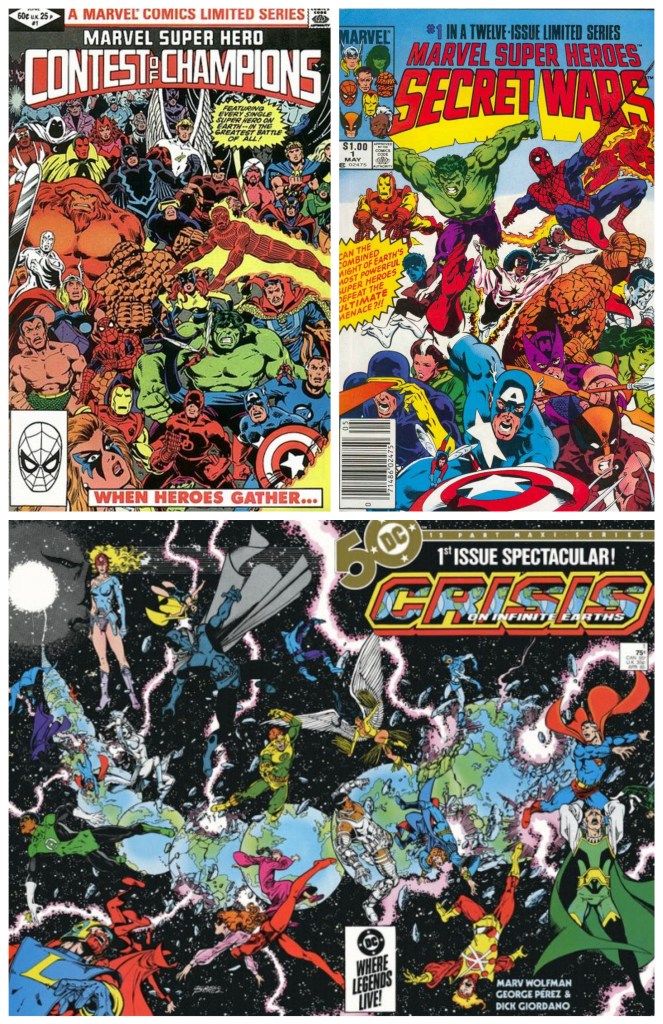
Most comic historians will agree that the “shared universe” conceit, in which most or all of the characters published by the same company are said to co-exist, can be traced back to 1940 and the first appearance of the Justice Society of America in All-Star Comics #3. In the early days, the JSA was little more than a framing device, in which the heroes would gather around a table and tell each other tales of their exploits, but eventually the stories would evolve to the point where they were having adventures together. Guest appearances in each other’s books became common, more teams were formed, and eventually both Marvel and DC Comics had sprawling worlds of interconnected characters. In a way, it’s baffling that it took 42 years for the next logical step in storytelling to happen: mashing everybody in the universe into a single story. That story was 1982’s Contest of Champions, a three-issue miniseries in which the Marvel Comics all-stars were abducted by a couple of the Elders of the Universe and forced to battle each other. It was a completely self-contained story that didn’t touch on any other book, but it was considered a precursor for the next step: the 12-issue Marvel Super Heroes Secret Wars in 1984. This time, we saw many of the Marvel heroes – in their own titles – encounter a mysterious device that whisked them away to parts unknown. They returned in the next issue after an absence of some weeks, many of them with changes. The maxiseries told the story of what happened to them in-between those two points.

“Okay, guys, let’s show ’em how it’s done.”

DC got into the game in 1985 with Crisis on Infinite Earths, and that’s when things really got wild. Contest of Champions and Secret Wars were both relatively self-contained stories. Although Secret Wars had repercussions for the regular series of the assorted characters (Spider-Man’s black costume, which would eventually become Venom; She-Hulk leaving the Avengers for the Fantastic Four; etc.) the story itself stayed in those 12 issues. In Crisis on Infinite Earths, for the first time, the story spilled out into the other comics being published by DC. While the heroes of the multiverse struggled to keep it together in the main series, most of the other books published by the company had side-stories that showed how the stars of that title were dealing with the collapse of reality. Green Lantern dealt with the destruction of an entire sector of space, DC Comics Presents booted Superman to an alternate reality where he met a young version of himself, and in Wonder Woman’s title she joined with the gods of Olympus to protect her home.  

Since then, the crossover has evolved again and again, with different forms that each have their own pros and cons. In some cases, a story in a single title or family of titles grew big enough that it only made sense to show the effects on other books. In Marvel’s Inferno (1989), the X-Men family of comics told the story of a demonic invasion of New York, and since most of Marvel’s heroes lived in New York it only made sense to show how Spider-Man, the Avengers, and the Fantastic Four were dealing with it as well. Later that same year we got Acts of Vengeance, a story wherein Loki plotted to destroy the Avengers by manipulating the Marvel Universe’s villains into attacking different heroes than those they usually fought. Yeah, I’m not entirely sure how that was supposed to work either, but it was a fun story: Spider-Man dealt with the X-Men’s enemy Magneto, while Daredevil’s foe Typhoid Mary set her sights on the Power Pack, and so forth. These kinds of crossovers work out fairly well, as it’s easy for readers to ignore any titles they don’t want to read. On the other hand, if they aren’t reading the core titles in which the story is taking place, they may be confused as to what is going on.

However, from a company standpoint, there’s one major problem with crossovers like that: there’s no extra books being sold. So the next level of crossover has a main miniseries, with stories touching on the heroes across the DCU. After the original Crisis, DC made this an almost-annual format for many years, with the likes of Legends, Millennium, Invasion!, Final Night, Genesis, and Underworld Unleashed all following suit. Marvel did it several times as well, with Secret Wars II, Infinity Gauntlet, and its assorted sequels. This is the kind of crossover I grew up with, and in many ways it’s still my favorite. The fact that it touches on the ongoing comics gives the story weight and makes it feel like it “matters” more than if the book is totally self-contained, and for the most part, you still only have to read the main title and any crossovers that you want, pushing aside those that you don’t.

There were…a LOT of these.

Later crossovers like Civil War and Fear Itself would expand on this concept: the main miniseries, crossovers into the ongoing books, and assorted miniseries and one-shots that spin off of the main book. This expands the story and allows the storytellers to touch on more elements of the event, and of course, it gives the publisher more books they can potentially sell. Publishers love that. Sometimes they love it so much that they’ll do a spinoff miniseries even if the characters involved currently have an ongoing. There are 97 X-Men titles at any given time, so was it strictly necessary to do a three-issue World War Hulk: X-Men miniseries instead of just putting the story in one of those? I say thee nay.

Then there’s the tier that we’re seeing more often these days, in which the crossover doesn’t touch the ongoing titles at all, but only features spinoffs and one-shots. There are, I think, two reasons this happens.

1: Money. 

2: Writers. 

I don’t think the first point needs much of an explanation, but let me tell you what I mean by the second one. The comic book industry has become increasingly writer-focused over the years, and while in many ways that’s a good thing, that does come with a degree of compartmentalization. Whereas in the past, editors would call up the writer of New Warriors and tell him to link his book to Infinity War whether he wanted to or not, today there’s more of a reluctance to disrupt the ongoing story. Al Ewing’s fantastic Immortal Hulk series was an excellent horror story that is perfect for binge-reading now that it’s over. But if you’re reading that story in a collected edition years later, it would be somewhat disconcerting to suddenly stop to deal with an invasion of symbiotes spilling over from the Spider-Man comics. So instead, there were Immortal Hulk one-shot specials when the title dealt with the events of the Absolute Carnage and King in Black crossovers, and the main book went unmolested.

The solution.

The benefit of this is that the crossover doesn’t impact the story when you’re reading it in a vacuum. There are two cons that come to mind, though. First, if a crossover is entirely self-contained, it’s easy to ignore it and decide it’s inconsequential to the meta-story of the shared universe as a whole. Second, it has a tendency to cause the main story to spill out into the spinoffs in a way that doesn’t happen as often with the other kinds of crossovers. Grant Morrison’s Final Crisis was a bit of a mindbender to begin with, but the ending is COMPLETELY out of the blue if you didn’t choose to read the Final Crisis: Superman Beyond two-issue miniseries that accompanied it.

A story like Knight Terrors is a relatively new variant on this format. The crossover is told entirely through crossover miniseries, but those miniseries are replacing the ongoing comics for the duration of the event. Instead of following June’s Nightwing #105 with July’s Nightwing #106, July and August give us Knight Terrors: Nightwing #1 and #2, with #106 saved for September. This is, by my count, the third time DC has done this, the previous times being Convergence in 2015 and Future State in 2021. It’s nice, in that it doesn’t disrupt the main book at all, but it also has a habit of making the event itself feel rather inconsequential. (Future State in particular has largely faded into irrelevance in the DCU.) 

Up until now, I’ve really only talked about format. I’m not making value judgments on any of these stories: there are both good and bad examples of every kind of crossover. What matters, I think, is what exactly you’re trying to accomplish with the story. Are you “just” telling a big story? Well, the first format I discussed is probably the right one. We mostly see that now with smaller crossovers, things like the Sinestro Corps War that only impacted the Green Lantern books (plus one issue of Blue Beetle). But even those “smaller” crossovers are starting to go the route of having one-shots or miniseries spinoffs: the upcoming Gotham War storyline will feature in the Batman and Catwoman ongoing titles but also have a few one-shots and a miniseries focusing on Jason Todd. 

Sometimes publishers label books as part of a crossover no matter how inconsequential they are, and that can irritate readers. People who picked up the Crisis on Infinite Earths issues of Swamp Thing were rightly irritated that the only connection seemed to be the skies turning red. Even when the book is objectively entertaining, it’s a bit frustrating. Geoff Johns and the late George Perez did a magnificent job on Final Crisis: Legion of Three Worlds (I would even argue that, to date, it was the LAST great Legion of Super-Heroes story), but pretending it had great significance to the Final Crisis storyline was something of a stretch. 

“Guys, when we said ‘Stop, you got it right,’ we didn’t mean that LITERALLY.”

Sometimes these crossovers are intended to reset things: DC has done that with Flashpoint and Dark Crisis on Infinite Earths, which led to the New 52 and Dawn of DC reboots, respectively. Sometimes these are intended not to re-set, but to set things up in the first place. That’s what the nascent Valiant Comics did in 1991 with Unity. When their universe was still young they tied together their six existing titles (four of which were less than a year old), launched two new titles, and introduced new characters and concepts that in turn would develop into more titles in the next year. It was a huge success and Valiant was the hot ticket, becoming so successful that only a few years later Acclaim bought the company and promptly ran it into the ground.

“Get ready, guys, it’s all downhill from here.”

People like to complain about “event fatigue” in comics the same way that many of them complain about “superhero fatigue” in movies, but the fact that people keep buying these books seems to indicate that they aren’t that exhausted. And as always, quality matters. People rarely complain about “too many comics” if they actually like the stories that they’re reading – it’s only when following a story gets to be a chore that they go to the internet and gripe. I don’t think crossovers are going anywhere, and honestly, I don’t really want them to. So I guess the important thing when planning them out, publishers, is to think really hard before you get into these storylines, and ask your doctor (Strange, not Doom) what kind of crossover is right for you. 

Blake M. Petit is a writer, teacher, and dad from Ama, Louisiana. His current writing project is the superhero adventure series Other People’s Heroes: Little Stars, a new episode of which is available every Wednesday on Amazon’s Kindle Vella platform. He knows that there are a LOT of crossover events he didn’t mention in this column, so before you reply with, “Hey, you forgot XYZ,” know that he didn’t. He just didn’t have room to make this comprehensive. Cut him some slack.  

Geek Punditry #17: Fiction’s Fiction

If there’s one thing you can say about fandom, it’s that all fans of every stripe want the same thing: more. If we love a TV series, we want movie spin-offs. If we love a comic book, we want that hero to appear in multiple titles. If we love football, we feign interest in the XFL or USFL until August, because at least it’s something. Whatever it is fans want, the unifying element is that everybody wants more of it. 

The problem is that stuff takes time. The average TV season lasts for 13 episodes these days (sometimes 22, if you’re lucky), leaving well over two thirds of a year with no new content. Movie sequels can take from years to decades, and sometimes never happen at all no matter how badly you want them. Waiting for new books is a crapshoot – if you’re a Stephen King fan you’ll have three new novels to read by the time you get home from Burger King, whereas George R.R. Martin readers will have to inherit the fandom from their grandparents before they get any new content. Even comic books, which usually have a pretty standard schedule of once or twice a month, take you ten minutes to read and then you’re stuck sitting around waiting for the next installment.

Efficiency is the only reason the man on the left has a higher body count.

So in order to satiate the thirst of fans for “more,” something marvelous has happened. “Extended” Universes. Novels based on movies, comic books based on novels, TV shows based on comics, movies based on TV shows. There’s a weird, incestuous spiderweb of media that springs up around any sufficiently popular franchise, and it’s been happening for ages. Back in 1942 George F. Lowther wrote The Adventures of Superman, a novel based on the world’s most popular comic book character who, at the time, was only four years old. In 1910, Thomas Edison produced a short film based (very loosely) on Mary Shelley’s Frankenstein. Hell, way back in 1615, Miguel de Cervantes published the second volume of Don Quixote largely to spite an anonymous writer who, using the pseudonym “Alonso Fernandez de Avellaneda,” released his own unauthorized sequel to the first book, something that would have brought down a legion of Disney-owned lawyers were anyone to try that today. The point is, fans have been greedy for a long, long time.

Pictured: More.

The great thing is, if you love Star Trek and can’t wait for June 15 and the season premiere of Strange New Worlds, there are literally hundreds of novels, comic books, and video games you can consume to get your fix. And some of them are really good. And some of them have very devoted fans, and some of them have wonderfully complex and entertaining lore and mythologies all their own.

And this is where the problem comes in. When extended universes are really popular, a sort of strange conflict begins to arise when the time comes to figure out what is and what is not canon. What’s “official” to the main universe that you’re enjoying? What “counts” and what doesn’t?

It used to be relatively simple: the medium that birthed the franchise was king, and everything else could be a fun diversion, but was not considered relevant to the creation of a new “official” installment. It didn’t count, it wasn’t real, it was “Fiction’s fiction.” Because of this, at the time, these expanded works didn’t usually do anything that would have permanent repercussions to the main story. Sure, there were Star Wars comics while the original trilogy was being produced, but there was never any real danger of Han Solo dying because Lucasfilm needed him for the next movie. This did produce some “funny in hindsight” moments when early writers teased a Luke/Leia relationship because they didn’t know yet that the two of them were brother and sister. Of course, neither did George Lucas, so who can blame them?

It was Star Wars, I think, that started to change things for these extended worlds. In the early 90s, it had been years since Return of the Jedi and there did not seem to be any intent to make more movies, so a plan was hatched to continue the universe via novels and comic books. The first Timothy Zahn trilogy of novels introduced the new big bad, the fandom-beloved Grand Admiral Thrawn, while Dark Horse Comics’ Dark Empire series brought Emperor Palpatine back from the dead by revealing he had the ability to transmit his mind into cloned bodies he had ready for just such an occasion. With the success of these stories, the Star Wars universe grew exponentially, with hundreds of interwoven stories introducing new characters, heroes, villains, planets, and alien species that were as thoroughly entertaining as anything the fans had come to love in the original trilogy. Even once movies were being made again, films that sometimes contradicted elements of the extended universe, the creators did their best to pivot, explain away inconsistencies, and incorporate “official” elements into their own world. And for the most part, it worked.

Geeks in the 90s were required by law to read these books 74 times.

Then Disney bought Lucasfilm and designated everything except the six existing movies and Clone Wars TV series to be non-canon. Actually, they used the term “Star Wars Legends,” because that way they could keep reprinting and profiting off the work while usually failing to pay the creators any royalties, which is a different rant I’m not going to get into right now. There would still be an extended universe, of course, but now they were going to produce it themselves, with books, comics, and video games tied to the new “official” canon, and ostensibly, those works would be considered canon as well. So far it seems to have worked out, but that doesn’t mean I doubt for a second that Kathleen Kennedy would make a movie that  contradicted Marvel Comics’s War of the Bounty Hunters series if she so felt the urge. 

My favorite “Star,” Trek, has had its own issues with extended universes, particularly in the 80s when DC Comics held the license. Following Star Trek II: The Wrath of Khan, DC began publishing new stories assuming a status quo as it was at the end of that movie: Admiral Kirk commanding the Enterprise after the death of Spock. Then came Star Trek III: The Search For Spock, in which Spock…y’know…un-dies. Despite the fact that the movies clearly take place right after each other, chronologically, the comic writers wrote a story that dovetailed their few years of adventures into that movie best they could, then began a new status quo. The Enterprise was destroyed, so Kirk took over command of the Excelsior for reasons, while Spock became captain of a science vessel and had his own adventures. Then Star Trek IV: The Voyage Home further complicated things with a story that clearly happened immediately after the events of the previous film and did not fit the comic book canon in any conceivable way. The comic book writers flailed for a while until DC got the rights to do an ongoing series of the then-new Star Trek: The Next Generation series, at which point they rebooted the comic starring the original crew so it could start with a new first issue the same month that TNG #1 came out, and then they just pretended those other stories they told never happened.

Trek got better in the late 90s and aughts, taking a cue from Star Wars and moving into stories based on franchise installments that seemed truly “over” and therefore safe to expand upon. There was a series of novels following the Deep Space Nine characters after the conclusion of their show, another with the adventures of Captain William Riker on the Titan following the final TNG movie, and even some series featuring mostly-new casts like Peter David’s New Frontier or the Starfleet Engineering Corps books. When the J.J. Abrams films brought Trek back to the screen, it was no problem for the extended universe, since they explicitly took place in an alternate timeline. In fact, it just gave writers a whole new universe to play around in. Modern Trek does have a few clashes, though: IDW Comics (who currently holds the license) recently began an initiative to create a more tightly woven universe through a relaunched Trek series and its Defiant spin-off, both of which are good comics, but which feature versions of Data and Beverly Crusher that seem to flat-out contradict the canon of Star Trek: Picard, which seems like a bizarre choice.

One of these things is not like the others…

The “official” continuation game has been played with more and more franchises in recent years. Buffy the Vampire Slayer and Firefly continued their respective universes in comic books, while Smallville – a TV show based on a comic – had a fairly lengthy “Season 11” series that followed that show: a comic book based on a TV show based on a comic book. Then there was the film adaptation of Stephen King’s The Dark Tower, a desperate effort to squash the material of seven books into 95 minutes (that’s seven Stephen King novels, most of which are large enough to qualify for their own zip code). While most fans were disappointed in the result, the sting is mitigated slightly if people try to view the film not as an adaptation of the books, but as a sequel to them. That probably doesn’t make any sense if you haven’t read the books, but just take my word for it.

That brings us to the issue when printed media are translated to the screen. Books were first, gloriously first, but if we’re being honest here, the general public often accepts film or TV adaptations as more official. Just talk to any devotee of L. Frank Baum’s The Wonderful Wizard of Oz and its subsequent sequels about how much you love the Ruby Slippers and watch them die a little inside. James Bond was created as a hero for novels and short stories, but the films are obviously what most people are familiar with, and those are highly contradictory. Some of the movies are based on Ian Fleming’s stories, some of them use the titles of stories but very little else, and others are cut from whole cloth, but there’s just no way to pretend they share a canon. Most Bond fans don’t care, of course, and modern fans tend to see the movies as the “real” James Bond more than the novels that gave him birth. (He’s a more likable character in the movies, to be fair, so this is not necessarily a bad thing.)

As for comic books, there have been comic book movies for a very long time, but those have historically been ignored by the comics themselves. The first Batman serial from the 40s, for example, portrayed him as a government agent beating up spies, something that doesn’t sync with any canon comic book I can think of. Even really popular films, like the Christopher Reeve Superman or Tobey Maguire Spider-Man, had a negligible effect on the comic books. Then came the Marvel Cinematic Universe, and boy, things changed. With the gargantuan success of the MCU, there are now effectively two “official” Marvel Universes, and the cinematic one is by far the one that’s more recognizable to the general public. The MCU was the first time anyone had ever tried to create so intricate a universe of interwoven films and TV shows, something that made it feel more “real” than that scene in Batman Forever where Bruce Wayne casually mentions Dick Grayson’s circus is “halfway to Metropolis” but otherwise gave no indication of anything beyond the boundaries of the film. The Marvel Studios movies and shows all linked to each other and all mattered to each other, just like the comics, and the “cinematic universe” model is something everyone has been trying to replicate ever since.

And of course, occasionally elements in these extended universes become popular enough that they can cross over into the “real” worlds. Harley Quinn was created in Batman: The Animated Series and was such a hit that she joined the official comic book universe, then spread out into live action. Superman’s pal Jimmy Olsen, almost as integral a character to the mythos as Lois Lane or the Kents, made his first appearance on Superman’s radio show. The aforementioned Batman serial, which is goofy and doesn’t feel like the same character at all, is responsible for the creation of the Batcave. And even though the Star Wars Legends stuff is no longer canon, Disney is starting to allow elements of that world to leak into the “official” world, such as bringing in Timothy Zahn’s Thrawn character and allowing the resurrection of Emperor Palpatine – although to avoid being accused of copying the Dark Empire comic book, they cleverly neglected to give any comprehensible reason for his return whatsoever. 

“I’m canon now, bitches!” –Thrawn, probably

The original question was that of what is “real” in these different universes. The newfound ubiquity of the multiverse concept in storytelling makes that easier. (It’s an old concept, I know, but in recent years it’s really experienced a boom in popular culture.) Marvel officially recognizes just about every version of its characters as “real” in one corner of the multiverse or another, with stories like Spider-Verse (the comic book) and Into the Spider-Verse (the movie) bringing them all into play together. DC has a similar policy and has officially declared that the Christopher Reeve Superman movies and Michael Keaton Batman movies are set in the same universe, although whether that will be contradicted by the upcoming Flash movie remains to be seen. The truth is that the people writing any version of these IPs in any medium will pick and choose those elements that they need to make their story work, and as that can be confusing if a fan is trying to reconcile everything, this is probably a good reason not to try that. What’s “real”? What “matters”? Whatever you need for the story you’re trying to enjoy right now.

The rest of it?

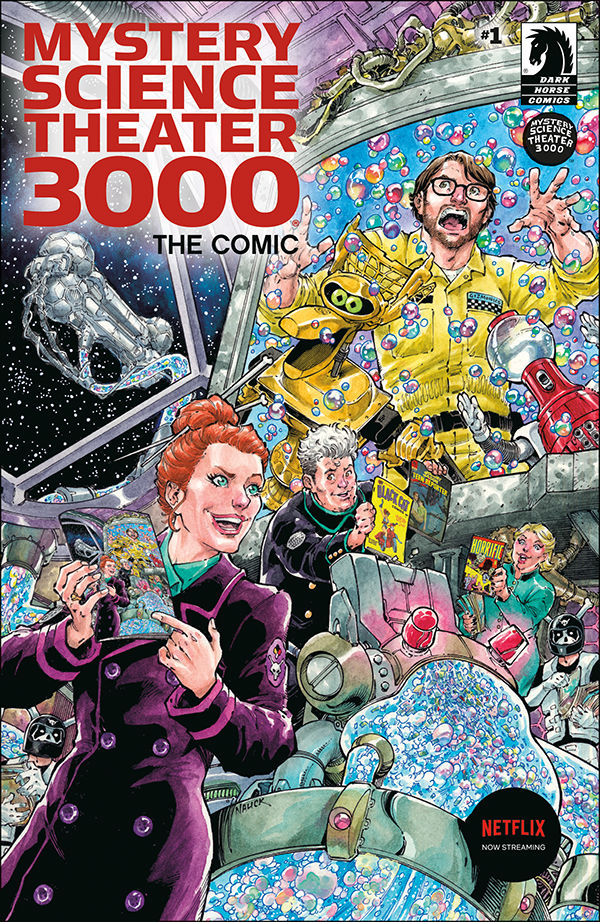
Just find that corner of the multiverse where a guy named Joel told us to repeat to ourselves “It’s just a show, I should really just relax.” 

Yep. Those guys got a comic book, too.

Blake M. Petit is a writer, teacher, and dad from Ama, Louisiana. His current writing project is the superhero adventure series Other People’s Heroes: Little Stars, a new episode of which is available every Wednesday on Amazon’s Kindle Vella platform. One of his favorite Star Trek novels is Federation, by Judith and Garfield Reeves-Stevens. Don’t try to read it and then watch First Contact. It doesn’t work. 

Geek Punditry #14: Filling In the Gaps

I’ve been reading comic books pretty much since I learned to read. The hook caught me when I was still in elementary school and my dad brought home a box of Archie Comics from a co-worker, and it was set even more firmly when my uncle gave me some old issues of Green Lantern and Legion of Super-Heroes he had. And much like watching your favorite TV show over and over, rereading old comic books is a form of comfort entertainment for folks like me. Oh sure, I still read new stuff, but revisiting the classics is like a shot of dopamine straight to the ol’ cerebral cortex (or wherever dopamine goes). The digital revolution in media has made that easier. You can find old stories you lost years ago, voraciously read precious comics without the fear of damaging those pristine back issues in your collection, or FINALLY read that missing issue of Power Pack you could never find as a kid that explained why the hell all of the kids had suddenly traded super powers and how the Snarkwars ended. This was serious business, friends.

Imagine waiting 35 years for apps to be invented so you could finally read this.

Of course, not everything is available digitally, not yet anyway. With nearly a century of comic books to digitize before they can be made available (and rights issues tying up a lot of them in various ways), the dream of a single device from which you can read every comic book ever made is probably going to remain a dream. But with Marvel Comics boasting over 30,000 comics on its app and DC hosting a library of over 24,000, it could practically take a lifetime to go through the stuff that’s already out there. Psyched for the new Guardians of the Galaxy movie? You can read every issue of their series right now. Pumped for the Blue Beetle film? The history of Jaime Reyes awaits you! Want to go back to the beginning? Check out every appearance of Superm–

Oh, wait.

Actually, not every issue of the assorted Superman comics from the past 85 years is among the 24K titles DC Universe Infinite has waiting for you. As every American learns in first grade, Superman first appeared in Action Comics #1 in 1938 and appeared in nearly every one of the title’s 904 issues before DC’s line-wide relaunch in 2011. But of those 904 issues, only 463 of them are on DCUI as of this writing. There are similar gaps in the other long-running Superman titles such as Superman and Adventures of Superman. Clark’s buddy Bruce Wayne has a similar problem: of the 811 pre-reboot issues of his flagship Detective Comics, DCUI has 696 as of now, again, with similar gaps in his other titles. Not as bad as the voids in Superman’s history, but still frustrating.

You’re telling me THIS isn’t worth digitizing?

My favorite characters and stories, as you may have noticed, tend to lean more towards DC than Marvel, but I also believe in credit where credit is due, and when it comes to making their library available, Marvel is considerably ahead of DC. You can read almost the entire run of the main series of their flagship properties like Fantastic Four, Avengers, and X-Men, and any gaps that exist are far smaller than those of their rivals. They’re also filling in the gaps much faster, with an almost weekly addition of big chunks of missing books (the last couple of weeks have given us dozens of issues of Dazzler, for instance), whereas DC rarely puts more than five or six older issues up a week, and usually from five or six different series, making it take much longer to complete a run if it gets completed at all.

I know it’s not as simple as pushing a button, of course. For comics that were produced before computer technology became a standard part of the production process (which means practically every comic produced before the 90s and a lot of them after that), digitizing them is a process. You need to find quality prints, scan each page by hand, and remaster them to make for a solid digital reading experience. For many comics, that means completely recoloring them based on the original guides. This takes time and money, so I don’t mind the wait. What bothers me, and a lot of other fans, is the kind of haphazard nature of what gets added. For example, this week’s slate of older books being added to the app includes Creature Commandos #1 from 2000, the first issue of the 1991 update to Who’s Who in the DC Universe, the first issue of the Eclipso: The Darkness Within crossover from 1992, Superman: Day of Doom #1 (a four-issue miniseries from 2002 produced for the 10th anniversary of Superman’s “Death”), and Stormwatch #46 from 1997. They’ve been (slowly) adding Stormwatch for some time now, so that makes sense, and Creature Commandos was part of James Gunn’s big DC announcement from a few weeks ago, so I get that too. The rest of them…baffling. Not that I’m complaining about anything being added, I have no objection to any of these titles. I just can’t figure why they’re going to those books when they haven’t yet added, for example, issues #216-274 of The Flash.

Less important than Creature Commandos #1.

Some things will probably never get digitized, I know that. For example, I’ve got no idea who currently owns the rights to the Adventures of Bob Hope, Adventures of Dean Martin and Jerry Lewis, or Jackie Gleason and the Honeymooners series launched in the 50s, and I doubt anybody except me actually cares. There are issues of the old Showcase anthology series that featured licensed characters DC has no rights to, such as G.I. Joe and James Bond, and which will almost certainly never be seen on the app. Then there’s Sovereign Seven, a series by legendary X-Men writer Chris Claremont, set in the DC Universe and often guest-starring DC characters, but for which the copyright was held by Claremont and artist Dwayne Turner. It would probably take some sort of monetary agreement between all the parties involved to add that series, and with so many other books still waiting for their shot, it seems unlikely that DC will make the effort to do so any time soon.

Look me in the eye and tell me you don’t want to know what happens next.

Then there are long runs of Green Lantern and Justice League Europe from the 90s that now present serious problems because the writer, Gerard Jones, plead guilty to possession of child pornography in 2018. Here’s a case where it’s perfectly understandable that DC doesn’t want to do anything that looks like they’re promoting his work or having to pay him royalties, and I don’t blame them for that. But it sucks for the other writers and artists who worked on those comics and who, through no fault of their own, find their back catalogs throttled. It also leaves us a case where some pretty big storylines are missing or incomplete, both for DC and Marvel. (Most notably for Marvel, Jones wrote what is to date the only ongoing Wonder Man series. With that character slated to get a Disney+ MCU series, normally you would expect his comics to be fast tracked for inclusion on the app, but as of now the only issues available are a few that are chapters in the Avengers crossover series, Operation: Galactic Storm.) 

The reason I’m thinking about this right now is because DC recently held their first “Backlist Breakout” poll for users of the DCUI app. Users were presented with a slate of eight titles not currently available and were asked to vote on which ones we wanted to move to the front of the queue, with the top three promised to be added to the app beginning in June. My vote was for one of the eventual winners, DC Challenge, a miniseries from the 80s where an all-star group of writers and artists participated in a sort of “exquisite corpse” experiment: the first team produced an issue of a DC crossover and then handed it off to the next team to continue the story with no instructions or input, figuring it out as they went along. This kind of storytelling has been done in books and other forms of entertainment, and the result was a delightfully insane comic that went totally off the rails, leaving the creators of the last issue the unenviable task of trying to make sense of a plot that had ballooned to include time travel, Nazis, the planet Earth itself being moved to another galaxy, and Groucho Marx. I cannot wait to read it again.

The most important vote you’ll cast this year.

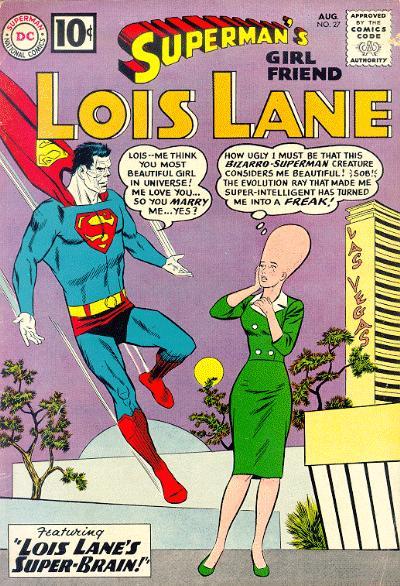
The other two winners in this round are books I’ve never read: the five issues of the 1967 Blue Beetle series (featuring Ted Kord, not Jaime, and published by Charleton Comics, but which DC owns the rights to) and the first 12 issues of the seminal fantasy series Warlord. The support for Warlord on the DC boards made its victory seem almost a foregone conclusion, and I look forward to it, since I’ve never read those issues. But it does open up another problem. Only the first 12 issues of Warlord have been promised. That’s 12 out of a series that ran for 133 issues plus six annuals. If fans want to see issues #13-24, Warlord is going to have come out triumphant again in the NEXT round of “Backlist Breakout” this summer. And then keep winning, every twelve issues, again and again, to finally make the whole series available. If it fails to win in even one round fans will be left dangling, their series put on a shelf with other unfinished titles like Adventure Comics, Doom Patrol, and Superman’s Girl Friend Lois Lane.

“Is this a joke to you?”

Again, I don’t mind waiting for everything to be digitized. And I even like the idea of “Backlist Breakout” making a game out of deciding what the next goodie added to DCUI will be. But there are some gaps that are so conspicuous that I just can’t figure out why DC isn’t doing anything to fix them right now.

Blake M. Petit is a writer, teacher, and dad from Ama, Louisiana. His current writing project is the superhero adventure series Other People’s Heroes: Little Stars, a new episode of which is available every Wednesday on Amazon’s Kindle Vella platform. He is admittedly thrilled that DC finally finished adding Captain Carrot and His Amazing Zoo Crew to the app a while back, but he’s quite put out that they haven’t gotten around to the three-issue Oz/Wonderland War miniseries that wrapped up the original Zoo Crew’s story yet. 

Geek Punditry #10: Shouldn’t Have Slept on This

There are a lot of comic books published every month. Like, at least four of them. And for someone who has been reading comics since childhood, there are times where the sheer volume of books being published can get overwhelming, even if you don’t read X-Men titles. The two biggest publishers, Marvel and DC, each have an intricate universe that carries on a complex interwoven meta-narrative that has run continuously, in one form or another, for decades, somehow subsisting even before variant covers were invented. And if you’re the sort of person who has things like a job or a family, or who enjoys eating food, there simply isn’t enough time to read everything that’s being published.

Fortunately, both Marvel and DC have in recent years launched online subscription services, where you can read a substantial portion of their respective libraries, with more books added each week. I’m a comic book collector, I can’t imagine a future where I didn’t want to get printed comics, but I consider myself a reader even more than a collector. And there’s a definite comfort to knowing that I don’t have to get all 1,124 books published a month (that’s 10,419 covers) in case there’s something I might want to read later. For books that I’m not enthusiastic about, things that I would be reading just to fill in a gap, it’s great to know that I can always go to the app a few months after release and it’ll be waiting there.

The best part about this system, though, is that when you go back and look at the stuff you missed, sometimes you find a gem that you may not have otherwise read at all. Since I’ve started reading these comics digitally, I’ve stumbled on several titles that I passed on in print, but really came to enjoy after the fact. So this week, for your edification, I’m going to share four comic series from the last few years that I didn’t read when they came out, but I’m sorry I slept on now.

Duo (DC/Milestone Comics)

Milestone Media, which has published through DC on and off for 30 years now, came back in 2021 in a big way, and while a lot of attention was given to the return of characters like Static, Icon, and Hardware, less attention was given to some of the new properties released in that universe. Duo, from writer Greg Pak and artists Khoi Pham and Scott Williams, focuses on David Kim and Kelly Sandborne, an engaged couple whose research in nanotechnology is on the verge of a breakthrough. With the right funding, David and Kelly believe they could revolutionize medicine: healing injuries, combating disease, even reversing the aging process itself. When they approach an investor to take their work to the next level, instead they find themselves under attack. Kelly is thought to be killed, but David soon discovers that she’s been saved by the nanobots the only way they could: transplanting her consciousness into his own mind. Now, sharing one body and immense power, David and Kelly have to stop her killers and find a way to separate.

Duo is a really great book. It takes elements from one of the old-school Milestone comics, Xombi, but also incorporates concepts and themes that feel more like the Starhawk/Aleta body-sharing dynamic from the old Guardians of the Galaxy or Valiant’s original Second Life of Doctor Mirage, about a married couple in which the husband was a literal ghost. The character beats between the two of them are great, with some surprisingly funny moments even turning up at Kelly’s memorial service, and the book deftly deals with the troubles of having the person you love literally living inside your mind. We don’t get a real grasp of what the villains are up to until the third issue, but the character building and questions raised by the story are more than compelling enough to pull us in even before that point. Modern Milestone is doing a lot of interesting stuff, but I’m surprised to discover that this book is my favorite of the pack.

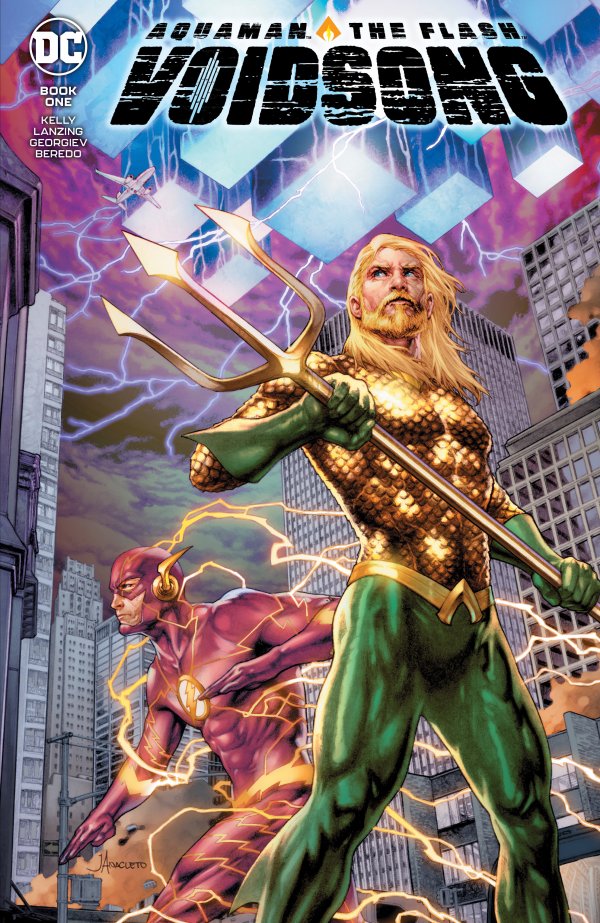
Aquaman and the Flash: Voidsong (DC Comics)

Ah, the miniseries. When the concept first really came to prominence in the 1980s, a comic book miniseries felt like an event, like something special. Now it almost feels inconsequential, with “ongoing” titles being relaunched every twelve minutes and proper miniseries feeling somewhat inconsequential. The idea of a miniseries starring the Flash and Aquaman facing an alien invasion felt like the sort of book that would never be referenced again, never have a serious impact on that “meta-narrative” I mentioned before, and therefore would be easy to skip. And I was wrong to feel that way.

The above description of the series, written by Jackson Lanzing and Collin Kelly and with art by Vasco Georgiev, is technically correct, but despite what Futurama would have us believe, that’s not always the best kind of correct. As the story goes, an invasion fleet immobilizes the entire planet with a sort of harmonic weapon (the titular “Voidsong”) that affects everyone except for the Flash and Aquaman – who were both insulated from the sound for Comic Book Reasons – leaving those two heroes as the only ones who can save the world. The great thing about this is that Aquaman and the Flash are not a traditional team-up pair. Sure, they’ve both been members of the Justice League since the very beginning, but when time comes for the heroes to pair off you’re more likely to see the Flash pal around with Green Lantern, while Aquaman hangs out with Wonder Woman or the Martian Manhunter. You almost never see these two, specifically, in a story together, and the story neatly moves from an early personality clash to a more respectful relationship in a very entertaining fashion. If you skipped this book because it wouldn’t “count,” I hear ya, but I’m telling you that we all missed out.

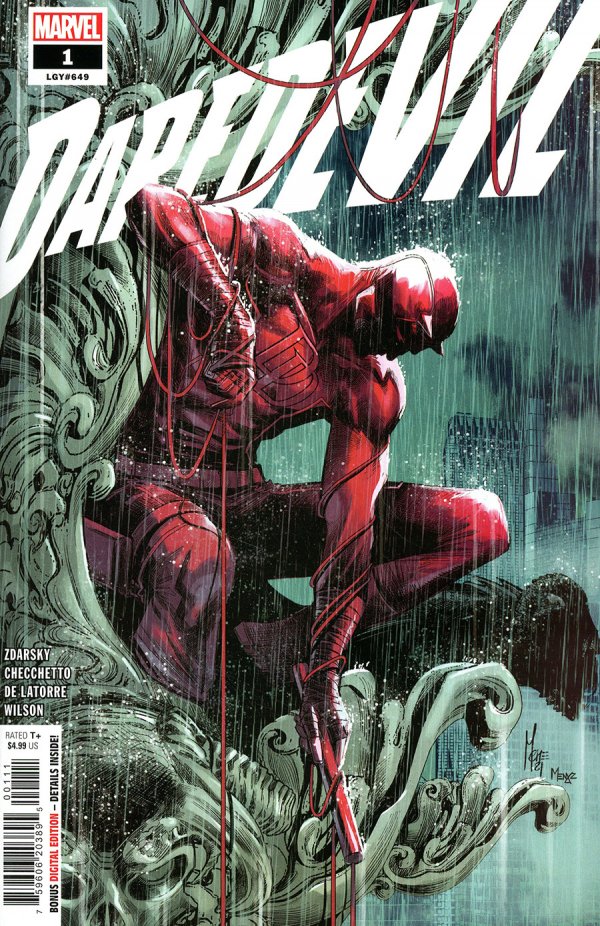
Daredevil by Chip Zdarsky (Marvel Comics)

Among Stan Lee’s Silver Age creations for Marvel Comics, Daredevil is probably the one I’ve read the least. It’s not that I dislike the character, but an awful lot of writers over the years have taken the approach that Daredevil is the hero that absolutely can never be allowed a single moment of joy. A lot of the modern runs on his book have had him suffer one tragedy after another without ever even a hope of peace or happiness. Years ago, when I was sent Marvel comics to review for the late, lamented Comixtreme website, I reached a point where I started to dread any new issue of Daredevil not because the book wasn’t good, but because I knew it would be so bleak I would need a shower afterwards.

Fortunately, Marvel seems to have decided that Spider-Man is now the character that will never be allowed anything resembling happiness, cheer, or entertainment, so Daredevil has lightened up a little bit. Chip Zdarsky, who is one of the more interesting writers working in mainstream comics today (under duress, it sometimes seems), took over the series in 2018. His version, admittedly, isn’t all rainbows and puppy dogs: early in the series, Daredevil accidentally kills a young man in the commission of a crime and eventually turns himself in to the police, getting sent to jail still wearing his mask. It’s a ridiculous concept, the masked hero in maximum security with a bunch of criminals, but once you accept the sheer lunacy behind it the story is fascinating. Zdarsky’s interpretation of Daredevil feels very in-character but, despite the dark inciting incident, manages to avoid the utter hopelessness so many writers have brought to the title.

Zdarsky’s run on the book went for 36 issues before it was restarted with a new #1 because it was a Wednesday. The current volume is on issue 11 and I don’t know how much longer it’s going to go, but I’m certainly along for the ride.

The Nice House on the Lake (DC/Black Label)

DC’s Black Label imprint is…well, I’ll be honest, it’s a mess. It was originally announced as a place for more “mature” versions of traditional DC heroes (“mature” here is being used in its traditional Latin definition, “more likely to drop an F-bomb”). The stories were also said to be out of continuity, except for the ones that aren’t. And sometimes they’re oversized and sometimes they’re not, sometimes they have characters formerly published by Vertigo and sometimes they have characters related to Batman. That’s about 90 percent of the time, actually. But sometimes they have absolutely nothing to do with established DC characters whatsoever. If you asked me to define what exactly the Black Label comics are supposed to be, the only consistent answer I could give you would be “something I would not give my eight-year-old nephew.”

Fortunately, it doesn’t matter what Black Label is, James Tynion IV and Alvaro Martinez Bueno’s The Nice House on the Lake is the gem in the crown. In this sci-fi/horror series (which I should stress has absolutely nothing to do with the DC Universe), ten people are invited for a week-long vacation by their mutual friend Walter at a…well, at a nice house on a lake. The cast is a very eclectic mix of people from Walter’s life – friends from high school, friends from college, friends from later. Some of the characters have a history with each other, others are nearly strangers, with Walter being the only link between them all. Before they can even settle into their vacation getaway, though–

Ah hell, I don’t want to tell you anything else, because this is a book built on mystery and surprise. There’s so much going on here, and almost all of it is built on character, which is fantastic. It’s a wild comic that takes a horrific turn at the end of the first issue, at which point it becomes virtually impossible to predict where things are going from one minute to the next. The book ends with a sequel hook, and I desperately hope that DC (or Black Label or whatever) is already well into working on the next volume, because while this series does come to a relatively definitive conclusion, there’s plenty more to explore and I can’t wait to do it. I won’t be sleeping on the sequel.

Blake M. Petit is a writer, teacher, and dad from Ama, Louisiana. His current writing project is the superhero adventure series Other People’s Heroes: Little Stars, a new episode of which is available every Wednesday on Amazon’s Kindle Vella platform. There are, of course, other books he slept on besides these. For example, if you didn’t read Justice League Vs. the Legion of Super-Heroes, you can consider yourself one of the lucky ones.

Hurricane Harvey: Comic Relief

As I write this, my wife and I are sitting in a hospital room with our newborn son (say “Hi” to everyone, Eddie) and she just read me a story about the New York Yankees and Boston Red Sox putting aside their legendary rivalry in order to hold a joint Hurricane Harvey benefit auction. It’s a lovely surprise and it warms the heart. It also makes me think about who else could do such a thing to help people in need. In particular, because of the rich veins of nerdery that flow through my body, I’m thinking about comic books.

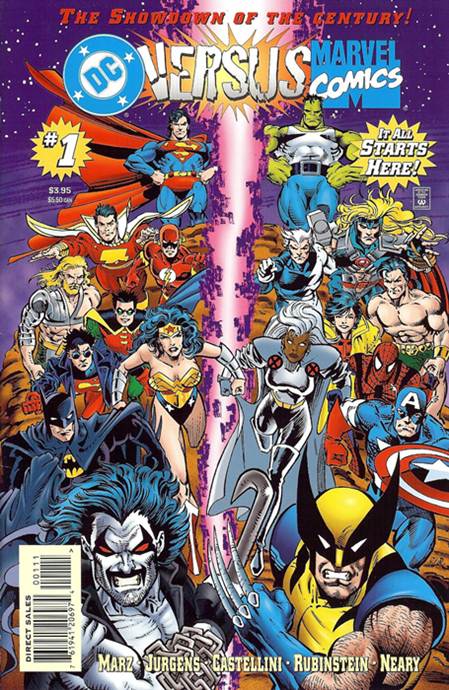
DC Vs Marvel 1I know both DC and Marvel Comics have said no to doing any future crossovers, but hear me out.
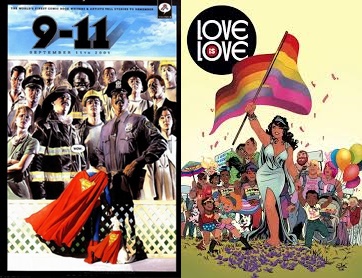
Right now there are hundreds of thousands of people homeless because their homes, lives, and businesses have been destroyed by Hurricane Harvey. In terms of sheer size, it’s probably going to top Katrina as the worst natural disaster in American history. It may have done so already. I’m honestly not sure. For what I think are obvious reasons, I’ve haven’t been able to watch the news super-closely this week. But what I do know is that rebuilding will take years and potentially billions of dollars to restore the parts of Texas and Louisiana devastated by this storm.

DC Charity CollaborationsBoth Marvel and DC, in the past, have done benefit comics in the wake of tragedy. Marvel put out two different special comics after September 11, 2001. DC teamed up with other publishers after 9/11 and in the wake of last year’s shooting in a Miami nightclub. Over the years, both companies have published special edition comics about things like child abuse, substance abuse, land mines, computer science, literacy, and oral hygiene. It’s not like charity comics are a new thing.

Heroes Marvel 9-11How about a DC/Marvel Harvey benefit book? No huge, universe-shattering event. No years-long buildup or hair pulling over how it effects continuity. Not even any of that stupid, fanboyish, inherently disappointing “who would win in a fight” crapola, since each short story would be about heroes coming together to help people in need instead of seeing which one could punch harder. It probably wouldn’t be too difficult to find creators willing to donate the time to do short stories (between five and ten pages, probably, no more), and you’d put together the biggest characters from each publisher:  Superman/Spider-Man, Batman/Iron Man, Wonder Woman/Thor, and — because you know it would put assess in the seats, Deadpool/Harley Quinn.

It would be the best-selling comic book of the century, AND it would raise a much-needed fortune for people in distress.

It’ll probably never happen, I know, but wouldn’t it be awesome to see the two leaders of an industry that makes its money telling stories about heroes set aside their differences so they could actually BE heroes for a change?

PS – Oh, and the capper? The one thing that could make the whole thing even better for long-time comic fans? If they could somehow just call the book”Harvey Comics.” Just saying.