
Subscribe to continue reading
Subscribe to get access to the rest of this post and other subscriber-only content.
Subscribe to get access to the rest of this post and other subscriber-only content.
It’s time for another roundup of recent Superman comics. This week I’ll be reviewing the Superman and Superman-related releases that were released on Jan 28 and Feb. 6. Let’s get into it!
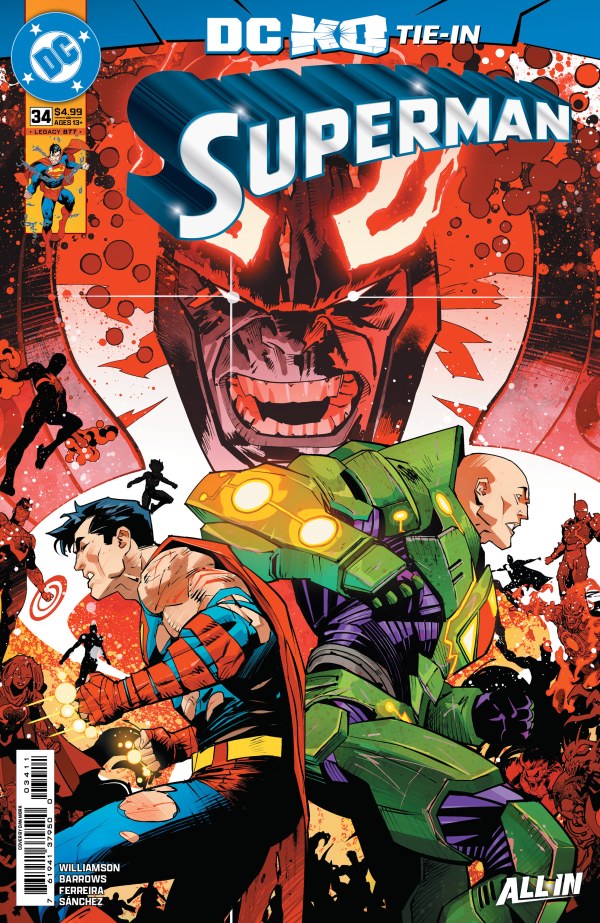
Superman Vol. 6 #34
Title: I, Superman (A DC KO Tie-In)
Writer: Joshua Williamson
Art: Eddy Barrows and Eber Ferreira
Main Cover: Dan Mora
In the arctic, the unusual trio of Lois, Superboy-Prime, and a Superman Robot are fleeing the Fortress of Solitude and the battle with members of Darkseid’s Legion. Meanwhile, the Final Four from the main tournament get a chance to look in on what’s happening back on Earth. It’s a pretty sparse recap, I admit, but the pages are PACKED here with character stuff.
The surprising redemption of Superboy-Prime continues this issue, as he finds himself confronting a Superman Robot that has many of the memories and personality of the original. The contrast between the two is marked and the way that Prime has to reckon with the way the REAL Superman apparently thinks of him…which isn’t what he expected, but is probably exactly what the reader would anticipate. I like Prime’s reactions quite a bit – he’s got an awful lot to cope with here, and for the most part, Williamson is handling it well. He may be going slightly too hard on the fourth wall-breaking dialogue, though. Prime is carrying around knowledge of the fact that he’s in a comic book universe, which is fine, but we don’t want it to go so far as to turn him into Deadpool.
We also spend time with the members of Darkseid’s Legion, who up until this point have come across largely as mindless stormtroopers wearing the faces of our friends. We get a different look here, a reminder that although they’re from a universe corrupted by Darkseid’s Omega Energy, they’re still fundamentally the same people, and perhaps the notion of redemption that Williamson is playing with here isn’t restricted to Prime himself.
I’m all about Eddy Barrows and Eber Ferreira’s artwork – bold, strong, and proud. They’re also pretty good about drawing a Prime that looks like an actual Superboy. Even at his most villainous, it’s important to remember that he’s still a version of Clark Kent, and there have been artists who occasionally forget that.
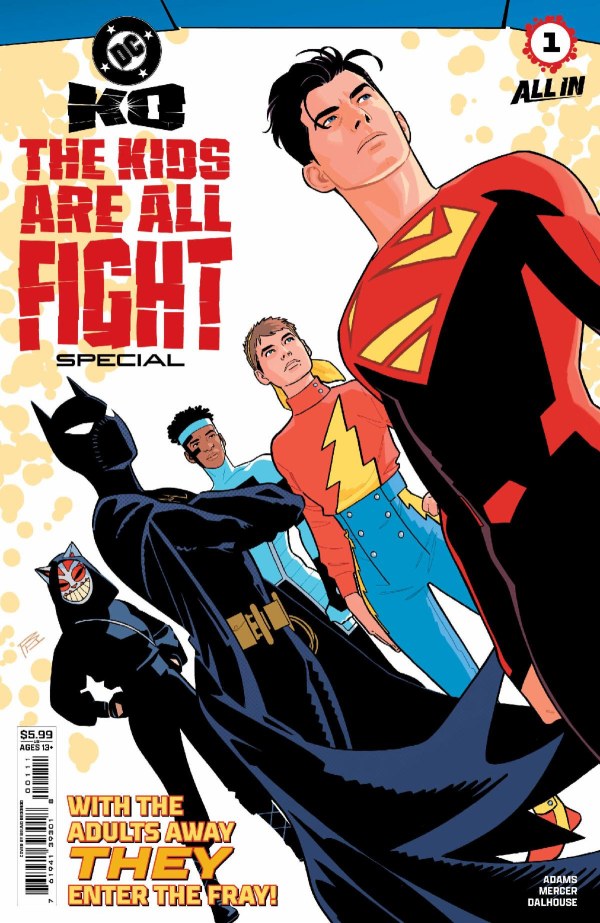
DC KO: The Kids Are All Fight Special #1
Writer: Jeremy Adams
Art: Travis Mercer
Main Cover: Bruno Redondo
The Justice League is strained at the moment, with many of their members caught up in the tournament for the Heart of Apokalips, and most of the others fighting to help evacuate Earth or deal with the dozens of other disasters cropping up all over the place. Jon Kent is given one of the most important duties of all: staying on the Watchtower and keeping an eye on some of the younger heroes, including the Boom, Fairplay, Quiz Kid, and Cheshire Cat. Of course, it would be a pretty short special if the kids just sat around and did what they were told, wouldn’t it? Naturally, they get loose, run into trouble against some of Darkseid’s minions, and Jonathan is forced to call on Cassandra Cain for help.
Jon has been in the last several issues of Titans, working with them as they spearhead the evacuation effort. In March, the book is scheduled to be retitled New Titans with issue #32, and the cover (with several characters in silhouette only) implies heavily that Jon will be a member of the new team. If that’s the case, I’m really quite satisfied with it. The character has been rattling around aimless, for entirely too long, and if making him a member of the Titans actually gives him something to do that makes sense, that’s the best we can hope for. What’s more, I like the group of kids that we see in this issue, the ones that Jon is protecting. I’ve wanted to see more of Boom since she first appeared in the Stargirl: The Lost Children miniseries a few years ago. Fairplay, too, is an interesting character, a very different take on Mr. Terrific that has a lot of promising storytelling avenues. Best of all, there’s a surprise guest-star in this issue that filled me with joy, and no doubt will have the same effect on a lot of other readers. It’s someone we haven’t seen in quite some time, but that DC has been teasing very heavily lately. I’m hoping that this character will stick around in New Titans as well.
Of course, none of that is set in stone. Jon is the only character in this issue whose silhouette appears on that New Titans cover. But covers – especially early solicits – can be deceiving. I don’t expect the heroes we see in this issue to be the new Titans team in its entirety, but I hope that Jon isn’t the only young hero that got a tryout in this issue, because I think there’s a lot to work with here.
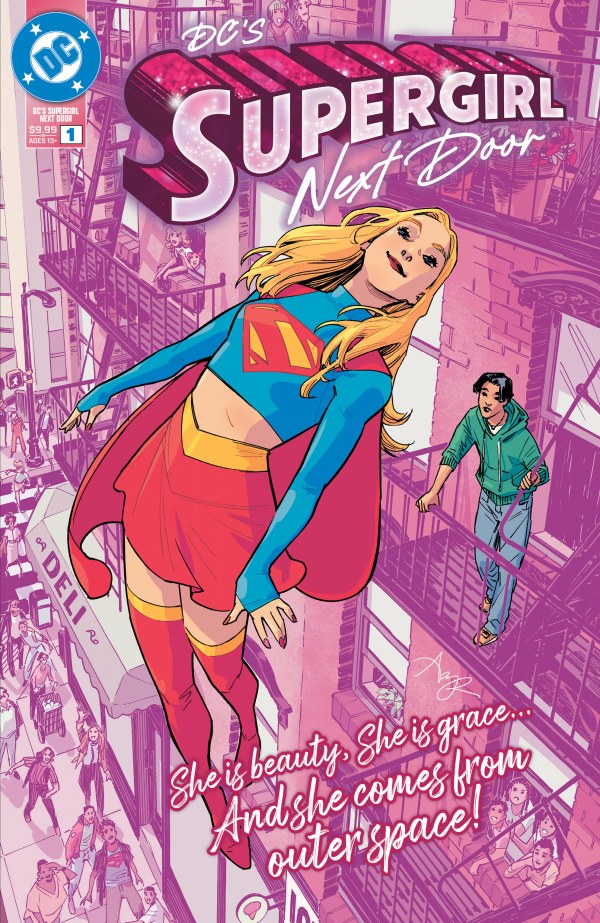
DC’s Supergirl Next Door #1
Note: This is DC’s Valentine’s Day anthology for 2026. There are eight different stories in the book, but I’m only reviewing the Supergirl story.
Title: A Dream of Different Stars
Writer: CRC Payne
Art: Paulina Ganucheau
Main Cover: Amy Reeder
Allen is a new kid in Midvale, struggling to make friends and struggling to fit in. That is, until he meets another new kid in town, Linda Danvers. The two of them form a bond and she opens up to him, revealing just how deeply she misses her old home, and Allen decides to do something to help her.
Short and sweet, but that’s what this story is. It’s a lovely little tale of a couple of foundlings who find solace in one another. CRC Payne is a name I mostly know from her work on DC’s digital comics, such as Batman Family Adventures and Harley Quinn in Paradise. She’s brought the same kind, quiet, reflective tenor she uses in Batman Family Adventures to this story as well, crafting a tale that makes it easy to relate to the characters despite its brevity. Ganucheau’s art has a loose quality to it as well, befitting the more animated style we see in Payne’s other work and fitting very well for this tidy little love story. There’s real charm here that I appreciate.
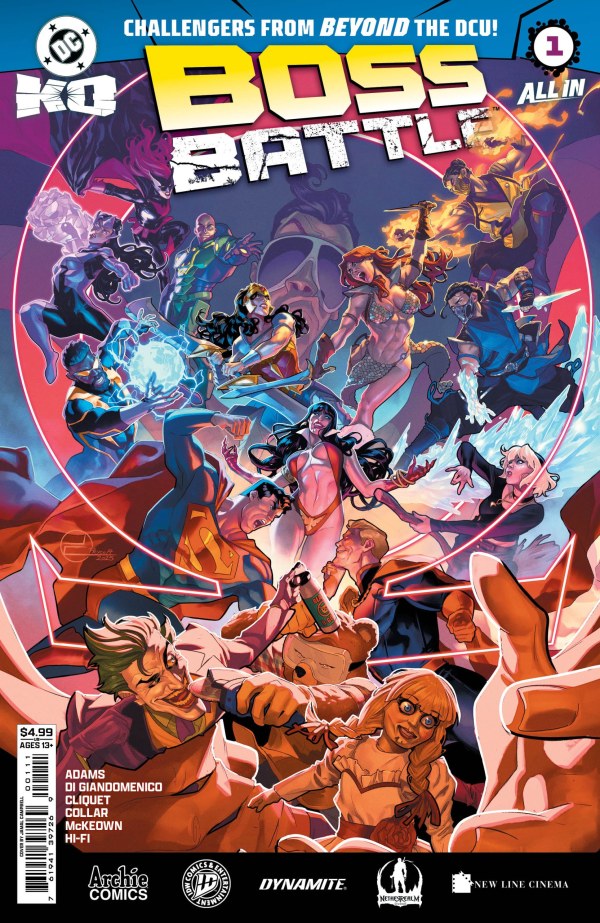
DC KO: Boss Battle #1
Writer: Jeremy Adams
Art: Ronan Cliquet, Carmine Di Giandomenico, Kieran McKeown, Pablo M. Collar
Main Cover: Jamal Campbell
Seconds after the end of DC KO #3, the Final Four in the tournament for the Heart of Apokalips are poised for the battle of their lives, but World Forger manages to “pause” the game. They’re not ready, the need more Omega Energy, so he finds a way to generate some by briefly spending the heroes into neighboring realities to have additional battles and charge up, leading to fights against the wildest opponents yet: Sub-Zero and Scorpion from Mortal Kombat, Samantha Strong from Beneath the Trees Where Nobody Sees, Sabrina the Teenage Witch, Vampirella, Red Sonja, the murderous doll Annabelle, and – in the title fight that people have been wanting to see for YEARS, Superman versus Homelander from Garth Ennis and Darrick Robinson’s The Boys.
During the Year of Superman, I included Homelander in the week I wrote about “Superman gone wrong” – characters who are intended to be dark or even evil versions of the Man of Steel. To me, Homelander is one of the most insidious of those. He is what people who never understand Superman THINK Superman should be like. And knowing that Superman is one of the few superheroes that Ennis actually has respect for, from the minute this book was announced, I was looking forward to seeing our boy Clark finally giving Homelander the beatdown he so richly deserves.
The result is…okay.
Look, the concept of this book is fantastic. It’s utterly insane, and the matchups are crazy. (Joker versus Annabelle, anybody? COME ON!) But it’s just too short. It seems like nearly half the book is taken up just with giving each of the champions borrowed from other universes a page of introduction each, then the fights themselves are over and done with far too quickly. I have never said this before, but this is a crossover spinoff one-shot that probably SHOULD have been a crossover spinoff miniseries.
What’s more, it’s kind of inconsequential. It picks up just as DC KO #3 ends, and the final page promises that the story leaps from this book straight into DC KO #4, and it’s structured in such a way that people who are only reading that main book will feel like they haven’t missed anything. I get why they structured it that way, and I don’t begrudge that, but considering that this book is ultimately just a fun little sidestory rather than required reading (like so many of the books from “All Fight Month” were) just kind of makes me lament the fact that there wasn’t time for a little more fun.
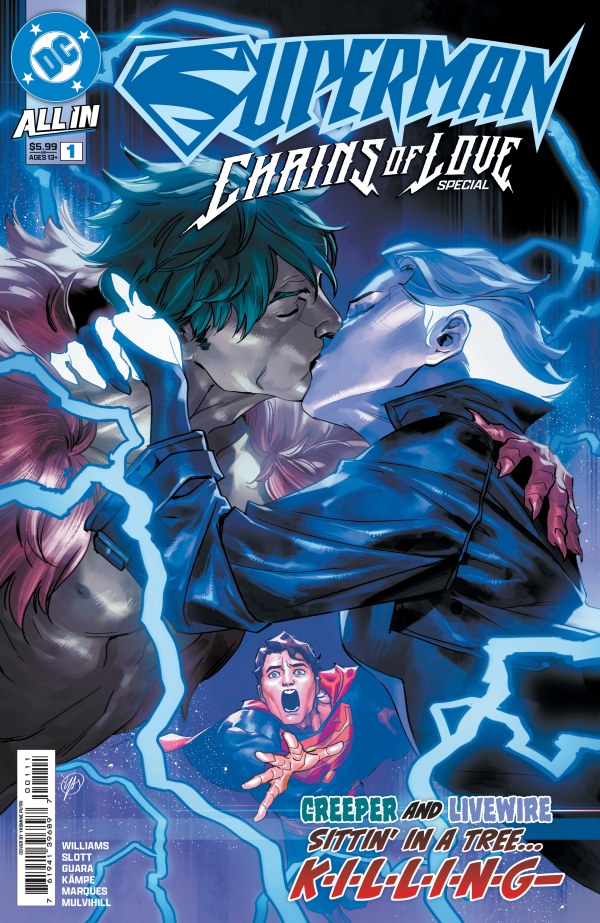
Superman: Chains of Love Special #1
Title: Creepers
Writer: Leah Williams
Art: Ig Guarra
Main Cover: Yasmine Putri
Just in time for Valentine’s Day, we get this one-shot. Livewire is being paroled from prison, but her years away have left her without her audience…until she stumbles into the Creeper, who finds a way to help her climb back to prominence. And then, with love in the air, the sparks fly.
It’s a cute enough story – questions of continuity aside (Livewire says early that she’s “from the 90s,” which feels a little meta), the two characters have an interesting chemistry that actually plays out in an entertaining way. Superman’s presence in the story is minimal however, mostly there for structure in the new environment that Leslie Willis finds herself in. But I guess DC (correctly) assumed that branding this as a Superman special rather than a Creeper/Livewire special would get more readers.
Title: Bill Zarro’s World
Writer: Dan Slott
Art: Rosi Kampe
Dan Slott and Rosi Kampe also come through with a back-up story in this issue. Bill Zarro is a lowly peon working at the Daily Planet. His boss is a jerk, his wife resents him, his kids disdain him…until one day he wakes up on Bizarro World, and everything changes. This is a short story that’s essentially an extended gag piece that builds up to an unusual and amusing punchline. The ending is funny enough to make the story worth recommending.
Absolute Superman #16
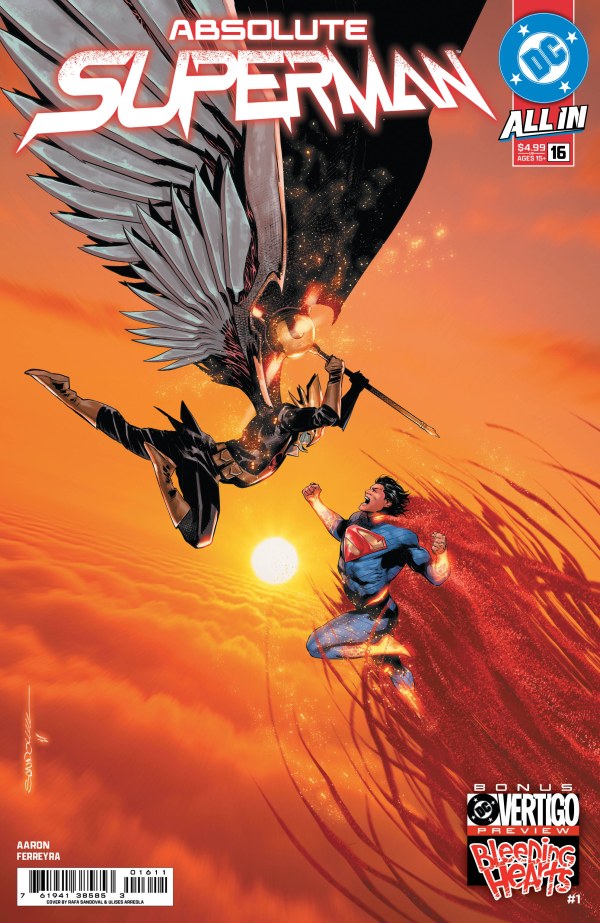
Title: The Never-Ending Begins Part Two: This Universe Will Break Your Heart, Kid
Writer: Jason Aaron
Art: Juan Ferreyra
Main Cover: Rafa Sandoval
This issue brings us the full introduction of a new Absolute Universe hero as Superman is approached by the mysterious Hawkman. This version of Carter Hall has been around for a long time, and initially doesn’t know what to make of this newcomer with all of the powers. We also see Lois as she tries to find a new direction in the wake of her departure from the espionage game, a new version of another classic character, and the recruitment of Lex Luthor continuing unabated.
Here’s something that I haven’t really said before about many of the Absolute comics: this issue is surprisingly funny. The first couple of pages in which Superman and Hawkman meet in midair are punctuated by Kal-El getting distracted by disasters both minor and major and then zipping off to deal with them and leaving Hawkman flapping his wings. The introduction to this new Hawkman works really well. It can be easy to forget that this “young” universe is still a universe, with a history all of its own, and Hawkman feels like a great opportunity to explore that a little bit more.
The Lois story has some humor as well. For a while it didn’t seem as though this book was going to brush much on the traditional Superman status quo at all, but here we’ve got Lois and Jimmy looking into being reporters, the introduction of the Daily Planet, and the debut of one Perry White. Even there, though, we see the influence of Darkseid on this world. The Planet ain’t the grand old dame she is in the main DC Universe, and although Perry has the same sort of grit you’d want from the character, it comes with more grime than one would usually expect. The way this is structured he may be a one-off character, but I really hope that’s not the case. I feel like there’s a lot of potential here, especially in having him interact with Lois.
Even the Lex Luthor scene is darkly comedic. The Absolute Luthor – with a proud shock of red hair and a burly beard, is a man utterly happy and content in his simple like. The difference between him and “our” Lex Luthor is perhaps more striking than any other Absolute character we’ve met yet, which is amusing, but at the same time, seems poised to bring him to a bitter, heartbreaking end.
Or not. Aaron has been surprising me a lot with this book.
Juan Ferreyra handles both the line art and colors for this book, and I really like his work. The flashback scenes, showing some of Carter’s adventures in the 40s, have a nice sort of archaic look to them. In the modern scenes, where he and Kal-El meet, he does this really interesting blur effect to show Superman zipping into action. It’s not wholly unique – I’ve seen similar effects from other artists – but his execution is great. I’m also a big fan of the monster designs from later in the issue, and his battle scenes look stunning.
We’re on the second issue of this new story arc, and it’s honestly shaping up to be my favorite from the series so far. It’s brighter somehow, and while that may be a deviation from the whole ethos of the Absolute Universe, I feel like that’s kind of the point. A Superman – a REAL Superman – should always be the bright spot in his world, no matter how dark the world itself may be.
Blake M. Petit is a writer, teacher, and dad from Ama, Louisiana. His most recent writing project is the superhero adventure series Other People’s Heroes: Little Stars, volume one of which is now available on Amazon. Don’t forget, you can check out earlier blogs in the Year of Superman/Superman Stuff Archive! Got a request for a future “Superman Stuff”? Drop it in the comments!
I don’t want every “Superman Stuff” post to be comic book recaps, hence last week’s post where I talked about the upcoming Spider-Man/Superman and Bizarro: Year None announcements. That said, one of the reasons I wanted to keep this going was so that I could keep talking about the NEW Superman comics as they come out. With that in mind, this week I’m going to give my feelings on some of the Superman-related comics that have been published so far in 2026.
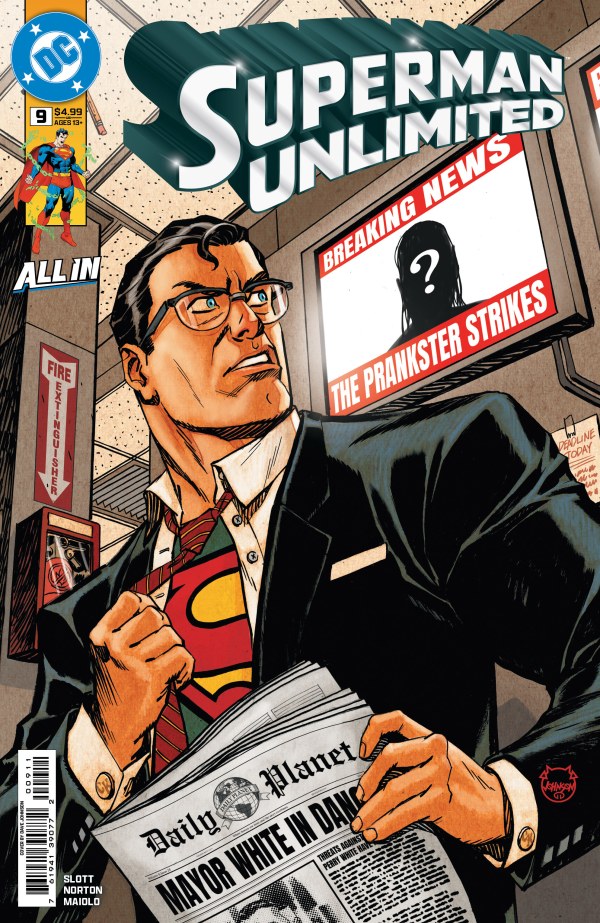
Superman Unlimited#9
Title: Die Laughing Part One
Writer: Dan Slott
Artist: Mike Norton
Main Cover: Dave Johnson
A series of strange deaths strikes Metropolis, and although they could be accidental, there’s something that makes it feel like they’re linked to an old foe of Superman’s. (I realize I’m playing coy with who the villain is, and they name drop him on the cover, so I guess that’s a little pointless.) Meanwhile, Metropolis’s new Mayor Perry White finds himself a target, and at Steelworks, Jon Kent gets an important warning from a very unexpected source.
There is a LOT of stuff going on in this issue. The main plot regarding Perry White is the through-line, but the story of Jon at Steelworks feels like there’s more going on than is readily apparent, and the ongoing story of the massive Kryptonite meteor that’s fallen to Earth is woven in through what happens in the other plots. What’s more, we also get to see a classic foe and a new collaborator show up here in ways that feel like there’s a lot of story to tell. The way this book is packed is honestly reminiscent of the way stories were structured during the much-missed Triangle Era, and as I read this I felt those pangs of regret that I’m going to have to wait a month for this storyline to continue rather than just one week.
Slott does some of the little character bits he’s so good at here. For instance, we see Clark Kent at a press conference by Mayor Perry White where he acts just like he’s asking questions to any random elected official, and Perry humorously reminds him that he doesn’t exactly have to introduce himself. It’s funny, but it also brings up the idea that it’s kind of unethical to send a reporter to cover a press conference when the guy at the podium happens to be godfather of the reporter’s son. Then again, Clark has been reporting on himself for almost 90 years now, so…
Mike Norton steps up for the artwork this issue, and it makes me wish we saw him drawing Superman more often. His lines are clean and bold, very reminiscent of the style we saw from the likes of Dan Jurgens or Jerry Orway back in the day. Having him on this book feels very, very right. I hope we get to see more of his work on Superman in the future.
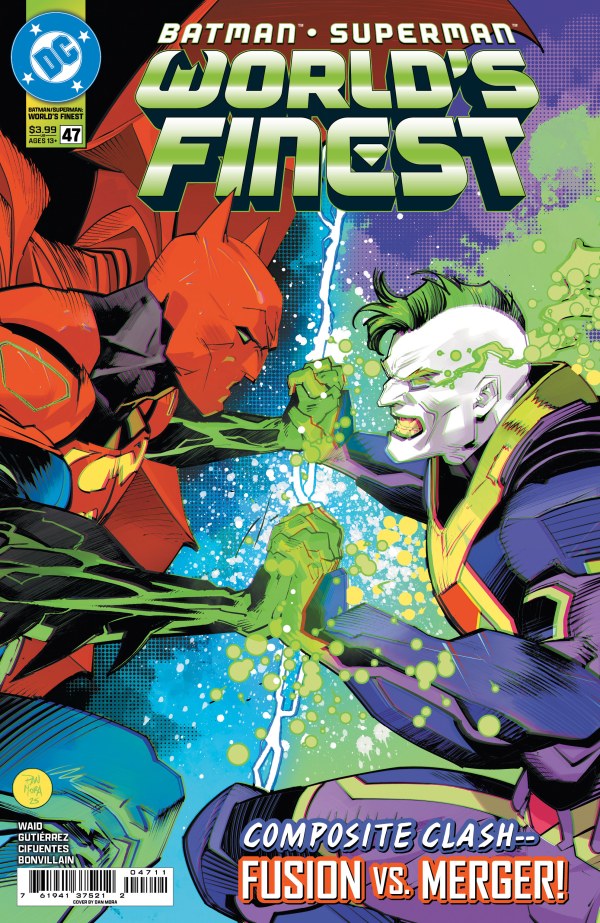
Batman/Superman: World’s Finest #47
Title: The Merger Part Three: Truth and Consequences
Writer: Mark Waid
Pencils: Adrian Gutierrez
Inks: Vicente Cifuentes
Main Cover: Dan Mora
Fusion – the merged form of Superman and Batman – is in battle with Merger, the Lex Luthor/Joker mashup. And if that wasn’t bad enough, Merger has used Hawkman’s Absorbascon to learn the identities of our heroes and transmit that information all over the planet. Fortunately, Fusion has a whole Justice League to back them up.
I’ve loved this book since day one, because Mark Waid is clearly having a lot of fun playing around with all these classic pieces of the DC Universe. World’s Finest is set several years in the past, so when the secret is revealed we get to see some things that wouldn’t happen if this story were set today: a more villainous Poison Ivy going after Alfred, or a Lois Lane who is heartbroken to realize that Superman has been hiding under her nose all this time. Waid writes these moments very well, with compelling character work, especially in the Lois Lane scene.
That said, he’s walking a tightrope here, playing with what they sometimes call “Schmuck Bait.” It’s when a story (particularly in an ongoing franchise) teases a development that you know will not or cannot stick. In this case, we know with 100 percent certainty before the issue even begins that the secrets of Superman and Batman’s respective identities will go back in the box, so that lowers the stakes dramatically. The trick is to use this to milk good character beats that will retain their significance even once the actual plot is reversed. He manages to do that here, and even ends the issue with a new little wrinkle that could be brought back later, either in the pages of this book, or in other DC titles set in the current continuity. Either way, there’s potential there.
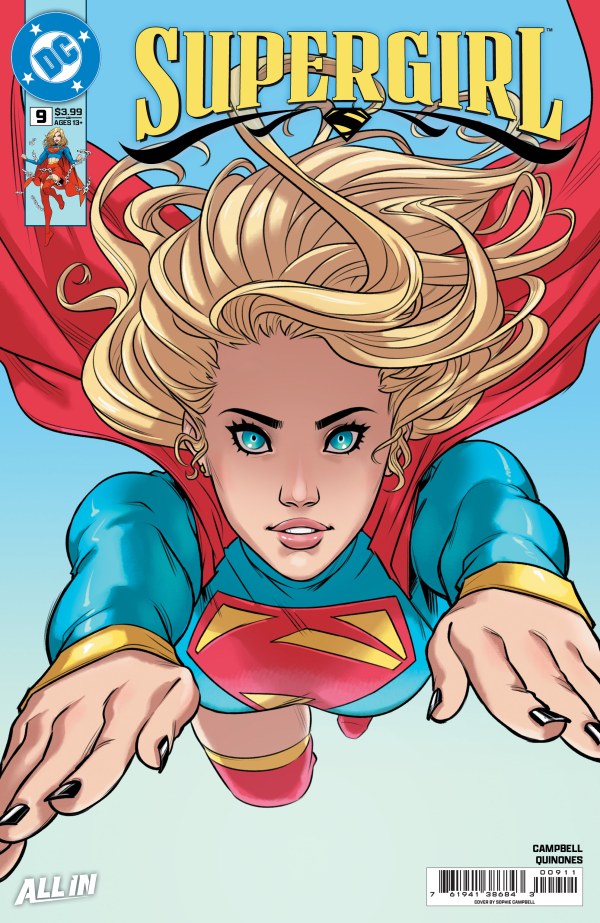
Supergirl Vol. 8 #9
Title: Resolutions
Writer: Sophie Campbell
Art: Joe Quinones
Main Cover: Sophie Campbell
Continuing the holiday kick this book has been on (the last three issues have been Halloween, Thanksgiving, and Christmas stories, respectively), it’s New Year’s Eve in Midvale, and Supergirl’s squad has been invited to a booze-free party to ring the year in. Lesla, unfamiliar with the effects of alcohol in the first place, is a bit disappointed to learn that it wouldn’t have any effect on her Kryptonian physiology. Lena has an idea for how to fix that little problem. Chaos ensues.
I have to admit, I didn’t see this issue coming. The first half comes across as Campbell trying to do an 80s style “very special episode” about the consequences of drinking, which would actually fit very well in what we’ve gotten from this series so far. The second half, however, takes a rather wild left turn when those consequences actually begin to stack. Stuff happens in this issue that drives a severe wedge in the family of friends Supergirl has built up around her, and I frankly didn’t see it coming. What’s more, Kara herself comes across as kind of cold in this issue – outwardly, at least. The reader gets to see her agonizing over the choices she makes and the way that she’s forced to push away her friends, but to those friends themselves she puts on a face of stoicism that’s really unexpected. Particularly in the case of Lesla, who is arguably a victim here, Kara doesn’t show the usual compassion that we get from her. I’ve been a big supporter of this book, but this is the first issue that feels like a misstep.
I’ve got no such complaints about the artwork, however. Campbell’s work on this title is great, but whenever she steps aside, they can bring in Joe Quinones to pinch-hit. I love his take on Kara and the rest of the cast, and I especially would like to see more of his version of Kandor.
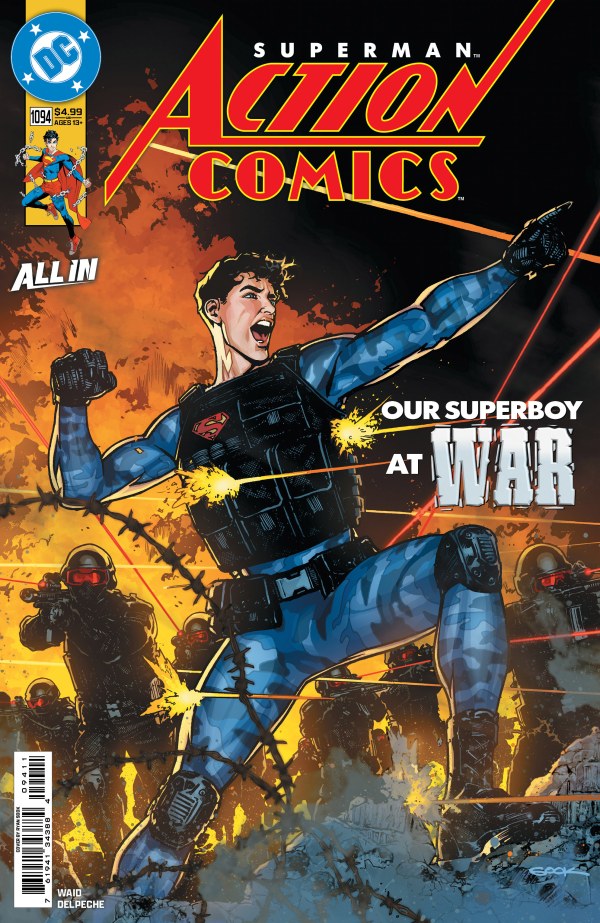
Action Comics#1094
Title: Our Superboy at War
Writer: Mark Waid
Art: Patricio Delpeche
Main Cover: Ryan Sook
This is an interesting one. The main story here is Superboy – in conjunction with his arrangement with General Sam Lane – being summoned to help with a military operation. Although that’s the A-plot, it’s also the least interesting part of the issue to me. That’s not to say that it’s not handled well – Mark Waid taps into the psyche of Clark Kent and has him go through this storyline in a way that feels very accurate for the character. The issue is that it’s very by-the-book. The beats are predictable, as are Clark’s reactions. I suppose that’s the thing about understanding a character really well – sometimes it can make certain stories feel very rote.
The b-plots in this issue are much more interesting to me. In the early part of the book, Clark has a study date (of sorts) with Lana Lang, and we’re teased with a strange animosity her father has for Clark. In the latter part, he goes on a camping trip with Pete Ross and laments the fact that there’s nobody he can share his secrets with. Both of these segments, to me, were far more satisfying than the A-plot. In each case, Waid is using established elements of the two characters to build them out a bit. For instance, Lana’s father being an archaeologist is a long-standing and well-known piece of the lore, but Waid seems to be using it here in a way that feels somewhat menacing, as though that status has a dark secret that’s going to cause trouble down the line. Pete, on the other hand, is famous for being the character who (in the Silver Age) knows that Clark is Superboy, but doesn’t tell anybody – not even Superboy himself. It definitely seems like we’re trending in that direction, but I trust Waid to do more with the concept than previous writers did. In the meantime, it’s really sad to see Clark upset about his big secret and the fact that there’s nobody else that could possibly understand what it’s like to have his kind of power.
Dang, if only he had some friends. If only he had a Legion of them or something.
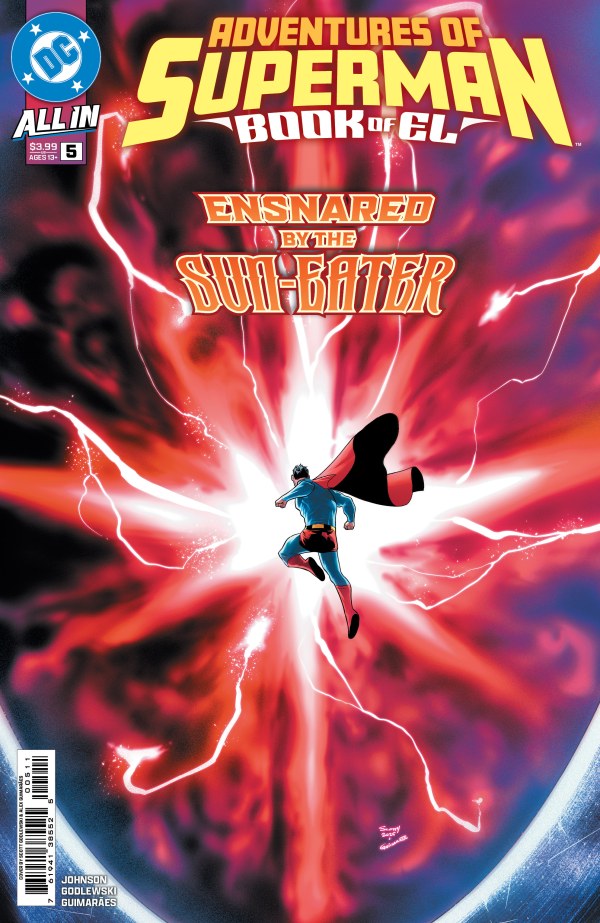
Adventures of Superman: House of El#5
Title: I Am the Lantern in the Dark
Writer: Phillip Kennedy Johnson
Art: Scott Godlewski
Main Cover: Scott Godlewski
A Sun-Eater has been unleashed on Lanternholm, the world that serves as the haven for the Lightborn. Superman and Ronan Kent join the fight alongside Ronan’s sister, Rowan. The Lanternholm stuff has actually been the most interesting part of this series yet to me, and I’m glad to see it take center stage in this issue. The DC Universe, let’s face it, has a LOT of potential futures. Some of them are easily compatible with one another, others require a bit more shoehorning to fit in, and this future in particular is at best going to be relegated to an alternate timeline in which Superman never comes home because – come on, let’s be honest here – we know that Superman is going to come home. It’s another example of that Schmuck Bait I mentioned earlier.
But that’s something that could theoretically be used to the story’s advantage. It is impossible for this future to be the “real” future of the DC Universe, so why not take some wilder, braver swings with it? I’d like to know more about what happened to the Lanterns in this future. I’d like to know more about what happens afterwards, with Rowan’s new status at the end of this issue. I’d read a miniseries about that, I’d read a miniseries about her. I’d be excited for it.
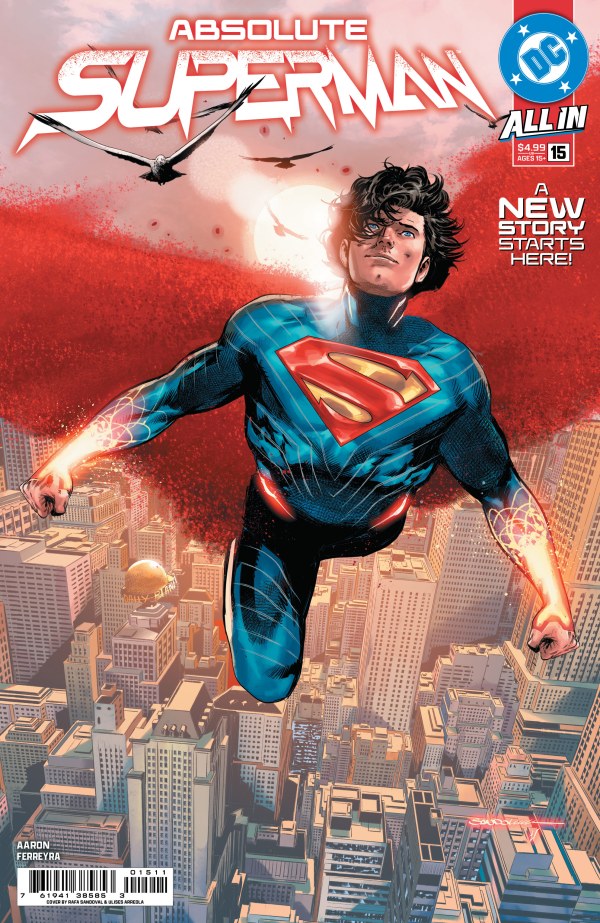
Absolute Superman #15
Title: The Never-Ending Begins Part One: In Blue
Writer: Jason Aaron
Art: Juan Ferreyra
Main Cover: Rafa Sandoval
A new storyline kicks off this issue, although it kicks off in a very low-key way. After the huge win at the end of last issue, Kal-El is trying to settle in, taking over the Kents’ farm and running it the way they would have wanted while, at the same time, operating as Superman around the world. Of course, as the beginning of a new story, new threats are coming in as well, and we see the seeds for a few things planted here.
It’s nice to have something of a breather this issue, as we see Kal-El spending time with a lot of people, exploring his relationships with both Lois Lane AND Lana Lang, and interestingly enough, even Ra’s Al Ghul. There’s shoe leather to be expended here, building on who each of these people is to our new Superman. What I really like, though, is the direction this series is trending. Clark has traded in his Kryptonian suit for a uniform made for him by Martha, a uniform that speaks to a brighter future for the character. The Absolute Universe is one where Darkseid’s ethos reigns supreme and hope is the underdog…but despite that, Superman still acts as a symbol of that hope, and this issue continues to demonstrate that.
We also get the first appearance of the Absolute version of one of Superman’s oldest foes, and he’s taken in a very different direction. The Toyman has gone through several incarnations over the years. This one is different from any of them, but it suits the universe we’re living in and still fits the concept of the character fairly well. We also get a cameo by next issue’s big guest star, Hawkman, and recent comments by Scott Snyder that we’ll see a gathering of heroes in this universe sooner or later feel like they’re inching closer to fruition.
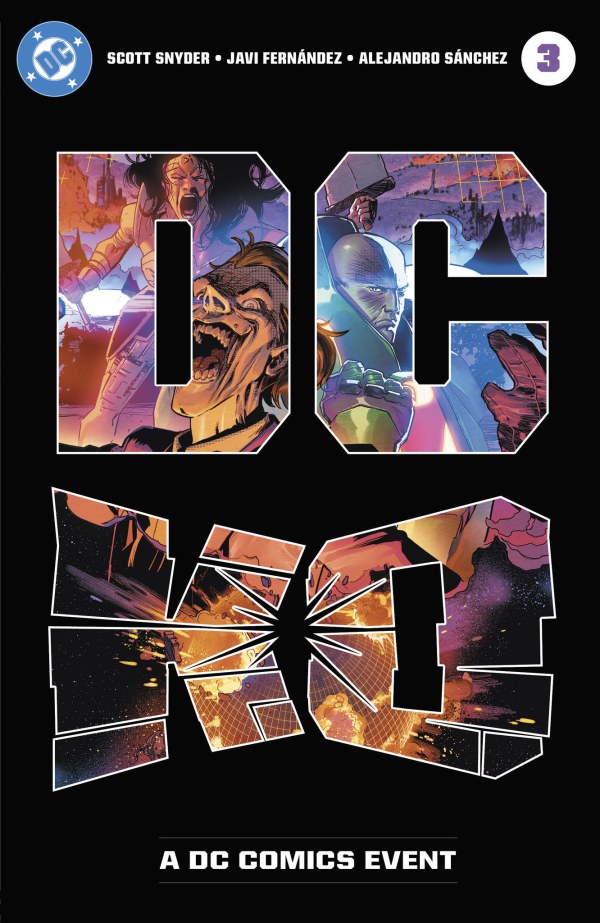
DC KO #3
Title: No Mercy
Writers: Scott Snyder & Joshua Williamson
Art: Javi Fernandez & Xermancio
Main Cover: Javi Fernandez
Following December’s “All Fight Month” event, the combatants in the KO tournament have been narrowed down to an “Elite Eight.” The remaining fighters are each given an opportunity to choose a partner to fight alongside in the next battle. However, the one fighter who generated the MOST Omega Energy gets a special prize – their partner may come from ANY level of reality…and that winner is the Joker.
Much as the “All Fight” issues were at their best when used as an examination of character, even the selection of the heroes’ partners serves that same purpose. Some of them are obvious, some of them are understandable, and some of them are baffling. All of them demonstrate something about the character who makes the choice, and it’s writing like that which has elevated DC KO from being just a mindless slugfest into one of the most compelling events the DC Universe has had in ages.
There’s a running commentary from the Heart of Apokalips throughout the story that focuses heavily on Superman as well – what’s going on in his head, how he’s dealing with the battle, how he handles the fact that he’s got to fight, kill, perhaps even use his friends. What’s more, from the beginning the idea has been that it was okay for the heroes to die or to kill in pursuit of winning the tournament, because whoever wins and gets the Omega Energy at the end will have the ability to reset the universe and fix everything. This issue Snyder really starts to explore what that would actually MEAN. Would anyone – even Superman – have the wherewithal to only turn the clock back to before the tournament, or would that temptation to make the world unto what he thinks would be paradise be too tantalizing?
Also, there are a couple of moments in this issue that are gonna make for great action figures.
Blake M. Petit is a writer, teacher, and dad from Ama, Louisiana. His most recent writing project is the superhero adventure series Other People’s Heroes: Little Stars, volume one of which is now available on Amazon. Don’t forget, you can check out earlier blogs in the Year of Superman/Superman Stuff Archive! Got a request for a future “Superman Stuff”? Drop it in the comments!
I’m writing this on Christmas morning, sitting amongst piles of wrapping paper and the mountain of Hot Wheels that Santa Claus brought Eddie, The Muppet Christmas Carol on TV because it’s not time for football yet. But it’s also the first day of the final chapter. After 51 weeks in which I have watched, read, or listened to at least one piece of Superman-related media every single day, no matter what life had in store for me, I’ve only got seven days left to reach the finish line.

I’m going to think of this week as “the best of the rest.” I’m going to try to read and watch some of my favorite or some of the most significant stories remaining on the gargantuan list I started the year with. And make no mistake, that list is still pretty big. I haven’t gotten close to scratching off all of it. So perhaps, just perhaps, when I reach New Year’s Day, my journey with Superman won’t be ending, but merely evolving.
But time for that later. Let’s get started.
And as always, you can check out earlier blogs in the Year of Superman Archive!
Thur., Dec. 25
Comics: Superman Smashes the Klan #1-3, DC Go! Holiday Special #32

Notes: A few weeks ago I listened to the radio serial “Superman Versus the Clan of the Fiery Cross.” In 2019, writer Gene Luen Yang and artist Gurihiru loosely adapted that storyline into a three-issue miniseries, Superman Smashes the Klan, that kept the skeleton of the original story, but added some new elements that really made for one of those evergreen graphic novels that will be read for a very long time.
Set in the days after World War II, the story kicks off with a Golden Age-style Superman polishing off a leftover Nazi calling himself Atom Man. The fight is tougher than it should be, as Atom Man is powered by a glowing green crystal that Superman has encountered before, that makes him weak and sick. We soon discover that this is a very young Superman who does not yet know the truth of his alien origins. Something is nagging at him, and he sees an odd vision of himself in the mirror looking like a creature from outer space. Meanwhile the Lee family – Dr. Lee, his wife, and their children Tommy and Roberta – is moving from the Chinatown section of Metropolis to the city proper because Dr. Lee is starting a new job as Chief Bacteriologist of the Metropolis Health Department. Their new neighbor, Jimmy Olsen, stops by to introduce himself and invite them to the Unity House Community Center baseball practice.
The story follows the plot of the radio show fairly well, but it adds in elements that weren’t present on the air. Superman learns in the course of this story that he’s an alien himself, giving an added dimension to the story of the Lees and their struggle to find acceptance in Metropolis. We’ve also got an original character, Tommy’s sister Roberta, who wasn’t in the original story but takes on a large part of the narrative. As the daughter of a Bacteriologist, Roberta is a bit of a germophobe, which only serves to enhance her existing awkward nature, making it much more difficult for her to acclimate to her new home. I like this angle a lot. Having Tommy fit in as a typical all-American boy worked well for the radio show. You didn’t even know that he WAS Chinese for the first few episodes, making the angle of the Klan come across as a surprise to the listener. But in a comic book, there’s no way to make that kind of thing a surprise. While Tommy is still that kid who everyone loves and blends in with the Unity House baseball team easily, Roberta gives us a character to depict the alienation that someone – especially a kid – can feel in this sort of situation. The idea in the original was just to point out how foolish the likes of the Klan were, and that’s all to the good, but Gene Luen Yang (himself a creator of Asian descent) brings a whole new dimension to the story by emphasizing the struggle of an immigrant family through Roberta’s perspective. Not to make it sound like she’s some damsel in distress, mind you. Roberta is Superman’s deuteragonist in this story. She overcomes her anxiety to help her brother, realizing very quickly that Chuck Riggs is involved with the Klan and using her knowledge to race to Tommy’s rescue. She also inspires Chuck’s change of heart much earlier than happens in the radio serial.
Tommy, on the other hand, perhaps tries a little TOO hard to fit in, leaning on his ethnicity in ways he didn’t in the original radio story. Once he becomes part of the Unity House baseball team he keeps dropping jokes about being Chinese (“Confucius says” references, for example), using what makes him different to enhance his popularity. Although he’s a good-natured kid, his insistence on drawing attention to being Chinese bothers his sister almost as much as the people who insult them.
Superman himself has yet another perspective on the immigrant experience. He knows he was adopted, and we see flashbacks of Jonathan showing him a strange device that was in the ship that brought him to Smallville, but it spoke a language they were never able to translate. He’s even gone so far as to mentally suppress some of his more fanciful powers, making for a nice explanation for why he goes from “leaping tall buildings” to outright flight.
Another addition to the story is the Atom Man subplot. After Superman captures Atom Man in the beginning, we see periodically that he’s not in police custody, but being studied by the Metropolis Health Department, a study that Dr. Lee clearly has misgivings about. Lois Lane – who had almost no presence in the original radio story – takes the lead on this one, cracking open the story about the “Health Department” which turns out to be a private enterprise conducting dubious research. Naturally, this turns out to dovetail with the story of the Klan in a rather unexpected way. This is one point I’m a little unsure about. Making the Klan a more high-tech organization, with “loftier” ideals than the simple bigotry of the original works for this version of the story, to be certain, but I’m not sure if it undermines the original point at all. Perhaps smarter people than I can answer that one.
The is a fantastic story – a bold, proud tale that does far more than simply adapt the original radio drama. Indeed, it ties the story of Tommy and Roberta Lee in with the core concept of Superman, making who they are as integral to the series as who he is. I can’t recommend this one highly enough.
Fri., Dec. 26
TV Episodes: Superman and Lois Season 4, Episodes 6-10
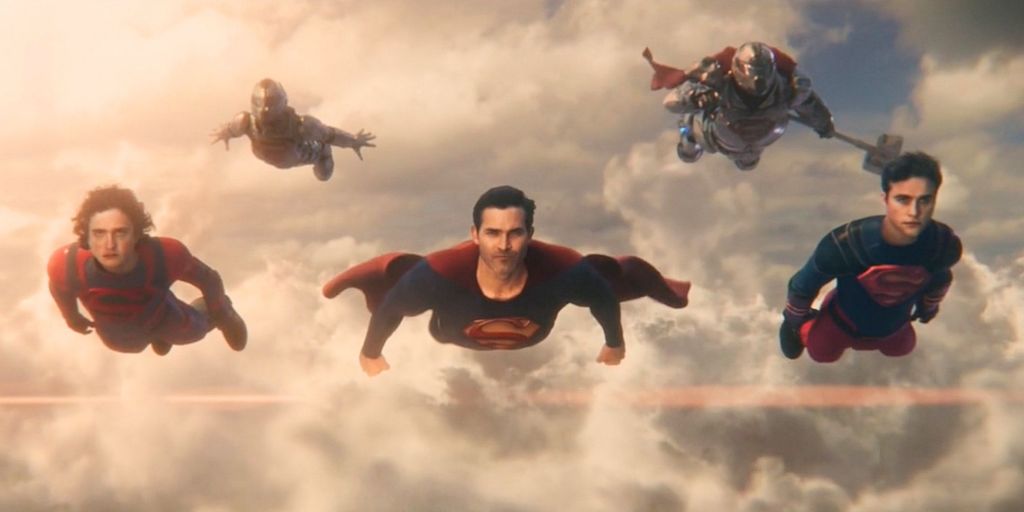
Notes: With my wife working and my son having a mountain of toys to play with and college football to watch, I decided that the day after Christmas was the time to finally finish the last season of Superman and Lois. I’m not going to to a play-by-play on these last five episodes, so let’s assume that you’ve watched these episodes that I’m watching for the first time, and I’m going to discuss my feelings about them as I watch.
In episode 6, we see Lex trying to tighten his grip on Smallville by buying up property and bribing the citizens, but they hold firm and resist – mostly because Clark wants them to do so. It’s a wonderful series of scenes in which Clark realizes something that viewers figured out several episodes ago: after seeing Lois and the boys run to Superman’s side after he was killed by Doomsday, the entire town of Smallville now knows that he’s really Superman. And best of all, every single one of them is willing to keep the secret and cover his back. It’s a great story beat, and actually one I’ve thought about several times over the years. Considering everything that he did for the town of Smallville, especially in those continuities where he had a career as Superboy, it would be utterly absurd if there weren’t a lot of people who deduced the truth. The fact that they keep the secret speaks to an inherent goodness in them, a loyalty to the hero who has saved them time and again. Plus, when we see him trying desperately to put the cat back in the bag, convincing people that he’s NOT Superman, it’s hilarious.
Of course, there’s gotta be some drama, and the fact of his identity leaking out predictably causes some problems – kids who are resentful of Jonathan and Jordan, an antagonist from an earlier season that comes back and causes trouble. The scene where someone takes a shot at him in a diner, forcing him to reveal himself, is just glorious, and it leads to the secret being revealed to the world. When that happened in the comics I hated it, because I knew this was a genie that had to go back in the bottle and we’d seen it before. But here, when it happens on a TV series that only has three episodes left, it’s an opportunity to tell a story that hasn’t been told with Superman before, and the creators nailed it.
Beyond that, of course, another big arc in this season is the fact that Clark now has Sam Lane’s heart, and it’s reducing his powers, causing him to age. At the same time, Luthor is planning his final revenge with the combination of a new super-suit (stolen from John Henry and beefed up with Kryptonite) and the return of his Doomsday monster. It all collides in the final episode, “It Went By So Fast,” a title which I can only assume was a meta way for the writers to indicate the fact that they didn’t really want the show to end. I get it, too – this last half-season, lower on the soap opera dramatics and higher on the Superman stuff, was really fantastic, and it’s leaving me wanting more.
They’ve done the Doomsday battle before in live action – in Smallville, in Batman V. Superman, and even before in this series…This is probably the best one I’ve ever seen. With Clark on the ropes, seeing Jonathan and Jordan step up to fight hits me in that parenting place that seems to dominate how I interpret stories these days. John Henry and Lana joining the fight as well shows how big Superman has become, how this world is rising up to meet him. He may have lost a step thanks to his heart transplant, but he’s also inspired another generation of heroes, meaning he doesn’t have to do it alone.
And that’s just act ONE of the finale.
While Clark is chucking Doomsday into the sun, back on Earth Lex attacks the twins and Lois goes after him directly. As she shouts at him to stop attacking everyone around her when she’s the one he really wants, she yells the most Lois Lane line I’ve ever heard: “I am not afraid of you, but you’ve always been TERRIFIED of me,” then nails his warsuit with a mine. It’s not enough to stop him, but it slows him down enough for Clark to make it back to Earth and really start the final battle. It’s an epic, airborne spectacle that ends, inevitably, with Luthor taken down.
And now we’re only HALFWAY through the episode.
Next we get a time skip to about year later with Lana’s wedding to John Henry Irons (an event that would happen a few months later in the comics as well). Kyle and Chrissy are expecting a second child, and Kyle and Lana have reconciled into what appears to be a sincere friendship. Jordan and Sarah, similarly, seem to have finally buried the hatchet, and John Henry spends a tender moment with Natalie as Lois gets an important text about Lex’s future behind bars.
In the final act, we get a voiceover from Clark about how Sam’s heart allowed him to live another 32 years, and how he wanted to leave behind a legacy, making the world a better place. Clark, along with the twins, John Henry, Natasha, even Bruno Mannheim, begin to make real change. Using the influence of Superman and Lois Lane, they start a foundation that accomplishes good throughout the world. The twins each marry and have kids of their own, and we get a nice scene of Grandma and Grandpa Lois and Clark (in admittedly dubious aging makeup). But eventually, Lois’s cancer returns, and Clark is left alone. He lasts for several more years before Sam Lane’s heart that had beat in his chest for so long finally gives out, passing away quietly with his sons next to him.
Clark sits up, young again, seeing his own body behind him. He embraces his sons – young again – and sees his grandchildren. He finds Luthor, of all people, sitting at his kitchen table, and offers him forgiveness…says goodbye to his friends one at a time, and in the end he sees a vision of Lois, waiting, to take him into the light.
Here’s the thing: the story of Superman doesn’t end. It just – it doesn’t. Five years from now, ten years, a hundred years from now, there will and should be new stories of Superman being told.
But if Superman DID end…this is the right way to do it. An ending that is happy in the life he and Lois get to lead, despite the fact that this life – like all those of mortals – must end. And the fact that a Superman left behind a better world than he arrived on in that spacecraft from Krypton. In the comic books, they can’t really do a story in which Superman changes the entire world this way, because they still need something to tell stories about next month and next year. But here, with a television series coming to an end and, with it, closing off the stories of that universe, they have the freedom to show what Superman is REALLY capable of. This season has been a buildup, showing how Superman inspires those around him – not only his own children or friends, but the people of Smallville who were willing to stand up for him, and the people of a world that grows to do the same. The ending of this episode is a tearjerker, but it’s left with a beautiful message of hope that is entirely appropriate for Superman.
But it’s not only hope. Superman is about hope, yes. But the thesis of this series is true as well: “[Love is] the thing that makes life worth living.” It’s what makes the story of Lois and Clark so powerful, in all its many iterations. A man from another world, a woman who represents the best of ours, and how they come together…this is a story worth telling.
Comics: DC Go! Holiday Special #41
Sat. Dec. 27
Comics: DC Go! Holiday Special #43 (Cameo), Detective Comics #1103, Superman: The Kryptonite Spectrum #5, Superman Unlimited #8, Action Comics #1093, Superman Vol. 6 #33, Absolute Superman #14, Batman/Superman: World’s Finest #46, Supergirl Vol. 8 #8, Justice League Unlimited Vol. 2 #14, Justice League Red #4 (Power Girl), Justice League Vs. Godzilla Vs. Kong 2 #5
Notes: For the final time (this year), I’m going to do a roundup of recent Superman-related comics, starting – oddly enough – with Detective Comics #1103. One of the first comics I read this year, back in the first week of January, was an issue of Tom Taylor’s Detective that showed Superman helping Bruce through an existential crisis. This actually serves as a nice bookend, with Bruce teaming up with Lois to help with an investigation. Superman appears briefly, but most of the issue is concerned with Lois showing off how dang capable she is, and how much respect Bruce has for her. It’s the middle of an ongoing storyline, so it’s probably not something most people would read on its own, but it’s worth mentioning because it’s a great Lois guest appearance.
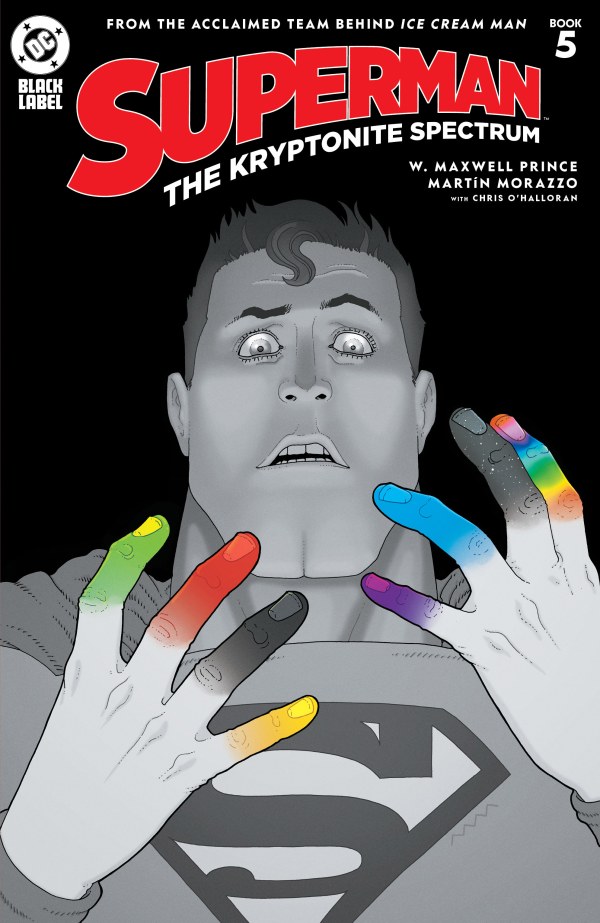
The final issue of Superman: The Kryptonite Spectrum wraps up W. Maxwell Prince and Martin Morazzo’s celebration of the Man of Steel in dynamite fashion. Lex Luthor has engineered a new Kryptonite Man, powered by the entire spectrum of the remnants of Superman’s home, and the battle between the two of them sends Superman on a spiral that leaves him questioning the very nature of the universe itself. Prince’s story leans heavily on metafiction, concentrating on Superman as a story and weaponizing that part of the character’s nature. The finale is entirely unexpected, but in its own way, as sincere a love letter to Superman as the likes of All Star Superman was – in fact, Prince and Morazzo lean heavily on Morrison and Quitely’s story here, and they do so in a way that’s both loving and triumphant. This is hands-down the miniseries of the year.
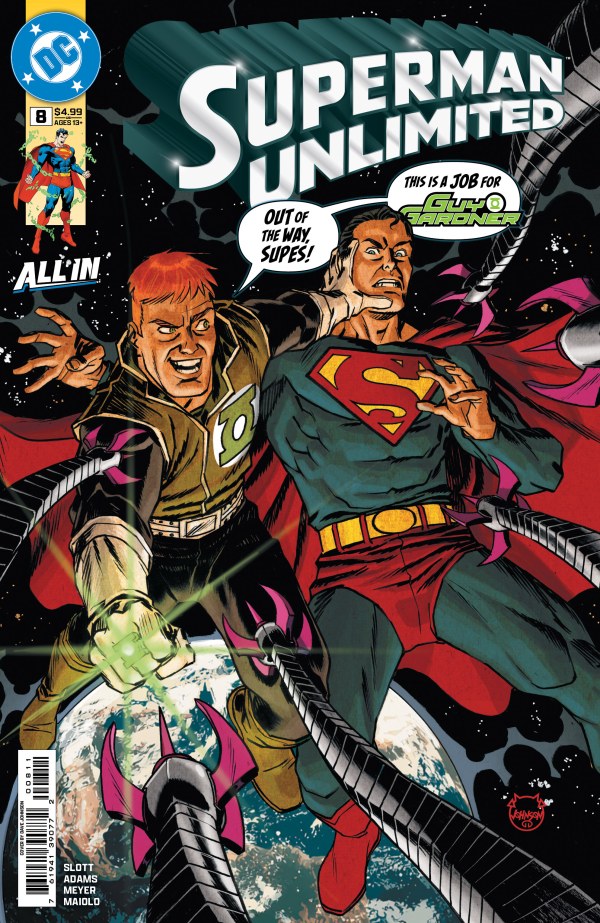
Superman Unlimited #8 gives us another of the one-off stories that this series has been doing so well. The influx of Kryptonite on Earth has changed a lot of things, including energy sources, and an experimental space flight is planning to make faster-than-light travel a commercial enterprise on Earth. With Lois Lane as a passenger on the maiden voyage, the Justice League assigns Guy Gardner to escort the flight in case something should happen. And wouldn’t you know it? Something happens. I have no doubt that Guy’s appearance in this issue is at least partially due to his guest-starring role in this summer’s big movie, but at the same time, it’s done exceptionally well. Guy is such a fun character – a rude, insufferable boor that is in every way diametrically the opposite of Superman…except for the fact that they’re both true heroes at heart. Seeing them together, both clashing and cooperating, pretty much always makes for a good time, and this issue is no exception.
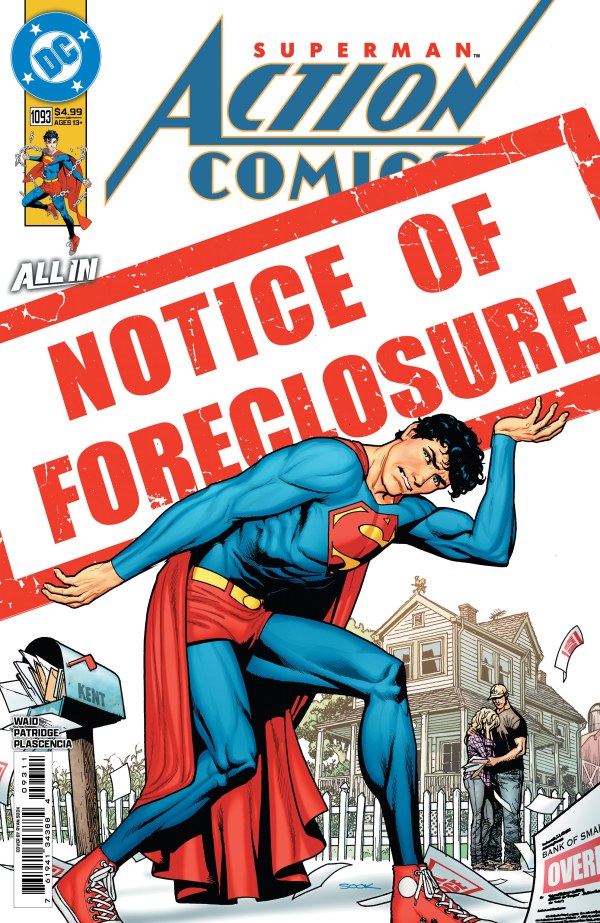
Action Comics #1093 is another one-off story, this time Mark Waid telling a Superboy tale that shows an event that’s fundamental to Superman’s moral core. Dozens of farmers throughout Smallville are given notices of foreclosure on their farms at the same time. The new owner of the bank assures them that if there’s an “error” they’ll figure it out, but the time it would take to do so would ruin every farm in Smallville. When Superboy contemplates using his power to “find” the money to save the town, it becomes a battle of wills between Clark and his parents, who think that using his powers for personal gain – even to save the town – isn’t the way to go. I’m sure that everyone who’s ever read a Superman comic has fantasized about having the power to hunt down undiscovered gold or some other get rich quick scheme, and Waid does a good job with the Kents of painting a picture of why such a thing should be above a Superman. I still have to confess that I’d probably go dig up the gold if I had Superboy’s powers, but in my defense, nobody has ever called me Earth’s greatest hero.
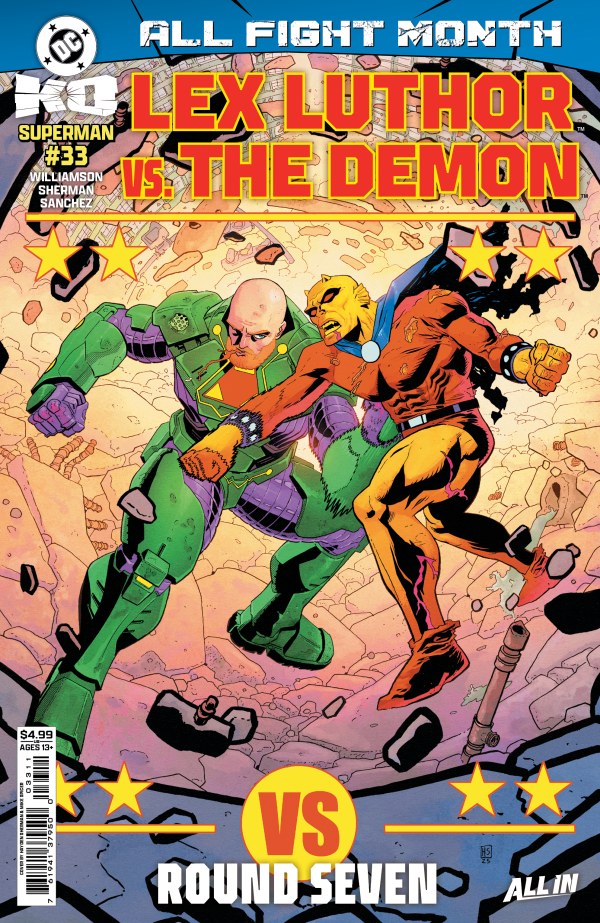
DC KO’s “All Fight Month” continues with Superman #33, with the unlikely battle between Lex Luthor and Etrigan the Demon. Throughout the month I’ve been impressed at just how well these battles have transcended being mere slugfests. Oh, there’s fightin’ a-plenty, but each of them has gone beyond that to telling a story that digs into the heart of the characters involved. We see who they are, why they do what they do, and what makes them worthy of the Omega Heart, even if it’s only in their own mind. Joshua Williamson taps into the blackness in Lex’s heart and simultaneously shines a light on him. By the end of the issue, you almost (aaaaalmost) want to root for him in his fight with the Demon, because damned if he doesn’t convince you that he’s earned the win. We also continue the storyline with Superboy-Prime and Lois, whose Superwoman powers have returned, in the Fortress of Solitude. Recent announcements about the state of the Superman titles after KO ends have made these pages a bit more relevant than we’d realized, and although I hate the fact that they keep spoiling things in the solicits, I’m very curious to see what’s coming next to this title.

Absolute Superman #14 ends the current storyline with an epic battle between Kal-El and Ra’s Al Ghul for the heart of Smallville. As the two of them go at it, we see Lois facing off against the Peacemakers and Sol’s internal battle with Brainiac, all of which come to an amazing crescendo in this issue. Without going into a blow-by-blow, the ending of this one is probably the most hopeful thing I’ve seen yet in the Absolute Universe as a whole, although as suits this world tainted by Darkseid’s energy, the victory is bittersweet and not without a price. In many ways, it clears the table for this series, and it will be very interesting to see where the story goes from here.

World’s Finest #46 continues the story of Lex Luthor and the Joker, fused into a single being and armed with the power of a device that gives them the sum total of all knowledge in the human race. Superman and Batman, naturally, have to step up and stop them, this time getting a little extra help from Green Lantern to juice them up in a way he’s done once before. The issue ends on a cliffhanger, and it’s a pretty good one, except for the fact that it suffers a bit from Prequelitis. Admittedly, even in the present day what happens at the end would likely be wiped out by the next issue, but when you’re dealing with a series set in the past, there’s really zero tension with the “shocking” ending. It’s still a great, fun story, though.
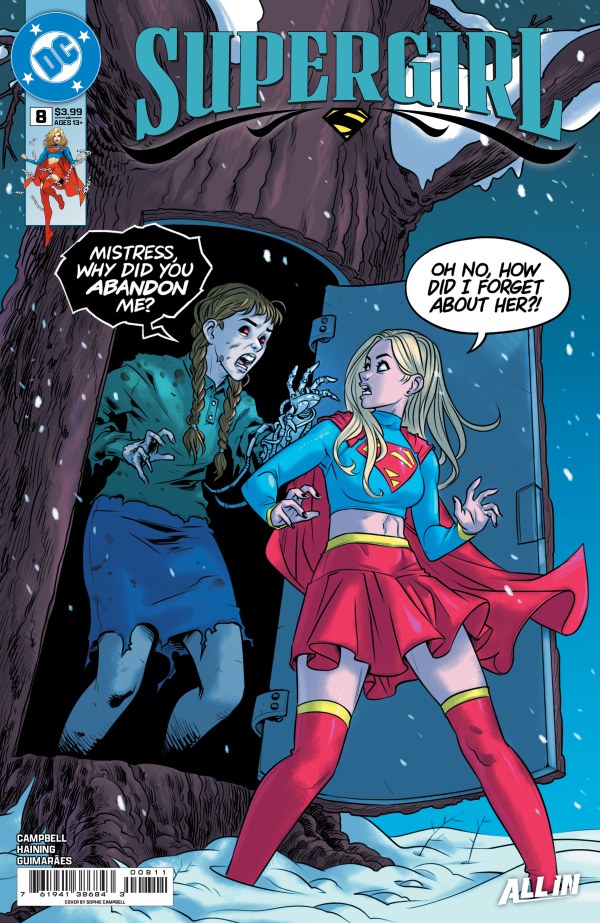
I’m going to end my tour of new comics with Supergirl #8. It’s Christmas in Midvale, but Supergirl isn’t feeling merry. The holidays, with their emphasis on family, always make her remember everything she lost in the destruction of Argo City. Still, the Danvers and Lesla-Lar do their best to cheer her up, even as they get a strange visitor from the past that Supergirl has neglected for far too long. Sophie Campbell’s Supergirl is probably my favorite new comic book title of the year, but this issue is a little atypical. While the series is usually very bright and uplifting, this issue is somewhat darker and more bittersweet, particularly for a Christmas story. That said, it works really well. Sophie takes Kara’s pain and shapes it into a valuable lesson for Lesla-Lar, whose journey to becoming a superhero is an important component of this title. The story is told well and propels the characters forward, while still giving us a little Christmas cheer in the process.
This is most likely the last I’ll talk about newly-released comics in the Year of Superman, and it’s bittersweet for me too. I’d be lying if I said I wasn’t looking forward to taking a break on January 1st, but at the same time, I’ve enjoyed pontificating about these new issues as they come out. It’s one of the main reasons I’m thinking about how to continue this blog into the new year.
Yeah, I’m teasing that again. Sue me.
Sun. Dec. 28
Comics: Superman: Space Age #1-3
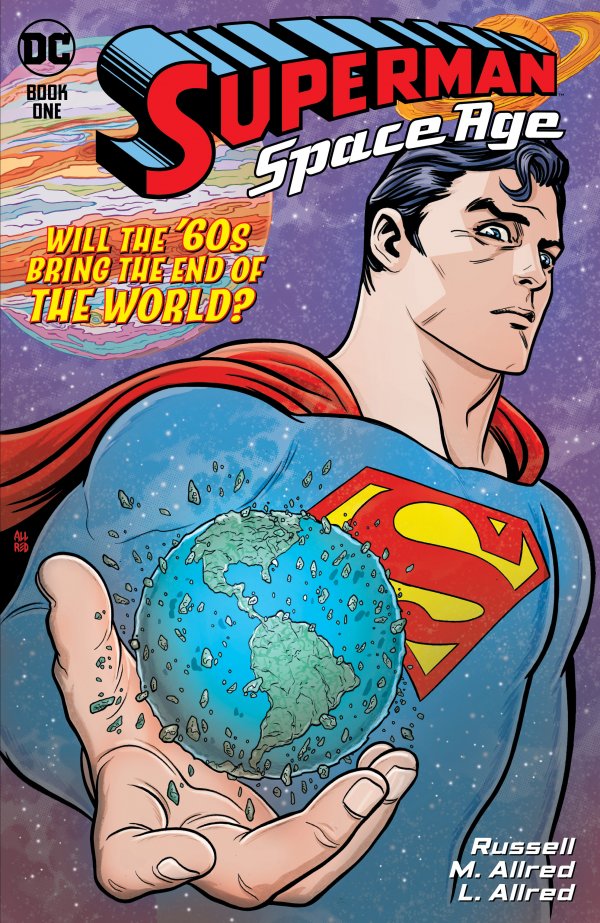
Notes: Continuing the theme of “Endings,” today I’ve decided to revisit the three-issue Space Age miniseries by Mark Russell and Michael Allred from 2022. Published as a Black Label series, like many of them, it really feels more like an Elseworlds. It’s set in a universe where Superman rises to prominence in the 1960s, with a Clark Kent that’s spurred to go out and find ways to save the world following the assassination of John F. Kennedy. Before he puts on his costume for the first time, though, he encounters a strange man called the Pariah, who warns him that the world will end in approximately twenty years. Pariah claims to have accidentally unleashed a great evil called the Anti-Monitor, an ancient being whose goal is to bring order to the Multiverse by destroying every positive-matter universe until only his own Antimatter universe remains. He tries to dismiss the Pariah as one of the “kranks” he’s assigned to cover as a Daily Planet cub reporter, but something about him sticks with Clark and he’s unable to shake it. On the other hand, he’s sometimes skeptical that the world will even last 20 years, as the arms race is intensifying and made worse by a false flag attack on Coast City orchestrated by Lex Luthor. The cataclysm turns out to bring heroes out of the woodwork: Batman captures Luthor, Abin Sur passes his ring on to Hal Jordan, Themiscyra sends Diana to the UN as an ambassador, and Superman makes his true debut disposing of American missiles before they can annihilate the Soviet Union. Book one ends with these four coming together at a new Hall of Justice.
In book two, we jump ahead to the 70s, where Superman is well-established, and the world is at peace following a nuclear disarmament treaty. But an interview with Lois leaves him questioning whether he’s doing all he can, and a similar disagreement drives a wedge in the Justice League. It’s a bad time for it too, as Green Lantern warns of the impending approach of a cosmic threat called Brainiac and, at the same time, a Superman from an alternate universe where all human life has been rendered extinct. It’s not all bad news, though – Clark is promoted to an editor’s desk at the Planet, Lois breaks Watergate, the two of them fall in love and she confesses that she knows he’s Superman just before he tells her. They even have time to get married and have a son before Brainiac arrives on Earth. But he’s not there to destroy the world, only to take its greatest resource before the Anti-Monitor can destroy it himself, hoping to use that resource in his battle against the Multiversal destroyer. That resource, as it turns out, is Kal-El of Krypton. The League drives Brainiac off the planet, but at the cost of Green Lantern’s life.
The final book in the trilogy takes us into the 80s where Clark finds Pariah again, who is impressed by his years of heroism, but still sees the end as inevitable. With less than two years before the Anti-Monitor arrives, the Brainiacs again ask Superman to join their fight, and this time, he considers it – but when a heart attack fells Johnathan Kent, he changes path, dedicating himself to saving the human race by eradicating disease by scanning their DNA. It turns out to be a ploy to record their genetic code. When the Anti-Monitor destroys the world, Superman makes for the Brainiacs’ portal, but instead of going into it he pushes through a crystal encoded with the DNA of every human he could collect, sending them to the empty world populated by the other Superman. He returns to his family just before the end, where on the other world the other Superman restores the human race on a new home.
In terms of “ending stories,” I kind of have mixed feelings about this one. On the one hand, it’s excellently done. The writing and storytelling are top-notch and the characters, even in the Elseworlds setting, still feel mostly true to the heroes we know and love. And I’ll pretty much always be on-board for artwork by Mike Allred, whose unique style is one of my favorites of all time. On the other hand, there’s an impending sense of doom that spreads across the entire thing. There are other dark “final” Superman stories, like Kingdom Come or Whatever Happened to the Man of Tomorrow?, but in both those cases we journey through the darkness with Superman and ultimately end in a place of hope. This one has a sense of nihilism that doesn’t quite befit the character. Even the ending, where the other Superman brings back humanity (starting, naturally, with Lois Lane), leaves us with the feeling that it’s only buying time. After all, the Anti-Monitor is still out there, the final battle has yet to be fought, let alone won.
The series raises some interesting questions as the different Leaguers look on things with different perspectives. Green Arrow views the world through the perspective of the “Trolley Problem,” whereas Batman’s point of view is that he just saves whoever he can, knowing he can’t save everyone. Superman, as fits the character, refuses to accept that, and is determined to find a way to save everyone even if doing so seems impossible. It’s a noble point of view that works in the regular DCU, but Russell shines a light on how unrealistic that perspective actually is. If I was looking for something realistic, though, I don’t think I’d be reading Superman in the first place. Superman is an ideal, and ideals don’t have to be realistic. They’re something to strive for, even if you know they can never really fall into your grasp, and that’s how Superman works best.
So is Space Age a good story? Yes. Absolutely. Without a doubt.
I don’t think it will ever be one of my favorites, though.
Mon., Dec. 29
Comics: DC Go! Holiday Special #47 (Supergirl), Doomsday Clock #1-12
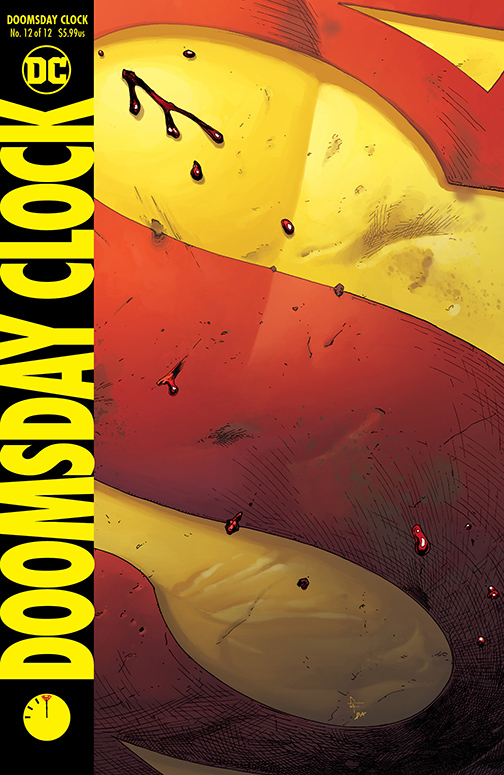
Notes: This is a controversial book, DC’s sequel to Watchmen which brings those characters into conflict with the heroes of the DC Universe, but I’m including it here for an important reason. In the end, this is very much a story about Superman. The first issue shows us the state of the world – since Ozymandias’s scheme was revealed by Rorschach’s journal, he has become the most wanted fugitive on the planet and the world has crept closer and closer to the very nuclear annihilation he was hoping to avoid. A new Rorschach has arisen, this time working with Ozymandias, who has a tumor growing in his skull. The two of them hope to find the only person in their universe with the power to change anything – Dr. Manhattan. Meanwhile, in another universe, Clark Kent wakes up from a nightmare, a horrible vision of the car crash that killed Jonathan and Martha Kent when he was only a teenager. It’s the first nightmare he’s ever had.
Ozymandias and Rorschach ally themselves with a pair of criminals – Marionette and Mime – who are seeking their missing son. They trace Dr. Manhattan to the DC Universe, where people are in upheaval following the popularization of the “Supermen Theory,” which posits the idea that the reason so many of Earth’s metahumans are American is because they have been deliberately created by the government since Superman’s first appearance. Faith in superheroes is eroding, with the only one who still has the public trust being Superman himself.
Over the course of these twelve issues Geoff Johns and Gary Frank delve into the nature of the DC Universe itself, starting with the notion (from DC Rebirth) that it was Dr. Manhattan who was responsible for the New 52 reboot in the first place. Turns out, it’s more complicated than that. Manhattan did toy with the fabric of the universe, but the reason it was possible for him to do so is because the “Prime” DC Universe – the one that’s called Earth-0 these days – isn’t actually part of the multiverse as we know it. Manhattan calls it the “Metaverse” (take that, Mark Zuckerberg) because it’s a core reality that the others are all reflective of. In the Metaverse, Superman made his first appearance in 1938 and inspired the heroes of the Justice Society. Then reality snapped, moving Superman’s appearance to 1956. The JSA still existed, but now Clark Kent had an early career as Superboy, inspired BY the JSA, and it was that Superboy that in turn inspired the Legion of Super-Heroes 1000 years in the future. Another snap popped Superman’s first appearance to 1986, and–
–are you seeing the pattern here?
The idea is this: Superman is the center of the Metaverse. As time goes forward, his existence is the constant, and as such, the universe is in a constant state of change. But every time the universe shifts, the previous iteration is preserved in a different world in the Multiverse. The original Golden Age Superman’s world is Earth-2. Another was preserved as Earth-1985. The version Manhattan created is Earth-52, and so forth. Eventually, Superman’s timeline will catch up with the Legion a millennium in the future, and when that happens, the ideals of Superman will become universal, and create a lasting peace.
Man, that’s a nice thought, isn’t it?
This book – much like the original Watchmen – suffered from a lot of delays before it could be finished, and many of the larger concepts have been ignored since then. I don’t think the concept of the Metaverse has been explored since this book, for instance, and by its very nature it makes sense that they wouldn’t bring it up all that often. On the other hand, this book also established that Martin Stein was part of a government conspiracy to create superheroes, and Firestorm was the result of that, something that I’m almost positive has not come up again. But that’s the beauty of this book – it provides a framework that can be used to explain away virtually any discrepancy or change in continuity. That thing you remember that the heroes didn’t? It happened in a previous iteration of the Metaverse, and it’s still canon out there in the Multiverse…somewhere.
If you’re the kind of person who considers Watchmen sacrosanct, I can understand why you wouldn’t like this book. It does, in a way, undermine the conclusion of that story by answering the intentionally vague question of what would become of Rorschach’s journals, and (perhaps even more blasphemous) it allows for that world to have a happy ending. But as good as Watchmen is, I have no objection to the notion of returning to that universe. The HBO miniseries did it in excellent fashion. I like this one too, if for no other reason than because it confirms something very important: Superman is the most important hero in the entire universe.
Shoot, guys. I could have told you that.
Tues. Dec. 30
Graphic Novel: It’s a Bird
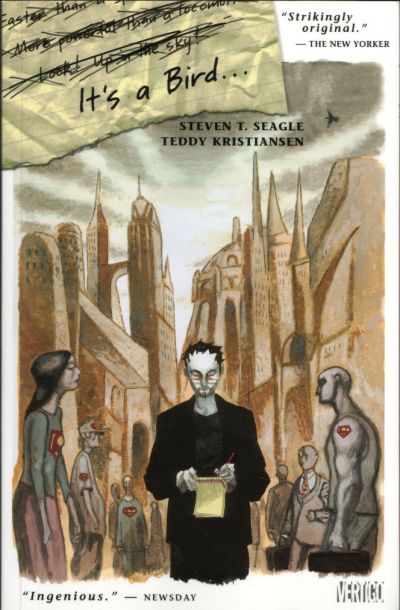
Notes: As with Doomsday Clock yesterday, I want to spend these last few days of the year with stories about Superman and about what he means. That quest led me back to It’s a Bird, the unique 2004 Vertigo graphic novel by Steven T. Seagle and Teddy Kristiansen. It’s perhaps the most unusual Superman story of them all in that Superman isn’t actually in it.
The story, which is semi-autobiographical, starts with five-year-old Steve waiting in a hospital as his grandmother languishes. To placate him and his brother, their father brings them a Superman comic…after which, Steve swiftly rejects comics, as they remind him too much of the hospital, making it all the more ironic that he would grow up to write them. When an adult Steve is offered the job of writing Superman by his editor, he rejects it, unable to find the character relatable.
The story is mostly about Steve trying to find his way into the Superman, and along the way he takes some interesting detours. His father goes missing, and fears of the disease that took his grandmother come back. Meanwhile, everyone he talks to about getting offered Superman is ecstatic for him and dumbfounded that he doesn’t want the job. These two threads are intercut with pages of Steve’s own musings on Superman, on who the character is and what he means – or at least, what he’s supposed to mean – as he tries to find something about the character that he can make believable in the real world.
The interlacing storylines, of course, come together in the end, because such things always happen in fiction even if they almost never do in real life. His father’s disappearance turns out to be related to the death of Steve’s grandmother all those years ago, and in confronting his father and the disease that haunts his family, Steve starts to find a way in to Superman.
It’s a good story, a powerful one, but it’s one whose inherent premise is one I somewhat disagree with. Steve’s quest is to find a way to make Superman “real.” I don’t think that’s necessary. Superman isn’t part of our real world any more than Mickey Mouse or Bugs Bunny or the food replicators on Star Trek. That doesn’t mean that he isn’t important, though, or that there’s nothing to be learned from them. In a lot of ways, I think the very fact of Superman’s fanciful nature is perhaps the most important thing about him.
Just as the story is very atypical for a Superman comic (such as it is), so is Teddy Kristiansen’s artwork. Kristiansen’s style is an odd halfway point between sketches and realism, in some ways making me think of Art Spiegleman…which is appropriate enough, as this book echoes Maus in various ways. Both stories are autobiographical, and with a frame narrative about the author struggling to relate to their fathers. In Maus, of course, the ghost that hangs between Art and his father is the spectre of the holocaust, while in this graphic novel it’s the shadow of the Huntington’s Disease that follows Steve’s family.
The book, of course, is specifically described as “semi-autobiographical.” Not really knowing much about Seagle himself, I wouldn’t presume to declare which parts are true and which ones aren’t, but regardless of any plot elements I tend to believe that all of the emotion in this book is genuine. The concerns, the fears, the anxieties that “Steve” expresses are almost certainly part of Seagle’s own psyche. Writers tend to do that, after all.
This is the Superman book for people who don’t understand Superman. I don’t know if, in the end, it will actually help them figure the character out – at least, not the way that I understand him – but it will at the very least help them find a path through someone else asking the same questions, and that’s a journey very much worth reading.
Comics: Harley Quinn X Elvira #3 (Power Girl guest appearance), Justice League Red #5 (Team Member Power Girl), Justice League Vs. Godzilla Vs. Kong 2 #6 (Team Member)
Wed. Dec. 31
Comics: Superman #247, Kamandi: The Last Boy on Earth #29
Notes: Well glory be, here it is. 365 days later, and the journey I started back on January 1 with Action Comics #1 is about to end…or at least, to evolve. I’ll talk more about that (say it with me) later, but for now, it’s time for the final Superman reads of the year. I thought hard about what to read today. In the early part of the year I’d planned to end it with a classic “last” Superman story, like Whatever Happened to the Man of Tomorrow? or Kingdom Come, but I decided to add those when I did the week of comics that influenced James Gunn’s Superman. So how else to end it? I ultimately decided to go with two comic books about what Superman is, because that’s where this entire journey has led me anyway.
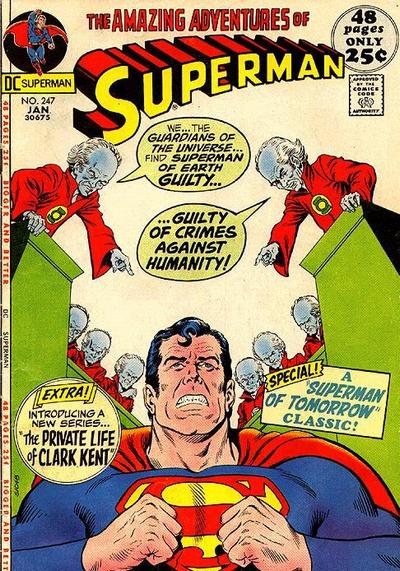
First is Superman #247, the Elliot S! Maggin/Curt Swan classic “Must There Be a Superman?” Like many of the stories I’ve read this year, I encountered this one for the first time when it was published in DC’s classic Greatest Superman Stories Ever Told collection. Let’s talk about why it qualifies.
The story begins with Superman taking on a special task for the Guardians of the Universe – a pod full of deadly spores on a path to Earth, and as the spores are yellow the Green Lanterns are helpless to stop it. Superman creates an artificial planet to draw the spores away safely, but is injured in the process, rescued by Green Lantern Katma Tui and brought back to Oa to heal. As Superman is healing, the Guardians take advantage of his unconscious state to plant a notion in his mind that his influence on Earth may be impeding human progress. (If this had been the “Year of Green Lantern,” you would have found me discussing a LOT of stories that drive home an important point: the Guardians are pompous assholes.) When Superman wakes up, the Guardians give him a tour of Oa, continually dropping comments about him contributing to a “Cultural Lag” on Earth, and sending him home with the notion that if he steps back, Earth will be better off.
As he returns to Earth, he stumbles on a child migrant worker being abused by his employer. Rescuing him, the child – Manuel – brings Superman back to his community where the residents begin begging him to help solve all their problems, such as fixing their crumbling houses. Superman refuses, saying that they need to know how to care for themselves, but an earthquake strikes just seconds later, destroying their homes. Superman blunts the quake and rebuilds their houses, but tries to convince them that they need to know how to care for themselves because no one – even Superman – can do anything. He returns to Metropolis only to get word of a cruise ship endangered by a waterspout, which he rushes off to save, even as the Guardians watch from afar.
Looking back at this story now, I feel like this was Maggin’s way of responding to people who asked why Superman didn’t just sweep in and fix all the problems in the world. After all, with his power, why couldn’t he just solve hunger, homelessness, war, famine, disease, and so forth? From a narrative standpoint, of course, the answer is obvious: if Superman were to do all these things, what stories would be left to tell? It would literally be the end of Superman, as a going storytelling concern. But what about in-universe? How do you explain it to a kid like Manuel, who’s getting beaten up by a man who basically controls his entire life? The answer is something that people who know Superman could have told you from the beginning: even with the best of intentions, having someone (like Superman) doing everything for them would hold them back, leave them unable to act or take care of themselves. It kind of reminds me of all those stupid ads begging me to use Google AI to write an email or a Facebook post as if I haven’t been perfectly capable of doing that for my entire life.
Superman is there to take care of the things that we can’t. As far as the things we CAN take care of…we shouldn’t expect him to do it all for us. But that doesn’t mean we can’t take inspiration from him.
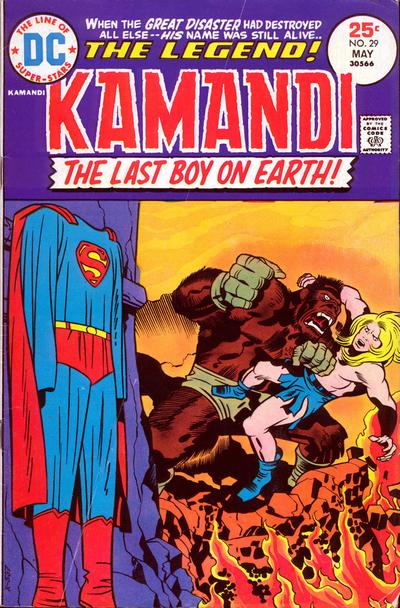
“Inspiration” is the theme of the final comic I’m going to read in this year of Superman, Jack Kirby’s Kamandi: The Last Boy on Earth #29. Kamandi, for the uninitiated, was a series about a post-apocalyptic world in which the human race is all but extinct, and the world is populated by anthropomorphized animals. In this issue Kamandi, one of the few remaining humans, finds the “Tablet of Revelation,” an ancient carving that prophesies the “return of the Mighty One,” a great warrior of the past. When the apes see Kamandi’s friend Ben Boxer, they believe him to be the returned “Mighty One.” One of the apes, Zuma, tries to engage him in combat, but the elder says that the Mighty One can only be revealed by demonstrating his powers against overwhelming odds. A catapult hurls claimants through the sky to prove that they can fly higher than the tallest building, an enormous boulder called the “Daily Planet” awaits the man who can move it, and so forth. Ben’s mutant powers convince some of the apes he’s the Mighty One, but a battle breaks out when they pledge to take him to his suit. In the fight, they come across a very familiar blue costume with a cape and a brilliant scarlet S-shield. Zuma tries to claim the costume, but perishes in battle as Kamandi defends the suit, saying “I know who owns it! I know that somewhere he’s still alive!” The suit is left, waiting until the true Mighty One returns.
This comic was released in 1975, some 30 years before the idea of the S-symbol standing for “hope” was put in place, but it’s hard not to think of it as you read this story. Kamandi’s faith that Superman is still out there is the sort of thing you’d expect, it feels like an appropriate place for the legend. The future of the DC Universe has been rewritten dozens of times, of course, with many of the various possibilities showing an immortal Superman, a legacy of heroes that lasts a millennia, or both. This feels like part of that, like the hero himself has left something behind with the promise that more is to come.
And that “promise of more to come” feels an appropriate place for me to stop.
Almost.
Movie: Superman (2025)

Notes: The first movie I watched this year was the original Christopher Reeve Superman from 1978. I’m going to end the year by revisiting the movie that inspired me to start this journey in the first place, James Gunn’s Superman. I’m not going to write it up again – Heavens knows you can find that on my original review. But I’m going to watch and enjoy.
One year later, and I have succeeded. I have watched, read, or listened to at least one thing starring or about Superman or a member of his family for an entire year. I’m actually quite stunned that I made it.
And I’ve still got so much to say.
But not yet. Come back Friday, friends, for my final thoughts on this year-long Odyssey, and my explanation of where I’m going from here.
Happy New Year.
Blake M. Petitis a writer, teacher, and dad from Ama, Louisiana. His most recent writing project is the superhero adventure series Other People’s Heroes: Little Stars, volume one of which is now available on Amazon.
In case you didn’t make it to the end of last week’s blog (I don’t blame you), I want to talk about what’s going on for the last month of the Year of Superman. I have plans for the last two weeks, including a week of holiday-themed stories and then wrapping it all up with a sort of “best of” week featuring classic stories I haven’t covered, as well as stories that kind of function as “endings” for the Man of Steel. In the last two weeks before then, it’s gonna be a free-for-all. I’m going to try to cross off as many things from my to-read and to-watch list as I possibly can, but there won’t necessarily be any rhyme or reason, pattern or theme. I’m going to get in whatever I can. As I write this, on Dec. 3, I know what I’m reading today, but I’ve got no idea what you’re going to get over the next six. Here’s hoping we can have some fun with it.
And as always, you can check out earlier blogs in the Year of Superman Archive!
Wed., Dec. 3
Graphic Novel: Superman: Ending Battle (Collects Superman Vol. 2 #186-187, Adventures of Superman #608-609, Superman: The Man of Steel #130-131, and Action Comics #795-796)

Notes: About two years after the legendary Action Comics #775, “What’s So Funny about Truth, Justice, and the American Way?”, the four Superman titles came in with a sequel story that lasted for two months across eight individual issues. In “Ending Battle,” written in turn by Geoff Johns, Joe Casey, Mark Schultz, and Joe Kelly, Clark Kent is in Washington, DC visiting his old friend Vice President Pete Ross (this was during the President Luthor era), when the White House is attacked by the Master Jailer and Neutron. They’ve been hired to kidnap Pete and his wife, Lana Lang – but not because he’s the Vice President. Superman stops them, but they manage to escape, and Pete gets a very cryptic call from President Luthor, asking him to tell Clark “You’re faster than a speeding bullet.”
Later that day (in part two), the Atomic Skull arrives in Kansas where he quickly takes down Superboy and is about to go after Jonathan and Martha before Superman arrives to save them. As the day continues, more villains attack people close to Clark Kent: Riot goes after his old high school coach, Quakemaster his dentist, Hellgramite one of his college professors, and so on. Superman races from scene to scene, capturing one B-list villain after another, piecing together that someone is targeting not Superman, but Clark. He also realizes that the villains that are being sent are deliberately sub-par – whoever is behind this isn’t actually trying to harm anyone, but rather to send the message that nobody close to Clark Kent is safe. The stakes are raised when King Shark goes after Jimmy Olsen. After Superman stops him, Shark claims that a voice in his head told him a name and location, and he didn’t have a choice but to attack. While Superman is cleaning up the Shark attack, someone attacks the Daily Planet.
In Part Three Superman arrives at the Planet to see it besieged by Green Lantern’s old enemy Evil Star. No seriously, that’s his name. But despite having a moniker that sounds like a third grader came up with it, Evil Star is a lot more dangerous than the bad guys so far. He’s powerful, and in control of dozens of inhuman monsters that make him very dangerous – but he has no more idea of why he’s attacking than King Shark did. The attacks are coming faster now – Rock and Terra-Man attacking Steelworks, the Metropolis Special Crimes Unit fighting Dr. Killgrave, and Superman has Lois gather everyone close to them at Steelworks, where Superman tells them that “Clark Kent” is in danger and that they’ve been targeted due to their association with him. Although many of them want to get out there and stand their ground, Lois convinces them that it’s better for them to stay there, safe, instead of dividing Superman’s attention by trying to rescue them all…and Bibbo (ah, but I love Bibbo) volunteers to make SURE everybody stays put. As he prepares to fight, a mental wave knocks Steel out of the battle and tells Superman to go to Lex Luthor.
In Part Four Superman finds Luthor hiding in a secret lair of his own, where he confesses that he knows Clark Kent is Superman…but he also says that he’s not the one responsible for the attacks. He doesn’t know who sent him Clark’s identity, and refuses to be a pawn in somebody else’s game (which is pretty damned Lex Luthor of him, you gotta admit). In the midst of their discussion, they’re attacked by the Elite. Superman quickly realizes that even THEY are being mentally controlled, and finally tracks down the source to the living interdimensional spacecraft called Bunny, whose consciousness has been destroyed and whose body is controlled by the Cyborg Superman. As he leaves the Cyborg in ruins, Superman declares war on the man he knows now to be responsible: Manchester Black.
In Part Five, Superman finds that the Master Jailer has converted Metropolis into the “largest prison on Earth,” and Manchester Black is waiting for him. But he still has a gauntlet of villains to get through: Prankster, a random Bizarro, a newbie called Puzzler, Neutron and Terra-Man again. (And in a beautiful one-page vignette, Mr. Mxyzptlk shows up. He’s planning to pursue his usual mischief, but when he sees just how royally pissed off Superman is, he voluntarily says his name backwards and disappears, realizing that this is “not a good time.”) As part six begins, Superman knocks the Kryptonite out of Metallo, declaring he doesn’t have time for this, and makes his way through a literal army of low-tier villains before stumbling upon the A-team: Bizarro #1, Mogul, and Silver Banshee working with the Master Jailer. The power goes out in the city and Lois decides she can’t stand sitting around in Steelworks anymore, sneaking out to investigate, only to find herself in the clutches of the man himself, Manchester Black.
Part seven takes Superman to the “boiling point” (to quote the cover) as he discovers that his four remaining foes are more dangerous than he realized. Black has tampered with Bizarro’s twisted mind, “clearing” it and making him far more capable than ever before, and after a full day of Superman running Black’s villain gauntlet, Bizarro and Mongul beat the tar out of him. Banshee, meanwhile, is also more dangerous now that Black has revealed Superman’s “true, genetic” name of Kal-El, giving her magic greater efficacy against him. Superman takes the fight to the tropics, where the sun refuels him, but even there, the Master Jailer has set snares for him, even spreading Kryptonite into the sand. He manages to defeat them and tracks Black back to Metropolis, where the villain has been mentally torturing Lois (in a series of profoundly disturbing scenes). When Superman arrives, he finds Black standing over her dead body.

In the grand finale, Black smugly reveals that the government let him out of prison to do dirty jobs for them, and he used that freedom to investigate, finding Clark’s identity by observing his affection for Lois Lane. He taunts Superman, saying that he’s finally shown him how the world “really works” – sending him on a day-long battle to “save the world,” and the only loss of life was the person who means the most to him. The battle is quick and fierce, and Superman annihilates Black’s body with a burst of heat vision – until that part is revealed to be another illusion. Superman refuses to dishonor Lois’s memory by killing his enemy. “Vengeance is not justice,” he says. In stunned astonishment, Black finally realizes – finally ACCEPTS – that Superman’s the real deal, that even after everything that’s been done to him, the armor will not break, and he won’t kill him, ever. The realization makes Black drop his illusions: Lois is alive, of course, Black’s suicide plan being to make Superman kill him and then discover Lois was alive…but he failed. Superman cannot be broken. He slinks away and wipes the minds of everyone he told Superman’s identity to, including Luthor (who, to his absolute fury, remembers that he USED to know who Superman really is, but CANNOT REMEMBER THE NAME). Then, seeing that he has indeed become the villain Superman called him, Black kills himself with a telekinetic bullet.
I don’t know if I’ve read this storyline through since it was originally published back in 2002, but holy hand grenades, it was a humdinger. This was one of the darkest Superman stories of the period, putting our hero through a physical and emotional wringer like he’s never been through before. The only thing I can think of to compare it to is the first half of the Knightfall storyline, when Bane breaks all of the villains out of Arkham Asylum and has Batman run himself ragged trying to defeat them all before he steps in and snaps his spine. But Black’s real goal wasn’t physical, it was emotional. It was about tearing down who Superman is at his core, making him betray his truest convictions, turning him into the monster that Black is convinced everybody is deep inside. It doesn’t happen, though. The story takes a very long, roundabout, and upsetting path to get there, but in the end the result is the same: Superman is Superman. And he cannot be compromised, no matter what. This story precedes Injustice, but in a way it almost feels like a rebuttal to that. Even in his darkest moment, even when he believes he’s lost everything, Superman doesn’t bend.
It’s the kind of climax that makes you smile and say, “Ya gotta respect that,” and in a way, that’s what Manchester Black does at the end. He sees that he was wrong, and he makes up for it as much as he can – restoring the status quo in regards to Clark’s secret identity, and then taking himself off the playing field. This being a comic book, of course, he eventually got better, but when he appears now he’s more of an anti-hero than the anti-villain he was in these storylines. “Ending Battle” changed him, and that’s quite a testament to the story.
The harshest part of the entire run comes in chapter seven, when Black tortures Lois. We see it – mentally he breaks her down, showing her her worst memories and her worst fears (such as Clark cheating on her with Wonder Woman) in a tremendously uncomfortable sequence that can only be described as mind rape. And frankly, it’s all unnecessary – as his plan depended on Lois being alive at the end of it, what the hell was the point of torturing her?
Fortunately, things work out at the end, and this was even a turning point for the Superman titles at the time. Following the events of the “Our Worlds at War” storyline (which coincided with the real-world tragedy of Sept. 11), Superman had changed his costume slightly, putting a black background in his S-shield, a black shield on his cape, and generally showing up in darker tones that were reflected in the stories of that period. After Black’s defeat, after he and Lois take time to heal, he goes back to the classic yellow, signaling that the period of mourning has ended and Superman is, indeed, Superman once again.
The only thing about this story that’s kind of confusing is just how isolated it feels. Granted, it takes place in a 24-hour period, but it spans the entire planet, and the only other heroes to actually appear are Superboy and Steel, neither of which turn out to be much of a factor. They reference the Justice League a few times, but it seems like the moment Superman realized someone was targeting Clark’s loved ones, he would have activated the entire JLA – have the Flash evacuating people, Green Lantern shielding them, Batman and Wonder Woman fighting at his side. This could almost be set in a world where Superman is the only superhero there is, and while I can understand that making the other characters a part of the story may have complicated it, leaving them out entirely feels like a tremendous oversight.
Comic: Justice League of America #49
Thur., Dec. 4
TV Episodes: Smallville Season One, Episode One, “Pilot;” Superman and Lois Season Three, Episode 7, “Forever and Always.”

Notes: It’s been a minute since I watched this one, but it’s time to sneak it in. Because the thing is, even though this show never calls our hero “Superman,” even though Clark never puts on the iconic costume until the last shot of the last episode, for an entire generation this is the gold standard of Superman on TV. As much as Christopher Reeve was fundamental to me, I know that people who came of age in the early 2000s latched on to this show. In fact, both David Corenswet and Nicholas Hoult identified this as their earliest exposure to Superman. And it lasted ten seasons for a reason: it’s a good show.
The pilot begins with an origin – a rocket in space falls to Earth in the little town of Smallville, Kansas, in 1989. In this version, though, it doesn’t fall by itself – along with the rocket comes a shower of meteors that causes untold havoc to the town, destroying buildings, striking cars and setting them ablaze, and horrifically killing the parents of little Lana Lang right in front of her eyes. As this is going on, industrialist Lionel Luthor (John Glover) is forced to land the helicopter he’s travelling in with his son, Lex, who runs into a cornfield in a blind panic during the shower. He stumbles on a young man lashed to a scarecrow with an “S” painted on his chest – a football initiation ritual – when a meteor streaks overhead and lays waste to the entire cornfield. When Lionel finds his son, the fallout of the meteors has caused his bright red hair to fall out. Oh yeah, and Jonathan and Martha Kent (John Schneider and Annette O’Toole) are tossed upside-down in their truck, only to find a little boy stumbling towards them through the wreckage. Martha, who has been praying for a child of their own, convinces her husband to adopt the boy. Because it wouldn’t be a Superman story otherwise, would it?
Twelve years later, young Clark Kent (Tom Welling) is now a student at Smallville High and he nervously asks his parents permission to try out for the football team. But Jonathan is hesitant, worried that there might be an “accident.” Clark doesn’t take it well, and when he realizes he missed the school bus carrying his friends Chloe Sullivan (Allison Mack) and Pete Ross (Sam Jones III), he dashes ahead, racing through the cornfields at super-speed to meet them at school. Clark catches a glimpse of Lana Lang (Kristen Kreuk), whom he approaches sheepishly before stumbling and falling flat on his face, a common occurrence. While he watches Lana and her boyfriend Whitney, Clark feels a surge of pain beyond his teen angst, and his eyes fall on the necklace Lana wears all the time, the one with a green meteor rock in it. That afternoon, as Clark walks home moping about everything, Lex Luthor (Michael Rosenbaum) loses control of his car when looking at his phone – let that be a lesson kids – and hits a roll of barbed wire that fell off a truck. Lex hits Clark head-on and his car plunges over the side of a bridge. Clark, unhurt, manages to pull the unconscious Lex from the wreck and perform CPR, saving his life. Lex is baffled at how Clark wasn’t hurt, especially when he sees the remains of his car, but is grateful to Clark for saving him. That same night, a local body shop is attacked by the young man that Lex saw in the cornfield 12 years ago. He seems to have electrical powers now, and he hasn’t aged a day.
Lex sends Clark a new truck as a “thank you,” but when Jonathan refuses to allow him to accept it, they get into an argument over how Clark feels like he’ll never be normal. Jonathan decides that it’s time to tell his son the truth of his origins and shows him the rocket that brought him to Earth on the day of the meteor shower. He rushes away in anger, eventually finding himself in a graveyard, where Lana Lang is visiting her parents. For the first time in his life, Clark is able to have a conversation with Lana without making a fool of himself. (It MAY have something to do with the fact that she gave Whitney her green meteor rock necklace for luck in the homecoming football game.) Although Clark is terribly non-specific, the two bond over their mutual trauma and he walks her home, getting a kiss on the cheek for his efforts and promising to save him a dance, even though she’s dating Whitney. Clark visits Lex to return the truck, and in the conversation it comes out that Jonathan doesn’t trust the Luthors because of Lionel’s shady business dealings. Despite the animosity of their fathers, Lex offers Clark his friendship, believing that their generation is the future.
Chloe, meanwhile, sees an odd bystander at the site of an attack on a former football player and tracks him down to a hospital where he’d been comatose since the day of the meteor shower, having recently escaped, identifying him as Jeremy Creek. Chloe shows Clark her “Wall of Weird,” an enormous catalogue of all the strange, inexplicable, and bizarre things that have happened in the town of Smallville since the day of the fateful meteor shower – dozens of news clipping and photos, including a Time magazine cover featuring a weeping three-year-old Lana Lang, and Clark suddenly feels guilty for the death of her parents. As he leaves school, Whitney grabs him, declaring that Clark has been targeted for the scarecrow initiation this year. Clark staggers in pain, seeing the green necklace around Whitney’s neck, and Whitney puts the necklace on Clark, saying, “This is as close as you’re ever gonna get to her.” While string up in the cornfield, Clark is approached by Jeremy Creek. He begs Jeremy to cut him loose, but Jeremy declares he’s safer where he is and leaves. Lex catches a glimpse of Jeremy in the field while driving to his father’s plant, then hears Clark calling for help in the field and cuts him down. The necklace falls from Clark’s neck and he feels his strength return, running from the field, and Lex finds the necklace in the dirt. Clark finds Jeremy about to use his powers to attack the Homecoming dance, and the two fight. Jeremy smashes a truck, getting sprayed with water that seems to short-circuit his electrical powers. When he awakens, he has no memory of the last 12 years. Clark goes home, watching from a distance as Whitney brings Lana home from the dance.
I was a faithful viewer of this series the entire time it was on the air, but I haven’t revisited it very much since the original run ended, and watching the pilot again after all this time is making me consider a full rewatch. (NEXT year.) I’d forgotten a lot of the little beats – how they tied in Lex and Lana’s respective status quo to the same meteor shower that brought Kal-El to Earth, for example, or the rather naked and shameless way Lana’s Aunt Nell thirsted after the very married Jonathan Kent.
The show did a great job of framing what is essentially a Superboy series (minus the costume) in the early 2000s. The characters all felt really true to the classic versions, as well, with the dynamics and relationships fitting the traditional mold while still feeling modern. One of the best things about the show, especially in the early seasons, was the dynamic between Clark and Lex. Although the notion of Lex being a friend of Clark’s who went bad was old, going back at least to the Silver Age, there had been precious few stories that actually EXPLORED that friendship prior to this part. Starting the show on the day they BECAME friends gave the show a nice element of tragedy to it. Lex insists to Clark that their friendship is sincere, and he honestly means it, but every single person watching the show knows that something is going to happen sooner or later to make it go terribly.
The elements that were added to the show are hit and miss. Using the meteors (Kryptonite, in case you didn’t pick up on it) as a sort of catch-all to create metahumans for the show made for a good source of villains, but it caused a “freak of the week” formula that started to get stale quickly. And although it is difficult to separate the character from the actress, Allison Mack’s Chloe Sullivan was a great new character, giving Clark a sort of confidant that he didn’t traditionally have. She was a fantastic character that added a new element unique to this version of the character. At one point they even added her to the comic books, in a Jimmy Olsen serial that ran in the pages of Action Comics during a period when DC was doing a lot of those backup serials. Unfortunately, she never showed up again after the Flashpoint/New 52 reboot, and considering the controversy surrounding Allison Mack, it seems unlikely that she’ll come back again any time soon.
It’s funny, really, how I am remembering now how much I liked this show back in the day. I don’t have time in December, that’s for sure, but I think when January rolls around I’m going to try to find time to pencil episode two into my viewing schedule.
Fri., Dec. 5
Comic: DC K.O.: Superman Vs. Captain Atom #1.

Notes: The “tournament” part of DC K.O. is hitting this month. With issue #2 of the main series narrowing the field down to 16 combatants, this month we’re getting a series of eight issues (four one-shots and four issues of existing ongoing series) that will feature one-on-one fights, and it all kicks off with Superman Vs. Captain Atom. Although he’s never really been an A-lister, Captain Atom is one of those characters like Firestorm, whose true potential is almost limitless if he really cut loose, and that makes him a suitable opponent for Superman. I won’t go through the play-by-play of the battle, but I will say that I was particularly satisfied with this issue. The fight was brutal and intense, but suitably, it was just as much a battle of ideology as it was a physical one. Captain Atom is ready to do whatever it takes to win, whereas Superman is desperately trying to hold on to his ideals even as the battle rages around him. Along the way, the story starts to pick up on the feel of a video game, with a strict set of rules, power ups, and alternate forms being laid out for the heroes as they go head-to-head. It’s rare that you see an all-fight issue that actually feels worthwhile, like it has weight to it, but if this is any indication of what the rest of the month is going to be, we’re in for some epic slugfests. I’m particularly looking forward to the last issue – the one-shot that will pit the Joker against his former victim, Jason Todd, the Red Hood.
Sat., Dec. 6
Movie: Man of Steel (2013)

Notes: I have to confess, I have deliberately dragged my feet when it comes to watching this movie in the Year of Superman project. But that should not be construed as a commentary on the film itself. No, my reluctance has nothing to do with the movie and everything to do with the toxicity of the fanbase that seems to have grown around it. With the possible exception of Star Wars, I have never seen a group of purported fans more whiny, obnoxious, delusional, or self-absorbed than adherents to Zack Snyder’s version of the DC Universe in the time since it was announced that James Gunn was going to reboot it. And in truth, I wasn’t totally in favor of the reboot when it was announced. I did – and still do – like Henry Cavill’s Superman, and I thought that a page-one restart was unnecessary. But that in no way excuses the abhorrent behavior from a small – but astonishingly vocal – segment of the fan base. So let me just say that if you’re one of the people who has spent the last few years online harassing James Gunn or the new cast, or fans of the new movies, or have attempted to review bomb or spread false narratives about the success of the film – if you’re one of these people, then please understand without a doubt that you suck, that you have made the rest of us who DID like the Snyder movies embarrassed to say so out of fear of being associated with you, and that Superman wouldn’t like you either.
Although he, of course, would give you a chance to redeem yourself, because that’s who Superman is.
Okay, that’s the last I’m going to say about that subject. Let’s talk about the movie. There were then – and still are – a lot of things about this incarnation of Superman that I really liked. Although I don’t feel like origin stories are necessary anymore, the opening sequence on Krypton is really dazzling, with a fascinating version of this world that’s unique and – although inspired by versions like John Byrne’s Krypton – isn’t exactly like anything else.
Snyder’s version of Superman leans into him as an alien: he is not of Earth, and although he strives to protect it he doesn’t feel as though he belongs. Every aspect of this version of Clark Kent emphasizes this – the early scenes where he’s struggling to contain his vision and hearing powers, the later scenes where he’s roaming the world before he settles in Metropolis, and of course, the main conflict in the second half of the movie that’s all about Zod calling him out, forcing him to be seen as an alien the very first time the human race glimpses him at all.
This is not, I should stress, my preferred version of Superman. I like it when the character is inherently human, with the fact of his birth on Krypton being incidental to the man he actually is. But like all legendary heroes going back to antiquity, there are different interpretations of the character, and for this particular “Superman is an alien” interpretation, the movie is very well-done.
Similarly, Henry Cavill’s Superman is the perfect fit for THIS interpretation. There’s a sadness and a longing to him, as he looks out on a world that he seems desperate to be a part of, but cannot connect with fully. Michael Shannon’s Zod has the anger and disdain that you want from the character, and he’s fantastic at what he does. Amy Adams as Lois Lane doesn’t quite have the ferocity that I usually like in my Loises, but she trades it for an intellectualism and demeanor where nothing quite phases her, and like many of the other things I’ve mentioned, it works for this version of the character.
There’s the score by Hans Zimmer to talk about as well. I absolutely love the music in this film – strong, bold, classical. Nothing will ever top the classic John Williams theme, of course, that music is etched into my soul. But Zimmer’s work is great, in particular the anthem that plays when we see Clark learning how to fly for the first time. That’s a fantastic sequence, and I never get tired of it.
Among detractors of this film, there are two major points of contention, one of which I think is justified, while the other is missing the point. First, the criticism I agree with: the portrayal of Jonathan Kent. I’m not wild about the fact that Jonathan tries to prevent Clark from using his powers to help people in this movie, although I think it’s more acceptable when you filter it through the lens of a father trying to protect his child. It’s not that he doesn’t care about the school bus full of kids that Clark risks his secret to save, it’s that in his mind HIS child is more important than any other, and he cannot abide the thought of what might happen to him if his secret were to become public. Speaking purely as a dad, I totally understand that perspective. But Jonathan Kent – and I’m going to be frank here – has to be the greatest father in the universe in order to raise a kid with Clark’s power who becomes a Superman instead of a Zod. This problem is especially clear when Jonathan allows himself to be taken by a tornado rather than letting Clark save him. It’s supposed to come across as heroic, in that he considers Clark’s secret more important than his own life, but when you think of the number of ways Clark could have saved his father and still protected his secret, then it just seems…foolish.
The other major criticism is one I disagree with wholeheartedly, and that’s the scene where Superman kills Zod. “Superman doesn’t kill!” they shout, and they’re right. But that’s not the same as saying he NEVER has. Snyder, again, seems to be taking his cue from John Byrne here, specifically the “Supergirl Saga,” in which Superman killed Zod and the two other Phantom Zone criminals to prevent them from finding a way to his Earth and destroying it. Doing so devastated Superman, causing a mental break and eventually steering him to dedicate himself to the protection of life, and never its destruction. The fact that Superman refuses to kill is MORE believable due to the fact that he did it ONCE.
And this film actually does the Byrne story one better. Rather than executing three helpless prisoners out of the fear of what they MIGHT do, in this film Superman kills Zod as he is ACTIVELY threatening the lives of innocent people. Even in a court of law, his actions at that moment would stand up as justifiable. But the lesson he takes away from it is the same – the agony on his face after Zod’s death shows just how deep a wound he’s created in himself.
The other two movies in which Cavill portrays Superman, similarly, have their ups and downs. I’m not going to get too deeply into either of them, except to say that I think Batman V Superman: Dawn of Justice gets more derision than it deserves and that Zack Snyder’s Justice League is vastly superior to the theatrical cut of the film. But all that said, although I didn’t feel like the reboot was necessary when it happened, I have since come around on that one wholeheartedly. This movie was good at what it did, but what the James Gunn/David Corenswet movie does is simply much more like the Superman that means so damn much to ME.
TV Episode: Superman and Lois Season 3, Episode 8, “Guess Who’s Coming to Dinner”
Sun., Dec. 7
Comic: Superman: The Kryptonite Spectrum #4

Notes: The penultimate issue of W. Maxwell Prince and Martin Morazzo’s Black Label miniseries is just as triumphant as the first three. In this one, Superman and Batman have figured out that the strange new varieties of Kryptonite they’ve been studying are actually the work of Mr. Mxyzptylk. In and of itself, this isn’t that surprising. What IS a bit of a shock, though, is the revelation that Mxy sent them as a distress signal – the Fifth Dimension is in serious danger, and only Superman can save them! But while he and Batman are doing their thing, Lex Luthor has plans for the new Kryptonite in his possession.
This issue is just a JOY to read. While it’s just as weirdly surrealistic as fans of Prince and Morazzo would come to expect, the tone is one that celebrates imagination and storytelling, focusing on how important these elements are to a character like Superman. It’s not at all what I expected from the two of them, and I couldn’t be happier with what we’ve been given. I should say, though, that it furthers the problem of DC not really knowing what “Black Label” should be, because it doesn’t seem to fit with anything else in that line at all.
There’s only one issue left, scheduled to drop next week, and I can’t wait for the finale.
Mon., Dec. 8
Comic: Batman/Superman: World’s Finest #45, Supergirl Vol. 8 # 7, Superman’s Pal Jimmy Olsen #144, Justice League of America #50
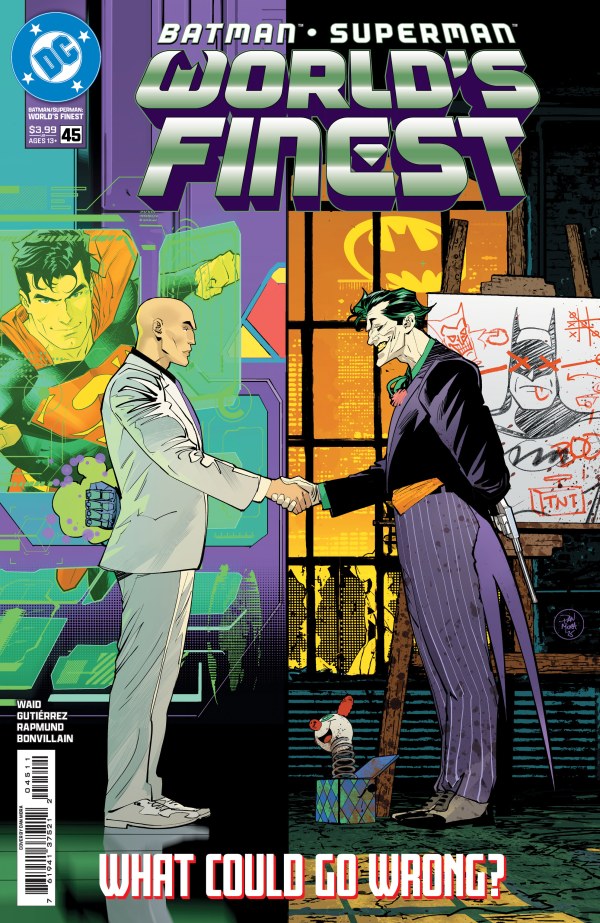
Notes: Mark Waid’s string of hits continues with World’s Finest #45, in which our two titular heroes actually take a mostly supporting role. This month, the Joker has gotten wind of Hawkman’s “Absorbascon,” a device that’s familiar to the readers, but which he sells to Lex Luthor on the promise that it can bring the user “infinite knowledge.” The two of them plot to get their hands on it, and the issue ends with their game being upped in a tantalizing and potentially deadly way.
What I really like here is that Waid is pushing forward the story while, at the same time, finding room to do a lot of great little character beats. Lots of people have written the Luthor/Joker partnership before, a team-up that makes little sense in reality, but that keeps happening mostly on the strength of having the arch-foes of the DC Universe’s top two hanging around together. The idea that someone of Luthor’s cold, rational nature would team-up with the Joker is ridiculous, so it’s always fun when a writer finds a way to make it make sense. The Joker of COURSE would love to hang out with Lex – poking holes in his logic is probably the next best thing to tormenting Batman – so having him bring a MacGuffin to Lex that the latter couldn’t possibly resist is a good excuse to force them together against Luthor’s wishes.
Although Superman and Batman take a back seat for most of this issue, we DO get some good moments with them, particularly the opening scene, which features Clark hanging out with Bruce at the Batcave, watching a football game between the Metropolis Meteors and the Gotham Goliaths. It’s incredibly rare to see the two of them doing something so utterly normal, just sitting around like any two ordinary guys, munching popcorn and rooting for their respective teams. It seems almost absurd for Superman and Batman to engage in such an afternoon…but for once, despite their clothes, they aren’t being Superman and Batman. They’re just Clark and Bruce. I can count the number of stories that pull that off effectively on one hand, and I’m not drawn by AI, so that’s a pretty low number.
I also want to call out the artwork by Adrian Gutierrez. I’ve made no secret of my love of Dan Mora’s work across the DC Universe, but Gutierrez has really stepped up and made this book his own. He handles the quiet character moments – like showing Superman wearing a football jersey over his uniform – just as real and perfectly in-character as the Big Damn Hero moments that come later in the issue. In other words, I’m a fan.
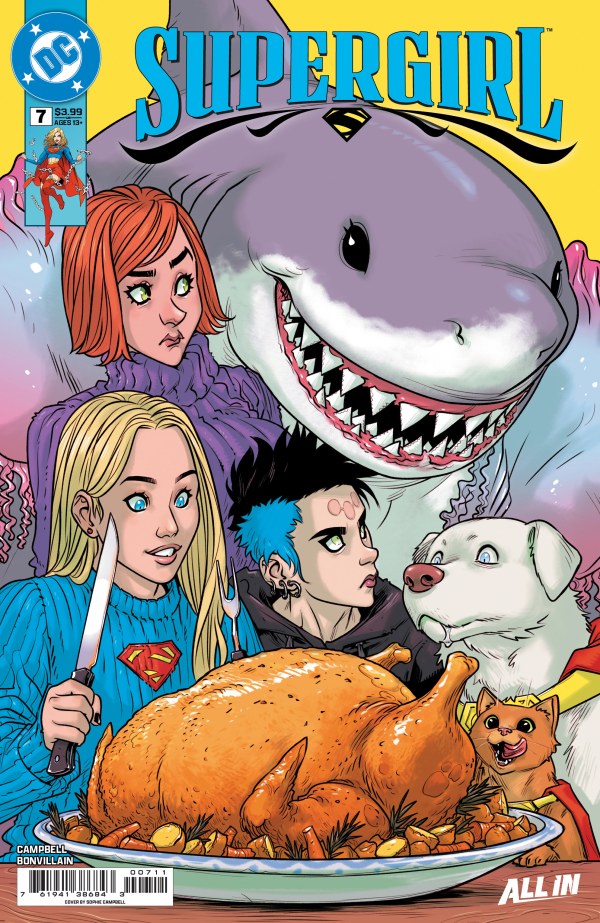
In Supergirl #7, it’s Thanksgiving in Midvale, and you know what that means! It means I should have read this comic book two weeks ago. But it ALSO means it’s Lesla’s first holiday on Earth. As Kara’s parents host a Thanksgiving dinner for all of Kara’s friends and family – including Superman and Lois – Lesla gets worried because Kara hasn’t shown up. Turns out she’s under the sea, trying to save herself from being turned into a mermaid by turquoise Kryptonite. You know, like you do.
My love for this book under Sophie Campbell’s stewardship continues unabated. On the one hand, we’ve got Supergirl herself tied up in a plotline that could have fallen straight out of the Silver Age, and Campbell is handling those adroitly. On the other hand, Lesla’s story carries most of the character weight in this issue, and it’s every bit as entertaining and meaningful as the superhero stuff. Lesla is trying to understand Thanksgiving, Lena hates it, Luna doesn’t celebrate it but just wants to be with her friends…the Double-L Squad that Kara has built up around her in this title is already one of the best supporting casts in comics. There’s so much happening with them, with the clashing personalities that somehow still make perfect sense as a group of friends, and it makes the book feel very real, very genuine, and very heartfelt. It’s honestly almost TOO perfect – I’ve been reading comic books for way too long and now I’m almost positive that something horrible is coming that’s going to break up this whole happy surrogate family. In my defense, though, the last page seems to be pointing to that as well, so it’s not just my hardwired paranoia.
I do have one question, though – having Superman show up for Thanksgiving dinner at the Danvers? That’s fine, everybody there knows Supergirl’s secret identity. Having him show up with LOIS, though…is that necessarily the best choice? Lex Luthor’s daughter is right across the table from them, is she not going to piece things together? I mean, I know she’s not the biggest fan of her dad, but still. Seems risky to me.
TV Episode: Superman and Lois Season 3, Episode 9, “The Dress.”
Tues., Dec. 9
Graphic Novel: Superman: Lois and Clark-Doom Rising

Notes: Dan Jurgens, of course, is one of the architects of Superman and who he is for the past 30-plus years, and when the Pre-Crisis Superman and Lois were brought back during the end of the New 52 era, he was called on to write the Lois and Clark miniseries that brought them and their young son Jonathan into regular DC continuity again. A few years later, he contributed this story as one of a series of back-up features that were running in Action Comics, specifically appearing in issues #1051-1057 of that series, along with the story from the Death of Superman 30th Anniversary Special that I read earlier this year. I love Jurgens’ take on Superman, and I love any story with Jonathan back when he was still a kid and interesting, so reading the collected edition of this serial felt like a nice way to wrap up this week.
Following the fight with Doombreaker from the special, Lois and Clark take Jon back to the California farm where they lived while in hiding (the New 52 version of Superman being the main one at the time). Jon’s powers are still new and burgeoning, and Clark is hoping to spend some time guiding the boy.
Back in Metropolis, though, the creature called Doombreaker (originally a construction worker named Lloyd Crayton who kept a piece of Doomsday’s bone and was later transformed by it) has escaped. The bone that caused his transformation has gone missing too, and what even Lois and Clark don’t know is that Jon has kept it, hiding it so that no one else could use it to turn themselves into a Doomsday monster. While he’s secreting it in his treehouse, a spacecraft lands and a young woman steps out, Glyanna of the planet P’Luhnn, asking Jon to take her to the man she assumes to be Earth’s king – Superman. The two are attacked by a robot enforcer. Jon calls for help and Clark, with his super-hearing, races away. Just then, though, Doombreaker arrives at the Kents’ doorstep, seeking the piece of Doomsday Jon took with him.
Superman finds Glyanna’s spacecraft, but no sign of her or Jon. Glyanna and Jon, meanwhile, are being held captive on the Enforcer’s spacecraft, where he plans to return Glyanna home to stand trial for treason. Jon fights the Enforcer, but causes the ship to crash, barely pulling Glyanna from the wreckage in time. He again calls his father for help, but Superman is embroiled in battle with Doombreaker, who’s found the piece of bone. When the Enforcer again comes after Jon, Glyanna reveals she’s been controlling it all along, and puts Jon in stasis to use him as a bargaining chip to force Superman to help her. Lois uses a weapon from Glyanna’s ship to stop Doombreaker, then shows Clark the alien’s message – her planet is in the midst of a revolution, and all Superman needs to do to get his son back is put it down for her.
Superman arrives on Glyanna’s planet and is given an ultimatum – stop the uprising or she’ll kill Jon, who is hidden inside one of 120 lead cells all over the planet. As he tries to buy time by holding the mob back, Jon pounds on the walls of his cell (in a manner nicely reminiscent of Doomsday’s first appearance), counting on his father to hear the vibrations, even if he can’t see him. When Glyanna realizes what Jon is doing, she cuts off the oxygen to his cell, but Clark has already located him and breaks him out. Superman finds Glyanna’s parents, the rightful rulers who were overthrown by their daughter, who explain that she was led to turn against them by an outside force. The story ends with Glyanna in space, her mysterious advisor telling her that she’s got a weapon of her own for the future: Doombreaker is in their clutches.
This is exactly the kind of story I loved when Jon was younger – Superman and his son, interacting AS father and son. The boy is still trying to learn about his powers and learn how to be a hero – all of this is territory that very few comic books have covered before, and virtually none of them with as high a profile a character as Superman. Nor has there been a mainstream hero so perfectly suited to this kind of story – it was Superman as a father, something that in the 75-plus years of his existence (at the time) had never really been done before. It was a change of pace that fit the characters and worked beautifully.
Yeah. I’m still salty about Bendis aging Jon up and putting an end to that era prematurely. The Superman books are good right now, but Jon has been a weak link in the franchise ever since that point, and stories like Doom Rising just serve to demonstrate the inherent potential in this formula that was left largely unrealized.
It also makes me remember that – to the best of my knowledge – the cliffhanger at the end of this issue has never been resolved. Glyanna and Doombreaker are theoretically still out there somewhere, waiting for a time to return. Somebody call Jurgens up and get him on that.
Comics: Batman: Wayne Family Adventures #51 (Guest Appearance), DC Go! Holiday Special 2025 #2 (Cameo)
Only three weeks left, friends, it hardly seems real. See you for Week 50 in seven days.
Blake M. Petit is a writer, teacher, and dad from Ama, Louisiana. His most recent writing project is the superhero adventure series Other People’s Heroes: Little Stars, volume one of which is now available on Amazon. You can subscribe to his newsletter by clicking right here. You can join in the Kryptonian Konversation every day in the Year of Superman Facebook Group!
As I write this, it’s Oct. 29 and I am still very much in the Halloween mood. I know, however, that this isn’t going to be posted until Nov. 5, and I respect the fact that you guys have probably shifted gears by now. So I’m going to do another random week for you, bouncing from one story to another at will and not beholden to anything in particular. You may still see a vampire or two, I make no promises.
Well, except for the promise that you’ll see a picture of my kid in his Halloween costume when we get to Friday. I can absolutely promise you THAT.
And as always, you can check out earlier blogs in the Year of Superman Archive!
Wed., Oct. 29
Comics: Superman #410, 412, 413, Jon Kent: This Internship is My Kryptonite #16
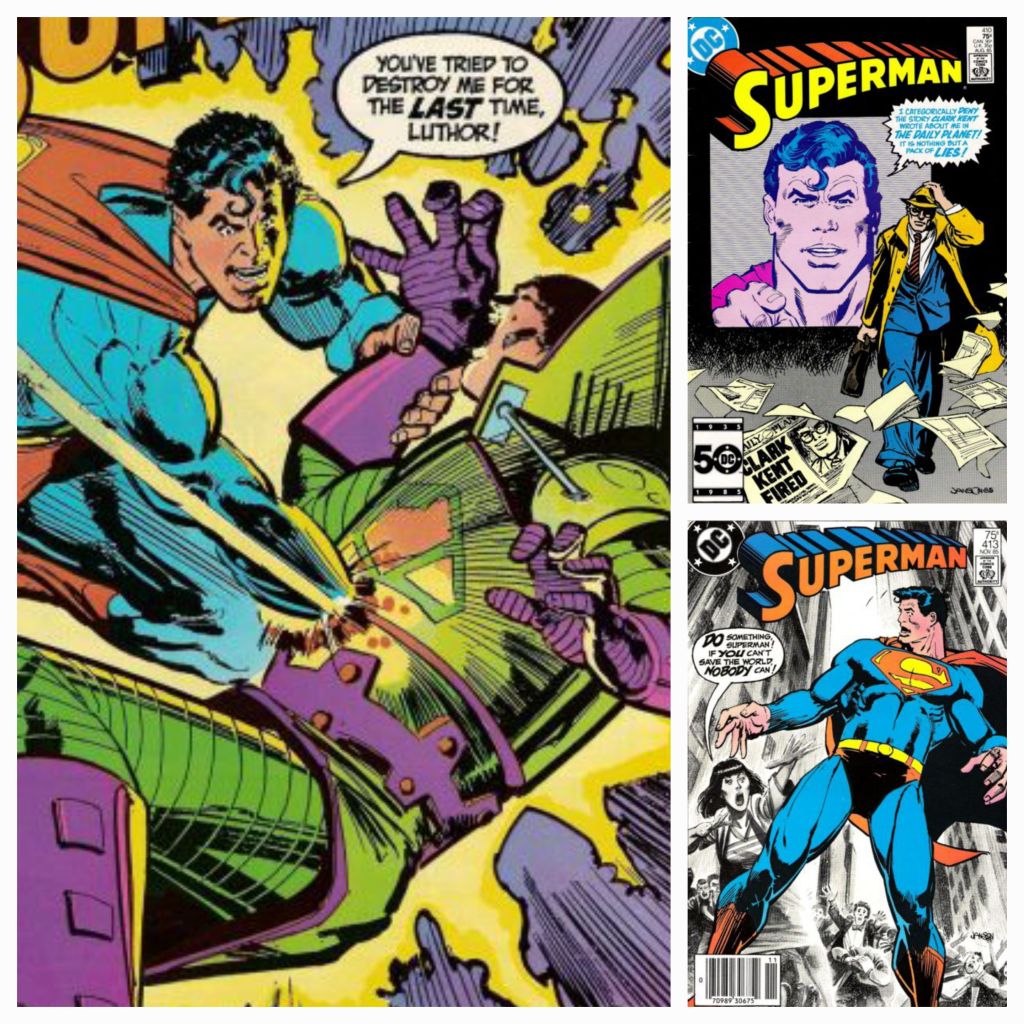
Notes: With the end of the year looming, I’m going to try to tick off some of the more random comics on my list that I haven’t gotten around to, books that don’t fit into any particular theme or week, but that I want to read for one reason or another. And I’m going to start in 1985 with a three-part Lex Luthor story that has become a minor classic.
Superman #410 starts normally enough, with Superman saving Honolulu from a plunging satellite. With Hawaii safe, Clark returns to the Daily Planet office and dutifully types out the story, turning it over to Perry White to put on the front page of the paper. As the evening edition hits the streets, though, Morgan Edge comes to Perry with horrifying news – the satellite Superman supposedly stopped is still in orbit, making the story he “told” Clark Kent seem fake. Superman zips to space to investigate and finds the satellite he clearly remembers catching floating in orbit where it belongs. Superman is faced with a horrible choice – tell Edge the truth and have people believe Superman is losing his grip on reality, or allow him to think Clark falsified the story. Given a choice between shattering peoples’ trust in Superman or in Clark Kent, he allows Edge to think Clark was at fault. Edge and Perry immediately fire Clark from both the Planet and WGBS news. As Clark tries to find the truth about what happened, we see Lex Luthor in a secluded island hideaway, boasting to his minions how he has found a way to broadcast false memories into Superman’s mind.
The trilogy skips issue #411, the legendary tribute to Julius Schwartz issue, and resumes in Superman #412, which begins with a humiliated Clark Kent on the unemployment line. He’s called away just as he’s about to be served, as Superman is needed to prevent a nearby construction disaster. Meanwhile, as Perry, Lois, Jimmy, and Lana agonize over Clark’s dismissal, Luthor is gloating over how Superman “allowed” his old pal Clark to take the fall for his own false memories. Lana, in fact, tears into Superman the next time she sees him for the same reason. Clark turns to his old friend Steve Lombard – who now owns a sporting goods store – for work. They’re hanging out when Luthor arrives in Metropolis, planting a series of “Scrambler Rods” around the city and nearly impaling Steve in the process. As he catches up to Luthor, an enraged Superman drives his fist into Luthor’s chest, killing him. When he withdraws his hand, Luthor’s armor explodes in an atomic wave that destroys the entire city of Metropolis!
For, like, a panel, before Superman finds himself clinging to the top of a skyscraper, having hallucinated the entire encounter. Luthor, meanwhile, has finished planting his rods, ready for the final phase of his “Ultimate Revenge” plan.
The final chapter picks up just seconds later, Superman still at the top of the building, having lost all faith in his own grip on reality. Even though he’s certain that Luthor is behind all of his current troubles, he no longer trusts his own senses, destroying his effectiveness as Superman. He stumbles back to Steve’s store, where Steve receives a phone call from Lois with a plan of her own. She has Steve invite Clark to a “charity bash” that evening, to which he reluctantly agrees. As he ponders his future, another hallucination hits – Steve’s store seems to vanish, then the entire city block, then the entire city, including his friends. Clark is missing, then, when the “charity bash” begins – actually a dinner in honor of Clark thrown by the people who still believe in him. While his friends give testimonies in Clark’s honor, Superman watches in horror as Luthor makes him believe he is obliterating the entire planet Earth. While Luthor has Superman captive, suffering from his hallucinations, Clark’s friends are growing worried, searching for him, wondering where he’s gone. When Superman’s hearing picks up on their fervent pleas, it breaks through Luthor’s spell. He goes after Luthor, but a strange vortex plucks Luthor from his clutches before he can bring him to justice. Superman joins Clark’s “other” friends at the dinner, claiming the whole thing was part of a plan of his to smoke Luthor out, thanks Clark for going along with it, and says he’s SURE Clark is looking forward to getting back to work.
I’ve said several times that the late 70s and early 80s were kind of a pallid era for the Superman comics. The villains and stories felt recycled and pointless, and although there were attempts at change (Lois “breaking up” with Superman, Clark dating Lana, etc.) none of it felt particularly important or consequential. But in the last year or so before the John Byrne reboot, they took some chances, and this story is one of the better ones. Although the conclusion still puts everything back in its neat little box, the journey to get there is an interesting one and I like the whole concept of everybody coming out in support not of Superman, but of Clark Kent. This was a time when Clark was usually still written as the disguise and Superman as the real personality, so having people in Clark’s corner for once was fresh and satisfying. Luthor’s getaway is a little irritating, but the knowledge that the vortex was sucking him up to participate in Crisis on Infinite Earths helps a bit. I almost wish they hadn’t given Clark his job back at the end – with the reboot on the horizon it wouldn’t have really made much of a difference, but may have made this story even more memorable.
Thur. Oct. 30
Podcast: Totally Rad Christmas, Episode, “Superboy-Young Dracula (w/CM Chuck)”

Notes: It’s the day before Halloween, so I decided to take a break from my usual Star Trek podcast on the way to work and see if the Totally Rad Christmas podcast had dropped any Halloween episodes this year. To my delight, I found that Gerry D and CM Chuck had gotten together to review an episode of the 1988 Superboy series in which young Clark faced off against…well, Young Dracula. I haven’t really gone back and watched this series in a long time, and I’m not sure at the moment where to find it. I own the first season on DVD, but not the subsequent ones, and although I know at one point it was available on DC Universe, that before it was merged with HBO Max and before Warner Bros. lost their collective minds and started throwing their IP to the four winds in the hopes of finding somebody desperate enough to buy them. The whole situation is ridiculous.
But anyway, the podcast. I don’t really remember the episode they’re discussing, and I wish I had it readily available to watch, as I’ve still got so many other Superman/vampire encounters fresh in my mind. I was glad to see that Gerry did enough research to unearth Superman #180, which I talked about last week, and how it demonstrated that a vampire biting a solar-powered Kryptonian wasn’t the best idea for the vampire. But that was a side conversation, not about the show itself, and the scattershot nature of this particular podcast does a nice job of emulating a conversation hanging around the comic shop, but isn’t exactly comprehensive in its coverage of the topic at hand. I’ll have to find this episode on my own somehow.
Comics: Superman: Silver Banshee #1-2, Cheetah and Cheshire Rob the Justice League #3 (Cameo), Saga of the Swamp Thing #24 (Guest Appearance), Justice League of America #36 (Team Member), Flash Vol. 6 #26 (Guest Appearance), Justice League Unlimited Vol. 2 #12 (Team Member)
Notes: In the comments to last week’s blog, Ben Herman asked if I’d ever read Dan Brereton’s two-issue Superman: Silver Banshee miniseries from 1998. And I know I have, I bought it when it came out and it’s still in my collection, but I probably haven’t read it SINCE the original publication. And as it, too, is a Halloween story (which I had forgotten, or I would have included it last week), this seems like an excellent opportunity to revisit it.
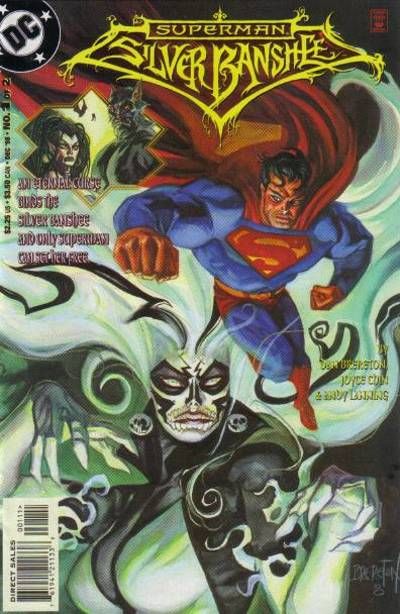
On Halloween Eve, Lois Lane gets a tip that will help her uncover a notorious gang of art thieves called the “Trickertreaters.” At the same time, in the Netherworld, Silver Banshee learns that there is one remaining descendant of the MacDougal clan, the clan responsible for her curse, and that she will never be free until the last MacDougal has perished. On Halloween, though, there are other options – she can go to Earth again, and if she uses the power of “good works,” the final MacDougal can lift the curse freely, without need for further death. Lacy MacElwain, her target, now lives in Metropolis (because of course she does) and the Banshee sets out to find her, but instead is snared by a summoning spell cast by the devil queen Hecate. Hecate – as it happens – is the one who lured Lois Lane with the promise of catching the Trickertreaters, whose newest member happens to be…oh come on, you can guess…yep. Lacy MacElwain herself.
Funny how things work out sometimes.
Anyway, Hecate’s stooge Thorpe knocks out Lois and ties her up as the art thieves arrive with their newest acquisition, an amulet that has no apparent monetary value, but that Hecate needs so she can do evil witch stuff. She tries to dismiss them without payment, but they take offense to that and wind up battling Thorpe, who turns out to be some kind of were-demon-thing. That’s an industry term, peeps. Lacy manages to get her hands on the amulet, which she brings to the mystic web where the Silver Banshee is held captive. The two of them are transported away from Hecate’s lair, and the Banshee tells Lacy that she will be freed of her curse if Lacy destroys the amulet, but it turns out to be fairly powerful. Thorpe tracks them down, but Superman (who got a little concerned when he found a dead body in the church where his wife was supposed to be meeting an informant) has caught up to them and saves her. As he confronts Hecate, Lacy flees for home, but the Banshee follows her, demanding she destroy the amulet. Unfortunately for Lacy, Hecate’s demons – including the transformed Trickertreaters – have trailed her as well.

In issue two, the Banshee tries to defend Lacy from the attack, but is forced to merge the two of them into a single body to prevent her death. In their shared form, the Banshee promises Lacy that destroying the amulet will set them both free. Unfortunately, Thorpe has his hands on it now. Superman, meanwhile is trapped by Hecate’s magic, and she plans to use Superman and Lois in her scheme. She gets the amulet back from a reluctant Thorpe, and the Banshee/Lacy hybrid attacks. The Banshee’s wail is surprisingly effective against Hecate, but she can’t free Superman or Thorpe from the Puppeteer demon that is holding them. In the battle, Lacy is killed, and the Banshee is freed from her curse, but unwilling to allow Lacy to sacrifice herself, she follows her into the afterlife, where the two of them are consumed by light. When the light fades, Superman, Lois, and a back-from-the-dead Lacy are all that remain. Lacy goes home, only to find that in saving her, the Banshee is now bound to her…no longer merged, but more of a regular haunt.
I’m really glad that Ben suggested I read this one again. The Silver Banshee has always been an interesting sort of anti-villain – she does bad things (murdering people, y’know) but she doesn’t do them out of actual malice or evil, merely out of a desire to free herself from a torturous curse. Once that curse is lifted, you can take the character in different directions, and this two-issue story is a nice sort of capstone to the status quo John Byrne first established for the character. She’s been used periodically ever since, sometimes as a villain, sometimes almost as a hero. I don’t recall offhand how long Lacy stuck around, but I don’t think she’s currently a factor when the Banshee shows up. Still, if there can be THREE ongoing series starring Batman bad girls who keep straddling the line between villain and kinda-sorta-hero, I think it’s well past time the Silver Banshee got at least another miniseries or something to give her the spotlight.
Fri., Oct. 31
Comics: Supergirl Vol. 5 Annual #2, Superman/Batman #65, Impulse #44 (Superboy Cameo)
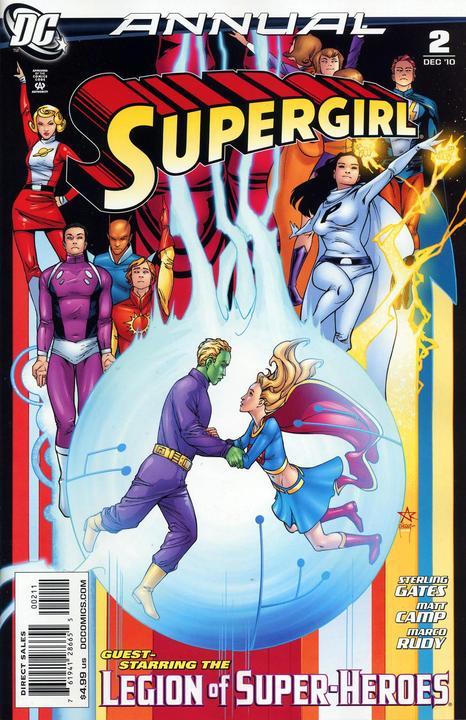
Notes: I don’t have a ton of time to read, though, because there’s trick-or-treatin’ to do, so I pulled the 2010 Supergirl annual, in which Kara is accidentally bounced 1000 years into the future and encounters the Legion – but NOT the Legion SHE knew. This is her cousin Kal-El’s Legion (recently restored in Action Comics) when they were teenagers. Brainiac 5 wants to find a way send her back immediately, worried about her disrupting the timestream the way he always worries when Superboy shows up, but it’s not that simple. She’s there for a month, joining the team and lending a hand, and learning – tragically – the circumstances of her own death. When a horned villain calling herself “Satan Girl” attacks, Kara and Brainy bounce four days into the future to see that Satan Girl has destroyed Metropolis, possessed the Legion, and taken over the world. It gets worse when she realizes that Brainy himself summoned her, but is arrogantly dismissing his own part in it.
An epic battle ensues between Satan Girl and the possessed Legion, with Kara, Brainy, and an army of animatronic Jimmy Olsens on the other (it makes sense in context). In the end, Brainy manages to send them back and prevent himself from summoning Satan Girl in the first place, then brings Kara home. In the process, they erase her memory of the future, including that of her own death, but Brainiac swears to do something to save her.
I like this story for a lot of reasons. Don’t ask me to explain why, but the various versions of the Legion that have flirted with a Supergirl/Brainiac 5 romance over the years have always appealed to me, and this one plays with that element as well. I hate it when people get into “shipping wars” over their preferred pairings, but I have to admit that I have a few of my own, and this is one of them. It works for the characters as they were at the time, and I hope that when the dust settles around the whole All In/DC KO thingamabob and we have a new, proper Legion again, this is an element that will be touched upon.
That said, I’m a little bummed because the reason I chose this particular issue is that the DC Universe app describes it as a Halloween story and…it ain’t. I mean, it was released in October and there’s the whole “Satan Girl” thing, but there’s no mention of Halloween in the story whatsoever. I assume that most of the listings on the DC app are copies of the original solicitations for the comics, especially for something as relatively recent as this, but that gets me a little grumpy that I skipped over a chance for some prime Halloween content.

There are greener – relatively speaking – pastures with the Halloween story from Superman/Batman #65. The story begins with Superman trying to save a falling plane as he’s done thousands of times. And this one, of course, has Lois Lane on it, as it has thousands of times. But it also has Perry White, his parents, Jimmy Olsen – and Superman watches in confusion as the plane goes down, killing everyone he loves. The scene shifts and we see that Superman is actually unconscious, as are Batman, the Joker, and Lex Luthor, all of whom had been engaged in a battle, then all taken down by an outside force. We watch the Joker live through his worst nightmare – a place where people actually treat his terrors as a joke. Lex Luthor’s worst nightmare, it turns out, is living out the bland, boring life of a subservient, specifically Jimmy Olsen. And Batman has a nightmare of a family – married to Selina Kyle, a son named Richard, his parents alive — and then watching them all gunned down by Alfred so he can bring things back to “the way it has to be.” The dream is nightmarish enough for Batman to wake up and realize all of them have been captured by – and are about to be buried alive by – the Scarecrow. Superman comes to next, stopping Batman from going too far in his revenge, and in the end we see a glimpse of the Scarecrow’s own worst nightmare – a land where he’s just an ordinary man of straw, one without a brain. It’s a cute story, and definitely one that feels more seasonally appropriate than the Supergirl one. But I think that’ll do it for Halloween in this blog. Until next time, anyway.
Halloween Bonus: I know you won’t believe me when I say this, but I had no influence on my son’s choice of Halloween costume this year. Well, not directly anyway. Obviously, his sphere of reference is influenced by proximity to me, and I wasn’t exactly subtle when I told him how happy it made me to bring him to watch the new James Gunn movie back in July. But at no point did I deliberately try to influence or manipulate him when the time came for him to select a Halloween costume.
“Eddie,” I asked him during one of our 27 trips to the various Spirit Halloween locations in our area, “What do you want to be for Halloween this year?”
“SUPERMAN!” he announced.
“Nobody is ever gonna believe I had nothing to do with this,” I said.
We wound up getting his costume at Walmart rather than Spirit, since they somehow got an exclusive on costumes from the movie. But we got the black hair color spray from Spirit, and I finally got a chance to wear the Superman pajamas he and his mom got me for Father’s Day back in June.
And I may be a little biased, but amongst all the arguing about Reeves and Cavill and Corenswet…well, with all due respect to those gentlemen, I may have a new favorite Superman.
Sat., Nov. 1
Comics: Superman: Red and Blue 2025 Special

Notes: This summer, during my family’s annual trip to Pittsburgh, I used the time to read over a lot of collected editions of various Superman books that didn’t quite fit in anywhere else. One of those was the collection of the delightful anthology series Superman: Red and Blue. I was quite happy when DC announced that they were bringing the concept back this year for a one-shot special with four new stories.
First up is “Priceless,” written by Paul Dini with art by Mirka Andolfo. Dini’s story features Superman on a mission to collect a rare mineral he needs to bail Supergirl out of an alien prison. It looks as though Dini is maintaining the characterization of Supergirl from the movie – a sort of hard-partying girl who gets into a little trouble with her dog. The story is funny and the art is wonderful, but there’s a nice little turn at the end that shows us that things weren’t exactly what Superman had assumed – and, in fact, family is everything.
“All the Time in the World” by Michael Walsh is a pretty simple story, a day in the life of Superman set in the era when Jonathan was still a toddler and Clark is desperately trying to find the time to be a husband and a father in a world where the demands for Superman’s gifts are neverending. This one…hits. I mean, there’s nothing world-changing or anything going on here, but it’s a theme that is particularly significant to me, right now, at this moment, where I’m looking at a schedule and trying to figure out how to fit in my son’s choir rehearsal and his basketball practice and his speech therapy and my own job and my wife’s job and if it is even possible, in the entire totality of the universe, to carve out even a single afternoon where I’m not going to be pulled into yet another thing that I don’t even know is going to happen now but it going to turn out to be of universe-altering consequence approximately 30 minutes before it has to happen. I may not have any literal fires to put out or people to catch as they fall off a building, but this is real. I know nothing about Michael Walsh, but I have to assume he’s a parent, because how the hell else could he understand this so well?
Next is Dan Abnett and Caitlin Yarsky’s “Out of the Ordinary.” When Superman saves a small town in Canada from a giant robot – you know, like you do – he is approached by a reporter for the tiny local paper who sheepishly asks for an interview. And to the surprise of absolutely nobody who understands Superman, he graciously agrees to one. The bulk of the story is just a quiet conversation between Superman and this young woman in a small-town diner, about what it’s like to be him and what it means to be “ordinary.” It’s a lovely story that really does nail the character, and in fact it functions very nicely as a (Clark Kent-ian polite) kind of rebuttal to Quentin Tarantino and anybody else who thinks that Superman is the “real” identity and Clark is a mask.
Last is “Red-Letter Days” by Rainbow Rowell and Cian Tomey. On Lois and Clark’s anniversary, Superman is summoned away by one of those regular world-threatening crisis type events. By the time he gets back, Lois has gotten a tip on an enormous story that deserves front-page coverage, but it’s going to take her and her husband staying up all night to get the sources and get the news straight. This isn’t a Superman story, it’s a Lois and Clark story, and I love it for that. We see the two of them doing what they do best (when Clark isn’t wearing a cape, that is) and in a way that isn’t interrupted by supervillains, alien invaders, time travel, or any of the other thousands of things that screw up a superhero’s life on a daily basis. It’s a story of a loving couple that struggles a little sometimes to find time for each other, and it’s delightful.
Superman’s the greatest hero there is, I think I’ve fairly well established my position on that by now. But for all the stories where he saves the world or the universe or a cat in a tree, there aren’t enough stories like the ones in this anthology. Four stories that lean on the man part of his name rather than the Super. There aren’t enough of these, and I hope that the Red and Blue anthology comes back again and again.
Sun., Nov. 2

Comic: Brave and the Bold Vol. 3 #16
Notes: Sundays aren’t days of rest for teachers. We’ve gotta get ready for the week, and I’ve got a ton of stuff on my plate today, so I decided to look for a one-off story I could read without sacrificing a huge chunk of time. I decided on this issue from the 2007 reboot of DC’s Brave and the Bold, which in this incarnation was a team-up title without a specific anchor character – there was never any telling which two characters would wind up with each other on any given issue. And as you can tell from the look on Superman’s face, this team-up with Catwoman surprised him as much as anybody.
Written by our old pal Mark Waid with art by Scott Kolins, the story begins with Superman responding to a bat-signal, telling Gordon that Batman asked him to cover for him while he was out of town. Gordon asks him to look into a rumored underworld auction, and Superman’s hearing picks up a burglary nearby. He finds Catwoman stealing an enormous jeweled egg, and Catwoman – a little smitten with the Man of Steel – tells him she needed it to get into the same crime auction. The evening’s prize is allegedly a map that leads to a certain hidden cave outside of Gotham City. Superman reluctantly agrees to work with Catwoman to stop the map from falling into the wrong hands. Selina dresses the two of them up to go undercover at the auction and a comedy of errors follows, most of them based on Superman’s attempts to sidestep actually giving any sort of aid to the criminal element around them. In the end they manage to prevent the contents of the cave from being used for nefarious purposes, and their encounter ends in a bit of a stalemate…but one that leaves Catwoman smiling.
I really enjoyed this issue. Batman never makes an appearance, but the story is essentially about him – specifically about how Superman and Catwoman, respectively, each feel about the Dark Knight and how that common ground allows them to put aside their differences and work together. And while you don’t get the impression that Catwoman’s flirting with Superman is entirely serious, it doesn’t seem as though she’s entirely joking either. After spending her life playing with the bad boys, a “date” with the ultimate good guy seems to be a refreshing change of pace for her, and even when Superman gets a little bit of an upper hand on her in the last few panels, she doesn’t seem to mind all that much. It’s just a simple, charming little story, the likes of which we could certainly use more of.
Mon., Nov. 3
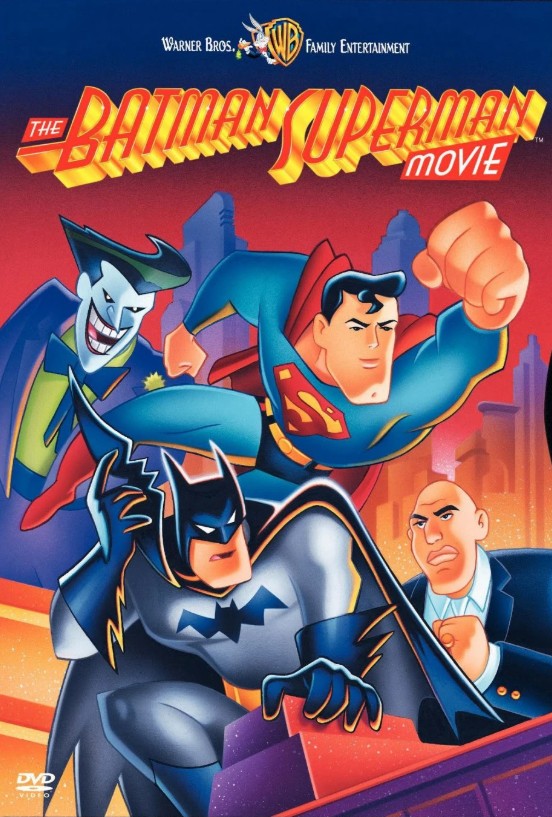
Animated Feature: The Batman/Superman Movie: World’s Finest (1997)
Notes: When I woke up this morning at around 2:30 with a rumbling in my stomach I had every intention of going to work. However, as the rumbling continued to have pointed conversations with me for the next several hours, I eventually resigned myself to a day on the couch. And since getting off the couch to find something to read didn’t seem like a fun time, I decided that today’s Superman fare would consist of something I could access via my remote control. Bizarrely, The Batman/Superman Movie: World’s Finest doesn’t appear to currently be streaming anywhere, not even on HBO Max. Although I could theoretically have watched the individual episodes of Superman: The Animated Series that were cut together to make the film, I once again am grateful for my adherence to physical media and how I’ve used that to meticulously populate my own Plex server.
Younger people reading this blog (and of course, we all know how popular it is with the kids) may not realize just what a big deal this movie was. Today, when everybody and their brother is trying to create a cinematic shared universe, it seems like a film of this nature would be a no-brainer. But in 1997, despite the fact that these characters were all owned by the same companies and their shows were worked on by the same people, there was still relatively little crossover. Batman: The Animated Series was a smash hit, and when the same creators put their work into a Superman series this is exactly what everybody was hoping for, but it was far from a foregone conclusion that we would GET it, at least not until it got gotten.
The movie starts off with the Joker and Harley Quinn stealing a jade dragon from a shop in Gotham City. Batman’s examination of the crime scene sets off some alarm bells, and he makes plans to head to Metropolis. In Superman’s town, the Joker and Harley rather forcibly coerce Lex Luthor into a partnership, presenting him with the “jade” dragon, which is actually made of Kryptonite. Lois and Clark are on-hand when Bruce Wayne flies into Metropolis for a business summit with Luthor, and feeling like she’d made a fool of herself in front of Superman earlier, Lois finds herself smitten with Bruce, who invites her out to dinner to discuss his plans in Metropolis. Although Bruce and Luthor have a business deal in place, Bruce pulls back from parts of it that are intended to create militarized robots, something that burns Lex.
That evening, as Batman roughs up some hoodlums in a bar to find information about the Joker’s whereabouts, Superman bursts in to stop his “vigilantism.” He’s shocked when he uses his X-Ray vision to peer through Batman’s cowl to see Bruce Wayne’s face, and Batman warns him about the Joker’s Kryptonite by taking out a shard to hold him back, allowing him to escape. When Clark returns to his apartment, he gets two surprises: a phone call from Lois informing him that she’ll be having breakfast with Bruce tomorrow, and a bat-shaped tracking device on his cape that alerts him to the fact that he was followed, and that Batman is watching him from a nearby building, his own identity revealed.
The next day, as Bruce arrives at the Planet to pick up Lois, he and Clark briefly compare notes on the Joker’s schemes. Clark is also a bit concerned about Bruce’s burgeoning relationship with Lois, to which Bruce replies, “It seems to me you had your chance.” At their date that night, though, the Joker swoops in and kidnaps her, despite Bruce’s efforts to keep her safe. The heroes go to her rescue, but despite knowing they’re walking into a trap, the Joker manages to get the upper hand and nearly kills them all before escaping.
Lois’s relationship with Bruce gets more and more serious, with her even requesting a transfer to the Planet’s Gotham office, but when she discovers he’s Batman (during an uncharacteristic moment in which his mask is yanked away) the brakes are put on. The heroes naturally team up to stop the Joker and Luthor, complete with his army of murderbots, and ultimately have to save both Luthor AND Metropolis from the Joker’s lunacy. Lois breaks up with Bruce, with the supreme irony of her not wanting to be in a relationship with a man with a dual identity, and Bruce and Clark part perhaps not as friends, but at least with respect and cooperation.
At the time this movie was released, the comics were still in a kind of nebulous state for Superman and Batman. The antagonistic relationship they had in the early years of the post-Crisis reboot had largely vanished and they were teammates in the Justice League again, but they had not yet re-forged the friendship that they’d enjoyed in years past. The movie does a quick job of fast-forwarding through that relationship to get them to a more stable place: when Batman and Superman first encounter one another in costume, they’re antagonists. The next day, each of them having learned the others’ identity, they immediately begin working together, if grudgingly. The cast is top-notch, of course. Tim Daly and Kevin Conroy ARE Superman and Batman for so many of us, but perhaps even better than the two of them together are the interactions between Mark Hamill’s Joker and Clancy Brown’s Luthor, perhaps the two greatest villain voices in animation history. I loved this movie when it first came out, and I still have fun watching it today.
Now if you’ll excuse me, my stomach is doing that thing again.
Tues., Nov. 4

Comic: Batman Adventures #25, Batman: Wayne Family Adventures #29 (Superboy Guest Appearance), Jon Kent: This Internship is My Kryptonite #17
Notes: I went back to work today, although I’m still not really at 100 percent. But I’m a teacher, and if you ask any teacher they’ll tell you that it’s sometimes easier to go to work feeling like garbage than it is to prepare for a class without you in it. At any rate, after the classing is done, I still need to work in something Superman, and I want it to be something quick. Continuing the theme from yesterday, with the World’s Finest movie, I decided to take a peek at Batman Adventures #25 from 1994, the first team-up between the animated Batman and Superman. Well, kinda, anyway. This comic came out before there was a Superman: The Animated Series, and the Superman that appears is based more on Superman as he appeared in comics at the time, long hair and all. Still, writer Kelley Puckett did an admirable job, and the artwork by the brilliant (and gone far too soon) Mike Parobeck make this issue a delight to revisit.
The story opens with Bruce Wayne at a party, unaware that there are crooks planting a bomb in the kitchen. Among the people he schmoozes with at the time is a Lex Luthor with long, red locks and a beard (befitting his “Lex Luthor Jr.” persona from the books) and a ponytailed Clark Kent. LexCorp and WayneTech are competing for a military bid, but the discussion is lost when Clark’s superhearing picks up the ticking bomb under a table. Bruce also notices something amiss and the two of them dismiss themselves, Superman appearing moments later to dispose of the bomb. While he takes it into space, Batman apprehends the crooks who planted the bomb in the first place. Superman comes down to help finish mopping up, and the two icons meet for the first time.
Maxie Zeus sends Commissioner Gordon a video taking credit for the attack and promising to blow up Gotham City if he doesn’t get the “proper tribute” by midnight, and although Zeus is clearly insane (demanding such ransom as “five hundred head of oxen” and “two hundred vestal virgins”), Gordon is clear that he doesn’t bluff. As the heroes search for Zeus’s explosives, Luthor offers his military hunter robots to aid in the search. Superman and Batman find Zeus’s lair, along with the controls of the bomb, just as Luthor’s robots crash in and attack everyone, including Superman, which he tries to explain away as saying the robots “mistook him for an enemy” – but shoot, isn’t it impressive that their weapons can slow him down? They defeat Zeus, but Batman soon deduces that the whole thing was staged by Luthor to secure the military bid. He confronts Luthor with the evidence, telling him to withdraw his bid or he’ll present the evidence to the military. In the end, he and Superman part on terms a bit friendlier than they did in the later movie.
It’s fun to go back and look at this sort of embryonic animated Superman here. Setting the story in Gotham gets them out of having to deal with elements like Lois, Perry, or the Daily Planet, with only Superman himself and Lex standing out as being from that world. And truly, visuals aside, they’re not that far off. Give each of them a haircut (and a shave, in Lex’s case) and tweak the dialogue a little so that this no longer comes across as their first meeting; you could quite easily make this canonical to the animated series. The relationship is slightly warmer, without the initial antagonism we saw in the movie, and is a little more in line with who they would become once they joined the Justice League together. The story works nicely as a little bit of a time capsule, looking at the world of Batman: The Animated Series before that world had a Superman in it and kind of guessing how he would fit in. The later Adventures in the DC Universe series would do the same thing with lots of characters, which made the whole thing kind of out of sorts when those same characters eventually appeared in different forms in the cartoon…but it was no less fun.
It was a nice week off from themes, folks, but we’re running out of 2025 and I’ve still got several themes left that I intend to tackle. So next week, I’m going to mirror something I did in October with “Superman gone bad.” Starting tomorrow, I’m going to spend seven days exploring the Supermen of Other Worlds – and I’m not just talkin’ Elseworlds, my friends. See you in seven!
Blake M. Petit is a writer, teacher, and dad from Ama, Louisiana. His most recent writing project is the superhero adventure series Other People’s Heroes: Little Stars, volume one of which is now available on Amazon. You can subscribe to his newsletter by clicking right here. You can join in the Kryptonian Konversation every day in the Year of Superman Facebook Group!
As you may know if you read my other blogs and watch my videos, I love Halloween. I love the last three months of the year, really, it’s the best part of the year and sometimes just waiting for it to happen is what makes me happy. And even here in the Year of Superman, I’ve got plans for October that will allow me to dip into the darkness, starting today with VILLAIN DEBUT WEEK. For the next seven days, I’ll be looking at the first appearances of some of Superman’s greatest – or at least most memorable – foes. And I gotta tell you, putting this together wasn’t as easy as you might think. As great a hero as Superman is, his rogues’ gallery doesn’t have as deep a bench as Batman, Spider-Man, or the Flash. What’s more, I’ve already covered the first appearances of several of his villains this year – Darkseid, Metallo, Doomsday, and the Cyborg Superman have all had their origins show up already. Others, like Conduit, had a long, protracted first storyline that I didn’t want to devote that much time to this week. Still more, also like Conduit, flamed brightly, but briefly, and then faded to obscurity. That said, I’ve picked what I think are enough memorable baddies to fill out the week, and I’m going to cover them in chronological order of first appearance.
And as always, you can check out earlier blogs in the Year of Superman Archive!
Wed., Oct. 1
Comics: Action Comics #13 & 14, 23
Notes: I’m gonna start off Villains Origin Week with the first supervillain Superman ever fought, followed by the character who is now revered as his greatest enemy. We’ll begin in Action Comics #13 from 1939 – the first appearance of the Ultra-Humanite.

The story starts pretty simply – Clark Kent is taking a cab to work at the Daily Star when he gets rammed by another taxi. He discovers that there’s a cab company exercising a protection racket against the other cabbies in town, trying to force them to sign up. After Superman busts Reynolds, the guy in charge of the racket, Reynolds is freed from a police transport. Superman takes off after him, chasing him to a cabin in the woods where his balding boss awaits. He introduces himself as the Ultra-Humanite and declares that a scientific experiment has given him the “most agile brain” on Earth, which he intends to use for world domination.
World domination, as we all know, frequently begins by muscling cab drivers for a percentage of their fare.
The Ultra-Humanite jolts Superman into unconsciousness with enough electricity to kill “five hundred men.” The waylaid hero is strapped to a board and driven into a circular saw, but the blade splinters on Superman’s skull and sends shrapnel around the room, one of the fragments piercing Reynold’s throat and killing him instantly (a pretty rare death indirectly caused by Superman). When Superman regains consciousness, the Ultra-Humanite flees in an airplane. Superman leaps into the air and smashes the plane’s propeller, sending it plummeting to the ground. When Superman examines the wreckage, there is no trace of the villain.
Wow, what a different story than the Superman we see today.
Not only is Superman far more cavalier about things like Reynolds’ death (even if it isn’t Superman’s fault), but he’s far more reckless when he causes the plane to crash. As for the Ultra-Humanite himself, he’s a far cry from the villain he would become. His schtick these days is his ability to leapfrog his mind from one body to another, with readers being most familiar with the albino gorilla body he uses most of the time these days. Not only is there no trace of his mental abilities, even his claim of having the “most agile” brain in the world doesn’t really hold up to much scrutiny here, as he doesn’t appear to have any greater intelligence than any other villain Superman had faced up to that point. He returns in issue #14, having escaped his death and once again nearly getting Superman in a deathtrap, but Superman got away again. I don’t know if Jerry Siegel – who wrote these stories – was deliberately trying to position the Ultra-Humanite as Superman’s greatest foe, but a lot of the elements inherent in this version of the character would soon be swapped with another, far more memorable villain.
Because Action Comics #23 gave us the first appearance of Lex Luthor.

In a story that definitely feels like it inspired James Gunn at least a lil’ bit, Superman discovers evidence that a war between two nations is being spurred on by the machinations of a mysterious profiteer named Luthor. When Clark Kent goes public with this knowledge, Luthor goes on the attack. Although not as drastic as the change between the embryonic Ultra-Humanite and his later form, this early Luthor is much different than the one we would grow to know and love to hate. His first name is never mentioned, and he comes across as more of a war criminal than the mad scientist or ruthless businessman he would later evolve into. He also has his famous red hair in this one. The story goes that when Luthor was brought back in a later story, the artist looked at this original for reference and mixed up Lex with his bald-headed flunky, changing the course of comic book history. It’s amazing, though, how time changes all these characters. Looking back at this original story, one could hardly believe this character would grow into one of the greatest supervillains of all time.
Thur., Oct. 2
Comics: Action Comics #51, 64, Superman #30, Taste of Justice #13
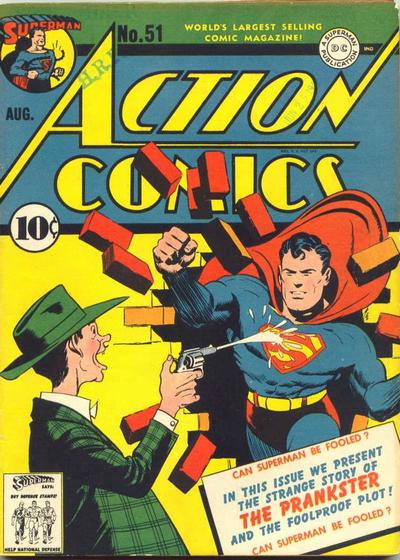
Notes: When I made my list of which villains I intended to include in this Villains Origins week, I decided I would go through that list chronologically. Upon doing so, though, I noticed an interesting pattern. The villains in Superman’s life – obviously unintentionally – seem to have been introduced in themed phases. Yesterday, Luthor and the Ultra-Humanite gave us the evil genius era. Today, in the early 1940s, we’re going to visit a trio of villains that all happen to fall under the category of what I’d call “pests” rather than legitimate threats. These are crooks who all are more of a nuisance than actually evil, out to have a little fun and sow a little chaos – although that doesn’t mean that, in later (and darker) eras of comics they weren’t used for more malicious purposes. I’m talking, of course, about the Prankster, the Toyman, and everybody’s favorite fifth dimensional imp, Mr. Mxyzptlk.
Prankster turns up first, in Action #51 from 1942. The story begins with Superman foiling an old-fashioned bank robbery, but the crooks narrowly escape to meet up with their boss – a goofy, big-eared, buck-toothed crook in a bad suit that calls himself the Prankster. He embarks upon another robbery loaded with the kind of jokes that kids think are funny – a handkerchief that stains your face with black ink, guns that shoot corks or water instead of bullets, and so forth. He even leaves a ticking bag at the scene of a crime, a bomb that the police are terrified to approach. Of course, Lois Lane has no such fear, marching right past Metropolis’s finest to open up the bag and cause a harmless noise-making explosion in a bag full of money. The Prankster’s goons are baffled by why their boss is leaving money BEHIND at the scene of their crimes, but keep going along with it. At the scene of their third crime Superman rounds up the gang and the cops charge Prankster with robbery and assault with a deadly weapon – both charges which are swiftly dropped when the Prankster reveals that his gun only shoots toy parachutes and that, far from stealing from his victim, he has GIVEN him $30,000.
I have to admit, I’ve never wanted so badly to be a crime victim as I have while reading this story.
Prankster keeps going with his bizarre scheme, giving away thousands of dollars time and again, before finally showing up at the Metropolis National Bank. The bank manager, thinking he’s in for a windfall of his own, opens up the vault for the Prankster, who proceeds to relieve him of millions of dollars in currency and jewels, far more than he’s given away. Superman goes after him, saving Lois (because of course she got herself kidnapped) and fighting a variety of traps before the Prankster himself is seemingly killed in a cave-in. Superman was a hell of a lot less curious about the apparent deaths of his foes in those days. But to the credit of the writer, this time they don’t even PRETEND the villain is really dead – in the last two panels we see the Prankster hiding in his cave and planning his next scheme.
Of the three nuisance villains we’re reading about today, I have to admit, I’ve always found the Prankster the least interesting. He’s like the Riddler without the smarts or the Joker without the charisma. That said, I’ve never read his first appearance before, and I’m surprised. His scheme is actually pretty clever, and he also comes across more menacing than I expected, killing one of his own goons in a trap because the man dared question him. He became less and less interesting over time, I guess, but for a Golden Age villain origin, this is solid.

About a year after the Prankster’s debut, the Toyman showed up for the first time in Action #64. Lois and Clark are walking through the park when an automated Superman doll runs past them. Clark catches it and returns it to the creator, a goofy looking dude in a Little Lord Fauntleroy getup calling himself the Toyman. Impressed at his work, Lois asks if she could write an article about him and his shop. Lois doesn’t know, of course, that not all of his toys are so benign. Toyman sends a troop of toy soldiers into a bank (never trust your money in a Metropolis bank) where they expel knockout gas, allowing him to loot the cash drawers, getting away on a flying pogo stick. For his next trick, Toyman uses a toy fire truck to start a fire at an expensive apartment building, leaving him free to rob the penthouse at the top as Superman is busy rescuing people from the flames. He even sends a letter to the Daily Planet to brag about his third crime, using a toy truck to blow up a bridge while his men in scuba gear empty a real armored car that fell into the water. Superman catches the divers, but Lois is caught (OF COURSE SHE IS) by the Toyman and his toy battleship. Superman ultimately tracks him to his hideout using his super-senses, and Clark shows up to untie Lois – but not before he beats her to writing up the story of the Toyman for the newspaper.
I really like the last bit, where Clark gets the better of Lois for once. As for Toyman himself, this is a character who’s been reinvented many times. At least three different characters (one of them a hero) have used the name, and the original Winslow Schott has been at turns a child-hating creep, a child-loving creep, and a third stage that made him – in the 90s – one of the darkest foes Superman ever fought. We’ll get to that story later this month.

In 1944, Superman #30 gave us the debut of the character we would come to know as Mr. Mxyzptlk, although it’s spelled “Mxyztplk” here, and the spelling changed later. I wanted to make sure I was clear about that – I’d hate for anybody to get confused. It all begins when a little man wearing a derby hat walks in front of a speeding truck and is seemingly killed. The paramedics can’t budge him, though, and he shocks the hell out of them by sitting up and encouraging them to try harder before stealing their ambulance, driving it straight up the side of the building, and making it explode. He next appears in a museum, loudly interrupting the unveiling of a new sculpture by howling for his friend “McGurk.” After disrupting the show, the sculpture is unveiled and comes to life, following the imp away. Superman finally chases down the little goober, but he vanishes. He continues to pop up in and around Metropolis causing chaos for several pages before slowing down long enough to tell Superman that he’s from another dimension and he thought using his powers in ours would be fun for a little while once he learned the magic words that could transport him back and forth. Superman deftly tricks him into saying the word that sends him home (“Klptzyxm,” natch) and he vanishes, but not before one last prank. Clark comes back to the Daily Planet to find that, rather than Clark’s story about Mxy’s pranks, he published a story mocking Lois Lane’s new hat.
This is a funny story, with great visuals and sight gags that click with this embryonic Mxyzptlk. There are even lots of little background jokes to populate the pages, like a kid telling his mom he wants to grow up to be like Superman only to be admonished that he has to eat his vegetables. It’s a great intro and no wonder that the imp was brought back time and again. He’s gone through a lot of incarnations as well. Sometimes he’s more malevolent, sometimes he’s more childlike, occasionally he even comes across as wanting to be Superman’s friend. Whatever the case, though, having him around is always amusing.
Fri. Oct. 3
Comics: Action Comics #242, Superboy #68
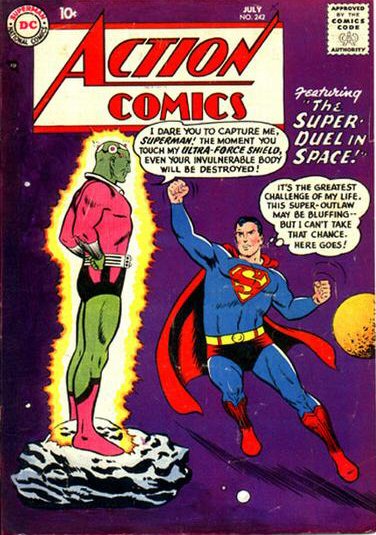
Notes: By the 50s, the era of the super-nuisance seemed to have passed, and the next batch of memorable villains to join Superman’s rogues gallery were of a more sci-fi bent: the alien Brainiac, the quasi-clone Bizarro and the cyborg Metallo. Metallo, coincidentally, made his first appearance in Action Comics #252, which I covered here several months ago, as it happens to be the same issue as the first appearance of Supergirl. But today I’ll look at Brainiac and Bizarro.
In Action #242, Brainiac comes to Earth to shrink its greatest cities and steal them to repopulate his own home planet, which was wiped out by a plague. After getting Paris and New York, Superman waits in Metropolis for his home town to be stolen as a way onto Brainiac’s ship. On board, the tiny Superman another city that was stolen: a city from his homeworld of Krypton – but upon entering the bottle, he loses his powers under the stimulated Kryptonian environment. He seeks help from a scientist named Kimda who happens to be his father Jor-El’s college roommate (I know that sounds like a joke, but I swear to God, that’s exactly what happened). Outside the bottle, Brainiac goes into suspended animation for his trip back home and Superman manages to escape the bottle. Using Kimda’s findings, Superman restores the cities of Earth, but then discovers that ray has only enough charge left for one more enlargement – either Superman or the Kryptonian city. Although he plans to restore the city, Kimda intervenes and turns the ray on, making Superman grow so that Earth would not be deprived of its greatest hero. Brainiac’s ship continues on its way while Superman brings the city to his Fortress of Solitude with a vow to find some way to restore it someday.
This is such a weird story to me. Brainiac has changed so much over the years that you almost wouldn’t recognize him – he’s usually painted as far more menacing and malevolent these days, and later incarnations would identify him as an artificial intelligence that occasionally uses flesh and blood bodies. Kandor itself would get massive development over the years – in fact, until I started to write this recap I didn’t even notice that the city was never identified by name in the original story, it was just “a Kryptonian city.” It’s really weird and fascinating to look back on these things, elements of Superman’s lore that would go on to become so important, and see how humbly they began.
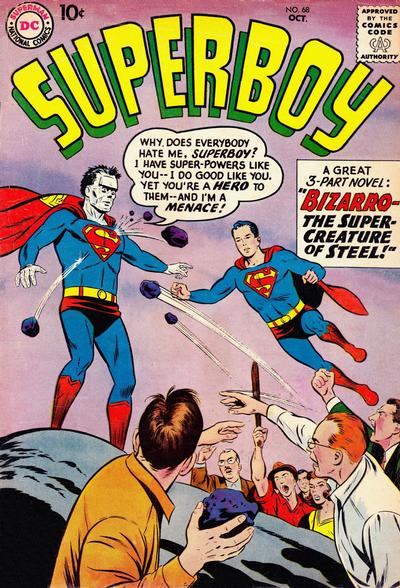
Bizarro first showed up in Superboy #58 later that same year. When one of Smallville’s seemingly infinite number of scientists asks Superboy to help him test a new “duplicator ray” he’s invented, he accidentally strikes Superboy with the beam and creates a “non-living” duplicate with a strange faceted skin and a feeble mind, but all of Superboy’s powers. Dubbed “Bizarro” the creature stumbles around Smallville for a while trying and failing to fit in, finally making friends with a young woman named Melissa who isn’t terrified of his appearance. The dim Bizarro, however, doesn’t realize that the girl is blind. When Bizarro decides to seek her out at Smallville High, Clark is forced to do some secretive super-feats to prevent the creature’s bumbling from accidentally killing half the class.
Superboy finds a chunk of Kryptonite and tries to use it to stop Bizarro, but it has no effect. He uses a marionette of Melissa to lure Bizarro to a military range, where the army fails to destroy the creature with heavy artillery. (Really, Clark, the creature obviously has all your powers, what were you thinking?) Bizarro returns to the real Melissa, where he discovers that she’s blind, and only his friend because she can’t see his real face. At the same time, Superboy learns that the irradiated pieces of the original duplicator ray have a Kryptonite-like effect on Bizarro. He approaches the creature with a piece of the metal and Bizarro hurls himself into it, exploding into a rain of dust. Somehow, the vibrations of his explosion trigger Melissa’s optic nerve and restore her sight, leaving her to wish she had seen the “kind face” of the creature who sacrificed himself for her.
This story goes to great lengths to remind us that Bizarro isn’t alive, over and over again, despite all evidence to the contrary. Doesn’t matter that he moves and thinks and has feelings and willingly sacrifices himself for the betterment of his only friend. None of those things are evidence of LIFE. After all, if he WERE alive, that would make Superboy a murderer, which probably would have been frowned upon. But alive or not, this Bizarro already carries a lot of the elements that the character would embody later, including his backwards thinking and speaking. He was brought back a year later, when the experiment that created Bizarro was duplicated on the adult Superman, creating a second Bizarro. This one would ironically go on to dub himself “Bizarro #1” when he created a whole planet of duplicates of himself and the Bizarro culture became fleshed out. John Byrne would also bring back the idea of Bizarro sacrificing himself to restore sight to a blind girl – this time Lucy Lane – when he rebooted the character in Man of Steel. The blueprint was there from the beginning, but it’s been greatly expanded over time.
Sat., Oct. 4
Comics: Superboy #83, Adventure Comics #283, Justice League: The Omega Act Special #1, Absolute Evil #1

Notes: The next point we reached with the introduction of memorable villains seems to have brought us to an era of threats from home – specifically, Krypton. Superboy #83 brought us the debut of the Kryptonite Kid, who first appears to Superboy in a dream. The Kid, with a body (and a dog) made of Kryptonite vexes the sleeping Superboy. Even more baffling, Superboy soon figures out that Krypto is having the same dreams as he is. The dreams come true when they encounter the Kid at a playground. The Kid chases Superboy, demonstrating his ability to transform things into Kryptonite with a touch – a playground slide first, then the lead culvert Superboy tries to use for cover. The Kid warns Superboy and Krypto that they have to leave Earth or he’ll kill them, then flees the scene. After a few more encounters, one of which winds up with Smallville High School itself turning into Kryptonite, the Kid reveals his secret origin. Turns out he was an inmate at a prison in space who volunteered for an experiment in exchange for the commuting of his sentence. He wound up with the ability to turn things into Kryptonite and decided to use it to attack Superboy. (Projecting himself into Krypto and Clark’s dreams are evidently a natural ability of his alien race.) Just when it seems that Superboy’s down for the count, the Kid is zapped away by – of all people – the young imp Mxyzptlk. After all if Superboy dies, there’ll be no one left for him to play with.
What a bizarre story. The origin is pretty generic, and in the end Superboy has no hand in saving himself – the only reason he survives is because Mxy didn’t want him to die. It’s also interesting to note that, by this point, things had been retconned so that Clark first encountered Mxyzptlk as a kid in Smallville rather than an adult in Metropolis. Kryptonite Kid wasn’t the most memorable of villains, but he did pop in to vex Superboy several more times, and at least once after they were adults. But there would be other villains who picked up the name Kryptonite Man later and made it more fearsome.

Clark was also Superboy in Adventure Comics, where he met perhaps the second greatest enemy he’d ever have, after Luthor himself: General Zod. It begins when a box falls to Earth in Smallville with Kryptonese writing on it. Superboy reads the inscription to learn that the box contains several weapons that were deemed too dangerous to leave lying around Krypton, so they shot them into space on a trajectory that would eventually cause them to fall onto a far less developed planet, because for all their scientific advancement and planetary harmony, the Kryptonians were kinda dumb. Among these devices, which Superboy learns were created by his own father, Jor-El (there were approximately seven people on Krypton when it exploded and they all were connected to the Els), is the infamous Phantom Zone projector. Superboy learns the history of the device, including how General Zod was banished into the Zone when he tried to stage a revolt on Krypton with an army of Bizarro-like duplicates of himself. The device is activated when a lizard steps on the button and turns Superboy into a Phantom, because — and I cannot reiterate this enough — Kryptonians were kinda dumb. The Phantom Superboy is forced to zip around Smallville – invisible and intangible – trying to find some way to get somebody to turn the device on and restore him. He finally gets a message to Jonathan Kent, using his super-brain to transmit a message to an electric typewriter. This works because earlier in the issue Lana Lang theorized it would. That’s the only reason.
Zod’s appearance in this issue is minimal, appearing only in the flashback that shows how the Phantom Zone projector works. Both he and the Phantom Zone would come back and become much more defined, although Zod himself was fairly unimpressive until the late Terrence Stamp played him in the first two Superman movies, elevating him to the A-list of Superman villains. Most versions of Zod in the comics since then have been based on the Stamp version of the character. The Phantom Zone, too, would be dramatically changed from merely turning the victim into a phantom into being a portal to a literal other dimension. There was a lot of refinement to this concept before it became what it is today.

I also grabbed this week’s new Superman comics today, including a pair of one-shots that are connected to the larger story of the DC Universe. The prelude to DC KO is presented in Justice League: The Omega Act Special. Superman has brought the lost Booster Gold back to the League, but he and the Doomsday/Time Trapper – along with the Flash – take a quick trip through time to discover what really happened when Darkseid died in the DC All-In Special. The upcoming conflict with the Absolute Universe is about to change everything, but Booster has been changed as well. And in addition to Booster, we get flashbacks to Krypton’s past when Lara (Superman’s mother) and Ursa (Zod’s wife) made a discovery that might change everything we know about a certain member of our cast. I’m really excited to see where this story is going.
Absolute Evil #1 is the a one-shot special celebrating the first anniversary of DC’s Absolute line, focusing (naturally) on the villains. Hector Hammond is summoned to a summit that includes Veronica Cale, Ra’s Al Ghul, and the humorless creature this universe calls Joker. Cale reveals how – in this universe – certain forces have operated to prevent the rise of costumed heroes, either through violence or temptation. We’re given glimpses of the would-be heroes of this world’s Golden Age and what happened to them, as well as an understanding of what these terribly powerful people have planned now that things have changed and superhumans are beginning to appear that are beyond their ability to control. The issue has a pretty decent recap of the broad strokes of the Absolute Universe to date, for those who maybe want to play catch-up, and there’s a pretty startling final page that leaves me scratching my chin and wondering where they’re planning to go with all this.
Sun., Oct. 5
Comics: Absolute Superman #12, Adventures of Superman: Book of El #2

Notes: I had a lot on my plate on this Sunday, so I’m going to hop in real quick and read the other two new Superman comics from this week, starting with Absolute Superman #12. “The Battle of Kansas” begins as Kal-El retreats to the one place on Earth he’s ever felt safe: Smallville. Lois and Jimmy have the same idea, seeking refuge in a diner where a face the readers will recognize immediately confronts them about their association with Lazarus. We also get some flashbacks to fill in a bit of Kal-El’s time on Earth, even as Ra’s Al Ghul prepares his revenge on the alien who dared to defy him. This may be my favorite issue of this series to date, with a real look at character and a bit of the flavor of hope we expect from a Superman story. The whole thesis of the Absolute universe is that “hope” is the underdog, and the whole world runs on darkness and conflict as befits a world spawned by the power of Darkseid. But even in a world this dark, this issue shows us how the light of this character shines through, and it feels really good.
I feel less good about Book of El #2. Superman is in the distant future with his descendant, Ronan Kent, seeking a way home. Meanwhile, the world has been taken over by one of his greatest foes. This issue explores that a little bit, but in a way that I frankly find irritating. Some science fiction writers have people in the future talk exactly like people do today, even though logically we know that’s not right. Language changes and evolves, and people from 1000 from now won’t talk exactly as we do any more than we talk like people from 1000 years ago. So other writers conjure up a “future speak” to address the issue. Sometimes it works, sometimes it doesn’t, and when it doesn’t it can come across as REALLY annoying. Realistic or not, sometimes it’s better to just keep the language simple.
Oct. 6
Comics: Action Comics #340, Superman #323, 324, DC Comics Presents #27, 28
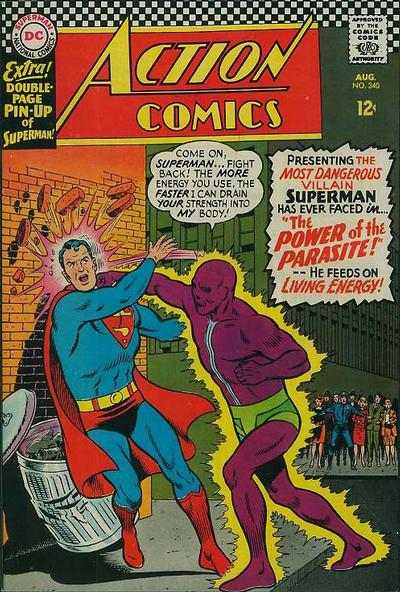
Notes: Back to Villains Week. The Parasite was the next significant Superman villain to show up, in Action Comics #340 from 1966. Like many of the villains we’ve talked about this week, he’s gone through a lot of changes over the years, and several people have used the name (although the powers haven’t changed significantly). Let’s see what kind of tomfoolery the original got up to.
The story, by the late Jim Shooter, kicks off hard, with the opening narration declaring that the Parasite was “the most powerful foe Superman has ever faced!” And in this pre-Darkseid, pre-Doomsday world, that may not be hyperbole. The story starts with Superman helping out in a government science lab, conducting experiments with radioactive elements that would kill an ordinary person. When the facility’s janitor Jensen, is tapped to dispose of the waste from the experiment, he remembers a rumor he heard that sometimes labs ship their payroll inside of containers marked “radioactive waste” to fool criminals. Instead, he proves that criminals are fools by opening up the container and exposing himself to the toxic material. Jensen’s skin turns purple and deformed and he collapses, as if all his energy has been spent. When one of the scientists finds him, Jensen finds himself absorbing not only the man’s energy, but also his scientific knowledge. He fights his way to freedom, absorbing the strength and minds of everyone he comes across. Although the energy he absorbs doesn’t last long, he begins to plan a new life as a human Parasite.
He later picks up a little of Superman’s energy as the Man of Steel flies past his hideout, and he gets the idea to hunt him down. When he feels an enormous surge of energy coming from Clark Kent, the Parasite figures out a secret that Luthor and Brainiac had been struggling with for decades. When Superman tries to stop him from robbing a bank, the Parasite defeats him with his own power and threatens to expose his secret identity if Superman refuses to fight him to the finish. He’s shocked that, no matter how much power he drains from Superman, he still keeps getting up and he keeps absorbing more and more until finally his mortal body is overloaded by Superman’s power and he explodes.
We’ve talked before about how unimaginative people complain that Superman’s powers make him “boring,” but it IS true that it’s hard to come up with a suitable physical threat for him. Like Kryptonite Kid, this was an effort to do so. But like Kryptonite Kid, in the end, Superman’s victory is a passive one. He survives not because of anything he DOES, but because the Parasite simply bites off more than he can chew. The Parasite would become a recurring foe for Superman over the decades, and although he remained dangerous, they also started to play up the fact that he wasn’t all that smart, and subsequent victories gave Superman a bit more agency. Still, it’s kind of disappointing that their first tete-a-tete ended the way it did.
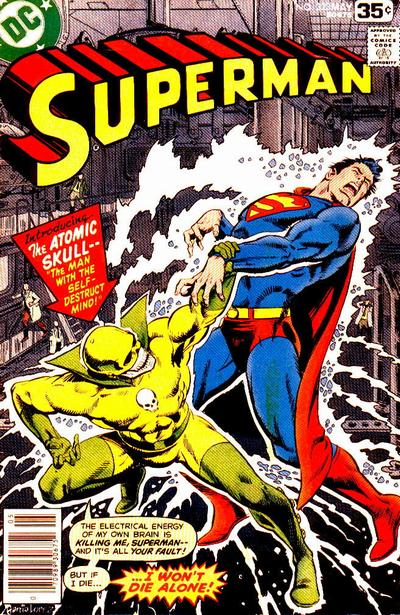
Next we jump ahead to 1978 and the first appearance of the Atomic Skull in Superman #323. Although the Skull has never quite cracked into the ranks of Superman’s A-list villains, he’s a B- (or, if I’m being honest, maybe C)-lister that I’ve always had a fondness for. Of course, I remember him better in his vastly different post-Crisis version that showed up in early issues of Superman: The Man of Steel. The original Skull appears in “The Man With the Self-Destruct Mind” by Martin Pasko and Curt Swan, and shows up on page one destroying a Superman statue and vowing to kill the real thing. Superman, meanwhile, is in space – he’s wearing a suit of lead armor trying to investigate a sudden preponderance of Kryptonite that’s been falling to Earth lately and coming into the possession of a group called the Skull Crime Organization. He soon discovers that “Krypton-Two,” a planet he once made out of chunks of Kryptonite, has somehow been destroyed and is showering Earth with Green K once again. The Skulls, meanwhile, kidnap a STAR Laps scientist and reveal that their craft is powered by their leader, the Atomic Skull, whose brain is creating miniature nuclear reactions. Furthermore, he is unmasked as former STAR Labs scientist Albert Michaels. (Michaels, it turns out, had made previous appearances as the leader of the Skulls – this is his first appearance with his new powers and costume.) As it turns out, Michaels has a rare nervous disorder that short-circuits his brain’s electrical impulses. A treatment for his condition only made it worse – not only does he still have seizures, but they are accompanied by energy bursts that are killing him, and he hates Superman because he’s jailed the only scientists (mad, I presume) who could have saved him. His plan involves loading up a rocket with the Kryptonite that’s falling to Earth and detonating it in the atmosphere, blanketing the planet with enough Kryptonite particles to remove Superman’s powers no matter where he is on the globe. And on the last page he plays his trump card – holding Superman at bay with the powers of Titano, the Super-Ape as he sends the rocket to blow up.
Part two of the story picks up in Superman #324, as Titano hits Superman with the rays of his Kryptonite vision. Superman manages to neutralize the ape by wrapping lead around its eyes, then takes out the Atomic Skull by redirecting one of his own energy-bursts. This leaves him with the problem of what to do with the Kryptonite missile, which he can’t approach to stop without exposing himself to fatal doses of Kryptonite. Titano comes after him again and, with his X-Ray vision, Superman determines that the Skull is controlling the ape via a device implanted in his brain. He manages to corral the ape and then use the Supermobile (God, I love the stupid, ridiculous Supermobile) to vacuum up the Kryptonite from the atmosphere.

I appreciate that they were trying to up the ante for the villains at Superman at this point. The late 70s and early 80s are really, for me, one of the dullest periods in the character’s history, with few memorable stories or characters appearing. The Skull is an exception. He’s a little generic – the mad scientist with atomic powers – but the idea that the powers are slowly killing him gives it a little more weight. I don’t think they did that much with the idea, though, and it’s been largely dropped from future versions of the character. Now, especially, where his head is encased in atomic fire, people write him off as a Ghost Rider knock-off. There’s more to it there, and I think the right writer could really make him into a top-level threat.

In 1980, Len Wein and Jim Starlin gave us DC Comics Presents #27. This issue of the Superman team-up book paired him off with the Martian Manhunter and gave us the first appearance of the world-conquering Mongul. Superman is alone in Clark’s apartment when he receives a message from outer space – a yellow-skinned alien who reveals that he has kidnapped three of Clark’s colleagues – Jimmy Olsen, Lois Lane, and Steve Lombard – and threatens them if Superman refuses to retrieve for him a crystal key that is being held on the fifth planet in the Cygnus system. At this period, the Martian Manhunter has left Earth, establishing a “new Mars” on Cygnus’s FOURTH planet, and when Superman approaches the crypt where the key is being kept, J’onn shows up and tells him that the world is off-limits. J’onn tells Superman that the key must remain where it is or countless worlds will be in jeopardy. The key is the only thing that will allow someone to get past the defenses of an ancient and incredibly powerful satellite called Warworld, and thus it may be the most dangerous object in the universe. Although Superman sympathizes, the two friends come to blows. Each of them attacks the other with their weakness (Kryptonite for Superman, fire for J’onn), and ultimately Superman retrieves the key. When Mongul arrives, though, he refuses to turn it over. J’onn saves the hostages, but Mongul manages to get the key and escapes.
There’s good and bad in this issue. On the plus side, Mongul is a great villain. He’s the most fully-formed of all the villains I’ve read about this week, the one who is most like who he becomes from the very beginning. He’s cold, manipulative, and ambitious, all qualities that make him one of the greats. On the other hand, I really dislike the way Wein paints Superman and J’onn. The two of them have been friends forever at this point – the fact that they went straight to fighting instead of trying to work together to find a way out of this dilemma does a disservice to them both.
The story continued in the next issue, when Superman recruits Supergirl to help him track Mongul to Warworld. (Why J’onn didn’t come along, considering how important he considered the key to be, is a mystery.) They find the planet and are dazzled by the enormity of it, but Superman manages to defeat Mongul by outlasting him – he reasons that the aliens that created the satellite died one by one because the control helmet was too much for them and that it would eventually wear Mongul out, and he’s right. It does make one wonder, though, why the hell the aliens would make their entire weapon fueled by a device that would not only cause their own extinction, but do so in what seems to be a matter of minutes. Who the hell ever thought THAT was a good idea? Even in the real world, it takes us much longer to destroy ourselves.
Tues., Oct. 7
Comics: Action Comics #595, 645, Justice League of America #31
Notes: You may have noticed something about the villains I’ve covered so far this week. I know my wife certainly has. They’ve all been men. I refuse to take the blame for this. It’s not my fault that for five decades, the writers of Superman never seemed to come up with an interesting continuing female villain. I think part of it is the idea that you can’t have Superman punch out a lady – it’s not a good look for the strongest man in the world to punch out a woman. In fact, go back and look at any early Justice League issue where the team fights a villain GROUP – there’s always one female villain so that Wonder Woman has somebody to fight.

But eventually, it seems, people decided to address that, and in my chronological journey through Superman’s rogues’ gallery, the last three significant villains I’m going to talk about all happen to be female.. We’re going to start with Action Comics #595 and the first appearance of the Silver Banshee. This was part of the John Byrne era, coming out in 1987 during the period when Action Comics was the Superman team-up book. This particular issue, though, didn’t divulge who Superman’s guest-star was on the cover, leaving a string of question marks where the second hero’s name usually went. It’s a striking cover nonetheless – a stark black-and-white villain with a skeletal face standing over Superman’s dead body while his spirit comes at her from behind. That’s a book that’ll get your attention.
The story starts with the Banshee walking through Metropolis, invading bookstores where she casually touches bystanders, drains their life force, and leaves them dead. And when Superman arrives, she does the same to him. The world is stunned by the hero’s sudden loss and he’s placed in state in a glass casket for a memorial as the Banshee escapes. At the funeral, though, everyone witnesses Superman’s ghost rise from his body and take off after the Banshee. Jimmy, meanwhile, has tracked her down to yet another bookstore. She’s about to touch him when Superman’s ghost appears and engages her, shocking her when she realizes she can’t hurt him anymore. The Banshee unleashes her scream, trying to destroy Superman, but winds up exploding. (Superman villains used to explode a LOT.) Jimmy is pulled from the debris by a LIVING Superman, and watches in astonishment as the ghost Superman transforms into J’onn J’onzz, making his second appearance in Villains Week! Give the man a box of Chockos! On the last page we get an explanation for everything – the Banshee’s ability to kill was based on her knowing her victim’s identity (because magic), so she was helpless against the shapeshifter. Jimmy also figured out that she was targeting bookstores that had recently received a shipment of books from a certain castle in Ireland. That, of course, is the sort of thing that comes back later.
The Silver Banshee has always been one of the most memorable new villains from this period. She’s got a phenomenal look, first of all – a really unique appearance that’s totally unlike any of Superman’s other villains. Also, considering how everyone remembers his vulnerability to magic, it’s surprising that he doesn’t have more enemies for whom magic is their usual shtick. Later stories would flesh out the character more, revealing a tragic backstory and making her more sympathetic. In recent years she’s wavered between villain and antihero, and she’s even (in her human form) dated Jimmy Olsen. In fact, I think she still is – Jimmy’s been a little out of focus in the comics lately, they really should address that. Anyway, the point is, she’s a good character.

Maxima, the warrior queen from the planet Almerac, made her first appearance in Action Comics #645 by Roger Stern and George Perez. I’ve written about Maxima in the Year of Superman many times, of course. She was a member of the Justice League during the Doomsday storyline, broke bad again in the electric era, and she’s had a smattering of other appearances over the last ten months. Today, though, we’re going to see where she came from in the first place.
The story begins with a stunning redhead strutting the streets of Metropolis and being accosted by a few gang members, one of whom quickly (and fatally) learns that pulling a knife on her isn’t a good idea. Maxima, along with an attendant named Sazu, is looking for Superman, and winds up at the Daily Planet office after being told he has connections there. Superman isn’t in attendance, though, and after leaving the entire staff in a trance, she leaves. Clark shows up, fresh from a fight with the Parasite in Starman’s comic (Stern was writing both books and liked to tie them together), shows up and snaps them out of it. They tell him about their attacker and he finds her pretty easily, as she’s now at City Hall holding the mayor hostage. When he arrives, she puts him under mental assault as a means of testing him. She’s testing Superman’s “worthiness” and finds him acceptable, but Sazu revolts. She claims that Superman is “unworthy” and unleashes her own mental powers against Maxima, who…explodes.
No, really.
Sazu is taken into custody and Superman is left confused, but the last page clues the reader in to the fact that the Maxima who blew up was just a simulacrum. The real Maxima is in outer space and now, dang it, she’s gonna have to come to Earth herself to make Superman hers.
And she did show up again, and several times after that, as her motivation was revealed: she was seeking a consort of superior bloodline with which to procreate and extend the line of the Royal Family of Almerac. As villain motivations go, it’s a lot more flattering than wanting to destroy him because he thinks it’s Superman’s fault that he went bald. It’s also interesting how the gender roles are inverted here. When you consider the revelation about Kal-El’s parents in James Gunn’s movie, it’s not all that different, but it’s definitely more controversial. Part of that, of course, is because Jor-El is usually portrayed more benevolently, but even were it a brand new character I think people would have found it more insidious than they did when Maxima shows up wanting pretty much the same thing. There’s probably a whole dissertation that could be written about the differences here, but that’s somewhat above my pay grade. At any rate, it makes Maxima one of the more memorable villains of the era, and she’s had the kind of longevity that it wouldn’t be surprising at all to see her show up in a new movie or TV show. There’s something interesting about this character that’s fun in a cheesy sci-fi sort of way.
TV Episode: Superman: The Animated Series Season 2, Episode 5, “Livewire”

Notes: The last villain we’re going to discuss on this avenue of animosity did not make her first appearance in comics, but rather on TV. No doubt trying to duplicate the smash hit they had when they created Harley Quinn on Batman: The Animated Series, the producers of the Superman cartoon introduced this new female foe in 1997, an electrical harpy called Livewire. Although she hasn’t QUITE had the degree of cultural penetration that Harley has (and to be fair, who HAS?), she, too, made the leap to comic books and has crossed swords with Superman occasionally ever since.
In “Livewire” we’re introduced to Leslie Willis (voiced by Lori Petty), a radio shock jock who’s riding a ratings high she’s getting off of trash-talking Superman. She goes through with her show’s anniversary celebration in Centennial Park despite a thunderstorm pouring down on them, and suffers the consequences when lightning overloads her equipment. Superman tries to shield her, but Leslie is bombarded by electricity, bleaching her skin white and her hair blue. When she wakes up in the hospital, she discovers she’s developed electrical powers, including the ability to control electronic devices, and attempts to hold the city of Metropolis hostage. She attacks the city’s hydroelectric plant, where Superman comes in to hold her off. After a pitched battle, Livewire blasts a hole in the dam and is washed over with water, causing her to EXPLODE!!!
Just kidding.
No, she stays in one piece, but the water DOES short-circuit her powers, allowing Superman to repair the damage to the power plant and bring her in. When we last see her, a radio voiceover tells us that Lex Luthor has volunteered (through the goodness of his heart, of course) to pay for her treatments, but the image we have of her strapped into a chair with wires all over her seem to indicate that she isn’t receiving the best of care.
I like Livewire, not just because Superman could use more female villains, but because she’s got a unique attitude. She’s not jealous of Superman’s popularity. She’s not out to prove that she’s more powerful than he is. She doesn’t want to outsmart him or outthink him, and she CERTAINLY doesn’t want to have his babies. Nope, Livewire is just a jerk, a loudmouthed radio asshole like Howard Stern, only more lifelike, and that’s an entertaining dynamic to play.
This first week of October was a fun one, but it’s just the beginning. Like I said, I intend to spend this month peering into the dark side (not to be confused with the Darkseid) of the Man of Steel, and I mean it. Come back next week for my discussion of Superman’s Darkest Hours.
Blake M. Petit is a writer, teacher, and dad from Ama, Louisiana. His most recent writing project is the superhero adventure series Other People’s Heroes: Little Stars, volume one of which is now available on Amazon. You can subscribe to his newsletter by clicking right here. You can join in the Kryptonian Konversation every day in the Year of Superman Facebook Group!
The monthlong journey through Superman’s electric era was fun, but I’m ready to mix it up again and get back to some different types of stories. So this week I’ve decided to go without a theme. I’ll grab random stories to enjoy each day, without any overarching plan or goal. I’ll get back to themes in October. And I’ve got plans for October.
And as always, you can check out earlier blogs in the Year of Superman Archive!
Wed., Sept. 24
Comics: Superman #162, Taste of Justice #12 (Krypto Appearance), Harley Quinn in Paradise #37 (Cameo), Jon Kent: This Internship is My Kryptonite #13
Notes: With the saga of Electric Superman behind me, I realized that there’s one thing I should have read that I forgot to include. Like “The Death of Superman,” the long-running epic of Superman Red and Superman Blue was not a unique idea to the Triangle Era, having drawn a little inspiration from a Silver Age “Imaginary Story.” Today, even though I’m purposely leaving this week open for random readings as the mood strikes me, I wanted to go back and read the original story of Superman Red and Superman Blue from 1963. I read this story for the first time when I was a kid, included in the delightful Greatest Superman Stories Ever Told trade paperback, which now that I think about it, may be the first trade paperback I ever got. I wonder how the contents of that would change were they to make a new volume today.

Anyway, in “The Amazing Story of Superman-Red and Superman-Blue” by Leo Dorfman, with art by the immortal Curt Swan, we start off with a discussion of Superman’s many failings. The publisher of the Daily Planet puts out a post listing raises for every employee except for Clark Kent (in fact it specifically says “Clark Kent: No Increase,” like that time on The Simpsons that the power plant announced layoffs in alphabetical order and only said “Simpson, Homer”), and before the bruising has even subsided, he’s summoned to the Fortress of Solitude where the citizens of Kandor are pissed that he hasn’t gotten around to enlarging them yet. And while they’re on the subject, why hasn’t he found a cure for Kryptonite poisoning or eradicated crime on Earth? Is he a Superman or isn’t he?
I gotta be honest, the Kandorians kinda seem like assholes in this one.
At any rate, they give him six months to try to accomplish all of these feats or they’re going to have him switch places with a Kandorian citizen and let the new guy try to do it. Superman, apparently forgetting the fact that he is – relative to them – the size of the Empire State Building, agrees to their terms. He tells Supergirl that he’s invented a “brain evolution machine” that could theoretically improve his mental power a hundredfold. The catch is that the machine is powered by radiation from all different colors of Kryptonite, so there’s a significant chance that something could go wrong. As it turns out, though, something goes extraordinarily RIGHT. The machine splits Superman into two beings, each 100 times smarter than the original. Unlike the last time this happened under the influence of Red Kryptonite, though, this time there’s no evil twin – they’re both still good.
The two super-geniuses quickly put their brains to work solving the issues that Kandor set forth for them, beginning with repairing Brainiac’s enlarging ray (which he’d never been able to do before) and restoring Krypton by causing a chain reaction that magnetically draws every chunk of Kryptonite in the universe to the planet and, at the same time, neutralizing their harmful rays. Kandor is enlarged on its rebuilt homeworld, and the first two problems on his list are solved just like that.
Before they can move on to the next item on their list, they get a telepathic signal from Lori Lemaris. The Atlanteans saw what they did for Kandor and ask them to help them find an uninhabited ocean planet to live on, since they’re “tired of being considered freaks here on Earth.” This is kind of a crazy notion – it’s not like the existence of Atlantis was common knowledge at the time, so who exactly was calling them freaks? It’s also weird that nobody ever stops to consider what Aquaman has to say about all this, although I suppose you need to remember that at this time, DC didn’t care nearly as much about continuity as they would later.
Once that’s taken care of, it’s crime time. The Supermen invent a ray that can “erase all thoughts of evil” from the minds of the world’s criminals, which they swiftly deploy through a series of satellites. Instantaneously, every villain on Earth is reformed. Bank robbers return their loot, escaped prisoners turn themselves in, the Soviet Union dumps all its missiles into the sea! Even Brainiac, coming from space to attack Superman again, has a change of heart when he gets in range of the satellites. And GEEZ, is this a story that would take on a different aspect if it were written today. If you were reading comics in the mid-aughts, you probably remember Identity Crisis, the DC event which revealed that certain members of the Justice League had agreed to use Zatanna’s magic to essentially brainwash certain criminals over time, removing memories and – in the case of Dr. Light – turning him from a serious threat into a buffoon. The revelation of their actions caused a schism in the League that nearly destroyed it before it was rebuilt in the wake of Infinite Crisis. One could argue that what happens in this story is far worse. Sure, there’s no more crime, but it’s at the cost of effectively brainwashing the entire planet. These are our HEROES, folks.
Not to say it’s all bad. Once the rays hit Lex Luthor and reform him, he whips up a serum that, after the Supermen distribute it into the world’s drinking water supply, instantaneously eradicates all disease from the Earth, even allowing him to grow his hair back. Yes, they even eradicate male pattern baldness.
The final chapter of this three-part “novel” shows us the end of the Supermen’s career. With Krypton restored and crime wiped out, Supergirl releases the Phantom Zone criminals (who are immediately reformed by the rays) and together they decide to go back to live on New Krypton, but not before the Legion of Super-Heroes pops in to say goodbye to her, and also give her a spaceship. Remember that, people, good friends are the greatest treasure. The Supermen then decide to turn their attention to the greatest danger of all: women. Superman, it seems, had always struggled between two girls, Lois Lane and Lana Lang, and unable to make a decision, kept them at arm’s length. Now that there’s no crime to endanger Superman’s wife, there’s no longer any reason to stay single. For the first time it turns out that Red and Blue aren’t EXACTLY alike – Red prefers Lois, while Blue is conveniently Team Lana, so each of them goes to reveal his identity and propose to the girl he loves. They each agree immediately to marry Superman (they most certainly would NOT have married Clark, let’s be honest), but are stunned when they discover that there are two of him.
Have they not been watching the news? I…I feel like the two Supermen who eradicated crime and spread Lex Luthor’s serum to cure all disease would have made the news.
Wait, LOIS AND LANA would have made the news, they BOTH WORKED for news organizations.
Anyway, their double wedding is disrupted when Best Man Jimmy Olsen and Maid of Honor Lucy Lane decide to tie the knot as well, making Lois and Lana considerably more understanding than any bride who was ever featured on TLC. Red decides he wants to retire to Krypton, taking Lois, Krypto, and Comet the Super-Horse with him, while Blue stays on Earth to devote his life to science while his robots take over the job of patrolling the Earth for natural disasters and accidents, which surprises me inasmuch as Dorfman didn’t have him invent an anti-Earthquake ray or something. The end.
This story…It’s been several years since I read it, and I have to admit, it hits a little differently than it used to. I still enjoy it. It’s got that sweet, naive charm of the Silver Age, and I’ve got a heavy chain of nostalgia that makes me appreciate it. At the same time, though, there’s a lot of stuff in here that very much would not fly today. In fact, I’m kind of surprised that nobody has latched on to this for one of the far-too-frequent “evil Superman” stories, returning to this “imaginary world” (which is now just considered part of the multiverse) to look into the consequences of actually manipulating the brains of the entire planet the way these Supermen do. There are several other things in the story that are a little iffy, but nothing as awe-inspiringly wild as that.
It was a different world 60 years ago, wasn’t it?
Thur. Sept. 26
Comics: Adventures of Superman #473

Notes: When I started this year, I compiled a sizable document listing the assorted theme weeks I had planned or was considering, along with another list of specific stories that I wanted to include for one reason or another. With the end of the year coming faster than it seems, I’ve decided to pepper these weeks that aren’t adhering to any particular theme with more of these random stories that made the list because I remember reading them and I wanted to visit them again. Such is the case with Adventures of Superman #473.
This issue came immediately after Lois and Clark’s engagement in Superman #50 which – if you recall when I wrote about the whole “Krisis of the Krimson Kryptonite” storyline months ago – is the story that actually locked me in as a regular Superman reader. That makes this one of the earliest Superman stories that drew me into this incarnation of the character, as well as the one that showed me a bit of what was then the status quo of the Green Lantern Corps, which at the time didn’t really exist. It was kind of foundational for my entry into the DCU.
Plus, that Dan Jurgens cover just slaps.
The story starts with Lois and Clark telling Jimmy the news of their engagement over lunch – a lunch disrupted when an enormous Green Lantern symbol appears in the sky over Metropolis. When the symbol morphs into an S-Shield, Lois rushes to write up the story that one of the Lanterns is trying to contact Superman, leaving Clark (who still hasn’t told her his identity at this point) the opportunity to sneak off. He flies to New York to find Guy Gardner, but Gardner didn’t send the signal. Gardner uses his ring to track the signal to a location in Wyoming where Hal Jordan is being held by a giant alien whose ship crashed on Earth centuries ago. Hal is helpless, his ring’s charge having been spent just as he signaled Superman, plus the alien is siphoning energy from his power battery. They find him beneath an air force base where Hal escapes and recharges his ring, then with the addition of Superman’s will, they take back the emerald energy he stole. The alien is despondent, believing himself trapped on Earth, but Superman and the Lanterns take pity on him and restore his ship to space with enough energy to finally, after centuries, return home.
This is a nice self-contained issue, with the only major link to the ongoing storylines being Lois and Clark’s engagement and a few references to the still-fresh wound of the death of Jerry White. But the book turned out to be pretty fundamental to me. As I said, I was still relatively new to DC at the time it came out, and this served as something of a gateway for me to both the Justice League America series that Guy was a member of, as well as the then-new Green Lantern series featuring the down-and-out, gray-templed, globetrotting Hal Jordan that existed at the time. I knew who the Justice League and Green Lantern were, of course, but at this point my perspectives on the characters were built primarily around pre-Crisis comics that my uncle had given me and the way they were depicted on shows like Super Friends. With this book my eyes were opened to a larger world. I became a fan of these properties, especially Green Lantern, and I’ve been a faithful reader of that comic ever since (with the exception of one writer whose run turned me off so much that I dropped the book until it ended – but the less said about that bleak period the better).
This book is also a great glimpse at the way the characters were written at the time. Gardner, for example, had the same stupid, brash attitude that Nathan Fillion made so much fun in the movie, although he’s perhaps even a little more dimwitted. There’s one point, for instance, where Superman shows his exasperation that the alien has allied himself with two old sparring partners of his named Dreadnaught and Psi-Phon, and Gardner takes that as a cue to go after them with a power ring-generated chainsaw. There’s some interesting contradictions here as well – he’s jingoistic enough to casually wish for a new war so he could show what he can do, but too dense to realize that the airplanes attacking them are American. Fortunately, this particular facet of the character has dulled over time.
Superman, meanwhile, is all him. When the alien believes himself to be stranded, Superman hits him with a classic observation: “How come extraterrestrials are always coming here and causing all kinds of trouble instead of asking for assistance? All you have to do is ASK!” The giant alien is suitably ashamed of his behavior before Superman helps him out anyway, because of course, he’s Superman.
A fun book from early in Jurgens’ run, and I enjoyed revisiting it again after all this time.
Fri., Sept. 26
Comics: Superman’s Pal Jimmy Olsen #139, 141, All-Star Squadron #36 (Team Member)

Notes: Here’s a fun, weird one that should have been worked into the week of Superman’s Strangest Team-Ups. Jack Kirby, who at this point was doing pretty much whatever he wanted with this title, had made Project: Cadmus a regular co-feature of Jimmy Olsen’s adventures. This is the issue where the Project unveiled the Guardian, the clone of the Golden Age hero who became a regular member of Superman’s supporting cast in this same basic form during the Triangle Era. Guardian changed a bit before the 90s, though. In this one he’s much more focused on being a clone, even commenting how it’s always an “experience” to meet an “original” human like Clark Kent. (That’s what we call dramatic irony, by the way, kiddos.) By the Triangle Era, Guardian had shed the conceit of making his status as a clone such a big part of his identity and was just the original Jim Harper in a new body.
The rest of the story involves “Goody Rickels,” WGBS employee with an uncanny resemblance to Don Rickles. Morgan Edge can’t stand him and tries to manipulate things to get rid of him, and honestly, it’s hard to blame him. It’s a really weird little story and, despite the promise on the cover of “Two Rickles,” the real Don doesn’t appear until part two of the story, which comes in issue #141. (Issue #140 was a giant-sized issue of reprints.) The second part begins with the bold cover proclamation: “Kirby says: Don’t ask! Just buy it!” Jimmy, Guardian, and Goody have been given a meal with a toxin that will activate and cause them to explode within 24 hours if they don’t get the antidote. As Guardian searches for it, Jimmy and Goody wind up at WBGS where the real Don Rickles is in a meeting with Morgan Edge. There’s a big dust-up and Goody is on the verge of exploding when Guardian shows up with the antidote. This also happens to be the issue where Clark Kent, in space with the New Gods, gets his first-ever glimpse of Apokolips, which is an interesting historical note for a comic book with Don Rickles on the cover.
Sat., Sept. 27
Comics: Superman Unlimited #5, Superman Vol. 6 #30, Justice League Unlimited Vol. 2 #11, New History of the DC Universe #3, Aquaman: Yo-Ho-Hold on To Your Hook #11 (Guest Appearance)
Notes: Once again, today I’m picking up the new Superman-related comics for the week, including two new issues of the ongoing, Justice League Unlimited, and a return to the reshaping of DC’s history.
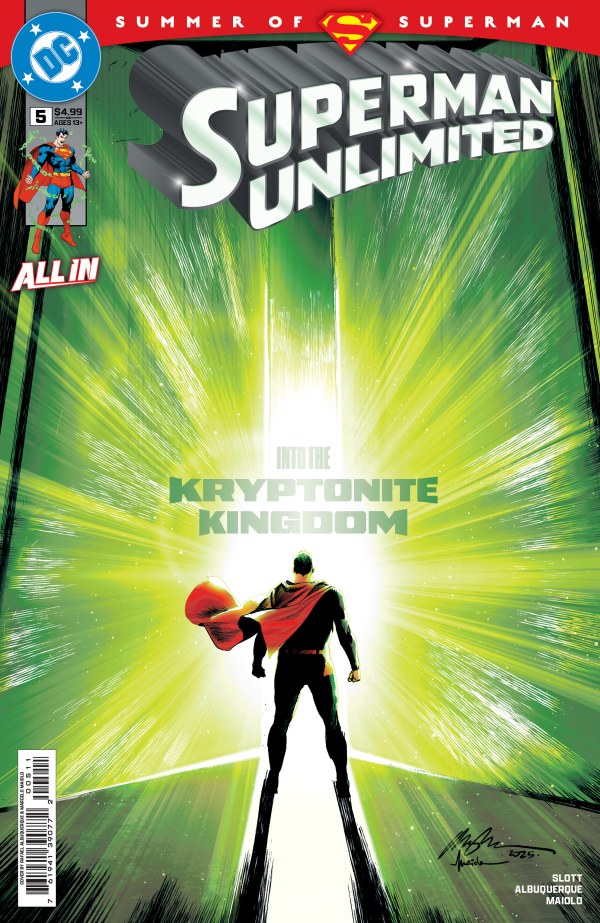
We’re starting it off with Superman Unlimited #5. The Daily Planet gets word that the Kult of Kobra is operating in El Caldero, the “Kryptonite Kingdom.” What’s more, the Calderan mining operation is about to uncover a Kryptonian Sunstone, the same kind of technology that built Superman’s Fortress of Solitude. Donning a suit of Kryptonite-proof armor and catching a ride in one of the most gloriously anachronistic pieces of Superman tech, he heads to Caldero to try to get the Sunstone before Kobra. The story seems to be picking up a little here. Previous issues have been largely one-off stories that connect to the larger story of the Kryptonite Kingdom, but this one gives us a nice little cliffhanger. It looks like the story is opening up, and I’m excited to see where it’s going to go.

The story of Darkseid’s Legion continues in Superman #30. Superman’s supposed ally, Superboy-Prime, has turned (insert surprised Pikachu face here), joining Darkseid’s Legion and capturing him, along with the long-suffering Booster Gold. The issue wraps up this (surprisingly short) storyline, but also acts as a lead-in to the upcoming DC KO event, and although I don’t want to get into too much more detail about what happens, Joshua Williamson pulls off a hell of a trick. There’s a brilliant reversal of expectations in this book, leading up to a climax (before the epilogue) that felt positively stirring. There’s a reason Superman is the greatest hero there is, and it’s got nothing to do with his powers. It’s about what he represents, what he stands for, what he means to other people. And boy-howdy, does this issue understand that. I love Superman, I love the Legion, I love Booster Gold…and I love what this issue does with all three of them.
We also, incidentally, get to use Prime’s meta awareness to give us what is objectively one of the most funny panels in a Superman comic all year. You’ll know it when you see it.
Justice League Unlimited #11 is another prelude to DC KO, this one starting off with the Justice League Watchtower being invaded by an army of Parademons. At the same time, beneath the country of Markovia, a League squad including Power Girl and Captain Atom find themselves in battle against some of Darkseid’s Legion. The battle goes poorly on both fronts and we get Leaguers down before a last page that ties very nicely into this week’s issue of Superman. I love when comics pull off tricks like this one, two stories that happen simultaneously and tie together in the end. It’s a nice way to make the shared universe conceit work, and theoretically, you don’t HAVE to read both of them to understand either one. It sure makes it more satisfying when you do, though.

And Waid returns with a plethora of artists to bring us New History of the DC Universe #3. Picking up on the aftermath of the original Crisis on Infinite Earths, Barry begins to recount the era of the DC Universe that made for my foundational years – the late 80s and early 90s – all the way up to Barry Allen’s resurrection in Final Crisis. As Barry is, in fact the narrator of this series, you could simply call this issue “stuff that happened while I was dead.” Once again, I’m impressed at how Mark Waid has gone about smoothing over certain elements of the combined/rebooted/revamped DC Universe. For instance, when Supergirl came back in 2004, she was introduced as though she were a brand-new character, her death in the original Crisis being removed from continuity. Waid has it both ways here – Supergirl DID die in the crisis, and the story we read in Jeph Loeb’s Superman/Batman run has been retconned slightly – rather than introducing her to Earth to use her as a weapon, now Darkseid actually resurrected Supergirl for the same reason. Waid also, once again, brings in elements of the Milestone Universe, specifically the 90s incarnations of the characters, marking them as denizens of the DCU proper in such a way that certainly makes it seem as though there are plans afoot to bring them back again.
This series really is a nerd’s dream. And as a nerd, I approve.
Sun., Sept. 28
Comics: Superman #125, DC Vs. Vampires: World War V #11 (Appearances by Supergirl, Steel, Lois Lane)
Notes: Let me tell you something about my family. My son is a football nut. Like, he’s crazed. If there is an NFL game on, he is insistent upon watching it, to the point that he begged me to take him to church yesterday on Saturday afternoon so that he could stay home this morning, Sunday, and watch the Steelers/Vikings game in Dublin at 8:30 am. He also gets up and gets VERY excited and VERY hyper, and the point is, by the time the early game ended and the noon game began, I was already exhausted by this little creature which I am emotionally, biologically, and legally responsible for. I didn’t really have it in me to get into any deep Superman lore today, so I scrolled through the DC app looking for the silliest, most ridiculous one-off comic I could find. The winner turned out to be Superman #125 from 1958.
The first story, “Lois Lane’s Super-Dream,” begins with Lois falling into a coma when she falls from a ten-foot ledge trying to sneak into the Metropolis Science Fair a week early, which has got to be the stupidest way she’s ever almost gotten herself killed, even in the Silver Age. She gets a blood transfusion to save her life, but her subconscious mind thinks she got it from Superman, and she has a dream where his blood gave her powers as well. In the dream she puts on a red wig and starts calling herself “Power Girl,” and she’s actually fairly effective until – again, in the dream – Clark Kent is nearly killed in an explosion. Power Lois gives Clark a transfusion of her blood, and now HE’S got powers too. Go figure. So she makes him a Power Man costume and the most comically ridiculous mustache anyone not named Oliver Queen has ever worn and makes him join her as a superhero. But Power Clark, in Lois’s subconscious, keeps screwing things up due to a combination of cowardice and ineptitude. The whole story kind of makes Lois look bad, showing not only what she really thinks of Clark, but the particularly cruel way she treats him as her sidekick.
“Clark Kent’s College Days” is next, the beginning of an “Untold Tales of Superman” series. I’ve read this story many times, as it too was included in either the Greatest Superman Stories Ever Told or Superman From the 30’s to the 70’s books (I honestly don’t remember which) I read so many times as a kid. Clark gets an invitation to his college class reunion and begins to reminisce about his early days at Metropolis University, where he’s putting on his weakling act and letting the upper classmen haze him. The seniors aren’t the real problem, though – in year two, Clark’s teacher Professor Maxwell catches Clark using his vision powers to weld a seam in a robot and immediately deduces that one of his students must be Superboy. In this next class, he begins hooking his students up to a lie detector and asking if they’re Superboy, which makes you wonder what the hell he’s supposed to be teaching. Clark barely escapes being interviewed before class ends, and Maxwell begins a series of schemes that could make Lucy Ricardo proud, attempting to prove that Clark is Superboy, even to the point of exposing him to Kryptonite. But Clark winds up outsmarting him every time, and finally escapes the Professor’s attention by strapping in and letting him ask if he’s Superboy. Clark says “No,” and passes the test. Is it because of his powers? His Kryptonian physiology being incompatible with the machine? Nah, it’s because he decided, right at that moment, that it was time to consider himself an adult and start referring to himself as “Superman.”
The cover story that got me to read this issue comes last, “Superman’s New Power.” Superman finds a pocket of fires in the core of the Earth that are causing tremors above in Metropolis. As he stabilizes the fires, he uncovers a tiny space ship that seems to have been embedded in Earth’s crust for eons. The ship blows up, and he later realizes his powers have changed. His normal powers (except, conveniently, invulnerability) have vanished, even as he gains the new ability to shoot a tiny replica of himself from his fingertips. The mini Superman has all his normal powers, so Superman’s career as a crimefighter shifts to being more of a puppeteer, sending Lil’ Superman into danger instead. While he proves just as effective as the real thing, Superman finds himself feeling emasculated at sitting on the sidelines while his teeny proxy goes into danger. The story ends when Tiny sacrifices himself to save Superman from a chunk of Kryptonite some crooks hurl at him. The Kryptonite makes Tiny vanish and Superman’s powers return to normal, ending with a panel where he contemplates whether Tiny had a consciousness and will of his own and made the sacrifice deliberately.
I’ve said it before and I’ll say it again: the 50s were a wild time.
Mon., Sept. 29
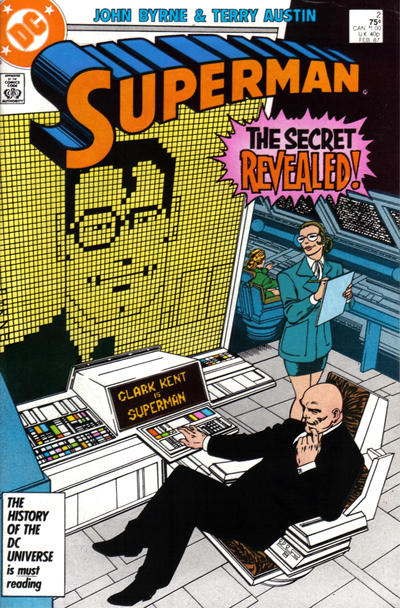
Comics: Superman Vol. 2 #2, Justice League of America #30 (Team Member)
Notes: Returning to my list of random Superman stories that I’ve read at some point, here’s yet another that I remember reading first in the old Greatest Superman Stories Ever Told trade paperback. The second issue of the John Byrne reboot in Superman #2 is a good story, and it’s got one of the best Lex Luthor moments of all time…at least, “best” in the sense that it’s one of the greatest expressions of who Lex is as a character, not in that it makes him look good.
At this point, Superman had been active for a few years (mostly glossed over in the Man of Steel miniseries), and Luthor is looking for any clues that could potentially help him destroy the Man of Steel. He finds them, along with analyst Amanda McCoy, in the form of a red-haired woman who seems to keep showing up when Superman is active. As they search for the strange woman, Luthor turns to his frequent flunky Sidney Happersan, who is examining the Metallo cyborg they captured in Superman #1. Determining that the Kryptonite heart in Metallo’s chest is potentially fatal to Superman, Lex ruthlessly rips it from him even though Happersan warns him that it will kill the cyborg. (Don’t worry, he got better.)
In Smallville, a pair of Luthor’s goons are looking for things that link Clark Kent to Superman, as Clark seems to be the one who gets all the big scoops. They drug Jonathan and Martha Kent then ransack their house, stealing Martha’s scrapbook of newspaper clippings regarding Superman. As they leave the house, they’re spotted by the passing Lana Lang, whom they drug and (realizing that she can identify them) kidnap. Imagine Lex’s glee, of course, when she turns out to be the very red-haired woman his people are searching for.
Days later, Clark Kent comes home to find a series of bloody footprints leading to his apartment and Lana hiding there, having been tortured for information that she refused to give. Sensing Luthor’s involvement, Superman barges into LexCorp, only to find that Luthor’s got a new piece of jewelry – a ring with a glowing green stone that keeps Superman at bay. Stymied, and with no actual proof of Luthor’s involvement, he takes Lana back to Smallville. In Metropolis, Amanda runs all the data they’ve found through the computer, seeking the link between Superman and Clark Kent, and she arrives at one inexorable conclusion: Clark Kent IS Superman.
And Luthor is furious at the absurdity of it. “I know that no man with the power of Superman would ever PRETEND to be a mere HUMAN!” he shouts, firing Amanda McCoy on the spot because “I have no place in my organization for people who cannot see the OBVIOUS.”
Ah, what a fantastic story, Mr. Byrne. This is the ultimate platonic ideal of who and what Lex Luthor is, especially at that time. He’s ruthless and cruel – his treatment of Lana, of Amanda, even of Metallo all demonstrate that. He’s intelligent, but not the super-scientist he was in the Silver Age or would become again. But he’s also so unbelievably arrogant that when the answer to all of his questions is served up to him on a silver platter, he rejects it because he cannot fathom anyone with Superman’s power being so good that he would “pretend” to be Clark Kent. Byrne actually used this as part of the punchline in his “Superbman Vs. the Fantastical Four” story from Marvel’s What The–?! #2, with the fake Dr. Doom telling Rex Ruthless that Superbman COULDN’T be a normal human because that would make him “nicer than us.”
This story is also important in that it sets up a number of different elements that would be of tremendous importance later, especially the Kryptonite Ring. That little domino would set off multiple chains. Luthor would learn to his grave error that he was wrong about the radiation being harmless to humans, and that wearing the ring constantly gives him cancer. This ultimately leads to him faking his own death, cloning a younger body, and returning to Metropolis pretending to be his own son. Amanda McCoy came back later desperate to prove she was right, stealing the ring but being killed in an alley for it, leading to the Dark Knight Over Metropolis story where Superman gave the ring to Batman, a concept which has been a consistent part of the characterization of the two heroes ever since.
It’s also a pretty good showing for Lana, proving – even under torture – that she’s a good friend and worthy of Clark’s trust, never betraying his secret. In Man of Steel, Byrne had turned Lana into something of a broken bird, heartbroken at the realization that Clark Kent was too big and too important to the world to be in her life the way that she wanted. It took a long time to rebuild her character, and this issue I think was the beginning of that.
Even these short stories can be great sometimes.
Tues., Sept. 30
Graphic Novel: Superman: True Brit

Notes: I decided to cap off this week with something relatively lighthearted – perhaps even a bit silly, and this 2004 Elseworlds graphic novel certainly fits the bill. True Brit brought John Byrne back to do artwork for the Man of Steel again, but this time in a story written by Kim Johnson “with some help” by Monty Python legend John Cleese, who of course is most famous for that one “Bicycle Repairman” sketch that we covered back in Parody Week. (There’s a brief shout-out to that bit in the book, as well.) Like many Elseworlds, it starts with a “what if” type of scenario – Jor-El sends his infant son to Earth. Instead of Kansas, though, this time his spacecraft lands in what Jor-El calls “their most advanced, most powerful nation – the British Empire!” Kal-El is found by a British farm couple, Jonathan and Martha Clark, who raise him as their son Colin. He struggles to control his powers, even after being told of his true alien heritage, and when the time comes to go off to University Mrs. Clark admonishes him to keep the powers hidden away in shame.
Studying journalism, he becomes smitten with his classmate Louisa Layne-Ferret, but she doesn’t show any interest in him until he accidentally impales a classmate with a cricket bat just before graduation. He winds up using his powers to get stories for a sleazy rag called the Daily Smear, where he finds out the famous rock band the Rutles (another in-joke) are in mortal danger, forcing him for the first time to act publicly in a Union Jack-adored Superman costume.
The Smear runs with it, making the Superman stories more outrageous and scandalous, to the point where the Clarks even move without telling Colin where they’re going. But his fortunes change when the Queen sets him some “impossible” tasks – making the trains run on time, reducing the wait time for hip operations (the solution, by the way, is to convince the surgeons to play less golf), and raising the quality of the programming of the BBC. But all his work may come to a screeching halt when he runs afoul of his greatest enemy: the Bat-Man.
The story is rife with gags and jokes that almost could have qualified this graphic novel for Parody Week in and of itself. For instance, when his adoptive parents think Colin can fly, they advise him to flap his arms like a bird, which causes a bit of amusing chaos and resultant property damage. When he finally does fly – with a horse – the poor animal has to be carted away to a veterinary hospital and treated for shock. An attempt to milk the cows with his super-speed and strength leaves them…let’s say “unhinged.” Perhaps my favorite joke comes when his mother tries to steer him into being a postman rather than a journalist, and he fires back with “I don’t CARE about respect! I’d rather be a REPORTER!”
Ah, maybe it’s just the ex-reporter in me that finds that hilarious, I dunno. But that seems to be the main thesis of this book. Rather than telling a story about Superman in another culture, True Brit comes across as Howard and Cleese giving a scathing indictment of the British media. Most of the book comes down to a heavy and brutal satire of the state of the British press, with the more lurid types of publications rising in prominence and the few legitimate reporters being buried. It’s a funny book, although I imagine a lot of the Britishisms are lost on an American audience.
Byrne’s artwork is interesting here. While not as cartoonish as he used in his What The–?! story, nor is it as clean and straightforward as his usual style as seen in his Superman run. He somewhat splits the difference here, drawing a world that still feels like part of the DC Multiverse but, at the same time, having enough fun with it to allow some silly sight gags, outrageous facial expressions, and goofy poses.
This week was a nice change of pace, friends, but October begins tomorrow. And October begins my favorite part of the year — those last three months that I love so much. And this year being the Year of Superman, it’s gonna be even better. For the next few weeks, as we approach Halloween, we’re going to be looking at darker versions of Superman, Superman gone wrong, a focus on his greatest villain, and more! See you then!
Blake M. Petit is a writer, teacher, and dad from Ama, Louisiana. His most recent writing project is the superhero adventure series Other People’s Heroes: Little Stars, volume one of which is now available on Amazon. You can subscribe to his newsletter by clicking right here. You can join in the Kryptonian Konversation every day in the Year of Superman Facebook Group!
After taking last week relatively easy, and after the kind of floperoo that Parody Week turned out to be, I decided I wanted to do something a little more fun this week. So I looked through my list of potential topics and decided it was time for SUPERMAN’S STRANGEST TEAM-UPS. You’re not gonna see him partnering with Batman or the Justice League here, guys. I’m not even counting inter-company crossovers like when he met the Fantastic Four or the Savage Dragon. No, this week we’re going to focus on a few team-ups Superman has had with characters (and sometimes real people, as you’ll see) that an outside observer would think is totally bizarre. And the fun part is, they would be right to think so.

And as always, you can check out earlier blogs in the Year of Superman Archive!
Wed., July 30
Comics: The Adventures of Jerry Lewis #105

Notes: I’ll kick this off with a comic I bought on eBay a few months ago specifically to use for this week, a book I’ve wanted an excuse to get for years: The Adventures of Jerry Lewis #105. Believe it or not kids, there was a time when being a famous comedian could get you your own comic book, and sometimes those books would last for YEARS. Bob Hope had one, as did Jackie Gleason, Abbott and Costello, and sitcoms like I Love Lucy had long-running comics through publishers like Dell and Charlton. This series specifically began in 1952 as The Adventures of Dean Martin and Jerry Lewis, but dropped Deano from the book in 1957 after the comedy duo broke up. Jerry held solo reign over the title for over a decade before it finally ended in 1971.
Anyway, in this issue Jerry is watching TV with his nephew Renfrew and their friend Witch Kraft (it was the 60s, I dunno) where they see a report of Superman fighting a giant space monster – a fight that has been dragging on for THREE DAYS. Superman finally defeats the beast, which turns out to be a robot. What he doesn’t know is that the robot was built by his old pal Lex Luthor, and when it was destroyed, it saturated Superman’s costume with a low level of Kryptonite dust that immediately begins to neutralize his powers. Back at the Daily Planet, Clark gets a new assignment – a feature on the danger of certain young people, and he’s sent to investigate one Renfrew Lewis. At the Lewis house, Clark gets progressively weaker, succumbing to various pranks of Renfrew that would normally be no problem. Finally, he gets soaked with water, prompting him to borrow an ill-fitting outfit from Jerry while his own clothes dry off. Luthor, meanwhile, tracks his Kryptonite to Jerry’s house, where Jerry has just discovered Clark’s Superman costume in the laundry and puts it on because…well, I guess because that’s what happens on the cover.
The story is completely absurd, of course. Jerry Lewis was a comedy legend, but he had a very specific persona. Especially in the early part of his career, he would always play a naive young man whose good nature couldn’t overcome his dimwittedness, spiraling him into one ridiculous situation after another. His comic book persona clearly borrowed that characterization, as that’s exactly what happens to him not only in this issue, but in probably every issue of this title that lasted, in its two incarnations, nearly twenty years. And honestly the fact that Jerry (the character) is both dim and nice is probably the only reason that Superman’s secret identity is maintained in this absurd comic. Although none of that explains why Luthor – who would certainly proclaim himself to be Earth’s smartest man – isn’t smart enough to put two and two together when he encounters Clark Kent and Jerry Lewis, the latter of whom is wearing Superman’s ill-fitting costume – only minutes before the real Superman shows up to put him away.
As silly as this story is, I really did enjoy it. It’s got the same sort of bizarre brand of comedy as certain strains of Archie Comics, or some of DC’s own Silver Age titles like Stanley and His Monster. I haven’t got the slightest idea who owns the rights to books like this anymore (is it the Jerry Lewis estate? The copyright information in the indicia only indicates National Periodical Publications), but I would love it if they could put together some collections of comics like this or their Bob Hope series, or even make them available digitally. I’d love to read more without having to pay eBay prices to track them down one at a time.
Thur., July 31
Comics: Captain Carrot and His Amazing Zoo Crew #1, DC X Sonic the Hedgehog #5

Notes: I’m not gonna lie, half the reason I decided to do this particular theme week was to have an easy excuse to sneak this comic book in. Captain Carrot and His Amazing Zoo Crew is one of my favorite DC Comics of all time, a comedic (but not silly) comic about superhero animals set in a world that feels like it fell out of a cartoon. At this time, DC had a “bonus book” program, where once a month a random title would include a 16-page comic in the center, often used to launch new series. Such was the case with New Teen Titans #16, which featured the first appearance of Captain Carrot. In that bonus book, by Zoo Crew co-creators Roy Thomas and Scott Shaw! (that exclamation point is part of his name, friends), Superman ran across several residents of Metropolis behaving like their primate ancestors. He tracked the disturbance to a strange meteor out near Pluto, but when he tried to stop it, both he and the meteor were punted into a different universe, designated Earth-C, in which the Earth was populated by “funny animals.” Chunks of the meteor fell to Earth, giving powers to several different animals. One of them irradiated a batch of carrots growing in a garden box belonging to cartoonist Roger Rabbit (he later began going by his middle name, Rodney, perhaps due to confusion with a certain OTHER lupine character), who gained incredible power upon munching on the carrot.
The first issue of Captain Carrot and His Amazing Zoo Crew picks up right where the bonus book left off, with Superman and the newly-minted Captain Carrot seeking out the meteor fragments and trying to find a way to Pluto to check it out through some sort of cosmic barrier. As they do so, just as happened back in Metropolis, various people begin reverting to a primitive state, acting not like the civilized animals they are but instead like their beastly ancestors. When Superman is captured, Captain Carrot picks up other animals who were altered by the meteors: the powerful Pig-Iron, mistress of magic Alley-Kat-Abra, turtle speedster Fastback, pliable poultry Rubberduck, and the star-spangled Yankee Poodle. Together they seek out Superman, bound by Kryptonite on Pluto, in the clutches of Starro the Conqueror. Eventually, of course, Starro is conquered and the Zoo Crew decides to stay together to fight the forces of evil on Earth-C.

Superman’s appearance here is almost incidental. The Zoo Crew does most of the heavy lifting, and replacing Superman with Wonder Woman, Captain Marvel, or any number of other heroes would have had negligible impact on the plot. But it’s fitting, in a way, that Superman was the first contact between the two worlds. He was still DC’s flagship character at the time (although Batman would soon overtake him, and Batman just wouldn’t have worked in this setting), and Captain Carrot was clearly his universe’s version of Superman. This would be codified years later during one of DC’s many crisis events (Final Crisis, I think) where it was revealed that EVERY world had an “official” Superman analogue, and in this world it was Captain Carrot.
I’ve written many times before about Roy Thomas and his love for comic book history, with his work on titles such as All-Star Squadron, Young All-Stars, Secret Origins, and the Elseworlds comic Superman: War of the Worlds. This one is a little off the beaten path for him, but even here, he couldn’t resist bringing in some DC lore. The first Zoo Crew recruit, Pig-Iron, is secretly Peter Porkchops, once the star of a series of DC’s funny animal comics from the 40s and 50s. Thomas and Shaw would go on to establish that Earth-C was actually the location of all of DC’s old funny animal comics, bringing in characters like the Dodo and the Frog, the Three Mousekteers, and their superhero turtle the Terrific Whatzit from the Golden Age, who turned out to be Fastback’s uncle.
The series lasted for 20 issues, with a three-issue miniseries in which the Zoo Crew travelled to Oz and Wonderland, then they went into limbo for a few decades. They’re back now, appearing periodically, and Captain Carrot specifically is a member of the multiversal Justice League Incarnate. But I’ll never stop pushing for a full-on revival of this delightfully offbeat comic.

Speaking of strange team-ups, this week also brings us the last issue of DC X Sonic the Hedgehog. With the two teams reunited on the DC Earth, they’ve got to assemble to chaos emeralds to take the fight to Darkseid. I’m not going to claim there’s anything truly shocking in this issue. The story plays out pretty much exactly as one would expect, right up to the last page sequel hook which may or may not ever be picked up on, probably based on how well this miniseries sells. But it was still a fun little excursion. It was genuinely hopeful and upbeat, without any of the usual nonsense of the heroes of two worlds fighting each other just because that’s what’s supposed to happen in crossover events. (As much as I’m looking forward to Deadpool/Batman in a couple of months, you know that’s exactly what’s going to happen.) This was just…fun.
And it’s okay to just be fun sometimes.
Fri., Aug. 1
TV Episode: I Love Lucy Season 6, Episode 13, “Lucy and Superman”

Notes: Regular readers of my blog know about my deep, abiding love for I Love Lucy. I think it’s one of the greatest sitcoms in the history of the medium and that Lucille Ball was a comedy genius the likes of which we have not seen since. And if you know I Love Lucy, then it’s probably no surprise that one of my favorite episodes was the sixth season episode in which Lucy meets Superman.
The episode begins with Lucy’s husband Ricky and their son, Little Ricky, watching The Adventures of Superman on TV. Little Ricky, with the innocence of a child who doesn’t actually have to pay for anything, asks if Superman can come to his birthday party that Saturday. Although Lucy lets him down easily, when they find out later that their frenemies the Applebys are planning to have their son’s party on the same day, the parents enter a cold war over throwing a party that will lure the childrens’ shared friend group to one party over the other. Lucy plies Ricky to try to get Superman – who he met in Hollywood – to come to Ricky’s party after all, quickly luring away all of the children, even little Stevie Appleby. As usually happens with Lucy’s schemes, though, things go awry. Ricky tells him Superman can’t make it, leading to Lucy donning a Superman costume and trying to get into the apartment from the ledge, only to get stuck outside in the rain when Superman shows up after all.
The Lucy writers played a neat little trick in this episode. Although the show frequently had celebrity guest stars appearing as themselves (everyone from John Wayne to Harpo Marx), they never ONCE refer to Superman as “George Reeves.” He’s just Superman. Although from an adult perspective, it seems a little odd that they never say his real name, even when the kids aren’t in the room, from a meta point of view it’s obvious that the entire episode is constructed in such a way to preserve the mystique of Superman for any children who happen to be watching. Reeves never appears as “himself,” only on TV as Superman and then again in the last scene in-costume, where he does his trademark leap through the window (in this case, the one that separates the Ricardos’ kitchen and living room) to make his glorious entrance. When Lucy gets stuck on the ledge, Superman is the one who climbs out to rescue her. Even the classic last line of the episode has the same sort of wit and charm that Reeves always brought to his performance: when out on the ledge, Ricky comments on the 15 years of crazy stunts Lucy has pulled. Reeves says, “You mean to say that you’ve been married to her for 15 years?” When Ricky replies in the affirmative, Reeves shoots back, “And they call me Superman!”
It’s a wonderful, charming episode of a charming show, and one that can be enjoyed on two levels. If you want, then you can consider this just your average episode of I Love Lucy with a famous guest. But if you’d prefer, you can accept the episode on face value and decide that Lucy takes place in the same universe as The Adventures of Superman TV show, and it wasn’t Reeves at all, but the real Man of Steel.
That doesn’t quite explain why he’s got his own TV show in-universe, but do I have to figure out everything myself?
Sat. Aug. 2
Comic Books: Multiversus: Collision Detected #1-6

Notes: While not a Superman starring vehicle like most of my other choices this week, he played a big part in this fun six-issue miniseries based on the short-lived video game, which combined characters from dozens of Warner Bros IPs including the DC Universe, Looney Tunes, Hanna-Barbera cartoons, Cartoon Network, The Matrix, The Wizard of Oz, Game of Thrones, The Neverending Story, and probably others I’m forgetting. I don’t play video games, friends. It’s not a judgment thing, I’m not trying to claim some sort of moral high ground or anything, I’d just rather spend my time with a movie, TV show, or book. I do, however, enjoy a good crossover, so when the miniseries based on the game was announced I knew I was going to read it, despite knowing absolutely nothing about the game.
The story begins with Superman, Batman, and Wonder Woman each having dreams that culminate in the vision of strange hieroglyphs: a rabbit, a witch, and a child bearing a star. Their investigation leads them to Avia Free, daughter of Mr. Miracle and Big Barda. When they arrive, though, the find that Avia already has another visitor: Bugs Bunny. After a particularly hilarious sequence of Batman trying – and failing – to interrogate Bugs, Avia shows them a video game system she modified to investigate some strange readings from behind the Source Wall just as a portal appears, spilling inhabitants of other dimensions into our own. The Flash, for instance, encounters Scooby-Doo and Shaggy having thwarted Condiment King’s effort to rob a Big Belly Burger and taking their reward in a mountain of food. Wonder Woman is attacked by an army of Winged Gorillas under the control of Grodd who, himself, has fallen under control of the Wicked Witch of the West. Superman finds Steven Universe and Garnet fighting Livewire and the Parasite in Metropolis, just as a Skullship appears in the sky – not a Brainiac ship, but one in the spitting image of Rick Sanchez, loaded with robotic simulacrum of Finn the Human, Jake, and Tom and Jerry.
As the Justice League begins containing the incursions from other universes – hero and villain alike – Batman manages to track down the truth. An entity called the Devoid, under duress from an even more powerful force called the Nothing, is forcing the multiversal travellers to fight in a tournament to protect their respective home universes. (I assume this is, in broad strokes, the story behind the video game.) Batman hatches a plan to return the fight to the Devoid, saving all of the endangered universes simultaneously, but there’s a little problem. To do this, he needs to find the final lost fighter – the Reindog – who is currently being coddled by Harley Quinn and targeted by her nasty ex, the Joker. They collect him from Gotham City, but Steven is wounded in battle. When Reindog heals him, it sends out a signal that leads the Devoid to Earth, where it takes over Avia and attacks. In exchange for freeing Avia, the assembled heroes agree to allow Devoid to take them to fight in the tournament. After they are swept away, though, the heroes reappear, revealing that Steven invented a device that would pluck tiny pieces of each of the heroes from throughout the multiverse and assemble them into a new version to join the tournament.
I love stories like this. It reminds me of being a kid, when you would throw all your different toys together in one box and act out some epic battle despite the fact that these characters don’t really have any business being together. I also like the way Bryan Q. Miller handles the Super-characters. It’s not his first go-round: he’s written, among other things, the Smallville sequel comics, and he has a nice handle on Lois and Clark. There’s a nice bit towards the beginning where she casually teases him for doing things the hard way when the age of technology should make it a little harder to track down the glyph from his dreams. And bonus points go to artist Jon Sommariva and colorist Matt Herms for dressing her in her signature outfit from Superman: The Animated Series, even though this isn’t “that” Lois. Miller also uses the differences in the respective universes to his advantage. For example, there’s a funny bit where Bugs, Scooby, Shaggy, and Steven Universe are shocked by the foul mouth (censored as it is) of the Rick-infected Brainiac.
It’s interesting, by the way, that although it is very obviously Rick Sanchez who’s riding in Brainiac’s skull, he is never mentioned by name in the story, and only appears in his “true” form in a few shots on Brainiac’s monitors. I assume that was a limitation imposed by the fact that Oni Press, not DC Comics, has the rights to the Rick and Morty comics, but it’s still kind of funny.
The story ends, as comics like this one often do, with a bit of a sequel hook, but considering that the game flopped and has been discontinued, it seems unlikely that we’ll ever get to see what happens next. I content myself in the knowledge that the comic is essentially a prequel to the game and that, if you beat the Devoid and the Nothing in the game itself, you can consider it the canonical ending of the story. And I hope that we see Miller writing more comics like this. He’s got a flair for it.
Sun. Aug. 3
Comic Book: Action Comics #421

Notes: Today we’re going to take a look at one of my favorite lesser-known Superman team-ups, the time he met Popeye.
Kinda.
In Action Comics #421, Superman’s pal Billy Anders (a semi-recurring character from the period) tells him about his recent encounter with Captain Horatio Strong. Strong is a salty sailor who has found a mysterious seaweed that, upon consumption, gives him incredible strength. When Billy tells Superman that Strong is one of his biggest fans, he agrees to arrange a meet-up. Meanwhile, A food corporation tries to buy the rights to Strong’s seaweed, “Sauncha,” but he refuses. He willingly gives a sample over to his idol, Superman, when Billy arranges a visit, but quickly realizes his visitor is a disguised spy for the food corporation wearing one of those remarkably lifelike rubber masks that were so ubiquitous in comics at the time. Superman and Captain Strong wind up duking it out when Strong vows to destroy the crooked company that tried to cheat him, and when he runs out of Sauncha, Superman tracks him to a spot in the ocean where he harvests it. When the Sauncha power runs out, Strong is nearly killed, but Superman whisks him to the hospital. As he recovers, he is ashamed of his actions, but Superman kindly tells him that it wasn’t his fault – he was under the influence of the plant, which Superman has identified as an alien species that must have fallen to Earth. Captain Strong promises to stick to good old Earth food from now on.
I first read this story in Best of DC Digest #48, in an issue that reprinted assorted Superman team-ups, and it’s long been a favorite of mine. Even as a kid, I immediately picked up on the fact that they were trying to emulate Popeye, and when Strong’s wife and best friend (obvious dopplegangers for Olive Oyl and Wimpy) showed up in later issues, it was like confirmation. What I didn’t realize as a kid was that Cary Bates had whipped up a Popeye expy to tell a story that was a metaphor for drug addiction. I guess it did the trick – I’ve never done any drugs, nor had any desire to. So Cary Bates and Captain Strong, thanks for teaching me the important lesson that using illicit substances will cause me to throw telephone booths and people and start fights with those I admire the most.
Seriously, I always thought Captain Strong was a fun character, and it’s a shame that he made only a handful of appearances over the next decade before fading into obscurity. He came back in 2015, gently being mocked (as was everything else) in Jimmy Palmiotti and Amanda Conner’s Harley Quinn series. I guess I understand – there’s not much call in modern comics for a character whose only reason to exist is to poke a little fun at Popeye. But I still have a warm place in my heart for Captain Horatio Strong. And although the similarities are superficial, I’ve always wondered if Strong was used as a bit of inspiration for one of my favorite characters of the Triangle Era, loveable lout “Bibbo” Bibbowski.
Mon. Aug. 4
Comic Books: Superman and Bugs Bunny #1-4

Notes: When I started this little project, I didn’t expect the Looney Tunes to turn up quite as often as they have, but between this and parody week, I’ve actually seen quite a bit of them lately. But let’s look at the 2000 miniseries by Mark Evanier, Joe Staton, Tom Palmer, and Mike DeCarlo. Even though Superman’s name is in the title of this one, like Multiversus, it’s more of an ensemble piece, featuring the entire Justice League. The chaos begins when Superman gets a visit from his old pal Mr. Mxyzptlk and, as usual, has to trick him into saying his name backward to send him home. At the same time, in another world, Bugs Bunny and Elmer Fudd encounter the Do-Do, an early and mostly forgotten Looney Tunes character from another world called Wackyland. Bugs deliberately borrows a trick from the pages of his favorite comic book publisher and tricks the Do-Do into saying Od-Od, banishing him at the same time that Myxyzptlk vanishes from Earth. The two cosmic tricksters collide in the place between worlds and decide to join forces and cause a little chaos by sending the Looney Tunes to Earth.
On the moon, Green Lantern finds Marvin the Martian planning to destroy the Earth (again). Flash races Speedy Gonzales through the desert, Plastic Man disguises himself as a cat only to fall afoul of the affection of Pepe LePew, and in Gotham City, Batman finds a very different Penguin than the one he expected. Myzptylk amps up the chaos by giving Elmer Fudd Superman’s powers (and costume), and poor Green Arrow is stuck with a singing, dancing Michigan J. Frog that doesn’t seem to want to perform for anybody else.
Mxy and the Do-Do find their relationship strained, the machine they’re using to toy with the heroes destroyed and forcing them all together. The Tunes are made honorary member of the Justice League (because why not?) just as the Do-Do turns on his partner, bringing about a – ya gotta say it – “Cwisis on Infinite Earths!”
Mark Evanier was absolutely the best choice to write this bizarre little crossover. As a writer in both comic books (perhaps best known as co-writer of Sergio Aragones’ Groo the Wanderer) and in animation (such as the original and excellent Garfield and Friends cartoon), he had the right sensibility to bring these two worlds together. It’s interesting that he chose to have both the Justice League and the Looney Tunes be fictional characters in the others’ universe. Bugs and Foghorn Leghorn read Action Comics, and every member of the League recognizes their cartoon co-stars the second they see them. It nicely sidesteps the usual introductions, although if the Leaguers have all watched the Looney Tunes (as well they should have) it should kind of make you question their judgment when they include the likes of Yosemite Sam and Elmer Fudd into the ranks of the honorary Leaguers.
I also give Evanier credit for diving into the archives of the Looney Tunes for this. He didn’t just bring out the A-listers like Bugs and Daffy – we get appearances by everyone from Pete Puma to the Goofy Gophers Mac and Tosh, and he keeps them all in character. He’s not quite as adept with the Justice League, writing them more like they would have been in the Silver Age than when this book was published in 2000. Things like Green Arrow’s panic over nobody believing his story about a singing frog don’t quite fit (especially since, as it should be noted, this was the less-emotive Connor Hawke version of Green Arrow rather than Oliver Queen). But you can accept these things are being part of the overlap with the land of the Looney.
Joe Staton’s layouts keep everything consistent, and using finishing team of Tom Palmer (handling the DC Universe and characters) and Mike DeCarlo (on the Looney Tunes) makes it all look nice, clean, and like these characters fit in a world together.
I’ve always liked this miniseries. It’s not a masterpiece, but it’s fun. And it helped inspire a series of DC one-shots a few years ago in which they met Looney Tunes and Hanna-Barbera characters, although those were part of a line that reimagined the cartoon characters in a more “serious” vein. Some of those specials worked better than others. I particularly liked seeing the Super-Sons meet Blue Falcon and Dynomut, and having Booster Gold encounter the Flintstones was a treat. Pretty much everyone agrees that the gem of those books was the Batman/Elmer Fudd special. But the shocking thing? No books featuring Superman.
What a waste of potential. At least we’ve got the OG.
Tues., Aug. 5
Comic Books: All-New Collectors’ Edition #56 (aka Superman Vs. Muhammed Ali)

Notes: The year was 1978. Jimmy Carter was elected president, Christopher Reeve was wearing the Superman costume, and we were still 26 years from the birth of America’s sweetheart Justin Bieber. And this was the year that brought us one of Superman’s most legendary and unexpected crossover events: a giant-sized special that saw him face off against “the Greatest,” Muhammad Ali.
Lois, Clark, and Jimmy are walking through Metropolis when they happen to stumble upon Muhammad Ali playing pick-up basketball with a group of school kids. As Lois approaches him for an interview, they are interrupted by the sudden appearance of an alien (you know, like you do) who summarily shoves Lois aside. Ali leaps to her defense as Clark ducks off to change his clothes, then follows the alien’s trail to an orbiting armada of spacecraft that…frankly…even in 1978 it’s kind of hard to believe nobody noticed them before. The alien identifies his race as the Scrubb, a warlike society who has come to Earth to pit our greatest champion against their own. Amusingly, Superman and Ali each presume the alien is talking about himself, and after a demonstration of their power, the Scrubb declares that the role of Earth’s champion will be decided in a match between the two of them, with Superman’s powers removed to make it fair – and if they refuse, the Scrubb promise to destroy the Earth itself.
Superman takes Ali to his Fortress of Solitude, where he creates a special ring to train: a time disruptor that can stretch their 24 hours to about two months, and a red sun lamp to remove Superman’s powers, giving the Greatest of All Time the time he needs to teach Superman how to box. The Scrubb catch wise, though, and disrupt the training after only two relative weeks, taking Superman and Ali into space where their bout will be broadcast across the universe. The fight is brutal, and Superman’s unfinished training makes him no match for his opponent…but still, the Man of Steel may be beaten and bloody, but refuses to fall down until the judges call the fight for Ali. As he is returned to Earth so the yellow sun may heal him, Ali prepares for his battle against the Scrubb’s champion, a gigantic brute called Hun’ya. To everyone’s shock (maybe even the writer, it’s so random) an angelic being appears in the ring demanding to act as moderator of the contest. The being appears differently to each species – to the humans she is the Greek Goddess of Wisdom, Pallas Athene. As the match begins, Ali’s cornerman Bundini Brown infiltrates the Scrubb command center, revealing himself as Superman in disguise. Impersonating the Scrubb Emperor, Superman orders the armada away from Earth, then catches a ride back to the yellow sun system to take it out as Ali defeats Hun’ya. The Emperor plans to turn back to destroy Earth anyway, but Hun’ya himself – disgusted by his lack of honor – defeats the Emperor.
The epic team of Dennis O’Neil and Neal Adams are the ones who put this special together, and honestly, nobody else could have done it. Adams did a note-perfect version of Ali in this book, creating a character who is immediately recognizable as the boxer while, at the same time, still looking like he belongs in this DC Universe. It helps that Adams’ natural style lends itself to more realistic visuals than a lot of other artists of the era, making the combinations seamless. The story is kind of wild, and really over the top, but what else would you want? There are some odd moments, of course – the deity that calls itself Athene lends absolutely nothing to the plot, and the book ends with Ali revealing to Superman that he’s figured out he’s really Clark Kent due to a slip of the tongue Superman had made much earlier in the story. Is there any particular reason for that? Absolutely not. But it also doesn’t hurt the story, and it feels like the kind of thing that Muhammad Ali would have insisted upon, so I can deal with it.
The funny thing about this one, I think, is that the story itself (wild as it may be) probably isn’t as well known as Adams’ incredible cover. It’s one of those covers that has become a classic, frequently targeted for swipes by other artists, and you can’t blame them. It’s so rich and detailed as to defy belief, with dozens of DC characters and real-world figures alike appearing in the audience to watch the Superman Vs. Ali fight. It’s so in-depth that the deluxe edition of the book includes a guide to help you identify everybody who appears on the cover. It’s the kind of attention to detail that the likes of Alex Ross grew up on and decided to emulate in his own career.
This is, frankly, an insane book. And it’s a classic for a reason.
Blake M. Petit is a writer, teacher, and dad from Ama, Louisiana. His most recent writing project is the superhero adventure series Other People’s Heroes: Little Stars, volume one of which is now available on Amazon. You can subscribe to his newsletter by clicking right here. You can join in the Kryptonian Konversation every day in the Year of Superman Facebook Group!
I never had any real doubt that James Gunn would make a good movie. After three Guardians of the Galaxy films, plus the holiday special, The Suicide Squad, Peacemaker, and even the little-remembered (but worth watching) film Super with Rainn Wilson, he’s proven he knows how to tell a superhero story. But the question, when it came to SuperMAN, is whether he truly understood the character and what we wanted from him.
James Gunn, I am thrilled to say, understood the assignment.
The launch film for the new DC Universe is everything I could have hoped for – exciting, thrilling, fun to watch, full of humor, full of heart, and – most importantly – carries its overt optimism like a torch leading the rest of the superhero universe in its direction. It’s like a calling card: superheroes can be fun and still mean something. And Superman, more than any other hero, should be the primary example of that.
This new DCU, we are told in the opening seconds of the film, is a world where metahumans have existed for three centuries. Superman has been active as a hero for about three years, and although he has garnered a great deal of goodwill in that time, a recent incursion into a hostile territory in Europe is causing international furor as some people question whether an alien should involve himself in human affairs. Lex Luthor, of course, leaps at the opportunity to use Superman’s actions to foment trouble, and it is the conflict between these two (who, at the beginning of the film, have yet to meet in person) that forms the core of the movie. It’s a solid foundation from which to explore the themes most important to Superman, specifically what it actually means to be human.
The main plot also leaves room for exploration in the relationships that Superman and Clark Kent enjoy – with Lois Lane, Jimmy Olsen, the three members of the “Justice Gang,” and of course, with Lex Luthor himself. Each of these characters has an important role to play in the movie, nobody feels superfluous and all of them feel like they’ve been served incredibly well by James Gunn’s script.
Krypto, of course, steals the show.
I want to talk in more detail about the characters and the actors who portray them, and I don’t know that I can do that without lapsing into spoiler territory, so consider this your warning. If you haven’t seen the movie yet, stop here, secure in the knowledge that I loved every moment of this movie and I can’t wait to see it again and again. This is the best Lois Lane we’ve ever had on screen. The best Jimmy Olsen. The best Lex Luthor. The best…
…damn, I love Christopher Reeve so much. Can I REALLY declare David Corenswet the best?
He’s definitely in the top two.
Spoilers begin after the graphic.

I’m going to go through this a character at a time, starting, of course, with David Corenswet as Clark Kent and Superman. Prior to this film, the only thing I’ve ever seen him in was Pearl, a violent slasher film in which he played a philandering movie projectionist – not exactly the sort of thing that automatically makes you think of Superman. (Thanks to Rachael Pearce for correcting me — I originally said Corenswet was in X, the film Pearl is a prequel to.) But from the first moment clips of this film started come out, he won me over. As Superman, he carries himself with strength and power, but not at the expense of his inherent humanity. He has moments as Superman where he feels weakened, and it never feels false. He expresses pain after being beaten by the Hammer of Boravia, moaning as his robots use solar rays to knit his broken bones. He crumbles in agony when exposed to Kryptonite. He takes punches during the climactic battle that you believe COULD kill him if they aren’t stopped. But far more importantly, he shows the kind of emotional vulnerability that we need in a role model. When public perception begins to go against him, his face shows the weight that comes with that. When Luthor murders an innocent man for the crime of believing in Superman, we see every ounce of the pain on Superman’s face.

And when he’s not doing that, he has a sweetness and a kindness to him. It’s no mistake that this movie goes out of its way to show us Superman saving lives even in the midst of chaos. When a kaiju is on a rampage, we see him protecting a little girl from a shockwave. He pauses in front of a series of shattered windows to make sure the people inside are okay. We even see him swoop down and rescue a squirrel – a moment that easily could have come across as silly, but in the context of the Superman we’re watching, feels perfectly in keeping with the kind of hero he is. His priority is life – all life – and he’ll not sacrifice a single one if he can help it.
Of the few faults I can find with this movie, most of them are in the category of wanting MORE. When it comes to Corenswet, I wish we had gotten a little more of him as Clark interacting with people who don’t know his dual identity. We get a few short scenes of him at the Planet office, scenes typically full of innuendo-laden conversation that only a fool would fail to pick up on (more on that later), but the rest of the time he’s either Superman or he’s around people who know his secret, such as Lois and his parents. In the few scenes where Corenswet puts on the glasses he’s so good at crafting his second identity that I wish we’d seen more of it.

I’d never watched anything with Rachel Brosnahan until I heard she’d been cast in this movie, at which point I decided to check out her TV series, The Marvelous Mrs. Maisel. By the end of the first episode, I was sold. Miriam Maisel is a force to be reckoned with in a time and place when women weren’t necessarily welcome, and the grit she showed in that series was exactly what I wanted in a Lois Lane. When this movie started, she carried all of that fire with her.
Brosnahan’s Lois Lane is tough and fearless, never backing down from anything except, perhaps, the potential of a relationship she doesn’t believe she’s capable of having. The full version of the interview scene (the one from the trailer) is perhaps the single best scene of Lois as a reporter in the entire canon of live-action Superman media. Despite the fact that she’s interviewing her (kinda) boyfriend and, even more impressively, Superman, she doesn’t blink for a second. She hammers him with the kind of questions a reporter should use in a situation like this, and when the inevitable conflict between Lois and Clark comes up as a result, it doesn’t feel forced. Clark is upset because to him it is SO OBVIOUS that he’s done the right thing, and it frustrates him that others don’t see it that way. Lois has a reporter’s point of view – more nuanced, less black and white, thus the two of them come to a verbal sparring match that serves their relationship well. When they eventually reconcile, it comes about because he realizes she was doing her job correctly, but at the same time, Lois can appreciate the fact that sometimes right is simply right, and understands why Clark did what he did.
Jimmy Olsen, as a character, has rarely been served well – and I don’t just mean in movies. Nothing against Marc McClure, who did his best in the 70s and 80s, but how many stories actually give Jimmy something to DO? Even when he had his own long-running comic book series in the Silver Age, the stories often involved him needing Superman’s help or doing something ridiculous that happened to work out in the end. Skyler Gisondo’s Jimmy, on the other hand, is funny and capable. He’s a legitimate reporter, and while he may not have the gravitas around the Planet office that Lois and Clark have, he’s good at what he does. There’s also a great running gag about Jimmy being, inexplicably, kind of a ladies’ man. We see several moments of girls checking him out and his desk is ornamented with photographs of him with women who, let’s be honest here, seem way out of his league. (No offense, Skyler Gisondo.) This joke gets a tremendous payoff when we find out that Eve Teschmacher, Lex Luthor’s girlfriend, is actually Jimmy’s EX and she wants him back.
Speaking of doing more with a character, let’s talk about Eve. Sara Sampaio plays Eve Teschmacher as a ditzy, selfie-obsessed product of a social media society. But the story completely redeems her when we learn that the avalanche of selfies she’s taken have been carefully done to capture evidence against Lex in the background – maps and charts that document his scheme and can be used to bring him down. The portrayal we get of the character fits well – she IS kind of ditzy and a little oblivious to the fact that Jimmy isn’t as into her as she is into him, but she is nowhere near as stupid as she pretends to be. That trope, of a character hiding their true intelligence until just the right moment, is one that I always enjoy, and Sampaio sells it hard.

Back to the Daily Planet for a minute – we also don’t get as much Perry White as I’d like, but from what we do see, Wendell Pierce nails the role. He’s got a sort of fatherly air to him, but also a dedication to doing his job. The best bit with him, though, comes right after the final battle, when Lois goes off to “interview” Superman. Perry just looks at Jimmy and asks “How long have they been hooking up?” I love the ambiguity of this scene and how it plays to the intelligence of the characters. Just before this, Perry was on a wild ride in the T-Craft with Lois and Jimmy, who broke the Luthor story. Then he brings along Cat Grant (the gossip columnist), Steve Lombard (the sports guy) and Ron Troupe (who I assume is a reporter but, as far as I can tell, never got an actual line in the movie). But at NO point does he look around and say “Where the hell is KENT?”
The only way this works is if you read that final scene the way I do: Jimmy and Perry not only know that Lois is hooking up with Superman, but they’ve figured out that Superman is Clark Kent. Hypno-glasses or not, they’re too smart not to have pieced it together. Plus, as we see elsewhere, this Clark is perhaps a little too loosey-goosey with guarding his secret – not only does he share it with Guy Gardner, of all people, but as I mentioned before, Lois and Clark keep having conversations that REALLY seem to hint at the fact that they’re hiding something. She may chastise him for not hiding his identity well enough, but if we’re being fair, she isn’t helping matters. If that is, in fact, what James Gunn intended, I love this shade for the characters. I love seeing them played to the height of their intelligence.

Let’s move on to the villain of the piece here: Nicholas Hoult as Lex Luthor. We’ve seen a lot of Lexes over the years, from Gene Hackman’s long-suffering rogue surrounded by incompetents to Jesse Eisenberg’s thinly-disguised Mark Zuckerberg impression. But this is the first Lex we’ve ever seen that I thought felt truly UNHINGED. He’s obsessed with Superman, as Lex Luthors often are, but Hoult’s interpretation takes it to the next level. Hoult’s Luthor is as petty and bitter as he is brilliant, his entire motivation boiling down to the fact that he cannot stand the fact that the world prefers Superman to him. To his credit, he’s not unaware: he knows perfectly well that he’s obsessed and bitter, but that doesn’t change anything. When his rage actually boils over, as it so often does, he can be legitimately frightening. He is, in fact, the perfect foil for Superman. Where Superman represents all of the goodness and nobility inherent in the human race – and, in fact, has specifically chosen to do so – Luthor is a perfect representative of all of our negative qualities: fear, anger, envy. I can only imagine how hard James Gunn must have been laughing when he wrote the scene in which we find out that the trolls who have been slamming Superman on social media are literally monkeys being mind-controlled by Luthor. It’s such a perfect picture of the people who live only to dispense hate online that you have to wonder if it’s even a fantasy.

Then there are the other heroes in this film. Edi Gathegi’s Mr. Terrific gets the most screen time, joining Lois in the rescue mission once Superman is caught in Luthor’s pocket dimension and fighting with Superman in Metropolis at the finale. He also comes across as the smartest (which is kind of his whole thing), most mature, and most responsible of the “Justice Gang.” He’s a leader and a man of conviction, although he does have a wry sense of humor and little patience for fools, which makes you wonder how he survives being on a team with Guy Gardner. Of all the gang, he’s the one I feel could most handily star in a movie of his own.
Speaking of Gardner, Nathan Fillion just KILLS it as our resident Green Lantern – funny, arrogant, and self-centered, but at the same time, absolutely fearless (which is one of the job requirements) and dedicated to doing what he thinks is right. It may not always be pretty, but Guy Gardner gets the job done. Isabela Merced’s Hawkgirl has the least to do out of the three of them, but even she manages to make a name for herself, showing just how tough she is and getting some really good moments, especially at the end.
Although not technically a member of the “Justice Gang” until the very end, I effusively loved Anthony Carrigan’s Metamorpho. Introduced in a sort of antagonistic role, with Lex having him make Kryptonite to torture Superman in his pocket dimension prison, it quickly becomes clear that he’s doing it against his will. Luthor has his son, and if bombarding the world’s greatest superhero with toxic radiation was the only way to keep MY kid safe from a psychopathic billionaire, I have to admit I’d probably do the same thing. But when Superman convinces him that there’s a way out, he turns very quickly and becomes a valuable ally. In the final fight on the Boravian front, he quickly proves his value and his worth, and becomes a character that you root for wholeheartedly.
Krypto?

Krypto is a very good boy.
The last thing I want to talk about is the world that Gunn is building. He is quite adamant that each DCU project be able to stand on its own, and this movie absolutely does that, but at the same time he’s laid enough seeds to have fans farming for months. For example, the opening narration tells us that in this universe, metahumans have been known to exist for 300 years. That’s a REALLY specific number. In most iterations of DC Comics, there have been larger-than-life figures throughout history: the Viking Prince, the Shining Knight, western heroes like Jonah Hex and so forth. But the modern metahuman usually doesn’t become a thing until roughly the World War II era. So why 300 years ago? Did something specific happen at that point that kicked off metahumans on the DCU Earth? Is it when the Starheart fell to Earth, does it have something to do with Nabu or the wizard Shazam? There isn’t nearly enough information to come up with an informed theory, but that’s not about to stop us from guessing.
We also get enough Easter Eggs to make me itch for the Blu-Ray release of this movie so I can pause it and peruse certain moments. The scene in the Hall of Justice, for example, has a mural of what appears to be the Justice Society of America in the background. I noticed Wildcat specifically, but I need to go back and see who else made the cut. I also feel like a careful examination of the people in the cells of Lex Luthor’s pocket prison will reveal certain things about who (or what) exists in this world.
The final scene has two wonderful moments – one is a quick cameo by Supergirl (Milly Alcock) which is a BLATANT set-up for her own movie, especially if you’ve read Woman of Tomorrow. The second part is a lovely character moment for Clark. Early in the movie, when his robots healed him, they showed him the recorded message from Jor-El and Lara to “soothe” him. In the end, having learned that his Kryptonian parents weren’t quite who he thought they were and understanding that he has chosen to be human, he instead is soothed by the memories of his life with Jonathan and Martha Kent.

The scene that made me most emotional in the entire film is the one where Pruitt Taylor Vance as Jonathan tells Clark that it’s his choices that make a person who he is, and then breaks down telling his son how proud he is of him. This hit me right in the Dad Place (that’d be the heart), and the fact that my own seven-year-old boy was sitting in the chair next to me no doubt was a contributing factor to how I had to scramble to see if there were any napkins left from the popcorn. People will want to pick apart this movie and apply their own messages and agenda to it, which is a stupid, tiresome pastime I never have any patience for. Here’s the message I took from it, and I don’t think this one requires any mental gymnastics to make it fit:
You are who you choose to be.
Superman is the best of us, not because of his powers and not because of what he CAN do. He’s the best because he chooses to do good. He’s a hero because he wants to help people. And this movie shows time and again how he inspires others to do the same, from the children raising flags on the battlefield to the way Guy and Hawkgirl change their minds and join in the final fight – and perhaps most importantly, in the form of a food truck vendor who spends his life trying to protect his hero. Superman raises up ordinary people, and if Lex could get out of his own damned head, he could do the same.
It’s a message we all could stand to remember.
You know, I’m worried I might have missed something. I think I need to see this movie again.
Blake M. Petit is a writer, teacher, and dad from Ama, Louisiana. His most recent writing project is the superhero adventure series Other People’s Heroes: Little Stars, volume one of which is now available on Amazon. You can subscribe to his newsletter by clicking right here. You can join in the Kryptonian Konversation every day in the Year of Superman Facebook Group!
 Blake M. Petit