Year of Superman Week 39: Mark Waid, Don Rickles, and Byrnein’ Down the House

The monthlong journey through Superman’s electric era was fun, but I’m ready to mix it up again and get back to some different types of stories. So this week I’ve decided to go without a theme. I’ll grab random stories to enjoy each day, without any overarching plan or goal. I’ll get back to themes in October. And I’ve got plans for October.

And as always, you can check out earlier blogs in the Year of Superman Archive!

Wed., Sept. 24

Comics: Superman #162, Taste of Justice #12 (Krypto Appearance), Harley Quinn in Paradise #37 (Cameo), Jon Kent: This Internship is My Kryptonite #13

Notes: With the saga of Electric Superman behind me, I realized that there’s one thing I should have read that I forgot to include. Like “The Death of Superman,” the long-running epic of Superman Red and Superman Blue was not a unique idea to the Triangle Era, having drawn a little inspiration from a Silver Age “Imaginary Story.” Today, even though I’m purposely leaving this week open for random readings as the mood strikes me, I wanted to go back and read the original story of Superman Red and Superman Blue from 1963. I read this story for the first time when I was a kid, included in the delightful Greatest Superman Stories Ever Told trade paperback, which now that I think about it, may be the first trade paperback I ever got. I wonder how the contents of that would change were they to make a new volume today.  

Anyway, in “The Amazing Story of Superman-Red and Superman-Blue” by Leo Dorfman, with art by the immortal Curt Swan, we start off with a discussion of Superman’s many failings. The publisher of the Daily Planet puts out a post listing raises for every employee except for Clark Kent (in fact it specifically says “Clark Kent: No Increase,” like that time on The Simpsons that the power plant announced layoffs in alphabetical order and only said “Simpson, Homer”), and before the bruising has even subsided, he’s summoned to the Fortress of Solitude where the citizens of Kandor are pissed that he hasn’t gotten around to enlarging them yet. And while they’re on the subject, why hasn’t he found a cure for Kryptonite poisoning or eradicated crime on Earth? Is he a Superman or isn’t he?

I gotta be honest, the Kandorians kinda seem like assholes in this one.

At any rate, they give him six months to try to accomplish all of these feats or they’re going to have him switch places with a Kandorian citizen and let the new guy try to do it. Superman, apparently forgetting the fact that he is – relative to them – the size of the Empire State Building, agrees to their terms. He tells Supergirl that he’s invented a “brain evolution machine” that could theoretically improve his mental power a hundredfold. The catch is that the machine is powered by radiation from all different colors of Kryptonite, so there’s a significant chance that something could go wrong. As it turns out, though, something goes extraordinarily RIGHT. The machine splits Superman into two beings, each 100 times smarter than the original. Unlike the last time this happened under the influence of Red Kryptonite, though, this time there’s no evil twin – they’re both still good. 

The two super-geniuses quickly put their brains to work solving the issues that Kandor set forth for them, beginning with repairing Brainiac’s enlarging ray (which he’d never been able to do before) and restoring Krypton by causing a chain reaction that magnetically draws every chunk of Kryptonite in the universe to the planet and, at the same time, neutralizing their harmful rays. Kandor is enlarged on its rebuilt homeworld, and the first two problems on his list are solved just like that.  

Before they can move on to the next item on their list, they get a telepathic signal from Lori Lemaris. The Atlanteans saw what they did for Kandor and ask them to help them find an uninhabited ocean planet to live on, since they’re “tired of being considered freaks here on Earth.” This is kind of a crazy notion – it’s not like the existence of Atlantis was common knowledge at the time, so who exactly was calling them freaks? It’s also weird that nobody ever stops to consider what Aquaman has to say about all this, although I suppose you need to remember that at this time, DC didn’t care nearly as much about continuity as they would later. 

Once that’s taken care of, it’s crime time. The Supermen invent a ray that can “erase all thoughts of evil” from the minds of the world’s criminals, which they swiftly deploy through a series of satellites. Instantaneously, every villain on Earth is reformed. Bank robbers return their loot, escaped prisoners turn themselves in, the Soviet Union dumps all its missiles into the sea! Even Brainiac, coming from space to attack Superman again, has a change of heart when he gets in range of the satellites. And GEEZ, is this a story that would take on a different aspect if it were written today. If you were reading comics in the mid-aughts, you probably remember Identity Crisis, the DC event which revealed that certain members of the Justice League had agreed to use Zatanna’s magic to essentially brainwash certain criminals over time, removing memories and – in the case of Dr. Light – turning him from a serious threat into a buffoon. The revelation of their actions caused a schism in the League that nearly destroyed it before it was rebuilt in the wake of Infinite Crisis. One could argue that what happens in this story is far worse. Sure, there’s no more crime, but it’s at the cost of effectively brainwashing the entire planet. These are our HEROES, folks.

Not to say it’s all bad. Once the rays hit Lex Luthor and reform him, he whips up a serum that, after the Supermen distribute it into the world’s drinking water supply, instantaneously eradicates all disease from the Earth, even allowing him to grow his hair back. Yes, they even eradicate male pattern baldness.

The final chapter of this three-part “novel” shows us the end of the Supermen’s career. With Krypton restored and crime wiped out, Supergirl releases the Phantom Zone criminals (who are immediately reformed by the rays) and together they decide to go back to live on New Krypton, but not before the Legion of Super-Heroes pops in to say goodbye to her, and also give her a spaceship. Remember that, people, good friends are the greatest treasure. The Supermen then decide to turn their attention to the greatest danger of all: women. Superman, it seems, had always struggled between two girls, Lois Lane and Lana Lang, and unable to make a decision, kept them at arm’s length. Now that there’s no crime to endanger Superman’s wife, there’s no longer any reason to stay single. For the first time it turns out that Red and Blue aren’t EXACTLY alike – Red prefers Lois, while Blue is conveniently Team Lana, so each of them goes to reveal his identity and propose to the girl he loves. They each agree immediately to marry Superman (they most certainly would NOT have married Clark, let’s be honest), but are stunned when they discover that there are two of him.

Have they not been watching the news? I…I feel like the two Supermen who eradicated crime and spread Lex Luthor’s serum to cure all disease would have made the news.

Wait, LOIS AND LANA would have made the news, they BOTH WORKED for news organizations.

Anyway, their double wedding is disrupted when Best Man Jimmy Olsen and Maid of Honor Lucy Lane decide to tie the knot as well, making Lois and Lana considerably more understanding than any bride who was ever featured on TLC. Red decides he wants to retire to Krypton, taking Lois, Krypto, and Comet the Super-Horse with him, while Blue stays on Earth to devote his life to science while his robots take over the job of patrolling the Earth for natural disasters and accidents, which surprises me inasmuch as Dorfman didn’t have him invent an anti-Earthquake ray or something. The end.

This story…It’s been several years since I read it, and I have to admit, it hits a little differently than it used to. I still enjoy it. It’s got that sweet, naive charm of the Silver Age, and I’ve got a heavy chain of nostalgia that makes me appreciate it. At the same time, though, there’s a lot of stuff in here that very much would not fly today. In fact, I’m kind of surprised that nobody has latched on to this for one of the far-too-frequent “evil Superman” stories, returning to this “imaginary world” (which is now just considered part of the multiverse) to look into the consequences of actually manipulating the brains of the entire planet the way these Supermen do. There are several other things in the story that are a little iffy, but nothing as awe-inspiringly wild as that. 

It was a different world 60 years ago, wasn’t it? 

Thur. Sept. 26

Comics: Adventures of Superman #473

Notes: When I started this year, I compiled a sizable document listing the assorted theme weeks I had planned or was considering, along with another list of specific stories that I wanted to include for one reason or another. With the end of the year coming faster than it seems, I’ve decided to pepper these weeks that aren’t adhering to any particular theme with more of these random stories that made the list because I remember reading them and I wanted to visit them again. Such is the case with Adventures of Superman #473.

This issue came immediately after Lois and Clark’s engagement in Superman #50 which – if you recall when I wrote about the whole “Krisis of the Krimson Kryptonite” storyline months ago – is the story that actually locked me in as a regular Superman reader. That makes this one of the earliest Superman stories that drew me into this incarnation of the character, as well as the one that showed me a bit of what was then the status quo of the Green Lantern Corps, which at the time didn’t really exist. It was kind of foundational for my entry into the DCU.

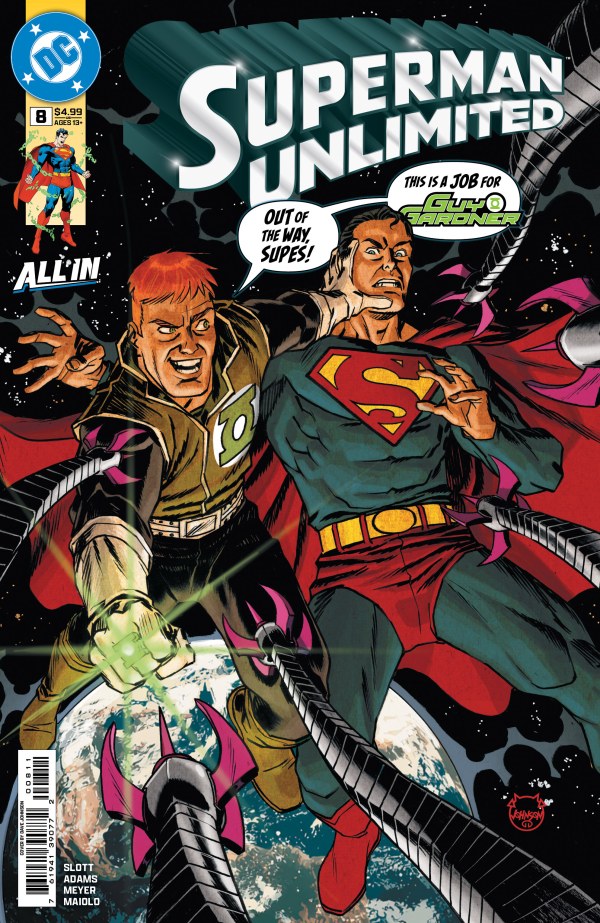
Plus, that Dan Jurgens cover just slaps.

The story starts with Lois and Clark telling Jimmy the news of their engagement over lunch – a lunch disrupted when an enormous Green Lantern symbol appears in the sky over Metropolis. When the symbol morphs into an S-Shield, Lois rushes to write up the story that one of the Lanterns is trying to contact Superman, leaving Clark (who still hasn’t told her his identity at this point) the opportunity to sneak off. He flies to New York to find Guy Gardner, but Gardner didn’t send the signal. Gardner uses his ring to track the signal to a location in Wyoming where Hal Jordan is being held by a giant alien whose ship crashed on Earth centuries ago. Hal is helpless, his ring’s charge having been spent just as he signaled Superman, plus the alien is siphoning energy from his power battery. They find him beneath an air force base where Hal escapes and recharges his ring, then with the addition of Superman’s will, they take back the emerald energy he stole. The alien is despondent, believing himself trapped on Earth, but Superman and the Lanterns take pity on him and restore his ship to space with enough energy to finally, after centuries, return home.

This is a nice self-contained issue, with the only major link to the ongoing storylines being Lois and Clark’s engagement and a few references to the still-fresh wound of the death of Jerry White. But the book turned out to be pretty fundamental to me. As I said, I was still relatively new to DC at the time it came out, and this served as something of a gateway for me to both the Justice League America series that Guy was a member of, as well as the then-new Green Lantern series featuring the down-and-out, gray-templed, globetrotting Hal Jordan that existed at the time. I knew who the Justice League and Green Lantern were, of course, but at this point my perspectives on the characters were built primarily around pre-Crisis comics that my uncle had given me and the way they were depicted on shows like Super Friends. With this book my eyes were opened to a larger world. I became a fan of these properties, especially Green Lantern, and I’ve been a faithful reader of that comic ever since (with the exception of one writer whose run turned me off so much that I dropped the book until it ended – but the less said about that bleak period the better). 

This book is also a great glimpse at the way the characters were written at the time. Gardner, for example, had the same stupid, brash attitude that Nathan Fillion made so much fun in the movie, although he’s perhaps even a little more dimwitted. There’s one point, for instance, where Superman shows his exasperation that the alien has allied himself with two old sparring partners of his named Dreadnaught and Psi-Phon, and Gardner takes that as a cue to go after them with a power ring-generated chainsaw. There’s some interesting contradictions here as well – he’s jingoistic enough to casually wish for a new war so he could show what he can do, but too dense to realize that the airplanes attacking them are American. Fortunately, this particular facet of the character has dulled over time.

Superman, meanwhile, is all him. When the alien believes himself to be stranded, Superman hits him with a classic observation: “How come extraterrestrials are always coming here and causing all kinds of trouble instead of asking for assistance? All you have to do is ASK!” The giant alien is suitably ashamed of his behavior before Superman helps him out anyway, because of course, he’s Superman.

A fun book from early in Jurgens’ run, and I enjoyed revisiting it again after all this time. 

Fri., Sept. 26

Comics: Superman’s Pal Jimmy Olsen #139, 141, All-Star Squadron #36 (Team Member)

Notes: Here’s a fun, weird one that should have been worked into the week of Superman’s Strangest Team-Ups. Jack Kirby, who at this point was doing pretty much whatever he wanted with this title, had made Project: Cadmus a regular co-feature of Jimmy Olsen’s adventures. This is the issue where the Project unveiled the Guardian, the clone of the Golden Age hero who became a regular member of Superman’s supporting cast in this same basic form during the Triangle Era. Guardian changed a bit before the 90s, though. In this one he’s much more focused on being a clone, even commenting how it’s always an “experience” to meet an “original” human like Clark Kent. (That’s what we call dramatic irony, by the way, kiddos.) By the Triangle Era, Guardian had shed the conceit of making his status as a clone such a big part of his identity and was just the original Jim Harper in a new body. 

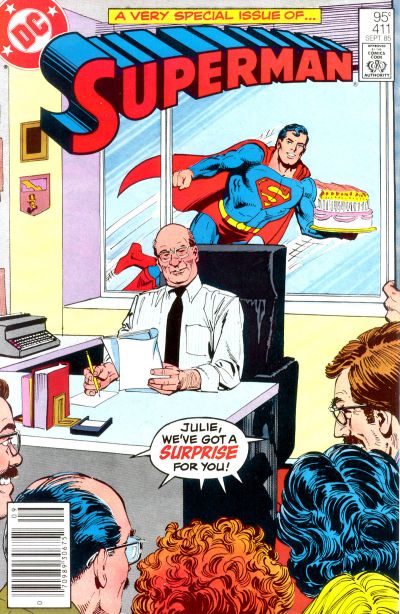
The rest of the story involves “Goody Rickels,” WGBS employee with an uncanny resemblance to Don Rickles. Morgan Edge can’t stand him and tries to manipulate things to get rid of him, and honestly, it’s hard to blame him. It’s a really weird little story and, despite the promise on the cover of “Two Rickles,” the real Don doesn’t appear until part two of the story, which comes in issue #141. (Issue #140 was a giant-sized issue of reprints.) The second part begins with the bold cover proclamation: “Kirby says: Don’t ask! Just buy it!” Jimmy, Guardian, and Goody have been given a meal with a toxin that will activate and cause them to explode within 24 hours if they don’t get the antidote. As Guardian searches for it, Jimmy and Goody wind up at WBGS where the real Don Rickles is in a meeting with Morgan Edge. There’s a big dust-up and Goody is on the verge of exploding when Guardian shows up with the antidote. This also happens to be the issue where Clark Kent, in space with the New Gods, gets his first-ever glimpse of Apokolips, which is an interesting historical note for a comic book with Don Rickles on the cover. 

Sat., Sept. 27

Comics: Superman Unlimited #5, Superman Vol. 6 #30, Justice League Unlimited Vol. 2 #11, New History of the DC Universe #3, Aquaman: Yo-Ho-Hold on To Your Hook #11 (Guest Appearance)

Notes: Once again, today I’m picking up the new Superman-related comics for the week, including two new issues of the ongoing, Justice League Unlimited, and a return to the reshaping of DC’s history.

We’re starting it off with Superman Unlimited #5. The Daily Planet gets word that the Kult of Kobra is operating in El Caldero, the “Kryptonite Kingdom.” What’s more, the Calderan mining operation is about to uncover a Kryptonian Sunstone, the same kind of technology that built Superman’s Fortress of Solitude. Donning a suit of Kryptonite-proof armor and catching a ride in one of the most gloriously anachronistic pieces of Superman tech, he heads to Caldero to try to get the Sunstone before Kobra. The story seems to be picking up a little here. Previous issues have been largely one-off stories that connect to the larger story of the Kryptonite Kingdom, but this one gives us a nice little cliffhanger. It looks like the story is opening up, and I’m excited to see where it’s going to go. 

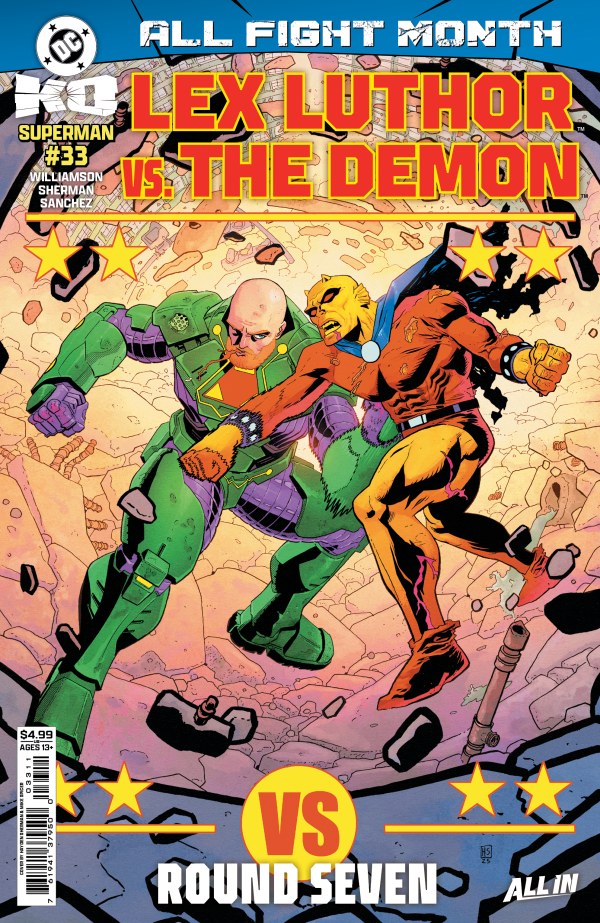
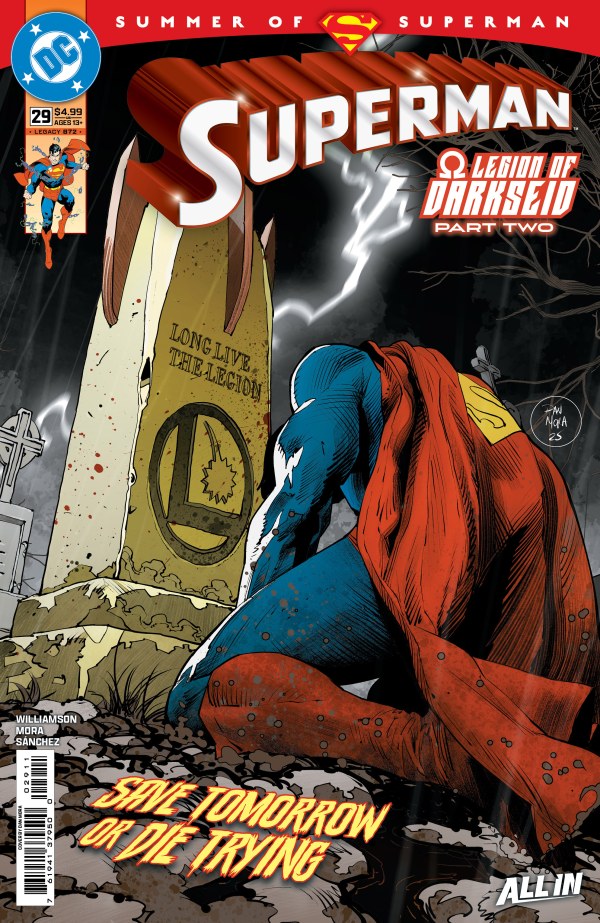
The story of Darkseid’s Legion continues in Superman #30. Superman’s supposed ally, Superboy-Prime, has turned (insert surprised Pikachu face here), joining Darkseid’s Legion and capturing him, along with the long-suffering Booster Gold. The issue wraps up this (surprisingly short) storyline, but also acts as a lead-in to the upcoming DC KO event, and although I don’t want to get into too much more detail about what happens, Joshua Williamson pulls off a hell of a trick. There’s a brilliant reversal of expectations in this book, leading up to a climax (before the epilogue) that felt positively stirring. There’s a reason Superman is the greatest hero there is, and it’s got nothing to do with his powers. It’s about what he represents, what he stands for, what he means to other people. And boy-howdy, does this issue understand that. I love Superman, I love the Legion, I love Booster Gold…and I love what this issue does with all three of them. 

We also, incidentally, get to use Prime’s meta awareness to give us what is objectively one of the most funny panels in a Superman comic all year. You’ll know it when you see it. 

Justice League Unlimited #11 is another prelude to DC KO, this one starting off with the Justice League Watchtower being invaded by an army of Parademons. At the same time, beneath the country of Markovia, a League squad including Power Girl and Captain Atom find themselves in battle against some of Darkseid’s Legion. The battle goes poorly on both fronts and we get Leaguers down before a last page that ties very nicely into this week’s issue of Superman. I love when comics pull off tricks like this one, two stories that happen simultaneously and tie together in the end. It’s a nice way to make the shared universe conceit work, and theoretically, you don’t HAVE to read both of them to understand either one. It sure makes it more satisfying when you do, though.

And Waid returns with a plethora of artists to bring us New History of the DC Universe #3. Picking up on the aftermath of the original Crisis on Infinite Earths, Barry begins to recount the era of the DC Universe that made for my foundational years – the late 80s and early 90s – all the way up to Barry Allen’s resurrection in Final Crisis. As Barry is, in fact the narrator of this series, you could simply call this issue “stuff that happened while I was dead.” Once again, I’m impressed at how Mark Waid has gone about smoothing over certain elements of the combined/rebooted/revamped DC Universe. For instance, when Supergirl came back in 2004, she was introduced as though she were a brand-new character, her death in the original Crisis being removed from continuity. Waid has it both ways here – Supergirl DID die in the crisis, and the story we read in Jeph Loeb’s Superman/Batman run has been retconned slightly – rather than introducing her to Earth to use her as a weapon, now Darkseid actually resurrected Supergirl for the same reason. Waid also, once again, brings in elements of the Milestone Universe, specifically the 90s incarnations of the characters, marking them as denizens of the DCU proper in such a way that certainly makes it seem as though there are plans afoot to bring them back again. 

This series really is a nerd’s dream. And as a nerd, I approve. 

Sun., Sept. 28

Comics: Superman #125, DC Vs. Vampires: World War V #11 (Appearances by Supergirl, Steel, Lois Lane)

Notes: Let me tell you something about my family. My son is a football nut. Like, he’s crazed. If there is an NFL game on, he is insistent upon watching it, to the point that he begged me to take him to church yesterday on Saturday afternoon so that he could stay home this morning, Sunday, and watch the Steelers/Vikings game in Dublin at 8:30 am. He also gets up and gets VERY excited and VERY hyper, and the point is, by the time the early game ended and the noon game began, I was already exhausted by this little creature which I am emotionally, biologically, and legally responsible for. I didn’t really have it in me to get into any deep Superman lore today, so I scrolled through the DC app looking for the silliest, most ridiculous one-off comic I could find. The winner turned out to be Superman #125 from 1958.

The first story, “Lois Lane’s Super-Dream,” begins with Lois falling into a coma when she falls from a ten-foot ledge trying to sneak into the Metropolis Science Fair a week early, which has got to be the stupidest way she’s ever almost gotten herself killed, even in the Silver Age. She gets a blood transfusion to save her life, but her subconscious mind thinks she got it from Superman, and she has a dream where his blood gave her powers as well. In the dream she puts on a red wig and starts calling herself “Power Girl,” and she’s actually fairly effective until – again, in the dream – Clark Kent is nearly killed in an explosion. Power Lois gives Clark a transfusion of her blood, and now HE’S got powers too. Go figure. So she makes him a Power Man costume and the most comically ridiculous mustache anyone not named Oliver Queen has ever worn and makes him join her as a superhero. But Power Clark, in Lois’s subconscious, keeps screwing things up due to a combination of cowardice and ineptitude. The whole story kind of makes Lois look bad, showing not only what she really thinks of Clark, but the particularly cruel way she treats him as her sidekick.

“Clark Kent’s College Days” is next, the beginning of an “Untold Tales of Superman” series. I’ve read this story many times, as it too was included in either the Greatest Superman Stories Ever Told or Superman From the 30’s to the 70’s books (I honestly don’t remember which) I read so many times as a kid. Clark gets an invitation to his college class reunion and begins to reminisce about his early days at Metropolis University, where he’s putting on his weakling act and letting the upper classmen haze him. The seniors aren’t the real problem, though – in year two, Clark’s teacher Professor Maxwell catches Clark using his vision powers to weld a seam in a robot and immediately deduces that one of his students must be Superboy. In this next class, he begins hooking his students up to a lie detector and asking if they’re Superboy, which makes you wonder what the hell he’s supposed to be teaching. Clark barely escapes being interviewed before class ends, and Maxwell begins a series of schemes that could make Lucy Ricardo proud, attempting to prove that Clark is Superboy, even to the point of exposing him to Kryptonite. But Clark winds up outsmarting him every time, and finally escapes the Professor’s attention by strapping in and letting him ask if he’s Superboy. Clark says “No,” and passes the test. Is it because of his powers? His Kryptonian physiology being incompatible with the machine? Nah, it’s because he decided, right at that moment, that it was time to consider himself an adult and start referring to himself as “Superman.” 

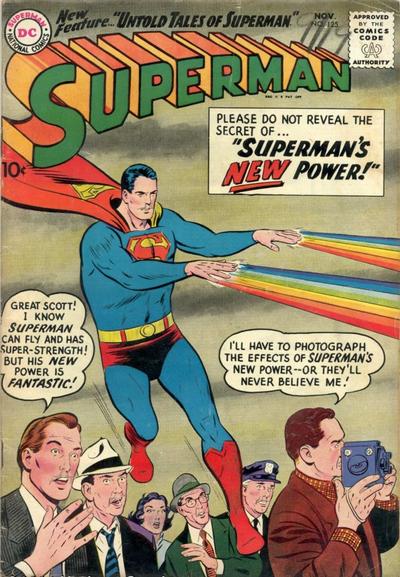
The cover story that got me to read this issue comes last, “Superman’s New Power.” Superman finds a pocket of fires in the core of the Earth that are causing tremors above in Metropolis. As he stabilizes the fires, he uncovers a tiny space ship that seems to have been embedded in Earth’s crust for eons. The ship blows up, and he later realizes his powers have changed. His normal powers (except, conveniently, invulnerability) have vanished, even as he gains the new ability to shoot a tiny replica of himself from his fingertips. The mini Superman has all his normal powers, so Superman’s career as a crimefighter shifts to being more of a puppeteer, sending Lil’ Superman into danger instead. While he proves just as effective as the real thing, Superman finds himself feeling emasculated at sitting on the sidelines while his teeny proxy goes into danger. The story ends when Tiny sacrifices himself to save Superman from a chunk of Kryptonite some crooks hurl at him. The Kryptonite makes Tiny vanish and Superman’s powers return to normal, ending with a panel where he contemplates whether Tiny had a consciousness and will of his own and made the sacrifice deliberately.

I’ve said it before and I’ll say it again: the 50s were a wild time.  

Mon., Sept. 29

Comics: Superman Vol. 2 #2, Justice League of America #30 (Team Member)

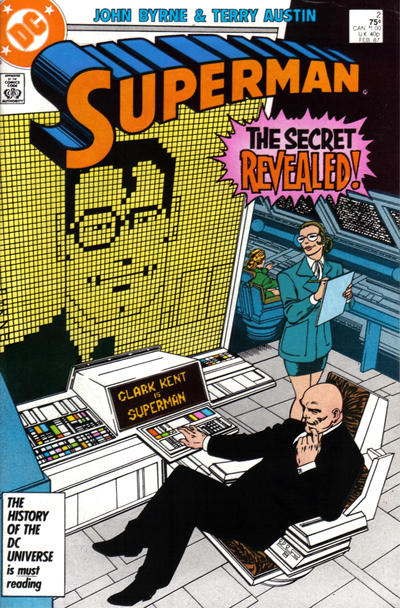
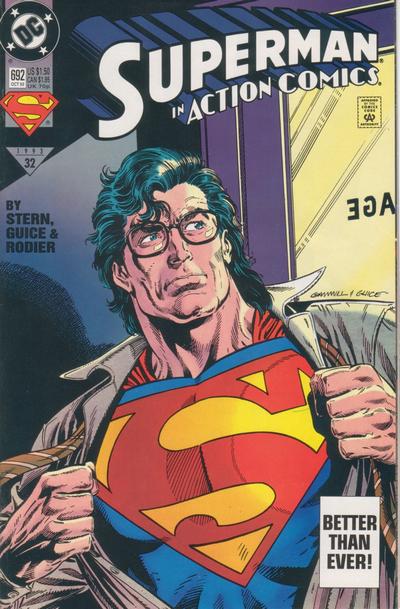
Notes: Returning to my list of random Superman stories that I’ve read at some point, here’s yet another that I remember reading first in the old Greatest Superman Stories Ever Told trade paperback. The second issue of the John Byrne reboot in Superman #2 is a good story, and it’s got one of the best Lex Luthor moments of all time…at least, “best” in the sense that it’s one of the greatest expressions of who Lex is as a character, not in that it makes him look good.

At this point, Superman had been active for a few years (mostly glossed over in the Man of Steel miniseries), and Luthor is looking for any clues that could potentially help him destroy the Man of Steel. He finds them, along with analyst Amanda McCoy, in the form of a red-haired woman who seems to keep showing up when Superman is active. As they search for the strange woman, Luthor turns to his frequent flunky Sidney Happersan, who is examining the Metallo cyborg they captured in Superman #1. Determining that the Kryptonite heart in Metallo’s chest is potentially fatal to Superman, Lex ruthlessly rips it from him even though Happersan warns him that it will kill the cyborg. (Don’t worry, he got better.) 

In Smallville, a pair of Luthor’s goons are looking for things that link Clark Kent to Superman, as Clark seems to be the one who gets all the big scoops. They drug Jonathan and Martha Kent then ransack their house, stealing Martha’s scrapbook of newspaper clippings regarding Superman. As they leave the house, they’re spotted by the passing Lana Lang, whom they drug and (realizing that she can identify them) kidnap. Imagine Lex’s glee, of course, when she turns out to be the very red-haired woman his people are searching for. 

Days later, Clark Kent comes home to find a series of bloody footprints leading to his apartment and Lana hiding there, having been tortured for information that she refused to give. Sensing Luthor’s involvement, Superman barges into LexCorp, only to find that Luthor’s got a new piece of jewelry – a ring with a glowing green stone that keeps Superman at bay. Stymied, and with no actual proof of Luthor’s involvement, he takes Lana back to Smallville. In Metropolis, Amanda runs all the data they’ve found through the computer, seeking the link between Superman and Clark Kent, and she arrives at one inexorable conclusion: Clark Kent IS Superman. 

And Luthor is furious at the absurdity of it. “I know that no man with the power of Superman would ever PRETEND to be a mere HUMAN!” he shouts, firing Amanda McCoy on the spot because “I have no place in my organization for people who cannot see the OBVIOUS.”

Ah, what a fantastic story, Mr. Byrne. This is the ultimate platonic ideal of who and what Lex Luthor is, especially at that time. He’s ruthless and cruel – his treatment of Lana, of Amanda, even of Metallo all demonstrate that. He’s intelligent, but not the super-scientist he was in the Silver Age or would become again. But he’s also so unbelievably arrogant that when the answer to all of his questions is served up to him on a silver platter, he rejects it because he cannot fathom anyone with Superman’s power being so good that he would “pretend” to be Clark Kent. Byrne actually used this as part of the punchline in his “Superbman Vs. the Fantastical Four” story from Marvel’s What The–?! #2, with the fake Dr. Doom telling Rex Ruthless that Superbman COULDN’T be a normal human because that would make him “nicer than us.”  

This story is also important in that it sets up a number of different elements that would be of tremendous importance later, especially the Kryptonite Ring. That little domino would set off multiple chains. Luthor would learn to his grave error that he was wrong about the radiation being harmless to humans, and that wearing the ring constantly gives him cancer. This ultimately leads to him faking his own death, cloning a younger body, and returning to Metropolis pretending to be his own son. Amanda McCoy came back later desperate to prove she was right, stealing the ring but being killed in an alley for it, leading to the Dark Knight Over Metropolis story where Superman gave the ring to Batman, a concept which has been a consistent part of the characterization of the two heroes ever since. 

It’s also a pretty good showing for Lana, proving – even under torture – that she’s a good friend and worthy of Clark’s trust, never betraying his secret. In Man of Steel, Byrne had turned Lana into something of a broken bird, heartbroken at the realization that Clark Kent was too big and too important to the world to be in her life the way that she wanted. It took a long time to rebuild her character, and this issue I think was the beginning of that. 

Even these short stories can be great sometimes. 

Tues., Sept. 30

Graphic Novel: Superman: True Brit

Notes: I decided to cap off this week with something relatively lighthearted – perhaps even a bit silly, and this 2004 Elseworlds graphic novel certainly fits the bill. True Brit brought John Byrne back to do artwork for the Man of Steel again, but this time in a story written by Kim Johnson “with some help” by Monty Python legend John Cleese, who of course is most famous for that one “Bicycle Repairman” sketch that we covered back in Parody Week. (There’s a brief shout-out to that bit in the book, as well.) Like many Elseworlds, it starts with a “what if” type of scenario – Jor-El sends his infant son to Earth. Instead of Kansas, though, this time his spacecraft lands in what Jor-El calls “their most advanced, most powerful nation – the British Empire!” Kal-El is found by a British farm couple, Jonathan and Martha Clark, who raise him as their son Colin. He struggles to control his powers, even after being told of his true alien heritage, and when the time comes to go off to University Mrs. Clark admonishes him to keep the powers hidden away in shame. 

Studying journalism, he becomes smitten with his classmate Louisa Layne-Ferret, but she doesn’t show any interest in him until he accidentally impales a classmate with a cricket bat just before graduation. He winds up using his powers to get stories for a sleazy rag called the Daily Smear, where he finds out the famous rock band the Rutles (another in-joke) are in mortal danger, forcing him for the first time to act publicly in a Union Jack-adored Superman costume. 

The Smear runs with it, making the Superman stories more outrageous and scandalous, to the point where the Clarks even move without telling Colin where they’re going. But his fortunes change when the Queen sets him some “impossible” tasks – making the trains run on time, reducing the wait time for hip operations (the solution, by the way, is to convince the surgeons to play less golf), and raising the quality of the programming of the BBC. But all his work may come to a screeching halt when he runs afoul of his greatest enemy: the Bat-Man.

The story is rife with gags and jokes that almost could have qualified this graphic novel for Parody Week in and of itself. For instance, when his adoptive parents think Colin can fly, they advise him to flap his arms like a bird, which causes a bit of amusing chaos and resultant property damage. When he finally does fly – with a horse – the poor animal has to be carted away to a veterinary hospital and treated for shock. An attempt to milk the cows with his super-speed and strength leaves them…let’s say “unhinged.” Perhaps my favorite joke comes when his mother tries to steer him into being a postman rather than a journalist, and he fires back with “I don’t CARE about respect! I’d rather be a REPORTER!”

Ah, maybe it’s just the ex-reporter in me that finds that hilarious, I dunno. But that seems to be the main thesis of this book. Rather than telling a story about Superman in another culture, True Brit comes across as Howard and Cleese giving a scathing indictment of the British media. Most of the book comes down to a heavy and brutal satire of the state of the British press, with the more lurid types of publications rising in prominence and the few legitimate reporters being buried. It’s a funny book, although I imagine a lot of the Britishisms are lost on an American audience. 

Byrne’s artwork is interesting here. While not as cartoonish as he used in his What The–?! story, nor is it as clean and straightforward as his usual style as seen in his Superman run. He somewhat splits the difference here, drawing a world that still feels like part of the DC Multiverse but, at the same time, having enough fun with it to allow some silly sight gags, outrageous facial expressions, and goofy poses.

This week was a nice change of pace, friends, but October begins tomorrow. And October begins my favorite part of the year — those last three months that I love so much. And this year being the Year of Superman, it’s gonna be even better. For the next few weeks, as we approach Halloween, we’re going to be looking at darker versions of Superman, Superman gone wrong, a focus on his greatest villain, and more! See you then!

Blake M. Petit is a writer, teacher, and dad from Ama, Louisiana. His most recent writing project is the superhero adventure series Other People’s Heroes: Little Stars, volume one of which is now available on Amazon. You can subscribe to his newsletter by clicking right here. You can join in the Kryptonian Konversation every day in the Year of Superman Facebook Group!

Year of Superman Week 35: A Spark of Change

When I started the Year of Superman back in January, I decided early on that I wasn’t going to spend the entire year reading stories from the “Triangle Era,” even though that is hands-down my favorite period of Superman comics. I did decide, though, that I would allow myself two indulgences. I would give myself a few weeks to delve into the epic and game-changing Death and Return of Superman storyline in the early part of the year. Then, later, I would allow myself to read the longer and more divisive saga of “Electric” Superman. The period where Superman’s powers and costume changed so radically was a major point of contention for a lot of readers at the time, although I feel that — like many stories of the era — it is looked back upon more fondly than it was initially received. But I have never gone back and read that era as a whole since it first came out.

I think it’s time.

That said, there’s a question that must be answered: exactly WHEN does this saga begin and end? It’s not as cut-and-dried as the Death of Superman, beginning with Doomsday’s appearance in Man of Steel #18. This story doesn’t begin in the issue where he gets the new costume. Superman’s power change is at least partially a result of an attempt to restore his powers after they are lost during the Final Night crossover. And after he is returned to “normal,” that issue ends with a cliffhanger that dovetails into a time-travel adventure against the villain Dominus that lasts several months before things are finally reset. Along the way he participates in more than one crossover event, is a regular member of the Justice League, and makes multiple guest appearances in lots of comics, including the Ultimate Access miniseries I read last week. All told, were I to read EVERY comic book with Electric Superman, it would be more than double (possibly triple) the number of issues in the Death and Return saga. That’s a LOT.

So here’s what I’ve decided: 

I’m going to read all of the issues of the regular Superman titles from the beginning of Final Night to the end of the Dominus storyline. I’ll read the main issues of any crossover in which Electric Superman appears, as well as crossover chapters in which Superman or members of the family appear. I’ll also read the annuals with Electric Superman. I’m going to skip the JLA issues, because after all, it’s part of Grant Morrison’s run and that whole thing is really one massive story in and of itself. And I’m not going to get into every guest-appearance he makes just because I think it would be a pain to try to track them all down, but I reserve the right to sneak one in if I really want to.

Even shortened like this, it’s still going to be the single largest endeavor of the Year of Superman. And I’m kind of excited to get into it.

All of this is to say, buckle up. It’s time to get sparkly.

Wow, that was lame.

And as always, you can check out earlier blogs in the Year of Superman Archive!

Wed., Aug. 27

Comics: Final Night #0-4, Power of Shazam! #20, Superman Vol. 2 #117, Adventures of Superman #540, Supergirl Vol. 4 #3, Action Comics #727, Superboy Vol. 3 #33, Legion of Super-Heroes Vol. 4 #86, Superman: The Man of Steel #62, Green Lantern Vol. 3 #81

Notes: It was a weird time in DC Comics. Hal Jordan had gone mad after the destruction of Coast City and took on the villain name Parallax following Zero Hour. Kyle Rayner was Green Lantern. Half of the Legion of Super-Heroes was stranded in the 20th century. And Lois Lane had ended her engagement to Clark Kent. Then, as if things weren’t bad enough, some idiot turns out the lights.

In The Final Night, by Karl Kesel and Stuart Immonen, an alien identifying herself as Dusk crashes her ship into Metropolis, where she is confronted by Superman, the Special Crimes Unit, and the time-tossed Legion of Super-Heroes. Dusk warns that a Sun Eater is approaching Earth, and that she has rushed ahead of it from world to world, trying to save people from its devastation, but thus far she has always failed. Superman quickly rallies the world’s heroes (and even some of the villains – they’ve got just as much to lose if the sun is eaten as the heroes do) and they take to space to try to stop the Sun Eater, but despite their best efforts, at the end of the first issue, Earth’s sun is consumed and the world is plunged into darkness. 

Issue two begins in rather dramatic fashion, when Lex Luthor – who has been in hiding – appears to offer his aid to the Justice League and Earth’s heroes in saving the world, including a powerful splash page of Superman and his worst enemy shaking hands in the face of a common threat. Meanwhile, the worlds’ heroes are in overdrive trying to protect people both from the drastic climate crisis as well as from each other. It soon becomes apparent, however, that with the sun gone, Superman’s powers are declining rapidly. Amidst all of this a new hero appears: a young man calling himself Ferro. 

In issue three things go from bad to worse. Turns out the sun isn’t actually GONE, but cut off inside the Sun Eater, where it’s trying to heal itself, but Luthor and Brainiac 5 realize that they have less than 24 hours left before the sun goes hyper-nova, wiping out everything in the solar system. Dusk makes plans to leave Earth before the end, as she has so many times before, but the Phantom Stranger takes her on a whirlwind Ebenezer Scrooge-like tour of the Earth, allowing her to witness our heroes’ refusal to give up, even in what is literally the darkest of hours. And as everyone begins making preparations for the bitter end, Guy Gardner is surprised by the appearance of a bright, beautiful green. 

Final Night #4 brings us to the brink. Luthor and Brainiac 5 have constructed a series of force-field bombs they believe will contain the nova and destroy the Sun Eater, but their chosen pilot, Green Lantern, disappears. Superman insists on going himself, and takes a moment to write a farewell letter to Lois, from whom he was estranged at the time. As he’s writing, through, Ferro steals the ship with the intention of making the suicide run on his own. As they try to stop him, Parallax arrives and offers to save the sun. Despite the reservations of some of the heroes (especially Batman), he does so – at the cost of his own life. Hal Jordan, once and future Green Lantern, falls as he dispels the darkness within.

The end of the story doesn’t quite hit the same now as it did in 1996, knowing as we all do that Hal would eventually return and become Green Lantern again. But as a way to end the arc he had been on since the Death of Superman it was fitting. Also fitting was the reaction of the other heroes: Superman chooses to believe that Hal Jordan found redemption in the end for the atrocities of Parallax, whereas Batman believes a moment of good at the end can never erase the slate. It says quite a bit about each of these heroes, and the book seems to recognize that. At the end of the issue, as Clark and Bruce debate Hal’s sacrifice, Karl Kesel writes a caption that has always stuck with me: “They are the world’s finest heroes, and all the rest follow the lead of one or the other.”

It’s an interesting perspective on the philosophy of the DC Universe, isn’t it?

Let’s talk for a moment about the assorted spin-off chapters. As I said, I didn’t read all of the assorted spin-offs, only those featuring Superman or a member of the family, but that still added an additional nine books to the five-issue main series. I’ll hit the high points in order, as dictated by the reading list on the DC Infinite app:

Power of Shazam! #20: As the weather begins deteriorating with the loss of the sun, Superman and the Marvels go into first responder mode while the wizards Shazam and Ibis try to find a magical solution to the problem. Superman’s presence here is minor, but there are interesting notes. First, this happens right after the sun is lost, so Superman’s powers are only beginning to wane. Second, there’s an amusing moment where Captain Marvel promises Superman “I won’t be distracted like when I faced that Thunder God,” a funny and oblique reference to the events of DC Vs. Marvel

Superman #117: This one is a cheat. Despite the banner on the cover, it’s not really part of the crossover. The issue wraps up an ongoing story with Superman and Professor Hamilton in the Fortress of Solitude and advances a few subplots, but it only ties in to the Final Night on the last few pages, when Superman receives word that something is approaching Earth. If you’re doing a readthrough of the story, this is utterly skippable. 

Adventures of Superman #540: Perry White fights valiantly to put out an edition of the Daily Planet, reasoning that failure to do so would be like giving up and admitting defeat. Emil, still in the Fortress of Solitude, starts transmitting his own research to S.T.A.R. Labs in an attempt to help. And in Metropolis, as Superman’s powers continue to dwindle, Ferro gets a rather heartbreaking origin. The Perry stuff is great, and the Ferro stuff sets the character up nicely for his future with the Legion.

Supergirl #3: Peter David’s epic run was interrupted pretty early by this crossover appearance. Supergirl (this is the Matrix version, remember), has very recently found herself bound to a mortal girl named Linda Danvers, and in her new home of Leesburg, people are beginning to fall apart as they beg for the return of the sun. The issue is mostly spent developing subplots for the series in the context of the crossover, and skippable if you just want to read Final Night, but it reminds me as always just how good David’s run on this character was. I may not be able to fit it in before the end of the year (it’s a total of 80 issues, plus assorted crossovers, annuals, and specials), but so, so worth reading.

Action Comics #727: A somewhat quiet, subdued issue. As Metropolis is blanketed with snow, a Superman whose powers are nearly gone struggles to keep the peace. Meanwhile, a desperate man finds new hope. Inconsequential to the main story, but this is actually one of those times where I really feel a crossover event works well, telling an emotional self-contained tale against the backdrop of the greater events.

Superboy #33: In Superboy’s home of Hawaii, people are gathering at the base of an active volcano for warmth. Roxy Leech, his manager’s daughter and Superboy’s best friend, decides that with the world ending in 24 hours there’s nothing left to lose and confesses her love for him, which is kind of awkward, as his girlfriend Tana Moon is on TV reporting on the crisis just as the volcano erupts. Turns out it’s a monster with the inventive name of Lava causing trouble. The ending here is particularly bittersweet, and surprisingly effective. 

Legion of Super-Heroes Vol. 4 #86: Ferro proves his mettle (get it?) by offering to dive into the sun with an enormous bomb to get it going again. Luthor and Brainiac already have devised their plan to send Green Lantern instead, though, but when he mysteriously vanishes (whisked away by Parallax, as it happened), Superman steps up to do it instead…something that doesn’t sit too well with Ferro. 

Superman: The Man of Steel #62: An interesting little side-trip. Almost de-powered, Superman tries to help a power plant stay functional to keep people from freezing in the dark. Meanwhile, Hamilton discovers that imminent destruction of the sun and sends word to the Daily Planet, while learning about the last days of Krypton and how eerily reminiscent they are of the current situation.

Green Lantern #81: An epilogue to the Final Night story featuring the funeral of Hal Jordan. Kyle Rayner is nervous, finding himself in the position of being asked to speak the death of a man he never met until he turned bad. Superman begins the ceremony, calling Hal a hero, before calling up other speakers who knew him best: Guy Gardner, John Stewart, Black Canary (speaking in the stead of the also dead-at-the-time Oliver Queen), the Flash, Carol Ferris, and finally Kyle. The heroes travel to the Coast City memorial, where Alan Scott turns the eternal flame green, and then Swamp Thing (making a rare non-Vertigo appearance for the time period) brings life back to the desolated landscape. In the end, even Batman finds it within himself to forgive.

A lovely story, although of course, it wouldn’t be the end at all. Nor is it the end for Superman because – as you may have noticed – I haven’t mentioned anything about his powers coming BACK yet. After the sun was restored, he – and everyone else – assumed his powers would go back to normal. But as we’re going to see soon, that isn’t what happened at all.  

Thur., Aug 28

Comics: Superman Vol. 6 #29, Justice League Unlimited Vol. 2 #10, Justice League: Dark Tomorrow Special #1, Green Lantern Vol. 8 #25 (Superboy Guest Appearance)

Notes: Gonna take a quick pause from the burgeoning Electric storyline to read some of the new Superman comics that dropped this week. Superman #29 continues the “Legion of Darkseid” story as Superman plans a trip to the future to save the Legion of Super-Heroes with the most unexpected partner of all time. 

It’s going to be hard to talk about this issue – I don’t really want to spoil anything, so can I just talk about vibes? As in, “I freaking love the vibes from this book”? Superman going into the future to save the Legion is exactly what I’ve been thirsting for. What’s more, writer Joshua Williamson is showing respect for EVERY incarnation of the Legion to date, weaving them all into this story (somehow) whilst still tying everything in to the ongoing “DC All In” saga. Again, without spoiling anything, if you haven’t read last year’s DC All-In Special or the Summer of Superman Special that came out in April, you’re missing out on the building blocks of this story. Superman even gets one of his trademark rousing speeches in which he espouses exactly what I’ve always felt is true: he may have been the inspiration for the Legion, but the Legion was every bit as much an inspiration to HIM.

Despite the darkness of this story, something about it is feeling…right. It rings true. And by the time the tale ends and the dust has settled, I feel like we just might finally have a true Legion again. 

Justice League Unlimited #10 actually takes place before the “Darkseid’s Legion” storyline, and involves the League trying to protect the Doomsday Time Trapper, who feels the encroachment of Darkseid and his Legion. Meanwhile, the Trinity have a little heart-to-heart about what happened with Air Wave (the whole “tricked by Grodd” thing) and how they need to approach Justice League recruitment in the future. As always, Mark Waid proves just how well he knows these characters, placing Superman and Batman at odds with one another on this matter, with Wonder Woman as the mediator between the two. Clark also gets in a pretty sharp jab at Bruce, which I don’t think he gets to do quite often enough.

Also, Dan Mora drew both of these issues, and he’s phenomenal. Really, any time these days I read a comic book where I don’t feel the artwork is up to snuff, I wish that they could clone Mora and have him do all of it. 

I also read the Justice League: Dark Tomorrow Special, which came out a few weeks ago but, somehow, I’d missed. I’m glad I grabbed it, though, because it feels pretty significant to this whole All In/Darkseid story that’s going on. Someone is hunting down and killing time travelers, which puts roughly half the Justice League at risk – especially those time-lost heroes from the “We Are Yesterday” crossover. A mysterious time-traveler calling himself “Legend” partners up with Air Wave and the lost heroes to try to save them. The issue is both an epilogue to “We Are Yesterday” and a prologue to future stories (including “Darkseid’s Legion” and the upcoming “DC KO”), and although the Super-family participation is minimal, it definitely feels significant, and if you’re following the ongoing saga of the DCU these days, you should pick it up.

Fri., Aug. 29

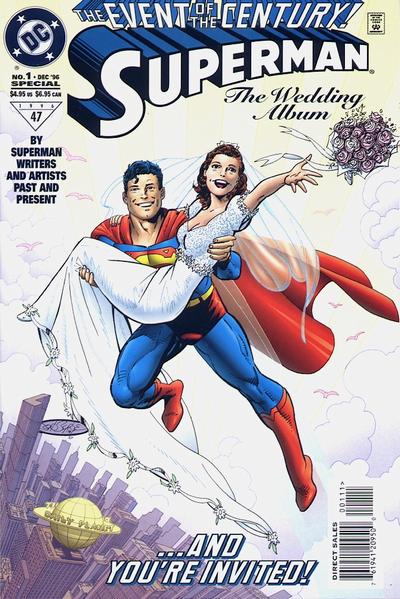
Comic Books: Superman Vol. 2 #118, Superman: The Wedding Album #1

Notes: I only briefly mentioned it when I read Final Night the other day, but at this point Lois and Clark were separated, she having called off their engagement and taken an assignment in Asia to get away from him. It was a bit of a delaying tactic – Warner Bros wanted corporate synergy and refused to allow DC Comics to have the two of them get married until they were also married on the then-running Lois and Clark: The New Adventures of Superman TV show. It was actually that edict that led to the Death of Superman in the first place, when they had to scrap their plans to marry them off in 1992. Here, four years later, after one delaying tactic after another, they finally got married on the show, and DC had to quickly follow suit.

In Superman #118 we pick up on her, chasing down a heroin ring in the far East. Back in Metropolis, meanwhile, S.T.A.R. Labs is working on the fact that, despite the sun coming back, Superman’s powers are still gone. After a seemingly-pointless reiteration of his origin, Wonder Woman and Lori Lemaris convince Superman to try to get Lois back. Lois, meanwhile, encounters a young man who tells her a lesson he learned as a child from an American stranger. It’s pretty clear where this is going from the very beginning, but Lois is still taken by surprise when she learns who her new friend’s old friend happens to be, and she makes a decision to return to Metropolis. Short? Abrupt? Hell yeah. But DC wasn’t given a lot of time to get things back in order – they needed to have the wedding of the century align with the TV show.

And this brings us to Superman: The Wedding Album, an event nearly 60 years in the making. This 88-page whopper told a hefty tale written by the five writers of the Superman comics of the era (Dan Jurgens, Karl Kesel, David Michelinie, Louise Simonson, and Roger Stern), with art by the regular teams and several other artists who had worked with Superman over the years, including John Byrne, Gil Kane, Paul Ryan, Tom Grummett, and a flashback sequence using pages by the great Curt Swan. It’s a nicely fitting tribute to the characters, kicking off with Lois being Lois – pretending to want to marry the head of the drug trafficking ring as a way to both bust him, at the same time, hitch a ride on his private jet back to Metropolis. She storms into the Daily Planet office wearing a ragged and torn wedding dress, then has it out with Clark. He fills her in on what’s been going on in her absence: he’s acting as Managing Editor of the Planet while Perry recovers from chemotherapy, oh yeah, and his powers are gone. (There’s a particularly funny line here: “Remember when the sun went out a while ago, Lois?” As if that’s the sort of thing a person could just forget.) The sequence ends with the entire Planet staff crowding around, trying to peek through the door, and seeing the two of them in an embrace, back where they belong.

The bulk of the special, after that, is all about wedding preparations: Lois’s bridal shower, the happy couple picking out their dress and tux, and house-hunting. And while it’s all fairly normal, non-superhero stuff, the writers manage to really infuse it with character. Lois’s mom is desperate to control things while her father makes no effort to disguise his distaste at his daughter’s choice of partner. Clark’s parents, meanwhile, do their best to play mediator. A fight breaks out at the Ace O’Clubs during the bachelor party, and Clark gets a visit from a friend to tell him that Metropolis will be taken care of during his honeymoon. Oh yeah – and the apartment that Lois fell in love with but couldn’t get is now theirs, courtesy of the building’s owner, one Bruce Wayne.

I’m really glad that they avoided the typical superhero wedding episode, where the ceremony is disrupted by a villain causing havoc or some natural disaster. The closest thing we get is Mr. Mxyzptlk popping in right before the blessed occasion to tell Clark he’s looking forward to screwing around with Mr. and Mrs. Kent very soon. Then it all closes off with a nice, simple, uneventful wedding that is heartfelt, sincere, and lavishly illustrated (with several members of the creative team in attendance). 

It’s a sweet issue, one that finally puts the will they/won’t they of six decades to rest and allows us to move on to something new.  

Turns out they were saving the chaos for the honeymoon.

Sat., Aug. 30

Podcast: Back to the Bins Episode #685: Superman S.C.O.R.E. III

Notes: It’s finally here! Regular blog readers may recall a while back when I joined Paul Spataro to record an episode of his Back to the Bins podcast, each of us discussing comics about the relationship between Superman and Wonder Woman. The episode has finally dropped, so make sure you check it out. It’s available on the Two True Freaks Podcast Network page, or you can find it on Spotify, Apple Podcasts, or wherever you download your podcasts. Join us for a chat about this unique super-couple. 

Comics: Taste of Justice #6, Adventures of Superman #541, Action Comics #728, Superman: The Man of Steel #63

Notes: A quick peek at Taste of Justice #6 – a short but fun story in which Martha Kent is injured (mildly – this series seems to specialize in minor mishaps most of the time), leaving Clark and Jonathan to try their hand at making her famous rhubarb pie. Interestingly, whereas most chapters of this online serial comic have led up to a triumphant dish being prepared, this one takes a different tack – the resultant pie isn’t up to Martha’s usual standards, a fact which she clearly finds somewhat amusing. I didn’t see that coming.

That done, it’s a dive back to 1996, where we’re going to read the comics that make up Lois and Clark’s honeymoon. After a surprisingly low-key and uneventful wedding, their trip to Hawaii makes up for it. Adventures of Superman #541 picks up at the wedding reception, after which the happy couple whisks off to the island paradise, where their celebrations are interrupted by an explosion. With Superman still powerless, fortunately, they happen to be on Superboy’s home turf. The explosion was caused by a creature that claims to be an island spirit called a Menehune, and the happy couple wind up meeting up with Superboy and his own reporter girlfriend, Tana Moon. The story is okay – more like we’re seeing a “Lower Decks” style peek in an issue of Superboy really. But the side quest is derailed on the last page, when Clark is shot and kidnapped by men in a speedboat. Of course, these guys don’t seem to realize that they’ve just made the biggest mistake of their lives: they’ve pissed off Lois Lane. 

Action Comics #728 picks up with Clark waking up in the custody of the brother of the very drug trafficker that Lois captured in the Wedding Album. Apparently Rajiv, as his name goes, holds something of a familial grudge. I have to admit, I found this issue kind of underwhelming. Clark spends most of the issue engrossed in a flashback to another time when his powers weren’t of any use, facing a terrorist armed with a chunk of Kryptonite. The flashback really adds nothing to the story, save for eventually reminding Clark that he has studied techniques to make it appear as though his heart has stopped beating – techniques that work just as well if he has powers or not. He uses his little trick to attempt an escape, only to learn that any such effort will be futile, as he’s being held captive on a submarine at the bottom of the Pacific Ocean. Good reveal, but it leaves us with about two pages of plot progression for the whole issue.

Superman: The Man of Steel #63 picks up with Clark being brought to a private island belonging to Rajiv as Lois begins the task of doing what she does best: following leads. In this case, she’s trying to track down her missing husband, which takes her all of four pages before she begins a guerilla assault on Rajiv’s compound. (And they call Batman the world’s greatest detective.) As she attempts her rescue, Clark learns that Rajiv isn’t tracking her out of petty revenge: when she bested his brother, Lois made off with a knife that, unbeknownst to her, has hidden in its hilt computer codes capable of hacking satellite technology and bringing down aircraft at will. As Clark stalls for time, trying to convince Rajiv that Lois found and sold the codes, she breaks in and saves the day.

The honeymoon arc as a whole is okay. You all should know by now how much I love a story where Lois has a chance to kick some ass, and she most certainly does that in the Man of Steel issue. For all the times Clark has saved her over the years, it’s really great to see how capable she is when the need arises. My beef really comes with how quick the whole thing is, especially the sequence where Lois tracks down Rajiv’s island. It just comes far too easily, even for someone as smart and capable as Lois. Considering that she only appeared on one page of Action #728, that issue feels even more superfluous than it does at first blush. It would have been far more satisfying, in my opinion, to truncate the flashback sequence in that issue and devote those pages to showing Lois hunting down Clark. It would make the Action issue feel far more relevant and the Man of Steel issue feel less rushed. It’s all about the pacing, people.

Still, kudos to Lois and Clark for having a honeymoon they could never forget. But when their vacation to paradise ends, it’s going to be time to get down to the real issue at hand: finding a way to restore Superman’s missing powers. 

Sun., Aug. 31

Comic Books: Superman Vol. 2 #119, Adventures of Superman #542, Action Comics #729, Superman: The Man of Steel #64

Notes: With the honeymoon over, it’s time to figure out what’s up with Clark’s powers. In Superman #119, Superman and the time-tossed Legion of Super-Heroes both arrive at LexCorp looking for help with their respective predicaments. They take a ship to the same orbital platform we saw back in the Superman/Aliens crossover (a rare instance of such a crossover being addressed as canon, helped no doubt by the fact that Dan Jurgens wrote both of them) and Brainiac 5 attempts to draw solar energy to jumpstart Clark’s powers…an effort met with failure. And in the midst of this Lex gets some surprising news: he’s going to be a daddy.

In Adventures #542, Superman heads to Project Cadmus for help but, again, finds himself stonewalled. Instead, he simply winds up on a brief psychedelic adventure with some of Jack Kirby’s stranger creations, the Hairies, before borrowing Guardian’s Whiz Wagon. He flies it down to Action Comics #729, where – en route to his Fortress in the Antarctic – he winds up at an energy research station where the crew has unwittingly unleashed a strange entity from the center of the Earth. Superman manages to best the creature even without his powers (paralleled with a subplot about Perry White going through chemotherapy) before finally making it to the Fortress where Emil Hamilton has been all this time. But even all his Kryptonian tech doesn’t restore his powers before Mr. Miracle and Big Barda pop in via Boom Tube, saying that the fate of the universe depends on Superman’s powers.

Finally, “Power Struggle” concludes in Man of Steel #64. The New Gods tell Superman that their world of New Genesis has somehow been destroyed, and the only hope of finding the truth is to retrieve the datacore in Metron’s suit…a datacore that can only be accessed by melting the suit in the heat of the sun itself. Metron assures Superman that their dive into the sun will recharge his powers quickly enough to pull them both out of the star before they’re killed…and miraculously, it works. Superman’s powers are restored, Metron is saved, and the data is retrieved. It all seems just so…neat and tidy. TOO neat and tidy, if you catch my drift.

Getting his powers back, as it would turn out, was just the beginning. 

Bonus: Comics in the wild!

Notes: Some time ago, DC announced that they were going to start selling comics at Dollar Tree locations. The comics would all be reprints, of course: most of them either the first issue in a story that is available in graphic novel form or a standalone comic, including many aimed at kids. The program expanded to reach various convenience stores, grocery stores, and other outlets. But today was the first time I ever actually saw any in the wild. After my son’s birthday party, we stopped for gas and I saw the rack inside the station. I had to go through it, fascinated by some of the choices for their reprint specials. The first appearance of the modern Supergirl from Superman/Batman is in the mix, as well as at least two current issues of Mark Waid’s World’s Finest series (each the beginning of a storyline, of course), and the first issue of Christopher Priest’s Superman: Lost. They weren’t ALL Superman comics, of course – there was the expected assortment of Batman comics, Harley Quinn comics, and Scooby-Doo comics, some of them all at the same time – but the very existence of this rack out there, outside of comic book stores where they can be seen by anybody…it was heartwarming to me.

Of course I had to get a couple. I picked up the reprint of John Byrne’s Superman #1 from 1987, as well as the reprint of the first issue of Batman Adventures Vol. 2. Like the Compact Comics, I feel like it’s important we support these things, friends.

Mon., Sept. 1

Comics: Superman Vol. 2 #120, Adventures of Superman #543, Action Comics #730, Superman: The Man of Steel #65, Superman Vol. 2 #121,  Adventures of Superman #544, Action Comics #731, Superman: The Man of Steel #66, Jon Kent: This Internship is My Kryptonite #6, Gotham City Sirens: Unfit For Orbit #5 (Power Girl guest appearance)

Notes: There was a bit of a lull in the Superman comics after he got his powers back but before they transformed. Let’s see what we can get through today. In Superman #120, Lex Luthor has a dream about his oncoming child idolizing Superman, a dream that chills him to the bone and opens up an issue of different characters talking about what they would do with Superman’s powers: Lex, Emil Hamilton, Jimmy Olsen, Cat Grant, Perry White, and a random kid who gets locked out of his house and needs Superman’s help. It’s a cute little breather of an issue, which was probably due at this point, although it had been entirely too long since we saw Lois. She hadn’t had a significant appearance since the honeymoon ended, and it’s time to really get into the adventures of Mr. and Mrs. Superman. There is one significant piece of foreshadowing, though: when Emil studies Superman to make sure that his powers are, indeed, back to normal, the scanner he’s using shorts out due to an unexpected electrical surge.

In the immortal words of C+C Music Factory, “Things That Make You Go Hmmmm…”

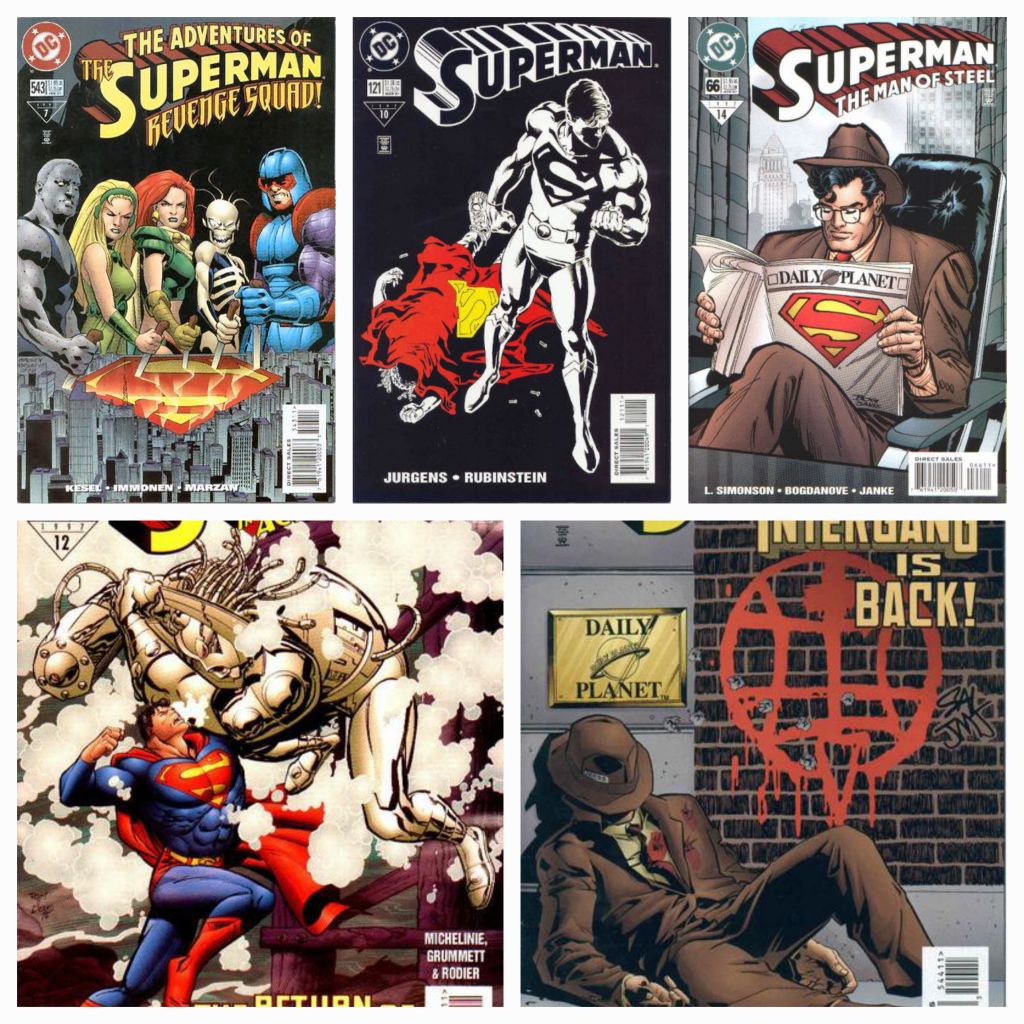
Adventures of Superman #543 shows us the newlyweds finally settling into their new apartment and Superman checking into a couple of escaped villains. Turns out the villains in question are being recruited for a new version of the good ol’ Superman Revenge Squad. A strange figure watching from the shadows has pulled together Anomaly, Barrage, Misa, Riot, and most troublingly, Maxima. When DC released this year’s Superman Treasury Edition I mentioned that I was disappointed to see Maxima reverting to her old villainous ways. I guess I’d forgotten that this wasn’t the first time she’d suffered from a bout of recidivism. The Squad makes its attack in Action Comics #730, but not before one of the very-frequent scenes of Superman flying over Metropolis pondering recent events to bring any casual readers up to speed. I never noticed until this read-through just how frequently that happened in the Triangle Era. I suppose they clung to the idea that any comic book could be somebody’s first, and they were doing their best to make sure that everyone knew what was going on. Admirable – but these days I’m very curious as to whether that old adage still bears any truth at all. Anyway, the fight goes poorly – the five villains, used to working on their own, wind up stumbling over each other and stabbing each other in the back, but by the last panel they manage to have Superman down, his head covered with a slime that Misa is using the block his powers. Geez, Misa, he JUST got them back. 

Man of Steel #65 wraps the story up as the Metropolis Special Crimes Unit arrives on the scene and joins the fight. For a full-issue fight scene, it’s not bad. It’s really nice to see the SCU used to the top of their intelligence, being legitimately effective in a fight against superpowered villains instead of just coming across as the useless cops that so often populate superhero comics. As the Revenge Squad is rounded up, their mysterious benefactor watches and plans his next move. I’ll tell you what I REALLY like here – it’s been so long since I read these issues that I’ve completely forgotten who the mysterious bad guy is that pulled the Revenge Squad together. I don’t know when the reveal is going to come, but I hope it lands. 

Superman #121 has writer Dan Jurgens once again pick up penciling duties (a rarity for this era) for a “very special issue” about Clark Kent befriending a ten-year-old girl who witnessed a gang shooting. When Superman tries to eliminate the guns from her housing project, thinking it will make it safe for her…well, let’s just say I’m kind of surprised that Jurgens would have written Superman as being so naive. 

Adventures #544 starts off with what I’m comfortable calling a controversial moment: Clark Kent is gunned down in the middle of a busy streetcorner. If that’s not confusing enough, it gets weirder when Lois arrives on the scene at the same time as…another Clark. Turns out the doppelganger is tied into the return of Intergang, which no doubt is going to cause trouble later on. Action #731 features another return: Lois and Clark are trying to enjoy an evening at home together when word comes of an attack by an old foe of his Cauldron – but he’s different than before. While Clark holds him off, Lois helps unravel the mystery of who is controlling the cyborg villain this time.

Finally (for today) let’s look at Superman: The Man of Steel #66. Remember Rajiv, the creep who messed up Lois and Clark’s honeymoon trying to get his hands on codes that would allow him to take over a satellite defense network? Well, seems like he got the codes, because in this issue he starts raining fire all over the world, demanding a billion-dollar ransom to stop. The story cuts between Superman taking to space to stop him and scenes on the ground where various people, including Bibbo, Jimmy Olsen, and Perry White’s family, try to help in their own way. It’s an interesting little experiment by Louise Simonson and Jon Bogdanove, a story ostensibly about how the S-shield itself stands for something to people and the power it has even on its own. It would be another decade before the concept of the shield being the Kryptonian word for “Hope” came about, but this has some of that same feel to it, and I like it on that level.

It’s odd, in retrospect, how these stories feel so disconnected from what’s coming. Except for the electric spark in Superman #120, there’s really been no buildup to the power switch. The news had already come out that the story was coming, of course, people knew that Superman was about to get a new costume and new power set, but they didn’t expend a lot of shoe leather on the concept for the first two months after the wedding storyline ended.

That’ll change very soon. 

Tues., Sept. 2

Comic Books: Superman Vol. 2 #122, Adventures of Superman #545, Action Comics #732, Superman: The Man of Steel #67, Superman Vol. 2 #123

Notes: The final month before the big switch begins in Superman #122. At this time, DC was still under the edict that Kal-El was to be the ONLY Kryptonian who survived the destruction of Krypton. That said, they had found ways around that with alternatives to the Kryptonian characters and concepts of the past: the Matrix Supergirl, an Earth dog Bibbo named “Krypto,” and most recently, a new version of the city of Kandor. In this continuity, Kandor was still a miniaturized city in a bottle that Superman was keeping safe in the Fortress of Solitude, but rather than a Kryptonian city, it was a town made of aliens from various worlds, all collected by an entity named Tolos before Superman saved them. In this issue, his powers start to go wild, causing electrical devices to explode and his body to phase in and out. Superman takes Lois to the Fortress to try to get to the bottom of it, wondering if the dimensional phase that had brought him to Kandor could be responsible, but inadvertently winds up releasing a blue-skinned, horned alien called Ceritak. In Adventures #545, things just get worse as Superman’s powers go out of control. He sparks uncontrollably, falling through walls and losing the ability to fly, all of which contribute to a power outage that goes across the city and frees the Atomic Skull from prison. The Skull, suffering from the delusion that he was the hero of an old movie serial and that Superman and everyone else were characters in the serial, winds up in battle against Superman, seeming to atomize him. 

Action #732 continues the battle because, obviously, Superman isn’t really dead. His energy was somehow dissipated by the skull, and he finds himself reconstituting at that Antarctic energy research station he stopped by when he was powerless a few issues back. Lois plays along with the Skull’s delusion as a delaying tactic and, making his way back to Metropolis, Superman starts to learn some of the capabilities of his new powers. He isn’t strong anymore and can’t fly, but he can bound around like energy, control magnetic waves, and access computer systems by touch. Eventually, he manages to bring the Skull down, but he has no idea what’s happening to him.

Superman: The Man of Steel #67 is next, although the title has become highly inaccurate at this point. (This is a good opportunity to talk about how, were this story to be told today, it would reach this point and then DC would likely cancel all four series and re-start them with new first issues, including changing the title of this one. Man of Energy doesn’t really have the same ring, though. I don’t know what they’d call it.) As news of Superman’s mutating powers starts to leak out, Lois clashes with the Planet’s new sensationalist circulation manager over their coverage. Meanwhile, Ceritak has made his way to Metropolis, where he’s inadvertently sewing some chaos. In the midst of the battle between the two Superman’s powers go absolutely haywire, causing a citywide blackout.

A quick aside before I move on to the main event: Jon Bogdanove. He’s one of my favorite Superman artists, mostly because his style has a sort of classic, old-fashioned sensibility that meshes perfectly with Superman. He gives us a huge, barrel-chested, squared-jawed hero that not only fits, but practically DEFINES the classic Superman mold. As Superman shifts from his traditional status quo to the electrical version, you’d think it would clash with his style…but somehow it doesn’t. Along with fine art and color work by Denis Janke and Digital Chameleon, he makes a creature of pure energy still invoke the core of Superman. That, along with several well-placed and highly amusing visual gags in this issue, call to mind some of his best work on Marvel’s Power Pack. I don’t think Bogs gets enough credit in general, and I wanted to call out this issue in particular as being a high point.

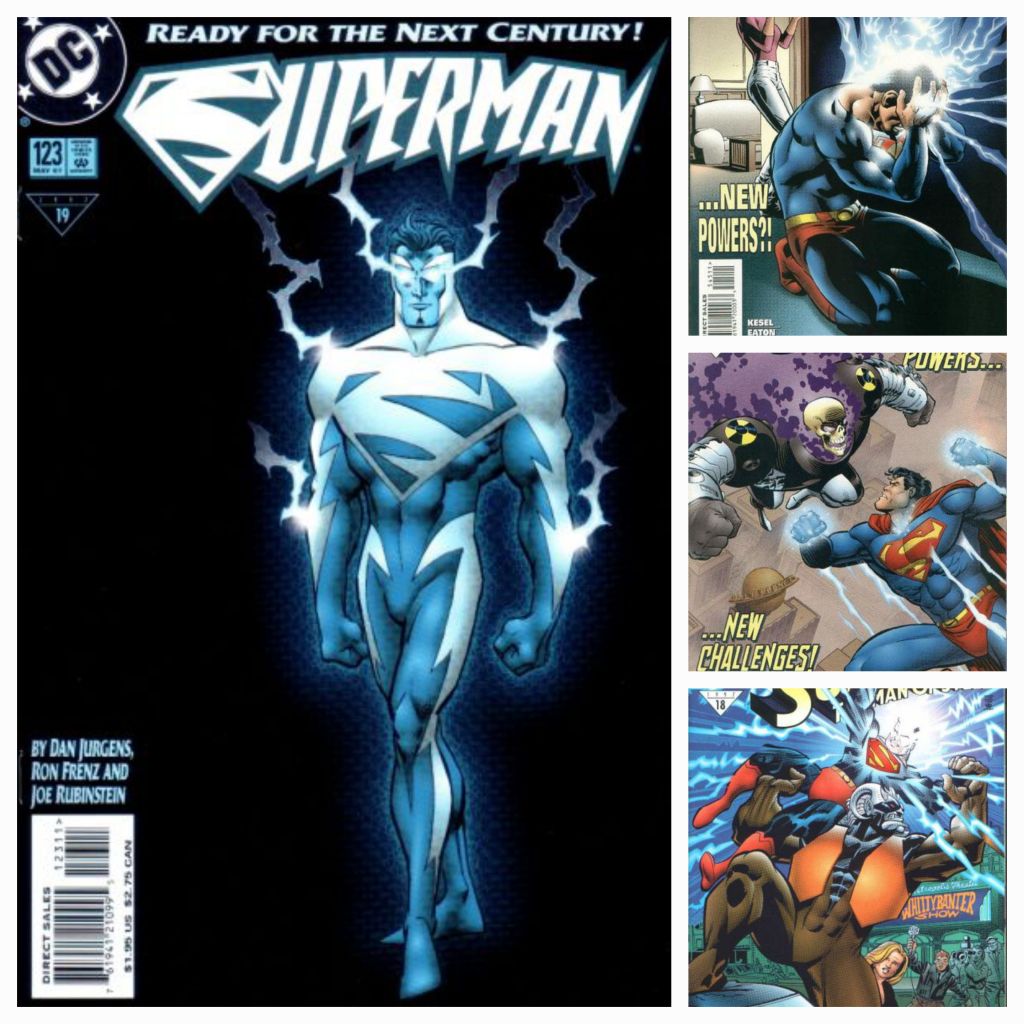
Finally, after a week of reading, we come to the book that I started this journey for: Superman #123. As Superman fights with the confused Ceritak (who Bibbo accidentally renames “Scorn”), he winds up in Hamilton’s lab, unable to control his new energy-body. Hamilton is approached by Erica del Portenza, wife (at the time) of Lex Luthor, who has an experimental cyber-woven polymer that she believes may be of assistance. Loath as they are to accept help from Luthor, Hamilton sees no choice and uses the fabric to create a containment suit. In his new duds, Superman finds that he can control his power while in energy-form as well as shift back to a fully human (and powerless) Clark Kent. As he says on the last page, “there’s a new Superman in town.”

This is such a wild story so far. After a rather slow buildup, we’ve got a Superman now with a completely different power set and costume, and while I don’t think I believed even then that this change was intended to be permanent, DC did their best to pretend this new status quo was going to last. So looking ahead to reading more of this, I’m expecting to see the sort of subplots and side-stories that defined the Triangle Era while, at the same time, continuing the story of the electro-Superman, leading up to the era of Superman-Red and Superman-Blue.

And despite feeling a bit of scorn (no pun intended) for this storyline for a very long time now, I find myself kind of looking forward to it. 

Blake M. Petit is a writer, teacher, and dad from Ama, Louisiana. His most recent writing project is the superhero adventure series Other People’s Heroes: Little Stars, volume one of which is now available on Amazon. You can subscribe to his newsletter by clicking right here. You can join in the Kryptonian Konversation every day in the Year of Superman Facebook Group!

Superman (2025): The Review

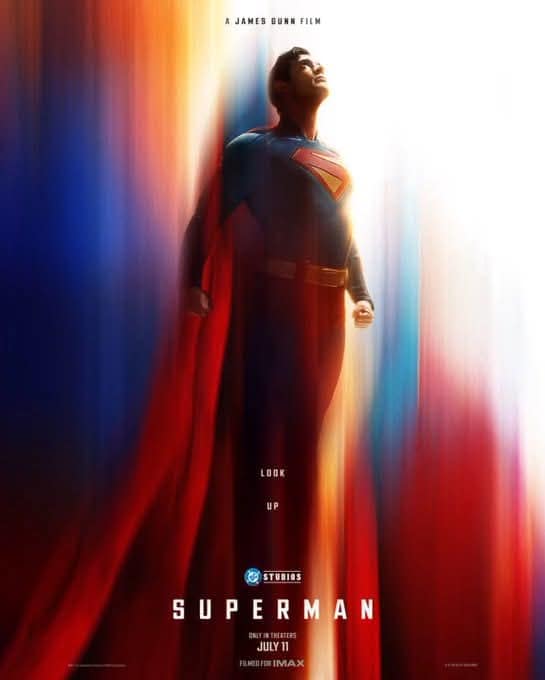
I never had any real doubt that James Gunn would make a good movie. After three Guardians of the Galaxy films, plus the holiday special, The Suicide Squad, Peacemaker, and even the little-remembered (but worth watching) film Super with Rainn Wilson, he’s proven he knows how to tell a superhero story. But the question, when it came to SuperMAN, is whether he truly understood the character and what we wanted from him.

James Gunn, I am thrilled to say, understood the assignment.

You might want to go get a snack before you read this review. We’re gonna be here a minute.

The launch film for the new DC Universe is everything I could have hoped for – exciting, thrilling, fun to watch, full of humor, full of heart, and – most importantly – carries its overt optimism like a torch leading the rest of the superhero universe in its direction. It’s like a calling card: superheroes can be fun and still mean something. And Superman, more than any other hero, should be the primary example of that.

This new DCU, we are told in the opening seconds of the film, is a world where metahumans have existed for three centuries. Superman has been active as a hero for about three years, and although he has garnered a great deal of goodwill in that time, a recent incursion into a hostile territory in Europe is causing international furor as some people question whether an alien should involve himself in human affairs. Lex Luthor, of course, leaps at the opportunity to use Superman’s actions to foment trouble, and it is the conflict between these two (who, at the beginning of the film, have yet to meet in person) that forms the core of the movie. It’s a solid foundation from which to explore the themes most important to Superman, specifically what it actually means to be human

The main plot also leaves room for exploration in the relationships that Superman and Clark Kent enjoy – with Lois Lane, Jimmy Olsen, the three members of the “Justice Gang,” and of course, with Lex Luthor himself. Each of these characters has an important role to play in the movie, nobody feels superfluous and all of them feel like they’ve been served incredibly well by James Gunn’s script. 

Krypto, of course, steals the show.

I want to talk in more detail about the characters and the actors who portray them, and I don’t know that I can do that without lapsing into spoiler territory, so consider this your warning. If you haven’t seen the movie yet, stop here, secure in the knowledge that I loved every moment of this movie and I can’t wait to see it again and again. This is the best Lois Lane we’ve ever had on screen. The best Jimmy Olsen. The best Lex Luthor. The best…

…damn, I love Christopher Reeve so much. Can I REALLY declare David Corenswet the best?

He’s definitely in the top two.

Spoilers begin after the graphic.

I’m going to go through this a character at a time, starting, of course, with David Corenswet as Clark Kent and Superman. Prior to this film, the only thing I’ve ever seen him in was Pearl, a violent slasher film in which he played a philandering movie projectionist – not exactly the sort of thing that automatically makes you think of Superman. (Thanks to Rachael Pearce for correcting me — I originally said Corenswet was in X, the film Pearl is a prequel to.) But from the first moment clips of this film started come out, he won me over. As Superman, he carries himself with strength and power, but not at the expense of his inherent humanity. He has moments as Superman where he feels weakened, and it never feels false. He expresses pain after being beaten by the Hammer of Boravia, moaning as his robots use solar rays to knit his broken bones. He crumbles in agony when exposed to Kryptonite. He takes punches during the climactic battle that you believe COULD kill him if they aren’t stopped. But far more importantly, he shows the kind of emotional vulnerability that we need in a role model. When public perception begins to go against him, his face shows the weight that comes with that. When Luthor murders an innocent man for the crime of believing in Superman, we see every ounce of the pain on Superman’s face.

That face.

And when he’s not doing that, he has a sweetness and a kindness to him. It’s no mistake that this movie goes out of its way to show us Superman saving lives even in the midst of chaos. When a kaiju is on a rampage, we see him protecting a little girl from a shockwave. He pauses in front of a series of shattered windows to make sure the people inside are okay. We even see him swoop down and rescue a squirrel – a moment that easily could have come across as silly, but in the context of the Superman we’re watching, feels perfectly in keeping with the kind of hero he is. His priority is life – all life – and he’ll not sacrifice a single one if he can help it.

Of the few faults I can find with this movie, most of them are in the category of wanting MORE. When it comes to Corenswet, I wish we had gotten a little more of him as Clark interacting with people who don’t know his dual identity. We get a few short scenes of him at the Planet office, scenes typically full of innuendo-laden conversation that only a fool would fail to pick up on (more on that later), but the rest of the time he’s either Superman or he’s around people who know his secret, such as Lois and his parents. In the few scenes where Corenswet puts on the glasses he’s so good at crafting his second identity that I wish we’d seen more of it.

The last journalist in America who remembers what integrity is.

I’d never watched anything with Rachel Brosnahan until I heard she’d been cast in this movie, at which point I decided to check out her TV series, The Marvelous Mrs. Maisel. By the end of the first episode, I was sold. Miriam Maisel is a force to be reckoned with in a time and place when women weren’t necessarily welcome, and the grit she showed in that series was exactly what I wanted in a Lois Lane. When this movie started, she carried all of that fire with her. 

Brosnahan’s Lois Lane is tough and fearless, never backing down from anything except, perhaps, the potential of a relationship she doesn’t believe she’s capable of having. The full version of the interview scene (the one from the trailer) is perhaps the single best scene of Lois as a reporter in the entire canon of live-action Superman media. Despite the fact that she’s interviewing her (kinda) boyfriend and, even more impressively, Superman, she doesn’t blink for a second. She hammers him with the kind of questions a reporter should use in a situation like this, and when the inevitable conflict between Lois and Clark comes up as a result, it doesn’t feel forced. Clark is upset because to him it is SO OBVIOUS that he’s done the right thing, and it frustrates him that others don’t see it that way. Lois has a reporter’s point of view – more nuanced, less black and white, thus the two of them come to a verbal sparring match that serves their relationship well. When they eventually reconcile, it comes about because he realizes she was doing her job correctly, but at the same time, Lois can appreciate the fact that sometimes right is simply right, and understands why Clark did what he did.

Llllllllllllllllllllladies.

Jimmy Olsen, as a character, has rarely been served well – and I don’t just mean in movies. Nothing against Marc McClure, who did his best in the 70s and 80s, but how many stories actually give Jimmy something to DO? Even when he had his own long-running comic book series in the Silver Age, the stories often involved him needing Superman’s help or doing something ridiculous that happened to work out in the end. Skyler Gisondo’s Jimmy, on the other hand, is funny and capable. He’s a legitimate reporter, and while he may not have the gravitas around the Planet office that Lois and Clark have, he’s good at what he does. There’s also a great running gag about Jimmy being, inexplicably, kind of a ladies’ man. We see several moments of girls checking him out and his desk is ornamented with photographs of him with women who, let’s be honest here, seem way out of his league. (No offense, Skyler Gisondo.) This joke gets a tremendous payoff when we find out that Eve Teschmacher, Lex Luthor’s girlfriend, is actually Jimmy’s EX and she wants him back.

Honestly, I give them all the credit in the world for avoiding duckface in this poster.

Speaking of doing more with a character, let’s talk about Eve. Sara Sampaio plays Eve Teschmacher as a ditzy, selfie-obsessed product of a social media society. But the story completely redeems her when we learn that the avalanche of selfies she’s taken have been carefully done to capture evidence against Lex in the background – maps and charts that document his scheme and can be used to bring him down. The portrayal we get of the character fits well – she IS kind of ditzy and a little oblivious to the fact that Jimmy isn’t as into her as she is into him, but she is nowhere near as stupid as she pretends to be. That trope, of a character hiding their true intelligence until just the right moment, is one that I always enjoy, and Sampaio sells it hard.

STILL don’t call him “chief.”

Back to the Daily Planet for a minute – we also don’t get as much Perry White as I’d like, but from what we do see, Wendell Pierce nails the role. He’s got a sort of fatherly air to him, but also a dedication to doing his job. The best bit with him, though, comes right after the final battle, when Lois goes off to “interview” Superman. Perry just looks at Jimmy and asks “How long have they been hooking up?” I love the ambiguity of this scene and how it plays to the intelligence of the characters. Just before this, Perry was on a wild ride in the T-Craft with Lois and Jimmy, who broke the Luthor story. Then he brings along Cat Grant (the gossip columnist), Steve Lombard (the sports guy) and Ron Troupe (who I assume is a reporter but, as far as I can tell, never got an actual line in the movie). But at NO point does he look around and say “Where the hell is KENT?”

The only way this works is if you read that final scene the way I do: Jimmy and Perry not only know that Lois is hooking up with Superman, but they’ve figured out that Superman is Clark Kent. Hypno-glasses or not, they’re too smart not to have pieced it together. Plus, as we see elsewhere, this Clark is perhaps a little too loosey-goosey with guarding his secret – not only does he share it with Guy Gardner, of all people, but as I mentioned before, Lois and Clark keep having conversations that REALLY seem to hint at the fact that they’re hiding something. She may chastise him for not hiding his identity well enough, but if we’re being fair, she isn’t helping matters. If that is, in fact, what James Gunn intended, I love this shade for the characters. I love seeing them played to the height of their intelligence. 

So bald…so evil…

Let’s move on to the villain of the piece here: Nicholas Hoult as Lex Luthor. We’ve seen a lot of Lexes over the years, from Gene Hackman’s long-suffering rogue surrounded by incompetents to Jesse Eisenberg’s thinly-disguised Mark Zuckerberg impression. But this is the first Lex we’ve ever seen that I thought felt truly UNHINGED. He’s obsessed with Superman, as Lex Luthors often are, but Hoult’s interpretation takes it to the next level. Hoult’s Luthor is as petty and bitter as he is brilliant, his entire motivation boiling down to the fact that he cannot stand the fact that the world prefers Superman to him. To his credit, he’s not unaware: he knows perfectly well that he’s obsessed and bitter, but that doesn’t change anything. When his rage actually boils over, as it so often does, he can be legitimately frightening. He is, in fact, the perfect foil for Superman. Where Superman represents all of the goodness and nobility inherent in the human race – and, in fact, has specifically chosen to do so – Luthor is a perfect representative of all of our negative qualities: fear, anger, envy. I can only imagine how hard James Gunn must have been laughing when he wrote the scene in which we find out that the trolls who have been slamming Superman on social media are literally monkeys being mind-controlled by Luthor. It’s such a perfect picture of the people who live only to dispense hate online that you have to wonder if it’s even a fantasy.

Meet the gang.

Then there are the other heroes in this film. Edi Gathegi’s Mr. Terrific gets the most screen time, joining Lois in the rescue mission once Superman is caught in Luthor’s pocket dimension and fighting with Superman in Metropolis at the finale. He also comes across as the smartest (which is kind of his whole thing), most mature, and most responsible of the “Justice Gang.” He’s a leader and a man of conviction, although he does have a wry sense of humor and little patience for fools, which makes you wonder how he survives being on a team with Guy Gardner. Of all the gang, he’s the one I feel could most handily star in a movie of his own.

Speaking of Gardner, Nathan Fillion just KILLS it as our resident Green Lantern – funny, arrogant, and self-centered, but at the same time, absolutely fearless (which is one of the job requirements) and dedicated to doing what he thinks is right. It may not always be pretty, but Guy Gardner gets the job done. Isabela Merced’s Hawkgirl has the least to do out of the three of them, but even she manages to make a name for herself, showing just how tough she is and getting some really good moments, especially at the end.

How could you not fall in love with that face?

Although not technically a member of the “Justice Gang” until the very end, I effusively loved Anthony Carrigan’s Metamorpho. Introduced in a sort of antagonistic role, with Lex having him make Kryptonite to torture Superman in his pocket dimension prison, it quickly becomes clear that he’s doing it against his will. Luthor has his son, and if bombarding the world’s greatest superhero with toxic radiation was the only way to keep MY kid safe from a psychopathic billionaire, I have to admit I’d probably do the same thing. But when Superman convinces him that there’s a way out, he turns very quickly and becomes a valuable ally. In the final fight on the Boravian front, he quickly proves his value and his worth, and becomes a character that you root for wholeheartedly. 

Krypto?

Krypto is a very good boy.

The last thing I want to talk about is the world that Gunn is building. He is quite adamant that each DCU project be able to stand on its own, and this movie absolutely does that, but at the same time he’s laid enough seeds to have fans farming for months. For example, the opening narration tells us that in this universe, metahumans have been known to exist for 300 years. That’s a REALLY specific number. In most iterations of DC Comics, there have been larger-than-life figures throughout history: the Viking Prince, the Shining Knight, western heroes like Jonah Hex and so forth. But the modern metahuman usually doesn’t become a thing until roughly the World War II era. So why 300 years ago? Did something specific happen at that point that kicked off metahumans on the DCU Earth? Is it when the Starheart fell to Earth, does it have something to do with Nabu or the wizard Shazam? There isn’t nearly enough information to come up with an informed theory, but that’s not about to stop us from guessing.

We also get enough Easter Eggs to make me itch for the Blu-Ray release of this movie so I can pause it and peruse certain moments. The scene in the Hall of Justice, for example, has a mural of what appears to be the Justice Society of America in the background. I noticed Wildcat specifically, but I need to go back and see who else made the cut. I also feel like a careful examination of the people in the cells of Lex Luthor’s pocket prison will reveal certain things about who (or what) exists in this world. 

The final scene has two wonderful moments – one is a quick cameo by Supergirl (Milly Alcock) which is a BLATANT set-up for her own movie, especially if you’ve read Woman of Tomorrow. The second part is a lovely character moment for Clark. Early in the movie, when his robots healed him, they showed him the recorded message from Jor-El and Lara to “soothe” him. In the end, having learned that his Kryptonian parents weren’t quite who he thought they were and understanding that he has chosen to be human, he instead is soothed by the memories of his life with Jonathan and Martha Kent.

Every dad wants this moment.

The scene that made me most emotional in the entire film is the one where Pruitt Taylor Vance as Jonathan tells Clark that it’s his choices that make a person who he is, and then breaks down telling his son how proud he is of him. This hit me right in the Dad Place (that’d be the heart), and the fact that my own seven-year-old boy was sitting in the chair next to me no doubt was a contributing factor to how I had to scramble to see if there were any napkins left from the popcorn. People will want to pick apart this movie and apply their own messages and agenda to it, which is a stupid, tiresome pastime I never have any patience for. Here’s the message I took from it, and I don’t think this one requires any mental gymnastics to make it fit:

You are who you choose to be.

Superman is the best of us, not because of his powers and not because of what he CAN do. He’s the best because he chooses to do good. He’s a hero because he wants to help people. And this movie shows time and again how he inspires others to do the same, from the children raising flags on the battlefield to the way Guy and Hawkgirl change their minds and join in the final fight – and perhaps most importantly, in the form of a food truck vendor who spends his life trying to protect his hero. Superman raises up ordinary people, and if Lex could get out of his own damned head, he could do the same. 

It’s a message we all could stand to remember. 

You know, I’m worried I might have missed something. I think I need to see this movie again. 

Blake M. Petit is a writer, teacher, and dad from Ama, Louisiana. His most recent writing project is the superhero adventure series Other People’s Heroes: Little Stars, volume one of which is now available on Amazon. You can subscribe to his newsletter by clicking right here. You can join in the Kryptonian Konversation every day in the Year of Superman Facebook Group!

Geek Punditry #124: Compact These!

A little over a month ago, I talked to you guys about Compact Comics, DC Comics’ incredibly well-received new publishing initiative, in which some of their most popular and well-known graphic novels have been reprinted in smaller volumes, about the same size as a modern paperback novel, for the deliciously new reader-friendly price point of $9.99. The first ten books DC released in this format all sold out and went back for additional printings, and a second wave of titles has been announced for later this year. As with the first wave, the new titles are a mix of perennial bestsellers, books with current media tie-ins, and a few offbeat titles that aren’t their usual superhero fare, but may well snare readers who want something different.

I applaud this initiative. I’m up for anything that gets more people reading comic books, and based on the success of this series so far, it seems like it’s doing the trick. But that doesn’t mean that ONLY the smash hits deserve the Compact Comics treatment. DC’s got a history going back 90 years, and in those nine decades they’ve turned out a lot of books that may not be immediately recognizable, but at the same time, are fully deserving of finding a new audience. So DC – I know you’re listening to me, I can hear you breathing – this week in Geek Punditry I’m going to give you some suggestions for a few titles that I think are worthy of inclusion and should be given the utmost consideration when the time comes to select round three of Compact Comics.

The Kents

Look, everybody knows I’m going to have at least ONE Superman-related suggestion, so why don’t we just get it out of the way early, shall we? The Kents was a 12-issue miniseries from 1997 and 1998, written by John Ostrander with art by Tim Truman (issues #1-8) and Tom Mandrake (issues #9-12).  In this series, Jonathan Kent uncovers a series of diaries, letters, and artifacts from the mid 1800s and, sharing them with his son, the two of them piece together an epic story about the history of the family that would give Earth her greatest hero. 

“Ah, who cares about the Kent family, Blake?” some of you may say. Well…people who are into the likes of Unforgiven, perhaps. Or True Grit. Or John Ford’s Stagecoach. Because The Kents isn’t a superhero story at all – it’s an epic western. In three acts, the story tells the saga of the Kent family before, during, and after the Civil War. There’s a bitter, harrowing tale of brother against brother played out against the backdrop of the American west, and in this story we not only see the seeds of righteousness and nobility that would one day so profoundly inform who Clark Kent is, but also the struggles, heartache, and betrayals that the family had to endure to build that foundation. I’ve loved this series since it first came out, and although it’s been reprinted once or twice over the years, it doesn’t look like there’s been a new edition of this book since 2012. That’s entirely too long, and it’s time it got back in the spotlight.

Camelot 3000

Speaking of 12-issue miniseries that have been out of print for over a decade, let’s talk about Camelot 3000. This science fiction/fantasy series by Mike W. Barr and Brian Bolland came out from 1982 to 1984, and it tells the story of a future where King Arthur has returned to Great Britain, as the prophecy foretold. In this distant future of the year 3000, the world has been divided up into four gargantuan autocratic countries, all bickering and fighting amongst one another, and completely oblivious to a greater threat from beyond the Earth. Arthur, resurrected, has to find the reincarnations of his knights and prepare them for battle.

This is a fantastic book, showcasing Bolland’s pencils even before he sharpened them to the point where he became the artist behind Watchmen, and the story very neatly mirrors the original Arthurian legend. Barr supposedly got the inspiration for the story while taking a college course on Arthur, and the work he put into shaping this world is really remarkable. He doesn’t just re-tell the original story, but weaves in certain themes, showing just how timeless they are. The Lancelot/Guinevere story is still hanging over everyone’s heads, and the new take on Tristan and Isolde is way ahead of its time. It’s also an important book, historically speaking – DC’s first maxi-series created for the direct market only, their first time experimenting with a new format, and the first time future superstar Bolland would do full stories for an American publisher.

But most importantly, it’s just a good comic that modern audiences haven’t all had an opportunity to experience yet, and it’s an experience they frankly deserve.  

Batman: Robin Ascendant

This doesn’t actually exist. I mean, the stories exist, but this particular collection of them, to my knowledge, has not been made…but damn it, it should be. Batman, as you may have heard, has gone through a Robin or two in his time, and for a lot of us, the definitive Robin is Tim Drake. I love Dick Grayson as much as anybody, but he’s far more interesting as Nightwing than he ever was as Robin. Tim Drake, on the other hand, is probably the best Robin there’s been. Batman himself has acknowledged that Tim will be a better detective than he is some day, and he’s also the only one of the main Robins that has never particularly harbored a desire to become Batman. He stepped into the role after the death of Jason Todd (who, of course, got better), during a period where Batman was being consumed with self-doubt and anger, and it seemed like the Dark Knight was going to go far, far darker than ever before. Tim  deduced the original Robin’s identity, and from there, it was easy enough to determine that Batman was Bruce Wayne, so he arrived on Bruce’s doorstep not because he wanted to be a superhero, but because he knew that Batman is better with a Robin.

The story in which this is told was called “A Lonely Place of Dying,” by Marv Wolfman, George Perez, and Jim Aparo, and while it has been collected many times, it’s only five issues long. (Batman #440-442 and New Titans #60-61) One of the few legitimate complaints I’ve heard anyone have about any of the Compact Comics is that certain ones – specifically the ones that reprint original graphic novels like Joker or Wonder Woman: Earth One – are too short compared to the ones that squeeze in a hefty 12 issues worth of content. So in order to combat this volume having the same problem, I propose a bundle of sorts, combining this story with two shorter, subsequent ones. Bruce didn’t make Tim a Robin immediately, dedicating himself to training the boy so as not to repeat the mistakes of Jason Todd, and there were a few good Tim stories before he put on the costume again. In “Rite of Passage,” from Detective Comics #618-620 (by Alan Grant and Norm Breyfogle), Tim’s parents are kidnapped by a villain called the Obeah Man, leading to a tragedy that would shape Tim dramatically. I would include that, then cap off the book with “Identity Crisis” from Batman #455-457 (Grant and Breyfogle again). Here, Tim is grappling with the events of “Rite of Passage,” struggling with the legacy of the two previous Robins looming over him, and is grounded while Batman sets out to take on the Scarecrow. But Tim figures out that Batman is walking into a trap, and realizes that he’s the hero’s only hope. 

When you put these three stories together, you’ve got a nice chronology of Tim Drake, leading up to him officially taking the mantle on the final page. And you’d get 11 issues of content, which is perfectly in keeping with the size of the better-received Compact Comics.

Tales of the Green Lantern Corps

One of the first Green Lantern stories I ever read – thanks to some comics given to me by my Uncle Todd – was the three-issue Tales of the Green Lantern Corps miniseries from 1981 by Mike W. Barr, Len Wein, and Joe Staton. In this truly epic story, all 3600 members of the Corps are called together to face the most dire of threats – their ancient enemy Krona has returned. Krona, a twisted member of the same race that eventually became the Guardians of the Universe, has forged an alliance with Nekron, a god of Death, and is planning to rend a hole between the worlds of the living and the dead, beginning with the destruction of the Corps’ central power battery on Oa. The Corps only has one charge remaining – a mere 24 hours to save the universe.

This is an incredible storyline – wide-reaching and eventful, that showcases not only Hal Jordan, but so many other Lanterns. Classics like Katma Tui and Tomar-Re show up, little-known GLs like Charlie Vicker make an appearance, and we get the debut of Arisia, who would go on to be a major player in the series. Furthermore, elements from this story would be used decades later in Geoff Johns’s Blackest Night, another awesome story that should get the Compact Comics treatment.

The only problem is all of this universe-spanning action takes place in only three issues, and, like I said, that just ain’t enough to satisfy Compact Comics reader. Fortunately, DC has already provided us with a solution. Tales of the Green Lantern Corps was not only the title of this miniseries, but also the banner under which solo tales of Green Lanterns from beyond the Earth appeared as back-up stories in the main comic for years. There were also three annual specials using this title with the same concept: short stories of various GLs. Some of those were amazing, such as the introduction of the bizarre and delightful Rot Lop Fan from Tales of the Green Lantern Corps Annual #3 (story by Alan Moore and Bill Willingham). Once you’ve included the three issue miniseries, it would be quite simple to cherry pick the best of the other Tales and build up enough of a collection to make a suitable Compact Comics volume.

Legion of Super-Heroes: The Great Darkness Saga

The Legion of Super-Heroes is one of DC’s greatest properties, and yet somehow it gets less respect and love than so many. It deserves more, and showcasing one of its crowning achievements in The Great Darkness Saga would be a way to show them off to a new audience. In this one, the heroes of the 30th Century find themselves coming into conflict with bizarre, shadowed figures who turn out to be corrupt clones of heroes from the past. The race to discover the truth about these threats leads to a collision with the characters of Jack Kirby’s Fourth World, finally bringing the Legion into conflict with the embodiment of evil in the DC Universe: Darkseid himself. The story was a smash hit when it was first published in the early 80s, and was credited with making Legion one of the best-selling comics in America for a while. It showcases virtually every character who was or had ever been a member of the Legion, as well as drawing in many of their allies like the Legion of Substitute Heroes and the Wanderers. If you’re looking for a showcase of everything the 30th Century had to offer, this is the book to read.

The main storyline is, again, somewhat short, running in Legion of Super-Heroes #290-294. However, there was a long buildup before the main story began, and previous collections have included material going back to issue #286 and their first annual, with an epilogue of sorts appearing in the third annual. And if you really want to link it to the greater DCU, years later there was another side-story that connected to it in issue #32 of Booster Gold, a series in which the time-travelling hero often found himself stumbling into classic DC storylines. There’s certainly enough to collect a full-size volume here.  

Ambush Bug

My final suggestion is probably my most off-the-wall, but I will defend it vigorously. For the last few years DC Comics has been trying to turn Harley Quinn into their answer to Deadpool, with the sort of fourth-wall breaking shenanigans he’s known for. With all due respect to the creators who have been involved in those stories, that’s a mistake. Harley became a hit character on her own merit, and changing who she is to fit some other character’s template is foolish, especially since they’ve already got a much better candidate: Ambush Bug.

Ambush Bug, created by Paul Kupperberg and Keith Giffen, is (supposedly) Irwin Schwab, a schlub who found an alien super suit that gave him the ability to teleport. Schwab is also ludicrously insane and a wholly unreliable narrator, making everything we know about him (including his real name, his origin, and his rivalry with the alien sock Argh!yle) suspect at best. Who or whatever Ambush Bug really is, he first showed up as an antagonist in DC Comics Presents #52, running afoul of Superman and the Doom Patrol. He came back a few issues later, causing problems for Superman and the Legion of Substitute Heroes, then decided to try becoming a hero after an encounter with Supergirl in her own comic. (He initially mistook Supergirl for her cousin. He’s that crazy.) Co-creator Keith Giffen and his writing partner Robert Loren Fleming soon started to run with the character, having him show up in three issues of Action Comics (where he quickly realized that Superman looked exactly like Clark Kent – he’s that crazy) before he got popular enough to get miniseries and specials all his own.

Ambush Bug was breaking the fourth wall before Harley, before Deadpool, even before John Byrne’s She-Hulk raised such a thing to an art form. He is fully aware of the fact that he’s a comic book character, and he was proficient in meta humor long before it became popular. His stories are bizarre, surrealistic, and utterly bonkers, and they’re a lot of fun because of that. Unfortunately, since the passing of Giffen, there really hasn’t been anybody else who has a great hold on the character and he doesn’t appear much these days. I’m sure it’s only a matter of time before somebody tries to bring him back, and when that happens, I hope they find creators who have just the right blend of humor and irreverence to do him justice. 

In the meantime, though, we can grease the wheels for his return with the Compact Comics treatment. Ambush Bug Vol. 1 should include his early appearances in DC Comics Presents, Action Comics, and Supergirl, as well as his first four-issue miniseries from 1985, and the Ambush Bug Stocking Stuffer Christmas special. Once that first volume is a sales juggernaut (as all my suggestions clearly would be) they could follow it up with Vol. 2, collecting the Son of Ambush Bug five-issue miniseries from 1986, the Ambush Bug Nothing Special from 1992, and the six-issue revival miniseries Ambush Bug: Year None from 2008. 

There you go, DC. I know the books for Compact Comics series two have already been chosen, so consider these six suggestions the first half of a wave three. I’m sure you can figure out the rest of that wave yourselves. You guys are pretty good at this too. 

Blake M. Petit is a writer, teacher, and dad from Ama, Louisiana. His most recent writing project is the superhero adventure series Other People’s Heroes: Little Stars, volume one of which is now available on Amazon. You can subscribe to his newsletter by clicking right here. He’s also started putting his LitReel videos on TikTok. He hopes you all appreciate the fact that he got to the end of this without talking about Captain Carrot. That wasn’t easy, people. 
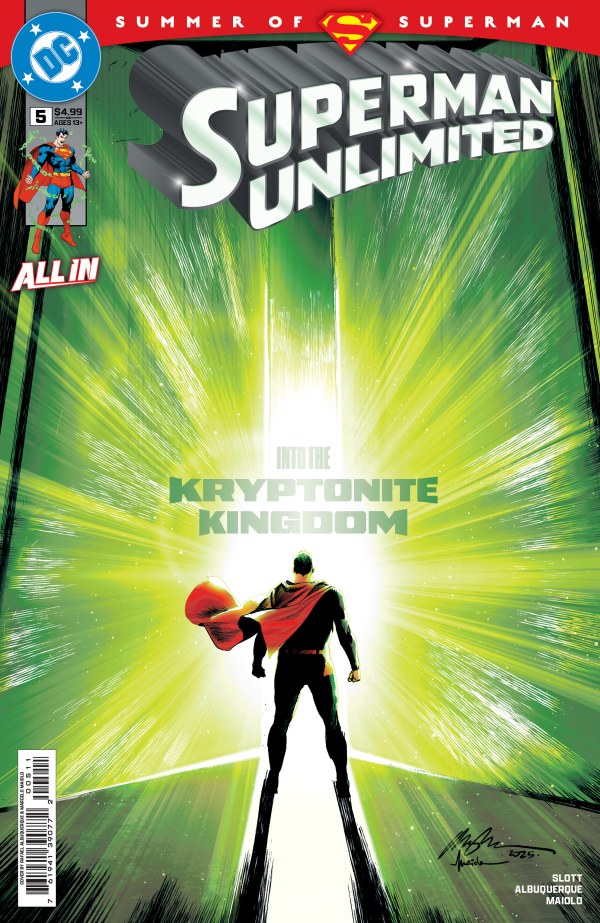
Year of Superman Week 11: The End of the Return

This week we’ll reach the end of the “Reign of the Supermen” storyline (probably – I’m writing this on the afternoon of March 12 before I start reading any of them, so I suppose anything might happen). After that, I intend to touch upon some of the stories that follow and some of the ways that the Death and Return storyline were reflected in other media. Being such a fundamental part of the Superman mythology at this point, it shouldn’t be surprising to anyone to see that it’s been revisited many times. We won’t get to them all, but there’s plenty coming up. 

Wed., March 12

Comics: Action Comics #690, Superman: The Man of Steel #25, Superman Vol. 2 #81, Adventures of Superman #504, Adventures of Superman Annual #5

“Eradication”? Get It? GET IT?

Notes: Let’s start with Action Comics #690. The Last Son of Krypton, close to death, returns to the Fortress of Solitude only to learn that his “power source” is gone – he’d been using the real Superman’s body to generate the energy he needed. The process has helped to resurrect him, though, and now Superman is on his way to Metropolis, charging across the ocean floor in a Kryptonian mech. The Kryptonian, meanwhile, sends what amounts to a deep fake video to the Justice League, blaming Coast City’s destruction on the Eradicator and sending the League and their most powerful allies on a wild goose chase into outer space to track him down. After all, it won’t be great for his plans if Earth’s most powerful heroes are still on Earth. 

Two things of note in this issue. First of all, the robots in the Fortress help repair the Eradicator’s damaged memory, revealing to him (and the reader) his true identity. It’s been a long time, but I’m pretty sure I figured this one out ahead of this issue. You see, at this time I voraciously re-read my favorite comics. I’d start with the Man of Steel miniseries, read every subsequent Superman comic in order (I had begun – but not completed – the process of filling in the gaps) until I reached the most recent, then go back and start from the beginning. So I’d read the Eradicator story maybe five or six times, it was pretty fresh in my memory, and Roger Stern dropped a LOT of clues (unlike Dan Jurgens, who was pretty good at holding the Cyborg’s true identity close to the vest). The other thing I want to point out concerns Superboy, captive of the Cyborg, struggling to get free and save Metropolis from being destroyed like Coast City. Up until this point, Superboy had been motivated largely by his thirst for fame and adoration. There were glimpses of the good core of Superman in him, but this is the point where it really starts to come out, when he REALLY starts to see the big picture and find himself willing to put himself on the line. It’s a good look for the Kid.

That’s a face only a Martha could love.

In Man of Steel #25 Superboy is still being held by the Cyborg in the enormous engine built over the ruins of Coast City, unable to figure out why his powers don’t work the way he expects them to. He manages to escape, rushing back to Metropolis just as Supergirl, Steel, Lex Luthor, and Lois all converge at the Metropolis airport, where the Kryptonian mech we’ve been following for a few issues now emerges from the ocean. After a brief fight, Lois holds the others back, recognizing the Kryptonian battlesuit. It cracks open and spills open its precious cargo: a black-clad Superman, ready to put his life on the line for Metropolis once again. There’s so much to love about this issue. We get Lois back, for one thing: after her creepy friend Jeb Friedman makes a move on her she has a moment of crisis and realizes she’s lost herself, then is determined to make her way to Coast City to blow the lid off the Cyborg. Superboy continues gaining more of an awareness of himself as well, and bringing all of our heroes (and Lex) together again leads up to a really inspiring last page. From here, it’s a roller coaster to the end of the story, and I’m there for it.

Lois: “Superman never wore black like some executioner.”
DC: But this will sell a LOT of action figures.
Lois: I withdraw my objection.

Superman #81 picks up right here, as the others face off against this newest guy wearing Superman’s face, with nobody sure what to make of him — especially since he has no powers. He’s saying the same thing as everyone else: Ms. Lane, you know me, you’re the one who gave me my name, so forth, and Lois is struggling until he pulls out To Kill a Mockingbird. The mention of Clark Kent’s favorite movie gives Lois pause – could this actually be the real deal? After a brief conversation, he borrows a pair of flight boots from one of Team Luthor and he, Superboy, and Steel take off for Coast City. Meanwhile, one of the Cyborg’s minions fills in another one of the truth about their master – the former Hank Henshaw, reduced to a computer intelligence, conquered Mongul and is using him to destroy Earth in Superman’s name. The wraparound sequences are best here, with Clark and Lois, all touching moments even now. The middle of the book, with the Cyborg’s origin, is less interesting once you already know the story. At the time, though, it was necessary – Henshaw had been a relatively obscure character who had only made a few prior appearances, and they were actually just before I became a regular Superman reader, so I had to go back and learn who he was after the fact. I wonder if I would have picked up on who Henshaw was earlier had I already read those comics. Probably not, if I’m being honest, but I’m still curious. 

Does anyone else remember the action figure line that came out after this with the slogan “Don’t mess with the S”? Wasn’t that an AWFUL slogan?

In Adventures #504, the trio lands in Coast City, where the powerless Superman scavenges weapons from the Warworlders as they fight their way to the heart of the engine. Cyborg’s got another missile prepared, though, and Superman and Steel watch helplessly as it blasts off for Metropolis, realizing only after the launch that Superboy is clinging to the side. He rides the missile across the country, trying to take it apart, before deflecting it from Metropolis at the last second, arcing it into the air where it explodes…seemingly taking the Kid with it. Spoiler alert: Superboy survived, but man I love this issue. If the Kid was going to stick around (as he did) he really needed a Hero Moment in this story, something to show that he was worthy of wearing the shield. I would say saving Metropolis from total destruction, possibly at the cost of his own life, does the trick.

Fortunately Superboy’s sense of timing got better later.

Of course, this DOES take us to Adventures of Superman Annual #5, our final Bloodlines check-in. Superboy wakes up in the hospital, having just stopped the missile, and is approached by Maggie Sawyer for help in hunting down the alien serial killers from the previous three Superman (and a dozen other) annuals. Meanwhile we meet the improbably named Donna Carol “D.C.” Force, youngest of the Force family. Everyone in D.C.’s fam has the metagene, but hers hasn’t activated yet, and she comes to Metropolis with her Uncle Harry chasing rumors of the alien killers who are making new metahumans. She winds up getting attacked, of course, and a paramedic’s defibrillators seem to give her the final ingredient, activating her gene and giving her electrical powers. D.C. teams up with Superboy to fight the aliens as Sparx. 

Sparx was easily the most successful of the four New Bloods that came from the Superman books, becoming a series regular in Superboy and the Ravers a few years later and having assorted appearances in the years since. I really like the concept of a kid who comes from a family of metas who just wants to be a superhero, too – it’s a nice, kind of sweet idea. The real issue with this book is TIMING. Superman and Steel are back in Engine City on the other side of the country trying to prevent the Cyborg from destroying the entire planet, and Superboy takes time out for a SIDE QUEST? You’ve gotta be kidding me. 

Thur., March 13

Comics: Action Comics #691, Superman: The Man of Steel #26, Green Lantern Vol. 3 #46, Superman Vol. 2 #82

Dammit, Clark, stop breaking the covers. Do you have any idea how expensive these are?

Notes: As Superman and Steel fight their way to the heart of Engine City in Action Comics #691, we discover that Supergirl has been following them since leaving Metropolis, using her invisibility to act as Superman’s “secret weapon” (a nice little nod to the original status quo of the original Supergirl). In the Fortress of Solitude, the Eradicator drains the power from the Fortress’s devices, leaving both the systems and robots dead, in order to recharge himself enough to return to the fight. And in the heart of the Engine, Mongul finds himself planning to turn on the Cyborg, while revealing that the Engine is powered by a gargantuan piece of Kryptonite. Good stuff in here. The book leans heavily on “If Lois believes he’s really Superman, that’s good enough for me,” and the man in black’s actions back it up. By the end of this issue, Steel is fully convinced that it’s the real deal, and even Mongul recognizes that this new enemy has far greater honor than the Cyborg, whose version of events must be twisted. 

Speaking of the “man in black,” I wanted to point out something regarding the covers for these issues. You notice how, although they had Superman in the black recovery suit (which has become a fan favorite alternate Superman look) they gave him his usual short hair instead of the long hair he came out of the Kryptonian mech with and would keep for the next few years? I’ve never quite understood that. I wonder if it was a case of the covers being drawn far enough ahead of time that the long hair hadn’t been decided upon yet when they were released. It’s an interesting little artifact though, isn’t it?

I would totally wear this cover on a T-shirt.

In Man of Steel #26, Mongul reveals his plan: since Superboy stopped the missile from turning Metropolis into a second engine, which would have made Earth into a new Warworld, he’s going to content himself with firing the existing engine and just, y’know, destroying the world. As a powerless Superman faces Mongul, Steel plunges into the heart of the engine. And in a moment that will change the DCU forever, Green Lantern returns from space to investigate what has happened to his city. There are two great bits in this issue for me. First of all, the Cyborg underestimating Steel’s ability to stop the engine. No way a mere human could possibly throw a wrench into his plans, right? But Mama Irons didn’t name him after the steel-drivin’ man for no reason. The allegory of John Henry vs the Machine may be a bit on-the-nose, but holy crap, is it a fantastic story beat. The other thing, which doesn’t really have a ton of significance but I’ve always thought was funny, was Lois’s scuzzy friend Jeb Friedman watching her concern over the battle in California and asking her if her late finance Clark Kent ever realized she was really in love with Superman.

That caption would prove to be far more prophetic than anybody would have guessed.

Green Lantern #46 is next. As Hal Jordan returns from space to see the wreckage of his home, he dives into the heart of the engine to do battle with Mongul. It’s a brutal fight, Hal hampered not only by Mongul’s yellow skin, but by the fact that if he really cuts loose he’ll unleash the Kryptonite powering the engine, but in the end there’s a hell of a beatdown. You don’t usually find this issue in the collected editions anymore, and for two reasons. One, the more important of the two, is because DC (and Marvel) are reluctant to reprint any of the work of this issue’s writer, who was convicted a few years back of some rather unsuperhero-like behavior. (I’m not going to elaborate – if you don’t already know, Google will tell you.) The other reason you don’t see it is a story reason – the issue runs concurrently with Superman #82, the end of the storyline, and reveals how the reign ends, which is kind of a problem if someone hasn’t read it yet. 

You know it’s special because CHROMIUM.

And here we are, Superman #82, the grand finale of “Reign of the Supermen.” Superboy and the Eradicator return to Coast City to rejoin the battle, but the others are cut off by the Cyborg, leaving him to face Superman and the Eradicator alone. In the depths of the Engine, they battle the Cyborg to a standstill. In a last-ditch effort, the Cyborg unleashes the power of the Kryptonite engine, draining it entirely in a massive power-blast, but the Eradicator hurls himself in front of Superman. The Kryptonite kills the Eradicator, but as the radiation passes through his body it transforms, restoring Superman’s powers. The other heroes break into the engine room just in time to see him defeat the Cyborg, and the true Superman stands revealed once and for all.

This really is a fantastic end to this storyline. Sure, neither the Eradicator nor the Cyborg turned out to be truly dead, and even Superman says in this issue that he doesn’t think Henshaw really CAN die, but try to forget the 30 years of comic book history that have passed since then. It’s Dan Jurgens at his finest, writing and drawing a fight for the ages. Images like the Cyborg inhabiting Steel’s armor and turning it against him are striking, as is the sight of the jawless Cyborg staggering around in pain before the end. Even the Eradicator gets his hero moment, sacrificing himself to save Superman, having been transformed by their psychic bond and abandoning his previous goal of restoring Krypton in favor of restoring her last son. Even now, all these years later, having read this story a dozen times, it’s awesome. 

But although this is the finale of “Reign of the Supermen,” it’s not the end of the Death and Life saga. The next few issues of the Superman books would all feature epilogues of one sort or another and there were several follow-up miniseries such as Superman/Doomsday: Hunter/Prey, which I’ll be tackling over the next several days. There’s still a lot of fun to come from our favorite hero biting the dust. 

Fri., March 14

Comics: Adventures of Superman #505, Action Comics #692, Superman: The Man of Steel #27, Superman Vol. 2 #83, Adventures of Superman #506, Action Comics #693

You know it’s special because HOLOFOIL.

Notes: Now for what I’m gonna call “epilogue month” (and a half). After the Cyborg was defeated and the Reign of the Supermen ended, there were a LOT of loose ends left to tie up. Adventures #505 starts with Superman returning to Lois Lane, who had at this point spent several days worried about what was happening in Coast City. After a happy reunion, they start brainstorming – after all, Superman’s resurrection is one thing, but how are they going to explain Clark Kent being found alive after all this time? The issue continues with several other happy reunions – with Jimmy and Perry, Maggie Sawyer, and best of all, with Bibbo. There’s a good bit of set-up here, mapping out how things are going to go for Clark and Superboy in the coming months, but mostly it’s kind of a down issue in terms of action. Even the supervillain who briefly shows up, “Loophole,” is disposed of quickly and in a rather comical way. It’s like the writers knew that – after the emotional roller coaster we’d been on since Doomsday first cracked open his shell – we needed a break. 

“It’s weird, when Clark was missing the broom closet was never locked…”

But just a week later, Action Comics #692 picks up right from that point, with Superman clearing away more Doomsday rubble and finding…CLARK KENT? Well no – not really. Turns out, Supergirl has used her shapeshifter powers to help complete the masquerade that brings Clark back from the dead. Although for everybody who ever complains about Clark’s glasses being an inadequate disguise, you have to wonder how nobody ever mentioned the fact that both he and Superman got long hair at the same time or how they both got it cut a few years later (comic book time) when Clark and Lois finally got married. 

We also get more loose end-tying. Here we learn that the Eradicator’s body has been taken to STAR Labs, where a heartbeat is detected, and Steel is expected to make a full recovery. There’s also a really cute moment where Lex Luthor confronts Superman about how absent Supergirl has been lately. When Superman deftly tells him off for acting as if he owns the girl, even Lex Luthor has to smile, realizing the real Superman is back. Sure, it’s just because that means he’s still got a chance to kill him himself, but it’s still oddly sweet. 

The issue ends with an unexpected visit from lesser-known DC Comics mystic Dr. Occult, whom Superman had met before. Occult is there to tell them just how close Superman got to dying, and that only a combination of several factors (including the efforts to revive him on the scene, the Eradicator’s interference, and Jonathan stopping his spirit from crossing over to the other side) managed to successfully bring about his resurrection. The point of this sequence is obviously to add back a little more dramatic tension in the future – DC no doubt felt that they HAD to convince the readers that Superman wasn’t immortal, even though later comics would pretty much say, “No, actually, he kinda is.” The issue ends with Occult dropping Lois and Clark off in Smallville for a joyful reunion with the Kents.

It’s just who he is, folks.

Man of Steel #27 shows us Clark’s welcome return to the Daily Planet, while Jonathan and Martha Kent go on a bit of a health kick that will ultimately redefine and modernize the characters a bit. Martha, from the John Byrne days onward, had been drawn as kind of a plumper version of Peter Parker’s Aunt May, and the makeover she soon undergoes makes her more youthful and vibrant, which was a welcome change. But the whole subplot is worth it for the panel where Jon Bogdanove draws Jonathan Kent pouting over the changes, hands stuffed in his pockets like a disappointed child. It’s like Power Pack, the Golden Years here. We also get the first hint that John Henry is going to relocate to Washington, D.C., which would be the setting when he got his own spinoff series later that year. Oh, and in the main plot, Lex throws a “Welcome Back” party for Superman that gets caught in the battle between the Underworlders (and their new leader) and Project Cadmus. This is set-up for future storylines that we won’t be covering from this blog, but it shows you how forward-thinking the writers were in this era. 

“Yeah, this way we don’t have to do another cover design.”

Superman #83 is the most literal epilogue to the saga (it even says it on the cover) as the heroes of the DCU gather to mourn the devastation of Coast City. I’m really glad they did this issue – with the joy over the return of Superman, it would have been really easy to forget that seven million (fictional) people died, but they didn’t pull away from it here. Obviously it would become a much, MUCH bigger plot point in Green Lantern, but it needed to be addressed in the Superman titles as well. The memorial gets disrupted when Lex Luthor shows up and the heroes nearly come to blows over what to do with the Engine: Green Lantern wants to let the atrocity crumble into the ocean, but Aquaman points out that such a thing would be toxic to the seas. Oh yeah, and a few of the Warworld stragglers are still there, causing trouble. The ensuing battle causes the Engine to crumble, but the Lanterns use their powers to sterilize the remnants and make them safe to settle in the ocean. In the end, Superman uses pieces of the engine to construct an eternal flame in memorial to those lost. 

Although the ramifications of the death and return storyline would be felt in the Superman books for a very long time, at this point they started to become a little less prominent as new storylines moved in and took their place. It only makes sense, of course, if you’re doing an ongoing serial like the four Superman titles were at the time, you never really get to call anything “the end.” More stuff always has to come in, and the Death and Return was, at this point, giving way to the stories of the future. But there are two last bits I want to mention. Adventures #505 brings back Superboy, where he learns the truth about himself and his powers. They’re based on Superman’s “aura” that gives him his invulnerability, but this causes Superboy’s powers to differ from the man himself in some interesting ways. The Kid finally accepts the Superboy name, and just like Steel, elements are put in place for his spinoff series. Finally, Action #693 brings Superman to STAR Labs, where the Eradicator’s body is still alive, but there is no spark of consciousness within him. A terminally ill doctor named David Connor is in charge of examining the body, but somehow (through comic booky science) winds up transferring his consciousness into it, thus making David Conner the new Eradicator. At this point, the status quo is more or less established for the foreseeable future – all of the remaining “Supermen” have a new lease on life and the cleanup of his death is more or less complete.

Sat., March 15

Essay: “The Superman Mythology: A Mini-Tribute to Edmond Hamilton by Jack Williamson” from The Krypton Companion

Notes: I don’t think I realized today was going to be a hard day earlier in the week. It’s been a rough few weeks for me, guys, the kind of period where having things like this blog to complete are what keeps me interacting with the universe instead of curling up into a ball, but March 15 is different even than that. March 15th is my mother’s birthday. We lost her in 2017, just ten days before Erin and I found out we were going to be parents. My son never knew his grandmother, and she never knew he was going to be born. I miss her a lot, and when times are bad I miss her even more. The point of all this is to say that I just did not have it in me to continue on today with “Death of Superman” stuff, even the aftermath.

Pictured: literature.

So instead, I turned to TwoMorrows’ excellent book of Superman minutia, The Krypton Companion and read a short piece about science fiction writer Edmond Hamilton and his connection to the Superman mythos. I’d heard of Hamilton before, but I’d never before connected him with our own Emil Hamilton, who Jerry Ordway confirmed was named for him. Emil was originally brought in as a one-off villain in Adventures of Superman, but Ordway pushed to rehabilitate him when John Byrne wanted a scientist-type friend for our hero. Ordway says he likes stories of bad guys being reformed. Me too – which is why it still ticks me off when they make Emil bad again.

Sorry I didn’t have more to say today, guys. I hope I’ll be in a better head space tomorrow.

March 16 & 17

Novel: The Death and Life of Superman by Roger Stern (Unfinished)

Notes: I’ve been riding the struggle bus lately. A few weeks ago I started having some car troubles and, frankly, the market ain’t great to replace it right now. This has had me under some greater-than-usual stress and, if I’m being honest, on those days when the stress gets particularly bad it’s been difficult to do even the things I want to do. One of the reasons behind “The Year of Superman” was to immerse myself in things that bring me joy, but when I’m in a bad headspace it’s hard to tackle that. All of that said, I haven’t missed a day of Superman content, I’ve just spent the last few days with Roger Stern’s novelization of The Death and Life of Superman, which was published back in 1993. I haven’t finished it yet – well, not this time around, anyway – but I’ve been enjoying it. 

There are lots of novels based on comic book superheroes, but novels adapting specific storylines are a bit more rare. I guess once DC realized just how big an impact this storyline was having, they started looking for more ways to monetize it. So Stern wrote this novel, while Louise Simonson wrote a “Junior Novelization” called Superman: Doomsday and Beyond, which I’ve actually never found a copy of. This isn’t the first time I’ve read this book, of course. I got it when it first came out, and in fact, it was originally released on my birthday (a fact I remember because I still see the original ad for it when I look through comics of the time) so it’s likely I requested it as a birthday present that year. I remember enjoying it quite a bit at the time, and it must have sold pretty well because DC did another novelization the next year, this time Batman: Knightfall by Dennis O’Neil, which I also enjoyed. I’ve still got that hardback copy, but I also snagged a paperback last year in a used bookstore, having no notion at the time that I’d be using it for such a worthy cause as the Year of Superman. It’s my first time reading it in at least 20 years.

Totally not posting this just so that everyone knows when my birthday is.

Reading it concurrently with the comics has been a fun experience, and showcases just how closely Stern’s manuscript adheres to the originals. Much of the dialogue is left intact, and even minor scenes such as Lois seeing a man in a hat and mistakenly thinking it’s Clark back from the dead remain. The only large swaths Stern skips over (at least in the portion of the book I’ve read so far) are the subplots regarding the Underworlders and Keith from the Superman: The Man of Steel issues, which were great for ongoing readers of the books, but didn’t have any real impact on the story of Superman’s death, so their absence isn’t really felt.

Stern keeps the same Justice League lineup from the comics, even going into explanations of Superman’s history with the team (which, if you’ll recall, was relatively new at the time) and the backstory of Guy Gardner’s expulsion from the Green Lantern Corps. Most adaptations would gloss over these things, or change the team to a more “traditional” lineup (as was done in the Death of Superman animated film I watched not long ago), so there’s a sort of purity in this incarnation. 

I also like how Stern brings in the backstory of the main cast – Superman, his relationship with Lois, and so forth. He plucks scenes from earlier comics, especially John Byrne’s Man of Steel miniseries, and uses them to fill in the world in which the story takes place. It’s really impressive how well the world is built up. Someone who has only a cursory knowledge of Superman can pick it up and pretty quickly get up-to-speed on everything they need to know about THIS incarnation of Superman. It’s pretty impressive, although I’m forced to wonder if anyone who isn’t familiar with the comics of the era would think it’s too much.

Like I said, I’m not quite done with the novel yet. I’ve got about a quarter of the book left to go, and I haven’t even gotten to the Cyborg’s big reveal yet, so I’ll have to come back when I get there to report on how well Stern sticks the landing. As of right now, I’m really quite happy with how good the adaptation has been.

Tues., March 18

Comic: Return of Superman 30th Anniversary Special

“Return” doesn’t look a day over 29, does it?

Notes: As they did with his death, in 2023 DC Comics came to us with an anniversary special for Superman’s return. And like that previous book, this one was a blend of then and now. The main story is set in the present, with Lois Lane adjusting to becoming the new editor of the Daily Planet, as Perry White was in a coma at the time. (Long story. It was Lex Luthor’s fault. Him and Brian Michael Bendis.) On the day of the frame story, Superman is occupied elsewhere, when the Cyborg Superman returns, once again attacking Metropolis. With the real deal out of the picture, Superboy, Steel, and the Eradicator return to clean up the pretender. Meanwhile, Lois and Ron Troupe go through Perry’s journals of the time when the would-be Supermen first appeared and reflect.

I really like the structure here. Perry White is, in my opinion, an underused character. We see Lois all the time, of course, and Jimmy had his own series that lasted a really long time, but I’ve always seen Perry as sort of a second (or third, depending on how you count) father figure to Clark and Lois both, and we don’t see his insights enough. Even though he was literally unconscious at the time of this story, using his journal for the frame to the flashback stories works really well to tap into his mindset. 

The first of the four flashback sequences focuses on Steel and his effort to get the infamous Toastmaster guns off the streets of Metropolis. It’s a fine story, once again reuniting Louise Simonson and Jon Bogdanove to show off their character and what he came to mean to the less-affluent sections of Metropolis. In the Eradicator story, written and drawn by Jerry Ordway, Perry plays witness as he faces off against one of Ordway’s oft-used foes from his time on the Superman comics, mad scientist Thaddeus Killgrave. The story leaves Perry uncertain about the visored hero, and with good reason. Karl Kesel and Tom Grummett are together again for the Superboy story, and this may be my favorite of the bunch. The Kid is definitely playing the part he did back in 1993 – arrogant and thirsting for fame – but Perry is able to see the good in him. A sweet interlude at a skateboard park reveals the child inside, something few of the stories of the time bothered to do, and it works really well. 

The last story, by Dan Jurgens, deals with Perry’s skepticism over the Cyborg Superman and how he tortured himself for publishing Ron Troupe’s story (from Superman #79) that indicated he was the real deal after the Cyborg’s true colors were shown. I love the angle we get here, how Perry never quite forgives himself for that mistake. He’s the editor of the Daily Planet, damn it, and his responsibility is to the truth. To have made such an egregious error eats at him. This is honestly pretty refreshing – the idea of a journalist in the modern day having the sort of integrity to take personal responsibility for what was an honest mistake…dang, when’s the last time you saw anything even close to that in the real world? 

The special as a whole is fun. The thing that surprises me most of all is that, in the end, while it serves perfectly well as a spotlight on the four Supermen that rose up to take Clark’s place, it’s really kind of a celebration of Perry White.

Thus ends week 11. In week 12, I’ve still got some “Death of Superman” epilogues and odds and ends I intend to tackle, but I’m looking ahead to week 13. What I would like to do, friends, if you can help me, is try a sort of “Reader’s Choice” week. What are some of your favorite one-off stories about Superman? They can be from any time period, any continuity, and don’t even have to be from a Superman comic (maybe he makes a memorable guest appearance in Firestorm or something). I’d like to get a bunch of done-in-one stories to cover over a few days. Bonus points if the issue is available via the DC Universe app, but if it isn’t, that’s not necessarily a dealbreaker. I’ve got a pretty hefty collection, after all, and odds are that your favorites will be among mine as well. So head to the comments and hit me with your suggestions!

Blake M. Petit is a writer, teacher, and dad from Ama, Louisiana. His most recent writing project is the superhero adventure series Other People’s Heroes: Little Stars, volume one of which is now available on Amazon. You can subscribe to his newsletter by clicking right here. You can join in the Kryptonian Konversation every day in the Year of Superman Facebook Group!

Year of Superman Week Eight: Some New, Some Classics, and Some Just Weird

Week eight of my Year of Superman was another one that kind of went all over the place. I revisited a few classic stories, checked in on a couple of “imaginary” tales, and looked at some of the more recent releases as well…then there’s that Christmas podcast. Don’t worry, I make it make sense.

Wed., Feb. 19

Comics: Power Girl Vol. 3 #16-17

New costume! Ish!

Notes: After a busy day without much time to read, I went to my bag of recent comics that I haven’t gotten around to reading yet to see if there was any Superman-related content to include this week. Not surprisingly, there wasn’t much, but I found that I hadn’t yet read issues #16 and 17 of the current Power Girl series. This is a Superman family book, of course, but it comes to Superman via a sort of tangent. Power Girl (for those who may not know) was the Kara Zor-L of the old Earth-2, from the pre-Crisis DC Universe. She made her way to the current DCU, after various multiversal crises and reboots, and for years they’ve struggled a little to figure out exactly where she fits in. In essence, she’s an older version of Supergirl from an alternate reality – part of the family, but with trouble finding her identity. 

Issue #16, the first of the two that I read, is the end of a recent storyline where Power Girl is facing someone called Ejecta. Ejecta, as a villain, hasn’t really grabbed me, but I do like the end of the fight where Power Girl takes her to the Fortress of Solitude and makes a point of what it takes for a Kryptonian like her to fight the good fight, that it’s actually harder NOT to kill their enemies. It’s a concept that makes so much logical sense, but doesn’t really come up all that often.

I like issue #17 better. It kicks off a new storyline, beginning with Power Girl and her best friend Lilith (aka Omen of the Titans) moving into a new place along with Natasha Irons, niece of my old buddy John Henry, who happens to share his Steel identity. Also on board is Streaky the Super-Cat and Power Girl’s boyfriend, Axel, who happens to be from Asgard. That would be a really weird sentence if I was writing about anything but a superhero universe, but there you go. While I’ve found this series to be somewhat uneven at points, I’ve enjoyed the way Leah Williams has assembled a solid supporting cast for Power Girl that feels pretty organic for the most part. I know why these characters are all together, and I like it.

The one thing I’m really NOT wild about is how Power Girl has abandoned her old identity of Karen Starr in favor of a new name, Paige Stetler, but call her Peej. Get it? “Peej?” P.G.? AAAAAH? I dunno, the book has never done a good job of convincing us that the switch was necessary or based on anything other than the internet not liking the name “Karen,” and the whole “P.G.” thing is just a bit too twee for my tastes. 

Thur., Feb. 20

As birthday presents go, this is way better than a necktie.

Comic: Superman #411

Notes: Another busy day and another somewhat random choice, I decided to read the classic Superman #411 today. This is an odd little issue that I’ve always found rather charming. Perry White’s old friend, the incredible editor Julius Schwartz, is in trouble, and his only salvation may come from Earth-Prime.

Julie Schwartz was, of course, one of the most prominent comic book editors of all time, with runs on various books that lasted years and even decades, including a long tenure on the Superman comics. This comic was produced as a surprise for Schwartz on the occasion of his 70th birthday, created behind his back and released as a surprise, even splitting up a three-part storyline to do it. The story in and of itself is standard for the time, even if it was not – as promised – “The Last Earth-Prime” story, but I’ve always appreciated this comic for the backstory behind it. 

Fri., Feb. 21

Comic: Action Comics #314, Superman #149

The most embarrassing dry cleaner mix-up in DC history.

Notes: When I was doing my research to prepare for “Superman Vs. the Flash” week, Action Comics #314 kept turning up in my searches. And although it didn’t really fit into the criteria of what I was looking for in that project, it was such a bizarre story that I kept it on my list of books to read when I’m looking for a random Superman comic, because it’s just so strange. And I LIKE strange.

First of all, despite the cover, this is NOT an issue about Superman ONLY becoming the Flash, but rather about alternate worlds in which he became five different members of the Justice League…sort of. While swimming around the bottom of the ocean – y’know, like you do – Aquaman uncovers a message for Superman sent to Earth from his father, Jor-El. On the recorded message (it’s interesting to note that the vastly advanced civilization of Krypton still used magnetic tape to record things) Jor-El tells his son that he originally considered several different worlds to send him to before choosing Earth, and presents him with a computer simulation of what his life would have been like on each of those five worlds. I’ll save you from the suspense: on these different worlds he would have grown up to be their versions of the Atom, Aquaman, Green Arrow, Batman, and finally, the Flash. 

Each of these different lives has its charm, although I think my favorite has to be the first one, where he’s an Atom expy. In this version, Jor-El sent him to a planet of giants where he lived among them as what appears to be a three-inch visitor from another world. He’s still got powers, though, and he uses them to fight crime, wearing a mask. WEARING A MASK. SO THAT NO ONE WILL SUSPECT HE’S THE ONLY OTHER THREE-INCH PERSON ON THE PLANET. It’s such a hellaciously preposterous idea that it could only have worked in the Silver Age – and make no mistake, it worked. One person actually says, “He’s as small as Kal-El…but it can’t be Kal-El, for this one has terrific powers!” 

For real. 

This is a silly story, but a fun one. There was a point where DC did lots of stories like this, “what if X happened?”, with the conceit usually being that the heroes were told the stories of their other lives by computer simulations or some other means. (There was a whole series of stories about Dick Grayson growing up to become Batman II and taking Bruce Wayne Jr. as his Robin, which eventually turned out to be fanfiction written by Alfred.) Later these would become “imaginary” stories, and eventually the concept evolved into Elseworlds. If this story were told today, each of these different lives would be assigned a different number and said to take place somewhere in the DC Multiverse, and while I do like a good Multiverse story, there’s a charm about the old days, where the stories were a bit simpler. It does, however, give me a thirst to read more such tales. I think it’s safe to say that more Elseworlds and Imaginary Stories will be coming to the Year of Superman in the future.

The back-up story in this issue – as was usually the case at the time – starred Supergirl. Her Kryptonian parents, Zor-El and Allura, had been revealed at this point to be alive and sent to live in the bottled city of Kandor, but Allura is growing ill with heartbreak over the separation from her daughter. You’d think Kara could visit more often. Anyway, they send word of Allura’s condition to Kara, but she’s away on a mission and it is instead received by her foster parents, the Danvers, who decide that the only thing to do is make their adopted daughter decide to leave them and go back to her original parents in Kandor by acting like jerks.

WHY DIDN’T ANYBODY IN THE SILVER AGE JUST HAVE A CONVERSATION?

If you look at other stories from this time period, it’s not really that out of place. Watch virtually any comedy (and a good number of the dramas) from the 30s to the 50s and you see one cascade of misunderstandings after another, dozens of catastrophes that could have been averted and hearts that would have been left unbroken if only people were straightforward with one another instead of coming up with ridiculously convoluted schemes to manipulate their loved ones into doing things “for their own good.” I get WHY the stories were like this – a comic book where someone tells somebody the truth and the dilemma is resolved in a page and a half would be kind of boring. But I am very glad that – for the most part – we’ve moved beyond this kind of storytelling crutch. Ridiculous misunderstandings should remain the providence of Shakespeare and Fawlty Towers reruns. For anybody else, it’s just frustrating. 

The story ends with Kara’s Earth parents and her Kryptonian parents swapping places, then a cliffhanger where we the readers are forced to question if this will be a permanent change. Once again, I’ll spare you the angst of wondering: it was not. Status quo was the king in comic books of the time, and permanent changes were as rare as diamond. Supergirl had already used hers up for the entire decade when she was adopted by the Danvers, putting an end to the stories of her life in Midvale Orphanage.

The weird thing is, this was covered by his insurance.

The main story, though, got me thinking about one of the two most famous “Imaginary” stories of all time…both of which, coincidentally, became “real” stories in the 90s (albeit in very different forms). Like I’ve said, I’ve pledged to read only two of the extended 90s storylines during this year, and the first of those is actually next on my list of 90s stories to revisit. So before I move on to the “real” Death of Superman, I thought today I would look back at the ORIGINAL Death of Superman, the “Imaginary Story” from Superman #149 in 1961.

The setup for this one is simplicity itself: prison inmate Lex Luthor discovers an element from outer space that allows him to invent a cure for cancer. Providing that cure to the world, he convinces everyone that he’s gone straight, including Superman. It’s all a ruse, though, and instead he sets up a trap for the Man of Steel. And for the first time, that trap succeeds, with Luthor slaying Superman with green kryptonite. 

I’ve always liked this story and, revisiting it today, I’m struck by how unique it really is for Superman stories of the time. In an era where most stories were a bit silly and often overdramatic, this takes the opposite track. It still uses all the tropes of a Silver Age story, including misdirection and secrets kept when there’s really no reason to do so (Supergirl disguising herself as Superman for all of 12 seconds at the end, for example) but they’re put together in a somewhat bleak configuration. Unlike Marvel’s What If? comics, it was pretty rare for even DC’s imaginary stories to end in so dark a place. There’s no lie, no secret hidden from the audience, no last-minute reprieve that saves Superman: when this story ends he is most assuredly dead, and even though Luthor will spend the rest of eternity in the Phantom Zone for his crime, nothing is bringing him back. It’s unlike any other such story of the time, and that makes it remarkable.

Other Comics: World’s Finest Comics #304, Legion of Super-Heroes Vol. 2 #312 (Clark as Superboy)

Sat., Feb. 22

Oh yeah…they still make NEW comics, too.

Comics: Absolute Superman #4, Action Comics #1083, Batman/Superman: World’s Finest #36

Notes: It’s been a few weeks since I made it into the comic shop to pick up my pulls, so today I’m hitting the new Superman comics that have come out since then. Absolute Superman #4 is more of a spotlight issue on Lois Lane, who in this new Absolute Universe is an agent of Lazarus rather than a reporter, although she’s still got her investigative skills, as in this issue we see her tracking down the elusive “Superman.” Good issue, and I’ve really enjoyed the Absolute stuff so far. Action Comics #1083 continues the Major Distaster/Atomic Skull storyline from last issue, which still isn’t a favorite of mine, but I do really like the scenes where Superman wakes up in the Batcave, where Bruce has brought him to recuperate after a fight with someone who could negate his powers knocks him for a loop. Mostly, though, I’m really looking forward to Mark Waid taking over this book full time this summer, as was recently announced. 

Speaking of Waid, he also writes Batman/Superman: World’s Finest #36. It’s a grand story set in the past, including a team-up with Aquaman and Swamp Thing, plus Clark’s old girlfriend, Lori Lemaris. Lotta LL names in Superman’s life. I should go back and read her first story soon, it’s a good one. 

Sun. Feb. 23

Frankly, I don’t think he looks anything like Tom Cruise.

Comic: Superman: War of the Worlds #1

Notes: Still searching for random comics to fill in the gaps before I begin the next BIG project next week, my recent reading of “The Death of Superman” gave me a taste for more Elseworlds, and that led me back to this gem from 1998. Written by Roy Thomas with art by Michael Lark, Superman: War of the Worlds is a mashup of the original Golden Age Superman with the alien invaders from H.G. Welles’s classic novel.

Roy Thomas is probably the greatest Golden Age comic book writer who didn’t actually work in the Golden Age. But through his long and illustrious career, he turned out one story after another that paid tribute to that era, including DC’s All-Star Squadron and Marvel’s Invaders, among countless other projects. This one-shot is not only a quintessential Elseworlds, it’s also quintessential Thomas. The story plays out pretty much exactly like the Golden Age Superman we all know and love right up until the day he arrives in Metropolis and tries to land himself a job at the Daily Star (where Clark Kent originally worked before the Daily Planet became the home of our favorite reporters). On that same day, though, what is believed to be a meteor strike unleashes an invasion of tripod-piloting aliens from the planet Mars, here to devastate and take over our world. 

Thomas simply does a perfect job of blending the two stories. The characters feel absolutely true to their Golden Age incarnations, while reacting to the story that adheres as closely to the Welles original as is practical. Lois Lane, for instance, is introduced when Clark gets to the Star, furious that the editor is about to give this newcomer off the street a chance at a major story while she’s been stuck scribbling a “Miss Lonelyhearts” type of column just because she’s a woman. Even in the Golden Age, Lois was someone who would always stand up for herself and never tolerate that kind of nonsense, and Thomas plays her up perfectly. I also really like the way they depict Lex Luthor, initially just a scientist investigating the alien meteor strike, but then turning collaborator when it seems that the aliens’ victory is inevitable. 

Thomas layers in World War II parallels that fit perfectly with both of the properties that he marries in this book, and the end – although heartbreaking – is compelling and appropriate for the story being told. When we talk about Elseworlds, everybody points to books like Kingdom Come and Superman: Red Son, and with good reason. Those books are classics. But there are a lot of other gems that were produced as a result of that line that we don’t remember nearly as well, and that’s a shame. I’m definitely going to pepper the rest of this Year of Superman with visits to some of the ones that we’ve forgotten about. 

Mon., Feb. 24

He’s a guy who refuses to kill. She’s an alien queen who refuses to do anything else.

Comics: Superman Vs. Aliens #1-3

Notes: A few days ago at ComicsPro, it was announced that Marvel and DC Comics are planning two new crossover one-shots later this year, DC/Marvel and Marvel/DC. Stale naming conventions aside, I’m excited. There hasn’t been any crossover between the two publishers since JLA/Avengers twenty years ago, except for the collected omnibi that were released last year. I finished up reading the first one early in January, although I didn’t talk about them much here in the blog, and the knowledge that there’s more coming makes me want to hurry up and pencil in the second omnibus into my reading rotation soon.

But not today. Today I decided to look at a different Superman crossover, one with Dark Horse Comics, back when they had the Aliens license and were pairing them off with everybody and their cousin, like Ocean Spray finding new flavors to mix with cranberry. Superman Vs. Aliens was the first such story featuring our own Man of Steel, and written as it was by Dan Jurgens, it fit into the Superman comics of the time better than a lot of these crossovers do. This is the era when Lex Luthor isn’t running LexCorp anymore, when Lois and Clark are engaged but not married yet, and when Supergirl was not a Kryptonian, but rather the Matrix shapeshifter from an alternate Earth. 

The story kicks off when an alien probe plummets to Earth, a craft with markings that Superman recognizes as being Kryptonian. The probe leads Superman to a distant city floating through space under a dome. Once there, the distance from a yellow sun causes his powers to begin to dwindle, even as he finds himself partnered with one of the city’s few remaining survivors, a girl named Kara, as they face the menace of the Xenomorphs. The story was so deliberately reminiscent of the original Supergirl that it was almost as if Dan Jurgens and DC were trolling us, and for years after this book was released there were rumors that Kara would return to the regular Superman titles, but it never happened. As it turned out in the end, this Argo wasn’t actually a Kryptonian city after all, but from another planet which suffered a similar fate as Krypton and learned about its language and culture from the Cleric, a character from the earlier Exile storyline. 

Jurgens finds a few ways to really make the story an interesting character piece for Superman. First of all, they need to reduce his powers to actually make the Xenomorphs a threat. Second, he treats Kara like long-lost family, and in a time where there were no other surviving Kryptonians in the DC Universe, it’s an impactful event, even if it only lasted for three issues. We’ve also got Dr. Kimble on the LexCorp station doing a darn good impression of Paul Reiser’s character from Aliens, while Xenomorphs are running wild on the station and Lois is trying to hold them off. 

But I think the best thing about this story, the thing that really shows the contrast between the two franchises, is how heavily Jurgens leans on Superman’s no-killing policy. It was a policy he broke exactly once, in the pocket universe that Matrix originally came from, and doing so nearly destroyed him. (I’ll have to look at that story before this year is over.) Having him face off against the Xenomorphs is fun – they are literally killing machines. They have no function other than death, and historically speaking, the only way to stop them is to kill them FIRST. But Superman refuses to do that. If there’s even a chance that these creatures may be sentient, he refuses to use lethal force. Some people would call that naive, but it’s a fundamental element of the character, and it’s the thing that makes this so different from so many other Aliens stories where the focus is to nuke them all from orbit. (It’s the only way to be sure.)

I remember when this story came out, how excited I was for it, and although the status quo of Superman’s universe has changed a lot over the years, I’m glad to see that it still holds up. 

Other Comics: Superman #7

Podcast: Totally Rad Christmas, Episode, “Superman (w/Tim Babb)”

Notes: A few years ago, my brother introduced me to the Totally Rad Christmas podcast, a podcast that is – in the words of host Gerry D – “about all things Christmas in the 80s.” However, Gerry isn’t particularly strict about that requirement. They often have episodes about Christmas movies and specials from outside of the 80s, as well as other things that Gerry associates with Christmas and just feels like waxing nostalgic. For instance, Superman was released on Dec. 15, 1978, and that’s enough to get it on the show. This episode was released back in 2020, but I’d never listened to it before, so this seemed like a good excuse to dust it off. Gerry and his guest for the episode, Tim Babb, discuss the film itself and – as is common for this podcast – their personal memories surrounding the film from childhood. As someone who has watched this movie countless times and who lives, eats, and breathes Superman, it’s actually nice to listen to a couple of guys who are FANS, but perhaps not the fanatic that I can be in my more eager moments. I don’t know if I would hunt this episode down as a Superman fan if I weren’t already a listener of this podcast, but as someone who’s already a fan, the overlap on this particular Venn Diagram is pleasing to me.

Tues., Feb. 25

Wait, WHY is Superman in the forest with a couple of kids?

Comic: Superman #257

Notes: Sometimes you just choose by cover. You scroll through the DC app, looking at the issues available and, for one reason or another, something jumps out at you. This one, for instance – Superman in the woods with two children. He’s calming them down, assuring him that there’s nobody around to harm them, but in a cutaway view underground we see a guy in armor with green skin and what looks like some sort of science fiction bazooka about to blast the ground right out from underneath him. They say you’re not supposed to judge a book by its cover, and that’s probably true, but a good one is sure as hell more likely to get you to pick it up.

The story in question isn’t quite as engaging. An alien has come to Earth hoping to steal our nitrogen using the “bazooka” from the cover – which he calls a war-horn – to create a variety of effects. Superman fights him, as per usual, but the alien’s military code refuses to allow him to concede defeat unless killed in battle. Superman winds up tricking the war-horn into leaving the planet by attempting to strike a fatal blow, which it automatically avoids and retreats, which to me seems antithetical to the whole military code aforementioned.

The main story isn’t great, but the back-up in this issue IS. The story begins on the planet Oa, home of the Green Lantern Corps, where Lantern Tomar-Re is about to retire from active duty and join the Corps’ honor guard. Before he does so, though, the Guardians must reconcile the one failure on his record. Fans have long asked why the Green Lanterns didn’t do something to prevent the destruction of Krypton, and this issue answers that question: Krypton was in Tomar-Re’s sector, and the then-rookie GL failed to stop the planet’s doom. Tomar was tasked with collecting a rare element that would delay (but not stop) Krypton’s destruction, but a burst of yellow radiation left him blind and unable to save the world in time. His sight was restored just in time to witness Krypton’s explosion. The Guardians had been watching Krypton for some time, suspecting that the offspring of their scientist Jor-El and his wife Lara would create someone exceptional, a “titan among the stars.” Now, years later, the existence of Superman has proven their suspicion correct, and Tomar’s failure is forgiven.

Man, can you imagine being so important that they decide your existence is more important than your entire planet? That’d be a lot to live up to. Fortunately, Superman doesn’t have an ego about this sort of thing. 

Okay, I’ve waited long enough. Tomorrow I’m going to start the big one, the saga that defined this character for so many. Be back next week for my thoughts on – at least the first stages of – The Death and Return of Superman. 

Blake M. Petit is a writer, teacher, and dad from Ama, Louisiana. His most recent writing project is the superhero adventure series Other People’s Heroes: Little Stars, volume one of which is now available on Amazon. You can subscribe to his newsletter by clicking right here. You can join in the Kryptonian Konversation every day in the Year of Superman Facebook Group!
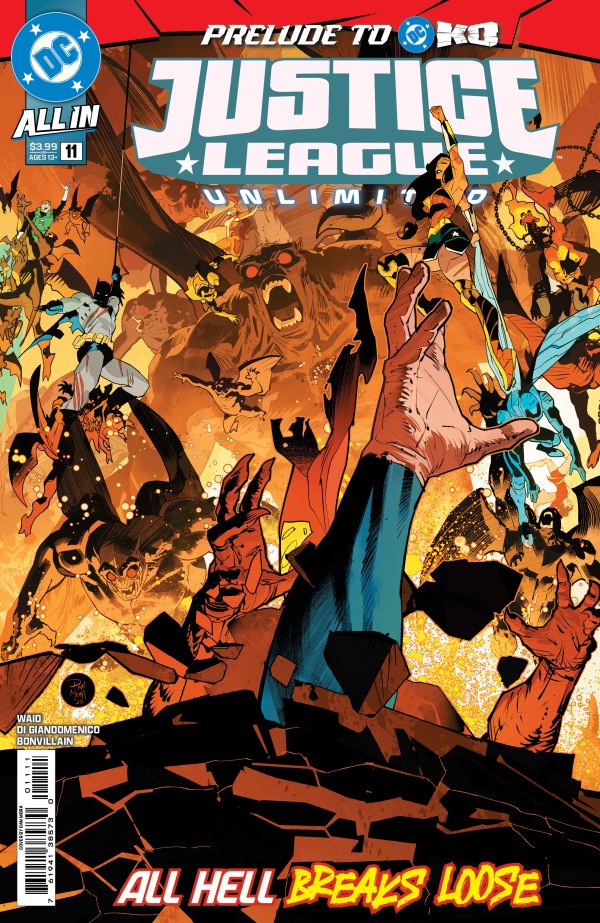
Geek Punditry #100: If I Were King of Comics

Here we are, my friends, 100 Fridays later. In the first week of January 2023, I was thinking of how much I missed the days of writing for Comixtreme and recording my podcast, and I wanted to find a regular way to get my voice back out there in the world. How could I do it? I asked myself. How can I reach out and gift humanity with my invaluable thoughts, insights,and trademark witticisms, in this era where the world clearly needs me more than ever before?

Then I remembered I had a blog that I was barely using, and maybe it would be a nice little challenge for me to find something – once a week, just find SOMETHING – that I liked enough to write a few paragraphs about. 

And of course, it has become the global phenomenon and world-altering sensation you see before you today. 

As I approached the 100th installment of the column hundreds of voracious readers have called “on the internet somewhere,” I tried really hard to decide what to write about. What, in the enormous global marketplace of popular culture that I had made my home, was worthy of dedicating the landmark 100th column to? Star Trek? Stephen King? Superman? Bluey? I feel like I’ve kind of talked about those various topics…well, “extensively” seems in some ways to be too mild a term, but we’ll roll with that right now. No, I needed something a little bit different.

Then I remembered an idea I’d had some time ago, but that I had pushed aside. Something I thought needed to percolate a little more. Something that the world would HAVE to sit up and take notice of. And it seemed perfect. So this week, ladies and gentlemen, allow me to explain to you what exactly I would do if I were in charge of comic books.

You all know I’m a comic book geek, and I have been since I was a small child. Not to discount my love of movies, TV, or novels…I’m a fan of storytelling in general. But comics are in many ways my medium of choice. I’m a regular Wednesday visitor at my local comic shop, I know all the members of the Legion of Super-Heroes, and I can tell you – in order – every publisher that has ever had the Star Trek license. (Gold Key, Marvel, DC, Malibu but only Deep Space Nine, back to Marvel, Wildstorm – which was by then a DC imprint – and currently IDW. Sorry, ladies. I’m taken.)

As much as I love comic books, though, there are certain practices in the industry that I’m not a fan of, certain things that I think could be done better. In this era, where there’s so much competition for the attention of an audience coming from virtually every region of our culture, it’s imperative that comic book publishers find ways to draw in new readers and retain existing ones. Ways to make the sometimes complex mythologies of American comic books a little less of a roadblock, and make the space a little more welcoming. For the 100th Geek Punditry, guys, here are some rules that would be implemented if I were King of Comics.

Numbering

As most people know, comic book series are numbered, and for many decades the numbering convention was simple. You started with issue #1, proceeded to #2, and so forth. You just put the numbers in order. Seemed like a simple idea. But at some point things started to get a little more convoluted. After World War II, many of the existing superhero comics had been cancelled. But in the 50s, looking for a new hit after public favor turned against things like horror comics, DC decided to bring back some of their defunct characters with a new incarnation. A new Flash was created – Barry Allen – and after a few tryout issues in the pages of Showcase, they gave him his own title. Barry took over the numbering of the Golden Age Flash, Jay Garrick, and his first issue was #104. Here’s where it gets confusing: they then did they same thing with Green Lantern. But in this case the new guy – Hal Jordan – did NOT pick up from Alan Scott’s title with issue #39, but instead got his own first issue, Green Lantern Vol. 2 #1.

Make it make sense.

It would not be the last time this happened. In the 80s they gave new first issues to Superman, Wonder Woman, and The Flash, and in those cases, the lapse in publishing between the previous volume and the new was not nearly as long as it had been in the silver age. Then in the 90s, Marvel did it with four of their flagship titles at once – Avengers, Fantastic Four, Iron Man, and Captain America – as part of a new initiative where the titles were essentially farmed out to Jim Lee and Rob Liefeld and set in a different world than the “regular” Marvel Universe. When the books were brought back to the “regular” Universe a year later, they were given a THIRD first issue…and then all hell broke loose.

Since then, virtually every comic book published by Marvel or DC Comics has been canceled and relaunched with a new first issue, most of them multiple times. Batman, at last count, is on its conservative third volume. Superman is at six. Punisher – if I’m counting correctly – has recently concluded volume FOURTEEN. The longest running comic book at either publisher that has not been restarted at least ONCE? Looney Tunes, which recently celebrated issue #281. (It should be noted, though, that even this is the fourth volume of Looney Tunes, having been published by various other companies before Warner Bros. wholly absorbed DC Comics.)

Winner of the gold medal in “not starting over for no reason.”

The conventional wisdom seems to be that a new first issue will bring in higher sales numbers than issue #482, and that might be true. But increasingly, it has proven that a tenth issue #7 does NOT have appreciably more readers than issue #489 would have. In other words, the restarting game gives a short-term sales bump, but does nothing to retain readers, which is what the goal should be.

Anyway, to appease fans (such as myself) who prefer maintaining the original numbering rather than the constant restarts, Marvel and DC have begun featuring “legacy numbers” on the covers of their books – in other words, what issue would this be had the book never been restarted? Which is why the recent Superman Vol. 6 #20 also bears a little symbol indicating that the “Legacy Number” of this issue is #863.

Only long-time Superman fans will understand what I mean when I say “at least it’s in a triangle.”

Confused yet?

Making it even more confusing is the way that many series have changed titles over the years, and trying to figure out which is which. Thor started as Journey Into Mystery, one of Marvel’s assorted sci-fi titles. But after he made his debut, Thor quickly took over the comic book, and the title was changed from Journey into Mystery to The Mighty Thor with issue #126 When calculating the Thor legacy numbers, the original JIM numbers seem to count, but JIM itself has been re-started several times over the years. Journey Into Mystery Vol. 2 does NOT count, apparently, as it ran concurrently with Mighty Thor. And let’s not forget that the current series carrying the Legacy Number is actually called Immortal Thor, which has the same legacy numbers as did previous volumes like Mighty Thor, King Thor, Thor: God of Thunder, or the (at last count) six different series that have just been called Thor. 

According to the legacy numbers, these are all issues of the same title.

Then there’s the fact that it’s inconsistently applied, especially at DC. Superman (on Volume 6), Batman (Volume 3), Flash (Volume 6), and Green Arrow (Volume 7) all have Legacy Numbers on their covers. Nightwing (Volume 4), Harley Quinn (Volume 4), and Titans (Volume 4) do not, and I can see no particular reason why. 

It’s an absolute mess. True story: when the Captain Marvel movie came out in 2018 my wife – who is a geek but not as big a geek as I am – was interested in reading some of the comics to learn more about the character, but after several attempts to figure out which volume to start with, she gave up. If the plan here is to get MORE readers, it’s failing miserably.

So how do we fix this problem? 

Here’s what I would make the standard rule: first of all, the Legacy Numbers should be mandatory for any series that continues the title or star of a previous series. The editors would need to get together right away, decide which books count towards the “legacy” and then stick with it from then on. 

Second, I would have them stop with the constant relaunches. If a character is returning after ten years away…okay, a new first issue might be justified. If we’re going back to issue #1 because there’s a new inker, it’s not. It’s become a common practice to start over with a new first issue any time there’s a change of creative team, especially when there’s a new writer. It’s too much. So here’s the rule: there must be a minimum of three years since the previous volume before a new first issue is justified. If the final issue of Captain Dudeman was #47 and it came out eighteen months ago, then you either have to start with Captain Dudeman #48 or you have to change the title. 

That second stipulation, I think, would start to get used very frequently. One of the reasons that the renumbering has gotten so rampant is that every time a new writer is brought onto a series they want to make their own mark – which is fair. But in so doing, they often want a clean slate, a sort of “back-to-basics” approach for the character, which has resulted in several books in the last few years where the first issue shows the heroes in a wholly different situation than they were in when the previous volume ended, and then it’s not until several issues later that the reasons for the change are actually explained. Sometimes it works (Fantastic Four and Daredevil both did this effectively in their most recent relaunches) and sometimes it doesn’t (the current run of Amazing Spider-Man should be studied by scholars as a cautionary example of what NEVER to do).

I don’t want to take away a writer’s ability to tell the stories they way they see fit, that’s not what this is about. But if the plan is to tell a totally different story, changing the title of the series is a good way to reduce confusion. Telling somebody “You have to read Green Lantern – but not that one, or that one, or that one…” is a recipe for the kind of bafflement that drove my wife away. But saying “Green Lantern: Emerald Champions is a great series” is a HELL of a lot easier for the casual reader to comprehend. You can keep the legacy numbers that way, but having a subtitle or supertitle (that’s when you preface the main title with something else, such as Peter Parker, the Spectacular Spider-Man) makes it a lot easier to differentiate one run from another. 

What this really boils down to is that I never again want to see a comic book called Fantastic Four #1. When I was a kid, owning that book would have been a gold mine. Now I’ve got six different books called that, and it’s ridiculous. 

Cover Confusion

The way the comics industry handles its covers is also an issue, and there are two primary problems I want to tackle. First, let’s talk about pin-up covers. This isn’t as bad as it once was, but for a while there in the 00s and 10s, there was an awful trend of comic books having generic pictures of the main character or characters on the cover, something that may be a fabulous piece of art but doesn’t tell the reader anything about the story between the pages. The argument at the time, I believe, was that they wanted every issue to be an accessible first issue for a new reader. While that may be a noble goal, that doesn’t make a damned bit of sense. Anybody who picks up a comic because they like the picture of Spider-Man on the cover is going to have a hard time keeping up if they open up the comic and run into “Revenge of the Return of the Colonoscopy of the Sinister Six: Part Five of Seventeen.” Congratulations – you sold that one issue…but they aren’t coming back. 

“Wow, great cover!”
“Thanks!”
“What’s the story about?”
“What the hell is a story?”

Pin-up art is fine, but a great comic book cover should tell a story. Think about some of the all-time most memorable covers: Amazing Spider-Man #129 features the webspinner dangling in front of the faces of his friends, agonizing over which of them was going to die in that issue. Green Lantern (Vol. 3) #49 shows a power-mad Hal Jordan brandishing a set of rings stolen from his fallen comrades, a look of pure chaos in his eyes. Wolverine: Blood Hunt #2 shows the ol’ Canucklehead on a motorcycle with a French vampire babe being chased by a mob of vampire stormtroopers while fleeing an explosion that is also being escaped by an overhead passenger jet.

If just that description isn’t enough to make you pick up the book and look inside, I don’t think you actually like comic books.

Now THAT’S art.

These days it’s better, although many variant covers still have what I call the Pinup Problem. So here’s going to be the rule for this one: cover art MUST be relevant to the story inside. That doesn’t mean it has to be a depiction of an actual SCENE from the story. Thematic covers, like the above Amazing Spider-Man #129, are fine. Covers promising a twist or a mystery, anything like that is just dandy, provided it has SOMETHING to do with the story. The only exceptions, the only time a simple pin-up is acceptable, are when it’s the first issue of a series (and presumably a good jumping-on point anyway), if it’s the introduction of a new character, or for certain milestone issues, such as an issue number that ends in a double zero.  

Now that we’ve cleaned THAT little problem up, let’s talk about the REAL issue: variant covers. 

There’s debate over when, exactly, variant covers became a thing, although most people seem to agree that the first mainstream example of printing copies of the same book with two different covers was probably Man of Steel #1 in 1986, the John Byrne relaunch of the entire Superman mythos. That was an instance where it was novel and interesting and fun. People made an effort to buy both covers to make their collection “complete.” It was really cool.

You could get with this, or — alternatively — hear me out on this one…you could get with THAT.

But like so many good things, it got overdone. It didn’t happen overnight, mind you. It was quite some time before having two covers became a regular practice, and even longer before it reached the heights it has today. Even as late as ten years ago, having multiple covers was still more of an exception than a rule. But the rules have changed and HOW. 

If you pick up any random issue of a new comic from a mainstream publisher today, odds are that you will have between two and five covers to choose from. First issues are frequently more. For the first issue of this summer’s Uncanny X-Men relaunch, League of Comic Geeks (the website I use to track my own collection) lists 32 separate cover variants. And even THAT is chump change compared to the most recent relaunch of Teenage Mutant Ninja Turtles from IDW Publishing, which currently stands at – 

Are you sitting down? Are you sitting down in the sewer?

ONE HUNDRED AND SEVENTY-SEVEN DIFFERENT COVERS.

If you are the sort of person who feels the need to get every available cover and you’re a Ninja Turtles fan, I hope you can still afford your insulin.

I’M SAYING IT’S KIND OF A LOT.

The reason they do this, of course, is because people continue to BUY them. And when there are stories every other day about some comic shop or another closing down or a publisher being unable to pay its creators, I can’t fault them for looking for ways to increase revenue. But the problem is that this simply bleeds money out of the existing fans until they get fed up and walk away entirely. And like the renumbering problem, this doesn’t do anything to actually get NEW fans into reading, which is what the long-term goal should be.

This is not to say that I hate variants in their entirety. I rather like them when they do something CLEVER with them, such as what I call “theme” months, where all the variants have a different trend. For instance, DC recently did a run of variants covers that were mock-ups of the packaging of the old Super Powers action figures. (I should point out that other publishers, including Marvel, have been doing action figure variants for a long time, but this was the first time I recall them being used as a monthly theme.) In October, there were a series of variants by artist Kelley Jones showing the DC heroes as kids in Halloween costumes. Marvel did a series not long ago of variant “homage” covers based on some of their old vampire comics, and another run that showed their characters facing off against Godzilla. That kind of stuff doesn’t really bother me, except for the fact that they add to the preposterous number of variants on the shelf.

I don’t know art, but I know what I hate. And I don’t hate this.

I also really like the “sketch” covers that have become popular in recent years. These are blank covers printed on a different cardstock that fans can use to draw their own artwork or have an artist draw something for them. They’re popular for commissions at comic book conventions and events like Free Comic Book Day, and I don’t think the blanks really cause a lot of confusion on the racks compared to the 30-plus X-Men covers. 

The worst part, I think, is that so many of these “variants” are barely worthy of being considered a separate cover. You commission a piece of art from an artist and you’ve got a cover. Print it with no logo or trade dress and it’s a “virgin” variant. Print it without colors and it’s a “sketch” variant. Print it with metallic ink and it’s a “foil” variant. You can crank out a dozen different covers with one sketch and people will continue to buy them. It’s insane.

I recognize that there are a lot of people who LIKE these variants, even if they aren’t MY thing. So in my capacity as the benevolent overlord of comic books, I don’t want to ban them entirely. Here are the restrictions I’ll put in place:

  • A standard issue of a comic book shall have no more than three covers: the “main” cover, a variant cover, and a “theme” variant for that month. 
  • First issues will be limited to five covers, including the theme cover.
  • Milestone issues, such as anniversaries, will be allowed extra variants consisting of no more than one-tenth of the number of issues the book has run. For instance, the 50th issue will be allowed 5 variants, the 100th issue will be allowed 10 variants, and so on. 
  • Retailer-exclusive variants will not count against the total. These are covers commissioned by – and only available from – specific retailers, such as an individual comic shop, store chain, or online retailer.
  • There will be no restrictions on “sketch” covers, nor will they count against the number of variants allowed. 

See? I can be as flexible as the next guy, provided the next guy isn’t Plastic Man.

Anyway, there we have it, guys. Comic books are fixed!

Well…okay, maybe not. There are still plenty of other things in the world of my favorite medium that need to be addressed. Other problems to solve, other fires to put out…but I’ve already gone on for nearly 3500 words, which is pretty massive for one of these Geek Punditry columns. So I think it’s time to put this topic aside, at least for now.

But that’s okay. After all, I’ve got to save something to write about when Geek Punditry #200 rolls around.

Blake M. Petit is a writer, teacher, and dad from Ama, Louisiana. His most recent writing project is the superhero adventure series Other People’s Heroes: Little Stars, volume one of which is now available on Amazon. You can subscribe to his newsletter by clicking right here. He’s also started putting his LitReel videos on TikTok. His goal to take over all of social media after it has started to slide towards irrelevance continues. 

Geek Punditry #65: Howard the Hero?

I am kind of a nerd. I know, I know, I hide it well, but the truth is that I have certain areas of interest about which I am extremely passionate. And one of the aspects of my nerdity that one must be aware of is the fact that I’m a little obsessed with making lists. I’ve been doing it at least since middle school, when I distinctly remember making a paper bookmark upon which I kept a list of every book I read, a list which quickly became too large for a bookmark that fit in anything less than an unabridged dictionary. The list-making obsession hasn’t changed, only the medium. I’ve often said that there are four “quadrants” of pop culture I mostly talk about here in Geek Punditry: movies, TV shows, books, and comics. It should not surprise you that I have a separate app in which I track my activity and make ridiculously detailed lists for each of these quadrants. (That would be Letterboxd, Trakt TV, Goodreads, and League of Comic Geeks, respectively. If you’re on any of those platforms, feel free to follow/friend me.) My wife says that this list-making thing is because of an inherent desire to create some semblance of order and control because in most areas of my life I feel like everything is in a state of permanent chaos and there’s nothing I can do about it. I reply by telling her to shut up, which she understands to mean, “I love you and you’re right, now stop it.”

I might have a problem.

Anyway, on Letterboxd a few years back, I decided to whip up a list of every superhero movie I could find, part of my desire to eventually watch them all. You would think that this would be a relatively non-controversial endeavor, assuming that you’ve never been on the internet. Those of us who HAVE been online at some point, however, are acutely aware that there is NOTHING online so benign that you can’t find SOMEBODY ready to argue about it. In the comments of my list, some people complained that I decided to skip non-English language films (because odds are I’ve never heard of those and I don’t want to dedicate my entire life to tracking them down), fanfilms (because for some reason those are frequently deleted and re-added to the Letterboxd database and I don’t want to have to keep putting the same movies back on again), and “adult” films (because make your own list, you weirdo). 

But what took me by surprise is when someone decided to complain that I left off the movie Howard the Duck. The exclusion had nothing to do with quality, mind you. I included every superhero movie I am even vaguely aware of, even the worst one ever made, by which I mean the Josh Trank Fantastic Four. No, I skipped Howard because – despite the fact that the movie is based on a Marvel comic book – Howard the Duck is not a superhero. He’s a comedy character, usually used in satirical stories, and while he does have adventures and has been known to interact with other inhabitants of the Marvel Universe, that doesn’t make him a superhero any more than it does Peter Parker’s Aunt May. The person who disagreed with me told me that the title of the film in his native country (Brazil) translates in English to Howard the Superhero, which he says indicates that it should be considered a superhero movie, whereas in reality it just made me question what’s wrong with the Portuguese word for “Duck.”

Never forget that THIS was the first theatrical movie based on a Marvel comic book, nerds.

So I decided that, in order to quell debate (note: this is impossible), I should probably come up with an actual definition of “superhero.” This turned out to be more difficult than it seems. You would think it’s obvious – get five different people to make a list of 100 superheroes and chances are 75 names would appear on at least four of the lists. But what MAKES a superhero? I decided to check with Merriam-Webster, which gives me two totally useless definitions. The first is “a fictional hero having extraordinary or superhuman powers,” which fails as a definition because it excludes Batman, and nobody is ever allowed to exclude Batman. The other definition is “an exceptionally skillful or successful person,” which seems kind of dumb because, arguably, Genghis Khan was exceptionally successful at what he did. And let’s not get into John Wayne Gacy.

“Behold! A superhero!”
“Put a sock in it, Diogenes.”

I needed something broad, but not too broad. I pondered, and I eventually came up with not a SINGLE definition, but a list of criteria. I would consider a character a superhero, I decided, if they fit at least TWO of the following criteria:

  1. Superhuman powers and abilities. These abilities need not be inherent, mind you. Green Lantern has no actual super powers, but he has a ring that gives him superhuman abilities, so he counts.
  2. A double identity, although this identity need not be secret. Everyone in the Marvel Cinematic Universe knows that Tony Stark is Iron Man – his ego wouldn’t allow them not to – but he still HAS that second identity.
  3. An identifiable (and toyetic, let’s not forget toyetic) uniform or appearance. This is, I admit, somewhat subjective. What’s identifiable to one person may not be identifiable to someone else. Think of it this way: if someone is cosplaying as a character and that cosplay is easily recognizable to someone familiar with the IP, that character probably meets this criteria.
  4. Fights crime or battles the forces of evil.
All basically the same thing.

What I like about this list is that none of these criteria make somebody a superhero by itself, but each time they’re combined you get closer to that superhero line. It also makes it easy to include anybody that I want, such as Zorro. People often say Superman (who first appeared in 1938) was the first superhero, and he is certainly the character who named the genre, but I don’t think it’s true that he’s the first. He was preceded by several characters who meet many of the criteria I’ve listed. Zorro (1919), the Lone Ranger (1933), and the Green Hornet (1936) all meet categories 2-4. The Shadow (1931) and the Phantom (also from 1936) meet all four. Even the Scarlet Pimpernel (1905) hits categories two and four. If anything, Superman is the first comic book superhero, and I’m sure even that is open for debate. As such, I included all of these “proto-heroes” on my cinematic superhero list.

Fun Fact: Canonically, the Lone Ranger is the Green Hornet’s great-uncle.
Less Fun Fact: Both of these movies are embarrassments that should never have been made.

Of course, even my criteria leaves a lot of room for debate. There are plenty of characters that one usually doesn’t think of as superheroes that fit at least two of the criteria. Harry Potter, for instance, has magical powers, fights evil, and has a very distinct appearance. The same can be said for Luke Skywalker. One could even argue that any Star Trek character from a race with psychic or shapechanging abilities would qualify. Are Spock, Odo, and Counselor Troi superheroes, or do their powers not count since they’re not unusual for members of their respective species? There are certainly people who would argue that all of these are superheroes, and while I wouldn’t put them on my personal list, I don’t know that I could effectively argue against their inclusion either.

Where, exactly, do we draw the line?

What about Indiana Jones? He fights evil. He’s easily cosplayable. And his real name is Henry Jones, Jr. Does his nickname qualify as a second identity? How about James Bond? He fights evil all the time. The uniform is a little harder to quantify – the most iconic Bond look is a tuxedo, but anybody can put on a tuxedo. And the second identity…does being Agent 007 count? Back in the day there was the fan theory that “James Bond” itself was a pseudonym passed down to whomever was Agent 007 at the time, which was a theory I liked and would most certainly qualify, until the film Skyfall quashed that theory for good.

Some people may ask what difference it even makes. We’re talking about fictional characters, after all. Who cares which ones do and do not count as superheroes? To those people I say, “Oh good for you, you’re far more well-adjusted than those of us who debate these sorts of things on the internet, please stay that way.” 

For the rest of us, I know that my attempt to define the term has probably caused more debate than it stopped. Sorry about that. If you’ve got a better definition than I do (or than Merriam-Webster does) I would love to hear it. And I’d even like to hear some unusual characters that you would say meet the criteria. But in the meantime, the only thing I can really say is that when it comes to a superhero, I know one when I see one.

And Howard, I’m sorry, it ain’t you. 

Blake M. Petit is a writer, teacher, and dad from Ama, Louisiana. His most recent writing project is the superhero adventure series Other People’s Heroes: Little Stars, now complete on Amazon’s Kindle Vella platform. He looked up the Portuguese word for “duck.” It’s “pato.” Why didn’t Brazil just call the movie “Howard o Pato”? 

Geek Punditry #61: Playing Favorites With Superheroes Part One

It’s time once again for PLAYING FAVORITES! It’s that semi-regular Geek Punditry mini-column in which I throw out a topic to you, my friends in the world of social media, and ask you to suggest different categories in which I discuss what I consider to be the best of the best. This time around, the topic is superheroes. Born in the pages of American comic books, but with roots in pulp magazines, myth, and thousands of other sources, the superhero is considered to be the modern mythology, with pantheons not only in comics, but in movies, TV, video games, and pretty much every other media you can name. And I am, it cannot be understated, a fan of the superhero. So what, then, are some of my favorites?

Legacy Heroes

Sandy Brophy is going to kick things off for us by asking for my favorite legacy heroes. A “legacy” hero, for those of you who may not have been reading comic books since you were six years old, is the term used when a superhero’s name and identity is passed on from one person to another. For example, in the early days of comics, the Flash was a college student by the name of Jay Garrick. After superheroes fell out of favor and stopped being published for a while, they were resurrected in the 1950’s with the creation of a brand-new Flash, this time a police scientist named Barry Allen. Barry was the Flash for a long time before dying in Crisis on Infinite Earths (it took longer than usual, but eventually he got better), and his nephew/sidekick Wally West, aka Kid Flash, took over as the new Flash.

And so on, and so on, and so on.

This also, by the way, is my answer to Sandy’s question. The Flash is undoubtedly my favorite legacy hero in comics. By the time I started reading comics Wally was the main Flash, and even decades later he’s still the one I feel is most compelling. He was young when he became the Flash, and thanks to the magic of comic book time I eventually caught up with him at the same time he was being written by Mark Waid, who turned him into a fully fleshed-out and wonderfully realized character in his own right. He got married, had kids, and he grew and matured. He was also – as Waid said – the first sidekick to “fulfill the promise,” in other words, to take over for his mentor. He’s also still, to the best of my recollection, the ONLY one to do so on a permanent basis. It’s true that Dick Grayson (the original Robin) became Batman for a while, and Captain America’s sidekick Bucky took up the shield when Steve Rogers was temporarily dead, but both of them reverted back to their other adult IDs (Nightwing and the Winter Soldier, respectively) when the original came back. Not so Wally. Barry returned and Wally stuck around, and although there’s been a lot of timey-wimey nonsense and attempts to sort of push him to the side, he’s bounced back. Wally is, again, the primary Flash, even in a world where Jay and Barry exist, and the nominal head of the Flash family. And he’s just the best.
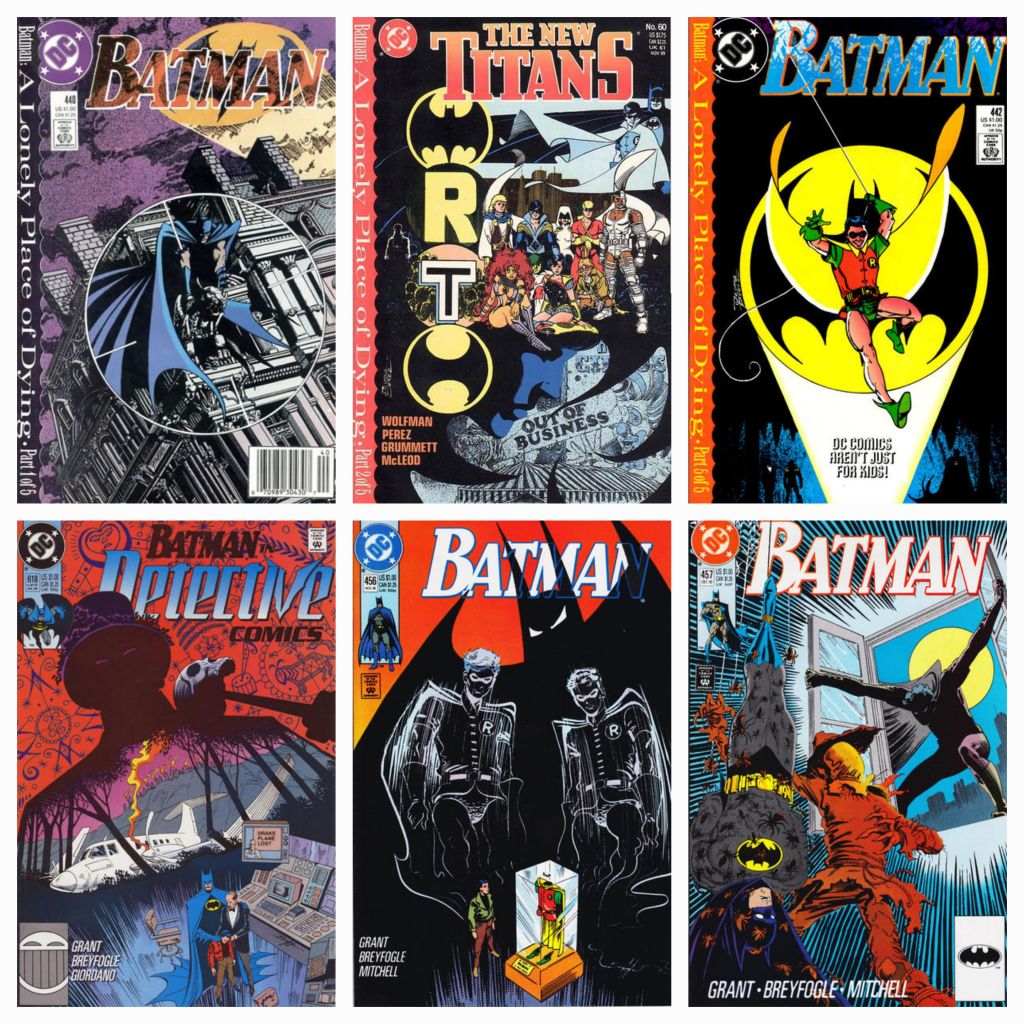
There are other good legacy heroes, don’t get me wrong. I enjoy the Jaime Reyes version of the Blue Beetle (although my heart will always belong to Ted Kord, himself the second Blue Beetle following Dan Garrett), and there are few who will argue that Kamala Khan hasn’t done more with the Ms. Marvel title than either of her predecessors, but Wally West is the ultimate legacy hero in my book.

Superhero Logos

My buddy Owen Marshall wants to know what some of my favorite superhero LOGOS are – those titles that splash across the cover of a comic book to (hopefully) let you know what you’re about to read. I’ll talk about what I think makes a good logo in general, then get into specifics. I think a great logo is something that stands out in a way that evokes the hero in question. The Superman logo, for instance, is relatively simple – his name, slightly curved, with drop letters that give it a sense of weight, of solidity. Any time you see that logo you think that somebody could just grab it off the cover – and, in fact, there have been many covers where that very thing has happened.

You can’t beat a classic.

Spider-Man’s original logo is great for similar reasons. It’s solid, but it’s also easy to partner up with a web in the background to help get across the idea that you’re dealing with a wallcrawler. And, like Superman, it’s a short enough logo that it’s very easy to add an adjective to the title (as in the AMAZING Spider-Man, the SPECTACULAR Spider-Man), but just as easy to drop a subtitle underneath (Spider-Man: Renew Your Vows). There have been many attempts over the years to create a new Spider-Man logo, but frankly, there’s never been one I like as much as the original, and it seems it’s never anything but a matter of time before they return to it.

Yeah, that’s the stuff.

The Avengers also have a fantastic logo. They’ve had several, of course, but I’m specifically talking about the most famous version, the one that Marvel Studios used for the basis of its movie design. It’s clean and bold, and the arrow in the letter “A” gives it a sense of forward motion that sort of plants the idea that these are heroes who are about to go out and DO something.

The arrow is in case you forget and try reading it right-to-left.

Green Lantern has had a great many logos over the years, many of which actually include a lantern, but my favorite doesn’t. I like the logo that premiered in 2005 with Green Lantern: Rebirth and which remained the primary version of the logo until just a few years ago. This version has that tilt to one side and a cool roundness to it that…okay, just hear me out on this…it makes me think of classic cars from the 50s. Smooth, sleek, fast…and those are words that apply to Green Lantern, especially the Hal Jordan version. 

And it’s all spacey and stuff.

I could probably spend an entire month just going through different logos, but I’m just going to cap it off here by saying that there are hundreds of awesome logos and if you want to read more about them I highly recommend the blog of comic book letterer and designer Todd Klein, who frequently makes posts where he discusses the design and history of comic’s greatest (and worst) logos, which is like drinking mother’s milk to a nerd like me. 

Superhero TV (pre-2000)

My old friend Patrick Slagle wants to know my favorite superhero live action TV shows. Well that’s easy! There have been SO many to choose from – Stargirl was great, and I was deeply enamored of Legends of Tomorrow, and then there was–

Oh, wait.

He specified shows from BEFORE the year 2000. Well. That makes it a lot more difficult. We’ve been in a superhero renaissance in the last decade or so, guys, with such an abundance of shows that even I haven’t gotten around to watching them all yet. (Peacemaker, for example, is still warming my “to-watch” list.) But if I’m going to restrict myself to the cultural wasteland that was 1999 and earlier, I guess there’s only the obvious choice.

Project: ALF.

If I don’t do this at least once in every Playing Favorites column the Don said he was gonna break my thumbs.

The superhero shows of my formative years…let’s be honest guys, they weren’t that great. The two most fundamental ones are probably the Bill Bixby/Lou Ferrigno Incredible Hulk and Lynda Carter as Wonder Woman. And while those are both good shows, neither of them were series I would watch on repeat, the sort of thing that makes a TV series worm its way into my psyche and become a part of the vast tapestry that is your friendly neighborhood Geek Pundit. And the truth is, a lot of the other shows of that era don’t hold up. Look at the 70s Amazing Spider-Man or Shazam! shows and try to convince me that these are fundamental pieces of Americana. The Greatest American Hero is a show I know I used to watch, plus it’s got the most earwormy theme song in superhero history, but I couldn’t relate the plot of a single episode after the pilot. It got better later, with the surprisingly decent Superboy TV series (mostly after Gerard Christopher took over the role from John Newton) and the “fun but fluffy” era of Lois and Clark: The New Adventures of Superman.

There are some wild swings in quality happening in this picture.

If I have to pick (and I do, it’s my damn game), I guess I’m going to have to give props to the two shows that I think launched the genre on TV: George Reeves in The Adventures of Superman and the Adam West/Burt Ward Batman show from 1966. I’ve always had a complicated relationship with the West/Ward era. When I hit those peak teenage years of arrogance and knowitallitude that most of us go through, I began to actively dislike that show, blaming it for people treating comic books as childish and infantile for decades after it was off the air and tarnishing the reputation of the caped crusader. Fortunately as I got older, I got over myself, thus disqualifying myself from ever running for elected office, but at the same time getting a sense of perspective. Sure, it wasn’t MY Batman, but I learned to appreciate it for what it was. I’ve softened to the show now. I even watch the reruns on MeTV Saturday nights between Svengoolie and Star Trek.

There’s no school like the old school.

George Reeves, though, I’ve always appreciated. He was the Curt Swan Superman come to life – square-jawed, barrel-chested, friend to all the innocent. But at the same time, he had a wicked sense of humor, showing clear joy whenever he got to take down a bad guy and taking a sly sort of pleasure any time he thwarted Lois Lane’s attempts to one-up him. I love the Reeves Superman and I don’t think he gets the respect he deserves. DC has launched a series of comics featuring the Christopher Reeve Superman as Superman ‘78, and that’s great. I love ‘em. But am I really the only person who would pick up a comic book called The Adventures of Superman ‘52?

Superhero Animals

I really like Marvel’s Scarlet Witch. She’s had several costumes over the years, but the best is the one George Perez whipped up for her for the Heroes Return era. It was red, naturally, which helps you identify her via color-coding, but the design also drew on the character’s Romani heritage, with a rare long skirt and robes that make you think of a fortune teller. All of that builds together and links her to her mystical roots. I’m fairly certain that if I didn’t know who the Avengers were and someone asked me which one I thought was the Scarlet Witch, I’d say, “Well, gotta be the woman in red, and not the tiger girl in the bikini.”

Jim MacQuarrie asked for my favorite Super-Animal, while Lew Beitz wants to know my favorite Super-PET. These two categories are close enough that I’ll talk about them together. They’re not EXACTLY the same, but there’s plenty of overlap. The way I look at it, we can divide super-animals into two categories: the ones that serves as an animal sidekick to the main hero, such as Krypto the Superdog, and those that are distinct heroes in their own right, like Hoppy the Marvel Bunny. The former are characters in established universes, while the latter usually exist in a Disney-esque universe where there are no humans at all, but instead races of anthropomorphic animals running the show.

As far as super-pets go, the Superman family has the deepest – and weirdest – bench to draw from. Krypto the Superdog and Beppo the Supermonkey are both animals from Krypton who made their way to Earth and gained powers like Superman and Supergirl. Supergirl also has a cat named Streaky who gains and loses his powers on a rotating basis thanks to exposure to something called X-Kryptonite (it was the 50s, it was safe to give something a name like that because there was no internet). Then there was Supergirl’s horse, Comet, who was actually a centaur from ancient Greece named Biron that was cursed and trapped in the form of a full horse. He hung around for a couple of thousand years before he met Supergirl and started to assist her on her missions, fell in love with her, and learned he could briefly become human when an actual comet passed close to Earth, allowing him to date Supergirl without telling her who he really –

Stop looking at me like that, I’m not making this up.

Superman is surprisingly indiscriminate about who he gives a cape to.

Anyway, Krypto is kind of the gold standard of super-pets, but there are a few others outside of the Super-Family worth mentioning. Wonder Woman’s kangaroo, Kanga, for instance. Ace the Bat-Hound, who Batman gives a mask to cover the bat-shaped patch of fur on his face and thus protect his secret identity. Chameleon Boy’s pet Proty who, like Chameleon Boy, is a shapeshifter, and fully sapient, and who can and did occasionally impersonate full grown adults, which makes you ask where the hell the Legion of Super-Heroes gets off treating him like a pet. And of course Damian Wayne, the current Robin, has Bat-Cow.

The only superhero who’s a source of 50 percent of the food groups.

Then there are the other types of Super-Animals: anthropomorphic heroes in their own right. Everyone who has heard me talk for five minutes will know that my favorite of these is Captain Carrot and his Amazing Zoo Crew. Created by Roy Thomas and Scott Shaw!, this 80s phenomenon was about a group of superhero animals who got powers from meteors that fell to (their version of) Earth. After meeting a dimension-hopping Superman, they were inspired to become heroes in their own right. The art is cartoony and the premise is silly, but what I’ve always loved about Captain Carrot and company is that their stories – at least in the 80s – weren’t played like cartoons. The plots were straight out of the pages of Golden and Silver Age comics, facing giant monsters and villains with cold-rays and all kinds of classic tropes. They were funny, sure, but not at the expense of the characters, as many of the modern writers who have tried to use Captain Carrot have forgotten. When I say I want a revival of the old-school Captain Carrot, I say it unironically and with love.

By contrast, there’s perhaps the most famous super-animal of the day, thanks to his starring role in an Academy Award-winning motion picture. I refer, of course, to Peter Porker, the Spectacular Spider-Ham. Spider-Ham’s comic hit JUST when I stared reading comics in earnest, and I devoured it. In this hilarious take on the Spider-Man story, Peter was the pet spider of mad scientist May Porker, who accidentally irradiated herself and bit him. The spider turned into a pig while maintaining his spider-powers. When May recovered from the radiation, her memory was erased and she thought she was just a kindly old lady and Peter was her nephew.

Move over, “The Boys,” the REAL heroes are back in town.

I’m not making this up either, but I wish I could take credit for it. The early Spider-Ham comics were a lot of fun, then he disappeared for decades before experiencing a renaissance in recent years. Like Captain Carrot, his modern adventures are sillier and more “cartoony” than the earlier ones, but UNlike Captain Carrot, the cartoony interpretation fits better, and has made him a better character.

My favorite Spider-Ham story, though, is not from the comics and not from the cartoons, but from the mouth of his creator, Tom DeFalco, when I met him at a convention a few years ago. He was signing reprints of the first appearance of Spider-Ham and his other great Spider character, Spider-Girl. I bought them both and told him how much I loved Spider-Ham when I was a kid, and he told how surprised he was when Marvel Comics sent him an invitation to the premiere of Spider-Man: Into the Spider-Verse. He didn’t understand why he was getting an invitation, and someone said, “It’s probably because Spider-Ham is in it.” And DeFalco, shocked, exclaimed, “SPIDER-HAM is in a MOVIE?”

Timeless. 

Favorite Superhero Costumes

My wife Erin, who always cuts the line because nobody else who submits questions has ever made lasagna for me, wants to know what my favorite superhero costumes are, both male and female. I think it was Alex Ross who said that the test of a good superhero costume is whether you could identify the character based just on the name, even if you knew nothing about them. Batman, for example. Green Lantern. Captain America. The 90s was an era where this consistently failed, especially in the X-Men comics and those later characters created by former X-artists. If you showed someone who knows nothing about comics pictures of Gambit, Cable, Maverick, Shatterstar, and Deadpool, then asked them to match the names to the pictures, any correct answers would happen purely because of the law of averages.

But anyway, when I read Ross’s definition, he also used that definition to argue that the greatest superhero costume of all time belongs to Spider-Man. It’s hard to argue with him. Nobody who saw a lineup of the Marvel Comics all-stars would have any difficulty telling that this guy is Spider-Man and not, for example, Wonder Man. And while that’s true of MOST of Spider-Man’s assorted costumes over the years, the original is still my favorite. The black costume is cool-looking, but the ol’ red-and-blues have a brighter, more optimistic tone that suits Spider-Man better. Spider-Man is a hard luck hero, to be sure, but he should never be a depressing, brooding character like Daredevil. (Are you listening, current Marvel editorial?) He’s the guy who should never give up and always finds it in himself to do the right thing, and the red and blue color scheme says that better than any of his other assorted looks. 

I don’t even blame him for admiring his own reflection.

Using the same metric, I also think the Rocketeer has a phenomenal costume. He is literally a human rocket, with a rocket pack strapped to his back and a helmet that evokes the speed and energy of the burgeoning space age. The rest of the outfit, though, with the brown bomber jacket and the jodhpur pants brings in the idea of his aviator background and grounds him in the World War II era where he belongs. 

This picture makes me want to make swooshy noises.

Honorable mention goes to the Flash, Green Lantern (Hal Jordan costume, although I have a soft spot for the one John Stewart wore in the Justice League cartoon) and Marvel’s Nova.

Erin also asked about my favorite female costumes, which I find is a little harder to do going by Alex Ross’s metric. Too many female costumes are designed more for titillation rather than actually identifying the character. And even those that DO clearly identify them often do so via a logo or symbol that marks them, such as Wonder Woman.

I think “Morgan” was the screenwriter of Doctor Strange and the Multiverse of Madness.

Harley Quinn is another one that is pretty obvious, at least in her original costume. The red-and-black color scheme, white makeup, and bangled headpiece brings up the notion of a Harlequin, which of course is the inspiration for the character. She’s changed her look several times over the past few years, and while some of her looks have been pretty good, none of them draw their inspiration from her roots the way her first look does. On the other hand, they’ve come up with a pretty solid justification for her changing her look – once she got over the Joker and dumped his homicidal ass, she doesn’t want to wear the costume that identifies her as his sidekick anymore.

Let’s face it, I could have posted a picture of a random duck here and you still could have pictured Harley’s get-up.

Then there’s Supergirl. She’s had a lot of costumes, the most iconic look being the basic Superman outfit, only with bare legs and a skirt. That’s not her best look, though. For me, my favorite Supergirl costume came from the 1970s, when she wore a loose blouse with a small S-shield over her heart rather than the full-size shield most superfolks wear. I love that look – it still clearly marks her as a member of the Super-family, but it’s very different from anything any of the others wear. Being loose instead of skintight like most superhero costumes, it’s got a freeing quality that speaks to a lighter version of the character in a period where she was working to get out of her more famous cousin’s shadow. It’s such a great look and I never stop wishing they would bring it back.

What can I say? She’s got the look.

That’s about it for this week, guys, but there are plenty of other questions I haven’t gotten to yet. So be sure to come by next week for Playing Favorites With Superheroes Part Two, and if you have a suggestion that I haven’t covered, go ahead and drop in in the comments. Up, up, and away!

Blake M. Petit is a writer, teacher, and dad from Ama, Louisiana. His most recent writing project is the superhero adventure series Other People’s Heroes: Little Stars, now complete on Amazon’s Kindle Vella platform. He realizes he talks about the Superman family a lot whenever he gets on to a superhero discussion, but let’s be honest, people. It’s either gonna be this or Star Trek.