I’m going to drop a spoiler for the current Avengers: Armageddon miniseries, as well as the upcoming Avengers comic book reboot by Chip Zdarsky, so if you’re behind on those and you don’t want to know that Pepper Potts is the new Spider-Man, you may want to skip this week’s column.
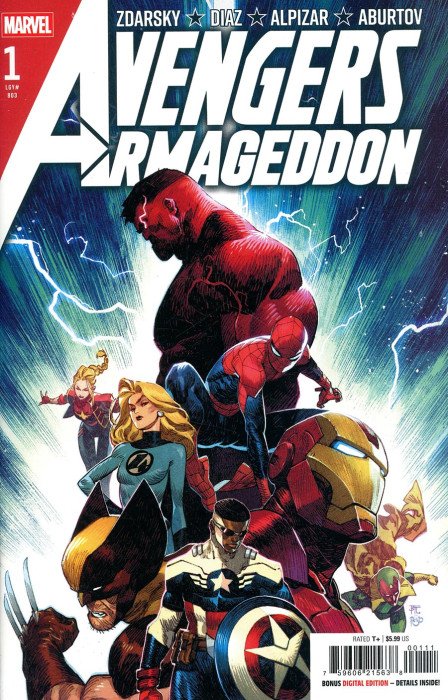
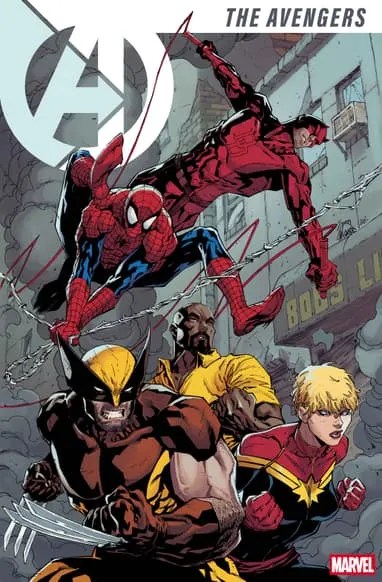
Just kidding about the Pepper Potts thing, but I’m not kidding about dropping a spoiler. Zdarsky’s miniseries has been building to his Avengers relaunch for a few months now, with a very different team being assembled in a world where the landscape has changed drastically. It seems as though the world is turning against the Avengers, and the reaction is an Avengers roster that is low on what we would think of as “Classic” Avengers. The team, as revealed in weeks past, will include Captain Marvel, Luke Cage, Wolverine, Spider-Man, and Daredevil. Not a one of the Avengers “Trinity” of Captain America, Iron Man, and Thor is lining up. It also doesn’t include any of the characters we think of as being “traditional” Avengers, such as the Vision, the Scarlet Witch, Black Widow, or Hawkeye. The most stable of the new lineup is Captain Marvel, who has had an almost-constant presence on the team for the better part of the last two decades. And each of these characters has been an Avenger at least once before (if only briefly), but if you showed me this roster without benefit of telling me what it was I probably would have guessed a new iteration of the Defenders before the Avengers.
Some people are angry about this lineup, because EVERY announcement on the internet makes SOMEBODY angry. I could post that I found a dollar bill in the pocket of a jacket I haven’t worn since last year and I’d get twelve people pissed off about it. And to be fair, there are some legitimate concerns to be had here. I’ve never been one to be upset about new characters joining the Avengers. That’s been a constant on the team ever since Captain America joined about 800 issues ago. But to me, it never quite feels like the Avengers at all unless it has at least SOME of the mainstays, and I guess I’m old-fashioned enough that Captain Marvel doesn’t 100 percent satisfy that requirement by herself.
The other thing that bothers some people is that many of these characters are reflective of the somewhat divisive “New Avengers” era by Brian Michael Bendis that began in 2005. This is a concern I can sympathize with. I am not a fan of Bendis’s work in general, and if I thought this book was just going to be a rehash of that, I wouldn’t be interested. But having Chip Zdarsky on the book makes me feel more comfortable – I am a fan of his work, with solid runs on comics like Daredevil, Batman, and Captain America under his belt, to say nothing of his own creator-owned work like the fantastic Image comic Public Domain. So if nothing else, he’s earned a story arc out of me before I decide if I’ll keep reading the book.
However, in the run-up to this, Marvel has played it coy about a secret final member of the team. There would be a member, they promised, who has never been an Avenger before. At this point, the number of heroes in the Marvel Universe who have NOT been a member of SOME Avengers team is pretty slim: it was pretty much down to Leapfrog, US-1, or Aunt May. But this week (and here’s the real spoiler, kiddies) the news dropped that the new member is somebody who has never BEEN in the Marvel Universe before: Miracleman.
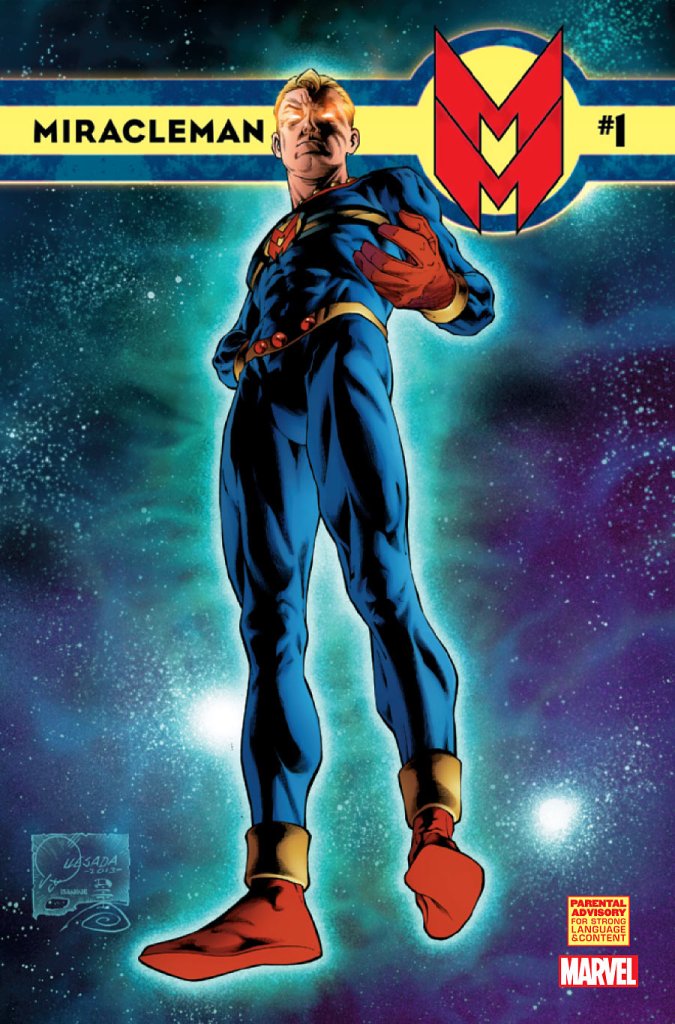
People complain sometimes about comic book characters having confusing or convoluted histories. But let me tell you, friends, there ain’t an X-Man on the planet with a backstory as twisted and bizarre as the REAL story behind Miracleman, and it’s kinda DC Comics’ fault.
Back in the 1940s, Captain Marvel was one of the biggest names in comics. No, not that Captain Marvel, the other one. The guy published by Fawcett Comics who wore a red suit and these days is often called “Shazam.” But DC Comics sued Fawcett, claiming that Captain Marvel was too similar to their Superman. The court case dragged on for years until Fawcett eventually gave up the ship and quit publishing the Marvel Family comics – once superhero comics in general had declined in popularity, it should be noted. But this caused a problem for L. Miller & Son, the British publisher who reprinted the Fawcett Comics in the UK. With a hole in their publishing schedule, they hired cartoonist Mick Angelo to come up with a replacement. Angelo’s solution was “Marvelman,” a character who was…well, he was pretty much Captain Marvel. He was a kid who had a magic word that gave him super powers, teamed up with young friends who had the same powers, his arch-nemesis was a mad scientist…it was blatant. Angelo changed the costume, the magic word, and made Marvelman’s origin based on science (comic book science, at least) rather than sorcery, but other than that, it was pretty much Captain Marvel.
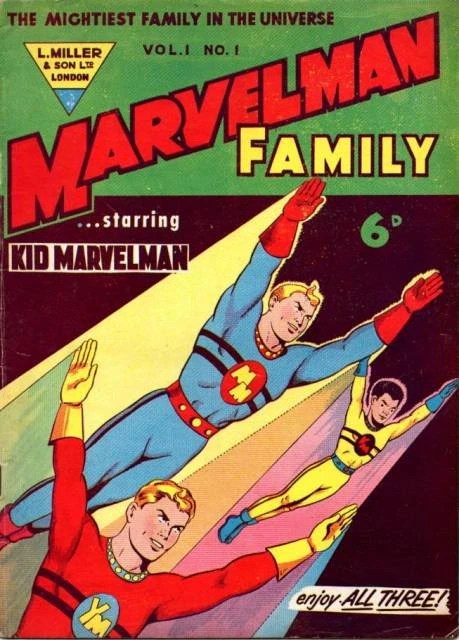
Marvelman lasted for about a decade and then faded away. Then in the 80s, Alan Moore came along and resurrected the character, making him a darker commentary on superhero comics in general. Most of the similarities to the old Captain Marvel evaporated, and the book was a hit. It was a precursor to the deconstruction of superheroes that Moore would become known for in books like Watchmen a few years later. Once he left the series, Neil Gaiman took over, but the book ended before Gaiman’s story could be finished. Before that happened, though, the series was popular enough to be transplanted to the United States by Eclipse Comics, who changed the name to Miracleman to avoid issues with Marvel Comics.
Here’s where it gets really complicated: there was a major legal dispute over who actually owned the rights to the character, with Gaiman, Eclipse Comics, and Mick Angelo all claiming pieces of (or in the case of Angelo, all of) it. Eventually, the courts decided that Angelo’s original copyright was still valid. Marvel Comics, whose editor-in-chief Joe Quesada had supported Gaiman in the dispute, stepped in and waved a lot of money at Angelo to acquire the character. They began reprinting the older comics, including the Moore and Gaiman runs, and had Gaiman continue the story he was never allowed to finish. The book was derailed again, though, when allegations of impropriety against Gaiman flared up a couple of years ago and, once again, the saga of Miracleman was left incomplete.
Now, though, it seems as if Miracleman’s future will not reside in his own story, but as part of the larger Marvel Universe. I haven’t read the new issue of Armageddon yet, so I don’t know if this is actually the Moore/Gaiman version of the character who has hopped over to the Marvel Universe or if it’s a multiversal variant showing up for the first time, but it doesn’t necessarily matter. A good writer can make either version work. The real question is whether anybody is going to CARE.
Bringing back older, obscure characters can be a tough sell. Any success Miracleman has had since coming to Marvel is largely because of older readers who wanted to finally get an ending to the saga that started back in the 1980s (and which it seems now will never actually end). Is taking that character, ANY version of him, and making him an Avenger going to win him any new fans? I’m not questioning Zdarsky’s story or his skill as a writer, I’m just saying I don’t know if it’ll be enough.
Comics, especially in the last couple of decades, are littered with the four-color corpses of older characters whose revivals fell flat. Marvel themselves have tried twice to bring back characters from the defunct CrossGen Comics (now owned by their corporate parent, Disney), but they failed to catch fire. Ever since the demise of the original Valiant Comics, those characters have been brought back time and again, only to fade back into obscurity with each attempt. Alien Books currently has the license to Zorro, a character who has changed hands among at least half a dozen publishers over the years, and they’re doing two series. One is a traditional series set in the old Spanish-occupied California. The other is a modern take, where a descendant of the original Zorro takes up the mantle in 2026. Both of them are really well done, but I don’t know if anybody on the PLANET is reading either of them except for me.
That’s not to say it’s IMPOSSIBLE for an older character to have a renaissance. The current Captain Marvel, Carol Danvers, is a perfect example of that. She’d fallen off the face of the Earth before Bendis brought her back for his Avengers (credit where credit is due) and now she’s one of the more recognizable characters in mainstream comics. Can Zdarsky pull off the same trick in bringing back Miracleman? I hope so. I like Zdarsky’s work and I like it when older characters come back. I would be happy to see this succeed, and I’d like to see the door open to other worthy characters that are sitting quietly on a shelf somewhere (coughULTRAVERSEcough).
But will it actually work?
A more cynical person would say it’d take a miracle.
But I’m saying it too, just because I like Dad jokes.
Blake M. Petit is a writer, teacher, and dad from Ama, Louisiana. His most recent writing project is the superhero adventure series Other People’s Heroes: Little Stars, volume one of which is now available on Amazon. He’s also started putting his LitReel videos on TikTok.

