This week the world of pop culture was totally rocked by the news that one of the greatest underrated movies of the 80s is FINALLY getting a sequel. Director Nick Castle’s 1984 science fiction epic The Last Starfighter is being revisited, after over four decades, in a new comic book series by Mad Cave Studios and the planet absolutely REJOICED.
Well it rocked MY world, anyway.
I don’t give a damn what you’ve been told, THIS is what Epic actually looks like.
I loved The Last Starfighter growing up. If you’ve never seen it, here’s the short version: teenager Alex Rogan (Lance Guest) is addicted to a video game – a cabinet video game, not one of them newfangled home consoles – and keeps playing it until he shatters the record. That night, he’s visited by an alien called Centauri (Robert Preston) who tells him that the game is actually a secret test, and Alex has been recruited to join the real StarLeague in its battle against “Xur and the Ko-Dan Armada.” In fact, for a lot of people my age, just SAYING the phrase “Xur and the Ko-Dan Armada” activates something inside of us similar to saying “mitochondria is the powerhouse of the cell.”
There were lots of movies in this era trying to ride the coattails of Star Wars, and this is one of my favorites. It’s been adapted before – there was a novelization, a Marvel comic book adaptation, and even a stage musical – but despite being pretty well loved by its fan base, there was never a sequel and the story has never continued until now. Original screen writer Jonathan Betuel is working with writers Deric A. Hughes and Benjamin Raab as well as artist Willi Roberts on this new series, which Beutel hints is the beginning of a plan to tell larger stories to expand the universe of the film. And I, for one, couldn’t be happier about it. Honestly, it couldn’t happen to a better franchise.
That said, just because this is the perfect franchise to relaunch as a comic book, that doesn’t mean there aren’t others. Mad Cave has taken the forefront on this in recent years, with reboots of Speed Racer, Dick Tracy, and Defenders of the Earth, as well as individual Defenders characters such as Flash Gordon and the Phantom. And Dynamite Publishing has stepped up to the plate with more “sophisticated” reboots of old cartoons like Thundercats, Silverhawks, Space Ghost, and Captain Planet. It’s not really surprising that writers and artists who grew up on these franchises want to resurrect them in comic book form and put their own spin on them. That said, even with the avalanche of classic stuff we’ve gotten in the last few years, there are still a few that haven’t been touched.
Yet.
So today, in a “Three Wishes” special, I’m going to propose three franchises that – to the best of my knowledge – have never had a sequel or reboot of any kind since their original run ended. And this was harder than it sounds – I thought about nearly a dozen different movies and TV shows that I discarded when I checked and found out that there HAD been a comic book or TV reboot that had escaped my notice. But I’m pretty sure that, for the three I’m about to talk about, any continuation of the original story exists only in the imagination of fans everywhere. Here are three 80s IPs that I would love to see get a reboot or sequel as a comic book.
Bionic Six
Although Bionic Six had only one season in 1987, this was in the day when a season of a syndicated show ran for 65 episodes, and the reruns could be broadcast for ages. I remember distinctly that our local station showed it fairly early in the morning, and I would watch this cartoon every day when I was getting ready for school, which is probably why I have such fond memories of it. In the “near future,” test pilot Jack Bennett is given super powers through a series experimental of bionic implants and acts as a superhero and secret agent, Bionic-1. But when an avalanche on a family vacation buries his entire family (his wife, son, daughter, and two foster sons) with an object giving off bizarre radiation, the professor who gave him his bionics decides that the only way to save his family is to bionicize the whole batch of ‘em. Professor Sharp becomes the handler/science guy for the team as they fight the supervillain Scarab (who also happens to be Sharp’s brother) and his minions.
I watched this show faithfully every morning, loved the heroes, loved hating the villains, and I even became a fan of some of the side-characters like the Bandroids (a robot rock band) and pair of villains called Perceptor and Kaleidoscope who did a heel-face turn and joined the good guys. There was a line of action figures in the same scale as the G.I. Joe toys I loved, and even better, the figures had transparent plastic and die-cast metal pieces for the bionics, objectively making them some of the coolest figures of the era. And although it didn’t become as well-known as the likes of Silverhawks or Captain Planet, I think the concept has just as much potential for continuation.
Were I to relaunch the book, here’s what I would do: I would pick up the story several years later. Professor Sharp has passed away, Scarab has long since been defeated, and the Bionic Six are in retirement. Eric (aka Sport-1) has settled into a low-level job, bitter that his dreams of becoming a professional athlete were quashed because he realized he could never compete without the secret of his bionics becoming public. His sister Meg (Rock-1) has found happiness as a music teacher. Their adopted brother Bunji (Karate-1) has retreated to a monastery somewhere, embracing a life of peace and solitude. And J.D. (IQ) has spun his remarkable intelligence into an enormous business empire. Things are mostly okay.
Until Scarab returns, kidnapping Eric’s daughter, Meg’s son, and J.D.’s twin girls. The siblings reunite, fetching Bunji from his retreat, and head out to rescue the kids. When they arrive, though, they find that Scarab has begun experimenting on them. To save them, J.D. finds himself forced to repeat Professor Sharp’s experiments and bionicize the kids, who never knew that their family was the legendary Bionic Six. After a few near-tragedies caused by their inexperience, Eric and Bunji agree to train them in the use of their powers, with J.D. providing financial backing and support. Although he and Meg decline to return to active duty, they agree to help out if the situation demands it, but now Eric, Bunji, and the four kids are the new Bionic Six. Bunji tries to teach them a more peaceful, spiritual approach, while Eric is desperate to prove himself, causing some nice little interpersonal conflict amidst the family in their new adventures.
Call me, Mad Cave.
Galaxy High School
The next sci-fi cartoon of the 80s I would give another shot is Galaxy High School. Like Bionic Six, this show only lasted one season. Unlike Bionic Six, though, it was a Saturday morning cartoon, and in its one season it only turned out 13 episodes. I was pretty stunned when I discovered that – I have memories of watching this cartoon that I could have SWORN lasted for YEARS. Reruns are a powerful thing, I guess. Anyway, the show was created by future blockbuster director Chris Columbus (who you may know as the guy who masterfully helmed the methodical torture of Joe Pesci and Daniel stern in Home Alone, among many other films).
In the show, two teenagers from Earth are accepted to the intergalactic “Galaxy High School.” Doyle Cleverlobe is a popular all-star jock, while Aimee Brighttower is an all-star in academics, but shy and unpopular. When they arrive at a school full of aliens, however, the script is flipped: the aliens all adore the brilliant Aimee, while Doyle finds himself immediately rubbing many of them the wrong way and turning into an outcast. The core of the show was the friendship (and teased romance) between the two of them and the adventures they had with their wild cast of alien friends.
If I were to continue this series, I’d pick up right where it left off in Galaxy High School: Sophomore Year. Doyle isn’t quite the outcast he was before, mostly because the others tolerate his presence since he’s friends with Aimee. He’s still eager to prove himself, but he’s a bit less of a dork about it. Aimee, meanwhile, will have a bit of a crisis when a new student rolls into school – a computer intelligence from another planet that’s even smarter than her.
In addition to continuing the teen romcom with the two of them, I would want to explore the hell out of this universe. The aliens in the show were really wild and creative (Gilda Gossip’s species had several mouths that never stopped talking, Booey Bubblehead had a literal bubble for a head, and the school bully Beef is a giant chicken), but we didn’t see much of their individual cultures in the show’s mere 13 episodes. I would do stories with field trips to other planets, or comics that take place during school breaks and holidays where Aimee and Doyle go with their friends back to their homeworlds for a visit, really getting a chance to explore. Galaxy High School only hinted at a larger, hilarious sci-fi universe that was kind of a kid-friendly version of Douglas Adams. I want to see more of that.
Condorman
The last 80s character I would love to see again comes from the little-known 1981 Disney movie Condorman. Woody Wilkins (Phantom of the Opera star Michael Crawford) is a comic book writer and artist who insists on testing out his fictional hero’s stunts in real life, such as building a Condorman hang glider and trying to fly from the Eiffel Tower. Woody gets caught up in a document exchange with a woman who turns out to be a Soviet spy who falls in love with him and decides to defect to the United States. The movie is kind of half superhero/half James Bond spoof with a lot of awesome gadgets and vehicles that sincerely appealed to the kid I was when I watched it over and over again. To this day, I think about the scene where Woody and Natalia are in what looks like an old truck that, with the flip of a switch, turns into the cool-as-hell Condormobile. It was pretty atypical of Disney, even for the time, but it was fun.
If I was bringing back Condorman, what would I do? Glad you asked, my friend. I’d keep the 80s time frame, because once you hit the 90s spy movies just weren’t what they used to be. I’d reintroduce the characters a year or two after the film, where Woody and Natalia have become a real spy team (mostly due to her doing her best to keep him from getting killed) and send them on another quest, this time to find an American asset who has been captured behind the Iron Curtain. After several adventures, we’d finally rescue the American, only to hit us with the big reveal: the American in question turns out to be Cliff Secord, a pilot in his 60s who once saved the United States wearing the jetpack and helmet of the Rocketeer.
Yeah, that’s right. I would use Condorman as a stealth entryway into a Disney Cinematic Universe. I would also bring in things like Tron, with those characters battling Russian programs. Woody and Natalia would find the remains of the Black Pearl from Pirates of the Caribbean. Tech would be built by Professor Ned Brainard (The Absent-Minded Professor) and Dr. Wayne Szalinski (Honey, I Shrunk the Kids). They would face off against the Sanderson Sisters from Hocus Pocus at Halloween, meet The Santa Clause’s Scott Calvin at Christmas! And I’m not sure when or how, but at some point SOMEBODY would have to Escape to Witch Mountain.
Look, crazier things have happened.
Blake M. Petit is a writer, teacher, and dad from Ama, Louisiana. His most recent writing project is the superhero adventure series Other People’s Heroes: Little Stars, volume one of which is now available on Amazon. You can subscribe to his newsletter by clicking right here. He’s also started putting his LitReel videos on TikTok. He may have gotten a little carried away on the Disney Universe thing, but he has no regrets.
The Year of Superman continues our journey through the Electric Superman era! This week we peek at the Pulp Heroes annuals, explore Superman’s activities during the Genesis crossover, and see that electric blue spark into crimson. Join me, why don’t you?
Comics:Superman Annual Vol. 2 #9, Superman: The Man of Steel Annual #6, Adventures of Superman Annual #9, Action Comics Annual #9, Batman: Gotham By Gaslight-A League For Justice #2.
Just like old times.
Notes: By 1997, DC had fallen off of the annual crossover events such as Armageddon 2001 and Bloodlines, instead shifting to a policy of doing annual THEMES, where the creative teams would tell one-off stories that fit into categories such as Elseworlds or Legends of the Dead Earth (which was also essentially Elseworlds, but post-apocalyptic, although one of the characters from these language later showed up as a member of the Legion of Super-Heroes). The 1997 theme was Pulp Heroes, in which each annual was tasked with placing the hero into a genre from classic pulp magazines – westerns, potboiler detective stories, old-fashioned sci-fi. The Supergirl annual for that year even did a romance comic, with a love story between Supergirl and Brainiac 5 (the Legion was still stuck in the 20th century at the time). It was a fun summer, with different types of stories that sported some gloriously painted covers that really evoked the time period they were paying tribute to.
These stories were all self-contained and could really be inserted almost anywhere into the timeline before the Blue/Red split, so I’m going to punch through them all here since we’ve got a sort of hard stop before the Genesis crossover. And I’ll start off with Superman Annual #9 by Dan Jurgens and Sean Chen. Labelled “My Greatest Adventure” on the cover, this issue drew its inspiration from the same sort of globe-trotting adventure yarns that inspired the likes of Indiana Jones. In the country of Bhutran, a mysterious cult called the Black Crucible is setting its sights on Jimmy Olsen, because it’s been at least twelve minutes since his life was endangered. In this story, set before he was canned from WGBS over the “Superman’s Secret Identity” fiasco, Jimmy is undercover trying to get the scoop on a smuggling operation when Bibbo accidentally outs him to the same crooks he’s trying to catch. He finds himself being targeted by an assassin who – upon failing in his task – kills himself. What’s even stranger is that the assassin, save for an enormous dragon tattoo on his chest, is a perfect doppelganger for Jimmy.
Jimmy and Bibbo assemble Lois, Clark, and lawyer Ed Drysdale at Professor Hamilton’s lab to try to get to the bottom of things, and the group uncovers a link to Bhutran. One plane ride later, they’re off to investigate. From here the story comes off as kind of a Doc Savage pastiche (with a bit of a lampshade to that fact in the end), with the hero operating alongside a team of specialists who each contribute something unique and invaluable to the mission (even Drysdale). We even get to see de-powered Clark using his own fists when he gets into a situation where Superman’s powers lose their advantage. It’s easily the best Jimmy story of the era, although that’s a low bar to jump considering the way he was being played in the main comics of the time.
Man of Steel Annual #6 bears the banner “Suspense Detective” for a story by Louise Simonson and Tommy Lee Edwards. In “Pierced,” SCU head Maggie Sawyer steps into the narrator’s box, agonizing over recent losses to her unit in their battles against the more unorthodox villains that seem to plague Metropolis. This time out it’s a telekinetic assassin with a face loaded with piercings, and Maggie gets understandably outraged when the FBI steps in and wrests control of the investigation away from the SCU. Lois, similarly, is frustrated with the lack of cooperation from law enforcement in getting her story out, with Maggie told not to talk to any reporters, ESPECIALLY Lois Lane. (Honestly, if you’re trying to keep something low-key in Metropolis, that’s a sensible demand to make.)
This isn’t a bad story at all. It feels like a chapter from the Metropolis SCU miniseries that guest-stars Superman in a prominent role, and that’s not a bad thing. I’ve often enjoyed the sort of “lower decks” storytelling we got from that comic and the brilliant Gotham Central. That said, I don’t think it’s as successful as the Superman Annual at capturing the feel of a pulp novel. The story is too contemporary, not really having the flavor of the kind of two-fisted cop stories that it seems to want to invoke. But if I didn’t know that was the goal, I wouldn’t give it that note, either. It’s a complete story, just a tad out of place.
Adventures of Superman Annual #9 brings us an absolutely gorgeous cover by Laurel Blechman with Electric Superman swinging into an old west saloon present a few Weird Western Tales. First is “Terror of the Sierra Madre” by John Rozum and artist Alcatena. Perry White sends Clark to New Mexico to look into a “major archaeological discovery” which promises to link the disappearances of three different tribes from the region. Joining the dig, Clark descends into an underground structure with iconography from the three different tribes all in the same place, suggesting that it was used for some sort of meeting between them all. As they investigate, strange spirits begin to inhabit the bodies of the archeological team – and then they come for Superman! This is one time where the Electric Superman particularly works, I think, causing an even sharper contrast with the western theme than it would if Superman had his conventional powers in this story. The bizarre juxtaposition of the energy man in a tale of the old west is a nice, zesty combination that I really enjoy.
Mike W. Barr and Dale Eaglesham then pitch in for “The Return of Saganowahna,” a story of a town where native American residents are being compelled into selling land that has been in their families for generations by the ravages of a creature called Saganowahna, “Chief of All Chiefs.” (No, it has nothing to do with Perry White) If you think it sounds like the plot of an episode of Scooby-Doo, you’re not far off. Eaglesham, for absolutely no reason, draws Superman in a white cowboy hat and duster, which looks absolutely fantastic over his electric blue costume. I want a Funko Pop of this guy.
The third story in this one is “The Journey of the Horseman” by Paul Grist and Enrique Villagran. In this one, an alien comes to Earth just as a new experimental energy source is about to be tested. The alien sets out to destroy, which I’m sure you can imagine, causes him to run afoul of Superman. Of the three stories in the book, this is the one that strains the theme the most. There’s really nothing “western” here, except for possibly casting the alien in a sort of “Man With No Name” sort of role, where he’s under suspicion even though his motives may ultimately turn out to be benevolent.
We’ll wrap up our Pulp Heroes journey with Action Comics Annual #9, a horror-inspired “Tale of the Unexpected” by David Michelinie and Vince Giarrano. Clark Kent is investigating a recent rash of museum thefts where ancient artifacts have been stolen – crimes that Clark believes are connected. The crooks are assembling pieces of a mystical stone, one which leaves Superman in the unenviable position of fighting an army of the dead. Of the four annuals, this is the one that feels most pertinent to the ongoing storyline of the regular comics. Ever since his shift to his energy powers, Clark says, he’s wondered if this has changed his vulnerability to magic. In this issue he’s forced to face it, along with dealing with the fear of forces that he can’t defeat, and he learns a little bit about the relationship between magic and energy that could definitely come in handy in later stories. That is, if any of the remaining stories from this era feature magic and if the writers of those stories actually remember that.
Thurs., Sept 11
Comic Books: Genesis #1, Steel #43, Superman: The Man of Steel #72, Genesis #2, Supergirl Vol. 4 #14, Superman Vol. 2 #128, Genesis #3, Adventures of Superman #551, Genesis #4, Batman: Justice Buster #27 (Superman Cameo), Jon Kent: This Internship Is My Kryptonite #8
This crossover just wasn’t the same after Peter Gabriel left.
Notes: Superman’s power struggles started during DC’s 1996 summer crossover event Final Night. Now we’ve progressed through a solid year’s worth of comics and we’re colliding with their 1997 crossover series, Genesis, which spun out of the pages of John Byrne’s Jack Kirby’s Fourth World series. The concept here was that the “Godwave,” a cosmic phenomenon, was about to pass through the universe. It had gone through twice before, the first time creating gods on multiple planets, and the second time creating humans. This time, reality itself seems to be threatened by its approach. As I did for Final Night, here I’m going to read the main Genesis series and any of the crossover issues featuring Superman or a member of the Superman-family, starting off with Genesis #1.
In Genesis #1, written by Byrne with art by Ron Wagner and Joe Rubinstein, heroes and villains start to feel their powers going haywire. The Flash’s speed is drained, as is Green Lantern’s ring, and Captain Marvel simply falls out of the sky. Others find their powers enhanced: Ultra Boy (the Legion is still in the 20th century) can suddenly use multiple powers at once, and Superman’s electrical powers feel an unexpected surge of energy. There doesn’t seem to be any rhyme or reason to it – heroes may be affected whether they’re metahuman, alien, mutant, or just have a powerful weapon like Green Lantern’s ring, while others like Aquaman suffer no changes at all. Batman theorizes that people from other dimensions, such as (the Matrix version of) Supergirl are not affected, but that never explains Aquaman. And as they debate and discuss what’s happening, an alien armada shows up in the skies above Earth. I never got the hang of Thursdays either.
The first Superman-family crossover comes in Steel #43 by Christopher Priest and Denys Cowan. This is a weird one, with the first half of the book mostly devoted to the ongoing stories and subplots of the series before touching upon Genesis – John Henry flies into Metropolis to check on Superman when he hears about the power fluctuations, only to suddenly start suffering from wild bursts of anger. He talks to Superman, who asks him to keep an eye on Metropolis while he meets up with the League (something that happened in Genesis #1), but when he flies off his new electromagnetic powers act like an EMP burst, frying the circuitry in John Henry’s armor and causing him to plummet from the sky! Cliffhangered!
Next up is Man of Steel #72. Lois and Clark are hanging out at the Planet when Clark’s powers spontaneously create an image of a meteor striking the Earth, freaking out Perry White’s assistant Alice, who decides she’s been working too hard. As Allie goes home, she’s attacked by Baud and her crew called Mainframe. Superman dives in to save her, but his powers again cause him to freeze and start projecting images, and Mainframe captures him, bringing him to their hideout. Override, the leader, is trying to use Superman to power a dimensional window, but Superman manages to get free, busting up a barroom brawl at the Ace O’Clubs between Bibbo, Scorn, and some monsters. This issue really has little to do with the crossover, just Lois theorizing at the end about some of the wild power fluctuations that have been happening lately. I hate that.
Genesis #2 picks up where the first issue ended, with the heroes at the Justice League Watchtower seeing the alien armada arrive in Earth orbit. Meanwhile, on the fused world of New Genesis and Apokalips (it’s a Fourth World thing), Darkseid seems to have vanished, which one would usually consider good news, except in this case it’s making the New Gods believe he’s behind the power fluctuations. One of the oldest of them, Arzaz, chooses this moment to reveal his true form as one of the “Old Ones,” the first Gods, who warns that if they do not stop the Godwave the Fourth World will be destroyed and replaced by a Fifth World. The changes don’t seem to be limited to powers, though – it’s also creating crises of faith. For instance, in Gotham City Robin, Huntress, and Catwoman seem to find themselves beset by a plague of fear and doubt that they normally don’t have. The Earth is suddenly besieged by Darkseid’s armies of Parademons, while the fleet in the sky turns out to be lead by the Darkstars leading an assault on Earth. Highfather finally shows up and says there’s one chance – some of our heroes will have to ride into the Godwave with a set of special Mother Boxes to focus the waning power of the Source. And all it’ll take is a few volunteers to run a suicide mission. He has no shortage of volunteers, of course.
The story moves from there to Supergirl #14. The crux of this series is that Supergirl saved the life of a woman named Linda Danvers that caused the two of them to merge into one person. This issue she goes to both of her sets of “parents” – the Kents, who raised her as Matrix, and Linda’s parents the Danvers – to tell them about it. It goes considerably better with Kents, who are far more used to weird stuff. Again, though, while Peter David’s whole run was great, the relationship to the crossover is tangential at best.
Superman #128 is – wonder of wonders – a crossover chapter that actually has to do with the main storyline. Picking up seconds after Genesis #2 ended, Green Lantern has had our heroes draw straws to decide who’s going to go on Highfather’s suicide mission. Before they can act, though, Highfather receives a psychic burst alerting him to danger at the Source Wall, the barrier between the universe as the cosmic energy of the Source itself, in which everyone who has tried to penetrate the wall has instead become bonded with it. They send Superman to investigate while the others continue their plans to deal with the Godwave. Superman is briefly dazzled by the sheer brilliance of the Source Wall, but his astonishment is broken when the giants bound to the wall begin trying to grab him and pull him in. He is trapped in a sort of living bubble, surrounded by memories of a human who turns out to be Hank Henshaw, the Cyborg Superman! Cliffhangered AGAIN!
In Genesis #3 the inevitable happens – Darkseid returns. He gives an infodump on the Godwave before noping out and having his army attack the heroes until the New God Takion breaks it up, before reverting to his human form and dying for some reason. Can you tell I’m getting tired of this crossover?
Adventures of Superman #551 apparently forgot that it was supposed to be part of Genesis, at least on the cover, since it’s missing the trade dress, despite being far more linked to the story than the Man of Steel or Supergirl issues. Picking up where Superman #128 left off, Superman is in the clutches of the Cyborg, who has been inside the wall for some time. They fight and Superman hurls the Cyborg back into the wall before returning to Highfather and the others, meaning this two-issue excursion apparently took place between two panels at the beginning of Genesis #3. Oh yeah – and although Superman doesn’t know it, the issue ends with a hint that Henshaw, who has the power to hop from one electronic device to another, is actually now riding around inside Superman’s new techno-suit.
In Genesis #4 Earth is in utter chaos, with people giving in to despair and rage all around. But it’s okay! Because the heroes save the universe by…holding hands and believing? I don’t even know at this point. I’m going to be blunt here – this is one of the most poorly-structured crossovers I’ve ever read in my life, and I’ve read a LOT of them. Things happen for no reason and the individual installments feel pointless. Too many of them have barely any connection to the main event, and even the main event itself is a complete mess. Why the hell did the Darkstars invade Earth? Why is Darkseid and his entire army just allowed to appear and disappear at will? The two-parter with Superman fighting the Cyborg isn’t even referenced in the main story, we just kind of have to ASSUME it happened somewhere between panels of issue three. And none of the characters have personality – even the strike force that is assembled to use Highfather’s special Mother Boxes never gets any real development. We only learn in a flashback which 13 characters were chosen, and the choices are pretty irrelevant – you could swap any of ‘em out with anybody else and there would be no impact on the story because they don’t DO anything except show up, shoot at things, and then come back with a dead Takion.
John Byrne has been responsible for some of the best, most memorable comic books of all time. His runs on X-Men, Fantastic Four, and indeed, Superman are legendary. This book? This is the platonic ideal of phoning it in.
Ugh. Now I’m grouchy. Here’s hoping tomorrow is better.
Fri., Sept. 12
Comic Books: Action Comics #738, Superman: The Man of Steel #73, Superman Vol. 2 #129, Adventures of Superman #552, Action Comics #739, Taste of Justice #9
That’s more like it.
Notes: We start today with Action Comics #738, the one Superman title that dodged the bullet of having to tie in to Genesis. Superman returns to Metropolis following the crossover and almost immediately runs into a thief with the power to phase through solid objects. He escapes through an electronic store, where the Cyborg (hiding in Superman’s suit) jumps into the store’s computer system and begins plotting his revenge. This is a pretty-low key issue, mostly there to set things up and progress subplots like Clark and Lois dealing with the new circulation manager at the Planet who has the hots for Clark, and Jimmy – who has been on the run from Intergang for several issues now – finding himself in ever-hotter water.
Man of Steel #73 picks up Jimmy’s predicament as Intergang finally catches up to him, just to run afoul of a group of high-powered hippie bikers that call themselves the Outsiders and who aren’t happy about Intergang’s encroachment on his territory. Meanwhile, Morgan Edge manages to convince Desaad (Edge works for Darkseid, by the way) to lend him some Parademons to help him wrest control of Intergang from Boss Moxie. Now Jimmy’s caught between three fighting factions. Superman finds himself in the unenviable position of defending Lex and his pregnant wife from them, and in Australia, Lois is on assignment to interview a native tribe whose Chief tells her “we are honored, for we have been chosen to witness the coming of the giants…and the end of all that is.”
Nicely ominous, and I’m surprised that they started referencing the Millennium Giants – the story that would be the endgame of the Electric Era – so early.
Superman #129 brings the focus back to Scorn and Ashbury, who has decided to start keeping a diary, beginning with the tale of bringing Scorn along with her to help decorate for her high school homecoming dance. Clark Kent also happens to be there (funny how that happens) working on a column when a fire breaks out. Fortunately, as Ashbury recounts, Superman ALSO shows up to help put it out. The issue mostly tracks Ash and her art teacher, Mr. Sormon, who it turns out isn’t a Superman fan. It also turns out there’s a reason for that. I have to admit, I got irritated with Sormon proselytizing in the classroom, which is the absolute last thing any decent teacher should do, until we got to the reveal that clarified it all.
Adventures of Superman #552 has Big Blue face the Parasite again, for about two pages. Most of the issue is actually taken up with Lex Luthor and Intergang, as Lex makes his own play for control of Metropolis’s organized crime cartel. We also check in with Clark, missing Lois (she’s still in Australia) and trying to deal with things like getting tired in his human body, which has never happened before.
And in Action #739, Ashbury takes Scorn to her homecoming dance, moved to a swanky hotel after the school caught on fire. Sounds nice – until an explosion rocks the hotel. Superman swoops in to save the day, only to discover the whole thing is a scheme by his old foe Carl Draper, now going by the name Locksmith. (Previously he was “Deathtrap.” In the pre-Crisis era he was the Master Jailer. And when he went to Smallville High with Clark, he was “Moosie.” The guy does not have a knack for good names.) As Scorn works on saving the kids at the dance, Superman works out his escape, getting back to the hotel just in time to stop it from collapsing. Back in Australia, though, Lois is kidnapped by Rajiv Naga, the guy who tried to kill Clark on their honeymoon. Fortunately for her, her dad gave her a GPS tracker before she left, which is why Clark is pretty surprised on the last page when Sam Lane shows up and demands Clark join him on a little trip down under to save her.
I’m looking forward to the next few issues – Sam Lane and Clark Kent working together? Sounds wild.
Sat., Sept. 13
Comic Books: Superman: The Man of Steel #74, Superman Vol. 2 #130, Adventures of Superman #553, Action Comics #740.
Faces. Faces are cool.
Notes: DC used to occasionally do these interesting events on their covers – one month every cover featured the hero on the top half of the cover with the title incorporated into the artwork at the bottom, for instance. This month was “Faces of the DC Universe”: each cover was a close-up of the face of the main character, or one of the main characters. I really liked these sort of mini-events – they had no bearing on the story inside, not disrupting the story like a Genesis-type crossover did, but it really made the books stand out on the racks in a pleasing, fun way. You still occasionally get cover themes like this, but they’re almost always restricted to variant covers these days, which isn’t nearly as much fun and don’t even catch the eye randomly. Ah, here I am getting nostalgic instead of talking about the comics. I guess I’ll do that now. I do it for YOU.
In Superman: The Man of Steel #74, Rajiv reveals his plan to the captive Lois. Back when he had Clark captured on their Honeymoon, he doused him with truth serum, during which Clark admitted to being Superman. Rajiv dismissed it at the time, but now he’s starting to wonder – so if Superman shows up to save Lois, he’ll consider it confirmation. Clark and Sam, meanwhile, are on their way to Australia, Clark lamenting the fact that he CAN’T get away and save Lois as Superman without Sam noticing something is up. There’s more “Clark’s Secret ID” stuff during this run than I remembered. Anyway, after a few close calls, Clark and Sam make it to Rajiv’s base, where Clark pulls off some quick-change shenanigans and figures out how to go invisible to save Lois without blowing his identity. This is the kind of stuff that works best in this period of Superman lore – forcing Clark to find alternative ways to pull off a rescue, while at the same time having to find new ways to protect his identity, since he can’t use his powers as “Clark” anymore. There have been several stories where the power change was really negligible – a few slightly rewritten panels and the stories would have worked just as well with “Classic” Superman. This time around, it’s a story where the different powers have a clear and measurable influence on the plot.
In Superman #130, with art by the late, lamented Norm Breyfogle, it’s Halloween! Lois and Clark are on their way to a Halloween ball, but are briefly detoured to S.T.A.R.Labs, where Superman examines the recently-uneared Dragon’s Tooth artifact. This large rock formation has an unusual molecular structure, almost like DNA, as if it were alive. That can’t possibly mean anything, right? Anyway, at the party Lois and Clark stride in wearing Robin and Batman costumes and we go through a half-dozen subplots. Perry is feeling better and he ribs Clark on his recent weight gain (turns out that Mr. Perfect Kryptonian Metabolism is struggling with being a normal human half the time). Lex Luthor is still trying to play Metropolis Mayor Berkowitz, while Dirk Armstrong is on the anti-Berkowitz bandwagon. When Ashbury winds up getting into it with her dad, she and Scorn bounce from the party only to be picked up by a guy wearing Doctor Doom knock-off armor and riding a fancy motorcycle. It turns out to be Jimmy Olsen. The guy, I mean, not the motorcycle. Oh yeah – and apparently Superman’s energy caused something inside the Dragon’s Tooth to awaken, releasing a gigantic spirit that quite publicly kidnaps Clark from the party, leading to him switching to Superman and finding himself battling not one, but THREE of the giants as the issue cliffhangers.
Adventures of Superman #553 picks up with Superman facing the three figures, who reveal themselves to be part of something called the “Millennium Guard.” He barely manages to escape, but they’re hot on his trail as he stumbles upon Jimmy, Scorn, and Ashbury – who’ve also picked up the Hairie called Misa (who not too long ago was part of Morgan Edge’s Superman Revenge Squad). They load the stunned Superman into Jimmy’s super-motorcycle and jet out of there to Cadmus. They manage to trick the Millennium Guard into thinking that Superman has been killed, at which point they each turn into a new Dragon’s Tooth. Well, at least that’s the end of it, right?
Nah, of course not. Also, Misa teleports Jimmy, Scorn, and Ashbury away before Superman can bring Ash back to her father or Guardian can arrest Misa. And in a subplot, Lucy Lane is terrorized by a super-powered serial killer that signs his name on walls as “The Ripper.”
Action Comics #740, the police find some of Lucy’s things in the sewer, the first actual clue they’ve got in the Ripper case. Superman follows the trail into the sewer and winds up fighting an enormous beast. It gets away, but Superman finds Lucy trapped in a makeshift cage. The word “Ripper” is, again, inscribed on the wall, but this time there are more characters, leading Superman to theorize that the word isn’t actually English at all, but part of a different alien language, and that the creature – whatever it is – was trying to tell Lucy something. It’s an interesting idea, I suppose, but kind of a stretch. I mean…what are the odds of a symbol in some sort of alien language resembling a character from our English alphabet? Come on, Superman, think about it.
Sun., Sept. 14
Comic Book: Superman: The Man of Steel #75
Wait, this looks…familiar.
Notes: 1998 began with Man of Steel 75 and a book that must have had Jon Bogdanove utterly delighted to draw – a spoof of Superman #75 on the front, and between the pages, a one-off story of Mr. Mxyzptlk. Lois and Clark happen to stumble upon a funeral procession of such size that they have to stop and check it out, only to find Mxyzptlk hamming it up over the casket. Mxy has decided that he wants to explore the concept of mortality, which (as a 5th dimensional imp) he’s never had to really think about…so he decides to die. Superman and Lois, as you can imagine, are not particularly concerned about this proclamation. Mxy whips up a new version of Superman’s killer to face – Bada Bing Bada Boomsday – and gives up his powers so he can REALLY die in battle.
Then it starts to get weird.
This is a really great little story. It’s goofy, silly, has no consequences and not even any real stakes. But Louise Simonson and Jon Bogdanove paint Mxyzptlk in a way that comes across more as a naive imp than the malevolent trickster he can be sometimes. He’s genuinely just there to experience something new, and the havoc he causes comes across not as the result of spite, but of genuine ignorance as to how we mere three-dimensional organisms live our lives. The whole thing boils down to a hilarious revelation as Mxy sees his version of the afterlife. You could skip this book. You could simply pluck it from the omnibus editions of the Electric Superman era. You could pretend it’s not there. But you’d be missing out on something that’s actually a lot of fun.
Mon., Sept. 15
Comic Books: Superman Vol. 2 #131, Adventures of Superman #554, Action Comics #741, Superman: The Man of Steel #76, Superman Red/Superman Blue #1, Jon Kent: This Internship is My Kryptonite #9
One last burst of blue…
Notes: It’s the big day! Lex’s wife, Erica, is about to give birth – so naturally, Lex is at a photo op with Mayor Berkowitz. He gets into it with Perry White over their shared history, which fills us in on a lot of things about this continuity’s version of Lex that had slipped my mind. I knew he hadn’t grown up in Smallville with Clark like so many versions of the character, but I’d forgotten he and Perry had taken on a similar dynamic: children of Suicide Slum that grew up as friends but broke apart. It’s also worth noting that Perry and Alice’s son, Jerry, had turned out to actually be Lex’s son – the product of an affair decades before. Although Perry and Alice had reconciled, the bitterness over Jerry’s death still lingered over Perry at this point. Perry gives Lois a reader’s digest version of Lex’s life – growing up in the slums, his parents dying in an “accident,” and being taken in by a foster family that was only interested in him because they suspected he had money. Lex fell in love with another of their fosters, a girl named Lena, who their foster father accidentally killed in a fit of anger. From then on, Perry says, any remnant of warmth in Lex Luthor was extinguished forever.
The ending of this issue is pretty shocking, even for Lex Luthor, and is kind of disturbing to read in the current climate. But by the time it’s over, Lex has a new daughter, he’s thrown his wife aside, he’s gotten what to him no doubt seems like a satisfying revenge, and Metropolis is on the hunt for a new mayor.
Adventures of Superman #554 returns to the far more comic booky story of the Ripper, the monster patrolling beneath the streets of Metropolis, but not before a scene where Lex lords his new daughter – Lena Luthor – over Superman, gloating that his studies of Kryptonian DNA have suggested to him that it would be utterly impossible for him to ever have a child with a human.
Anyway, Metropolis’s new mayor calls in a Kraven wannabe called Burton “Hunter” Thompson to try to track down the Ripper in the sewers, much to the chagrin of SCU head Maggie Sawyer, who is forced to work with him. At the Planet, Dirk is upset because he hasn’t heard from Ashbury in over a week. When Clark tries to comfort him, saying that Scorn will keep her safe, Dirk snaps back that he can’t understand because he’s not a father, a remark which visibly disturbs Clark. Damn, the Superman writers were REALLY leaning into that angle, weren’t they? It almost makes me wonder if they were planning to do a super-baby storyline way back then, but then it got sidelined for some reason.
Superman joins the SCU and the Hunter in the sewers where they manage to find the Ripper. Hunter kills it while the creature is clearly trying to communicate, and Superman is left wondering what more there is to the Ripper that Hunter is trying to hide.
Action Comics #741 brings back the time-tossed Legionnaires one last time. In their efforts to return home in their own comic, they’ve kinda sorta accidentally created a malevolent AI that’s taking control of tanks and other heavy machinery and causing havoc. Fortunately in the real world AI is totally benevolent and can only do good things. In the comic, though, they wind up struggling against out of control aircraft – which Brainiac 5 discovers aren’t being controlled by his C.O.M.P.U.T.O. after all, but from a signal coming from LexCorp Tower, because of course it is. They find Lex in the middle of telling his new daughter a rather slanted version of Chaucer’s tale of Chanticleer the Rooster (great segment there by the way) and end the issue with a particularly nice dig against Luthor. Superman doesn’t get petty often, but when he does, he finds a way to hit you where it hurts.
This would be the last time we saw the Legion before they went home, by the way. Their search for C.O.M.P.U.T.O. continued from this issue into issue #100 of their own series, which featured them finally returning to the 30th century. It was nice while it lasted, though.
In Man of Steel #76, Bogdanove does a nice take on his own over for Superman: The Man of Steel #1 (a trick he repeated a couple of years ago for the first issue of the Steelworks miniseries), and we pick up on Jimmy’s group, now on a quest. The DNAliens Simyan and Mokkari, meanwhile, are cooking up a new creation in a kind of weird meta-story. The two storylines collide with the release of a monster in midtown Metropolis. Superman takes care of it fairly easily and Ashbury is finally returned to her father…but Simyan and Mokkari are picked up by Morgan Edge, who hears they have a habit of creating monsters. It’s a really weird issue – visually fun, but it feels like they’re trying to cap off the Ashbury thing quickly to move on to what’s next.
Pictured: Next.
What’s next, you ask? Why, that would be Superman Red/Superman Blue #1, the beginning of the final act of the electric era. So important that it even had a 3-D variant cover! On Christmas, the Cyborg returns yet again, teaming up with the Toyman (who, at this time, was in his child-murdering phase) with a plan to destroy Superman. They capture him in a sort of energy bottle, with the Cyborg planning to rip his energy-body apart and store it in a thousand containers. At the same time, Toyman has Lois captive, and takes her away. As Superman’s body is dispersed he panics and explodes, the Cyborg’s machine splitting him into two – neither of which is aware of the other. “Blue” rushes off to save Lois from the Toyman, while “Red” brutally battles the Cyborg and traps his electronic consciousness inside an orbital antenna. The two villains disposed of, both Supermen return to the Planet office, switch to Clark Kent, and proceed to make an entrance…I gotta tell ya, that’s the way to do a cliffhanger that isn’t a life-or-death situation. The story itself is a little surprising, with such a big change in the status quo happening really quickly with absolutely no buildup. Unlike the transformation to Electric Superman, which was seeded and hinted at for months, this just HAPPENS.
Even odder, this issue spends a lot of time on the ongoing subplots of the Superman saga. Scorn is captured by a hologram controlled by Lex Luthor, who wants to study him to learn more about Kandor. Jimmy returns to his ransacked apartment to find the medallion he got in the Pulp Heroes Superman Annual, which freaks Misa out. There’s really a shocking amount of stuff happening here that ISN’T directly related to the Red/Blue split, but that does help it to feel like a significant chapter of the ongoing saga, which is a good thing.
Tues., Sept. 16
Comic Books: Superman Vol. 2 #132, Adventures of Superman #555, Superman: Man of Tomorrow #10, Action Comics #742, Superman: The Man of Steel #77, Jon Kent: This Internship is My Kryptonite #10
See what they did on those bottom two covers? Idn’t that NEAT?
Notes: We’ll finish up this week with the first month’s worth of the adventures of Red and Blue. I know I’ve been on this storyline for three weeks now, but it doesn’t feel like it to me – I feel like I’ve whipped through this much faster than I expected, and I think I’ll be able to finish it off next week. Fortunately I’ve still got several other themes lined up to get me to the end of the year.
We’re starting things with Superman #132, picking up right where the cliffhanger at the end of the Red/Blue special left off. The two Clark Kents both return to the Daily Planet building at the same time, with Blue coming down from the roof and Red entering from the ground level. Blue goes off to a lunch meeting with Perry, while Red finds Lois and effusively shows his joy that she’s okay, even though he doesn’t know how she escaped the Toyman. Most of the issue is taken up with Three’s Company style shenanigans, with the two Clarks narrowly missing each other at the Planet office, at the JLA Watchtower, or Dooley’s restaurant, but the JLA quickly discovers that there are two Supermen. Their genetic scanners, furthermore, confirm that BOTH of the men are genuine, something Blue doesn’t accept, leading to the two Clarks confronting each other in the alley behind the restaurant on the last page.
It’s subtle, but this issue also lays the groundwork for the way these two are going to differentiate from one another, aside from the color. As we see Red bounding around Metropolis, he’s very energetic, free-wheeling, and emotional. He cracks jokes like Spider-Man and has no hesitation dropping a friendly put down on Green Lantern. Blue, on the other hand, is already coming across as colder and more stoic, with a short but clear moment of rudeness to a waiter who spills some coffee on his tie. There are a lot of stories about a character splitting into two that pull this same trick – each version gets PART of the character’s personality. In Superman’s case, Red is his emotional side, Blue the logical, and it’s going to be very clear soon that neither of them is as effective without the other.
Adventures of Superman #555 continues with the fight in the alley, both Clarks swearing to be the genuine article. As they argue, a lunatic with a pair of guns and dynamite strapped to his chest barges into Dooley’s. Red punches out Blue and rushes in to tackle the attacker, scared for Lois’s safety, without even changing to Superman. The bomb is still ticking, though, and Blue switches to his energy form to whisk the bomber out of the restaurant. He manages to contain the explosion and save the bomber, but winds up confronting Red again, each of them convinced that the other is the Cyborg pulling some new scheme. When they touch each other, though, something happens…
Meanwhile, Jimmy and Misa make their move to rescue the captive Scorn, a plan that gets slightly derailed when the Black Crucible – the cult Jimmy took the Medallion of the Damned from – shows up in an attempt to reclaim it. They get him free and the three of them, along with Ashbury, are on the road again.
Man of Tomorrow #10 picks up with Lois confronting her husbands at home. When they came into contact their minds temporarily fused together, making them realize how the Cyborg’s machine split them. Unfortunately, they don’t know how to merge into one again, prompting them to zip to the Fortress of Solitude to look for a solution. When they get there, though, they find that the Fortress has been invaded by Dana Dearden, aka Obsession, a highly-powered woman who is…well…obsessed with Superman. To make matters worse, Maxima shows up at the same time, hopefully convincing Superman that he’s gotta work harder in this continuity to hide the Fortress. The two women fight over him, trashing the Fortress and nearly destroying Kandor before Maxima tricks Dana into leaving via a telepathic trick, and the Supers capture Maxima and drop her off at Belle Reve. It’s a pretty good issue, but true to the Man of Tomorrow ethos, it doesn’t really have any major plot momentum in the Red/Blue saga, except for Maxima confirming that both Red and Blue are really Superman (which we already knew) and that Kryptonian tech isn’t going to fix the problem.
Action Comics #742 is next. Red and Blue split up, Blue being more concerned with finding a solution to their problems, but Professor Hamilton is nowhere to be found. In the meantime, an eco-terrorist calling himself Kirichitan releases all the animals from the Metropolis petting zoo, with Blue zipping in to fight him. Meanwhile, the home where Luthor has been keeping his wife under sedation since the birth of their daughter mysteriously burns to the ground. Meanwhile, Man of Steel #77 shows us what Red is up to at the same time, zipping home to be with Lois, but being called to investigate the fire that seems to have consumed Erica. Red and Scorn wind up, through timey-wimeyness, fighting some dinosaurs and robots in Suicide Slum, and Scorn decides that his presence is too dangerous for Ashbury, leaving her behind and breaking her heart.
There’s a fun little trick with these two issues, taking place simultaneously and showing some of the same events from different perspectives. It’s not quite a Rashomon situation, but writers Stuart Immonen and Louise Simonson have a little fun with the conceit, as do Immonen and Jon Bogdanove on the two covers that match each other as a single image.
Oh yeah – also, at Cadmus, something is happening to the Dragon’s Tooth artifacts. We’re on the cusp of the Millennium Giants, and the end of this era.
It’s not something I ever thought I would say, but comedy is in danger of becoming a dying art. In movies, at least, it’s become harder and harder to sell a comedy to the theater crowd, mainly because in a world where movie theater attendance has never really recovered from the Covid shutdowns, people are far more discriminating about what they choose when they go out to a movie theater. The prevailing notion is that if you’re only going to see a movie in a theater a few times a year, it’s best to spend those chits on the big-budget special effects spectaculars, the things that really demand that IMAX treatment on the big screen. I know I’m guilty of that – my wife and I only get out to see a movie without our son a few times a year at best, so we’ve got to make sure it “counts.” After all, a comedy that’s funny in the theater will be just as funny at home, right?
Of course, some comedies aren’t funny no matter WHERE you are.
No, that’s not right at all, actually.
I’ve written before about that ever-so-thin line between comedy and horror, and about how both art forms are built on a similar formula of tension, buildup, and release, with the primary difference being that horror releases tension through screams whereas comedy releases it through laughter. It’s the reason, in fact, that horror/comedy hybrids can be so effective. But there’s another similarity that people don’t realize. Most horror movies are scarier in movie theaters than at home, where you can feed on the energy of the people around you, hear them gasp and shout with each scare, where you can see the girl a row ahead of you grab onto her boyfriend when the monster leaps at the screen. It makes watching a horror movie a communal experience that’s more enjoyable than watching the same movie alone. (There are exceptions, of course. Certain small, claustrophobic films like Buried or home invasion movies like Hush probably work better in a darkened living room with the curtains drawn and as few people as possible with you. But those are the exceptions, not the rule.)
Similarly, there’s something about comedy that’s funnier when you’re with an audience. There’s an emotional charge in the air that is infectious, spreading from one person to another. Even ONE person can be enough to trigger this. I’ll watch episodes of RiffTrax or Mystery Science Theater 3000 a dozen times by myself and chuckle with the riffs. But if I watch that same episode with my wife, those quiet laughs to myself become full-belly guffaws. Laughter, like terror, is contagious. One person’s laughter eases the path for others – it’s almost like hearing someone else laughing gives you PERMISSION to laugh, a permission that you don’t actually NEED, but that your psyche is waiting for anyway.
Crow: I guess this is what he gets for making Green Lantern.
Unfortunately we didn’t make it to the theaters for this one, but the reboot of The Naked Gun is available digitally now, and my wife Erin and I watched it earlier this week. I’ve heard from many people whose opinions I respect that it was the funniest movie of the year, which sadly isn’t as bold a statement as it used to be. I grew up on the original Leslie Nielsen Naked Gun movies, as well as the Police Squad series that preceded it. I dearly loved that style of slapstick comedy, the kind we got from Mel Brooks’ Blazing Saddles or Spaceballs, and that the same Abrahams and Zucker Brothers combo that gave us Police Squad would refine in their disaster spoof Airplane! And I mourned – oh, HOW I mourned – the death of that kind of comedy when it was replaced by Friedberg/Seltzer stinkers like Date Movie, Meet the Spartans, and The Starving Games.
So much high art it should be in a museum.
Someone watching a trailer for these movies might not be able to tell what the difference is on the surface. They’re all goofy movies built on absurd, surrealistic comedy that’s almost like a cartoon brought to life. But the difference is that Brooks, Abrahams, and the Zuckers understand how parody works. Blazing Saddles, Spaceballs, and The Naked Gun are spoofs of westerns, science fiction, and cop dramas (respectively). They mock the tropes of those films ruthlessly, while at the same time telling their own stories. Date Movie and similar films lack that kind of imagination or creativity. They replace actual gags with straight references to other films, and seem to think that simply acknowledging the existence of a (usually superior) movie somehow counts as a joke, but they have no identity or voice of their own.
Airplane!, incidentally, is the oddball in this group. Whereas the others weren’t parodies of SPECIFIC movies (although Spaceballs leaned harder on Star Wars than most other sci-fi), Airplane! was almost a beat-for-beat remake of a lesser-known and much-forgotten disaster movie called Zero Hour, even borrowing some of the dialogue from the earlier film. They simply took the existing plot and characters and amplified them to absurd levels and created a comedy classic.
But that kind of comedy had died out, as I said, replaced by the Reference Fests that slapstick has become in the last two decades. So when I heard they were rebooting The Naked Gun I was highly skeptical. When I heard that Liam Neeson had been cast as Frank Drebbin Jr., my optimism increased slightly – Neeson is a great actor and I believed he may have the comedy chops to pull it off. But it wasn’t until I saw the trailer, where they included a joke that addressed the elephant in the room – a certain cast member of the original trilogy who became infamous after the series ended – that I realized that this movie might just be self-aware enough to work.
And it really did.
And they get bonus points for mocking AI. Everybody gets bonus points for mocking AI.
Erin and I watched this movie and, from the first scene, I found myself laughing out loud at the antics on the screen. Liam Neeson has reinvented his career before – after a long period as a profound dramatic actor he took a left turn into action hero starting with the Taken franchise. Now it seems like he’s ready to reinvent himself again. He doesn’t play Frank Drebbin Jr. as completely stone-faced as his “father,” Leslie Nielsen, played the original. Instead, he’s got his own sort of blend of faux seriousness mixed with just enough winking at the camera to indicate that he recognizes just how ridiculous the movie is, and he’s cool with it.
The real revelation here, though, was casting Pamela Anderson as the femme fatale of the movie. It’s been quite a while since Anderson was really in the public eye, and when she WAS making movies more frequently she wasn’t usually being sought out for her comedic skills. But she nailed it in this movie, with the same kind of goofy sensibility that Neeson brought to the screen. Word has it that she and Liam Neeson have actually begun a romantic relationship in real life after working together on this movie. That wasn’t on my bingo card for 2025, but after seeing them together I absolutely believe it, because the chemistry is flawless.
Get a guy who looks at you like that even with that hair.
Most importantly, though, the writing is sharp and clever. The jokes are about the tropes of a police procedural, not about the EXISTENCE of it. The screenwriters rarely make reference to any specific movie or TV show, and when they DO it’s actually done well (such as an extended joke where Neeson’s character is distraught that his Tivo has accidentally lost season one of Buffy the Vampire Slayer – the joke here being that a hardboiled cop at his age KNOWS so much about Buffy, not that it EXISTS).
The Naked Gun (“the new version,” Neeson says in his first of many fourth wall-leaning moments) is the kind of comedy we don’t get anymore, and it’s the kind of comedy we need. Honestly, when is the last time you went to a movie theater to watch a comedy? I went back and looked at my Letterboxd diary to find the last time I saw a new movie in a theater that was an actual comedy and not just a superhero movie with comedic elements or a cartoon I was taking Eddie to watch. I made it back to 2017 when Erin and I saw The Big Sick, which is really more of a dramedy. Before that I’ve gotta go back to the action/comedy The Nice Guys in 2016. Both of those, by the way, are movies that deserve a lot more love than they get.
The Naked Gun didn’t set the box office on fire, but it was highly lauded by critics and by those audiences that actually DID show up. I’m hoping that’s enough to justify Paramount moving forward with a sequel. Neeson and Anderson are such a great on-screen duo that it would be a crime not to pair them up again. This wouldn’t be the first time a movie – especially a comedy – found its audience after the lights dimmed in the movie theater, so I’m giving this my recommendation. Buy or rent it digitally. Stream it when it eventually shows up on Paramount+. Buy the Blu-Ray or DVD when it hits stores. I want more movies like this, and so should you. I didn’t get to see this one with a tub of popcorn in my lap and a huge screen in front of me, so I’m hoping I’ll get that shot for part two.
Blake M. Petit is a writer, teacher, and dad from Ama, Louisiana. His most recent writing project is the superhero adventure series Other People’s Heroes: Little Stars, volume one of which is now available on Amazon. You can subscribe to his newsletter by clicking right here. He’s also started putting his LitReel videos on TikTok. You know what other movie didn’t get enough love? The Rocketeer. Just saying.
After last week’s extended wind-up, this week it’s time to do a deep dive into the era of Electric Blue Superman. I’ve honestly got no idea how far into the run I’ll get in the next seven days, but I intended to have a good time finding out.
Before I get into it, though, some fun news hit today. James Gunn hopped on social media earlier with a post of image by Jim Lee: Superman (in the David Corenswet costume) and Lex Luthor in his power armor. Along with the image came the caption, “Man of Tomorrow. July 9, 2027.” This is pretty exciting. We knew he was working on the next movie already, but this is far more information than I thought we would possibly get before next year. We’ve got what seems to be a title, and maybe even a hint of the plot, with Lex in his armor. Obviously, I’m pumped.
After all, isn’t the one thing Superman has always been missing a screwdriver?
But I gotta tell you this story. I got a message right before lunch and, being in class at the time, I obviously couldn’t stop to look at my phone. When the lunch bell rang, the students left the room and I checked to see that Mark had shared this image. I got excited, I replied, and then I stepped out into the hall. Not 90 seconds after I got Mark’s message, a student ran up to me – not even a student I teach, just one who knows me – who wanted to know if I had seen James Gunn’s announcement yet.
Comics:Adventures of Superman #546, Action Comics #733, Superman: The Man of Steel #68, Superman Vol. 2 #124
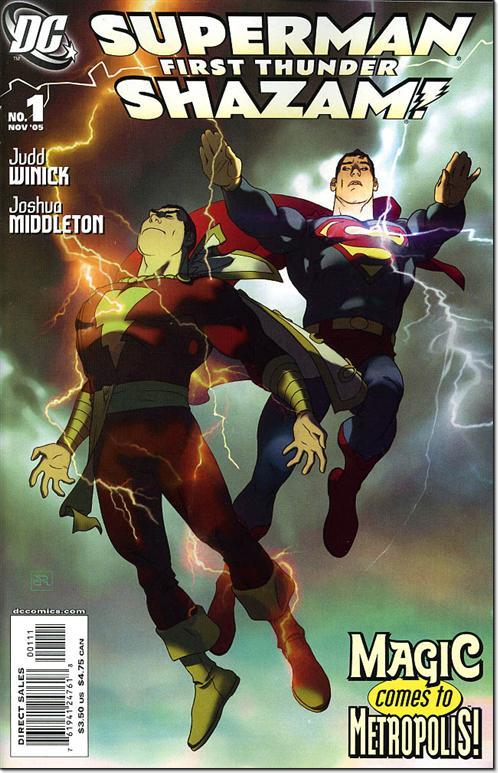
That image looks…familiar somehow.
Notes: In Adventures of Superman #546, Lois Lane has her first meeting with her new and improved husband. As glad as she is to see him okay, he’s just as angry when he sees that the Daily Planet’s inflammatory new columnist Dirk Armstrong has painted him as a menace…mostly because Clark thinks he was right. When word comes in that Dirk’s blind daughter, Ashbury, has been kidnapped, Superman races to search for her, only to get sidetracked when he’s attacked by his old foe Metallo, who wants to try his hand at facing the new Superman. Don’t worry about the kidnapping victim, though – Ashbury is rescued by Scorn, who she briefly mistakes for Superman. Liking the role of hero, Scorn puts on Superman’s old symbol as his own.
In Action #733, Superman just manages to escape from Metallo’s clutches by switching to his human form, but winds up injured in the process. Hoping to gain more control over his new powers he seeks out someone who has similar experience: the energy-hero called the Ray. After a few tips, Metallo rises again, and Superman figures out some new tricks to take him down. This is an interesting issue – Ray only appears on a few pages, despite getting a nice “guest-starring” credit and half the cover. But what he does here isn’t insignificant, helping Superman start to figure out his powers and even theorizing that the reason he has no powers in his human form is because he subconsciously is imitating humans as he sees them. I like the fact that Superman isn’t above going to a younger hero for help when he needs it, even one as relatively inexperienced as the Ray. It’s the sort of thing that works well as a character beat, showing how even-tempered and nuanced he is.
The battle with Metallo continues in Man of Steel #68, and courtesy of Jimmy Olsen, it gets a lot harder. At this period, Jimmy was working as a TV reporter for WGBS news instead of his traditional photographer gig, and desperate to stay on top of the ratings heap, he starts covering the Metallo fight and explaining Superman’s new powers based on information he got from Professor Hamilton. Metallo is monitoring the TV broadcast, though, and using Jimmy’s broadcast to change his tactics. Superman manages to beat him, but winds up spinning into space, having absorbed far too much energy.
After ending Man of Steel #68, Dan Jurgens makes the rather odd choice to begin Superman #124 after the crisis has been resolved, with Lois and Clark discussing how the Planet’s publisher, Franklin Stern, is angry over his frequent absences lately. Then Clark dives into a flashback in which he’s saved from dissipating into energy in outer space by the timely intervention of one of Jurgens’ favorite creations, Booster Gold. The rescue fries the armor Booster has been wearing for some time, though – actually, ever since his original super-suit was destroyed in battle with Doomsday. Superman brings Booster to Hamilton, who uses the leftover weave from Superman’s containment suit and combines it with the remaining future technology Booster brought back from the future with him, giving him a new suit that’s a bit more in line with his classic one. I love when you see stuff like this – Jurgens clearly wasn’t happy with how the writers that followed him on Justice League America changed Booster’s armor and used this opportunity to fix it a little bit.
This issue gives us a lot of advancement on several subplots as well. Jimmy kind of patches up his relationship with Lois and Clark, ashamed of how his broadcast had endangered Superman, just in time for Perry White to storm into the Planet office and announce that his cancer is in remission and demand his job back. In Kandor, the town’s rulers find evidence that the bottled city – which is actually out of phase in another dimension – is on the verge of destruction. And Scorn is drawn to Lois and Clark’s apartment, where he finds one of Clark’s old costumes.
Reading these issues this way, one after another, following the story for long periods of time, is really making me feel nostalgic for the Triangle Era in a way that not even the Death of Superman. I love having this quick progression of story, so unlike a typical monthly comic book story. Even right now, when the Superman comics are really good, this is a different feeling. It’s a feeling I like.
Ah, I wish we could get it back.
Thur., Sept. 4
Comics: Adventures of Superman #547, Action Comics #734, Superman: The Man of Steel #69, Superman Vol. 2 #125, Secret Six Vol. 5 (Super-Son)
The Atom only went along because Superman told him they’d go spelunking instead of skydiving.
Notes: Still adjusting to his new powers, in Adventures #547, Superman is alerted to the crisis in Kandor and decides to reach out to a hero with experience in size manipulation: the Atom. At this point, though, Ray Palmer had gone through an even more radical transformation than Superman, having been reduced in age to a teenager. He was currently the leader of a new, very different version of the Teen Titans in a book written and drawn by our old pal Dan Jurgens. Still, despite having a teenager’s body and attitude, he retained his memories, and as a former Justice Leaguer, jumps at the chance to work with one of the big guns. Hamilton journeys to the Fortress with the two heroes, and Superman and the Atom dive down into Kandor. Scorn, meanwhile, is wandering around Metropolis stalking Ashbury and carrying around the Superman costume he took from Clark’s apartment, seemingly trying to decide what he wants his path to be now that he’s free of Kandor.
Action #734 picks up with Ashbury reuniting with Scorn, although the blind girl is still under the misapprehension that he’s Superman. At that same time Rock – a villain Superman caught a few months back – breaks out. With Superman and the Atom in Kandor, though, Scorn takes care of Rock by himself, to the confusion of the SCU, who sees this horned, blue brute wearing Superman’s old costume. In Kandor, Superman and the Atom fight off some of the city’s peacekeepers who are still loyal to their original captor, Tolos, and a group of dissidents manage to attack the city’s environmental generator. The city is beginning to freeze, but that’s not even the real issue. They’ve got one hour to get the generator back online before everyone in Kandor suffocates to death.
In Man of Steel #69, Superman, the Atom, and a telekinetic local named Faern try to get to the generator to start it up again. But the generator is bombed, and in the explosion, Tolos is revealed to be alive and hiding in Faern’s body. He escapes and takes over Superman, which I’m sure you can imagine is inconvenient for everyone. Outside of Kandor, Scorn has crashed at Ashbury’s apartment, with the blind girl finally figuring out that he’s not actually Superman, but she befriends him anyway. When her dad shows up, though, he thinks Scorn is a menace and Scorn, not realizing Dirk is Ash’s father, leaps from the window with her in his arms. Perry White demands that Planet staff get to the bottom of the Scorn situation, and still more questions about Clark’s attendance issue are raised.
I bring up that last point mostly because I think it’s an interesting note for the character. One of the reasons for Clark choosing the job of a reporter is usually the notion that it will allow him to be absent frequently to act as Superman under the guise of “covering a story.” That might work if he’s gone for a few hours, but as we’ve seen in these books lately, his other job sometimes has to take him away for days, weeks, even months at a time. The excuses he (and later, Lois) come up with to explain his disappearances often strain credulity and are frequently lampshaded these days. All of this is just to say that things like this are why I like the interpretation of the characters that say Perry White knows – or at least strongly suspects – that Clark is Superman, because otherwise he’d never put up with this.
The Kandor story wraps up in Superman #125. Tolos, controlling Superman’s body, frees himself from Kandor and attacks Hamilton, who’s been holding vigil over the bottled city. But Hamilton manages to science Tolos out, sending them both – separately – back into the bottle. Superman manages to trick Tolos, trapping him in the “glass” of the bottle, which is actually an energy barrier containing the city in its pocket dimension. Reuniting with the Atom, the two heroes manage to fix the machines that maintain the city’s environment, and the story ends with Superman swearing to the people of Kandor to find a way and a place to release them from the bottle and set them free.
It sounds awfully familiar, actually.
The first extended team-up between Energy Superman and the Atom is an interesting glimpse at the characters and the time. Superman is still learning the ropes of his energy form, but he’s still essentially the same person at his core. The Atom, on the other hand, has his memories and powers intact, but the brashness and eagerness of a teenager. Almost every other page in these four issues includes a reference to him hoping to impress Superman enough that he’ll score an invitation into the newly-formed (at the time) Justice League. The story flows together the way the Triangle Era did, and although this version of Kandor has been excised from continuity, there’s some interesting stuff going on. I especially like Scorn – a character who looks like a monster but decides that, if he’s gonna be stuck on Earth, there are worse things to be than Superman. He’s not wrong.
Fri., Sept. 5
Comics: Adventures of Superman #548, Action Comics #735, Superman: The Man of Steel #70
“Why you electrocuting yourself? Why you electrocuting yourself?”
Notes: In an epilogue to last month’s adventure, Kandor is shifting its allegiance from Tolos to Superman. In fact, his shield (the current, electric blue one) is showing up as a graffiti tag on city walls. Superman tells the Atom he’d be willing to recommend the Atom to rejoin the League, but suggests he could be of more use leading the Teen Titans, which he decides to take as a challenge. Clark returns to the Planet and tries to excuse his absence by saying he was hunting down the story on the new Superman, to which Perry replies, “Which one?” But while working on the story, Lois drops a bomb on Clark that he hadn’t been made aware of before: that the electronic fabric in his new suit was supplied by Lex Luthor. He rushes to LexCorp Tower, suspecting Lex of being involved with his power change as he’s tried tampering with them in the past, but leaves when Erica fakes a problem with her pregnancy. And in a moment that’s chilling to any long-time DC fan, the Phantom Stranger pops in to tell Clark that there’s some great disturbance in the universe, something that may or may not be connected to Superman’s new powers. And the fact that he’s not sure should be pretty scary to anyone.
(Wait — has anyone told Booster Gold that HIS suit has LexCorp tech too?)
Action #735 brings us the return of Saviour, a delusional serial killer who wants to “punish” liars and fakes, and who doesn’t believe that Superman actually returned from the dead and is dedicated to killing the “imposter” using his name. Ashbury, meanwhile, has found a hiding place for Scorn in the abandoned pool at her school. When Scorn hears Saviour on the radio calling Superman out, he is determined to help. Superman’s new energy powers allow him to find a way to cancel out Saviour’s energy, taking him out, but he manages to slip away and vow revenge.
In Man of Steel #70 Superman and Scorn part as friends, but not before Superman tells the alien he has to bring Ashbury – a 17-year-old girl – back to her father. Although Ash protests, Scorn trusts Superman’s judgment, and she finally acquiesces upon learning her absence is taking its toll on Dirk’s health. WGBS, meanwhile, airs Jimmy’s interview with Hamilton about Superman’s new powers, despite the fact that it gave Metallo an edge in the fight, and this time Saviour picks up on it. With his reality-warming, he starts to mimic Superman’s new powers to get his attention. Scorn and even Bibbo get in on it, with Bibbo snatching a crib sheet Saviour wrote to keep track of what he learned about Superman’s powers. Superman and Scorn beat Saviour, but Jimmy’s relationship with his friends is damaged even further.
Jimmy could rarely catch a break during the Triangle Era. A running theme seemed to be him making a foolish mistake and then having one consequence after another stacked up on him like an enormous Dagwood Sandwich of Suck. It honestly could get a little tiresome after a while. These days we don’t see him quite as often as I’d like, but when we do, it’s usually more in the vein of the weirdness magnet that Matt Fraction (and, to a lesser degree, James Gunn) used him as. I prefer that.
Sat. Sept. 6
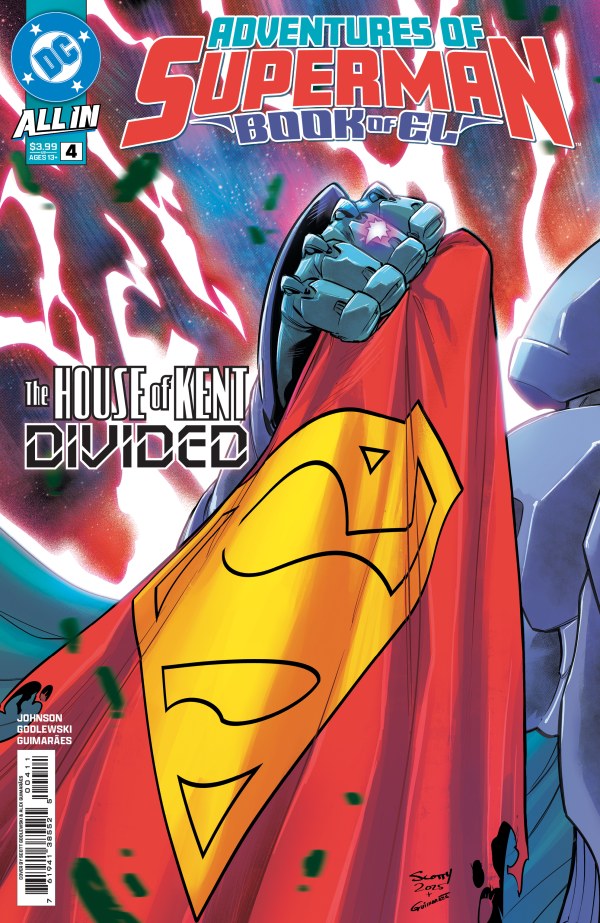
Comic Books: Adventures of Superman: Book of El #1, Absolute Superman #11, Justice League Vs. Godzilla Vs. Kong 2 #4
Notes: I’m taking a break today from the electric saga to pick into this week’s new Superman titles, starting with Adventures of Superman: Book of El #1.
🎶”Who wrote the book of El?”🎶 “I told you, Phillip Kennedy Johnson. Stop singing.”
This new miniseries is written by Phillip Kennedy Johnson as sort of the conclusion to his run on the Super-titles that followed Brian Michael Bendis’s run and lasted into the Dawn of DC era before he stepped aside. I had mixed feelings about his run. Coming off of the (ahem) previous writer it was inevitable that it would be an improvement, and there were certainly things about Johnson’s run that I enjoyed, but I ultimately got turned off. In this period, Johnson wrote about a Superman that was depowered on Warworld, and for most of that run, it was the only regular comic featuring Clark Kent. (The Superman title was sidelined and replaced with Jon Kent as Superman: Son of Kal-El.) I got burned out on Warworld eventually. Towards the end of the run I realized what the problem was – it was simply too long. A solid year of Superman on another planet and separated from Lois, Metropolis, and all the other elements that make Superman so great just didn’t work for me. In the Triangle Era they could have gotten away with it because a twelve-issue storyline would still only last three months, but 12 was too much. I greatly preferred the final section of Johnson’s run, after Superman returned to Earth and Action Comics became kind of a Superman Family title.
All that said, let’s look at what Book of El gives us. The story starts on a lazy day in Smallville, with the Kent family all together: Lois and Clark, Jonathan and Martha, Jon, and the adopted twins from Johnson’s run, Otho-Ra and Osul-Ra, who have ostensibly been living with Lois and Clark this whole time but who even the good writers of the modern Superman titles consistently forget about. Their idyllic afternoon is shattered by an attack by Kryl-Ux, an enemy from Warworld, leading an invasion force and – seemingly – hurling Superman into the future. On the last few pages Clark encounters Ronan Kent, a descendent of his from Johnson’s Future State comics, and the knowledge that he disappeared from Earth hundreds of years ago.
I really do like the way Johnson writes the whole Kent family together. He gives each character a voice that fits them, and his Lois and Clark interactions (so infrequent during his Warworld storyline) are excellent. The revelation at the end takes all the air out of the tires, though. Clark is missing for centuries? Presumed dead? And the invasion of Earth is successful? The whole thing may as well end with a big banner that says “THIS STORY WILL BE RESET AND THIS FUTURE WILL NOT HAPPEN.” By the end of this miniseries, I have absolutely ZERO doubt, something will happen that will eliminate the future of Ronan Kent from being a potential future. That doesn’t mean the story can’t still be good, but it excises the whole thing from consequence in continuity, and that hurts.
Brainiac doing his best Cryptkeeper voice: “What the matter, Kal? Got GORE-gia on your mind? HEEHEHEEHEHEHEHEEEE!!!”
In Absolute Superman #11, Kal-El is in the clutches of Brainiac, who is forcing him to experience hundreds of torturous simulations of the final days of Krypton with the intention of brainwashing him into becoming a tool for Ra’s Al Ghul. Despite some early success, though, Kal-El begins to resist the reprogramming. Meanwhile, Lois and Jimmy are captives of Talia, and find a very unexpected rescuer coming to their aid. This series is progressing a little slowly, to be honest, but this issue is solid. There’s a lot of action and great stuff with Kal-El and Brainiac, and I particularly like the way Jason Aaron is playing with [REDACTED] when that particular character comes to the rescue. Good stuff here.
Finally, we have Justice League Vs. Godzilla Vs. Kong 2 #4. The League is trying to recruit Godzilla to help with the current situation, but something in the other realm where Godzilla resides is preventing the Kryptonians from fully processing the solar radiation that powers them. To even the score, Mr. Terrific whips up a device that will temporarily make Superman kaiju-size…but at the same time, reduce his intellect to a point where he’s operating on pure instinct. That’s right: it’s Godzilla vs. Kaiju-Superman!
And somebody decided to go with a cover of a few random League members facing a water monster that doesn’t even appear in this issue. I swear, boneheaded movies like this are the reason I should be put in charge of comic books.
Sun., Sept. 7
Comic Books: Superman Vol. 2 #126, Adventures of Superman #549, Action Comics #736, Superman: The Man of Steel #71, Superman Vol. 2 #127
Clark had trouble making friends in this era.
Notes: It’s back to the electric era today, starting with Superman #126, in which our new electrified hero faces his Dark Knight buddy. Lex Luthor is planning his legal defense for his…well, trillions of crimes. But his scheme is to argue that he was somehow influenced by the Kryptonite ring that gave him cancer. Despite the fact that it might help Luthor, Mr. Truth and Justice Superman has no choice but to go to Batman and retrieve the ring. He returns it after some tests or run – or so he thinks. Luthor had one of his “scientists” pull a fast one, replacing the ring with a duplicate. Superman and Batman don’t know that the ring in the Batcave is a fake…but Luthor doesn’t know that Kryptonite no longer affects Superman in his energy form.
There’s an awful lot going on in this issue. In addition to the main plot I just recapped, there’s a great sequence where Superman saves the city from a plane crash, having to figure out how to use his new powers to do something that would have been relatively simple for the “old” Superman. Scorn is also convinced to abandon the Superman costume he’s been wearing and forge a name for himself. There’s good stuff there, but the actual Superman/Batman meeting is kind of a letdown. I would have hoped Batman would have more to say about Clark’s transformation, as this is presumably the first time they’ve encountered each other since it happened, but Batman barely seems to notice. It feels like those early Byrne issues where the two were tense rivals at best. Granted, they weren’t yet Superbesties again at this period, but as teammates in Grant Morrison’s Justice League, I would have expected them to be a bit more cordial to one another.
Adventures of Superman #549 stars with Superman forced to do something he didn’t need to do when he had hearing and vision powers: go on patrol. Instead of stumbling on Intergang, though, he winds up in the middle of a rumble between the Newsboy Legion and the Dingbats of Danger Street. No, really, those are actual comic book characters. Jimmy, meanwhile, is struggling to find some credibility after his recent struggles. He decides to check in on Lois and Clark, but arrives just as Intergang firebombs their building as a warning to Lois to back off. Superman evacuates the building, but is then forced to go back in as a powerless Clark to protect his identity. After spending the night in the hospital suffering from smoke inhalation, he goes to Professor Hamilton to ask if he’s discovered a way to restore his powers to normal, but Hamilton gives him the shocking news that this change seems to be permanent. Also at the end, Superman brings in yet another obscure group of DC kid characters to settle the issue between the Newsboys and the Dingbats, and Jimmy decides he’s going to resurrect his career by making one of the stupidest decisions he’s ever made in his entire life, and keep in mind that this is a man who once married a gorilla.
Action Comics #736: The mysterious shadowy figure who recently assembled a Superman Revenge Squad starts assembling…well…a new Superman Revenge Squad. He busts Barrage out of prison, then recruits Rock and the Parasite to his cause, with a promise of more to come. Clark, meanwhile, is depressed over the revelation that the change to his powers will be permanent. He heads to Pennsylvania on assignment for the Planet, only to get trapped in a coal mine collapse with a bunch of miners. The old Superman could get them out in moments, of course, but if he were to fire up his new electrical powers, he runs the risk of igniting the coal dust in the air and killing them all. This is the kind of story that they do every so often to prove that Superman is more than his powers – he’s actually got a brain, too. Clark finds a way to save everybody without his powers, because that’s what Superman does, no matter what costume he’s wearing.
Man of Steel #71 picks up on the Jimmy Olsen Bonehead Show. After the incident at the apartment, Jimmy is convinced he’s figured out Superman’s secret identity, and the rest of the crew at WBGS news is trying to convince him to pursue and report it. But at the same time Bibbo, who punched Jimmy out a few issues ago for his LAST boneheaded move, gets back in the boxing ring and wins, then surrenders his title as penance for hitting Jimmy. Somehow this is enough to cause a moral quandary in a man who should have NO moral quandary about the question of WHETHER OR NOT TO RUIN THE LIFE OF HIS BEST FRIEND, JAMES BARTHOLOMEW OLSEN, WHAT IN THE NAME OF NERON ARE YOU THINKING?
Ahem.
Also, the mysterious recruiter picks up a new villain, an electrical woman named Baud, to join his new Revenge Squad, and his identity is revealed as…Morgan Edge. It’s not the most dramatic reveal, honestly, but it tracks. He sends them to fight Superman, because that’s what he does.
And in Superman #127, Superman narrowly escapes the Revenge Squad as they start to fight amongst themselves. Superman lets the Parasite take out the other three, then bounces in and reverses things on his magenta rival, defeating him by using his new powers to suck the excess energy from him and leaving him helpless. Then, Lois and Clark get a visit from Jimmy, who asks their advice on whether he should pursue the story of the century, even if it will get someone “really mad at him.” Clark, being Clark, tells him that the truth is the most important thing, and Jimmy leaves renewed in his determination to blow Superman’s secret identity, because they are really writing him as unforgivably stupid at this point in the series. Honestly, I’d forgotten about all this. Jimmy. James. Jimothy. What the hell, dude?
Mon., Sept. 8
Comics: Adventures of Superman#550, Action Comics #737, Superman: The Man of Tomorrow #9, Jon Kent: This Internship is My Kryptonite #7, Justice League of America #28
Or “The Adventures of Superman’s Stupidest Friend, Jimmy Olsen.”
Notes: Jimmy’s giant bonehead extravaganza comes to a head in the “double-sized anniversary issue” Adventures of Superman #550. As he prepares his news special in which he plans to reveal Superman’s identity, he tries to justify it in his head by saying that, without his hearing and vision powers to alert him to danger, Superman’s identity being public would make it SO MUCH EASIER for people to come to him for help, displaying the kind of mental gymnastics that wouldn’t be associated with Superman again until Zack Snyder fans started to desperately try to pretend that the James Gunn movie wasn’t successful. Jimmy invites Lois and Clark to the taping of his special, along with two other guests: former football pro Johnny Dakota and Newstime magazine publisher Collin Thornton, both of whom also happen to live in the same building as our happy couple. Lois storms out of taping as Jimmy reveals what’s up his slave, but Clark instead gives Jimmy a kind but firm dressing-down about how Superman wouldn’t do anything to hurt anybody. The speech doesn’t fall on deaf ears, but Jimmy realizes it’s too late to back down now, and so on live TV he announces that Superman’s secret identity is…NOBODY!
Okay, he did the right thing in the end, but Jimmy B. Olsen comes across – both in-universe and to the reader – as one of the dumbest characters in the entire DCU.
Predictably, he gets fired from WGBS and he decides to take a little time off, even keeping the truth about Superman’s secret to himself…that Superman is really, of course, Collin Thornton.
I dislike this take on Jimmy so, SO much. I’ve talked before about how I prefer it when characters are played to the top of their intelligence, and this is as far from that as it could possibly go. Not only does Jimmy completely miss every clue that Clark is, in fact Superman, a fact that even a child could infer from the speech Clark gives him in this issue, but his emotional intelligence would have that same child look at him in disgust. One of my favorite bits of the new movie is the scene in the end, where Perry White and Jimmy Olsen quip about how long Lois and Superman have been hooking up. The scene can be read one of two ways: either they know Lois is involved with their biggest headline, OR they know that Lois is involved with Clark and that Clark happens to be Superman. There’s been quite a lot of chatter online about this, and personally, I prefer the latter interpretation, much for the same reason that I believe that James Gordon knows that Batman is really Bruce Wayne – he’s just too smart NOT to have figured it out, but he knows it’s best to keep it to himself. THAT’s the Perry and Jimmy I want to read about.
Not this assclown.
But as it turns out, the dumbification of Jimmy Olsen wasn’t over yet. Action Comics #737picks up the thread, as (in an issue by guest writer Mark Waid) Olsen is attacked by Intergang, who isn’t buying his claim that Superman has no secret identity, and they’re ready to get the truth out of him. Jimmy just barely manages to escape – in only his boxers, which only serves to deepen his public humiliation when he’s picked up by the police. It just gets worse when the people who bail him out turn out not to be family or friends, but the same Intergang agents who were after him before. Meanwhile, at Lex Luthor’s trial, Lex’s lawyer argues that Lex, while dying of Kryptonite radiation, was saved by one of his research team, but lay comatose for months, only coming out of it shortly before the Final Night crisis. The real criminal was his clone, “Lex Luthor Jr.” (which is technically true, if you ignore the fact that Junior was just Lex’s brain in a younger body). The real kicker, though, is when the defense actually produces the clone – now aging, infirm, and raging in court. The judge, reluctantly, allows Lex to go free.
There are a couple of good bits in this one, even as Jimmy continues to act like a bonehead. First, after Lex’s trial, a snide and confident Lex Luthor informs his lawyer that everything he just said in court was bupkis, he was indeed the one responsible for the “clone’s” crimes, and he’s about to go launch a plan to destroy the Justice League which the attorney can’t tell anyone about due to attorney/client privilege. It’s just the kind of utterly arrogant thing that makes Lex such a delicious villain, and Waid sells it nicely. Another good bit is at the end, when a desperate Jimmy turns to Bibbo for help. The same Bibbo who punched Jimmy out for his jackass behavior not that long ago comes to his aid because, in his own words, “We’re both pals o’ Superman, and dat’s a pretty solid brotherhood.”
The world needs more Bibbo Bibbowski in it.
A quick note about the next book I’m going to be reading, Superman: The Man of Tomorrow #9. During the “Triangle Era” we had four monthly Superman comics, which equaled 48 issues of Superman a year. As you may have heard, though, years actually have about 52 weeks. Comic books come out on Wednesday, and roughly four times a year you get a month with five Wednesdays in it instead of four. DC decided to fill in these gap weeks with Man of Tomorrow, a bonus title that only appeared in these missing Wednesdays. It was a fun idea, but they rarely added anything substantial to the ongoing storyline (I suppose DC knew that even with a triangle on the cover some people would skip it) and eventually it was phased out in lieu of DC’s “fifth week” events, where they’d fill Wednesday #5 with a series of themed one-shots like Girlfrenzy or New Year’s Evil.
Anyhoo, Man of Tomorrow #9 is kind of the perfect expression of this series. It’s a one-off story in which Jonathan and Martha – talking about their son’s recent transformation – run down all of the other trials and tribulations he’s faced over the years. The book is really nothing but a condensed history lesson of all the main storylines that had happened to the character in the decade since John Byrne’s Man of Steel reboot, which is kind of an odd choice for a book they’re afraid would only be purchased by the most intrepid of readers, because they would be far more likely than the casuals to already know all of this stuff. The cover is pretty misleading too, with a banner that proclaims “The Secrets of Superman’s Costume!” Spoiler alert: there are absolutely no secrets in this book, just a parade of Superman’s history with a visual focus – courtesy of artists Paul Ryan and Brett Breeding – on the assorted different costumes and appearances Superman had over the years. We got glimpses of pretty much everything, from the armor he wore during Krisis of the Krimson Kryptonite to the circus strongman getup from Time and Time Again to the battle suit Mother Box gave him in Superman/Doomsday: Hunter/Prey. In fact, if I were a toy manufacturer looking to do a really comprehensive line of figures featuring every different getup Superman ever wore, this book would be a pretty valuable resource for this time period. As a story it’s cute, but kind of a throwaway.
Tues., Sept. 9
Short Film: Superman 75
And he doesn’t look a day over 87.
Notes: My original plan for today was to read the Superman annuals that featured ol’ Electric Blue, but September 9th turned out to be one of those days that just gets away from you. I had my hands full with various things, and by the time I’m writing this at nearly 7:30 pm, I haven’t had a chance to indulge in any Superman content. It’s time to play one of the little “emergency cards” I had planned out at the beginning of the year – a quickie I could sneak in on a day like this one, when time is of the essence and I might not have another chance to keep my streak alive. Today I chose Superman 75, a two-minute animated short directed by Zack Snyder and Bruce Timm to celebrate Superman’s 75th anniversary back in 2013.
Say what you will about Snyder (and at some point, before the year ends, I intend to do so), but this short really does show a respect for the character of Superman. In two minutes, Snyder and Timm craft a wonderful little visual retrospective of Superman’s 75-year history, which I still can’t believe was already 12 years ago. I hope DC has some plans in place for year 90, it’s going to be here before they know it.
Anyway, over the two minutes of the short – which is mostly set to the classic John Williams score — we start off with an extreme close-up of the S-shield from the cover of Action Comics #1, which then springs to life and then begins evolving through the various ages of the character. At turn, we see glimpses of the Fleisher Superman, some Golden Age comics, George Reeves, the proliferation of new heroes and villains that joined Superman in the Silver Age, a glimpse of the Super Friends, a dip into the 70s when Superman boxed Muhammad Ali, the death and return, the electric era, the Animated Series, Smallville, Kingdom Come, and the New 52 (WHEW!) before the short finally wraps with a glimpse of Henry Cavill in that first promo shot we ever saw of him, where Superman was standing in the rubble of what looked like a bank vault. For the last segment the music shifts to the Hans Zimmer score, paying what I still think was a suitable tribute to the character as he was at the time.
I’ve watched this cartoon probably a half-dozen times since it was first released, and I enjoy it every single time. It’s a nice visual history of my favorite hero, and it’s the sort of thing I’d like to see them revisit and update every so often. But when I watched it on my laptop this time, something interesting happened. My son, Eddie, heard the now-familiar strains of the John Williams music coming from the computer and asked what I was watching. So I had him sit on the couch next to me so we could watch it together. As we went through the short I briefly informed him which eras we were passing through, and he thrilled at the appearance of Krypto during the Silver Age segment. Of course he did – we all love Krypto. If James Gunn throws Beppo into the Man of Tomorrow movie, I’ll show this short to Eddie again and he’ll go wild over that.
Assuming I have a little more time tomorrow, I’ll get around to those annuals, and then continue on my journey through Superman’s electrical era. Until then, friends!
Tomorrow, September 6, is National Read a Book Day. This holiday, designated by the American Institute to Come Up With Holidays Until We’ve Filled Every Day of the Calendar Year Twice Over, is legally and trademarkably different from National Book Lover’s Day, which happened on August 9. You see, Book Lover’s Day was a celebration of the people in your life who love books, which is why I received so many boxes of candy and bouquets of flowers that day. National Read a Book Day is the day in which you are to pick up a book and read it whether you like it or not, or else hamsters will crawl out of your closet at night and nibble your earlobes off.
Read a book or I’ll break your kneecaps.
Or something like that, I admit, I didn’t read too deeply into the website where I saw this holiday listed. But a day dedicated to books is a good thing, regardless of any rodentia-based nocturnal terrors that may or may not exist but definitely do. As a teacher, I spend my day with teenagers and, perhaps more tellingly, with samples of their writing. And I’ve got to tell you, ANYTHING that exposes our young people to more competent volumes of prose is not only a good thing, but necessary for my personal mental health. When I assign essays, I constantly get back papers without indentations, without punctuation, with words like “because” and “you” shortened to the totally efficient and time-saving “bc” and “u.” I know the reason is that a lot of these kids don’t spend any time at all reading things longer than a text message, the majority of which are composed by OTHER kids that don’t spend any time reading anything longer than a text message. That’s not just a shame, but it’s DANGEROUS for their cognitive capabilities.
Not long ago, one of my students attempted to debate me on the necessity of punctuation. As in, she didn’t think we needed any punctuation at all. Her argument, which I swear upon the ghosts of Merriam AND Webster, was that “we shouldn’t have punctuation because people should just be smart enough to know what everyone is saying.”
I want all of you to remember that next time your local government calls for any sort of vote that would give teachers a raise.
My reply, and I paraphrase, was twofold. First of all, if your argument is contingent upon everyone in the world suddenly becoming much more intelligent than they currently are, it’s time to change your argument, because you’re failing as badly as someone with a business plan that includes “after I win the lottery.” Second, punctuation exists in order to make writing more understandable. That is literally its function. To prove my point, I found an image online of some old text before punctuation was invented.
This isn’t what it looked like, but it may as well have been.
“It wouldn’t look like THAT!” the student wailed.
“Well of course not, this is calligraphy from nearly thousand years ago, because that’s how long it’s been since we realized that punctuation is necessary.”
The thing is, arguments like this would typically be avoided if the person who institutes them simply had an appreciation for the written word. And I know it makes me sound like an old crank (which I am), but there isn’t enough of that these days. Recreational reading – after several years of increasing – seems to be on the decline again. Even short-form reading is under attack. People turn to videos on YouTube or TikTok instead of written analyses of anything. And I don’t mean to criticize people for having personal tastes on anything – if you would rather watch a video essay than read a written essay, that’s certainly your prerogative – but if I’m trying to find instructions for home repair that would take about 30 seconds, I don’t want to have to watch a four-minute video begging me to subscribe to somebody’s channel before I get to it.
“I’ll show you how to replace a flange, but you’re gonna have to WORK for it.”
If you’re the sort of person who reads my little Geek Punditry columns, you’re probably NOT the sort of person who needs anyone to convince you that reading books is a good thing. I imagine the Venn Diagram of people who appreciate books and people who like reading to me ramble on about Star Trek has an awful lot of overlap. But maybe tomorrow you can do a little something to try to recruit somebody else. Suggest a book to a friend. Take your kids to the library. Do a post on social media about the last book you read and enjoyed. Anything that makes reading a little bit more visible and reminds people that – hey – it’s cool, too.
And a few things to remember:
Reading is inclusive. And I don’t just mean in subject matter (although I do mean that), but also in format. It drives me crazy when I hear someone say that audiobooks aren’t “real books.” Just because you’re not looking at a page doesn’t mean you aren’t processing the information in the book, and the actual mental process is the most important part of the whole thing. People forget how relatively recent it is, in the history of the human race, that literacy has been considered NORMAL. Only a couple of hundred years ago the percent of people who even COULD read, let alone DID read, was only a fraction of what it is today. And yet these people still knew stories from history, from folklore, from the Bible, from classical mythology. How? Because other people TOLD them these stories, and they listened. And that makes audiobooks as valid as any other form of reading.
This is what I look like in the car.
Graphic novels and comic books, similarly, are “real” books. And while I don’t ONLY mean the American superhero comic book, I don’t EXCLUDE them either. Comic books, in general, have a higher percentage of unique words per hundred than most prose novels aimed at a similar reading level. They activate all the same mental processes as a book that’s only words. And most importantly, they give the reader things to delve into that may lead them to other books. I started reading comics at a young age. It was the stuff I read in comics that led me to other writers like Isaac Asimov and Ray Bradbury. From there I moved on to Mark Twain, Ursula Le Guin, Daphne du Maurier, Dave Barry, Orson Scott Card, L. Frank Baum, Edgar Allan Poe, Judith and Garfield Reeves-Stevens, Stephen King, and pretty much every other author I have ever read in my entire life. I started with Stan Lee, now I teach Shakespeare. It all helps.
And finally, nonfiction also counts. While, to be fair, I certainly PREFER reading fiction when I’m reading for pleasure, that doesn’t mean that someone who’d rather read a book about World War II military campaigns, the lives of the greatest players of Major League Baseball, or migratory patterns of Canadian geese isn’t still reading. It’s all reading. It’s all good.
In fact, it’s all great.
So tomorrow, grab a book, grab somebody to read with you, and join the celebration. National Read a Book Day may only come once a year, but books are forever.
Blake M. Petit is a writer, teacher, and dad from Ama, Louisiana. His most recent writing project is the superhero adventure series Other People’s Heroes: Little Stars, volume one of which is now available on Amazon. You can subscribe to his newsletter by clicking right here. He’s also started putting his LitReel videos on TikTok. If you happened to want to read one of HIS books tomorrow, that would be nice, but it’s not a requirement.
When I started the Year of Superman back in January, I decided early on that I wasn’t going to spend the entire year reading stories from the “Triangle Era,” even though that is hands-down my favorite period of Superman comics. I did decide, though, that I would allow myself two indulgences. I would give myself a few weeks to delve into the epic and game-changing Death and Return of Superman storyline in the early part of the year. Then, later, I would allow myself to read the longer and more divisive saga of “Electric” Superman. The period where Superman’s powers and costume changed so radically was a major point of contention for a lot of readers at the time, although I feel that — like many stories of the era — it is looked back upon more fondly than it was initially received. But I have never gone back and read that era as a whole since it first came out.
I think it’s time.
That said, there’s a question that must be answered: exactly WHEN does this saga begin and end? It’s not as cut-and-dried as the Death of Superman, beginning with Doomsday’s appearance in Man of Steel #18. This story doesn’t begin in the issue where he gets the new costume. Superman’s power change is at least partially a result of an attempt to restore his powers after they are lost during the Final Night crossover. And after he is returned to “normal,” that issue ends with a cliffhanger that dovetails into a time-travel adventure against the villain Dominus that lasts several months before things are finally reset. Along the way he participates in more than one crossover event, is a regular member of the Justice League, and makes multiple guest appearances in lots of comics, including the Ultimate Access miniseries I read last week. All told, were I to read EVERY comic book with Electric Superman, it would be more than double (possibly triple) the number of issues in the Death and Return saga. That’s a LOT.
So here’s what I’ve decided:
I’m going to read all of the issues of the regular Superman titles from the beginning of Final Night to the end of the Dominus storyline. I’ll read the main issues of any crossover in which Electric Superman appears, as well as crossover chapters in which Superman or members of the family appear. I’ll also read the annuals with Electric Superman. I’m going to skip the JLA issues, because after all, it’s part of Grant Morrison’s run and that whole thing is really one massive story in and of itself. And I’m not going to get into every guest-appearance he makes just because I think it would be a pain to try to track them all down, but I reserve the right to sneak one in if I really want to.
Even shortened like this, it’s still going to be the single largest endeavor of the Year of Superman. And I’m kind of excited to get into it.
All of this is to say, buckle up. It’s time to get sparkly.
Comics:Final Night #0-4, Power of Shazam! #20, Superman Vol. 2 #117, Adventures of Superman #540, Supergirl Vol. 4 #3, Action Comics #727, Superboy Vol. 3 #33, Legion of Super-Heroes Vol. 4 #86, Superman: The Man of Steel #62, Green Lantern Vol. 3 #81
Notes: It was a weird time in DC Comics. Hal Jordan had gone mad after the destruction of Coast City and took on the villain name Parallax following Zero Hour. Kyle Rayner was Green Lantern. Half of the Legion of Super-Heroes was stranded in the 20th century. And Lois Lane had ended her engagement to Clark Kent. Then, as if things weren’t bad enough, some idiot turns out the lights.
In The Final Night, by Karl Kesel and Stuart Immonen, an alien identifying herself as Dusk crashes her ship into Metropolis, where she is confronted by Superman, the Special Crimes Unit, and the time-tossed Legion of Super-Heroes. Dusk warns that a Sun Eater is approaching Earth, and that she has rushed ahead of it from world to world, trying to save people from its devastation, but thus far she has always failed. Superman quickly rallies the world’s heroes (and even some of the villains – they’ve got just as much to lose if the sun is eaten as the heroes do) and they take to space to try to stop the Sun Eater, but despite their best efforts, at the end of the first issue, Earth’s sun is consumed and the world is plunged into darkness.
Issue two begins in rather dramatic fashion, when Lex Luthor – who has been in hiding – appears to offer his aid to the Justice League and Earth’s heroes in saving the world, including a powerful splash page of Superman and his worst enemy shaking hands in the face of a common threat. Meanwhile, the worlds’ heroes are in overdrive trying to protect people both from the drastic climate crisis as well as from each other. It soon becomes apparent, however, that with the sun gone, Superman’s powers are declining rapidly. Amidst all of this a new hero appears: a young man calling himself Ferro.
In issue three things go from bad to worse. Turns out the sun isn’t actually GONE, but cut off inside the Sun Eater, where it’s trying to heal itself, but Luthor and Brainiac 5 realize that they have less than 24 hours left before the sun goes hyper-nova, wiping out everything in the solar system. Dusk makes plans to leave Earth before the end, as she has so many times before, but the Phantom Stranger takes her on a whirlwind Ebenezer Scrooge-like tour of the Earth, allowing her to witness our heroes’ refusal to give up, even in what is literally the darkest of hours. And as everyone begins making preparations for the bitter end, Guy Gardner is surprised by the appearance of a bright, beautiful green.
Final Night #4 brings us to the brink. Luthor and Brainiac 5 have constructed a series of force-field bombs they believe will contain the nova and destroy the Sun Eater, but their chosen pilot, Green Lantern, disappears. Superman insists on going himself, and takes a moment to write a farewell letter to Lois, from whom he was estranged at the time. As he’s writing, through, Ferro steals the ship with the intention of making the suicide run on his own. As they try to stop him, Parallax arrives and offers to save the sun. Despite the reservations of some of the heroes (especially Batman), he does so – at the cost of his own life. Hal Jordan, once and future Green Lantern, falls as he dispels the darkness within.
The end of the story doesn’t quite hit the same now as it did in 1996, knowing as we all do that Hal would eventually return and become Green Lantern again. But as a way to end the arc he had been on since the Death of Superman it was fitting. Also fitting was the reaction of the other heroes: Superman chooses to believe that Hal Jordan found redemption in the end for the atrocities of Parallax, whereas Batman believes a moment of good at the end can never erase the slate. It says quite a bit about each of these heroes, and the book seems to recognize that. At the end of the issue, as Clark and Bruce debate Hal’s sacrifice, Karl Kesel writes a caption that has always stuck with me: “They are the world’s finest heroes, and all the rest follow the lead of one or the other.”
It’s an interesting perspective on the philosophy of the DC Universe, isn’t it?
Let’s talk for a moment about the assorted spin-off chapters. As I said, I didn’t read all of the assorted spin-offs, only those featuring Superman or a member of the family, but that still added an additional nine books to the five-issue main series. I’ll hit the high points in order, as dictated by the reading list on the DC Infinite app:
Power of Shazam! #20: As the weather begins deteriorating with the loss of the sun, Superman and the Marvels go into first responder mode while the wizards Shazam and Ibis try to find a magical solution to the problem. Superman’s presence here is minor, but there are interesting notes. First, this happens right after the sun is lost, so Superman’s powers are only beginning to wane. Second, there’s an amusing moment where Captain Marvel promises Superman “I won’t be distracted like when I faced that Thunder God,” a funny and oblique reference to the events of DC Vs. Marvel.
Superman #117: This one is a cheat. Despite the banner on the cover, it’s not really part of the crossover. The issue wraps up an ongoing story with Superman and Professor Hamilton in the Fortress of Solitude and advances a few subplots, but it only ties in to the Final Night on the last few pages, when Superman receives word that something is approaching Earth. If you’re doing a readthrough of the story, this is utterly skippable.
Adventures of Superman #540: Perry White fights valiantly to put out an edition of the Daily Planet, reasoning that failure to do so would be like giving up and admitting defeat. Emil, still in the Fortress of Solitude, starts transmitting his own research to S.T.A.R. Labs in an attempt to help. And in Metropolis, as Superman’s powers continue to dwindle, Ferro gets a rather heartbreaking origin. The Perry stuff is great, and the Ferro stuff sets the character up nicely for his future with the Legion.
Supergirl #3: Peter David’s epic run was interrupted pretty early by this crossover appearance. Supergirl (this is the Matrix version, remember), has very recently found herself bound to a mortal girl named Linda Danvers, and in her new home of Leesburg, people are beginning to fall apart as they beg for the return of the sun. The issue is mostly spent developing subplots for the series in the context of the crossover, and skippable if you just want to read Final Night, but it reminds me as always just how good David’s run on this character was. I may not be able to fit it in before the end of the year (it’s a total of 80 issues, plus assorted crossovers, annuals, and specials), but so, so worth reading.
Action Comics #727: A somewhat quiet, subdued issue. As Metropolis is blanketed with snow, a Superman whose powers are nearly gone struggles to keep the peace. Meanwhile, a desperate man finds new hope. Inconsequential to the main story, but this is actually one of those times where I really feel a crossover event works well, telling an emotional self-contained tale against the backdrop of the greater events.
Superboy #33: In Superboy’s home of Hawaii, people are gathering at the base of an active volcano for warmth. Roxy Leech, his manager’s daughter and Superboy’s best friend, decides that with the world ending in 24 hours there’s nothing left to lose and confesses her love for him, which is kind of awkward, as his girlfriend Tana Moon is on TV reporting on the crisis just as the volcano erupts. Turns out it’s a monster with the inventive name of Lava causing trouble. The ending here is particularly bittersweet, and surprisingly effective.
Legion of Super-Heroes Vol. 4 #86: Ferro proves his mettle (get it?) by offering to dive into the sun with an enormous bomb to get it going again. Luthor and Brainiac already have devised their plan to send Green Lantern instead, though, but when he mysteriously vanishes (whisked away by Parallax, as it happened), Superman steps up to do it instead…something that doesn’t sit too well with Ferro.
Superman: The Man of Steel #62: An interesting little side-trip. Almost de-powered, Superman tries to help a power plant stay functional to keep people from freezing in the dark. Meanwhile, Hamilton discovers that imminent destruction of the sun and sends word to the Daily Planet, while learning about the last days of Krypton and how eerily reminiscent they are of the current situation.
Green Lantern #81: An epilogue to the Final Night story featuring the funeral of Hal Jordan. Kyle Rayner is nervous, finding himself in the position of being asked to speak the death of a man he never met until he turned bad. Superman begins the ceremony, calling Hal a hero, before calling up other speakers who knew him best: Guy Gardner, John Stewart, Black Canary (speaking in the stead of the also dead-at-the-time Oliver Queen), the Flash, Carol Ferris, and finally Kyle. The heroes travel to the Coast City memorial, where Alan Scott turns the eternal flame green, and then Swamp Thing (making a rare non-Vertigo appearance for the time period) brings life back to the desolated landscape. In the end, even Batman finds it within himself to forgive.
A lovely story, although of course, it wouldn’t be the end at all. Nor is it the end for Superman because – as you may have noticed – I haven’t mentioned anything about his powers coming BACK yet. After the sun was restored, he – and everyone else – assumed his powers would go back to normal. But as we’re going to see soon, that isn’t what happened at all.
Thur., Aug 28
Comics: Superman Vol. 6 #29, Justice League Unlimited Vol. 2 #10, Justice League: Dark Tomorrow Special #1, Green Lantern Vol. 8 #25 (Superboy Guest Appearance)
Notes: Gonna take a quick pause from the burgeoning Electric storyline to read some of the new Superman comics that dropped this week. Superman #29 continues the “Legion of Darkseid” story as Superman plans a trip to the future to save the Legion of Super-Heroes with the most unexpected partner of all time.
It’s going to be hard to talk about this issue – I don’t really want to spoil anything, so can I just talk about vibes? As in, “I freaking love the vibes from this book”? Superman going into the future to save the Legion is exactly what I’ve been thirsting for. What’s more, writer Joshua Williamson is showing respect for EVERY incarnation of the Legion to date, weaving them all into this story (somehow) whilst still tying everything in to the ongoing “DC All In” saga. Again, without spoiling anything, if you haven’t read last year’s DC All-In Special or the Summer of Superman Specialthat came out in April, you’re missing out on the building blocks of this story. Superman even gets one of his trademark rousing speeches in which he espouses exactly what I’ve always felt is true: he may have been the inspiration for the Legion, but the Legion was every bit as much an inspiration to HIM.
Despite the darkness of this story, something about it is feeling…right. It rings true. And by the time the tale ends and the dust has settled, I feel like we just might finally have a true Legion again.
Justice League Unlimited #10 actually takes place before the “Darkseid’s Legion” storyline, and involves the League trying to protect the Doomsday Time Trapper, who feels the encroachment of Darkseid and his Legion. Meanwhile, the Trinity have a little heart-to-heart about what happened with Air Wave (the whole “tricked by Grodd” thing) and how they need to approach Justice League recruitment in the future. As always, Mark Waid proves just how well he knows these characters, placing Superman and Batman at odds with one another on this matter, with Wonder Woman as the mediator between the two. Clark also gets in a pretty sharp jab at Bruce, which I don’t think he gets to do quite often enough.
Also, Dan Mora drew both of these issues, and he’s phenomenal. Really, any time these days I read a comic book where I don’t feel the artwork is up to snuff, I wish that they could clone Mora and have him do all of it.
I also read the Justice League: Dark Tomorrow Special, which came out a few weeks ago but, somehow, I’d missed. I’m glad I grabbed it, though, because it feels pretty significant to this whole All In/Darkseid story that’s going on. Someone is hunting down and killing time travelers, which puts roughly half the Justice League at risk – especially those time-lost heroes from the “We Are Yesterday” crossover. A mysterious time-traveler calling himself “Legend” partners up with Air Wave and the lost heroes to try to save them. The issue is both an epilogue to “We Are Yesterday” and a prologue to future stories (including “Darkseid’s Legion” and the upcoming “DC KO”), and although the Super-family participation is minimal, it definitely feels significant, and if you’re following the ongoing saga of the DCU these days, you should pick it up.
Fri., Aug. 29
Comic Books: Superman Vol. 2 #118, Superman: The Wedding Album #1
Notes: I only briefly mentioned it when I read Final Night the other day, but at this point Lois and Clark were separated, she having called off their engagement and taken an assignment in Asia to get away from him. It was a bit of a delaying tactic – Warner Bros wanted corporate synergy and refused to allow DC Comics to have the two of them get married until they were also married on the then-running Lois and Clark: The New Adventures of Superman TV show. It was actually that edict that led to the Death of Superman in the first place, when they had to scrap their plans to marry them off in 1992. Here, four years later, after one delaying tactic after another, they finally got married on the show, and DC had to quickly follow suit.
In Superman #118 we pick up on her, chasing down a heroin ring in the far East. Back in Metropolis, meanwhile, S.T.A.R. Labs is working on the fact that, despite the sun coming back, Superman’s powers are still gone. After a seemingly-pointless reiteration of his origin, Wonder Woman and Lori Lemaris convince Superman to try to get Lois back. Lois, meanwhile, encounters a young man who tells her a lesson he learned as a child from an American stranger. It’s pretty clear where this is going from the very beginning, but Lois is still taken by surprise when she learns who her new friend’s old friend happens to be, and she makes a decision to return to Metropolis. Short? Abrupt? Hell yeah. But DC wasn’t given a lot of time to get things back in order – they needed to have the wedding of the century align with the TV show.
And this brings us to Superman: The Wedding Album, an event nearly 60 years in the making. This 88-page whopper told a hefty tale written by the five writers of the Superman comics of the era (Dan Jurgens, Karl Kesel, David Michelinie, Louise Simonson, and Roger Stern), with art by the regular teams and several other artists who had worked with Superman over the years, including John Byrne, Gil Kane, Paul Ryan, Tom Grummett, and a flashback sequence using pages by the great Curt Swan. It’s a nicely fitting tribute to the characters, kicking off with Lois being Lois – pretending to want to marry the head of the drug trafficking ring as a way to both bust him, at the same time, hitch a ride on his private jet back to Metropolis. She storms into the Daily Planet office wearing a ragged and torn wedding dress, then has it out with Clark. He fills her in on what’s been going on in her absence: he’s acting as Managing Editor of the Planet while Perry recovers from chemotherapy, oh yeah, and his powers are gone. (There’s a particularly funny line here: “Remember when the sun went out a while ago, Lois?” As if that’s the sort of thing a person could just forget.) The sequence ends with the entire Planet staff crowding around, trying to peek through the door, and seeing the two of them in an embrace, back where they belong.
The bulk of the special, after that, is all about wedding preparations: Lois’s bridal shower, the happy couple picking out their dress and tux, and house-hunting. And while it’s all fairly normal, non-superhero stuff, the writers manage to really infuse it with character. Lois’s mom is desperate to control things while her father makes no effort to disguise his distaste at his daughter’s choice of partner. Clark’s parents, meanwhile, do their best to play mediator. A fight breaks out at the Ace O’Clubs during the bachelor party, and Clark gets a visit from a friend to tell him that Metropolis will be taken care of during his honeymoon. Oh yeah – and the apartment that Lois fell in love with but couldn’t get is now theirs, courtesy of the building’s owner, one Bruce Wayne.
I’m really glad that they avoided the typical superhero wedding episode, where the ceremony is disrupted by a villain causing havoc or some natural disaster. The closest thing we get is Mr. Mxyzptlk popping in right before the blessed occasion to tell Clark he’s looking forward to screwing around with Mr. and Mrs. Kent very soon. Then it all closes off with a nice, simple, uneventful wedding that is heartfelt, sincere, and lavishly illustrated (with several members of the creative team in attendance).
It’s a sweet issue, one that finally puts the will they/won’t they of six decades to rest and allows us to move on to something new.
Turns out they were saving the chaos for the honeymoon.
Sat., Aug. 30
Podcast: Back to the Bins Episode #685: Superman S.C.O.R.E. III
Notes: It’s finally here! Regular blog readers may recall a while back when I joined Paul Spataro to record an episode of his Back to the Bins podcast, each of us discussing comics about the relationship between Superman and Wonder Woman. The episode has finally dropped, so make sure you check it out. It’s available on the Two True Freaks Podcast Network page, or you can find it on Spotify, Apple Podcasts, or wherever you download your podcasts. Join us for a chat about this unique super-couple.
Comics: Taste of Justice #6, Adventures of Superman #541, Action Comics #728, Superman: The Man of Steel #63
Notes: A quick peek at Taste of Justice #6 – a short but fun story in which Martha Kent is injured (mildly – this series seems to specialize in minor mishaps most of the time), leaving Clark and Jonathan to try their hand at making her famous rhubarb pie. Interestingly, whereas most chapters of this online serial comic have led up to a triumphant dish being prepared, this one takes a different tack – the resultant pie isn’t up to Martha’s usual standards, a fact which she clearly finds somewhat amusing. I didn’t see that coming.
That done, it’s a dive back to 1996, where we’re going to read the comics that make up Lois and Clark’s honeymoon. After a surprisingly low-key and uneventful wedding, their trip to Hawaii makes up for it. Adventures of Superman #541 picks up at the wedding reception, after which the happy couple whisks off to the island paradise, where their celebrations are interrupted by an explosion. With Superman still powerless, fortunately, they happen to be on Superboy’s home turf. The explosion was caused by a creature that claims to be an island spirit called a Menehune, and the happy couple wind up meeting up with Superboy and his own reporter girlfriend, Tana Moon. The story is okay – more like we’re seeing a “Lower Decks” style peek in an issue of Superboy really. But the side quest is derailed on the last page, when Clark is shot and kidnapped by men in a speedboat. Of course, these guys don’t seem to realize that they’ve just made the biggest mistake of their lives: they’ve pissed off Lois Lane.
Action Comics #728 picks up with Clark waking up in the custody of the brother of the very drug trafficker that Lois captured in the Wedding Album. Apparently Rajiv, as his name goes, holds something of a familial grudge. I have to admit, I found this issue kind of underwhelming. Clark spends most of the issue engrossed in a flashback to another time when his powers weren’t of any use, facing a terrorist armed with a chunk of Kryptonite. The flashback really adds nothing to the story, save for eventually reminding Clark that he has studied techniques to make it appear as though his heart has stopped beating – techniques that work just as well if he has powers or not. He uses his little trick to attempt an escape, only to learn that any such effort will be futile, as he’s being held captive on a submarine at the bottom of the Pacific Ocean. Good reveal, but it leaves us with about two pages of plot progression for the whole issue.
Superman: The Man of Steel #63 picks up with Clark being brought to a private island belonging to Rajiv as Lois begins the task of doing what she does best: following leads. In this case, she’s trying to track down her missing husband, which takes her all of four pages before she begins a guerilla assault on Rajiv’s compound. (And they call Batman the world’s greatest detective.) As she attempts her rescue, Clark learns that Rajiv isn’t tracking her out of petty revenge: when she bested his brother, Lois made off with a knife that, unbeknownst to her, has hidden in its hilt computer codes capable of hacking satellite technology and bringing down aircraft at will. As Clark stalls for time, trying to convince Rajiv that Lois found and sold the codes, she breaks in and saves the day.
The honeymoon arc as a whole is okay. You all should know by now how much I love a story where Lois has a chance to kick some ass, and she most certainly does that in the Man of Steel issue. For all the times Clark has saved her over the years, it’s really great to see how capable she is when the need arises. My beef really comes with how quick the whole thing is, especially the sequence where Lois tracks down Rajiv’s island. It just comes far too easily, even for someone as smart and capable as Lois. Considering that she only appeared on one page of Action #728, that issue feels even more superfluous than it does at first blush. It would have been far more satisfying, in my opinion, to truncate the flashback sequence in that issue and devote those pages to showing Lois hunting down Clark. It would make the Action issue feel far more relevant and the Man of Steel issue feel less rushed. It’s all about the pacing, people.
Still, kudos to Lois and Clark for having a honeymoon they could never forget. But when their vacation to paradise ends, it’s going to be time to get down to the real issue at hand: finding a way to restore Superman’s missing powers.
Sun., Aug. 31
Comic Books: Superman Vol. 2 #119, Adventures of Superman #542, Action Comics #729, Superman: The Man of Steel #64
Notes: With the honeymoon over, it’s time to figure out what’s up with Clark’s powers. In Superman #119, Superman and the time-tossed Legion of Super-Heroes both arrive at LexCorp looking for help with their respective predicaments. They take a ship to the same orbital platform we saw back in the Superman/Aliens crossover (a rare instance of such a crossover being addressed as canon, helped no doubt by the fact that Dan Jurgens wrote both of them) and Brainiac 5 attempts to draw solar energy to jumpstart Clark’s powers…an effort met with failure. And in the midst of this Lex gets some surprising news: he’s going to be a daddy.
In Adventures #542, Superman heads to Project Cadmus for help but, again, finds himself stonewalled. Instead, he simply winds up on a brief psychedelic adventure with some of Jack Kirby’s stranger creations, the Hairies, before borrowing Guardian’s Whiz Wagon. He flies it down to Action Comics #729, where – en route to his Fortress in the Antarctic – he winds up at an energy research station where the crew has unwittingly unleashed a strange entity from the center of the Earth. Superman manages to best the creature even without his powers (paralleled with a subplot about Perry White going through chemotherapy) before finally making it to the Fortress where Emil Hamilton has been all this time. But even all his Kryptonian tech doesn’t restore his powers before Mr. Miracle and Big Barda pop in via Boom Tube, saying that the fate of the universe depends on Superman’s powers.
Finally, “Power Struggle” concludes in Man of Steel #64. The New Gods tell Superman that their world of New Genesis has somehow been destroyed, and the only hope of finding the truth is to retrieve the datacore in Metron’s suit…a datacore that can only be accessed by melting the suit in the heat of the sun itself. Metron assures Superman that their dive into the sun will recharge his powers quickly enough to pull them both out of the star before they’re killed…and miraculously, it works. Superman’s powers are restored, Metron is saved, and the data is retrieved. It all seems just so…neat and tidy. TOO neat and tidy, if you catch my drift.
Getting his powers back, as it would turn out, was just the beginning.
Bonus: Comics in the wild!
Notes: Some time ago, DC announced that they were going to start selling comics at Dollar Tree locations. The comics would all be reprints, of course: most of them either the first issue in a story that is available in graphic novel form or a standalone comic, including many aimed at kids. The program expanded to reach various convenience stores, grocery stores, and other outlets. But today was the first time I ever actually saw any in the wild. After my son’s birthday party, we stopped for gas and I saw the rack inside the station. I had to go through it, fascinated by some of the choices for their reprint specials. The first appearance of the modern Supergirl from Superman/Batman is in the mix, as well as at least two current issues of Mark Waid’s World’s Finest series (each the beginning of a storyline, of course), and the first issue of Christopher Priest’s Superman: Lost. They weren’t ALL Superman comics, of course – there was the expected assortment of Batman comics, Harley Quinn comics, and Scooby-Doo comics, some of them all at the same time – but the very existence of this rack out there, outside of comic book stores where they can be seen by anybody…it was heartwarming to me.
Of course I had to get a couple. I picked up the reprint of John Byrne’s Superman #1 from 1987, as well as the reprint of the first issue of Batman Adventures Vol. 2. Like the Compact Comics, I feel like it’s important we support these things, friends.
Mon., Sept. 1
Comics: Superman Vol. 2#120,Adventures of Superman #543, Action Comics #730, Superman: The Man of Steel #65, Superman Vol. 2 #121,Adventures of Superman #544, Action Comics #731, Superman: The Man of Steel #66, Jon Kent: This Internship is My Kryptonite #6, Gotham City Sirens: Unfit For Orbit #5 (Power Girl guest appearance)
Notes: There was a bit of a lull in the Superman comics after he got his powers back but before they transformed. Let’s see what we can get through today. In Superman #120, Lex Luthor has a dream about his oncoming child idolizing Superman, a dream that chills him to the bone and opens up an issue of different characters talking about what they would do with Superman’s powers: Lex, Emil Hamilton, Jimmy Olsen, Cat Grant, Perry White, and a random kid who gets locked out of his house and needs Superman’s help. It’s a cute little breather of an issue, which was probably due at this point, although it had been entirely too long since we saw Lois. She hadn’t had a significant appearance since the honeymoon ended, and it’s time to really get into the adventures of Mr. and Mrs. Superman. There is one significant piece of foreshadowing, though: when Emil studies Superman to make sure that his powers are, indeed, back to normal, the scanner he’s using shorts out due to an unexpected electrical surge.
In the immortal words of C+C Music Factory, “Things That Make You Go Hmmmm…”
Adventures of Superman #543 shows us the newlyweds finally settling into their new apartment and Superman checking into a couple of escaped villains. Turns out the villains in question are being recruited for a new version of the good ol’ Superman Revenge Squad. A strange figure watching from the shadows has pulled together Anomaly, Barrage, Misa, Riot, and most troublingly, Maxima. When DC released this year’s Superman Treasury Edition I mentioned that I was disappointed to see Maxima reverting to her old villainous ways. I guess I’d forgotten that this wasn’t the first time she’d suffered from a bout of recidivism. The Squad makes its attack in Action Comics #730, but not before one of the very-frequent scenes of Superman flying over Metropolis pondering recent events to bring any casual readers up to speed. I never noticed until this read-through just how frequently that happened in the Triangle Era. I suppose they clung to the idea that any comic book could be somebody’s first, and they were doing their best to make sure that everyone knew what was going on. Admirable – but these days I’m very curious as to whether that old adage still bears any truth at all. Anyway, the fight goes poorly – the five villains, used to working on their own, wind up stumbling over each other and stabbing each other in the back, but by the last panel they manage to have Superman down, his head covered with a slime that Misa is using the block his powers. Geez, Misa, he JUST got them back.
Man of Steel #65 wraps the story up as the Metropolis Special Crimes Unit arrives on the scene and joins the fight. For a full-issue fight scene, it’s not bad. It’s really nice to see the SCU used to the top of their intelligence, being legitimately effective in a fight against superpowered villains instead of just coming across as the useless cops that so often populate superhero comics. As the Revenge Squad is rounded up, their mysterious benefactor watches and plans his next move. I’ll tell you what I REALLY like here – it’s been so long since I read these issues that I’ve completely forgotten who the mysterious bad guy is that pulled the Revenge Squad together. I don’t know when the reveal is going to come, but I hope it lands.
Superman #121 has writer Dan Jurgens once again pick up penciling duties (a rarity for this era) for a “very special issue” about Clark Kent befriending a ten-year-old girl who witnessed a gang shooting. When Superman tries to eliminate the guns from her housing project, thinking it will make it safe for her…well, let’s just say I’m kind of surprised that Jurgens would have written Superman as being so naive.
Adventures #544 starts off with what I’m comfortable calling a controversial moment: Clark Kent is gunned down in the middle of a busy streetcorner. If that’s not confusing enough, it gets weirder when Lois arrives on the scene at the same time as…another Clark. Turns out the doppelganger is tied into the return of Intergang, which no doubt is going to cause trouble later on. Action #731 features another return: Lois and Clark are trying to enjoy an evening at home together when word comes of an attack by an old foe of his Cauldron – but he’s different than before. While Clark holds him off, Lois helps unravel the mystery of who is controlling the cyborg villain this time.
Finally (for today) let’s look at Superman: The Man of Steel #66. Remember Rajiv, the creep who messed up Lois and Clark’s honeymoon trying to get his hands on codes that would allow him to take over a satellite defense network? Well, seems like he got the codes, because in this issue he starts raining fire all over the world, demanding a billion-dollar ransom to stop. The story cuts between Superman taking to space to stop him and scenes on the ground where various people, including Bibbo, Jimmy Olsen, and Perry White’s family, try to help in their own way. It’s an interesting little experiment by Louise Simonson and Jon Bogdanove, a story ostensibly about how the S-shield itself stands for something to people and the power it has even on its own. It would be another decade before the concept of the shield being the Kryptonian word for “Hope” came about, but this has some of that same feel to it, and I like it on that level.
It’s odd, in retrospect, how these stories feel so disconnected from what’s coming. Except for the electric spark in Superman #120, there’s really been no buildup to the power switch. The news had already come out that the story was coming, of course, people knew that Superman was about to get a new costume and new power set, but they didn’t expend a lot of shoe leather on the concept for the first two months after the wedding storyline ended.
That’ll change very soon.
Tues., Sept. 2
Comic Books: Superman Vol. 2 #122, Adventures of Superman #545, Action Comics #732, Superman: The Man of Steel #67, Superman Vol. 2 #123
Notes: The final month before the big switch begins in Superman #122. At this time, DC was still under the edict that Kal-El was to be the ONLY Kryptonian who survived the destruction of Krypton. That said, they had found ways around that with alternatives to the Kryptonian characters and concepts of the past: the Matrix Supergirl, an Earth dog Bibbo named “Krypto,” and most recently, a new version of the city of Kandor. In this continuity, Kandor was still a miniaturized city in a bottle that Superman was keeping safe in the Fortress of Solitude, but rather than a Kryptonian city, it was a town made of aliens from various worlds, all collected by an entity named Tolos before Superman saved them. In this issue, his powers start to go wild, causing electrical devices to explode and his body to phase in and out. Superman takes Lois to the Fortress to try to get to the bottom of it, wondering if the dimensional phase that had brought him to Kandor could be responsible, but inadvertently winds up releasing a blue-skinned, horned alien called Ceritak. In Adventures #545, things just get worse as Superman’s powers go out of control. He sparks uncontrollably, falling through walls and losing the ability to fly, all of which contribute to a power outage that goes across the city and frees the Atomic Skull from prison. The Skull, suffering from the delusion that he was the hero of an old movie serial and that Superman and everyone else were characters in the serial, winds up in battle against Superman, seeming to atomize him.
Action #732 continues the battle because, obviously, Superman isn’t really dead. His energy was somehow dissipated by the skull, and he finds himself reconstituting at that Antarctic energy research station he stopped by when he was powerless a few issues back. Lois plays along with the Skull’s delusion as a delaying tactic and, making his way back to Metropolis, Superman starts to learn some of the capabilities of his new powers. He isn’t strong anymore and can’t fly, but he can bound around like energy, control magnetic waves, and access computer systems by touch. Eventually, he manages to bring the Skull down, but he has no idea what’s happening to him.
Superman: The Man of Steel #67 is next, although the title has become highly inaccurate at this point. (This is a good opportunity to talk about how, were this story to be told today, it would reach this point and then DC would likely cancel all four series and re-start them with new first issues, including changing the title of this one. Man of Energy doesn’t really have the same ring, though. I don’t know what they’d call it.) As news of Superman’s mutating powers starts to leak out, Lois clashes with the Planet’s new sensationalist circulation manager over their coverage. Meanwhile, Ceritak has made his way to Metropolis, where he’s inadvertently sewing some chaos. In the midst of the battle between the two Superman’s powers go absolutely haywire, causing a citywide blackout.
A quick aside before I move on to the main event: Jon Bogdanove. He’s one of my favorite Superman artists, mostly because his style has a sort of classic, old-fashioned sensibility that meshes perfectly with Superman. He gives us a huge, barrel-chested, squared-jawed hero that not only fits, but practically DEFINES the classic Superman mold. As Superman shifts from his traditional status quo to the electrical version, you’d think it would clash with his style…but somehow it doesn’t. Along with fine art and color work by Denis Janke and Digital Chameleon, he makes a creature of pure energy still invoke the core of Superman. That, along with several well-placed and highly amusing visual gags in this issue, call to mind some of his best work on Marvel’s Power Pack. I don’t think Bogs gets enough credit in general, and I wanted to call out this issue in particular as being a high point.
Finally, after a week of reading, we come to the book that I started this journey for: Superman #123. As Superman fights with the confused Ceritak (who Bibbo accidentally renames “Scorn”), he winds up in Hamilton’s lab, unable to control his new energy-body. Hamilton is approached by Erica del Portenza, wife (at the time) of Lex Luthor, who has an experimental cyber-woven polymer that she believes may be of assistance. Loath as they are to accept help from Luthor, Hamilton sees no choice and uses the fabric to create a containment suit. In his new duds, Superman finds that he can control his power while in energy-form as well as shift back to a fully human (and powerless) Clark Kent. As he says on the last page, “there’s a new Superman in town.”
This is such a wild story so far. After a rather slow buildup, we’ve got a Superman now with a completely different power set and costume, and while I don’t think I believed even then that this change was intended to be permanent, DC did their best to pretend this new status quo was going to last. So looking ahead to reading more of this, I’m expecting to see the sort of subplots and side-stories that defined the Triangle Era while, at the same time, continuing the story of the electro-Superman, leading up to the era of Superman-Red and Superman-Blue.
And despite feeling a bit of scorn (no pun intended) for this storyline for a very long time now, I find myself kind of looking forward to it.
Once August hits every year, I ramp up my viewing of scary movies in preparation for the Halloween season. The name for this event changes annually: sometimes I call it “Shocktober,” sometimes “Scream-A-Thon,” sometimes simply “Extended Spooky Season.” This time I’ve elected to call it “Toddoween,” in celebration of the late, great horror actor Tony Todd, who passed away earlier this year. I’m making a special point to watch as many of his movies as I can in the 2025 season, and as such, throughout August I’ve been sneaking in the various Final Destination movies whenever possible. The only one I’ve got left is the newest film, Final Destination: Bloodlines, which came out earlier this year and which turned out to be Todd’s last film.
And he went out swinging.
If you’re not familiar, Final Destination is kind of a unique horror franchise. Rather than having a psychotic killer chasing after the victims with a machete or something, the series has a very different formula. Each movie begins with the protagonist (a different one each time) having some sort of a psychic flash about an impending disaster, which they react to in such a way that saves them and a group of other people from whatever cataclysm is fated to occur. In the first one it’s a plane crash, the second is a huge traffic pileup caused by logs falling off a truck, in the third it’s a roller coaster disaster, and so forth. Rather than having escaped their fates safe and sound, though, the survivors inevitably start to get picked off one by one by bizarre and increasingly improbable “accidents.” The idea behind the series is that Death itself isn’t happy that they escaped its plan, and it’s coming to take what belongs to it.
The series, interestingly enough, started off as a pitch for an episode of The X-Files that didn’t get used, so writer Jeffrey Reddick spun it out into its own thing, and it’s fairly popular among horror movie fans despite the fact that it lacks a single unifying figure like Michael Myers, Jason Voorhees, or Freddy Krueger. In fact, the closest thing the franchise has to an “icon” is Tony Todd’s character of Bludworth the mortician, and even he has only appeared in four of the six films, usually in just a single scene. This makes Final Destination an extremely rare horror example of one of my favorite subcategories of film: stories without a traditional antagonist.
And, consequently, without a series of action figures.
Quick English Teacher moment: at some point you may have been taught – probably by a well-meaning middle school teacher who was trying to keep things simple – that a “protagonist” is the “good guy” in a story, whereas the “antagonist” is the “bad guy.” This is not true. I mean, USUALLY if the story has a traditional “good guy” and “bad guy,” the protagonist and antagonist fill those respective roles, but that’s not what those words MEAN. The protagonist is the character or group of characters whose actions drive the story, or simply the “main character.” They CAN be good, but they don’t have to be. Look at Breaking Bad, for example, an amazing show where Bryan Cranston shows us Walter White’s slow descent into becoming a villain protagonist.
Antagonists, on the other hand, are the people or forces who work in opposition to the protagonist. Again, this doesn’t necessarily make them BAD. My Cousin Vinnie is a good example. The closest thing the movie has to an antagonist is the prosecuting attorney (played by Lane Smith) that Joe Pesci’s Vinnie is trying to defeat in court, but he’s a warm, friendly person who genuinely likes Vinnie and has no ill will or animosity towards him; he’s simply doing his job and attempting to prosecute two men he sincerely believes to be murderers. And when he’s confronted with evidence that proves the defendants are innocent, he IMMEDIATELY drops the charges. Not a bad guy at all.
Villain Protagonist, Hero Antagonist. It’s like how Lincoln had a secretary named Kennedy and Kennedy had a secretary named Lincoln.
We’re so used to the protagonist/antagonist dichotomy in fiction that when we get a story that legitimately has no antagonist, it’s often a breath of fresh air. One of my favorites in this category is Andy Weir’s novel The Martian, and the Matt Damon movie based on that book. Mark Watney, astronaut, is stranded alone on Mars after a storm makes the rest of his crew mistakenly believe him to be dead. Once Mission Control back on Earth discovers that he’s alive, they do everything in their power to bring him home. By the end of the story, the entire planet is watching and rooting for him. Even traditional rivals like the Chinese space agency are cooperating in the hopes of saving one man. If there’s any antagonist in this book it’s science itself, because that’s what causes every danger to Watney’s life. It’s an incredibly uplifting, optimistic story, so hopeful and positive that even Sean Bean fails to die. I’m really looking forward to Project Hail Mary, also based on a Weir novel, and also utterly lacking in a traditional antagonist.
It’s a little more common to see stories like this in fiction aimed at younger audiences. The Winnie the Pooh stories, for instance, are utterly bereft of danger. In both the original books and the Disney cartoons everybody is friends with everybody else, and the conflicts usually arrive from misunderstanding or happenstance, at least until the character went into public domain and the sort of chuckleheads who think it’s funny to turn beloved icons of childhood into serial killers did their thing. Mary Poppins is another good example. Mary Poppins swirls into the lives of the Banks family ostensibly to act as their nanny, and although their father initially disapproves of her methods, that doesn’t really make him an antagonist. In fact, by the end of the film it has become clear that Mary Poppins didn’t really show up for the kids at all, but rather to help teach George Banks to express the love and devotion he’s always had for his children, which has been previously locked behind a facade of British propriety.
Actually, in early drafts there WAS an antagonist, but it was so hard to imagine anyone not falling in love with Julie Andrews that they had Bert stop murdering suffragettes and made him a chimney sweep instead.
Non-antagonist stories are frequently highly positive and optimistic. Those that aren’t usually fall into the category of “Man Vs. Nature,” stories where the heroes struggle against something that has no consciousness and therefore isn’t INTENTIONALLY working against them: The Perfect Storm, 127 Hours, or the Twister movies fall into this category. But Final Destination is kind of unique in this way. The question I’m asking right now is this: IS there an antagonist in Final Destination?
First of all, I have to remind myself that I haven’t seen Bloodlines yet, so I suppose it’s entirely possible that the new film has already answered my question, rendering this entire train of thought moot. If so, don’t tell me. I’m going to try to squeeze the movie in during the Labor Day weekend. But the obvious answer is no. Death is not, strictly speaking, a “character.” Nobody shows up in a hood and cowl waving a scythe through the air, nor is there some peaceful angel who arrives to usher people off to their reward or punishment as the case may be. In some of the films (but not all of them) we may see one of the survivors who breaks under the realization that Death is coming for them and turns on the others, but that’s an aberration. At most, those characters are minor antagonists, supporting the main force.
But that main force, Death itself…does it count? Is it active, is it aware? The films seem to imply that it is. Hell, even the fact that I’ve insisted on capitalizing “Death” in this column implies that it is. Not only is Death an intelligent force in this universe, but it’s a nasty and sadistic one that enjoys playing with its victims. If taken in and of itself, you could clip out any death scene from the franchise and view it simply as a dramatization of an accident. (The fact that those accidents vary wildly in tone – some of them come across as tragedy, others as comedy, some as almost insultingly absurd – is irrelevant.) But pieced together, it really does feel as though Death, despite lacking a face, is in fact a character. It’s actually kind of impressive. Not all of the Final Destination movies are great (a couple of them are downright lousy), but even the bad ones help contribute to the storytelling magic trick of making a malevolent force that has no tangible representation in the entire franchise feel very real, and even imbue it with a personality. That’s actually kind of cool.
I mean, it’s not the kind of personality you’d bring home to meet your parents, but it DOES count as personality.
So I’m going to keep that in mind when I sit down to watch Bloodlines, and I’ll be curious to see if the most recent movie in the franchise continues this particular magic trick or if they give into temptation and make Death more of a “thing.”
In either case, I’m curious as to your thoughts on the subject. If you’ve seen these movies, do you think Death counts as an antagonist?
And I’m open to suggestions for other films to fill Toddoween. I’ve already got the Candyman and Hatchet franchises queued up, as well as the Night of the Living Dead remake, but I’ve got two more months to fill. Help me have fun with the best of one of the greats of modern horror, and join me in raising a glass to the magnificent Tony Todd.
Blake M. Petit is a writer, teacher, and dad from Ama, Louisiana. His most recent writing project is the superhero adventure series Other People’s Heroes: Little Stars, volume one of which is now available on Amazon. You can subscribe to his newsletter by clicking right here. He’s also started putting his LitReel videos on TikTok. He’s also gonna try to squeeze in Tony Todd’s episode of Holliston, if he can remember how a Blu-Ray player works.
I spent last week dipping my toes into the DC Vs. Marvel crossover, as well as the first wave of Amalgam Comics titles. But I’m not done yet: I’ve still got over half the huge Amalgam Age Omnibus to get through, including two sequel miniseries and the second wave of Amalgam Comics. Not only that, but after a few weeks where the beginning of the school year has kept me busy, I finally get a chance to sit down and catch up on more recent Superman comics. Oh yeah – and Peacemaker season two drops this week, and while I don’t expect to see Superman to show up, James Gunn has promised that the story of this season follow on from the film, so there’s a pretty good chance I’ll have some thoughts to share about that. Let’s begin, shall we?
I had the same look on my face as Access when I read Civil War II.
Notes: I’m going to say something that may be controversial here. I actually like the follow-up miniseries, like DC/Marvel: All-Access, better than the DC Vs. Marvel event itself. DC Vs. Marvel was a fun experiment, but the plot was really just a flimsy excuse to show off fights between the characters and frame the Amalgam specials. All-Access, on the other hand, has an actual STORY to it, and I appreciate that. Written by Ron Marz with art by Butch Guice, whom you may remember passed away earlier this year, All-Access starts out with Axel Asher, the man who straddles the line between the Marvel and DC Universes as Access. A psychic flash warns him that Venom has somehow hopped universes, and if anyone from either universe stays in the other one for too long it could cause the worlds to fuse into the Amalgam Universe again, so the cosmic hall monitor has to get to work. He comes across Venom in Metropolis, where he’s throwing down with Superman, and so Access decides to get some backup by calling in someone who knows what Venom’s deal is: Peter Parker, the Amazing Spider-Man.
This is all in the first issue of the miniseries, by the way, which almost works very well as a standalone Superman/Spider-Man team-up. There’s no gratuitous hero-on-hero fighting here, just two good men teaming up to take down one bad one, and Marz plays them both perfectly. Re-reading this issue is where I started to realize that this is kind of what I had hoped DC Vs. Marvel would have been all along.
Superman doesn’t show up again until the last page of issue #3, but in the meantime, Jubilee convinces Access to take her back to the DC Universe because when she and Robin were supposed to be fighting each other, they kind of fell in love. (To this day, it’s probably the best relationship Tim Drake has ever had.) Their reunion is interrupted by an encounter with Two-Face, then again when the Scorpion appears, once again mysteriously having been pulled from the other universe. Access recruits Batman to help him solve the mystery of the “crossovers,” and Batman suggests that they track down the man who, in the combined universe, was supposed to be its defender: Dr. Stephen Strange. Batman approaches Strange, suspecting that he’s causing the crossovers somehow, and Jubilee calls in the X-Men to hold him off. Issue three ends with Access once again calling in the cavalry, bringing in the rest of the Justice League.
Issue four is X-Men vs. JLA, at least at first. Things change when Access discovers that Dr. Strangefate has been hiding in Strange’s subconscious ever since the merger and used him to cause the crossovers in an attempt to restore the Amalgam Universe. He fuses Wonder Woman and Storm once again into their Amalgam counterpart, Amazon, but when he realizes he doesn’t have the right parts to put together anyone else, he starts creating NEW Amalgams: Superman and Bishop! Iceman and Aquaman! Jean Grey and the Martian Manhunter! Things get wild!
The story ends with a nice little promise, the Amalgam Universe restored as a sort of pocket universe where Strangefate is locked away, and the Marvel and DC Universes get to remain separate. But this miniseries was so much fun, seeing the characters actually interact in ways that didn’t go straight to the fisticuffs. The Robin/Jubilee stuff in particular was fantastic, and I loved seeing Superman and Spider-Man working together again.
It’ll never happen, but I’d love to see a longer Access series, say a 12-issue event in which he’s trying to solve some sort of mystery that encompasses both worlds. And I’d love if, during this year, he appears not only in his own series, but in the ongoing comics of both companies, bringing surprise guest stars with him. But seeing as how the original plan was for DC Vs. Marvel to end with She-Hulk and Martian Manhunter swapping universes for a year until that plan was nixed by the lawyers, it’s doubtful that anything like that could happen. It’s not like the world has gotten LESS litigious since 1996, after all.
Thur., Aug 21
Comic Books: Super-Soldier: Man of War #1
The amalgamated Snyder Brothers fans get SO angry that they gave Super-Soldier his trunks back.
Notes: A year after DC Vs. Marvel, a second wave of 12 Amalgam one-shots were released, six of them continuing adventures of the characters from the first, six of them with all-new Amalgamations. What’s interesting is that even the books that carried over didn’t continue the STORIES from the original. Some of them were unrelated stories, some made brief reference to the previous, and some went REALLY wild, like Dark Claw Adventures giving us an adventure of the Amalgamated Batman/Wolverine combo in a Batman: The Animated Series style. For our first visit with the Super family, Super-Soldier: Man of War dipped back in time to give us an adventure of the character from World War II. Mark Waid and Dave Gibbons reunite for this story, which kicks off with Super-Soldier at a meeting of the All-Star Winners Squadron. But he’s only there long enough for us to notice some new Amalagams (such as the Human Torch/Green Lantern mashup Human Lantern) before it’s off to join Jimmy Olsen for a special undercover Daily Planet assignment overseas.
On the ship to Europe, Clark and Jimmy make the acquaintance of Sgt. Rock and the Howling Commandos, and Clark is later chagrined to find that Winston Churchill has fallen for the do-gooder act of his arch-nemesis, Lex Luthor, husband of Lois Lane. In a way, Luthor’s involvement actually makes this a prequel to the previous story, as the issue ends with him unveiling the plans for the Ultra-Metallo that Super-Soldier fought the first time we read one of his adventures. Kinda makes you wonder why it took Luthor 50 years to get it together.
As before, Waid and Gibbons do a great job lacing together the Superman and Captain America characters, this time bringing in the World War II-era heroes of Easy Company and the Howlers as well. Peggy Carter, for instance, shows up here as a member of the French Resistance (although I couldn’t figure out which member of Easy Company she was supposed to be mashed up with). The appearance of Major Zemo and his War Wheel pushes this over the top – silly and gleeful. These Amalgam books, when done well, are just an enormous amount of fun. Is it too much to hope that the new DC/Marvel crossover books that are about to come out will open the door for the return of this mixed-up universe?
Fri., Aug 22
No, you give YOUR dog an invisible bone!
Last night was the premiere of Peacemaker season 2. I thought that meant I would be able to watch it when I got home from work, but apparently, it dropped at 8 p.m. EST, by which time my sports fanatic son was engrossed in a preseason game between two teams that nobody in our house has any personal connection to. But that was okay, I figured that I would just watch it the next day. I guess that was pretty stupid of me, though, to assume that I could wait a whole 20 hours and not have anything spoiled for me. Before the game was even over, though, posts were appearing on social media that spoiled something that really pissed me off. You see, season one was made BEFORE James Gunn was given the job of revamping the DCU, and was intended as part of the previous iteration of the DC Extended Universe. With the new DCU that began in Creature Commandos and continued into Superman, though, there were questions as to which parts of the season were still canon. Gunn has been exploring that in the official podcast for the show, but there was a moment in the finale that they were going to have to work a little bit to reconcile.
Naturally, looking at Facebook last night, I was spammed with different pages that I don’t even follow sharing a screenshot that ruined a pretty amusing moment. How dare I assume that people wouldn’t make it into a headline? It had been an entire 180 minutes since the show dropped! What are they, made of stone?
Here’s the rule: If you’re posting spoilers about a show on the day it airs, you’re an asshole. That goes for individuals as well as all of those pages that I have since blocked.
By the time you read this it will have been nearly a week since that episode, and I STILL wouldn’t talk about it without giving you a warning. So in the next paragraph I’m going to spoil a few things about the end of Peacemaker season one and the beginning of season two. If you haven’t watched them and want to remain pure, skip ahead to Saturday.
TV Show: Peacemaker Season 2, Episode 1: “The Ties that Grind.”
Season one of Peacemaker ended with the titular hero and his team, the 11th Street Kids, saving the world from an invasion of alien butterflies. It’s more impressive than it sounds. But in the battle, Emelia Harcourt was nearly killed. Towards the end of the episode, Peacemaker is carrying her to safety when, lo and behold, the Justice League appeared – too late to do any good. The League, in this case, included silhouettes of Superman and Wonder Woman, as well as Jason Momoa as Aquaman and Ezra Miller as the Flash. It was a funny scene, but as that Justice League doesn’t exist, that scene clearly was no longer canon.
Gunn promised to explain it away and he did at the very beginning of the episode, in the “Previously on…” montage, where the League was replaced by the Justice GANG from the movie. The silhouettes of Superman, Mr. Terrific, and Supergirl all appeared, as well as a quick and the cameos have been replaced by Isabela Merced’s Hawkgirl and Nathan Fillion’s Guy Gardner. It was a funny bit. But I bet it would have been funnier if not for the asshats on the internet posting it the night before I got to watch it.
Fillion and Merced appear later in the episode as well, alongside Sean Gunn as Maxwell Lord allowing Peacemaker to audition for the Justice Gang. Watching the episode, it’s clear why DC put out the digital version of Superman last week – there are a lot of things in this show that build directly on that movie, although it’s still Peacemaker’s story of course. Rick Flagg shows up, worried about another dimensional rift like the “Luthor Incident” that happened this summer. Besides the connections to Superman, the show also starts trickling in new characters, like a surprising cameo by White Rabbit and references to the likes of the Ultra-Humanite and Captain Triumph. Rick Flagg is even working with Sasha Bordeaux, a supporting character from Greg Rucka’s Batman comics. Gunn seems to be using this season of Peacemaker to lay in chunks of the history of the DCU that Superman only hinted at, and I’m really quite excited by that.
Look, it’s not a HUGE Superman link, and it’s DEFINITELY not a show I’m gonna watch with my seven-year-old like the movie, but this show is starting to look like it’s going to be part of the fundamental fabric of the new DCU, and that would make it worth watching even if it WEREN’T really good.
Comics:Jon Kent: This Internship is My Kryptonite #5
Notes: The beginning of a new school year traditionally keeps me busy, and today was the first time I’ve made it in to pick up my new comics in a few weeks. As such, I’ve got a hefty nine Superman or Superman-related comics sitting in my stack, waiting to read and discuss, including the much-anticipated Superman: The Kryptonite Spectrum #1. This Black Label series is by W. Maxwell Prince and Martin Morazzo, the creative team behind Image Comics’ incredible existential horror series Ice Cream Man. That’s the only thing of theirs that I’ve read before, however, and while I’m a big fan, I’ve been curious ever since this was announced as to just how their sensibilities would translate over to the Man of Steel.
As it turns out, they translate wonderfully.
In this story, Superman discovers four new strains of Kryptonite beyond the usual colors we’re aware of, and recruits Batman to help him experiment with them and find out what they do. The first, a Purple K, distorts Superman’s perception of time – something that is especially concerning as Lex Luthor chooses just that minute to unleash Solomon Grundy in Metropolis.
It would be fair for someone to question whether a creative team best known for a cosmic mind-tripping horror comic would be an appropriate choice for a Superman story, but Prince and Morazzo acquit themselves right away. The Kryptonite Spectrum isn’t a horror story by any stretch, but when Superman’s concept of linear time is skewed, we get a story that drifts into the kind of psychological twists that make Ice Cream Man so compelling while skipping the actual terror. Prince uses this conceit to play with the reader’s concept of time as well, and the script even twists Superman’s interactions with his friends, with a few scenes with Lois Lane dipping into the very real anxieties that Ice Cream Man so frequently mines for pure horror. Here, though, rather than terror, Prince uses them for character drama, displaying things about the relationships between the characters that feel very true, very human. This may not have the “Elseworlds” label, but the story clearly isn’t set in the mainstream DC Universe, with Superman and Lois’s relationship framed in a way that doesn’t fit that world, but feels quite appropriate for the story that Prince and Morazzo are telling. This is a great first issue of a very different kind of Superman story, and I enjoyed it heartily.
Remember this the next time one of you wants to give me grief for putting up my Halloween decorations in September.
Dan Slott and Rafael Albuquerque are back with Superman Unlimited #4. With the Daily Planet expanding to a global operation, Jimmy Olsen has been tasked with helping set up their Gotham City office. While he’s in town, he and his ape city sidekick Tee-Nah run across Man-Bat and wind up summoning Superman for help. What they don’t know, though, is that this is a new Man-Bat, one who can transmit its curse via a bite…and a chance encounter with all the Kryptonite on Earth these days has left Superman just vulnerable enough to get nipped. Soon it’s Robin and the Birds of Prey vs. Superman-Bat!
This book is really turning out to be just what I wanted. There’s an ongoing storyline – that of the Kryptonite meteor that fell to Earth and the consequences of that – however, each issue feels like it’s telling a complete and self-contained story. The A-plot, the “Superman-Bat” thing, is done in one and it’s over. The background story of the Kryptonite and the expanded operations of the Planet continue. Although it’s a single monthly comic, in a lot of ways it feels like the structure of the glorious “Triangle Era” of the Superman comics, and I love it for that. Slott also works in some nice tidbits regarding Superman’s interaction with the Batman family, which – coming right on the heels of having read The Kryptonite Spectrum #1 – makes it feel as if DC is using the month of August to make sure everyone remembers that Superman and Batman are best buds. Which, of course, I approve of wholeheartedly.
This is what happens when you don’t use fluoride.
Supergirl #4 continues Sophie Campbell’s new(ish) take on the Woman of Tomorrow. Having defeated her doppelganger Lesla-Lar last issue, this issue Supergirl takes her back to Kandor where she does something her cousin would most certainly approve of wholeheartedly: she goes to bat for her. Supergirl argues that Lesla has the drive to become a real hero, if only given the proper guidance, and volunteers to take that task upon herself. That’s the very beginning of the issue – afterwards we see Lesla make earnest attempts to prove her worth, leading up to a strange but entertaining encounter at a Goth club where she makes a mistake in judgment that winds up having the Supergirl squad face the forces of Decay.
I just adore Campbell’s take on Supergirl. This issue in particular feels so true to the character – she comes off as someone who has demons in her past but, having largely conquered them, is sworn to help other people do the same. And following Lesla in this issue just magnifies that fact, demonstrating the effect that just being in proximity of someone like Supergirl can have on a soul that’s not truly evil, but merely lost. It’s such a good look for her and for the entire Superman family, and Campbell is nailing it in a delightful way. I also appreciate how Campbell is mining Supergirl’s past – the “new” villain, Decay, is a new version of an obscure character from Supergirl’s ‘80s series who, to the best of my knowledge, hasn’t reappeared since then. She knows this character’s history and she’s using it to her best advantage, which makes for a really rewarding read.
Sun., Aug. 24
Comics: Krypto: The Last Dog of Krypton #3, Action Comics #1089, Justice League Red #1
Notes: After a busy Sunday of groceries, shoe shopping, making my weekly LitReel and, of course, a required stop at Spirit Halloween, it’s nearly 7 pm before I have a chance to sit down and read anything. Fortunately, I’ve still got six more new Superman-related books to dig into. Let’s see how many I get to this evening.
Beware the fetch.
Krypto: The Last Dog of Krypton #3 is first. Wandering alone after abandoning Lex Luthor, Krypto is stumbling through the woods when he comes across a little girl who’s as lost as he is. Roaming through the freezing woods, Krypto takes it upon himself to take care of the child, and in the process, proves just what a good boy he really is.
The first two issues of this miniseries blew me away. This one… DAMN it, Ryan North. Three issues in a row – THREE ISSUES IN A ROW – and you’ve got me in tears reading about KRYPTO THE SUPERDOG.
Honestly, if you’re not reading this comic book I don’t know what even is wrong with you.
When a teenager loses one of his contact lenses.
Action Comics #1089 may not have me sobbing over the adventures of a dog, but that doesn’t mean it’s not good. Last issue, young Clark Kent was surprised when his history teacher showed up on his doorstep and revealed that he knew Clark was Superboy. This issue, Mr. Blake has a reveal of his own and, frankly, I’m kind of irritated with myself for not picking up on who he was in the first place. Mark Waid is being Mark Waid here, tapping on his seemingly infinite awareness of the DC Universe to bring back a character who hasn’t been seen in a while and recontextualizing him in the world of Superboy’s Smallville. I can’t get much more specific without spoiling anything here, and in case you haven’t read the issue yet, I don’t want to do that But Waid is doing really interesting stuff in this issue.
My one complaint is actually the cover by Ryan Sook. It’s a great piece of art – evocative and certainly sure to get a reader’s attention…only it doesn’t seem to actually fit anything in the story. I hate when comic book covers are dull, generic pin-ups, but it may be even worse when the cover is of a scene that doesn’t even appear in the book.
Wait, some of these costumes need more red.
The last book I squeeze in before I’m alerted by my child that he’s hungry and he has expectations of something called “dinner” is the first issue of the latest DC All-In era Justice League spinoff, Justice League Red. Ever since the Justice League re-formed, Red Tornado has been serving as the computer intelligence running the operations for the team. This issue, Power Girl and Green Lantern Simon Baz get a red alert on their League ID cards that summon them to a satellite Red Tornado built without the knowledge of the rest of the League. His computer mind has been running millions of simulations and has determined that the new League is somehow going to lead to a catastrophe on Earth, and he needs a few trusted members to handle secret tasks the rest of the League cannot learn about in order to stop it.
Writer Saladin Ahmed is taking an interesting path in this book. The story leads us to believe that Red Tornado is unstable, and that all of these predictions and algorithms he’s run are unreliable. Even as Power Girl and Simon carry out their first mission, they’re skeptical as to whether they’re doing the right thing and whether they can trust their robot teammate. But to play that hand so early, to make it seem from the very beginning that Red Tornado may be going off the rails…it feels kind of like a feint to me. I’m willing to bet that we’re going to find out along the way that things are even worse than believing Red Tornado is wrong: we’re going to find out that somehow, he’s RIGHT. Interesting set-up, and I look forward to seeing where this goes.
Mon. Aug. 25
Comics: Absolute Superman #10, Batman/Superman: World’s Finest #42, Justice League Vs. Godzilla Vs. Kong 2 #3
Confirmed: I still can’t see John Cena.
Notes: Time to wrap up my catch-up weekend (plus one day) with the final three Superman-related comics from my visit to the comic shop. I’m kicking it off with Absolute Superman #10. The battle continues between the Omega Men and Ra’s Al Ghul’s Peacemakers, with Peacemaker Smith on the front line in the hunt for Kal-El. With a Kryptonite bullet in Smith’s gun, Kal-El is faced with a decision, and a reflection onto a hard choice his father once made brings about a surprising result.
The conceit of the Absolute comics is that this is an entire universe tainted by Darkseid, where hope is the eternal underdog and the sort of values that characterize the traditional DC heroes are absent. This issue, Kal-El is faced with the kind of choice that Superman inevitably comes down to at some point in his career, and it’s a testament to Jason Aaron’s writing that, right up until the choice is made, I’m not entirely certain which way I think he’s going to go.
I like the way the Absolute world plays with characters as well. Concepts like the Omega Men, Peacemaker, and especially Ra’s Al Ghul are not traditional elements of the Superman corner of the DC Universe, but they work in the story we’re getting here. Overall, it’s a good chapter in this saga.
This am bad serious book.
In World’s Finest #42, Superman and the Dynamic Duo have been summoned to Bizarro World to help with a plague. The Bizarros (including Bizarro Superman #1 and Batzarro) who are infected find their minds realigned to a more Earth-like way of thinking. Such a danger can’t be allowed to spread, so they’ve turned to our heroes to save them…but together, they find that the danger may be greater than even the plague seemed to be.
Mark Waid is doing some really interesting things with the Bizarros here. He plays with the notion of how science and physics don’t really allow for something like a square planet and what the consequences of such a world would be. At the same time, he tackles the Bizarro philosophy of things being “backwards” as well, in a way that makes me feel slightly abashed for my criticism of the Bizarro story in the recent Kal-El-Fornia Love summer special. There’s also a great moment for Batman here – Robin (understandably) questions why it would be such a bad thing if the Bizarros all had their minds reversed to what we think of as “normal.” Batman’s response is a little unexpected, at least until he gives his reasoning, displaying a depth of compassion that Batman isn’t often given credit for. It’s a good look on Bruce.
So they’re sitting around watching Japanese movies, so what?
I finally get to the end of the new Superman titles (less than 48 hours before this week’s comics go on sale) with Justice League Vs. Godzilla Vs. Kong 2 #3. At the center of the Earth, Superman and Lex Luthor are forced into an uneasy alliance as they come across a herd of giant gorillas. (A herd? A pride? What are a group of gorillas called? I should probably look that up.) On the surface, meanwhile, Supergirl and Wonder Woman get to work liberating a Monarch base being held captive by Task Force X, and Harley Quinn gets involved in a rather…unique therapy session.
Obviously, I love crossovers, and seeing the League facing off against the Kaiju of the Legendary Monsterverse is a lot of fun. I particularly like bringing in the Suicide Squad as an alternative antagonist in this story. But it’s the sort of thing that’s a little hard to hold in your head from month to month. Waiting for the trade isn’t a practice I care for, but this is probably a situation where the story will read better in collected form than issue-to-issue. Once it’s over, I’ll have to re-read the whole thing in a lump.
Notes: We’re going to end our journey through the Amalgam Universe and the DC/Marvel Omnibus today with Spider-Boy Team-Up #1, and the subsequent Unlimited Access miniseries. The final one-shot, written by Roger Stern and Karl Kesel (cleverly Amalgamated into R.K. Sternsel) with art by Jose Ladronn, features the return of the Arach-kid with a special guest appearance by his pals in the Legion of Galactic Guardians 2099, and that in and of itself should tell you that at this point they were going WILD with the Amalgamations. At Cadmus, as preparations are made for the Kid’s upcoming nuptials to Mary Jane Watson, aka the Insect Queen, the Kid is plucked from the timestream and brought to the far-flung future, where the Legion is about to elect a new leader. Will it be Vance Cosmic? Martinex 5? Cannonfire? Multiple Mai–you know what, there’s too many, I’m not going to list them all. But it’s pretty interesting to note that there are so many Legionnaires that there aren’t enough Guardians to Amalgamate them all (or at least, there weren’t at the time) so they wind up mashing together with virtually any Marvel character that fits: Dream Girl and Destiny made up Dream Date, Matter-Eater Lad and the Trapster made Paste-Eater Pete, and my personal favorite, Bouncing Boy and Speedball mashed into Bouncing Ball. Unfortunately, Spider-Boy’s time displacement is causing stress on the time stream, and he winds up falling into different time periods, meeting different incarnations of the Legion.
The book turns out to be a real celebration and gentle parody of the Legion, poking some lighthearted fun at the various reboots the team has undergone over the years, a topic with which I have some passing familiarity. Even Ladronn’s artwork works really well, emulating the different styles of Keith Giffen’s Five Years Later era just as neatly as he does the Chris Sprouse-inspired Reboot Legion. The ending is a really nice touch, tying together the “2099” part of the melding with the only Legionnaire that it could possibly have been. Even divorced from the rest of the Amalgam comics, Spider-Boy was a glorious, joyful, wild experiment. Man, I hope the upcoming facsimile edition is just a precursor of things to come.
Something about Thor-El is kinda…compelling…
The last gasp – both for the Amalgams and for the Access concept of Marvel/DC Crossovers, came in the 1998 miniseries Unlimited Access by Karl Kesel and Pat Olliffe. The story starts with Access, the “Cosmic Hall Monitor,” popping back to his home in Marvel’s New York after sorting out a recent encounter between Spider-Man and Batman. Kesel implies here that this particular crossover had Access looking on from the background trying to keep things straight. As a concept, it actually would work to explain EVERY Marvel/DC crossover – Access, or someone like him, keeping an eye on temporary fusions between the worlds, which the respective heroes forget after the fact. If they decided to run with it that way.
Access has to untangle the appearance of Mantis – one of Darkseid’s lesser goons – in battle with Spider-Man, a fight that gets escalated when Juggernaut and Wonder Woman wind up in the mix. Things get even crazier when he takes Diana home only to find himself tangled in a fight between a still-savage Hulk and Green Lantern Hal Jordan…who is DEAD.
Superman doesn’t actually show up in the first few issues of this miniseries, so I’ll cut to the chase: as it turns out, Access doesn’t just bounce back and forth between universes, but discovers he can bounce back and forth in TIME as well, allowing him to meet the different versions of the Marvel and DC heroes from any point in the timestream (including the “Days of Future Past” X-Men from the distant year 2012). He’s also got the ability to create Amalgams, merging characters from the two worlds into one, which comes in handy when it turns out he’s being tracked by Darkseid, who wants his ability to traverse the worlds. By issue three, Amazing Grace has hypnotized the original Avengers and Justice League into battling each other, and Access decides to reach out for the only hero who stands a chance of fixing this mess: big blue himself, Superman. And I mean Superman during his electric blue era. It takes literally seconds for Superman to jolt everyone back to their senses, then he and Captain America mobilize the two teams to fight off Darkseid’s invasion of the Marvel Earth. But the crazy just keeps coming with the Brotherhood of Evil Mutants, the original X-Men, and a group of teen heroes who – just months later – would wind up getting their own title as Young Justice.
By issue four, Darkseid and Magneto are teaming up to take over the world (this is early Magneto, when he was still into that kind of thing) and the heroes decide to combine their powers – literally – into a single strikeforce of Amalgams. Black Canary and Jean Grey: Jean Black! Giant-Man and Green Lantern: Green Goliath! Captain America and Captain Marvel Jr.: Captain America Jr.! I know, I didn’t write it. And of course, Superman and Thor are fused together as Thor-El.
The fun part here is seeing these new Amalgams throw out casual references to help the reader to understand what they’re like in their own minds: Captain America Jr. possessing the “wisdom of Lincoln,” for example, or Thor-El referencing the Valhalla Zone. The series, and the history of Access, end with him accepting the truth about himself, beating Darkseid, and swearing to prevent a future he doesn’t want to experience.
Reading this story again now, there’s so much potential left in this concept, and thanks to the nature of Access’s powers, there’s no reason that Marvel and DC couldn’t pick up on it again at any time. With new crossovers (finally) on the horizon between the two of them, the chance is right there. I don’t know if they’ll take it – I certainly hope so.
But for now, at least, our journey with Superman and the heroes of other worlds has come to an end. And I think it’s time to rededicate myself to stories focused around Clark Kent himself. That in mind, next week, I’m going to embark upon my re-read of the longest Superman saga I’ll have yet tackled for the Year of Superman blog. See you then!
It’s a dark time for America’s Favorite Teenager. After 50 years of continuous publication, Archie Comics has ended its traditional digest comics program. Once a mainstay of supermarket and drugstore magazine racks, these little pocket-sized volumes were long considered the best value in comics, giving you hundreds of pages of Archie stories – usually a mixture of new stories and reprints – for a bargain price. Even when the price rose to $9.99 a few years ago, ten bucks for nearly 200 pages is a great deal compared to most other comics, which tend to run $3.99 or $4.99 for a page count that usually ends in the twenties. What’s worse is what the Archie digests have been replaced with: a new series of “seasonal” digests, beginning with a Halloween special, that are slightly taller than the previous digests and have half the pages, but maintain the $9.99 price point.
Surprisingly, this week’s column is not actually about Halloween.
Going from 196 pages down to 96 for the same price? It’s still more story than most comics, I grant you that, but it’s also a bit of a slap in the face to the readers.
I grew up reading Archie Comics. I loved the exploits of Archie and Jughead, I reviled the loathsome Reggie Mantle, I could not fathom why Archie wasted so much time on Veronica when Betty was clearly the better choice. And I was joining a long string of readers that went back to the 1940s, filling in all the eras in-between. My mom was never interested when I was reading X-Men or ShadowHawk, but she was an Archie reader from way back, and we even talked about them together sometimes. My sister only ever read two categories of comic books: Archie and Star Trek. This was a company with generations of fans and without the stigma of being “just for boys” that the superhero world often faced..
But that’s the problem, isn’t it? “Was.” There aren’t enough fans anymore. There was a time not too long ago when Archie Comics were the best-selling comics in America. The official sales numbers rarely reflected this, of course, as the comic book best-seller charts were based solely on the sales of Diamond Distribution to comic book stores and didn’t factor in sales in other markets, which is where Archie did the bulk of their business. But those newsstand sales have fallen precipitously, and the bankruptcy of Diamond itself has caused an upheaval in the comic book world that has many publishers flailing in an effort to figure out what to do next.
Archie has bigger problems than even that, though. With the exception of the digests, Archie hasn’t published monthly comics in several years, and their output of new stories has been reduced to a trickle. Most Archie comics these days come in one of three categories:
One-shot comics built around a theme (like sports or video games) or holidays (like Halloween and Christmas). These comics usually have one new story and several reprints. The biggest problem here is that the new stories are frequently a mere FIVE pages, hardly worth the asking price. What’s more, Archie has fallen into the speculator trap in two ways. First, they load these books up with an obscene number of variant covers. I’m not a huge fan of variants in general, but I particularly dislike them in comics that should theoretically be aimed at kids, because a kid might not realize they’re buying the same comic over and over again. The other issue is that Archie often touts these one-shots as being the “first appearance” of a new character – a relative of one of the existing characters, a new kid in school, two weird little apparitions that function as Halloween sprites, and so forth. The conventional wisdom here is that speculators will snap up “first appearances” in the hopes that the new character will take off, making their first appearance valuable on the secondary market. But with no new comics being published in which these new characters are allowed to grow and star in stories and build a fan base, who the hell is ever going to care where their first appearance was?
The second kind of book Archie is publishing is the (very) occasional “special” issue, such as the recent Archie Meets Jay and Silent Bob one-shot or last year’s Archie: The Decision. The former has the wholesome Riverdale gang meet the foul-mouthed denizens of Kevin Smith’s View Askew films, and in fact, the book was written by Smith himself. The clash of worlds is an amusing idea, but it’s something that primarily only appeals to existing fans of Kevin Smith, which is to say, people around my age. This isn’t a book you can – or should – give to your kids to get them into Archie. The Decision, meanwhile, was a special written by comic book superstar Tom King (he wrote the graphic novel that they’re making into a Supergirl movie right now, as a point of interest), and was advertised as being the story in which Archie FINALLY, after all these decades, would decide which girl he wanted to be with: Betty or Veronica. Spoiler alert: he didn’t decide.
The last category of Archie comics is the facsimile editions, something that lots of other publishers have been doing. These reprint classic comics, complete with the original cover, letter columns, ads, and everything else. It’s a cute idea, and I really have no issue with Archie indulging in this, except for the problem I have with EVERYBODY’s facsimile editions: variant covers. What’s the point of a facsimile with a different cover than the original? It’s no longer a facsimile, is it? (That’s a facetious question, of course. All variants are done for the same reason: to get people to buy multiple copies, a short-term boost, rather than the healthier strategy trying to get more PEOPLE to buy at least ONE copy.)
There are the occasional others – maybe one or two miniseries a year that come, go, and are quickly forgotten. But with this meager output, it’s no wonder that Archie’s fanbase has collapsed. There are a lot of people reading this right now who are probably surprised to find out that Archie is still in business AT ALL. As kids’ attentions have shifted from written material like comics to electronic entertainment like video games and YouTube, the original pool of fans that Archie was created for has evaporated. Pre-existing, older fans drift away because it’s just “kid stuff.” And nobody is filling the void.
Not to say Archie hasn’t had chances, but they’ve squandered them. In 2013, for example, they had a hit comic with Afterlife With Archie, a straight-up horror series featuring more “mature” versions of their classic characters in the midst of a zombie apocalypse. The book was huge and it spawned a whole line of Archie Horror, with other titles starring Jughead as a werewolf, Veronica as a vampire, and Sabrina the not-so-kid-friendly Teenage Witch. But the book that launched the line, Afterlife, frittered away, putting out only 10 issues over the next three years and then vanishing when the writer, Roberto Aguirre-Sacasa, moved his career focus from comics to writing for television. The series was left unfinished, and it’s hard to even recommend it to new readers, knowing that the story has no conclusion.
“This is great! Where’s the rest of it?” “Remember when you told me to watch Firefly? Well now we’re even.”
Ironically, Aguirre-Sacasa’s TV career involved another missed opportunity for Archie, developing the TV show Riverdale. This was a much more adult soap opera type of story starring the Archie characters, and although I was never a fan, I could appreciate just how big of a hit it was. I routinely had students in my classroom during the years that the show was on the air who discussed Archie, Betty, and Veronica the same way they did the likes of any other popular series. But if they were even aware of these characters’ comic book heritage, they didn’t care. Once, when I bought one of those aforementioned digests while grocery shopping, the cashier saw an ad for Riverdale on the back cover and started talking about how much he loved the show, going on about which characters he hated and which ones he shipped. But when he flipped the book over and saw the more traditional Archie characters on the front cover, he may as well have been staring into outer space. As popular as the show was, Archie Comics did nothing to capitalize on that while it was on the air, and now the opportunity has passed.
The point of all this is that Archie is in serious trouble. Trouble that I don’t even know if they can get out of, at least not alone. But I do have a few ideas. Could any of them work? I really don’t know, I’m not a businessman or an expert on markets or anything like that. But I’ll tell you this much: they’re at least better than doing NOTHING.
The first thing Archie needs to do is rededicate itself to actually putting out new material. And I don’t mean the occasional one-shot, they need to get into the monthly comic book game again. I would start small, giving the line four comics a month: the stalwarts Archie, Jughead, and Betty and Veronica, with the fourth spot being left open for themed one-shots, holiday specials, crossovers and the like. But these should most definitely NOT be the reprint-fests that we’ve gotten the last few years. Reprints are okay, especially for a property like Archie where the classic stories are somewhat evergreen and can both entertain (potential) new readers and charm the older readers who enjoy seeing them again. But they should NEVER be the primary focus of a four dollar comic book. New material should make up at MINIMUM half of each issue, preferably more.
As far as the stories themselves, I think Archie should split the difference between the old-school comedic quickies and the soap opera. Keep the comics fun and lighthearted, but allow for ongoing storylines and character growth as well. Make the stories a little more sophisticated, and you’ll hold on to readers longer. You can still do one-off gag comics as backups if you really need to scratch that itch.
Second, I think Archie needs a partner. Over the last several years Valiant Comics went through similar problems as Archie is having, with mismanagement and poor decisions killing their brand. Valiant is in something of a rebuilding stage, which they accomplished by partnering with another publisher, Alien Books. Although still two different companies, Valiant publishes through Alien and the Alien logo appears with the Valiant logo on their covers. Valiant handles the production; Alien handles the publishing. So far it seems to be working fairly well. If Archie is struggling on this end, then a similar arrangement with another publisher might be beneficial for them.
See? They had a resurgence and everything.
The Diamond bankruptcy hit everybody as well, making it harder to get comics on the racks, and those companies that had not done so already started to sign contracts with other publishers and distributors to get their books out again. Once again, Alien and Valiant found a lifeline by turning to another publisher, this time IDW, to utilize their distribution system. Now the Alien and Valiant comics appear in the IDW catalogue that comes out in comic shops every month. Partnering with a larger publisher, once more, would help Archie solve this distribution problem.
But what if the problems are deeper than that? Having never been around the Archie offices, I don’t really know what caused the domino chain that led to their current situation, and it’s possible that there needs to be a complete overhaul. So if things are THAT bad, here’s the nuclear option:
Sell Archie Comics to another publisher.
I know, that sounds huge, and it would be a last resort. But if it’s the only way for the characters to survive, I would find that preferable than letting them die.
Way back in the days of the late, lamented Comixtreme website, I once wrote a column pondering – just in a “what if?” fashion – what would happen if Archie was purchased by DC Comics. Now I’m coming at this from the perspective that it may be exactly what Archie NEEDS. Why DC specifically? Well, DC has a long history of buying up characters from other publishers, and while the popularity of them may wax and wane, the characters from the former Fawcett Comics (such as the Shazam! family), Charlton Comics (Peacemaker, the Blue Beetle, the Question), Quality Comics (Plastic Man, Uncle Sam, the Freedom Fighters) and Wildstorm Comics (WildC.A.T.S., the Authority) all still show up on a fairly regular basis. They haven’t been utterly forgotten like SOME universes I could mention after they were purchased by OTHER publishers I could also mention, and here I would like you to imagine the sound of me coughing whilst squeezing in the words “Ultraverse” and “Marvel” into my hacking fit.
Why yes, I am too cheap to pay to remove the imgflip watermark, thanks for noticing.
Archie could also fill in a void in DC’s line. They’ve got a robust program of graphic novels for younger readers, which is awesome, but their regular comic books for kids have somewhat dried up. Last year they quietly cancelled their long-running Looney Tunes and Scooby-Doo comics, leaving only Teen Titans Go as a regular DC comic for kids. Archie could fill in there. Furthermore, DC’s multiverse is pretty healthy these days and could easily find room for all the different flavors of Archie. The “Classic” comics could be on one Earth, the more soap opera-y comics from the last decade or so could be another, the horror comics could fill a few more. Heck, they could even print Archie Horror under the Black Label umbrella.
Then there are the Archie superhero comics to consider, the Red Circle heroes. Archie has had superheroes for as long as anybody else, with characters like the Comet, the Fly, and the Black Hood. Hell, Archie even beat Marvel to the punch with the first patriotic superhero, the Shield. Those characters eventually faded after World War II like most other superheroes, but Archie has made many attempts to bring them back over the years, and some of them have been really good.
What’s more, DC has partnered with Archie TWICE in the past to revive the Red Circle heroes, with the Impact Comics universe in the 1990s, then by briefly incorporating them into the DC Universe itself in the late 00s. We could include those worlds as well: the “original” Red Circlers could have their own Earth, the Impact versions could have another, and new, updated versions could be introduced into the DCU.
You got YOUR Multiverse, we got OURS.
Of course, not being a businessman (you can tell from all the business I fail to do), I haven’t got the foggiest notion how much money it would cost to purchase Archie Comics outright. I do know, however, that DC’s parent company Warner Bros. is in something of a chaotic state itself at the moment, so that’s probably not something that would be particularly high on their agenda. If a purchase is out of the cards, then perhaps a long-term licensing agreement like DC has with Milestone Media could accomplish the same purpose.
And DC isn’t the only game in town (although I think it would probably be BEST for Archie, should it come to that). There are other publishers with whom they could work out similar arrangements. But it’s at a point where Archie fans are grasping at straws, hoping for anything to keep the characters alive. Something has to be done, and quickly, or Riverdale High School may finally close its doors for good.
And seriously, where is Mr. Weatherbee going to find a new job at his age?
ADDENDUM: After I finished writing this column but before I posted it, Archie Comics happened to make a fairly big announcement: the aforementioned Tom King is apparently working on a new Archie feature film with Universal Studios. This is good news, and I sincerely hope that the movie is a hit, but I don’t think it’ll alleviate any of the problems I’ve been talking about. Getting people to follow the characters to the comic books is the goal here, and historically, very few movies have actually done that. Then again, who knows? Maybe Mr. King’s Archie movie will be the exception.
Blake M. Petit is a writer, teacher, and dad from Ama, Louisiana. His most recent writing project is the superhero adventure series Other People’s Heroes: Little Stars, volume one of which is now available on Amazon. You can subscribe to his newsletter by clicking right here. He’s also started putting his LitReel videos on TikTok. He’s still holding out hope for the Jughead Vs. Joey Chestnut one-shot.
It happened when I got home from work on Aug. 13. I turned on my laptop, began to scroll Facebook, and saw the news I’ve been waiting for:
“Superman coming to 4K, Blu-Ray, and DVD on Sept. 23!”
Ah, a little something to take the edge off.
Rumors about a release date have been bouncing around for weeks now, but I have reached a point where I ignore anything that isn’t official from DC Studios. When I saw that the Blu-Ray was, in fact, available for pre-order, I showed it to my wife.
“Are you going to pre-order it?” she said.
“I don’t know. I know what’s gonna happen. I’m gonna pre-order it, then a week from now they’re going to announce some super ultra mega special edition that I’m going to have to get.”
“Well then wait.”
“But I want it.”
And then she gave me that Look (married guys reading this know exactly what Look I’m talking about) as I clicked pre-order and proudly announced that I saved $9.99 on shipping thanks to Amazon Prime.
Notes: For a few years now DC has been on a pretty good streak with their seasonal anthology specials, including ones for Valentine’s Day, Halloween, the December holiday smorgasbord, and then one that’s more generically “Summer.” The best thing about them are the titles. Are You Afraid of Darkseid? Grifter Got Run Overy By a Reindeer. How to Lose a Guy Gardner in 10 Days.
Awesome.
This summer’s special is Kal-El-Fornia Love and, for the first time in memory, it’s a seasonal special that is entirely focused around a single corner of the DCU, in this case, the Superman family having adventures on the West Coast. What else do you expect from the Summer of Superman? It came out a few weeks ago, but I hadn’t gotten around to reading it until now…I have to be honest, it always kinda bugs me that DC puts out their “Summer” specials right around the time that my summer vacation ENDS and I go back to work. If you can drop a Christmas special in November, DC, how about giving us the summer special in June next year?
The special kicks off with “See Spot Fly,” a Superman story by Bryan Q. Miller and Gerardo Sandoval. I know I wrote just a few weeks ago about how good Miller’s Multiversus miniseries was and how I wanted to see more from him, but…this wasn’t it. In the story, something falls from the moon and crashes into the western seaboard, prompting Superman to leap to the rescue…and somehow Lois is Loising in a way that doesn’t really solidify. It’s so weird, Lois is in danger and it’s obvious that Superman has to set out to save her, but the story jumps from the thing falling to Earth to Superman on the rescue so abruptly that I looked back three times to see if I had skipped a page. The story feels woefully incomplete and it doesn’t make a to of sense, and that makes me sad.
“The Gorilla Ex-Wife of Jimmy Olsen” is a sequel to Superman’s Pal Jimmy Olsen #98, a comic I’ve actually never read but which features Jimmy Olsen marrying a gorilla, so I don’t know why the hell I don’t have eleven slabbed copies already. Written by Christof Bogacs with art by Jacoby Salcedo, Jimmy encounters his gorilla ex-wife, Bruna, an actress, whom he has not seen since be broke her heart. But now she’s mated with (and managed by) Gorilla Grodd. Jimmy is at a Hollywood party to get photos of the new actress, but afraid of an awkward conversation, he instead challenges Grodd to a “Gorilla Games” competition, because that sounds like an amazing idea. Bogacs is channeling his inner Matt Fraction here, telling a nicely comedic story in a way that feels like it could be a lost chapter from Fraction’s Jimmy Olsen series from a few years ago. In the end, though, we actually get to see a little maturity and growth from Jimmy, which can be rare.
Joshua Hale Fialkov and Bruno Abdias give us Power Girl in “Before Sunrise,” although you wouldn’t know it at first. The story actually kicks off with Ice enjoying a basketball game by herself when some nutjob tries to shoot up the place. Ice has the situation handled, but finds an unexpected assist when Power Girl shows up. The bad guys are dispatched quickly and the rest of the story is Ice and Power Girl kind of having a girls’ night – not a party night, but a night where they just go out and engage as friends, having conversations about their lives and their place in the world. It’s an odd little story, the sort of thing that I somehow doubt will ever be referenced again, but there’s a sweetness to it that I find pretty endearing. And I love the way Abdias draws both of the heroines.
“Against the Wind” by James Reid and Jon Mikel gives us Bizarro on a journey to become a hero. At least…he TRIES, but things like saving kittens from a bridge collapse instead of the humans using the logic that the kittens (unlike the humans) would never have had swimming lessons makes it a little hard to take him seriously. When he hears that there’s an open casting call for actors who want to play Superman in a movie, though, he sees a chance. I have mixed feelings about this one. It’s funny, it’s genuinely funny, but it also doesn’t seem as though Reid quite gets Bizarro. He’s an imperfect duplicate, he does the OPPOSITE of what he’s supposed to do, but that’s not what happens in this story. Is it FUNNY when he winds up at Mardi Gras instead of Hollywood because “Louisiana” and “Los Angeles” are both abbreviated “L.A.”? Sure. But that’s not OPPOSITE, that’s just him being stupid. The whole story is full of stuff like that, stuff that works for a GOOFY character, but doesn’t make sense even for Bizarro logic.
Lois Lane stars in “Bite of the Apple” by Meghan Fitzmartin and Marcial Toldedano Vargas. Lois is invited onto a podcast hosted by a razor-tongued host who wants to take Lois to task for her coverage of a recent murder case. Turns out there’s more to the podcast that meets the eye. It’s…okay. The story has a good handle on how Lois views the responsibility of a journalist, but it doesn’t really explain why she’d agree to be on a podcast like this in the first place, let alone why Wonder Woman shows up at the last second. (She says Lois’s sister contacted her. How the hell does Lucy Lane have Wonder Woman’s phone number?)
“Across the Room” by Brandon Thomas and Juni Ba stars the Steels, John Henry and Natasha Irons, hitting the beach on a little vacation. At least, they’re trying, but stuff just keeps happening. This is another confusing story, but this time I have to feel like the art is at least partially to blame. The story is kind of about Natasha hitting it off with a girl at the resort they’re staying at (in-between scenes of her behaving like a petulant teenager for no apparent reason), but there’s a focus on a Superman “birthmark” she has on her ankle. It’s drawn in such a way, though, that at first I wasn’t even sure whose ankle I was looking at. When it turns up again, when she’s in armor, there is ZERO explanation for why it’s visible. Where did her armor GO? Why is her foot bare? There’s goo on it – is the monster she’s fighting made of acid? Comic book art has to tell a story, and this one kind of falls short on that front.
Dave Wielgosz and Joey Vazquez give us “Who Do You Belong To?” The story starts with Jon Kent in flight over the forests of northern California trying to investigate something that has been ripping up the trees. The creature turns out to be an escapee from Cadmus, though, and he’s already got another member of the family on his trail: Conner Kent. Turns out the “monster” was once his pet at Cadmus, and he’s there to save him before someone destroys him. It’s a good setup, but the execution is a major split decision. Jon feels awkward around Conner, not knowing exactly who they are to one another, which is somewhat fair. Conner feels awkward around Jon because he feels inferior, like compared to Jon he doesn’t quite deserve the name “Superboy,” and that is utterly preposterous. Conner Kent was around for two decades of real time before Jon showed up. He proved himself time and again. He died saving the entire universe in Infinite Crisis. Jon…hasn’t. There is no world in which I accept Conner feeling inferior to Jon. Awkward? Sure. Confused? I’ll take it. Intimidated since Jon is Superman’s “real” son? Fine. Inferior? Hell no. This story is SO symptomatic of the fact that DC does not know what to do with these two characters anymore, a problem exacerbated by the fact that of Jon’s two identities, neither of them fit anymore. He was Superboy when Conner was MIA. He became Superman when his father was off-world. Now they’re both back and he has no identity. Even the recent Secret Six miniseries has been calling him “Super Son,” which is better than sharing somebody else’s name, but hardly a sustainable identity.
For God’s sake, DC, can we please all recognize the fact that the name “Valor” isn’t in use at the moment? I know it doesn’t start with an “S,” but it’s got history and it would at least START to fix this ridiculous problem you created for yourselves.
Anyhoo, the last story in the book is “Something in the Water” by George Mann and Travis Mercer. Supergirl hits the beach only to wind up fighting some sort of giant Kraken-type sea monster. Turns out it’s an eldritch abomination. Fortunately she has a little help – John Constantine drops by for a visit. The story is pretty straightforward, honestly. No twists, no surprises, it’s so barebones that it almost feels like a lost plot from the Silver Age. That said, the art is great, and the wildly different personalities between Kara and Constantine makes for a fun couple of pages.
I wish I liked this book more than I did, but of the eight stories, only the Jimmy Olsen, Power Girl, and Supergirl stories left me feeling fully satisfied. Three out of eight isn’t a great score.
Thurs., Aug. 14
It’s been sitting here all year, and I think the time has finally come for me to dig into the second of the two DC Vs. Marvel omnibus editions that came out last year, the one collecting the original DC Vs. Marvel miniseries, most of the Amalgam one-shots from the two waves that were released, and the two sequel miniseries DC/Marvel: All Access and Marvel/DC: Unlimited Access. It’s gonna take me a minute to get through this whole monster because, although the Year of Superman is clearly my calling, I do still have a job and a wife and a child. And I’m not going to write about EVERY comic in the omnibus either, just the ones featuring Superman, a member of the Superman family, or one of their Amalgamated versions. If I happen to hit a day where none of the books I read for this feature a Super, I’ll have to squeeze in some other content to keep the streak alive.
It’s a thankless job, but somebody has to do it.
Comic Books: DC Vs. Marvel #1, Marvel Vs. DC #2, Batman: Gotham By Gaslight-A League For Justice #1 (Team Member), Jon Kent: This Internship is My Kryptonite #3
The shot heard ’round the nerd world.
Notes: This epic crossover, written by Ron Marz and Peter David (alternating issues) with art by Dan Jurgens and Claudio Castellini (jamming together on all four) starts simply: Spider-Man swinging through New York City and encountering a man trying to hold together a glowing cardboard box in an alley. He drops in to investigate, only to be struck by a shaft of light that transports him across universes to Gotham City, where he encounters the Joker. The box continues to send out streams of light, striking hero and villain alike and transporting them from one universe to another. As new alliances are forged, Clark Kent is paired up with the Daily Planet’s newest photographer, Peter Parker, and together they hope to solve the mystery. Meanwhile, in a place between worlds, the Spectre and the Living Tribunal are helpless to watch as two gargantuan entities, the Brothers, come into contact with one another. In the second issue, we learn that the Brothers were cosmic entities who came to blows untold eons ago, splitting into two different universes and forgetting their connection to one another. Now the awareness has returned and each brother, the embodiment of a different universe, seeks to prove his worlds’ superiority. They plan a contest, each choosing 11 champions from their respective worlds to do battle, with the world that loses vanishing forever. The first round ends with DC ahead 2-1, with Flash beating Quicksilver, Aquaman beating Namor, and Thor beating Captain Marvel. Meanwhile, a young man named Axel Asher learns the truth of his life – he is a sentient piece of the Brothers, and his powers are awakening.
I was in college when this miniseries came out, and when I say it was a big deal for comic fans, there can be no understating that. These were the fights that we’d been debating our entire lives, and now they were gonna be canon. Not only that, but fans were gonna get to VOTE on five of the eleven matches. And it was done by an all-star creative team, with only Claudio Castellini being kind of an unknown here in the States. It was a dream come true.
Looking back on it all this time later, there are things I like and things I don’t. In his introduction to the book, Ron Marz says that the decision was made to use the contemporary versions of the characters, such as the Ben Reilly Spider-Man, the long-haired Superman, and Thor wearing…whatever the hell he was wearing in the 90s. The argument was that part of the impetus for the miniseries was to pump new excitement into a comic industry that was in trouble, thus using the characters as they were currently appearing in the comics made the most sense. From a business standpoint I get it, and it worked, but you can’t deny that it dates this book badly, locking this in to a specific time period much more than many of the other crossovers I’ve read. Despite that, there are little moments that I just love: when Spider-Man meets the Joker, Joker refers to their previous encounters in the Batman/Spider-Man crossover – a crossover that Spidey doesn’t remember, but that the Fourth Wall-leaning Joker does. Peter David, in the second issue, really mines his well of comic knowledge, and do so with good humor as well: we get a scene of Rick Jones and Snapper Carr arguing over who’ll win the battle between Thor and Captain Marvel, for instance, and Aquaman’s victory comes when he wallops Namor with a killer whale, claiming that Namor’s weakness is that he’s too noble to cheat.
Superman’s part in the first two issues is somewhat minimal. We see him meet up with Juggernaut at the beginning, then it’s more of a Clark Kent/Peter Parker (but still Ben Reilly, don’t ask) team-up as they poke around fruitlessly, trying to figure out what’s happening. I like seeing those two characters together, but as their investigations ultimately go nowhere, it feels a bit like wasted space. Marz and David clearly were doing the best they could to have the characters of each world collide with one another on every page, and some of those pages feel like they could have been handled differently.
There’s a nostalgia inherent in these pages that I love, however, and even just two issues into this enormous book, I’m having fun already.
Notes: The third issue of Marvel Vs. DC is the main event, the issue where the rest of the battles are revealed, including the five matchups that the readers were allowed to vote on. It’s also, in many ways, the least satisfying part of the story, largely BECAUSE of those matches. Sure, there’s fun to be had in having the characters face off against each other. That’s kind of the point of the whole thing. But by leaving the results open to a vote, we were left with several fights that didn’t really work. I’m not the sort of reader who likes to get into the “who would in in a fight?” arguments online because the real answer is always the same: whoever the writer wants to win. But even then, it’s incumbent upon the writer to come up with a satisfying way to reach that conclusion, and that doesn’t always happen here with the fights that are nothing more than popularity contests. Storm defeats Wonder Woman by striking her with a bolt of lightning, something that a character of her power level should be able to shrug off with minimal trouble. Lobo loses to Wolverine by DUCKING BEHIND A BAR and having Wolverine as the only one who pops up, a cop-out so egregious that even writer Ron Marz recognizes it in the introduction to the Omnibus. And Batman manages to beat Captain America only because the latter is struck by a wave of storm runoff flushing through the sewer where their fight is taking place. None of these are satisfying in a narrative sense.
The two audience-decided fights with results I DO agree with, coincidentally, are the two fights involving a member of our Superman family. Superman faces off against the Hulk, and this being one of the eras in which the Hulk had Bruce Banner’s mind, getting him angrier doesn’t automatically ramp up his strength to absurd degrees as happens with some writers, so Superman’s victory is really never in question. Then Superboy faces off against Spider-Man, and although Superboy is far more powerful than Spidey, I give the tip of the hat to Spider-Man’s experience. Even this Spidey, the Ben Reilly Spidey, has had years of practice taking down opponents much more powerful than he is, so taking down a cocky Superboy isn’t a stretch.
This issue ends where the real fun begins, though, with the two Brothers deciding NOT to eliminate the losing universe after all, but instead attempting to re-form into a single being. In so doing, their universes merge as well. The Marvel Universe is gone! The DC Universe is gone! In their place stands only the AMALGAM AGE OF COMICS, a line of one-shots featuring merged version of the heroes of two worlds. The Amalgam comics had a great conceit – not only were they mashups of the Marvel and DC heroes, but they were written in such as way as though they had existed since the Golden Age, that there was a whole universe of history behind them, and that we were just seeing the first issues of a relaunched wave of titles.
“When Super-Soldier throws his mighty shieeeeeeld…”
Super-Soldier #1 is the first such issue in the volume, a comic by Mark Waid and Dave Gibbons featuring a fusion of Superman and Captain America. In 1938, an alien spacecraft crashed on Earth with no survivors, but the government used samples from the alien remains to enhance the ongoing super soldier program, giving incredible power to a new hero who could have won World War II almost singlehandedly had he not been lost in battle with the insidious Ultra-Metallo. It would be 50 years before he was found frozen in ice and thawed out by the Judgment League Avengers, returning to the world as Super-Soldier. Now, an attack on Daily Planet editor Jimmy Olsen sends the Super-Soldier into battle with his arch enemy: Lex Luthor, the Green Skull.
It’s a little hard to assign credit for this one. It’s unclear how much of the world is the result of the creative team of any individual issue and how much can be attributed to the think tank that crafted the Amalgam Universe as a whole. I’ll err on the side of caution, though, and praise Mark Waid and Dave Gibbons for just how well this comic book works. All the little bits and pieces of both Superman and Captain America lore link together seamlessly, without some of the clunky leaps in logic that plague many of the other Amalgam comics. It’s probably because this book had (in my opinion at least) the most talented creative team of the entire lot, but I loved Super-Soldier. I also love the fact that the Omnibus also includes a lot of the supplemental material, such as the fake letter pages from the original comics that drop nice tidbits about the world of Amalgam comics in the midst of inside jokes and Easter Eggs. It makes the read all the more enjoyable.
Sat. Aug 16
Short Film: Krypto Saves the Day: School Bus Scuffle
Look at that good, good, dopey-looking good boy.
Notes: I got an unexpected surprise this morning when I discovered that DC Studios has dropped the first of four Krypto animated shorts on their YouTube channel. School Bus Scuffle is first, with Coastal Catastrophe, Halloween Havoc, and Package Pandemonium all coming (presumably) soon. I love the fact that Krypto has kind of become the breakout character from the Superman movie (now available digitally!) and I’m gleeful to see what else they do with our good boy.
Written and directed by Ryan Kramer, in this short Krypto catches a glimpse of a pigeon and embarks upon an epic chase across the skies of Metropolis – a chase that quickly spirals into potential disaster for a school bus on the way to Metropolis Elementary School. Like in the movie, Kramer’s Krypto is very dog-like – easily distracted, prone to chasing things that look interesting, and with the potential to cause some real chaos with just the wag of his tail. But despite that, he shows that he really is a good boy at heart. There’s a lot of humor in this short, including running bits with the kids in the bus (including one who’s taking a nap) that are particularly amusing. I’m really looking forward to the next three shorts in this series.
Comics: Bruce Wayne: Agent of S.H.I.E.L.D. #1, Spider-Boy #1
Notes: Although Bruce Wayne: Agent of S.H.I.E.L.D. by Chuck Dixon and Cary Nord doesn’t feature Super-Soldier or any other Superman family Amalgams, I thought it was worthy of mention because it does carry over the Green Skull Lex Luthor from Super-Soldier #1. In this one, Bruce Wayne’s parents were assassinated by Hydra as a child, prompting him to join S.H.I.E.L.D. when he grew up. Now he’s risen through the ranks and turned the spy organization into his personal army with one goal: vengeance against the Green Skull. Flash forward to the present day and he’s using a rig designed by Tony Stark to lead a strike force against Hydra, including special agents Moonwing (Moon Knight/Nightwing) and Huntress (Sharon Carter/Barbara Gordon). This is an interesting one, showing that the “Amalgamations” aren’t always one-to-one. Madame Hydra, for instance, is secretly Selina Luthor. Jason Todd shows up in a Deathlok suit, although the characterization doesn’t really fit either of them, and Bane MAY be mashed up with Crossbones, but he may just be mashed with a generic Hydra mook, too. We get to see Sgt. Rock with Nick Fury, though, and that’s good times.
Alas, ‘Ringo, we hardly knew ye.
Spider-Boy #1, by Karl Kesel and the late, legendary Mike Wieringo, is still one of the favorites of this event, and in fact, it was recently announced that this will be the first Marvel/DC crossover book to get the facsimile treatment that’s so popular these days. Mashing up Spider-Man and Superboy was probably a clever little joke on the fact that, act the time at least, they were both clones, and the result is one of the highlights of the entire DC Vs. Marvel era. The book opens up in Project CADMUS, with the titular Spider-Boy defending the genetic project from the invading Bizarnage. From there we get a glimpse of his origin: part of an experiment to replicate the Super-Soldier project, it wasn’t entirely successful, killing geneticist Peter Parker in the process. The resultant specimen had a portion of Super-Soldier’s strength and the ability to alter his personal gravity, making it appear as though he could cling to walls, thus the spider-theme.
I can only imagine the fun Karl Kesel had putting all the Super and Spider Lego pieces together in new ways here. The kid is raised by his “Uncle Gen,” aka GENeral Thunderbolt Ross, who is killed by a burglar. He creates a secret identity paying tribute to his two late “fathers,” calling himself Pete Ross. And Cadmus’s staff include a murderer’s row of big brains from both universes: Reed Richards, Ray Palmer, Hank Pym, Otto Octavius. We even get to see S.H.I.E.L.D. agent Sue Storm, her brother Johnny, and Senator Ben “Rocky” Grimm. It’s the kind of absurd thing you create when you’re a kid, or wild fanfiction made semi-canon by circumstances.
All of it is wrapped up in the joyfully energetic and playful artwork of Mike Wieringo, the first face that would go on a Mt. Rushmore of great comic book artists whose careers – and lives – were tragically cut short. Under ‘Ringo’s hand the Kid looks – and behaves – far more like Superboy than Spider-Man, but that’s not a problem. Most of these Amalgams tend to lean a little harder on one “parent” than another, and the glorious mishmash of pieces in this comic book make it more than worth reading. No offense to Dan Slott or Bailey Briggs, but this is the character I’m always going to think of when somebody mentions Spider-Boy.
Sun., Aug 17
1938-2025
This is rapidly becoming my least-favorite part of the Year of Superman, but once again, we’ve lost someone who left an amazing impact on the world of the Man of Steel, and it’s only fitting that we take a moment to pay tribute. Oscar nominee and legendary actor Terence Stamp, best known as General Zod to fans of the Christopher Reeve Superman films, has passed away at the age of 87.
If you grew up watching the Reeve films, then Terrence Stamp is indelibly etched in your mind: a cold, stark face of villainy, with a voice that sends chills down your spine. Who among us can read the words “KNEEL BEFORE ZOD!” without hearing them in his voice? Stamp took a character who had been an occasional antagonist for Superman in the comics to being one of his most recognizable foes to the world at large, probably second only to Lex Luthor himself.
But beyond that, he had an incredible body of work in film and television, including another Superman connection that many of us forget. Despite being most famous as Zod, Stamp was tapped to provide the voice for Superman’s father, Jor-El, for several episodes of the Smallville TV show.
He was one of the greats, and he’ll never be forgotten.
Comics: X-Patrol #1, Assassins #1
Dreams like this are why you don’t eat burritos late at night.
Notes: Continuing my read of the Amalgam books, but there are less Super-connections in this batch. X-Patrol #1 features the titular team (a mashup of X-Force and the Doom Patrol, although like many Amalgam books, it picks up bits and pieces of other characters as well) in battle against the insidious Dr. Doomsday (Dr. Doom/Doomsday – do I really need to point some of these out?) as well as features a quick panel where we see “alternate dimensions” featuring fractured versions of the Amalgam heroes (in other words, the REAL Superman, Spider-Man, Batman, Wolverine, and Wonder Woman).
Assassins is a weird one: Catwoman and Elektra are merged into Catsai (a clever play on words), while Daredevil and Deathstroke are turned into the gender-flipped Dare the Terminator. The two of them are going after the Big Question (Kingpin/Riddler) in this book that, frankly, is kinda dull outside of giving us another half-dozen mashups. I mention it only because of the inclusion of Jimmy Urich, a combo of Jimmy Olsen and Ben Urich, naturally. The reason I’m bringing it up here is because it does kind of raise the question as to HOW tightly the Amalgam Universe was plotted out. We already saw Jimmy Olsen appear as an older version of himself in Super-Soldier, where it was somewhat implied that he filled the “Bucky” role in the Soldier’s World War II-era adventures. Having another mashup of him is curious. Not that this is the only character to appear more than once. This issue also has “Wired,” a combo of Cable and…I’m actually not sure who he’s supposed to be mashed up with. But we already saw Niles Cable over in X-Patrol, where he was mashed with the Doom Patrol’s Niles Caulder.
This is the kind of stuff that only mega nerds would care about, of course. But as an official mega nerd, I reserve the right to care.
Mon., Aug. 18
Comics: Taste of Justice #3, Fire and Ice: When Hell Freezes Over #4 (Guest Appearance)
Yeah, but you’re an easy mark, Arthur, be honest.
Notes: Today is Open House at my school for the fall semester, that night when parents are invited to come down and meet their children’ s teachers, discuss what’s going to happen in my class, and ask me vital questions like “Where’s room 121?” What that means for me, practically, is that I won’t have a chance to go home after work and read anything today. Instead, in the gap between my last class and when the parents start showing up, I’m going to squeeze in a couple of recent items from the DC Universe Infinite app, such as the DC Go! Comic Taste of Justice #3. I mentioned this comic before when I read issue #1: a clever little experiment in which the writer (Andrew Aydin) tries to work in a story surrounding a cooking demonstration. This issue is co-written by real life chefJosé Andrés, who appears in the story as a friend of reporter Clark Kent. Brainiac is doing Brainiac things that threaten the world food supply, with certain island nations being most directly affected, so Clark and Aquaman recruit Chef Andrés to help them feed an island community while the Justice League deals with Brainiac.
I have to give Aydin credit here. The concept of this book requires him to come up with a story that leaves a gap to insert a recipe in each issue, and it can’t be easy to come up with creative ways to do that. The first two issues (the first starring Lois Lane and the second starring Cyborg and Beast Boy) have taken the approach of someone trying to teach someone else how to cook. This time around he’s gotten more creative, using a crisis situation as a backdrop and making the food preparation aspart of the emergency response. We also get to see various Justice Leaguers using their powers to help out, such as Aquaman helping catch lionfish to cook and the Flash cleaning and filleting enough fish to feed the entire community in minutes.
Is the recipe itself any good? I’ve got no idea. I’ve not a chef and I’m pretty sure I’ve never eaten lionfish. But the way they handle things here makes it at least sound appetizing and not too difficult to prepare, which is pretty much what you want out of a comic book like this one.
I also worked in the recent Fire and Ice: When Hell Freezes Over #4. I got the first Fire and Ice miniseries last year because I love those two characters, and I have ever since the Giffen/DeMatteis Justice League days. I decided not to get this sequel series because…well, I love the characters, and I found the first one profoundly disappointing. But not so disappointing that I won’t read it on the app. Superman makes a guest appearance in this issue, as Fire and Ice are in Hell dealing with Neron and Grodd attacks Smallville, which is their current home. There’s a cute little interaction with Superman and Martha Kent (who is a recurring member of the cast), but beyond that, I’m afraid there’s not much to recommend this issue. The supporting cast, like Fire and Ice, have been body-swapped, and the fact that I forgot that until halfway through the book is a testament to how uninteresting those characters have turned out to be. It’s a shame, because Bea and Tora are great characters and I love the fact that they’ve got a showcase. I just wish it were a better one.
Tues., Aug. 19
Comic Books: Doctor Strangefate #1, DC Vs. Marvel #4, Wonder Woman Vol. 6 #23 (Superman guest appearance), New Gods Vol. 5 #8 (Superman guest appearance), Batman: Justice Buster #26 (Superman guest appearance), Jon Kent: This Internship is My Kryptonite #4
Notes: Today I’m finishing off the last of the Amalgam comics and the first DC Vs. Marvel crossover. The Amalgam books are mostly a little bit of silly fun, without contributing directly to the main storyline, many of them even ending on cliffhangers that were never meant to be resolved. The only exception was Doctor Strangefate #1, written by DC Vs. Marvel co-scribe Ron Marz. In this one, Access (the man with the power to step between the worlds) is being pursued by the titular Strangefate and some of his associates: the Shulk (Hulk/Solomon Grundy), Jade Nova (the Kyle Rayner Green Lantern/Frankie Raye Nova), and the White Witch (Scarlet Witch/Zatanna). Access, it seems, has two shards of the previous universes which can be used to separate them, and Strangefate is trying to stop that, knowing that if Access succeeds in restoring the previous universes, his world will be destroyed. Access escapes at the end of the issue, leading into the finale of the crossover. It’s not really a Superman-related comic, and I mention it mainly because it sets up the end. There is one small concession to the Superman mythos, though: Strangefate’s manservant is Mxy, a combination of Dr. Strange’s Wong and, of course, our old pal Mxyzptlk.
Imagine a sound like the biggest zipper in the multiverse.
Finally, DC Vs. Marvel ended the story with Access revealing that he hid the two missing shards inside of Batman and Captain America before the worlds merged, meaning that in this new universe they’re inside Dark Claw and Super-Soldier. He retrieves the shards and manages to “unzip” the universes, but the Brothers are now at each other’s throats. The worlds are on the verge of collapse, the sky itself is bleeding, even J. Jonah Jameson APOLOGIZES to Spider-Man for all the harassment over the years! And Peter Venkman thought dogs and cats living together was apocalyptic!
The destruction of the two most profitable universes in comics is prevented in an oddly fitting way: the Brothers are on the verge of destroying everything when they are confronted by the two men who briefly held pieces of their form, the men among gods called Batman and Captain America. And as each Brother examines the hero from his counterpart’s universe, they both come to the conclusion that the other world ain’t that bad after all and let the universes return to their natural state.
Makes you wish comic book FANS could learn that lesson, doesn’t it?
DC Vs. Marvel, as a whole, was a fun experiment, but it was kind of short on Superman. In this last issue we only see him briefly helping the Hulk fight the Mole Man in the Batcave, which sounds like somebody was doing “Superhero Mad Libs,” and then as Clark Kent arriving at the Daily Planet office so he can be with Lois as they face what they believe will be the end of the world. It’s to be expected, I suppose – a story of this size is bound to be heavier on plot than on character. Then again, that doesn’t mean it HAS to be this way.
I’m not done with the omnibus just yet. There was a second wave of Amalgam Comics, plus the two follow-up miniseries, so next week I’ll tap into the Superman-related issues of each of those. In the meantime, watch out for those bleeding skies.