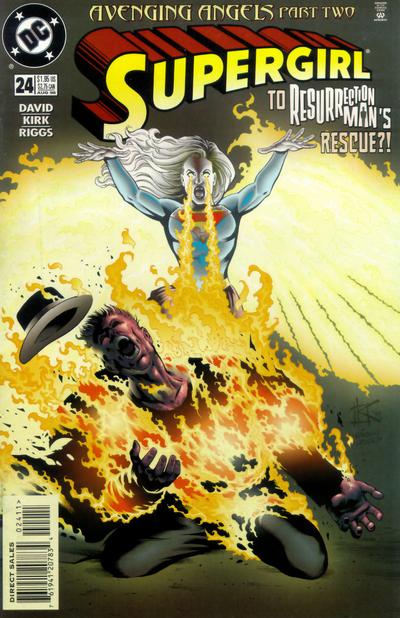
Back in June, just before the Supergirl movie dropped, I devoted a column to the first few issues of the longest-running series the girl of steel has had to date: Peter David’s 80-issue run from 1996 through 2003. At the time, I talked about the first five issues of the series, as well as the prologue short story from Showcase ‘96. Since then, I’ve been working issues of the series in my regular rotation of re-reads, and this week I wanted to check in on the series so far.
At this point, I’ve gotten through the first 24 issues of the series, along with its two annuals and the two issues of Resurrection Man that the title crossed over with in 1998. This is the first time I’ve read most of these issues since they first came out nearly 30 years ago, which is an appalling number that whoever is in charge of time should be immediately apologizing to me for. I find that, while I remember most of the broad strokes, it’s the little things that I’m really getting into this time around.
For example, the broad strokes in question include the fact that Peter David’s Supergirl is what’s called an “Earth-Bound Angel,” a sort of heavenly being that is created when someone who is utterly unselfish sacrifices themself to save the life of someone beyond redemption. In this case, the former is Supergirl (the Matrix version) and the latter is Leesburg resident Linda Danvers. The Earth-Bound Angel is created by fusing the two of them into a single being. Much of the story comes from Linda, whose past is far dirtier than you usually expect from a member of the Superman family, trying to navigate the fact that she’s now cast into the role of a hero, and attempting to reconcile two sets of memories that have become one.
This much I remember. The stuff I didn’t remember is where the book really shines: the conflict between Linda and her parents, particularly her mother, who struggles with the knowledge that her child has been irrevocably transformed, for example. Or the surprisingly large presence that Jonathan and Martha Kent have in these issues – surprising inasmuch as I didn’t remember them being in it quite so often, not surprising that they would want to take care of “Mae,” whom they raised as a daughter.
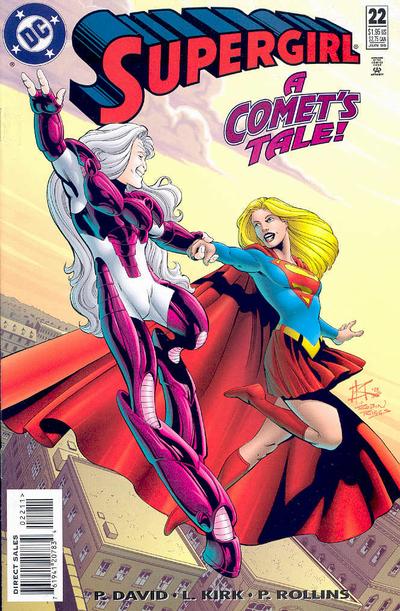
I’d forgotten a lot of the supporting cast as well. I remembered the demonic Buzz and the bizarre reboot of Comet (the Silver Age “Superhorse”), but I had forgotten characters like Linda’s struggling journalist pal Cutter, his ex-wife Andrea (who winds up with a crush on Linda), Linda’s best friend Mattie Harcourt, and the odd little boy named Wally who claims to be God and who, frankly, you struggle trying to argue with. Peter David had an uncanny knack for bringing in societal concepts and big ideas, concepts that were hot button topics at the time (and in some cases, still are today), and approaching them in a way that treats them as components of a story rather than an effort to make any sort of statement on the writer’s part. While one can probably figure out David’s political and spiritual beliefs with a deep enough reading of his work, that’s always subtext, and he never comes across as though he’s standing on a soapbox.
What’s more, David does all of this while dodging and navigating one DC “event” intruding into his story after another. Issue #3 was part of the Final Night crossover, then issue #14 was interrupted for Genesis (and believe me, that’s the kindest word to use for Genesis), and in issue #20 Supergirl had to leave town to help Superman deal with the Millennium Giants in his own titles. Some writers allow their book to be derailed entirely, while others give a crossover only the cursory acknowledgement and then ignore the fact that the sky has turned red. David is one of the few who really succeeded in striking a balance. In all of these issues, while Supergirl is dealing with the larger threats that are encompassing the DC Universe, we see the excellent supporting cast handling the trauma on their own, with lasting repercussions for the ongoing storyline that make these issues feel relevant and not just a bump in the road.
It’s also worth noting that original artist Gary Frank left the book less than a year into his run, making way for the man who partnered with David for most of the series, Leonard Kirk. And with all due respect to Frank, I think it was a change for the better. Gary Frank comes from a very highly detailed school of art, which is all well and good, but David uses a softer line and a more classic school of character design, without ever giving up the ability of the characters to emote or “act” on the page.
A little more than a quarter of the way through David’s run, and I’m enjoying it thoroughly. With the news that Sophie Campbell intends to bring back the Matrix Supergirl in the current run of the series, I can only hope she’s studied these issues intently, because there’s a lot of gold to be mined here. I’ll check in again later, maybe once I round issue #50.
Blake M. Petit is a writer, teacher, and dad from Ama, Louisiana. His most recent writing project is the superhero adventure series Other People’s Heroes: Little Stars, volume one of which is now available on Amazon. Don’t forget, you can check out earlier blogs in the Year of Superman/Superman Stuff Archive! Got a request for a future “Superman Stuff”? Drop it in the comments!

