Ah, Valentine’s Day: the day to show your affection to the one you love, or perhaps the ones if you’re Nick Cannon or somebody. The day that we celebrate passion and romance. The day that everyone who is not, currently, in a relationship does their absolute best to ignore, because those of us who DO have cause to celebrate on this day can – admittedly – be absolutely sickening at times. And most importantly, it’s the day where we feature Part Two of “Playing Favorites With Love Stories.” Just like last week with Part One, I took to social media and asked my friends to throw out suggestions for love story categories to talk about, and this week I’m going to tackle a few more. Grab your sweetie and pull up a chair – there’s some heart-shaped excellence coming your way.
Superhero Love
Eric LeBlanc asked me for my “favorite superhero movies that are just love stories with violence.” That’s an interesting way to phrase it, particularly since a lot of traditional love stories are also “love stories with violence,” but I’m up for the challenge. I have, after all, watched a superhero movie or two in my time, and because of that I think I am uniquely qualified to declare that the best superhero love story ever to grace the silver screen is probably 1980’s Superman II.
Nothing says romance like fighting three evil prison escapees and crashing through a Coke sign.
Part of this, I concede, may be recency bias. I watched Superman II again only a few weeks ago as part of my ongoing Year of Superman project (with new posts every Wednesday – tell your friends!) so it’s still pretty fresh in my mind, but it’s perhaps my favorite depiction of the Superman/Lois Lane relationship on screen. The whole film hinges on the idea that Superman, upon having Lois finally prove his dual identity, decides that he wants to be with her and that the only way to do so is to give up his powers. As it turns out, though, super-timing was not one of his abilities. No sooner has he abdicated his super-ness than he gets his clock cleaned by a jerk in a diner and finds out – oh yeah – while he was off in the arctic circle becoming human again, General Zod and his cronies have escaped the Phantom Zone and are about to take over the world.
Much as I love the Zod stuff, the Superman and Lois relationship is the soul of this movie, and so much credit needs to go to Christopher Reeve and Margot Kidder for making it work. Kidder’s fire and verve absolutely make it believable that this is a woman a man of steel would fall in love with, would be willing to sacrifice everything to be with, and that steers us into the tragedy of it all when he is forced to conclude that the world needs Superman more than Superman needs love. Your heart breaks for the both of them, even if the film kind of chickens out at the end and he uses the heretofore-unknown “super kiss” power to make her forget the whole thing. The super kiss is really the only part of the film that bothers me, but it’s not nearly enough to knock this excellent film from its perch at the top of the mountain.
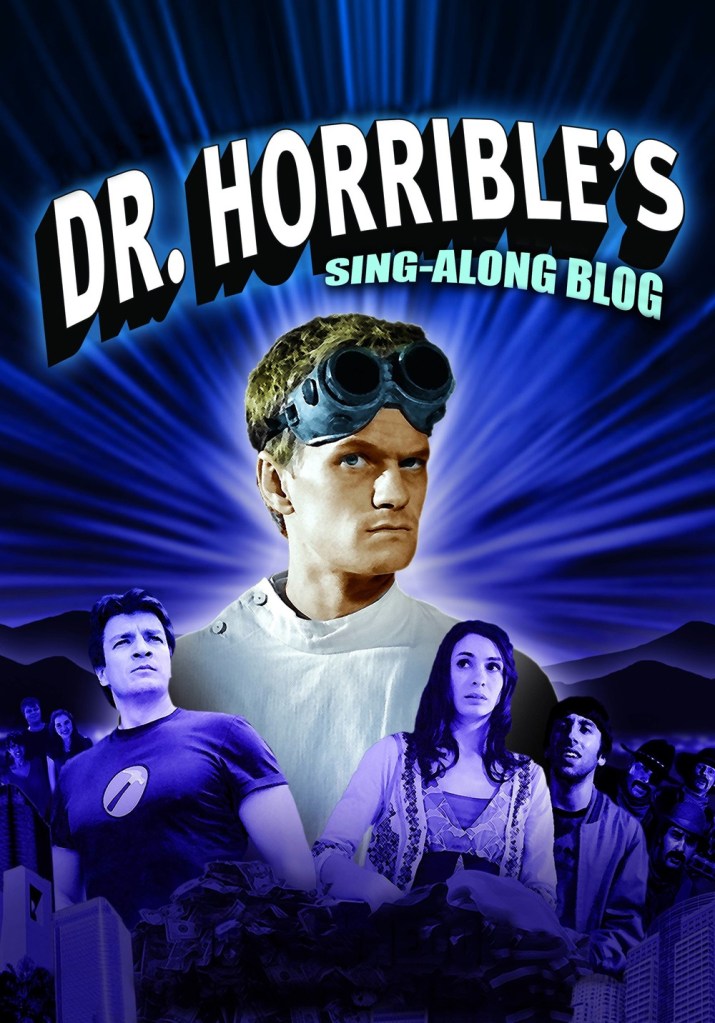
Next is perhaps an odd choice, but I’ve always been fond of Dr. Horrible’s Sing-Along Blog, the musical that came about as a result of a 2008 writer’s strike. Dr. Horrible (Neil Patrick Harris) is an aspiring supervillain trying to crack into the big leagues when he finds himself falling for a girl he meets doing laundry (played flawlessly by Felicia Day). Unfortunately for him, her life is saved by his arch-enemy, the superhero Captain Hammer (Nathan Fillion), who – as heroes go – is way less Superman and way more Guy Gardner. Apropos, I know.
The supervillain musical Joker: Folie à Deux WISHES it could be.
I absolutely love this one. The songs are catchy, the three main actors are at the top of their form, and the conclusion is suitably heartbreaking. And it nicely meets Eric’s qualification of “a love story with violence.”
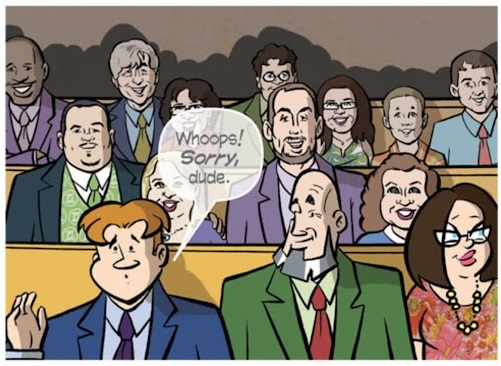
Not every superhero love story has to end sadly, though, although it seems like most of the really good movies do. But I don’t want to leave you utterly bereft of happy endings, so even though Eric specifically asked for movies, I’m going to throw out a comic book recommendation, one that I’ve been a fan of for many years: Thom Zahler’s delightful series Love and Capes.
Pictured: Love. Also pictured: Capes.
This story, described by Zahler as a romantic situation comedy, focuses on Abby Tennyson, a bookshop owner who is stunned, in the first issue, when she learns that her boyfriend Mark is actually the world’s most powerful superhero, the Crusader. Abby and Mark have one of the healthiest relationships in the entirety of superhero comics, and the way we watch their relationship grow and develop over the years – through dating, marriage, and parenthood – is the absolute rebuttal to any comic book writer who argues that there are no interesting stories to tell about a couple in a happy relationship. (Lookin’ – as always – as YOU, Spider-Man editorial office.) This series is a favorite of mine not only because it’s a great story (it is) but because it enjoys the rare honor of being one of the only comic books that I’ve ever discovered upon a recommendation from Erin, my own girlfriend (at the time, now wife). In fact, she and I were even guests at Mark and Abby’s wedding. No, really.
I was mostly there to check out the venue.
Platonic Love
Chance Simoncelli suggested the best “platonic” love stories. I really like this suggestion – it seems like much of the media is focused on romantic love, which is fine, but they zero in on it to the expense of every other type of relationship. It’s like the entertainment world doesn’t seem to grasp the concept that sometimes people are just friends, with no romantic connection, but that doesn’t mean their love isn’t deep and true and sincere. This is one of the reasons I hate fanfiction, if we’re being perfectly blunt.
But on rare occasions, they do manage to get it right, and share with us a deep, committed bond between two people that never indulge in any hanky-panky, and I think those stories should be celebrated. One of my favorites comes from the TV show Parks and Recreation. Nick Offerman’s Ron Swanson and Amy Poehler’s Leslie Knope couldn’t possibly be more different. Leslie is a chipper, enthusiastic-to-a-fault government employee who sees working in public service as the highest calling there is, whereas Ron is a grouchy straw Libertarian who sees all government work as inherently useless and wants nothing more than for everybody to leave him alone. Somehow, they’re the best of friends. Their devotion to one another is so powerful that in the final season of the show, after a time jump, the two of them have a wedge driven between them and it’s as horrifying and shocking as it would have been had either of them broken up with their respective spouses. The episode where the two of them reconnect and reconcile their differences is one of the most beautiful and sweetest in the entire series, as their bonds are once again forged over a mutual affection, respect, and a love for breakfast foods.
On any given day, I am both of these people.
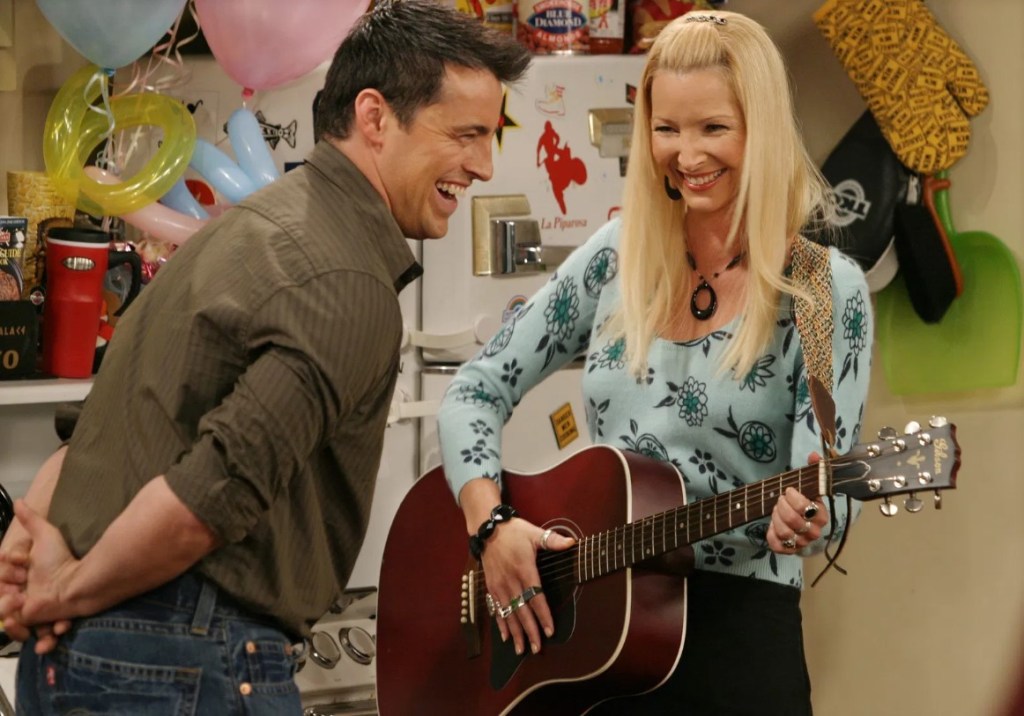
There’s also a great example from the show Friends. First of all, I think it’s time we all admit that, in terms of friendship, Joey Tribbiani was the MVP of that show. The whole thesis of the series is that these six people are one another’s found family, but the level of loyalty and devotion that Matt LeBlanc’s character shows to each of the other five at various points in the series is above and beyond, and I don’t know if he gets enough credit for that. The late-seasons dalliance with Rachel aside (we can all agree that was Friends’ worst plotline, right?), he is the staunchest of the group.
And the best such relationship, I think, is the one he has with Lisa Kudrow’s Phoebe. With the other four pairing off and going through assorted romantic shenanigans of one sort or another for the entire run of the series, these two are simply friends through thick and thin. There were occasional episodes where we saw some flirtatious banter between them, and once in a while they would allude to the notion of them hooking up somewhere down the line, but at no point does it ever come across as a serious intention. Frankly, although they both enjoy playing the game with one another, I think Joey and Phoebe love each other TOO much to ever get physical, because they already know their relationship is perfect the way it is. In fact, she may be the one woman on the entire planet that Joey feels that way about, and if that’s not special I don’t know what is.
Somehow the womanizer and the former mugger were the wholesome, beating heart of the show.
I also need to give a little credit to Disney here. True, they have done as much to push romantic love as being the apex of a relationship as any studio on the planet, but there was one time they deliberately steered away from that and they nailed it, and I of course am talking about Frozen. It’s a Disney Princess movie from the outset and, as such, people expect it to follow the usual tropes of a Disney Princess movie, including the damsel in distress and the handsome prince. And for much of the film it does use these tropes, including Anna being afflicted by an errant piece of magic that threatens to turn her into ice if the spell is not broken by an act of true love.
I know it’s fashionable to hate on Frozen and call it overrated now, and I’ll be the first to admit that the hype train it rode for many years went a lot farther than it probably should, but that doesn’t take away from the fact that the filmmakers were brilliant in how they subverted the expectations of a Princess movie. While Anna is looking for “true love” to cure her, her handsome prince reveals himself to be an opportunistic villain who was only planning to marry her to move himself into position to become king. If she dies, all the better for him. In the end, though, Anna IS saved by an act of true love: not by her false fiance Hans, nor even from the stout-hearted Kristoff, whose love for Anna IS pure. Anna is saved by her sister Elsa, stepping in to defeat Hans at the last second and breaking her own spell. The love between the two sisters is at the heart of the film, far more than Anna’s love triangle, and that makes it a unique and special film in the Disney canon. And I don’t care HOW sick you are of hearing “Let It Go,” it gets my respect for that.
“Are you thinking what I’m thinking?” “Yes, those fanfiction writers are messed up.”
Finally, of course, we can’t forget the greatest platonic love story of all: a story not between man and woman, not between friends, not between family, but between the sole survivor of a dying world and his appetite.
Project ALF.
The true platonic love affair is between me and this joke.
Will They/Won’t They?
Finally, Duane Hower asks for the best “Will they/Won’t they?” in geek culture, “and why is it Buffy and Spike?” Ah yes, the “Will they/Won’t they?” It’s the trope that fuels a million stories and makes half of them frustrating. The truth is, any time they try a “Will they/Won’t they?” the storytellers are playing with fire. Setting up a WTWT is incredibly easy: get two characters, hint at a degree of attraction between them, and then make the audience shriek uncontrollably as you refuse to settle the question. But concluding that arc in a satisfying way is a lot harder than it seems on the surface. If you resolve it too quickly you give up fuel for future stories. If you play it out too long, the audience gets frustrated. If you resolve it at exactly the right time, half the audience will hate the outcome, no matter what the outcome happens to be. Duane mentions Buffy the Vampire Slayer, and I concede that it’s a pretty good example, as far as WTWT go, but mostly because of how adroitly the storytellers managed the timing.
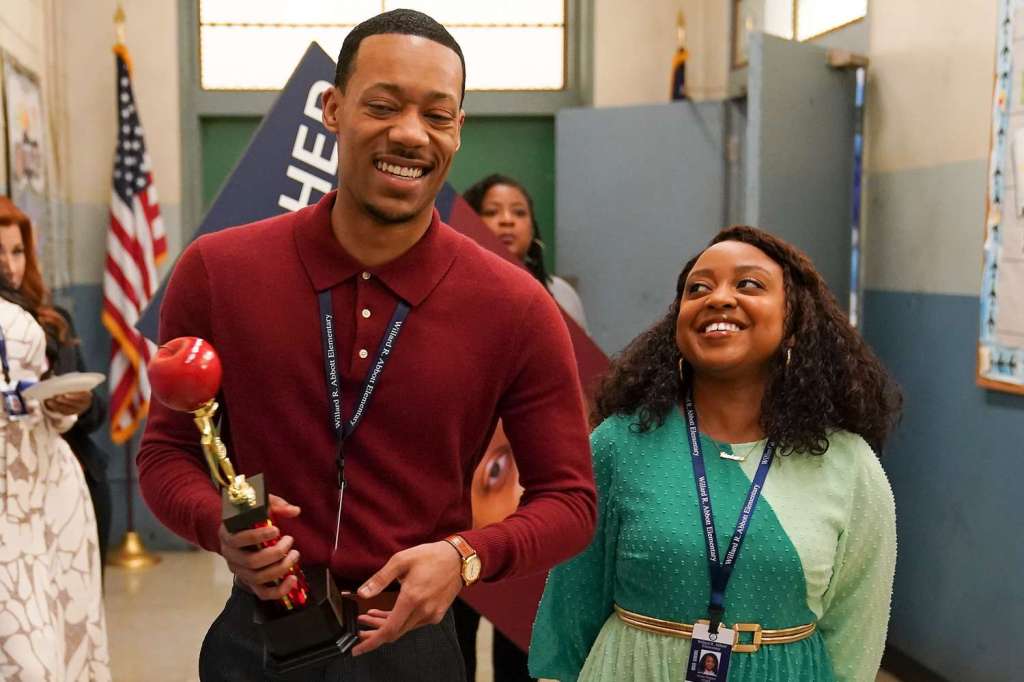
There are tons of classic examples: Pam and Jim from The Office, Sam and Diane (and later, Sam and Rebecca) from Cheers, Ted and Robin from How I Met Your Mother? and so forth, and while some of them navigated the minefield better than others, I think the relationship between Janine and Gregory in Abbott Elementary is one of the better examples. In the first episode, Gregory joins the Abbott Elementary faculty and we quickly see sparks between him and Janine, who happens to be in a long-term relationship. In truth, for the first few episodes Abbott adheres so closely to the format of The Office that it’s almost uncanny. But the relationship between the two of them changes and takes unexpected turns over the next few seasons. Relationships change, feelings change, and while the attraction between them remains undeniable, you’ve got a case here where you genuinely aren’t sure which way they’re going to take the characters. In fact, a late season three episode sets up things to put the kibosh on them once and for all just before the season finale changes everything. One of the reasons I think Abbott is the best comedy currently on television is because of its hilarious and shockingly realistic depiction of a school setting, but the Janine/Gregory relationship is a close second.
Fun fact: putting this much adorable in a single room is considered a health hazard in 29 states.
But perhaps the greatest example of a WTWT in the history of television comes from the brilliant, magnificent, legendary, and frankly underrated sitcom Newsradio. This 90s show about the staff of a New York radio station is one of the smartest and funniest television shows in the entire history of the medium, with whip-smart writing and a cast that performs their roles with such ease, grace, and humor that watching it can almost make you forget what a dumpster fire of a human being Andy Dick turned out to be. As the show was in development, though, the network (NBC) insisted that they include a WTWT among the cast. That was absurd, the writers said. That wasn’t the show they were doing! That wasn’t the story they were trying to tell! This was supposed to be a workplace comedy, not a romcom!
“Give us a WTWT,” NBC intoned deeply, whilst carefully counting their Seinfeld money.
“FIIIIIIIIIINE,” the Newsradio writers replied, tweaking the first episode to set up a WTWT between Dave Foley and Maura Tierney’s characters. “Happy now?”
“Delighted,” NBC said, lighting a cigar on fire with a $100-bill with Jason Alexander’s signature on it.
And then the Newsradio writers took their mandated WTWT and resolved it in the SECOND EPISODE by hooking up the two characters officially.
“Look, we’re not Mulder and Scully, let’s just get on with it.”
Newsradio is one of the greatest sitcoms of all time, but the way they thumbed their nose at the network may be their crowning achievement.
Thus concludes PLAYING FAVORITES WITH LOVE STORIES, friends. I hope you all have a fantastic Valentine’s Day. Spend it with someone you love, fire up some of these stories we’ve mentioned, and remember that Phil Hartman was a genius
Blake M. Petit is a writer, teacher, and dad from Ama, Louisiana. His most recent writing project is the superhero adventure series Other People’s Heroes: Little Stars, volume one of which is now available on Amazon. You can subscribe to his newsletter by clicking right here. He’s also started putting his LitReel videos on TikTok. Did you know that Jon and Liz the veterinarian finally hooked up in the Garfield comic strip? No really, it’s true. Just throwing that out there to remind you that there’s hope for everybody.
Today I’m going to start the first of the Theme Weeks I’m planning to do for this little project. It won’t be every week, nor will the content of those weeks be 100 percent dedicated to that theme. There’s still a lot of Superman and Lois to catch up on, after all. But on these theme weeks, I’m going to focus on a specific character, creator, or concept related to Superman. For this first week, I’m going to put the spotlight on the second-most important character in the entire Superman mythos, one of the best comic book characters ever created. Welcome, friends, to Lois Lane Week! Lois has been around since day one, appearing in Action Comics #1 along with Superman himself, and over the years has grown and evolved into one of the most complex and engaging characters in comics…when she’s written correctly. In the Golden Age, Lois was a tough-as-nails, courageous, crusading reporter. The modern incarnation has a lot of the same qualities. When written properly, Lois Lane is brilliant, fearless, and a force of nature. The only Lois I’m not crazy about, honestly, is the Silver Age Lois, a character who seemed more interested in marrying Superman or proving his secret identity (because somehow that would convince him to marry her). I’m going to try to look at all ages of Lois this week.
Wed., Jan. 22
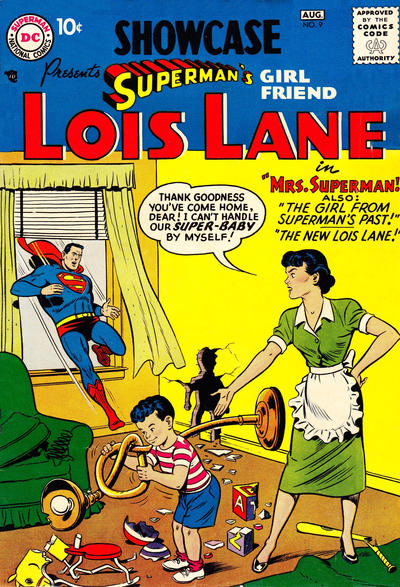
Comics:Showcase #9
Notes: DC’s Showcase comic book, in the 50s, was essentially a try-out series. Every issue or two they would change the headliner, basically using the series to test the possibilities of a new character or new title, many of which eventually spun off into their own series. Most famously, this is the series that gave us the Barry Allen Flash and the Hal Jordan Green Lantern, but today we’re focusing on Showcase #9, the prototype for the series that would be called Superman’s Girl Friend, Lois Lane.
If you swapped Lois with Chili and Superman with Bandit, this is any given episode of Bluey.
This Showcase issue is pretty indistinguishable from the early years of Lois’s solo title, with three stories each dedicated to Lois’s love life with Superman, while he treated her in a way that would have pretty much everybody on Reddit telling her to dump him, and frankly, I can’t blame them. The first story is “The Girl From Superman’s Past.” Lana Lang – Superboy’s old flame from Smallville – moves to Metropolis, and she and Lois immediately wind up sparring for the affection of the now-adult Superman, up to and including placing themselves in danger to see which one he was going choose to rescue. At the end of the story, of course, Superman has refrained from making a decision, probably because both of these women are behaving like lunatics.
“The New Lois Lane” is even more bonkers. When Superman learns that a group of crooks are on the verge of unveiling his secret identity, he creates a new alter-ego, “Allen Todd,” and counts on Lois’s trademark snooping to reveal Mr. Todd as being the real Superman. Unfortunately for him, Lois recently used a Weight and Fortune Telling Machine (no, really) that told her to change her strategy to help get the man she loves – so instead of trying to reveal his secret, she starts going behind his back to “help” him HIDE it. I tell you, some of these Silver Age Lois Lane stories are positively Shakespearean, in that they’re predicated on absurd coincidences and ridiculous misunderstandings that could easily be cleared up if either of the people involved were capable of having a simple adult conversation, for God’s sake.
Finally, there’s “Mrs. Superman,” in which Lois gets a head injury and has a coma dream about her fondest wish: marrying Superman. To get her out of it, Superman sits by her bedside and feeds her “false” information to try to snap her out of the fantasy – you know, horrible things like Superman’s real identity being Clark Kent, or that he’s cheating on her with a woman named Lulu, because every woman in Metropolis is legally required to have a name beginning with the letter “L.” I guess in this one Superman is at least trying to help Lois. Technically.
The idea, I suppose, was to make a comic book that fit in with the popular romance comics of the time, although these stories were even sillier and more convoluted than a lot of those. I guess it was popular, though, as this series lasted for 16 years and 137 issues before being merged with the Jimmy Olsen title as Superman Family. But sitting from where I am, where my Loises are all strong, independent, and smart as a whip, it’s bonkers to me that this incarnation of the character lasted as long as she did.
Articles: “A Fond Remembrance of Mort Weisinger By His Son” and “The Superman Mythos: Roots of the Superman Confluence,” both by Eddy Zeno, from The Krypton Companion
Thur., Jan. 23
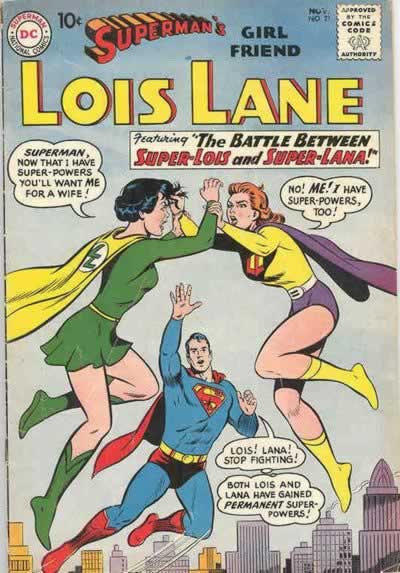
Comics: DC Horror Presents… #3 (Cameo), Superman’s Girl Friend, Lois Lane #21, Action Comics #662, Superman Vol. 2 #53
Notes: Returning to the shockingly meager offerings on DC Universe Infinite for this series, I decided to check in on Lois Lane #21, featuring a pretty well-known cover with Lois and Lana somehow superpowered and slugging it out for Superman’s affections, but I don’t think I’ve ever read this one before. The first two stories in this issue, though, are a two-parter unrelated to the cover. In “Dolls of Doom” and “Trapped in Kandor,” Lois is tricked into posing for a Lois Lane doll by a gang of criminals planning to use her against Superman. This somehow winds up with her sent to the bottled city of Kandor where she falls in love with a Kandorian who is – shockingly – a dead ringer for Superman.
I’m sorry to not have a better synopsis for this story, but I refuse to take total blame for it, because the DC Universe app has the PAGES IN THE WRONG ORDER. The middle of chapter two appears in chapter one and vice-versa, and while it is theoretically possible to read the pages in the correct order by flipping back and forth in the app, by the time I realized what the problem was I was so angry about it that I stopped trying. Hey, DC Universe Infinite: FIX THIS CRAP.
After all, with the pages scrambled, some people may find this confusing.
The last story is the one I was really interested in anyway. “The Battle Between Super-Lois and Super-Lana” features Superman’s two favorite girls, now rival reporters, who stumble upon a magic lake that conveniently gives super powers to anyone who bathes in it. Realizing they now have all of Superman’s powers, they decide that this is the perfect time to make him choose between them by doing things like cooking giant food, finding and wearing priceless jewelry that has been lost to antiquity, and carving their own faces into mountainsides. The story ends, predictably, with the magic water wearing off and Superman once again getting out of having to make up his mind. The most important part of the legacy of this issue is that the “magic water” came back into play decades later in Alan Moore’s “Whatever Happened to the Man of Tomorrow?” (which of course you can be certain I’ll read before this Year of Superman is over.)
It’s unfathomable to me how the book lasted this long with stories that make the title character look like an obsessed stalker and make Superman look like an indecisive jackass. I think I need an palate cleanser, so I decide to read the issues I skipped between “Krisis of the Krimson Kryptonite” and “Time and Time Again” – the story of how Clark Kent finally revealed his secret identity to Lois Lane.
The face of “WHAT THE ACTUAL F@#??”
It happened in Action Comics #662, and before I get into the story, can we talk about the cover for a minute? This is a classic by Kerry Gammill and Brett Breeding, and it’s wild to me that this hasn’t made the echelon of often-homaged covers like Action Comics #1, Superman #1, or even Superman Vol. 2 #75 (the Death of Superman issue). The angle, from Clark’s point-of-view, is perfect, and the look of total amazement on Lois’s face just kills me every time I look at it. I love this cover.
As for the story itself, the issue begins with Lois and Clark having a comics code-approved romantic evening at home, with Clark about to tell Lois the big secret just as they’re interrupted by the Silver Banshee. Her magic told her that Superman was in that apartment, but all she finds there is this tall drink of water in a pair of glasses, so she dashes out. Clark goes after her, leaving Lois somewhat confused. The middle part of the issue is pretty standard for the time period – Superman fighting the Banshee (who, I should mention, has one of the coolest designs for any Superman villain ever) while in a subplot, a LexCorp employee digs into the mystery of the company CEO’s death and his potential heir. The Lois story doesn’t come back until the last couple of pages, where Clark gives the big reveal on a full-page splash panel at the very end of the issue, leading into Superman Vol. 2 #53.
The first few pages of this issue are devoted to the Lois and Clark story, as she tells him that she thinks – on some level – she knew his secret for a long time, but had always dismissed it, then she (understandably) asks for a little time to process this major revelation. The rest of the issue deals with Superman being asked to help escort a political prisoner being brought from the Middle East back to the ol’ U.S. of A. It’s a perfectly fine issue, but it definitely illustrates the way the Superman comics were written in the 90s. Each issue had an A-plot (which may or may not continue next week) and several ongoing B-plots that were often specific to the individual titles and writers. Anything dealing with the Clark Kent side of his life was usually relegated to the B-plots, even something as monumental as this. If this story were being told today, the revelation would have been its own one-shot issue with a half-dozen miniseries spin-offs dealing with the fallout. In these two issues, it’s less than ten pages total.
All that said, I like how they dealt with Lois here. Rather than make her look or feel foolish for not having known Clark’s secret, she confesses to having had a gut feeling. In the Silver Age, that “gut feeling” was half of her reason for existence. This is a much smarter, more mature Lois Lane, and it’s a much better interpretation of the character.
Fri., Jan. 24
TV Episode: Superman: The Animated Series, Season 2, Episode 7, “Target”
Notes: Except for Margot Kidder, I think Dana Delaney may just be my favorite Lois Lane. Her wit and sarcasm feels so completely perfect for the character – I love the way she knows she’s the smartest one in the room, but doesn’t lord it over anybody unless they’re asking for it. It’s like if Bugs Bunny were a reporter. One of the things I particularly liked about Superman: The Animated Series is that they wrote Lois the way she SHOULD have been written in an era before she and Clark were allowed to be together. This is a Lois who, like the Lois of the Golden Age, finds Superman more fascinating than Clark. However, she doesn’t spend all her time mooning over him or trying to crack the secret of his identity. She’s someone with a thirst for truth and, along with that, a hefty appreciation of justice.
And if we’re being totally honest, there’s just something about a gal with purple eyes.
In this episode, Lois is sent a death threat just seconds before receiving a prestigious journalism award. After a quick rescue by Superman (as per usual) she embarks upon a quest to find out who’s gunning for her, with more and deadlier attempts following her as she seeks out the truth. Although both Clark and Superman appear and factor heavily into the plot, we never actually see the transition from one to the other, aiding the conceit that this is an episode told from Lois’s perspective. It’s a great episode for showing how smart and, ultimately, dangerous she can be to the wrong people (the “corrupt” that she mentions in her acceptance speech), and I like the fact that she refuses sensible precautions like staying under house arrest when there are super criminals gunning for her. It’s the kind of reckless that is 100 percent indicative of Lois Lane. And it’s great that she cracks the mystery on her own, without Superman’s help or without even hearing the clue that tells him where to find her at the end. If I have any complaint, though, it’s that she doesn’t show herself quite as capable as I’d like. Every deathtrap is escaped, narrowly, by Superman’s interference. Sure, it’s part of the usual schtick for these two, but it would have been nice if just ONCE she managed to get herself out of trouble by herself.
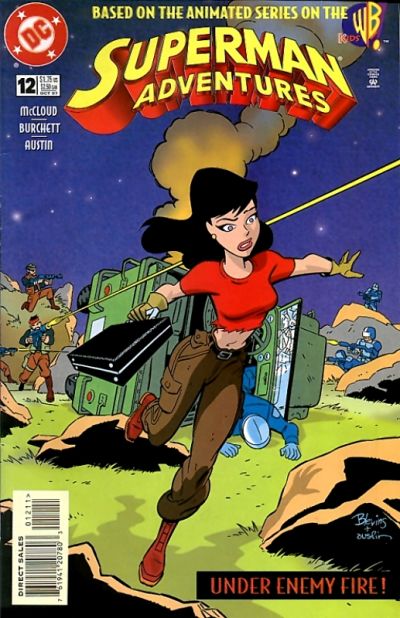
Notes: Like the episodes of the cartoon, Superman Adventures #12 demonstrates ably who Lois Lane should be. Superman has been infected with a Kryptonian virus, and Lois and Professor Emil Hamilton are in the midst of a war zone trying to get an essential ingredient for an antidote. Once the cure for the man of steel is synthesized, it’s up to Lois to transport it back to Metropolis through battlefields, across oceans, and in the midst of an awful lot of criminal types who would be perfectly happy if the cure never makes it to its destination. The story, written by Scott McCloud, perfectly showcases the cartoon’s version of Lois. We see how strong and gutsy she is, every step of the way. The best thing is that she’s not doing it because she’s in LOVE with Superman, she’s doing it because the world NEEDS Superman. A+ Lois Laning in this issue, guys.
Sat. Jan. 25
Answering the question, “What if we write Lois Lane, but for the Pretty Little Liars demographic?”
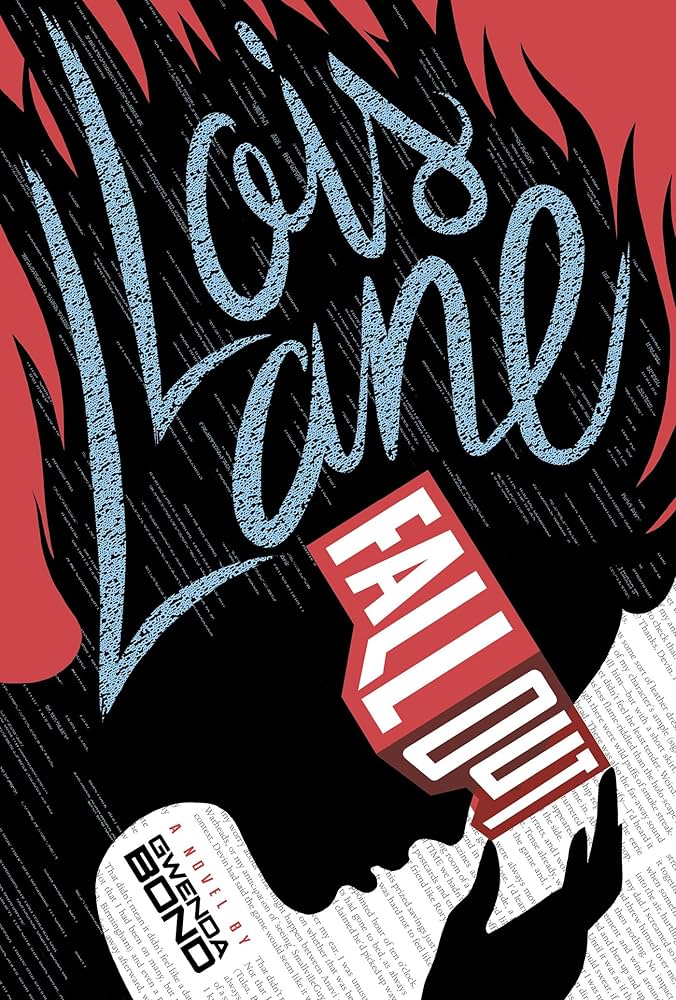
Novel: Fallout (2015) by Gwenda Bond
Notes: This is part of a larger push to put the DC characters into young adult novels, a practice that I think is a good idea. Get ‘em while they’re young, get ‘em reading, get ‘em loving the characters. In this version, Lois is a teenager in the modern day – or at least in the modern day of 2015, when this was published, which cannot possibly be 10 years ago, so this is just more proof that math is a liar. Young Lois and her family have recently moved to Metropolis, the latest in a long line of homes as befits her army brat lifestyle, but the Lanes are hoping to put down roots this time. At a new school, Lois struggles making friends until she’s recruited for a special initiative of the Daily Planet to bring in high school students with an interest in journalism. As Lois tries to acclimate to her new passion, she finds that a group of bullies at the school may be more than they seem, and the principal may be part of a larger conspiracy.
This book, part of a trilogy by Gwenda Bond, gives me serious Nancy Drew vibes. This is not a criticism, mind you, I think that’s actually quite appropriate for a young Lois Lane. Although the story is structured to lead her towards her destiny as the world’s greatest reporter, for most of the plot she’s doing a detective’s job, trying to crack a mystery with the help of a few sometimes reluctant friends. In fact, the only one who’s totally on her side from the beginning is her online friend, who goes by the handle “SmallvilleGuy” and is shockingly hesitant to cough up details about himself.
I liked this book a lot more than I expected to, if I’m being honest. I’ve read a lot of novels based on comic book characters and too many of them are sort of bland, lifeless retellings of a story that would be better served as a comic book. But Gwenda Bond has a fine voice for Lois, and the way she builds up the sometimes antagonistic nature of her relationship with her father works well. Bond’s Sam Lane hits all of the right beats for that character – he’s tough, he’s strict, and he wants things to be done his way. At the same time, though, he’s not an ogre. He’s a father who wants what’s best for his children, and the conflict stems from the fact that what he thinks is best is not necessarily what Lois wants, not because he’s evil.
The interactions with “SmallvilleGuy” are fun, but maybe a little too much like the writer is winking at the camera. I don’t mind a little bit of that, but when you spin this whole mystery around a question that the audience already knows the answer to, it doesn’t necessarily hit right. It’s not like it makes Lois look stupid or anything (just because SmallvilleGuy’s in-game avatar is an alien is no reason Lois should suspect that he’s the real thing), but you do start to twirl your finger a little and say, “Okay, let’s get on with it.”
All that said, I did like this book. I did like this Lois. And while I don’t know if I’ll get around to them right away, I’m adding the other two books in this trilogy (Double Down and Triple Threat) to my massive to-be-read list. That’s not a promise that I’ll ever get to them, if I’m being 100 percent honest, but they’re definitely on the radar.
Notes: The current run of the main Superman comic has been really good. Written by Joshua Williamson with art by Dan Mora – who, in case I haven’t mentioned it recently, is far and away the best Superman artist of the modern era – our heroes find themselves in a very precarious position. Doomsday, the creature who killed Superman once, is the target of an alien invading force, forcing Superman to work with the instrument of his own destruction. He’s not alone, though – Lois is currently Superwoman. I have to say “currently” because you know that, sooner or later, the status quo will reassert itself, but giving her Kryptonian powers (however temporary) is making for an interesting twist to the dynamic. The entire Superman family has sort of become a team, defending Metropolis together, and Super-Lois has essentially been made co-leader along with her husband. This isn’t the first time that Lois has gotten powers, of course, but this is a way of portraying that relationship that I’m pretty sure we’ve never seen before. With this being my “Year of Superman,” with the movie coming out in July, and with DC giving the Man of Steel a much bigger push than they have in recent years, I couldn’t be happier that this monthly comic is really good right now.
Sun., Jan. 26
The After School Special of Lois Lore.
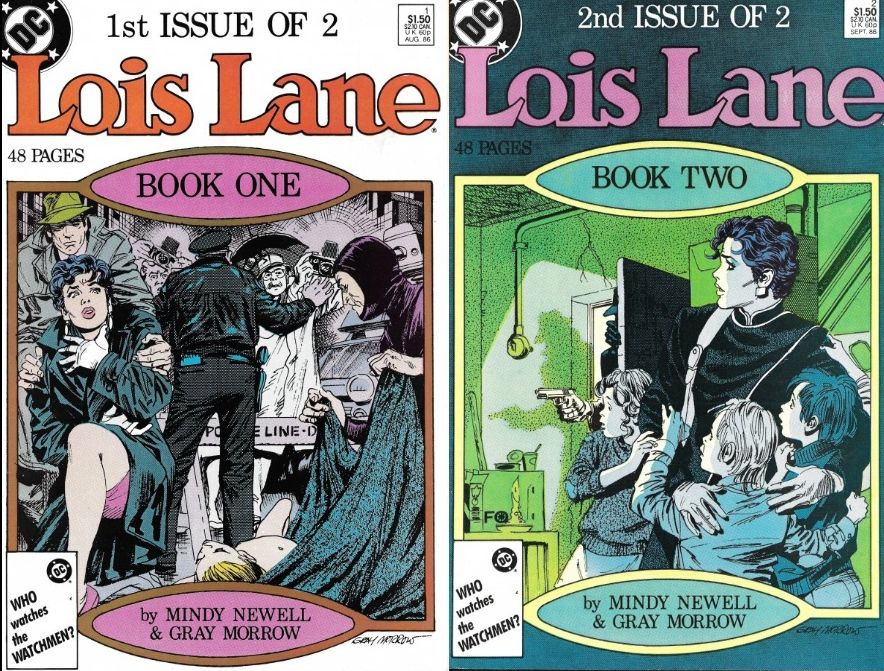
Comic Books: Lois Lane #1-2
Notes: The early 80s were a weird time for Lois Lane in the comics. After all those decades of chasing after him, she “broke up” with Superman, feeling as though the relationship wasn’t going anywhere (go figure). What’s more, Clark started dating Lana Lang, which was admittedly a nice change of pace, as she was now interested in Clark Kent rather than Superboy/man, and it changed things up for a while. But the problem was, then, what do you do with Lois?
The answer, it seems, is this miniseries: two double-sized issues of two chapters each which were clearly originally intended to be a four-issue miniseries, but they condensed it for some reason. Regardless, in this refreshingly Superman-free story, Lois is covering a police investigation that turns up the body of a child, a horrifying moment that sends her deep into the investigation of child abduction and trafficking. I would have been about nine years old when this miniseries was published, so I can tell you that the whole “stranger danger” scare was a big thing at the time, and this miniseries feels very much like an attempt to connect to the After School Special audience by telling a story with an important message. Not that the message isn’t important, of course – sadly, it’s possibly even more relevant today than it was almost 40 years ago. But the way they tell the story is a bit heavy-handed, as many of these “Very Special Episodes” tend to be.
On the other hand, it’s good to see a story where Lois is being Lois – doing reporter work, digging into a story and trying to uncover the truth. The sad thing is that Lois comes off as awfully antagonistic throughout the story: she clashes with her editor, she clashes with her sister Lucy…she clashes with everybody. And there’s a point where it feels less like frustration about her serious story not being taken seriously and a bit more like Lois has some sort of chip on her shoulder. (It may have helped if the story at any point recapped just why she and Lucy were at each other’s throats at this period.) As it is, though, we get none of that. We learn nothing about why Lois is behaving the way she is, save for general sensitivity over the subject matter. It’s a pretty dark topic , but it’s hard to conceive of a seasoned reporter like Lois Lane suddenly lashing out at everybody around her over something like this. Half the characters assume she’s upset over her breakup with Superman, and while that too would be completely out of character for her, at least it would be an explanation.
We DO get a shocking revelation about Lana Lang…a revelation that, to the best of my knowledge, was never referenced again, and certainly has been wiped out in the half dozen or so continuity reboots since then. And in the end, the story doesn’t really have a resolution. We just run out of threads to follow. That’s how stuff like this happens in reality, sadly. But this isn’t reality, it’s fiction, and as much as I enjoy seeing a spotlight on Lois Lane, this spotlight is given to a story that forever will seem incomplete.
Enjoy it now, kids. Once Jon is born, even this won’t be far enough to get some peace and quiet.
Notes: So after getting engaged, finding out her fiancé was really Superman, losing him to time-travel shenanigans, and dealing with a dozen other problems that cropped up in the course of the four Superman comics of the era, in this issue Lois FINALLY has a chance to stop and talk to Clark about what it would mean for the two of them to be married. I’ve always enjoyed this issue.
The first half is a series of events where Lois keeps getting left behind as Clark rushes off to deal with one emergency or another – a sunken submarine, a homeless man who’s gotten his hands on a super-villain’s discarded weapons stash…you know, typical stuff. But in the second half, Clark bundles Lois up and takes her off to the top of Mt. Fuji, one place where he doubts that an emergency will call him away, for a conversation. The scene itself only takes a couple of pages, but it’s powerful. Lois asks why Clark, with all his power, would choose to be Superman, and he gives the most Superman answer imaginable: “Because no one else can.” They talk about their relationship and what they mean to one another, and by the time they return to Metropolis, it feels like a hurdle has been passed. After this, the relationship in the comics was usually rock-solid (except for that brief period where they broke up, but which eventually led directly into their wedding, and for the New 52 reboot, but we can dismiss that for timey-wimey reasons). I hate when writers throw a breakup/makeup dynamic onto their characters just because they can’t think of a way to tell compelling stories about a couple without threatening their relationship (lookin’ at you, Spider-Man writers). I’m really glad that this issue ended that era for Lois and Clark in a satisfying way.
Also of note: this issue is kind of an epilogue to the Time and Time Again storyline from last week as well. One of the Linear Men, Liri Lee, feels responsible for the months that Superman was lost in time, so she tries to make it up to him by pausing time for Lois and Clark (without their knowledge) and allowing them to discuss their relationship uninterrupted. It’s a nice little conceit and although I don’t think it was strictly necessary, it served the purpose of showing that the original Linear Man did not act alone (something that would become significant later) and perhaps gave a little more plausibility to the notion that Superman could go that long without picking up on a disaster somewhere that needed his attention.
Geez, how many Robins does that guy NEED?
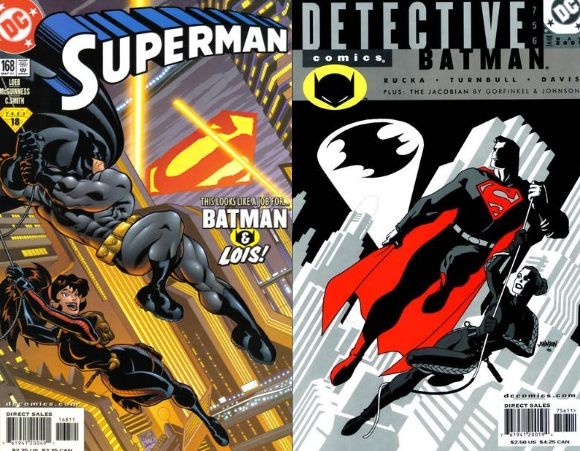
Next up is a dandy two-parter from Superman Vol. 2 #168 and Detective Comics #756. This story comes from the era in which Lex Luthor had been elected President of the United States, and things kick off when Lois learns from her father (Lex’s secretary of state) that he’s somehow regained possession of the Kryptonite ring we last mentioned back in the Dark Knight Over Metropolis storyline. Superman, being Superman, is reluctant to break into the White House to get the ring, so Lois decides to enlist the help of somebody somewhat less reluctant: Batman.
This is a great story. I love seeing Lois being proactive and using her husband’s ties to the superhero community to right a wrong. I also love how Superman winds up in conflict with his wife and best friend in a way that doesn’t seem convoluted or out of character. Of course Superman would refuse to break into the White House, no matter who’s sitting in that chair or what the provocation, and of course Lois and Bruce wouldn’t give a damn about all that when it comes to getting that sort of a weapon out of Lex Luthor’s hands. It’s a dandy little character play from writers Jeph Loeb and Greg Rucka (respectively) and it’s only slightly undermined by the ending. I don’t mind at all that Clark and Bruce hatched a scheme of their own, but I’m admittedly a tad disappointed that they didn’t let Lois in on it. That said, it’s a fine story that shows, as the best stories do, just how proactive Lois Lane can be.
Just as grounded in reality as her ’86 miniseries.
I’ll wrap up today with Superman: Lois Lane, a one-shot from the New 52 era. I won’t get into the pros and cons of that time period at the moment – odds are at some point later this year I’ll get into it a little bit – but I will say one of my least favorite things about that period was the way DC erased pretty much every superhero marriage and returned to the old status quo of Lois not knowing Clark’s identity and, for most of the run, not having any sort of relationship with him either. In fact, Superman only makes a cameo in this issue, and Clark isn’t mentioned at all.
That said, if you just change the costume Superman wears in his cameo, this story could very easily be dropped into pretty much any continuity or any time period for Superman. It’s a self-contained story about Lois, starting with her sister Lucy showing up on her doorstep, injured, begging for help. Lucy’s roommate, Amanda, has been transformed into some sort of monster by a strange street drug, and she pleads with Lois to rescue her. Like a lot of the best Lois stories, this one showcases her detective skills, hunting down the origin of the drug that’s terrorizing Amanda and going to whatever lengths it takes to save her. It’s not a bad story, although it does showcase just how much Lucy Lane has become something of a punching bag over the years. That poor girl never seems to catch a break.
Tues., Jan. 28
AKA Superman versus the Three Stooges
Movie: Superman II
Notes: The first Superman film, with Christopher Reeve and Margot Kidder, remains one of my favorite movies ever made, and by far my favorite superhero film. But ever since the release of the “Donner Cut” in 2006 I’ve harbored a belief that, had the film been completed as intended, Superman II would have surpassed it.
Not to say that the Superman II we have isn’t good. Quite to the contrary, it’s a great movie. Superman facing off against a trio of Kryptonian villains, Lex Luthor bouncing from enemy to ally to, at the end, a desperate attempt at becoming a frenemy before Superman deposits him with the police. And most importantly this week, this is the movie where I feel like Margot Kidder’s Lois Lane gets her best moments. In this film, Lois discovers the truth, that Clark Kent is Superman. They share a tender love story in which he decides to give up his powers, which his mother Lara (or rather, her approximation in a Kryptonian data crystal) tells him is the only way he can ever be with a human woman. But when Zod and company attack Earth, seeking the son of Jor-El, he has to find a way to restore himself and save the world. It’s a great superhero movie mixed up with a beautifully tragic love story. But there are two things about it I’ve never cared for. One is the end, where Superman erases Lois’s memory with a…well…a super-kiss. It’s a dumb power, one that we’ve never seen show up anywhere else except for a short gag in Scott Kurtz’s PVP comic strip, but the power itself isn’t the problem. It feels awfully cruel of Clark to do that to Lois, not unlike the stupid kinds of things that we saw from Superman throughout the Silver Age. Even if you couch it in the belief that Lois will be happier without knowing the truth, I don’t care for that.
The other problem is something that was much better in the Donner cut: the way that Lois discovers Clark’s secret. In the film, as completed, Lois hurls herself from Niagara Falls, expecting Superman to save her and finally prove her suspicion that he and Clark are one and the same. Clark manages to pull her out without divulging his identity, but only minutes later, he pointlessly trips and falls into a fireplace, allowing her to see that he isn’t harmed. It’s awful. Clark is way too experienced – not to mention way too smart – to give away the world’s greatest secret that way.
The Donner cut is SO. MUCH. BETTER. If you’ve never seen it, you can watch the pertinent scene on YouTube, and I urge you to do so if you haven’t. (I believe that the YouTube version was actually cobbled together from screen tests and was not intended for use in the final film, but that doesn’t matter.) If you don’t feel like watching it, allow me to explain what makes it so great.
As in the finished movie, Lois has failed in an attempt at proving Clark is Superman, and is discussing her suspicions with him. Suddenly, she pulls a gun. He goes into his usual blubbering Clark routine, trying to talk her out of doing something rash, but to his horror, she pulls the trigger. He starts for a moment, but then, realizing there’s no way out of this one, he stands up, straight as a board, glaring at her. He takes off his glasses, activating that Clark-to-Superman transformation that Christopher Reeve could pull off like nobody else, and says, “You realize, of course, if you’d been wrong Clark Kent would have been killed.” Lois raises the gun and says, “Well, they’re blank.” Clark’s head falls to his chest, realizing just how deftly he’s been outsmarted.
A face that says, “God help me, I love this infuriating woman so, so much.”
No Lois Lane has ever Lois Laned as hard as Margot Kidder Lois Laned in this scene.
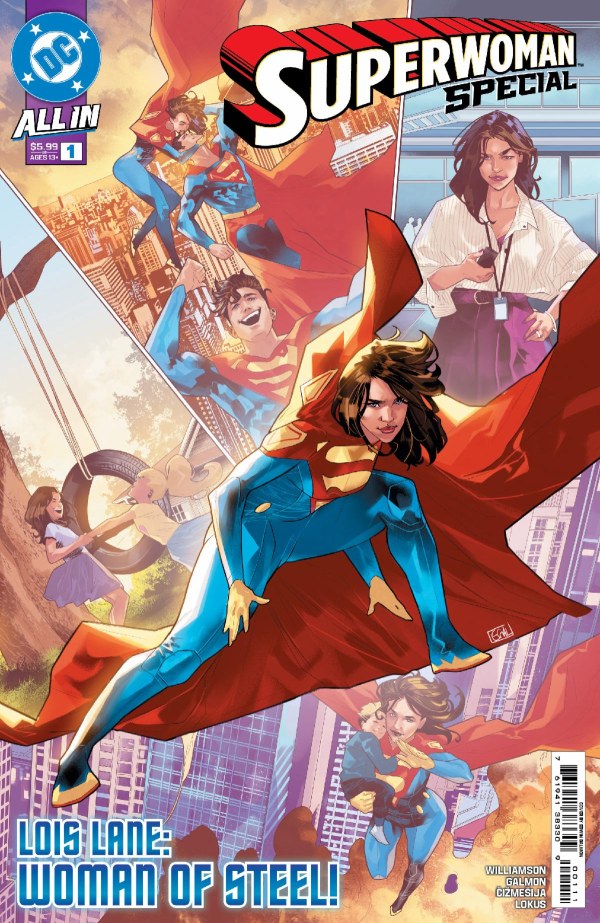
Comics: Superwoman Special #1, DC Comics Presents #69, Supergirl Vol. 2 #21, Justice League of America #15, New Adventures of Superboy #31
She was always a woman of steel. She just has the jammies now.
Notes: I decided to close out “Lois Week” with a re-reading of Superwoman Special #1, which came out just over a month ago and is part of the current ongoing storyline in the Superman comics. A few months back, Lois suddenly started showing up in a Superwoman costume, displaying the same powers as her super-hubby and fighting alongside him, with no indication as to how this happened. This special finally gives us the skinny as Lois tells the other two super-women in Metropolis, Lana Lang and Kara, how she got her powers. In last fall’s Absolute Power crossover, Amanda Waller set out to steal the powers from the world’s heroes (and villains, but mostly the heroes). Waller was, of course, defeated, but when the powers were restored not everything went as planned. Some powers were altered and some went to the wrong people, including Lois suddenly having Kryptonian powers. An examination from Mr. Terrific and the Atom concludes that Lois does, indeed, have Kryptonian powers, but there seems to be a limit – every time she uses them, she is in danger of burning them out. Being Lois, she isn’t content to sit on the sidelines when people are in danger, hence the new Superwoman. The other thing the reader learns in this issue that the heroes don’t is where, exactly, her powers came from. She has inadvertently stolen the powers from one of Superman’s greatest enemies, General Zod, and it seems unlikely that he’s going to be happy when he finds out where his powers have gone.
This special is kind of a fill-in-the-blanks moment, revealing the backstory in the currently ongoing storyline, but there are a few moments I really like. The coffee klatch with Lois, Supergirl, and Lana Lang (who has also been a Superwoman for a few years now, if you haven’t kept up) works really well to help establish the relationship between these three women, arguably the most important ones in Clark’s life, except of course for Martha. Second, I love the scene where Lois reveals to Clark that she’s gained powers. There’s no moment of shock or disbelief – Clark has seen enough weird stuff that it doesn’t even phase him. They just decide to have a nice, romantic flight together before it’s time to get to the bottom of it all.
The last thing I really like is the one thing that I think may possibly be a permanent, or at least long-term change. Lois isn’t going to keep Zod’s powers forever, I don’t think anybody even remotely familiar with comic books thinks that’s going to happen. But her OTHER new job that is showcased in this issue MAY last for a good while. Perry White, in recent issues, stepped down as editor-in-chief of the Daily Planet to run for mayor of Metropolis, leaving Lois in charge. Once he won the election, her temporary position became less temporary. It’s actually been really fun to see Lois as the boss, particularly those moments where her journalistic integrity clashes with her knowledge as Superman’s wife. (There was a story in one of the other titles recently where she took Clark off of any Superman-related stories as they were a conflict of interest, even if the two of them are the only ones who know it.) I really love having Lois in charge, and as great a character as Perry White is, this new dynamic is one that I think has a lot of storytelling mileage in it, and I hope they don’t revert to status quo on this one any time soon.













 Blake M. Petit