Year of Superman Week Ten: The Reign Begins

Last week, I spent most of my Superman time reading the story of his death from 1992. This week we’re jumping ahead over that gap in publication to look into the story that brought him back. Get ready for “Reign of the Supermen,” friends! But first…

It’s gonna get CRAAAAAAAZYYYYYYY…

Wed., March 5

Comics: Adventures of Superman #500

Supposedly, you could peel off the top layer of this cover and remove Jonathan’s hand. I never tried it. I don’t know why the hell anybody would want to.

Notes: The return of Superman begins right where Superman #77 ended with Jonathan Kent lying in a hospital in cardiac arrest. I think back to 1993, when we had to wait about three months in the relative hours that passed between these issues. It truly seemed, at the time, that Jonathan had died of grief over the death of his son, and unlike Clark, we didn’t really feel certain that Jonathan would necessarily be coming back. I think that’s one of the things that still makes this issue so damned good.

Before I get too deep into this I need to make something clear – if you have never read the “Reign of the Supermen” story before, I’m going to be spoiling stuff left and right, beginning in this little recap of this issue. I’m assuming that anyone reading this blog is a hardcore Superman fan and already knows the story pretty well, but on the off-chance that you don’t, consider this your spoiler warning. I didn’t worry quite as much about spoilers when it came to the Death of Superman because…well, it’s right there in the title. But there are a few twists coming in the story of his return, so if you don’t know (for example) who the four people who stepped up to fill Superman’s shoes are, this is your warning to go read the entire story first before you come back here.

Okay, back to Adventures #500. The first half of the issue follows Jonathan into a near-death experience. In a strange realm somewhere between the living and the dead, Jonathan sees Clark being taken away by a contingent of Kryptonian spirits. He charges after his boy, uncovering the truth – the “Kryptonians” are minions of Clark’s old foe, the demon Blaze, and it’s up to Jonathan to convince “Kal-El” to turn around and come back to Earth.

I wonder if there was ever a temptation to have Superman fight this battle himself, do the sort of “power of will” ending that so many of his stories have had in the past. Certainly, it would have been adequate, but…this is better. Having him saved by Jonathan is just better. Showing the father risking everything to save his child is always something that’s going to tug on my heartstrings, and the fact that the child in question is Superman himself somehow makes it even better. “Oh, my son is the most powerful man in the world? Man of steel? Man of tomorrow? His symbol literally means ‘hope’? Shut up, hand me a shovel, and get out of my way.”

I love Jonathan in this book. 

The shovel, by the way, is a really nice callback to the last chapter of John Byrne’s Man of Steel, where Clark was mesmerized by a hologram of Jor-El and Jonathan broke him free by smashing it with a shovel. Here it’s not really Jor-El, but demon wearing his form, but the fact that Jonathan manages to summon a shovel out of the ether to save his boy just makes me want to jump up and cheer.

The main story ends with Lois and Inspector Henderson of the Metropolis PD going to Superman’s tomb to find that it empty, just in case the Christ allegory in the character wasn’t obvious enough. After that, though, we get into our first sightings of the four new characters who stepped up as the stars of the series for the next few months, and each of them has an introduction that is quite fitting for the person they would prove himself to be. John Henry Irons is first glimpsed pulling himself from rubble and proclaiming that he’s got to stop Doomsday – the hero inherent in him is already clear. The “Last Son of Krypton” first shows up dishing out a rather brutal brand of justice – the right intentions, but the wrong path. “The Kid” (who at this point had no name) is broken free from Cadmus by the Newsboy Legion and demonstrates the pigheadedness that defined his early years with a simple proclamation: “Don’t ever call me Superboy!” And finally, the Cyborg makes his first appearance in a wordless sequence in which he lands in front of the Daily Planet building and destroys the marker that designates the spot where Superman died, proclaiming simply “I’m back.” As the true villain of the piece, it’s a nice introduction. Would the real Superman necessarily destroy his memorial? Possibly…but a villain intent on destroying Superman’s good name would definitely do so.

I’m looking forward to reading the rest of this again, my friends. 

Thur., March 6

“One of these things is not like the others…”

Comics: Action Comics #687, Superman: The Man of Steel #22, Superman Vol. 2 #78, Adventures of Superman #501

Notes: The return storyline begins in earnest today. Like I said yesterday, I’m not going to bother to try to hide the reveals for these books, but at the same time, I’m also going to try to recreate the thought process we went through as readers when these books were still fresh, still coming out one week at a time (except for these first four issues, which were all released on the same day). The story begins with the “Last Son of Krypton,” who would eventually be revealed to be the Eradicator, being reconstituted in the Fortress of Solitude by the very robots that he built. Ever since he was supposedly destroyed back in Action Comics #667, the energy that made up his essence had been trapped in the walls of the Fortress, finally restored here. Roger Stern structures it in such a way, though, that it’s not immediately obvious that we’re looking at the Eradicator. It’s possible, or so it seemed at the time, that this energy-being who then went to retrieve Superman’s body, was actually Superman’s soul. He’s less compassionate than our Superman, less personal with Lois, but this too could have been an artifact of his encounter in the afterlife from Adventures #500. 

Man of Steel #22 gives us John Henry Irons’ first full appearance, and we first see him sitting on the stoop of an apartment building, telling kids the story of John Henry versus the machine. Again, subtlety was not a strong suit for these comics. Anyway, John – under the alias “Henry Johnson,” is horrified when a gang hit kills one of the neighborhood kids using a weapon he recognizes as a “Toastmaster,” something he designed in his previous life. He remembers how Superman once saved his life, and told him to “make it count,” inspiring him to make the Man of Steel armor to clean the streets of his weapons. I’ve made no secret of my love of John Henry, and how of the four Supermen, he was my favorite. I think it’s important to point out, though, that the idea of him being the “real” Superman wasn’t out of the question at the time. Although the other three all LOOKED like Superman, John Henry was the one who ACTED the most like Superman. What’s more, this first issue introduces us to John’s neighbor Rosie, the clairvoyant, who claims the Man of Steel is a “walk-in spirit,” the result of a soul whose body has been killed but who instead finds another body to inhabit. If that sounds ridiculous to you, keep in mind that this is part of a universe that includes Deadman and the Spectre. Although it didn’t turn out to be true, at the time the notion that Clark Kent’s spirit was somehow inside John Henry’s body was not something that we could safely rule out. 

In Superman #78, the Cyborg makes his big splash, breaking into Cadmus to take Doomsday’s body. In order to prevent Westfield from attempting to clone the creature, he brings it into space and chains it to an asteroid, drifting – seemingly – aimlessly. The Cyborg then encounters Lois, who insists he visit Professor Hamilton for study. To everyone’s shock, Hamilton’s tests reveal that the Cyborg’s metallic parts are indeed Kryptonian, and his body is genetically identical to Superman. He is, to all appearances, Superman brought bac to life. The truth is that Hank Henshaw, in a computer consciousness, stole the Kryptonian Matrix that brought Kal-El to Earth as an infant, giving him the material to build a convincing body. He was also clever in that the parts of his body that were replaced with metal corresponded pretty well to the areas that seemed to suffer the most damage during the battle with Doomsday. This was the Superman that I remember finding the most plausible in that first month, for the aforementioned reasons. There is, however, one other clue that convinced me pretty well that turned out to be a cheat: in his internal monologue, the Cyborg looks at Doomsday and thinks, “They didn’t bother to wash MY blood off you.” That particular possessive pronoun makes no sense for anybody to use except Superman, and was one of the strongest arguments – among readers – for the Cyborg’s claim to the throne. It still doesn’t make sense that the Cyborg would think that way. That’s a little bit of narrative cheating that bugs me to this day.

Last, we get Adventures of Superman #501, the introduction of the Metropolis Kid. The lad who would one day be Superboy comes to town saving joggers, fighting crime, and proving just how arrogant a super-powered 15-year-old would be. He’s upfront from the beginning, though, telling the world that he’s Superman’s clone, although this would later turn out to only be part of the story, and that story itself would change more than once before it settled on its current status quo. Of the four Supermen, this was the one that I never once thought could be “our” Superman brought back to life…however, that didn’t necessarily mean he wasn’t “real.” After all, if Rosie was right about John Henry’s body containing Superman’s soul, he would need somewhere to go, right? Some comic book science aging the Kid could have made a perfect vessel to contain it, had the story gone in that direction.

I’m remembering the fun of this storyline now. For the last 30 years, any time I’ve read these comics again it’s been with that perspective of knowing the ending. While I can’t throw that lens away, I’ve kinda rediscovered the way I looked at the stories at the time, trying to measure all the possibilities…and that’s a fun way to read these. 

Fri. March 7

The “telescope” is literally a giant horseshoe magnet. Trust me, this image is cooler.

Animated Short: The Magnetic Telescope (1942)

Notes: Unsure if I can get in any reading time today, I decided to squeeze in the next Fleischer short while I have a chance. In this one, a scientist (I’ll let you decide for yourself if there should be a “mad” in there) invents a telescope with an enormous magnet attached, with the intention of drawing celestial bodies closer to Earth for further examination. The problem with this, of course, is that he is DRAWING CELESTIAL BODIES CLOSER TO EARTH. It doesn’t help when the police shut down his machine, cutting off the power after he’s already pulled a comet towards Metropolis and robbing him of the ability to send it back. Superman, naturally, is going to have to get in there and save the day. The short is pretty standard, with the usual gorgeous animation and a story that is fairly predictable. The most interesting thing, I think, is the lack of common sense displayed not only by the scientist, but by Clark Kent, who is taking a TAXI to the observatory after Lois calls in to report the catastrophe. It isn’t until the cab gets stopped by falling meteor chunks that Clark decides to switch to his costume and fly there. Why is he wasting money on a cab in the first place? 

Sat. March 8

Comics: Superman: The Man of Steel Annual #2, Action Comics #688, Superman: The Man of Steel #23, Superman Vol. 2 #79, Adventures of Superman #502

It was the 90s, you see, there was nothing more important than “Edge.”

Notes: The tricky part of reading the “Reign of the Supermen” and related comics is going to be working in the annuals. As they don’t carry the “Triangle” numbers the way the regular issues do, I’m going to cycle them into the reading order as close as I can figure to when they were released, relative to the other comics, and that means I’ll be starting with Superman: The Man of Steel Annual #2. Now in 1993, DC’s summer annual event was a story called Bloodlines, in which a group of aliens came to Earth to feed on humans. Some of the humans they attacked, however, didn’t die, but instead had their metagene awakened, giving them superpowers. The result was that each annual this year introduced a new superhero or villain. Some of them were pretty cool, others were kind of lame, and the only one who had any real lasting impact was Hitman. Edge, for instance, the character that John Henry Irons meets in this issue, hasn’t made an appearance since 1995. It’s pretty tertiary to the ongoing story, with the biggest contribution being that it shows how the Man of Steel is becoming accepted in the neighborhood.

They’re fighting over who has the better hairstyle.

Moving back to the regular issues, we’d entered an interesting time. Although the Triangle Numbers and weekly serialization continued, each of the four would-be Supermen had their own plots and stories that lasted for the first couple of months of “Reign” before the Cyborg played his hand and tied the four titles together again for the rest of the run. In Action #688, for instance, we see a confrontation between the Eradicator and Guy Gardner. In a move that’s surprisingly touching, Gardner is outraged to see four people wearing Superman’s symbol, having gained a new respect for Superman following the Doomsday battle. Guy sets out to put a stop to them, but when he sees how brutal the Eradicator is with criminals, he decides that maybe this fellow IS the Superman Metropolis needs. Ah well, it was fun while it lasted. 

These two, on the other hand, are fighting over who has the goofier nickname on the cover.

Man of Steel #23 then gives us the first encounter between two of the would-be Supermen, Steel and Superboy. The kid makes a mistake that costs a Daily Planet helicopter pilot his life, and John Henry takes him to task for it, but considering that the weapon that dealt the killing blow was of his design, he grows into being more understanding. This is also the issue in which he meets Lois, who feels the same way about John as I always have – this is the only one of the pretenders who seems to have Clark’s spirit. In retrospect, I wonder if Lois’s endorsement was the reason I gravitated so strongly to John Henry, not only then, but in all the years since as well.

Schwarzenegger briefly considered copying this image for his Gubernatorial posters, but decided it was too low-key.

Superman #79 is told through a newspaper column written by Ron Troupe, who is trying to show himself worthy of replacing the (believed to be dead) Clark Kent at the Daily Planet. Perry White challenges him to bring in a story so big that he proves he deserves the job, and it’s hard to argue the SCALE of the story he brings in. Troupe lucks into being on the scene as the Cyborg thwarts a presidential assassination attempt, and in the process, uses a genetic scanner that seems to confirm that he is, in fact, the true Superman. There are two things about this issue that stick with me. First, although I don’t think I realized it at the time, it’s impressive how Dan Jurgens worked so hard to stay away from delving into the Cyborg’s life when he wasn’t in front of the public, and avoided giving us a glimpse into his thoughts (after that misstep in the previous issue). The other thing that stands out to me is that so many, so SO many comic book writers don’t have the slightest idea what a news article is supposed to read like. Even if I accept Ron’s writing as a column rather than a proper news article, the fact that he himself uses the genetic scanner on Superman makes the whole thing a gargantuan conflict of interests. I recognize the irony here, as Clark obviously made his career by writing about himself, but at least he tried to HIDE it. 

All we need is Krypto! (Actually, there’s a version of him in this issue.)

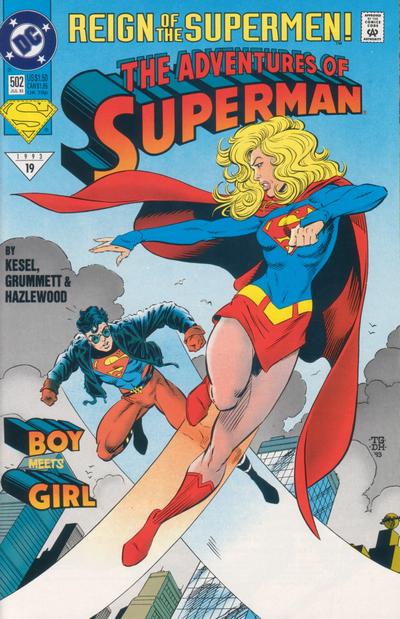
Rounding out month two of “Reign,” in Adventures of Superman #502, Lex Luthor tries to lure Superboy away from WGBS by having Supergirl prance around in front of him in a slinky dress. I wish I was making that part up. But the kid sticks with WGBS when Vinnie Edge presents him with a new manager who also happens to have a teenage daughter…all while the kid is crushing on WGBS reporter Tana Moon. It’s odd, when these books came out I was roughly the same age as the kid is mentally, and I don’t remember being bothered by just how openly he’s manipulated through sex appeal. I suppose it’s the perspective of maturity, or whatever the hell you call it when you apply that particular characteristic to me. This issue is also the first in the “Reign” era to end on a cliffhanger, as Edge hires a villain called Stinger to attack the kid, and winds up blowing up a bridge, leaving Superboy and Supergirl shocked and unable to do anything because they’re out of pages! Man, I hope they figure out a way out of this in Action #689.

Sun., March 9

Comics: Superman Annual #5, Action Comics #689, Superman: The Man of Steel #24

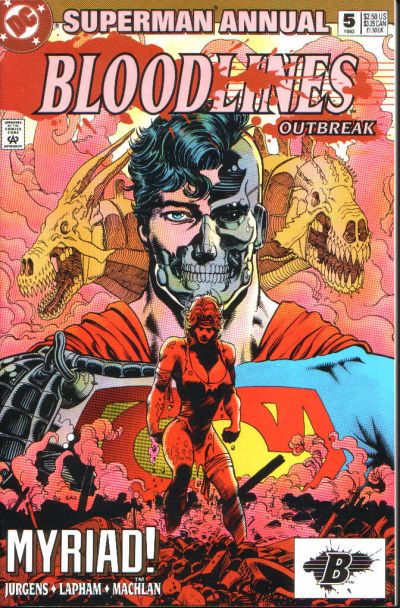
“Myriad!” is Latin for “character who has made one appearance in the last 30 years.”

Notes: We’ve got another Bloodlines crossover for you this time. Unusually for this particular crossover, though, it actually picks up on threads from the ongoing comic book. Back in issue Superman #77, Lex Luthor murdered his martial arts instructor, partially because she embarrassed him in training, but mostly to prove he could still get away with it now that Superman was dead. In Superman Annual #5, one of the aliens gobbling up people left and right finds her discarded body in a landfill and makes her into a quick snack, inadvertently activating her metagene and resurrecting her. She wakes up with no memory of her life, but soon finds she can absorb the memories and personality of anyone she comes into contact with, and even control them. She clashes with Luthor and the Cyborg (which I suppose is appropriate, as it was technically his book at the time) before absorbing the memory and personality of one of Luthor’s assassins and vanishes. Myriad’s future, after the Bloodlines crossover, wasn’t much better than Edge. She popped up in an issue of Action Comics a few months later, then – as far as I can tell – nothing until a surprise appearance in a Batman one-shot, Legends of Gotham, in 2023. But you know, I’ve often believed that even the least-interesting characters can be made fascinating if you give them to the right writer and put them into the right story. Who knows? Maybe Myriad could have a comeback some day. At the very least, the next two newbies we’re going to meet stuck around a little bit longer than the first two.

This is exactly the way my brother watches March Madness.

Action Comics #689 picks up immediately after Adventures #502, and this is the point where the four books begin to really intertwine again. As Superboy and Supergirl rescue the victims of the bridge collapse, in the Fortress of Solitude a man crawls from the machinery that has been recharging him. At the time, it was intended to appear as though this was the Last Son of Krypton (aka the Eradicator) having rested up, but in retrospect, this was the issue where the real Superman actually came back, although we wouldn’t know it for some time. The Eradicator had taken his body from the tomb and was using it as a sort of power source in the Fortress, but in so doing, the machinery resurrected him, a process which – at the end of the storyline – they made damn sure to insist would never work again. Except that they kinda did it again years later when Superboy died. Ah well, who’s counting? Anyway, also in this issue we see Steel face off with the Eradicator over the latter’s more lethal techniques, something Steel vehemently opposes, once more proving that if any of these four EVER had a claim to the S-shield, it was John Henry Irons. Oh yeah, and Mongul is guiding a vast warship through outer space on a trajectory to Earth in order to exact his revenge on Superman. That couldn’t possibly be bad, though, right? 

They were REALLY trying hard to make “Iron John” stick, weren’t they?

Man of Steel #24 follows this up as Steel and the Eradicator’s fight brings them to Coast City, California. Steel tries to convince the Kryptonian that his brutality is unbecoming of a Superman and, surprisingly, the Eradicator actually takes his words to heart. He promises to leave Metropolis to Steel, while he tackles injustice out on the west coast, a decision that would prove to be really, really unfortunate for an awful lot of people. The rest of the issue is concerned with John’s return to Metropolis and a battle with the White Rabbit, the source of the Toastmaster weapons plaguing the city and who also happens to be John’s ex. This issue – as well as most of the “Reign” issues – also briefly checks in with Lois, who is still struggling with Clark’s loss. As much as I like this storyline, I don’t care for how little of Lois we see. I get it – they need to tell the story of the four wannabes and, frankly, there isn’t too much to DO with Lois other than show her skepticism. Still, she’s as important to these books as Clark himself, and when she only shows up on two or three pages in an issue, I miss her. 

Mon., March 10

Comics: Action Comics Annual #5, Superman Vol. 2 #80, Adventures of Superman #503

Notes: I’m going to break with my effort to read the annuals in release order because I realized that, after this point, the Eradicator (at least in this form) doesn’t return to Metropolis for the remainder of the “Reign of the Supermen” storyline, however his Bloodlines annual is set in Metropolis, so even though it came out after, it must take place BEFORE the issues I’ve already read. Being a nerd is fun. 

Note: nothing even remotely like this happens in the issue.

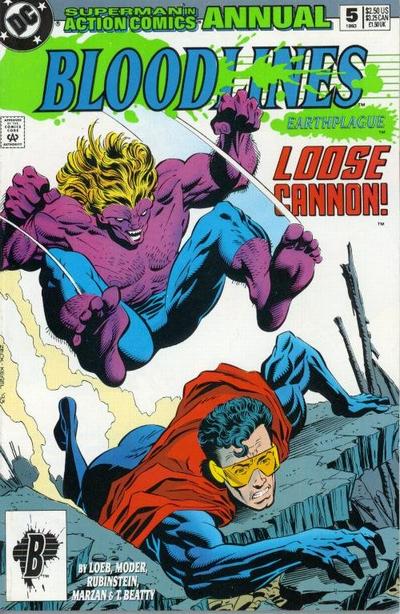
Anyway, Action Comics Annual #5 introduces us to Loose Cannon. Eddie Walker is a former Metropolis Special Crimes Unit officer whose reckless behavior (they always called him a “Loose Cannon” – GET IT???) leaves him partially crippled in an encounter with a metahuman perp. Maggie Sawyer calls him back into service to investigate the murders that are being carried out by the alien visitors , and he winds up becoming their next victim. Now, by night, he turns into a seven foot tall bruiser with blue skin that changes to different colors depending on his mood, because they had to make him at least a LITTLE different than the Hulk. He and the Eradicator throw down with the aliens, but they escape because the crossover was only halfway finished at this point. Loose Cannon fared slightly better than previous two “new bloods” we’ve read about, getting his own miniseries and sporadic appearances in the years since, but he’s never gonna be an A-lister. Not that this really sets him apart from the rest of the Bloodlines characters. 

That Newstime ad I mentioned last week seems more prophetic now, doesn’t it?

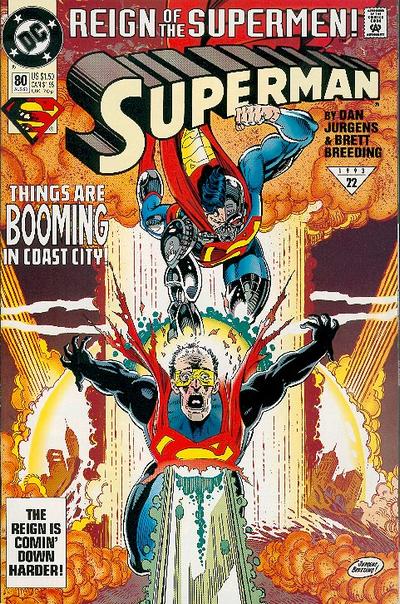
Superman #80 is where “Reign” REALLY takes a turn. Mongul’s warship arrives on Earth and heads to Green Lantern’s home of Coast City, which is conveniently where the Last Son of Krypton is currently operating. The Cyborg sweeps in to “investigate,” and riiiiight up until this point, you might still be thinking he’s the real Superman. Right up until the page where he blasts the Eradicator in the back and tells him, “You’ll be blamed for the deaths of millions.”

Oh. So HE’S the bad guy. 

Three pages later, Mongul’s ship detonates 77,000 individual explosive devices, annihilating Coast City and murdering the seven million people who call it home.

I cannot stress this enough, the Cyborg really IS the bad guy.

The explosion reduces the Eradicator to his energy form and he retreats to the Fortress of Solitude, where again we get one of those fake-out scenes of “someone” piloting a Kryptonian mech, implied to be the Eradicator, but whom we who have read this story before know is our boy Clark. The issue ends with a wonderfully ominous page of Mongul kissing the Cyborg’s hand as he declares that Metropolis is his next target. 

This issue was probably a bigger shocker back in the day than the actual death of Superman was. I mean, we all knew that Superman was going to die. It was on the NEWS. But nobody leaked word that Coast City – home of Hal Jordan and one of the more established fictional cities in the DCU after Metropolis and Gotham – was going to be wiped off the map. This wasn’t just something huge for the Superman books, it was going to have radical consequences for Green Lantern, which in turn would have consequences for the Justice League titles, Guy Gardner’s book, Flash…it was the beginning of a domino chain that reverberated for years. Even now, looking at the current status quo of the Green Lantern corner of the DC Universe, where Parallax is an entity that powers the Yellow Lanterns and each color has its own such entity…this is the book that led to the stories that led to that particular status quo years later. You have to wonder if, in that Superman retreat where the writers were trying to figure out what to do since Warner Bros made them delay the wedding of Lois and Clark because of the Dean Cain/Teri Hatcher TV show, they had any inkling of just how big the consequences of someone joking “Let’s just kill him!” would be. 

Cyborg is really just envious of the leather jacket.

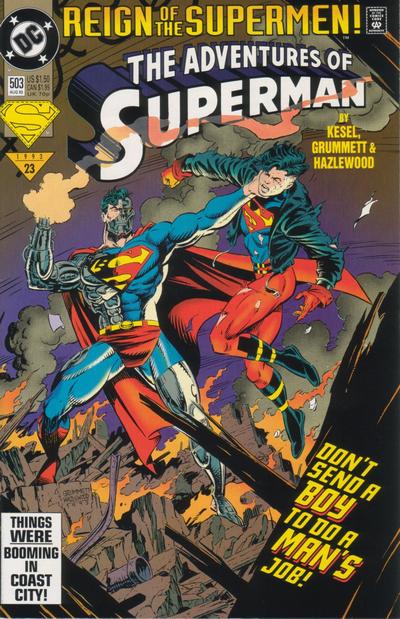
The Cyborg’s plot continues in Adventures of Superman #503. Having taken care of the Last Son of Krypton, he requests that Superboy be sent to the remains of Coast City to “assist” him, really planning to eliminate another of his rivals. He takes the Kid down fairly quickly, but not before making a grave mistake – talking about having powers like the Kid “when I was your age” on the WGBS news feed. Back in Metropolis, Lois hears this and knows for certain he’s an imposter – in this continuity, Clark’s powers hadn’t fully developed yet when he was 15. The real Superman, meanwhile, stumbles from the Fortress in his Kryptonian mech and begins the march back to civilization, and the Kid shows the first glimpse of the power that will later be called “tactile telekinesis,” further evidence that he is NOT – as Paul Westfield at Cadmus claimed – simply a clone of Superman. Without belaboring the point, because I don’t think it actually is clarified until after the “Reign” story ends, we eventually learn that Cadmus couldn’t totally crack Superman’s genetic code, so they manipulated a clone to LOOK like him and used what information they COULD get to give him similar – but different – powers. Years later Geoff Johns came in and further retconned the origins to its current status quo: Superboy is a clone whose DNA is a mix of Superman and Lex Luthor. But they co-parent like champs.  

Tues., March 11

TV Episode: Justice League Unlimited Season 2, Episode 3: “The Doomsday Sanction”

“Okay, tell me when this starts to hurt…”

Notes: I didn’t have any reading time today, guys, and by the time I finally had a chance to sit down I was kind of exhausted. As much as I love reading, sometimes your brain just isn’t in that place, you know? So instead, I decided to dip into the excellent Justice League Unlimited cartoon to check out an episode centering around our old pal Doomsday.

Written by the late, great Dwayne McDuffie, this episode starts with Batman popping into Amanda Waller’s shower in a hell of a power move, confronting her over her activities with Project: Cadmus, which in the DCAU is a project dedicated to creating weapons capable of defeating the Justice League, including clones. One of the Cadmus doctors, Dr. Milo, is told his research is going to be defunded. Angry at being cut off, he goes to the cell where Doomsday is being held and tells the creature that he is an altered clone of Superman who was trained to hate the Man of Steel by Waller and Emil Hamilton, and it’s the two of them who should be his REAL target. Doomsday doesn’t care WHY he hates Superman, though, just that he does, and after dispatching Dr. Milo, he sets out, confronting Superman on a volcanic island the League is trying to evacuate. As the battle rages, Cadmus’s General Eiling sends a missile with a Kryptonite warhead to destroy both Superman AND Doomsday, not caring what it will do to the inhabitants of the island where the battle takes place…an attack that even Waller realizes is going too far. Batman stops the missiles while still over open ocean and Superman stops Doomsday by chucking him into the volcano. The League takes Doomsday into custody, and Superman exiles him to the Phantom Zone. That action doesn’t sit right with the recovering Batman, though, causing him to fear that maybe Cadmus has a point.

This was such a fantastic series. McDuffie’s handling of the characters was amazing, and the way he and the other writers pieced together all the different nuggets of the different DC heroes into a cohesive whole that made sense for this universe is nothing short of astonishing. They never did a real “adaptation” of the Death of Superman storyline, but they found interesting uses for Doomsday nonetheless. It’s a very different TYPE of Doomsday, I must say. He’s not a mindless beast – he’s intelligent and at least relatively verbose, able to exchange taunts with Superman and tell him he’ll live to regret exiling him before they send him off to the Zone. He is also clearly far less powerful than the Doomsday from the comics. Superman’s fight with him wasn’t EASY, don’t get me wrong, but considering that the only way he could be stopped in the comics was by the two of them killing each other, the fact that a mere volcanic eruption seems a little less impressive. Even more so the fact that he is held prisoner – both by Cadmus and by the League – with relatively little difficulty…this is a different Doomsday than the one who kills Superman in the comics. But for this world, for this universe, for a Saturday morning Cartoon Network series that was ostensibly aimed at children, it’s not a bad fit at all. 

If there’s one thing I don’t like about this episode – this series as a whole, to be honest – it’s placing Emil Hamilton on the side of Waller’s Cadmus mad scientists. Hamilton is one of those characters from “my” Superman era – the good-hearted and sometimes absentminded scientist who, after making one mistake which Superman stopped before it could go TOO far, turned into one of Superman’s greatest allies. In the comics they eventually gave him a heel turn as well, and that’s something that has never sat right with me in all the years since. It’s been well over a decade since he’s made more than a token appearance anywhere, and honestly, I’m not even sure what his status even is anymore, vis-a-vis his relationship to Superman, after all the years of reboots both hard and soft. But they always say that comics are cyclical – it’s probably only a matter of time before somebody who loves Emil Hamilton the way I do steps into the shoes of writing Superman and finds a way to rehabilitate him and bring him back. At least, I sincerely hope so.

The Reign continues next time, friends!

Blake M. Petit is a writer, teacher, and dad from Ama, Louisiana. His most recent writing project is the superhero adventure series Other People’s Heroes: Little Stars, volume one of which is now available on Amazon. You can subscribe to his newsletter by clicking right here. You can join in the Kryptonian Konversation every day in the Year of Superman Facebook Group!
Year of Superman Week Nine: The Beginning of the End…

As I have said many times, the golden age of Superman comics – for me at least – was the late 80s and early 90s, the period we now wax nostalgically for as the “Triangle Era.” I could honestly have just spent this year reading John Byrne’s Man of Steel miniseries (that’s still coming – at some point I’m going to do an “origins” week) and then continuing on until the triangles ended ‘round about 2000 or so. But instead, I made a list of some of the most important stories and high points of the time and, those that don’t necessarily fit into another theme I have planned, I’m trying to hit in roughly chronological order. And as of now, I’m only planning to read two of the longer storylines from the era (although I reserve the right to add more later if I feel I’ve got the room), and having moved forward appropriately in the timeline, it’s time to get into one of the defining storylines of the character. 

It’s October of 1992. I’m a 10th grade student with a subscription to the four Superman comics, eagerly awaiting their arrival each week and getting pretty darn mad when the US Postal service delivers them out of order (which happened, I must tell you, more than once). And even though I knew it was coming, even though it had been bandied about on TV and in newspapers for weeks prior to the beginning of the story, I didn’t know if I was really prepared for the story that — at the time – was called “Doomsday,” but that these days we typically refer to as “The Death of Superman.”

This was pretty much all I thought about for two months in the fall of 1992.

Wed., Feb. 26

Comics: Superman: The Man of Steel #18, Justice League America #69, Superman Vol. 2 #74, Adventures of Superman #497, Action Comics #684, Superman: The Man of Steel #19, Superman Vol. 2 #75

Notes: After a month of one-page prologues, the creature who would be known as Doomsday burst free from his subterranean prison in Man of Steel #18, and spends this issue stomping through the countryside, ripping up landscape and crushing animals before finding civilization. But the surprising thing, if you’re reading this for the first time, may be that Doomsday is the B-plot of this first issue. Most of the pages are used to deal with a running story from this particular series regarding a community of monsters in Metropolis’s underground. In the 90s, although the four separate Superman comics of the era continued into one another each week, each series tended to have its own subplots and stories to focus on, including the Underworlders. This issue also features Keith, an orphan who has befriended Superman and hopes to find his lost mother, and who would eventually be adopted by Perry and Alice White. 

I really love the Keith sequences in particular. The creative team on this book of Louise Simonson and Jon Bogdanove had previously done a wonderful run together on Marvel’s Power Pack, a comic book about a group of brothers and sisters who are all given powers by a benevolent alien. It was one of Marvel’s best comics of the era, and whenever Simonson writes children she brings a really authentic feel to them. Her children are inexperienced and naive at times, but never stupid or foolish. There is an inherent realism to her kids that I absolutely love. Keith was out of focus in the comics for a very long time, and with all the reboots that have happened over the years I wasn’t even sure he still existed in the DCU until recently, when Perry White was running for mayor and Keith showed up at an event with him. I hope, now that Perry is the mayor of Metropolis, we see a little more of Keith White.

Next up was what essentially was the end of Superman’s tenure with the Justice League, which had begun only nine issues before. The JLA is called in to stop Doomsday’s rampage, but Superman is on live TV doing an interview on the Cat Grant show and unaware of their battle, leaving his teammates to face the beast without their most powerful member. As Superman talks to a group of high school students, the League – if we’re being candid – gets their asses handed to them. Guy Gardner is hurt, Bloodwynd is chucked into a fire, and Blue Beetle is rendered comatose just as he was about to crack the mystery of who Bloodwynd really is. (If you remember a few weeks ago from the Justice League issues I read, that was Beetle’s primary preoccupation in this period, and if I may toot my own horn a mite, I remember solving that mystery myself when I read this issue, using the same clue that made it click for Blue Beetle. It wasn’t confirmed in the comics for several months, though.) The fight is intense, and rolls right into the next issue of Superman, #74. 

In fact, this was a running theme through the rest of this storyline. Each issue from this point on flowed seamlessly into the next and, starting with Adventures of Superman #497, each issue began to reduce the number of panels per page. Every page in that issue had four panels, the next three, then two, and in the final chapter the entire issue is told in full-page splash panels. What this does, essentially, is give the story a sense of ACCELERATION. Fewer panels means the story goes more quickly, each issue faster than the last, until we get to the final showdown on the streets of Metropolis in Superman #75. 

Superman #74: Superman joins the League to take on Doomsday. In the battle, Booster’s power suit is destroyed, Fire burns out her powers, Guy Gardner’s face is swollen so badly he can’t see, and Ice and Bloodwynd are taken down. The only one to escape unscathed is Maxima, and only because she leaves early to bring the near-death Blue Beetle to a hospital. 

Adventures of Superman #497: When Superman has to go back to rescue a family and his teammates from the house Doomsday destroyed in the previous issue, he gets a head start and starts creating havoc, taking down military helicopters and smashing into a small town before Superman can catch up to him. Supergirl (the Matrix version) sees the destruction on TV and wants to help, but her boyfriend Lex Luthor Jr. (long story, just read the Wikipedia explanation) holds her back. Maxima returns but is taken out in short order, and Superman vows to defeat the beast alone. 

Action Comics #684: The fight with Doomsday crashes into a department store, where a TV ad for an upcoming pro wrestling match at the Metropolis Area causes the beast to take notice of his destination: “Mhh-Trr-Plss…” A road sign that matches the advertisement points him towards Superman’s city as the Daily Planet helicopter – carrying Lois Lane and Jimmy Olsen – arrives to report on the carnage. The battle destroys an abandoned territory called Habitat, but the creature escapes and bounds towards Metropolis.

What it feels like being a teacher the week before a holiday.

Superman: The Man of Steel #19: Doomsday arrives in Metropolis. Cameras broadcast the battle across the world, including Smallville, where the Kents watch their son’s battle for his life on television. Supergirl finally is sent to help, but one blow from Doomsday disrupts her synthetic body and takes her out. Emil Hamilton and Bibbo (perhaps the greatest supporting character ever) bring a laser cannon to the roof to try to help, but to no avail. The Metropolis Special Crimes Unit open fire with everything they have, but they don’t even chip his hide. And in the end, Superman vows to draw the line in Metropolis.

When I read this story in high school, this issue was a great fight scene, sure, but like so many things it hits different for me now, as a parent. It seems quite telling to me that most people, like Jimmy, have the attitude that he’ll be OKAY. He’s SUPERMAN. He always comes out of it okay. But his parents, Jonathan and Martha, voice the fears of parents: “They don’t think anything bad can really happen to him.” The implication, obviously, is that the Jimmys of the world are wrong…and wrong he is.

Superman #75: The end. 

I remember distinctly the day this issue arrived in the mail. I got home from school before either of my parents got home from work, before the school bus dropped off my younger brother and sister, and I found this issue sitting in the mailbox. I brought it into the house, didn’t turn on the TV, didn’t even turn on the lights. The window in the living room gave me all the sunlight I needed as I slit open the plastic bag and opened the pages to witness the end of Earth’s greatest hero in quiet and solitude.

The story is swift, as befits an issue where every page is a single panel. Superman and Doomsday tear through Metropolis, trading blows until finally, with one last all-powerful punch, each of them collapse on the street. Lois rushes to his side and cradles him, his last words asking if Doomsday is defeated, his last thought for the city he was trying to protect, before the light fades from his eyes.

Yeah, I will admit, I cried when I read that. I still get misty today, even knowing that this was just the beginning of a much longer storyline it still hits like a kick to the gut. And even in 1992, when this was released, nobody really believed that Superman would stay dead. It was a story, and at the end of the story the status quo would be restored. That’s how these things went. 

It didn’t make it hurt any less.

This BROKE me.

And that’s what makes it one of the all-time great comic book epics, that I can read it again today and still feel that pang of loss I had when I was 15 years old. 

Man, this is a heavy way to start the week.

Thur., Feb. 27

When I woke up this morning, I went through my usual routine of showering, dressing, getting together a lunch for work, and then popping online for a few minutes until it was time to leave. Usually I want to see what the weather is going to be, if there’s any traffic snarls I should be aware of, that sort of thing.

I did not expect to begin the day with the news of the death of Gene Hackman.

1930-2025

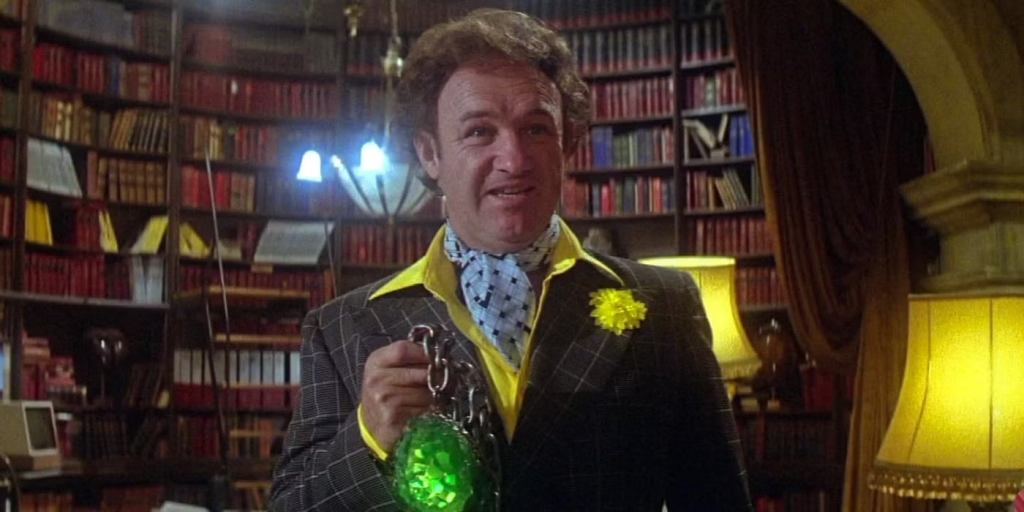
Hackman, of course, was a legendary actor, known for countless roles in dozens of classic films, but to me (and, I suspect, most people around my age) he is indelibly linked to the role of Lex Luthor. His Luthor was smooth, slimy, cheerfully manipulative and yet prone to brief outbursts of rage when faced with incompetence, which makes you wonder why he so often surrounded himself with incompetence. As much as Christopher Reeve shaped our perception of Superman and Margot Kidder our Lois Lane, so too did Gene Hackman shape our Lex Luthor.

As of when I write this, Thursday morning, the news is reporting that Hackman, his wife, and their dog were all found dead in their home in Arizona. Although foul play is not suspected, no cause of death has been determined. It goes without saying that my heart goes out to their families, those who knew and loved them personally. But also, it feels like a moment to raise a glass in tribute as another little piece of our childhood has left us forever. And at my age, it feels like we lose one of those pieces every other day. 

RIP, Mr. Hackman. See you in Otisburg. 

Comics: Death of Superman 30th Anniversary Special #1

Ah yes, “Death,” the traditional 30th anniversary theme.

Notes: Am I going a little out of order? Absolutely. But it feels more appropriate to read this now than to do so chronologically. In 2022, DC released this special with new stories by the same writers and artists behind the original Death of Superman event, followed up the next year with a special for the 30th anniversary of his return. I’ll get to that one too.

In the first story, Lois and Clark’s son Jon (still 10 years old, this is set before the Bendis aging controversy) in school when a familiar survivor of the Doomsday attack comes to talk to his class. This, as it turns out, is the first time Jon learns that his father died before Jon was born. I love this story – Lois’s talk with Jon is a nice sort of postmortem for everybody who read that story back when it was first published, encapsulating the feeling and emotion of the day while maintaining a bit of hope for the future. But as if that weren’t enough, we get a hell of a fight scene as well, as a construction worker who kept a chunk of Doomsday’s shattered bone all these years is suddenly transformed into a new version of the monster. The battle scene in the streets of Metropolis is pretty epic, and shows that Dan Jurgens hasn’t lost a step. It could have been published in 1992 and fit right in. It just makes it feel like more and more of a crime that he was bumped from Action Comics after issue #1000 when the status quo was upended. DC, I plead with you, find some way to have Jurgens writing and drawing Superman regularly again, preferably doing stories of Lois, Clark, and Jon in the past, like this one.

We also get three more stories, the first reuniting Adventures of Superman creators Jerry Ordway and Tom Grummett for a focus on Jonathan and Martha Kent. In the original “Death of Superman” we saw glimpses of the two of them watching the fight on TV. This story expands upon that, as they talk about some of the dark places and brutal battles their son had been in over the years. It’s a pretty good recap of the ‘86-’92 era of Superman through the eyes of the people who made Clark Kent the hero that he is. Martha’s Superman scrapbook is legendary, but this issue takes that concept one step further, showing the invisible impact Superman has on the world. It’s a really nice look at the character from a different angle. 

The third story brings back Roger Stern and Butch Guice, then the creative team on Action Comics, for a story starring Guardian at Project Cadmus, which was one of their ongoing subplot. The story shows the events of the day of Superman’s death from Guardian’s perspective, and although it doesn’t really offer any new insight into the story, it’s really great to see Guardian, Dubbilex, Dan Turpin, and some of the characters that were so important to the books at the time.

Finally, Man of Steel creators Louise Simonson and Jon Bogdanove return for a story about John Henry Irons, the man who will be Steel, and what happened to him during the Doomsday rampage. Having recently been saved from falling to his death by Superman, John Henry is determined to help him fight Doomsday, but as he follows the path of destruction, he find himself stopping at one disaster after another, pausing to save other people even as Superman fights for his life. This is why I love John Henry as a character so much – out of the four “new” Supermen that rose after his death, he was always the one who most embodied the spirit of Superman. With no powers, no weapons, without even the armor he would soon build, John Henry risks his life again and again to save others. And that’s what a Superman is for. 

Fri., Feb. 28

Legitimately some of the best stories of the era.

Comics: Justice League America #70, Adventures of Superman #498, Action Comics #685, Superman: The Man of Steel #20, Superman Vol. 2 #76, Adventures of Superman #499, Action Comics #686, Superman: The Man of Steel #21, Superman Vol. 2 #77

Notes: Although I can’t recall quite where, I remember reading an interview once with the creators behind the Death of Superman saga where one of them (probably Dan Jurgens) said that the stories that they were really interested in telling, the ones they found most compelling, were those from the “Funeral For a Friend” storyline. How does the world cope with the loss of Superman? How do we move on? How do we choose to honor his memory? The Doomsday story was a necessity to get them to that point, the “Reign of the Supermen” was the necessity to bring him back, but these stories are the heart of the saga.

Justice League America #70 picks up moments after the end of the battle with Doomsday, picking up the same dialogue – even the same narration – from the final pages of Superman #75. (And let’s hear it for Dan Jurgens, getting paid to write the same pages twice. Nice trick, sir!) The League is in a shambles: Blue Beetle comatose, Fire’s powers burned out and not returning, Ice injured, and Booster Gold’s future technology completely destroyed. As they try to pick up the pieces, the rest of the DCU’s heroes begin to assemble at JLA headquarters in New York to pay their respects to the fallen hero. It’s a touching book, with words of deep mourning and emotion that fit the grim day. For all intents and purposes, this was the end of Superman’s tenure with the League until it was restructured a few years later by Grant Morrison, but for what it was and when it was, this was a suitable ending.

Adventures of Superman #498 also picks up on the heels of Superman #75, showing the efforts to resuscitate the Man of Steel, and the ultimate futility of the attempt. This issue takes us everywhere: Supergirl tries to pull herself back together, Gangbuster is angry at himself for not being there, and in Smallville Jonathan and Martha Kent cling to one another and pray for a miracle. Somehow, even now, the thing that hits me hardest is the scene of Bibbo strapping on one of Professor Hamilton’s force field belts so he can withstand the jolt as he tried to hit Superman with hyper-charged defibrillator paddles. Bibbo is just one of those characters that’s too wholesome for the world – a big, gruff bruiser with the brains of a kid and the heart of a prince. The inherent goodness in him, in a man that the world would have cast aside, is what makes him such a perfect member of the Superman supporting cast. He’s another one we don’t see nearly enough nowadays. 

Action Comics #685 picks up that evening, as a Daily Planet extra edition announces the news no one wants to hear: “SUPERMAN–DEAD: METROPOLIS MARVEL KILLED IN ACTION.” Paul Westfield and Project: Cadmus get into a fight with Guardian and Supergirl over the right to claim the body, while everywhere else we see the world beginning to mourn. Meanwhile, at the Daily Planet, people are starting to worry about Lois. In the wake of the fight with Doomsday, thousands of people are missing – and one of them is her fiancé, Clark Kent. When they say that this is the section of the story the creators were most interesting in telling, this is the issue that I always come back to. The final page is one of the single most affecting pages I’ve ever read in a comic book, as Bibbo – having cleared out his bar so he can be alone – gets down on one knee, says a “Hail Mary,” and prays…not for Superman, but for the protection of the world he left behind. 

If this page doesn’t rip at your heart I’m not sure how to talk to you.

Superman: The Man of Steel #20 gives us the funeral. On a rainy day in Metropolis, millions of people line the streets to watch the processional as his body is brought to a hastily-erected monument in Centennial Park. In Kansas, meanwhile, the Kents hold a solemn, quiet ceremony of their own. Again, this issue shows us the impact of Superman on the world – people recalling the times he saved them, Batman deciding to take care of a guy with a bomb “Superman’s way,” and so on. We also get more of those Simonson-written kids that I like so much. 

In issue #76 of Superman, it’s Christmas! Doesn’t quite feel that way, though, with Superman gone. So in his memory the Justice League and a few others gather in Metropolis to carry out one of Superman’s annual traditions – reading and answering letters from people in need. This is a great issue, a sequel to an earlier story where we saw how Superman spends Christmas, and which I’ll no doubt read and write about this December. We also get a pair of subplots: Jimmy Olsen and Bibbo help out Mitch Anderson, the kid whose house Doomsday destroyed, and the Kents come to Metropolis with Lana Lang to hold a private wake with Lois, as four of the only people who knew who Superman really was. 

After this issue the stories take a turn. The immediate aftermath of his death and the period of mourning over, the story now becomes the struggle over his remains. In Adventures #499 we see that Westfield – defeated on the day Superman died – has burrowed into his tomb to steal his body for genetic experimentation. Action Comics #686 shows us that Cadmus is hoping to clone Superman, a storyline that obviously would become prominent later. Superman: The Man of Steel #21 takes us back to Smallville, where Jonathan’s memories of his lost son become overwhelming. In Metropolis, flooding helps Lois uncover the theft of Superman’s body, and takes the story to the front page. Finally, in Superman #77, after Supergirl and Lois recover Superman’s body and put it back where it belongs, Lex Luthor II (Lex pretending to be his own son) takes a moment to gloat in the tomb. In Smallville, though, Jonathan has been rushed to the hospital after collapsing in his field. After an issue of memories of his son, “Funeral For a Friend” ends with a chilling flatline.

The second half of “Funeral For a Friend” isn’t bad at all, but it’s there largely for setup. It plants a lot of seeds that would bear fruit in the upcoming “Reign” storyline. For pure emotional impact, the first half is one tearjerker after another, with a few more coming in the final two issues as Jonathan’s personal grief overtakes him. I know I say this a lot, but reading these issues as a parent makes them far, far more powerful than they were when I was a kid. As painful as it is to see Superman fall, seeing the utter devastation to the father who helped shape him into the hero he is may be the most heartbreaking part of the entire saga. 

Other Comics: Justice League of America #17, New Adventures of Superboy #32

Sat. March 1

Animated Film: The Death of Superman (2018)

Notes: Everywhere else, it’s just Saturday, but here in Louisiana it’s the weekend before Mardi Gras. And while I’m not a particularly enthusiastic paradegoer, my son is, and as such I make the effort to take him. Today was the Krewe of Lul parade, a nice little family-friendly small-town parade local to my community, and even better, I’ve got a cousin who lives on the parade route and always invites us to watch the parade there. It was a great day, and someone on one of the floats threw my son a ridiculously large stuffed snake, which my wife doesn’t yet know about as she had to work today, and I cannot WAIT to see her face when she gets home.

It’s got nothing to do with Superman, but c’mon, LOOK at this thing.

Parades are a little exhausting, though, especially when it’s hot outside, and I’m still a little too sun-dazzled to want to read anything today. So my Year of Superman continues at the moment with the 2018 The Death of Superman animated movie. This was actually the second attempt at animating the story, but as the first condensed the entire trilogy into one film rather than splitting it into two like this one, I’m waiting until after I finish reading the whole thing before I rewatch it. It’ll come soon enough.

Clearly, this is traditional carnival viewing.

This film was made during the period of DC animation where the movies were all set in a single universe largely based on the New 52 incarnations of the characters. As such, the story is tweaked appropriately to make it fit: the Justice League that faces Doomsday is that incarnation of the team rather than the Jurgens-era lineup, for example. And while Lois and Clark weren’t a couple in the New 52 era, here they’re in the early stages of a budding romance. Lois wants to keep their relationship a secret from their coworkers at the Planet, she hasn’t met his parents yet, and – probably most importantly – she does not yet know the secret of his duel identity. Other changes aren’t necessarily New 52 related, but help to condense the story: Doomsday’s coming to Earth, for example, is connected to the disaster that kills Hank Henshaw’s crew and sets him on the path of villainy he’ll occupy in the next movie. 

I’ve always been a fan of the voice cast here. It’s a little bit of stunt casting, placing real-life husband and wife Jerry O’Connell and Rebecca Romijn as Clark and Lois, but I like them both in their assigned roles. Rainn Wilson, meanwhile, is a deliciously wicked Lex Luthor, and Patrick Fabian has always sort of straddled the line between clean-cut and white collar crook, which somehow fits Hank Henshaw very well. We also get Rosario Dawson as a highly convincing Wonder Woman and Nathan Fillion as Hal Jordan, the Green Lantern that a lot of us thought he should have played in live action (although I have every confidence he’ll nail Guy Gardner). 

Pictured: First Officers Jack Ransom of the USS Cerritos and Una Chin-Riley of the USS Enterprise. (Colorized)

There’s a considerable amount of buildup here – it’s almost halfway into the movie before Doomsday’s rampage begins – but I think it’s necessary. This movie leans more heavily on the developing Lois/Clark romance, and that buildup is focused largely on that. We see Clark agonizing over whether to tell her his secret, Diana berating him for not telling Lois who he really is yet, even asking for advice from the soon-to-be-married Barry Allen about his relationship with Iris. That buildup to what should be the happiest moment of their lives, the engagement (and the reveal of the secret) is well-done, and thus when the battle with Doomsday begins and the inevitable happens, the whole thing feels even more tragic. The reveal is handled well too – I love the fact that Lois’s first reaction, once the shock wears off, is “This is so unethical! You’ve been writing stories about yourself!” The emotional resonance echoes after the battle too, as we see the Kents unable to get close to their son’s funeral, then see Bibbo’s beautiful prayer sequence recontextualized into a montage over the city in mourning. 

The animation isn’t my favorite, to be honest. The characters are a bit too blocky, and they’re using the New 52-era designs, which means excessive lines EVERYWHERE, and Superman’s suit is too dark and kind of bland. But once we finally get to the fight with Doomsday it’s brutal and pretty epic. The killing blow is actually far more graphic than I expected, with Superman actually hitting Doomsday hard enough to make his head spin around, and it doesn’t look “cartoony” at all. 

Also, Bibbo is in this movie. So, y’know, I like it. 

Sun. March 2

Comics: Superman Vol. 6 #23, Justice League Unlimited Vol. 2 #4, Power Girl Vol. 3 #18

But certainly, Doomsday must have mellowed out in the last 30 years, right?

Notes: I’m taking a quick break from the Death and Return saga to check in on this week’s new Superman-related titles. First up: Superman Vol. 6 #23, the latest in Joshua Williamson and Dan Mora’s ongoing saga. Doomsday is now the Time Trapper, and his control over the timestream is giving Lois a chance to pause while the contemporary Doomsday and Radiant battle it out in Metropolis as the Superman family tries to hold the line. I like what Williamson is doing here, using the original Death of Superman storyline (so I guess I’m not TOTALLY taking a break) as the framework for this new story, and giving us a neat focus on the characters . There’s a great speech from Lois when she talks about how she wept on the day Superman died, and how her tears may not have been for exactly the reasons one may have expected. It’s not a retcon, but rather a subtle recontextualization of the moment that I think actually works really well. And as usual, Dan Mora is killing it. I can’t say enough good things about his artwork. Over the past few years he’s become probably my favorite current artist in comics, and he’s earning his place on the Superman Mt. Rushmore with the likes of Curt Swan, John Byrne, and Dan Jurgens.

I’m not done with Mora yet, though – he also drew this week’s Justice League Unlimited Vol. 2 #4, this time teamed up with writer Mark Waid. The terrorist group called Inferno is unleashing havoc all over the world, with global fires crippling the Martian Manhunter and perhaps even killing Swamp Thing. In response, Mr. Terrific tries to recruit Alec Holland’s daughter Tefe, while Batman sees to the fallen J’onn J’onzz. Superman’s actual participation in this issue is minimal, appearing in just a few panels helping with the evacuation efforts from the wildfires while the big brains and the magic users try to solve the problem, but that’s actually one of the reasons I like this book so much. Waid has really stacked the deck by including virtually every hero in the DCU. It would be really tempting to still spend most of the time with the Big Guns, but Waid has done a great job crafting a story that allows for the lesser-known characters to rise to the front lines instead of Superman and Wonder Woman to be the A-team every single issue. It may be tangential to my “Year of Superman,” but it’s still maybe the best book DC is publishing right now.

Last but not least, Power Girl Vol. 3 18 continues Leah Williams and David Baldeon’s tale of the housewarming from hell. The grand opening celebration for the new Star building, complete with a bunch of guests from Asgard, is disrupted when a strange barrier traps everyone inside. Superman and Steel (John Henry) try to crack it open from the outside, while inside, Power Girl, Omen, and Steel (Natasha) attempt to get to the bottom of their predicament. This is an issue that feels very much like a middle chapter, incomplete and with a lot of questions. In and of itself, there’s nothing wrong with that, but I don’t know if they structure the story quite enough to get us started before the story begins. We kick it off with the barrier already in place, then after several pages, flash back to how we got there. I don’t object to in medias res, but I don’t know if it really works well for this issue. Hopefully the next chapter of this particular story will clarify things a bit. 

Mon., March 3

Comics: Legacy of Superman #1, Supergirl/Team Luthor Special #1

Notes: After the conclusion of the “Funeral For a Friend” storyline, DC took the rather bold – for the time – step of ceasing publication of the four Superman titles for a few months. They resumed in the spring with Adventures of Superman #500, and I have to give them credit for not doing what they would do today – namely, restart each series with a new first issue. Actually, in the gap they would have published four separate miniseries for the four Supermen who took his place, THEN restarted each series with a new first issue. But I digress. In the gap, they published a few specials about what was happening in Metropolis in the wake of the Death of Superman

Don’t get too attached to that kid in the upper right-hand corner.

Legacy of Superman includes five short stories about different defenders of Metropolis. First was a Guardian story, set during the time before Lois and Supergirl retrieved Superman’s body from Cadmus, about their efforts to map Kryptonian DNA. As several of the characters wrestled with the ethics of the situation, we are introduced to the hyper-advanced Guardian clone called Auron, a character who, as I recall, seemed like he was going to be more important that he eventually turned out to be. Next was a story that brought back the old character(s) Rose and Thorn. Rose Forrest is secretly the vigilante called Thorn – a secret that even she herself does not know. It’s what at the time was called Multiple Personality Disorder, or at least a comic book-level understanding of it. With Superman dead, crime in Metropolis is on the rise, and Thorn comes back to help out. It’s a perfectly fine story, but other than reintroducing Thorn, it’s not particularly significant. Of more significance is the Gangbuster story. The longtime Superman supporting cast member is trying to step up and fill his shoes, but the fight against Metropolis’s criminals is getting harder on him, wearing him down, and making him more brutal. Story number four features Sinbad, a young boy with telekinetic powers who had appeared in a three-issue storyline a few years prior. This story, like the issues that introduced him, was by the creative team of William Messner-Loeb and Curt Swan, and I’m pretty sure it’s the last time the character ever appeared. 

The last story features Waverider, and for reasons I cannot fathom, it is not included in the DC Universe Infinite edition of this comic book. I swear that app seems less and less Infinite all the time. Fortunately, I’ve got the week off work and I’ve got the issue in my collection. Waverider (from the Armageddon 2001 storyline) has at this point joined the Linear Men (from the Time and Time Again storyline) and, upon learning of Superman’s death, is determined to use their time travel powers to save him. That is until their leader, Matthew Ryder (an alternate-timeline variant of Waverider himself) starts listing people whose contributions to history could have been greater had they lived longer and asking where they drew the line. It’s a good argument, but I’ve always wondered why Dan Jurgens didn’t take it a step further to the logical conclusion – that manipulating time for your own ends is as dangerous as the enemies to the timestream you fight, and that doing so (even with good intentions) has rarely ended well.

Laugh if you want, but do YOU have hair that magnificent?

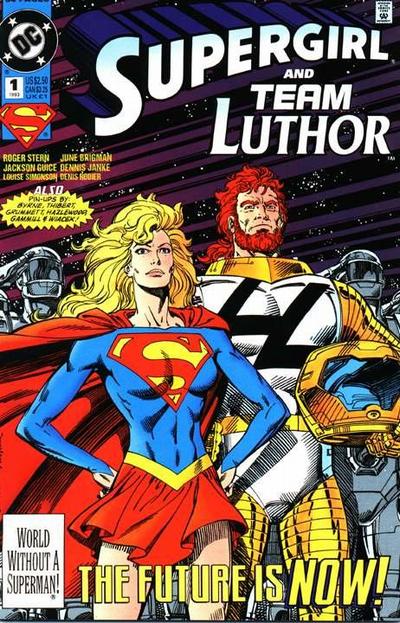
The Supergirl/Team Luthor Special has two stories. The first, by Roger Stern and June Brigman, focuses on Supergirl and “Lex Luthor II”’s private police force stepping up to help fight crime in Metropolis, similar to some of the stories in the previous volume. Louise Simonson writes the second story, where Supergirl encounters some of the Underworlders whose story has been one of the major plots in Superman: The Man of Steel. Both of these stories, while perfectly fine, seemed somewhat insignificant at the time. With the benefit of hindsight, though, I see that they were planting seeds for stories that would play out in the next Supergirl miniseries and the accompanying Superman titles featuring the collapse of Project: Cadmus, the fall of the Underworld, and the end of Luthor’s charade – stories that, I’m fairly certain, wouldn’t be published for nearly a year. They plotted things REALLY well, those Triangle Era Superman writers. 

Tues., March 4

Magazines: Newstime, Wizard Superman Tribute Edition

Did Jimmy win a Pulitzer for this photo, or am I just imagining things?

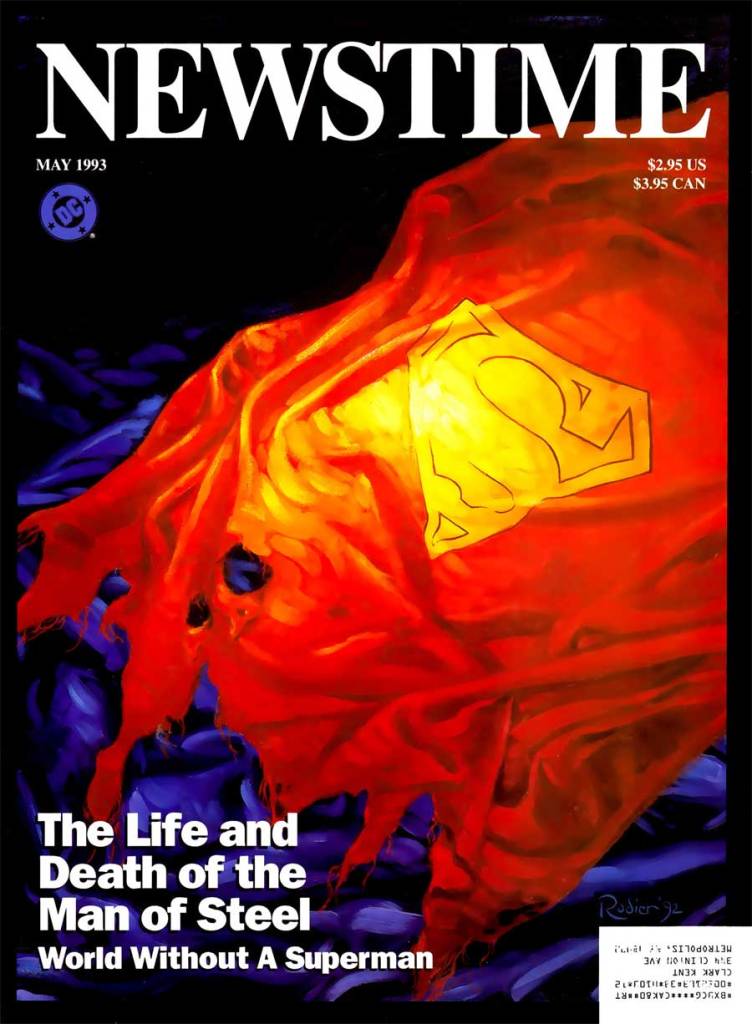
Notes: In addition to the two one-shot comics published during the Superman Gap, DC also released a one-off edition of Newstime, a fictional news magazine that Clark Kent worked for briefly in the comics. The magazine, featuring a “photograph” on the cover taken by Jimmy Olsen as Superman lay dying, is a sort of defictionalized artifact of a news magazine from the DC Universe, giving us in the real world a glimpse into how the DCU reacted to Superman’s death. There are, as expected, news articles written about the battle with Doomsday, the reaction of the world to Superman’s death, and the chaos that the Justice League was left in with Superman dead and so many of their members injured or powerless. The magazine fits really nicely in with the comics, with bits updating the status of some of the celebrities that were reported missing in the comic books after Doomsday’s rampage. Baseball player Hank “The Hammer” Halloran, you’ll be happy to note, survived the attack, but comedian and actor Morty Beckman died in a collapsing building. Daily Planet reporter and former Newstime editor-in-chief Clark Kent is still among the missing. 

Other things in the magazine are somewhat odd, like the article featuring quotes from assorted famous people about the death of Superman. Many of them are DC characters like Bruce Wayne, Lex Luthor II, Wonder Woman, and so on. Others, though, are from real-world figures, and they don’t all seem to be written from an in-universe perspective. A quote from William Shatner tells about how he used to dress as Superman when he was a child, Penn Jillette comments that Superman will have to die a few more times before he’ll be impressed, and John Goodman regales us with a bizarre story of his own personal encounter with Mr. Mxyzptlk following Superman’s death. I’m forced to wonder if some of these are legitimate comments they got from these people. After all, Superman’s death is one of the few comic book stories (especially back then) that made the major news cycles. 

The book finishes off with a few pages of fake movie and music reviews and lots of fake ads, and I have to give the DC crew credit for how well it’s all put together. Except for the fact that the “photos” are mostly panels taken from the comics, this looks and feel like a real news magazine, albeit much thinner than most of them. And just in case anyone thought that they’d let a book like this go without any foreshadowing, there’s a two-page ad early in the book that was meaningless when the magazine was originally published, but became quite jarring in hindsight just a few months later. 

😬

There’s one last thing I wanted to read from the “Death of Superman” era before we begin with the return tomorrow, and that’s this special Wizard Magazine tribute edition. I was a big fan of Wizard in its early years and was a subscriber for quite a long time. Eventually I got rid of all my old issues, a move which I now deeply regret, especially in the case of those few issues in which they published letters I wrote. But I held on to this Superman special, a nice little package released after the Death storyline but before the return really wrapped up. I haven’t read it in many years, though, and it’s interesting to go back and look at what the contents include.

Do you think anyone in comics has drawn versions of the same scene as many times as Dan Jurgens has this one?

There’s a piece by legendary Superman artist Curt Swan about his time with the character, to start. Jack Curtain provides a fairly comprehensive (although somewhat cynical) history of Superman, while Joel W. Tscherne gives us a good piece of the history of the post-Crisis Superman to date. Reading this article again, I’m jarred to realize that more time has passed for the most recent incarnation of Superman (the one we’ve had since DC Rebirth sort of merged the 90s Superman with the New 52 version) than had passed between John Byrne’s Man of Steel and the Doomsday story. Good grief, somebody get Waverider in here to make time slow down.

We get a retrospective on great Superman artists throughout history, a piece that is dying for a contemporary update to include all the greats who have worked on the character since then (including Stuart Immonen, Barry Kitson, Ron Frenz, Jim Lee, Ed McGuinness, Tim Sale, Frank Quitely, Alex Ross, Patrick Gleason, Jamal Campbell, and my current favorite Dan Mora – and that’s just off the top of my head). Next is a look ahead at the return of Superman, including interviews with the creators, especially Jerry Ordway, who ended his tenure as a Superman writer with Adventures of Superman #500. Then the writers for “Reign of the Supermen” talk about the four characters we’re going to meet very soon. Action Comics’s Roger Stern says that their Superman will be more “Kryptonian,” but cautions us that it’s not going to be someone trying to turn Earth INTO Krypton, like in the Eradicator storyline. Stern, you cheeky monkey. Ordway’s successor Karl Kesel talks about how Adventures of Superman will give us a more “modern” Superboy (he didn’t like being called that) who ties himself to WGBS, a TV station, rather than a stodgy old newspaper. Dan Jurgens talks a bit about the Cyborg Superman, although to me the part of this section that stands out is where he discusses Lois’s skepticism. Good for you, Lois. And Louise Simonson talks about John Henry Irons, even giving a lot of backstory about his family that I don’t know has ever been explored very much in the comic books, which is a shame. 

There’s a lot more in here, including a piece from Elliot S! Maggin about Superman as a pop icon, Andy Mangels talking about Superman’s history on TV and in film, and lots of other articles about various pieces of Superman’s history. I’ve gotten psyched to go back and read more of these, and I probably will in the coming weeks, but hopefully the stuff I’ve talked about will give you the impetus to dust off your copy (or find one on eBay) to go back and revisit this interesting time capsule of who and what Superman was in those months between his death and his return.

And speaking of his return…

…well, I’ll see you tomorrow. 

Blake M. Petit is a writer, teacher, and dad from Ama, Louisiana. His most recent writing project is the superhero adventure series Other People’s Heroes: Little Stars, volume one of which is now available on Amazon. You can subscribe to his newsletter by clicking right here. You can join in the Kryptonian Konversation every day in the Year of Superman Facebook Group!
Year of Superman Week Seven: Superman Vs. the Flash

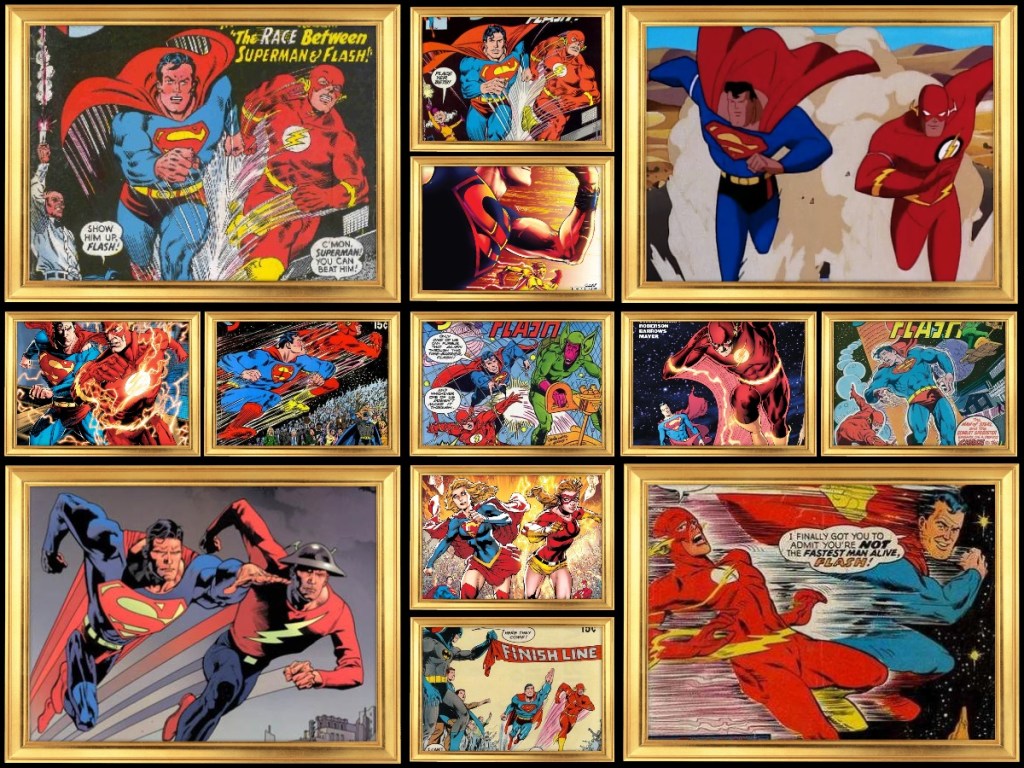
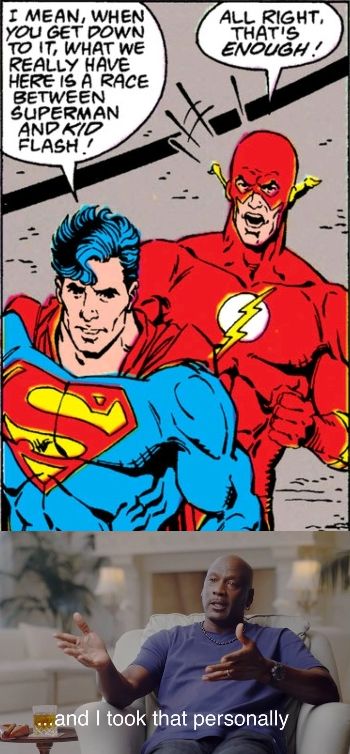
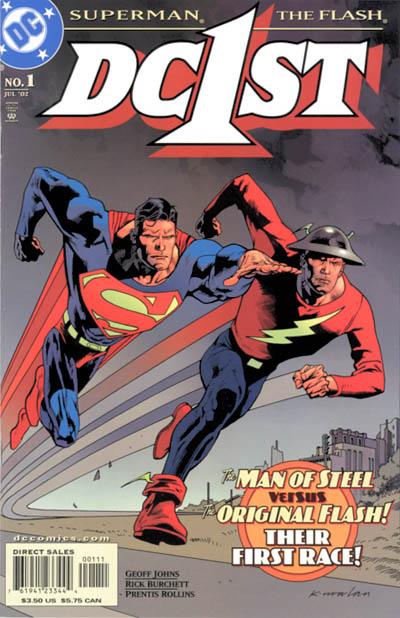
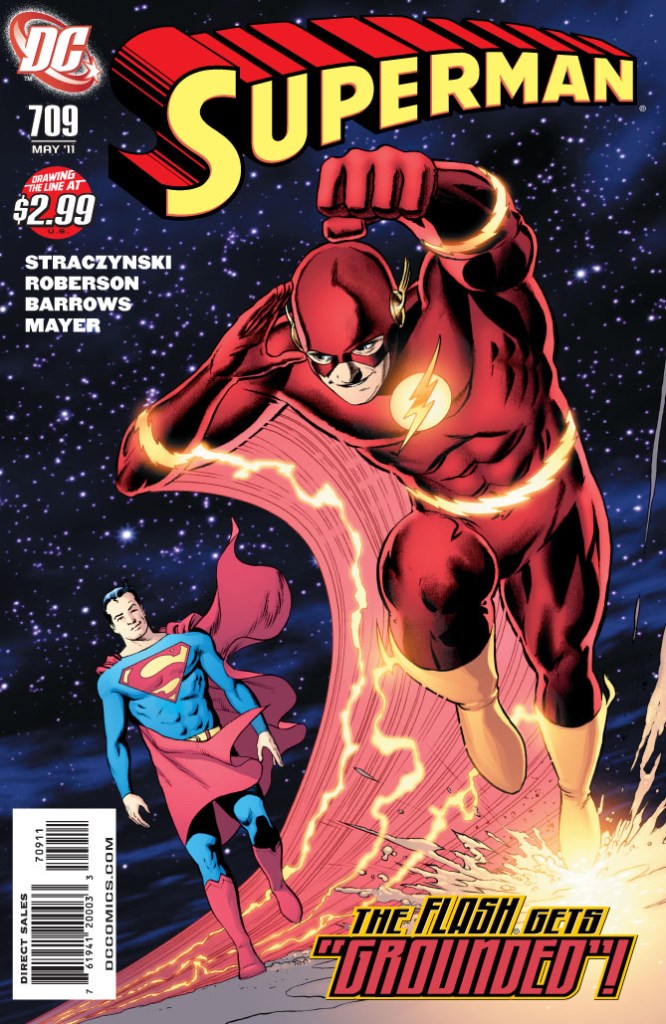
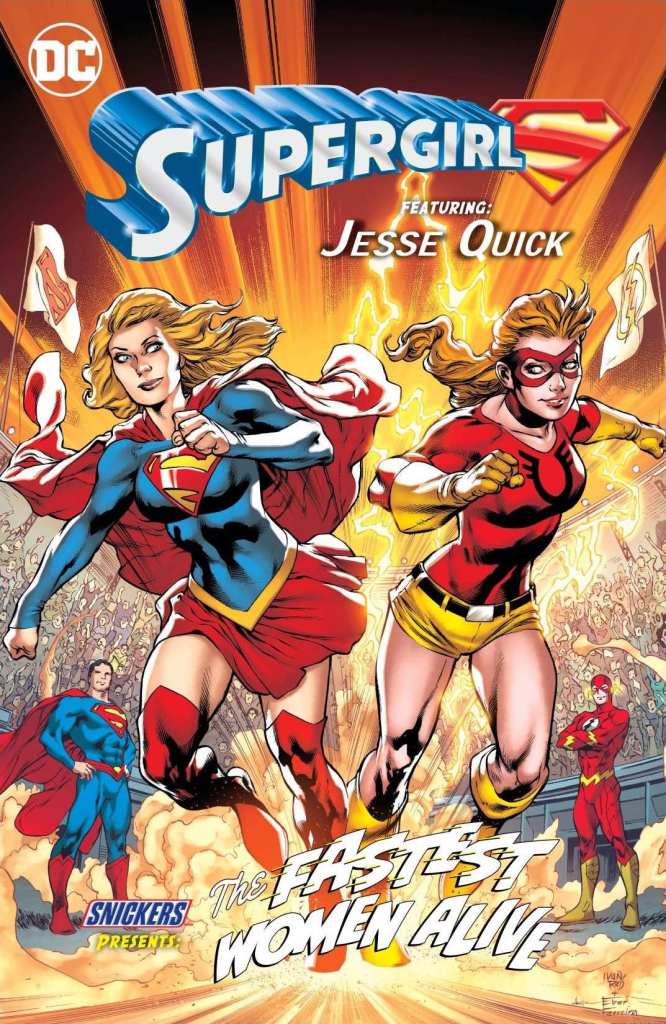
After the chaos of the last couple of weeks, I wanted to stabilize things a little bit, so it’s time for another theme week. He’s called the fastest man alive, but he’s often been forced to defend that title against the Man of Steel, so for the next seven days I’m going to put my attention on the competitions between Superman and the scarlet speedster himself. Yes, it’s Superman Vs. the Flash Week!

(Superman versus the) FLASH! (Bum bum bum bum bum) AAAH-AAAAAH!!!

Okay, I think I should make one thing clear here: in a straight-up foot race between Superman and the Flash, the Flash should win every time. Whether we’re talking about Barry Allen or Wally West, it doesn’t matter. The Flash’s entire job description is the fact that there’s nobody faster than him, and if you take that away it diminishes the character. Even Superman shouldn’t be allowed to do that.

That said, there have been many stories over the years that pit them against each other, and some of them are an awful lot of fun. 

Wed., Feb. 12

Comics: Superman #199, Flash #175

Literally, the starting line for this whole thing.

Notes: The first-ever Superman/Flash race, at least as far as I can tell, is Superman #199 from 1967. The United Nations recruit Superman and Flash to race for one another to raise funds for charity, a basic enough premise that reasonably pits the two of them against each other without some sort of contrived misunderstanding, which I greatly appreciate. Unfortunately, a pair of major crime syndicates also bet a fortune on the outcome of the race, one on Superman and one on the Flash, and so they both hatch schemes to make sure their chosen hero is the winner. After uncovering the schemes and beating the gangsters, Superman and Flash conspire to end the race in a precise tie so that neither crime syndicate can cash in on their winnings and, conveniently, so that DC Comics doesn’t have to definitively answer the question of which of the two men is the faster. 

What I find funny about this story is that, even though the story is contrived in such a way that the race ends in a tie, writer Jim Shooter almost seems to do so grudgingly. There are several times that we see the Flash doing things that seem to demonstrate that, as far as foot speed goes, he’s superior. As they race across the ocean, Flash is running on top of the water, whereas Superman has to swim at superspeed. Similarly, Supes has to burrow through sand dunes and climb over pyramids in the desert, while the Flash is simply vibrating right through them. At one point, Flash even employs a super-speed trick to rescue Superman from a random chunk of Kryptonite vomited up by a volcano without Superman even noticing. The only times Superman has an advantage is when his invulnerability or other non-speed powers give him an edge – in freezing cold, diving down a waterfall, or maintaining his balance across a frozen lake. Every task shows that the Flash’s super-speed tricks are superior, even if the story itself has to skirt the issue at the end. This would be a running theme through future competitions between Superman and Barry Allen.  

It’s covers like this, Superman. Covers like this are why some people call you a jerk.

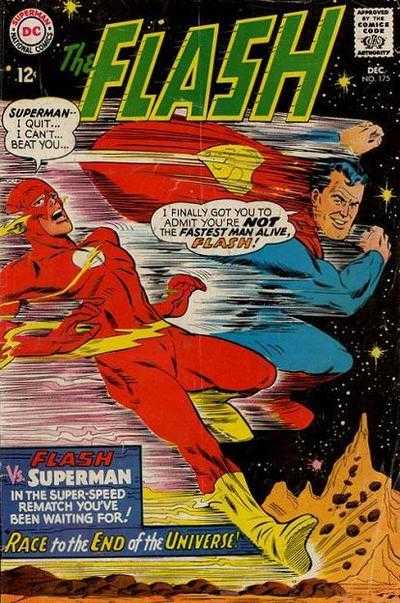
Only a few months later, they got together for a rematch in Flash #175. It starts when the two heroes wind up muscling in on each other’s territory, each of them getting an emergency alert from the other on their Justice League signal devices that their teammate denies sending out. When the JLA assembles, it turns out the signal was sent by a pair of aliens Superman and Batman have encountered before. The aliens had placed a wager on the first race and, as it ended in a tie, insist on a rematch. Instead of lapping the Earth this time, though, they’re going to force the heroes to race across the Milky Way. Oh, and just in case they need a little added incentive, they promise to annihilate Central City if the Flash loses and Metropolis if Superman is the loser. So as sports commissioners, they’re still slightly less evil than Roger Goodell. 

The aliens throw lots of traps and obstacles in front of our heroes, each of whom independently finds evidence that the race isn’t all it’s cracked up to be. But it’s the Silver Age, so neither of them ever thinks to just TELL his teammate that the race is a fake, they make vague statements about things being “off” until they beat the aliens on the last two pages, with the race once again not having any definitive winner. 

As snarky as I sound, I actually did enjoy this issue. It was a pretty decent follow-up to the first race, and it gets bonus points for the last panel, where Flash and Superman look directly at the reader and invite them to go back to the finish line on Page 21 and decide for themselves who they think won. You can’t get away with stuff like that these days.

Thur., Feb. 13

Comics: World’s Finest Comics #198-199

“Okay, we’re ACTUALLY gonna declare a winner this time, right? No more cop-outs?

Notes: Three years after the first two races, DC decided to try it again. Although World’s Finest has, historically, been the Superman/Batman team-up book, there was a period in which it was a Superman team-up title, with Superman as the anchor and different guest-stars for each issue, so it was here that they staged the next installment in this saga. And THIS time, the cover of issue #198 proclaims, “There MUST be a winner!”

Race #3 has the wildest conceit yet – the Guardians of the Universe (the little blue guys who sponsor the Green Lantern Corps) have detected an incursion of “Arachronids,” faster-than-light lifeforms that are disrupting space and time. The only way to save the universe is for two people to race in a path opposite that of the Arachronids, and the only ones speedy enough to do the job are Superman and the Flash. (This is in the days before the “Flash Family,” of course, there was only Barry and Wally West as Kid Flash. If this were to happen today there are roughly a dozen speedsters more qualified than Superman to handle this deal.) Anyway, the Guardians provide the Flash with an amulet that will allow him to race in space and he suggests – since we never actually settled the question of who’s faster – why not make this another race? 

Things are going swimmingly until the Arachronids destroy a sun, knocking our heroes off-track on a planet where the sunlight keeps shifting from yellow to red, which negates Superman’s powers. Oh, and did I mention that the time-disruptions have chucked Jimmy Olsen back to ancient Rome, where he’s about to get executed by a firing squad of archers? 

Part two of the story reveals the truth: the Arachronids were created by General Zod and a group of Phantom Zone escapees, and they’ve got Superman and the Flash captured on a planet that straddles the line between dimensions. They wind up on a world where the red sun is draining Superman’s powers and the Flash has his swiftness curtailed when the baddies steal the amulet given to him by the Guardians, leaving them to crawl towards the device that’s causing all the chaos. WHO WILL MAKE IT FIRST?

This is the first time I’ve read this particular two-parter and, I’ve gotta say, I really enjoyed it. It’s a different angle on the Superman/Flash race, one that’s apart from the usual “racing for charity” conceit or the other various contrivances that have pit them against one another. No, this time it’s a totally original contrivance, and I appreciate that. I also appreciate the fact that they TECHNICALLY declare a winner of the race this time (it’s the Flash, spoiler alert), but they do so on a world where both heroes are virtually powerless and are literally crawling towards their destination, so the question as to who’s really faster when they’re at normal power is still left up in the air. I’m sure that was the mandate at the time. I’m glad that they eventually got over that mandate, though, as some of the later stories we’re going to get around to reading will demonstrate. 

Other Comics: Jenny Sparks #6 (Superman appearance), Black Lightning Vol. 4 #3 (Steel II appearance), The Question: All Along the Watchtower #3 (Superman Cameo), Superman’s Girl Friend, Lois Lane #10

Fri., Feb. 14

Comics: DC Comics Presents #1-2

“Barry? Clark. Hey, wanna be the first guest in my new team-up book? Noooo…not a race this time…I wouldn’t do that to you…”

Notes: Eventually, World’s Finest went back to being a Superman/Batman book, and while Batman had his own team-up series (The Brave and the Bold), Superman was given his own with DC Comics Presents. In the first two issues of this series, published in 1978, we got the next installment of the friendly rivalry between Superman and the Flash – and, in fact, I’m pretty sure this was the last such story before Barry’s death in Crisis on Infinite Earths. (If I’m wrong, by all means, correct me in the comments.) 

This time around, our heroes are captured by a pair of warring alien races, one of whom has sent an agent forward in time to go through the “cosmic curtain” that separates the end of the timeline to the beginning. (Time, you see, is evidently a giant loop, but their time machines only go FORWARD, so they have to take the long way around, as if they were flying across Europe and Asia to get to California from Florida. Flat-timers hate this issue.) Since the Flash “won” the previous race, they send him to help their agent in the future, with the consequence for failure being the destruction of Earth. The other aliens, though, force Superman’s hand by telling him that if their enemy succeeds in changing time, Krypton will explode SOONER than it was supposed to, and Superman will never exist. 

The major difference between this two-parter and the previous three races between Superman and the Flash is that the race is across time, rather than space, and it’s a significant enough change to really make this one stand out. Superman’s actions seem a bit out of character, of course – he’s risking the destruction of Earth to save his own life, a task even the VILLAINS are surprised to see him willingly take. Naturally, it turns out to all be part of the plan.

This one, unlike the other three races we’ve seen, doesn’t even really try to address the issue of who “wins.” Once Superman’s plan is unveiled, the heroes work together (as it should be) to thwart BOTH sects of warring aliens and fix all the timey-wimey chaos before anyone is killed, especially Jimmy Olsen. The conclusion, then, is satisfying, but leaves the central question essentially unanswered. In fact, the first time we get anything resembling a true answer, it would have to come from Barry’s protege, Wally West, another 12 years later.

Other Comics: Superman’s Pal, Jimmy Olsen #135, Justice League of America #16, Action Comics #372

Podcast: DC Studios Showcase Episode 1 (Discussion of documentary film Super/Man: The Christopher Reeve Story)

Valentine’s Day Stuff: Today is, in case you forgot, Valentine’s Day. (And if you DID forget, this isn’t going to be posted until February 19th, so you are SERIOUSLY out of luck.) But I couldn’t let the day pass without noting my darling wife, Erin, and how she indulged my quest for the Year of Superman today.

Pictured: Love. And personal hygiene products.

She got me the McFarlane Toys Super Powers Fleischer-style Superman, a figure I’ve been hunting for ever since I found out it existed, but have been resisting paying eBay prices. If I won the lottery, I would build an entire toy display room in my palatial mansion, and one full wall would be dedicated to a collection of Super Powers figures, Marvel Secret Wars figures, and figures from comparable toy lines like the Archie Mighty Crusaders and Defenders of the Earth series of my youth. She also got me a set of the new Superman-branded Old Spice body wash and deodorant, which I first saw in an ad a week or two ago where it was being promoted along with Batman-branded products, prompting me to ask her, “Who do you think smells better? Superman or Batman? I bet Batman sweats a lot.”

And yet, she’s been married to me for over 10 years now. Get you one who understands you like mine understands me, friends. 

Sat., Feb. 15

Comic Books: Adventures of Superman #463, Flash Vol. 2 #53

“On your marks! Get se–wait a second, haven’t we done this before?”

Notes: The next time the Man of Steel and the Scarlet Speedster would face off against one another wouldn’t come until 1990, at which point both of them had experienced some drastic changes. Superman had gone through the post-Crisis John Byrne reboot, whereas Barry Allen had died in Crisis on Infinite Earths and been replaced by his protege, former Kid Flash Wally West. Like a lot of Superman history, it’s unclear if any of the previous races with Barry were canon to Superman at this time, but the story makes it quite clear that it’s the first time he’s faced off against Wally, at least, and it’s a distinction that Superman takes pretty seriously.

This story involves our old pal from the Fifth Dimension, Mr. Mxyzptlk, who shows up on Earth this time restructuring Mount Rushmore to include his own face. The Flash happens to get there first and, when Mxy finds out that he’s supposedly the “fastest man alive,” he decides to put that claim to a test. If Superman can beat the Flash in a race around the world, he says, he’ll pop out of our dimension for the usual 90 days. Superman notes, rather dismissively, that Wally hasn’t been the Flash that long and strongly implies that beating KID Flash won’t be too difficult, and Wally does his best impression of Michael Jordan in that meme. The race is on. 

From here out, the story is actually pretty straightforward. Unlike most of the races we don’t have to deal with any shady stipulations, misdirects for the reader, or bad guys trying to fix the outcome of the race, except for your typical Mxy shenanigans. There is a nice little scene I’d forgotten about, where Mxyzptlk tries to offer Lex Luthor a hunk of red Kryptonite but Lex turns him down, which actually makes this story a stealth prequel to the Krisis of the Krimson Kryptonite story we read last month. But as far as the actual RACE goes, it’s pretty cut and dried, with both heroes putting the pedal to the metal until, in the final stretch, Wally reaches out and beats Superman by a nose. 

Totally saving the day! As it turns out, Mxy had learned about deception from Lex in a previous visit and so he was trying it out. Although he SAID he was only going to leave Earth if Superman won, he had always REALLY planned to leave if the FLASH won. It never occurs to him to simply lie again, which is actually kind of a silly, charming hat to put on this dude in his silly, charming hat.

This was the first Superman/Flash race I ever read, and as such it’s always held a place of esteem in my personal pantheon of Superman stories, but I think it’s important to note which versions of the characters we’re looking at. Superman was only a few years post-Byrne, an era in which his power had been scaled down dramatically to make him less “godlike.” Over the years his powers would slowly creep up in strength again until today he’s more powerful than ever before, but as Supermen go, the one in this story was relatively slow. However, this was also early in Wally’s tenure as the Flash, a period during which he was much slower than Barry ever was. When Mark Waid took over Wally’s series a few years later he established that Wally had a subconscious fear of overshadowing his predecessor and had a self-imposed mental block limiting his speed. Once he got over that, he became the fastest Flash there ever was. The point is that if you took the current versions of either Superman OR the Flash and popped them into the race during this era, either of them could smoke the two characters we watched race today.

This time it’s a METAPHORICAL race! The greatest kind of race there is!

I also read issue #53 of Wally’s first solo title, a story which was NOT actually a race, despite what the cover promised. In this one, Jimmy Olsen has gotten himself captured by some South American warlord (because that’s what Jimmy Olsen DOES) and Superman decides to recruit the only person alive faster than him (as established in the previous race) to help find Jimmy before he’s unalived. This is a typical superhero team-up story: good, not special, but enjoyable. I think the most interesting thing about it, the thing that gives it a spot of interest in superhero history, is that this happens to be the issue in which Wally’s pal the Pied Piper (former villain, now reformed) comes out to him as gay. I don’t know if this is the FIRST openly gay character in mainstream comics, but he’s certainly ONE of the first, and while it’s no big deal in today’s comic book landscape, for 1991 it was a pretty surprising revelation. There ya go, ya learned something today. 

Sun., Feb. 16

Comic Book: DC First: Superman/Flash #1

Big Good Vs. Big Good.

Notes: I’ve got a sick kid to take care of this afternoon and, as a parent, that has to take precedence over pretty much everything. But in-between far too frequent trips to the bathroom and a larger-than-average number of baths, I made it a point to squeeze in the next story in the Superman/Flash pantheon. This time we leap ahead to 2002 for DC First: Superman/Flash. This was a series of one-shots DC did that showed the first meetings between various characters – but as Superman’s first races between Barry Allen and Wally West were already pretty well documented, for this special they did something a little different and very cool: they showed Superman’s first race with Jay Garrick, the original Golden Age Flash. 

This issue reads more as a special issue of the then-current Flash run. It’s written by Geoff Johns, who was writing that book at the time, and it deals with subplots involving Pied Piper and Jay’s wife, Joan, with Superman’s involvement coming in coincidentally. Wally and Jay head to Metropolis to a bookshop where they’ve sourced a rare book as a gift for Joan, only to run afoul of the old Flash rogue Abra Kadabra. The faux wizard of the 64th century casts a spell that begins causing Wally to age rapidly, then tells Superman and Jay they can save him if they can catch him in a race – with the caveat that whoever touches Wally first will take the curse upon themselves. What you’ve got, then, is perhaps the greatest conceit for a Superman/Flash race of them all. They aren’t racing for charity, they aren’t racing for ego, they aren’t even racing with the fate of the world at stake. They are literally racing one another for the RIGHT TO SACRIFICE THEMSELVES TO SAVE WALLY. There is no better motivation for these two heroes.

I know I read this book when it first came out. It’s in my collection, and I was an avid reader of both the Superman comics (duh) and Flash, so I am 100 percent certain I read it. But it came out 23 years ago, and I didn’t really remember the story at all until I sat down to read it this afternoon, and it honestly blew me away. Even though it’s more of a Flash story than a Superman story, it really exemplifies the values of Superman in a way that a lot of these other races failed to do. It may be my favorite read for this week to date.  

Mon., Feb. 17

Comics: Flash: Rebirth #3, Superman #709

This issue, as far as I’m concerned, is the final word on the whole thing.

Notes: I actually struggled with whether to include this issue of Flash: Rebirth from 2009 in my Year of Superman reading. It’s the middle of a storyline, and Superman’s appearance is barely a cameo, but that one sequence in which he appears is significant enough that I felt it warranted inclusion. Barry Allen, having returned from the dead in the terribly inaccurately named Final Crisis event, is being transformed into a new Black Flash, essentially the spirit of death for speedsters such as himself. To protect Wally, his grandson Bart, and everyone else he loves, he decides he’s going to rush back into the Speed Force before the transformation can happen, and Superman takes off after him. At this point, the League had gone through its share of recent tragedies, and both Aquaman and the Martian Manhunter were dead (they got better), so Clark isn’t about to let Barry die again. 

This leads to one of my favorite pages that Geoff Johns ever wrote, as the two of them are racing each other up the Daily Planet building and Superman says, “I’ve raced you before, Barry. I even won some of those races.”*

Barry simply says, “Those were for charity, Clark.”

And then he leaves him in the dust.

Like I keep saying, the Flash SHOULD be faster than Superman. This issue is the best evidence of that ever.

(*By the way, despite what he says, I don’t actually recall Superman ever winning one of those races. There were a few ties, but every time a victor was declared it was the guy in red. I’m going to assume, from the way Clark talks, that there may have been other charity races off-panel that we didn’t get to watch. And now that I’ve said it, it’s going to manifest in the universe as a seven-part time-travel crossover event, coming this fall.) 

“You’re GROUNDED young man! That means no disrupting the time stream! Just do your homework and straight to bed!”

The final Superman/Flash face-off I could find in comics came in Superman #709 from 2011, part of J. Michael Straczynski’s “Grounded” storyline. In this arc, Superman decides he needs to reconnect with the ordinary people he is sworn to protect, so he commits himself to walk across the United States. It’s an interesting concept, to be certain, and Straczynski is an excellent writer, but the general consensus on this storyline is that it sort of fell flat. I think the problem is that it went on for far too long (who wants an entire year of Superman just…walking?) and even Straczynski himself seemed to lose interest in it, as evidenced by the fact that he bowed out before the story was over and it was completed by Chris Roberson. 

The “race” part of this issue is over fairly quickly. While walking through Boulder, Colorado, the entire town is suddenly transformed into a Kryptonian city. Superman soon figures out that the transformation is the work of the Flash, who has been overtaken by a Kryptonian artifact and he needs Superman to set him free. After he does so, they have a cup of coffee and talk about legacy. This is what I mean, by the way, when I say that the “Grounded” story went on too long. The story of this issue is perfectly fine, in and of itself, but when you read it in the context of the entire year-long storyline, it was too much of the same thing over and over: Superman walking somewhere, doubting himself, having a significant encounter with various characters (both new and previously established) and coming to a peaceful resolution. That’s great ONCE, but do you really want to read it twelve issues in a row?

The most interesting thing to me about this issue is that it happens concurrently with that month’s issue of Superboy, in which the Kid of Steel races KID Flash for the first time, and which Clark and Barry catch a glimpse of on a diner television. I’ll take a look at that issue tomorrow when I look at the few races I could find between members of the Superman and Flash families other than the patriarchs. 

TV Episode: Superman: The Animated Series, Season Two, Episode 4, “Speed Demons”

“Loved you on Wings, by the way.”

Notes: That’s all the comic book Superman/Flash races I could find, but there’s still this episode of Superman: The Animated Series, the first appearance of the Flash in the DC Animated Universe. In this episode he’s voiced by Charlie Schlatter, although Michael Rosenbaum would take over the character for the Justice League cartoons. (Tim Daly would be replaced as Superman by George Newburn too. I guess not everyone can be Kevin Conroy and Mark Hamill.) In this episode, Superman and the Flash are pitted against each other in, as per their first-ever encounter, a charity race. This time the rules are a bit more sensible for the two of them: the winner will be the first to complete 100 laps around the globe. Of course, just like many of their races in the comics, there’s a catch – the arm bands they’re wearing to track their progress are, in truth, using them to build up ionic energy to power a plot by the Weather Wizard. (Weather Wizard, by the way, was voiced by the late Miguel Ferrer in a delightfully dastardly way.)

This episode never makes it clear which Flash we’re watching, Barry or Wally. In terms of attitude and personality, it’s definitely influenced by the early days of Wally’s solo title. He’s slick, he’s cocky, and he relentlessly flirts with Lois Lane, none of which are things you could ever imagine Barry doing. It takes plenty of cues from the classic comics, though, such as the race itself being derailed halfway through when Superman and the Flash catch wind (rimshot) of the Weather Wizard’s plan and call it off to get around to some good ol’ fashioned thwartin’. It’s easy to forget that the Batman cartoon almost never had guest-stars from outside the Batman family, so this was one of the first times we really started to see an animated universe begin to form in the Paul Dini/Bruce Timm era. It was a real delight to revisit this episode again. 

There is ONE other Superman/Flash race that I haven’t covered here, but for what I consider a good reason. It’s part of Tom King’s Superman: Up in the Sky series, which is a magnificent comic in its own right, and I intend to cover it in its entirety at some point this year. Plus, looking at the issue with the race on its own wouldn’t really make a ton of sense, absent of the context. I’m bringing it up here mainly so that nobody thinks I forgot about it.

Tues., Feb. 18

Comics: Superboy Vol. 4 #5, Supergirl: The Fastest Women Alive #1

“I don’t know why Barry and Clark always make such a big deal about this.”

Notes: I had one day left in “Superman Vs. The Flash Week,” but I had run out of actual Superman/Flash races, so I decided to close it out with a pair of comics featuring other members of the respective Super- and Flash-Families strapping on their jogging shoes to see who’s swiftest. First was Superboy Vol. 4 #5 from 2011, the first ever Superboy/Kid Flash race (this Kid Flash being Bart Allen, Barry’s grandson, who previously had gone by “Impulse” and since has retaken that name). In this era, Superboy was living in Smallville, and his presence had rocked the town with a few supervillain attacks that resulted in some pretty major damage. This time around, the race is scheduled to raise money to rebuild the town. As the two old friends zip across the globe, though, Bart can tell that Conner Kent’s mind is elsewhere.

This issue is part of Jeff Lemire’s run on the title, a tenure that was cut tragically short by the New 52 reboot later that year. Lemire was doing a great job at grounding Superboy in a way that this version of the character so rarely is, giving him a home and a family in Smallville to contend with, and making his adventures a mix of the cosmic and the mundane, something Lemire is exceptionally good at. (And if you don’t believe me, check out his series Black Hammer.) Despite the race being a backdrop, the mundane part is the focus of the issue, with nary a supervillain plot or alien invader to disrupt things. Instead, in the midst of a race across the globe, Conner just confides in his friend about his pain over his recent breakup with Wonder Girl.

The ending of the race is a cop-out, which we’ve all come to expect, but this may be the biggest one yet. (Spoiler: somehow, Krypto crosses the finish line first and everyone accepts it, even though it feels as legit as Harry Potter’s name being tossed in the Goblet of Fire.) Still, if you’re thinking of reading this book, the Lemire run is extremely worthy of your time – it’s just that this issue, by itself, may not be quite so satisfying without the context of the rest of the run.

Finally, we’ve got the bizarre little one-shot Supergirl: The Fastest Women Alive, a special comic from 2019 presented by Snickers. Very, very much by Snickers. There is Snickers branding on nearly every page, and even the captions that tell you where the racers are at the moment are branded in the Snickers logo font. The message, just in case you missed it, is: Snickers.

Did we mention it’s presented by Snickers?

For the first half of the issue, though, this is actually a decent enough race between Supergirl and Jesse Quick. It uses most of the tropes of the previous races, such as it being a charity race, Supergirl not being allowed to fly, and so forth. The turn comes halfway through, though, when the racers discover that the Parasite has attacked the arena where the race began and will end, and he’s already got Superman and the Flash on the ropes. The lightning ladies rush back to save the day, but how can they possibly get the energy they need to overload and defeat the energy-sucking Parasite?

HOW CAN THEY FIND THE NECESSARY ENERGY?

SNICKERS? GOT A SUGGESTION?

This story is a full-issue equivalent of the delightfully goofy old Hostess comic book ads, only way less subtle. 

I kinda love it.

And thus, friends, concludes Superman Vs. The Flash week. My feelings haven’t really changed, I must say. In any contest of speed between a Super of any stripe and a Flash by any name, the Flashes should always be the ones to come out on top. Sorry, Superman, but it’s their whole entire deal. You can’t really compete.

But this week has proven it’s fun to watch you try anyway.

Blake M. Petit is a writer, teacher, and dad from Ama, Louisiana. His most recent writing project is the superhero adventure series Other People’s Heroes: Little Stars, volume one of which is now available on Amazon. You can subscribe to his newsletter by clicking right here. You can join in the Kryptonian Konversation every day in the Year of Superman Facebook Group!
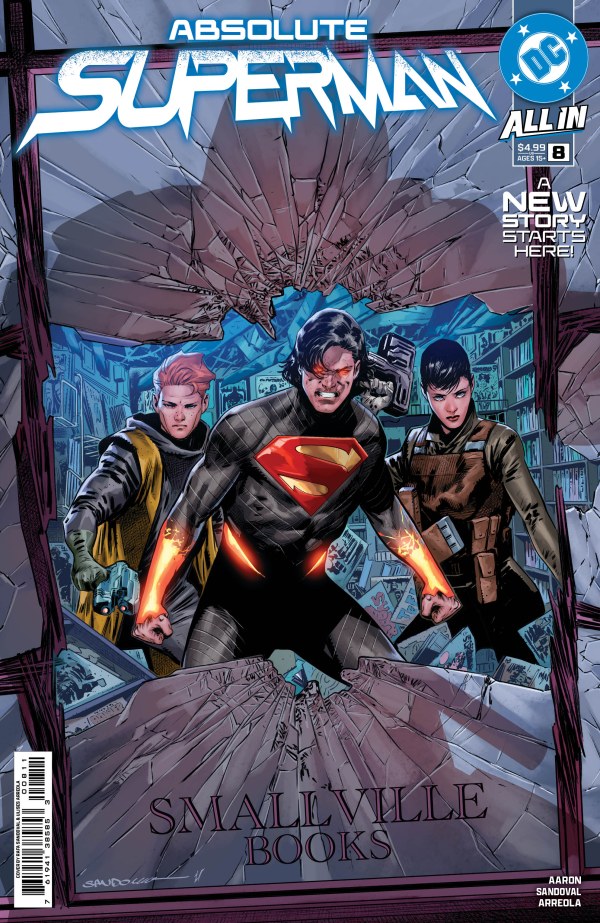
Year of Superman Week Five: Like Throwing Darts at a Board

As I approach the end of January, having finished up my first theme week, I find myself in a bit of a pickle in regards to what Superman content I want to read today. I’m not ready to kick off another theme week yet, but as I look over my (prodigious) list, I find that most of the stuff I’m particularly excited for is all suited for one of the theme weeks I’ve got planned for later in the year. So what, then, should I read on this random Wednesday? Never let it be said that I make things easy on myself. After some brief deliberation, I just scroll through the offerings on DC Universe Infinite until I settle, fairly randomly, on my first read for the week.

Wed., Jan. 29

Comics: Legends of the DC Universe #39, Superman Vs. Meshi #1

Notes: DC once published a title called Batman: Legends of the Dark Knight, which featured a different creative team on every story arc telling stories that were not necessarily constrained by any particular continuity. There were some amazing stories told in this series, and they eventually spun the idea off into Legends of the DC Universe, a series which not only switched out the creative team with every story, but also the main character. This issue, a one-off by Danny Fingeroth and Randy Green, is called “Sole Survivor of Earth.”

Which, let’s face it, sounds like a depressing idea even if you WERE that sole survivor.

The issue begins with a very familiar scene – a scientist and his wife concerned about an upcoming disaster that could mean the end of life on their planet, a fear made even more prescient due to their infant son. But we aren’t on Krypton this time – we’re in Washington state. Superman, meanwhile, is at the Fortress of Solitude, building a memorial to his Kryptonian parents, when he gets a notification of a disturbance at the Earth’s core. The scientist, Dr. Balboa, has been studying the tremors and trying to stabilize them, only to accidentally trigger a sequence that could destroy the Earth. In desperation, he and his wife drop their son into a spaceship and blast him to another inhabited system. Why not? It worked for the last guy.

Except in this case, the “last guy” manages to save the world, stopping the destruction Balboa’s experiments caused but sapping a lot of his power anyway. When he tracks down Dr. Balboa, he learns about the child in the rocket and sets off to space, despite his own power loss, to find him.

This is a good issue. It’s never going to make a boxed set of the Greatest Superman Stories Ever Told (that reminds me, I’ve got to find and read my copy of The Greatest Superman Stories Ever Told), but it’s a fun story that nicely turns the traditional Superman origin story backwards. There’s not a lot of tension, to be honest, because the outcome is never in any doubt. Nobody thinks that Balboa is actually going to blow up the Earth, and there’s no such thing as an infant in danger once Superman finds out that they need help. Their survival is pretty much guaranteed. But that doesn’t make it any less fun to look at things from a different point of view once in a while.  

I also, somewhat randomly, went back and read Superman Vs. Meshi #1. This manga series was a part of a line of books that DC co-produced with Kodansha Comics. Joker: One Operation Joker was another, and the third, Batman: Justice Buster is still running. I always considered this the most bizarre of the three, though, because…well… it’s about Superman eating at Japanese chain restaurants. 

You will believe a man can fry…rice. I’m sorry, that was terrible.

No. Really. That’s what this entire series is about. And it ran for 23 issues.

In this first issue, having been turned down by Lois for a lunch date, Clark whips over to Japan to indulge at an all-you-can eat yakitori joint. (For people, like myself, who have no idea what yakitori is, I Googled it – chicken skewers.) There’s a brief fight scene – a flashback as he remembers the villain he fought who on the day he first discovered the restaurant, but the bulk of the story is him ordering various meat skewers and gushing over how delicious they are. The writer, Satoshi Miyagawa, lovingly describes the food in a way that makes you wonder whether you’re reading a superhero comic book or a restaurant review, and at one point he’s so “overwhelmed by flavor” that the food literally activates his heat vision. He even goes on about how well the yakitori pairs with the soda he ordered. 

Perhaps the weirdest thing is that none of this ever feels out of character. Would Superman pop over to Japan just for lunch? Yeah, I think he would. Would he have a running inner monologue about how good the food is and how it all comes together? People forget that Clark Kent is a writer, and like most writers I know, he probably has an inner monologue that never shuts the hell up. The only difference is that this is a scene that they would almost never write in an American comic because it’s too important that we get to the scene where he has to beat the crap out of Terra-Man or something. 

This book is so WEIRD. But for some reason, I like it. 

Thur., Jan. 30

TV Episodes: Superman and Lois Season 2, Ep. 1, “What Lies Beneath”

The “V” season, apparently.

Notes: The second season starts off right where season one ended – the rescue of Natasha Irons from John Henry’s original universe…but in her universe, this Natasha is the daughter of Lois Lane, something that causes issues for the both of them. Meanwhile, both Jordan and Jonathan are facing issues with their respective girlfriends, and the teenagers acting like teenagers have Lois and Clark butting heads with each other.

In my notes on the season one finale, I mentioned that this show was cut from a different cloth than other CW shows. As season two begins, though, it feels a bit more CW than ever. The clash between Lois and Clark over Jonathan’s behavior feels really forced – Lois is taking her frustrations out on Clark and he’s not acting with the degree of empathy one would expect from Superman. I’m actually starting to feel a little vibe from the Lois Lane miniseries that I read last week, where Lois acted inexplicably angry towards everyone. Eventually, she explains this as anger over her own mother leaving her family when she was young, and thinking she’s like that because she doesn’t feel anything motherly for Natasha…who, we have to stress here, is NOT her daughter. It doesn’t really make that much sense.

Natasha, meanwhile, is behaving even more irrational, taking her frustrations out on her father and somehow blaming him for the fact that the people who were her friends in her home dimension don’t know her here. Huh? In her case, at least, the frustration is more understandable, but the show skips over showing us why Natasha can’t seem to fit in. There’s an undercurrent of rage to this episode that’s baffling me. 

Superheroes? Oh yeah, there’s a little of that. Superman learns that Sam Lane’s replacement at the DOD is using the X-Kryptonite recovered in season one to create his own little army, complete with his shield, which Superman isn’t happy about. I sense this is going to be the undercurrent for this season. 

Comics: Superman: Lex Luthor Special #1, DC’s Lex and the City #1

I mean, not so’s you would notice, Lex.

Notes: I also read a couple of this weeks’ new comics today, one of which is more relevant than the others. The Superman: Lex Luthor Special is continuing the ongoing storyline from the main Superman comic and, in fact, is written by regular writer Joshua Williamson. In last fall’s DC All In Special, Darkseid was (seemingly) killed, but a new, alternate universe was forged, infused by Darkseid’s negative energy, as opposed to the more hopeful environment of the main DCU. In this issue, Mr. Terrific is trying to crack the secret of this other world (which readers will know is the setting of DC’s Absolute Superman and other titles), but the inherent darkness is too much. There’s only one man brilliant enough to understand this but with a mind that won’t be corrupted by it…unfortunately, Lex Luthor has had amnesia for some time, and has been trying to live down the dark deeds of his previous self. 

This is hardly the first time we’ve seen Lex try to be a good guy, but much like we’ve seen Lois become Superwoman before, this series has been handling it well. It’s such a tight balancing act with Lex, as we see there is a goodness in him, but it’s usually overshadowed by his darker, more selfish nature. This issue seems to promise that story is moving forward now, with a final revelation that’s going to change things. I’m more interested in the flashbacks to Lex’s childhood that help paint who he really is. Good issue.

This week also gave us DC’s annual Valentine’s Day special this year titled DC’s Lex and the City. Luthor is the star of the title story in this anthology, in which a gossip columnist gets tangled in his web. It seems a little farfetched that Lex would be smitten with this woman, to be honest, but despite that It’s an okay story. It’s an okay anthology, with some stories being better than others, as is usually the case. If you’re planning to read this, the Mr. Freeze story is the prize of the bunch. Really, though, the main reason I’m even taking any notes about it is to point out that whoever is giving titles to DC’s holiday specials deserves a raise. Lex and the City is hilarious, and it goes right up there with the Christmas special Grifter Got Run Over By a Reindeer and the Halloween haunt Are You Afraid of Darkseid?, among others. I love it. 

Fri., Jan. 31st

Comics: Day of the Krypton Man from Superman Vol. 2 #41, Adventures of Superman #464, Action Comics #651, Superman Vol. 2 #42, Adventures of Superman #465, Action Comics #652; Return of the Krypton Man from Superman: The Man of Steel #1, Superman Vol. 2 #57, Adventures of Superman #480, Action Comics #667

It’s so embarrassing when they mix up your suits at the cleaners.

Notes: Today I (again, randomly) decided to read the two storylines that most contributed to the creation of the Eradicator, one of the best concepts of the late 80s before he got a little watered down (as happens to a lot of great villains, am I right Venom, Carnage, Sabretooth, the Joker, and Doomsday?) I considered starting with the storyline that where he first showed up, but the Exile arc is pretty long and I’ve already decided to restrict myself to only two long story arcs this year, lest I have no room for anything else. So here’s the short version: while exiled in space, Superman found a Kryptonian artifact called the Eradicator which he brought back to Earth, where it constructed a citadel in the antarctic, which eventually became this continuity’s version of the Fortress of Solitude. As Day of the Krypton Man begins Draaga, an alien Superman encountered during that arc, is coming to Earth to get his revenge on the big guy. At the same time, that cosmic bruiser Lobo is heading to Earth to prove how tough HE is by throwing down with Supes. Also, Maxima of Almerac is once again zipping to Metropolis to convince Superman to become her mate. And if that wasn’t enough, when they get to Earth they all find a Superman that is becoming cold and aloof, ignoring his family and friends and approaching his task as Earth’s protector with stark logic rather than his trademark compassion. He’s firing people from his new job as editor at Newstime magazine, forgetting Lana Lang’s birthday, and spurning Lois when she tries to ask him out. This is, simply, neither the Superman nor the Clark Kent any of us know. 

The Eradicator’s doing, as it turns out. The device is manipulating Superman, transforming him both mentally and physically into the “ideal” Kryptonian. His encounters with the three alien menaces all end in ways that would be out of character for Superman when he’s in his right mind, the fight with Draaga even transporting the top half of the Statue of Liberty to the moon. (Professor Hamilton’s fault – he was trying to help, but if Superman was himself he’d never have allowed the fight to happen at such a popular tourist attraction in the first place.) Eventually he makes the decision to abandon both of his identities, Superman AND Clark Kent, and live merely as Kal-El, a Kryptonian trying to bring Krypton to Earth.

I love the ending of this one. What ultimately snaps him out of it and allows him to break free of the Eradicator’s influence is concern for his parents, Jonathan and Martha Kent. When the Eradicator endangers the two of them, his reprogramming of Clark’s brain starts to break down and the real Superman comes back. Over the nearly 90 years that this character has existed, the degree to which he identifies as a Kryptonian has always varied wildly from one incarnation to another. This is the way I see him: he’s a human, a resident of the planet Earth, who happens to have a Kryptonian heritage. And when the two clash, it’s Clark Kent that wins out over Kal-El.

At the end of this story, Superman balls up the Eradicator and chucks it into the sun, thinking that’ll be the end of it, but about 15 months (and one engagement) later, he shows up again in the appropriately-titled Return of the Krypton Man storyline. The Eradicator returns, this time in a humanoid form, having used his time in the sun to begin the process of transforming it into a red dwarf to mimic the sun of Krypton. The next step in his plan is to terraform Earth itself into a replica of his dead planet. I may have mentioned a few weeks ago how tired I am of the “Kryptonian villain tries to turn Earth into Krypton” trope…well, I first read this story when it was originally published, long BEFORE I got tired of it, so it doesn’t bother me quite as much.

“And take THAT!”

Although this one is four issues instead of six, each of those four issues was giant-sized, so the page count works out about the same. Despite that, this one feels like a much quicker read. This storyline started with Superman: The Man of Steel #1, the book which gave the “Triangle Era” of Superman four titles and essentially making his adventures a weekly rather than a bunch of semi-related monthlies. With this storyline the creative teams were slightly shuffled as well. The Superman/Eradicator fight is ongoing, beginning at the end of Man of Steel #1 and continuing more or less uninterrupted throughout the other three issues, while a number of subplots are established or developed throughout the four issues. Among them we’ve got Perry White, on leave from the Daily Planet, trying to save his marriage; his temporary replacement laying off 10 percent of the newspaper staff, including Jimmy Olsen; Cat Grant finding herself the target of harassment from her boss while Jose Delgado (aka Gangbuster) looks after her son; and a terrorist group called Cerberus making attacks across Metropolis. All of these stories play out and develop as Superman and the Eradicator fight on Earth, off in space, and back to Earth again. 

Superman wins, of course, with the help of Emil Hamilton. This is a decent story that eventually turns out to be setup for the Death and Return of Superman story, which I’ll probably be getting to in just a couple of weeks. I do wonder, though, if they were already planning that when this storyline was put to press or if it was just one of those moments of serendipity.

Sat., Feb. 1

TV Episode: Superman and Lois Season 2, Ep. 2, “The Ties That Bind”, Ep. 3, “The Thing in the Mines”, Ep. 4, “The Inverse Method”

Notes: It’s been a rough 24 hours for me, and I have to confess, I wasn’t certain I’d get around to Superman today. But I’ve gone this far and I don’t want to break the streak so early in the year, so I’m jumping into the next few episodes of Superman and Lois.  

There’s a LOT going on in these few episodes. Clark is being plagued by strange visions and emotional outbursts that are making him dangerous. Trying to figure out what’s going on, he discovers that his newly-found brother has somehow regained his powers. Lois is being targeted by a podcast host who’s getting sources of hers from an old story about a cult to recant their testimonies to her. Jonathan suspects a kid at school is taking some sort of super-steroid. Jordan finds out his girlfriend had a fling at camp. Lana decides to run for mayor. John Henry and Natasha try to settle in on the Kent farm. This is the Dagwood Sandwich of CW superhero shows.

Not to say that it’s bad. There’s a lot of stuff going on, but the show doesn’t really have difficulty keeping everything straight. And it’s likely that, before the season is over, everything will come together like an episode of Seinfeld. It’s just weird to have so many different plots running at the same time, moving in and out of each other as the focus switches around the various characters involved. 

The Lois plot, involving the cult, is the one that’s bothering me at the moment, mostly because once again we see Lucy Lane turning up as a punching bag. I don’t think we’ve seen Lucy before in this continuity (someone correct me if I’m wrong) but I immediately think of all the stuff that’s happened to the character in the comics over the years. She was blind for a while, she was a villain for a while, she gets dumped by Jimmy Olsen, she marries Ron Troupe and has a baby, but if I’m being perfectly honest I haven’t got the foggiest notion if that kid even still exists in the current DC Universe. And here she is, a former cult member who seems to be disavowing the sister that tried to save her. This isn’t really a knock on the show, it’s just telling a story, but I really dislike the trope of making a character the universe’s punching bag. (I know I’ve said it before, but it’s the reason I don’t enjoy most modern Spider-Man comics anymore.) I guess I’m just saying that I wish Lucy would get a break. Everybody needs one once in a while. 

Nice little surprise towards the end of episode three, though: Superman battles the “Thing in the Mines” from the title, a powerful enemy in a suit of armor. When Superman cracks the armor open, though, he finds a distorted version of his own face staring back at him. Is this their version of Bizarro? And have they found a way to do the character that actually makes him menacing? Unlike Lucy, Bizarro is a character I can take either way, either as the ultra-powerful menace OR as the misunderstood giant who’s not actually out to HURT anyone, but is dangerous just by virtue of his power. If he’s a pure bad guy this time around, I’m okay with that.

Last thing I’ll point out is the increased focus on Natasha. I like how she’s turning around. She felt kind of whiny in that first episode this season, but she’s come back and shows a lot of wit and intelligence in these. I’m willing to chalk that first appearance to growing pains as the writers tried to figure out the character. I’m already liking her much more. 

Episode four (I’m writing this as I watch and not going back to edit, just for clarity) seems to prove that I’m right. The Mine Guy looks about as Bizarro as you could get in live-action without getting goofy.

Sun., Feb. 2

Comic: DC Speechless #3

Silent but delightful.

Notes: DC Speechless was a short digital-first series by Gustavo Duarte. Each issue placed a different character in a wordless, comedic adventure of some sort. In this issue, Superman is forced to face down a couple of giant bugs attacking not only Metropolis, but also his wardrobe. 

These silent issues are always a neat challenge for storytellers. Getting everything across through pictures only is a mark of a great artist, and Duarte is really good at telling a funny story. I enjoyed this quickie for what it is – simple, a little silly, and beautifully drawn.

Mon., Feb. 3

Comic Book: Superman #123

A psychologist could have a field day with this.

Notes: It’s time for a little more Silver Age silliness. Before the first appearance of Kara Zor-El, the Supergirl we all know and love, there was a proto “Super-Girl” that first appeared in this comic. An archeologist gives Jimmy Olsen a souvenir – an ancient totem that can ostensibly grant three wishes once a century. Jimmy, having earlier overheard Superman tell Lois that he could only ever marry a “super girl” who wouldn’t be in danger from his lifestyle, decides to wish up a prospective wife for him. This, friends, is why he’s called “Superman’s pal.”

Of course, things go wrong as the girl keeps blundering into things and screwing them up, because that’s apparently what super powered women do, until she finally sacrifices herself to save Superman from some Kryptonite. The funniest part is the panel where Jimmy uses the totem to wish her away before she dies, where he chokes and says, “We’ll never forget you,” then everbody promptly proceeded to never mention her again, not even a few months later when Superman met his cousin from Krypton who looked virtually identical to the girl that his best friend conjured up or him to marry. Wild time.

Ah, but the fun wasn’t over. Jimmy got THREE wishes from the totem, remember, so this is a full-length three-parter! In the second part of the story some crooks read the Daily Planet story outlining how Jimmy used the totem to create Super-Girl, then break into his apartment to steal the magic artifact and use it to take away Superman’s powers. That’s it. Not for powers of their own. Not to, I dunno, kill Superman. Not even just for a mountain of money so that the criminals don’t have to crime anymore. The underworld of Metropolis was really short-sighted at the time, weren’t they? Anyway, Superman and Jimmy use some stunts to mimic his powers and make the crooks think the wish didn’t worry so they’ll retrieve the totem, at which point he shows up, captures them, and has Jimmy cancel the wish.

With just one wish left, Jimmy wants to make it a great one to make up for how the first two screwed up. (Jimmy, for heaven’s sake, just wish for a winning lottery ticket like a normal person.) This time he decides it’d be swell if he could send Superman back in time to meet his parents, but since he doesn’t want Superman to hear him MAKING his wish, he types it up. And apparently he’s as bad at spelling as Lois legendarily is, because he accidentally types “I wish for Superman to MATE his parents on Krypton.” Supes is whisked back in time to an era before his parents married. One might expect him to have to play Cupid here, based on how Jimmy’s typo was phrased, but Jor-El and Lara are already a couple. They just can’t get married yet because they’re accused of being part of a terrorist plot to overthrow the government and they wind up needing their son’s help to clear their names. This includes tricking a villain into accidentally creating Kryptonite, which seems kind of counter to the whole “no killing” thing, but I digress.

It’s another case of insane Silver Age storytelling – all three parts of this “novel” (which they loved to call these stories on the cover) are predicated on wild misunderstandings, incredible cases of jumping to conclusions, and just plain bafflingly stupid choices on the parts of the heroes and villains alike. I’m a teacher, and I’m constantly telling my students that it isn’t fair to use the standards of the modern day to judge the citizens of an earlier time, but stories like this make it pretty dang tempting sometimes. 

Tues., Feb. 4

Short: The Bulleteers

Notes: After a very random and, frankly, pretty harsh week for me outside of the Superman blogosphere, I decided to close things off with another of the classic Fleischer shorts. Next up is The Bulleteers from 1942. In this one, the bad guys (you can tell they’re bad guys because they’re all wearing the same cowl with a point in the front but no mask) create a bullet-shaped rocket car they intend to use to rob the Metropolis treasury.

The very faces of evil.

I do not understand the motivations of villains like these. They want money? They have invented a flying car that turns into a giant bullet. They can afford to construct a secret base in the core of a mountain, complete with turning one side of that mountain into a hidden drawbridge-style door. I don’t know exactly what the overhead on any of this stuff is, but it seems to me that patents on this kind of technology alone have to be far more than the city of Metropolis could possibly be able to cough up.

Anyway, after the Bulleteers crash into the Treasury building, which conveniently seems to keep all of the money in the city in one enormous vault, Superman gets his hand on it and rips it apart in midair, saving the day. Good for him.

Tangent: This isn’t directly Superman-related, but I think it’s something worth addressing. Today, the trailer for the new Marvel movie Fantastic Four: First Steps was released. You may not know this, but my love for the Fantastic Four is almost – not quite, but ALMOST – up there with my love of Superman. The Thing is my second-favorite character in all of comics, and I firmly believe he’s the best thing Stan Lee and Jack Kirby ever did. I saw the trailer and I enjoyed it immensely. I even made an incredibly dorky TikTok video about it, in my own inimitable style.  

The reason I’m bringing it up here, though, is because in some of the Superman groups I follow, I saw people posting the video and saying they don’t think it will be competition for James Gunn’s Superman. And I have to ask this question, guys.

Why does it NEED to be?

Seriously, where is it written that every film has to be a direct rival of every other? Or every studio? Is it because they come out in the same month, Superman on July 11th and Fantastic Four two weeks later on the 25th? Or is it just because Marvel and DC fans have some sort of deep-seated need in their very souls to somehow prove their dominance over the other?

It makes no sense to me. I am looking forward to Superman. Hell, I decided to devote this entire YEAR to how much I’m looking forward to it. But that doesn’t mean I’m not allowed to look forward to Fantastic Four. It doesn’t mean if I like one, I am not allowed to like the other. It’s said that a rising tide raises all ships, and I sincerely believe that – a great superhero movie will make people thirst for MORE great superhero movies, and hopefully the studios will learn the right lessons from one another about what MAKES a great superhero movie. Judging by the trailers from these two films, I feel as though they have.

And if there’s no other reason to ask why they have to be opposed to one another, just ask yourself this: would Superman want it that way? Would he want to be rivals? Or would he be in the front row of the cinema on July 25th, cheering for the adventures of Marvel’s first family with the rest of us.

I rather suspect that would be the case, don’t you?

Blake M. Petit is a writer, teacher, and dad from Ama, Louisiana. His most recent writing project is the superhero adventure series Other People’s Heroes: Little Stars, volume one of which is now available on Amazon. You can subscribe to his newsletter by clicking right here. You can join in the Kryptonian Konversation every day in the Year of Superman Facebook Group!

Geek Punditry #61: Playing Favorites With Superheroes Part One

It’s time once again for PLAYING FAVORITES! It’s that semi-regular Geek Punditry mini-column in which I throw out a topic to you, my friends in the world of social media, and ask you to suggest different categories in which I discuss what I consider to be the best of the best. This time around, the topic is superheroes. Born in the pages of American comic books, but with roots in pulp magazines, myth, and thousands of other sources, the superhero is considered to be the modern mythology, with pantheons not only in comics, but in movies, TV, video games, and pretty much every other media you can name. And I am, it cannot be understated, a fan of the superhero. So what, then, are some of my favorites?
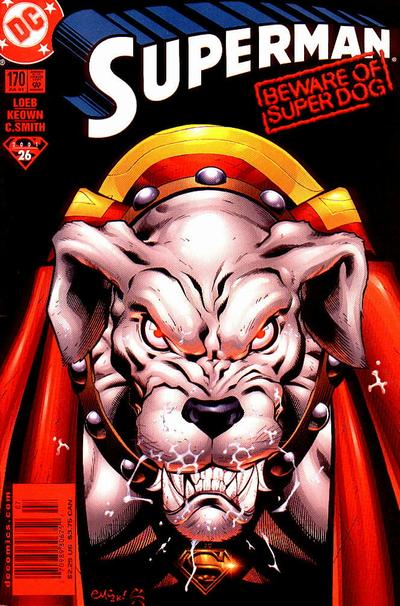
Legacy Heroes

Sandy Brophy is going to kick things off for us by asking for my favorite legacy heroes. A “legacy” hero, for those of you who may not have been reading comic books since you were six years old, is the term used when a superhero’s name and identity is passed on from one person to another. For example, in the early days of comics, the Flash was a college student by the name of Jay Garrick. After superheroes fell out of favor and stopped being published for a while, they were resurrected in the 1950’s with the creation of a brand-new Flash, this time a police scientist named Barry Allen. Barry was the Flash for a long time before dying in Crisis on Infinite Earths (it took longer than usual, but eventually he got better), and his nephew/sidekick Wally West, aka Kid Flash, took over as the new Flash.

And so on, and so on, and so on.

This also, by the way, is my answer to Sandy’s question. The Flash is undoubtedly my favorite legacy hero in comics. By the time I started reading comics Wally was the main Flash, and even decades later he’s still the one I feel is most compelling. He was young when he became the Flash, and thanks to the magic of comic book time I eventually caught up with him at the same time he was being written by Mark Waid, who turned him into a fully fleshed-out and wonderfully realized character in his own right. He got married, had kids, and he grew and matured. He was also – as Waid said – the first sidekick to “fulfill the promise,” in other words, to take over for his mentor. He’s also still, to the best of my recollection, the ONLY one to do so on a permanent basis. It’s true that Dick Grayson (the original Robin) became Batman for a while, and Captain America’s sidekick Bucky took up the shield when Steve Rogers was temporarily dead, but both of them reverted back to their other adult IDs (Nightwing and the Winter Soldier, respectively) when the original came back. Not so Wally. Barry returned and Wally stuck around, and although there’s been a lot of timey-wimey nonsense and attempts to sort of push him to the side, he’s bounced back. Wally is, again, the primary Flash, even in a world where Jay and Barry exist, and the nominal head of the Flash family. And he’s just the best.

There are other good legacy heroes, don’t get me wrong. I enjoy the Jaime Reyes version of the Blue Beetle (although my heart will always belong to Ted Kord, himself the second Blue Beetle following Dan Garrett), and there are few who will argue that Kamala Khan hasn’t done more with the Ms. Marvel title than either of her predecessors, but Wally West is the ultimate legacy hero in my book.

Superhero Logos

My buddy Owen Marshall wants to know what some of my favorite superhero LOGOS are – those titles that splash across the cover of a comic book to (hopefully) let you know what you’re about to read. I’ll talk about what I think makes a good logo in general, then get into specifics. I think a great logo is something that stands out in a way that evokes the hero in question. The Superman logo, for instance, is relatively simple – his name, slightly curved, with drop letters that give it a sense of weight, of solidity. Any time you see that logo you think that somebody could just grab it off the cover – and, in fact, there have been many covers where that very thing has happened.

You can’t beat a classic.

Spider-Man’s original logo is great for similar reasons. It’s solid, but it’s also easy to partner up with a web in the background to help get across the idea that you’re dealing with a wallcrawler. And, like Superman, it’s a short enough logo that it’s very easy to add an adjective to the title (as in the AMAZING Spider-Man, the SPECTACULAR Spider-Man), but just as easy to drop a subtitle underneath (Spider-Man: Renew Your Vows). There have been many attempts over the years to create a new Spider-Man logo, but frankly, there’s never been one I like as much as the original, and it seems it’s never anything but a matter of time before they return to it.

Yeah, that’s the stuff.

The Avengers also have a fantastic logo. They’ve had several, of course, but I’m specifically talking about the most famous version, the one that Marvel Studios used for the basis of its movie design. It’s clean and bold, and the arrow in the letter “A” gives it a sense of forward motion that sort of plants the idea that these are heroes who are about to go out and DO something.

The arrow is in case you forget and try reading it right-to-left.

Green Lantern has had a great many logos over the years, many of which actually include a lantern, but my favorite doesn’t. I like the logo that premiered in 2005 with Green Lantern: Rebirth and which remained the primary version of the logo until just a few years ago. This version has that tilt to one side and a cool roundness to it that…okay, just hear me out on this…it makes me think of classic cars from the 50s. Smooth, sleek, fast…and those are words that apply to Green Lantern, especially the Hal Jordan version. 

And it’s all spacey and stuff.

I could probably spend an entire month just going through different logos, but I’m just going to cap it off here by saying that there are hundreds of awesome logos and if you want to read more about them I highly recommend the blog of comic book letterer and designer Todd Klein, who frequently makes posts where he discusses the design and history of comic’s greatest (and worst) logos, which is like drinking mother’s milk to a nerd like me. 

Superhero TV (pre-2000)

My old friend Patrick Slagle wants to know my favorite superhero live action TV shows. Well that’s easy! There have been SO many to choose from – Stargirl was great, and I was deeply enamored of Legends of Tomorrow, and then there was–

Oh, wait.

He specified shows from BEFORE the year 2000. Well. That makes it a lot more difficult. We’ve been in a superhero renaissance in the last decade or so, guys, with such an abundance of shows that even I haven’t gotten around to watching them all yet. (Peacemaker, for example, is still warming my “to-watch” list.) But if I’m going to restrict myself to the cultural wasteland that was 1999 and earlier, I guess there’s only the obvious choice.

Project: ALF.

If I don’t do this at least once in every Playing Favorites column the Don said he was gonna break my thumbs.

The superhero shows of my formative years…let’s be honest guys, they weren’t that great. The two most fundamental ones are probably the Bill Bixby/Lou Ferrigno Incredible Hulk and Lynda Carter as Wonder Woman. And while those are both good shows, neither of them were series I would watch on repeat, the sort of thing that makes a TV series worm its way into my psyche and become a part of the vast tapestry that is your friendly neighborhood Geek Pundit. And the truth is, a lot of the other shows of that era don’t hold up. Look at the 70s Amazing Spider-Man or Shazam! shows and try to convince me that these are fundamental pieces of Americana. The Greatest American Hero is a show I know I used to watch, plus it’s got the most earwormy theme song in superhero history, but I couldn’t relate the plot of a single episode after the pilot. It got better later, with the surprisingly decent Superboy TV series (mostly after Gerard Christopher took over the role from John Newton) and the “fun but fluffy” era of Lois and Clark: The New Adventures of Superman.

There are some wild swings in quality happening in this picture.

If I have to pick (and I do, it’s my damn game), I guess I’m going to have to give props to the two shows that I think launched the genre on TV: George Reeves in The Adventures of Superman and the Adam West/Burt Ward Batman show from 1966. I’ve always had a complicated relationship with the West/Ward era. When I hit those peak teenage years of arrogance and knowitallitude that most of us go through, I began to actively dislike that show, blaming it for people treating comic books as childish and infantile for decades after it was off the air and tarnishing the reputation of the caped crusader. Fortunately as I got older, I got over myself, thus disqualifying myself from ever running for elected office, but at the same time getting a sense of perspective. Sure, it wasn’t MY Batman, but I learned to appreciate it for what it was. I’ve softened to the show now. I even watch the reruns on MeTV Saturday nights between Svengoolie and Star Trek.

There’s no school like the old school.

George Reeves, though, I’ve always appreciated. He was the Curt Swan Superman come to life – square-jawed, barrel-chested, friend to all the innocent. But at the same time, he had a wicked sense of humor, showing clear joy whenever he got to take down a bad guy and taking a sly sort of pleasure any time he thwarted Lois Lane’s attempts to one-up him. I love the Reeves Superman and I don’t think he gets the respect he deserves. DC has launched a series of comics featuring the Christopher Reeve Superman as Superman ‘78, and that’s great. I love ‘em. But am I really the only person who would pick up a comic book called The Adventures of Superman ‘52?

Superhero Animals

I really like Marvel’s Scarlet Witch. She’s had several costumes over the years, but the best is the one George Perez whipped up for her for the Heroes Return era. It was red, naturally, which helps you identify her via color-coding, but the design also drew on the character’s Romani heritage, with a rare long skirt and robes that make you think of a fortune teller. All of that builds together and links her to her mystical roots. I’m fairly certain that if I didn’t know who the Avengers were and someone asked me which one I thought was the Scarlet Witch, I’d say, “Well, gotta be the woman in red, and not the tiger girl in the bikini.”

Jim MacQuarrie asked for my favorite Super-Animal, while Lew Beitz wants to know my favorite Super-PET. These two categories are close enough that I’ll talk about them together. They’re not EXACTLY the same, but there’s plenty of overlap. The way I look at it, we can divide super-animals into two categories: the ones that serves as an animal sidekick to the main hero, such as Krypto the Superdog, and those that are distinct heroes in their own right, like Hoppy the Marvel Bunny. The former are characters in established universes, while the latter usually exist in a Disney-esque universe where there are no humans at all, but instead races of anthropomorphic animals running the show.

As far as super-pets go, the Superman family has the deepest – and weirdest – bench to draw from. Krypto the Superdog and Beppo the Supermonkey are both animals from Krypton who made their way to Earth and gained powers like Superman and Supergirl. Supergirl also has a cat named Streaky who gains and loses his powers on a rotating basis thanks to exposure to something called X-Kryptonite (it was the 50s, it was safe to give something a name like that because there was no internet). Then there was Supergirl’s horse, Comet, who was actually a centaur from ancient Greece named Biron that was cursed and trapped in the form of a full horse. He hung around for a couple of thousand years before he met Supergirl and started to assist her on her missions, fell in love with her, and learned he could briefly become human when an actual comet passed close to Earth, allowing him to date Supergirl without telling her who he really –

Stop looking at me like that, I’m not making this up.

Superman is surprisingly indiscriminate about who he gives a cape to.

Anyway, Krypto is kind of the gold standard of super-pets, but there are a few others outside of the Super-Family worth mentioning. Wonder Woman’s kangaroo, Kanga, for instance. Ace the Bat-Hound, who Batman gives a mask to cover the bat-shaped patch of fur on his face and thus protect his secret identity. Chameleon Boy’s pet Proty who, like Chameleon Boy, is a shapeshifter, and fully sapient, and who can and did occasionally impersonate full grown adults, which makes you ask where the hell the Legion of Super-Heroes gets off treating him like a pet. And of course Damian Wayne, the current Robin, has Bat-Cow.

The only superhero who’s a source of 50 percent of the food groups.

Then there are the other types of Super-Animals: anthropomorphic heroes in their own right. Everyone who has heard me talk for five minutes will know that my favorite of these is Captain Carrot and his Amazing Zoo Crew. Created by Roy Thomas and Scott Shaw!, this 80s phenomenon was about a group of superhero animals who got powers from meteors that fell to (their version of) Earth. After meeting a dimension-hopping Superman, they were inspired to become heroes in their own right. The art is cartoony and the premise is silly, but what I’ve always loved about Captain Carrot and company is that their stories – at least in the 80s – weren’t played like cartoons. The plots were straight out of the pages of Golden and Silver Age comics, facing giant monsters and villains with cold-rays and all kinds of classic tropes. They were funny, sure, but not at the expense of the characters, as many of the modern writers who have tried to use Captain Carrot have forgotten. When I say I want a revival of the old-school Captain Carrot, I say it unironically and with love.

By contrast, there’s perhaps the most famous super-animal of the day, thanks to his starring role in an Academy Award-winning motion picture. I refer, of course, to Peter Porker, the Spectacular Spider-Ham. Spider-Ham’s comic hit JUST when I stared reading comics in earnest, and I devoured it. In this hilarious take on the Spider-Man story, Peter was the pet spider of mad scientist May Porker, who accidentally irradiated herself and bit him. The spider turned into a pig while maintaining his spider-powers. When May recovered from the radiation, her memory was erased and she thought she was just a kindly old lady and Peter was her nephew.

Move over, “The Boys,” the REAL heroes are back in town.

I’m not making this up either, but I wish I could take credit for it. The early Spider-Ham comics were a lot of fun, then he disappeared for decades before experiencing a renaissance in recent years. Like Captain Carrot, his modern adventures are sillier and more “cartoony” than the earlier ones, but UNlike Captain Carrot, the cartoony interpretation fits better, and has made him a better character.

My favorite Spider-Ham story, though, is not from the comics and not from the cartoons, but from the mouth of his creator, Tom DeFalco, when I met him at a convention a few years ago. He was signing reprints of the first appearance of Spider-Ham and his other great Spider character, Spider-Girl. I bought them both and told him how much I loved Spider-Ham when I was a kid, and he told how surprised he was when Marvel Comics sent him an invitation to the premiere of Spider-Man: Into the Spider-Verse. He didn’t understand why he was getting an invitation, and someone said, “It’s probably because Spider-Ham is in it.” And DeFalco, shocked, exclaimed, “SPIDER-HAM is in a MOVIE?”

Timeless. 

Favorite Superhero Costumes

My wife Erin, who always cuts the line because nobody else who submits questions has ever made lasagna for me, wants to know what my favorite superhero costumes are, both male and female. I think it was Alex Ross who said that the test of a good superhero costume is whether you could identify the character based just on the name, even if you knew nothing about them. Batman, for example. Green Lantern. Captain America. The 90s was an era where this consistently failed, especially in the X-Men comics and those later characters created by former X-artists. If you showed someone who knows nothing about comics pictures of Gambit, Cable, Maverick, Shatterstar, and Deadpool, then asked them to match the names to the pictures, any correct answers would happen purely because of the law of averages.

But anyway, when I read Ross’s definition, he also used that definition to argue that the greatest superhero costume of all time belongs to Spider-Man. It’s hard to argue with him. Nobody who saw a lineup of the Marvel Comics all-stars would have any difficulty telling that this guy is Spider-Man and not, for example, Wonder Man. And while that’s true of MOST of Spider-Man’s assorted costumes over the years, the original is still my favorite. The black costume is cool-looking, but the ol’ red-and-blues have a brighter, more optimistic tone that suits Spider-Man better. Spider-Man is a hard luck hero, to be sure, but he should never be a depressing, brooding character like Daredevil. (Are you listening, current Marvel editorial?) He’s the guy who should never give up and always finds it in himself to do the right thing, and the red and blue color scheme says that better than any of his other assorted looks. 

I don’t even blame him for admiring his own reflection.

Using the same metric, I also think the Rocketeer has a phenomenal costume. He is literally a human rocket, with a rocket pack strapped to his back and a helmet that evokes the speed and energy of the burgeoning space age. The rest of the outfit, though, with the brown bomber jacket and the jodhpur pants brings in the idea of his aviator background and grounds him in the World War II era where he belongs. 

This picture makes me want to make swooshy noises.

Honorable mention goes to the Flash, Green Lantern (Hal Jordan costume, although I have a soft spot for the one John Stewart wore in the Justice League cartoon) and Marvel’s Nova.

Erin also asked about my favorite female costumes, which I find is a little harder to do going by Alex Ross’s metric. Too many female costumes are designed more for titillation rather than actually identifying the character. And even those that DO clearly identify them often do so via a logo or symbol that marks them, such as Wonder Woman.

I think “Morgan” was the screenwriter of Doctor Strange and the Multiverse of Madness.

Harley Quinn is another one that is pretty obvious, at least in her original costume. The red-and-black color scheme, white makeup, and bangled headpiece brings up the notion of a Harlequin, which of course is the inspiration for the character. She’s changed her look several times over the past few years, and while some of her looks have been pretty good, none of them draw their inspiration from her roots the way her first look does. On the other hand, they’ve come up with a pretty solid justification for her changing her look – once she got over the Joker and dumped his homicidal ass, she doesn’t want to wear the costume that identifies her as his sidekick anymore.

Let’s face it, I could have posted a picture of a random duck here and you still could have pictured Harley’s get-up.

Then there’s Supergirl. She’s had a lot of costumes, the most iconic look being the basic Superman outfit, only with bare legs and a skirt. That’s not her best look, though. For me, my favorite Supergirl costume came from the 1970s, when she wore a loose blouse with a small S-shield over her heart rather than the full-size shield most superfolks wear. I love that look – it still clearly marks her as a member of the Super-family, but it’s very different from anything any of the others wear. Being loose instead of skintight like most superhero costumes, it’s got a freeing quality that speaks to a lighter version of the character in a period where she was working to get out of her more famous cousin’s shadow. It’s such a great look and I never stop wishing they would bring it back.

What can I say? She’s got the look.

That’s about it for this week, guys, but there are plenty of other questions I haven’t gotten to yet. So be sure to come by next week for Playing Favorites With Superheroes Part Two, and if you have a suggestion that I haven’t covered, go ahead and drop in in the comments. Up, up, and away!

Blake M. Petit is a writer, teacher, and dad from Ama, Louisiana. His most recent writing project is the superhero adventure series Other People’s Heroes: Little Stars, now complete on Amazon’s Kindle Vella platform. He realizes he talks about the Superman family a lot whenever he gets on to a superhero discussion, but let’s be honest, people. It’s either gonna be this or Star Trek.