Geek Punditry #110: Playing Favorites With Love Stories

It’s been a while, but it’s time once again for Playing Favorites! Yes, Playing Favorites, that Geek Punditry mini feature in which I throw out a category and my pals on social media suggest related topics wherein we pick some of the best of the best. With Valentine’s Day looming, this week I asked people to share ideas for love story topics. So grab that special someone and let’s get to it! 

Bad Choices 

Jeff Edwards asked for love stories where it’s clear that the people involved made the wrong choice. It’s a funny idea, because I’m sure we can all think of at least one movie where we’ve walked away saying something like, “What the hell did he SEE in her?” And as far as I’m concerned the absolute apex of this trope is from the Lord of the Rings film trilogy. 

No, I didn’t expect to be writing about Lord of the Rings this week either, but here we are. 

Now I love these movies. I think they are masterpieces, and I respect that Peter Jackson didn’t play all fast and loose with canon like SOME fantasy filmmakers I could mention. But if there’s one thing I simply will never understand, it’s why Aragorn would choose Arwen over Eowyn.

Seriously, why is this even a contest?

Sure, Liv Tyler is a classical beauty, but even 20 years ago I would have climbed over her and an entire briar patch to get to Miranda Otto. Nor is it just a matter of looks. Arwyn has that elvish grace and delicacy that makes you feel like you’re embracing a porcelain doll, and I don’t care for that. Eowyn is strong and brave, she killed the Witch King with the power of semantics, and I hear she’s doing her best to get better at making stew. She’s got it all.

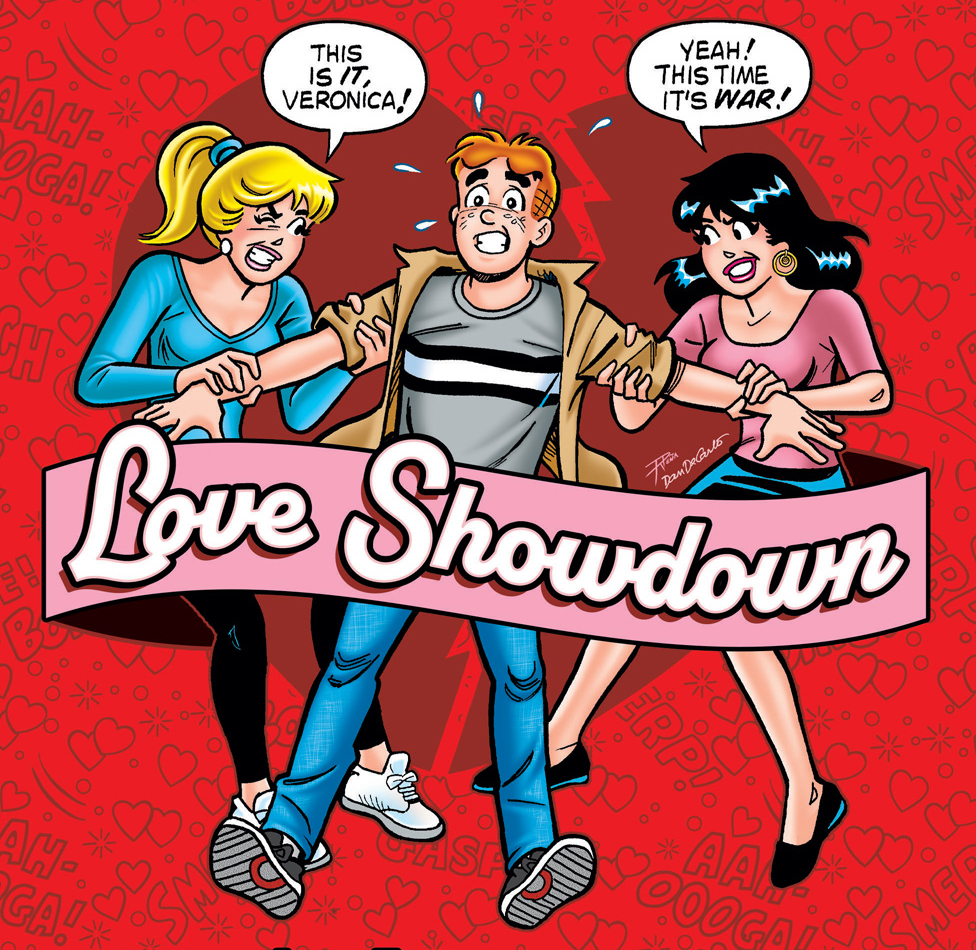
In second place is a tie between every story ever written in which Archie Andrews chooses Veronica Lodge over Betty Cooper. I get it. Archie, Betty, and Veronica are the eternal love triangle, and we all know that there’s never going to be a TRUE resolution. They’ve had attempts over the years, but it never sticks. But there is a word that the French have for people who prefer Veronica over Betty: wrongo.

Frankly, they can both do better.

I don’t want this to sound like I hate Veronica, mind you. I think she gets a bit of a bad rap. There have been numerable stories that have shown that, underneath her rich girl veneer, she has a good heart. But that doesn’t change the fact that she’s spoiled and selfish, and that Archie is dazzled by her beauty. Betty, on the other hand, is entirely loyal and devoted to him, and loves him without reservation, whereas Veronica on many occasions has been known to toss him aside at a moment’s notice. In fact, that’s probably WHY Archie goes for Veronica – because she’s less attainable. 

What an incredibly stupid reason. What an incredibly realistic reason.

As if that weren’t enough, Archie ignores the very sensible advice of his friends. I’m not saying that if my friends hadn’t liked Erin when I starting dating her that I would have ended the relationship, but at the very least it would have made me question what was up. True friends, people who honestly have your back, should be listened to, and Jughead has made it ABUNDANTLY clear over the years that he’s Team Betty. Archie. Archibald. Listen to your bro.

It’s a little easier to justify when you remember that Archie and the gang are all, in fact, teenagers, and as such he is even more inclined to make incredibly stupid choices than we males of the biologically adult variety. The characters aren’t ever going to grow up, but if they DID, I would like to think that Archie’s better judgment would finally kick in and he would see that the girl next door is the way to go, hopefully before Betty finally comes to HER senses and dumps his ass for Adam Chisolm.

Yes, as a matter of fact, I DO feel ways about things. 

Finally, although this is not a hill that I personally am prepared to die on, my wife wishes me to share her sincere belief that, in West Side Story, Tony was an absolute idiot for going after Maria when Anita was, like, RIGHT THERE. This is true of both the original and the remake. This is even true of the older Rita Moreno IN the remake. I, on the other hand, just want to point out that West Side Story is a multiversal variant of Romeo and Juliet, and as such, pretty much everybody in that story makes nothing but bad choices all day and all night. 

Electric Love

My uncle Todd Petit asked for the best love story involving a robot or cyborg, which is extremely specific, but that’s cool with me! I was a little hesitant to pick this one, though, mostly because in the Facebook comments several people already went straight to what I think is probably the best robot love story of all time.

Project ALF. 

Ah, I’ve missed this stupid, stupid joke.

No, wait, I’m thinking of the best alien/feline love stories. Obviously, the best love story involving robots comes from the Pixar masterpiece WALL-E. I love this movie, and I assume pretty much everybody who has a soul also loves it, and perhaps the main reason is the deep, perfect, sincere love that is expressed in this film. WALL-E is a garbage robot; his job for centuries has been just to collect trash and compact it. There’s no emotional component to this. But after all these hundreds of years of solitude, he finds himself growing a personality – likes, dislikes, hobbies. He begins saving select items from the trash that he finds interesting and grows a little collection. He makes friends with a cockroach. He is mesmerized by the movie Hello, Dolly! 

He even gave her flowers.

And then he meets EVE, a robot that is searching the dead Earth for signs that life can return, and it’s instant sparks. It’s like watching a busted down Ford Pinto fall in love with a sleek new electric hybrid vehicle (coming this fall in Cars 4!) but it WORKS. At first, EVE isn’t particularly impressed by WALL-E, but his sweetness, kindness, and courage melt her electronic heart. And perhaps the most amazing thing about it is that their entire relationship is almost completely wordless. Neither of them have any dialogue other than occasionally saying their names, but that doesn’t matter. By the end of this movie you are crying and cheering and imagining a new Earth populated by a slendering human population and all of WALL-E and EVE’s little robot babies.

That said, good on Pixar for resisting the urge to name him ADD-M. 

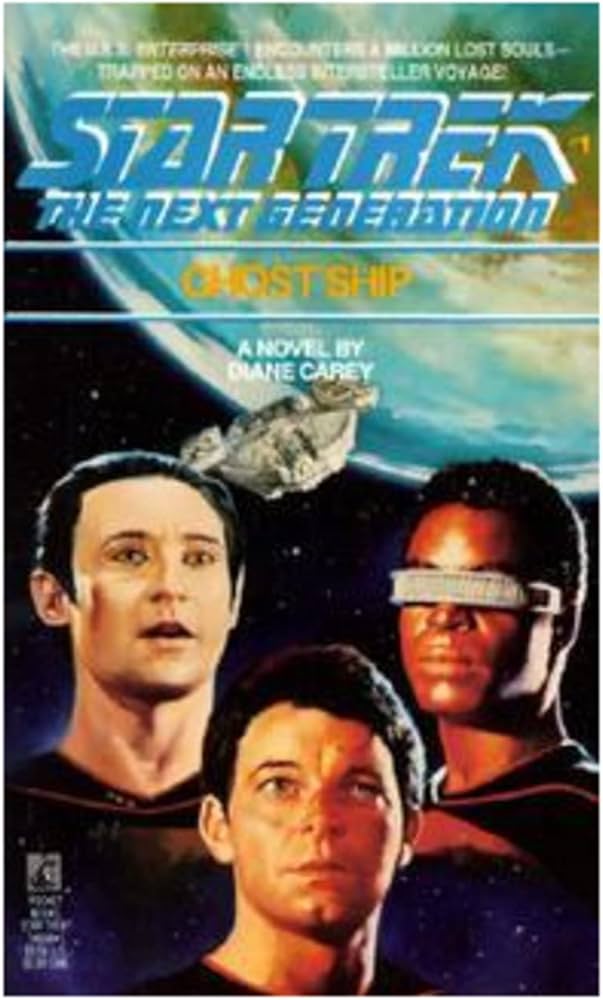
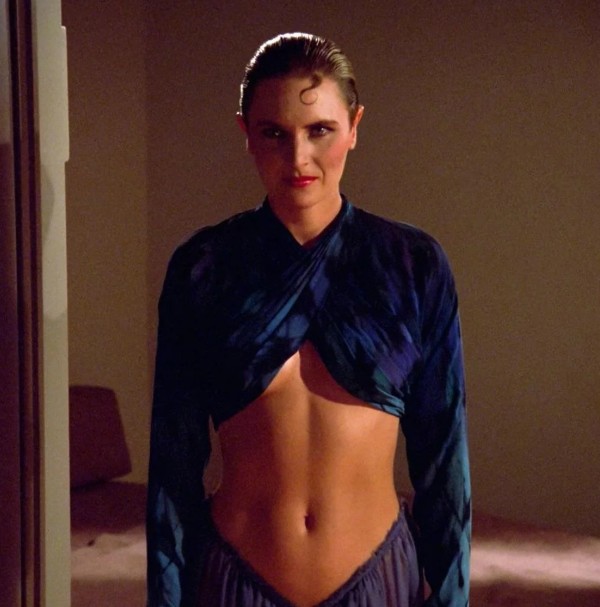
As for other great robot love stories…well, the one that comes most clearly to mind is actually one of the most tragic, and it’s from Star Trek: The Next Generation. Like most Star Trek shows in the pre-modern era, this show changed and evolved considerably over its first few seasons. Perhaps the most visible change (other than Riker’s beard) was the departure of Denise Crosby, who played security chief Tasha Yar in season one. Crosby asked to be written out of the show, frustrated over the lack of attention and development her character was getting, and honestly, you can’t blame her. Go back and watch that first season again and you’ll see most of the writing did her no favors at all. But there is ONE element of her abbreviated story that stuck with the characters for all time, and that was her relationship with the android Data. The idea of Data is that he is a Pinocchio, a robot that looks almost human and that wants to be a real boy, if only he knew what emotions were.

She had an AI boyfriend BEFORE it was cool.

Data is my favorite Next Generation character, and in my top three of all Star Trek characters, and the reason is because of his emotional journey. The conceit was that, as an android, he desired the emotions he did not have, but even in that description you can see the contradiction. DESIRE is an emotion. If you HAVE no emotions, how can you DESIRE them? My read on Data, the way I feel about the character, is that he truly DID have emotions from the very beginning – he simply didn’t understand them, know how to process them, know how to define them, and therefore he BELIEVED he had none. After Tasha Yar is killed off, Data returns to her in his thoughts many times. For six seasons, then again 30 years later in the final season of Star Trek: Picard, it is Data that recalls Tasha more than anybody else, Data who brings her up, Data who reveals in that Picard episode that his memories of her are a core component of his personality matrix. The great legacy of Tasha Yar is the fact that, for the rest of his existence, poor Data has been mourning a woman he didn’t really understand he was in love with. 

Sitcom Love

Rachel Ricks asks what I think is the best romance from a sitcom. That’s such a tricky one. There are a lot of great sitcom COUPLES – Bob and Linda Belcher, Herman and Lily Munster, and so forth – but if it’s a pairing that was already together when the show begins, I don’t think I can count them. To count it as a romance, I think we need to see the relationship blossom INTO love.

I also don’t really count those stories that end poorly or where the characters don’t really belong together. Sam and Diane on Cheers may be one of the all-time legendary sitcom couples, but they were utterly toxic to one another and never belonged together. Not to say that a love story HAS to have a happy ending (see what I said about Data), but if it’s a sitcom, I want something a bit more lighthearted.

So I’m gonna stick to the Cheersiverse and say one of my favorite sitcom romances is Niles and Daphne from Frasier. And it’s odd, because it started off as a pretty poor depiction of a relationship – when they meet, Niles is already married (to an utterly reprehensible woman who browbeats and emasculates him at every turn) and pines for Daphne in secret for years. She, meanwhile, is completely oblivious to his affection and treats him with the same love and care that she does Eddie the dog. Eventually, though, his marriage to Maris ends and the two of them find one another. The arc where they’re both with other people but wind up boomeranging into each other’s arms is one of my favorites, and from that point onward the love and affection between them elevates both characters.

Pictured: Steam Heat

There’s a relatively early episode where they have to pretend to be a couple as one of the screwball schemes that happened in every other episode of Frasier, and they play the part so convincingly that Niles almost believes she shares his affection until she compliments him on how good an actor he is. The heartbreak David Hyde Pierce conveys is palpable, and you die a little for him. But it’s bought back years later, when they get together and revisit that scene again, bringing it all full circle. I just love watching those two. 

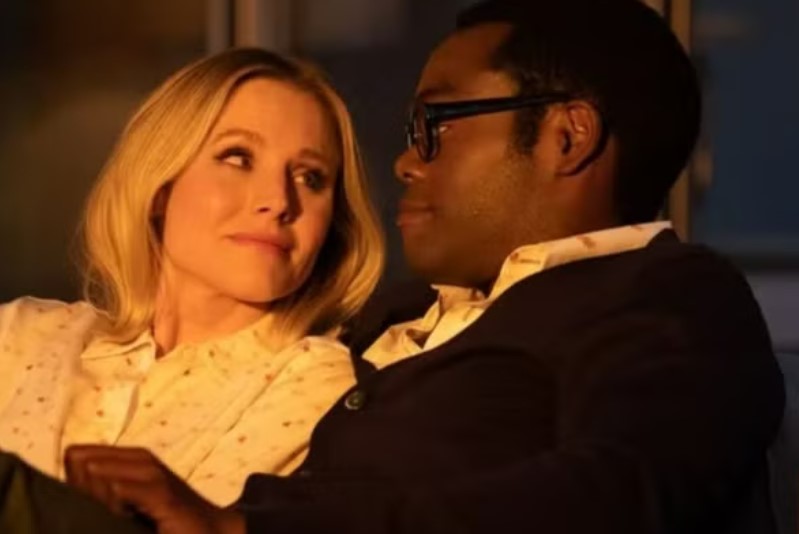
I also simply adore the relationship between Eleanor and Chidi on The Good Place. This show, about a self-proclaimed “Arizona dirtbag” (played in an adorable way that only Kristen Bell could have pulled off) who goes to Heaven due to what amounts to a clerical error, is one of the smartest and most emotionally profound sitcoms of the past decade, if not of all time. The relationship that develops between Eleanor and Chidi (William Jackson Harper) is one of the core elements of what makes it such a magnificent show. Eleanor has spent her life being self-centered and scuzzy, whereas Chidi’s life has been one of anxiety and apprehension. Eleanor acts without thinking, Chidi overthinks EVERYTHING to the point of catastrophe. The way each of them makes the other a better person is beautiful and heartwarming. 

If this screenshot doesn’t make you want to cry, you did NOT watch the last episode.

There’s a lot more to The Good Place than I revealed in that little recap, because if you’ve never seen the show I don’t want to spoil any of the incredible twists and surprises that it includes, but go and watch it and tell me you’re not rooting for Eleanor and Chidi every step of the way.

Okay, folks, I think that’s going to bring us to the end of part one of “Playing Favorites With Love Stories.” There are still several great suggestions for topics, though, so I’m not done yet. Come back next Friday, Valentine’s Day, for part two. And until then, hey, share this with someone you love. 

Blake M. Petit is a writer, teacher, and dad from Ama, Louisiana. His most recent writing project is the superhero adventure series Other People’s Heroes: Little Stars, volume one of which is now available on Amazon. You can subscribe to his newsletter by clicking right here. He’s also started putting his LitReel videos on TikTok. He maintains that the purest love story on TV is Gomez and Morticia Addams, but nobody asked about that, so he’s gonna drop it here. 

Geek Punditry #51: (DC Comics Presents) The Greatest Santa Claus Stories Ever Told

Every week comic book fans go to the shop to pick up the latest exploits of their favorite heroes: Superman, the Fantastic Four, the Flash, and so forth. And this month, DC has brought back one of their top recurring characters, pairing him off with none other than the Batman in a four-issue miniseries that has proven to be the most epic tale in the battle of good versus evil since Cindy Lou Who managed to get to the Grinch. I refer, of course, to the legendary four-issue epic called Batman/Santa Claus: Silent Knight. 

“Ho ho hoooold on a second, whose comic book is this, anyway?”

Written by Jeff Parker with art by Michele Bandini and covers by Dan Mora (who – I’m throwin’ this out there – may be the best Superman artist of this generation) in this story Batman and Santa have to team up to save Christmas from the demonic Krampus. This comes as a shock to Robin, Nightwing, and the other members of the Batman family, because they always thought Bruce was making one of his rare jokes when he told them that Santa Claus was one of the many teachers he went to while in training to become the world’s greatest detective. Nope. Santa is 100 percent legit. And I love that.

When an established property does a Santa Claus story, they usually go in one of two ways: either everyone is shocked to learn that Santa Claus is real, or Santa Claus is NOT real in this dismal, crapsack universe, but people learn a lesson about the True Meaning of Christmas anyway. It’s not often that you see a story – other than those aimed directly and exclusively at children – that accepts Santa as a simple fact of existence, and the breakdown of which characters are aware of Santa and those that previously were not is really hilarious. Considering the fact that this is a superhero universe, the question of Santa’s existence seems kind of silly: your best friend can juggle mountains, you work with a guy who breathes underwater, you hang out with a Olympian Demigoddess, and your Secret Santa this year wears a magic ring he got from blue aliens. Why the hell would it be hard to believe in Santa Claus?

Back in the 80s and early 90s, DC published a series of collected editions called The Greatest Stories Ever Told, a simple best-of collection featuring some of their characters. There were, to my recollection, two Batman volumes, one for Superman, one for the Joker (this was when the 1989 Batman movie was red-hot), one for the Flash and one featuring team-up stories. Alas, they completely neglected to give a volume to the greatest hero of all: St. Nicholas himself. So in honor of Silent Night, this week I’m going to entreat DC Comics to prep his well-deserved volume for next year. And not only that, I’m going to help them out by suggesting some of DC’s best Santa Claus stories for inclusion. Almost all of these are available to read on the DC Universe Infinite app, by the way, so if you’re a subscriber, you can go over there right now and check out the saga of Santa.

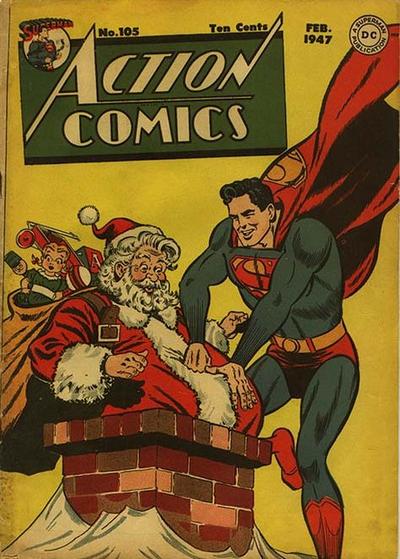
We’re gonna start with Action Comics #105 from way back in 1946. In “The Man Who Hated Christmas” by Jerry Siegel and John Sikela, we meet a guy who sets out to destroy the season by assassinating Santa Claus! Fortunately for children all over the world, Superman is on the case. Like Silent Night, I love this story because there’s none of the usual prevaricating over whether or not Santa really exists. Superman hears that St. Nick is in trouble and he shoots off to save the day without hesitation, helping Santa conquer his diet (it makes sense in context) and taking over when the bad guy absconds with Santa’s reindeer. It’s a charming little story with a great cover that should be read more often.

Doing this in 2023 would immediately get you cancelled.

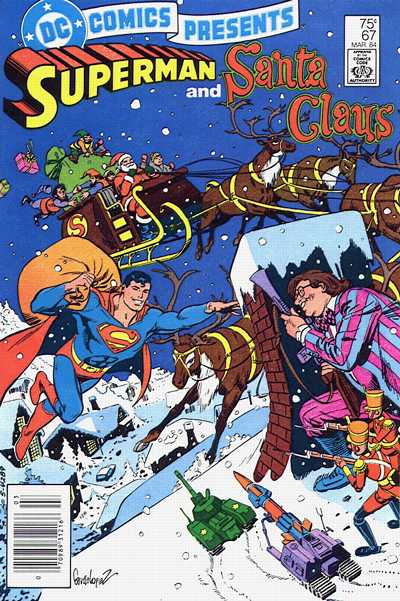
Superman must have forgotten this early encounter, though, because when he met Santa again in 1983’s DC Comics Presents #67, he’s shocked to discover the ol’ spirit of Christmas is real. (Save your emails – we can excuse this by saying that the Action Comics example was the Earth-2 Superman, while DCP featured the Superman of Earth-1.) In “‘Twas the Fright Before Christmas” by Len Wein and Curt Swan, a young boy named Timmy Dickens (because the 80s were big on subtlety), tries to rob a street corner Santa. Superman brings Tim to his Fortress of Solitude in the arctic to get to the bottom of things. Turns out that while sneaking an early peek at his Christmas presents, Tim was zapped by one of his toys and hypnotized to commit crimes and bring the money to Superman’s old enemy, the Toyman. When leaving the Fortress, Tim’s toy zaps Superman, causing him to crash, only to be rescued by Santa’s elves. Clark and Nick team up to take down the Toyman in a battle that I’ve always loved. I first read this story when it was reprinted in Christmas With the Superheroes #1 in 1988 (also available on the app), along with several other classic Christmas stories from DC’s history worth reading…but this was the only one that featured Santa. 

“The only characters available for a team-up this month are Santa Claus and Air Wave.”
“AGAIN?”

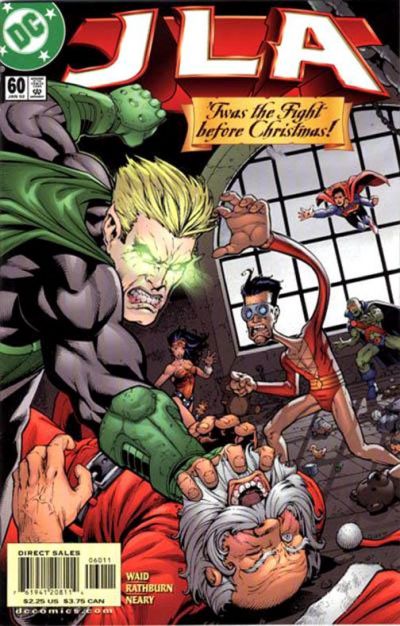
Mark Waid, who made the “Santa must be real” argument beautifully in an issue of Impulse (because why WOULDN’T Barry Allen’s grandson believe in a guy in a red suit fast enough to move all over the world), gave us a tale of Santa in JLA #60 (2001, with art by Cliff Rathburn and Paul Neary). This time Plastic Man is in the spotlight, spending Christmas with his sidekick Woozy Winks and Woozy’s family. Woozy’s nephew is at that skeptical “There ain’t no Santa Claus” age, so to try to restore his Christmas spirit, Plas tells him the story of how Santa Claus joined the Justice League following a battle with the demon Neron. It’s a hilarious tale, with the boy’s stubborn skepticism causing Plastic Man to constantly elevate the stakes in the story, giving Santa heat vision, armor, and other ridiculous power ups in the course of his battle. Waid being a sentimental sort, the story ends with a nice little moment of heartwarming involving some of his teammates. 

“Say it!”
“No!”
“Say Die Hard is NOT a Christmas movie!”
“This is why you’re on the naughty list!”

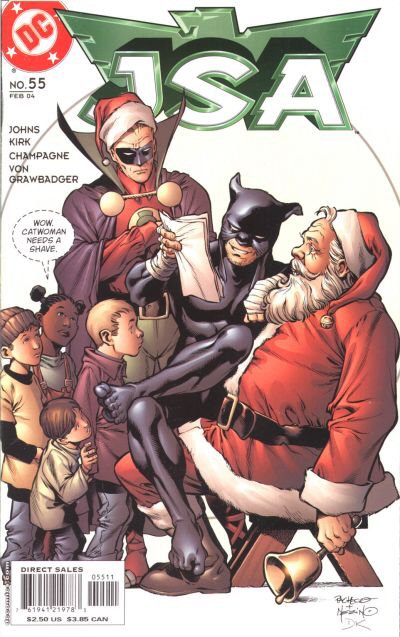
JSA #55 from 2003 is one of my favorite Christmas stories of all time. Written by Geoff Johns with art by Leonard Kirk, “Be Good For Goodness’ Sake” is narrated by a department store Santa Claus getting ready for Christmas Eve, planning to spend the evening entertaining the gathered kids, while at the same time waiting for a visit for some old friends – the Justice Society of America. Johns probably has a greater love and respect for the Golden Age of comics than any writer since the days of Roy Thomas, and he drew on that masterfully with this story. It was already a fun tale about heroes reconnecting with one of their own, but the reveal of just who is wearing the Santa Claus suit still warms my heart 20 years after the book was originally published. That means I’ve read this comic at least 20 times, because it’s a once-a-year read since I first discovered it. And I’ve got no plans to stop.

Not even gonna make a joke about this one. Just read the book. It’s SO good.

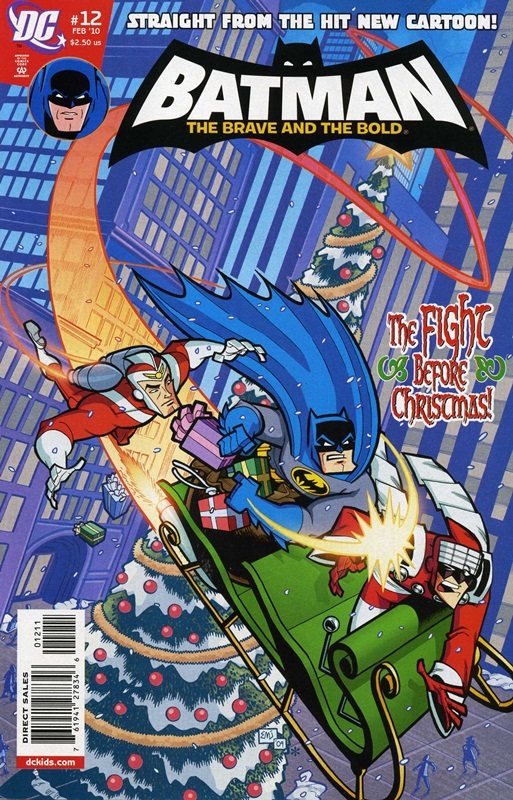
2009 gave us Batman: The Brave and the Bold #12. This comic, based on the animated series of the same name, teamed up Batman with Adam Strange in “The Fight Before Christmas” by Landry Q. Walker and Eric Jones. On Christmas Eve Batman is swept up by one of Adam’s Zeta-Rays to the planet Rann where he discovers that a malevolent force is sweeping through the universe, destroying planets. It’s already taken Thanagar, and Batman was rescued from Earth just moments before its own demise. But there is still a chance to save everyone thanks to some timey-wimey shenanigans that might just set things right in a Christmas miracle. Santa, admittedly, isn’t a HUGE presence in this comic, but the end gives us a shocking new twist on the old boy that I thought was clever and fun.

“Now that the Harley Quinn cartoon has made Kite-Man more interesting, you’re officially my lamest villain, Calendar Man.”

DCU Holiday Bash #2 came out in 1997, one of many Christmas anthologies DC has done over the years, featuring a variety of seasonal stories. The best, however, was a simple two-pager by Ty Templeton called “Present Tense.” On the planet Apokalips, Darkseid is alarmed to discover an incoming invader, a mysterious and absurdly powerful craft that is avoiding his defenses and on a collision course with his citadel. Like most two-page stories this one is basically an extended buildup to a simple punchline, but it’s just fantastic. And Templeton himself shared a link this week to a fanfilm by Bad Boss Studios that recreates the story in LEGO! It’s definitely worth checking out. 

You have to be REALLY aggressive to be a Doordash driver on Apokalips.

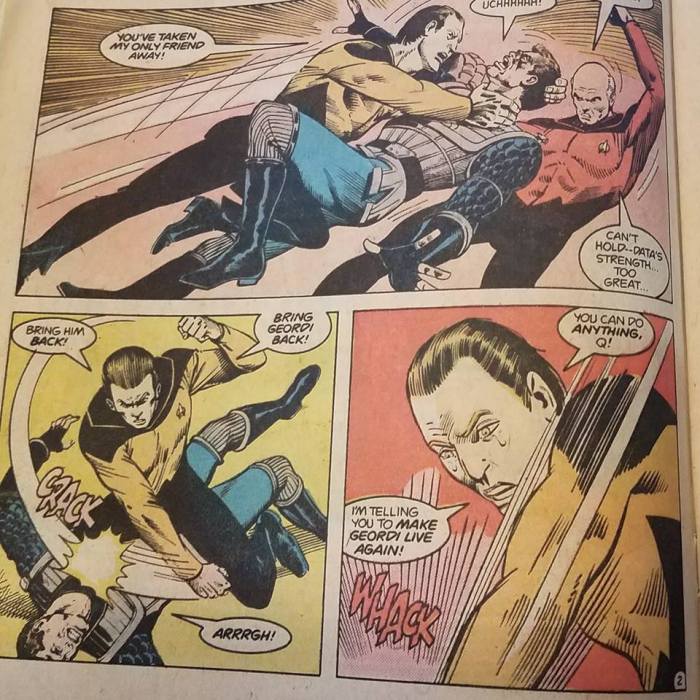
My final suggestion…actually isn’t in the DC Universe. And they no longer have the license to this franchise, so it’s not on DC Infinite. But if that Warner Bros/Paramount merger that they’re talking about winds up going through, you never know, it could come back. I’m talking about 1987 and Star Trek: The Next Generation #2. This is SUCH a bizarre comic book that I couldn’t get through this list of DC’s Santa stories without including it. “Spirit in the Sky” is written by Mike Carlin with art by Pablo Marcos, and it came out just a few months after the premiere of the TV show, which most certainly means that the comic was put into production before the creators ever got a chance to WATCH much of it…and BOY does it show. This six-issue miniseries feels consistently out of tone and character with the TV show, especially in an issue where it seems like Geordi has been killed, spurring the “emotionless” Data into a violent rage, screaming like a grieving child over the loss of his only friend. Whoo. Thank goodness when they launched the ongoing series the next year they had more of the TV show to work from.

Still better than season 4 of Discovery.

But let’s look at “Spirit in the Sky.” It’s the holiday season, and the Enterprise is hosting celebrations for the various cultures (human and otherwise) that celebrate at that time of year. As Captain Jean-Luc Picard is begrudgingly planning to make an appearance at each of the various parties, the ship encounters an alien race called the Creeg that is trailing a mysterious energy source throughout the stars. This story is truly bonkers and doesn’t feel like Star Trek at all, which may be the most Star Trek thing about it.

The prototype Cardassians were weird.

There are, of course, many other comic books featuring Santa Claus out there, and not all of them are even published by DC, but there are only three days left until Christmas, so you’ve got to pick and choose. These handsome selections should give you a solid foundation to begin your education of DC’s greatest superhero.

Blake M. Petit is a writer, teacher, and dad from Ama, Louisiana. His current writing project is the superhero adventure series Other People’s Heroes: Little Stars, a new episode of which is available every Wednesday on Amazon’s Kindle Vella platform. Dang it! He forgot all about Fables #56, where Bill Willingham answered the question as to whether Santa Claus is a Fable. Ah well, there’s always next year.

Geek Punditry #16: The Case For Star Trek: Legacy

You know, I had a column planned this week. Took some notes. Had it mapped out in my brain. And then I went and watched the finale of Star Trek: Picard, the magnificent, joyous finale that was honestly everything I wanted it to be, and suddenly what I was going to write about has gone completely out of my head. Instead, this week, I’m going to look ahead to the future of Star Trek – specifically about Picard showrunner Terry Matalas’s proposed Star Trek: Legacy series, and why it needs to happen. So here’s your warning, friends: after this point there WILL be spoilers for Picard, all the way to the final credits. If you haven’t watched it yet, continue reading at your own risk.

RED ALERT! SHIELDS UP! SPOILERS INCOMING!

After two seasons of Picard that were disjointed and felt forced, the third and final season gave fans what we wanted all along: a suitable ending for the cast of Star Trek: The Next Generation. The last time we saw these characters together in canon was in the film Star Trek: Nemesis, which left us on a bittersweet note that was never resolved. Data was destroyed, Will Riker and Deanna Troi went off to the Titan, and the heroes we’d come to love were scattered to the cosmic winds. In this final season of Picard, Terry Matalas brought back Data and reunited the seven core cast members of The Next Generation (well…EIGHT core members, actually, since he even resurrected the Enterprise-D) so that their story could end the way they deserved. Now, rather than leaving behind our friends in a state of mourning, we say farewell to them as they are together, happy, and in the wake of their greatest triumph. This is something that cannot be said for the characters in any other Star Trek series, and if this is in fact the last time we see these heroes (and I suspect it is at least the last time we see them all together), it is a fitting goodbye.

But Matalas did not JUST reunite the TNG crew. He also built a new crew, combining a few of the characters from the first two seasons of Picard with others created for this season, and we leave them on the bridge of the Titan, newly rechristened as the USS Enterprise-G. It is at this point that Matalas is staring Paramount executives in the eye and challenging them to greenlight a series about this new crew, a series he has been calling Star Trek: Legacy to anybody who’ll listen, even though it hasn’t actually been approved by Paramount.

Yet.

Let’s talk about the reasons that a Terry Matalas-led Star Trek: Legacy is not only possible, but exactly what long term Trek fans are hungry for.

CONTINUING THE SAGA

“Look at us! Here we are! Right where we belong…”

After Nemesis, every Trek series or movie for nearly two decades went backwards in time. Star Trek: Enterprise was about the ship that led to the creation of the Federation, the J.J. Abrams movies showed us the crew of the original series in an alternate timeline, and Discovery started its first season about a decade or so before the original series. Without debating the relative quality of any of these projects, none of them moved forward in the time period that fans had come to love through three series and four movies. That didn’t happen until Picard. And with that series finished, we are once again left without a continuation of that period in live action. Strange New Worlds and the upcoming Starfleet Academy series are in different points in the timeline, and while the animated Prodigy series seems to be in that time period (it’s honestly a little nebulous exactly where it falls), I think most fans probably join me in wanting a flagship series set in the 25th century. 

This is the most well-developed era in the Trek timeline, with elements from TNG, Deep Space Nine and Voyager all in play, and so far the only show that’s playing with all these toys is the animated comedy Lower Decks. And while it’s true that eras that have not been explored as much have room for development, that doesn’t quench the thirst for exploration of the storylines, cultures, alien races, and characters we already know. A show set in this time period would allow us to check in with those elements and see where they go in the future – something that would be inevitable with Voyager alumni Seven of Nine as captain of the Enterprise-G and two members of the bridge crew whose parents are members of the TNG crew. (Not to mention the fact that Riker and Troi have a daughter who is currently enrolled in Starfleet Academy, and could easily join the show later if we really wanted to ramp up the fan service). 

It would also allow the show to address the one glaring absence from Picard: the characters from Star Trek: Deep Space Nine. For the first eight episodes of the season the major threat were the Changelings, the main antagonists from DS9, but except for Worf nobody from DS9 ever made an appearance. I suspect we probably would have seen them if not for the passing of Rene Auberjonois, who played the Changeling Odo on that series – but alas, it was not to be. Regardless of why we didn’t see them, DS9 remains my favorite Trek series, and a Legacy show could (and should) check in on the station, what’s been going on with Bajor since the Dominion War…maybe even finally provide some resolution to the final fate of Captain Benjamin Sisko.

THE ENTERPRISE IS THE HEART OF STAR TREK

There are a lot of letters left in the alphabet.

When the original Star Trek series debuted in 1966, there wasn’t necessarily a conceit that there was anything special about the ship among the other ships in the fleet except that it was the one we were following. Throughout the show and the original movies, though, we got the impression that the Enterprise crew stood out, and by the time TNG launched in 1987, it was declared that the Enterprise was the name given to the flagship of Starfleet. This was codified with the Star Trek: Enterprise series, which retroactively applied that name to the first ship capable of Warp 5, and the adventures of that particular crew led to the birth of the United Federation of Planets. The point is, while the Star Trek universe is vast and diverse with room for many, many stories, the Enterprise is the core of that universe.

True, we have Strange New Worlds, which is set on the Enterprise NCC-1701 in the pre-Kirk years, but that’s kind of the problem. Don’t get me wrong, I love SNW, but the inherent difficulty with any prequel series is that certain elements are closed off as storytelling avenues. At no point in SNW are you ever going to fear that the ship will be destroyed or that any of the characters who show up in the original series, such as Spock or Dr. M’Benga, are in mortal danger. There can be great adventures told with Pike’s Enterprise, but it will inevitably be trapped in the “past” of Star Trek. The 25th century, for many fans, is the “present,” and we haven’t had canonical, ongoing stories of an Enterprise in that time period since TNG went off the air in 1994. The look of the ship can change, the crew can change, the letter at the end of the registry number can change, but the fact of the matter is that without an Enterprise, Star Trek simply isn’t complete. As Jack Crusher observed when the Enterprise-G was unveiled, “Names mean almost everything.”

A CHANCE FOR NEW DANGERS

“Um, you got something on your…on your face…oh, dear God…”

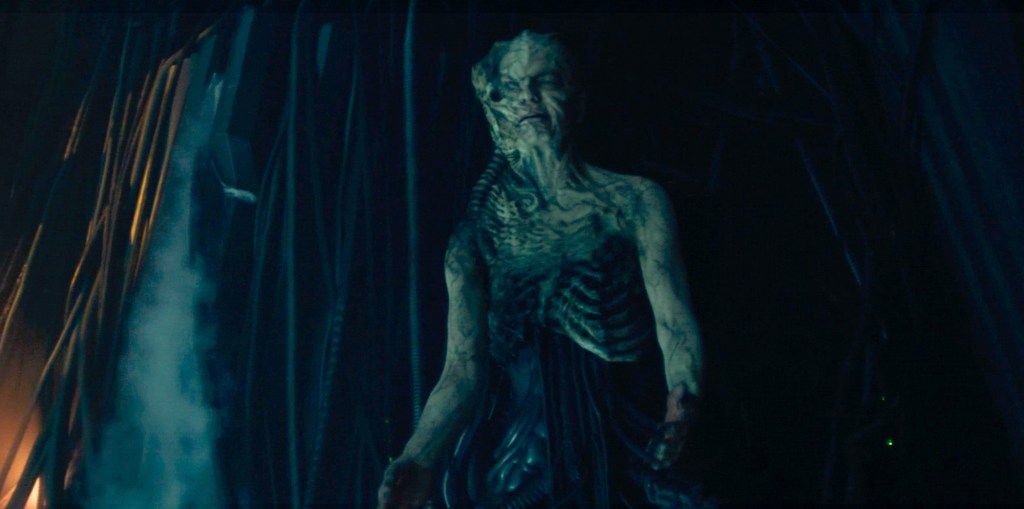
In addition to bringing back the TNG crew one last time, Picard also gave a definitive, final conclusion to the story of that era’s greatest threat: the Borg. When this malevolent race was introduced in TNG it was a terrifying idea: an artificial intelligence that propagated by taking the technology of conquered worlds and transforming the biological inhabitants of the destroyed civilizations into mindless drones, kind of like when Disney buys a new IP. But like many popular villains, the Borg got a little overused over the years (even as recently as season two of Picard). What the finale gave us was one last face-off between the Borg Queen and Jean-Luc Picard, one that was eminently satisfying, but also done in a way that should take the Borg off the table for good.

(I say “should” here because I’m realistic. With any long-running franchise, eventually new hands will take over, and when that happens they often will bring back the elements they loved from the past. Someday somebody WILL sit down in a Paramount boardroom and say, “Okay, here’s how we’re gonna bring the Borg back.” It’s inevitable. But I don’t think it will happen soon and I don’t think that person will be Terry Matalas.)

With the Borg gone, it’s time to bring in new threats, new enemies, new villains. This is a chance to have a fresh start in a familiar setting, which from a creative standpoint can be a hell of a lot of fun.

A NEW GENERATION

“Okay, now that I’m captain, when is it my turn to kill Tuvix?”

Like I said, the way Matalas stacked the crew of the Enterprise-G was a straight-up challenge to Paramount, loading the bridge with characters that matter to us. We already knew Seven of Nine from Voyager of course, but the crew also includes Picard’s former aide Rafi, who after two years finally spent this season blossoming into a compelling character through her partnership and friendship with Worf. We have Jack Crusher, son of Beverly Crusher and Jean-Luc Picard, who seems to have embraced his parents’ philosophy after struggling with it for some time. We have Sidney “Crash” LaForge at the helm, piloting the ship and determined to get out of the shadow of her legendary father. Over the course of this season we grew to care about these characters. Beyond the previous relationship between Seven and Rafi, we also saw Seven and Jack build a rapport which paid off when she named him a special counselor to the Captain. There was also a clear chemistry between Jack and Sidney, and the idea of Geordi LaForge showing up periodically to bristle at his daughter flirting with Jean-Luc Picard’s son is absolutely delicious. 

Matalas crafted these characters in such a way that the potential is obvious, and showcased them to make us want more. And just in case that wasn’t enough, he closed the series with a mid-credit stinger in which Jack Crusher meets his dad’s best frenemy, Q, who tells Jack that his own trials are just beginning. Translating this scene into Klingon and back again reveals that what he REALLY means is, “Come on, Paramount+, I double dog dare you to greenlight this spinoff.”

And then there’s the elephant in the room.

LET’S TALK ABOUT SHAW

The most beloved dipshit ever to come out of Chicago.

Liam Shaw, played by Todd Stashwick, was introduced in the first episode of this season as captain of the Titan, and he initially came across as an antagonist. He didn’t like Seven of Nine, even though she was his first officer. He had no respect for Picard and Riker when they came on to his ship and tried to divert his mission. He even insulted Picard’s wine, setting up what would turn out to be one of the season’s best running gags. But by the end of the first episode you knew who Liam Shaw was: an asshole that you couldn’t stand and couldn’t wait to see get what was coming to him.

Then something magic happened.

We realized that nothing Shaw was doing was out of line. These two relics, neither of whom had any official standing with Starfleet at the moment, showed up on his ship and tried to send him off on a very spurious mission with no orders and a half-assed explanation, almost destroying the ship and killing everybody in the process. We, the audience, trust Picard and Riker because we’ve known them since jelly bracelets were in fashion, but Shaw has no such luxury. As for his relationship with Seven, as it turns out he was a survivor of Wolf 359, the most infamous Borg attack of all time (before this one), which happened to be led by Picard himself during the time he was assimilated. The man probably had to deal with PTSD every time he looked at Seven. 

Shaw’s abrasive qualities became part of his charm, especially as he continued to show himself to be highly qualified and competent, not only as Captain, but also as an engineer later on in the season. His voluminous ego doesn’t go away, but it also doesn’t stop him from doing the right thing, as we see when he gets injured a few episodes later and immediately transfers command of the Titan to Riker, a man he clearly doesn’t like, because he knows it’s the best chance for survival. Over nine episodes Shaw goes from an unlikable asshole to a tremendously likable asshole.

And then he dies.

Not a pointless, meaningless death, not a Tasha Yar death. Liam Shaw dies to buy Picard and the others time to escape the Borg as they’re taking over the Titan, and with his last breath passes his ship over to Seven of Nine (using her chosen name for the first time). Then, just to rub a little salt in the wound, we later found out that he had already recommended Seven’s promotion to captain even before the events of the season had begun.

But he’s dead, right? So why does it even matter?

Come on, guys. Since when has being dead ever stopped a great character? The entire season was filmed before it premiered, so there was no way of knowing just how much the fans would grow to embrace Liam Shaw when the decision was made to kill him off, but Matalas says he has an idea for how to bring him back if and when the opportunity presents itself. As for the question of what to do with him afterwards…honestly, I’m not sure. They won’t (and shouldn’t) take Seven out of the Captain’s chair to make room for him, and I certainly don’t want to see another series with a painfully dubious chain of command such as has plagued Discovery since the end of season one, but I want more stories with Liam Shaw. And I know I’m not alone.

Hell, maybe he’d be happy to step out of the command chair and become chief engineer.

Let’s take one last look at the most beautiful bird in the galaxy.

There’s an adage in the entertainment business that giving the audience what they want isn’t necessarily the best way to tell a story. But sometimes you go so far in the opposite direction that you wind up with a stupid, chaotic, and utterly insulting mess that seems more like they actively hate the audience that made them successful in the first place, and here I am specifically thinking of what Marvel Comics insists on doing with The Amazing Spider-Man. Season three of Picard has proven there’s nothing wrong with giving people what they want, you just need to find a good story in which to do it. Terry Matalas did that this season, and he knocked it out of the park. He’s earned the right to do it again.

Star Trek: Legacy, Paramount.

Make it so.

Blake M. Petit is a writer, teacher, and dad from Ama, Louisiana. His current writing project is the superhero adventure series Other People’s Heroes: Little Stars, a new episode of which is available every Wednesday on Amazon’s Kindle Vella platform. He also wants to push his idea for a Star Trek: Fleet Museum animated anthology series, where in each episode a holographic tour guide based on Geordi LaForge tells a story about one of the legendary ships in his museum to a pack of tourists. He’s not kidding about this. Call him, Paramount, you all should talk.