In case you haven’t heard, there’s a new season of Night Court airing right now. Now that may surprise you if you, like most of us, remember the show going off the air back in 1992. But it may be slightly less shocking if I tell you that the new series, like approximately 75 percent of television these days, is a reboot.
Criminal Court Part 2, Part 2.
We live in the age of reboots on TV, and I think there are few obvious reasons for that. First of all, the people who fell in love with shows like Night Court during their formative years in the 80s and 90s are now largely the ones calling the shots at the networks, contributing greatly to the already-cyclical nature of pop culture. If you loved something once, it’s not unnatural or unusual to want to reclaim it and bring it back again, so when that kid who grew up watching DuckTales was given a shot at pitching an animated series to Disney, you damned well better believe he was gonna pitch a new DuckTales.
The other reason, of course, is that the TV world in utter chaos as ratings for broadcast television drop like Wile E. Coyote strapped to an anvil and nobody knows how to interpret what little data we get from streaming services. It’s considered a safer bet to hitch your star to an older series that might bring its older audience along for the ride. It’s why we got shows like The Connors, Fuller House, Girl Meets World, Quantum Leap, Animaniacs, Raven’s Home, One Day at a Time, And Just Like That, and, for the kiddos from the aughts, iCarly. It’s why every couple of months somebody floats the idea of a new version of The Office and why Bryan Cranston likes to tease us to say he’d totally be down to resurrect Malcolm in the Middle. Reboots are here and they’re not going anywhere. It’s like all these old shows were buried in the TV Land Pet Sematary, and sometimes they come back VERY wrong.
More shambling corpses than 10 season of The Walking Dead.
The truth is, like any other wave in entertainment, there are good and bad attempts, and I think one of the things that contributes to how well a reboot is accepted is the adherence to the original. It’s bizarre how often a studio will bring back an old show and then change everything about it, sometimes resulting in something as appalling as Thundercats Go! (the Gage Creed of the TV Land Pet Sematary). The logic of the producers is usually something along the lines of “We’re trying to get new fans, not old ones.” My response to this is, “if you’re not trying to get the old fans, why the hell did you call the show Walker: Texas Ranger?”
One of the most interesting examples of both a failed AND a successful reboot is Star Trek: Picard. When the first season was launched, the idea was to focus solely on Patrick Stewart’s Jean-Luc Picard character, with only sparse appearances from some of his old castmates. They didn’t want to just make season 8 of Star Trek: The Next Generation. The problem, of course, was that the fans just wanted season 8 of Star Trek: The Next Generation. So after two seasons of – I’m going to be kind here – dubious quality, for the third and final season they threw away most of the elements that weren’t working, got the crew of the Enterprise-D on the phone, and made one of the most entertaining and warmly-regarded seasons of TV in Trek History.
I’m never gonna get tired of this picture.
But back to Night Court. The new series is set in the same courtroom as the original, and it is a continuation rather than a full continuity restart such as Charmed, which I for one prefer. The head of the new ensemble is Melissa Rauch (of The Big Bang Theory) as Judge Abby Stone, daughter of the character played by the late Harry Anderson in the old series. While many of these reboots make an effort to have a cast that frequently blends the old and the new, there isn’t a ton of cross-pollination in Criminal Court Part Two, and for a fair enough reason: most of the original cast is no longer with us. Night Court, tragically, has suffered a far greater attrition rate than most other shows of the 80s. Of the entire original main cast, only three of them were still alive when the reboot was announced, and one of them (the great Richard Moll, who played Bull Shannon) passed away after season one without ever agreeing to make an appearance. Marsha Warfield, touchingly, has made two appearances, and Brent Spiner (who played a recurring character for a few years on the original) has shown up as well, but fans looking for familiar faces will be disappointed.
The only original cast member that’s a regular on the new version is John Larroquette, whose Dan Fielding is almost unrecognizable as the same character. 80s Dan was sleazy, lascivious, and somebody that wouldn’t last ten minutes in a modern courthouse without getting “Me Too”ed into oblivion, which is probably the reason for the drastic change. Modern Dan is old, curmudgeonly, a combination of Oscar the Grouch and Mr. Wilson from Dennis the Menace. I’m not saying that I need a sleazeball character for a show to be enjoyable, but considering how it was his defining characteristic, it seems ridiculous that his bed-jumping past is almost completely ignored in favor of this somewhat lonely man that Dan has become. I don’t even mind that he’s changed, I just wish there was a clearer path of transition, because they don’t talk about his past at all. He’s mentioned the death of his wife, which is implied to have triggered this change in his personality, but HELL, that’s a story I want to know! Tell me about the woman who changed Dan!
I just want someone to make this make sense.
The show isn’t quite as wacky as the original either. Oh sure, the classic series didn’t start wacky, but it spun wildly out of control and by the final season it was practically a live-action cartoon. In fact, in one memorable episode, a defendant in a one-scene gag turned out to be the fully-animated and aforementioned Wile E. Coyote. The reboot occasionally makes a flailing grab at bringing that sensibility back, but it usually feels forced. So far the most authentic thing about the series is ditching the actor playing the Court Clerk and replacing him between the first two seasons.
Anyway, the new Night Court is okay. It’s not great, it’s okay, and that’s how I feel about most of the reboots that I’ve watched. Fuller House drew most of its charm by reminding the viewers about the cheese of the original series. The Animaniacs relaunch gave me a few laughs, but there was nothing that came even close to the genius of the Anvilania episode of the classic.
And then there’s Frasier.
The show that gave the world tossed salads and scrambled eggs.
I’ve written before of my love for Cheers and how I consider it one of the greatest sitcoms of all time, and that love extends to its spinoff. In fact, I would say that Frasier and Better Call Saul belong on a special shelf labeled “spinoffs as good as and sometimes even better than the original.” It is a very, very exclusive club. Laverne and Shirley keeps petitioning for admission but is denied on the grounds of the Cindy Williams-less last season. And because I loved Frasier so damned much, I was wary of the reboot when the first season dropped last fall. I finally worked myself up to give it a watch and…
…be surprised by this…
…it’s okay.
Let me tell you a little bit about the new set-up. In the original Frasier, Kelsey Grammer’s character from Cheers moved from Boston to Seattle where his father Martin (John Mahoney) wound up moving in with him. Frasier, of course, was a Harvard-educated psychiatrist with more than a little bit of pretension, whereas his father was a retired cop who liked beer and basketball. The Odd Couple style dynamic between them provided a lot of the fuel for what was one of the greatest comedies in television history (and that’s not even bringing up the brilliance of the rest of the cast). In the reboot, Frasier moves back to Boston and moves in with his son, Frederick (played by Jack Cutmore-Scott) who has inherited both his father’s intelligence and his grandfather’s working-class sensibilities. The original show gave us a long and rewarding arc of Frasier and Martin reconnecting and forging a sincere and touching bond. In perhaps the reboot’s most interesting twist, Frasier deliberately moves in with his son in an attempt to recreate this father/son bond following Martin’s death.
“I’m confused. Which one of them is supposed to be the new Chopper Dave?”
Cutmore-Scott and Grammer work well together, mirroring the Frasier/Martin dynamic but reversing the archetypes of the characters. The rest of the cast, though, isn’t as engaging, and I don’t think there’s anybody who watches the reboot who isn’t waiting for Niles and Daphne to show up. Obviously the late John Mahoney can’t make an appearance, but his specter hangs over the first season of the reboot and it makes for one of the most authentic elements of the show. It’s telling, though, that the two best episodes of the first season are the ones that guest-starred Bebe Neuwirth (as Frasier’s ex-wife and Freddy’s mom Lilith) and Peri Gilpin (as Frasier’s old radio producer Roz Doyle). Supposedly David Hyde Pierce and Jane Leeves, who played Niles and Daphne in the old show, were approached to appear in the reboot but declined. I’ve probably heard a half dozen explanations for why they turned the offer down, and since I have no idea which if any of them is correct, I’m not going to speculate or point fingers. All I’m going to say is the show has a much better chance of getting a season three if they find a way to get Pierce and Leeves to show up in season two.
If you’re going to bring back something from the past, you need to keep in mind what people loved about it in the first place. That doesn’t mean it needs to be exactly the same. In many cases – be it because of changing societal values or the loss of beloved performers – it can’t be. But if you don’t at least identify the spirit of the original and do your best to bring it back in the reboot, then what the hell is the point?
Blake M. Petit is a writer, teacher, and dad from Ama, Louisiana. His most recent writing project is the superhero adventure series Other People’s Heroes: Little Stars, now complete on Amazon’s Kindle Vella platform. He’s waiting with baited breath for the reboot of Mama’s Family now that Vicki Lawrence is actually age-appropriate to play Mama.
Hey, friends — if you follow this page I assume that means that you actually like listening to me ramble on about stuff. And since one of the things I ramble the most about is Star Trek, perhaps you’d like to listen to me do that in person! This weekend is the annual Fan Expo New Orleans convention, and I’ve been invited to sit on on a fan panel named “How Star Trek: Picard Launched the Next Generation.”
People who read my Geek Punditry columns will remember that I have a LOT to say about that specific topic, and I’ll be discussing it with my pals Eric LeBlanc and Justin Toney at 3:30 p.m. in room 271. Drop in and say hi!
In the first week of January, 2023, I was in a funk. You see, I realized that I’m happier – in general – when I’m spending time talking about those things I enjoy, an itch I used to be able to scratch through various online outlets. But the rise of Facebook had strangled the forum-based websites I used to write for, the demands of parenting had forced a retirement of my podcast, and none of the alternatives I had tried since then seemed to stick. Then, like a miracle, a voice from above spoke to me:
Hey, dumbass, you have a blog.
So I challenged myself to spend 2023 writing a new piece once a week about something in the world of pop culture that I loved: comic books, movies, television and more. And I’m proud to say that as of this week, Geek Punditry #52, I will have successfully met that goal. And I enjoy doing it, and I have every intention of continuing it in 2024. But the question, then, was how to tie off my first year of blogging about those things I enjoy? The answer was obvious. I’d end the year by talking about my favorites from that year. So this week, my friends, get ready for the inaugural edition of the PUNDIE AWARDS!
Yeeeeeas, that’s right, the Pundie Awards, my hopefully-annual review of those things in pop culture that brought me the most joy over the past 12 months. The categories are entirely decided by what will allow me to talk about what I want to talk about. The winners are determined by a democratically-administered voting process including an electoral body consisting of myself. This ain’t fair or unbiased – this is just me talking about the things that came out in 2023 that I loved the most.
Ready? Let’s do movies first!
Blake’s Favorite Superhero Movie: Spider-Man: Across the Spider-Verse
As much as I loved Into the Spider-Verse, I couldn’t believe how much better the sequel turned out to be. An incredible team of writers, animators, and performers managed to elevate the story of Miles Morales by opening up the multiverse concept from the first film to incorporate not just a handful of Spider-people, but hundreds of them from remarkably disparate worlds. Not only that, but the different worlds often had wildly different animation styles from one another, all of which somehow managed to mesh perfectly.
None of that would have mattered, however, if the movie didn’t have a worthwhile story to go with it. Miles Morales has been somewhat lonely since his last adventure with the Spiders of other worlds, and when he encounters them again it seems as though his dreams are being answered, but the discoveries he makes in this film call into question his entire role in the Spider-Verse. There’s serious character drama mixed up with the superhero action in this movie, and it’s all as compelling as anything I saw on the screen this year. The tragedy is that the writer and actor strikes delayed production on the third film in the trilogy, Beyond the Spider-Verse, and we’re all left dangling from the film’s cliffhanger with no idea how long it’ll be before it is resolved.
Blake’s Favorite Horror Movie: No One Will Save You
I’ve gotta preface this by saying there are several horror movies that I wanted to see this year that I haven’t gotten around to yet, including Evil Dead Rise, The Boogeyman, Saw X, and several others. Out of those I have seen, however, No One Will Save You takes the top spot for the innovative way writer/director Brian Duffield told his story. The movie (a Hulu original, if you haven’t seen it) stars Kaitlyn Dever in a home invasion film where the invaders turn out to be from another world. What makes the film stand out though, is that it is told with almost no dialogue. The film relies on the visuals and the performances of the actors – Dever in particular – to tell the story, including unraveling the secret of why she is separated from the town in which she lives. The reveals in this movie are handled really well, and the ending is one of those conclusions that seriously screws with your brain. If that’s the kind of movie you’re looking for, look no further.
Blake’s Favorite Comedy: Renfield
Some may argue that this should have been included in the “horror” category, but my response to this would be that it’s honestly NOT that scary, it’s VERY funny, and these are MY awards, you jackass, and if you don’t like it, go write your own blog.
Anyway, Renfield. Future Lex Luthor Nicholas Hoult plays the titular character, long-suffering assistant to the king of darkness, Dracula himself (played by Nicolas Cage in a performance that chews so much scenery they must have had to reinforce the walls in the set). The concept of making a comedy about Dracula’s human minion set in modern-day New Orleans is funny in and of itself, but what elevates it is the way it handles the material. The script – written by Ryan Ridley and Walking Dead creator Robert Kirkman – takes the story of Dracula and Renfield and uses it as a metaphor for people trapped in an abusive relationship. Not to say that abusive relationships are funny, of course, but it’s one of those stories that uses humor to shed light on a serious situation by making it seem absurd. Looking at the dynamic between Renfield and Dracula is actually helpful in exploring how someone may need to deal with their abusers, and perhaps help the audience find their way to sympathize with victims of such a situation.
I feel like I’m not making it clear how funny this movie is. Trust me. It’s really funny. It just has a serious point to make in-between the laughs and the vampire shenanigans.
Blake’s Favorite Drama: The Holdovers
Paul Giamatti plays a teacher at a prestigious boys school in 1970. Stuck on the wrong side of the headmaster, Giamatti is forced to spend Christmas with a group of “holdovers” – students who, for one reason or another, are unable to return home during Christmas break. The movie turns into a pretty deep character study between three leads. Giamatti plays a bitter and heavily-disliked teacher, Dominic Sessa is one of the students that is justifiably outraged at being left behind so his mother and her new husband can take an unexpected honeymoon, and Da’Vine Joy Randolph is the school’s head cook, a grieving mother who herself is spending Christmas alone.
Each of these three, at the beginning of the film, seems to be a fairly stock character: the nasty teacher, the troubled student, the above-the-nonsense side character. But the forced proximity between the three of them slowly reveals depths to each, and by the time the movie ends we’re left feeling like we have watched three real, fully-developed people. Each of them is flawed, each of them has problems, but we understand them in a way that is undeniable and makes us love each of them just a little bit. Each of the three actors I mentioned here give a master’s performance in this movie, and it’s absolutely something worth watching.
The Most Delightful Surprise of 2023: Dungeons and Dragons: Honor Among Thieves.
This is the fourth attempt at a live-action Dungeons and Dragons film, and the problem with the previous three efforts is that they have all – and here I’m going to use a term from the Book of Leviticus – blown chunks. There was no real reason to expect Take Four to be any different.
And yet…damned if it wasn’t a really fun movie. Chris Pine plays the same kind of charming but slightly rough edged character he usually does, although this time it’s a new character instead of James T. Kirk or Steve Trevor, and he leads a group of ne’er-do-wells including Michelle Rodriguez, Justice Smith, and Sophia Lillis in a quest to steal an ancient and powerful relic. If you’ve ever played Dungeons and Dragons (which I have, although it has been a very long time since I was in a campaign), the plot feels pretty standard. What makes the movie work, though, is the humor, the characters, and the way they react to the fantasy situations that surround them. Their behavior, frankly, feels very authentic to the way that people playing the game would really behave in those situations, and while the movie doesn’t really go meta in the way that description may imply, it still delivers on pretty much every level. I wouldn’t necessarily place this on any “best of 2023” lists, but in terms of expectation versus reality, there’s not a single movie this year that over-delivered more than this one.
Let’s shift gears a bit now and talk about some of my favorite comic books of the year. I know that not everybody reading this is necessarily into comics, but y’know, maybe pay attention anyway. You might find something worth looking into. And if not, skip down to the bottom where I talk about television, by which I mean a lot of Star Trek.
Blake’s Favorite Ongoing DC Comic: Batman/Superman: World’s Finest
Written by Mark Waid with art by Dan Mora (who I said last week is probably the best Superman artist working in comic books right now), this is the most entertaining ongoing series DC is putting out, and they’ve been on a pretty big upswing this year. Set in the early days of the characters’ friendship, this story explores not only Batman and Superman themselves, but also the characters that surround them. Over the course of this year we’ve seen Superman lose a sidekick we never knew about, a murder mystery in which the primary suspect was Bruce Wayne himself, a return to the world of Waid’s classic Kingdom Come, and a fantastically entertaining one-off story about the original Robin (Dick Grayson) going on a date with Supergirl and pretty much everything going wrong.
The book is often funny, always entertaining, and takes characters we have loved for decades and makes them fresh and fun again. And that’s just Waid’s writing. The artwork is also top-notch, with Mora handling most issues and drawing the characters in a way that feels classic and powerful. I keep harping on his Superman, but there’s a reason for that: it’s so damned good. When you see a Superman by Dan Mora, you see a guy that you would find equally believable going toe-to-toe with Darkseid and then turning around and getting a cat unstuck from a tree.
It’s already spun off another book, World’s Finest: Teen Titans, featuring the early days of Robin’s own superhero team, and also written by Waid. This is a brand that DC absolutely needs to run with, because it’s as good as it gets.
But like I said, DC has really upped their game this year, so without getting into detail, I also wanna hand out some honorable mentions. Also worth reading this year from DC are Shazam! (another Waid book), Superman, Nightwing, Green Lantern, Titans, and the recently-rebooted Wonder Woman.
Blake’s Favorite Ongoing Marvel Comic: Fantastic Four
Admittedly, I am biased here. Everybody knows that the Thing is my favorite Marvel character and my second-favorite superhero of them all, right after Superman, so any book with him in it gets at least another two points on a scale of one to ten automatically. So with his bonus two points, Ryan North’s run on Fantastic Four gets, roughly, an eleven.
North’s run began in November of 2022, so most of his story came out in 2023. In the first few issues of the book, we see a Fantastic Four that has been run out of New York City and dispersed to the four winds (pun intended), and perhaps most horrifyingly of all, are without their children. The book launches with a mystery; we are not told immediately what happened to place them in this situation. But unlike certain other Marvel comics I could mention (I’m callin’ you out, Amazing Spider-Man) the mystery was revealed in issue FOUR, and was done in a way that was very satisfying and very in-character. Without getting into any spoilers, I want to say that the reason the FF left New York and the reason the kids are all missing makes perfect sense (unlike another certain book where the long-delayed revelation went against not only years of characterization but also just common freaking sense). At the same time, it changed the status quo in a way that is inherently temporary, but still paved the way for a year of very old-school sci-fi adventures. In other words, Ryan North found a way to take the FF back to the kind of crazy stories the book featured in the early days without getting rid of the modern trappings entirely or invalidating the feelings of the fans who enjoy those trappings. And now that we’re at a point where that storyline is being resolved, I’m really anxious and excited to see what North has planned next.
Blake’s Favorite Ongoing Image Comic: Radiant Black
This isn’t the first time this year I’ve mentioned how much I love Radiant Black, written by Kyle Higgins with art by Marcelo Costa. The title that launched Image’s “Massive-Verse” line (which also includes entertaining books such as Rogue Sun, No/One, and The Dead Lucky) is a superhero story about a young man, Nathan, who finds an alien artifact that gives him incredible power…until he’s hurt and put into a coma, with his best friend Marshall taking over. When Nathan wakes up, the two friends share the power until they’re forced to choose which of them gets to keep it.
Aside from just being a well-written comic with great art, Higgins and Costa do really interesting and innovative things with how the story is told. In one issue, in which Radiant Black encounters a crew making a fanfilm about him, we’re given a QR code that takes us to YouTube and shows us the actual film. Issue #25 though, the issue in which Nathan and Marshall are given their choice is the one that really elevates things when the readers are instructed to vote for which of the two of them becomes the permanent Radiant Black. The BIG shock, however, came when fans walked into comic shops to pick up issue #26 only to find two different versions: one in which Nathan took over and one in which Marshall got the job. During the currently-running “Catalyst War” storyline, there are two versions of the story, and it’s NOT just a case of penciling in a different face for each version. The two of them are different people, make different choices, and have different consequences, and it’s not until the story ends that the result of the fan vote will be revealed and one of the two timelines will be declared the “real” one.
I like good art and I love great writing, but if you REALLY want to make me go to bat for your comic book, pull some risky moves with how you tell the story and you’ll have me on your side for life.
Blake’s Favorite Comic Book Reboot: Skybound’s Energon Universe
Robert Kirkman, mentioned back in the Renfield entry, loves to surprise his audience. He didn’t announce ahead of time that issue #193 of The Walking Dead would be the last issue of the series. He didn’t tell anyone that there would be an Atom Eve special for his Invincible cartoon until it appeared on Prime Video. And earlier this year he launched a new comic, a sci-fi space opera, called Void Rivals. Nobody was really talking about this book much until the day the first issue reached the stands and, towards the end, fans were shocked to find an appearance by the Autobot Jetfire. This is how we learned that Void Rivals was not merely a new series, but the launch for a new shared universe including Void Rivals and the two classic Hasbro properties TransFormers and G.I. Joe.
There have been a lot of crossovers between TransFormers and G.I. Joe over the years, and the previous license holder IDW Publishing even tried to create a shared universe including those two and other Hasbro properties like M.A.S.K., ROM, and Micronauts. None of those efforts have ever really worked, though, because once these properties are already established, it’s too difficult to mesh them together. If the G.I. Joe team has already been around for 75 issues, why the hell have they never before referenced the giant robots that turn into oil tankers that have been fighting in downtown Las Vegas? You can’t explain it. What Kirkman and his team have done is the only real way to make a shared universe from these properties: tie them together from the inception.
So Void Rivals launched this “Energon Universe,” and it’s exploring space and some of the other alien races classic to the TransFormers franchise. The line continued with a new TransFormers book by Daniel Warren Johnson, which begins the story of how the war between the Autobots and Decepticons first spills over onto Earth. This is being followed up by two miniseries written by Joshua Williamson, Duke and Cobra Commander, which show the origins of the respective hero and villain teams of the G.I. Joe corner of the universe, and link those origins to the appearance of robot aliens on planet Earth. Void Rivals is pretty good, but TransFormers has been great, and the first issue of Duke – which came out this week – really blew me away. I’m totally on board for this universe, and I’m so happy with what Kirkman has put together.
Side note: Kirkman also gets bonus points for continuing Larry Hama’s G.I. Joe: A Real American Hero, the original series that was started by Marvel Comics back in the 80s and resurrected by IDW. It’s the classic G.I. Joe continuity, still in the hands of the man who basically created the incarnation of the franchise that we all grew up with, and I couldn’t be happier that it’s still out there.
Well that was a fun dip into the world of comic books. Let’s wrap up this look back at 2023 by discussing some of my favorite TV shows of the year, shall we?
Blake’s Favorite Star Trek Series: Lower Decks
I have made no secret of my love of Star Trek: Lower Decks. I wrote a whole column about it not too long ago, so I don’t want to spend a lot of space rehashing what I said then, but it would be disingenuous of me to write about my favorites of the year and NOT bring it up again. You can go back and look at that previous column if you want details, but it’s a show that is not only outrageously funny, but incredibly clever and truly loving towards the history behind the franchise. If you’re a fan of any incarnation of Trek and you haven’t been watching it, you’re making a mistake.
Blake’s Favorite Star Trek Series that isn’t Lower Decks: Picard, Season Three
With all due respect to Strange New Worlds – which had a phenomenal second season – the final season of Star Trek: Picard told a story we’ve been waiting to see for two decades now. The first two seasons of that show were no great shakes, it’s true, but the last season brought back the entire main crew from Star Trek: The Next Generation and gave them one last, grand adventure together, which they never really had. The finale of the TV show was never intended as their final story, since they were immediately rolling into production of the movies. The last movie in that franchise was not intended to be the last movie, and so it didn’t really give us closure either. But this story brought back everybody we loved and told a story that was exciting, heartfelt, and absolutely engaging from the first episode to the last. What’s more, it also laid the groundwork for a new generation of Trek, bringing in a new crew with a mixture of familiar and brand-new characters that fans warmly embraced. The executives at Paramount are absolute fools if they don’t capitalize on this and bring this crew back together again for more adventures.
Blake’s Favorite Comedy Series that isn’t Lower Decks: Abbott Elementary
Sometimes I need to remind myself that there are TV shows with live actors that aren’t set in outer space. Abbott Elementary is a wonderful way to do so – it’s a fantastically funny show that, at the same time, is really down-to-Earth and realistic in certain ways. The quick pitch behind this show is to call it “The Office, but in an elementary school.” It carries over the same sort of mockumentary style, and a lot of the characters seem to fit similar templates, such as the ridiculously inept boss (the principal, played by Ava Coleman), the hardass veteran (fantastically played by Barbara Howard) and the young, adorkable “will they/won’t they” couple (played by Tyler James Williams and show creator Quinta Brunson).
The thing about this show is that, while it IS very funny and the characters ARE very compelling, it also works very well as a look into the working of a real elementary school. Not ALL of it, of course – it’s a comedy and like many comedies it will often sacrifice realism for the sake of a joke. But the show deals with issues that, as a teacher, I see every day: funding difficulties, student behavior issues, intrusive parents and so forth. There are a lot of movies and TV shows set in schools, but this is the first time I’ve ever watched a show about a school that actually makes me believe that someone in the writing room might actually have been a teacher at one point.
It’s a great show with no weak links, and every time I hear about it getting an award in writing, directing, acting, or anything else, I just nod and say, “Yep. Nailed it.”
Blake’s Favorite Horror Series: Fall of the House of Usher
Writer/director Mike Flanagan has produced several films and TV shows for Netflix, and he finished up his contract this year with a miniseries kinda-sorta based on the works of Edgar Allan Poe. Kinda-sorta. Truth be told, when I watched Fall of the House of Usher, I described it to people as “Mike Flanagan bought all of the Edgar Allan Poe LEGO kits, threw away the instructions, and then built his own brand new thing out of all the pieces.”
This is not a criticism. The show is great.
The framing sequence features Bruce Greenwood as Roderick Usher, telling inspector C. Auguste Dupin (another Poe character played by Carl Lumbly) about the tragic deaths of his adult children, all of which happened in the past few weeks. What follows is a long, winding, generational tragedy, beginning in Usher’s childhood and leading up to the moments before the series actually begins. The cast is amazing, including several of Flangan’s usual troupe of actors like Carla Guigno, Henry Thomas, Kyliegh Curran, and Kate Siegel, and giving Mark Hamill perhaps the best dramatic turn of his entire career. The stories that unfold also tie into not just “Fall of the House of Usher,” but several other works of Poe as well. Episode titles, to give you an idea of what I’m talking about, include “The Masque of the Red Death,” “Murder in the Rue Morgue,” “The Tell-Tale Heart,” and “The Raven.”
If you go into this show expecting a faithful adaptation of the works of Edgar Allan Poe, you’re going to be disappointed. But if you look at it as someone using Poe as inspiration to create something entirely new, it’s a fantastic, engaging, and really disturbing series that goes right up there with the best horror on TV.
Flanagan is currently working on an adaptation of Stephen King’s epic The Dark Tower series, which previously fell flat in a movie in 2017. If there’s anyone out there who I feel has the skill and vision to make that book series – one of my favorites of all time – into a SUCCESSFUL show, it’s Mike Flanagan.
And that’s about all, guys. Out of all the new stories I read or watched in 2023, these are the ones I enjoyed the most. This isn’t comprehensive, of course: there are hundreds of movies, TV shows, and comic books that I never got around to this year. So if one of your favorites wasn’t included in this little retrospective, just comfort yourself by saying, “Well, Blake obviously didn’t watch Oppenheimer yet, so he couldn’t include it.” Because it’s either that or I DID see it and I didn’t like it as much as you, which is especially the case if your favorite movie of the year was Flamin’ Hot. Ugh.
I hope you’ve enjoyed this glimpse back at 2023, and furthermore, I hope you’ve enjoyed spending a year with me talking about the stories and storytelling that I love. That’s what Geek Punditry has really been about since day one, a chance for me to get out there and talk about these things again. And while I may not have TMZ knocking down my door begging to do commentary for them, writing this column every week has made me feel good and I’ve enjoyed doing it. So come back on the first Friday in January, and we’ll begin Geek Punditry Year Two.
Blake M. Petit is a writer, teacher, and dad from Ama, Louisiana. His current writing project is the superhero adventure series Other People’s Heroes: Little Stars, a new episode of which is available every Wednesday on Amazon’s Kindle Vella platform. He’s trying to remember: in “Year Two,” is that the one where he finally tracks down the mugger who killed his parents in an alley, or is he thinking of something else?
You know, I had a column planned this week. Took some notes. Had it mapped out in my brain. And then I went and watched the finale of Star Trek: Picard, the magnificent, joyous finale that was honestly everything I wanted it to be, and suddenly what I was going to write about has gone completely out of my head. Instead, this week, I’m going to look ahead to the future of Star Trek – specifically about Picard showrunner Terry Matalas’s proposed Star Trek: Legacy series, and why it needs to happen. So here’s your warning, friends: after this point there WILL be spoilers for Picard, all the way to the final credits. If you haven’t watched it yet, continue reading at your own risk.
RED ALERT! SHIELDS UP! SPOILERS INCOMING!
After two seasons of Picard that were disjointed and felt forced, the third and final season gave fans what we wanted all along: a suitable ending for the cast of Star Trek: The Next Generation. The last time we saw these characters together in canon was in the film Star Trek: Nemesis, which left us on a bittersweet note that was never resolved. Data was destroyed, Will Riker and Deanna Troi went off to the Titan, and the heroes we’d come to love were scattered to the cosmic winds. In this final season of Picard, Terry Matalas brought back Data and reunited the seven core cast members of The Next Generation (well…EIGHT core members, actually, since he even resurrected the Enterprise-D) so that their story could end the way they deserved. Now, rather than leaving behind our friends in a state of mourning, we say farewell to them as they are together, happy, and in the wake of their greatest triumph. This is something that cannot be said for the characters in any other Star Trek series, and if this is in fact the last time we see these heroes (and I suspect it is at least the last time we see them all together), it is a fitting goodbye.
But Matalas did not JUST reunite the TNG crew. He also built a new crew, combining a few of the characters from the first two seasons of Picard with others created for this season, and we leave them on the bridge of the Titan, newly rechristened as the USS Enterprise-G. It is at this point that Matalas is staring Paramount executives in the eye and challenging them to greenlight a series about this new crew, a series he has been calling Star Trek: Legacy to anybody who’ll listen, even though it hasn’t actually been approved by Paramount.
Yet.
Let’s talk about the reasons that a Terry Matalas-led Star Trek: Legacy is not only possible, but exactly what long term Trek fans are hungry for.
CONTINUING THE SAGA
“Look at us! Here we are! Right where we belong…”
After Nemesis, every Trek series or movie for nearly two decades went backwards in time. Star Trek: Enterprise was about the ship that led to the creation of the Federation, the J.J. Abrams movies showed us the crew of the original series in an alternate timeline, and Discovery started its first season about a decade or so before the original series. Without debating the relative quality of any of these projects, none of them moved forward in the time period that fans had come to love through three series and four movies. That didn’t happen until Picard. And with that series finished, we are once again left without a continuation of that period in live action. Strange New Worlds and the upcoming Starfleet Academy series are in different points in the timeline, and while the animated Prodigy series seems to be in that time period (it’s honestly a little nebulous exactly where it falls), I think most fans probably join me in wanting a flagship series set in the 25th century.
This is the most well-developed era in the Trek timeline, with elements from TNG, Deep Space Nine and Voyager all in play, and so far the only show that’s playing with all these toys is the animated comedy Lower Decks. And while it’s true that eras that have not been explored as much have room for development, that doesn’t quench the thirst for exploration of the storylines, cultures, alien races, and characters we already know. A show set in this time period would allow us to check in with those elements and see where they go in the future – something that would be inevitable with Voyager alumni Seven of Nine as captain of the Enterprise-G and two members of the bridge crew whose parents are members of the TNG crew. (Not to mention the fact that Riker and Troi have a daughter who is currently enrolled in Starfleet Academy, and could easily join the show later if we really wanted to ramp up the fan service).
It would also allow the show to address the one glaring absence from Picard: the characters from Star Trek: Deep Space Nine. For the first eight episodes of the season the major threat were the Changelings, the main antagonists from DS9, but except for Worf nobody from DS9 ever made an appearance. I suspect we probably would have seen them if not for the passing of Rene Auberjonois, who played the Changeling Odo on that series – but alas, it was not to be. Regardless of why we didn’t see them, DS9 remains my favorite Trek series, and a Legacy show could (and should) check in on the station, what’s been going on with Bajor since the Dominion War…maybe even finally provide some resolution to the final fate of Captain Benjamin Sisko.
THE ENTERPRISE IS THE HEART OF STAR TREK
There are a lot of letters left in the alphabet.
When the original Star Trek series debuted in 1966, there wasn’t necessarily a conceit that there was anything special about the ship among the other ships in the fleet except that it was the one we were following. Throughout the show and the original movies, though, we got the impression that the Enterprise crew stood out, and by the time TNG launched in 1987, it was declared that the Enterprise was the name given to the flagship of Starfleet. This was codified with the Star Trek: Enterprise series, which retroactively applied that name to the first ship capable of Warp 5, and the adventures of that particular crew led to the birth of the United Federation of Planets. The point is, while the Star Trek universe is vast and diverse with room for many, many stories, the Enterprise is the core of that universe.
True, we have Strange New Worlds, which is set on the Enterprise NCC-1701 in the pre-Kirk years, but that’s kind of the problem. Don’t get me wrong, I love SNW, but the inherent difficulty with any prequel series is that certain elements are closed off as storytelling avenues. At no point in SNW are you ever going to fear that the ship will be destroyed or that any of the characters who show up in the original series, such as Spock or Dr. M’Benga, are in mortal danger. There can be great adventures told with Pike’s Enterprise, but it will inevitably be trapped in the “past” of Star Trek. The 25th century, for many fans, is the “present,” and we haven’t had canonical, ongoing stories of an Enterprise in that time period since TNG went off the air in 1994. The look of the ship can change, the crew can change, the letter at the end of the registry number can change, but the fact of the matter is that without an Enterprise, Star Trek simply isn’t complete. As Jack Crusher observed when the Enterprise-G was unveiled, “Names mean almost everything.”
A CHANCE FOR NEW DANGERS
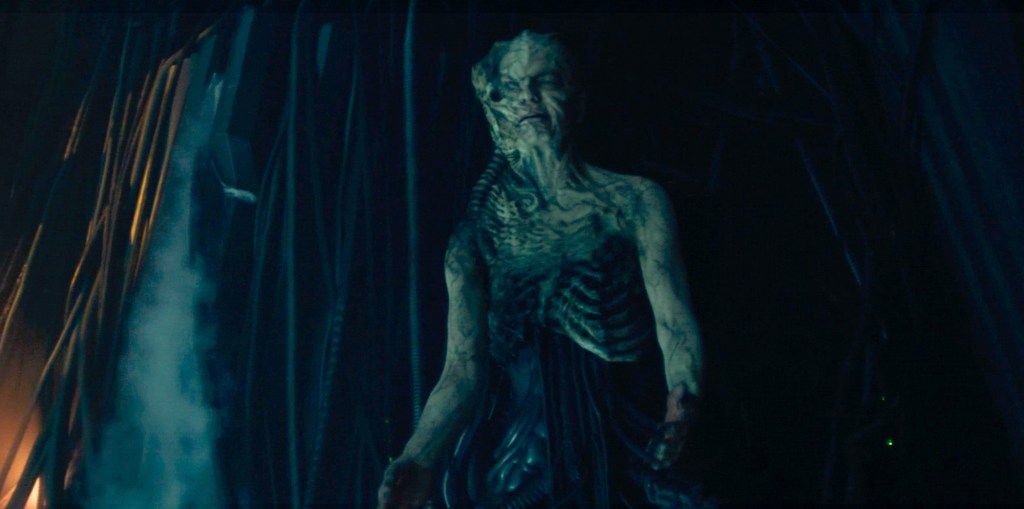
“Um, you got something on your…on your face…oh, dear God…”
In addition to bringing back the TNG crew one last time, Picard also gave a definitive, final conclusion to the story of that era’s greatest threat: the Borg. When this malevolent race was introduced in TNG it was a terrifying idea: an artificial intelligence that propagated by taking the technology of conquered worlds and transforming the biological inhabitants of the destroyed civilizations into mindless drones, kind of like when Disney buys a new IP. But like many popular villains, the Borg got a little overused over the years (even as recently as season two of Picard). What the finale gave us was one last face-off between the Borg Queen and Jean-Luc Picard, one that was eminently satisfying, but also done in a way that should take the Borg off the table for good.
(I say “should” here because I’m realistic. With any long-running franchise, eventually new hands will take over, and when that happens they often will bring back the elements they loved from the past. Someday somebody WILL sit down in a Paramount boardroom and say, “Okay, here’s how we’re gonna bring the Borg back.” It’s inevitable. But I don’t think it will happen soon and I don’t think that person will be Terry Matalas.)
With the Borg gone, it’s time to bring in new threats, new enemies, new villains. This is a chance to have a fresh start in a familiar setting, which from a creative standpoint can be a hell of a lot of fun.
A NEW GENERATION
“Okay, now that I’m captain, when is it my turn to kill Tuvix?”
Like I said, the way Matalas stacked the crew of the Enterprise-G was a straight-up challenge to Paramount, loading the bridge with characters that matter to us. We already knew Seven of Nine from Voyager of course, but the crew also includes Picard’s former aide Rafi, who after two years finally spent this season blossoming into a compelling character through her partnership and friendship with Worf. We have Jack Crusher, son of Beverly Crusher and Jean-Luc Picard, who seems to have embraced his parents’ philosophy after struggling with it for some time. We have Sidney “Crash” LaForge at the helm, piloting the ship and determined to get out of the shadow of her legendary father. Over the course of this season we grew to care about these characters. Beyond the previous relationship between Seven and Rafi, we also saw Seven and Jack build a rapport which paid off when she named him a special counselor to the Captain. There was also a clear chemistry between Jack and Sidney, and the idea of Geordi LaForge showing up periodically to bristle at his daughter flirting with Jean-Luc Picard’s son is absolutely delicious.
Matalas crafted these characters in such a way that the potential is obvious, and showcased them to make us want more. And just in case that wasn’t enough, he closed the series with a mid-credit stinger in which Jack Crusher meets his dad’s best frenemy, Q, who tells Jack that his own trials are just beginning. Translating this scene into Klingon and back again reveals that what he REALLY means is, “Come on, Paramount+, I double dog dare you to greenlight this spinoff.”
And then there’s the elephant in the room.
LET’S TALK ABOUT SHAW
The most beloved dipshit ever to come out of Chicago.
Liam Shaw, played by Todd Stashwick, was introduced in the first episode of this season as captain of the Titan, and he initially came across as an antagonist. He didn’t like Seven of Nine, even though she was his first officer. He had no respect for Picard and Riker when they came on to his ship and tried to divert his mission. He even insulted Picard’s wine, setting up what would turn out to be one of the season’s best running gags. But by the end of the first episode you knew who Liam Shaw was: an asshole that you couldn’t stand and couldn’t wait to see get what was coming to him.
Then something magic happened.
We realized that nothing Shaw was doing was out of line. These two relics, neither of whom had any official standing with Starfleet at the moment, showed up on his ship and tried to send him off on a very spurious mission with no orders and a half-assed explanation, almost destroying the ship and killing everybody in the process. We, the audience, trust Picard and Riker because we’ve known them since jelly bracelets were in fashion, but Shaw has no such luxury. As for his relationship with Seven, as it turns out he was a survivor of Wolf 359, the most infamous Borg attack of all time (before this one), which happened to be led by Picard himself during the time he was assimilated. The man probably had to deal with PTSD every time he looked at Seven.
Shaw’s abrasive qualities became part of his charm, especially as he continued to show himself to be highly qualified and competent, not only as Captain, but also as an engineer later on in the season. His voluminous ego doesn’t go away, but it also doesn’t stop him from doing the right thing, as we see when he gets injured a few episodes later and immediately transfers command of the Titan to Riker, a man he clearly doesn’t like, because he knows it’s the best chance for survival. Over nine episodes Shaw goes from an unlikable asshole to a tremendously likable asshole.
And then he dies.
Not a pointless, meaningless death, not a Tasha Yar death. Liam Shaw dies to buy Picard and the others time to escape the Borg as they’re taking over the Titan, and with his last breath passes his ship over to Seven of Nine (using her chosen name for the first time). Then, just to rub a little salt in the wound, we later found out that he had already recommended Seven’s promotion to captain even before the events of the season had begun.
But he’s dead, right? So why does it even matter?
Come on, guys. Since when has being dead ever stopped a great character? The entire season was filmed before it premiered, so there was no way of knowing just how much the fans would grow to embrace Liam Shaw when the decision was made to kill him off, but Matalas says he has an idea for how to bring him back if and when the opportunity presents itself. As for the question of what to do with him afterwards…honestly, I’m not sure. They won’t (and shouldn’t) take Seven out of the Captain’s chair to make room for him, and I certainly don’t want to see another series with a painfully dubious chain of command such as has plagued Discovery since the end of season one, but I want more stories with Liam Shaw. And I know I’m not alone.
Hell, maybe he’d be happy to step out of the command chair and become chief engineer.
Let’s take one last look at the most beautiful bird in the galaxy.
There’s an adage in the entertainment business that giving the audience what they want isn’t necessarily the best way to tell a story. But sometimes you go so far in the opposite direction that you wind up with a stupid, chaotic, and utterly insulting mess that seems more like they actively hate the audience that made them successful in the first place, and here I am specifically thinking of what Marvel Comics insists on doing with The Amazing Spider-Man. Season three of Picard has proven there’s nothing wrong with giving people what they want, you just need to find a good story in which to do it. Terry Matalas did that this season, and he knocked it out of the park. He’s earned the right to do it again.
Star Trek: Legacy, Paramount.
Make it so.
Blake M. Petit is a writer, teacher, and dad from Ama, Louisiana. His current writing project is the superhero adventure series Other People’s Heroes: Little Stars, a new episode of which is available every Wednesday on Amazon’s Kindle Vella platform. He also wants to push his idea for a Star Trek: Fleet Museum animated anthology series, where in each episode a holographic tour guide based on Geordi LaForge tells a story about one of the legendary ships in his museum to a pack of tourists. He’s not kidding about this. Call him, Paramount, you all should talk.





 Blake M. Petit