It’s not something I ever thought I would say, but comedy is in danger of becoming a dying art. In movies, at least, it’s become harder and harder to sell a comedy to the theater crowd, mainly because in a world where movie theater attendance has never really recovered from the Covid shutdowns, people are far more discriminating about what they choose when they go out to a movie theater. The prevailing notion is that if you’re only going to see a movie in a theater a few times a year, it’s best to spend those chits on the big-budget special effects spectaculars, the things that really demand that IMAX treatment on the big screen. I know I’m guilty of that – my wife and I only get out to see a movie without our son a few times a year at best, so we’ve got to make sure it “counts.” After all, a comedy that’s funny in the theater will be just as funny at home, right?
Of course, some comedies aren’t funny no matter WHERE you are.
No, that’s not right at all, actually.
I’ve written before about that ever-so-thin line between comedy and horror, and about how both art forms are built on a similar formula of tension, buildup, and release, with the primary difference being that horror releases tension through screams whereas comedy releases it through laughter. It’s the reason, in fact, that horror/comedy hybrids can be so effective. But there’s another similarity that people don’t realize. Most horror movies are scarier in movie theaters than at home, where you can feed on the energy of the people around you, hear them gasp and shout with each scare, where you can see the girl a row ahead of you grab onto her boyfriend when the monster leaps at the screen. It makes watching a horror movie a communal experience that’s more enjoyable than watching the same movie alone. (There are exceptions, of course. Certain small, claustrophobic films like Buried or home invasion movies like Hush probably work better in a darkened living room with the curtains drawn and as few people as possible with you. But those are the exceptions, not the rule.)
Similarly, there’s something about comedy that’s funnier when you’re with an audience. There’s an emotional charge in the air that is infectious, spreading from one person to another. Even ONE person can be enough to trigger this. I’ll watch episodes of RiffTrax or Mystery Science Theater 3000 a dozen times by myself and chuckle with the riffs. But if I watch that same episode with my wife, those quiet laughs to myself become full-belly guffaws. Laughter, like terror, is contagious. One person’s laughter eases the path for others – it’s almost like hearing someone else laughing gives you PERMISSION to laugh, a permission that you don’t actually NEED, but that your psyche is waiting for anyway.
Crow: I guess this is what he gets for making Green Lantern.
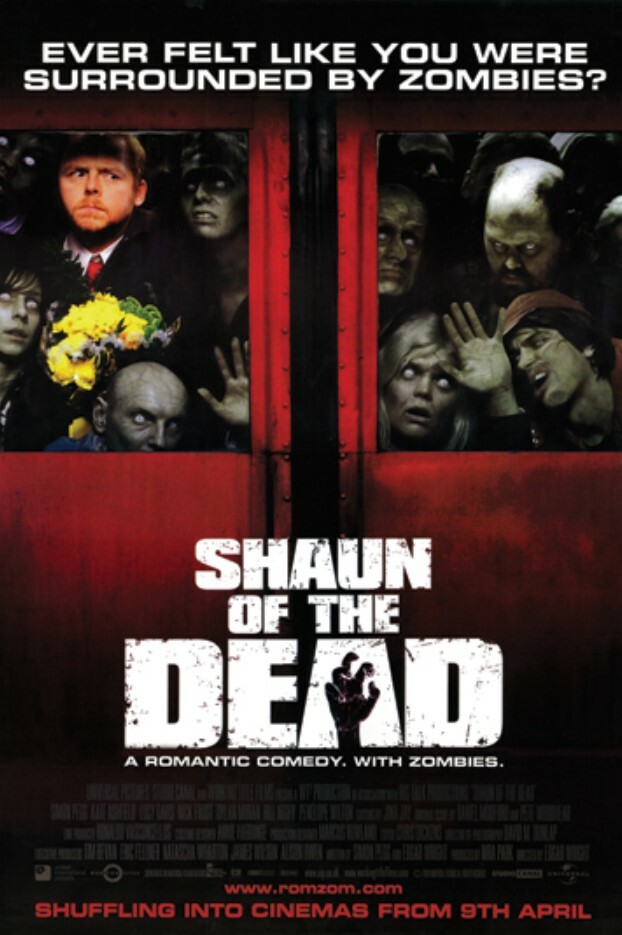
Unfortunately we didn’t make it to the theaters for this one, but the reboot of The Naked Gun is available digitally now, and my wife Erin and I watched it earlier this week. I’ve heard from many people whose opinions I respect that it was the funniest movie of the year, which sadly isn’t as bold a statement as it used to be. I grew up on the original Leslie Nielsen Naked Gun movies, as well as the Police Squad series that preceded it. I dearly loved that style of slapstick comedy, the kind we got from Mel Brooks’ Blazing Saddles or Spaceballs, and that the same Abrahams and Zucker Brothers combo that gave us Police Squad would refine in their disaster spoof Airplane! And I mourned – oh, HOW I mourned – the death of that kind of comedy when it was replaced by Friedberg/Seltzer stinkers like Date Movie, Meet the Spartans, and The Starving Games.
So much high art it should be in a museum.
Someone watching a trailer for these movies might not be able to tell what the difference is on the surface. They’re all goofy movies built on absurd, surrealistic comedy that’s almost like a cartoon brought to life. But the difference is that Brooks, Abrahams, and the Zuckers understand how parody works. Blazing Saddles, Spaceballs, and The Naked Gun are spoofs of westerns, science fiction, and cop dramas (respectively). They mock the tropes of those films ruthlessly, while at the same time telling their own stories. Date Movie and similar films lack that kind of imagination or creativity. They replace actual gags with straight references to other films, and seem to think that simply acknowledging the existence of a (usually superior) movie somehow counts as a joke, but they have no identity or voice of their own.
Airplane!, incidentally, is the oddball in this group. Whereas the others weren’t parodies of SPECIFIC movies (although Spaceballs leaned harder on Star Wars than most other sci-fi), Airplane! was almost a beat-for-beat remake of a lesser-known and much-forgotten disaster movie called Zero Hour, even borrowing some of the dialogue from the earlier film. They simply took the existing plot and characters and amplified them to absurd levels and created a comedy classic.
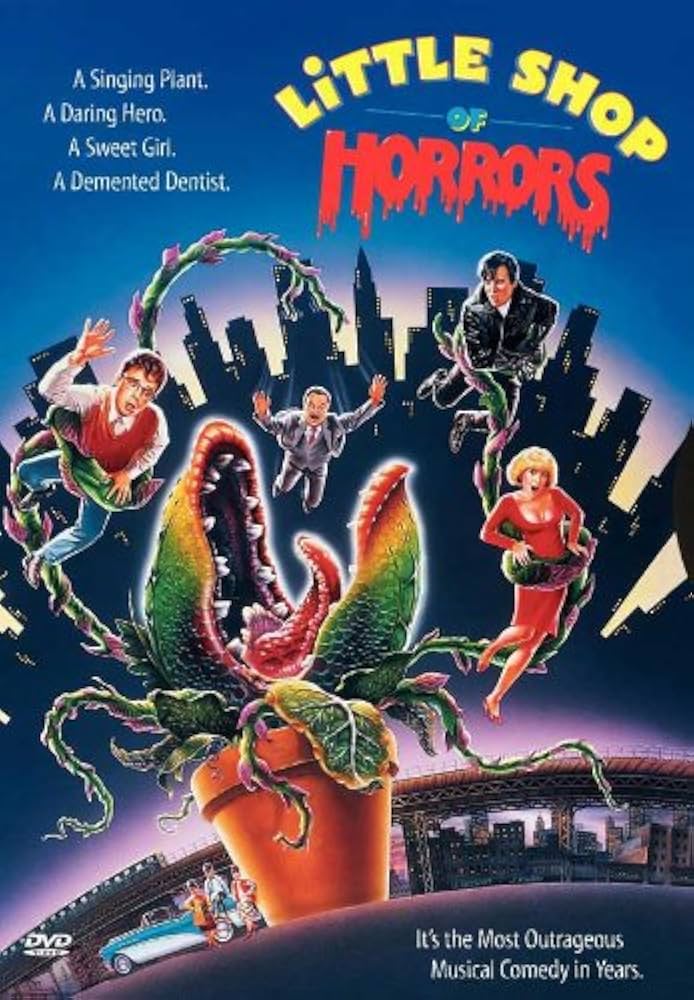
But that kind of comedy had died out, as I said, replaced by the Reference Fests that slapstick has become in the last two decades. So when I heard they were rebooting The Naked Gun I was highly skeptical. When I heard that Liam Neeson had been cast as Frank Drebbin Jr., my optimism increased slightly – Neeson is a great actor and I believed he may have the comedy chops to pull it off. But it wasn’t until I saw the trailer, where they included a joke that addressed the elephant in the room – a certain cast member of the original trilogy who became infamous after the series ended – that I realized that this movie might just be self-aware enough to work.
And it really did.
And they get bonus points for mocking AI. Everybody gets bonus points for mocking AI.
Erin and I watched this movie and, from the first scene, I found myself laughing out loud at the antics on the screen. Liam Neeson has reinvented his career before – after a long period as a profound dramatic actor he took a left turn into action hero starting with the Taken franchise. Now it seems like he’s ready to reinvent himself again. He doesn’t play Frank Drebbin Jr. as completely stone-faced as his “father,” Leslie Nielsen, played the original. Instead, he’s got his own sort of blend of faux seriousness mixed with just enough winking at the camera to indicate that he recognizes just how ridiculous the movie is, and he’s cool with it.
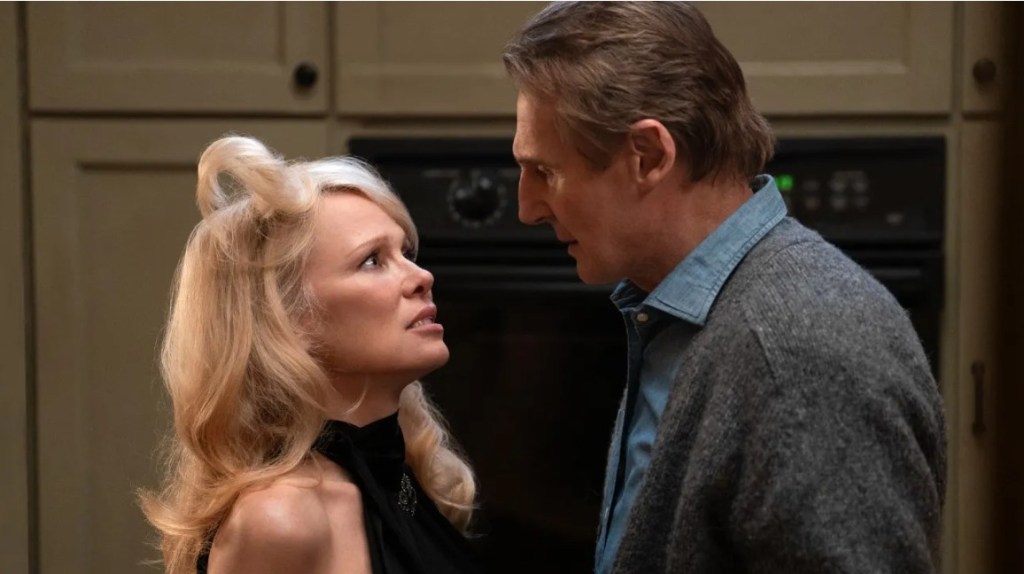
The real revelation here, though, was casting Pamela Anderson as the femme fatale of the movie. It’s been quite a while since Anderson was really in the public eye, and when she WAS making movies more frequently she wasn’t usually being sought out for her comedic skills. But she nailed it in this movie, with the same kind of goofy sensibility that Neeson brought to the screen. Word has it that she and Liam Neeson have actually begun a romantic relationship in real life after working together on this movie. That wasn’t on my bingo card for 2025, but after seeing them together I absolutely believe it, because the chemistry is flawless.
Get a guy who looks at you like that even with that hair.
Most importantly, though, the writing is sharp and clever. The jokes are about the tropes of a police procedural, not about the EXISTENCE of it. The screenwriters rarely make reference to any specific movie or TV show, and when they DO it’s actually done well (such as an extended joke where Neeson’s character is distraught that his Tivo has accidentally lost season one of Buffy the Vampire Slayer – the joke here being that a hardboiled cop at his age KNOWS so much about Buffy, not that it EXISTS).
The Naked Gun (“the new version,” Neeson says in his first of many fourth wall-leaning moments) is the kind of comedy we don’t get anymore, and it’s the kind of comedy we need. Honestly, when is the last time you went to a movie theater to watch a comedy? I went back and looked at my Letterboxd diary to find the last time I saw a new movie in a theater that was an actual comedy and not just a superhero movie with comedic elements or a cartoon I was taking Eddie to watch. I made it back to 2017 when Erin and I saw The Big Sick, which is really more of a dramedy. Before that I’ve gotta go back to the action/comedy The Nice Guys in 2016. Both of those, by the way, are movies that deserve a lot more love than they get.
The Naked Gun didn’t set the box office on fire, but it was highly lauded by critics and by those audiences that actually DID show up. I’m hoping that’s enough to justify Paramount moving forward with a sequel. Neeson and Anderson are such a great on-screen duo that it would be a crime not to pair them up again. This wouldn’t be the first time a movie – especially a comedy – found its audience after the lights dimmed in the movie theater, so I’m giving this my recommendation. Buy or rent it digitally. Stream it when it eventually shows up on Paramount+. Buy the Blu-Ray or DVD when it hits stores. I want more movies like this, and so should you. I didn’t get to see this one with a tub of popcorn in my lap and a huge screen in front of me, so I’m hoping I’ll get that shot for part two.
Blake M. Petit is a writer, teacher, and dad from Ama, Louisiana. His most recent writing project is the superhero adventure series Other People’s Heroes: Little Stars, volume one of which is now available on Amazon. You can subscribe to his newsletter by clicking right here. He’s also started putting his LitReel videos on TikTok. You know what other movie didn’t get enough love? The Rocketeer. Just saying.
Grady Hendrix’s novel How to Sell a Haunted House has been optioned for a motion picture. This is not new information, by the way – the deal was signed with Sam Raimi’s Ghost House studio about two years ago, but today is the first time I’ve heard about it, and it’s got me very interested. I like Hendrix’s work quite a bit. I’ve only read three of his books so far (the aforementioned Haunted House, Final Girls Support Group, and the very cool nonfiction book Paperbacks From Hell, about the history of horror novels and cover art in the 70s and 80s), but every one of them has encouraged me to read more. I don’t know if it’s fair to classify myself as a “fan,” having only really dipped my toes into his work thus far, but perhaps “fan-in-training” would be accurate. Regardless, having read How to Sell a Haunted House, I am immediately struck by the cinematic possibilities of the story, while at the same time, left very curious about exactly what tone they’re going to strike with a horror movie where the villains are – drumroll please – puppets.
You don’t even want to know what going through escrow is like.
I apologize if that feels like a spoiler to anyone, but it’s part of the synopsis of the book and, when the movie is made, it most likely will be in the trailer, so I don’t feel TOO bad. It’s kinda like if you hear that there’s a new slasher movie coming out and someone tells you that the killer wears a mask. In the novel, single mom Louise Joyner has to go back to her home town after her parents are killed in a car crash. Once home, she’s forced to go about the task of closing up her childhood home for sale with the help of her estranged brother. As they go through the house, they find that there may be more to their mother’s massive collection of puppets and dolls than they ever suspected.
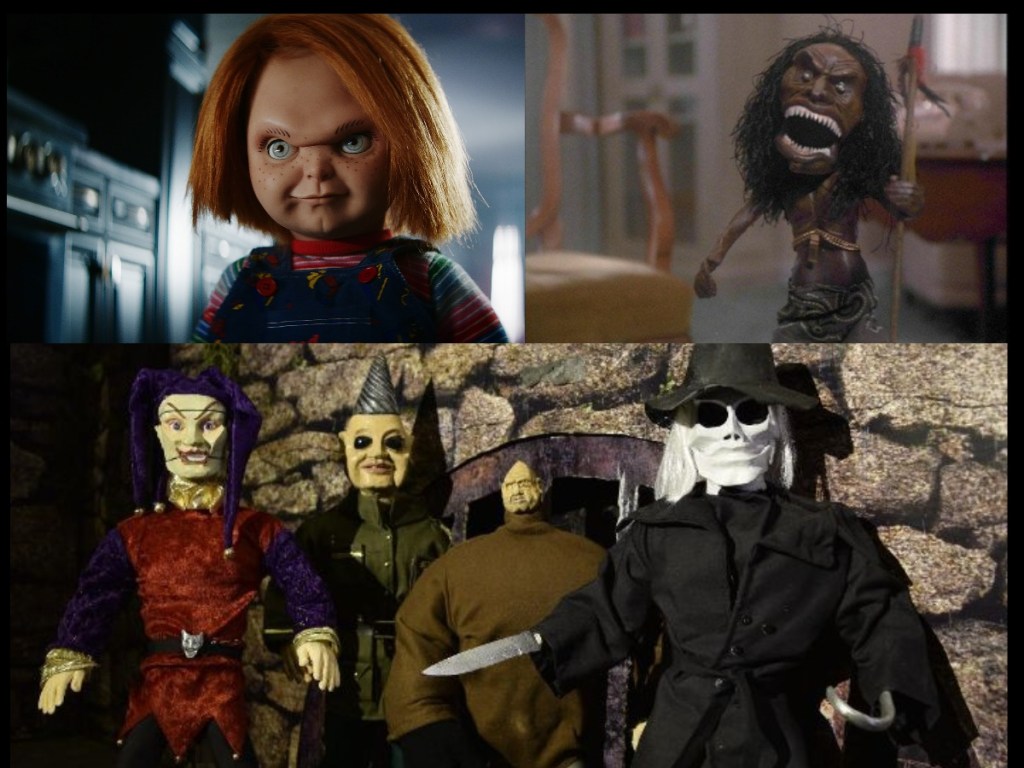
Once the movie is completed, How to Sell a Haunted House will join the echelon of horror flicks that I like to think of as “Teeny Tiny Terrors.” Horror, as a genre, has dozens (if not hundreds) of categories and subcategories, most of which can overlap at some intersection or another. How to Sell a Haunted House will fit into a few categories – haunted house movies, obviously, but also the narrower but quite popular category of killer toys, home of such classic films as Child’s Play, Puppet Master, and the last segment in Trilogy of Terror. The Joyner puppets will join a pretty fabulous collection of creatures.
Sorry if that gives you nightmares.
Not all Teeny Tiny Terrors are toys, of course. I’d also place things like Leprechaun, Gremlins, Ghoulies, Munchies, Critters, Hobgoblins, and even Sam from Trick ‘r Treat into this category: all monsters or aliens or some sort of supernatural threat that are embodied in what is – to an adult human, of course – a package that seems small and harmless until the teeth are bared. Because of this, almost all Teeny Tiny Terrors fall into one of my OTHER favorite horror subcategories: horror comedies. I wrote about this extensively last year, specifically about how common it is for horror to have elements of comedy, and how some lean harder on the funny parts and others lean harder on the terror. I even described a spectrum with varying levels of horror/comedies depending on which side they lean towards (a Type 1 is the lightest, funniest of the group, while 5 is the scariest). Almost any Teeny Tiny Terror will land on the spectrum somewhere. The first Child’s Play movie, I think, was a solid 4, although as is often the case the series lightened up with subsequent installments to 3s and even occasionally to 2s.
With a Teeny Tiny Terror of any type, at least part of the humor is going to come from the concept of something that’s supposed to be innocent and harmless suddenly turning psychotic. The idea of the dolls in Puppet Master turning out to be possessed by the spirits of dead Nazis, for example, is so patently absurd that it’s hard to take it too seriously even as the likes of the Tunneler doll are drilling into somebody’s skull. There’s a macabre comedy to this. It’s similar to the psychotic clown craze from a few years back, although not exactly the same. With killer toys, you’ve got something that’s supposed to be harmless turning bad.
Teeny Tiny Terrors are nothing new. They showed up in John Christopher’s baffling 1966 novel The Little People, were used to disturbing effect in Tod Browning’s 1932 film Freaks, and have showed up in folklore about as far back as you can imagine. Today we’re even retroactively applying it to full-grown terrors. Just a few days ago I got an email from Spirit Halloween announcing their new line of Horror Movie Babies, figures and decorations starring infantilized versions of Michael Myers, Chucky, Ghostface, the Frankenstein Monster and others. And even THAT is a spinoff of their long-running Zombie Babies line. There aren’t enough Teeny Tiny Terrors already, now we’re taking full-grown terrors and giving them the Jim Henson’s Muppet Babies treatment!
Remember that episode where Leatherface gutted Camilla like a fish?
There are other subcategories related to the Teeny Tiny Terrors in different ways, such as the aforementioned Killer Klowns. Like deadly toys, the reason clowns can be scary is that you’re taking something that’s supposed to be innocent and perverting it. Dolls are inanimate, though, and supposed to be used to fuel a child’s imagination, but have no agency of their own. They exist only as a reflection of a child’s innocence. Clowns, on the other hand, are people, and we know that (unlike a doll) a person can easily hide their true nature. They commit their atrocities beneath makeup that was originally intended to induce laughter only amplifies the terror. Whether we’re talking about Pennywise, Art the Clown, or the Joker, killer clowns can be a hell of a lot scarier than killer toys.
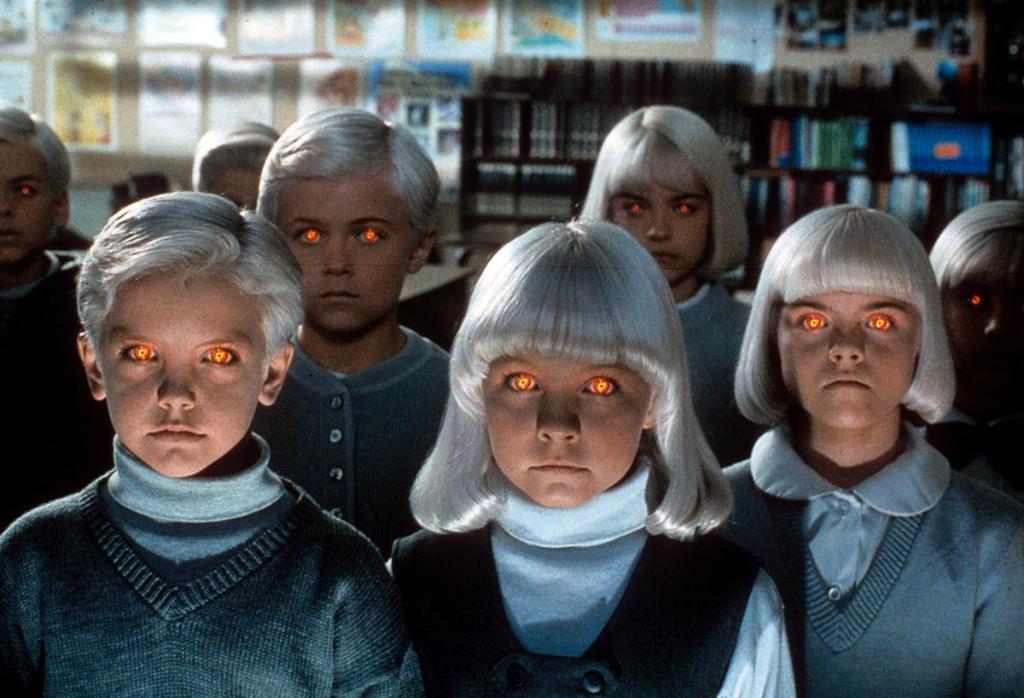
There’s also the related category of Creepy Kids, like we see in films such as Children of the Corn or Village of the Damned. Again, here’s something that should be innocent that’s turned bad, but in this case it’s far less likely to be funny. A demonic child is something of a perversion of innocence, it’s taking a human being in the period of their life where they are supposed to have the least darkness and transforming them into something ghastly. There are SOME Creepy Kids on the horror/comedy spectrum, but I think they’re far less likely to go there than Teeny Tiny Terror or Killer Klowns.
The good news is that modern cameras don’t create redeye, so there’s no chance of remaking this one.
But back to Grady Hendrix: I’m not surprised that an adaptation of his work would go into the horror/comedy territory, because pretty much everything of his that I’ve read seems tailor-made for it. Aside from Haunted House, he gave us Final Girl Support Group, a novel about women who survived attacks from slasher-type killers (most of whom are obvious copyright-friendly substitutes for the likes of Jason Voorhees and Michael Myers) and what happens when an unknown threat starts gunning for them. Hendrix plays with meta humor here, digging into the tropes and expectations of the slasher genre in a way that’s reminiscent of Wes Craven’s Scream movies (and, in fact, one of the Final Girls is a clear replacement for Sidney Prescott). Even his nonfiction book, Paperbacks From Hell, shows a deep love and understanding of all the tropes of horror fiction. Writers like that often enjoy playing with those tropes in an amusing way.
Art.
Assuming the movie adapts the tone of the book faithfully, I think it would also land in type 4. It’s not a laugh riot, and in fact, some of the stuff at the end could be downright grotesque depending on how the director chooses to film it. But as I said, the very concept of Teeny Tiny Terrors has an inherent humor to it that, even in the darkest moments, lends itself well to tongue-in-cheek references and black comedy. Hendrix is one of the modern greats in that regard. I hope that the movie does it justice.
Blake M. Petit is a writer, teacher, and dad from Ama, Louisiana. His most recent writing project is the superhero adventure series Other People’s Heroes: Little Stars, volume one of which is now available on Amazon. You can subscribe to his newsletter by clicking right here. He’s also started putting his LitReel videos on TikTok. Despite what you may have expected, “Teeny Tiny Terrors” does not refer to what happens when your son realizes we’re out of cheese sticks.
I’m sitting here two weeks after the debut of James Gunn’s Superman movie and I’m quite happy. As of the time I write this, it’s sitting at almost $260 million domestically and nearly $433 million worldwide, which in this post-COVID era is nothing to sneeze at. It’s already the top-grossing superhero movie of the year so far, and most importantly, it’s been embraced by the public. The critics love it, the fans love it, and people are still talking about it two weeks later, something you can’t really say for some of the other summer movies like Jurassic World: Rebirth. Lines like “Maybe being kind is the real punk rock” have achieved meme status, and not in a mocking way like that CEO at the Coldplay concert. Most importantly, it has gotten people reenergized. Sure, there are some people who don’t like it, and it’s fair to not like something, but if the REASON you don’t like something is because Superman believes in goodness, has a sense of humor, or wants to protect the life of even the smallest creature, then I’ll be frank: your opinion does not matter to me.
My face when I think about the bit with the squirrel.
With this movie doing well, eyes are now turning to the rest of James Gunn’s new DC Universe. When he and producer Peter Safran took over as co-heads of DC Studios a few years ago, they announced a slew of projects, but Gunn has also been very clear that he’s not going to move forward with anything until the script is ready, so several of those projects are on the back burner. The ones that are definitely on the schedule are – in order of release – season two of the Peacemaker TV series next month, the Lanterns series for early next year, the new Supergirl movie next summer, and a Clayface movie next fall. (Clayface, by the way, is the most indicative of the fact that Gunn is not married to a roadmap – it was not part of the initial announcement and Gunn said the character wasn’t even on the radar for a solo film, but writer Mike Flanagan pitched him a story that was so good they put it on the fast track.)
The hero we didn’t know we needed.
Movies in the works but not yet on the schedule are a Brave and the Bold movie (featuring Batman and the Damian Wayne Robin), The Authority, Swamp Thing, and Sgt. Rock. On TV, they’re working on live-action shows including Paradise Island, Waller, and Booster Gold, and in animation, they’re working on Blue Beetle, Mr. Miracle, and a second season of Creature Commandos. Other things have been tossed around, including a movie featuring Bane and Deathstroke, and Supergirl screenwriter Ana Nogueira has reportedly turned in a script for a Teen Titans movie AND has been hired to do a script for Wonder Woman. Following the success of Superman, rumors are flying about shows starring Edi Gathegi’s Mr. Terrific and Skyler Gisando as Jimmy Olsen. There are other series and films in the works as well, but the ones I haven’t mentioned thus far (such as the sequel to Matt Reeves’ The Batman or an animated Starfire series for children) are mostly intended to be part of DC Studios’ “Elseworlds” imprint and not part of the DCU proper.
So obviously, there’s a LOT to look forward to in the next several years. But what is it I always say about fans? What do fans want above all else?
That’s right. Fans want MORE.
So today I want to talk about my Three Wishes for the new DCU. What are three projects that I would love to see? If I had a chance to sit down with James Gunn and convince him to add three of my dream projects to the schedule, what would they be? Let’s do one live-action series, one animated series, and one movie, just to cover all the bases that this DCU is touching. I’m also going to try to incorporate some themes or genres that the other projects haven’t gotten around to yet.
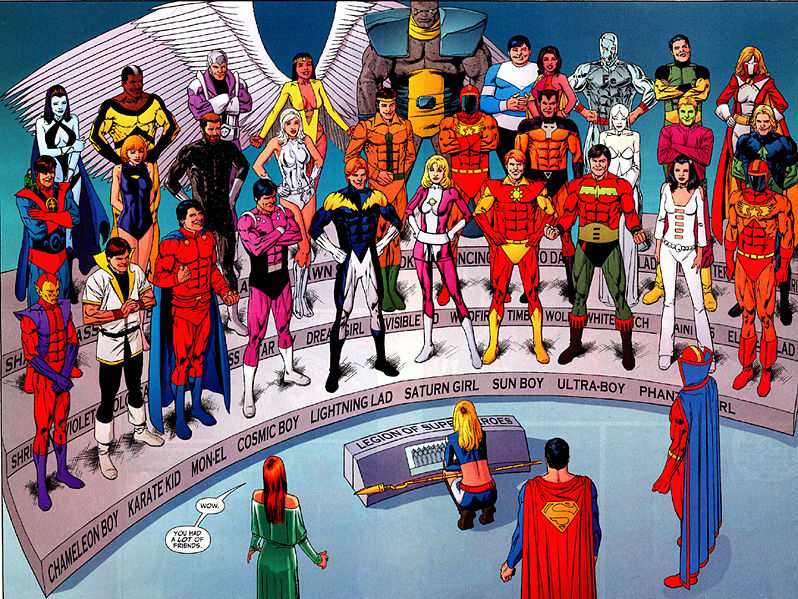
Live action series: Legion of Super-Heroes
Call the casting department and tell them to put a pot of coffee on.
My love for the Legion of Super-Heroes is no secret. I think it’s one of DC’s greatest franchises: the heroes of the 31st century, who have modeled themselves after the greatest heroes of our time. Dozens of heroes from different worlds, cultures, and species, allowing for any number of different characters and character dynamics. The series presents an opportunity to do science fiction and superheroes at the same time, and as Gunn has made it clear that he wants the different DC projects to each have a different feeling, this would fill a niche that isn’t there yet. (Okay, technically I suppose the Lanterns TV series will have a science fiction element to it, but from all the descriptions it seems like that show is going to be more of a military mystery/drama. That’s great, but I want a real space opera.)
But this would have to be a TV series. The Legion of Super-Heroes is, frankly, just too big for a movie. There are literally dozens of characters in the group, and even if you were to narrow down the focus to a core group of, say, seven or eight, you need time to explore who each of them are and how they relate to one another. You couldn’t do justice to the Legion in two hours.
The next thing is that I believe that the Legion is strongest as a spin-off of Superman. It’s how the characters were first introduced back in 1958, as kids who loved the legend of Clark Kent and travelled back in time to recruit him to join their club when he was just a teenager. It creates something of a stable time loop: the Legion models itself after Superman, but the Legion also taught Clark Kent to be a superhero in the first place. So I would use the early 2000s Legion of Super-Heroes animated series as my inspiration, casting someone to play a teenage Clark Kent and having him as a regular member of the cast. This would also open the door to have David Corenswet do a cameo as adult Clark at some point, probably in the last episode.
I don’t know if Corenswet is a jewelry guy, but I think this ring would look pretty good on him.
What’s more, although the Legion is set 1000 years in the future, that doesn’t mean that it can’t still be used to establish things for the contemporary stories. Alien races like the Khund or the Dominators, who could easily show up in other DC projects, could be introduced there. And the series could be used to give sneak peaks as to what will happen in the other movies and shows. (“Hey, why does the woman in this old photo have a golden lasso?” “Don’t worry, Clark, you’ll find out soon enough.”)
Is the reason I’m suggesting this series just because I love the Legion and I want other people to love it too? I’m not gonna lie, that’s probably at least 75 percent of my reasoning here. But that doesn’t make it a bad idea. I think this show could be great.
Animated Series: Deadman
With Clayface playing in the realm of body horror (it has been compared, tonally, to David Cronenberg’s The Fly), the supernatural corner of the DC Universe is waiting for some exploration. Deadman is the answer. If you’re unfamiliar with the character, Boston Brand was a circus performer who was murdered in the middle of his act. Rather than going to the great beyond, though, he was sent back to Earth as a ghost to solve his own murder. With the ability to possess the bodies of other people, Deadman has had a long and bizarre career as a superhero that most people (even in the DC Universe) don’t even know exists.
And you thought YOUR Monday sucked.
By the very nature of who the character is, Deadman has been used plenty of times to delve into the world of horror stories. He is, of course, a literal ghost, so haunted houses and poltergeists and all manner of demonic foes are par for the course for him. And he also regularly runs across other DC characters who are mired in this world of magic and the supernatural, like the Spectre, the Phantom Stranger, and Zatanna, giving a series of this nature an opportunity to open up the world even further.
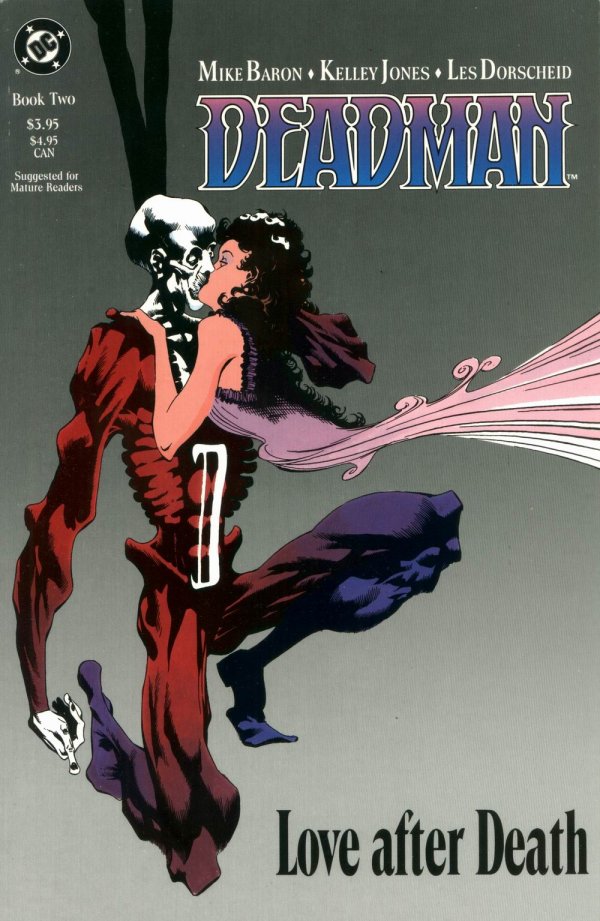
As for why it would be best as an animated project – there’s a certain creative freedom in animation. It allows you to do things that would stretch credulity in live action, even with the best special effects. Have you ever noticed that the animated Star Trek series are far more likely to bring in characters who are not, strictly, humanoid? Creatures with three arms or body types that you could never fit a human actor into? That’s because in animation you don’t have to pay for huge animatronics, make actors spend days in the makeup chair applying heavy or even painful prosthetics, or worry about sketchy CGI that just doesn’t mesh against the human actors standing in front of a green screen. Animation would give them the freedom to really explore the afterlife, plunge into the depths of Hell, or put Deadman through extreme transformations like the nearly-skeletal Kelley Jones version of the character without having to torture the performers.
Very few actresses would be willing to have their torso removed to do this scene justice.
It could be groundbreaking in another sense as well. Animation is finally starting to crack free from the decades-old bias that it’s only intended for children, but it’s still rare to see adult-oriented animated projects that aren’t comedies. Even Creature Commandos, which was basically an action movie with monsters, leaned heavily on dark humor. Any humor in Deadman would likely come from Boston himself cracking wise, as the situations he plunges into would be deadly serious…no pun intended.
Movie: Firestorm
With page-rippin’ power!
Firestorm is one of DC’s perennial B-listers. The character inspires incredible amounts of devotion from his fans, but the NUMBER of fans just isn’t big enough to crack him into the mainstream. This could finally be a chance to fix that. Although several characters over the years have shared the name and the powers, the crux is usually that two people (originally scientist Martin Stein and high school student Ronnie Raymond) are fused into a single super-powerful being as the result of a nuclear accident. One of the two – Stein in the original – is dormant in the fused Firestorm persona, only able to offer advice to the one who’s steering the ship. This allows for a sort of “odd couple” dynamic, putting together two characters who don’t necessarily belong together and forcing them to literally work as one for the greater good.
Writer Gerry Conway, who co-created the character, had done a long run on Marvel’s Spider-Man and was attempting to recreate the dynamic of a younger hero, which DC didn’t really have at the time. Their heroes were all older, the younger ones were all sidekicks, so putting a teenager in the driver’s seat was different for them, and the character quickly became beloved, even becoming the youngest person to ever join the Justice League (at the time at least). But after 100 issues of his solo series, the doors were shuttered way back in 1990 and, despite several strong attempts to give him a resurgence, he’s struggled to really become big again ever since.
For the movie, I would make Martin Stein sort of the “man in the chair,” the person inadvertently responsible for Firestorm, but not part of Firestorm himself. I’d keep the part of Ronnie’s origin where he gets suckered into joining a group of “protestors” to impress a girl, only to find out that they’re actually eco-terrorists. But when the accident happens, rather than fuse with Stein, I’d have him fuse with the second Firestorm, Jason Rusch, who I would make Stein’s lab assistant.
“Fusion Confusion” was my nickname when I worked at that restaurant making sushi burritos.
The dynamic we’d have here would be Jason believing Ronnie’s a dumb jock while Ronnie sees Jason as a stuck-up egghead, and the two would slowly and begrudgingly learn to respect each other – the old “together we are more than the sum of our parts” routine. The eco-terrorists would be linked to a bigger bad, of course, who is targeting different scientific institutions in the DCU such as S.T.A.R.Labs, and giving us an opportunity to include other science-based heroes such as Captain Atom, Hourman, Stargirl, or the Flash – who has been oddly absent from all official conversation about the current DCU. There’d even be a clear opportunity to bring in Edi Gathegi as Mr. Terrific again, because when you have a science problem, who better to call than the smartest man in the world? I kind of like the idea of Stein being one of Mr. Terrific’s former professors who now finds himself running to his old student for help.
Okay, James Gunn, the ball is in your court now. You’re doing a great job so far, don’t get me wrong, but there’s always room to bring in even more goodness. Here are my suggestions.
Now I’ve got to get back to finishing up season one of Peacemaker before season two drops.
Blake M. Petit is a writer, teacher, and dad from Ama, Louisiana. His most recent writing project is the superhero adventure series Other People’s Heroes: Little Stars, volume one of which is now available on Amazon. You can subscribe to his newsletter by clicking right here. He’s also started putting his LitReel videos on TikTok. Come back to him in a month, he’ll probably have three totally different suggestions.
A local swimming pool in my area allows its members to host movie nights during the summer – special events after the sun goes down where you can choose a movie and watch it while you splash around and swat at mosquitos because, let’s be honest, we’re still in Louisiana. But it sounds like a fun time, and recently my brother and sister’s respective families – both of which are members – decided to co-host a movie night. The stipulations were simple: pick a movie rated PG-13 or lower, preferably one that you have on physical media because the streaming capabilities at the pool aren’t exactly state-of-the-art, and Jaws is already taken. Because of course it is.
Even scary in chlorinated water.
If you’re scheduling an outdoor summer movie, Jaws is probably the most obvious choice there is. It is – as I’m sure you’ve heard me mention before – a virtually flawless movie, and with it being the 50th anniversary this year, interest is at maximum. The story is also a summertime classic – a shark attacks the beaches of Amity Island in the peak of the summer tourism season. After several attacks, including one that ruins the Fourth of July even worse than your cousin who can’t stop talking about politics, the chief of police teams up with an oceanographer and a sailor to hunt down the murderous beast. There’s not a wasted frame in this movie, the music is perfect, and it is absolutely scandalous that Robert Shaw didn’t get a Best Supporting Actor Oscar.
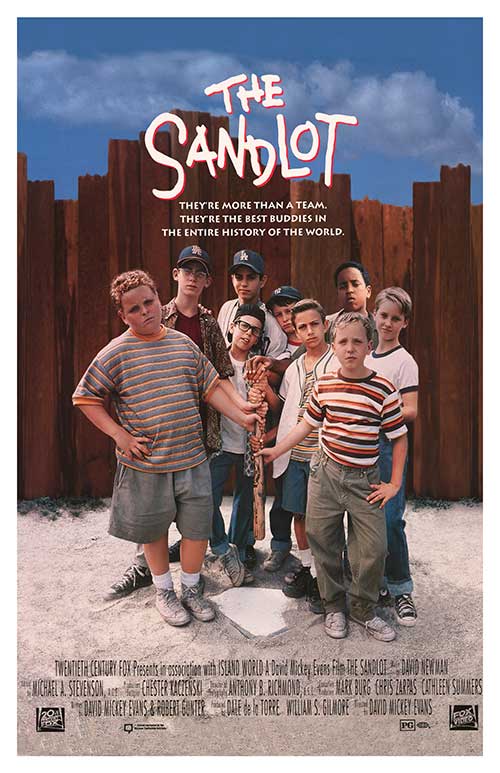
But some other family had already taken it. Since that wasn’t an option, my family started to toss around alternatives. My brother was stuck between Goonies and The Sandlot, both of which are classic films, but they ultimately went with the latter. I get it. As much as I love Goonies, if you’re going for a movie with a summer feel it’s pretty hard to argue against The Sandlot. It’s your timeless coming-of-age story about a new kid in town who finds friends with a ragtag bunch who spends their days playing baseball in a local…well…sandlot. Again, it’s a movie that’s perfectly in keeping with the theme and gives you a summertime feel like few other movies can accomplish. Perfect – they texted the pool’s organizer to tell him they’d settled on their movie and my sister jumped on Oriental Trading and started ordering baseball-themed decorations for the event.
I think one of these kids grew up to be the ambassador to Uganda or something.
Right after she got her shipping notification, the organizer texted back to tell them that some other family had already chosen The Sandlot for THEIR movie night.
And so it was back to the drawing board. Goonies was briefly reconsidered, then someone suggested doing a “Christmas in July” theme and showing National Lampoon’s Christmas Vacation or Home Alone, both of which I thought would be a really fun idea. Christmas Vacation was ultimately vetoed due to that one moment of profanity Chevy Chase drops during his legendary meltdown scene at the end of the film, which I can respect. There are gonna be a lot of kids in the pool, after all, and you don’t want to have to cover their ears lest you be forced to explain who Bing Crosby and Danny Kaye were. Other ideas rattled around until finally, they decided to go with a recent hit that was freshly available on Blu-Ray: The Minecraft Movie.
I’ve never played Minecraft myself, nor have I seen the movie. I don’t really know anything about it, other than it apparently has something to do with a chicken wearing jockeys, but it made a ton of money and I’m sure it’s going to be a big success with the families at the pool. But is it really a summer movie?
As so often happens when I think about stuff like this, I started to compile a list. If I was scheduling an outdoor summer movie film festival, what are some of the movies I would program? What are movies that both capture the feel of summertime in various ways AND are family-friendly enough that I could put them on a big screen in the out of doors and not have to answer uncomfortable questions from pearl-clutching parents? (Obviously, the other Vacation movies are automatically disqualified.) So here is how I’d program a summer film triple feature that’s fun for everyone. I want three movies that encapsulate three of the most iconic summertime activities: a road trip, summer camp, and going to the beach. Each activity gets one film.
First up, for the earliest movie you need something for the kids that’s also fun for the adults. When I hear someone dismiss a terrible movie because “it’s just for kids,” that feels like a slap in the face to the likes of Up, Wall-E, Puss in Boots: The Last Wish, or hundreds of other great movies that are aimed at children but still have the kind of depth and heart that endears grown-ups to them. If you think it’s okay to make an awful movie just because you think only kids are going to watch it, I’m telling you right now, you’ve got to do better.
The greatest comedic mind of his era in his first feature-length movie!
So I’m going to kick it off with a road trip movie that kids and parents alike love: A Goofy Movie from 1995. Goofy’s son Max is out of school for the summer, and Goofy decides to take his son on the ultimate fishing trip. But unbeknownst to him, Max has bragged to a girl he’s got a crush on that he’s going to a rock concert, and he has to devise a way to get his dad to change his plans.
This is one of those movies that you can watch as a kid and enjoy it on one level, then as an adult, get an entirely different message. As a kid, this is the story of Max trying to have the greatest summer of his life and win the girl of his dreams. You get that. You understand it. And you absolutely understand how his father – literally Goofy – can be somewhat embarrassing for an adolescent, especially when genetics seem to have determined that you’re doomed to follow in his footsteps and become a Goof in your own right.
As an adult, you see this movie as the story of a father whose son is on the verge of growing up and who is desperately attempting to forge memories together before it’s too late. As an adult, you know that the stuff that Max is worried about is teenage stuff, stuff that quickly loses its relevance when you’re out of high school, but Goofy’s desires are all about a life long bond that he’s afraid of losing, something that hits the gut of any parent.
Plus, the music slaps.
It’s not part of the “Disney Animated Canon,” as it wasn’t produced by the Walt Disney Animation Studios arm of the many-tentacled monster that is Disney, but I think it rates up there with Beauty and the Beast, The Lion King, and Aladdin as one of the finest, most heartfelt films of the Disney Renaissance era. And it’s funnier than any of them.
For the second film in my summer film fest, I’m going to step back a decade from the adventures of the Goof clan and bring in the late, great Jim Varney in Ernest Goes to Camp. Here’s a movie that’s maybe a bit more for the adults who grew up with Ernest, but the kids will love it too. Summer amp is such a traditional activity that it absolutely HAS to be included in our triple feature. And since we’re going for a family-friendly festival, we have to automatically disqualify any summer camp movie which features counselors being brutally murdered. Which is about 95 percent of them.
But that’s cool! Because Ernest Goes to Camp is actually better than any of those. American Hero Jim Varney plays the kindhearted (but dimwitted) Ernest P. Worrel, handyman at Kamp Kikakee, who has aspirations of one day becoming a camp counselor. He gets a shot at his dream when a group of boys from a reform school are sent to him as part of the camp’s “Second Chance” program and Ernest is put in charge. The kids turn out to be rougher than Ernest expected, and things get even worse when he’s conned into getting the owner of the camp to sign the land over to a developer.
From there, as always, it’s Ernest to the rescue.
Jim Varney’s Ernest is one of those things that I’ve never hidden my love for, and it actually feels great to see how kindly he’s regarded now. There was a heart and a warmth to the Ernest movies, a sincerity to them, a…dare I pun? An earnestness to the character that few others have matched. Ernest is the kind of hero who succeeds because he’s too simple to understand that victory is impossible. Honestly, I think if more of us had that kind of simplicity in our hearts, the world would be a better place.
Then comes movie #3. Now for the third chapter of a triple feature, you’re allowed to be a little less kid-friendly, since a lot of the parents with littles will have taken them home by now, leaving mostly grown-ups and older kids left in the audience. I’m going to close things off, then with Adam Sandler and Drew Barrymore in 50 First Dates. Sandler has made some stinkers, I won’t lie, but I’ve always enjoyed the sweetness of this movie.
If nothing else, you’ve got to respect this movie for not being Little Nicky.
Set in Hawaii, so there’s a constant beach backdrop, Sandler plays Henry Roth, an employee at a Sea World-style park who meets and immediately falls in love with an art teacher named Lucy. After an amazing first date, he tries to see her again, only to learn that she has no idea who she is. Lucy, it seems, suffered brain damage in a car accident and has lost the ability to make long-term memories – every day she wakes up and has forgotten everything that has happened since the day of the accident. If Henry wants to be with the girl of his dreams, he has to make her fall in love with him all over again. Every. Single. Day.
Sandler’s movies, especially from this era, could often rely on gross-out or prurient humor that doesn’t work for me. And to be fair, there’s a little of that in 50 First Dates. But there’s also a heart to this film that a lot of Sandler’s movies don’t have. A lot of guys in Henry’s situation would bail out, but the notion that he cares enough about Lucy to go through with starting over day after day after day is pretty wholesome and encouraging.
There you have it, friends – a summertime triple feature that I think would make for a fine night out at the movies. Go ahead and inflate your portable screens, fire up the grill, and set up the lawn chairs. You can have this one for free.
Blake M. Petit is a writer, teacher, and dad from Ama, Louisiana. His most recent writing project is the superhero adventure series Other People’s Heroes: Little Stars, volume one of which is now available on Amazon. You can subscribe to his newsletter by clicking right here. He’s also started putting his LitReel videos on TikTok. He’ll be back with a perfect Halloween campfire triple feature in October if he remembers, which he almost certainly won’t.
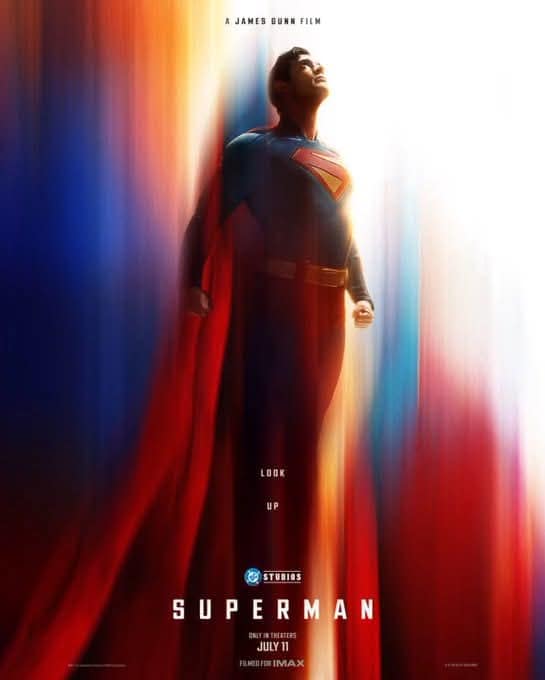
I never had any real doubt that James Gunn would make a good movie. After three Guardians of the Galaxy films, plus the holiday special, The Suicide Squad, Peacemaker, and even the little-remembered (but worth watching) film Super with Rainn Wilson, he’s proven he knows how to tell a superhero story. But the question, when it came to SuperMAN, is whether he truly understood the character and what we wanted from him.
James Gunn, I am thrilled to say, understood the assignment.
You might want to go get a snack before you read this review. We’re gonna be here a minute.
The launch film for the new DC Universe is everything I could have hoped for – exciting, thrilling, fun to watch, full of humor, full of heart, and – most importantly – carries its overt optimism like a torch leading the rest of the superhero universe in its direction. It’s like a calling card: superheroes can be fun and still mean something. And Superman, more than any other hero, should be the primary example of that.
This new DCU, we are told in the opening seconds of the film, is a world where metahumans have existed for three centuries. Superman has been active as a hero for about three years, and although he has garnered a great deal of goodwill in that time, a recent incursion into a hostile territory in Europe is causing international furor as some people question whether an alien should involve himself in human affairs. Lex Luthor, of course, leaps at the opportunity to use Superman’s actions to foment trouble, and it is the conflict between these two (who, at the beginning of the film, have yet to meet in person) that forms the core of the movie. It’s a solid foundation from which to explore the themes most important to Superman, specifically what it actually means to be human.
The main plot also leaves room for exploration in the relationships that Superman and Clark Kent enjoy – with Lois Lane, Jimmy Olsen, the three members of the “Justice Gang,” and of course, with Lex Luthor himself. Each of these characters has an important role to play in the movie, nobody feels superfluous and all of them feel like they’ve been served incredibly well by James Gunn’s script.
Krypto, of course, steals the show.
I want to talk in more detail about the characters and the actors who portray them, and I don’t know that I can do that without lapsing into spoiler territory, so consider this your warning. If you haven’t seen the movie yet, stop here, secure in the knowledge that I loved every moment of this movie and I can’t wait to see it again and again. This is the best Lois Lane we’ve ever had on screen. The best Jimmy Olsen. The best Lex Luthor. The best…
…damn, I love Christopher Reeve so much. Can I REALLY declare David Corenswet the best?
He’s definitely in the top two.
Spoilers begin after the graphic.
I’m going to go through this a character at a time, starting, of course, with David Corenswet as Clark Kent and Superman. Prior to this film, the only thing I’ve ever seen him in was Pearl, a violent slasher film in which he played a philandering movie projectionist – not exactly the sort of thing that automatically makes you think of Superman. (Thanks to Rachael Pearce for correcting me — I originally said Corenswet was in X, the film Pearl is a prequel to.) But from the first moment clips of this film started come out, he won me over. As Superman, he carries himself with strength and power, but not at the expense of his inherent humanity. He has moments as Superman where he feels weakened, and it never feels false. He expresses pain after being beaten by the Hammer of Boravia, moaning as his robots use solar rays to knit his broken bones. He crumbles in agony when exposed to Kryptonite. He takes punches during the climactic battle that you believe COULD kill him if they aren’t stopped. But far more importantly, he shows the kind of emotional vulnerability that we need in a role model. When public perception begins to go against him, his face shows the weight that comes with that. When Luthor murders an innocent man for the crime of believing in Superman, we see every ounce of the pain on Superman’s face.
That face.
And when he’s not doing that, he has a sweetness and a kindness to him. It’s no mistake that this movie goes out of its way to show us Superman saving lives even in the midst of chaos. When a kaiju is on a rampage, we see him protecting a little girl from a shockwave. He pauses in front of a series of shattered windows to make sure the people inside are okay. We even see him swoop down and rescue a squirrel – a moment that easily could have come across as silly, but in the context of the Superman we’re watching, feels perfectly in keeping with the kind of hero he is. His priority is life – all life – and he’ll not sacrifice a single one if he can help it.
Of the few faults I can find with this movie, most of them are in the category of wanting MORE. When it comes to Corenswet, I wish we had gotten a little more of him as Clark interacting with people who don’t know his dual identity. We get a few short scenes of him at the Planet office, scenes typically full of innuendo-laden conversation that only a fool would fail to pick up on (more on that later), but the rest of the time he’s either Superman or he’s around people who know his secret, such as Lois and his parents. In the few scenes where Corenswet puts on the glasses he’s so good at crafting his second identity that I wish we’d seen more of it.
The last journalist in America who remembers what integrity is.
I’d never watched anything with Rachel Brosnahan until I heard she’d been cast in this movie, at which point I decided to check out her TV series, The Marvelous Mrs. Maisel. By the end of the first episode, I was sold. Miriam Maisel is a force to be reckoned with in a time and place when women weren’t necessarily welcome, and the grit she showed in that series was exactly what I wanted in a Lois Lane. When this movie started, she carried all of that fire with her.
Brosnahan’s Lois Lane is tough and fearless, never backing down from anything except, perhaps, the potential of a relationship she doesn’t believe she’s capable of having. The full version of the interview scene (the one from the trailer) is perhaps the single best scene of Lois as a reporter in the entire canon of live-action Superman media. Despite the fact that she’s interviewing her (kinda) boyfriend and, even more impressively, Superman, she doesn’t blink for a second. She hammers him with the kind of questions a reporter should use in a situation like this, and when the inevitable conflict between Lois and Clark comes up as a result, it doesn’t feel forced. Clark is upset because to him it is SO OBVIOUS that he’s done the right thing, and it frustrates him that others don’t see it that way. Lois has a reporter’s point of view – more nuanced, less black and white, thus the two of them come to a verbal sparring match that serves their relationship well. When they eventually reconcile, it comes about because he realizes she was doing her job correctly, but at the same time, Lois can appreciate the fact that sometimes right is simply right, and understands why Clark did what he did.
Llllllllllllllllllllladies.
Jimmy Olsen, as a character, has rarely been served well – and I don’t just mean in movies. Nothing against Marc McClure, who did his best in the 70s and 80s, but how many stories actually give Jimmy something to DO? Even when he had his own long-running comic book series in the Silver Age, the stories often involved him needing Superman’s help or doing something ridiculous that happened to work out in the end. Skyler Gisondo’s Jimmy, on the other hand, is funny and capable. He’s a legitimate reporter, and while he may not have the gravitas around the Planet office that Lois and Clark have, he’s good at what he does. There’s also a great running gag about Jimmy being, inexplicably, kind of a ladies’ man. We see several moments of girls checking him out and his desk is ornamented with photographs of him with women who, let’s be honest here, seem way out of his league. (No offense, Skyler Gisondo.) This joke gets a tremendous payoff when we find out that Eve Teschmacher, Lex Luthor’s girlfriend, is actually Jimmy’s EX and she wants him back.
Honestly, I give them all the credit in the world for avoiding duckface in this poster.
Speaking of doing more with a character, let’s talk about Eve. Sara Sampaio plays Eve Teschmacher as a ditzy, selfie-obsessed product of a social media society. But the story completely redeems her when we learn that the avalanche of selfies she’s taken have been carefully done to capture evidence against Lex in the background – maps and charts that document his scheme and can be used to bring him down. The portrayal we get of the character fits well – she IS kind of ditzy and a little oblivious to the fact that Jimmy isn’t as into her as she is into him, but she is nowhere near as stupid as she pretends to be. That trope, of a character hiding their true intelligence until just the right moment, is one that I always enjoy, and Sampaio sells it hard.
STILL don’t call him “chief.”
Back to the Daily Planet for a minute – we also don’t get as much Perry White as I’d like, but from what we do see, Wendell Pierce nails the role. He’s got a sort of fatherly air to him, but also a dedication to doing his job. The best bit with him, though, comes right after the final battle, when Lois goes off to “interview” Superman. Perry just looks at Jimmy and asks “How long have they been hooking up?” I love the ambiguity of this scene and how it plays to the intelligence of the characters. Just before this, Perry was on a wild ride in the T-Craft with Lois and Jimmy, who broke the Luthor story. Then he brings along Cat Grant (the gossip columnist), Steve Lombard (the sports guy) and Ron Troupe (who I assume is a reporter but, as far as I can tell, never got an actual line in the movie). But at NO point does he look around and say “Where the hell is KENT?”
The only way this works is if you read that final scene the way I do: Jimmy and Perry not only know that Lois is hooking up with Superman, but they’ve figured out that Superman is Clark Kent. Hypno-glasses or not, they’re too smart not to have pieced it together. Plus, as we see elsewhere, this Clark is perhaps a little too loosey-goosey with guarding his secret – not only does he share it with Guy Gardner, of all people, but as I mentioned before, Lois and Clark keep having conversations that REALLY seem to hint at the fact that they’re hiding something. She may chastise him for not hiding his identity well enough, but if we’re being fair, she isn’t helping matters. If that is, in fact, what James Gunn intended, I love this shade for the characters. I love seeing them played to the height of their intelligence.
So bald…so evil…
Let’s move on to the villain of the piece here: Nicholas Hoult as Lex Luthor. We’ve seen a lot of Lexes over the years, from Gene Hackman’s long-suffering rogue surrounded by incompetents to Jesse Eisenberg’s thinly-disguised Mark Zuckerberg impression. But this is the first Lex we’ve ever seen that I thought felt truly UNHINGED. He’s obsessed with Superman, as Lex Luthors often are, but Hoult’s interpretation takes it to the next level. Hoult’s Luthor is as petty and bitter as he is brilliant, his entire motivation boiling down to the fact that he cannot stand the fact that the world prefers Superman to him. To his credit, he’s not unaware: he knows perfectly well that he’s obsessed and bitter, but that doesn’t change anything. When his rage actually boils over, as it so often does, he can be legitimately frightening. He is, in fact, the perfect foil for Superman. Where Superman represents all of the goodness and nobility inherent in the human race – and, in fact, has specifically chosen to do so – Luthor is a perfect representative of all of our negative qualities: fear, anger, envy. I can only imagine how hard James Gunn must have been laughing when he wrote the scene in which we find out that the trolls who have been slamming Superman on social media are literally monkeys being mind-controlled by Luthor. It’s such a perfect picture of the people who live only to dispense hate online that you have to wonder if it’s even a fantasy.
Meet the gang.
Then there are the other heroes in this film. Edi Gathegi’s Mr. Terrific gets the most screen time, joining Lois in the rescue mission once Superman is caught in Luthor’s pocket dimension and fighting with Superman in Metropolis at the finale. He also comes across as the smartest (which is kind of his whole thing), most mature, and most responsible of the “Justice Gang.” He’s a leader and a man of conviction, although he does have a wry sense of humor and little patience for fools, which makes you wonder how he survives being on a team with Guy Gardner. Of all the gang, he’s the one I feel could most handily star in a movie of his own.
Speaking of Gardner, Nathan Fillion just KILLS it as our resident Green Lantern – funny, arrogant, and self-centered, but at the same time, absolutely fearless (which is one of the job requirements) and dedicated to doing what he thinks is right. It may not always be pretty, but Guy Gardner gets the job done. Isabela Merced’s Hawkgirl has the least to do out of the three of them, but even she manages to make a name for herself, showing just how tough she is and getting some really good moments, especially at the end.
How could you not fall in love with that face?
Although not technically a member of the “Justice Gang” until the very end, I effusively loved Anthony Carrigan’s Metamorpho. Introduced in a sort of antagonistic role, with Lex having him make Kryptonite to torture Superman in his pocket dimension prison, it quickly becomes clear that he’s doing it against his will. Luthor has his son, and if bombarding the world’s greatest superhero with toxic radiation was the only way to keep MY kid safe from a psychopathic billionaire, I have to admit I’d probably do the same thing. But when Superman convinces him that there’s a way out, he turns very quickly and becomes a valuable ally. In the final fight on the Boravian front, he quickly proves his value and his worth, and becomes a character that you root for wholeheartedly.
Krypto?
Krypto is a very good boy.
The last thing I want to talk about is the world that Gunn is building. He is quite adamant that each DCU project be able to stand on its own, and this movie absolutely does that, but at the same time he’s laid enough seeds to have fans farming for months. For example, the opening narration tells us that in this universe, metahumans have been known to exist for 300 years. That’s a REALLY specific number. In most iterations of DC Comics, there have been larger-than-life figures throughout history: the Viking Prince, the Shining Knight, western heroes like Jonah Hex and so forth. But the modern metahuman usually doesn’t become a thing until roughly the World War II era. So why 300 years ago? Did something specific happen at that point that kicked off metahumans on the DCU Earth? Is it when the Starheart fell to Earth, does it have something to do with Nabu or the wizard Shazam? There isn’t nearly enough information to come up with an informed theory, but that’s not about to stop us from guessing.
We also get enough Easter Eggs to make me itch for the Blu-Ray release of this movie so I can pause it and peruse certain moments. The scene in the Hall of Justice, for example, has a mural of what appears to be the Justice Society of America in the background. I noticed Wildcat specifically, but I need to go back and see who else made the cut. I also feel like a careful examination of the people in the cells of Lex Luthor’s pocket prison will reveal certain things about who (or what) exists in this world.
The final scene has two wonderful moments – one is a quick cameo by Supergirl (Milly Alcock) which is a BLATANT set-up for her own movie, especially if you’ve read Woman of Tomorrow. The second part is a lovely character moment for Clark. Early in the movie, when his robots healed him, they showed him the recorded message from Jor-El and Lara to “soothe” him. In the end, having learned that his Kryptonian parents weren’t quite who he thought they were and understanding that he has chosen to be human, he instead is soothed by the memories of his life with Jonathan and Martha Kent.
Every dad wants this moment.
The scene that made me most emotional in the entire film is the one where Pruitt Taylor Vance as Jonathan tells Clark that it’s his choices that make a person who he is, and then breaks down telling his son how proud he is of him. This hit me right in the Dad Place (that’d be the heart), and the fact that my own seven-year-old boy was sitting in the chair next to me no doubt was a contributing factor to how I had to scramble to see if there were any napkins left from the popcorn. People will want to pick apart this movie and apply their own messages and agenda to it, which is a stupid, tiresome pastime I never have any patience for. Here’s the message I took from it, and I don’t think this one requires any mental gymnastics to make it fit:
You are who you choose to be.
Superman is the best of us, not because of his powers and not because of what he CAN do. He’s the best because he chooses to do good. He’s a hero because he wants to help people. And this movie shows time and again how he inspires others to do the same, from the children raising flags on the battlefield to the way Guy and Hawkgirl change their minds and join in the final fight – and perhaps most importantly, in the form of a food truck vendor who spends his life trying to protect his hero. Superman raises up ordinary people, and if Lex could get out of his own damned head, he could do the same.
It’s a message we all could stand to remember.
You know, I’m worried I might have missed something. I think I need to see this movie again.
Last Sunday I was out to lunch with the family (as we often do on Sundays) when I got an alert from the AMC Theater app on my phone. “Yo Blake!” the app said (I paraphrase). “We’re showing Minions: The Rise of Gru on Wednesday! Tickets are only three bucks for AMC Stubbs members! You want in?”
I looked over at my son, he and I both off from school for the summer, and said, “Hey Eddie, do you want to see a Minions movie on Wednesday?”
He did.
He posed like at least three of the characters in this image.
I’ve written before – extensively – about my love affair with movies, and more importantly, with movie theaters. Yeah, ticket prices have gone up. Yeah, the theaters can sometimes be filled with rude, obnoxious people. Yeah, I can’t pause the movie to go to the bathroom. Yeah, they show an obscene number of commercials before the movie actually starts. (I do not include movie trailers in the “obscene number of commercials.” I adore movie trailers – they can show as many of those as they want.) And if the movie I want to see isn’t one that I can bring a seven-year-old to watch, that means my wife and I have to arrange for somebody to babysit him, an operation that at times seems to require a level of planning and strategy that could have won the American revolution. But despite all of the problems associated with a visit to the theater, I still wholeheartedly believe that the best way to watch a movie is to do it in a darkened theater with an excited crowd.
Pictured: optimum movie excitement.
When we took Eddie for his first movie theater experience a little more than two years ago (I wrote about it here) I was nervous. I didn’t know if he would like it. Would it be too loud for him? Would he lose interest? Could he possibly stay in his seat that long? Even though we were taking him to see Puss in Boots: The Last Wish, would the movie itself simply fail to engage him? I imagine these are fairly common worries when a parent takes a kid to the movies for the first time, but I also know that I personally have a deeper love for the movie theater experience than the average parent does in this day and age. It was a real concern for me, that the kid I love so dang much would turn out to hate an EXPERIENCE I love so dang much. But I was delighted that the boy enjoyed himself. In the two years since then, we’ve brought him to the movies several times, and only once did we wind up having to leave because he couldn’t sit still. (I do not blame him – he was five years old and it was before his doctor and we managed to find an ADHD medication that really worked for him.) Last summer was the first time he actually ASKED us to take him to a specific movie, and while I may not have necessarily chosen The Garfield Movie as one of my all-too-rare cinematic excursions these days, he wanted to go to the movies! I was happy to oblige.
This summer – this month, in fact – is going to be the big one. The first time he sees a movie that’s not targeted precisely at kids. Next Friday Erin and I are taking him to see Superman. And again, I have felt pangs of nerves concerning this. Yeah, we’ve gone to the movies with him several times, but almost all of them have been animated movies. And the only one that WASN’T – Sonic the Hedgehog 3 – has a cast made up of 75 percent CGI characters, and TWO villains played by Jim Carrey, who is essentially a Looney Tune in human form. (Aside: It’s a shame they never made a sequel to Who Framed Roger Rabbit? with him in it – it could have been a masterpiece.)
In my younger days, when I had the time to go to the movies two or three times in a week, it was a different experience. My friends and I would arrive at a theater sometimes not even knowing what we were going to see – we’d look at the schedule when we arrived and pick a film that was starting soon. Then after the first movie ended, we’d go out and look at the schedule and do it again. We would each pay for our tickets independent of one another, then go into the theater and sit wherever we wanted. We would get snacks, popcorn, or drinks, and that was the limit of what we could spend money on in a movie theater.
When I brought Eddie to the theater on Wednesday, I had purchased our tickets three days prior. I knew specifically that we were to be seated in Row G, seats 7 and 8. And nearly half the lobby had been given up to merchandise: not just candy and snacks, but toys, collectibles, t-shirts, and the ubiquitous popcorn buckets and drink cups that have become almost required for any tentpole film. I have mixed feelings about a lot of these changes. I don’t really object to the merchandise sales – if it’s good enough for concerts to help keep touring bands afloat, there’s nothing wrong with a movie theater selling stuff to remind people of their favorite films, after all. But like any sort of collectible market, it’s spun off a rather distasteful secondary market of people who swoop in without any particular love of a movie, buy up all the merch they can, and sell it on eBay at a markup. I hate flippers, people who take advantage of the care and affection others have for a film, a comic book, a creator. Although I didn’t have any intention of spending the eighty bucks AMC wants for a Galactus Popcorn Bucket when Fantastic Four comes out, it rankles me that if I WANTED to it would likely be sold out before I could get there, but I could score one for $200 online.
“I AM GALACTUS! DEVOURER OF SNACKS!”
As for the assigned seating – I actually like this particular innovation. It takes off a little of the pressure of having to get to a movie early to get a good seat, which can sometimes be invaluable when you’re toting a little chaos gremlin like a child with you. Sure, there was a fun sense of camaraderie that developed in those days when we would stand in line for hours waiting to see Star Wars Episode I: The Phantom Menace (let’s not debate the movie itself, guys, I’m talking about the fun of spending the day amongst like minded fans, which is undeniable). But if I’m being perfectly frank, I’m not 20 years old anymore. The idea of standing in any line for two or three hours makes my spinal column start to itch in anticipation of the aches that are soon to come.
So I don’t mind at all knowing that I can buy tickets ahead of time (as I’ve already done for Superman) and be guaranteed a seat in a relatively low row, right in the middle, where I like it. The only problem with purchasing tickets ahead of time is when you’re getting a large group together, trying to coordinate it so that you all buy tickets in the same row. Either you all have to have a text chain to ensure everyone is buying the right tickets in the right place before some stranger winds up between you and your girlfriend, or you have to assign one person to buy the tickets all at once and then you pay that person back. In either case, it’s an added degree of hassle. But considering how long it’s been since I went to a movie with anybody other than my wife and son, it hasn’t been an issue for me in quite some time.
But man, I love these summer bargain matinees. It’s not a new thing, mind you. Movie theaters have long pulled kids’ movies from past years back into theaters for mid-week screenings in the summer: hits from the past few years that are now easily available on a billion streaming services. Perhaps movies that the kids in question have already seen a dozen times. Movies that you don’t actually have to see in a theater, if all you want is to see the movie. That doesn’t matter to them. They get to go to the movies. Eddie loves the Minions. He’s seen all four Despicable Me movies as well as the first Minions film. As it happens, the only movie in the Minionverse he HADN’T watched yet was the second Minions film, The Rise of Gru, which also just happened to be the one AMC told me was coming back to the screen this week. So I bought tickets for the two of us for just $3 each and took him down there. And if you ask him right now, he could tell you all the things he loved about going.
He loves that it’s “like nighttime” in the theater, even in the middle of the day.
He loves getting to pick out snacks (it was Gummy Bears this time) and share a bucket of popcorn with his dad.
He gets CRAZY excited when Superman shows up on the screen. (There wasn’t, technically, a Superman movie trailer on Wednesday, but we DID see commercials which used clips from Superman to promote Toyota, Dairy Queen, Progressive Insurance, and Milk-Bone Dog Biscuits, and that made Eddie happy).
He liked the end of the movie, which happens at a Chinese New Year parade, complete with an impressive CGI fireworks display – and this kid loves fireworks.
And ever since that one “bad movie” – the time when he couldn’t handle it and we had to leave – he gets very proud of himself for making it through a movie. He was beaming and smiling as we walked out of The Rise of Gru, terribly pleased that he’s grown up enough to go through a whole movie without having to leave. As we walked through the lobby towards the parking lot, he waved back and said, “Bye, AMC! See you next week for Superman!”
You’re ding-dang right, we will.
This doesn’t happen when we watch a movie at home. And I’ll never get tired of it.
Blake M. Petit is a writer, teacher, and dad from Ama, Louisiana. His most recent writing project is the superhero adventure series Other People’s Heroes: Little Stars, volume one of which is now available on Amazon. You can subscribe to his newsletter by clicking right here. He’s also started putting his LitReel videos on TikTok. He’s all a-tingle waiting for next Friday, and if Eddie wants to, he wants to take him to see Fantastic Four: First Steps, too.
When you teach the same subject for long enough, there are certain topics and certain lessons you start to look forward to. One of my favorite things to cover with my 12th grade English students, for example, is Hamlet, and I particularly look forward to the famous “To be or not to be” scene. I always start by telling the kids that this is the big one, the grande supreme enchilada, the most famous speech that Willie Shakes ever wrote which, by proxy, also makes it one of the most famous speeches ever written in the entire history of the English language. Then I look at the kid who has already volunteered to read the speech out loud and say, “No pressure.”
Here’s a level three nerd joke. Ahem: “Took him 900 years to get this part right.”
After we read and discuss the speech together, I show them clips of several different film versions of Hamlet. We talk about how different actors play the role, how the different settings change their interpretation of the scene, and fun English class stuff like that. The most entertaining version – to me, at least – is when we watch Ethan Hawke’s depiction of the scene from 2000. In this version, director Michael Almereyda has changed the setting to the modern day (or at least, what was modern in 2000) and has Hamlet deliver this speech wandering the Action Movies section of a Blockbuster Video store. But I’m showing this to contemporary high school students. Even the oldest of them wasn’t born until 2007, and the vast majority of them have no idea what they’re looking at. Popular guesses include a gas station, a convenience store, and a bookstore. The ones that DO recognize Blockbuster Video, I assume, do so because they’ve seen Captain Marvel.
The weird thing is, after updating the setting, they kept the headgear 100 percent historically accurate.
It’s funny to me, to see the cultural disconnect between the film and the modern audience. No doubt Almereyda intended to make the movie contemporary, but in choosing that particular setting, this film feels even more dated than a traditional version of Hamlet set in the 7th century. And the percentage of my students who know where Hawke is before I explain it gets smaller with each passing year. These are kids who have never – and WILL never – browse the video section of a store.
And as entertaining as the lesson usually is, the fact that this is an artifact of times gone by makes me a little sadder each year.
I grew up in the 80s. I was in high school and college in the 90s. The peak of Video Store Culture is intertwined with the most important developmental years of my life. I remember as a kid, my parents taking us down to the video store and letting us roam the aisles looking for movies to watch. My younger brother and sister would gravitate towards the kids’ movies, and while they would pour over the shelves trying to make their own decisions, I found myself drifting to sections of the store I knew my parents would NEVER allow us to rent from, especially the horror section. Ghoulish monsters, blood dripping down faces, whatever the hell was going on with the box art for The Stuff…I was mesmerized.
9-year-old me would have TRADED my brother to find out what was going on here.
VHS box art of the 1980s was a unique art form that has no peer in the history of pop culture, save perhaps for paperback book covers of the same era. Great box art could make even the lamest, cheesiest low-budget schlockfest seem tempting. But my folks weren’t the sort who would allow a 9-year-old kid to rent something like Creepshow no matter HOW enticing the box art was. So those movies found a home in my psyche only in poster form, which is how they remained until I was old enough to rent them and watch them myself. At which point – let’s be honest – I discovered that a great many of those movies were better as box art than they ever were as films. But that was okay.
As I got older and went to video stores myself, I would gravitate to all kinds of movies, devouring things that I’d been curious about for years but had never been able to indulge in before. Not just horror, but classic sci-fi, old comedies, or indie darlings I’d heard good things about like Magnolia. It didn’t hurt that around the time I graduated college, my best friend Jason became the manager – and eventually owner – of the video store I most often patronized, so I got to sample an awful lot of movies for free. And as culture shifted from VHS to DVD, I went from being simply a viewer to a collector. I would go to Best Buy, Circuit City, Borders, or Barnes and Noble and spend hours walking through the shelves, examining the DVD cases, trying to find old favorites to add to my shelf or new movies I’d never heard of that were worth a watch. I could do this alone, but it was more fun to do it with Jason or our other friends. Either way, though, there was a tangibility to holding those cases in my hands, reading the description on the back, studying the list of special features to see if there was a good making-of featurette or commentary track that would be worth listening to or – of course – admiring the cover art.
This is a pleasure that has largely been lost to us. Netflix slaughtered the video store in its sleep, and of those retail stores I mentioned the only one that both still exists and has a physical media section at all is Barnes and Noble, and it’s nowhere near what it used to be. And while I know that we always lose certain cultural elements as time passes and culture evolves, this is one of those changes that has hurt not only the people who make these movies, but the consumers who watch them as well.
It’s the streaming era I’m talking about, of course. That’s what killed the video store, that’s what has DVD and Blu-Ray sales on life support. (Thank God for horror movie fans, one of the last stalwart groups to demand physical media for their preferred art form. They’re the ones keeping the whole thing alive right now.) Sure, the convenience of streaming can’t be beat. I don’t need to go down to the video store anymore. I don’t need to HOPE that the movie I want to watch will be available. I don’t have to take the risk that I’ll get a disc with a scratch that has rendered it unplayable, and never again will I need to double-check that I’ve rewound a tape before I return it.
Was there anything worse than opening the DVD case at home and seeing THIS?
But this same convenience has made the entire movie-watching experience feel more disposable, like it doesn’t matter anymore. If I went down to Jason’s video store hoping to rent Scream 2 only to find that it had already been rented, that’s when I would look for something different and discover movies that I may otherwise have never watched, like Amelie. With streaming, you just have to hope that the movie you want is on a service you subscribe to, and if it is, there’s no need to roam.
But even if the movie you want ISN’T on your service, or even if you don’t know what you want to watch, the browsing experience isn’t the same. In a store, looking at a movie case, you had the opportunity to pick it up, read the back, gaze at that beautiful, beautiful cover art. Today, every movie is reduced not to art, but to a thumbnail. Most of the time it’s a still shot from the movie, probably a close-up of the biggest star in the film, with the title superimposed on top of it. It’s bland, lifeless. Just as the greatest box art could make me watch the worst movies, so can a cookie-cutter thumbnail cause me to scroll right past one of the best movies of the year, and I’ll never know.
We’ve lost the community aspect as well. For people like me, TALKING about the movie after I’ve watched it is just as vital a part of the experience as actually watching it. Discussing what we liked, what we didn’t like, what did we think the sequel would be like, should there even be a sequel at all? At the video store, you can chat with other customers. “What are you getting? Oh, I’ve seen that one, that’s great. Say, I really liked From Dusk ‘Till Dawn but I’m not sure what to watch next. Any suggestions?” Sure, the streaming services TRY to do this, but I would take the suggestion of a random film geek in a video store over the Netflix algorithm every second of my life, and it wouldn’t even be a struggle.
Netflix has “We think you’ll love these.” Your local video store had “Vinnie’s picks.” Nobody ever saw Vinnie. No one knew who he was. But Vinnie introduced you to Boondock Saints and you LOVED him for it.
And with this, the respect given to a movie by the audience is being cut down. I know a lot of people who’ll stop a movie if they aren’t engaged in the first five minutes. And sure, that’s your prerogative, but there’s something to be said for a slow burn. Some movies need to be given time to get into the story, and sometimes that’s what makes it effective. In the video rental days, once we made it home with a movie we WATCHED the damn thing, no matter how bad the first five minutes were, because that was our only option. And I think we were better for it. I don’t want to tell you that you should sit around watching something you don’t like, but the disposability of entertainment has caused us to forget how to give a story a fair chance. I can spend twice as long scrolling through the options on Hulu than I ever did looking at the DVDs at Borders, but I’ll end up far less satisfied.
Then there’s the way movies are presented today. TVs have, for the most part, gotten substantially larger than they were when I was a kid. You would think that would make the viewing experience better, but somehow the opposite has happened. My students, my nieces and nephews, are more likely to watch a movie on their Chomebook, their tablet, or – worst of all – their PHONE. Not to say I’m not guilty of this at times – when my sports fanatic son is bound and determined to watch a lacrosse match between two colleges I’ve never heard of with an announcer who has all the life and energy of the sloth from Zootopia, minus the personality, I’m certainly not above pulling up an episode of Star Trek on my laptop. But it’s not my preferred method of watching anything, and the idea of watching an entire motion picture on a phone screen is giving me a migraine. But to kids today it’s common. I’ve had students tell me they’ve watched entire movies chopped up into two-minute segments and posted (in portrait mode for the love of God) to TikTok, a practice which I’m pretty sure is directly responsible for the sharp rise in instances of bird flu in the United States.
I took this picture myself just to illustrate my point and it STILL makes me want to punch me in the face.
The only thing that mitigates the sting for me is that I know I’m not alone. I have many friends – both in real life and on social media – who join me in bemoaning the decline of video store culture, and while there may not be enough of us to bring that culture BACK, it helps to know that other people feel the same way as you do. Coincidentally, on the same day this week my students were confused by the Blockbuster store in Hamlet, I listened to an episode of the Movie Crypt podcast in which filmmaker Alex Ross Perry discussed his new documentary Videoheaven, a “video essay” (in his own words) about the rise, influence, and fall of the video store told through clips of movies and TV shows featuring video stores. The movie is almost three hours long, he says, and frankly, it sounds amazing. I am very excited about this film and very anxious to get a chance to watch it.
I’ve never met Mr. Ross Perry, but just based on this poster, I suspect he’d be my kinda people.
Ironically, I’ll probably have to wait until it comes to streaming.
Blake M. Petit is a writer, teacher, and dad from Ama, Louisiana. His most recent writing project is the superhero adventure series Other People’s Heroes: Little Stars, volume one of which is now available on Amazon. You can subscribe to his newsletter by clicking right here. He’s also started putting his LitReel videos on TikTok. Yes, he’s old. You wanna make somethin’ of it?
Today I’m going to start the first of the Theme Weeks I’m planning to do for this little project. It won’t be every week, nor will the content of those weeks be 100 percent dedicated to that theme. There’s still a lot of Superman and Lois to catch up on, after all. But on these theme weeks, I’m going to focus on a specific character, creator, or concept related to Superman. For this first week, I’m going to put the spotlight on the second-most important character in the entire Superman mythos, one of the best comic book characters ever created. Welcome, friends, to Lois Lane Week! Lois has been around since day one, appearing in Action Comics #1 along with Superman himself, and over the years has grown and evolved into one of the most complex and engaging characters in comics…when she’s written correctly. In the Golden Age, Lois was a tough-as-nails, courageous, crusading reporter. The modern incarnation has a lot of the same qualities. When written properly, Lois Lane is brilliant, fearless, and a force of nature. The only Lois I’m not crazy about, honestly, is the Silver Age Lois, a character who seemed more interested in marrying Superman or proving his secret identity (because somehow that would convince him to marry her). I’m going to try to look at all ages of Lois this week.
Wed., Jan. 22
Comics:Showcase #9
Notes: DC’s Showcase comic book, in the 50s, was essentially a try-out series. Every issue or two they would change the headliner, basically using the series to test the possibilities of a new character or new title, many of which eventually spun off into their own series. Most famously, this is the series that gave us the Barry Allen Flash and the Hal Jordan Green Lantern, but today we’re focusing on Showcase #9, the prototype for the series that would be called Superman’s Girl Friend, Lois Lane.
If you swapped Lois with Chili and Superman with Bandit, this is any given episode of Bluey.
This Showcase issue is pretty indistinguishable from the early years of Lois’s solo title, with three stories each dedicated to Lois’s love life with Superman, while he treated her in a way that would have pretty much everybody on Reddit telling her to dump him, and frankly, I can’t blame them. The first story is “The Girl From Superman’s Past.” Lana Lang – Superboy’s old flame from Smallville – moves to Metropolis, and she and Lois immediately wind up sparring for the affection of the now-adult Superman, up to and including placing themselves in danger to see which one he was going choose to rescue. At the end of the story, of course, Superman has refrained from making a decision, probably because both of these women are behaving like lunatics.
“The New Lois Lane” is even more bonkers. When Superman learns that a group of crooks are on the verge of unveiling his secret identity, he creates a new alter-ego, “Allen Todd,” and counts on Lois’s trademark snooping to reveal Mr. Todd as being the real Superman. Unfortunately for him, Lois recently used a Weight and Fortune Telling Machine (no, really) that told her to change her strategy to help get the man she loves – so instead of trying to reveal his secret, she starts going behind his back to “help” him HIDE it. I tell you, some of these Silver Age Lois Lane stories are positively Shakespearean, in that they’re predicated on absurd coincidences and ridiculous misunderstandings that could easily be cleared up if either of the people involved were capable of having a simple adult conversation, for God’s sake.
Finally, there’s “Mrs. Superman,” in which Lois gets a head injury and has a coma dream about her fondest wish: marrying Superman. To get her out of it, Superman sits by her bedside and feeds her “false” information to try to snap her out of the fantasy – you know, horrible things like Superman’s real identity being Clark Kent, or that he’s cheating on her with a woman named Lulu, because every woman in Metropolis is legally required to have a name beginning with the letter “L.” I guess in this one Superman is at least trying to help Lois. Technically.
The idea, I suppose, was to make a comic book that fit in with the popular romance comics of the time, although these stories were even sillier and more convoluted than a lot of those. I guess it was popular, though, as this series lasted for 16 years and 137 issues before being merged with the Jimmy Olsen title as Superman Family. But sitting from where I am, where my Loises are all strong, independent, and smart as a whip, it’s bonkers to me that this incarnation of the character lasted as long as she did.
Articles: “A Fond Remembrance of Mort Weisinger By His Son” and “The Superman Mythos: Roots of the Superman Confluence,” both by Eddy Zeno, from The Krypton Companion
Thur., Jan. 23
Comics: DC Horror Presents… #3 (Cameo), Superman’s Girl Friend, Lois Lane #21, Action Comics #662, Superman Vol. 2 #53
Notes: Returning to the shockingly meager offerings on DC Universe Infinite for this series, I decided to check in on Lois Lane #21, featuring a pretty well-known cover with Lois and Lana somehow superpowered and slugging it out for Superman’s affections, but I don’t think I’ve ever read this one before. The first two stories in this issue, though, are a two-parter unrelated to the cover. In “Dolls of Doom” and “Trapped in Kandor,” Lois is tricked into posing for a Lois Lane doll by a gang of criminals planning to use her against Superman. This somehow winds up with her sent to the bottled city of Kandor where she falls in love with a Kandorian who is – shockingly – a dead ringer for Superman.
I’m sorry to not have a better synopsis for this story, but I refuse to take total blame for it, because the DC Universe app has the PAGES IN THE WRONG ORDER. The middle of chapter two appears in chapter one and vice-versa, and while it is theoretically possible to read the pages in the correct order by flipping back and forth in the app, by the time I realized what the problem was I was so angry about it that I stopped trying. Hey, DC Universe Infinite: FIX THIS CRAP.
After all, with the pages scrambled, some people may find this confusing.
The last story is the one I was really interested in anyway. “The Battle Between Super-Lois and Super-Lana” features Superman’s two favorite girls, now rival reporters, who stumble upon a magic lake that conveniently gives super powers to anyone who bathes in it. Realizing they now have all of Superman’s powers, they decide that this is the perfect time to make him choose between them by doing things like cooking giant food, finding and wearing priceless jewelry that has been lost to antiquity, and carving their own faces into mountainsides. The story ends, predictably, with the magic water wearing off and Superman once again getting out of having to make up his mind. The most important part of the legacy of this issue is that the “magic water” came back into play decades later in Alan Moore’s “Whatever Happened to the Man of Tomorrow?” (which of course you can be certain I’ll read before this Year of Superman is over.)
It’s unfathomable to me how the book lasted this long with stories that make the title character look like an obsessed stalker and make Superman look like an indecisive jackass. I think I need an palate cleanser, so I decide to read the issues I skipped between “Krisis of the Krimson Kryptonite” and “Time and Time Again” – the story of how Clark Kent finally revealed his secret identity to Lois Lane.
The face of “WHAT THE ACTUAL F@#??”
It happened in Action Comics #662, and before I get into the story, can we talk about the cover for a minute? This is a classic by Kerry Gammill and Brett Breeding, and it’s wild to me that this hasn’t made the echelon of often-homaged covers like Action Comics #1, Superman #1, or even Superman Vol. 2 #75 (the Death of Superman issue). The angle, from Clark’s point-of-view, is perfect, and the look of total amazement on Lois’s face just kills me every time I look at it. I love this cover.
As for the story itself, the issue begins with Lois and Clark having a comics code-approved romantic evening at home, with Clark about to tell Lois the big secret just as they’re interrupted by the Silver Banshee. Her magic told her that Superman was in that apartment, but all she finds there is this tall drink of water in a pair of glasses, so she dashes out. Clark goes after her, leaving Lois somewhat confused. The middle part of the issue is pretty standard for the time period – Superman fighting the Banshee (who, I should mention, has one of the coolest designs for any Superman villain ever) while in a subplot, a LexCorp employee digs into the mystery of the company CEO’s death and his potential heir. The Lois story doesn’t come back until the last couple of pages, where Clark gives the big reveal on a full-page splash panel at the very end of the issue, leading into Superman Vol. 2 #53.
The first few pages of this issue are devoted to the Lois and Clark story, as she tells him that she thinks – on some level – she knew his secret for a long time, but had always dismissed it, then she (understandably) asks for a little time to process this major revelation. The rest of the issue deals with Superman being asked to help escort a political prisoner being brought from the Middle East back to the ol’ U.S. of A. It’s a perfectly fine issue, but it definitely illustrates the way the Superman comics were written in the 90s. Each issue had an A-plot (which may or may not continue next week) and several ongoing B-plots that were often specific to the individual titles and writers. Anything dealing with the Clark Kent side of his life was usually relegated to the B-plots, even something as monumental as this. If this story were being told today, the revelation would have been its own one-shot issue with a half-dozen miniseries spin-offs dealing with the fallout. In these two issues, it’s less than ten pages total.
All that said, I like how they dealt with Lois here. Rather than make her look or feel foolish for not having known Clark’s secret, she confesses to having had a gut feeling. In the Silver Age, that “gut feeling” was half of her reason for existence. This is a much smarter, more mature Lois Lane, and it’s a much better interpretation of the character.
Fri., Jan. 24
TV Episode: Superman: The Animated Series, Season 2, Episode 7, “Target”
Notes: Except for Margot Kidder, I think Dana Delaney may just be my favorite Lois Lane. Her wit and sarcasm feels so completely perfect for the character – I love the way she knows she’s the smartest one in the room, but doesn’t lord it over anybody unless they’re asking for it. It’s like if Bugs Bunny were a reporter. One of the things I particularly liked about Superman: The Animated Series is that they wrote Lois the way she SHOULD have been written in an era before she and Clark were allowed to be together. This is a Lois who, like the Lois of the Golden Age, finds Superman more fascinating than Clark. However, she doesn’t spend all her time mooning over him or trying to crack the secret of his identity. She’s someone with a thirst for truth and, along with that, a hefty appreciation of justice.
And if we’re being totally honest, there’s just something about a gal with purple eyes.
In this episode, Lois is sent a death threat just seconds before receiving a prestigious journalism award. After a quick rescue by Superman (as per usual) she embarks upon a quest to find out who’s gunning for her, with more and deadlier attempts following her as she seeks out the truth. Although both Clark and Superman appear and factor heavily into the plot, we never actually see the transition from one to the other, aiding the conceit that this is an episode told from Lois’s perspective. It’s a great episode for showing how smart and, ultimately, dangerous she can be to the wrong people (the “corrupt” that she mentions in her acceptance speech), and I like the fact that she refuses sensible precautions like staying under house arrest when there are super criminals gunning for her. It’s the kind of reckless that is 100 percent indicative of Lois Lane. And it’s great that she cracks the mystery on her own, without Superman’s help or without even hearing the clue that tells him where to find her at the end. If I have any complaint, though, it’s that she doesn’t show herself quite as capable as I’d like. Every deathtrap is escaped, narrowly, by Superman’s interference. Sure, it’s part of the usual schtick for these two, but it would have been nice if just ONCE she managed to get herself out of trouble by herself.
Notes: Like the episodes of the cartoon, Superman Adventures #12 demonstrates ably who Lois Lane should be. Superman has been infected with a Kryptonian virus, and Lois and Professor Emil Hamilton are in the midst of a war zone trying to get an essential ingredient for an antidote. Once the cure for the man of steel is synthesized, it’s up to Lois to transport it back to Metropolis through battlefields, across oceans, and in the midst of an awful lot of criminal types who would be perfectly happy if the cure never makes it to its destination. The story, written by Scott McCloud, perfectly showcases the cartoon’s version of Lois. We see how strong and gutsy she is, every step of the way. The best thing is that she’s not doing it because she’s in LOVE with Superman, she’s doing it because the world NEEDS Superman. A+ Lois Laning in this issue, guys.
Sat. Jan. 25
Answering the question, “What if we write Lois Lane, but for the Pretty Little Liars demographic?”
Novel: Fallout (2015) by Gwenda Bond
Notes: This is part of a larger push to put the DC characters into young adult novels, a practice that I think is a good idea. Get ‘em while they’re young, get ‘em reading, get ‘em loving the characters. In this version, Lois is a teenager in the modern day – or at least in the modern day of 2015, when this was published, which cannot possibly be 10 years ago, so this is just more proof that math is a liar. Young Lois and her family have recently moved to Metropolis, the latest in a long line of homes as befits her army brat lifestyle, but the Lanes are hoping to put down roots this time. At a new school, Lois struggles making friends until she’s recruited for a special initiative of the Daily Planet to bring in high school students with an interest in journalism. As Lois tries to acclimate to her new passion, she finds that a group of bullies at the school may be more than they seem, and the principal may be part of a larger conspiracy.
This book, part of a trilogy by Gwenda Bond, gives me serious Nancy Drew vibes. This is not a criticism, mind you, I think that’s actually quite appropriate for a young Lois Lane. Although the story is structured to lead her towards her destiny as the world’s greatest reporter, for most of the plot she’s doing a detective’s job, trying to crack a mystery with the help of a few sometimes reluctant friends. In fact, the only one who’s totally on her side from the beginning is her online friend, who goes by the handle “SmallvilleGuy” and is shockingly hesitant to cough up details about himself.
I liked this book a lot more than I expected to, if I’m being honest. I’ve read a lot of novels based on comic book characters and too many of them are sort of bland, lifeless retellings of a story that would be better served as a comic book. But Gwenda Bond has a fine voice for Lois, and the way she builds up the sometimes antagonistic nature of her relationship with her father works well. Bond’s Sam Lane hits all of the right beats for that character – he’s tough, he’s strict, and he wants things to be done his way. At the same time, though, he’s not an ogre. He’s a father who wants what’s best for his children, and the conflict stems from the fact that what he thinks is best is not necessarily what Lois wants, not because he’s evil.
The interactions with “SmallvilleGuy” are fun, but maybe a little too much like the writer is winking at the camera. I don’t mind a little bit of that, but when you spin this whole mystery around a question that the audience already knows the answer to, it doesn’t necessarily hit right. It’s not like it makes Lois look stupid or anything (just because SmallvilleGuy’s in-game avatar is an alien is no reason Lois should suspect that he’s the real thing), but you do start to twirl your finger a little and say, “Okay, let’s get on with it.”
All that said, I did like this book. I did like this Lois. And while I don’t know if I’ll get around to them right away, I’m adding the other two books in this trilogy (Double Down and Triple Threat) to my massive to-be-read list. That’s not a promise that I’ll ever get to them, if I’m being 100 percent honest, but they’re definitely on the radar.
Notes: The current run of the main Superman comic has been really good. Written by Joshua Williamson with art by Dan Mora – who, in case I haven’t mentioned it recently, is far and away the best Superman artist of the modern era – our heroes find themselves in a very precarious position. Doomsday, the creature who killed Superman once, is the target of an alien invading force, forcing Superman to work with the instrument of his own destruction. He’s not alone, though – Lois is currently Superwoman. I have to say “currently” because you know that, sooner or later, the status quo will reassert itself, but giving her Kryptonian powers (however temporary) is making for an interesting twist to the dynamic. The entire Superman family has sort of become a team, defending Metropolis together, and Super-Lois has essentially been made co-leader along with her husband. This isn’t the first time that Lois has gotten powers, of course, but this is a way of portraying that relationship that I’m pretty sure we’ve never seen before. With this being my “Year of Superman,” with the movie coming out in July, and with DC giving the Man of Steel a much bigger push than they have in recent years, I couldn’t be happier that this monthly comic is really good right now.
Sun., Jan. 26
The After School Special of Lois Lore.
Comic Books: Lois Lane #1-2
Notes: The early 80s were a weird time for Lois Lane in the comics. After all those decades of chasing after him, she “broke up” with Superman, feeling as though the relationship wasn’t going anywhere (go figure). What’s more, Clark started dating Lana Lang, which was admittedly a nice change of pace, as she was now interested in Clark Kent rather than Superboy/man, and it changed things up for a while. But the problem was, then, what do you do with Lois?
The answer, it seems, is this miniseries: two double-sized issues of two chapters each which were clearly originally intended to be a four-issue miniseries, but they condensed it for some reason. Regardless, in this refreshingly Superman-free story, Lois is covering a police investigation that turns up the body of a child, a horrifying moment that sends her deep into the investigation of child abduction and trafficking. I would have been about nine years old when this miniseries was published, so I can tell you that the whole “stranger danger” scare was a big thing at the time, and this miniseries feels very much like an attempt to connect to the After School Special audience by telling a story with an important message. Not that the message isn’t important, of course – sadly, it’s possibly even more relevant today than it was almost 40 years ago. But the way they tell the story is a bit heavy-handed, as many of these “Very Special Episodes” tend to be.
On the other hand, it’s good to see a story where Lois is being Lois – doing reporter work, digging into a story and trying to uncover the truth. The sad thing is that Lois comes off as awfully antagonistic throughout the story: she clashes with her editor, she clashes with her sister Lucy…she clashes with everybody. And there’s a point where it feels less like frustration about her serious story not being taken seriously and a bit more like Lois has some sort of chip on her shoulder. (It may have helped if the story at any point recapped just why she and Lucy were at each other’s throats at this period.) As it is, though, we get none of that. We learn nothing about why Lois is behaving the way she is, save for general sensitivity over the subject matter. It’s a pretty dark topic , but it’s hard to conceive of a seasoned reporter like Lois Lane suddenly lashing out at everybody around her over something like this. Half the characters assume she’s upset over her breakup with Superman, and while that too would be completely out of character for her, at least it would be an explanation.
We DO get a shocking revelation about Lana Lang…a revelation that, to the best of my knowledge, was never referenced again, and certainly has been wiped out in the half dozen or so continuity reboots since then. And in the end, the story doesn’t really have a resolution. We just run out of threads to follow. That’s how stuff like this happens in reality, sadly. But this isn’t reality, it’s fiction, and as much as I enjoy seeing a spotlight on Lois Lane, this spotlight is given to a story that forever will seem incomplete.
Enjoy it now, kids. Once Jon is born, even this won’t be far enough to get some peace and quiet.
Notes: So after getting engaged, finding out her fiancé was really Superman, losing him to time-travel shenanigans, and dealing with a dozen other problems that cropped up in the course of the four Superman comics of the era, in this issue Lois FINALLY has a chance to stop and talk to Clark about what it would mean for the two of them to be married. I’ve always enjoyed this issue.
The first half is a series of events where Lois keeps getting left behind as Clark rushes off to deal with one emergency or another – a sunken submarine, a homeless man who’s gotten his hands on a super-villain’s discarded weapons stash…you know, typical stuff. But in the second half, Clark bundles Lois up and takes her off to the top of Mt. Fuji, one place where he doubts that an emergency will call him away, for a conversation. The scene itself only takes a couple of pages, but it’s powerful. Lois asks why Clark, with all his power, would choose to be Superman, and he gives the most Superman answer imaginable: “Because no one else can.” They talk about their relationship and what they mean to one another, and by the time they return to Metropolis, it feels like a hurdle has been passed. After this, the relationship in the comics was usually rock-solid (except for that brief period where they broke up, but which eventually led directly into their wedding, and for the New 52 reboot, but we can dismiss that for timey-wimey reasons). I hate when writers throw a breakup/makeup dynamic onto their characters just because they can’t think of a way to tell compelling stories about a couple without threatening their relationship (lookin’ at you, Spider-Man writers). I’m really glad that this issue ended that era for Lois and Clark in a satisfying way.
Also of note: this issue is kind of an epilogue to the Time and Time Again storyline from last week as well. One of the Linear Men, Liri Lee, feels responsible for the months that Superman was lost in time, so she tries to make it up to him by pausing time for Lois and Clark (without their knowledge) and allowing them to discuss their relationship uninterrupted. It’s a nice little conceit and although I don’t think it was strictly necessary, it served the purpose of showing that the original Linear Man did not act alone (something that would become significant later) and perhaps gave a little more plausibility to the notion that Superman could go that long without picking up on a disaster somewhere that needed his attention.
Geez, how many Robins does that guy NEED?
Next up is a dandy two-parter from Superman Vol. 2 #168 and Detective Comics #756. This story comes from the era in which Lex Luthor had been elected President of the United States, and things kick off when Lois learns from her father (Lex’s secretary of state) that he’s somehow regained possession of the Kryptonite ring we last mentioned back in the Dark Knight Over Metropolis storyline. Superman, being Superman, is reluctant to break into the White House to get the ring, so Lois decides to enlist the help of somebody somewhat less reluctant: Batman.
This is a great story. I love seeing Lois being proactive and using her husband’s ties to the superhero community to right a wrong. I also love how Superman winds up in conflict with his wife and best friend in a way that doesn’t seem convoluted or out of character. Of course Superman would refuse to break into the White House, no matter who’s sitting in that chair or what the provocation, and of course Lois and Bruce wouldn’t give a damn about all that when it comes to getting that sort of a weapon out of Lex Luthor’s hands. It’s a dandy little character play from writers Jeph Loeb and Greg Rucka (respectively) and it’s only slightly undermined by the ending. I don’t mind at all that Clark and Bruce hatched a scheme of their own, but I’m admittedly a tad disappointed that they didn’t let Lois in on it. That said, it’s a fine story that shows, as the best stories do, just how proactive Lois Lane can be.
Just as grounded in reality as her ’86 miniseries.
I’ll wrap up today with Superman: Lois Lane, a one-shot from the New 52 era. I won’t get into the pros and cons of that time period at the moment – odds are at some point later this year I’ll get into it a little bit – but I will say one of my least favorite things about that period was the way DC erased pretty much every superhero marriage and returned to the old status quo of Lois not knowing Clark’s identity and, for most of the run, not having any sort of relationship with him either. In fact, Superman only makes a cameo in this issue, and Clark isn’t mentioned at all.
That said, if you just change the costume Superman wears in his cameo, this story could very easily be dropped into pretty much any continuity or any time period for Superman. It’s a self-contained story about Lois, starting with her sister Lucy showing up on her doorstep, injured, begging for help. Lucy’s roommate, Amanda, has been transformed into some sort of monster by a strange street drug, and she pleads with Lois to rescue her. Like a lot of the best Lois stories, this one showcases her detective skills, hunting down the origin of the drug that’s terrorizing Amanda and going to whatever lengths it takes to save her. It’s not a bad story, although it does showcase just how much Lucy Lane has become something of a punching bag over the years. That poor girl never seems to catch a break.
Tues., Jan. 28
AKA Superman versus the Three Stooges
Movie: Superman II
Notes: The first Superman film, with Christopher Reeve and Margot Kidder, remains one of my favorite movies ever made, and by far my favorite superhero film. But ever since the release of the “Donner Cut” in 2006 I’ve harbored a belief that, had the film been completed as intended, Superman II would have surpassed it.
Not to say that the Superman II we have isn’t good. Quite to the contrary, it’s a great movie. Superman facing off against a trio of Kryptonian villains, Lex Luthor bouncing from enemy to ally to, at the end, a desperate attempt at becoming a frenemy before Superman deposits him with the police. And most importantly this week, this is the movie where I feel like Margot Kidder’s Lois Lane gets her best moments. In this film, Lois discovers the truth, that Clark Kent is Superman. They share a tender love story in which he decides to give up his powers, which his mother Lara (or rather, her approximation in a Kryptonian data crystal) tells him is the only way he can ever be with a human woman. But when Zod and company attack Earth, seeking the son of Jor-El, he has to find a way to restore himself and save the world. It’s a great superhero movie mixed up with a beautifully tragic love story. But there are two things about it I’ve never cared for. One is the end, where Superman erases Lois’s memory with a…well…a super-kiss. It’s a dumb power, one that we’ve never seen show up anywhere else except for a short gag in Scott Kurtz’s PVP comic strip, but the power itself isn’t the problem. It feels awfully cruel of Clark to do that to Lois, not unlike the stupid kinds of things that we saw from Superman throughout the Silver Age. Even if you couch it in the belief that Lois will be happier without knowing the truth, I don’t care for that.
The other problem is something that was much better in the Donner cut: the way that Lois discovers Clark’s secret. In the film, as completed, Lois hurls herself from Niagara Falls, expecting Superman to save her and finally prove her suspicion that he and Clark are one and the same. Clark manages to pull her out without divulging his identity, but only minutes later, he pointlessly trips and falls into a fireplace, allowing her to see that he isn’t harmed. It’s awful. Clark is way too experienced – not to mention way too smart – to give away the world’s greatest secret that way.
The Donner cut is SO. MUCH. BETTER. If you’ve never seen it, you can watch the pertinent scene on YouTube, and I urge you to do so if you haven’t. (I believe that the YouTube version was actually cobbled together from screen tests and was not intended for use in the final film, but that doesn’t matter.) If you don’t feel like watching it, allow me to explain what makes it so great.
As in the finished movie, Lois has failed in an attempt at proving Clark is Superman, and is discussing her suspicions with him. Suddenly, she pulls a gun. He goes into his usual blubbering Clark routine, trying to talk her out of doing something rash, but to his horror, she pulls the trigger. He starts for a moment, but then, realizing there’s no way out of this one, he stands up, straight as a board, glaring at her. He takes off his glasses, activating that Clark-to-Superman transformation that Christopher Reeve could pull off like nobody else, and says, “You realize, of course, if you’d been wrong Clark Kent would have been killed.” Lois raises the gun and says, “Well, they’re blank.” Clark’s head falls to his chest, realizing just how deftly he’s been outsmarted.
A face that says, “God help me, I love this infuriating woman so, so much.”
No Lois Lane has ever Lois Laned as hard as Margot Kidder Lois Laned in this scene.
Comics: Superwoman Special #1, DC Comics Presents #69, Supergirl Vol. 2 #21, Justice League of America #15, New Adventures of Superboy #31
She was always a woman of steel. She just has the jammies now.
Notes: I decided to close out “Lois Week” with a re-reading of Superwoman Special #1, which came out just over a month ago and is part of the current ongoing storyline in the Superman comics. A few months back, Lois suddenly started showing up in a Superwoman costume, displaying the same powers as her super-hubby and fighting alongside him, with no indication as to how this happened. This special finally gives us the skinny as Lois tells the other two super-women in Metropolis, Lana Lang and Kara, how she got her powers. In last fall’s Absolute Power crossover, Amanda Waller set out to steal the powers from the world’s heroes (and villains, but mostly the heroes). Waller was, of course, defeated, but when the powers were restored not everything went as planned. Some powers were altered and some went to the wrong people, including Lois suddenly having Kryptonian powers. An examination from Mr. Terrific and the Atom concludes that Lois does, indeed, have Kryptonian powers, but there seems to be a limit – every time she uses them, she is in danger of burning them out. Being Lois, she isn’t content to sit on the sidelines when people are in danger, hence the new Superwoman. The other thing the reader learns in this issue that the heroes don’t is where, exactly, her powers came from. She has inadvertently stolen the powers from one of Superman’s greatest enemies, General Zod, and it seems unlikely that he’s going to be happy when he finds out where his powers have gone.
This special is kind of a fill-in-the-blanks moment, revealing the backstory in the currently ongoing storyline, but there are a few moments I really like. The coffee klatch with Lois, Supergirl, and Lana Lang (who has also been a Superwoman for a few years now, if you haven’t kept up) works really well to help establish the relationship between these three women, arguably the most important ones in Clark’s life, except of course for Martha. Second, I love the scene where Lois reveals to Clark that she’s gained powers. There’s no moment of shock or disbelief – Clark has seen enough weird stuff that it doesn’t even phase him. They just decide to have a nice, romantic flight together before it’s time to get to the bottom of it all.
The last thing I really like is the one thing that I think may possibly be a permanent, or at least long-term change. Lois isn’t going to keep Zod’s powers forever, I don’t think anybody even remotely familiar with comic books thinks that’s going to happen. But her OTHER new job that is showcased in this issue MAY last for a good while. Perry White, in recent issues, stepped down as editor-in-chief of the Daily Planet to run for mayor of Metropolis, leaving Lois in charge. Once he won the election, her temporary position became less temporary. It’s actually been really fun to see Lois as the boss, particularly those moments where her journalistic integrity clashes with her knowledge as Superman’s wife. (There was a story in one of the other titles recently where she took Clark off of any Superman-related stories as they were a conflict of interest, even if the two of them are the only ones who know it.) I really love having Lois in charge, and as great a character as Perry White is, this new dynamic is one that I think has a lot of storytelling mileage in it, and I hope they don’t revert to status quo on this one any time soon.
Here in Southern Louisiana, we’re known for a few things: food, music, and a general manager that none of the best potential head football coaches in the country want to work with. But this week, we got put on the map for something pretty unusual for us: snow. On Tuesday, we were hit with a snowstorm that dumped more of the white stuff than anybody alive has ever seen in the state of Louisiana before, as much as 10 inches in some areas. I know some of you in the north are scoffing at that – ten inches of snow is nothing to you if you live in North Dakota, for example, but this is insane for us. We don’t get snow like this. Every few years we get a dusting that makes us giggle until we have enough to make a snowman roughly the size of a Funko Pop and then we hope it happens again before we’re drawing social security. But this was more snow than Louisiana has had since 1895. That’s not a typo, it’s more than we’ve had in 130 years, and pretty much everything was shut down: roads, schools, businesses…everything except the Waffle House. As a result, I got three days to spend with my wife and son in a winter wonderland.
Seriously, this NEVER happens.
So naturally, I’m thinking about horror movies.
Well, not exactly. But spending so many days unable to leave the house because of ice and snow got me thinking about stories with that premise: people stranded together due to cold weather. And the fact is, most of those are scary movies. (Or Hallmark Christmas movies, but I’m not gonna write about those in January.) Pretty much every great example I could think of qualifies as a thriller, if not an outright horror film, and I guess it makes sense. Being forced in a confined space with people over a period of time can start to wear on you, the edges can be chipped off, and before long you’re staring at each other like Daffy Duck does when Porky Pig starts to look like a steamed ham.
So in honor of this once-in-a-lifetime event, I decided to break out my Five Favorite Frigid Fables, five great movies about people stuck together in the cold. As always, these lists are highly subjective. They’re the five best movies I thought about that fit my criteria, and it’s always possible that if I made this list tomorrow I’d pick five totally different movies. I’m going to go from the most well-known movie on this list to the least, at least, according to the viewing numbers on Letterboxd. The first three are movies that will make most of you say, “Well obviously,” but I’m hoping by the end you’ll find something you may not have heard of before.
The Thing (1982), directed by John Carpenter
My family made it through the Louisiana Sneauxmageddon pretty easily, but if I hadn’t included this movie on the list my wife may have left me anyway. This is probably the defining example of a cold weather confined area horror movie, as well as being one of the best sci-fi/horror mashups ever made. In this film, if you’re one of the three people on the planet who aren’t aware of it, a group of researchers at an Antarctic base uncover an alien creature that has been buried under the ice for hundreds of thousands of years. Although it is literally never a good idea to thaw one of these out, the alien escapes and begins to prey on the men.
Making matters worse, they discover that the alien is a shapeshifter. Not only is it a murderous beast, but it has the ability to transform and look like any one of them, so they can’t even trust each other. The resultant film is a masterpiece about fear, mistrust, and paranoia, a world where even your best friend may be the thing that’s out to kill you. The ending in particular is wickedly clever and absolutely perfect for this film. The movie is a remake of the 1951 film The Thing From Another World, itself based on the novella “Who Goes There?” by John W. Campbell, thereby simultaneously proving that sometimes the remakes are better than the original and sometimes the adaptation is better than the book. On the other hand, the remake/prequel of THIS movie from 2011 is…well, it’s just okay. But of the four iterations of this story, John Carpenter is the one who did it best.
The Hateful Eight (2015) directed by Quentin Tarantino
I feel like this is kind of a “forgotten” film. It’s not so much that people don’t know about it, but it rarely seems to make the conversation when people talk about their favorite Tarantino movies, which is surprising to me, because I’d easily place it in my top three. (The others are Inglorious Basterds and Once Upon a Time in Hollywood, since you asked.) In some ways, you could almost call this a western version of The Thing. Several travellers are snowbound at a haberdashery during an intense blizzard, including some bounty hunters, a condemned murderer, a sheriff, a cowboy, and a former Confederate general. As the storm rages outside, inside the lodge we start to learn that all of these people may not be the strangers that we assumed. These are people with deep wounds, some of them caused by the others that they’re now trapped with, and there is a hunger for revenge.
Even for Tarantino, this is a dark film. There is a rage and anger brimming beneath the surface, and there really aren’t any “good guys.” The movie is about bad people, badly damaged people, and the things they do to one another. The entertainment factor comes from trying to unravel the mystery of exactly how all of these people are connected and who has a past with whom. In that way, it may be the most well-written of Tarantino’s movies, with a complex plot that rewards multiple viewings as you try to untangle the web. There’s also an extended version, released via Netflix as a four-part miniseries, which I never got around to watching, but writing about it now is making me want to do so.
Misery (1990) directed by Rob Reiner
Do you ever stop to think about how weird the career trajectory of some people turns out to be? Rob Reiner, the guy who played Meathead on All in the Family, grows up to direct two of the best Stephen King adaptations of all time (this one and Stand By Me) along with stuff like The Princess Bride and When Harry Met Sally. Go figure.
Anyway, in this magnificent movie based on one of King’s best stories, novelist Paul Sheldon (James Caan) gets in a car accident in the snow and is rescued by a former nurse named Annie Wilkes (Kathy Bates). Annie tells Paul that she’s his biggest fan and is delighted to help nurse him back to health, but from the very beginning things feel…off. Things get much worse when Annie discovers Paul killed off her favorite character in his newest book, and the two enter into a deranged battle of wills as Annie fights for the survival of the fictional Misery Chastain, while Paul has to fight for his life.
The movie is incredible – taut, tense, and full of legitimate chills. This was Kathy Bates’ breakout role, and garnered her an Oscar for Best Actress back when the Academy Awards still actually meant something. Everybody involved in this movie is at the top of their game, and it’s just as engaging and exciting today as when it was released 35 years ago.
Frozen (2010) directed by Adam Green
Elsa is going to be crowned the queen of Arendelle and her sister–wait, wrong Frozen. No, this movie came out three years before that other one, and it is most definitely NOT a beloved musical about the power of familial love. This film involves a trio of young skiers (Shawn Ashmore, Emma Bell, and Kevin Zegers) who – through a series of mishaps that make Kevin McCallister getting left behind in Home Alone seem plausible – get stuck on a ski lift as the weekend mountain resort they’re visiting shuts down for the week.
Although the circumstances necessary to get the three of them trapped up there admittedly stretch credulity a little bit, once you get past that the movie is fantastic. You’d think a movie about three people stuck on a ski lift would run out of steam quickly, but the way the situation rapidly escalates into a life-or-death battle against the elements is totally gripping. It’s the kind of movie that makes you question what you would do in that situation, forcing you to wonder if you could possibly survive such an experience, dangling from an immobile ski lift with no hope of rescue for days as the temperature keeps falling and wolves begin to prowl in hard-packed snow beneath you. This was actually the first Adam Green movie I watched, before I discovered his signature Hatchet franchise, and it’s usually the one I recommend to people first. I love this movie.
Scare Me (2020) directed by Josh Ruben
The final film on this list is the most recent and least well-known, but by god, it deserves an audience. Writer/director Josh Ruben plays Fred, a writer on a retreat in the mountains. While taking a jog one morning he encounters Fanny (Aya Cash), a fellow writer who’s also on vacation. When a storm knocks out the power to their cabins, Fred and Fanny decide to ride out the weather together, passing the time by telling chilling stories as they challenge one another to – well, as the title says – “scare me.”
This is a movie that’s so simple, but absolutely brilliant. Almost the entire film is simply these two in a cabin talking to one another, but it’s done in such a way that you get sucked right in from the very beginning. The tales they tell are inventive and entertaining, but also slowly reveal things about the two main characters that lead you to question the entire situation. As good as the writing is, though, it wouldn’t be anything without the performances by Ruben and Cash. Both of them are probably better known for their comedic work (although after this movie, Cash hit it big on The Boys), but as I’ve said many times, the line between comedy and horror is very thin and the two disciplines rely on a lot of the same skills. That is to say, a great comedic actor very often has the chops to be a great horror actor, and these two prove it with this movie. They’re both wonderfully funny, but on a dime they can turn the entire situation around and scare the pants off of you. If you haven’t watched this movie, it’s currently available on Shudder and Hoopla, as well as the usual digital rental services. This movie proves how possible it is to tell a killer scary story without relying on gore and special effects, but just great performances. In fact, it could very easily be turned into a stage play, and it would be amazing.
There you have it, guys – five stories about people trapped in the cold. If it’s your thing, I hope you check them out. And if you’ve got suggestions for other such movies beyond these five, let’s hear it! Drop your own suggestions in the comments.
Blake M. Petit is a writer, teacher, and dad from Ama, Louisiana. His most recent writing project is the superhero adventure series Other People’s Heroes: Little Stars, volume one of which is now available on Amazon. You can subscribe to his newsletter by clicking right here. He’s also started putting his LitReel videos on TikTok. He briefly considered including the 2002 Cuba Gooding Jr. terror film Snow Dogs, but he thought that might be a bit too much.
This time it’s Squid Game’s fault. The most popular Netflix series on the planet dropped a second season a few weeks ago, right in the middle of the break between semesters for most schools, so approximately seventeen bajillion people binged the entire thing before they went back. Of all the human beings on the planet Earth, according to my meticulous records accrued by reading social media posts, the only one who has not watched the entirety of Squid Game season two is some schlub named Blake M. Petit in Louisiana. In my defense, I’ve got other things occupying my attention. In December, I mostly watch Christmas movies until the 26th, at which point I try to spend the next week catching up on movies I missed that year. Then on Jan. 1, I began my Year of Superman project, so while I certainly WANT to watch Squid Game, I simply haven’t gotten around to it yet.
Spoiler: The real Squid Game is the friends we made along the way. Who then get shot in the head.
This does not stop my students, of course, and when we returned from the Christmas break on Monday, I found myself several times having to stop them from babbling everything that happened in the show that I haven’t watched yet. I ask you to remember, now, that this is season two. This is a season that dropped mere days ago, not months or years, but several of them walked into the room wanting to tell me all about it, despite my admonitions NOT to do so. And I think it’s time, once again, to talk about spoilers.
I’ve seen the studies that say that some people PREFER to be spoiled – that knowing beforehand what happens in a story reduces their anxiety and allows them to enjoy the story better. Speaking as somebody who lives with anxiety as a constant companion that I wish I could jettison out of my brain and into outer space, I can only call this theory utter balderdash. It makes no sense to me AT ALL. I cannot, for the life of me, fathom how it feels BETTER to know that Rosebud was his mother’s maiden name, that Jack Dawson makes it onto the door, or that Captain America dies from using the Infinity Gauntlet before you actually see it. I get far more anxiety from being AFRAID of getting spoiled than I EVER have from wondering what will happen in the story next.
However, I’m also mature enough to accept that no two brains work the same way, and that while the messed-up hunk of meat in MY skull is absolutely spoiler-adverse, that doesn’t mean that people who prefer spoilers aren’t real. I get that. I don’t UNDERSTAND it, but I GET it. However, the fact that people watch and enjoy things differently from one another makes for an even BETTER reason to avoid spoilers, not a WORSE one. You see, if a person WANTS spoilers for virtually anything – a movie, a book, a TV show – they are readily available. They can be found in just seconds on Google, or if you want to get absolutely insane fake spoilers like I wrote in the preceding paragraph, you can get them on ChatGPT. Those who want to be spoiled can easily alleviate their anxiety. But for those of us who DON’T want spoilers, someone throwing them around casually is a severe blow to our enjoyment of whatever story you guys are out to ruin for us.
“But you know, Blake,” some of you say, “If the spoiler ruins the story, then it wasn’t really a good story in the first place.” I have heard this from many people, many times. I have also heard people say that thin crust pizza is better than thick crust. All of these people are – and here I’m going to use a somewhat complicated literary term, so I apologize in advance if you don’t quite get where I’m coming from – full of horseshit.
Writers construct stories in a certain way. They create characters, select conflict, craft a setting, all to generate a certain effect in the reader or viewer. All of these things are tools in a vast and complicated toolbox, and one of those tools is the power of the reveal. Take something like The Sixth Sense, for example. I’m going to spoil it now, and I’m warning you in advance because that’s the decent thing to do, but I also know that it’s a relatively old and very well-known movie, so I’m not TOO worried about ruining it for anybody. Still, if you don’t know what happens, here’s your last chance to bow out.
“And they keep calling Chicago Style ‘casserole’.” “What, do they think that’s an insult or something?” “I guess.”
In this movie, a psychologist played by Bruce Willis attempts to help a boy played by Haley Joel Osment who believes he can see ghosts. Most of the movie focuses on Willis’s character as he tries to steer Osment through this bizarre ability of his and lead him to making peace with his strange power in the moments before the final revelation at the end – that Willis himself is a ghost, although he didn’t know it.
It was a great moment, a fantastic surprise that not only made the movie exciting, but made viewers want to go back and watch it again to look for the many clues they missed the first time around. There’s a scene, for instance, where Willis is at dinner with his wife, talking to her as she grows frustrated and walks out on him. On first viewing, it seems as though she’s angry at him and is refusing to have a conversation, but watching it later it becomes clear that she can’t see or hear him, and what the audience thought was anger over his frequent absences is actually grief over his death. Once you realize that, you realize that NOBODY other than Osment’s character ever directly talks to or interacts with Willis in the entire film, a realization that is far more meaningful and rewarding the second time you watch it…IF you didn’t get it the first time.
Although writer/director M. Night Shyamalan has become something of a punchline in later years for an overreliance on twist endings like this one, this is the movie that made his career, and it was a hit for a reason. But if you go into the movie knowing that Willis is a ghost, you lose that shock at the end and, instead, spend the movie picking apart the little clues that are only intended to be significant in retrospect.
What’s really weird is that Moonlighting had the same twist, but nobody ever caught on.
Or, to put it more simply, if a writer chooses to use a reveal in a story, they are doing so for a purpose. If that reveal is spoiled, you are both robbing the writer of the right to tell the story as they intend AND robbing the audience of the ability to enjoy the story as the writer wanted them to. Saying that if a spoiler ruins a story then it wasn’t a good story is like saying that if you make a pizza without sauce and it doesn’t taste right that means it wasn’t a good pizza. Maybe not, but if COULD have been if you hadn’t LEFT OUT A VITAL INGREDIENT.
What I’m getting down to is that avoiding spoilers should be a simple matter of common courtesy. If you want to get spoiled, you can. Fine. Go nuts. As I always say, it’s your life and you have the right to enjoy things the way you want, and my feelings about it should have no dominion over your own. However, when you throw around spoilers on social media or in a crowded room, you’re taking that same right away from other people. Not being able to go to the movies very often – especially to see R-rated movies – I knew I would be spoiled on Deadpool and Wolverine long before I actually got to watch it, and I was right. That movie is built on several surprise moments, with cameo appearances by actors and characters who haven’t been seen in Marvel movies in years, or in at least one case, ever. But I didn’t get to see the movie until four months after it hit theaters, and every cameo in the film had been spoiled for me before I got to see it. At this point I don’t even get angry anymore, just frustrated. I still enjoyed the movie, don’t get me wrong. I just know I would have enjoyed it MORE if I DIDN’T know that Lea Thompson was going to show up to reprise her role as Beverly from Howard the Duck.
“Well that’s on you, Blake,” someone says. “You should avoid those parts of social media.” By the way, if anybody ever figures out who this person is who keeps shouting out from the back of the room to interrupt my columns, let me know. He’s a jerk. The thing is, people drop these spoilers EVERYWHERE. It’s not like I’m part of a Deadpool Group on Facebook where I expect to get barraged by this stuff. It shows up in random posts on all social media. And even if I unplugged from social media entirely, that wouldn’t save me from things like the kid who walked into my classroom the day before the second Doctor Strange movie was released and – loudly – announced who one of the unrevealed characters was.
To his credit, when he saw how angry I was, that kid at least had the decency to apologize.
People shouldn’t have to spend their entire lives like Keanu Reeves in bullet time, twisting and contorting in midair to avoid having things ruined for them. Common courtesy should dictate that spoilers be restricted to a time and place where they are expected and welcome.
Pictured: Logging on to Facebook the week any given Marvel movie is released.
All that said, there IS a statute of limitations here. People use common experiences – such as stories – as a shared reference point just as a basic element of communication. We aren’t quite as bad as the aliens on that one episode of Star Trek that communicated 100 percent via metaphor (the “Darmok and Jalad at Tanagra” episode – even if you don’t watch Trek, I guarantee you’ve heard the reference online), but we DO use our common experiences, including story, to relate to one another. Eventually, any story that is sufficiently popular enters the sphere of public knowledge, and it’s no longer reasonable to expect to remain spoiler-free. Another example from school – a few days ago my English class was discussing the way artificial intelligence is depicted in the media, and the movie The Matrix came up. I started to hem and haw a little bit, trying to talk about the movie without giving away anything important, until one of my students said, “Mr. Petit, that movie is 25 years old.” I thanked her for making me feel like Methuselah, but her point was well-made, and after that I stopped worrying about ruining the movie and just talked about it. The conversation went much better after that.
But again, this is a movie that was released a quarter of a century ago. (If I have to feel like an old man when I think about The Matrix, so does everybody else.) I would never have done this with a movie that came out last year, let alone last month. And even if the movie WAS old, I wouldn’t do it if somebody had asked me not to.
What I’m calling for, my friends, is simple courtesy. If you don’t mind spoilers, fine. That’s your prerogative. But that doesn’t give you the right to ruin things for people who DO. Think before you spoiler. And the newer a movie or TV show is, think even harder.
And here’s hoping I get around to season two of Squid Game before one of these kids ruins season three for me.
Blake M. Petit is a writer, teacher, and dad from Ama, Louisiana. His most recent writing project is the superhero adventure series Other People’s Heroes: Little Stars, volume one of which is now available on Amazon. You can subscribe to his newsletter by clicking right here. He’s also started putting his LitReel videos on TikTok. In case you didn’t catch the joke, all of the spoilers he dropped in this column (except for the Sixth Sense example) were fake. Lea Thompson wasn’t in Deadpool and Wolverine. It was Lady Gaga.