
Last week, I wrote about some of Superman’s strangest team-ups. This week I’ve decided to focus on some of his more conventional crossovers, meetings where Superman has encountered the heroes (and villains) of other worlds. I’ve already written about a couple of them, most notably the first Superman/Aliens miniseries from Dark Horse, but this week I’ve got a list of times he met with characters from Marvel Comics, Image Comics, other Dark Horse heroes, and more. It actually may wind up being more than one week, honestly, it’s a long list. But I’m going to begin at the beginning.
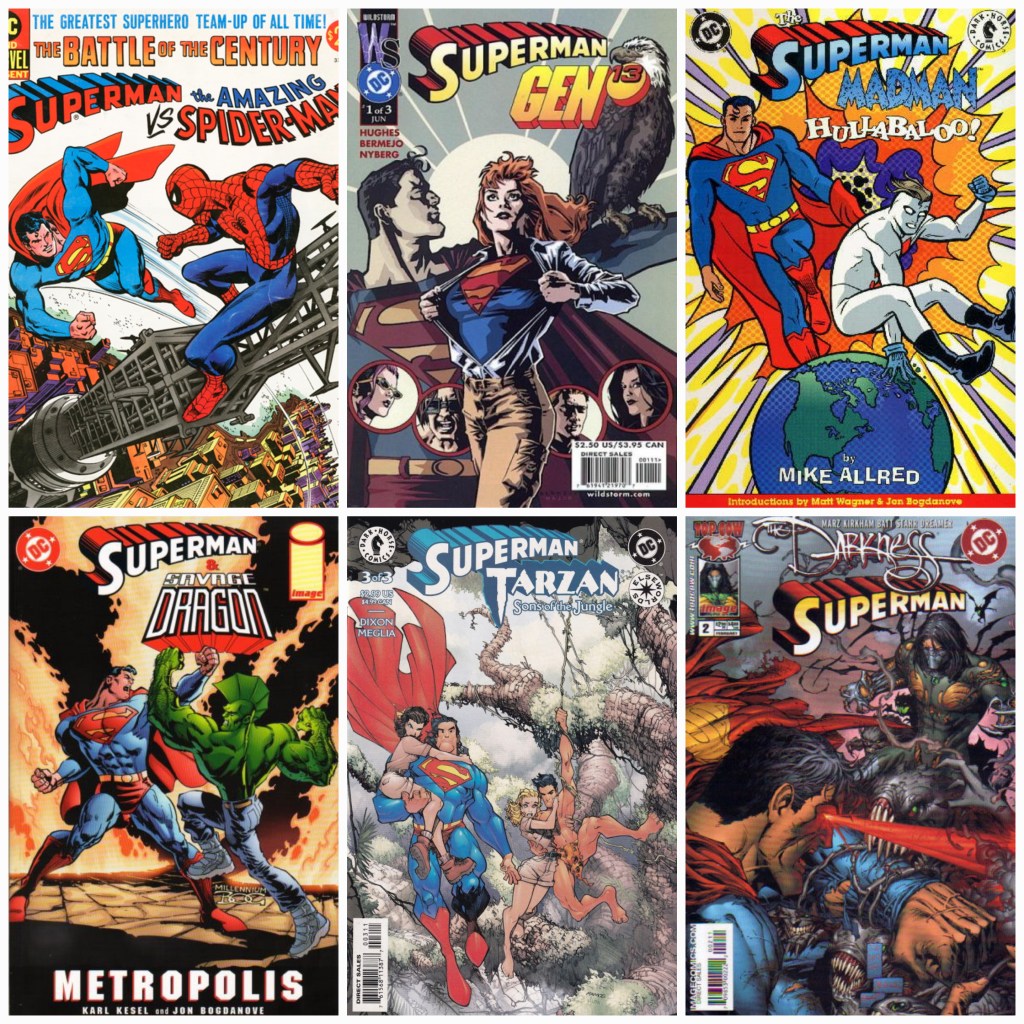
And as always, you can check out earlier blogs in the Year of Superman Archive!
Wed., Aug. 6
Comics: Superman Vs. the Amazing Spider-Man

Notes: This special from 1976 was the first official meeting between characters from the Marvel and DC Universes. Gerry Conway, who had written both characters, teamed up with penciller Ross Andru and inker Dick Giordano for this one, a pretty substantial endeavor at the time. 96 pages, a hefty $2 price point, and an oversized book demanded a story that was worth it…and Conway delivered. The book opens up with a pair of extended prologues where Superman and Spider-Man face off against and capture their respective arch-foes, Lex Luthor and Dr. Octopus. Either of these prologues, by the way, could have easily served as the first half of a story in the heroes’ individual comics, with a standard set-up and nothing that indicates that these two formerly separate universes had begun to bleed together. That doesn’t come until Prologue 3, when Lex is marched into his new prison cell in a maximum security facility in New Mexico, only to find that Otto Octavius is right down the hall. Luthor asks Octavius if he’d be interested in a team-up before revealing he’d hidden a set of tools beneath a layer of fake skin that allowed for a prison break.
Finally, a third of the way into this mammoth comic book, we reach “Chapter One,” in which Peter Parker and Clark Kent finally encounter one another for the first time at a science conference. Both newsmen are having a rough time – Peter finally quits the Daily Bugle in a fit of rage at ol’ J. Jonah Jameson’s frequent abuse, and Clark learns that he’s having a major story ripped out from under him at WGBS because the network wants a “bigger name” reporter. They’re each licking their respective wounds when Superman – or rather, someone who looks like him – swoops in and kidnaps Lois Lane and Mary Jane Watson by zapping them with rays that make them disappear. The heroes both duck out and change clothes, only to encounter one another on the roof. Spider-Man thinks Superman was behind the kidnapping, whereas Spidey’s reputation (thanks to the aforementioned J.J.J.) makes Superman suspect he’s involved, and we get the requisite fight scene. Luthor and Doc Ock are nearby and decide to make things more fun by zapping Spidey with a ray that temporarily enhances his powers, making him strong enough to hold his own against the Man of Steel. After throwing enough punches to satisfy the readers, they calm down, compare notes, and decide to team up to get to the bottom of things.
From there, the story goes largely as you expect – they track down the villains who are holding the girls hostage, they’re sent on a few wild goose chases, and ultimately, the day is saved. But it’s really great to see how well the two of them work together. Honestly, the fight scene is the weakest part of the book, because it requires you to believe that both of these veteran heroes are going to go in spoiling for a fight. It MAY be justifiable if they were totally unfamiliar with one another, but in this iteration where the DC and Marvel heroes co-exist, they know each other by reputation. Superman MAY think Spidey is sketchy thanks to his bad press, but there’s no way Spider-Man would go in swinging against Superman.
Once you get past that, it’s much more satisfying to see them working together, fighting the bad guys, and rescuing Lois and MJ. Conway cleverly aligns things so that each hero gets a moment at the end that gives them a win that they couldn’t have done without the other. Luthor’s schemes wind up cooking up a tsunami Spider-Man could never stop it on his own, but Superman can…only the bad guys would escape were he to do so…if not for Spider-Man. Neat little trick that allows them each to have their moment in the sun.
It took time, but this was the pebble that eventually led to an avalanche of crossovers in the 90s, to the point that it started to feel less special. The sad thing is that familiarity – plus a bit of bad blood – led to the publishers doing nothing together for close to two decades. Next month’s Deadpool/Batman is finally bringing it back, and I couldn’t be happier about that. I love a good crossover, a good combination of characters that don’t usually appear together.
Thur., Aug. 7
Comics: Superman/Madman Hullabalo #1-3

Notes: Next up on my tour of Superman Crossovers Past is this little gem from 1997, Mike Allred’s Superman/Madman Hullabaloo. I discovered Allred’s Madman in college (which I believe is scientifically proven to be the best way to discover the character) and I quite quickly became a fan. Madman is markedly different from most other superhero characters. He is — or was, at this point — an enigmatic creature, a corpse brought back to life with no memory of his past except for a fleeting vision he believes to be the Hand of God. Taking the name Frank Einstein (there is no reason to be subtle in comic books) he becomes a sort of science hero, having adventures in the face of the strangest things imaginable.
In this story, Frank and Superman — in their respective universes — are each working on an experiment that causes them to collide. Their bodies remain in place, but their minds swap places and universes, leaving each hero wearing a mashup of their uniforms and possessing a fragment of Superman’s powers. As Superman is found by Frank’s team, Lois Lane finds Frank and brings him to Emil Hamilton. On two different worlds the heroes look for a solution.
Superman and Frank’s team manage to snap over to Metropolis where they meet up with Lois, Hamilton, and Frank. They quickly manage to restore the heroes to their proper bodies, but fragments of Superman’s powers have been absorbed by various people in both dimensions, leading to the heroes teaming up and hunting them down to restore Superman to full power. In their search, they discover that Mr. Myzptlyk is behind their difficulties, leading Frank to challenge the imp to a contest to give up the game…the greatest contest of them all. It’s Mxy versus the Madman in a game of…(drumroll please)… TWISTER.
It’s really impressive to me just how easily Superman mixes in with Allred’s universe. He looks fantastic in Allred’s art style, and I love the two mashup designs for the blended heroes. Even more than that, though, Superman works so well with the Madman tone. Madman is perhaps the most philosophical ongoing superhero comic book of all time, after all, just as prone to quietly contemplating the meaning of existence as he is to getting into fisticuffs. In fact, one of the first things he does after he and Clark are separated and get to have a real conversation is ask the Man of Steel if he believes in God. How often does that sort of thing turn up in mainstream comics?
Allred also easily evades the trap of having the heroes fight each other for no real reason before the team up begins. As Superman himself points out, he and Frank were literally parts of one another for a while there — if he can’t trust him, who can he trust? They work together very well. If they appeared in the same world on a regular basis, in fact, I could truly believe the two of them are friends. It’s a lovely, quiet, unorthodox little crossover, and I love it.
I don’t think Superman always gets enough credit — from fans or writers — for his intelligence. I don’t mean the whole “Super scientist who builds robot duplicates of himself” either, I mean his emotional intelligence. He’s shown himself often of being so capable of connecting with people on a deep, real level. And in a way, that’s kind of what Madman is all about — connection, trying to find out how the universe is all tied together. Frank is literally a walking corpse, but he’s found love. He’s found a home. He has friends and people who care about him. I’m gonna put on my English teacher hat here for a moment and posit that the reason that Victor Frankenstein is “the monster” in Mary Shelley’s novel isn’t necessarily because he “played God.” Doctors do that every day. But where Victor failed — and where those surrounding Frank Einstein succeed — is that he didn’t give any love to the creature he willed into existence. Jo and Dr. Flem may not be the creators of our ginchy hero, but they give him what Frankenstein didn’t. Earlier in this year we examined Superman as the Frankenstein monster in an Elseworlds tale, and I think the combination of these two heroes would be an interesting place to explore that further.
Allred worked on Superman again just a couple of years ago, in the “Not an Elseworlds Because We Weren’t Using That Label At the Time” miniseries Superman: Space Age where he was teamed with writer Mark Russell. And it was good. But I would love to see Frank Einstein and Clark Kent cross paths again.
Fri., Aug. 8
Comics: Superman/Gen 13 #1-3
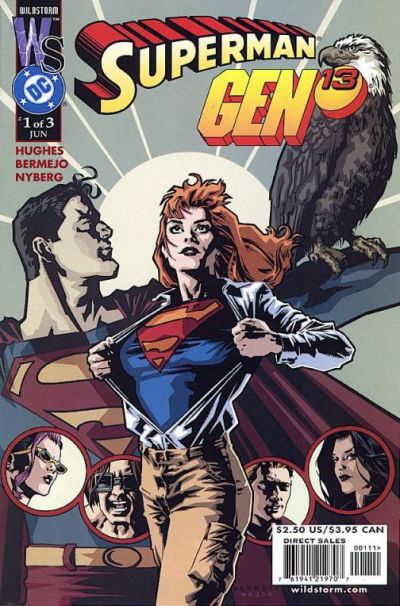
Notes: When Image Comics was founded in the early 90s, Jim Lee’s Wildstorm Studios was one of the major players, with hits like WildC.A.T.S., Stormwatch, and Gen 13. And I think all of us were pretty surprised when, in 1998, he signed on at DC Comics, selling his studio and characters to DC and becoming one of their executives. Since then he’s only risen higher in the ranks, now serving as co-publisher. But in those early days of the marriage of DC and Wildstorm, when the two universes were still separate, this crossover was a nice little event.
Written by Adam Hughes with art by later Lex Luthor: Man of Steel artist Lee Bermejo, it begins with the Gen 13 kids – super-powered fugitives running from the government project that gave them their powers – taking a trip to Metropolis. Their leader, Caitlin Fairchild, is an unabashed Superman fan, and is ecstatic when they almost immediately run across a battle between Superman and Titano. Caitlin is knocked out in the chaos, and Superman puts his cape over her for protection as he goes off to tussle with the super-ape. When Caitlin wakes up she has lost her memory. She wanders into traffic and is hit by a fire truck, but survives without a scratch, and looking down at the cape that was draped over her when she woke up she comes to the obvious conclusion: she must be Supergirl.
Superman promises the Gen 13 kids to help them track down Caitlin, and they wind up at the Daily Planet, where Lois immediately figures out that they’re super-powered, because she’s smarter than the entire team put together. Meanwhile, Caitlin has acquired a store-bought Supergirl costume and makes her “debut” thwarting a bank robbery. Trying to embark upon a superhero career, Caitlin’s natural clumsiness comes out, causing one disaster after another as Superman and her teammates are always stuck one step behind her, cleaning up the messes that she’s made. And it all gets even worse when the real Supergirl gets wind of the chaos being done in her name.
As you’ve probably noticed by now, I have a preference for crossovers that don’t do the standard “meet, fight, team-up” formula that we’ve seen so many times, and this particular series has the most clever sidestep for that I’ve ever seen. Not only do the respective heroes never get into a physical fight, there’s not really even a traditional antagonist. Oh sure, there are a couple of bad guys that need to be thwarted, but they’re all pretty incidental and interchangeable. The real story here is about Caitlin going missing and the ideological struggle between Superman and the rest of the Gen 13 kids. With the exception of Caitlin, the rest of the team is stuck in the mindset of Superman being a boring stiff, with Grunge at one point even expressing this to Clark Kent’s face, unaware of who he’s really talking to. We even get to see a nice conversation with Lois and Clark in which he does his best not to show how deeply hurt he actually is by the way the kids perceive him. As the story goes on, one by one, they slowly come around to realizing his true worth…although this kind of has the side effect of making them seem childish sometimes. From a character standpoint, it may be acceptable that a group of 90s teenagers would think of Superman as lame, but to have three of them making fun of the fourth for cooperating when Superman is actively trying to find their missing friend makes them all seem…well, not “lame,” but a much harsher word for it.
It’s a very nice workaround that tells a very different kind of crossover story. I don’t even mind the cliched depiction of amnesia here – nothing realistic about it, but you’ve got to allow for a certain suspension of disbelief. This one is just fun.
Sat., Aug 9
Comics: Superman & Savage Dragon: Chicago #1 & Superman & Savage Dragon: Metropolis #1
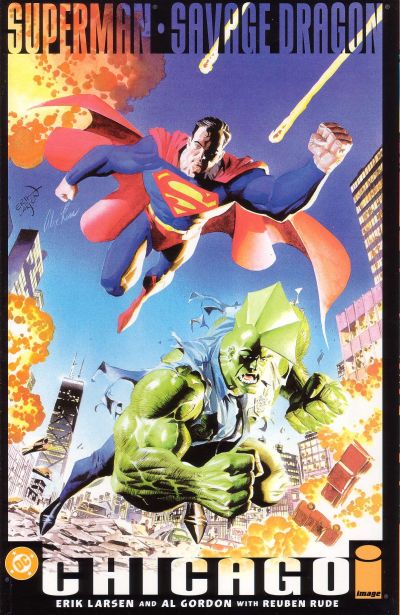
Notes: I’ve never been a Savage Dragon reader, but I get anything with Superman in it, so I’ve had these two books in my collection since they were first released. That was over 20 years ago, though, and I don’t think I’ve read either of them since. I had to check the League of Comic Geeks website to even remind myself which one came out first, and as it turned out, that was a mistake. I got a few pages into Metropolis when Superman and Dragon first encounter each other and start talking like old friends, which got me confused. Metropolis came out in 1999, according to the website, whereas Chicago wasn’t released until the beginning of 2002. But I picked up Chicago instead and saw that I was getting the story of Superman and the Dragon’s first meeting. I wasn’t sure why they were published this way, although I have to wonder if Erik Larsen’s Chicago book was intended to come first but wound up suffering from the kind of delays that frequently plagued Image Comics at the time. When I got to the point where Lois Lane mentions that she’s engaged – an engagement that had ended in marriage several years earlier at that point – I figured that must be the case. The point of this paragraph is that if you happen to have both of these books, read Chicago first.
In Chicago, with story and art by Larsen, some of Superman’s foes are cropping up in the Windy City, having joined forces with the Dragon’s enemies in a crime organization called the Vicious Circle. Superman is called in to help with the menace, something that doesn’t sit well with Officer Dragon of the CPD. The two of them partner up, although the Dragon deeply resents this intruder into his city. Eventually, they manage to mend fences and beat the bad guy. And hey, at least they didn’t actually come to blows with each other.
Larsen has always kind of been hit or miss with me. I like some of his work, but the few times I’ve tried Savage Dragon I haven’t really found it to be to my taste. I can say that he doesn’t mind making his own character look like the jerk in this book, something that a lot of creators would refuse to do, and I appreciate that he writes a pretty solid Superman. Perhaps the best bit, though, is when Lois gets the Dragon to admit that at least part of his animosity against Big Blue is just because of simple jealousy.

I was a bigger fan of Superman & Savage Dragon: Metropolis, written by Karl Kesel with art by one of my favorite Superman artists, “Triangle Era” mainstay Jon Bogdanove. Superman and the Dragon’s second meeting (although the first published) begins with Superman crashing to Earth in a burning field in a scene highly reminiscent of how the Dragon was found in his own very first issue. When he wakes up, Superman has no memory of the last few days, and the Dragon is called in to help him piece together the mystery of what happened to him and how it’s linked to a series of strange murders in the city’s homeless population. Their investigation brings them across Killroy, son of Steppenwolf, and into battle with Darkseid and the forces of Apokalips.
As I said, I prefer this book to the other one. It’s more steeped in the Superman world, which is of course more engaging to me, and Kesel has some fun with it. When Superman and the Dragon visit the Daily Planet office to look into what Clark Kent had been working on before Superman’s disappearance, for instance, there’s a funny scene where Superman and Lois have a strained discussion over what Clark’s password is on the computer system: Superman insists that “Clark” told him that he had changed it, whereas Lois insists that “he” would have told her so. Yeah, they’re married at this point, and the scene, played out in front of Jimmy and the Dragon, is highly amusing. We also get to visit with Bibbo in Suicide Slum, who declares that the Dragon is okay because any pal of Superman’s is a pal of his too. The fun here is seeing how the Dragon responds to the way that the people of Metropolis treat their hero, as opposed to the treatment he’s used to.
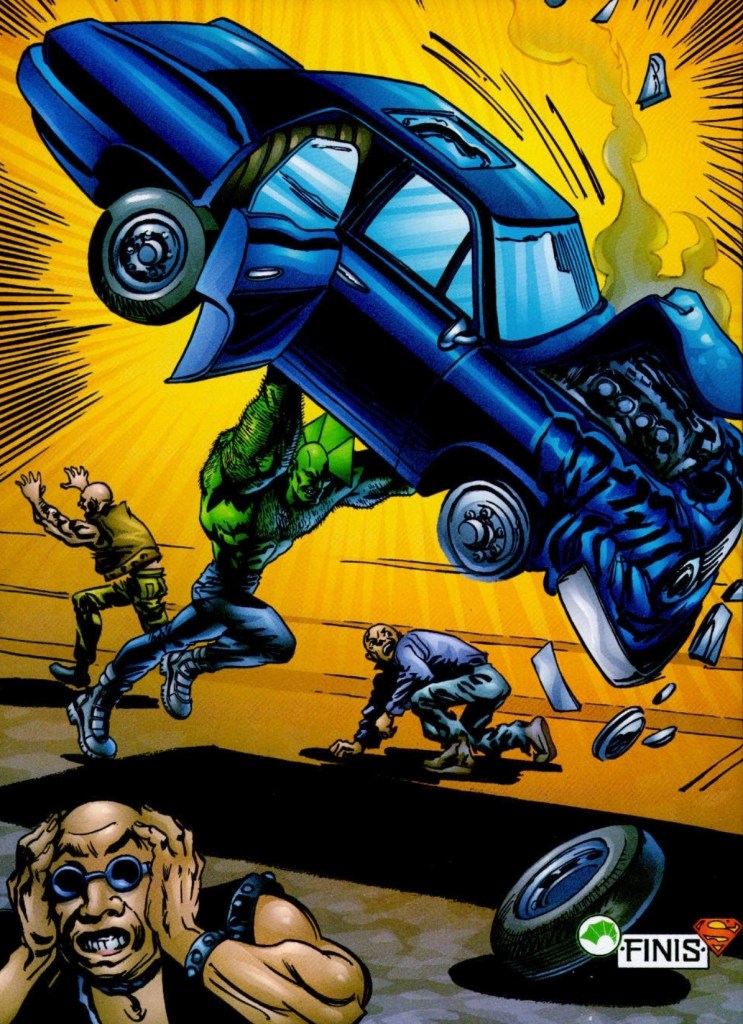
The one knock on this book is that the Dragon himself is kind of secondary. The other book plays off of the differences between the two of them more, with Dragon’s animosity grinding Superman and vice versa. In this one, the hatchet has been buried and they’re friends, which means you could swap out the Dragon with pretty much any other character that has super strength and the changes to the plot would be negligible. It does end on a really cute note, though. Feeling bad about Lois being worried about him during his disappearance, Superman asks the Dragon to cover for him in Metropolis so he could have a night off from fighting crime. His buddy the Dragon agrees, which leads to a last page that is just the kind of winking-at-the-camera nonsense that a reader like me digs.
Sun. Aug 10
Comics: Superman/Fantastic Four #1, Jon Kent: This Internship Is My Kryptonite #2

Notes: For the first time since this project started, I’m going back to re-read something. At the beginning of the year, I was finishing up the mammoth DC/Marvel Omnibus that came out last fall, and I read a few books at the tail end of that, but I didn’t write about them in detail. But this week, when I’m talking about great Superman crossovers, I felt like I really should address that time Superman met the team that he’s sharing cinemas with this summer in Dan Jurgens’ oversized Superman/Fantastic Four one-shot from 1999.
In this one, Superman finds a message from his late father, Jor-El, who tells him that he wants his son to avenge the destruction of Krypton, which he now claims was destroyed by the world-devourer, Galactus. But in this book, which came out post-DC Vs. Marvel (which I’m planning to read soon), Superman is aware that Galactus is a cosmic force that has been encountered by the heroes of the “Other” Earth (aka, the Marvel Universe), and decides to seek out the world-hopping metahuman from that crossover, Access, to help him traverse the universes. (Access is name-dropped but, like “Sir Not Appearing in This Picture” from Monty Python and the Holy Grail, he is mysteriously absent.) In the Marvel Universe, meanwhile, Franklin Richards is playing with the action figure of his favorite cartoon character, Superman, who is apparently a fictional hero on Earth-616. No one is more delighted than Frank when the real deal shows up at Four Freedoms Plaza asking for their help. But Superman winds up having to fight for the Four when their defense systems turn on them, having been hijacked somehow by the Cyborg Superman. Things get worse – much worse – when Galactus shows up and decides he wants Superman for his new herald.
You know how I keep talking about how I dislike crossovers where the heroes fight each other for no reason? Well thank Rao, this story actually gives us a reason. Superman being transformed into a Herald of Galactus is a more than legit reason for him to face off against the FF, but even then, the conflict is brief and has more of a feeling of a rescue mission than actual combat. The FF know that Superman is a hero, and they’re trying to free him from Galactus’s control rather than actually take him down.
I also like the fact that this crossover – as well as a few others from this time period – recognized the fact that DC Vs. Marvel happened and used that as part of the fabric of the story. It allows this story to fit into the continuity of both sets of characters, which the early crossovers like his encounter with Spider-Man simply can’t do. Unfortunately, by the time JLA/Avengers rolled around a few years later, that angle was dropped. The heroes were still from separate universes, but there was no recognition of the fact that any of them had met in the past. I can’t help but wonder what the plans are for Deadpool/Batman and the assorted back-up crossovers that are going to come in those two books.
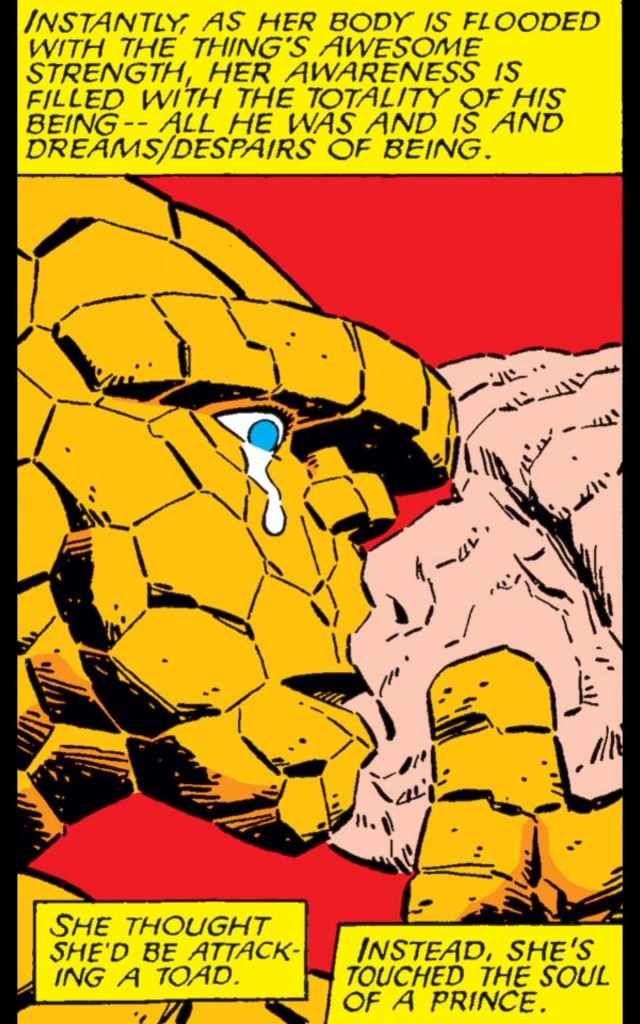
Finally, although this isn’t really about Superman, this issue makes me wish Dan Jurgens had done a run on Fantastic Four at some point. He has the voices for the characters down very well, and I love his rendition of the Thing (my #2 all-time favorite character), but peeking at his credits I only see a handful of FF-related comics, and none on any of their regular titles. There’s still time, Marvel. I love what Ryan North is doing these days, but how about hitting Jurgens up for a miniseries or something?
Mon., Aug. 11
Comics: Superman/Tarzan: Sons of the Jungle #1-3
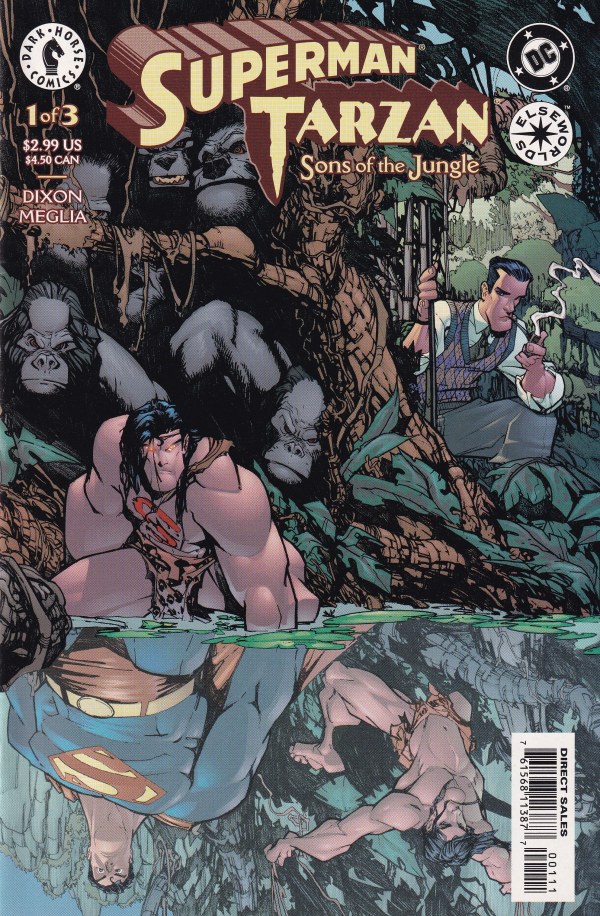
Notes: I love a good crossover. I love a good Elseworlds story. To the best of my knowledge, the two have only collided twice. The first was John Byrne’s excellent World War II romp, Batman and Captain America. The other was this three-issue miniseries by Chuck Dixon and artist Carlos Meglia. In this one, the mutiny that leads to the abandonment of Lord Greystoke and his wife is thwarted when a star streaks through the sky. Taking it as a sign from God, the mutineers retreat from their plan and the family makes its way back to England. That streak, however, lands in the thick of the jungle, where a familiar ape tribe finds what appears to be a human baby in the wreckage. When the child demonstrates remarkable strength, they adopt him and name him “Argo-Zan,” meaning “Fire-skin.” The Greystokes have their child, named John, and the two babies grow into very different men. In the jungle Argo-Zan finds the wreckage of the craft that brought him to the apes, along with a holographic vision of his true parents. As he learns of the legacy of Krypton and adopts his true name, Kal-El, in England John Greystoke advances through school – a brilliant scholar, but somehow lost and empty, as though there is some hole in his life he cannot account for.
After some struggles, Kal-El finds himself able to bond with a human tribe, but an enemy ape has an eye out for a mysterious glowing rock that seems to plague his rival. Greystoke, meanwhile, has been wandering the world trying to find himself, finally planning an expedition to Africa. Along with him is a correspondent for the Daily Planet, Lois Lane, as well as Lois’s aide, Jane Porter. Their dirigible is brought down by a hostile tribe but, believing the aircraft is from Krypton, Kal-El leaps to their defense. In the ensuing battle, both men find themselves and their purpose. Kal-El returns to civilization with Lois, while John Clayton chooses to remain in Africa with Jane Porter, adopting the name the friendly tribes have given him: Tarzan.
As I said, I’m a big fan of crossovers. I am not, however, particularly steeped in Tarzan lore. I’ve seen a few of the movies, read a few of the comics, but I’ve never dove into the original Edgar Rice Burroughs novels (I’m more of a John Carter of Mars fan) so I can’t really say how closely this comic traces any of the original lore. I’m not even sure which characters (aside from Lois, Clark, Tarzan, and Jane) are Burroughs characters and which are original creations of Dixon and Meglia. That said, there’s a lot I like here. We’ve got the classic Elseworlds concept of taking the hero and switching his origin with somebody else, as we saw when Kal-El became Bruce Wayne in Superman: Speeding Bullets or when Bruce Wayne became Green Lantern in Batman: In Darkest Knight. And although the book ends in the old “What If”/“Elseworlds” format of bringing the heroes as close to the “real” status quo as possible, it does so without giving us obvious analogues for Lex Luthor or any of Superman’s main villains, which is a nice change of pace.
As a crossover, it’s pretty unique. Not only do Superman and Tarzan not fight each other in this one, but Kal-El and John Clayton never even interact until the last few pages of the three-issue story. In some ways it’s more like a crossover of worlds than of characters. The book ends (as these often do) as soon as a new status quo is established, something ALMOST the same as the “real” universe, and we don’t really get to see any of the aftermath. Sometimes that can be a good thing, but in this case, I actually wish there were more. It feels like we’ve read one act of a story. I’m left wanting to see how the ape-raised Kal-El adapts to a society that he doesn’t truly understand, especially with the power at his disposal. I’m curious as to what kind of man Tarzan is when raised by his human parents instead of an ape tribe. And I really want to see the two of them interact a bit more. And you know, leaving the audience wanting more is typically considered a good thing. The problem is when that desire is because it feels as though the story is unfinished, and to a small degree, that’s kind of how I feel here.
It’s not unusual in comics for a different artist to do the covers than the interior artwork, but in this case I think you’ll forgive me for not realizing that happened until I double checked the credits to write this. Carlos Meglia’s style is reminiscent of an adventure cartoon, with the kind of big eyes and oversized feet that bring to mind Japanese manga, so you can understand that I didn’t notice Humberto Ramos ONLY did the covers for this series. Their styles are very similar at first glance, and should Mr. Meglia ever somehow read this, I hope he knows I mean that as a compliment.
This is a unique crossover, and one I enjoyed. It would be nice to see more Elseworlds crossovers. And now that DC has brought that imprint back from the dead, it doesn’t feel impossible.
Tue., Aug 12
Comics: The Darkness/Superman #1-2

Notes: I’m going to close off this week of Superman crossovers with the two-issue team-up between Top Cow and DC from 2005, The Darkness/Superman, written by Ron Marz with art by Tyler Kirkham. I know even less about The Darkness than I do Tarzan. I know it’s a Witchblade spin-off, and I believe that the main character is the son of a mafia kingpin or something, but that’s pretty much it. Did that stop me from getting the crossover when it dropped? Absolutely not. Seriously, it’s been 32 weeks, you’d think you would know me better than that by now.
Fortunately for me, the book gives me a quick rundown on who the character is – Jackie Estacado, mafia hitman who becomes the controller of a mysterious demonic power called “The Darkness” on his 21st birthday. After he killed the guy who killed his girlfriend, he became…I dunno, not a hero. He’s still a mobster – the book even starts off with him meeting up with Metallo in Metropolis to flex his muscles and show he’s the man to take over their organized crime rackets. The Daily Planet gets word that Estacado is in town and Perry sends his top people out to find out what they can, which leads to Superman stumbling on an encounter between Estacado and Metropolis’s Grasso crime family. Estacado tries to convince Superman that he’s the better crime lord for Metropolis – that he would run a smooth organization that doesn’t let innocent people get caught in the crossfire, unlike the current regime. But the meeting is interrupted when Metallo shows up again, brandishing his Kryptonite heart as usual, and takes Lois Lane hostage, because it was like already February 3rd and Lois had only been held hostage four times so far that year.
When Metallo escapes with Lois, Estacado offers to help Superman get her back, recognizing that the Kryptonite keeps the Man of Steel at bay and that Lois is, and I quote, “More than just a cute reporter to you.” Superman reluctantly takes him up on his offer and is forced to watch from a distance as Estacado invades the Grasso’s hideout in an effort to save her. Once Lois is safe, he returns to Superman and reiterates his plan to move into Metropolis…but Superman stands his ground. The two of them come to blows before Superman defeats him because…the sun comes up? That seems to be what happens. I guess Jackie Estacado’s powers go away in daylight? At any rate, once that happens he gives up and promises to stay out of Metropolis. Superman lets him go out of gratitude for saving Lois. The two part neither as allies nor as friends, but at least not as enemies.
At least this time the requisite crossover fight makes sense. This isn’t Superman teaming up with a hero, he’s forging an uneasy alliance with an anti-villain. Jackie even tells him at one point, “I’m a bad guy, but I’m not a BAD GUY.” (This was seven years before Wreck-It Ralph used almost exactly the same line, so good for you, writer Ron Marz.) And I concede, that’s the vibe I’m getting here. Jackie isn’t really a pure villain, but there’s definite Michael Corleone energy here. And to be fair, he works pretty well as that kind of character. I’ve enjoyed Marz’s work for a long time, so I’m not surprised that he made this work for me as well.
That said, there are a few things that don’t quite gel. Superman sitting on the side while someone else fights Metallo for him, first of all. Sure, Metallo has the whole Kryptonite thing going on, but when has that ever stopped Superman from going in for the fight? And although I suppose Jackie was written in-character (I assume, since Marz was the writer for The Darkness’s ongoing series at the time, that he knew how he would behave), but it still seems a little bit of a stretch to think he’d really believe Superman would turn a blind eye to his operations just because he’s the lesser of two evils. Superman isn’t going to settle for ANY evils if he’s got anything to say about it.
It was a fun week, poking around at more Superman crossovers, and there are still more that I haven’t looked at yet, including the epic DC Vs. Marvel event and its several spin-offs, such as the Amalgam Comics line. I’m looking at the big, gorgeous omnibus edition that DC published of that series last year, just waiting to be read, and I think I’ll get around to that pretty soon. Maybe even next week.
Blake M. Petit is a writer, teacher, and dad from Ama, Louisiana. His most recent writing project is the superhero adventure series Other People’s Heroes: Little Stars, volume one of which is now available on Amazon. You can subscribe to his newsletter by clicking right here. You can join in the Kryptonian Konversation every day in the Year of Superman Facebook Group!





 Blake M. Petit