Year of Superman Week 47: Superman Through the Ages (Part One)

As Week 47 dawns, I find myself in a quandary. You see, with only six weeks left in the year, I am looking down at the list of stuff I wanted to cover and I know there’s simply no way I’m going to get around to everything. I expected that, to be honest. But there are certain things that I feel I SHOULD cover, particularly different media productions of Superman that I’ve barely touched upon, if at all. From today, Nov. 19, I looked at this week – after Saturday I’ll be on Thanksgiving break. That will give me a little bit more time to do some of these things, but will it be enough? Can I squeeze in ALL of the movies and TV shows I haven’t done? Or would I have to wait until next week, which will begin the day before Thanksgiving…but I’ll be back at work that Monday. And in the meantime, there are several days where I know that my time will be limited – Thanksgiving itself, at least one “shopping” day, and two days during the break which are devoted to taking the family to the Louisiana Renaissance Festival and taking my son to see Zootopia 2. How can I POSSIBLY choose a week to fit all of these things in? I’m sitting here pulling out my hair…

And then the answer hits me.

“You dummy,” the answer says, “this is YOUR challenge. You can make the rules whatever you want. Who says it has to be just ONE week?”

Doy.

So over the next TWO weeks, I’m going to endeavor to cross off as many of the remaining Superman adaptations as I possibly can, while allowing myself the days where I know I’ll have to find something short to read that will not fit the theme. I am choosing to be kind to myself. Superman would approve. 

I’ve created for myself a list of every Superman movie – theatrical or animated – I have not already reviewed this year. I’ve also added the pilot episodes of any show I haven’t discussed substantially. (I feel like I’ve written, at various points, enough about Superman: The Animated Series, Superman and Lois, and My Adventures With Superman that I’m okay skipping those.) I’ve also added in the old theatrical serials, a few significant documentaries, and a few adaptations that are too weird to resist. All in all, there are about 30 different things I hope to watch, and I make no promises of getting to them all, but I’ll do my best. 

And I’m going to start with something entirely different.

And as always, you can check out earlier blogs in the Year of Superman Archive!

Wed., Nov. 19

Radio Program: The Adventures of Superman serial “Clan of the Fiery Cross,” episodes 3-12. 

Notes: I’m gonna share a little behind-the-scenes magic with you guys. That internal monologue I just shared with you? That didn’t happen today. I went through it a few days ago. Please continue to trust me.

That said, once I decided to do this format, I knew that one of the things I HAD to include was the Adventures of Superman radio show, which starred Bud Collyer – the Superman of the Fleischer animated shorts – as Clark Kent and Superman. Beginning in 1940, the radio program was the way that a lot of people were first introduced to the Man of Steel, and between that and the Fleischer shorts, helped make him a household name. In particular, there was one storyline from 1946 that I’d intended to listen to from the day I decided on the Year of Superman project, and this seems like the perfect time to do it. The story, which lasted for about 15 installments of daily 15-minute episodes, is titled “Clan of the Fiery Cross,” and it is EXACTLY what it sounds like.

Clark Kent is hanging out with cub reporter Jimmy Olsen (Jackie Kelk) who tells him about the hot new pitcher on the Unity House baseball team, a kid named Tommy Lee. Their previous pitcher, Chuck Riggs, is pretty sore that Tommy took his spot when he moved to Metropolis. He keeps harassing Tommy, even intentionally hogging the plate in practice, resulting in him getting beaned by a pitch. Jimmy, the manager, throws Chuck off the team for his behavior. Chuck goes home to his Uncle Matt and tells him the story, and Matt brings Chuck to repeat his tale to a “secret meeting,” embellishing and lying to make it seem like Tommy hit him malevolently. Chuck’s group, the Clan of the Fiery Cross, uses this as an excuse to launch an attack against Tommy and his family, especially his father, a doctor who was recently awarded the job of the city’s top Bacteriologist. As the Clan’s activities get more frightening and brutal, even kidnapping Jimmy and Perry White over an anti-Clan editorial, Jimmy’s pal Superman naturally has to step in to preserve the fight for truth, justice, and the American way.

I apologize if the following description offends anybody, but I have to say it: putting this story on the radio in 1946 was ballsy as hell. Without ever using the real name, the story was a direct attack on the Ku Klux Klan, painting Matt and his cronies as bitter, angry cowards and not flinching away from the nasty portrayal of their bigotry. The story was inspired by a man named Stetson Kennedy, who infiltrated the real KKK and suggested the story to the show’s producers, even giving them details about real Klan rituals, some of which were used in the show. The writers also took great pains to paint the average Clansman as weak and cowardly. One of the most amusing parts comes in the final few episodes, when Matt Riggs flees to the leader of the Clan, only to learn that his “Superior” doesn’t even believe in the racist bile that they’ve been spewing. He sees the Clan as nothing more than a means to milk money out of hateful, pathetic men. I’m not sure if that makes him better or worse than the true believers, but either way, it’s food for thought. 

The show reportedly had a real-world impact as well, trivializing groups like the Klan and cutting into their recruitment and membership, taking away the power. For the first time, Superman wasn’t just a fictional hero, but was doing real, measurable good in the real world.

To make it even better, the story itself not only cuts some real world bad guys off at the knees, but it’s a corker of a story, too. One of the things I like about it is how they slowly build the threat. In the first episode (each of which is only a little more than ten minutes, with the commercials cut out) all we really see is that Chuck hates Tommy for taking his spot on the baseball team. The implications are pretty subtle for the first and second episode, with it not quite being overt just WHY Uncle Matt hates Tommy’s family so much. The only clear comment I remember hearing, in fact, is Tommy shouting the word “yellow” in the midst of an argument, and with multiple people shouting it would be easy to miss or to misconstrue as meaning “coward.” The Clan is introduced in episode two, and it was obvious from the outset just what group the producers were parodying, but it’s not until episode three that Tommy and his family are explicitly stated to be Chinese. Now to be fair, I’m not a historian. It’s entirely possible that in 1946, just having the last name “Lee” would have been a dead giveaway. But they don’t SAY it. Tommy has no accent and never says anything that would betray his heritage, helping drive home the point that he’s just like the rest of the boys on the baseball team, so by the time we know his family is Chinese we’re already on his side. If a listener was the type of person who would have been put off by that, the structure cuts them off at the pass.

On a pure character note, I appreciate how much of this story is taken up with Clark Kent, rather than Superman. Clark is the one who encourages Tommy, then Tommy’s father, to stand up to the Clan. Clark is the one who frequently puts out speeches about how cowardly and vile the Clan is and what it means to be a true American. In fact, he doesn’t even put on his Superman costume at all until episode six, when he has to save an injured Tommy from drowning in the river. Jimmy, on the other hand, is brave and stalwart, but comes off as a little dim. There are several instances where Clark has to use his powers in a way that causes Jimmy to question how he knew something (like the bomb he spots with his X-Ray vision) or where he went (saving Tommy from a deliberately hurled baseball bat), but when he asks about it, Clark simply changes the subject and Jimmy never thinks to bring it up again. This is why you’ve been a cub reporter for 90 years, James. 

The one-off characters are served well, too. Tommy and his father are well-drawn characters, with realistic actions and motivations. And even Chuck Riggs gets a redemption arc, struggling with whether to help Clark Kent track down his uncle once he realizes just how vicious the Clan actually is. I love a good redemption arc, probably because it speaks to a belief that somewhere inside, most people are good at heart. 

It can be a little heavy-handed at times – at least once an episode somebody (usually, but not always Clark) launches into a speech about how bad the Clan is and how people can be as American as anybody else regardless of “the color of their skin or the church they attend” (not an exact quote, but that’s the gist of it). I usually find it off-putting when a movie or TV show hammers their point in like this, even when it’s a point I happen to agree with, but it’s easier to swallow here when you remind yourself that this was a different time (a time when the Clan’s ideas were far more popular than they are today), that it was a show for children who maybe NEEDED to hear it over and over again, and that the show was originally presented as a daily serial and perhaps needed to restack not only the theme, but also the plot frequently. 

I’ve always enjoyed old radio shows, but most of the time I listen to the comedies. This was a fun, exciting trip to the past with Superman, and although I haven’t quite finished the story as of this writing, I’m really happy to have made it into the rotation. A few years ago Gene Luen Yang adapted it into a three-issue miniseries, which was also excellent, and I’m going to try to squeeze it in before the end of the year. But the year is already pretty packed, so no promises. 

Comics: Aquaman: Yo-Ho-Hold On to Your Hook #20 (Guest appearance, Power Girl), Justice League of America #44

Thur., Nov. 20

Radio Program: The Adventures of Superman serial “Clan of the Fiery Cross,” episodes 13-16. 

Comics: Spawn #10 (Oblique Cameo), Justice League of America #46 (Team Member)

Movie: Superman and the Mole Men (1951)

Notes: My goal, over the next two weeks, is to scratch off as many movies and pilot episodes of the various Superman adaptations as I can. Today I got to do two in one. Superman and the Mole Men was a short theatrical film (only 58 minutes!) starring George Reeves and Phyllis Coates in a sort of trial run for the Adventures of Superman TV series, which would premiere in 1952. Reeves and Coates, of course, carried over to play Superman and Lois Lane, but Coates would later leave the series and be replaced by Noel Neill, who had previously played Lois during the Kirk Alyn movie serials, at least one of which I’m going to try to watch in this block on a day where I’ve actually got the time. (Those suckers are four hours long, all together.) This short movie was later edited down into two TV episodes at the end of the first season of the TV show. 

Which is easy to do, honestly, because at the time there wasn’t really the insistence we have today on pilot episodes setting up a series. If you watch the first episode of most TV shows from the last few decades, be they comedies, dramas, or genre shows, that first episode almost always includes a story that sets up the status quo for the series: a new person joins the workforce, a family moves to a new town, a superhero gets an origin, and so forth. In the 50s, though, pretty much every series was given a status quo right out of the box that never deviated, allowing people to watch any episode in any order without any risk of confusing them. So George Reeves’ Superman never got an origin beyond the opening narration that tells us about the ol’ “Strange visitor from another planet” and “Who, disguised as Clark Kent” routine. 

In Superman and the Mole Men, Clark Kent and Lois Lane are sent out to write a story on the world’s deepest oil well. The night they arrive, though, a pair of bizarre, furry creatures climb out of the oil shaft, frightening the night watchmen enough to trigger a fatal heart attack. As Lois and Clark try to investigate his mysterious death, Lois spots the “mole men” and we get the classic Cassandra bit of her telling people all about it, but them not believing her, at least not initially. When the mole men are spotted in town, an angry mob forms and attacks, shooting one of them. Superman rescues the wounded creature, taking it to the hospital, where the mob follows them, but Superman protects the recovering mole man. Three more of the creatures come out of the drill shaft, this time with a laser gun. They fire on the mob, but Superman blocks the laser to protect the humans. He returns the injured mole creature to his people and they take him back down into the Earth, destroying the well on their way down.

As a movie, this isn’t exactly the sort of thing that burns up the screen. The story is pretty small and we barely even glimpse the world of Superman – we never see the Daily Planet office or even any of the city of Metropolis, after all. But that’s judging it by modern standards. At the time, this would have fit in perfectly with the sort of B-roll movies that studios turned out to fit the back half of a double feature. And looking at it as a pair of TV episodes, it’s clearly got a bigger budget and wider scope than the standard episode of The Adventures of Superman usually did. It also does a great job of establishing Superman’s values right away: he protects EVERYBODY. He saves the mole man from an angry mob, then he saves the angry mob from the mole men. He gives the rioters a good talking-to, admonishing their behavior like a disappointed high school principal even as he’s taking their guns away from them, but even then he’s not going to let them get hurt either. There’s my Superman for ya. 

The most important thing about this is George Reeves himself. From the outset, his Superman and Clark Kent are fully formed characters – brave, noble, and dauntless in their pursuit of what is right. If there’s any flaw to his performance, is that he doesn’t do enough to distinguish Clark from Superman. Clark is TOO bold, TOO heroic, and the notion that Lois Lane wouldn’t see through his disguise in ten seconds is more laughable here than in any other iteration of the franchise. Reeves’ Superman is great, and I love his performance dearly, but he’s exactly the same whether he’s wearing glasses or tights. 

As for Phyllis Coates as Lois Lane…I would never say her performance is BAD, but she lacks the sort of fire and verve that I like my Loises to have. I grew up watching reruns of this show on Nick at Nite, and even as a kid I could see a distinct level up when Coates left the show and Noel Neill took over. But I’ll get my chance to talk about her when we get to the movie serials.

This movie isn’t a masterpiece, but it’s a fascinating piece of Superman lore, and if you’re a real fan of the character who has never seen this (or at least seen the edited two-parter of the TV show) it’s worth looking up. 

Fri, Nov. 21

Comic Books: New Adventures of Superboy #37, Batman: Wayne Family Adventures #41 (Guest Appearance), World’s Finest Comics #307

Notes: I mentioned in my preface this week that there will be days over the next few weeks where I just flat-out know I won’t have the time to watch anything longform, or possibly anything at all, and today is such a day. So I’m going to sneak in The New Adventures of Superboy #37 from 1983, mostly because issue #38 is an all-too-rare Thanksgiving story, and I want that to be available to read next week.

This is actually part two of a story I read a little while back but didn’t blog about, in which Clark’s teacher William Wright gets mental powers. In the previous issue, he managed to defeat Superboy while using his powers to make some of his students rob a bank. Superboy approaches him, but Mr. Wright again stops him, throwing a car at him and somehow taking away his ability to fly. Wright tells Superboy that he’s discovered that he can do literally anything, provided he BELIEVES in it strongly enough, and that linking his brain to the teenagers enhances his powers. Despite his repeated defeats, Superboy confronts him again and Wright uses his powers to believe that the moon will stop orbiting the Earth. Superboy’s super-senses immediately confirm that it worked, but he pretends that it didn’t in order to put a chink in Wright’s belief system. He bluffs his way into making Wright’s powers diminish, then he helps Pete Ross – one of Wright’s mind-slaves – break out of his control, further weakening Wright’s powers. Eventually, he defeats Wright, using the reasoning that if Wright’s powers only work because he believes they can, they WON’T work if his victims DON’T believe they will.

It is, of course, infallible logic.

There are a few things, I think, we can take away from this story. First, it is incredibly stupid for anyone – hero or villain – to explain exactly how his powers work to his opponent. That’s just a recipe for defeat. And second, the Small County, Kansas Department of Education really needs to tighten up its screening process for potential hires.  

Sat., Nov. 22

Comic: Superman Unlimited #7

Notes: I just got home from a long – and fun – day in Hammond for the annual Louisiana Renaissance Festival. We don’t go every year, but it’s been a few years since the last time we went and Eddie has gotten much more attentive. We wanted to see how our older little guy would enjoy it, and also, my wife wanted to consume a comically large turkey leg. All of our goals, I am pleased to announce, were satisfied during the course of the day.

But the Year of Superman waits for no Festival, and even though I’m bone tired and my dogs are barkin’, I cannot go to bed without getting a little Kryptonian Kontent. Fortunately, yesterday one of the various errands I ran involved picking up the last couple of weeks of Superman comics from the local shop, so as Eddie watches LSU football, I’m snuggling into the couch with issue #7 of Dan Slott, Jeremy Adams, and Lucas Meyer’s Superman Unlimited.

In Smallville, Jon Kent is helping John Henry Irons test out some special gauntlets that are supposed to neutralize Kryptonite radiation. While he’s there, a message from Lois leads him to the brand-new Smallville office of the Daily Planet, which she’s asking him to head up, challenging him to start his new career by bringing in a story as Jon Kent, without the powers of Superman. The hunt for a story leads him underground, where he encounters an enormous drilling robot with some surprisingly familiar pilots.

First of all, I have to give Slott and Adams (pinch hitting on the dialogue for this issue) credit for trying to find some sort of structure in Jon’s life. The character has been utterly aimless for entirely too long, and although I’m never going to be happy about the way he was aged up in the Bendis run, if he’s going to be an adult at least they’re making an effort at actually treating him like one. It also provides us with a few amusing scenes, like a Steelworks employee who completely fails to see through Jon’s glasses despite the fact that he was crushing on him while in costume a few scenes earlier and John Henry being flabbergasted that the disguise actually works.

Second, in one of those little moments of serendipity that you just can’t plan for, this issue brings in none other than – drumroll please – the Mole Men! Yes, the co-stars of the first-ever Superman theatrical feature film starring George Reeves, the one we talked about just a few days ago, are brought into the DC Universe proper in the pages of this issue. The comic was released on Wednesday and I didn’t watch and blog about Superman and the Mole Men until Thursday, but I swear, this was a total coincidence. It’s just one of those little moments of serendipity that make my career as a world-famous, jet-setting Superman blogger all the more rewarding, y’know? 

Sun., Nov. 23

TV Episode: The New Adventures of Superman Season 1, Episode 1, “The Force Phantom”; The Adventures of Superboy Season 1, Episodes 1-2, “The Spy From Outer Space” Parts 1 and 2.

Notes: In 1966, over a decade after the George Reeves TV show left the airwaves, Filmation reunited Fleisher and radio stars Bud Collyer and Joan Alexander for a new series of Superman adventures, cleverly titled The New Adventures of Superman. This was one of several DC comics adapted into animated form at the time and shown in blocks with each other. There were a total of 68 seven-minute shorts in this series, and I’m about to watch the first one “The Force Phantom.” 

In “The Force Phantom,” a beam of energy from outer space arrives on Earth and coalesces into a being of pure force that begins destroying space bases across Earth, on a Westward march towards the United States. Fearing that Cape Kennedy is next, Superman zips down to Florida to stand sentinel. At the same time, a flying saucer from Mars orbits the Earth, and its inhabitants send the Force Phantom down to Earth to attack Cape Kennedy. Superman rescues an American rocket  from the creature, but its rampage continues, hitting Superman hard enough to drive him into the ground. Superman’s relentless attack damages the machine generating the creature from the flying saucer, and Superman races into orbit to stop the Martians. He fights the Phantom again, in space, this time overloading and destroying the generator. He drives them back to Mars and returns to Earth, giving the story of Superman’s latest adventure to Perry White. 

The episode has the legendarily limited animation that we’ve come to associate with Filmation studios. Although not as bad as, for example, the early Marvel Comics cartoons (which were little more than slideshows), the characters move slowly and their action is stilted, with mouths that only barely match the words that are being spoken. That said, there are some cool visuals here. It may have been cheap to produce, but I actually really like the design of the Force Phantom itself – basically a bunch of lightning bolts in humanoid shape with empty space within its body. And the Martians themselves look like old-fashioned stereotypical “evil invaders from outer space,” right down to the insidious mustaches. Collyer is doing his best in this cartoon, still sounding like Superman, but one has to wonder if he ever pondered the fact that he went from starring in the most beautiful, lushly animated cartoons of the era to something that looked like it could have been done via a flipbook. 
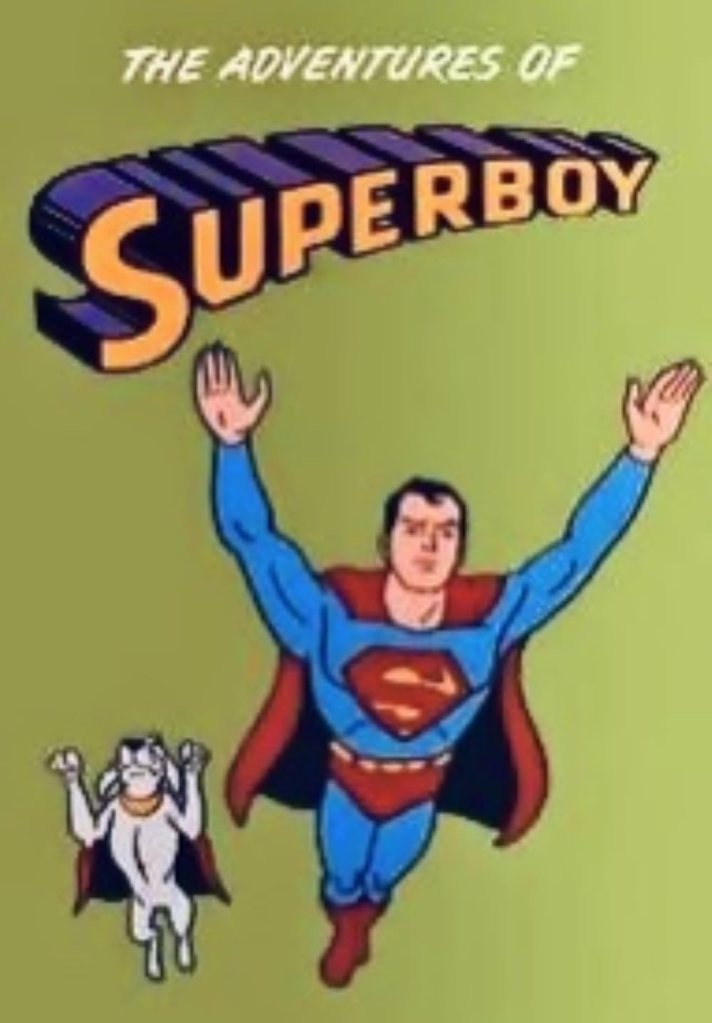
One of the other DC properties that joined Superman in the 1966 Filmation block just happened to be his younger alter-ego, given his first TV appearance with The Adventures of Superboy, starring Bob Hastings as Superboy and Judy Jetson herself, Janet Waldo, as Lana Lang. Superboy’s cartoon kicked off with a two-parter, “The Spy From Outer Space.” The cartoon begins with Krypto waiting for his master when a green man from outer space appears and begins melting a nearby mountain into lava! Krypto rushes off to summon Superboy, who happens to be in class at Smallville High at the moment, but he ducks out and joins his dog, keeping in the canonicity of the Superboy comic I read a few days ago which showed that the education system in Small County left a lot to be desired. Superboy and Krypto dig a trench to stop the lava from reaching civilization, while elsewhere the alien summons bolts of lightning and tornados to smash up nearby farms. Superboy stops the freak weather and Krypto leads him to the alien, which includes the objectively hilarious moment when Superboy looks down from the sky to see a green-skinned alien wearing a jetpack and asks his dog, “Is that the one?”

Superboy catches the alien and brings him to the police, where he confesses to being a spy and then giggles as he teleports away. The boy and his dog track the alien to his homeworld only to find that the planet’s red sun drains Superboy’s powers. He’s captured and the aliens and tell him of their plan to invade Earth, but Krypto finds a way to block the red sunlight and restore Superboy’s powers (why doesn’t the red sun drain Krypto’s powers, you may ask – and you will not get an answer) and he takes off to chase the invasion fleet. The aliens use giant magnifying glasses to start forest fires, like kids burning ants, but Superboy smashes the lenses and blows out the fire. The aliens try creating more and more disasters, but the Boy of Steel thwarts each one. Finally, he and Krypto attack the rockets directly, hurling some of them away from Earth and sending the others to retreat in fear. 

Although the Superboy episodes obviously suffer from the same cheap animation style, being another Filmation cartoon of the 60s, I actually like these more. I think having a two-part story allows it to breathe a little more and allows the writers to do more with it. And I love having Krypto along for the ride. Superman has never really had a traditional sidekick like Robin or Bucky. Even Supergirl has traditionally been the star of her own feature rather than a partner to Superman. Using Krypto in this way is very entertaining. 

I still don’t get why Krypto was immune to the red sun, though. Somebody make that one make sense. And don’t say that the aliens’ planet must be orbiting Sirius, the Dog Star, because I already thought of that joke. 

Comic: Batman/Static Beyond #1 (Guest Appearance)

Mon., Nov. 24

Musical: It’s a Bird, It’s a Plane, It’s Superman! (1975)

Notes: So the plan these couple of weeks was to cover as many different Superman adaptations as possible, and that includes one of the weirdest versions – the 1966 Broadway musical, It’s a Bird, It’s a Plane, It’s Superman! The musical that was so awful that it closed in only four months! And yet, in 1975, they took this stinker of a musical and turned it into a TV movie, so I guess that’s what I’m watching. The TV version starred David Wilson as Superman, Lesley Anne Warren as Lois Lane, and David Wayne as “Dr. Abner Sedgewick,” our supervillain who should have just been Lex Luthor, because come on.

Following a recap of his origin (it was REQUIRED) the people of Metropolis launch into our opening number, “We Need Him,” a weak and forgettable number about just how much they love Superman. Get ready, by the way, “weak and forgettable” is the prevailing description for the music in this one. The underworld of Metropolis, on the other hand, is having a rough time, and so a mob boss puts out a hit on Superman. Dr. Sedgwick arrives at the Daily Planet office, where he tells Lois Lane that the city is “doomed.” So see, the death ray installed at Metropolis University last year to put down student uprisings has been stolen. Lois is remarkably nonchalant about that, but agrees to contact Superman. What he doesn’t know is that it’s a trap by Sedgewick, who has lost the Nobel Prize ten times and logically concluded that the best way to get revenge on the world is to kill Superman. You see, if he DOESN’T kill Superman first, Superman will stop him when he tries to destroy Sweden. 

I am not making up this motivation, friends.

I need you to understand something here: my lack of enthusiasm for this special is not because I don’t like musicals. I LOVE them. Before I had a kid, back when I actually had time, I performed in several of them. I was Max Biaylistock in the Thibodaux Playhouse’s 2015 run of The Producers, for cryin’ out loud. So it is as a lover of musical theater that I tell you that this is one of the worst musicals ever written. The songs are bland and forgettable – although I have to say that the original cast album from ‘66 is FAR better than the weird version they have here, where they’ve added synthesizers and what may be an attempt at an occasional disco beat. What’s more, most of the actors are so unenthusiastic that you have to wonder if they’re being blackmailed into performing. The one exception is Lesley Anne Warren, who is as radiant as ever and does the best she could with the plate of garbage she was given. Warren even screen tested for Lois Lane in the first Christopher Reeve film a few years later, and while Margot Kidder was the perfect Lois for that movie, I have to say that Warren could have nailed the part as well. 

The staging for this TV movie does the actors no favors, either. Still in the era of “Pow! Bam!” birthed by the 1966 Batman TV series, the sets are all dressed to look like comic book sketches (or at least what somebody thought comic book sketches looked like), complete with Ben-Day dots, inexplicably, in black and white. For Dr. Sedgewick’s motive rant/patter song, he paces around the room staring directly into the camera, which is just about the most boring way a musical number can possibly be staged. This particular theatrical crime is repeated later during Superman’s awful, self-indulgent song where he whines that the people of Metropolis don’t love him anymore (which, of course, is part of Sedgwick’s plan, because somehow that’s necessary to kill him). 

The story and characterization are the kind of thing that somebody who has never read a Superman story thinks a Superman story is about. Wilson’s Clark Kent is weak, whiney, and mealy-mouthed, while his Superman starts out pompous and arrogant, then BECOMES whiney and mealy-mouthed. At one point he even moans, “I don’t DESERVE love!” to which I had to nod and concur. Even worse is how they treat Lois Lane, who does nothing in this musical except for moon over Superman – she literally forgets that Clark Kent EXISTS at one point. I can forgive a little winking at the camera and a helping of cheese, but the character assassination of Lois Joanne Lane is unforgivable. 

Yeah, I looked up her middle name just so I could drive that point home. 

Then there’s a subplot with Planet columnist Max Mencken (Kenneth Mars) who helps out Sedgewick because he hates Superman for “stealing” Lois Lane from him, even though he’s dating another columnist played by Loretta Swit. And let’s face it, this is the only universe in which a Kenneth Mars could pull a Loretta Swit, so what’s he complaining about? To be fair, though, Mencken does provide us with one of the few funny jokes in this clunker, although it’s really only funny in retrospect: Sedgwick’s computer deduces that Superman’s secret identity is that of a Daily Planet employee who is obsessed with Lois Lane, so he must be Max Mencken. Max says the computer is wrong, at which point it beeps and Sedgewick announces, “The computer says it’s NEVER wrong!” So if nothing else, they accurately predicted the existence of people who use Chat GPT. 

The baffling thing to me is not that this musical closed in four months. If anything, that was three and a half months too long. The amazing thing is that it closed despite positive reviews. I’ve often found that when there’s a large discrepancy between the “Critics’ Score” and the “Audience Score” on Rotten Tomatoes, I’m more likely to agree with the audience, and I guess this movie is proof that some things just never change. Is it the worst incarnation of Superman ever? Well no, Chuck Austen DID write Action Comics for a whole-ass year. But it’s gotta be on the bottom ten list. 

Comic: Titans Vol. 4 #29 (Jon Kent cameo)

TV Episode: Superman and Lois Season 3, Episode 5, “Head On.”

Tues., Nov. 25

TV Episode: Superman (1988), Season 1, Episode 1, “Destroy the Defendroids/The Adoption.”
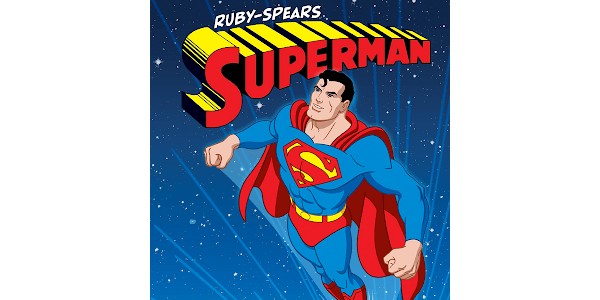
Notes: In 1988, Ruby-Spears animation took a swing at another Superman cartoon, this time bringing in elements from a lot of different sources. The theme music is a riff on the John Williams theme from the movies, for instance, but a lot of the characterization came from the post-Crisis John Byrne reboot, probably because the head story editor for the series was comic book legend Marv Wolfman, who was also writing the Adventures of Superman comic at the time. Gil Kane, another comic mastermind, provided the character designs. The cast included Beau Weaver as Superman and Ginny McSwain as Lois Lane, with some animation all-stars filling out the cast: Michael Bell (Duke from G.I. Joe) as Lex Luthor, and voice acting royalty Alan Oppenheimer and Tress MacNeillie as Jonathan and Martha Kent. 

“Destroy the Defendroids” starts with Superman taking Lois on a flight through the sky in a scene very reminiscent of the “Can You Read My Mind?” bit from the movie. Their date is disrupted, though, when he’s called upon to stop a high-tech robot running amok in the city. The robot is riddled with LexCorp components, but when Superman arrives to arrest Lex he’s stymied by Lex’s new piece of jewelry – a ring with a Kryptonite stone. Lex makes it clear, of course, that although his company MADE those parts that doesn’t mean that HE was the one who built the robot. After all, anyone could have bought them and assembled them into a menace. The next day, though, he debuts his newest innovation to Metropolis – a swarm of robots called the Defendroids, which he offers to fight crime. Superman pretends to leave town to keep an eye on Luthor, but snaps back to save Lois, Jimmy, and Clark (whom he “wraps up in his cape” for the escape) when they’re nearly killed thanks to the Defendroids antics. When Lois and Jimmy approach LexCorp tower in a helicopter, the robots shoot them out of the sky and take them captive. Superman trails after them, despite the robots’ Kryptonite weapons. He saves them, naturally, but their danger was only a distraction as Lex uses the Defendroids to rob a train. (Lex’s assistant points out how irrational it is for someone of his wealth to stoop to a train robbery, but nobody ever accused Lex Luthor of being rational.) Superman thwarts the robbery, but Lex has naturally covered his tracks, blaming the robots’ actions on “a short circuit.” Which in the Ruby-Spears universe apparently is enough to absolve you from both criminal AND civil charges.

My favorite thing about this cartoon was that each half-hour episode consisted of the main story followed by a short, a story from Martha Kent’s Family Album. The short in this first episode was “The Adoption.” Jonathan and Martha bring a child to Smallville Orphanage, having “found” him on their farm, and express their interest in adopting him, but the head of the orphanage, Mr. Warner, dismisses them as being too old to adopt. As different parents come in to visit the new baby, they keep walking into things like a trashed playroom, the boy flying around the room on a rocking horse, or him riding a lion that he liberated from the zoo. At night, the baby flies away from the orphanage and finds his way back to the Kent farm, where Jonathan and Martha find him sleeping soundly between them in the morning. Jonathan vows to convince Warner to allow them to adopt the child, and they name him – try to act surprised – Clark.

Both parts of this show were really good. The animation is very much of the 80s, which is to say, better than the Filmation cartoons we watched yesterday, but not as good as it was going to get just a few years later. But the stories landed, at least they did for the 11-year-old kid who was watching them at the time. The characterizations were consistent with the comics, and although the stories weren’t quite as sophisticated, they were pretty good for a Saturday morning cartoon. And the “Superman’s Family Album” segments were just charming and delightful. Up until this point, there had been precious little depiction of Jonathan and Martha Kent in the media – really just their sporadic appearances in The Adventures of Superboy and the scenes in the first half of the 1978 movie. This would be the first time a lot of people really got to see them as parents, and I appreciate that to this day.

The cartoon sadly lasted only 13 episodes, its run going from only September to December of 1988. It’s a shame, it really did deserve more. On the other hand, if it had a long run, we may not have gotten Superman: The Animated Series in 1996…so I guess all things considered, it was an even trade. 

“Superman through the ages” continues next week, friends. Until then, Happy Thanksgiving! 

Blake M. Petit is a writer, teacher, and dad from Ama, Louisiana. His most recent writing project is the superhero adventure series Other People’s Heroes: Little Stars, volume one of which is now available on Amazon. You can subscribe to his newsletter by clicking right here. You can join in the Kryptonian Konversation every day in the Year of Superman Facebook Group!

Year of Superman Week 31: Superman’s Strangest Team-Ups

After taking last week relatively easy, and after the kind of floperoo that Parody Week turned out to be, I decided I wanted to do something a little more fun this week. So I looked through my list of potential topics and decided it was time for SUPERMAN’S STRANGEST TEAM-UPS. You’re not gonna see him partnering with Batman or the Justice League here, guys. I’m not even counting inter-company crossovers like when he met the Fantastic Four or the Savage Dragon. No, this week we’re going to focus on a few team-ups Superman has had with characters (and sometimes real people, as you’ll see) that an outside observer would think is totally bizarre. And the fun part is, they would be right to think so. 

And as always, you can check out earlier blogs in the Year of Superman Archive!

Wed., July 30

Comics: The Adventures of Jerry Lewis #105

Shame he didn’t team up with SuperGIRL. I can see it now: “Hey, nice Kryptonian LAAAA-DYYYY!”

Notes: I’ll kick this off with a comic I bought on eBay a few months ago specifically to use for this week, a book I’ve wanted an excuse to get for years: The Adventures of Jerry Lewis #105. Believe it or not kids, there was a time when being a famous comedian could get you your own comic book, and sometimes those books would last for YEARS. Bob Hope had one, as did Jackie Gleason, Abbott and Costello, and sitcoms like I Love Lucy had long-running comics through publishers like Dell and Charlton. This series specifically began in 1952 as The Adventures of Dean Martin and Jerry Lewis, but dropped Deano from the book in 1957 after the comedy duo broke up. Jerry held solo reign over the title for over a decade before it finally ended in 1971.

Anyway, in this issue Jerry is watching TV with his nephew Renfrew and their friend Witch Kraft (it was the 60s, I dunno) where they see a report of Superman fighting a giant space monster – a fight that has been dragging on for THREE DAYS. Superman finally defeats the beast, which turns out to be a robot. What he doesn’t know is that the robot was built by his old pal Lex Luthor, and when it was destroyed, it saturated Superman’s costume with a low level of Kryptonite dust that immediately begins to neutralize his powers. Back at the Daily Planet, Clark gets a new assignment – a feature on the danger of certain young people, and he’s sent to investigate one Renfrew Lewis. At the Lewis house, Clark gets progressively weaker, succumbing to various pranks of Renfrew that would normally be no problem. Finally, he gets soaked with water, prompting him to borrow an ill-fitting outfit from Jerry while his own clothes dry off. Luthor, meanwhile, tracks his Kryptonite to Jerry’s house, where Jerry has just discovered Clark’s Superman costume in the laundry and puts it on because…well, I guess because that’s what happens on the cover.

The story is completely absurd, of course. Jerry Lewis was a comedy legend, but he had a very specific persona. Especially in the early part of his career, he would always play a naive young man whose good nature couldn’t overcome his dimwittedness, spiraling him into one ridiculous situation after another. His comic book persona clearly borrowed that characterization, as that’s exactly what happens to him not only in this issue, but in probably every issue of this title that lasted, in its two incarnations, nearly twenty years. And honestly the fact that Jerry (the character) is both dim and nice is probably the only reason that Superman’s secret identity is maintained in this absurd comic. Although none of that explains why Luthor – who would certainly proclaim himself to be Earth’s smartest man – isn’t smart enough to put two and two together when he encounters Clark Kent and Jerry Lewis, the latter of whom is wearing Superman’s ill-fitting costume – only minutes before the real Superman shows up to put him away.

As silly as this story is, I really did enjoy it. It’s got the same sort of bizarre brand of comedy as certain strains of Archie Comics, or some of DC’s own Silver Age titles like Stanley and His Monster. I haven’t got the slightest idea who owns the rights to books like this anymore (is it the Jerry Lewis estate? The copyright information in the indicia only indicates National Periodical Publications), but I would love it if they could put together some collections of comics like this or their Bob Hope series, or even make them available digitally. I’d love to read more without having to pay eBay prices to track them down one at a time. 

Thur., July 31

Comics: Captain Carrot and His Amazing Zoo Crew #1, DC X Sonic the Hedgehog #5

If I hadn’t included him in Super-Sponsor week, the Kwik Bunny would have followed this issue.

Notes: I’m not gonna lie, half the reason I decided to do this particular theme week was to have an easy excuse to sneak this comic book in. Captain Carrot and His Amazing Zoo Crew is one of my favorite DC Comics of all time, a comedic (but not silly) comic about superhero animals set in a world that feels like it fell out of a cartoon. At this time, DC had a “bonus book” program, where once a month a random title would include a 16-page comic in the center, often used to launch new series. Such was the case with New Teen Titans #16, which featured the first appearance of Captain Carrot. In that bonus book, by Zoo Crew co-creators Roy Thomas and Scott Shaw! (that exclamation point is part of his name, friends), Superman ran across several residents of Metropolis behaving like their primate ancestors. He tracked the disturbance to a strange meteor out near Pluto, but when he tried to stop it, both he and the meteor were punted into a different universe, designated Earth-C, in which the Earth was populated by “funny animals.” Chunks of the meteor fell to Earth, giving powers to several different animals. One of them irradiated a batch of carrots growing in a garden box belonging to cartoonist Roger Rabbit (he later began going by his middle name, Rodney, perhaps due to confusion with a certain OTHER lupine character), who gained incredible power upon munching on the carrot. 

The first issue of Captain Carrot and His Amazing Zoo Crew picks up right where the bonus book left off, with Superman and the newly-minted Captain Carrot seeking out the meteor fragments and trying to find a way to Pluto to check it out through some sort of cosmic barrier. As they do so, just as happened back in Metropolis, various people begin reverting to a primitive state, acting not like the civilized animals they are but instead like their beastly ancestors. When Superman is captured, Captain Carrot picks up other animals who were altered by the meteors: the powerful Pig-Iron, mistress of magic Alley-Kat-Abra, turtle speedster Fastback, pliable poultry Rubberduck, and the star-spangled Yankee Poodle. Together they seek out Superman, bound by Kryptonite on Pluto, in the clutches of Starro the Conqueror. Eventually, of course, Starro is conquered and the Zoo Crew decides to stay together to fight the forces of evil on Earth-C.

After striking a somewhat familiar pose.

Superman’s appearance here is almost incidental. The Zoo Crew does most of the heavy lifting, and replacing Superman with Wonder Woman, Captain Marvel, or any number of other heroes would have had negligible impact on the plot. But it’s fitting, in a way, that Superman was the first contact between the two worlds. He was still DC’s flagship character at the time (although Batman would soon overtake him, and Batman just wouldn’t have worked in this setting), and Captain Carrot was clearly his universe’s version of Superman. This would be codified years later during one of DC’s many crisis events (Final Crisis, I think) where it was revealed that EVERY world had an “official” Superman analogue, and in this world it was Captain Carrot.

I’ve written many times before about Roy Thomas and his love for comic book history, with his work on titles such as All-Star Squadron, Young All-Stars, Secret Origins, and the Elseworlds comic Superman: War of the Worlds. This one is a little off the beaten path for him, but even here, he couldn’t resist bringing in some DC lore. The first Zoo Crew recruit, Pig-Iron, is secretly Peter Porkchops, once the star of a series of DC’s funny animal comics from the 40s and 50s. Thomas and Shaw would go on to establish that Earth-C was actually the location of all of DC’s old funny animal comics, bringing in characters like the Dodo and the Frog, the Three Mousekteers, and their superhero turtle the Terrific Whatzit from the Golden Age, who turned out to be Fastback’s uncle.

The series lasted for 20 issues, with a three-issue miniseries in which the Zoo Crew travelled to Oz and Wonderland, then they went into limbo for a few decades. They’re back now, appearing periodically, and Captain Carrot specifically is a member of the multiversal Justice League Incarnate. But I’ll never stop pushing for a full-on revival of this delightfully offbeat comic.

“In yo’ heeeeead! In Darkseid’s heeeee-eee-eeaaaad!”

Speaking of strange team-ups, this week also brings us the last issue of DC X Sonic the Hedgehog. With the two teams reunited on the DC Earth, they’ve got to assemble to chaos emeralds to take the fight to Darkseid. I’m not going to claim there’s anything truly shocking in this issue. The story plays out pretty much exactly as one would expect, right up to the last page sequel hook which may or may not ever be picked up on, probably based on how well this miniseries sells. But it was still a fun little excursion. It was genuinely hopeful and upbeat, without any of the usual nonsense of the heroes of two worlds fighting each other just because that’s what’s supposed to happen in crossover events. (As much as I’m looking forward to Deadpool/Batman in a couple of months, you know that’s exactly what’s going to happen.) This was just…fun.

And it’s okay to just be fun sometimes. 

Fri., Aug. 1

TV Episode: I Love Lucy Season 6, Episode 13, “Lucy and Superman”

“Lucy, you REALLY got some ‘splainin’ to do!”

Notes: Regular readers of my blog know about my deep, abiding love for I Love Lucy. I think it’s one of the greatest sitcoms in the history of the medium and that Lucille Ball was a comedy genius the likes of which we have not seen since. And if you know I Love Lucy, then it’s probably no surprise that one of my favorite episodes was the sixth season episode in which Lucy meets Superman.

The episode begins with Lucy’s husband Ricky and their son, Little Ricky, watching The Adventures of Superman on TV. Little Ricky, with the innocence of a child who doesn’t actually have to pay for anything, asks if Superman can come to his birthday party that Saturday. Although Lucy lets him down easily, when they find out later that their frenemies the Applebys are planning to have their son’s party on the same day, the parents enter a cold war over throwing a party that will lure the childrens’ shared friend group to one party over the other. Lucy plies Ricky to try to get Superman – who he met in Hollywood – to come to Ricky’s party after all, quickly luring away all of the children, even little Stevie Appleby. As usually happens with Lucy’s schemes, though, things go awry. Ricky tells him Superman can’t make it, leading to Lucy donning a Superman costume and trying to get into the apartment from the ledge, only to get stuck outside in the rain when Superman shows up after all.

The Lucy writers played a neat little trick in this episode. Although the show frequently had celebrity guest stars appearing as themselves (everyone from John Wayne to Harpo Marx), they never ONCE refer to Superman as “George Reeves.” He’s just Superman. Although from an adult perspective, it seems a little odd that they never say his real name, even when the kids aren’t in the room, from a meta point of view it’s obvious that the entire episode is constructed in such a way to preserve the mystique of Superman for any children who happen to be watching. Reeves never appears as “himself,” only on TV as Superman and then again in the last scene in-costume, where he does his trademark leap through the window (in this case, the one that separates the Ricardos’ kitchen and living room) to make his glorious entrance. When Lucy gets stuck on the ledge, Superman is the one who climbs out to rescue her. Even the classic last line of the episode has the same sort of wit and charm that Reeves always brought to his performance: when out on the ledge, Ricky comments on the 15 years of crazy stunts Lucy has pulled. Reeves says, “You mean to say that you’ve been married to her for 15 years?” When Ricky replies in the affirmative, Reeves shoots back, “And they call me Superman!”

It’s a wonderful, charming episode of a charming show, and one that can be enjoyed on two levels. If you want, then you can consider this just your average episode of I Love Lucy with a famous guest. But if you’d prefer, you can accept the episode on face value and decide that Lucy takes place in the same universe as The Adventures of Superman TV show, and it wasn’t Reeves at all, but the real Man of Steel.

That doesn’t quite explain why he’s got his own TV show in-universe, but do I have to figure out everything myself? 

Sat. Aug. 2

Comic Books: Multiversus: Collision Detected #1-6

“Jinkies!”

Notes: While not a Superman starring vehicle like most of my other choices this week, he played a big part in this fun six-issue miniseries based on the short-lived video game, which combined characters from dozens of Warner Bros IPs including the DC Universe, Looney Tunes, Hanna-Barbera cartoons, Cartoon Network, The Matrix, The Wizard of Oz, Game of Thrones, The Neverending Story, and probably others I’m forgetting. I don’t play video games, friends. It’s not a judgment thing, I’m not trying to claim some sort of moral high ground or anything, I’d just rather spend my time with a movie, TV show, or book. I do, however, enjoy a good crossover, so when the miniseries based on the game was announced I knew I was going to read it, despite knowing absolutely nothing about the game. 

The story begins with Superman, Batman, and Wonder Woman each having dreams that culminate in the vision of strange hieroglyphs: a rabbit, a witch, and a child bearing a star. Their investigation leads them to Avia Free, daughter of Mr. Miracle and Big Barda. When they arrive, though, the find that Avia already has another visitor: Bugs Bunny. After a particularly hilarious sequence of Batman trying – and failing – to interrogate Bugs, Avia shows them a video game system she modified to investigate some strange readings from behind the Source Wall just as a portal appears, spilling inhabitants of other dimensions into our own. The Flash, for instance, encounters Scooby-Doo and Shaggy having thwarted Condiment King’s effort to rob a Big Belly Burger and taking their reward in a mountain of food. Wonder Woman is attacked by an army of Winged Gorillas under the control of Grodd who, himself, has fallen under control of the Wicked Witch of the West. Superman finds Steven Universe and Garnet fighting Livewire and the Parasite in Metropolis, just as a Skullship appears in the sky – not a Brainiac ship, but one in the spitting image of Rick Sanchez, loaded with robotic simulacrum of Finn the Human, Jake, and Tom and Jerry. 

As the Justice League begins containing the incursions from other universes – hero and villain alike – Batman manages to track down the truth. An entity called the Devoid, under duress from an even more powerful force called the Nothing, is forcing the multiversal travellers to fight in a tournament to protect their respective home universes. (I assume this is, in broad strokes, the story behind the video game.) Batman hatches a plan to return the fight to the Devoid, saving all of the endangered universes simultaneously, but there’s a little problem. To do this, he needs to find the final lost fighter – the Reindog – who is currently being coddled by Harley Quinn and targeted by her nasty ex, the Joker. They collect him from Gotham City, but Steven is wounded in battle. When Reindog heals him, it sends out a signal that leads the Devoid to Earth, where it takes over Avia and attacks. In exchange for freeing Avia, the assembled heroes agree to allow Devoid to take them to fight in the tournament. After they are swept away, though, the heroes reappear, revealing that Steven invented a device that would pluck tiny pieces of each of the heroes from throughout the multiverse and assemble them into a new version to join the tournament.

I love stories like this. It reminds me of being a kid, when you would throw all your different toys together in one box and act out some epic battle despite the fact that these characters don’t really have any business being together. I also like the way Bryan Q. Miller handles the Super-characters. It’s not his first go-round: he’s written, among other things, the Smallville sequel comics, and he has a nice handle on Lois and Clark. There’s a nice bit towards the beginning where she casually teases him for doing things the hard way when the age of technology should make it a little harder to track down the glyph from his dreams. And bonus points go to artist Jon Sommariva and colorist Matt Herms for dressing her in her signature outfit from Superman: The Animated Series, even though this isn’t “that” Lois. Miller also uses the differences in the respective universes to his advantage. For example, there’s a funny bit where Bugs, Scooby, Shaggy, and Steven Universe are shocked by the foul mouth (censored as it is) of the Rick-infected Brainiac. 

It’s interesting, by the way, that although it is very obviously Rick Sanchez who’s riding in Brainiac’s skull, he is never mentioned by name in the story, and only appears in his “true” form in a few shots on Brainiac’s monitors. I assume that was a limitation imposed by the fact that Oni Press, not DC Comics, has the rights to the Rick and Morty comics, but it’s still kind of funny.

The story ends, as comics like this one often do, with a bit of a sequel hook, but considering that the game flopped and has been discontinued, it seems unlikely that we’ll ever get to see what happens next. I content myself in the knowledge that the comic is essentially a prequel to the game and that, if you beat the Devoid and the Nothing in the game itself, you can consider it the canonical ending of the story. And I hope that we see Miller writing more comics like this. He’s got a flair for it. 

Sun. Aug. 3

Comic Book: Action Comics #421

“I yam what I yam…a legally-distinct creation that is not subject to a copyright infringement suit by King Features Syndicate!”

Notes: Today we’re going to take a look at one of my favorite lesser-known Superman team-ups, the time he met Popeye.

Kinda.

In Action Comics #421, Superman’s pal Billy Anders (a semi-recurring character from the period) tells him about his recent encounter with Captain Horatio Strong. Strong is a salty sailor who has found a mysterious seaweed that, upon consumption, gives him incredible strength. When Billy tells Superman that Strong is one of his biggest fans, he agrees to arrange a meet-up. Meanwhile, A food corporation tries to buy the rights to Strong’s seaweed, “Sauncha,” but he refuses. He willingly gives a sample over to his idol, Superman, when Billy arranges a visit, but quickly realizes his visitor is a disguised spy for the food corporation wearing one of those remarkably lifelike rubber masks that were so ubiquitous in comics at the time. Superman and Captain Strong wind up duking it out when Strong vows to destroy the crooked company that tried to cheat him, and when he runs out of Sauncha, Superman tracks him to a spot in the ocean where he harvests it. When the Sauncha power runs out, Strong is nearly killed, but Superman whisks him to the hospital. As he recovers, he is ashamed of his actions, but Superman kindly tells him that it wasn’t his fault – he was under the influence of the plant, which Superman has identified as an alien species that must have fallen to Earth. Captain Strong promises to stick to good old Earth food from now on.

I first read this story in Best of DC Digest #48, in an issue that reprinted assorted Superman team-ups, and it’s long been a favorite of mine. Even as a kid, I immediately picked up on the fact that they were trying to emulate Popeye, and when Strong’s wife and best friend (obvious dopplegangers for Olive Oyl and Wimpy) showed up in later issues, it was like confirmation. What I didn’t realize as a kid was that Cary Bates had whipped up a Popeye expy to tell a story that was a metaphor for drug addiction. I guess it did the trick – I’ve never done any drugs, nor had any desire to. So Cary Bates and Captain Strong, thanks for teaching me the important lesson that using illicit substances will cause me to throw telephone booths and people and start fights with those I admire the most.

Seriously, I always thought Captain Strong was a fun character, and it’s a shame that he made only a handful of appearances over the next decade before fading into obscurity. He came back in 2015, gently being mocked (as was everything else) in Jimmy Palmiotti and Amanda Conner’s Harley Quinn series. I guess I understand – there’s not much call in modern comics for a character whose only reason to exist is to poke a little fun at Popeye. But I still have a warm place in my heart for Captain Horatio Strong. And although the similarities are superficial, I’ve always wondered if Strong was used as a bit of inspiration for one of my favorite characters of the Triangle Era, loveable lout “Bibbo” Bibbowski.

Mon. Aug. 4

Comic Books: Superman and Bugs Bunny #1-4

“What’s up, Clark?”

Notes: When I started this little project, I didn’t expect the Looney Tunes to turn up quite as often as they have, but between this and parody week, I’ve actually seen quite a bit of them lately. But let’s look at the 2000 miniseries by Mark Evanier, Joe Staton, Tom Palmer, and Mike DeCarlo. Even though Superman’s name is in the title of this one, like Multiversus, it’s more of an ensemble piece, featuring the entire Justice League. The chaos begins when Superman gets a visit from his old pal Mr. Mxyzptlk and, as usual, has to trick him into saying his name backward to send him home. At the same time, in another world, Bugs Bunny and Elmer Fudd encounter the Do-Do, an early and mostly forgotten Looney Tunes character from another world called Wackyland. Bugs deliberately borrows a trick from the pages of his favorite comic book publisher and tricks the Do-Do into saying Od-Od, banishing him at the same time that Myxyzptlk vanishes from Earth. The two cosmic tricksters collide in the place between worlds and decide to join forces and cause a little chaos by sending the Looney Tunes to Earth.

On the moon, Green Lantern finds Marvin the Martian planning to destroy the Earth (again). Flash races Speedy Gonzales through the desert, Plastic Man disguises himself as a cat only to fall afoul of the affection of Pepe LePew, and in Gotham City, Batman finds a very different Penguin than the one he expected. Myzptylk amps up the chaos by giving Elmer Fudd Superman’s powers (and costume), and poor Green Arrow is stuck with a singing, dancing Michigan J. Frog that doesn’t seem to want to perform for anybody else. 

Mxy and the Do-Do find their relationship strained, the machine they’re using to toy with the heroes destroyed and forcing them all together. The Tunes are made honorary member of the Justice League (because why not?) just as the Do-Do turns on his partner, bringing about a – ya gotta say it – “Cwisis on Infinite Earths!” 

Mark Evanier was absolutely the best choice to write this bizarre little crossover. As a writer in both comic books (perhaps best known as co-writer of Sergio Aragones’ Groo the Wanderer) and in animation (such as the original and excellent Garfield and Friends cartoon), he had the right sensibility to bring these two worlds together. It’s interesting that he chose to have both the Justice League and the Looney Tunes be fictional characters in the others’ universe. Bugs and Foghorn Leghorn read Action Comics, and every member of the League recognizes their cartoon co-stars the second they see them. It nicely sidesteps the usual introductions, although if the Leaguers have all watched the Looney Tunes (as well they should have) it should kind of make you question their judgment when they include the likes of Yosemite Sam and Elmer Fudd into the ranks of the honorary Leaguers. 

I also give Evanier credit for diving into the archives of the Looney Tunes for this. He didn’t just bring out the A-listers like Bugs and Daffy – we get appearances by everyone from Pete Puma to the Goofy Gophers Mac and Tosh, and he keeps them all in character. He’s not quite as adept with the Justice League, writing them more like they would have been in the Silver Age than when this book was published in 2000. Things like Green Arrow’s panic over nobody believing his story about a singing frog don’t quite fit (especially since, as it should be noted, this was the less-emotive Connor Hawke version of Green Arrow rather than Oliver Queen). But you can accept these things are being part of the overlap with the land of the Looney.

Joe Staton’s layouts keep everything consistent, and using finishing team of Tom Palmer (handling the DC Universe and characters) and Mike DeCarlo (on the Looney Tunes) makes it all look nice, clean, and like these characters fit in a world together.

I’ve always liked this miniseries. It’s not a masterpiece, but it’s fun. And it helped inspire a series of DC one-shots a few years ago in which they met Looney Tunes and Hanna-Barbera characters, although those were part of a line that reimagined the cartoon characters in a more “serious” vein. Some of those specials worked better than others. I particularly liked seeing the Super-Sons meet Blue Falcon and Dynomut, and having Booster Gold encounter the Flintstones was a treat. Pretty much everyone agrees that the gem of those books was the Batman/Elmer Fudd special. But the shocking thing? No books featuring Superman.

What a waste of potential. At least we’ve got the OG. 

Tues., Aug. 5

Comic Books: All-New Collectors’ Edition #56 (aka Superman Vs. Muhammed Ali)

Float like a Kryptonian, sting like heat vision!

Notes: The year was 1978. Jimmy Carter was elected president, Christopher Reeve was wearing the Superman costume, and we were still 26 years from the birth of America’s sweetheart Justin Bieber. And this was the year that brought us one of Superman’s most legendary and unexpected crossover events: a giant-sized special that saw him face off against “the Greatest,” Muhammad Ali.

Lois, Clark, and Jimmy are walking through Metropolis when they happen to stumble upon Muhammad Ali playing pick-up basketball with a group of school kids. As Lois approaches him for an interview, they are interrupted by the sudden appearance of an alien (you know, like you do) who summarily shoves Lois aside. Ali leaps to her defense as Clark ducks off to change his clothes, then follows the alien’s trail to an orbiting armada of spacecraft that…frankly…even in 1978 it’s kind of hard to believe nobody noticed them before. The alien identifies his race as the Scrubb, a warlike society who has come to Earth to pit our greatest champion against their own. Amusingly, Superman and Ali each presume the alien is talking about himself, and after a demonstration of their power, the Scrubb declares that the role of Earth’s champion will be decided in a match between the two of them, with Superman’s powers removed to make it fair – and if they refuse, the Scrubb promise to destroy the Earth itself.

Superman takes Ali to his Fortress of Solitude, where he creates a special ring to train: a time disruptor that can stretch their 24 hours to about two months, and a red sun lamp to remove Superman’s powers, giving the Greatest of All Time the time he needs to teach Superman how to box. The Scrubb catch wise, though, and disrupt the training after only two relative weeks, taking Superman and Ali into space where their bout will be broadcast across the universe. The fight is brutal, and Superman’s unfinished training makes him no match for his opponent…but still, the Man of Steel may be beaten and bloody, but refuses to fall down until the judges call the fight for Ali. As he is returned to Earth so the yellow sun may heal him, Ali prepares for his battle against the Scrubb’s champion, a gigantic brute called Hun’ya. To everyone’s shock (maybe even the writer, it’s so random) an angelic being appears in the ring demanding to act as moderator of the contest. The being appears differently to each species – to the humans she is the Greek Goddess of Wisdom, Pallas Athene. As the match begins, Ali’s cornerman Bundini Brown infiltrates the Scrubb command center, revealing himself as Superman in disguise. Impersonating the Scrubb Emperor, Superman orders the armada away from Earth, then catches a ride back to the yellow sun system to take it out as Ali defeats Hun’ya. The Emperor plans to turn back to destroy Earth anyway, but Hun’ya himself – disgusted by his lack of honor – defeats the Emperor. 

The epic team of Dennis O’Neil and Neal Adams are the ones who put this special together, and honestly, nobody else could have done it. Adams did a note-perfect version of Ali in this book, creating a character who is immediately recognizable as the boxer while, at the same time, still looking like he belongs in this DC Universe. It helps that Adams’ natural style lends itself to more realistic visuals than a lot of other artists of the era, making the combinations seamless. The story is kind of wild, and really over the top, but what else would you want? There are some odd moments, of course – the deity that calls itself Athene lends absolutely nothing to the plot, and the book ends with Ali revealing to Superman that he’s figured out he’s really Clark Kent due to a slip of the tongue Superman had made much earlier in the story. Is there any particular reason for that? Absolutely not. But it also doesn’t hurt the story, and it feels like the kind of thing that Muhammad Ali would have insisted upon, so I can deal with it.

The funny thing about this one, I think, is that the story itself (wild as it may be) probably isn’t as well known as Adams’ incredible cover. It’s one of those covers that has become a classic, frequently targeted for swipes by other artists, and you can’t blame them. It’s so rich and detailed as to defy belief, with dozens of DC characters and real-world figures alike appearing in the audience to watch the Superman Vs. Ali fight. It’s so in-depth that the deluxe edition of the book includes a guide to help you identify everybody who appears on the cover. It’s the kind of attention to detail that the likes of Alex Ross grew up on and decided to emulate in his own career.

This is, frankly, an insane book. And it’s a classic for a reason. 

Blake M. Petit is a writer, teacher, and dad from Ama, Louisiana. His most recent writing project is the superhero adventure series Other People’s Heroes: Little Stars, volume one of which is now available on Amazon. You can subscribe to his newsletter by clicking right here. You can join in the Kryptonian Konversation every day in the Year of Superman Facebook Group!

Geek Punditry #61: Playing Favorites With Superheroes Part One

It’s time once again for PLAYING FAVORITES! It’s that semi-regular Geek Punditry mini-column in which I throw out a topic to you, my friends in the world of social media, and ask you to suggest different categories in which I discuss what I consider to be the best of the best. This time around, the topic is superheroes. Born in the pages of American comic books, but with roots in pulp magazines, myth, and thousands of other sources, the superhero is considered to be the modern mythology, with pantheons not only in comics, but in movies, TV, video games, and pretty much every other media you can name. And I am, it cannot be understated, a fan of the superhero. So what, then, are some of my favorites?

Legacy Heroes

Sandy Brophy is going to kick things off for us by asking for my favorite legacy heroes. A “legacy” hero, for those of you who may not have been reading comic books since you were six years old, is the term used when a superhero’s name and identity is passed on from one person to another. For example, in the early days of comics, the Flash was a college student by the name of Jay Garrick. After superheroes fell out of favor and stopped being published for a while, they were resurrected in the 1950’s with the creation of a brand-new Flash, this time a police scientist named Barry Allen. Barry was the Flash for a long time before dying in Crisis on Infinite Earths (it took longer than usual, but eventually he got better), and his nephew/sidekick Wally West, aka Kid Flash, took over as the new Flash.

And so on, and so on, and so on.

This also, by the way, is my answer to Sandy’s question. The Flash is undoubtedly my favorite legacy hero in comics. By the time I started reading comics Wally was the main Flash, and even decades later he’s still the one I feel is most compelling. He was young when he became the Flash, and thanks to the magic of comic book time I eventually caught up with him at the same time he was being written by Mark Waid, who turned him into a fully fleshed-out and wonderfully realized character in his own right. He got married, had kids, and he grew and matured. He was also – as Waid said – the first sidekick to “fulfill the promise,” in other words, to take over for his mentor. He’s also still, to the best of my recollection, the ONLY one to do so on a permanent basis. It’s true that Dick Grayson (the original Robin) became Batman for a while, and Captain America’s sidekick Bucky took up the shield when Steve Rogers was temporarily dead, but both of them reverted back to their other adult IDs (Nightwing and the Winter Soldier, respectively) when the original came back. Not so Wally. Barry returned and Wally stuck around, and although there’s been a lot of timey-wimey nonsense and attempts to sort of push him to the side, he’s bounced back. Wally is, again, the primary Flash, even in a world where Jay and Barry exist, and the nominal head of the Flash family. And he’s just the best.

There are other good legacy heroes, don’t get me wrong. I enjoy the Jaime Reyes version of the Blue Beetle (although my heart will always belong to Ted Kord, himself the second Blue Beetle following Dan Garrett), and there are few who will argue that Kamala Khan hasn’t done more with the Ms. Marvel title than either of her predecessors, but Wally West is the ultimate legacy hero in my book.

Superhero Logos

My buddy Owen Marshall wants to know what some of my favorite superhero LOGOS are – those titles that splash across the cover of a comic book to (hopefully) let you know what you’re about to read. I’ll talk about what I think makes a good logo in general, then get into specifics. I think a great logo is something that stands out in a way that evokes the hero in question. The Superman logo, for instance, is relatively simple – his name, slightly curved, with drop letters that give it a sense of weight, of solidity. Any time you see that logo you think that somebody could just grab it off the cover – and, in fact, there have been many covers where that very thing has happened.

You can’t beat a classic.

Spider-Man’s original logo is great for similar reasons. It’s solid, but it’s also easy to partner up with a web in the background to help get across the idea that you’re dealing with a wallcrawler. And, like Superman, it’s a short enough logo that it’s very easy to add an adjective to the title (as in the AMAZING Spider-Man, the SPECTACULAR Spider-Man), but just as easy to drop a subtitle underneath (Spider-Man: Renew Your Vows). There have been many attempts over the years to create a new Spider-Man logo, but frankly, there’s never been one I like as much as the original, and it seems it’s never anything but a matter of time before they return to it.

Yeah, that’s the stuff.

The Avengers also have a fantastic logo. They’ve had several, of course, but I’m specifically talking about the most famous version, the one that Marvel Studios used for the basis of its movie design. It’s clean and bold, and the arrow in the letter “A” gives it a sense of forward motion that sort of plants the idea that these are heroes who are about to go out and DO something.

The arrow is in case you forget and try reading it right-to-left.

Green Lantern has had a great many logos over the years, many of which actually include a lantern, but my favorite doesn’t. I like the logo that premiered in 2005 with Green Lantern: Rebirth and which remained the primary version of the logo until just a few years ago. This version has that tilt to one side and a cool roundness to it that…okay, just hear me out on this…it makes me think of classic cars from the 50s. Smooth, sleek, fast…and those are words that apply to Green Lantern, especially the Hal Jordan version. 

And it’s all spacey and stuff.

I could probably spend an entire month just going through different logos, but I’m just going to cap it off here by saying that there are hundreds of awesome logos and if you want to read more about them I highly recommend the blog of comic book letterer and designer Todd Klein, who frequently makes posts where he discusses the design and history of comic’s greatest (and worst) logos, which is like drinking mother’s milk to a nerd like me. 

Superhero TV (pre-2000)

My old friend Patrick Slagle wants to know my favorite superhero live action TV shows. Well that’s easy! There have been SO many to choose from – Stargirl was great, and I was deeply enamored of Legends of Tomorrow, and then there was–

Oh, wait.

He specified shows from BEFORE the year 2000. Well. That makes it a lot more difficult. We’ve been in a superhero renaissance in the last decade or so, guys, with such an abundance of shows that even I haven’t gotten around to watching them all yet. (Peacemaker, for example, is still warming my “to-watch” list.) But if I’m going to restrict myself to the cultural wasteland that was 1999 and earlier, I guess there’s only the obvious choice.

Project: ALF.

If I don’t do this at least once in every Playing Favorites column the Don said he was gonna break my thumbs.

The superhero shows of my formative years…let’s be honest guys, they weren’t that great. The two most fundamental ones are probably the Bill Bixby/Lou Ferrigno Incredible Hulk and Lynda Carter as Wonder Woman. And while those are both good shows, neither of them were series I would watch on repeat, the sort of thing that makes a TV series worm its way into my psyche and become a part of the vast tapestry that is your friendly neighborhood Geek Pundit. And the truth is, a lot of the other shows of that era don’t hold up. Look at the 70s Amazing Spider-Man or Shazam! shows and try to convince me that these are fundamental pieces of Americana. The Greatest American Hero is a show I know I used to watch, plus it’s got the most earwormy theme song in superhero history, but I couldn’t relate the plot of a single episode after the pilot. It got better later, with the surprisingly decent Superboy TV series (mostly after Gerard Christopher took over the role from John Newton) and the “fun but fluffy” era of Lois and Clark: The New Adventures of Superman.

There are some wild swings in quality happening in this picture.

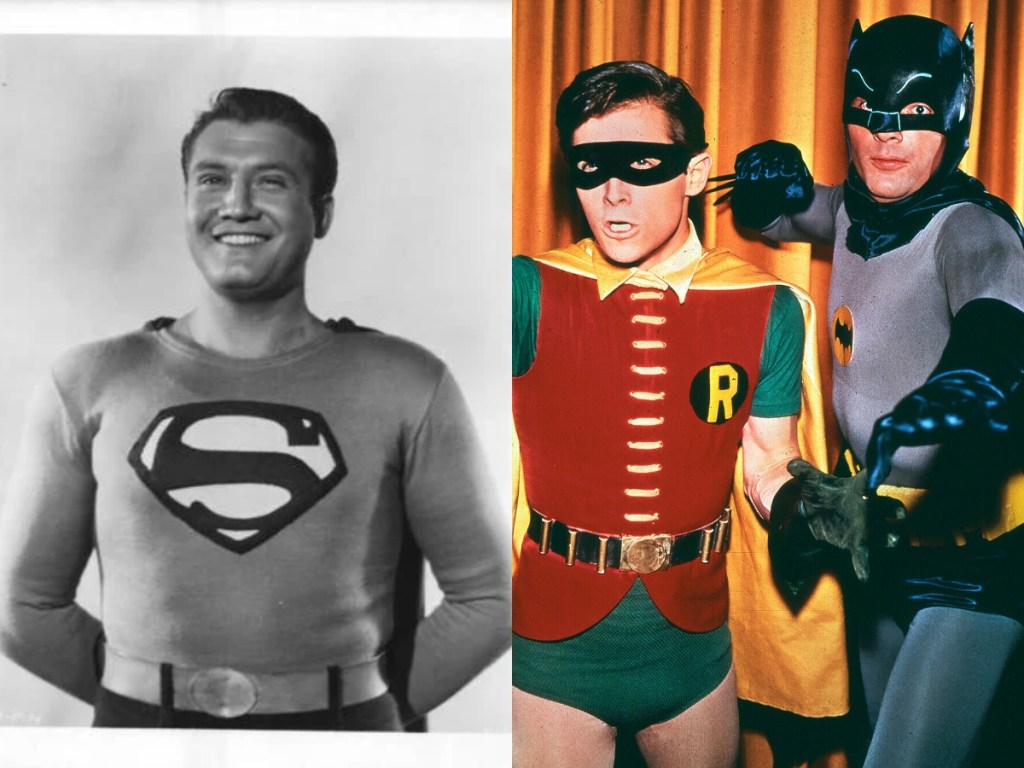
If I have to pick (and I do, it’s my damn game), I guess I’m going to have to give props to the two shows that I think launched the genre on TV: George Reeves in The Adventures of Superman and the Adam West/Burt Ward Batman show from 1966. I’ve always had a complicated relationship with the West/Ward era. When I hit those peak teenage years of arrogance and knowitallitude that most of us go through, I began to actively dislike that show, blaming it for people treating comic books as childish and infantile for decades after it was off the air and tarnishing the reputation of the caped crusader. Fortunately as I got older, I got over myself, thus disqualifying myself from ever running for elected office, but at the same time getting a sense of perspective. Sure, it wasn’t MY Batman, but I learned to appreciate it for what it was. I’ve softened to the show now. I even watch the reruns on MeTV Saturday nights between Svengoolie and Star Trek.

There’s no school like the old school.

George Reeves, though, I’ve always appreciated. He was the Curt Swan Superman come to life – square-jawed, barrel-chested, friend to all the innocent. But at the same time, he had a wicked sense of humor, showing clear joy whenever he got to take down a bad guy and taking a sly sort of pleasure any time he thwarted Lois Lane’s attempts to one-up him. I love the Reeves Superman and I don’t think he gets the respect he deserves. DC has launched a series of comics featuring the Christopher Reeve Superman as Superman ‘78, and that’s great. I love ‘em. But am I really the only person who would pick up a comic book called The Adventures of Superman ‘52?

Superhero Animals

I really like Marvel’s Scarlet Witch. She’s had several costumes over the years, but the best is the one George Perez whipped up for her for the Heroes Return era. It was red, naturally, which helps you identify her via color-coding, but the design also drew on the character’s Romani heritage, with a rare long skirt and robes that make you think of a fortune teller. All of that builds together and links her to her mystical roots. I’m fairly certain that if I didn’t know who the Avengers were and someone asked me which one I thought was the Scarlet Witch, I’d say, “Well, gotta be the woman in red, and not the tiger girl in the bikini.”

Jim MacQuarrie asked for my favorite Super-Animal, while Lew Beitz wants to know my favorite Super-PET. These two categories are close enough that I’ll talk about them together. They’re not EXACTLY the same, but there’s plenty of overlap. The way I look at it, we can divide super-animals into two categories: the ones that serves as an animal sidekick to the main hero, such as Krypto the Superdog, and those that are distinct heroes in their own right, like Hoppy the Marvel Bunny. The former are characters in established universes, while the latter usually exist in a Disney-esque universe where there are no humans at all, but instead races of anthropomorphic animals running the show.

As far as super-pets go, the Superman family has the deepest – and weirdest – bench to draw from. Krypto the Superdog and Beppo the Supermonkey are both animals from Krypton who made their way to Earth and gained powers like Superman and Supergirl. Supergirl also has a cat named Streaky who gains and loses his powers on a rotating basis thanks to exposure to something called X-Kryptonite (it was the 50s, it was safe to give something a name like that because there was no internet). Then there was Supergirl’s horse, Comet, who was actually a centaur from ancient Greece named Biron that was cursed and trapped in the form of a full horse. He hung around for a couple of thousand years before he met Supergirl and started to assist her on her missions, fell in love with her, and learned he could briefly become human when an actual comet passed close to Earth, allowing him to date Supergirl without telling her who he really –

Stop looking at me like that, I’m not making this up.

Superman is surprisingly indiscriminate about who he gives a cape to.

Anyway, Krypto is kind of the gold standard of super-pets, but there are a few others outside of the Super-Family worth mentioning. Wonder Woman’s kangaroo, Kanga, for instance. Ace the Bat-Hound, who Batman gives a mask to cover the bat-shaped patch of fur on his face and thus protect his secret identity. Chameleon Boy’s pet Proty who, like Chameleon Boy, is a shapeshifter, and fully sapient, and who can and did occasionally impersonate full grown adults, which makes you ask where the hell the Legion of Super-Heroes gets off treating him like a pet. And of course Damian Wayne, the current Robin, has Bat-Cow.

The only superhero who’s a source of 50 percent of the food groups.

Then there are the other types of Super-Animals: anthropomorphic heroes in their own right. Everyone who has heard me talk for five minutes will know that my favorite of these is Captain Carrot and his Amazing Zoo Crew. Created by Roy Thomas and Scott Shaw!, this 80s phenomenon was about a group of superhero animals who got powers from meteors that fell to (their version of) Earth. After meeting a dimension-hopping Superman, they were inspired to become heroes in their own right. The art is cartoony and the premise is silly, but what I’ve always loved about Captain Carrot and company is that their stories – at least in the 80s – weren’t played like cartoons. The plots were straight out of the pages of Golden and Silver Age comics, facing giant monsters and villains with cold-rays and all kinds of classic tropes. They were funny, sure, but not at the expense of the characters, as many of the modern writers who have tried to use Captain Carrot have forgotten. When I say I want a revival of the old-school Captain Carrot, I say it unironically and with love.

By contrast, there’s perhaps the most famous super-animal of the day, thanks to his starring role in an Academy Award-winning motion picture. I refer, of course, to Peter Porker, the Spectacular Spider-Ham. Spider-Ham’s comic hit JUST when I stared reading comics in earnest, and I devoured it. In this hilarious take on the Spider-Man story, Peter was the pet spider of mad scientist May Porker, who accidentally irradiated herself and bit him. The spider turned into a pig while maintaining his spider-powers. When May recovered from the radiation, her memory was erased and she thought she was just a kindly old lady and Peter was her nephew.

Move over, “The Boys,” the REAL heroes are back in town.

I’m not making this up either, but I wish I could take credit for it. The early Spider-Ham comics were a lot of fun, then he disappeared for decades before experiencing a renaissance in recent years. Like Captain Carrot, his modern adventures are sillier and more “cartoony” than the earlier ones, but UNlike Captain Carrot, the cartoony interpretation fits better, and has made him a better character.

My favorite Spider-Ham story, though, is not from the comics and not from the cartoons, but from the mouth of his creator, Tom DeFalco, when I met him at a convention a few years ago. He was signing reprints of the first appearance of Spider-Ham and his other great Spider character, Spider-Girl. I bought them both and told him how much I loved Spider-Ham when I was a kid, and he told how surprised he was when Marvel Comics sent him an invitation to the premiere of Spider-Man: Into the Spider-Verse. He didn’t understand why he was getting an invitation, and someone said, “It’s probably because Spider-Ham is in it.” And DeFalco, shocked, exclaimed, “SPIDER-HAM is in a MOVIE?”

Timeless. 

Favorite Superhero Costumes

My wife Erin, who always cuts the line because nobody else who submits questions has ever made lasagna for me, wants to know what my favorite superhero costumes are, both male and female. I think it was Alex Ross who said that the test of a good superhero costume is whether you could identify the character based just on the name, even if you knew nothing about them. Batman, for example. Green Lantern. Captain America. The 90s was an era where this consistently failed, especially in the X-Men comics and those later characters created by former X-artists. If you showed someone who knows nothing about comics pictures of Gambit, Cable, Maverick, Shatterstar, and Deadpool, then asked them to match the names to the pictures, any correct answers would happen purely because of the law of averages.

But anyway, when I read Ross’s definition, he also used that definition to argue that the greatest superhero costume of all time belongs to Spider-Man. It’s hard to argue with him. Nobody who saw a lineup of the Marvel Comics all-stars would have any difficulty telling that this guy is Spider-Man and not, for example, Wonder Man. And while that’s true of MOST of Spider-Man’s assorted costumes over the years, the original is still my favorite. The black costume is cool-looking, but the ol’ red-and-blues have a brighter, more optimistic tone that suits Spider-Man better. Spider-Man is a hard luck hero, to be sure, but he should never be a depressing, brooding character like Daredevil. (Are you listening, current Marvel editorial?) He’s the guy who should never give up and always finds it in himself to do the right thing, and the red and blue color scheme says that better than any of his other assorted looks. 

I don’t even blame him for admiring his own reflection.

Using the same metric, I also think the Rocketeer has a phenomenal costume. He is literally a human rocket, with a rocket pack strapped to his back and a helmet that evokes the speed and energy of the burgeoning space age. The rest of the outfit, though, with the brown bomber jacket and the jodhpur pants brings in the idea of his aviator background and grounds him in the World War II era where he belongs. 

This picture makes me want to make swooshy noises.

Honorable mention goes to the Flash, Green Lantern (Hal Jordan costume, although I have a soft spot for the one John Stewart wore in the Justice League cartoon) and Marvel’s Nova.

Erin also asked about my favorite female costumes, which I find is a little harder to do going by Alex Ross’s metric. Too many female costumes are designed more for titillation rather than actually identifying the character. And even those that DO clearly identify them often do so via a logo or symbol that marks them, such as Wonder Woman.

I think “Morgan” was the screenwriter of Doctor Strange and the Multiverse of Madness.

Harley Quinn is another one that is pretty obvious, at least in her original costume. The red-and-black color scheme, white makeup, and bangled headpiece brings up the notion of a Harlequin, which of course is the inspiration for the character. She’s changed her look several times over the past few years, and while some of her looks have been pretty good, none of them draw their inspiration from her roots the way her first look does. On the other hand, they’ve come up with a pretty solid justification for her changing her look – once she got over the Joker and dumped his homicidal ass, she doesn’t want to wear the costume that identifies her as his sidekick anymore.

Let’s face it, I could have posted a picture of a random duck here and you still could have pictured Harley’s get-up.

Then there’s Supergirl. She’s had a lot of costumes, the most iconic look being the basic Superman outfit, only with bare legs and a skirt. That’s not her best look, though. For me, my favorite Supergirl costume came from the 1970s, when she wore a loose blouse with a small S-shield over her heart rather than the full-size shield most superfolks wear. I love that look – it still clearly marks her as a member of the Super-family, but it’s very different from anything any of the others wear. Being loose instead of skintight like most superhero costumes, it’s got a freeing quality that speaks to a lighter version of the character in a period where she was working to get out of her more famous cousin’s shadow. It’s such a great look and I never stop wishing they would bring it back.

What can I say? She’s got the look.

That’s about it for this week, guys, but there are plenty of other questions I haven’t gotten to yet. So be sure to come by next week for Playing Favorites With Superheroes Part Two, and if you have a suggestion that I haven’t covered, go ahead and drop in in the comments. Up, up, and away!

Blake M. Petit is a writer, teacher, and dad from Ama, Louisiana. His most recent writing project is the superhero adventure series Other People’s Heroes: Little Stars, now complete on Amazon’s Kindle Vella platform. He realizes he talks about the Superman family a lot whenever he gets on to a superhero discussion, but let’s be honest, people. It’s either gonna be this or Star Trek.