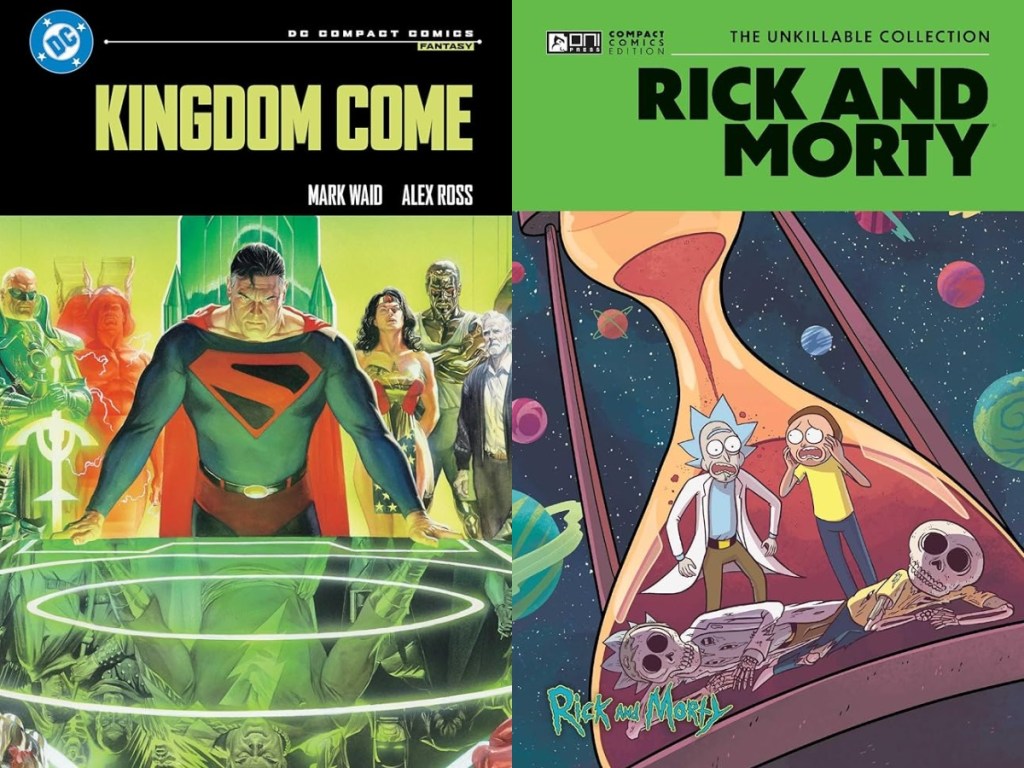
A little over a month ago, I talked to you guys about Compact Comics, DC Comics’ incredibly well-received new publishing initiative, in which some of their most popular and well-known graphic novels have been reprinted in smaller volumes, about the same size as a modern paperback novel, for the deliciously new reader-friendly price point of $9.99. The first ten books DC released in this format all sold out and went back for additional printings, and a second wave of titles has been announced for later this year. As with the first wave, the new titles are a mix of perennial bestsellers, books with current media tie-ins, and a few offbeat titles that aren’t their usual superhero fare, but may well snare readers who want something different.
I applaud this initiative. I’m up for anything that gets more people reading comic books, and based on the success of this series so far, it seems like it’s doing the trick. But that doesn’t mean that ONLY the smash hits deserve the Compact Comics treatment. DC’s got a history going back 90 years, and in those nine decades they’ve turned out a lot of books that may not be immediately recognizable, but at the same time, are fully deserving of finding a new audience. So DC – I know you’re listening to me, I can hear you breathing – this week in Geek Punditry I’m going to give you some suggestions for a few titles that I think are worthy of inclusion and should be given the utmost consideration when the time comes to select round three of Compact Comics.
The Kents
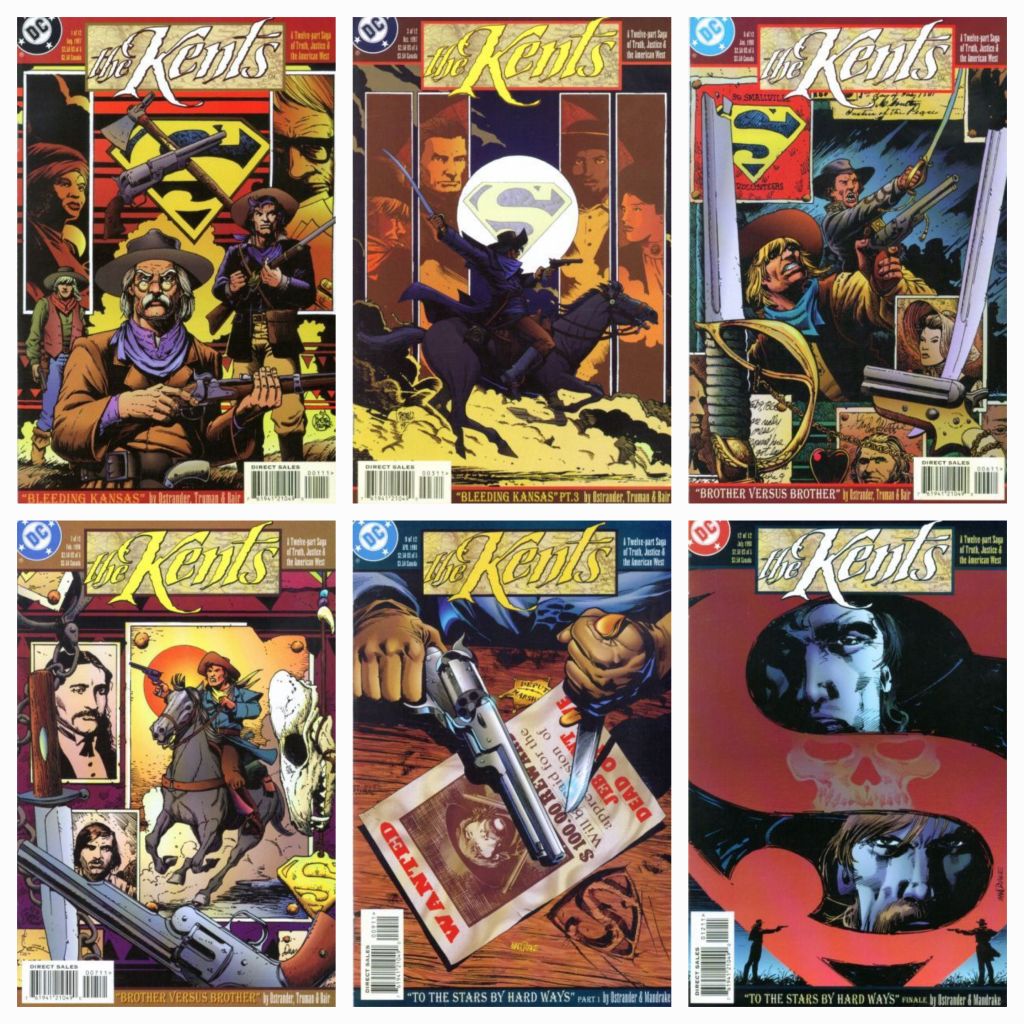
Look, everybody knows I’m going to have at least ONE Superman-related suggestion, so why don’t we just get it out of the way early, shall we? The Kents was a 12-issue miniseries from 1997 and 1998, written by John Ostrander with art by Tim Truman (issues #1-8) and Tom Mandrake (issues #9-12). In this series, Jonathan Kent uncovers a series of diaries, letters, and artifacts from the mid 1800s and, sharing them with his son, the two of them piece together an epic story about the history of the family that would give Earth her greatest hero.
“Ah, who cares about the Kent family, Blake?” some of you may say. Well…people who are into the likes of Unforgiven, perhaps. Or True Grit. Or John Ford’s Stagecoach. Because The Kents isn’t a superhero story at all – it’s an epic western. In three acts, the story tells the saga of the Kent family before, during, and after the Civil War. There’s a bitter, harrowing tale of brother against brother played out against the backdrop of the American west, and in this story we not only see the seeds of righteousness and nobility that would one day so profoundly inform who Clark Kent is, but also the struggles, heartache, and betrayals that the family had to endure to build that foundation. I’ve loved this series since it first came out, and although it’s been reprinted once or twice over the years, it doesn’t look like there’s been a new edition of this book since 2012. That’s entirely too long, and it’s time it got back in the spotlight.
Camelot 3000
Speaking of 12-issue miniseries that have been out of print for over a decade, let’s talk about Camelot 3000. This science fiction/fantasy series by Mike W. Barr and Brian Bolland came out from 1982 to 1984, and it tells the story of a future where King Arthur has returned to Great Britain, as the prophecy foretold. In this distant future of the year 3000, the world has been divided up into four gargantuan autocratic countries, all bickering and fighting amongst one another, and completely oblivious to a greater threat from beyond the Earth. Arthur, resurrected, has to find the reincarnations of his knights and prepare them for battle.
This is a fantastic book, showcasing Bolland’s pencils even before he sharpened them to the point where he became the artist behind Watchmen, and the story very neatly mirrors the original Arthurian legend. Barr supposedly got the inspiration for the story while taking a college course on Arthur, and the work he put into shaping this world is really remarkable. He doesn’t just re-tell the original story, but weaves in certain themes, showing just how timeless they are. The Lancelot/Guinevere story is still hanging over everyone’s heads, and the new take on Tristan and Isolde is way ahead of its time. It’s also an important book, historically speaking – DC’s first maxi-series created for the direct market only, their first time experimenting with a new format, and the first time future superstar Bolland would do full stories for an American publisher.
But most importantly, it’s just a good comic that modern audiences haven’t all had an opportunity to experience yet, and it’s an experience they frankly deserve.
Batman: Robin Ascendant
This doesn’t actually exist. I mean, the stories exist, but this particular collection of them, to my knowledge, has not been made…but damn it, it should be. Batman, as you may have heard, has gone through a Robin or two in his time, and for a lot of us, the definitive Robin is Tim Drake. I love Dick Grayson as much as anybody, but he’s far more interesting as Nightwing than he ever was as Robin. Tim Drake, on the other hand, is probably the best Robin there’s been. Batman himself has acknowledged that Tim will be a better detective than he is some day, and he’s also the only one of the main Robins that has never particularly harbored a desire to become Batman. He stepped into the role after the death of Jason Todd (who, of course, got better), during a period where Batman was being consumed with self-doubt and anger, and it seemed like the Dark Knight was going to go far, far darker than ever before. Tim deduced the original Robin’s identity, and from there, it was easy enough to determine that Batman was Bruce Wayne, so he arrived on Bruce’s doorstep not because he wanted to be a superhero, but because he knew that Batman is better with a Robin.
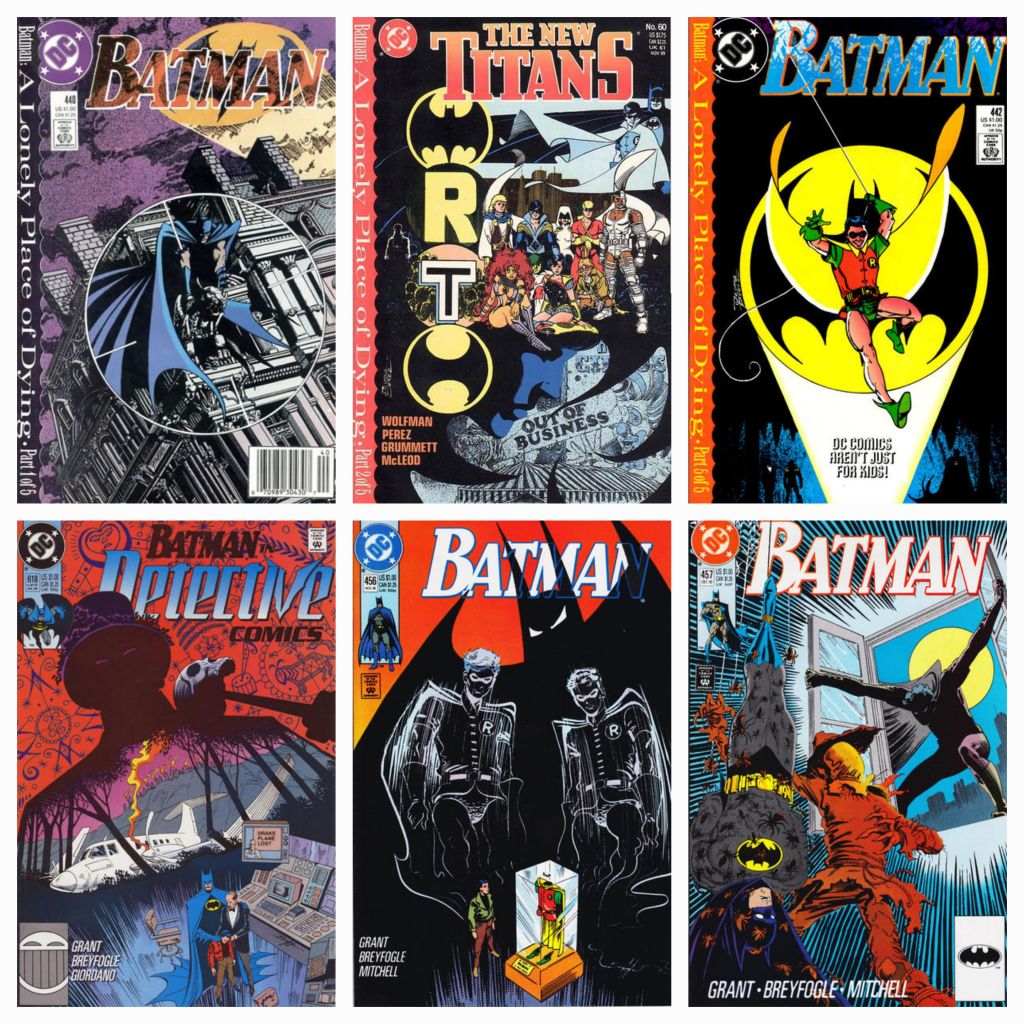
The story in which this is told was called “A Lonely Place of Dying,” by Marv Wolfman, George Perez, and Jim Aparo, and while it has been collected many times, it’s only five issues long. (Batman #440-442 and New Titans #60-61) One of the few legitimate complaints I’ve heard anyone have about any of the Compact Comics is that certain ones – specifically the ones that reprint original graphic novels like Joker or Wonder Woman: Earth One – are too short compared to the ones that squeeze in a hefty 12 issues worth of content. So in order to combat this volume having the same problem, I propose a bundle of sorts, combining this story with two shorter, subsequent ones. Bruce didn’t make Tim a Robin immediately, dedicating himself to training the boy so as not to repeat the mistakes of Jason Todd, and there were a few good Tim stories before he put on the costume again. In “Rite of Passage,” from Detective Comics #618-620 (by Alan Grant and Norm Breyfogle), Tim’s parents are kidnapped by a villain called the Obeah Man, leading to a tragedy that would shape Tim dramatically. I would include that, then cap off the book with “Identity Crisis” from Batman #455-457 (Grant and Breyfogle again). Here, Tim is grappling with the events of “Rite of Passage,” struggling with the legacy of the two previous Robins looming over him, and is grounded while Batman sets out to take on the Scarecrow. But Tim figures out that Batman is walking into a trap, and realizes that he’s the hero’s only hope.
When you put these three stories together, you’ve got a nice chronology of Tim Drake, leading up to him officially taking the mantle on the final page. And you’d get 11 issues of content, which is perfectly in keeping with the size of the better-received Compact Comics.
Tales of the Green Lantern Corps
One of the first Green Lantern stories I ever read – thanks to some comics given to me by my Uncle Todd – was the three-issue Tales of the Green Lantern Corps miniseries from 1981 by Mike W. Barr, Len Wein, and Joe Staton. In this truly epic story, all 3600 members of the Corps are called together to face the most dire of threats – their ancient enemy Krona has returned. Krona, a twisted member of the same race that eventually became the Guardians of the Universe, has forged an alliance with Nekron, a god of Death, and is planning to rend a hole between the worlds of the living and the dead, beginning with the destruction of the Corps’ central power battery on Oa. The Corps only has one charge remaining – a mere 24 hours to save the universe.
This is an incredible storyline – wide-reaching and eventful, that showcases not only Hal Jordan, but so many other Lanterns. Classics like Katma Tui and Tomar-Re show up, little-known GLs like Charlie Vicker make an appearance, and we get the debut of Arisia, who would go on to be a major player in the series. Furthermore, elements from this story would be used decades later in Geoff Johns’s Blackest Night, another awesome story that should get the Compact Comics treatment.
The only problem is all of this universe-spanning action takes place in only three issues, and, like I said, that just ain’t enough to satisfy Compact Comics reader. Fortunately, DC has already provided us with a solution. Tales of the Green Lantern Corps was not only the title of this miniseries, but also the banner under which solo tales of Green Lanterns from beyond the Earth appeared as back-up stories in the main comic for years. There were also three annual specials using this title with the same concept: short stories of various GLs. Some of those were amazing, such as the introduction of the bizarre and delightful Rot Lop Fan from Tales of the Green Lantern Corps Annual #3 (story by Alan Moore and Bill Willingham). Once you’ve included the three issue miniseries, it would be quite simple to cherry pick the best of the other Tales and build up enough of a collection to make a suitable Compact Comics volume.
Legion of Super-Heroes: The Great Darkness Saga
The Legion of Super-Heroes is one of DC’s greatest properties, and yet somehow it gets less respect and love than so many. It deserves more, and showcasing one of its crowning achievements in The Great Darkness Saga would be a way to show them off to a new audience. In this one, the heroes of the 30th Century find themselves coming into conflict with bizarre, shadowed figures who turn out to be corrupt clones of heroes from the past. The race to discover the truth about these threats leads to a collision with the characters of Jack Kirby’s Fourth World, finally bringing the Legion into conflict with the embodiment of evil in the DC Universe: Darkseid himself. The story was a smash hit when it was first published in the early 80s, and was credited with making Legion one of the best-selling comics in America for a while. It showcases virtually every character who was or had ever been a member of the Legion, as well as drawing in many of their allies like the Legion of Substitute Heroes and the Wanderers. If you’re looking for a showcase of everything the 30th Century had to offer, this is the book to read.
The main storyline is, again, somewhat short, running in Legion of Super-Heroes #290-294. However, there was a long buildup before the main story began, and previous collections have included material going back to issue #286 and their first annual, with an epilogue of sorts appearing in the third annual. And if you really want to link it to the greater DCU, years later there was another side-story that connected to it in issue #32 of Booster Gold, a series in which the time-travelling hero often found himself stumbling into classic DC storylines. There’s certainly enough to collect a full-size volume here.
Ambush Bug
My final suggestion is probably my most off-the-wall, but I will defend it vigorously. For the last few years DC Comics has been trying to turn Harley Quinn into their answer to Deadpool, with the sort of fourth-wall breaking shenanigans he’s known for. With all due respect to the creators who have been involved in those stories, that’s a mistake. Harley became a hit character on her own merit, and changing who she is to fit some other character’s template is foolish, especially since they’ve already got a much better candidate: Ambush Bug.
Ambush Bug, created by Paul Kupperberg and Keith Giffen, is (supposedly) Irwin Schwab, a schlub who found an alien super suit that gave him the ability to teleport. Schwab is also ludicrously insane and a wholly unreliable narrator, making everything we know about him (including his real name, his origin, and his rivalry with the alien sock Argh!yle) suspect at best. Who or whatever Ambush Bug really is, he first showed up as an antagonist in DC Comics Presents #52, running afoul of Superman and the Doom Patrol. He came back a few issues later, causing problems for Superman and the Legion of Substitute Heroes, then decided to try becoming a hero after an encounter with Supergirl in her own comic. (He initially mistook Supergirl for her cousin. He’s that crazy.) Co-creator Keith Giffen and his writing partner Robert Loren Fleming soon started to run with the character, having him show up in three issues of Action Comics (where he quickly realized that Superman looked exactly like Clark Kent – he’s that crazy) before he got popular enough to get miniseries and specials all his own.
Ambush Bug was breaking the fourth wall before Harley, before Deadpool, even before John Byrne’s She-Hulk raised such a thing to an art form. He is fully aware of the fact that he’s a comic book character, and he was proficient in meta humor long before it became popular. His stories are bizarre, surrealistic, and utterly bonkers, and they’re a lot of fun because of that. Unfortunately, since the passing of Giffen, there really hasn’t been anybody else who has a great hold on the character and he doesn’t appear much these days. I’m sure it’s only a matter of time before somebody tries to bring him back, and when that happens, I hope they find creators who have just the right blend of humor and irreverence to do him justice.
In the meantime, though, we can grease the wheels for his return with the Compact Comics treatment. Ambush Bug Vol. 1 should include his early appearances in DC Comics Presents, Action Comics, and Supergirl, as well as his first four-issue miniseries from 1985, and the Ambush Bug Stocking Stuffer Christmas special. Once that first volume is a sales juggernaut (as all my suggestions clearly would be) they could follow it up with Vol. 2, collecting the Son of Ambush Bug five-issue miniseries from 1986, the Ambush Bug Nothing Special from 1992, and the six-issue revival miniseries Ambush Bug: Year None from 2008.
There you go, DC. I know the books for Compact Comics series two have already been chosen, so consider these six suggestions the first half of a wave three. I’m sure you can figure out the rest of that wave yourselves. You guys are pretty good at this too.
Blake M. Petit is a writer, teacher, and dad from Ama, Louisiana. His most recent writing project is the superhero adventure series Other People’s Heroes: Little Stars, volume one of which is now available on Amazon. You can subscribe to his newsletter by clicking right here. He’s also started putting his LitReel videos on TikTok. He hopes you all appreciate the fact that he got to the end of this without talking about Captain Carrot. That wasn’t easy, people.







 Blake M. Petit