Tomorrow, September 6, is National Read a Book Day. This holiday, designated by the American Institute to Come Up With Holidays Until We’ve Filled Every Day of the Calendar Year Twice Over, is legally and trademarkably different from National Book Lover’s Day, which happened on August 9. You see, Book Lover’s Day was a celebration of the people in your life who love books, which is why I received so many boxes of candy and bouquets of flowers that day. National Read a Book Day is the day in which you are to pick up a book and read it whether you like it or not, or else hamsters will crawl out of your closet at night and nibble your earlobes off.
Read a book or I’ll break your kneecaps.
Or something like that, I admit, I didn’t read too deeply into the website where I saw this holiday listed. But a day dedicated to books is a good thing, regardless of any rodentia-based nocturnal terrors that may or may not exist but definitely do. As a teacher, I spend my day with teenagers and, perhaps more tellingly, with samples of their writing. And I’ve got to tell you, ANYTHING that exposes our young people to more competent volumes of prose is not only a good thing, but necessary for my personal mental health. When I assign essays, I constantly get back papers without indentations, without punctuation, with words like “because” and “you” shortened to the totally efficient and time-saving “bc” and “u.” I know the reason is that a lot of these kids don’t spend any time at all reading things longer than a text message, the majority of which are composed by OTHER kids that don’t spend any time reading anything longer than a text message. That’s not just a shame, but it’s DANGEROUS for their cognitive capabilities.
Not long ago, one of my students attempted to debate me on the necessity of punctuation. As in, she didn’t think we needed any punctuation at all. Her argument, which I swear upon the ghosts of Merriam AND Webster, was that “we shouldn’t have punctuation because people should just be smart enough to know what everyone is saying.”
I want all of you to remember that next time your local government calls for any sort of vote that would give teachers a raise.
My reply, and I paraphrase, was twofold. First of all, if your argument is contingent upon everyone in the world suddenly becoming much more intelligent than they currently are, it’s time to change your argument, because you’re failing as badly as someone with a business plan that includes “after I win the lottery.” Second, punctuation exists in order to make writing more understandable. That is literally its function. To prove my point, I found an image online of some old text before punctuation was invented.
This isn’t what it looked like, but it may as well have been.
“It wouldn’t look like THAT!” the student wailed.
“Well of course not, this is calligraphy from nearly thousand years ago, because that’s how long it’s been since we realized that punctuation is necessary.”
The thing is, arguments like this would typically be avoided if the person who institutes them simply had an appreciation for the written word. And I know it makes me sound like an old crank (which I am), but there isn’t enough of that these days. Recreational reading – after several years of increasing – seems to be on the decline again. Even short-form reading is under attack. People turn to videos on YouTube or TikTok instead of written analyses of anything. And I don’t mean to criticize people for having personal tastes on anything – if you would rather watch a video essay than read a written essay, that’s certainly your prerogative – but if I’m trying to find instructions for home repair that would take about 30 seconds, I don’t want to have to watch a four-minute video begging me to subscribe to somebody’s channel before I get to it.
“I’ll show you how to replace a flange, but you’re gonna have to WORK for it.”
If you’re the sort of person who reads my little Geek Punditry columns, you’re probably NOT the sort of person who needs anyone to convince you that reading books is a good thing. I imagine the Venn Diagram of people who appreciate books and people who like reading to me ramble on about Star Trek has an awful lot of overlap. But maybe tomorrow you can do a little something to try to recruit somebody else. Suggest a book to a friend. Take your kids to the library. Do a post on social media about the last book you read and enjoyed. Anything that makes reading a little bit more visible and reminds people that – hey – it’s cool, too.
And a few things to remember:
Reading is inclusive. And I don’t just mean in subject matter (although I do mean that), but also in format. It drives me crazy when I hear someone say that audiobooks aren’t “real books.” Just because you’re not looking at a page doesn’t mean you aren’t processing the information in the book, and the actual mental process is the most important part of the whole thing. People forget how relatively recent it is, in the history of the human race, that literacy has been considered NORMAL. Only a couple of hundred years ago the percent of people who even COULD read, let alone DID read, was only a fraction of what it is today. And yet these people still knew stories from history, from folklore, from the Bible, from classical mythology. How? Because other people TOLD them these stories, and they listened. And that makes audiobooks as valid as any other form of reading.
This is what I look like in the car.
Graphic novels and comic books, similarly, are “real” books. And while I don’t ONLY mean the American superhero comic book, I don’t EXCLUDE them either. Comic books, in general, have a higher percentage of unique words per hundred than most prose novels aimed at a similar reading level. They activate all the same mental processes as a book that’s only words. And most importantly, they give the reader things to delve into that may lead them to other books. I started reading comics at a young age. It was the stuff I read in comics that led me to other writers like Isaac Asimov and Ray Bradbury. From there I moved on to Mark Twain, Ursula Le Guin, Daphne du Maurier, Dave Barry, Orson Scott Card, L. Frank Baum, Edgar Allan Poe, Judith and Garfield Reeves-Stevens, Stephen King, and pretty much every other author I have ever read in my entire life. I started with Stan Lee, now I teach Shakespeare. It all helps.
And finally, nonfiction also counts. While, to be fair, I certainly PREFER reading fiction when I’m reading for pleasure, that doesn’t mean that someone who’d rather read a book about World War II military campaigns, the lives of the greatest players of Major League Baseball, or migratory patterns of Canadian geese isn’t still reading. It’s all reading. It’s all good.
In fact, it’s all great.
So tomorrow, grab a book, grab somebody to read with you, and join the celebration. National Read a Book Day may only come once a year, but books are forever.
Blake M. Petit is a writer, teacher, and dad from Ama, Louisiana. His most recent writing project is the superhero adventure series Other People’s Heroes: Little Stars, volume one of which is now available on Amazon. You can subscribe to his newsletter by clicking right here. He’s also started putting his LitReel videos on TikTok. If you happened to want to read one of HIS books tomorrow, that would be nice, but it’s not a requirement.
Statistics are a funny thing, and by “funny” I mean “likely to make my brain sad.” I recently read a statistic that claims only about 46 percent of American women read fiction (novels, short stories) on a regular basis. It’s a lower number than I would like, but reading rates in general seem to always be declining, so it can’t be that surprising. What WAS surprising is that the rate of MEN who read fiction, as of 2022 when this study was conducted, is about 27 percent. That’s appalling to me. That means that if I line up four guys, odds are only one of them will have read anything more inventive than the sports page in the past year. And THAT guy is just reading Brony fanfic.
“Fluttershy slipped out of her fishnet holster…” good grief, people are deranged…
I don’t want it to sound like I’m against nonfiction, mind you. You can read any genre you want, as long as you’re reading. I constantly beg my students to find SOMETHING to read every day, be it a video game magazine or Crime and Punishment, I don’t care. But it leaves me confused, baffled, as to what exactly it is that drives so many men away from fiction. They go to movies, they watch TV shows – but when it comes to picking up a book, they’re more likely to turn to history or how-to. I guess it goes back to the old joke about men, upon reaching a certain age, having to choose whether they’re going to get really into either grilling or World War II. (I am past that certain age, by the way, and I am obsessed with many things, but not those.)
That’s not to say I don’t read nonfiction, I do, but the funny thing is that most of the nonfiction I read is nonfiction ABOUT fiction. For instance, the current book I’m finally chopping off my To Be Read pile is Teenagers From the Future, a collection of essays edited by Tim Callahan about DC Comics’ Legion of Super-Heroes. That’s the kind of nerd I am. I like to read the analysis of fiction written by other nerds. I’ve read books about the history of Universal Studios, specifically their monster movies from the 1920s to the 50s. I’ve read books about the making of Alfred Hitchcock’s Psycho and the life of Edgar Allan Poe. Not long ago, when making one of my world-famous, soon-to-be sponsored by Netflix LitReels (this part is absolutely not true), I was doing a little research about movie novelizations from the 1980s. In the course of that research I discovered that Ryan North, the writer behind the current excellent runs of Fantastic Four and Star Trek: Lower Decks comic books, has written an entire book analyzing the differences between the film Back to the Future and its movie novelization. This made me realize that I needed to read the novelization again, then read North’s book, B^F.
An all new way to go back in time.
If I’m going to read a memoir, it’s not going to be one written by a former president or supreme court justice, but an actor or a writer. Stephen King’s On Writing: A Memoir of the Craft, for example, is one of my favorite books. I go back and read it again every few years, if for no other reason than to remind myself that the best-selling writer on the planet suffers from many of the same struggles as any other schmuck who dedicates themselves to figuring out the proper order to put words in on a daily basis. I really enjoyed Growing Up With Manos: The Hands of Fate by Jackey Neyman Jones, daughter of the director of one of the worst movies ever made, about the journey to create that cinematic oddity and the strange way it has impacted her life. And actor, comedian, and talk show host Craig Ferguson’s American on Purpose is an uplifting, magnificent exploration of what my country can mean to somebody looking at it from the outside, with all the wit and humor that you would expect from Ferguson.
That’s not to say that I stick with just feel-good stuff. I’ve read, for instance, Matthew Perry’s Friends, Lovers, and the Big Terrible Thing and Jeanette McCurdy’s I’m Glad My Mom Died, both of which dig into the lives of actors, both of which are deeply tragic in very different ways. And let’s not forget Maus, Art Spiegelman’s haunting graphic novel (yes, nonfiction graphic novels do exist) detailing his father’s experiences in Auschwitz. Spiegelman makes the interesting narrative choice of depicting the Jews as mice and the Germans as cats, with other nationalities occasionally popping up as other animals (Americans, for instance, are dogs, from the old “dogface” nickname). The result is a book that looks like a sort of hybrid of Watership Down and history’s greatest nightmare. These aren’t books that make me feel better about the world, but I’m certainly glad that I read them.
These books have one thing in common: none of them will cheer you up.
More often than that, though, I like reading books about the creation of movies, comics, television, and even other books. A few years ago, for example, I found a pair of books by Dustin McNeill and Travis Mullins called Taking Shape and Taking Shape II. The first was a deep dive into the creation of all the different movies in the Halloween horror franchise, which was cool. The sequel, however, was far more interesting: an exploration of all the scripts, pitches, and abandoned ideas for Halloween sequels and reboots that were NOT made for one reason or another. McNeil also has a solo effort, Slash of the Titans, about the long and twisted road that eventually led to the movie Freddy Vs. Jason, including discussion of some abandoned story ideas that, frankly, I think showed more potential than the final film we actually got. I’m fascinated by the creative process, and exploring the different ways these stories have been told, or even not told, is something that really compels me.
These books, paradoxically, make a delightful little romp.
If you want me to get into history (of the two I’m far more likely to get into grilling, but let’s stick with history for now), I prefer it to be couched it in the world of fiction. Do I want to read a book about life in Victorian England? No. Do I want to read Les Standiford’s The Man Who Invented Christmas, about how life in Victorian England eventually led to the creation and legacy of Charles Dickens’ A Christmas Carol? Absolutely. Am I particularly interested in investing any more time than I already have into McCarthyism and the moral crusading of the 1950s and 60s? That’s a no from me, dawg. but if you hand me David Hadju’s The Ten-Cent Plague: The Great Comic Book Scare and How it Changed America, now you have my attention.
Often, when I write these Geek Punditry pieces, I’m trying to show people the universality of what I’m writing about. The thesis of this column is to discuss things I like and urge others to share in my joy. But I have to wonder if, in this instance, I’m a little too unique for that. The real world is scary enough, friends, and I sometimes think we all spend too much time immersed in it anyway, with 24-hour news networks dedicated to showing us the worst possible angle on everything that happens and 24-hour doomscrolling on social media dedicated to making the worst even more horrific. I prefer spending my time in worlds of the imagination, and I make no apology for that. So I guess what makes me a little different is that, even if I’m exploring reality, I’m doing so out of a thirst to find the paths to fantasy.
Blake M. Petit is a writer, teacher, and dad from Ama, Louisiana. His most recent writing project is the superhero adventure series Other People’s Heroes: Little Stars, volume one of which is now available on Amazon. You can subscribe to his newsletter by clicking right here. He’s also started putting his LitReel videos on TikTok. If you were surprised at the fact that he didn’t bring up Star Trek this week, that’s because there ARE nonfiction books about Star Trek, but frankly, not enough of them.
Warning: This week’s Geek Punditry might be disturbing for people who love books, because this week I’m going to be discussing the three most terrifying letters for a bibliophile: TBR.
Almost as scary as IRS.
TBR, if you aren’t a reader, stands for “To Be Read,” and it’s something that will chill the blood of anyone who actually enjoys reading, because the TBR is the most intimidating thing in the universe. Some of us have actual, physical piles of TBR books. For others, it’s just a list. Still more have a sizeable section of our e-reader’s memory taken up with books that they’re going to read, and I quote, “someday, I swear to God.” But no matter what form your TBR takes, the existence of the TBR is a constant reminder that there are more books deserving of our time than we can possibly devote that time to.
It’s so easy to make that TBR bigger. All it takes is for you to become aware of a book that sounds good. Your favorite author has a new release? It goes into the TBR. Your friend tells you about something great they read on a recent beach trip? TBR. You’re wandering through one of those bookstores that you somehow keep stumbling into when you’re supposed to be buying groceries or perhaps extinguishing a fire, and some book catches your eye? TBR. There’s a new cover on this one? T.B.R.
A NEW FOREWORD? By HAROLD BLOOM?
Adding a book to your TBR is easy, almost effortless, especially if you just maintain a list. But getting them electronically is easy too – after all, ebooks are usually mostly text (unless you’re talking about graphic novels, but that is a different – albeit similar – conversation). Text files don’t take up nearly as much space on a storage disc as music, videos, or photographs, so you can store a LOT more books on your phone or tablet than anything else, and you can add more…and more…and more.
Then there are the physical book readers, those who have overflowing shelves of books they’ve read and three times as many shelves of books in the TBR. For some of us, we display books the way a hunter or a fisherman will have a prize kill mounted and placed on the wall.
“Here we are, Under the Dome by Stephen King. Hardcover, 1074 pages. I brought this bad boy down back in 2011.”
“Cool. Say, what are all these books on these shelves over here?”
“We’re not gonna talk about those.”
So yes, adding a book to the TBR is effortless. But removing it is a torture the likes of which should seriously have been studied by the Geneva Convention, because it requires you to actually READ the book.
Oh, what fresh Hell is THIS?
“But Blake,” you’re saying, “I thought you said that the whole TBR thing is only relevant to people who LIKE to read.”
Oh, you silly person. Just because you LIKE to read doesn’t mean you actually get to DO it. We live in a world of chaos and terror and reality television, and although reading is a pastime that we book lovers dearly enjoy engaging in, the universe frequently colludes to deny us the time to do it. What’s more, even if you find the time, the little things that chip away at you day in and day out may sometimes leave you too emotionally exhausted to actually do the thing that you do to relax. If you just like, for example, watching baseball, then when you get home you can turn on a baseball game and the extent of your intellectual engagement will be formulating your Facebook post explaining why the umpire is an idiot. But reading is, ipso facto, a more mentally demanding pastime than many of these others, and after a long day at work or with the kids or just dealing with the avalanche of depression that social media has somehow convinced us to plug directly into our veins, the idea of picking up that novel about the vampire apocalypse may start to seem a little daunting, no matter how good the writing is.
The point is, stuff is added to the TBR much, much faster than it can feasibly be removed unless you physically drag your bookshelf into a sterile room with no connection to the outside world. The closest thing many of us get to that sort of distraction-free environment is reading on an airplane, which is actually where I achieved some of my greatest TBR accomplishments before I started traveling with a child, at which point even that avenue was largely closed to me.
“I don’t actually want to go to Taipei, but how else am I supposed to finish reading the new Hunger Games prequel?”
To make matters worse, although you CAN eventually get a book off the TBR by reading it, a lot of us also like to…this is insane, but listen to me here…we like to read books AGAIN.
We’re crazy, I know. But there are legitimate reasons for doing so. Perhaps the next book in the series is about to come out, but it’s been 17 years since George R.R. Martin released the last one, so you need to read it again to refresh your memory. Perhaps the last time you read To Kill a Mockingbird was in high school and you have come to recognize that your perspective as an adult is vastly different than that of the 16-year-old who previously read the book and it may be worth re-evaluating it from this new point of view. Maybe it’s just a comfort book, and you feel the need to return to it every so often to sort of ground yourself and remind yourself of the things in the world that you actually like and make you happy as opposed to…well…everything else. No matter the reason, the practical result is that even a book once removed from the TBR can be returned to the TBR at any moment and without warning, and then once again, your only shot at removing it is to read it all over.
People who don’t read books are listening to this and assuming that I’ve lost my mind, whereas book readers are nodding at me and trying to remember if To Kill a Mockingbird is already on their TBR and, if not, adding it.
The sheer volume of books that exist doesn’t help. No matter how old you currently are, people were writing books thousands of years before you were born, and at least seven of them are worth reading. What’s worse, there are a bunch of assholes out there right now casually writing even more great books that deserve to be read, as if you didn’t already have enough on your plate, the inconsiderate jerks. There is a point where most book readers have to face the fact that yes, they own more books than they can ever hope to finish reading in their lifetime, but they’re still reluctant to get rid of any of them, because any of these books MIGHT be called up to the major league at any given moment.
“Well, Blake,” you continue, having this dialogue despite the fact that I wrote this several days before it was posted online and your ability to speak back through the time-space continuum is uncanny, “At least if you’ve got a massive TBR, you never have to worry about what you’re going to read next, right?” Ha ha ha! What an idiot! No, having a TBR makes it even HARDER to choose your next read. Think of it this way, if you have lunch at Raising Cane’s, you really only have one choice to make: will you substitute your cole slaw with extra fries or extra toast? But if you go to, say, the Cheesecake Factory, they hand you a menu so thick that, at first glance, you may think it should be added to your TBR. So let me ask you, my friends, at which restaurant will you have an easier time making a decision?
Exactly.
The last book I took off my TBR was The Final Girl Support Group by Grady Hendrix. It was a great book, about a group of survivors of slasher-type murderers (the characters are very thinly veiled homages to the final girls of movies like Friday the 13th, Scream, Silent Night Deadly Night, and many others) who have an therapy group they attend together until someone starts trying to kill them. This is the third of Hendrix’s books I have read and I’ve really become a fan of the way he blends plots right out of a scary movie with a dark and sharp sense of humor. Unfortunately for me, after three hits in a row from him, I’ve pretty much decided that every book he’s ever written deserves to be on my TBR. I’m looking at Horrorstör next, billed as “a haunted house story set in a furniture store.” It sounds ridiculous and amazing, and there’s no telling how long it will be on the TBR before I get to it.
“Look at me, Song of Achilles! Take in my glory, The Redemption of Time! THE TBR CAN BE ESCAPED!”
But the point is, I FINISHED Support Group, so I got to take it off the TBR. Great! Go me! So…what next? More horror? Do I want another horror story so quickly, or do I want to mix it up a little bit? A little comedy? There was definitely humor in Support Group, but it wasn’t a laugh riot, so something a little lighter might be welcome. I’ve got a ton of Star Trek novels I haven’t gotten around to yet…but it hasn’t been THAT long since I read one. Maybe I should go back and pick up one of the Ruth Plumly Thompson Oz books I haven’t gotten around to, except that I didn’t really care for the last one I read, Grampa in Oz, and while I intend to eventually read all of the Famous Forty, I’ve put her on probation for a while. I read the first book of that trilogy by Gwenda Bond a couple of months ago and I really liked that, so perhaps I should pick up book two. Or maybe…
And my mind goes around like this for hours at a time until a friend of mine on Facebook posts that she just started reading Hail Mary by Andy Weir which, of course, makes me think that it’s time to finally go back and read The Martian for a second time.
Not even joking, this is the most scientifically-accurate book I’ve read since my second year of college.
Again, non-readers are ready to send me to an asylum. Book lovers know EXACTLY what I’m going through.
So my friends, be kind to those of us who love to read. We have chosen a recreational activity that frequently includes as much planning and careful mental preparation as getting another job, except that instead of getting paid for it, we just get more books to put on the TBR. It’s a curse.
A lovely, wonderful-smelling curse that none of us would give up even if we could.
Blake M. Petit is a writer, teacher, and dad from Ama, Louisiana. His most recent writing project is the superhero adventure series Other People’s Heroes: Little Stars, volume one of which is now available on Amazon. You can subscribe to his newsletter by clicking right here. He’s also started putting his LitReel videos on TikTok. He added six books to his TBR while writing this. Shut up.
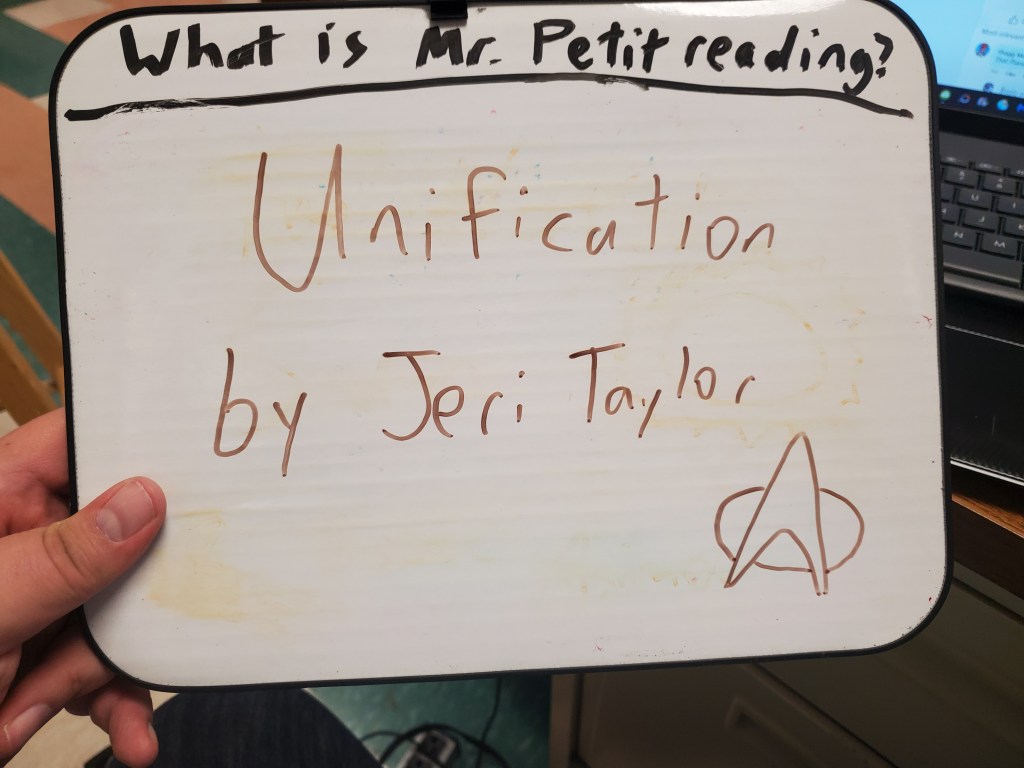
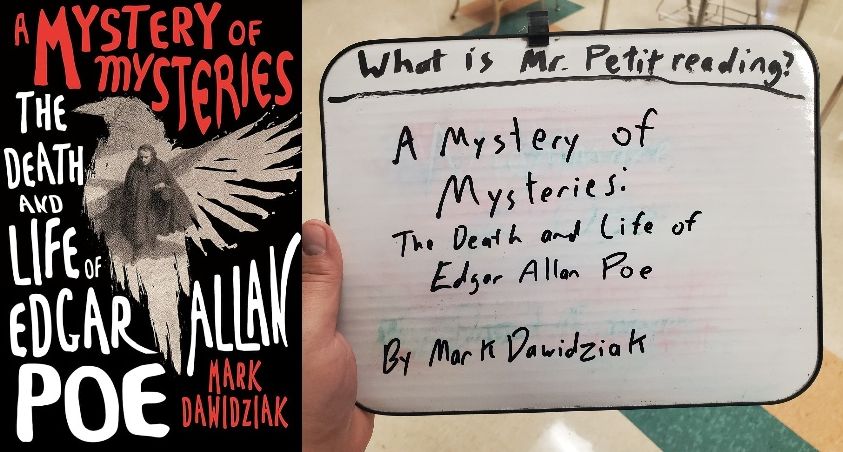
There’s a relatively new trend among teachers – English teachers, at least – that I’ve grown quite fond of: the “What am I reading?” board. There aren’t enough kids out there who read just for the pleasure of it, and it seems like that number dwindles every day. Sure, talking about books all day is one of the best parts of my job, but I think kids get the idea that I spend all my time marinating in Shakespeare or F. Scott Fitzgerald. And while I certainly enjoy many things about both of those authors, that ain’t what I read for fun. So teachers have started making signs or bulletins that declare that we’re reading for our own recreation in the hopes of stirring some conversation. I never draw attention to the board, or let them know when I’m changing it up, but in the past year or so that I’ve kept the board in my room it has spurred a few questions like, “How many books DO you read?” and “Why do you draw that little star next to so many of them?”
It’s a Starfleet delta, you heathens.
Anyway, another thing that this board has been good for is keeping me reading at a relatively brisk pace. The last thing I want is a kid asking me why I’ve spent the last month and a half on the novelization of Spaceballs. So I carve out a little time to read each day, usually before I go to bed, and I keep that board updated as often as possible. It’s been really helpful to me, giving me an impetus to read more often, and I thought today it may be fun to look back on a few recent reads that I’ve enjoyed.
A Mystery of Mysteries: The Death and Life of Edgar Allan Poe by Mark Dawidziak
I picked this book up at Barnes and Noble on my birthday, part of my Rear Window date night with my wife, and I finished reading it a couple of days ago while riding out Hurricane Francine. I like to think Edgar Allan Poe would have approved. This is a great biography of Poe, with an emphasis on the unsolved mystery surrounding his death, found wandering the streets of Baltimore in a haze, drunk, possibly rabid, and dying a few days later crying out for an unknown person called “Reynolds.”
Or so the reports say.
Dawidziak alternates chapters between telling the story of Poe’s life and the story of Poe’s death, and in both cases he spends a lot of time unraveling a lot of the scandalous tales that have plagued the widest-read author in American history ever since his death. Was he actually an opium addict? (No.) Was he an alcoholic? (He had his troubles with alcohol, but at the time of his death he had taken – and adhered to – a temperance pledge.) Did he die of rabies? (The water he drank on his deathbed seems to rule that out.) Granted, I haven’t read a LOT of books about Poe’s life, but Dawidziak definitely paints the most balanced portrayal of the man that I’ve ever read. There’s a clear admiration of Poe in his words as well. This is obviously the work of an author who holds Poe in high regard, so it’s not surprising how much work he does to rehabilitate Poe’s reputation. At the same time, though, the writing is clear and engaging, and the book left me feeling like I know much more about the man who we all imagine hunched over a shadowed writing desk, an ominous raven perched on his shoulder. If you’re at all a fan of Poe, I can’t recommend this book enough. It’s the perfect way to pregame for Spooky Season
A Nightmare in Oz is set in the modern day, 120 years after Dorothy Gale’s first journey to Oz and almost as long since she and her Aunt Em and Uncle Henry came to Oz to live permanently (which happened in Baum’s sixth book, The Emerald City of Oz, in case you didn’t know). But in Oz, nobody ages or dies, so Dorothy is still a young girl here in the 21st century. The story begins with Dorothy having a nightmare – her first since coming to Oz over 100 years ago. As she seeks an answer to her dark visions, she discovers that many of the residents of Oz that, like her, originally came from the non-fairy world are having nightmares of their own: Em, Henry, the Wizard of Oz (who also came back – really people, read the original books) and even her little dog Toto. The mystery of where the nightmare comes from brings back an ancient threat and opens up the doors for an engaging new fantasy series.
Since the Oz books went into public domain, dozens of authors (maybe even hundreds) have tried to put their own stamp on the world of Baum’s creations. Some, like Eric Shanower, do their best to create a world that seems like it could have spilled from the pen of L. Frank Baum himself. Others, such as Gregory Maguire of Wicked fame, use the skeleton of Oz to do something quite different that doesn’t strictly fit in with anything that Baum has done or would have done with his stories.
But Keyes has found a marvelous balance between these two extremes. He is taking Baum’s works as canon, and Dorothy and the other characters have the same inherent goodness and sweetness that readers of the Famous Forty would find familiar and comforting. But by bouncing the action forward a century, he also adds a layer of modernity and sophistication that many contemporary writers don’t attempt. It’s the same old Dorothy, but she’s got a century of experiences that are belied by her childlike exterior. The danger in this book feels more real and more layered than most of the old stories, while not going to the extreme of some other modern writers. I really enjoyed this book, and I’m looking forward to digging into the rest of the books in this series.
The Naked Sun by Isaac Asimov
But this accelerated reading schedule isn’t only reserved for new books. I’ve taken advantage of it to dive back into some old favorites as well, such as Isaac Asimov’s robot series. Most recently I read the second book in the series, The Naked Sun. In a future in which the citizens of Earth are limited to lives in huge, domed cities without ever facing the outside world, Detective Elijah Baley is summoned by an old partner – Robot Daneel Olivaw – to help solve a murder on a distant planet where the sky is open to all, but is so sparsely populated that people live solitary lives without ever seeing one another in person.
Asimov was renowned as a science fiction master, and the world-building in this series has always impressed me. We’re all familiar with the Three Laws of Robotics and all the stories that have been written trying to thwart them, but that’s just the beginning. The projected future of the human race and how Earth is made subservient to its own colonies is fascinating, as are the different types of worlds explored throughout these stories. But I don’t know that people give Asimov enough credit for how good he was as a mysterywriter. This is by no means the only mystery novel Asimov wrote, and not even the only mystery/sci-fi hybrid, but the unique circumstances of the world in which the story takes place adds an additional level of complexity to the mystery that makes this one a joy to unravel.
Of course, not every book that I’ve read in the year since I started keeping my board has been a winner, but as I always do with this column, I’m doing my best to focus on those things that I love. You’re not going to hear about the clunkers. At any rate, these are just a few of the stories that I’ve dug into lately that have helped me jumpstart my love of the written word. Hopefully, you’ve been having fun with books lately too.
Blake M. Petit is a writer, teacher, and dad from Ama, Louisiana. His most recent writing project is the superhero adventure series Other People’s Heroes: Little Stars, volume one of which is now available on Amazon. You can subscribe to his newsletter by clicking right here. The toughest thing about Blake’s new reading routine? Figuring out what book to read NEXT. There’s a…sizable list of candidates.
For some time now I’ve had the novelization of the TV show Charles in Charge sitting in my eBay searches, contemplating whether or not I should jump on it.
The first thing they teach you in blogger school is to start a column with a sentence that will compel the reader to continue in the hopes of making sense of what you’re saying. How am I doing?
You see, we live in a time when people like me (nerds) often go back and recapture things from our youth – things that we remember fondly or that tickle a nostalgic button somewhere in our soul. Often these things take the form of toys, but just as popular are other collectibles like trading cards, comics, vintage video games, and – of course – books. So the reason I’m thinking about getting this book, which is oddly enough a novelization of the opening episodes of the SECOND SEASON of Charles in Charge (I later learned that there is a novelization of the pilot I’ve never seen in person), is because I remember getting it at one of those glorious Scholastic Book Fairs that we used to anticipate with the same excitement and fervor as we would Christmas morning. It’s purely a nostalgia thing, friends.
Don’t tell the eBay seller I borrowed their picture for this, okay?
Eh?
Oh, you mean you were wondering why the hell there was a Charles in Charge novel in the first place, aren’t you?
That also goes back to the time period in which I grew up, a magical, halcyon time known as the 1980s. It was a heck of a time to grow up. We had the best music, sodas were clear sometimes, and cigarettes had only been bad for you for like 20 minutes. But that doesn’t mean everything was perfect. This was in an era before streaming services, an era before you could pull up popular entertainment on demand from your remote control without even having to get off your couch and look for clean pants. If you saw a TV show you liked, the only way to experience it again was hope for a rerun. If you loved a movie, you had to wait for it to come on HBO (if you had it) or rent it from these ancient temples that we called “video stores.” You couldn’t even just go out and BUY the VHS tape the way you later could the DVD, because in the early days of home video the studios made the movies prohibitively expensive (nobody in their right mind would – or should – have paid $120 for a VHS copy of The Land Before Time 2)so that most people couldn’t afford to build a home library and, instead, the studios made their money using the video stores as the middleman. Eventually, the prices of VHS tapes dropped and home libraries became a thing, but for much of my childhood if there was a movie you really loved, there was only one surefire way to experience it again whenever you wanted: buying the novelization.
When you need to hear Madonna as Breathless Mahoney, this is the next best thing.
Novelizations have been around almost as long as film, going back to the silent era. In 1966 Isaac Asimov was hired to novelize the film Fantastic Voyage. (He was so disappointed with the result that he came back years later with a “sequel” called Fantastic Voyage II: Destination Brain, which just used the premise of miniaturized scientists going into a human body and otherwise was completely independent). One of the most interesting examples, I think, is 2001: A Space Odyssey. Author Arthur C. Clarke and director Stanley Kubrick collaborated on the story, then Clark wrote the novel WHILE Kubrick worked on the film, so which of them technically is the adaptation of the other? If you ever figure it out, let me know.
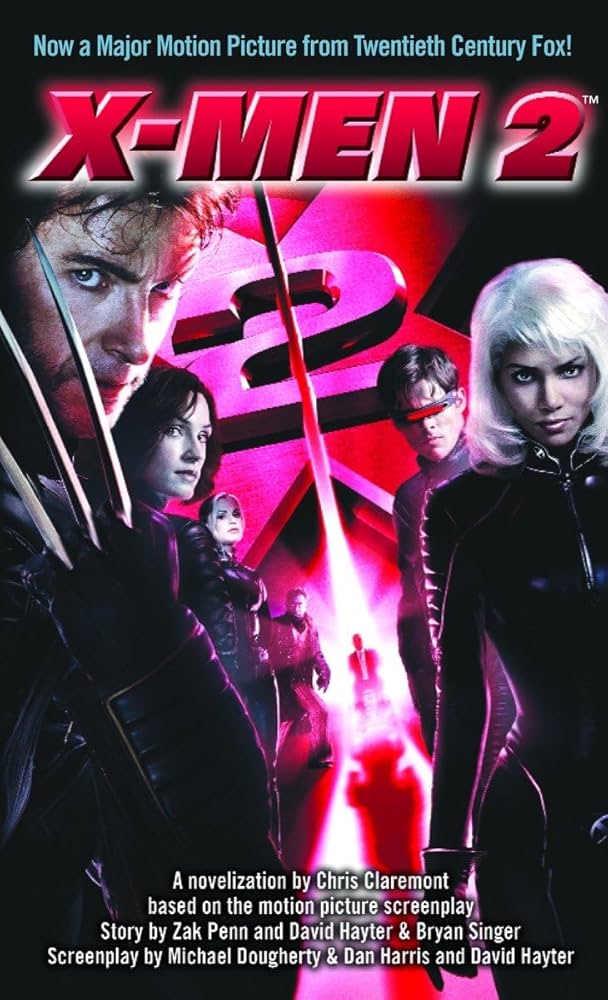
But in the 80s, the novelization was huge. I had stacks of them for the formative movies of my youth: E.T.: The Extra-Terrestrial, Batman, Dick Tracy, Back to the Future…not to mention the requisite Star Trek and Star Wars books. Not all of them were very good, of course. Some of them were downright terrible. But there was something interesting about reading these books, which were often based on early drafts of the film’s script. The novels had to be written quickly, usually while the film was still in production, in order to have them printed and on the shelves when the movie came out, so if things changed during the production, the novel would sometimes be based on the original version rather than the change. The novelization of the second X-Men movie, for example, is so different (up to which characters lived and died) that you’d be hard-pressed to believe the writer even KNEW anything about the X-Men…if it weren’t Chris Claremont, whose work on the characters in the 70s and 80s is pretty much the main reason that those characters survived past the 70s and 80s without falling into obscurity.
“Claremont! Who the hell is ‘Bolverine’?”
Screenplays often lack the detail that you get in a novel as well, and as such the authors had to conjure up a lot of the characters’ backstory, inner monologue, and other elements that wouldn’t have room to go into in a feature film. Goonies is a phenomenal example of this. It’s a movie that everybody my age grew up idolizing, that we watched over and over again, that became a fundamental part of our psyche. So we all know that the reason Josh Brolin’s character Brandon has to steal a child’s bicycle after his brother Mikey (Sean Astin) lets the air out of his own bike tires is because he flunked his driver’s test. But the novel tells us that the REASON Brand flunked his test is because he suffers from claustrophobia and freaked out about being the car with the driving instructor, a stranger. Overcoming his claustrophobia in the caves becomes an interesting running element through the novel. It also gives us a little insight into what happens to the characters after the movie ends – for instance, Chunk’s parents officially adopt Sloth and give him the name Jason Sloth Cohen at his Bar Mitzvah. It’s adorable.
Not to mention the subtle suggestions that Mikey is actually the reincarnation of One-Eyed Willie.
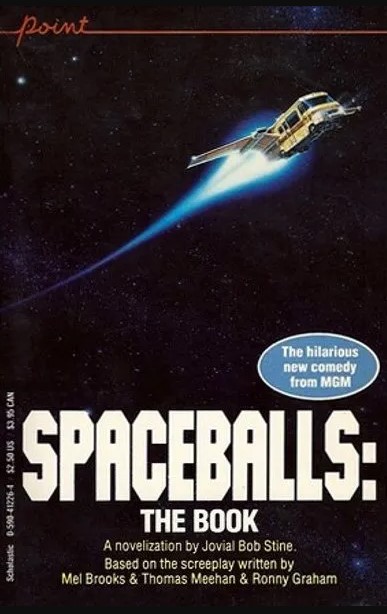
And of course, these novelizations were turned out in large numbers, especially the ones for kids. The Charles in Charge book I mentioned before is only one of many such novelizations I got from a Scholastic imprint called Point, which specialized in middle grade books. This resulted in a lot of those aforementioned novelizations, plus an avalanche of the kind of kiddie horror books that would turn so many people into lifelong horror fans, such as the Goosebumps line. It got to a point (no pun intended) that I would actually look for that Point logo at the Scholastic Book fair, as I knew those were books for people like me. In fact, a while back I finally DID jump on eBay to snag one of those old Point books from my youth, their novelization of the Mel Brooks comedy Spaceballs. When I got the book I saw, to my surprise, that it was written by “Jovial Bob Stine.” This name meant nothing to me when the movie came out in 1987, but looking back on it now I realize that this was one of the various pen names used by someone who would soon become a Scholastic legend – R.L. Stine, creator of those Goosebumps novels I mentioned before.
It’s JOVIAL, see. Also hilarious. Says so right there.
Some of these books have become real collector’s items. If you look up the original novelizations of some of the 80s horror movies like Halloween, Friday the 13th, or A Nightmare on Elm Street, you see them going for hundreds of dollars now. Considering the demand, it’s actually really surprising to me that you don’t see them reissued more often, or at least offered digitally. In some cases, I suppose it’s a rights issue (the rights for Friday the 13th are notoriously complicated at the moment), but some are less understandable. DC Comics recently announced a new novel, Batman: Resurrection, which will serve as a direct sequel to the 1989 Batman movie. That sounds cool – but why not reissue the novelization of the original movie to go with it?
Trust me, geeks will eat this stuff up.
Novelizations are still produced today, but not as many as there were back in the 80s and 90s. A lot of sci-fi movies still get them, but the odds of seeing a novel based on, for instance, the premiere of Abbot Elementary seems fairly remote. Obviously, with the streaming era, it’s not as necessary to have a book to get your hands on the story the way it was when I was a kid. More than that, though, I think that the streaming era has broken down the audience so that these things aren’t part of the cultural conversation the way they used to be. When something like the first few Star Wars movies came out, they were a phenomenon that EVERYBODY had to talk about, had to experience. They lingered in theaters for months, even years, before finally filtering out and making way for something new. That doesn’t happen anymore. A movie lives or dies based on its opening weekend. TV series dump an entire season at once and everybody has forgotten about it a week later. It’s a sad thing, I think, a change that I’m not fond of, but it’s the world we live in now.
So I’ll keep my eye on eBay and keep my finger over that “buy it now” button. I’m not saying I’ll get every old novel I see, of course. I’m just saying that if I COULD, I WOULD.
Blake M. Petit is a writer, teacher, and dad from Ama, Louisiana. His most recent writing project is the superhero adventure series Other People’s Heroes: Little Stars, volume one of which is now available on Amazon. You can subscribe to his newsletter by clicking right here. If you ever see a decent price for the novelization of Howard the Duck, let him know.
I know, it’s unusual for me to kick off one of these columns with something so overtly political, but bear with me here.
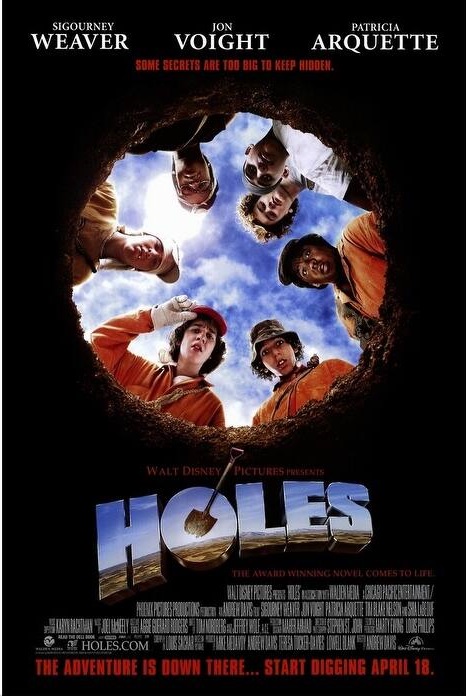
Holes, which came out in 2003, is an adaptation of Louis Sachar’s young adult novel of the same name. The story is about a kid named Stanley Yelnats who is falsely accused of stealing a pair of very expensive celebrity shoes from a charity auction and sentenced to 18 months at a juvenile detention facility called Camp Green Lake. As it turns out there’s nothing green about the camp, nor is there a lake there anymore – just the desert remains of a dried lakebed where the detainees are forced to dig five-foot holes day after day in an effort to “build their character.” The film bounces around three different timelines: Stanley’s story is intercut with that of his great-great-grandfather, who accidentally brought a curse down on five generations of his family, and the origin story of a brutal outlaw named “Kissin’” Kate Barlow, who terrorized the Green Lake community a century ago.
Trigger warning: may offend people with holes.
I remembered enjoying the movie when it first came out, but a few days ago I watched it for the first time in several years and I was really impressed by how tightly plotted the film is. Even with juggling three timelines there is virtually no fat in the plot. Everything in the story turns out to be significant in the end, either to revealing the truth about the two timelines that take place in the past or to bringing the storyline of the present day to a satisfying conclusion. It’s a really good movie, and I’m not even kidding when I say that screenwriters could do worse than to study it when it comes to learning how to put a story together.
Part of the reason for the tightness of the story, I think, is because the screenplay was written by Louis Sachar himself, adapting his own novel. True, sometimes when this happens the original writer can be a tad too precious about keeping their favorite bits or not understand the necessities of adaptation, but Sachar did a stellar job. However, as I often do when I watch a movie I really enjoy, I spent a little time online afterwards looking into the history of the film and learned something I hadn’t known before: Sachar’s script was NOT the first attempt to adapt the book. The first attempt at adapting the story was written by Richard Kelly, who is probably best known as the writer and director of Donnie Darko, which film scholars among you will recognize as being one of the last movies one would think about when drawing comparisons to Holes. Furthermore, that Kelly script – as it turns out – is freely available online, and I clicked on it to take a look.
The beloved children’s classic reimagined by…this guy.
Kelly’s version begins with a narrator described as an “elderly voice” saying – and I swear, I am transcribing this verbatim: “Once…when it was still early in the twenty-first century…there existed a prison in a sea of sand.”
Holy crap.
It continues.
“All signs of life in this place had been destroyed by something terrible…and that something had dried up into the earth…and the earth was a prison for all mankind.”
HOLY.
CRAP.
Had Kelly even read the book?
Incidentally, the ellipses you’re seeing in these passages were there originally, I didn’t omit anything. This is HOW IT IS WRITTEN.
At this point I saved the link so I could go back and read it later, because something this completely bonkers has to be examined slowly, carefully. When Stanley “Kramer” shows up later on the page, the narrator continues by telling us “He did not feel sorry for what he had done…but feeling sorrow is not adequate punishment for such a crime. Feeling sorrow does not absolve the crime from the memory of the victims…if the victims are still breathing.”
Was Kelly even aware of the fact that there is a book?
Adaptations are not a new art form, guys. The Greeks borrowed from existing myths and legends when they invented modern theater. Virtually all of Shakespeare’s most famous plays are based on history, mythology, or earlier poetry that he expanded in his own way. The Lego Movie was based on the works of Eudora Welty. So it’s not that I have any objection to adapting a work from one medium to another. But at SOME point, it seems like someone has to ask the question: if I’m changing the story this much, is it even still really an adaptation?
Change is inevitable when changing from one medium to another, and for any of a thousand reasons. In The Hunger Games, for instance, the novel is written from the first-person point of view of Katniss Everdeen and is heavily loaded with her internal monologue. This is difficult to do well in a movie, and thus the information we learn in monologue – whether it’s plot-driven or character-driven – has to be imparted to the audience in a different way. Sometimes the changes are pragmatic. Back to Holes for a moment – in the novel, Stanley begins the story as a fat boy who gradually loses weight due to the physical labor he’s forced to undergo. The filmmakers decided to drop this and cast the relatively slim Shia LaBoeuf under the reasoning that it would be too difficult to make a 14-year-old actor gain and lose weight so drastically over the course of filming, not to mention potentially dangerous to his health. That is a 100 percent acceptable change.
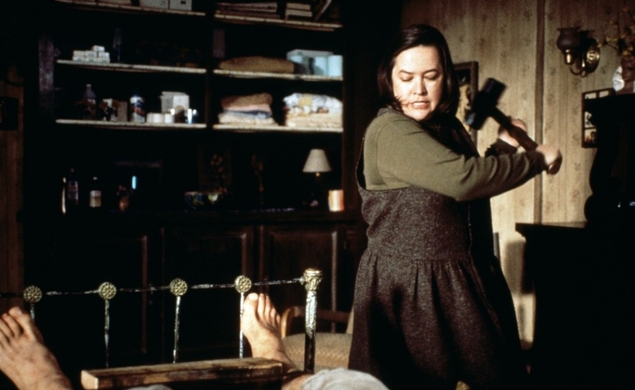
Sometimes changes are just a matter of understanding what the audience can handle. I’ll give you two examples from Stephen King. Cujo is a book about a mother and her child trapped in an increasingly hot car by a violent and rabid St. Bernard. In the book – spoiler alert here for a 43-year-old novel – the child dies of heatstroke. But in the movie, the filmmakers let the kid live, thinking his death would be too much for the audience. There’s a similar change in the film version of Misery, about a writer who gets in a terrible car accident and is rescued by his “biggest fan,” who turns out to be a deranged lunatic. In the book, to prevent Paul Sheldon from escaping, the insane Annie Wilkes cuts off his feet. If that sentence shocked you it’s probably because you are more familiar with the famous scene in the movie, where she “only” hobbles him by breaking his ankles with a sledgehammer. Reportedly, the producers felt like audiences would never forgive the actress, Kathy Bates, if she went so far as to actually cut his feet off. And if you think that audiences are smart enough to know the difference between the actor and the behavior of their character, look up the way “fans” treated Anna Gunn for the things Skyler White did on Breaking Bad.
If social media had existed in 1990, Kathy Bates might still be in hiding for this.
When it comes to these changes, the filmmakers chose to lessen the tragedy of the book. I don’t think that we’re saying that book readers are more accepting of gore or death than people who watch movies, though. I think the lesson here is that it is more difficult – more disturbing – to watch certain tragedies than to read about them. On the other hand, there’s the adaptation of King’s novella The Mist, which is a book with an ambiguous ending. The film, however, goes in the OPPOSITE direction, making the ending OVERTLY tragic. In this case, though, making the ending far worse than the original actually works. Stephen King himself has reportedly said he prefers the ending of the movie to the that of the story he wrote.
Time is also a big factor when it comes to adaptation. If you’re adapting a doorstopper novel, especially into a film intended for theatrical distribution, it’s virtually impossible to squeeze in everything. Lord of the Rings fans have elevated the absence of Tom Bombadil from the film version of the beloved trilogy to meme status. To a lesser degree, the same is true for the Scouring of the Shire. As much as I appreciate those sequences in the book, though, when we’re talking about movies that already have a running time that’s longer than the first marriages of certain people I went to college with, I can forgive Peter Jackson for laying those pieces aside.
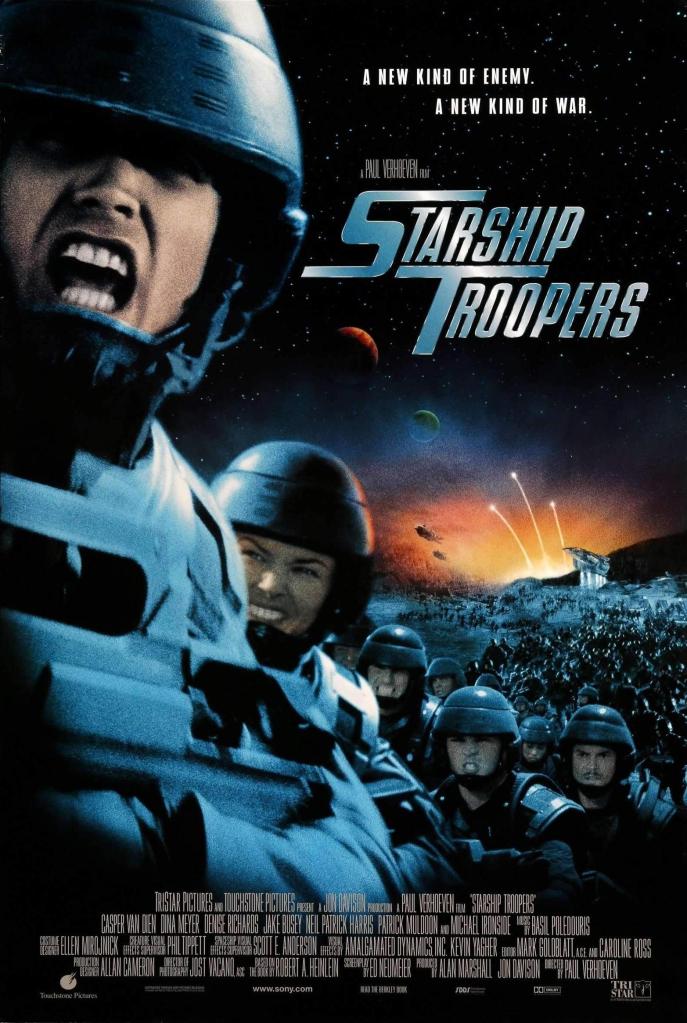
Changes from one medium to another are a necessity, because no two types of storytelling have exactly the same requirements or demands. I don’t mind changes, provided that making the change does not alter or pervert the spirit or intent of the original work, and here’s where I’m going to piss some people off, because Starship Troopers. It’s one of those movies that flopped when it came out but has grown a devoted following in recent years. That seems to happen a lot – something people disliked when it came out is rediscovered years later and lauded or, conversely, something that was once popular is hit with backlash and people suddenly declare that they never thought it was that good in the first place and they only saw it in the theaters 27 times “ironically.” I don’t do that a lot, honestly. I’ve certainly reevaluated movies after the fact, sometimes enjoying them more, sometimes less, but I don’t think I’ve ever done a complete 180 on a film. Which brings us back to Starship Troopers.
My friends, I’m here to tell ya that I thought it sucked then and I think it sucks now.
I’m going to pause here so the type of person who writes angry responses without bothering to read my point can write an angry response without bothering to read my point.
Fans of the movie praise Paul Verhoeven for making a witty sci-fi anti-war satire, a movie in which the entire human military is thinly painted as Nazis in training. However, none of this is applicable to the book, which is most certainly not anti-war, nor is it in the practice of making the humans into the bad guys. In fact, the book – which I should admit I was already a fan of before the movie was made – isn’t really plot-driven at all, but is more of an examination of the life of a soldier in a hypothetical science fiction future. The war against the insectoid aliens is there, but it’s more of a backdrop, a way of examining the world that author Robert Heinlein created. It’s no surprise, then, to find out that Verhoeven admittedly never even finished reading the book, finding it too “boring” and “militaristic.”
Sir, I must say this: if you can’t even finish reading the source material of an adaptation, I submit that you are not the right person to adapt it.
Here’s the thing, folks: I have no objection to Verhoeven making an anti-war movie, or a satire, or a movie in which humans are thinly-disguised bad guys. This is his right as a filmmaker, and there are plenty of good movies that do just this. I do, however, have a strong objection to him doing so by trading in on a novel by Robert Heinlein which is none of those things. I simply don’t think it’s fair, either to readers of the novel or to Heinlein himself, and in disputes of this nature I’m pretty much always going to side with the original author’s intent. If Verhoven had made a virtually identical movie, changing the names and calling it something like Spaceship Soldiers instead, we would not be having this conversation right now…but it’s also possible that we wouldn’t be talking about the movie AT ALL, that without the connection to Heinlein, the film would have been forgotten entirely.
It’s not a question of which of these men I agree with more, it’s a question of whether it is ethically right of Verhoven to use Heinlein’s story to espouse views that Heinlein’s story clearly disagreed with. Personally, I don’t think it is. I know that this is an area in which a lot of people will disagree with me. Hell, maybe Heinlein himself would disagree with me. But I ask you this: Arlo Guthrie’s 18-minute song “Alice’s Restaurant,” which was essentially a protest against the Vietnam war, was made into a similarly anti-war film. Had Guthrie not been involved in the film, but rather it was made by somebody else who painted Guthrie’s character as a fool and his protest against the war as misguided, would that have been fair to Guthrie?
What I’m getting at, friends, is this: if you’re a fan of Starship Troopers, is your acceptance of the adaptation process based on which political viewpoint you agree with? If that’s the case, I’m afraid that we will not be able to meet halfway on this one, and I hope that we can still be friends and that you’ll still come back next week when I’m writing about how awesome the theme from DuckTales is or something.
Adapting a story from one medium to another should be done for one of two reasons. First, if it is an exceptionally good story and you want to retell it for a different audience. Great! Do it! But if it IS an exceptionally good story, then why do you want to change it?
The second, more cynical reason, is because the story is popular, and you’re hoping to make money by appealing to the pre-existing audience. Okay, I can live with that. But if the story IS already popular and has a pre-existing audience, WHY DO YOU WANT TO CHANGE IT?
The answer, by the way, is because writers can be a vain bunch (yes, I am including myself in that number) and a good number cannot resist the urge to put their own stamp on something. This is what Richard Kelly did (remember him?) in his Holes adaptation. He wasn’t writing an adaptation of Louis Sachar’s novel Holes, he was writing a Richard Kelly movie that was vaguely suggested by a novel by Louis Sachar. And for a fan of Louis Sachar’s novel, that would have been MASSIVELY disappointing.
But writers do this anyway, because for some people it’s more important that something is “theirs” than it is that they treat the source material faithfully. Sometimes that means they’ve created a brand-new breakout character, like the people who gave us Scrappy Doo. Sometimes that means “updating” a story for a whole new audience, the way the smash hit film Barb Wire “updated” the story of Casablanca to become beloved by the ages. And sometimes it’s because the author is just trying to trade on somebody else’s work to spread their own message to the masses, which makes me wonder how strong a storyteller you actually are if you can’t get your message out without borrowing somebody else’s name.
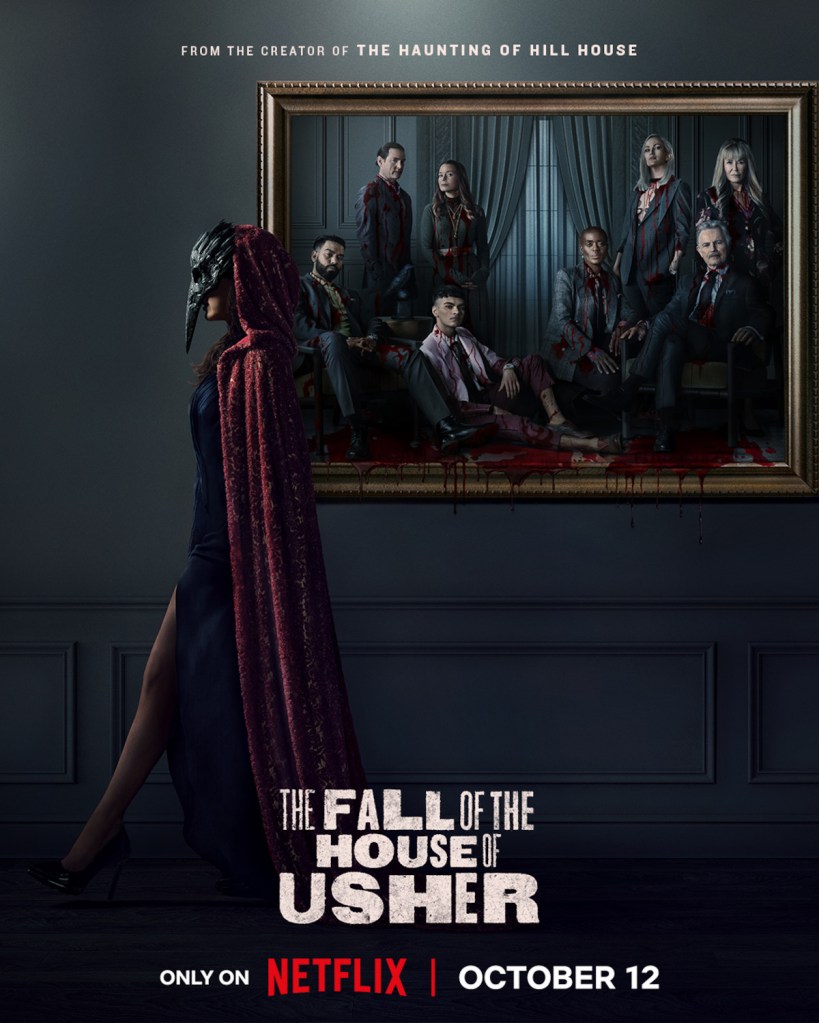
I’m not saying it’s impossible to do a complete re-imagining of a work and do it well. The Netflix miniseries Fall of the House of Usher is an excellent example. Writer/director Mike Flanagan didn’t even TRY to do a straight adaptation of Edgar Allan Poe’s short story. Instead, what he did was grab bits and pieces of dozens of DIFFERENT Poe stories and reassemble them into something totally original and unique. It was as if he had gotten his hands on ten different Edgar Allan Poe Lego kits, threw away the instructions, and used the bricks to create his own thing. It was fantastic, and is one of the projects I point to when I say that Flanagan is, in fact, the right man to adapt Stephen King’s The Dark Tower if anyone ever has the guts to give him the money to do it. But he didn’t do it by twisting or changing Poe’s work into something unrecognizable. Quite the opposite – he did something that was totally his and slipped in recognizable elements to help us see the larger picture.
Definitely the weirdest Lego movie.
Then there’s the wild movie that actually gets its name from the process we’re talking about, Adaptation, which is ostensibly an adaptation of Susan Orlean’s nonfiction book The Orchid Thief. The book is a portrait of a horticulturalist who was arrested for poaching flowers, but that’s not the movie screenwriter Charlie Kaufman wrote. Instead, he wrote a movie about how he (Kaufman himself, as a character in the movie) struggled with adapting the book. He fictionalizes Orlean and John Leroche, the subject of the book, and creates a fictional twin brother for himself – both Charlie and “Donald” Kaufman are played by Nicolas Cage in one of those movies that earns him his reputation of doing kind of insane movies. Orlean herself was understandably taken aback when she read the script, but in more recent interviews has said she’s come around and now loves the movie, which was in no way a literal adaptation of her work but still successfully communicated the book’s themes of longing and obsession. Also there’s a car chase.
Most adaptations, I think, usually fall somewhere in-between the highly faithful Holes and the bonkers left turns of Adaptation. I always point to The Wizard of Oz here – most people’s version of Oz is the one we saw in 1939, the Judy Garland movie that has become a legitimate cultural classic. It’s a lovely movie, it’s beautifully filmed, and the music is timeless. As an adaptation, though, it’s mid. The film leaves out lots of sequences from the book, compresses two good witches into one (making Glinda seem like kind of a jerk for not telling Dorothy that the Ruby Slippers could send her home at the beginning, whereas in the original book those are two entirely different witches and the first apparently doesn’t know), and changes a few things – most egregiously the ending, which implies that Dorothy’s journey to Oz was just a dream. This is not at all suggested by the book, but the ending of the film has become so iconic that it’s inspired a thousand other “all just a dream” endings, which – speaking as a writer – is a crime I consider only slightly worse than lighting an orphanage full of puppies on fire and chaining the doors on your way out. But even then, the sense of wonder and awe that the film gives us DOES successfully communicate the wonder and awe of the book, and for that reason I can still love it.
A good adaptation has the potential to breathe new life into an existing work. A bad one, though, has the power to choke a work to death. If it ever comes down to a choice between one or the other, I know which side I’m going to be on.
Blake M. Petit is a writer, teacher, and dad from Ama, Louisiana. His most recent writing project is the superhero adventure series Other People’s Heroes: Little Stars, volume one of which is now available on Amazon. You can subscribe to his newsletter by clicking right here. He’s not kidding about the theme from DuckTales, you know. As TV themes go, he dares you to name more of a banger.
A few months ago, a friend of mine shared with me a website called Freebooksy.com, which alerts you to freebies in the Amazon Kindle store. It’s fairly simple – you click on the genres that you’re interested in when you sign up and each morning you get an email with a selection of free books available. Inclusion in the email is paid for by the authors and publishers, I should point out, as a promotional tool, so you see the same names over and over again, but it’s hard to complain about free. I check the email most days, but I don’t sweat it if I miss a day because I know that the same stuff will be comin’ around again before too long.
Also before too long I noticed a distinct trend, especially among those books that are designated as “thrillers”: utter homogony when it comes to cover design. On any given day when I open this newsletter and scroll to the thriller section, I will see a minimum of three covers with virtually the same style:
A single color palette – often blue, but reds and oranges are also popular – which creates a gradient across the book cover.
The title of the book in large unimpressive block letters.
The author’s name in smaller unimpressive block letters.
A line of text informing you what series this particular volume belongs to.
A background image that usually cuts across the middle of the book. This is often, but not always, a landscape of some sort. Popular choices are mountain ranges, swamps, beaches, and cabins in the snow.
Usually I would try to provide some pictures here to demonstrate my frustration, but considering how I’m talking about how dull and bland these covers are, I kinda feel bad calling anybody out specifically. So instead, I have used my legendary skill at Not-Quite-Photoshop-But-a-Free-Online-Alternative to create my own example of the sort of cover I see over and over and over again.
Now you know why I don’t design my own book covers.
Riveting, right? If you go to Amazon right now and click on the “thriller” genre once you figure out where they’ve hidden the books, you will see dozens and dozens of titles that duplicate that template to the letter. After a while they all blend together and there’s nothing to make me remember any of them. They always say you can’t judge a book by its cover, and that may be true, but I’m sure as hell more likely to pick up a book in the first place if the cover doesn’t look like it was made with Generic Thriller Template #1138.
The same holds true for movie posters, by the way. Movie posters were once an art form all to themselves, with gorgeous illustrations by the likes of the great Drew Struzan that made me even more anxious to see Goonies, Indiana Jones and the Temple of Doom, or Back to the Future than the trailers did. Now book covers and movie posters seem to be churned out by committee, choosing the elements that hit the greatest number of quadrants to appeal to the largest number of people and, in the process, becoming something that is appealing to no one.
Name a movie poster from the past ten years that’s better than this one. Trick question. You can’t.
Look, I’m spoiled. Most of my book covers have been done by Jacob Bascle, who absolutely knocks it out of the park every time the way he did with the cover for Little Stars Book One: Twinkle Twinkle, which by the way is now available to preorder on Amazon. (That’s as subtle as I get, folks.) But I also know that’s because I self-publish, and if I ever get tied up with an actual publisher I may not have much of a say into who does the book cover or how. But none of that changes the fact that the people turning out book covers right now have totally lost the plot.
As with so many things that aren’t as cool now as they used to be, let’s look back at the 70s and 80s to see how it should be done. This was, I believe, a golden age for book covers and movie posters, especially when it came to genre fiction like horror or sci-fi. Sure, the artwork was lurid, over-the-top, and often terribly deceptive as far as the actual contents of the work, but sweet cinnamon sugar, was it memorable! For example, let’s look at Stephen King (the real one) and his 1978 epic The Stand. This is a gargantuan novel about a virus that escapes from a science lab and spreads out into the world with a fatality rate of over 99 percent. Those who survive wind up collecting in two groups – a mostly peace loving community in Boulder, Colorado, and a vicious, hedonistic sect in Las Vegas under the rule of King’s frequent boogeyman character Randall Flagg. It’s an amazing book and it’s the one that first made me a fan of Stephen King’s work when I read it in high school.
Now look at the first edition cover.
You think an AI “artist” could have come up with something this incredible?
Isn’t that AMAZING? There are SO MANY QUESTIONS to be asked here. Why does that dude look like Luke Skywalker? Who’s the rat guy with the sword? Why are Luke Skywalker and the rat guy dueling? Is Randall Flagg Emperor Palpatine? How does this tie into the epic saga of the insidious disease called Captain Trips? And the answer is: it doesn’t! There is absolutely nothing about this book illustration that has the barest relation to the 10,942 pages of text in-between these covers. It’s like some writer failed to deliver his fantasy novel about an uprising of lycanthropic rodents in a medieval setting and the publisher just said, “Hell, we gotta use this art somewhere” just before King’s manuscript arrived, delivered by three separate UPS trucks. And history was made. But the thing is, as little as this cover has to do with the actual book, it’s memorable as hell.
Then there’s another of my favorite books, William Goldman’s The Princess Bride. Everyone knows the movie – the epic comedy love story of true love and grand adventure. It’s a family favorite and a tale that transcends generations, finding new fans every day both young and old. It is the perfect movie for lovers, for adventure seekers, for parents, for children. And a lot of people have read the book as well. But how many of you have ever seen the cover to the 1974 edition of the book?
“Uhh…Larry…what exactly do you think a Bride is?”
I don’t even have a theory to explain this cover, the way I do the Stephen King book. It’s patently obvious that whoever painted this artwork hadn’t read the book – possibly had never read any book. In fact, I wouldn’t be too surprised if whoever painted this isn’t legally allowed within 300 yards of a library. And yet, I never forget that this cover exists.
I love going to used bookstores, and one of the best reasons is to look at this sort of wild cover art that just doesn’t exist anymore. The next time you’re in one, take a turn into the horror or sci-fi section – even if you don’t normally read horror or sci-fi – and just scan the book covers. Aliens with googly eyes, knives dripping with blood, monsters that may or may not bear any resemblance to the creatures inside the book. Walking through these stores is the closest I can get today to the experience of walking through a video store as a youth, going down that horror section and seeing the ghastly and yet somehow enticing cover art that adorned such classics as Evil Dead 2, Re-Animator, or The Stuff. Oh no, my parents never allowed me to rent these movies when I was a kid, but even then I was drawn to the artwork, and I’ve gone back and revisited a lot of those films as an adult…and you know, even the worst of them seem to trigger a hint of pleasant nostalgia for those trips down the video store aisle.
Pictured:Nostalgia.
In 2017, horror writer Grady Hendrix released Paperbacks From Hell, a book that examined the absolute avalanche of horror fiction that was produced in the 70s and 80s. Hendrix does a great job in this book of dividing up the work into different categories and discussing some of the more prominent writers, most popular novels, and intriguing trends that existed at the time. But if we’re being honest, the biggest reason to get Hendrix’s book is to get over 250 pages of full color illustrations of some of the wildest horror novel cover art that ever existed.
If this makes you want to read this book, you’re my kind of people.
The book is a love letter to the genre, and was popular enough that Valancourt books actually did a limited re-release of several of the books mentioned, original cover art intact, with a new forward by Hendrix himself. Unfortunately, that rerelease did not include John Christopher’s The Little People, a novel about a British couple that tries to turn an Irish castle into a B&B only to learn that it is infested with Nazi Leprechauns. No, there’s not a typo anywhere in that sentence.
All this goodness…no Nazi Leprechauns.
If you think I’m coming across as a stodgy old man lamenting the days of his youth – well, you’re very perceptive. But you can’t wander through a Barnes and Noble and look at the wall of $18 trade paperbacks that waits for you there with so many of the same cover tropes over and over again and objectively tell me that cover art has improved over the last 40 years. Nah, give me the days when an eyeball rolling around in a skull looked at me from the cover of a book, the time of creepy dolls and skeleton horses and eyes glaring at me from behind a set of venetian blinds. These were covers with personality. These were covers that meant something.
Not necessarily something that related to the inside of the book, of course. But something.
SPECIAL ANNOUNCEMENT:
Hey, have you ever missed a Geek Punditry column? Sad, isn’t it? How you don’t know what everyone at work is talking about around the water cooler, ostracizing you and pushing you to the fringes of society the same way they used to do because you didn’t watch Game of Thrones? Well, you’ll never have that problem again if you subscribe to my newsletter. I’m kicking off a (probably) weekly roundup of everything I’ve been doing, which will include links to the newest Geek Punditry, information about whatever new releases I have coming up, some chatter about what I’m working on, and the occasional bonus goodie as well. And as a thank you for signing up, your welcome email includes a top secret, never before seen short story from the world of Siegel City called “Sally Starcher is Cosmagirl!” So if you’re into that kind of stuff, if you want to know what I’m up to, if you just don’t want to miss out when Derek from accounting starts talking about Sally Starcher the way he used to talk about someone called “Khaleesi,” there’s an easy solution. Just click this link, drop me your email address, and you’re all set!
Blake M. Petit is a writer, teacher, and dad from Ama, Louisiana. His most recent writing project is the superhero adventure series Other People’s Heroes: Little Stars, volume one of which is now available on Amazon. You can subscribe to his newsletter by clicking on this dandy little link right here. He hasn’t had any eyeballs on his own book covers yet. He’s waiting for the right time. Maybe something about bunnies.
When you’re a high school teacher and spend most of your day around teenagers, you will overhear their conversations whether you like it or not. You hear about the TikToking, and you know who is dating who, and on frequent occasions you learn more about the way these kids spend their weekends than you ever want to know and you contemplate duct-taping your own children to a pool table from the time they’re 13 until they turn 27 or so. And on rare, extremely rare occasions, you’ll hear them discuss things that are actually relevant to your class. Earlier this week, for instance, I overheard a few girls talking about why so many people are using The Great Gatsby as themes for parties and dances these days.
As always happens when there’s a conversation worth joining, I jumped in. “There are three reasons,” I said. “First of all, it’s the 20s again, so people are playing with that. Second, the book went into public domain a few years ago, so nobody has to pay to use these things. And third, there are a lot of people who think the movie is fun and didn’t actually pay attention when they were supposed to be reading the book.”
“Ain’t no party like a Gatsby party, ’cause a Gatsby party ends with three people dead and a complete loss of faith in the American dream!”
The Great Gatsby is, of course, a seminal work of American literature. It’s one of the best books ever written in this country, and it paints a complex and gripping narrative in a relatively short number of pages, but the book is about the unsatisfying nature of a decadent lifestyle and how pursuit of material things is shallow and destructive. Anybody who comes away from that book thinking that these characters are something to aspire towards is – and I’m going to be kind here – an utter moron.
I talked about this conversation with some of my English teacher friends (of course I have English teacher friends – we sit around and conjugate each other’s verbs and talk about which infinitives we’re crushing on) and discussed the fact that there aren’t a lot of books that we teach that provide role models or, for that matter, happy endings. Let’s face it, most books that are complicated enough for a really deep literary analysis tend towards tragic – or at best, bittersweet – endings. The least-depressing book I’ve ever used in my classroom is The Hitchhiker’s Guide to the Galaxy, and that book BEGINS with the complete destruction of the planet Earth. And one of my friends in this chat commented that this is why she sticks to reading lighthearted stuff on her own time – “literature” is too depressing.
Whaddaya gonna do? You’ve got to build bypasses.
I’ve always thought it was odd to use the word “literature” as a genre, the way I would “science fiction” or “horror.” What, exactly, qualifies something as a work of literature? Every time I walk into a bookstore with a “literature” section, I want to ask somebody who decides which books go on those shelves and which ones do not? Isn’t the very existence of a “literature” section sort of a low-key insult to all of the other books in the store that got shelved somewhere else? Ernest Hemingway’s The Old Man and the Sea goes on the literature shelves whereas William Goldman’s The Princess Bride doesn’t, but I could write you a whole dissertation on which one is a better book, and it ain’t the Hemingway.
One of these is one of the most incredible stories ever conceived by the human mind and the other one is what happens when Ernest Hemingway doesn’t go to therapy.
Is it just the age of the work? Everyone would agree that Lord of the Flies from 1954 is a great work of literature. But what about Robert Heinlein’s Rocket Ship Galileo, published in 1947? It’s not only a book that doesn’t enter the “great literature” discussion, it’s not even usually part of the conversation when you talk specifically about the work of Robert Heinlein. We got George Orwell’s 1984 in 1948, nearly twenty years after the first Nancy Drew novel, The Secret of the Old Clock, but nobody is citing the works of Carolyn Keene in the conversation of great writers. And that’s not just because she didn’t actually exist.
Is it just about the complexity of the work? Must a work deal with heavy ideas and deep themes to qualify? The Adventures of Huckleberry Finn gets my personal vote for the greatest American novel ever written (sorry, F. Scott Fitzgerald). Set 20 years before the Civil War but written about 20 years afterwards, the novel is a deep and fascinating analogy about the changes the country went through during that time period. Whereas Mark Twain’s earlier book with these characters (The Adventures of Tom Sawyer) was a simple boy’s adventure story, Huckleberry Finn is about a child struggling with the ethical quandary of whether it is morally right to help his friend Jim escape from slavery. Jim’s owner, Miss Watson, has taken care of Huck, and in the eyes of the law he is betraying her by helping in Jim’s escape. But eventually, he comes to the conclusion that he’s going to be loyal to his friend, even if it goes against the law, even if it goes against what he has been taught is morally right. The book deals with the destructive nature of bigotry, ignorance, and hypocrisy, and Huck himself becomes symbolic of the moral transmogrification that the United States was beginning to undergo. In other words, literature.
The thing is, though, a lot of these same ideas and themes can also be found in random episodes of Star Trek. If I pull out Oliver Crawford’s script for “Let That Be Your Last Battlefield,” I can get into a deep conversation about the folly of racism as we watch two aliens whose species has hunted itself to extinction because some of them are black and white whereas others are white and black. It’s a legendary episode, but could I justifiably call the script for it literature the same way I would Huck Finn or – to use the other best-known example of anti-racist literature – To Kill a Mockingbird? Most people would say no.
“I dunno, Frank, are you sure the analogy isn’t too subtle?”
I posed this question, this “what is literature” question, to my English pals, and one of them said she once looked it up herself and read one of the characteristics that makes something literature is a focus on character and their development rather than plot. Does that really work, though? Gatsby is a very deep examination of the characters, but none of them actually CHANGE. By the end of the book, they (the ones that survive, anyway) are all the same shallow, soulless people they were when the story began and only the narrator – the criminally bland Nick Carroway – has shown any development at all, that development being disgust at the people around him. It’s like you’re left feeling when you watch the final episode of Seinfeld.
On the other hand, my friend pointed out, the male lead in Fifty Shades of Grey seems to change by the end of that series, becoming actually devoted to the narrator. I’ll let you draw your own conclusion as to whether this qualifies as development or not, I haven’t read Fifty Shades. But if there’s one thing everyone in our English chat can agree on, it’s that Fifty Shades of Grey does NOT qualify as literature.
I want to be clear here: I haven’t seen the movies, nor read most of the books. I’ve read exactly one page, the first one, in a bookstore. I was curious as to what the big deal was, and after reading one page I said – out loud – “Oh good LORD,” and put it down. It’s not that the book is smut. If you want to read smut, go right ahead, I don’t judge you for it at all. I will, however, judge you for reading such POORLY WRITTEN smut when there is smut of much better quality readily available. I’m not telling you not to read Fifty Shades because it’s explicit, I’m telling you not to read it because you deserve better smut.
Not pictured: Literature. Or believable characters, genuine titillation, or a functional understanding of the culture it purports to depict.
Is it the fact that something is “highbrow” what makes it literature? Well that comes with the same problem as designating something literature in the first place: who decides? To pull the Shakespeare card again, my students are ALWAYS intimidated when we start reading Hamlet because they think of Shakespeare as something for “thinky” people. Sure, that may be the way he’s considered today, but in his own time, Shakespeare was a popular writer. He was turning out play after play for the masses, and because he knew exactly what the people wanted, he loaded them with sex and violence. He was the J.J. Abrams of the 16th century. The kids don’t get that, though. If you understand what he’s actually saying, Hamlet’s line “Do you think I meant country matters?” is just as raunchy (and way more clever) than anything E.L. James wrote, but in all my years of teaching the play I’ve never had a student pick up on the subtext. Only a few of them get the later, more obvious line when Claudius is seeking Polonius’s corpse and Hamlet tells him Polonius is, “in heaven…if your messenger find him not there, seek him i’th’other place yourself.” Every so often I have a kid who asks, “Did he just tell the king to go to Hell?” and that student automatically becomes my favorite.
“I don’t look thoughtful enough. Give me 20 percent more confetti.”
The bar can’t be whether something makes you think. Last week I finished reading Liu Cixin’s novel The Three Body Problem, and that’s one of the thinkiest dang books I’ve ever read. The book follows a large cast of characters who discover a secret organization attempting to prepare Earth to be conquered by extraterrestrial invaders. This is, I must stress, an extremely barebones description of the plot, and deliberately so. This story is far deeper and more complicated than my pitiable attempt to summarize it. In fact, if someone tried to argue that it’s the best science fiction novel of the 21st century so far, I will have absolutely no ammunition with which to disagree with them. This Chinese novel was originally serialized in 2006, published as a novel in 2008, and first published in English in 2014, so no matter which edition you’ve read, it’s less than 18 years old. As such, it’s not something that I hear come into the conversation when people discuss “literature.” Not YET, anyway. Come back in 20 or 30 years and that may well change. But is it only the relative youth of the book that keeps it off the table?
Not pictured: Literature, but ask me again in 2056.
Maybe it’s a combination of all of these things. Maybe “literature” has to be deep AND intelligent AND kind of old. Maybe all these things that we now call “literature” are only in that category because they’re the best examples of their time period and we’ve forgotten 90 percent of the utter crap that was written around the same time. That’s not only possible, I think the further back in the history of storytelling you go it becomes almost undeniable. The poet W.H. Auden once said,“Some books are undeservedly forgotten; none are undeservedly remembered,” and by this I think he was trying to tell us that people will hopefully still be reading The Three Body Problem in the year 2100, whereas by then hopefully the only people who remember 50 Shades of Gray will be literary historians who cannot figure out why readers were so temporarily obsessed with a piece of mediocre Twilight fan fiction.
Increasingly, when it comes to the question of literature, I find myself using the late Supreme Court Justice Potter Stewart’s description of “obscenity.” Unable to actually define the term, he simply said, “I know it when I see it.” That’s how I feel about literature, too. But my opinion, of course, doesn’t count for more or less than anybody else’s.
Except for that guy shelving the “literature” section at Barnes and Noble. He apparently holds a little more sway than the rest of us.
Blake M. Petit is a writer, teacher, and dad from Ama, Louisiana. His most recent writing project is the superhero adventure series Other People’s Heroes: Little Stars, now complete on Amazon’s Kindle Vella platform. He doesn’t know if anyone would ever call the new trilogy version of that series, beginning with Little Stars Book One: Twinkle Twinkle, “literature,” but he DOES know it will be available in both paperback and ebook beginning on May 4, and he is CRAZY excited about it.
Earlier this week, the internet was abuzz with an image released from the upcoming film The Bride! (The exclamation point is part of the title – I’m interested, but not so excited as to declare it via punctuation.)Written and directed by Maggie Gyllenhaal, this movie seems to be an updated version of the Frankenstein story, moved to the 1930s and starring Bale as the monster and Jessie Buckly as the titular bride. Director James Whale’s original Bride of Frankenstein is probably the best of the old Universal Monster movies from the 30s and 40s, and ol’ Vic’s creation is hands-down my favorite classic monster, so news of this film intrigues me. But I think it intrigues me even more than it ordinarily would because with this movie, at least the fifth Frankenstein-derived film released or announced in recent years, it seems that we are in the midst of a full-scale Frankenssance.
Of course, all anybody wants to talk about is the tattoo.
Let’s do a quick bit of literary spelunking for anyone who doesn’t know the story (both of you). In 1816, Mary Godwin was vacationing at the home of her friend Lord Byron with her soon-to-be husband Percy Shelley. This was in the era when visiting a friend could be an extended stay that lasted weeks or months at a time, as opposed to modern times when it lasts until the owner of the home claps his knees and says, “Well, I don’t let me keep you any longer” because the Pelicans game starts in a half-hour and he doesn’t want to watch it with a dirty Celtics fan like you. It was an exceptionally rainy and dreary summer, and to pass the time trapped inside, Byron proposed that they each write a “ghost story” to entertain one another. If you ever wonder which of them won that little competition, remember that it’s 200 years later and the only one that we’re still reading is the one that was written by the 19-year-old girl.
By the way, I really want to stress how amazing that is to me. Whenever somebody talks about the creation of Frankenstein, or the Modern Prometheus, they focus on how shocking it was that it was written by a woman. That shouldn’t be what surprises you. I’m a high school English teacher and I’m not shocked at all that a masterpiece of literature was written by a woman. I’m shocked that it was written by somebody the same age as a student that I had to ask to stop from pouring Pop Rocks into a bottle of Coke in the back of my classroom last week while I was trying to review gerunds.
But I digress. The story follows Victor Frankenstein, a college dropout (nope, he’s not a doctor) who is so obsessed with conquering death following the loss of his mother that he finds a way to reanimate dead tissue. But when he does so, he’s so horrified by the hideousness of his creation that he flees in terror, leaving it to fend for itself. I always interpret his fear as being an expression of the Uncanny Valley problem, where something is so CLOSE to looking authentically human that even the smallest deviation is unacceptable to the eye, which is one of the many ways that the story of Frankenstein is a great metaphor for modern AI.
The Gold Standard. Okay, the GREEN standard.
Most people, of course, think of Boris Karloff’s version of the creature when they think of Frankenstein’s monster: the monosyllabic, hulking brute with the flattop, green skin, and bolts on his neck, whereas none of that really applies to the vision in Shelley’s novel. But that’s okay. I think that one of the things that really makes a character – any character – into a timeless one is its potential for reinvention. Compare the original Arthur Conan Doyle Sherlock Holmes stories to the Basil Rathbone movies, the Robert Downey Jr. version, or the Benedict Cumberbatch series. All are perfectly valid, but very different from one another. Think of all the different depictions there have been of Batman, Superman, Tarzan, Dorothy of Oz, Cinderella…if a character is unable to be adapted, it’s not a character likely to achieve immortality. Victor Frankenstein may not have lived forever himself, but the versatility of his creation ensures that his name will last forever.
Like I said, we all know Boris Karloff, but he wasn’t the first cinematic Frankenstein. That honor belongs to Augustus Phillips, who played the creature in a 14-minute film produced by Thomas Edison in 1910. After Karloff played the creature, the role was passed to Lon Chaney Jr., then Bela Lugosi, then Glenn Strange, who rounded out Universal’s original version of the creature in one of my favorite films of all time, Abbott and Costello Meet Frankenstein.
I’m not kidding. This is maybe my favorite movie of all time. I will never get tired of it.
Since then the list of actors who have played the creature is staggering: Robert De Niro in Mary Shelley’s Frankenstein (1994), Christopher Lee in The Curse of Frankenstein (1957), Aaron Eckhart in I, Frankenstein (2014), Clancy Brown in The Bride (1985), and Tom Noonan in The Monster Squad (1987), and that just scratches the surface. There was a stage version in which Benedict Cumberbatch and Johnny Lee Miller EACH played the Creature and Victor Frankenstein, alternating nights. As of this writing, IMDB credits Mary Shelley as the writer on 115 different projects, and frankly, I think that number is low. I mentioned last week that I’ve got a little obsession with creating lists. On Letterboxd, I’ve logged 55 different movies that I tagged as adapting or being inspired by Mary Shelley’s creation, including Mel Brooks’s Young Frankenstein, The Rocky Horror Picture Show, the Hotel Transylvania series, all of the Universal films that featured the creature and several – but not all – of the Hammer Horror films that did the same. I’ve got a list of nearly 50 other Frankenstein movies that I haven’t seen yet, but I hope to get around to eventually.
Whole lotta Frankie goin’ on.
There’s a LOT of Frankenstein out there, is what I’m getting at. And while they haven’t all been great, there have been a lot of very interesting ones. We seem to have reached one of those moments in the cultural zeitgeist (there’s another English teacher word for you, folks) where the Creature is in ascendance. In addition to Gyllenaal’s The Bride!, Guillermo del Toro is working on his own version of the story for Netflix starring Oscar Isaac as Victor, Jacob Eldori as the creature, and current horror It Girl Mia Goth in a role that doesn’t seem to have been specified yet. A lot of sources seem to be reporting that she’s playing the Bride, but those same sources also reported that Isaac was playing the creature and Andrew Garfield was playing Victor Frankenstein, and those reports seem to have been wrong. It likely depends on how faithful del Toro intends to be to the original novel. (The bride existed in the original novel, by the way, but was destroyed by Victor before he could bring her to life.) It’s hard to say which of these two movies I’m more interested in. The images of Christian Bale are intriguing, but I don’t think I’ve ever been disappointed by a Guillermo del Toro film. The man won best picture for what was essentially a remake of The Creature From the Black Lagoon, and let’s hear it for the Universal executive who passed on that movie.
The man made us root for THIS, he can make any movie he wants.
Of course, two upcoming films would not, in and of themselves, qualify as a Frankenssance. But those aren’t the only ones. In the last two years there have been at least three significant films based at least in part on the Frankenstein legend, all of which I’ve watched during my spring break, because that’s what spring break is for. First up, let’s talk about Poor Things, the movie that scored Oscar nominations for Best Picture and Best Director and a Best Actress win for Emma Stone. Based on the novel by Alasdair Gray, this film tells of a dead young woman (Stone) whose body is reanimated by a scientist (Willem Dafoe). The woman, dubbed Bella, starts with a blank slate of a mind, an infant mentality, and as she grows to learn about the world around her, finds herself rejecting many of the Victorian standards of morality and the world’s treatment of women. I haven’t read the book, but the film was an interesting statement about gender roles of the time period. I was a little disappointed that they didn’t spend as much time with Willem Dafoe’s character, though, a malformed scientist who seems to have an unusual kind of kinship with Bella. The film never quite makes it plain, but the interpretation I came away with is that Dafoe’s Godwin Baxter was actually the original Frankenstein monster, carrying on his father’s work. I don’t know if that was the intention of the film or the original novel. I suppose I could look it up, but where would the fun be in that?
Frankenstein, Frankensteiner, Frankensteinest.
Earlier this year we saw the release of the Zelda Williams-directed Lisa Frankenstein. In this film, set in 1989, Kathryn Newton (the actress getting all of the horror movie roles that aren’t going to Mia Goth) plays a teenage girl trying to begin a new life in a new town after her father remarries only six months after her mother’s violent death. Lisa doesn’t seem to fit in anywhere, not with her brutally abusive stepmother (Carla Guigno) or her well-meaning but vapid new stepsister (Liza Soberano). The closest thing she has to a friend is a bust on a tombstone she finds in an old, abandoned cemetery. A bolt of lightning reanimates the corpse underneath (Cole Sprouse) and they embark on a vendetta of revenge. The film is a horror comedy, although it’s got a darker, even meaner tone than I expected, but it’s made very well. The movie is the directorial debut for Williams (daughter of the late Robin) and I’m very interested to see what she can do next.
But the best neo-Frankenstein I’ve watched lately is probably the one you’re least likely to have heard of: The Angry Black Girl and Her Monster, written and directed by Bomani J. Story. Originally released via Shudder and now on Hulu, if you’re a Frankenstein fan, you’ve gotta check it out. Laya DeLeon Hayes plays Vicaria, a teenage girl who (like the original Victor) has been obsessed with conquering death since the early loss of her mother. Her rage is compounded when she loses her brother to violence, and she sets out to prove that death is a disease and she can cure it. The movie is set in the present-day, and Story wears his influences on his sleeve. It’s the furthest removed film from Mary Shelly’s original time, and yet, it also seems to be the one most devoted to her original vision. The idea of treating death as a disease is very much reflective of what Shelley wrote about 200 years ago, and while Story applies a contemporary lens and modern social issues to his tale, it still feels very authentically Frankenstein.
As I always say, if there’s one thing that a geek always wants, it’s more. For a fan of Shelley and Karloff and Strange like myself, this new influx of Frankenstein material can only be a good thing. I’m always anxious to see another twist or another take on the story. Keep them coming, Hollywood, and I’ll keep watching.
And once this wave passes, we’ll talk about giving the Wolfman his turn.
Blake M. Petit is a writer, teacher, and dad from Ama, Louisiana. His most recent writing project is the superhero adventure series Other People’s Heroes: Little Stars, now complete on Amazon’s Kindle Vella platform. If you didn’t know he was a devoted fan of Frankenstein, he can only imagine that you didn’t pay attention last Christmas when he was re-presenting all of his old short stories, like “Warmth.”
Not too long ago, I remember seeing a statistic that said among adults who read frequently, men are more likely to be nonfiction readers, whereas women are more likely to read fiction. When you consider just how prodigious the romance section of a bookstore can be, the idea that women read fiction makes perfect sense. (I’m not trying to indulge in gender stereotypes here, but let’s be honest, ain’t nobody marketing a Harlequin bodice-ripper to a male audience.) I’m a bit more confused about the men reading nonfiction, though. Sure, I suppose men are more likely to be into things like military history and other such subjects, but if I were single and looking to meet a woman in a bookstore, I would probably start hanging around the true crime section. And subsequently get arrested, now that I think about it. Dear God, I’m glad I’m married. Anyway, I suppose I’m a bit of an odd duck in that I very rarely read nonfiction. My shelves are stacked with novels and comic books, for the most part. And when I DO read nonfiction, it’s usually nonfiction that, in one way or another, is ABOUT fiction. In fact, my favorite nonfiction books are all about the movies.
It’s like if The Godfather were written by a sarcastic robot.
Back in 2002, Mystery Science Theater 3000 alumni Kevin Murphy (a few years before the birth of RiffTrax) released his book A Year at the Movies. I bought it, mostly, because it was written by Tom Servo and I thought that was cool, but I was amazed at how utterly engrossed I was when I opened up the book and started reading. In the years after MST3K ended its initial run, Murphy had become – understandably – a bit disenchanted with the movies. For this book, he embarked upon a quest to rediscover them. His goal was to attend a public screening of a movie every day for an entire calendar year, and this book is a memoir of his experience.
And it’s great.
First of all, it’s funny. This should come as absolutely no surprise to anybody, that a book written by Kevin Murphy has plenty of knee-slapping moments. But it’s a lot more than that. Murphy doesn’t just go down to the local megaplex 365 times. He explores the world, going to film festivals and special events. He travels to the smallest movie theater in America, visits a theater built inside an ice hotel where the movie is projected onto a wall of snow, experiences a film festival in a country where the sun doesn’t set for months at a time. He takes Mike Nelson with him to watch Corky Romano. Reading about these adventures makes me want to go and join in.
In Kevin Murphy’s Odyssey, this is Scylla AND Charybdis.
And he talks about the movies, of course. The good ones, the bad ones, the ones in-between. The book is part film critique and part travelogue. And it should be mentioned that the year mentioned in the title happens to be 2001 – so fair warning, when you get to September, something happens that obviously is of far greater significance than Kevin’s little movie watching project, but nonetheless impacts his quest.
It’s a magnificent book and I’ve often wished Murphy would write a sequel. In this age of streaming and the massive changes that have undergone the movie theater business in the last decade, I’m wondering what his findings would be if he tried to do this again. Mr. Murphy, if you’re reading this, I know you’re pretty dang busy with RiffTrax, but I read this book probably every other year and I would LOVE to intercut it with a Part II.
The fact that I do re-read this book, on average, every two years or so, brings me to my next point. Obviously, this is the kind of writing that appeals to me. So I need more. I need more books ABOUT movies. Not just the making of movies (although there are obviously some excellent books written about that very subject matter), but books by people who love movies, about WHY they love movies, about HOW they love movies. So let me tell you some of my favorites that I’ve found in the years since Kevin Murphy inadvertently set me off on my own quest, then I’ll open the floor for recommendations from the audience.
Not THAT Showgirls. Except for the one part where he talks about Showgirls.
In terms of matching the flavor that Kevin Murphy brought to his project, the next best thing I’ve found is Showgirls, Teen Wolves, and Astro Zombies: A Film Critic’s Year-Long Quest to Find the Worst Movie Ever Made. Written by Michael Adams, this is a book whose subtitle lays out its premise exactly. Adams, at the time a writer for Empire magazine, was struck by the idea of trying to find the worst movie of all time. The book chronicles his journey of hunting down DVDs and old VHS tapes, categorizing them, brushing with fame, and the conclusions he has reached at the end. The amazing thing about this book – like most of the books I’m talking about here – is that even when he’s telling me how awful the movies are, Adams describes them in such a fun and charming way that I find myself adding many of them to my watchlist on Letterboxd.
Brian W. Collins had a similar project, his Horror Movie a Day blog, where he watched and reviewed a different horror movie every single day for a few years. Eventually he gave up on the “daily” aspect of the project, but he still publishes new reviews relatively often, and he put the best of them into Horror Movie a Day: The Book. In this one, Collins simply chooses some of his favorite reviews (not necessarily his favorite MOVIES) and divides them up into several categories. For horror movie fans, this is a fun way to find lots of movies you may never have heard of and get opinions on movies that you already have your own thoughts on. Collins is also a strong writer, and his style is entertaining to read in and of itself.
Of course, I don’t want to discount books about MAKING movies. There are three books by Dustin McNeill worth mentioning here, the first two co-written with Travis Mullins, all of which are about some of our favorite slasher flicks. In Taking Shape: Developing Halloween From Script to Scream, McNeill and Mullins do meticulous research and conduct lots of interviews with the principal writers, directors, actors, and other people involved in the production of the various movies in the Halloween franchise, beginning with the original in 1978 and going up to the most recent film at the time of publication, which was 2019. What I love about this book is that even though I’ve seen all of these movies time and again, there are a lot of things that went on behind the scenes that I never knew about. It’s not like some lame clickbait article with a headline like “20 things you never knew about Halloween III that turns out to be 17 things everybody knows and three things that are bullshit. This book gives serious, entertaining insight into the production of one of the most iconic horror franchises of all time.
It’s the Lord of the Rings of books about slasher movies, some of which were never actually made.
The sequel, Taking Shape II: The Lost Halloween Sequels, gives the same treatment to all the Halloween movies that were NOT made over the decades – the rejected pitches, the movies that started production but died on the vine and so forth. I liked this book even more than the first one, because it not only gives great insight into the way the movie business works, but it lands with a wealth of ideas for movies that never existed but that, in a few cases, really sounded a hell of a lot better than the movies that were actually made.
Before either of those two, though, McNeill published Slash of the Titans: The Road to Freddy Vs. Jason. It’s the same conceit as the Halloween books, but focused solely on the project that ultimately became Freddy Vs. Jason. The movie was in development for many, many years, and McNeill breaks down all of the various iterations that it went through before finally landing on the one that made it to the screen. It, too, is a fascinating read. McNeill has several other similar books on his bibliography that I haven’t gotten around to reading yet, but I want to, including another Mullins collaboration, Reign of Chucky, and a book co-written with J. Michael Roddy called Adventures in Amity: Tales From the Jaws Ride that sounds pretty darn interesting.
All of these books are well worth reading if you’re a fan of the movies in question or even just a fan of movies in general. I am, however, always in search of more. My question for you, guys, is simple: what are your favorite books ABOUT movies? Books that are similar to the ones I listed above, books that aren’t at all like any of them, I am open to all suggestions. Movies are one of the greatest forms of storytelling, and stories about that form of storytelling – be it from the perspective of an insider or an outsider – absolutely fascinate me. Hit me up with your favorite picks, and maybe in a few months I’ll come back and do a follow-up to this column evaluating what you guys recommend.
Blake M. Petit is a writer, teacher, and dad from Ama, Louisiana. His most recent writing project is the superhero adventure series Other People’s Heroes: Little Stars, now complete on Amazon’s Kindle Vella platform. Has anyone ever written anything about that Star Wars movie? Seems like that would have been chronicled somewhere by now, right?