Geek Punditry #82: I’m Going to Go Back There Someday

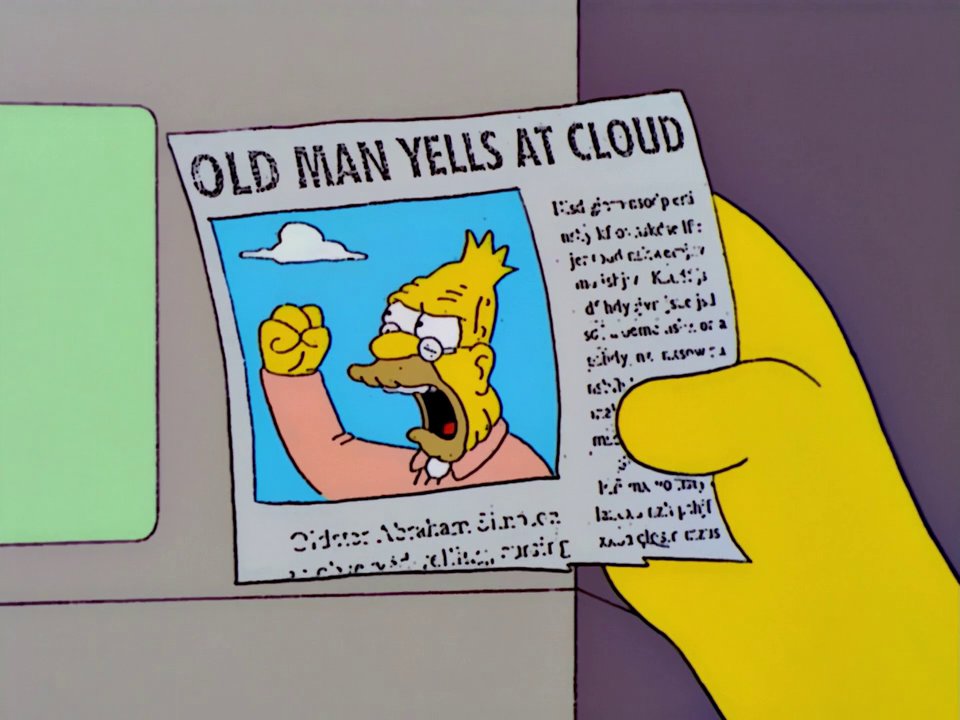
It’s that time again, friends. Every year, as July races to a close, kids sharpen pencils for school, and teachers spend an inordinate amount of time and money getting their classrooms suitable to post on Instagram, the geeks of the world converge on San Diego, California for the annual bacchanalia officially known as Comic-Con International. And every year I sit here in Louisiana, gazing to the west, and wishing I could be there with ‘em.

Goals.

It’s a bucket list thing for me, guys. Some day, at least ONCE, I want to go to San Diego Comic-Con. I’ve got a lot of friends who have been – heck, with the pals I have who work in comics, I’ve got a lot of friends who go pretty much every year. I see the posts and I gaze at the photos shared on social media and I think about what it would be like to be there, even though I know it’s not going to happen any time soon. It’s expensive, first of all. Admission to the convention aside, I think about the costs of airfare, food, car rental or Ubers to get around, and hotel rooms (some reportedly going for over $1000 a night on this particular weekend) and I know there’s no way this can be swung on a teacher’s salary in the current economy. Then there’s the kiddo – making this trip would either require my wife to take time off work to stay home with our son or her take off work so all three of us could go together. Going together is my preference, but not really feasible at the moment. So it stays on that bucket list, unchecked, right next to “Play Benjamin Franklin in a production of 1776.

Also goals.

“Ah, it’s okay Blake,” say some of my friends. “Comic-Con isn’t what it used to be anyway.” And that, at least, is true. It’s been a really long time since Comic-Con was actually about comic books. The media empires have taken it over – movie and TV studios are the stars of the really big panels, and video game companies flock there to shill their upcoming games. And while I don’t begrudge any of them, comics are my real jam, and are what I’d really want to see. I’d rather go to a DC Comics panel than a Warner Bros. panel most days…although if it were James Gunn and company talking about the upcoming Superman movie, it’d be a heck of an internal battle. 

Still wanna go, though.

It also doesn’t seem to be quite as big in terms of making news as it used to be. For years in these waning days of July, I would refresh my web browser all day long, waiting for news reports coming from San Diego to tell me what was going to happen over the next year in the world of entertainment. Marvel would unveil whole slates of films there back when such a thing seemed like a wise thing to do, and fans like myself would teeter on the edge of Firefox to see what was coming next. I don’t feel like that happens as much anymore. Studios are so desperate to stay relevant that they squeeze out announcements all year long, often prematurely, very often promising things that wind up never happening. It’s frustrating, to be sure. But in terms of what it does to Comic-Con it’s even worse, as so many of the “big” panels have changed. There’s no longer an opportunity to blow our minds with announcements of what’s to come, but rather just a recap of the announcements that have been made since the last time they recapped their announcements. 

Yet I still wish I was there.

It’s not like I’ve never been to a convention, of course. When I was young, I went with my Uncle Todd to a few Star Trek conventions (these don’t really exist anymore, as Comic-Con and its many imitators have become a catch-all for pop culture and cons specific to a single franchise have become much rarer). When the Chicago Comic-Con was still a big deal I did a road trip with my buddies Mike and James. I’ve been to Philly and Houston, and many Wizard World-turned-Fan Expo shows here in New Orleans. And I’ve been to dozens of smaller shows, which are honestly better when it comes to the comic book side of things. Back in April, Erin and I took Eddie to a small show in Covington (right across Lake Pontchartrain from New Orleans) and it was honestly the BEST show I’ve been to in YEARS when it comes to the number of vendors selling comic books and comic paraphernalia, as opposed to thousands of headshots you could get signed by whatever actors are in attendance. I loved that little show, and I’m looking forward to the next one.

Observe the Native North American Geek in his natural habitat.

But I still feel that COMPULSION to go to the BIG one.

Why?

Because in a weird way it feels like home.

I don’t know if younger readers will get this, because the stigma about being into “nerdy” stuff seems to have largely gone away. With Marvel and Star Wars being so mainstream and things like Game of Thrones and The Boys becoming media juggernauts, things that we used to consider niche entertainment have become dominant parts of the cultural zeitgeist. But when I was in high school in the 90s, I was always made to feel like I didn’t belong because I read comics and watched cartoons. I clung to the things I loved, but often felt the need to hide them, lest I become even more of an outcast than I already was. I’d even quit Disney and Archie comics not because I didn’t like them anymore, but because I let people put it in my head that if I was in high school and reading Uncle Scrooge something must have been wrong with me. If I was seen with a Star Trek novel or an X-Men t-shirt, the reaction quite clearly elicited the same response every time: you do not belong here. High school was a bitch of a place, guys.

I’ve got a core memory of a time in 1993 when Superman: The Man of Steel #22 came out. This was during the whole “Death and Return of Superman” storyline, and John Henry Irons IMMEDIATELY became my favorite of the four potential heirs to the throne. I brought the comic to school with me and, on a break outside, I sat on a bench to read it. And within seconds, a jerk from my PE class yanked it out of my hands because I was such a “nerd,” threw dirt into the die-cut cover, and stomped away laughing.

I can’t help but feel that John Henry would have known how to deal with it.

I don’t remember the guy’s name. I couldn’t pick his face out of a lineup. But I’ll never forget what he did, because you CAN’T forget anything that makes you feel that small.

I look at my own students, and I don’t see that anymore. Oh sure, there are still cliques and groups, there will ALWAYS be cliques and groups, but they aren’t really based on things like what kind of pop culture a kid is into anymore. I see a lot of kids who read Manga (not enough into western comics, but that’s a separate issue), but I never see anyone get bullied for that. You want to pick on a kid for playing video games? Dude, that’s a club whose membership is EVERYBODY. Things have changed and, in this respect at least, have very much changed for the better.

But I come from a time BEFORE those changes, when I only knew two or three other kids in my school who were openly comic book fans, and most of them wound up moving away before we graduated. It was a lonely time.

The first time I walked into a comic book convention, it was like I had finally found my tribe. There were people here who not only wouldn’t MOCK me for reading Superman, but would join me in a spirited debate over the credentials of the Man of Steel, Cyborg, Superboy, and Eradicator, and which of them (if any) were the real deal. There were people here who could ALSO explain why some crew members on the Enterprise wore red while others wore gold or blue. There were people who not only wouldn’t mock me for loving Uncle Scrooge comics, but they would join me in line to get a print and comics signed by Don Rosa, perhaps the greatest artist ever to draw the Laird of the Clan McDuck. (Yeah, I love Carl Barks too, but I said what I said.)

If my house caught on fire I would save my son, and then this. My wife is faster than me, she’s already outside at this point, that’s why I didn’t mention her.

Nobody should ever have to feel the way I felt on that day back in 1993, certainly not because of what they like to read or watch. But I wish that EVERYBODY could have that experience of walking into a room and suddenly feeling like that’s where you’ve belonged all along.

I still get that when I walk into my local comic shop (BSI Comics in Metairie, Louisiana – and I’ll never be shy about giving them the shout-out). I feel that way on Free Comic Book Day, when hundreds of like-minded folks come together to see what’s new. And I feel that way when I attend a show full of people selling, drawing, reading, and talking about comics and movies and TV shows. And even the people who aren’t into the same comics and movies and TV shows as I am are still part of the same tribe, because we know that even if I’m into Star Trek and you’re into Star Wars, we’re still more alike than we are different.

Not like that Stargate weirdo.

So why would I possibly want to go to the big, bloated, past-its-glory-days Comic-Con International in San Diego? 

Because in a way that I don’t know if you can understand if you’re lucky enough to never have felt like an outcast, it’s where I feel like I belong. With my people. With my tribe. Just because I’ve never been doesn’t mean it doesn’t call to me like home.

Ah well. Maybe next year.

Blake M. Petit is a writer, teacher, and dad from Ama, Louisiana. His most recent writing project is the superhero adventure series Other People’s Heroes: Little Stars, volume one of which is now available on Amazon. You can subscribe to his newsletter by clicking right here. He believes the Great Gonzo said it best when he sang, “I’ve never been there, but I know the way,” and a tip of the hat to Steve J. Rogers for putting that bug in his ear. 
Geek Punditry #81: Whatever the Era

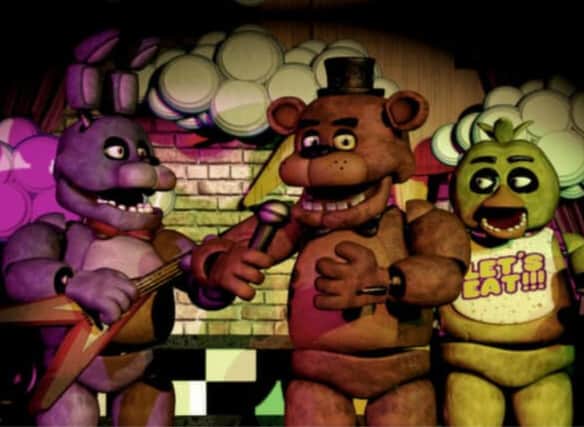
During the school year, I spend most of my time around teenagers. I teach high school English, and as such I am constantly exposed to the youth of today, with their thoughts and their ideas and their imaginations and occasionally their aromas, because some of these kids pay as much attention to the personal hygiene lessons in health class as they do when I’m trying to get them to understand 1984. But it’s July and school is not currently in session, and the only teenager in my usual orbit is my 13-year-old niece, Maggie, so the only teen ideas I am exposed to are mostly about something called Five Nights at Freddy’s.

“Thank you for bein’ a frieeeeeend…”

When I AM surrounded by the kids, though, one of the battles I fight a lot is attempting to convince them that just because something is old doesn’t mean it has no value. Shakespeare is the most frequently-cited example of this: yes, the language is old-fashioned and frequently archaic, but once you get past that the stories are pretty darn timeless. Romeo and Juliet is about a couple of kids YOUR AGE (or often younger, as I teach 11th and 12th graders) who want to date but their parents hate each other. Othello is the story of a man driven to homicidal envy because the girl he likes married someone of a different ethnicity. Hamlet is about a college kid whose father is murdered and then his mom marries his uncle, which everybody can agree is pretty messed up and will make Thanksgiving very awkward. When you boil it down, the greatest works of the past are just as relevant today, except that they’re too deep to discuss in-depth in a 15-second TikTok video.

Helping kids to see this, to understand the value in works of the past, is part of my job. In fact, in many ways, it’s my favorite part of my job. Don’t get me wrong, reading a well-written essay from a kid who struggled to put a sentence together at the beginning of the year is a badge of honor, but if that essay is explaining what they think the whole Green Light thing from The Great Gatsby is about in a way that makes sense…well, that’s like winning an Olympic medal. And most kids, I find, are pretty open to this, once you can find the right path in. It may take some trial and error, but I sincerely believe that any young scholar can find the value in the classics if you try hard enough.

I wish the opposite was true of their grandparents.

Tag someone you know in this picture.

A few weeks ago, I wrote about the creation of a new over-the-air broadcast network, MeTV Toons, dedicated to showcasing classic animation 24 hours a day. It’s a great idea and one that I truly hope to be able to watch if the New Orleans affiliate – which finally launched just TODAY – would boost their damn signal a little bit so I could pick it up from my house. But that’s not the point. In that previous column, I also talked about a few online communities that have sprung up around this new network. The communities are thriving now. The largest of them, which was at 17,000 members when I wrote the previous column a month ago, has ballooned up to almost 65,000 people. And as is expected, there’s a lot of talk about the cartoons and what people’s favorites are and how much they’re enjoying the network, which I love. There are also a minimum of 750 posts a day from somebody who doesn’t understand how to watch the network, because apparently many of these people, who I would estimate are largely in their 50s and 60s, have completely forgotten how antenna television works. But the worst part of this community are the entirely-too-frequent posts that exist not to talk about the classic cartoons, but to complain about modern ones.

“I hope they don’t start making NEW shows. That’s what ruined Cartoon Network.”

“They shouldn’t show anything from later than the 70s. All of that stuff sucks.”

“You know who’s a fan of Powerpuff Girls? Hitler.”

And so forth.

I find it incredibly frustrating to read through this stuff, for a few reasons. First of all, and most importantly, is the sheer negativity of it. The world has enough negativity in it, and I hate the fact that Social Media – an invention that SHOULD have been used to bring all the people in the world together – has instead merely given us different ways to tribalize ourselves and spit venom at anybody who’s not part of Our Group. And second, it’s just not true. I can’t fathom the mindset of somebody who can turn on an episode of Help!… It’s the Hair Bear Bunch! and then claim with a straight face that this is the apex of animated entertainment.

Where the culture of Western Civilization apparently reached its climax.

The thing is, guys, both my Bard-averse teens and their Cartoon Network-hating parents and grandparents are suffering from the same problem, and it’s a problem that most of us have to overcome in some form or another. We are exposed to certain media when we grow up, and that media fundamentally contributes to the structure of our preferences in our brains. In other words, the stuff that we like when we’re young is the blueprint for the kind of stuff we like throughout our entire lives. If one of my 11th grade students tells me how much their mom hates the music she listens to, I suggest she ask her mom what HER parents thought of New Kids on the Block, and what THEIR parents thought of the Beatles, and so forth. Every generation firmly, steadfastly, believes that music reached its absolute pinnacle during their own formative years, even though it’s obvious that the best decade for music was the 1980s.

The same is true for everything: movies, TV shows, books, fashions, food, sports, and of course, cartoons. The big difference between my kids and their parents is that by and large, I find the kids FAR more likely to expand their horizons and look at work from another time. My students were in diapers when The Office was popular or not even born when Friends was a hit, but they’ll binge those shows and come to school talking about them. But trying to get one of these Toon-haters to give a chance to a modern cartoon like Bob’s Burgers, Star Trek: Lower Decks, Gravity Falls, or the finest cartoon of them all, Bluey, is a challenge that would make Sisyphus ask if he can just go back to pushing that rock up the hill.

Sorry, guys. I’m being told by the Facebook group that none of you are as good as… *checks notes* ‘Yakky Doodle.’

I know I’m generalizing here, and that’s not really fair. There are most certainly older people willing to give more recent works a chance. I know, I’m one of ‘em. And there are a lot of people like that. My uncle Wally, who happens to be an animator, would frequently talk to me about Animaniacs in the heyday of that particular cartoon – which was after his time, obviously, but one of the favorites of my time. He obviously PREFERRED the classics of his youth like the Looney Tunes and the Hanna-Barbera all-stars, but he was (and still is) always willing to give the new stuff a CHANCE.

The problem with the MeTV Toons group – like any other group – is that the most obnoxious people also tend to be the loudest. They’re the ones that complain, the ones that whine, the ones that come in with a sense of entitlement because the network has the TEMERITY to show Captain Planet instead of a 23rd rerun of The Flintstones for half an hour. 

Is it true that there are a lot of bad cartoons these days? Sure. But that’s true of ANY field of creative endeavor in ANY era. As sci-fi author Theodore Sturgeon once observed, “Ninety percent of everything is crap.” For every Scooby-Doo that was turned out, there are a dozen Hanna-Barbera cartoons that died after one season. Looney Tunes gave us the work of Bugs Bunny, Daffy Duck, and the Road Runner and Coyote…but it also gave us Merlin Mouse and Cool Cat.

I swear, these were actual, official Looney Tunes. Google it.

Hell, even my beloved Willie Shakes is considered the greatest writer in the history of the world…but name five other writers from the late 16th century. Unless you’ve got an English degree, chances are you can’t. There’s just as much good stuff being produced now as there ever was. The reason the past seems “better” is because it’s only the good stuff that gets REMEMBERED. If you lock yourself in to the work of your own formative years, you will miss out on a wealth of great storytelling, great music, great ART. And if you’re okay with that, I can’t change your mind, but at the very least you need to RECOGNIZE that bias and not make blanket statements about everything that’s from outside of your time period, because that’s not fair to anybody. 

I have a challenge for you, my friends. Right now, I want you to identify your formative decade. Are you an 80s kid? 90s? What was the time period in which you did the majority of your growing, say from first grade through twelfth? For most of us, that is the period where these preferences and feelings are most firmly established.

Okay, have you got your decade identified? GREAT. Here’s the challenge then: this week, I want you to go out and find something from OUTSIDE that decade that you think is worth watching, reading, or listening to. I don’t care if it’s from before your time or after, but I want you to find something from a different time period that you think is worthwhile, something that you can get excited about, something you want to tell people to check out. And then I want you to come back here – or hit me on Facebook, Twitter, or Threads – and tell me WHAT you read or watched and WHY you like it. 

There’s plenty of great stuff out there, guys – from any era. The trick is just to figure out where to look.

Blake M. Petit is a writer, teacher, and dad from Ama, Louisiana. His most recent writing project is the superhero adventure series Other People’s Heroes: Little Stars, volume one of which is now available on Amazon. You can subscribe to his newsletter by clicking right here. He considers himself an 80s kid, but he has just as much love for The Honeymooners and The Good Place as he does for Mama’s Family. Wow, that’s a weird list.

Geek Punditry #80: If You Liked the Movie, You Should Read the Book

For some time now I’ve had the novelization of the TV show Charles in Charge sitting in my eBay searches, contemplating whether or not I should jump on it.

The first thing they teach you in blogger school is to start a column with a sentence that will compel the reader to continue in the hopes of making sense of what you’re saying. How am I doing?

You see, we live in a time when people like me (nerds) often go back and recapture things from our youth – things that we remember fondly or that tickle a nostalgic button somewhere in our soul. Often these things take the form of toys, but just as popular are other collectibles like trading cards, comics, vintage video games, and – of course – books. So the reason I’m thinking about getting this book, which is oddly enough a novelization of the opening episodes of the SECOND SEASON of Charles in Charge (I later learned that there is a novelization of the pilot I’ve never seen in person), is because I remember getting it at one of those glorious Scholastic Book Fairs that we used to anticipate with the same excitement and fervor as we would Christmas morning. It’s purely a nostalgia thing, friends.

Don’t tell the eBay seller I borrowed their picture for this, okay?

Eh?

Oh, you mean you were wondering why the hell there was a Charles in Charge novel in the first place, aren’t you?

That also goes back to the time period in which I grew up, a magical, halcyon time known as the 1980s. It was a heck of a time to grow up. We had the best music, sodas were clear sometimes, and cigarettes had only been bad for you for like 20 minutes. But that doesn’t mean everything was perfect. This was in an era before streaming services, an era before you could pull up popular entertainment on demand from your remote control without even having to get off your couch and look for clean pants. If you saw a TV show you liked, the only way to experience it again was hope for a rerun. If you loved a movie, you had to wait for it to come on HBO (if you had it) or rent it from these ancient temples that we called “video stores.” You couldn’t even just go out and BUY the VHS tape the way you later could the DVD, because in the early days of home video the studios made the movies prohibitively expensive (nobody in their right mind would – or should – have paid $120 for a VHS copy of The Land Before Time 2) so that most people couldn’t afford to build a home library and, instead, the studios made their money using the video stores as the middleman. Eventually, the prices of VHS tapes dropped and home libraries became a thing, but for much of my childhood if there was a movie you really loved, there was only one surefire way to experience it again whenever you wanted: buying the novelization.

When you need to hear Madonna as Breathless Mahoney, this is the next best thing.

Novelizations have been around almost as long as film, going back to the silent era. In 1966 Isaac Asimov was hired to novelize the film Fantastic Voyage. (He was so disappointed with the result that he came back years later with a “sequel” called Fantastic Voyage II: Destination Brain, which just used the premise of miniaturized scientists going into a human body and otherwise was completely independent). One of the most interesting examples, I think, is 2001: A Space Odyssey. Author Arthur C. Clarke and director Stanley Kubrick collaborated on the story, then Clark wrote the novel WHILE Kubrick worked on the film, so which of them technically is the adaptation of the other? If you ever figure it out, let me know.

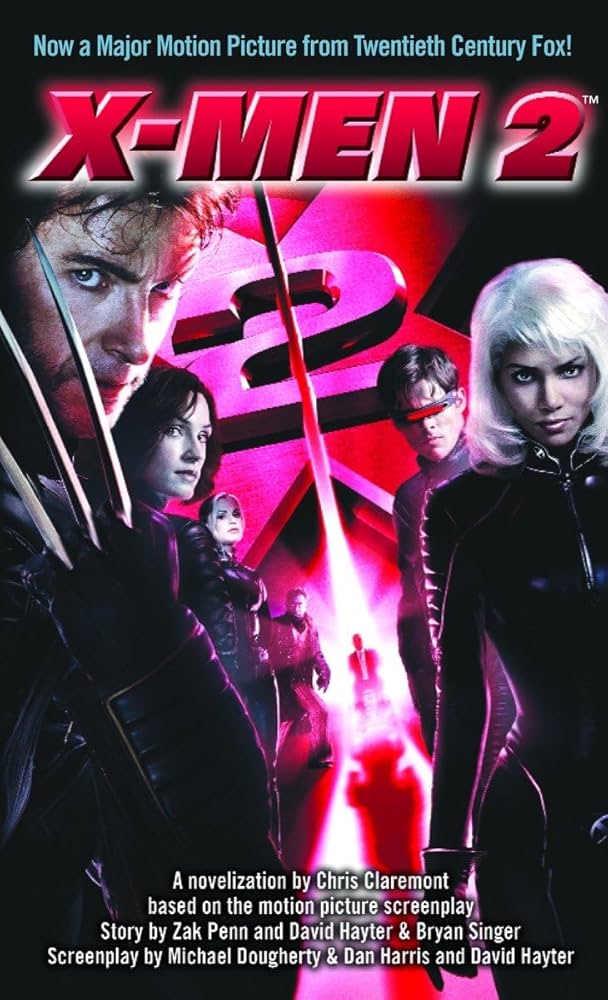
But in the 80s, the novelization was huge. I had stacks of them for the formative movies of my youth: E.T.: The Extra-Terrestrial, Batman, Dick Tracy, Back to the Future…not to mention the requisite Star Trek and Star Wars books. Not all of them were very good, of course. Some of them were downright terrible. But there was something interesting about reading these books, which were often based on early drafts of the film’s script. The novels had to be written quickly, usually while the film was still in production, in order to have them printed and on the shelves when the movie came out, so if things changed during the production, the novel would sometimes be based on the original version rather than the change. The novelization of the second X-Men movie, for example, is so different (up to which characters lived and died) that you’d be hard-pressed to believe the writer even KNEW anything about the X-Men…if it weren’t Chris Claremont, whose work on the characters in the 70s and 80s is pretty much the main reason that those characters survived past the 70s and 80s without falling into obscurity.

“Claremont! Who the hell is ‘Bolverine’?”

Screenplays often lack the detail that you get in a novel as well, and as such the authors had to conjure up a lot of the characters’ backstory, inner monologue, and other elements that wouldn’t have room to go into in a feature film. Goonies is a phenomenal example of this. It’s a movie that everybody my age grew up idolizing, that we watched over and over again, that became a fundamental part of our psyche. So we all know that the reason Josh Brolin’s character Brandon has to steal a child’s bicycle after his brother Mikey (Sean Astin) lets the air out of his own bike tires is because he flunked his driver’s test. But the novel tells us that the REASON Brand flunked his test is because he suffers from claustrophobia and freaked out about being the car with the driving instructor, a stranger. Overcoming his claustrophobia in the caves becomes an interesting running element through the novel. It also gives us a little insight into what happens to the characters after the movie ends – for instance, Chunk’s parents officially adopt Sloth and give him the name Jason Sloth Cohen at his Bar Mitzvah. It’s adorable. 

Not to mention the subtle suggestions that Mikey is actually the reincarnation of One-Eyed Willie.

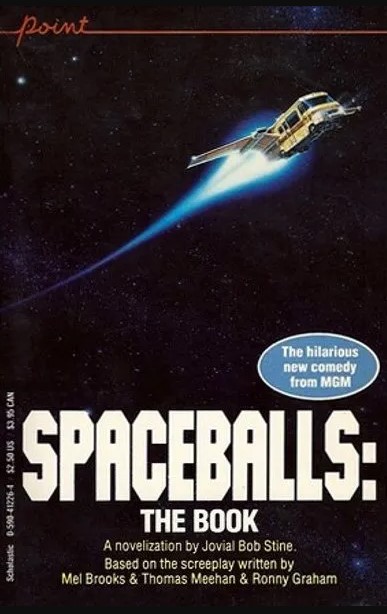
And of course, these novelizations were turned out in large numbers, especially the ones for kids. The Charles in Charge book I mentioned before is only one of many such novelizations I got from a Scholastic imprint called Point, which specialized in middle grade books. This resulted in a lot of those aforementioned novelizations, plus an avalanche of the kind of kiddie horror books that would turn so many people into lifelong horror fans, such as the Goosebumps line. It got to a point (no pun intended) that I would actually look for that Point logo at the Scholastic Book fair, as I knew those were books for people like me. In fact, a while back I finally DID jump on eBay to snag one of those old Point books from my youth, their novelization of the Mel Brooks comedy Spaceballs. When I got the book I saw, to my surprise, that it was written by “Jovial Bob Stine.” This name meant nothing to me when the movie came out in 1987, but looking back on it now I realize that this was one of the various pen names used by someone who would soon become a Scholastic legend – R.L. Stine, creator of those Goosebumps novels I mentioned before.

It’s JOVIAL, see. Also hilarious. Says so right there.

Some of these books have become real collector’s items. If you look up the original novelizations of some of the 80s horror movies like Halloween, Friday the 13th, or A Nightmare on Elm Street, you see them going for hundreds of dollars now. Considering the demand, it’s actually really surprising to me that you don’t see them reissued more often, or at least offered digitally. In some cases, I suppose it’s a rights issue (the rights for Friday the 13th are notoriously complicated at the moment), but some are less understandable. DC Comics recently announced a new novel, Batman: Resurrection, which will serve as a direct sequel to the 1989 Batman movie. That sounds cool – but why not reissue the novelization of the original movie to go with it? 

Trust me, geeks will eat this stuff up.

Novelizations are still produced today, but not as many as there were back in the 80s and 90s. A lot of sci-fi movies still get them, but the odds of seeing a novel based on, for instance, the premiere of Abbot Elementary seems fairly remote. Obviously, with the streaming era, it’s not as necessary to have a book to get your hands on the story the way it was when I was a kid. More than that, though, I think that the streaming era has broken down the audience so that these things aren’t part of the cultural conversation the way they used to be. When something like the first few Star Wars movies came out, they were a phenomenon that EVERYBODY had to talk about, had to experience. They lingered in theaters for months, even years, before finally filtering out and making way for something new. That doesn’t happen anymore. A movie lives or dies based on its opening weekend. TV series dump an entire season at once and everybody has forgotten about it a week later. It’s a sad thing, I think, a change that I’m not fond of, but it’s the world we live in now.

So I’ll keep my eye on eBay and keep my finger over that “buy it now” button. I’m not saying I’ll get every old novel I see, of course. I’m just saying that if I COULD, I WOULD.

Blake M. Petit is a writer, teacher, and dad from Ama, Louisiana. His most recent writing project is the superhero adventure series Other People’s Heroes: Little Stars, volume one of which is now available on Amazon. You can subscribe to his newsletter by clicking right here. If you ever see a decent price for the novelization of Howard the Duck, let him know.

Geek Punditry #79: The Case For ID3

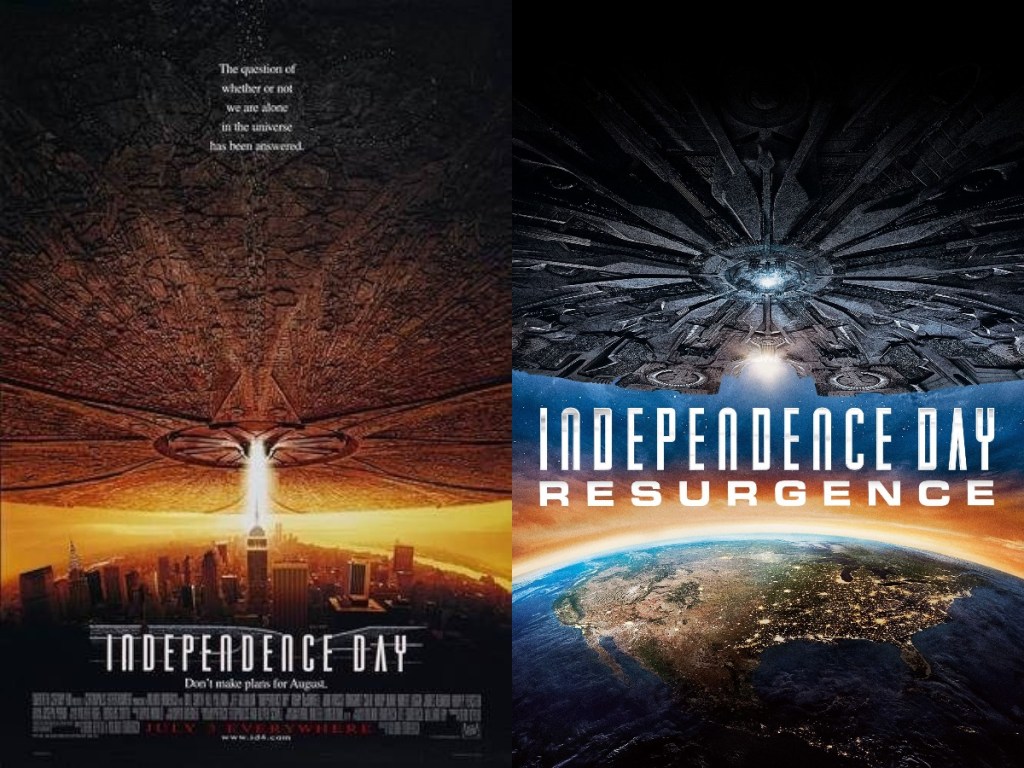
On holidays, we all have certain favorite movies that we like to return to. At Christmas we all binge It’s a Wonderful Life, A Christmas Story, and dozens of others. Around Halloween we’ll sit down to watch Hocus Pocus or, appropriately, Halloween. On Arbor Day, of course, Swamp Thing. And although the Fourth of July doesn’t quite have the cinematic pedigree of some of those other holidays, there are definitely movies appropriate to watch at this time of year. 1776 is one of my favorite musicals of all time, and my wife’s favorite movie, Jaws, has enough July 4th talk to count even though the film ends several days after the holiday. But of course the most obvious movie to watch in early July is the 1996 blockbuster film Independence Day, the Roland Emmerich/Dean Devlin sci-fi extravaganza in which the Fresh Prince, Lone Starr, Cousin Eddie, and Jeff Goldblum come together and summon the power of America to save the world from an alien invasion.

If you had barbecue this week, you have this man to thank.

The movie – which I know we’ve all seen – is big, over-the-top, aggressively bombastic, and I love every frame of it. It is FUN, fun in a way that many blockbusters in the years since have forgotten how to be. The special effects are better than most movies we get today, the musical score is an absolute masterpiece, and the final act of the movie has one Big Damn Hero moment after another – and when done well, there’s nothing better than a Big Damn Hero moment. It is, quite frankly, a perfect film for what it is. If Bill Pullman had REALLY run for President in 1996, he would have won in a landslide. 

20 years later, a sequel was attempted. Independence Day: Resurgence was…not as good as the original. For reasons that I’m going to get into shortly, the movie felt kind of stale and like it was trying too hard, whereas the original made its sense of spectacle feel effortless. But this year, after rewatching the original a few days ago, I decided to give the sequel another chance. It…still isn’t a great movie. But the tragedy of it is that it had the POTENTIAL to be. The actual STORY is very strong. Let me give you the reader’s digest version of the important stuff that happens in Resurgence:

“If it helps, imagine you’re hearing this in my voice.”

It has been 20 years since Earth successfully destroyed the invading alien force. In that time, humanity has come together in a way previously unheard of, scavenging the alien technology to create an age of technological advancement that has helped create peace across the planet. Suddenly, another spacecraft appears. Humanity, fearful of a second invasion, attacks first this time, but discovers that this is NOT the same alien race that attacked them before – in fact, our old enemy is PURSUING this newcomer. We again have to battle the invaders, this time with the help of the newcomer, who we learn is an envoy of a coalition of survivors of the Big Bad Aliens, whom they call the Harvesters. We discover that Earth has become famous across the galaxy for being the only planet to ever successfully defend itself against the Harvesters. They are our FANS, and they want us to come into outer space to lead the fight to stop the bad guys once and for all.

“See? That doesn’t sound so bad, does it?”

If that sounds 1000 percent better than the movie you remember watching back in 2016, that’s because it is. The plot is fantastic – it expands upon the original mythology and elevates the threat, with the promise of exploring a much larger and grander universe that the original film only hinted at. But the final product didn’t deliver on that level. The cast was reduced to a series of Xerox copies of the original characters and the story structure was broken down in such a way that it mimicked the first movie far too comfortably to be satisfying. I always say that if there’s one thing fans want it’s “More,” but movie executives never understand what that MEANS. We don’t want the SAME thing, we want that familiar thing to CONTINUE and GROW and EXPAND. And while Resurgence had all the potential in the world to do that, by reducing it to a copy of the original, it failed.

The characters didn’t help. They tried to elevate the children of Will Smith and Bill Pullman’s characters to the new heroes, but there was none of the sense of heroism from the original. Pullman’s President Tom Whitmore at least got a proper sendoff, but Will Smith died off-screen and the wife Goldblum reconciled with in the original is gone without a trace, replaced by a new love interest. Was Margaret Colin unwilling to return? I have no idea. But we’re stuck with another less interesting love interest in a movie that already has a less interesting love story between Pullman’s daughter and Thor’s brother. (The one who isn’t Loki.) This also largely damages the character arc Goldblum received in the first movie, and if there’s one thing I hate, it’s a sequel that erases previous character development. 

I dare you to name a single one of these characters who wasn’t played by Jeff Goldblum. See? It’s even harder than Avatar.

But that spark, man…that spark is still there. And the idea of a movie about the human race joining together with an intergalactic federation to take the fight TO the Harvesters still REALLY appeals to me. So that’s why I’m here today, friends. Since the 20th Century Fox acquisition, Independence Day is now the property of the Walt Disney International Shadow Government and Entertainment Consortium (although they had to be reminded that this only referred to the film franchise and not the actual holiday). That in mind, I want to suggest that they take a chance on a new movie – or maybe even a Disney+ series – to continue the story.

Let’s talk about how to do this, guys. First of all, we don’t want to FORGET Resurgence. The whole point of this exercise is to remember that there IS a solid core of a story there. So instead, I say we do an Evil Dead 2. The second Evil Dead movie had a much greater distribution (and budget) than the first, and since he couldn’t be sure that much of their audience would ever have seen the original, creator Sam Raimi used the opening act of the sequel to make a condensed recap/remake of the previous movie. It is possible to watch Evil Dead 2 without ever having watched the original and not miss a beat. So with ID3, we start with a sequence that runs through everything I just said in my recap, because nothing else in that movie is really necessary for the story that’s going to get told next.

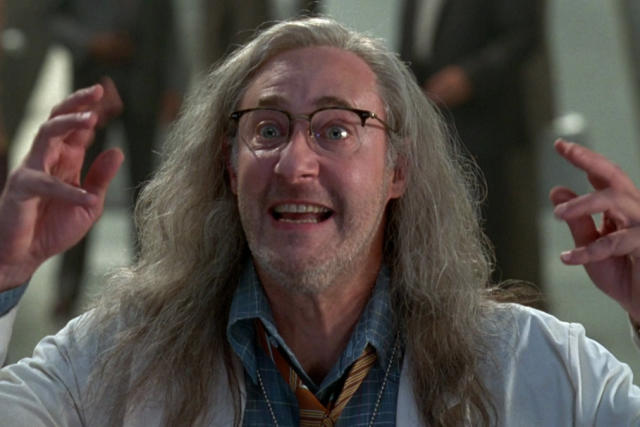
Second, at this point we need an almost entirely new cast. Bill Pullman’s character died in the sequel, and most of the new characters are pretty forgettable. We can try to squeeze in Jeff Goldblum just because he’s Jeff Goldblum and I don’t think it’s possible to look into those steely eyes and tell him “no,” but the one guy we can’t do without? Brent Spiner as Dr. Brakish Okun, whose increased screen time in the sequel is probably the best part of Resurgence. Not only is he the in-universe expert on the aliens, but his long contact with them gave him a sort of psychic link that will be invaluable.

Not to mention his experience in interspecies relations.

Once we’ve got all that established, we need a ten year time skip. We’re in space now. We are in command of the coalition of survivors, and here’s where we REALLY have fun, because we get to see all of these different kinds of alien creatures. We learn about their worlds that have been destroyed and the society they have built in the wake of the Harvesters attacks. We can tell the story of the war with the Harvesters, and there’s room for a lot more beyond that. What about the previous wars, the ones that were lost? Are there other races out there in need of a rescue? Are there other races out there even WORSE than the Harvesters themselves? There’s potential in every one of these ideas to tell a compelling story. Everybody is all about doing “shared universes” these days – this would be a chance to expand the universe of Independence Day into a sci-fi backdrop as rich and exciting as the best of Star Trek or Star Wars.

IF it’s done right.

Which of these two did it right, Disney? Come on. This isn’t a trick question.

That’s what it always boils down to, isn’t it? The truth is, a lot of modern sci-fi is pretty divisive. For everyone who loves The Mandalorian, you can find five people complaining about The Acolyte. Some Star Trek fans refuse to consider Lower Decks canon, some hate Discovery. Picard is that amazingly rare show where virtually everybody agrees it got BETTER in the last season. And the truth is, no matter what would be attempted with another Independence Day, there are a lot of people who will hate it sight unseen and never give it a chance.

But I don’t think that’s a good enough reason not to try.

Everybody knows that the studios are terrified to take a chance on a NEW idea, a NEW IP. They would much rather just try to pump dollars out of the ones that already exist. And since they’re doing that anyway, why not at least TRY to do so with a franchise that still has a lot of unrealized potential? 

That’s my thoughts on it, anyway.

Maybe next time I’ll tell DC Comics how to fix the Legion of Super-Heroes. Really, the fact that they haven’t just put me in charge of this stuff yet is ridiculous. 

Blake M. Petit is a writer, teacher, and dad from Ama, Louisiana. His most recent writing project is the superhero adventure series Other People’s Heroes: Little Stars, volume one of which is now available on Amazon. You can subscribe to his newsletter by clicking right here. Step one of fixing the Legion is to pretend the most recent incarnation never happened, by the way.