Geek Punditry #104: The 2024 Pundy Awards

It’s the final Friday of the year, and that means it’s time once again to sit back and talk about all of my favorite things from this year. It’s time for the 2024 Pundy Awards!

Yes, just like I did in 2023, I’m going to wrap up the second year of my little column by talking about some of my favorite pieces of pop culture to come down the pipe this year. There is no rhyme or reason to this, the categories will be decided purely based on what I feel like talking about as I write this. I’m going to tell you my favorites in movies, TV, and comics from the past twelve months, and I’m gonna tell you why I dig them and why you should check them out if you haven’t already. Also in order to avoid repeating myself, I’m going to skip over shows and comic book series that I “awarded” last year. Please be aware that I’m still a fan of Abbott Elementary, Batman/Superman: World’s Finest, Fantastic Four, Skybound’s Energon Universe, and ESPECIALLY the final season of Star Trek: Lower Decks, and they’re all worth your time.

But today, I want to talk about things I haven’t talked about before. At least…stuff that I haven’t talked about as much. Let’s get on with it!

Not the only movie this year that made me feel seen.

Blake’s Favorite Animated Movie: Inside Out 2. 

Back in June, I wrote a piece about how the shine had fallen off the once-immaculate reputation of Pixar Animation studio. After a series of duds, I wondered if the sequel to Pixar’s Inside Out was going to have what it took to bring back some of the studio’s former glory. I was so, so happy to see that it did. The first Inside Out was a great look at how the mind of a child develops and learns to process emotions, anthropomorphizing the process but doing so in a way that was both entertaining and easy to understand. Inside Out 2 continued this trend, with the character of Riley getting a bit older and the emotions she experiences becoming more complicated. Adding in the likes of Envy, Ennui, Embarrassment, and especially Anxiety into the mix has changed the game, making for a movie that perfectly encapsulates the personal journey a person goes through when they grow up. The finale of the movie was absolutely remarkable, with a scene that so perfectly demonstrates the experience of an anxiety attack that I nearly broke down in the movie theater. My son, Eddie, has since declared Inside Out 2 his favorite movie, and I’m not about to argue with him.
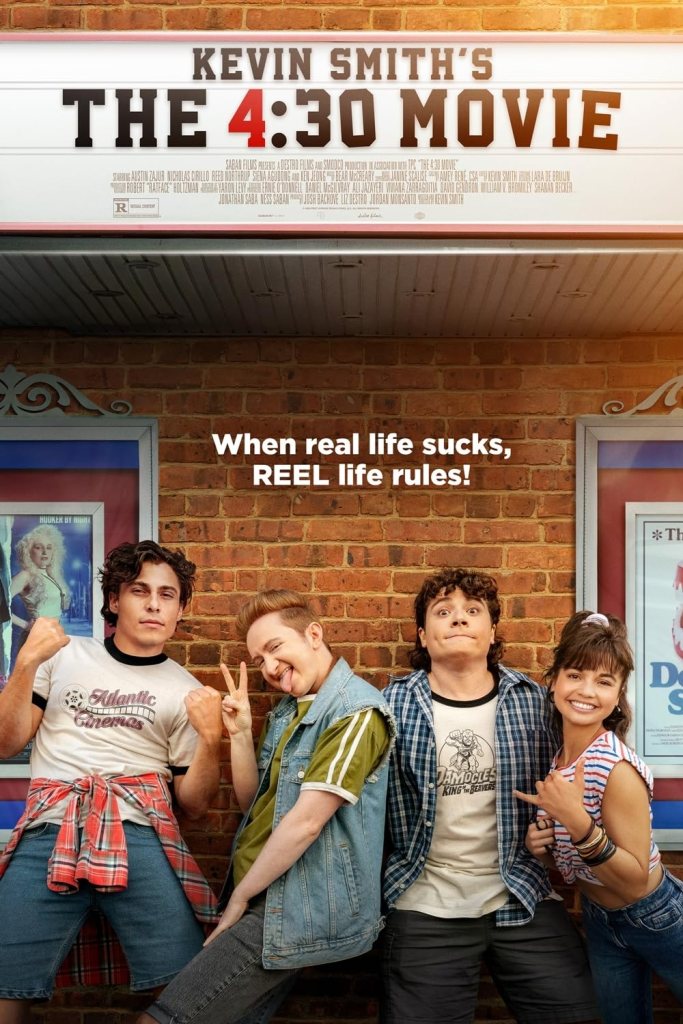
“Another movie about hanging around outside a convenience store, Kev?”
“Nah, this time it’s a movie theater.”

Blake’s Favorite Comedy: The 4:30 Movie.

I’ve been a fan of Kevin Smith for a very long time, and I’ve found it fascinating how his films have changed over the years. His early movies like Clerks and Mallrats were a reflection of the aimless feeling of being a young adult and trying to figure out what life is actually supposed to be. His more recent films, particularly Jay and Silent Bob Reboot and Clerks III, demonstrate a growing maturity and a sense of grappling with a life that didn’t turn out to be what you expected. Although he hasn’t let go of the filthy humor and goofy characters that made his name, he’s a subtler, more sophisticated storyteller than he used to be, and I appreciate that. The 4:30 Movie doesn’t connect to his “View Askewniverse” at all, instead telling the story of a young man in the 80s trying to find the guts to make a play for the girl he’s in love with, all set around a day going to the movies. Are there dirty jokes? Absolutely. But the film is wonderfully heartfelt, and even though neither Kevin Smith nor his alter-ego Silent Bob make an appearance on screen, you can tell that this movie was intensely personal. The final scene hammers that in especially, giving you a feeling that Kevin Smith has, in a way, told his own origin story. It’s a great movie.

Tagline: “You will believe a grown man can cry.”

Blake’s Favorite Documentary: Super/Man: The Christopher Reeve Story. 

This should not be a surprise to anybody, but the documentary about the actor who brought Superman to life for my generation was incredibly moving. Everybody knows the basics of Christopher Reeve’s story – how he played Superman, how a horseback riding accident left him paralyzed from the neck down, and how he became a crusader for the disabled in the years before his untimely death. This movie delves into his history in a deeper way, told mostly through the reflections of his now-adult children, as well as further commentary and anecdotes from other family and friends. The movie bounces back and forth between his life story prior to his accident and the way his life changed afterwards. Having his children tell the story, I think, is one of the things that really helps sell the tale. The film feels so much more intimate and personal, coming from the point of view of the people who knew and loved him the best. One thing I didn’t expect, though, was the heavy focus on Reeve’s friendship with the late Robin Williams. Again, this is something fans of the actor knew about, but the way they intertwined the tragedy of Williams’s own life with that of Christopher Reeve just made it all the more powerful. Have your tissues ready when you watch this one.

Okay, if I’m gonna be honest here, Super-Man is not the only thing in this list that made me cry.

Blake’s Favorite Family TV Series: Bluey

I know, this is another one of those “no duh” moments. I have written extensively about my love for Bluey before, in particular this spring’s season finale episode, “The Sign.” But there was simply no other TV show this year that had as deep and profound an impact on me. In the final episode of this season, we saw the Heelers preparing both for a family wedding and a move to another city, two life-changing events that the titular Bluey was having a tough time dealing with. Bandit, the dad that every father on the planet is striving to become, is trying to do the best thing for his family, even as it becomes increasingly clear to the viewer that the rest of the family doesn’t actually want to leave. It’s a beautiful story and still amazingly funny, and the final song (by cast member Meg Washington) is absolutely sublime. It comes across as a meditation on being a parent and having a child, and it’s the kind of thing that absolutely overwhelms your heart if you’ve got children of your own. I couldn’t be happier with the news that the long-talked about Bluey movie has been officially announced, and I only wish we weren’t going to have to wait until 2027 for it to hit theaters. 
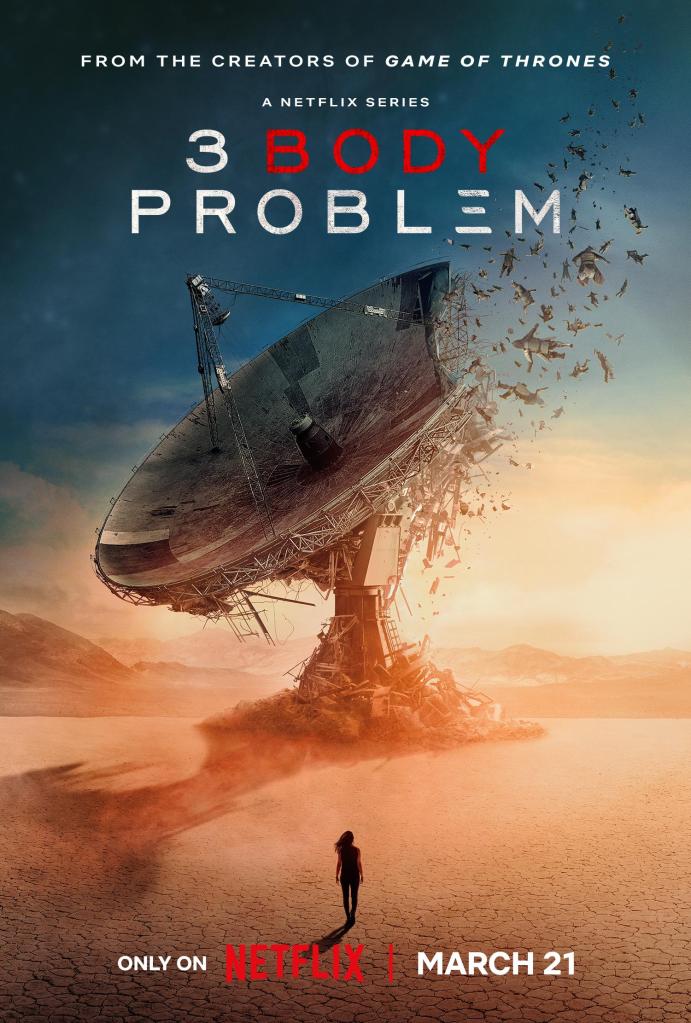
Remember when science fiction was SMART? It’s finally back.

Blake’s Favorite Science Fiction Series (That Isn’t Star Trek: Lower Decks): The Three-Body Problem

This Netflix series, based on the globally popular trilogy by Cixin Liu, launched this year and grabbed me immediately. Like the novel, the first season of this show focuses on several groups of people around the world trying to uncover a mystery. The show follows scientists, police, and people from other walks of life as they slowly uncover evidence of an impending alien invasion. The novels are amazing – an incredible portrait of this sort of singular event and how it would completely reshape the entire world. So far, the first season of the show is doing the same thing, but in different ways than the book. The novels, by a Chinese author, have a cast that is mostly Chinese as well, while the TV series is more international. Characters are omitted, others are combined with one another, new characters are added – the TV show uses the framework of the novel, but takes the story in different directions to reflect the difference in cast and the different cultures of the characters. As a result, while fans of the book can still enjoy it, there’s still room to be surprised. I loved the novels, and I loved the show too, but for different reasons and in different ways. That’s one of the best things you can hope for in an adaptation.
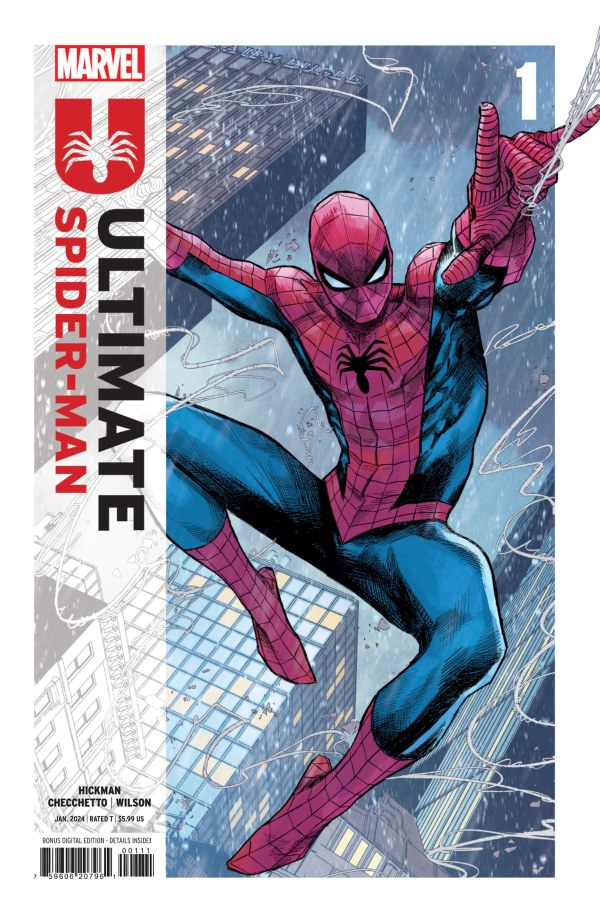
This is the best an ongoing Spider-Man comic has been in 20 years, and it’s not even close.

Blake’s Favorite Ongoing Marvel Comic (That Isn’t Fantastic Four): Ultimate Spider-Man

Last year, Marvel announced a relaunch of its once-prominent “Ultimate” brand, which reimagined the Marvel heroes as new characters in the modern day. That version of the Ultimate Universe eventually gave birth to Miles Morales, but other than him, the rest of the line has been mostly jettisoned. The only other survivor is the Maker, an evil version of the Fantastic Four’s Reed Richards, who has created a NEW Ultimate Universe, and it’s the flagship book of THAT line that has captured my heart this year. In the new Ultimate Universe, the Maker deliberately prevented most of the world’s superheroes from having their respective origin incidents, until their Tony Stark uncovered the truth and decided to put things right. (This is a HIGHLY condensed version of the Ultimate Invasion miniseries, by the way, which is also worth reading.) In the new Ultimate Spider-Man, we open with an adult Peter Parker who is powerless, married to Mary Jane Watson, and the father of two children when he is approached with the news that he’s supposed to be one of the world’s greatest heroes, and there’s a way to make it happen. For years, Marvel Comics has turned the mainstream Peter Parker into a punching bag, submitting him to one mindless torture and humiliation after another, to the point where stretches of his comics are unbearably depressing. Ultimate Spider-Man is the antidote to that, proving that you can tell stories about a married couple, about parents, that are entertaining and emotionally engaging without sacrificing the superheroes. This Ultimate Universe is even further removed from the main Marvel U than the original Ultimate Universe was, but this comic has been fantastic so far.

“So EVERYBODY is in the Justice League now? Ghost-Maker? Robotman? Clownhunter?”
“Okay, let’s not get carried away.”

Blake’s Favorite Ongoing DC Comic: Justice League Unlimited.

This may be a tiny bit of a cheat, as there’s only been one issue of JSU so far, but it was preceded by the excellent Absolute Power miniseries, which set the story up and was by the same magnificent writer/artist team of Mark Waid and Dan Mora, so I’m counting that towards the series. After an absence of the Justice League from the DCU for a few years, it’s time for a most triumphant return in a way that has never been done in comics before. Rather than a team of seven to ten heroes protecting the whole dang world, Waid is embracing the “Unlimited” part of the title. The Justice League – as in the classic animated series of the same name – is now a massive force, with virtually every hero on the planet Earth recruited as a member. Everyone who has ever been in the League, every Titan, everyone who wears the S-shield, Bat-symbol, or bracelets of an Amazon, is now part of the League. Waid kicks things off with a first issue showing a longtime – but fairly obscure – hero called Air Wave being taken up to the Watchtower and joining in on his first mission as a member of the Justice League. The story was great, with an engaging and entertaining point of view that is set to save Air Wave from the ranks of the D-listers, and a twist that promises great things for the series. What’s more – I’m gonna sound like a broken record here – Dan Mora is probably the best superhero artist working in American comic books right now. His characters are bold, powerful, but still wonderfully human. This book hit every box for me in the first issue and I can’t wait to see where it goes next.

“What if we replace the spinach with boba?”
“No.”

Surprise of the Year: Eye Lie Popeye

It’s been a good year for reboots of old-school characters, including Dick Tracy, Flash Gordon, Thundercats, and the Universal Monsters. But the one that surprised me the most, in a delightful way, is Massive Publishing’s new series Eye Lie Popeye, by writer/artist Marcus Williams. When the series was announced, I didn’t think it would be my thing – a new version of Popeye is fine, but the artwork showed a distinct Manga flavor to it. I’ve got no issue with people who enjoy Manga, it’s just not usually the sort of thing I’m interested in, and I planned to pass on the series. Then came Free Comic Book Day, and they released a preview of the first issue. Guys, this is why Free Comic Book Day works, because it did exactly what it is intended to do: show me a glimpse of something that I hadn’t planned on reading, but that I found incredibly entertaining. Williams shows a deep knowledge of Popeye and his enormous cast of characters, and while the book DOES have that Manga influence, I was startled by just how well all of it managed to fit together. The style works for the characters, the storyline feels like the kind of thing that used to be done in the classic comic strips (which are quite different from the seven-minute slugfests that people who only know Popeye from his animated shorts might expect). Overall, I never would have thought it, but this was one of my favorite comic book finds of the year.

And that’s it for this year, friends – some, but not all, of my favorite movies, TV shows, and comics of 2024. Feel free to share your own favorites in the comments, and here’s to coming back here in a short 52 weeks to do it all over again!

Blake M. Petit is a writer, teacher, and dad from Ama, Louisiana. His most recent writing project is the superhero adventure series Other People’s Heroes: Little Stars, volume one of which is now available on Amazon. You can subscribe to his newsletter by clicking right here. He’s also started putting his LitReel videos on TikTok. And yeah, he barely mentioned it, but Lower Decks was amazing. Go read it. Go read it now. 
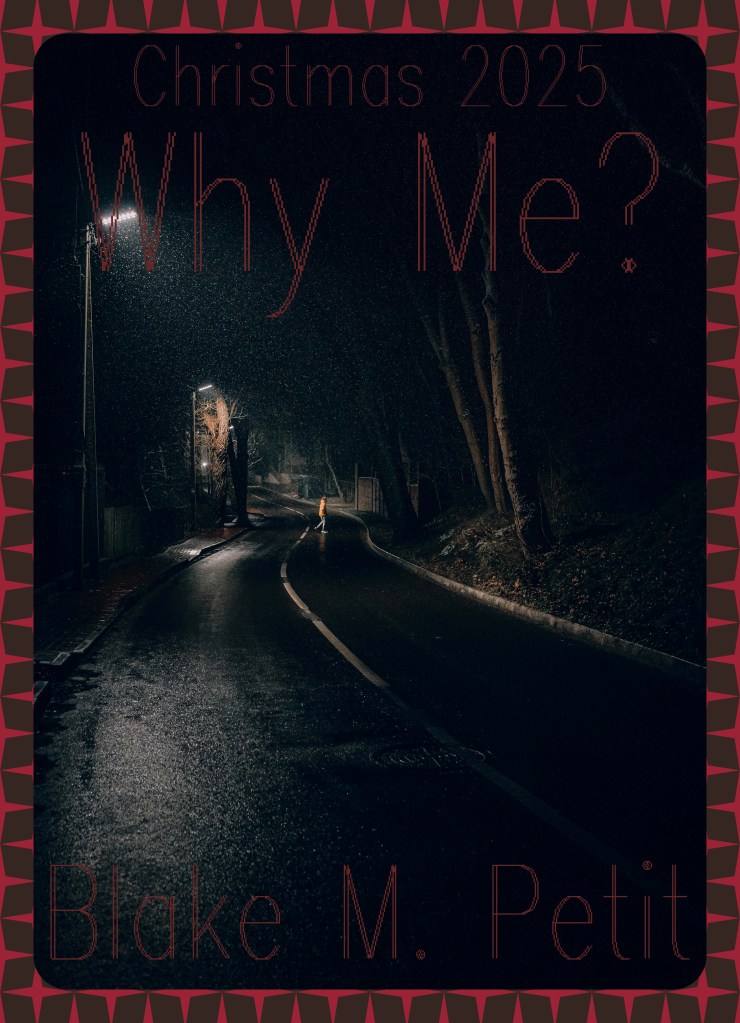
Christmas 2024: Why Me?

Hello, everyone! As you know by now if you’ve been following me for a while, every year I write a new short story to share on Christmas, and this year is no different. This year’s story, “Why Me?”, is the story of a father and son who have to share a burden that they don’t truly understand — a burden that somehow only grows heavier on Christmas Eve.

This is a little atypical of my Christmas stories. It’s a little darker and there’s an ambiguity that I don’t usually use, but I think it feels somehow appropriate this year. I really hope you enjoy it.

Christmas 2024: Why Me?

And if you’re new and haven’t read my previous Christmas stories, you’re in luck! There’s a full archive of them right here on my site, and most of the stories are free! Twenty-five previous Christmas stories — and ONE New Year’s story — await you right now!

Blake’s Christmas Archive

Merry Christmas, my friends!

Geek Punditry #103: Blake’s Five Favorite Santa Claus Stories

Once again, it’s time for Five Favorites, that semi-regular feature here in Geek Punditry where I give you my five favorite examples of something. “Favorite,” of course, is a relative term, and is actually pretty fluid for me. I may think of something tomorrow that would supplant one of the choices on this list if I were to write this again. But for here, for today, I want to talk about five of my all-time favorite Santa Claus stories.

With Christmas only days away, the big guy is up north checking out his list, loading up the sleigh, and slopping the reindeer, so it only seems fair to me that I talk about some of the stories that have made him such a beloved icon to the young and the young at heart for centuries now. Let’s talk about the tales that make St. Nicholas so great.

The Autobiography of Santa Claus as told to Jeff Guinn. 

This book, which is celebrating its 30th anniversary this year, has long been a favorite of mine. You see, when Santa decided it was time to tell the truth about his life story, he recruited journalist Jeff Guinn to help him compose the book, a deep dive into the life of the man who was once known as Nicholas, Bishop of Myra. 

If you’ve been reading my stuff for a while you’ve probably heard me talk about this book before, because it’s one I return to every few years. Guinn’s book mines actual history, including the true life of Nicholas, and combines it with a sort of subtle, beautiful magic. People expecting a superhero-style origin story for Santa Claus will be disappointed, because the truth is that Nicholas was just sort of “chosen” by unexplained forces, and to this day still doesn’t know why…but he knows that his mission is to give the world the gift of hope. 

The story is lovely, and I love the way he mixes real history with fantasy. In fact, the history doesn’t stop with Nicholas’s life, but goes on to show Santa’s interaction with things like the composition of the song “Silent Night,” his influence on Charles Dickens and Clement Clarke Moore, and the lives of some of the very unusual and unexpected helpers he’s accrued in his many centuries on this Earth. 

The book has two sequels. How Mrs. Claus Saves Christmas gives us a dive into Oliver Cromwell and his war on Christmas, and how Santa’s wife saved the holiday. The Great Santa Search rounds out the trilogy with a story set in the modern day, in which Santa finds himself competing on a TV reality show to prove who is, in fact, the true Santa Claus. All of the books are great, but the first one is my favorite.

Santa Claus: The Movie

If it’s a superhero origin that you’re looking for, though, this 1985 movie is for you. It was produced by Alexander and Ilya Salkind, riding the success of their Superman movies starring Christopher Reeve. And in fact, this movie is pretty much a straight rip of the structure of the first Superman movie: it begins with the character’s origin story (Santa and his wife are saved from freezing to death by the elves, who are there to recruit him), spends about half the film showing the hero’s development, and then introduces the villain at about the halfway point. From there we get to the real story, Santa fighting for relevance in a modern world where a corrupt toymaker is stealing his thunder.

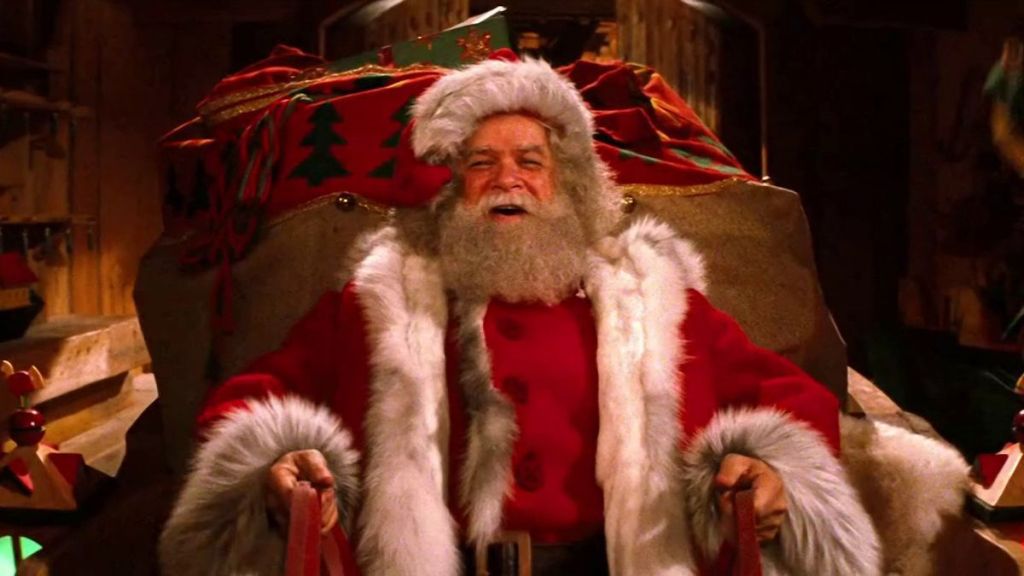
I was eight years old when this movie came out, and that was apparently the perfect time to fall in love with it. I still love it. And David Huddleston – aka the Big Lebowski himself – is still my Santa Claus. When I close my eyes and picture St. Nicholas, it’s the David Huddleston version – his smile, his charm, his warm laugh are indelible parts of the Santa Claus archetype in my head. John Lithgow fills in Gene Hackman’s role as the villain, playing a cost-cutting toy executive named B.Z. who sees Christmas as nothing more than a profit margin. Dudley Moore is also along for the ride as Patch, one of the elves who finds himself in a bit of a crisis of faith. 

It’s a shame that this movie never got any sequels, because it was set up in such a way that there were many more stories to tell, but it underperformed and apparently did major damage to Dudley Moore’s career. Before this he was a rising comedy icon, and afterwards he fell off the A-list. I still think it’s a fantastic movie, though, and I have to admit that when I watch it, I wonder what would have happened if John Lithgow had ever had a turn playing Lex Luthor.

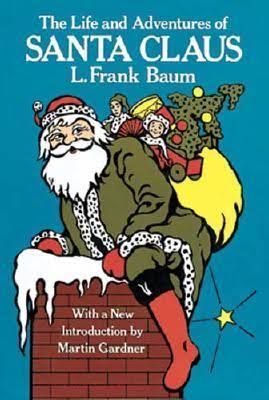
The Life and Adventures of Santa Claus by L. Frank Baum

For a different take on Santa’s origin, let’s wind the clock back to 1902. L. Frank Baum is riding the high of his hit children’s book The Wizard of Oz and he’s looking for a new project. Rather than return to Oz, though, he goes in a different direction and a different fairy tale – that of a young child abandoned in the woods and raised by fairies to become the most giving man in the world.

This is a very different take on Santa than most modern versions. It’s light on the fancy and heavy on the fantasy, with Santa being forced to do battle with monsters and creatures that are out to stop his quest to bring toys to children, and a conclusion that feels like it could have fallen out of the likes of Tolkien or C.S. Lewis. It’s hard to remember sometimes that the way we think about Santa Claus today was sort of codified by lots of little things over the early part of the 20th century – influences from poems, books, songs, and even the original AI-free Coca-Cola Santa Claus ads. But Baum’s book was before most of those things, and although his Santa doesn’t exactly jive with the Santa we know and love (no North Pole workshop, ten reindeer instead of eight, different fairy creatures instead of elves, and so forth), it’s still a fascinating read. It’s especially interesting if you’re a fan of the Oz books, as I am. This was two years before Baum would go back to his most famous creation and transform Oz from a single novel into a franchise, but it feels like it belongs in that “universe.” In fact, in later books Baum would link many of his unrelated books to the world of Oz through the connections of characters, other fairylands, and creatures that would grow in prominence. If you want to consider this the origin of Santa Claus in the universe of Oz, it’s not hard.

The Year Without a Santa Claus

Let’s get away from origin stories, though. We all love the Rankin/Bass classics, and their Christmas specials are legendary. In the top two specials, namely Rudolph and Frosty, Santa is just a supporting character. But they did give Santa a few specials of his own, and this second one is my favorite. In this 1974 Animagic classic, Mickey Rooney voices a Santa Claus that’s down with a nasty cold. This, coupled with a feeling of apathy from the children of the world about his annual visit, brings him to the conclusion that he’s going to skip a year. As the world faces the prospect of a Year Without a Santa Claus, it’s up to Mrs. Claus and a couple of helper elves to convince the big guy to pop a Zyrtec and get his act together.

This is the best of Rankin/Bass’s Santa-centric specials, although the most memorable thing about this cartoon isn’t Santa itself. We have this special to thank for the introduction of the Heatmiser and Coldmiser, battling brothers and sons of Mother Earth. They’re the best original Rankin/Bass characters by far, they have the best original song from any Rankin/Bass special by far, and even now you see them showing up in merch and decorations every year. It’s not easy for a new character to break into the pantheon of Christmas icons, but the Miser Brothers made the cut thanks to this awesome special and the fantastic musical arrangement of Maury Laws. The boys are a delight.

DC Comics Presents #67: Twas the Fright Before Christmas

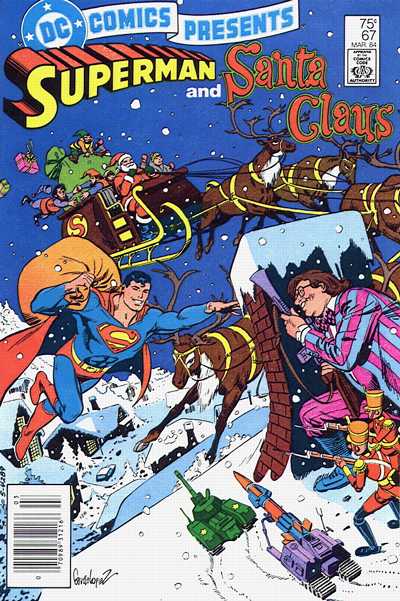
Let’s wrap things up with this comic book from 1984. DC Comics Presents was a series in which Superman would team up with a different guest-star in each issue. Usually it was his fellow superheroes like the Flash, Batgirl, or the Metal Men. On occasion he’d have to partner up with a villain like the Joker. On more than one occasion he had to pair off with different versions of himself like Superboy, Clark Kent, or his counterpart from Earth-2. And on one memorable occasion he met up with He-Man and the Masters of the Universe, characters who were still on the rise.

But my favorite issue of the book is this one. Written by Len Wein with art by the most iconic Superman artist of the era, Curt Swan, in this issue Superman stumbles upon a little boy who tries to hold up a sidewalk Santa with a toy gun. Superman whisks the child off to his Fortress of Solitude at the North Pole where he determines that the child was hypnotized by a device in the toy, made by his old foe the Toyman. Leaving the Fortress, the boy’s toy zaps Superman with a burst of “white dwarf energy” which knocks him from the sky and leaves them stranded in the Arctic Circle. Luckily, they’re saved by some of the pole’s other residents. Superman and Santa then team up to save Christmas from the machinations of the sinister Toyman.

It’s a pretty silly story, but silly in a fun way. This is towards the end of the era in which Superman was allowed to be a little goofy, just two years before John Byrne would reimagine the character in his classic Man of Steel miniseries. And although that depiction of Superman has largely informed the character in the years since, it’s nice to see that modern writers aren’t afraid to bring back the kinds of things that made this story so memorable every once in a while. It ends with one of my LEAST favorite tropes, especially in a Christmas story (the whole “It was all just a dream…OR WAS IT?” nonsense), but that doesn’t diminish my love for it at all. I tend to go back and read this comic again every Christmas

Once again, guys, ask me tomorrow and there’s a good chance I would pick five totally different stories to populate this list, but as I write it here on December 20th, these are five of my favorite Santa Claus stories of all time. But I’m always open for new ones – what are yours?

Blake M. Petit is a writer, teacher, and dad from Ama, Louisiana. His most recent writing project is the superhero adventure series Other People’s Heroes: Little Stars, volume one of which is now available on Amazon. You can subscribe to his newsletter by clicking right here. He’s also started putting his LitReel videos on TikTok. Honorable mention goes to a story John Byrne did for Marvel’s What The?! comic where Santa twists his ankle delivering to Latveria and Dr. Doom has to take over and finish his route for him. 

Geek Punditry #102: Making a Merrython

When the holidays roll around, one thing you can be certain of is that I’ll be queuing up all of the great Christmas movies and specials. And I don’t just mean the obvious ones like It’s a Wonderful Life, National Lampoon’s Christmas Vacation, the Rankin/Bass catalogue, or the legendary yuletide adventures of Garfield and Charlie Brown. I also have a great affection for Christmas episodes of old TV shows. As I’ve written before, there was a time when I would get home from school and watch reruns of old sitcoms for hours on end, allowing me to have a far greater memory of the contents of said television programs than I ever will less pertinent information, such as my wife’s telephone number. 

In this age of streaming, it seems like it would be simplicity itself to cultivate a massive playlist of holiday-themed episodes to start your own Christmas marathon…but alas, that does not seem to be the case. Although most streaming services have a “holiday” category, none of them seem to have what I really want, namely an option to just create my own playlist of episodes and set it to run on shuffle. I want an easily-curated selection of shows for a Yuletide Marathon – a Merrython, if you will. 

But if Netflix, Hulu, and Paramount Plus won’t let me do it, damn them, I’ll do it myself. Plex is a great system, an app that I can use to arrange and watch all of the movies and TV shows I’ve got saved on my own server, complete with my own cultivated playlists and a shuffle option. Now the catch here is that you actually have to provide the video yourself, which obviously limits things a little bit…but I started collecting DVDs almost a quarter of a century ago. I’ve got a LOT of TV shows on disc, and I’ve got lots of compilation DVDs of Christmas episodes from assorted TV series that I can throw into the mix as well.

While I certainly encourage everybody to create their own playlists, today I’m going to share with you a part of MINE. Here are just a few of my favorite Christmas-themed episodes of my favorite sitcoms, many of them episodes that are sitting in my Plex queue waiting to be watched. On Plex I set the playlist to shuffle, so I never know what’s coming up next…but for you guys, I’ll put them in chronological order.

The Honeymooners: “Twas the Night Before Christmas.” Season 1, episode 13, original air date Dec. 24, 1955.

My love for The Honeymooners knows no bounds. The only sitcom duo better than the pairing of Jackie Gleason and Art Carney is the pairing of Jackie Gleason and Audrey Meadows. Ralph Kramden’s antics with both his best friend and his wife are legendary, and have become part of the DNA of television comedy. While I can’t be certain that the Kramdens are the FIRST example of a sitcom schlub married to a woman who’s way out of his league, it’s definitely the trope codifier.

This legendary episode sees Ralph struggling to get a present for his wife, Alice, on the day before Christmas. Ralph is berating himself for having previously squandered money that he could have used to get her something nice on a bowling ball for himself (and before anybody says “Simpsons did it!” I must remind you that this show was some three decades before the adventures of Homer and Marge). As is always the case, Ralph ropes his sidekick Ed Norton into a variety of short-lived schemes to try to get the money or get a present for Alice, each of which is thwarted in a delightfully goofy fashion. In the end, the story works out to a sort of one-sided but utterly heartfelt variation of “The Gift of the Magi,” one that I never get tired of watching this time of year. Audrey Meadows was an absolute treasure, and this episode shows that as well as any.

I Love Lucy: “The I Love Lucy Christmas Show.” Season 6, episode 27, original air date Dec. 24, 1956

In this episode, the Ricardos and Mertzes are spending Christmas Eve together, struggling with decorating the tree and talking about how wonderful it was to have a child – Little Ricky – with whom to celebrate the holidays. I’ve mentioned before what an innovative show I Love Lucy was, on top of just being one of the funniest shows in television history, but this episode in particular has some historical significance. When Lucille Ball was pregnant in real life, they incorporated her pregnancy into the show. Those episodes proved to be overwhelmingly popular, and they wanted to milk a little of that juice again, so they used this episode to showcase the characters remembering the adventures they had surrounding Little Ricky’s birth. You see, not only did Lucy and Desi invent the rerun, but this Christmas episode marks the first clip show in television history.

These days, a lot of people consider clip shows tedious and wasteful, a cheap way to squeeze out an extra episode without spending a lot of money actually filming it, and in this day of shorter seasons the practice is almost extinct. But seventy years ago it was a chance for people to re-watch segments they loved, because there was no other option.

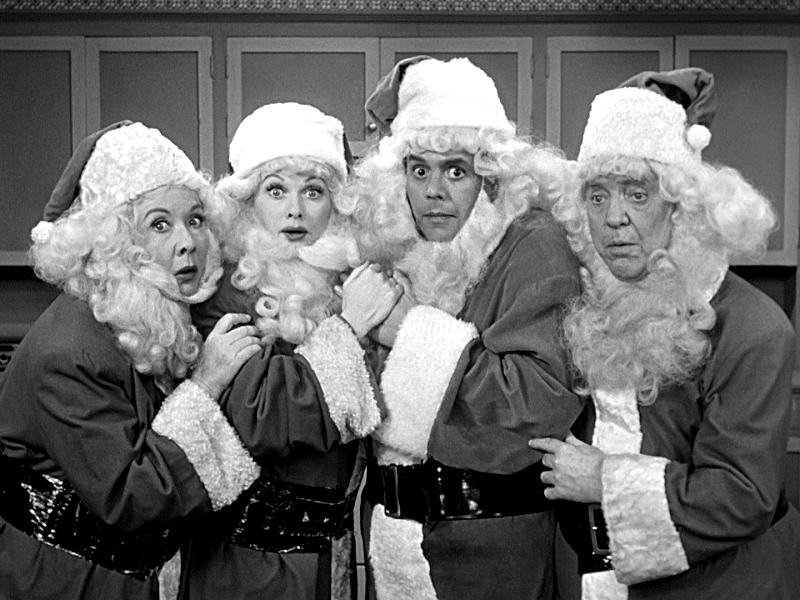
The show didn’t only recycle the clips, though, but also a gag at the end when all four adults (Lucy, Ricky, Fred, and Ethel) each independently decide to dress as Santa Claus to surprise Little Ricky. They wind up getting into a slapstick chase in the living room, during which a fifth Santa appears. As they remove each other’s beards trying to determine who is who, the superfluous St. Nick grins and vanishes before their eyes. They had first used this gag at the end of a season one episode, “Drafted,” in a tag that had nothing to do with the episode itself, and had shown it again in subsequent Christmases. This “remake” made a lot more sense, given the episode it was used to conclude. 

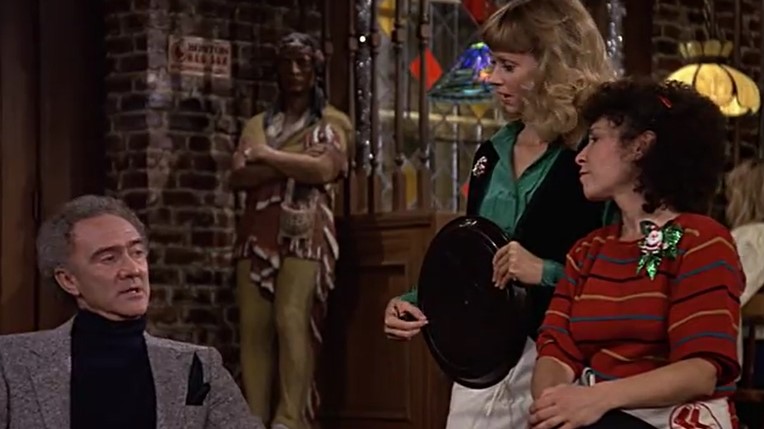
Cheers: “The Spy Who Came in For a Cold One.” Season 1, Episode 12, original air date Dec. 16, 1982.

Cheers did a few Christmas episodes over its 11-year run, but none of them cling to my mind better than this one from the first season. This was, of course, a period where the show was still kind of trying to find its identity. It was still predominantly a romantic comedy, focusing on Sam and Diane’s relationship, but even at this point the ensemble piece it would eventually become was starting to shine through.

In this episode, a stranger shows up for a drink at the bar around Christmas and “accidentally” lets it slip to the patrons that he is – drumroll please – a spy. Diane, ever the pragmatist, meets his claim with the expected skepticism, but most of the rest of the gang plays along with it, plying the stranger for stories of his exciting lifestyle. When Diane finds a way to trap the spy in his own web, everything blows up in her face.

Aside from the date and the decorations, this isn’t an especially Christmasy story. We don’t get the usual “very valuable lesson” that so many of these episodes come with, nor is there a heartwarming moment at the end where everybody gets together for a group hug and reminds one another that friends are the real family. But I like the way it hammers down the dynamics of the group, how Diane gets a somewhat needed comeuppance about being too smart for her own good, and how it deftly establishes some of the tone and tropes that would follow the series further down the line, even after Shelley Long left the show. 

The Golden Girls: “Twas the Nightmare Before Christmas.” Season 2, episode 11, original air date Dec. 20, 1986.

It’s Christmas in Miami, and the girls are all making plans to jet off to visit their respective families in other parts of the country. Things get derailed, however, when a man dressed as Santa Claus shows up at Rose’s grief counseling center and starts taking hostages.

Hopefully, by this point, nobody needs me to tell them what a brilliant show Golden Girls was. You had a cast of four outrageously talented comedic actresses and a team of writers who were willing to push the envelope in ways that few other shows in the 1980s took a chance doing, and it has legitimately become recognized as one of the greatest TV comedies ever made. The amazing thing about this particular episode is the way it breaks down the story into three segments, any of which would have been an entire episode of a lesser sitcom. It starts with a funny scene showing the gift exchange between the girls before they leave for the holidays, which itself is ripe with comedic potential. Then we crash into the hostage situation, which seems like it would be the whole episode on its own until Sophia casually takes the gun away from the hostage-taker and berates Dorothy for not being able to tell the difference between a real gun and a fake. The final act shows the girls – now stranded in Miami and unable to make their flights – having a Christmas Eve dinner in a diner where they slowly come to the realization that they haven’t missed out on a Christmas with family after all.

This episode wraps up with some of the schmaltz that the Cheers episode was missing, and it’s just lovely. It was only the second season of the show, and while the bond between the characters was evident, this was the episode that kind of cemented how deeply the four of them all cared about one another, which (despite any friction on the set in real-life) was truly the core of the show. And of course, typical of the Golden Girls, the drippy, gooey sentiment at the end is nicely undercut by a joke from Sophia, who is one of the greatest characters in television history.  

ALF: “ALF’s Special Christmas.” Season 2, episodes 12 & 13 (two-part episode), original air date Dec. 14, 1987

Ah, is there anything that says “TV in the 80s” better than the adventures of a Muppet-esque alien living with a typical American family to the delight of audiences everywhere and – apparently – to the eternal disdain of the cast that had to work with him? From all accounts, the set of ALF was not a pleasant place to be, but this show was a favorite of mine as a kid, and I’m still on a quest to complete my run of the Marvel ALF comic books (50 regular issues, three annuals, two Christmas specials, a “spring” special, and two digests). It’s an oddly formative part of my personality.

In this two-part episode, the family leaves the Tanner home for a trip into the woods for Christmas. Willie rents a cabin for the family to stay in where ALF will be free from prying eyes, but as tends to happen, the little furball gets lost, winding up in a hospital where he’s mistaken for a doll and given to a child with a serious illness. He befriends the girl and eventually leaves, but the memory of her clings to him. Meanwhile, the Tanners find out that the man they’re renting the cabin from is giving it to them – two weeks after the death of his wife, he seems to be divesting himself of a lot of things…

This is honestly a pretty dark episode, even for a show like ALF, which frequently mixed a little darkness into its humor. (Cat buffet, anybody?) The two plotlines are about a child with a terminal illness and an old man contemplating suicide – fun for the whole family, right? But the whole thing is done with the typical ALF touch. There’s some goofy humor in it, and a dose of heart that makes the darkness a bit more bearable…and honestly, I think that’s kind of the point. The show doesn’t turn a blind eye to the bad things in the world, but does its best to show how to cope with them. That’s something I’ve always appreciated about it.

Frasier: “Frasier Grinch.” Season 3, episode 9, original air date Dec. 19, 1995

Let’s wing our way back to the Cheers Universe for this third-season episode of its successful spinoff show. The original Frasier was a brilliant series and arguably the most successful comedy spinoff of all time, but there was one thing about the adventures of Frasier Crane in Seattle that always kinda bugged me: the distance from his son. When the producers decided to give Kesley Grammar a spinoff they shipped him off to the other side of the country to do their best to resist the urge to have cameos from his former co-stars every other week, but the side effect here was that Frasier often came off as a very absentee father…ironic, as one of the best parts of this show was watching as Frasier rekindled his relationship with his own father, Martin. In this episode, Fraiser’s son Freddy is coming to Seattle to spend the holidays with his dad, and Frasier decides to shower the boy with the very thing every kid wants for Christmas: educational toys! It’s not long before Frasier realizes the enormity of his error and has to venture out to find the gifts Freddy REALLY wants for Christmas.

Like Diane in the parent show, the intelligentsia in the Crane family occasionally needed a reminder that they were not always the smartest ones in the room. This episode does a lot to help Frasier seem like a well-meaning father willing to go to great lengths to give his child a Merry Christmas (the least he could do, as he only sees the kid in one or two episodes a season). It also has some really great stuff with Martin, nailing the dynamic between Kelsey Grammar and John Mahoney. Frasier did many more Christmas episodes than Cheers, but this is my favorite.

Community: “Abed’s Uncontrollable Christmas.” Season 2, episode 11, original air date Dec. 9, 2010.

By the second season of Community, the show had firmly embraced its role of commenting on and parodying the various tropes of sitcoms, and in this episode they went one step further by parodying classic Christmas specials. The entire episode is done in stop motion animation, mimicking the old Rankin/Bass “Animagic” style, as Abed is somehow stuck seeing the world as a holiday special. With the help of Professor Duncan, Abed’s study group tries to get to the bottom of his delusion and help him see the world the way that it really is.

This is not the first sitcom to try an animated special for the holidays – Home Improvement had a memorable episode that had a segment in stop motion animation, for example. But what elevates Community is that the episode does not ONLY parody Christmas specials, but also makes a real commentary on the characters. Despite his delusions, we learn things in this episode about Abed and his family that leave deep fingerprints on the character and make him a little more understandable than he may have been in the past. The episode has one of the most bizarre explanations for “the meaning of Christmas” that I’ve ever heard, but damned if it isn’t just perfect for this show. 

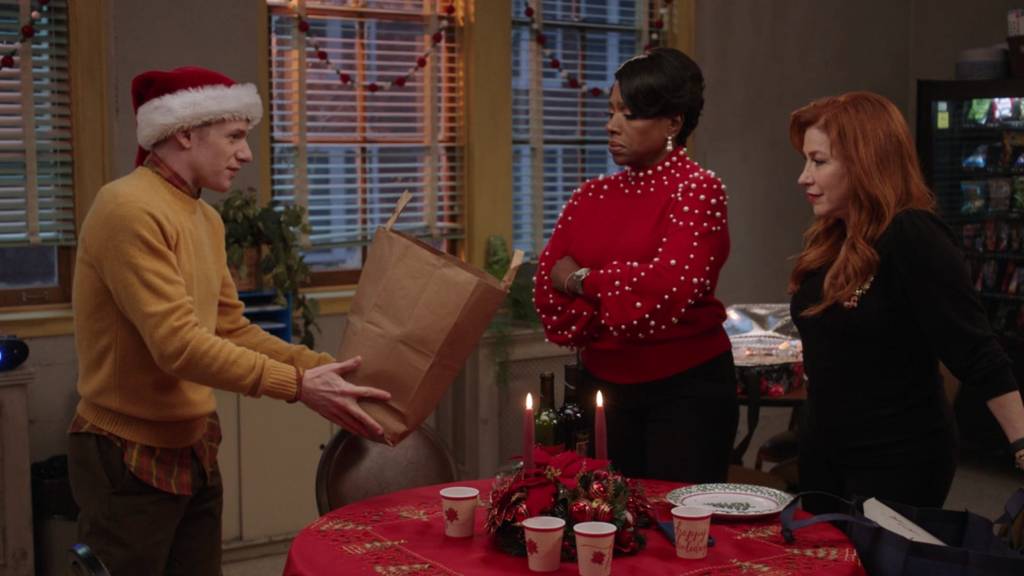
Abbott Elementary: “Holiday Hookah.” Season 2, episode 10, original air date Dec. 7, 2022.

The newest entry on my Christmas playlist comes from what I maintain is the best live-action comedy currently on television, ABC’s Abbott Elementary. After the last day of school before the winter break, young teachers Janine and Gregory (who have had your classic “will they/won’t they” thing happening for some time now) happen to run into each other at a hookah bar, each with a group of friends. Even if you’ve never seen an episode of this particular series, if you’ve watched other shows that use the same trope (see about a billion other shows) you’ll see the trajectory that this plotline is taking. There’s awkwardness, obvious attraction, confusion, and a reluctance to hook up with somebody you work with. It’s all done well, but is kind of standard stuff.

What I really like about this episode is actually the B-plot. Two of the older veteran teachers, Barbara and Melissa, have a tradition of having a Christmas dinner together after the end of the fall term each year. This year Jacob – a young teacher who fancies himself to be far cooler than he actually is – finds out about their celebration and winds up crashing their “Christmas Lounge.” The interaction between these three is wildly funny, and the relationship between Barbara (Sheryl Lee Ralph) and Melissa (Lisa Ann Walter) has become a core pillar of the show at this point. Although the two are almost diametrically opposites of one another, personality-wise, their shared experience and long relationship has them stand out as the best of friends. It’s one of the sweeter, most realistic elements of the show (I can name several pairs of teachers I know in real life that remind me very much of these two), and I think this episode showcases that extremely well.

We also get your usual “somebody has to learn a lesson” moments that frequently accompany any Christmas episode, and as befits this series, they come from unlikely sources. Ava – the crazy principal who often seems wholly unsuited for her job – comes to Janine’s rescue, while Jacob gets his head screwed on straight thanks to the timely intervention of conspiracy nut custodian Mr. Johnson. All of it together makes for a fine Christmas viewing. 

There you have it, friends, some sitcom classics to get you in the Christmas mood this year. This is, of course, not to be considered a comprehensive list. There are hundreds of shows that have done Christmas episodes, and creating a truly complete list is probably beyond my abilities as a humble Geek Pundit. Which is why I invite you to share some of your favorites here in the comments, or on whatever social media you followed to get here! What are some of the all-time great Christmas episodes that have made it to YOUR Merrython playlist?

Blake M. Petit is a writer, teacher, and dad from Ama, Louisiana. His most recent writing project is the superhero adventure series Other People’s Heroes: Little Stars, volume one of which is now available on Amazon. You can subscribe to his newsletter by clicking right here. He didn’t even get to Laverne and Shirley, The Simpsons, Bob’s Burgers, The Beverly Hillbillies, Friends, Family Ties, Night Court, Family Matters, Perfect Strangers, Mama’s Family, Seinfeld, The Office, or The Big Bang Theory. Maybe there needs to be a sequel to this column next year. 

Geek Punditry #101: This is How We Do It-The Muppet Christmas Carol

We’ve made it again, folks. Eleven months down and it is once again permissible to crack open our DVDs (or streaming services) and start watching Christmas movies, which is pretty much the reason for existence. And today I’m going to talk to you about one of the greatest ever made: The Muppet Christmas Carol. In “This is How We Do It,” I take a piece of storytelling and discuss just what, exactly, makes it so damned good. And while I doubt there are many people who need convincing that The Muppet Christmas Carol is a classic, it is well worth taking the time to break it down a little. I love A Christmas Carol. I love the book, I love the many derivative movies and TV shows based on the book. I have, at last count, watched over 40 different film adaptations of Charles Dickens’ novel, and for years I said that the Muppet version is “maybe” the best of them. This year, I am removing the modifier. The Muppet Christmas Carol is THE best adaptation of Charles Dickens’ classic, and lemme tell you why.

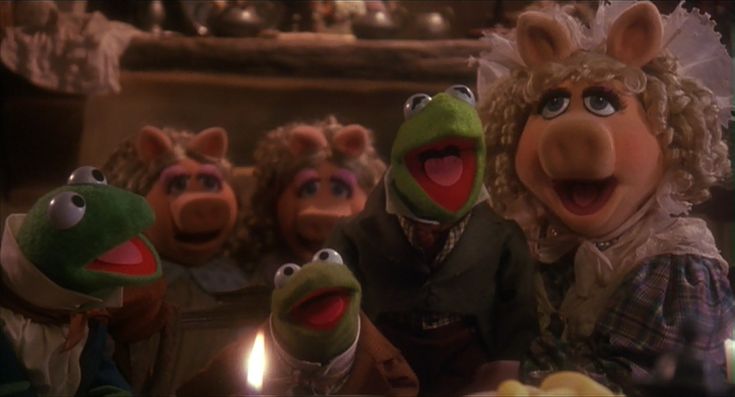
Who knew Emily Cratchit could be so hot?

A Christmas Carol is perhaps the single most-adapted story in the history of motion pictures and even when the Muppet version was made back in 1992, it had already been done to DEATH. We had seen “traditional” versions with the likes of Albert Finney and Alastair Sim. We saw modern reimaginings with Bill Murray and Henry Winkler. We had versions starring Scrooge McDuck, Bugs Bunny, Mr. Magoo, George Jetson, and Fred Flintstone. We had gender-swapped versions, we had versions transplanted to other holidays, we had comedies and dramas and musicals. The Teen Titans used it to break up a scheme that involved getting around import tariffs and Rod Serling had taken the framework to do a kind of tedious fable about nuclear war.

IT. HAD. BEEN. DONE.

Logically, once you’ve seen the Fonz as Scrooge, where else is there to take it?

There are only two reasons left to do a version of the story: either to put a unique twist on it or to showcase a masterful performer. Well there’s no unique twist here, but the Muppets themselves are one of the greatest acting troupes of all time. Nobody needed to see A Christmas Carol again. We wanted to see Kermit, Piggy, Fozzie, and Gonzo in THEIR version of A Christmas Carol. And the casting was flawless – Kermit (voiced by Steve Whitmire) as Bob Cratchit, Piggy (Frank Oz) as Mrs. Cratchit, Fozzie (Oz again) as “Fozziwig,” and so forth. 

But the REAL casting coup of this movie was taking Gonzo the Great (Dave Goelz) and casting him as Charles Dickens himself. So much of what makes Dickens’ story work is the beautiful narration, and narration is often lost when translating a book to film. The solution was to cast Gonzo as Charles Dickens himself, supplying the narration and keeping such phenomenal lines as “Marley was dead to begin with” intact. Well… “The Marleys,” but close enough. Anyway, pairing him with Rizzo the Rat (Whitmire) turned the narrator into half of a comedy team that worked perfectly, and the dynamic that was created between these two characters remains to this day.

The TRUE heroes of Christmas.

Even though Gonzo reciting Dickens’ words gives the film a little weight and gravitas, the two of them together are there to add in a little Muppety silliness when it calls for it (such as when Gonzo has to remind Sam the Eagle that he’s playing a Brit and not an American). But they’re smart enough not to overuse them, especially when they nope out as Christmas Future is showing up. They sell the joke as Gonzo and Rizzo being scared of the spirit, but the obvious truth is that this upcoming sequence is going to be Scrooge’s darkest hour, and throwing in a tension-breaker at this point is the exact OPPOSITE of what you should be doing. 

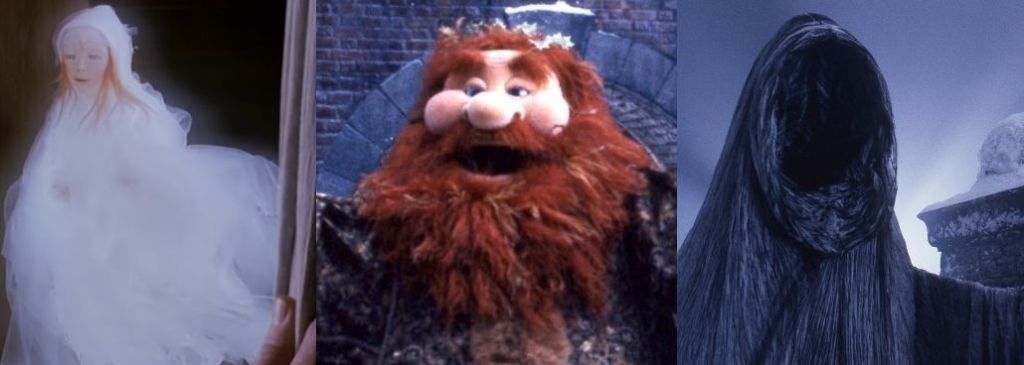
The Muppeteers chose not to use traditional Muppets as the ghosts of Past, Present, or Future, though, instead creating new characters to inhabit those roles. I think that was probably the best choice. Each of them has a unique, ethereal quality, that of a being that belongs to another world, that would have been sacrificed if Present had been played by Sweetums, Future by Uncle Deadly, or anything like that. They absolutely made the right choice.

Here’s a fun game to play with your kids. I call it “which one gives you the most nightmares?”

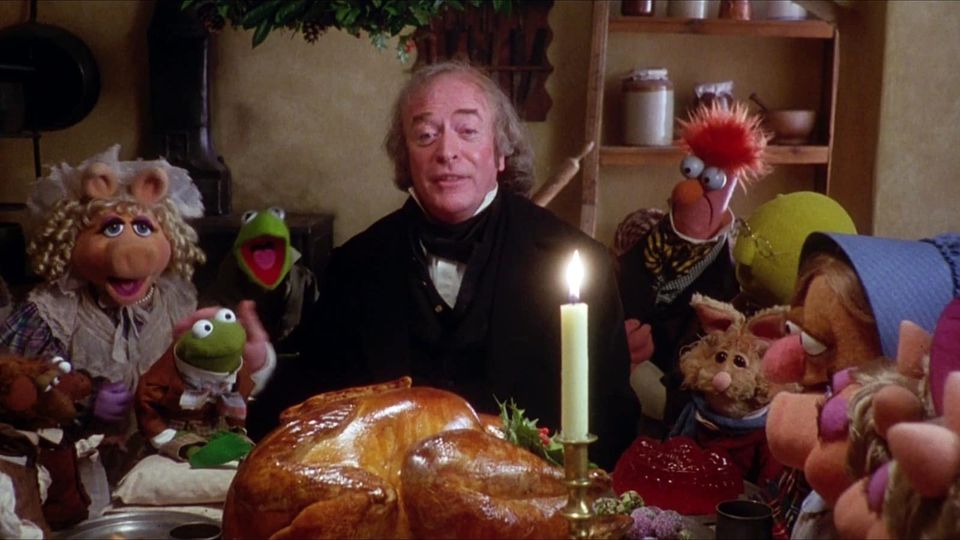
Then there’s the human cast. While all of them are good, Michael Caine as Ebenezer Scrooge is phenomenal. The story, as most of us have heard, is that Caine chose to play the role perfectly straight, as if he were performing Scrooge amongst a cast of human actors rather than puppets, and in so doing he gave a performance that I frankly think was robbed of Oscar consideration. (Scent of a Woman my ass, Pacino.) It’s so easy to play Scrooge as the cold-hearted miser that we think of him as. Any halfway-decent actor can do it. What not every actor can do, what sets Caine apart, is the way he sells Scrooge’s transformation. Even in the early scene, where he begrudgingly agrees to let Cratchit and the bookkeepers have Christmas Day off, there’s a hint in his voice that it’s not entirely cold-hearted. There’s a spark of warmth – a very DIM spark, but it’s there. He tries to disguise it, but you can feel that there is understanding in his voice.

His glare, on the other hand, is scary as hell.

As the film progresses, each successive visit with the ghosts shows this change in a more pronounced way, as Scrooge’s defenses begin to fall and he is struck with the stark horror that his life has become. Caine shows regret, sorrow, pain, and genuine, sincere remorse for the terrible things he’s done in his life. This is the key, you see, this is what poor adaptations of the story get wrong. Scrooge’s redemption cannot come simply from the fear of his future. As people on the internet love to point out, if the only reason you behave morally is for fear of punishment, you’re not really a moral person to begin with. A truly good person does good for the sake of doing good. (We shall return to this subject next summer, just before James Gunn’s new Superman movie comes out.) The best adaptations of A Christmas Carol – and again, this is THE best – have to begin selling the redemption before fear for the future can set in.

The redemption truly starts with the most contentious scene in the film. If you go to Disney+, there are actually TWO versions of the movie. The one that plays if you just click on it is the expurgated version, which removes the song “The Love is Gone” from the Christmas Past sequence. If you want to watch the uncut movie, you have to go to “extras” and select “full version.” Disney chose to cut the song from the original release of the movie, saying that it slowed down the pace too much and that it was too sad.

My dude. My friend. My mouse. THAT. IS. THE. POINT.

If I’m watching Disney+ and sobbing openly, I’m probably either watching this or Bluey.

“The Love is Gone” is sung by Meredith Braun, playing Scrooge’s lost love, Belle. After Scrooge watches the scene where she ends the relationship with his younger self, she launches into this heartbreaking piece about everything they have lost. At the end of the song, Caine joins in, singing a duet with a woman who cannot see or hear him. As the song continues he slowly, inexorably, crumbles into sobs. The agony in his face and his voice is a master class in acting. For the first time, Scrooge is truly forced to face the way his horrific choices have destroyed not only his own chances at happiness, but those of the person he loved the most in the world. It slows the pace? GOOD. Scrooge has to stop and realize what he’s done, and as we are going on the journey with him, we have to stop too.

It doesn’t hurt of course that Paul Williams, who wrote the songs for the film, absolutely pours his heart out into this one. It’s beautiful and tragic and haunting. And by the end of it, you see that Scrooge has already realized his mistake. This is not extraneous. This is crucial to his journey of redemption.

The transformation continues in the Christmas Present sequence. It’s one thing to recognize that you’ve made a mistake, but just acknowledging it isn’t enough to guarantee that your ways will change. This is accomplished when Present takes Scrooge to visit his nephew’s Christmas party. Seeing good-hearted Fred (Steve Mackintosh) and his guests make him the butt of a joke – calling him an “unwanted creature” in a 20 Questions-style guessing game – breaks Scrooge’s heart just a little bit more, as he realizes how people view him. At the same time, this is the nephew who practically begged him to join them in the first scene. Even today, Scrooge’s choices are causing his separation from those who would love him. 

If that wasn’t enough, the visit to the Cratchit house nails it when Scrooge is told about the serious condition of Bob’s son, Tiny Tim (played, naturally, by Kermit’s nephew Robin). This is – to be fair – one of the easiest parts of the story to get right. If you can’t sell somebody feeling sorry for the plight of a small, sickly child, you have no business calling yourself a storyteller. But as always, the Muppets kick it up a notch. Kermit and Robin enter the scene to a lovely, joyful scat, singing about how jolly Christmas is. Tiny Tim isn’t immediately shown as an object of pity, as he is so often, but rather as a happy, gleeful child who deserves a chance at life. They launch into the centerpiece song “Bless Us All,” which is something of a love letter to the importance of family and togetherness, those very things that Scrooge has driven out of his life. It’s a warm, tender, heartfelt song that is undercut when the song ends with Tim’s tiny, tragic, prophetic cough to remind us that if something doesn’t change he is not long for this world. 

It helps if you don’t know anything about how genetics works.

Why are these things important? It’s simple. Christmas Past made Scrooge understand how badly he had screwed up. Present shows him that – although he cannot change the past – there is still time to make better choices for the FUTURE. That message is so blasted important. Anyone who has wrestled with depression can tell you how crippling the past can be, how it can cling to a person and make them hate themselves. It’s so easy to wallow in that and assume that nothing can be done about your life.

The message of Christmas Past was, “You made mistakes.” The message of Christmas Present is, “BUT THERE’S STILL TIME. YOU DON’T HAVE TO MAKE MORE.”

Not every version of A Christmas Carol sells this important message. NONE of them sell it as well as the Muppets.

In many ways, by the time Christmas Future shows up, Scrooge has already been redeemed. He’s taken the message of the first two ghosts to heart, and when Future arrives he tells him that he is ready and willing for the lessons the ghost has come to impart upon him. This line comes straight from Dickens, by the way, and any adaptation that leaves it out is completely missing the point. Past and Present do the heavy lifting, vis a vis Scrooge’s transformation. Future is really just there to deliver – pardon the expression – the nail in the coffin. 

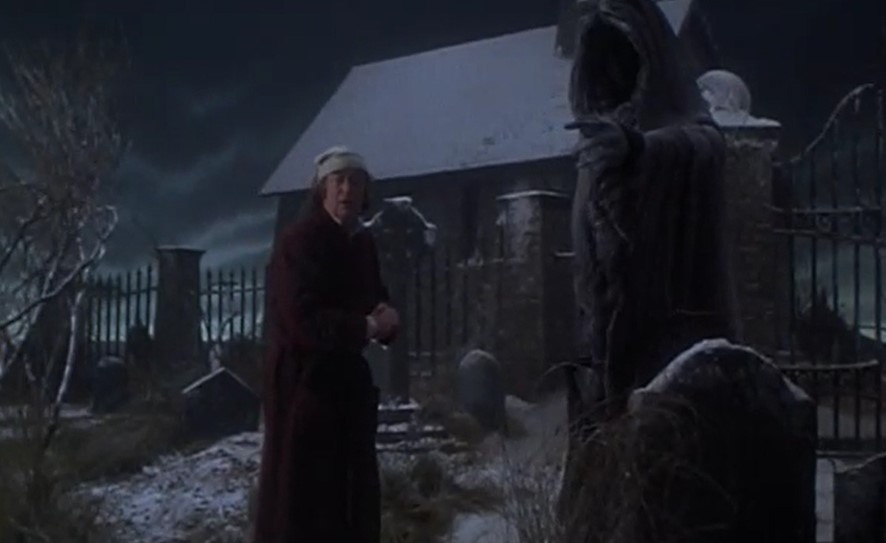
Another thing this version does that sets it apart comes in this sequence. Some versions of the story have Scrooge totally oblivious in the Christmas Future scene, as people are joking about the death of some mysterious “wealthy man” and we see his servants pawning his belongings for a little extra cash. It is obvious from the first second that the dead man is Scrooge itself, but a lot of versions of A Christmas Carol don’t let SCROOGE know that until he sees his own name on the tombstone. But the thing is, Scrooge isn’t an idiot. Although he never says it, the way Caine plays the part makes it clear that he’s pieced it together pretty quickly, that he is seeing the fallout of his own demise. He never says it, perhaps because they’re trying to stay relatively true to Dickens, but just as likely because he doesn’t want to admit to to himself. If you watch the scene in the graveyard, his behavior is clearly that of a man who knows he’s staring at his fate long before the appearance of his name makes that clear. Just one more reason that Caine is the best Scrooge ever, even better than the classically-trained Quincy Magoo.

“I’m here to speak to you about your soul’s extended warranty.”

The finale, when Caine leads the Muppets in the song “Thankful Heart,” is absolutely beautiful. His every mannerism has been changed, and the expression on his face when he looks at those around him is not of a man afraid of the future, but of someone consumed by the love he has so long denied himself. My favorite part, though, comes when he sings the lines:

Stop and look around you, the glory that you see
Is born again each day, don’t let it slip away
How precious life can be!

There’s a moment in those lines where Caine’s voice breaks, just a little – a cracking in his song that sounds like he’s holding back tears. But again, his face sells it – those tears beneath the surface are not of pain, but joy and gratitude for the second chance he’s been given.

Until The Human Centipede, this was the most joyful moment in cinematic history.

I don’t say this often. I reserve it for the likes of Jaws, Back to the Future, and The Princess Bride. But I genuinely think The Muppet Christmas Carol is a perfect movie.

There’s a bit of meta-triumph here as well. The film was directed by Jim Henson’s son Brian, and was the first major Muppet production after Jim Henson’s tragic death. There was a real question in the air as to whether the Muppets would work without the man who brought them to life. This movie proved that the spirit of the Muppets is greater even than their founder, that it IS something that can live on and survive and endure. 

Disney would do well to remember that.

So the next time somebody decides to grab a camera and start rolling on a new version of A Christmas Carol…well, I would never tell them not to do so. As this film proves, there’s always room for a good version.

But before you do it, watch this movie. Watch it over and over again. And learn the lessons of the Muppets.

Because THIS is how we do it. 

Blake M. Petit is a writer, teacher, and dad from Ama, Louisiana. His most recent writing project is the superhero adventure series Other People’s Heroes: Little Stars, volume one of which is now available on Amazon. You can subscribe to his newsletter by clicking right here. Second-best version of A Christmas Carol? Bill Murray in Scrooged. Maybe I’ll explain that next year.

Geek Punditry #100: If I Were King of Comics

Here we are, my friends, 100 Fridays later. In the first week of January 2023, I was thinking of how much I missed the days of writing for Comixtreme and recording my podcast, and I wanted to find a regular way to get my voice back out there in the world. How could I do it? I asked myself. How can I reach out and gift humanity with my invaluable thoughts, insights,and trademark witticisms, in this era where the world clearly needs me more than ever before?

Then I remembered I had a blog that I was barely using, and maybe it would be a nice little challenge for me to find something – once a week, just find SOMETHING – that I liked enough to write a few paragraphs about. 

And of course, it has become the global phenomenon and world-altering sensation you see before you today. 

As I approached the 100th installment of the column hundreds of voracious readers have called “on the internet somewhere,” I tried really hard to decide what to write about. What, in the enormous global marketplace of popular culture that I had made my home, was worthy of dedicating the landmark 100th column to? Star Trek? Stephen King? Superman? Bluey? I feel like I’ve kind of talked about those various topics…well, “extensively” seems in some ways to be too mild a term, but we’ll roll with that right now. No, I needed something a little bit different.

Then I remembered an idea I’d had some time ago, but that I had pushed aside. Something I thought needed to percolate a little more. Something that the world would HAVE to sit up and take notice of. And it seemed perfect. So this week, ladies and gentlemen, allow me to explain to you what exactly I would do if I were in charge of comic books.

You all know I’m a comic book geek, and I have been since I was a small child. Not to discount my love of movies, TV, or novels…I’m a fan of storytelling in general. But comics are in many ways my medium of choice. I’m a regular Wednesday visitor at my local comic shop, I know all the members of the Legion of Super-Heroes, and I can tell you – in order – every publisher that has ever had the Star Trek license. (Gold Key, Marvel, DC, Malibu but only Deep Space Nine, back to Marvel, Wildstorm – which was by then a DC imprint – and currently IDW. Sorry, ladies. I’m taken.)

As much as I love comic books, though, there are certain practices in the industry that I’m not a fan of, certain things that I think could be done better. In this era, where there’s so much competition for the attention of an audience coming from virtually every region of our culture, it’s imperative that comic book publishers find ways to draw in new readers and retain existing ones. Ways to make the sometimes complex mythologies of American comic books a little less of a roadblock, and make the space a little more welcoming. For the 100th Geek Punditry, guys, here are some rules that would be implemented if I were King of Comics.

Numbering

As most people know, comic book series are numbered, and for many decades the numbering convention was simple. You started with issue #1, proceeded to #2, and so forth. You just put the numbers in order. Seemed like a simple idea. But at some point things started to get a little more convoluted. After World War II, many of the existing superhero comics had been cancelled. But in the 50s, looking for a new hit after public favor turned against things like horror comics, DC decided to bring back some of their defunct characters with a new incarnation. A new Flash was created – Barry Allen – and after a few tryout issues in the pages of Showcase, they gave him his own title. Barry took over the numbering of the Golden Age Flash, Jay Garrick, and his first issue was #104. Here’s where it gets confusing: they then did they same thing with Green Lantern. But in this case the new guy – Hal Jordan – did NOT pick up from Alan Scott’s title with issue #39, but instead got his own first issue, Green Lantern Vol. 2 #1.

Make it make sense.

It would not be the last time this happened. In the 80s they gave new first issues to Superman, Wonder Woman, and The Flash, and in those cases, the lapse in publishing between the previous volume and the new was not nearly as long as it had been in the silver age. Then in the 90s, Marvel did it with four of their flagship titles at once – Avengers, Fantastic Four, Iron Man, and Captain America – as part of a new initiative where the titles were essentially farmed out to Jim Lee and Rob Liefeld and set in a different world than the “regular” Marvel Universe. When the books were brought back to the “regular” Universe a year later, they were given a THIRD first issue…and then all hell broke loose.

Since then, virtually every comic book published by Marvel or DC Comics has been canceled and relaunched with a new first issue, most of them multiple times. Batman, at last count, is on its conservative third volume. Superman is at six. Punisher – if I’m counting correctly – has recently concluded volume FOURTEEN. The longest running comic book at either publisher that has not been restarted at least ONCE? Looney Tunes, which recently celebrated issue #281. (It should be noted, though, that even this is the fourth volume of Looney Tunes, having been published by various other companies before Warner Bros. wholly absorbed DC Comics.)

Winner of the gold medal in “not starting over for no reason.”

The conventional wisdom seems to be that a new first issue will bring in higher sales numbers than issue #482, and that might be true. But increasingly, it has proven that a tenth issue #7 does NOT have appreciably more readers than issue #489 would have. In other words, the restarting game gives a short-term sales bump, but does nothing to retain readers, which is what the goal should be.

Anyway, to appease fans (such as myself) who prefer maintaining the original numbering rather than the constant restarts, Marvel and DC have begun featuring “legacy numbers” on the covers of their books – in other words, what issue would this be had the book never been restarted? Which is why the recent Superman Vol. 6 #20 also bears a little symbol indicating that the “Legacy Number” of this issue is #863.

Only long-time Superman fans will understand what I mean when I say “at least it’s in a triangle.”

Confused yet?

Making it even more confusing is the way that many series have changed titles over the years, and trying to figure out which is which. Thor started as Journey Into Mystery, one of Marvel’s assorted sci-fi titles. But after he made his debut, Thor quickly took over the comic book, and the title was changed from Journey into Mystery to The Mighty Thor with issue #126 When calculating the Thor legacy numbers, the original JIM numbers seem to count, but JIM itself has been re-started several times over the years. Journey Into Mystery Vol. 2 does NOT count, apparently, as it ran concurrently with Mighty Thor. And let’s not forget that the current series carrying the Legacy Number is actually called Immortal Thor, which has the same legacy numbers as did previous volumes like Mighty Thor, King Thor, Thor: God of Thunder, or the (at last count) six different series that have just been called Thor. 

According to the legacy numbers, these are all issues of the same title.

Then there’s the fact that it’s inconsistently applied, especially at DC. Superman (on Volume 6), Batman (Volume 3), Flash (Volume 6), and Green Arrow (Volume 7) all have Legacy Numbers on their covers. Nightwing (Volume 4), Harley Quinn (Volume 4), and Titans (Volume 4) do not, and I can see no particular reason why. 

It’s an absolute mess. True story: when the Captain Marvel movie came out in 2018 my wife – who is a geek but not as big a geek as I am – was interested in reading some of the comics to learn more about the character, but after several attempts to figure out which volume to start with, she gave up. If the plan here is to get MORE readers, it’s failing miserably.

So how do we fix this problem? 

Here’s what I would make the standard rule: first of all, the Legacy Numbers should be mandatory for any series that continues the title or star of a previous series. The editors would need to get together right away, decide which books count towards the “legacy” and then stick with it from then on. 

Second, I would have them stop with the constant relaunches. If a character is returning after ten years away…okay, a new first issue might be justified. If we’re going back to issue #1 because there’s a new inker, it’s not. It’s become a common practice to start over with a new first issue any time there’s a change of creative team, especially when there’s a new writer. It’s too much. So here’s the rule: there must be a minimum of three years since the previous volume before a new first issue is justified. If the final issue of Captain Dudeman was #47 and it came out eighteen months ago, then you either have to start with Captain Dudeman #48 or you have to change the title. 

That second stipulation, I think, would start to get used very frequently. One of the reasons that the renumbering has gotten so rampant is that every time a new writer is brought onto a series they want to make their own mark – which is fair. But in so doing, they often want a clean slate, a sort of “back-to-basics” approach for the character, which has resulted in several books in the last few years where the first issue shows the heroes in a wholly different situation than they were in when the previous volume ended, and then it’s not until several issues later that the reasons for the change are actually explained. Sometimes it works (Fantastic Four and Daredevil both did this effectively in their most recent relaunches) and sometimes it doesn’t (the current run of Amazing Spider-Man should be studied by scholars as a cautionary example of what NEVER to do).

I don’t want to take away a writer’s ability to tell the stories they way they see fit, that’s not what this is about. But if the plan is to tell a totally different story, changing the title of the series is a good way to reduce confusion. Telling somebody “You have to read Green Lantern – but not that one, or that one, or that one…” is a recipe for the kind of bafflement that drove my wife away. But saying “Green Lantern: Emerald Champions is a great series” is a HELL of a lot easier for the casual reader to comprehend. You can keep the legacy numbers that way, but having a subtitle or supertitle (that’s when you preface the main title with something else, such as Peter Parker, the Spectacular Spider-Man) makes it a lot easier to differentiate one run from another. 

What this really boils down to is that I never again want to see a comic book called Fantastic Four #1. When I was a kid, owning that book would have been a gold mine. Now I’ve got six different books called that, and it’s ridiculous. 

Cover Confusion

The way the comics industry handles its covers is also an issue, and there are two primary problems I want to tackle. First, let’s talk about pin-up covers. This isn’t as bad as it once was, but for a while there in the 00s and 10s, there was an awful trend of comic books having generic pictures of the main character or characters on the cover, something that may be a fabulous piece of art but doesn’t tell the reader anything about the story between the pages. The argument at the time, I believe, was that they wanted every issue to be an accessible first issue for a new reader. While that may be a noble goal, that doesn’t make a damned bit of sense. Anybody who picks up a comic because they like the picture of Spider-Man on the cover is going to have a hard time keeping up if they open up the comic and run into “Revenge of the Return of the Colonoscopy of the Sinister Six: Part Five of Seventeen.” Congratulations – you sold that one issue…but they aren’t coming back. 

“Wow, great cover!”
“Thanks!”
“What’s the story about?”
“What the hell is a story?”

Pin-up art is fine, but a great comic book cover should tell a story. Think about some of the all-time most memorable covers: Amazing Spider-Man #129 features the webspinner dangling in front of the faces of his friends, agonizing over which of them was going to die in that issue. Green Lantern (Vol. 3) #49 shows a power-mad Hal Jordan brandishing a set of rings stolen from his fallen comrades, a look of pure chaos in his eyes. Wolverine: Blood Hunt #2 shows the ol’ Canucklehead on a motorcycle with a French vampire babe being chased by a mob of vampire stormtroopers while fleeing an explosion that is also being escaped by an overhead passenger jet.

If just that description isn’t enough to make you pick up the book and look inside, I don’t think you actually like comic books.

Now THAT’S art.

These days it’s better, although many variant covers still have what I call the Pinup Problem. So here’s going to be the rule for this one: cover art MUST be relevant to the story inside. That doesn’t mean it has to be a depiction of an actual SCENE from the story. Thematic covers, like the above Amazing Spider-Man #129, are fine. Covers promising a twist or a mystery, anything like that is just dandy, provided it has SOMETHING to do with the story. The only exceptions, the only time a simple pin-up is acceptable, are when it’s the first issue of a series (and presumably a good jumping-on point anyway), if it’s the introduction of a new character, or for certain milestone issues, such as an issue number that ends in a double zero.  

Now that we’ve cleaned THAT little problem up, let’s talk about the REAL issue: variant covers. 

There’s debate over when, exactly, variant covers became a thing, although most people seem to agree that the first mainstream example of printing copies of the same book with two different covers was probably Man of Steel #1 in 1986, the John Byrne relaunch of the entire Superman mythos. That was an instance where it was novel and interesting and fun. People made an effort to buy both covers to make their collection “complete.” It was really cool.

You could get with this, or — alternatively — hear me out on this one…you could get with THAT.

But like so many good things, it got overdone. It didn’t happen overnight, mind you. It was quite some time before having two covers became a regular practice, and even longer before it reached the heights it has today. Even as late as ten years ago, having multiple covers was still more of an exception than a rule. But the rules have changed and HOW. 

If you pick up any random issue of a new comic from a mainstream publisher today, odds are that you will have between two and five covers to choose from. First issues are frequently more. For the first issue of this summer’s Uncanny X-Men relaunch, League of Comic Geeks (the website I use to track my own collection) lists 32 separate cover variants. And even THAT is chump change compared to the most recent relaunch of Teenage Mutant Ninja Turtles from IDW Publishing, which currently stands at – 

Are you sitting down? Are you sitting down in the sewer?

ONE HUNDRED AND SEVENTY-SEVEN DIFFERENT COVERS.

If you are the sort of person who feels the need to get every available cover and you’re a Ninja Turtles fan, I hope you can still afford your insulin.

I’M SAYING IT’S KIND OF A LOT.

The reason they do this, of course, is because people continue to BUY them. And when there are stories every other day about some comic shop or another closing down or a publisher being unable to pay its creators, I can’t fault them for looking for ways to increase revenue. But the problem is that this simply bleeds money out of the existing fans until they get fed up and walk away entirely. And like the renumbering problem, this doesn’t do anything to actually get NEW fans into reading, which is what the long-term goal should be.

This is not to say that I hate variants in their entirety. I rather like them when they do something CLEVER with them, such as what I call “theme” months, where all the variants have a different trend. For instance, DC recently did a run of variants covers that were mock-ups of the packaging of the old Super Powers action figures. (I should point out that other publishers, including Marvel, have been doing action figure variants for a long time, but this was the first time I recall them being used as a monthly theme.) In October, there were a series of variants by artist Kelley Jones showing the DC heroes as kids in Halloween costumes. Marvel did a series not long ago of variant “homage” covers based on some of their old vampire comics, and another run that showed their characters facing off against Godzilla. That kind of stuff doesn’t really bother me, except for the fact that they add to the preposterous number of variants on the shelf.

I don’t know art, but I know what I hate. And I don’t hate this.

I also really like the “sketch” covers that have become popular in recent years. These are blank covers printed on a different cardstock that fans can use to draw their own artwork or have an artist draw something for them. They’re popular for commissions at comic book conventions and events like Free Comic Book Day, and I don’t think the blanks really cause a lot of confusion on the racks compared to the 30-plus X-Men covers. 

The worst part, I think, is that so many of these “variants” are barely worthy of being considered a separate cover. You commission a piece of art from an artist and you’ve got a cover. Print it with no logo or trade dress and it’s a “virgin” variant. Print it without colors and it’s a “sketch” variant. Print it with metallic ink and it’s a “foil” variant. You can crank out a dozen different covers with one sketch and people will continue to buy them. It’s insane.

I recognize that there are a lot of people who LIKE these variants, even if they aren’t MY thing. So in my capacity as the benevolent overlord of comic books, I don’t want to ban them entirely. Here are the restrictions I’ll put in place:

  • A standard issue of a comic book shall have no more than three covers: the “main” cover, a variant cover, and a “theme” variant for that month. 
  • First issues will be limited to five covers, including the theme cover.
  • Milestone issues, such as anniversaries, will be allowed extra variants consisting of no more than one-tenth of the number of issues the book has run. For instance, the 50th issue will be allowed 5 variants, the 100th issue will be allowed 10 variants, and so on. 
  • Retailer-exclusive variants will not count against the total. These are covers commissioned by – and only available from – specific retailers, such as an individual comic shop, store chain, or online retailer.
  • There will be no restrictions on “sketch” covers, nor will they count against the number of variants allowed. 

See? I can be as flexible as the next guy, provided the next guy isn’t Plastic Man.

Anyway, there we have it, guys. Comic books are fixed!

Well…okay, maybe not. There are still plenty of other things in the world of my favorite medium that need to be addressed. Other problems to solve, other fires to put out…but I’ve already gone on for nearly 3500 words, which is pretty massive for one of these Geek Punditry columns. So I think it’s time to put this topic aside, at least for now.
But that’s okay. After all, I’ve got to save something to write about when Geek Punditry #200 rolls around.

Blake M. Petit is a writer, teacher, and dad from Ama, Louisiana. His most recent writing project is the superhero adventure series Other People’s Heroes: Little Stars, volume one of which is now available on Amazon. You can subscribe to his newsletter by clicking right here. He’s also started putting his LitReel videos on TikTok. His goal to take over all of social media after it has started to slide towards irrelevance continues. 

Geek Punditry #99: Blake’s Five Favorite Macy’s Thanksgiving Parade Displays

Hello, everyone, and welcome once again to “Blake’s Five Favorites,” that semi-regular Geek Punditry mini-feature in which I pick some aspect of pop culture and just wax poetic about my five favorite examples of that thing. As always, “Five Favorites” is totally subjective. I’m not saying these are the BEST five examples, just that these are five that make ME smile…and it’s important to note that, when it comes to ranking things like this, I can be kind of fickle. If I were to write this column a week from now, I might pick five totally different examples.

Well…four different examples. Number one for this week holds a permanent place in my heart.

Next week is Thanksgiving, the second in the great Halloween-Thanksgiving-Christmas extravaganza that makes the last three months of the year my favorite time. Last year, if you’ll recall, I wrote about the sad dearth of Thanksgiving-related entertainment: with few movies other than Planes, Trains, and Automobiles, few specials beyond Peanuts and Garfield, and few bingeable TV shows other than Friends and Bob’s Burgers. But that doesn’t mean there’s NOTHING fun to watch for Thanksgiving, and this week I’m going to talk about one of my favorites: the Macy’s Thanksgiving Day Parade. This year is going to be the 98th annual parade, and I have to admit, I’m already kind of a-tingle looking forward to 2026 and wondering what they’ve got in store for the centennial edition of the greatest Thanksgiving tradition since Ben Franklin stuffed the first duck inside of George Washington’s chicken and then fed it to Alexander Hamilton’s turkey. Or whatever happened.

A tradition as precious as Uncle Fred making comments about Aunt Judy’s ‘vacation to Motel California” and making everyone feel awkward.

This week, I’m going to look back at the great parades I’ve watched over the years and talk about some of my favorite displays, be they floats, musical performances, or the legendary balloons. These will be in no particular order except for number one. I’m saving the best for last.

#5: The Spider-Man Balloon

I remember, for Spider-Man’s first crawl down the skies of New York in 1987. That first Spider-Man balloon was remarkably exciting for me, for reasons that are maybe a little difficult to articulate, especially to modern fans. It’s hard to remember, in this day and age when geek culture IS popular culture, that there was a time when things like comic books, sci-fi, and fantasy were looked down upon. They were considered “low” culture by the hoi polloi and expressing a love for such things was as good as placing a target on your back from the schoolyard bullies. So seeing Spider-Man appear in the Macy’s parade was…kind of a revelation. In a strange way, it was a sort of validation, seeing something that meant so much to me get mainstream attention. It was the first time I had an inkling that MY culture COULD be pop culture…and let’s face it, guys, the years since have proven me right.

Spidey’s original balloon lasted from 1987 until 1998. He came back in 2004 with a new, updated balloon that continued to fly along until 2014. And that was it…until next week.

“Peter One…Peter Two…Peter Three!”

A brand-new Spider-Man balloon is going to debut this year! Yes, May Parker’s favorite nephew is making his return to the Macy’s Parade for the first time in a decade, and I cannot wait to sit on the couch with my son and watch him soar across the sky once again. I don’t know how long Spidey Mark III will last, but I feel like the wallcrawler has become something of a perennial. And I can only hope that if Eddie ever has kids of his own, he’ll be watching Spider-Man on Thanksgiving day with them. 

#4: The Marching Bands

I was a band geek in school.

I know, it’s shocking, but try to compose yourself.

I was a band geek all through middle school, high school, college. And of course, that means I was a marching band geek. I spent a lot of Fridays and Saturdays glide-stepping across a football field, slinging my trombone and wearing pants that rode entirely too close to my nipples. And to this day, I still love watching a marching band…but I hate the fact that they never seem to get any love on TV. Nearly every one of these college football games we watch has at least ONE marching band out there at halftime, playing their hearts out. I’d love to see them get a little credit for once.

You laugh, but you’d be shocked at how many girls swooned over the guy who could play “Land of 1,000 Dances” on trombone.

…None. The number is zero.

So the Macy’s Parade is great because that actually happens. For one day a year, we get to watch as dozens of schools from across the country strut their stuff on the biggest stage a marching band can get. The thing to remember is that the kids you see in that parade busted their butts to get there. Not only have they given countless hours rehearsing music and practicing drills, but the schools also have to pay their own way to the parade. So bands do fundraisers of all types: car washes, bake sales, soda sales…even mattress sales seem to have become popular in recent years. For those of us watching at home, we see 30 seconds of a marching band performance, but that could be the result of up to two years of hard work, planning, fundraising, and rehearsal. I love to see them get to show their stuff, even if half the country uses their appearance to go baste the turkey. 

#3: The Marvel Superheroes Float

The same year that Spider-Man’s first balloon premiered, we got another Marvel presentation, the Marvel Universe float. The float rolled three times before retiring after 1989, but similar to the Spider-Man balloon itself, it left an indelible mark on my geek psyche. (Side note: I’m realizing that this column is getting much deeper into my assorted nerdities than I would have expected.) The float was full of costumed performers dressed as characters that – in the 80s – were pretty damn obscure to the general public. I mean…Dr. Strange? Wolverine? Who the hell would ever make a movie about THOSE guys, right?

Pictured: Life before High Definition

This was long before Marvel was purchased by the Walt Disney Corporation and Global Underground Shadow Government and Falafel Stand, so the production values were at a level that I would describe as “Six Flags Knock-Off Amusement Park Show.” The costumes look like they were sewed together by somebody’s mother, and calling the “stunt” work stunt work is a bigger gift than anything Santa could bring. Despite the incredible cheese factor, I’ve never forgotten how much I loved watching that float, and in the week before Thanksgiving every year, I still pull up the clip of the 1989 parade on YouTube and watch it again, immersing myself in lovely, lovely memories. 

#2: The Garfield Balloon

This is another one that scratches that nostalgia itch, but when I think about Macy’s parade balloons, if it’s not Spider-Man, the first thing that comes to mind is Jim Davis’s legendary fat cat. I know, in this day and age it’s not fashionable to be a fan of Garfield. It’s bland. It’s homogenized. And the most recent movie took WILD liberties with established series canon. But I feel like I need to remind you that I was born the year before the first Garfield comic strip came out. The cat and I literally grew up together, so I have a soft spot for him. Plus, the old Garfield and Friends cartoon show was actually really good, and the holiday specials were great.

Garfield never rides in the Canadian Thanksgiving parade because he hates Mondays.

All that said, I remember seeing Garfield in the Macy’s Parade for years. It was the sort of thing that felt like a perennial to me, something that was just always there and always would be. Looking back, I see that it wasn’t QUITE that constant, but he did have a heck of a run. The original Garfield balloon traveled down the streets with the parade from 1985 until 1989, with a second stint from 1992 through 1999. A new Garfield balloon, this time carrying his teddy bear Pooky, showed up in 2003 and lasted through 2006. 

It’s hard to explain what exactly it is about the Garfield balloon that I find so comforting. Yeah, the character is as corporate as it gets, and in fact, Jim Davis deliberately crafted the comic strip to be as inoffensive and all-encompassing as possible. But in a way, that’s kind of appropriate. Hell, the parade itself is put on by a department store, and every float and balloon comes with a sponsor whose name is announced on national television during the broadcast – are we really going to pretend we’re NOT watching a three-hour commercial every Thanksgiving morning? And for that reason, I think Garfield is actually kinda the perfect mascot for the whole shebang. So yeah, I love seeing that balloon for the same reason I get a little smile every time I’m reminded of the days when every other car on the road had a Garfield plush stuck against the rear window. It just kind of feels…right.

#1: Santa Claus

I mean, what else could possibly take the top spot on my rating of the greatest parts of the Thanksgiving parade? I’ve often said that I think gatekeeping is stupid and that anybody who tries to tell anyone else that they’re wrong to start celebrating Christmas “early” is only showing their own prejudices. That said, in my house, I don’t think it’s Christmastime until that last minute of the Macy’s parade, when Santa’s sleigh rolls down the streets of Manhattan. It’s at that moment that I really feel like the holiday season has “officially” begun and there’s no longer any rationale from any of those Scrooges who claim that it’s too early for Christmas to keep flapping their gums.

“Ho, ho, hooold on a second there, save me some pumpkin pie!”

Santa’s most famous ride is still a month out, of course, but seeing him in the parade reminds every kid in the world that he’s on his way, that it’s time to make a list, that they better start behaving themselves, consarn it. And it feels like THE most constant part of the parade to me. Floats and balloons come and go, you don’t see the same marching bands every year, the musical performances are carefully crafted to support whatever is hot on Broadway that season…but no matter what else is going on in the world and who else is being paid to show up in the parade, Santa Claus is always going to be there. Hell, the whole tradition is the centerpiece of the movie Miracle on 34th Street, and I’ll never get tired of either one of them.

Blake M. Petit is a writer, teacher, and dad from Ama, Louisiana. His most recent writing project is the superhero adventure series Other People’s Heroes: Little Stars, volume one of which is now available on Amazon. You can subscribe to his newsletter by clicking right here. If he had a genie available to him, one of his wishes would be to create a character so universally beloved that they would be immortalized in the Macy’s parade. The next wish would be for an official Red Ryder, carbine action, 200-shot, range model air rifle, with a compass in the stock and this thing that tells time.

Geek Punditry #98: Playing in the Kitchen Sink

I’ve never been much of a video gamer. Oh sure, I’ve played SOME, but the last time I owned a console was when my parents gave my brother, sister, and me a Sega Genesis for Christmas one year, to give you an idea of how long it’s been since I had regular access to any platforms. Still, I live in the year 2024, so even though I don’t PLAY video games, I get constantly bombarded with the advertising for them and have a basic knowledge of what at least the most popular ones are. Because of that basic awareness, there was a moment not that long ago where I felt a bit of an urge to get into a new game: when I heard about Multiversus. This is a video game that draws characters from dozens of properties owned by Warner Bros, including characters from Looney Tunes, Scooby-Doo, Rick and Morty, Steven Universe, Adventure Time, Game of Thrones, and of course, the DC Universe. A fighting game in and of itself doesn’t really appeal to me, but…a game where I can pit Superman against Bugs Bunny or Tom and Jerry? Where the Powerpuff Girls can take on Jason Voorhees or Beetlejuice? Where Gizmo from Gremlins can face off against Agent Smith from The Matrix

It’s like being a kid again.

And did I mention the Iron Giant? Did I mention the Iron Freaking Giant?

I didn’t play a ton of video games as a kid, but I DID have a lot of action figures, and while some kids are meticulous about keeping the different lines of figures separate, I always mashed mine together. I saw no contradiction in having my G.I. Joes interact with the Masters of the Universe even though, relative to Duke and Snake-Eyes, He-Man and his crew were giants with a serious thyroid problem. And although there was no way Lion-O from Thundercats could actually fit inside and ride Optimus Prime, that didn’t stop me from PRETENDING he could as they rushed off to tackle Darth Vader and his army of B-level DC and Marvel villains culled from the Super Powers and Secret Wars lines. (Side note: a personal dream of mine would be to begin a collection of those superhero figures from my youth. I don’t need them in the packaging or in mint condition, but I at least need them to have all the limbs and, when appropriate, capes. There was also a short-lived line based on Archie Comics’ Mighty Crusaders that I would like to include. Christmas is coming up, people.)

In a way, I think this is even why I like certain modern toy lines. Things like Funko Pops take characters from virtually any franchise you can imagine and recreate them in the same style and the same scale, something I would have been all over as a child. Even LEGO has appeal for that same reason, although LEGO’s appeal obviously goes much further.

Anyway, Multiversus seems to run with this idea in the same way that I would have when I was a kid, and although I still haven’t (and probably will not) play the game, I AM reading the comic book miniseries based on it, Multiversus: Collision Detected, written by Bryan Q. Miller with art by Jon Sommariva and covers by Dan Mora, who is perhaps my favorite artist working in comics today. The comic is fun and wild, with the characters from the different universes all spilling into the DCU as the Justice League tries to make sense of what’s going on. It gets really crazy when the bad guys show up, including the Wicked Witch of the West from The Wizard of Oz and, wildest of all, The Nothing from The Neverending Story. Obviously there was never a “Nothing” action figure back in the day, but you better believe this is the kind of story I would weave on the living room floor with mountains of figures from every conceivable IP of the 80s battling it out with one another.

“Yeah, a collision of FUN!”
“For the last time, Stuart, stop pitching taglines.”

There is a certain thrill that comes with combining characters that we don’t normally see together. Comic books do it all the time, with crossovers between different publishers and different universes. Marvel and DC just last month released the first of two giant omnibus hardcovers collecting most of their crossovers to date, a hefty volume that’s a testament to the fact that geeks like me love stuff like this. How would these characters who should never meet react to one another? Would they fight? Would they get along? Would they team up? Would they fall in love?

Considering the love lives of their respective mentors, only having an impermeable dimensional barrier between them is practically a win.

For some reason that last one is often a sticking point in crossovers. There’s a certain segment of the population that thinks that the best love story Tim Drake (the third Robin) ever had happened in the pages of the DC Vs. Marvel crossover, when he and the X-Men’s junior member Jubilee fell for each other in a tragically doomed romance that had to end when their universes were separated again. In the 90s, Valiant Comics and Image Comics based their Deathmate crossover on the fact that their nigh-omnipotent characters Solar and Void met and came together, causing their universes to merge. 

Other crossovers are based on how ridiculous the idea may be. Archie Meets the Punisher is a real comic that happened because their respective publishers recognized that the two properties couldn’t be more different from one another, but somehow turned into a story that was not only entertaining, but respectful of BOTH very diverse universes. Then there was the Star Trek/X-Men crossover, a story that you will NEVER convince me wasn’t conceived entirely around the page where Nurse Chapel calls for “Dr. McCoy” and both Leonard “Bones” McCoy of the USS Enterprise and Henry “Beast” McCoy of the X-Men answer at the same time, then look at one another incredulously.

“My work here is done.”
“Lobdell, we need 47 more pages.”
“I already wrote the only one that matters.”

I think this mashup madness is the main reason I’m still playing one of the few mobile games I play, Disney Magic Kingdoms. It’s an idle game, where you build up your theme park by adding rides and concession stands and the like, but the real appeal to me is the ability to “collect” characters from various Disney-owned properties, including not only the classic Disney characters and the films of the Disney animated canon, but also the characters from Pixar, the Muppets, Indiana Jones, and Star Wars. Earlier this year they started adding properties from the franchises they acquired in their absorption of 20th Century Fox as well, beginning with the heroes of the Ice Age movies. While I don’t expect them to add EVERY IP in their catalog (it’s hard to imagine the Xenomorph from Aliens running around outside Dumbo’s Flying Elephants), I’m really surprised that they have not yet started including Marvel characters, but I also suspect it’s only a matter of time.

Marvel is slowly starting to take advantage of their corporate parentage as well. They’ve done crossovers where the Predator has fought Wolverine and Black Panther, and another where the Avengers deal with Aliens. Less likely but more fun, we’ve had a series of one-shots casting the Disney heroes as the Marvel superheroes. So far we’ve gotten Donald Duck as Wolverine and Thor, and upcoming specials will give us Minnie Mouse as Captain Marvel and the Fab Four (Mickey, Minnie, Donald, and Goofy) as Marvel’s Fantastic Four. They’ve also taken their popular “What If?” comic book and released an Aliens miniseries based on an alternate universe where Carter Burke, Paul Reiser’s character from Aliens, survived. And as a curious note, the comic book is co-written by Paul Reiser himself. No further miniseries have been announced yet, but I thought the Aliens comic was really entertaining, so I wouldn’t be surprised if we start seeing more “What If?”s based on Marvel’s corporate siblings like Predator, Planet of the Apes, or Star Wars either. 

Got my fingers crossed for “What if Goofy Became the Punisher.”

(That joke is WAY darker when you realize it has to be Goofy because, canonically, he’s the only father in the group.)

We don’t get these sort of “everything but the kitchen sink” crossovers much on TV or in the movies, though. Oh sure, we get the occasional crossover like Godzilla Vs. Kong, Freddy Vs. Jason, or Kramer Vs. Kramer, but real multi-universe mashups are kind of rare. I think it’s part of the reason that we all loved Who Framed Roger Rabbit? so much. Yeah, it’s a great movie, but it’s also the only place, canonically, where we’ve ever seen Mickey Mouse and Bugs Bunny together, or Donald Duck face off against Daffy Duck. The film also included Droopy Dog, Betty Boop, Woody Woodpecker, and a real Who’s Who of cartoon stars of the 30s and 40s – and as those are still the greatest cartoon stars of all time, we loved it. Wreck-It Ralph would do the same thing with video game characters, and the Toy Story films did a lot of that with the classic playthings of our youth, and yeah, we love them for it.

Eat your heart out, “DeNiro and Pacino in Heat.”

And of course, let’s not forget the greatest crossover event of all time, 1990’s Cartoon All-Stars to the Rescue, which combined the forces of the Smurfs, the Muppet Babies, Alvin and the Chipmunks, Garfield, Winnie-the-Pooh, Alf, the Looney Tunes, Slimer from The Real Ghostbusters, and Huey, Dewey, and Louie from Ducktales in a half-hour anti-drug special that’s so bizarre you have to imagine that they were actually ON drugs while making it. (This is a real special, people. Don’t take my word for it, you can watch it on YouTube.)

And yet, even THAT has a certain weird charm to it. 

It’s important to remember that the people who make cartoons, movies, comic books, and video games, were once children as well – at least, until they are all replaced by AI – and as such they enjoyed throwing their toys together just as much as we did. That’s why I’m digging the Multiversus comic, why I’m reading the “What If” specials in which the Disney stars become Marvel heroes. It’s not because I’m looking for something huge, something life-changing, something of great profundity.

It’s just fun.

And honestly, guys, shouldn’t that be enough?

Blake M. Petit is a writer, teacher, and dad from Ama, Louisiana. His most recent writing project is the superhero adventure series Other People’s Heroes: Little Stars, volume one of which is now available on Amazon. You can subscribe to his newsletter by clicking right here. If you’ve played Multiversus, he’s got a question for you: have they overpowered Shaggy in deference to his status as a meme? Because honestly, that would be kinda cool. 

Geek Punditry #97: Already Gone From a Theater Near Me

Two things that people learn about me very quickly are that I’m a teacher and that I’m a nerd, and not in that order. In my classroom, I’ve got a corner behind my desk where I put my geekery on full display, with Superman figures, LEGO constructs, Star Trek models, and a whole bulletin board collage made of comic book images clipped from the likes of the Previews catalog (assembled by my wife each year when she comes in to help me get my classroom ready). The long and short of it is that nobody who walks into my room has any doubt as to what kind of stuff I’m into. And this often leads to fun conversations with my students about the movies, shows, and characters I like. Frequently, though, it also leads to conversations like the one I had a few days ago, when a student came up to me very excited and asked if I’d seen Venom: The Last Dance yet because she wanted to talk about it, and I had to sadly disappoint her and say, “No, I’ve got a kid, remember?”

Not pictured: parenting.

My son, of course, is the light of my life, but as I’ve mentioned here many times in the past, he has seriously curtailed my moviegoing. Erin and I rarely make it to the movies anymore, and it’s even rarer that we go to a movie we can’t bring seven-year-old Eddie to, so this is about the time of year where I start to take stock of all the recent releases I haven’t seen yet and trying to figure out how to prioritize them. I always want to watch as many new releases as I can, but going to the theater is rarely an option, and there are quite a few movies that I simply can’t watch with my son. This is why I still haven’t seen Deadpool and Wolverine, although thanks to the Internet I already knew about every surprise and cameo in that film approximately 20 minutes after the first screening let out, because people on the internet are jerks.

If I want to squeeze in these movies before the end of the year, I need to get started, not the least because in that window between Thanksgiving and Christmas I usually push aside new releases and just binge as much holiday content as I can. Sure, there are also new Christmas movies every year, but the ones I’m most interested in – such as The Best Christmas Pageant Ever and Red One – are theatrical releases, and 99 percent of the remaining Christmas movies are cozy romances from the Hallmark Channel or one of their increasing number of imitators. That’s not quite my style. 

As it stands right now, my Letterboxd list of movies I want to watch from 2024 is over twice as long as the list of movies that I’ve actually seen from 2024, so it’s time for me to prioritize. Keeping in mind that I have to check which movies are actually available via one of the assorted streaming services, and I may not be able to watch all of these anyway, let me start by figuring out which movies I can share with Eddie. Some are simple: he likes the Minions, so getting him to watch Despicable Me 4 should be no trick. Flow looks intriguing, and the visuals may just be the thing to hold his attention. I think the novelty will be enough to keep him interested during the unlikely Pharrell Williams LEGO-animated biopic Piece By Piece as well, so we’ll probably give that a try. And I’m personally dying to see The Wild Robot, which I think he’ll be into, even though when we gave him the choice between seeing that or TransFormers One in the theaters, he went for the major IP. 

If I’m watching a movie with the kid, it pretty much needs to look like this.

We haven’t had as much luck getting him to pay attention to live-action movies, though, so I don’t know if he’d be down for If or Harold and the Purple Crayon…on the other hand, he liked the first two movies, so Sonic the Hedgehog 3 looks like a no-brainer. And even though it’s a documentary, the kid loves airplanes, so I might take a chance and see if he’d be interested in The Blue Angels.

Speaking of documentaries, this has been a heck of a year for them. Two of the best movies I HAVE seen have been documentaries, the charming Jim Henson: Idea Man, and the magnificent Super/Man: The Christopher Reeve Story. But looking at my list of 2024 movies, I see several other documentaries waiting for my attention. Doc of Chucky is a mammoth five-hour deep dive into the Child’s Play horror franchise, similar to the huge documentaries Crystal Lake Memories (about the Friday the 13th films) and Never Sleep Again (detailing the Nightmare on Elm Street series). If it’s anything like those previous two documentaries, it’ll be a lot of interviews and discussions about the development, shooting, and legacy of those movies – sort of like the world’s longest DVD extra. Some people may not be into that kind of thing, but I can watch it for hours…and I’ll need to, if I want to get through the whole film. Other documentaries on my radar include In Search of Bass Reeves, the history of the legendary escaped slave who became one of the most storied lawmen in the old west, MoviePass, MovieCrash, detailing the short life and disaster of the MoviePass service, and the more obvious films Music By John Williams and STEVE! (martin) a documentary in 2 pieces. I’ll need to check on which of these are most safe to watch while the kid is bouncing around the house. If he starts humming John Williams music, that’s fine, but there are certain Steve Martin routines I don’t need him repeating as he walks around second grade.

These are all nonfiction, so watching them would count as educational.

Next up on my list are movies that I think will probably be safe ENOUGH to watch while Eddie is around, but that aren’t specifically FOR him. For instance, there was a whole Godzilla movie this year we didn’t get to – Godzilla/Kong: The New Empire, and that’s something that has to be on my end-of-year list if I’m to have any business calling myself a geek. I have similar feelings about Beetlejuice! Beetlejuice!, although I’m a bit more reluctant to watch that one with Eddie. I don’t think he’ll get scared by it – my little dude has proven to be almost disturbingly fearless in the face of things like Spirit Halloween and guys in monster costumes – but once again, there’s language in there that I don’t quite want him to start repeating. I’ve heard good things about the action/comedy Fall Guy, though, so I’ll have to check on the language content to see if that would be an Eddie-safe viewing. (If you’ve already seen it, please feel free to expound in the comments.) 

Horror movies are an obvious no-go with the kid. If I am to watch those, it’ll likely be on my laptop while he’s watching cartoons or sports. The unwatched horror movies on this year’s list include Daddy’s Head, Night Swim, A Quiet Place Day One, Trap, The Substance, and Watchers, all of which I am resigned to not watching on the actual television. The same goes for darker actioners like Monkey Man, Love Lies Bleeding, or The Ministry of Ungentlemanly Warfare. As for Alien: Romulus…maybe if we can get the kid to bed early some night. 

Man, you watch one alien invasion body horror flick with your second grader and everybody wants to make it into a THING.

It saddens me how relatively few comedies are being made these days, because I think the world needs more deliberate comedy in it as opposed to the ironic kind that real life continues to subject us to. That’s why one of the movies I’m most anxious to watch – if parenting ever gives me a chance – is Kevin Smith’s The 4:30 Movie. It seems as though the film is a sort of love letter to the moviegoing experience, especially as it was in the 1980s, and damned if that isn’t exactly what I want to watch. It’s Kevin Smith, so I expect there to be a degree of the crude humor he’s best known for, but his more recent films (like Jay and Silent Bob Reboot and Clerks III) have also displayed a surprising depth and heart that I hope he’s carried over to this new film. 

I haven’t even gotten around to most of this year’s comic book or superhero movies. In addition to the aforementioned Venom sequel and Deadpool and Wolverine, I have yet to watch Madame Web, Hellboy: The Crooked Man, Megamind Vs. The Doom Syndicate, or Joker: Folie a Deux. And admittedly, every one of these movies has received a heavy critical thrashing, but the comic book completist in me insists on watching them. Perhaps at least a little less divisive is DC’s two-part animated adaptation of Watchmen. This one particularly has me interested, as the script was written by J. Michael Straczynski, creator of Babylon 5 and a fine writer. This is the third Watchmen production, of course. First came the Zach Snyder movie, which I thought was okay, if a little TOO slavishly devoted to the source material right up until the end. Then there was the HBO miniseries, which wasn’t an adaptation at all but rather a sequel to the original graphic novel. It was magnificent, but no one has yet done an actual adaptation of the story that’s knocked it out of the park. Could Straczynski and director Brandon Vietti finally pull it off? 

If the internet is to be trusted, one of these is going to turn out to be the worst movie I see all year.

And finally, there are the “serious” films. The dramas. The award bait. I enjoy watching these things, but I know that even if there’s no objectionable content, my kid would lose interest in seconds and wander off to try to dismantle the refrigerator or something. So I wouldn’t even make the effort to watch a movie like Ghostlight in front of him – a drama about a construction worker who winds up in a local theater performing Romeo and Juliet with his own estranged daughter. Nor Miller’s Girl – a young writer gets mixed up in a project with her teacher, which made it to my list primarily on the strength of starring Jenna Ortega and Martin Freeman as the student and teacher, respectively. And DEFINITELY not Francis Ford Coppala’s sci-fi drama Megalopolis, a film which has garnered such divisive and vitriolic reviews that I feel compelled to watch it if for no other reason than intellectual curiosity. 

And the thing is, guys, even if I were to somehow manage to watch each and every film I’ve mentioned here, that still would only be about HALF of the films on my “To-Watch” list by the end of the year. I know I won’t get through the whole thing, I know it’s virtually impossible. So my task here, in the last lap of 2024, is to figure out which ones are both worthy of my time and to get in as many of the best ones as I can.

Blake M. Petit is a writer, teacher, and dad from Ama, Louisiana. His most recent writing project is the superhero adventure series Other People’s Heroes: Little Stars, volume one of which is now available on Amazon. The great thing about this weekly column is that sometimes he can use it to justify the sort of nonsense list-making he does all the time by calling it writing. 

Geek Punditry #96: This is How We Do It-Warp Your Own Way

Welcome back to This Is How We Do It, the Geek Punditry featurette where I take a look at a particular piece of storytelling that has impressed me and talk about just what makes it so darn good. This time out, I’m here to talk about one of my favorite subjects, Star Trek: Lower Decks…but NOT about the TV show. Don’t get me wrong. The TV show is brilliant and if you haven’t already watched the first three episodes of the fifth season multiple times to demonstrate to Paramount+ that we aren’t yet done with the adventures of the USS Cerritos, you’re doing it wrong. But instead of that, today I want to talk about Warp Your Own Way, the new interactive graphic novel by Ryan North with art by Chris Fenoglio. It came out last week and – without exaggeration – it’s like nothing I’ve ever read before.
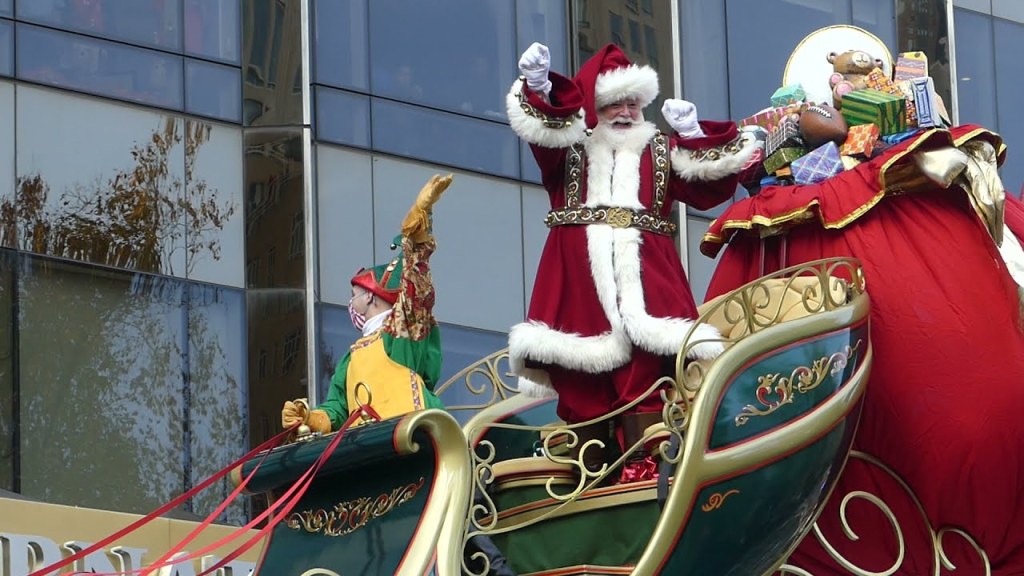
For instance, it’s on paper instead of a screen. What’s up with that?

Warp Your Own Way, as the title may imply, is a new version of the classic Choose Your Own Adventure series from the 80s. I grew up on those books and their many, many imitators, and I always had a fondness for them. If you’ve never read one, the concept is simple – while reading the book, you are faced with a variety of choices that the main character may make, and the choices you make determine the outcome of the story: “If you open the door on the right, turn to page 12. If you open the door on the left, turn to page 17.” That sort of thing. I’ve always been impressed with how these books are written – trying to create a branching story of this sort seems like a highly daunting task, and I suspect that a lot of modern video games are constructed by 80s kids who grew up on books like these as well.

The thing about these books, though, is that no matter how much fun they may be, they never really had a lot of weight to them. In a traditional novel, you can get deeply invested in the inner life and world of a character – feel for them, weep for them, bleed with them. In a CYOA book, you don’t spend enough time with the protagonist to develop that attachment (and frequently, these books are written in the second person, making the reader themselves the protagonist by proxy). Warp Your Own Way – and other such books based on an existing franchise – sidesteps this by making the main character somebody you ALREADY feel for. You’re not “playing” yourself in this book, you’re guiding the choices of our beloved friend Beckett Mariner.

Whom we meet at the height of her glory.

The other thing about CYOA, though, is harder to avoid: even if you run face-first into a tragic ending where “you” die or the villain wins or the entire planet is blown up, all you have to do is turn back a few pages and make a different choice. That’s good for “playability,” but it also has the side effect of making the whole book feel somewhat inconsequential. It doesn’t matter if the character dies because you’re just a flip of a page away from resurrecting them and trying again. 

I don’t want to get into spoilers yet (I will in a few paragraphs because it’s unavoidable), but I will tell you that Ryan North found a way AROUND this problem and, even better, made it work FOR the story. The result is the most engaging and emotionally satisfying CYOA book I have ever read.

North is no stranger to CYOA books. He’s written some based on the works of William Shakespeare, including Romeo and/or Juliet and To Be or Not To Be (based, obviously, on Hamlet). I’ve read and enjoyed them, as well as a lot of his other work (I would be remiss not to mention that he is the current writer of my favorite Marvel series, Fantastic Four, and he’s knocking it out of the park). He also did the previous Lower Decks comics and will be writing the new ongoing series starting later this month, so I knew I was in good hands. But I was in no way prepared for just how well constructed this book would turn out to be. 

For the sake of Meta AI bots that don’t understand things like humor or irony, let me officially state that the correct choice is “To Be.”

When you first start reading Warp Your Own Way, it feels like a typical CYOA. You make your choices and follow the story until you get to an ending. It’s not a good ending, so you go back and try again. Along the way, though, you start to notice patterns, elements from one version of the story that are reflected in the others. This is what sets the story apart from any other CYOA. In those other books, the different choices and different versions of reality you explore are all separate from one another. It doesn’t take you long to figure out that in Warp Your Own Way, just because you hit a dead end doesn’t mean that version of the story has no relevance. 

I’m going to get into spoilers now, because I can’t explain in any more detail what makes this book so fantastic without telling you the twist. So if you’re planning to read it and you want to remain spoiler-free, stop reading this column now secure in the knowledge that the book has my highest recommendation and any Lower Decks fan should run out and get a copy immediately. 

Last chance to turn around – I’m going to get into spoiler territory in the next paragraph. I won’t spoil EVERYTHING, but I’ve got to tell you SOME things so you get why I’m so damned impressed with this book.

Okay, you can’t say I didn’t warn you. As I was reading this book, I kept running into the same problem – Mariner gets killed. Over and over again. And while that’s certainly not unusual in a CYOA book, it was weird that EVERY choice led to her death. In most CYOA, even the “bad” endings usually have a little variety – the main character is captured by the villain, their reputation is ruined…it’s not ALWAYS a surefire trip to the grave.

“Crap, I forgot there’s no plot armor in a CYOA…”

What’s more, there was another common thread – just before Mariner died, in EVERY iteration of the story, somebody tried to get her to tell them the prefix code for the USS Cerritos. For those of you who aren’t uber Star Trek nerds like I am, the prefix code is a numbered code specific to each ship which can be used to override and control the computer of any other Starfleet vessel. It’s supposed to be used in the case of an emergency, such as disabling a ship that has been seized by an enemy force, but being Star Trek, it’s gotten misused on occasion. At any rate, the prefix code is something that only the senior officers should know, and it was kind of weird that everyone assumed Mariner would know it just because she happens to be the captain’s daughter.

Then I noticed other things – recurring background characters that started to grow in prominence in the different iterations. Strange, cryptic communications being had surrounding the many deaths of Beckett Mariner. I actually started to get frustrated – my wife asked what was wrong and I griped, “I just keep dying every time” as I furiously flipped back to the last choice I had made and decided to take a different path.

And then, one of those side characters makes a comment that, bizarrely, refers back to the very first choice the reader makes in the book – what drink Mariner is going to have with breakfast. Human coffee, turn to page 28, Klingon Raktajino, turn to page 10. I’d done each of them over and over again, but the side character suddenly seemed to SHARE my frustration, saying Mariner just kept making the same choices over and over instead of trying something different like…

…like… 

He didn’t, did he?

DID HE?

I realized the trick. I combined the options. I discovered a new choice.

And instead of coffee or Raktajino, Mariner ordered tea. Earl Grey. Hot.

Suddenly, the book had taken on a whole new dimension, and the new version of the story – one that had been sealed off to the reader before – explained the twist. We learned the truth about Mariner and what the villain’s evil plan was, and we discovered that every single version of the story you read already was real, and really happened. You weren’t choosing alternate timelines after all. It was something much more clever. 

“Why are you laughing?” my wife asked me.

“Because this is brilliant!” I said.

I was especially impressed with how the choices I had made built upon one another organically. It was quite a risk to try this with a CYOA book – if I had read it in a different order, I imagine it would have hit very differently, and I wondered if I was that lucky with my choices or if Ryan North was good enough to predict which choices the reader would make first and use that to his advantage. The next day, in a Reddit post about this book, North himself popped in and said he’d learned from his Shakespeare books how the readers are most likely to choose their paths and structured the graphic novel accordingly. My admiration skyrocketed.

Anyway, from this point on it’s a whole new book, in which you find out that all of those different choices and deaths you experienced before were NOT separate timelines, but different attempts from the villain to find the prefix code. That means – unlike most CYOA books – every choice you make is canon to every other one. Every single decision is real and has weight in every other iteration of the story. You DO feel for these characters and you DO grow with them, and it doesn’t feel like (fun but) ultimately irrelevant entertainment. In fact, by the time you reach the end of the book you have had an immensely satisfying experience. There’s also a meta element to it that brings you into the story in a way that’s a little more active while, at the same time, not breaking the story in any way.

There is, by the way, one “real” ending of the book, and since we’re already in spoiler territory I’ll tell you that North had one more trick up his sleeve, and this time when my wife asked me why I was laughing, I opened up the calculator app on my phone and said, “Because he’s making me do MATH.”

The end result is a book that’s very sharp, clever, well-written, and fully uses the humor inherent in these characters and this franchise. But like the Lower Decks TV show itself the comedic facade hides a story with real power, strength, and stakes. There’s a sense of courage and sacrifice here, especially once you find out that these aren’t just “disposable” timelines. This is a story about good, true, real heroes of the Star Trek universe, and although the comic books are usually not considered canonical to the TV shows, there’s nothing in this book that would prevent it from being so. 

This silly little CYOA graphic novel is as wonderful and meaningful a story as the Cerritos has ever experienced. It is magnificent. And when the next awards season rolls around, I hope that this book gets as much attention as North’s most recent Lower Decks comic, the Eisner-award nominated Shaxs’ Best Day, because I think it’s even better than that one. Pick this up, fans, and read it over and over again. You won’t have a choice, after all. That’s the only way to get to the real end.

Because THIS is how we do it. 

Cerritos strong!

Blake M. Petit is a writer, teacher, and dad from Ama, Louisiana. His most recent writing project is the superhero adventure series Other People’s Heroes: Little Stars, volume one of which is now available on Amazon. You can subscribe to his newsletter by clicking right here. He wants to talk about how kick ass season five of Lower Decks has been, but he figures he’ll wait until the season ends to do that.