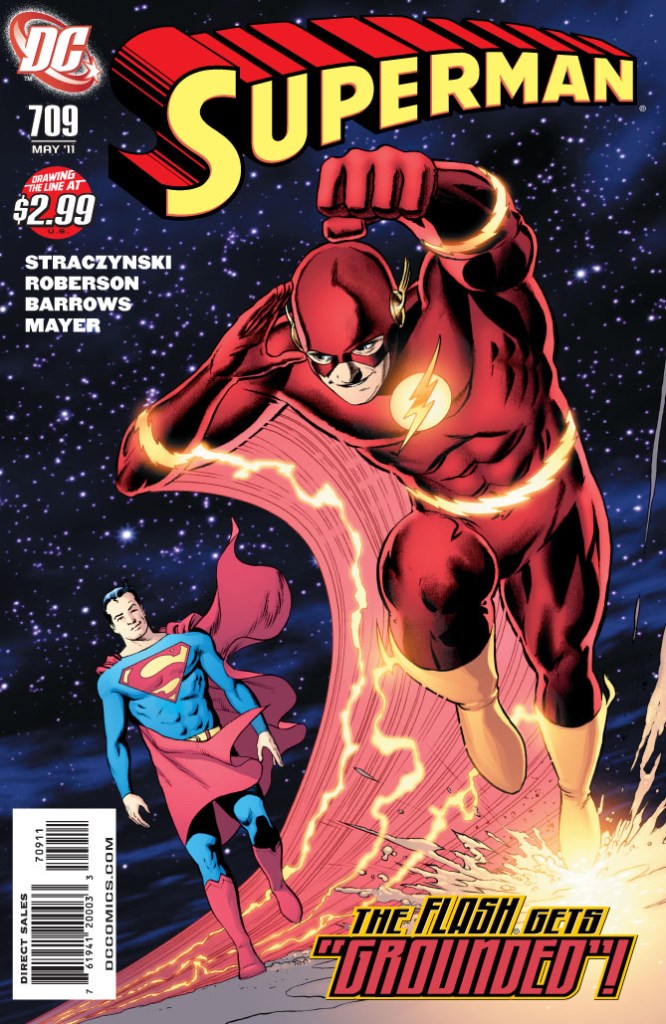
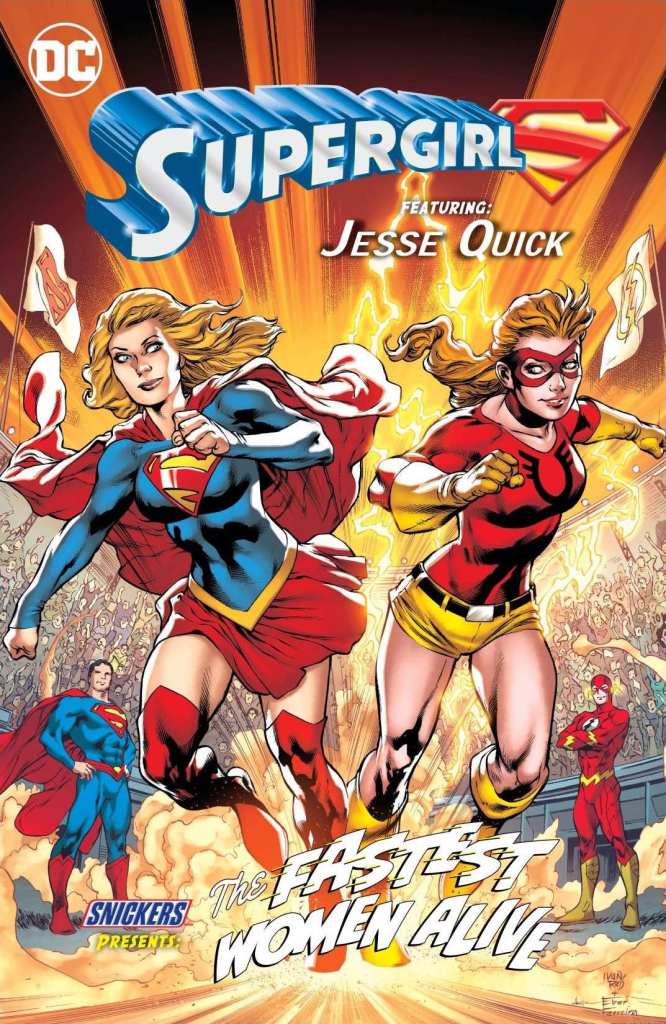
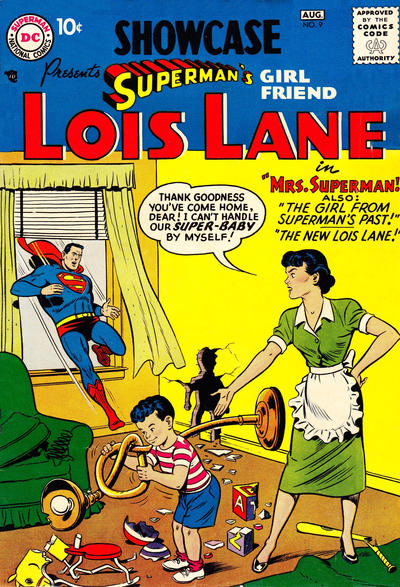
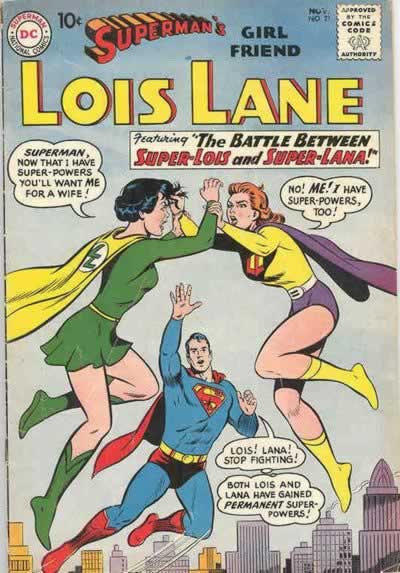
Year of Superman Week 44: Mo’ Monsters, Mo’ Problems

As I write this, it’s Oct. 29 and I am still very much in the Halloween mood. I know, however, that this isn’t going to be posted until Nov. 5, and I respect the fact that you guys have probably shifted gears by now. So I’m going to do another random week for you, bouncing from one story to another at will and not beholden to anything in particular. You may still see a vampire or two, I make no promises. 

Well, except for the promise that you’ll see a picture of my kid in his Halloween costume when we get to Friday. I can absolutely promise you THAT. 

And as always, you can check out earlier blogs in the Year of Superman Archive!

Wed., Oct. 29

Comics: Superman #410, 412, 413, Jon Kent: This Internship is My Kryptonite #16
Notes: With the end of the year looming, I’m going to try to tick off some of the more random comics on my list that I haven’t gotten around to, books that don’t fit into any particular theme or week, but that I want to read for one reason or another. And I’m going to start in 1985 with a three-part Lex Luthor story that has become a minor classic.

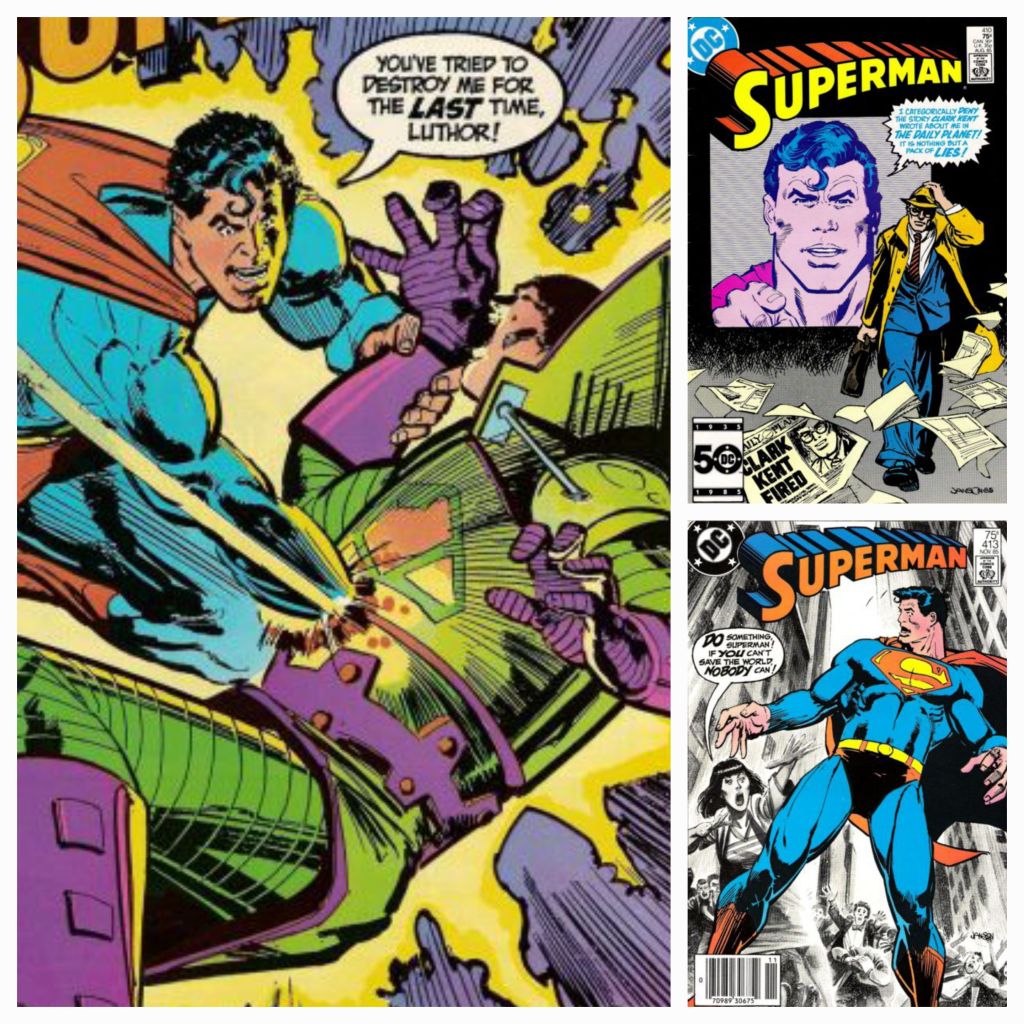
Superman #410 starts normally enough, with Superman saving Honolulu from a plunging satellite. With Hawaii safe, Clark returns to the Daily Planet office and dutifully types out the story, turning it over to Perry White to put on the front page of the paper. As the evening edition hits the streets, though, Morgan Edge comes to Perry with horrifying news – the satellite Superman supposedly stopped is still in orbit, making the story he “told” Clark Kent seem fake. Superman zips to space to investigate and finds the satellite he clearly remembers catching floating in orbit where it belongs. Superman is faced with a horrible choice – tell Edge the truth and have people believe Superman is losing his grip on reality, or allow him to think Clark falsified the story. Given a choice between shattering peoples’ trust in Superman or in Clark Kent, he allows Edge to think Clark was at fault. Edge and Perry immediately fire Clark from both the Planet and WGBS news. As Clark tries to find the truth about what happened, we see Lex Luthor in a secluded island hideaway, boasting to his minions how he has found a way to broadcast false memories into Superman’s mind. 

The trilogy skips issue #411, the legendary tribute to Julius Schwartz issue, and resumes in Superman #412, which begins with a humiliated Clark Kent on the unemployment line. He’s called away just as he’s about to be served, as Superman is needed to prevent a nearby construction disaster. Meanwhile, as Perry, Lois, Jimmy, and Lana agonize over Clark’s dismissal, Luthor is gloating over how Superman “allowed” his old pal Clark to take the fall for his own false memories. Lana, in fact, tears into Superman the next time she sees him for the same reason. Clark turns to his old friend Steve Lombard – who now owns a sporting goods store – for work. They’re hanging out when Luthor arrives in Metropolis, planting a series of “Scrambler Rods” around the city and nearly impaling Steve in the process. As he catches up to Luthor, an enraged Superman drives his fist into Luthor’s chest, killing him. When he withdraws his hand, Luthor’s armor explodes in an atomic wave that destroys the entire city of Metropolis!

For, like, a panel, before Superman finds himself clinging to the top of a skyscraper, having hallucinated the entire encounter. Luthor, meanwhile, has finished planting his rods, ready for the final phase of his “Ultimate Revenge” plan. 

The final chapter picks up just seconds later, Superman still at the top of the building, having lost all faith in his own grip on reality. Even though he’s certain that Luthor is behind all of his current troubles, he no longer trusts his own senses, destroying his effectiveness as Superman. He stumbles back to Steve’s store, where Steve receives a phone call from Lois with a plan of her own. She has Steve invite Clark to a “charity bash” that evening, to which he reluctantly agrees. As he ponders his future, another hallucination hits – Steve’s store seems to vanish, then the entire city block, then the entire city, including his friends. Clark is missing, then, when the “charity bash” begins – actually a dinner in honor of Clark thrown by the people who still believe in him. While his friends give testimonies in Clark’s honor, Superman watches in horror as Luthor makes him believe he is obliterating the entire planet Earth. While Luthor has Superman captive, suffering from his hallucinations, Clark’s friends are growing worried, searching for him, wondering where he’s gone. When Superman’s hearing picks up on their fervent pleas, it breaks through Luthor’s spell. He goes after Luthor, but a strange vortex plucks Luthor from his clutches before he can bring him to justice. Superman joins Clark’s “other” friends at the dinner, claiming the whole thing was part of a plan of his to smoke Luthor out, thanks Clark for going along with it, and says he’s SURE Clark is looking forward to getting back to work.

I’ve said several times that the late 70s and early 80s were kind of a pallid era for the Superman comics. The villains and stories felt recycled and pointless, and although there were attempts at change (Lois “breaking up” with Superman, Clark dating Lana, etc.) none of it felt particularly important or consequential. But in the last year or so before the John Byrne reboot, they took some chances, and this story is one of the better ones. Although the conclusion still puts everything back in its neat little box, the journey to get there is an interesting one and I like the whole concept of everybody coming out in support not of Superman, but of Clark Kent. This was a time when Clark was usually still written as the disguise and Superman as the real personality, so having people in Clark’s corner for once was fresh and satisfying. Luthor’s getaway is a little irritating, but the knowledge that the vortex was sucking him up to participate in Crisis on Infinite Earths helps a bit. I almost wish they hadn’t given Clark his job back at the end – with the reboot on the horizon it wouldn’t have really made much of a difference, but may have made this story even more memorable. 

Thur. Oct. 30

Podcast: Totally Rad Christmas, Episode, “Superboy-Young Dracula (w/CM Chuck)”

Notes: It’s the day before Halloween, so I decided to take a break from my usual Star Trek podcast on the way to work and see if the Totally Rad Christmas podcast had dropped any Halloween episodes this year. To my delight, I found that Gerry D and CM Chuck had gotten together to review an episode of the 1988 Superboy series in which young Clark faced off against…well, Young Dracula. I haven’t really gone back and watched this series in a long time, and I’m not sure at the moment where to find it. I own the first season on DVD, but not the subsequent ones, and although I know at one point it was available on DC Universe, that before it was merged with HBO Max and before Warner Bros. lost their collective minds and started throwing their IP to the four winds in the hopes of finding somebody desperate enough to buy them. The whole situation is ridiculous.

But anyway, the podcast. I don’t really remember the episode they’re discussing, and I wish I had it readily available to watch, as I’ve still got so many other Superman/vampire encounters fresh in my mind. I was glad to see that Gerry did enough research to unearth Superman #180, which I talked about last week, and how it demonstrated that a vampire biting a solar-powered Kryptonian wasn’t the best idea for the vampire. But that was a side conversation, not about the show itself, and the scattershot nature of this particular podcast does a nice job of emulating a conversation hanging around the comic shop, but isn’t exactly comprehensive in its coverage of the topic at hand. I’ll have to find this episode on my own somehow. 

Comics: Superman: Silver Banshee #1-2, Cheetah and Cheshire Rob the Justice League #3 (Cameo), Saga of the Swamp Thing #24 (Guest Appearance), Justice League of America #36 (Team Member), Flash Vol. 6 #26 (Guest Appearance), Justice League Unlimited Vol. 2 #12 (Team Member)

Notes: In the comments to last week’s blog, Ben Herman asked if I’d ever read Dan Brereton’s two-issue Superman: Silver Banshee miniseries from 1998. And I know I have, I bought it when it came out and it’s still in my collection, but I probably haven’t read it SINCE the original publication. And as it, too, is a Halloween story (which I had forgotten, or I would have included it last week), this seems like an excellent opportunity to revisit it. 
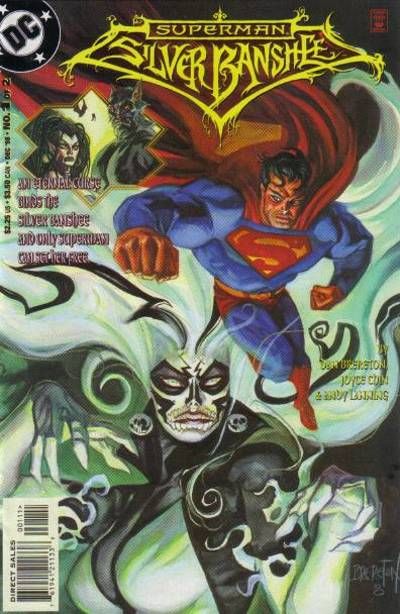
On Halloween Eve, Lois Lane gets a tip that will help her uncover a notorious gang of art thieves called the “Trickertreaters.” At the same time, in the Netherworld, Silver Banshee learns that there is one remaining descendant of the MacDougal clan, the clan responsible for her curse, and that she will never be free until the last MacDougal has perished. On Halloween, though, there are other options – she can go to Earth again, and if she uses the power of “good works,” the final MacDougal can lift the curse freely, without need for further death. Lacy MacElwain, her target, now lives in Metropolis (because of course she does) and the Banshee sets out to find her, but instead is snared by a summoning spell cast by the devil queen Hecate. Hecate – as it happens – is the one who lured Lois Lane with the promise of catching the Trickertreaters, whose newest member happens to be…oh come on, you can guess…yep. Lacy MacElwain herself.

Funny how things work out sometimes.

Anyway, Hecate’s stooge Thorpe knocks out Lois and ties her up as the art thieves arrive with their newest acquisition, an amulet that has no apparent monetary value, but that Hecate needs so she can do evil witch stuff. She tries to dismiss them without payment, but they take offense to that and wind up battling Thorpe, who turns out to be some kind of were-demon-thing. That’s an industry term, peeps. Lacy manages to get her hands on the amulet, which she brings to the mystic web where the Silver Banshee is held captive. The two of them are transported away from Hecate’s lair, and the Banshee tells Lacy that she will be freed of her curse if Lacy destroys the amulet, but it turns out to be fairly powerful. Thorpe tracks them down, but Superman (who got a little concerned when he found a dead body in the church where his wife was supposed to be meeting an informant) has caught up to them and saves her. As he confronts Hecate, Lacy flees for home, but the Banshee follows her, demanding she destroy the amulet. Unfortunately for Lacy, Hecate’s demons – including the transformed Trickertreaters – have trailed her as well. 

In issue two, the Banshee tries to defend Lacy from the attack, but is forced to merge the two of them into a single body to prevent her death. In their shared form, the Banshee promises Lacy that destroying the amulet will set them both free. Unfortunately, Thorpe has his hands on it now. Superman, meanwhile is trapped by Hecate’s magic, and she plans to use Superman and Lois in her scheme. She gets the amulet back from a reluctant Thorpe, and the Banshee/Lacy hybrid attacks. The Banshee’s wail is surprisingly effective against Hecate, but she can’t free Superman or Thorpe from the Puppeteer demon that is holding them. In the battle, Lacy is killed, and the Banshee is freed from her curse, but unwilling to allow Lacy to sacrifice herself, she follows her into the afterlife, where the two of them are consumed by light. When the light fades, Superman, Lois, and a back-from-the-dead Lacy are all that remain. Lacy goes home, only to find that in saving her, the Banshee is now bound to her…no longer merged, but more of a regular haunt. 

I’m really glad that Ben suggested I read this one again. The Silver Banshee has always been an interesting sort of anti-villain – she does bad things (murdering people, y’know) but she doesn’t do them out of actual malice or evil, merely out of a desire to free herself from a torturous curse. Once that curse is lifted, you can take the character in different directions, and this two-issue story is a nice sort of capstone to the status quo John Byrne first established for the character. She’s been used periodically ever since, sometimes as a villain, sometimes almost as a hero. I don’t recall offhand how long Lacy stuck around, but I don’t think she’s currently a factor when the Banshee shows up. Still, if there can be THREE ongoing series starring Batman bad girls who keep straddling the line between villain and kinda-sorta-hero, I think it’s well past time the Silver Banshee got at least another miniseries or something to give her the spotlight. 

Fri., Oct. 31

Comics: Supergirl Vol. 5 Annual #2, Superman/Batman #65, Impulse #44 (Superboy Cameo)
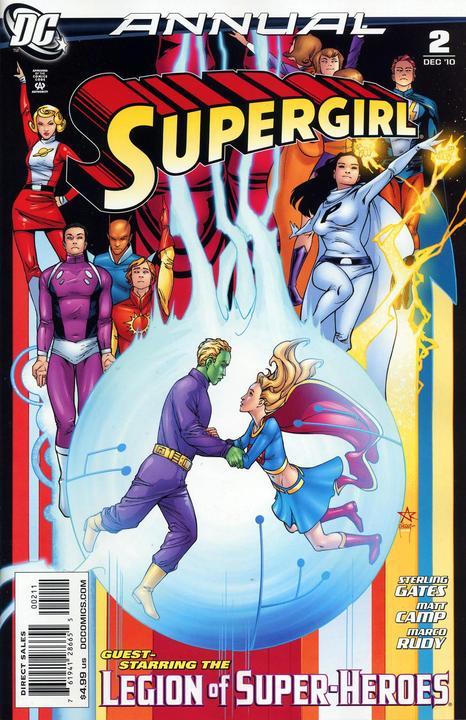
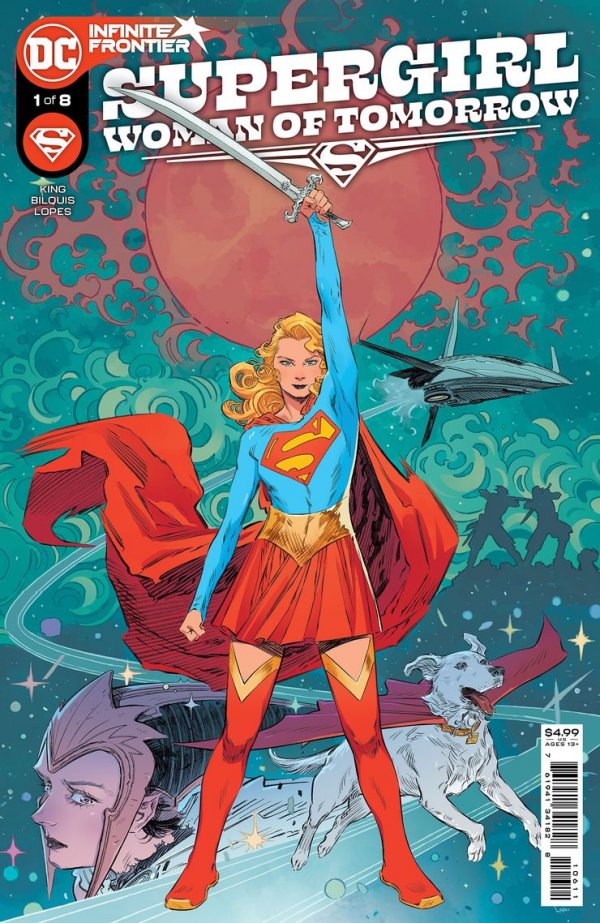
Notes: I don’t have a ton of time to read, though, because there’s trick-or-treatin’ to do, so I pulled the 2010 Supergirl annual, in which Kara is accidentally bounced 1000 years into the future and encounters the Legion – but NOT the Legion SHE knew. This is her cousin Kal-El’s Legion (recently restored in Action Comics) when they were teenagers. Brainiac 5 wants to find a way send her back immediately, worried about her disrupting the timestream the way he always worries when Superboy shows up, but it’s not that simple. She’s there for a month, joining the team and lending a hand, and learning – tragically – the circumstances of her own death. When a horned villain calling herself “Satan Girl” attacks, Kara and Brainy bounce four days into the future to see that Satan Girl has destroyed Metropolis, possessed the Legion, and taken over the world. It gets worse when she realizes that Brainy himself summoned her, but is arrogantly dismissing his own part in it. 

An epic battle ensues between Satan Girl and the possessed Legion, with Kara, Brainy, and an army of animatronic Jimmy Olsens on the other (it makes sense in context). In the end, Brainy manages to send them back and prevent himself from summoning Satan Girl in the first place, then brings Kara home. In the process, they erase her memory of the future, including that of her own death, but Brainiac swears to do something to save her.

I like this story for a lot of reasons. Don’t ask me to explain why, but the various versions of the Legion that have flirted with a Supergirl/Brainiac 5 romance over the years have always appealed to me, and this one plays with that element as well. I hate it when people get into “shipping wars” over their preferred pairings, but I have to admit that I have a few of my own, and this is one of them. It works for the characters as they were at the time, and I hope that when the dust settles around the whole All In/DC KO thingamabob and we have a new, proper Legion again, this is an element that will be touched upon.

That said, I’m a little bummed because the reason I chose this particular issue is that the DC Universe app describes it as a Halloween story and…it ain’t. I mean, it was released in October and there’s the whole “Satan Girl” thing, but there’s no mention of Halloween in the story whatsoever. I assume that most of the listings on the DC app are copies of the original solicitations for the comics, especially for something as relatively recent as this, but that gets me a little grumpy that I skipped over a chance for some prime Halloween content.

There are greener – relatively speaking – pastures with the Halloween story from Superman/Batman #65. The story begins with Superman trying to save a falling plane as he’s done thousands of times. And this one, of course, has Lois Lane on it, as it has thousands of times. But it also has Perry White, his parents, Jimmy Olsen – and Superman watches in confusion as the plane goes down, killing everyone he loves. The scene shifts and we see that Superman is actually unconscious, as are Batman, the Joker, and Lex Luthor, all of whom had been engaged in a battle, then all taken down by an outside force. We watch the Joker live through his worst nightmare – a place where people actually treat his terrors as a joke. Lex Luthor’s worst nightmare, it turns out, is living out the bland, boring life of a subservient, specifically Jimmy Olsen. And Batman has a nightmare of a family – married to Selina Kyle, a son named Richard, his parents alive — and then watching them all gunned down by Alfred so he can bring things back to “the way it has to be.” The dream is nightmarish enough for Batman to wake up and realize all of them have been captured by – and are about to be buried alive by – the Scarecrow. Superman comes to next, stopping Batman from going too far in his revenge, and in the end we see a glimpse of the Scarecrow’s own worst nightmare – a land where he’s just an ordinary man of straw, one without a brain. It’s a cute story, and definitely one that feels more seasonally appropriate than the Supergirl one. But I think that’ll do it for Halloween in this blog. Until next time, anyway. 

Halloween Bonus: I know you won’t believe me when I say this, but I had no influence on my son’s choice of Halloween costume this year. Well, not directly anyway. Obviously, his sphere of reference is influenced by proximity to me, and I wasn’t exactly subtle when I told him how happy it made me to bring him to watch the new James Gunn movie back in July. But at no point did I deliberately try to influence or manipulate him when the time came for him to select a Halloween costume.

“Eddie,” I asked him during one of our 27 trips to the various Spirit Halloween locations in our area, “What do you want to be for Halloween this year?”

“SUPERMAN!” he announced.

“Nobody is ever gonna believe I had nothing to do with this,” I said. 

We wound up getting his costume at Walmart rather than Spirit, since they somehow got an exclusive on costumes from the movie. But we got the black hair color spray from Spirit, and I finally got a chance to wear the Superman pajamas he and his mom got me for Father’s Day back in June.
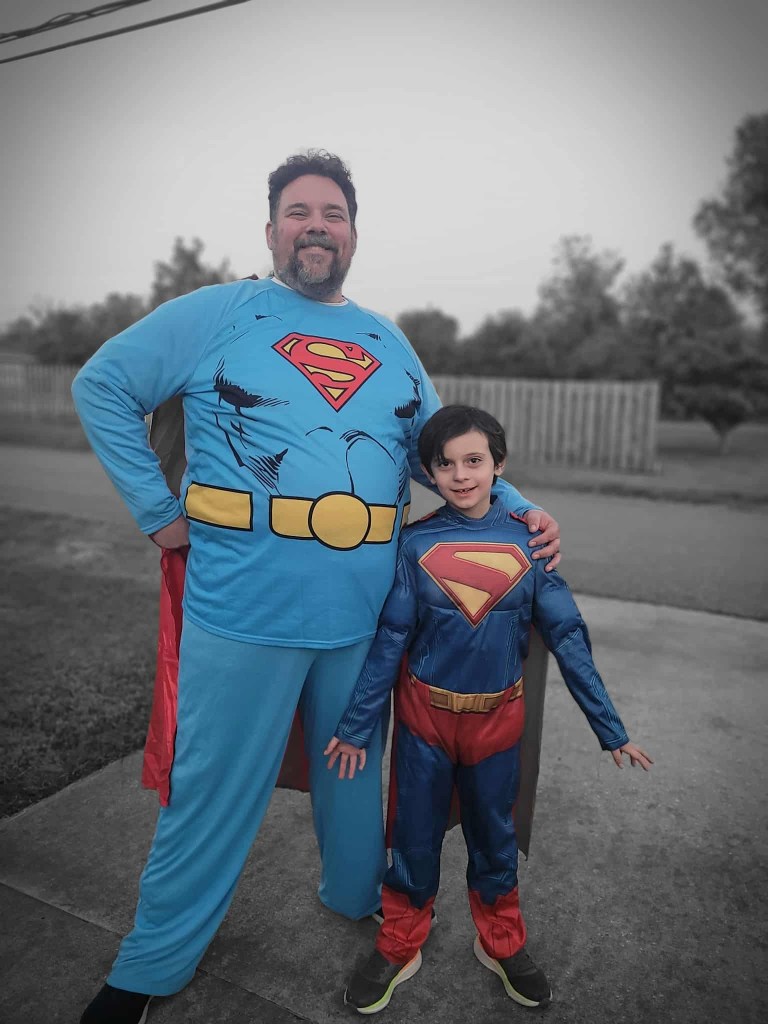
And I may be a little biased, but amongst all the arguing about Reeves and Cavill and Corenswet…well, with all due respect to those gentlemen, I may have a new favorite Superman.

Sat., Nov. 1

Comics: Superman: Red and Blue 2025 Special

Notes: This summer, during my family’s annual trip to Pittsburgh, I used the time to read over a lot of collected editions of various Superman books that didn’t quite fit in anywhere else. One of those was the collection of the delightful anthology series Superman: Red and Blue. I was quite happy when DC announced that they were bringing the concept back this year for a one-shot special with four new stories. 

First up is “Priceless,” written by Paul Dini with art by Mirka Andolfo. Dini’s story features Superman on a mission to collect a rare mineral he needs to bail Supergirl out of an alien prison. It looks as though Dini is maintaining the characterization of Supergirl from the movie – a sort of hard-partying girl who gets into a little trouble with her dog. The story is funny and the art is wonderful, but there’s a nice little turn at the end that shows us that things weren’t exactly what Superman had assumed – and, in fact, family is everything.

“All the Time in the World” by Michael Walsh is a pretty simple story, a day in the life of Superman set in the era when Jonathan was still a toddler and Clark is desperately trying to find the time to be a husband and a father in a world where the demands for Superman’s gifts are neverending. This one…hits. I mean, there’s nothing world-changing or anything going on here, but it’s a theme that is particularly significant to me, right now, at this moment, where I’m looking at a schedule and trying to figure out how to fit in my son’s choir rehearsal and his basketball practice and his speech therapy and my own job and my wife’s job and if it is even possible, in the entire totality of the universe, to carve out even a single afternoon where I’m not going to be pulled into yet another thing that I don’t even know is going to happen now but it going to turn out to be of universe-altering consequence approximately 30 minutes before it has to happen. I may not have any literal fires to put out or people to catch as they fall off a building, but this is real. I know nothing about Michael Walsh, but I have to assume he’s a parent, because how the hell else could he understand this so well?

Next is Dan Abnett and Caitlin Yarsky’s “Out of the Ordinary.” When Superman saves a small town in Canada from a giant robot – you know, like you do – he is approached by a reporter for the tiny local paper who sheepishly asks for an interview. And to the surprise of absolutely nobody who understands Superman, he graciously agrees to one. The bulk of the story is just a quiet conversation between Superman and this young woman in a small-town diner, about what it’s like to be him and what it means to be “ordinary.” It’s a lovely story that really does nail the character, and in fact it functions very nicely as a (Clark Kent-ian polite) kind of rebuttal to Quentin Tarantino and anybody else who thinks that Superman is the “real” identity and Clark is a mask.

Last is “Red-Letter Days” by Rainbow Rowell and Cian Tomey. On Lois and Clark’s anniversary, Superman is summoned away by one of those regular world-threatening crisis type events. By the time he gets back, Lois has gotten a tip on an enormous story that deserves front-page coverage, but it’s going to take her and her husband staying up all night to get the sources and get the news straight. This isn’t a Superman story, it’s a Lois and Clark story, and I love it for that. We see the two of them doing what they do best (when Clark isn’t wearing a cape, that is) and in a way that isn’t interrupted by supervillains, alien invaders, time travel, or any of the other thousands of things that screw up a superhero’s life on a daily basis. It’s a story of a loving couple that struggles a little sometimes to find time for each other, and it’s delightful.

Superman’s the greatest hero there is, I think I’ve fairly well established my position on that by now. But for all the stories where he saves the world or the universe or a cat in a tree, there aren’t enough stories like the ones in this anthology. Four stories that lean on the man part of his name rather than the Super. There aren’t enough of these, and I hope that the Red and Blue anthology comes back again and again.

Sun., Nov. 2

Comic: Brave and the Bold Vol. 3 #16

Notes: Sundays aren’t days of rest for teachers. We’ve gotta get ready for the week, and I’ve got a ton of stuff on my plate today, so I decided to look for a one-off story I could read without sacrificing a huge chunk of time. I decided on this issue from the 2007 reboot of DC’s Brave and the Bold, which in this incarnation was a team-up title without a specific anchor character – there was never any telling which two characters would wind up with each other on any given issue. And as you can tell from the look on Superman’s face, this team-up with Catwoman surprised him as much as anybody.

Written by our old pal Mark Waid with art by Scott Kolins, the story begins with Superman responding to a bat-signal, telling Gordon that Batman asked him to cover for him while he was out of town. Gordon asks him to look into a rumored underworld auction, and Superman’s hearing picks up a burglary nearby. He finds Catwoman stealing an enormous jeweled egg, and Catwoman – a little smitten with the Man of Steel – tells him she needed it to get into the same crime auction. The evening’s prize is allegedly a map that leads to a certain hidden cave outside of Gotham City. Superman reluctantly agrees to work with Catwoman to stop the map from falling into the wrong hands. Selina dresses the two of them up to go undercover at the auction and a comedy of errors follows, most of them based on Superman’s attempts to sidestep actually giving any sort of aid to the criminal element around them. In the end they manage to prevent the contents of the cave from being used for nefarious purposes, and their encounter ends in a bit of a stalemate…but one that leaves Catwoman smiling.

I really enjoyed this issue. Batman never makes an appearance, but the story is essentially about him – specifically about how Superman and Catwoman, respectively, each feel about the Dark Knight and how that common ground allows them to put aside their differences and work together. And while you don’t get the impression that Catwoman’s flirting with Superman is entirely serious, it doesn’t seem as though she’s entirely joking either. After spending her life playing with the bad boys, a “date” with the ultimate good guy seems to be a refreshing change of pace for her, and even when Superman gets a little bit of an upper hand on her in the last few panels, she doesn’t seem to mind all that much. It’s just a simple, charming little story, the likes of which we could certainly use more of.

Mon., Nov. 3
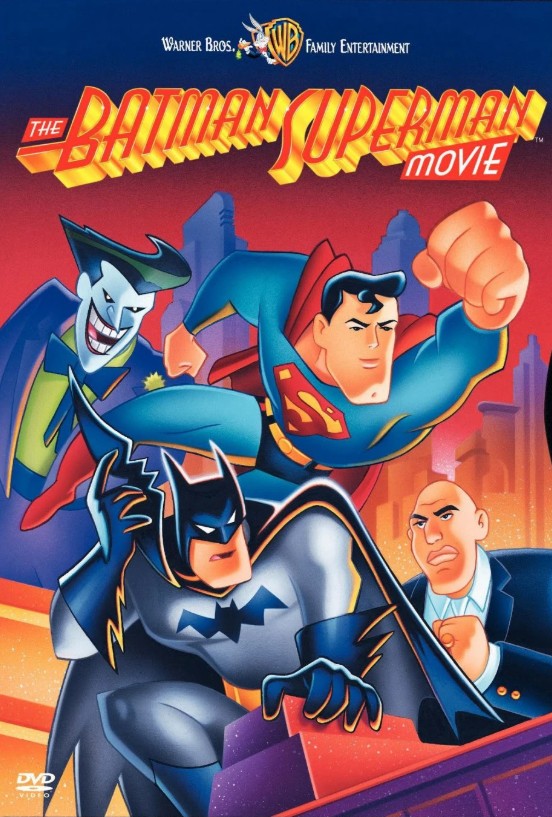
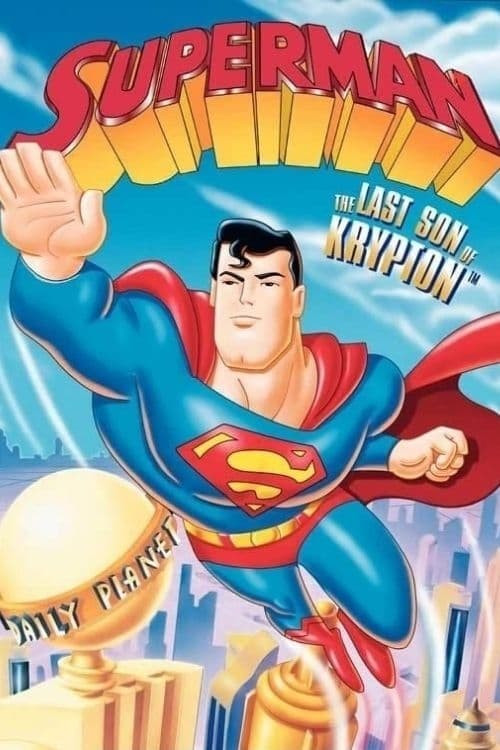
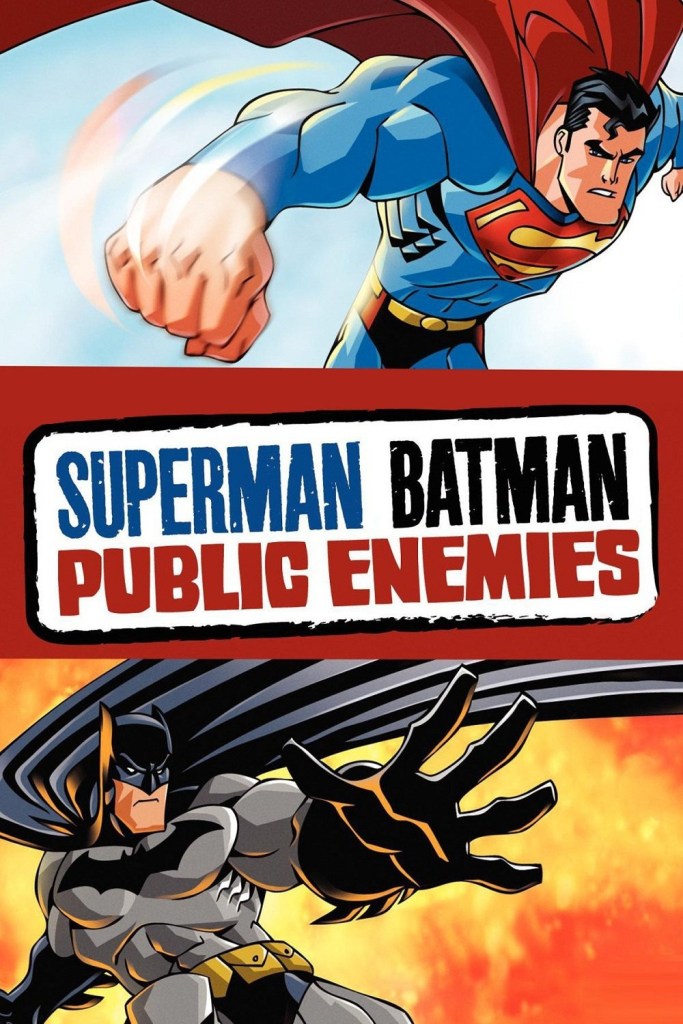
Animated Feature: The Batman/Superman Movie: World’s Finest (1997)

Notes: When I woke up this morning at around 2:30 with a rumbling in my stomach I had every intention of going to work. However, as the rumbling continued to have pointed conversations with me for the next several hours, I eventually resigned myself to a day on the couch. And since getting off the couch to find something to read didn’t seem like a fun time, I decided that today’s Superman fare would consist of something I could access via my remote control. Bizarrely, The Batman/Superman Movie: World’s Finest doesn’t appear to currently be streaming anywhere, not even on HBO Max. Although I could theoretically have watched the individual episodes of Superman: The Animated Series that were cut together to make the film, I once again am grateful for my adherence to physical media and how I’ve used that to meticulously populate my own Plex server. 

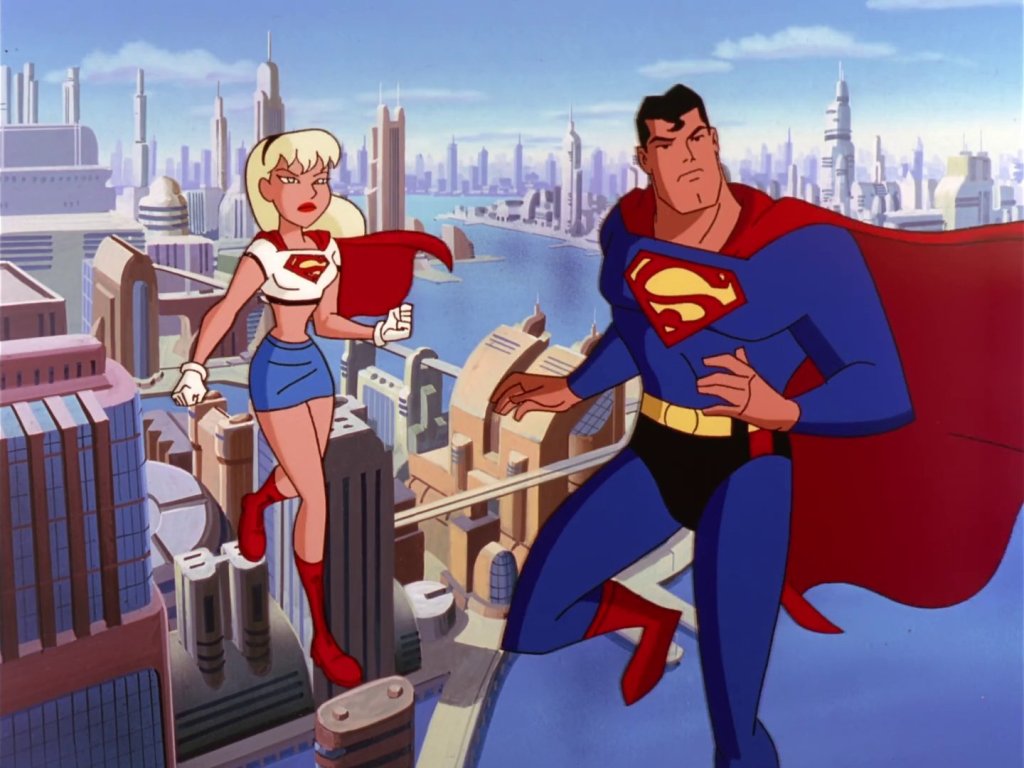
Younger people reading this blog (and of course, we all know how popular it is with the kids) may not realize just what a big deal this movie was. Today, when everybody and their brother is trying to create a cinematic shared universe, it seems like a film of this nature would be a no-brainer. But in 1997, despite the fact that these characters were all owned by the same companies and their shows were worked on by the same people, there was still relatively little crossover. Batman: The Animated Series was a smash hit, and when the same creators put their work into a Superman series this is exactly what everybody was hoping for, but it was far from a foregone conclusion that we would GET it, at least not until it got gotten. 

The movie starts off with the Joker and Harley Quinn stealing a jade dragon from a shop in Gotham City. Batman’s examination of the crime scene sets off some alarm bells, and he makes plans to head to Metropolis. In Superman’s town, the Joker and Harley rather forcibly coerce Lex Luthor into a partnership, presenting him with the “jade” dragon, which is actually made of Kryptonite. Lois and Clark are on-hand when Bruce Wayne flies into Metropolis for a business summit with Luthor, and feeling like she’d made a fool of herself in front of Superman earlier, Lois finds herself smitten with Bruce, who invites her out to dinner to discuss his plans in Metropolis. Although Bruce and Luthor have a business deal in place, Bruce pulls back from parts of it that are intended to create militarized robots, something that burns Lex. 

That evening, as Batman roughs up some hoodlums in a bar to find information about the Joker’s whereabouts, Superman bursts in to stop his “vigilantism.” He’s shocked when he uses his X-Ray vision to peer through Batman’s cowl to see Bruce Wayne’s face, and Batman warns him about the Joker’s Kryptonite by taking out a shard to hold him back, allowing him to escape. When Clark returns to his apartment, he gets two surprises: a phone call from Lois informing him that she’ll be having breakfast with Bruce tomorrow, and a bat-shaped tracking device on his cape that alerts him to the fact that he was followed, and that Batman is watching him from a nearby building, his own identity revealed. 

The next day, as Bruce arrives at the Planet to pick up Lois, he and Clark briefly compare notes on the Joker’s schemes. Clark is also a bit concerned about Bruce’s burgeoning relationship with Lois, to which Bruce replies, “It seems to me you had your chance.” At their date that night, though, the Joker swoops in and kidnaps her, despite Bruce’s efforts to keep her safe. The heroes go to her rescue, but despite knowing they’re walking into a trap, the Joker manages to get the upper hand and nearly kills them all before escaping. 

Lois’s relationship with Bruce gets more and more serious, with her even requesting a transfer to the Planet’s Gotham office, but when she discovers he’s Batman (during an uncharacteristic moment in which his mask is yanked away) the brakes are put on. The heroes naturally team up to stop the Joker and Luthor, complete with his army of murderbots, and ultimately have to save both Luthor AND Metropolis from the Joker’s lunacy. Lois breaks up with Bruce, with the supreme irony of her not wanting to be in a relationship with a man with a dual identity, and Bruce and Clark part perhaps not as friends, but at least with respect and cooperation. 

At the time this movie was released, the comics were still in a kind of nebulous state for Superman and Batman. The antagonistic relationship they had in the early years of the post-Crisis reboot had largely vanished and they were teammates in the Justice League again, but they had not yet re-forged the friendship that they’d enjoyed in years past. The movie does a quick job of fast-forwarding through that relationship to get them to a more stable place: when Batman and Superman first encounter one another in costume, they’re antagonists. The next day, each of them having learned the others’ identity, they immediately begin working together, if grudgingly.  The cast is top-notch, of course. Tim Daly and Kevin Conroy ARE Superman and Batman for so many of us, but perhaps even better than the two of them together are the interactions between Mark Hamill’s Joker and Clancy Brown’s Luthor, perhaps the two greatest villain voices in animation history. I loved this movie when it first came out, and I still have fun watching it today.

Now if you’ll excuse me, my stomach is doing that thing again. 

Tues., Nov. 4

Comic: Batman Adventures #25, Batman: Wayne Family Adventures #29 (Superboy Guest Appearance), Jon Kent: This Internship is My Kryptonite #17

Notes: I went back to work today, although I’m still not really at 100 percent. But I’m a teacher, and if you ask any teacher they’ll tell you that it’s sometimes easier to go to work feeling like garbage than it is to prepare for a class without you in it. At any rate, after the classing is done, I still need to work in something Superman, and I want it to be something quick. Continuing the theme from yesterday, with the World’s Finest movie, I decided to take a peek at Batman Adventures #25 from 1994, the first team-up between the animated Batman and Superman. Well, kinda, anyway. This comic came out before there was a Superman: The Animated Series, and the Superman that appears is based more on Superman as he appeared in comics at the time, long hair and all. Still, writer Kelley Puckett did an admirable job, and the artwork by the brilliant (and gone far too soon) Mike Parobeck make this issue a delight to revisit. 

The story opens with Bruce Wayne at a party, unaware that there are crooks planting a bomb in the kitchen. Among the people he schmoozes with at the time is a Lex Luthor with long, red locks and a beard (befitting his “Lex Luthor Jr.” persona from the books) and a ponytailed Clark Kent. LexCorp and WayneTech are competing for a military bid, but the discussion is lost when Clark’s superhearing picks up the ticking bomb under a table. Bruce also notices something amiss and the two of them dismiss themselves, Superman appearing moments later to dispose of the bomb. While he takes it into space, Batman apprehends the crooks who planted the bomb in the first place. Superman comes down to help finish mopping up, and the two icons meet for the first time. 

Maxie Zeus sends Commissioner Gordon a video taking credit for the attack and promising to blow up Gotham City if he doesn’t get the “proper tribute” by midnight, and although Zeus is clearly insane (demanding such ransom as “five hundred head of oxen” and “two hundred vestal virgins”), Gordon is clear that he doesn’t bluff. As the heroes search for Zeus’s explosives, Luthor offers his military hunter robots to aid in the search. Superman and Batman find Zeus’s lair, along with the controls of the bomb, just as Luthor’s robots crash in and attack everyone, including Superman, which he tries to explain away as saying the robots “mistook him for an enemy” – but shoot, isn’t it impressive that their weapons can slow him down? They defeat Zeus, but Batman soon deduces that the whole thing was staged by Luthor to secure the military bid. He confronts Luthor with the evidence, telling him to withdraw his bid or he’ll present the evidence to the military. In the end, he and Superman part on terms a bit friendlier than they did in the later movie.

It’s fun to go back and look at this sort of embryonic animated Superman here. Setting the story in Gotham gets them out of having to deal with elements like Lois, Perry, or the Daily Planet, with only Superman himself and Lex standing out as being from that world. And truly, visuals aside, they’re not that far off. Give each of them a haircut (and a shave, in Lex’s case) and tweak the dialogue a little so that this no longer comes across as their first meeting; you could quite easily make this canonical to the animated series. The relationship is slightly warmer, without the initial antagonism we saw in the movie, and is a little more in line with who they would become once they joined the Justice League together. The story works nicely as a little bit of a time capsule, looking at the world of Batman: The Animated Series before that world had a Superman in it and kind of guessing how he would fit in. The later Adventures in the DC Universe series would do the same thing with lots of characters, which made the whole thing kind of out of sorts when those same characters eventually appeared in different forms in the cartoon…but it was no less fun. 

It was a nice week off from themes, folks, but we’re running out of 2025 and I’ve still got several themes left that I intend to tackle. So next week, I’m going to mirror something I did in October with “Superman gone bad.” Starting tomorrow, I’m going to spend seven days exploring the Supermen of Other Worlds – and I’m not just talkin’ Elseworlds, my friends. See you in seven!

Blake M. Petit is a writer, teacher, and dad from Ama, Louisiana. His most recent writing project is the superhero adventure series Other People’s Heroes: Little Stars, volume one of which is now available on Amazon. You can subscribe to his newsletter by clicking right here. You can join in the Kryptonian Konversation every day in the Year of Superman Facebook Group!

Year of Superman Week 40: Villain Debut Week

As you may know if you read my other blogs and watch my videos, I love Halloween. I love the last three months of the year, really, it’s the best part of the year and sometimes just waiting for it to happen is what makes me happy. And even here in the Year of Superman, I’ve got plans for October that will allow me to dip into the darkness, starting today with VILLAIN DEBUT WEEK. For the next seven days, I’ll be looking at the first appearances of some of Superman’s greatest – or at least most memorable – foes. And I gotta tell you, putting this together wasn’t as easy as you might think. As great a hero as Superman is, his rogues’ gallery doesn’t have as deep a bench as Batman, Spider-Man, or the Flash. What’s more, I’ve already covered the first appearances of several of his villains this year – Darkseid, Metallo, Doomsday, and the Cyborg Superman have all had their origins show up already. Others, like Conduit, had a long, protracted first storyline that I didn’t want to devote that much time to this week. Still more, also like Conduit, flamed brightly, but briefly, and then faded to obscurity. That said, I’ve picked what I think are enough memorable baddies to fill out the week, and I’m going to cover them in chronological order of first appearance.

And as always, you can check out earlier blogs in the Year of Superman Archive!

Wed., Oct. 1

Comics: Action Comics #13 & 14, 23

Notes: I’m gonna start off Villains Origin Week with the first supervillain Superman ever fought, followed by the character who is now revered as his greatest enemy. We’ll begin in Action Comics #13 from 1939 – the first appearance of the Ultra-Humanite. 

He had more work done than the entire Kardashian family.

The story starts pretty simply – Clark Kent is taking a cab to work at the Daily Star when he gets rammed by another taxi. He discovers that there’s a cab company exercising a protection racket against the other cabbies in town, trying to force them to sign up. After Superman busts Reynolds, the guy in charge of the racket, Reynolds is freed from a police transport. Superman takes off after him, chasing him to a cabin in the woods where his balding boss awaits. He introduces himself as the Ultra-Humanite and declares that a scientific experiment has given him the “most agile brain” on Earth, which he intends to use for world domination.

World domination, as we all know, frequently begins by muscling cab drivers for a percentage of their fare. 

The Ultra-Humanite jolts Superman into unconsciousness with enough electricity to kill “five hundred men.” The waylaid hero is strapped to a board and driven into a circular saw, but the blade splinters on Superman’s skull and sends shrapnel around the room, one of the fragments piercing Reynold’s throat and killing him instantly (a pretty rare death indirectly caused by Superman). When Superman regains consciousness, the Ultra-Humanite flees in an airplane. Superman leaps into the air and smashes the plane’s propeller, sending it plummeting to the ground. When Superman examines the wreckage, there is no trace of the villain. 

Wow, what a different story than the Superman we see today.

Not only is Superman far more cavalier about things like Reynolds’ death (even if it isn’t Superman’s fault), but he’s far more reckless when he causes the plane to crash. As for the Ultra-Humanite himself, he’s a far cry from the villain he would become. His schtick these days is his ability to leapfrog his mind from one body to another, with readers being most familiar with the albino gorilla body he uses most of the time these days. Not only is there no trace of his mental abilities, even his claim of having the “most agile” brain in the world doesn’t really hold up to much scrutiny here, as he doesn’t appear to have any greater intelligence than any other villain Superman had faced up to that point. He returns in issue #14, having escaped his death and once again nearly getting Superman in a deathtrap, but Superman got away again. I don’t know if Jerry Siegel – who wrote these stories – was deliberately trying to position the Ultra-Humanite as Superman’s greatest foe, but a lot of the elements inherent in this version of the character would soon be swapped with another, far more memorable villain.

Because Action Comics #23 gave us the first appearance of Lex Luthor. 

Proof that sometimes losing your hair is a glow-up.

In a story that definitely feels like it inspired James Gunn at least a lil’ bit, Superman discovers evidence that a war between two nations is being spurred on by the machinations of a mysterious profiteer named Luthor. When Clark Kent goes public with this knowledge, Luthor goes on the attack. Although not as drastic as the change between the embryonic Ultra-Humanite and his later form, this early Luthor is much different than the one we would grow to know and love to hate. His first name is never mentioned, and he comes across as more of a war criminal than the mad scientist or ruthless businessman he would later evolve into. He also has his famous red hair in this one. The story goes that when Luthor was brought back in a later story, the artist looked at this original for reference and mixed up Lex with his bald-headed flunky, changing the course of comic book history. It’s amazing, though, how time changes all these characters. Looking back at this original story, one could hardly believe this character would grow into one of the greatest supervillains of all time. 

Thur., Oct. 2

Comics: Action Comics #51, 64, Superman #30, Taste of Justice #13

Superman WISHES that pistol was full of water.

Notes: When I made my list of which villains I intended to include in this Villains Origins week, I decided I would go through that list chronologically. Upon doing so, though, I noticed an interesting pattern. The villains in Superman’s life – obviously unintentionally – seem to have been introduced in themed phases. Yesterday, Luthor and the Ultra-Humanite gave us the evil genius era. Today, in the early 1940s, we’re going to visit a trio of villains that all happen to fall under the category of what I’d call “pests” rather than legitimate threats. These are crooks who all are more of a nuisance than actually evil, out to have a little fun and sow a little chaos – although that doesn’t mean that, in later (and darker) eras of comics they weren’t used for more malicious purposes. I’m talking, of course, about the Prankster, the Toyman, and everybody’s favorite fifth dimensional imp, Mr. Mxyzptlk. 

Prankster turns up first, in Action #51 from 1942. The story begins with Superman foiling an old-fashioned bank robbery, but the crooks narrowly escape to meet up with their boss – a goofy, big-eared, buck-toothed crook in a bad suit that calls himself the Prankster. He embarks upon another robbery loaded with the kind of jokes that kids think are funny – a handkerchief that stains your face with black ink, guns that shoot corks or water instead of bullets, and so forth. He even leaves a ticking bag at the scene of a crime, a bomb that the police are terrified to approach. Of course, Lois Lane has no such fear, marching right past Metropolis’s finest to open up the bag and cause a harmless noise-making explosion in a bag full of money. The Prankster’s goons are baffled by why their boss is leaving money BEHIND at the scene of their crimes, but keep going along with it. At the scene of their third crime Superman rounds up the gang and the cops charge Prankster with robbery and assault with a deadly weapon – both charges which are swiftly dropped when the Prankster reveals that his gun only shoots toy parachutes and that, far from stealing from his victim, he has GIVEN him $30,000. 

I have to admit, I’ve never wanted so badly to be a crime victim as I have while reading this story.

Prankster keeps going with his bizarre scheme, giving away thousands of dollars time and again, before finally showing up at the Metropolis National Bank. The bank manager, thinking he’s in for a windfall of his own, opens up the vault for the Prankster, who proceeds to relieve him of millions of dollars in currency and jewels, far more than he’s given away. Superman goes after him, saving Lois (because of course she got herself kidnapped) and fighting a variety of traps before the Prankster himself is seemingly killed in a cave-in. Superman was a hell of a lot less curious about the apparent deaths of his foes in those days. But to the credit of the writer, this time they don’t even PRETEND the villain is really dead – in the last two panels we see the Prankster hiding in his cave and planning his next scheme.

Of the three nuisance villains we’re reading about today, I have to admit, I’ve always found the Prankster the least interesting. He’s like the Riddler without the smarts or the Joker without the charisma. That said, I’ve never read his first appearance before, and I’m surprised. His scheme is actually pretty clever, and he also comes across more menacing than I expected, killing one of his own goons in a trap because the man dared question him. He became less and less interesting over time, I guess, but for a Golden Age villain origin, this is solid. 

Pictured: Pure, unmitigated evil.

About a year after the Prankster’s debut, the Toyman showed up for the first time in Action #64. Lois and Clark are walking through the park when an automated Superman doll runs past them. Clark catches it and returns it to the creator, a goofy looking dude in a Little Lord Fauntleroy getup calling himself the Toyman. Impressed at his work, Lois asks if she could write an article about him and his shop. Lois doesn’t know, of course, that not all of his toys are so benign. Toyman sends a troop of toy soldiers into a bank (never trust your money in a Metropolis bank) where they expel knockout gas, allowing him to loot the cash drawers, getting away on a flying pogo stick. For his next trick, Toyman uses a toy fire truck to start a fire at an expensive apartment building, leaving him free to rob the penthouse at the top as Superman is busy rescuing people from the flames. He even sends a letter to the Daily Planet to brag about his third crime, using a toy truck to blow up a bridge while his men in scuba gear empty a real armored car that fell into the water. Superman catches the divers, but Lois is caught (OF COURSE SHE IS) by the Toyman and his toy battleship. Superman ultimately tracks him to his hideout using his super-senses, and Clark shows up to untie Lois – but not before he beats her to writing up the story of the Toyman for the newspaper. 

I really like the last bit, where Clark gets the better of Lois for once. As for Toyman himself, this is a character who’s been reinvented many times. At least three different characters (one of them a hero) have used the name, and the original Winslow Schott has been at turns a child-hating creep, a child-loving creep, and a third stage that made him – in the 90s – one of the darkest foes Superman ever fought. We’ll get to that story later this month.

Me: Is it weird that I kinda prefer Mxyzptlk Version 1.0?
My wife: For you? No, not at all.

In 1944, Superman #30 gave us the debut of the character we would come to know as Mr. Mxyzptlk, although it’s spelled “Mxyztplk” here, and the spelling changed later. I wanted to make sure I was clear about that – I’d hate for anybody to get confused. It all begins when a little man wearing a derby hat walks in front of a speeding truck and is seemingly killed. The paramedics can’t budge him, though, and he shocks the hell out of them by sitting up and encouraging them to try harder before stealing their ambulance, driving it straight up the side of the building, and making it explode. He next appears in a museum, loudly interrupting the unveiling of a new sculpture by howling for his friend “McGurk.” After disrupting the show, the sculpture is unveiled and comes to life, following the imp away. Superman finally chases down the little goober, but he vanishes. He continues to pop up in and around Metropolis causing chaos for several pages before slowing down long enough to tell Superman that he’s from another dimension and he thought using his powers in ours would be fun for a little while once he learned the magic words that could transport him back and forth. Superman deftly tricks him into saying the word that sends him home (“Klptzyxm,” natch) and he vanishes, but not before one last prank. Clark comes back to the Daily Planet to find that, rather than Clark’s story about Mxy’s pranks, he published a story mocking Lois Lane’s new hat.

This is a funny story, with great visuals and sight gags that click with this embryonic Mxyzptlk. There are even lots of little background jokes to populate the pages, like a kid telling his mom he wants to grow up to be like Superman only to be admonished that he has to eat his vegetables. It’s a great intro and no wonder that the imp was brought back time and again. He’s gone through a lot of incarnations as well. Sometimes he’s more malevolent, sometimes he’s more childlike, occasionally he even comes across as wanting to be Superman’s friend. Whatever the case, though, having him around is always amusing. 

Fri. Oct. 3

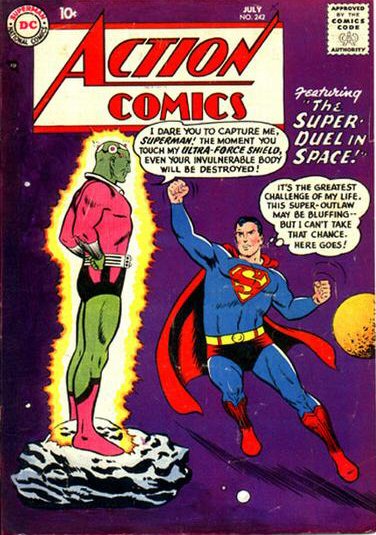
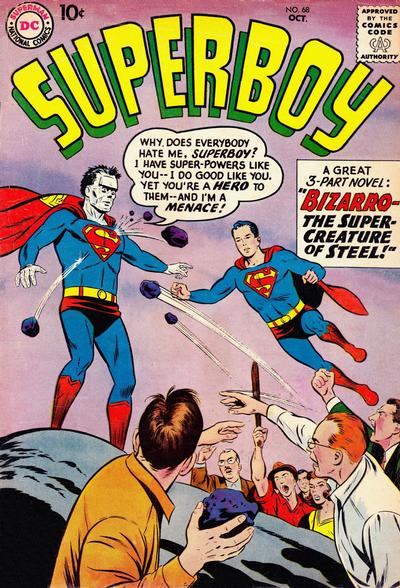
Comics: Action Comics #242, Superboy #68

On his first cover, one could easily picture Brainiac singing “Neener neener neener.”

Notes: By the 50s, the era of the super-nuisance seemed to have passed, and the next batch of memorable villains to join Superman’s rogues gallery were of a more sci-fi bent: the alien Brainiac, the quasi-clone Bizarro and the cyborg Metallo. Metallo, coincidentally, made his first appearance in Action Comics #252, which I covered here several months ago, as it happens to be the same issue as the first appearance of Supergirl. But today I’ll look at Brainiac and Bizarro.

In Action #242, Brainiac comes to Earth to shrink its greatest cities and steal them to repopulate his own home planet, which was wiped out by a plague. After getting Paris and New York, Superman waits in Metropolis for his home town to be stolen as a way onto Brainiac’s ship. On board, the tiny Superman another city that was stolen: a city from his homeworld of Krypton – but upon entering the bottle, he loses his powers under the stimulated Kryptonian environment. He seeks help from a scientist named Kimda who happens to be his father Jor-El’s college roommate (I know that sounds like a joke, but I swear to God, that’s exactly what happened). Outside the bottle, Brainiac goes into suspended animation for his trip back home and Superman manages to escape the bottle. Using Kimda’s findings, Superman restores the cities of Earth, but then discovers that ray has only enough charge left for one more enlargement – either Superman or the Kryptonian city. Although he plans to restore the city, Kimda intervenes and turns the ray on, making Superman grow so that Earth would not be deprived of its greatest hero. Brainiac’s ship continues on its way while Superman brings the city to his Fortress of Solitude with a vow to find some way to restore it someday.

This is such a weird story to me. Brainiac has changed so much over the years that you almost wouldn’t recognize him – he’s usually painted as far more menacing and malevolent these days, and later incarnations would identify him as an artificial intelligence that occasionally uses flesh and blood bodies. Kandor itself would get massive development over the years – in fact, until I started to write this recap I didn’t even notice that the city was never identified by name in the original story, it was just “a Kryptonian city.” It’s really weird and fascinating to look back on these things, elements of Superman’s lore that would go on to become so important, and see how humbly they began. 

This issue am worthless! Me no get it slabbed in plastic!

Bizarro first showed up in Superboy #58 later that same year. When one of Smallville’s seemingly infinite number of scientists asks Superboy to help him test a new “duplicator ray” he’s invented, he accidentally strikes Superboy with the beam and creates a “non-living” duplicate with a strange faceted skin and a feeble mind, but all of Superboy’s powers. Dubbed “Bizarro” the creature stumbles around Smallville for a while trying and failing to fit in, finally making friends with a young woman named Melissa who isn’t terrified of his appearance. The dim Bizarro, however, doesn’t realize that the girl is blind. When Bizarro decides to seek her out at Smallville High, Clark is forced to do some secretive super-feats to prevent the creature’s bumbling from accidentally killing half the class.

Superboy finds a chunk of Kryptonite and tries to use it to stop Bizarro, but it has no effect. He uses a marionette of Melissa to lure Bizarro to a military range, where the army fails to destroy the creature with heavy artillery. (Really, Clark, the creature obviously has all your powers, what were you thinking?) Bizarro returns to the real Melissa, where he discovers that she’s blind, and only his friend because she can’t see his real face. At the same time, Superboy learns that the irradiated pieces of the original duplicator ray have a Kryptonite-like effect on Bizarro. He approaches the creature with a piece of the metal and Bizarro hurls himself into it, exploding into a rain of dust. Somehow, the vibrations of his explosion trigger Melissa’s optic nerve and restore her sight, leaving her to wish she had seen the “kind face” of the creature who sacrificed himself for her.

This story goes to great lengths to remind us that Bizarro isn’t alive, over and over again, despite all evidence to the contrary. Doesn’t matter that he moves and thinks and has feelings and willingly sacrifices himself for the betterment of his only friend. None of those things are evidence of LIFE. After all, if he WERE alive, that would make Superboy a murderer, which probably would have been frowned upon. But alive or not, this Bizarro already carries a lot of the elements that the character would embody later, including his backwards thinking and speaking. He was brought back a year later, when the experiment that created Bizarro was duplicated on the adult Superman, creating a second Bizarro. This one would ironically go on to dub himself “Bizarro #1” when he created a whole planet of duplicates of himself and the Bizarro culture became fleshed out. John Byrne would also bring back the idea of Bizarro sacrificing himself to restore sight to a blind girl – this time Lucy Lane – when he rebooted the character in Man of Steel. The blueprint was there from the beginning, but it’s been greatly expanded over time. 

Sat., Oct. 4

Comics: Superboy #83, Adventure Comics #283, Justice League: The Omega Act Special #1, Absolute Evil #1

It’s not the worst dream his parents could walk in on him having.

Notes: The next point we reached with the introduction of memorable villains seems to have brought us to an era of threats from home – specifically, Krypton. Superboy #83 brought us the debut of the Kryptonite Kid, who first appears to Superboy in a dream. The Kid, with a body (and a dog) made of Kryptonite vexes the sleeping Superboy. Even more baffling, Superboy soon figures out that Krypto is having the same dreams as he is. The dreams come true when they encounter the Kid at a playground. The Kid chases Superboy, demonstrating his ability to transform things into Kryptonite with a touch – a playground slide first, then the lead culvert Superboy tries to use for cover. The Kid warns Superboy and Krypto that they have to leave Earth or he’ll kill them, then flees the scene. After a few more encounters, one of which winds up with Smallville High School itself turning into Kryptonite, the Kid reveals his secret origin. Turns out he was an inmate at a prison in space who volunteered for an experiment in exchange for the commuting of his sentence. He wound up with the ability to turn things into Kryptonite and decided to use it to attack Superboy. (Projecting himself into Krypto and Clark’s dreams are evidently a natural ability of his alien race.) Just when it seems that Superboy’s down for the count, the Kid is zapped away by – of all people – the young imp Mxyzptlk. After all if Superboy dies, there’ll be no one left for him to play with.

What a bizarre story. The origin is pretty generic, and in the end Superboy has no hand in saving himself – the only reason he survives is because Mxy didn’t want him to die. It’s also interesting to note that, by this point, things had been retconned so that Clark first encountered Mxyzptlk as a kid in Smallville rather than an adult in Metropolis. Kryptonite Kid wasn’t the most memorable of villains, but he did pop in to vex Superboy several more times, and at least once after they were adults. But there would be other villains who picked up the name Kryptonite Man later and made it more fearsome. 

Ma and Pa couldn’t understand why Clark ghosted them.

Clark was also Superboy in Adventure Comics, where he met perhaps the second greatest enemy he’d ever have, after Luthor himself: General Zod. It begins when a box falls to Earth in Smallville with Kryptonese writing on it. Superboy reads the inscription to learn that the box contains several weapons that were deemed too dangerous to leave lying around Krypton, so they shot them into space on a trajectory that would eventually cause them to fall onto a far less developed planet, because for all their scientific advancement and planetary harmony, the Kryptonians were kinda dumb. Among these devices, which Superboy learns were created by his own father, Jor-El (there were approximately seven people on Krypton when it exploded and they all were connected to the Els), is the infamous Phantom Zone projector. Superboy learns the history of the device, including how General Zod was banished into the Zone when he tried to stage a revolt on Krypton with an army of Bizarro-like duplicates of himself. The device is activated when a lizard steps on the button and turns Superboy into a Phantom, because — and I cannot reiterate this enough — Kryptonians were kinda dumb. The Phantom Superboy is forced to zip around Smallville – invisible and intangible – trying to find some way to get somebody to turn the device on and restore him. He finally gets a message to Jonathan Kent, using his super-brain to transmit a message to an electric typewriter. This works because earlier in the issue Lana Lang theorized it would. That’s the only reason.

Zod’s appearance in this issue is minimal, appearing only in the flashback that shows how the Phantom Zone projector works. Both he and the Phantom Zone would come back and become much more defined, although Zod himself was fairly unimpressive until the late Terrence Stamp played him in the first two Superman movies, elevating him to the A-list of Superman villains. Most versions of Zod in the comics since then have been based on the Stamp version of the character. The Phantom Zone, too, would be dramatically changed from merely turning the victim into a phantom into being a portal to a literal other dimension. There was a lot of refinement to this concept before it became what it is today. 

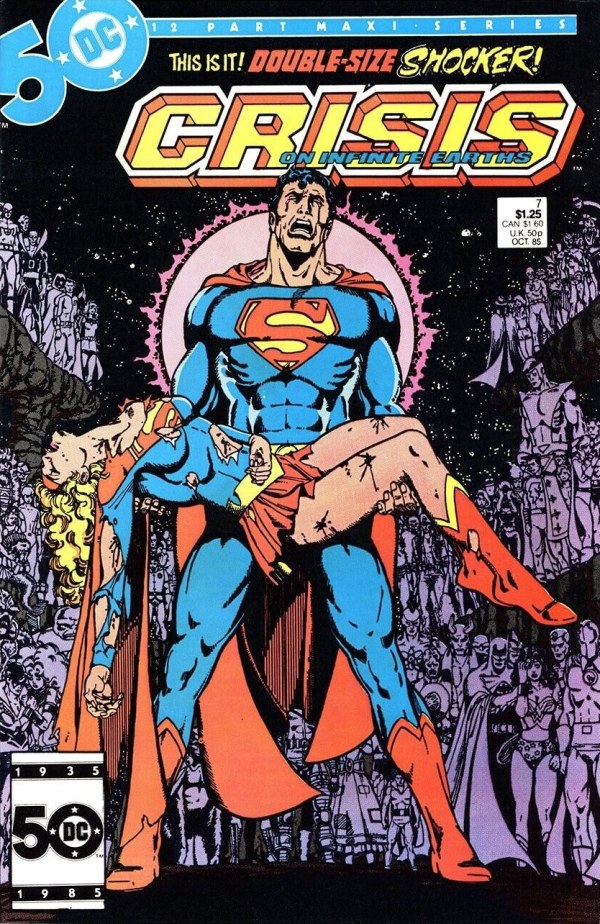
Superman poses for a lot of covers where he holds a dying blonde in his arms.

I also grabbed this week’s new Superman comics today, including a pair of one-shots that are connected to the larger story of the DC Universe. The prelude to DC KO is presented in Justice League: The Omega Act Special. Superman has brought the lost Booster Gold back to the League, but he and the Doomsday/Time Trapper – along with the Flash – take a quick trip through time to discover what really happened when Darkseid died in the DC All-In Special. The upcoming conflict with the Absolute Universe is about to change everything, but Booster has been changed as well. And in addition to Booster, we get flashbacks to Krypton’s past when Lara (Superman’s mother) and Ursa (Zod’s wife) made a discovery that might change everything we know about a certain member of our cast. I’m really excited to see where this story is going.  

Absolute Evil #1 is the a one-shot special celebrating the first anniversary of DC’s Absolute line, focusing (naturally) on the villains. Hector Hammond is summoned to a summit that includes Veronica Cale, Ra’s Al Ghul, and the humorless creature this universe calls Joker. Cale reveals how – in this universe – certain forces have operated to prevent the rise of costumed heroes, either through violence or temptation. We’re given glimpses of the would-be heroes of this world’s Golden Age and what happened to them, as well as an understanding of what these terribly powerful people have planned now that things have changed and superhumans are beginning to appear that are beyond their ability to control. The issue has a pretty decent recap of the broad strokes of the Absolute Universe to date, for those who maybe want to play catch-up, and there’s a pretty startling final page that leaves me scratching my chin and wondering where they’re planning to go with all this. 

Sun., Oct. 5

Comics: Absolute Superman #12, Adventures of Superman: Book of El #2

“Dammit, he’s right behind me, isn’t he?”

Notes: I had a lot on my plate on this Sunday, so I’m going to hop in real quick and read the other two new Superman comics from this week, starting with Absolute Superman #12. “The Battle of Kansas” begins as Kal-El retreats to the one place on Earth he’s ever felt safe: Smallville. Lois and Jimmy have the same idea, seeking refuge in a diner where a face the readers will recognize immediately confronts them about their association with Lazarus. We also get some flashbacks to fill in a bit of Kal-El’s time on Earth, even as Ra’s Al Ghul prepares his revenge on the alien who dared to defy him. This may be my favorite issue of this series to date, with a real look at character and a bit of the flavor of hope we expect from a Superman story. The whole thesis of the Absolute universe is that “hope” is the underdog, and the whole world runs on darkness and conflict as befits a world spawned by the power of Darkseid. But even in a world this dark, this issue shows us how the light of this character shines through, and it feels really good. 

I feel less good about Book of El #2. Superman is in the distant future with his descendant, Ronan Kent, seeking a way home. Meanwhile, the world has been taken over by one of his greatest foes. This issue explores that a little bit, but in a way that I frankly find irritating. Some science fiction writers have people in the future talk exactly like people do today, even though logically we know that’s not right. Language changes and evolves, and people from 1000 from now won’t talk exactly as we do any more than we talk like people from 1000 years ago. So other writers conjure up a “future speak” to address the issue. Sometimes it works, sometimes it doesn’t, and when it doesn’t it can come across as REALLY annoying. Realistic or not, sometimes it’s better to just keep the language simple.

Oct. 6

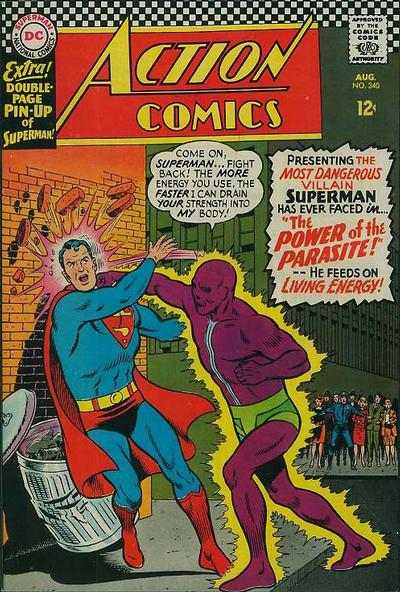
Comics: Action Comics #340, Superman #323, 324, DC Comics Presents #27, 28

As a soulless monster who leeches the life force from unsuspecting victims, he went with “Parasite” because “Insurance Claims Adjuster” was just too evil.

Notes: Back to Villains Week. The Parasite was the next significant Superman villain to show up, in Action Comics #340 from 1966. Like many of the villains we’ve talked about this week, he’s gone through a lot of changes over the years, and several people have used the name (although the powers haven’t changed significantly). Let’s see what kind of tomfoolery the original got up to. 

The story, by the late Jim Shooter, kicks off hard, with the opening narration declaring that the Parasite was “the most powerful foe Superman has ever faced!” And in this pre-Darkseid, pre-Doomsday world, that may not be hyperbole. The story starts with Superman helping out in a government science lab, conducting experiments with radioactive elements that would kill an ordinary person. When the facility’s janitor Jensen, is tapped to dispose of the waste from the experiment, he remembers a rumor he heard that sometimes labs ship their payroll inside of containers marked “radioactive waste” to fool criminals. Instead, he proves that criminals are fools by opening up the container and exposing himself to the toxic material. Jensen’s skin turns purple and deformed and he collapses, as if all his energy has been spent. When one of the scientists finds him, Jensen finds himself absorbing not only the man’s energy, but also his scientific knowledge. He fights his way to freedom, absorbing the strength and minds of everyone he comes across. Although the energy he absorbs doesn’t last long, he begins to plan a new life as a human Parasite.

He later picks up a little of Superman’s energy as the Man of Steel flies past his hideout, and he gets the idea to hunt him down. When he feels an enormous surge of energy coming from Clark Kent, the Parasite figures out a secret that Luthor and Brainiac had been struggling with for decades. When Superman tries to stop him from robbing a bank, the Parasite defeats him with his own power and threatens to expose his secret identity if Superman refuses to fight him to the finish. He’s shocked that, no matter how much power he drains from Superman, he still keeps getting up and he keeps absorbing more and more until finally his mortal body is overloaded by Superman’s power and he explodes.

We’ve talked before about how unimaginative people complain that Superman’s powers make him “boring,” but it IS true that it’s hard to come up with a suitable physical threat for him. Like Kryptonite Kid, this was an effort to do so. But like Kryptonite Kid, in the end, Superman’s victory is a passive one. He survives not because of anything he DOES, but because the Parasite simply bites off more than he can chew. The Parasite would become a recurring foe for Superman over the decades, and although he remained dangerous, they also started to play up the fact that he wasn’t all that smart, and subsequent victories gave Superman a bit more agency. Still, it’s kind of disappointing that their first tete-a-tete ended the way it did. 

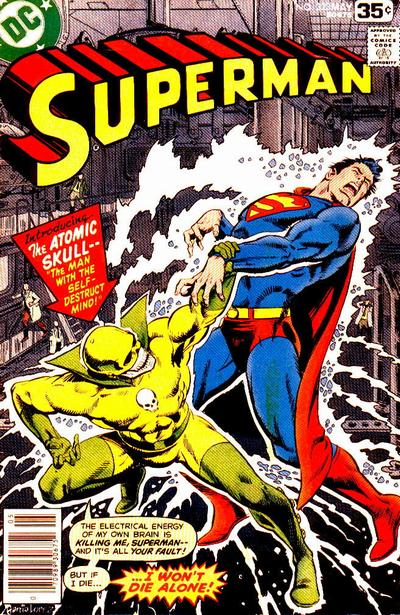
“No, my name is NOT JOHNNY BLAZE. Why does everybody keep ASKING me that?”

Next we jump ahead to 1978 and the first appearance of the Atomic Skull in Superman #323. Although the Skull has never quite cracked into the ranks of Superman’s A-list villains, he’s a B- (or, if I’m being honest, maybe C)-lister that I’ve always had a fondness for. Of course, I remember him better in his vastly different post-Crisis version that showed up in early issues of Superman: The Man of Steel. The original Skull appears in “The Man With the Self-Destruct Mind” by Martin Pasko and Curt Swan, and shows up on page one destroying a Superman statue and vowing to kill the real thing. Superman, meanwhile, is in space – he’s wearing a suit of lead armor trying to investigate a sudden preponderance of Kryptonite that’s been falling to Earth lately and coming into the possession of a group called the Skull Crime Organization. He soon discovers that “Krypton-Two,” a planet he once made out of chunks of Kryptonite, has somehow been destroyed and is showering Earth with Green K once again. The Skulls, meanwhile, kidnap a STAR Laps scientist and reveal that their craft is powered by their leader, the Atomic Skull, whose brain is creating miniature nuclear reactions. Furthermore, he is unmasked as former STAR Labs scientist Albert Michaels. (Michaels, it turns out, had made previous appearances as the leader of the Skulls – this is his first appearance with his new powers and costume.) As it turns out, Michaels has a rare nervous disorder that short-circuits his brain’s electrical impulses. A treatment for his condition only made it worse – not only does he still have seizures, but they are accompanied by energy bursts that are killing him, and he hates Superman because he’s jailed the only scientists (mad, I presume) who could have saved him. His plan involves loading up a rocket with the Kryptonite that’s falling to Earth and detonating it in the atmosphere, blanketing the planet with enough Kryptonite particles to remove Superman’s powers no matter where he is on the globe. And on the last page he plays his trump card – holding Superman at bay with the powers of Titano, the Super-Ape as he sends the rocket to blow up.

Part two of the story picks up in Superman #324, as Titano hits Superman with the rays of his Kryptonite vision. Superman manages to neutralize the ape by wrapping lead around its eyes, then takes out the Atomic Skull by redirecting one of his own energy-bursts. This leaves him with the problem of what to do with the Kryptonite missile, which he can’t approach to stop without exposing himself to fatal doses of Kryptonite. Titano comes after him again and, with his X-Ray vision, Superman determines that the Skull is controlling the ape via a device implanted in his brain. He manages to corral the ape and then use the Supermobile (God, I love the stupid, ridiculous Supermobile) to vacuum up the Kryptonite from the atmosphere. 

Does James Bond have a car with robot fists? DOES HE?

I appreciate that they were trying to up the ante for the villains at Superman at this point. The late 70s and early 80s are really, for me, one of the dullest periods in the character’s history, with few memorable stories or characters appearing. The Skull is an exception. He’s a little generic – the mad scientist with atomic powers – but the idea that the powers are slowly killing him gives it a little more weight. I don’t think they did that much with the idea, though, and it’s been largely dropped from future versions of the character. Now, especially, where his head is encased in atomic fire, people write him off as a Ghost Rider knock-off. There’s more to it there, and I think the right writer could really make him into a top-level threat. 

Thank God Dave Gibbons taught him correct posture.

In 1980, Len Wein and Jim Starlin gave us DC Comics Presents #27. This issue of the Superman team-up book paired him off with the Martian Manhunter and gave us the first appearance of the world-conquering Mongul. Superman is alone in Clark’s apartment when he receives a message from outer space – a yellow-skinned alien who reveals that he has kidnapped three of Clark’s colleagues – Jimmy Olsen, Lois Lane, and Steve Lombard – and threatens them if Superman refuses to retrieve for him a crystal key that is being held on the fifth planet in the Cygnus system. At this period, the Martian Manhunter has left Earth, establishing a “new Mars” on Cygnus’s FOURTH planet, and when Superman approaches the crypt where the key is being kept, J’onn shows up and tells him that the world is off-limits. J’onn tells Superman that the key must remain where it is or countless worlds will be in jeopardy. The key is the only thing that will allow someone to get past the defenses of an ancient and incredibly powerful satellite called Warworld, and thus it may be the most dangerous object in the universe. Although Superman sympathizes, the two friends come to blows. Each of them attacks the other with their weakness (Kryptonite for Superman, fire for J’onn), and ultimately Superman retrieves the key. When Mongul arrives, though, he refuses to turn it over. J’onn saves the hostages, but Mongul manages to get the key and escapes.

There’s good and bad in this issue. On the plus side, Mongul is a great villain. He’s the most fully-formed of all the villains I’ve read about this week, the one who is most like who he becomes from the very beginning. He’s cold, manipulative, and ambitious, all qualities that make him one of the greats. On the other hand, I really dislike the way Wein paints Superman and J’onn. The two of them have been friends forever at this point – the fact that they went straight to fighting instead of trying to work together to find a way out of this dilemma does a disservice to them both. 

The story continued in the next issue, when Superman recruits Supergirl to help him track Mongul to Warworld. (Why J’onn didn’t come along, considering how important he considered the key to be, is a mystery.) They find the planet and are dazzled by the enormity of it, but Superman manages to defeat Mongul by outlasting him – he reasons that the aliens that created the satellite died one by one because the control helmet was too much for them and that it would eventually wear Mongul out, and he’s right. It does make one wonder, though, why the hell the aliens would make their entire weapon fueled by a device that would not only cause their own extinction, but do so in what seems to be a matter of minutes. Who the hell ever thought THAT was a good idea? Even in the real world, it takes us much longer to destroy ourselves. 

Tues., Oct. 7

Comics: Action Comics #595, 645, Justice League of America #31

Notes: You may have noticed something about the villains I’ve covered so far this week. I know my wife certainly has. They’ve all been men. I refuse to take the blame for this. It’s not my fault that for five decades, the writers of Superman never seemed to come up with an interesting continuing female villain. I think part of it is the idea that you can’t have Superman punch out a lady – it’s not a good look for the strongest man in the world to punch out a woman. In fact, go back and look at any early Justice League issue where the team fights a villain GROUP – there’s always one female villain so that Wonder Woman has somebody to fight.

In an outfit like this, she ain’t no lady.

But eventually, it seems, people decided to address that, and in my chronological journey through Superman’s rogues’ gallery, the last three significant villains I’m going to talk about all happen to be female.. We’re going to start with Action Comics #595 and the first appearance of the Silver Banshee. This was part of the John Byrne era, coming out in 1987 during the period when Action Comics was the Superman team-up book. This particular issue, though, didn’t divulge who Superman’s guest-star was on the cover, leaving a string of question marks where the second hero’s name usually went. It’s a striking cover nonetheless – a stark black-and-white villain with a skeletal face standing over Superman’s dead body while his spirit comes at her from behind. That’s a book that’ll get your attention. 

The story starts with the Banshee walking through Metropolis, invading bookstores where she casually touches bystanders, drains their life force, and leaves them dead. And when Superman arrives, she does the same to him. The world is stunned by the hero’s sudden loss and he’s placed in state in a glass casket for a memorial as the Banshee escapes. At the funeral, though, everyone witnesses Superman’s ghost rise from his body and take off after the Banshee. Jimmy, meanwhile, has tracked her down to yet another bookstore. She’s about to touch him when Superman’s ghost appears and engages her, shocking her when she realizes she can’t hurt him anymore. The Banshee unleashes her scream, trying to destroy Superman, but winds up exploding. (Superman villains used to explode a LOT.) Jimmy is pulled from the debris by a LIVING Superman, and watches in astonishment as the ghost Superman transforms into J’onn J’onzz, making his second appearance in Villains Week! Give the man a box of Chockos! On the last page we get an explanation for everything – the Banshee’s ability to kill was based on her knowing her victim’s identity (because magic), so she was helpless against the shapeshifter. Jimmy also figured out that she was targeting bookstores that had recently received a shipment of books from a certain castle in Ireland. That, of course, is the sort of thing that comes back later.

The Silver Banshee has always been one of the most memorable new villains from this period. She’s got a phenomenal look, first of all – a really unique appearance that’s totally unlike any of Superman’s other villains. Also, considering how everyone remembers his vulnerability to magic, it’s surprising that he doesn’t have more enemies for whom magic is their usual shtick. Later stories would flesh out the character more, revealing a tragic backstory and making her more sympathetic. In recent years she’s wavered between villain and antihero, and she’s even (in her human form) dated Jimmy Olsen. In fact, I think she still is – Jimmy’s been a little out of focus in the comics lately, they really should address that. Anyway, the point is, she’s a good character.

Stalker with a crush, anyone?

Maxima, the warrior queen from the planet Almerac, made her first appearance in Action Comics #645 by Roger Stern and George Perez. I’ve written about Maxima in the Year of Superman many times, of course. She was a member of the Justice League during the Doomsday storyline, broke bad again in the electric era, and she’s had a smattering of other appearances over the last ten months. Today, though, we’re going to see where she came from in the first place.

The story begins with a stunning redhead strutting the streets of Metropolis and being accosted by a few gang members, one of whom quickly (and fatally) learns that pulling a knife on her isn’t a good idea. Maxima, along with an attendant named Sazu, is looking for Superman, and winds up at the Daily Planet office after being told he has connections there. Superman isn’t in attendance, though, and after leaving the entire staff in a trance, she leaves. Clark shows up, fresh from a fight with the Parasite in Starman’s comic (Stern was writing both books and liked to tie them together), shows up and snaps them out of it. They tell him about their attacker and he finds her pretty easily, as she’s now at City Hall holding the mayor hostage. When he arrives, she puts him under mental assault as a means of testing him. She’s testing Superman’s “worthiness” and finds him acceptable, but Sazu revolts. She claims that Superman is “unworthy” and unleashes her own mental powers against Maxima, who…explodes.

No, really.

Sazu is taken into custody and Superman is left confused, but the last page clues the reader in to the fact that the Maxima who blew up was just a simulacrum. The real Maxima is in outer space and now, dang it, she’s gonna have to come to Earth herself to make Superman hers.

And she did show up again, and several times after that, as her motivation was revealed: she was seeking a consort of superior bloodline with which to procreate and extend the line of the Royal Family of Almerac. As villain motivations go, it’s a lot more flattering than wanting to destroy him because he thinks it’s Superman’s fault that he went bald. It’s also interesting how the gender roles are inverted here. When you consider the revelation about Kal-El’s parents in James Gunn’s movie, it’s not all that different, but it’s definitely more controversial. Part of that, of course, is because Jor-El is usually portrayed more benevolently, but even were it a brand new character I think people would have found it more insidious than they did when Maxima shows up wanting pretty much the same thing. There’s probably a whole dissertation that could be written about the differences here, but that’s somewhat above my pay grade. At any rate, it makes Maxima one of the more memorable villains of the era, and she’s had the kind of longevity that it wouldn’t be surprising at all to see her show up in a new movie or TV show. There’s something interesting about this character that’s fun in a cheesy sci-fi sort of way.

TV Episode: Superman: The Animated Series Season 2, Episode 5, “Livewire”

She’s got an ELECTRIC personality! Haha! Get it? Ah, I’ll show myself out.

Notes: The last villain we’re going to discuss on this avenue of animosity did not make her first appearance in comics, but rather on TV. No doubt trying to duplicate the smash hit they had when they created Harley Quinn on Batman: The Animated Series, the producers of the Superman cartoon introduced this new female foe in 1997, an electrical harpy called Livewire. Although she hasn’t QUITE had the degree of cultural penetration that Harley has (and to be fair, who HAS?), she, too, made the leap to comic books and has crossed swords with Superman occasionally ever since.

In “Livewire” we’re introduced to Leslie Willis (voiced by Lori Petty), a radio shock jock who’s riding a ratings high she’s getting off of trash-talking Superman. She goes through with her show’s anniversary celebration in Centennial Park despite a thunderstorm pouring down on them, and suffers the consequences when lightning overloads her equipment. Superman tries to shield her, but Leslie is bombarded by electricity, bleaching her skin white and her hair blue. When she wakes up in the hospital, she discovers she’s developed electrical powers, including the ability to control electronic devices, and attempts to hold the city of Metropolis hostage. She attacks the city’s hydroelectric plant, where Superman comes in to hold her off. After a pitched battle, Livewire blasts a hole in the dam and is washed over with water, causing her to EXPLODE!!!

Just kidding.

No, she stays in one piece, but the water DOES short-circuit her powers, allowing Superman to repair the damage to the power plant and bring her in. When we last see her, a radio voiceover tells us that Lex Luthor has volunteered (through the goodness of his heart, of course) to pay for her treatments, but the image we have of her strapped into a chair with wires all over her seem to indicate that she isn’t receiving the best of care. 

I like Livewire, not just because Superman could use more female villains, but because she’s got a unique attitude. She’s not jealous of Superman’s popularity. She’s not out to prove that she’s more powerful than he is. She doesn’t want to outsmart him or outthink him, and she CERTAINLY doesn’t want to have his babies. Nope, Livewire is just a jerk, a loudmouthed radio asshole like Howard Stern, only more lifelike, and that’s an entertaining dynamic to play.

This first week of October was a fun one, but it’s just the beginning. Like I said, I intend to spend this month peering into the dark side (not to be confused with the Darkseid) of the Man of Steel, and I mean it. Come back next week for my discussion of Superman’s Darkest Hours. 

Blake M. Petit is a writer, teacher, and dad from Ama, Louisiana. His most recent writing project is the superhero adventure series Other People’s Heroes: Little Stars, volume one of which is now available on Amazon. You can subscribe to his newsletter by clicking right here. You can join in the Kryptonian Konversation every day in the Year of Superman Facebook Group!
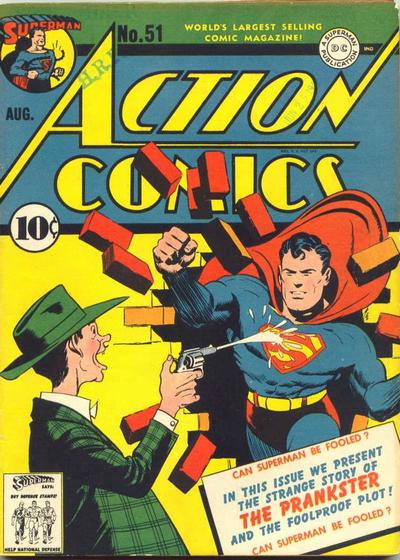
Week 24: Wonder Woman, Batman, LEGO, and Father’s Day

I woke up early on June 11th, friends. It’s summer vacation, there is no reason for me to get up early, but I was wide awake at 6 am and refreshing the AMC Theaters app, looking every few minutes to see if it had begun yet. Today, you see, was the day that Superman tickets officially went on sale. 

At noon, it turns out. I found that out later.

But I was too excited to get back to sleep, and when the app finally opened up and allowed advance ticket sales to begin, I got the first three seats in an early screening for one month from today, July 11th. I showed the tickets to Eddie, and I told him how excited I am not just to see the movie, but specifically to watch it with him.

That’s more important to me than anything else, really. Taking my son to see a new Superman movie. It’s something I never thought would happen, especially after Justice League sloughed through theaters when Eddie was only three months old. Now? I couldn’t possibly be more excited.

But that’s still a whole month away. Time for a fairly random week in the Year of Superman.

And as always, you can check out earlier blogs in the Year of Superman Archive!

Wed., June 11

Comics: Young All-Stars #10

Iron Munro’s dad was bulletproof. Mine is hard of hearing. He wins.

Notes: The first comic I’m going to discuss this week is a surprise, even to me. I’ve mentioned before that – although I’m only writing about Superman comics here – there are lots of other comics that I’m reading, and as I made my way through a bundle of Roy Thomas’s Young All-Stars from the 80s, issue #10 stopped me in my tracks. Young All-Stars was Thomas’s attempt to rebuild the Golden Age of DC history post-Crisis, in a world in which the likes of Wonder Woman, Batman, and – yes – Superman had not yet existed. And Thomas was uniquely suited to that task, having a love for the Golden Age that I maintain is unsurpassed among any comic book creator that wasn’t actually working during that era. 

One of the members of that team was Arnold “Iron” Munro – a young man of incredible strength, speed, and resilience who kind of filled the “Superman” role in the team. Munro’s first appearance was in issue one of this title, and after a few adventures, he managed to get his hands on the diary of his late father. In this issue he sits down and reads it – the diary of one Hugo Danner.

I’ve read ABOUT this before in my vast studies of the DC Universe, but this was the first time I actually read this issue, the issue in which it was revealed that Iron Munro was the son of the main character of Philip Wylie’s novel Gladiator, which if you remember from the very first week of this Year of Superman project is believed by some to be at least partially where Jerry Siegel and Joe Shuster drew their inspiration for Superman. The issue is a straight-up adaptation of that novel, run through the frame story of Iron Munro reading the main narrative in his father’s diary. Thomas hits all the major beats, although he condenses the story greatly, and for the most part only makes minor changes.

There is one BIG change, though, and a necessary one. In the novel, Hugo Danner’s own father (whose experiments gave him his powers) informs Hugo that his process is not an inheritable trait, and that should Hugo ever have children they would not possess his power. In the comic, Dr. Danner says that he doesn’t KNOW if the process will be inherited, and Hugo replies that he always assumed he was infertile, else he’d have dropped litters of little Gladiators all over the world. (It was 1988 and Young All-Stars was a direct market title: I wonder if that comment would have snuck through if it had been made to adhere to the Comics Code.) The story of Iron Munro’s own birth is absent from this issue, and in fact, the way the diary ends it seem quite possible that Hugo didn’t know that he had successfully fathered a child before his own death, but with this completely unexpected Superman connection, I’m more excited than ever to continue reading this great series from the 80s.   

TV Episodes: Superman: The Animated Series Season 1, Episode 1-3, “The Last Son of Krypton” Parts 1-3

Up, up, and Animate!

Notes: With just a month to go before the big movie, I’m going to be ramping up how much Superman I share with my son, Eddie. My wife suggested that today we watch the pilot of Superman: The Animated Series together, a three-parter that was also released on DVD as the movie Superman: The Last Son of Krypton. I’ve seen this several times over the years, and I seem to find something else to appreciate about it every time. For example, this time around, we see Jor-El pleading with the Kryptonian Council that they have to put the entire population of the planet into the Phantom Zone before the planet is destroyed (a good idea that I’m surprised more versions of this story haven’t addressed). But the Council doesn’t listen, this time not out of pure hubris, but because the planet’s massive Brainiac computer is assuring them that Jor-El is mistaken and the planet is safe.

Keep that in mind, people: in the DC Animated Universe, the entire population of Krypton died because people trusted an evil A.I. It’s the lesson we ALL need to learn from this.

Although it isn’t as noticeable if you watch the movie version, the entire first episode of this series takes place on Krypton, with Jor-El first trying to convince the council, then turning against the ruling Brainiac computer before having to steal his own rocket prototype to send Kal-El to Earth. It’s kind of brave, really, to have an entire episode without any of the regular performers or characters, save for baby Kal-El himself, especially on a story that – even by 1996 – was pretty darn well known. But this was in an era where TV shows HAD to have a “proper” pilot episode to set everything up, and the creators brought the same love and attention to detail to the show that they did Batman: The Animated Series, so it’s hard to complain. 

Episode 2 begins with Kal-El’s rocket landing in Kansas and being found by the Kents. Martha, as usual, loves him right away, and after some minor persuasion, Jonathan agrees to take the starchild in. We get a timeskip to teenage Clark, who is excelling at school, but struggles to fit in, finally confessing to his best friend, Lana Lang, that he has incredible powers and abilities beyond those of mortal men. After he rescues a child from an explosion, Jonathan and Martha show him the rocket that brought him to Earth, where a message from Jor-El tells him about his origins. After a quick flight around Smallville, another time skip brings us to Metropolis, where people are reporting a “guardian angel” with red wings whisking around the city saving people from near-disasters. At the Daily Planet, Lois Lane is asked to take new hire Clark Kent to a LexCorp press conference unveiling a new military exosuit – a conference interrupted by a terrorist attack. As villains swarm LexCorp to steal the suit, Clark slips away and changes to his OWN special suit – Superman makes his debut, appropriately enough, saving Lois Lane. 

Back in Lois Lane week, I wrote about how good Dana Delany is as Lois Lane, and I want to reiterate it today. She’s brash, a little self-important, and utterly dumbfounded at how Clark manages to make it to LexCorp before her after she ditches him. It’s no wonder he falls in love with her. Tim Daly, meanwhile, makes his debut in this episode as well, and I’ve always liked his Superman. There’s a sort of quiet strength in his voice. He’s powerful, but confident, and he gives you the impression that being Earth’s greatest hero is effortless most of the time. These two, along with the deliciously oily Clancy Brown as Lex Luthor, were a real power trio in this show. 

Part three picks up right where part two ended, with Clark trying to save an airplane in the fallout of the terrorist attack. The Planet dubs him “Superman” and, after some advice from Jonathan and Martha (“I don’t want anybody thinking you’re like that nut in Gotham City,” she says), he swoops in to Lois to give her an interview. Later, as Clark, he tells Lois his theory that Luthor was behind the theft of his own exosuit in order to reap a windfall from the government building a better version, as well as selling the original suit to an enemy power. Lois being Lois, she tries to investigate on her own, only to get caught by the terrorists. Fortunately, in what will become quite the habit, Superman shows up in the nick of time. After cleaning up the bad guys and throwing Luthor a warning, Metropolis cheers for its new Man of Steel.

Meanwhile, in deep space, an alien craft picks up a probe with a familiar pattern – Brainiac lives.

Ah, what a great way to end the first episode of this new Superman. Even Eddie watched some of it, which is pretty good for a him. I’m going to be sharing more and more with him as we work our way up to July 11th. 

Thur., June 12

Movies: Superman/Batman: Public Enemies, Superman/Batman: Apocalypse

Notes: I didn’t necessarily plan for there to be an animated theme this week, but when it happens on its own, who am I to argue? Today I rewatched the two animated films that adapted the first two story arcs from Jeph Loeb’s Superman/Batman series, Public Enemies and Apocalypse.

Public enemies, but private besties.

In Public Enemies, after Lex Luthor has risen to the presidency, he drums up false charges against Superman and Batman, sending a task force of heroes (and Major Force) led by Captain Atom to take them down. The world’s finest team has to go on the run, prove their innocence, and defeat President Lex. Apocalypse, the sequel, is a pretty solid adaptation of the “Supergirl From Krypton” story arc I wrote about back in Supergirl Week

It’s so great to see Tim Daly, Kevin Conroy, and Clancy Brown reprising their roles from the DC Animated Universe, and this movie is full of great little moments, such a conversation between Superman and Batman after the former has been shot by a Kryptonite bullet and Bruce is trying to bring him to the Batcave for medical attention. Out of nowhere, Clark starts talking about Magpie, the first villain the two of them ever faced together. It’s a great little bit that serves no purpose other than to indicate that these two are, in fact, friends…which is how it should always be. 

When Kara started shopping at Hot Topic, Clark knew something was wrong.

The sequel, Apocalypse, is a little jarring at first. The animation style changes dramatically between the two movies, as each is trying to imitate the original artist – Ed McGuinnes for Public Enemies and Michael Turner for Apocalypse), but the continuity of having Daly and Conroy back helps. The story follows the comic book pretty closely, adding Summer Glau as Supergirl and Susan Eisenberg as Wonder Woman to round out our cast of heroes. 

As a whole, the film is a pretty straightforward adaptation of the comic book, from Kara’s discovery, to her training on Themiscyra, her abduction to Apokalips, her recovery in Smallville, and the final confrontation with Darkseid. It doesn’t tread any new ground, it just tells the story. Which is actually kind of refreshing, after you think of the way some of the more recent Batman animated movies have felt the need to change the ending (Hush, A Long Halloween, and Gotham By Gaslight all suffered from this remarkably stupid choice). While it’s true that SOME measure of change is almost always necessary to successfully adapt a story from print to film, there are too many films that seem to make the changes for no reason, and I love the fact that this one avoided that trap. 

Comics: Nightwing Vol. 4 #126 (Cameo)

Fri., June 13

Magazine: DC Comics Presents Superman

I never thought about it before, but I betcha in the DC Universe, it’s GREEN cars that have the highest insurance rates.

Notes: Last week my family stopped at Barnes & Noble for my wife’s birthday. After we had checked out, as we were walking towards the door, Erin suddenly perked up and rushed to the magazine rack. There she plucked the special edition I’d been hearing people online talking about: DC Comics Presents Superman. I knew it was out there, and I had to pick it up.

The magazine is on newsstands across America, there to serve as a sort of gateway for people who don’t read comics all the time but are interested in the movie. It reprints the first issues of three of the miniseries that James Gunn drew inspiration from for the new movie, specifically All-Star Superman by Grant Morrison and Frank Quitely, Superman For All Seasons by Jeph Loeb and Tim Sale, and Lex Luthor: Man of Steel by Brian Azzarello and Lee Bermejo. It’s also peppered with bits and pieces of Superman trivia, and some commentary by Gunn on each of the three stories and how they helped influence the movie.

Now let’s be clear here: if you’re a Superman superfan such as myself, there’s pretty much nothing new for this magazine to offer. I’ve read all three of the comics contained herein before. I knew almost all of the trivia tidbits. I’ve already got a DC Universe Infinite subscription, so the offer for a 30-day free trial on the back cover (so you can read the REST of the three miniseries that this magazine only samples) is useless to me. Even the cover – Dan Mora’s recreation of Action Comics #1 featuring the David Corenswet costume – isn’t new, as the same artwork was used on an Action #1 facsimile edition that came out last month. But there was absolutely no way I could let this book sit on the rack without swooping right back to the same Barnes and Noble clerk who had just checked me out and picking it up. 

I’m not going to get in-depth on the stories here, since I intend to read and discuss each of those three miniseries in the near future. I was, however, a little surprised to see the inclusion of the Lex Luthor issue. I’ve heard the other two mentioned often as being part of the inspiration for the movie, but I hadn’t heard about the Azzarello/Bermejo series before. Gunn’s commentary mentions that Nicholas Hoult’s Lex is going to be smarter and more menacing than the Luthors we’ve seen on the screen before, and with all due respect to the late Gene Hackman, I think it’s about time. It also helps to underline a point that Gunn has made on social media: that the core of the movie is going to be the three characters of Clark, Lois, and Lex Luthor. 

Simply as a Superman superfan, I’m glad to add this magazine to the collection. Functionally, the most important thing is that this alerts me that I need to move Lex Luthor: Man of Steel up in my planned reading order for the rest of this year. And for those of you who maybe AREN’T walking Superman encyclopedias such as myself, it’s a cool primer before the movie. 

Sat. June 14

TV Episodes: Superman and Lois Season 2, Eps. 12-15.

“OW. OW. OW. OW. OW. OW. OW. OW. OW.”

Notes: After getting some writing done on an unrelated project, I decided to burn the rest of season two of Superman and Lois this afternoon. Here’s the quick synopsis of all four of them: We pick up right as Clark tells Lana his big secret, a shock that drives a schism between the Kents and Lana’s family. Lana gets over her anger, but her fear of putting her own family in danger and the stress of keeping the secret wears on her. Clark and Tal manage to destroy the pendant that Ally Alston plans to use to merge people with their Bizarro-world counterparts, but a battle with Clark leaves him powerless. Before he can recover – a process he is warned may take years, Ally makes her next move, bringing a square Bizarro sun into orbit around Earth, flooding the world with red sunlight. Newly-minted Smallville mayor Lana tells the people about what’s going on, as John Henry and Natasha prepare his armor to continue the fight in Superman’s absence, but John is soon missing in action. Jordan has to reveal his powers to protect Lana and Sarah, and Sarah immediately figures out that her mother has been hiding the secret as well, proving that she’s the smart one in the family. And then, as if all that wasn’t bad enough, Earth and Bizarro World begin to flicker and merge, with Ally serving as a nexus between the two. 

The season finale begins with Chrissy Beppo of the Smallville Gazette announcing to the world that the planet is merging with its counterpart, everyone is screwed, and Superman isn’t around to save them. I guess the New York Times was reporting on the Met Gala that day. Tal hooks up again with the family to stand with them as Lois and Sam get bounced to Bizarro Earth and Bizarro Lois comes to ours. Tal tries to fight Ally in space, but his powers are drained as easily as Clark’s were, and he has to be saved by Jordan. Clark decides that the only thing to do is for Tal to throw him into the sun to jumpstart his powers and give him a fighting chance. Natasha puts together her own armor and heads to space, where she finds her father, but the odds of either of them making it home seem slim. Tal throws Clark into the sun. The plan works, and supercharged Superman races to Earth to face down Ally Alston. Knocking her from the sky, he flies around the two worlds to build up enough energy to – I am not making this up – PUNCH THEM APART. 

Of course it works. It might be absurd, but it’s still Superman. 

After the chaos ends, Jordan and Sarah have a heart-to-heart and mend fences. Then, in the most baffling moment of a TV series in which people have a conversation on the surface of the sun and a super-punch breaks apart two planets that are fusing together, Lois tells her boss Chrissy that Clark is Superman, because she’s tired of keeping secrets from her friend. Tal somehow winds up on Bizarro World and, even stranger, sends Jonathan and Jordan trucks. I…I don’t get it either. Clark takes the family out to the ocean to recreate a new Fortress of Solitude, this time for all of them and not just himself. And in a sequel hook for next season, John Henry gets evidence that Bruno Mannheim, head of Intergang, is the man who murdered his counterpart in this universe. 

Plenty of interesting things to talk about in this block of episodes. Let’s start with Tal – the bad guy of season one, as seems to be the trend in these CW shows, slowly creeps towards a redemption arc this season. He’s not a good guy, per se, but he doesn’t want to merge with his Bizarro self any more than anyone else, so he pitches in. That seems to be how these things always go, and while I usually enjoy a good redemption, sometimes it seems like the producers want to keep a good actor around after the logical course of his story is over, and this is the best way they can think of to do it. It’s also kind of weird that, considering the global consequences of this story, the only stuff we see outside of Smallville are some establishing shots of cities around the world. Yeah, it’s where the characters live and it’s kind of the home base of the series, but you’d think that maybe it would be important to impart this kind of information on to, say, the president, as opposed to the mayor of Smallville. 

Clark’s plan, meanwhile, is absurd on the face of it. Even if being chucked into the sun IS good enough to recharge his powers, there’s nothing that indicates that Ally wouldn’t be able to just steal them again when he goes back to face her. I mean, she DOESN’T, although there’s no explanation as to WHY. It’s a dumb idea and it seems idiotic to even try, but when he tells the boys that they have to hold onto hope…well damn if Tyler Hoechlin doesn’t sell that. He really is great in this role.

The Chrissy stuff is the hardest for me to deal with, though. Telling Lana Superman’s secret makes sense. The truth filtering down to Sarah works from a storytelling standpoint. But telling Chrissy just seems intended to include a comedy beat that’s pretty nonsensical and doesn’t feel earned in any way. 

There are good character moments throughout the episodes, especially the last one. Jordan and Jonathan get into a fight because Jordan is terrified their father will die, while Jonathan refuses to accept the possibility – a nice beat that’s indicative of both of them. There’s an even better moment a second later as Sam Lane, the guy who’s an antagonist half the time, gives them a speech about how lucky the world is to have their father – to have Superman. We even get to see a tearful reunion between Kyle, Lana, and the girls, that leaves me touched. And the John/Natasha stuff is just fantastic. There’s also a nice Easter Egg at the end, where the celebration of Superman’s triumph is dubbed “Miracle Monday,” which happens to be the title of a Superman novel by Elliot S! Maggin. 

The best thing about the second half of this season, though, is the greater emphasis on family. John and Natasha, by the end of the season, really do feel like members of the Kent family. Tal and Lucy both wind up closer to their respective siblings than they were when the season began. Even cluing Lana and Lucy in on the Big Secret all feels like an effort to create a true Superman family in this series. It may be CALLED Superman and Lois, but it’s becoming much more of an ensemble than I think anyone would have expected. 

The first half of this season wasn’t really my bag, but the second half – despite some moments in the finale – really brings it around. I’m feeling better about how it’s going and I’m looking forward to season three. 

Sun., June 15

Happy Father’s Day!

It’s Father’s Day here in the US, and boy, did my wife understand the assignment. This morning she and my son presented me with a Superbundle that started the day off right: the miniature figures from the new Superman movie, a DVD set of all the LEGO DC movies, a great Superman and Krypto shirt, and the best pajamas I’ve ever owned. I hope all the dads out there had a great one.

Comic: Action Comics #600

They made a statue of that like me once, but it just said “Commemorating 37 years of inventing brand-new neuroses.”

Notes: I’m reading this book for a specific purpose a little outside of the ordinary. I was invited to sit in on the excellent Back to the Bins podcast, where host Paul Sparato invites various geek pundits like myself to and discuss older comics. I’ve done the show a few times now, and I always have fun. When Paul asked me what I wanted to talk about, I just said “Something Superman-related,” because I kind of have a theme going right now. I settled on one of the books on my still-massive list of comics I hope to tackle before the end of the year, Action Comics #600, the conclusion of John Byrne’s run on this series. We’re set to record tomorrow morning, so I’m reading my pick today. 

The main story here picks up right where the previous issue left off – Superman has encountered Wonder Woman, and the two of them are engaging in a liplock that has her looking as surprised as the reader. The two first met a few months prior, during DC’s Legends crossover, and Superman has been harboring an attraction to Diana ever since. (Can you blame him?) But their “first date” is interrupted when Diana receives a distress call from Hermes on Mount Olympus. Superman goes with her to investigate, only to find that the home of the gods has been conquered by Darkseid. Although he tries to trick them into fighting each other, Superman and Wonder Woman are too clever to fall for it, and not only bring the fight to Darkseid, but show that his attempt at conquest, as Olympus is currently deserted.

None of that is why I like this story so much, good as it is. What I really like is the end, where Superman and Wonder Woman mutually realize that they’re better off as friends than lovers. To Superman, the visit to Olympus makes him realize that their worlds are simply too different to mesh, whereas Diana feels their personal philosophies are too different. 

All of this is true, but that’s not the reason I prefer Clark and Diana as friends. It’s not even because Lois and Clark are made for each other. But as I mentioned several weeks ago, Diana is, in many ways, the only person that Clark can truly relate to on this level – someone who understands the burden of his power and his struggle to do good with it. Very few people are ON his level, and most of the others are either villains or people who look up to Clark as a father figure. Diana gives him a confidant that he sorely needs, and I feel like this story kind of sets that up. 

There are also a few back-up stories, also written by Byrne, starring Wonder Woman, Lex Luthor, Jimmy Olsen, and – bizarrely – Man-Bat. Although none of these are quite as memorable as the main story, there’s some important stuff here, particularly Lex’s discovery that the Kryptonite ring he’s been wearing is making him sick, and a moment that we may be able to pinpoint as the scene where Lois’s affections start to swivel from Superman to Clark Kent, before she knew they were the same person. The Jimmy and Man-Bat stories, on the other hand, lead into a nice Mike Mignola story that I should read soon just because I remember it and I remember it being really good.

Movie: LEGO Batman: DC Super-Heroes Unite

They’re finally animated what’s been going on in my imagination since I was nine.

Notes: After I finished reading the Action Comics issue, Eddie and I spent the afternoon watching the first of the films in the boxed set they gave me, LEGO Batman: DC Super-Heroes Unite, which happens to co-star Superman. In this one, the Joker teams up with Lex Luthor to carry out his latest nefarious scheme. Batman is determined to stop the villains on his own, despite the fact that Superman keeps popping up and trying to help him. This movie set up a whole LEGO DC Universe that ran for about a decade, with several other shorts and films that all stem from this first story, where Superman has to teach Batman that it’s okay to have friends.

It also has the great fun of LEGO movies. There are a lot of silly moments, some great comedy, buoyed by the fact that they got Clancy Brown back to voice Lex again. Christopher Corey Smith does his best Mark Hammil impression as the Joker, and Troy Baker and Travis Willingham do a solid job as Batman and Superman, respectively. The movie also has plenty of Easter Eggs for the fans and liberal use of Danny Elfman’s score for Batman and John Williams’s Superman theme. I’ve always liked this movie, and I look forward to sharing the rest of them with my son. 

Mon. June 16

Comics: Superman/Wonder Woman #1, Green Lantern Vol. 8 #22 (Guest Starring Superboy), Superman Family #216

Most people just go out for coffee on a first date.

Notes: I’m recording with Paul this morning, so before I do, I go to the DC Universe Infinite app and pull up the book he selected for the podcast, Superman/Wonder Woman #1. (Paul, for the record, made his choice first, and was the reason I went with Action #600) This was a New 52-era comic, which I haven’t discussed that much this year yet, but it’s an interesting take on the characters. In the New 52, Superman and Lois weren’t together, she didn’t know his identity, and so forth. It was also a younger Superman – Tony Daniel’s artwork makes Clark look like he’s in his early 20s, and that feels appropriate here. In this issue, which picks up on a recent Justice League issue where the two of them start dating, Clark and Diana each grapple a little bit with their burgeoning relationship before getting into a fight to try to stop a device that’s causing chaotic weather.

I’ve made my feelings about the Superman/Wonder Woman relationship pretty clear here in the past, so I won’t belabor the point. I will say, however, that this series does a decent job with the concept. If you’re going to have Superman and Wonder Woman together, it makes sense to have conversations about what that means and how they mesh together, considering how different their respective worlds actually are. Unfortunately, these conversations always seem to have a trajectory that points towards the fact that this particular pairing just isn’t that good an idea. Writer Charles Soule does his best, but I’ve never read a Superman/Wonder Woman romance that didn’t feel like an organic relationship rather than an editorial mandate, with the exception of Kingdom Come.

I am impressed, however, at how well Soule meshes the book with the Superman and Wonder Woman titles of the time. This comic picks up on threads from both of the stars’ respective series and incorporates them in ways that make the book feel relevant. Far too often, when you’ve got a team-up book where one or both of the stars have their own ongoing titles, the team-up feels kind of irrelevant. Mark Waid manages to avoid that with his current World’s Finest series by having it set in the past, but I’ve read enough of the bronze age World’s Finest to know that was a serious flaw in that title. This book avoids that nicely, and in fact, by the time this particular series ended it was essentially as relevant to the ongoing story arcs as Superman and Action Comics.

I don’t love this book, but if I’m being honest, it’s mostly because I don’t love the concept itself. If you can divorce yourself from that, it’s really not bad. 

After I finish reading, Erin takes Eddie to the living room while I set up my laptop in our bedroom, and Paul and I have a lovely chat about these two issues. I do miss podcasting. I did it for a decade pretty consistently, and it was one of my favorite ways to get my voice out there. It only ended because we had a new baby in the house, and it was impossible to get time to record. Well, the new baby is almost eight now, but it still takes a lot of string-pulling to arrange our schedule in such a way that Erin can sequester him and give me enough quiet time to have these kinds of chats. It’s not something I think I’ll be able to do again regularly any time soon, but I’m really grateful whenever Paul or any of my other podcast pals are able to bring me along for the ride. I’ll be sure to drop the link to the episode once it’s posted. 

Tues. June 17

Comic: All New Collector’s Edition #C-54 (aka Superman Vs. Wonder Woman)

“I want YOU! To knock it off and stop fighting!”

Notes: To close out this week, I decided to take a peek into another classic Superman/Wonder Woman story, this one from All New Collector’s Edition. This treasury-sized special from 1977, by Gerry Conway and Jose Luis Garcia-Lopez, presents a lost tale of the Superman and Wonder Woman of Earth-2, and is set firmly in the grip of the second World War. Shortly after the battle of Midway, both Superman and Wonder Woman independently have adventures which alert them to the existence of the Manhattan Project. While Clark Kent tries to report on it, Wonder Woman’s discovery that “Man’s World” is pursuing atomic weaponry horrifies her to the point that she goes to the University of Chicago in the hopes of destroying it. When word reaches the Daily Planet that Wonder Woman has seemingly gone berserk, Superman rushes to Chicago to confront her. The two friends battle fiercely, destroying city blocks before they mutually decide to take their disagreement to a neutral playing field: the moon. While on the lunar surface, their battle is interrupted when they see the lights of the eastern seaboard of the United States begin blinking in Morse Code: an SOS. Putting aside their disagreement, the heroes report to Washington where they discover that the component pieces of the atomic bomb model have been stolen. Wonder Woman chases down one of them taken by the super-powered Japanese warrior called Sumo, while Superman faces the German Baron Blitzkrieg on the streets of New Orleans. They bring the villains – and the stolen pieces of the device – together on a Pacific Island, where Blitzkrieg activates the atomic weapon. He and Sumo begin to fight over who was going to take the technology back to their respective country, while Superman and Wonder Woman retreat to a safe distance just before the island they are on is annihilated by the world’s first atomic explosion. Returning to Washington, Franklin Roosevelt assures Wonder Woman that the atomic weapon was intended only as a display of power, and that the United States would NEVER use such a thing in war.

Subtle, Mr. Conway.

This is a great book, I must say. First of all, it’s always fun to see these heroes in the World War II setting. Roy Thomas was the master of this in the 80s, but this book preceded All-Star Squadron and really did a great job painting the two respective heroes in that world. The artwork is by Jose Luis Garcia-Lopez and is amazing, but I repeat myself. But mostly, it’s the twist on the formula that I appreciate the most. 

There are thousands of comic books about heroes – friends – who wind up fighting each other over stupid, contrived misunderstandings, battles that should and would never have happened if anybody were to just take two seconds to have a dialogue with one another before resorting to throwing punches. But the fight in this book actually makes sense in-character. Diana Prince may have worked for the United States Army, but she wasn’t really an American, and the idea of “Man’s World” having their hands on such a horrifically powerful weapon is something that cannot sit well with her. Her attack on the University of Chicago may be a little over the top, but it’s not out of character. Superman, meanwhile, is acting to defend the interests of the United States, showing a trust in his adopted country that he was raised with but Wonder Woman wasn’t. As such, the conflict feels real and natural, even to the point where Superman has to fight Wonder Woman once she’s started her attack. In modern comics, there would have been much greater consequences of this – imagine Tom King’s Wonder Woman run after she had launched an attack on an American University – but in this special it ends neatly. It’s a great, classic one-off story.

Next week I’m going to be traveling, friends, going on a trip to visit family, but that doesn’t mean the Year of Superman is taking a break. To the contrary, I’ve already got a plan to keep going while on the road. See you next time!

Blake M. Petit is a writer, teacher, and dad from Ama, Louisiana. His most recent writing project is the superhero adventure series Other People’s Heroes: Little Stars, volume one of which is now available on Amazon. You can join in the Kryptonian Konversation every day in the Year of Superman Facebook Group!

Year of Superman Week 21: Supergirl Week

With her own movie coming out next year, DC Comics has wisely decided to bring back Supergirl’s ongoing series, and with the first issue hitting stands last week, I thought it would be appropriate to dedicate Week 21 of the Year of Superman to Kara Zor-El. This week I’ll be digging into some of the most important and best stories of the girl of steel in comics, television, movies, and more. I’m specifically going to limit myself to stories featuring the Kara Zor-El version of the character. There are other Supergirls, to be certain, and I’ll probably touch upon them at some point, but I’ve already got more Supergirl stories than I’ll likely have time to cover on my list even BEFORE I add stuff starring the Matrix/Linda Danvers version. So Peter David fans, just sit tight. I don’t know exactly when it’ll happen, but I’ll get to your Supergirl before the year is out.

And as always, you can check out earlier blogs in the Year of Superman Archive!

For now, though, let’s dig into the history of DC’s Maid of Might. 

Wed., May 21

Comics: Action Comics #252, Action Comics #275, Action Comics #279-285

Notes: I’ll start off, appropriately enough, with Supergirl’s first appearance from Action Comics #252, by Otto Binder and Al Plastino. Although as was often the case at the time, the cover story was not the FIRST story in the issue. It starts with the first appearance of Metallo. I won’t get too much into that story, except to note that one plot point involves Metallo being able to impersonate Superman merely by shaving off his mustache. In the Silver Age DC Universe, there were apparently only three faces that everyone had to share.

And a million pubescent boys felt an awakening…

After a Congorilla story, we finally get to the main event: “The Supergirl From Krypton.” Superman is summoned to the site of a crashing rocketship, where he is stunned to discover a teenage girl who has all the same powers as he does. It turns out that she’s a survivor of Krypton as well, from a city that escaped Krypton’s destruction and protected itself by covering the ground with lead to save them from the remains of their home turning into deadly Kryptonite. But when a meteor shower destroys the lead, the girl’s parents put her into a spacecraft and sent her to Earth, where they’d been watching the last son of Krypton through a space telescope. Superman and the girl, Kara, discover that their fathers were brothers, making them cousins, and just like a good cousin, Superman immediately puts a wig on her and drops her off at a local orphanage until she’s trained in using her powers. She randomly chooses the name “Linda Lee,” another “L.L.,” which at this point is so unlikely that even Superman himself has to point it out. 

This is kind of an embryonic version of Supergirl’s origin. There are several aspects that would later change and others that would be added – for instance, the original story doesn’t identify her home as “Argo City,” as later stories would, nor did it establish that the city escaped Krypton’s destruction because it was beneath a transparent dome. Instead it just sort of…made it somehow. Also, in this version, the Zor-El family peeked at Earth for years, but never connected the dots that Superman was the son of Jor-El. Later stories would make it clear that they knew that Superman was one of their family and that they sent Kara to him specifically for that reason.

The last thing that I have to point out is just how quickly Superman decides to drop his cousin off at an orphanage. It’s a bizarre situation – he doesn’t even make it to another PAGE before he brings her to Midvale. I get it – it was the Silver Age and DC Comics would never have allowed them to upset the status quo in such a way that Clark Kent now had a teenage girl living under his roof…but still, it feels kind of cold-hearted. Modern-day Clark Kent would NEVER do that. At this point, especially since the Warworld storyline a couple of years ago, he’s collecting new family members like he’s a Pokémon trainer. 

The next few stories I’m going to cover come from Supergirl’s early days, when she was living in hiding as Superman’s “Secret Weapon.” He decided to keep her existence a secret from the world for…reasons that I’ve frankly never understood. I guess it had something to do with not wanting her to go public until she had command of her abilities or something, but that sure never stopped Batman from throwing a Robin out onto the street with him. Action Comics #275 starts with the dandy Brainiac story “The Menace of Red-Green Kryptonite,” where an insidious device from Brainiac makes Superman start…stealing hats. He confides the truth about the ray to Supergirl and eventually beats Brainiac after only a minor international incident, covering the fact that the ray actually made him grow a third eye in the back of his head. It was the Silver Age, people, what’reya gonna do?

But the real reason I read this issue was for the second story, “Ma and Pa Kent Adopt Supergirl.” In what is essentially an “imaginary story” (although it doesn’t carry that label), Supergirl is sad because Superman was raised by a loving family while she’s stuck at an orphanage. (GO FIGURE, CLARK.) So that night, she has a dream in which she, not Kal-El, was the child of Jor-El and Lara, and was the first Kryptonian to come to Earth and be adopted by the Kents. Her early years are similar to those of Clark, until her teenage years where we start to see some curveballs. Her bestie, Lana Lang, winds up dating the guy “Linda” is crushing on, so she’s stuck with some dude named Lex Luthor. A Kryptonian rocket somes to Earth, but instead of Krypto the Superdog, she finds a super-parrot from Krypton to be her super-pet. The biggest change? Whereas young Clark Kent helps his father run his general store, young Linda Kent stays at home to help her mother clean. Because she’s a girl. 

I can’t even sometimes. 

It gets even wackier when Lex overhears Linda’s parrot “Squawky,” sitting on his perch, chirping “Linda Kent is Supergirl!” Lex, knowing Linda is crushing on Bob Benson, tells him her secret so that he’ll pay attention to her. The dream ends when Linda finds out that Bob is only interested in her now because she’s Supergirl, and she dumps him. 

As far as dream sequences go, it’s funny to note how even Kara’s subconscious has the same sort of inherent misogyny that so many Lois Lane stories of the time enjoyed. 

Supergirl finally gets her wish for parents in Action Comics #279…after a story in which Hercules and Sampson show up in Metropolis and try to court Lois Lane and Lana Lang. It’s such a ridiculous story, even by Silver Age standards, that I don’t even know what to say about it. So let’s move on to “Supergirl’s Secret Enemy.” In this one, a jealous girl from Krypton named Lesla-Lar…

Yes. Lesla-Lar.

I mean, I get it, in college I knew an inordinate number of girls whose first initial was “A,” but Superman makes it RIDICULOUS.

…has stolen Supergirl’s powers with a Kryptonite ray. Stuck as a normal human girl, Supergirl allows herself to be adopted, because apparently the existence of her super powers is what kept her from being adoptable before. She goes home with Mr. and Mrs. Fred Danvers, where her new dad immediately tells her to change her hair because she’s too old to be wearing pigtails, which if we’re being honest, is creepy as hell. Superman, meanwhile, vows to try to find a way to restore her powers, but Lesla-Lar isn’t finished yet. As Linda sleeps that night, Lesla teleports her to Kandor and brainwashes her, then switches places with her at the Danvers’ home, her own Kryptonian powers intact.

This nonsense goes on for several issues, with Lesla swapping with Linda while she’s asleep and Linda having no idea she’s being abducted and living a second life in Kandor. My favorite bit comes in Action #281. As Superman and the fake Supergirl prepare to reveal herself to the world, Krypto the Superdog figures out that she’s an imposter via his sense of super-smell recognizing that Lesla wears the wrong perfume. (I love that friggin’ dog.) With his super-vision, he sees the real Supergirl in Kandor. Krypto hits a switch to swap Linda and Lesla again, but the brainwashing continues. She has no memory of the swap and STILL Doesn’t have her powers. Testing a theory, Superman brings her back in time, where she discovers she still has her powers! That’s right! Science means NOTHING! So he LEAVES HER THERE, only for her to realize he’s dropped her off in the year 1692! She begins to use her powers openly, making people think she’s a witch, then gives up and uses her powers to return home…where her powers once again disappear, making this whole time-travel segment utterly meaningless and nonsensical.

Action Comics #282 begins with me being genuinely baffled at how this ridiculous story isn’t over yet. Superman has built Supergirl a replica of the Legion of Super-Heroes’ time machine so she can test out whether her powers will return if she goes to the future. He can’t go with her, though, because he’s busy with “urgent problems.” Hey Superman, you know what makes “urgent” problems less urgent? A FREAKING TIME MACHINE. Anyway, in the future, Linda discovers that her powers have once again returned, and starts superheroing again. She saves the Earth from a Martian invasion (has anyone talked to J’onn J’onzz about this?) but when she gets back her powers are gone again…UNTIL THEY RETURN. And now she’s even STRONGER than Superman! And in Kandor, Lesla-Lar is arrested! And in the end, we find out that Mr. Mxyzptlk is responsible for giving her powers back AND making her immune to Kryptonite! Did they have a DART BOARD with random plot points in the DC offices back in 1961? 

The next two issues each feature a pair of red Kryptonite stories, one each for Superman and Supergirl, at the end of which Mxyzptlk’s tampering wears off, leaving Supergirl again vulnerable to GREEN Kryptonite…but also, somehow, her regular powers are back. There is absolutely no explanation as to why her powers return to normal, but I don’t even care at this point, because the whole reason I read this little chain of bonkers was to get to issue #285, in which Superman FINALLY reveals Supergirl to the world.

“World’s greatest heroine?” Clark? She’s been on Earth for twelve seconds. Does Diana mean NOTHING to you?

It starts off with telling the Danvers that they adopted a Supergirl (something that would have been a little hard to disguise, as she had to catch their car when Fred drove off a bridge), then goes on to a televised announcement that makes the world so excited you’d think the McRib had come back. The first half of the issue is just showing how the entire world – nay, the UNIVERSE – has become #TeamSupergirl. In the second half, while Superman is in space, she fights a Kaiju. 

I think that’s enough Silver Age silliness. I make jokes, but I hope it’s also evident that I have a real soft spot for these stories. No matter how ridiculous or silly they may seem, there’s a heart to them that not all comic books have, and even the silliest elements (such as a dog wearing a cape) can bear the seeds of greatness. Plenty of that to come for the girl of steel. 

Thur., May 22

Comics: Crisis on Infinite Earths #7, Superman #415, Christmas With the Super-Heroes #2, Supergirl Vol. 8 #1, Superman Unlimited #1, Action Comics #1086, DC X Sonic the Hedgehog #3, Batman/Superman: World’s Finest #39

Notes: So yesterday we dug into the origins of the Silver Age Supergirl. Today we’re gonna look at her ending. After years of secret adventures, time-travel with the Legion of Super-Heroes, and attempts to modernize her in the 70s and 80s by making her a college student and, later, a teacher, when the decision was made to restructure the DC Universe in the mid-80s, Supergirl was going to be taken off the table. So Crisis on Infinite Earths #7 gave her a heroic send-off (with one of the most iconic comic book covers of all time).

I rank this cover right after Marvel’s Madballs #6.

I’m not going to dig TOO deeply into the lore of Crisis. (I’m actually still contemplating whether I’ll do a week or two dedicated to the assorted DC crisis events and the roles of the Supers in each one – it’s a good idea, I think, but kind of a daunting task when you look at it.) Here’s the TL:DR: the Anti-Monitor is causing the destruction of the Multiverse, and at this point, only five universes remain. After a discussion of how the Multiverse was created in the first place, the heroes launch an assault on the Anti-Monitor’s citadel. Superman and Dr. Light find an enormous solar collector, an engine that is reducing the vibrational differences between the multiple Earths, causing them to occupy the same space and destroy one another. Superman winds up in a head-to-head battle against the Anti-Monitor, a being so immensely powerful that he’s being beaten to death – until Supergirl swoops in to the rescue. With her cousin on the ropes, Supergirl drives the Anti-Monitor into his own solar collector. When she looks back to check on Superman and Dr. Light, the Anti-Monitor unleashes a fatal attack, then escapes to lick his wounds. Kara lives just long enough to know that she succeeded – the solar collector is destroyed and the remaining worlds are saved.

For now.

And then she dies in Kal-El’s arms. 

If there’s one thing that bristles me in these crisis events, it’s when a hero dies a meaningless death. And these days, the revolving door in comic book heaven has begun to swing so rapidly that it’s impossible to take ANY death seriously. That said, if the story itself is good, it can still be impactful. Marv Wolfman and George Perez gave Kara the send-off she deserved – dying not only to save the entirety of the Multiverse, but specifically, to save her cousin. In terms of sheer scope, not even the Death of Superman can match up to it.  

That wasn’t quite the end for the original Kara Zor-El, however. I also want to look at a pair of epilogues to her story. The first came shortly after her death, in Superman #415.

This issue was the direct inspiration for The Maury Povich Show.

With the knowledge that this entire continuity would soon be rendered moot by the Man of Steel anyway, the creative teams on the Superman books took some big swings in their last year, including this story by Cary Bates and Curt Swan. Superman’s fancy ears pick up on a hypersonic code used to access the Fortress of Solitude, and since the only other person who knew that code is the late Supergirl, he races there immediately, finding an extraterrestrial invader stealing something from his memorial to her. The alien identifies himself as Salkor, superhero of his planet, and regales us with the story of how, two years ago, he found Supergirl drifting in space suffering from Kryptonite poisoning. He saved her, but she awakened with no memory of who she was (another amnesia story – I should be taking a tally of these). Salkor dubs the beautiful stranger ”Jasma.” The two of them become partners in defending his world, quickly falling in love. They got married, and Salkor gave her a device called a Hokku, which can record memories. But Jasma vanished one day after battling a mercenary called Naxx, and Salkor eventually tracked her down to Earth, where the news of her death broke his heart. He went to the Fortress merely to retrieve the Hokku he gave her. 

But Naxx is there as well, seeking revenge against Supergirl for defeating him. The two men she loved the most team up to defeat the mercenary, then find a holographic message left for both of them. In it, Kara tells Salkor that she regained her memories, but lost knowledge of him, making her way back to Earth, her full memories not being restored until later. Superman and Salkor part as friends, united in their grief for the girl of steel. 

It’s kind of a wild story. Cary Bates is counting on the reader accepting that Kara – upon regaining her memory – wouldn’t tell Clark or anybody else about her marriage on another planet. (Although I guess keeping that kind of thing a secret would be sort of a Silver Age thing to do.) The other thing is that Kara supposedly got her memory back after a battle that happened in her own series, and having read that series, I gotta tell you that the issues after that battle do NOT read like a girl mourning her lost love from across the universe.

Still, none of that makes this a bad story. It’s a sad, bittersweet farewell to a beloved character that DC knew was about to be taken off the table very definitively, in that once Byrne’s reboot kicked in she wouldn’t exist at all. 

The most enduring epilogue to the story of Supergirl, however, didn’t come until 1989 and DC’s second Christmas With the Super-Heroes special…which I have to admit, I feel weird about reading in May, as I’m usually quite strict about limiting seasonal content to the appropriate season. But hey, this is Christmas with a purpose. There are several good stories in this issue, starting with an uncharacteristically dour Superman story by Paul Chadwick (but it’s got an optimistic ending). Then, after stories featuring Batman, Wonder Woman, Enemy Ace, Green Lantern and the Flash, we finally get to the real reason we’re including this in Supergirl week: the Deadman story!

Bear with me, I’m going somewhere with this.

In “Should Auld Acquaintance Be Forgot” by Alan Brennert and Dick Giordano, Deadman is drifting around having a very bitter Christmas. The lights, the music, the goodwill – to a ghost, denied even the pleasure of human touch unless he steals those moments away from someone who is living – well, it’s all kind of depressing. After a few brief encounters where he does just that, steals time from the living, a despondent Boston Brand rages against the goddess that trapped him in this state…until he’s suddenly approached by a young woman who can see him, hear him – even touch him, as evidenced when she whips off his mask. Deadman has been feeling sorry for himself, for the fact that for all the good he’s done, nobody even knows about it. The young woman looks him in the eye and says, “We do it because it needs to be done. Because if we don’t, no one else will. And we do it even if no one knows what we’ve done. Even if no one knows we exist. Even if no one remembers we EVER existed.” Having restored some of Boston’s faith, the woman turns to leave, but he stops her, saying “I don’t even know your name.”

Like fun it doesn’t.

It didn’t mean anything to Deadman, but it meant a hell of a lot to us. 

To this day, I’m kind of surprised that DC allowed this story to go through. The edict was that Superman was the sole survivor of Krypton, that he always had been, that we were supposed to pretend that Supergirl and Krypto and the Kandorians and all the rest just…never were. But Alan Brennert used that edict to surreptitiously pay tribute to a fallen hero and give all the fans a little wink at the camera.

Man, I love this story. 

But enough about the past – how about the present? I’m going to take a few paragraphs now to talk about some of the new Superman-family comics that have come out in the last couple of weeks, starting with the first issue of the new volume of Supergirl.

Remember when comics were fun? IT’S HAPPENING AGAIN, PEOPLE!

The new series, with story and art by Sophie Campbell, starts off with a great recap of Supergirl’s current status quo. Considering how much it’s changed and been warped over the years, this is pretty necessary, even for regular readers like me. Here’s the quick version: Supergirl (now a young adult who seems to have carried over some of the history of her pre-Crisis version) returns to Midvale, where the Danvers have returned to their old home. When she gets there, she finds that the town is obsessed with being the home of Supergirl, which sets Kara off a little bit…especially when she encounters another girl wearing a Supergirl costume who seems to have convinced the town that she’s the real deal. I absolutely LOVED this first issue. Campbell does a great job bringing new readers up to speed on who Kara is these days, including lots of little Easter Eggs like her hair color-changing comb, a reference to the late (apparently) Dick Malverne, and some of her old costumes. The art style is also awesome – it looks like it could have come from a cartoon, although not a SPECIFIC cartoon. It’s not aping Superman: The Animated Series or anything else, it’s just a kind of playful, lightly inked style that feels very much like a cartoon, and I hope everyone understands that I mean that as a compliment. I put this first issue down feeling very good about the future of the Girl of Steel.

Okay, it’s not Supergirl. But isn’t it pretty?

Also launching this week is Dan Slott and Rafael Albuquerque’s Superman Unlimited, which we got a preview of on Free Comic Book Day. The first act of this issue are the same pages from that book, in which we learn about the Daily Planet’s new status quo as a global news organization, then Superman flies into space where he finds an enormous Kryptonite meteor plummeting towards Earth. Superman’s life flashes before his eyes, providing a VERY handy recap of all the major points of his story in continuity for the sake of anybody who has never read Superman, or at least, hasn’t read him in a long time. (Most importantly to me: Slott establishes that Clark WAS, in fact, Superboy, and he WAS, in fact, a member of the Legion of Super-Heroes, and for reinstating that piece of continuity I believe he deserves, at minimum, the Nobel Prize.) 

The book ends on a nice little cliffhanger, and while most of it is set-up, it’s a really satisfying set-up. Slott has a good handle on the character, and Albuquerque’s artwork is great. DC is very much living up to their “Summer of Superman” pledge thus far. 

This is already shaping up to be the longest blog in the history of the Year of Superman (so far), so lemme rapid-fire the last few. Action Comics #1086 is the finale of “Solitude” by G. Willow Wilson and Gavin Guidry, finishing up Superman’s battle against the Kilg%re in the Arctic. Good issue, great art, and I still really like the Arctic costume Superman wears in this one. I want it on a Funko Pop. Issue #2 of DC X Sonic the Hedgehog ended with the Justice League trapped in Sonic’s world and Team Sonic on Earth. In issue 3, the Sonic characters have to step up and replace the Justice League, not only when it comes to protecting Earth, but also in finding the Chaos Emeralds needed to reopen the portal to return home. They do so while wearing the Justice League’s uniforms, and there will most certainly be action figures of these. Finally, Batman/Superman: World’s Finest #39 brings us part four of “We Are Yesterday.” The modern day Superman, Batman, and Nightwing get swapped with their respective counterparts from the World’s Finest era in a charming story. While the versions from the past keep getting glimpses of the future, the current versions are stuck trying not to alter anything from history. There are a few really great moments in this issue, and I’m psyched for the last two chapters. 

Fri., May 23

Comics: Superman/Batman #8-13, 19

“I’ve got a telegram from Will Smith. It says ‘Welcome to Earf.’ I know you don’t get it yet, but you’ve got a lot of human pop culture to catch up on.”

Notes: After nearly two decades of a Superman Status Quo that allowed for no other Kryptonians, the tide finally changed in the early 2000s. First came the restoration of Krypto, and then “The Supergirl From Krypton,” a six-issue story from Superman/Batman #8-13, written by Jeph Loeb with art by the late Michael Turner. With Superman in hiding as the rest of the world’s heroes try to gather up Kryptonite from a massive meteor that fell in the previous storyline (yeah, Unlimited isn’t the first time such a thing has been done), Batman is called upon to investigate an enormous chunk in Gotham Harbor. That chunk includes a rocket, and in that rocket turns out to be a confused teenage girl speaking Kryptonian. When she’s brought to Superman, the two converse in Kryptonian and he proudly introduces her to Bruce as Kara Zor-el, his cousin.

The two keep Supergirl in hiding for months, Batman in particular feeling skeptical as to the truth about who she says she is, before Wonder Woman demands to bring her to Themyscira. Kara trains there for a time, but the island is attacked by Darkseid’s forces (including Doomsday clones) who kidnap Kara and take her to Apokolips. The three heroes team up with Big Barda to mount a rescue effort, only to find that Kara has been brainwashed by Darkseid. Clark has to break her out of it, bringing her back to Earth. As he takes her to Smallville, though, Darkseid attacks again, seemingly killing Kara with his Omega Beams. Superman unleashes like never before, taking Darkseid to space and trapping him in the Source Wall, where he declares the Lord of Apokalips will never bother them again (spoiler alert: he was wrong). Kara, we then learn, was teleported to safety, and Superman introduces Supergirl to Earth’s heroes.

Hey, look at that. I CAN write a shorter recap.

Anyway, as far as modern interpretations of Kara’s origin go, this works out much better than finding her in a rocket and immediately taking her to the orphanage. It was inevitable that Batman would play a large part in the story (remember the title of the series, after all), but it’s nice to note how heavily they leaned on Wonder Woman in this too. If there’s anyone on Earth that Kara could relate to in her first few days on the planet, after all, it’s probably her. This is – more or less – the Kara that exists today, although there are some continuity questions that definitely arise, such as her having lived with the Danvers in her current series. 

There was also an epilogue of sorts a few issues later, issue #19, where we saw more of Kara trying to fit in and taking down bad guys. That issue was later reprinted as issue #0 of her next ongoing series (I believe it was Supergirl Vol. 4), which eventually established some things about Kara that have remained in continuity – such as the idea that she was actually OLDER than Kal-El, but trapped in suspended animation for decades as he grew up, and the notion that her powers are potentially greater than his. I rather like both of these conceits and I’m glad that DC, as well as most of the adaptations, have stuck with them over the years.

Sat., May 24

Comics: Supergirl: Woman of Tomorrow #1-8

“IIIIIII HAAAAAAAVE THE POWEEEEEEEEEER!”

Notes: Today I decided to jump to the most acclaimed Supergirl story of the modern era, and the inspiration for her upcoming movie, Supergirl: Woman of Tomorrow by Tom King and Bilquis Evely. In this 2021-2022 miniseries, Supergirl has taken Krypto on a little spaceflight to celebrate her 21st birthday, off for a party on a planet where a red sun diminishes her powers. On this world, she meets a child named Ruthye Marye Knoll, who tries to hire Supergirl to hunt down and kill an assassin named Krem of the Yellow Hills, the man who murdered Ruthye’s father. Supergirl initially refuses, but when a fight against Krem mortally wounds Krypto, Supergirl’s only hope is to track down Krem and get a sample of the poison that is killing our good, good boy. What follows is an eight-issue odyssey across the universe as Supergirl and Ruthye seek Krem and, in the process, learn where true power comes from.

Tom King is, as I’ve said before in this blog, a somewhat divisive writer. And honestly, I don’t agree with it. I’ve never read a story by Tom King that I really hated, even the ones that get the most vitriol online. In fact – here’s a confession for you – if you had asked me the summer of 2022 what my least-favorite King story was, I probably would have said Supergirl: Woman of Tomorrow.

And I would have been wrong.

Allow me to explain. This book is a slow burn. There’s some action, yes, but it’s only a superhero comic by a technicality. There are very few superhero elements to it, and even fewer science fiction elements. In fact, between the purple prose and the gorgeous artwork by Bilquis Evely, it reads more like a fantasy epic than either of the other more logical genres into which it is usually placed. And I don’t mind a slow burn at all, but slow burns don’t always work in monthly comic books. By the time each issue of Woman of Tomorrow came out, I had sort of forgotten and lost track of where the story was, and that made it a difficult read. I don’t like the process of “writing for the trade paperback” that some writers engage in, and this is a perfect example of why.

Last summer, though, on an airplane to Pittsburgh, I decided to give this story another chance. I read it in its entirety for the first time, and when I did THAT, it was a totally different ballgame. Suddenly I understood why it was so highly acclaimed. I understood why DC Studios had chosen it to be the inspiration for the upcoming movie, because when you read all eight chapters together, my friends, it’s a beautiful thing.

The story is told not through Supergirl’s eyes, but through a book written by Ruthye years after the events have taken place. So instead of hearing inner monologue from Kara about how misguided this poor, orphaned child is to seek revenge, we get Ruthye’s interpretation of events, and we get to see how she is shaped and changed by the presence of Supergirl in her life. This isn’t an action story, but a character study and a meditation on what is needed to bring peace to a troubled soul. The S-shield, as we all know, stands for hope, and that’s the characteristic that we all so often attribute to Superman. That’s fine. But when it comes to SuperGIRL, I think her strongest power is her compassion, her capacity to love, and her ability to impart those feelings on others. This story sells it without misstep. 

The ending of the book, I have to warn you, is oddly ambiguous. In fact, it wasn’t until my third reading that I really think I’ve fully grasped what happened. It’s a character moment that fits perfectly, and if my interpretation is correct, it’s actually one of the few spots of humor in what is otherwise a very dramatic tale. But there’s debate out there over what actually happened, so I’ll leave it to you to read and decide for yourself what you think is the final fate of Ruthye Marye Knoll and Krem of the Yellow Hills.

I’m also tremendously impressed that they’re going with this story, in particular, to base a MOVIE on. I’m not sure exactly HOW faithful it’ll be to the comic book. They have, of course, included both Ruthye and Krem in the cast (played respectively by Eve Ridley and Matthias Schoenaerts), but they’ve also thrown in Jason Momoa as Lobo, who doesn’t appear anywhere in the story. If they keep it MOSTLY faithful, though, it’s going to be quite a departure for superhero fans. We’ve gotten used to years of movies where the stakes just keep getting raised – gotta beat the villain becomes gotta win the war becomes gotta save the world becomes gotta save half the universe. Now we’ve even got multiple universes at risk. But at its core, the stakes for Woman of Tomorrow are relatively small. There are no universes, planets, or civilizations in danger. The struggles in this comic book are done for the sake of one dog wounded by poisoned arrows and one girl wounded by a shattered heart. Compared to your average superhero movie, that’s small potatoes. But I think that’s exactly what we need – a reminder that a story need not be about the sake of the entire universe to be compelling, and that the battle for a single soul is just as worthy of telling. It’s a beautiful comic book. Here’s hoping we get a beautiful movie, too. 

Sun., May 25

RIP Peter David, 1956-2025

Once again, we’ve got to pause the Year of Superman to pay tribute to a creator who has left us. Today it was announced that legendary comic book writer and novelist Peter David has passed away. David may have been one of the most prolific writers of the last half-century, having done epic runs on Marvel comics like Incredible Hulk , Captain Marvel, Spider-Man, and X-Factor, having co-created Spider-Man 2099, adapting Stephen King’s Dark Tower series, and work at DC on books like Young Justice, Aquaman, and Star Trek. David also wrote dozens of novels, including Star Trek adaptations and original stories, works adapting various other comics, movies, and TV shows, and his own original works such as Sir Apropos of Nothing. He wrote for TV and movies as well, including episodes of Babylon 5 and, with Bill Mumy, creating the Nickelodeon sci-fi series Space Cases. David never did an extended run on Superman, but his Supergirl series from the 90s took the Matrix version of that character and turned it on its ear, reinventing her, melding bits of classic Supergirl lore, and turning her into an entirely unique creation the likes of which neither DC nor anybody else had ever seen before. In fact, the only page of original comic book art I own is a page by Leonard Kirk from one of David’s Supergirl issues, in which she encounters Mary Marvel. I had already planned to cover at least the beginning of David’s Supergirl run in a later week, but I feel like it’s going to be sooner than I intended now. 

His characters were always rich and his prose was full of humor and imagination. He was a favorite of mine for a very long time, and although his output has dwindled in recent years as his health declined, the knowledge that there will never be more has me deeply saddened. 

RIP, “Writer of Stuff.” You are already missed. 

TV Episodes: Superman: The Animated Series Season 2, Episode 27-28, “Little Girl Lost” Parts 1 and 2

She pulls that shirt off better than I do, I’m not gonna lie.

Notes: Superman takes a craft into deep space, following the path of the rocket that brought him to Earth, in the hopes of finding some remnant of his destroyed homeworld. To his dismay, the planet is nothing but debris, but his spacecraft picks up a distress beacon from another world in the system. Superman arrives to find a frozen planet and a hologram telling him that this world was Argo, sister planet of Krypton, which was thrown out of its orbit when Krypton was destroyed. Superman finds a single survivor, a young girl in suspended animation. He brings the girl, Kara, back to Earth, where the Kents care for her as she acclimates to Earth. But Kara, anxious to explore the world, rushes to Metropolis in the hopes of “helping” Clark deal with his current Intergang problem. Instead of listening to Clark’s warning to wait in his apartment, though, Kara flirts her way into accompanying Jimmy Olsen on his own Intergang investigation. Part one of the two-parter ends with Jimmy and Kara going a bit too far and coming face-to-face with Granny Goodness and the Female Furies of Apokalips. In part two, as Supergirl throws down with the Furies, Superman shows up to help, but gets captured by the Furies. Supergirl finds a device in the rubble to open a portal to Apokalips and heads off to rescue him. She does, but destroys the machine that would have stopped a comet Darkseid has hurtled towards Earth. Superman tries stopping it the hard way, but the momentum is just too great, prompting Kara to fly into it at top speed, destroying it. You know – like Supergirls do. In the end, Jimmy gets the scoop of the year – Supergirl stops Intergang AND saves the world – and Earth gets a brand-new hero. 

I may be cheating here just a little bit. I said that this week I was only going to focus on Kara Zor-El, and TECHNICALLY, this Supergirl doesn’t qualify, as she’s actually Kara In-Ze of Argo. But I’m including it anyway for a few reasons. First: this was obviously the compromise Paul Dini and Bruce Timm came up with when DC wouldn’t allow them to have a Kryptonian Supergirl. Second: this two-part episode is too classic not to include. And third: It’s my blog, dammit. 

Kryptonian or not, in terms of personality, this is EXACTLY who I think Supergirl should be in her early days on Earth. She’s young, earnest, eager to help people, but also restless and impatient, faced with an entire new planet to explore in the hopes of finding a new home to replace the one that she lost. There have been times (lookin’ at YOU, New 52) where Supergirl has been played more angsty, more angry at having lost her homeworld…and while that may be justified, that doesn’t really feel like her character to me. Whereas Robin is the tempering influence to Batman, bringing light into the darkness of his world, I see Supergirl as a sort of conduit to Superman’s youth, a reminder that even to heroes with the power and responsibilities of gods, there is still room for joy. This, I think, is my favorite Supergirl, and the animated series captured that masterfully. 

TV Episode: Smallville, Season 7, Episode 2, “Kara”

Notes: I was a devoted viewer of Smallville during its TV run. I never missed an episode, and I enjoyed most of it. But I actually haven’t really revisited the show that much since the initial airing, so this is an interesting experience. I know I’ve seen this episode before, but watching it out of context like this, I’m trying to remember just what was going on in the show. Lois and Clark aren’t a couple yet, and she doesn’t seem to know about his powers, but where are all the 1,001 CW subplots at this point in season 7? Maybe it’s time to do a full rewatch.

Maybe not just yet, I’ve got a LOT of other Superman on my plate.

“STOP! In the NAAAAME of DOUBLE-L NAAAAAAMES!”

Anyway, in this episode Clark and Lois find a spacecraft and encounter a young woman who swiftly knocks out Lois and warns Clark not to touch her stuff before zooming into the sky and looking down into a token from the House of El with the image of a baby in it. Clark is stunned not only to face another Kryptonian, but one who – unlike him – can FLY. As Chloe tracks down a subplot (I’m gonna skip the non-Kara stuff in my recap or we’ll be here all day), Clark seeks out the flying girl, who is shocked to find that he has powers as well. Together they piece together their combined history: she is Kara, daughter of Zor-El, sent to Earth to protect her baby cousin and, with him, save Krypton from destruction. But when her ship landed on Earth in the same meteor shower that brought Kal-El to the Kents, she was buried and trapped in suspended animation for 18 years until a collapsing dam a few episodes ago set her free. Bigger problems, though – someone has taken her ship, and if they don’t get it back, the humans trying to open it up may well trigger a nuclear explosion.  

Unlike the animated Kara, this episode doesn’t actually end the story, but I don’t have time to down an entire season of Smallville, so let me just talk a little about Laura Vandervoot and her version of the character. Despite being the Supergirl actress with, objectively, the name that is most fun to say at parties, her version of the character is a bit angrier than I usually like. She’s got a little bit of a chip on her shoulder, angry at having been sent to a world that she clearly views as being primitive, perhaps even angrier at learning that the baby she was sent to protect is now older than she is. None of this is out of character, mind you, considering the way that the story is shaped in Smallville, and by the end of this episode we come around to the fact that much of her anger is based on grief over the loss of her homeworld. Vandervoot’s Supergirl isn’t my favorite, but it would be hard to argue that it isn’t perfect for this specific series. 

TV Episodes: My Adventures With Superman Season 2, Episodes 4-10

THIS Supergirl costume, on the other hand, I could rock.

Notes: I almost forgot that Supergirl made her debut in the second season of My Adventures With Superman – forgot mostly because I never got around to FINISHING that second season. So on a lazy Sunday afternoon with my wife at work, I decided to play a little catch-up. I’m not going to go into a deep recap of an entire half-season of the show, but here’s the quick version: Kara comes to Earth and brings Clark to her “Father,” who turns out to be not Zor-El, but Brainiac. Brainiac tries to use Clark’s body to take over Earth in the name of his “New Kryptonian Empire,” but Lois saves him with the Power of Love, and then all our heroes team up to fight Brainiac. 

I don’t mean for that to sound dismissive, because there’s really quite a lot about this show I like. But I’ll get more into that when I do “Pilot Week” or whatever the hell I’m going to wind up calling it. Today, let’s talk about Kara. This version of Kara has been manipulated by Brainiac for an unknown number of years, and she comes to Earth with an anger to her, even more than the Smallville version. As I’ve said before, I don’t like Angry Supergirl, but I did like watching how – over the course of this season – Clark and his friends chipped away and the shell Brainiac built around her and helped guide her to the light. Her interactions with Jimmy Olsen in particular are adorable, with both of them coming across as young people with a crush who don’t really know how to deal with it. 

The climactic battle, to be honest, is a little disappointing. What we get in the end is a Kara under Brainiac’s mind-control doing battle with Clark, who tries to turn things around using the standard “I know you’re still in there!” defense that superheroes always use on allies suffering from mind control. I won’t spoil the ending of the fight for you, but if you’re at all familiar with storytelling tropes, I probably don’t have to. That said, the execution of this very familiar trope is pretty good, and ultimately, we end the season with a new version of Supergirl that I hope to see more of in season three.  

Mon., May 26

Comics: Supergirl: Cosmic Adventures in the 8th Grade #1-6

I don’t remember the 8th grade being this much fun.

Notes: In 2008, writer Landry Q. Walker and artist Eric Jones gave us an utterly delightful young readers miniseries, Supergirl: Cosmic Adventures in the 8th Grade. This series gave us a ground-up reimagining for Supergirl in a format for younger readers. It was one of DC’s early attempts this century to start making headway into the YA market, and when they launched their YA graphic novel program a few years later, the paperback edition of this story was rightfully included.

In this version, Kara’s rocket crashes in Metropolis, where she accidentally thwarts a Lex Luthor plot. She tells Superman her story – she’s from Argo, a moon of Krypton in this continuity, and stowed away on a rocket her father was sending to Earth to contact Superman. Unfortunately, she passed through a dimensional barrier to get to Earth, and Superman has no idea how to send her back. A Supergirl who’s homesick is nothing new, but it’s pretty rare for that home to still exist, giving her a quest to find a way back.

Stuck on Earth, Superman supplies her with a secret identity and enrolls her in Stanhope Boarding School, where she struggles to fit in to this new Earth culture. She has difficulty controlling her powers and accidentally creates an evil duplicate of herself – Belinda Zee (who is not QUITE a Bizarro, but kind of like the Mean Girls version of that) who begins making her life a living hell. Things start to pick up when she finally makes a friend, an incredibly smart young woman named Lena Thorul. Things are starting to look better…but may get worse when Kara finds out her only friend is the sister of Lex Luthor.

Over the course of six issues, we’re treated to new versions of Comet and Streaky, we get teases about the Legion of Super-Heroes, and the revelation of the real villain of the piece still cracks me up all these years later. It was a truly magnificent series, one that I passed along to my nieces once they were old enough to start reading comics. The tragedy is that the book ends with multiple sequel hooks, and Walker and Jones tried for years to get the promised Cosmic Adventures in the 9th Grade underway. For some reason or another, though, it just never happened, and after the untimely passing of Eric Jones in 2022, it seems unlikely that it ever will. But this is without a doubt one of my favorite interpretations of Supergirl, one that even an old man like me enjoys coming back and revisiting every so often. The book has been reprinted several times, with a new edition scheduled for release in August (no doubt as part of the whole “Summer of Superman” foofarah). And if you’ve got kids around that middle school age, it’s a perfect book for them. 

Tues., May 27

Movie: Supergirl (1984)

Novel: Supergirl by Norma Fox Mazer

Comic: Supergirl: The Official Adaptation of the Movie #1

Notes: In 1984, the Salkinds decided to expand their Superman movie franchise with a spinoff featuring his cousin. And as luck would have it, I own not only the DVD, but also the novelization of the film AND the comic book adaptation of the same. So I thought it would be pretty fitting to close off Supergirl Week by taking a look at all three versions of this story.

“You will believe a franchise can spin-off.”

In the movie, we find ourselves on Argo City, last remnant of the planet Krypton, where young Kara (Helen Slater) is shown a powerful device called the Omegahedron by her teacher, Zaltar (Peter O’Toole). But Zaltar wasn’t supposed to have the Omegahedron, and an accident sends it beyond the shield that protects Argo from space. Turns out that the Omegahedron was the city’s power source, and without it, they have only days to live. Kara takes a ship to follow the Omegahedron to Earth, where it has fallen into the hands of a would-be witch named Selena (Faye Dunaway). The Omegahedron enhances Selena’s power’s greatly, taking her from the level of parlor tricks to being a potential world-conquering threat. Unfortunately for the world, Superman is on a mission in outer space.

In her search for the Omegahedron, Kara takes on the human identity of Linda Lee and enrolls in a local boarding school, where she forges a letter from her famous cousin, Daily Planet reporter Clark Kent, to vouch for her. She’s assigned a dorm room with Lucy Lane (Maureen Teefy), sister of Lois, who she quickly befriends and introduces her to her kinda-boyfriend Jimmy Olsen (Marc McClure, reprising his role from the Reeve movies). With the threat of utter destruction looming for Argo City, Linda proceeds to…take classes and play field hockey. Seriously, she spends a large chunk of this film acting like a normal Earth girl trying to hide her powers with absolutely no sense of urgency to save her family, friends, and entire civilization, for whom she is their only hope of survival. Selena, meanwhile, is practicing her magic, casting a spell that she intends to use to get the hunky handyman Ethan (Hart Bochner, whom you may remember as being the asshole John McClane doesn’t know in Die Hard) to fall in love with her. Instead, it accidentally makes him head-over-heels for Linda. For some reason, this also has the side-effect of making him talk the way that people who don’t understand Shakespeare think characters in Shakespeare plays talk.

Selena somehow manages to send Supergirl to the Phantom Zone, where she finds Zaltar has been exiled for his role in the loss of the Omegahedron. As Selena creates a mountain in the middle of Midvale to serve as her new fortress, Supergirl struggles to escape the Zone. Zaltar, who has fallen into despair in the Zone, leads her to the one way to escape, which makes you wonder why Zod and company never gave that one a shot. Zaltar perishes in the escape attempt, but Kara makes it through, returns to Earth, and defeats Selena, bringing the Omegahedron back to Argo City. And in the end, I’m just left wondering what the hell Clark Kent is gonna thnk when Jimmy gets back to Metropolis and says, “Hey, I met your cousin. Also I was briefly captured by a witch until a girl wearing a Superman costume beat her up.”

I’ll cut to the chase: this is not a good movie. The villain performances are hammy and overacted, the love potion subplot is just plain creepy (Selena’s fixation on the much younger Ethan has a nonconsensual “Mrs. Robinson” vibe, and even once it rebounds and he falls for Linda one should remember that he’s an adult and she’s a high school student), and there’s a lot of little nonsensical stuff that was probably necessitated by the low budget, such as Kara popping out of her spacecraft in a Supergirl costume with no explanation. And the abundance of cheese in this film just makes the stuff that IS good even more tragic, because so much of this movie deserved better than it got.

Helen Slater, first of all. She is perfectly cast – quiet and lovely, with an otherworldly charm that is entirely appropriate for the character. She pulls off the “stranger in a strange land” routine flawlessly, and she alone would make this movie worth watching. In the modern movie climate, they’d have had her make a cameo in Superman III or something before spinning her off into her own film, and this is one of the few times where I wish they HAD used modern techniques in the 80s, just because I wish we could have seen her play Supergirl more than once. (I’m not counting that scene in Flash.) As it is, the only real ties to the Christopher Reeve films are a poster of Superman in Lucy’s dorm and a totally superfluous appearance by Marc McClure as Jimmy Olsen, adding nothing to the plot. I would like to give them credit for adhering to canon by having him date Lucy Lane, but as with Ethan, in this continuity he’s way too old to be hooking up with a high school student. 

The score, by Jerry Goldsmith, also top-notch. Not John Williams good, of course, but it’s got a nice ethereal quality to it, less like a science fiction score and more like a fantasy film, which is appropriate for the tone of this movie. You could drop this score into something like Willow and it wouldn’t feel out of place at all. 

Even the special effects, considering the time period, are pretty good. And I love the design of Argo City, even if it doesn’t really match what Richard Donner’s version of Krypton looked like in the first Superman movie, but I can chalk that up to different cities having different styles. I mean, it’s not like New Orleans looks like San Francisco, right? 

“Are You There, Rao? It’s Me, Kara.”

As was often the case in the 80s, Supergirl got a novelization as well. I happened to pick it up on eBay some time back, in one of those moments where I snag weird stuff that I like. (By the way, if anyone wants to get me something for my birthday, just find a box of old movie and TV novelizations from the 80s on eBay. I have a strange fascination with those.) The novelization is by Norma Fox Mazer, whose body of work outside of this adaptation seems to be largely in the category of novels for children and teenage girls, which is pretty appropriate for adapting Supergirl. Her pedigree absolutely shows, too, filling the book with odd diversions and tangents that feel like the could have spilled from a Judy Blume novel, things like Kara feeling intimidated by her mother’s beauty, or interjections from Lucy’s point of view that work in the sort of slang that an adult novelist in the 80s probably thought that teenagers used, although as a child of the 80s myself I’m somewhat skeptical of their authenticity. 

The strangest thing about the book, though, is the timeline. The film makes it quite clear that Kara has only days to recover the Omegahedron before Argo is doomed, but the novel makes it seem as though Linda is enrolled at Stanhope for months before she recovers it and makes it home. It seems as though she’d return to a dead planet as far as the novel goes. But like I said, I have a weird fascination with these kinds of novelizations, especially since many of them were written before the film itself was finished, and I find the differences intriguing. This isn’t a great novel in the same way that the film isn’t a great movie, but like the movie, I still had fun reading it. 

I need you people to know that I exposed myself to three different versions of this story. THREE. Because I love you.

The comic book adaptation does a better job, I think. Written by Joey Cavlieri with art by Gray Morrow, it tells the story in a much more abbreviated way. This mostly eliminates the problem of making it seem like Kara is spending too much time on Earth while Argo is dying, and the art by Morrow is really lovely. He even does a good job of making the characters look like the actors, which isn’t easy. And even artists who do that well often do so at the expense of a certain liveliness, with art that looks like a static photographic rather than a dynamic comic book page. Morrow conquers that challenge. With the material they were given to work with, I think the comic did a superior job of adapting what was a weak screenplay. 

Originally I planned for Supergirl Week to include the pilot episode of Melissa Benoist’s TV series from 2015 as well, but fate had other plans, in the form of a power outage followed by an internet outage yesterday and into this morning that cut into the time that I planned to devote to the show. But you know, I’m pretty sure this is already the longest installment of the Year of Superman blog to date, so maybe it’s okay if I leave one thing for later. Besides, I’ve long planned a week where I watch the pilot episodes of all the assorted Superman TV shows, and I think I’ll have time to sneak in Melissa then. And if not, who knows? There may be time yet for Supergirl Week Part II. 

Blake M. Petit is a writer, teacher, and dad from Ama, Louisiana. His most recent writing project is the superhero adventure series Other People’s Heroes: Little Stars, volume one of which is now available on Amazon. You can subscribe to his newsletter by clicking right here. You can join in the Kryptonian Konversation every day in the Year of Superman Facebook Group!

Year of Superman Week Seven: Superman Vs. the Flash

After the chaos of the last couple of weeks, I wanted to stabilize things a little bit, so it’s time for another theme week. He’s called the fastest man alive, but he’s often been forced to defend that title against the Man of Steel, so for the next seven days I’m going to put my attention on the competitions between Superman and the scarlet speedster himself. Yes, it’s Superman Vs. the Flash Week!

(Superman versus the) FLASH! (Bum bum bum bum bum) AAAH-AAAAAH!!!

Okay, I think I should make one thing clear here: in a straight-up foot race between Superman and the Flash, the Flash should win every time. Whether we’re talking about Barry Allen or Wally West, it doesn’t matter. The Flash’s entire job description is the fact that there’s nobody faster than him, and if you take that away it diminishes the character. Even Superman shouldn’t be allowed to do that.

That said, there have been many stories over the years that pit them against each other, and some of them are an awful lot of fun. 

Wed., Feb. 12

Comics: Superman #199, Flash #175

Literally, the starting line for this whole thing.

Notes: The first-ever Superman/Flash race, at least as far as I can tell, is Superman #199 from 1967. The United Nations recruit Superman and Flash to race for one another to raise funds for charity, a basic enough premise that reasonably pits the two of them against each other without some sort of contrived misunderstanding, which I greatly appreciate. Unfortunately, a pair of major crime syndicates also bet a fortune on the outcome of the race, one on Superman and one on the Flash, and so they both hatch schemes to make sure their chosen hero is the winner. After uncovering the schemes and beating the gangsters, Superman and Flash conspire to end the race in a precise tie so that neither crime syndicate can cash in on their winnings and, conveniently, so that DC Comics doesn’t have to definitively answer the question of which of the two men is the faster. 

What I find funny about this story is that, even though the story is contrived in such a way that the race ends in a tie, writer Jim Shooter almost seems to do so grudgingly. There are several times that we see the Flash doing things that seem to demonstrate that, as far as foot speed goes, he’s superior. As they race across the ocean, Flash is running on top of the water, whereas Superman has to swim at superspeed. Similarly, Supes has to burrow through sand dunes and climb over pyramids in the desert, while the Flash is simply vibrating right through them. At one point, Flash even employs a super-speed trick to rescue Superman from a random chunk of Kryptonite vomited up by a volcano without Superman even noticing. The only times Superman has an advantage is when his invulnerability or other non-speed powers give him an edge – in freezing cold, diving down a waterfall, or maintaining his balance across a frozen lake. Every task shows that the Flash’s super-speed tricks are superior, even if the story itself has to skirt the issue at the end. This would be a running theme through future competitions between Superman and Barry Allen.  

It’s covers like this, Superman. Covers like this are why some people call you a jerk.

Only a few months later, they got together for a rematch in Flash #175. It starts when the two heroes wind up muscling in on each other’s territory, each of them getting an emergency alert from the other on their Justice League signal devices that their teammate denies sending out. When the JLA assembles, it turns out the signal was sent by a pair of aliens Superman and Batman have encountered before. The aliens had placed a wager on the first race and, as it ended in a tie, insist on a rematch. Instead of lapping the Earth this time, though, they’re going to force the heroes to race across the Milky Way. Oh, and just in case they need a little added incentive, they promise to annihilate Central City if the Flash loses and Metropolis if Superman is the loser. So as sports commissioners, they’re still slightly less evil than Roger Goodell. 

The aliens throw lots of traps and obstacles in front of our heroes, each of whom independently finds evidence that the race isn’t all it’s cracked up to be. But it’s the Silver Age, so neither of them ever thinks to just TELL his teammate that the race is a fake, they make vague statements about things being “off” until they beat the aliens on the last two pages, with the race once again not having any definitive winner. 

As snarky as I sound, I actually did enjoy this issue. It was a pretty decent follow-up to the first race, and it gets bonus points for the last panel, where Flash and Superman look directly at the reader and invite them to go back to the finish line on Page 21 and decide for themselves who they think won. You can’t get away with stuff like that these days.

Thur., Feb. 13

Comics: World’s Finest Comics #198-199

“Okay, we’re ACTUALLY gonna declare a winner this time, right? No more cop-outs?

Notes: Three years after the first two races, DC decided to try it again. Although World’s Finest has, historically, been the Superman/Batman team-up book, there was a period in which it was a Superman team-up title, with Superman as the anchor and different guest-stars for each issue, so it was here that they staged the next installment in this saga. And THIS time, the cover of issue #198 proclaims, “There MUST be a winner!”

Race #3 has the wildest conceit yet – the Guardians of the Universe (the little blue guys who sponsor the Green Lantern Corps) have detected an incursion of “Arachronids,” faster-than-light lifeforms that are disrupting space and time. The only way to save the universe is for two people to race in a path opposite that of the Arachronids, and the only ones speedy enough to do the job are Superman and the Flash. (This is in the days before the “Flash Family,” of course, there was only Barry and Wally West as Kid Flash. If this were to happen today there are roughly a dozen speedsters more qualified than Superman to handle this deal.) Anyway, the Guardians provide the Flash with an amulet that will allow him to race in space and he suggests – since we never actually settled the question of who’s faster – why not make this another race? 

Things are going swimmingly until the Arachronids destroy a sun, knocking our heroes off-track on a planet where the sunlight keeps shifting from yellow to red, which negates Superman’s powers. Oh, and did I mention that the time-disruptions have chucked Jimmy Olsen back to ancient Rome, where he’s about to get executed by a firing squad of archers? 

Part two of the story reveals the truth: the Arachronids were created by General Zod and a group of Phantom Zone escapees, and they’ve got Superman and the Flash captured on a planet that straddles the line between dimensions. They wind up on a world where the red sun is draining Superman’s powers and the Flash has his swiftness curtailed when the baddies steal the amulet given to him by the Guardians, leaving them to crawl towards the device that’s causing all the chaos. WHO WILL MAKE IT FIRST?

This is the first time I’ve read this particular two-parter and, I’ve gotta say, I really enjoyed it. It’s a different angle on the Superman/Flash race, one that’s apart from the usual “racing for charity” conceit or the other various contrivances that have pit them against one another. No, this time it’s a totally original contrivance, and I appreciate that. I also appreciate the fact that they TECHNICALLY declare a winner of the race this time (it’s the Flash, spoiler alert), but they do so on a world where both heroes are virtually powerless and are literally crawling towards their destination, so the question as to who’s really faster when they’re at normal power is still left up in the air. I’m sure that was the mandate at the time. I’m glad that they eventually got over that mandate, though, as some of the later stories we’re going to get around to reading will demonstrate. 

Other Comics: Jenny Sparks #6 (Superman appearance), Black Lightning Vol. 4 #3 (Steel II appearance), The Question: All Along the Watchtower #3 (Superman Cameo), Superman’s Girl Friend, Lois Lane #10

Fri., Feb. 14

Comics: DC Comics Presents #1-2

“Barry? Clark. Hey, wanna be the first guest in my new team-up book? Noooo…not a race this time…I wouldn’t do that to you…”

Notes: Eventually, World’s Finest went back to being a Superman/Batman book, and while Batman had his own team-up series (The Brave and the Bold), Superman was given his own with DC Comics Presents. In the first two issues of this series, published in 1978, we got the next installment of the friendly rivalry between Superman and the Flash – and, in fact, I’m pretty sure this was the last such story before Barry’s death in Crisis on Infinite Earths. (If I’m wrong, by all means, correct me in the comments.) 

This time around, our heroes are captured by a pair of warring alien races, one of whom has sent an agent forward in time to go through the “cosmic curtain” that separates the end of the timeline to the beginning. (Time, you see, is evidently a giant loop, but their time machines only go FORWARD, so they have to take the long way around, as if they were flying across Europe and Asia to get to California from Florida. Flat-timers hate this issue.) Since the Flash “won” the previous race, they send him to help their agent in the future, with the consequence for failure being the destruction of Earth. The other aliens, though, force Superman’s hand by telling him that if their enemy succeeds in changing time, Krypton will explode SOONER than it was supposed to, and Superman will never exist. 

The major difference between this two-parter and the previous three races between Superman and the Flash is that the race is across time, rather than space, and it’s a significant enough change to really make this one stand out. Superman’s actions seem a bit out of character, of course – he’s risking the destruction of Earth to save his own life, a task even the VILLAINS are surprised to see him willingly take. Naturally, it turns out to all be part of the plan.

This one, unlike the other three races we’ve seen, doesn’t even really try to address the issue of who “wins.” Once Superman’s plan is unveiled, the heroes work together (as it should be) to thwart BOTH sects of warring aliens and fix all the timey-wimey chaos before anyone is killed, especially Jimmy Olsen. The conclusion, then, is satisfying, but leaves the central question essentially unanswered. In fact, the first time we get anything resembling a true answer, it would have to come from Barry’s protege, Wally West, another 12 years later.

Other Comics: Superman’s Pal, Jimmy Olsen #135, Justice League of America #16, Action Comics #372

Podcast: DC Studios Showcase Episode 1 (Discussion of documentary film Super/Man: The Christopher Reeve Story)

Valentine’s Day Stuff: Today is, in case you forgot, Valentine’s Day. (And if you DID forget, this isn’t going to be posted until February 19th, so you are SERIOUSLY out of luck.) But I couldn’t let the day pass without noting my darling wife, Erin, and how she indulged my quest for the Year of Superman today.

Pictured: Love. And personal hygiene products.

She got me the McFarlane Toys Super Powers Fleischer-style Superman, a figure I’ve been hunting for ever since I found out it existed, but have been resisting paying eBay prices. If I won the lottery, I would build an entire toy display room in my palatial mansion, and one full wall would be dedicated to a collection of Super Powers figures, Marvel Secret Wars figures, and figures from comparable toy lines like the Archie Mighty Crusaders and Defenders of the Earth series of my youth. She also got me a set of the new Superman-branded Old Spice body wash and deodorant, which I first saw in an ad a week or two ago where it was being promoted along with Batman-branded products, prompting me to ask her, “Who do you think smells better? Superman or Batman? I bet Batman sweats a lot.”

And yet, she’s been married to me for over 10 years now. Get you one who understands you like mine understands me, friends. 

Sat., Feb. 15

Comic Books: Adventures of Superman #463, Flash Vol. 2 #53

“On your marks! Get se–wait a second, haven’t we done this before?”

Notes: The next time the Man of Steel and the Scarlet Speedster would face off against one another wouldn’t come until 1990, at which point both of them had experienced some drastic changes. Superman had gone through the post-Crisis John Byrne reboot, whereas Barry Allen had died in Crisis on Infinite Earths and been replaced by his protege, former Kid Flash Wally West. Like a lot of Superman history, it’s unclear if any of the previous races with Barry were canon to Superman at this time, but the story makes it quite clear that it’s the first time he’s faced off against Wally, at least, and it’s a distinction that Superman takes pretty seriously.

This story involves our old pal from the Fifth Dimension, Mr. Mxyzptlk, who shows up on Earth this time restructuring Mount Rushmore to include his own face. The Flash happens to get there first and, when Mxy finds out that he’s supposedly the “fastest man alive,” he decides to put that claim to a test. If Superman can beat the Flash in a race around the world, he says, he’ll pop out of our dimension for the usual 90 days. Superman notes, rather dismissively, that Wally hasn’t been the Flash that long and strongly implies that beating KID Flash won’t be too difficult, and Wally does his best impression of Michael Jordan in that meme. The race is on. 

From here out, the story is actually pretty straightforward. Unlike most of the races we don’t have to deal with any shady stipulations, misdirects for the reader, or bad guys trying to fix the outcome of the race, except for your typical Mxy shenanigans. There is a nice little scene I’d forgotten about, where Mxyzptlk tries to offer Lex Luthor a hunk of red Kryptonite but Lex turns him down, which actually makes this story a stealth prequel to the Krisis of the Krimson Kryptonite story we read last month. But as far as the actual RACE goes, it’s pretty cut and dried, with both heroes putting the pedal to the metal until, in the final stretch, Wally reaches out and beats Superman by a nose. 

Totally saving the day! As it turns out, Mxy had learned about deception from Lex in a previous visit and so he was trying it out. Although he SAID he was only going to leave Earth if Superman won, he had always REALLY planned to leave if the FLASH won. It never occurs to him to simply lie again, which is actually kind of a silly, charming hat to put on this dude in his silly, charming hat.

This was the first Superman/Flash race I ever read, and as such it’s always held a place of esteem in my personal pantheon of Superman stories, but I think it’s important to note which versions of the characters we’re looking at. Superman was only a few years post-Byrne, an era in which his power had been scaled down dramatically to make him less “godlike.” Over the years his powers would slowly creep up in strength again until today he’s more powerful than ever before, but as Supermen go, the one in this story was relatively slow. However, this was also early in Wally’s tenure as the Flash, a period during which he was much slower than Barry ever was. When Mark Waid took over Wally’s series a few years later he established that Wally had a subconscious fear of overshadowing his predecessor and had a self-imposed mental block limiting his speed. Once he got over that, he became the fastest Flash there ever was. The point is that if you took the current versions of either Superman OR the Flash and popped them into the race during this era, either of them could smoke the two characters we watched race today.

This time it’s a METAPHORICAL race! The greatest kind of race there is!

I also read issue #53 of Wally’s first solo title, a story which was NOT actually a race, despite what the cover promised. In this one, Jimmy Olsen has gotten himself captured by some South American warlord (because that’s what Jimmy Olsen DOES) and Superman decides to recruit the only person alive faster than him (as established in the previous race) to help find Jimmy before he’s unalived. This is a typical superhero team-up story: good, not special, but enjoyable. I think the most interesting thing about it, the thing that gives it a spot of interest in superhero history, is that this happens to be the issue in which Wally’s pal the Pied Piper (former villain, now reformed) comes out to him as gay. I don’t know if this is the FIRST openly gay character in mainstream comics, but he’s certainly ONE of the first, and while it’s no big deal in today’s comic book landscape, for 1991 it was a pretty surprising revelation. There ya go, ya learned something today. 

Sun., Feb. 16

Comic Book: DC First: Superman/Flash #1

Big Good Vs. Big Good.

Notes: I’ve got a sick kid to take care of this afternoon and, as a parent, that has to take precedence over pretty much everything. But in-between far too frequent trips to the bathroom and a larger-than-average number of baths, I made it a point to squeeze in the next story in the Superman/Flash pantheon. This time we leap ahead to 2002 for DC First: Superman/Flash. This was a series of one-shots DC did that showed the first meetings between various characters – but as Superman’s first races between Barry Allen and Wally West were already pretty well documented, for this special they did something a little different and very cool: they showed Superman’s first race with Jay Garrick, the original Golden Age Flash. 

This issue reads more as a special issue of the then-current Flash run. It’s written by Geoff Johns, who was writing that book at the time, and it deals with subplots involving Pied Piper and Jay’s wife, Joan, with Superman’s involvement coming in coincidentally. Wally and Jay head to Metropolis to a bookshop where they’ve sourced a rare book as a gift for Joan, only to run afoul of the old Flash rogue Abra Kadabra. The faux wizard of the 64th century casts a spell that begins causing Wally to age rapidly, then tells Superman and Jay they can save him if they can catch him in a race – with the caveat that whoever touches Wally first will take the curse upon themselves. What you’ve got, then, is perhaps the greatest conceit for a Superman/Flash race of them all. They aren’t racing for charity, they aren’t racing for ego, they aren’t even racing with the fate of the world at stake. They are literally racing one another for the RIGHT TO SACRIFICE THEMSELVES TO SAVE WALLY. There is no better motivation for these two heroes.

I know I read this book when it first came out. It’s in my collection, and I was an avid reader of both the Superman comics (duh) and Flash, so I am 100 percent certain I read it. But it came out 23 years ago, and I didn’t really remember the story at all until I sat down to read it this afternoon, and it honestly blew me away. Even though it’s more of a Flash story than a Superman story, it really exemplifies the values of Superman in a way that a lot of these other races failed to do. It may be my favorite read for this week to date.  

Mon., Feb. 17

Comics: Flash: Rebirth #3, Superman #709

This issue, as far as I’m concerned, is the final word on the whole thing.

Notes: I actually struggled with whether to include this issue of Flash: Rebirth from 2009 in my Year of Superman reading. It’s the middle of a storyline, and Superman’s appearance is barely a cameo, but that one sequence in which he appears is significant enough that I felt it warranted inclusion. Barry Allen, having returned from the dead in the terribly inaccurately named Final Crisis event, is being transformed into a new Black Flash, essentially the spirit of death for speedsters such as himself. To protect Wally, his grandson Bart, and everyone else he loves, he decides he’s going to rush back into the Speed Force before the transformation can happen, and Superman takes off after him. At this point, the League had gone through its share of recent tragedies, and both Aquaman and the Martian Manhunter were dead (they got better), so Clark isn’t about to let Barry die again. 

This leads to one of my favorite pages that Geoff Johns ever wrote, as the two of them are racing each other up the Daily Planet building and Superman says, “I’ve raced you before, Barry. I even won some of those races.”*

Barry simply says, “Those were for charity, Clark.”

And then he leaves him in the dust.

Like I keep saying, the Flash SHOULD be faster than Superman. This issue is the best evidence of that ever.

(*By the way, despite what he says, I don’t actually recall Superman ever winning one of those races. There were a few ties, but every time a victor was declared it was the guy in red. I’m going to assume, from the way Clark talks, that there may have been other charity races off-panel that we didn’t get to watch. And now that I’ve said it, it’s going to manifest in the universe as a seven-part time-travel crossover event, coming this fall.) 

“You’re GROUNDED young man! That means no disrupting the time stream! Just do your homework and straight to bed!”

The final Superman/Flash face-off I could find in comics came in Superman #709 from 2011, part of J. Michael Straczynski’s “Grounded” storyline. In this arc, Superman decides he needs to reconnect with the ordinary people he is sworn to protect, so he commits himself to walk across the United States. It’s an interesting concept, to be certain, and Straczynski is an excellent writer, but the general consensus on this storyline is that it sort of fell flat. I think the problem is that it went on for far too long (who wants an entire year of Superman just…walking?) and even Straczynski himself seemed to lose interest in it, as evidenced by the fact that he bowed out before the story was over and it was completed by Chris Roberson. 

The “race” part of this issue is over fairly quickly. While walking through Boulder, Colorado, the entire town is suddenly transformed into a Kryptonian city. Superman soon figures out that the transformation is the work of the Flash, who has been overtaken by a Kryptonian artifact and he needs Superman to set him free. After he does so, they have a cup of coffee and talk about legacy. This is what I mean, by the way, when I say that the “Grounded” story went on too long. The story of this issue is perfectly fine, in and of itself, but when you read it in the context of the entire year-long storyline, it was too much of the same thing over and over: Superman walking somewhere, doubting himself, having a significant encounter with various characters (both new and previously established) and coming to a peaceful resolution. That’s great ONCE, but do you really want to read it twelve issues in a row?

The most interesting thing to me about this issue is that it happens concurrently with that month’s issue of Superboy, in which the Kid of Steel races KID Flash for the first time, and which Clark and Barry catch a glimpse of on a diner television. I’ll take a look at that issue tomorrow when I look at the few races I could find between members of the Superman and Flash families other than the patriarchs. 

TV Episode: Superman: The Animated Series, Season Two, Episode 4, “Speed Demons”

“Loved you on Wings, by the way.”

Notes: That’s all the comic book Superman/Flash races I could find, but there’s still this episode of Superman: The Animated Series, the first appearance of the Flash in the DC Animated Universe. In this episode he’s voiced by Charlie Schlatter, although Michael Rosenbaum would take over the character for the Justice League cartoons. (Tim Daly would be replaced as Superman by George Newburn too. I guess not everyone can be Kevin Conroy and Mark Hamill.) In this episode, Superman and the Flash are pitted against each other in, as per their first-ever encounter, a charity race. This time the rules are a bit more sensible for the two of them: the winner will be the first to complete 100 laps around the globe. Of course, just like many of their races in the comics, there’s a catch – the arm bands they’re wearing to track their progress are, in truth, using them to build up ionic energy to power a plot by the Weather Wizard. (Weather Wizard, by the way, was voiced by the late Miguel Ferrer in a delightfully dastardly way.)

This episode never makes it clear which Flash we’re watching, Barry or Wally. In terms of attitude and personality, it’s definitely influenced by the early days of Wally’s solo title. He’s slick, he’s cocky, and he relentlessly flirts with Lois Lane, none of which are things you could ever imagine Barry doing. It takes plenty of cues from the classic comics, though, such as the race itself being derailed halfway through when Superman and the Flash catch wind (rimshot) of the Weather Wizard’s plan and call it off to get around to some good ol’ fashioned thwartin’. It’s easy to forget that the Batman cartoon almost never had guest-stars from outside the Batman family, so this was one of the first times we really started to see an animated universe begin to form in the Paul Dini/Bruce Timm era. It was a real delight to revisit this episode again. 

There is ONE other Superman/Flash race that I haven’t covered here, but for what I consider a good reason. It’s part of Tom King’s Superman: Up in the Sky series, which is a magnificent comic in its own right, and I intend to cover it in its entirety at some point this year. Plus, looking at the issue with the race on its own wouldn’t really make a ton of sense, absent of the context. I’m bringing it up here mainly so that nobody thinks I forgot about it.

Tues., Feb. 18

Comics: Superboy Vol. 4 #5, Supergirl: The Fastest Women Alive #1

“I don’t know why Barry and Clark always make such a big deal about this.”

Notes: I had one day left in “Superman Vs. The Flash Week,” but I had run out of actual Superman/Flash races, so I decided to close it out with a pair of comics featuring other members of the respective Super- and Flash-Families strapping on their jogging shoes to see who’s swiftest. First was Superboy Vol. 4 #5 from 2011, the first ever Superboy/Kid Flash race (this Kid Flash being Bart Allen, Barry’s grandson, who previously had gone by “Impulse” and since has retaken that name). In this era, Superboy was living in Smallville, and his presence had rocked the town with a few supervillain attacks that resulted in some pretty major damage. This time around, the race is scheduled to raise money to rebuild the town. As the two old friends zip across the globe, though, Bart can tell that Conner Kent’s mind is elsewhere.

This issue is part of Jeff Lemire’s run on the title, a tenure that was cut tragically short by the New 52 reboot later that year. Lemire was doing a great job at grounding Superboy in a way that this version of the character so rarely is, giving him a home and a family in Smallville to contend with, and making his adventures a mix of the cosmic and the mundane, something Lemire is exceptionally good at. (And if you don’t believe me, check out his series Black Hammer.) Despite the race being a backdrop, the mundane part is the focus of the issue, with nary a supervillain plot or alien invader to disrupt things. Instead, in the midst of a race across the globe, Conner just confides in his friend about his pain over his recent breakup with Wonder Girl.

The ending of the race is a cop-out, which we’ve all come to expect, but this may be the biggest one yet. (Spoiler: somehow, Krypto crosses the finish line first and everyone accepts it, even though it feels as legit as Harry Potter’s name being tossed in the Goblet of Fire.) Still, if you’re thinking of reading this book, the Lemire run is extremely worthy of your time – it’s just that this issue, by itself, may not be quite so satisfying without the context of the rest of the run.

Finally, we’ve got the bizarre little one-shot Supergirl: The Fastest Women Alive, a special comic from 2019 presented by Snickers. Very, very much by Snickers. There is Snickers branding on nearly every page, and even the captions that tell you where the racers are at the moment are branded in the Snickers logo font. The message, just in case you missed it, is: Snickers.

Did we mention it’s presented by Snickers?

For the first half of the issue, though, this is actually a decent enough race between Supergirl and Jesse Quick. It uses most of the tropes of the previous races, such as it being a charity race, Supergirl not being allowed to fly, and so forth. The turn comes halfway through, though, when the racers discover that the Parasite has attacked the arena where the race began and will end, and he’s already got Superman and the Flash on the ropes. The lightning ladies rush back to save the day, but how can they possibly get the energy they need to overload and defeat the energy-sucking Parasite?

HOW CAN THEY FIND THE NECESSARY ENERGY?

SNICKERS? GOT A SUGGESTION?

This story is a full-issue equivalent of the delightfully goofy old Hostess comic book ads, only way less subtle. 

I kinda love it.

And thus, friends, concludes Superman Vs. The Flash week. My feelings haven’t really changed, I must say. In any contest of speed between a Super of any stripe and a Flash by any name, the Flashes should always be the ones to come out on top. Sorry, Superman, but it’s their whole entire deal. You can’t really compete.

But this week has proven it’s fun to watch you try anyway.

Blake M. Petit is a writer, teacher, and dad from Ama, Louisiana. His most recent writing project is the superhero adventure series Other People’s Heroes: Little Stars, volume one of which is now available on Amazon. You can subscribe to his newsletter by clicking right here. You can join in the Kryptonian Konversation every day in the Year of Superman Facebook Group!

Year of Superman Week Four: Lois Lane Week

Today I’m going to start the first of the Theme Weeks I’m planning to do for this little project. It won’t be every week, nor will the content of those weeks be 100 percent dedicated to that theme. There’s still a lot of Superman and Lois to catch up on, after all. But on these theme weeks, I’m going to focus on a specific character, creator, or concept related to Superman. For this first week, I’m going to put the spotlight on the second-most important character in the entire Superman mythos, one of the best comic book characters ever created. Welcome, friends, to Lois Lane Week! Lois has been around since day one, appearing in Action Comics #1 along with Superman himself, and over the years has grown and evolved into one of the most complex and engaging characters in comics…when she’s written correctly. In the Golden Age, Lois was a tough-as-nails, courageous, crusading reporter. The modern incarnation has a lot of the same qualities. When written properly, Lois Lane is brilliant, fearless, and a force of nature. The only Lois I’m not crazy about, honestly, is the Silver Age Lois, a character who seemed more interested in marrying Superman or proving his secret identity (because somehow that would convince him to marry her). I’m going to try to look at all ages of Lois this week.

Wed., Jan. 22

Comics: Showcase #9

Notes: DC’s Showcase comic book, in the 50s, was essentially a try-out series. Every issue or two they would change the headliner, basically using the series to test the possibilities of a new character or new title, many of which eventually spun off into their own series. Most famously, this is the series that gave us the Barry Allen Flash and the Hal Jordan Green Lantern, but today we’re focusing on Showcase #9, the prototype for the series that would be called Superman’s Girl Friend, Lois Lane.

If you swapped Lois with Chili and Superman with Bandit, this is any given episode of Bluey.

This Showcase issue is pretty indistinguishable from the early years of Lois’s solo title, with three stories each dedicated to Lois’s love life with Superman, while he treated her in a way that would have pretty much everybody on Reddit telling her to dump him, and frankly, I can’t blame them. The first story is “The Girl From Superman’s Past.” Lana Lang – Superboy’s old flame from Smallville – moves to Metropolis, and she and Lois immediately wind up sparring for the affection of the now-adult Superman, up to and including placing themselves in danger to see which one he was going choose to rescue. At the end of the story, of course, Superman has refrained from making a decision, probably because both of these women are behaving like lunatics.

“The New Lois Lane” is even more bonkers. When Superman learns that a group of crooks are on the verge of unveiling his secret identity, he creates a new alter-ego, “Allen Todd,” and counts on Lois’s trademark snooping to reveal Mr. Todd as being the real Superman. Unfortunately for him, Lois recently used a Weight and Fortune Telling Machine (no, really) that told her to change her strategy to help get the man she loves – so instead of trying to reveal his secret, she starts going behind his back to “help” him HIDE it. I tell you, some of these Silver Age Lois Lane stories are positively Shakespearean, in that they’re predicated on absurd coincidences and ridiculous misunderstandings that could easily be cleared up if either of the people involved were capable of having a simple adult conversation, for God’s sake.

Finally, there’s “Mrs. Superman,” in which Lois gets a head injury and has a coma dream about her fondest wish: marrying Superman. To get her out of it, Superman sits by her bedside and feeds her “false” information to try to snap her out of the fantasy – you know, horrible things like Superman’s real identity being Clark Kent, or that he’s cheating on her with a woman named Lulu, because every woman in Metropolis is legally required to have a name beginning with the letter “L.” I guess in this one Superman is at least trying to help Lois. Technically.

The idea, I suppose, was to make a comic book that fit in with the popular romance comics of the time, although these stories were even sillier and more convoluted than a lot of those. I guess it was popular, though, as this series lasted for 16 years and 137 issues before being merged with the Jimmy Olsen title as Superman Family. But sitting from where I am, where my Loises are all strong, independent, and smart as a whip, it’s bonkers to me that this incarnation of the character lasted as long as she did. 

Articles: “A Fond Remembrance of Mort Weisinger By His Son” and “The Superman Mythos: Roots of the Superman Confluence,” both by Eddy Zeno, from The Krypton Companion

Thur., Jan. 23

Comics: DC Horror Presents… #3 (Cameo), Superman’s Girl Friend, Lois Lane #21, Action Comics #662, Superman Vol. 2 #53

Notes: Returning to the shockingly meager offerings on DC Universe Infinite for this series, I decided to check in on Lois Lane #21, featuring a pretty well-known cover with Lois and Lana somehow superpowered and slugging it out for Superman’s affections, but I don’t think I’ve ever read this one before. The first two stories in this issue, though, are a two-parter unrelated to the cover. In “Dolls of Doom” and “Trapped in Kandor,” Lois is tricked into posing for a Lois Lane doll by a gang of criminals planning to use her against Superman. This somehow winds up with her sent to the bottled city of Kandor where she falls in love with a Kandorian who is – shockingly – a dead ringer for Superman.

I’m sorry to not have a better synopsis for this story, but I refuse to take total blame for it, because the DC Universe app has the PAGES IN THE WRONG ORDER. The middle of chapter two appears in chapter one and vice-versa, and while it is theoretically possible to read the pages in the correct order by flipping back and forth in the app, by the time I realized what the problem was I was so angry about it that I stopped trying. Hey, DC Universe Infinite: FIX THIS CRAP. 

After all, with the pages scrambled, some people may find this confusing.

The last story is the one I was really interested in anyway. “The Battle Between Super-Lois and Super-Lana” features Superman’s two favorite girls, now rival reporters, who stumble upon a magic lake that conveniently gives super powers to anyone who bathes in it. Realizing they now have all of Superman’s powers, they decide that this is the perfect time to make him choose between them by doing things like cooking giant food, finding and wearing priceless jewelry that has been lost to antiquity, and carving their own faces into mountainsides. The story ends, predictably, with the magic water wearing off and Superman once again getting out of having to make up his mind. The most important part of the legacy of this issue is that the “magic water” came back into play decades later in Alan Moore’s “Whatever Happened to the Man of Tomorrow?” (which of course you can be certain I’ll read before this Year of Superman is over.) 

It’s unfathomable to me how the book lasted this long with stories that make the title character look like an obsessed stalker and make Superman look like an indecisive jackass. I think I need an palate cleanser, so I decide to read the issues I skipped between “Krisis of the Krimson Kryptonite” and “Time and Time Again” – the story of how Clark Kent finally revealed his secret identity to Lois Lane.

The face of “WHAT THE ACTUAL F@#??”

It happened in Action Comics #662, and before I get into the story, can we talk about the cover for a minute? This is a classic by Kerry Gammill and Brett Breeding, and it’s wild to me that this hasn’t made the echelon of often-homaged covers like Action Comics #1, Superman #1, or even Superman Vol. 2 #75 (the Death of Superman issue). The angle, from Clark’s point-of-view, is perfect, and the look of total amazement on Lois’s face just kills me every time I look at it. I love this cover.

As for the story itself, the issue begins with Lois and Clark having a comics code-approved romantic evening at home, with Clark about to tell Lois the big secret just as they’re interrupted by the Silver Banshee. Her magic told her that Superman was in that apartment, but all she finds there is this tall drink of water in a pair of glasses, so she dashes out. Clark goes after her, leaving Lois somewhat confused. The middle part of the issue is pretty standard for the time period – Superman fighting the Banshee (who, I should mention, has one of the coolest designs for any Superman villain ever) while in a subplot, a LexCorp employee digs into the mystery of the company CEO’s death and his potential heir. The Lois story doesn’t come back until the last couple of pages, where Clark gives the big reveal on a full-page splash panel at the very end of the issue, leading into Superman Vol. 2 #53. 

The first few pages of this issue are devoted to the Lois and Clark story, as she tells him that she thinks – on some level – she knew his secret for a long time, but had always dismissed it, then she (understandably) asks for a little time to process this major revelation. The rest of the issue deals with Superman being asked to help escort a political prisoner being brought from the Middle East back to the ol’ U.S. of A. It’s a perfectly fine issue, but it definitely illustrates the way the Superman comics were written in the 90s. Each issue had an A-plot (which may or may not continue next week) and several ongoing B-plots that were often specific to the individual titles and writers. Anything dealing with the Clark Kent side of his life was usually relegated to the B-plots, even something as monumental as this. If this story were being told today, the revelation would have been its own one-shot issue with a half-dozen miniseries spin-offs dealing with the fallout. In these two issues, it’s less than ten pages total.

All that said, I like how they dealt with Lois here. Rather than make her look or feel foolish for not having known Clark’s secret, she confesses to having had a gut feeling. In the Silver Age, that “gut feeling” was half of her reason for existence. This is a much smarter, more mature Lois Lane, and it’s a much better interpretation of the character. 

Fri., Jan. 24

TV Episode: Superman: The Animated Series, Season 2, Episode 7, “Target”

Notes: Except for Margot Kidder, I think Dana Delaney may just be my favorite Lois Lane. Her wit and sarcasm feels so completely perfect for the character – I love the way she knows she’s the smartest one in the room, but doesn’t lord it over anybody unless they’re asking for it. It’s like if Bugs Bunny were a reporter. One of the things I particularly liked about Superman: The Animated Series is that they wrote Lois the way she SHOULD have been written in an era before she and Clark were allowed to be together. This is a Lois who, like the Lois of the Golden Age, finds Superman more fascinating than Clark. However, she doesn’t spend all her time mooning over him or trying to crack the secret of his identity. She’s someone with a thirst for truth and, along with that, a hefty appreciation of justice.

And if we’re being totally honest, there’s just something about a gal with purple eyes.

In this episode, Lois is sent a death threat just seconds before receiving a prestigious journalism award. After a quick rescue by Superman (as per usual) she embarks upon a quest to find out who’s gunning for her, with more and deadlier attempts following her as she seeks out the truth. Although both Clark and Superman appear and factor heavily into the plot, we never actually see the transition from one to the other, aiding the conceit that this is an episode told from Lois’s perspective. It’s a great episode for showing how smart and, ultimately, dangerous she can be to the wrong people (the “corrupt” that she mentions in her acceptance speech), and I like the fact that she refuses sensible precautions like staying under house arrest when there are super criminals gunning for her. It’s the kind of reckless that is 100 percent indicative of Lois Lane. And it’s great that she cracks the mystery on her own, without Superman’s help or without even hearing the clue that tells him where to find her at the end. If I have any complaint, though, it’s that she doesn’t show herself quite as capable as I’d like. Every deathtrap is escaped, narrowly, by Superman’s interference. Sure, it’s part of the usual schtick for these two, but it would have been nice if just ONCE she managed to get herself out of trouble by herself. 

Comics: Superman Adventures #12, Batman/Superman: World’s Finest #35

This issue: Lois visits downtown Detroit!

Notes: Like the episodes of the cartoon, Superman Adventures #12 demonstrates ably who Lois Lane should be. Superman has been infected with a Kryptonian virus, and Lois and Professor Emil Hamilton are in the midst of a war zone trying to get an essential ingredient for an antidote. Once the cure for the man of steel is synthesized, it’s up to Lois to transport it back to Metropolis through battlefields, across oceans, and in the midst of an awful lot of criminal types who would be perfectly happy if the cure never makes it to its destination. The story, written by Scott McCloud, perfectly showcases the cartoon’s version of Lois. We see how strong and gutsy she is, every step of the way. The best thing is that she’s not doing it because she’s in LOVE with Superman, she’s doing it because the world NEEDS Superman. A+ Lois Laning in this issue, guys. 

Sat. Jan. 25

Answering the question, “What if we write Lois Lane, but for the Pretty Little Liars demographic?”

Novel: Fallout (2015) by Gwenda Bond

Notes: This is part of a larger push to put the DC characters into young adult novels, a practice that I think is a good idea. Get ‘em while they’re young, get ‘em reading, get ‘em loving the characters. In this version, Lois is a teenager in the modern day – or at least in the modern day of 2015, when this was published, which cannot possibly be 10 years ago, so this is just more proof that math is a liar. Young Lois and her family have recently moved to Metropolis, the latest in a long line of homes as befits her army brat lifestyle, but the Lanes are hoping to put down roots this time. At a new school, Lois struggles making friends until she’s recruited for a special initiative of the Daily Planet to bring in high school students with an interest in journalism. As Lois tries to acclimate to her new passion, she finds that a group of bullies at the school may be more than they seem, and the principal may be part of a larger conspiracy. 

This book, part of a trilogy by Gwenda Bond, gives me serious Nancy Drew vibes. This is not a criticism, mind you, I think that’s actually quite appropriate for a young Lois Lane. Although the story is structured to lead her towards her destiny as the world’s greatest reporter, for most of the plot she’s doing a detective’s job, trying to crack a mystery with the help of a few sometimes reluctant friends. In fact, the only one who’s totally on her side from the beginning is her online friend, who goes by the handle “SmallvilleGuy” and is shockingly hesitant to cough up details about himself. 

I liked this book a lot more than I expected to, if I’m being honest. I’ve read a lot of novels based on comic book characters and too many of them are sort of bland, lifeless retellings of a story that would be better served as a comic book. But Gwenda Bond has a fine voice for Lois, and the way she builds up the sometimes antagonistic nature of her relationship with her father works well. Bond’s Sam Lane hits all of the right beats for that character – he’s tough, he’s strict, and he wants things to be done his way. At the same time, though, he’s not an ogre. He’s a father who wants what’s best for his children, and the conflict stems from the fact that what he thinks is best is not necessarily what Lois wants, not because he’s evil. 

The interactions with “SmallvilleGuy” are fun, but maybe a little too much like the writer is winking at the camera. I don’t mind a little bit of that, but when you spin this whole mystery around a question that the audience already knows the answer to, it doesn’t necessarily hit right. It’s not like it makes Lois look stupid or anything (just because SmallvilleGuy’s in-game avatar is an alien is no reason Lois should suspect that he’s the real thing), but you do start to twirl your finger a little and say, “Okay, let’s get on with it.”

All that said, I did like this book. I did like this Lois. And while I don’t know if I’ll get around to them right away, I’m adding the other two books in this trilogy (Double Down and Triple Threat) to my massive to-be-read list. That’s not a promise that I’ll ever get to them, if I’m being 100 percent honest, but they’re definitely on the radar. 

Comics: Superman Vol. 6 #22, Justice League Unlimited Vol. 2 #3

I hate every villain has the same tailor.

Notes: The current run of the main Superman comic has been really good. Written by Joshua Williamson with art by Dan Mora – who, in case I haven’t mentioned it recently, is far and away the best Superman artist of the modern era – our heroes find themselves in a very precarious position. Doomsday, the creature who killed Superman once, is the target of an alien invading force, forcing Superman to work with the instrument of his own destruction. He’s not alone, though – Lois is currently Superwoman. I have to say “currently” because you know that, sooner or later, the status quo will reassert itself, but giving her Kryptonian powers (however temporary) is making for an interesting twist to the dynamic. The entire Superman family has sort of become a team, defending Metropolis together, and Super-Lois has essentially been made co-leader along with her husband. This isn’t the first time that Lois has gotten powers, of course, but this is a way of portraying that relationship that I’m pretty sure we’ve never seen before. With this being my “Year of Superman,” with the movie coming out in July, and with DC giving the Man of Steel a much bigger push than they have in recent years, I couldn’t be happier that this monthly comic is really good right now. 

Sun., Jan. 26

The After School Special of Lois Lore.

Comic Books: Lois Lane #1-2

Notes: The early 80s were a weird time for Lois Lane in the comics. After all those decades of chasing after him, she “broke up” with Superman, feeling as though the relationship wasn’t going anywhere (go figure). What’s more, Clark started dating Lana Lang, which was admittedly a nice change of pace, as she was now interested in Clark Kent rather than Superboy/man, and it changed things up for a while. But the problem was, then, what do you do with Lois?

The answer, it seems, is this miniseries: two double-sized issues of two chapters each which were clearly originally intended to be a four-issue miniseries, but they condensed it for some reason. Regardless, in this refreshingly Superman-free story, Lois is covering a police investigation that turns up the body of a child, a horrifying moment that sends her deep into the investigation of child abduction and trafficking. I would have been about nine years old when this miniseries was published, so I can tell you that the whole “stranger danger” scare was a big thing at the time, and this miniseries feels very much like an attempt to connect to the After School Special audience by telling a story with an important message. Not that the message isn’t important, of course – sadly, it’s possibly even more relevant today than it was almost 40 years ago. But the way they tell the story is a bit heavy-handed, as many of these “Very Special Episodes” tend to be. 

On the other hand, it’s good to see a story where Lois is being Lois – doing reporter work, digging into a story and trying to uncover the truth. The sad thing is that Lois comes off as awfully antagonistic throughout the story: she clashes with her editor, she clashes with her sister Lucy…she clashes with everybody. And there’s a point where it feels less like frustration about her serious story not being taken seriously and a bit more like Lois has some sort of chip on her shoulder. (It may have helped if the story at any point recapped just why she and Lucy were at each other’s throats at this period.) As it is, though, we get none of that. We learn nothing about why Lois is behaving the way she is, save for general sensitivity over the subject matter. It’s a pretty dark topic , but it’s hard to conceive of a seasoned reporter like Lois Lane suddenly lashing out at everybody around her over something like this. Half the characters assume she’s upset over her breakup with Superman, and while that too would be completely out of character for her, at least it would be an explanation. 

We DO get a shocking revelation about Lana Lang…a revelation that, to the best of my knowledge, was never referenced again, and certainly has been wiped out in the half dozen or so continuity reboots since then. And in the end, the story doesn’t really have a resolution. We just run out of threads to follow. That’s how stuff like this happens in reality, sadly. But this isn’t reality, it’s fiction, and as much as I enjoy seeing a spotlight on Lois Lane, this spotlight is given to a story that forever will seem incomplete. 

Mon., Jan. 27

Comics: Superman Vol. 2 #59, Superman Vol. 2 #168, Detective Comics #756, Superman: Lois Lane #1

Enjoy it now, kids. Once Jon is born, even this won’t be far enough to get some peace and quiet.

Notes: So after getting engaged, finding out her fiancé was really Superman, losing him to time-travel shenanigans, and dealing with a dozen other problems that cropped up in the course of the four Superman comics of the era, in this issue Lois FINALLY has a chance to stop and talk to Clark about what it would mean for the two of them to be married. I’ve always enjoyed this issue.

The first half is a series of events where Lois keeps getting left behind as Clark rushes off to deal with one emergency or another – a sunken submarine, a homeless man who’s gotten his hands on a super-villain’s discarded weapons stash…you know, typical stuff. But in the second half, Clark bundles Lois up and takes her off to the top of Mt. Fuji, one place where he doubts that an emergency will call him away, for a conversation. The scene itself only takes a couple of pages, but it’s powerful. Lois asks why Clark, with all his power, would choose to be Superman, and he gives the most Superman answer imaginable: “Because no one else can.” They talk about their relationship and what they mean to one another, and by the time they return to Metropolis, it feels like a hurdle has been passed. After this, the relationship in the comics was usually rock-solid (except for that brief period where they broke up, but which eventually led directly into their wedding, and for the New 52 reboot, but we can dismiss that for timey-wimey reasons). I hate when writers throw a breakup/makeup dynamic onto their characters just because they can’t think of a way to tell compelling stories about a couple without threatening their relationship (lookin’ at you, Spider-Man writers). I’m really glad that this issue ended that era for Lois and Clark in a satisfying way. 

Also of note: this issue is kind of an epilogue to the Time and Time Again storyline from last week as well. One of the Linear Men, Liri Lee, feels responsible for the months that Superman was lost in time, so she tries to make it up to him by pausing time for Lois and Clark (without their knowledge) and allowing them to discuss their relationship uninterrupted. It’s a nice little conceit and although I don’t think it was strictly necessary, it served the purpose of showing that the original Linear Man did not act alone (something that would become significant later) and perhaps gave a little more plausibility to the notion that Superman could go that long without picking up on a disaster somewhere that needed his attention. 

Geez, how many Robins does that guy NEED?

Next up is a dandy two-parter from Superman Vol. 2 #168 and Detective Comics #756. This story comes from the era in which Lex Luthor had been elected President of the United States, and things kick off when Lois learns from her father (Lex’s secretary of state) that he’s somehow regained possession of the Kryptonite ring we last mentioned back in the Dark Knight Over Metropolis storyline. Superman, being Superman, is reluctant to break into the White House to get the ring, so Lois decides to enlist the help of somebody somewhat less reluctant: Batman.

This is a great story. I love seeing Lois being proactive and using her husband’s ties to the superhero community to right a wrong. I also love how Superman winds up in conflict with his wife and best friend in a way that doesn’t seem convoluted or out of character. Of course Superman would refuse to break into the White House, no matter who’s sitting in that chair or what the provocation, and of course Lois and Bruce wouldn’t give a damn about all that when it comes to getting that sort of a weapon out of Lex Luthor’s hands. It’s a dandy little character play from writers Jeph Loeb and Greg Rucka (respectively) and it’s only slightly undermined by the ending. I don’t mind at all that Clark and Bruce hatched a scheme of their own, but I’m admittedly a tad disappointed that they didn’t let Lois in on it. That said, it’s a fine story that shows, as the best stories do, just how proactive Lois Lane can be. 

Just as grounded in reality as her ’86 miniseries.

I’ll wrap up today with Superman: Lois Lane, a one-shot from the New 52 era. I won’t get into the pros and cons of that time period at the moment – odds are at some point later this year I’ll get into it a little bit – but I will say one of my least favorite things about that period was the way DC erased pretty much every superhero marriage and returned to the old status quo of Lois not knowing Clark’s identity and, for most of the run, not having any sort of relationship with him either. In fact, Superman only makes a cameo in this issue, and Clark isn’t mentioned at all.

That said, if you just change the costume Superman wears in his cameo, this story could very easily be dropped into pretty much any continuity or any time period for Superman. It’s a self-contained story about Lois, starting with her sister Lucy showing up on her doorstep, injured, begging for help. Lucy’s roommate, Amanda, has been transformed into some sort of monster by a strange street drug, and she pleads with Lois to rescue her. Like a lot of the best Lois stories, this one showcases her detective skills, hunting down the origin of the drug that’s terrorizing Amanda and going to whatever lengths it takes to save her. It’s not a bad story, although it does showcase just how much Lucy Lane has become something of a punching bag over the years. That poor girl never seems to catch a break. 

Tues., Jan. 28

AKA Superman versus the Three Stooges

Movie: Superman II

Notes: The first Superman film, with Christopher Reeve and Margot Kidder, remains one of my favorite movies ever made, and by far my favorite superhero film. But ever since the release of the “Donner Cut” in 2006 I’ve harbored a belief that, had the film been completed as intended, Superman II would have surpassed it.

Not to say that the Superman II we have isn’t good. Quite to the contrary, it’s a great movie. Superman facing off against a trio of Kryptonian villains, Lex Luthor bouncing from enemy to ally to, at the end, a desperate attempt at becoming a frenemy before Superman deposits him with the police. And most importantly this week, this is the movie where I feel like Margot Kidder’s Lois Lane gets her best moments. In this film, Lois discovers the truth, that Clark Kent is Superman. They share a tender love story in which he decides to give up his powers, which his mother Lara (or rather, her approximation in a Kryptonian data crystal) tells him is the only way he can ever be with a human woman. But when Zod and company attack Earth, seeking the son of Jor-El, he has to find a way to restore himself and save the world. It’s a great superhero movie mixed up with a beautifully tragic love story. But there are two things about it I’ve never cared for. One is the end, where Superman erases Lois’s memory with a…well…a super-kiss. It’s a dumb power, one that we’ve never seen show up anywhere else except for a short gag in Scott Kurtz’s PVP comic strip, but the power itself isn’t the problem. It feels awfully cruel of Clark to do that to Lois, not unlike the stupid kinds of things that we saw from Superman throughout the Silver Age. Even if you couch it in the belief that Lois will be happier without knowing the truth, I don’t care for that.

The other problem is something that was much better in the Donner cut: the way that Lois discovers Clark’s secret. In the film, as completed, Lois hurls herself from Niagara Falls, expecting Superman to save her and finally prove her suspicion that he and Clark are one and the same. Clark manages to pull her out without divulging his identity, but only minutes later, he pointlessly trips and falls into a fireplace, allowing her to see that he isn’t harmed. It’s awful. Clark is way too experienced – not to mention way too smart – to give away the world’s greatest secret that way.

The Donner cut is SO. MUCH. BETTER. If you’ve never seen it, you can watch the pertinent scene on YouTube, and I urge you to do so if you haven’t. (I believe that the YouTube version was actually cobbled together from screen tests and was not intended for use in the final film, but that doesn’t matter.) If you don’t feel like watching it, allow me to explain what makes it so great.

As in the finished movie, Lois has failed in an attempt at proving Clark is Superman, and is discussing her suspicions with him. Suddenly, she pulls a gun. He goes into his usual blubbering Clark routine, trying to talk her out of doing something rash, but to his horror, she pulls the trigger. He starts for a moment, but then, realizing there’s no way out of this one, he stands up, straight as a board, glaring at her. He takes off his glasses, activating that Clark-to-Superman transformation that Christopher Reeve could pull off like nobody else, and says, “You realize, of course, if you’d been wrong Clark Kent would have been killed.”  Lois raises the gun and says, “Well, they’re blank.” Clark’s head falls to his chest, realizing just how deftly he’s been outsmarted.

A face that says, “God help me, I love this infuriating woman so, so much.”

No Lois Lane has ever Lois Laned as hard as Margot Kidder Lois Laned in this scene. 

Comics: Superwoman Special #1, DC Comics Presents #69, Supergirl Vol. 2 #21, Justice League of America #15, New Adventures of Superboy #31

She was always a woman of steel. She just has the jammies now.

Notes: I decided to close out “Lois Week” with a re-reading of Superwoman Special #1, which came out just over a month ago and is part of the current ongoing storyline in the Superman comics. A few months back, Lois suddenly started showing up in a Superwoman costume, displaying the same powers as her super-hubby and fighting alongside him, with no indication as to how this happened. This special finally gives us the skinny as Lois tells the other two super-women in Metropolis, Lana Lang and Kara, how she got her powers. In last fall’s Absolute Power crossover, Amanda Waller set out to steal the powers from the world’s heroes (and villains, but mostly the heroes). Waller was, of course, defeated, but when the powers were restored not everything went as planned. Some powers were altered and some went to the wrong people, including Lois suddenly having Kryptonian powers. An examination from Mr. Terrific and the Atom concludes that Lois does, indeed, have Kryptonian powers, but there seems to be a limit – every time she uses them, she is in danger of burning them out. Being Lois, she isn’t content to sit on the sidelines when people are in danger, hence the new Superwoman. The other thing the reader learns in this issue that the heroes don’t is where, exactly, her powers came from. She has inadvertently stolen the powers from one of Superman’s greatest enemies, General Zod, and it seems unlikely that he’s going to be happy when he finds out where his powers have gone.

This special is kind of a fill-in-the-blanks moment, revealing the backstory in the currently ongoing storyline, but there are a few moments I really like. The coffee klatch with Lois, Supergirl, and Lana Lang (who has also been a Superwoman for a few years now, if you haven’t kept up) works really well to help establish the relationship between these three women, arguably the most important ones in Clark’s life, except of course for Martha. Second, I love the scene where Lois reveals to Clark that she’s gained powers. There’s no moment of shock or disbelief – Clark has seen enough weird stuff that it doesn’t even phase him. They just decide to have a nice, romantic flight together before it’s time to get to the bottom of it all.

The last thing I really like is the one thing that I think may possibly be a permanent, or at least long-term change. Lois isn’t going to keep Zod’s powers forever, I don’t think anybody even remotely familiar with comic books thinks that’s going to happen. But her OTHER new job that is showcased in this issue MAY last for a good while. Perry White, in recent issues, stepped down as editor-in-chief of the Daily Planet to run for mayor of Metropolis, leaving Lois in charge. Once he won the election, her temporary position became less temporary. It’s actually been really fun to see Lois as the boss, particularly those moments where her journalistic integrity clashes with her knowledge as Superman’s wife. (There was a story in one of the other titles recently where she took Clark off of any Superman-related stories as they were a conflict of interest, even if the two of them are the only ones who know it.) I really love having Lois in charge, and as great a character as Perry White is, this new dynamic is one that I think has a lot of storytelling mileage in it, and I hope they don’t revert to status quo on this one any time soon. 

Blake M. Petit is a writer, teacher, and dad from Ama, Louisiana. His most recent writing project is the superhero adventure series Other People’s Heroes: Little Stars, volume one of which is now available on Amazon. You can subscribe to his newsletter by clicking right here. You can join in the Kryptonian Konversation every day in the Year of Superman Facebook Group!