Year of Superman Week 52: And to All Things, an Ending

I’m writing this on Christmas morning, sitting amongst piles of wrapping paper and the mountain of Hot Wheels that Santa Claus brought Eddie, The Muppet Christmas Carol on TV because it’s not time for football yet. But it’s also the first day of the final chapter. After 51 weeks in which I have watched, read, or listened to at least one piece of Superman-related media every single day, no matter what life had in store for me, I’ve only got seven days left to reach the finish line. 

I’m going to think of this week as “the best of the rest.” I’m going to try to read and watch some of my favorite or some of the most significant stories remaining on the gargantuan list I started the year with. And make no mistake, that list is still pretty big. I haven’t gotten close to scratching off all of it. So perhaps, just perhaps, when I reach New Year’s Day, my journey with Superman won’t be ending, but merely evolving.

But time for that later. Let’s get started.

And as always, you can check out earlier blogs in the Year of Superman Archive!

Thur., Dec. 25

Comics: Superman Smashes the Klan #1-3, DC Go! Holiday Special #32

Notes: A few weeks ago I listened to the radio serial “Superman Versus the Clan of the Fiery Cross.” In 2019, writer Gene Luen Yang and artist Gurihiru loosely adapted that storyline into a three-issue miniseries, Superman Smashes the Klan, that kept the skeleton of the original story, but added some new elements that really made for one of those evergreen graphic novels that will be read for a very long time.

Set in the days after World War II, the story kicks off with a Golden Age-style Superman polishing off a leftover Nazi calling himself Atom Man. The fight is tougher than it should be, as Atom Man is powered by a glowing green crystal that Superman has encountered before, that makes him weak and sick. We soon discover that this is a very young Superman who does not yet know the truth of his alien origins. Something is nagging at him, and he sees an odd vision of himself in the mirror looking like a creature from outer space. Meanwhile the Lee family – Dr. Lee, his wife, and their children Tommy and Roberta – is moving from the Chinatown section of Metropolis to the city proper because Dr. Lee is starting a new job as Chief Bacteriologist of the Metropolis Health Department. Their new neighbor, Jimmy Olsen, stops by to introduce himself and invite them to the Unity House Community Center baseball practice. 

The story follows the plot of the radio show fairly well, but it adds in elements that weren’t present on the air. Superman learns in the course of this story that he’s an alien himself, giving an added dimension to the story of the Lees and their struggle to find acceptance in Metropolis. We’ve also got an original character, Tommy’s sister Roberta, who wasn’t in the original story but takes on a large part of the narrative. As the daughter of a Bacteriologist, Roberta is a bit of a germophobe, which only serves to enhance her existing awkward nature, making it much more difficult for her to acclimate to her new home. I like this angle a lot. Having Tommy fit in as a typical all-American boy worked well for the radio show. You didn’t even know that he WAS Chinese for the first few episodes, making the angle of the Klan come across as a surprise to the listener. But in a comic book, there’s no way to make that kind of thing a surprise. While Tommy is still that kid who everyone loves and blends in with the Unity House baseball team easily, Roberta gives us a character to depict the alienation that someone – especially a kid – can feel in this sort of situation. The idea in the original was just to point out how foolish the likes of the Klan were, and that’s all to the good, but Gene Luen Yang (himself a creator of Asian descent) brings a whole new dimension to the story by emphasizing the struggle of an immigrant family through Roberta’s perspective. Not to make it sound like she’s some damsel in distress, mind you. Roberta is Superman’s deuteragonist in this story. She overcomes her anxiety to help her brother, realizing very quickly that Chuck Riggs is involved with the Klan and using her knowledge to race to Tommy’s rescue. She also inspires Chuck’s change of heart much earlier than happens in the radio serial.

Tommy, on the other hand, perhaps tries a little TOO hard to fit in, leaning on his ethnicity in ways he didn’t in the original radio story. Once he becomes part of the Unity House baseball team he keeps dropping jokes about being Chinese (“Confucius says” references, for example), using what makes him different to enhance his popularity. Although he’s a good-natured kid, his insistence on drawing attention to being Chinese bothers his sister almost as much as the people who insult them.

Superman himself has yet another perspective on the immigrant experience. He knows he was adopted, and we see flashbacks of Jonathan showing him a strange device that was in the ship that brought him to Smallville, but it spoke a language they were never able to translate. He’s even gone so far as to mentally suppress some of his more fanciful powers, making for a nice explanation for why he goes from “leaping tall buildings” to outright flight.

Another addition to the story is the Atom Man subplot. After Superman captures Atom Man in the beginning, we see periodically that he’s not in police custody, but being studied by the Metropolis Health Department, a study that Dr. Lee clearly has misgivings about. Lois Lane – who had almost no presence in the original radio story – takes the lead on this one, cracking open the story about the “Health Department” which turns out to be a private enterprise conducting dubious research. Naturally, this turns out to dovetail with the story of the Klan in a rather unexpected way. This is one point I’m a little unsure about. Making the Klan a more high-tech organization, with “loftier” ideals than the simple bigotry of the original works for this version of the story, to be certain, but I’m not sure if it undermines the original point at all. Perhaps smarter people than I can answer that one.

The is a fantastic story – a bold, proud tale that does far more than simply adapt the original radio drama. Indeed, it ties the story of Tommy and Roberta Lee in with the core concept of Superman, making who they are as integral to the series as who he is. I can’t recommend this one highly enough. 

Fri., Dec. 26

TV Episodes: Superman and Lois Season 4, Episodes 6-10
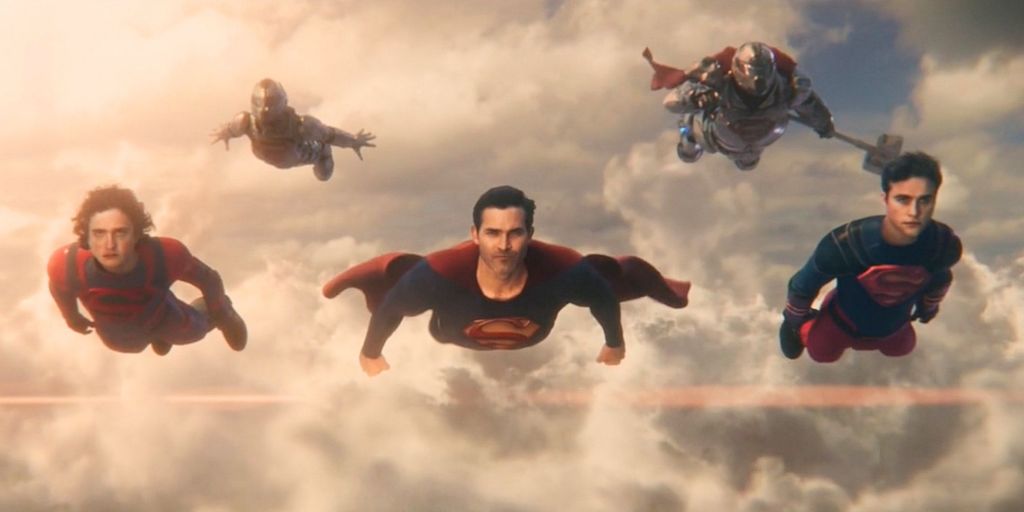
Notes: With my wife working and my son having a mountain of toys to play with and college football to watch, I decided that the day after Christmas was the time to finally finish the last season of Superman and Lois. I’m not going to to a play-by-play on these last five episodes, so let’s assume that you’ve watched these episodes that I’m watching for the first time, and I’m going to discuss my feelings about them as I watch.

In episode 6, we see Lex trying to tighten his grip on Smallville by buying up property and bribing the citizens, but they hold firm and resist – mostly because Clark wants them to do so. It’s a wonderful series of scenes in which Clark realizes something that viewers figured out several episodes ago: after seeing Lois and the boys run to Superman’s side after he was killed by Doomsday, the entire town of Smallville now knows that he’s really Superman. And best of all, every single one of them is willing to keep the secret and cover his back. It’s a great story beat, and actually one I’ve thought about several times over the years. Considering everything that he did for the town of Smallville, especially in those continuities where he had a career as Superboy, it would be utterly absurd if there weren’t a lot of people who deduced the truth. The fact that they keep the secret speaks to an inherent goodness in them, a loyalty to the hero who has saved them time and again. Plus, when we see him trying desperately to put the cat back in the bag, convincing people that he’s NOT Superman, it’s hilarious. 

Of course, there’s gotta be some drama, and the fact of his identity leaking out predictably causes some problems – kids who are resentful of Jonathan and Jordan, an antagonist from an earlier season that comes back and causes trouble. The scene where someone takes a shot at him in a diner, forcing him to reveal himself, is just glorious, and it leads to the secret being revealed to the world. When that happened in the comics I hated it, because I knew this was a genie that had to go back in the bottle and we’d seen it before. But here, when it happens on a TV series that only has three episodes left, it’s an opportunity to tell a story that hasn’t been told with Superman before, and the creators nailed it.

Beyond that, of course, another big arc in this season is the fact that Clark now has Sam Lane’s heart, and it’s reducing his powers, causing him to age. At the same time, Luthor is planning his final revenge with the combination of a new super-suit (stolen from John Henry and beefed up with Kryptonite) and the return of his Doomsday monster. It all collides in the final episode, “It Went By So Fast,” a title which I can only assume was a meta way for the writers to indicate the fact that they didn’t really want the show to end. I get it, too – this last half-season, lower on the soap opera dramatics and higher on the Superman stuff, was really fantastic, and it’s leaving me wanting more. 

They’ve done the Doomsday battle before in live action – in Smallville, in Batman V. Superman, and even before in this series…This is probably the best one I’ve ever seen. With Clark on the ropes, seeing Jonathan and Jordan step up to fight hits me in that parenting place that seems to dominate how I interpret stories these days. John Henry and Lana joining the fight as well shows how big Superman has become, how this world is rising up to meet him. He may have lost a step thanks to his heart transplant, but he’s also inspired another generation of heroes, meaning he doesn’t have to do it alone. 

And that’s just act ONE of the finale.

While Clark is chucking Doomsday into the sun, back on Earth Lex attacks the twins and Lois goes after him directly. As she shouts at him to stop attacking everyone around her when she’s the one he really wants, she yells the most Lois Lane line I’ve ever heard: “I am not afraid of you, but you’ve always been TERRIFIED of me,” then nails his warsuit with a mine. It’s not enough to stop him, but it slows him down enough for Clark to make it back to Earth and really start the final battle. It’s an epic, airborne spectacle that ends, inevitably, with Luthor taken down.

And now we’re only HALFWAY through the episode.

Next we get a time skip to about year later with Lana’s wedding to John Henry Irons (an event that would happen a few months later in the comics as well). Kyle and Chrissy are expecting a second child, and Kyle and Lana have reconciled into what appears to be a sincere friendship. Jordan and Sarah, similarly, seem to have finally buried the hatchet, and John Henry spends a tender moment with Natalie as Lois gets an important text about Lex’s future behind bars. 

In the final act, we get a voiceover from Clark about how Sam’s heart allowed him to live another 32 years, and how he wanted to leave behind a legacy, making the world a better place. Clark, along with the twins, John Henry, Natasha, even Bruno Mannheim, begin to make real change. Using the influence of Superman and Lois Lane, they start a foundation that accomplishes good throughout the world. The twins each marry and have kids of their own, and we get a nice scene of Grandma and Grandpa Lois and Clark (in admittedly dubious aging makeup). But eventually, Lois’s cancer returns, and Clark is left alone. He lasts for several more years before Sam Lane’s heart that had beat in his chest for so long finally gives out, passing away quietly with his sons next to him.

Clark sits up, young again, seeing his own body behind him. He embraces his sons – young again – and sees his grandchildren. He finds Luthor, of all people, sitting at his kitchen table, and offers him forgiveness…says goodbye to his friends one at a time, and in the end he sees a vision of Lois, waiting, to take him into the light.

Here’s the thing: the story of Superman doesn’t end. It just – it doesn’t. Five years from now, ten years, a hundred years from now, there will and should be new stories of Superman being told.

But if Superman DID end…this is the right way to do it. An ending that is happy in the life he and Lois get to lead, despite the fact that this life – like all those of mortals – must end. And the fact that a Superman left behind a better world than he arrived on in that spacecraft from Krypton. In the comic books, they can’t really do a story in which Superman changes the entire world this way, because they still need something to tell stories about next month and next year. But here, with a television series coming to an end and, with it, closing off the stories of that universe, they have the freedom to show what Superman is REALLY capable of. This season has been a buildup, showing how Superman inspires those around him – not only his own children or friends, but the people of Smallville who were willing to stand up for him, and the people of a world that grows to do the same. The ending of this episode is a tearjerker, but it’s left with a beautiful message of hope that is entirely appropriate for Superman.

But it’s not only hope. Superman is about hope, yes. But the thesis of this series is true as well: “[Love is] the thing that makes life worth living.” It’s what makes the story of Lois and Clark so powerful, in all its many iterations. A man from another world, a woman who represents the best of ours, and how they come together…this is a story worth telling. 

Comics: DC Go! Holiday Special #41

Sat. Dec. 27

Comics: DC Go! Holiday Special #43 (Cameo), Detective Comics #1103, Superman: The Kryptonite Spectrum #5, Superman Unlimited #8, Action Comics #1093, Superman Vol. 6 #33, Absolute Superman #14, Batman/Superman: World’s Finest #46, Supergirl Vol. 8 #8, Justice League Unlimited Vol. 2 #14, Justice League Red #4 (Power Girl), Justice League Vs. Godzilla Vs. Kong 2 #5

Notes: For the final time (this year), I’m going to do a roundup of recent Superman-related comics, starting – oddly enough – with Detective Comics #1103. One of the first comics I read this year, back in the first week of January, was an issue of Tom Taylor’s Detective that showed Superman helping Bruce through an existential crisis. This actually serves as a nice bookend, with Bruce teaming up with Lois to help with an investigation. Superman appears briefly, but most of the issue is concerned with Lois showing off how dang capable she is, and how much respect Bruce has for her. It’s the middle of an ongoing storyline, so it’s probably not something most people would read on its own, but it’s worth mentioning because it’s a great Lois guest appearance. 
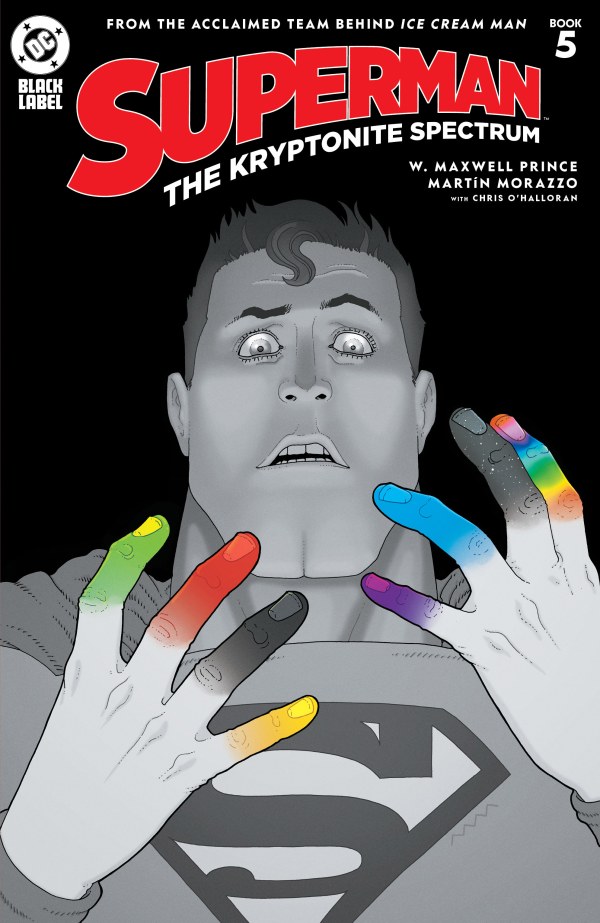
The final issue of Superman: The Kryptonite Spectrum wraps up W. Maxwell Prince and Martin Morazzo’s celebration of the Man of Steel in dynamite fashion. Lex Luthor has engineered a new Kryptonite Man, powered by the entire spectrum of the remnants of Superman’s home, and the battle between the two of them sends Superman on a spiral that leaves him questioning the very nature of the universe itself. Prince’s story leans heavily on metafiction, concentrating on Superman as a story and weaponizing that part of the character’s nature. The finale is entirely unexpected, but in its own way, as sincere a love letter to Superman as the likes of All Star Superman was – in fact, Prince and Morazzo lean heavily on Morrison and Quitely’s story here, and they do so in a way that’s both loving and triumphant. This is hands-down the miniseries of the year.
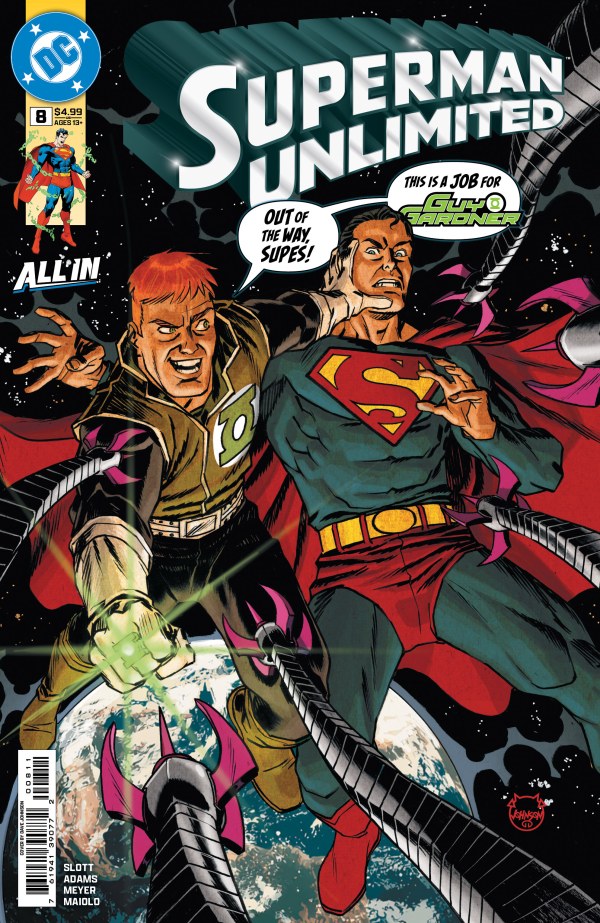
Superman Unlimited #8 gives us another of the one-off stories that this series has been doing so well. The influx of Kryptonite on Earth has changed a lot of things, including energy sources, and an experimental space flight is planning to make faster-than-light travel a commercial enterprise on Earth. With Lois Lane as a passenger on the maiden voyage, the Justice League assigns Guy Gardner to escort the flight in case something should happen. And wouldn’t you know it? Something happens. I have no doubt that Guy’s appearance in this issue is at least partially due to his guest-starring role in this summer’s big movie, but at the same time, it’s done exceptionally well. Guy is such a fun character – a rude, insufferable boor that is in every way diametrically the opposite of Superman…except for the fact that they’re both true heroes at heart. Seeing them together, both clashing and cooperating, pretty much always makes for a good time, and this issue is no exception. 
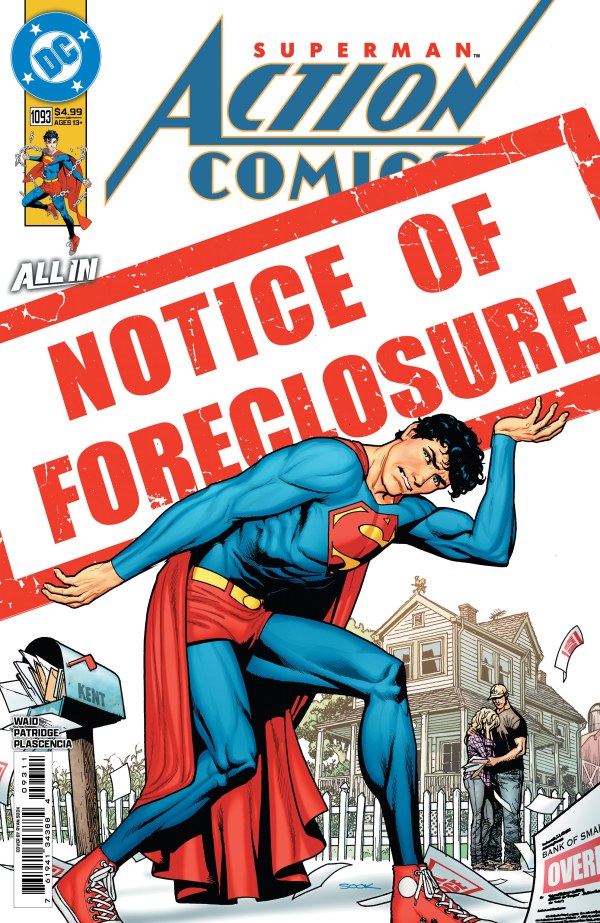
Action Comics #1093 is another one-off story, this time Mark Waid telling a Superboy tale that shows an event that’s fundamental to Superman’s moral core. Dozens of farmers throughout Smallville are given notices of foreclosure on their farms at the same time. The new owner of the bank assures them that if there’s an “error” they’ll figure it out, but the time it would take to do so would ruin every farm in Smallville. When Superboy contemplates using his power to “find” the money to save the town, it becomes a battle of wills between Clark and his parents, who think that using his powers for personal gain – even to save the town – isn’t the way to go. I’m sure that everyone who’s ever read a Superman comic has fantasized about having the power to hunt down undiscovered gold or some other get rich quick scheme, and Waid does a good job with the Kents of painting a picture of why such a thing should be above a Superman. I still have to confess that I’d probably go dig up the gold if I had Superboy’s powers, but in my defense, nobody has ever called me Earth’s greatest hero. 
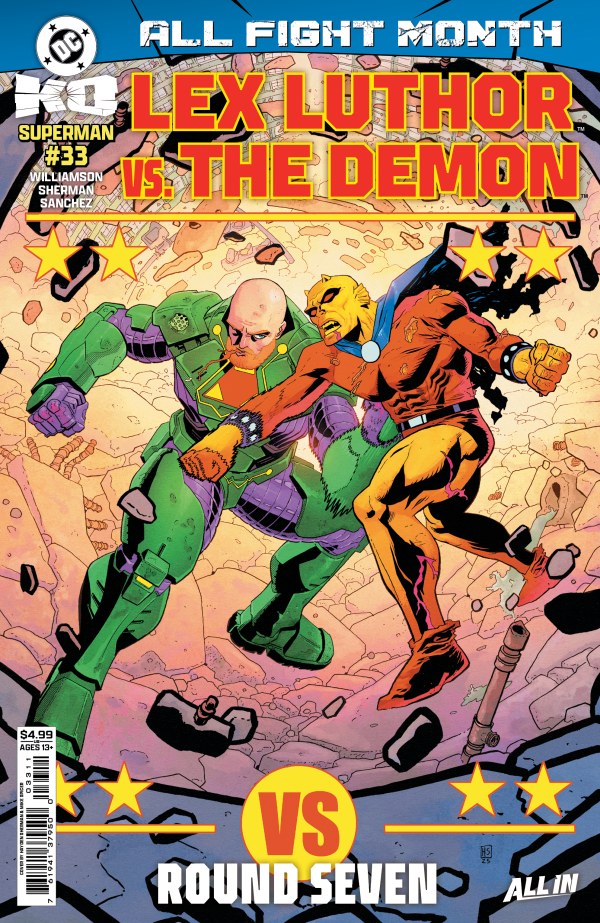
DC KO’s “All Fight Month” continues with Superman #33, with the unlikely battle between Lex Luthor and Etrigan the Demon. Throughout the month I’ve been impressed at just how well these battles have transcended being mere slugfests. Oh, there’s fightin’ a-plenty, but each of them has gone beyond that to telling a story that digs into the heart of the characters involved. We see who they are, why they do what they do, and what makes them worthy of the Omega Heart, even if it’s only in their own mind. Joshua Williamson taps into the blackness in Lex’s heart and simultaneously shines a light on him. By the end of the issue, you almost (aaaaalmost) want to root for him in his fight with the Demon, because damned if he doesn’t convince you that he’s earned the win. We also continue the storyline with Superboy-Prime and Lois, whose Superwoman powers have returned, in the Fortress of Solitude. Recent announcements about the state of the Superman titles after KO ends have made these pages a bit more relevant than we’d realized, and although I hate the fact that they keep spoiling things in the solicits, I’m very curious to see what’s coming next to this title. 

Absolute Superman #14 ends the current storyline with an epic battle between Kal-El and Ra’s Al Ghul for the heart of Smallville. As the two of them go at it, we see Lois facing off against the Peacemakers and Sol’s internal battle with Brainiac, all of which come to an amazing crescendo in this issue. Without going into a blow-by-blow, the ending of this one is probably the most hopeful thing I’ve seen yet in the Absolute Universe as a whole, although as suits this world tainted by Darkseid’s energy, the victory is bittersweet and not without a price. In many ways, it clears the table for this series, and it will be very interesting to see where the story goes from here. 

World’s Finest #46 continues the story of Lex Luthor and the Joker, fused into a single being and armed with the power of a device that gives them the sum total of all knowledge in the human race. Superman and Batman, naturally, have to step up and stop them, this time getting a little extra help from Green Lantern to juice them up in a way he’s done once before. The issue ends on a cliffhanger, and it’s a pretty good one, except for the fact that it suffers a bit from Prequelitis. Admittedly, even in the present day what happens at the end would likely be wiped out by the next issue, but when you’re dealing with a series set in the past, there’s really zero tension with the “shocking” ending. It’s still a great, fun story, though. 
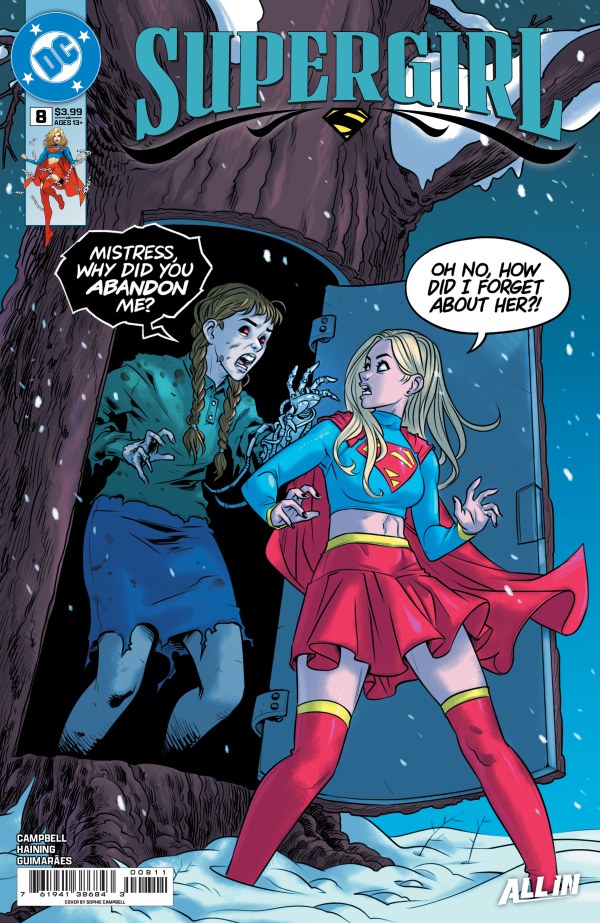
I’m going to end my tour of new comics with Supergirl #8. It’s Christmas in Midvale, but Supergirl isn’t feeling merry. The holidays, with their emphasis on family, always make her remember everything she lost in the destruction of Argo City. Still, the Danvers and Lesla-Lar do their best to cheer her up, even as they get a strange visitor from the past that Supergirl has neglected for far too long. Sophie Campbell’s Supergirl is probably my favorite new comic book title of the year, but this issue is a little atypical. While the series is usually very bright and uplifting, this issue is somewhat darker and more bittersweet, particularly for a Christmas story. That said, it works really well. Sophie takes Kara’s pain and shapes it into a valuable lesson for Lesla-Lar, whose journey to becoming a superhero is an important component of this title. The story is told well and propels the characters forward, while still giving us a little Christmas cheer in the process.

This is most likely the last I’ll talk about newly-released comics in the Year of Superman, and it’s bittersweet for me too. I’d be lying if I said I wasn’t looking forward to taking a break on January 1st, but at the same time, I’ve enjoyed pontificating about these new issues as they come out. It’s one of the main reasons I’m thinking about how to continue this blog into the new year.

Yeah, I’m teasing that again. Sue me. 

Sun. Dec. 28

Comics: Superman: Space Age #1-3
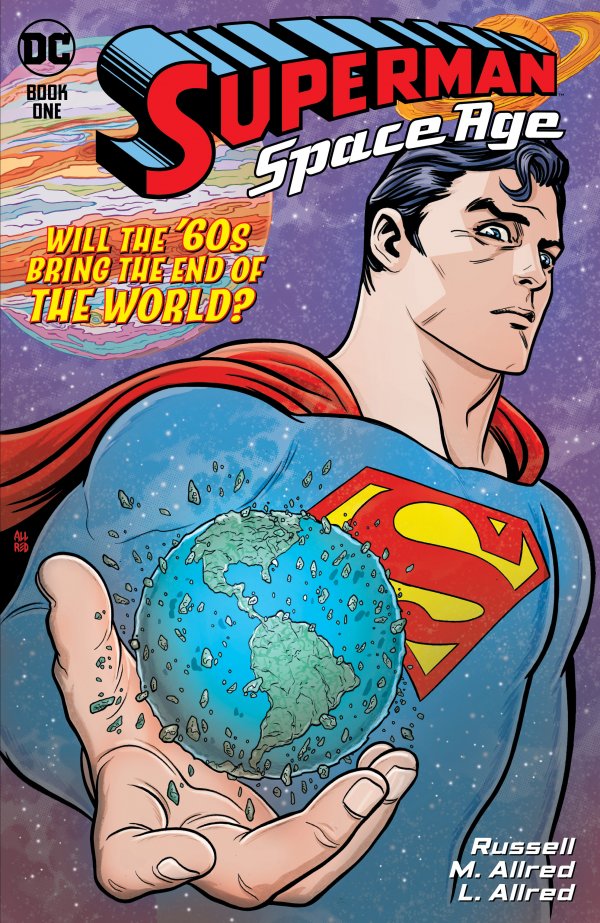
Notes: Continuing the theme of “Endings,” today I’ve decided to revisit the three-issue Space Age miniseries by Mark Russell and Michael Allred from 2022. Published as a Black Label series, like many of them, it really feels more like an Elseworlds. It’s set in a universe where Superman rises to prominence in the 1960s, with a Clark Kent that’s spurred to go out and find ways to save the world following the assassination of John F. Kennedy. Before he puts on his costume for the first time, though, he encounters a strange man called the Pariah, who warns him that the world will end in approximately twenty years. Pariah claims to have accidentally unleashed a great evil called the Anti-Monitor, an ancient being whose goal is to bring order to the Multiverse by destroying every positive-matter universe until only his own Antimatter universe remains. He tries to dismiss the Pariah as one of the “kranks” he’s assigned to cover as a Daily Planet cub reporter, but something about him sticks with Clark and he’s unable to shake it. On the other hand, he’s sometimes skeptical that the world will even last 20 years, as the arms race is intensifying and made worse by a false flag attack on Coast City orchestrated by Lex Luthor. The cataclysm turns out to bring heroes out of the woodwork: Batman captures Luthor, Abin Sur passes his ring on to Hal Jordan, Themiscyra sends Diana to the UN as an ambassador, and Superman makes his true debut disposing of American missiles before they can annihilate the Soviet Union. Book one ends with these four coming together at a new Hall of Justice.

In book two, we jump ahead to the 70s, where Superman is well-established, and the world is at peace following a nuclear disarmament treaty. But an interview with Lois leaves him questioning whether he’s doing all he can, and a similar disagreement drives a wedge in the Justice League. It’s a bad time for it too, as Green Lantern warns of the impending approach of a cosmic threat called Brainiac and, at the same time, a Superman from an alternate universe where all human life has been rendered extinct. It’s not all bad news, though – Clark is promoted to an editor’s desk at the Planet, Lois breaks Watergate, the two of them fall in love and she confesses that she knows he’s Superman just before he tells her. They even have time to get married and have a son before Brainiac arrives on Earth. But he’s not there to destroy the world, only to take its greatest resource before the Anti-Monitor can destroy it himself, hoping to use that resource in his battle against the Multiversal destroyer. That resource, as it turns out, is Kal-El of Krypton. The League drives Brainiac off the planet, but at the cost of Green Lantern’s life.

The final book in the trilogy takes us into the 80s where Clark finds Pariah again, who is impressed by his years of heroism, but still sees the end as inevitable. With less than two years before the Anti-Monitor arrives, the Brainiacs again ask Superman to join their fight, and this time, he considers it – but when a heart attack fells Johnathan Kent, he changes path, dedicating himself to saving the human race by eradicating disease by scanning their DNA. It turns out to be a ploy to record their genetic code. When the Anti-Monitor destroys the world, Superman makes for the Brainiacs’ portal, but instead of going into it he pushes through a crystal encoded with the DNA of every human he could collect, sending them to the empty world populated by the other Superman. He returns to his family just before the end, where on the other world the other Superman restores the human race on a new home.

In terms of “ending stories,” I kind of have mixed feelings about this one. On the one hand, it’s excellently done. The writing and storytelling are top-notch and the characters, even in the Elseworlds setting, still feel mostly true to the heroes we know and love. And I’ll pretty much always be on-board for artwork by Mike Allred, whose unique style is one of my favorites of all time. On the other hand, there’s an impending sense of doom that spreads across the entire thing. There are other dark “final” Superman stories, like Kingdom Come or Whatever Happened to the Man of Tomorrow?, but in both those cases we journey through the darkness with Superman and ultimately end in a place of hope. This one has a sense of nihilism that doesn’t quite befit the character. Even the ending, where the other Superman brings back humanity (starting, naturally, with Lois Lane), leaves us with the feeling that it’s only buying time. After all, the Anti-Monitor is still out there, the final battle has yet to be fought, let alone won.

The series raises some interesting questions as the different Leaguers look on things with different perspectives. Green Arrow views the world through the perspective of the “Trolley Problem,” whereas Batman’s point of view is that he just saves whoever he can, knowing he can’t save everyone. Superman, as fits the character, refuses to accept that, and is determined to find a way to save everyone even if doing so seems impossible. It’s a noble point of view that works in the regular DCU, but Russell shines a light on how unrealistic that perspective actually is. If I was looking for something realistic, though, I don’t think I’d be reading Superman in the first place. Superman is an ideal, and ideals don’t have to be realistic. They’re something to strive for, even if you know they can never really fall into your grasp, and that’s how Superman works best.

So is Space Age a good story? Yes. Absolutely. Without a doubt.

I don’t think it will ever be one of my favorites, though. 

Mon., Dec. 29

Comics: DC Go! Holiday Special #47 (Supergirl), Doomsday Clock #1-12
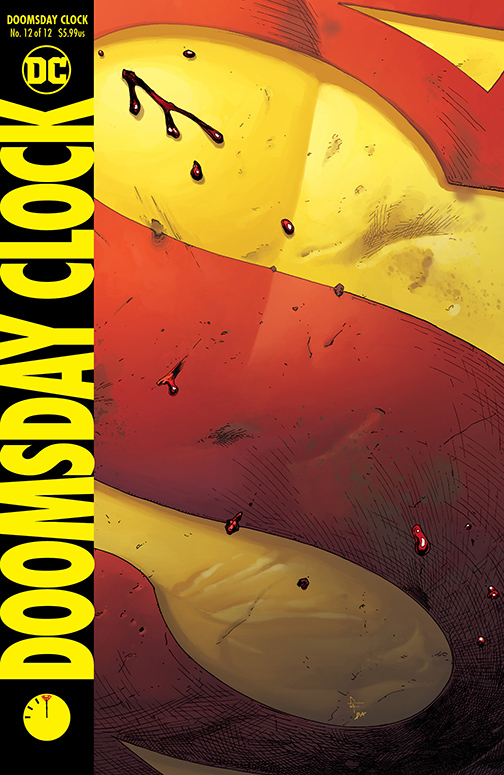
Notes: This is a controversial book, DC’s sequel to Watchmen which brings those characters into conflict with the heroes of the DC Universe, but I’m including it here for an important reason. In the end, this is very much a story about Superman. The first issue shows us the state of the world – since Ozymandias’s scheme was revealed by Rorschach’s journal, he has become the most wanted fugitive on the planet and the world has crept closer and closer to the very nuclear annihilation he was hoping to avoid. A new Rorschach has arisen, this time working with Ozymandias, who has a tumor growing in his skull. The two of them hope to find the only person in their universe with the power to change anything – Dr. Manhattan. Meanwhile, in another universe, Clark Kent wakes up from a nightmare, a horrible vision of the car crash that killed Jonathan and Martha Kent when he was only a teenager. It’s the first nightmare he’s ever had.

Ozymandias and Rorschach ally themselves with a pair of criminals – Marionette and Mime – who are seeking their missing son. They trace Dr. Manhattan to the DC Universe, where people are in upheaval following the popularization of the “Supermen Theory,” which posits the idea that the reason so many of Earth’s metahumans are American is because they have been deliberately created by the government since Superman’s first appearance. Faith in superheroes is eroding, with the only one who still has the public trust being Superman himself. 

Over the course of these twelve issues Geoff Johns and Gary Frank delve into the nature of the DC Universe itself, starting with the notion (from DC Rebirth) that it was Dr. Manhattan who was responsible for the New 52 reboot in the first place. Turns out, it’s more complicated than that. Manhattan did toy with the fabric of the universe, but the reason it was possible for him to do so is because the “Prime” DC Universe – the one that’s called Earth-0 these days – isn’t actually part of the multiverse as we know it. Manhattan calls it the “Metaverse” (take that, Mark Zuckerberg) because it’s a core reality that the others are all reflective of. In the Metaverse, Superman made his first appearance in 1938 and inspired the heroes of the Justice Society. Then reality snapped, moving Superman’s appearance to 1956. The JSA still existed, but now Clark Kent had an early career as Superboy, inspired BY the JSA, and it was that Superboy that in turn inspired the Legion of Super-Heroes 1000 years in the future. Another snap popped Superman’s first appearance to 1986, and–

–are you seeing the pattern here?

The idea is this: Superman is the center of the Metaverse. As time goes forward, his existence is the constant, and as such, the universe is in a constant state of change. But every time the universe shifts, the previous iteration is preserved in a different world in the Multiverse. The original Golden Age Superman’s world is Earth-2. Another was preserved as Earth-1985. The version Manhattan created is Earth-52, and so forth. Eventually, Superman’s timeline will catch up with the Legion a millennium in the future, and when that happens, the ideals of Superman will become universal, and create a lasting peace.

Man, that’s a nice thought, isn’t it?

This book – much like the original Watchmen – suffered from a lot of delays before it could be finished, and many of the larger concepts have been ignored since then. I don’t think the concept of the Metaverse has been explored since this book, for instance, and by its very nature it makes sense that they wouldn’t bring it up all that often. On the other hand, this book also established that Martin Stein was part of a government conspiracy to create superheroes, and Firestorm was the result of that, something that I’m almost positive has not come up again. But that’s the beauty of this book – it provides a framework that can be used to explain away virtually any discrepancy or change in continuity. That thing you remember that the heroes didn’t? It happened in a previous iteration of the Metaverse, and it’s still canon out there in the Multiverse…somewhere.

If you’re the kind of person who considers Watchmen sacrosanct, I can understand why you wouldn’t like this book. It does, in a way, undermine the conclusion of that story by answering the intentionally vague question of what would become of Rorschach’s journals, and (perhaps even more blasphemous) it allows for that world to have a happy ending. But as good as Watchmen is, I have no objection to the notion of returning to that universe. The HBO miniseries did it in excellent fashion. I like this one too, if for no other reason than because it confirms something very important: Superman is the most important hero in the entire universe.

Shoot, guys. I could have told you that. 

Tues. Dec. 30

Graphic Novel: It’s a Bird
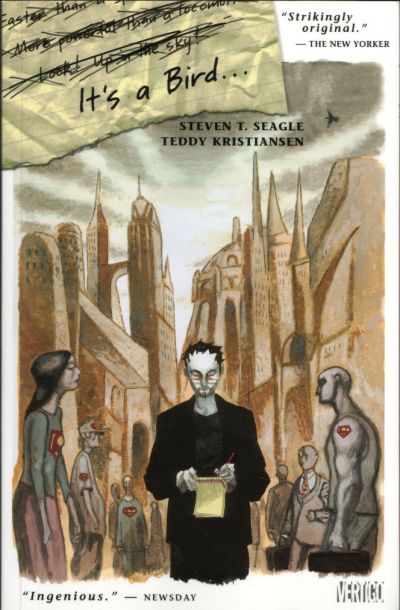
Notes: As with Doomsday Clock yesterday, I want to spend these last few days of the year with stories about Superman and about what he means. That quest led me back to It’s a Bird, the unique 2004 Vertigo graphic novel by Steven T. Seagle and Teddy Kristiansen. It’s perhaps the most unusual Superman story of them all in that Superman isn’t actually in it. 

The story, which is semi-autobiographical, starts with five-year-old Steve waiting in a hospital as his grandmother languishes. To placate him and his brother, their father brings them a Superman comic…after which, Steve swiftly rejects comics, as they remind him too much of the hospital, making it all the more ironic that he would grow up to write them. When an adult Steve is offered the job of writing Superman by his editor, he rejects it, unable to find the character relatable. 

The story is mostly about Steve trying to find his way into the Superman, and along the way he takes some interesting detours. His father goes missing, and fears of the disease that took his grandmother come back. Meanwhile, everyone he talks to about getting offered Superman is ecstatic for him and dumbfounded that he doesn’t want the job. These two threads are intercut with pages of Steve’s own musings on Superman, on who the character is and what he means – or at least, what he’s supposed to mean – as he tries to find something about the character that he can make believable in the real world. 

The interlacing storylines, of course, come together in the end, because such things always happen in fiction even if they almost never do in real life. His father’s disappearance turns out to be related to the death of Steve’s grandmother all those years ago, and in confronting his father and the disease that haunts his family, Steve starts to find a way in to Superman. 

It’s a good story, a powerful one, but it’s one whose inherent premise is one I somewhat disagree with. Steve’s quest is to find a way to make Superman “real.” I don’t think that’s necessary. Superman isn’t part of our real world any more than Mickey Mouse or Bugs Bunny or the food replicators on Star Trek. That doesn’t mean that he isn’t important, though, or that there’s nothing to be learned from them. In a lot of ways, I think the very fact of Superman’s fanciful nature is perhaps the most important thing about him.

Just as the story is very atypical for a Superman comic (such as it is), so is Teddy Kristiansen’s artwork. Kristiansen’s style is an odd halfway point between sketches and realism, in some ways making me think of Art Spiegleman…which is appropriate enough, as this book echoes Maus in various ways. Both stories are autobiographical, and with a frame narrative about the author struggling to relate to their fathers. In Maus, of course, the ghost that hangs between Art and his father is the spectre of the holocaust, while in this graphic novel it’s the shadow of the Huntington’s Disease that follows Steve’s family.

The book, of course, is specifically described as “semi-autobiographical.” Not really knowing much about Seagle himself, I wouldn’t presume to declare which parts are true and which ones aren’t, but regardless of any plot elements I tend to believe that all of the emotion in this book is genuine. The concerns, the fears, the anxieties that “Steve” expresses are almost certainly part of Seagle’s own psyche. Writers tend to do that, after all.

This is the Superman book for people who don’t understand Superman. I don’t know if, in the end, it will actually help them figure the character out – at least, not the way that I understand him – but it will at the very least help them find a path through someone else asking the same questions, and that’s a journey very much worth reading. 

Comics: Harley Quinn X Elvira #3 (Power Girl guest appearance), Justice League Red #5 (Team Member Power Girl), Justice League Vs. Godzilla Vs. Kong 2 #6 (Team Member)

Wed. Dec. 31

Comics: Superman #247, Kamandi: The Last Boy on Earth #29
Notes: Well glory be, here it is. 365 days later, and the journey I started back on January 1 with Action Comics #1 is about to end…or at least, to evolve. I’ll talk more about that (say it with me) later, but for now, it’s time for the final Superman reads of the year. I thought hard about what to read today. In the early part of the year I’d planned to end it with a classic “last” Superman story, like Whatever Happened to the Man of Tomorrow? or Kingdom Come, but I decided to add those when I did the week of comics that influenced James Gunn’s Superman. So how else to end it? I ultimately decided to go with two comic books about what Superman is, because that’s where this entire journey has led me anyway.

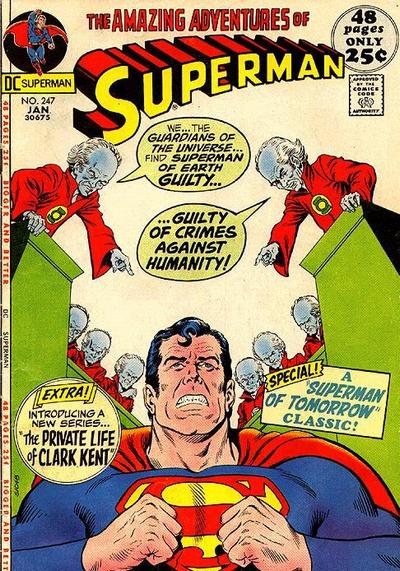
First is Superman #247, the Elliot S! Maggin/Curt Swan classic “Must There Be a Superman?” Like many of the stories I’ve read this year, I encountered this one for the first time when it was published in DC’s classic Greatest Superman Stories Ever Told collection. Let’s talk about why it qualifies. 

The story begins with Superman taking on a special task for the Guardians of the Universe – a pod full of deadly spores on a path to Earth, and as the spores are yellow the Green Lanterns are helpless to stop it. Superman creates an artificial planet to draw the spores away safely, but is injured in the process, rescued by Green Lantern Katma Tui and brought back to Oa to heal. As Superman is healing, the Guardians take advantage of his unconscious state to plant a notion in his mind that his influence on Earth may be impeding human progress. (If this had been the “Year of Green Lantern,” you would have found me discussing a LOT of stories that drive home an important point: the Guardians are pompous assholes.) When Superman wakes up, the Guardians give him a tour of Oa, continually dropping comments about him contributing to a “Cultural Lag” on Earth, and sending him home with the notion that if he steps back, Earth will be better off. 

As he returns to Earth, he stumbles on a child migrant worker being abused by his employer. Rescuing him, the child – Manuel – brings Superman back to his community where the residents begin begging him to help solve all their problems, such as fixing their crumbling houses. Superman refuses, saying that they need to know how to care for themselves, but an earthquake strikes just seconds later, destroying their homes. Superman blunts the quake and rebuilds their houses, but tries to convince them that they need to know how to care for themselves because no one – even Superman – can do anything. He returns to Metropolis only to get word of a cruise ship endangered by a waterspout, which he rushes off to save, even as the Guardians watch from afar.

Looking back at this story now, I feel like this was Maggin’s way of responding to people who asked why Superman didn’t just sweep in and fix all the problems in the world. After all, with his power, why couldn’t he just solve hunger, homelessness, war, famine, disease, and so forth? From a narrative standpoint, of course, the answer is obvious: if Superman were to do all these things, what stories would be left to tell? It would literally be the end of Superman, as a going storytelling concern. But what about in-universe? How do you explain it to a kid like Manuel, who’s getting beaten up by a man who basically controls his entire life? The answer is something that people who know Superman could have told you from the beginning: even with the best of intentions, having someone (like Superman) doing everything for them would hold them back, leave them unable to act or take care of themselves. It kind of reminds me of all those stupid ads begging me to use Google AI to write an email or a Facebook post as if I haven’t been perfectly capable of doing that for my entire life. 

Superman is there to take care of the things that we can’t. As far as the things we CAN take care of…we shouldn’t expect him to do it all for us. But that doesn’t mean we can’t take inspiration from him.
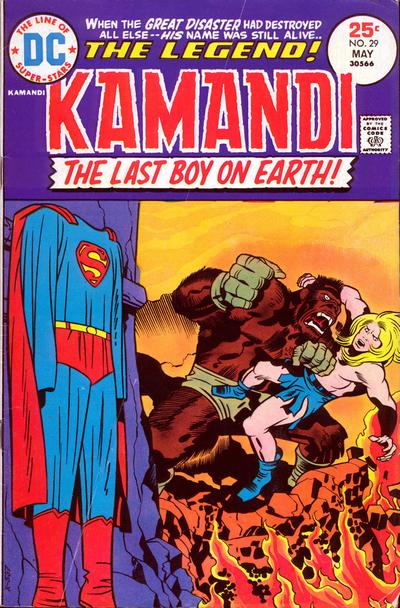
“Inspiration” is the theme of the final comic I’m going to read in this year of Superman, Jack Kirby’s Kamandi: The Last Boy on Earth #29. Kamandi, for the uninitiated, was a series about a post-apocalyptic world in which the human race is all but extinct, and the world is populated by anthropomorphized animals. In this issue Kamandi, one of the few remaining humans, finds the “Tablet of Revelation,” an ancient carving that prophesies the “return of the Mighty One,” a great warrior of the past. When the apes see Kamandi’s friend Ben Boxer, they believe him to be the returned “Mighty One.” One of the apes, Zuma, tries to engage him in combat, but the elder says that the Mighty One can only be revealed by demonstrating his powers against overwhelming odds. A catapult hurls claimants through the sky to prove that they can fly higher than the tallest building, an enormous boulder called the “Daily Planet” awaits the man who can move it, and so forth. Ben’s mutant powers convince some of the apes he’s the Mighty One, but a battle breaks out when they pledge to take him to his suit. In the fight, they come across a very familiar blue costume with a cape and a brilliant scarlet S-shield. Zuma tries to claim the costume, but perishes in battle as Kamandi defends the suit, saying “I know who owns it! I know that somewhere he’s still alive!” The suit is left, waiting until the true Mighty One returns.

This comic was released in 1975, some 30 years before the idea of the S-symbol standing for “hope” was put in place, but it’s hard not to think of it as you read this story. Kamandi’s faith that Superman is still out there is the sort of thing you’d expect, it feels like an appropriate place for the legend. The future of the DC Universe has been rewritten dozens of times, of course, with many of the various possibilities showing an immortal Superman, a legacy of heroes that lasts a millennia, or both. This feels like part of that, like the hero himself has left something behind with the promise that more is to come.

And that “promise of more to come” feels an appropriate place for me to stop.

Almost.

Movie: Superman (2025)

Notes: The first movie I watched this year was the original Christopher Reeve Superman from 1978. I’m going to end the year by revisiting the movie that inspired me to start this journey in the first place, James Gunn’s Superman. I’m not going to write it up again – Heavens knows you can find that on my original review. But I’m going to watch and enjoy.

One year later, and I have succeeded. I have watched, read, or listened to at least one thing starring or about Superman or a member of his family for an entire year. I’m actually quite stunned that I made it.

And I’ve still got so much to say.

But not yet. Come back Friday, friends, for my final thoughts on this year-long Odyssey, and my explanation of where I’m going from here.

Happy New Year. 

Blake M. Petitis a writer, teacher, and dad from Ama, Louisiana. His most recent writing project is the superhero adventure series Other People’s Heroes: Little Stars, volume one of which is now available on Amazon.

Year of Superman Week 50: Everything Everywhere All At Once

It’s the last somewhat “random” week of the year, my friends. With only three of these blogs left before the Year of Superman ends, I’ve got plans for weeks 51 and 52 – that means I’ve got seven days to scratch as many other items off my list as possible. And you know, I’ve narrowed down that list substantially over the last 49 weeks, but there are still a lot of things I haven’t gotten around to and, frankly, I know that I WON’T get around to before the year is out.

But you know, that’s okay. Just because the year is ending doesn’t mean I’ll stop talking about Superman.

More about that later, but for now, let’s jump into this week’s journey, shall we? 

And as always, you can check out earlier blogs in the Year of Superman Archive!

Wed., Dec. 10

Graphic Novel: Superman: The World

Notes: This is, I believe, the third installment in DC’s “The World” series of graphic novels, following Batman and the Joker. The concept here is that different creative teams from all over the world are invited to contribute short stories about the title character of the anthology. It’s a neat idea that, in the first two volumes, showed us some interesting perspectives on the titular characters. Let’s take a look at what creators from all over do with the man of steel.

The book starts with Dan Jurgens and Lee Weeks (who also did the Doom Rising graphic novel I read yesterday) contributing the American story, “Let Slip the Dogs of War.” Lois and Clark are on a flight into Metropolis (a tedious and frustrating enterprise for Clark) when their plane is diverted due to what appears to be a kaiju attacking the city. Superman, of course, gets out to do his thing, and discovers that the creature may not be the threat people take it for. It’s a very Jurgens-esque story, with a great big honkin’ alien and Superman being Superman in the most Superman way possible. I’ve made it abundantly clear that I don’t think there’s a creator in comics who gets Superman better than Dan Jurgens, and this is one more example of that.

Spain’s Jorge Jimenez contributes “Superman in Granada.” After stopping a meteorite from hitting Earth, Superman’s powers are neutralized and he finds himself stuck in Spain for about six hours before the effects wear off and he can get home. The story is partially a travelog about how beautiful and welcoming the city of Granada is (and Jimenez and colorist Alejandro Sanchez 100 percent sell you on that concept), while the rest of it is about Superman getting by in a place where people don’t quite believe who he is, because let’s be honest, if you saw a guy in a Superman costume walking around and trying to explain that he can’t fly at the moment, you probably wouldn’t believe him either. This one is really very sweet.

“Superman’s Inferno” comes from Italian writer Marco Nucci and artist Fabio Celoni. Lois and Clark are in Italy on the 700th anniversary of the death of Dante, author of the Divine Comedy, a day in which it was prophesied that a portal to Hell would open and flood the world with demons unless a lost incantation is recited. Lois dismisses it as legend, but Clark is uneasy, and when the clock strikes midnight – sure enough – the city is hit by an earthquake. The story traces Superman’s journey through the nine circles of hell – nice, if a little on-the nose. And the revelation of the “incantation” is perhaps just a shade too cute, but still clever. The artwork is top-notch, though, a journey through Hell that’s perhaps a little on the cartoonish side, but tells the story very well. 

From Serbia, writer/artist Stevan Subic gives us “My Choice, Protecting the Light.” With his super-hearing, Superman picks up someone in Serbia threatening violence against another person who describes themself as “Superman’s friend,” trying to prevent the other from obtaining Kryptonite. This story is a little weak. Although Subic goes out of his way to say that the people of Serbia are Superman’s friends and to have Superman call them honorable, we don’t really SEE any of them, except a brief glimpse of the guards protecting the Kryptonite. It’s very much a case of telling instead of showing. The story would have been served better had the people taken a more active role in the fight scene, interacting with Superman and his mystery adversary a little bit more, rather than keep it so contained. 

Cameroon’s writer Dr. Ejob Gauis and artist E.N. Ejob are the creators of “Chariot of the Gods.” A week after Superman stops a villain in Cameroon, damaging an ancient statue in the process, he is being forced into a battle against one of their champions. By breaking the statue, Superman cut the people off from their gods, and only a judgement by combat can complete the restoration ritual. The story is a bit of a treatise about respecting the boundaries and traditions of other cultures. It’s a little disjointed – like, why couldn’t anybody TELL Superman what the big deal was about the statue BEFORE they started punching each other? – but overall it works. 

Rana Daggubati and Sid Koitan give us India’s entry, “To Be a Hero.” A young Superman, just a year into his career, is in India as Clark Kent when he gets invited into an expedition to find a lost civilization. When they come across it, though, they’ve been beaten by outsiders looting the temple of sacred artifacts. I really liked this one – a short, simple story of Superman doing the right thing with great artwork and a color scheme that feels like this was originally produced for the Red and Blue series, which of course is magnificent all around. 

Mauro Mantella and Augustin Alessio are the creators of Argentina’s “The Last Seed of Krypton.” While Clark is in Argentina chasing a story, an energy-creature from what turns out to be a yellow Kryptonite meteor bursts free and attacks Superman, disrupting his powers as yellow Kryptonite does. The creature turns out to be a Kryptonian equivalent to Swamp Thing, hoping to merge with Earth’s Green. There are good ideas in this story, and I quite like the contradictory narration of Superman trying to find a way to defeat a foe whilst that foe sees him as a “Kryptonian brother” trying to bring him a gift. But it’s never quite clear why they’re fighting in the first place, other than the creature frightening people. There doesn’t seem to be any THREAT in allowing it to merge with the Green, or if there is, it isn’t made explicit. There’s also a point where Superman – his powers dwindling – has to find a way to amplify moonlight to recharge himself. Cool idea, except that nobody seemed to let the colorist know that this scene was supposed to take place at night – it seems to be broad daylight outside. There’s something here, but the execution falls kind of flat. 

Turkish writer/artist Ethem Onur Bilgic’s story is “The Hero and the Bull.” Lois and Clark – who are seriously piling up Daily Planet travel expenses in this book – are in Turkey for a history symposium. A group of mercenaries is going after some sacred stones in this one, which can be used to summon a being from antiquity. This one is pretty cut-and-dried – bad guys want to use an old artifact to do a bad thing, Superman stops the bad thing. No twists or surprises, but it’s well done and the art is great.

“Superman in Paris” is by Sylvain Runberg and Marcial Toledano Vargas. Clark has taken Lois on a trip to France to visit an exhibit by her favorite artists, but King Shark swims up the Seine looking for a meal on the logic that French food is the best food in the world, the French people eat French food every day, therefore French people should be the most delicious prey on the planet. I mean…I can’t really fault that logic. It’s a funny story with a fairly standard Superhero fight in the middle of it. Again, though, the artwork by Vargas is top-notch.

Brazil’s Jefferson Costa writes and draws “The Red Mantle.” Clark is in Rio seeking an ancient artifact – the titular “red mantle” – that has been stolen from a museum exhibit. He winds up getting into a philosophical debate with the thief. It’s okay, but I’m starting to wish that DC had put a cap on the number of stories that deal with “an ancient artifact” in this book. I get it, the point is to showcase the culture of the creator’s country of origin, but how many times in a row can that fall on some sort of piece of antiquity being either misused or misunderstood?

“Marzanna” is Poland’s contribution, written by Bartosz Sztybor with art by Marek Oleksicki. In Poland, on the last day of winter, an effigy of the winter goddess Marzanna is drowned in effigy to signal the beginning of spring. But Clark Kent is there because for decades now, every year, a woman has gone missing on that day only to be found later, drowned in the river. You’d think somebody would have pieced together the link between the two before then, don’t you? Anyway, Superman finds some people trying to kill a live woman, believing that the effigy is not enough to prevent eternal winter, and he ends up fighting Marzanna herself. Now this is a good example of what I’m talking about – the story is deeply rooted in Polish culture, but it’s totally different from “watch out for that ancient artifact.” More of these, please.

Bernando Fernandez of Mexico is the creator of “To the Left of the Hummingbird.” In a story with delightfully cartoonish artwork, Clark is in Mexico City to write about the local street food scene (I really want his job), when the city is rocked by a series of Earthquakes. The quakes turn out to be the result of Huitzilopochtli, god of War, sending his harbinger beasts (which look an awful lot like elephants) to prepare the people for doom. You know, as good as “Marzanna” was, this story is making me realize that “Superman fights local god” is just as prevalent in this volume as “Superman deals with ancient artifact.” In some of the stories, like “The Hero and the Pull,” there’s even overlap. Come on, guys, how about a little variety? All that said, this story is really well done, and the ending has a nice, clever little twist that sets it apart. 

“Man of Kruppstahl” is next, from German cartoonist Flix. (“Stahl” is German for “steel.” I checked.) Perry White gets a letter from Heinrich Rupp claiming that he’s invented steel stronger than Superman, and has even sent three plane tickets so they can send a team to check it out. For the first time in this book, someone other than Perry is footing the bill. That’s nice. Anyway, he sends Lois, Clark, and Jimmy Olsen to Germany to investigate the “K-Ruppsteel.” Rupp unveils a giant cage and has a “randomly selected lady” (Lois) tossed into it to demonstrate how tough it is, claiming that Superman MUST be afraid of his invention, or else he would be there. This flawless logic aside, Superman of course shows up to show his “metal.” Get it? Ah? Anyway, it’s a cute little story with wonderful artwork, provided you don’t think too hard about the logic behind it.

Stepan Kopriva and Michael Suchanek of the Czech Republic are behind “If Nihilism is the Answer, What is the Question?” which sounds like the title of an original series Star Trek episode. And in fact, the story takes place in the far future aboard a Czech space station, when an older Superman is summoned to protect the station from a meteor swarm. He becomes embroiled in a conflict between residents of the station who are happy to have him there and others who see him as a symbol of imperialism there to subjugate their autonomy. I admit, I don’t know much about Czech politics, but I get the distinct impression that this story is intended to be a satire of some common issues in that country. If anyone out there knows more about the topic than I do, let me know if the satire lands. That said, I like this story and I especially liked Suchanek’s design for the older Superman. It’s a great look. 

The last story is the fifth chapter of the Japanese Manga series “Superman Vs. Meshi” by Satoshi Miyagawa and Kai Kitago. I covered the first chapter of this series earlier in the year. If you missed that blog, the story – and in fact, the entire series – is about the fact that Clark Kent loves Japanese chain restaurants and ducks over to Japan for lunch whenever possible. I’ve read this entire series on the DC Infinity app and I do enjoy it, but it’s still one of the most bizarre Superman projects I’ve ever seen. In this issue specifically, he gets there a little too late to go to his favorite restaurant, and instead discovers the wonders of Japanese convenience store food. 

As with any anthology, the quality varies from story to story. Some of them are great, and none of them are true duds, although as I said, I would have liked a little more variety in the basic premise for some of them. Boy, the Japanese entry averts that problem, though. 

TV Episode: Superman and Lois Season 3, Episode 10-11.

Thur., Dec. 11

Comics: World of Metropolis #1-4, DC Go! Holiday Special #3 (Supergirl and Superwoman of Earth-11), Justice League of America #52

Notes: Earlier this year, I covered John Byrne’s four-issue World of Smallville miniseries for Mother’s Day, as it was (sadly) one of the few stories I could find that gave a real focus to Martha Kent. But this was actually just the middle series in a trilogy that Byrne wrote in order to flesh out the new continuity he’d crafted for Superman with the oft-mentioned Man of Steel reboot. The first miniseries was World of Krypton (which took its title from one of DC’s early miniseries in the pre-Crisis days), and the trilogy wrapped up with World of Metropolis, written by Byrne with art by Win Mortimer. I’m going to dip my toes into this one today, four issues that each focus on a different member of Superman’s Metropolitan cast, beginning with Perry White in “A Reporter’s Story.”

After praising Jimmy Olsen for bringing in a front-page story about Superman beating one of those hulking bad guys that show up all the time, Perry comes across another story about LexCorp expanding into Ho Chi Minh city. Lex Luthor’s continued success bristles Perry, triggering a flashback to the time when Perry White, a young reporter at the time, came home after a year and a half away covering stories in an overseas warzone. Perry has a happy reunion with his girlfriend, Alice Spencer, not knowing that during his absence she’d been romanced by Lex, who deliberately kept her in the dark about Perry’s whereabouts or even if he was still alive. Perry is distraught when he learns his old friend Lex is planning to sell the Daily Planet. Luthor offers Perry a job anchoring the news on his TV station, but Perry demands that he’s a newspaper man. As he’s leaving, Lex has one of his many female assistants bring Alice an earring she left there before, revealing their dalliance. Perry and Alice reconcile and he finds an investor to buy the Planet and keep it open, but Lex still considers the victory his when Alice announces that she’s pregnant. 

The story of Jerry White, Alice’s son whose fatherhood is somewhat ambiguous for a while, would become a running subplot in the late Byrne and post-Byrne comics for a while. The discovery that Lex was Jerry’s true father drove a wedge between Perry and Alice, and Jerry’s subsequent death only made it worse. Their marital woes became a running subplot for years in real time, and eventually led to them bonding over adopting a young boy, Keith. It’s interesting how something that was such a big element of the comics for so long started here in this spinoff.

Issue #2 is the Lois Lane spotlight, “How I Spent My Summer Vacation.” In flashback 15-year-old Lois Lane dragged her little sister with her to the Daily Planet office and tried to get a job out of Perry White, now the managing editor of the paper. He tells her to come back in about ten years, but on the way out Lois hears some men discussing something happening at LexCorp, and how anyone who scores that story will get major points with Perry White. Lois sneaks out that night and breaks into Luthor’s tower to try to find some sort of evidence. Although she’s captured with relative ease, Luthor is impressed by the fire he sees in the girl. She manages to sneak out a single slip of paper with information that impresses Perry as well, and she lands her first job. 

Let’s hear it again, folks: “THIS is the way Lois should be written.” She’s smart and she’s gutsy, but at 15 she isn’t yet wise. In fact, it’s that teenage illusion of immortality that fuels this story, showing how she stumbles into a situation that could very well have gotten her killed in other hands. Byrne’s Lois kept her gumption when she grew up, but added the experience that would have kept her from ever making such childish mistakes. It’s a good look on her. 

Lex comes across much worse, though, practically salivating over video footage of Lois having her clothes shredded and searched by one of his employees. It would be bad enough if he did that with adult Lois, but doing it to the 15-year-old adds an additional level of creepyness that I suppose has far greater weight today than it did when this was written in 1988. And while I often make the point that villains in fiction should be expected to do villainous things, this was perhaps a bridge too far. I don’t know that this particular plot point was ever referenced outside of this issue, and I doubt that it ever would have passed editorial if the comic came out today.  

Clark Kent steps up in issue #3, “Mr. Kent Goes to Metropolis.” When he first arrives in Metropolis, young Clark Kent notices a shootout between the police and some criminals with heavy ordinance, holed up in an apartment building. Not yet having adopted his Superman identity, he tries to stop the shootout discreetly before he has to make it for an interview to enroll in Metropolis University. One night he spots a woman being chased by a car, but she escapes without his help. He does happen to overhear her name and where she works, though – it’s Lois Lane of the Daily Planet, and seeing her inspires Clark to pursue journalism. 

This issue isn’t as solid or direct a story as the first two, with a large portion given over to a subplot about Clark getting a job at a diner through college, a waitress there getting a crush on him, and the fact that in the modern day they’ve remained friends, with her kids (with her husband Ed) even calling him “Uncle Clark.” Sweet story, very humanizing, but kind of forgettable. We’ve definitely seen this kind of thing with Clark Kent before.

Jimmy Olen gets the last story with “Friends in Need.” After Jimmy gets into one of those scrapes he’s always getting himself into, he summons Superman with his signal watch for a little help. After he’s safe, Jimmy remembers four years ago, when he came up with the idea for the watch in the first place. Only 14 at the time, Jimmy has a job as a copy boy at the Planet, sneaking out of his house to prove himself to folks like Lois and Clark, who is celebrating his one-year anniversary at the paper. The sneaking out gets him in trouble with his mom, but as she’s chewing him out Jimmy is visited by a troubled classmate, Chrissy, who has taken a bottle of pills and is fading fast. Jimmy’s mother tries to call emergency services, but she can’t get through, and Jimmy breaks the phone in frustration. As his mother rushes out to try to hail a car for help, Jimmy uses his radio kit to send out an ultrasonic signal that Superman hears, summoning him to get Chrissy to the hospital just in time. Jimmy, of course, adapted the technology into his signal watch, and today Chrissy has been taken out of her abusive home, giving her a happy ending of her own.

There’s some nice stuff in here, particularly in showing how clever Jimmy Olsen can be. For instance, a conversation with Lois has them questioning why Superman’s face is always blurry in photos, and just how it is that Clark gets so many Superman stories. Jimmy floats an…interesting idea that Lois quickly shoots down (in a fun reversal of the old Silver Age paradigm of Lois trying to prove that Clark is Superman). And of course, his quick thinking to save Chrissy’s life helps show off some technological skills that help flesh out the character as well. Too many writers forget that and just write Jimmy as some boneheaded kid, and “Superman’s pal” deserves better.

TV Episodes: Superman and Lois Season 3, Episode 12-13.

Fri., Dec. 12

Comics: Action Comics #309, DC Go! Holiday Special #4 (Bizarro and Earth-23 Superman)

Notes: I’m gonna be honest, I’m swamped today. I had work, of course, and working in a school in those three weeks between Thanksgiving and Christmas is like working backstage on the Muppet Show, only less organized. Later, I’ve got to take my son to basketball practice, and we’re following that up with our annual trip to Lafreniere Park and their lovely family Christmas Light display. So I need something quick to read. I choose Action Comics #309 from the remains of my list, the famous story where Superman tells his identity to – well, I’ll do my recap. 

The story begins with Clark receiving a letter for Superman from the President of the United States, who is asking him to recover the nose cone from a recent spaceflight to be presented as a gift to an astronaut on a TV show. This begins a series of chores where he’s asked to find different items to give to the honorees of the TV show, but when he arrives at the studio he discovers that everyone – even the President – was bamboozling him to keep him busy, as HE, Superman, is the first honoree on Our American Heroes. The show goes off as sort of a take on This is Your Life, as Superman is visited by friends such as Richard Parker (retired Smallville police chief whom he worked with as Superboy). Next come the three LLs in his life – Lois Lane, Lana Lang, and Lori Lemaris, then Supergirl and the Super-Pets. Before Superman can summon a robot from his fortress to appear on the show as “Clark Kent,” he overhears Lois and Lana planning to use a device that detects electronics to prove that he and Clark are the same person. As the show goes on, Superman meets more and more of his friends: the Kandorians, Pete Ross, Jimmy Olsen, the Legion of Super-Heroes, and Batman and Robin. But every possible replacement “Clark” is scratched off the list since they’re already there: his Kandorian double, the shapeshifting Chameleon Boy, Batman…even Pete (who Superman doesn’t know knows his dual identity) assumes that Superman will just summon a robot.

But sure enough, at the last minute, Clark Kent walks across the stage, baffling Lois and Lana when their device fails to register him as a robot. As the show ends, Superman takes “Clark” backstage, where he removes the makeup to reveal the one man that Superman recently did a favor for that he knows he can trust with his identity: President John F. Kennedy.

It was a more innocent time, friends. 

The story is fun, but as often happened in the Silver Age the writers took some wild swings to justify cancelling out anybody who could have helped Clark in his predicament. The Legion has to go home to deal with an emergency, so Chameleon Boy couldn’t stick around. (They have a TIME MACHINE. Why do they have to go NOW?) Batman takes off his mask to show that he’s wearing Bizarro makeup because he thought it would be funny to show Lois Lane what a Bizarro-Batman would look like. After all, we all know just what a wacky prankster the Batman can be. Unfortunately, it would take far too long to take off the makeup and replace it with a Clark Kent disguise, so he’s no good either. It’s just a symptom of the storytelling – when you start with the end, that being “Superman needs the president to pretend to be Clark Kent,” you might just have to jump through some ridiculous hoops to make it work.

We also get a Supergirl story in this issue, “The Untold Story of Argo City.” After a visit to the Midvale Orphanage were she lived before she was adopted by the Danvers, Supergirl has dreams of her parents Zor-El and Allura, pleading with her and telling her they’re alive. Frightened by the dream, Supergirl ventures into the Phantom Zone, believing them to be there. The hordes of Kryptonian villains who inhabit the Zone taunt her, telling her that her parents ARE there, but they refuse to help. Leaving the Zone, she uses an invention of Superman’s that allows her to see the past to view Argo City’s destruction. As it turns out, before Argo died of the Kryptonite radiation from the ground beneath them, Zor-El found a different frequency of the Phantom Zone which he called the Survival Zone, but only he and Allura made it there in time. Now that they have found a way to contact their daughter, Supergirl vows to help her parents get free some day.

And she did, eventually, but that’s all pre-Crisis stuff. It didn’t happen that way anymore. Still fun to read, though. 

Sat., Dec. 13

TV Episodes: Superman and Lois Season 4, Episodes 1-5.

Notes: My goal, I don’t mind telling you, is to include the final episode of this series in the last week of 2025. It’s going to be a week of endings, and I’ve heard a lot of great stuff about the finale of the series as a whole, so I’ve got high hopes.

I haven’t written too much about the last several episodes, even as I was watching them, but starting the final season feels like a good place to do a sort of recap. The Big Bad of season 3 of Superman and Lois actually turned out to be cancer, as the bulk of the season was taken up with Lois battling the disease. This ran parallel with a subplot about mobster Bruno Mannheim, who happened to own the hospital where Lois was being treated. She also befriended a fellow patient that turned out to be Bruno’s wife, and Natalie started dating a really nice, charming guy who turned out to be his son. It’s the sort of string of coincidences that we only accept in TV Land.

The Lois storyline, I admit, was effective. There was a good amount of sincere emotion built into it, with everything building up to a crescendo a few episodes before the finale. Then in the last two episodes the season went into a totally different direction: Mannheim’s downfall revealed information that exonerated Lex Luthor, who has been in jail for 17 years following an expose that Lois wrote about him. In those last two episodes he was released, threatening Lois. The last episode ended with a cliffhanger – Sam was kidnapped and Superman wound up fighting an awfully Doomsday-esque monster that was created through the systematic torture of the awfully Bizarro-esque Superman from another world from season two.

The third season kicks off with Luthor continuing to spread his threats, Sam in Luthor’s captivity, and Superman missing – the last glimpse we got of him is his tattered cape floating on the surface of the moon. If they’re going for another version of the Death of Superman story, they deserve credit for taking it in a very different direction than any of the previous iterations. But as they go through it, things get DARK. Sam is beaten and tortured by Lex, and he’s tossed into a grave to be buried alive with Lex giving the order to keep the sand wet to make it more painful. The boys are desperately looking for any sign of their father or grandfather, and Lois confronts Lex again, where he expresses his plan to move to Smallville permanently. Fortunately, Jordan’s super-hearing picks up on Sam choking and he and Lois manage to save him just in time. Still no sign of Clark, though. Not until the final moments of the episode, where Doomsday (is he officially Doomsday? Imma call him Doomsday) beats him into submission, then brings him back to Smallville and drops him in the middle of the street in front of Lois and the twins, then bounds away to give Luthor Superman’s heart as ordered to do. Lois, Jonathan, and Jordan fall to their knees in tears as the people of Smallville watch.

The opening of this final season is nicely tense, but there’s something seriously missing: the rest of the cast. After building a strong group of characters with John Henry, Natalie, and Lana Lang’s family in the first three seasons, the producers relegated everybody except for Lois, Clark, and the twins to “recurring” status, none of them having more than a handful of the ten episodes to their credit. It feels like a cheap money-saving measure, honestly, and while the episodes I’ve watched thus far aren’t bad, there’s a definite sense that things are missing. I’m hoping that their few remaining appearances will be enough to give their respective stories a sense of closure. 

The second episode begins with Lana getting everyone in town to back off as Jordan brings his father to the Fortress, pleading with the AI of Lara to save him. Despite the fact that he’s literally missing his heart, she promises to do all she can and puts him into stasis. When he returns home, he tells Jonathan that the only way to save their father is to find the heart that Doomsday ripped from his chest. The whole episode is a cat-and-mouse game between Luthor and the Kents, and…

It’s definitely not going in any direction I could have predicted. I’m looking forward to how this shakes out. 

Sun., Dec. 14

Comic Book: Superman: Under a Yellow Sun #1

Notes: Although it doesn’t come up very often these days, in the early years of post-Crisis continuity, John Byrne and other, later writers occasionally mentioned that Lois and Clark both had side hustles writing fiction in addition to their careers as journalists. I even recall one issue, although I don’t remember which one, in which Clark bemoans seeing one of his novels in a bookstore placed on a remainder table next to the horror novel Fear Book, which was written by – nice meta joke here – John Byrne. This 1994 one-shot by John Francis Moore takes the metafictional aspect a bit further by presenting Under a Yellow Sun, a novel by Clark Kent. The one-shot cuts between scenes from the novel illustrated by Eduardo Barreto and a subplot featuring Clark Kent’s adventures in “real” life that inspire the novel, with art by Kerry Gammill.

Clark is struggling to produce his novel, dodging his agent and throwing himself into a news story, something he’s more comfortable with. Gangs in Metropolis are getting their hands on high-tech ordinance that seems like it could only have come from LexCorp, and Clark gets entangled with a LexCorp executive named Joanna DaCosta, who may have the key to unlocking the mystery. Joanna, Luthor, and Clark’s usual supporting cast all bleed into the novel he’s working on, a potboiler about a former special forces agent named David Guthrie who’s caught up in an arms trafficking scheme in what seems to be an island paradise. 

It’s fun to see Clark struggling with a problem that Superman cannot possibly help him with – writer’s block. And it’s fun to see the story bounce back and forth between Clark’s imagination and the stuff that feeds it. There are good bits with Lois as well – where she’s concerned about Clark’s relationship with Joanna (although published in 1994, this story is set before Lois and Clark were engaged or she knew his secret identity), and where she helps him at the end when his frustration over his failure to catch Luthor in the act leads him to write a bitter nihilistic ending that Lois rightly declares is unfitting for him. 

It’s a romanticized version of a writer’s life, to be certain, but come on…it’s still Superman’s writer’s life. There are bound to be some liberties taken. But it’s a great opportunity to get eyes on a corner of Superman’s life that we rarely get to see. 

Mon., Dec. 15

Comic: Superman Vol. 2 #9, DC Go! Holiday Special #6 (Team Member, Superdemon of the League of Shadows), Justice League of America #53 (Team Member)

Notes: ‘Tis the Monday before Christmas break, and for a teacher, that means it’s crunch time. I’ve got essays to assign, papers to grade…and as much as I hate to skimp, I think the next few days I’ll be looking at relatively quick things. Fortunately, after Friday hits I’ll be off work for the remainder of the Year of Superman, so hopefully I’ll be free to tackle a lot of the meatier stuff that’s still on my plate. For today, though, why don’t we take a look at the first meeting – post-Crisis, that is – between Superman and the Clown Prince of Crime? “To Laugh and Die in Metropolis” comes from John Byrne’s Superman #9.

Superman casually wanders into a jewelry store in Metropolis, but he’s uncharacteristically silent and unresponsive, despite a smile on his face. That smile grows deadly, though, peeling into a rictus as his face is bleached white and his hair turns green. Gas spews out of his ears, killing everyone in the store, and he loots a massive diamond. Opening the case triggers a silent alarm, though, and the REAL Superman hears it, zipping in to stop what turns out to be a robot – with a nuclear bomb in its chest cavity. He flies the robot into orbit before it explodes. The blast knocks Superman to the Mojave Desert, while back in Metropolis the Special Crimes Unit starts to clean up the victims. When Superman returns, he picks up a signal from Jimmy Olsen’s famous watch, only to find it attached to a balloon with a note from the Joker claiming he’s kidnapped Jimmy, Lois Lane, and Perry White, and sealed them in lead-lined coffins across the city with less than a half hour of air. 

The Joker, meanwhile, is gloating in his secret hideout – a mobile tanker car – in which he’s got all three captives tied up. His plan is to have Superman waste time looking for them while he makes his escape, gleeful at the vacation from matching wits with Batman and only having to deal with a “muscle-bound clod” like Superman. The smile (literally) is wiped off his face seconds later when Superman lifts up the truck and brings him straight to prison. 

The story is quick and fun, with Byrne taking the opportunity both to show that Superman is NOT – as the Joker assumed – just dumb muscle, and also to demonstrate something about his powers. The Joker thought that Superman not being able to see the lead coffins would make them impossible to find, when in fact, it made it easier. He simply swept the city with his X-Ray vision and quickly found and opened each coffin he COULDN’T see through. I feel as though Byrne wrote this story as much to clarify that aspect of Superman’s powers as he did for the sake of the story itself.

Although the main story is self-contained, Byrne had a lot of subplots going during his tenure, and this issue followed up on one of the main ones. In an earlier issue, someone had stolen Martha Kent’s scrapbook of Superman activity, and in this one it arrives at Clark Kent’s desk at the Planet. It’s part of the Amanda McCoy storyline – the Luthor employee who deduced Clark’s identity – that we’ve seen in bits and pieces across the year. There’s also a one-page vignette with Lana Lang that set up the later Millennium crossover.

The gem of the issue, though, is the short back-up story, “Metropolis 900 Miles.” Lex Luthor stops in at a random diner 900 miles from Metropolis (hence the title), where he meets an attractive young waitress named Jenny and invites her to spend a month with him in Metropolis. When she tells him she’s married, he doesn’t blink an eye and offers her a cool million dollars to be his for 30 days. After coldly telling her how meaningless her life is, he tells her he’ll wait for ten minutes in his car for her decision. Jenny has a few pages of pondering the offer, arguing with her coworkers and calling her husband, before looking out the window and seeing that Luthor is gone. In the final panels we see Luthor gloating with his driver, saying that Jenny will spend the rest of her life wondering what her answer would have been.

This is a particularly sadistic game to play, even for the likes of Lex Luthor, but that’s kind of what makes it work so well. Byrne was still in the mode of demonstrating the ruthless billionaire incarnation of Lex, the classic Mad Scientist being so close to people’s hearts for so long. I think this story went a long way to demonstrating just how cold, cruel, and manipulative the character actually was. It’s the kind of thing that makes you despise him even more…which is, ironically, also the very thing that makes him an interesting, compelling character, and which makes this story some of the best character building work Byrne ever did with the character. And all in a scant seven pages. 

One of these days I’ve got to get around to doing a full readthrough of the Byrne era of Superman.

Don’t worry. I’ll let you know when I do. 

Tues., Dec. 16

Comic: Adventures of Superman: House of El #4

Notes: Circumstances suck. We all have to deal with them at times, and they’re really never a good thing. Circumstances severely limited my time to do much of anything today, friends, and I admit, I dropped in a book that I knew I could read quickly without thinking too much about it. Adventures of Superman: House of El #4.

Still in the distant future, Superman is seeking his lost adoptive children, Otho and Osul, with the help of his descendant, Ronan Kent. The path leads them to a world called Lanternholm, where they’re going to have to confront Ronan’s estranged twin sister, Rowan, who is apparently part of a distant evolution of the many-colored Lantern Corps that we’re familiar with in our time. I have to say, this is probably the most interesting issue of the series for me so far. I’ve mentioned before how the fact that we know Superman will return to his own time kind of deflates the consequences for his book. There are a few more inasmuch as the fates of Otho and Osul, unlike Superman himself, are NOT written in stone…but at the same time, those two characters have been so out of focus in the comic since Kennedy’s original run ended that I’m not sure anybody would have even noticed if they were just never mentioned again.

Rowan and Lanternholm, on the other hand, are a different story There’s some interesting stuff happening here, with Rowan using what appear to be Star Sapphire powers in a different way than we’re used to, and implications that the Lanterns of this era are vastly different from those of our time. I’d like more exploration of this, to see what Lanternholm is and how it grew to that point, but I don’t know if we’ll get much more of that before this miniseries ends.

This week, I’m sorry to say, is ending on a bit of a low note. It was a rough day. But with only two weeks left until the end of the year, I’m hoping I’ll be able to latch on to some stuff that will bring some much-needed holiday joy into our household. 

Blake M. Petit is a writer, teacher, and dad from Ama, Louisiana. His most recent writing project is the superhero adventure series Other People’s Heroes: Little Stars, volume one of which is now available on Amazon. You can subscribe to his newsletter by clicking right here. You can join in the Kryptonian Konversation every day in the Year of Superman Facebook Group!
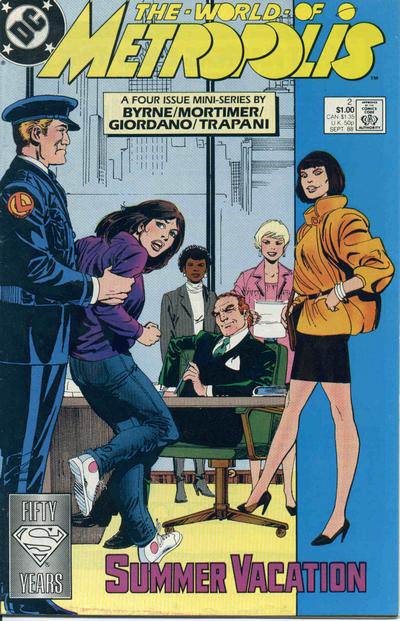
Year of Superman Week 46: Superman And…

As the chill finally returns to the air down here in southern Louisiana, I can feel the end of the year approaching. The last three months are always my favorite time of the year, although in this case they’re a little bittersweet. Spending this year with Superman has been fun for me, giving me something to look forward to…and while I have to admit I’m looking forward to finishing off the daily requirement, I also know I’m going to miss it. I’m thinking of ways to continue this blog without the daily stipulation into 2026 – no decisions yet, but there are things in my head.

At any rate, there are still a handful of themes I’ve got left that I want to do, but those are all anchored to specific times in one way or another, and none of them are this week. So get ready for another seven random days in the Year of Superman blog.

And as always, you can check out earlier blogs in the Year of Superman Archive!

Wed., Nov. 12

Comics: Superman #276

Notes: We’re going to start this week by looking at my list of stories that I wanted to hit this year at one point or another, but that didn’t fit into any particular theme. And if you’re not wise to the behind-the-scenes chaos that led to the writing of Superman #276, it seems as random as they come. Most comic book fans know the story behind the original Captain Marvel: originally published by Fawcett Comics, he was a smash hit and outsold pretty much every comic on the stands, including Superman at times. National Publications (the company that would later rebrand as DC) sued Fawcett, claiming Captain Marvel infringed on the Superman copyright due to the similarity in their appearance and powers. The case dragged on in court for years, until the post-World War II-era, in which superhero comics fell out of favor. Eventually, Fawcett settled the case, no longer making enough profit from the comics to continue to fight. Years later, DC would eventually license, then outright buy the characters from the Fawcett catalogue and bring them back to comics. 

In 1974, DC Comics had been publishing Shazam! for over a year. His own title was set on “Earth-S,” home to the original Fawcett heroes, and although the multiverse was already very much in play at DC, for some reason editorial was wary of having him actually interact with the heroes of the DC Universe. Writer Elliot S! Maggin’s solution was this issue, “Make Way For Captain Thunder!” Using an early, rejected name for Captain Marvel, Maggin has Superman encounter a young boy – Willy Fawcett – who appears in the streets of Metropolis one day. Willie seems out of time, with a haircut that was popular 20 years earlier and expecting to pay a nickel for 35-cent bus fare. And the big clue that something isn’t kosher: he’s never heard of Superman before. Willie sees a helicopter about to rob an armored car, so he rubs his “magic belt buckle” and says the magic word “Thunder!” With a bolt of lightning (and the amusing sound effect “sha-boom!”) he transforms into…well, not Captain Marvel, but somebody who looks a hell of a lot like him.

As Captain Thunder swoops in to stop the robbery, something takes hold of his mind and, instead, he aids the crooks in stealing not only the contents, but the entire armored car. Superman comes in to save the car and Thunder turns back into Willie, who cannot remember anything that happened since his transformation. He decides to turn to Superman for help, and looks up his most famous “friend,” Clark Kent. (The notion that even a child from an alternate dimension can learn that Clark and Superman are pals within a few hours is perhaps the greatest strain on the credulity of Superman’s secret identity, by the way.) Willie tells Clark his origin – how, on a campout with his orphanage, he was summoned by an owl to follow it to a cave in the woods. There he encountered an ancient Native American medicine man, who bestowed on him the magic belt that would give him seven spiritual abilities: the power of a Tornado, the speed of a Hare, the bravery of Uncas, the wisdom of Nature, the toughness of Diamond, the flight of an Eagle, and the tenacity of a Ram!

Note to Maggin: If the editor needs to drop in a footnote explaining that Uncas was a warrior chief, you know that you’ve maybe stretched this bit to its limits.

Anyhoo, Willie became Captain Thunder, and – in my favorite page in the book – recounts his final battle with the Monster League of Evil, which was made of up, I kid you not, the Universal Monsters. The battle took place in a series of other dimensions (1953 of them, to be exact), but evidently, when Willie tried to get home he wound up on the wrong Earth, where he comes to understand that the League did something to Captain Thunder, making him turn evil when he transforms. Clark – an alien from another planet who hangs out with an Amazonian goddess and a guy from Mars and who routinely fights cyborgs and has traveled through time on countless occasions and more than once met an exact duplicate of himself from a world he calls Earth-2 – comes to the obvious conclusion that Willie is delusional. 

Somehow THIS is the part that strained credulity.

Clarks recruit Lois to help him bring Willie to the police station for help, but another robbery summons his attention. He ducks away and becomes Superman, as Willie turns into his own alter-ego. But once again, as if he’s forgotten that he’ll turn evil, Captain Thunder turns evil. The crooks escape as Superman and Thunder battle it out in the skies over Metropolis. Superman manages to trick Thunder into turning back into Willie, because somehow he suddenly believes his story, and then holds him in a wrestling grip and tells Willie to change back, where he’ll somehow force Thunder to use his wisdom to overcome the Monster League’s brainwashing. There is absolutely no reason that this should work, but somehow it does, and Thunder furthermore figures out how to use his magic to return to his native dimension. 

This is one of those stories that I like not in spite of how ridiculous it is, but BECAUSE of it. Details aside, there’s virtually no difference between Billy/Captain Marvel and Willie/Captain Thunder. If someone were to redraw his costume and the origin pages, it would fit perfectly as the first meeting between Big Blue and the Big Red Cheese. The incongruities also have a weird charm to it. The notion that Clark questions Willie’s story is laughable, the idea that he comes around so easily is absurd. The fight is…well, it’s an awful lot of fun. And I won’t lie, I would love to see the history of Captain Thunder’s battles against the likes of Boris Karloff, Bela Lugosi, and Lon Chaney Jr.

There were so many different one-off universes that peppered DC Comics in the years before the original Crisis. I kinda wish we could visit some of them again. 

Thur., Nov. 13

Comics: Superman Vs. Lobo #1-3, Jon Kent: This Internship is My Kryptonite #19, Justice League of America #40

Notes: Today I’ve selected the three-issue Superman Vs. Lobo miniseries from 2021, written by Tim Seely and Sarah Beattie with art by Mirka Andolfo. Why? Because just like when they published this miniseries, it seemed like a good idea at the time. 

That sounds snarkier than I intended. This isn’t a bad series, not at all, but it’s part of the ill-defined “Black Label” imprint at DC. When it was first announced, “Black Label” was supposed to be a more “mature readers’” imprint featuring the DC characters. Then it started to publish comics that were creator-owned and had nothing to do with the DCU Universe. Then they folded the Vertigo imprint and made those properties Black Label books. Then they brought BACK the Vertigo Imprint and moved some of the Black Label originals over there. And all the while, they were reprinting some books under Black Label that didn’t make any sense at all – such as Kingdom Come – while also publishing a few new properties that didn’t really have any content that marked them as “mature readers,” such The Last Days of Lex Luthor, which would probably be best as an Elseworlds. Then they brought back Elseworlds. What I’m getting at is, I’m not entirely certain what Black Label is supposed to be and, based on all available evidence, neither is DC Comics.

None of that, however, is the fault of the creative team of this miniseries, nor does that make it a bad story. The story kicks off with the Martian Manhunter sending Superman out into space to check on a space station that’s been damaged near the orbit of Jupiter, with astronauts in grave peril. As he’s saving them, everyone’s favorite Main Man Lobo has a vacation ruined when the resort planet he’s on is attacked by a kaiju-sized monster that turns out to be a microscopic tardigrade which has somehow been blown up to gargantuan proportions. He also meets “biologist and wildlife photography” Dr. Semedea Flik, who is an expert on single survivors of extinct species, and therefore is delighted to meet Lobo, who famously murdered his entire planet of Czarnia. Lobo, of course, doesn’t care about the destruction his fight with the tardigrade is causing, but Superman happens to be passing by in space and dives in to save both the creature and the people endangered by its rampage. Lobo, of course, sees Superman as a killjoy, ruining the fun of his fight, but Flik is thrilled to meet TWO “sole survivors” in one day. (Unless you count Supergirl or the Kandorians or Lobo’s daughter or…) When the news coverage of the fight starts painting Superman as a hero, Lobo is furious and decides to “ruin” him. 

Lobo comes to Earth and gets on LexTube to begin slandering Superman. Lois (with a little help from Batman) begins a counter-offensive against Lobo online, and the vitriol online begins to fuel an army of robots that the Toyman created to prove that social media is toxic. (I guess even Winslow Schott can’t be wrong all the time.) Superman combats it by urging people to get online and post positive things and – this is far less realistic than the tardigrade kaiju – they actually start to do it. Speaking of the tardigrade, it comes to Earth, only much smaller and now demonstrating extreme intelligence. Its name, it says, is Numen, and like Superman and Lobo is the last survivor of his homeworld. Flik is THRILLED. Feeling a kinship to the two of them, Numen decides to use his vast power to give them a gift: restore and send them back to their homeworlds, but he makes a little boo-boo. On the last page, Superman finds himself on Czarnia and Lobo on Krypton. 

Issue two kicks off with the Justice League searching for the missing Superman, with J’onn discovering that Krypton has somehow been restored and Green Lantern learning that Czarnia’s extinct population has come back. Numen, in a scene as funny as it is creepy, has learned that people on Earth communicate via “tweeting,” so it makes all the birds in the world explain to people that he sent Superman and Lobo back to their home planets. Of course, he’s wrong. On Czarnia, Superman – whose powers are dying under the planet’s red-tinted sun – learns that most of the population seems kind and pleasant, and Lobo was an anomaly. On Krypton, Lobo is frustrated at how “lame” the place is, but changes his tune when he realizes that there’s a sect of Kryptonians who blame their cold, sterile ways for the planet’s destruction and have decided to revert to a culture of hedonism and debauchery, his two favorite things. Flik has technology that allows her to bounce between worlds, viewing a civil war slowly brewing on Krypton between Lobo’s wild friends and the traditionalists, while Superman starts to find evidence that the Czarnians aren’t actually as nice as they pretend to be, with a deep paranoia and distrust underlying their apparent sweetness. 

Lobo’s Kryptonian pals decide to expand the influence of Krypton into space, and begin by cloning an army of Lobos and sending it to Czarnia to start the genocide all over again. Superman, meanwhile, discovers that the kindly woman he’s been staying with has been leeching his blood and his powers, and manages to reverse the cell drain after she’s killed by one of the clones. As Lobo returns to Czarnia to kill his clones – and everybody else all over again – only to learn that the resurrection has turned many of them as bloodthirsty as he is. Superman makes it to Krypton and finds his parents, but is horrified to learn that Jor-El planted a killer parasite into the Lobo clones, which are still living beings. Flick finds Numen and convinces him that he’s screwed up by bringing back the dead worlds, and Numen collapses in self-pity. He removes the two worlds, but not before Jor-El tells his son how proud he is that he became a man of compassion, even for those who despise him. Flik then tells Superman and Lobo that she’s studied Numen and discovered that there are people seeking out Numen, whose birth destroyed their entire universe…Union! Zealot! Maul! Helspont! And the almost-Superman himself, Mr. Majestic! Some of the most powerful characters from the Wildstorm Universe!

Not that they CALLED it “the Wildstorm Universe” in the text, mind you, but it was still a hell of a surprise. Also a nice reminder that most Black Label comics are non-canonical. The Wildstorm heroes had been firmly integrated into the DCU at this point, so I guess that means we’re looking at two different worlds in the vast multiverse right now. I’m okay with that.

In the third issue, Flik tells us Numen’s origin. He’s part of a species that feeds on the fundamental forces of reality. When one of them is born, they consume an entire universe in order to survive. Flik begs Superman and Lobo to help her protect Numen from the “Revenge Squad” that’s after him. Superman agrees because he’s Superman, Lobo agrees because Flik agrees to pay him, and the fighting starts. While Lobo tears through half the team, Majestic and Zealot team up against Superman. In the heat of battle, Superman concedes that Majestic is more powerful than he is, but that’s not going to stop him from fighting to defend Numen with his last breath. Proving that he is, perhaps, more like Superman than he thought, Majestic is moved to put down his arms and talk. Lobo double-crosses Flik, though, setting up Numen to be killed and taking her technology and Numen’s energy to create a new universe where he’s the hero and Superman went mad after the murder of Jimmy Olsen. Lois, though, in a wonderful bit of meta-commentary, quickly figures out that the new universe they’re in is full of bad stereotypes and tropes, like so many “evil Superman” stories we’ve read, and concludes that they’re trapped in a “badly written story authored by an edgelord.” Lobo takes that personally and a battle ensues, but to everyone’s shock, he breaks down with the realization that he’s wasted the power he stole to rewrite the universe just so people would love him instead of thinking, “Maybe…I shoulda just not been a giant piece of $#*.” He expends the energy restoring the universe and integrating the orphaned Wildstorm heroes into it (so maybe it IS canonical?).  

The series works on a few levels. It’s satirical, but pointedly so. First of all, it’s a bit of a deconstruction of Lobo himself. Created in the 80s as a PARODY of over-the-top, violent characters like the Punisher, his runaway popularity instead made him the poster boy, despite the fact that he exists only to exhibit all of their worst characteristics. This comic doesn’t flinch from that, reminding us over and over again that he’s a scuzzball who does not deserve admiration. The best line in the series, for example, is Superman calling Lobo “the worst person I’ve ever met, and I regularly have to spend time with Lex Luthor.” The second best, though, is directed at Lobo himself: “You think everyone is as terrible as you, and that makes you the loneliest man I’ve ever met.” Yes, Superman pities even Lobo. And all of this helps build towards a mild sort of redemption for the character in the end. He doesn’t ATONE for his awfulness, but at the very least he grows enough that he can recognize it and admit it, which – considering the place that he starts from – is not inconsiderable.

The other element of satire is pointed at the media and social media, how it tries to manipulate the narrative and how we’ve taken a piece of technology that should have brought everybody together and created greater understanding of us all and instead have decided to use it to be nasty to each other and create little echo chambers where we can sit in a virtual room and pretend that everybody who isn’t in the chamber with us is stupid and evil. It may sound a little hypocritical of me to talk this way about social media – I obviously use it all the time – but in my defense I do my best to keep my interactions online positive. I talk about the things I love, I try to steer clear of railing against things that I hate, because seriously, who needs to hear that? Even this whole “year of Superman” project is dedicated to that purpose, to me devoting 365 days to something that means something powerful and wonderful to me. 

I’m not saying that everyone should use social media exactly the way that I do, I’m just saying that the world might not seem quite as terrible if they did.

Lobo included. 

Fri., Nov. 14

Comic: Superman Vol. 4 #12-13, Aquaman Vol. 5 #53 (Guest appearance), Justice League of America #41-42, Adventure Comics #267

Notes: Although it wasn’t my original intention, after two days of comics that amounted to “Superman Vs. another hero,” it seems as though the universe has chosen a theme for this week for me. Who am I to argue? So today I decided to seek out another such story, landing on the two-part “Super Monster” from the Rebirth era, written by Peter J. Tomasi and Patrick Gleason with art by Doug Mahnke. In this, Superman faces off against Frankenstein. Not the kind we saw in Halloween week, though, but the actual Frankenstein’s monster, who in the modern DC Universe has taken the name “Eric Frankenstein” and joined the supernatural spy agency S.H.A.D.E. The story starts with Lois meeting a friend of hers named Candice, editor of the Hamilton Horn newspaper, who is trying to lure her away from the Planet (she had recently returned at this point – long story) only for Frankenstein to interrupt the interview and attack the editor, claiming he’s been chasing her for some time. Lois blasts Frankenstein with a weapon she’d recently “borrowed” from Batman and she and Candice flee. Superman, naturally, arrives to defend his wife, and he and Frankenstein get into it. The creature manages to get his hands on Candice and rips her face off, revealing an alien beneath. 

In the second issue, Frankenstein explains that “Candice” is really a war criminal named Kroog who has been fleeing justice from several planets. Superman is glad to have captured a criminal, but admonishes Frankenstein for going after him in a way that caused destruction and potential injury to innocent people. Before they can take Kroog away, though, Frankenstein’s estranged Bride shows up. No longer with S.H.A.D.E., the Bride is now a bounty hunter and has come to take Kroog and collect the money for his head. In the scuffle over who’s going to bring Kroog in, the alien escapes. Superman has to break up the squabbling exes  and together they track the alien down to bring him to justice.

The real meat of this two-parter comes towards the end of the second part. After Frankenstein and the Bride fight each other, there’s a short sequence where Lois asks the Bride about what happened to drive them apart. The answer is horrific – they had a son who became a monster (like, spiritually) and the Bride was forced to kill him to save the lives of innocents. From here we start to extrapolate that their divide is not actually based on hatred or even a lack of love between the two of them, but on the pain of their loss. As this was the era where Jon Kent was still a child, and still a relatively new addition to the Superman mythos, the story hits both Lois and the reader hard. The story ends with a quiet, wordless few pages of Lois and Clark returning home, tucking their son into bed, and giving him a goodnight kiss.

If you’re a parent, you get why this hits so hard. If you’re not, I’m not sure if I can explain it to you. 

Sat., Nov. 15

Comics: Booster Gold #7, Action Comics #594, Booster Gold #23.

Who did it better?

Notes: Once I realized I had accidentally stumbled into a theme, I got on the DC Universe app and just starting randomly seeking out different stories about Superman – for whatever convoluted reason – coming to blows with other heroes, because why not? That reminded me of these early comics in which Superman faces off against his future JLA teammate Booster Gold. In Booster Gold #7 from 1986, Dan Jurgens had his time-travelling hero encounter the man of steel for the first time. A year later, John Byrne and Jurgens collaborated on a two-part story that crossed over with Action Comics.

Booster Gold #7 begins with Booster, Superman, and a few hangers-on having just been abducted by an alien warlord called Galeb who is accusing them of treason, despite the fact that they don’t even know who he is. Galeb  accuses them of conspiring with Ranzee, an alien who claimed to be marooned on Earth. They try to fight their way out, but Galeb’s wife – a self-proclaimed mystic – sends out a burst of mental energy that knocks all of them out, even Superman, because magic. They awaken in prison, and Ranzee tells them of how Galeb has ruled his people as a tyrant for years, leading him to steal a spaceship and go to Earth to ask the legendary Superman for help after Galeb personally tortured and murdered his wife and child. Booster wants to jump right in and take Galeb out, but the more experienced Superman cautions him about jumping into a political situation without all of the information. Galeb comes to their cell and says that he is willing to release everyone but Ranzee, who is to be executed. When Booster tries to attack, Superman steps in to stop him and the two come to blows. Superman holds back, hoping to cool Booster off, but Booster just keeps going. Eventually, Skeets shorts out Booster’s suit to stop the fight. Skeets has been investigating and learned that Ranzee lied to them – he is actually Galeb’s stepbrother and has been attempting to overthrow Galeb for years. Superman takes Booster back to Earth with his tail between his legs, arriving home at the same time as Lois Lane, who came by to interview Metropolis’s newest hero. Superman flies off, not at all impressed at his new rival.

This story, it should be noted, was published in the midst of Crisis on Infinite Earths and technically features the pre-Crisis Superman, although there is little to differentiate him from the character that would soon appear in the Byrne reboot. But it’s really interesting to me just how much Superman dislikes Booster in their first meeting. Of course, this early in his career, Booster didn’t really give him much to like. He’s cocky, hard-headed, and impulsive, and those qualities would have caused disaster had Superman not been there to get in his way. The way the character grew and evolved over the years is really remarkable, and he’s become one of my favorite DC characters.

John Byrne did one of his cover swipes (a lot of artists do cover swipes, but Byrne got the bug earlier than many – the man draws a Fantastic Four #1 swipe more often than I change my socks) to show Superman and Booster’s next encounter. Mayor Berkowitz has declared it to be Superman Day in Metropolis. The festivities are upset, though, when Booster Gold blows up the Superman statue that was supposed to be dedicated that day. He then calls a press conference where he accuses Superman of crimes against humanity for his recent incursion in the terrorist state of Qurac. Booster calls Superman down for taking political action that way, which comes off as particularly hypocritical if you just read Booster Gold #7, in which Superman stopped him from doing exactly that. Booster then decides to lure Superman into a fight by abducting the mayor’s daughter. Hearing her call for help, Superman zips in and Booster hits him way harder than Superman expected. Booster begins to pummel Superman, beating him with relative ease. With Superman on the ropes, though, a SECOND Booster appears, calling the first an imposter. 

The story concludes in Booster Gold #23, once again by Dan Jurgens. A flashback informs us that this fake Booster has been in action for several days, smearing Superman, as Booster was in mourning over the recent loss of his sister and wasn’t even aware of his doppelganger. In the present, Booster manages to shred the fake’s outer covering, revealing a robot underneath. When Booster destroys it, a chunk of Kryptonite falls out, explaining how he was beating Superman. The reader learns that – surprise, surprise – the robot was sent by Lex Luthor, who was using it to gather as much data as possible on Superman for Luthor reasons. He sends a second armored operative – human this time – to attack Superman and retrieve the Kryptonite, and although his drone gets away with Luthor’s glowing rock, Superman easily captures the goon. He knows it’s Luthor’s handiwork, but the guy inside the armor claims to work for Booster Gold, is carrying Booster Gold International ID, and even the components of his armor were made by Booster’s company. Superman doesn’t buy the frame-up for a second. Booster gets the best of Luthor that night, but the epilogue brings in a new challenge for Booster that looks pretty bleak. But this ain’t the “Year of Booster Gold,” no matter how much he might wish it was, so I’m going to let you look all that up for yourself.

The antagonism between Superman and Booster continues here, although by this time Booster has become somewhat more integrated in life in Metropolis. There are even references to previous interviews with Lois, despite Booster and Superman not having encountered one another in the interim. It’s also funny to read these books by Dan Jurgens, who would of course eventually go on to be one of the most significant Superman creators of the post-Crisis era, before he was actually writing or drawing Superman on a regular basis. The character (especially in issue #7) doesn’t quite look like Jurgens’ Superman, it’s more like he was still trying to figure out how to draw him. He got Superman’s personality right away, though, with the character feeling like himself right out of the gate. 

Sun. Nov. 16

Comic Books: Firestorm, the Nuclear Man #2, Justice League of America #179-180

Notes: Early in his career – in his second issue, in fact – Firestorm bumped into Superman. Makes sense, really, when you consider just how powerful “the nuclear man” actually is, Superman and the Justice League would clearly want to keep tabs on him. Let’s see how that turned out, shall we?

After a little showboating and reflecting on his origin, because back in the day a superhero was required to recap his origin once an issue, teenage superhero Ronnie Raymond goes about his day. His crush Doreen seems to be into his secret identity (nice), but his father isn’t impressed, nervous about that kind of power in the hands of an individual. And Ronnie can’t even ask his other half Professor Martin Stein for help, because in these early days of the character, Stein didn’t remember anything that happened when he and Ronnie were merged as Firestorm. (I’ve never tracked down the story where that particular tidbit was overturned. If anyone knows when it happened, let me know, would you?) Clark Kent, meanwhile, reporting on the new hero for WGBS, decides that this is exactly the sort of thing that Superman should be keeping an eye on. As he flies to New York to check in on the kid, Stein is attacked in his lab by Multiplex, the Duplicate Menace. (The much better “Multiple Man” was obviously already taken.) Fortunately for Stein, Ronnie discovers the atomic bond he shares with the older man allows him to feel it when Stein is hit and know when he’s in danger. He also discovers that they don’t need to be physically next to one another to trigger their transformation, and Firestorm arrives to take on Multiplex. As Firestorm and Multiplex trade blows, Superman arrives just in time to see the young hero get pummeled, dampening his notions of inviting Firestorm into the Justice League. Superman saves him, and despite a moment of being star-struck, Firestorm zips off in search of Multiplex. Superman follows him and watches as Firestorm captures Multiplex, promising the young hero that he may be Justice League material after all.

Okay, so it was 1978, but that last part feels WILDLY presumptuous on Superman’s part. Suggesting Justice League membership to somebody he literally has just met, who he saw fight ONE supervillain? Because he’s got drive and wants to prove himself? It would make a little more sense today, in this era of Justice League Unlimited, where pretty much everybody with a mask gets a card and a ticket to the Watchtower, but wow.  

Just for funsies, I decided to follow this up with Justice League of America #179 and 180, the issues where Firestorm actually DOES join the League, published less than two (real-time) years later, a membership that I’m sure in NO way was influenced by the fact that Firestorm’s creator Gerry Conway was writing the JLA title at the time. Anyway, true to his word, Superman sponsors Firestorm’s membership in this issue, saying that the rookie hero’s “youthful exuberance” will be an asset to the team. Then once he zones out when Batman starts explaining the procedural stuff involved in being a JLA member, Ronnie gives the reader another recap of his origin (I told you, it was required). After a hearty congratulations from Superman, Firestorm returns to Earth and splits up. Ronnie sends Martin Stein (still unaware of his double life) home in a cab, then he meets his friends to check out the hot new disco in town. Seriously, disco. Who says comics from 1980 aren’t timeless? Anyway, it turns out that one of Ronnie’s friends who was supposed to meet him at the club is missing, supposedly in the clutches of a woman called “the Satin Satan.” Ronnie calls Stein back – again, and Firestorm confronts the witchlike woman, feeling her power overtake him just in time to hit his brand-new JLA signal device. 

In the next issue, the League arrives in the penthouse where Firestorm was abducted, only to find the place wrecked and empty. A few minutes later, Ronnie Raymond’s friends arrive with a security guard, looking for him. Zatanna’s magic powers manage to track down Satin Satan and Firestorm, helping him get free. Together, the League fights off Satin’s demons and apparently free her from the demonic influence that’s gripping her, then everybody except Green Arrow congratulates Firestorm on a great first case.

Look.

Gerry Conway is a comic book legend, we can all agree on that, right? And Firestorm is a great character – he was really bold and unique when he was created, and he’s been someone I’ve always thought deserves to be a constant presence in the DCU in one form or another, even during the periods in which he lies fallow.

All that said, NOTHING in these three issues suggests that Firestorm is Justice League material. Sure, he comes through in the end, but he makes mistake after mistake, fumbles into traps, and generally acts like a rank amateur. I can see why Superman would want to keep an eye on somebody so powerful, and making him a member of the League in order to train him and help him get better would make a lot of sense. But it’s not framed that way, it all comes across as the League – Superman especially – getting starry-eyed at this new kid and all the neat toys he’s got and wanting him to stick around so they can play together. It comes across a little bit like Conway’s pet. 

I also realize that these issues don’t QUITE fit into the “Superman Vs.” theme I’ve kinda been going for this week, but as I didn’t even really intend to do a theme this week at all, I’m not going to feel bad about that. Maybe I’ll call this week “Superman And…” instead.

The weirdest thing, though, is that the issue ends with the clear implication that Satin Satan hasn’t REALLY been set free of her demonic possession – that there is an impending danger that will come back to plague the Justice League again. But a quick check online seems to suggest that these two issues are the ONLY ONES in which she EVER APPEARED. Really? With an ending like THAT? Nobody has picked up on it and tried to do something with the MODEL-GORGEOUS DEMONIC VILLAIN in the past FOUR AND A HALF DECADES?

I’ve now read over 1,000 individual comic book issues for this Year of Superman project, and that may be the wildest thing I’ve discovered yet. 

TV Episode: Superman and Lois Season 3, Ep. 3, “In Cold Blood”

Mon, Nov. 17

Comic: Captain Atom #46, Action Comics #587, Batman: Wayne Family Adventures #38 (Guest Appearance)

Notes: Like the first Firestorm comic I covered yesterday, I picked this one more or less because Superman was on the cover and I hadn’t read it before. Captain Atom wakes up on the moon, trapped in a crystalline crucifix along with several other heroes and villains, Superman included. He manages to free himself and Superman, and the two of them investigate their abduction, which turns out to be the work of a crystal alien called Kylstar (say it out loud). After a brief scuffle with their abductor, Kylstar’s translating droid tells them that his planet is ruled by an evil dictator, and he has been seeking sentient weapons – super-beings, in other words – to help him free his planet. He releases the other captives, one of whom is an alien who confirms his story (which is more than we had in the issue of Booster Gold the other day that had a lot of these same beats). Kylstar offers to return anyone who doesn’t want to go with him to their homeworld, but both Atom and Superman decide to return to Earth. After they’re gone, Kylstar casually reveals to Major Force – who agreed to accompany him – that he’s going to have to go ahead and conquer the entire galaxy to have a strong enough army to take on his enemy. Force is all about that. In the end, Superman does Cap a solid, helping him find his estranged daughter Peggy.

It’s an okay issue, and I wonder if the Kylstar storyline was picked up later on in the run. Major Force obviously made it back to Earth at some point, because he was available a few years later to commit the act that led to the “fridging” becoming a comic book-specific verb. But my appetite for a hero vs. hero fight hasn’t been satisfied. So I’ll go back to scratch that itch with another comic from John Byrne’s Action Comics team-up era, issue #587, featuring the Etrigan the Demon.

To be fair, it’s a little tricky to decide if this even counts as “hero vs. hero,” as Demon’s status is kind of flexible. Depending on the writer, he’s either a demon who tries to do good or an evil spirit FORCED to do go via his association with Jason Blood. Byrne writes Etrigran more on the good side, though, without any internal quandaries over wanting to do bad and just doing the good, so it’ll fit nicely. 

The story starts with Jason Blood and his friend Glenda Mark in an antique shop in Gotham City, where she accidentally activates an old piece that suddenly captures her in a metallic column. The column expands, capturing the others in the shop as if it were trying to create a miniature city, and Jason only barely manages to summon the Demon in time to avoid being taken himself. Superman is returning to Earth from space when he spots the metal city growing and completely overtaking Gotham. He comes in and tries to wreck the expanding columns, but Etrigan attacks, telling Superman he must not harm the towers. The two of them fight for a few pages before Etrigan shows Superman that every time they break one of the columns it bleeds human blood. Etrigan explains that each column is a human who has been transformed, and the only way to stop them from dying is to do so before they are cursed, and he casts a spell to send Superman back in time. As Etrigan existed in that time, he couldn’t go with Superman (this was an old time travel rule in DC Comics that doesn’t seem to apply anymore) but he gives Superman one hour before the spell wears off and returns him to his own time, and tells him to seek out Jason Blood. Superman finds 12th Century Jason, and together they track down Morgaine le Fay in the process of creating the very artifact that started the mess. Superman dives in despite the magic and disrupts the spell, resetting the timeline. An epilogue replays the scene in the Gotham antique shop, bereft of the artifact, and all is well. 

The fight between Superman and Etrigan is short, but really effective. And it’s actually nice to see one of these scuffles where Superman – however well-meaning – is in the wrong. It’s a good change of pace. This issue also has several elements that I always enjoy: time travel, doses of Arthurian legend, and John Byrne artwork. Overall, it’s a fun read. 

TV Episode: Superman and Lois Season 3, Episode 4, “Too Close to Home.”

I’ve been trying to squeeze in episodes of this show again because I still want to try to finish it by the end of the year. I haven’t been writing about all of them, though, because I kind of feel like I’ve run out of things to say. I like Tyler Hoechlin and Elizabeth Tulloch. I love Wolé Parks as John Henry Irons. But the series as a whole hasn’t gripped me as much as I wanted it to. However, the scene in this episode of Clark – Clark, not Superman – in the diner, facing off against Emmitt Pergande? That’s absolute poetry. 

Tues., Nov. 18

Comics: Superman/Shazam!: First Thunder #1-4

Notes: I started this inadvertent “Versus” week with Superman fighting the faux Captain Marvel, so it seems only appropriate that I end it with an early encounter with the real thing. And again, this isn’t actually a fight – Superman and Captain Marvel are never opposed to each other in this miniseries. But you know what? I don’t care. It’s still a good comic.

Published in 2005, this miniseries by Judd Winick and Josh Middleton was a contemporary take on the first meeting between Big Blue and Big Red. It begins with the wizard Shazam at the Rock of Eternity, early in “the second age of heroes,” observing the nascent members of the Justice League in action, then gives us a quick time skip to the rookie Captain Marvel averting a plane crash in Fawcett City. (It is amazing how often planes in comic book universes ALMOST crash. If it was as frequent in real life as it is in a comic book world, nobody would ever board an airplane ever again.) Meanwhile in Metropolis, Superman investigates a break-in at the Museum of Natural History that brings him into battle with a big, blue creature – a sign of that singular bane of his, magic. We also see Billy Batson homeless and refusing to go to yet another foster home, living in abandoned subway tunnels with some help from his friend, a kid named Scott. Looking at a recent newspaper, Billy sees a story about the museum robbery in Metropolis and decides to keep an eye on the Fawcett City museum. Sure enough, that night, there’s a break-in – the same crooks as in Metropolis, still trying to steal Russian artifacts. Once again, the crooks summon monsters and they hurl Captain Marvel out of the museum, where Superman is waiting to lend a hand.

In issue two, we start “one week ago,” with a summit between Dr. Thaddeus Sivana and Lex Luthor, where the two evil geniuses – despite their mutual dislike of one another – agree to cooperate, with Luthor giving Sivana use of an operative named Spec to trail Captain Marvel. Spec, we find out, managed to trail Marvel and witnessed his transformation into a child. Back in the “present,” Superman and Captain Marvel meet outside the museum for the first time and team up to fight the monsters summoned by the robbers. After fighting them off, Marvel asks Superman if they can “talk,” and the two of them have a casual conversation on the top of Mt. Everest, discussing their powers and what it’s like to be heroes. Their talk is disrupted when Superman hears a pair of dual threats coming from Fawcett – Sivana has summoned the demonic villain Sabbac via a spell which also creates a solar eclipse, and wouldn’t you know it? Dr. Bruce Gordon has once again been taken over by the spirit of Eclipso. 

Yeah, he’s in this too.

Issue three kicks off with Spec finding his way to the homeless enclave where Billy Batson has been living, looking for information about “a little boy, about eleven years old, black hair,” and offering to pay handsomely. While Spec hunts Billy, Superman and Marvel take on Sabbac in Fawcett City. At the same time, Eclipso makes his move, using a satellite network to transform the people of Fawcett into – goodie! – more Eclipsos! Superman dismantles Eclipso’s machine, but still has to deal with a legion of innocent people who have been eclipsed and go on the attack, while Marvel is left to face Sabbac alone. Superman escapes and disrupts the coven that caused the Eclipse, breaking Eclipso’s hold on everyone, including Bruce Gordon, and Marvel tricks Sabbac into saying his own name, causing him to turn off his powers just like Billy uses the word “Shazam!” Superman and Marvel part as friends, but that night as Billy is reading about his own exploits in the newspaper, Sivanna (using Spec’s intel) sends an army of thugs to kidnap him.

In the final issue, Billy switches to Captain Marvel just before Sivanna’s goons open fire. He defeats them easily, but in the gunfire his friend Scott is mortally wounded. Marvel brings him to the hospital, but Scott succumbs to his injuries. Marvel bursts into the police station where Sivanna’s thugs have been taken and begins to brutalize one of them, demanding to know who hired him. Moments later, he’s ripped apart Sivanna’s corporate headquarters and has Sivanna’s throat in his hand. He chokes him, almost to death, but relents before Sivanna is killed and flees the scene. In Metropolis, Clark hears about the incident and finds Marvel again at Mt. Everest, where he plans to have him answer for attacking a police station, assaulting a prisoner, and destroying the top floor of the Sivana building…until he sees Marvel weeping. Superman is confused by Marvel’s sobbing about getting “his best friend killed,” until he says his magic word and becomes Billy Batson again. Superman demands that Billy take him to the Wizard Shazam, where he rips into him for putting a child in danger. “He’s just a boy,” he declares. Shazam replies, “He is. A boy who could use guidance.” In the last few pages, Clark Kent finds Billy in the abandoned building where he’s living now. He removes his glasses, unbuttons his shirt to reveal the “S,” and sits down to have a talk.

This is such a great story, all building up to the last few scenes, which are immensely powerful. At first, Superman sees Marvel as a contemporary, an equal, somebody who maybe can understand the burden of power that he carries because he shares it. When he discovers the truth about Billy Batson, the righteous anger that fills him is perfectly in keeping, although you have to wonder if he ever had a similar discussion with Batman about any of the Robins. In any case, this is such a great dynamic for the two of them. In a world where Superman and Billy Batson co-exist, Clark Kent would be a perfect mentor for the boy. Unfortunately, in all the reboots that have happened in the past 20 years, I’m fairly certain this story is no longer canon, and that’s a shame.

One other amusing thing I need to point out – Marvel defeats Sabbac by tricking him into saying his own name, which also happens to be the magic word that triggers his transformation. At this point, people had mistakenly been calling Captain Marvel “Shazam” for decades, since DC was using that word to secure the trademark. But Sabbac having a name that he can’t say is ridiculous, a problem Captain Marvel Jr. had since the beginning, and a problem that was exacerbated in the New 52 reboot when “Shazam” became Billy’s hero name. These days, in-universe, Billy’s alter ego is just “The Captain,” which sidesteps the problem, but it’s kind of lame as a superhero name. I dunno, maybe they should have just stuck with “Captain Thunder” in the first place. 

Radio Program: The Adventures of Superman serial “The Clan of the Fiery Cross” episodes 1 and 2.

More on that one next week.

Blake M. Petit is a writer, teacher, and dad from Ama, Louisiana. His most recent writing project is the superhero adventure series Other People’s Heroes: Little Stars, volume one of which is now available on Amazon. You can subscribe to his newsletter by clicking right here. You can join in the Kryptonian Konversation every day in the Year of Superman Facebook Group!
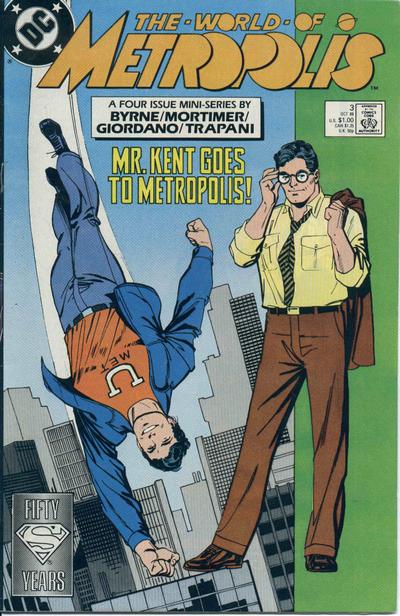
Week 24: Wonder Woman, Batman, LEGO, and Father’s Day

I woke up early on June 11th, friends. It’s summer vacation, there is no reason for me to get up early, but I was wide awake at 6 am and refreshing the AMC Theaters app, looking every few minutes to see if it had begun yet. Today, you see, was the day that Superman tickets officially went on sale. 

At noon, it turns out. I found that out later.

But I was too excited to get back to sleep, and when the app finally opened up and allowed advance ticket sales to begin, I got the first three seats in an early screening for one month from today, July 11th. I showed the tickets to Eddie, and I told him how excited I am not just to see the movie, but specifically to watch it with him.

That’s more important to me than anything else, really. Taking my son to see a new Superman movie. It’s something I never thought would happen, especially after Justice League sloughed through theaters when Eddie was only three months old. Now? I couldn’t possibly be more excited.

But that’s still a whole month away. Time for a fairly random week in the Year of Superman.

And as always, you can check out earlier blogs in the Year of Superman Archive!

Wed., June 11

Comics: Young All-Stars #10

Iron Munro’s dad was bulletproof. Mine is hard of hearing. He wins.

Notes: The first comic I’m going to discuss this week is a surprise, even to me. I’ve mentioned before that – although I’m only writing about Superman comics here – there are lots of other comics that I’m reading, and as I made my way through a bundle of Roy Thomas’s Young All-Stars from the 80s, issue #10 stopped me in my tracks. Young All-Stars was Thomas’s attempt to rebuild the Golden Age of DC history post-Crisis, in a world in which the likes of Wonder Woman, Batman, and – yes – Superman had not yet existed. And Thomas was uniquely suited to that task, having a love for the Golden Age that I maintain is unsurpassed among any comic book creator that wasn’t actually working during that era. 

One of the members of that team was Arnold “Iron” Munro – a young man of incredible strength, speed, and resilience who kind of filled the “Superman” role in the team. Munro’s first appearance was in issue one of this title, and after a few adventures, he managed to get his hands on the diary of his late father. In this issue he sits down and reads it – the diary of one Hugo Danner.

I’ve read ABOUT this before in my vast studies of the DC Universe, but this was the first time I actually read this issue, the issue in which it was revealed that Iron Munro was the son of the main character of Philip Wylie’s novel Gladiator, which if you remember from the very first week of this Year of Superman project is believed by some to be at least partially where Jerry Siegel and Joe Shuster drew their inspiration for Superman. The issue is a straight-up adaptation of that novel, run through the frame story of Iron Munro reading the main narrative in his father’s diary. Thomas hits all the major beats, although he condenses the story greatly, and for the most part only makes minor changes.

There is one BIG change, though, and a necessary one. In the novel, Hugo Danner’s own father (whose experiments gave him his powers) informs Hugo that his process is not an inheritable trait, and that should Hugo ever have children they would not possess his power. In the comic, Dr. Danner says that he doesn’t KNOW if the process will be inherited, and Hugo replies that he always assumed he was infertile, else he’d have dropped litters of little Gladiators all over the world. (It was 1988 and Young All-Stars was a direct market title: I wonder if that comment would have snuck through if it had been made to adhere to the Comics Code.) The story of Iron Munro’s own birth is absent from this issue, and in fact, the way the diary ends it seem quite possible that Hugo didn’t know that he had successfully fathered a child before his own death, but with this completely unexpected Superman connection, I’m more excited than ever to continue reading this great series from the 80s.   

TV Episodes: Superman: The Animated Series Season 1, Episode 1-3, “The Last Son of Krypton” Parts 1-3

Up, up, and Animate!

Notes: With just a month to go before the big movie, I’m going to be ramping up how much Superman I share with my son, Eddie. My wife suggested that today we watch the pilot of Superman: The Animated Series together, a three-parter that was also released on DVD as the movie Superman: The Last Son of Krypton. I’ve seen this several times over the years, and I seem to find something else to appreciate about it every time. For example, this time around, we see Jor-El pleading with the Kryptonian Council that they have to put the entire population of the planet into the Phantom Zone before the planet is destroyed (a good idea that I’m surprised more versions of this story haven’t addressed). But the Council doesn’t listen, this time not out of pure hubris, but because the planet’s massive Brainiac computer is assuring them that Jor-El is mistaken and the planet is safe.

Keep that in mind, people: in the DC Animated Universe, the entire population of Krypton died because people trusted an evil A.I. It’s the lesson we ALL need to learn from this.

Although it isn’t as noticeable if you watch the movie version, the entire first episode of this series takes place on Krypton, with Jor-El first trying to convince the council, then turning against the ruling Brainiac computer before having to steal his own rocket prototype to send Kal-El to Earth. It’s kind of brave, really, to have an entire episode without any of the regular performers or characters, save for baby Kal-El himself, especially on a story that – even by 1996 – was pretty darn well known. But this was in an era where TV shows HAD to have a “proper” pilot episode to set everything up, and the creators brought the same love and attention to detail to the show that they did Batman: The Animated Series, so it’s hard to complain. 

Episode 2 begins with Kal-El’s rocket landing in Kansas and being found by the Kents. Martha, as usual, loves him right away, and after some minor persuasion, Jonathan agrees to take the starchild in. We get a timeskip to teenage Clark, who is excelling at school, but struggles to fit in, finally confessing to his best friend, Lana Lang, that he has incredible powers and abilities beyond those of mortal men. After he rescues a child from an explosion, Jonathan and Martha show him the rocket that brought him to Earth, where a message from Jor-El tells him about his origins. After a quick flight around Smallville, another time skip brings us to Metropolis, where people are reporting a “guardian angel” with red wings whisking around the city saving people from near-disasters. At the Daily Planet, Lois Lane is asked to take new hire Clark Kent to a LexCorp press conference unveiling a new military exosuit – a conference interrupted by a terrorist attack. As villains swarm LexCorp to steal the suit, Clark slips away and changes to his OWN special suit – Superman makes his debut, appropriately enough, saving Lois Lane. 

Back in Lois Lane week, I wrote about how good Dana Delany is as Lois Lane, and I want to reiterate it today. She’s brash, a little self-important, and utterly dumbfounded at how Clark manages to make it to LexCorp before her after she ditches him. It’s no wonder he falls in love with her. Tim Daly, meanwhile, makes his debut in this episode as well, and I’ve always liked his Superman. There’s a sort of quiet strength in his voice. He’s powerful, but confident, and he gives you the impression that being Earth’s greatest hero is effortless most of the time. These two, along with the deliciously oily Clancy Brown as Lex Luthor, were a real power trio in this show. 

Part three picks up right where part two ended, with Clark trying to save an airplane in the fallout of the terrorist attack. The Planet dubs him “Superman” and, after some advice from Jonathan and Martha (“I don’t want anybody thinking you’re like that nut in Gotham City,” she says), he swoops in to Lois to give her an interview. Later, as Clark, he tells Lois his theory that Luthor was behind the theft of his own exosuit in order to reap a windfall from the government building a better version, as well as selling the original suit to an enemy power. Lois being Lois, she tries to investigate on her own, only to get caught by the terrorists. Fortunately, in what will become quite the habit, Superman shows up in the nick of time. After cleaning up the bad guys and throwing Luthor a warning, Metropolis cheers for its new Man of Steel.

Meanwhile, in deep space, an alien craft picks up a probe with a familiar pattern – Brainiac lives.

Ah, what a great way to end the first episode of this new Superman. Even Eddie watched some of it, which is pretty good for a him. I’m going to be sharing more and more with him as we work our way up to July 11th. 

Thur., June 12

Movies: Superman/Batman: Public Enemies, Superman/Batman: Apocalypse

Notes: I didn’t necessarily plan for there to be an animated theme this week, but when it happens on its own, who am I to argue? Today I rewatched the two animated films that adapted the first two story arcs from Jeph Loeb’s Superman/Batman series, Public Enemies and Apocalypse.

Public enemies, but private besties.

In Public Enemies, after Lex Luthor has risen to the presidency, he drums up false charges against Superman and Batman, sending a task force of heroes (and Major Force) led by Captain Atom to take them down. The world’s finest team has to go on the run, prove their innocence, and defeat President Lex. Apocalypse, the sequel, is a pretty solid adaptation of the “Supergirl From Krypton” story arc I wrote about back in Supergirl Week

It’s so great to see Tim Daly, Kevin Conroy, and Clancy Brown reprising their roles from the DC Animated Universe, and this movie is full of great little moments, such a conversation between Superman and Batman after the former has been shot by a Kryptonite bullet and Bruce is trying to bring him to the Batcave for medical attention. Out of nowhere, Clark starts talking about Magpie, the first villain the two of them ever faced together. It’s a great little bit that serves no purpose other than to indicate that these two are, in fact, friends…which is how it should always be. 

When Kara started shopping at Hot Topic, Clark knew something was wrong.

The sequel, Apocalypse, is a little jarring at first. The animation style changes dramatically between the two movies, as each is trying to imitate the original artist – Ed McGuinnes for Public Enemies and Michael Turner for Apocalypse), but the continuity of having Daly and Conroy back helps. The story follows the comic book pretty closely, adding Summer Glau as Supergirl and Susan Eisenberg as Wonder Woman to round out our cast of heroes. 

As a whole, the film is a pretty straightforward adaptation of the comic book, from Kara’s discovery, to her training on Themiscyra, her abduction to Apokalips, her recovery in Smallville, and the final confrontation with Darkseid. It doesn’t tread any new ground, it just tells the story. Which is actually kind of refreshing, after you think of the way some of the more recent Batman animated movies have felt the need to change the ending (Hush, A Long Halloween, and Gotham By Gaslight all suffered from this remarkably stupid choice). While it’s true that SOME measure of change is almost always necessary to successfully adapt a story from print to film, there are too many films that seem to make the changes for no reason, and I love the fact that this one avoided that trap. 

Comics: Nightwing Vol. 4 #126 (Cameo)

Fri., June 13

Magazine: DC Comics Presents Superman

I never thought about it before, but I betcha in the DC Universe, it’s GREEN cars that have the highest insurance rates.

Notes: Last week my family stopped at Barnes & Noble for my wife’s birthday. After we had checked out, as we were walking towards the door, Erin suddenly perked up and rushed to the magazine rack. There she plucked the special edition I’d been hearing people online talking about: DC Comics Presents Superman. I knew it was out there, and I had to pick it up.

The magazine is on newsstands across America, there to serve as a sort of gateway for people who don’t read comics all the time but are interested in the movie. It reprints the first issues of three of the miniseries that James Gunn drew inspiration from for the new movie, specifically All-Star Superman by Grant Morrison and Frank Quitely, Superman For All Seasons by Jeph Loeb and Tim Sale, and Lex Luthor: Man of Steel by Brian Azzarello and Lee Bermejo. It’s also peppered with bits and pieces of Superman trivia, and some commentary by Gunn on each of the three stories and how they helped influence the movie.

Now let’s be clear here: if you’re a Superman superfan such as myself, there’s pretty much nothing new for this magazine to offer. I’ve read all three of the comics contained herein before. I knew almost all of the trivia tidbits. I’ve already got a DC Universe Infinite subscription, so the offer for a 30-day free trial on the back cover (so you can read the REST of the three miniseries that this magazine only samples) is useless to me. Even the cover – Dan Mora’s recreation of Action Comics #1 featuring the David Corenswet costume – isn’t new, as the same artwork was used on an Action #1 facsimile edition that came out last month. But there was absolutely no way I could let this book sit on the rack without swooping right back to the same Barnes and Noble clerk who had just checked me out and picking it up. 

I’m not going to get in-depth on the stories here, since I intend to read and discuss each of those three miniseries in the near future. I was, however, a little surprised to see the inclusion of the Lex Luthor issue. I’ve heard the other two mentioned often as being part of the inspiration for the movie, but I hadn’t heard about the Azzarello/Bermejo series before. Gunn’s commentary mentions that Nicholas Hoult’s Lex is going to be smarter and more menacing than the Luthors we’ve seen on the screen before, and with all due respect to the late Gene Hackman, I think it’s about time. It also helps to underline a point that Gunn has made on social media: that the core of the movie is going to be the three characters of Clark, Lois, and Lex Luthor. 

Simply as a Superman superfan, I’m glad to add this magazine to the collection. Functionally, the most important thing is that this alerts me that I need to move Lex Luthor: Man of Steel up in my planned reading order for the rest of this year. And for those of you who maybe AREN’T walking Superman encyclopedias such as myself, it’s a cool primer before the movie. 

Sat. June 14

TV Episodes: Superman and Lois Season 2, Eps. 12-15.

“OW. OW. OW. OW. OW. OW. OW. OW. OW.”

Notes: After getting some writing done on an unrelated project, I decided to burn the rest of season two of Superman and Lois this afternoon. Here’s the quick synopsis of all four of them: We pick up right as Clark tells Lana his big secret, a shock that drives a schism between the Kents and Lana’s family. Lana gets over her anger, but her fear of putting her own family in danger and the stress of keeping the secret wears on her. Clark and Tal manage to destroy the pendant that Ally Alston plans to use to merge people with their Bizarro-world counterparts, but a battle with Clark leaves him powerless. Before he can recover – a process he is warned may take years, Ally makes her next move, bringing a square Bizarro sun into orbit around Earth, flooding the world with red sunlight. Newly-minted Smallville mayor Lana tells the people about what’s going on, as John Henry and Natasha prepare his armor to continue the fight in Superman’s absence, but John is soon missing in action. Jordan has to reveal his powers to protect Lana and Sarah, and Sarah immediately figures out that her mother has been hiding the secret as well, proving that she’s the smart one in the family. And then, as if all that wasn’t bad enough, Earth and Bizarro World begin to flicker and merge, with Ally serving as a nexus between the two. 

The season finale begins with Chrissy Beppo of the Smallville Gazette announcing to the world that the planet is merging with its counterpart, everyone is screwed, and Superman isn’t around to save them. I guess the New York Times was reporting on the Met Gala that day. Tal hooks up again with the family to stand with them as Lois and Sam get bounced to Bizarro Earth and Bizarro Lois comes to ours. Tal tries to fight Ally in space, but his powers are drained as easily as Clark’s were, and he has to be saved by Jordan. Clark decides that the only thing to do is for Tal to throw him into the sun to jumpstart his powers and give him a fighting chance. Natasha puts together her own armor and heads to space, where she finds her father, but the odds of either of them making it home seem slim. Tal throws Clark into the sun. The plan works, and supercharged Superman races to Earth to face down Ally Alston. Knocking her from the sky, he flies around the two worlds to build up enough energy to – I am not making this up – PUNCH THEM APART. 

Of course it works. It might be absurd, but it’s still Superman. 

After the chaos ends, Jordan and Sarah have a heart-to-heart and mend fences. Then, in the most baffling moment of a TV series in which people have a conversation on the surface of the sun and a super-punch breaks apart two planets that are fusing together, Lois tells her boss Chrissy that Clark is Superman, because she’s tired of keeping secrets from her friend. Tal somehow winds up on Bizarro World and, even stranger, sends Jonathan and Jordan trucks. I…I don’t get it either. Clark takes the family out to the ocean to recreate a new Fortress of Solitude, this time for all of them and not just himself. And in a sequel hook for next season, John Henry gets evidence that Bruno Mannheim, head of Intergang, is the man who murdered his counterpart in this universe. 

Plenty of interesting things to talk about in this block of episodes. Let’s start with Tal – the bad guy of season one, as seems to be the trend in these CW shows, slowly creeps towards a redemption arc this season. He’s not a good guy, per se, but he doesn’t want to merge with his Bizarro self any more than anyone else, so he pitches in. That seems to be how these things always go, and while I usually enjoy a good redemption, sometimes it seems like the producers want to keep a good actor around after the logical course of his story is over, and this is the best way they can think of to do it. It’s also kind of weird that, considering the global consequences of this story, the only stuff we see outside of Smallville are some establishing shots of cities around the world. Yeah, it’s where the characters live and it’s kind of the home base of the series, but you’d think that maybe it would be important to impart this kind of information on to, say, the president, as opposed to the mayor of Smallville. 

Clark’s plan, meanwhile, is absurd on the face of it. Even if being chucked into the sun IS good enough to recharge his powers, there’s nothing that indicates that Ally wouldn’t be able to just steal them again when he goes back to face her. I mean, she DOESN’T, although there’s no explanation as to WHY. It’s a dumb idea and it seems idiotic to even try, but when he tells the boys that they have to hold onto hope…well damn if Tyler Hoechlin doesn’t sell that. He really is great in this role.

The Chrissy stuff is the hardest for me to deal with, though. Telling Lana Superman’s secret makes sense. The truth filtering down to Sarah works from a storytelling standpoint. But telling Chrissy just seems intended to include a comedy beat that’s pretty nonsensical and doesn’t feel earned in any way. 

There are good character moments throughout the episodes, especially the last one. Jordan and Jonathan get into a fight because Jordan is terrified their father will die, while Jonathan refuses to accept the possibility – a nice beat that’s indicative of both of them. There’s an even better moment a second later as Sam Lane, the guy who’s an antagonist half the time, gives them a speech about how lucky the world is to have their father – to have Superman. We even get to see a tearful reunion between Kyle, Lana, and the girls, that leaves me touched. And the John/Natasha stuff is just fantastic. There’s also a nice Easter Egg at the end, where the celebration of Superman’s triumph is dubbed “Miracle Monday,” which happens to be the title of a Superman novel by Elliot S! Maggin. 

The best thing about the second half of this season, though, is the greater emphasis on family. John and Natasha, by the end of the season, really do feel like members of the Kent family. Tal and Lucy both wind up closer to their respective siblings than they were when the season began. Even cluing Lana and Lucy in on the Big Secret all feels like an effort to create a true Superman family in this series. It may be CALLED Superman and Lois, but it’s becoming much more of an ensemble than I think anyone would have expected. 

The first half of this season wasn’t really my bag, but the second half – despite some moments in the finale – really brings it around. I’m feeling better about how it’s going and I’m looking forward to season three. 

Sun., June 15

Happy Father’s Day!

It’s Father’s Day here in the US, and boy, did my wife understand the assignment. This morning she and my son presented me with a Superbundle that started the day off right: the miniature figures from the new Superman movie, a DVD set of all the LEGO DC movies, a great Superman and Krypto shirt, and the best pajamas I’ve ever owned. I hope all the dads out there had a great one.

Comic: Action Comics #600

They made a statue of that like me once, but it just said “Commemorating 37 years of inventing brand-new neuroses.”

Notes: I’m reading this book for a specific purpose a little outside of the ordinary. I was invited to sit in on the excellent Back to the Bins podcast, where host Paul Sparato invites various geek pundits like myself to and discuss older comics. I’ve done the show a few times now, and I always have fun. When Paul asked me what I wanted to talk about, I just said “Something Superman-related,” because I kind of have a theme going right now. I settled on one of the books on my still-massive list of comics I hope to tackle before the end of the year, Action Comics #600, the conclusion of John Byrne’s run on this series. We’re set to record tomorrow morning, so I’m reading my pick today. 

The main story here picks up right where the previous issue left off – Superman has encountered Wonder Woman, and the two of them are engaging in a liplock that has her looking as surprised as the reader. The two first met a few months prior, during DC’s Legends crossover, and Superman has been harboring an attraction to Diana ever since. (Can you blame him?) But their “first date” is interrupted when Diana receives a distress call from Hermes on Mount Olympus. Superman goes with her to investigate, only to find that the home of the gods has been conquered by Darkseid. Although he tries to trick them into fighting each other, Superman and Wonder Woman are too clever to fall for it, and not only bring the fight to Darkseid, but show that his attempt at conquest, as Olympus is currently deserted.

None of that is why I like this story so much, good as it is. What I really like is the end, where Superman and Wonder Woman mutually realize that they’re better off as friends than lovers. To Superman, the visit to Olympus makes him realize that their worlds are simply too different to mesh, whereas Diana feels their personal philosophies are too different. 

All of this is true, but that’s not the reason I prefer Clark and Diana as friends. It’s not even because Lois and Clark are made for each other. But as I mentioned several weeks ago, Diana is, in many ways, the only person that Clark can truly relate to on this level – someone who understands the burden of his power and his struggle to do good with it. Very few people are ON his level, and most of the others are either villains or people who look up to Clark as a father figure. Diana gives him a confidant that he sorely needs, and I feel like this story kind of sets that up. 

There are also a few back-up stories, also written by Byrne, starring Wonder Woman, Lex Luthor, Jimmy Olsen, and – bizarrely – Man-Bat. Although none of these are quite as memorable as the main story, there’s some important stuff here, particularly Lex’s discovery that the Kryptonite ring he’s been wearing is making him sick, and a moment that we may be able to pinpoint as the scene where Lois’s affections start to swivel from Superman to Clark Kent, before she knew they were the same person. The Jimmy and Man-Bat stories, on the other hand, lead into a nice Mike Mignola story that I should read soon just because I remember it and I remember it being really good.

Movie: LEGO Batman: DC Super-Heroes Unite

They’re finally animated what’s been going on in my imagination since I was nine.

Notes: After I finished reading the Action Comics issue, Eddie and I spent the afternoon watching the first of the films in the boxed set they gave me, LEGO Batman: DC Super-Heroes Unite, which happens to co-star Superman. In this one, the Joker teams up with Lex Luthor to carry out his latest nefarious scheme. Batman is determined to stop the villains on his own, despite the fact that Superman keeps popping up and trying to help him. This movie set up a whole LEGO DC Universe that ran for about a decade, with several other shorts and films that all stem from this first story, where Superman has to teach Batman that it’s okay to have friends.

It also has the great fun of LEGO movies. There are a lot of silly moments, some great comedy, buoyed by the fact that they got Clancy Brown back to voice Lex again. Christopher Corey Smith does his best Mark Hammil impression as the Joker, and Troy Baker and Travis Willingham do a solid job as Batman and Superman, respectively. The movie also has plenty of Easter Eggs for the fans and liberal use of Danny Elfman’s score for Batman and John Williams’s Superman theme. I’ve always liked this movie, and I look forward to sharing the rest of them with my son. 

Mon. June 16

Comics: Superman/Wonder Woman #1, Green Lantern Vol. 8 #22 (Guest Starring Superboy), Superman Family #216

Most people just go out for coffee on a first date.

Notes: I’m recording with Paul this morning, so before I do, I go to the DC Universe Infinite app and pull up the book he selected for the podcast, Superman/Wonder Woman #1. (Paul, for the record, made his choice first, and was the reason I went with Action #600) This was a New 52-era comic, which I haven’t discussed that much this year yet, but it’s an interesting take on the characters. In the New 52, Superman and Lois weren’t together, she didn’t know his identity, and so forth. It was also a younger Superman – Tony Daniel’s artwork makes Clark look like he’s in his early 20s, and that feels appropriate here. In this issue, which picks up on a recent Justice League issue where the two of them start dating, Clark and Diana each grapple a little bit with their burgeoning relationship before getting into a fight to try to stop a device that’s causing chaotic weather.

I’ve made my feelings about the Superman/Wonder Woman relationship pretty clear here in the past, so I won’t belabor the point. I will say, however, that this series does a decent job with the concept. If you’re going to have Superman and Wonder Woman together, it makes sense to have conversations about what that means and how they mesh together, considering how different their respective worlds actually are. Unfortunately, these conversations always seem to have a trajectory that points towards the fact that this particular pairing just isn’t that good an idea. Writer Charles Soule does his best, but I’ve never read a Superman/Wonder Woman romance that didn’t feel like an organic relationship rather than an editorial mandate, with the exception of Kingdom Come.

I am impressed, however, at how well Soule meshes the book with the Superman and Wonder Woman titles of the time. This comic picks up on threads from both of the stars’ respective series and incorporates them in ways that make the book feel relevant. Far too often, when you’ve got a team-up book where one or both of the stars have their own ongoing titles, the team-up feels kind of irrelevant. Mark Waid manages to avoid that with his current World’s Finest series by having it set in the past, but I’ve read enough of the bronze age World’s Finest to know that was a serious flaw in that title. This book avoids that nicely, and in fact, by the time this particular series ended it was essentially as relevant to the ongoing story arcs as Superman and Action Comics.

I don’t love this book, but if I’m being honest, it’s mostly because I don’t love the concept itself. If you can divorce yourself from that, it’s really not bad. 

After I finish reading, Erin takes Eddie to the living room while I set up my laptop in our bedroom, and Paul and I have a lovely chat about these two issues. I do miss podcasting. I did it for a decade pretty consistently, and it was one of my favorite ways to get my voice out there. It only ended because we had a new baby in the house, and it was impossible to get time to record. Well, the new baby is almost eight now, but it still takes a lot of string-pulling to arrange our schedule in such a way that Erin can sequester him and give me enough quiet time to have these kinds of chats. It’s not something I think I’ll be able to do again regularly any time soon, but I’m really grateful whenever Paul or any of my other podcast pals are able to bring me along for the ride. I’ll be sure to drop the link to the episode once it’s posted. 

Tues. June 17

Comic: All New Collector’s Edition #C-54 (aka Superman Vs. Wonder Woman)

“I want YOU! To knock it off and stop fighting!”

Notes: To close out this week, I decided to take a peek into another classic Superman/Wonder Woman story, this one from All New Collector’s Edition. This treasury-sized special from 1977, by Gerry Conway and Jose Luis Garcia-Lopez, presents a lost tale of the Superman and Wonder Woman of Earth-2, and is set firmly in the grip of the second World War. Shortly after the battle of Midway, both Superman and Wonder Woman independently have adventures which alert them to the existence of the Manhattan Project. While Clark Kent tries to report on it, Wonder Woman’s discovery that “Man’s World” is pursuing atomic weaponry horrifies her to the point that she goes to the University of Chicago in the hopes of destroying it. When word reaches the Daily Planet that Wonder Woman has seemingly gone berserk, Superman rushes to Chicago to confront her. The two friends battle fiercely, destroying city blocks before they mutually decide to take their disagreement to a neutral playing field: the moon. While on the lunar surface, their battle is interrupted when they see the lights of the eastern seaboard of the United States begin blinking in Morse Code: an SOS. Putting aside their disagreement, the heroes report to Washington where they discover that the component pieces of the atomic bomb model have been stolen. Wonder Woman chases down one of them taken by the super-powered Japanese warrior called Sumo, while Superman faces the German Baron Blitzkrieg on the streets of New Orleans. They bring the villains – and the stolen pieces of the device – together on a Pacific Island, where Blitzkrieg activates the atomic weapon. He and Sumo begin to fight over who was going to take the technology back to their respective country, while Superman and Wonder Woman retreat to a safe distance just before the island they are on is annihilated by the world’s first atomic explosion. Returning to Washington, Franklin Roosevelt assures Wonder Woman that the atomic weapon was intended only as a display of power, and that the United States would NEVER use such a thing in war.

Subtle, Mr. Conway.

This is a great book, I must say. First of all, it’s always fun to see these heroes in the World War II setting. Roy Thomas was the master of this in the 80s, but this book preceded All-Star Squadron and really did a great job painting the two respective heroes in that world. The artwork is by Jose Luis Garcia-Lopez and is amazing, but I repeat myself. But mostly, it’s the twist on the formula that I appreciate the most. 

There are thousands of comic books about heroes – friends – who wind up fighting each other over stupid, contrived misunderstandings, battles that should and would never have happened if anybody were to just take two seconds to have a dialogue with one another before resorting to throwing punches. But the fight in this book actually makes sense in-character. Diana Prince may have worked for the United States Army, but she wasn’t really an American, and the idea of “Man’s World” having their hands on such a horrifically powerful weapon is something that cannot sit well with her. Her attack on the University of Chicago may be a little over the top, but it’s not out of character. Superman, meanwhile, is acting to defend the interests of the United States, showing a trust in his adopted country that he was raised with but Wonder Woman wasn’t. As such, the conflict feels real and natural, even to the point where Superman has to fight Wonder Woman once she’s started her attack. In modern comics, there would have been much greater consequences of this – imagine Tom King’s Wonder Woman run after she had launched an attack on an American University – but in this special it ends neatly. It’s a great, classic one-off story.

Next week I’m going to be traveling, friends, going on a trip to visit family, but that doesn’t mean the Year of Superman is taking a break. To the contrary, I’ve already got a plan to keep going while on the road. See you next time!

Blake M. Petit is a writer, teacher, and dad from Ama, Louisiana. His most recent writing project is the superhero adventure series Other People’s Heroes: Little Stars, volume one of which is now available on Amazon. You can join in the Kryptonian Konversation every day in the Year of Superman Facebook Group!

Year of Superman Week 19: Superman Who?

We’re here approaching the middle of May already, and for me that means the end of a school year. This week is the last week for my 12th graders, while my 11th graders are gearing up for their last two weeks. All of this boils down to less time for me, so I don’t think I’m going to work too hard to maintain any sort of theme this week. Let’s just take it as it comes and see what turns up.

Wed., May 7

Comics: Action Comics #558, Superman’s Pal Jimmy Olsen #138, Justice League of America #23

Ironically, this is what I feel like when I get an ice cream headache.

Notes: Here’s another one of those semi-random issues that turns up in my classic comic read-throughs, and it really illustrates something about the middle years of Superman. After the Silver Age silliness started to die down, there was a long period where it didn’t quite seem that the writers knew what to do with him. He only had a few great villains, like Luthor and Brainiac, and it’s not like he could face off against them twice every month, or they’d be overused. Attempts at creating new villains tended to turn out losers with little meat behind them, such as Terra-Man, or else random alien or mystical opponents who were only good for one story each. Other than that, they had him facing off against natural disasters or some sort of personal mishap that made Superman himself (temporarily) dangerous or otherwise imperiled without having an actual antagonist. 

As for his personal relationships – the perpetual Second Act of ongoing comic books is on no greater display than it was here. They didn’t want Clark to get married, they kept Lois as a hanger-on, they didn’t add any characters, they didn’t remove any, and that’s how things were for decades. They finally made a slight shift in the late 70s and early 80s: moving Clark to WGBS added a few characters to the cast, and bringing back an adult Lana Lang who was finally infatuated with Clark Kent rather than Superboy changed up the classic Superman/Lois/Clark love triangle. Ultimately, though, these changes were largely cosmetic, and the actual plots didn’t change all that much. When somebody calls Superman boring I disagree with them vehemently, but I have to assume that the majority of their exposure to the character probably comes from this era.

All of this is to say, “The All-Searing Eyes” from Action Comics #558 is another example of a Superman story that’s low on threat and doesn’t really have any reaching impact. Superman is brought into contact with a scientist attempting to solve the world’s energy problems, and he thinks he’s found the way to do it: Superman’s heat vision. He believes if he can discern how Superman’s heat vision works, he may potentially be able to harness that energy for the benefit of the people of the world. Superman, being Superman, agrees to have his heat vision tested, but he’s forced to end the experiment prematurely to avert a disaster, and as a result, he finds himself unable to turn the heat vision off.

Is there story potential here? Sure. A Superman unable to turn off his heat vision would be horribly dangerous, something that was actually addressed in a 90s storyline in which his powers went out of control for a while. But true to the time period, there wasn’t much room for real drama here. Superman realizes he’s in a pickle, he causes a small amount of trouble but no lasting damage, and at the end of 12 pages the scientist manages to get his heat vision back to normal. Ultimately this – like a lot of the comics of the era – feels pretty inconsequential. It has no lasting impact for any of our characters, and nothing that happens is ever referenced again. This isn’t to say that every single Superman story (or every story for any ongoing character, for that matter) HAS to have long-reaching consequences, but if they don’t, they should at least reveal something about the characters or, at bare minimum, be original and fun. This story, and many of them of the era, just don’t tick any of those boxes. In a modern age where it seems like comic books are rebooted every twenty minutes and it never matters anymore, you can look at books like this one – books that happened in the years before the first major reboot – and you can understand why DC felt like it was necessary. 

Thur., May 8

Comics: Superman #126, Blue Devil #3 (Guest Appearance), Action Comics #375, Infinity, Inc. #5 (Power Girl)

And this is what it takes to get RID of an ice cream headache.

Notes: As I’ve said before, on weeks when I’m not pursuing a particular theme, there’s little rhyme or reason to the choices I make as to which Superman content I’ll explore. For example, Superman #126? It’s on the docket for today solely because I was scrolling through the DC Universe Infinity app, the cover caught my eye, and I don’t think I’ve ever read this story before.

I should clarify: I’ve never read the story presented in this PARTICULAR issue before…but I have most CERTAINLY read stories about Superman with amnesia. They were strikingly common in the Silver Age, and even as late as the early 90s there was the “Blackout” five-parter, in which Superman’s memory was accidentally wiped by an experiment Emil Hamilton was working on and he wound up on a tropical island almost marrying a native princess. (Hmm. Should I read that one next? It’s been a while.)

But for now, I’m focusing on “Superman’s Hunt For Clark Kent.” While experimenting for a possible antidote to Kryptonite radiation at the Fortress of Solitude, an accident causes Superman to lose his memory…but fortunately not his powers, which he needs to fly down to Metropolis to start piecing together his missing life. He gets clothes from a British chap who is literally giving them away to the first person he sees who’ll fit them and who seems to have no idea who Superman is, then decides to adopt a “secret identity.” He disguises himself as a Brit, bleaches his hair blond, takes the name “Clarence Kelvin,” and applies for a job at the Daily Planet

You know, there’s an adage in writing that goes something like, “In real life, we expect coincidence. In fiction, we do not stand for it.” I imagine that adage was coined in response to stories like this one. Superman’s behavior is completely absurd and preposterous, and seems to happen only to keep him from telling literally anybody on the planet the predicament he’s in, at which point every scientist in the world (except for Lex Luthor) would be falling over themselves to try to cure his amnesia. But instead he…fights a whale. 

Eventually, he learns who he really is by flying into space far enough to overtake the rays of light coming from Earth and using his telescopic vision to watch himself, in the past, changing his clothes, making him realize he’s Clark Kent – and that may be the LEAST scientifically implausible thing about this story. At the end, everything goes back to normal, with Clark settling in at the Planet again…but something about this is bothering me. He discovers that he’s really Clark Kent. He resumes his life as Clark Kent. But at NO POINT does the story actually say that his MEMORY returns. Does that mean that Superman technically had amnesia for the rest of the Silver Age?

Where’s that grim and gritty follow-up?

As usual for this era, there are three stories in the issue. The second one isn’t particularly memorable, but the third one made me do a double-take. In “The Two Faces of Superman,” Lois deliberately makes herself unattractive to ward off a blind date and Clark, catching wind of this, decides to teach her a lesson. He decided to do that a LOT in the Silver Age, in and of itself there would be nothing noteworthy about this. But as Superman, he whisks her off on a date, at the end of which he “confesses” that he always wears a rubber mask as Superman and wants to finally show her his true face. And when he does…well…see for yourself.

“What, me Kryptonian?”

Yep. Superman decides to turn himself into the spitting image of Mad Magazine’s Alfred E. Neuman. 

And this, it should be noted, was long BEFORE Mad was published by DC Comics. 

Anyway, to her credit, Lois is smart enough to figure out Superman’s ruse (after a few pages of angst and soul-searching) and calls his bluff by accepting a marriage proposal he never thought she would go for. In the end, both of them put their cards on the table and admit the truth, and Lois even concedes that it was wrong of her to blow off her blind date in such a way, then goes right back to dreaming about wanting to marry Superman – but NOT by tricking him. I guess that’s the sort of thing that passed for noble aspirations in 1959. 

Fri., May 9

Comic: Absolute Superman #7

This is what it felt like when I got an ant farm in 4th grade.

Notes: Only one new Superman-related comic hit the stands this week, although I did get the Dan Mora variant cover for the Action Comics #1 facsimile, because I’m a sucker. The one new book, Absolute Superman #7, is our introduction to the Brainiac of this dark universe. In fact, Superman doesn’t technically appear at all. Instead we spend the entire issue exploring this new incarnation of the villain and his obsession with the Superman that has somehow appeared on Earth. This version of Brainiac has a bit in common with Geoff Johns’ re-imagining of the character several years ago, but there’s a madness to him that I’ve never seen in a Brainiac before. It suits the grimmer universe that the Absolute titles occupy quite well, and I’m looking forward to seeing where it goes next.

Most interestingly, though, is the cover. I have to talk about my love for this cover, by Rafa Sandoval. It’s not just that it’s a good piece of art, although, it is, but look at it. Word balloons. How often do comic book covers have word balloons these days? It’s a lost art, and when it IS used, it’s usually used for comedic purposes. To see it done this way is both unexpected and exciting. Good on ya, DC. 

Sat., May 10

TV Episode: Superman and Lois, Season 2, Episode 8, “Into Oblivion”; Episode 9, “30 Days and 30 Nights.”

After I make it to work on a day like this I usually text my wife and say “Careful, the fog is crazy this morning.”

Notes: The assorted subplots that have defined this season continue in episode 8. Jonathan, expelled from school, is given permission to complete his coursework online and is forced to get a job. Jordan discovers that the reason his brother has refused to tell anyone about his sources for X-Kryptonite is because he’s trying to protect Candice, the girl he’s been seeing, who’s trying to support her family. John Henry is recovering from amnesia (more amnesia?) and has forgotten that he’s not married to Lois in this universe, and his recovery is triggering Natalie, who remembers how the Superman of her original universe murdered her mother. Lana’s husband Kyle – despite their estrangement – tries to help her prepare for her upcoming debate in the race for Mayor of Smallville, while Sarah tries to convince Jordan to become friends with the girl she hooked up with in summer camp. 

Sometimes the synopsis of these episodes make me long for the quiet subtlety of a Silver Age issue of Superman’s Girl Friend, Lois Lane.

In episode 9, cult leader Ally Allston (the one who sucked Lucy Lane into her web) breaks DOD custody and manages to hop into a portal to another dimension. Superman goes after her and winds up trapped in that other dimension for…well, the name of the episode IS “30 Days and 30 Nights.” In that time, disasters go unchecked and lives are lost as the world cries out, “Where is Superman?” As John Henry sets out in his Steel armor to fill in the gaps, Jordan tries to use his super-senses to find his absent father. Ah yes – and the Smallville mayoral election happens, and lest we forget, Lana is on the ballot. 

As much as I want to enjoy this series, in episode 8 there’s just too much going on, and it’s not connecting with me as a result. I feel like I need a scorecard to keep track of all the storylines, and for somebody who navigated the entire Triangle Era of Superman comics with no issues, that’s saying something. That said, there are a few things that I liked here. Jonathan taking the fall for Candice, for example, feels like a very Kent thing to do. He’s protecting someone and taking the heat on his own, and while he’s doing it in a stupid way, he’s also a teenage boy and thus a certain level of stupidity is to be expected when girls are concerned. I also like the way that Clark tries to mend fences with Natalie, someone he has never wronged, but at the same time, someone who may be the only person on Earth with a legitimate reason to be traumatized by Superman. There are a few good scenes with the two of them, and I like the development of her character.

I’m not wild about the continued development with Lucy and the cult leader who sucked her in, and the end of the episode has Lucy taking a turn that not only marks her as a bit of a villain, but a way bigger idiot than even Jonathan. It does lead into Episode 9, though, which improves over 8 considerably. It starts with John Henry suiting up in his armor and trying to fill in the gaps left by Clark’s absence. There’s also a great bit where Kyle – a firefighter – is trapped in a burning building and Jordan has to use his powers to save him. Lois is outraged, but Jordan stands his ground and insists that he did the right thing. And damn it, Lois, you know he’s right. Finally – FINALLY – we get some of the stuff I’ve been wanting to see in this series. Jordan uses his powers to save somebody’s life. Lois argues that he should have let John Henry handle it, but Jordan points out that John wouldn’t have made it in time and Kyle would have died. Jordan is 100 percent right – he used his super powers to save somebody’s life, and that is ESPECIALLY important while his father is missing. On the other hand, Lois isn’t approaching this as someone who is desperate for a new superhero in the world. She looks at it from the perspective of a wife whose husband is missing and whose son just did something incredibly dangerous, sparking her fears of losing him too. Lois is totally in the wrong, and yet, her reaction is entirely understandable and in-character. And that, my friends, is what makes for a compelling conflict.

This episode also finally gives us a little forward momentum on the X-Kryptonite storyline, as Jonathan breaks down and tells his mother where to find the distributor, sending Lois, Sam Lane, and Jordan on a stakeout that goes bad. (There’s a cute bit here where Lois’s knowledge of the kind of knots used to keep them in check makes her father question just how many times his daughter has been tied up over the years.) Despite Lois’s protests, Jordan comes in to save his mother and grandfather, and maybe for the first time in this whole series, we see a glimpse of the Superboy he just may be destined to be. I love what they do with him in this episode, it’s the best we’ve seen from Jordan yet. 

Although Sarah dumping him at the end of the episode because he keeps disappearing and won’t tell her what’s going on is more of a Peter Parker consequence than a Clark Kent one. Ah well. He’s got the powers, best he learn what it takes to be a superhero now. 

It ends on a hell of a cliffhanger, and it’s probably the best episode of the season so far. And Superman isn’t even actually IN it. Go figure. 

Sun. May 11

Comics: World of Smallville #1-4

Notes: It’s Mother’s Day here in the US, and in the Year of Superman I thought I should devote my reading today to that mom of moms, Martha Kent. Let’s face it, Martha and Jonathan are probably the greatest parents in all fiction. They took a child with the power of the gods and raised him to a man who uses that power only to help people. That is A-plus parenting no matter how you slice it.

Nobody else even comes close. No disrespect to May Parker, but look at the little bundle of neuroses SHE raised. And sure, Susan Richards’s son is plenty powerful, but they actually put a mental block on him to prevent him from accessing his abilities. I mean, I get it – when Eddie was little we put a lock on our oven because it was too dangerous to allow him to open it at will. Same thing. But still, Martha had no such protections, and she STILL knocked it out of the park.

Problem is…there aren’t really a ton of great comic book stories ABOUT Martha. Sure, she appears a lot, especially since the Man of Steel reboot, but she’s almost always in a supportive capacity. There have been a few stories about Jonathan, but Martha almost always appears to impart a little wisdom like a midwestern Yoda, to fuss over her son like any other mom even if he IS Superman, or to bake.

So even though it’s really more about Jonathan and Martha as a couple, today I decided to read the World of Smallville miniseries from 1988. This was actually the middle part of a trilogy of miniseries written by John Byrne expanding upon Superman’s corner of the DC Universe after his reboot, preceded by World of Krypton and concluding with World of Metropolis. In this one, Clark comes home to Smallville to visit with his parents, but a slip of the tongue by Jonathan sends him probing into family secrets he never heard before.

You know how they tell you if you find an old videotape in your parents’ closet you shouldn’t watch it? Well, this is nothing at all like that, you sicko.

Although Jonathan Kent and Martha Clark were sweethearts from a young age, their lives were shattered he was missing and presumed dead in World War II (I assume that, were they to reference this story today, they’d update it, perhaps to the first Gulf War). By the time Jonathan was found alive, Martha had married Daniel Fordman, a member of Smallville’s wealthiest family, although she never stopped loving him. Jonathan comes home to find yet another shock – Dan is dying of cancer, and he wants Jonathan to take Martha from him. Jonathan is shocked at the idea and, despite his sister’s encouragement, is planning to reject Daniel’s proposal. It turns out to be a moot point, though, as when he arrives at the Fordman house to do so, he’s there just in time to see Daniel fighting with his sister – a fight that drives him to his death. Jonathan and Martha, we learn, were engaged six months later.

It’s not exactly Romeo and Juliet, but that’s a good thing, since those two both ended up dead.

After the first two issues, which tell that story and a re-telling of how the Kents learned they couldn’t conceive a child and then, miracle of miracles, found one in a rocket ship, issue three brings in Lana Lang to talk about a little of the trauma SHE was subjected to by John Byrne. To be fair, it wasn’t entirely his fault. At least part of the blame has to go to Steve Englehart, author of DC’s 1988 crossover event, Millennium. In that story we learned that the Manhunters – the failed android race that preceded the Green Lantern Corps as peacekeepers in the universe – had stationed agents all over Earth to spy on its burgeoning superhero population. The editorial edict was that each comic had to have someone revealed to be a Manhunter spying on their respective hero. Byrne went one better – in the Superman titles it turned out the Manhunter was Doctor Whitney, Smallville’s pediatrician, who was sent to watch the child from Krypton. Whitney implanted a device into the spinal column of every child he delivered for the next two decades, turning every kid in Smallville into a sleeper agent that was to be activated to report on the actions of Clark Kent. 

They got better after Millennium, fortunately. In fact, Lana was the only one who even remembered the ordeal. But these last two issues deal with what happened to her as a result. It’s a dark story, and the miniseries as a whole serves mostly to fill in blanks from Man of Steel and to connect the dots to the Millennium revelations. It’s good, and it’s worth including if you do a read of the Byrne era Superman. It’s a shame, though, that there just aren’t a lot of other great Martha stories out there.  

Mon., May 12

Comics: “Blackout,” from Adventures of Superman #484, Action Comics #671, Superman: The Man of Steel #6, Superman Vol. 2 #62, Adventures of Superman #485

Notes: Ever since I got that dose of Super-amnesia from the reading I did a few days ago, that concept has stayed with me, and I decided to go ahead and read the old “Blackout” storyline again. This was 1991, about a year before the Death of Superman, but after Lois and Clark got engaged and she learned about his double life, and this was deep into my formative years as a Superman reader. I was about two years into being a regular and any time I went to a comic shop or convention I scoured the back issue bins for everything post-1987 Superman that I could find. What’s more, when the new Man of Steel series launched, DC ran ads offering a discounted subscription rate for all four of the Superman titles for a year, and I asked my parents to buy me the subscription for my birthday, ensuring (in this era before I had a pull folder at a local comic shop) that I would never be in danger of missing an issue. It was a present they renewed for the next several years. It was a sweet time for me.

Something something ice cream headache.

“Blackout” begins in Adventures #484, when the mysterious Mr. Z reads in a newspaper about Superman’s friendship with Professor Emil Hamilton. Mr. Z was a villain Superman had faced a few times before (first in Superman #51, then during his jaunt into World War II during the “Time and Time Again” storyline I wrote about waaaaaaay back in Week Three) – seemingly immortal, with the ability to mesmerize others. When Superman visits Hamilton to test a remote apparatus he’s developing to help monitor the Antarctic Fortress of Solitude, he learns that Mr. Z hypnotized Emil, turning the viewing device into a trap. Z learns that the magic gem Superman confiscated from him during their previous encounter is being held in the Fortress, and commands Superman to bring him to it. Hamilton, freed from Z’s commands, tries to override the device remotely, but the enormous power drain not only plunges Metropolis into a blackout, but winds up wiping out both Superman AND Mr. Z’s memories.

In Part Two (Action Comics #671), Metropolis struggles to deal with the blackout. Gangbuster is doing his best to pick up the slack, and the chaos in the streets prompts Rose Forrest’s alternate personality, the Thorn, to come out of retirement. Then, in the midst of the blackout, a figure appears to try to bring the city some sense of normalcy: Lex Luthor II, “son” of the “late” industrialist. Meanwhile, after a brief stopover at an Antarctic research base, the mind-wiped Superman and Mr. Z wind up on an uncharted island full of prehistoric beasties. 

Fair warning, guys, telling your wife, “It wasn’t my fault I had amnesia” does NOT work. Don’t ask me how I know.

Man of Steel #6 gives us part three. Superman and Z discover that they’re not alone on the island with the dinosaurs – there’s a tribe of natives there as well. Most of them, it seems, are fairly neanderthal in appearance. The notable exception, naturally, is their princess, an exotic bombshell that immediately falls for Superman. The princess, Lola-La (BECAUSE OF COURSE THERE’S A DOUBLE-L) arranges for her marriage to Superman, but despite his amnesia, he resists her advances, a voice in the back of his head telling him that it’s not right. Back in Metropolis, Hamilton and Lois (source of the voice in his head we mentioned before) meet up with Guardian, who takes them out in the Whiz Wagon to look for the missing Superman.

Part Four: Superman #62! In addition to having a Lois Lane vs. Lola-La cover that no doubt inspired a LOT of fanfiction, there’s a story here as well. Lois, Hamilton, and Guardian find Superman JUST in time to stop the wedding. After a tussle with Lola-La, Lois sparks upon a method that juuuuuust might bring back Superman’s memory. Oh yeah – and in Metropolis, Agent Liberty shows up to help fight the rioting from the blackout.

Some anthropologists theorize the modern internet was invented just so people would write their own versions of how this scene played out.

The story wraps up in Adventures #485, which picks up where the previous part left off – with Lois trying to kiss Superman’s memories back. It doesn’t quite work, but Superman is convinced to return to Metropolis with her. They leave, Mr. Z staying behind, having found some peace in his tropical paradise. Guardian whips them back to Metropolis, arranging for Project: Cadmus’s resident telepath Dubbilex to help try to restore Superman’s memory. 

I’ve always enjoyed this storyline. There’s a degree of tonal whiplash going on here, but I think it’s justified. The scenes in Metropolis, with the blackout and the riots, are played seriously, but the stuff on the island is a straight-up comedy. There’s misunderstanding, coquettish flirtation, and lots of silly jokes (including a Gilligan’s Island gag) that make it a joy to read. There’s little that happens in this storyline of future relevance, though, except for the abandonment of the Mr. Z storyline. I don’t remember off the top of my head if he ever came back after this issue, it may well be that he’s still living a happy life out there on his tropical island, his memory of the atrocities he committed in the past completely wiped away. And it’s always pleasant to see Lois taking such a proactive role, leading the quest first to find Superman, then restore his memory. The final sequence, where Dubbilex leads Superman through his own mind, also has the added fun of making his mental “fortress” look like the classic Arctic Fortress of Solitude, which in this continuity had never existed, complete with the giant golden door and key. 

The Metropolis stuff, on the other hand, had pretty major significance for the next several years of the Superman titles. First, it’s the on-panel debut of Lex Luthor the Second. We (the readers) didn’t know it yet, but this would turn out to be the original Luthor, having faked his death and cloned a new body to pass off as his own son, and it was a substantial part of the Superman comics for quite some time. We also got the return of Rose and Thorn, a Bronze age vigilante who had the unique condition of being what at the time was called a multiple personality. Rose had no idea that a vigilante called Thorn took over her body to fight crime, spurred by the hatred of the mafia ties in her own family. Thorn became a semi-regular character in the Superman comics for a while, similar to Gangbuster and Guardian. Finally, this story gave us one of the earliest appearances of Agent Liberty, one of those government-sponsored superheroes that you hear about all the time. He, too, became a pretty big part of the supporting cast for a while, even joining the Justice League briefly after Superman’s death. 

Mostly, though, I just like this story. There’s enough meat to make it feel substantial and juuuuust enough silliness to keep the whole thing feeling like a lot of fun. And sometimes, that’s all you want. 

Tues., May 13

Comic: World’s Finest Comics #90

Notes: It’s been a day, guys. If you’ve had day where it’s just “a day,” you know what I mean, and with the end of the school year rapidly approaching, I feel like these “days” are going to be coming fast and furious over the next couple of weeks. And frankly, on “a day” I usually don’t want to do any more than find a hole to crawl into and hope that tomorrow is NOT – with apologies to Scarlett O’Hara – “another day.”

“If you think this is irritating, Bruce, wait’ll I tell you about the Alfred E. Neuman mask I had to use on Lois the other day…”

Still, I made a promise to myself that I was going to find some Superman every day this year, and that includes “days,” so I carved out enough time to read an oldie, World’s Finest Comics #90. Modern readers may forget this, but there actually was a Batwoman and Bat-Girl in the Silver Age, Kathy Kane and her niece Bette, respectively. Although the modern Batwoman kind of shares the original’s name (she goes by “Kate” these days), that’s pretty much where the resemblance ends – old school Batwoman was a socialite who embarked upon a crimefighting career specifically in the hopes of snaring Batman into marriage. It doesn’t say specifically, but I would guess she was a big fan of Lois Lane’s column. Anyway, for most of the stories in the era, that was Batwoman’s primary motivation. In this particular story, Batman had recently discovered her secret identity and forced her into retirement, reasoning that if he could figure out who she really was, so could the bad guys. But things get more complicated when a criminal escapes from prison boasting that he’s got a capsule that will give him Superman’s powers for 24 hours. Superman, hearing about this on the news, immediately recognizes this as a capsule invented by his father, Jor-El, back on Krypton, and reasons that the box must have crashed on Earth, so he zips over to Gotham City to lend a hand.

This set-up raises any number of questions. 

First of all, if Jor-El could give anyone super powers for 24 hours, why didn’t he use those pills to empower some people to maybe stop the planet from exploding? Or at the LEAST, to help with the evacuation?

Second, is there ANY piece of the destroyed planet Krypton that did NOT eventually make its way to the Earth? Was our planet just bombarded with their leftovers for decades? How is it more people weren’t killed by falling Kryptonite meteors? 

Third, how did the crook know that the capsule would give him super powers? Did Jor-El label the box? In English?

FOURTH, if you have a capsule like that in your possession, why would you HIDE it? 

And FINALLY, even if you have a good reason to hide it, why would you TELL EVERYBODY ABOUT IT?

Anyway, Batwoman disobeys Batman’s retirement order because he…needs her help… and beats the crook to the capsule, taking it and giving herself Superman’s powers for 24 hours. What would you do with Superman’s powers for a day, friends? Fight crime? Try to solve world hunger? Read every book in the library? Grab a sack of coal and just start turning out diamonds? 

Well, that’s because you’re not insane. But Batwoman apparently was, because when she gets powers the ONLY thing she wants to do with them is figure out Batman’s secret identity. Her first attempt – looking through his and Robin’s masks with X-Ray vision – fails, because as soon as Batman found out she had powers, he and Robin lined their masks with lead. Say what you will, but as the saying goes, you’re not paranoid if they really ARE out to get you.

As Batman and Superman try to hatch a plan to discourage Batwoman, she has plans of her own. She trails Batman and Robin back to the Batcave and, upon seeing whose house it’s under, is satisfied that she’s solved the riddle of their dual identities. Then she turns her attention to figuring out Superman’s identity because…reasons. Her plan is simple: just stick to him like glue until she sees him change his clothes. He tries to shake her by flying through a lightning storm, through Niagara Falls…nothing. That is, until he walks into an old decrepit house, which scares off a Batwoman with Kryptonian powers because – I swear to Christ I am not making this part up – THERE MIGHT BE MICE INSIDE.

But she keeps on following him, even to the Daily Planet, where Superman is pleasantly surprised to find Clark Kent waiting for him. It’s actually Batman in disguise, of course, helping a brother out. But as Batwoman’s powers fade away, she reveals she’s found Batman’s true identity: JOHN MARTIN!

Actually, the Batcave she saw him drive into was a fake that Superman carved. Helping a brother out. 

But in the end, Batman decides that Batwoman’s acts of stalking, childishness, and mice-fearing “showed such cleverness and courage that I can’t ask you to drop your career completely.”

My friends. Today is May 13th. As of this writing, I have read 377 separate comic books featuring Superman or a member of the Superman family. And that’s just in 2025. And that’s just the SUPERMAN comics I’ve read. And I can say with full sincerity and conviction that this issue contains the stupidest portrayal of an adult female human being I have yet to come across.

On the other hand, I guess it’s nice to know that Lois Lane isn’t the only woman the writers of the era mistreated ever so badly. 

I’m hoping that tomorrow will help break my recent chain of “a day”s. The first full trailer for the new Superman movie is supposed to drop (will already have dropped by the time you read this), and I’m sure I’ll have stuff to say about it. And in honor of both that new trailer and what appears to be the beginning of the movie merchandising blitz – starting with an ad for Milkbone dog biscuits – I’ve decided that next week will be the week of Superman: The Super-Sponsor! I’ll be looking at commercials and comic books where Superman is there to sell ya something. This should be fun. 

Blake M. Petit is a writer, teacher, and dad from Ama, Louisiana. His most recent writing project is the superhero adventure series Other People’s Heroes: Little Stars, volume one of which is now available on Amazon. You can subscribe to his newsletter by clicking right here. You can join in the Kryptonian Konversation every day in the Year of Superman Facebook Group!
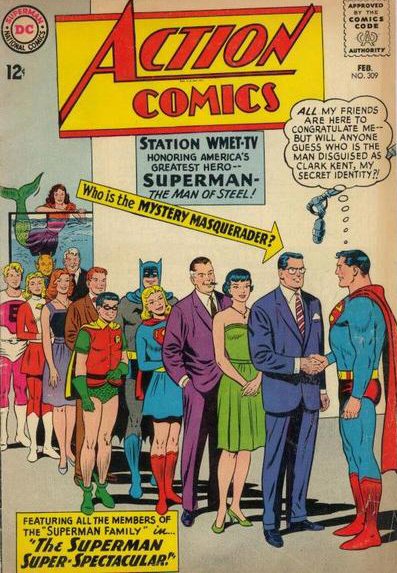
Year of Superman Week 17: Lex, Batman, Power Girl, Batman, Elseworlds, Batman, and Spam

Another week, another round of the Year of Superman! It’s going to be another random week, a week where I’m not going to be adhering to any particular theme or category, and just reading or watching whatever catches my fancy. And there’s some fancy, fancy stuff coming down the pipe this week, from the big 25th issue of Joshua Williamson’s run on Superman to the completed three-part Last Days of Lex Luthor miniseries, and…well, I don’t even know what else will come up, because I’m writing this at the beginning of the week and I’ve got no idea where the solar winds of Rao will take me. Join me and let’s find out!

Wed., April 23

I feel like Perry is kinda burying the lede here…

Comic: Superman Vol. 6 #25

Notes: Since Williamson kicked off his run on the main Superman comic about two years ago, he’s been building up a pretty epic storyline involving Lex Luthor. It began after Lex was taken into custody, turning over his company to Superman and making it “SuperCorp.” As one of the few people on Earth whose memory of Superman’s double identity remained (it was because of him that it was wiped out anyway), he decided that if he couldn’t destroy Superman, he would force him to work WITH him, and it was a strategy that worked pretty well for some time. Along the way, though, Lex lost his memory, leaving him a man who wasn’t quite as brilliant as before, but who had a genuine benevolence to him, seeming to want to atone for the crimes of his former self. It was a change for the better for everyone – except for Mercy Graves.

In this climactic issue, Mercy has let loose one of Lex’s failed experiments, X-El, a Luthor/Kryptonian hybrid clone, that she’s hoping to have supplant the “new” Luthor, and it’s Superman, Superwoman, and Lex vs. X-El. I loved this issue – it feels like a real culmination of the story so far, with everything that’s been happening building up to an incredible fight that lasts for most of the extra-sized issue. What’s more, the usual penciler Jamal Campbell (who has been doing a bang-up job on this series) is joined by a murderer’s row of talent, including Eddy Barrows, Eber Ferreira, and Dan Mora. Campbell and Alejandro Sanchez are credited as colorists as well, and although you don’t often discuss the colorists when you’re talking about comic books, this is one issue where it really stand out to me. Every page has at least one panel that could be turned into a poster I’d expect to see in any comic shop. 

Although the issue is, like I said, kind of a culmination of the storyline in that it has brought everything together, it would be a mistake to imply that it’s the END of the story. In fact, this issue ends in a cliffhanger that’s really got me itching for issue #26. But man, I can’t say enough good things about this run and this creative team. 

Thur., April 24

I just wish that Bryan Hitch would have the guts to put a little symbolism into his artwork.

Comics: Superman: The Last Days of Lex Luthor #1-3

Notes: About a month ago, when the long-delayed second issue of this miniseries finally came out, I decided to wait to read it until I had the third and final issue in my hands. I don’t know if the story would have been less impactful had I not chosen to wait, but I DO know that it would have driven me crazy to have to wait for the final installment, because ultimately, this is one of the finest Superman stories I have ever read.

And if you haven’t noticed, I’ve read a LOT of them.

In the first issue (which, again, came out nearly two years ago, and that’s the last time I’ll reference the delay), Superman is attacked once again by his greatest enemy…but this time, Luthor’s goal is not the death of the man of steel. No, for once, he needs his HELP. Lex Luthor, it seems, is dying. Some strange, exotic radiation is attacking his cells, and he knows that Superman is the one being in the universe who will stop at nothing to find a cure, because Superman…well…Superman is the man who saves everybody.

I don’t want to say too much more about the story, because there are some incredible twists and surprises throughout this miniseries. But that doesn’t mean there isn’t still a LOT to say. The reason Luthor turns to Superman, again, is because he knows that Superman will absolutely refuse to quit as long as there is a life in jeopardy, and the fact that the life in question belongs to his greatest enemy makes no difference whatsoever. Luthor sees this as foolishness, as a weakness on Superman’s part, but throughout this story, Mark Waid demonstrates why this is actually his greatest strength. Superman is confronted by friends who cannot fathom why he would risk so much to help Luthor. The quest to save his enemy becomes public knowledge, making some of the public turn against him. His quest takes him to Kandor, Atlantis, Themiscyra, and even the 31st Century, before the final reveal of what’s really going on turns everything on its ear and seals the fate of the two characters.

It’s an odd choice, to make this a Black Label book. Black Label is ostensibly a “mature reader’s” imprint, but there’s nothing in this book that warrants that marker. It’s out of continuity, to be certain, and I wonder if this would have been listed as Elseworlds, had that label been resurrected when the first issue appeared. But no matter what imprint this story falls under, it’s a masterpiece. It’s Mark Waid’s dissertation on who Superman is and why he has to be who he is. We learn the same things about Lex Luthor, in fact, and the relationship between these two characters has never been laid out so bare, so stark, so clean as in this story.

This story is brilliant. This is one of the best Superman stories I’ve ever read. 

Fri., April 25

Comics: Justice League Unlimited Vol. 2 #6

Notes: The second part of “We are Yesterday” in Justice League Unlimited doesn’t have a ton of Super-action, but it’s a great issue nonetheless. In this issue, we see Grodd hatching his plan to infiltrate the past and collect purer versions of his former compatriots in the Legion of Doom to act as a countermeasure to the now-larger League. We also get a glimpse of the moment when Superman recruited Air Wave – who has become a surprisingly important character in this series – to join the League. Air Wave is an interesting character – a D-lister for years, and Waid has already found a way to make him compelling and sympathetic through a comparatively small number of pages in the first six issues of this title. I really hope that we get to see more of his story after this crossover with World’s Finest reaches its conclusion. 

Graphic Novel: Batman: Hush (Collects Batman #608-619, Superman appears in #611, 612, and 619)

“Say it, Bruce! SAY THAT GLASSES ARE A PERFECTLY ADEQUATE DISGUISE!”

Notes: With “Hush 2” currently running in the ongoing Batman comic book, I wanted to go back and re-read the original, as it’s been a while. I’m not going to dig into it too deeply, as this ain’t the “Year of Batman,” and Superman’s appearances are brief. But brief or not, they ARE impactful, and I wanted to point out a few things. 

First comes in Chapter 4 (issue #611 of the ongoing), in which Bruce Wayne visits Metropolis and, specifically, the offices of the Daily Planet. At this time, Bruce actually OWNED the Planet. I’m not sure if he still does or not. Hey, DC, give us a ruling. But regardless, in this issue he’s been finding himself growing more and more drawn to Catwoman, with whom he’s always had a “will they/won’t they” relationship. At the Planet office, he watches Lois and Clark together and marvels at how Clark has found someone with whom he’s willing to trust his greatest secret. A few chapters later (kinda spoilers, in case you’ve never read “Hush” before), Bruce reveals his own identity to Selina for the first time. It’s one of those rare status quo changes – like Lois and Clark getting married – that has stuck, and I find it very interesting that writer Jeph Loeb decided to use the Lois and Clark relationship as a way of sort of justifying that relationship upgrade for Selina and Bruce.

Superman has a bigger presence in Chapter 5 (issue #612), in which he’s being controlled by Poison Ivy and comes to blows with Batman in the sewers of Metropolis. (Side note: it’s VERY odd to see the way Catwoman fights both Ivy and Harley Quinn in this storyline, considering the way that the three of them would become the “Gotham City Sirens” just a few years later.) It’s a pretty good fight, all things considered. Bruce has his Kryptonite ring, and he’s counting on both that and the fact that he knows Superman is actively fighting against Ivy’s mind control to keep him alive. I think the most interesting thing about this fight, though, comes from a two-page spread in the middle, where Bruce’s inner narration makes a comment that the internet has elevated to meme status: “Deep down, Clark’s essentially a good person…and deep down, I’m not.” People love to use this quote, but I think a lot of them miss the point. The way I read it, this is something that Bruce sincerely believes…but he’s wrong. Not about Clark, of course, but about himself. And Clark would be the first one to tell him that.

Also, in this issue, Poison Ivy gets captured by Krypto, and that’s just adorable.

Superman then dips out of the rest of the story until the denouement in Chapter 12 (issue #619). The mysterious Hush has been defeated and Bruce turns once again to Superman…not just because he needs a friend, but also because he needs someone with X-Ray vision to make sure that Hush didn’t do anything inside of his head…and literally, not the way the Joker does it. The three appearances of Superman in this story really speak strongly towards the bond between these two heroes and the trust that they share. At the same time as this storyline was winding down, Loeb was launching the ongoing Superman/Batman series, and I don’t believe for a second that this was a coincidence. He writes both heroes well. He writes them TOGETHER excellently. 

Sat., April 26

Comic: Power Girl Vol. 4 #20

“Meet Kara who’s never had a home
From Argo City to the Phantom Zone
But PAIGE HAS MADE FRIENDS LEFT AND RIGHT
TO GO WITH HER KRYTPONIAN MIGHT!
Whaaaat a crazy pair…”

Notes: This volume of Power Girl ends with this issue and, much as I hate to say it, I’m not really upset to see it go. It had a promising start, but the series seemed to be all about trying to figure out who Power Girl is and…frankly…I’m tired of that. A lack of identity has been Power Girl’s defining characteristic for the past 40 years, and that’s at least 39 years too long for that to be interesting in any individual character. At first, it seemed as though this series was going to lock her in to a true identity, but as evidenced by the cover of this last issue, it never really felt like it gelled. The book built up her world, built up her supporting cast, but didn’t really build up HER. I get it. It’s difficult. The elevator pitch of the character is “older Supergirl from Earth-2,” and since we’ve already got the “Prime” Supergirl, that doesn’t seem to leave room for her. But if all you do with the character is point out that she seems superfluous without redefining her in a satisfying way…well, what have you actually done? I hope somebody else gets their hands on Power Girl soon. I don’t care if it’s as a supporting player in the Superman titles or if she rejoins the Justice Society or what, but I want somebody, ANYBODY to take Kara Zor-L and finally, after all these years, say “This is who she is and this is what makes her unique, and can we please stop having the same conversation?”

Is that so much to ask? 

Sun., April 27

Comics: Batman Vol. 3 #36-37

Part one: Bromance. Part two: Romance.

Notes: When I read Hush a few days ago, I noticed a scene in the chapter where Superman is controlled by Poison Ivy where Catwoman tries to break him out of it by threatening Lois Lane’s life. She didn’t mean it, of course, she did it because Batman told her that Superman was close to the people who worked at the Daily Planet and that endangering one of them would help him break from Ivy’s control. Nor did she know specifically that Lois was Clark’s wife – Bruce also told her that Jimmy Olsen and Perry White would have been suitable for this purpose. But the scene put me in mind of a more recent meeting between these four, and I wanted to read it today.

Tom King’s run on Batman is controversial for reasons I’m not going to get into here, but the two-part “Super Friends” story from Batman Vol. 3 #36 and 37 is one of the best stories about Superman and Batman I have ever read. Batman and Catwoman have recently become engaged, and in the first issue Bruce and Clark each have conversations with their respective significant others about the fact that they haven’t spoken to one another about the engagement yet. Clark is convinced that the fact that Bruce hasn’t called him is evidence that they’re not really that close, Bruce says he shouldn’t have to call Clark because his best friend is actually Jim Gordon (who doesn’t know his real name) or Alfred (who Selina points out is on his payroll, and therefore doesn’t count). The bulk of the issue is taken up with cutting back and forth between these two conversations, and the quick realization that Lois and Selina know Clark and Bruce far better than either of the world’s two greatest heroes know themselves. At the end of the first issue, the two couples come together in one of the most charming meet-cutes I’ve ever seen. You’ve probably seen the page on the internet even if you’ve never read the issue.

Yeah, that’s the stuff.

In part two, the foursome go on a double date to an amusement park which is celebrating “Superhero Night” – you have to have on a superhero costume to get in. Under the ladies’ suggestions, Bruce and Clark wear each other’s costumes and enter the park to enjoy an extremely rare night for themselves. 

Tom King’s depiction of this relationship is spot-on. They’re best friends, even though neither one of them really wants to admit it. Their differences are what make them work together, not something that drives them apart. And the scenes of Lois and Selina bonding with one another are absolutely joyous. We fans talk quite a bit about how difficult it must be for superheroes to hide the secret of their dual lives, but we don’t talk enough about the toll it might take on those who love them. Giving Lois a new friend in Selina really feels natural. I was, I admit, disappointed when the Batman/Catwoman wedding didn’t go through, because I thought that DC would finally have the guts to push Batman’s status quo in a new direction permanently. I still think that it would have been better if they’d remained together. But mostly, I miss the chance to have more issues like this one, with Clark and Lois and Selina and (however begrudgingly) Bruce just being friends.

Don’t we all need that? 

Mon., April 28

TV Episode: Superman and Lois, Season 2, Episode 7, “Anti-Hero”

Or the “Lana’s Trauma Conga Express.”

Notes: Superman has been taken into custody by the DOD, who are holding him under a red sun lamp to negate his powers. As Lois and Sam try to figure out a way to navigate his release, Jordan is still angry at his brother for lying about the source of his newfound powers, and Lana and Sarah are dealing with the fallout of Lana’s impending separation from her husband.

Did you notice how each plot point I recapped there got progressively less superhero-y and more soap opera-ish? To be fair, there has been overlap in the kind of storytelling done by superheroes and soap operas for a very long time. Even as far back as the Golden Age you had the occasional unrequited love runner that punctuated early superheroes. Then, once Stan Lee brought in the Marvel Age of comics, the greater emphasis of serialized storytelling made it virtually inevitable that elements like Spider-Man’s disastrous love life would become an ongoing story point. But at times, Superman and Lois feels far more like a teen drama than a superhero show. It’s not fair to criticize the show on that point – for what it’s doing, it seems to do it just fine. But it isn’t exactly what I’m looking for here.

Some of the soap opera stuff is done well. For instance, there’s a nice scene where Lois and Lana are bonding over their respective family struggles – Lana with the fact that her husband cheated on her, Lois with the fact that her son got caught with a backpack full of drugs. The odd thing is that they’re treating X-Kryptonite as if it was any other drug. Jonathan’s bag had 20 vials, each of which could turn a teenager into a walking weapon of mass destruction, but the conversation they have could have been ripped straight out of a 70s After School Special about a mom who caught her son with a joint. 

That’s not to say that there’s no superhero stuff going on, of course. The story of Clark in custody, held under the red lamps with his half-brother Morgan Edge, is exactly what I’m hoping to see. The DOD even weaponizes Superman’s compassion, threatening to harm Edge if he doesn’t give them information that they want, which he does despite the fact that his brother is also his enemy. I even like the way the two of them put their differences aside and work together. The CW has a tradition of villains slowly reforming and joining the heroes that goes back to when they were the WB network and it happened every season on Buffy the Vampire Slayer, so if that turns out to be the long game with Morgan Edge’s character, I’m used to it. Once they meet up with the hologram of Lara and the Alternate-Superman (can we PLEASE just call him Bizarro?), there’s some good action stuff here. 

But none of that addresses the real problem I’ve been having with this show in season two. I love Hoechlin’s Superman, but the problem here is that they’ve isolated him. The show is stronger when he’s paired with Lois or where he’s working with his sons and their struggles with Jordan’s powers and Jonathan’s typical lack thereof. If you’re not doing that kind of thing, if you have him segregated from the rest of the main cast, you may as well be watching two entirely different shows. 

Clark, fortunately, returns to Lois at the end of the episode. But before that we get one more little scene I liked. Edge is still in custody, still the bad guy, but at the end of it Clark addresses him as “Brother.” This actually goes directly against something said earlier in the episode, when she tells Jonathan that his father would never forgive him for his involvement with X-K. But as the end of this episode shows you, Superman’s forgiveness is infinite. You mean to tell me, Lois, that you don’t think he would forgive his SON? Come on, you know him better than that.  

Then again, the episode ends with Clark tearing into Jonathan and not allowing him the opportunity to talk, so what do I know? 

Tues., April 28

Comic: Superman: Speeding Bullets #1, Action Comics #374

When the dry cleaner at the Hall of Justice mixes up the bags.

Notes: I’ve got a new writing project I’m working on today, so I needed something quick to slip in to the Year of Superman. The classic Elseworlds one-shot Superman: Speeding Bullets seemed like just the thing. Written by J.M. DeMatteis with art by Eduardo Barreto, this is about as close to the old Marvel What If? format as Elseworlds got, basically asking the question, “What if Kal-El was found by Thomas and Martha Wayne instead of Jonathan and Martha Kent?” Thomas and Martha – childless in this universe – find the rocket ship and adopt the child much like the Kents did, naming him Bruce and raising him as their own. Kal-El’s life in Gotham is pretty similar to the mainstream Bruce Wayne until the night of his parents’ murder, when – seeing the people he loved most in the world gunned down in front of him – his head vision activated and he roasted Joe Chill to death. In shock, Bruce developed a mental block about that night, forgetting his powers until – as a young adult – robbers break into Wayne Manor. His heat vision – and memories – come back, and he becomes a much more brutal version of Batman and the one in our universe.

When I say this was close to a What If?, I don’t just mean in premise, but also in execution. The classic What If? stories tended to end in one of two ways: either the universe attempts to “course correct,” resulting in a world as close to the original as possible, or things go so dark and bleak that it may as well be the apocalypse, at least for the characters involved, if not literally. Some of the ways we see that here are Bruce deciding to buy the Gotham Gazette and hiring Perry White and Lois Lane, falling in love with the latter, and Lex Luthor suffering an accident in a chemical plant, transforming him into this world’s version of the Joker. Since this is a world that can’t have both a Superman and a Batman, we watch Bruce Wayne transform from one to another. Lois’s influence cools his rage, getting him to pull back on his bloodlust, and eventually abandoning the Batman identity to become his world’s Superman. It’s an interesting book, and it works well as an Elseworlds. I have to admit, though, I’m surprised that this version of Bat/Superman hasn’t turned up the way other Elseworlds versions like Red Son or the Vampire Batman have once the Multiverse was opened up again. 

Blake M. Petit is a writer, teacher, and dad from Ama, Louisiana. His most recent writing project is the superhero adventure series Other People’s Heroes: Little Stars, volume one of which is now available on Amazon. You can subscribe to his newsletter by clicking right here. You can join in the Kryptonian Konversation every day in the Year of Superman Facebook Group!
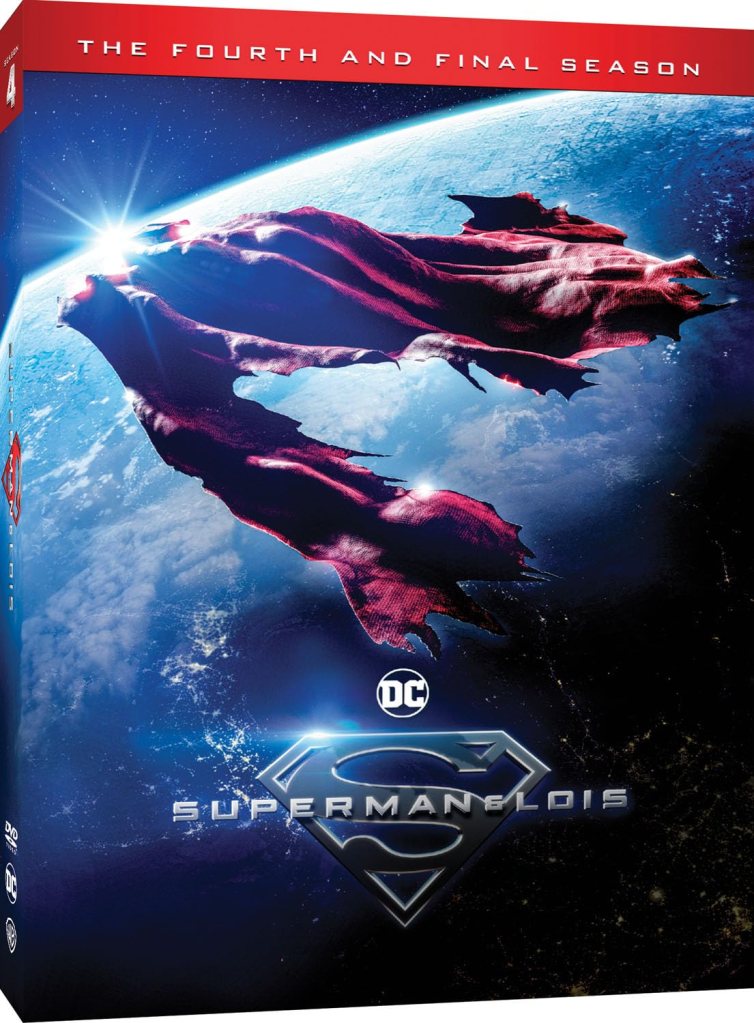
Year of Superman Week 15: Highs and Lois (Rimshot)

It’s going to be another pretty random week in the blog, folks. Having put the finishing touches on Krypto Week, I don’t have a particular theme to adhere to for the next seven days – I’ll read or watch whatever strikes my fancy on the day.

Wed., March 12

Comics: Superman #285, Flash #158 (Cameo)

This guy went on to a promising career as a referee in the National Football League.

Notes: If you’re anything like me, you love going to comic book stores and conventions or scouring eBay for old comics. I dive into dollar bins, I get lots of old, random comics, because I love finding strange, unusual books, things that aren’t on the radar of the collectors. And, of course, I also snare any Superman-related content I can get my hands on. I get it faster than I read them, to be frank, so I have a substantial “To Read” pile at home. Today I’m going to randomly pull out a book from that pile to kick off the week.

The winner is Superman #285 from 1975. I haven’t ever read this one before, but it’s got the legendary team of Elliot S! Maggin and Curt Swan, so it’s at least got that much going for it. In the story, Superman is deeply engrossed in the mystery of the missing Roy Raymond, TV Detective. Raymond is an old DC character who, even by ‘75, had faded into obscurity, and sending Superman out to search for him is a decent story. There’s also a fun subplot regarding WBGS gossip maven Lola Barnett, a semi-regular of the supporting cast at the time (and let’s give the creators a hand for resisting the urge to make her one more of Superman’s legendary “Double-Ls”). When Lola is challenge to keep a big, juicy secret for an entire week, she selects one given to her by Clark Kent, a secret the reader can’t read the ending of: “I am not who I seem to be. I’m really…”

Obviously, nobody thought that Clark was going to out himself to a gossip columnist to win a bet, but the last-page reveal of what the secret actually WAS turned out to be fun. 

I don’t know if the intent behind this issue was to bring Roy Raymond back as an ongoing concern for the DC Universe, but if it was, it didn’t quite work. Ol’ Roy remains pretty obscure to this day. But kudos to Maggin and Swan for giving it a try. 

Thur., April 10

Comics: Action Comics #761, Wonder Woman Vol. 2 #170, New Adventures of Superboy #33, Titans Vol. 4 #19 (Cameo), Flash Vol. 6 #19 (Guest Appearance)

Well, not WITH Wonder Woman. That’s kinda the point of the story.

Notes: Joe Kelly is one of those writers who did a solid job on his tenure with Superman, and although I think few people would put him on their Mount Rushmore of Superman writers, he’s responsible for a couple of my favorite Superman stories of all time. The second one, Action Comics #775, will show up at some point this year when I pair it up with watching the movie that adapted it, Superman Vs. the Elite. But for today, I’m going to look at what I consider to be his second-best one-off story, a Superman/Wonder Woman story from Action #761. In a recent issue, a photographer caught a photograph of Superman in which he was clearly wearing a wedding band – Clark slipped up and forgot to take it off when switching identities – and the question of “Who is Mrs. Superman?” is dominating the celebrity news cycle. Lois and Clark are having a lazy morning, semi-joking about the situation, when Diana shows up and throws everything into turmoil.

Superman and Wonder Woman are whisked off to Asgard in this story, while Lois is stuck back on Earth, slightly smarting over the fact that her husband has been taken to another dimension with an Amazon princess. Clark and Diana are trapped in Asgard, helping the Aesir fight off an invasion of demons, for 1,000 years…their time. On Earth, only a day passes. 

So much is written about the friendship of Superman and Batman, and with reason. But the Superman/Wonder Woman relationship is more complicated and, in a lot of ways, more interesting. Over the years there have been several stories that flirted with a romance between them. They even made their couplehood canonical during the New 52 era, and shared an ongoing series for a couple of years. But that pairing has never really sat right with me. Part of it, I guess, is that Lois and Clark are the permanent pairing in my brain. Nothing has ever been able to chip away at that, they were literally made for one another, and I reject any efforts to keep them apart.

But there’s also the fact that pairing off Superman and Wonder Woman seems, to a degree, too obvious. There have been plenty of superhero universes that do their own versions of these characters and make them a couple, and none of them have ever been particularly satisfying to me. Superman already has the perfect romantic partner, but what he doesn’t have is somebody with whom he can share the burden of being someone of immense power in a world that could crumble under his grip if he allowed it to do so. He doesn’t have someone else who understands what it means to control yourself and resist the urge to make things the way you believe they should be simply because you have the ability to do so. Even with the other members of the Superman family, like Kara, Conner, Jonathan, and so forth, he has to take on a role that is – if not fully parental – at least that of the fraternal authority. He’s either Dad or big brother to every other Kryptonian in his orbit. 

Lois is his wife, and can be his confidante in many things. Batman is his partner in the neverending battle, and their friendship should be secure. But Wonder Woman is a peer that he needs. So the scene in this issue where, after a millennium of battle, Wonder Woman begins to crack and almost acts on her attraction to Superman, is one of my favorites ever written. Is the attraction mutual? Almost certainly. She’s Wonder Woman, for Zeus’s sake. But it cannot be acted on, for two very good reasons. First: even after 1,000 years apart, Clark’s devotion to Lois remains absolute. But second, and far more interesting, because he loves Diana so completely as – in his own words – “my best friend.”

There isn’t enough media out there that recognizes that friendship – genuine friendship – is possible between people, whether it’s members of opposite sex or any other compatible sexual orientation. It’s why slash fiction kind of gets on my nerves – it feels like a rejection of the notion that two people can be close without wanting to get down and dirty. These two characters seem awfully close – there MUST be something else going on, right? Or, “Oh, your wife’s friends with a dude? Obviously he’s trying to steal her from you.” Are there people like that? Sure. Even Lois feels a tinge of jealousy when Diana is around. But she needn’t, and that’s the point.

Friendship is real, and it’s important, and true friendship as an adult is something far too many people in this world live without. True love does not have to be romantic in nature to be true, and when I see a story that recognizes that fact, it always makes me want to celebrate it.

I tend to imagine Diana is giving Lois that speech you just read.

So yeah. I dig this issue very much. Reading it, in fact, put me in mind of another excellent Wonder Woman/Lois story, Wonder Woman Vol. 2 #170, which I wish I had read back in Lois Lane week. “A Day in the Life” was ALSO co-written by Joe Kelly, partnered here with magnificent Wonder Woman storyteller Phil Jimenez. In this one, Lois has requested an unexpected assignment from Perry White: a profile piece on Wonder Woman. After meeting up at the home of Steve Trevor and Etta Candy (married to one another in this continuity), Lois tags along with Diana over the course of a typical day. She goes to France where she gives a speech to a packed crowd of university students, zooms up to the Justice League Watchtower to check on an experiment, and zips down to Central City where Diana makes an appearance on the DC Universe equivalent of The View. She makes a stop with President Luthor in Washington, whisks away to disadvantaged areas all over the world, and visits with Donna Troy before making an appearance at the United Nations. 

The gem of this issue is the final scene, which is just Lois and Diana in a bar, shooting pool, and kind of having it out. Although Diana has been nothing but gracious to her, something about her still rubs Lois the wrong way. This is a fantastic scene about each of the two women, as well as their respective relationship to Superman. The reporter in Lois is always looking at perfection and trying to find the flaws in it, which is one of the things that makes the flawless Diana so damned frustrating. But there’s also the fact, she admits, that her husband’s best friend is an Amazonian goddess, and not even Lois Lane is so secure that she isn’t at least a little rattled by that. Diana lays her cards on the table as well, talking about how much she respects Lois and how amazing a woman SHE must be for Superman to have chosen her (even, she points out, after their 1,000-year adventure in Asgard, which apparently Clark neglected to tell Lois about). 

Relationships are a weird thing, and as a writer, you recognize that each person that becomes part of a relationship does not add to the complexity, it multiplies it. The Lois/Clark relationship is a thing, the Clark/Diana relationship is a thing, the Lois/Diana relationship is a thing. But this issue is about the gestalt of them all, the Lois/Clark/Diana relationship. It’s the best – and perhaps the only – comic I’ve ever read that is really about the THREE of them, and it’s really good.

And hell, Superman isn’t even IN it. 

Fri., April 11

Comics: Justice League of America #20, Superman’s Girl Friend, Lois Lane #12, World’s Finest Comics #305

Based on the rules of Silver Age comics, I half-expected that the story would be Superman just flying in place to screw with Lana’s head.

Notes: In the Silver Age, if Lois wasn’t busy trying to get Superman to marry her, she was spending the remainder of her time flirting with his teammates in the Justice League. In Lois Lane #12, it was Aquaman’s turn. When a freak accident crushes Lois’s legs and lungs, Aquaman brings her to a surgeon who determines the only way to save her life is to turn her into a mermaid. 

Yeah, you can read that sentence as many times as you want, it’s still crazy.

Lois attempts to adjust to her new undersea life while preventing Superman from finding out what has happened to her, although presumably if she’d known about his previous fling with Lori Lemaris she would know that “mermaid” apparently wasn’t a deal-breaker for Superman. While beneath the ocean, she starts to have feelings for Aquaman, but then rejects him, knowing that it’s truly Superman she loves in her heart. After a second freak accident again leaves her on the brink of death, Superman rushes to the hospital library, memorizes every medical book in existence, swiftly passes a series of examinations to prove his medical knowledge, and performs surgery to give Lois her legs and lungs back.

The questions, both ethical and existential, are enormous.

So Superman – Silver Age Superman, at least – has the medical knowledge to transform a mermaid into a human being. And a HUMAN doctor possesses the knowledge to turn a human into a mermaid in the first place. I am banging my head against the wall trying to wrap my brain around what I just read and I cannot make it work. It may be the single most insane story I’ve read yet in this entire “Year of Superman.” 

Five stars. 

In this issue’s second story, Lana Lang swipes a formula Lois is supposed to give to Superman that supposedly can give anyone super-strength and invulnerability. Lana is using it to try to steal Superman from Lois, and when Lois finds out, she hatches a devious scheme that winds up making both her and Lana look like absolutely horrible human beings, and I can only thank Rao that this isn’t canon anymore.

Finally, we have “Lois Lane Loves Clark Kent,” except that of course she doesn’t. She catches Clark surviving a fall and determines that she’s been right in all her years of suspecting he’s really Superman. This time, though, she decides to trap him by “falling in love” with Clark and not telling him she’s learned her secret until after the Honeymoon. Superman decides to teach her a lesson. Dickishness ensues. 

Sat., April 12

Animated Shorts: Electric Earthquake (1942), Volcano (1942)

Notes: It’s been a minute. How about another Fleischer short or two today? 

When I was a kid, all we had were wood-burning earthquakes.

In Electric Earthquake, a mad scientist has set up a device beneath Manhattan harbor that threatens to destroy the entire city with an earthquake. In and of itself, this shouldn’t be a huge surprise – from the cartoons I’ve watched so far it seems like at least 75 percent of the city’s population were mad scientists. But this particular scientist is a Native American, angry that the island was taken from his people and demanding it back. The cartoon leaves you with mixed feelings, honestly. On the one hand, it’s somewhat problematic to paint the Native American as the villain in this story. On the other hand, he’s oddly progressive in that he doesn’t wallow in any kind of stereotypes, and he’s obviously intelligent and crafty. If it weren’t for the whole “destroying the whole island and murdering everybody” thing, it would be one of the more positive portrayals of the time.

And as a Superman fan, I find it interesting that – at this point – it seems that the filmmakers at least still viewed Superman’s “Metropolis” as another name for New York, as the scientist quite clearly calls the island “Manhattan.” I wonder just when, exactly, they decided to definitively establish Metropolis as its own separate city.  

“Dammit, for the last time, I am NOT doing an R. Kelly joke.”

Volcano, thankfully, breaks us free of the necessity of yet another mad scientist, and sets the man of steel loose against the danger of an erupting volcano. With word of an impending eruption making global headlines, Perry White sends Lois and Clark off to cover the event. Lois sneaks Clark’s press pass, though, leaving him frozen out of the danger zone so she can get the story herself – a decision that she may come to regret when the volcano begins to erupt before the scientists can blast the side of the mountain and divert the lava flow to an uninhabited area. Naturally, this looks like a job for Superman.

I’ve talked a lot about just how beautifully animated the Fleischer shorts are, and from that perspective, this may be one of the absolute best. The flowing lava, flickering flames, the waves crashing in the ocean…it’s all absolutely gorgeous to look at, and the movements of the characters all feel very realistic and authentic. When you think about how awfully stilted some animation was at the time, it’s astonishing that they pulled this off. Hell, there are cartoons being turned out today that don’t look this good. Plus, the lack of a human antagonist (especially yet another “mad scientist”) makes this cartoon a nice refresher from the others of the line.  

Comics: Green Lantern Vol. 8 #20 (Guest Starring Superboy)

Sun., April 13

TV Episode: Superman and Lois Season 2, Episode 6, “Tried and True.”

“Golly, Blake, how nice of you to remember we exist.”

Notes: You see, this is why I never finished watching Superman and Lois when it was on the air. I start watching it, and I get into a pretty good rhythm for a few days, then I get distracted by something shiny and the next thing I know I haven’t watched an episode in two months. I’m not blaming anybody else, it’s my fault. I’ll try to do better.

Oh wow, this episode starts with creepy-ass Bizarro with his creepy-ass eyes fighting a bunch of DOD agents. It’s odd that this version of Bizarro is as surprising as it is. I mean, the concept of an imperfect Superman, with all of his power but an inverted sense of his morality, SHOULD be pretty frightening. But instead, the character is almost always played for laughs, with joke stories or full of silly misunderstandings. There have been attempts to make him a bit more serious over the years, but this “reverse Superman” from a parallel dimension is the most chilling incarnation of the character I’ve ever seen. 

We’ve also got the usual dose of Superman and Lois drama – Jordan and Jonathan dealing with the powers the latter got from his dose of X-Kryptonite, Sam having to play referee between Lois and Lucy, Lana’s marriage falling apart, and the mother of one of the DOD agents killed by “Inverted Superman” demanding justice. It’s probably because it’s been a little while since I watched an episode, but it feels like there’s just an enormous number of plots and subplots going on in here, and I’m kind of hoping that things are whittled down a bit. I’m seeing the reason a lot of people have called Tyler Hoechlin the best on-screen Superman ever (I don’t know that I’d necessarily agree, but he’s definitely very good). The show itself, though, at least at this point in season two, feels like standard CW fare. 

Mon., April 14

Comics: Superman: Earth One Vol. 1

It doesn’t matter the universe, this pose is a requirement.

Notes: Back in 2010, DC began this “Earth One” experiment, a series of original graphic novels re-imagining the characters from the ground up. It was similar to Marvel’s Ultimate Universe, with the big exception being the fact that the stories were being told in graphic novel format rather than monthly comics. It was interesting, and some of the books were very good, but the line petered off somewhat. I don’t think DC ever really established “Earth One” as a cohesive universe the way Marvel did with the Ultimate line. There was little – if any – cross-pollination between the graphic novels, and in fact, some of them didn’t feel like they belonged to the same universe as the others at all. It’s been quite some time since there were any new Earth One books, even though DC does keep them still in print, but as far as launching a whole new UNIVERSE, the current Absolute line seems to be doing the job much more successfully.

All that said, let’s look at the first of the Earth One graphic novels anyway. Written by J. Michael Straczynski with art by Shane Davis, this is a pretty solid way to recontextualize Superman in the early 21st century. We begin with young Clark Kent, fresh from Smallville Junior College, moving to Metropolis to find himself. The trouble is, he isn’t quite certain who he wants to be. He tries several different jobs, all of which he excels at, none of which he finds fulfilling…everything except for his attempt to get a job at the Daily Planet, where Perry White basically tells him he’s not good enough yet, but there’s a high turnover rate, so they may give him a call. The whole question may be moot, though, when an alien invasion force attacks Earth, searching for the last child of Kryton, whom they have been chasing across the stars for twenty years. They are the race responsible for Krypton’s destruction…and they are here to finish the job.

I don’t remember noticing it at the time, but I’m a little shocked at how similar the story here is to the movie Man of Steel, which of course came out three years later. It’s not exactly the same, of course – in the movie the antagonists are Kryptonians hoping to rebuild their planet, not a new race hoping to complete their extermination – but the aspect of the alien invasion drawing out Kal-El, but instead being a facade to hide their true intentions for Earth – is spot-on. It’s different tonally, and it ends things pointing in a very different direction than the film, but I am sorely tempted to go back into the credits for Man of Steel to see if Straczynksi and Davis were among the comic book creators given special “acknowledgements” in the film. (“Acknowledgements” is Hollywood talk for “we used ideas from these guys but we’re probably not going to pay them. Kind of like ChatGPT.)  

One of the things I like about this book is the way Straczynski addresses the fact that Superman doesn’t wear a mask. People with no imagination constantly harp on how the glasses are a bad disguise, but they’re missing the point. There’s a nice conversation where Martha tells Clark that he can’t wear a mask, that someone with that much power would be terrifying to people if they thought he had something to hide, and thus he has to allow them to trust him. We’ve seen echoes of this in countless Superman stories over the years. Dozens of antagonists, from Lex Luthor to Sam Lane, have all feared or hated Superman because they can’t conceive of a man with his kind of power using it for good. It’s the reason he wears bright colors, it’s the reason he operates in the light instead of the darkness. Supposedly David Corenswet himself, our new Superman (July 11th can’t come soon enough) lobbied hard to include the trunks for the costume because the trunks look like a circus performer, and he wants his Superman to be someone that nobody is afraid of. That’s PERFECT. That’s EXACTLY who Superman should be, and this graphic novel explains that pretty succinctly in a single page. 

I know I’ve read the second volume in this series, but I can’t quite recall if I ever got around to the third one. If the story of the death of Krypton and the mysterious force behind it was resolved before the Earth One line kind of faded away. But hey, this is the Year of Superman, and I’ve still got 36 whole weeks left to go – that’s plenty of time to dig into the last two books in this line. I’m sure this isn’t the last we’ll see of this particular version of Superman. 

Tues., April 15

Comics: Superman: For Tomorrow (From Superman Vol. 2 #204-215), Superman’s Pal, Jimmy Olsen #137

Do you think Jim Lee knew he was designing DC fans’ favorite bookends when he drew these covers?

Notes: Coming pretty quickly on the heels of Batman: Hush, superstar artist Jim Lee (who would go on to be one of the heads of DC Comics) partnered up with writer Brian Azzarello for another year-long run on DC’s other flagship superhero. Lee and Loeb had turned out to be a magic team on Batman, but I wasn’t a huge fan of Azzarello’s take on Superman at the time. In truth, I don’t think I’ve re-read this story since it was first published in 2004, though, and it’s possible that the perspective of time – as well as reading it all at once instead of doling it out a month at a time – will make me more charitable towards it. Let’s find out together, shall we?

For Tomorrow begins with Superman visiting a Catholic priest, Daniel Leone, in a discussion that is clearly about absolution without ever actually using the word. We’re coming in after a year-long time-skip, and in that time something has happened called “The Vanishing.” Eventually, we determine that a year ago one million people across the globe simply disappeared, among them Lois Lane, and Superman is carrying great guilt over this event. However, it doesn’t seem like his guilt is the normal “wanting to save everybody” thing Superman carries with him, but rather something more specific.

I’m reminded immediately of why I struggled with this story the first time around. The entire first chapter is hints and veiled innuendo, not actually getting to what the story is about until the last couple of pages. That’s certainly something that works better in the collected format, but which can be infuriating if you’re waiting a month between installments. What’s more, Azzarello – who at the time was known for more noir comic books like 100 Bullets – brings that sensibility to Superman. We get glimpses of what’s going on, people talking AROUND the issue instead of actually discussing it, and while that works well for the style of story he’s accustomed to, it doesn’t really feel like a good fit for Superman, not to me at least.

As the story continues, Superman starts to regularly visit Father Leone, unburdening himself with the story of how he became embroiled in a conflict in the Middle East (obviously even more topical in 2004 than it is today) and his battles with a cybernetic monster called Equus, and of course, how these things tied into the Vanishing. 

As the year goes on, Superman finds himself in conflict with the Justice League over the events that lead to the Vanishing, particularly Batman, in an exchange that I find particularly distasteful. This is in a period where tensions between DC’s Trinity were building up heavily, which eventually lead to Infinite Crisis, and while it fits in that context, that doesn’t make the scene where Superman says to Batman “You’re my friend, but I don’t like you” any more pleasant to read. Both heroes feel out of character here, Superman in particular. He even insists that Batman call him “Kal-El” instead of “Clark,” something that doesn’t feel natural or appropriate at all. 

“Look, Cla–Kal…just tell us what name to put on your locker in the Watchtower.”

It goes on in the next chapter, when Wonder Woman attacks him at the Fortress of Solitude because he’s trying to do something about the Vanishing, which she calls “suicide.” Even Superman lampshades the fact that her using a deadly weapon against him (in this case, a magical sword) to prevent him from doing something that could kill him doesn’t make any damned sense. But like in the first chapter, Azzarello keeps dancing around exactly what IS going on, dodging the question of what Superman’s plan is and why Bruce and Diana oppose it. If you want to create conflict between heroes, fine, but that conflict works better when everybody has clear motivation – otherwise it’s just a frustrating fight that doesn’t seem to have any purpose other than to showcase Jim Lee’s (admittedly masterful) artwork. 

But perhaps there’s no other moment so off the wall as the scene where Superman has a conversation with Clark Kent (for reasons) about retrieving Lois from whatever the Vanishing is. Clark tells Superman that Lois was “uncomfortable” seeing him because “I’m not the man she loves.”

The hell? 

Granted, this isn’t really Clark, it’s a robot, but there’s a subtext here that’s painful and uncomfortable. There was an awful lot of shoe leather spent in the first 50 issues of this very title built around the fact that Clark Kent is EXACTLY the man that Lois Lane loves, and both characters are better for it than they ever were before. Furthermore, the notion that Superman and Clark are two different “people” is a similarly outdated Silver Age idea. Superman and Clark work best when they’re the same man wearing different clothes. Change my mind.  

Azzarello delves heavily into musing about the nature of good and evil and what Superman’s place is in a world where these concepts are more concrete than abstract. In and of itself, there’s nothing wrong with that. There are some great Superman stories that have been written about that very topic. However, the style is far more ponderous than most Superman stories, with lines like “To be in the presence of evil is to be both utterly offended and absolutely afraid.” A line like this would feel right in place in a Vertigo comic book, but in Superman it gives the impression of someone working very hard to be serious. That’s not to say that a serious Superman story isn’t possible – in fact, I’ve got a week planned for later this year where I intend a deep-dive into Superman’s darkest hours – but at the same time, this isn’t math class. Azzarello is showing his work too much, and that distracts the reader from the story. 

Once we finally get to the revelation of what the Vanishing was and why Superman is carrying around the responsibility for it…I’ll concede this much: it is a very Superman solution to a Superman problem. And it explains why the League was so antagonistic towards him. It doesn’t explain why Bruce and Diana were trying to prevent him from reversing it, though. And the truth is so massive that it should have left a stain on the character for years, but the story was rarely referenced after this, perhaps because of the way the world was reshaped relatively soon when Infinite Crisis kind of hit the reset button. 

I wanted to like this story. I hoped that the years would have changed my perspective, but in the end I still just can’t feel it. But I’m glad I made the effort – there’s some fine artwork here, and I know that my perspective on some stories changes over time. It’s worth trying again, even if in the end, I land in the same place that I started. 

Blake M. Petit is a writer, teacher, and dad from Ama, Louisiana. His most recent writing project is the superhero adventure series Other People’s Heroes: Little Stars, volume one of which is now available on Amazon. You can subscribe to his newsletter by clicking right here. You can join in the Kryptonian Konversation every day in the Year of Superman Facebook Group!
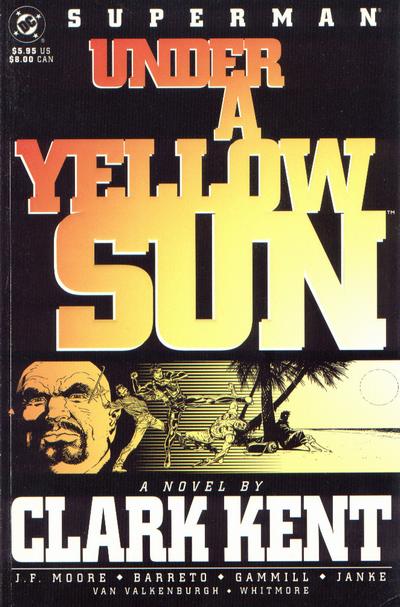
Year of Superman Week Six: Panic in My Soul and Panic in the Sky!

Last week, as I alluded to in that blog post, was a chaotic mess for me that left me a little bit of a wreck. I’m a little better as I write this, on the afternoon of Feb. 5, but the things that have been dragging me down since last Friday haven’t subsided entirely. As a result, I didn’t have time to really read or watch anything Superman-related today, and for a moment I was afraid my streak would end in only week six. But on the way home from work, an angel appeared in my podcatcher app in the form of good old Michael Bailey.

Wed., Feb. 5

Podcast: It All Comes Back to Superman Series 2, episode 8, “Moving Kryptonian Images Part One: Superman and the Mole Men”

Notes: Like myself, Michael’s got plans leading up to the release of the Gunn Superman movie, including an examination of 25 different feature films starring the Man of Steel, and he starts with this one. I’m not going to attempt any sort of recap when I listen to these episodes – in fact, in the future I may have no notes at all – but I really do enjoy them and I’m glad I’ve got him riding shotgun while I drive to keep my mind on the good things in this world…specifically those that come in the form of a strange visitor from another planet.

Thur., Feb. 6

I WISH they made these toys.

Comic: Super Powers Vol. 4 #1

Notes: It’s a busy week for me, so once again, I need something quick. The Super Bowl is coming to New Orleans this Sunday and my son is a ravenous football fan. While there’s no way we could possibly afford a trip to the Big Game, the NFL Fan Experience they’re hosting at the New Orleans Convention Center is considerably more affordable, and something Eddie will have fun with, so after school on Thursday we hustle him off to New Orleans for a few hours of gridiron fun. It’s a great time, but it does limit my Superman reading time to finding a quick comic on the DC Infinite app to read before bed. The winner is Super Powers #1 from 2016. This comic is by the amazing team of Art Baltazar and Franco Aureliani, and is set in the same world as some of their other kid-friendly comics Tiny Titans and Superman Family Adventures. In this first issue, Batman has mysteriously gone missing from Gotham City and it’s up to Superman and Wonder Woman to find him.

Art and Franco have a wonderful sense of humor and a delightfully free style that makes for some of the best comics for kids published in decades. And like most TRULY great works for children, it’s still fun for adults to read. The stories often have silly angles and even the occasional euphemism for some of the more adult concepts, but in a winking-at-the-camera way. This series was one of the few times they tried an extended storyline rather than a one-off or a series of shorts in a single issue, and I’m going to have to make it a point to finish the rest of the six-issue series this weekend. 

Fri., Feb. 7

Comics: Super Powers Vol. 4 #2-6

Notes: Today I decided to finish up the Art Baltazar and Franco Aurelani miniseries I started yesterday. I read this comic when it was released back in 2016, but it turned out to have far more Superman relevance to it than I remembered. For instance, I’d forgotten that in this very kid-friendly continuity, Jor-El and Lara are alive and living in Kandor. And, in fact, in this series they give Superman a baby brother, Prym-El…who, as it turns out, also has plenty of connection to one of Jor-El’s other “children,” the computer intelligence Brainiac. The Brainiac story actually works really well. It’s presented in a format that is intended for children, obviously, but if you took the bare bones of the plot and re-told it for an adult audience it would work perfectly well. On the other hand, that would cause us to lose a lot of the tongue-in-cheek humor and delightful continuity gags intended for the older people who they knew were reading the books as well. After all, there aren’t a lot of elementary school kids who read this book and would have gotten the joke about “Superboy Prym.” (If you don’t get the joke either, “Prym” is pronounced with a long “y”.)

I really do love this creative team. They’ve done some of the funniest and most welcoming comics for young readers this century, and that’s something we can always use more of. They still dip their toes back into the DC Universe occasionally, although they spend more time these days doing their own thing or working on other properties, such as some of the recent graphic novels based on the works of Dr. Seuss, but I will always welcome their return to the Superman family. 

Sat., Feb. 8

The worst part is that the Daily Planet’s health insurance defines this as a preexisting condition.

Comics: Superman #250, Superman #281.

Notes: Coming down from a stressful week, I decided to spend this afternoon finally reading the two new Superman comics I picked up at Fan Expo New Orleans back in Week Two. First up was the double-sized anniversary issue, Superman #250 from 1972. In this issue, Superman faces the Terra-Man, a villain that the narration has the audacity to refer to as “the most dangerous man in the world.” Although to be fair, he DOES almost manage to take out Superman with a device that causes the man of steel to get older every time he uses his powers. But still, Terra-Man has never quite made the upper echelon of Superman foes – the idea of a cowboy riding a flying horse and using high-tech weapons was maybe a wee bit too “high concept” to really catch on. And the end of the issue doesn’t really help. If you don’t mind spoilers for a 50 year old comic, here goes: Superman realizes that since using his powers makes him older, NOT using them will make him young again. This is an utterly ludicrous supposition and there’s no reason to assume that such a thing would be true, which makes it even more infuriating that it works. Even sillier is the notion that, once he’s young again, the mark that Terra-Man put on him to cause the aging just…vanishes. This is why you’re a D-list villain, Terra-Man. Stuff like this.

But if you really wanna talk silly, let’s look at Superman #281 from 1974. This is the first appearance of Vartox, a character who – like Terra-Man – never quite cracked the A-list, but also has had a bit of a lingering fan base, which I think is mostly attributable to his ludicrous costume,  clearly inspired by the Sean Connery movie Zardoz, which came out earlier that year. HE’s not even a villain, actually. He’s a superhero from another planet, who comes to Earth when his wife mysteriously dies. Turns out her “bionic twin” – an exact doppleganger on Earth – was murdered, which somehow triggered her death as well. He comes to Earth to catch the man who killed the twin (and, consequently, Vartox’s wife), but he knows he’ll have to reckon with Superman.

He’s got to be a villain. No hero would wear that vest.

Why the hell doesn’t it ever occur to these aliens to just ask Superman for help instead of coming up with some goofy, ludicrous, Fawlty Towers-level scheme?

Still, silly as he is, there’s something fun about Vartox, and it’s nice that he hasn’t been totally forgotten.

Sun., Feb. 9

Graphic Novel: Superman: Panic in the Sky (Reprints Action Comics #674-676, Adventures of Superman #488-490, Superman Vol. 2 #65-67, & Superman: The Man of Steel #9-11)

Comic Book: Justice League Spectacular #1

Everyone’s invited to this party!

Notes: As I mentioned a few weeks, ago I became a regular reader of the Superman comics with the Krisis of the Krimson Kryptonite storyline. That made Panic in the Sky, which came out a little more than a year later, my first “major” event story. It’s wild to look back at it now – eight issues, entirely self-contained in the Superman comics. If a story like this were attempted today, it would be its own miniseries with dozens of spinoffs and crossovers into every other DC title, but this compact little story was handled with ease. There was even room, in the most recent graphic novel edition, to add the next four issues of the weekly Superman books, which dealt with the fallout in various ways.

In this storyline, Brainiac has gained control of Warworld, as well as taken over the mind of the alternate universe refugee called Matrix, who also became this era’s Supergirl. Along with Draaga and Maxima (both of whom we last saw during the Krypton Man story), Brainiac set out to use Warworld to conquer the Earth. At the time, following the “Breakdowns” storyline, the Justice League was disbanded, so Superman put together a team of all the heroes of Earth (or at least the most popular ones they could get editorial permission to use over this two month period) to drive them off.

I have a deep affection for this story for several reasons. First of all, it was my first “big” storyline as a Superman reader, and it was also my first exposure to some of the lesser-known DC characters that would eventually grow to be favorites of mine. It was also pretty unique in that it brought Superman to the forefront of the superhero community, something that wasn’t being done much at the time. This was early 1992, and ever since John Byrne revamped Superman in 1987, he hadn’t been incorporated much into the greater DCU. He made appearances, especially in big crossover events, but he had never been a member of the Justice League and he didn’t have the close ties to Batman and Wonder Woman that are considered so fundamental to the character today. 

This was a rare story, to see him step up and take command of so many heroes. It’s also odd that the first person he recruited to defend Earth was, of all people, Deathstroke. Deathstroke had mostly been a villain in the Teen Titans’ book, but he’d become popular enough to warrant his own title and, as happened to most villains who got their own book, there was a bit of an effort being made to rehabilitate him into more of an anti-hero. It worked to some extent, but eventually he broke bad again, and frankly, it works better for him. 

Reading it again today, it feels a little off in some places. Some of the various characters don’t always sound quite like themselves, which was no doubt a consequence of the four writers playing Round Robin with them. Another such result was that it was hard to keep track of the minor characters – people like Valor, Starman, and Dr. Fate would appear in the invasion force on Warworld without having appeared previously or having been set up as part of the story at all. But damn, it was fun to see artist Jon Bogdanove do his best C.C. Beck impression whenever he got to draw Captain Marvel.

Then there’s this one…

The weirdest thing, though, is the Supergirl/Draaga relationship. In the first chapter, Draaga battles a Supergirl who is still wearing Superman’s form. As soon as she becomes herself again, Brainiac takes over her mind, and he maintains that hold for several issues. Then, once she’s free of Brainiac’s control, she’s apparently in love with Draaga. When did this happen? When did this relationship develop? And did they have to save the entire thing for the issue where Draaga makes a heroic sacrifice, giving his life to save her? I don’t mind the heroic sacrifice bit, it just feels like it comes out of nowhere. Although it does nicely set up how the naive Matrix was the sort to really fall into her emotions, which would become pretty important to her character in upcoming storylines involving Lex Luthor.

There are a few major components to this story that make it pretty significant, historically speaking. First, this was the story where Matrix/Supergirl finally came to Earth permanently and joined the Superman supporting cast, pretty much until Peter David launched her own ongoing title a few years later. Second, this is the story that broke the post-Crisis Superman of his “loner” status. Not long after this, he was part of the re-formed Justice League in the Justice League Spectacular one-shot (which I also read today, for funsies) where he’d stay until his battle with Doomsday. 

There’s one last bit that’s not so much a significant fact as an amusing footnote. In the climactic battle, just before he’s defeated in Superman #66, Brainiac launches a device of some sort into Earth’s atmosphere. Several months later, when the Death of Superman storyline was announced, that issue got a temporary spike in popularity as speculators (they’re not a new phenomenon, folks) began to theorize that the probe was the point of origin for Doomsday, which no doubt would make that a super valuable book in the future. It wasn’t a bad theory, if not for the fact that anybody who read the VERY NEXT ISSUE (Superman #67) already knew EXACTLY what the probe was, a weapon to scourge a planet if Warworld was defeated, and that probe was beaten just 30 real-world days after it launched. It’s so important to read EVERYTHING, people.

As a storyline, Panic in the Sky has a few rough edges, but it’s an adventure I still think mostly holds up.

Mon., Feb. 10

Comics: DC Power: Rise of the Power Company #1 (Steel Cameo), Justice League America #61-64

Okay, I know I’ve seen this one before.

Notes: The world in general needs more John Henry Irons. He only has one quick scene in the DC Power special, but it seems that DC is planning to bring back the Power Company in a larger way. As this scene shows he’s got a relationship with Josiah Power, I’m hoping that when that “big way” hits, Steel has a big role to play in it.

I also continued reading Superman’s time in the Justice League in the 90s. That wasn’t originally on my bingo card, but reading the Justice League Spectacular issue yesterday made me want to continue. In these first four issues, Dan Jurgens decided to get classic, bringing in some old Justice League foes in the form of Weapons Master and Starbreaker. Jurgens, who was writing and drawing both this book and Superman at the time, faced an interesting challenge with this. You see, in this Post-Byrne universe, Superman had never been a member of the Justice League before, however, Jurgens was referenced old Justice League stories in which Superman had played an active part. He sidestepped it by having Superman refer to “one of the times I helped the old Justice League.” It’s not the worst way to avoid the issue, mind you. In the early days of the comic book, despite being full members, Superman and Batman didn’t always play an active part. They would be missing for an issue or most of an issue, giving space to the less-popular members, and occasionally pop in for a finale. In at least one issue that I’ve read this year, Superman shows up on the last page and the League starts to tell him about their latest adventure. So saying that he just “helped” the League a lot in the old days doesn’t really take a ton of mental gymnastics to accept.

On the other hand, both in Panic in the Sky and in these issues, a big deal is made out of the fact that Superman has always been a loner. He’s not a team player, they say, he’s someone who is most effective flying solo (excuse the pun). So how do you explain the fact that he was “helping” the Justice League every other month in the old days?

The character stuff in these issues is better once you manage to ignore the continuity snarls. There are a couple of major sources of conflict for Superman outside of the villains, both of which help form the shape of the book. Superman does not get along with Maxwell Lord, who seems like a smug opportunist even before the later Infinite Crisis turn the character would take. As Max is the one who first assembled this version of the League, he thinks that makes him in charge, a stance that Superman staunchly opposes. Similarly, he clashes with the League’s current Green Lantern, Guy Gardner. Part of the clash is because Guy, too, thinks he should be in charge, but even moreso, Guy is angry because his on-again off-again girlfriend Ice clearly has a crush on Superman. The Guy/Ice relationship was always an odd one. It only really makes sense in an “opposites attract” context, and works best in more of a humorous book, like the Giffen/DeMatteis Justice League book was before Jurgens took over and it became more of a straight superhero series. After that, having Ice together with a boorish lout like Guy didn’t really click. 

Not to say I dislike Guy. The character is entertaining as anything – he is the living embodiment of “He’s an asshole, but he’s OUR asshole,” and the way he clashes with Superman in these issues feels perfectly in character for both of them at the time. The fact that Guy is going to be in the James Gunn movie, where he’ll be played by Nathan Fillion and, evidently, drawn by Kevin Maguire. There’s been nothing to indicate that Ice will be in the movie, of course, but I wonder if this is the dynamic Gunn is planning between the two characters. It could be a lot of fun if it is.

TV Episode: Superman and Lois, Season Two, Ep. 5, “Girl…You’ll Be a Woman, Soon.”

Notes: Lana’s daughter (and Jordan’s girlfriend) Sarah has her quinceanera, which is majorly ruined when Sarah’s dad makes a confession. Jonathan is juicing. Bizarro kills a character who got her name from the comics, but not much else. This is another episode that feels more like a CW soap opera than – as so many of my friends have told me – the best Superman ever. To be fair, when they say that they’re talking about Tyler Hoechlin’s performance and not the show itself, and this episode is a little light on Hoechlin. I still feel like the series is in a sophomore slump. I’m not giving up though, guys. Promise.

Tues., Feb. 11

Comics: Justice League America #65-68

James Gunn, take note…

Notes: I try not to pay too much attention to criticism for the upcoming Superman movie, mostly because I find that anybody who spends that much criticizing something they haven’t even watched yet is a troll, but there’s one element in particular that comes to mind as I read these issues of Justice League America: people worried that the film is introducing too many superheroes too fast. We know for certain that at least four other characters (not counting the usual Superman supporting cast) appear in the movie: Mr. Terrific, Metamorpho, Hawkgirl, and Guy Gardner. Some people seem to think that the movie will spend a lot of time on them to the detriment of Superman himself.

Let me explain why that’s not a logical argument: are you equally worried about the fact that the cast includes Perry White, Jimmy Olsen, Cat Grant, and Steve Lombard? 

The way I see it, our hero has two workplaces: as Clark Kent he works at the Daily Planet and as Superman he works with the Justice League, and while I don’t want any of those characters to be cardboard, none of them require an entire movie’s worth of development either. If Hawkgirl doesn’t have any more screen time than Jimmy, I don’t think that’s going to be a bad thing.

I bring this up because I get a similar feeling reading these issues of Justice League America. Dan Jurgens took over after the legendary Keith Giffen/J.M. DeMatteis era of the book and made it more of a traditional superhero comic. The result is that Superman himself is mostly a side character. We spend a lot of time on the returning characters (Guy, Fire, Ice, Blue Beetle, and Booster Gold). A lot of the focus also falls on two of the new members of the League: the enigmatic Bloodwynd, whom Beetle becomes obsessed with investigating, and Superman’s former foe Maxima, who is trying to rehabilitate herself on Earth after the loss of her homeworld. Superman shows up, but for the most part he’s there to clash with Guy and Max and give Ice someone to moon over. He doesn’t even appear at all in issue #67, and when #68 begins the rest of the team is stomping around Metropolis on a kaiju-sized Guy Gardner ring construct trying to hunt him down because he never bothered to pick up his JLA signal device.

All of this makes it even more baffling when you realize the ten issues collected in the Superman and the Justice League America graphic novel (the Spectacular one-shot and issues #60-68) are pretty much his entire tenure with the team, because you know what happens in issue #69? 

Doomsday happens.

I remember when these books came out. A huge deal was made of the fact that Jurgens was taking over the comic and that Superman was joining, so the fact that his tenure ended with his death about a year later is really bizarre. Jurgens himself didn’t stick with the book much longer after the Death of Superman storyline, and I have to wonder what the internal discussions were at the time. I can’t imagine the death had been mapped out at the time that the decision was made to add Superman to the JLA, so what happened when they realized he was going to be bumped from the book by virtue of not being alive? 

Reading these issues like this, collected together for the first time in many years, it really feels like Jurgens was building up a lot of story points that he never got to resolve. I love the original Death and Return of Superman storyline. I think it’s an epic story and one of the most important touchstones in the character’s history. But I really wish I could get a VPN that lets me access the DC Universe Infinite app from an alternate universe where Superman wasn’t killed, the Jurgens Justice League run lasted longer, and these stories unspooled as originally intended.

Next week, it’s another theme! It’s time for Superman Vs. the Flash! I’m going to try to read and watch as many of the races between the Man of Steel and the Scarlet Speedster as I can find, and if there’s one in particular you want me to cover – either in comics or TV – make sure you let me know in the comments or in the Year of Superman Facebook Group!

Blake M. Petit is a writer, teacher, and dad from Ama, Louisiana. His most recent writing project is the superhero adventure series Other People’s Heroes: Little Stars, volume one of which is now available on Amazon. You can subscribe to his newsletter by clicking right here. You can join in the Kryptonian Konversation every day in the Year of Superman Facebook Group!

Year of Superman Week Five: Like Throwing Darts at a Board

As I approach the end of January, having finished up my first theme week, I find myself in a bit of a pickle in regards to what Superman content I want to read today. I’m not ready to kick off another theme week yet, but as I look over my (prodigious) list, I find that most of the stuff I’m particularly excited for is all suited for one of the theme weeks I’ve got planned for later in the year. So what, then, should I read on this random Wednesday? Never let it be said that I make things easy on myself. After some brief deliberation, I just scroll through the offerings on DC Universe Infinite until I settle, fairly randomly, on my first read for the week.

Wed., Jan. 29

Comics: Legends of the DC Universe #39, Superman Vs. Meshi #1

Notes: DC once published a title called Batman: Legends of the Dark Knight, which featured a different creative team on every story arc telling stories that were not necessarily constrained by any particular continuity. There were some amazing stories told in this series, and they eventually spun the idea off into Legends of the DC Universe, a series which not only switched out the creative team with every story, but also the main character. This issue, a one-off by Danny Fingeroth and Randy Green, is called “Sole Survivor of Earth.”

Which, let’s face it, sounds like a depressing idea even if you WERE that sole survivor.

The issue begins with a very familiar scene – a scientist and his wife concerned about an upcoming disaster that could mean the end of life on their planet, a fear made even more prescient due to their infant son. But we aren’t on Krypton this time – we’re in Washington state. Superman, meanwhile, is at the Fortress of Solitude, building a memorial to his Kryptonian parents, when he gets a notification of a disturbance at the Earth’s core. The scientist, Dr. Balboa, has been studying the tremors and trying to stabilize them, only to accidentally trigger a sequence that could destroy the Earth. In desperation, he and his wife drop their son into a spaceship and blast him to another inhabited system. Why not? It worked for the last guy.

Except in this case, the “last guy” manages to save the world, stopping the destruction Balboa’s experiments caused but sapping a lot of his power anyway. When he tracks down Dr. Balboa, he learns about the child in the rocket and sets off to space, despite his own power loss, to find him.

This is a good issue. It’s never going to make a boxed set of the Greatest Superman Stories Ever Told (that reminds me, I’ve got to find and read my copy of The Greatest Superman Stories Ever Told), but it’s a fun story that nicely turns the traditional Superman origin story backwards. There’s not a lot of tension, to be honest, because the outcome is never in any doubt. Nobody thinks that Balboa is actually going to blow up the Earth, and there’s no such thing as an infant in danger once Superman finds out that they need help. Their survival is pretty much guaranteed. But that doesn’t make it any less fun to look at things from a different point of view once in a while.  

I also, somewhat randomly, went back and read Superman Vs. Meshi #1. This manga series was a part of a line of books that DC co-produced with Kodansha Comics. Joker: One Operation Joker was another, and the third, Batman: Justice Buster is still running. I always considered this the most bizarre of the three, though, because…well… it’s about Superman eating at Japanese chain restaurants. 

You will believe a man can fry…rice. I’m sorry, that was terrible.

No. Really. That’s what this entire series is about. And it ran for 23 issues.

In this first issue, having been turned down by Lois for a lunch date, Clark whips over to Japan to indulge at an all-you-can eat yakitori joint. (For people, like myself, who have no idea what yakitori is, I Googled it – chicken skewers.) There’s a brief fight scene – a flashback as he remembers the villain he fought who on the day he first discovered the restaurant, but the bulk of the story is him ordering various meat skewers and gushing over how delicious they are. The writer, Satoshi Miyagawa, lovingly describes the food in a way that makes you wonder whether you’re reading a superhero comic book or a restaurant review, and at one point he’s so “overwhelmed by flavor” that the food literally activates his heat vision. He even goes on about how well the yakitori pairs with the soda he ordered. 

Perhaps the weirdest thing is that none of this ever feels out of character. Would Superman pop over to Japan just for lunch? Yeah, I think he would. Would he have a running inner monologue about how good the food is and how it all comes together? People forget that Clark Kent is a writer, and like most writers I know, he probably has an inner monologue that never shuts the hell up. The only difference is that this is a scene that they would almost never write in an American comic because it’s too important that we get to the scene where he has to beat the crap out of Terra-Man or something. 

This book is so WEIRD. But for some reason, I like it. 

Thur., Jan. 30

TV Episodes: Superman and Lois Season 2, Ep. 1, “What Lies Beneath”

The “V” season, apparently.

Notes: The second season starts off right where season one ended – the rescue of Natasha Irons from John Henry’s original universe…but in her universe, this Natasha is the daughter of Lois Lane, something that causes issues for the both of them. Meanwhile, both Jordan and Jonathan are facing issues with their respective girlfriends, and the teenagers acting like teenagers have Lois and Clark butting heads with each other.

In my notes on the season one finale, I mentioned that this show was cut from a different cloth than other CW shows. As season two begins, though, it feels a bit more CW than ever. The clash between Lois and Clark over Jonathan’s behavior feels really forced – Lois is taking her frustrations out on Clark and he’s not acting with the degree of empathy one would expect from Superman. I’m actually starting to feel a little vibe from the Lois Lane miniseries that I read last week, where Lois acted inexplicably angry towards everyone. Eventually, she explains this as anger over her own mother leaving her family when she was young, and thinking she’s like that because she doesn’t feel anything motherly for Natasha…who, we have to stress here, is NOT her daughter. It doesn’t really make that much sense.

Natasha, meanwhile, is behaving even more irrational, taking her frustrations out on her father and somehow blaming him for the fact that the people who were her friends in her home dimension don’t know her here. Huh? In her case, at least, the frustration is more understandable, but the show skips over showing us why Natasha can’t seem to fit in. There’s an undercurrent of rage to this episode that’s baffling me. 

Superheroes? Oh yeah, there’s a little of that. Superman learns that Sam Lane’s replacement at the DOD is using the X-Kryptonite recovered in season one to create his own little army, complete with his shield, which Superman isn’t happy about. I sense this is going to be the undercurrent for this season. 

Comics: Superman: Lex Luthor Special #1, DC’s Lex and the City #1

I mean, not so’s you would notice, Lex.

Notes: I also read a couple of this weeks’ new comics today, one of which is more relevant than the others. The Superman: Lex Luthor Special is continuing the ongoing storyline from the main Superman comic and, in fact, is written by regular writer Joshua Williamson. In last fall’s DC All In Special, Darkseid was (seemingly) killed, but a new, alternate universe was forged, infused by Darkseid’s negative energy, as opposed to the more hopeful environment of the main DCU. In this issue, Mr. Terrific is trying to crack the secret of this other world (which readers will know is the setting of DC’s Absolute Superman and other titles), but the inherent darkness is too much. There’s only one man brilliant enough to understand this but with a mind that won’t be corrupted by it…unfortunately, Lex Luthor has had amnesia for some time, and has been trying to live down the dark deeds of his previous self. 

This is hardly the first time we’ve seen Lex try to be a good guy, but much like we’ve seen Lois become Superwoman before, this series has been handling it well. It’s such a tight balancing act with Lex, as we see there is a goodness in him, but it’s usually overshadowed by his darker, more selfish nature. This issue seems to promise that story is moving forward now, with a final revelation that’s going to change things. I’m more interested in the flashbacks to Lex’s childhood that help paint who he really is. Good issue.

This week also gave us DC’s annual Valentine’s Day special this year titled DC’s Lex and the City. Luthor is the star of the title story in this anthology, in which a gossip columnist gets tangled in his web. It seems a little farfetched that Lex would be smitten with this woman, to be honest, but despite that It’s an okay story. It’s an okay anthology, with some stories being better than others, as is usually the case. If you’re planning to read this, the Mr. Freeze story is the prize of the bunch. Really, though, the main reason I’m even taking any notes about it is to point out that whoever is giving titles to DC’s holiday specials deserves a raise. Lex and the City is hilarious, and it goes right up there with the Christmas special Grifter Got Run Over By a Reindeer and the Halloween haunt Are You Afraid of Darkseid?, among others. I love it. 

Fri., Jan. 31st

Comics: Day of the Krypton Man from Superman Vol. 2 #41, Adventures of Superman #464, Action Comics #651, Superman Vol. 2 #42, Adventures of Superman #465, Action Comics #652; Return of the Krypton Man from Superman: The Man of Steel #1, Superman Vol. 2 #57, Adventures of Superman #480, Action Comics #667

It’s so embarrassing when they mix up your suits at the cleaners.

Notes: Today I (again, randomly) decided to read the two storylines that most contributed to the creation of the Eradicator, one of the best concepts of the late 80s before he got a little watered down (as happens to a lot of great villains, am I right Venom, Carnage, Sabretooth, the Joker, and Doomsday?) I considered starting with the storyline that where he first showed up, but the Exile arc is pretty long and I’ve already decided to restrict myself to only two long story arcs this year, lest I have no room for anything else. So here’s the short version: while exiled in space, Superman found a Kryptonian artifact called the Eradicator which he brought back to Earth, where it constructed a citadel in the antarctic, which eventually became this continuity’s version of the Fortress of Solitude. As Day of the Krypton Man begins Draaga, an alien Superman encountered during that arc, is coming to Earth to get his revenge on the big guy. At the same time, that cosmic bruiser Lobo is heading to Earth to prove how tough HE is by throwing down with Supes. Also, Maxima of Almerac is once again zipping to Metropolis to convince Superman to become her mate. And if that wasn’t enough, when they get to Earth they all find a Superman that is becoming cold and aloof, ignoring his family and friends and approaching his task as Earth’s protector with stark logic rather than his trademark compassion. He’s firing people from his new job as editor at Newstime magazine, forgetting Lana Lang’s birthday, and spurning Lois when she tries to ask him out. This is, simply, neither the Superman nor the Clark Kent any of us know. 

The Eradicator’s doing, as it turns out. The device is manipulating Superman, transforming him both mentally and physically into the “ideal” Kryptonian. His encounters with the three alien menaces all end in ways that would be out of character for Superman when he’s in his right mind, the fight with Draaga even transporting the top half of the Statue of Liberty to the moon. (Professor Hamilton’s fault – he was trying to help, but if Superman was himself he’d never have allowed the fight to happen at such a popular tourist attraction in the first place.) Eventually he makes the decision to abandon both of his identities, Superman AND Clark Kent, and live merely as Kal-El, a Kryptonian trying to bring Krypton to Earth.

I love the ending of this one. What ultimately snaps him out of it and allows him to break free of the Eradicator’s influence is concern for his parents, Jonathan and Martha Kent. When the Eradicator endangers the two of them, his reprogramming of Clark’s brain starts to break down and the real Superman comes back. Over the nearly 90 years that this character has existed, the degree to which he identifies as a Kryptonian has always varied wildly from one incarnation to another. This is the way I see him: he’s a human, a resident of the planet Earth, who happens to have a Kryptonian heritage. And when the two clash, it’s Clark Kent that wins out over Kal-El.

At the end of this story, Superman balls up the Eradicator and chucks it into the sun, thinking that’ll be the end of it, but about 15 months (and one engagement) later, he shows up again in the appropriately-titled Return of the Krypton Man storyline. The Eradicator returns, this time in a humanoid form, having used his time in the sun to begin the process of transforming it into a red dwarf to mimic the sun of Krypton. The next step in his plan is to terraform Earth itself into a replica of his dead planet. I may have mentioned a few weeks ago how tired I am of the “Kryptonian villain tries to turn Earth into Krypton” trope…well, I first read this story when it was originally published, long BEFORE I got tired of it, so it doesn’t bother me quite as much.

“And take THAT!”

Although this one is four issues instead of six, each of those four issues was giant-sized, so the page count works out about the same. Despite that, this one feels like a much quicker read. This storyline started with Superman: The Man of Steel #1, the book which gave the “Triangle Era” of Superman four titles and essentially making his adventures a weekly rather than a bunch of semi-related monthlies. With this storyline the creative teams were slightly shuffled as well. The Superman/Eradicator fight is ongoing, beginning at the end of Man of Steel #1 and continuing more or less uninterrupted throughout the other three issues, while a number of subplots are established or developed throughout the four issues. Among them we’ve got Perry White, on leave from the Daily Planet, trying to save his marriage; his temporary replacement laying off 10 percent of the newspaper staff, including Jimmy Olsen; Cat Grant finding herself the target of harassment from her boss while Jose Delgado (aka Gangbuster) looks after her son; and a terrorist group called Cerberus making attacks across Metropolis. All of these stories play out and develop as Superman and the Eradicator fight on Earth, off in space, and back to Earth again. 

Superman wins, of course, with the help of Emil Hamilton. This is a decent story that eventually turns out to be setup for the Death and Return of Superman story, which I’ll probably be getting to in just a couple of weeks. I do wonder, though, if they were already planning that when this storyline was put to press or if it was just one of those moments of serendipity.

Sat., Feb. 1

TV Episode: Superman and Lois Season 2, Ep. 2, “The Ties That Bind”, Ep. 3, “The Thing in the Mines”, Ep. 4, “The Inverse Method”

Notes: It’s been a rough 24 hours for me, and I have to confess, I wasn’t certain I’d get around to Superman today. But I’ve gone this far and I don’t want to break the streak so early in the year, so I’m jumping into the next few episodes of Superman and Lois.  

There’s a LOT going on in these few episodes. Clark is being plagued by strange visions and emotional outbursts that are making him dangerous. Trying to figure out what’s going on, he discovers that his newly-found brother has somehow regained his powers. Lois is being targeted by a podcast host who’s getting sources of hers from an old story about a cult to recant their testimonies to her. Jonathan suspects a kid at school is taking some sort of super-steroid. Jordan finds out his girlfriend had a fling at camp. Lana decides to run for mayor. John Henry and Natasha try to settle in on the Kent farm. This is the Dagwood Sandwich of CW superhero shows.

Not to say that it’s bad. There’s a lot of stuff going on, but the show doesn’t really have difficulty keeping everything straight. And it’s likely that, before the season is over, everything will come together like an episode of Seinfeld. It’s just weird to have so many different plots running at the same time, moving in and out of each other as the focus switches around the various characters involved. 

The Lois plot, involving the cult, is the one that’s bothering me at the moment, mostly because once again we see Lucy Lane turning up as a punching bag. I don’t think we’ve seen Lucy before in this continuity (someone correct me if I’m wrong) but I immediately think of all the stuff that’s happened to the character in the comics over the years. She was blind for a while, she was a villain for a while, she gets dumped by Jimmy Olsen, she marries Ron Troupe and has a baby, but if I’m being perfectly honest I haven’t got the foggiest notion if that kid even still exists in the current DC Universe. And here she is, a former cult member who seems to be disavowing the sister that tried to save her. This isn’t really a knock on the show, it’s just telling a story, but I really dislike the trope of making a character the universe’s punching bag. (I know I’ve said it before, but it’s the reason I don’t enjoy most modern Spider-Man comics anymore.) I guess I’m just saying that I wish Lucy would get a break. Everybody needs one once in a while. 

Nice little surprise towards the end of episode three, though: Superman battles the “Thing in the Mines” from the title, a powerful enemy in a suit of armor. When Superman cracks the armor open, though, he finds a distorted version of his own face staring back at him. Is this their version of Bizarro? And have they found a way to do the character that actually makes him menacing? Unlike Lucy, Bizarro is a character I can take either way, either as the ultra-powerful menace OR as the misunderstood giant who’s not actually out to HURT anyone, but is dangerous just by virtue of his power. If he’s a pure bad guy this time around, I’m okay with that.

Last thing I’ll point out is the increased focus on Natasha. I like how she’s turning around. She felt kind of whiny in that first episode this season, but she’s come back and shows a lot of wit and intelligence in these. I’m willing to chalk that first appearance to growing pains as the writers tried to figure out the character. I’m already liking her much more. 

Episode four (I’m writing this as I watch and not going back to edit, just for clarity) seems to prove that I’m right. The Mine Guy looks about as Bizarro as you could get in live-action without getting goofy.

Sun., Feb. 2

Comic: DC Speechless #3

Silent but delightful.

Notes: DC Speechless was a short digital-first series by Gustavo Duarte. Each issue placed a different character in a wordless, comedic adventure of some sort. In this issue, Superman is forced to face down a couple of giant bugs attacking not only Metropolis, but also his wardrobe. 

These silent issues are always a neat challenge for storytellers. Getting everything across through pictures only is a mark of a great artist, and Duarte is really good at telling a funny story. I enjoyed this quickie for what it is – simple, a little silly, and beautifully drawn.

Mon., Feb. 3

Comic Book: Superman #123

A psychologist could have a field day with this.

Notes: It’s time for a little more Silver Age silliness. Before the first appearance of Kara Zor-El, the Supergirl we all know and love, there was a proto “Super-Girl” that first appeared in this comic. An archeologist gives Jimmy Olsen a souvenir – an ancient totem that can ostensibly grant three wishes once a century. Jimmy, having earlier overheard Superman tell Lois that he could only ever marry a “super girl” who wouldn’t be in danger from his lifestyle, decides to wish up a prospective wife for him. This, friends, is why he’s called “Superman’s pal.”

Of course, things go wrong as the girl keeps blundering into things and screwing them up, because that’s apparently what super powered women do, until she finally sacrifices herself to save Superman from some Kryptonite. The funniest part is the panel where Jimmy uses the totem to wish her away before she dies, where he chokes and says, “We’ll never forget you,” then everbody promptly proceeded to never mention her again, not even a few months later when Superman met his cousin from Krypton who looked virtually identical to the girl that his best friend conjured up or him to marry. Wild time.

Ah, but the fun wasn’t over. Jimmy got THREE wishes from the totem, remember, so this is a full-length three-parter! In the second part of the story some crooks read the Daily Planet story outlining how Jimmy used the totem to create Super-Girl, then break into his apartment to steal the magic artifact and use it to take away Superman’s powers. That’s it. Not for powers of their own. Not to, I dunno, kill Superman. Not even just for a mountain of money so that the criminals don’t have to crime anymore. The underworld of Metropolis was really short-sighted at the time, weren’t they? Anyway, Superman and Jimmy use some stunts to mimic his powers and make the crooks think the wish didn’t worry so they’ll retrieve the totem, at which point he shows up, captures them, and has Jimmy cancel the wish.

With just one wish left, Jimmy wants to make it a great one to make up for how the first two screwed up. (Jimmy, for heaven’s sake, just wish for a winning lottery ticket like a normal person.) This time he decides it’d be swell if he could send Superman back in time to meet his parents, but since he doesn’t want Superman to hear him MAKING his wish, he types it up. And apparently he’s as bad at spelling as Lois legendarily is, because he accidentally types “I wish for Superman to MATE his parents on Krypton.” Supes is whisked back in time to an era before his parents married. One might expect him to have to play Cupid here, based on how Jimmy’s typo was phrased, but Jor-El and Lara are already a couple. They just can’t get married yet because they’re accused of being part of a terrorist plot to overthrow the government and they wind up needing their son’s help to clear their names. This includes tricking a villain into accidentally creating Kryptonite, which seems kind of counter to the whole “no killing” thing, but I digress.

It’s another case of insane Silver Age storytelling – all three parts of this “novel” (which they loved to call these stories on the cover) are predicated on wild misunderstandings, incredible cases of jumping to conclusions, and just plain bafflingly stupid choices on the parts of the heroes and villains alike. I’m a teacher, and I’m constantly telling my students that it isn’t fair to use the standards of the modern day to judge the citizens of an earlier time, but stories like this make it pretty dang tempting sometimes. 

Tues., Feb. 4

Short: The Bulleteers

Notes: After a very random and, frankly, pretty harsh week for me outside of the Superman blogosphere, I decided to close things off with another of the classic Fleischer shorts. Next up is The Bulleteers from 1942. In this one, the bad guys (you can tell they’re bad guys because they’re all wearing the same cowl with a point in the front but no mask) create a bullet-shaped rocket car they intend to use to rob the Metropolis treasury.

The very faces of evil.

I do not understand the motivations of villains like these. They want money? They have invented a flying car that turns into a giant bullet. They can afford to construct a secret base in the core of a mountain, complete with turning one side of that mountain into a hidden drawbridge-style door. I don’t know exactly what the overhead on any of this stuff is, but it seems to me that patents on this kind of technology alone have to be far more than the city of Metropolis could possibly be able to cough up.

Anyway, after the Bulleteers crash into the Treasury building, which conveniently seems to keep all of the money in the city in one enormous vault, Superman gets his hand on it and rips it apart in midair, saving the day. Good for him.

Tangent: This isn’t directly Superman-related, but I think it’s something worth addressing. Today, the trailer for the new Marvel movie Fantastic Four: First Steps was released. You may not know this, but my love for the Fantastic Four is almost – not quite, but ALMOST – up there with my love of Superman. The Thing is my second-favorite character in all of comics, and I firmly believe he’s the best thing Stan Lee and Jack Kirby ever did. I saw the trailer and I enjoyed it immensely. I even made an incredibly dorky TikTok video about it, in my own inimitable style.  

The reason I’m bringing it up here, though, is because in some of the Superman groups I follow, I saw people posting the video and saying they don’t think it will be competition for James Gunn’s Superman. And I have to ask this question, guys.

Why does it NEED to be?

Seriously, where is it written that every film has to be a direct rival of every other? Or every studio? Is it because they come out in the same month, Superman on July 11th and Fantastic Four two weeks later on the 25th? Or is it just because Marvel and DC fans have some sort of deep-seated need in their very souls to somehow prove their dominance over the other?

It makes no sense to me. I am looking forward to Superman. Hell, I decided to devote this entire YEAR to how much I’m looking forward to it. But that doesn’t mean I’m not allowed to look forward to Fantastic Four. It doesn’t mean if I like one, I am not allowed to like the other. It’s said that a rising tide raises all ships, and I sincerely believe that – a great superhero movie will make people thirst for MORE great superhero movies, and hopefully the studios will learn the right lessons from one another about what MAKES a great superhero movie. Judging by the trailers from these two films, I feel as though they have.

And if there’s no other reason to ask why they have to be opposed to one another, just ask yourself this: would Superman want it that way? Would he want to be rivals? Or would he be in the front row of the cinema on July 25th, cheering for the adventures of Marvel’s first family with the rest of us.

I rather suspect that would be the case, don’t you?

Blake M. Petit is a writer, teacher, and dad from Ama, Louisiana. His most recent writing project is the superhero adventure series Other People’s Heroes: Little Stars, volume one of which is now available on Amazon. You can subscribe to his newsletter by clicking right here. You can join in the Kryptonian Konversation every day in the Year of Superman Facebook Group!
Year of Superman Week Three: Toys, Time-Travel, and a Podcast

This week, friends, I have gone out of my way to prove myself even nerdier than I already was. I’ve started a Facebook group dedicated specifically to this little Year of Superman project. These weekly blog posts aren’t going anywhere, but in the Facebook group I’m going to do a daily post (unless I forget), as well as talk about any Superman news that comes out, such as the recent announcement of the new Superman Unlimited comic book series by Dan Slott and Rafael Albuquerque. I’ll also be using the group to crowdsource ideas for upcoming theme weeks, so if you want to be part of the conversation, please join us there at the Year of Superman Facebook Group.

Wed., Jan. 15

Funko Pop: Joey Tribbiani (from Friends) as Superman

It looks great, but I keep hearing this voice behind me saying, “Hey, Lois, how YOU doiiiiiin’…?”

Notes: In my classroom, behind my desk, I have a bit of a Superman shrine. A few shelves of the bookcase immediately behind where I sit are devoted to assorted Superman toys and knick knacks, including a good collection of Funko Pops. In fact, tracking down the assorted Superman-related Funkos is a nice little side hobby. Today I’ve got a new one, a late Christmas present from my wife Erin, because it was a pre-order that didn’t come in until this week. It’s Joey from Friends wearing a Superman costume (like he did in that one episode). I’m excited to put him on the shelf next to Phoebe from Friends wearing a Supergirl costume (like she did in that one episode). I’m also slightly nervous because they’ve announced a new wave of Smallville Pops including Clark in his “Blur” jacket and Kara in the Supergirl colors, plus I have no doubt whatsoever that the James Gunn movie later this year will have a wave of Funkos to accompany it. I need to add more shelves to my classroom, is what I’m saying. 

Comics: Time and Time Again, originally printed in Adventures of Superman #467, Action Comics #663, Superman Vol. 2 #54, Adventures of Superman #468, Action Comics #664, Superman Vol. 2 #55, Adventures of Superman #469, Action Comics #665; Challengers of the Unknown Vol. 5 #1 (Superman as temporary member)

Whereas if I could time travel, I’d just go to July 11th so I could watch the movie.

Notes: I decided to try to only do one 90s storyline per week, so as to avoid overload, but it’s interesting how closely grouped together they’ve all been so far. This story, which takes place only a few months after the Krisis of the Krimson Kryptonite I read last week, picks up on many of those same threads, particularly Lois and Clark’s engagement. In the books I skipped over to get to this storyline there were a couple I maybe should have read: the issues where Clark reveals his identity to Lois. This story begins with the two of them having a frank and – refreshingly mature and adult – conversation about that revelation. Lois was planning to marry Clark Kent, and the knowledge that she’s also marrying Superman has her worried about the implications behind that. (Can you IMAGINE the Lois of the 1950s having this reaction? It’s so great.) Their conversation, though, is interrupted when a time traveler calling himself the Linear Man attacks Booster Gold in the skies above Metropolis, planning to take Booster back to his original time period in the 25th century. Superman sees the fight and jumps in to help, but damages the Linear Man’s equipment and winds up getting lost in the timestream, bouncing between the past and the future for, oh, about seven issues or so. 

I do like a time travel story, and this is a fun one, with Superman bouncing back and forth through time, encountering the Justice Society and Etrigan the Demon in the past, and the Legion of Super-Heroes at three different points in their own history. The story does sharply remind me, though, that this particular incarnation of Superman (thanks to the 1986 John Byrne reboot) was never a member of the Legion. The Legion is another of my favorite DC properties, although it’s been terribly mishandled in recent years, but I’ve always felt it works best if you keep the anchor to Superman – he’s the inspiration for the group, and what’s more, I like seeing him as a member. Seeing these brief interactions with them in their early years, again in their heyday, and once more in the “Five Years Later” era just makes me want to read more Legion stories. But this is the year of SUPERMAN…I’ll just have to give them their own theme week.

Each chapter of this story, after the first one, goes back to the “present” in Metropolis, showing various members of Superman’s supporting cast for one or two panels. We see Jimmy Olsen’s mom interrupt his date with Lucy Lane, Perry and Alice White coming together over the grief of the death of their son, LexCorp struggling with what to do in the wake of Lex Luthor’s (seeming) death, and Bibbo being Bibbo. Most of these are setting up things that will come to fruition in later issues, but all of them end up unresolved in the final chapter, where Superman bounces back to the present day, lands on the moon, and heads for home. I actually went on and read the next issue – Action Comics #665 – to see if any of this was addressed. What we got was a good scene with Lois and Clark reuniting, he having been lost in time for several months, but her only having experienced a few hours since he left her. I really like this scene – it’s a good bookend for the beginning of the story, where they were talking about their relationship. They didn’t make it explicit, but I feel like this experience of “losing” Clark for a few hours is what helped Lois come to terms with what being married to Superman would be like. And the last 34 years have pretty much proven that to be correct.  

Thur., Jan. 16

Podcast: It All Comes Back to Superman Series 2, Episode 6

Podcasting’s Michael Bailey is – to use the vernacular of my generation – a buddy of mine. Although I have not yet been fortunate enough to meet him in person, we’ve had a long and friendly association over the years as colleagues – as podcasters (before my unfortunate retirement from that arena), as columnists, as bloggers, and most importantly, as Superman fans. Whenever there’s any new Superman news coming down the pipe, I’m always interested to hear Michael’s take on it. He is one of the very few people I know who, were they to tell me to my face they were a bigger Superman fan than I am, I would not attempt to argue the point.

It’s like “Six Degress of Kevin Bacon,” but with a spit curl.

Today (and a bit of yesterday) I fired up his podcast It All Comes Back to Superman on my drive to and from work to listen to his take on the trailer for the James Gunn Superman, the same trailer that started me on this whole journey. For over an hour, Michael breaks down the trailer and talks about it, comparing the way it is made to those of the previous two theatrical Superman attempts and placing it in a bit of historical context, in addition to giving his personal feelings on it. I’m happy – but not surprised – to hear that his feelings are a virtual mirror of my own. He sounds excited, enthusiastic, and energized, not just by the trailer itself, but by the specific elements of the trailer that touched me the most (things like the use of the John Williams score, the boy raising the Superman flag, and of course, Krypto). 

There are a lot of people out there podcasting about this kind of stuff. If you’re a Superman fan and want the thoughts of a fellow Superman fan, this is really the podcast to check out. 

Comics: Wonder Woman Vol. 6 #16 (Clark Kent cameo, Jimmy Olsen appearance), Plastic Man No More! #4 (Superman appearance), Jenny Sparks #5 (Superman Appearance), Justice League of America #14 (Team Member)

Fri., Jan 17

Say what you will, but Washington has always been a weird town.

Comics: Action Comics #371, Action Comics Annual #3

Notes: By the 60s, a lot of the silliness of the Silver Age had begun to die down, but that didn’t stop this 1969 issue of Action Comics from bringing in just a hint of it for good measure. In this story, Superman gets partial amnesia from a space mission – he remembers that he’s Superman, but somehow completely loses the memory of being Clark Kent. As he sets out to discover who he really is, he decides to ask the one person he suspects he may have shared his secret with: Batman!

Ha ha! Just kidding. No, that would make sense. No, instead Superman deduces that he may have told his secret to the President of the United States. And if that assumption seems absurd, this next one is gonna knock you for a loop. When he arrives in Washington he learns that the President is missing, and obviously concludes that he IS the President. So with a little prosthetic makeup, he settles back into his presidential role of meeting dignitaries and dancing with the visiting Lois Lane from the Daily Planet. An assassin makes an attempt on his life, only for him to be saved by Lois’s fellow Planet reporter, Clark Kent. Or, actually, a spy disguising himself as Clark in an effort to get close to the president. They say that in real life we expect coincidence but in fiction we don’t stand for it. Stories like this are the reason why.

Anyway, this goofy story ends with the real President returning but Superman not getting his memory back. It’s going to be continued next issue, where we’re promised that Superman is going to think he’s a professional wrestler. I’m gonna have to read that one, but first, this story makes me think of a different story in which Superman becomes President. 

Action Comics Annual #3 was part of the Armageddon 2001 storyline, in which a time-traveler named Waverider comes back in time because, in his future, one of Earth’s superheroes has become a tyrant that has taken over the world. Waverider is trying to find the person who will one day become Monarch by using his powers to view their futures. It’s a great concept for a crossover event because it allows all of the annuals to be self-contained “Elseworlds”-type stories about possible futures for the DC heroes, such as this one, in which Superman is elected President of the United States. I remember being really excited for this series when it came out and I sought out and devoured every installment, even those for titles I didn’t usually read. This was one of the best. In this possible future, Clark’s old friend Pete Ross is running for president when Clark has to save him from an assassination attempt that winds up revealing his identity to the world. With Pete alive but injured, he implores Clark to take over and run for office himself. 

What I’ve always enjoyed about this issue is how overwhelmingly positive it is. Although there is conflict, we watch as Superman uses his power, his wisdom, and his connections with the greater superhero community to bring peace to the world. In the last few years it’s become increasingly popular to tell stories of a “Superman gone bad,” losing his mind and taking over the world. And yeah, some of those stories have been pretty good. (The comic adaptation of the video game Injustice: Gods Among Us stands out to me as being one of the better-made examples of this trope.) But it’s a trope that has become majorly overdone. This issue, published over 30 years ago, is the antidote to that. Although I doubt that the mainstream comics would never go down the route of making Superman an overtly political figure (in fact, I sincerely hope they never do), showing a world under his control that changes for the better instead of the worse feels far more in keeping with who and what Superman is. 

Other Comics: Superman #6, Action Comics #556

Notes on Superman #6: There isn’t much to say about this issue until the last page. Lois, injured, is in need of a blood transfusion, and Clark “tears open his skin” so that he can donate to her. In modern comics, this would probably result in her getting super powers and becoming Superwoman (as she currently is, as I’m writing this), but back in 1940 the only effect was her making a startlingly rapid recovery and feeling just great afterwards. The last panel is what stays with me, though, where we see Clark thinking about how he’s feeling an inclination to tell Lois the secret of his double identity. I’ve heard from different sources over the years that Siegel and Shuster had planned to have Superman reveal his identity to Lois and for the two of them to get married way back in the 1940s, but the editors wouldn’t allow them to do it. It took over 50 years before they finally got the two of them down the aisle, and I can’t help but wonder what the history of Superman would have looked like had they been allowed to get them together way back when. 

Sat., Jan. 18

TV Episodes: Superman and Lois, Season One, Ep. 13, “Fail Safe”; Ep. 14, “The Eradicator”; Ep. 15 (Season Finale), “The Last Sons of Krypton”.

TV’s second-best dad after Bandit Heeler.

Notes: In “Fail Safe,” the title comes from a conversation Superman has with Lois’s dad, General Sam Lane, who is promising to dismantle the weapons systems his people had prepared to deal with him should Superman ever go bad. Clark tells him not to, however, recognizing the possibility of him being taken over again, and knowing that a “fail safe” is a good idea. The scene has some slight echoes of Dark Knight Over Metropolis, where he gives a similar speech to Batman, but it’s really interesting to see him say it to Sam. In the comics, Sam Lane usually has a far more antagonistic relationship with Superman. This version has shades of that, but on the whole is much more level-headed and reasonable, perhaps because this is one of the few continuities in which he knows Clark’s dual identity. He’s so reasonable, in fact, that he contacts Lois and tells her about Clark’s request. The resulting conversation leads to the fail safe being taken out of Lane’s hands and given to the one other person Clark trusts with it: John Henry Irons. Much like in the comics, John Henry is quickly becoming one of my favorite side-characters on this show.

We also see Jonathan, in a low moment, hanging out with John Henry. I don’t know where this particular storyline is going, but I can see a version of this where the non-powered Jonathan, in an effort to keep up with his superpowered family, might become a sort of apprentice to Steel. I like this idea, as a concept – Jonathan feeling inferior to his dad and twin brother is a nice impetus to push him in this direction and make him a distinct, unique version of the character. 

“The Eradicator” is your standard penultimate episode of the season. There’s a lot of setup and a cliffhanger. Among other things, we see Jonathan pushing harder to become part of John Henry’s weapon-building projects, Lana’s family deciding to leave Smallville, Jordan getting upset over this because he only started dating Lana’s daughter Sarah about 20 minutes ago, and the people of Smallville getting increasingly angry over the presence of Sam Lane’s DOD troops are they try to clean the caverns near the town of X-Kryptonite and hunt down Morgan Edge, who has managed to merge himself with the deadly Kryptonian artifact called the Eradicator. If you’re not familiar with the term from the comic books, take it from me when I tell you that the Eradicator is about as friendly as the name would imply. The episode, of course, ends with a cliffhanger – the uber-powered Edge attacking Sam, Sarah, and the twins on the road and taking Jordan captive, then Jordan being taken over by the conscious of an evil Kryptonian. I hate when that happens.

“The Last Sons of Krypton,” the season finale, starts off with Clark being forced to fight his own son. The old trope of Jordan moving his mouth with an old man’s voice coming out of it is…cheesy. But at the same time, the scene hits me in my Dad bone. The idea of your child turning against you, against their will, placing you in a position where you may have to hurt them to save the world…it’s hard to imagine a more nightmarish position for a parent to be in. The scene later in the episode, where Jonathan helps his brother break free, really takes it out of me. It’s corny as hell. It’s overdone and overused and overwritten, and somehow it’s making my eyes a little blurry, because there’s something about that familial love that cuts right into me no matter how corny and overdone and overwritten the scene may be. 

At the end of this first season of the show, I think I need to look back and see how they’re doing so far. It’s a CW show, and it has a lot of the same flavor that we go with shows like Smallville, The Flash, and of course, Supergirl. At the same time, this is a different angle than those other shows. I hesitate to use the term more “mature,” because that makes it seem like it’s intended for older viewers, and I think this may be the most family-accessible out of all of them. But it’s not told from the point of view of a teenager or a young twentysomething like most of the other shows that network produced. That teen angle is still there, through the twins, but the title characters are older, are parents, and the show is reflective of this different perspective. For a superhero show, that’s really refreshing. For a Superman show, it’s practically a necessity. Overall, I would give this first season a B+. 

Sun., Jan. 19

I’ve always been fascinated at how the Kryptonian justice system was based on album covers.

Comics: Action Comics #1091, #1092

Notes: Action Comics #1091 finishes off the 12-issue “Phantoms” storyline written by Mark Waid. Waid was ascendant during my fundamental 90s reading years, with a dominant run on Flash and going on to do memorable work with the JLA, Captain America, and plenty of others. One of the greatest Superman stories of all time, Kingdom Come, was written by him. And yet he’s never had an extended run on the character. The closest he’s come is his three years (and counting) on Batman/Superman: World’s Finest, which is only half a Superman book and is set in the past. I would love to see him take over one of the regular, modern continuity Superman comics full time one of these days, but stories like “Phantoms” make for good reading until that happens. This Waid doing what Waid is good at – taking old-school concepts (in this case, the Phantom Zone) and using them as the focal point for a story with modern sensibilities. Best of all, he rescues Mon-El of the Legion of Super-Heroes from the… (oh man, how do I be kind here?) …from the controversial interpretation of the most recent Brian Michael Bendis run on the title. Actually, if there’s no space for Waid on a Superman book at the moment, how about we let him fix the Legion? They need it. 

Issue #1092 continues with the “Superman Superstars” initiative (rather than having a single creative team for Action Comics these days, they’re bringing on big-name creators for short-term arcs). In this story, part one of John Ridley’s “Force Majeure,” we saw Clark confronting Major Disaster. Disaster is an old-school villain who has tried to go straight in the past, but in this issue we see him backslide, leading to a Superman who is uncharacteristically angry and disappointed. I’m not sure how I feel about this story, frankly. Superman being disappointed by an enemy he thought had reformed is reasonable, but the anger he displays seems almost out of character. I’m also not wild about Major Disaster going bad again. It’s not unusual to see a comic book story where a villain goes straight, but those are almost always “overturned” by later writers who make them villains again. I’m never a fan of that trope. It feels like it undermines the story from the writer who reformed them in the first place (although I suppose the same argument could be made for a writer who turns a bad guy good). Moreover, it also speaks to a kind of cynicism, as though redemption is not possible. That’s not a theme that I buy into, and frankly, I don’t think Superman would buy it either. But it’s just the first part of the story. Let’s wait and see where it goes. 

Mon. Jan. 20

Short: “The Arctic Giant”

Here in southern Louisiana, we’re prepping for a winter storm the likes of which we almost never see. Seriously, they’re calling for the heaviest snowfall we’ve seen in these parts in 130 years. So when I saw that the next Fleischer short to watch was “The Arctic Giant…” well, I simply couldn’t resist. 

In this cartoon, arctic scientists find a tyrannosaurus frozen in ice, with the added discovery that the creature may still be alive, should it happen to thaw out. I don’t know why anybody would say such a thing out loud, because that pretty much guarantees that’s exactly what will happen – especially when Lois Lane is in the building. 

Pictured: Arctic

I know that I shouldn’t exactly expect scientific accuracy from these shorts, but this “tyrannosaurus” looks like Dino from the Flintstones with green skin and pointy teeth. Still, I have never and will never mind a little silliness in these cartoons. There’s a weird delight in watching this impossible creature stomp around Metropolis like a proto-Godzilla, stomping on bridges and wapping buildings with his gorgeously-animated tail. The scene where it destroys a bridge, similarly, is a sight to behold. It sounds odd to call such a thing “beautiful,” but the animation of its devastation is so well done that I can’t think of a better word to use. 

We also get one of my favorite bits of characterization from any of these shorts. After Superman saves Lois from the dinosaur he tells her to stay put, to which she bows and replies in a deliciously snarky, “Yes, m’lord.” Joan Alexander nails this line with just the perfect level of sarcasm. 

I don’t know if this is the BEST of the four Superman shorts so far, but I think it’s my favorite. 

Comic: DC Vs. Vampires: World War V #6 (Lois Lane, Supergirl appearances)

Tues. Jan. 21

Comic Read: Superman #266

Notes: Today is, to put it simply, a very unusual day here in Louisiana. I mentioned in yesterday’s entry that we were gearing up for a winter storm like we rarely see here. It’s turned out to be far beyond anyone’s expectations – higher snowfall than we’ve seen in the past 130 years has buried the region. Schools are closed, businesses are closed, ROADS are closed, and I’m cuddled with my family, nice and warm. We took Eddie out to play in the snow a little bit, but he made it quite clear that he prefers the warmth, so it didn’t last long. I did, I should note, wear my Superman beanie when I went outside – bought it a few years ago before a particularly cold Mardi Gras parade and it’s stayed in my jacket pocket ever since for just such an occasion.

This is NOT a normal Tuesday down here.

Back inside, I decided for my Superman reading today I should find something appropriately arctic. My first thought was to find a comic centering on the Fortress of Solitude, but that turned out to be harder than I thought. You see, I do love the DC Universe Infinite app, I use it every day, but there are some egregious holes in the catalog. For example, the first run of Action Comics – the one that lasted until the New 52 reboot – lasted for 904 issues. The app, as of this writing, includes 480 of them. That’s a pretty substantial lapse, and it includes issues like the classic Fortress story from issue #241, “The Super-Key to Fort Superman.” The other assorted long-running Superman titles have similar gaps, and other relevant issues like DC Special Series #26 (the Fortress of Solitude treasury edition special) are all missing. To be fair, it’s not only Superman that has this problem. If you look at most of the long runners – Batman, Wonder Woman, etc. – you’ll see similar holes in the run. So DC, if you’re reading this – and I know you are – consider this my plea to start filling in these gaps. We would greatly appreciate it.

“It was more impressive when Neal Adams did this bit with the sand guy.”

Anyway, with the Fortress idea shot down, I continued to look for something cold-themed, finally settling on Superman #266, “The Nightmare Maker.” In this issue from 1973, Superman faces off against a villain who claims to be THE Abominable Snowman, although he doesn’t look anything like that guy from the Rudolph cartoon. It’s an okay story, but it sort of falls into an early Bronze-age miasma that a lot of the Superman comics lapsed into. They had mostly outgrown the Silver Age silliness, but the character and the world was still struggling to find an identity, so there are a lot of issues like this one, the sort of thing Smallville fans would eventually dub “freak of the week” stories. Eventually, I know, the characters got richer and the world grew more complex. But this is just from an era of Superman that I don’t vibe with as well.  

Next week, guys, I’m going to do the first of what I imagine will be fairly regular “theme weeks” here. I’ve got several ideas for different characters or tropes to focus on this year, and while I won’t make EVERYTHING that week about the theme (still got a lot of episodes of Superman and Lois to catch up on), on those weeks I’ll have a specific focus. For my first theme week, I’m going to turn my attention to the most important character in the entire mythos other than Superman himself: Lois Lane. If you have suggestions for specific comic book stories or TV episodes that you think are the Best of Lois – either on her own or focusing on her relationship with Clark Kent – let me know in the comments, or at the new Year of Superman Facebook Group!

Blake M. Petit is a writer, teacher, and dad from Ama, Louisiana. His most recent writing project is the superhero adventure series Other People’s Heroes: Little Stars, volume one of which is now available on Amazon. You can subscribe to his newsletter by clicking right here. You can join in the Kryptonian Konversation every day in the Year of Superman Facebook Group!