Geek Punditry #59: The Crossover Question

It was the kind of news that grinds the internet to a halt, sometimes for upwards of 17 seconds. After years, decades even, where some of the most sought-after comic books of all time were out of print and unavailable unless you wanted to pay crazy eBay prices, this week DC and Marvel Comics announced a pair of omnibus editions collecting most of the crossover comics that have been produced over the years featuring meetings between the two most famous superhero pantheons in the world.

This is not a drill, people!

I’m not sure if younger fans will realize exactly how big a deal this sort of thing is. From the moment that the two respective worlds solidified, there were fans who were anxious to see the Justice League meet the Avengers, the X-Men meet the Teen Titans, Brother Voodoo meet Brother Power: The Geek. It’s like when you have toys from multiple toy lines and try to play with them all together. I know that every kid my age, at some point, had their G.I. Joes face off against Darth Vader, the TransFormers clash with He-Man, and the Thundercats and Silverhawks grab a drink down at the bar. Those were the stories that spilled out of our imagination. But the idea of a “real,” “official” story in which such a thing happened was the stuff of dreams. So in 1975, when the two publishers announced their first joint venture, it was like a dream come true!

For Wizard of Oz fans, that is. Yes, because of some weird things like licensing agreements with MGM and the public domain status of the original novel, the first comic co-produced by Marvel and DC Comics was an adaptation of MGM’s The Wizard of Oz, hitting the stands a scant 36 years after the film’s debut. I was only around for the last few years of it, guys, but it really seems like the 70s were a bizarre time.

The part where Wolverine rips out the Cowardly Lion’s entrails, in retrospect, may have been a tad overboard.

But that collaboration seemed to grease the wheels between the two publishers and, in 1976, fans got Superman Vs. the Amazing Spider-Man. Like the Oz book, this was an oversized treasury edition featuring the clash of the respective publisher’s two most popular characters, and it was a hit. In 1981 there was a second Superman/Spider-Man meeting, followed by Batman Vs. the Incredible Hulk (or, as I like to call it, “Battle of the Bruces”), and in 1982 we got The Uncanny X-Men and the New Teen Titans. Then work began on an Avengers/Justice League crossover, a story that would surely be the crown jewel for the two publishers, but things kind of fell apart. Not only did that planned crossover never happen, but all crossovers between the two dried up for over a decade. 

Childhoods were defined in these books.

That changed in 1994, when the era of comic book excess was in full swing, and the two collaborated again with what would be the first of two Batman/Punisher crossovers. It wasn’t Bruce Wayne, though – this story took place during the Knightfall era, and the Punisher ran across the Jean-Paul Valley version of Batman. By the time the sequel rolled around, Bruce was back and Frank Castle learned what the real Batman is like. This pair kicked off a new wave of Marvel/DC crossovers including Batman/Spider-Man, Batman/Daredevil, Batman/Captain America – look, by the 90s it was clear who DC’s top seller was. But Superman got in on the fun too, meeting both the Hulk and the Fantastic Four. Green Lantern met up with the Silver Surfer, and then there was the villain-centric Darkseid Vs. Galactus: The Hunger by John Byrne. 

College years, on the other hand, were defined by THESE books.

The creme de la creme, of course, was 1996’s mega-event DC Vs. Marvel, where the two universes collided in a four-issue slugfest where the fans voted for the winners of the five top battles. This was a great gimmick from a sales standpoint but posed something of a creative challenge, as writers Peter David and Ron Marz had to figure out some way to have Lobo (an indestructible alien with Superman-level strength) lose a fight to Wolverine (a character who is considerably less powerful unless you count his mutant ability to sell a trillion copies and, in this case, garner a trillion extra votes). Their solution, hilariously, was to have the two of them duck behind a counter and only have Wolverine pop up, thereby avoiding the need to actually explain how he could possibly have won.
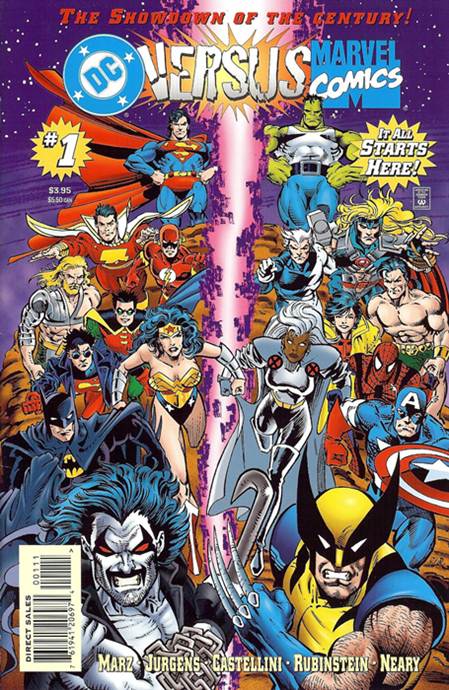
Nerds argued over this for almost 60 years before Marvel and DC decided to settle things. It didn’t stop nerds from arguing.

Specious battles aside (I also take issue with Storm of the X-Men beating Wonder Woman with a bolt of lightning and Batman beating Captain America because the latter got hit by a wave of water from a flooding sewer which threw off his aim), the book was a smash hit. It spawned two sequel miniseries, but the thing that fans remember most were the series of one-shots that came in-between issues three and four of the main storyline, the Amalgam Universe. Basically, the Marvel and DC Universes were merged, and we got 12 one-shots starring character mashups like Super Soldier (Superman fused with Captain America), Dark Claw (Batman and Wolverine), Speed Demon (Flash and Ghost Rider) and so forth. A year later there were another series of 12 one-shots, half of which were follow-ups to the original dozen and the other six introducing new mashups like the Lobo the Duck (Lobo and Howard the Duck) and Iron Lantern (Iron Man and Green La– look, do I have to spell out EVERYTHING?). 
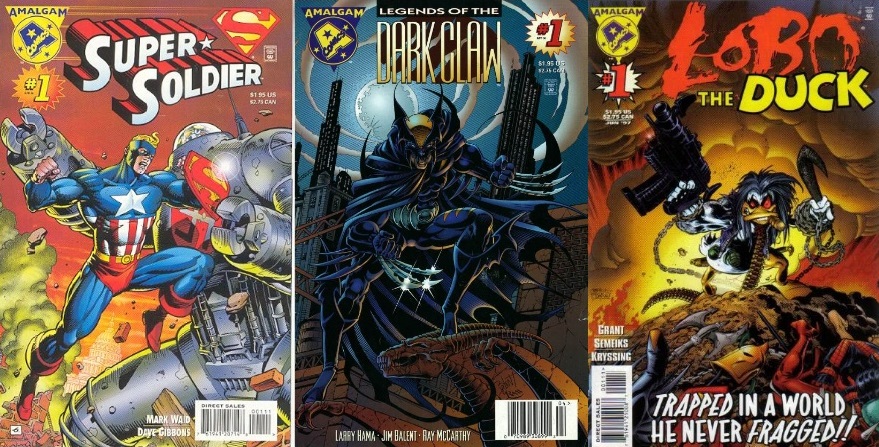
The next time someone tells you that drawing doofy fan mashups won’t get you anywhere, show them this.

The Marvel/DC crossover craze ended in 2003 with the long-awaited JLA/Avengers crossover, and it came about in a sort of odd way. The legendary George Perez, whom everyone agreed was the only man alive who should draw this book, joined upstart publisher CrossGen Comics, and CrossGen made all of its talent sign exclusive contracts for the term of their employment. The only loophole allowed was in Perez’s contract, which stated he would be allowed to do JLA/Avengers if it ever happened. That seemed to be enough to get Marvel and DC to figure things out, and the four-issue miniseries finally came about. But that’s the last time any Marvel or DC characters met one another.

There were other crossovers in that era, of course. Marvel’s Iron Man met Valiant’s X-O Manowar, and Daredevil encountered Shi from Crusade Comics. DC and Dark Horse comics became besties: Superman crossed over with Michael Allred’s Madman, the Joker fought the Mask, and Batman met both Grendel and Hellboy (the latter with Starman in tow). But the two biggest games in comics stopped playing together at that point, possibly because of corporate chicanery and possibly because the always friendly rivalry between the two publishers became somewhat less friendly for a while. 

Marvel, in fact, seems to have quit crossovers altogether. A search on the Internet (which, as we all know, has never been wrong about anything) seems to indicate the last time Marvel characters crossed over with any other publisher was back in 2009, when the Avengers and Thunderbolts were featured with Top Cow Comics characters in a miniseries called Fusion. We’ve recently got a new crossover, though, with Wolverine fighting the Predator, but as both characters are now owned by the Walt Disney Corporation and IP Farm and Macaroni Grill, and therefore both published by Marvel, I don’t know that it technically counts. 

And it’s not like other publishers haven’t gotten into the game as well. Before Disney bought Fox, Dark Horse Comics held the rights to Aliens and Predator, and they fought EVERYBODY. Superman Vs. Aliens, Batman Vs. Predator, Green Lantern Vs. Aliens, Magnus: Robot Fighter Vs. Predator, WildC.A.T.S. Vs. Aliens, Archie Vs. Predator (no, I’m not kidding), Batman and Superman Vs. Aliens and Predator…it was a cottage industry.

Fellas, when THIS many people have trouble getting along with you, maybe it’s time to admit that the problem is YOU.

And their sparring partners often met other publishers’ characters as well. Archie Comics has crossed over with – among others – the Punisher, Batman ‘66, Harley Quinn and Poison Ivy, Vampirella and Red Sonja, and the Tiny Titans. They also crossed over with the Teenage Mutant Ninja Turtles when Archie was publishing THAT book, but since the Turtles have moved to IDW Publishing they’ve encountered the Mighty Morphin Power Rangers (twice), Batman (four times), and the characters from Stranger Things, which has also crossed over with Dungeons and Dragons, which has also crossed over with Rick and Morty. The Power Rangers have also met both the Justice League and Godzilla, and the Justice League and Godzilla are currently meeting each other – along with King Kong – in a crossover with the Legendary Monsterverse. 

While Marvel has pulled out of the crossover game (which is something I largely suspect is an edict from Disney, although I have nothing to back that up, it’s just a gut feeling), DC has kept it up. Besides the aforementioned TMNT, Power Rangers, and Godzilla/Kong crossovers, the Justice League has met the characters from Jeff Lemire’s Black Hammer, and enjoyed crossovers with corporate siblings the Looney Tunes and the Hanna-Barbera cartoon characters. Batman and Scooby-Doo, who have met in cartoons many times, now share an ongoing children’s comic. DC has also partnered with IDW for Star Trek/Green Lantern, Star Trek/Legion of Super-Heroes, and an inventive crossover between DC’s Sandman Universe and Joe Hill’s Locke and Key. IDW seems to love crossovers, even with different licensed properties in their own stable. While they owned the licenses to these assorted properties, they crossed over TransFormers with Ghostbusters, Back to the Future, and Star Trek: The Animated Series (making new Autobots out of the Ecto-1, the Delorean, and the Enterprise, respectively). Star Trek, by the way, also crossed over with the X-Men when Marvel owned that license, in two one-shot comics and a prose novel titled Planet X. And Valiant and Image Comics did the “universes merge” story three whole years before Amalgam Comics in a series called Deathmate, which is largely remembered today for the fact that Rob Liefeld’s issue of the series was hilariously late. 
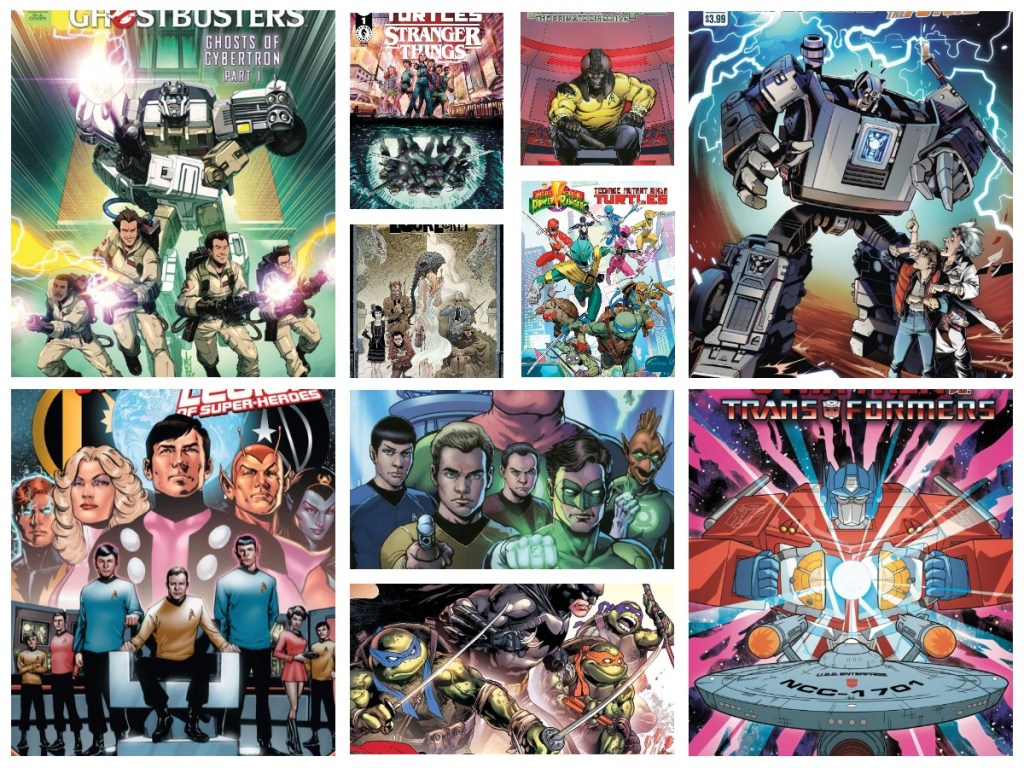
IDW is the Nick Cannon of comic book crossover events. No, not musically.

In fact, there’s only one really major franchise that has significant comic book presence that – as far as I know – has never done an official crossover, and that’s Star Wars. Even before the Disney buyout and the comics moved to Marvel, Dark Horse never made an effort to have Luke Skywalker meet Barb Wire or something. The closest they’ve come was in an out-of-continuity story in the Star Wars Tales anthology comic from 2004, in which the Millennium Falcon gets lost in a galaxy far, far away and crash-lands on a primitive planet, only for the remains to be discovered centuries later by an archeologist strongly implied to be Indiana Jones. 

I know it can seem overwhelming if you’re a casual fan, trying to make all of these things work out. The good news is, you don’t have to. The vast majority of these crossovers are either considered non-canonical to the main properties or are of such little consequence to the ongoing story that they may as well be. There are rare exceptions (the WildC.A.T.S./Aliens crossover killed off several members of Wildstorm Comics’ Stormwatch team, for example), but for the most part, they can be read on their own, self-contained, without impacting the ongoing comics in any significant way.

So why do them at all?

Because they’re fun. They’re fun for the readers, who like seeing beloved characters interact, and they’re fun for the creators, who enjoy making them just as much. It’s true that there was a saturation point of crossovers in the early 2000s, but the solution to saturation is to slow down the flow, not cut it off entirely. 

So the announcement of the two DC/Marvel omnibus editions is welcome. The DC Versus Marvel: The Amalgam Age omnibus will collect the DC Vs. Marvel miniseries, its two sequels, and 13 of the 24 Amalgam books. The DC Versus Marvel omnibus will collect most of their other crossovers. But the exclusion of the remaining 11 Amalgam books is surprising and a little frustrating, and the DC Versus Marvel omnibus will exclude JLA/Avengers, which was reprinted in a very limited charity run two years ago after George Perez announced that he was suffering from terminal cancer. The fact that it was once again Perez being on a deadline that got that book off to the printer is a sad sort of cosmic convergence. 

No joke here. George Perez was one of the greatest comic book artists ever to pick up a pencil, and he deserves all the love and respect he gets.

I hope that there are plans to reprint the rest of the Amalgam books at some point, but even if there aren’t, the fact that they’re doing the omnibus editions at all is encouraging. It’s something fans have wanted for a very long time and we didn’t really think would ever happen. It also, of course, has everybody asking a couple of pertinent questions. First, why now? What has changed in the Marvel/DC relations that allows these books to finally see print again? A lot of the people responsible for the bad blood between the publishers are gone now, and that may indeed play a significant role. And if THAT has changed, let’s just ask the most obvious question of them all:

Could this be a precursor to more?

As I said, it’s been over 20 years since the Marvel and DC Universes connected in any official capacity and a lot has changed. I think there are a lot of fans who would be interested to see Miles Morales meet Damian Wayne or have Kamala Khan interact with Jon Kent. How would the Titans of today – now DC’s premiere super-team – react to the X-Men in the age of Krakoa? And come on, fans have been pining for a Deadpool/Harley Quinn crossover for ages. Such a book would be as good a license to print money as Wolverine was in the 90s. 

I’m not saying it will happen. I’m just saying that if it DID, it would be cool. 

I’m also saying that the two omnibus books are coming out in August, which also happens to be my birthday month. I’m just. Sayin’. 

Blake M. Petit is a writer, teacher, and dad from Ama, Louisiana. His most recent writing project is the superhero adventure series Other People’s Heroes: Little Stars, now complete on Amazon’s Kindle Vella platform. He’s always wanted to write the Captain Carrot/Spider-Ham crossover that America deserves. 
Geek Punditry #56: The Pundy Update

January is kind of a stale month, pop culture-wise. There aren’t any huge movies out to discuss. The holiday backup has us all in its grip as we spent the month recovering from frivolity by trying to get everything back in order, so we don’t have as much time to indulge in the things we love in the first place. The playoffs are a thing. And this year especially, although the writer and actor’s strikes are over, the delay in new material has us rather struggling to find decent TV worth watching. Yes, friends, it’s a quiet time here in the Geek Punditry Global Media Hub. I don’t have a ton of things to say a lot about.

So instead of choosing a topic that doesn’t quite fit into a full column and stretching it out unnecessarily, this week I’m going to do a little bit of an update. I’ll scroll through columns from the past and give you a bit of new information to tell you how those topics are going, how I feel about them now, whether or not anything has changed since I last wrote about them. It’s this or another mailbag. What do you say?

That’s what I thought.

Item One: Last April, I wrote about the magic of the show I Love Lucy and how Lucy, in many ways, codified the sort of serialized storytelling that is commonplace on television today. (See Geek Punditry #15: How Lucy Gave Us the Arc.) In that column, I also spent a little time talking about the greatness of Pluto TV. This is an app on your smart TV that gives you free access to hundreds of channels of specialized content. There’s one channel that just shows the entirety of I Love Lucy, another devoted to The Carol Burnett Show. Others bring us RiffTrax, Mystery Science Theater 3000, Top Gear, Bar Rescue, Unsolved Mysteries, and hundreds of others. I know there are other apps, like Roku TV and FreeVee, that have similar features. Some of them even have the same specific channels. But Pluto TV is the one we use most often, so it’s the one I’m talking about.

I’m just saying, there are worse ways to spend a weekend.

Not long ago, while trying to find something appropriate for my son to watch that wouldn’t make me want to gouge my own eyeballs out, I stumbled upon Pluto’s Garfield and Friends channel, and I left it on. Eddie soon became hooked. He now specifically requests Garfield on most occasions when I let him pick what to watch unless there’s a football or hockey game on. (My kid is a sports nut, which probably makes people who knew me in college snort milk out of their noses laughing. Even if they aren’t drinking milk at the time.) I watched this show when I was a kid and I enjoyed it, but this is the first time I’ve really sat down and paid attention to it in quite some time, and can I tell you something folks? As comedy, Garfield and Friends legitimately holds up.

Comedy peaked in 1989.

While the Garfield comic strip is often criticized for being somewhat bland in its comedy, pushing no boundaries and having as much of an edge as a donut, the show is actually quite the opposite. The scripts are littered with sharp puns, sarcastic humor, and the occasional slightly more adult reference you know the writers were just hoping would slip past the censors. The fourth wall on this show is less of a rule and more of a vague suggestion, and the propensity for overly-long jokes is the kind of thing that I’ve always found hilarious. Part of the credit has to go to head writer Mark Evanier, a longtime TV and comic book writer who perhaps is best known these days as the co-writer of Sergio Aragones’s sword-and-sandals parody comic Groo the Wanderer. Evanier had spent a lot of time working on cartoons where the kind of stale, inoffensive storytelling we criticize the Garfield comic for was the norm, and apparently he went into full-on rebellion against the form. 

There are a lot of episodes of this show with kind of a downer ending, if you really think about it. Jon Arbuckle is a perennial loser and he’s treated as such. Garfield’s relationship with Penelope (who replaced the comic’s Arlene for reasons that still aren’t clear) is completely selfish, with him only loving her because her owners have an Italian restaurant. Evanier even introduced the maddening Buddy Bears specifically to mock the shows he had worked on before – the Buddy Bears’ credo is that you are never allowed to disagree with anything and you must always get along, and thus they are portrayed as completely insane. The US Acres (or Orson’s Farm segments in certain countries) similarly have a slyness to them that most cartoons of the time couldn’t touch, and few cartoons specifically for children do today. If you haven’t watched Garfield and Friends in a couple of decades, click over to Pluto TV and give it a watch. The show is still great. And if not, it’s at least better than whatever is on Disney Jr. right now.

Item Two: Back in November, I wrote about Marvel Comics announcing a new version of Ultimate Spider-Man, featuring an adult Spider-Man married to Mary Jane Watson and with two kids. (See Geek Punditry #44: What’s Wrong With a Spider-Family?) Having spent the better part of two decades complaining about Marvel Comics’s refusal to tell stories about an adult Spider-Man with a wife and a family, I felt it would be somewhat hypocritical of me not to try the new series by Jonathan Hickman and Marco Checchetto. The first issue came out a couple of weeks ago and, I’m happy to report, it’s even better than I hoped. It may well be the best single issue of a Spider-Man comic that I’ve read in twenty years. I am not exaggerating that number, friends. 

This is what a Spider-Man comic book ought to be, people.

I’m going to explain what makes it so great, but I can’t really do that without getting into spoilers for that book, as well as the miniseries that launched this new Ultimate Universe, Ultimate Invasion. So if you haven’t read either of those and are trying to stay spoiler-free, just leave it at knowing that I really liked this book and jump down to Item Three. Deal?

Ultimate Invasion was about the Maker, the Reed Richards of the original Ultimate Marvel Universe (the one that gave us Miles Morales), which was destroyed during the 2015 Secret Wars event, also written by Hickman. Miles and the Maker were the only two survivors, and migrated to the main Marvel Universe. In Invasion, the Maker decides to recreate his original universe, but with “tweaks” this time, eliminating the events that created many of that world’s superheroes and manipulating the one that remain, so we are given a world that is quite different from the Marvel Universe we’re used to. Most relevant to this book, the Maker prevented the genetically altered spider from ever biting Peter Parker, thus denying this world its Spider-Man. 

Ultimate Spider-Man #1 picks up that story in the present day, where an adult Peter is married to Mary Jane and has the aforementioned kids. But the book is loaded with many more surprises than that, such as when we find out that the editor of the Daily Bugle is, in this universe, Peter’s uncle Ben Parker. You never think about it, but in this world where Pete never becomes Spider-Man, his uncle is never murdered. Then a few pages later we learn that Ben is a widower, and that in this world it is MAY Parker who died from violence, during a terrorist attack carried out by Howard Stark (read Ultimate Invasion for that sentence to make sense). 

Aside from the surprises, I’m utterly in love with the way Hickman is writing the Peter/Mary Jane dynamic. Peter is deeply dissatisfied with his life because of this horrible, gnawing void in his stomach. He knows something is missing, but he doesn’t know what. Too many writers – too many BAD writers – would play this for drama at the expense of Peter and Mary Jane’s relationship: MJ would take his dissatisfaction personally, thinking it has something to do with her, a rift would form between them, drama would ensue. Hickman’s MJ, however, is both smart and kind enough to realize that’s not the case, and while something is missing from her husband’s life, it’s not about her and he doesn’t blame her for it. THIS Mary Jane is deeply supportive and believes in her Peter. So when he gets a message from a kid calling himself TONY Stark, claiming that the universe is messed up, Peter was supposed to be one of this world’s greatest superheroes, and there’s something in this package that can fix things, MJ is the one who encourages him to do it. And then he opens up the case and finds a vial with an itsy-bitsy spider…

This book is just gold. Hickman has built new versions of very familiar characters that feel truer to the spirit of the ones we love than any version we’ve seen in ages. I know this first issue did blockbuster numbers, but that’s not a surprise. Hickman is a hot writer, it’s launching a new universe, and it has a billion and twelve variant covers, all of which translate to sales. The key will be to see if people keep buying it six months from now. I hope they do.

Item Three: One of the consequences of this fallow period in television is that, among all of the other things that aren’t happening right now, there’s no new Star Trek for me to enjoy at the moment. I’ve mentioned my affection for Star Trek in the past (See Geek Punditry #1-55), but it occurred to me that I’ve never mentioned exactly what happened to draw me so deeply into Trek fandom over the last few years. I’ve been a Star Trek fan since I was a kid, growing up on the original series and reruns of the animated series on Nickelodeon. I got into The Next Generation and Deep Space Nine pretty heavily, and in high school and my early college years, I was a major fan. But as you get older you get into more things and different things, and my passion started to wane. It never died – I still liked the shows and I’d watch every new movie, but it wasn’t so much a lifestyle choice for me.

In 2017, my sister told me about a podcast she was listening to called Star Trek: The Next Conversation. Hosted by TV writers Matt Mira and Andy Secunda (Mira also being podcast veteran from shows like Nerdist, James Bonding, and approximately 400 others), the concept was that Andy was a Trek fan who had never watched The Next Generation for some reason, so hardcore fan Matt would walk him through the series an episode at a time as they broke down and dissected the storytelling from the perspective of TV writers. I’d listened to several of Matt’s shows before and Andy won me over immediately. There’s a friendship and chemistry between the two of them, which is probably the single most important element to making a successful podcast. Their thoughts and insights on the show are solid and interesting, and their wild tangents (the second-most important element in a successful podcast) are crazy entertaining. 

Don’t tell Paramount about the logo, though. I don’t know if there’s a copyright thing going on here.

What’s more, listening to these two guys geek out about Trek made ME geek out more about Trek. Since then, I’ve been watching every episode of Star Trek along with them, even shows I didn’t care for, because listening to these two guys talk about it has been my reward. They finished The Next Generation in May of 2022, and since then they’ve been going through my favorite series, Deep Space Nine. And if you’re willing to jump into their Patreon, they also cover Voyager, Enterprise, and all of the live-action new Trek series as new episodes drop. (They do not cover my beloved Lower Decks, sadly, because as comedy writers they feel like their nitpicking of Lower Decks would not be as entertaining as the other episodes…and honestly, based on their commentary on the Strange New Worlds/Lower Decks crossover episode, I think they’re right.)

But not only has this show made me start watching more Star Trek, my fandom has increased as well. I find myself hunting down and reading the old comic books and novels. I’ve gotten more shirts and nicknacks. I slowly began to assemble a collection of the miniature Eaglemoss Enterprise models, only to rush and get the last few when Eaglemoss went under. What I guess I’m saying is that Matt Mira and Andy Secunda are responsible for making me an even bigger nerd than I already was, and I thank them for it. 

Item Four: I don’t know if you’re the kind of person who reads the little blurbs at the end of every one of these columns, but if you are, you know that I’ve worked in a bonus joke in the last line of every one. Good for you. If you rearrange the letters in them you’ll get a secret message.

More importantly, though, that blurb has also always had a pitch for my Kindle Vella series, Other People’s Heroes: Little Stars. The language of that blurb is going to have to change beginning this week, though. I’ve always called it my “Current” writing project. As of this week, it will now be my “most recent” writing project. After two and a half years, I’ve finally finished this epic story. I talked more about it on this blog a few days ago, so I won’t get into detail about it right now, but if you’re the kind of person who likes superheroes and adventures and absolute doorstoppers of storytelling I’d like to invite you to check it out. I’m immensely proud of the story I told, and I’m hoping that you’ll enjoy it too.

Come on, people, how often do I ask you for anything?

Blake M. Petit is a writer, teacher, and dad from Ama, Louisiana. His most recent writing project is the superhero adventure series Other People’s Heroes: Little Stars, now complete on Amazon’s Kindle Vella platform. What about a Garfield/Star Trek/Spider-Man crossover? Would that be a thing? Could we make that happen?