Geek Punditry #119: It’s the Little Things

Here at Geek Punditry Global Headquarters and Communications Hub and Lawn Care Emporium, we have five separate but equally important departments: the Department of Movie Stuff, the the Department of TV Stuff, the Department of Book Stuff, the Department of Comic Stuff, and the Jimmy John’s down on the third floor. And we try our best to balance those departments out, spending a little bit of time on each and not overwhelming our legion of adoring readers with any one topic above any other. But even though last week’s topic was about comic books, and I feel we’ve gotten a little comic book heavy lately, we’re going back to DC Comics again this week. There are two important reasons for this:

  1. The topic we’re going to discuss is of great significance and, if studied properly, has the potential to turn into a great boon not only for DC Comics, but for the entire comic book landscape.
  2. I couldn’t think of anything else to write about.

Last year, our friends at DC kicked off a publishing initiative called “Compact Comics.” This new line of paperback editions, all bearing a distinctive trade dress, collects some of DC’s most popular and important storylines in volumes smaller than the usual trade paperback design. At 8.5 by 5.5 inches, these full-color editions are almost exactly the size of a current fiction paperback that you might buy at any bookstore. They sell for $9.99, and have become a hit in both comic shops and in other retail outlets. And frankly, it couldn’t have come at a better time.

“You see, we call them COMPACT because they’re SMALL.” –Guy who paid $250,000 for his marketing degree.

Comics are in a bit of a crisis, although to be honest, there’s nothing new about that. I’ve been reading comic books for 40 years and I can’t remember a time when people didn’t fear that the industry was in the midst of some crisis or another. But we’re in a time where the distribution model is in absolute turmoil, with so many publishers abandoning Diamond Distribution (which had a monopoly on the comic book distribution market for decades) that the company had to declare bankruptcy earlier this year. As Diamond scrambled for a new owner to right the ship, all of the comic book publishers were flailing about, trying to make sure that they could still get their product into the hands of readers.

What does this have to do with Compact Comics? Nothing – at least not directly. DC abandoned Diamond some time ago, and they’re one of the few publishers big enough to weather this particular storm without any real chaos. But the issue here is how to get readers to pick up the comics, and what DC has done is found a format that is inherently appealing to those readers, something that will draw people in and get them not only to read one volume, but to go back to the shop and pick up another one. And that’s exactly what everybody in comic books should be trying to do.
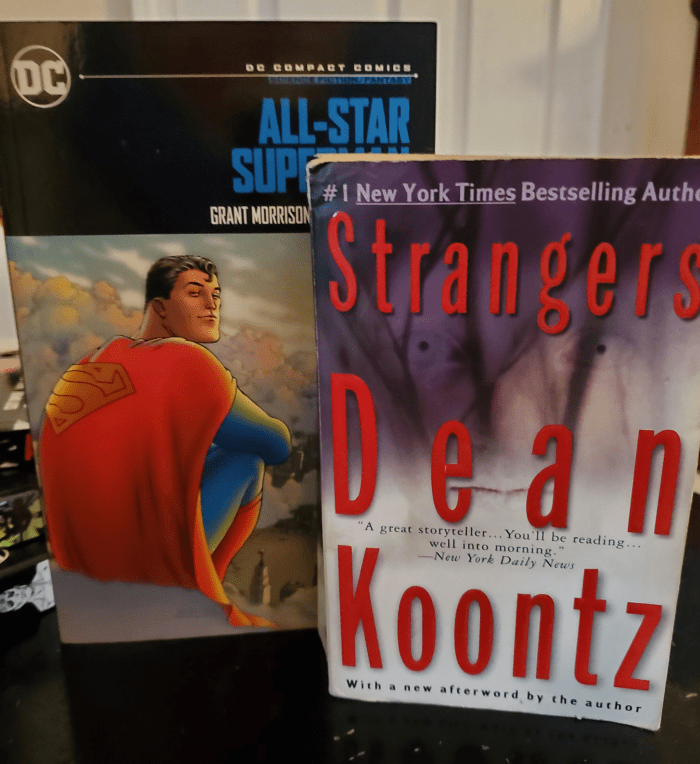
I didn’t have a banana for scale so, as per FDA guidelines, I used Dean Koontz instead.

First of all, the size is important, and don’t let anybody tell you differently. Traditional graphic novels in the larger trade paperback format have been fine for a long time, but they’re not as portable as the Compact Comics. They’re good as archival editions, whereas Compact Comics are the sort of thing that will appeal to a casual reader – someone who is browsing the stacks at an airport bookstore or shuffling through the available volumes at Barnes & Noble looking for their next great read. It’s not a coincidence that the Compact Comics size is very similar to that of Japanese Manga, which is enormously popular. (The day I realized that Manga now had a section three times as large as the traditional graphic novel shelves at Barnes & Noble, I died a little inside.) Some may see this as an attempt by DC to court the Manga reader, and I think there’s at least a little truth to that. But I think it’s even more true that they simply recognized that the portability is one of the things that contributes to the success of Manga, so they decided to run with it.

This isn’t new, of course. Manga has been growing in popularity for decades, so why has it taken American comics so long to catch up to this smaller format? Honestly, I think it’s the printing technology. Most Manga is in black-and-white, and therefore easier and cheaper to print. Most American comics, on the other hand, are in color, making them not only more expensive, but more difficult to reduce in size to the smaller format without muddying the colors or losing detail in the artwork. But printing technology has improved, and anyone glancing through a Compact Comic will be able to tell you that the artwork looks just as good now as it did in the original printing – in the cases of some of the older stories that have been remastered, even better. 

“He’s big! He’s blue! He’s right in front of you!”

The next thing, and this cannot be understated, is the price. TEN BUCKS for a complete graphic novel? These days, that’s the deal of the century. A full-size graphic novel of comparable length will usually go in the $25 to $30 range. In fact, most individual comic books these days sell for $3.99 or $4.99. That means that for the same price as two issues of Action Comics, I can get all twelve issues of Watchmen and have a complete story. It’s an incredible bargain, especially for somebody dipping their toes into comic books for the first time. Imagine a  potential reader who, for example, is excited about James Gunn’s upcoming Superman movie and is interested in reading some of the comic books that inspired it. They may look at the trade paperback or hardcover editions of some of those books retailing for anywhere from $25 to $50 (depending on how fancy the edition is) and rightly blanch. Even four bucks for a 22-page comic book story is an awful lot. But over 250 pages of Grant Morrison and Frank Quitely’s All-Star Superman for $9.99? That, my friends, is the sweet spot. With everything in the universe getting more and more expensive, seeing such a low price point is absolutely going to get a reader’s attention.

And I think it’s also important to note which stories DC selected to include in the first wave of Compact Comics. Aside from the aforementioned All-Star Superman and Watchmen, both bona fide classics, DC also included two of the more successful Batman stories from the past couple of decades, The Court of Owls and Hush. They populated the line with stories featuring their most popular (and – let’s be honest – cinematic) characters, including Wonder Woman: Earth One, Harley Quinn and the Gotham City Sirens, Catwoman: Trail of the Catwoman, and Brian Azzarello and Lee Bermejo’s chilling Joker graphic novel. Then they tossed in a recent hit, the Green Lantern science fiction murder mystery Far Sector. And as the coup de grace (which is Latin for “a cooper full of grass”) they gave us the first volume of Scott Snyder’s horror series American Vampire. Why is that so significant? Well, Snyder had a co-writer for the backup stories in the first six issues of this excellent series, a little fella by the name of Stephen King. 

And in case you didn’t know, King’s name on the cover of a book is the closest thing in the publishing world to a license to print money. For once, DC knew what they were doing.

Admittedly, his name is usually a bit larger.

The line was so popular that a second wave of Compact Comics will be hitting shops this over the course of this year, this time including Kingdom Come, Static Season One, DCeased, Batwoman: Elegy, Superman: Birthright, The Authority: Book One, Superman/Batman: Book One, DC: The New Frontier, Wonder Woman: Blood and Guts, Harley Quinn: Wild at Heart, Batman: The Long Halloween, Y: The Last Man Book One, V For Vendetta, and We3. As with the first wave, we have a good mix of perennial classics, more recent favorites, properties that are linked to upcoming DC Studios releases, and a few really strong comics from outside the DC Universe itself that have proven popular to folks who don’t read superheroes. 

And of course, as the initiative has proven successful, it’s being imitated. A few months after it was clear that Compact Comics was a hit, Marvel Comics announced its own new “Premier Collection,” a similar-sized set of graphic novels (9 by 6 inches, just a half-inch larger per side) with a $14.99 price point (a bit higher than the Compact Comics, but still more palpable than a traditional graphic novel to a new reader). This line kicked off in February with a new edition of Daredevil: Born Again, which – what a co-inky-dink! – just happens to have the same title as the recent hit show on Disney+. Isn’t it nice how stuff like that just works out sometimes?

“Kevin? C.B. What’s the slate for 2025 again?”

But DC (and anyone who copies them) has to play it smart. So far they have, but it’s imperative that they make sure that the books they’re putting out fulfill the needs of the reader. For standalone books like We3 or The New Frontier, the task is done. Put out the book and keep it in print. Maybe throw out a new cover or a new afterword for an anniversary edition, but there’s not much else to think about. But go back and look at that list of titles again. Did you notice how many of them include the words “Book One?” And even several of them that don’t have “Book One” in the name have follow-ups (Batman: The Long Halloween was followed by Batman: Dark Victory, and Jeph Loeb is currently finishing his trilogy with The Last Halloween) or were originally released as part of an ongoing series that readers would like to continue reading (Wonder Woman: Blood and Guts was part of Brian Azzarello’s 2011 run on the character). 

If the intent on DC’s part is that the readers will be drawn into the Compact Comics and then drift over to the standard-sized graphic novels for the rest of the series, that would be a huge mistake. Readers may like convenience, but we also like consistency. And if you don’t believe me, ask any book reader how they feel about a series of fantasy novels that doesn’t put the publisher’s logo, author’s name, or volume number in the same PLACE on the spine of every volume. Have a bucket handy when you do so, though, because just the thought of that may cause some bibliophiles to throw up.

No, if a reader STARTS reading Y: The Last Man in Compact Comics format, they’re going to want to CONTINUE reading Y: The Last Man in Compact Comics format. Yes, DC, that means selling all TEN volumes in this new size when it’s time to do a new printing. I concede, it wouldn’t have made sense to put out all ten volumes at once when the format was still new and untested. But once the format has demonstrated it has legs, you’ve got to stick with it. Will each individual volume make less money than the larger editions? Yes, it will. But I honestly think that what you gain in the number of sales will more than make up for any shortfall in the single unit profits. 

“No, seriously, this thing is enormous. Where’s the real Volume 2?”

So what comes next for Compact Comics? Assuming the new wave (which will begin in May with Kingdom Come) is as successful as the first, I think we could see these books on the market for a very long time. In fact, outside of hardcore comic book collectors, I could see the compact size becoming the format of choice for the casual reader. I don’t have any trouble at all foreseeing a future where this becomes the standard way that people read collected editions and original graphic novels. And I don’t think that’s a bad thing at all. In truth, I think ANYTHING that makes comics easier to get in the hands of people who don’t have them there already is a good thing. 

And so, so nice to look at.

I’ve got a few of the Compact Comics myself, and I couldn’t be happier with the format. They look good, they read great, and they look oh-so pretty on a shelf. If I had the money and space, I’d put up an entire bookcase with each of the ten that have been printed so far, leaving room for the next wave, Marvel’s Premier Editions, and anybody else who wants to play along. I sincerely believe that this is a great thing for comic books, and I hope that every publisher out there is paying attention to how well this line is doing. Because if you’re thinking about the future of comics, this just may be where we find it. 

Blake M. Petit is a writer, teacher, and dad from Ama, Louisiana. His most recent writing project is the superhero adventure series Other People’s Heroes: Little Stars, volume one of which is now available on Amazon. You can subscribe to his newsletter by clicking right here. He’s also started putting his LitReel videos on TikTok. Yeah, he’s the kind of nerd who can write 2,000 words about a printing format, but YOU’RE the kind of nerd who READ 2,000 words about a printing format, so let’s not pretend we’re so different, all right?

Geek Punditry #38: Whence Elseworlds?

Multiverses are big these days. What was once a relatively niche science fiction concept has become popularized by things like the Spider-Verse movies, Best Picture winner Everything Everywhere All At Once, and about seven thousand fanfics where the guy from the Avatar: The Last Airbender cartoon meets and beats up his counterpart from the live action movie. So it’s odd to think that one of the first fictional worlds to use the multiverse as a major concept once attempted to do away with it because it was deemed too confusing. DC Comics introduced its multiverse in 1961 with Flash #123, in which writer Gardner Fox had the Flash of that time period (Barry Allen) meet the Flash of the 1940s (Jay Garrick). The problem was it had been established earlier that, in Barry’s world, Jay Garrick was considered a fictional character that Barry had read about as a child. The fix was to declare Jay’s world an alternate universe, an “Earth-2,” even though he had been around first. Fox was even slick enough to write himself into the story, claiming that the writer “Gardner Fox” had some sort of telepathic link to the other world and didn’t realize the stories he was conjuring that he believed to be pure fiction were, in fact, reporting on actual events from Earth-2. It was a wild, crazy concept for the time, and it started an avalanche.

In the 90s, DC Comics gave us Elseworlds, a series of books set outside of the "real" DC Universe that fans quickly latched on to. This week in Geek Punditry, I take a brief look at the origins of the imprint, the history of DC'S multiverse, and explain how Elseworlds is back -- even if DC doesn't want to admit it.
“How long do you think we can keep this up?”
“Oh, I’d say at least 60 years.”

It wasn’t too long before the Silver Age Green Lantern, Hal Jordan, met his own Earth-2 counterpart, Alan Scott. Heroes who had been continuously published since the Golden Age and were not replaced by other characters (predominantly Superman, Batman, and Wonder Woman) discovered that they had almost identical doppelgangers on Earth-2, and eventually the Earth-1 Justice League of America met the Earth-2 Justice Society for an annual get-together. 

And once there are two universes. why not more? Earth-3 had villainous versions of the heroes: Superman became the evil Ultraman, Batman the crafty Owlman, Green Lantern the kinda lame and poorly-named Power Ring, and so forth. Then DC started adding worlds that included the characters they’d purchased from other defunct publishers: the heroes of Charlton Comics inhabited Earth-4, the Shazam! Family of Fawcett Comics fame was from Earth-S, and the heroes of Quality Comics were shifted off into Earth-X – a world where the Nazis won World War II! 

“Not gonna lie to you, Sam, this is kind of awkward.”

By the 80s, though, DC felt that things had gotten unwieldy, so writer Marv Wolfman gave us Crisis on Infinite Earths, their first mega-crossover event, in which all but one Earth was destroyed and the surviving heroes of many different worlds came to reside there. Both Green Lanterns and Flashes, otherworldly heroes like Plastic Man, the Blue Beetle, and Captain Marvel, and many more populated this “new” DC Universe. For the most part, I think this has worked to DC’s benefit over the years – it’s easier to build a cohesive world if all your main characters inhabit the same universe. Were it not for this, we never would have had the Blue Beetle/Booster Gold friendship, the Flash family wouldn’t have developed into the legacy it currently is, and people would have forgotten about Peacemaker long before John Cena showed up to actually make him interesting for a change. Despite that, though, I have always disagreed with the fundamental thesis that led to the writing of Crisis in the first place – that a multiverse storyline was too complicated for the casual reader. And if anything, the proliferation of multiverse stories in recent years, I think, has proven me to be correct.

What’s more, I think even many of the writers at DC Comics felt the same way, because it wasn’t too long before they started to branch out again and tell stories that didn’t fall into the canon of the one and only DC Universe. Just three years after Crisis ended, DC published Gotham By Gaslight, a one-shot story by Brian Augustyn and Mike Mignola, which featured a Victorian Batman doing battle with Jack the Ripper. The book was a hit, and the idea of telling stories of DC heroes in different worlds came back. Batman: Holy Terror by Alan Brennert and Norm Breyfogle, showed an alternate history in which the British Empire never fell out of favor and the colonies in North America are run by an oppressive government. In this version, Batman becomes a sort of Guy Fawkes-esque character, rebelling against British rule. This book was labeled an “Elseworlds” title, and the name became the brand under which DC stories from outside the continuity took place for the next decade and a half.

Original slogan:” Elseworlds-Because there can’t be too many different versions of Batman.”

Over the years we got some magnificent books, each casting the heroes of the DC Universe in different scenarios. In Superman: Speeding Bullets, Kal-El of Krypton crashed not in Kansas, but in Gotham City, where he was raised by Thomas and Martha Wayne. Batman: In Darkest Night showed us a world where Abin Sur crashed in Gotham City instead of Coast City (a LOT of alien spacecraft touch ground in Gotham in Elseworlds) and thus Bruce Wayne became Earth’s Green Lantern instead of Hal Jordan. Justice Riders casts the Justice League in a western yarn and The Golden Age tells a bittersweet ending to the saga of the Justice Society. Even crossovers with other companies occasionally bore the Elseworlds brand – Batman met both Marvel’s Captain America and Tarzan (published, at the time, through Dark Horse Comics) in Elseworlds stories.

Perhaps the high point of the imprint came in 1996, when Mark Waid and Alex Ross published their four-issue masterwork Kingdom Come. Set a few decades in the future, this is a DC Universe that has been disintegrating ever since Superman left humanity behind following the tragic death of his wife, Lois Lane, and the brutal murder of her killer, the Joker, before he could face justice. In his absence, the world has been overrun by a new breed of metahuman, heroes in name only, more interested in fighting each other than protecting the human race. In this story the Spectre takes a minister named Norman McCay on an Ebenezer Scrooge-type tour of this world as Superman is called back to action following a catastrophic event that pushes the entire Earth to the edge of annihilation. The story is largely a response to the sort of over-muscled, over-gunned, over-pouched heroes that were so popular in the 90s, and despite having a distinct dystopian flavor, it is ultimately one of the most beautiful and powerfully optimistic stories comics have ever produced.

You’re probably expecting some kind of joke here, but this is just straight-up one of the greatest comic book series ever made.

DC quietly pushed the Elseworlds brand aside in 2003, the argument being that it had become overused and was starting to grow stale. It’s hard to argue with that, too, especially when you start counting the number of Elseworlds that basically boiled down to “Kal-El landed somewhere other than Smallville, Kansas.” (Off the top of my head, we’ve got Superman: Red Son, Superman: The Dark Side, Superman: True Brit, JLA: The Nail, The Superman Monster, and even another Dark Horse collaboration, Superman/Tarzan: Sons of the Jungle, all of which hinge on that same basic point.) As the multiverse was slowly creeping back into the “real” DC Comics, Elseworlds was placed…well…elsewhere. It came back briefly in 2010 for a three-issue Superman miniseries, Last Family of Krypton (this time little Kal-El’s parents escaped Krypton with him), and the name was used for an Arrowverse crossover event on TV, but other than that, it’s been gone for a long time.

“Okay, so you’re kind of over Batman Elseworlds. How about 37 Superman Elseworlds that all have the same starting point?”

Or has it?

DC is not using the name anymore, no, but they certainly are using the same basic concept. There are a lot of DC books being published that feature versions of the DC heroes in different worlds. Sean Phillips’s Batman: White Knight and its various sequels and spinoffs are set in a world where the Joker goes sane. Since that series premiered in 2017, it’s built a small universe of its own. There’s also the world of DCEased, a universe in which Darkseid succeeds in gaining the Anti-Life Equation, unleashing a memetic virus that transforms its victims into a sort of techno-undead creature, but don’t you dare call them zombies. Jurassic League was a miniseries that re-cast the Justice League as anthropomorphic dinosaurs, because why the hell not? Dark Knights of Steel features a medieval world where Jor-El, Lara, and Kal-El came to Earth together and live in a sort of fantasy setting surrounded by analogues of the other DC heroes and villains. And then there’s the cleverly-named DC Versus Vampires, which is about the signing of the Magna Carta.

Pictured: Pope Innocent III and King John.

Kidding. No, it’s exactly what it says on the wrapper. 

The thing about these books is that none of them are self-contained. Most Elseworlds, back in the day, ran anywhere from one to four issues, but that was typically where it ended. White Knight and DCEased both had multiple series and one-shots. Vampires and Steel each ran for 12 issues plus spin-offs. And each of these worlds has been designated a number in the new, current, DC Multiverse. They are Elseworlds in all but name – in fact, in a more literal sense than many of the older (forgotten) Elseworlds books, as they are actually other worlds in the DC Multiverse. Many of the other Elseworlds of the past have been “imported” into the new DC Multiverse as well, especially the much-loved and highly-inspirational Kingdom Come, which has crossed over and interacted with the “Main” DC Universe on many occasions, including in Waid’s current run on Batman/Superman: World’s Finest.  

Since DC has once again embraced the concept, what I (and, I suspect, many of the fans who were reading comics in the 90s) would like is for them to once again embrace the brand. Bring back Elseworlds. When these books are reprinted, give them the label. When the inevitable sequels come out, give them the label. If anything, the label will only help. While it may be clear that Jurassic League isn’t the “real” DC Universe, a casual fan picking up DC Versus Vampires might be concerned about why Hal Jordan is doing his best Dracula impression in this series but it doesn’t seem to be affecting the regular monthly Green Lantern title. Having a specific brand would alleviate that problem.

The only difference between these and an Elseworlds is the label.

And since the current philosophy at DC seems to be “every story happened SOMEWHERE in the Multiverse,” I say they should run with it. Don’t just put the Elseworlds LABEL on the book, plop a NUMBER in it as well. When they print the Dark Knights of Steel omnibus, give it an Elseworlds logo with a little mark signifying that this is Earth-118. Instead of reprinting Kingdom Come under the “mature readers” Black Label imprint (where it is woefully misplaced), give it back the Elseworlds mark and label it as Earth-22. There are two more miniseries coming out this year set on Earth-789, the world shared by the Christopher Reeve Superman and Michael Keaton Batman movies – give THOSE the Elseworlds labels too!

It exists, it has fans, and it has a clear purpose now that’s more than just a grab bag of weird. It’s true that the label was overused in the 90s, but the solution to that isn’t to never use it again, it’s just to use it sparingly. There’s no fan of the books that currently exist that would be turned off by an Elseworlds label, and there are many fans who may be more inclined to pick them up if they saw that familiar, beloved brand again. If nothing else, I think, it’s worth the try. Nothing in comics ever really dies – Superman can come back from Doomsday, Barry Allen can come back from the Speed Force…let’s let the Elseworlds brand have its time back from the dead. 

Blake M. Petit is a writer, teacher, and dad from Ama, Louisiana. His current writing project is the superhero adventure series Other People’s Heroes: Little Stars, a new episode of which is available every Wednesday on Amazon’s Kindle Vella platform. Fingers crossed for the Elseworlds miniseries set on Earth-26, home of Captain Carrot. By now you should know he’s not joking.