Geek Punditry #86: This is How We Do It Presents…Absolute Power

Hello, everybody, and welcome to This is How We Do It, the latest Geek Punditry feature-within-a-feature. In This is How We Do It, which I intend to be a recurring segment here, I’m just going to showcase a piece of storytelling that I think is being done exceptionally well and talk about why I think it’s so great. It is the antidote to Internet negativity. And the subject of the inaugural This is How We Do It is going to be the currently-ongoing DC Comics crossover event, Absolute Power. Fair warning, it’s not going to be possible to talk about why this is so great without spoiling some things, so this will be a spoilerful discussion. If you’re not up to date on reading this fantastic series, you may want to hold off on reading this at least until you get to issue #2 of the main title, because that’s the most recent issue as I write this.

Get ready, because this one ROCKS.

Comic crossovers are by no means a new thing, and I’ve talked before at length about them but I feel like I need to give a brief overview of what I mean here. In these “event” storylines, there is usually a main narrative that brings together the various characters of a publisher’s shared universe (in this case, DC Comics), while assorted spin-offs and special issues of the series that star the individual characters tell other angles of the story. The earliest such event I can find that followed this format is DC’s Crisis on Infinite Earths from 1985-86. (It’s true that Marvel Super Heroes Secret Wars came out first, guys, but there were no spin-offs of that book, which to me makes it more of an embryonic version of the crossover as it exists today.) DC has done dozens of them, as has Marvel. In fact, pretty much every publisher that has a shared universe (or even Multiverse) has dipped their toes in the format at one time or another – Image Comics, Valiant Comics, IDW, Dynamite, even Archie Comics has had crossover events. 

So what makes Absolute Power so good? In a word: construction. Some events seem to come out of nowhere and have little ongoing impact – last year’s DC summer event Knight Terrors, for instance, has made relatively few ripples after it was over. Others will sometimes take existing heroes and force them to behave wildly out of character for the purposes of the narrative (lookin’ at YOU, Marvel’s Civil War). And sometimes, they’re just so overblown and complicated that it’s impossible to keep track of what’s actually going on. Absolute Power suffers from exactly zero percent of these problems.

Mark Millar knows what he did.

A good crossover really needs to start with a good antagonist, and this story has one of the best: Amanda Waller, who has decided that superheroes are the biggest threat to the planet. Waller is an established character, best known for her role as being in charge of the various incarnations of the Suicide Squad (a group of supervillains that she forces to do jobs for the government in exchange for reduced sentences – with the caveat that if they step out of line she’ll set off an explosive device she had implanted in their NECK). Waller has always tread the line of what makes an anti-hero, usually using underhanded methods to accomplish goals that are more or less positive…ish. However, that placed her perfectly for her role of the villain in this story, being a natural extrapolation of who she has always been as a character. In fact, Waller is the BEST kind of villain – the sort that, in her own mind, is 100 percent justified in her actions. Waller COMPLETELY believes that what she’s doing is the right, moral, ethical thing to do, and that makes her both more interesting and more dangerous than any bad guy who’s just in it for the Evulz. 

What do you MEAN, she doesn’t look like a good guy?

The next thing that makes a crossover work, in my opinion, is setup. Before the original Crisis on Infinite Earths happened, there were months of stories from DC where a mysterious, shadowy figure was shown to be monitoring the heroes of Earth. (As it turned out, he wasn’t the bad guy, but you could certainly be forgiven for thinking he was.) Absolute Power has a more obvious setup, but a very effective one. Waller has taken the villains from two recent storylines – Queen Braniac from the House of Brainiac Superman story, and Failsafe, a robotic duplicate of Batman with all of his tactical genius and none of his morals and ethics. She has combined their respective tech with the work of the old Justice League villain Professor Ivo to create a set of androids who can steal superpowers, and sent them out to attack, depower, and capture both superheroes and villains alike. In the first issue of Absolute Power, dozens of heroes have their powers stolen and most of them are taken prisoner by Waller. By the time the second issue rolls around, those heroes who remain at large have begun assembling at Superman’s Fortress of Solitude to plan a counter-offensive.
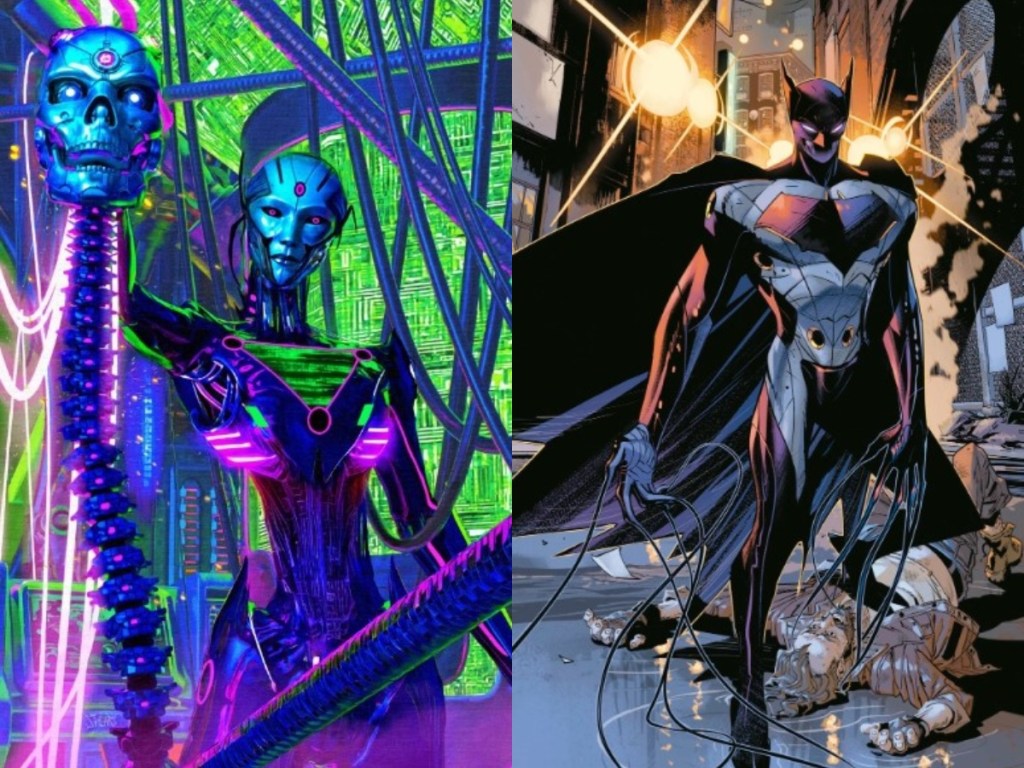
Imagine how nasty a character Amanda has to be that THESE two are her MINIONS.

Another important element is that the characters be true to themselves, and here I’ve got to give it up to writer Mark Waid. Waid was a mainstay of DC Comics in the 90s and early 00s, with a legendary run on The Flash and turning out the best of DC’s Elseworlds line with Kingdom Come. After a long exile, he’s returned to DC and is crushing it with books like Batman/Superman: World’s Finest. In short, there are few people in comics who know the characters as well as Mark Waid, and he’s proving it again here. Aside from using Waller to her logical extreme, he’s showing perfectly who the various DC heroes are, such as a depowered but still dauntless Superman. When Batman and Mr. Terrific get into a squabble over who should be the leader of this little resistance group, it’s Nightwing who steps up, gives a rousing speech that would make Jean-Luc Picard stand and applaud, and takes command. The best part, though, is Batman’s reaction: watching Dick Grayson, the original Robin, take his place as the natural rallying point for a group of shattered, broken, and frightened heroes, Batman simply gives us a sly smile and says, “That’s my boy.”

For Batman, this is an almost shamefully embarrassing display of pride.

And I haven’t even talked about the artwork by Dan Mora, who is probably my favorite artist working at DC right now. It’s phenomenal, with real emotion and characterization displayed on the characters’ faces and mannerisms. A good artist can always make or break a book, and Mora – as he’s done with Waid on Batman/Superman – is doing an incredible job.

The next aspect that makes a crossover work is what happens in the spin-off books. In the original Crisis, the main story was supplemented by chapters in the various ongoing comics showing what was happening to those heroes during the Crisis itself, and that was the template for crossovers for a long time. Somewhere along the line, though, it became less likely for an individual series to be interrupted by a crossover and we’d get several – sometimes DOZENS – of spin-off one-shots and miniseries doing the job instead. I don’t think it’s a coincidence that this shift in how crossovers were told corresponded with the point where the comic book WRITERS became the stars of the show, their prominence somewhat overtaking the artists. If the guy writing, for example, Uncanny X-Men at the time didn’t want his X-Men storyline interrupted because of World War Hulk, then the main title would remain unmolested and a World War Hulk: X-Men miniseries would take its place. The far extreme of this policy was what DC did last year with Knight Terrors, where EVERY ongoing DC comic was replaced for two months with a two-part miniseries showing that character’s interaction with the event, and many of them were never touched upon again.

For the most part, I’m in favor of a writer getting to tell the story the way they want, but speaking as a READER, I prefer when the crossovers touch the regular title. To me, that gives them greater weight, makes them feel more “important” than putting them into a spin-off miniseries. Absolute Power has returned to form on this. The ongoing titles are picking up the story threads started in the main series and running with them. After Nightwing gives the heroes various assignments in Absolute Power #2, we see them start to carry out their missions in the pages of Superman, Batman, Wonder Woman and other titles. In other books, like Green Lantern, we get side stories of some of the heroes who have been captured or are still on the run. And then there’s Green Arrow, which deals with the most shocking development of the story to date: longtime Justice League member Green Arrow has inexplicably turned tables and joined Amanda Waller, fighting his friends! Obviously, anything this incredible has to be covered in the main Absolute Power title, so what’s going on in his book right now? We see how his supporting cast – his son Connor, various former sidekicks and so on – are reacting to the fact that their patriarch seems to have broken bad. 
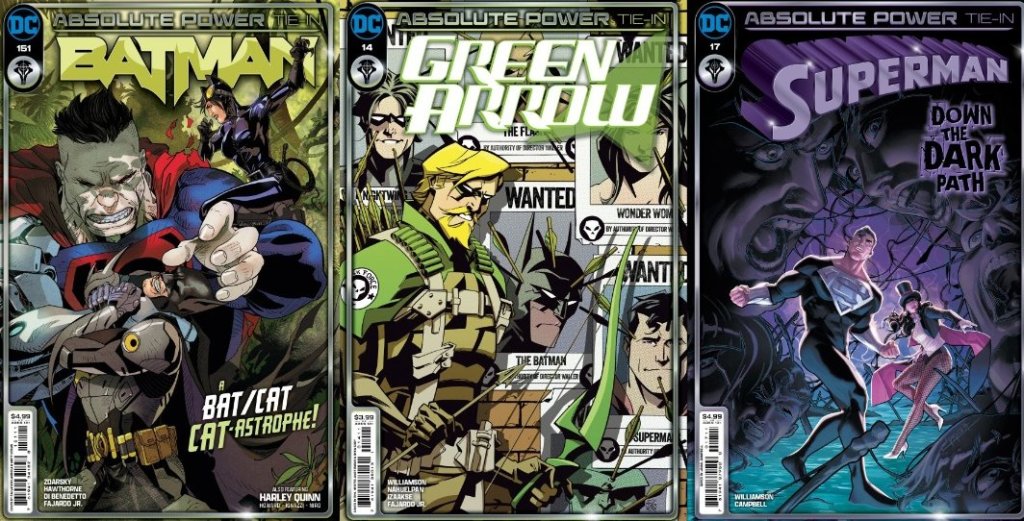
Crossover chapters that are actually RELEVANT? Is that ALLOWED?

There are, I should concede, two spin-off miniseries for Absolute Power, but both are a bit more justified. Absolute Power: Origins is a deep dive into Amanda Waller’s backstory, showing how she went from a grieving mother who lost family members to violence (and how many heroes have had that same motivation?) to the magnificent bastard she is today. Absolute Power: Task Force VII, on the other hand, tells stories focusing on Waller’s seven power-stealing androids and their interactions with the heroes. Neither may be absolutely NECESSARY to the story, but I feel as though they both add something that otherwise we wouldn’t have, which is what a good spin-off should do. 

The last thing that I think makes for a solid crossover is the impact of the story after it ends. I hate to keep picking on Knight Terrors, because I don’t really think it was a bad story, but the overall impact on the DC Universe since then has been negligible. The only significant thread I can think of was increasing Waller’s paranoia, but she already had that in spades and, what’s more, the Beast World event that FOLLOWED Knight Terrors did that same job, but better. Obviously, it’s impossible to tell right now just how Absolute Power will shape the DCU going forward, but there are hints in the solicitations for upcoming comics. After the series ends we’re going to be treated to a new initiative called “DC All-In,” which will start with a one-shot before branching out. This isn’t going to be a continuity reboot as DC has done in the past, but it will launch several new titles and some of the existing books will get new creative teams and new directions. The one that I’m most excited for will be the newly-announced Justice League Unlimited, done by the Absolute Power team of Waid and Mora. Although they’re playing details close to the vest until the end of Absolute Power, preliminary artwork and buzz indicate that this comic will be taking its cue from the cartoon series of the same name, in which the League expanded to include virtually every hero in the DC Universe, with different ones called up as needed. This is honestly the way I’ve thought they should have run the League for the past twenty years, since the cartoon was launched, and the fact that it’s finally happening makes me giddy. The fact that it’s Waid and Mora taking the reigns makes me ECSTATIC. 
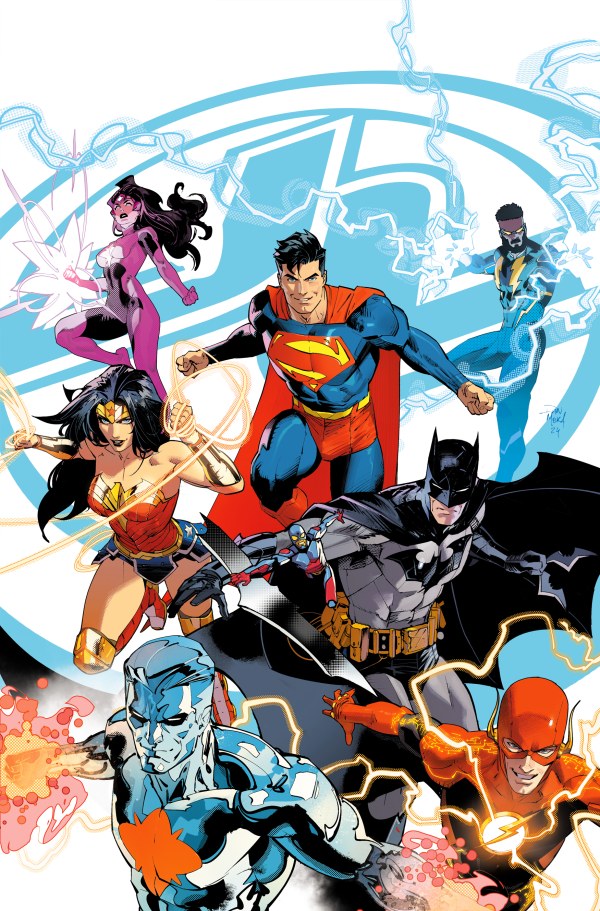
Holy crap, guys, Santa got my letter.

So even now, only halfway through the event, I feel as though Absolute Power has all the earmarks of one of the DC Universe’s classic storylines. All the pieces are in place and the right creative team is there. I haven’t enjoyed a book of this nature this much in years, and the fact that I’m equally excited for the stuff promised to come next makes it even better. So for the next creative team – from any publisher – who’s looking to do a multi-character, multi-title crossover epic event series, I can offer no better advice than to look to Mark Waid, Dan Mora, and Absolute Power.

Because THIS is how we do it.

Blake M. Petit is a writer, teacher, and dad from Ama, Louisiana. His most recent writing project is the superhero adventure series Other People’s Heroes: Little Stars, volume one of which is now available on Amazon. You can subscribe to his newsletter by clicking right here. Now if only the next event series were to bring back Captain Carrot to his deserved place of prominence in the DC Universe. 

Geek Punditry #71: Gimmie a Gimmick

As you may have heard me mention once or twice, last weekend was the annual Nerd Bacchanalia known as Free Comic Book Day, one of my favorite days of the entire calendar year. And on this day, as they always do, my friends at BSI Comics were kind enough to allow me to set up a table and sell a few copies of my new book (which you should have ordered by now). From the vantage point of my table, I was facing a wall that displayed several back issues from those halcyon days of the 1990s, which were among the most formative years of my comic book consuming lifetime. The wall was adorned with lots of those flashy “Enhanced” covers that were so popular at the time – holofoil covers, embossed covers, chromium covers, glow-in-the-dark covers…you name a goofy gimmick, comic book publishers from the 1990s slapped it on the cover of a book. And as I spent hours there looking at those books, an odd realization slowly came over me.

I kinda miss those days.

I stared at these covers for eight hours on Saturday. It does things to a man.

It’s weird. During that time gimmick covers became a glut. They seemed to be coming at an ever-faster pace with ever-weirder gimmicks, and at the time I remember getting sick and tired of them. These days, however, they have become scarce. They’re not extinct, but you don’t see them nearly as much. Instead, modern publishers have decided to go with the business model of publishing 37 different variant covers for every issue. Some of them still slip in an enhanced cover in the mix, usually holofoil or “metallic” covers (for instance, DC recently did a run of metallic covers for various books with artwork featuring only the character’s symbol on a solid background). But they are not the exception, not the rule. 

I’m not going to try to get into a comprehensive history of the gimmick cover, but I’m going to tell you a little bit about my personal experiences with them. The first cover enhancement I remember seeing was back in 1991 when DC Comics released their second Robin miniseries, Robin II: The Joker’s Wild, each issue of which had covers with holographic images. Holograms themselves weren’t anything new, of course – I even remember making them in my high school chemistry class – but this was the first time I saw one on the cover of a comic book. It was cool! It was new! It was fun! And it was – if I recall – only fifty cents more than the regular cover! SWEET!

The next time someone tells you they faked the moon landing, remind them that this was considered high tech in 1991.

Not to be outdone, the next year Marvel gave each of the four Spider-Man titles at the time a cover with a hologram to celebrate Spider-Man’s 30th anniversary. (If you, too, remember when these comics were published, don’t do the math. It’ll make you realize that Spider-Man is now in his 60s and make us all feel like that scene at the end of Saving Private Ryan.) The holograms were more elaborate than DC’s, and each issue was a giant-sized extravaganza back in the days when such a thing actually meant something, so while they were more expensive than the issues of Robin, they were inarguably awesome. 

THIS technology, on the other hand, could have taken us to Mars.

Not long after that, there was another set of four Spider-Man covers with “holofoil” enhancements – the background of the artwork was metallic and shiny and you know how much we like shiny objects, so those were also a huge hit. And thus the floodgates were opened. Actual holograms became less common (as, if I remember from my chemistry class, they were more complicated to produce), but holofoil became a popular choice. Then other enhancements started to arrive. Die-cut covers, which had long been a popular choice in the paperback book market, started to show up. It made sense, too – have Wolverine’s claws slash through the cover of the comic book and you’ve got an obvious thematic connection. Similarly, embossed covers with artwork raised and stamped into the cardstock in a 3-D fashion made the transition from horror and sci-fi novels to comic books. Glow-in-the-dark, another mainstay of other marketing strategies, became used both for spooky books like DC’s The Spectre and goofy books like the Bongo Comics Simpsons spin-off Radioactive Man. 

Valiant Comics launched Bloodshot with what I believe was the first “Chromium” cover: artwork printed on a metallic backing with some sort of plastic covering. The first two books with this process had a chromium panel embedded in cardstock, then DC upped the ante with a full chromium front cover on Superman #82 (the book that concluded the Death and Return of Superman cycle). Eventually, somebody realized that it was easier to do an entire chromium cover – front and back- – instead of just parts of one, and most chromium covers after that became full wraparound covers, with art that extended from the front to the back in one large image that was no doubt easier to produce than a chromium front and a traditional back which then somehow had to be affixed.

Most people agreed that Image Comics’ “Enriched Uranium” covers went too far.

There were a couple of really weird enhancements, too. DC’s 1992 crossover event Eclipso: The Darkness Within focused on a demonic villain that possesses people infected by a magical black diamond. To kick things off, DC published a special with a cover featuring Eclipso holding up the diamond – which was an actual plastic diamond glued to the cover. Kind of cool, until the time comes to put the comic book in a bag and store it without splitting the mylar or putting divots in the back of whatever book it’s stored next to.

My personal favorite from this era, in terms of sheer weirdness, comes from Malibu Comics. Malibu was a hot publisher at the time, and their comic Protectors kicked off a new shared universe with revamps of several Golden Age characters that had fallen into the public domain. In the fifth issue of that series, the character Night Mask was killed in an effort to show early on that being a superhero would be a dangerous path and that the untrained or inexperienced would be in grave danger. Malibu chose to communicate this message with cover art that featured a bullet hole in the character’s chest that was punched through not only the cover, but the entire comic book. I’ve often wondered if this was a last minute decision, as the hole punched straight through the art on every page, in some cases even taking out a small piece of a word balloon and making you try to guess what the dialogue was supposed to be. It’s such a weird little thing, though, that even people who barely remember that the Protectors ever existed will likely remember the comic with the hole through it. (A few years later Malibu would launch their Ultraverse line, overshadowing the Protectors universe. The publisher was later purchased by Marvel, and all of their properties would fade into obscurity except for a little IP called Men in Black.)

Historians have determined that this is the point when the Comics Code just threw up their hands and surrendered.

As tends to happen, of course, good things went too far. Whereas these sort of enhanced covers started off being used for special events – first issues, anniversaries, major storylines and so forth – they quickly became overused. Instead of a holofoil cover for a 100th issue, we were getting foil covers because it was Wednesday. An issue of Fantastic Four in which the Human Torch lost control of his flame was printed with an entirely white cover, the artwork embossed into the cardstock and almost impossible to see. They’d repeat this trick with metallic Avengers covers and, of course, other publishers would soon follow suit.

With this oversaturation, fans eventually got turned off and stopped buying them, which no doubt at least partially contributed to the late 90s collapse of the comic book speculator market, and the flow of gimmicks was reduced to a trickle. Instead, as I said before, the focus for most publishers has shifted to producing variants – the same book with lots of different covers. And these have gotten ridiculous as well: while some variants have completely different artwork, others just change the color or remove the logo and trade dress or print the uncolored artwork as a “sketch” variant. For a relaunch of Justice League of America, DC put out over fifty covers with the same artwork featuring the team raising the American flag in an Iwo Jima-like pose.  For the variants, they switched out the US flag to that of each individual state and, I think, a few territories. Easiest way to sell one guy fifty copies of the same book EVER. Marvel did something similar with a series called U.S. Avengers, putting out a different cover for each state with a different Avenger, proclaiming them the official Avenger of that state. (Some of these made perfect sense: as Monica Rambeau is the only Avenger FROM Louisiana, she is the natural choice to be the Avenger OF Louisiana. But I’m still waiting for someone to tell me why She-Hulk is the official Avenger of Idaho, with an explanation other than “Well, SOMEBODY’S gotta be.”) 

And don’t even get me started on the fact that Spider-Man, the most New York hero in any multiverse, is the Avenger of New Hampshire.

Whatever the case, the result with the variant wave is the same: they’re counting on completists to buy every cover variant of the book they can get their hands on. Which I suppose helps them sell comics, but it also burns out regular readers and does absolutely NOTHING to attract a NEW readership, which is where American comics are having such a difficult time right now. I’m sure it costs less to print a traditional cover than one with a hologram on it, but I’m really not a fan of the business model that says “convince one customer to buy the same book two dozen times” instead of the business model that says “make a comic book good enough that two dozen people will want to buy it instead of one.” 

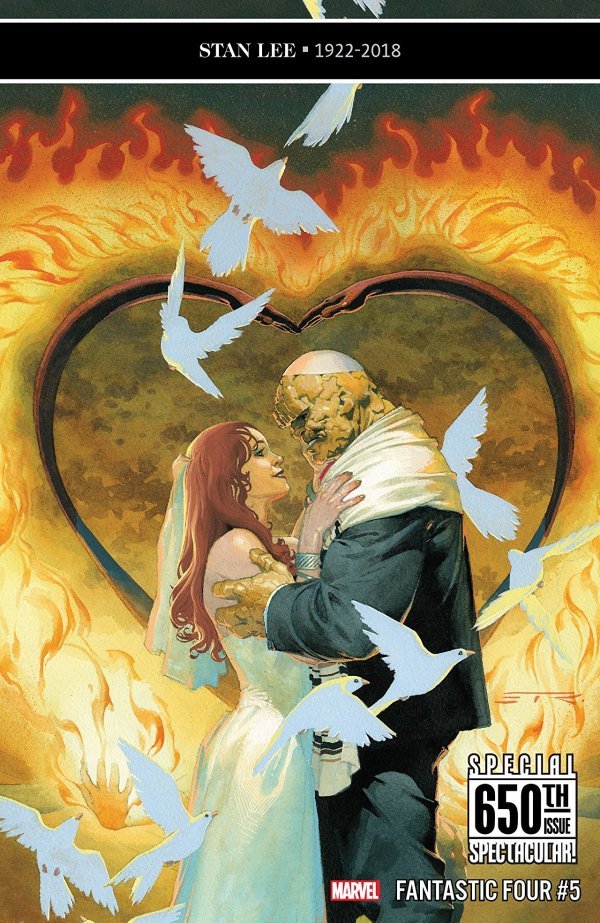
These days you still see holofoil and metallic covers, usually when a smaller publisher does a run with 75 different variants and then doubles it by making holofoil versions of each. Marvel and DC have also each done runs of lenticular covers (an image where the artwork changes if you tilt the page or look at it from a different angle) in the last decade or so. But there hasn’t been much else. When Superman married Lois Lane in 1996, there was a special edition cover embossed and designed to resemble a wedding invitation. When the Thing from the Fantastic Four finally married his longtime girlfriend Alicia Masters in 2019, we got a bunch of covers showing the couple from every conceivable angle, but not the slightest hint of foil, nothing that glowed in the dark, and certainly nothing that could be scratched and, subsequently, sniffed. 

I don’t care what anybody says, Stan Lee’s epitaph does NOT count as a cover enhancement.

I know that if the enhancements came back they would quickly become overdone all over again. I know that after three months of Green Lantern covers where one glows and the next has a lantern shape cut out and the third glows AND has a lantern shape cut out I would probably start to get irritated because they’re charging an extra buck for each cover. But they’re doing that for a lot of the variants NOW, and while I am not someone who usually buys variants, I admit that I would be more inclined to do so if there was a little bit of an enhancement to sweeten the pot. 

The hard part is not doing covers like these, it’s doing them in such a way that people don’t get sick of them. Reserve them for important occasions. First issues are acceptable. Anniversary issues are acceptable. The beginning or end of a major storyline is acceptable. 

“Wednesday” is not.

I know that my yearning for these covers is tainted by nostalgia, but that’s not always a bad thing. Nostalgia is the only reason X-Men ‘97 exists on Disney+, and people seem to be pretty darn satisfied with it. (I haven’t watched it yet, so no spoilers.) 

I don’t know, maybe it’s just me. Maybe I’m just shouting into the wind and when you guys read this week’s column you’ll all think I’m crazy for feeling this way. Heck, even I think I’m a little crazy for feeling this way. All I know is this: when I go into BSI Comics to pick up some new books, I almost never want the variants…but once in a while, I wouldn’t mind getting my hands on an enhancement or two. 

Blake M. Petit is a writer, teacher, and dad from Ama, Louisiana. His most recent writing project is the superhero adventure series Other People’s Heroes: Little Stars, volume one of which is now available on Amazon. You can subscribe to his newsletter by clicking right here. If you go on eBay looking for some of these comics he’s talking about, don’t be fooled. The “coffee stains on page 17” variant is NOT an enhancement, no matter what the seller is telling you. 

Geek Punditry #59: The Crossover Question

It was the kind of news that grinds the internet to a halt, sometimes for upwards of 17 seconds. After years, decades even, where some of the most sought-after comic books of all time were out of print and unavailable unless you wanted to pay crazy eBay prices, this week DC and Marvel Comics announced a pair of omnibus editions collecting most of the crossover comics that have been produced over the years featuring meetings between the two most famous superhero pantheons in the world.

This is not a drill, people!

I’m not sure if younger fans will realize exactly how big a deal this sort of thing is. From the moment that the two respective worlds solidified, there were fans who were anxious to see the Justice League meet the Avengers, the X-Men meet the Teen Titans, Brother Voodoo meet Brother Power: The Geek. It’s like when you have toys from multiple toy lines and try to play with them all together. I know that every kid my age, at some point, had their G.I. Joes face off against Darth Vader, the TransFormers clash with He-Man, and the Thundercats and Silverhawks grab a drink down at the bar. Those were the stories that spilled out of our imagination. But the idea of a “real,” “official” story in which such a thing happened was the stuff of dreams. So in 1975, when the two publishers announced their first joint venture, it was like a dream come true!

For Wizard of Oz fans, that is. Yes, because of some weird things like licensing agreements with MGM and the public domain status of the original novel, the first comic co-produced by Marvel and DC Comics was an adaptation of MGM’s The Wizard of Oz, hitting the stands a scant 36 years after the film’s debut. I was only around for the last few years of it, guys, but it really seems like the 70s were a bizarre time.

The part where Wolverine rips out the Cowardly Lion’s entrails, in retrospect, may have been a tad overboard.

But that collaboration seemed to grease the wheels between the two publishers and, in 1976, fans got Superman Vs. the Amazing Spider-Man. Like the Oz book, this was an oversized treasury edition featuring the clash of the respective publisher’s two most popular characters, and it was a hit. In 1981 there was a second Superman/Spider-Man meeting, followed by Batman Vs. the Incredible Hulk (or, as I like to call it, “Battle of the Bruces”), and in 1982 we got The Uncanny X-Men and the New Teen Titans. Then work began on an Avengers/Justice League crossover, a story that would surely be the crown jewel for the two publishers, but things kind of fell apart. Not only did that planned crossover never happen, but all crossovers between the two dried up for over a decade. 

Childhoods were defined in these books.

That changed in 1994, when the era of comic book excess was in full swing, and the two collaborated again with what would be the first of two Batman/Punisher crossovers. It wasn’t Bruce Wayne, though – this story took place during the Knightfall era, and the Punisher ran across the Jean-Paul Valley version of Batman. By the time the sequel rolled around, Bruce was back and Frank Castle learned what the real Batman is like. This pair kicked off a new wave of Marvel/DC crossovers including Batman/Spider-Man, Batman/Daredevil, Batman/Captain America – look, by the 90s it was clear who DC’s top seller was. But Superman got in on the fun too, meeting both the Hulk and the Fantastic Four. Green Lantern met up with the Silver Surfer, and then there was the villain-centric Darkseid Vs. Galactus: The Hunger by John Byrne. 

College years, on the other hand, were defined by THESE books.

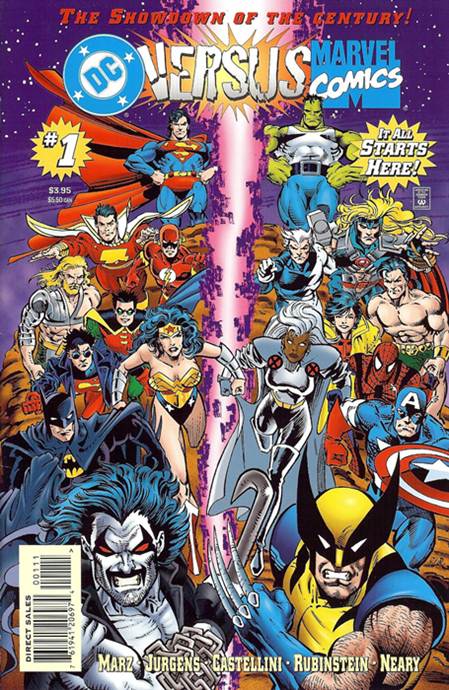
The creme de la creme, of course, was 1996’s mega-event DC Vs. Marvel, where the two universes collided in a four-issue slugfest where the fans voted for the winners of the five top battles. This was a great gimmick from a sales standpoint but posed something of a creative challenge, as writers Peter David and Ron Marz had to figure out some way to have Lobo (an indestructible alien with Superman-level strength) lose a fight to Wolverine (a character who is considerably less powerful unless you count his mutant ability to sell a trillion copies and, in this case, garner a trillion extra votes). Their solution, hilariously, was to have the two of them duck behind a counter and only have Wolverine pop up, thereby avoiding the need to actually explain how he could possibly have won.

Nerds argued over this for almost 60 years before Marvel and DC decided to settle things. It didn’t stop nerds from arguing.

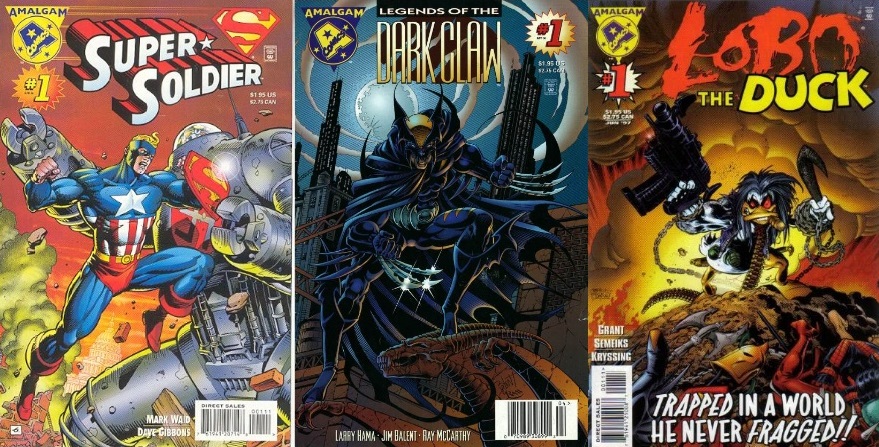
Specious battles aside (I also take issue with Storm of the X-Men beating Wonder Woman with a bolt of lightning and Batman beating Captain America because the latter got hit by a wave of water from a flooding sewer which threw off his aim), the book was a smash hit. It spawned two sequel miniseries, but the thing that fans remember most were the series of one-shots that came in-between issues three and four of the main storyline, the Amalgam Universe. Basically, the Marvel and DC Universes were merged, and we got 12 one-shots starring character mashups like Super Soldier (Superman fused with Captain America), Dark Claw (Batman and Wolverine), Speed Demon (Flash and Ghost Rider) and so forth. A year later there were another series of 12 one-shots, half of which were follow-ups to the original dozen and the other six introducing new mashups like the Lobo the Duck (Lobo and Howard the Duck) and Iron Lantern (Iron Man and Green La– look, do I have to spell out EVERYTHING?). 

The next time someone tells you that drawing doofy fan mashups won’t get you anywhere, show them this.

The Marvel/DC crossover craze ended in 2003 with the long-awaited JLA/Avengers crossover, and it came about in a sort of odd way. The legendary George Perez, whom everyone agreed was the only man alive who should draw this book, joined upstart publisher CrossGen Comics, and CrossGen made all of its talent sign exclusive contracts for the term of their employment. The only loophole allowed was in Perez’s contract, which stated he would be allowed to do JLA/Avengers if it ever happened. That seemed to be enough to get Marvel and DC to figure things out, and the four-issue miniseries finally came about. But that’s the last time any Marvel or DC characters met one another.

There were other crossovers in that era, of course. Marvel’s Iron Man met Valiant’s X-O Manowar, and Daredevil encountered Shi from Crusade Comics. DC and Dark Horse comics became besties: Superman crossed over with Michael Allred’s Madman, the Joker fought the Mask, and Batman met both Grendel and Hellboy (the latter with Starman in tow). But the two biggest games in comics stopped playing together at that point, possibly because of corporate chicanery and possibly because the always friendly rivalry between the two publishers became somewhat less friendly for a while. 

Marvel, in fact, seems to have quit crossovers altogether. A search on the Internet (which, as we all know, has never been wrong about anything) seems to indicate the last time Marvel characters crossed over with any other publisher was back in 2009, when the Avengers and Thunderbolts were featured with Top Cow Comics characters in a miniseries called Fusion. We’ve recently got a new crossover, though, with Wolverine fighting the Predator, but as both characters are now owned by the Walt Disney Corporation and IP Farm and Macaroni Grill, and therefore both published by Marvel, I don’t know that it technically counts. 

And it’s not like other publishers haven’t gotten into the game as well. Before Disney bought Fox, Dark Horse Comics held the rights to Aliens and Predator, and they fought EVERYBODY. Superman Vs. Aliens, Batman Vs. Predator, Green Lantern Vs. Aliens, Magnus: Robot Fighter Vs. Predator, WildC.A.T.S. Vs. Aliens, Archie Vs. Predator (no, I’m not kidding), Batman and Superman Vs. Aliens and Predator…it was a cottage industry.

Fellas, when THIS many people have trouble getting along with you, maybe it’s time to admit that the problem is YOU.

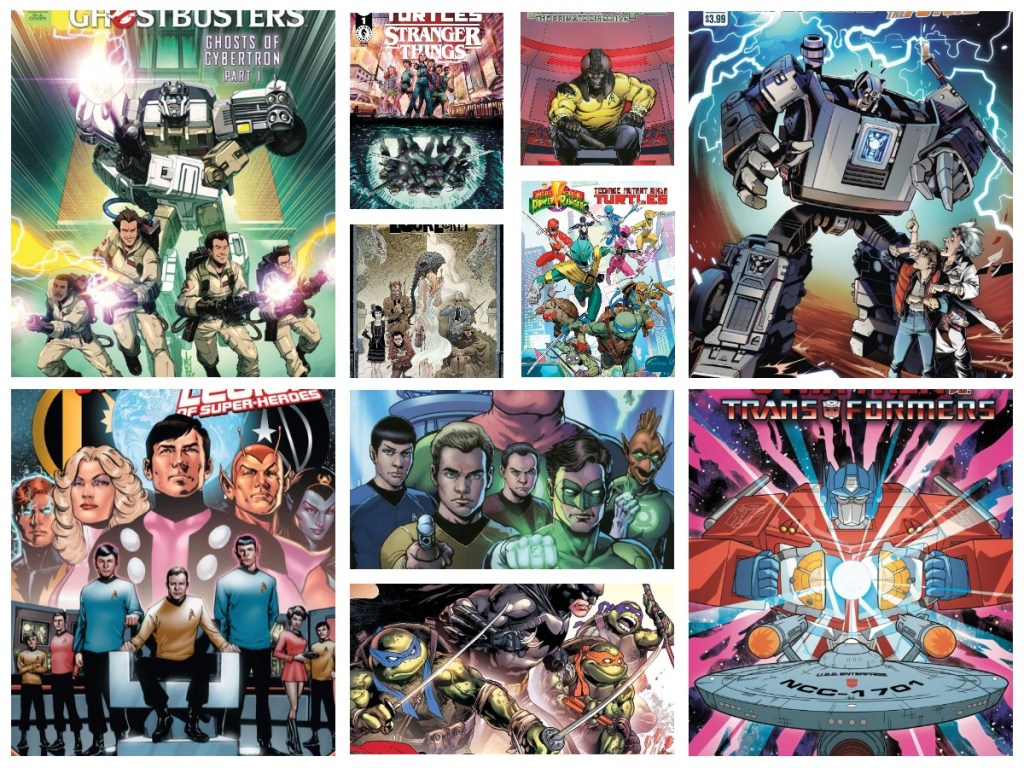
And their sparring partners often met other publishers’ characters as well. Archie Comics has crossed over with – among others – the Punisher, Batman ‘66, Harley Quinn and Poison Ivy, Vampirella and Red Sonja, and the Tiny Titans. They also crossed over with the Teenage Mutant Ninja Turtles when Archie was publishing THAT book, but since the Turtles have moved to IDW Publishing they’ve encountered the Mighty Morphin Power Rangers (twice), Batman (four times), and the characters from Stranger Things, which has also crossed over with Dungeons and Dragons, which has also crossed over with Rick and Morty. The Power Rangers have also met both the Justice League and Godzilla, and the Justice League and Godzilla are currently meeting each other – along with King Kong – in a crossover with the Legendary Monsterverse. 

While Marvel has pulled out of the crossover game (which is something I largely suspect is an edict from Disney, although I have nothing to back that up, it’s just a gut feeling), DC has kept it up. Besides the aforementioned TMNT, Power Rangers, and Godzilla/Kong crossovers, the Justice League has met the characters from Jeff Lemire’s Black Hammer, and enjoyed crossovers with corporate siblings the Looney Tunes and the Hanna-Barbera cartoon characters. Batman and Scooby-Doo, who have met in cartoons many times, now share an ongoing children’s comic. DC has also partnered with IDW for Star Trek/Green Lantern, Star Trek/Legion of Super-Heroes, and an inventive crossover between DC’s Sandman Universe and Joe Hill’s Locke and Key. IDW seems to love crossovers, even with different licensed properties in their own stable. While they owned the licenses to these assorted properties, they crossed over TransFormers with Ghostbusters, Back to the Future, and Star Trek: The Animated Series (making new Autobots out of the Ecto-1, the Delorean, and the Enterprise, respectively). Star Trek, by the way, also crossed over with the X-Men when Marvel owned that license, in two one-shot comics and a prose novel titled Planet X. And Valiant and Image Comics did the “universes merge” story three whole years before Amalgam Comics in a series called Deathmate, which is largely remembered today for the fact that Rob Liefeld’s issue of the series was hilariously late. 

IDW is the Nick Cannon of comic book crossover events. No, not musically.

In fact, there’s only one really major franchise that has significant comic book presence that – as far as I know – has never done an official crossover, and that’s Star Wars. Even before the Disney buyout and the comics moved to Marvel, Dark Horse never made an effort to have Luke Skywalker meet Barb Wire or something. The closest they’ve come was in an out-of-continuity story in the Star Wars Tales anthology comic from 2004, in which the Millennium Falcon gets lost in a galaxy far, far away and crash-lands on a primitive planet, only for the remains to be discovered centuries later by an archeologist strongly implied to be Indiana Jones. 

I know it can seem overwhelming if you’re a casual fan, trying to make all of these things work out. The good news is, you don’t have to. The vast majority of these crossovers are either considered non-canonical to the main properties or are of such little consequence to the ongoing story that they may as well be. There are rare exceptions (the WildC.A.T.S./Aliens crossover killed off several members of Wildstorm Comics’ Stormwatch team, for example), but for the most part, they can be read on their own, self-contained, without impacting the ongoing comics in any significant way.

So why do them at all?

Because they’re fun. They’re fun for the readers, who like seeing beloved characters interact, and they’re fun for the creators, who enjoy making them just as much. It’s true that there was a saturation point of crossovers in the early 2000s, but the solution to saturation is to slow down the flow, not cut it off entirely. 

So the announcement of the two DC/Marvel omnibus editions is welcome. The DC Versus Marvel: The Amalgam Age omnibus will collect the DC Vs. Marvel miniseries, its two sequels, and 13 of the 24 Amalgam books. The DC Versus Marvel omnibus will collect most of their other crossovers. But the exclusion of the remaining 11 Amalgam books is surprising and a little frustrating, and the DC Versus Marvel omnibus will exclude JLA/Avengers, which was reprinted in a very limited charity run two years ago after George Perez announced that he was suffering from terminal cancer. The fact that it was once again Perez being on a deadline that got that book off to the printer is a sad sort of cosmic convergence. 

No joke here. George Perez was one of the greatest comic book artists ever to pick up a pencil, and he deserves all the love and respect he gets.

I hope that there are plans to reprint the rest of the Amalgam books at some point, but even if there aren’t, the fact that they’re doing the omnibus editions at all is encouraging. It’s something fans have wanted for a very long time and we didn’t really think would ever happen. It also, of course, has everybody asking a couple of pertinent questions. First, why now? What has changed in the Marvel/DC relations that allows these books to finally see print again? A lot of the people responsible for the bad blood between the publishers are gone now, and that may indeed play a significant role. And if THAT has changed, let’s just ask the most obvious question of them all:

Could this be a precursor to more?

As I said, it’s been over 20 years since the Marvel and DC Universes connected in any official capacity and a lot has changed. I think there are a lot of fans who would be interested to see Miles Morales meet Damian Wayne or have Kamala Khan interact with Jon Kent. How would the Titans of today – now DC’s premiere super-team – react to the X-Men in the age of Krakoa? And come on, fans have been pining for a Deadpool/Harley Quinn crossover for ages. Such a book would be as good a license to print money as Wolverine was in the 90s. 

I’m not saying it will happen. I’m just saying that if it DID, it would be cool. 

I’m also saying that the two omnibus books are coming out in August, which also happens to be my birthday month. I’m just. Sayin’. 

Blake M. Petit is a writer, teacher, and dad from Ama, Louisiana. His most recent writing project is the superhero adventure series Other People’s Heroes: Little Stars, now complete on Amazon’s Kindle Vella platform. He’s always wanted to write the Captain Carrot/Spider-Ham crossover that America deserves. 

Geek Punditry #51: (DC Comics Presents) The Greatest Santa Claus Stories Ever Told

Every week comic book fans go to the shop to pick up the latest exploits of their favorite heroes: Superman, the Fantastic Four, the Flash, and so forth. And this month, DC has brought back one of their top recurring characters, pairing him off with none other than the Batman in a four-issue miniseries that has proven to be the most epic tale in the battle of good versus evil since Cindy Lou Who managed to get to the Grinch. I refer, of course, to the legendary four-issue epic called Batman/Santa Claus: Silent Knight. 

“Ho ho hoooold on a second, whose comic book is this, anyway?”

Written by Jeff Parker with art by Michele Bandini and covers by Dan Mora (who – I’m throwin’ this out there – may be the best Superman artist of this generation) in this story Batman and Santa have to team up to save Christmas from the demonic Krampus. This comes as a shock to Robin, Nightwing, and the other members of the Batman family, because they always thought Bruce was making one of his rare jokes when he told them that Santa Claus was one of the many teachers he went to while in training to become the world’s greatest detective. Nope. Santa is 100 percent legit. And I love that.

When an established property does a Santa Claus story, they usually go in one of two ways: either everyone is shocked to learn that Santa Claus is real, or Santa Claus is NOT real in this dismal, crapsack universe, but people learn a lesson about the True Meaning of Christmas anyway. It’s not often that you see a story – other than those aimed directly and exclusively at children – that accepts Santa as a simple fact of existence, and the breakdown of which characters are aware of Santa and those that previously were not is really hilarious. Considering the fact that this is a superhero universe, the question of Santa’s existence seems kind of silly: your best friend can juggle mountains, you work with a guy who breathes underwater, you hang out with a Olympian Demigoddess, and your Secret Santa this year wears a magic ring he got from blue aliens. Why the hell would it be hard to believe in Santa Claus?

Back in the 80s and early 90s, DC published a series of collected editions called The Greatest Stories Ever Told, a simple best-of collection featuring some of their characters. There were, to my recollection, two Batman volumes, one for Superman, one for the Joker (this was when the 1989 Batman movie was red-hot), one for the Flash and one featuring team-up stories. Alas, they completely neglected to give a volume to the greatest hero of all: St. Nicholas himself. So in honor of Silent Night, this week I’m going to entreat DC Comics to prep his well-deserved volume for next year. And not only that, I’m going to help them out by suggesting some of DC’s best Santa Claus stories for inclusion. Almost all of these are available to read on the DC Universe Infinite app, by the way, so if you’re a subscriber, you can go over there right now and check out the saga of Santa.

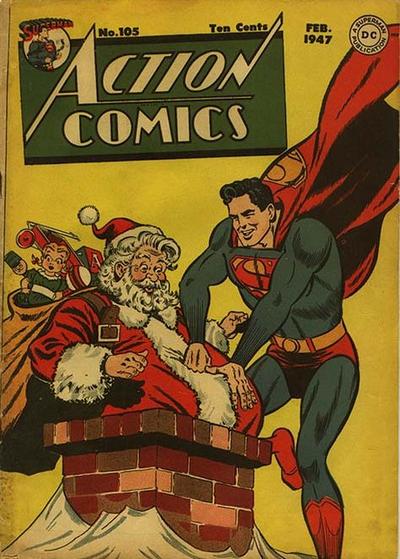
We’re gonna start with Action Comics #105 from way back in 1946. In “The Man Who Hated Christmas” by Jerry Siegel and John Sikela, we meet a guy who sets out to destroy the season by assassinating Santa Claus! Fortunately for children all over the world, Superman is on the case. Like Silent Night, I love this story because there’s none of the usual prevaricating over whether or not Santa really exists. Superman hears that St. Nick is in trouble and he shoots off to save the day without hesitation, helping Santa conquer his diet (it makes sense in context) and taking over when the bad guy absconds with Santa’s reindeer. It’s a charming little story with a great cover that should be read more often.

Doing this in 2023 would immediately get you cancelled.

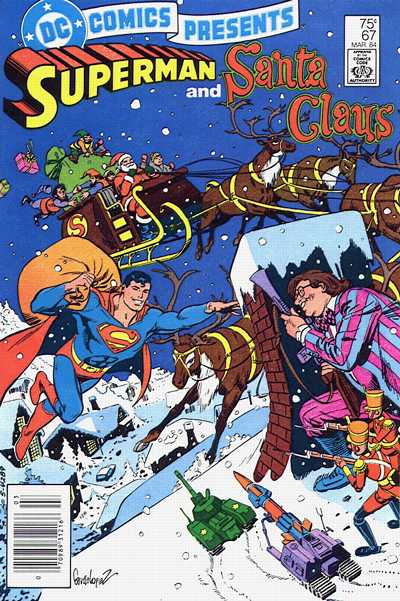
Superman must have forgotten this early encounter, though, because when he met Santa again in 1983’s DC Comics Presents #67, he’s shocked to discover the ol’ spirit of Christmas is real. (Save your emails – we can excuse this by saying that the Action Comics example was the Earth-2 Superman, while DCP featured the Superman of Earth-1.) In “‘Twas the Fright Before Christmas” by Len Wein and Curt Swan, a young boy named Timmy Dickens (because the 80s were big on subtlety), tries to rob a street corner Santa. Superman brings Tim to his Fortress of Solitude in the arctic to get to the bottom of things. Turns out that while sneaking an early peek at his Christmas presents, Tim was zapped by one of his toys and hypnotized to commit crimes and bring the money to Superman’s old enemy, the Toyman. When leaving the Fortress, Tim’s toy zaps Superman, causing him to crash, only to be rescued by Santa’s elves. Clark and Nick team up to take down the Toyman in a battle that I’ve always loved. I first read this story when it was reprinted in Christmas With the Superheroes #1 in 1988 (also available on the app), along with several other classic Christmas stories from DC’s history worth reading…but this was the only one that featured Santa. 

“The only characters available for a team-up this month are Santa Claus and Air Wave.”
“AGAIN?”

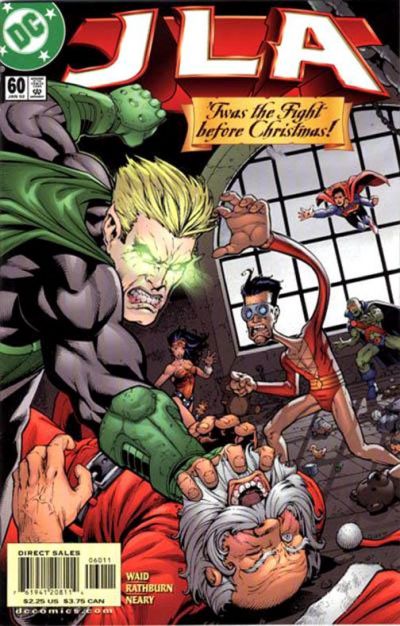
Mark Waid, who made the “Santa must be real” argument beautifully in an issue of Impulse (because why WOULDN’T Barry Allen’s grandson believe in a guy in a red suit fast enough to move all over the world), gave us a tale of Santa in JLA #60 (2001, with art by Cliff Rathburn and Paul Neary). This time Plastic Man is in the spotlight, spending Christmas with his sidekick Woozy Winks and Woozy’s family. Woozy’s nephew is at that skeptical “There ain’t no Santa Claus” age, so to try to restore his Christmas spirit, Plas tells him the story of how Santa Claus joined the Justice League following a battle with the demon Neron. It’s a hilarious tale, with the boy’s stubborn skepticism causing Plastic Man to constantly elevate the stakes in the story, giving Santa heat vision, armor, and other ridiculous power ups in the course of his battle. Waid being a sentimental sort, the story ends with a nice little moment of heartwarming involving some of his teammates. 

“Say it!”
“No!”
“Say Die Hard is NOT a Christmas movie!”
“This is why you’re on the naughty list!”

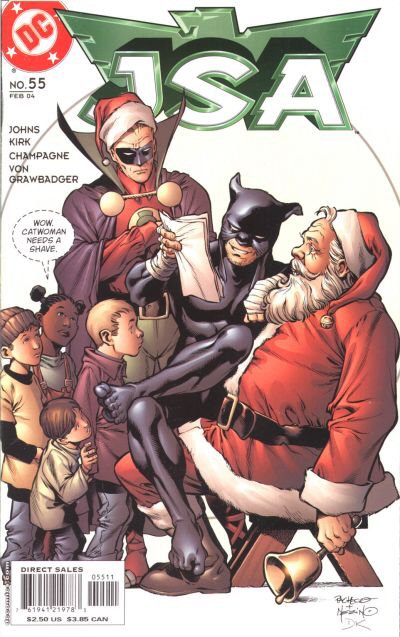
JSA #55 from 2003 is one of my favorite Christmas stories of all time. Written by Geoff Johns with art by Leonard Kirk, “Be Good For Goodness’ Sake” is narrated by a department store Santa Claus getting ready for Christmas Eve, planning to spend the evening entertaining the gathered kids, while at the same time waiting for a visit for some old friends – the Justice Society of America. Johns probably has a greater love and respect for the Golden Age of comics than any writer since the days of Roy Thomas, and he drew on that masterfully with this story. It was already a fun tale about heroes reconnecting with one of their own, but the reveal of just who is wearing the Santa Claus suit still warms my heart 20 years after the book was originally published. That means I’ve read this comic at least 20 times, because it’s a once-a-year read since I first discovered it. And I’ve got no plans to stop.

Not even gonna make a joke about this one. Just read the book. It’s SO good.

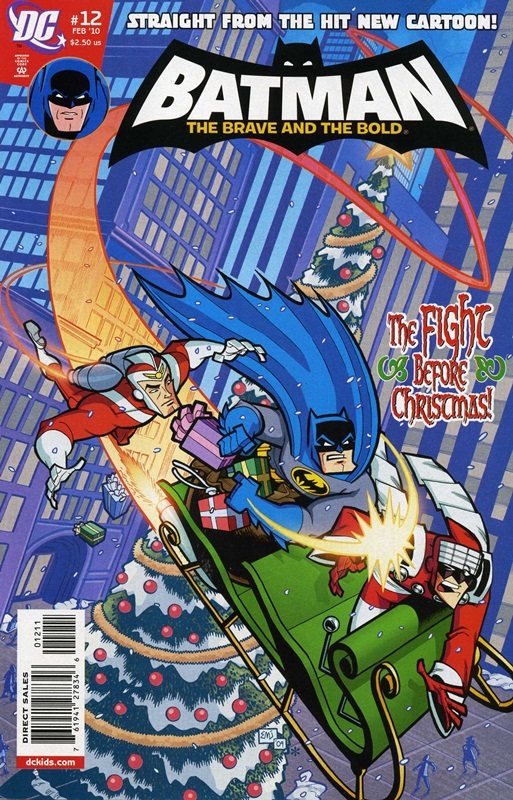
2009 gave us Batman: The Brave and the Bold #12. This comic, based on the animated series of the same name, teamed up Batman with Adam Strange in “The Fight Before Christmas” by Landry Q. Walker and Eric Jones. On Christmas Eve Batman is swept up by one of Adam’s Zeta-Rays to the planet Rann where he discovers that a malevolent force is sweeping through the universe, destroying planets. It’s already taken Thanagar, and Batman was rescued from Earth just moments before its own demise. But there is still a chance to save everyone thanks to some timey-wimey shenanigans that might just set things right in a Christmas miracle. Santa, admittedly, isn’t a HUGE presence in this comic, but the end gives us a shocking new twist on the old boy that I thought was clever and fun.

“Now that the Harley Quinn cartoon has made Kite-Man more interesting, you’re officially my lamest villain, Calendar Man.”

DCU Holiday Bash #2 came out in 1997, one of many Christmas anthologies DC has done over the years, featuring a variety of seasonal stories. The best, however, was a simple two-pager by Ty Templeton called “Present Tense.” On the planet Apokalips, Darkseid is alarmed to discover an incoming invader, a mysterious and absurdly powerful craft that is avoiding his defenses and on a collision course with his citadel. Like most two-page stories this one is basically an extended buildup to a simple punchline, but it’s just fantastic. And Templeton himself shared a link this week to a fanfilm by Bad Boss Studios that recreates the story in LEGO! It’s definitely worth checking out. 

You have to be REALLY aggressive to be a Doordash driver on Apokalips.

My final suggestion…actually isn’t in the DC Universe. And they no longer have the license to this franchise, so it’s not on DC Infinite. But if that Warner Bros/Paramount merger that they’re talking about winds up going through, you never know, it could come back. I’m talking about 1987 and Star Trek: The Next Generation #2. This is SUCH a bizarre comic book that I couldn’t get through this list of DC’s Santa stories without including it. “Spirit in the Sky” is written by Mike Carlin with art by Pablo Marcos, and it came out just a few months after the premiere of the TV show, which most certainly means that the comic was put into production before the creators ever got a chance to WATCH much of it…and BOY does it show. This six-issue miniseries feels consistently out of tone and character with the TV show, especially in an issue where it seems like Geordi has been killed, spurring the “emotionless” Data into a violent rage, screaming like a grieving child over the loss of his only friend. Whoo. Thank goodness when they launched the ongoing series the next year they had more of the TV show to work from.
Still better than season 4 of Discovery.

But let’s look at “Spirit in the Sky.” It’s the holiday season, and the Enterprise is hosting celebrations for the various cultures (human and otherwise) that celebrate at that time of year. As Captain Jean-Luc Picard is begrudgingly planning to make an appearance at each of the various parties, the ship encounters an alien race called the Creeg that is trailing a mysterious energy source throughout the stars. This story is truly bonkers and doesn’t feel like Star Trek at all, which may be the most Star Trek thing about it.

The prototype Cardassians were weird.

There are, of course, many other comic books featuring Santa Claus out there, and not all of them are even published by DC, but there are only three days left until Christmas, so you’ve got to pick and choose. These handsome selections should give you a solid foundation to begin your education of DC’s greatest superhero.

Blake M. Petit is a writer, teacher, and dad from Ama, Louisiana. His current writing project is the superhero adventure series Other People’s Heroes: Little Stars, a new episode of which is available every Wednesday on Amazon’s Kindle Vella platform. Dang it! He forgot all about Fables #56, where Bill Willingham answered the question as to whether Santa Claus is a Fable. Ah well, there’s always next year.