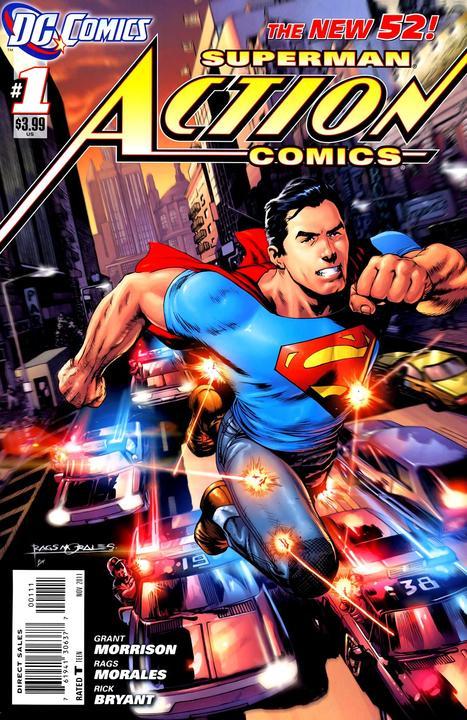
Year of Superman Week 50: Everything Everywhere All At Once

It’s the last somewhat “random” week of the year, my friends. With only three of these blogs left before the Year of Superman ends, I’ve got plans for weeks 51 and 52 – that means I’ve got seven days to scratch as many other items off my list as possible. And you know, I’ve narrowed down that list substantially over the last 49 weeks, but there are still a lot of things I haven’t gotten around to and, frankly, I know that I WON’T get around to before the year is out.

But you know, that’s okay. Just because the year is ending doesn’t mean I’ll stop talking about Superman.

More about that later, but for now, let’s jump into this week’s journey, shall we? 

And as always, you can check out earlier blogs in the Year of Superman Archive!

Wed., Dec. 10

Graphic Novel: Superman: The World

Notes: This is, I believe, the third installment in DC’s “The World” series of graphic novels, following Batman and the Joker. The concept here is that different creative teams from all over the world are invited to contribute short stories about the title character of the anthology. It’s a neat idea that, in the first two volumes, showed us some interesting perspectives on the titular characters. Let’s take a look at what creators from all over do with the man of steel.

The book starts with Dan Jurgens and Lee Weeks (who also did the Doom Rising graphic novel I read yesterday) contributing the American story, “Let Slip the Dogs of War.” Lois and Clark are on a flight into Metropolis (a tedious and frustrating enterprise for Clark) when their plane is diverted due to what appears to be a kaiju attacking the city. Superman, of course, gets out to do his thing, and discovers that the creature may not be the threat people take it for. It’s a very Jurgens-esque story, with a great big honkin’ alien and Superman being Superman in the most Superman way possible. I’ve made it abundantly clear that I don’t think there’s a creator in comics who gets Superman better than Dan Jurgens, and this is one more example of that.

Spain’s Jorge Jimenez contributes “Superman in Granada.” After stopping a meteorite from hitting Earth, Superman’s powers are neutralized and he finds himself stuck in Spain for about six hours before the effects wear off and he can get home. The story is partially a travelog about how beautiful and welcoming the city of Granada is (and Jimenez and colorist Alejandro Sanchez 100 percent sell you on that concept), while the rest of it is about Superman getting by in a place where people don’t quite believe who he is, because let’s be honest, if you saw a guy in a Superman costume walking around and trying to explain that he can’t fly at the moment, you probably wouldn’t believe him either. This one is really very sweet.

“Superman’s Inferno” comes from Italian writer Marco Nucci and artist Fabio Celoni. Lois and Clark are in Italy on the 700th anniversary of the death of Dante, author of the Divine Comedy, a day in which it was prophesied that a portal to Hell would open and flood the world with demons unless a lost incantation is recited. Lois dismisses it as legend, but Clark is uneasy, and when the clock strikes midnight – sure enough – the city is hit by an earthquake. The story traces Superman’s journey through the nine circles of hell – nice, if a little on-the nose. And the revelation of the “incantation” is perhaps just a shade too cute, but still clever. The artwork is top-notch, though, a journey through Hell that’s perhaps a little on the cartoonish side, but tells the story very well. 

From Serbia, writer/artist Stevan Subic gives us “My Choice, Protecting the Light.” With his super-hearing, Superman picks up someone in Serbia threatening violence against another person who describes themself as “Superman’s friend,” trying to prevent the other from obtaining Kryptonite. This story is a little weak. Although Subic goes out of his way to say that the people of Serbia are Superman’s friends and to have Superman call them honorable, we don’t really SEE any of them, except a brief glimpse of the guards protecting the Kryptonite. It’s very much a case of telling instead of showing. The story would have been served better had the people taken a more active role in the fight scene, interacting with Superman and his mystery adversary a little bit more, rather than keep it so contained. 

Cameroon’s writer Dr. Ejob Gauis and artist E.N. Ejob are the creators of “Chariot of the Gods.” A week after Superman stops a villain in Cameroon, damaging an ancient statue in the process, he is being forced into a battle against one of their champions. By breaking the statue, Superman cut the people off from their gods, and only a judgement by combat can complete the restoration ritual. The story is a bit of a treatise about respecting the boundaries and traditions of other cultures. It’s a little disjointed – like, why couldn’t anybody TELL Superman what the big deal was about the statue BEFORE they started punching each other? – but overall it works. 

Rana Daggubati and Sid Koitan give us India’s entry, “To Be a Hero.” A young Superman, just a year into his career, is in India as Clark Kent when he gets invited into an expedition to find a lost civilization. When they come across it, though, they’ve been beaten by outsiders looting the temple of sacred artifacts. I really liked this one – a short, simple story of Superman doing the right thing with great artwork and a color scheme that feels like this was originally produced for the Red and Blue series, which of course is magnificent all around. 

Mauro Mantella and Augustin Alessio are the creators of Argentina’s “The Last Seed of Krypton.” While Clark is in Argentina chasing a story, an energy-creature from what turns out to be a yellow Kryptonite meteor bursts free and attacks Superman, disrupting his powers as yellow Kryptonite does. The creature turns out to be a Kryptonian equivalent to Swamp Thing, hoping to merge with Earth’s Green. There are good ideas in this story, and I quite like the contradictory narration of Superman trying to find a way to defeat a foe whilst that foe sees him as a “Kryptonian brother” trying to bring him a gift. But it’s never quite clear why they’re fighting in the first place, other than the creature frightening people. There doesn’t seem to be any THREAT in allowing it to merge with the Green, or if there is, it isn’t made explicit. There’s also a point where Superman – his powers dwindling – has to find a way to amplify moonlight to recharge himself. Cool idea, except that nobody seemed to let the colorist know that this scene was supposed to take place at night – it seems to be broad daylight outside. There’s something here, but the execution falls kind of flat. 

Turkish writer/artist Ethem Onur Bilgic’s story is “The Hero and the Bull.” Lois and Clark – who are seriously piling up Daily Planet travel expenses in this book – are in Turkey for a history symposium. A group of mercenaries is going after some sacred stones in this one, which can be used to summon a being from antiquity. This one is pretty cut-and-dried – bad guys want to use an old artifact to do a bad thing, Superman stops the bad thing. No twists or surprises, but it’s well done and the art is great.

“Superman in Paris” is by Sylvain Runberg and Marcial Toledano Vargas. Clark has taken Lois on a trip to France to visit an exhibit by her favorite artists, but King Shark swims up the Seine looking for a meal on the logic that French food is the best food in the world, the French people eat French food every day, therefore French people should be the most delicious prey on the planet. I mean…I can’t really fault that logic. It’s a funny story with a fairly standard Superhero fight in the middle of it. Again, though, the artwork by Vargas is top-notch.

Brazil’s Jefferson Costa writes and draws “The Red Mantle.” Clark is in Rio seeking an ancient artifact – the titular “red mantle” – that has been stolen from a museum exhibit. He winds up getting into a philosophical debate with the thief. It’s okay, but I’m starting to wish that DC had put a cap on the number of stories that deal with “an ancient artifact” in this book. I get it, the point is to showcase the culture of the creator’s country of origin, but how many times in a row can that fall on some sort of piece of antiquity being either misused or misunderstood?

“Marzanna” is Poland’s contribution, written by Bartosz Sztybor with art by Marek Oleksicki. In Poland, on the last day of winter, an effigy of the winter goddess Marzanna is drowned in effigy to signal the beginning of spring. But Clark Kent is there because for decades now, every year, a woman has gone missing on that day only to be found later, drowned in the river. You’d think somebody would have pieced together the link between the two before then, don’t you? Anyway, Superman finds some people trying to kill a live woman, believing that the effigy is not enough to prevent eternal winter, and he ends up fighting Marzanna herself. Now this is a good example of what I’m talking about – the story is deeply rooted in Polish culture, but it’s totally different from “watch out for that ancient artifact.” More of these, please.

Bernando Fernandez of Mexico is the creator of “To the Left of the Hummingbird.” In a story with delightfully cartoonish artwork, Clark is in Mexico City to write about the local street food scene (I really want his job), when the city is rocked by a series of Earthquakes. The quakes turn out to be the result of Huitzilopochtli, god of War, sending his harbinger beasts (which look an awful lot like elephants) to prepare the people for doom. You know, as good as “Marzanna” was, this story is making me realize that “Superman fights local god” is just as prevalent in this volume as “Superman deals with ancient artifact.” In some of the stories, like “The Hero and the Pull,” there’s even overlap. Come on, guys, how about a little variety? All that said, this story is really well done, and the ending has a nice, clever little twist that sets it apart. 

“Man of Kruppstahl” is next, from German cartoonist Flix. (“Stahl” is German for “steel.” I checked.) Perry White gets a letter from Heinrich Rupp claiming that he’s invented steel stronger than Superman, and has even sent three plane tickets so they can send a team to check it out. For the first time in this book, someone other than Perry is footing the bill. That’s nice. Anyway, he sends Lois, Clark, and Jimmy Olsen to Germany to investigate the “K-Ruppsteel.” Rupp unveils a giant cage and has a “randomly selected lady” (Lois) tossed into it to demonstrate how tough it is, claiming that Superman MUST be afraid of his invention, or else he would be there. This flawless logic aside, Superman of course shows up to show his “metal.” Get it? Ah? Anyway, it’s a cute little story with wonderful artwork, provided you don’t think too hard about the logic behind it.

Stepan Kopriva and Michael Suchanek of the Czech Republic are behind “If Nihilism is the Answer, What is the Question?” which sounds like the title of an original series Star Trek episode. And in fact, the story takes place in the far future aboard a Czech space station, when an older Superman is summoned to protect the station from a meteor swarm. He becomes embroiled in a conflict between residents of the station who are happy to have him there and others who see him as a symbol of imperialism there to subjugate their autonomy. I admit, I don’t know much about Czech politics, but I get the distinct impression that this story is intended to be a satire of some common issues in that country. If anyone out there knows more about the topic than I do, let me know if the satire lands. That said, I like this story and I especially liked Suchanek’s design for the older Superman. It’s a great look. 

The last story is the fifth chapter of the Japanese Manga series “Superman Vs. Meshi” by Satoshi Miyagawa and Kai Kitago. I covered the first chapter of this series earlier in the year. If you missed that blog, the story – and in fact, the entire series – is about the fact that Clark Kent loves Japanese chain restaurants and ducks over to Japan for lunch whenever possible. I’ve read this entire series on the DC Infinity app and I do enjoy it, but it’s still one of the most bizarre Superman projects I’ve ever seen. In this issue specifically, he gets there a little too late to go to his favorite restaurant, and instead discovers the wonders of Japanese convenience store food. 

As with any anthology, the quality varies from story to story. Some of them are great, and none of them are true duds, although as I said, I would have liked a little more variety in the basic premise for some of them. Boy, the Japanese entry averts that problem, though. 

TV Episode: Superman and Lois Season 3, Episode 10-11.

Thur., Dec. 11

Comics: World of Metropolis #1-4, DC Go! Holiday Special #3 (Supergirl and Superwoman of Earth-11), Justice League of America #52

Notes: Earlier this year, I covered John Byrne’s four-issue World of Smallville miniseries for Mother’s Day, as it was (sadly) one of the few stories I could find that gave a real focus to Martha Kent. But this was actually just the middle series in a trilogy that Byrne wrote in order to flesh out the new continuity he’d crafted for Superman with the oft-mentioned Man of Steel reboot. The first miniseries was World of Krypton (which took its title from one of DC’s early miniseries in the pre-Crisis days), and the trilogy wrapped up with World of Metropolis, written by Byrne with art by Win Mortimer. I’m going to dip my toes into this one today, four issues that each focus on a different member of Superman’s Metropolitan cast, beginning with Perry White in “A Reporter’s Story.”

After praising Jimmy Olsen for bringing in a front-page story about Superman beating one of those hulking bad guys that show up all the time, Perry comes across another story about LexCorp expanding into Ho Chi Minh city. Lex Luthor’s continued success bristles Perry, triggering a flashback to the time when Perry White, a young reporter at the time, came home after a year and a half away covering stories in an overseas warzone. Perry has a happy reunion with his girlfriend, Alice Spencer, not knowing that during his absence she’d been romanced by Lex, who deliberately kept her in the dark about Perry’s whereabouts or even if he was still alive. Perry is distraught when he learns his old friend Lex is planning to sell the Daily Planet. Luthor offers Perry a job anchoring the news on his TV station, but Perry demands that he’s a newspaper man. As he’s leaving, Lex has one of his many female assistants bring Alice an earring she left there before, revealing their dalliance. Perry and Alice reconcile and he finds an investor to buy the Planet and keep it open, but Lex still considers the victory his when Alice announces that she’s pregnant. 

The story of Jerry White, Alice’s son whose fatherhood is somewhat ambiguous for a while, would become a running subplot in the late Byrne and post-Byrne comics for a while. The discovery that Lex was Jerry’s true father drove a wedge between Perry and Alice, and Jerry’s subsequent death only made it worse. Their marital woes became a running subplot for years in real time, and eventually led to them bonding over adopting a young boy, Keith. It’s interesting how something that was such a big element of the comics for so long started here in this spinoff.
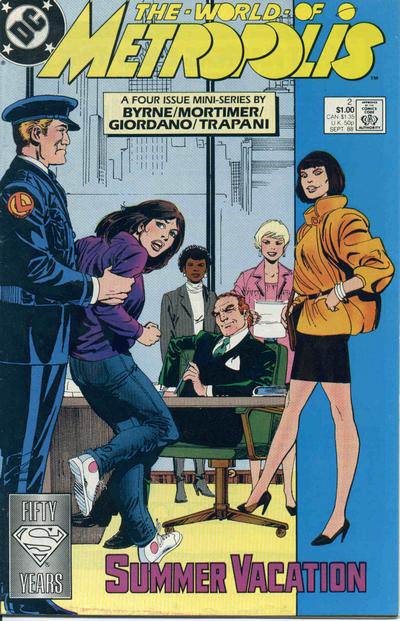
Issue #2 is the Lois Lane spotlight, “How I Spent My Summer Vacation.” In flashback 15-year-old Lois Lane dragged her little sister with her to the Daily Planet office and tried to get a job out of Perry White, now the managing editor of the paper. He tells her to come back in about ten years, but on the way out Lois hears some men discussing something happening at LexCorp, and how anyone who scores that story will get major points with Perry White. Lois sneaks out that night and breaks into Luthor’s tower to try to find some sort of evidence. Although she’s captured with relative ease, Luthor is impressed by the fire he sees in the girl. She manages to sneak out a single slip of paper with information that impresses Perry as well, and she lands her first job. 

Let’s hear it again, folks: “THIS is the way Lois should be written.” She’s smart and she’s gutsy, but at 15 she isn’t yet wise. In fact, it’s that teenage illusion of immortality that fuels this story, showing how she stumbles into a situation that could very well have gotten her killed in other hands. Byrne’s Lois kept her gumption when she grew up, but added the experience that would have kept her from ever making such childish mistakes. It’s a good look on her. 

Lex comes across much worse, though, practically salivating over video footage of Lois having her clothes shredded and searched by one of his employees. It would be bad enough if he did that with adult Lois, but doing it to the 15-year-old adds an additional level of creepyness that I suppose has far greater weight today than it did when this was written in 1988. And while I often make the point that villains in fiction should be expected to do villainous things, this was perhaps a bridge too far. I don’t know that this particular plot point was ever referenced outside of this issue, and I doubt that it ever would have passed editorial if the comic came out today.  
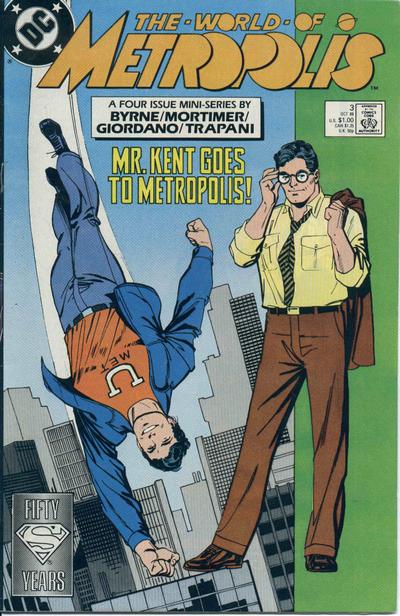
Clark Kent steps up in issue #3, “Mr. Kent Goes to Metropolis.” When he first arrives in Metropolis, young Clark Kent notices a shootout between the police and some criminals with heavy ordinance, holed up in an apartment building. Not yet having adopted his Superman identity, he tries to stop the shootout discreetly before he has to make it for an interview to enroll in Metropolis University. One night he spots a woman being chased by a car, but she escapes without his help. He does happen to overhear her name and where she works, though – it’s Lois Lane of the Daily Planet, and seeing her inspires Clark to pursue journalism. 

This issue isn’t as solid or direct a story as the first two, with a large portion given over to a subplot about Clark getting a job at a diner through college, a waitress there getting a crush on him, and the fact that in the modern day they’ve remained friends, with her kids (with her husband Ed) even calling him “Uncle Clark.” Sweet story, very humanizing, but kind of forgettable. We’ve definitely seen this kind of thing with Clark Kent before.

Jimmy Olen gets the last story with “Friends in Need.” After Jimmy gets into one of those scrapes he’s always getting himself into, he summons Superman with his signal watch for a little help. After he’s safe, Jimmy remembers four years ago, when he came up with the idea for the watch in the first place. Only 14 at the time, Jimmy has a job as a copy boy at the Planet, sneaking out of his house to prove himself to folks like Lois and Clark, who is celebrating his one-year anniversary at the paper. The sneaking out gets him in trouble with his mom, but as she’s chewing him out Jimmy is visited by a troubled classmate, Chrissy, who has taken a bottle of pills and is fading fast. Jimmy’s mother tries to call emergency services, but she can’t get through, and Jimmy breaks the phone in frustration. As his mother rushes out to try to hail a car for help, Jimmy uses his radio kit to send out an ultrasonic signal that Superman hears, summoning him to get Chrissy to the hospital just in time. Jimmy, of course, adapted the technology into his signal watch, and today Chrissy has been taken out of her abusive home, giving her a happy ending of her own.

There’s some nice stuff in here, particularly in showing how clever Jimmy Olsen can be. For instance, a conversation with Lois has them questioning why Superman’s face is always blurry in photos, and just how it is that Clark gets so many Superman stories. Jimmy floats an…interesting idea that Lois quickly shoots down (in a fun reversal of the old Silver Age paradigm of Lois trying to prove that Clark is Superman). And of course, his quick thinking to save Chrissy’s life helps show off some technological skills that help flesh out the character as well. Too many writers forget that and just write Jimmy as some boneheaded kid, and “Superman’s pal” deserves better.

TV Episodes: Superman and Lois Season 3, Episode 12-13.

Fri., Dec. 12

Comics: Action Comics #309, DC Go! Holiday Special #4 (Bizarro and Earth-23 Superman)
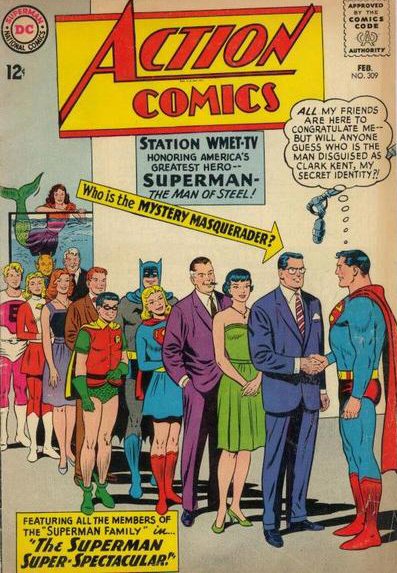
Notes: I’m gonna be honest, I’m swamped today. I had work, of course, and working in a school in those three weeks between Thanksgiving and Christmas is like working backstage on the Muppet Show, only less organized. Later, I’ve got to take my son to basketball practice, and we’re following that up with our annual trip to Lafreniere Park and their lovely family Christmas Light display. So I need something quick to read. I choose Action Comics #309 from the remains of my list, the famous story where Superman tells his identity to – well, I’ll do my recap. 

The story begins with Clark receiving a letter for Superman from the President of the United States, who is asking him to recover the nose cone from a recent spaceflight to be presented as a gift to an astronaut on a TV show. This begins a series of chores where he’s asked to find different items to give to the honorees of the TV show, but when he arrives at the studio he discovers that everyone – even the President – was bamboozling him to keep him busy, as HE, Superman, is the first honoree on Our American Heroes. The show goes off as sort of a take on This is Your Life, as Superman is visited by friends such as Richard Parker (retired Smallville police chief whom he worked with as Superboy). Next come the three LLs in his life – Lois Lane, Lana Lang, and Lori Lemaris, then Supergirl and the Super-Pets. Before Superman can summon a robot from his fortress to appear on the show as “Clark Kent,” he overhears Lois and Lana planning to use a device that detects electronics to prove that he and Clark are the same person. As the show goes on, Superman meets more and more of his friends: the Kandorians, Pete Ross, Jimmy Olsen, the Legion of Super-Heroes, and Batman and Robin. But every possible replacement “Clark” is scratched off the list since they’re already there: his Kandorian double, the shapeshifting Chameleon Boy, Batman…even Pete (who Superman doesn’t know knows his dual identity) assumes that Superman will just summon a robot.

But sure enough, at the last minute, Clark Kent walks across the stage, baffling Lois and Lana when their device fails to register him as a robot. As the show ends, Superman takes “Clark” backstage, where he removes the makeup to reveal the one man that Superman recently did a favor for that he knows he can trust with his identity: President John F. Kennedy.

It was a more innocent time, friends. 

The story is fun, but as often happened in the Silver Age the writers took some wild swings to justify cancelling out anybody who could have helped Clark in his predicament. The Legion has to go home to deal with an emergency, so Chameleon Boy couldn’t stick around. (They have a TIME MACHINE. Why do they have to go NOW?) Batman takes off his mask to show that he’s wearing Bizarro makeup because he thought it would be funny to show Lois Lane what a Bizarro-Batman would look like. After all, we all know just what a wacky prankster the Batman can be. Unfortunately, it would take far too long to take off the makeup and replace it with a Clark Kent disguise, so he’s no good either. It’s just a symptom of the storytelling – when you start with the end, that being “Superman needs the president to pretend to be Clark Kent,” you might just have to jump through some ridiculous hoops to make it work.

We also get a Supergirl story in this issue, “The Untold Story of Argo City.” After a visit to the Midvale Orphanage were she lived before she was adopted by the Danvers, Supergirl has dreams of her parents Zor-El and Allura, pleading with her and telling her they’re alive. Frightened by the dream, Supergirl ventures into the Phantom Zone, believing them to be there. The hordes of Kryptonian villains who inhabit the Zone taunt her, telling her that her parents ARE there, but they refuse to help. Leaving the Zone, she uses an invention of Superman’s that allows her to see the past to view Argo City’s destruction. As it turns out, before Argo died of the Kryptonite radiation from the ground beneath them, Zor-El found a different frequency of the Phantom Zone which he called the Survival Zone, but only he and Allura made it there in time. Now that they have found a way to contact their daughter, Supergirl vows to help her parents get free some day.

And she did, eventually, but that’s all pre-Crisis stuff. It didn’t happen that way anymore. Still fun to read, though. 

Sat., Dec. 13

TV Episodes: Superman and Lois Season 4, Episodes 1-5.
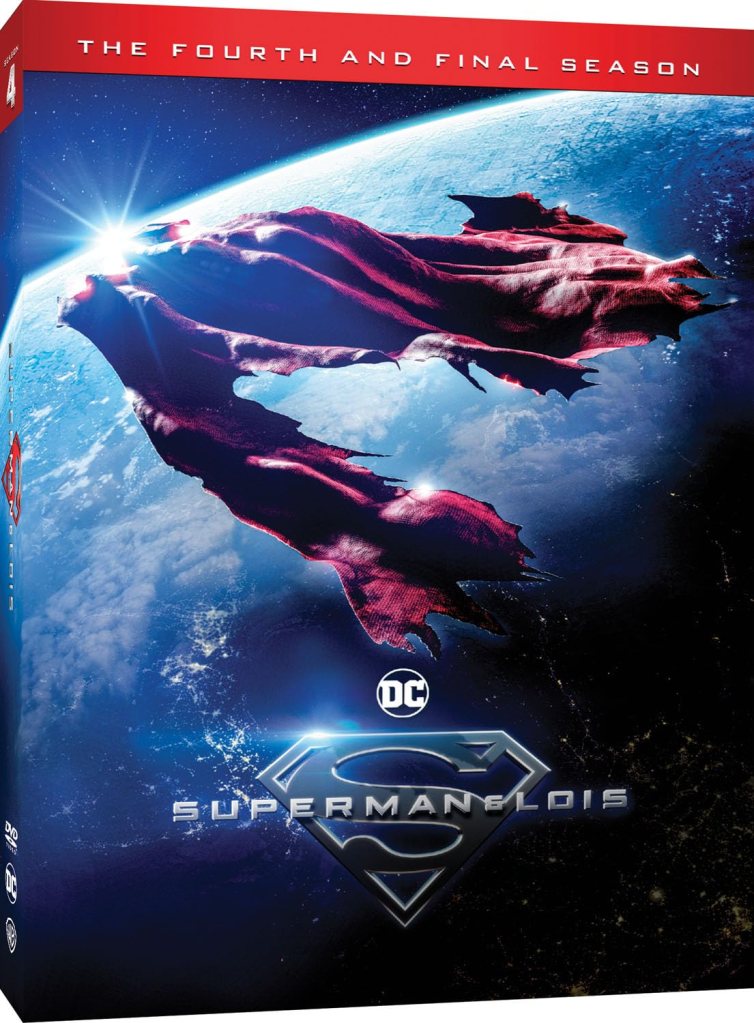
Notes: My goal, I don’t mind telling you, is to include the final episode of this series in the last week of 2025. It’s going to be a week of endings, and I’ve heard a lot of great stuff about the finale of the series as a whole, so I’ve got high hopes.

I haven’t written too much about the last several episodes, even as I was watching them, but starting the final season feels like a good place to do a sort of recap. The Big Bad of season 3 of Superman and Lois actually turned out to be cancer, as the bulk of the season was taken up with Lois battling the disease. This ran parallel with a subplot about mobster Bruno Mannheim, who happened to own the hospital where Lois was being treated. She also befriended a fellow patient that turned out to be Bruno’s wife, and Natalie started dating a really nice, charming guy who turned out to be his son. It’s the sort of string of coincidences that we only accept in TV Land.

The Lois storyline, I admit, was effective. There was a good amount of sincere emotion built into it, with everything building up to a crescendo a few episodes before the finale. Then in the last two episodes the season went into a totally different direction: Mannheim’s downfall revealed information that exonerated Lex Luthor, who has been in jail for 17 years following an expose that Lois wrote about him. In those last two episodes he was released, threatening Lois. The last episode ended with a cliffhanger – Sam was kidnapped and Superman wound up fighting an awfully Doomsday-esque monster that was created through the systematic torture of the awfully Bizarro-esque Superman from another world from season two.

The third season kicks off with Luthor continuing to spread his threats, Sam in Luthor’s captivity, and Superman missing – the last glimpse we got of him is his tattered cape floating on the surface of the moon. If they’re going for another version of the Death of Superman story, they deserve credit for taking it in a very different direction than any of the previous iterations. But as they go through it, things get DARK. Sam is beaten and tortured by Lex, and he’s tossed into a grave to be buried alive with Lex giving the order to keep the sand wet to make it more painful. The boys are desperately looking for any sign of their father or grandfather, and Lois confronts Lex again, where he expresses his plan to move to Smallville permanently. Fortunately, Jordan’s super-hearing picks up on Sam choking and he and Lois manage to save him just in time. Still no sign of Clark, though. Not until the final moments of the episode, where Doomsday (is he officially Doomsday? Imma call him Doomsday) beats him into submission, then brings him back to Smallville and drops him in the middle of the street in front of Lois and the twins, then bounds away to give Luthor Superman’s heart as ordered to do. Lois, Jonathan, and Jordan fall to their knees in tears as the people of Smallville watch.

The opening of this final season is nicely tense, but there’s something seriously missing: the rest of the cast. After building a strong group of characters with John Henry, Natalie, and Lana Lang’s family in the first three seasons, the producers relegated everybody except for Lois, Clark, and the twins to “recurring” status, none of them having more than a handful of the ten episodes to their credit. It feels like a cheap money-saving measure, honestly, and while the episodes I’ve watched thus far aren’t bad, there’s a definite sense that things are missing. I’m hoping that their few remaining appearances will be enough to give their respective stories a sense of closure. 

The second episode begins with Lana getting everyone in town to back off as Jordan brings his father to the Fortress, pleading with the AI of Lara to save him. Despite the fact that he’s literally missing his heart, she promises to do all she can and puts him into stasis. When he returns home, he tells Jonathan that the only way to save their father is to find the heart that Doomsday ripped from his chest. The whole episode is a cat-and-mouse game between Luthor and the Kents, and…

It’s definitely not going in any direction I could have predicted. I’m looking forward to how this shakes out. 

Sun., Dec. 14

Comic Book: Superman: Under a Yellow Sun #1
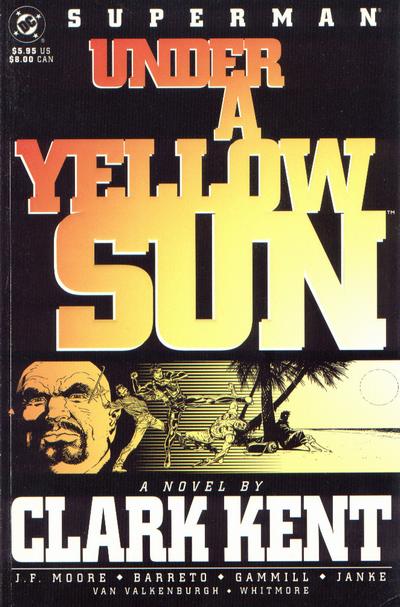
Notes: Although it doesn’t come up very often these days, in the early years of post-Crisis continuity, John Byrne and other, later writers occasionally mentioned that Lois and Clark both had side hustles writing fiction in addition to their careers as journalists. I even recall one issue, although I don’t remember which one, in which Clark bemoans seeing one of his novels in a bookstore placed on a remainder table next to the horror novel Fear Book, which was written by – nice meta joke here – John Byrne. This 1994 one-shot by John Francis Moore takes the metafictional aspect a bit further by presenting Under a Yellow Sun, a novel by Clark Kent. The one-shot cuts between scenes from the novel illustrated by Eduardo Barreto and a subplot featuring Clark Kent’s adventures in “real” life that inspire the novel, with art by Kerry Gammill.

Clark is struggling to produce his novel, dodging his agent and throwing himself into a news story, something he’s more comfortable with. Gangs in Metropolis are getting their hands on high-tech ordinance that seems like it could only have come from LexCorp, and Clark gets entangled with a LexCorp executive named Joanna DaCosta, who may have the key to unlocking the mystery. Joanna, Luthor, and Clark’s usual supporting cast all bleed into the novel he’s working on, a potboiler about a former special forces agent named David Guthrie who’s caught up in an arms trafficking scheme in what seems to be an island paradise. 

It’s fun to see Clark struggling with a problem that Superman cannot possibly help him with – writer’s block. And it’s fun to see the story bounce back and forth between Clark’s imagination and the stuff that feeds it. There are good bits with Lois as well – where she’s concerned about Clark’s relationship with Joanna (although published in 1994, this story is set before Lois and Clark were engaged or she knew his secret identity), and where she helps him at the end when his frustration over his failure to catch Luthor in the act leads him to write a bitter nihilistic ending that Lois rightly declares is unfitting for him. 

It’s a romanticized version of a writer’s life, to be certain, but come on…it’s still Superman’s writer’s life. There are bound to be some liberties taken. But it’s a great opportunity to get eyes on a corner of Superman’s life that we rarely get to see. 

Mon., Dec. 15

Comic: Superman Vol. 2 #9, DC Go! Holiday Special #6 (Team Member, Superdemon of the League of Shadows), Justice League of America #53 (Team Member)

Notes: ‘Tis the Monday before Christmas break, and for a teacher, that means it’s crunch time. I’ve got essays to assign, papers to grade…and as much as I hate to skimp, I think the next few days I’ll be looking at relatively quick things. Fortunately, after Friday hits I’ll be off work for the remainder of the Year of Superman, so hopefully I’ll be free to tackle a lot of the meatier stuff that’s still on my plate. For today, though, why don’t we take a look at the first meeting – post-Crisis, that is – between Superman and the Clown Prince of Crime? “To Laugh and Die in Metropolis” comes from John Byrne’s Superman #9.

Superman casually wanders into a jewelry store in Metropolis, but he’s uncharacteristically silent and unresponsive, despite a smile on his face. That smile grows deadly, though, peeling into a rictus as his face is bleached white and his hair turns green. Gas spews out of his ears, killing everyone in the store, and he loots a massive diamond. Opening the case triggers a silent alarm, though, and the REAL Superman hears it, zipping in to stop what turns out to be a robot – with a nuclear bomb in its chest cavity. He flies the robot into orbit before it explodes. The blast knocks Superman to the Mojave Desert, while back in Metropolis the Special Crimes Unit starts to clean up the victims. When Superman returns, he picks up a signal from Jimmy Olsen’s famous watch, only to find it attached to a balloon with a note from the Joker claiming he’s kidnapped Jimmy, Lois Lane, and Perry White, and sealed them in lead-lined coffins across the city with less than a half hour of air. 

The Joker, meanwhile, is gloating in his secret hideout – a mobile tanker car – in which he’s got all three captives tied up. His plan is to have Superman waste time looking for them while he makes his escape, gleeful at the vacation from matching wits with Batman and only having to deal with a “muscle-bound clod” like Superman. The smile (literally) is wiped off his face seconds later when Superman lifts up the truck and brings him straight to prison. 

The story is quick and fun, with Byrne taking the opportunity both to show that Superman is NOT – as the Joker assumed – just dumb muscle, and also to demonstrate something about his powers. The Joker thought that Superman not being able to see the lead coffins would make them impossible to find, when in fact, it made it easier. He simply swept the city with his X-Ray vision and quickly found and opened each coffin he COULDN’T see through. I feel as though Byrne wrote this story as much to clarify that aspect of Superman’s powers as he did for the sake of the story itself.

Although the main story is self-contained, Byrne had a lot of subplots going during his tenure, and this issue followed up on one of the main ones. In an earlier issue, someone had stolen Martha Kent’s scrapbook of Superman activity, and in this one it arrives at Clark Kent’s desk at the Planet. It’s part of the Amanda McCoy storyline – the Luthor employee who deduced Clark’s identity – that we’ve seen in bits and pieces across the year. There’s also a one-page vignette with Lana Lang that set up the later Millennium crossover.

The gem of the issue, though, is the short back-up story, “Metropolis 900 Miles.” Lex Luthor stops in at a random diner 900 miles from Metropolis (hence the title), where he meets an attractive young waitress named Jenny and invites her to spend a month with him in Metropolis. When she tells him she’s married, he doesn’t blink an eye and offers her a cool million dollars to be his for 30 days. After coldly telling her how meaningless her life is, he tells her he’ll wait for ten minutes in his car for her decision. Jenny has a few pages of pondering the offer, arguing with her coworkers and calling her husband, before looking out the window and seeing that Luthor is gone. In the final panels we see Luthor gloating with his driver, saying that Jenny will spend the rest of her life wondering what her answer would have been.

This is a particularly sadistic game to play, even for the likes of Lex Luthor, but that’s kind of what makes it work so well. Byrne was still in the mode of demonstrating the ruthless billionaire incarnation of Lex, the classic Mad Scientist being so close to people’s hearts for so long. I think this story went a long way to demonstrating just how cold, cruel, and manipulative the character actually was. It’s the kind of thing that makes you despise him even more…which is, ironically, also the very thing that makes him an interesting, compelling character, and which makes this story some of the best character building work Byrne ever did with the character. And all in a scant seven pages. 

One of these days I’ve got to get around to doing a full readthrough of the Byrne era of Superman.

Don’t worry. I’ll let you know when I do. 

Tues., Dec. 16

Comic: Adventures of Superman: House of El #4
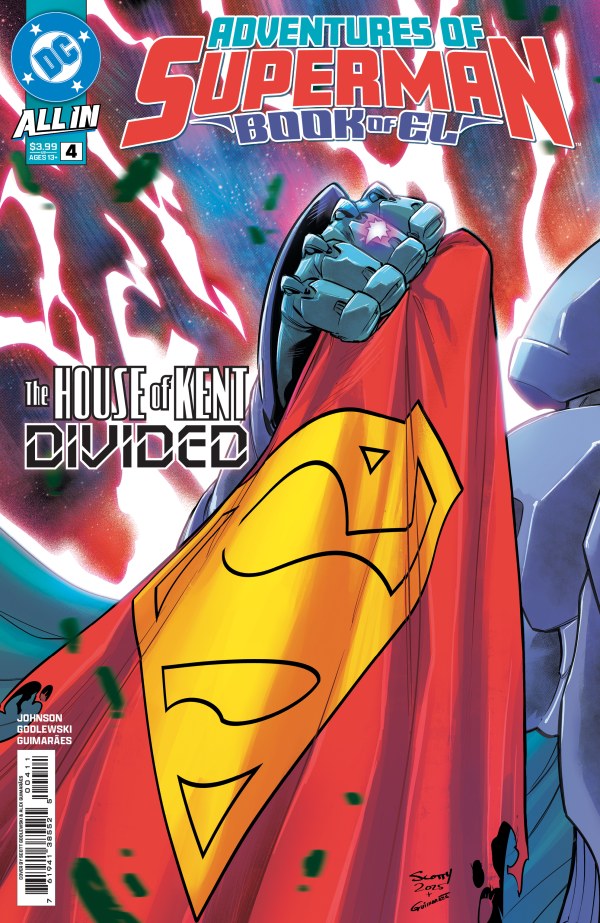
Notes: Circumstances suck. We all have to deal with them at times, and they’re really never a good thing. Circumstances severely limited my time to do much of anything today, friends, and I admit, I dropped in a book that I knew I could read quickly without thinking too much about it. Adventures of Superman: House of El #4.

Still in the distant future, Superman is seeking his lost adoptive children, Otho and Osul, with the help of his descendant, Ronan Kent. The path leads them to a world called Lanternholm, where they’re going to have to confront Ronan’s estranged twin sister, Rowan, who is apparently part of a distant evolution of the many-colored Lantern Corps that we’re familiar with in our time. I have to say, this is probably the most interesting issue of the series for me so far. I’ve mentioned before how the fact that we know Superman will return to his own time kind of deflates the consequences for his book. There are a few more inasmuch as the fates of Otho and Osul, unlike Superman himself, are NOT written in stone…but at the same time, those two characters have been so out of focus in the comic since Kennedy’s original run ended that I’m not sure anybody would have even noticed if they were just never mentioned again.

Rowan and Lanternholm, on the other hand, are a different story There’s some interesting stuff happening here, with Rowan using what appear to be Star Sapphire powers in a different way than we’re used to, and implications that the Lanterns of this era are vastly different from those of our time. I’d like more exploration of this, to see what Lanternholm is and how it grew to that point, but I don’t know if we’ll get much more of that before this miniseries ends.

This week, I’m sorry to say, is ending on a bit of a low note. It was a rough day. But with only two weeks left until the end of the year, I’m hoping I’ll be able to latch on to some stuff that will bring some much-needed holiday joy into our household. 

Blake M. Petit is a writer, teacher, and dad from Ama, Louisiana. His most recent writing project is the superhero adventure series Other People’s Heroes: Little Stars, volume one of which is now available on Amazon. You can subscribe to his newsletter by clicking right here. You can join in the Kryptonian Konversation every day in the Year of Superman Facebook Group!
Year of Superman Week 46: Superman And…

As the chill finally returns to the air down here in southern Louisiana, I can feel the end of the year approaching. The last three months are always my favorite time of the year, although in this case they’re a little bittersweet. Spending this year with Superman has been fun for me, giving me something to look forward to…and while I have to admit I’m looking forward to finishing off the daily requirement, I also know I’m going to miss it. I’m thinking of ways to continue this blog without the daily stipulation into 2026 – no decisions yet, but there are things in my head.

At any rate, there are still a handful of themes I’ve got left that I want to do, but those are all anchored to specific times in one way or another, and none of them are this week. So get ready for another seven random days in the Year of Superman blog.

And as always, you can check out earlier blogs in the Year of Superman Archive!

Wed., Nov. 12

Comics: Superman #276

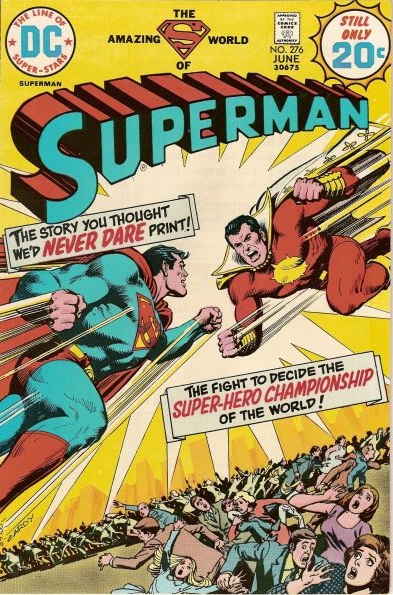
Notes: We’re going to start this week by looking at my list of stories that I wanted to hit this year at one point or another, but that didn’t fit into any particular theme. And if you’re not wise to the behind-the-scenes chaos that led to the writing of Superman #276, it seems as random as they come. Most comic book fans know the story behind the original Captain Marvel: originally published by Fawcett Comics, he was a smash hit and outsold pretty much every comic on the stands, including Superman at times. National Publications (the company that would later rebrand as DC) sued Fawcett, claiming Captain Marvel infringed on the Superman copyright due to the similarity in their appearance and powers. The case dragged on in court for years, until the post-World War II-era, in which superhero comics fell out of favor. Eventually, Fawcett settled the case, no longer making enough profit from the comics to continue to fight. Years later, DC would eventually license, then outright buy the characters from the Fawcett catalogue and bring them back to comics. 

In 1974, DC Comics had been publishing Shazam! for over a year. His own title was set on “Earth-S,” home to the original Fawcett heroes, and although the multiverse was already very much in play at DC, for some reason editorial was wary of having him actually interact with the heroes of the DC Universe. Writer Elliot S! Maggin’s solution was this issue, “Make Way For Captain Thunder!” Using an early, rejected name for Captain Marvel, Maggin has Superman encounter a young boy – Willy Fawcett – who appears in the streets of Metropolis one day. Willie seems out of time, with a haircut that was popular 20 years earlier and expecting to pay a nickel for 35-cent bus fare. And the big clue that something isn’t kosher: he’s never heard of Superman before. Willie sees a helicopter about to rob an armored car, so he rubs his “magic belt buckle” and says the magic word “Thunder!” With a bolt of lightning (and the amusing sound effect “sha-boom!”) he transforms into…well, not Captain Marvel, but somebody who looks a hell of a lot like him.

As Captain Thunder swoops in to stop the robbery, something takes hold of his mind and, instead, he aids the crooks in stealing not only the contents, but the entire armored car. Superman comes in to save the car and Thunder turns back into Willie, who cannot remember anything that happened since his transformation. He decides to turn to Superman for help, and looks up his most famous “friend,” Clark Kent. (The notion that even a child from an alternate dimension can learn that Clark and Superman are pals within a few hours is perhaps the greatest strain on the credulity of Superman’s secret identity, by the way.) Willie tells Clark his origin – how, on a campout with his orphanage, he was summoned by an owl to follow it to a cave in the woods. There he encountered an ancient Native American medicine man, who bestowed on him the magic belt that would give him seven spiritual abilities: the power of a Tornado, the speed of a Hare, the bravery of Uncas, the wisdom of Nature, the toughness of Diamond, the flight of an Eagle, and the tenacity of a Ram!

Note to Maggin: If the editor needs to drop in a footnote explaining that Uncas was a warrior chief, you know that you’ve maybe stretched this bit to its limits.

Anyhoo, Willie became Captain Thunder, and – in my favorite page in the book – recounts his final battle with the Monster League of Evil, which was made of up, I kid you not, the Universal Monsters. The battle took place in a series of other dimensions (1953 of them, to be exact), but evidently, when Willie tried to get home he wound up on the wrong Earth, where he comes to understand that the League did something to Captain Thunder, making him turn evil when he transforms. Clark – an alien from another planet who hangs out with an Amazonian goddess and a guy from Mars and who routinely fights cyborgs and has traveled through time on countless occasions and more than once met an exact duplicate of himself from a world he calls Earth-2 – comes to the obvious conclusion that Willie is delusional. 

Somehow THIS is the part that strained credulity.

Clarks recruit Lois to help him bring Willie to the police station for help, but another robbery summons his attention. He ducks away and becomes Superman, as Willie turns into his own alter-ego. But once again, as if he’s forgotten that he’ll turn evil, Captain Thunder turns evil. The crooks escape as Superman and Thunder battle it out in the skies over Metropolis. Superman manages to trick Thunder into turning back into Willie, because somehow he suddenly believes his story, and then holds him in a wrestling grip and tells Willie to change back, where he’ll somehow force Thunder to use his wisdom to overcome the Monster League’s brainwashing. There is absolutely no reason that this should work, but somehow it does, and Thunder furthermore figures out how to use his magic to return to his native dimension. 

This is one of those stories that I like not in spite of how ridiculous it is, but BECAUSE of it. Details aside, there’s virtually no difference between Billy/Captain Marvel and Willie/Captain Thunder. If someone were to redraw his costume and the origin pages, it would fit perfectly as the first meeting between Big Blue and the Big Red Cheese. The incongruities also have a weird charm to it. The notion that Clark questions Willie’s story is laughable, the idea that he comes around so easily is absurd. The fight is…well, it’s an awful lot of fun. And I won’t lie, I would love to see the history of Captain Thunder’s battles against the likes of Boris Karloff, Bela Lugosi, and Lon Chaney Jr.

There were so many different one-off universes that peppered DC Comics in the years before the original Crisis. I kinda wish we could visit some of them again. 

Thur., Nov. 13

Comics: Superman Vs. Lobo #1-3, Jon Kent: This Internship is My Kryptonite #19, Justice League of America #40

Notes: Today I’ve selected the three-issue Superman Vs. Lobo miniseries from 2021, written by Tim Seely and Sarah Beattie with art by Mirka Andolfo. Why? Because just like when they published this miniseries, it seemed like a good idea at the time. 

That sounds snarkier than I intended. This isn’t a bad series, not at all, but it’s part of the ill-defined “Black Label” imprint at DC. When it was first announced, “Black Label” was supposed to be a more “mature readers’” imprint featuring the DC characters. Then it started to publish comics that were creator-owned and had nothing to do with the DCU Universe. Then they folded the Vertigo imprint and made those properties Black Label books. Then they brought BACK the Vertigo Imprint and moved some of the Black Label originals over there. And all the while, they were reprinting some books under Black Label that didn’t make any sense at all – such as Kingdom Come – while also publishing a few new properties that didn’t really have any content that marked them as “mature readers,” such The Last Days of Lex Luthor, which would probably be best as an Elseworlds. Then they brought back Elseworlds. What I’m getting at is, I’m not entirely certain what Black Label is supposed to be and, based on all available evidence, neither is DC Comics.

None of that, however, is the fault of the creative team of this miniseries, nor does that make it a bad story. The story kicks off with the Martian Manhunter sending Superman out into space to check on a space station that’s been damaged near the orbit of Jupiter, with astronauts in grave peril. As he’s saving them, everyone’s favorite Main Man Lobo has a vacation ruined when the resort planet he’s on is attacked by a kaiju-sized monster that turns out to be a microscopic tardigrade which has somehow been blown up to gargantuan proportions. He also meets “biologist and wildlife photography” Dr. Semedea Flik, who is an expert on single survivors of extinct species, and therefore is delighted to meet Lobo, who famously murdered his entire planet of Czarnia. Lobo, of course, doesn’t care about the destruction his fight with the tardigrade is causing, but Superman happens to be passing by in space and dives in to save both the creature and the people endangered by its rampage. Lobo, of course, sees Superman as a killjoy, ruining the fun of his fight, but Flik is thrilled to meet TWO “sole survivors” in one day. (Unless you count Supergirl or the Kandorians or Lobo’s daughter or…) When the news coverage of the fight starts painting Superman as a hero, Lobo is furious and decides to “ruin” him. 

Lobo comes to Earth and gets on LexTube to begin slandering Superman. Lois (with a little help from Batman) begins a counter-offensive against Lobo online, and the vitriol online begins to fuel an army of robots that the Toyman created to prove that social media is toxic. (I guess even Winslow Schott can’t be wrong all the time.) Superman combats it by urging people to get online and post positive things and – this is far less realistic than the tardigrade kaiju – they actually start to do it. Speaking of the tardigrade, it comes to Earth, only much smaller and now demonstrating extreme intelligence. Its name, it says, is Numen, and like Superman and Lobo is the last survivor of his homeworld. Flik is THRILLED. Feeling a kinship to the two of them, Numen decides to use his vast power to give them a gift: restore and send them back to their homeworlds, but he makes a little boo-boo. On the last page, Superman finds himself on Czarnia and Lobo on Krypton. 

Issue two kicks off with the Justice League searching for the missing Superman, with J’onn discovering that Krypton has somehow been restored and Green Lantern learning that Czarnia’s extinct population has come back. Numen, in a scene as funny as it is creepy, has learned that people on Earth communicate via “tweeting,” so it makes all the birds in the world explain to people that he sent Superman and Lobo back to their home planets. Of course, he’s wrong. On Czarnia, Superman – whose powers are dying under the planet’s red-tinted sun – learns that most of the population seems kind and pleasant, and Lobo was an anomaly. On Krypton, Lobo is frustrated at how “lame” the place is, but changes his tune when he realizes that there’s a sect of Kryptonians who blame their cold, sterile ways for the planet’s destruction and have decided to revert to a culture of hedonism and debauchery, his two favorite things. Flik has technology that allows her to bounce between worlds, viewing a civil war slowly brewing on Krypton between Lobo’s wild friends and the traditionalists, while Superman starts to find evidence that the Czarnians aren’t actually as nice as they pretend to be, with a deep paranoia and distrust underlying their apparent sweetness. 

Lobo’s Kryptonian pals decide to expand the influence of Krypton into space, and begin by cloning an army of Lobos and sending it to Czarnia to start the genocide all over again. Superman, meanwhile, discovers that the kindly woman he’s been staying with has been leeching his blood and his powers, and manages to reverse the cell drain after she’s killed by one of the clones. As Lobo returns to Czarnia to kill his clones – and everybody else all over again – only to learn that the resurrection has turned many of them as bloodthirsty as he is. Superman makes it to Krypton and finds his parents, but is horrified to learn that Jor-El planted a killer parasite into the Lobo clones, which are still living beings. Flick finds Numen and convinces him that he’s screwed up by bringing back the dead worlds, and Numen collapses in self-pity. He removes the two worlds, but not before Jor-El tells his son how proud he is that he became a man of compassion, even for those who despise him. Flik then tells Superman and Lobo that she’s studied Numen and discovered that there are people seeking out Numen, whose birth destroyed their entire universe…Union! Zealot! Maul! Helspont! And the almost-Superman himself, Mr. Majestic! Some of the most powerful characters from the Wildstorm Universe!

Not that they CALLED it “the Wildstorm Universe” in the text, mind you, but it was still a hell of a surprise. Also a nice reminder that most Black Label comics are non-canonical. The Wildstorm heroes had been firmly integrated into the DCU at this point, so I guess that means we’re looking at two different worlds in the vast multiverse right now. I’m okay with that.

In the third issue, Flik tells us Numen’s origin. He’s part of a species that feeds on the fundamental forces of reality. When one of them is born, they consume an entire universe in order to survive. Flik begs Superman and Lobo to help her protect Numen from the “Revenge Squad” that’s after him. Superman agrees because he’s Superman, Lobo agrees because Flik agrees to pay him, and the fighting starts. While Lobo tears through half the team, Majestic and Zealot team up against Superman. In the heat of battle, Superman concedes that Majestic is more powerful than he is, but that’s not going to stop him from fighting to defend Numen with his last breath. Proving that he is, perhaps, more like Superman than he thought, Majestic is moved to put down his arms and talk. Lobo double-crosses Flik, though, setting up Numen to be killed and taking her technology and Numen’s energy to create a new universe where he’s the hero and Superman went mad after the murder of Jimmy Olsen. Lois, though, in a wonderful bit of meta-commentary, quickly figures out that the new universe they’re in is full of bad stereotypes and tropes, like so many “evil Superman” stories we’ve read, and concludes that they’re trapped in a “badly written story authored by an edgelord.” Lobo takes that personally and a battle ensues, but to everyone’s shock, he breaks down with the realization that he’s wasted the power he stole to rewrite the universe just so people would love him instead of thinking, “Maybe…I shoulda just not been a giant piece of $#*.” He expends the energy restoring the universe and integrating the orphaned Wildstorm heroes into it (so maybe it IS canonical?).  

The series works on a few levels. It’s satirical, but pointedly so. First of all, it’s a bit of a deconstruction of Lobo himself. Created in the 80s as a PARODY of over-the-top, violent characters like the Punisher, his runaway popularity instead made him the poster boy, despite the fact that he exists only to exhibit all of their worst characteristics. This comic doesn’t flinch from that, reminding us over and over again that he’s a scuzzball who does not deserve admiration. The best line in the series, for example, is Superman calling Lobo “the worst person I’ve ever met, and I regularly have to spend time with Lex Luthor.” The second best, though, is directed at Lobo himself: “You think everyone is as terrible as you, and that makes you the loneliest man I’ve ever met.” Yes, Superman pities even Lobo. And all of this helps build towards a mild sort of redemption for the character in the end. He doesn’t ATONE for his awfulness, but at the very least he grows enough that he can recognize it and admit it, which – considering the place that he starts from – is not inconsiderable.

The other element of satire is pointed at the media and social media, how it tries to manipulate the narrative and how we’ve taken a piece of technology that should have brought everybody together and created greater understanding of us all and instead have decided to use it to be nasty to each other and create little echo chambers where we can sit in a virtual room and pretend that everybody who isn’t in the chamber with us is stupid and evil. It may sound a little hypocritical of me to talk this way about social media – I obviously use it all the time – but in my defense I do my best to keep my interactions online positive. I talk about the things I love, I try to steer clear of railing against things that I hate, because seriously, who needs to hear that? Even this whole “year of Superman” project is dedicated to that purpose, to me devoting 365 days to something that means something powerful and wonderful to me. 

I’m not saying that everyone should use social media exactly the way that I do, I’m just saying that the world might not seem quite as terrible if they did.

Lobo included. 

Fri., Nov. 14

Comic: Superman Vol. 4 #12-13, Aquaman Vol. 5 #53 (Guest appearance), Justice League of America #41-42, Adventure Comics #267

Notes: Although it wasn’t my original intention, after two days of comics that amounted to “Superman Vs. another hero,” it seems as though the universe has chosen a theme for this week for me. Who am I to argue? So today I decided to seek out another such story, landing on the two-part “Super Monster” from the Rebirth era, written by Peter J. Tomasi and Patrick Gleason with art by Doug Mahnke. In this, Superman faces off against Frankenstein. Not the kind we saw in Halloween week, though, but the actual Frankenstein’s monster, who in the modern DC Universe has taken the name “Eric Frankenstein” and joined the supernatural spy agency S.H.A.D.E. The story starts with Lois meeting a friend of hers named Candice, editor of the Hamilton Horn newspaper, who is trying to lure her away from the Planet (she had recently returned at this point – long story) only for Frankenstein to interrupt the interview and attack the editor, claiming he’s been chasing her for some time. Lois blasts Frankenstein with a weapon she’d recently “borrowed” from Batman and she and Candice flee. Superman, naturally, arrives to defend his wife, and he and Frankenstein get into it. The creature manages to get his hands on Candice and rips her face off, revealing an alien beneath. 

In the second issue, Frankenstein explains that “Candice” is really a war criminal named Kroog who has been fleeing justice from several planets. Superman is glad to have captured a criminal, but admonishes Frankenstein for going after him in a way that caused destruction and potential injury to innocent people. Before they can take Kroog away, though, Frankenstein’s estranged Bride shows up. No longer with S.H.A.D.E., the Bride is now a bounty hunter and has come to take Kroog and collect the money for his head. In the scuffle over who’s going to bring Kroog in, the alien escapes. Superman has to break up the squabbling exes  and together they track the alien down to bring him to justice.

The real meat of this two-parter comes towards the end of the second part. After Frankenstein and the Bride fight each other, there’s a short sequence where Lois asks the Bride about what happened to drive them apart. The answer is horrific – they had a son who became a monster (like, spiritually) and the Bride was forced to kill him to save the lives of innocents. From here we start to extrapolate that their divide is not actually based on hatred or even a lack of love between the two of them, but on the pain of their loss. As this was the era where Jon Kent was still a child, and still a relatively new addition to the Superman mythos, the story hits both Lois and the reader hard. The story ends with a quiet, wordless few pages of Lois and Clark returning home, tucking their son into bed, and giving him a goodnight kiss.

If you’re a parent, you get why this hits so hard. If you’re not, I’m not sure if I can explain it to you. 

Sat., Nov. 15

Comics: Booster Gold #7, Action Comics #594, Booster Gold #23.

Who did it better?

Notes: Once I realized I had accidentally stumbled into a theme, I got on the DC Universe app and just starting randomly seeking out different stories about Superman – for whatever convoluted reason – coming to blows with other heroes, because why not? That reminded me of these early comics in which Superman faces off against his future JLA teammate Booster Gold. In Booster Gold #7 from 1986, Dan Jurgens had his time-travelling hero encounter the man of steel for the first time. A year later, John Byrne and Jurgens collaborated on a two-part story that crossed over with Action Comics.

Booster Gold #7 begins with Booster, Superman, and a few hangers-on having just been abducted by an alien warlord called Galeb who is accusing them of treason, despite the fact that they don’t even know who he is. Galeb  accuses them of conspiring with Ranzee, an alien who claimed to be marooned on Earth. They try to fight their way out, but Galeb’s wife – a self-proclaimed mystic – sends out a burst of mental energy that knocks all of them out, even Superman, because magic. They awaken in prison, and Ranzee tells them of how Galeb has ruled his people as a tyrant for years, leading him to steal a spaceship and go to Earth to ask the legendary Superman for help after Galeb personally tortured and murdered his wife and child. Booster wants to jump right in and take Galeb out, but the more experienced Superman cautions him about jumping into a political situation without all of the information. Galeb comes to their cell and says that he is willing to release everyone but Ranzee, who is to be executed. When Booster tries to attack, Superman steps in to stop him and the two come to blows. Superman holds back, hoping to cool Booster off, but Booster just keeps going. Eventually, Skeets shorts out Booster’s suit to stop the fight. Skeets has been investigating and learned that Ranzee lied to them – he is actually Galeb’s stepbrother and has been attempting to overthrow Galeb for years. Superman takes Booster back to Earth with his tail between his legs, arriving home at the same time as Lois Lane, who came by to interview Metropolis’s newest hero. Superman flies off, not at all impressed at his new rival.

This story, it should be noted, was published in the midst of Crisis on Infinite Earths and technically features the pre-Crisis Superman, although there is little to differentiate him from the character that would soon appear in the Byrne reboot. But it’s really interesting to me just how much Superman dislikes Booster in their first meeting. Of course, this early in his career, Booster didn’t really give him much to like. He’s cocky, hard-headed, and impulsive, and those qualities would have caused disaster had Superman not been there to get in his way. The way the character grew and evolved over the years is really remarkable, and he’s become one of my favorite DC characters.

John Byrne did one of his cover swipes (a lot of artists do cover swipes, but Byrne got the bug earlier than many – the man draws a Fantastic Four #1 swipe more often than I change my socks) to show Superman and Booster’s next encounter. Mayor Berkowitz has declared it to be Superman Day in Metropolis. The festivities are upset, though, when Booster Gold blows up the Superman statue that was supposed to be dedicated that day. He then calls a press conference where he accuses Superman of crimes against humanity for his recent incursion in the terrorist state of Qurac. Booster calls Superman down for taking political action that way, which comes off as particularly hypocritical if you just read Booster Gold #7, in which Superman stopped him from doing exactly that. Booster then decides to lure Superman into a fight by abducting the mayor’s daughter. Hearing her call for help, Superman zips in and Booster hits him way harder than Superman expected. Booster begins to pummel Superman, beating him with relative ease. With Superman on the ropes, though, a SECOND Booster appears, calling the first an imposter. 

The story concludes in Booster Gold #23, once again by Dan Jurgens. A flashback informs us that this fake Booster has been in action for several days, smearing Superman, as Booster was in mourning over the recent loss of his sister and wasn’t even aware of his doppelganger. In the present, Booster manages to shred the fake’s outer covering, revealing a robot underneath. When Booster destroys it, a chunk of Kryptonite falls out, explaining how he was beating Superman. The reader learns that – surprise, surprise – the robot was sent by Lex Luthor, who was using it to gather as much data as possible on Superman for Luthor reasons. He sends a second armored operative – human this time – to attack Superman and retrieve the Kryptonite, and although his drone gets away with Luthor’s glowing rock, Superman easily captures the goon. He knows it’s Luthor’s handiwork, but the guy inside the armor claims to work for Booster Gold, is carrying Booster Gold International ID, and even the components of his armor were made by Booster’s company. Superman doesn’t buy the frame-up for a second. Booster gets the best of Luthor that night, but the epilogue brings in a new challenge for Booster that looks pretty bleak. But this ain’t the “Year of Booster Gold,” no matter how much he might wish it was, so I’m going to let you look all that up for yourself.

The antagonism between Superman and Booster continues here, although by this time Booster has become somewhat more integrated in life in Metropolis. There are even references to previous interviews with Lois, despite Booster and Superman not having encountered one another in the interim. It’s also funny to read these books by Dan Jurgens, who would of course eventually go on to be one of the most significant Superman creators of the post-Crisis era, before he was actually writing or drawing Superman on a regular basis. The character (especially in issue #7) doesn’t quite look like Jurgens’ Superman, it’s more like he was still trying to figure out how to draw him. He got Superman’s personality right away, though, with the character feeling like himself right out of the gate. 

Sun. Nov. 16

Comic Books: Firestorm, the Nuclear Man #2, Justice League of America #179-180

Notes: Early in his career – in his second issue, in fact – Firestorm bumped into Superman. Makes sense, really, when you consider just how powerful “the nuclear man” actually is, Superman and the Justice League would clearly want to keep tabs on him. Let’s see how that turned out, shall we?

After a little showboating and reflecting on his origin, because back in the day a superhero was required to recap his origin once an issue, teenage superhero Ronnie Raymond goes about his day. His crush Doreen seems to be into his secret identity (nice), but his father isn’t impressed, nervous about that kind of power in the hands of an individual. And Ronnie can’t even ask his other half Professor Martin Stein for help, because in these early days of the character, Stein didn’t remember anything that happened when he and Ronnie were merged as Firestorm. (I’ve never tracked down the story where that particular tidbit was overturned. If anyone knows when it happened, let me know, would you?) Clark Kent, meanwhile, reporting on the new hero for WGBS, decides that this is exactly the sort of thing that Superman should be keeping an eye on. As he flies to New York to check in on the kid, Stein is attacked in his lab by Multiplex, the Duplicate Menace. (The much better “Multiple Man” was obviously already taken.) Fortunately for Stein, Ronnie discovers the atomic bond he shares with the older man allows him to feel it when Stein is hit and know when he’s in danger. He also discovers that they don’t need to be physically next to one another to trigger their transformation, and Firestorm arrives to take on Multiplex. As Firestorm and Multiplex trade blows, Superman arrives just in time to see the young hero get pummeled, dampening his notions of inviting Firestorm into the Justice League. Superman saves him, and despite a moment of being star-struck, Firestorm zips off in search of Multiplex. Superman follows him and watches as Firestorm captures Multiplex, promising the young hero that he may be Justice League material after all.

Okay, so it was 1978, but that last part feels WILDLY presumptuous on Superman’s part. Suggesting Justice League membership to somebody he literally has just met, who he saw fight ONE supervillain? Because he’s got drive and wants to prove himself? It would make a little more sense today, in this era of Justice League Unlimited, where pretty much everybody with a mask gets a card and a ticket to the Watchtower, but wow.  

Just for funsies, I decided to follow this up with Justice League of America #179 and 180, the issues where Firestorm actually DOES join the League, published less than two (real-time) years later, a membership that I’m sure in NO way was influenced by the fact that Firestorm’s creator Gerry Conway was writing the JLA title at the time. Anyway, true to his word, Superman sponsors Firestorm’s membership in this issue, saying that the rookie hero’s “youthful exuberance” will be an asset to the team. Then once he zones out when Batman starts explaining the procedural stuff involved in being a JLA member, Ronnie gives the reader another recap of his origin (I told you, it was required). After a hearty congratulations from Superman, Firestorm returns to Earth and splits up. Ronnie sends Martin Stein (still unaware of his double life) home in a cab, then he meets his friends to check out the hot new disco in town. Seriously, disco. Who says comics from 1980 aren’t timeless? Anyway, it turns out that one of Ronnie’s friends who was supposed to meet him at the club is missing, supposedly in the clutches of a woman called “the Satin Satan.” Ronnie calls Stein back – again, and Firestorm confronts the witchlike woman, feeling her power overtake him just in time to hit his brand-new JLA signal device. 

In the next issue, the League arrives in the penthouse where Firestorm was abducted, only to find the place wrecked and empty. A few minutes later, Ronnie Raymond’s friends arrive with a security guard, looking for him. Zatanna’s magic powers manage to track down Satin Satan and Firestorm, helping him get free. Together, the League fights off Satin’s demons and apparently free her from the demonic influence that’s gripping her, then everybody except Green Arrow congratulates Firestorm on a great first case.

Look.

Gerry Conway is a comic book legend, we can all agree on that, right? And Firestorm is a great character – he was really bold and unique when he was created, and he’s been someone I’ve always thought deserves to be a constant presence in the DCU in one form or another, even during the periods in which he lies fallow.

All that said, NOTHING in these three issues suggests that Firestorm is Justice League material. Sure, he comes through in the end, but he makes mistake after mistake, fumbles into traps, and generally acts like a rank amateur. I can see why Superman would want to keep an eye on somebody so powerful, and making him a member of the League in order to train him and help him get better would make a lot of sense. But it’s not framed that way, it all comes across as the League – Superman especially – getting starry-eyed at this new kid and all the neat toys he’s got and wanting him to stick around so they can play together. It comes across a little bit like Conway’s pet. 

I also realize that these issues don’t QUITE fit into the “Superman Vs.” theme I’ve kinda been going for this week, but as I didn’t even really intend to do a theme this week at all, I’m not going to feel bad about that. Maybe I’ll call this week “Superman And…” instead.

The weirdest thing, though, is that the issue ends with the clear implication that Satin Satan hasn’t REALLY been set free of her demonic possession – that there is an impending danger that will come back to plague the Justice League again. But a quick check online seems to suggest that these two issues are the ONLY ONES in which she EVER APPEARED. Really? With an ending like THAT? Nobody has picked up on it and tried to do something with the MODEL-GORGEOUS DEMONIC VILLAIN in the past FOUR AND A HALF DECADES?

I’ve now read over 1,000 individual comic book issues for this Year of Superman project, and that may be the wildest thing I’ve discovered yet. 

TV Episode: Superman and Lois Season 3, Ep. 3, “In Cold Blood”

Mon, Nov. 17

Comic: Captain Atom #46, Action Comics #587, Batman: Wayne Family Adventures #38 (Guest Appearance)

Notes: Like the first Firestorm comic I covered yesterday, I picked this one more or less because Superman was on the cover and I hadn’t read it before. Captain Atom wakes up on the moon, trapped in a crystalline crucifix along with several other heroes and villains, Superman included. He manages to free himself and Superman, and the two of them investigate their abduction, which turns out to be the work of a crystal alien called Kylstar (say it out loud). After a brief scuffle with their abductor, Kylstar’s translating droid tells them that his planet is ruled by an evil dictator, and he has been seeking sentient weapons – super-beings, in other words – to help him free his planet. He releases the other captives, one of whom is an alien who confirms his story (which is more than we had in the issue of Booster Gold the other day that had a lot of these same beats). Kylstar offers to return anyone who doesn’t want to go with him to their homeworld, but both Atom and Superman decide to return to Earth. After they’re gone, Kylstar casually reveals to Major Force – who agreed to accompany him – that he’s going to have to go ahead and conquer the entire galaxy to have a strong enough army to take on his enemy. Force is all about that. In the end, Superman does Cap a solid, helping him find his estranged daughter Peggy.

It’s an okay issue, and I wonder if the Kylstar storyline was picked up later on in the run. Major Force obviously made it back to Earth at some point, because he was available a few years later to commit the act that led to the “fridging” becoming a comic book-specific verb. But my appetite for a hero vs. hero fight hasn’t been satisfied. So I’ll go back to scratch that itch with another comic from John Byrne’s Action Comics team-up era, issue #587, featuring the Etrigan the Demon.

To be fair, it’s a little tricky to decide if this even counts as “hero vs. hero,” as Demon’s status is kind of flexible. Depending on the writer, he’s either a demon who tries to do good or an evil spirit FORCED to do go via his association with Jason Blood. Byrne writes Etrigran more on the good side, though, without any internal quandaries over wanting to do bad and just doing the good, so it’ll fit nicely. 

The story starts with Jason Blood and his friend Glenda Mark in an antique shop in Gotham City, where she accidentally activates an old piece that suddenly captures her in a metallic column. The column expands, capturing the others in the shop as if it were trying to create a miniature city, and Jason only barely manages to summon the Demon in time to avoid being taken himself. Superman is returning to Earth from space when he spots the metal city growing and completely overtaking Gotham. He comes in and tries to wreck the expanding columns, but Etrigan attacks, telling Superman he must not harm the towers. The two of them fight for a few pages before Etrigan shows Superman that every time they break one of the columns it bleeds human blood. Etrigan explains that each column is a human who has been transformed, and the only way to stop them from dying is to do so before they are cursed, and he casts a spell to send Superman back in time. As Etrigan existed in that time, he couldn’t go with Superman (this was an old time travel rule in DC Comics that doesn’t seem to apply anymore) but he gives Superman one hour before the spell wears off and returns him to his own time, and tells him to seek out Jason Blood. Superman finds 12th Century Jason, and together they track down Morgaine le Fay in the process of creating the very artifact that started the mess. Superman dives in despite the magic and disrupts the spell, resetting the timeline. An epilogue replays the scene in the Gotham antique shop, bereft of the artifact, and all is well. 

The fight between Superman and Etrigan is short, but really effective. And it’s actually nice to see one of these scuffles where Superman – however well-meaning – is in the wrong. It’s a good change of pace. This issue also has several elements that I always enjoy: time travel, doses of Arthurian legend, and John Byrne artwork. Overall, it’s a fun read. 

TV Episode: Superman and Lois Season 3, Episode 4, “Too Close to Home.”

I’ve been trying to squeeze in episodes of this show again because I still want to try to finish it by the end of the year. I haven’t been writing about all of them, though, because I kind of feel like I’ve run out of things to say. I like Tyler Hoechlin and Elizabeth Tulloch. I love Wolé Parks as John Henry Irons. But the series as a whole hasn’t gripped me as much as I wanted it to. However, the scene in this episode of Clark – Clark, not Superman – in the diner, facing off against Emmitt Pergande? That’s absolute poetry. 

Tues., Nov. 18

Comics: Superman/Shazam!: First Thunder #1-4

Notes: I started this inadvertent “Versus” week with Superman fighting the faux Captain Marvel, so it seems only appropriate that I end it with an early encounter with the real thing. And again, this isn’t actually a fight – Superman and Captain Marvel are never opposed to each other in this miniseries. But you know what? I don’t care. It’s still a good comic.

Published in 2005, this miniseries by Judd Winick and Josh Middleton was a contemporary take on the first meeting between Big Blue and Big Red. It begins with the wizard Shazam at the Rock of Eternity, early in “the second age of heroes,” observing the nascent members of the Justice League in action, then gives us a quick time skip to the rookie Captain Marvel averting a plane crash in Fawcett City. (It is amazing how often planes in comic book universes ALMOST crash. If it was as frequent in real life as it is in a comic book world, nobody would ever board an airplane ever again.) Meanwhile in Metropolis, Superman investigates a break-in at the Museum of Natural History that brings him into battle with a big, blue creature – a sign of that singular bane of his, magic. We also see Billy Batson homeless and refusing to go to yet another foster home, living in abandoned subway tunnels with some help from his friend, a kid named Scott. Looking at a recent newspaper, Billy sees a story about the museum robbery in Metropolis and decides to keep an eye on the Fawcett City museum. Sure enough, that night, there’s a break-in – the same crooks as in Metropolis, still trying to steal Russian artifacts. Once again, the crooks summon monsters and they hurl Captain Marvel out of the museum, where Superman is waiting to lend a hand.

In issue two, we start “one week ago,” with a summit between Dr. Thaddeus Sivana and Lex Luthor, where the two evil geniuses – despite their mutual dislike of one another – agree to cooperate, with Luthor giving Sivana use of an operative named Spec to trail Captain Marvel. Spec, we find out, managed to trail Marvel and witnessed his transformation into a child. Back in the “present,” Superman and Captain Marvel meet outside the museum for the first time and team up to fight the monsters summoned by the robbers. After fighting them off, Marvel asks Superman if they can “talk,” and the two of them have a casual conversation on the top of Mt. Everest, discussing their powers and what it’s like to be heroes. Their talk is disrupted when Superman hears a pair of dual threats coming from Fawcett – Sivana has summoned the demonic villain Sabbac via a spell which also creates a solar eclipse, and wouldn’t you know it? Dr. Bruce Gordon has once again been taken over by the spirit of Eclipso. 

Yeah, he’s in this too.

Issue three kicks off with Spec finding his way to the homeless enclave where Billy Batson has been living, looking for information about “a little boy, about eleven years old, black hair,” and offering to pay handsomely. While Spec hunts Billy, Superman and Marvel take on Sabbac in Fawcett City. At the same time, Eclipso makes his move, using a satellite network to transform the people of Fawcett into – goodie! – more Eclipsos! Superman dismantles Eclipso’s machine, but still has to deal with a legion of innocent people who have been eclipsed and go on the attack, while Marvel is left to face Sabbac alone. Superman escapes and disrupts the coven that caused the Eclipse, breaking Eclipso’s hold on everyone, including Bruce Gordon, and Marvel tricks Sabbac into saying his own name, causing him to turn off his powers just like Billy uses the word “Shazam!” Superman and Marvel part as friends, but that night as Billy is reading about his own exploits in the newspaper, Sivanna (using Spec’s intel) sends an army of thugs to kidnap him.

In the final issue, Billy switches to Captain Marvel just before Sivanna’s goons open fire. He defeats them easily, but in the gunfire his friend Scott is mortally wounded. Marvel brings him to the hospital, but Scott succumbs to his injuries. Marvel bursts into the police station where Sivanna’s thugs have been taken and begins to brutalize one of them, demanding to know who hired him. Moments later, he’s ripped apart Sivanna’s corporate headquarters and has Sivanna’s throat in his hand. He chokes him, almost to death, but relents before Sivanna is killed and flees the scene. In Metropolis, Clark hears about the incident and finds Marvel again at Mt. Everest, where he plans to have him answer for attacking a police station, assaulting a prisoner, and destroying the top floor of the Sivana building…until he sees Marvel weeping. Superman is confused by Marvel’s sobbing about getting “his best friend killed,” until he says his magic word and becomes Billy Batson again. Superman demands that Billy take him to the Wizard Shazam, where he rips into him for putting a child in danger. “He’s just a boy,” he declares. Shazam replies, “He is. A boy who could use guidance.” In the last few pages, Clark Kent finds Billy in the abandoned building where he’s living now. He removes his glasses, unbuttons his shirt to reveal the “S,” and sits down to have a talk.

This is such a great story, all building up to the last few scenes, which are immensely powerful. At first, Superman sees Marvel as a contemporary, an equal, somebody who maybe can understand the burden of power that he carries because he shares it. When he discovers the truth about Billy Batson, the righteous anger that fills him is perfectly in keeping, although you have to wonder if he ever had a similar discussion with Batman about any of the Robins. In any case, this is such a great dynamic for the two of them. In a world where Superman and Billy Batson co-exist, Clark Kent would be a perfect mentor for the boy. Unfortunately, in all the reboots that have happened in the past 20 years, I’m fairly certain this story is no longer canon, and that’s a shame.

One other amusing thing I need to point out – Marvel defeats Sabbac by tricking him into saying his own name, which also happens to be the magic word that triggers his transformation. At this point, people had mistakenly been calling Captain Marvel “Shazam” for decades, since DC was using that word to secure the trademark. But Sabbac having a name that he can’t say is ridiculous, a problem Captain Marvel Jr. had since the beginning, and a problem that was exacerbated in the New 52 reboot when “Shazam” became Billy’s hero name. These days, in-universe, Billy’s alter ego is just “The Captain,” which sidesteps the problem, but it’s kind of lame as a superhero name. I dunno, maybe they should have just stuck with “Captain Thunder” in the first place. 

Radio Program: The Adventures of Superman serial “The Clan of the Fiery Cross” episodes 1 and 2.

More on that one next week.

Blake M. Petit is a writer, teacher, and dad from Ama, Louisiana. His most recent writing project is the superhero adventure series Other People’s Heroes: Little Stars, volume one of which is now available on Amazon. You can subscribe to his newsletter by clicking right here. You can join in the Kryptonian Konversation every day in the Year of Superman Facebook Group!

Year of Superman Week 43: Superman Meets the Monsters

It’s the last full week before Halloween, and I’m going whole hog on the spooky content, friends. This week we’re going to find ourselves encountering some of the creepiest crawlies there are. Vampires, werewolves, mummies, and Dr. Frankenstein’s bouncing baby boy are all coming your way week, along with a few Halloween specials. We’re gonna wrap up October in classic Abbott and Costello fashion with Superman Meets the Monsters!

And as always, you can check out earlier blogs in the Year of Superman Archive!

Wed., Oct. 22

Comics: Superman: The Man of Steel #14, Superman Vol. 2 #70, Young Justice #3, Wonder Woman Vol. 6 #25 (Cameo)

Notes: We’re going to kick off this week with a two-part story from 1992 in which Tim Drake – at time the newly-minted Robin – pays a visit after news that an odd “blood plague” has jumped from Gotham City to Metropolis. Tim suspects that the victims, drained of blood and left to die, were the targets of a vampire, and he’s determined to hunt them down. Tim, being the smartest member of the Batman family, is absolutely right: we see the vampire appear in the home of the ill Lucy Lane whose boyfriend (at the time) Jimmy Olsen is at her bedside when he appears. The vampire pulls Lucy from her window to feast, his appearance constantly changing and cycling through various famous movie vampires, before Jimmy drives him off with the flashbulb of his camera. The next day he shows Lois the photo he took of Lucy hovering in the air, proof of the attack because vampires can’t be photographed. Dozens of people start disappearing, including Jimmy’s friend Babe (I didn’t name her, folks), a rocker girl who hired him for a photo shoot.

Since Superman is out of town dealing with a series of disasters and calamities, it’s up to the rest of our cast to do something about the situation. The next night, Jimmy, Lois, and Ella Lane (Lucy and Lois’s mom) treat her room with garlic and prepare to look out for her. Jimmy, meanwhile, goes full-out Monster Hunter with a kind of ridiculous getup that I can’t believe never made it into an action figure. Jimmy and Robin encounter each other on a rooftop (their first meeting) as they both track their suspect, the mysterious “Dr. Ruthven.” (Ruthven, by the way, I believe is an old Bulgarian name which means “Obviously I’m a vampire in disguise, I mean, come ON.”) But when Ruthven turns out to be more they can handle, Jimmy activates his signal watch, summoning Superman to his side. He manages to grab Ruthven as the sun is rising, and they watch him disintegrate. Their victory is short-lived, though, as they hear Ruthven laughing, mocking them, saying that sunlight can’t kill a “modern” vampire.

The story continues in Superman #70, with Superman and Robin patrolling the city and Robin trying to convince Superman that vampires are undead, and the usual no-killing rules therefore do not apply. Superman, meanwhile, isn’t convinced that driving a wooden stake through someone is the way to go. Jimmy, hospitalized from his own injuries fighting Ruthven, implores Superman to save Lucy. As he seeks her out, Jimmy and Robin begin making plans. That night, Superman is distracted by a subplot just long enough for Ruthven to return to Lucy’s apartment and take her away, but Jimmy and Robin trace him to an old cemetery where he’s gathered dozens of people he’s infected, including Lucy. Lucy is about to bite Superman (and, as her vampire powers are magical, it would probably work), and Jimmy tackles Robin to prevent him from staking her. 

As all this is going on, the situation is being observed by the demon Blaze, an old foe of Superman’s who is concerned that there are certain dead people whose souls were marked for her, but are still in the land of the living, trapped in their undead forms. Blaze floods the cemetery with light that burns the vampire virus out of the victims. Ruthven falls onto a statue of a soldier with a bayonet, essentially staking himself. All seems to be well until the final panel, when we see a face in Babe’s eye that reveals she is not as free of the vampire influence as we would have hoped.

The Babe situation would become a running subplot for quite some time, not resolving itself until some time after Superman’s death and resurrection, so it clearly wasn’t the end of this particular storyline. But that’s how it was during the Triangle Era – this little two-parter set up lots of pieces that would pay off later. The Babe story was one of them, the Blaze storyline would flare up just a month later, and there were even seeds for the two-part “Crisis at Hand” story we read here a couple of weeks ago. It’s fun to see Jimmy hanging out with Robin as well, although there’s never any real explanation as to why Batman would have sent him to Metropolis to deal with a friggin’ vampire without any backup. This was during the period where Tim was enjoying a few miniseries before graduating to his own solo title, and the red-hot popularity of the character explains his appearance in a meta sense, but not in a story sense.

As we’ve seen before, though, it bothers me that the heroes didn’t actually win this one. Without Blaze’s intervention, Superman may well have been bitten and turned into a vampire. Ultimately, it’s hard to call this one a victory for the good guys, no matter how much fun the story actually was. 

For a bonus bit of Halloween fun, let’s look at Young Justice #3 by the late Peter David with art by Todd Nauck. Tim’s back again, this time with his pals Superboy and Impulse, having fun at a Halloween party with their brand-new superhero team. Unfortunately, a cult nearby has – in an attempt to summon a demon – accidentally plucked a teenage Mr. Mxyzlptlk from back in time. He encounters the kids and, hearing about his future shenanigans from Superboy, resolves never to use his powers frivolously. Unfortunately, it’s one of those “would you kill Hitler as a baby?” scenarios – it may sound like a good idea, but the ripples through time turn out to be disastrous. Young Justice is then tasked with teaching Mxy HOW to be a prankster in order to save the world. 

David’s run on Young Justice was simply a delight. It was a series that had plenty of humor and laughs, but at the same time, never once skimped on characterization. Early in this issue, for example, there’s a scene where Superboy defends Robin from a jerk at the party, not because he doesn’t think Robin can handle himself, but because as someone who hangs out WITH Robin, he’s afraid that if Robin comes off as a wimp it’ll make him look bad. There was a lot of character growth done in this series, and by the end of it Tim and Conner were fast friends, but that bond didn’t exist yet here. There’s also a subplot with Red Tornado, who was acting as a sort of senior advisor to the team, reconnecting with his daughter as she goes trick-or-treating. These little character moments were a trademark of David’s writing, and whether he was writing a cosmic epic or a goofy story about a Halloween party, either way it elevated his work and helped make it more than the sum of its parts. It’s only been a couple of months, but I miss his stuff already.

Thur., Oct. 23

Comics: Superboy #123, Superman Vol. 2 #5-6, DC Comics Presents #53, Superman #11, Action Comics #559

Notes: Today I’m going to tackle a couple of comics that only a Mummy could love, starting with Superboy #123, “The Curse of the Superboy Mummy.” The story begins in ancient Egypt, when an oracle sees a vision of the future with Superboy demonstrating his amazing powers. The oracle tells the royal magician how to create a potion that will turn his son Seth into a super-boy, even crafting a costume to match that in the vision. Neferti, daughter of the pharaoh, takes an interest in Seth, but he spurns her as he had no interest in her before he gained his powers. She turns to a rival magician for a charm to make Seth love her. He gives her a jade scarab, but the magician tricks her and the scarab strikes Seth down, causing both he and Neferti to drown in the sea. The two are mummified and buried together. In sorrow, Seth’s father carves a warning inscription into his son’s tomb about a calamity the oracle predicted, but he is driven out before it can be finished.

5,000 years later, Lana Lang and Clark Kent are digging up a pyramid in modern Egypt (this isn’t quite as random as it sounds – Lana’s father was an archaeology professor) and happen to unearth the mummies of Neferti and Seth who – wouldn’t you know – happen to EXACTLY resemble Lana and Superboy, whose costume Seth is still wearing. Lana doesn’t know what the inscription on the tomb says, but Clark knows ALL ancient languages, because when you’ve got super-speed you need to find some way to pass the time. It reads “Mighty Superboy! Behold Seth, the super-youth of our day, and Neferti, who slew him by mishap. Heed the warning of the magic shield which predicts that you, too, will be killed by the maid, Lana, of your time, unless you first destroy her…” The mummies crumble into dust, and Clark dismisses the prophecy. Upon returning to Smallville, Superboy gets a sudden chest pain when he picks up Lana the next day. It happens again every time he gets near Lana, which is frequent, as she seems even more trouble-prone than Silver Age Lois Lane. Together they crack the mystery – Lana foudn and has been wearing Neferti’s scarab, which is affecting Superboy much like Kryptonite. The inscription, which was never finished, was supposed to say “unless you first destroy her SCARAB.” 

This is why it’s always important not to bury the lede, guys.

It’s a fun story, though, and although it has a lot of the sillier tropes of the era, it presents them in a fun, more unique way than a lot of the comics of the time. Superboy doesn’t actually FIGHT a mummy, I guess, but he’s almost killed by one, and that feels like it fits in with Halloween to me.

Clark would encounter a mummy again in the John Byrne era, in Superman #5, “The Mummy Strikes!” Clark comes in to work where Perry White shows him a video that Lois sent covering an archeological dig in South America. The video cut out, and Perry orders Clark on the next flight down there to find out what happened – of course, the fastest flight happens to be Air Superman. When he arrives he finds he camp safe, allows Lois to think Superman dropped him off (it’s not TECHNICALLY a lie) and discovers what’s going on. The archaeologists have uncovered a metal cylinder that seems to have been made by advanced technology, but is at least 6000 years old. What’s more, the pyramid they are excavating was built over a technological structure that predates human civilization. As they search the caverns, a gigantic creature wrapped like a mummy bursts through the walls and attacks them. Clark manages to “get separated” from the group so he can use his powers against the mummy, but it knocks him out. Lois finds him and the creature, whose trappings have fallen away to reveal an enormous robot. The story continues in issue #6, where Clark wakes up to find Lois holding up his Superman uniform. She tells him that he has been unconscious for “two solar days” and refers to Clark as a “handsome stranger.” Clark realizes that Lois, and the rest of the camp, have had their bodies taken over by alien forces. He learns that these creatures belong to a race that existed on Earth before humans, but who abandoned the planet when struck by a plague. About 500 of them chose to stay and placed their minds in the body of their robot, which would awaken when the race that replaced them reached a sufficient level of development, then take their planet back. Superman battles the robot, which still has the minds of most of the lost civilization, and forces it to release Lois and the rest of the team, who conveniently have no memory of their captivity. He tricks the robot into trying to download its consciousness into his Kryptonian body, which short-circuits the transfer sequence, causing the robot to explode. Superman gives Lois the story this time, “Clark” having been returned to Metropolis already.

I enjoyed this little John Byrne two-parter with its appropriate seasonal goodness. The first half, with the mummy, has some classic monster movie tropes, although the science fiction underpinnings show through the seams from the very beginning. The second half does away with those trappings (literally and figuratively), but the notion of a pre-human civilization trying to wipe out humanity is another classic trope that you could find in the sci-fi invasion films of the 50s, giving the entire thing a nice, old-school feel that’s wildly apropos for the season. There’s also a funny little runner about Clark having neglected to shave and trying not to let Lois notice that he and Superman are sporting the same five o’clock shadow. I know I usually defend Lois in the old days for not figuring out that Superman and Clark were the same person, but I have to admit, stories like this one make that tough sometimes. 

I’ll close off today with the curious little book that is DC Comics Presents #53. Presents, as you may recall, was the Superman team-up book, with Superman partnering up with a different guest star in each issue. In this one, his guest star is House of Mystery, an odd choice in that it’s not exactly a CHARACTER. House of Mystery and its sister title, House of Secrets, were a pair of horror anthology comics hosted by the brothers, Cain and Abel, similar in concept to classic comics like Tales From the Crypt, but not quite as intense. In this issue, Mystery’s host Cain pops in to present to us the Superman story “The Haunting Dooms of Halloween.” The story starts with a kid – little Ricky (who probably not coincidentally looks like Ricky from Superman III, which had been released earlier that year) trick-or-treating in a Superman costume when suddenly, without warning, he turns into Superman himself. He rushes to Metropolis and bursts into Lois Lane’s Halloween party, where he abducts Lois. At the same time, Jimmy transforms into Thor – the costume HE was wearing – and tries to save her by…making it rain. Clark, wearing a Green Lantern costume, pretends that whatever magic is affecting Jimmy has struck him as well and uses his “power ring” to fly after the fake Superman. 

Back at the House of Mystery, Cain is settling in to tell another story to a group of children when he gets a visitor – Mr. Mxyzptlk (Mxy seems to just LOVE Halloween), who brings in the fake Superman and Lois. He restores Ricky to normal, then starts zapping the other kids to become the monsters and ghosts they’re dressed as. The real Superman (in his own costume now) tracks them down and enters the House, and a voice warns him that he must find Lois by midnight or she’ll be lost forever. He stumbles through the house, facing not only his own fears, but assorted monsters that he’s reluctant to hurt when he realizes that they’re transformed children. As the clock strikes midnight, Superman stands in stark horror at his failure…until Mxy reveals himself, and he starts to laugh. Cain is confused until Superman explains – the whole thing is obviously a joke. Mxy may be a pest, but he wouldn’t actually HURT anyone. This is a WILD swing, by the way, as there are plenty of Mxyzptlk stories where he DOES hurt people, but in this case it seems to be right – Lois is freed from her own prank (being stuck in a room full of comic book artists chained to their drawing boards and begging her to set them free), and Mxy begins to plot his next Halloween stunt. He’s foiled not by Superman, but by little Ricky, who feeds Cain a clue to trick Mxy into banishing himself for another 90 days. 

This is a really silly story, far more lighthearted than your typical House of Mystery fare, and Cain plays a more active role than he usually does. It’s very much in keeping with the Superman stories of the era, though, and a joy to read as part of my Halloween windup. I didn’t anticipate having two Mxyzptlk stories in two days, however. I suppose Halloween WOULD be his favorite time of the year, though. Hey, DC, if you’re listening, I’ve got an idea for NEXT year’s anthology theme…

Fri., Oct. 24

Comics: Superman’s Pal Jimmy Olsen #44, 52

Notes: If there’s one thing you can say about Jimmy Olsen, it’s that his life is NEVER boring. Whether he’s getting elastic powers or turning into a giant turtle, some sort of nonsense is ALWAYS happening to him. Today I’m going to take a peek into a couple of his hairiest adventures, beginning with Jimmy Olsen #44, “The Wolf-Man of Metropolis.” Superman, who has apparently learned nothing from all the times Jimmy has turned himself into a turtle, drops off a box of ancient bottles and jars that he recently uncovered, including one that purports to contain a potion that can turn someone into a “wolf-man.” When Lois asks Jimmy if it’s real, he decides to prove it’s just a superstition by drinking the contents of the bottle. (Side note: whether werewolves are real or not, is it really the best idea to drink from a bottle that’s been underground for centuries? This is why Jimmy is still a junior reporter after 85 years.) That night, the potion kicks in and turns him into a werewolf just before he’s supposed to take Lucy on a date to a masquerade party. He avoids admitting he’s a werewolf by getting her a Red Riding Hood costume, and they even win the costume contest. Over the next few nights, though, he keeps changing into a wolf and having to find increasingly unlikely explanations for why he’s still wearing the makeup. Lois immediately catches on to what happened and tells her sister, but Jimmy keeps evading the question instead of just fessing up and asking her to break the curse for him, as the bottle says it will end if he gets a kiss from a pretty girl. Jimmy gets desperate, even attempting to pay random women in the park to kiss him (had this story happened today it would be all over social media and Jimmy would be cancelled FOREVER) before Superman brings Jimmy into a dark room and gets his cousin, Supergirl, to give him a smooch and put him out of his misery. 

This story makes Jimmy look so remarkably stupid that you can’t help but love it. From drinking the potion to refusing to admit it even after Lois has told Lucy about the boneheaded thing he did this time, Jimmy doesn’t make a single correct decision throughout the entirety of the tale. He doesn’t even know, at the end, that Supergirl is the one who saves him, because this is during that period when her existence was still being kept a secret, which is why Superman asks her to kiss him in the dark. I would love to have listened in when Superman called her to help with this one: “Hey, Linda, it’s Clark. My idiot friend drank a potion that – yes, AGAIN – a potion that turned him into a werewolf. Will you kiss him for me?”

Incidentally, in the backup story in this issue, Mr. Mxyzptlk disguises himself as a leprechaun. It may not be a Halloween story, but if this keeps up I may have to re-name this “Mr. Mxyzptlk” week.

Jimmy’s monstrous problems weren’t over, though. Just eight issues later, MYXYZPTLK COMES BACK! I am UTTERLY DELIGHTED. Mxy, dodging taking his own girlfriend out for a birthday date, comes to Metropolis and falls head over heels in love with Lucy Lane. Trying to find a way to sabotage Jimmy, he sees the b0ttle of wolf-man potion in Jimmy’s trophy collection and makes him drink it, but further uses his magic to turn the potion into water. It doesn’t affect Jimmy, but he doesn’t know that. Instead, Mxy places his own curse on Jimmy, one that is immune to the kiss of a beautiful girl. When the sun comes down, Jimmy becomes a wolf-man again. Once more, Superman summons Supergirl to make out with Jimmy in the dark, but it doesn’t work and he’s still stuck as a wolf. The next night, he’s working late at the Planet office when the sun goes down and he once again wolfs out. Lois takes pity on him and gives him a kiss, but once again, nothing happens. On Night Three, Lucy insists on Jimmy taking her to the zoo at night, because that’s apparently something girls did in the 1950s. Jimmy changes again, and this time Lucy kisses him (with her eyes closed, trying to pretend he’s somebody else), but again, no avail. It keeps going – Lori Lemaris, Lana Lang, nobody’s kiss saves him! Until a veiled girl on the street rushes up to him and gives him a smooch that turns him normal again. She whips off her veil to reveal the less-than-gorgeous face of Miss Gzptlsnz, Mxy’s spurned girlfriend, who enchanted her own lipstick to break Mxy’s magic. She tricks Mxy into going home and follows him, then he goes back to Lucy to tell her he’s normal again, but this time she spurns him because he’s kissed too many girls this week.

I have no notes. This story is perfect and, although I haven’t actually looked it up, I assume it won the Nobel Prize for literature. 

Sat., Oct. 25

Comics: Superman #143, Action Comics #531, Green Lantern Vol. 8 #27 (Superboy Guest Appearance), Green Lantern Corps Vol. 4 (Superboy Guest Appearance), Green Lantern Vol. 8 #28 (Superboy Guest Appearance), Action Comics #1091, Superman Unlimited #6, Batman/Superman: World’s Finest #44

Notes: Today we’re going to spend a little time with Superman and his encounters with my favorite creature of them all – the Frankenstein monster. The creature has been in the public domain since the dawn of comics, and he’s showed up everywhere. In modern times, the DC version has even become a secret agent and adopted the name “Eric Frankenstein.” But we’re going to look at earlier versions this time out, starting with Superman #143: “Bizarro Meets Frankenstein!”

On Bizarro World, the Bizarro kids love Earth movies – terrifying monsters like Charlie Chaplin and comedies starring the likes of the Wolfman and Mummy. But Bizarro #1 is outraged when he sees a commercial advertising a new Frankenstein movie as starring “the world’s scariest monster.” Determined to prove that he, Bizarro, is scarier than Frankenstein, he zips to Earth, scaring the crap out of a Yeti just to prove that he can before he makes his way to Metropolis. First, he finds the actor wearing the monster makeup and chucks him out of the window, then makes his way to the movie set. To his shock, though, instead of being terrified of him, everyone laughs and the actresses even line up to give him kisses. Unbeknownst to him, the director saw Superman on set earlier and told the girls that he must have put on Bizarro makeup to stir up publicity to his Frankenstein movie. I assume this story must take place on an alternate Earth where that kind of logic makes sense.

Bizarro’s attempts to generate terror continue to fail. A few actors on a western set shoot at him to make him dance (having accidentally chewed a loco weed that’s growing on the movie lot) and a couple of kids don’t fear him, but treat him like Santa Claus (Bizarro doesn’t know that the kids’ parents are part of a circus freakshow, so ain’t nothin’ gonna creep them out). Finally, he gets back to the Frankenstein set, where he starts tearing stuff up, but once again, there’s no fear on anyone’s faces. Superman finally drives Bizarro off by playing a recording to make Bizarro think someone is screaming in terror and a static electricity machine to make the actors’ hair stand on end. Back on Bizarro World, Bizarro decides to celebrate Halloween (Dec. 24, of course) with his kids with a marionette of the scariest monster on Earth – Superman.

My goodness, what a delightfully absurd story. Perhaps the funniest thing is that Bizarro himself isn’t the one acting backwards this time. His goal of proving that he’s the scariest monster of them all is actually pretty straightforward, and in truth, is more logical than most of his stories often are. But even for the Silver Age, the set of contrived coincidences that keep people from fearing him over and over again just stack up to a point of utter absurdity. I love this story for what it is, though: ridiculous, cheesy fun. 

Action Comics #531gives us “The Devil and the Daily Planet!” Morgan Edge is making preparations to sell the Daily Planet to a sleazy tabloid publisher named Mort Waxman, a decision that has Clark and his colleagues quite upset. As he’s being shown around the building, Waxman is attacked Scooby-Doo style by a ghost who tells him to get out. The staff begins searching the building, and Lois and Clark run afoul of a Frankenstein-type monster dead set on getting Waxman, whom he calls his “creator,” and Jimmy and Perry wind up fighting a horde of demons that attack a mysterious woman in the printing room. The whole thing turns out to be the work of the ghost of the Planet’s original printer’s assistant, who loves the newspaper and refuses to see it destroyed by Waxman. In the end, Edge is convinced that the paper is too important to turn over to a profiteering scum merchant like Waxman, marking one of the few instances in comic book history of Morgan Edge demonstrating something like integrity.

Marv Wolfman and Joe Staton are responsible for this one, and it’s pretty good. This is from 1982, that era when the Superman comics as a whole were kind of stale, but this was a different sort of story. Superman wasn’t quite the hero in this one, facing a supernatural threat where he was confused as anybody else, but the story holds up the ideals of the character very well. I also really like Staton’s Frankenstein Monster – it’s a nice design that is more evocative of the original Mary Shelley novel than the more popular movie rendition, and it really works well for the character here.

In addition to the creepy content, I’m also going to read some of the recent Superman comics today – it’s been a couple of weeks, and I’ve got several of them built up. Action Comics #1091 continues Mark Waid’s Superboy story with Sam Lane trying to capture young Clark. He escapes easily, but the realization that the military is after him leaves Clark rattled, especially since he was sent there by Captain Comet. When he confronts him, Comet tells Clark he knew that Lane would try to catch him and he wanted to see how Superboy would handle a problem he couldn’t simply punch. Clark soon realizes there’s more going on than Adam Blake is telling him. I said an issue or two ago that I hoped Mark Waid wasn’t taking the route of turning Captain Comet, one of DC’s longest running heroes (maybe never an A-list hero, but still a hero) into a villain. The reveal in this issue is really well-planned, and the final pages between Superboy and Captain Comet are magnificent. It’s perfectly in character for both of them, and it’s wonderful to see a story where a Clark this young starts learning the lessons that will make him the greatest hero of them all. 

Dan Slott and Rafael Albuquerque (with Mike Norton this time) continue their story in Superman Unlimited #6. A visit to the Kryptonite-rich country of El Cadero to retrieve a Kryptonian sunstone runs into some problems as Clark’s lead suit is ripped open, exposing him to the incredible amount of Kryptonite radiation permeating the country. At that moment, of course, the Kobra operatives choose to take action. This is the sixth issue, the half-year mark of the title, which is traditionally where the first trade paperback collection will end. That makes it a decent time to take stock of where the series as a whole is going. Slott has set up a really interesting status quo, with a potentially hostile nation having control of the largest Kryptonite stockpile on the planet, Superman discovering a new power, and of course, the return of the Supermobile. The last page also is extremely promising, setting up future storylines for a couple of characters who have been underutilized lately. I’m hoping the second half of this title’s first year is as good as its first, because it’s been a strong addition to the Superman family of titles.

Waid is back for Batman/Superman: World’s Finest #44. Superman and Batman decide to send Robin (Dick Grayson – remember, this series is set in the past) to investigate a company that may have ties to LexCorp. Concerned about his safety, though, they ask Supergirl – who hasn’t held the highest opinion of Robin since their disastrous and hilarious date back in issue #12 of this series, to keep an eye on him from a distance. When the facility they’re in turns out to be experimenting with a synthetic Kryptonite, the fight gets a lot harder, and funnier. I absolutely love the antagonistic attraction Waid laces into the interactions of these two characters. It’s a funny dynamic to play up that’s pretty unique in pairings between the Superman and Batman families. I hope, at some point, we get to see Waid write a contemporary story with the two of them to see how the grown-up Nightwing and Supergirl get along these days. 

Sun., Oct. 26

Comics: Superman’s Pal Jimmy Olsen #142-143, Krypto: The Last Dog of Krypton #5, Superman: The Kryptonite Spectrum #3, Supergirl Vol. 8 #6, Justice League Red #3, New History of the DC Universe #4

Notes: More monsterly fun begins today with Superman’s Pal Jimmy Olsen #142, part of Jack Kirby’s run, in which Jimmy and Supes meet “The Man From Transilvane!” A vampire called Dragorin casts his spell on Laura Conway, secretary of Jimmy and Clark’s boss, Morgan Edge. When she passes out in the office, they quickly discover her vampiric affliction, and Dragorin appears to interrogate her about her previous employer, Dabney Donovan. Jimmy and Clark go to investigate Donovan’s old lab, where they face off with a werewolf, causing Clark to duck out and Superman to take his place. Together, they figure out that Dragorin is seeking information about a cemetery called Bloodmoor. They track Dragolin to Bloodmoor, where they find his secret – the miniature planet Transilvane, buried beneath his mausoleum! The story continues in issue #143, where we learn that Donovan created the entire planet, complete with its monster-like inhabitants, as one of his experiments. They find Dragorin in what looks like a coffin, but Superman realizes they’re more like decompression chambers, helping them make the transition from Transilvane to Earth. The monsters put Superman in a torture device, hoping to force him to reveal Donovan’s whereabouts. Unfortunately for them, Superman doesn’t know, and also, he’s Superman, so the torture device isn’t all that effective. Donovan’s machines are about to unleash a “Genocide Spray,” cleansing Transilvane’s surface of all life to prepare it for new experiments. Superman manages to stop the spray and send the Transilvanians back home. Together, he and Jimmy figure out that the beings from Transilvane were “copiers” – creatures of a fluid atomic base that transformed into monstrous forms because Donovan flooded their planet with images from horror movies. Superman decides to give them a more peaceful world, and they switch the movie in Donovan’s machine to Oklahoma

There’s a reason they called Jack Kirby the King of Comics, and I suppose that reason is that no other man on Earth could have gotten away with starting a story by showing a vampire attacking a secretary and ending it by having Superman convert the entire population of a miniature planet into devotees of musical theatre. Kirby had no hesitation to take wild swings, and the more I read of his Jimmy Olsen run, the more convinced I am that this series showcased that better than anything else. Still, for all the fun I’ve had so far this week, I’ve seen relatively few legitimate monsters. There was a robot wrapped up like a mummy, an actor in Frankenstein makeup, kids turned into monsters by Mxy-magic, Jimmy turned into a wolfman without losing his inherent Jimmytude…and now this alien that’s kinda like a vampire. I feel the need for REAL monsters. Fortunately, I’ve got a few more comics lined up that may understand the assignment a little better.

Halfway through the Saints/Buccaneers football game, I decided that if I was going to cry this afternoon it should be for a GOOD reason, so I picked up Krypto: The Last Dog of Krypton #5. The final issue of Ryan North and Mike Norton’s miniseries is just as flawless as the first four issues as Krypto, still wandering, stumbles upon a family in trouble. Remembering some of the hardships he’s endured since coming to Earth, he comes to their rescue, and then something miraculous happens.

This is, simply put, a beautiful comic book. North has a pipeline right to the heart of the reader, tapping into emotion that greatly outstrips any other comic on the market right now. His Krypto never says a word, but nevertheless proves over and over again what kind of hero he truly is. Norton, meanwhile, is putting forth his A-game in every panel, filling Krypto’s canine face with courage and emotion. 

This is the best miniseries of 2025. I’m putting it out there right now. It’s perfect. 

Of course, Superman: The Kryptonite Spectrum may be a close second. The third issue of W. Maxwell Prince and Martin Morazzo’s Black Label series starts with a Superman who has been reduced to a teenager after exposure to a new kind of Cobalt Kryptonite, so the Justice League places him in the custody of one of the few people who can relate to what he’s going through: Billy Batson. As Batman tries to seek a cure to the Cobalt K’s effects, he stumbles upon a surprising revelation about the Rainbow Kryptonite in his possession. Billy and Clark, meanwhile, decide to visit a local amusement park that turns out to be a trap set by their respective foes, Dr. Sivana and the Toyman. Hilarity ensues.

Well, not “hilarity,” actually, but “existential drama ensues” doesn’t have the same ring to it. Prince layers his story with the same kind of deep questions and introspective moments that have made Ice Cream Man such a hit, but at the same time, respecting the characters and crafting a tone that feels kind of like the Silver Age taken a bit more seriously. It’s All Star Superman played for drama. And all of that is a good thing.

Sophie Campbell’s Supergirl #6 give us a brand-new Halloween tale. Kara is being plagued by bad dreams about her own past: her time as a Red Lantern, the time she was manipulated by Darkseid, and her own death in Crisis on Infinite Earths. As her friends try to figure out what’s wrong with her, Supergirl faces a demonic being called Nightflame who claims to be a facet of Kara’s own personality. It’s a quick, self-contained story, but there’s a lot to like about it. Campbell reflects a lot of elements of Supergirl’s past that seem to be intended to help differentiate which of her stories and versions are still in continuity these days (in addition to the previous stories I mentioned, her father’s tenure as a Cyborg Superman and the epic events of Woman of Tomorrow are both referenced). I have to wonder if DC disseminated Mark Waid’s notes for The New History of the DC Universe to its writers as they were coming in, because Campbell works hard to reflect the reality that miniseries has given us. But it doesn’t just show us the tough times in Supergirl’s past – it’s a story about a girl who has confronted her own demons and is working past them. For the most part, this series has been pretty lighthearted, but Supergirl is a character who has endured an awful lot of trauma (arguably much more than her cousin) and Campbell isn’t shying away from showing that. 

Nightflame, by the way, is yet another Character from Supergirl’s past, and the cover is even an homage to her prior appearance from Adventure Comics #421. You’ve gotta appreciate the attention to detail.

The mystery deepens in Justice League Red #3. As Cyborg and Green Lantern try to save Red Canary from the Church of Blood, Power Girl confronts Red Tornado over the “gift” he offered her at the end of last issue. Red Tornado is starting to come apart – he’s afraid he’s losing his humanity and, at the same time, using his algorithm to try to predict future catastrophic events that his newly-assembled strike force is intended to prevent. But there’s one future – one REALLY bad future – that he’s got his eye on, and this issue he tells us what he’s going to need the team to do. I like the premise here, of Red Tornado putting together a red ops – um, black ops – team that does jobs he can’t divulge to the rest of the Justice League. I just hope writer Saladin Ahmed can pull it off without permanent damage to the character. I suppose it’ll all come down to how the rest of this miniseries shakes out. 

Mark Waid finishes up his romp through the multiverse with New History of the DC Universe #4, with Barry Allen bringing us from the events of Blackest Night right up to the most recent events in the DCU. I’m a little surprised that he didn’t try to touch upon the Legion of Super-Heroes more, but I suppose that’s being saved for the regular comics. I did like how the notes at the end touch upon virtually all of the many potential futures of the DC Universe. There are a lot of great characters out there, and it would be kind of a shame to decanonize any of them. The book works well in terms of trying to explain the reason behind the assorted contradictions of DC history, if not explaining the contradictions themselves. By the end of it all, I feel like we have a solid foundation and understanding of just what stories matter, with a real pathway to the future. I’m going to have to go back at some point and read these four issues (and the extensive notes in the end) in one fell swoop. 

Mon., Oct. 27

Comics: Superman #344, Action Comics #577, Superman Vol. 2 #180, Batgirl Vol. 3 #14 (Supergirl guest appearance), DC KO #1, Titans Vol. 4 #28 (Cameo), 29 (Guest-Appearance, Jonathan Kent). Superman Vol. 6 #31

Notes: There was more blood-sucking goodness to be had in Superman #344 from 1980, “The Monsters Among Us” by Paul Levitz and Curt Swan. Lois and Clark are sent to cover a seance at an old castle that is intended to summon the spirit of mystic Roland Randall on the 50th anniversary of his death. The medium, a blind woman named Cassandra Craft, tells Clark that she senses an “inner strength” to him, something he quickly denies. When the seance begins, Cassandra cries out and faints, waking up to say that Randall’s spirit is terrified of something. Clark spots two figures in the storm raging outside and ducks away so Superman can investigate. The two shapes burst into the room, appearing as Dracula and the Frankenstein monster, and they’re after Cassandra. After a quick battle with Superman the monsters escape, vowing to return. The next day, after a bizarre vignette where the Frankenstein monster steals some cakes from a bakery truck and briefly tousles with Superman, they return to the castle seeking Cassandra. He manages to fight them off, setting the creature on fire and creating a miniature sun with a hydrogen balloon to cripple Dracula. With the monsters out for the count, the Phantom Stranger appears out of nowhere and spirits them away.

No, really, that’s how it ends. No explanation, no rationalization, not even a “to be continued.” Dracula, at least, says something like “Not again!” but that doesn’t actually tell us ANYTHING. On the one hand, I’m glad that Superman actually had the monsters beaten already by the time the deus ex machina showed up, but on the other hand, what the hell, Paul Levitz? A good story with a very frustrating finale.

In Action Comics #577 by Keith Giffen and Robert Loren Fleming, Superman faces off with “Caitiff, the first vampire!” The Metropolis Center for Disease Control reports a number of “suspicious deaths.” Seeing a news report promising footage of what’s going on, a creature named Caitiff decides to stop it from airing again on the evening news, which means he’s going to target the WGBS anchor, Clark Kent. Clark, meanwhile, is reluctant to show the footage, which he believes to be the work of a vampire. (Isn’t it refreshing, by the way, that in most of these stories Clark doesn’t waste any time with the whole “vampires aren’t real” nonsense? The man is an alien, his best friend is an Amazon goddess, he frequently does battle with a pint-sized wizard from the fifth dimension – vampire skepticism would be absolutely absurd in the DC Universe.) Caitiff attacks Clark on the air but, as a vampire, his image doesn’t transmit over the broadcast, so he’s visible to the people in the studio. He vanishes into mist and Clark – as Superman – takes after him, further exacerbating the indigestion his frequent disappearances cause his director, Josh Coyne. Superman inhales the mist that makes up the vampire, but Caitiff attacks him psychically, stirring up feelings of immense loneliness and causing Superman to black out long enough for him to escape. He tracks the vampire to a subterranean lair full of desiccated skeletons. At first Superman is horrified, believing them to be Caitiff’s victims, but Caitiff reveals that these are the remains of his own family, his own people, who were exterminated by humans over the years, Catiff is the last of them. He slips away and Superman is left to pity the creature who, like Superman, is the last of his kind.

This is a dark tale, and really genuinely sad. It evokes the feeling of some of the great monster movies like The Wolfman or the original Frankenstein, where the creature comes across less as a demon and more like a victim of circumstance. Caitiff seems to have no true malice within him, only a well-justified fear of humans and their actions towards his kind. The panel where he talks about how human scientists dissected his own child is particularly chilling. This works very well as a sad meditation on humanity, which is something you often get out of good monster stories. 

Superman faced a Lord of Darkness yet again in 2002, in Superman #180 by Jeph Loeb, Geoff Johns, and Ian Churchill. Lois, Clark, and Jimmy visit the home of the mysterious Count Rominoff “somewhere in eastern Europe.” Rominoff, an admirer of Lois’s work, has invited them to his castle where he promises a rare interview in light of the recent annexation of a nearby country by General Zod. That night, Lois is roused from her slumber and she roams the grounds, where Superman appears just in time to save her from a werewolf attack, then the appearance of a vampire. She passes out and wakes up in the morning with no memory of the late night excursion, which has Clark understandably worried. That night, as Rominoff’s thrall Elizabeth goes after Jimmy, Rominoff is revealed to be Dracula himself and clashes with Superman over Lois. Dracula reveals that he invited Lois specifically because he wanted to lure Superman to his castle. He uses his magic to hypnotize Superman and bites him, only to find himself suddenly in agonizing pain. 

Remember what a vampire’s main weakness is? That’s right, the sun. 

Remember Superman’s power source? That’s right. THE SUN.

Biting Superman turns out to be like biting into a solar battery. Dracula howls in pain and disintegrates, and Superman snaps out of it none the worse for the experience. Jimmy, meanwhile, has just managed to escape Elizabeth, but as the Planet staff goes home, we see that Elizabeth has found a new home of her own amongst the Creature Commandos. 

The interesting thing about this is that, despite feeling like a mostly one-off story, it’s highly intertwined with plots that were running through the books at the time. The Zod thing is the most obvious part, but we also see that Lois is still bitter at Clark for choosing to save Wonder Woman’s life over that of Lois’s father during the recent Our Worlds at War crossover, and that friction between them persists throughout the issue. On the other hand, even though Superman doesn’t actually “beat” Dracula through his own agency, I absolutely LOVE the way Loeb wraps up the conflict. Connecting Superman’s solar cells to Dracula’s fatal weakness is the sort of little bit of cleverness that makes a story far more enjoyable to me. I’m sure that, in the 23 years since this story was written, Superman MUST have faced another vampire, but I’m not sure if this has come up again. I know it didn’t during the DC Vs. Vampires series, but that’s an Elseworlds. I want to believe this is a canon vampire immunity for the main line. 

One last Super-family/Dracula clash came interestingly, in Batgirl #14 from 2010. This issue was part of Bryan Q. Miller’s excellent, underrated Batgirl run, which starred Stephanie Brown and was derailed by the New 52 reboot the following year. But one of the running subplots he had was a friendship between Stephanie and Supergirl. I really enjoyed that, and it’s a shame that they haven’t touched upon it again since Stephanie came back from comic book oblivion a few years ago. In “Terror in the 3rd Dimension,” Kara drops by Gotham City to have a girls’ night with Stephanie. Kara, who was still written as being new to Earth at the time, is in love with Stephanie’s relatively “normal” life, living with her mom and attending college, and she’s hoping to share in some of those experiences. They wind up deciding to take in a 3-D revival of a vampire movie. As they’re watching the film, an experiment at the campus super collider (of COURSE they have a super collider on a college campus in Gotham City) causes several Bela Lugosi-style Draculas to leap from the screen and terrorize the crowd. Batgirl and Supergirl find that the lab’s experiments in “hard light” force fields lasted one second, creating 24 Draculas – one for each frame of the film that played during that second. One of the science students who was behind the experiments gives them a set of control rods that will destabilize them if they, y’know, stake the Draculas through the heart. 

It’s the sort of premise that’s so ridiculous that only works if the story KNOWS it’s ridiculous and refuses to take itself seriously. Fortunately, that’s a perfect description of Miller’s run on this book. Sure, it’s a Batman-family book, and sometimes it got dark, but Stephanie herself was kind of the antidote to that. It came out of the time when Bruce Wayne was believed to be dead and Dick Grayson took over as Batman, and the books as a whole were consumed with darkness. This title specifically, and her friendship with Supergirl in particular, made this feel like a light in that darkness. You’ve probably seen Mike Maihack’s delightful Supergirl/Batgirl comics online (how DC has yet to commission this man to do a graphic novel is beyond me). Although that’s the Barbara Gordon Batgirl instead of Stephanie, it’s got a similar tone to this book, and the relationship between our two heroines is lovely. Somebody pass this issue over to Sophie Campbell – I want this dynamic back. 

DC’s latest crossover event has also begun, and it’s time to play a little catch-up on DC KO. The time-tossed heroes from the Omega Act special have come with dire news. Darkseid has placed a “Heart of Apokalips” at the center of Earth, something that will overrun the planet with Omega Energy and give Darkseid the power to reshape reality as he wishes. The only hope is for one of the Justice League to take it first – and the only way to get through it is through personal combat with one another, for reasons that writer Scott Snyder explains much better than I can here. Is it a comic book-y type of excuse to have a bunch of heroes fight each other? Heck no! Because the bad guys find out about it and sneak their way into the tournament, so it’s a comic book-y type of excuse to have a bunch of heroes AND villains fight each other!

That’s snarky, I know, because it’s all a little convoluted, but that doesn’t mean I didn’t enjoy it. Snyder does a really good job of selling the stakes and having the heroes prepare to do battle with each other without it seeming out of character. There are even some nice surprises in this one, including one character who doesn’t make it into the first round of the contest, something that’s going to surprise everyone. So far so good.

The spin-offs are hitting as well. In Titans #28, the Titans are tasked with evacuating Earth, assisted by Jonathan Kent. Superman #31, meanwhile, is not only tying into the crossover, but seriously paying off the assorted storylines that have been going on in this title since DC All-In started. Before leaving for the KO tournament, Superman consults the simulation of Jor-El at the Fortress of Solitude for any knowledge Krypton may have had about Darkseid and the Omega Energy. Failing that, he helps coordinate LexCorp’s resources – along with Brainiac’s miniaturization tech – to help facilitate the evacuation of Earth. After he leaves, Lois isn’t satisfied and makes her way to the Fortress to interview Jor-El herself. Her conversation with the Kryptonian archives brings unexpected fruit, and a surprise visitor to the Fortress turns everything on its head. It’s always nice, during these crossover events, when it feels as though the story has been planned out. Ever since the original Crisis on Infinite Earths, events have been plagued by “red skies” crossovers – issues with the event labelling but nothing to do with the story except the color of the sky to indicate something big is happening elsewhere. This feels like the opposite of that – a comic that has told its own story very well, but at the same time, contributes to the overall crossover AND uses it to extend its own storylines. It’s great stuff. 

Tues., Oct. 28

Comics: DC’s Zatannic Panic (Cameo), DCU Halloween Special #1 (2008), Taste of Justice #15 (Starring Jimmy Olsen)

Notes: Let’s close off this week with some seasonal stuff, starting with the annual DC Halloween special. This year, the marketing people who come up with the titles for these things continue to earn their paycheck with Zatannic Panic, which – shockingly – has no stories starring anyone from the Superman family. Superman DOES make a brief appearance in the delightful Ambush Bug story that serves as a nice meta-commentary on the Halloween special as a whole, but that ain’t enough for me. So I dipped back into the DC Infinity archives and pulled out the 2008 DCU Halloween Special, a title that would last for three years, then fade away before the annual specials returned in the Rebirth era with a different wild title each year. (My favorite, by the way, is still the 2021 special, Are You Afraid of Darkseid?)

The 2008 special – hosted Cryptkeeper-style by the late Ralph and Sue Dibney – starts off with a Superman story. In “Deadline: Halloween” by Mike Johnson and Tony Shasteen, Clark is working late after the Daily Planet Halloween party, where Perry warns Clark to take it easy before he ends up like “Old Man McCampbell,” an old reporter who died before finishing his last story. Clark hears some odd noises, and when he investigates, he finds himself facing what appear to be ghosts of some of his greatest enemies. After getting knocked around a little, a ghostly Lex Luthor pulls him into a framed newspaper, which changes to a picture of Clark with the headline “Reporter Missing.” With him tapped in the paper, the ghost of McCampbell appears and commandeers Clark’s computer to finally finish his last story. Clark awakens at his computer, believing he finished his story in his sleep, then goes home where he greets a trio of trick-or-treaters dressed like Batman who mock Clark’s fake-looking Superman costume. 

The nature of these specials sometimes works against the stories being told. I feel like there’s a good story here, something that would have worked well in a longer tale, but in seven pages there’s not enough buildup, not enough development of the McCampbell ghost to really feel like we’ve got a satisfying payoff. Looks like I will, yet again, have to seek some Super Halloween content elsewhere. 

Animated Short: Krypto Saves the Day: Halloween Havoc

Notes: The second of the new DC Studios Krypto shorts just happens to be Halloween-themed, and even though it dropped a few weeks ago, I held off on watching it until this week so I could include it as a seasonally-appropriate addition to the blog. Halloween Havoc, written and directed by David Gemmill, in this one Clark Kent (dressed as Frankenstein) realizes he’s running low on Halloween candy and leaves Krypto in charge while he goes out to get more. This turns out to be a drastic mistake as Krypto is almost immediately distracted by a black cat and goes, once again, on a citywide chase trying to get his quarry, causing havoc (hey, I bet THAT’S where the title comes from!) and potentially ruining Halloween for children everywhere in the process.

Like the first short, “School Bus Scuffle,” this one is really cute and clever. The gags land and there are even a couple of Easter Eggs for DC Comics fans who are paying attention. The final punchline is perfect, and even helped to answer a concern I found myself thinking about as the short went on. And special mention has to go to musical composer Paul Fraser, who I imagine was given the instructions “Make it sound like The Munsters, but not enough to get sued.”

After two chase scene shorts, though, I’m very curious about the other two that haven’t dropped yet. Will they go in a different direction next time, or is Krypto going to be DC Studios’ answer to Tom and Jerry, every episode being a chaotic and futile effort to get his quarry before realizing the error of his ways and proving himself to be a good boy at the very end?

Hope you’ve enjoyed “Superman Meets the Monsters” week, friends. There are still three days left in October as I write this, but the next blog isn’t scheduled to be posted until Nov. 5, so I’m not going to do any more Halloween focus – although you may still get bits and pieces. Hope you all have a fun, safe, and (dare I say it?) SUPER Halloween! 

Blake M. Petit is a writer, teacher, and dad from Ama, Louisiana. His most recent writing project is the superhero adventure series Other People’s Heroes: Little Stars, volume one of which is now available on Amazon. You can subscribe to his newsletter by clicking right here. You can join in the Kryptonian Konversation every day in the Year of Superman Facebook Group!

Year of Superman Week 41: Superman’s Darkest Hours

Our descent into darkness continues. Last week, we spent some time in the earliest days of some of Superman’s most dastardly foes, and also the Prankster. This week we’re shifting the focus to Superman himself, looking at Superman’s darkest hours. These are going to be some of the hardest, toughest, most heartbreaking moments the Man of Steel ever went through. Not surprisingly, there aren’t really a lot of early stories here. In the Golden and Silver Ages, the formula of the stories didn’t really allow for the kind of darkness I’m examining. The formula insisted that the heroes always won and the villains got their comeuppance. And to be fair, even in the stories we’re about to talk about, the world didn’t end. Well, except for the one time that it did.

These are all in-continuity stories, by the way. I’m not doing Elseworlds or alternate realities, because that’s a little too easy. There are MUCH darker stories in some of those worlds, because writers sometimes see that Elseworlds label as a license to blow everything up. But I don’t feel bad about excluding them either, because for the most part, I find those ultra-bleak Elseworlds fairly forgettable. And the ones that AREN’T forgettable…well, I’ve either already covered them or I have plans for them somewhere else before the year is out.

And as always, you can check out earlier blogs in the Year of Superman Archive!

Wed., Oct. 8

Comics: “The Supergirl Saga,” Superman Vol. 2 #21, Adventures of Superman #444, Superman Vol. 2 #22

Notes: We all know that, after the death of Supergirl in Crisis on Infinite Earths and John Byrne’s Man of Steel reboot, the edict from DC Comics was that there were to be no other Kryptonians – Superman was the only one. They even had to do a whole story with the Legion of Super-Heroes involving a pocket universe to explain how Superboy had been a member of the team when, in the main comics, we were told that Superboy never existed. As he was preparing his departure from the Superman titles in 1988, John Byrne gave us a story that played with these ideas and reverberated with the title – and the character – for a very long time.

In Superman #21, Superman finds himself being trailed in the air by a mysterious pursuer. After some midair showmanship, he manages to catch the person who’s been chasing him, shocked to find a woman wearing a variation of his costume. The girl changes her face and turns into Lana Lang, who tells her her powers are different from his, and that they were given to her by Lex Luthor. When he tells her that Luthor is a criminal, Super-Lana gets confused and attacks him with a telekinetic blast. The battle takes them to Lana’s farm in Smallville, where Superman finds the REAL Lana and his parents tied up in the basement. Superman pieces together that this is the Lana from the pocket dimension he once visited with the Legion, and shows her his Metropolis and its version of Lex Luthor to help clear her mind. Slowly she remembers where she came from, and tells Superman that it’s been ten years since he visited her world, even though for him it’s only been a few months. She brings him back to her universe where he meets their greatest hero, the redheaded super-scientist Lex Luthor, who needs Superman’s help to prevent the end of the world. 

Shocking stuff in here for the time, although it’s hard to divorce the story from what we now know about the Matrix Supergirl and what happens in this universe. She – and the reader – truly believe she’s that world’s Lana Lang, which makes the story all the sadder in the telling. This issue is also interesting to me personally, in how it ties in to other comics I’ve read recently. Considering the brutal way Lana was treated in Superman #2, her appearance is a real shock before the truth is revealed. And in a subplot, Jimmy Olsen is keen to go to Ireland to continue investigating the mystery of the Silver Banshee, whom we read about just last week. I like these little unplanned moments of synchronicity in my reading, it helps me feel like the whole life of Superman is more of a rich tapestry rather than a hodgepodge of random pieces being thrown together. 

The story continues in Adventures of Superman #444, which is neat because this is technically BEFORE the “Triangle Era” in which all three (and later four, and even five) Superman titles were tied together into a neat little serial, although that concept would come soon and really began here. This issue he’s joined by penciler and co-plotter Jerry Ordway for a story that begins with Lex, Pete Ross, and Super-Lana showing him the graves of the Kents of the parallel reality. That’s only the beginning of how bad things are, though, as we soon learn that in this universe Smallville is encased in a force-field, protecting it from the devastation that has destroyed the rest of Earth. 

We get a more detailed retelling of how the Time Trapper created the Pocket Universe here, all as part of his trap for the Legion, and clipping out every planet that had intelligent life except for the two he needed: Earth and Krypton. This means that there were no extraterrestrial heroes – no Green Lanterns, no Hawkman, and so forth – nor did the Trapper allow for the origins that created the rest of Earth’s protectors. In this world, the late Superboy was the ONLY superhero. Lex came to Smallville believing he’d found a cure for Kryptonite poisoning, only to learn that Superboy was gone. Pete and Lana took Lex to Superboy’s lab, where he discovered a device that allowed him to communicate with a trio of Kryptonians trapped in what one of them calls the “Survival Zone.” Believing he’s found heroes to replace Superboy, Luthor frees them only to learn that General Zod, Quex-Ul, and Zaora were no heroes at all. Zod declared himself King of the World and, for the next ten years, the Kryptonians brought death and devastation to anyone who opposed them. 

Luthor built a resistance base in Smallville and found a way to give Lana powers, but despite that, it wasn’t enough. Hope seemed lost until he found a way to our dimension and our Superman, sending Lana to him for help. At the same time, though, the Kryptonians tired of individual battles and bored straight to the core of the Earth, blasting the atmosphere off the planet. The only life left is the Kryptonians themselves and those under Luthor’s Smallville dome. At the end of the issue, Superman stands with the battered resistance, ready to do anything to stop the terror of Zod.

This is, in essence, an issue-long infodump. It works, it tells us everything we need to know, and it gives us a bit more of this world (including a trio of would-be freedom fighters named Bruce Wayne, Hal Jordan, and Oliver Queen). The plot doesn’t really advance much, though, which makes this feel like kind of an anomaly in this quick three-part story. This is definitely the kind of story that, were it being told today, would take up at least a six-issue miniseries and a dozen spin-off one-shots showing what the other denizens of Earth-Pocket were up to during the Great Zod War. These little time capsules fascinate me.

John Byrne’s Superman run ends with issue #22 and one of the most shocking covers you could hope to see: Superman wearing an executioner’s mask and opening up a box of Kryptonite. The story starts after a time skip, where Superman is standing in the ruins of Smallville on a planet with almost life. A flashback shows us the final, pitched battle between the resistance and the Kryptonians, who made quick work of most of them and destroy Smallville station. They roast Supergirl into a blob of protomatter, and Lex sends Superman on a desperate quest to the ruins of Superboy’s lab in Smallville. Quex-Ul attacks and Superman is reminded that the Trapper made these other Kryptonians more powerful than he is. But he finds his goal in the rubble – a canister of Gold Kryptonite that takes away Quex-Ul’s powers, then he does the same to Zod and Zaora. He finds Luthor dying in the rubble, where he explains that Supergirl isn’t really Lana Lang, but a protoplasmic Matrix that he programmed in the hopes of luring her to this universe. He dies expressing his regret that he didn’t use the Kryptonite sooner. 

Then we get one of the most controversial scenes in Superman history. He returns to the powerless villains, but Zod is still defiant, boasting that he will find a way to restore their powers and make their way to Superman’s world and repeat their holocaust. And so, to prevent such a thing, Superman opens a canister of Green Kryptonite and kills them. He finds the burned Matrix being in the rubble and brings her to his universe, to his Smallville, hoping that once again his parents can save the last survivor of a dead world. 

This book was shocking as hell when it was published, and it’s a hot button topic even now. Superman killed three people, and not in self-defense. I am firmly, steadfastly in the camp of believing that Superman does not kill. However, I also believe that this story is exactly WHY he should not kill. He doesn’t do it out of anger or malice, but because he sees no other option. And doing so tortures him. Byrne draws so much pain in a panel with a single tear, and at the end of the issue you’re left with the feeling that Superman would never be the same. In fact, he wasn’t for some time. The trauma of what he experienced would lead him to develop a split personality and eventually exile himself from Earth for a time, in one of the first truly protracted storylines of the proto-Triangle Era. 

What’s more, and I KNOW I’m gonna piss off some people when I say this, I think this issue justifies the Man of Steel movie. In that film (in case you hadn’t heard) Superman kills Zod in combat. A lot of people were upset about that, and rightly so. But just because a story choice upsets you doesn’t make it the wrong choice. Superman is not a killer, but I think that by doing it ONCE, you SOLIDIFY the fact that it’s wrong for him. It is a pain that nearly destroyed him in the comics, and a pain he can never bring himself to repeat. The films tried to play it the same way. While there are other things about the Snyder movies that I’m willing to debate, I never had an objection to that particular story choice. And the REASON I never objected to that moment of darkness is because I already knew about the darkness from “The Supergirl Saga.”

Thur., Oct. 9

Comic: Adventures of Superman #474, Jon Kent: This Internship is My Kryptonite #14, Batman: Gotham By Gaslight-A League For Justice #3 (Team Member)

Notes: Our tour through the most painful parts of Superman’s past continues with Adventures of Superman #474, a Dan Jurgens story called “Face to Face With Yesterday.” It’s a story that shows us one of the worst moments of Clark Kent’s young life and, paradoxically, it’s also one of my favorite Superman stories of them all.

The story begins on a snow-blanketed New Year’s Eve as Superman returns to Smallville, not to visit his parents, but so that Clark Kent can be at Lowell County Hospital for a bleak, tragic evening. Clark is there to visit a patient named Scott Brubaker, but the head nurse at the desk isn’t happy to see him at all. In fact, as she tells a younger colleague, Clark Kent is one of the people who was involved with the tragedy that caused Scott’s condition in the first place. He enters the hospital room where Scott’s parents are keeping a lonely vigil. They’re upset at first, believing that Clark is there for a story, but Clark assures them that he’s only there to say goodbye. 

In flashback, we see ten years in the past, when Clark and Scott – both members of the Smallville High football team – begin to forge a friendship that was bridging the divide between the kids who live in town and farm kids like Clark and Pete Ross. Scott join Clark, Pete, and Lana Lang for a New Year’s Eve party where alcohol is flowing freely. Although reluctant to do so, Clark and his friends join in the drinking. At the end of the night, Scott volunteers to drive the farm kids home, despite having more booze in him than anyone else. The inevitable happens – Scott veers in front of an 18-wheeler and his car smashes into a tree. Clark, naturally unhurt, pulls Lana and Pete from the wreckage, but Scott is too far gone, and has been in a coma ever since. 

Back in the present, Scott’s parents have convinced the courts to allow them to pull the plug on their son, having spent a decade in a vegetative state. Clark tells Scott’s parents that he blames himself, that he should have taken the wheel instead, and the Brubakers try to assuage his guilt. After all, Scott’s dad says, Clark had been drinking that night too.

This is what we call dramatic irony, folks. You see, even though Clark’s powers hadn’t kicked in yet, the reader knows fully well that even at 18 he was immune to the effects of alcohol and he was stone-cold sober. And Clark knows it too. As he talks to Scott’s parents, he realizes just how profound that night was on the rest of his life, setting him on a course to always – ALWAYS – do the right thing. He says goodbye and leaves. On the way out of the hospital, he overhears a couple planning to get into their car, a wine bottle in their hands, clearly drunk. But before they can drive away, they realize that somehow, in the midst of a blizzard, their tires have melted into the pavement.

On TV, a story like this would be what they call a “very special episode.” It’s when a character – usually, but not exclusively teenager – is faced with a moral dilemma and the viewer is supposed to infer the correct behavior. And these stories are often pretty schmaltzy. But this comic never felt that way to me. It wasn’t preachy, it wasn’t like some sort of stale Public Service Announcement, despite its very clear statement about drunk driving. Instead, it felt like it was giving us a missing piece of Superman’s life.

Allow me to explain. Unlike most superheroes – Batman, Spider-Man, the Punisher – Superman has no tragic inciting incident in his past. Oh sure, there’s the whole “my planet exploded” thing, but that happened in his infancy. It’s not an event that he remembers, not the thing that compels him to do good. Even in continuities where the Kents are dead before he becomes Superman, those deaths are almost always natural and don’t have a direct relationship to the moral core of the Man of Steel. (Their parenting sure does, but not their deaths.) And to be fair, Superman doesn’t exactly need a tragic backstory either. It is enough – certainly SHOULD be enough – to have a hero who does the right thing simply because it’s the right thing to do.

That said, while I don’t think this story is necessary, and it hasn’t become an ingrained part of the character’s backstory like the deaths of the Waynes or Ben Parker, it does help very much to humanize Clark Kent. He’s Superman, yeah, but before that he was a kid. Before that he made a stupid decision that thousands of other kids have made, and like far too many of them, a price was paid for that decision. 

I dunno, maybe part of the reason I still think this story is so profound is because I’m a high school teacher. I spend my entire day around other people the same age that Clark Kent was in this story, and I have known more than one in my years who was the victim of a stupid choice like the ones Clark and Scott made. So it’s important to me. It matters to me. And in an odd way, it also does something for the character that we saw in the “Supergirl Saga.” It shows us the consequences of a choice, and how it indelibly etches into the soul of a man determined to never let it happen again.  

Fri., Oct. 10

Comic: Superman Vol. 2 #84, 85

Notes: During Villain Debut Week I wrote about the Toyman, and how he was always a relatively minor villain – annoying, but not particularly violent or dangerous. That changed in Superman #84 from 1993, in what was one of the darkest Superman stories I’d ever read. The Toyman has established a lair beneath the streets of Metropolis and he’s begun kidnapping children whose parents he believes are “bad.” His mind has completely snapped, and he believes that by imprisoning these children in his subterranean dungeon he is somehow protecting them from a harsh, cruel world. At the same time Clark – still fresh from his recent resurrection in the “Reign of the Supermen,” – is enjoying life by taking Lois off to Paris for an evening. As the two of them are in Europe, Cat Grant takes her son Adam to a Halloween party where he’s lured away by a promise of a room full of video games. The Toyman brings Adam to his lair, “rescuing” him from his “sick, embarrassing lush of a mother.” But Adam proves to be more willful and defiant than his other captives, and when tries to free the other children, the Toyman decides that he can’t risk Adam telling people about his lair. When Lois and Clark return the next morning, they are horrified at the news that Adam’s body has been identified. 

The next three weekly issues of the Superman titles were a short storyline called “Spilled Blood,” in which Superman battled a new version of Bloodsport, among others. Although the Adam story remained an undercurrent, it wasn’t resolved until Superman #85 the following month. Cat approaches Superman in the street, outraged that he hasn’t caught the Toyman yet (the whole “Spilled Blood” thing kept him busy), and he begs her to find help for herself while he seeks the killer. More bodies have been found, and Superman manages to trace the Toyman to the harbor. The once-whimsical villain has gone completely off the deep end, wallowing in an oversized crib and having conversations with his invisible “Mommy,” Norman Bates-style. Superman bursts into the lair in anger, but when he sees how pathetic the Toyman has become, he takes pity on him, capturing him even as the Toyman destroys his own lair.

The story of his capture is told in flashback, though, cutting back to the present, where we see Cat sneaking a gun into the police station where Toyman is being held. Throughout the story, Cat’s running narration shows us the pain, grief, and rage she’s caged up, ready to unleash on her son’s murderer. As the Toyman rebukes Cat, calling her a bad mother and saying she raised a bad boy, she pulls her gun on him. He is defiant at first, until “Mommy” tells him that she really means it, and he’s reduced to pathetic groveling. When Cat pulls the trigger, though, a flag with the word “bang” on it pops out. Superman shows up, telling her she could be in a lot of trouble if he were to tell the police what she did, but Cat walks off, trying to find a way to live her life alone.

Even in 1993, when this story came out, I recognized it as being one of the darkest, bleakest Superman stories I’d ever read. I’m not sure who had the idea of turning the Toyman into a child-murderer or what the hopes of editorial were…was it an attempt to make a “darker,” “grittier” villain out of somebody who had long been a joke? Was it done in the hopes of giving Superman a more grounded, realistic foe than the likes of Doomsday or Brainiac? Or was it just Dan Jurgens feeling a compulsion to show a story where Superman’s power wasn’t enough? Regardless of the impetus behind it, the story that disturbed me when I was young absolutely slices through my guts when I read it now as a parent, with my own son about the same age as Adam Grant. I don’t want to, but I can’t help but think about how I would feel in Cat’s position, what I would do…and the truth is I don’t know. I don’t WANT to know. It’s a nightmare the likes of which I can’t even imagine.

Compared to THIS Toyman…give me Doomsday. Give me the Cyborg. Give me Darkseid. But don’t ever give me what happened to Cat Grant. 

Sat., Oct. 11

Graphic Novel: Superman: Sacrifice, collecting Superman Vol. 2 #218-220, Adventures of Superman #642-643, Action Comics #829, Wonder Woman Vol. 2 #219-220

Notes: By 2005, the DC Universe was gearing up for a change. A lot of storylines that had been running in assorted titles turned out to be setting pieces in place for the upcoming Infinite Crisis event: the Rock of Eternity was destroyed, sending magic into disarray; Batman’s paranoia led him to create a satellite monitoring system called Brother Eye; and Maxwell Lord had been revealed as the leader of Checkmate, a spy agency that he’d turned into an anti-metahuman organization. His machinations when Ted Kord, the Blue Beetle, discovered that Max had stolen Brother Eye, so Max killed him. In the Superman titles, things had been growing appreciably darker for some time, and the four-part “Sacrifice” storyline was the point that led him into the crossover event. 

The graphic novel picks up before the events of the crossover proper, with Superman #218. Superman’s old foe Blackrock is murdered by a new villain who wants to steal the rock that gives him his power. Blackrock 2.0 turns out to be more dangerous, laying waste to a large section of Metropolis before Superman is able to take him out with a heavy application of heat vision. The public sentiment, however, has been turning against superheroes for some time, and the sheer display of power necessary for Superman to take Blackrock down leaves people terrified of him, fleeing from what they perceive as his ferocity. 

It gets worse in Part 1 of “Sacrifice” proper, from Superman #219. Following the destruction of the Fortress of Solitude (which happened back in “For Tomorrow”) Superman built a new Fortress in South America. “Sacrifice” begins with him waking up in the new Fortress with blood on his hands. In flashback, he remembers Brainiac in the Daily Planet office with Lois. Clark barges in, but the alien is gone. He tracks down Brainiac, but finds that he’s captured Perry, Lana, Jimmy, and Lois. Superman is forced to watch as Brainiac murders those closest to him and, in a rage, he decides to break his most sacred vow and kill his foe. The flashback ends as he looks at the blood on his hands and realizes it’s human – it can’t be Brainiac’s. 

And that’s when the Justice League arrives, demanding answers.

In Action #829, J’onn J’onzz visits Lois – who is very much not dead – to ask for her help, given Superman’s recent “erratic” behavior. At the Fortress, meanwhile, the Flash, Green Lantern, and Black Canary are seeking answers. Superman again remembers the encounter at the Planet office, but this time it isn’t Brainiac with Lois – it’s Darkseid. Again, his enemy has Lois captive, and he forces Superman into personal combat…combat that ends with Lois’s death. Back in the Fortress, Black Canary tells Superman to examine the blood on his hands to see who it REALLY belongs to. In horror, they go to the Justice League Watchtower to see his true victim – Batman, who has been beaten within an inch of his life.

In Adventures #642, as Batman fights for his life, the League shows Superman surveillance footage of how he nearly killed Batman, stopped only at the last second by Wonder Woman. Superman’s memories have changed again – he remembers the fight, but this time it was Ruin he battled. J’onn theorizes that someone has planted some sort of psychotic episode into Superman’s mind. Bringing Wonder Woman with him, the two of them delve into Superman’s psyche and find evidence that Superman is being manipulated by Maxwell Lord. Max has damaged Superman’s mind, using the very mental barriers Superman placed in his own mind after he killed the Phantom Zone criminals. As they plan how to contain him, Max’s conditioning kicks in again: Superman suddenly turns paranoid and attacks the League, fighting through them while believing he’s searching for Max. Diana goes after him, finding Max in his hideaway and learning that his control over Superman appears to be complete.

“Sacrifice” ends in Wonder Woman #219, one of the most controversial comics of the era. Max uses his mind control powers to make Superman believe he’s watching Doomsday kill Lois, revealing he’s spent years subtly manipulating Superman, implanting tendrils of paranoia and terror. He has Superman attack Diana, believing her to be Doomsday. The battle is fierce and global, but she manages to distract him and get back to Max, tying him in her lasso and forcing him to release Superman. Max taunts her, saying that she can’t keep him in her lasso forever, and eventually he’ll set Superman loose again. Diana tells Max – under the power of the Lasso of Truth – to tell her how to free Superman from his control. Max’s answer is simple: “Kill me.”

And she does. 

Although that was the end of the issues branded “Sacrifice,” the story wasn’t over. It continues a second later in Wonder Woman #220. Superman is horrified when he realizes what Diana has done, but before he can say anything a pair of disasters in different parts of the world call the two of them apart. As if that weren’t bad enough, when she goes to see Batman and he discovers what she’s done, he tells her to “Get out.” The fallout continued in Adventures of Superman #643 – we see the two issues of Wonder Woman from Clark’s perspective: his imagined fight with Doomsday, watching him kill Lois and countless others, then waking up from a nightmare just in time to watch Diana, his best friend, snap Max’s neck without a hint of remorse. Like Diana, he’s called away, and like Diana, he checks on Bruce. And while he doesn’t tell Superman to go away, his reception is almost as cold. Superman returns to Lois, broken, unsure what to do.

The graphic novel wraps up with Superman #220, in which Superman and Superboy team up to take on the Eradicator, but that issue really has very little to do with the rest of the story and I suspect it was only included because they weren’t sure where else to put it in the assorted paperbacks collecting the stories running up to Infinite Crisis. That’s what this is really about, after all. The conceit behind Infinite Crisis would eventually turn out to be that Alex Luthor of Earth-3, Superman of Earth-2, and Superboy of Earth-Prime had been watching the prime DC Universe ever since the end of the original Crisis on Infinite Earths, and seeing how dark the world had become, Luthor decided to rewrite it. As such the stories before that were intended to amplify that darkness. Batman’s creation of a global spy satellite was enough to put him on everyone’s naughty list, but “Sacrifice” served to shove a wedge between all three members of DC’s Trinity, with Diana’s actions being condemned by both Bruce and Clark, Clark refusing to trust Bruce because of the aforementioned Brother Eye, and Bruce deciding that neither of the other two had gone far enough. Taken in and of themselves, these stories are all hard and bleak. As part of the larger tapestry, though, it really works well. I liked Infinite Crisis at the time and I still enjoy it. And I agreed with the main thesis – the DC universe HAD gotten too dark, and I was happy that the story ended with rays of hope, a promise that the universe would grow better again. The sad thing is that the DC creators themselves seemed to forget that. After a promising start, the stories again took a turn for the darker, and brightness didn’t really start to return until DC Rebirth in 2016. Even then it’s had its ups and downs since then. I’m glad to say that, at the moment, it feels like we’re in an upswing. 

Sun., Oct. 12

Comics: Superman: The Man of Steel #16, Superman Vol. 2 #72

Notes: I’ve got a quickie today, the two-part “Crisis at Hand” from 1992 (which may well be the shortest “Crisis” DC ever published). This story hearkens back to some of Superman’s earliest Golden Age stories when Clark’s superhearing picks up the sounds of a man beating a woman. He’s shocked to realize that the assault is happening in his own apartment building – his neighbors Gary and Andrea Johnson. He bursts into the apartment and stops Gary from whipping his wife with a belt, but when the police arrive, Andrea defends her husband and asks the police to throw Superman out. The next morning Clark relates to Lois a story from early in his career, a nice recreation of the infamous “wife-beater” scene from Action Comics #1, when he stopped a similar crime. Louise Simonson and Jon Bogdanove extend the scene, though, showing Clark talking to his father later and questioning if he did the right thing. With the police unable to intervene unless Andrea is willing to press charges, part one of the story ends with Clark clutching his hands over his ears, helpless as he listens to Gary battering his wife yet again.

Part two came in Superman #72 by Dan Jurgens and Brad Vancata. Clark turns to Jonathan for counsel once again, then Lois, telling her the story of how the “wife-beater” episode ENDED all those years ago. Not long after Superman stopped the man from hitting his wife, Clark Kent got sent to cover his first murder case for the Planet only to find that the victim was the woman he’d just saved. When an enraged Superman tracked down the husband, he blamed Superman for not killing him when he stopped him the first time. The absurdity of the situation has resonated with Clark ever since, and he knows that this isn’t a situation Superman can solve. When he and Lois get back to his apartment, though, they hear crashes in the Johnson apartment. Although Clark tries to stay out of it, Lois refuses to do so. They burst in and Andrea tells Gary to leave. Lois stays with Andrea, giving her the number of a woman’s shelter and urging her to seek help (which she does), while Superman winds up finding Gary on a bridge and talks him out of committing suicide, taking him to get the help HE needs as well.

Like “Face to Face With Yesterday,” this story has the earmarks of the “very special episode,” although here it has the added element of it being a story about Superman having to face the fact that there are some problems he can’t solve. In the end, though, it’s a very human story, and as harsh as it is (especially the scene at the murder victim’s funeral, when the killer’s mother begs Superman to spare her son) it ends with an element of hope. As the best Superman stories always should. 

Mon., Oct. 13

Graphic Novel: Superman: Brainiac (Collects Action Comics #866-870)

Notes: The Geoff Johns/Gary Frank era of Action Comics wasn’t a particularly bleak one, although it did bring us to a heartbreaking conclusion at the end of the five-part Brainiac story, which begins with a flashback to Krypton. Before the destruction of the planet, we see General Zod and his army battling against an invading Skull-shaped spacecraft that seals the city of Kandor in a bottle and miniaturizes it. From there, we shift to the present day Daily Planet, where a few familiar faces are returning to the fold: boorish sports editor Steve Lombard and Cat Grant, who seems to have got down a rabbit hole of reinventing herself for the worse since the death of her son (even reaching the point of throwing herself at the now-married Clark Kent as she used to in the days before he and Lois got together). The conversation is interrupted by the incursion of a Brainiac drone into Metropolis. Superman fights it off with relative ease, but a message is sent to the Skullship in space, where we learn that Brainiac is seeking Kryptonians.

In part two, Johns does a little bit of continuity welding. Y’see, over the years Brainiac had taken on a LOT of forms – alien invader, human possessed by an outside force, robot, etc. Supergirl (who remembers pre-destruction Krypton) tells us that all of these versions are different “probes” created by the REAL Brainiac, and that no one has ever encountered his true form before. On Krypton Brainiac basically became a planetwide boogeyman after Kandor’s abduction, terrifying everyone. After a conversation with the world’s greatest dad, Clark takes a ship into space, planning to bring the fight to Brainiac for once. He finds him attacking yet another world, but is unable to stop him from destroying the sun of an inhabited planet, killing everyone there, and taking Superman captive.

Superman wakes up in Part Three, in the midst of the Skullship surrounded by other aliens in suspended animation, as well as shrunken cities…including Kandor. That’s when Brainiac attacks, of course. And he’s set his sights on Earth. Supergirl shows up at the Planet office, looking for Clark, and is with Lois when the shadow of Brainiac’s ship appears in the sky over Metropolis. In Part Four, Supergirl tries to fight the drones on Earth as Superman battles Brainiac in his ship. Superman manages to make contact with Kandor, including Supergirl’s parents, Zor-El and Allura, but Brainiac has the upper hand. He manages to reduce Metropolis to one of his bottle cities and fires a probe into the sky. On Earth, Jonathan and Martha Kent watch as the probe arcs towards the sun, ready to destroy it just like Brainiac did to the sun of Krypton.

In the final chapter, Superman faces Brainiac as Supergirl races through space to stop the probe. The battle falls to Earth, where Superman manages to disable Brainiac. But as he sets out to restore Kandor to full size, Brainiac sends a probe to strike at Superman’s heart: Smallville. The probe attacks the Kent farm, and Jonathan just barely manages to pull Martha away before the barn is destroyed. Their joy is short-lived, though, as the exertion triggers a heart attack. Superman hears his mother screaming from the other side of the world and races to Smallville just as Jonathan Kent dies.

Generally speaking, I prefer the continuities in which Jonathan and Martha Kent are alive for our adult Superman. There are too few positive portrayals of parents in superhero fiction (or fiction in general, for that matter), and having arguably the two greatest parents in history alive and available gave an added dimension to Superman. It’s probably my favorite single element that John Byrne brought to the table in 1986, and I was elated when Doomsday Clock finally made it clear that, in the DC Rebirth continuity, both Kent parents were alive again (they were both dead in the New 52 era).

All that said, none of those personal feelings of mine take away from the gut punch that Johns delivers at the end of this storyline. The death of a parent is one of the most horrible and most inevitable parts of life (I speak from experience here, friends), and it’s something we’d never really watched Clark Kent deal with before. In Action Comics #1, the Kents were already dead before Clark went to Metropolis, his mourning done away with in a single panel. Although they were considerably fleshed out in the years following via the Superboy comics, there’d never really been a story where we saw Clark Kent grapple with the loss. I also appreciate how Johns accomplished it. Having Jonathan’s death be natural – a heart attack, in most of the continuities where his death is explicitly portrayed – is a good reminder for the character that for all his power, there are some things that even a Superman cannot fight. On the other hand, having that heart attack brought on by an act of heroism is beautifully fitting for the man who raised Superman, and makes his loss all the more tragic.

Up until those last few pages, this story wouldn’t have made the cut for “Superman’s Darkest Hours” week. Most of it is good, but standard for the time. In fact, there are even several bits of light – a lot of humor surrounding Cat Grant and Steve Lombard, Johns and Gary Frank really hammering home their love and inspiration from the Christopher Reeve films, and a particularly inspiring bit with Supergirl where her cousin tells her that it’s okay to be afraid, and that reminder giving her the courage to overcome that same fear and save her adopted world. But no matter how great the victory, how incredible the triumph, the loss at the end makes for a moment that deserves a place in the worst moments of anybody’s life.

Tues., Oct. 14

Comics: Superman/Batman #26

Notes: The last stop on our tour of Superman’s darkest hours comics not from the dark moment itself, but more from its aftermath. Every comic book fan knows that a crisis-level event will, of course, include casualties. And we also know that these casualties, more often than not, turn out to be temporary. Still, if written well, even a comic book death can have an emotional impact. Such was the case with the death of Conner Kent, Superboy, in Infinite Crisis. But that’s not the moment I want to look at today – I want to delve into the aftermath, from Superman/Batman #26. This, frankly, is a comic book with a backstory even more heartbreaking than what’s on the page. Jeph Loeb, who had been the writer of this title since its inception, lost his son Sam to cancer. This book was made in his honor, packaging a plot that Sam himself had written with pages scripted and drawn by 26 of the biggest names in comics – Geoff Johns, Jim Lee, Tim Sale, Brad Meltzer, Mike Kunkel, and several others. It’s an all-star lineup that came together for the sake of a young man who left the world entirely too soon.

The story is packaged as Robin (Tim Drake) telling a story of one grand adventure he had with his best friend, who has recently died. Superboy and Robin are tasked with finding the missing Toyman – not Winslow Schott, but the 13-year-old whiz kid named Hiro Okumura who had straddled the line between villain and hero and, at this time, was making gadgets and vehicles for Batman. Superman and Batman know that Hiro is on the edge, and they hope the influence of Robin and Superboy will help keep him on the side of the angels. They arrive at his lair, which seems to have been broken into, and are immediately confronted by the original Toyman, claiming he’s taken care of the pretender. Robin quickly figures out, though, that the Winslow they’re talking to is a robot. The pair battle their way through a series of environments with robot duplicates of their friends and foes, the whole thing feeling like a real-life video game, until they finally find Hiro himself at the heart of it, manipulating the whole thing. When confronted about why he would do such a thing, Robin proves his detective prowess by intuiting that Hiro, simply, is lonely, and he wanted to have fun with some friends. The two of them invite Hiro to hang out with them sometime.

It’s a simple story, really. In any other context, it would be a one-off throwaway – fun, but not particularly memorable. But the circumstances behind its creation and framing story of Robin, in tears, remembering his friend make the entire thing heart-wrenching. 

Jeph Loeb takes things one step further, though, with a back-up in which he reteams with his Superman For All Seasons partner Tim Sale to tell “Sam’s Story.” This one, narrated by Jonathan Kent, takes us back to Clark Kent’s school days in Smallville, hanging out with his friends Lana and Pete. But the focus is on neither of them, but on a heretofore unmentioned classmate of Clark’s called – of course – Sam. Sam was the the kid who could make Clark Kent laugh, made him happy in a way that was enough to sometimes even make him forget just how different he was from everybody else. But when Sam starts showing up to school sick – on crutches, losing his hair – and joking it off, Clark’s X-Ray vision immediately spots the culprit: a horrific dark spot in Sam’s bones. When Clark asks Sam what he can do, Sam’s reply is “Be my pal.” 

On the day that Sam dies, Clark runs. He runs halfway through the night, finally coming home at 3 am and sitting on the porch with his father, asking “Why?” The story ends with a note written by Sam (Loeb) that feels like the kind of creed a Superman should live by.

When I read this story now, I imagine myself in Jonathan’s role, holding my own son and trying to help him work through his own grief. It hasn’t happened yet, thankfully, but it’s one of those inevitabilities of life. We all know it happens eventually. The one thing I can’t image, though, is being in the place of Jeph Loeb, writing this story as a eulogy for his own son. I can’t imagine it, but I admire him, for taking what must have been his worst nightmare and turning it into something sad and sweet and lovely. 

Whoo. Despite the theme I went with this week, I didn’t really expect to finish off the blog with tears in my eyes, but that just goes to show you how powerful this issue actually was. Next week, paradoxically, will be a little less sad, although probably even darker. For the last few years there’s been a real push in the media to tell stories of a “bad” Superman, whether that’s in an Elseworlds-type story featuring Clark Kent or in other universes with a character that the writer is using as a Superman stand-in. Next week we’re gonna look at some of THOSE, examining their characters and what makes them so dark, and compare them to the real Man of Steel. See you in seven days for “Superman Gone Wrong!” 

Blake M. Petit is a writer, teacher, and dad from Ama, Louisiana. His most recent writing project is the superhero adventure series Other People’s Heroes: Little Stars, volume one of which is now available on Amazon. You can subscribe to his newsletter by clicking right here. You can join in the Kryptonian Konversation every day in the Year of Superman Facebook Group!

Year of Superman Week 39: Mark Waid, Don Rickles, and Byrnein’ Down the House

The monthlong journey through Superman’s electric era was fun, but I’m ready to mix it up again and get back to some different types of stories. So this week I’ve decided to go without a theme. I’ll grab random stories to enjoy each day, without any overarching plan or goal. I’ll get back to themes in October. And I’ve got plans for October.

And as always, you can check out earlier blogs in the Year of Superman Archive!

Wed., Sept. 24

Comics: Superman #162, Taste of Justice #12 (Krypto Appearance), Harley Quinn in Paradise #37 (Cameo), Jon Kent: This Internship is My Kryptonite #13

Notes: With the saga of Electric Superman behind me, I realized that there’s one thing I should have read that I forgot to include. Like “The Death of Superman,” the long-running epic of Superman Red and Superman Blue was not a unique idea to the Triangle Era, having drawn a little inspiration from a Silver Age “Imaginary Story.” Today, even though I’m purposely leaving this week open for random readings as the mood strikes me, I wanted to go back and read the original story of Superman Red and Superman Blue from 1963. I read this story for the first time when I was a kid, included in the delightful Greatest Superman Stories Ever Told trade paperback, which now that I think about it, may be the first trade paperback I ever got. I wonder how the contents of that would change were they to make a new volume today.  

Anyway, in “The Amazing Story of Superman-Red and Superman-Blue” by Leo Dorfman, with art by the immortal Curt Swan, we start off with a discussion of Superman’s many failings. The publisher of the Daily Planet puts out a post listing raises for every employee except for Clark Kent (in fact it specifically says “Clark Kent: No Increase,” like that time on The Simpsons that the power plant announced layoffs in alphabetical order and only said “Simpson, Homer”), and before the bruising has even subsided, he’s summoned to the Fortress of Solitude where the citizens of Kandor are pissed that he hasn’t gotten around to enlarging them yet. And while they’re on the subject, why hasn’t he found a cure for Kryptonite poisoning or eradicated crime on Earth? Is he a Superman or isn’t he?

I gotta be honest, the Kandorians kinda seem like assholes in this one.

At any rate, they give him six months to try to accomplish all of these feats or they’re going to have him switch places with a Kandorian citizen and let the new guy try to do it. Superman, apparently forgetting the fact that he is – relative to them – the size of the Empire State Building, agrees to their terms. He tells Supergirl that he’s invented a “brain evolution machine” that could theoretically improve his mental power a hundredfold. The catch is that the machine is powered by radiation from all different colors of Kryptonite, so there’s a significant chance that something could go wrong. As it turns out, though, something goes extraordinarily RIGHT. The machine splits Superman into two beings, each 100 times smarter than the original. Unlike the last time this happened under the influence of Red Kryptonite, though, this time there’s no evil twin – they’re both still good. 

The two super-geniuses quickly put their brains to work solving the issues that Kandor set forth for them, beginning with repairing Brainiac’s enlarging ray (which he’d never been able to do before) and restoring Krypton by causing a chain reaction that magnetically draws every chunk of Kryptonite in the universe to the planet and, at the same time, neutralizing their harmful rays. Kandor is enlarged on its rebuilt homeworld, and the first two problems on his list are solved just like that.  

Before they can move on to the next item on their list, they get a telepathic signal from Lori Lemaris. The Atlanteans saw what they did for Kandor and ask them to help them find an uninhabited ocean planet to live on, since they’re “tired of being considered freaks here on Earth.” This is kind of a crazy notion – it’s not like the existence of Atlantis was common knowledge at the time, so who exactly was calling them freaks? It’s also weird that nobody ever stops to consider what Aquaman has to say about all this, although I suppose you need to remember that at this time, DC didn’t care nearly as much about continuity as they would later. 

Once that’s taken care of, it’s crime time. The Supermen invent a ray that can “erase all thoughts of evil” from the minds of the world’s criminals, which they swiftly deploy through a series of satellites. Instantaneously, every villain on Earth is reformed. Bank robbers return their loot, escaped prisoners turn themselves in, the Soviet Union dumps all its missiles into the sea! Even Brainiac, coming from space to attack Superman again, has a change of heart when he gets in range of the satellites. And GEEZ, is this a story that would take on a different aspect if it were written today. If you were reading comics in the mid-aughts, you probably remember Identity Crisis, the DC event which revealed that certain members of the Justice League had agreed to use Zatanna’s magic to essentially brainwash certain criminals over time, removing memories and – in the case of Dr. Light – turning him from a serious threat into a buffoon. The revelation of their actions caused a schism in the League that nearly destroyed it before it was rebuilt in the wake of Infinite Crisis. One could argue that what happens in this story is far worse. Sure, there’s no more crime, but it’s at the cost of effectively brainwashing the entire planet. These are our HEROES, folks.

Not to say it’s all bad. Once the rays hit Lex Luthor and reform him, he whips up a serum that, after the Supermen distribute it into the world’s drinking water supply, instantaneously eradicates all disease from the Earth, even allowing him to grow his hair back. Yes, they even eradicate male pattern baldness.

The final chapter of this three-part “novel” shows us the end of the Supermen’s career. With Krypton restored and crime wiped out, Supergirl releases the Phantom Zone criminals (who are immediately reformed by the rays) and together they decide to go back to live on New Krypton, but not before the Legion of Super-Heroes pops in to say goodbye to her, and also give her a spaceship. Remember that, people, good friends are the greatest treasure. The Supermen then decide to turn their attention to the greatest danger of all: women. Superman, it seems, had always struggled between two girls, Lois Lane and Lana Lang, and unable to make a decision, kept them at arm’s length. Now that there’s no crime to endanger Superman’s wife, there’s no longer any reason to stay single. For the first time it turns out that Red and Blue aren’t EXACTLY alike – Red prefers Lois, while Blue is conveniently Team Lana, so each of them goes to reveal his identity and propose to the girl he loves. They each agree immediately to marry Superman (they most certainly would NOT have married Clark, let’s be honest), but are stunned when they discover that there are two of him.

Have they not been watching the news? I…I feel like the two Supermen who eradicated crime and spread Lex Luthor’s serum to cure all disease would have made the news.

Wait, LOIS AND LANA would have made the news, they BOTH WORKED for news organizations.

Anyway, their double wedding is disrupted when Best Man Jimmy Olsen and Maid of Honor Lucy Lane decide to tie the knot as well, making Lois and Lana considerably more understanding than any bride who was ever featured on TLC. Red decides he wants to retire to Krypton, taking Lois, Krypto, and Comet the Super-Horse with him, while Blue stays on Earth to devote his life to science while his robots take over the job of patrolling the Earth for natural disasters and accidents, which surprises me inasmuch as Dorfman didn’t have him invent an anti-Earthquake ray or something. The end.

This story…It’s been several years since I read it, and I have to admit, it hits a little differently than it used to. I still enjoy it. It’s got that sweet, naive charm of the Silver Age, and I’ve got a heavy chain of nostalgia that makes me appreciate it. At the same time, though, there’s a lot of stuff in here that very much would not fly today. In fact, I’m kind of surprised that nobody has latched on to this for one of the far-too-frequent “evil Superman” stories, returning to this “imaginary world” (which is now just considered part of the multiverse) to look into the consequences of actually manipulating the brains of the entire planet the way these Supermen do. There are several other things in the story that are a little iffy, but nothing as awe-inspiringly wild as that. 

It was a different world 60 years ago, wasn’t it? 

Thur. Sept. 26

Comics: Adventures of Superman #473

Notes: When I started this year, I compiled a sizable document listing the assorted theme weeks I had planned or was considering, along with another list of specific stories that I wanted to include for one reason or another. With the end of the year coming faster than it seems, I’ve decided to pepper these weeks that aren’t adhering to any particular theme with more of these random stories that made the list because I remember reading them and I wanted to visit them again. Such is the case with Adventures of Superman #473.

This issue came immediately after Lois and Clark’s engagement in Superman #50 which – if you recall when I wrote about the whole “Krisis of the Krimson Kryptonite” storyline months ago – is the story that actually locked me in as a regular Superman reader. That makes this one of the earliest Superman stories that drew me into this incarnation of the character, as well as the one that showed me a bit of what was then the status quo of the Green Lantern Corps, which at the time didn’t really exist. It was kind of foundational for my entry into the DCU.

Plus, that Dan Jurgens cover just slaps.

The story starts with Lois and Clark telling Jimmy the news of their engagement over lunch – a lunch disrupted when an enormous Green Lantern symbol appears in the sky over Metropolis. When the symbol morphs into an S-Shield, Lois rushes to write up the story that one of the Lanterns is trying to contact Superman, leaving Clark (who still hasn’t told her his identity at this point) the opportunity to sneak off. He flies to New York to find Guy Gardner, but Gardner didn’t send the signal. Gardner uses his ring to track the signal to a location in Wyoming where Hal Jordan is being held by a giant alien whose ship crashed on Earth centuries ago. Hal is helpless, his ring’s charge having been spent just as he signaled Superman, plus the alien is siphoning energy from his power battery. They find him beneath an air force base where Hal escapes and recharges his ring, then with the addition of Superman’s will, they take back the emerald energy he stole. The alien is despondent, believing himself trapped on Earth, but Superman and the Lanterns take pity on him and restore his ship to space with enough energy to finally, after centuries, return home.

This is a nice self-contained issue, with the only major link to the ongoing storylines being Lois and Clark’s engagement and a few references to the still-fresh wound of the death of Jerry White. But the book turned out to be pretty fundamental to me. As I said, I was still relatively new to DC at the time it came out, and this served as something of a gateway for me to both the Justice League America series that Guy was a member of, as well as the then-new Green Lantern series featuring the down-and-out, gray-templed, globetrotting Hal Jordan that existed at the time. I knew who the Justice League and Green Lantern were, of course, but at this point my perspectives on the characters were built primarily around pre-Crisis comics that my uncle had given me and the way they were depicted on shows like Super Friends. With this book my eyes were opened to a larger world. I became a fan of these properties, especially Green Lantern, and I’ve been a faithful reader of that comic ever since (with the exception of one writer whose run turned me off so much that I dropped the book until it ended – but the less said about that bleak period the better). 

This book is also a great glimpse at the way the characters were written at the time. Gardner, for example, had the same stupid, brash attitude that Nathan Fillion made so much fun in the movie, although he’s perhaps even a little more dimwitted. There’s one point, for instance, where Superman shows his exasperation that the alien has allied himself with two old sparring partners of his named Dreadnaught and Psi-Phon, and Gardner takes that as a cue to go after them with a power ring-generated chainsaw. There’s some interesting contradictions here as well – he’s jingoistic enough to casually wish for a new war so he could show what he can do, but too dense to realize that the airplanes attacking them are American. Fortunately, this particular facet of the character has dulled over time.

Superman, meanwhile, is all him. When the alien believes himself to be stranded, Superman hits him with a classic observation: “How come extraterrestrials are always coming here and causing all kinds of trouble instead of asking for assistance? All you have to do is ASK!” The giant alien is suitably ashamed of his behavior before Superman helps him out anyway, because of course, he’s Superman.

A fun book from early in Jurgens’ run, and I enjoyed revisiting it again after all this time. 

Fri., Sept. 26

Comics: Superman’s Pal Jimmy Olsen #139, 141, All-Star Squadron #36 (Team Member)

Notes: Here’s a fun, weird one that should have been worked into the week of Superman’s Strangest Team-Ups. Jack Kirby, who at this point was doing pretty much whatever he wanted with this title, had made Project: Cadmus a regular co-feature of Jimmy Olsen’s adventures. This is the issue where the Project unveiled the Guardian, the clone of the Golden Age hero who became a regular member of Superman’s supporting cast in this same basic form during the Triangle Era. Guardian changed a bit before the 90s, though. In this one he’s much more focused on being a clone, even commenting how it’s always an “experience” to meet an “original” human like Clark Kent. (That’s what we call dramatic irony, by the way, kiddos.) By the Triangle Era, Guardian had shed the conceit of making his status as a clone such a big part of his identity and was just the original Jim Harper in a new body. 

The rest of the story involves “Goody Rickels,” WGBS employee with an uncanny resemblance to Don Rickles. Morgan Edge can’t stand him and tries to manipulate things to get rid of him, and honestly, it’s hard to blame him. It’s a really weird little story and, despite the promise on the cover of “Two Rickles,” the real Don doesn’t appear until part two of the story, which comes in issue #141. (Issue #140 was a giant-sized issue of reprints.) The second part begins with the bold cover proclamation: “Kirby says: Don’t ask! Just buy it!” Jimmy, Guardian, and Goody have been given a meal with a toxin that will activate and cause them to explode within 24 hours if they don’t get the antidote. As Guardian searches for it, Jimmy and Goody wind up at WBGS where the real Don Rickles is in a meeting with Morgan Edge. There’s a big dust-up and Goody is on the verge of exploding when Guardian shows up with the antidote. This also happens to be the issue where Clark Kent, in space with the New Gods, gets his first-ever glimpse of Apokolips, which is an interesting historical note for a comic book with Don Rickles on the cover. 

Sat., Sept. 27

Comics: Superman Unlimited #5, Superman Vol. 6 #30, Justice League Unlimited Vol. 2 #11, New History of the DC Universe #3, Aquaman: Yo-Ho-Hold on To Your Hook #11 (Guest Appearance)

Notes: Once again, today I’m picking up the new Superman-related comics for the week, including two new issues of the ongoing, Justice League Unlimited, and a return to the reshaping of DC’s history.

We’re starting it off with Superman Unlimited #5. The Daily Planet gets word that the Kult of Kobra is operating in El Caldero, the “Kryptonite Kingdom.” What’s more, the Calderan mining operation is about to uncover a Kryptonian Sunstone, the same kind of technology that built Superman’s Fortress of Solitude. Donning a suit of Kryptonite-proof armor and catching a ride in one of the most gloriously anachronistic pieces of Superman tech, he heads to Caldero to try to get the Sunstone before Kobra. The story seems to be picking up a little here. Previous issues have been largely one-off stories that connect to the larger story of the Kryptonite Kingdom, but this one gives us a nice little cliffhanger. It looks like the story is opening up, and I’m excited to see where it’s going to go. 

The story of Darkseid’s Legion continues in Superman #30. Superman’s supposed ally, Superboy-Prime, has turned (insert surprised Pikachu face here), joining Darkseid’s Legion and capturing him, along with the long-suffering Booster Gold. The issue wraps up this (surprisingly short) storyline, but also acts as a lead-in to the upcoming DC KO event, and although I don’t want to get into too much more detail about what happens, Joshua Williamson pulls off a hell of a trick. There’s a brilliant reversal of expectations in this book, leading up to a climax (before the epilogue) that felt positively stirring. There’s a reason Superman is the greatest hero there is, and it’s got nothing to do with his powers. It’s about what he represents, what he stands for, what he means to other people. And boy-howdy, does this issue understand that. I love Superman, I love the Legion, I love Booster Gold…and I love what this issue does with all three of them. 

We also, incidentally, get to use Prime’s meta awareness to give us what is objectively one of the most funny panels in a Superman comic all year. You’ll know it when you see it. 

Justice League Unlimited #11 is another prelude to DC KO, this one starting off with the Justice League Watchtower being invaded by an army of Parademons. At the same time, beneath the country of Markovia, a League squad including Power Girl and Captain Atom find themselves in battle against some of Darkseid’s Legion. The battle goes poorly on both fronts and we get Leaguers down before a last page that ties very nicely into this week’s issue of Superman. I love when comics pull off tricks like this one, two stories that happen simultaneously and tie together in the end. It’s a nice way to make the shared universe conceit work, and theoretically, you don’t HAVE to read both of them to understand either one. It sure makes it more satisfying when you do, though.

And Waid returns with a plethora of artists to bring us New History of the DC Universe #3. Picking up on the aftermath of the original Crisis on Infinite Earths, Barry begins to recount the era of the DC Universe that made for my foundational years – the late 80s and early 90s – all the way up to Barry Allen’s resurrection in Final Crisis. As Barry is, in fact the narrator of this series, you could simply call this issue “stuff that happened while I was dead.” Once again, I’m impressed at how Mark Waid has gone about smoothing over certain elements of the combined/rebooted/revamped DC Universe. For instance, when Supergirl came back in 2004, she was introduced as though she were a brand-new character, her death in the original Crisis being removed from continuity. Waid has it both ways here – Supergirl DID die in the crisis, and the story we read in Jeph Loeb’s Superman/Batman run has been retconned slightly – rather than introducing her to Earth to use her as a weapon, now Darkseid actually resurrected Supergirl for the same reason. Waid also, once again, brings in elements of the Milestone Universe, specifically the 90s incarnations of the characters, marking them as denizens of the DCU proper in such a way that certainly makes it seem as though there are plans afoot to bring them back again. 

This series really is a nerd’s dream. And as a nerd, I approve. 

Sun., Sept. 28

Comics: Superman #125, DC Vs. Vampires: World War V #11 (Appearances by Supergirl, Steel, Lois Lane)

Notes: Let me tell you something about my family. My son is a football nut. Like, he’s crazed. If there is an NFL game on, he is insistent upon watching it, to the point that he begged me to take him to church yesterday on Saturday afternoon so that he could stay home this morning, Sunday, and watch the Steelers/Vikings game in Dublin at 8:30 am. He also gets up and gets VERY excited and VERY hyper, and the point is, by the time the early game ended and the noon game began, I was already exhausted by this little creature which I am emotionally, biologically, and legally responsible for. I didn’t really have it in me to get into any deep Superman lore today, so I scrolled through the DC app looking for the silliest, most ridiculous one-off comic I could find. The winner turned out to be Superman #125 from 1958.

The first story, “Lois Lane’s Super-Dream,” begins with Lois falling into a coma when she falls from a ten-foot ledge trying to sneak into the Metropolis Science Fair a week early, which has got to be the stupidest way she’s ever almost gotten herself killed, even in the Silver Age. She gets a blood transfusion to save her life, but her subconscious mind thinks she got it from Superman, and she has a dream where his blood gave her powers as well. In the dream she puts on a red wig and starts calling herself “Power Girl,” and she’s actually fairly effective until – again, in the dream – Clark Kent is nearly killed in an explosion. Power Lois gives Clark a transfusion of her blood, and now HE’S got powers too. Go figure. So she makes him a Power Man costume and the most comically ridiculous mustache anyone not named Oliver Queen has ever worn and makes him join her as a superhero. But Power Clark, in Lois’s subconscious, keeps screwing things up due to a combination of cowardice and ineptitude. The whole story kind of makes Lois look bad, showing not only what she really thinks of Clark, but the particularly cruel way she treats him as her sidekick.

“Clark Kent’s College Days” is next, the beginning of an “Untold Tales of Superman” series. I’ve read this story many times, as it too was included in either the Greatest Superman Stories Ever Told or Superman From the 30’s to the 70’s books (I honestly don’t remember which) I read so many times as a kid. Clark gets an invitation to his college class reunion and begins to reminisce about his early days at Metropolis University, where he’s putting on his weakling act and letting the upper classmen haze him. The seniors aren’t the real problem, though – in year two, Clark’s teacher Professor Maxwell catches Clark using his vision powers to weld a seam in a robot and immediately deduces that one of his students must be Superboy. In this next class, he begins hooking his students up to a lie detector and asking if they’re Superboy, which makes you wonder what the hell he’s supposed to be teaching. Clark barely escapes being interviewed before class ends, and Maxwell begins a series of schemes that could make Lucy Ricardo proud, attempting to prove that Clark is Superboy, even to the point of exposing him to Kryptonite. But Clark winds up outsmarting him every time, and finally escapes the Professor’s attention by strapping in and letting him ask if he’s Superboy. Clark says “No,” and passes the test. Is it because of his powers? His Kryptonian physiology being incompatible with the machine? Nah, it’s because he decided, right at that moment, that it was time to consider himself an adult and start referring to himself as “Superman.” 

The cover story that got me to read this issue comes last, “Superman’s New Power.” Superman finds a pocket of fires in the core of the Earth that are causing tremors above in Metropolis. As he stabilizes the fires, he uncovers a tiny space ship that seems to have been embedded in Earth’s crust for eons. The ship blows up, and he later realizes his powers have changed. His normal powers (except, conveniently, invulnerability) have vanished, even as he gains the new ability to shoot a tiny replica of himself from his fingertips. The mini Superman has all his normal powers, so Superman’s career as a crimefighter shifts to being more of a puppeteer, sending Lil’ Superman into danger instead. While he proves just as effective as the real thing, Superman finds himself feeling emasculated at sitting on the sidelines while his teeny proxy goes into danger. The story ends when Tiny sacrifices himself to save Superman from a chunk of Kryptonite some crooks hurl at him. The Kryptonite makes Tiny vanish and Superman’s powers return to normal, ending with a panel where he contemplates whether Tiny had a consciousness and will of his own and made the sacrifice deliberately.

I’ve said it before and I’ll say it again: the 50s were a wild time.  

Mon., Sept. 29

Comics: Superman Vol. 2 #2, Justice League of America #30 (Team Member)

Notes: Returning to my list of random Superman stories that I’ve read at some point, here’s yet another that I remember reading first in the old Greatest Superman Stories Ever Told trade paperback. The second issue of the John Byrne reboot in Superman #2 is a good story, and it’s got one of the best Lex Luthor moments of all time…at least, “best” in the sense that it’s one of the greatest expressions of who Lex is as a character, not in that it makes him look good.

At this point, Superman had been active for a few years (mostly glossed over in the Man of Steel miniseries), and Luthor is looking for any clues that could potentially help him destroy the Man of Steel. He finds them, along with analyst Amanda McCoy, in the form of a red-haired woman who seems to keep showing up when Superman is active. As they search for the strange woman, Luthor turns to his frequent flunky Sidney Happersan, who is examining the Metallo cyborg they captured in Superman #1. Determining that the Kryptonite heart in Metallo’s chest is potentially fatal to Superman, Lex ruthlessly rips it from him even though Happersan warns him that it will kill the cyborg. (Don’t worry, he got better.) 

In Smallville, a pair of Luthor’s goons are looking for things that link Clark Kent to Superman, as Clark seems to be the one who gets all the big scoops. They drug Jonathan and Martha Kent then ransack their house, stealing Martha’s scrapbook of newspaper clippings regarding Superman. As they leave the house, they’re spotted by the passing Lana Lang, whom they drug and (realizing that she can identify them) kidnap. Imagine Lex’s glee, of course, when she turns out to be the very red-haired woman his people are searching for. 

Days later, Clark Kent comes home to find a series of bloody footprints leading to his apartment and Lana hiding there, having been tortured for information that she refused to give. Sensing Luthor’s involvement, Superman barges into LexCorp, only to find that Luthor’s got a new piece of jewelry – a ring with a glowing green stone that keeps Superman at bay. Stymied, and with no actual proof of Luthor’s involvement, he takes Lana back to Smallville. In Metropolis, Amanda runs all the data they’ve found through the computer, seeking the link between Superman and Clark Kent, and she arrives at one inexorable conclusion: Clark Kent IS Superman. 

And Luthor is furious at the absurdity of it. “I know that no man with the power of Superman would ever PRETEND to be a mere HUMAN!” he shouts, firing Amanda McCoy on the spot because “I have no place in my organization for people who cannot see the OBVIOUS.”

Ah, what a fantastic story, Mr. Byrne. This is the ultimate platonic ideal of who and what Lex Luthor is, especially at that time. He’s ruthless and cruel – his treatment of Lana, of Amanda, even of Metallo all demonstrate that. He’s intelligent, but not the super-scientist he was in the Silver Age or would become again. But he’s also so unbelievably arrogant that when the answer to all of his questions is served up to him on a silver platter, he rejects it because he cannot fathom anyone with Superman’s power being so good that he would “pretend” to be Clark Kent. Byrne actually used this as part of the punchline in his “Superbman Vs. the Fantastical Four” story from Marvel’s What The–?! #2, with the fake Dr. Doom telling Rex Ruthless that Superbman COULDN’T be a normal human because that would make him “nicer than us.”  

This story is also important in that it sets up a number of different elements that would be of tremendous importance later, especially the Kryptonite Ring. That little domino would set off multiple chains. Luthor would learn to his grave error that he was wrong about the radiation being harmless to humans, and that wearing the ring constantly gives him cancer. This ultimately leads to him faking his own death, cloning a younger body, and returning to Metropolis pretending to be his own son. Amanda McCoy came back later desperate to prove she was right, stealing the ring but being killed in an alley for it, leading to the Dark Knight Over Metropolis story where Superman gave the ring to Batman, a concept which has been a consistent part of the characterization of the two heroes ever since. 

It’s also a pretty good showing for Lana, proving – even under torture – that she’s a good friend and worthy of Clark’s trust, never betraying his secret. In Man of Steel, Byrne had turned Lana into something of a broken bird, heartbroken at the realization that Clark Kent was too big and too important to the world to be in her life the way that she wanted. It took a long time to rebuild her character, and this issue I think was the beginning of that. 

Even these short stories can be great sometimes. 

Tues., Sept. 30

Graphic Novel: Superman: True Brit

Notes: I decided to cap off this week with something relatively lighthearted – perhaps even a bit silly, and this 2004 Elseworlds graphic novel certainly fits the bill. True Brit brought John Byrne back to do artwork for the Man of Steel again, but this time in a story written by Kim Johnson “with some help” by Monty Python legend John Cleese, who of course is most famous for that one “Bicycle Repairman” sketch that we covered back in Parody Week. (There’s a brief shout-out to that bit in the book, as well.) Like many Elseworlds, it starts with a “what if” type of scenario – Jor-El sends his infant son to Earth. Instead of Kansas, though, this time his spacecraft lands in what Jor-El calls “their most advanced, most powerful nation – the British Empire!” Kal-El is found by a British farm couple, Jonathan and Martha Clark, who raise him as their son Colin. He struggles to control his powers, even after being told of his true alien heritage, and when the time comes to go off to University Mrs. Clark admonishes him to keep the powers hidden away in shame. 

Studying journalism, he becomes smitten with his classmate Louisa Layne-Ferret, but she doesn’t show any interest in him until he accidentally impales a classmate with a cricket bat just before graduation. He winds up using his powers to get stories for a sleazy rag called the Daily Smear, where he finds out the famous rock band the Rutles (another in-joke) are in mortal danger, forcing him for the first time to act publicly in a Union Jack-adored Superman costume. 

The Smear runs with it, making the Superman stories more outrageous and scandalous, to the point where the Clarks even move without telling Colin where they’re going. But his fortunes change when the Queen sets him some “impossible” tasks – making the trains run on time, reducing the wait time for hip operations (the solution, by the way, is to convince the surgeons to play less golf), and raising the quality of the programming of the BBC. But all his work may come to a screeching halt when he runs afoul of his greatest enemy: the Bat-Man.

The story is rife with gags and jokes that almost could have qualified this graphic novel for Parody Week in and of itself. For instance, when his adoptive parents think Colin can fly, they advise him to flap his arms like a bird, which causes a bit of amusing chaos and resultant property damage. When he finally does fly – with a horse – the poor animal has to be carted away to a veterinary hospital and treated for shock. An attempt to milk the cows with his super-speed and strength leaves them…let’s say “unhinged.” Perhaps my favorite joke comes when his mother tries to steer him into being a postman rather than a journalist, and he fires back with “I don’t CARE about respect! I’d rather be a REPORTER!”

Ah, maybe it’s just the ex-reporter in me that finds that hilarious, I dunno. But that seems to be the main thesis of this book. Rather than telling a story about Superman in another culture, True Brit comes across as Howard and Cleese giving a scathing indictment of the British media. Most of the book comes down to a heavy and brutal satire of the state of the British press, with the more lurid types of publications rising in prominence and the few legitimate reporters being buried. It’s a funny book, although I imagine a lot of the Britishisms are lost on an American audience. 

Byrne’s artwork is interesting here. While not as cartoonish as he used in his What The–?! story, nor is it as clean and straightforward as his usual style as seen in his Superman run. He somewhat splits the difference here, drawing a world that still feels like part of the DC Multiverse but, at the same time, having enough fun with it to allow some silly sight gags, outrageous facial expressions, and goofy poses.

This week was a nice change of pace, friends, but October begins tomorrow. And October begins my favorite part of the year — those last three months that I love so much. And this year being the Year of Superman, it’s gonna be even better. For the next few weeks, as we approach Halloween, we’re going to be looking at darker versions of Superman, Superman gone wrong, a focus on his greatest villain, and more! See you then!

Blake M. Petit is a writer, teacher, and dad from Ama, Louisiana. His most recent writing project is the superhero adventure series Other People’s Heroes: Little Stars, volume one of which is now available on Amazon. You can subscribe to his newsletter by clicking right here. You can join in the Kryptonian Konversation every day in the Year of Superman Facebook Group!

Year of Superman Week 37: The Big Split

The Year of Superman continues our journey through the Electric Superman era! This week we peek at the Pulp Heroes annuals, explore Superman’s activities during the Genesis crossover, and see that electric blue spark into crimson. Join me, why don’t you?

And as always, you can check out earlier blogs in the Year of Superman Archive!

Wed., Sept. 10

Comics: Superman Annual Vol. 2 #9, Superman: The Man of Steel Annual #6, Adventures of Superman Annual #9, Action Comics Annual #9, Batman: Gotham By Gaslight-A League For Justice #2.

Just like old times.

Notes: By 1997, DC had fallen off of the annual crossover events such as Armageddon 2001 and Bloodlines, instead shifting to a policy of doing annual THEMES, where the creative teams would tell one-off stories that fit into categories such as Elseworlds or Legends of the Dead Earth (which was also essentially Elseworlds, but post-apocalyptic, although one of the characters from these language later showed up as a member of the Legion of Super-Heroes). The 1997 theme was Pulp Heroes, in which each annual was tasked with placing the hero into a genre from classic pulp magazines – westerns, potboiler detective stories, old-fashioned sci-fi. The Supergirl annual for that year even did a romance comic, with a love story between Supergirl and Brainiac 5 (the Legion was still stuck in the 20th century at the time). It was a fun summer, with different types of stories that sported some gloriously painted covers that really evoked the time period they were paying tribute to. 

These stories were all self-contained and could really be inserted almost anywhere into the timeline before the Blue/Red split, so I’m going to punch through them all here since we’ve got a sort of hard stop before the Genesis crossover. And I’ll start off with Superman Annual #9 by Dan Jurgens and Sean Chen. Labelled “My Greatest Adventure” on the cover, this issue drew its inspiration from the same sort of globe-trotting adventure yarns that inspired the likes of Indiana Jones. In the country of Bhutran, a mysterious cult called the Black Crucible is setting its sights on Jimmy Olsen, because it’s been at least twelve minutes since his life was endangered. In this story, set before he was canned from WGBS over the “Superman’s Secret Identity” fiasco, Jimmy is undercover trying to get the scoop on a smuggling operation when Bibbo accidentally outs him to the same crooks he’s trying to catch. He finds himself being targeted by an assassin who – upon failing in his task – kills himself. What’s even stranger is that the assassin, save for an enormous dragon tattoo on his chest, is a perfect doppelganger for Jimmy. 

Jimmy and Bibbo assemble Lois, Clark, and lawyer Ed Drysdale at Professor Hamilton’s lab to try to get to the bottom of things, and the group uncovers a link to Bhutran. One plane ride later, they’re off to investigate. From here the story comes off as kind of a Doc Savage pastiche (with a bit of a lampshade to that fact in the end), with the hero operating alongside a team of specialists who each contribute something unique and invaluable to the mission (even Drysdale). We even get to see de-powered Clark using his own fists when he gets into a situation where Superman’s powers lose their advantage. It’s easily the best Jimmy story of the era, although that’s a low bar to jump considering the way he was being played in the main comics of the time.

Man of Steel Annual #6 bears the banner “Suspense Detective” for a story by Louise Simonson and Tommy Lee Edwards. In “Pierced,” SCU head Maggie Sawyer steps into the narrator’s box, agonizing over recent losses to her unit in their battles against the more unorthodox villains that seem to plague Metropolis. This time out it’s a telekinetic assassin with a face loaded with piercings, and Maggie gets understandably outraged when the FBI steps in and wrests control of the investigation away from the SCU. Lois, similarly, is frustrated with the lack of cooperation from law enforcement in getting her story out, with Maggie told not to talk to any reporters, ESPECIALLY Lois Lane. (Honestly, if you’re trying to keep something low-key  in Metropolis, that’s a sensible demand to make.) 

This isn’t a bad story at all. It feels like a chapter from the Metropolis SCU miniseries that guest-stars Superman in a prominent role, and that’s not a bad thing. I’ve often enjoyed the sort of “lower decks” storytelling we got from that comic and the brilliant Gotham Central. That said, I don’t think it’s as successful as the Superman Annual at capturing the feel of a pulp novel. The story is too contemporary, not really having the flavor of the kind of two-fisted cop stories that it seems to want to invoke. But if I didn’t know that was the goal, I wouldn’t give it that note, either. It’s a complete story, just a tad out of place.

Adventures of Superman Annual #9 brings us an absolutely gorgeous cover by Laurel Blechman with Electric Superman swinging into an old west saloon present a few Weird Western Tales. First is “Terror of the Sierra Madre” by John Rozum and artist Alcatena. Perry White sends Clark to New Mexico to look into a “major archaeological discovery” which promises to link the disappearances of three different tribes from the region. Joining the dig, Clark descends into an underground structure with iconography from the three different tribes all in the same place, suggesting that it was used for some sort of meeting between them all. As they investigate, strange spirits begin to inhabit the bodies of the archeological team – and then they come for Superman! This is one time where the Electric Superman particularly works, I think, causing an even sharper contrast with the western theme than it would if Superman had his conventional powers in this story. The bizarre juxtaposition of the energy man in a tale of the old west is a nice, zesty combination that I really enjoy.  

Mike W. Barr and Dale Eaglesham then pitch in for “The Return of Saganowahna,” a story of a town where native American residents are being compelled into selling land that has been in their families for generations by the ravages of a creature called Saganowahna, “Chief of All Chiefs.” (No, it has nothing to do with Perry White) If you think it sounds like the plot of an episode of Scooby-Doo, you’re not far off. Eaglesham, for absolutely no reason, draws Superman in a white cowboy hat and duster, which looks absolutely fantastic over his electric blue costume. I want a Funko Pop of this guy.

The third story in this one is “The Journey of the Horseman” by Paul Grist and Enrique Villagran. In this one, an alien comes to Earth just as a new experimental energy source is about to be tested. The alien sets out to destroy, which I’m sure you can imagine, causes him to run afoul of Superman. Of the three stories in the book, this is the one that strains the theme the most. There’s really nothing “western” here, except for possibly casting the alien in a sort of “Man With No Name” sort of role, where he’s under suspicion even though his motives may ultimately turn out to be benevolent.  

We’ll wrap up our Pulp Heroes journey with Action Comics Annual #9, a horror-inspired “Tale of the Unexpected” by David Michelinie and Vince Giarrano. Clark Kent is investigating a recent rash of museum thefts where ancient artifacts have been stolen – crimes that Clark believes are connected. The crooks are assembling pieces of a mystical stone, one which leaves Superman in the unenviable position of fighting an army of the dead. Of the four annuals, this is the one that feels most pertinent to the ongoing storyline of the regular comics. Ever since his shift to his energy powers, Clark says, he’s wondered if this has changed his vulnerability to magic. In this issue he’s forced to face it, along with dealing with the fear of forces that he can’t defeat, and he learns a little bit about the relationship between magic and energy that could definitely come in handy in later stories. That is, if any of the remaining stories from this era feature magic and if the writers of those stories actually remember that. 

Thurs., Sept 11

Comic Books: Genesis #1, Steel #43, Superman: The Man of Steel #72, Genesis #2, Supergirl Vol. 4 #14, Superman Vol. 2 #128, Genesis #3, Adventures of Superman #551, Genesis #4, Batman: Justice Buster #27 (Superman Cameo), Jon Kent: This Internship Is My Kryptonite #8

This crossover just wasn’t the same after Peter Gabriel left.

Notes: Superman’s power struggles started during DC’s 1996 summer crossover event Final Night. Now we’ve progressed through a solid year’s worth of comics and we’re colliding with their 1997 crossover series, Genesis, which spun out of the pages of John Byrne’s Jack Kirby’s Fourth World series. The concept here was that the “Godwave,” a cosmic phenomenon, was about to pass through the universe. It had gone through twice before, the first time creating gods on multiple planets, and the second time creating humans. This time, reality itself seems to be threatened by its approach. As I did for Final Night, here I’m going to read the main Genesis series and any of the crossover issues featuring Superman or a member of the Superman-family, starting off with Genesis #1.

In Genesis #1, written by Byrne with art by Ron Wagner and Joe Rubinstein, heroes and villains start to feel their powers going haywire. The Flash’s speed is drained, as is Green Lantern’s ring, and Captain Marvel simply falls out of the sky. Others find their powers enhanced: Ultra Boy (the Legion is still in the 20th century) can suddenly use multiple powers at once, and Superman’s electrical powers feel an unexpected surge of energy. There doesn’t seem to be any rhyme or reason to it – heroes may be affected whether they’re metahuman, alien, mutant, or just have a powerful weapon like Green Lantern’s ring, while others like Aquaman suffer no changes at all. Batman theorizes that people from other dimensions, such as (the Matrix version of) Supergirl are not affected, but that never explains Aquaman. And as they debate and discuss what’s happening, an alien armada shows up in the skies above Earth. I never got the hang of Thursdays either.

The first Superman-family crossover comes in Steel #43 by Christopher Priest and Denys Cowan. This is a weird one, with the first half of the book mostly devoted to the ongoing stories and subplots of the series before touching upon Genesis – John Henry flies into Metropolis to check on Superman when he hears about the power fluctuations, only to suddenly start suffering from wild bursts of anger. He talks to Superman, who asks him to keep an eye on Metropolis while he meets up with the League (something that happened in Genesis #1), but when he flies off his new electromagnetic powers act like an EMP burst, frying the circuitry in John Henry’s armor and causing him to plummet from the sky! Cliffhangered!

Next up is Man of Steel #72. Lois and Clark are hanging out at the Planet when Clark’s powers spontaneously create an image of a meteor striking the Earth, freaking out Perry White’s assistant Alice, who decides she’s been working too hard. As Allie goes home, she’s attacked by Baud and her crew called Mainframe. Superman dives in to save her, but his powers again cause him to freeze and start projecting images, and Mainframe captures him, bringing him to their hideout. Override, the leader, is trying to use Superman to power a dimensional window, but Superman manages to get free, busting up a barroom brawl at the Ace O’Clubs between Bibbo, Scorn, and some monsters. This issue really has little to do with the crossover, just Lois theorizing at the end about some of the wild power fluctuations that have been happening lately. I hate that.

Genesis #2 picks up where the first issue ended, with the heroes at the Justice League Watchtower seeing the alien armada arrive in Earth orbit. Meanwhile, on the fused world of New Genesis and Apokalips (it’s a Fourth World thing), Darkseid seems to have vanished, which one would usually consider good news, except in this case it’s making the New Gods believe he’s behind the power fluctuations. One of the oldest of them, Arzaz, chooses this moment to reveal his true form as one of the “Old Ones,” the first Gods, who warns that if they do not stop the Godwave the Fourth World will be destroyed and replaced by a Fifth World. The changes don’t seem to be limited to powers, though – it’s also creating crises of faith. For instance, in Gotham City Robin, Huntress, and Catwoman seem to find themselves beset by a plague of fear and doubt that they normally don’t have. The Earth is suddenly besieged by Darkseid’s armies of Parademons, while the fleet in the sky turns out to be lead by the Darkstars leading an assault on Earth. Highfather finally shows up and says there’s one chance – some of our heroes will have to ride into the Godwave with a set of special Mother Boxes to focus the waning power of the Source. And all it’ll take is a few volunteers to run a suicide mission. He has no shortage of volunteers, of course.

The story moves from there to Supergirl #14. The crux of this series is that Supergirl saved the life of a woman named Linda Danvers that caused the two of them to merge into one person. This issue she goes to both of her sets of “parents” – the Kents, who raised her as Matrix, and Linda’s parents the Danvers – to tell them about it. It goes considerably better with Kents, who are far more used to weird stuff. Again, though, while Peter David’s whole run was great, the relationship to the crossover is tangential at best.

Superman #128 is – wonder of wonders – a crossover chapter that actually has to do with the main storyline. Picking up seconds after Genesis #2 ended, Green Lantern has had our heroes draw straws to decide who’s going to go on Highfather’s suicide mission. Before they can act, though, Highfather receives a psychic burst alerting him to danger at the Source Wall, the barrier between the universe as the cosmic energy of the Source itself, in which everyone who has tried to penetrate the wall has instead become bonded with it. They send Superman to investigate while the others continue their plans to deal with the Godwave. Superman is briefly dazzled by the sheer brilliance of the Source Wall, but his astonishment is broken when the giants bound to the wall begin trying to grab him and pull him in. He is trapped in a sort of living bubble, surrounded by memories of a human who turns out to be Hank Henshaw, the Cyborg Superman! Cliffhangered AGAIN! 

In Genesis #3 the inevitable happens – Darkseid returns. He gives an infodump on the Godwave before noping out and having his army attack the heroes until the New God Takion breaks it up, before reverting to his human form and dying for some reason. Can you tell I’m getting tired of this crossover?

Adventures of Superman #551 apparently forgot that it was supposed to be part of Genesis, at least on the cover, since it’s missing the trade dress, despite being far more linked to the story than the Man of Steel or Supergirl issues. Picking up where Superman #128 left off, Superman is in the clutches of the Cyborg, who has been inside the wall for some time. They fight and Superman hurls the Cyborg back into the wall before returning to Highfather and the others, meaning this two-issue excursion apparently took place between two panels at the beginning of Genesis #3. Oh yeah – and although Superman doesn’t know it, the issue ends with a hint that Henshaw, who has the power to hop from one electronic device to another, is actually now riding around inside Superman’s new techno-suit.

In Genesis #4 Earth is in utter chaos, with people giving in to despair and rage all around. But it’s okay! Because the heroes save the universe by…holding hands and believing? I don’t even know at this point. I’m going to be blunt here – this is one of the most poorly-structured crossovers I’ve ever read in my life, and I’ve read a LOT of them. Things happen for no reason and the individual installments feel pointless. Too many of them have barely any connection to the main event, and even the main event itself is a complete mess. Why the hell did the Darkstars invade Earth? Why is Darkseid and his entire army just allowed to appear and disappear at will? The two-parter with Superman fighting the Cyborg isn’t even referenced in the main story, we just kind of have to ASSUME it happened somewhere between panels of issue three. And none of the characters have personality – even the strike force that is assembled to use Highfather’s special Mother Boxes never gets any real development. We only learn in a flashback which 13 characters were chosen, and the choices are pretty irrelevant – you could swap any of ‘em out with anybody else and there would be no impact on the story because they don’t DO anything except show up, shoot at things, and then come back with a dead Takion.

John Byrne has been responsible for some of the best, most memorable comic books of all time. His runs on X-Men, Fantastic Four, and indeed, Superman are legendary. This book? This is the platonic ideal of phoning it in. 

Ugh. Now I’m grouchy. Here’s hoping tomorrow is better. 

Fri., Sept. 12

Comic Books: Action Comics #738, Superman: The Man of Steel #73, Superman Vol. 2 #129, Adventures of Superman #552, Action Comics #739, Taste of Justice #9

That’s more like it.

Notes: We start today with Action Comics #738, the one Superman title that dodged the bullet of having to tie in to Genesis. Superman returns to Metropolis following the crossover and almost immediately runs into a thief with the power to phase through solid objects. He escapes through an electronic store, where the Cyborg (hiding in Superman’s suit) jumps into the store’s computer system and begins plotting his revenge. This is a pretty-low key issue, mostly there to set things up and progress subplots like Clark and Lois dealing with the new circulation manager at the Planet who has the hots for Clark, and Jimmy – who has been on the run from Intergang for several issues now – finding himself in ever-hotter water. 

Man of Steel #73 picks up Jimmy’s predicament as Intergang finally catches up to him, just to run afoul of a group of high-powered hippie bikers that call themselves the Outsiders and who aren’t happy about Intergang’s encroachment on his territory. Meanwhile, Morgan Edge manages to convince Desaad (Edge works for Darkseid, by the way) to lend him some Parademons to help him wrest control of Intergang from Boss Moxie. Now Jimmy’s caught between three fighting factions. Superman finds himself in the unenviable position of defending Lex and his pregnant wife from them, and in Australia, Lois is on assignment to interview a native tribe whose Chief tells her “we are honored, for we have been chosen to witness the coming of the giants…and the end of all that is.” 

Nicely ominous, and I’m surprised that they started referencing the Millennium Giants – the story that would be the endgame of the Electric Era – so early. 

Superman #129 brings the focus back to Scorn and Ashbury, who has decided to start keeping a diary, beginning with the tale of bringing Scorn along with her to help decorate for her high school homecoming dance. Clark Kent also happens to be there (funny how that happens) working on a column when a fire breaks out. Fortunately, as Ashbury recounts, Superman ALSO shows up to help put it out. The issue mostly tracks Ash and her art teacher, Mr. Sormon, who it turns out isn’t a Superman fan. It also turns out there’s a reason for that. I have to admit, I got irritated with Sormon proselytizing in the classroom, which is the absolute last thing any decent teacher should do, until we got to the reveal that clarified it all. 

Adventures of Superman #552 has Big Blue face the Parasite again, for about two pages. Most of the issue is actually taken up with Lex Luthor and Intergang, as Lex makes his own play for control of Metropolis’s organized crime cartel. We also check in with Clark, missing Lois (she’s still in Australia) and trying to deal with things like getting tired in his human body, which has never happened before. 

And in Action #739, Ashbury takes Scorn to her homecoming dance, moved to a swanky hotel after the school caught on fire. Sounds nice – until an explosion rocks the hotel. Superman swoops in to save the day, only to discover the whole thing is a scheme by his old foe Carl Draper, now going by the name Locksmith. (Previously he was “Deathtrap.” In the pre-Crisis era he was the Master Jailer. And when he went to Smallville High with Clark, he was “Moosie.” The guy does not have a knack for good names.) As Scorn works on saving the kids at the dance, Superman works out his escape, getting back to the hotel just in time to stop it from collapsing. Back in Australia, though, Lois is kidnapped by Rajiv Naga, the guy who tried to kill Clark on their honeymoon. Fortunately for her, her dad gave her a GPS tracker before she left, which is why Clark is pretty surprised on the last page when Sam Lane shows up and demands Clark join him on a little trip down under to save her. 

I’m looking forward to the next few issues – Sam Lane and Clark Kent working together? Sounds wild. 

Sat., Sept. 13

Comic Books: Superman: The Man of Steel #74, Superman Vol. 2 #130, Adventures of Superman #553, Action Comics #740.

Faces. Faces are cool.

Notes: DC used to occasionally do these interesting events on their covers – one month every cover featured the hero on the top half of the cover with the title incorporated into the artwork at the bottom, for instance. This month was “Faces of the DC Universe”: each cover was a close-up of the face of the main character, or one of the main characters. I really liked these sort of mini-events – they had no bearing on the story inside, not disrupting the story like a Genesis-type crossover did, but it really made the books stand out on the racks in a pleasing, fun way. You still occasionally get cover themes like this, but they’re almost always restricted to variant covers these days, which isn’t nearly as much fun and don’t even catch the eye randomly. Ah, here I am getting nostalgic instead of talking about the comics. I guess I’ll do that now. I do it for YOU.

In Superman: The Man of Steel #74, Rajiv reveals his plan to the captive Lois. Back when he had Clark captured on their Honeymoon, he doused him with truth serum, during which Clark admitted to being Superman. Rajiv dismissed it at the time, but now he’s starting to wonder – so if Superman shows up to save Lois, he’ll consider it confirmation. Clark and Sam, meanwhile, are on their way to Australia, Clark lamenting the fact that he CAN’T get away and save Lois as Superman without Sam noticing something is up. There’s more “Clark’s Secret ID” stuff during this run than I remembered. Anyway, after a few close calls, Clark and Sam make it to Rajiv’s base, where Clark pulls off some quick-change shenanigans and figures out how to go invisible to save Lois without blowing his identity. This is the kind of stuff that works best in this period of Superman lore – forcing Clark to find alternative ways to pull off a rescue, while at the same time having to find new ways to protect his identity, since he can’t use his powers as “Clark” anymore. There have been several stories where the power change was really negligible – a few slightly rewritten panels and the stories would have worked just as well with “Classic” Superman. This time around, it’s a story where the different powers have a clear and measurable influence on the plot. 

In Superman #130, with art by the late, lamented Norm Breyfogle, it’s Halloween! Lois and Clark are on their way to a Halloween ball, but are briefly detoured to S.T.A.R.Labs, where Superman examines the recently-uneared Dragon’s Tooth artifact. This large rock formation has an unusual molecular structure, almost like DNA, as if it were alive. That can’t possibly mean anything, right? Anyway, at the party Lois and Clark stride in wearing Robin and Batman costumes and we go through a half-dozen subplots. Perry is feeling better and he ribs Clark on his recent weight gain (turns out that Mr. Perfect Kryptonian Metabolism is struggling with being a normal human half the time). Lex Luthor is still trying to play Metropolis Mayor Berkowitz, while Dirk Armstrong is on the anti-Berkowitz bandwagon. When Ashbury winds up getting into it with her dad, she and Scorn bounce from the party only to be picked up by a guy wearing Doctor Doom knock-off armor and riding a fancy motorcycle. It turns out to be Jimmy Olsen. The guy, I mean, not the motorcycle. Oh yeah – and apparently Superman’s energy caused something inside the Dragon’s Tooth to awaken, releasing a gigantic spirit that quite publicly kidnaps Clark from the party, leading to him switching to Superman and finding himself battling not one, but THREE of the giants as the issue cliffhangers.  

Adventures of Superman #553 picks up with Superman facing the three figures, who reveal themselves to be part of something called the “Millennium Guard.” He barely manages to escape, but they’re hot on his trail as he stumbles upon Jimmy, Scorn, and Ashbury – who’ve also picked up the Hairie called Misa (who not too long ago was part of Morgan Edge’s Superman Revenge Squad). They load the stunned Superman into Jimmy’s super-motorcycle and jet out of there to Cadmus. They manage to trick the Millennium Guard into thinking that Superman has been killed, at which point they each turn into a new Dragon’s Tooth. Well, at least that’s the end of it, right?

Nah, of course not. Also, Misa teleports Jimmy, Scorn, and Ashbury away before Superman can bring Ash back to her father or Guardian can arrest Misa. And in a subplot, Lucy Lane is terrorized by a super-powered serial killer that signs his name on walls as “The Ripper.” 

Action Comics #740, the police find some of Lucy’s things in the sewer, the first actual clue they’ve got in the Ripper case. Superman follows the trail into the sewer and winds up fighting an enormous beast. It gets away, but Superman finds Lucy trapped in a makeshift cage. The word “Ripper” is, again, inscribed on the wall, but this time there are more characters, leading Superman to theorize that the word isn’t actually English at all, but part of a different alien language, and that the creature – whatever it is – was trying to tell Lucy something. It’s an interesting idea, I suppose, but kind of a stretch. I mean…what are the odds of a symbol in some sort of alien language resembling a character from our English alphabet? Come on, Superman, think about it.  

Sun., Sept. 14

Comic Book: Superman: The Man of Steel #75

Wait, this looks…familiar.

Notes: 1998 began with Man of Steel 75 and a book that must have had Jon Bogdanove utterly delighted to draw – a spoof of Superman #75 on the front, and between the pages, a one-off story of Mr. Mxyzptlk. Lois and Clark happen to stumble upon a funeral procession of such size that they have to stop and check it out, only to find Mxyzptlk hamming it up over the casket. Mxy has decided that he wants to explore the concept of mortality, which (as a 5th dimensional imp) he’s never had to really think about…so he decides to die. Superman and Lois, as you can imagine, are not particularly concerned about this proclamation. Mxy whips up a new version of Superman’s killer to face – Bada Bing Bada Boomsday – and gives up his powers so he can REALLY die in battle.

Then it starts to get weird.

This is a really great little story. It’s goofy, silly, has no consequences and not even any real stakes. But Louise Simonson and Jon Bogdanove paint Mxyzptlk in a way that comes across more as a naive imp than the malevolent trickster he can be sometimes. He’s genuinely just there to experience something new, and the havoc he causes comes across not as the result of spite, but of genuine ignorance as to how we mere three-dimensional organisms live our lives. The whole thing boils down to a hilarious revelation as Mxy sees his version of the afterlife. You could skip this book. You could simply pluck it from the omnibus editions of the Electric Superman era. You could pretend it’s not there. But you’d be missing out on something that’s actually a lot of fun.  

Mon., Sept. 15

Comic Books: Superman Vol. 2 #131, Adventures of Superman #554, Action Comics #741, Superman: The Man of Steel #76, Superman Red/Superman Blue #1, Jon Kent: This Internship is My Kryptonite #9

One last burst of blue…

Notes: It’s the big day! Lex’s wife, Erica, is about to give birth – so naturally, Lex is at a photo op with Mayor Berkowitz. He gets into it with Perry White over their shared history, which fills us in on a lot of things about this continuity’s version of Lex that had slipped my mind. I knew he hadn’t grown up in Smallville with Clark like so many versions of the character, but I’d forgotten he and Perry had taken on a similar dynamic: children of Suicide Slum that grew up as friends but broke apart. It’s also worth noting that Perry and Alice’s son, Jerry, had turned out to actually be Lex’s son – the product of an affair decades before. Although Perry and Alice had reconciled, the bitterness over Jerry’s death still lingered over Perry at this point. Perry gives Lois a reader’s digest version of Lex’s life – growing up in the slums, his parents dying in an “accident,” and being taken in by a foster family that was only interested in him because they suspected he had money. Lex fell in love with another of their fosters, a girl named Lena, who their foster father accidentally killed in a fit of anger. From then on, Perry says, any remnant of warmth in Lex Luthor was extinguished forever. 

The ending of this issue is pretty shocking, even for Lex Luthor, and is kind of disturbing to read in the current climate. But by the time it’s over, Lex has a new daughter, he’s thrown his wife aside, he’s gotten what to him no doubt seems like a satisfying revenge, and Metropolis is on the hunt for a new mayor.

Adventures of Superman #554 returns to the far more comic booky story of the Ripper, the monster patrolling beneath the streets of Metropolis, but not before a scene where Lex lords his new daughter – Lena Luthor – over Superman, gloating that his studies of Kryptonian DNA have suggested to him that it would be utterly impossible for him to ever have a child with a human. 

This is an example of what TV Tropes calls “Hilarious in Hindsight.” 

Anyway, Metropolis’s new mayor calls in a Kraven wannabe called Burton “Hunter” Thompson to try to track down the Ripper in the sewers, much to the chagrin of SCU head Maggie Sawyer, who is forced to work with him. At the Planet, Dirk is upset because he hasn’t heard from Ashbury in over a week. When Clark tries to comfort him, saying that Scorn will keep her safe, Dirk snaps back that he can’t understand because he’s not a father, a remark which visibly disturbs Clark. Damn, the Superman writers were REALLY leaning into that angle, weren’t they? It almost makes me wonder if they were planning to do a super-baby storyline way back then, but then it got sidelined for some reason. 

Superman joins the SCU and the Hunter in the sewers where they manage to find the Ripper. Hunter kills it while the creature is clearly trying to communicate, and Superman is left wondering what more there is to the Ripper that Hunter is trying to hide. 

Action Comics #741 brings back the time-tossed Legionnaires one last time. In their efforts to return home in their own comic, they’ve kinda sorta accidentally created a malevolent AI that’s taking control of tanks and other heavy machinery and causing havoc. Fortunately in the real world AI is totally benevolent and can only do good things. In the comic, though, they wind up struggling against out of control aircraft – which Brainiac 5 discovers aren’t being controlled by his C.O.M.P.U.T.O. after all, but from a signal coming from LexCorp Tower, because of course it is. They find Lex in the middle of telling his new daughter a rather slanted version of Chaucer’s tale of Chanticleer the Rooster (great segment there by the way) and end the issue with a particularly nice dig against Luthor. Superman doesn’t get petty often, but when he does, he finds a way to hit you where it hurts.

This would be the last time we saw the Legion before they went home, by the way. Their search for C.O.M.P.U.T.O. continued from this issue into issue #100 of their own series, which featured them finally returning to the 30th century. It was nice while it lasted, though.

In Man of Steel #76, Bogdanove does a nice take on his own over for Superman: The Man of Steel #1 (a trick he repeated a couple of years ago for the first issue of the Steelworks miniseries), and we pick up on Jimmy’s group, now on a quest. The DNAliens Simyan and Mokkari, meanwhile, are cooking up a new creation in a kind of weird meta-story. The two storylines collide with the release of a monster in midtown Metropolis. Superman takes care of it fairly easily and Ashbury is finally returned to her father…but Simyan and Mokkari are picked up by Morgan Edge, who hears they have a habit of creating monsters. It’s a really weird issue – visually fun, but it feels like they’re trying to cap off the Ashbury thing quickly to move on to what’s next.

Pictured: Next.

What’s next, you ask? Why, that would be Superman Red/Superman Blue #1, the beginning of the final act of the electric era. So important that it even had a 3-D variant cover! On Christmas, the Cyborg returns yet again, teaming up with the Toyman (who, at this time, was in his child-murdering phase) with a plan to destroy Superman. They capture him in a sort of energy bottle, with the Cyborg planning to rip his energy-body apart and store it in a thousand containers. At the same time, Toyman has Lois captive, and takes her away. As Superman’s body is dispersed he panics and explodes, the Cyborg’s machine splitting him into two – neither of which is aware of the other. “Blue” rushes off to save Lois from the Toyman, while “Red” brutally battles the Cyborg and traps his electronic consciousness inside an orbital antenna. The two villains disposed of, both Supermen return to the Planet office, switch to Clark Kent, and proceed to make an entrance…I gotta tell ya, that’s the way to do a cliffhanger that isn’t a life-or-death situation. The story itself is a little surprising, with such a big change in the status quo happening really quickly with absolutely no buildup. Unlike the transformation to Electric Superman, which was seeded and hinted at for months, this just HAPPENS. 

Even odder, this issue spends a lot of time on the ongoing subplots of the Superman saga. Scorn is captured by a hologram controlled by Lex Luthor, who wants to study him to learn more about Kandor. Jimmy returns to his ransacked apartment to find the medallion he got in the Pulp Heroes Superman Annual, which freaks Misa out. There’s really a shocking amount of stuff happening here that ISN’T directly related to the Red/Blue split, but that does help it to feel like a significant chapter of the ongoing saga, which is a good thing. 

Tues., Sept. 16

Comic Books: Superman Vol. 2 #132, Adventures of Superman #555, Superman: Man of Tomorrow #10, Action Comics #742, Superman: The Man of Steel #77, Jon Kent: This Internship is My Kryptonite #10

See what they did on those bottom two covers? Idn’t that NEAT?

Notes: We’ll finish up this week with the first month’s worth of the adventures of Red and Blue. I know I’ve been on this storyline for three weeks now, but it doesn’t feel like it to me – I feel like I’ve whipped through this much faster than I expected, and I think I’ll be able to finish it off next week. Fortunately I’ve still got several other themes lined up to get me to the end of the year.

We’re starting things with Superman #132, picking up right where the cliffhanger at the end of the Red/Blue special left off. The two Clark Kents both return to the Daily Planet building at the same time, with Blue coming down from the roof and Red entering from the ground level. Blue goes off to a lunch meeting with Perry, while Red finds Lois and effusively shows his joy that she’s okay, even though he doesn’t know how she escaped the Toyman. Most of the issue is taken up with Three’s Company style shenanigans, with the two Clarks narrowly missing each other at the Planet office, at the JLA Watchtower, or Dooley’s restaurant, but the JLA quickly discovers that there are two Supermen. Their genetic scanners, furthermore, confirm that BOTH of the men are genuine, something Blue doesn’t accept, leading to the two Clarks confronting each other in the alley behind the restaurant on the last page. 

It’s subtle, but this issue also lays the groundwork for the way these two are going to differentiate from one another, aside from the color. As we see Red bounding around Metropolis, he’s very energetic, free-wheeling, and emotional. He cracks jokes like Spider-Man and has no hesitation dropping a friendly put down on Green Lantern. Blue, on the other hand, is already coming across as colder and more stoic, with a short but clear moment of rudeness to a waiter who spills some coffee on his tie. There are a lot of stories about a character splitting into two that pull this same trick – each version gets PART of the character’s personality. In Superman’s case, Red is his emotional side, Blue the logical, and it’s going to be very clear soon that neither of them is as effective without the other.

Adventures of Superman #555 continues with the fight in the alley, both Clarks swearing to be the genuine article. As they argue, a lunatic with a pair of guns and dynamite strapped to his chest barges into Dooley’s. Red punches out Blue and rushes in to tackle the attacker, scared for Lois’s safety, without even changing to Superman. The bomb is still ticking, though, and Blue switches to his energy form to whisk the bomber out of the restaurant. He manages to contain the explosion and save the bomber, but winds up confronting Red again, each of them convinced that the other is the Cyborg pulling some new scheme. When they touch each other, though, something happens…

Meanwhile, Jimmy and Misa make their move to rescue the captive Scorn, a plan that gets slightly derailed when the Black Crucible – the cult Jimmy took the Medallion of the Damned from – shows up in an attempt to reclaim it. They get him free and the three of them, along with Ashbury, are on the road again.

Man of Tomorrow #10 picks up with Lois confronting her husbands at home. When they came into contact their minds temporarily fused together, making them realize how the Cyborg’s machine split them. Unfortunately, they don’t know how to merge into one again, prompting them to zip to the Fortress of Solitude to look for a solution. When they get there, though, they find that the Fortress has been invaded by Dana Dearden, aka Obsession, a highly-powered woman who is…well…obsessed with Superman. To make matters worse, Maxima shows up at the same time, hopefully convincing Superman that he’s gotta work harder in this continuity to hide the Fortress. The two women fight over him, trashing the Fortress and nearly destroying Kandor before Maxima tricks Dana into leaving via a telepathic trick, and the Supers capture Maxima and drop her off at Belle Reve. It’s a pretty good issue, but true to the Man of Tomorrow ethos, it doesn’t really have any major plot momentum in the Red/Blue saga, except for Maxima confirming that both Red and Blue are really Superman (which we already knew) and that Kryptonian tech isn’t going to fix the problem. 

Action Comics #742 is next. Red and Blue split up, Blue being more concerned with finding a solution to their problems, but Professor Hamilton is nowhere to be found. In the meantime, an eco-terrorist calling himself Kirichitan releases all the animals from the Metropolis petting zoo, with Blue zipping in to fight him. Meanwhile, the home where Luthor has been keeping his wife under sedation since the birth of their daughter mysteriously burns to the ground. Meanwhile, Man of Steel #77 shows us what Red is up to at the same time, zipping home to be with Lois, but being called to investigate the fire that seems to have consumed Erica. Red and Scorn wind up, through timey-wimeyness, fighting some dinosaurs and robots in Suicide Slum, and Scorn decides that his presence is too dangerous for Ashbury, leaving her behind and breaking her heart.

There’s a fun little trick with these two issues, taking place simultaneously and showing some of the same events from different perspectives. It’s not quite a Rashomon situation, but writers Stuart Immonen and Louise Simonson have a little fun with the conceit, as do Immonen and Jon Bogdanove on the two covers that match each other as a single image.

Oh yeah – also, at Cadmus, something is happening to the Dragon’s Tooth artifacts. We’re on the cusp of the Millennium Giants, and the end of this era.

Blake M. Petit is a writer, teacher, and dad from Ama, Louisiana. His most recent writing project is the superhero adventure series Other People’s Heroes: Little Stars, volume one of which is now available on Amazon. You can subscribe to his newsletter by clicking right here. You can join in the Kryptonian Konversation every day in the Year of Superman Facebook Group!

Year of Superman Week 30: A Little of This, a Little of That

As I sit down to write this, a little after 7 pm on the evening of July 23rd, I’m exhausted. My wife got three days off work in a row and so we decided to take a quick trip to Gulfport and Biloxi, Mississippi. We visited the beach, took in a Biloxi Shuckers baseball game, visited the excellent Mississippi Aquarium, and I even managed to squeeze in a visit to 3 Alarm Comics, one of the shops in the area. Now, Wednesday evening, I haven’t read anything Superman-related yet today, so I’m going to dig into the pile and pick something pretty much at random to pontificate about. I suspect the rest of this week will be kind of random too. Hope that’s okay with everybody out there. 

And as always, you can check out earlier blogs in the Year of Superman Archive!

Wed., July 23

Comics: Action Comics #560

I hate when somebody knocks my logo down.

Notes: Off the top of my head, I can’t remember if I’ve mentioned Ambush Bug here in the Year of Superman before. I know I wrote about him a couple of months ago, when I suggested that DC collect his early appearances in their new Compact Comics line, but that’s a whole different animal, even if it is on the same website. Ambush Bug was a co-creation of Paul Kupperberg and Keith Giffen. Originally a villain, he was really more of an annoyance than a threat to Superman, and he got even MORE annoying when he decided to go straight and become a hero. Ambush Bug also beat Deadpool to the fourth wall breaking schtick by well over a decade (maybe more – I don’t know exactly when Deadpool started doing that bit). He’s fully aware that he’s a comic book character and had frequent conversations with his creators in the later issues in which he appeared. 

Although he gets the cover of this issue of Action, Ambugh Bug doesn’t actually show up until the second story. The first one, “Meet John Doe” by Kupperberg and artist Alex Saviuk, features Superman facing off a villain calling himself…well…John Doe. The story kicks off with Doe escaping prison, then deciding to take out his frustration on the various institutions that kept him incarcerated for over two decades. When Superman encounters him he starts suffering from bizarre bouts of amnesia, temporarily forgetting things like his dual identity or some of his powers, and Doe gleefully takes credit for his sudden selective memory loss.

  It’s a pretty standard early-80s Superman story, taking down a villain with a little bit of misdirection. Doe also isn’t even a memorable villain (although I suppose that’s appropriate enough), and I don’t believe he ever showed up again. The most interesting thing about this story is that Doe appears to be sponsored by a mysterious figure in a satellite calling himself the Monitor. The DC Universe, at this point in 1984, was already trying to put together the pieces for what would eventually be Crisis on Infinite Earths, but some of these early Monitor appearances really don’t make much sense in the context of who the character would eventually become.

Giffen flies solo on the Ambush Bug back-up story. In “Police Blotter,” the recently “reformed” Ambush Bug has moved to Metropolis and set up a private detective agency. Getting word of this, Clark Kent decides to investigate the investigator, only for Ambush Bug to suss out his secret identity before they even reach the bottom of the second page. From there, the rest of the pages are less of a cohesive story and more like assorted glimpses of Ambush Bug making his way through Metropolis by doing things like arresting a car with an expired parking meter and dragging it to the steps of the police station, then popping into the Daily Planet offices to pay his best pal Superman a visit.

I’ve read this story before. It was one of the earliest Superman stories I read as a child (I would have been six or seven when it was published and, while I don’t think I read it quite that young, I don’t think I was much older than that), and it was certainly my first exposure to what we now call meta humor. (Yes, meta humor was a thing back then. Meta humor has been a thing for hundreds — maybe thousands — of years, it’s only recently that we started to CLASSIFY it.) I know I didn’t get the joke about Ambush Bug not doing something particularly gruesome because Giffen had drawn him behind an office door – I don’t think I even knew who Giffen was at the time. I knew, vaguely, that somebody had to write and draw comic books, but I wasn’t particularly paying attention to the credits yet to see who those people were. Now, as an adult, I love this kind of stuff, and Giffen was one of the greats. The story is really funny, highly bizarre, and just the kind of thing that makes me want to read more Ambush Bug. The character still pops up from time to time, but nobody has really had a great handle on him since Giffen’s last go-round. I know that the way comics work he won’t remain in limbo forever, but I hope that someone who’s half as good as Giffen was gets their hands on Irwin Schwab someday. 

Thur., June 24

Comics: Superman #327

And you thought your family reunion was rough.

Notes: You know how you can get home from a trip and then the next day you feel like you’re in over your head? Even though our Mississippi sojourn was only three days, that’s what today has been like for me, catching up on a dozen different things and not realizing I still had to clock in the Year of Superman entry for today until late afternoon. But it’s been 205 days since I started this whole thing, and I haven’t missed a day yet. Being busy sure as hell isn’t going to do it to me. So I did the same thing I did yesterday, digging into my unread pile and choosing a fairly random book, in this case, Superman #327 from 1978. I picked this one, I don’t mind admitting, based on the cover. Kobra has captured Jonathan and Martha Kent! Superman has to do his bidding or they’re doomed! I was so surprised to see this cover, in which Kobra has clearly learned Superman’s secret identity, that I totally forgot that the pre-Crisis Ma and Pa Kent were actually already dead by the time Clark became Superman.

Anyway, the story begins with Clark Kent returning home to his apartment only to be attacked by Kobra and some of his stooges. Superman has never faced Kobra before (although some of his fellow Justice Leaguers have), but he has in his possession one of Kobra’s weapons, a teleportation gun, with a homing beacon that Kobra followed to Clark’s apartment, revealing his secret identity, which actually automatically puts him in the top 0.3 percent of every villain Superman had ever battled in terms of awareness. Kobra escapes, but later kicks up a sandstorm to draw Superman out. There he reveals that he’s plucked the late Jonathan and Martha Kent from the timestream about a week before their deaths, and if Superman doesn’t obey his every whim, he’ll…kill them!

It’s kind of a strange plan, isn’t it? Superman’s reaction is that he has to save the Kents because if they were to die it would change his personal history. And…I mean…it WOULD, but would having them die one week sooner really made that much of a difference? Don’t get me wrong, Superman should save them regardless, but the logic doesn’t necessarily track. Wouldn’t it have made more sense for Kobra, since he apparently can do this sort of thing, to pull the Kents out of time when Clark was a baby? Or when THEY were babies? The consequences would be much more profound, I think.

Anyway, Superman beats Kobra because Superman beats Kobra, but Kobra gets away and, at the end of the story, still knows Superman is Clark Kent. I really wonder where I have to follow this story to see how the cat got back in the bag. 

The back-up story in this issue is a tale of “Mr. and Mrs. Superman,” the Lois and Clark of Earth-2, who periodically showed up in tales of their life as a married couple at this time. The newlyweds are moving into a new apartment when they’re nearly crushed by their own couch. Clark, naturally, saves the day, but it soon becomes apparent that their brush with death was no accident – Clark is being targeted by members of a criminal organization called the Colonel Future Gang for a series of expose’s he’s been writing, and they’re trying to take him out for good.

I’m gonna keep my lips shut on how this one ends because it’s actually really good. But what I WILL say is that it’s actually Lois and her razor-sharp brain that solves the problem this time around, and you guys all know how much I love it when Lois is played to the top of her intelligence. It wasn’t always the default back in the era when this story was written, and it was even rarer for the Golden Age Lois, who this story stars. It’s great to see her outsmarting the bad guys here, and I’m really pleased with this story. I don’t think these “Mr. and Mrs. Superman” stories have ever been collected anywhere, and DC should do something about that. 

There’s actually a lot of stuff from this era that has been kind of lost. I suppose it’s a consequence of the fact that DC’s stories weren’t always on fire then. This was the period when Marvel was making moves with new characters that pushed the limits like Ghost Rider, Dracula, Power Man and Iron Fist, and the like. DC, on the other hand, was kind of coasting on the same characters they’d brought in during the Silver Age, with only Firestorm being notable as a new addition to the lineup in this period. And except for some of the Batman stories of the age, a lot of it has been forgotten. But that doesn’t mean that there aren’t stories from the 70s and 80s worth reading. 

Fri., July 25

Comics: Jon Kent: This Internship is My Kryptonite #1, Green Lantern Vol. 8 #24

Hot take: don’t read this book.

Notes: Late last year, DC Comics kicked off their “DC Go!” program on the app. It’s basically the same thing as the Infinity Comics Marvel has been publishing online for some years now. The idea here is that rather than breaking the comic book story into traditional panels, the story flows straight down from one panel to another in an “infinite” scroll. It’s something that’s been tossed around and done for years, but the Big Two are fairly new in the game. I’m lukewarm on the format, if I’m being honest. It’s an interesting idea, but it’s rare that the creators actually use it to its utmost potential. Every so often you have an artist do something interesting or innovative with the format, or at the very least use it to do an extended panel (most often somebody falling or climbing down a great distance). For the most part, though, it’s just a less-convenient way to read a story. The worst is when they take a comic that was traditionally published and chop it up to rearrange it in the Infinity format. It’s like colorizing a movie – you take something that was perfectly good in the first place and make it worse.

That said, even when they don’t use the format to its greatest potential, that doesn’t mean that there aren’t some really good stories told in the format.

However, This Internship is My Kryptonite is not one of them. The story here is that Jon Kent is getting an internship at the Daily Planet, and in this first issue, he meets his coworkers.

That’s…that’s it. That’s pretty much all that happens. And the thing is that those coworkers, and pretty much everybody else in the comic for that matter, are all the most annoying human beings ever put on a comic book page. Seriously, there is nobody likable in this comic book. Even Clark Kent, showing up briefly in a cameo, is just there for an “embarassing dad” joke. 

Look, I give them credit for at least TRYING to do something with Jon. The character has been aimless for too long. But this is a poor fit. What they’re doing here is conceptually no different than a dozen other “young Superman” stories that were done with Clark. Furthermore, it doesn’t even appear to be canon, as in this story Lois Lane is NOT in charge of the Planet, as she is in the comics these days. So even if this WERE a good story (which, I must reiterate, it is not), it wouldn’t actually fix any of the problems we’re having with mainstream Jon Kent.

I don’t mind a little experimentation with comic book formats, but this particular experiment didn’t even make me want to read the second issue. 

Sat. July 26

It truly was a Superfantastic July.

I just got back from taking my family to see Fantastic Four: First Steps. As I’ve made abundantly clear, my love for the Fantastic Four is second only to my devotion to Superman, and I’ve been waiting even longer for a good FF movie than I have for the rebirth of the Man of Steel. I also think it’s profoundly stupid, the way some people want to pit these movies against one another. There is room for both and I think that the success of one will only feed the other.

I don’t want to spend too much time talking about First Steps, as this isn’t the “Year of the Fantastic Four.” But I’ll definitely say this much: it is currently possible to go down to your local cinema and treat yourself to a double-feature of a great Superman movie followed by a great Fantastic Four movie. I never thought I’d see the day.

Comic Books: Superman Vol. 6 #28, Justice League Unlimited Vol. 2 #9, New History of the DC Universe #2. 

Notes: After the movie, we rolled by the comic shop to pick up this week’s Superman-related titles. First up is Superman #28, the beginning of the “Darkseid’s Legion” story arc. Last year, in the DC All-In Special, we got a glimpse of a universe corrupted by Darkseid’s energy (the universe we’re seeing in the “Absolute” comics) and populated by a horrifying Legion of Super-Heroes. This issue promises to begin unravelling the mystery. 

You know when you meet up with old friends that you haven’t seen in a while and they’ve all been transformed into acolytes of Darkseid?

The story, by Joshua Williamson and Dan Mora, picks up after the Validus attack from the Summer of Superman special. Worried about his friends in the future, Superman returns to Smallville to retrieve his Legion flight ring before he sets out to visit them. Before he can depart from Smallville, though, he finds himself face-to-face with a Saturn Girl who – much like the Absolute Universe – has been inspired not by Superman, but by Darkseid himself. 

The issue is a hell of a start to this storyline, with an insidious version of the Legion acting as the bad guys even as Clark reflects on the REAL Legion, what it means to him, and how it pains him that the future is always somehow in flux. Perhaps DC is finally planning to address the ways they keep warping this history of the Legion? It would be nice to settle it once and for all. 

Justice League Unlimited continues with its ninth issue, an epilogue to the recent “We Are Yesterday” storyline. The League is trying to cope with the dual problems of restoring the time-lost heroes to their respective proper eras and, in a storyline that mostly follows Mr. Terrific, trying to find and rescue the lost and duped Air Wave, who the heroes now know was conned into turning against them in the battle with Grodd. It’s more Mark Waid goodness, with the League finding mistakes it’s made and the heroes trying to compensate. We’re also starting to draw together a few different threads here, with the appearance of the Doomsday/Time Trapper hybrid that’s been popping up in Superman and the return of the World Forger, a Justice League frenemy from a couple of relaunches back who is responsible for the creation of our specific world in the multiverse. 

Waid has so much on his plate right now – this title, World’s Finest, Action Comics, Batman and Robin: Year One, and the miniseries I’m going to talk about next. With all of these pieces combined it really feels as though he has become the primary architect of the modern DCU. At the very least, it seems that everybody else has to run their respective pieces by him to make sure they all fit. 

MY history textbook had a picture of a bunch of bison on it. What a rip-off.

That other Waid project is New History of the DC Universe, the second issue of which hit this week. This issue starts with Kal-El’s spacecraft landing in Smallville and goes straight through to the original Crisis on Infinite Earths. Without spending hours recapping the specifics, it’s really impressive how Waid has managed to piece together the different continuities in ways that make sense. For example, he establishes that Victor Stone (aka Cyborg) WAS part of the team that fought back Darkseid and eventually became the Justice League, as seen in the New 52 version of the Justice League’s origin, but his injuries were so great that he had to be placed in suspended animation to heal. When he awoke years later, he joined the Teen Titans, as in his original origin. It’s a neat little workaround that manages to keep both of Cyborg’s “origins” mostly intact. The real test is going to come next issue, though. At the end of this one, Waid gives us the Great Crisis, including the death of both Barry Allen (who is narrating the series) and Supergirl. Explaining Barry will be simple enough – his resurrection story was part of the terribly inaccurately-named Final Crisis, but Supergirl? She never GOT a resurrection story. She died in Crisis, then the Man of Steel reboot happened and she never existed at all, then she came back in an updated version of her original origin. So I’m very eager to see what kind of slight-of-hand Waid intends to use to bring her back from the dead. 

Sun. July 27

It’s back to Krypton today, folks!

Essays: “The Kryptonian Alphabet: A Real-World Historical Tale” (2006) by Al Turniansky, “Superboy and the Legion of Super-Heroes” (2006) by Mark Waid, “The Superman Mythology: Animal Planet-Legion of Super-Pets” (2006), “Al Plastino Interview” (2003) by Glen Cadigan, “The Superman Mythology: Krypton Meets Camelot” (2006), all from The Krypton Companion.

Notes: It is a busy and scorching Sunday here in southern Louisiana. Early this afternoon, my family and I went to see a performance of Willy Wonka Kids, a half-hour reduction of the stage play that happened to star my niece, Maggie, in her stage debut (as Grandma Josephina, an Oompa Loompa, and the best squirrel I’ve seen since the Superman movie). Afterwords, we went out for lunch and did some grocery shopping before we came home and I filmed my LitReel for the week. I then took my usual hour to edit all the takes down to a tight three and a half minutes and set it to upload. FINALLY, I had time to sit back and pull out the DC Universe app to look for a Superman comic to read today.

Naturally, that’s when the internet went out.

It’s still out as I write this. My reel still hasn’t uploaded. It’s irritating as hell.

So I had a few options here. I could wait for the internet to come back – which isn’t really an option, as when this happens (and it happens far too often) there’s really no way of telling how long it will take to come back on. Could be 30 seconds, could be Tuesday. I could try to read a comic on my phone, but I hate reading comics on my phone. The screen is too small. I could dip into my stack of unread comics, as I’ve already done twice in this pretty random week in the Year of Superman, but like I said, I already did that twice this week and I didn’t really want to do it again.

So I went with option four and I pulled out The Krypton Companion again, the excellent book of essays and interviews about the history of the Superman mythology. I’ve read essays from this book before this year but it’s been a few months, so let’s dig in again.

Al Turniansky gives us “The Kryptonian Alphabet,” an interesting little story about the creation of…well, it’s right there in the title. Back in the 50s, he said, they would frequently receive letters from readers (kids, usually) trying to submit their own Kryptonian alphabet, which usually just consisted of 26 different “squiggles” that corresponded exactly to the standard English alphabet, much like modern Interlac as has been used in DC Comics for quite some time. In an effort to put a rest to that practice, editor E. Nelson Bridwell replied in a letter column that the Kryptonian alphabet actually had 118 characters, thinking that this would stop the kids from trying to come up with them. E. Nelson Bridwell clearly did not understand the fanaticism of the average comic book fan.

Mark Waid himself chimes in with an essay regarding Superman’s history with the Legion of Super-Heroes. There’s nothing particularly revelatory in this piece, it’s mostly just a discussion of how the Legion contributes to the Superman mythos itself, but it’s nice to hear some of the details from such an expert. This essay, in fact, was actually originally published in 2006, when Waid was the writer of Supergirl and the Legion of Super-Heroes, so he’s pretty much THE expert. 

I also read through a nice short piece on the Legion of Super-Pets and an interview with classic artist Al Plastino, but the best thing I read today was “Krypton Meets Camelot,” a discussion of the famous story in which Superman works with President John F. Kennedy to promote his physical fitness program. Although it was written while Kennedy was still alive and scheduled for publication for Superman #168, it was promptly shelved upon Kennedy’s assassination. It didn’t actually see print until #170, at the request of the Johnson administration. The essay also briefly discusses some of the other appearances of Kennedy and other presidents (especially Abraham Lincoln) in comics. This reminds me that I haven’t actually re-read that Kennedy story for the Year of Superman, and I probably should.

I would check right now to see if it’s available on the DC Universe Infinite App but…well, you know. No internet. 

But with summer coming to an end entirely too soon – I return to work to begin preparing for this new school year on Friday, August 1 – I suspect I may be turning to the Kryptonian Companion a bit more often when I’ve got a day where I’m short on time and I need a quick dose of Superman to keep my streak alive. 

Mon. July 28

Friday is getting closer whether I like it or not. Today, the last Monday of my summer, my wife and I took Eddie down to the school where they helped me start putting my classroom together for the new school year. Rearranging furniture, unpacking and re-shelving books, putting up decorations, and most of all, getting together my Geek Corner. I think everybody needs something like my Geek Corner. It’s the little section of my classroom by my desk where I surround myself by my own nerdy stuff. Erin always puts together a collage of pictures – mostly comic book characters – that I’ve clipped out of Previews and other assorted catalogs and magazines over the past year. Then, on the bookshelf behind my desk, I put up a worthy collection of Superman stuff.

A collection so worthy it could lift Mjolnir.

There are, it’s safe to say, a couple of dozen Funko Pops of various sizes, other figures, figurines, and statues, a plush doll, some Hot Wheels and Corgi Cars, and probably other things that I’ve forgotten about but that you can enjoy in the pictures I’m sharing here. The prize addition to the collection this year, though, is the Daily Planet popcorn “bucket” I picked up the day we saw Superman in theaters. I’d hoped to squeeze in a second viewing of the film before school starts up, but it seems pretty unlikely that will happen, with our schedule for the next few days being what it is. But I hope the rest of you guys keep seeing it again and again, and you can be assured I’ll be preordering the Blu-Ray as soon as it’s available.

Getting home from school in the mid-afternoon, it’s time to find some Superman stuff to read today. 

Comic Book: Superman #170

And you thought your family reunion was — wait, I already did that joke this week?

Notes: Still thinking about the essay I read yesterday regarding the Superman/Kennedy comic, I thought it would be interesting to go back and read that one again. The story, frankly, is kind of dull. Superman saves a group of international hikers trapped by an avalanche, upon which Lana Lang realizes the European survivors are peppy and ready to move, whereas the Americans are slow and sluggish. Superman meets with Kennedy about helping to promote the President’s physical fitness program, which turns into Perry White forcing the staff of the Daily Planet to join him in assorted exercise activities, which causes Clark to constantly have to find ways to fake feeling more exhausted than he actually does. The ultimate comes when the crew is caught by a cave-in. When Perry, Lois, and Jimmy see Clark lifting the boulder effortlessly, they realize he’s been fooling them for years and is, of course, secretly Superman.

Haha! Just kidding. No, Perry immediately assumes that his noodle-armed schlep of an employee has been so beefed up by the new Daily Planet fitness regimen that he has – in just a few days of exercise – gained the ability to heft an enormous chunk of rock. That is one hell of a program, Perry. Just…astonishing.

The story is of greater interest as a historical footnote than as an actual story, to be honest. The back-up story is a bit more entertaining: “If Lex Luthor Were Superman’s Father.” In this story Luthor comes up with what I think we can all agree is the greatest evil scheme in the history of evil schemes. Settle down, this one is a doozy:

Step One: Escape from jail.

Step Two: Travel back in time and journey to the planet Krypton BEFORE Jor-El and Lara get married.

Step Three: Pretend to be a hero, “Luthor the Noble.” 

Step Four: Make Jor-El look bad and make Lara fall in love with and marry HIM instead.

Step Five: Sire Kal-El (why he would be named -El if Jor-El isn’t his father is beyond me) and then wait a few years for Krypton to blow up.

Step Six: Return to his own time where Superman, being a dutiful son, cannot arrest his own father, allowing Luthor free reign to commit crimes.

The wildest thing is that this plan almost WORKS. He makes it all the way up to Step Five and has Lara on the altar (which apparently was a giant wedding jewel on Krypton) before a special device he’s wearing to protect him from Krypton’s greater gravity suddenly runs out of power, pinning him to the floor. Before he can be rescued, he confesses that he’s actually from Earth. He manages to hop into his time machine and escape back to Earth before he can be thrown into the Phantom Zone, only to immediately be picked up by Superman and returned to jail. 

This is a truly insane plan, even by Silver Age standards. And despite the fact that the cover calls it an “imaginary story,” the way it ends (with Jor-El and Lara reconciling) it still quite easily fits into the actual canon of the Silver Age comics. And if I may be a little crude, it’s ridiculous how funny it is that Luthor’s ultimate plot to render Superman ineffective forever boils down to being able to say “Hey, Kal-El, I banged your mom!” 

Tues., July 29

It is a million and twelve degrees outside and I’ve got two days left before I go back to school. My drive, if I’m being perfectly honest, is absolutely drained. I want to read Superman, but I don’t want to dig into anything that’s going to take me all day either, because I’ve got to bring my son to the library and to a therapy appointment and then, right after that, I’m taking my wife out for one last dose of summer fun – a Weird Al Yankovic concert that we bought tickets to nearly a year ago. So I’m going to find something quick today. Ah – here we go! 

Comic Book: Superman Vol. 2 #1

The first day is always rough, isn’t it Clark?

Notes: I, of course, wrote about John Byrne’s Man of Steel reboot back during “Origins Week,” and some of his other Superman stories have peppered the blog, but I have not, previously, taken the time to look at his first issue as the regular, ongoing Superman writer and artist. And as it’s a mostly self-contained story, and the fact that it’s got “First Issue” stamped on the cover in big, red letters, it feels like this would be a good quickie to dig into today. 

Whereas Man of Steel took long gaps in-between issues, skipping years to get to the “present day” of the DC Universe, Byrne’s first issue of Superman picked up only weeks after the final issue of his miniseries. Superman has only recently discovered the truth of his Kryptonian heritage, and now he’s seeking the rocket that brought him to Earth, which was stolen from the Kent farm. He eventually tracks it down to an empty warehouse, where its sole inhabitant has been dead for weeks. 

Later, as Clark meets Lois for a jogging date, they literally run into a bank robbery being committed by a towering bull of a man who introduces himself as Metallo, the man who will kill Superman thanks to his Kryptonite heart. Metallo, it turns out, was built by the dead man Superman had tracked down earlier and was powered by a chunk of Kryptonite that had hitched a ride on Kal-El’s rocket (which you can see strike the rocket on–panel in Man of Steel #1 – give Byrne credit for planning ahead). Metallo has Superman on the ropes before he’s picked up by a strange craft. Superman survives the encounter but is more nervous than ever about his unknown rescuer…as well he should be, as the readers are aware that Metallo has been taken by Lex Luthor, who has the attitude that nobody is allowed to kill Superman but him.

I’m reminding myself, as I read this, that this was the first issue of Superman following the relaunch, and there’s a fair possibility that a lot of people who picked it up hadn’t read the miniseries. So what if this was somebody’s first exposure to Superman? If that’s the case, there are some VERY interesting choices in here. First of all, let’s talk about Lois and Clark’s relationship. Lois is still bitter about Clark scooping her on the day Superman first arrived in Metropolis, but his persistence seems to have worn her down. She as much as admits she finds him attractive, but pushes back against his advances. Clark, to his credit, is adamant that he wants to win Lois’s heart, but he wants to do it as HIMSELF, not as Superman. If all you knew about Superman before reading this was Silver Age stories or the dynamic from the Christopher Reeve movies, you get a sharp change in what is expected. This is a dynamic that I greatly prefer, and Byrne is building up these two characters really nicely.

Metallo’s re-imagining is handled well. He’s constructed specifically to take out Superman, built by a man who has convinced himself that Superman is an alien invader. It’s the standard excuse for anti-Superman villains, of course, but I don’t think it was quite as overused in 1987 when this was published, so I won’t take points off for that. Even if it were cliched, it’s still a huge step up from Metallo’s original Silver Age origin, in which he was made into a cyborg by a well-meaning scientist who just happened to let it slip that Kryptonite was an element that could power his heart. Oh, and that Metallo himself was one of those ridiculously convenient dopplegangers of the era, somebody who just HAPPENED to look almost exactly like Superman. That happened inexcusably often in that period, and it frankly irritates the hell out of me every time I see that trope turn up.

The fight scene is really unexpected, if you think of it from a historical perspective. Once Metallo turns up the juice on his Kryptonite, it’s a curb-stomp battle, and it doesn’t look like Superman stands a chance. Byrne! What were you doing? It was Superman’s first issue and you had him get his ass handed to him by Metallo, only to be saved by LEX LUTHOR! It’s ridiculous! And impossible! Isn’t Superman ALWAYS supposed to be completely infallible and indestructible? He’s NEVER been hurt in nearly 90 years of his recorded history! He has absolutely NO vulnerabilities!

At least, that’s what those three guys still whining about the James Gunn movie would lead me to believe.

No, it IS surprising that Byrne starts off his series with an inarguable loss, but it fits into the arc he’s telling, which began in Man of Steel and continues on into the next issue. I considered reading issue #2 today as well, but I’m actually planning a Lex Luthor week at some point, and it’s just too good an issue not to include when that happens.

“Singin’ byyyye, byyyye Miss Kryptonian pie…”

I also returned to the DC app this week to read the first issue of another of the DC Go! comics, Taste of Justice. In this one, set in the early days of Lois and Clark’s relationship, it’s Clark Kent’s birthday (and they’re sticking with the Feb. 29 date, as in Alan Moore’s work), so Lois Lane decides she wants to do something special and cook his favorite meal, Beef Bourguignon. The only problem is, for all the things she’s great at, Lois Lane can’t cook, so she calls in Perry White to help her out. 

This is a cute story. In large part, it’s about how to cook the specific dish, and I assume that’s going to be the format of this series: each issue showcasing a DC character cooking something for some reason. It’s a weird format, but it makes as much sense as the Superman Vs. Meshi manga series where he literally spends every issue talking about his favorite food at different Japanese chain restaurants. Anyway, while I wouldn’t necessarily try to cook the dish based on the instructions in this comic (Perry frequently neglects to mention things like the quantity of ingredients or cook times), I can definitely see myself looking up real recipes for foods I read about here. The story itself has a sweetness to it, with Lois trying to do something nice for the guy she’s falling in love with and being willing to reach out for help from someone she trusts when she needs help. There’s a vulnerability there that she doesn’t usually show, and it makes sense that Perry White is the one who would get to see it.

It was a low-key week, guys, but honestly, I kind of feel like that’s what I needed. I hope you enjoyed it anyway, and here’s hoping I’ve got something more exciting next Wednesday. 

Blake M. Petit is a writer, teacher, and dad from Ama, Louisiana. His most recent writing project is the superhero adventure series Other People’s Heroes: Little Stars, volume one of which is now available on Amazon. You can subscribe to his newsletter by clicking right here. You can join in the Kryptonian Konversation every day in the Year of Superman Facebook Group!

Year of Superman Week 29: Parody Week!

With the movie (you know which one) so fresh in my mind, I thought quite a bit about what to do this week. I don’t know what Superman stories would be best to follow it. Certainly, anything that would be capable of TOPPING it is likely something I’ve already read. So rather than any of that, I decided to go in the opposite direction: parody. Parody is a classic format for stories, something that’s been around almost as long as storytelling itself. I’m pretty sure that after the first caveman, Ug, finished regaling his tribe with the story of how he singlehandedly took down a wooly mammoth, when he walked away his buddy Og stood up and started doing a mocking impression of Ug getting impaled by a tusk.

In the nearly 90 years of his existence, Superman has been parodied many times, and we’re going to look at those this week. We’ll look at his parodies from comics and magazines like Mad and Cracked, check out spoofs from shows like Saturday Night Live, and even delve into the times that the Looney Tunes did their own take on the Man of Steel. So this week, friends, let’s laugh.

And as always, you can check out earlier blogs in the Year of Superman Archive!

Wed., July 16

Comics: Mad #4, What The–?! #2

Notes: Everybody has heard of Mad Magazine, but if you’re not a hardcore comic book nerd like myself you may not know that Mad actually started out as a comic, published by EC Comics, the same company responsible for classics like Tales From the Crypt and Weird Science. When the anti-comic furor of the 50s led to the creation of the Comics Code of America, an organization that at times seemed intended solely to crush EC out of existence, they pivoted and made Mad a magazine instead, because evidently making the page size larger and switching to black-and-white was enough to exempt it from the Code. I didn’t say it made sense, people.

But anyway, the fourth issue of Mad (the comic book) brought us one of the first Superman parodies in print: “Superduperman” by Harvey Kurtzman and Wally Wood. Here we meet Clark Bent, assistant copy boy at the Daily Dirt, a pathetic creature who has spent the last ten years saving up his meager salary (seventy-five cents and a good bus token) in the hopes of buying a pearl necklace for “girl reporter” Lois Pain. The city of Cosmopolis is being plagued by an “Unknown Monster,” and Clark dives into a phone booth (then a second because the first was occupied) to change into Superduperman. To his shock, he discovers that the “Monster” is, in fact, Captain Marbles, who has gone rogue and decided he’s just in it for the money.

A few interesting things here: Mad #4 was published in 1953, just a few months before Fawcett Comics would throw in the towel in their years-long court battle against National Comics over their claim that Captain Marvel infringed on their Superman copyright. So there’s a meta level to having Superduperman slug it out with Captain Marbles that I find pretty amusing, but I have to wonder if the average kid in 1953 would have gotten that joke. The depiction of “Clark Bent” is pretty striking here, taking the “meek, mild” Clark Kent that we all know and love and making him even more pathetic, making Lois a cold, cruel harpy, and making Superduperman kind of a dunce. 

I think the biggest draw is Wally Wood’s artwork. He was one of the greatest comedic artists of the time, probably of ALL time, and the level of energy and fun he puts on every page is outstanding. The man was a giant and I’m so glad I included this story in the Year of Superman.

In 1988, Marvel Comics decided to get back into the parody game with What The–?!, the Marvel Mag of Mirth and Mayhem. I was 10 years old when this series started, and it was pretty much tailor-made for me. The second issue, though, was something that was actually more special than I realized at the time: Superbman versus the Fantastical Four in “My Badguy, My Enemy!” by none other than John Byrne. 

In 1988, Byrne was wrapping up his time on Superman for DC and returning to Marvel, where had previously done a legendary run on Fantastic Four, so I suppose the idea of having him parody his two greatest achievements in comics to date was a natural match. Byrne wrote and drew this story (with inks by another Superman laureate, Jerry Ordway), which has reporters Park Bench and Nosy Dame travel to New York from their home in Metropopolopolis to report on the newest bankruptcy of the Fantastical Four. When the Human Scorch carelessly causes Nosey’s hairdo to wilt, Superbman jumps into action.

I loved this incredibly goofy story as a kid and, as an adult, I appreciate it on an entirely different level. Byrne was doing something that I admire the hell out of: making fun of himself and having a grand time doing it. The story makes several references to the way Superman was changed in Byrne’s own reboot, including comments about how he’s not as powerful as he was previously, how he’s not as square as he used to be, and how his cape is no longer indestructible. The last one led to a joke that 10-year-old me thought was the funniest thing he’d ever read and, if I’m being honest, adult me still thinks is pretty hilarious:

Even a parody of Ben Grimm still sounds like Ben Grimm, and I think that’s beautiful.

But as the fight between our heroes rages, off to the side there’s a battle of wits between Doctor Bloom, sworn enemy of the Fantastical Four, and Rex Ruthless, sworn enemy of Superbman (the Keeper of the Comics Code actually has to step in at one point to tell them to cut down on the swearing). The two super-geniuses begin arguing over their plots, with Bloom revealing that he faked the FF’s bankruptcy to lure Park Bent to report on it, having deduced that Bent was Superbman. Ruthless finds this HILARIOUS, in a page that I now recognize as being the real pearl of this story. He gives Bloom a lecture on how impossible that would be, a page where Byrne is parodying his own treatment of Lex Luthor from Superman (Vol. 2) #2, in which Luthor rejected the same line of logic connecting Clark and Superman. Byrne even gets into making jokes about his own predilections in panel layout here, stuff that as a kid I didn’t catch on to at all. (I wasn’t reading Superman comics yet at that point, and even if I had been I don’t know if I would have caught on to all the nuances.)

But perhaps the greatest inside joke in the comic is the way Byrne draws Superbman’s s-shield. I remember reading an introduction Byrne once wrote for Man of Steel in which he discussed his history with Superman and how, as a child, he didn’t realize the symbol was supposed to be an “s.” To him, he said, the shapes looked like a pair of fish swimming at one another. So when he got the chance to do a parody, that’s what he drew. That’s a joke that I bet almost NOBODY got – I certainly didn’t get it at the time – but it’s one of my favorites now.

I wish Byrne had done more comedy comics like this one. He had a real flair for it. 

Thur. July 17

Magazines: Mad #208, Cracked #160

Notes: When I was younger I read Mad and Cracked pretty regularly, although I drifted away as I got older. This happened with a lot of stuff, but unlike other things I dropped as being “for kids” like Disney and Archie comics, I never really went back to Mad on a regular basis. At the risk of sounding pretentious, I think my sense of humor just grew in a different direction than those publications specialize in. Still, I’ve got a lot of them from when I was younger and I’ve tracked down others over the years that either featured or reprinted specific Superman comics – plus there are some available (you know where this is going) on the DC Universe Infinite app. So during Parody Week, I’m going to try to go through some of the ones that I’ve got in roughly the order of publication. 

First up is Mad #208, which recycled the title “Superduperman” for its parody of the first Christopher Reeve movie. I can’t find a writer credit, oddly enough, but Mort Drucker’s signature appears on the first page and – let’s be frank – it would be pretty clear it was his art even without it. Drucker was a phenomenal caricaturist, the characters in his Mad parodies immediately recognizable as the celebrities he was spoofing, even when exaggerating or mocking their features. He even nails the design of Glenn Ford and Phillis Thaxter as Jonathan and Martha Kent in their brief appearance. 

I’m not going to bother to recap the story here, because as a parody it’s a fairly by-the-beat retelling of the story of the movie. How well, then, does it succeed as a comedy? 

Eeeeeeeh.

I think this is why I never quite got back to Mad once I got older. The comedy in many of these stories is dependent on straw man jokes and easy targets: a crack about how improbable it is that Lois can afford such an opulent apartment on a reporter’s salary, gags about how outrageously out-of-proportion Marlon Brando’s paycheck for this movie was, and of course, a joke about the glasses. Probably the best joke in the entire parody comes at the very end, after Superduperman spins time back to save “Lotus Lain.” As in the movie, Supes gets a vision of his father reminding him he’s not supposed to interfere with human history. In this version, though, there’s a second voice telling him to do it – it turns out to be the executives at Warner Bros. recognizing that they need Lotus alive for Superduperman II.

The same month that Mad’s parody came out, rival magazine Cracked gave us “Suped-Upman: The Satire.” Once again, there’s no credited creative team, but the artwork to me looks a hell of a lot like the great John Severin, who did stories for Cracked for decades. 

The Cracked story isn’t specifically parodying the movie, but rather just giving us a goofy look at a Superman-type character, and honestly, I think it’s better for it. Freed from trying to draw the actors, Severin’s characters have a life and expressiveness where other parodies sometimes fall short. Cluck Clone doesn’t leave his parents’ farm to become a reporter, but rather gets a job at a delicatessen called the Deli Planet where he meets a lovely girl named Lewis Paine – whose safety takes top priority over gunshot victims when Suped-Upman goes into action a few pages later.

After reading just these two parodies, I feel like I’m already starting to gel a sort of theory of satire, at least how I see it. Of the two, the Cracked story is honestly much funnier and a lot of fun to read, and I think the reason for that is because whoever wrote it wasn’t simply retelling the story of the movie. He took the broad strokes of the Superman legend, tweaked them in a humorous way, and then told his own story rather than just filling in the blanks of the existing plotline like a complicated Mad Lib. Cracked is doing its own thing, and it’s a better story for it.

And you know, the same is true for all the great satires out there. Compare something like Mel Brooks’s Spaceballs to a Friedberg/Seltzer movie such as Epic Movie. Brooks simply uses the CONCEPTS of science fiction (especially, but not exclusively Star Wars) to tell a funny story, whereas Friedberg and Seltzer rip out chunks of existing stories and patch them together like some horrific Frankenquilt that seems to think that simply REFERRING to another movie is enough to qualify as a joke. All of this is building my brain up to what I think I’m going to refer to as Petit’s Law of Satire: Satire is funnier in broad strokes than in specifics. The two stories I read yesterday, from Mad #4 and What The–?! #2, were both really funny, and neither of them was parodying a specific story. The Cracked satire is funnier than the Mad by-the-beat parody. 

I think I’m on to something here.

Let’s see if it holds up over the next few days. 

Comic Books: New Gods Vol. 5 #7 (Guest Appearance), Green Lantern Vol. 8 #23 (Guest Appearance, Conner Kent)

Fri., July 18

Short Films: Super-Rabbit (1943), Stupor Duck (1956), Superior Duck (1996)

Notes: Today I decided to peek in on the second greatest collection of characters in the Warner Bros. catalogue, after the DC superheroes. I’m talking, of course, of the Looney Tunes. I have a deep, abiding love of the likes of Bugs and Daffy, and as each of those stalwarts took their turns poking fun at Superman, I wanted to include them here in Parody Week, starting with Bugs Bunny in Super-Rabbit.

Directed by Chuck Jones, this cartoon starts off with a spoof of the Flesicher shorts, parodying the old “faster than a speeding bullet” intro before bringing us to Super-Rabbit’s origin. Bugs Bunny is a lab animal in this one, given some super-powered carrots that give him incredible powers. He decides the best way to use these powers is to head to Texas and take on a hunter called Cottontail Smith who has dedicated himself to wiping out all rabbits. Bugs does his usual number on Smith and his horse until a midair mishap causes him to lose his power carrots, which Smith and the horse gobble them up. Just before he’s about to be pummeled, Bugs declares, “This looks like a job for a REAL Superman!” Then, in a bit of standard-for-the-time patriotism, he ducks into a phone booth, joins the army, and marches off in the direction of a road sign that inexplicably points to both Berlin AND Tokyo. 

The superhero stuff in this cartoon is almost incidental. The opening sequence is where most of the tropes come in, with the Fleischer-specific parody, but once Bugs gets to Texas and comes to loggerheads with Smith the antics he pulls off are pretty standard for him. Could catching a cannonball and using it to play an impromptu game of basketball count as a feat of super-strength? Sure, but this is also BUGS BUNNY we’re talking about, a cosmic trickster with the ability to warp reality in any manner he deems the most amusing at the time, so I’m not convinced that the magic carrots are strictly necessary here. The only parts of the cartoon that seem specifically dedicated to a Superman parody, other than Bugs’s outfit, are the bits where he’s flying. That does, of course, give us the best joke in the entire short, as Bugs flies into the stratosphere and whips past a horse who is astonished to see a rabbit flying at 30,000 feet.

Think about that for a minute.

Anyway, it’s a good cartoon. Perhaps not the greatest parody in history, but it IS the cartoon that led to the awesome Super-Rabbit figure that adorns one of my Superman shelves, and it’s worth it for that alone. 

Next up, in 1956 Robert McKimson drafted Daffy Duck for another poke at the man of steel in Stupor Duck. This one is a much more direct parody of Superman than Super-Rabbit, beginning with Daffy in disguise as “mild-mannered reporter Cluck Trent.” Daffy overhears his editor watching TV but, true to form, mistakes the broadcast for the braggadocio of a supervillain and sets out to thwart him, only to get thwarted himself over and over. 

Bugs is a classic character, but in terms of parody, I think Daffy is actually more effective. A lot of the humor in this short comes from Daffy making a fool of himself in ways that just wouldn’t happen to Bugs. He saves a building from collapsing, for example, only to wind up getting punched out by the head of the demolition crew that was TRYING to demolish it. He saves a “sinking” ship and gets blasted by the cannon of the submarine he just pulled out of the water. It’s great, goofy stuff that is perfectly in keeping with Daffy Duck, but wouldn’t have worked with Bugs. I think I have to conclude, oddly enough, that although Super-Rabbit is a funnier cartoon, Stupor Duck is a better parody. 

Director Chuck Jones would take one more swing at superheroes more than five decades after Super-Rabbit, teaming up with Daffy for the 1996 short Superior Duck. This time out, Daffy is a sort of mashup between Superman and Duck Dodgers, setting out to save the day only to be constantly thwarted by…his narrator.

Seriously, that’s the entire cartoon. Daffy is out to do some superheroics, but the narrator (voiced by the immortal Thurl Ravenscroft) cannot get his lines right, forcing Daffy into one increasingly-preposterous situation after another. It’s a less direct Superman parody than some of the others, but they make up for it with a last-act cameo that left me in stitches. 

With Mel Blanc having left us by this point, we’re left with different voice actors, some of which work and others don’t. Frank Gorshin, TV’s Riddler, absolutely knocks it out of the park as Daffy and Foghorn Leghorn. Eric Goldberg does a good Porky and Marvin the Martian, but his Tweety left something to be desired. But this still feels like the same Chuck Jones who gave us the likes of Duck Amuck and One Froggy Evening. It’s a hoot. 

TV Episode: The Looney Tunes Show, Season 2, Episode 26: “SuperRabbit.”

Notes: But we’re not done yet! In 2011, the Cartoon Network brought us the highly-underrated cartoon The Looney Tunes Show. I loved this show – rather than simply aping the classic Looney Tunes shorts, they merged those sensibilities with a TV sitcom, casting Bugs and Daffy as roommates in a kind of Odd Couple situation, with Bugs playing the more sensible, straightlaced one to Daffy’s aimless vagabond. If I had heard the show described as such before I watched it, I probably would have dismissed it outright, but I really grew to love the series and to this day wish it had lasted longer than two seasons. 

The episode I’m focusing on was the season two finale (which, sadly, turned out to be the series finale as well), “SuperRabbit.” In this one, as Daffy starts scrounging through Bugs’s belongings looking for stuff to sell (did I mention he was a vagabond?) he comes across a strange crystal carrot. Bugs tries to divert Daffy’s attention from the carrot with a tale of his “true” origins. He isn’t REALLY Bugs Bunny, he claims, but an alien from the planet Crypton. (With a “C.” Because Daffy is WAAAAY too smart to fall for Bugs ripping off Superman’s origin by spelling it with a “K”.”) From there, we actually get an adventure of Bugs as SuperRabbit facing off against some of his greatest enemies: Brainiac (aka Marvin the Martian)! Lex Luthor! (Elmer Fudd, naturally)! And General Zod (Daffy himself)!

I hate to say it, but this was actually one of the weaker episodes of The Looney Tunes Show. The strength of the cartoon came from putting Bugs and Daffy into very sitcom-esque tropes and then spinning them wildly out of control. This episode mostly avoids that, electing instead to do a full-episode parody of what could have been a fairly standard Superman story with a few added jokes (such as Elmer’s Lex Luthor telling people “I’m hunting SuperWabbits”). It’s an okay parody, but it’s nowhere near the level of entertainment that this show was usually capable of, and it makes me sad that the show ended on this note.  

Sat. July 19

Magazines: Mad #225, Cracked #183

Notes: Mad returned to the world of “Superduperman” with a parody of Superman II, with Mort Drucker once again providing artwork and Frank Jacobs writing it. For all I know, Jacobs wrote the first one as well, but as I said a couple of days ago, I couldn’t find a credit for that one. It certainly reads like it was written by the same author. Like the first one, “Superduperman II” is, in essence, a beat-for-beat retelling of the plot of the movie with added puns. Some of them, of course, land better than others. We have a very standard formula for a Mad parody: Jacobs and Drucker essentially break the movie down into single-panel moments; in each panel, the characters make wry observations about the situation they are currently in; and it ends with a punchline. Once you get used to it, the humor comes across as very staccato, with a rhythm that’s predictable, but not in a soothing way, so it’s not surprising that the funniest moments in the story are all things that are original to the comic. There’s a funny bit at the beginning, for example, where they mock the movie for opening up with flashbacks to the first film. Later, during the fight with the Phantom Zone criminals, Rocky Balboa randomly shows up for a panel to punch the Non parody, telling Superduperman that he’s there to get in shape for his own upcoming sequel. The funniest wholly original gag comes in a couplet where Superduperman is rushing off to Paris to save Lotus Lain, only to have to whip around because he forgot France is eastward.

Really effective comedy is based on surprise, and I think that’s pretty indicative of why I fell out of love with Mad parodies as I got older – they’re all pretty much the same, pretty predictable. Even at this point, in 1981, the good parts of the magazine were the things that didn’t parody a specific story, like Don Martin’s strips, Sergio Aragones’ marginals, and of course, “Spy Vs. Spy.”

Cracked, meanwhile, again chose not to do a direct parody of Superman II, instead choosing to run a three-page gag piece called “What Christopher Reeve (That Super Man) Will Be Like When He Gets Old.” The joke here is that, with Superman II being a huge hit, they assumed that they would go on to make dozens and dozens of sequels for decades to come, and the comic jokes about what an “old” Superman would be like: his powers being less impressive, using his strength to break a pound of spaghetti rather than bend steel, for example. The jokes were fair for the time – this was the era where movie sequels were just starting to get out of hand, and once popular movie franchise hit a certain point, there was an assumption that it would go on forever. (Remember the bit in Back to the Future Part II where Marty cringes from the holographic shark advertising Jaws 19, or the quick joke in Spaceballs in which a movie reviewer is about to talk about Rocky 5,000?) The problem here is obvious, and not at all the fault of anybody who worked on this comic: no matter how good the jokes may have seemed at the time, given what happened to Christopher Reeve, they’re just not funny anymore.

I want to note, briefly, that I’m going to try to cover as many Superman parodies as I can before this week is up, but that number is dependent on what’s actually available to me in my personal collection or the DC app, and also on my ability to locate them. I’ve scrouged up quite a few, but that doesn’t mean that I’ve identified them all. I bring that up because if Cracked did parodies of movies past Superman II, I either don’t have them or can’t find them. From here on out, the remaining print parodies on my list are all Mad.

Mad #243, for example, teamed Drucker with writer Stan Hart for “Stuporman ZZZ.” Changing up the writer didn’t change up the formula, though – it’s still your average beat-for-beat Mad parody. Each panel has that same ol’ rhythm, the same ol’ cadence, the same ol’ delivery. And once again, the funniest part is the stuff that’s NOT directly taken from the film: this time around, it’s a sequence after the “Kraptonite” makes Stuporman go bad, where he demonstrates this by using a joy buzzer to shake the Pope’s hand, giving a whoopee cushion to the UN Secretary-General, and mooning Ronald and Nancy Reagan at the White House. Reading these stories actually makes me feel sorry for Mort Drucker – he’s such a fantastic cartoonist and caricaturist, and I wish he’d been given better material to illustrate. Even the two-page “Don Martin’s Superman III Outtakes” strip is funnier than the main story. 

I’m starting to get a little burned out on the Mad formula now, to the point where I’m looking forward to the point where I get to the parodies that came out after I fell off as a reader. Hopefully by that point, they’ll have discovered a second way to tell a joke. 

Comics: Superman Unlimited #3, Krypto: The Last Dog of Krypton #2, Batman/Superman: World’s Finest #41

Notes: It ain’t all parodies, though, friends. There are still new Superman comics this week, and I’m getting into those today too, starting with Dan Slott and Rafael Albuqueque’s Superman Unlimited #3. Told largely through Krypto’s eyes, in this issue we see our best boy catch some bad guys, get taken for a walk by Jon, and then catch scent of an old foe of Superman’s that he decides to track down.

At first, the story seems like a charming but inconsequential chapter of the Unlimited storyline. The first two issues largely dealt with the enormous Kryptonite meteor that fell to Earth and the havoc it’s wreaking everywhere, but that plotline doesn’t show up here for quite some time. The Krypto story is lovely, and there’s a great scene where Lois and Clark ask Jon what exactly he’s doing with himself these days (a question a lot of the readers are asking too – the character has been painfully aimless for entirely too long, and I’m not shy about laying the blame for that on the stupid age-up foisted on him during the Bendis run). In the last third of the book, though, there’s a nice reveal where we come to understand how the Krypto story is fitting in. Some new wrinkles to the Kryptonite story are added and a new player is added to the game, and that makes this book – which was already fun to read – feel much more significant. 

Ryan North and Mike Norton are back for Krypto: The Last Dog of Krypton #2. I have no doubt that this miniseries owes its existence to the fact that Krypto has such a big role in the movie, and I honestly wouldn’t be surprised if DC didn’t even have any intention of publishing a Krypto series until after he showed up in the trailer last December and got such a huge response. If that’s true, then that trailer has given us one of the best comics of the year. 

In this second issue, Krypto has been taken in by – of all people – a young Lex Luthor. Having left his original home of Smallville, Lex is living with relatives he clearly despises and for some reason, decides to take in this stray dog he’s found. The ambition that will mark the adult Lex Luthor is already there, but in this early incarnation, he’s struggling with his morality. This would be a fascinating book even if it weren’t for Krypto. We’re seeing the kind of internal conflict that kind of determines who a character will eventually be – if given the chance for greatness at the expense of having to do something horrific, will they do it? Adult Lex, we know, wouldn’t hesitate, but seeing him at a young enough developmental stage where there’s still a last lingering shred of conscience is fascinating.

People who pick up this comic expecting to see the bounding, joyful Krypto of the movie might be a little put off, but if that’s not all you’re looking for, this comic is really phenomenal. 

Finally, in Batman/Superman: World’s Finest #41, we start with Batman, Robin, and Superman inexplicably transported to Bizarro World. Bizarro World is actually kind of an appropriate element to bring in here in Parody Week, because bad Bizarro stories are kind of like a bad Mad satire: by-the-book tellings of an oaf doing things backwards. The good ones find new twists to put on it, and this one is pretty good. We start off with Robin as the point of view character, which is nice, as he’s never been to Bizarro World before and the sheer panic he goes through uses a normally unflappable character to show just how crazy it is. Then we get to the twist – there’s some sort of pandemic going through the Bizarros that warps their brains and makes them the worst thing a Bizarro can be: normal. Waid finds some fun ways to play with the Bizarro’s backwards nature in this issue, promising a fun story arc. 

Sun. July 20

Comedy Sketches: “Bicycle Repairman” from Monty Python’s Flying Circus Season One, Episode Three, Assorted Saturday Night Live sketches

Notes: Okay, so we’ve taken a look at Superman parodies in comics and cartoons, but what about live action? These, I think, can give us a broader view of how pop culture views the Man of Steel, at least at the time each parody was made. We’ll start off with Monty Python’s “Bicycle Repairman” sketch from 1969. In this bit, we peek in on an inverted world in which everyone is Superman. At least, everyone wears a Superman costume and has padded muscles – we never actually witness any of these Supermen doing anything super. But when trouble happens, in the form of Terry Jones Superman falling off his bicycle, another Superman (Michael Palin) makes a quick change and rushes to save the day as…BICYCLE REPAIRMAN!

The Pythons, of course, were masters of surreal comedy. It doesn’t matter if the sketch makes no logical sense, it’s about the gags and about the underlying subversion that they’re sneaking in. And while this particular sketch doesn’t make any grand political statements, it IS interesting in what it shows us about how superheroes were viewed in 1969. First of all, there’s no particular reason for this sketch to be about Superman. They could have put virtually any superhero costume on the cast and the joke would have been exactly the same. But in 1969, Superman was viewed as the default superhero among most people. It’s who you automatically thought of when you said the word, and so that’s what they went with.

The sketch is also intriguing in how it reflects on one other non-Superman element. In the bit where Bicycle Repairman is (spoiler) repairing the bicycle, we get treated to nonsensical “sound effects” such as “Clink!”, “Inflate!” and “Alter Saddle!” They’re done in the style of the “Bow! Bam!” shots from the 1966 Batman TV show. Between these two things, I think it gives us a fairly accurate depiction of just how the general public viewed superheroes at the end of the 60s.

The rest of the sketches I’ve found all come from Saturday Night Live, although thankfully, they’re sometimes decades apart, so I think that gives us an interesting overview of the topic. We’re starting with the “Superhero Party” sketch from 1979, starring Margot Kidder herself as Lois Lane and Bill Murray as Superman, hosting their first party together. 

We get an all-star roundup of comedians playing comic book characters in this one: Dan Akroyd as the Flash, John Belushi as the Hulk (who rotates being Grand Marshall of the St. Patrick’s Day Parade with Green Lantern) and Jane Curtain popping in as a delightfully catty Lana Lang who tries to convince Lois that Clark Kent is secretly the Flash (apparently Superman still hasn’t told her his secret identity, despite having been married for some time). Spider-Man, Spider-Woman, and the Thing all show up in off-the-rack costumes that conceal the presumed extras wearing them. The gem here is Garrett Morris as Ant-Man, a character who, at the time, was as D-list as you could get. I’m sure most of the audience watching this when it aired in 1979 assumed it was a fake character the SNL writers made up. Murray ducks out at one point and returns as “Clark Kent,” where Lois starts confiding to her old pal that life with Superman has become stiflingly dull. What really crushes his spirit, though, is finding out that Lois used to date the Hulk. 

This sketch is full of hilarious, little moments. Murray prances around, “flying” from one spot in the room to another. Lois briefly admonishes him to allow her to open a housewarming gift because “not all of us have X-Ray vision,” and so forth. Unlike the Monty Python example, which just uses a surface level awareness of Superman, the writers of this sketch pull some deep cuts that I’m sure would zip past a lot of people, especially the Ant-Man reference (which nonetheless was so memorable that it got Morris a cameo in the first Ant-Man movie). The ending of the sketch, I confess, is a little weak, but at least it HAS an ending, which is more than you can say for most SNL segments of the past 20 years or so.

In 1985, Christopher Reeve hosted the show. Rather than actually parody Superman himself, though, they took the clever approach of telling the story of the “Superman Auditions.” Jim Belushi plays Richard Donner, auditioning the last three potential actors for the role of his Superman movie, including (of course) Christopher Reeve as himself. The three of them read sides opposite Donner’s assistant (Julia Louis-Dreyfuss). When they run the scene where Clark stops a mugger, Belushi suddenly fires a gun at Reeve. He’s angry when the bullet, rather than bouncing off his chest harmlessly, keeps bouncing off his chin and teeth and breaking windows. Reeve turns out to be at a serious disadvantage compared to the other two auditioners, one of whom catches the bullet in his teeth and the other of which is promptly shot dead. 

The concept is so utterly absurd that it’s actually kind of delightful, and while nothing about it makes the slightest bit of sense, I keep laughing every time I see it. In terms of mannerisms, Reeve plays his Superman lines just the way he always does, but he keeps bumbling the use of his authentic super powers in a way that seems appropriate for his Clark Kent. And this time the punchline at the end of the sketch lands nicely. 

The next sketch is VERY much of its time, “Superman’s Funeral” from 1992. As I mentioned waaaay back when I did my reread of the Death of Superman for this blog, it was big news – so big that it even inspired an SNL sketch. You have to understand, the “Superhero Party” and “Superman Auditions” sketches were 100 percent done just because they had Kidder and Reeve hosting the show, and when that happens, they tend to play off of some of the actor’s best-known characters. But that doesn’t apply to “Superman’s Funeral.” They did this bit just because it was such an enormous part of the cultural zeitgeist at just that moment. (Also in the zeitgeist: that episode’s host, comedian Sinbad.)

Superman, as you may expect, doesn’t actually appear in this bit. We instead have Rob Schneider as Jimmy Olsen acting as host for Superman’s funeral. He talks to the other heroes as they arrive: Aquaman (David Spade), Adam Sandler (the Flash), Tim Meadows (Green Lantern). Dana Carvey’s Batman breaks down in tears during the eulogy, leading to Robin (Chris Rock) trying to comfort him on the dais. Lex Luthor (Al Franken) ultimately has to confess that he’s actually pretty happy about the whole thing. Perry White (the immortal Phil Hartman) gives a speech where he can do little more than burble “Great Caesar’s Ghost!” over and over again. Chris Farley as the Hulk (some people from Marvel Comics came by to pay their respects) hilariously switches from incoherent Hulk-speech to being an erudite speaker when he switches to his notecards. And then at the end, Jimmy rushes in and reports that the Legion of Doom is attacking the Metropolis Arena. Batman quickly mobilizes the rest of the heroes to rush off and thwart them. The surprisingly touching moment (“Let’s do it for Superman!”) is slightly undercut – in traditional SNL style – by showing Black Lightning (Sinbad) swiping food from the catering table.

Again, I’m impressed by some of the details in this bit. Tim Meadows, for instance, wears a costume that’s actually accurate to what John Stewart was wearing in the comics at the time, as opposed to the standard GL uniform. And Sinbad’s Black Lightning is incensed at the fact that nobody at the funeral seems to know who he is. (This was funnier in 1992, before the character had his own television series.) 

On the other hand, they weren’t married to modern continuity either. Lois Lane (Julia Sweeney) is confused that Clark Kent hasn’t shown up for the funeral. Given that most of the public, at this point, probably weren’t aware that Lois was in on the secret by now or that she and Clark were engaged, it’s a forgivable omission. I love this sketch. I remember watching it when it originally aired, being dumbfounded by the fact that stuff from comic books – from my comics, that I was reading – were actually being spoofed by SNL. And to be frank, this is what I consider their Golden Age, the era of Hartman, Carvey, Mike Myers and so forth. Once those guys left, the show fell off, and I’ve honestly never found it to be consistently funny ever since then. Does that make me sound like a grumpy old man? Well, what can I say? When you’re right, you’re right. 

Future Black Adam Dwayne “The Rock” Johnson took on the Man of Steel in 2000 in a sketch called “Clark Kent.” (Oddly enough, unlike the other sketches, this one doesn’t appear to be available on YouTube. We’ll have to content ourselves with a random TikTok capture of it.) In this one, after Superman zips away from the Daily Planet, the newspaper staff (featuring Molly Shannon as Lois Lane, Jimmy Fallon as Jimmy Olsen, and Chris Parnell as Perry White) begrudgingly wait for Johnson’s Clark Kent to appear, like he always does. As he walks onto the scene, his Superman costume ridiculously poking out from beneath his suit, the others all crack up over how his pathetic attempts to conceal his secret identity. 

That’s the whole joke in this sketch – the rest of the Planet staffers are painfully aware that Superman and Clark are the same person and constantly mock him behind his back. It’s a funny bit, too – while I think people don’t give the character enough credit for how he pulls off the masquerade (shown most effectively by Christopher Reeve and in the All Star Superman series), the joke is actually kind of funny at first. It does lapse into being a little mean-spirited as the three of them delight in screwing with him, not to mention some seriously dated jokes where they try to rile “Clark” by claiming “Superman” might be gay. This whole sketch is kind of endemic of SNL, though – a premise that has some potential, but that quickly spirals into jokes that tend to be more nasty than funny, then falling short at the end.

Finally, late last year, SNL dropped a sketch on YouTube that had apparently been cut for time earlier in the season, John Mulaney and Sarah Sherman as Superman and Lois, in an “alternate version” of the famous interview from the 1978 film. The bit starts off the same as the scene from the film, with Superman arriving at Lois’s apartment in the hopes of answering some of the questions the public may have about him, only to be interrupted by the sudden appearance of Lois’s heretofore unmentioned roommate Glenn (Chloe Fineman). Fineman shows up wearing an awful wig and an oversized bikini t-shirt, then stumbles into mispronouncing “Superman” as though it were a last name. From there Fineman just gets more and more debauched and inappropriate as Superman and Lois desperately attempt to conduct the interview.

I’m a big fan of John Mulaney. He’s one of the best stand-up performers in the public eye these days, he’s a GREAT voice actor (I loved him as Spider-Ham in Into the Spider-Verse), and if you’ve never seen his routine about the fun he and a friend had with a jukebox when they were kids, stop right now and watch it on YouTube. But the sketch just doesn’t work. The joke – the ONLY joke – is that Lois’s roommate is a debaucherous idiot. Not a FUNNY idiot, just an idiot. The only thing resembling humor comes towards the end when Superman tries to fly Lois away and is surprised to find her heavier than he expected. (It’s funny, you see, because she’s seen him lift a tank with his little finger.) The rest of it…John Mulaney deserves better. Hell, everyone in this sketch deserves better. I don’t know who wrote this sketch or who approved it, but the only person at SNL who was doing their job that week is the person who decided to cut it for time. 

Animated Short: She-Sick Sailors (1944)

Notes: There’s one more cartoon I forgot to cover the other day, and as I doubt I’ll have a chance before this week ends, I’m gonna squeeze it in now. Seymour Kneitel, who directed several of the Fleischer Superman shorts, had one more shot at the character in 1944, in the Popeye cartoon She-Sick Sailors. When Popeye discovers that Olive Oyl is enamored of the Superman comic books (delightfully, complete with the Fleischer Superman anthem), Bluto decides to cut in on Popeye’s action by putting on a Superman costume, shaving his beard off, and impersonating the Man of Steel. From there, we get your average Popeye short, with the sailor and Bluto sparring over Olive’s affections, but with an added Superman element.

I love this short. It’s a perfect Popeye cartoon, using the formula to a tee, but at the same time it still manages to crack jokes about Superman himself and the expectations of the character, largely informed by the cartoons that the same studio had recently finished making. And it’s all worth it all just to hear Popeye deliver the line “Listen here, Stupidman! Ya still has ta proves ta ME that you’re a better man than I am!” 

Mon., July 21

Magazines: Mad #415, Mad #468, #524

Notes: I’m jumping ahead now to 2002, and a Mad parody of a piece of Superman lore we’ve only briefly touched upon here so far: Smallville. Their “Smellville” parody (with art, once more, by the great Mort Drucker, written by Dick Debartolo), starts with the usual Mad Magazine double-page spread where we get a Mousketeer Roll Call of the cast, each giving us a brief description of who they are, their function on the show, and the only joke that the magazine seems to think the character is capable of providing.

It’s funny to notice some of the assumptions that this parody made about the show, which was still very early in its run when it was published. That opening double-paged spread, for instance, features caricatures of Margot Kidder and Teri Hatcher, each claiming they’re planning to be Lois Lane when they graduate. It feels like the writer is leaning on a prediction that Lois would eventually be revealed to be a Smallville High Student, but that of course didn’t happen. On the other hand, wondering what the impetus was behind that specific gag is more satisfying than reading the “satire” actually is. 

The parody is only five pages long and utterly bereft of story. We get assorted vignettes that show bits and pieces of scenes from the show’s first season, a running gag about “weird stuff” happening in Smellville on Tuesday nights between 9 and 10 pm (which admittedly is amusing the first time they do it, but less funny each subsequent time), and then the whole thing ends abruptly with the iconic scene of Clark lashed to a scarecrow. This reads like a parody written by someone who hasn’t watched any of Smallville except for the commercials, taking a wild shot at what probably happens. This is arguably the weakest Mad parody we’ve seen yet.

Mad took a swipe at Superman Returns in 2006. Dick Debartolo returns for this one, with art by Tom Richmond. Here we have “Spider-Sham” recruited to narrate “Stuporman Returns,” the joke being that Mad wanted a hero who actually had a movie come out in this century to get people’s attention. (I’ll concede, that’s actually pretty funny.) From there, we get a quick recap of the original Superman (or at least the parts of it that were pertinent to Superman Returns), then we land on the joke the magazine has settled on for this one: Returns is just a retread of elements from the original movie. Which honestly is pretty fair for a satire of Superman Returns, but also pretty goddamn hypocritical for Mad Magazine, which from what I can tell abandoned its quest to develop a second joke somewhere around 1987. 

There are good things to say. This one, unlike Smellville, actually has a story to it, although it is buoyed by the fact that it simply has to do the cut-and-paste, beat-by-beat recreation of the movie, so actually having a plot is no mean feat. Richmond’s art is pretty good as well, showing skills at caricature that match Drucker’s. Also, apparently Mad switched from black and white to full color some time between 2002 and 2006, which is earlier than I thought, and the color actually looks very good. 

The last two panels are probably the funniest in the comic. There’s a good joke about the show House (which was a hit at the time), and a final panel playing on the weird ambiguity of Lois’s son, complete with a visual reference to Action Comics #1, which I’m sure will make certain collectors I know scramble to find a copy of this issue once they realize it.

It’s not great. It’s not particularly funny. But at least it’s better than “Smellville.”

The last issue of Mad I’m going to subject myself to before their reboot is their Man of Steel parody from issue #524 in 2013. In “Man of Veal” (because puns don’t actually have to be funny, they just have to rhyme), we get the by-the-book recap of the feature film that it’s satirizing, as is to be expected. However, I’ve got something surprising to say:

Some of the jokes in this one are actually pretty good.

However, not enough to make up for the ones that are absolutely horrific. 

For example, there are some truly tasteless, vulgar jokes in here about Taylor Swift (and I don’t even care if you’re making fun of Taylor Swift, I care that the joke ISN’T FUNNY). Another panel about the sexual proclivities of Kryptonians (Kraptonians? Oh, who cares?) that isn’t even close to amusing enough to justify how gross it is. Digs at comic book readers that come out of nowhere. And when their Lois Lane shows up (I can’t even be bothered to flip back to see what pseudonym they used), she’s a painful straw feminist stereotype, prancing around and talking about femininity in terms that feel like they could have come from one of the Spice Girls at their most annoying. Is that what they thought Amy Adams was doing? It boggles the mind.

Despite the enthusiasm I had for Parody Week when I started, subjecting myself to one painful Mad garbagefest after another has made me start to regret the whole thing. 

Tues. July 22

Magazines: Mad Magazine Vol. 2 #15, #44

Notes: At some point in their long history, the parent company of Mad Magazine was sold to Warner Bros, which of course also owns DC Comics, and the stewardship of Mad was handed over to them. In 2018, they decided to relaunch the magazine with a new first issue, because somehow there are still people who think that’s a positive thing. I’ve actually never read an issue of the “new” Mad before today, but as I started to look for entries for Parody Week, I discovered that the current state of the magazine seems to be a mixture of classic features and reprints, which I find surprisingly sad. Maybe because I don’t have a ton of faith in the reprints they have to choose from. But after some sifting around, I managed to find a couple of issues of the current Mad on the DC app that have Superman-centric spoofs.

And may Rao have mercy on my soul.

Mad Vol. 2 #15, from 2020, has several superhero-centric reprints, including spoofs of the X-Men, Spider-Man, and others. There are a few Superman shorts in here, including a Sergio Aragones classic where Superman proves, to his chagrin, that he is in fact more powerful than a locomotive. The highlight of the issue, without question, is Harvey Kurtzman and Wally Wood’s “Bat Boy and Rubin” parody from 1953 – the same era and creative team that gave us the original “Superduperman” (which is also included as a “digital extra” in this issue). Then, just last month, issue #44 of the magazine gave us a mostly-Superman issue, with reprints of their parodies of the original Superman, Superman Returns, and Supergirl (which I didn’t read before). There are also a few new Superman strips, the best of which is “The Further Adventures of That Guy From the Cover of Action Comics #1.” The gag there is simply photoshopping “that guy” into various other comic book covers, but it’s actually pretty inventive. Or maybe I’ve just been desensitized. 

This last issue that I’m going to cover this week makes a few things very clear, though. “Petit’s Law of Satire: Satire is funnier in broad strokes than in specifics,” is absolutely true. The funniest strips and shorts are invariably the ones that aren’t trying to zero in on a retelling of a specific story, but just use the tropes and concepts of what they’re mocking to do something original. 

Look at the greats: Mel Brooks and the Zuckers did their greatest work parodying an entire genre like sci-fi (Spaceballs), westerns (Blazing Saddles) and disaster movies (Airplane). Even Young Frankenstein wasn’t a retelling of the original story, but a new one that built upon it. The same holds true in literature. Douglas Adams’ Hitchhiker’s Guide to the Galaxy parodies sci-fi, Terry Pratchett’s Discworld uses fantasy tropes as a launchpad to parody any number of topics. If Adams had just tried to do a retelling of Star Trek or Pratchett had tried to copy Lord of the Rings, I doubt we’d still be reading either of their works today. Does anyone remember Star Wreck, a series of very Trek-specific parody books that came out in the 80s and 90s? No, just me? Thought so. 

What’s more, I think that something else that’s pretty true has become evident to me: parody is also funnier if it’s loving. (Satire does NOT have to be loving, but parody and satire aren’t exactly the same thing.) The funniest things I’ve read this week were “Superduperman” and John Byrne’s “Superbman Vs. the Fantastical Four,” neither of which gave me the impression that they were being made by someone who disliked their target. They loved them enough, in fact, to have a deeper understanding of them that made the humor ring true. The worst of the Mad parodies, on the other hand, are nasty, mean-spirited hit pieces that seem to have been written by somebody who resents the original material for the crime of existing. Similarly, the best SNL sketches are the earlier ones. The ones with Margot Kidder and Christopher Reeve both show some affection, and the “Superman’s Funeral” bit feels like there’s actual love behind it. 

I’m sorry, folks – of all the theme weeks I planned out for this year, I was terribly unprepared how much of a dud this one would turn out to be. There have to be better Superman parodies out there that I’m not aware of. If you know of any, please let me know. I’d be happy to return to this topic in the future, as soon as we stumble across some parodies that are actually…you know…funny. 

Blake M. Petit is a writer, teacher, and dad from Ama, Louisiana. His most recent writing project is the superhero adventure series Other People’s Heroes: Little Stars, volume one of which is now available on Amazon. You can subscribe to his newsletter by clicking right here. You can join in the Kryptonian Konversation every day in the Year of Superman Facebook Group!

Year of Superman Week 23: Superman and the Legion of Super-Heroes

If you ask Joe Public what team Superman is a member of, pretty much everyone will bring up the Justice League. And they’re not wrong – Superman is a vital member of the League, and honestly, it doesn’t really feel like the JLA without the trinity of Superman, Batman, and Wonder Woman. (I love the Giffen/DeMatteis run, don’t get me wrong, but that’s the JLI.) But the thing is, the Justice League isn’t the FIRST team Clark Kent was a member of. And in truth, as far as his development as a character, I don’t think it’s even the most important. This week we’re going to look at the young people he inspired and who, in turn, helped shape him into the hero he is. Superman would still be Superman if he’d never joined the Justice League…but he’s not really the hero he is without the Legion of Super-Heroes. 

And the same goes for Superboy. And Supergirl. And Jonathan Kent, too. Because of reboot after reboot, there have been a lot of versions of the Legion over the years, and Clark, Conner, Kara, and Jon have each had their own incarnation. This week I’ll try to peek at each of them, talk about why the Legion matters so much to Superman, and discuss the best (and worst) of the 31st Century’s greatest heroes. 

The Legion is kind of complicated these days, thanks to DC’s constant rebooting of their timeline. If you aren’t already familiar with them and you’re looking for a little clarification, I wrote about their convoluted history in this Geek Punditry blog a couple of months ago. Please, go check it out. 

And as always, you can check out earlier blogs in the Year of Superman Archive!

Wed., June 4

Comics: Adventure Comics #247, Action Comics #276, Absolute Superman #8, Justice League Vs. Godzilla Vs. Kong 2 #1

The same thing happened to me when I tried to join the Webelos.

Notes: The Legion made its first appearance in Adventure Comics #247, during the period in which the headline character of that anthology series was Superboy. In this issue, beneath a Curt Swan cover that has become one of those legendary covers that gets “Homaged” again and again, Clark Kent is on the streets of Smallville when he is addressed as Superboy by a mysterious teenager he’s never met before. He switches to his other identity and zooms off, only to be met by another teenager calling him Clark, then a third. Horrified at first that his identity has been revealed, he is relieved when the teens tell him their secret: they are time-travelers. In their future, they are members of a club for superheroes inspired by the legendary exploits of Superboy, and they have come back in time to invite him to join. They bring him to the future, where he sees that Smallville has become a bustling…well…metropolis – but only by the standards of HIS time. In their time, it’s still considered a tiny community. The teens (Cosmic Boy, Saturn Girl, and Lightning Boy) put Superboy through a series of initiation tests, but each time he is distracted by a disaster that requires his attention. At first, he thinks he’s failed, but the heroes reveal that the disasters he stopped were of their own doing, and it was just an initiation stunt. Superboy joins the team and goes home, but joining them in the future soon becomes a recurring part of his adventures.

Like so many of the other characters I’ve looked at this year, this early version of the Legion feels terribly incomplete. Heck, it’s not even called the Legion of Super-Heroes yet, just the “Super-Hero Club.” The three founders are all there, but Lightning Boy would soon change his name to Lightning Lad, and all three would quickly adopt new uniforms that didn’t sport their full names across the chest like a Ben Cooper Halloween costume. The exact time period from which they hail vacillated over the next several stories before it finally, firmly, was set at 1,000 years in the future. And although only the three founders take active part in this first issue, we see other generic teens that I assume are intended to be other Legionnaires, including one that – in the digital version on DC Universe Infinite – appears to be re-colored to suggest that it’s Brainiac 5. But that’s kind of pointless, since we’ll see his first appearance shortly. 

There isn’t a ton of meat in this first appearance, but I guess the idea of Superboy having actual peers was too good, so they not only brought them back, but soon added Supergirl to the mix, even though she and Superboy were separated by about 20 years of time. But hey, it’s time travel, that’s not really an issue. The first time she encountered the Legion, she was rejected because she was suffering from Red Kryptonite exposure, which seems pretty mean when you consider they darn well should have known that Red K only lasts for 24 hours. But in Action Comics #276, she got her next chance.

This issue begins similar to Clark’s first encounter with the Legion. Linda Lee is walking around Midvale, lamenting the fact that she’s got no super-powered friends to hang out with. (I feel compelled to point out that this was 1961, and even the most embryonic form of the Teen Titans wouldn’t first appear until 1964, but isn’t it weird that they never had Supergirl join until the Matrix version in the 90s?) To her surprise, she’s soon approached by three girls with powers: one wearing a mask, one that can move through solid objects, and another who can split into three bodies. The girl with the mask removes it to reveal that she’s Saturn Girl, one of the members of the Legion Supergirl met before. If you need an explanation for why she bothered with the mask, the only answer I have is that in the Silver Age nobody was ever straightforward about ANYTHING. The girls – Saturn Girl, Phantom Girl, and Triplicate Girl – take her to the future for a second shot at joining the Legion, this time alongside fellow prospective members Sun Boy, Bouncing Boy, and Brainiac 5. She is shocked at first to find that a descendant of one of her cousin’s greatest enemies is trying to be a hero, but is won over by his tender affection towards her. Supergirl is given a time-traveling membership like the one Superboy had, while Brainiac becomes a permanent member. Then, for absolutely no reason, she has a brief encounter in Atlantis, which only serves to lead up to a final panel where Linda remarks on the fact that she may not have a boyfriend in Midvale, but there’s an alien 1,000 years in the future AND a merman in Atlantis crushing on her, so it ain’t so bad.

Abysmal epilogue sequence aside, this is an interesting issue. It introduces not one, but FIVE significant Legionnaires (both Bouncing Boy and Sun Boy joined the team by the next time they turned up), and gives Supergirl a peer group like her cousin – in fact, the SAME one as her cousin. And just in case you’re worried about any timey-wimey problems arising from the fact that Superboy and Supergirl were members of the same team, they found ways to play with it. They established, for instance, that Saturn Girl placed a telepathic block on each of them, so that when they returned to their respective time periods, they would lose any memories they’d gained that would be relevant to their own future. Practically, this meant that Superboy only remembered that one day his superpowered cousin would come to Earth when he was actually in the future. They also usually avoided having both of them appear in a Legion story at the same time, so it didn’t come up too often.

Over the years, they would each bond with the Legion, and this is where I really think this group becomes important. The JLA is Superman’s team, sure, and he is close to several of them. Superman, Batman, and Wonder Woman in particular are called the DC “Trinity,” and their friendship is important, the stuff of legend.

But those are the friends he has as an adult. The Legion are his childhood friends, and that’s important. That’s special. As we learned from stories such as Stand By Me and The Sandlot, the friends we have when we’re young are a fundamental part of shaping who we are as adults. And there’s been more than one story that demonstrates just how important the Legion of Super-Heroes is to making Superboy become the Superman of legend. 

At least, until Man of Steel in 1986 upended everything by that declaring that Clark Kent had never had a career as Superboy. That change in the timeline would have catastrophic consequences for the Legion of Super-Heroes. 

But I’ll read about that tomorrow. For now, why not join me in a look at the two Superman-related comics that hit the shops this week? 

Someone’s gonna pay for that window.

Absolute Superman #8 begins the second story arc of the series. Visiting Martha Kent in Smallville, Kal-El is approached by Lois Lane…unfortunately, she’s followed by the rest of Lazarus, the Peacemakers, the Omega Men, and – oh yeah – a sniper with Kryptonite bullets. Jason Aaron keeps mixing up the DC Universe here, taking familiar pieces and putting them in unfamiliar positions, like plucking a Lego brick from a castle set and using it to build a spaceship. It’s a fun exercise, though, and I keep enjoying the stuff they’re doing.  

We also get the first issue of Justice League Vs. Godzilla Vs. Kong 2. Picking up a few years after the end of the previous miniseries, it’s Barry Allen’s wedding day! Unfortunately, he still hasn’t told Iris his secret identity. As the League tries to coax him into doing so, Amanda Waller reactivates Task Force X to deal with a resurgence of Titans (not the Teen ones – that’s what they call Kaiju in the Legendary Monsterverse). I love these crossovers, and I think it’s very interesting that, for the next few months at least, Godzilla is going to feature in comics from no less than THREE American publishers: the Monsterverse version here, the Toho version fighting the Marvel Universe over there, and all the wild iterations in the regular Godzilla comics from IDW Publishing. 

Thur., June 5

Comics: Legion of Super-Heroes Vol. 3 #37, Superman Vol. 2 #8, Action Comics #591, Legion of Super-Heroes Vol. 3 #48, Secret Six Vol. 5 #3 (Super Son)

Who says you can’t go home and have a fight with another iteration of yourself from a parallel pocket dimension again?

Notes: I’ve written at length about John Byrne’s Man of Steel in 1986 and how that reboot changed the Superman mythos. But one aspect I haven’t talked about that much is the Legion. As a team who not only had Superboy and Supergirl as members, but whose entire existence was INSPIRED by Superboy, after DC changed their continuity to declare that Superboy and Supergirl never existed, how could they explain the Legion? The solution came in this four-part story from 1987, beginning in Legion of Super-Heroes Vol. 3 #37.

Cosmic Boy, having recently returned from a visit to the 20th century (in his own self-titled miniseries) reports that the past has been altered, and the Legion has to investigate. A time storm hurls them to the past, to a Smallville populated by Superboy – a time that Cosmic Boy has reported no longer exists. Arriving in Smallville, the team splits in half – one group making contact with Superboy, the others staying with the time bubble. Superboy ambushes the team, though, trapping them in a stasis-beam. When Pete Ross (an honorary Legionnaire) warns the others what Superboy has done, they attempt to flee. And in the distant future, the Legion’s old enemy the Time Trapper revels in the chaos he is sewing. Part two comes in Superman #8, set in the “present day” of 1987, where we begin with John Byrne’s Clark Kent using his powers to help Lana fix up the farm she is returning to after years away. His super-senses detect a time bubble with four super-powered teenagers appearing across Smallville, and they get into one of those required “heroes fight heroes over a misunderstanding” situations before Brainiac 5 calls an end to hostilities. Brainy tells Superman about their history with Superboy, a history he has no memory of, and as they prepare to seek answers, Superboy appears and captures the five of them in his stasis ray. 

Action Comics #591 gives us part three of the story: Superboy is being forced to attack his friends by the Time Trapper, who reveals that Superboy’s entire existence is part of a trap laid for the Legion. Over the centuries, stories of Superman’s legend had been changed, making the Legion believe in a “Superboy” era that never existed. When they first decided to time travel and meet Superboy (back in Adventures #247), the Trapper created an entire pocket universe that matched their skewed legends of Clark Kent. It was THIS Superboy that the Legion befriended, who joined them, and who they visited every time they traveled to the past. But unable to betray his friends, Superboy altered the stasis beam so Superman would escape and chase them, ultimately landing in the pocket universe. Superboy and the Legion reconcile and go to the future, returning Superman to his own universe – but this wouldn’t be his last encounter with the Pocket Universe.

We’ll get to that some other week.

The story ends tragically in Legion #38. As Superboy and the Legion confront the Time Trapper, he reveals that one of his machines has protected the Pocket Universe from the multiversal devastation that happened in Crisis on Infinite Earths. In the skies above Smallville, Superboy sacrifices his life to save his universe from destruction. The Legion brings his body back to the 30th century to mourn…with an eye towards revenge against the Time Trapper once and for all.

Paul Levitz, longtime Legion writer, had a tough task here. Remove Superboy from the board, recognize that the “real” Superman was never Superboy and never a member of the Legion, but do so in a way that was still respectful to the Legion’s history. I think he did as good a job as anybody possibly could. The “Pocket Universe” conceit manages to keep every story where Superboy, Supergirl, or the Super-Pets encountered the Legion canonical, even if they’re only canon to the Legion and not the rest of the DC Universe. Furthermore, even though Superboy may never have been “real” in the first place, Levitz gave him a sendoff worthy of the Man of Steel that he would never grow up to be — sacrificing himself to save his world is the kind of thing members of the House of El do. Kara did it in the Crisis, The Post-Crisis Superman would do it on the streets of Metropolis a few years later. Self-sacrifice is hardwired in the DNA of the Superman family, and this story demonstrated that nicely. 

Which makes it a little frustrating that six years later, Zero Hour would throw it all out the window.

Fri., June 6

Comics: “Future Tense” storyline: Superboy Vol. 3 #21, Legion of Super-Heroes Vol. 4 #74, Legionnaires #31; The Legion #25-33, Legion Secret Files 3003, Teen Titans Vol. 3 #16, Teen Titans/Legion Special

Be honest, are you Team Leather Jacket or Team T-Shirt?

Notes: The Crisis was intended to streamline the DC Multiverse, and while it was largely successful, there were loose ends that just…dangled. It caused problems for a while, and in 1993 Dan Jurgens tried to close off those issues in Zero Hour: A Crisis in Time. It was a good story, and one of the changes it wrought was a reboot of the Legion of Super-Heroes. As Man of Steel did for Superman, the Legion reboot started the characters over from page one – they were teens again, the names and costumes were made a little less “Silver Age-y” (Lightning Lad, for instance, became Live Wire, Triplicate Girl became Triad, and so forth), and in this continuity, the Legion was inspired generally by the heroes of the past, and not Superboy or Superman specifically.  Our new Superboy, the one we met in “Reign of the Supermen,” had his own title by now, and first encountered the Legion in a three-part story called “Future Tense” from 1995. 

The Legion travels back in time to rescue Valor, a rebooted version of their own Mon-El (it’s a long story) that Superboy had encountered a few issues ago in his title. After the requisite “fight over a misunderstanding” happens, Superboy tells the Legion how Valor had nearly died from lead poisoning until he entered a “zone where time stands still,” because there was NO way they would be allowed to call it the “Phantom Zone.” Brainiac 5 tries to reopen the zone until, frustrated by the technology of the time, he warps all of them – Superboy included – back to their home in the 30th century. Things get more complicated when Superboy accidentally lets it slip that Valor – who, in the past millennia, has become a religious figure – is returning, causing a massive upheaval among the millions of Valorites across the galaxy. The Legion makes it look as though their attempt to rescue Valor fails, getting his devotees to back off, then rescue him for real in private before sending Superboy home.

This story was pretty emblematic of both the Legion and Superboy of the time. They’re young and they’re highly emotional. In this version, for instance, Triad’s three different bodies each have different parts of her personality, and one of her immediately gets the hots for Superboy. Superboy, meanwhile, was in his hotheaded stage, and certain members of the Legion took severe umbrage to that, specifically Leviathan (this incarnation’s version of Colossal Boy) and Brainiac 5 himself. Still, he does manage to prove his worth, and at the end of the three issues Cosmic Boy (whose name did NOT get updated) makes him an honorary member of the Legion. The kid and the team would encounter each other occasionally over the next few years, through assorted time travel shenanigans, but we wouldn’t see Superboy as a full member until 2003. 

At this point, both the Legion and Superboy had gone through some dark times, the former having its series restarted as just The Legion, and the latter having his series cancelled and being jutted over into Teen Titans. So it was surprising to see him show up on the cover to The Legion #25, wearing a classic Superman costume rather than his own uniform, no less. The story was a bit different – after an issue largely spent recapping their recent tragedies and stacking the new status quo, they found Superboy drifting inexplicably through space. This kicks off the six-part “Foundations” storyline, in which Superboy and the Legion face off against Darkseid and wind up meeting a time-tossed Clark Kent, still a teenager, before he ever put on a superhero costume. It’s a great story, really, although it is HEAVILY mired in the stuff that had happened in the Legion in the last few years, and it would probably be unadvisable to read on its own – I feel like it would be really confusing to anyone who wasn’t familiar with “Legion of the Damned” or the stories that followed it. 

The important thing is that it showed Superboy maturing, becoming a better person and a better hero, and that’s all to the good. Superboy stuck around with the team for the rest of the run, which was all well and good…except that he was also appearing concurrently in Teen Titans with no explanation. After Legion ended with issue #38, we got a two-part story wrapping everything up. In Teen Titans #16, Conner is having lunch with Cassie (Wonder Girl) when he’s plucked up by the Stargate that sent him to the 31st Century. He reappears a moment later, now wearing his Legion uniform, telling Cassie that he needs the Titans to help save the future. So his entire tenure in the Legion, presumably, takes place between those two panels: pencil that in, continuity nerds. Anyway, they’re attacked by the Persuader, and Superboy brings the Titans to the 31st Century, where the Fatal Five have created a Legion of their own to attack Earth: an army of Fatal Fives from throughout the multiverse. Fortunately, Brainiac 5 has a plan, but it requires the work of TWO speedsters: the Legion’s XS and her cousin, Bart Allen, aka Kid Flash. They manage to defeat the Five, but the Legion is lost in the timestream, all except for Shikkari, who finds herself in another world, where the Legion is…different.

Yep. Time for another reboot.

This iteration of the Legion lasted 10 years, and it’s the first one I ever read as a regular reader. As such, I have great affection for it. The stories were solid, with a classic flavor that still felt modern, and the art was wonderful. I was really sorry to see it end, but I’m glad that when it went, at least there was a member of the House of El standing with them in what looked – at the time – like their final moments. But we would see this Legion again.

Just not yet. 

Sat., June 7

Graphic Novel: Supergirl and the Legion of Super-Heroes: Strange Visitor From Another Century (Collects Legion of Super-Heroes Vol. 5 #14, Supergirl and the Legion of Super-Heroes #16-19)

“Don’t ask ME, I thought she was DEAD.”

Notes: The “Threeboot” Legion that followed the Titans/Legion special was an interesting beast. Written by Mark Waid, with art by Barry Kitson, this newest iteration gave us a Legion inspired by stories of the heroes of the past that much of the population believed to be mere legends – nobody really BELIEVED that the likes of Superman, Batman, or Wonder Woman had ever existed. Society had grown increasingly distant and oppressive – people stayed home, alone, communicating electronically but rarely seeing one another in person. What’s more, the youth of the galaxy were particularly downtrodden, with free thinking suppressed to make sure everyone conformed. In this universe, the Legion were a group of super-powered teens who rejected this system. They adopted costumes and code-names inspired by the heroes of the past and started a movement, with other young people from across the galaxy joining them.

The volume I read today picks up after their first few adventures, where they’ve proven their worth and the United Planets has reluctantly deputized them as a peacekeeping force. As the Legion licks their wounds from a recent loss, things are tossed into upheaval when a young woman professing to be the legendary Supergirl appears. Much of the galaxy believes that she’s a hoax, because they think Supergirl is a fictional character. As for Supergirl herself, this is the Kara Zor-El who climbed out of a rocket in Gotham Harbor only a few months ago (by her reckoning, but not much longer in real time). Between her adventures with her cousin, Batman, and Wonder Woman, the devastation of the Crisis, and now finding herself 1000 years in the future, the trauma has begun to affect her mind and she believes that everything that has happened to her – including her existence in the Legion’s time – is a dream, and that any minute she’s going to wake up back on Krypton.

Waid had already created a world for the Legion dissimilar from the previous two, and this was a Supergirl that was different from any other Superman family member who’d ever joined the Legion. Despite that, though, it all worked. While the WORLD was different, the Legionnaires were staunchly themselves: Cosmic Boy was the consummate leader, Lightning Lad was impulsive, Brainiac 5 an arrogant jerk who was mainly tolerated because he actually WAS the smartest one in the room as opposed to just somebody who thought he was. There were some revisions, of course – previous iterations of Shrinking Violet had often been quiet and timid, but Waid reimagined her as the ass-kicking master of espionage that somebody with her power set would logically have the ability to be. 

Meanwhile, we’ve got this traumatized Supergirl floating around with this crew, somebody who doesn’t believe that anything happening around her is actually real. Which makes it all the more impressive, I think, that she continues to act every inch the hero. She saves lives, stops disasters, fights villains, even though she believes that it’s all a dream and that nothing around her will have any consequences. Perhaps it’s the level of her consciousness that knows it’s NOT a delusion, perhaps it’s just that Kara Zor-El can’t help but help people no matter the circumstances. Whatever it is, it made for a unique dynamic. Supergirl stayed with the book for a couple of years, going home in issue #36, and the series itself ended at issue #50.

But even before this version of the Legion went away, we got glimpses of what was next. 

Sun., June 8

Graphic Novel: Superman and the Legion of Super-Heroes, collects Action Comics #858-863

Now THIS is going home again.

Notes: I don’t mind telling you that Geoff Johns is one of my favorite comic book writers. His strengths, as I think he proved with his tenures on Flash and Green Lantern, come when he takes the framework of the past and expands upon them. He’s the writer, for instance, who used the existence of Sinestro’s yellow ring to extrapolate an entire Sinestro Corps, and from there, a different corps of Lanterns for each color of the spectrum. His runs on Superman have been short, but what he did with the six issues of “Superman and the Legion of Super-Heroes” from 2007 and 2008 is one of my favorite examples of his work. Although it was running concurrently with the Supergirl and the Legion series, in this storyline Johns brought back something that had been lost from Superman’s past, much as earlier writers had brought back Krypto, the Phantom Zone, and Supergirl: he was restoring Superman’s history with the Legion.

Johns and artist Gary Frank, who would reunite in 2009 for Superman: Secret Origin, kick things off with a bang. Superman is contacted by a probe from the future sent by Brainiac 5 reactivate suppressed memories of his past with the Legion. Suddenly, Superman remembers meeting the Legion founders, being invited to join the team, and losing contact with them after the Crisis. (I know there have been a LOT of Crises in the DCU – typically they’re referring to the original Crisis on Infinite Earths when they use the definite article, i.e. THE Crisis.) The probe brings him to the future where things have gone horribly wrong: Something has turned the sun red, diminishing Superman’s powers. Earth is being run by a xenophobic “Justice League” led by a fascist calling himself Earth-Man that has made the Legion, with its many alien members, outlaws. Oh yes – and Brainiac 5, the Legionnaire who brought Superman to the future, is missing. Earth-Man, as it turns out, is a Legion reject who can absorb powers from others. He built a following claiming that Superman was a human, not an alien, and in fact was staunchly opposed to the presence of aliens on Earth. He’s been capturing the non-human Legionnaires and stealing their powers in his quest for conquest. 

Superman and the few remaining Legionnaires manage to escape Earth and track Brainiac 5 to his homeworld of Colu, the only planet in the galaxy more xenophobic than Earth. They gather Brainy and a few others, including the Legion of Substitute Heroes, and together launch an assault on the Justice League on Earth, where they learn that Earth-Man has been using the captive Sun Boy to make our sun red, weakening Superman. In the climactic battle, a powerless Superman faces an Earth-Man with the power of the entire Legion flowing through him…but there’s one thing that Superman has that Earth-Man never will.

His friends.

I cannot express enough how much I love this story. There are plenty of stories of Superboy with the Legion, and those are great, but this is one of the few stories of the Legion fighting with an adult Superman, and that’s a dynamic I want to see more of. (Recent hints in the current Superman comic books are giving me hopes that we’ll see more of that soon, but I digress.) Like I said earlier this week, Superman with the Legion is a group of friends. The tone feels more like the Titans than the Justice League, a found family standing together rather than a group of disparate heroes united for a common cause. That “found family” trope is always something that resonates with me, and I love seeing Superman as a part of it.

It’s also good to see a story that makes its points without preaching or turning into a polemic. There’s a definite message here, with Earth-Man’s hatred of anyone not from Earth, but that message is secondary to the story. Not that Johns and Frank were subtle about it – Earth-Man’s costume is as close to a Nazi uniform as you can get without actually applying swastikas, and his real name is the egregiously German Kirt Niedrigh, juuuuuuuuuust in case we didn’t get what they were going for. But parallels to World War II aside, the story also has a point to make about being an outsider. Bringing the Subs in makes it even better, having them act as a foil for Earth-Man – they were rejected from the Legion just as he was, but rather than turning into monsters, they used their disappointment as fuel to become something good. 

There are plenty of questions raised by this story, of course. First of all, which Legion is this, exactly? It’s an older Legion: despite still having words like “Boy,” “Lad,” Kid,” and “Girl” in their code-names, they all appear to be roughly the same age as Superman. But the costumes and past they share with Clark seem to indicate this is a continuity that continued the characters from some point prior to the controversial “Five Years Later” era (which was the final era of the original Legion before the reboot in 1993, beginning between their second and third encounters with the time-traveling Superman in Time and Time Again). If that’s them, how are they coexisting with Supergirl’s Legion, which I remind you, was being published in their own series at this point? Who, or what, was the “real” Legion of Super-Heroes?

To answer that question, DC again turned to Geoff Johns, in what is my single favorite Legion story of all time. 

Mon., June 9

Comics: Final Crisis: Legion of 3 Worlds #1-5

Get ready for the most egregiously misnamed Crisis of them all!

Notes: In 2008, Geoff Johns and George Perez teamed up for this five-issue miniseries. While ostensibly a spin-off of Grant Morrison’s Final Crisis event, it really has nothing to do with the larger storyline of that series and can be read independently of it. I still may get to the main Final Crisis story at some point, since the conclusion is pretty Superman-centric, but for today I’m just going to focus on this Legion story. 

Superboy-Prime, insane survivor of Earth-Prime (see Crisis on Infinite Earths and Infinite Crisis for the full backstory if you don’t already know it) is plucked by the Time Trapper and hurled to the Legion’s time period. Finding the Superman Museum in Smallville, Prime is horrified to discover that he’s only a footnote in Superman’s Hall of Villains, and even worse, is pushed further over the edge by the veneration of Conner Kent, the Superboy that Prime murdered in Infinite Crisis. In Metropolis, meanwhile, the United Planets is turning against the Legion, whose members are in disarray. Brainiac 5 has been stripped of his Brainiac title by his home planet, Mon-El is suffering from the lead poisoning that plagues all Daxamites, and Sun Boy’s powers haven’t returned since his torture at the hands of Earth-Man. Things get progressively worse as Prime springs all of the Legion’s enemies from prison, creating an entire Legion of Super-Villains. The real Legion brings Superman back to their time to aid them, and Brainiac 5 reveals his plan: fight a Legion with a TRUE Legion – by summoning the Legions of two other worlds in the multiverse.

Brainy uses the Crystal Ball that the Justice League and Justice Society used for their very first team-up in the Silver Age to summon the other two Legions – the Reboot Legion that Conner had been a member of, and the Threeboot Legion that had welcomed Kara. Superman and the assembled Legions battle Prime’s army as Brainy enacts Stage Two of his plan: assembling all the electrical-powered Legionnaires to charge up XS and use her to pull her cousin, the presumed-dead Bart Allen, from the Speed Force to rejoin them as Kid Flash. Finally, the Brainiacs use Time Travel to implement Phase Three of their plan: a version of Starman in the 21st century robs a certain grave and transports its inhabitant to the Antarctic. A thousand years later, the Brainiacs unearth the body, which has been slowly healing and rebuilding for a millennia in the same Kryptonian device that brought Superman back after his battle with Doomsday. The final piece to restore him is a hair from one of his genetic donors – Lex Luthor (taken, naturally, from a point in the past BEFORE he went bald). After a thousand years, Conner Kent lives again. 

The battle rages on two fronts – Superboy, Kid Flash and the Legions versus Prime in the Arctic, Superman and the original founders versus the Time Trapper in deep space. It turns out the two battles are really one: this iteration of the Trapper is a future version of Superboy-Prime himself. But for all his power, all his anger, in the final battle, the Legion lives.

Ever since Man of Steel, the Legion’s continuity had become a mess, with two reboots failing to make things simpler, since their interactions with the heroes of the present kept contradicting each other. Legion of 3 Worlds finally solved the problem by establishing that each of the three Legions was from a different world of the Multiverse. The original Legion, the one that Clark had been a member of in his youth, was from the future of DC’s main universe. The Reboot Legion, Conner’s Legion, was from Earth-247, a world that had been destroyed in a Crisis, but not one of the ones that was restored when the Multiverse was brought back. And Kara’s Threeboot Legion, amazingly, was from the future of Earth-Prime, the world where all of the DC Comics heroes exist as fictional characters. All those times in Waid’s run when people had insisted to the Legion that the ancient stories about Superman and the Justice League weren’t real? In their universe, they were right

So not only was the Legion clarified in a way that made sense, but Johns used it to bring back two of the Teen Titans he’d written in an immensely satisfying way, and even used this miniseries as a springboard for the return of the Green Lantern Corps in the 31st century. The Legion was finally clear, established in a way that made sense, and ready for action. And it was done in a way that made all three Legions legitimate and viable, and set each of them up so that they could be used in different ways across the tales of the DC Multiverse. He even managed to codify the importance of the Legion in Superman’s history, explicitly stating (via R.J. Brande) that it was his interactions with Cosmic Boy, Saturn Girl, and Lightning Lad that taught young Clark Kent what it meant to be a hero, and that he would in turn become the inspiration for heroes for the next 1,000 years. It was the perfect fix and the perfect fit. 

Why, DC? WHY THE HELL DID YOU DECIDE TO REBOOT THEM YET AGAIN???

Tue., June 10

Comics: Superman Vol. 5 #14, 15

If you people ever doubt that I love you, remember that I read this comic again so I could write about it.

Notes: A few years post-Final Crisis, as we all know, DC rebooted their entire universe in the New 52 relaunch, including both Superman and the Legion. Once again, Superman was divorced from the roots of the Legion, but other than that, the Legion was one of the properties that was relatively unchanged. But it didn’t set sales on fire, either, and the New 52 version was quietly cancelled after two years. After that, their appearances became sporadic for a while until 2018, when Marvel superstar Brian Michael Bendis was hired by DC to take over the Superman comics.

I’m going to be blunt, guys, I’m not typically a fan of Bendis’s work. I don’t want to spend all day explaining the reasons why, but I don’t think I’ll need to, as my Legion-specific criticisms will make it clear. The biggest issue I had with his run was his treatment of Jon Kent. Lois and Clark’s son had been around in comics for a few years, and was about 10 years old. The stories of Clark raising his son were magnificent. They were fresh, they were original, they were something that we rarely saw in comics: an adult superhero teaching his child what it means to BE a hero is a dynamic that, somehow, had gone almost ignored in the 80 years that the superhero genre had been around. So when Bendis took over, of course, the first thing he did was have Jon fall into a spacehole with his grandfather and come out as a teenager. 

It’s more complicated than that, but the gist of it was that sweet and joyful Jon was now an angst-filled teenage superhero, of which we have thousands, and like most teenage superheroes his stories quickly began to drift towards “adults screw everything up, but kids MY age know better.” It’s a tired, stale trope that we’ve seen a billion times. But there is one good thing I can say about Bendis’s Superman comics: compared to his work on Legion of Super-Heroes, his Superman looks like Watchmen. 

It started in issue #14 of his Superman run, the tail end of a story arc about Superman, Supergirl, and Superboy teaming up with General Zod to capture an alien who has responsible for the destruction of Krypton. At the end of the story, the Kryptonians are brought before a coalition of alien races who were caught up in their battle, and Jon says something along the lines of, “On Earth, we have a thing called the United Nations…” Then, after his dad gives a brief speech about working together, a time portal opens. And the new, re-re-rebooted Legion of Super-Heroes spills out of it and offers Jon membership because he just invented the United Planets by saying ten words that point out something that already exists, and thus he’s the most important historical figure of the past 1,000 years.

I’m getting a headache.

In issue #15 of Superman, the word of Jon’s AMAAAAAZING insight starts to spread. Adam Strange even says “I can’t believe I’ve been out here this entire time and I didn’t think of it.” (Neither can anyone else, Adam – didn’t you ever watch Star Trek? For that matter, are we really supposed to believe that NOBODY had ever thought of this idea before in the ENTIRE GALAXY?) Then the Legion offers to take Jon to the future with them, because he’s so smart and awesome and cool and they wanna be friends with them. He winds up going and joins them for Bendis’s 12-issue Legion series which…I should read it again today. In the interest of fairness, I should read it again for this blog, but I just can’t bring myself to do it. It…it just wasn’t the Legion.

Yeah, the character names were mostly the same. So were the powers. And they were in the 31st century. But everything that makes the Legion entertaining was entirely absent. The characterizations were…I can’t even say they were WRONG, they were GONE. The members of this team had no life, no personality, other than being ASTONISHED that the GREAT JONATHAN KENT WAS THERE. It was like reading about Jon and the Legion of Sycophants. That’s another Bendisian trait, by the way – he introduces a younger version of the hero, then all of the other characters walk around and talk about how much better the new version is than the old one. (If you think I’m exaggerating, I offer the following as evidence: Miles Morales, Ironheart, and the teenage X-Men who were brought forward in time because Beast thought their adult versions sucked.) It was in full force here, with the Legion telling us how Jon – not Clark – would be remembered as THE Superman, as THE character who saved the galaxy. And I’m sorry, if you’re going to make a claim like that, you gotta convince me of it.

There were also a ton of arbitrary changes that drove me crazy, such as making Mon-El a Kryptonian descendant of Superman rather than a Daxamite like he’s been for his entire existence. And as usual, Bendis included his own characters (which is fair) like a new version of Dr. Fate (oooookay) and a Gold Lantern whose powers and history were ill-defined and didn’t really seem to add anything to the story. I made it through the 12 issues of his run, but when he closed it off with a six-issue Justice League Vs. the Legion of Super-Heroes miniseries I couldn’t even bring myself to buy the comics, reading it instead when it came to DC Universe Infinite and still feeling as though I’d overpaid. 

Since that miniseries ended, again, the Legion has returned to sporadic appearances. Some of them have reflected the Bendis Legion, but others evoke Legions of the past. Mark Waid himself went on the record recently to tell us that DC has plans for the Legion that he thinks will make everyone happy, and we’ve already seen glimpses of that in the DC All In Special and (appropriately) the Superman titles. We’ve been promised that Superman #29 (coming out in August) will feature Superman and a “mysterious ally” searching for the lost Legion of Super-Heroes. I’m anxious and I’m optimistic. For the most part, DC’s “All In” titles have been very satisfying, and if the new Legion (whatever it is) has Mark Waid’s stamp of approval, that gives me reason to hope. Because the Legion, at its best, is not JUST a team of heroes from the future. It’s about hope for the future, just as much as Superman is. And it’s a fundamental part of who and what Superman is. It’s one of the greatest concepts in comics, and it deserves to be treated as such.

So here’s hoping that, whatever begins in August, it ends with a story that leaves us all ready to slip on our flight rings, thrust our fists into the air, and join with a battle cry that will echo back ten centuries:

Even Brainiac 5 is irritated by Brainiac 5.

But you know, I can’t end it here. I can’t conclude my look at one of my favorite pieces of the entire Superman mythology with a discussion of their worst version. So how about a little bonus? Let’s join hands, hop in Brainiac 5’s Time Bubble, and zip back to 2006 so we can watch the first episode of the Legion of Super-Heroes animated series together, shall we?

TV Episode: Legion of Super-Heroes Season 1, Episode 1: “Man of Tomorrow”

It ain’t the Diniverse, but it’s still pretty dang good.

Notes: Young Clark Kent is about to leave home. He’s packing up and heading away from Smallville to go to Metropolis, where he’s got a job as a copy boy at the Daily Planet. On the night before he’s supposed to head to the big city, though, he’s approached by a group of super-powered teenagers from the future, teens who know about the powers he’s kept hidden his entire life. He won’t miss a thing, they promise, they can return him to the moment he left – and tantalized by the idea of not having to hide himself, he goes with them. Arriving in the future, he discovers that they need his help combatting their foes, the Fatal Five. In the end, Clark takes the costume he learns he’ll have someday and, as Superman, joins the Legion.

I love this cartoon. It’s the purest expression of my favorite thing about the Legion, namely that it helps shape Clark Kent into Superman while, at the same time, being inspired BY Superman. It’s a bit more literal in this version than others – the Clark that joins this Legion hasn’t ever really been in a fight and hasn’t learned how to use all of his powers yet. The Legion has plenty to teach him, and over the first season of the show, we see him grow and blossom. The second season takes place after a time skip, returning to the future after a few years away. It was an interesting retool, but ultimately the show only lasted for those two seasons. If you love the Legion like I do, though, it’s well worth seeking them out and watching them.

After all, we Legionnaires need SOMETHING to keep us occupied between now and August. 

Blake M. Petit is a writer, teacher, and dad from Ama, Louisiana. His most recent writing project is the superhero adventure series Other People’s Heroes: Little Stars, volume one of which is now available on Amazon. You can join in the Kryptonian Konversation every day in the Year of Superman Facebook Group!
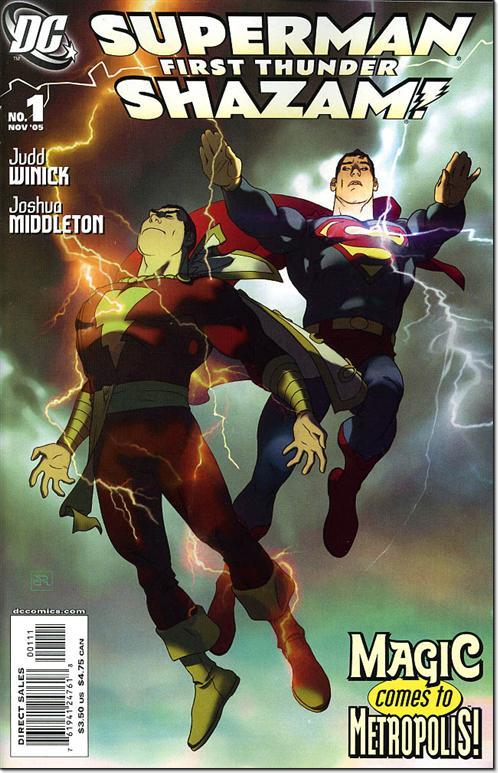
Year of Superman Week 16: Origin Week

It’s a big week for Superman fans – DC’s “Summer of Superman” initiative is kicking off this week with the Summer of Superman Special. Not only that, but April 18th is the anniversary of the release of Action Comics #1 back in 1938, and therefore DC has declared it “Superman Day.” It also happens to be the first day of my spring break, so I’m intending to put my son in his Superman t-shirt (matching my own) and going down to BSI Comics that day to celebrate.

And since this week marks the Man of Steel’s anniversary, it feels like a good time for another one of those themes that I had marked off at the beginning of the year: it’s gonna be Origins Week. Superman’s origin has been told many, many times over the years, and in many different continuities. Last week, for instance, I read the first Earth One graphic novel, which was such a take on Superman’s origin. But I’m going to focus on the ways his origin has been told in-continuity. DC’s continuity has been retold and rebooted a ridiculous number of times over the years, of course, but this week I’m going to plant my flag on stories that were considered the definitive origin of the “Prime Universe” Superman at the time of publication. And even then, I’ve got plenty to choose from.

Wed., April 16

Comics: Superman #53, Superman #146, Challengers of the Unknown Vol. 5 #4 (Guest Appearance)

Notes: I read Action Comics #1 back on January 1st, so I’m not going to include it again in Origins Week. Besides, there wasn’t a lot of detail in that first iteration of the origin anyway – so many of the details, including the name of his home planet, weren’t filled in until later. The origin presented in Superman #1 wasn’t much better, expanding to a whopping two pages before jumping into the issue’s first story. So I’m going to look instead at a couple of later issues that filled out the story, beginning with Superman #53 from 1948, a special “tenth anniversary” story. To be honest, I’m not 100 percent sure that this is the first time the origin was told in full, but the text on the first page DOES say “Now, at last, you’ll know all the answers,” so at the very least not all of this stuff was yet common knowledge.

Don’t you love how quaint the old blurbs were? “World Greatest Adventure Character!” The Fantastic Four was just waiting to jump in on the hyperbole bandwagon.

The story begins on Krypton, with Jor-El warning that the planet’s uranium core is breaking down, transforming the planet into an enormous atomic bomb. The planet’s rulers, of course, don’t believe his warnings, and Jor-El makes it home just as the final cataclysm begins. He has room in his prototype rocket for his wife and child, but Lara insists her place is with her husband, and thus they send their baby to Earth alone. His rocket lands in the American heartland, where he is found by an elderly couple who bring him to an orphanage. The super baby causes chaos in the orphanage, and when the older couple returns hoping to adopt the child, the orphanage rushes through the paperwork to get rid of him quickly. Bringing them home, he is named Clark Kent. He grows up, gradually discovering more and more powers, until as a young adult his foster mother dies, followed by his father, who urges Clark on his deathbed to use his powers for good. 

As you can see, the basic framework of Superman’s origin is all here, the skeleton which has provided the structure of his story for the past 87 years. But the story cuts off before he goes to Metropolis, joins the Daily Planet, first encounters Lois…in other words, a lot of the stuff that really helps make Superman who he is. There are also an awful lot of details that haven’t been filled in yet. Jor-El and Lara are both named, but their baby is not specifically called Kal-El in this story. The Kents’ first names aren’t mentioned until the scene where Clark stands by his graves, and then the names inscribed as “John” and “Mary,” before they were codified as Jonathan and Martha. And even though he clearly grows up in a small town, the location is not specified as Kansas, and the name “Smallville” is never mentioned.

You could honestly do this same experiment with any of the Golden Age heroes who have stood the test of time – go back and read their earliest stories and see which elements were missing, which pieces of their mythology that seem so critical to us now were in fact later additions. And “mythology” really is the appropriate word – you could do this same task with the stories of Thor, of Odysseus, of any character from classical mythology. Stories grow and build and evolve over time, and our modern stories are no different. It’s a process that honestly fascinates me, which is one of the reasons I’m approaching this week the way that I am. 

And they didn’t even put the kid into a five-point harness? Kypton deserved what it got.

We got a more complete version of the origin in Superman #146 from 1961. In “The Story of Superman’s Life,” a lot of those little details that hadn’t solidified yet in ‘48 had come into focus. Once again we see Jor-El warning the people of Krypton of the planet’s impending doom, but only his brother, Zor-El, believes him. In this version, he first uses Krypto as a test subject, sending him into space first before the final cataclysm that causes him and Lara to send Kal-El (now named) to the stars. This version also covers how the nuclear reaction transformed the fragments of the planet into Kryptonite, then shows Kal-El’s rocket landing in Smallville, where he is found by Jonathan and Martha Kent. This time, the Kents leave the baby on the orphanage doorstep, coming back to adopt him after a few days of superbaby hijinks. He grows up, gaining power as he does, and the Kents eventually discover that the blankets he was wrapped in when they found him are just as invulnerable as their son. 

As Clark gets older, Martha unravels the threads of the blankets (because they can’t be cut) and re-weaves them into his first Superboy costume. Clark adopts his glasses – made from glass from his rocket ship which is impervious to his head vision – to help protect his secret identity from the likes of his nosy next-door neighbor Lana Lang. In fact, he even builds his first robot duplicate in order to trick Lana. We get his reunion with Krypto  and how he uses the information he learns to determine his true origin, coming from Krypton, and how the Earth’s yellow sun and lower gravity give him his powers. His first interaction with Kryptonite is rather benign – Jonathan brings home a rock for his son’s mineral collection that instead makes him sick. The next stage of his life comes when his foster parents again die, with his father again urging him to use his powers for good before he’s gone, and Superboy decides to leave Smallville to come to Metropolis. 

Clearly, this is much more detailed than the previous version, including a lot of the bits and pieces that had become standard by then. However, because of this, the comic book doesn’t read so much as a story as a checklist ” here are the things that we know about Superman, so let’s make sure that we mark them off along the way. There are even a few elements that are covered in footnotes – such as how Zor-El (who would become Supergirl’s father) escaped Krypton’s destruction and how a pack of green Kryptonite meteors were transformed into red Kryptonite. And even though this story ends with Clark Kent working for the Planet, we don’t actually get the story of HOW that happened. 

It’s more detailed, but honestly, I like the story from issue #53 better.

That said, this story pretty much laid out the important details, and it would be 25 years before there was any serious revision again. That would be John Byrne’s Man of Steel, and that’s what I’ll tackle next. 

Thur., April 18

Comics: Man of Steel #1-6, Detective Comics #1095 (Guest Appearance), Justice League of America #21

TWO! TWO! TWO covers in one!
Notes: If I were to take a guess as to which Superman comic I’ve read more than any other…well, it would be impossible to say for sure, but I would wager that Man of Steel #1 is a close contender. I don’t remember exactly when I got this first issue or how, but I know that it was in my collection even before I became an adamant Superman reader a couple of years later. I read that issue many times, I liked that first issue quite a bit, and I know that I’ve returned to it over and over again in the years since. Man of Steel was DC (via writer/artist John Byrne) attempting to update Superman for the 80s, and on that note, it succeeded beyond all measure. Superman was reinvigorated, given new life. It made Clark Kent the character’s heart and Superman the mask, as opposed to the reverse dynamic which most older stories had employed. It crumbled up and threw away the lovelorn man-chasing Lois Lane once and for all, replacing her with a fearless reporter who was every bit the equal of the Man of Steel – a portrayal more than a little inspired by Margot Kidder’s performance. And perhaps the greatest change, at least in my opinion, was that unlike every version of Superman that had come before, in this version Jonathan and Martha Kent were still alive, still able to be family and confidants to the adult Superman, giving him something he had never had before.

This isn’t to say that I love everything about his version of Superman. My biggest beef is the enforced notion that Kal-El be the ONLY survivor of Krypton, which did away with such things as Krypto, Supergirl, the bottled city of Kandor, and so forth. These elements would drip back in over the years, fortunately. But for the most part, this is the origin of Superman that is most firmly etched in my brain, and when I think of the architecture of Krypton or the clothing that Jor-El and Lara wore, this is still the version that comes to mind most fervently.

Let’s break it down, shall we?

Man of Steel #1 begins on a Krypton that is dying. Millions are succumbing to a plague they are calling the “green death,” but only Jor-El has been able to uncover the truth. A chain reaction in the core of the planet is transmuting the entire world into a new, radioactive metal that is killing them all, and what’s worse, that same reaction is soon going to destroy the planet. Jor-El takes the gestation matrix carrying his unborn son and outfits it with a hyperdrive to send it to another world, which he does so mere moments before Krypton’s death. With his final breath, he expresses his love to Lara, something that on this Krypton – a cold world devoid of emotion and feeling – is strictly forbidden. 

Byrne skips ahead now to Clark Kent’s senior year of high school, where he wins the final football game of the season virtually singlehandedly. Slightly disappointed, Jonathan Kent reveals to his son that he is not their natural born child, but rather that he was found in a spacecraft 18 years prior. Clark decides to leave Smallville and begin using his gifts to help other people. Another time skip sends us ahead seven years, where Martha Kent has compiled a scrapbook of newspaper clippings of all manner of disasters that were averted – a puzzle solved when the newest headline reads “Mysterious Superman Saves Space Plane.” Clark comes home and tells his parents how he was forced to use his powers openly for the first time, preventing the crash of an experimental spacecraft that happened to include among its crew a reporter for the Daily Planet – one Lois Lane. Together, the Kents decide that in order to operate freely, Clark needs a new identity. They craft a costume, design a symbol, and Superman is born.

A few other things of note in this first issue: besides the dramatic change to Krypton, Byrne also canonizes the idea that Superman’s first public appearance is saving Lois Lane from an air disaster – in essence a much more dramatic version of the helicopter rescue from the first Richard Donner/Christopher Reeve movie – as well as that it is Lois who dubs him “Superman” in the press. There have been lots of revamps to Superman’s origin over the years, lots of versions that have bled into other media, but I always like it when they keep these two particular elements. It just feels right. It doesn’t quite work in versions where he was SuperBOY before he grew up, of course, but I’m willing to pick my battles.

This issue also set the tone for the rest of the five-issue miniseries that preceded Byrne’s runs on Superman and Action Comics. DC wanted a new Superman, but they didn’t want to have to tell an ongoing story where he’s still brand new and unknown to the world. So like this first issue, the rest of the miniseries skips ahead to high points in Superman’s career, important first encounters, that sort of thing, before finally catching up to a “modern day” at the end of issue six. This was, I think, probably the best way to handle it, and it left room for Byrne and future writers to fill in some blanks, which of course they did.

I’ve never thought about it before, but it must be hell for Lois Lane to get an insurance quote.

Issue two probably has the briefest time skip of the series, picking up shortly after Superman has gone public. As he makes his first appearances in uniform, Lois finds herself determined to get the story of this remarkable newcomer to Metropolis. She spends days following him from one encounter to another, always showing up just after he’s finished saving someone or thwarting a crime, but never getting close enough to talk to him. Lois decides to get his attention by driving her car off the pier, prompting him to swoop in and save her for the second time, and she manages to pressure him into an interview, although he isn’t too forthcoming. As he takes off, he casually asks her if she always drives around with an aqualung under the front seat of her car. Lois, clearly smitten, rushes the story of Superman, bringing it in to Perry White’s office, only to have all the wind blown out of her sails when Perry reveals that the Planet has already gotten the same story from their newest reporter: Clark Kent.

This issue nails the Lois Lane that I love – unflinching, brave, willing to do anything for her story. It also sets the gait for their relationship: Superman knowing full well that she was never in any danger but playing along anyway is just the perfect dynamic for the two of them. If anyone asks me who Lois Lane is, I can’t think of a better way to answer that question than to just show them this issue.

Man of Steel #3 reintroduces another of Superman’s most important relationships: that with Batman. But this isn’t the best friend he had in the Silver Age, or even the slightly strained friendship they enjoyed in the early 80s. Superman comes to Gotham City to round up the vigilante who has been making the news, only to be told by Batman that he’s rigged a device that will set off an explosion somewhere in Gotham City, killing an innocent person, if Superman touches him. With Superman temporarily helpless, Batman explains that Gotham requires a different approach – for example, he’s tracking down a thief and murderer called Magpie who has been terrorizing the city. Superman reluctantly goes along and helps capture Magpie, only to learn at the end that Batman’s “bomb” was in his utility belt the entire time – the “innocent” person in danger was himself. The two leave not as friends, but at least with a truce and the understanding that their different worlds require different methods.

This issue illustrates the other thing from this era of Superman that bothers me – the antagonistic relationship he had with Batman. Frank Miller loves to take credit for destroying their friendship (via The Dark Knight Returns), and DC ran with that dynamic for far too long. That’s not to say that this isn’t a good issue – Byrne does a fine job – but it set Superman and Batman at odds with one another for quite some time before the relationship finally began to soften, becoming allies again, and eventually the friends that they should be. 

Issue four brings Superman, for the first time, in conflict with his greatest enemy. Byrne’s revamp of Lex Luthor transformed him from the evil mad scientist of the old days into a ruthless, brilliant, corrupt businessman. Rather than operating out of a secret lair, he’s got a huge building shaped like his own initials, and he controls Metropolis fairly openly – until Superman shows up. He hires thugs to fake a terrorist attack on his cruise ship, horrifying Lois and seemingly “killing” Clark Kent. (Spoiler alert: Clark isn’t really dead.) Superman rounds up Lex and arrests him for the first time, setting the tone for their relationship from then on. LexCorp (sometimes “LuthorCorp”) would become a permanent addition to the Superman mythology, and the current iteration of Lex is somewhere between this one and the old version – still a ruthless businessman, but ALSO with the incredible scientific mind that Superman mourns whenever he uses it for evil. One other element added here is Lex’s pursuit of Lois Lane. This is a bit that’s come and gone over the years, but for this version of Lex, it works just fine. This was the perfect Lex for the time, but I think the gestalt version we have these days is probably the ultimate form of Lex Luthor.

I hate it when my imperfect duplicate shows up and punches me in the face.

The fifth issue gives us another time skip, and this time, the creation of a new Bizarro. This time around, an effort by Lex to clone Superman results in a duplicate that is slowly deteriorating. Meanwhile, Lois’s sister Lucy is dire straits, contemplating the futility of her life as the result of a terrorist attack that left her blind. This is a really odd way to reintroduce Lucy Lane into continuity, although I suppose it does somewhat continue the trend of Lucy being treated like the universe’s punching bag. This is perhaps the oddest of the six issues. The others all have a specific point or person in Superman’s life that they focus on: his origin, Lois Lane, Batman, Lex Luthor, and in the final issue we’ll see him learn about his heritage. The creation of a new Bizarro – particularly one that doesn’t even survive the issue – is an odd choice. It does show a bit more just how crafty Lex can be, but issue four already established that pretty handily. There’s nothing wrong with it, of course, but it’s always felt a bit out of place among the other five chapters. 

In the final issue of this miniseries, Superman returns to Smallville to visit his parents and comes face-to-face with Lana Lang. Lana had only been mentioned briefly back in issue one, so this is a pretty big deal – we learn that before Clark left Smallville, he told Lana about his powers. To him, he was confiding in a friend, but Lana – who had always harbored dreams of a future as Mrs. Clark Kent – saw it as the end of the future she had always imagined. This was a totally new dynamic for Clark and Lana, and it lasted for some years as Lana slowly evolved as a character. I like this as a chapter in her past, but I’m glad it’s behind her and she’s taken her place as one of Clark’s closest friends. In fact, she’s even – you know what? I’ll wait until tomorrow to talk more about what Lana is up to these days.

The other big thing about Clark’s return to Smallville is his interaction with the matrix that brought him to Earth. A hologram of Jor-El downloads the history of Krypton into Clark’s brain, telling him the truth of his origin for the first time. He knows the history of Krypton, can speak its languages, knows of its great literature…but in the end, decides that it isn’t important. He may be the last son of Krypton, but it is Earth that made him who he was.

Little bit louder for Quentin Tarantino and Max Landis.

Yeah, that’s pretty much my thesis on Superman too. Thanks for confirming, Mr. Byrne. 

Fri. April 18

Feature Film: Superman III (1983)

The recasting of Lois Lane was controversial at the time.

Notes: I decided to pause “Origin Week” just for today, Superman Day, so that I could celebrate it properly. I put a little video on TikTok explaining what’s so darn great about Superman. I put my son in his Superman T-shirt and I put on mine. (Well, I put on ONE of mine. I have…several.) We went out to our local comic shop, BSI Comics in Metairie, Louisiana, and we came home to watch a Superman movie. It may not be the most obvious choice for this most glorious of occasions, but I’ve already rewatched the first two Christopher Reeve Superman movies for this blog experiment, so I decided to continue on with the infamous Superman III. In this one, a man named Gus Gorman (Richard Pryor) struggling to keep employment suddenly finds a talent for computer programming . His skills – and the use of those skills to defraud the company – brings him to the attention of his boss (Robert Vaughn) who, rather than throwing Gus in jail, decides to use his skills for the benefit of them both. Meanwhile, Clark Kent returns to Smallville for a high school reunion, bringing him back into the orbit of Lana Lang (Annette O’Toole), the girl he left behind.

I hate to admit it, but I do have something of a soft spot for this movie. It’s not great, of course. Lois Lane is reduced to a cameo, the villain quite clearly SHOULD have been Brainiac – but for some reason, wasn’t – and the attempts to make it into a comedy so as to justify Richard Pryor’s presence are…well…strained.

But despite that, there are things about this movie I enjoy. Richard Pryor was funny. Even when the material he was working with wasn’t great, he had a talent to elevate it and make it more entertaining, and it’s fun to watch him on screen. Then there’s Annette O’Toole, an absolutely radiant Lana Lang. She’s sweet and gentle, the polar opposite of everything Margot Kidder’s Lois Lane is, and while everyone knows that Lois and Clark is the endgame, watching O’Toole as Lana for a few minutes is enough to make you believe he could be reconsidering it. 

But the best thing about this movie comes after Gus hits Superman with a chunk of synthetic Kryptonite that slowly turns him bad. In what is honestly one of the best scenes in the entire Reeve Superman series, he splits into two people – an Evil Superman vs. a Good Clark Kent. The scene – a battle in a junkyard where Christopher Reeve battles himself – is well shot and has impressive effects, but it also really works thematically. Even in an era where “Clark” being the real guy and “Superman” the mask was perhaps a minority opinion, this movie kind of puts forth that thesis, and I love that about it.

Comics: Superman Day 2025: Jimmy Olsen’s Supercyclopedia Special Edition #1, DC X Sonic the Hedgehog #2, Batman/Superman: World’s Finest #38, Action Comics #1085, Summer of Superman Special #1

Notes: I also sat down this afternoon to read the last couple of weeks of Superman comics, so let’s run through those together, shall we? 

I love the high holidays.

There were several free Superman comics available today, but I already had most of them (All-Star Superman #1, Superman For All Seasons #1, and so forth), so I passed on those in the hopes that they would pass into the hands of people who haven’t read them a dozen times before. I did, however, get the preview edition of Gabe Soria and Sand Jarrell’s graphic novel Jimmy Olsen’s Supercyclopedia. The hook of this graphic novel, it seems, is that Jimmy Olsen is getting a little tired of living in Superman’s shadow. Not that he blames the big guy, but it’s easy to get lost when the world only thinks of you as “Superman’s pal.” Then someone shows up who seems interested in Jimmy himself, and that changes things. It’s an interesting concept, but I have to admit, it didn’t totally grab me. Although I could see myself reading the rest of the book via DC Universe Infinite, I don’t know that I’d buy it.

DC X Sonic the Hedgehog #2: The crossover event of the century continues with Sonic and the Flash chasing after Darkseid to try to wrest the Chaos Emerald from him. When he manages to escape, the Justice League and Team Sonic manage to chase him down to the Ragna Rock for a fateful confrontation – with a shocking ending. I don’t have a lot more to say about this book other than what I said about the first issue – it’s so much fun to see these characters together, and really refreshing to have a crossover that bypasses the requisite “heroes fighting heroes” tropes and just gets to the fun stuff. Once this series is over, the collected edition is going to be a perfect book to get for my son and my nephew. 

Batman/Superman: World’s Finest #38 begins the “We Are Yesterday” crossover in earnest. Clark Kent is covering the test flight of a Wayne Aeronautics jet plane – piloted by one Hal “Highball” Jordan – when the plane is destroyed and Jordan abducted by Gorilla Grodd. Superman, Batman, and the Flash take off to rescue Hal from the superintelligent simian, whose sights are higher than ever. This is the beginning of the time travel story Mark Waid is weaving between this series and Justice League Unlimited, with the modern-day Grodd interacting with his past self. It’s a great start to the story, full of superheroics, great artwork, and lots of monkeys. These are all good things.

Action Comics #1085 is the beginning of the two-part “Solitude” arc by G. Willow Wilson and Gavin Guidry (who previously did a great stint on the Superman ‘78 comic, and I’m happy to see him here). Clark is sent to the arctic to cover an experiment at a research station. Shortly after his arrival, though, the local wildlife takes undue interest in the station – they’re attacked by cyborg polar bears! And lemme tell ya, that sentence is as much fun to write as it is to read about. Anyway, it’s a good first half of the story, plus Guidry gets to design a new white and blue “polar” costume for Superman. It’s odd that Superman has so comparatively few variants, as opposed to Batman, but I have no doubt that we’ll be seeing this outfit in action figure or Funko Pop form sometime soon. 

Yet there’s no scene where anybody says, “Cool suit, Superman!” What a waste.

And of course, the big release this week was Summer of Superman Special #1, a one-shot that sets the stage for the next several months of Superman comics. The book is co-written by Joshua Williamson (regular writer on Superman), Mark Waid (who’s about to take over as the regular Action Comics writer), and Dan Slott (who will launch a third ongoing Superman title, Superman Unlimited, soon). “The Past, the Present, the Future,” begins in…well…the past. Validus, one of the foes of the Legion of Super-Heroes, is attacking Smallville, and Clark – as Superboy – and Krypto have to leap into action to stop him. There’s a really interesting bit here about how the Legion has placed a mental block to prevent Superboy from remembering things about his own future (this was well established in dozens of classic Legion stories, that’s not the clever bit), but nevertheless, he glimpses something that gives him a lingering memory that will change his entire life.

Summer, huh? (Glances at the title of the blog) Amateurs.

The story then jumps to the present day, and it’s a joyous day – it’s the wedding of Lana Lang and John Henry Irons. Lana is worried about some sort of super-chicanery messing things up, but that’s silly, right? RIGHT? Oh, no, Validus is back. This time, though, there’s a whole Superman family to take him on. The whole issue is great, and it’s highly successful at setting a tone for the upcoming storylines – especially the epilogue, which ties in to a story that started last year in the DC All-In Special and that we’ve been left dangling on for months now. The end of the issue also gives us the lowdown on several new books coming – not just Slott’s new title, but new books for Supergirl and Krypto, a treasury-sized one-shot by Dan Jurgens, and more. 

The summer of 2025 is already shaping up to be a great time to be a Superman fan. 

Sat., April 19

Comics: Superman: Birthright #1-12

When he flies in FRONT of Clark, you see, nobody suspects them of being the same dude.

Notes: By 2004, Superman had changed enough that DC decided it was time to revamp the origin again. That job went to the phenomenal writer Mark Waid, whom they paired off with a rising star named Leinil Francis Yu. The result, Superman: Birthright, is a solid Superman origin story that’s kind of been lost to time. A few years later, Geoff Johns would revamp the origin yet again (we’ll read his version in a couple of days), and then the New 52 hit and everything was upturned. But in these 12 issues, Waid did some really interesting things, a few of which have managed to stick.

The story begins – act surprised here – with the destruction of Krypton. This version is neither like the Silver Age version nor the cold, sterile world that John Byrne created. There’s a more modernistic sci-fi bent to it, and this time around it’s Lara who urges Jor-El to send their child to Earth when the latter begins to bend. Waid carries this theme forward after a time skip, when we see a Clark at age 25, covering news stories freelance in Africa and finding himself in a position to use his mysterious abilities to help people. Again, it’s Mom who turns out to be the impetus here – Martha pushes the creation of the Superman identity, while Jonathan is upset that Clark wants to hide his true name. Don’t worry, Jonathan comes around.

From there, from the point where Clark goes to Metropolis for the first time and saves Jimmy Olsen and Lois Lane from a helicopter disaster (NEVER get into an aircraft of any sort with Lois Lane, you’re just asking for trouble), the story takes a turn. While the elements of the Daily Planet staff are still there and still important, from here on out the story becomes largely about Superman vs. Lex Luthor. Waid brings back the Silver Age conceit of the character, in which Superboy and Lex had been friends, but he modernizes it. Since there never was a Superboy in this continuity, Lex was friends with Clark Kent (I feel like this was a deliberate effort to echo the popular Smallville TV show, which isn’t a bad thing). Waid puts a different light on the unique friendship – although Lex’s arrogance existed even then, both young men carried with them an air of alienation that made them bond. Lex, of course, didn’t know what exactly made Clark different from everybody else, but it was Lex’s intelligence that set HIM apart. 

In the Silver Age, Lex had the worst supervillain motivation of all time – Superboy saved him from a failed experiment, but the fumes released made him lose his hair. So he decided to become a criminal mastermind. And that’s terrible. Waid brings back the basic idea of Lex’s villain turn coming from a disaster that involves Clark, but he does it in a much more believable way. The adult Lex in this story is the fusion of super scientist and super businessman that he still mostly is today, and he carries that brilliance and anger with him as he cracks the secret of Superman’s heritage – discovering that Superman is an alien from the distant planet Krypton, which even Clark doesn’t know yet. Lex decides to turn the world against its new hero by faking an invasion from Krypton to draw him out, culminating in a fantastic battle scene that includes, among other things, a fantastic moment where the S-shield becomes literally that.

“I dunno, Leinil, do you think anybody will get the symbolism here?”

Like I said, this origin has been largely pushed aside by DC, but there are a few elements that I think are worth mentioning, at least one of which has become a staunch part of canon. One is the explanation for Clark’s glasses. Waid clearly decided to address the old (tired) complaint that the glasses aren’t enough of a disguise by establishing that Clark’s eyes are a truly unearthly shade of blue, a color that no one not from Krypton would have seen before. Superman still has those eyes, but Clark’s glasses dull the color and make his eyes seem more mundane, helping with the disguise. I don’t know if that tidbit is still canon, but with Waid about to take over Action Comics, I hope he brings it back.

The other thing that we get here is – as far as I can tell – this is the story that first established the concept that the Superman symbol stands for hope. As Clark studies the holograms sent to Earth with him, he doesn’t understand the Kryptonian language, so he tries to unlock his past by watching the images and videos sent by his parents. The S-shield of the House of El is a persistent image, and it comes to represent hope to Clark, something he pushes forth when he adopts the symbol as Superman. The idea that it was literally the Kryptonian character for their word meaning “hope” isn’t there yet – that, I believe, came a few years later during DC’s 52 series (which Waid co-wrote), but I think that we’ve found the genesis of one of my favorite little details of Superman lore.

It’s a good story, and even if it isn’t canon anymore, it’s still an enjoyable read. 

Sun., April 20

Comics: Secret Origins Vol. 3 #1

Superman HATES green cars.

Notes: It’s Easter Sunday here, and Easter is a big family day for us, so I knew I would need something quick for today’s Origins Week installment. How handy, then, that back in 1985 DC Comics relaunched their old Secret Origins series, re-presenting the genesis of heroes from the Golden Age to the Bronze, and kicking it off with an issue dedicated to the Golden Age Superman. The series was the brainchild of Roy Thomas, who also wrote this issue, and frankly there couldn’t have been a better candidate. I don’t think there’s a human being on the planet with a greater love for Golden Age comics than Roy Thomas, as evidenced by his All-Star Squadron from DC, Invaders from Marvel, the Alter Ego miniseries he wrote for First Comics and the subsequent comic book magazine he produces that carries the same title. Mark Waid is kind of a spiritual successor to him, in that both men are walking encyclopedias of comic book history, and it shows through in their work.

This issue is a pretty straightforward adaptation of the “origin” story I mentioned from Superman #53 grafted together with the story of Superman’s first adventure from Action Comics #1. Thomas, along with classic Superman penciler Wayne Boring and inks by Jerry Orway, re-tells the story that we’re all intimately familiar with, and does so almost beat-for-beat. Even panel compositions and little tidbits like a ticking clock in the corner of the panel to count down to an innocent man’s execution are carried over from the original Siegel and Shuster panels to the new ones. As such, it’s a retelling of the original story, but not really an update. The oddest thing, though, is the fact that Thomas makes reference several times to the fact that this Superman and – in fact – his entire universe no longer even existed, following the events of the recently-concluded Crisis on Infinite Earths. It’s an odd take, to build a series built on what, at that point, had essentially been relegated to “imaginary” stories. Still, if you’re looking for an old-school origin of Superman with a slightly more modern bent, this issue is worth reading. The whole series is, actually. I was always a fan of Secret Origins, and it’s a shame that anthology books like this one just don’t seem to have legs in a modern market. 

Mon., April 21

Comics: Superman: Secret Origin #1-6

It’s like a Christmas card with an alien from another planet on it.

Notes: Six years after Birthright, and following another reset in Infinite Crisis, DC handed Geoff Johns the reigns to do his own take on Superman’s origin. Johns was one of DC’s top writers at the time, having taken both The Flash and Green Lantern and expanded their respective corners of the DC Universe exponentially, making them more exciting and (frankly) more significant than they had been in years, if not decades. Johns had also cut his teeth working as an assistant to Richard Donner, director of the first Christopher Reeve movie (and most of the second), and the two of them even wrote a run of Action Comics together. It’s not really a surprise, then, that Johns’ version of the origin borrows as much from the classic movie as it does from the classic comics, right down to artist Gary Frank drawing a Clark Kent that looks so much like Reeve you’d think he was doing a straight-up adaptation of the film. In the scene in issue #3 where he first arrives at the Daily Planet, it’s even more pronounced. Frank draws Clark with Reeve’s physical mannerisms and characteristics, the bumbling fake persona that he wore in his “disguise.” It’s so effective that every line you read goes through your head in Reeve’s own voice.

Johns merges a lot of elements from the various Superman eras and blends in some of his own. His version was, in fact, Superboy, and had been a member of the Legion of Super-Heroes. His costume was made from his Kryptonian blankets, and Clark’s glasses were made from glass taken from the spacecraft to help him control his heat vision. To help reconcile some of the elements that work better with Superman making his debut as an adult, Johns has Clark keep “Superboy” a secret, operating as privately as possible and being considered little more than an urban legend in Smallville. That way he maintains the big moment of his public introduction later in Metropolis where he…oh, look at that. He saves Lois Lane from a helicopter accident.

NEVER. GO. NEAR. AN. AIRCRAFT. WITH. LOIS. LANE.

Unique to this version, Lana Lang knows about Clark’s powers since childhood, having been saved by him from a wheat thresher (a scene quite reminiscent of Superman saving Lana’s son from a similar fate in Superman III). Lex, once again, is from Smallville, and a few years older than Clark, but still friend-ish with him. I particularly like Lex’s introduction, where he asks Clark if he’s smart, reasoning that wearing glasses either means you’re genetically inferior or you read a lot. 

I’ve read this series more than once, but reading it all together creates some interesting juxtapositions. In issue #2, for instance, when Superboy first meets the Legion, I’m struck by how Johns writes Brainiac 5. His intelligence leads to incredible arrogance and condescension towards everyone around him…which seems pretty darn familiar if you flip back a few pages to a scene where Clark is talking to Lex in the school library. Johns writes Brainiac as Lex Luthor with a fundamentally good core – but “good” doesn’t necessarily mean “nice.” It’s pretty funny, and really spot-on in terms of characterization.

It’s not just the people whose characterization changes, though, it’s the whole city of Metropolis. When Clark first arrives it’s a cynical place, a place where nobody ever looks up, where everybody is out for themselves, where the Planet is on the brink of ruin, and where people line up for hours in the hopes of catching a few scraps from their oh-so-benevolent top citizen, Lex Luthor. The presence of Superman chances the whole town, making it a bolder, more optimistic place, a town where the potential for the future seems real and not just a pipe dream. Lex, naturally, hates it. I love it. 

Lois is Lois as Lois should be – smart unflinching. When given a chance, she goes for Lex’s throat without a second of hesitation. But what I really love is how she sees through Clark’s bumbling facade almost instantly. The same day he comes to work at the Planet, she sizes him up and calls him out on the false humility and ill-fitting clothes, declaring quite correctly that he obviously wants people to underestimate him. That insight is perfect for her…which actually makes it even funnier when she encounters Superman and fails to put two and two together. She continues being impressed by Clark throughout the miniseries, but even at the end she hasn’t dovetailed into the whole “is Clark really Superman?” bit from the Silver Age, and I’m glad for that.

In addition to Luthor, Johns brings in the Parasite, Metallo, and even Sam Lane as secondary antagonists, but when you get right down to it, this is a story about four characters: Superman, Lois, Luthor, and Metropolis herself. And Johns serves all four of them very, very well. 

Tues., April 22

Comics: Action Comics Vol. 2 #1-8

This is the one time where Superman and I could literally wear the same outfit.

Notes: I’m going to close off Origin Week with what I believe is the most recent revamp of Superman’s full origin, from the New 52 reboot of the entire DC Universe that happened in 2011. Ironically, despite being the most recent, it’s also one that was sponged from continuity most completely. Still, it’s written by Grant Morrison, and I’ve never read anything by Grant Morrison that didn’t have at least SOME reading value in it. Let’s see how the New 52 handled our boy Clark.

Morrison’s Action Comics begins six months after Superman’s public debut in Metropolis (thus robbing us of the opportunity to see him save Lois Lane from a helicopter crash), and the inspiration here is clearly the earliest Superman stories of Siegel and Shuster. He’s not as powerful as he would become, he’s not flying yet, and he shows bruises and abrasions from some of his tougher battles. He’s also doing the “fighting for the little guy” thing that we saw so much of in the earliest tales, going after corrupt businessmen and politicians…which has made him the target of corrupt businessmen the likes of Lex Luthor. He’s not even wearing a proper costume at this point, prancing around the city in trousers, a t-shirt, and a cape. It’s a wild look, and if Morrison’s intention was to show that this was a Superman starting from scratch, it worked. 

The story sees Superman being captured by Luthor and Sam Lane, fighting against them, and rescuing Metropolis from Brainiac. Along the way, we discover that – although Couluan – Brainiac had a presence on Krypton and has one here on Earth. Clark also gets his hands on the Kryptonian armor that became the uniform of the New 52 Superman, and by the end of the story, he’s made enough of a name for himself to take a job at the Daily Planet.

What also works is John Henry Irons – in a world where the Doomsday fight never happened (although this would be reversed, like most of the New 52 changes) they made John one of the scientists working on the project that studied Superman with Luthor, then had him show his heroic side by turning on Luthor and Sam Lane, building his suit of armor in the process. If there’s no “Death of Superman” in the continuity to contend with, this is a decent enough way to get a Steel. 

But the thing is, there isn’t much else that works for me here. I get that the idea here was a whole new Superman, a whole new universe, but as turned out to be the case with much of the New 52, they threw out the baby with the bathwater. This is an origin that doesn’t just update the classic elements that make Superman who he is, it throws out many of them. We see only glimpses of Krypton, and we get more of the Kents through some of the back-up stories written by Sholly Fisch than the main stories written by Morrison. We only get a few pages each with Lois Lane and Jimmy Olsen, and although the attitude Morrison crafts for Superman works for a young man trying to find himself, ultimately, it’s somewhat unsatisfying.

I hate to say this, because Morrison has done excellent work with the Man of Steel. I’ve always enjoyed DC One Million and the Final Crisis tie-in Superman Beyond, and let’s be honest here, All-Star Superman absolutely deserves a place on the Mount Rushmore of Greatest Superman Stories Ever Told. But the New 52 Action Comics origin just falls flat for me. It would be one thing if this were an alternate universe – an “Ultimate” or “Absolute” Superman – but as the origin for the Prime DC Universe Man of Steel, it just doesn’t click. Out of all the different iterations of Superman’s origins I’ve read this week, I’m afraid I saved my least favorite for last.

This all begs the question, of course, of what exactly Superman’s origin is today. Like I said, I doubt that many remnants of the New 52 version have stuck with us. The Superman we read about in 2025 is kiiiiinda the New 52 Superman mashed together with the Post-Crisis John Byrne Superman, but even that Superman has had no less than three different versions of his origins over the years. And since DC Rebirth gave us the current iteration of Superman beginning in 2016, they haven’t really done a retelling of the origin again. But maybe Mark Waid will tackle that in his upcoming New History of the DCU. If he does, I’ll be sure to share with you my thoughts on his newest take. 

Blake M. Petit is a writer, teacher, and dad from Ama, Louisiana. His most recent writing project is the superhero adventure series Other People’s Heroes: Little Stars, volume one of which is now available on Amazon. You can subscribe to his newsletter by clicking right here. You can join in the Kryptonian Konversation every day in the Year of Superman Facebook Group!