Geek Punditry #160: The Difficulty of a Kingamatic Universe

“Hey,” one of my students whispers to the kid sitting next to him. “He’s reading It.”

And I smile.

On the wall in my classroom is a small whiteboard. At the top of the board is written “What is Mr. Petit reading?” Underneath, I regularly update the board with the title and author of whatever book has most recently been removed from my To-Be-Read pile and is actually in the process of being read. Currently, that book is Stephen King’s It. I’ve had that board up for a few years now, and I update it whenever I begin a new book, and having it visible has led to lots of really great questions such as “Are you still reading that one?” and “How many books do you read, anyway?”

“Not to put too fine a point on it, but I read more books yesterday than some people in here will read in their entire lives. Please don’t take that as a challenge.”

Occasionally, though, the board can lead to an actual conversation if a student happens to have read the book, is curious about it, or didn’t know that a book even existed (for properties they’re only familiar with as movies, such as Ready Player One). It is the book currently on the board, and it’ll probably stay there for a little while, because even for Stephen King, it’s kinda long. Some students are horrified when I tell them that I’m reading a book that’s in the ballpark of 1100 pages. They are even more baffled when I tell them that this is not the first time I’ve read it. I don’t recall, honestly, if this is the third or fourth time I’ve taken this particular trip to Derry, Maine, but I know exactly when the LAST time I read it was – it was late August and early September of 2017, and I remember it because it happened to be the book I was reading the week my son was born. I recall sitting there, scrolling through the pages on my tablet as Erin and Eddie slept, each of them rather exhausted after recently undergoing the most dramatic moving day in the history of a human being. 

Don’t worry, I didn’t whip out my book and start reading as soon as the kid popped out – this was some time later, as we had to stay in the hospital a little while as they treated him for some blessedly minor things that prevented us from going home for about five days. If you’ve ever spent time in the hospital, no matter how serious the condition may be, you’ll know that after a few days you start crawling up the walls if you don’t have something to do. My something was to visit with my friends in the Losers Club.
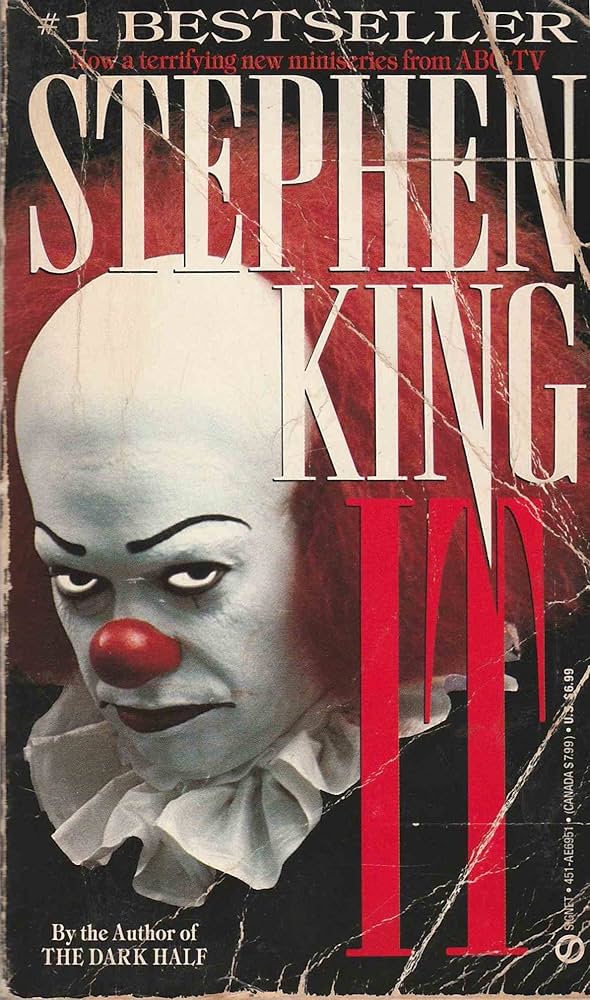
In retrospect, this may not have been the best choice for a new father’s reading material.

The specific reason I started reading It again this week, though, is because I finished the first season of HBO’s TV series Welcome to Derry, a prequel to the film adaptations of the novel from 2017 and 2019. The series is produced by Andy Muschietti, who directed the films and half the episodes of the show as well.  I thoroughly enjoyed the series, and it made me thirst to go back and revisit the source material again. As I’m reading it, I’m noticing the little bits and pieces, the tidbits the writers and showrunners planted in the show that help build out the world with water from the original font. 

To be clear, this TV series is a prequel to the MOVIES, not the book. There are some important differences that prevent it from working as an adaptation of the novel, chiefly the time period. The original novel is set in two eras: 1958 (when the protagonists are children) and 1985 (when they return to Derry as adults to finish what they started). The creature they do battle with has a cycle of about 27 years in hibernation, after which it returns to wreak havoc on Derry once again. 1985 was contemporary when the book was written, but Muschietti decided to keep the story set in the “present” when the films were released, meaning the events were shifted to 1989 (for the kid portions) and 2016 (for the adult portions). Welcome to Derry details the previous cycle of It in 1962. The point is that the movie universe cannot fit the timeline of the book universe, and that’s honestly not a bad thing.
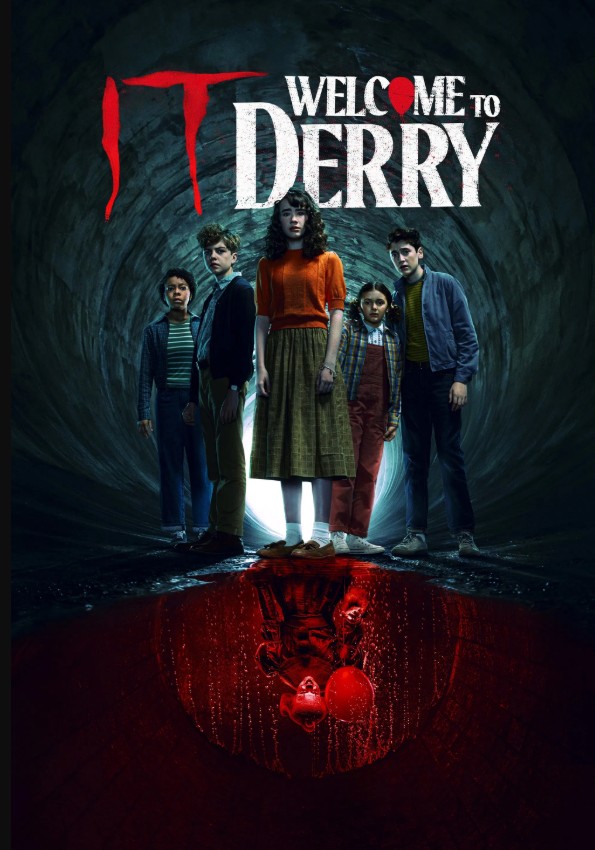
People who saw the show know just what a dirty trick this poster is.

Since the show, from the outset, cannot be a direct prequel to the novel, Muschietti and the writers are playing a little more fast and loose with the story, while still paying respect to it. For example, in the original novel Veronica Grogan is the name of one of the countless victims of Pennywise during the monster’s 1958 cycle. The TV show elevates her to one of the main characters fighting against the clown in the generation BEFORE the Losers’ first encounter with the monster. The names of many other characters from the book are peppered throughout the show, some of them characters mentioned in the novel, others with names that imply (and in a few cases, make abundantly clear) that they are relatives or ancestors of characters from the original in this version of the story. 

But the connections to the works of Stephen King don’t end with elements strictly from It. At one point, a character is sent to Shawshank Prison, the setting of King’s classic novella (and its classic movie adaptation) The Shawshank Redemption. Shawshank is frequently referenced in King’s Maine-centric stories, which is to say a little more than half of them, so it’s not a surprise when it turns up here. An even bigger link, though, is the character Dick Halloran. Halloran is one of the principal characters in his novel The Shining, which was written before It, and the original novel reveals that he was somehow involved in the tragically violent events that concluded a previous cycle of It. Welcome to Derry expands upon that, showing those events in full and giving Halloran a much more significant role. What’s more, they don’t even stop there, referencing elements of Halloran’s character that come neither from It OR The Shining, but rather from the latter’s sequel, Doctor Sleep. 

“Honestly, we’re just glad somebody remembered we were here.”

What I’m getting at here is that Welcome to Derry feels like it’s inching closer and closer to something that Stephen King fans have wanted to see for a very long time: a true cinematic universe.

Yeah, we’re going to that well again. Marvel has its cinematic universe. DC is on take two. We’ve got one for Star Wars and John Wick and even horror franchises like The Conjuring. But the thing you need to remember is that none of these franchises INVENTED the idea of a shared universe. It’s been around for a very long time. William Faulkner linked several of his novels and short stories together via the inhabitants of the fictional Yoknapatawpha County, Mississippi. James Joyce’s Dublin serves as the backdrop for several of his stories and, inasmuch as it’s possible to understand anything Joyce wrote, several of them link together. And King, much like many other contemporary writers, delights in dropping in Easter Eggs, hints, clues, and references that tie his various stories to one another. 

Now not ALL of his stories can be said to definitively take place in the same universe. The Stand, for example, is a novel about a virus that kills most of the population of the world, which clearly precludes most of his later works from being set in the same universe. Cell isn’t exactly a zombie story, but it’s close enough that this world is incompatible with most of King’s other work. And it’s hard to reconcile the bleak, horrific vision of the afterlife from Revival with several of his other stories which feature good, even friendly ghosts on occasion, such as Bag of Bones. Then there are the Stephen King books that explicitly reference other King books – or their movie adaptations – as fiction. That’s a bit of a roadblock.

On the other hand, King himself has provided us with a handy device that can explain away any discrepancy via his Dark Tower series: a multiverse. The Tower itself is a sort of central hub around which all reality converges, and that includes many different worlds and dimensions that are similar to, but distinct from, one another. The Dark Tower provides links not only to It and The Stand, but to multiple other books and short stories. And lots of the other stories he’s written drop in casual references that remind us that yes, their universe is one of the countless that are connected to the Tower. 

If ever there was a scene that MUST be committed to film, it’s this.

So all that said, why HAVEN’T we gotten a proper Stephen King cinematic universe before? The biggest obstacle, frankly, is licensing. King’s first novel, Carrie, was published in 1974, and he’s been turning out book after book and story after story since then. The most recent count I can find credits him with 67 novels and novellas and over 200 short stories over his 52-year career, and he’s been selling off the rights to them to different players all along. I don’t begrudge the man this – Lord knows I wish I could get that kind of payday – but the result is that the film and television rights to his works are all over the place. Dozens of studios and even individual filmmakers own bits and pieces of him, and getting all of them together to play nice and collaborate seems like a pretty impossible prospect. It’s the same reason that Marvel characters didn’t start meeting each other on screen until Marvel Comics stopped selling the rights to anybody who offered them twelve dollars and half a Fruit Roll-Up and started making the movies themselves. 

It’s not like King isn’t still a significant player in the entertainment game. People who don’t follow him may think of his work primarily as the grist for a huge slate of horror movies from the 1980s, but they’ve been coming out regularly since then – and they’re not all horror. 2025 brought us no less than four big-screen adaptations of his work: The Monkey (which turned a straight horror short story into kind of a bizarre black comedy), The Life of Chuck (a beautiful and faithful adaptation of a semi-fantasy by director Mike Flanagan), and two adaptations of books he wrote under his Richard Bachman alias, The Long Walk and The Running Man. These last two are both dystopian science fiction rather than horror, but they’re radically different from one another, despite the fact that they both have the same hook of characters competing in a lethal game in the hopes of a life-changing prize. But while The Long Walk is a dark, nihilistic societal commentary, The Running Man is a slam-bang action film. 

There have been attempts in the past to create a sort of King universe. Most notably, in 2018 Hulu produced Castle Rock, a series “inspired” by elements from a great number of King’s various works and set in that OTHER town in Maine that seems like it must be a nightmare to actually live in. The show was okay and it lasted two seasons, but I don’t think it actually gave fans what they wanted: a world in which the stories they love (or at least versions of those stories) could coexist. In Castle Rock, it was more like they took chunks of King’s books – characters, names, places – and pieced them together into something different. That’s a legitimate storytelling technique, of course. Mike Flanagan did it with Edgar Allan Poe for his exquisite miniseries version of Fall of the House of Usher. But it wasn’t quite what we were looking for.

In Welcome to Derry, the events of the two It movies are canonical, and the things we’ve seen so far make it quite easy to link that world with The Shawshank Redemption and the Shining/Doctor Sleep duet – if not exactly the movies we’re familiar with, then at least some version of those events. All of those movies, it should be pointed out, were released by Warner Bros., which is no doubt why they could play with those toys so easily. The show has not officially been renewed for a second season, but it has achieved real critical acclaim (although, typical for a streaming service, we have no idea what its numbers are), and Muschietti has been quite vocal about his plans for the next two seasons of the show. Future seasons would tell stories of two earlier iterations of the It cycle, in 1935 and 1908. This, I think, would be the perfect opportunity to build out the universe and add more parts of the Stephen King world. In fact, I think in some ways it would be almost REQUIRED to do that.

I loved season one of Welcome to Derry. The story was tense and compelling, the performances were great, and even though King wasn’t directly involved, the new characters all felt like the sort of characters that we get attached to in his books – ordinary people who get swept up in something far beyond their comprehension. If there is one legitimate complaint about the show, though, it’s probably that about half of the plot (the half that focuses on the child protagonists rather than the adults) is a bit TOO similar to the original It: a bunch of outcast children band together to stand against the evil of Pennywise the Clown. If we’re going to do another two seasons, they can’t just be two still-earlier stories about kids teaming up and fighting the monster. They need to bring something else to the table.

Andy Muschietti, I think, has proven himself an able enough storyteller that he is no doubt aware of this fact. The way he’s talking, it seems like he already knows what the story will be in 1935 and 1908. What I’m hoping is that he finds ways to tie in to other King stories. Could there potentially be references to John Coffey or the other characters from The Green Mile (set in 1932 in the novel, but it wouldn’t be outlandish of them to drag it forward in the timeline a few years)? Could we see the immortal vampires of ‘Salem’s Lot or the origins of the mysterious government project called “The Shop” from books like Firestarter? All of these, of course, would depend on rights issues in various ways, but I don’t think any of them are impossible either. 

Then there’s The Dark Tower itself, the rights to which currently reside with the previously mentioned Mike Flanagan. There was an earlier attempt to put the story of Roland of Gilead to film, a 2017 movie that foolishly tried to condense seven novels (all but one of which fall into doorstopper territory) into a 90-minute feature, and fans were not pleased. Flanagan, who already has several well-received King adaptations under his belt, has expressed the desire to use The Dark Tower for a television series of about five seasons, with a pair of movies to conclude the story. This is a much smarter approach to the material, and Flanagan has proven himself time and again to be someone perfectly suited to bringing Stephen King’s stories to life. 
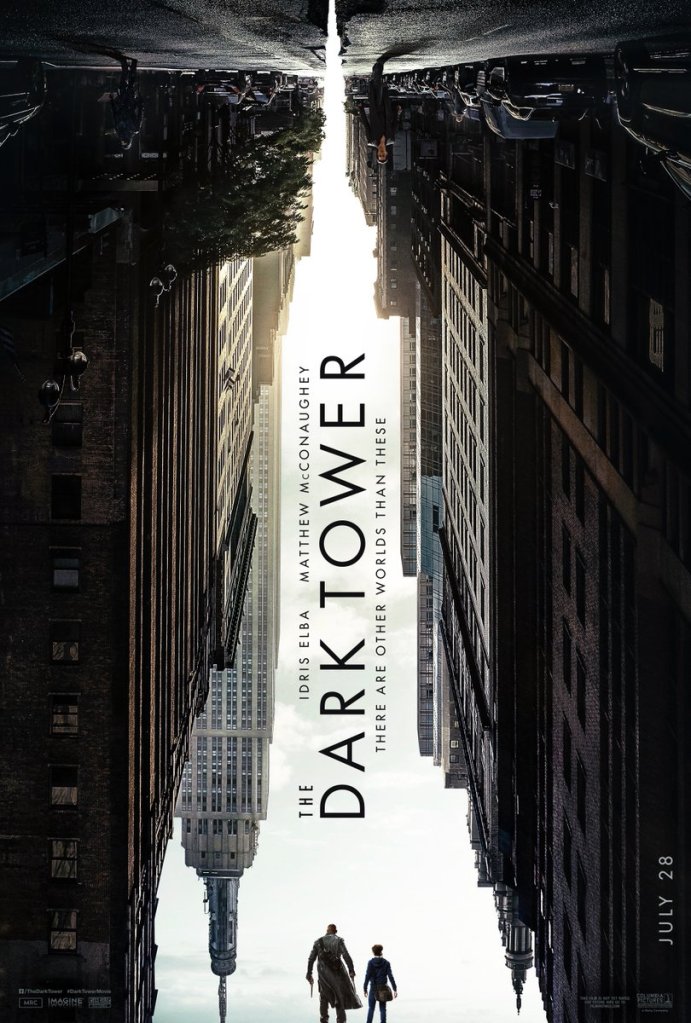
This…was NOT perfectly suited.

The optimal version of this, for me at least, would be for Flanagan’s Dark Tower to share fabric with Muschietti’s series. Characters common to both projects could be played by the same actors, the stories could be woven in concert with one another – separate, but linked. Could it happen? Well, Warner Bros. owns the rights to It and Welcome to Derry, so for this to happen, Flanagan would have to produce his series in cooperation with Warner Bros. It’s not out of the question. His previous development deal with Netflix is over, and his current deal with Amazon does not include The Dark Tower. He could take the story anywhere he wants. And he’s got a relationship with Warner Bros. as well – he directed their adaptation of Doctor Sleep and wrote the upcoming Clayface movie from DC Studios, which coincidentally, is ALSO in the Andy Muschietti business, as he’s been signed to direct their upcoming Batman movie, Brave and the Bold.

I’m not saying that this will happen. I’m not saying that Flanagan and Muschietti and Stephen King and Warner Bros. will join forces and finally begin to create the Kingamatic Universe that Constant Readers have been craving for the better part of five decades.

I’m not saying it’s going to happen.

I’m just saying it would be pretty damn cool.

Blake M. Petit is a writer, teacher, and dad from Ama, Louisiana. His most recent writing project is the superhero adventure series Other People’s Heroes: Little Stars, volume one of which is now available on Amazon. You can subscribe to his newsletter by clicking right here. He’s also started putting his LitReel videos on TikTok. He also hopes that somewhere in there they find a way to tell us what happened to the Girl Who Loved Tom Gordon…specifically, does she still love Tom Gordon, or has she moved on to – say – Shohei Ohtani?

Geek Punditry #147: It’s Not Halloween (But Who Cares?)

The whole “What Qualifies as a Christmas Movie” debate has been at a fever pitch for several years now. Die Hard, Lethal Weapon, Iron Man 3 – each of these has defenders ranging from people who genuinely appreciate their holiday content for what it is to edgelords who think they’re somehow better than other people by picking Riggs and Murtaugh over Rudolph and Frosty. Strangely, though, Halloween has never really fallen victim to this sort of heated, brutal, occasionally family-schisming battle royale. People are eager to accept certain movies as part of their standard Halloween fare even if nothing in the film has any direct ties to the holiday. And I think we should embrace that philosophy.

Art.

Some of my favorite movies fall into this category. As anyone who has seen the posters in my living room knows, one of my favorite movies of all time is Abbott and Costello Meet Frankenstein. I love the Universal Monsters, I love Bud and Lou, and this film fused those two brands at their respective heights into a hilarious film that nevertheless holds up the Universal Monsters as icons that they are. Bela Lugosi’s Dracula! Lon Chaney Jr.’s Wolfman! Glenn Strange’s Frankenstein Monster! (Okay, it stinks that they couldn’t get Boris Karloff to come back to the play the monster one last time, but of all the actors who wore the makeup for Universal, Strange was #2 after Karloff.) And I watch this movie at LEAST once every October as part of my Halloween wind-up. There’s a masquerade party in the third act, but it’s not specifically noted as being a Halloween party, and the film doesn’t seem to have any indication of what time of year it takes place. But the gestalt of having the finest incarnations of the Universal Monsters is enough to place it on my list.

That’s one of the great things about Halloween – the inclusivity of the concept. You can get away with almost anything as a Halloween costume, even if what you’re dressing as has no Halloween link. You can be a superhero or a princess, you can make a costume based on a pun, you can be a character from your favorite TV show or you can dress up as your friend who you know is going to be at the same party and watch them stew about it as you imitate their mannerisms flawlessly. All of it counts. And because of that, it’s much easier for a character or a movie to be elevated to iconic Halloween status even if there’s nothing strictly Halloweenish about them.

My other top two movie franchises that fall into this category are, of course, Ghostbusters and Scream. None of the Ghostbusters films take place at Halloween, and Scream didn’t touch upon the holiday until the sixth installment, but both of them are eagerly accepted as standard Halloween costumes now, much like any other Universal Monster, 80s slasher, or Beetlejuice. And, in fact, I try to work them into my Halloween viewing rotation almost every year. (If I don’t get around to Ghostbusters I’ll save it for December – Ghostbusters II is a New Year’s movie, after all.)

Halloween movies are like pumpkin spice. Pumpkin spice doesn’t actually taste like pumpkin, it tastes like cinnamon and the other assorted ingredients you add to a squash to make it taste like a pie instead of…well…a squash. Similarly, there are a lot of great movies that may not have any Halloween ingredients to them, but nevertheless, deliver hard on the Halloween flavor. 

The Stuff (1985)

Still can’t get enough.

I remember seeing the poster for this in the video store every time my parents took us there to pick out a few movies when I was a kid. I knew my mom would never let me rent stuff like this, but it never stopped me from looking at the poster and wondering what it was all about. Once I was old enough to seek out the movies I wanted myself, I found that this Larry Cohen film was ridiculous and delightful at the same time. “Mo” Rutherford (Michael Moriarity) is hired by a dairy company to investigate a new product called “The Stuff,” a creamy substance that is obliterating sales of ice cream and other traditional desserts. Nobody knows what’s in it or what it’s made of, and when Mo learns the truth, the answers are horrifying. The Stuff has the feel of a 50s sci-fi alien invasion movie, it’s like Invasion of the Body Snatchers mixed with The Blob mixed with a Baskin-Robbins commercial. The tone is perfectly appropriate to blend in with your Halloween viewing – silly and over-the-top with an antagonist that is absurd on the face of it. As far as Halloween costume potential goes, there’s not really an iconic character for you to dress up as, but if you were to whip up a costume that looks like a “Stuff” carton, you’ll immediately figure out who the cool kids at your Halloween party are. If nothing else, this movie is the quintessential argument for food nutrition labels.

Killer Klowns From Outer Space (1988)

Pictured: 2016.

True story: Last year on November 1st, after Spirit Halloween put everything at 50 percent off, my wife picked up the 12-foot inflatable Jumbo the Clown from this, one of her favorite cheesy movies. Jumbo sat in his box in the closet until this September, when I told her it was time to test out our Halloween decorations to make sure they still worked and she remembered buying this thing. It wasn’t until he was plugged in for the first time that we realized just how tall 12 feet actually is.

Eddie for scale.

Totally worth it, though, because this movie is a delight. In Killer Klowns, alien clowns come to Earth and begin abducting people in cotton candy traps and taking them to their ship, which happens to resemble a circus tent. The story is ostensibly about a bunch of young people who band together to fight them off, but nobody is watching the movie for the humans. The clowns are the stars, lovingly created by the Chiodo Brothers in a fashion that evokes the finest puppet work of the Jim Henson company. The Chiodos actually repainted and reused some of the clowns a few years later for the trolls in a legit Halloween classic, Ernest Scared Stupid.

It may not be a Halloween movie per se, but there are few things in the world that feel more Halloweenish than a good ol’ creepy clown, and the ones from this movie are some of the best. The iconic looks make for great costumes, and the movie itself is a ton of fun.

It (All versions)

Georgie for scale.

Similar to the Killer Klowns, Stephen King’s Pennywise the Dancing Clown is one of those characters that feels as perfectly suited to Halloween as Ebenezer Scrooge does to Christmas. The Creepy Clown Coefficient is in full effect here, whether you’re looking at Tim Curry from the 1990 TV miniseries or Bill Skarsgard from the 2017 and 2019 films and the new Welcome to Derry streaming series. Pennywise isn’t silly like the Killer Klowns, of course. He’s a much darker threat and can be legitimately frightening, whereas it’s hard to imagine anyone being anything but charmed by the Chiodos’ creations. The movies lean on the darker side of Halloween, but that’s okay. The darker side is more pronounced here than in any other holiday, and that’s kind of what we love about it. 

The Addams Family (All Versions)

If Taylor Swift had referenced Gomez and Morticia in her songs instead of Romeo and Juliet, maybe she would have made something of herself.

I wonder what Charles Addams would think if he could see the cultural phenomenon his little one-panel gag comics have become. The original Addams family came from a series of comic strips that mixed comedy with macabre elements of a monster movie, and although some of the characters became regulars, they didn’t have names or distinct personalities until they were adapted into a TV series in 1964. While it was a popular enough show, and fondly remembered, Addams died before the property really exploded with the 1991 film starring Raul Julia, Anjelica Huston, Christopher Lloyd, and Christina Ricci. Since then we’ve had multiple cartoons, three live action films, two animated movies, a Broadway musical, and a new streaming series focusing on the Addams’ daughter Wednesday. But although Wednesday may be the breakout star, virtually every member of the family has become iconic. Gomez, Morticia, Uncle Fester, Cousin It, even Pugsley all have a distinct, unique look to them, and you can throw on any of the movies or any of the assorted TV shows and get a beautiful blend of creepy and comedy that is a perfect fit for the season. 

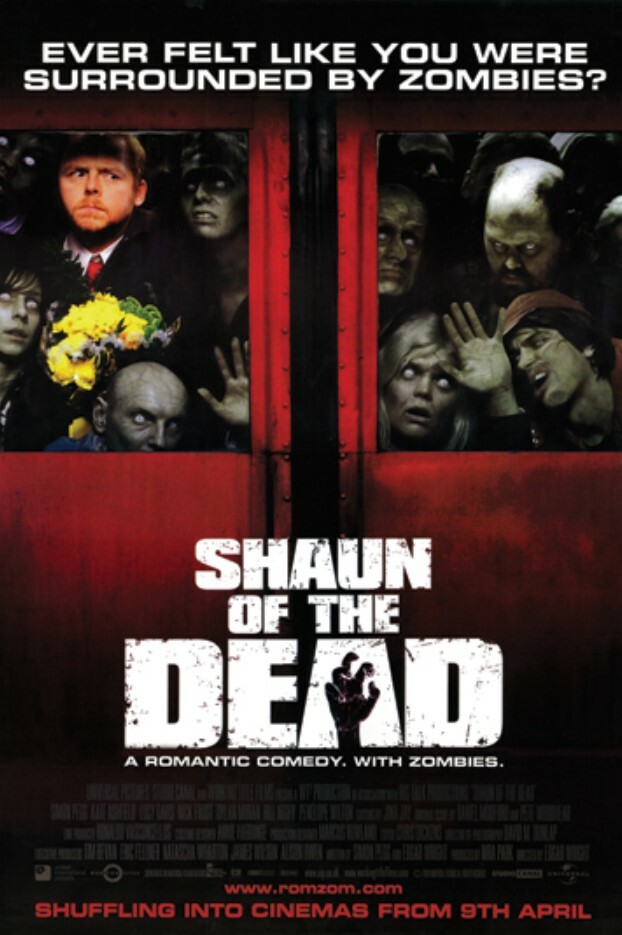
Shaun of the Dead (2004)

Because this is what it feels like going to WORK, amirite?

Edgar Wright’s comedic send-up of zombie movies has the perfect sense of scary and silly that you’re looking for. Shaun (Simon Pegg) is a retail jockey struggling with a girlfriend who wants more out of life than he seems willing to give, a mother whose husband he constantly clashes with, and a best friend who is enabling his arrested development more than anything else. He’s ALREADY living like a zombie even before the dead start to rise. Like a lot of the all-time great horror/comedies, Shaun works because the zombies themselves are played absolutely straight – nothing silly or goofy about them. The human characters, however, are funny and highly relatable. One could make an argument for virtually any zombie movie as being part of your Halloween rotation, but I’ve always felt that the more comedic ones fit in more with the fun of the holiday. And although there are plenty of zombie comedies out there, I don’t think it’s controversial to say that this is probably the best. It’s definitely the most iconic. Zombie costumes are easy, but cosplaying as the HERO of a zombie movie is often tough – they are, by the standards of the genre, usually kind of dull, generic, everyman types. But you can cosplay Shaun easily – a white shirt, crimson tie, a nametag, and a cricket bat are all you need. And make sure to get a little red on you.

Labyrinth (1986)

Where the hell is Fozzie?

Jim Henson’s fantasy film from 1986 may have flopped at the box office, but today the fans are devoted, dedicated, and legion. A young Jennifer Connelly plays Sarah, a teenage girl whose frustration at babysitting her infant brother inadvertently leads to his abduction by Jareth, the Goblin King (David Bowie). But Jareth offers her a chance to get him back – make her way to the Goblin City at the center of his remarkable Labyrinth before time runs out and she can take him home. The film is lavish and gorgeous. The characters, too, are memorable and loveable, with some of the finest work Jim Henson’s creature shop ever did. Even the bad guys have distinct personalities and witticisms that make them a joy to watch. And as the movie, technically, is all about monsters, it gives off those Halloween vibes any time of year.

There you have it, friends, a few non-Halloween flicks that you can throw into your rotation and feel perfectly seasonal. What are some of your favorites?

Blake M. Petit is a writer, teacher, and dad from Ama, Louisiana. His most recent writing project is the superhero adventure series Other People’s Heroes: Little Stars, volume one of which is now available on Amazon. You can subscribe to his newsletter by clicking right here. He’s also started putting his LitReel videos on TikTok. He didn’t mention the Munsters because lord knows he doesn’t feel like stirring up THAT can of worms yet again. The scars still haven’t healed from the last time. 

Geek Punditry #145: What Makes an Icon?

Matt Groening, creator of The Simpsons, famously said he believes one of the keys to an iconic cartoon character design is whether the character is recognizable just from their silhouette. Think about it – if you show pretty much anybody anywhere in the world the mouse-ear shape, they’ll instantly recognize Mickey Mouse. The same can be said for characters like SpongeBob Squarepants, Phineas and Ferb, Bugs Bunny, and a lot of the other cartoon all-stars. And Groening himself is legendary for utilizing this tactic with the signature nine spikes on Bart Simpson’s head or the trademark antenna on the top of Futurama’s robot character Bender Bending Rodriguez. But as insightful as this piece of wisdom is, I don’t think it applies only to cartoons. In truth, any truly great design should have elements that make it instantly recognizable. And with Halloween only three weeks away, this week I’m going to help you all make your costuming decisions by applying this reasoning to horror movie icons.

Of course, the silhouette isn’t the only thing that makes for a horror icon. There are several factors to take into consideration. The overall design, in addition to just the silhouette, needs to be memorable. The characters themselves should be interesting and unique. A character should be popular enough that people will recognize them and you won’t have to spend the entire Halloween party explaining what your costume is. And when you’re talking about Halloween costumes, above all else, they should be fun to play. So let’s go over some of the all-time great horror movie icons and see just how they stack up to this metric before you suit up for your Halloween party. 

Every one is a winner.

We’re gonna start old-school with the Universal Monsters. The great thing about these characters is that they are all INSTANTLY recognizable, even to children who were born 90 years after the movies were released and have never seen any of them. Characters like Dracula, the Frankenstein Monster, and the Invisible Man are all based on classic literature and are not Universal originals, but when you ask somebody to picture them, they invariably envision the versions popularized by Bela Lugosi, Boris Karloff, and Claude Rains, respectively. In fact, those designs are all copyrighted (at least for the next few years). If you were to make a movie about Frankenstein, you couldn’t give your monster the flattop or neck-bolts, because those are all owned by Universal Studios even though the monster himself isn’t. So these classic horrors all meet the standard of memorability and recognizability. The only caveat comes with the Mummy and the Wolfman. Although those are, of course, classic monsters, the designs here (while still amazing for the time) aren’t as immediately attributable to the Universal designs specifically. It’s very easy to mistake Im-Ho-Tep or Larry Talbot for a generic mummy or werewolf. And of course, there’s nothing wrong with being a generic werewolf. But if you want to be the Lon Chaney Jr. Wolfman specifically, you may need something like a silver wolf-headed cane as an accessory to drive the point home. 

I don’t think even a mother could love that face.

The 70s and 80s gave us our next great wave of horror movie icons, and many of them have persevered. Leatherface, the killer from Texas Chainsaw Massacre, was probably the first great iconic character of the era. He’s got an easily-identifiable apron, a mask made of human skin, and – of course – a chainsaw to whip around his intended victims. He arguably started the trend of slasher movie icons that would explode in popularity in later years. He wouldn’t necessarily be my first choice to cosplay as, however. To be blunt, his appearance is a lot scarier than some of his successors. That’s not always a deal-breaker, of course, but you have to consider your audience. I’m a dad, and if I’m going to any sort of Halloween event there’s a 99 percent chance that there will be children in attendance. Leatherface is immediately frightening in a way that even the likes of Freddy and Jason are not. Of course, if you’re going to an adults-only event or to something like a horror convention, that’s less of a concern, but you should always keep in mind who’s going to see your costume. There’s also his signature weapon to consider. Having a prop to use as part of your costume is a plus, but you have to remember that you’re going to be keeping track of the thing all night long. Do you really want to spend the entire party looking for places to put your chainsaw? 

Eh, my money is still on the Gorn.

Michael Myers from Halloween is a really simple costume – all you need is a jumpsuit and a mask. A bladed weapon is recommended, but optional. And that’s all it will take to be a character that 99 percent of people will recognize whether they’ve ever seen one of his movies or not. The question now becomes: how dedicated are you to staying in character? Michael is a silent killer. He stalks and he tracks you like an unstoppable monolith, and he never says a word. The closest thing you get to an emotion from him is when he tilts his head quizzically to look at the victim he’s just pinned to the wall. If you’re the type of costumer who enjoys not only dressing up, but also embodying the character that you’re playing (minus the actual murder part, of course), you have to be prepared to spend the evening being very restrained, slow, and deliberate with your movements. It’s not a dealbreaker, but you should definitely check if four out of five dentists recommend Michael Myers or somebody else.

“Yeah, I slept on Mario Lemieux’s couch for like six months after I got drafted…”

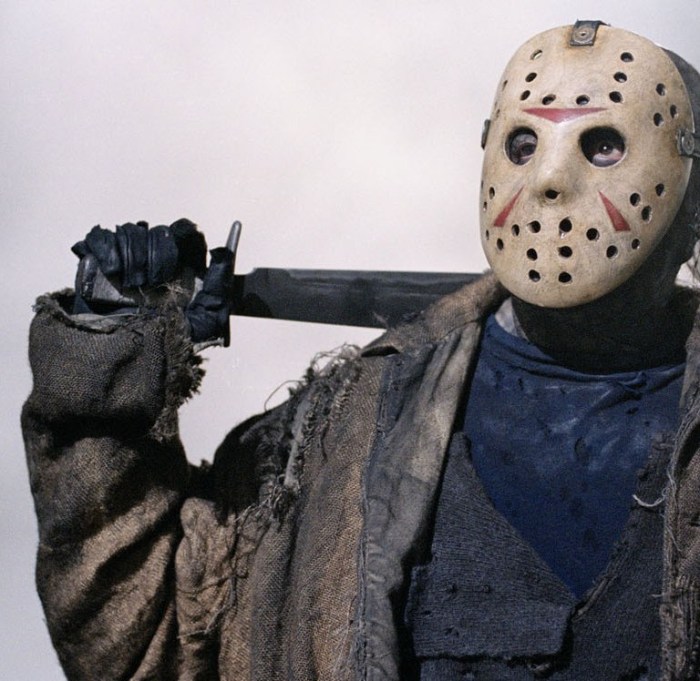
Jason Voorhees of Friday the 13th has a similar concern. Again, the costume is pretty simple – virtually any ragged, ratty slacks and shirt will be suitable as his clothing, and an easy-to-aquire mask and machete will complete the ensemble. And as far as iconic characters go, I would say that Jason is perhaps even more recognizable to the general public than Michael Myers is. Michael has a William Shatner mask that’s spray-painted white, but almost ANY hockey mask will evoke feelings of Jason. Like Michael, Jason doesn’t talk. Unlike Michael, though, he’s much faster and more brutal, expressing his emotion through his actions rather than words. It can be a fun part to play depending on how willing you are to commit.

The absolute worst dream analyst in the phone book.

The great slasher triumvirate is completed with Freddy Krueger of A Nightmare on Elm Street. Iconic, indeed. Everybody knows Freddy on sight, with his classic red-and-green sweater, fedora, and bladed glove. The tricky thing with Freddy is his face. The character is a burn victim, and although he’s so ubiquitous in pop culture that I don’t really have the same concerns about him being too scary for kids that I have with Leatherface, the burns present a different problem. You see, Freddy – unlike Jason or Michael – is a talker. His quick, dark sense of humor is integral to the character, and if you’re gonna dress up like Freddy you’re going to want to throw out bon mots all night long, with an emphasis on extra “bitch”es should you encounter anybody at the party dressed like Rick and Morty. If you wear a Freddy mask, though, that talkiness becomes more difficult and cumbersome. Wearing a rubber mask makes it more difficult for people to understand what you’re saying, and actually speaking under the mask increases the temperature beneath the rubber roughly ten degrees per “bitch.” If you live in a climate like I do in Louisiana, that ten degrees may be the difference between life or death. The alternative to a mask is makeup, which can be time-consuming, difficult to apply, and easy to mess up. Please understand, I’m not saying any of this to discourage someone from playing Freddy – I just want to point out some of the possible concerns that come with such a costume.

“Chuck, look, I’ve thought it over and… well… I’ve decided that, no, I do NOT want to play.”

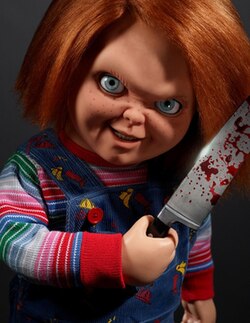
The last great slasher icon of the 80s is probably Chucky from the Child’s Play franchise. When my son was five years old, we took him to Spirit Halloween and we toured all the costumes before finally asking him which one he wanted. He jumped in delight and exclaimed “CHUCKY JUMPSUIT!” I actually took out my phone and recorded him saying it because I knew nobody would ever believe he picked it on his own.

My wife Erin and I are both horror movie fans, but we’re not idiots – our five-year-old son had never seen any of the Child’s Play movies, and the 8-year-old he is now STILL hasn’t seen any of them. But that doesn’t matter – Chucky is one of those ubiquitous characters that even kids recognize. His bright blue overalls and multicolor sweater, a shock of red hair, and freckles across his nose all give us a nice, friendly image that kids enjoy. That is, of course, the point of the character – he’s a child’s doll that is possessed by the spirit of a serial killer, so of COURSE his image is something that would be appealing to children. However, this also leads to a problem: it’s hard to wear this costume as an adult without coming across as creepy, and not in the right way. Five-year-old Eddie was the most adorable little serial killer ever, but if a 35-year-old puts on the jumpsuit, he needs to be DARN sure he’s got a receptive audience before he shows up, or he’s going to be getting strange looks all night.

Still groovy after all these years.

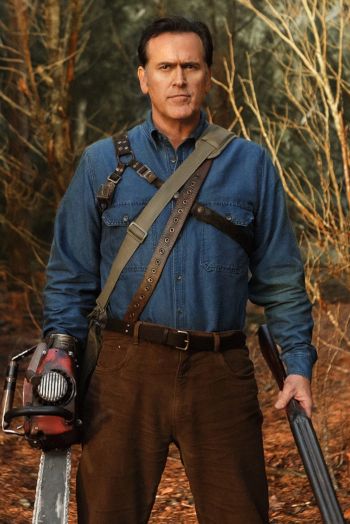
Not every horror icon is a villain, of course. Ash Williams, Bruce Campbell’s hero from the Evil Dead franchise, is another solid costume choice. Most of the costume is relatively simple too – slacks, a blue shirt, a bandolier, and some blood splattered across your face. The most iconic part of Ash’s appearance, though, is the most difficult: in Evil Dead 2, Ash’s hand becomes possessed by a Deadite and he is forced to amputate it, then top off the stump with a chainsaw. Now you’ve got all the same problems as cosplaying Leatherface with the added difficulty of finding a way to keep a chainsaw attached to your hand all night. Alternatively, you could go with Ash from the third film, Army of Darkness, in which he replaces the chainsaw with a mechanical hand. It’s certainly easier than the chainsaw, but it’s FAR less iconic and less likely to be recognized. And honestly, even WITH the chainsaw, Ash doesn’t have the cultural penetration of a Freddy or a Jason. If you’re wearing the costume to a horror convention, people will know you immediately, but for the office Halloween party, be prepared to explain your costume over and over again. 

Greenscreen backdrop of an 80s New York skyline sold separately.

Of course, as far as 80s monster movie heroes go, there’s nothing more iconic than the Ghostbusters. This has become a classic choice for a Halloween costume because it ticks all the boxes: it’s simple, it’s recognizable, and it’s fun. You need two things: a jumpsuit with a Ghostbusters patch and a name tag, and a proton pack. The jumpsuit is readily available in any costume shop and easy to make if you’re so inclined. The proton pack is more difficult, but there are inflatable ones that are lightweight and are usually included with commercial costumes, or more expensive and detailed ones that you can buy or assemble yourself. It’s also a highly adaptable costume. There are the classic khaki jumpsuits from the first movie, the gray variants from Ghostbusters II, the 2016 jumpsuits, multicolored costumes from The Real Ghostbusters cartoon, the red parkas from the Frozen Empire movie, versions from other cartoons, video games, toys…the list goes on. And fans often come up with their own original variants and designs. In fact, similar to the 501st Stormtrooper Legion (a Star Wars fan collective that has expanded far beyond just cosplay to things like public appearances and charity work), there are Ghostbusters chapters all over the world of fans who enjoy this sort of thing. I don’t have the time, talent, or money to be a really good cosplayer, but I’ve always said that if I DID have the opportunity to join such a group, it would be the Louisiana Ghostbusters.

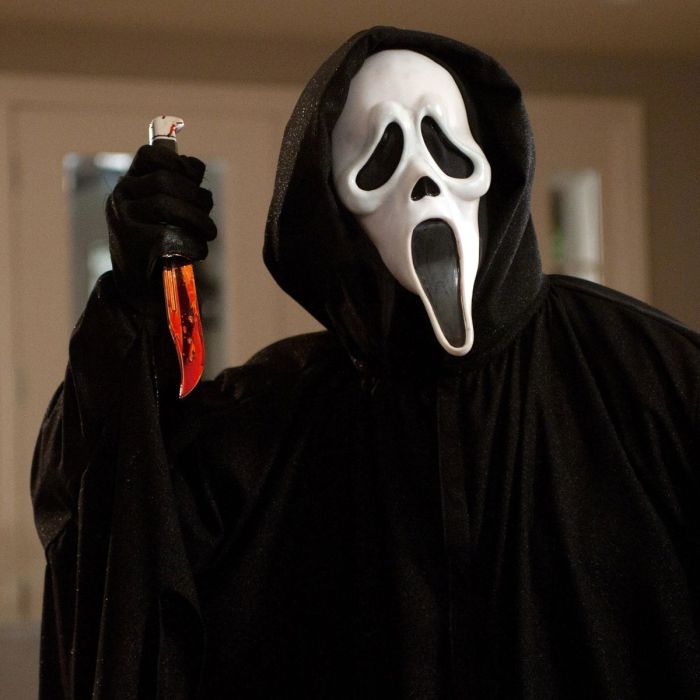
“Stabbity-Stab-Stab-Stab!” -Ghostface in Scream 7, probably.

Moving on from the 80s, let’s look at the most iconic horror character of the 90s: Ghostface. The killer from the Scream movies is unique in that the costume is the only constant – a different set of villains wears it in every movie. In fact, over the six Scream movies to date, over a dozen different characters have donned the mask to engage in murderous shenanigans. But this lack of uniformity hasn’t been an obstacle for Ghostface becoming an icon – in fact, it’s probably the STRENGTH behind it. More so than any other character, anybody can wear the Ghostface mask.

It’s also unique in that the costume itself didn’t actually originate with the movies. It was part of a line of Halloween masks produced by a company called Fun World. Director Wes Craven liked the mask, put the character in black robes, and entered into a licensing deal with Fun World that has had them rolling in cash for nearly 30 years now. Not everybody may know the name “Ghostface,” of course, but we all recognize “the guy from Scream.” A few weeks ago my sister told me that my 11-year-old nephew – who is even less likely to have seen the movies than my 5-year-old was, because my sister is NOT a horror fan – has declared his intention to be Ghostface for Halloween this year. I’m very proud as an uncle and I can’t wait to see him when my sister and I take our kids trick-or-treating together. I just wish the boys had collaborated on being movie killers in the same year, because that would have been cute. (Eddie isn’t going as a murderer this year – he wants to be Superman. This is the proudest moment of my entire life.)

Since the turn of the century there have been several efforts at creating new horror icons. And while characters like Victor Crowley of the Hatchet franchise, Trick ‘r Treat’s Sam, and Leslie Vernon of the woefully underrated Behind the Mask are great and have many of the trademarks that make for a classic icon, the only recent monsters that have reached the degree of cultural penetration that the classics enjoy are a pair of clowns. 

Nope, no nightmare fuel here.

In 2017 we got a theatrical version of Stephen King’s It. The first dramatization of It, a TV miniseries from 1990, featured Tim Curry as Pennywise the Clown, and he was magnificent. Curry in general is magnificent, of course, and his makeup as Pennywise is suitably creepy when Tim Curry is wearing it. But Bill Skarsgard from the 2017 version – let’s be honest here – has broken into the mainstream in a way that Tim Curry’s never quite did. The design of the makeup is creepier, and Skarsgard’s performance is unsettling in a more insidious way. A lot of people would recognize you if you dressed as Tim Curry’s Pennywise, but EVERYBODY recognizes the Skarsgard version. Either version is relatively easy to cosplay – you need the costume and the wig, which are readily available. Skarsgard’s makeup is more complicated, though, and if you don’t want to subject yourself to the same masking problems you’d have with Freddy, make sure that you – or someone you trust – is capable of making that transformation.

Llllllllllllllllllladies.

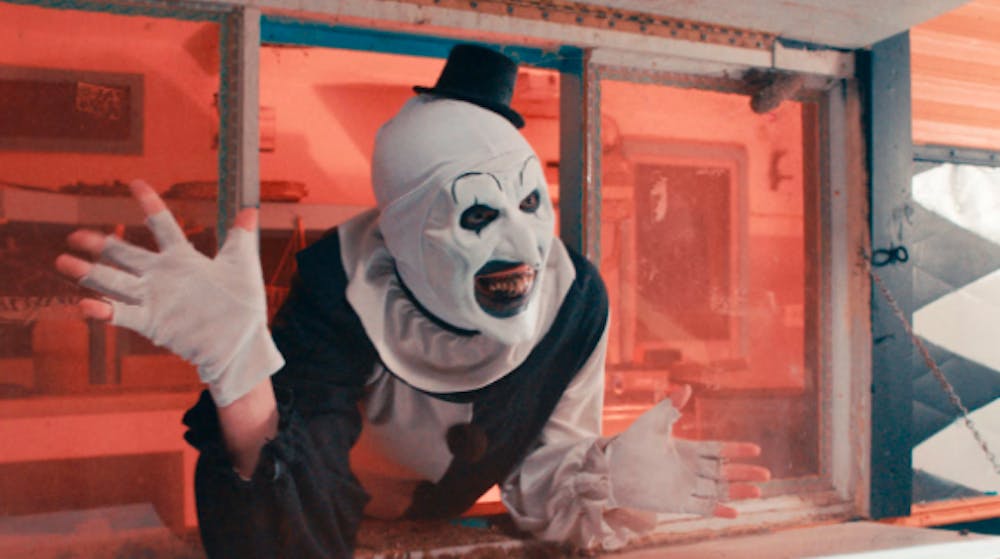
The most recent character to break into the echelon of horror icons, though, is probably Art the Clown of the Terrifier franchise. Art was originally played by Mike Giannelli in a series of short films and anthology segments, but Giannelli retired from acting and the role was taken over by David Howard Thornton for the first full-length Terrifier film in 2016. A malevolent clown with a stark black-and-white costume and makeup that is immediately recognizable, Art has risen to iconic status faster than anybody since Ghostface. As far as horror icons go, Art is perhaps the darkest, most brutal, most sadistic character ever to crack into the public consciousness. He’s more violent, more aggressive, and while the voiceless beast DOES still have a sense of humor, it’s so dark that it makes the likes of Freddy Krueger look like an episode of Bluey by comparison. 

Naturally, he’s become a huge favorite among horror fans. 

In terms of costuming, again, Art is relatively easy. Costumes and masks are available, and since Art doesn’t talk you don’t have to worry about being muffled. On the other hand, makeup is more expressive and less restrictive than a mask, so if you’ve got the skill (or someone with the skill to help you) I would always prefer the makeup approach. Something else to consider is that Art – while huge among horror fans – is not necessarily someone that the average person on the street will recognize, at least not YET. On the other hand, even if your audience doesn’t know ART the Clown, the general appearance of the character is more than sufficient to give the idea that this is NOT a funny clown, and the mystique is preserved.

There are plenty of other characters that we didn’t quite touch on, of course, and you should always go with whatever is comfortable and fun for you. Hopefully I’ve given you a few tools you can use to evaluate your own costume choices when you’re making the decision. You’ve got three weeks left, folks – get started.

Blake M. Petit is a writer, teacher, and dad from Ama, Louisiana. His most recent writing project is the superhero adventure series Other People’s Heroes: Little Stars, volume one of which is now available on Amazon. You can subscribe to his newsletter by clicking right here. He’s also started putting his LitReel videos on TikTok. Since Eddie is Superman this year, he’ll be wearing his own Kryptonian pajamas come Halloween night. Scary can wait. 

Geek Punditry #90: The Mount Rushmore of Monsters

Yesterday, September 19, when I got home from work, my wife was ready and waiting for something we’ve been looking forward to for months: putting up the Halloween decorations. Oh I know, some people may scoff. Some may say it’s too early. Some may say that preparing for Halloween before October is a terrible breach of seasonal etiquette. To these people I say, bite my gourd. Halloween is one of my favorite times of the year, and I’ve been waiting for this day since I went back to work from summer vacation on August 1. It is well past time, as far as I am concerned.

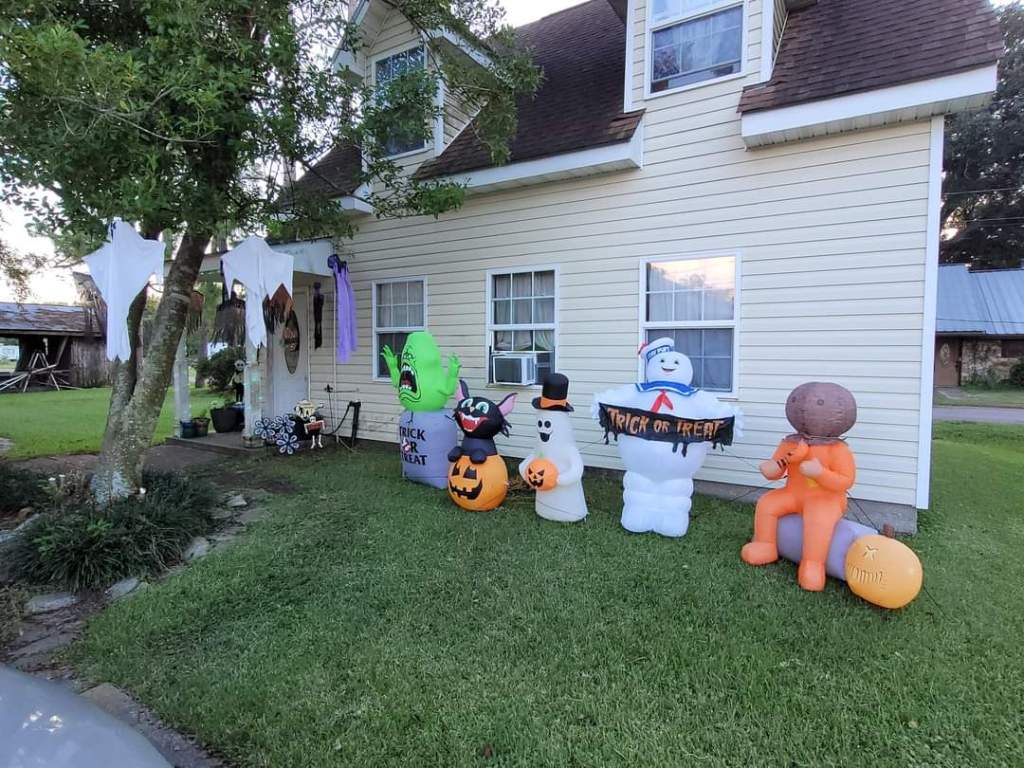
Our decorations aren’t terribly complex, because we can’t afford anything terribly complex. Nor are they terribly scary, because we have a seven-year-old and we don’t want to give him nightmares. But Eddie does love monsters and creepy crawlies, so we’re not above hanging a few ghosts from the trees, wrapping the posts in front of our door with LED lights, and setting up inflatables of the likes of Slimer and the Stay-Puft Marshmallow Man. We’d have more if we could, but we’re happy with what we got.

Pictured: Not Complex Decorations

As we were decorating, though, I started to think about just which horror icons I would adorn our home with if money was no object. If I could grab the icons of terror from any time period, who would they be? In short, what creatures belong on the Mount Rushmore of Monsters?

It was honestly too hard to narrow down all the different monsters from throughout history to a simple quartet, so I decided instead to do three different mountains dedicated to three different eras: the Universal Monsters, 80s Slashers, and 21st Century Terrors. Obviously there are plenty of other ways I could subdivide things, but restricting myself to these three keeps me from going overboard (and gives me an excuse to return to this topic later, should I so choose). 

I’m making my decisions based on how iconic I think the monsters are – how far have they come in terms of penetrating popular culture? For example, no matter how good a movie I think Behind the Mask: The Rise of Leslie Vernon is (and it IS a GREAT movie, and you should all watch it) the fact that he’s kind of faded away since then is going to keep Leslie off the list.

But enough of that. Who HAS made the cut?

Universal Monsters

Universal Studios didn’t invent the horror movie, and in fact, most of their iconic creatures came not from them, but from the annals of public domain. That said, when people think of these classic monsters, the average member of the public is picturing the versions that came from the Universal monster flicks. The Universal Monsters are still known worldwide, a valuable brand that even kids will recognize without ever having seen a single one of their films. Their versions of Dracula, Frankenstein, the Wolfman, the Invisible Man, and many more are absolute legends. How in the world do you narrow it down to just four?

Well, you do it by deciding which ones are the MOST iconic, which ones are known by EVERYBODY – even people who hate monster movies or don’t like Halloween. And for that reason, I think the first two spots have to go to the Frankenstein Monster and his lovely Bride, as portrayed by Boris Karloff and Elsa Lanchester, respectively. Karloff wasn’t the only actor to play the creature for Universal (Lon Chaney Jr., Bela Lugosi, and Glenn Strange each had turns as well), but he was the first and there can be no denying that he was the most memorable. It’s his picture that you see on the merch, his face that the Halloween masks are based on, and his rendition that has informed pretty much everything from his three successors to Frankenberry cereal. As for the Bride, despite the fact that she only appeared in the one film – and only in the final scene of the movie at that – she has become as iconic as the Monster himself. The tall hair with the white streak, the bandage-wrapped body draped in gossamer, and Lanchester’s wide eyes and legendary scream have earned a permanent place in pop culture.

“Still a better love story than–” Ah, you know the joke.

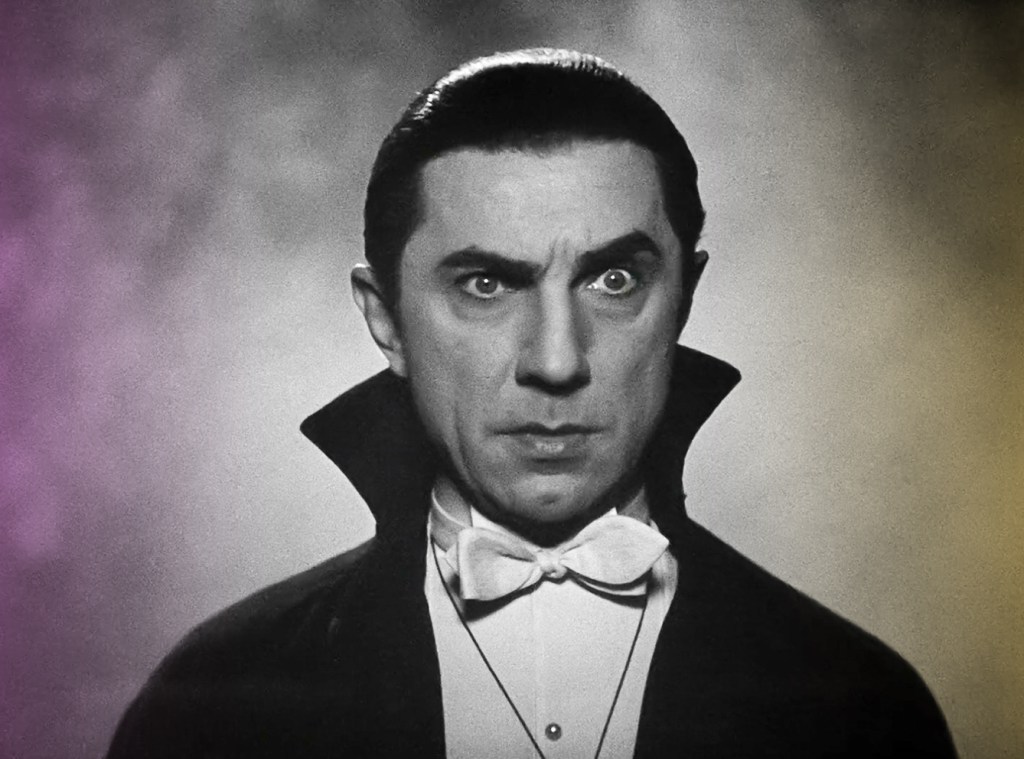
Spot #3 on the mountain couldn’t possibly be given to anybody but Bela Lugosi as Dracula. People don’t often realize that Lugosi only played the count twice, in the original 1931 Dracula, then not again until 1948 in Abbott and Costello Meet Frankenstein. But like Karloff’s Frankenstein Monster, his is the most recognizable version of Bram Stoker’s bloodsucker. Everything we accept about Dracula’s hairstyle, his clothes, and his accent (a remnant of Lugosi’s own Hungarian background) come from this version of the creature. Even today, when you watch a Hotel Transylvania movie, it’s Lugosi that Adam Sandler is doing a parody of. Like Karloff, his depiction of the monster is so famous that anybody who tried to do a novel-accurate version of Dracula would probably be met with confused looks as people asked why the hell he has a mustache.

“Sometimes I do, in fact, say ‘Blah, blah, blah’.”

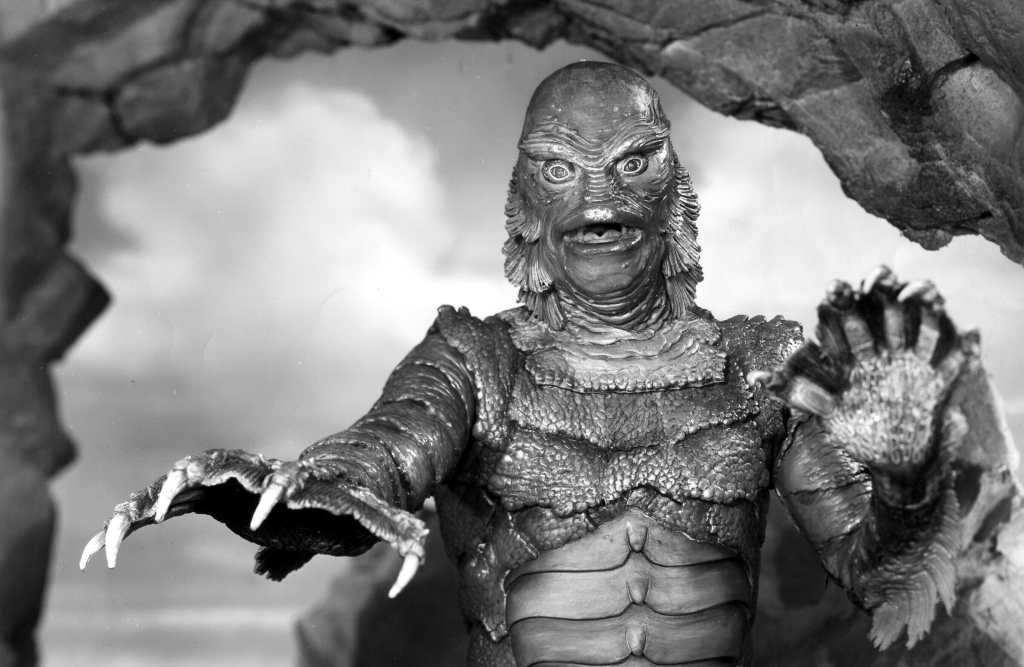
And then there’s the final spot and…guys, this is hard for me. REALLY hard. Not because there isn’t an obvious choice, but because it means I’m going to have to sideline one of my favorites. I love Lon Chaney Jr. as the Wolfman. I think he’s got some of the best, most nuanced performances in the entire Universal monster canon, and if this mountain was just my favorites, he’d be right up there. But in terms of how ICONIC he is…well…there are a lot of werewolves in movieland, and he doesn’t quite have the complete dominance over his version of the monster that Karloff and Lugosi do. But you know which monster IS instantly recognizable as the one and only Universal creation? The Creature From the Black Lagoon.

He’s not my favorite of the monsters (in fact, a few years ago I actually ranked him as my LEAST favorite of the iconic Universal Monsters), but EVERYBODY knows the Creature. And since this is the only iconic Universal Monster that is a wholly original creation, not based on an existing book or folklore, there’s not even any real competition for him to have to crush. He’s the one and only. (Although the most famous knock-off happened to win the Academy Award for Best Picture. Go figure, Universal exec who turned down Guillermo Del Toro.)   

And he never needs a moisturizer either. Guy is legit.

80s Slashers

It has been said by many a horror fan that the slashers of the 80s are the spiritual successors to the Universal Monsters. Granted, they’re far gorier and less kid-friendly than the classics; I’ll sit down and watch a Universal classic with my son, but we’re not going to be sharing a Nightmare on Elm Street marathon any time soon. But at the same time, many of these creatures have achieved the same level of cultural awareness as the creatures of the golden age of cinema. In other words, although not everybody may have watched all of – or ANY of – the Friday the 13th movies, I don’t think there is anyone in the western world who can see somebody wear a hockey mask and pick up a knife without thinking, “JASON!”

Which is why, by the way, he gets the first spot on the 80s Mount Rushmore. Jason Voorhees is synonymous with slasher movies. Even though he wasn’t the bad guy in the first movie and he didn’t get his iconic hockey mask until the third, the version of Jason we’ve had since then has made his mark on our culture. It’s a go-to Halloween costume for bigger dudes (guilty) because it’s so simple – the mask, a weapon, some old clothes and everybody knows who you are. He’s a lumbering monument to the iconic nature of the 80s slasher. Also, the question of which version of Jason is most iconic is largely moot, since no matter who plays him, the mask makes him look pretty much the same. Besides, the best one was Kane Hodder and you know it. 

The downfall of the summer camp industry began here.

Next to him will be his one-time sparring partner, Freddy Krueger, and this time the creature IS permanently associated with one actor, Robert Englund. (Jackie Earle Haley played him in the Nightmare on Elm Street remake, and although I don’t think anyone really blames that movie’s failure on his performance, it’s still a version we’d rather forget.) In an era where most of the slasher icons were silent killers – hulking brutes who were just as capable of breaking your bones as slitting your throat – Englund’s Freddy is svelte, agile, and with a wonderfully wicked sense of humor that has made him as beloved in the real world as he is terrifying to the teens of Elm Street. Even before the two characters faced off in the movie Freddy Vs. Jason, people would often say their names in a single breath as the two most well-known movie monsters of the era.

The only guy on this list to have recorded a song with Will Smith.

The third slot belongs to another quiet killer, Michael Myers from the Halloween franchise. (I know, the first movie came out in 1978, but he’s part of that 80s echelon of horror regardless.) Like Jason, many actors have played the role, but unlike Jason I don’t know that there’s necessarily a consensus as to who did it the best. That said, the creepy killer in a William Shatner mask painted white is indelibly linked to the holiday of Halloween. If you weren’t afraid he might stick a knife in their stomach, you might be sending your kids to sit on his lap for a picture like we do Santa Claus and the Easter Bunny. Jason and many other killers over the decades have taken their cues from John Carpenter’s creation, and few have done it better.

The original strong silent type.

The fourth spot is a little tougher this time. There’s an argument to be made for Leatherface, gruesome titan of the Texas Chainsaw Massacre franchise, but A) only ONE of his films actually came out in the 80s, and B) I don’t think he’s nearly as recognizable to the general public as Freddy, Jason, or Michael. But you know who is? CHUCKY. 

“Chucky, I appreciate your offer, but I’ve considered the situation and…well…I have decided that I do not, in fact, ‘wanna play’.”

Charles Lee Ray, the bloodthirsty serial killer played by Brad Dourif who has possessed the body of a child’s “Good Guy” doll and, in the process, made us all afraid of our kid’s toys, has earned his spot on my Mount Rushmore. Okay, only one of Chucky’s movies (the original Child’s Play) came out in the 80s, but he’s a MUCH more recognizable figure than Leatherface. In addition to his film series, he’s the star of a TV series that is currently on the air and – let’s face it: the merch. Chucky’s as much a brand as he is a character at this point. Everybody knows who he is and what he looks like, and the name “Chucky” is now permanently associated with a red-haired pint-sized whelp who brings chaos and despair in his wake, although part of that may be attributable to the cartoon Rugrats. 

21st Century Terrors

This last mountain of mine is going to be the most challenging, mostly because the pop culture penetration part is a little harder to say for sure with modern monsters. Lots of things are popular when they’re NEW, but will they still be instantly recognized 40 to 90 years later like the monsters I’ve talked about already? Only time will tell. That said, these are the four that I would currently put on the mountain, based on how popular they are NOW and how popular I think they are likely to remain. I’ll go in chronological order of their first films for this batch.

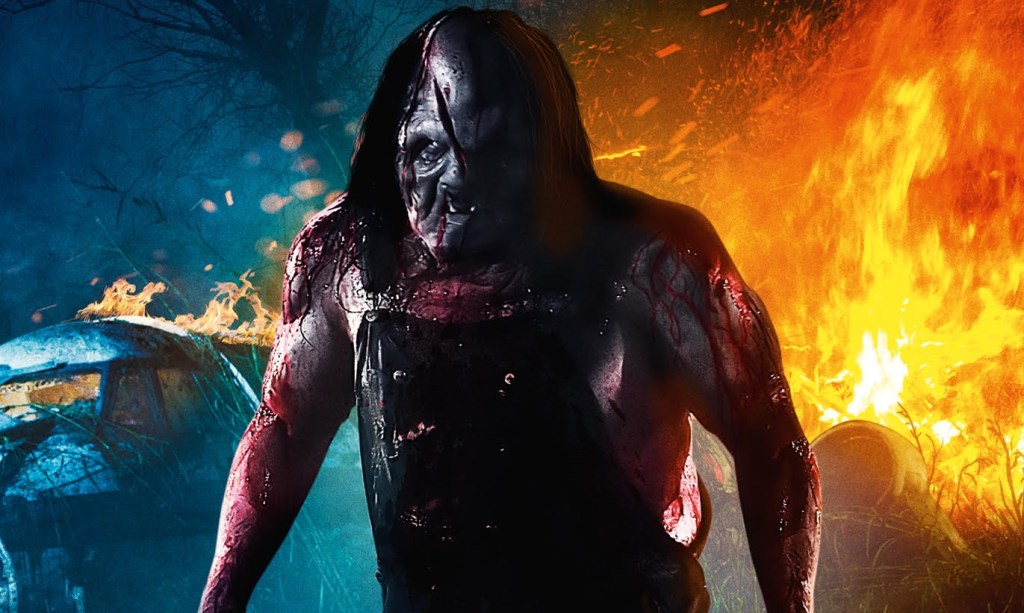
First up is Victor Crowley, the hatchet-wielding killer of Adam Green’s…well…Hatchet series. Victor is a good ol’ Louisiana swamp boy, accidentally killed by his own father as the result of a cruel Halloween prank gone tragically wrong and transformed into a murderous, vengeful spirit that allows no one to leave his home in Honey Island Swamp alive should they be so foolish as to venture there after dark. 

“No, Victor, you’re still a…a handsome young man…”

I admit to a little bias on this first choice – I’m a big fan of Adam Green and his work in general, so I’m always ready to promote it a little bit. Regardless, I think Victor (who has ONLY been played by Kane Hodder) is highly deserving of this spot. The first Hatchet movie, in 2006, came at a time when virtually all horror was a remake or reboot, either of an older franchise or of a Japanese horror film. Green had the guts to come out with an 80s-style slasher in a time when they weren’t in vogue and created a popular, beloved franchise. It’s been a few years since his last outing (in 2017’s Victor Crowley) but he’s still filling toy stores and turning out new comic books from American Mythology, keeping him alive until Green and Hodder are ready to polish up their hatchets and bring him back to the screen.

Next, from 2009, I’m picking Sam from writer/director Michael Dougherty’s anthology film Trick ‘r Treat. This is one of my favorite Halloween movies, an annual must-watch featuring four delightfully scary stories that all center around the same small town on the same Halloween night, with the diminutive orange-and-burlap clad creature called Sam serving as the common element to all four of them. The movie has a highly devoted fan base, and every few years we get our hearts broken all over again as news of a sequel is announced and then, sadly, nothing happens. Despite that, though, Sam has only become more and more popular as an icon, with costumes, decorations, and toys filling the shelves of a Spirit Halloween near you even as we speak – and really, is there a better measure of an iconic monster than that?

The cutest lil’ lunatic of the season.

The psycho that gets the third spot comes from 2016’s Terrifier by writer/director Damien Leone: Art the Clown. (And let me just say for the benefit of those readers who happen to be my wife that I intended to include Art BEFORE you looked over my shoulder and saw the title of this column and said, “You better include Art the Clown.” You’re welcome.) Art actually appeared in a couple of short films and the 2013 anthology All Hallow’s Eve, played then by Mike Gianelli. But it wasn’t until the 2016 Terrifier, when David Howard took over the role, that the character really started to get stratospheric popularity.

If you weren’t scared of clowns already, this guy will change that.

What is it, exactly, that makes Art so creepy? I suppose part of it is just our cultural fear of clowns, which has only gotten worse in the last decade. Part of it is the unnerving design of the character and his ghastly makeup. But a lot of the credit has to go to Howard’s performance. His Art is lithe, quiet, menacing, and probably the single most brutal horror to yet appear on my list. Seriously, if one of my Mount Rushmore Monsters was coming after me, there’s nobody I’ve mentioned that I would be more disturbed by than Art the Clown. Art, like Sam, has begun to ascend that Mount Rushmore of Merchandise as well, with costumes, decorations, and tchotchkes appearing everywhere this Halloween season in anticipation of the upcoming Terrifier 3 which, amusingly enough, is going to be a Christmas film. My wife got a stuffy of him when we made our first Spirit trip this year. It’s adorable.

The last monster on my last mountain? It’s going to be a controversial choice, I know, but I challenge anyone to make an argument that Bill Skarsgård’s rendition of Pennywise the Dancing Clown doesn’t belong there. Like Art, the villain of Stephen King’s It has that creepy vibe to him, but unlike Art, he’s a chatterbox. He’s as likely to talk the terror into you as he is to jump out from a closet. Whereas Art is an anomaly, a creature of unknown origins who is all the more horrible for it, we know what the deal is with Pennywise. He’s a nightmare out of time, a beast from another universe that preys on our fears and surfaces every 27 years to do so. And Skarsgård is flawless in the role – sly, charming, compelling, and an absolute terror every second he’s on the screen.

This is the guy who WOULD say “yes,” when Chucky asks if he wants to play.

I know some of my Stephen King purist friends will turn on me for this one. And look, I love Tim Curry as much as anybody. But he’s be honest here, Skarsgård’s version of the character has completely eclipsed Tim Curry in terms of cultural awareness. Children of the 80s and 90s remember Curry as Pennywise, but if you ask anyone who didn’t see that miniseries in their formative years, the vision of the character they come away with is Bill Skarsgård. 

And damned if I don’t think he earned it.

There you have it, friends, three Mountains of Malevolence. But lists like this one are intended to INSPIRE discussion, not settle a debate. So tell me, who would YOU put on each of those mountains? And what other mountains would you build? Let me hear all about your Quartets of Corruption! 

Blake M. Petit is a writer, teacher, and dad from Ama, Louisiana. His most recent writing project is the superhero adventure series Other People’s Heroes: Little Stars, volume one of which is now available on Amazon. You can subscribe to his newsletter by clicking right here. Other mountains he considered were Hammer Horror, Final Girls, Horror Heroes…ah well. Next time. 

Geek Punditry #41: Playing Favorites With Horror Movies (Part Two)

Horror Without a Death

Last week, in a column that has been-fast tracked for the 2023 Pulitzer Prize for Blog Posts about Horror Movies (probably not a real thing) I asked my friends on social media to give me suggestions for categories of horror. I would then report back on your suggestions here and talk about some of my favorites in each category. I got a lot of great suggestions – so many, in fact, that I couldn’t fit them all into a single column. So buckle in, my friends, it’s time for Week Two of Playing Favorites With Horror Movies!

Horror Without a Death

Duane Hower came at me with one of the toughest suggestions of the whole batch: what’s my favorite horror movie in which NOBODY DIES? (And a note here – just the fact that a movie can be mentioned in this category qualifies as a spoiler, so if you’re squeamish about that sort of thing, you may want to hop down to the next category.) 

It was tough, guys. There aren’t that many films that meet the criteria – after all, the point of horror is to instill fear, and that inherently brings with it the fear of the void. There are plenty of horror/comedies that fall into this category, sure, but straight horror? It’s not easy to find good examples.

A few eventually came to mind. Poltergeist is about a family that moves to a new home only to discover malevolent spirits already inhabit their dwelling. The Others is about a family that moves to a new home…only to discover that malevolent spirits already inhabit…okay, there’s a pattern. But 1408! That mixes it up! That’s about a travel writer who gets a hotel room! And finds that malevolent spirits inhabit the dwelling. 

“I see dead people. Not fresh ones, though.”

Still, these are solid films where nobody dies (well…depending on which cut of 1408 you watch). The thing is, they’re also all ghost stories. And ghost stories rock, don’t get me wrong, but they’re stories about somebody who has already died. Can I count them in this category, just because the deaths in question happened before the movie began?

If I rule out ghost stories, the pool gets even shallower, but there are still a few tasty fish in it. Tod Browning’s Freaks from 1932, for instance. The director of Bela Lugosi’s Dracula followed it with this movie about performers in a circus sideshow and an unscrupulous woman who plans to take advantage of them to seize an inheritance one of them is due to collect. The movie is pretty wild, and was so controversial at the time that Browning’s career was essentially destroyed. But nobody dies in the film…although by the ending, there’s someone who may wish they were dead.

I also need to give credit to One Hour Photo, a thriller starring the late, great Robin Williams. Williams plays a man who works for one of those one hour photo development labs (kids, ask your parents) and becomes dangerously obsessed with one of the families whose film he processes. Williams, of course, was a legend for his comedic roles, and often showed his dramatic chops as well in movies like Dead Poets Society and Good Morning, Vietnam, but this is the only movie I can think of that showed how outright SCARY he could be when he set his mind to it. The man was a unique and priceless talent, and I feel like this is a movie that doesn’t get talked about enough, possibly because the entire premise is centered around a piece of late 20th century culture that doesn’t really exist anymore.

Hammer Horror

My old buddy Eric LeBlanc wanted to know what my favorite movie was from the Hammer Films catalog. In the 1950s, after Universal Studios quietly put an end to their monumental run of monster movies, Britain’s Hammer Films saw an opportunity to fill the void. Not only did they start pumping out horror movies at a pace that would have made Carl Lammle Jr. pick his jaw up off the floor, but they did so by borrowing a heck of a lot of the goodwill that Universal had built up, using the same public domain creeps like Frankenstein’s monster, vampires, mummies, and werewolves. 

I never got quite as deep into Hammer as I have into the Universal library, but I’ve seen a lot of their films and I definitely have my favorites, the top being 1958’s Horror of Dracula (or sometimes just Dracula). Incredibly stylish and colorful, the movie is also a bit more faithful to the original novel than the Universal version. Plus it has two of the giants of horror in some of their best parts: Christopher Lee as Count Dracula and Peter Cushing as Van Helsing. Lee is creepy and charming, and the only reason he’s not considered the definitive version of Dracula is that Bela Lugosi beat him to it. And Van Helsing? Sorry, Hugh Jackman, but Peter Cushing owns that role. 

The HORROR…of a world without photoshop.

Stephen King Adaptation

Rachel Ricks played right into my hands by asking for my favorite Stephen King adaptation.

Project ALF.

Iiiiiiiit’s baaaaaaaaack!

As anyone who has read this blog for more than a day knows, I’m a huge fan of Stephen King’s books…but what about his movies? There have been over 200 adaptations of King’s novels and short stories (I checked IMDB), so which one is the best? Truth is the really great ones aren’t actually horror movies: The Shawshank Redemption, The Green Mile, and Stand By Me are some of the best films ever made based on King’s work, but none of them qualify as horror. When you get into the scary content, the sad truth is that a lot of the adaptations are sub-par. (I mean…have you SEEN Maximum Overdrive? Whoever directed that movie doesn’t seem to have the slightest idea what Stephen King is all about. It’s like he was on cocaine or something.)

That said, there are SOME good horror movies based on King’s work. Many people would point immediately to The Shining, but I’m not among them. Look, it’s a good movie, but as an adaptation of King’s book it is terrible. I’d rather focus on movies that DO adapt the books more or less faithfully.

I already mentioned 1408 earlier, and I’d place it close to the top of this list. At the VERY top, though, would be Misery, the James Caan/Kathy Bates adaptation about a writer (it’s a Stephen King movie, of COURSE it’s about a writer) who gets in a terrible car accident only to be saved by his biggest fan. As he begins to heal, though, he discovers that he may have been better off in the wreck. 

Some people, however, would classify Misery more as a thriller than a horror movie, so for those who like to split hairs, let’s talk about The Mist. A mysterious fog full of murderous monsters rolls over a small town, trapping dozens of people in a supermarket. The adaptation is solid, but what really elevates it is the ending. Frank Darabont, who wrote and directed this film (and Shawshank and The Green Mile, so you see his pedigree) changed the ending of the story, something that I usually find outrageous. But the ending he put on was so shocking and dark that even Stephen King himself says he prefers it to the original. 

And I’ve got to give credit to It. I consider this one of King’s best novels – perhaps THE best Stephen King novel – and we’ve gotten TWO pretty good adaptations. The original miniseries from the 90s did the best it could on network television, and Tim Curry is iconic as Pennywise. But in 2017 we got a fantastic adaptation of half of the novel, with Bill Skarsgard taking Pennywise and making him his own. Admittedly, It Chapter Two from 2019 didn’t quite live up to the first part, but you can watch the first part on its own and get a solid, satisfying story. It’s darn near perfect.

It’s good to be the King.

The Wonderful World of Disney

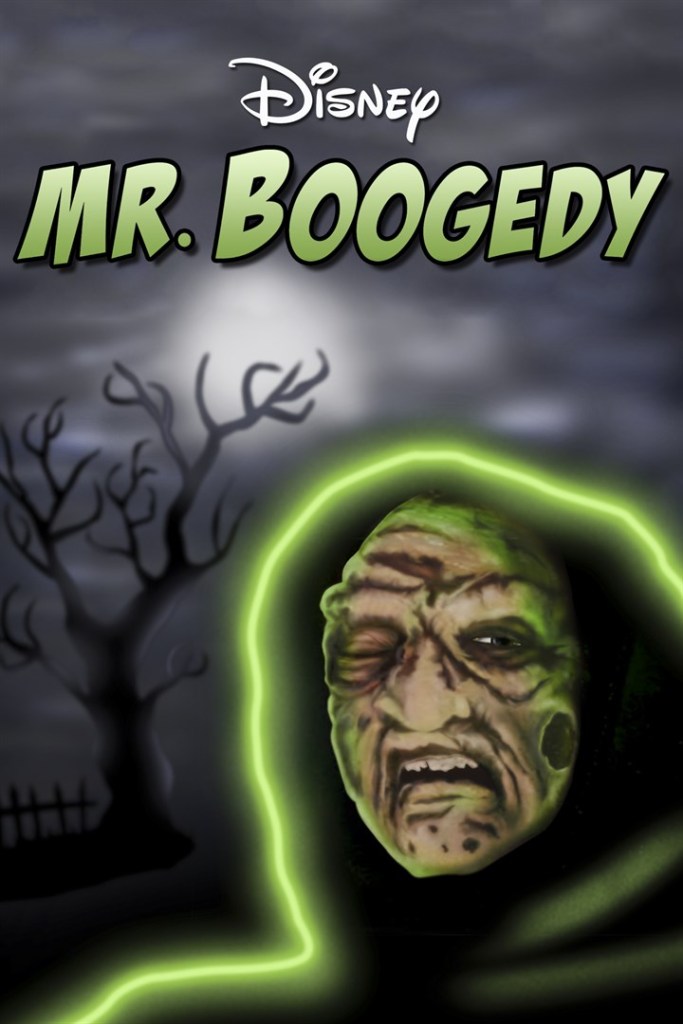
Ryan Tait gave me a category I NEVER would have thought of, but absolutely love: my favorite Wonderful World of Disney Halloween movie. Back in the day, before even the Disney channel, Wonderful World was a delightful showcase for Disney content of all stripes, and some of those made-for-TV movies still hold a warm place in my heart today. My favorite for this category is going to both show my age and make a lot of people wonder what the hell I’m talking about, but I have a deep abiding fondness for the 1986 film Mr. Boogedy.

From the studio that brought you Old Yeller.

A novelty salesman and his family move into a new house that turns out to be haunted (SO MANY of these movies are about people who move into haunted houses, and there are some downright unscrupulous realtors out there) by both some kind ghosts who have been trapped there and by the malevolent spirit who has kept them prisoner. It’s a silly, cheesy movie, but it’s so much fun. And the cast has a great pedigree. Richard Masur of the 90s It, a pre-Buffy the Vampire Slayer Kristy Swanson, a pre-Married With Children David Faustino, and young Benji Gregory, on the cusp of superstardom for his role on the sitcom…not making it up this time…ALF. 

Benji wasn’t in the movie, though.

Both Mr. Boogedy and its (perhaps even better) sequel, Bride of Boogedy, are available on Disney+…but I’m hesitant to tell you to go and watch them if you’ve never seen them before. It’s one of those things where I know my fondness for the movie comes from having watched it over and over again as a child, and I suspect that somebody watching it now, for the first time, as an adult, wouldn’t love it the way that I do. But if you HAVE seen it before and remember it warmly, go check it out. I watched it last year and I still love it.

Installments Past a Sequel

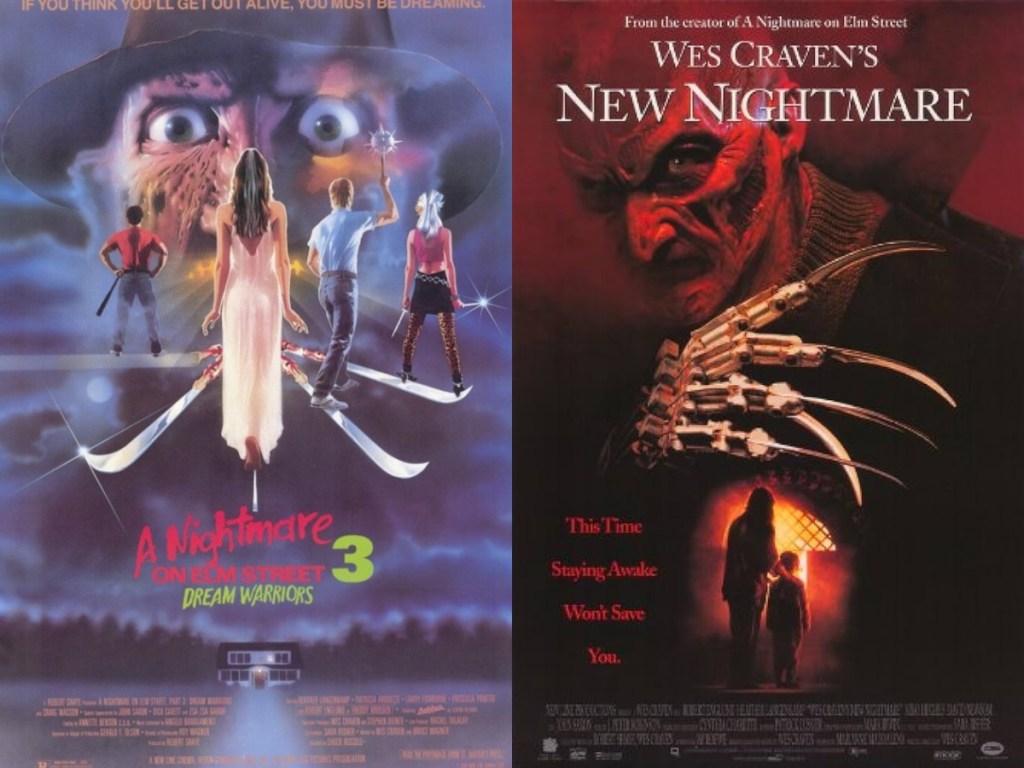
Jasper Fahrig asked what I thought were good installments of a franchise past the first sequel. It’s a truth of filmmaking that long-running series often suffer from diminishing returns. The deeper you get, the worse the franchise often becomes, so finding a good movie that’s part 3 or higher isn’t always easy. Fortunately, Wes Craven is there to hook us up with not one, but two films in the Nightmare on Elm Street franchise. Craven wrote and directed the original Nightmare, but sat out the sequel. When Part Three (Dream Warriors) was made, he came back to help with the story. After a part two that many people admittedly enjoy, but doesn’t really fit with the rest of the franchise, part three is GREAT. Robert Englund is in top form, Heather Langenkamp returns as Nancy (the BEST final girl outside of Laurie Strode), and the crazy horror dream imagery is used to the best effect in the entire series. What’s more, the movie was directed by Chuck Russell (whose remake of The Blob I mentioned last week) and co-written by Frank Darabont. Maybe I’m NOT a horror fan, guys, maybe I’m just a fan of several very specific filmmakers.

But Craven wasn’t quite done. He stepped away from Freddy after that and three more sequels incredibly diluted the character before Wes came back to save the day one more time with Wes Craven’s New Nightmare. Langenkamp is back again, but this time she plays HERSELF, an actress who finds herself haunted by the spirit of Freddy Kruger, the killer from that old movie she made years ago. Craven also appears as himself in the movie, as does Robert Englund, playing both himself and Freddy Krueger. The movie uses the language of the Nightmare series to make a statement about the power of storytelling and belief. It was ” meta” two years before Craven would redefine “meta” with the Scream franchise, and it’s hands-down my favorite Nightmare.

A double feature to keep you up all night.

Award-Worthy Horror

Seth Pontiff wanted to know some horror movie performances that I thought were worthy of Oscar consideration. Oooh, that’s a good one. I’ve often complained about the way the Academy ignores genre movies, but there HAVE been a scarce few performances that got nods. Kathy Bates actually won best actress for Misery, and the next year both Jodie Foster and Anthony Hopkins would take home statues for Silence of the Lambs, but those are movies that the Academy can classify as “Thrillers” without getting their hands dirty in a straight-up horror movie.

So who should have been recognized, but wasn’t? I have to say, I think it’s an outright crime that Boris Karloff was never recognized for his work as the Frankenstein monster. He played the creature three times, twice in movies that are indisputable classics, and infused the monster with such depth and humanity that the viewer comes out the other end on his side. There was so much sadness and power in the character, interspersed with other moments like unbridled joy at those few times he thinks he’s found a kindred spirit, and Karloff sells every second of it. There’s a reason that every kid who draws a picture of the creature gives him a flattop and bolts on his neck, and it’s not because Mary Shelley described him that way.

Another performance that I think was awardworthy? Jamie Lee Curtis as Laurie Strode in Halloween. Not the 1978 film…the one from 2018. This is going to be controversial, I know, because that film has become EXTREMELY divisive among horror fans. And in truth, I was highly disappointed in the final film in that trilogy. But when I look at the 2018 movie by itself I am in awe of her performance. Curtis plays Laurie Strode as a trauma survivor who has spent her entire life preparing for the other shoe to drop. It’s a performance full of anguish and pain, and she sells it every second she’s on screen. I’m glad that she got her Oscar last year for Everything Everywhere All at Once, but I really believe she should have had it sooner.

I’m actually not great at Photoshop either, so pretend I made it look like these two are holding little statues.

Psychological Horror

And finally, AJ Peden asked me about my favorite psychological horror movies. What makes this difficult is that it’s really hard to define what “psychological horror” actually is. The Wikipedia definition (yeah, I looked it up) says it’s horror “with a particular focus on mental, emotional, and psychological states to frighten, disturb, or unsettle its audience.” Well gee, that narrows it down, right? Another problem here is that so many of these movies overlap into other subgenres: ghost stories, slasher movies, found footage films, etc., have all had prime examples of what we could call “psychological horror.” 

I suppose my favorites in this incredibly broad subcategory would have to go back to the great Alfred Hitchcock. Psycho is the obvious example – it’s a great movie with a brilliant twist halfway through the film and a second brilliant twist at the end of the film. It’s also one of the prototypes for the slasher. So is Peeping Tom, which is also a dandy example of psychological horror. In that film, directed by Michael Powell, Karlheinz Bohm plays a photographer making a documentary about fear by filming the deaths of his victims. I suppose a 1960 audience may have been enticed by the title or the high sexual content (by 1960s standards) of the film, but the way Bohm’s character messes with your head is really powerful.

In the 60s, this was scarier than asbestos.

For more modern examples, I think Jordan Peele has kind of taken the forefront of the wave. Get Out, the movie that made people realize that guy from the goofy sketch comedy show was actually a master of terror, was not only a meditation on race relations, but a terrifying film about the potential of having your body literally stolen from you and the mental state that would result from – or compel somebody to do – such a thing. There have been a lot of films since Get Out that have tried to capture that same flavor (The Barbarian comes to mind, as does X and its prequel, Pearl), but I think as far as today’s filmmakers go, Peele wears the crown. 

And I think that’s going to wrap it up, guys. There are a few other suggestions I didn’t get to, but those are either in categories where I haven’t seen enough movies to really form an opinion (Patrick Slagle – sorry, I don’t have a lot of folk horror movies in my catalog) or categories where my answer is so basic that I don’t know that I have anything interesting to say about it. (Rene Gautreaux: the best religious-based horror movie is still the original The Exorcist. Tony Cirillo, my favorite puppet from the Puppet Master franchise is Blade, because blades are cool.) 

I hope you enjoyed this little experiment as much as I did. I had a lot of fun letting you guys tell me what to write about, and I think we uncovered a few gems in the process. May this two-parter help you find some new stuff to watch in the remainder of this spooky season, and keep your eyes right here! I don’t think it’s going to be too long before I ask you all to help me Play Favorites again. 

Blake M. Petit is a writer, teacher, and dad from Ama, Louisiana. His current writing project is the superhero adventure series Other People’s Heroes: Little Stars, a new episode of which is available every Wednesday on Amazon’s Kindle Vella platform. All this and nobody asked about the best zombie movie? Ah well, maybe next time.