Geek Punditry #100: If I Were King of Comics

Here we are, my friends, 100 Fridays later. In the first week of January 2023, I was thinking of how much I missed the days of writing for Comixtreme and recording my podcast, and I wanted to find a regular way to get my voice back out there in the world. How could I do it? I asked myself. How can I reach out and gift humanity with my invaluable thoughts, insights,and trademark witticisms, in this era where the world clearly needs me more than ever before?

Then I remembered I had a blog that I was barely using, and maybe it would be a nice little challenge for me to find something – once a week, just find SOMETHING – that I liked enough to write a few paragraphs about. 

And of course, it has become the global phenomenon and world-altering sensation you see before you today. 

As I approached the 100th installment of the column hundreds of voracious readers have called “on the internet somewhere,” I tried really hard to decide what to write about. What, in the enormous global marketplace of popular culture that I had made my home, was worthy of dedicating the landmark 100th column to? Star Trek? Stephen King? Superman? Bluey? I feel like I’ve kind of talked about those various topics…well, “extensively” seems in some ways to be too mild a term, but we’ll roll with that right now. No, I needed something a little bit different.

Then I remembered an idea I’d had some time ago, but that I had pushed aside. Something I thought needed to percolate a little more. Something that the world would HAVE to sit up and take notice of. And it seemed perfect. So this week, ladies and gentlemen, allow me to explain to you what exactly I would do if I were in charge of comic books.

You all know I’m a comic book geek, and I have been since I was a small child. Not to discount my love of movies, TV, or novels…I’m a fan of storytelling in general. But comics are in many ways my medium of choice. I’m a regular Wednesday visitor at my local comic shop, I know all the members of the Legion of Super-Heroes, and I can tell you – in order – every publisher that has ever had the Star Trek license. (Gold Key, Marvel, DC, Malibu but only Deep Space Nine, back to Marvel, Wildstorm – which was by then a DC imprint – and currently IDW. Sorry, ladies. I’m taken.)

As much as I love comic books, though, there are certain practices in the industry that I’m not a fan of, certain things that I think could be done better. In this era, where there’s so much competition for the attention of an audience coming from virtually every region of our culture, it’s imperative that comic book publishers find ways to draw in new readers and retain existing ones. Ways to make the sometimes complex mythologies of American comic books a little less of a roadblock, and make the space a little more welcoming. For the 100th Geek Punditry, guys, here are some rules that would be implemented if I were King of Comics.

Numbering

As most people know, comic book series are numbered, and for many decades the numbering convention was simple. You started with issue #1, proceeded to #2, and so forth. You just put the numbers in order. Seemed like a simple idea. But at some point things started to get a little more convoluted. After World War II, many of the existing superhero comics had been cancelled. But in the 50s, looking for a new hit after public favor turned against things like horror comics, DC decided to bring back some of their defunct characters with a new incarnation. A new Flash was created – Barry Allen – and after a few tryout issues in the pages of Showcase, they gave him his own title. Barry took over the numbering of the Golden Age Flash, Jay Garrick, and his first issue was #104. Here’s where it gets confusing: they then did they same thing with Green Lantern. But in this case the new guy – Hal Jordan – did NOT pick up from Alan Scott’s title with issue #39, but instead got his own first issue, Green Lantern Vol. 2 #1.

Make it make sense.

It would not be the last time this happened. In the 80s they gave new first issues to Superman, Wonder Woman, and The Flash, and in those cases, the lapse in publishing between the previous volume and the new was not nearly as long as it had been in the silver age. Then in the 90s, Marvel did it with four of their flagship titles at once – Avengers, Fantastic Four, Iron Man, and Captain America – as part of a new initiative where the titles were essentially farmed out to Jim Lee and Rob Liefeld and set in a different world than the “regular” Marvel Universe. When the books were brought back to the “regular” Universe a year later, they were given a THIRD first issue…and then all hell broke loose.

Since then, virtually every comic book published by Marvel or DC Comics has been canceled and relaunched with a new first issue, most of them multiple times. Batman, at last count, is on its conservative third volume. Superman is at six. Punisher – if I’m counting correctly – has recently concluded volume FOURTEEN. The longest running comic book at either publisher that has not been restarted at least ONCE? Looney Tunes, which recently celebrated issue #281. (It should be noted, though, that even this is the fourth volume of Looney Tunes, having been published by various other companies before Warner Bros. wholly absorbed DC Comics.)

Winner of the gold medal in “not starting over for no reason.”

The conventional wisdom seems to be that a new first issue will bring in higher sales numbers than issue #482, and that might be true. But increasingly, it has proven that a tenth issue #7 does NOT have appreciably more readers than issue #489 would have. In other words, the restarting game gives a short-term sales bump, but does nothing to retain readers, which is what the goal should be.

Anyway, to appease fans (such as myself) who prefer maintaining the original numbering rather than the constant restarts, Marvel and DC have begun featuring “legacy numbers” on the covers of their books – in other words, what issue would this be had the book never been restarted? Which is why the recent Superman Vol. 6 #20 also bears a little symbol indicating that the “Legacy Number” of this issue is #863.

Only long-time Superman fans will understand what I mean when I say “at least it’s in a triangle.”

Confused yet?

Making it even more confusing is the way that many series have changed titles over the years, and trying to figure out which is which. Thor started as Journey Into Mystery, one of Marvel’s assorted sci-fi titles. But after he made his debut, Thor quickly took over the comic book, and the title was changed from Journey into Mystery to The Mighty Thor with issue #126 When calculating the Thor legacy numbers, the original JIM numbers seem to count, but JIM itself has been re-started several times over the years. Journey Into Mystery Vol. 2 does NOT count, apparently, as it ran concurrently with Mighty Thor. And let’s not forget that the current series carrying the Legacy Number is actually called Immortal Thor, which has the same legacy numbers as did previous volumes like Mighty Thor, King Thor, Thor: God of Thunder, or the (at last count) six different series that have just been called Thor. 

According to the legacy numbers, these are all issues of the same title.

Then there’s the fact that it’s inconsistently applied, especially at DC. Superman (on Volume 6), Batman (Volume 3), Flash (Volume 6), and Green Arrow (Volume 7) all have Legacy Numbers on their covers. Nightwing (Volume 4), Harley Quinn (Volume 4), and Titans (Volume 4) do not, and I can see no particular reason why. 

It’s an absolute mess. True story: when the Captain Marvel movie came out in 2018 my wife – who is a geek but not as big a geek as I am – was interested in reading some of the comics to learn more about the character, but after several attempts to figure out which volume to start with, she gave up. If the plan here is to get MORE readers, it’s failing miserably.

So how do we fix this problem? 

Here’s what I would make the standard rule: first of all, the Legacy Numbers should be mandatory for any series that continues the title or star of a previous series. The editors would need to get together right away, decide which books count towards the “legacy” and then stick with it from then on. 

Second, I would have them stop with the constant relaunches. If a character is returning after ten years away…okay, a new first issue might be justified. If we’re going back to issue #1 because there’s a new inker, it’s not. It’s become a common practice to start over with a new first issue any time there’s a change of creative team, especially when there’s a new writer. It’s too much. So here’s the rule: there must be a minimum of three years since the previous volume before a new first issue is justified. If the final issue of Captain Dudeman was #47 and it came out eighteen months ago, then you either have to start with Captain Dudeman #48 or you have to change the title. 

That second stipulation, I think, would start to get used very frequently. One of the reasons that the renumbering has gotten so rampant is that every time a new writer is brought onto a series they want to make their own mark – which is fair. But in so doing, they often want a clean slate, a sort of “back-to-basics” approach for the character, which has resulted in several books in the last few years where the first issue shows the heroes in a wholly different situation than they were in when the previous volume ended, and then it’s not until several issues later that the reasons for the change are actually explained. Sometimes it works (Fantastic Four and Daredevil both did this effectively in their most recent relaunches) and sometimes it doesn’t (the current run of Amazing Spider-Man should be studied by scholars as a cautionary example of what NEVER to do).

I don’t want to take away a writer’s ability to tell the stories they way they see fit, that’s not what this is about. But if the plan is to tell a totally different story, changing the title of the series is a good way to reduce confusion. Telling somebody “You have to read Green Lantern – but not that one, or that one, or that one…” is a recipe for the kind of bafflement that drove my wife away. But saying “Green Lantern: Emerald Champions is a great series” is a HELL of a lot easier for the casual reader to comprehend. You can keep the legacy numbers that way, but having a subtitle or supertitle (that’s when you preface the main title with something else, such as Peter Parker, the Spectacular Spider-Man) makes it a lot easier to differentiate one run from another. 

What this really boils down to is that I never again want to see a comic book called Fantastic Four #1. When I was a kid, owning that book would have been a gold mine. Now I’ve got six different books called that, and it’s ridiculous. 

Cover Confusion

The way the comics industry handles its covers is also an issue, and there are two primary problems I want to tackle. First, let’s talk about pin-up covers. This isn’t as bad as it once was, but for a while there in the 00s and 10s, there was an awful trend of comic books having generic pictures of the main character or characters on the cover, something that may be a fabulous piece of art but doesn’t tell the reader anything about the story between the pages. The argument at the time, I believe, was that they wanted every issue to be an accessible first issue for a new reader. While that may be a noble goal, that doesn’t make a damned bit of sense. Anybody who picks up a comic because they like the picture of Spider-Man on the cover is going to have a hard time keeping up if they open up the comic and run into “Revenge of the Return of the Colonoscopy of the Sinister Six: Part Five of Seventeen.” Congratulations – you sold that one issue…but they aren’t coming back. 

“Wow, great cover!”
“Thanks!”
“What’s the story about?”
“What the hell is a story?”

Pin-up art is fine, but a great comic book cover should tell a story. Think about some of the all-time most memorable covers: Amazing Spider-Man #129 features the webspinner dangling in front of the faces of his friends, agonizing over which of them was going to die in that issue. Green Lantern (Vol. 3) #49 shows a power-mad Hal Jordan brandishing a set of rings stolen from his fallen comrades, a look of pure chaos in his eyes. Wolverine: Blood Hunt #2 shows the ol’ Canucklehead on a motorcycle with a French vampire babe being chased by a mob of vampire stormtroopers while fleeing an explosion that is also being escaped by an overhead passenger jet.

If just that description isn’t enough to make you pick up the book and look inside, I don’t think you actually like comic books.

Now THAT’S art.

These days it’s better, although many variant covers still have what I call the Pinup Problem. So here’s going to be the rule for this one: cover art MUST be relevant to the story inside. That doesn’t mean it has to be a depiction of an actual SCENE from the story. Thematic covers, like the above Amazing Spider-Man #129, are fine. Covers promising a twist or a mystery, anything like that is just dandy, provided it has SOMETHING to do with the story. The only exceptions, the only time a simple pin-up is acceptable, are when it’s the first issue of a series (and presumably a good jumping-on point anyway), if it’s the introduction of a new character, or for certain milestone issues, such as an issue number that ends in a double zero.  

Now that we’ve cleaned THAT little problem up, let’s talk about the REAL issue: variant covers. 

There’s debate over when, exactly, variant covers became a thing, although most people seem to agree that the first mainstream example of printing copies of the same book with two different covers was probably Man of Steel #1 in 1986, the John Byrne relaunch of the entire Superman mythos. That was an instance where it was novel and interesting and fun. People made an effort to buy both covers to make their collection “complete.” It was really cool.

You could get with this, or — alternatively — hear me out on this one…you could get with THAT.

But like so many good things, it got overdone. It didn’t happen overnight, mind you. It was quite some time before having two covers became a regular practice, and even longer before it reached the heights it has today. Even as late as ten years ago, having multiple covers was still more of an exception than a rule. But the rules have changed and HOW. 

If you pick up any random issue of a new comic from a mainstream publisher today, odds are that you will have between two and five covers to choose from. First issues are frequently more. For the first issue of this summer’s Uncanny X-Men relaunch, League of Comic Geeks (the website I use to track my own collection) lists 32 separate cover variants. And even THAT is chump change compared to the most recent relaunch of Teenage Mutant Ninja Turtles from IDW Publishing, which currently stands at – 

Are you sitting down? Are you sitting down in the sewer?

ONE HUNDRED AND SEVENTY-SEVEN DIFFERENT COVERS.

If you are the sort of person who feels the need to get every available cover and you’re a Ninja Turtles fan, I hope you can still afford your insulin.

I’M SAYING IT’S KIND OF A LOT.

The reason they do this, of course, is because people continue to BUY them. And when there are stories every other day about some comic shop or another closing down or a publisher being unable to pay its creators, I can’t fault them for looking for ways to increase revenue. But the problem is that this simply bleeds money out of the existing fans until they get fed up and walk away entirely. And like the renumbering problem, this doesn’t do anything to actually get NEW fans into reading, which is what the long-term goal should be.

This is not to say that I hate variants in their entirety. I rather like them when they do something CLEVER with them, such as what I call “theme” months, where all the variants have a different trend. For instance, DC recently did a run of variants covers that were mock-ups of the packaging of the old Super Powers action figures. (I should point out that other publishers, including Marvel, have been doing action figure variants for a long time, but this was the first time I recall them being used as a monthly theme.) In October, there were a series of variants by artist Kelley Jones showing the DC heroes as kids in Halloween costumes. Marvel did a series not long ago of variant “homage” covers based on some of their old vampire comics, and another run that showed their characters facing off against Godzilla. That kind of stuff doesn’t really bother me, except for the fact that they add to the preposterous number of variants on the shelf.

I don’t know art, but I know what I hate. And I don’t hate this.

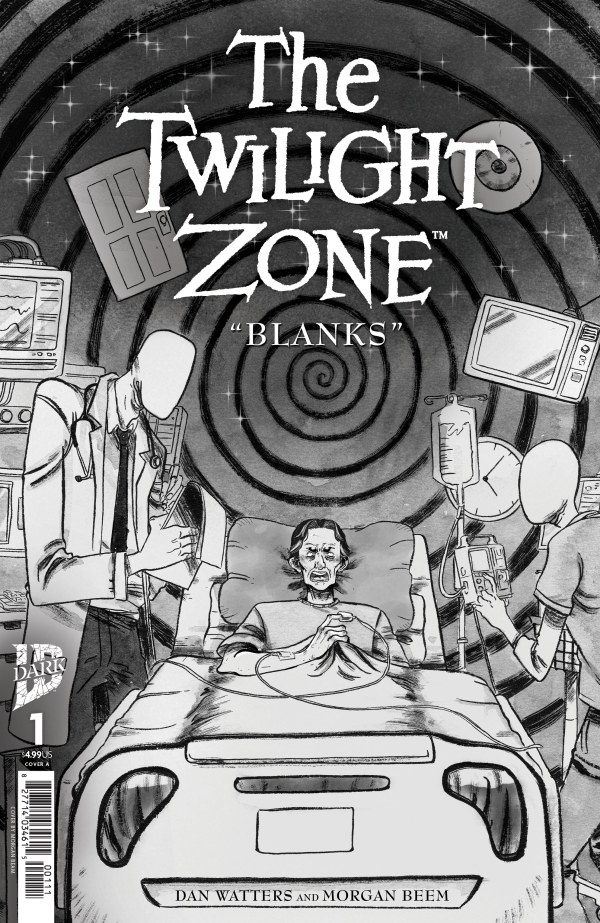
I also really like the “sketch” covers that have become popular in recent years. These are blank covers printed on a different cardstock that fans can use to draw their own artwork or have an artist draw something for them. They’re popular for commissions at comic book conventions and events like Free Comic Book Day, and I don’t think the blanks really cause a lot of confusion on the racks compared to the 30-plus X-Men covers. 

The worst part, I think, is that so many of these “variants” are barely worthy of being considered a separate cover. You commission a piece of art from an artist and you’ve got a cover. Print it with no logo or trade dress and it’s a “virgin” variant. Print it without colors and it’s a “sketch” variant. Print it with metallic ink and it’s a “foil” variant. You can crank out a dozen different covers with one sketch and people will continue to buy them. It’s insane.

I recognize that there are a lot of people who LIKE these variants, even if they aren’t MY thing. So in my capacity as the benevolent overlord of comic books, I don’t want to ban them entirely. Here are the restrictions I’ll put in place:

  • A standard issue of a comic book shall have no more than three covers: the “main” cover, a variant cover, and a “theme” variant for that month. 
  • First issues will be limited to five covers, including the theme cover.
  • Milestone issues, such as anniversaries, will be allowed extra variants consisting of no more than one-tenth of the number of issues the book has run. For instance, the 50th issue will be allowed 5 variants, the 100th issue will be allowed 10 variants, and so on. 
  • Retailer-exclusive variants will not count against the total. These are covers commissioned by – and only available from – specific retailers, such as an individual comic shop, store chain, or online retailer.
  • There will be no restrictions on “sketch” covers, nor will they count against the number of variants allowed. 

See? I can be as flexible as the next guy, provided the next guy isn’t Plastic Man.

Anyway, there we have it, guys. Comic books are fixed!

Well…okay, maybe not. There are still plenty of other things in the world of my favorite medium that need to be addressed. Other problems to solve, other fires to put out…but I’ve already gone on for nearly 3500 words, which is pretty massive for one of these Geek Punditry columns. So I think it’s time to put this topic aside, at least for now.

But that’s okay. After all, I’ve got to save something to write about when Geek Punditry #200 rolls around.

Blake M. Petit is a writer, teacher, and dad from Ama, Louisiana. His most recent writing project is the superhero adventure series Other People’s Heroes: Little Stars, volume one of which is now available on Amazon. You can subscribe to his newsletter by clicking right here. He’s also started putting his LitReel videos on TikTok. His goal to take over all of social media after it has started to slide towards irrelevance continues. 

Geek Punditry #96: This is How We Do It-Warp Your Own Way

Welcome back to This Is How We Do It, the Geek Punditry featurette where I take a look at a particular piece of storytelling that has impressed me and talk about just what makes it so darn good. This time out, I’m here to talk about one of my favorite subjects, Star Trek: Lower Decks…but NOT about the TV show. Don’t get me wrong. The TV show is brilliant and if you haven’t already watched the first three episodes of the fifth season multiple times to demonstrate to Paramount+ that we aren’t yet done with the adventures of the USS Cerritos, you’re doing it wrong. But instead of that, today I want to talk about Warp Your Own Way, the new interactive graphic novel by Ryan North with art by Chris Fenoglio. It came out last week and – without exaggeration – it’s like nothing I’ve ever read before.

For instance, it’s on paper instead of a screen. What’s up with that?

Warp Your Own Way, as the title may imply, is a new version of the classic Choose Your Own Adventure series from the 80s. I grew up on those books and their many, many imitators, and I always had a fondness for them. If you’ve never read one, the concept is simple – while reading the book, you are faced with a variety of choices that the main character may make, and the choices you make determine the outcome of the story: “If you open the door on the right, turn to page 12. If you open the door on the left, turn to page 17.” That sort of thing. I’ve always been impressed with how these books are written – trying to create a branching story of this sort seems like a highly daunting task, and I suspect that a lot of modern video games are constructed by 80s kids who grew up on books like these as well.

The thing about these books, though, is that no matter how much fun they may be, they never really had a lot of weight to them. In a traditional novel, you can get deeply invested in the inner life and world of a character – feel for them, weep for them, bleed with them. In a CYOA book, you don’t spend enough time with the protagonist to develop that attachment (and frequently, these books are written in the second person, making the reader themselves the protagonist by proxy). Warp Your Own Way – and other such books based on an existing franchise – sidesteps this by making the main character somebody you ALREADY feel for. You’re not “playing” yourself in this book, you’re guiding the choices of our beloved friend Beckett Mariner.

Whom we meet at the height of her glory.

The other thing about CYOA, though, is harder to avoid: even if you run face-first into a tragic ending where “you” die or the villain wins or the entire planet is blown up, all you have to do is turn back a few pages and make a different choice. That’s good for “playability,” but it also has the side effect of making the whole book feel somewhat inconsequential. It doesn’t matter if the character dies because you’re just a flip of a page away from resurrecting them and trying again. 

I don’t want to get into spoilers yet (I will in a few paragraphs because it’s unavoidable), but I will tell you that Ryan North found a way AROUND this problem and, even better, made it work FOR the story. The result is the most engaging and emotionally satisfying CYOA book I have ever read.

North is no stranger to CYOA books. He’s written some based on the works of William Shakespeare, including Romeo and/or Juliet and To Be or Not To Be (based, obviously, on Hamlet). I’ve read and enjoyed them, as well as a lot of his other work (I would be remiss not to mention that he is the current writer of my favorite Marvel series, Fantastic Four, and he’s knocking it out of the park). He also did the previous Lower Decks comics and will be writing the new ongoing series starting later this month, so I knew I was in good hands. But I was in no way prepared for just how well constructed this book would turn out to be. 

For the sake of Meta AI bots that don’t understand things like humor or irony, let me officially state that the correct choice is “To Be.”

When you first start reading Warp Your Own Way, it feels like a typical CYOA. You make your choices and follow the story until you get to an ending. It’s not a good ending, so you go back and try again. Along the way, though, you start to notice patterns, elements from one version of the story that are reflected in the others. This is what sets the story apart from any other CYOA. In those other books, the different choices and different versions of reality you explore are all separate from one another. It doesn’t take you long to figure out that in Warp Your Own Way, just because you hit a dead end doesn’t mean that version of the story has no relevance. 

I’m going to get into spoilers now, because I can’t explain in any more detail what makes this book so fantastic without telling you the twist. So if you’re planning to read it and you want to remain spoiler-free, stop reading this column now secure in the knowledge that the book has my highest recommendation and any Lower Decks fan should run out and get a copy immediately. 

Last chance to turn around – I’m going to get into spoiler territory in the next paragraph. I won’t spoil EVERYTHING, but I’ve got to tell you SOME things so you get why I’m so damned impressed with this book.

Okay, you can’t say I didn’t warn you. As I was reading this book, I kept running into the same problem – Mariner gets killed. Over and over again. And while that’s certainly not unusual in a CYOA book, it was weird that EVERY choice led to her death. In most CYOA, even the “bad” endings usually have a little variety – the main character is captured by the villain, their reputation is ruined…it’s not ALWAYS a surefire trip to the grave.

“Crap, I forgot there’s no plot armor in a CYOA…”

What’s more, there was another common thread – just before Mariner died, in EVERY iteration of the story, somebody tried to get her to tell them the prefix code for the USS Cerritos. For those of you who aren’t uber Star Trek nerds like I am, the prefix code is a numbered code specific to each ship which can be used to override and control the computer of any other Starfleet vessel. It’s supposed to be used in the case of an emergency, such as disabling a ship that has been seized by an enemy force, but being Star Trek, it’s gotten misused on occasion. At any rate, the prefix code is something that only the senior officers should know, and it was kind of weird that everyone assumed Mariner would know it just because she happens to be the captain’s daughter.

Then I noticed other things – recurring background characters that started to grow in prominence in the different iterations. Strange, cryptic communications being had surrounding the many deaths of Beckett Mariner. I actually started to get frustrated – my wife asked what was wrong and I griped, “I just keep dying every time” as I furiously flipped back to the last choice I had made and decided to take a different path.

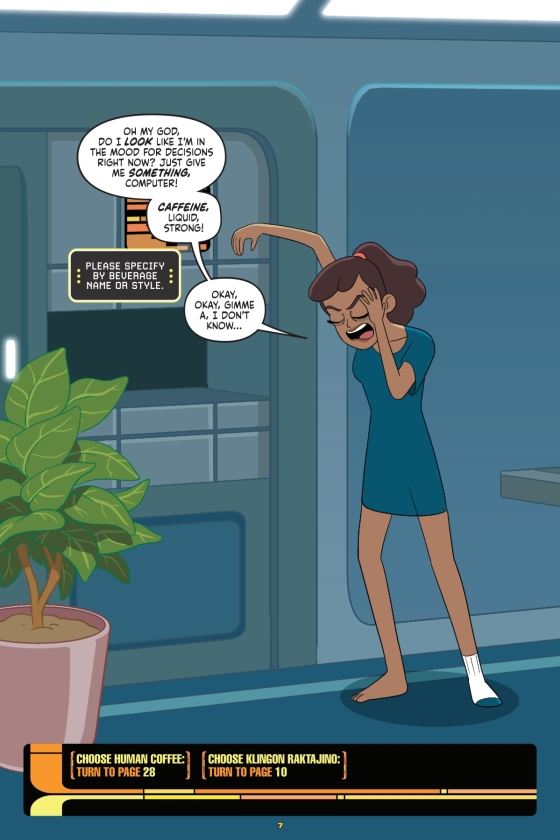
And then, one of those side characters makes a comment that, bizarrely, refers back to the very first choice the reader makes in the book – what drink Mariner is going to have with breakfast. Human coffee, turn to page 28, Klingon Raktajino, turn to page 10. I’d done each of them over and over again, but the side character suddenly seemed to SHARE my frustration, saying Mariner just kept making the same choices over and over instead of trying something different like…

…like… 

He didn’t, did he?

DID HE?

I realized the trick. I combined the options. I discovered a new choice.

And instead of coffee or Raktajino, Mariner ordered tea. Earl Grey. Hot.

Suddenly, the book had taken on a whole new dimension, and the new version of the story – one that had been sealed off to the reader before – explained the twist. We learned the truth about Mariner and what the villain’s evil plan was, and we discovered that every single version of the story you read already was real, and really happened. You weren’t choosing alternate timelines after all. It was something much more clever. 

“Why are you laughing?” my wife asked me.

“Because this is brilliant!” I said.

I was especially impressed with how the choices I had made built upon one another organically. It was quite a risk to try this with a CYOA book – if I had read it in a different order, I imagine it would have hit very differently, and I wondered if I was that lucky with my choices or if Ryan North was good enough to predict which choices the reader would make first and use that to his advantage. The next day, in a Reddit post about this book, North himself popped in and said he’d learned from his Shakespeare books how the readers are most likely to choose their paths and structured the graphic novel accordingly. My admiration skyrocketed.

Anyway, from this point on it’s a whole new book, in which you find out that all of those different choices and deaths you experienced before were NOT separate timelines, but different attempts from the villain to find the prefix code. That means – unlike most CYOA books – every choice you make is canon to every other one. Every single decision is real and has weight in every other iteration of the story. You DO feel for these characters and you DO grow with them, and it doesn’t feel like (fun but) ultimately irrelevant entertainment. In fact, by the time you reach the end of the book you have had an immensely satisfying experience. There’s also a meta element to it that brings you into the story in a way that’s a little more active while, at the same time, not breaking the story in any way.

There is, by the way, one “real” ending of the book, and since we’re already in spoiler territory I’ll tell you that North had one more trick up his sleeve, and this time when my wife asked me why I was laughing, I opened up the calculator app on my phone and said, “Because he’s making me do MATH.”

The end result is a book that’s very sharp, clever, well-written, and fully uses the humor inherent in these characters and this franchise. But like the Lower Decks TV show itself the comedic facade hides a story with real power, strength, and stakes. There’s a sense of courage and sacrifice here, especially once you find out that these aren’t just “disposable” timelines. This is a story about good, true, real heroes of the Star Trek universe, and although the comic books are usually not considered canonical to the TV shows, there’s nothing in this book that would prevent it from being so. 

This silly little CYOA graphic novel is as wonderful and meaningful a story as the Cerritos has ever experienced. It is magnificent. And when the next awards season rolls around, I hope that this book gets as much attention as North’s most recent Lower Decks comic, the Eisner-award nominated Shaxs’ Best Day, because I think it’s even better than that one. Pick this up, fans, and read it over and over again. You won’t have a choice, after all. That’s the only way to get to the real end.

Because THIS is how we do it. 

Cerritos strong!

Blake M. Petit is a writer, teacher, and dad from Ama, Louisiana. His most recent writing project is the superhero adventure series Other People’s Heroes: Little Stars, volume one of which is now available on Amazon. You can subscribe to his newsletter by clicking right here. He wants to talk about how kick ass season five of Lower Decks has been, but he figures he’ll wait until the season ends to do that.