Here at Geek Punditry Global Headquarters and Communications Hub and Lawn Care Emporium, we have five separate but equally important departments: the Department of Movie Stuff, the the Department of TV Stuff, the Department of Book Stuff, the Department of Comic Stuff, and the Jimmy John’s down on the third floor. And we try our best to balance those departments out, spending a little bit of time on each and not overwhelming our legion of adoring readers with any one topic above any other. But even though last week’s topic was about comic books, and I feel we’ve gotten a little comic book heavy lately, we’re going back to DC Comics again this week. There are two important reasons for this:
- The topic we’re going to discuss is of great significance and, if studied properly, has the potential to turn into a great boon not only for DC Comics, but for the entire comic book landscape.
- I couldn’t think of anything else to write about.
Last year, our friends at DC kicked off a publishing initiative called “Compact Comics.” This new line of paperback editions, all bearing a distinctive trade dress, collects some of DC’s most popular and important storylines in volumes smaller than the usual trade paperback design. At 8.5 by 5.5 inches, these full-color editions are almost exactly the size of a current fiction paperback that you might buy at any bookstore. They sell for $9.99, and have become a hit in both comic shops and in other retail outlets. And frankly, it couldn’t have come at a better time.

Comics are in a bit of a crisis, although to be honest, there’s nothing new about that. I’ve been reading comic books for 40 years and I can’t remember a time when people didn’t fear that the industry was in the midst of some crisis or another. But we’re in a time where the distribution model is in absolute turmoil, with so many publishers abandoning Diamond Distribution (which had a monopoly on the comic book distribution market for decades) that the company had to declare bankruptcy earlier this year. As Diamond scrambled for a new owner to right the ship, all of the comic book publishers were flailing about, trying to make sure that they could still get their product into the hands of readers.
What does this have to do with Compact Comics? Nothing – at least not directly. DC abandoned Diamond some time ago, and they’re one of the few publishers big enough to weather this particular storm without any real chaos. But the issue here is how to get readers to pick up the comics, and what DC has done is found a format that is inherently appealing to those readers, something that will draw people in and get them not only to read one volume, but to go back to the shop and pick up another one. And that’s exactly what everybody in comic books should be trying to do.
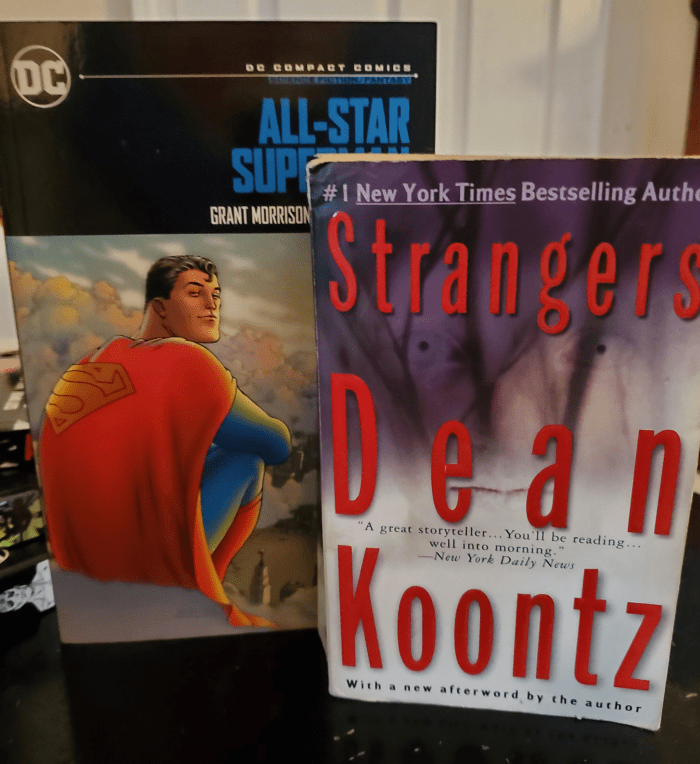
First of all, the size is important, and don’t let anybody tell you differently. Traditional graphic novels in the larger trade paperback format have been fine for a long time, but they’re not as portable as the Compact Comics. They’re good as archival editions, whereas Compact Comics are the sort of thing that will appeal to a casual reader – someone who is browsing the stacks at an airport bookstore or shuffling through the available volumes at Barnes & Noble looking for their next great read. It’s not a coincidence that the Compact Comics size is very similar to that of Japanese Manga, which is enormously popular. (The day I realized that Manga now had a section three times as large as the traditional graphic novel shelves at Barnes & Noble, I died a little inside.) Some may see this as an attempt by DC to court the Manga reader, and I think there’s at least a little truth to that. But I think it’s even more true that they simply recognized that the portability is one of the things that contributes to the success of Manga, so they decided to run with it.
This isn’t new, of course. Manga has been growing in popularity for decades, so why has it taken American comics so long to catch up to this smaller format? Honestly, I think it’s the printing technology. Most Manga is in black-and-white, and therefore easier and cheaper to print. Most American comics, on the other hand, are in color, making them not only more expensive, but more difficult to reduce in size to the smaller format without muddying the colors or losing detail in the artwork. But printing technology has improved, and anyone glancing through a Compact Comic will be able to tell you that the artwork looks just as good now as it did in the original printing – in the cases of some of the older stories that have been remastered, even better.

The next thing, and this cannot be understated, is the price. TEN BUCKS for a complete graphic novel? These days, that’s the deal of the century. A full-size graphic novel of comparable length will usually go in the $25 to $30 range. In fact, most individual comic books these days sell for $3.99 or $4.99. That means that for the same price as two issues of Action Comics, I can get all twelve issues of Watchmen and have a complete story. It’s an incredible bargain, especially for somebody dipping their toes into comic books for the first time. Imagine a potential reader who, for example, is excited about James Gunn’s upcoming Superman movie and is interested in reading some of the comic books that inspired it. They may look at the trade paperback or hardcover editions of some of those books retailing for anywhere from $25 to $50 (depending on how fancy the edition is) and rightly blanch. Even four bucks for a 22-page comic book story is an awful lot. But over 250 pages of Grant Morrison and Frank Quitely’s All-Star Superman for $9.99? That, my friends, is the sweet spot. With everything in the universe getting more and more expensive, seeing such a low price point is absolutely going to get a reader’s attention.
And I think it’s also important to note which stories DC selected to include in the first wave of Compact Comics. Aside from the aforementioned All-Star Superman and Watchmen, both bona fide classics, DC also included two of the more successful Batman stories from the past couple of decades, The Court of Owls and Hush. They populated the line with stories featuring their most popular (and – let’s be honest – cinematic) characters, including Wonder Woman: Earth One, Harley Quinn and the Gotham City Sirens, Catwoman: Trail of the Catwoman, and Brian Azzarello and Lee Bermejo’s chilling Joker graphic novel. Then they tossed in a recent hit, the Green Lantern science fiction murder mystery Far Sector. And as the coup de grace (which is Latin for “a cooper full of grass”) they gave us the first volume of Scott Snyder’s horror series American Vampire. Why is that so significant? Well, Snyder had a co-writer for the backup stories in the first six issues of this excellent series, a little fella by the name of Stephen King.
And in case you didn’t know, King’s name on the cover of a book is the closest thing in the publishing world to a license to print money. For once, DC knew what they were doing.

The line was so popular that a second wave of Compact Comics will be hitting shops this over the course of this year, this time including Kingdom Come, Static Season One, DCeased, Batwoman: Elegy, Superman: Birthright, The Authority: Book One, Superman/Batman: Book One, DC: The New Frontier, Wonder Woman: Blood and Guts, Harley Quinn: Wild at Heart, Batman: The Long Halloween, Y: The Last Man Book One, V For Vendetta, and We3. As with the first wave, we have a good mix of perennial classics, more recent favorites, properties that are linked to upcoming DC Studios releases, and a few really strong comics from outside the DC Universe itself that have proven popular to folks who don’t read superheroes.
And of course, as the initiative has proven successful, it’s being imitated. A few months after it was clear that Compact Comics was a hit, Marvel Comics announced its own new “Premier Collection,” a similar-sized set of graphic novels (9 by 6 inches, just a half-inch larger per side) with a $14.99 price point (a bit higher than the Compact Comics, but still more palpable than a traditional graphic novel to a new reader). This line kicked off in February with a new edition of Daredevil: Born Again, which – what a co-inky-dink! – just happens to have the same title as the recent hit show on Disney+. Isn’t it nice how stuff like that just works out sometimes?

But DC (and anyone who copies them) has to play it smart. So far they have, but it’s imperative that they make sure that the books they’re putting out fulfill the needs of the reader. For standalone books like We3 or The New Frontier, the task is done. Put out the book and keep it in print. Maybe throw out a new cover or a new afterword for an anniversary edition, but there’s not much else to think about. But go back and look at that list of titles again. Did you notice how many of them include the words “Book One?” And even several of them that don’t have “Book One” in the name have follow-ups (Batman: The Long Halloween was followed by Batman: Dark Victory, and Jeph Loeb is currently finishing his trilogy with The Last Halloween) or were originally released as part of an ongoing series that readers would like to continue reading (Wonder Woman: Blood and Guts was part of Brian Azzarello’s 2011 run on the character).
If the intent on DC’s part is that the readers will be drawn into the Compact Comics and then drift over to the standard-sized graphic novels for the rest of the series, that would be a huge mistake. Readers may like convenience, but we also like consistency. And if you don’t believe me, ask any book reader how they feel about a series of fantasy novels that doesn’t put the publisher’s logo, author’s name, or volume number in the same PLACE on the spine of every volume. Have a bucket handy when you do so, though, because just the thought of that may cause some bibliophiles to throw up.
No, if a reader STARTS reading Y: The Last Man in Compact Comics format, they’re going to want to CONTINUE reading Y: The Last Man in Compact Comics format. Yes, DC, that means selling all TEN volumes in this new size when it’s time to do a new printing. I concede, it wouldn’t have made sense to put out all ten volumes at once when the format was still new and untested. But once the format has demonstrated it has legs, you’ve got to stick with it. Will each individual volume make less money than the larger editions? Yes, it will. But I honestly think that what you gain in the number of sales will more than make up for any shortfall in the single unit profits.

So what comes next for Compact Comics? Assuming the new wave (which will begin in May with Kingdom Come) is as successful as the first, I think we could see these books on the market for a very long time. In fact, outside of hardcore comic book collectors, I could see the compact size becoming the format of choice for the casual reader. I don’t have any trouble at all foreseeing a future where this becomes the standard way that people read collected editions and original graphic novels. And I don’t think that’s a bad thing at all. In truth, I think ANYTHING that makes comics easier to get in the hands of people who don’t have them there already is a good thing.

I’ve got a few of the Compact Comics myself, and I couldn’t be happier with the format. They look good, they read great, and they look oh-so pretty on a shelf. If I had the money and space, I’d put up an entire bookcase with each of the ten that have been printed so far, leaving room for the next wave, Marvel’s Premier Editions, and anybody else who wants to play along. I sincerely believe that this is a great thing for comic books, and I hope that every publisher out there is paying attention to how well this line is doing. Because if you’re thinking about the future of comics, this just may be where we find it.
Blake M. Petit is a writer, teacher, and dad from Ama, Louisiana. His most recent writing project is the superhero adventure series Other People’s Heroes: Little Stars, volume one of which is now available on Amazon. You can subscribe to his newsletter by clicking right here. He’s also started putting his LitReel videos on TikTok. Yeah, he’s the kind of nerd who can write 2,000 words about a printing format, but YOU’RE the kind of nerd who READ 2,000 words about a printing format, so let’s not pretend we’re so different, all right?




 Blake M. Petit