It was the kind of news that grinds the internet to a halt, sometimes for upwards of 17 seconds. After years, decades even, where some of the most sought-after comic books of all time were out of print and unavailable unless you wanted to pay crazy eBay prices, this week DC and Marvel Comics announced a pair of omnibus editions collecting most of the crossover comics that have been produced over the years featuring meetings between the two most famous superhero pantheons in the world.

I’m not sure if younger fans will realize exactly how big a deal this sort of thing is. From the moment that the two respective worlds solidified, there were fans who were anxious to see the Justice League meet the Avengers, the X-Men meet the Teen Titans, Brother Voodoo meet Brother Power: The Geek. It’s like when you have toys from multiple toy lines and try to play with them all together. I know that every kid my age, at some point, had their G.I. Joes face off against Darth Vader, the TransFormers clash with He-Man, and the Thundercats and Silverhawks grab a drink down at the bar. Those were the stories that spilled out of our imagination. But the idea of a “real,” “official” story in which such a thing happened was the stuff of dreams. So in 1975, when the two publishers announced their first joint venture, it was like a dream come true!
For Wizard of Oz fans, that is. Yes, because of some weird things like licensing agreements with MGM and the public domain status of the original novel, the first comic co-produced by Marvel and DC Comics was an adaptation of MGM’s The Wizard of Oz, hitting the stands a scant 36 years after the film’s debut. I was only around for the last few years of it, guys, but it really seems like the 70s were a bizarre time.

But that collaboration seemed to grease the wheels between the two publishers and, in 1976, fans got Superman Vs. the Amazing Spider-Man. Like the Oz book, this was an oversized treasury edition featuring the clash of the respective publisher’s two most popular characters, and it was a hit. In 1981 there was a second Superman/Spider-Man meeting, followed by Batman Vs. the Incredible Hulk (or, as I like to call it, “Battle of the Bruces”), and in 1982 we got The Uncanny X-Men and the New Teen Titans. Then work began on an Avengers/Justice League crossover, a story that would surely be the crown jewel for the two publishers, but things kind of fell apart. Not only did that planned crossover never happen, but all crossovers between the two dried up for over a decade.

That changed in 1994, when the era of comic book excess was in full swing, and the two collaborated again with what would be the first of two Batman/Punisher crossovers. It wasn’t Bruce Wayne, though – this story took place during the Knightfall era, and the Punisher ran across the Jean-Paul Valley version of Batman. By the time the sequel rolled around, Bruce was back and Frank Castle learned what the real Batman is like. This pair kicked off a new wave of Marvel/DC crossovers including Batman/Spider-Man, Batman/Daredevil, Batman/Captain America – look, by the 90s it was clear who DC’s top seller was. But Superman got in on the fun too, meeting both the Hulk and the Fantastic Four. Green Lantern met up with the Silver Surfer, and then there was the villain-centric Darkseid Vs. Galactus: The Hunger by John Byrne.

The creme de la creme, of course, was 1996’s mega-event DC Vs. Marvel, where the two universes collided in a four-issue slugfest where the fans voted for the winners of the five top battles. This was a great gimmick from a sales standpoint but posed something of a creative challenge, as writers Peter David and Ron Marz had to figure out some way to have Lobo (an indestructible alien with Superman-level strength) lose a fight to Wolverine (a character who is considerably less powerful unless you count his mutant ability to sell a trillion copies and, in this case, garner a trillion extra votes). Their solution, hilariously, was to have the two of them duck behind a counter and only have Wolverine pop up, thereby avoiding the need to actually explain how he could possibly have won.
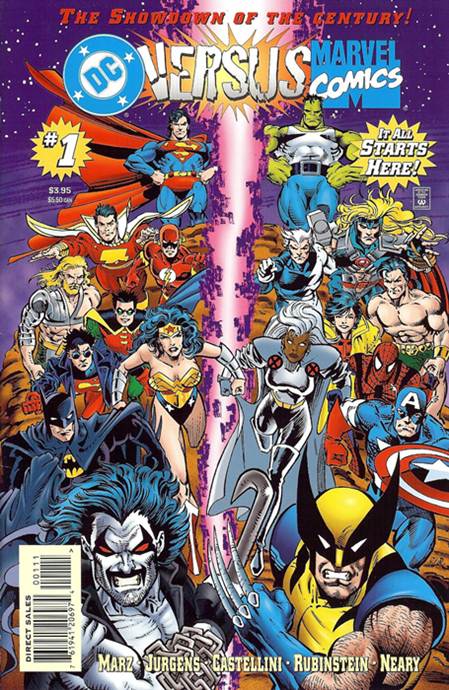
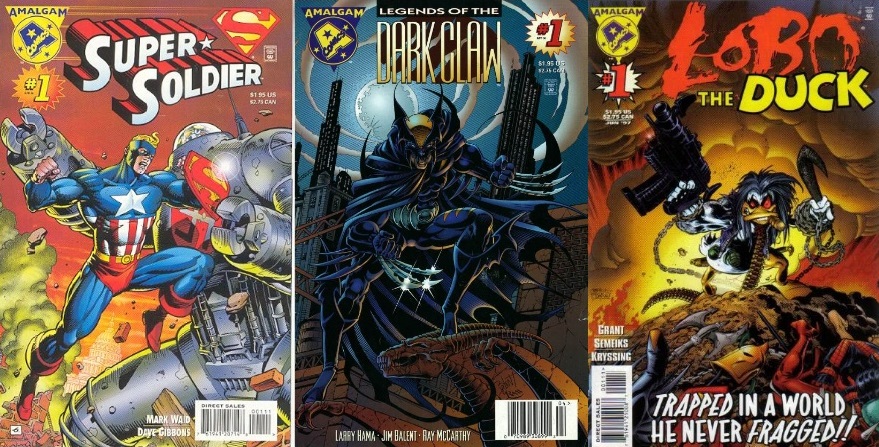
Specious battles aside (I also take issue with Storm of the X-Men beating Wonder Woman with a bolt of lightning and Batman beating Captain America because the latter got hit by a wave of water from a flooding sewer which threw off his aim), the book was a smash hit. It spawned two sequel miniseries, but the thing that fans remember most were the series of one-shots that came in-between issues three and four of the main storyline, the Amalgam Universe. Basically, the Marvel and DC Universes were merged, and we got 12 one-shots starring character mashups like Super Soldier (Superman fused with Captain America), Dark Claw (Batman and Wolverine), Speed Demon (Flash and Ghost Rider) and so forth. A year later there were another series of 12 one-shots, half of which were follow-ups to the original dozen and the other six introducing new mashups like the Lobo the Duck (Lobo and Howard the Duck) and Iron Lantern (Iron Man and Green La– look, do I have to spell out EVERYTHING?).
The Marvel/DC crossover craze ended in 2003 with the long-awaited JLA/Avengers crossover, and it came about in a sort of odd way. The legendary George Perez, whom everyone agreed was the only man alive who should draw this book, joined upstart publisher CrossGen Comics, and CrossGen made all of its talent sign exclusive contracts for the term of their employment. The only loophole allowed was in Perez’s contract, which stated he would be allowed to do JLA/Avengers if it ever happened. That seemed to be enough to get Marvel and DC to figure things out, and the four-issue miniseries finally came about. But that’s the last time any Marvel or DC characters met one another.
There were other crossovers in that era, of course. Marvel’s Iron Man met Valiant’s X-O Manowar, and Daredevil encountered Shi from Crusade Comics. DC and Dark Horse comics became besties: Superman crossed over with Michael Allred’s Madman, the Joker fought the Mask, and Batman met both Grendel and Hellboy (the latter with Starman in tow). But the two biggest games in comics stopped playing together at that point, possibly because of corporate chicanery and possibly because the always friendly rivalry between the two publishers became somewhat less friendly for a while.
Marvel, in fact, seems to have quit crossovers altogether. A search on the Internet (which, as we all know, has never been wrong about anything) seems to indicate the last time Marvel characters crossed over with any other publisher was back in 2009, when the Avengers and Thunderbolts were featured with Top Cow Comics characters in a miniseries called Fusion. We’ve recently got a new crossover, though, with Wolverine fighting the Predator, but as both characters are now owned by the Walt Disney Corporation and IP Farm and Macaroni Grill, and therefore both published by Marvel, I don’t know that it technically counts.
And it’s not like other publishers haven’t gotten into the game as well. Before Disney bought Fox, Dark Horse Comics held the rights to Aliens and Predator, and they fought EVERYBODY. Superman Vs. Aliens, Batman Vs. Predator, Green Lantern Vs. Aliens, Magnus: Robot Fighter Vs. Predator, WildC.A.T.S. Vs. Aliens, Archie Vs. Predator (no, I’m not kidding), Batman and Superman Vs. Aliens and Predator…it was a cottage industry.

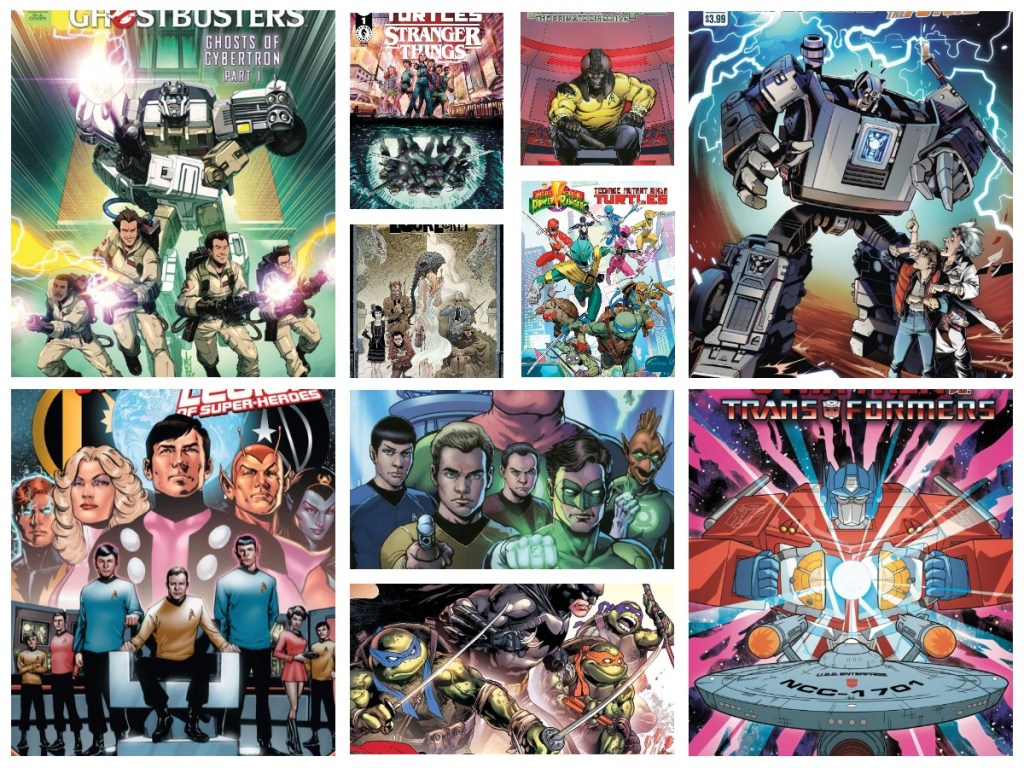
And their sparring partners often met other publishers’ characters as well. Archie Comics has crossed over with – among others – the Punisher, Batman ‘66, Harley Quinn and Poison Ivy, Vampirella and Red Sonja, and the Tiny Titans. They also crossed over with the Teenage Mutant Ninja Turtles when Archie was publishing THAT book, but since the Turtles have moved to IDW Publishing they’ve encountered the Mighty Morphin Power Rangers (twice), Batman (four times), and the characters from Stranger Things, which has also crossed over with Dungeons and Dragons, which has also crossed over with Rick and Morty. The Power Rangers have also met both the Justice League and Godzilla, and the Justice League and Godzilla are currently meeting each other – along with King Kong – in a crossover with the Legendary Monsterverse.
While Marvel has pulled out of the crossover game (which is something I largely suspect is an edict from Disney, although I have nothing to back that up, it’s just a gut feeling), DC has kept it up. Besides the aforementioned TMNT, Power Rangers, and Godzilla/Kong crossovers, the Justice League has met the characters from Jeff Lemire’s Black Hammer, and enjoyed crossovers with corporate siblings the Looney Tunes and the Hanna-Barbera cartoon characters. Batman and Scooby-Doo, who have met in cartoons many times, now share an ongoing children’s comic. DC has also partnered with IDW for Star Trek/Green Lantern, Star Trek/Legion of Super-Heroes, and an inventive crossover between DC’s Sandman Universe and Joe Hill’s Locke and Key. IDW seems to love crossovers, even with different licensed properties in their own stable. While they owned the licenses to these assorted properties, they crossed over TransFormers with Ghostbusters, Back to the Future, and Star Trek: The Animated Series (making new Autobots out of the Ecto-1, the Delorean, and the Enterprise, respectively). Star Trek, by the way, also crossed over with the X-Men when Marvel owned that license, in two one-shot comics and a prose novel titled Planet X. And Valiant and Image Comics did the “universes merge” story three whole years before Amalgam Comics in a series called Deathmate, which is largely remembered today for the fact that Rob Liefeld’s issue of the series was hilariously late.
In fact, there’s only one really major franchise that has significant comic book presence that – as far as I know – has never done an official crossover, and that’s Star Wars. Even before the Disney buyout and the comics moved to Marvel, Dark Horse never made an effort to have Luke Skywalker meet Barb Wire or something. The closest they’ve come was in an out-of-continuity story in the Star Wars Tales anthology comic from 2004, in which the Millennium Falcon gets lost in a galaxy far, far away and crash-lands on a primitive planet, only for the remains to be discovered centuries later by an archeologist strongly implied to be Indiana Jones.
I know it can seem overwhelming if you’re a casual fan, trying to make all of these things work out. The good news is, you don’t have to. The vast majority of these crossovers are either considered non-canonical to the main properties or are of such little consequence to the ongoing story that they may as well be. There are rare exceptions (the WildC.A.T.S./Aliens crossover killed off several members of Wildstorm Comics’ Stormwatch team, for example), but for the most part, they can be read on their own, self-contained, without impacting the ongoing comics in any significant way.
So why do them at all?
Because they’re fun. They’re fun for the readers, who like seeing beloved characters interact, and they’re fun for the creators, who enjoy making them just as much. It’s true that there was a saturation point of crossovers in the early 2000s, but the solution to saturation is to slow down the flow, not cut it off entirely.
So the announcement of the two DC/Marvel omnibus editions is welcome. The DC Versus Marvel: The Amalgam Age omnibus will collect the DC Vs. Marvel miniseries, its two sequels, and 13 of the 24 Amalgam books. The DC Versus Marvel omnibus will collect most of their other crossovers. But the exclusion of the remaining 11 Amalgam books is surprising and a little frustrating, and the DC Versus Marvel omnibus will exclude JLA/Avengers, which was reprinted in a very limited charity run two years ago after George Perez announced that he was suffering from terminal cancer. The fact that it was once again Perez being on a deadline that got that book off to the printer is a sad sort of cosmic convergence.

I hope that there are plans to reprint the rest of the Amalgam books at some point, but even if there aren’t, the fact that they’re doing the omnibus editions at all is encouraging. It’s something fans have wanted for a very long time and we didn’t really think would ever happen. It also, of course, has everybody asking a couple of pertinent questions. First, why now? What has changed in the Marvel/DC relations that allows these books to finally see print again? A lot of the people responsible for the bad blood between the publishers are gone now, and that may indeed play a significant role. And if THAT has changed, let’s just ask the most obvious question of them all:
Could this be a precursor to more?
As I said, it’s been over 20 years since the Marvel and DC Universes connected in any official capacity and a lot has changed. I think there are a lot of fans who would be interested to see Miles Morales meet Damian Wayne or have Kamala Khan interact with Jon Kent. How would the Titans of today – now DC’s premiere super-team – react to the X-Men in the age of Krakoa? And come on, fans have been pining for a Deadpool/Harley Quinn crossover for ages. Such a book would be as good a license to print money as Wolverine was in the 90s.
I’m not saying it will happen. I’m just saying that if it DID, it would be cool.
I’m also saying that the two omnibus books are coming out in August, which also happens to be my birthday month. I’m just. Sayin’.
Blake M. Petit is a writer, teacher, and dad from Ama, Louisiana. His most recent writing project is the superhero adventure series Other People’s Heroes: Little Stars, now complete on Amazon’s Kindle Vella platform. He’s always wanted to write the Captain Carrot/Spider-Ham crossover that America deserves.
 Blake M. Petit