Geek Punditry #129: Fact and Fiction

Statistics are a funny thing, and by “funny” I mean “likely to make my brain sad.” I recently read a statistic that claims only about 46 percent of American women read fiction (novels, short stories) on a regular basis. It’s a lower number than I would like, but reading rates in general seem to always be declining, so it can’t be that surprising. What WAS surprising is that the rate of MEN who read fiction, as of 2022 when this study was conducted, is about 27 percent. That’s appalling to me. That means that if I line up four guys, odds are only one of them will have read anything more inventive than the sports page in the past year. And THAT guy is just reading Brony fanfic. 

“Fluttershy slipped out of her fishnet holster…” good grief, people are deranged…

I don’t want it to sound like I’m against nonfiction, mind you. You can read any genre you want, as long as you’re reading. I constantly beg my students to find SOMETHING to read every day, be it a video game magazine or Crime and Punishment, I don’t care. But it leaves me confused, baffled, as to what exactly it is that drives so many men away from fiction. They go to movies, they watch TV shows – but when it comes to picking up a book, they’re more likely to turn to history or how-to. I guess it goes back to the old joke about men, upon reaching a certain age, having to choose whether they’re going to get really into either grilling or World War II. (I am past that certain age, by the way, and I am obsessed with many things, but not those.)

That’s not to say I don’t read nonfiction, I do, but the funny thing is that most of the nonfiction I read is nonfiction ABOUT fiction. For instance, the current book I’m finally chopping off my To Be Read pile is Teenagers From the Future, a collection of essays edited by Tim Callahan about DC Comics’ Legion of Super-Heroes. That’s the kind of nerd I am. I like to read the analysis of fiction written by other nerds. I’ve read books about the history of Universal Studios, specifically their monster movies from the 1920s to the 50s. I’ve read books about the making of Alfred Hitchcock’s Psycho and the life of Edgar Allan Poe. Not long ago, when making one of my world-famous, soon-to-be sponsored by Netflix LitReels (this part is absolutely not true), I was doing a little research about movie novelizations from the 1980s. In the course of that research I discovered that Ryan North, the writer behind the current excellent runs of Fantastic Four and Star Trek: Lower Decks comic books, has written an entire book analyzing the differences between the film Back to the Future and its movie novelization. This made me realize that I needed to read the novelization again, then read North’s book, B^F.

An all new way to go back in time.

If I’m going to read a memoir, it’s not going to be one written by a former president or supreme court justice, but an actor or a writer. Stephen King’s On Writing: A Memoir of the Craft, for example, is one of my favorite books. I go back and read it again every few years, if for no other reason than to remind myself that the best-selling writer on the planet suffers from many of the same struggles as any other schmuck who dedicates themselves to figuring out the proper order to put words in on a daily basis. I really enjoyed Growing Up With Manos: The Hands of Fate by Jackey Neyman Jones, daughter of the director of one of the worst movies ever made, about the journey to create that cinematic oddity and the strange way it has impacted her life. And actor, comedian, and talk show host Craig Ferguson’s American on Purpose is an uplifting, magnificent exploration of what my country can mean to somebody looking at it from the outside, with all the wit and humor that you would expect from Ferguson. 

That’s not to say that I stick with just feel-good stuff. I’ve read, for instance, Matthew Perry’s Friends, Lovers, and the Big Terrible Thing and Jeanette McCurdy’s I’m Glad My Mom Died, both of which dig into the lives of actors, both of which are deeply tragic in very different ways. And let’s not forget Maus, Art Spiegelman’s haunting graphic novel (yes, nonfiction graphic novels do exist) detailing his father’s experiences in Auschwitz. Spiegelman makes the interesting narrative choice of depicting the Jews as mice and the Germans as cats, with other nationalities occasionally popping up as other animals (Americans, for instance, are dogs, from the old “dogface” nickname). The result is a book that looks like a sort of hybrid of Watership Down and history’s greatest nightmare. These aren’t books that make me feel better about the world, but I’m certainly glad that I read them.

These books have one thing in common: none of them will cheer you up.

More often than that, though, I like reading books about the creation of movies, comics, television, and even other books. A few years ago, for example, I found a pair of books by Dustin McNeill and Travis Mullins called Taking Shape and Taking Shape II. The first was a deep dive into the creation of all the different movies in the Halloween horror franchise, which was cool. The sequel, however, was far more interesting: an exploration of all the scripts, pitches, and abandoned ideas for Halloween sequels and reboots that were NOT made for one reason or another. McNeil also has a solo effort, Slash of the Titans, about the long and twisted road that eventually led to the movie Freddy Vs. Jason, including discussion of some abandoned story ideas that, frankly, I think showed more potential than the final film we actually got. I’m fascinated by the creative process, and exploring the different ways these stories have been told, or even not told, is something that really compels me.

These books, paradoxically, make a delightful little romp.

If you want me to get into history (of the two I’m far more likely to get into grilling, but let’s stick with history for now), I prefer it to be couched it in the world of fiction. Do I want to read a book about life in Victorian England? No. Do I want to read Les Standiford’s The Man Who Invented Christmas, about how life in Victorian England eventually led to the creation and legacy of Charles Dickens’ A Christmas Carol? Absolutely. Am I particularly interested in investing any more time than I already have into McCarthyism and the moral crusading of the 1950s and 60s? That’s a no from me, dawg. but if you hand me David Hadju’s The Ten-Cent Plague: The Great Comic Book Scare and How it Changed America, now you have my attention.

Often, when I write these Geek Punditry pieces, I’m trying to show people the universality of what I’m writing about. The thesis of this column is to discuss things I like and urge others to share in my joy. But I have to wonder if, in this instance, I’m a little too unique for that. The real world is scary enough, friends, and I sometimes think we all spend too much time immersed in it anyway, with 24-hour news networks dedicated to showing us the worst possible angle on everything that happens and 24-hour doomscrolling on social media dedicated to making the worst even more horrific. I prefer spending my time in worlds of the imagination, and I make no apology for that. So I guess what makes me a little different is that, even if I’m exploring reality, I’m doing so out of a thirst to find the paths to fantasy. 

Blake M. Petit is a writer, teacher, and dad from Ama, Louisiana. His most recent writing project is the superhero adventure series Other People’s Heroes: Little Stars, volume one of which is now available on Amazon. You can subscribe to his newsletter by clicking right here. He’s also started putting his LitReel videos on TikTok. If you were surprised at the fact that he didn’t bring up Star Trek this week, that’s because there ARE nonfiction books about Star Trek, but frankly, not enough of them.

Ghosts of Christmas Stories Past 2020: Warmth

I don’t think I need to explain to anybody how the year 2020 sucked. If you can think of a single positive that came out of that horrid, ridiculous, divisive crapnado of a year, you’re Pollyanna compared to me. As that year reached its end, and I approached the time to once again tackle my little holiday tradition, I thought about what it was we all really needed that year.

The answer was simple but, as is so often the case, the way to convey the message was a little more complicated. This is one case where my life as a teacher really came in handy. I don’t know if teachers should admit this to their students, but there are certain lessons, certain subjects that we enjoy much more than others. I do admit to my students that the marking period when we tackle Hamlet is my absolute favorite part of the school year. But there are other stories that I teach that I really enjoy as well, and it is one of those that brought “Warmth” to life. Like all truly great stories, there are different versions of it, and in this story I did a little work trying to reconcile public perception with the original text, while at the same time telling a story of my own. I think I did okay when it comes to that, but whether I did or not, the result is one of my personal favorites of all the Christmas stories I’ve written over the years. 

Christmas 2020: Warmth

Ghosts of Christmas Stories Past 2019: I Can Explain

2019 was the year my little Christmas tradition almost ended. 2017 was the hardest year of my life – that was the year that I lost my mother AND the year my son was born. My entire life was thrown into chaos, and in all that chaos, all my creative juices sort of evaporated. I managed to squeeze out the monthly chapters of Santa’s Odyssey that brought us from Christmas of 2017 to New Year’s Day of 2019. 

And then after that…nothing. Santa’s Odyssey drained what little fuel I had left in the tank, and for a long time, although I tried desperately to get a story started again, nothing I tried gained any traction. When Christmas approached that year, I resigned myself to the fact that this was the year my little tradition would finally die.

But then, a few days before the deadline, an idea came to me, and I got back in the saddle. “I Can Explain” is the shortest of my short stories, and probably not the best, but it kept me going at a point where I wasn’t sure if anything would. And it drew on what was going on in my world, which gives it a certain sincerity. And although I didn’t have any real creative output for the next year and a half (it wouldn’t be until 2021, when I found my way to Other People’s Heroes: Little Stars, that I actually found the will to write long-term again), if I hadn’t finished this story I may never have written the story for 2020, which turned out to be one of my favorites. So for that reason, I’m really glad that this story exists.

Christmas 2019: I Can Explain

Geek Punditry #17: Fiction’s Fiction

If there’s one thing you can say about fandom, it’s that all fans of every stripe want the same thing: more. If we love a TV series, we want movie spin-offs. If we love a comic book, we want that hero to appear in multiple titles. If we love football, we feign interest in the XFL or USFL until August, because at least it’s something. Whatever it is fans want, the unifying element is that everybody wants more of it. 

The problem is that stuff takes time. The average TV season lasts for 13 episodes these days (sometimes 22, if you’re lucky), leaving well over two thirds of a year with no new content. Movie sequels can take from years to decades, and sometimes never happen at all no matter how badly you want them. Waiting for new books is a crapshoot – if you’re a Stephen King fan you’ll have three new novels to read by the time you get home from Burger King, whereas George R.R. Martin readers will have to inherit the fandom from their grandparents before they get any new content. Even comic books, which usually have a pretty standard schedule of once or twice a month, take you ten minutes to read and then you’re stuck sitting around waiting for the next installment.

Efficiency is the only reason the man on the left has a higher body count.

So in order to satiate the thirst of fans for “more,” something marvelous has happened. “Extended” Universes. Novels based on movies, comic books based on novels, TV shows based on comics, movies based on TV shows. There’s a weird, incestuous spiderweb of media that springs up around any sufficiently popular franchise, and it’s been happening for ages. Back in 1942 George F. Lowther wrote The Adventures of Superman, a novel based on the world’s most popular comic book character who, at the time, was only four years old. In 1910, Thomas Edison produced a short film based (very loosely) on Mary Shelley’s Frankenstein. Hell, way back in 1615, Miguel de Cervantes published the second volume of Don Quixote largely to spite an anonymous writer who, using the pseudonym “Alonso Fernandez de Avellaneda,” released his own unauthorized sequel to the first book, something that would have brought down a legion of Disney-owned lawyers were anyone to try that today. The point is, fans have been greedy for a long, long time.

Pictured: More.

The great thing is, if you love Star Trek and can’t wait for June 15 and the season premiere of Strange New Worlds, there are literally hundreds of novels, comic books, and video games you can consume to get your fix. And some of them are really good. And some of them have very devoted fans, and some of them have wonderfully complex and entertaining lore and mythologies all their own.

And this is where the problem comes in. When extended universes are really popular, a sort of strange conflict begins to arise when the time comes to figure out what is and what is not canon. What’s “official” to the main universe that you’re enjoying? What “counts” and what doesn’t?

It used to be relatively simple: the medium that birthed the franchise was king, and everything else could be a fun diversion, but was not considered relevant to the creation of a new “official” installment. It didn’t count, it wasn’t real, it was “Fiction’s fiction.” Because of this, at the time, these expanded works didn’t usually do anything that would have permanent repercussions to the main story. Sure, there were Star Wars comics while the original trilogy was being produced, but there was never any real danger of Han Solo dying because Lucasfilm needed him for the next movie. This did produce some “funny in hindsight” moments when early writers teased a Luke/Leia relationship because they didn’t know yet that the two of them were brother and sister. Of course, neither did George Lucas, so who can blame them?

It was Star Wars, I think, that started to change things for these extended worlds. In the early 90s, it had been years since Return of the Jedi and there did not seem to be any intent to make more movies, so a plan was hatched to continue the universe via novels and comic books. The first Timothy Zahn trilogy of novels introduced the new big bad, the fandom-beloved Grand Admiral Thrawn, while Dark Horse Comics’ Dark Empire series brought Emperor Palpatine back from the dead by revealing he had the ability to transmit his mind into cloned bodies he had ready for just such an occasion. With the success of these stories, the Star Wars universe grew exponentially, with hundreds of interwoven stories introducing new characters, heroes, villains, planets, and alien species that were as thoroughly entertaining as anything the fans had come to love in the original trilogy. Even once movies were being made again, films that sometimes contradicted elements of the extended universe, the creators did their best to pivot, explain away inconsistencies, and incorporate “official” elements into their own world. And for the most part, it worked.

Geeks in the 90s were required by law to read these books 74 times.

Then Disney bought Lucasfilm and designated everything except the six existing movies and Clone Wars TV series to be non-canon. Actually, they used the term “Star Wars Legends,” because that way they could keep reprinting and profiting off the work while usually failing to pay the creators any royalties, which is a different rant I’m not going to get into right now. There would still be an extended universe, of course, but now they were going to produce it themselves, with books, comics, and video games tied to the new “official” canon, and ostensibly, those works would be considered canon as well. So far it seems to have worked out, but that doesn’t mean I doubt for a second that Kathleen Kennedy would make a movie that  contradicted Marvel Comics’s War of the Bounty Hunters series if she so felt the urge. 

My favorite “Star,” Trek, has had its own issues with extended universes, particularly in the 80s when DC Comics held the license. Following Star Trek II: The Wrath of Khan, DC began publishing new stories assuming a status quo as it was at the end of that movie: Admiral Kirk commanding the Enterprise after the death of Spock. Then came Star Trek III: The Search For Spock, in which Spock…y’know…un-dies. Despite the fact that the movies clearly take place right after each other, chronologically, the comic writers wrote a story that dovetailed their few years of adventures into that movie best they could, then began a new status quo. The Enterprise was destroyed, so Kirk took over command of the Excelsior for reasons, while Spock became captain of a science vessel and had his own adventures. Then Star Trek IV: The Voyage Home further complicated things with a story that clearly happened immediately after the events of the previous film and did not fit the comic book canon in any conceivable way. The comic book writers flailed for a while until DC got the rights to do an ongoing series of the then-new Star Trek: The Next Generation series, at which point they rebooted the comic starring the original crew so it could start with a new first issue the same month that TNG #1 came out, and then they just pretended those other stories they told never happened.

Trek got better in the late 90s and aughts, taking a cue from Star Wars and moving into stories based on franchise installments that seemed truly “over” and therefore safe to expand upon. There was a series of novels following the Deep Space Nine characters after the conclusion of their show, another with the adventures of Captain William Riker on the Titan following the final TNG movie, and even some series featuring mostly-new casts like Peter David’s New Frontier or the Starfleet Engineering Corps books. When the J.J. Abrams films brought Trek back to the screen, it was no problem for the extended universe, since they explicitly took place in an alternate timeline. In fact, it just gave writers a whole new universe to play around in. Modern Trek does have a few clashes, though: IDW Comics (who currently holds the license) recently began an initiative to create a more tightly woven universe through a relaunched Trek series and its Defiant spin-off, both of which are good comics, but which feature versions of Data and Beverly Crusher that seem to flat-out contradict the canon of Star Trek: Picard, which seems like a bizarre choice.

One of these things is not like the others…

The “official” continuation game has been played with more and more franchises in recent years. Buffy the Vampire Slayer and Firefly continued their respective universes in comic books, while Smallville – a TV show based on a comic – had a fairly lengthy “Season 11” series that followed that show: a comic book based on a TV show based on a comic book. Then there was the film adaptation of Stephen King’s The Dark Tower, a desperate effort to squash the material of seven books into 95 minutes (that’s seven Stephen King novels, most of which are large enough to qualify for their own zip code). While most fans were disappointed in the result, the sting is mitigated slightly if people try to view the film not as an adaptation of the books, but as a sequel to them. That probably doesn’t make any sense if you haven’t read the books, but just take my word for it.

That brings us to the issue when printed media are translated to the screen. Books were first, gloriously first, but if we’re being honest here, the general public often accepts film or TV adaptations as more official. Just talk to any devotee of L. Frank Baum’s The Wonderful Wizard of Oz and its subsequent sequels about how much you love the Ruby Slippers and watch them die a little inside. James Bond was created as a hero for novels and short stories, but the films are obviously what most people are familiar with, and those are highly contradictory. Some of the movies are based on Ian Fleming’s stories, some of them use the titles of stories but very little else, and others are cut from whole cloth, but there’s just no way to pretend they share a canon. Most Bond fans don’t care, of course, and modern fans tend to see the movies as the “real” James Bond more than the novels that gave him birth. (He’s a more likable character in the movies, to be fair, so this is not necessarily a bad thing.)

As for comic books, there have been comic book movies for a very long time, but those have historically been ignored by the comics themselves. The first Batman serial from the 40s, for example, portrayed him as a government agent beating up spies, something that doesn’t sync with any canon comic book I can think of. Even really popular films, like the Christopher Reeve Superman or Tobey Maguire Spider-Man, had a negligible effect on the comic books. Then came the Marvel Cinematic Universe, and boy, things changed. With the gargantuan success of the MCU, there are now effectively two “official” Marvel Universes, and the cinematic one is by far the one that’s more recognizable to the general public. The MCU was the first time anyone had ever tried to create so intricate a universe of interwoven films and TV shows, something that made it feel more “real” than that scene in Batman Forever where Bruce Wayne casually mentions Dick Grayson’s circus is “halfway to Metropolis” but otherwise gave no indication of anything beyond the boundaries of the film. The Marvel Studios movies and shows all linked to each other and all mattered to each other, just like the comics, and the “cinematic universe” model is something everyone has been trying to replicate ever since.

And of course, occasionally elements in these extended universes become popular enough that they can cross over into the “real” worlds. Harley Quinn was created in Batman: The Animated Series and was such a hit that she joined the official comic book universe, then spread out into live action. Superman’s pal Jimmy Olsen, almost as integral a character to the mythos as Lois Lane or the Kents, made his first appearance on Superman’s radio show. The aforementioned Batman serial, which is goofy and doesn’t feel like the same character at all, is responsible for the creation of the Batcave. And even though the Star Wars Legends stuff is no longer canon, Disney is starting to allow elements of that world to leak into the “official” world, such as bringing in Timothy Zahn’s Thrawn character and allowing the resurrection of Emperor Palpatine – although to avoid being accused of copying the Dark Empire comic book, they cleverly neglected to give any comprehensible reason for his return whatsoever. 

“I’m canon now, bitches!” –Thrawn, probably

The original question was that of what is “real” in these different universes. The newfound ubiquity of the multiverse concept in storytelling makes that easier. (It’s an old concept, I know, but in recent years it’s really experienced a boom in popular culture.) Marvel officially recognizes just about every version of its characters as “real” in one corner of the multiverse or another, with stories like Spider-Verse (the comic book) and Into the Spider-Verse (the movie) bringing them all into play together. DC has a similar policy and has officially declared that the Christopher Reeve Superman movies and Michael Keaton Batman movies are set in the same universe, although whether that will be contradicted by the upcoming Flash movie remains to be seen. The truth is that the people writing any version of these IPs in any medium will pick and choose those elements that they need to make their story work, and as that can be confusing if a fan is trying to reconcile everything, this is probably a good reason not to try that. What’s “real”? What “matters”? Whatever you need for the story you’re trying to enjoy right now.

The rest of it?

Just find that corner of the multiverse where a guy named Joel told us to repeat to ourselves “It’s just a show, I should really just relax.” 

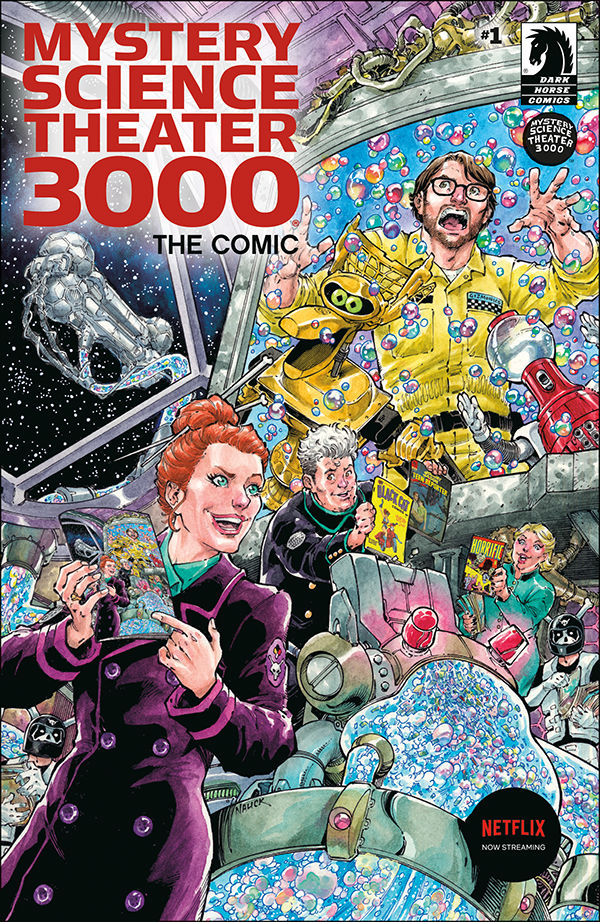
Yep. Those guys got a comic book, too.

Blake M. Petit is a writer, teacher, and dad from Ama, Louisiana. His current writing project is the superhero adventure series Other People’s Heroes: Little Stars, a new episode of which is available every Wednesday on Amazon’s Kindle Vella platform. One of his favorite Star Trek novels is Federation, by Judith and Garfield Reeves-Stevens. Don’t try to read it and then watch First Contact. It doesn’t work.