Year of Superman Week 52: And to All Things, an Ending

I’m writing this on Christmas morning, sitting amongst piles of wrapping paper and the mountain of Hot Wheels that Santa Claus brought Eddie, The Muppet Christmas Carol on TV because it’s not time for football yet. But it’s also the first day of the final chapter. After 51 weeks in which I have watched, read, or listened to at least one piece of Superman-related media every single day, no matter what life had in store for me, I’ve only got seven days left to reach the finish line. 

I’m going to think of this week as “the best of the rest.” I’m going to try to read and watch some of my favorite or some of the most significant stories remaining on the gargantuan list I started the year with. And make no mistake, that list is still pretty big. I haven’t gotten close to scratching off all of it. So perhaps, just perhaps, when I reach New Year’s Day, my journey with Superman won’t be ending, but merely evolving.

But time for that later. Let’s get started.

And as always, you can check out earlier blogs in the Year of Superman Archive!

Thur., Dec. 25

Comics: Superman Smashes the Klan #1-3, DC Go! Holiday Special #32

Notes: A few weeks ago I listened to the radio serial “Superman Versus the Clan of the Fiery Cross.” In 2019, writer Gene Luen Yang and artist Gurihiru loosely adapted that storyline into a three-issue miniseries, Superman Smashes the Klan, that kept the skeleton of the original story, but added some new elements that really made for one of those evergreen graphic novels that will be read for a very long time.

Set in the days after World War II, the story kicks off with a Golden Age-style Superman polishing off a leftover Nazi calling himself Atom Man. The fight is tougher than it should be, as Atom Man is powered by a glowing green crystal that Superman has encountered before, that makes him weak and sick. We soon discover that this is a very young Superman who does not yet know the truth of his alien origins. Something is nagging at him, and he sees an odd vision of himself in the mirror looking like a creature from outer space. Meanwhile the Lee family – Dr. Lee, his wife, and their children Tommy and Roberta – is moving from the Chinatown section of Metropolis to the city proper because Dr. Lee is starting a new job as Chief Bacteriologist of the Metropolis Health Department. Their new neighbor, Jimmy Olsen, stops by to introduce himself and invite them to the Unity House Community Center baseball practice. 

The story follows the plot of the radio show fairly well, but it adds in elements that weren’t present on the air. Superman learns in the course of this story that he’s an alien himself, giving an added dimension to the story of the Lees and their struggle to find acceptance in Metropolis. We’ve also got an original character, Tommy’s sister Roberta, who wasn’t in the original story but takes on a large part of the narrative. As the daughter of a Bacteriologist, Roberta is a bit of a germophobe, which only serves to enhance her existing awkward nature, making it much more difficult for her to acclimate to her new home. I like this angle a lot. Having Tommy fit in as a typical all-American boy worked well for the radio show. You didn’t even know that he WAS Chinese for the first few episodes, making the angle of the Klan come across as a surprise to the listener. But in a comic book, there’s no way to make that kind of thing a surprise. While Tommy is still that kid who everyone loves and blends in with the Unity House baseball team easily, Roberta gives us a character to depict the alienation that someone – especially a kid – can feel in this sort of situation. The idea in the original was just to point out how foolish the likes of the Klan were, and that’s all to the good, but Gene Luen Yang (himself a creator of Asian descent) brings a whole new dimension to the story by emphasizing the struggle of an immigrant family through Roberta’s perspective. Not to make it sound like she’s some damsel in distress, mind you. Roberta is Superman’s deuteragonist in this story. She overcomes her anxiety to help her brother, realizing very quickly that Chuck Riggs is involved with the Klan and using her knowledge to race to Tommy’s rescue. She also inspires Chuck’s change of heart much earlier than happens in the radio serial.

Tommy, on the other hand, perhaps tries a little TOO hard to fit in, leaning on his ethnicity in ways he didn’t in the original radio story. Once he becomes part of the Unity House baseball team he keeps dropping jokes about being Chinese (“Confucius says” references, for example), using what makes him different to enhance his popularity. Although he’s a good-natured kid, his insistence on drawing attention to being Chinese bothers his sister almost as much as the people who insult them.

Superman himself has yet another perspective on the immigrant experience. He knows he was adopted, and we see flashbacks of Jonathan showing him a strange device that was in the ship that brought him to Smallville, but it spoke a language they were never able to translate. He’s even gone so far as to mentally suppress some of his more fanciful powers, making for a nice explanation for why he goes from “leaping tall buildings” to outright flight.

Another addition to the story is the Atom Man subplot. After Superman captures Atom Man in the beginning, we see periodically that he’s not in police custody, but being studied by the Metropolis Health Department, a study that Dr. Lee clearly has misgivings about. Lois Lane – who had almost no presence in the original radio story – takes the lead on this one, cracking open the story about the “Health Department” which turns out to be a private enterprise conducting dubious research. Naturally, this turns out to dovetail with the story of the Klan in a rather unexpected way. This is one point I’m a little unsure about. Making the Klan a more high-tech organization, with “loftier” ideals than the simple bigotry of the original works for this version of the story, to be certain, but I’m not sure if it undermines the original point at all. Perhaps smarter people than I can answer that one.

The is a fantastic story – a bold, proud tale that does far more than simply adapt the original radio drama. Indeed, it ties the story of Tommy and Roberta Lee in with the core concept of Superman, making who they are as integral to the series as who he is. I can’t recommend this one highly enough. 

Fri., Dec. 26

TV Episodes: Superman and Lois Season 4, Episodes 6-10
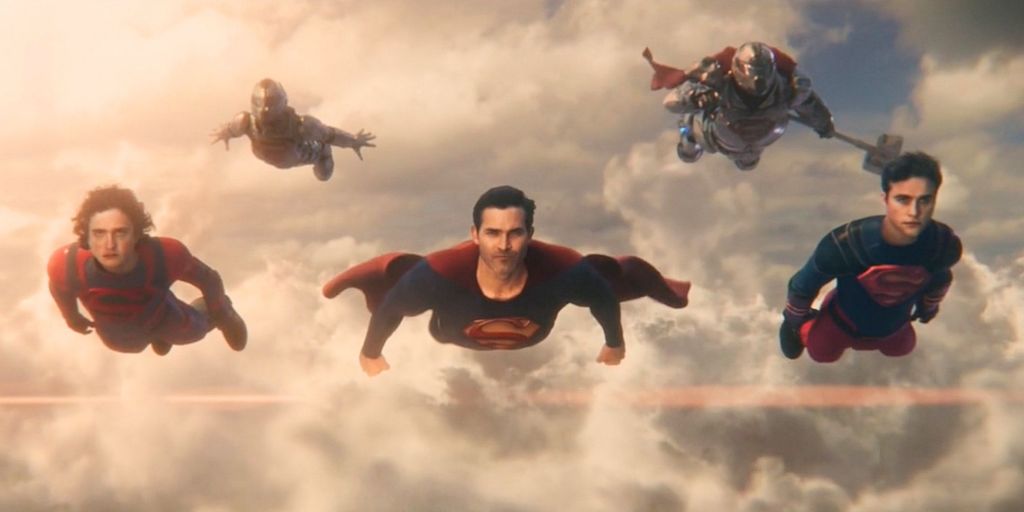
Notes: With my wife working and my son having a mountain of toys to play with and college football to watch, I decided that the day after Christmas was the time to finally finish the last season of Superman and Lois. I’m not going to to a play-by-play on these last five episodes, so let’s assume that you’ve watched these episodes that I’m watching for the first time, and I’m going to discuss my feelings about them as I watch.

In episode 6, we see Lex trying to tighten his grip on Smallville by buying up property and bribing the citizens, but they hold firm and resist – mostly because Clark wants them to do so. It’s a wonderful series of scenes in which Clark realizes something that viewers figured out several episodes ago: after seeing Lois and the boys run to Superman’s side after he was killed by Doomsday, the entire town of Smallville now knows that he’s really Superman. And best of all, every single one of them is willing to keep the secret and cover his back. It’s a great story beat, and actually one I’ve thought about several times over the years. Considering everything that he did for the town of Smallville, especially in those continuities where he had a career as Superboy, it would be utterly absurd if there weren’t a lot of people who deduced the truth. The fact that they keep the secret speaks to an inherent goodness in them, a loyalty to the hero who has saved them time and again. Plus, when we see him trying desperately to put the cat back in the bag, convincing people that he’s NOT Superman, it’s hilarious. 

Of course, there’s gotta be some drama, and the fact of his identity leaking out predictably causes some problems – kids who are resentful of Jonathan and Jordan, an antagonist from an earlier season that comes back and causes trouble. The scene where someone takes a shot at him in a diner, forcing him to reveal himself, is just glorious, and it leads to the secret being revealed to the world. When that happened in the comics I hated it, because I knew this was a genie that had to go back in the bottle and we’d seen it before. But here, when it happens on a TV series that only has three episodes left, it’s an opportunity to tell a story that hasn’t been told with Superman before, and the creators nailed it.

Beyond that, of course, another big arc in this season is the fact that Clark now has Sam Lane’s heart, and it’s reducing his powers, causing him to age. At the same time, Luthor is planning his final revenge with the combination of a new super-suit (stolen from John Henry and beefed up with Kryptonite) and the return of his Doomsday monster. It all collides in the final episode, “It Went By So Fast,” a title which I can only assume was a meta way for the writers to indicate the fact that they didn’t really want the show to end. I get it, too – this last half-season, lower on the soap opera dramatics and higher on the Superman stuff, was really fantastic, and it’s leaving me wanting more. 

They’ve done the Doomsday battle before in live action – in Smallville, in Batman V. Superman, and even before in this series…This is probably the best one I’ve ever seen. With Clark on the ropes, seeing Jonathan and Jordan step up to fight hits me in that parenting place that seems to dominate how I interpret stories these days. John Henry and Lana joining the fight as well shows how big Superman has become, how this world is rising up to meet him. He may have lost a step thanks to his heart transplant, but he’s also inspired another generation of heroes, meaning he doesn’t have to do it alone. 

And that’s just act ONE of the finale.

While Clark is chucking Doomsday into the sun, back on Earth Lex attacks the twins and Lois goes after him directly. As she shouts at him to stop attacking everyone around her when she’s the one he really wants, she yells the most Lois Lane line I’ve ever heard: “I am not afraid of you, but you’ve always been TERRIFIED of me,” then nails his warsuit with a mine. It’s not enough to stop him, but it slows him down enough for Clark to make it back to Earth and really start the final battle. It’s an epic, airborne spectacle that ends, inevitably, with Luthor taken down.

And now we’re only HALFWAY through the episode.

Next we get a time skip to about year later with Lana’s wedding to John Henry Irons (an event that would happen a few months later in the comics as well). Kyle and Chrissy are expecting a second child, and Kyle and Lana have reconciled into what appears to be a sincere friendship. Jordan and Sarah, similarly, seem to have finally buried the hatchet, and John Henry spends a tender moment with Natalie as Lois gets an important text about Lex’s future behind bars. 

In the final act, we get a voiceover from Clark about how Sam’s heart allowed him to live another 32 years, and how he wanted to leave behind a legacy, making the world a better place. Clark, along with the twins, John Henry, Natasha, even Bruno Mannheim, begin to make real change. Using the influence of Superman and Lois Lane, they start a foundation that accomplishes good throughout the world. The twins each marry and have kids of their own, and we get a nice scene of Grandma and Grandpa Lois and Clark (in admittedly dubious aging makeup). But eventually, Lois’s cancer returns, and Clark is left alone. He lasts for several more years before Sam Lane’s heart that had beat in his chest for so long finally gives out, passing away quietly with his sons next to him.

Clark sits up, young again, seeing his own body behind him. He embraces his sons – young again – and sees his grandchildren. He finds Luthor, of all people, sitting at his kitchen table, and offers him forgiveness…says goodbye to his friends one at a time, and in the end he sees a vision of Lois, waiting, to take him into the light.

Here’s the thing: the story of Superman doesn’t end. It just – it doesn’t. Five years from now, ten years, a hundred years from now, there will and should be new stories of Superman being told.

But if Superman DID end…this is the right way to do it. An ending that is happy in the life he and Lois get to lead, despite the fact that this life – like all those of mortals – must end. And the fact that a Superman left behind a better world than he arrived on in that spacecraft from Krypton. In the comic books, they can’t really do a story in which Superman changes the entire world this way, because they still need something to tell stories about next month and next year. But here, with a television series coming to an end and, with it, closing off the stories of that universe, they have the freedom to show what Superman is REALLY capable of. This season has been a buildup, showing how Superman inspires those around him – not only his own children or friends, but the people of Smallville who were willing to stand up for him, and the people of a world that grows to do the same. The ending of this episode is a tearjerker, but it’s left with a beautiful message of hope that is entirely appropriate for Superman.

But it’s not only hope. Superman is about hope, yes. But the thesis of this series is true as well: “[Love is] the thing that makes life worth living.” It’s what makes the story of Lois and Clark so powerful, in all its many iterations. A man from another world, a woman who represents the best of ours, and how they come together…this is a story worth telling. 

Comics: DC Go! Holiday Special #41

Sat. Dec. 27

Comics: DC Go! Holiday Special #43 (Cameo), Detective Comics #1103, Superman: The Kryptonite Spectrum #5, Superman Unlimited #8, Action Comics #1093, Superman Vol. 6 #33, Absolute Superman #14, Batman/Superman: World’s Finest #46, Supergirl Vol. 8 #8, Justice League Unlimited Vol. 2 #14, Justice League Red #4 (Power Girl), Justice League Vs. Godzilla Vs. Kong 2 #5

Notes: For the final time (this year), I’m going to do a roundup of recent Superman-related comics, starting – oddly enough – with Detective Comics #1103. One of the first comics I read this year, back in the first week of January, was an issue of Tom Taylor’s Detective that showed Superman helping Bruce through an existential crisis. This actually serves as a nice bookend, with Bruce teaming up with Lois to help with an investigation. Superman appears briefly, but most of the issue is concerned with Lois showing off how dang capable she is, and how much respect Bruce has for her. It’s the middle of an ongoing storyline, so it’s probably not something most people would read on its own, but it’s worth mentioning because it’s a great Lois guest appearance. 
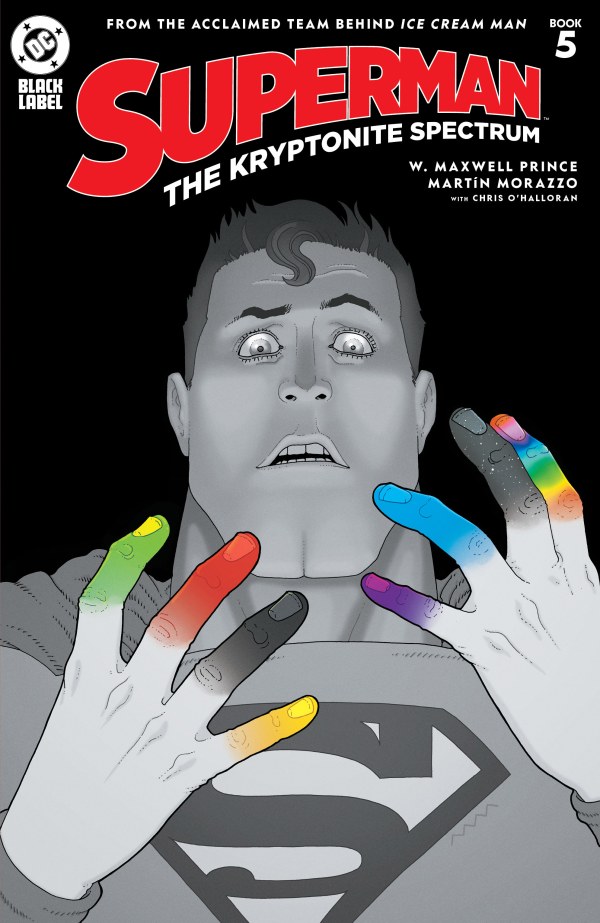
The final issue of Superman: The Kryptonite Spectrum wraps up W. Maxwell Prince and Martin Morazzo’s celebration of the Man of Steel in dynamite fashion. Lex Luthor has engineered a new Kryptonite Man, powered by the entire spectrum of the remnants of Superman’s home, and the battle between the two of them sends Superman on a spiral that leaves him questioning the very nature of the universe itself. Prince’s story leans heavily on metafiction, concentrating on Superman as a story and weaponizing that part of the character’s nature. The finale is entirely unexpected, but in its own way, as sincere a love letter to Superman as the likes of All Star Superman was – in fact, Prince and Morazzo lean heavily on Morrison and Quitely’s story here, and they do so in a way that’s both loving and triumphant. This is hands-down the miniseries of the year.
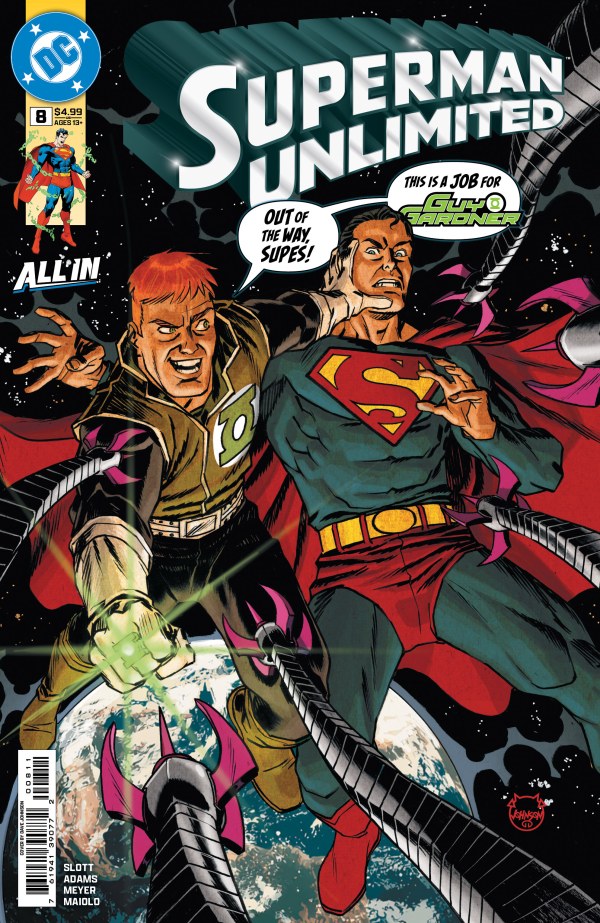
Superman Unlimited #8 gives us another of the one-off stories that this series has been doing so well. The influx of Kryptonite on Earth has changed a lot of things, including energy sources, and an experimental space flight is planning to make faster-than-light travel a commercial enterprise on Earth. With Lois Lane as a passenger on the maiden voyage, the Justice League assigns Guy Gardner to escort the flight in case something should happen. And wouldn’t you know it? Something happens. I have no doubt that Guy’s appearance in this issue is at least partially due to his guest-starring role in this summer’s big movie, but at the same time, it’s done exceptionally well. Guy is such a fun character – a rude, insufferable boor that is in every way diametrically the opposite of Superman…except for the fact that they’re both true heroes at heart. Seeing them together, both clashing and cooperating, pretty much always makes for a good time, and this issue is no exception. 
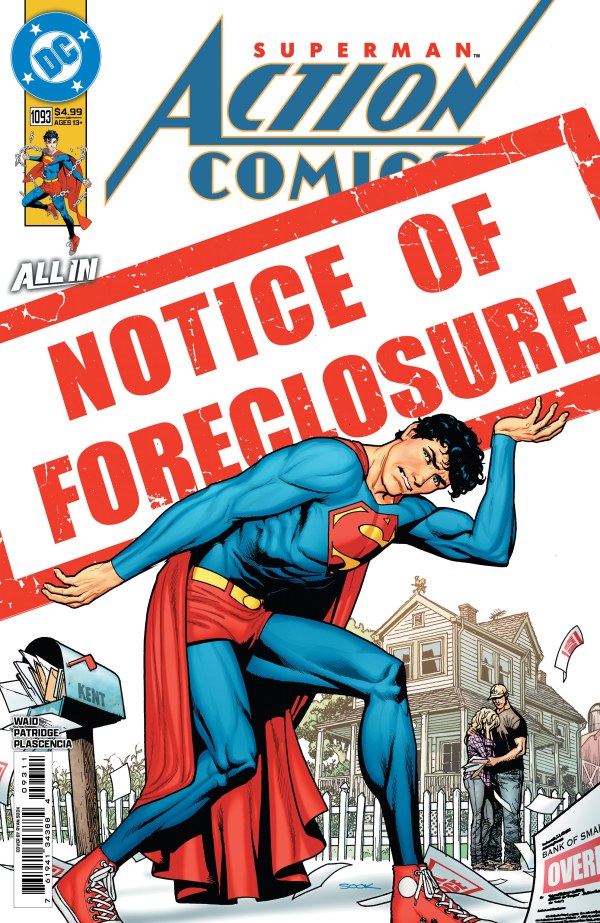
Action Comics #1093 is another one-off story, this time Mark Waid telling a Superboy tale that shows an event that’s fundamental to Superman’s moral core. Dozens of farmers throughout Smallville are given notices of foreclosure on their farms at the same time. The new owner of the bank assures them that if there’s an “error” they’ll figure it out, but the time it would take to do so would ruin every farm in Smallville. When Superboy contemplates using his power to “find” the money to save the town, it becomes a battle of wills between Clark and his parents, who think that using his powers for personal gain – even to save the town – isn’t the way to go. I’m sure that everyone who’s ever read a Superman comic has fantasized about having the power to hunt down undiscovered gold or some other get rich quick scheme, and Waid does a good job with the Kents of painting a picture of why such a thing should be above a Superman. I still have to confess that I’d probably go dig up the gold if I had Superboy’s powers, but in my defense, nobody has ever called me Earth’s greatest hero. 
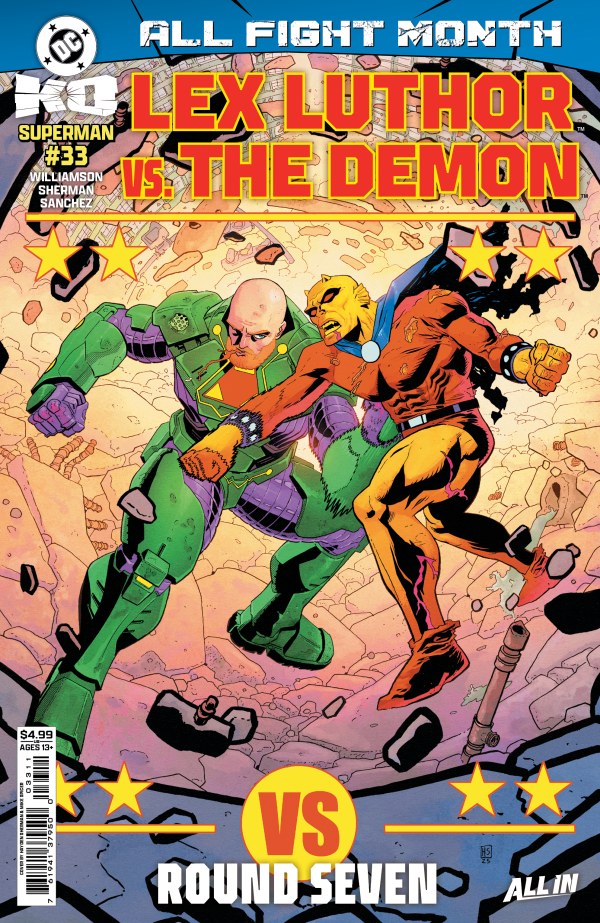
DC KO’s “All Fight Month” continues with Superman #33, with the unlikely battle between Lex Luthor and Etrigan the Demon. Throughout the month I’ve been impressed at just how well these battles have transcended being mere slugfests. Oh, there’s fightin’ a-plenty, but each of them has gone beyond that to telling a story that digs into the heart of the characters involved. We see who they are, why they do what they do, and what makes them worthy of the Omega Heart, even if it’s only in their own mind. Joshua Williamson taps into the blackness in Lex’s heart and simultaneously shines a light on him. By the end of the issue, you almost (aaaaalmost) want to root for him in his fight with the Demon, because damned if he doesn’t convince you that he’s earned the win. We also continue the storyline with Superboy-Prime and Lois, whose Superwoman powers have returned, in the Fortress of Solitude. Recent announcements about the state of the Superman titles after KO ends have made these pages a bit more relevant than we’d realized, and although I hate the fact that they keep spoiling things in the solicits, I’m very curious to see what’s coming next to this title. 

Absolute Superman #14 ends the current storyline with an epic battle between Kal-El and Ra’s Al Ghul for the heart of Smallville. As the two of them go at it, we see Lois facing off against the Peacemakers and Sol’s internal battle with Brainiac, all of which come to an amazing crescendo in this issue. Without going into a blow-by-blow, the ending of this one is probably the most hopeful thing I’ve seen yet in the Absolute Universe as a whole, although as suits this world tainted by Darkseid’s energy, the victory is bittersweet and not without a price. In many ways, it clears the table for this series, and it will be very interesting to see where the story goes from here. 

World’s Finest #46 continues the story of Lex Luthor and the Joker, fused into a single being and armed with the power of a device that gives them the sum total of all knowledge in the human race. Superman and Batman, naturally, have to step up and stop them, this time getting a little extra help from Green Lantern to juice them up in a way he’s done once before. The issue ends on a cliffhanger, and it’s a pretty good one, except for the fact that it suffers a bit from Prequelitis. Admittedly, even in the present day what happens at the end would likely be wiped out by the next issue, but when you’re dealing with a series set in the past, there’s really zero tension with the “shocking” ending. It’s still a great, fun story, though. 
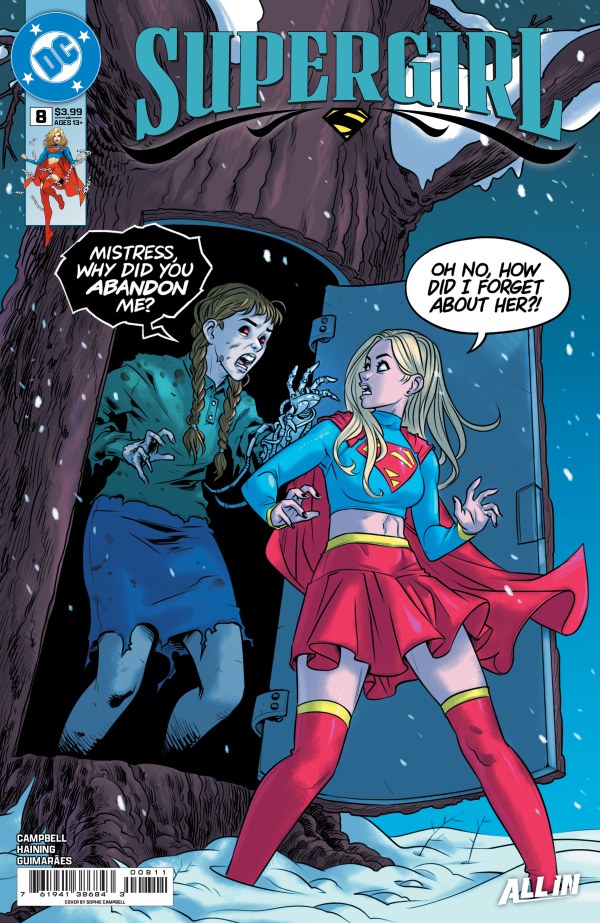
I’m going to end my tour of new comics with Supergirl #8. It’s Christmas in Midvale, but Supergirl isn’t feeling merry. The holidays, with their emphasis on family, always make her remember everything she lost in the destruction of Argo City. Still, the Danvers and Lesla-Lar do their best to cheer her up, even as they get a strange visitor from the past that Supergirl has neglected for far too long. Sophie Campbell’s Supergirl is probably my favorite new comic book title of the year, but this issue is a little atypical. While the series is usually very bright and uplifting, this issue is somewhat darker and more bittersweet, particularly for a Christmas story. That said, it works really well. Sophie takes Kara’s pain and shapes it into a valuable lesson for Lesla-Lar, whose journey to becoming a superhero is an important component of this title. The story is told well and propels the characters forward, while still giving us a little Christmas cheer in the process.

This is most likely the last I’ll talk about newly-released comics in the Year of Superman, and it’s bittersweet for me too. I’d be lying if I said I wasn’t looking forward to taking a break on January 1st, but at the same time, I’ve enjoyed pontificating about these new issues as they come out. It’s one of the main reasons I’m thinking about how to continue this blog into the new year.

Yeah, I’m teasing that again. Sue me. 

Sun. Dec. 28

Comics: Superman: Space Age #1-3
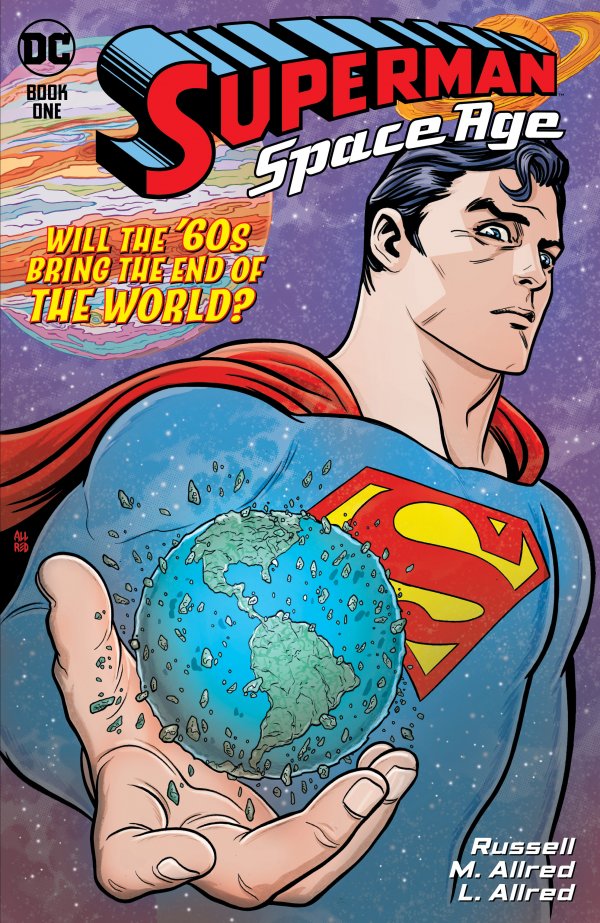
Notes: Continuing the theme of “Endings,” today I’ve decided to revisit the three-issue Space Age miniseries by Mark Russell and Michael Allred from 2022. Published as a Black Label series, like many of them, it really feels more like an Elseworlds. It’s set in a universe where Superman rises to prominence in the 1960s, with a Clark Kent that’s spurred to go out and find ways to save the world following the assassination of John F. Kennedy. Before he puts on his costume for the first time, though, he encounters a strange man called the Pariah, who warns him that the world will end in approximately twenty years. Pariah claims to have accidentally unleashed a great evil called the Anti-Monitor, an ancient being whose goal is to bring order to the Multiverse by destroying every positive-matter universe until only his own Antimatter universe remains. He tries to dismiss the Pariah as one of the “kranks” he’s assigned to cover as a Daily Planet cub reporter, but something about him sticks with Clark and he’s unable to shake it. On the other hand, he’s sometimes skeptical that the world will even last 20 years, as the arms race is intensifying and made worse by a false flag attack on Coast City orchestrated by Lex Luthor. The cataclysm turns out to bring heroes out of the woodwork: Batman captures Luthor, Abin Sur passes his ring on to Hal Jordan, Themiscyra sends Diana to the UN as an ambassador, and Superman makes his true debut disposing of American missiles before they can annihilate the Soviet Union. Book one ends with these four coming together at a new Hall of Justice.

In book two, we jump ahead to the 70s, where Superman is well-established, and the world is at peace following a nuclear disarmament treaty. But an interview with Lois leaves him questioning whether he’s doing all he can, and a similar disagreement drives a wedge in the Justice League. It’s a bad time for it too, as Green Lantern warns of the impending approach of a cosmic threat called Brainiac and, at the same time, a Superman from an alternate universe where all human life has been rendered extinct. It’s not all bad news, though – Clark is promoted to an editor’s desk at the Planet, Lois breaks Watergate, the two of them fall in love and she confesses that she knows he’s Superman just before he tells her. They even have time to get married and have a son before Brainiac arrives on Earth. But he’s not there to destroy the world, only to take its greatest resource before the Anti-Monitor can destroy it himself, hoping to use that resource in his battle against the Multiversal destroyer. That resource, as it turns out, is Kal-El of Krypton. The League drives Brainiac off the planet, but at the cost of Green Lantern’s life.

The final book in the trilogy takes us into the 80s where Clark finds Pariah again, who is impressed by his years of heroism, but still sees the end as inevitable. With less than two years before the Anti-Monitor arrives, the Brainiacs again ask Superman to join their fight, and this time, he considers it – but when a heart attack fells Johnathan Kent, he changes path, dedicating himself to saving the human race by eradicating disease by scanning their DNA. It turns out to be a ploy to record their genetic code. When the Anti-Monitor destroys the world, Superman makes for the Brainiacs’ portal, but instead of going into it he pushes through a crystal encoded with the DNA of every human he could collect, sending them to the empty world populated by the other Superman. He returns to his family just before the end, where on the other world the other Superman restores the human race on a new home.

In terms of “ending stories,” I kind of have mixed feelings about this one. On the one hand, it’s excellently done. The writing and storytelling are top-notch and the characters, even in the Elseworlds setting, still feel mostly true to the heroes we know and love. And I’ll pretty much always be on-board for artwork by Mike Allred, whose unique style is one of my favorites of all time. On the other hand, there’s an impending sense of doom that spreads across the entire thing. There are other dark “final” Superman stories, like Kingdom Come or Whatever Happened to the Man of Tomorrow?, but in both those cases we journey through the darkness with Superman and ultimately end in a place of hope. This one has a sense of nihilism that doesn’t quite befit the character. Even the ending, where the other Superman brings back humanity (starting, naturally, with Lois Lane), leaves us with the feeling that it’s only buying time. After all, the Anti-Monitor is still out there, the final battle has yet to be fought, let alone won.

The series raises some interesting questions as the different Leaguers look on things with different perspectives. Green Arrow views the world through the perspective of the “Trolley Problem,” whereas Batman’s point of view is that he just saves whoever he can, knowing he can’t save everyone. Superman, as fits the character, refuses to accept that, and is determined to find a way to save everyone even if doing so seems impossible. It’s a noble point of view that works in the regular DCU, but Russell shines a light on how unrealistic that perspective actually is. If I was looking for something realistic, though, I don’t think I’d be reading Superman in the first place. Superman is an ideal, and ideals don’t have to be realistic. They’re something to strive for, even if you know they can never really fall into your grasp, and that’s how Superman works best.

So is Space Age a good story? Yes. Absolutely. Without a doubt.

I don’t think it will ever be one of my favorites, though. 

Mon., Dec. 29

Comics: DC Go! Holiday Special #47 (Supergirl), Doomsday Clock #1-12
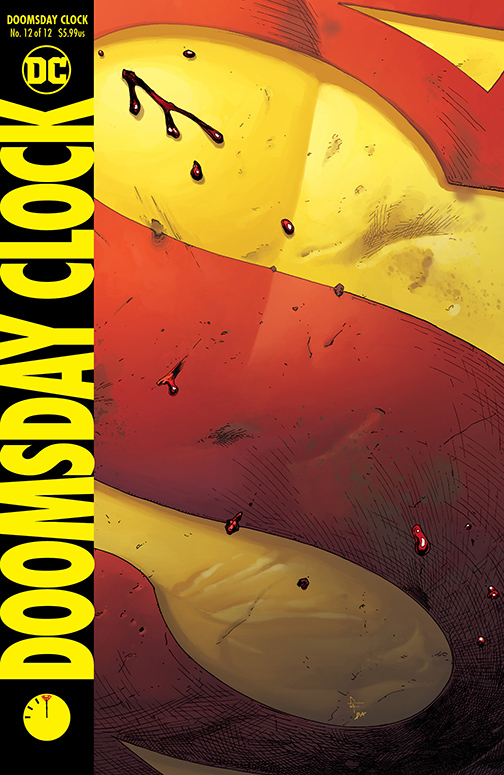
Notes: This is a controversial book, DC’s sequel to Watchmen which brings those characters into conflict with the heroes of the DC Universe, but I’m including it here for an important reason. In the end, this is very much a story about Superman. The first issue shows us the state of the world – since Ozymandias’s scheme was revealed by Rorschach’s journal, he has become the most wanted fugitive on the planet and the world has crept closer and closer to the very nuclear annihilation he was hoping to avoid. A new Rorschach has arisen, this time working with Ozymandias, who has a tumor growing in his skull. The two of them hope to find the only person in their universe with the power to change anything – Dr. Manhattan. Meanwhile, in another universe, Clark Kent wakes up from a nightmare, a horrible vision of the car crash that killed Jonathan and Martha Kent when he was only a teenager. It’s the first nightmare he’s ever had.

Ozymandias and Rorschach ally themselves with a pair of criminals – Marionette and Mime – who are seeking their missing son. They trace Dr. Manhattan to the DC Universe, where people are in upheaval following the popularization of the “Supermen Theory,” which posits the idea that the reason so many of Earth’s metahumans are American is because they have been deliberately created by the government since Superman’s first appearance. Faith in superheroes is eroding, with the only one who still has the public trust being Superman himself. 

Over the course of these twelve issues Geoff Johns and Gary Frank delve into the nature of the DC Universe itself, starting with the notion (from DC Rebirth) that it was Dr. Manhattan who was responsible for the New 52 reboot in the first place. Turns out, it’s more complicated than that. Manhattan did toy with the fabric of the universe, but the reason it was possible for him to do so is because the “Prime” DC Universe – the one that’s called Earth-0 these days – isn’t actually part of the multiverse as we know it. Manhattan calls it the “Metaverse” (take that, Mark Zuckerberg) because it’s a core reality that the others are all reflective of. In the Metaverse, Superman made his first appearance in 1938 and inspired the heroes of the Justice Society. Then reality snapped, moving Superman’s appearance to 1956. The JSA still existed, but now Clark Kent had an early career as Superboy, inspired BY the JSA, and it was that Superboy that in turn inspired the Legion of Super-Heroes 1000 years in the future. Another snap popped Superman’s first appearance to 1986, and–

–are you seeing the pattern here?

The idea is this: Superman is the center of the Metaverse. As time goes forward, his existence is the constant, and as such, the universe is in a constant state of change. But every time the universe shifts, the previous iteration is preserved in a different world in the Multiverse. The original Golden Age Superman’s world is Earth-2. Another was preserved as Earth-1985. The version Manhattan created is Earth-52, and so forth. Eventually, Superman’s timeline will catch up with the Legion a millennium in the future, and when that happens, the ideals of Superman will become universal, and create a lasting peace.

Man, that’s a nice thought, isn’t it?

This book – much like the original Watchmen – suffered from a lot of delays before it could be finished, and many of the larger concepts have been ignored since then. I don’t think the concept of the Metaverse has been explored since this book, for instance, and by its very nature it makes sense that they wouldn’t bring it up all that often. On the other hand, this book also established that Martin Stein was part of a government conspiracy to create superheroes, and Firestorm was the result of that, something that I’m almost positive has not come up again. But that’s the beauty of this book – it provides a framework that can be used to explain away virtually any discrepancy or change in continuity. That thing you remember that the heroes didn’t? It happened in a previous iteration of the Metaverse, and it’s still canon out there in the Multiverse…somewhere.

If you’re the kind of person who considers Watchmen sacrosanct, I can understand why you wouldn’t like this book. It does, in a way, undermine the conclusion of that story by answering the intentionally vague question of what would become of Rorschach’s journals, and (perhaps even more blasphemous) it allows for that world to have a happy ending. But as good as Watchmen is, I have no objection to the notion of returning to that universe. The HBO miniseries did it in excellent fashion. I like this one too, if for no other reason than because it confirms something very important: Superman is the most important hero in the entire universe.

Shoot, guys. I could have told you that. 

Tues. Dec. 30

Graphic Novel: It’s a Bird
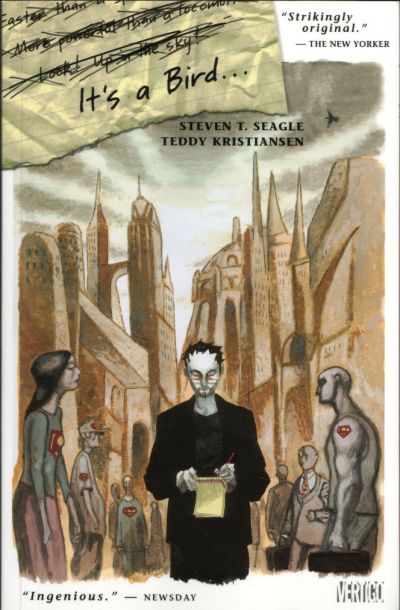
Notes: As with Doomsday Clock yesterday, I want to spend these last few days of the year with stories about Superman and about what he means. That quest led me back to It’s a Bird, the unique 2004 Vertigo graphic novel by Steven T. Seagle and Teddy Kristiansen. It’s perhaps the most unusual Superman story of them all in that Superman isn’t actually in it. 

The story, which is semi-autobiographical, starts with five-year-old Steve waiting in a hospital as his grandmother languishes. To placate him and his brother, their father brings them a Superman comic…after which, Steve swiftly rejects comics, as they remind him too much of the hospital, making it all the more ironic that he would grow up to write them. When an adult Steve is offered the job of writing Superman by his editor, he rejects it, unable to find the character relatable. 

The story is mostly about Steve trying to find his way into the Superman, and along the way he takes some interesting detours. His father goes missing, and fears of the disease that took his grandmother come back. Meanwhile, everyone he talks to about getting offered Superman is ecstatic for him and dumbfounded that he doesn’t want the job. These two threads are intercut with pages of Steve’s own musings on Superman, on who the character is and what he means – or at least, what he’s supposed to mean – as he tries to find something about the character that he can make believable in the real world. 

The interlacing storylines, of course, come together in the end, because such things always happen in fiction even if they almost never do in real life. His father’s disappearance turns out to be related to the death of Steve’s grandmother all those years ago, and in confronting his father and the disease that haunts his family, Steve starts to find a way in to Superman. 

It’s a good story, a powerful one, but it’s one whose inherent premise is one I somewhat disagree with. Steve’s quest is to find a way to make Superman “real.” I don’t think that’s necessary. Superman isn’t part of our real world any more than Mickey Mouse or Bugs Bunny or the food replicators on Star Trek. That doesn’t mean that he isn’t important, though, or that there’s nothing to be learned from them. In a lot of ways, I think the very fact of Superman’s fanciful nature is perhaps the most important thing about him.

Just as the story is very atypical for a Superman comic (such as it is), so is Teddy Kristiansen’s artwork. Kristiansen’s style is an odd halfway point between sketches and realism, in some ways making me think of Art Spiegleman…which is appropriate enough, as this book echoes Maus in various ways. Both stories are autobiographical, and with a frame narrative about the author struggling to relate to their fathers. In Maus, of course, the ghost that hangs between Art and his father is the spectre of the holocaust, while in this graphic novel it’s the shadow of the Huntington’s Disease that follows Steve’s family.

The book, of course, is specifically described as “semi-autobiographical.” Not really knowing much about Seagle himself, I wouldn’t presume to declare which parts are true and which ones aren’t, but regardless of any plot elements I tend to believe that all of the emotion in this book is genuine. The concerns, the fears, the anxieties that “Steve” expresses are almost certainly part of Seagle’s own psyche. Writers tend to do that, after all.

This is the Superman book for people who don’t understand Superman. I don’t know if, in the end, it will actually help them figure the character out – at least, not the way that I understand him – but it will at the very least help them find a path through someone else asking the same questions, and that’s a journey very much worth reading. 

Comics: Harley Quinn X Elvira #3 (Power Girl guest appearance), Justice League Red #5 (Team Member Power Girl), Justice League Vs. Godzilla Vs. Kong 2 #6 (Team Member)

Wed. Dec. 31

Comics: Superman #247, Kamandi: The Last Boy on Earth #29
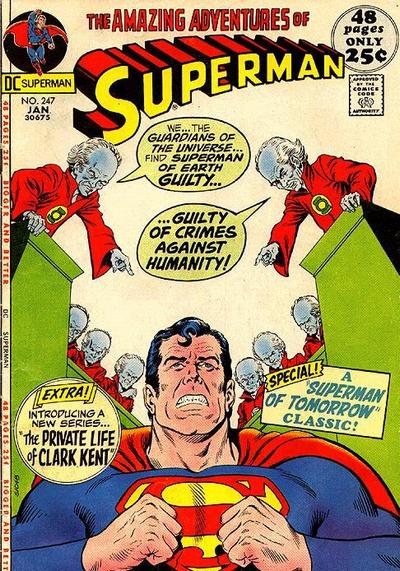
Notes: Well glory be, here it is. 365 days later, and the journey I started back on January 1 with Action Comics #1 is about to end…or at least, to evolve. I’ll talk more about that (say it with me) later, but for now, it’s time for the final Superman reads of the year. I thought hard about what to read today. In the early part of the year I’d planned to end it with a classic “last” Superman story, like Whatever Happened to the Man of Tomorrow? or Kingdom Come, but I decided to add those when I did the week of comics that influenced James Gunn’s Superman. So how else to end it? I ultimately decided to go with two comic books about what Superman is, because that’s where this entire journey has led me anyway.

First is Superman #247, the Elliot S! Maggin/Curt Swan classic “Must There Be a Superman?” Like many of the stories I’ve read this year, I encountered this one for the first time when it was published in DC’s classic Greatest Superman Stories Ever Told collection. Let’s talk about why it qualifies. 

The story begins with Superman taking on a special task for the Guardians of the Universe – a pod full of deadly spores on a path to Earth, and as the spores are yellow the Green Lanterns are helpless to stop it. Superman creates an artificial planet to draw the spores away safely, but is injured in the process, rescued by Green Lantern Katma Tui and brought back to Oa to heal. As Superman is healing, the Guardians take advantage of his unconscious state to plant a notion in his mind that his influence on Earth may be impeding human progress. (If this had been the “Year of Green Lantern,” you would have found me discussing a LOT of stories that drive home an important point: the Guardians are pompous assholes.) When Superman wakes up, the Guardians give him a tour of Oa, continually dropping comments about him contributing to a “Cultural Lag” on Earth, and sending him home with the notion that if he steps back, Earth will be better off. 

As he returns to Earth, he stumbles on a child migrant worker being abused by his employer. Rescuing him, the child – Manuel – brings Superman back to his community where the residents begin begging him to help solve all their problems, such as fixing their crumbling houses. Superman refuses, saying that they need to know how to care for themselves, but an earthquake strikes just seconds later, destroying their homes. Superman blunts the quake and rebuilds their houses, but tries to convince them that they need to know how to care for themselves because no one – even Superman – can do anything. He returns to Metropolis only to get word of a cruise ship endangered by a waterspout, which he rushes off to save, even as the Guardians watch from afar.

Looking back at this story now, I feel like this was Maggin’s way of responding to people who asked why Superman didn’t just sweep in and fix all the problems in the world. After all, with his power, why couldn’t he just solve hunger, homelessness, war, famine, disease, and so forth? From a narrative standpoint, of course, the answer is obvious: if Superman were to do all these things, what stories would be left to tell? It would literally be the end of Superman, as a going storytelling concern. But what about in-universe? How do you explain it to a kid like Manuel, who’s getting beaten up by a man who basically controls his entire life? The answer is something that people who know Superman could have told you from the beginning: even with the best of intentions, having someone (like Superman) doing everything for them would hold them back, leave them unable to act or take care of themselves. It kind of reminds me of all those stupid ads begging me to use Google AI to write an email or a Facebook post as if I haven’t been perfectly capable of doing that for my entire life. 

Superman is there to take care of the things that we can’t. As far as the things we CAN take care of…we shouldn’t expect him to do it all for us. But that doesn’t mean we can’t take inspiration from him.
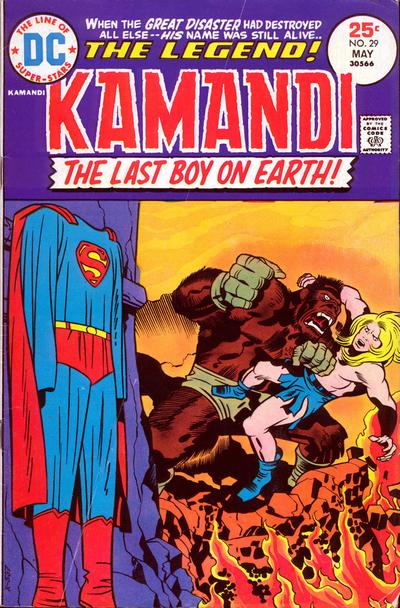
“Inspiration” is the theme of the final comic I’m going to read in this year of Superman, Jack Kirby’s Kamandi: The Last Boy on Earth #29. Kamandi, for the uninitiated, was a series about a post-apocalyptic world in which the human race is all but extinct, and the world is populated by anthropomorphized animals. In this issue Kamandi, one of the few remaining humans, finds the “Tablet of Revelation,” an ancient carving that prophesies the “return of the Mighty One,” a great warrior of the past. When the apes see Kamandi’s friend Ben Boxer, they believe him to be the returned “Mighty One.” One of the apes, Zuma, tries to engage him in combat, but the elder says that the Mighty One can only be revealed by demonstrating his powers against overwhelming odds. A catapult hurls claimants through the sky to prove that they can fly higher than the tallest building, an enormous boulder called the “Daily Planet” awaits the man who can move it, and so forth. Ben’s mutant powers convince some of the apes he’s the Mighty One, but a battle breaks out when they pledge to take him to his suit. In the fight, they come across a very familiar blue costume with a cape and a brilliant scarlet S-shield. Zuma tries to claim the costume, but perishes in battle as Kamandi defends the suit, saying “I know who owns it! I know that somewhere he’s still alive!” The suit is left, waiting until the true Mighty One returns.

This comic was released in 1975, some 30 years before the idea of the S-symbol standing for “hope” was put in place, but it’s hard not to think of it as you read this story. Kamandi’s faith that Superman is still out there is the sort of thing you’d expect, it feels like an appropriate place for the legend. The future of the DC Universe has been rewritten dozens of times, of course, with many of the various possibilities showing an immortal Superman, a legacy of heroes that lasts a millennia, or both. This feels like part of that, like the hero himself has left something behind with the promise that more is to come.

And that “promise of more to come” feels an appropriate place for me to stop.

Almost.

Movie: Superman (2025)

Notes: The first movie I watched this year was the original Christopher Reeve Superman from 1978. I’m going to end the year by revisiting the movie that inspired me to start this journey in the first place, James Gunn’s Superman. I’m not going to write it up again – Heavens knows you can find that on my original review. But I’m going to watch and enjoy.

One year later, and I have succeeded. I have watched, read, or listened to at least one thing starring or about Superman or a member of his family for an entire year. I’m actually quite stunned that I made it.

And I’ve still got so much to say.

But not yet. Come back Friday, friends, for my final thoughts on this year-long Odyssey, and my explanation of where I’m going from here.

Happy New Year. 

Blake M. Petitis a writer, teacher, and dad from Ama, Louisiana. His most recent writing project is the superhero adventure series Other People’s Heroes: Little Stars, volume one of which is now available on Amazon.
Year of Superman Week 46: Superman And…

As the chill finally returns to the air down here in southern Louisiana, I can feel the end of the year approaching. The last three months are always my favorite time of the year, although in this case they’re a little bittersweet. Spending this year with Superman has been fun for me, giving me something to look forward to…and while I have to admit I’m looking forward to finishing off the daily requirement, I also know I’m going to miss it. I’m thinking of ways to continue this blog without the daily stipulation into 2026 – no decisions yet, but there are things in my head.

At any rate, there are still a handful of themes I’ve got left that I want to do, but those are all anchored to specific times in one way or another, and none of them are this week. So get ready for another seven random days in the Year of Superman blog.

And as always, you can check out earlier blogs in the Year of Superman Archive!

Wed., Nov. 12

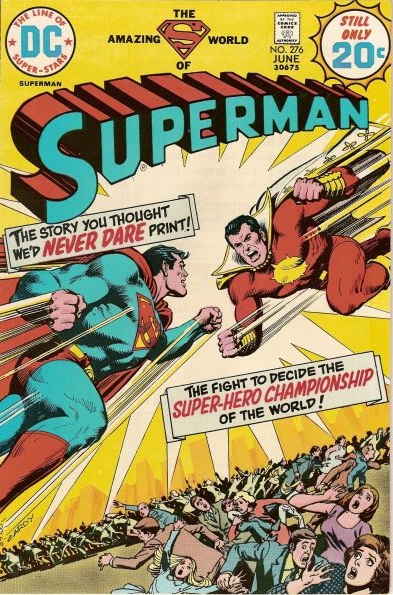
Comics: Superman #276

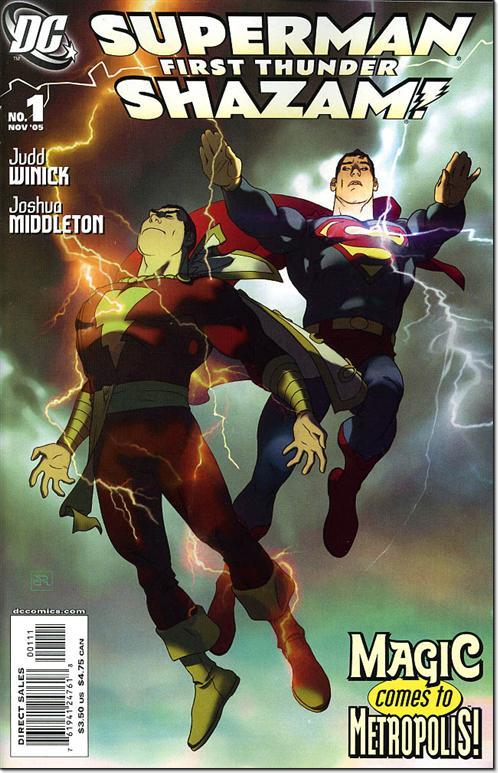
Notes: We’re going to start this week by looking at my list of stories that I wanted to hit this year at one point or another, but that didn’t fit into any particular theme. And if you’re not wise to the behind-the-scenes chaos that led to the writing of Superman #276, it seems as random as they come. Most comic book fans know the story behind the original Captain Marvel: originally published by Fawcett Comics, he was a smash hit and outsold pretty much every comic on the stands, including Superman at times. National Publications (the company that would later rebrand as DC) sued Fawcett, claiming Captain Marvel infringed on the Superman copyright due to the similarity in their appearance and powers. The case dragged on in court for years, until the post-World War II-era, in which superhero comics fell out of favor. Eventually, Fawcett settled the case, no longer making enough profit from the comics to continue to fight. Years later, DC would eventually license, then outright buy the characters from the Fawcett catalogue and bring them back to comics. 

In 1974, DC Comics had been publishing Shazam! for over a year. His own title was set on “Earth-S,” home to the original Fawcett heroes, and although the multiverse was already very much in play at DC, for some reason editorial was wary of having him actually interact with the heroes of the DC Universe. Writer Elliot S! Maggin’s solution was this issue, “Make Way For Captain Thunder!” Using an early, rejected name for Captain Marvel, Maggin has Superman encounter a young boy – Willy Fawcett – who appears in the streets of Metropolis one day. Willie seems out of time, with a haircut that was popular 20 years earlier and expecting to pay a nickel for 35-cent bus fare. And the big clue that something isn’t kosher: he’s never heard of Superman before. Willie sees a helicopter about to rob an armored car, so he rubs his “magic belt buckle” and says the magic word “Thunder!” With a bolt of lightning (and the amusing sound effect “sha-boom!”) he transforms into…well, not Captain Marvel, but somebody who looks a hell of a lot like him.

As Captain Thunder swoops in to stop the robbery, something takes hold of his mind and, instead, he aids the crooks in stealing not only the contents, but the entire armored car. Superman comes in to save the car and Thunder turns back into Willie, who cannot remember anything that happened since his transformation. He decides to turn to Superman for help, and looks up his most famous “friend,” Clark Kent. (The notion that even a child from an alternate dimension can learn that Clark and Superman are pals within a few hours is perhaps the greatest strain on the credulity of Superman’s secret identity, by the way.) Willie tells Clark his origin – how, on a campout with his orphanage, he was summoned by an owl to follow it to a cave in the woods. There he encountered an ancient Native American medicine man, who bestowed on him the magic belt that would give him seven spiritual abilities: the power of a Tornado, the speed of a Hare, the bravery of Uncas, the wisdom of Nature, the toughness of Diamond, the flight of an Eagle, and the tenacity of a Ram!

Note to Maggin: If the editor needs to drop in a footnote explaining that Uncas was a warrior chief, you know that you’ve maybe stretched this bit to its limits.

Anyhoo, Willie became Captain Thunder, and – in my favorite page in the book – recounts his final battle with the Monster League of Evil, which was made of up, I kid you not, the Universal Monsters. The battle took place in a series of other dimensions (1953 of them, to be exact), but evidently, when Willie tried to get home he wound up on the wrong Earth, where he comes to understand that the League did something to Captain Thunder, making him turn evil when he transforms. Clark – an alien from another planet who hangs out with an Amazonian goddess and a guy from Mars and who routinely fights cyborgs and has traveled through time on countless occasions and more than once met an exact duplicate of himself from a world he calls Earth-2 – comes to the obvious conclusion that Willie is delusional. 

Somehow THIS is the part that strained credulity.

Clarks recruit Lois to help him bring Willie to the police station for help, but another robbery summons his attention. He ducks away and becomes Superman, as Willie turns into his own alter-ego. But once again, as if he’s forgotten that he’ll turn evil, Captain Thunder turns evil. The crooks escape as Superman and Thunder battle it out in the skies over Metropolis. Superman manages to trick Thunder into turning back into Willie, because somehow he suddenly believes his story, and then holds him in a wrestling grip and tells Willie to change back, where he’ll somehow force Thunder to use his wisdom to overcome the Monster League’s brainwashing. There is absolutely no reason that this should work, but somehow it does, and Thunder furthermore figures out how to use his magic to return to his native dimension. 

This is one of those stories that I like not in spite of how ridiculous it is, but BECAUSE of it. Details aside, there’s virtually no difference between Billy/Captain Marvel and Willie/Captain Thunder. If someone were to redraw his costume and the origin pages, it would fit perfectly as the first meeting between Big Blue and the Big Red Cheese. The incongruities also have a weird charm to it. The notion that Clark questions Willie’s story is laughable, the idea that he comes around so easily is absurd. The fight is…well, it’s an awful lot of fun. And I won’t lie, I would love to see the history of Captain Thunder’s battles against the likes of Boris Karloff, Bela Lugosi, and Lon Chaney Jr.

There were so many different one-off universes that peppered DC Comics in the years before the original Crisis. I kinda wish we could visit some of them again. 

Thur., Nov. 13

Comics: Superman Vs. Lobo #1-3, Jon Kent: This Internship is My Kryptonite #19, Justice League of America #40

Notes: Today I’ve selected the three-issue Superman Vs. Lobo miniseries from 2021, written by Tim Seely and Sarah Beattie with art by Mirka Andolfo. Why? Because just like when they published this miniseries, it seemed like a good idea at the time. 

That sounds snarkier than I intended. This isn’t a bad series, not at all, but it’s part of the ill-defined “Black Label” imprint at DC. When it was first announced, “Black Label” was supposed to be a more “mature readers’” imprint featuring the DC characters. Then it started to publish comics that were creator-owned and had nothing to do with the DCU Universe. Then they folded the Vertigo imprint and made those properties Black Label books. Then they brought BACK the Vertigo Imprint and moved some of the Black Label originals over there. And all the while, they were reprinting some books under Black Label that didn’t make any sense at all – such as Kingdom Come – while also publishing a few new properties that didn’t really have any content that marked them as “mature readers,” such The Last Days of Lex Luthor, which would probably be best as an Elseworlds. Then they brought back Elseworlds. What I’m getting at is, I’m not entirely certain what Black Label is supposed to be and, based on all available evidence, neither is DC Comics.

None of that, however, is the fault of the creative team of this miniseries, nor does that make it a bad story. The story kicks off with the Martian Manhunter sending Superman out into space to check on a space station that’s been damaged near the orbit of Jupiter, with astronauts in grave peril. As he’s saving them, everyone’s favorite Main Man Lobo has a vacation ruined when the resort planet he’s on is attacked by a kaiju-sized monster that turns out to be a microscopic tardigrade which has somehow been blown up to gargantuan proportions. He also meets “biologist and wildlife photography” Dr. Semedea Flik, who is an expert on single survivors of extinct species, and therefore is delighted to meet Lobo, who famously murdered his entire planet of Czarnia. Lobo, of course, doesn’t care about the destruction his fight with the tardigrade is causing, but Superman happens to be passing by in space and dives in to save both the creature and the people endangered by its rampage. Lobo, of course, sees Superman as a killjoy, ruining the fun of his fight, but Flik is thrilled to meet TWO “sole survivors” in one day. (Unless you count Supergirl or the Kandorians or Lobo’s daughter or…) When the news coverage of the fight starts painting Superman as a hero, Lobo is furious and decides to “ruin” him. 

Lobo comes to Earth and gets on LexTube to begin slandering Superman. Lois (with a little help from Batman) begins a counter-offensive against Lobo online, and the vitriol online begins to fuel an army of robots that the Toyman created to prove that social media is toxic. (I guess even Winslow Schott can’t be wrong all the time.) Superman combats it by urging people to get online and post positive things and – this is far less realistic than the tardigrade kaiju – they actually start to do it. Speaking of the tardigrade, it comes to Earth, only much smaller and now demonstrating extreme intelligence. Its name, it says, is Numen, and like Superman and Lobo is the last survivor of his homeworld. Flik is THRILLED. Feeling a kinship to the two of them, Numen decides to use his vast power to give them a gift: restore and send them back to their homeworlds, but he makes a little boo-boo. On the last page, Superman finds himself on Czarnia and Lobo on Krypton. 

Issue two kicks off with the Justice League searching for the missing Superman, with J’onn discovering that Krypton has somehow been restored and Green Lantern learning that Czarnia’s extinct population has come back. Numen, in a scene as funny as it is creepy, has learned that people on Earth communicate via “tweeting,” so it makes all the birds in the world explain to people that he sent Superman and Lobo back to their home planets. Of course, he’s wrong. On Czarnia, Superman – whose powers are dying under the planet’s red-tinted sun – learns that most of the population seems kind and pleasant, and Lobo was an anomaly. On Krypton, Lobo is frustrated at how “lame” the place is, but changes his tune when he realizes that there’s a sect of Kryptonians who blame their cold, sterile ways for the planet’s destruction and have decided to revert to a culture of hedonism and debauchery, his two favorite things. Flik has technology that allows her to bounce between worlds, viewing a civil war slowly brewing on Krypton between Lobo’s wild friends and the traditionalists, while Superman starts to find evidence that the Czarnians aren’t actually as nice as they pretend to be, with a deep paranoia and distrust underlying their apparent sweetness. 

Lobo’s Kryptonian pals decide to expand the influence of Krypton into space, and begin by cloning an army of Lobos and sending it to Czarnia to start the genocide all over again. Superman, meanwhile, discovers that the kindly woman he’s been staying with has been leeching his blood and his powers, and manages to reverse the cell drain after she’s killed by one of the clones. As Lobo returns to Czarnia to kill his clones – and everybody else all over again – only to learn that the resurrection has turned many of them as bloodthirsty as he is. Superman makes it to Krypton and finds his parents, but is horrified to learn that Jor-El planted a killer parasite into the Lobo clones, which are still living beings. Flick finds Numen and convinces him that he’s screwed up by bringing back the dead worlds, and Numen collapses in self-pity. He removes the two worlds, but not before Jor-El tells his son how proud he is that he became a man of compassion, even for those who despise him. Flik then tells Superman and Lobo that she’s studied Numen and discovered that there are people seeking out Numen, whose birth destroyed their entire universe…Union! Zealot! Maul! Helspont! And the almost-Superman himself, Mr. Majestic! Some of the most powerful characters from the Wildstorm Universe!

Not that they CALLED it “the Wildstorm Universe” in the text, mind you, but it was still a hell of a surprise. Also a nice reminder that most Black Label comics are non-canonical. The Wildstorm heroes had been firmly integrated into the DCU at this point, so I guess that means we’re looking at two different worlds in the vast multiverse right now. I’m okay with that.

In the third issue, Flik tells us Numen’s origin. He’s part of a species that feeds on the fundamental forces of reality. When one of them is born, they consume an entire universe in order to survive. Flik begs Superman and Lobo to help her protect Numen from the “Revenge Squad” that’s after him. Superman agrees because he’s Superman, Lobo agrees because Flik agrees to pay him, and the fighting starts. While Lobo tears through half the team, Majestic and Zealot team up against Superman. In the heat of battle, Superman concedes that Majestic is more powerful than he is, but that’s not going to stop him from fighting to defend Numen with his last breath. Proving that he is, perhaps, more like Superman than he thought, Majestic is moved to put down his arms and talk. Lobo double-crosses Flik, though, setting up Numen to be killed and taking her technology and Numen’s energy to create a new universe where he’s the hero and Superman went mad after the murder of Jimmy Olsen. Lois, though, in a wonderful bit of meta-commentary, quickly figures out that the new universe they’re in is full of bad stereotypes and tropes, like so many “evil Superman” stories we’ve read, and concludes that they’re trapped in a “badly written story authored by an edgelord.” Lobo takes that personally and a battle ensues, but to everyone’s shock, he breaks down with the realization that he’s wasted the power he stole to rewrite the universe just so people would love him instead of thinking, “Maybe…I shoulda just not been a giant piece of $#*.” He expends the energy restoring the universe and integrating the orphaned Wildstorm heroes into it (so maybe it IS canonical?).  

The series works on a few levels. It’s satirical, but pointedly so. First of all, it’s a bit of a deconstruction of Lobo himself. Created in the 80s as a PARODY of over-the-top, violent characters like the Punisher, his runaway popularity instead made him the poster boy, despite the fact that he exists only to exhibit all of their worst characteristics. This comic doesn’t flinch from that, reminding us over and over again that he’s a scuzzball who does not deserve admiration. The best line in the series, for example, is Superman calling Lobo “the worst person I’ve ever met, and I regularly have to spend time with Lex Luthor.” The second best, though, is directed at Lobo himself: “You think everyone is as terrible as you, and that makes you the loneliest man I’ve ever met.” Yes, Superman pities even Lobo. And all of this helps build towards a mild sort of redemption for the character in the end. He doesn’t ATONE for his awfulness, but at the very least he grows enough that he can recognize it and admit it, which – considering the place that he starts from – is not inconsiderable.

The other element of satire is pointed at the media and social media, how it tries to manipulate the narrative and how we’ve taken a piece of technology that should have brought everybody together and created greater understanding of us all and instead have decided to use it to be nasty to each other and create little echo chambers where we can sit in a virtual room and pretend that everybody who isn’t in the chamber with us is stupid and evil. It may sound a little hypocritical of me to talk this way about social media – I obviously use it all the time – but in my defense I do my best to keep my interactions online positive. I talk about the things I love, I try to steer clear of railing against things that I hate, because seriously, who needs to hear that? Even this whole “year of Superman” project is dedicated to that purpose, to me devoting 365 days to something that means something powerful and wonderful to me. 

I’m not saying that everyone should use social media exactly the way that I do, I’m just saying that the world might not seem quite as terrible if they did.

Lobo included. 

Fri., Nov. 14

Comic: Superman Vol. 4 #12-13, Aquaman Vol. 5 #53 (Guest appearance), Justice League of America #41-42, Adventure Comics #267

Notes: Although it wasn’t my original intention, after two days of comics that amounted to “Superman Vs. another hero,” it seems as though the universe has chosen a theme for this week for me. Who am I to argue? So today I decided to seek out another such story, landing on the two-part “Super Monster” from the Rebirth era, written by Peter J. Tomasi and Patrick Gleason with art by Doug Mahnke. In this, Superman faces off against Frankenstein. Not the kind we saw in Halloween week, though, but the actual Frankenstein’s monster, who in the modern DC Universe has taken the name “Eric Frankenstein” and joined the supernatural spy agency S.H.A.D.E. The story starts with Lois meeting a friend of hers named Candice, editor of the Hamilton Horn newspaper, who is trying to lure her away from the Planet (she had recently returned at this point – long story) only for Frankenstein to interrupt the interview and attack the editor, claiming he’s been chasing her for some time. Lois blasts Frankenstein with a weapon she’d recently “borrowed” from Batman and she and Candice flee. Superman, naturally, arrives to defend his wife, and he and Frankenstein get into it. The creature manages to get his hands on Candice and rips her face off, revealing an alien beneath. 

In the second issue, Frankenstein explains that “Candice” is really a war criminal named Kroog who has been fleeing justice from several planets. Superman is glad to have captured a criminal, but admonishes Frankenstein for going after him in a way that caused destruction and potential injury to innocent people. Before they can take Kroog away, though, Frankenstein’s estranged Bride shows up. No longer with S.H.A.D.E., the Bride is now a bounty hunter and has come to take Kroog and collect the money for his head. In the scuffle over who’s going to bring Kroog in, the alien escapes. Superman has to break up the squabbling exes  and together they track the alien down to bring him to justice.

The real meat of this two-parter comes towards the end of the second part. After Frankenstein and the Bride fight each other, there’s a short sequence where Lois asks the Bride about what happened to drive them apart. The answer is horrific – they had a son who became a monster (like, spiritually) and the Bride was forced to kill him to save the lives of innocents. From here we start to extrapolate that their divide is not actually based on hatred or even a lack of love between the two of them, but on the pain of their loss. As this was the era where Jon Kent was still a child, and still a relatively new addition to the Superman mythos, the story hits both Lois and the reader hard. The story ends with a quiet, wordless few pages of Lois and Clark returning home, tucking their son into bed, and giving him a goodnight kiss.

If you’re a parent, you get why this hits so hard. If you’re not, I’m not sure if I can explain it to you. 

Sat., Nov. 15

Comics: Booster Gold #7, Action Comics #594, Booster Gold #23.

Who did it better?

Notes: Once I realized I had accidentally stumbled into a theme, I got on the DC Universe app and just starting randomly seeking out different stories about Superman – for whatever convoluted reason – coming to blows with other heroes, because why not? That reminded me of these early comics in which Superman faces off against his future JLA teammate Booster Gold. In Booster Gold #7 from 1986, Dan Jurgens had his time-travelling hero encounter the man of steel for the first time. A year later, John Byrne and Jurgens collaborated on a two-part story that crossed over with Action Comics.

Booster Gold #7 begins with Booster, Superman, and a few hangers-on having just been abducted by an alien warlord called Galeb who is accusing them of treason, despite the fact that they don’t even know who he is. Galeb  accuses them of conspiring with Ranzee, an alien who claimed to be marooned on Earth. They try to fight their way out, but Galeb’s wife – a self-proclaimed mystic – sends out a burst of mental energy that knocks all of them out, even Superman, because magic. They awaken in prison, and Ranzee tells them of how Galeb has ruled his people as a tyrant for years, leading him to steal a spaceship and go to Earth to ask the legendary Superman for help after Galeb personally tortured and murdered his wife and child. Booster wants to jump right in and take Galeb out, but the more experienced Superman cautions him about jumping into a political situation without all of the information. Galeb comes to their cell and says that he is willing to release everyone but Ranzee, who is to be executed. When Booster tries to attack, Superman steps in to stop him and the two come to blows. Superman holds back, hoping to cool Booster off, but Booster just keeps going. Eventually, Skeets shorts out Booster’s suit to stop the fight. Skeets has been investigating and learned that Ranzee lied to them – he is actually Galeb’s stepbrother and has been attempting to overthrow Galeb for years. Superman takes Booster back to Earth with his tail between his legs, arriving home at the same time as Lois Lane, who came by to interview Metropolis’s newest hero. Superman flies off, not at all impressed at his new rival.

This story, it should be noted, was published in the midst of Crisis on Infinite Earths and technically features the pre-Crisis Superman, although there is little to differentiate him from the character that would soon appear in the Byrne reboot. But it’s really interesting to me just how much Superman dislikes Booster in their first meeting. Of course, this early in his career, Booster didn’t really give him much to like. He’s cocky, hard-headed, and impulsive, and those qualities would have caused disaster had Superman not been there to get in his way. The way the character grew and evolved over the years is really remarkable, and he’s become one of my favorite DC characters.

John Byrne did one of his cover swipes (a lot of artists do cover swipes, but Byrne got the bug earlier than many – the man draws a Fantastic Four #1 swipe more often than I change my socks) to show Superman and Booster’s next encounter. Mayor Berkowitz has declared it to be Superman Day in Metropolis. The festivities are upset, though, when Booster Gold blows up the Superman statue that was supposed to be dedicated that day. He then calls a press conference where he accuses Superman of crimes against humanity for his recent incursion in the terrorist state of Qurac. Booster calls Superman down for taking political action that way, which comes off as particularly hypocritical if you just read Booster Gold #7, in which Superman stopped him from doing exactly that. Booster then decides to lure Superman into a fight by abducting the mayor’s daughter. Hearing her call for help, Superman zips in and Booster hits him way harder than Superman expected. Booster begins to pummel Superman, beating him with relative ease. With Superman on the ropes, though, a SECOND Booster appears, calling the first an imposter. 

The story concludes in Booster Gold #23, once again by Dan Jurgens. A flashback informs us that this fake Booster has been in action for several days, smearing Superman, as Booster was in mourning over the recent loss of his sister and wasn’t even aware of his doppelganger. In the present, Booster manages to shred the fake’s outer covering, revealing a robot underneath. When Booster destroys it, a chunk of Kryptonite falls out, explaining how he was beating Superman. The reader learns that – surprise, surprise – the robot was sent by Lex Luthor, who was using it to gather as much data as possible on Superman for Luthor reasons. He sends a second armored operative – human this time – to attack Superman and retrieve the Kryptonite, and although his drone gets away with Luthor’s glowing rock, Superman easily captures the goon. He knows it’s Luthor’s handiwork, but the guy inside the armor claims to work for Booster Gold, is carrying Booster Gold International ID, and even the components of his armor were made by Booster’s company. Superman doesn’t buy the frame-up for a second. Booster gets the best of Luthor that night, but the epilogue brings in a new challenge for Booster that looks pretty bleak. But this ain’t the “Year of Booster Gold,” no matter how much he might wish it was, so I’m going to let you look all that up for yourself.

The antagonism between Superman and Booster continues here, although by this time Booster has become somewhat more integrated in life in Metropolis. There are even references to previous interviews with Lois, despite Booster and Superman not having encountered one another in the interim. It’s also funny to read these books by Dan Jurgens, who would of course eventually go on to be one of the most significant Superman creators of the post-Crisis era, before he was actually writing or drawing Superman on a regular basis. The character (especially in issue #7) doesn’t quite look like Jurgens’ Superman, it’s more like he was still trying to figure out how to draw him. He got Superman’s personality right away, though, with the character feeling like himself right out of the gate. 

Sun. Nov. 16

Comic Books: Firestorm, the Nuclear Man #2, Justice League of America #179-180

Notes: Early in his career – in his second issue, in fact – Firestorm bumped into Superman. Makes sense, really, when you consider just how powerful “the nuclear man” actually is, Superman and the Justice League would clearly want to keep tabs on him. Let’s see how that turned out, shall we?

After a little showboating and reflecting on his origin, because back in the day a superhero was required to recap his origin once an issue, teenage superhero Ronnie Raymond goes about his day. His crush Doreen seems to be into his secret identity (nice), but his father isn’t impressed, nervous about that kind of power in the hands of an individual. And Ronnie can’t even ask his other half Professor Martin Stein for help, because in these early days of the character, Stein didn’t remember anything that happened when he and Ronnie were merged as Firestorm. (I’ve never tracked down the story where that particular tidbit was overturned. If anyone knows when it happened, let me know, would you?) Clark Kent, meanwhile, reporting on the new hero for WGBS, decides that this is exactly the sort of thing that Superman should be keeping an eye on. As he flies to New York to check in on the kid, Stein is attacked in his lab by Multiplex, the Duplicate Menace. (The much better “Multiple Man” was obviously already taken.) Fortunately for Stein, Ronnie discovers the atomic bond he shares with the older man allows him to feel it when Stein is hit and know when he’s in danger. He also discovers that they don’t need to be physically next to one another to trigger their transformation, and Firestorm arrives to take on Multiplex. As Firestorm and Multiplex trade blows, Superman arrives just in time to see the young hero get pummeled, dampening his notions of inviting Firestorm into the Justice League. Superman saves him, and despite a moment of being star-struck, Firestorm zips off in search of Multiplex. Superman follows him and watches as Firestorm captures Multiplex, promising the young hero that he may be Justice League material after all.

Okay, so it was 1978, but that last part feels WILDLY presumptuous on Superman’s part. Suggesting Justice League membership to somebody he literally has just met, who he saw fight ONE supervillain? Because he’s got drive and wants to prove himself? It would make a little more sense today, in this era of Justice League Unlimited, where pretty much everybody with a mask gets a card and a ticket to the Watchtower, but wow.  

Just for funsies, I decided to follow this up with Justice League of America #179 and 180, the issues where Firestorm actually DOES join the League, published less than two (real-time) years later, a membership that I’m sure in NO way was influenced by the fact that Firestorm’s creator Gerry Conway was writing the JLA title at the time. Anyway, true to his word, Superman sponsors Firestorm’s membership in this issue, saying that the rookie hero’s “youthful exuberance” will be an asset to the team. Then once he zones out when Batman starts explaining the procedural stuff involved in being a JLA member, Ronnie gives the reader another recap of his origin (I told you, it was required). After a hearty congratulations from Superman, Firestorm returns to Earth and splits up. Ronnie sends Martin Stein (still unaware of his double life) home in a cab, then he meets his friends to check out the hot new disco in town. Seriously, disco. Who says comics from 1980 aren’t timeless? Anyway, it turns out that one of Ronnie’s friends who was supposed to meet him at the club is missing, supposedly in the clutches of a woman called “the Satin Satan.” Ronnie calls Stein back – again, and Firestorm confronts the witchlike woman, feeling her power overtake him just in time to hit his brand-new JLA signal device. 

In the next issue, the League arrives in the penthouse where Firestorm was abducted, only to find the place wrecked and empty. A few minutes later, Ronnie Raymond’s friends arrive with a security guard, looking for him. Zatanna’s magic powers manage to track down Satin Satan and Firestorm, helping him get free. Together, the League fights off Satin’s demons and apparently free her from the demonic influence that’s gripping her, then everybody except Green Arrow congratulates Firestorm on a great first case.

Look.

Gerry Conway is a comic book legend, we can all agree on that, right? And Firestorm is a great character – he was really bold and unique when he was created, and he’s been someone I’ve always thought deserves to be a constant presence in the DCU in one form or another, even during the periods in which he lies fallow.

All that said, NOTHING in these three issues suggests that Firestorm is Justice League material. Sure, he comes through in the end, but he makes mistake after mistake, fumbles into traps, and generally acts like a rank amateur. I can see why Superman would want to keep an eye on somebody so powerful, and making him a member of the League in order to train him and help him get better would make a lot of sense. But it’s not framed that way, it all comes across as the League – Superman especially – getting starry-eyed at this new kid and all the neat toys he’s got and wanting him to stick around so they can play together. It comes across a little bit like Conway’s pet. 

I also realize that these issues don’t QUITE fit into the “Superman Vs.” theme I’ve kinda been going for this week, but as I didn’t even really intend to do a theme this week at all, I’m not going to feel bad about that. Maybe I’ll call this week “Superman And…” instead.

The weirdest thing, though, is that the issue ends with the clear implication that Satin Satan hasn’t REALLY been set free of her demonic possession – that there is an impending danger that will come back to plague the Justice League again. But a quick check online seems to suggest that these two issues are the ONLY ONES in which she EVER APPEARED. Really? With an ending like THAT? Nobody has picked up on it and tried to do something with the MODEL-GORGEOUS DEMONIC VILLAIN in the past FOUR AND A HALF DECADES?

I’ve now read over 1,000 individual comic book issues for this Year of Superman project, and that may be the wildest thing I’ve discovered yet. 

TV Episode: Superman and Lois Season 3, Ep. 3, “In Cold Blood”

Mon, Nov. 17

Comic: Captain Atom #46, Action Comics #587, Batman: Wayne Family Adventures #38 (Guest Appearance)

Notes: Like the first Firestorm comic I covered yesterday, I picked this one more or less because Superman was on the cover and I hadn’t read it before. Captain Atom wakes up on the moon, trapped in a crystalline crucifix along with several other heroes and villains, Superman included. He manages to free himself and Superman, and the two of them investigate their abduction, which turns out to be the work of a crystal alien called Kylstar (say it out loud). After a brief scuffle with their abductor, Kylstar’s translating droid tells them that his planet is ruled by an evil dictator, and he has been seeking sentient weapons – super-beings, in other words – to help him free his planet. He releases the other captives, one of whom is an alien who confirms his story (which is more than we had in the issue of Booster Gold the other day that had a lot of these same beats). Kylstar offers to return anyone who doesn’t want to go with him to their homeworld, but both Atom and Superman decide to return to Earth. After they’re gone, Kylstar casually reveals to Major Force – who agreed to accompany him – that he’s going to have to go ahead and conquer the entire galaxy to have a strong enough army to take on his enemy. Force is all about that. In the end, Superman does Cap a solid, helping him find his estranged daughter Peggy.

It’s an okay issue, and I wonder if the Kylstar storyline was picked up later on in the run. Major Force obviously made it back to Earth at some point, because he was available a few years later to commit the act that led to the “fridging” becoming a comic book-specific verb. But my appetite for a hero vs. hero fight hasn’t been satisfied. So I’ll go back to scratch that itch with another comic from John Byrne’s Action Comics team-up era, issue #587, featuring the Etrigan the Demon.

To be fair, it’s a little tricky to decide if this even counts as “hero vs. hero,” as Demon’s status is kind of flexible. Depending on the writer, he’s either a demon who tries to do good or an evil spirit FORCED to do go via his association with Jason Blood. Byrne writes Etrigran more on the good side, though, without any internal quandaries over wanting to do bad and just doing the good, so it’ll fit nicely. 

The story starts with Jason Blood and his friend Glenda Mark in an antique shop in Gotham City, where she accidentally activates an old piece that suddenly captures her in a metallic column. The column expands, capturing the others in the shop as if it were trying to create a miniature city, and Jason only barely manages to summon the Demon in time to avoid being taken himself. Superman is returning to Earth from space when he spots the metal city growing and completely overtaking Gotham. He comes in and tries to wreck the expanding columns, but Etrigan attacks, telling Superman he must not harm the towers. The two of them fight for a few pages before Etrigan shows Superman that every time they break one of the columns it bleeds human blood. Etrigan explains that each column is a human who has been transformed, and the only way to stop them from dying is to do so before they are cursed, and he casts a spell to send Superman back in time. As Etrigan existed in that time, he couldn’t go with Superman (this was an old time travel rule in DC Comics that doesn’t seem to apply anymore) but he gives Superman one hour before the spell wears off and returns him to his own time, and tells him to seek out Jason Blood. Superman finds 12th Century Jason, and together they track down Morgaine le Fay in the process of creating the very artifact that started the mess. Superman dives in despite the magic and disrupts the spell, resetting the timeline. An epilogue replays the scene in the Gotham antique shop, bereft of the artifact, and all is well. 

The fight between Superman and Etrigan is short, but really effective. And it’s actually nice to see one of these scuffles where Superman – however well-meaning – is in the wrong. It’s a good change of pace. This issue also has several elements that I always enjoy: time travel, doses of Arthurian legend, and John Byrne artwork. Overall, it’s a fun read. 

TV Episode: Superman and Lois Season 3, Episode 4, “Too Close to Home.”

I’ve been trying to squeeze in episodes of this show again because I still want to try to finish it by the end of the year. I haven’t been writing about all of them, though, because I kind of feel like I’ve run out of things to say. I like Tyler Hoechlin and Elizabeth Tulloch. I love Wolé Parks as John Henry Irons. But the series as a whole hasn’t gripped me as much as I wanted it to. However, the scene in this episode of Clark – Clark, not Superman – in the diner, facing off against Emmitt Pergande? That’s absolute poetry. 

Tues., Nov. 18

Comics: Superman/Shazam!: First Thunder #1-4

Notes: I started this inadvertent “Versus” week with Superman fighting the faux Captain Marvel, so it seems only appropriate that I end it with an early encounter with the real thing. And again, this isn’t actually a fight – Superman and Captain Marvel are never opposed to each other in this miniseries. But you know what? I don’t care. It’s still a good comic.

Published in 2005, this miniseries by Judd Winick and Josh Middleton was a contemporary take on the first meeting between Big Blue and Big Red. It begins with the wizard Shazam at the Rock of Eternity, early in “the second age of heroes,” observing the nascent members of the Justice League in action, then gives us a quick time skip to the rookie Captain Marvel averting a plane crash in Fawcett City. (It is amazing how often planes in comic book universes ALMOST crash. If it was as frequent in real life as it is in a comic book world, nobody would ever board an airplane ever again.) Meanwhile in Metropolis, Superman investigates a break-in at the Museum of Natural History that brings him into battle with a big, blue creature – a sign of that singular bane of his, magic. We also see Billy Batson homeless and refusing to go to yet another foster home, living in abandoned subway tunnels with some help from his friend, a kid named Scott. Looking at a recent newspaper, Billy sees a story about the museum robbery in Metropolis and decides to keep an eye on the Fawcett City museum. Sure enough, that night, there’s a break-in – the same crooks as in Metropolis, still trying to steal Russian artifacts. Once again, the crooks summon monsters and they hurl Captain Marvel out of the museum, where Superman is waiting to lend a hand.

In issue two, we start “one week ago,” with a summit between Dr. Thaddeus Sivana and Lex Luthor, where the two evil geniuses – despite their mutual dislike of one another – agree to cooperate, with Luthor giving Sivana use of an operative named Spec to trail Captain Marvel. Spec, we find out, managed to trail Marvel and witnessed his transformation into a child. Back in the “present,” Superman and Captain Marvel meet outside the museum for the first time and team up to fight the monsters summoned by the robbers. After fighting them off, Marvel asks Superman if they can “talk,” and the two of them have a casual conversation on the top of Mt. Everest, discussing their powers and what it’s like to be heroes. Their talk is disrupted when Superman hears a pair of dual threats coming from Fawcett – Sivana has summoned the demonic villain Sabbac via a spell which also creates a solar eclipse, and wouldn’t you know it? Dr. Bruce Gordon has once again been taken over by the spirit of Eclipso. 

Yeah, he’s in this too.

Issue three kicks off with Spec finding his way to the homeless enclave where Billy Batson has been living, looking for information about “a little boy, about eleven years old, black hair,” and offering to pay handsomely. While Spec hunts Billy, Superman and Marvel take on Sabbac in Fawcett City. At the same time, Eclipso makes his move, using a satellite network to transform the people of Fawcett into – goodie! – more Eclipsos! Superman dismantles Eclipso’s machine, but still has to deal with a legion of innocent people who have been eclipsed and go on the attack, while Marvel is left to face Sabbac alone. Superman escapes and disrupts the coven that caused the Eclipse, breaking Eclipso’s hold on everyone, including Bruce Gordon, and Marvel tricks Sabbac into saying his own name, causing him to turn off his powers just like Billy uses the word “Shazam!” Superman and Marvel part as friends, but that night as Billy is reading about his own exploits in the newspaper, Sivanna (using Spec’s intel) sends an army of thugs to kidnap him.

In the final issue, Billy switches to Captain Marvel just before Sivanna’s goons open fire. He defeats them easily, but in the gunfire his friend Scott is mortally wounded. Marvel brings him to the hospital, but Scott succumbs to his injuries. Marvel bursts into the police station where Sivanna’s thugs have been taken and begins to brutalize one of them, demanding to know who hired him. Moments later, he’s ripped apart Sivanna’s corporate headquarters and has Sivanna’s throat in his hand. He chokes him, almost to death, but relents before Sivanna is killed and flees the scene. In Metropolis, Clark hears about the incident and finds Marvel again at Mt. Everest, where he plans to have him answer for attacking a police station, assaulting a prisoner, and destroying the top floor of the Sivana building…until he sees Marvel weeping. Superman is confused by Marvel’s sobbing about getting “his best friend killed,” until he says his magic word and becomes Billy Batson again. Superman demands that Billy take him to the Wizard Shazam, where he rips into him for putting a child in danger. “He’s just a boy,” he declares. Shazam replies, “He is. A boy who could use guidance.” In the last few pages, Clark Kent finds Billy in the abandoned building where he’s living now. He removes his glasses, unbuttons his shirt to reveal the “S,” and sits down to have a talk.

This is such a great story, all building up to the last few scenes, which are immensely powerful. At first, Superman sees Marvel as a contemporary, an equal, somebody who maybe can understand the burden of power that he carries because he shares it. When he discovers the truth about Billy Batson, the righteous anger that fills him is perfectly in keeping, although you have to wonder if he ever had a similar discussion with Batman about any of the Robins. In any case, this is such a great dynamic for the two of them. In a world where Superman and Billy Batson co-exist, Clark Kent would be a perfect mentor for the boy. Unfortunately, in all the reboots that have happened in the past 20 years, I’m fairly certain this story is no longer canon, and that’s a shame.

One other amusing thing I need to point out – Marvel defeats Sabbac by tricking him into saying his own name, which also happens to be the magic word that triggers his transformation. At this point, people had mistakenly been calling Captain Marvel “Shazam” for decades, since DC was using that word to secure the trademark. But Sabbac having a name that he can’t say is ridiculous, a problem Captain Marvel Jr. had since the beginning, and a problem that was exacerbated in the New 52 reboot when “Shazam” became Billy’s hero name. These days, in-universe, Billy’s alter ego is just “The Captain,” which sidesteps the problem, but it’s kind of lame as a superhero name. I dunno, maybe they should have just stuck with “Captain Thunder” in the first place. 

Radio Program: The Adventures of Superman serial “The Clan of the Fiery Cross” episodes 1 and 2.

More on that one next week.

Blake M. Petit is a writer, teacher, and dad from Ama, Louisiana. His most recent writing project is the superhero adventure series Other People’s Heroes: Little Stars, volume one of which is now available on Amazon. You can subscribe to his newsletter by clicking right here. You can join in the Kryptonian Konversation every day in the Year of Superman Facebook Group!