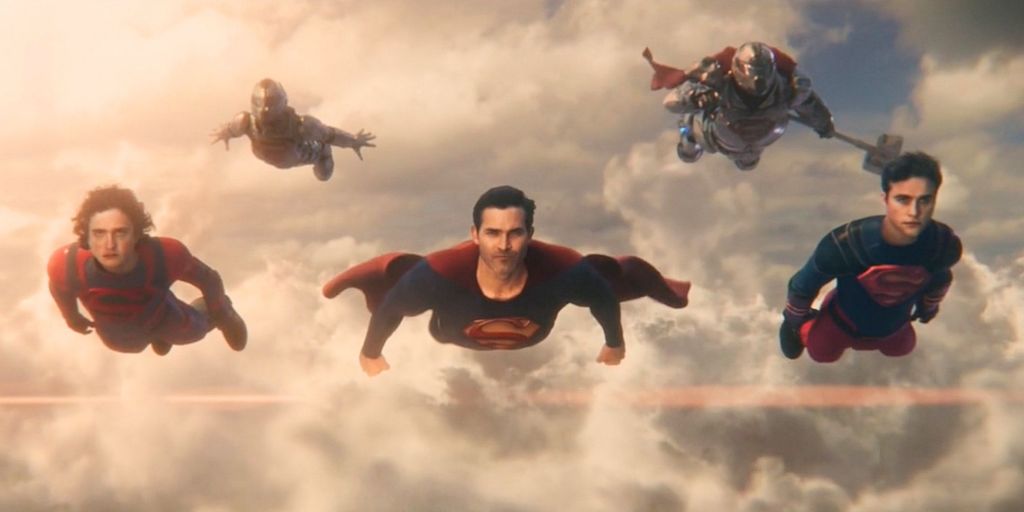
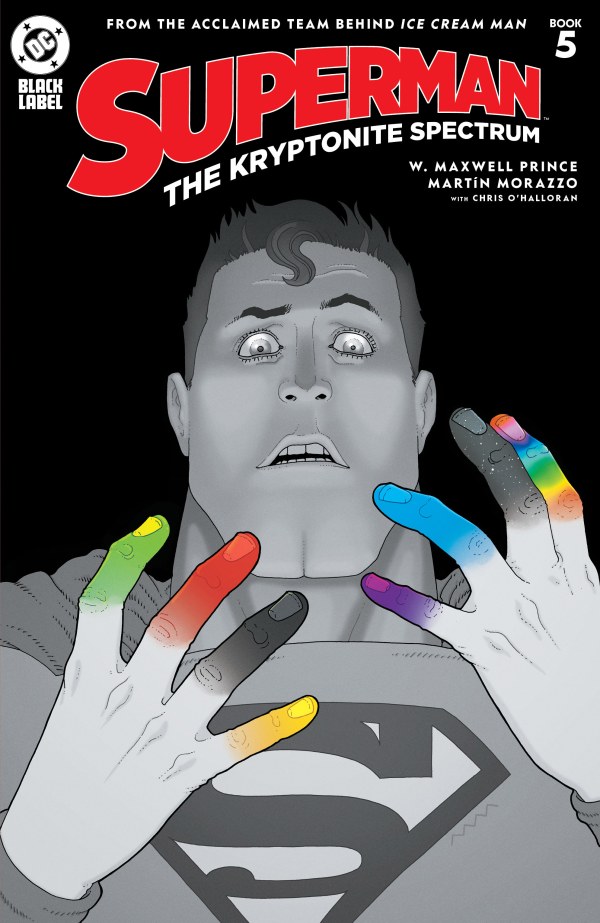
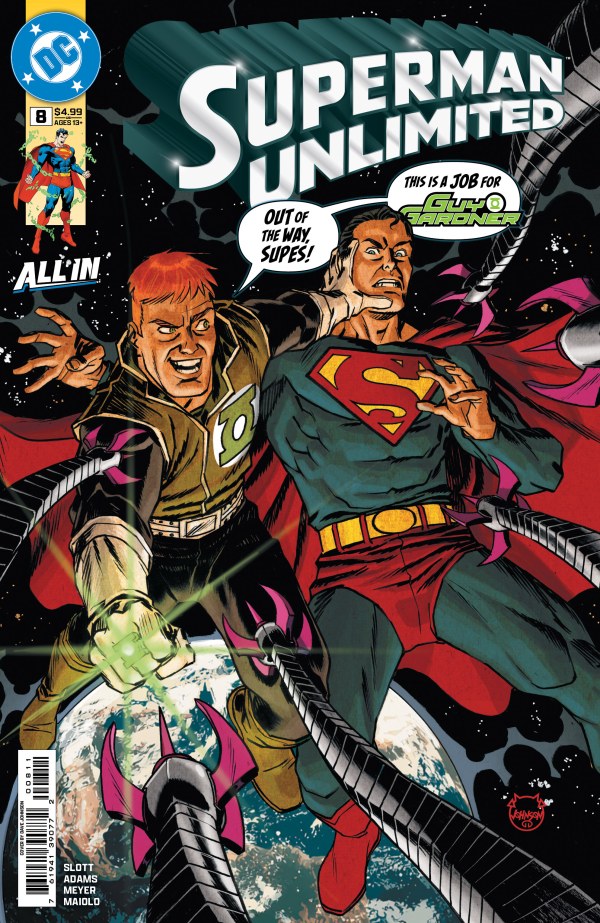
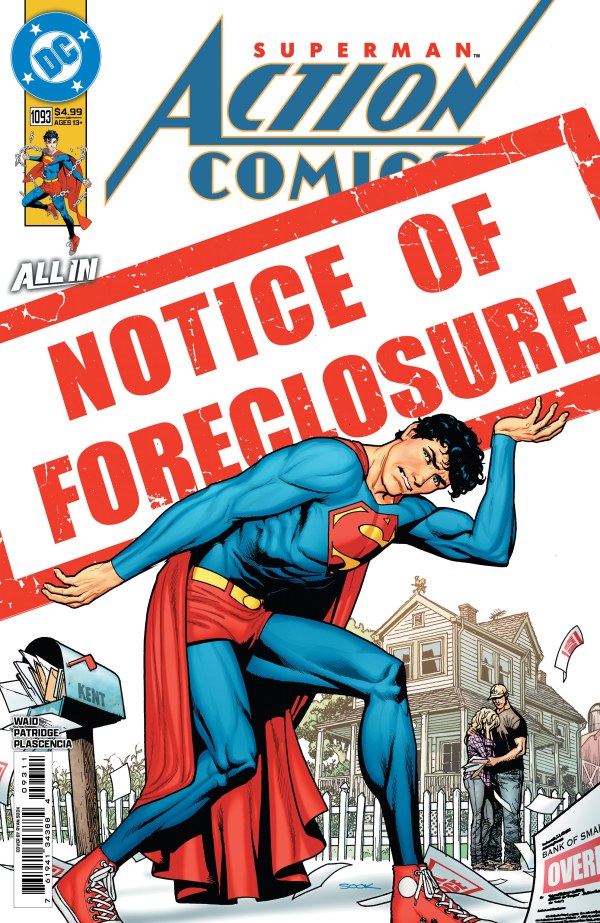
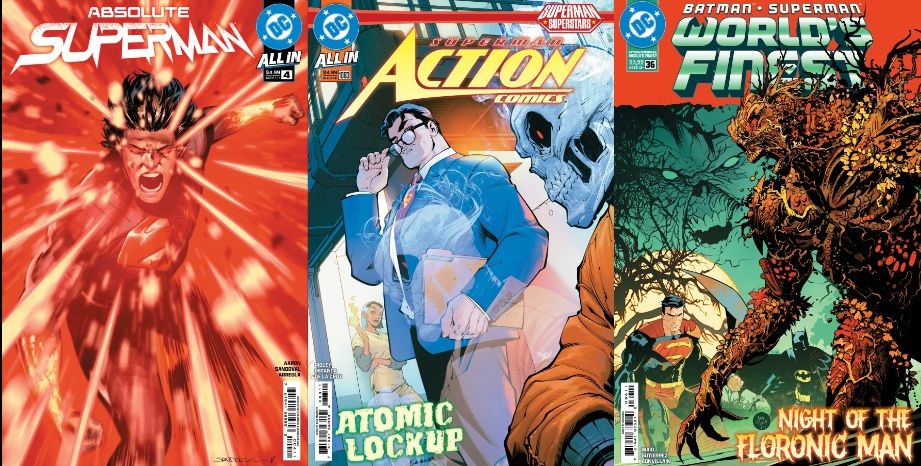
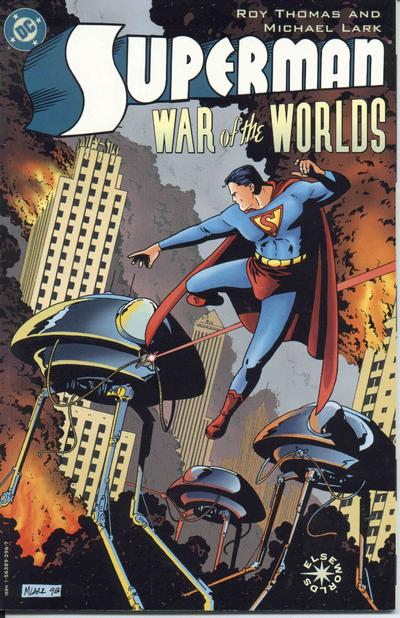
Year of Superman Week 23: Superman and the Legion of Super-Heroes

If you ask Joe Public what team Superman is a member of, pretty much everyone will bring up the Justice League. And they’re not wrong – Superman is a vital member of the League, and honestly, it doesn’t really feel like the JLA without the trinity of Superman, Batman, and Wonder Woman. (I love the Giffen/DeMatteis run, don’t get me wrong, but that’s the JLI.) But the thing is, the Justice League isn’t the FIRST team Clark Kent was a member of. And in truth, as far as his development as a character, I don’t think it’s even the most important. This week we’re going to look at the young people he inspired and who, in turn, helped shape him into the hero he is. Superman would still be Superman if he’d never joined the Justice League…but he’s not really the hero he is without the Legion of Super-Heroes. 

And the same goes for Superboy. And Supergirl. And Jonathan Kent, too. Because of reboot after reboot, there have been a lot of versions of the Legion over the years, and Clark, Conner, Kara, and Jon have each had their own incarnation. This week I’ll try to peek at each of them, talk about why the Legion matters so much to Superman, and discuss the best (and worst) of the 31st Century’s greatest heroes. 

The Legion is kind of complicated these days, thanks to DC’s constant rebooting of their timeline. If you aren’t already familiar with them and you’re looking for a little clarification, I wrote about their convoluted history in this Geek Punditry blog a couple of months ago. Please, go check it out. 

And as always, you can check out earlier blogs in the Year of Superman Archive!

Wed., June 4

Comics: Adventure Comics #247, Action Comics #276, Absolute Superman #8, Justice League Vs. Godzilla Vs. Kong 2 #1

The same thing happened to me when I tried to join the Webelos.

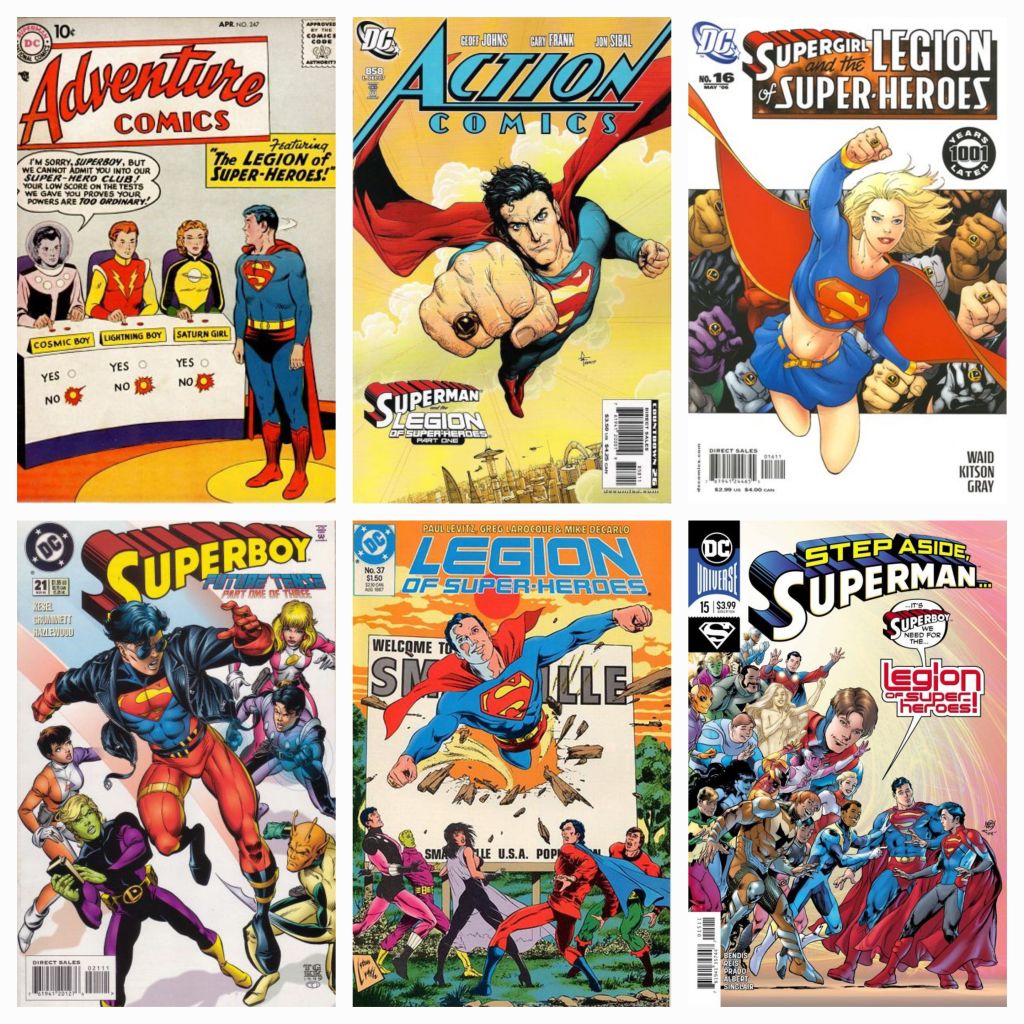
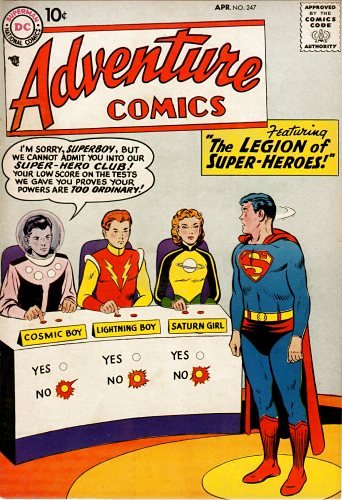
Notes: The Legion made its first appearance in Adventure Comics #247, during the period in which the headline character of that anthology series was Superboy. In this issue, beneath a Curt Swan cover that has become one of those legendary covers that gets “Homaged” again and again, Clark Kent is on the streets of Smallville when he is addressed as Superboy by a mysterious teenager he’s never met before. He switches to his other identity and zooms off, only to be met by another teenager calling him Clark, then a third. Horrified at first that his identity has been revealed, he is relieved when the teens tell him their secret: they are time-travelers. In their future, they are members of a club for superheroes inspired by the legendary exploits of Superboy, and they have come back in time to invite him to join. They bring him to the future, where he sees that Smallville has become a bustling…well…metropolis – but only by the standards of HIS time. In their time, it’s still considered a tiny community. The teens (Cosmic Boy, Saturn Girl, and Lightning Boy) put Superboy through a series of initiation tests, but each time he is distracted by a disaster that requires his attention. At first, he thinks he’s failed, but the heroes reveal that the disasters he stopped were of their own doing, and it was just an initiation stunt. Superboy joins the team and goes home, but joining them in the future soon becomes a recurring part of his adventures.

Like so many of the other characters I’ve looked at this year, this early version of the Legion feels terribly incomplete. Heck, it’s not even called the Legion of Super-Heroes yet, just the “Super-Hero Club.” The three founders are all there, but Lightning Boy would soon change his name to Lightning Lad, and all three would quickly adopt new uniforms that didn’t sport their full names across the chest like a Ben Cooper Halloween costume. The exact time period from which they hail vacillated over the next several stories before it finally, firmly, was set at 1,000 years in the future. And although only the three founders take active part in this first issue, we see other generic teens that I assume are intended to be other Legionnaires, including one that – in the digital version on DC Universe Infinite – appears to be re-colored to suggest that it’s Brainiac 5. But that’s kind of pointless, since we’ll see his first appearance shortly. 

There isn’t a ton of meat in this first appearance, but I guess the idea of Superboy having actual peers was too good, so they not only brought them back, but soon added Supergirl to the mix, even though she and Superboy were separated by about 20 years of time. But hey, it’s time travel, that’s not really an issue. The first time she encountered the Legion, she was rejected because she was suffering from Red Kryptonite exposure, which seems pretty mean when you consider they darn well should have known that Red K only lasts for 24 hours. But in Action Comics #276, she got her next chance.

This issue begins similar to Clark’s first encounter with the Legion. Linda Lee is walking around Midvale, lamenting the fact that she’s got no super-powered friends to hang out with. (I feel compelled to point out that this was 1961, and even the most embryonic form of the Teen Titans wouldn’t first appear until 1964, but isn’t it weird that they never had Supergirl join until the Matrix version in the 90s?) To her surprise, she’s soon approached by three girls with powers: one wearing a mask, one that can move through solid objects, and another who can split into three bodies. The girl with the mask removes it to reveal that she’s Saturn Girl, one of the members of the Legion Supergirl met before. If you need an explanation for why she bothered with the mask, the only answer I have is that in the Silver Age nobody was ever straightforward about ANYTHING. The girls – Saturn Girl, Phantom Girl, and Triplicate Girl – take her to the future for a second shot at joining the Legion, this time alongside fellow prospective members Sun Boy, Bouncing Boy, and Brainiac 5. She is shocked at first to find that a descendant of one of her cousin’s greatest enemies is trying to be a hero, but is won over by his tender affection towards her. Supergirl is given a time-traveling membership like the one Superboy had, while Brainiac becomes a permanent member. Then, for absolutely no reason, she has a brief encounter in Atlantis, which only serves to lead up to a final panel where Linda remarks on the fact that she may not have a boyfriend in Midvale, but there’s an alien 1,000 years in the future AND a merman in Atlantis crushing on her, so it ain’t so bad.

Abysmal epilogue sequence aside, this is an interesting issue. It introduces not one, but FIVE significant Legionnaires (both Bouncing Boy and Sun Boy joined the team by the next time they turned up), and gives Supergirl a peer group like her cousin – in fact, the SAME one as her cousin. And just in case you’re worried about any timey-wimey problems arising from the fact that Superboy and Supergirl were members of the same team, they found ways to play with it. They established, for instance, that Saturn Girl placed a telepathic block on each of them, so that when they returned to their respective time periods, they would lose any memories they’d gained that would be relevant to their own future. Practically, this meant that Superboy only remembered that one day his superpowered cousin would come to Earth when he was actually in the future. They also usually avoided having both of them appear in a Legion story at the same time, so it didn’t come up too often.

Over the years, they would each bond with the Legion, and this is where I really think this group becomes important. The JLA is Superman’s team, sure, and he is close to several of them. Superman, Batman, and Wonder Woman in particular are called the DC “Trinity,” and their friendship is important, the stuff of legend.

But those are the friends he has as an adult. The Legion are his childhood friends, and that’s important. That’s special. As we learned from stories such as Stand By Me and The Sandlot, the friends we have when we’re young are a fundamental part of shaping who we are as adults. And there’s been more than one story that demonstrates just how important the Legion of Super-Heroes is to making Superboy become the Superman of legend. 

At least, until Man of Steel in 1986 upended everything by that declaring that Clark Kent had never had a career as Superboy. That change in the timeline would have catastrophic consequences for the Legion of Super-Heroes. 

But I’ll read about that tomorrow. For now, why not join me in a look at the two Superman-related comics that hit the shops this week? 

Someone’s gonna pay for that window.

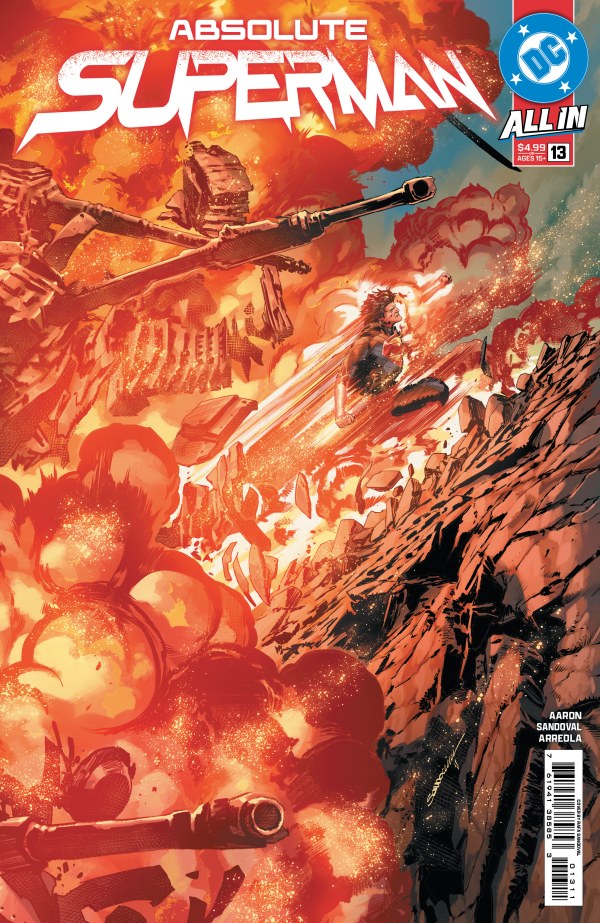
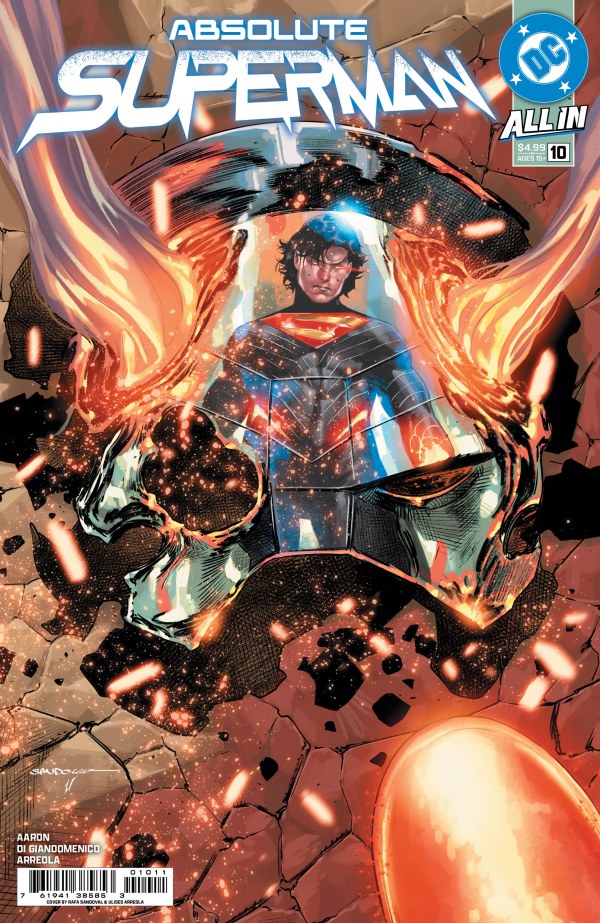
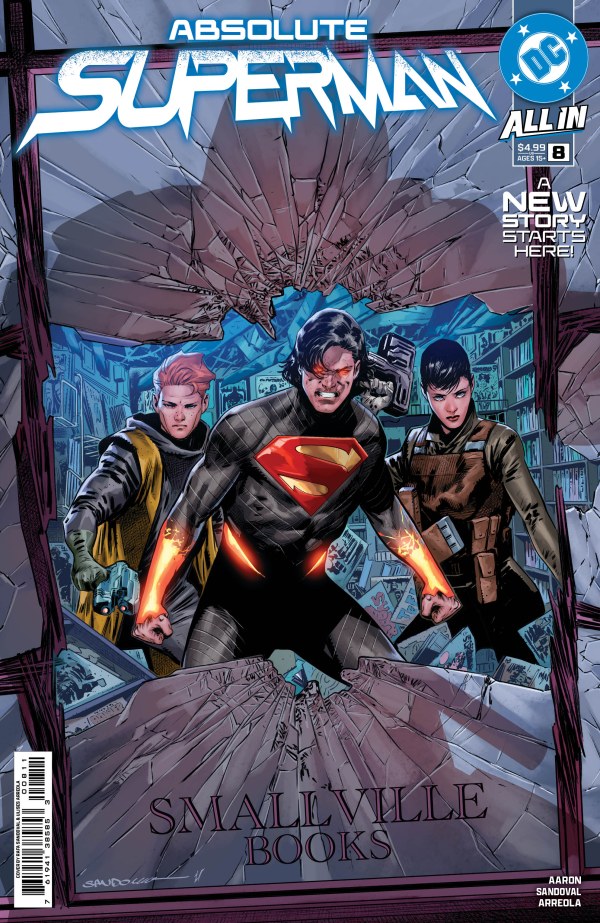
Absolute Superman #8 begins the second story arc of the series. Visiting Martha Kent in Smallville, Kal-El is approached by Lois Lane…unfortunately, she’s followed by the rest of Lazarus, the Peacemakers, the Omega Men, and – oh yeah – a sniper with Kryptonite bullets. Jason Aaron keeps mixing up the DC Universe here, taking familiar pieces and putting them in unfamiliar positions, like plucking a Lego brick from a castle set and using it to build a spaceship. It’s a fun exercise, though, and I keep enjoying the stuff they’re doing.  

We also get the first issue of Justice League Vs. Godzilla Vs. Kong 2. Picking up a few years after the end of the previous miniseries, it’s Barry Allen’s wedding day! Unfortunately, he still hasn’t told Iris his secret identity. As the League tries to coax him into doing so, Amanda Waller reactivates Task Force X to deal with a resurgence of Titans (not the Teen ones – that’s what they call Kaiju in the Legendary Monsterverse). I love these crossovers, and I think it’s very interesting that, for the next few months at least, Godzilla is going to feature in comics from no less than THREE American publishers: the Monsterverse version here, the Toho version fighting the Marvel Universe over there, and all the wild iterations in the regular Godzilla comics from IDW Publishing. 

Thur., June 5

Comics: Legion of Super-Heroes Vol. 3 #37, Superman Vol. 2 #8, Action Comics #591, Legion of Super-Heroes Vol. 3 #48, Secret Six Vol. 5 #3 (Super Son)

Who says you can’t go home and have a fight with another iteration of yourself from a parallel pocket dimension again?

Notes: I’ve written at length about John Byrne’s Man of Steel in 1986 and how that reboot changed the Superman mythos. But one aspect I haven’t talked about that much is the Legion. As a team who not only had Superboy and Supergirl as members, but whose entire existence was INSPIRED by Superboy, after DC changed their continuity to declare that Superboy and Supergirl never existed, how could they explain the Legion? The solution came in this four-part story from 1987, beginning in Legion of Super-Heroes Vol. 3 #37.

Cosmic Boy, having recently returned from a visit to the 20th century (in his own self-titled miniseries) reports that the past has been altered, and the Legion has to investigate. A time storm hurls them to the past, to a Smallville populated by Superboy – a time that Cosmic Boy has reported no longer exists. Arriving in Smallville, the team splits in half – one group making contact with Superboy, the others staying with the time bubble. Superboy ambushes the team, though, trapping them in a stasis-beam. When Pete Ross (an honorary Legionnaire) warns the others what Superboy has done, they attempt to flee. And in the distant future, the Legion’s old enemy the Time Trapper revels in the chaos he is sewing. Part two comes in Superman #8, set in the “present day” of 1987, where we begin with John Byrne’s Clark Kent using his powers to help Lana fix up the farm she is returning to after years away. His super-senses detect a time bubble with four super-powered teenagers appearing across Smallville, and they get into one of those required “heroes fight heroes over a misunderstanding” situations before Brainiac 5 calls an end to hostilities. Brainy tells Superman about their history with Superboy, a history he has no memory of, and as they prepare to seek answers, Superboy appears and captures the five of them in his stasis ray. 

Action Comics #591 gives us part three of the story: Superboy is being forced to attack his friends by the Time Trapper, who reveals that Superboy’s entire existence is part of a trap laid for the Legion. Over the centuries, stories of Superman’s legend had been changed, making the Legion believe in a “Superboy” era that never existed. When they first decided to time travel and meet Superboy (back in Adventures #247), the Trapper created an entire pocket universe that matched their skewed legends of Clark Kent. It was THIS Superboy that the Legion befriended, who joined them, and who they visited every time they traveled to the past. But unable to betray his friends, Superboy altered the stasis beam so Superman would escape and chase them, ultimately landing in the pocket universe. Superboy and the Legion reconcile and go to the future, returning Superman to his own universe – but this wouldn’t be his last encounter with the Pocket Universe.

We’ll get to that some other week.

The story ends tragically in Legion #38. As Superboy and the Legion confront the Time Trapper, he reveals that one of his machines has protected the Pocket Universe from the multiversal devastation that happened in Crisis on Infinite Earths. In the skies above Smallville, Superboy sacrifices his life to save his universe from destruction. The Legion brings his body back to the 30th century to mourn…with an eye towards revenge against the Time Trapper once and for all.

Paul Levitz, longtime Legion writer, had a tough task here. Remove Superboy from the board, recognize that the “real” Superman was never Superboy and never a member of the Legion, but do so in a way that was still respectful to the Legion’s history. I think he did as good a job as anybody possibly could. The “Pocket Universe” conceit manages to keep every story where Superboy, Supergirl, or the Super-Pets encountered the Legion canonical, even if they’re only canon to the Legion and not the rest of the DC Universe. Furthermore, even though Superboy may never have been “real” in the first place, Levitz gave him a sendoff worthy of the Man of Steel that he would never grow up to be — sacrificing himself to save his world is the kind of thing members of the House of El do. Kara did it in the Crisis, The Post-Crisis Superman would do it on the streets of Metropolis a few years later. Self-sacrifice is hardwired in the DNA of the Superman family, and this story demonstrated that nicely. 

Which makes it a little frustrating that six years later, Zero Hour would throw it all out the window.

Fri., June 6

Comics: “Future Tense” storyline: Superboy Vol. 3 #21, Legion of Super-Heroes Vol. 4 #74, Legionnaires #31; The Legion #25-33, Legion Secret Files 3003, Teen Titans Vol. 3 #16, Teen Titans/Legion Special

Be honest, are you Team Leather Jacket or Team T-Shirt?

Notes: The Crisis was intended to streamline the DC Multiverse, and while it was largely successful, there were loose ends that just…dangled. It caused problems for a while, and in 1993 Dan Jurgens tried to close off those issues in Zero Hour: A Crisis in Time. It was a good story, and one of the changes it wrought was a reboot of the Legion of Super-Heroes. As Man of Steel did for Superman, the Legion reboot started the characters over from page one – they were teens again, the names and costumes were made a little less “Silver Age-y” (Lightning Lad, for instance, became Live Wire, Triplicate Girl became Triad, and so forth), and in this continuity, the Legion was inspired generally by the heroes of the past, and not Superboy or Superman specifically.  Our new Superboy, the one we met in “Reign of the Supermen,” had his own title by now, and first encountered the Legion in a three-part story called “Future Tense” from 1995. 

The Legion travels back in time to rescue Valor, a rebooted version of their own Mon-El (it’s a long story) that Superboy had encountered a few issues ago in his title. After the requisite “fight over a misunderstanding” happens, Superboy tells the Legion how Valor had nearly died from lead poisoning until he entered a “zone where time stands still,” because there was NO way they would be allowed to call it the “Phantom Zone.” Brainiac 5 tries to reopen the zone until, frustrated by the technology of the time, he warps all of them – Superboy included – back to their home in the 30th century. Things get more complicated when Superboy accidentally lets it slip that Valor – who, in the past millennia, has become a religious figure – is returning, causing a massive upheaval among the millions of Valorites across the galaxy. The Legion makes it look as though their attempt to rescue Valor fails, getting his devotees to back off, then rescue him for real in private before sending Superboy home.

This story was pretty emblematic of both the Legion and Superboy of the time. They’re young and they’re highly emotional. In this version, for instance, Triad’s three different bodies each have different parts of her personality, and one of her immediately gets the hots for Superboy. Superboy, meanwhile, was in his hotheaded stage, and certain members of the Legion took severe umbrage to that, specifically Leviathan (this incarnation’s version of Colossal Boy) and Brainiac 5 himself. Still, he does manage to prove his worth, and at the end of the three issues Cosmic Boy (whose name did NOT get updated) makes him an honorary member of the Legion. The kid and the team would encounter each other occasionally over the next few years, through assorted time travel shenanigans, but we wouldn’t see Superboy as a full member until 2003. 

At this point, both the Legion and Superboy had gone through some dark times, the former having its series restarted as just The Legion, and the latter having his series cancelled and being jutted over into Teen Titans. So it was surprising to see him show up on the cover to The Legion #25, wearing a classic Superman costume rather than his own uniform, no less. The story was a bit different – after an issue largely spent recapping their recent tragedies and stacking the new status quo, they found Superboy drifting inexplicably through space. This kicks off the six-part “Foundations” storyline, in which Superboy and the Legion face off against Darkseid and wind up meeting a time-tossed Clark Kent, still a teenager, before he ever put on a superhero costume. It’s a great story, really, although it is HEAVILY mired in the stuff that had happened in the Legion in the last few years, and it would probably be unadvisable to read on its own – I feel like it would be really confusing to anyone who wasn’t familiar with “Legion of the Damned” or the stories that followed it. 

The important thing is that it showed Superboy maturing, becoming a better person and a better hero, and that’s all to the good. Superboy stuck around with the team for the rest of the run, which was all well and good…except that he was also appearing concurrently in Teen Titans with no explanation. After Legion ended with issue #38, we got a two-part story wrapping everything up. In Teen Titans #16, Conner is having lunch with Cassie (Wonder Girl) when he’s plucked up by the Stargate that sent him to the 31st Century. He reappears a moment later, now wearing his Legion uniform, telling Cassie that he needs the Titans to help save the future. So his entire tenure in the Legion, presumably, takes place between those two panels: pencil that in, continuity nerds. Anyway, they’re attacked by the Persuader, and Superboy brings the Titans to the 31st Century, where the Fatal Five have created a Legion of their own to attack Earth: an army of Fatal Fives from throughout the multiverse. Fortunately, Brainiac 5 has a plan, but it requires the work of TWO speedsters: the Legion’s XS and her cousin, Bart Allen, aka Kid Flash. They manage to defeat the Five, but the Legion is lost in the timestream, all except for Shikkari, who finds herself in another world, where the Legion is…different.

Yep. Time for another reboot.

This iteration of the Legion lasted 10 years, and it’s the first one I ever read as a regular reader. As such, I have great affection for it. The stories were solid, with a classic flavor that still felt modern, and the art was wonderful. I was really sorry to see it end, but I’m glad that when it went, at least there was a member of the House of El standing with them in what looked – at the time – like their final moments. But we would see this Legion again.

Just not yet. 

Sat., June 7

Graphic Novel: Supergirl and the Legion of Super-Heroes: Strange Visitor From Another Century (Collects Legion of Super-Heroes Vol. 5 #14, Supergirl and the Legion of Super-Heroes #16-19)

“Don’t ask ME, I thought she was DEAD.”

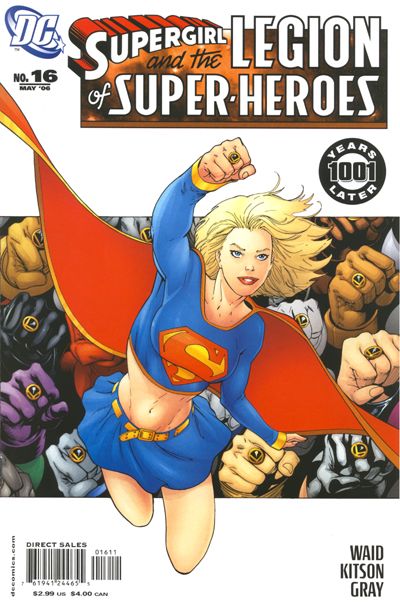
Notes: The “Threeboot” Legion that followed the Titans/Legion special was an interesting beast. Written by Mark Waid, with art by Barry Kitson, this newest iteration gave us a Legion inspired by stories of the heroes of the past that much of the population believed to be mere legends – nobody really BELIEVED that the likes of Superman, Batman, or Wonder Woman had ever existed. Society had grown increasingly distant and oppressive – people stayed home, alone, communicating electronically but rarely seeing one another in person. What’s more, the youth of the galaxy were particularly downtrodden, with free thinking suppressed to make sure everyone conformed. In this universe, the Legion were a group of super-powered teens who rejected this system. They adopted costumes and code-names inspired by the heroes of the past and started a movement, with other young people from across the galaxy joining them.

The volume I read today picks up after their first few adventures, where they’ve proven their worth and the United Planets has reluctantly deputized them as a peacekeeping force. As the Legion licks their wounds from a recent loss, things are tossed into upheaval when a young woman professing to be the legendary Supergirl appears. Much of the galaxy believes that she’s a hoax, because they think Supergirl is a fictional character. As for Supergirl herself, this is the Kara Zor-El who climbed out of a rocket in Gotham Harbor only a few months ago (by her reckoning, but not much longer in real time). Between her adventures with her cousin, Batman, and Wonder Woman, the devastation of the Crisis, and now finding herself 1000 years in the future, the trauma has begun to affect her mind and she believes that everything that has happened to her – including her existence in the Legion’s time – is a dream, and that any minute she’s going to wake up back on Krypton.

Waid had already created a world for the Legion dissimilar from the previous two, and this was a Supergirl that was different from any other Superman family member who’d ever joined the Legion. Despite that, though, it all worked. While the WORLD was different, the Legionnaires were staunchly themselves: Cosmic Boy was the consummate leader, Lightning Lad was impulsive, Brainiac 5 an arrogant jerk who was mainly tolerated because he actually WAS the smartest one in the room as opposed to just somebody who thought he was. There were some revisions, of course – previous iterations of Shrinking Violet had often been quiet and timid, but Waid reimagined her as the ass-kicking master of espionage that somebody with her power set would logically have the ability to be. 

Meanwhile, we’ve got this traumatized Supergirl floating around with this crew, somebody who doesn’t believe that anything happening around her is actually real. Which makes it all the more impressive, I think, that she continues to act every inch the hero. She saves lives, stops disasters, fights villains, even though she believes that it’s all a dream and that nothing around her will have any consequences. Perhaps it’s the level of her consciousness that knows it’s NOT a delusion, perhaps it’s just that Kara Zor-El can’t help but help people no matter the circumstances. Whatever it is, it made for a unique dynamic. Supergirl stayed with the book for a couple of years, going home in issue #36, and the series itself ended at issue #50.

But even before this version of the Legion went away, we got glimpses of what was next. 

Sun., June 8

Graphic Novel: Superman and the Legion of Super-Heroes, collects Action Comics #858-863

Now THIS is going home again.

Notes: I don’t mind telling you that Geoff Johns is one of my favorite comic book writers. His strengths, as I think he proved with his tenures on Flash and Green Lantern, come when he takes the framework of the past and expands upon them. He’s the writer, for instance, who used the existence of Sinestro’s yellow ring to extrapolate an entire Sinestro Corps, and from there, a different corps of Lanterns for each color of the spectrum. His runs on Superman have been short, but what he did with the six issues of “Superman and the Legion of Super-Heroes” from 2007 and 2008 is one of my favorite examples of his work. Although it was running concurrently with the Supergirl and the Legion series, in this storyline Johns brought back something that had been lost from Superman’s past, much as earlier writers had brought back Krypto, the Phantom Zone, and Supergirl: he was restoring Superman’s history with the Legion.

Johns and artist Gary Frank, who would reunite in 2009 for Superman: Secret Origin, kick things off with a bang. Superman is contacted by a probe from the future sent by Brainiac 5 reactivate suppressed memories of his past with the Legion. Suddenly, Superman remembers meeting the Legion founders, being invited to join the team, and losing contact with them after the Crisis. (I know there have been a LOT of Crises in the DCU – typically they’re referring to the original Crisis on Infinite Earths when they use the definite article, i.e. THE Crisis.) The probe brings him to the future where things have gone horribly wrong: Something has turned the sun red, diminishing Superman’s powers. Earth is being run by a xenophobic “Justice League” led by a fascist calling himself Earth-Man that has made the Legion, with its many alien members, outlaws. Oh yes – and Brainiac 5, the Legionnaire who brought Superman to the future, is missing. Earth-Man, as it turns out, is a Legion reject who can absorb powers from others. He built a following claiming that Superman was a human, not an alien, and in fact was staunchly opposed to the presence of aliens on Earth. He’s been capturing the non-human Legionnaires and stealing their powers in his quest for conquest. 

Superman and the few remaining Legionnaires manage to escape Earth and track Brainiac 5 to his homeworld of Colu, the only planet in the galaxy more xenophobic than Earth. They gather Brainy and a few others, including the Legion of Substitute Heroes, and together launch an assault on the Justice League on Earth, where they learn that Earth-Man has been using the captive Sun Boy to make our sun red, weakening Superman. In the climactic battle, a powerless Superman faces an Earth-Man with the power of the entire Legion flowing through him…but there’s one thing that Superman has that Earth-Man never will.

His friends.

I cannot express enough how much I love this story. There are plenty of stories of Superboy with the Legion, and those are great, but this is one of the few stories of the Legion fighting with an adult Superman, and that’s a dynamic I want to see more of. (Recent hints in the current Superman comic books are giving me hopes that we’ll see more of that soon, but I digress.) Like I said earlier this week, Superman with the Legion is a group of friends. The tone feels more like the Titans than the Justice League, a found family standing together rather than a group of disparate heroes united for a common cause. That “found family” trope is always something that resonates with me, and I love seeing Superman as a part of it.

It’s also good to see a story that makes its points without preaching or turning into a polemic. There’s a definite message here, with Earth-Man’s hatred of anyone not from Earth, but that message is secondary to the story. Not that Johns and Frank were subtle about it – Earth-Man’s costume is as close to a Nazi uniform as you can get without actually applying swastikas, and his real name is the egregiously German Kirt Niedrigh, juuuuuuuuuust in case we didn’t get what they were going for. But parallels to World War II aside, the story also has a point to make about being an outsider. Bringing the Subs in makes it even better, having them act as a foil for Earth-Man – they were rejected from the Legion just as he was, but rather than turning into monsters, they used their disappointment as fuel to become something good. 

There are plenty of questions raised by this story, of course. First of all, which Legion is this, exactly? It’s an older Legion: despite still having words like “Boy,” “Lad,” Kid,” and “Girl” in their code-names, they all appear to be roughly the same age as Superman. But the costumes and past they share with Clark seem to indicate this is a continuity that continued the characters from some point prior to the controversial “Five Years Later” era (which was the final era of the original Legion before the reboot in 1993, beginning between their second and third encounters with the time-traveling Superman in Time and Time Again). If that’s them, how are they coexisting with Supergirl’s Legion, which I remind you, was being published in their own series at this point? Who, or what, was the “real” Legion of Super-Heroes?

To answer that question, DC again turned to Geoff Johns, in what is my single favorite Legion story of all time. 

Mon., June 9

Comics: Final Crisis: Legion of 3 Worlds #1-5

Get ready for the most egregiously misnamed Crisis of them all!

Notes: In 2008, Geoff Johns and George Perez teamed up for this five-issue miniseries. While ostensibly a spin-off of Grant Morrison’s Final Crisis event, it really has nothing to do with the larger storyline of that series and can be read independently of it. I still may get to the main Final Crisis story at some point, since the conclusion is pretty Superman-centric, but for today I’m just going to focus on this Legion story. 

Superboy-Prime, insane survivor of Earth-Prime (see Crisis on Infinite Earths and Infinite Crisis for the full backstory if you don’t already know it) is plucked by the Time Trapper and hurled to the Legion’s time period. Finding the Superman Museum in Smallville, Prime is horrified to discover that he’s only a footnote in Superman’s Hall of Villains, and even worse, is pushed further over the edge by the veneration of Conner Kent, the Superboy that Prime murdered in Infinite Crisis. In Metropolis, meanwhile, the United Planets is turning against the Legion, whose members are in disarray. Brainiac 5 has been stripped of his Brainiac title by his home planet, Mon-El is suffering from the lead poisoning that plagues all Daxamites, and Sun Boy’s powers haven’t returned since his torture at the hands of Earth-Man. Things get progressively worse as Prime springs all of the Legion’s enemies from prison, creating an entire Legion of Super-Villains. The real Legion brings Superman back to their time to aid them, and Brainiac 5 reveals his plan: fight a Legion with a TRUE Legion – by summoning the Legions of two other worlds in the multiverse.

Brainy uses the Crystal Ball that the Justice League and Justice Society used for their very first team-up in the Silver Age to summon the other two Legions – the Reboot Legion that Conner had been a member of, and the Threeboot Legion that had welcomed Kara. Superman and the assembled Legions battle Prime’s army as Brainy enacts Stage Two of his plan: assembling all the electrical-powered Legionnaires to charge up XS and use her to pull her cousin, the presumed-dead Bart Allen, from the Speed Force to rejoin them as Kid Flash. Finally, the Brainiacs use Time Travel to implement Phase Three of their plan: a version of Starman in the 21st century robs a certain grave and transports its inhabitant to the Antarctic. A thousand years later, the Brainiacs unearth the body, which has been slowly healing and rebuilding for a millennia in the same Kryptonian device that brought Superman back after his battle with Doomsday. The final piece to restore him is a hair from one of his genetic donors – Lex Luthor (taken, naturally, from a point in the past BEFORE he went bald). After a thousand years, Conner Kent lives again. 

The battle rages on two fronts – Superboy, Kid Flash and the Legions versus Prime in the Arctic, Superman and the original founders versus the Time Trapper in deep space. It turns out the two battles are really one: this iteration of the Trapper is a future version of Superboy-Prime himself. But for all his power, all his anger, in the final battle, the Legion lives.

Ever since Man of Steel, the Legion’s continuity had become a mess, with two reboots failing to make things simpler, since their interactions with the heroes of the present kept contradicting each other. Legion of 3 Worlds finally solved the problem by establishing that each of the three Legions was from a different world of the Multiverse. The original Legion, the one that Clark had been a member of in his youth, was from the future of DC’s main universe. The Reboot Legion, Conner’s Legion, was from Earth-247, a world that had been destroyed in a Crisis, but not one of the ones that was restored when the Multiverse was brought back. And Kara’s Threeboot Legion, amazingly, was from the future of Earth-Prime, the world where all of the DC Comics heroes exist as fictional characters. All those times in Waid’s run when people had insisted to the Legion that the ancient stories about Superman and the Justice League weren’t real? In their universe, they were right

So not only was the Legion clarified in a way that made sense, but Johns used it to bring back two of the Teen Titans he’d written in an immensely satisfying way, and even used this miniseries as a springboard for the return of the Green Lantern Corps in the 31st century. The Legion was finally clear, established in a way that made sense, and ready for action. And it was done in a way that made all three Legions legitimate and viable, and set each of them up so that they could be used in different ways across the tales of the DC Multiverse. He even managed to codify the importance of the Legion in Superman’s history, explicitly stating (via R.J. Brande) that it was his interactions with Cosmic Boy, Saturn Girl, and Lightning Lad that taught young Clark Kent what it meant to be a hero, and that he would in turn become the inspiration for heroes for the next 1,000 years. It was the perfect fix and the perfect fit. 

Why, DC? WHY THE HELL DID YOU DECIDE TO REBOOT THEM YET AGAIN???

Tue., June 10

Comics: Superman Vol. 5 #14, 15

If you people ever doubt that I love you, remember that I read this comic again so I could write about it.

Notes: A few years post-Final Crisis, as we all know, DC rebooted their entire universe in the New 52 relaunch, including both Superman and the Legion. Once again, Superman was divorced from the roots of the Legion, but other than that, the Legion was one of the properties that was relatively unchanged. But it didn’t set sales on fire, either, and the New 52 version was quietly cancelled after two years. After that, their appearances became sporadic for a while until 2018, when Marvel superstar Brian Michael Bendis was hired by DC to take over the Superman comics.

I’m going to be blunt, guys, I’m not typically a fan of Bendis’s work. I don’t want to spend all day explaining the reasons why, but I don’t think I’ll need to, as my Legion-specific criticisms will make it clear. The biggest issue I had with his run was his treatment of Jon Kent. Lois and Clark’s son had been around in comics for a few years, and was about 10 years old. The stories of Clark raising his son were magnificent. They were fresh, they were original, they were something that we rarely saw in comics: an adult superhero teaching his child what it means to BE a hero is a dynamic that, somehow, had gone almost ignored in the 80 years that the superhero genre had been around. So when Bendis took over, of course, the first thing he did was have Jon fall into a spacehole with his grandfather and come out as a teenager. 

It’s more complicated than that, but the gist of it was that sweet and joyful Jon was now an angst-filled teenage superhero, of which we have thousands, and like most teenage superheroes his stories quickly began to drift towards “adults screw everything up, but kids MY age know better.” It’s a tired, stale trope that we’ve seen a billion times. But there is one good thing I can say about Bendis’s Superman comics: compared to his work on Legion of Super-Heroes, his Superman looks like Watchmen. 

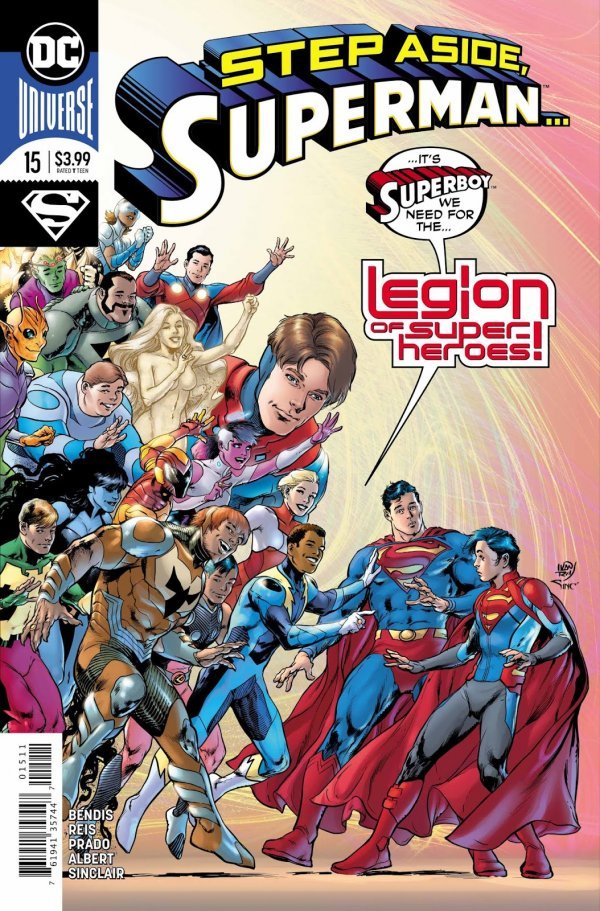
It started in issue #14 of his Superman run, the tail end of a story arc about Superman, Supergirl, and Superboy teaming up with General Zod to capture an alien who has responsible for the destruction of Krypton. At the end of the story, the Kryptonians are brought before a coalition of alien races who were caught up in their battle, and Jon says something along the lines of, “On Earth, we have a thing called the United Nations…” Then, after his dad gives a brief speech about working together, a time portal opens. And the new, re-re-rebooted Legion of Super-Heroes spills out of it and offers Jon membership because he just invented the United Planets by saying ten words that point out something that already exists, and thus he’s the most important historical figure of the past 1,000 years.

I’m getting a headache.

In issue #15 of Superman, the word of Jon’s AMAAAAAZING insight starts to spread. Adam Strange even says “I can’t believe I’ve been out here this entire time and I didn’t think of it.” (Neither can anyone else, Adam – didn’t you ever watch Star Trek? For that matter, are we really supposed to believe that NOBODY had ever thought of this idea before in the ENTIRE GALAXY?) Then the Legion offers to take Jon to the future with them, because he’s so smart and awesome and cool and they wanna be friends with them. He winds up going and joins them for Bendis’s 12-issue Legion series which…I should read it again today. In the interest of fairness, I should read it again for this blog, but I just can’t bring myself to do it. It…it just wasn’t the Legion.

Yeah, the character names were mostly the same. So were the powers. And they were in the 31st century. But everything that makes the Legion entertaining was entirely absent. The characterizations were…I can’t even say they were WRONG, they were GONE. The members of this team had no life, no personality, other than being ASTONISHED that the GREAT JONATHAN KENT WAS THERE. It was like reading about Jon and the Legion of Sycophants. That’s another Bendisian trait, by the way – he introduces a younger version of the hero, then all of the other characters walk around and talk about how much better the new version is than the old one. (If you think I’m exaggerating, I offer the following as evidence: Miles Morales, Ironheart, and the teenage X-Men who were brought forward in time because Beast thought their adult versions sucked.) It was in full force here, with the Legion telling us how Jon – not Clark – would be remembered as THE Superman, as THE character who saved the galaxy. And I’m sorry, if you’re going to make a claim like that, you gotta convince me of it.

There were also a ton of arbitrary changes that drove me crazy, such as making Mon-El a Kryptonian descendant of Superman rather than a Daxamite like he’s been for his entire existence. And as usual, Bendis included his own characters (which is fair) like a new version of Dr. Fate (oooookay) and a Gold Lantern whose powers and history were ill-defined and didn’t really seem to add anything to the story. I made it through the 12 issues of his run, but when he closed it off with a six-issue Justice League Vs. the Legion of Super-Heroes miniseries I couldn’t even bring myself to buy the comics, reading it instead when it came to DC Universe Infinite and still feeling as though I’d overpaid. 

Since that miniseries ended, again, the Legion has returned to sporadic appearances. Some of them have reflected the Bendis Legion, but others evoke Legions of the past. Mark Waid himself went on the record recently to tell us that DC has plans for the Legion that he thinks will make everyone happy, and we’ve already seen glimpses of that in the DC All In Special and (appropriately) the Superman titles. We’ve been promised that Superman #29 (coming out in August) will feature Superman and a “mysterious ally” searching for the lost Legion of Super-Heroes. I’m anxious and I’m optimistic. For the most part, DC’s “All In” titles have been very satisfying, and if the new Legion (whatever it is) has Mark Waid’s stamp of approval, that gives me reason to hope. Because the Legion, at its best, is not JUST a team of heroes from the future. It’s about hope for the future, just as much as Superman is. And it’s a fundamental part of who and what Superman is. It’s one of the greatest concepts in comics, and it deserves to be treated as such.

So here’s hoping that, whatever begins in August, it ends with a story that leaves us all ready to slip on our flight rings, thrust our fists into the air, and join with a battle cry that will echo back ten centuries:

Even Brainiac 5 is irritated by Brainiac 5.

But you know, I can’t end it here. I can’t conclude my look at one of my favorite pieces of the entire Superman mythology with a discussion of their worst version. So how about a little bonus? Let’s join hands, hop in Brainiac 5’s Time Bubble, and zip back to 2006 so we can watch the first episode of the Legion of Super-Heroes animated series together, shall we?

TV Episode: Legion of Super-Heroes Season 1, Episode 1: “Man of Tomorrow”

It ain’t the Diniverse, but it’s still pretty dang good.

Notes: Young Clark Kent is about to leave home. He’s packing up and heading away from Smallville to go to Metropolis, where he’s got a job as a copy boy at the Daily Planet. On the night before he’s supposed to head to the big city, though, he’s approached by a group of super-powered teenagers from the future, teens who know about the powers he’s kept hidden his entire life. He won’t miss a thing, they promise, they can return him to the moment he left – and tantalized by the idea of not having to hide himself, he goes with them. Arriving in the future, he discovers that they need his help combatting their foes, the Fatal Five. In the end, Clark takes the costume he learns he’ll have someday and, as Superman, joins the Legion.

I love this cartoon. It’s the purest expression of my favorite thing about the Legion, namely that it helps shape Clark Kent into Superman while, at the same time, being inspired BY Superman. It’s a bit more literal in this version than others – the Clark that joins this Legion hasn’t ever really been in a fight and hasn’t learned how to use all of his powers yet. The Legion has plenty to teach him, and over the first season of the show, we see him grow and blossom. The second season takes place after a time skip, returning to the future after a few years away. It was an interesting retool, but ultimately the show only lasted for those two seasons. If you love the Legion like I do, though, it’s well worth seeking them out and watching them.

After all, we Legionnaires need SOMETHING to keep us occupied between now and August. 

Blake M. Petit is a writer, teacher, and dad from Ama, Louisiana. His most recent writing project is the superhero adventure series Other People’s Heroes: Little Stars, volume one of which is now available on Amazon. You can join in the Kryptonian Konversation every day in the Year of Superman Facebook Group!
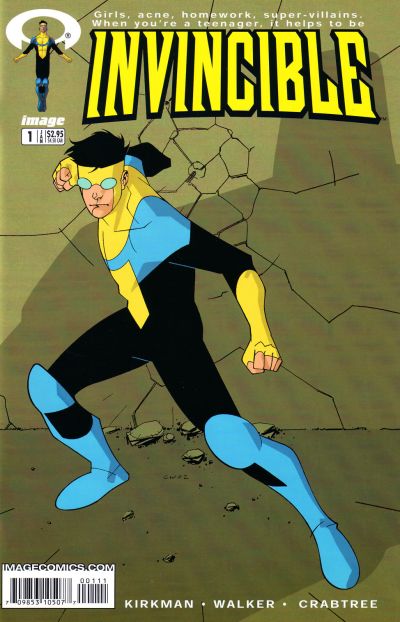
Year of Superman Week 19: Superman Who?

We’re here approaching the middle of May already, and for me that means the end of a school year. This week is the last week for my 12th graders, while my 11th graders are gearing up for their last two weeks. All of this boils down to less time for me, so I don’t think I’m going to work too hard to maintain any sort of theme this week. Let’s just take it as it comes and see what turns up.

Wed., May 7

Comics: Action Comics #558, Superman’s Pal Jimmy Olsen #138, Justice League of America #23

Ironically, this is what I feel like when I get an ice cream headache.

Notes: Here’s another one of those semi-random issues that turns up in my classic comic read-throughs, and it really illustrates something about the middle years of Superman. After the Silver Age silliness started to die down, there was a long period where it didn’t quite seem that the writers knew what to do with him. He only had a few great villains, like Luthor and Brainiac, and it’s not like he could face off against them twice every month, or they’d be overused. Attempts at creating new villains tended to turn out losers with little meat behind them, such as Terra-Man, or else random alien or mystical opponents who were only good for one story each. Other than that, they had him facing off against natural disasters or some sort of personal mishap that made Superman himself (temporarily) dangerous or otherwise imperiled without having an actual antagonist. 

As for his personal relationships – the perpetual Second Act of ongoing comic books is on no greater display than it was here. They didn’t want Clark to get married, they kept Lois as a hanger-on, they didn’t add any characters, they didn’t remove any, and that’s how things were for decades. They finally made a slight shift in the late 70s and early 80s: moving Clark to WGBS added a few characters to the cast, and bringing back an adult Lana Lang who was finally infatuated with Clark Kent rather than Superboy changed up the classic Superman/Lois/Clark love triangle. Ultimately, though, these changes were largely cosmetic, and the actual plots didn’t change all that much. When somebody calls Superman boring I disagree with them vehemently, but I have to assume that the majority of their exposure to the character probably comes from this era.

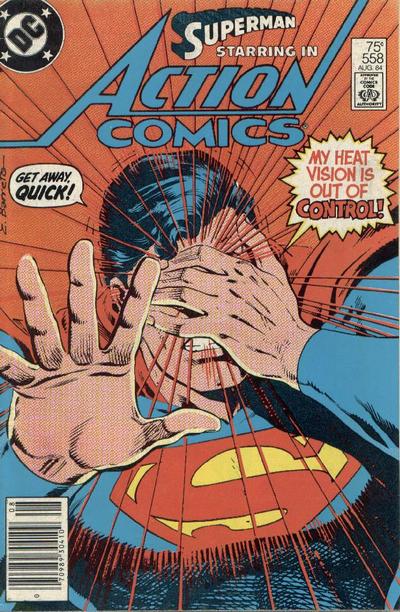
All of this is to say, “The All-Searing Eyes” from Action Comics #558 is another example of a Superman story that’s low on threat and doesn’t really have any reaching impact. Superman is brought into contact with a scientist attempting to solve the world’s energy problems, and he thinks he’s found the way to do it: Superman’s heat vision. He believes if he can discern how Superman’s heat vision works, he may potentially be able to harness that energy for the benefit of the people of the world. Superman, being Superman, agrees to have his heat vision tested, but he’s forced to end the experiment prematurely to avert a disaster, and as a result, he finds himself unable to turn the heat vision off.

Is there story potential here? Sure. A Superman unable to turn off his heat vision would be horribly dangerous, something that was actually addressed in a 90s storyline in which his powers went out of control for a while. But true to the time period, there wasn’t much room for real drama here. Superman realizes he’s in a pickle, he causes a small amount of trouble but no lasting damage, and at the end of 12 pages the scientist manages to get his heat vision back to normal. Ultimately this – like a lot of the comics of the era – feels pretty inconsequential. It has no lasting impact for any of our characters, and nothing that happens is ever referenced again. This isn’t to say that every single Superman story (or every story for any ongoing character, for that matter) HAS to have long-reaching consequences, but if they don’t, they should at least reveal something about the characters or, at bare minimum, be original and fun. This story, and many of them of the era, just don’t tick any of those boxes. In a modern age where it seems like comic books are rebooted every twenty minutes and it never matters anymore, you can look at books like this one – books that happened in the years before the first major reboot – and you can understand why DC felt like it was necessary. 

Thur., May 8

Comics: Superman #126, Blue Devil #3 (Guest Appearance), Action Comics #375, Infinity, Inc. #5 (Power Girl)

And this is what it takes to get RID of an ice cream headache.

Notes: As I’ve said before, on weeks when I’m not pursuing a particular theme, there’s little rhyme or reason to the choices I make as to which Superman content I’ll explore. For example, Superman #126? It’s on the docket for today solely because I was scrolling through the DC Universe Infinity app, the cover caught my eye, and I don’t think I’ve ever read this story before.

I should clarify: I’ve never read the story presented in this PARTICULAR issue before…but I have most CERTAINLY read stories about Superman with amnesia. They were strikingly common in the Silver Age, and even as late as the early 90s there was the “Blackout” five-parter, in which Superman’s memory was accidentally wiped by an experiment Emil Hamilton was working on and he wound up on a tropical island almost marrying a native princess. (Hmm. Should I read that one next? It’s been a while.)

But for now, I’m focusing on “Superman’s Hunt For Clark Kent.” While experimenting for a possible antidote to Kryptonite radiation at the Fortress of Solitude, an accident causes Superman to lose his memory…but fortunately not his powers, which he needs to fly down to Metropolis to start piecing together his missing life. He gets clothes from a British chap who is literally giving them away to the first person he sees who’ll fit them and who seems to have no idea who Superman is, then decides to adopt a “secret identity.” He disguises himself as a Brit, bleaches his hair blond, takes the name “Clarence Kelvin,” and applies for a job at the Daily Planet

You know, there’s an adage in writing that goes something like, “In real life, we expect coincidence. In fiction, we do not stand for it.” I imagine that adage was coined in response to stories like this one. Superman’s behavior is completely absurd and preposterous, and seems to happen only to keep him from telling literally anybody on the planet the predicament he’s in, at which point every scientist in the world (except for Lex Luthor) would be falling over themselves to try to cure his amnesia. But instead he…fights a whale. 

Eventually, he learns who he really is by flying into space far enough to overtake the rays of light coming from Earth and using his telescopic vision to watch himself, in the past, changing his clothes, making him realize he’s Clark Kent – and that may be the LEAST scientifically implausible thing about this story. At the end, everything goes back to normal, with Clark settling in at the Planet again…but something about this is bothering me. He discovers that he’s really Clark Kent. He resumes his life as Clark Kent. But at NO POINT does the story actually say that his MEMORY returns. Does that mean that Superman technically had amnesia for the rest of the Silver Age?

Where’s that grim and gritty follow-up?

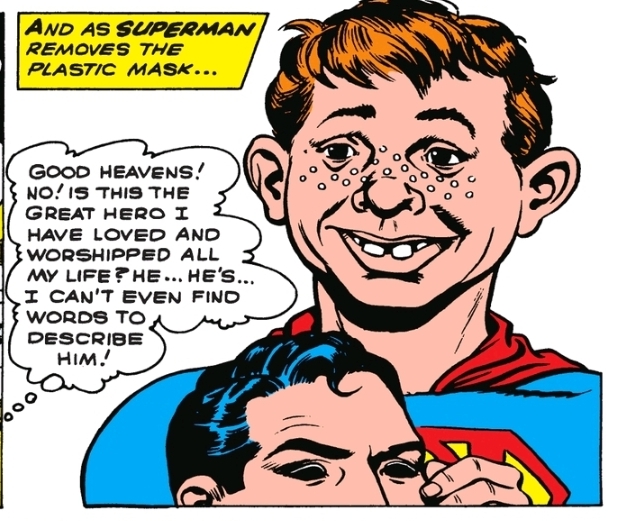
As usual for this era, there are three stories in the issue. The second one isn’t particularly memorable, but the third one made me do a double-take. In “The Two Faces of Superman,” Lois deliberately makes herself unattractive to ward off a blind date and Clark, catching wind of this, decides to teach her a lesson. He decided to do that a LOT in the Silver Age, in and of itself there would be nothing noteworthy about this. But as Superman, he whisks her off on a date, at the end of which he “confesses” that he always wears a rubber mask as Superman and wants to finally show her his true face. And when he does…well…see for yourself.

“What, me Kryptonian?”

Yep. Superman decides to turn himself into the spitting image of Mad Magazine’s Alfred E. Neuman. 

And this, it should be noted, was long BEFORE Mad was published by DC Comics. 

Anyway, to her credit, Lois is smart enough to figure out Superman’s ruse (after a few pages of angst and soul-searching) and calls his bluff by accepting a marriage proposal he never thought she would go for. In the end, both of them put their cards on the table and admit the truth, and Lois even concedes that it was wrong of her to blow off her blind date in such a way, then goes right back to dreaming about wanting to marry Superman – but NOT by tricking him. I guess that’s the sort of thing that passed for noble aspirations in 1959. 

Fri., May 9

Comic: Absolute Superman #7

This is what it felt like when I got an ant farm in 4th grade.

Notes: Only one new Superman-related comic hit the stands this week, although I did get the Dan Mora variant cover for the Action Comics #1 facsimile, because I’m a sucker. The one new book, Absolute Superman #7, is our introduction to the Brainiac of this dark universe. In fact, Superman doesn’t technically appear at all. Instead we spend the entire issue exploring this new incarnation of the villain and his obsession with the Superman that has somehow appeared on Earth. This version of Brainiac has a bit in common with Geoff Johns’ re-imagining of the character several years ago, but there’s a madness to him that I’ve never seen in a Brainiac before. It suits the grimmer universe that the Absolute titles occupy quite well, and I’m looking forward to seeing where it goes next.

Most interestingly, though, is the cover. I have to talk about my love for this cover, by Rafa Sandoval. It’s not just that it’s a good piece of art, although, it is, but look at it. Word balloons. How often do comic book covers have word balloons these days? It’s a lost art, and when it IS used, it’s usually used for comedic purposes. To see it done this way is both unexpected and exciting. Good on ya, DC. 

Sat., May 10

TV Episode: Superman and Lois, Season 2, Episode 8, “Into Oblivion”; Episode 9, “30 Days and 30 Nights.”

After I make it to work on a day like this I usually text my wife and say “Careful, the fog is crazy this morning.”

Notes: The assorted subplots that have defined this season continue in episode 8. Jonathan, expelled from school, is given permission to complete his coursework online and is forced to get a job. Jordan discovers that the reason his brother has refused to tell anyone about his sources for X-Kryptonite is because he’s trying to protect Candice, the girl he’s been seeing, who’s trying to support her family. John Henry is recovering from amnesia (more amnesia?) and has forgotten that he’s not married to Lois in this universe, and his recovery is triggering Natalie, who remembers how the Superman of her original universe murdered her mother. Lana’s husband Kyle – despite their estrangement – tries to help her prepare for her upcoming debate in the race for Mayor of Smallville, while Sarah tries to convince Jordan to become friends with the girl she hooked up with in summer camp. 

Sometimes the synopsis of these episodes make me long for the quiet subtlety of a Silver Age issue of Superman’s Girl Friend, Lois Lane.

In episode 9, cult leader Ally Allston (the one who sucked Lucy Lane into her web) breaks DOD custody and manages to hop into a portal to another dimension. Superman goes after her and winds up trapped in that other dimension for…well, the name of the episode IS “30 Days and 30 Nights.” In that time, disasters go unchecked and lives are lost as the world cries out, “Where is Superman?” As John Henry sets out in his Steel armor to fill in the gaps, Jordan tries to use his super-senses to find his absent father. Ah yes – and the Smallville mayoral election happens, and lest we forget, Lana is on the ballot. 

As much as I want to enjoy this series, in episode 8 there’s just too much going on, and it’s not connecting with me as a result. I feel like I need a scorecard to keep track of all the storylines, and for somebody who navigated the entire Triangle Era of Superman comics with no issues, that’s saying something. That said, there are a few things that I liked here. Jonathan taking the fall for Candice, for example, feels like a very Kent thing to do. He’s protecting someone and taking the heat on his own, and while he’s doing it in a stupid way, he’s also a teenage boy and thus a certain level of stupidity is to be expected when girls are concerned. I also like the way that Clark tries to mend fences with Natalie, someone he has never wronged, but at the same time, someone who may be the only person on Earth with a legitimate reason to be traumatized by Superman. There are a few good scenes with the two of them, and I like the development of her character.

I’m not wild about the continued development with Lucy and the cult leader who sucked her in, and the end of the episode has Lucy taking a turn that not only marks her as a bit of a villain, but a way bigger idiot than even Jonathan. It does lead into Episode 9, though, which improves over 8 considerably. It starts with John Henry suiting up in his armor and trying to fill in the gaps left by Clark’s absence. There’s also a great bit where Kyle – a firefighter – is trapped in a burning building and Jordan has to use his powers to save him. Lois is outraged, but Jordan stands his ground and insists that he did the right thing. And damn it, Lois, you know he’s right. Finally – FINALLY – we get some of the stuff I’ve been wanting to see in this series. Jordan uses his powers to save somebody’s life. Lois argues that he should have let John Henry handle it, but Jordan points out that John wouldn’t have made it in time and Kyle would have died. Jordan is 100 percent right – he used his super powers to save somebody’s life, and that is ESPECIALLY important while his father is missing. On the other hand, Lois isn’t approaching this as someone who is desperate for a new superhero in the world. She looks at it from the perspective of a wife whose husband is missing and whose son just did something incredibly dangerous, sparking her fears of losing him too. Lois is totally in the wrong, and yet, her reaction is entirely understandable and in-character. And that, my friends, is what makes for a compelling conflict.

This episode also finally gives us a little forward momentum on the X-Kryptonite storyline, as Jonathan breaks down and tells his mother where to find the distributor, sending Lois, Sam Lane, and Jordan on a stakeout that goes bad. (There’s a cute bit here where Lois’s knowledge of the kind of knots used to keep them in check makes her father question just how many times his daughter has been tied up over the years.) Despite Lois’s protests, Jordan comes in to save his mother and grandfather, and maybe for the first time in this whole series, we see a glimpse of the Superboy he just may be destined to be. I love what they do with him in this episode, it’s the best we’ve seen from Jordan yet. 

Although Sarah dumping him at the end of the episode because he keeps disappearing and won’t tell her what’s going on is more of a Peter Parker consequence than a Clark Kent one. Ah well. He’s got the powers, best he learn what it takes to be a superhero now. 

It ends on a hell of a cliffhanger, and it’s probably the best episode of the season so far. And Superman isn’t even actually IN it. Go figure. 

Sun. May 11

Comics: World of Smallville #1-4

Notes: It’s Mother’s Day here in the US, and in the Year of Superman I thought I should devote my reading today to that mom of moms, Martha Kent. Let’s face it, Martha and Jonathan are probably the greatest parents in all fiction. They took a child with the power of the gods and raised him to a man who uses that power only to help people. That is A-plus parenting no matter how you slice it.

Nobody else even comes close. No disrespect to May Parker, but look at the little bundle of neuroses SHE raised. And sure, Susan Richards’s son is plenty powerful, but they actually put a mental block on him to prevent him from accessing his abilities. I mean, I get it – when Eddie was little we put a lock on our oven because it was too dangerous to allow him to open it at will. Same thing. But still, Martha had no such protections, and she STILL knocked it out of the park.

Problem is…there aren’t really a ton of great comic book stories ABOUT Martha. Sure, she appears a lot, especially since the Man of Steel reboot, but she’s almost always in a supportive capacity. There have been a few stories about Jonathan, but Martha almost always appears to impart a little wisdom like a midwestern Yoda, to fuss over her son like any other mom even if he IS Superman, or to bake.

So even though it’s really more about Jonathan and Martha as a couple, today I decided to read the World of Smallville miniseries from 1988. This was actually the middle part of a trilogy of miniseries written by John Byrne expanding upon Superman’s corner of the DC Universe after his reboot, preceded by World of Krypton and concluding with World of Metropolis. In this one, Clark comes home to Smallville to visit with his parents, but a slip of the tongue by Jonathan sends him probing into family secrets he never heard before.

You know how they tell you if you find an old videotape in your parents’ closet you shouldn’t watch it? Well, this is nothing at all like that, you sicko.

Although Jonathan Kent and Martha Clark were sweethearts from a young age, their lives were shattered he was missing and presumed dead in World War II (I assume that, were they to reference this story today, they’d update it, perhaps to the first Gulf War). By the time Jonathan was found alive, Martha had married Daniel Fordman, a member of Smallville’s wealthiest family, although she never stopped loving him. Jonathan comes home to find yet another shock – Dan is dying of cancer, and he wants Jonathan to take Martha from him. Jonathan is shocked at the idea and, despite his sister’s encouragement, is planning to reject Daniel’s proposal. It turns out to be a moot point, though, as when he arrives at the Fordman house to do so, he’s there just in time to see Daniel fighting with his sister – a fight that drives him to his death. Jonathan and Martha, we learn, were engaged six months later.

It’s not exactly Romeo and Juliet, but that’s a good thing, since those two both ended up dead.

After the first two issues, which tell that story and a re-telling of how the Kents learned they couldn’t conceive a child and then, miracle of miracles, found one in a rocket ship, issue three brings in Lana Lang to talk about a little of the trauma SHE was subjected to by John Byrne. To be fair, it wasn’t entirely his fault. At least part of the blame has to go to Steve Englehart, author of DC’s 1988 crossover event, Millennium. In that story we learned that the Manhunters – the failed android race that preceded the Green Lantern Corps as peacekeepers in the universe – had stationed agents all over Earth to spy on its burgeoning superhero population. The editorial edict was that each comic had to have someone revealed to be a Manhunter spying on their respective hero. Byrne went one better – in the Superman titles it turned out the Manhunter was Doctor Whitney, Smallville’s pediatrician, who was sent to watch the child from Krypton. Whitney implanted a device into the spinal column of every child he delivered for the next two decades, turning every kid in Smallville into a sleeper agent that was to be activated to report on the actions of Clark Kent. 

They got better after Millennium, fortunately. In fact, Lana was the only one who even remembered the ordeal. But these last two issues deal with what happened to her as a result. It’s a dark story, and the miniseries as a whole serves mostly to fill in blanks from Man of Steel and to connect the dots to the Millennium revelations. It’s good, and it’s worth including if you do a read of the Byrne era Superman. It’s a shame, though, that there just aren’t a lot of other great Martha stories out there.  

Mon., May 12

Comics: “Blackout,” from Adventures of Superman #484, Action Comics #671, Superman: The Man of Steel #6, Superman Vol. 2 #62, Adventures of Superman #485

Notes: Ever since I got that dose of Super-amnesia from the reading I did a few days ago, that concept has stayed with me, and I decided to go ahead and read the old “Blackout” storyline again. This was 1991, about a year before the Death of Superman, but after Lois and Clark got engaged and she learned about his double life, and this was deep into my formative years as a Superman reader. I was about two years into being a regular and any time I went to a comic shop or convention I scoured the back issue bins for everything post-1987 Superman that I could find. What’s more, when the new Man of Steel series launched, DC ran ads offering a discounted subscription rate for all four of the Superman titles for a year, and I asked my parents to buy me the subscription for my birthday, ensuring (in this era before I had a pull folder at a local comic shop) that I would never be in danger of missing an issue. It was a present they renewed for the next several years. It was a sweet time for me.

Something something ice cream headache.

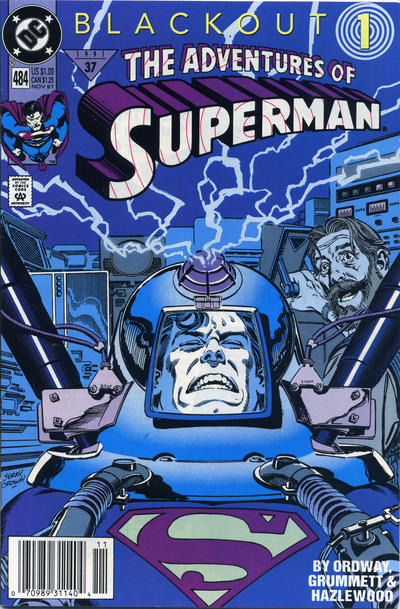
“Blackout” begins in Adventures #484, when the mysterious Mr. Z reads in a newspaper about Superman’s friendship with Professor Emil Hamilton. Mr. Z was a villain Superman had faced a few times before (first in Superman #51, then during his jaunt into World War II during the “Time and Time Again” storyline I wrote about waaaaaaay back in Week Three) – seemingly immortal, with the ability to mesmerize others. When Superman visits Hamilton to test a remote apparatus he’s developing to help monitor the Antarctic Fortress of Solitude, he learns that Mr. Z hypnotized Emil, turning the viewing device into a trap. Z learns that the magic gem Superman confiscated from him during their previous encounter is being held in the Fortress, and commands Superman to bring him to it. Hamilton, freed from Z’s commands, tries to override the device remotely, but the enormous power drain not only plunges Metropolis into a blackout, but winds up wiping out both Superman AND Mr. Z’s memories.

In Part Two (Action Comics #671), Metropolis struggles to deal with the blackout. Gangbuster is doing his best to pick up the slack, and the chaos in the streets prompts Rose Forrest’s alternate personality, the Thorn, to come out of retirement. Then, in the midst of the blackout, a figure appears to try to bring the city some sense of normalcy: Lex Luthor II, “son” of the “late” industrialist. Meanwhile, after a brief stopover at an Antarctic research base, the mind-wiped Superman and Mr. Z wind up on an uncharted island full of prehistoric beasties. 

Fair warning, guys, telling your wife, “It wasn’t my fault I had amnesia” does NOT work. Don’t ask me how I know.

Man of Steel #6 gives us part three. Superman and Z discover that they’re not alone on the island with the dinosaurs – there’s a tribe of natives there as well. Most of them, it seems, are fairly neanderthal in appearance. The notable exception, naturally, is their princess, an exotic bombshell that immediately falls for Superman. The princess, Lola-La (BECAUSE OF COURSE THERE’S A DOUBLE-L) arranges for her marriage to Superman, but despite his amnesia, he resists her advances, a voice in the back of his head telling him that it’s not right. Back in Metropolis, Hamilton and Lois (source of the voice in his head we mentioned before) meet up with Guardian, who takes them out in the Whiz Wagon to look for the missing Superman.

Part Four: Superman #62! In addition to having a Lois Lane vs. Lola-La cover that no doubt inspired a LOT of fanfiction, there’s a story here as well. Lois, Hamilton, and Guardian find Superman JUST in time to stop the wedding. After a tussle with Lola-La, Lois sparks upon a method that juuuuuust might bring back Superman’s memory. Oh yeah – and in Metropolis, Agent Liberty shows up to help fight the rioting from the blackout.

Some anthropologists theorize the modern internet was invented just so people would write their own versions of how this scene played out.

The story wraps up in Adventures #485, which picks up where the previous part left off – with Lois trying to kiss Superman’s memories back. It doesn’t quite work, but Superman is convinced to return to Metropolis with her. They leave, Mr. Z staying behind, having found some peace in his tropical paradise. Guardian whips them back to Metropolis, arranging for Project: Cadmus’s resident telepath Dubbilex to help try to restore Superman’s memory. 

I’ve always enjoyed this storyline. There’s a degree of tonal whiplash going on here, but I think it’s justified. The scenes in Metropolis, with the blackout and the riots, are played seriously, but the stuff on the island is a straight-up comedy. There’s misunderstanding, coquettish flirtation, and lots of silly jokes (including a Gilligan’s Island gag) that make it a joy to read. There’s little that happens in this storyline of future relevance, though, except for the abandonment of the Mr. Z storyline. I don’t remember off the top of my head if he ever came back after this issue, it may well be that he’s still living a happy life out there on his tropical island, his memory of the atrocities he committed in the past completely wiped away. And it’s always pleasant to see Lois taking such a proactive role, leading the quest first to find Superman, then restore his memory. The final sequence, where Dubbilex leads Superman through his own mind, also has the added fun of making his mental “fortress” look like the classic Arctic Fortress of Solitude, which in this continuity had never existed, complete with the giant golden door and key. 

The Metropolis stuff, on the other hand, had pretty major significance for the next several years of the Superman titles. First, it’s the on-panel debut of Lex Luthor the Second. We (the readers) didn’t know it yet, but this would turn out to be the original Luthor, having faked his death and cloned a new body to pass off as his own son, and it was a substantial part of the Superman comics for quite some time. We also got the return of Rose and Thorn, a Bronze age vigilante who had the unique condition of being what at the time was called a multiple personality. Rose had no idea that a vigilante called Thorn took over her body to fight crime, spurred by the hatred of the mafia ties in her own family. Thorn became a semi-regular character in the Superman comics for a while, similar to Gangbuster and Guardian. Finally, this story gave us one of the earliest appearances of Agent Liberty, one of those government-sponsored superheroes that you hear about all the time. He, too, became a pretty big part of the supporting cast for a while, even joining the Justice League briefly after Superman’s death. 

Mostly, though, I just like this story. There’s enough meat to make it feel substantial and juuuuust enough silliness to keep the whole thing feeling like a lot of fun. And sometimes, that’s all you want. 

Tues., May 13

Comic: World’s Finest Comics #90

Notes: It’s been a day, guys. If you’ve had day where it’s just “a day,” you know what I mean, and with the end of the school year rapidly approaching, I feel like these “days” are going to be coming fast and furious over the next couple of weeks. And frankly, on “a day” I usually don’t want to do any more than find a hole to crawl into and hope that tomorrow is NOT – with apologies to Scarlett O’Hara – “another day.”

“If you think this is irritating, Bruce, wait’ll I tell you about the Alfred E. Neuman mask I had to use on Lois the other day…”

Still, I made a promise to myself that I was going to find some Superman every day this year, and that includes “days,” so I carved out enough time to read an oldie, World’s Finest Comics #90. Modern readers may forget this, but there actually was a Batwoman and Bat-Girl in the Silver Age, Kathy Kane and her niece Bette, respectively. Although the modern Batwoman kind of shares the original’s name (she goes by “Kate” these days), that’s pretty much where the resemblance ends – old school Batwoman was a socialite who embarked upon a crimefighting career specifically in the hopes of snaring Batman into marriage. It doesn’t say specifically, but I would guess she was a big fan of Lois Lane’s column. Anyway, for most of the stories in the era, that was Batwoman’s primary motivation. In this particular story, Batman had recently discovered her secret identity and forced her into retirement, reasoning that if he could figure out who she really was, so could the bad guys. But things get more complicated when a criminal escapes from prison boasting that he’s got a capsule that will give him Superman’s powers for 24 hours. Superman, hearing about this on the news, immediately recognizes this as a capsule invented by his father, Jor-El, back on Krypton, and reasons that the box must have crashed on Earth, so he zips over to Gotham City to lend a hand.

This set-up raises any number of questions. 

First of all, if Jor-El could give anyone super powers for 24 hours, why didn’t he use those pills to empower some people to maybe stop the planet from exploding? Or at the LEAST, to help with the evacuation?

Second, is there ANY piece of the destroyed planet Krypton that did NOT eventually make its way to the Earth? Was our planet just bombarded with their leftovers for decades? How is it more people weren’t killed by falling Kryptonite meteors? 

Third, how did the crook know that the capsule would give him super powers? Did Jor-El label the box? In English?

FOURTH, if you have a capsule like that in your possession, why would you HIDE it? 

And FINALLY, even if you have a good reason to hide it, why would you TELL EVERYBODY ABOUT IT?

Anyway, Batwoman disobeys Batman’s retirement order because he…needs her help… and beats the crook to the capsule, taking it and giving herself Superman’s powers for 24 hours. What would you do with Superman’s powers for a day, friends? Fight crime? Try to solve world hunger? Read every book in the library? Grab a sack of coal and just start turning out diamonds? 

Well, that’s because you’re not insane. But Batwoman apparently was, because when she gets powers the ONLY thing she wants to do with them is figure out Batman’s secret identity. Her first attempt – looking through his and Robin’s masks with X-Ray vision – fails, because as soon as Batman found out she had powers, he and Robin lined their masks with lead. Say what you will, but as the saying goes, you’re not paranoid if they really ARE out to get you.

As Batman and Superman try to hatch a plan to discourage Batwoman, she has plans of her own. She trails Batman and Robin back to the Batcave and, upon seeing whose house it’s under, is satisfied that she’s solved the riddle of their dual identities. Then she turns her attention to figuring out Superman’s identity because…reasons. Her plan is simple: just stick to him like glue until she sees him change his clothes. He tries to shake her by flying through a lightning storm, through Niagara Falls…nothing. That is, until he walks into an old decrepit house, which scares off a Batwoman with Kryptonian powers because – I swear to Christ I am not making this part up – THERE MIGHT BE MICE INSIDE.

But she keeps on following him, even to the Daily Planet, where Superman is pleasantly surprised to find Clark Kent waiting for him. It’s actually Batman in disguise, of course, helping a brother out. But as Batwoman’s powers fade away, she reveals she’s found Batman’s true identity: JOHN MARTIN!

Actually, the Batcave she saw him drive into was a fake that Superman carved. Helping a brother out. 

But in the end, Batman decides that Batwoman’s acts of stalking, childishness, and mice-fearing “showed such cleverness and courage that I can’t ask you to drop your career completely.”

My friends. Today is May 13th. As of this writing, I have read 377 separate comic books featuring Superman or a member of the Superman family. And that’s just in 2025. And that’s just the SUPERMAN comics I’ve read. And I can say with full sincerity and conviction that this issue contains the stupidest portrayal of an adult female human being I have yet to come across.

On the other hand, I guess it’s nice to know that Lois Lane isn’t the only woman the writers of the era mistreated ever so badly. 

I’m hoping that tomorrow will help break my recent chain of “a day”s. The first full trailer for the new Superman movie is supposed to drop (will already have dropped by the time you read this), and I’m sure I’ll have stuff to say about it. And in honor of both that new trailer and what appears to be the beginning of the movie merchandising blitz – starting with an ad for Milkbone dog biscuits – I’ve decided that next week will be the week of Superman: The Super-Sponsor! I’ll be looking at commercials and comic books where Superman is there to sell ya something. This should be fun. 

Blake M. Petit is a writer, teacher, and dad from Ama, Louisiana. His most recent writing project is the superhero adventure series Other People’s Heroes: Little Stars, volume one of which is now available on Amazon. You can subscribe to his newsletter by clicking right here. You can join in the Kryptonian Konversation every day in the Year of Superman Facebook Group!

Year of Superman Week Eight: Some New, Some Classics, and Some Just Weird

Week eight of my Year of Superman was another one that kind of went all over the place. I revisited a few classic stories, checked in on a couple of “imaginary” tales, and looked at some of the more recent releases as well…then there’s that Christmas podcast. Don’t worry, I make it make sense.

Wed., Feb. 19

Comics: Power Girl Vol. 3 #16-17

New costume! Ish!

Notes: After a busy day without much time to read, I went to my bag of recent comics that I haven’t gotten around to reading yet to see if there was any Superman-related content to include this week. Not surprisingly, there wasn’t much, but I found that I hadn’t yet read issues #16 and 17 of the current Power Girl series. This is a Superman family book, of course, but it comes to Superman via a sort of tangent. Power Girl (for those who may not know) was the Kara Zor-L of the old Earth-2, from the pre-Crisis DC Universe. She made her way to the current DCU, after various multiversal crises and reboots, and for years they’ve struggled a little to figure out exactly where she fits in. In essence, she’s an older version of Supergirl from an alternate reality – part of the family, but with trouble finding her identity. 

Issue #16, the first of the two that I read, is the end of a recent storyline where Power Girl is facing someone called Ejecta. Ejecta, as a villain, hasn’t really grabbed me, but I do like the end of the fight where Power Girl takes her to the Fortress of Solitude and makes a point of what it takes for a Kryptonian like her to fight the good fight, that it’s actually harder NOT to kill their enemies. It’s a concept that makes so much logical sense, but doesn’t really come up all that often.

I like issue #17 better. It kicks off a new storyline, beginning with Power Girl and her best friend Lilith (aka Omen of the Titans) moving into a new place along with Natasha Irons, niece of my old buddy John Henry, who happens to share his Steel identity. Also on board is Streaky the Super-Cat and Power Girl’s boyfriend, Axel, who happens to be from Asgard. That would be a really weird sentence if I was writing about anything but a superhero universe, but there you go. While I’ve found this series to be somewhat uneven at points, I’ve enjoyed the way Leah Williams has assembled a solid supporting cast for Power Girl that feels pretty organic for the most part. I know why these characters are all together, and I like it.

The one thing I’m really NOT wild about is how Power Girl has abandoned her old identity of Karen Starr in favor of a new name, Paige Stetler, but call her Peej. Get it? “Peej?” P.G.? AAAAAH? I dunno, the book has never done a good job of convincing us that the switch was necessary or based on anything other than the internet not liking the name “Karen,” and the whole “P.G.” thing is just a bit too twee for my tastes. 

Thur., Feb. 20

As birthday presents go, this is way better than a necktie.

Comic: Superman #411

Notes: Another busy day and another somewhat random choice, I decided to read the classic Superman #411 today. This is an odd little issue that I’ve always found rather charming. Perry White’s old friend, the incredible editor Julius Schwartz, is in trouble, and his only salvation may come from Earth-Prime.

Julie Schwartz was, of course, one of the most prominent comic book editors of all time, with runs on various books that lasted years and even decades, including a long tenure on the Superman comics. This comic was produced as a surprise for Schwartz on the occasion of his 70th birthday, created behind his back and released as a surprise, even splitting up a three-part storyline to do it. The story in and of itself is standard for the time, even if it was not – as promised – “The Last Earth-Prime” story, but I’ve always appreciated this comic for the backstory behind it. 

Fri., Feb. 21

Comic: Action Comics #314, Superman #149

The most embarrassing dry cleaner mix-up in DC history.

Notes: When I was doing my research to prepare for “Superman Vs. the Flash” week, Action Comics #314 kept turning up in my searches. And although it didn’t really fit into the criteria of what I was looking for in that project, it was such a bizarre story that I kept it on my list of books to read when I’m looking for a random Superman comic, because it’s just so strange. And I LIKE strange.

First of all, despite the cover, this is NOT an issue about Superman ONLY becoming the Flash, but rather about alternate worlds in which he became five different members of the Justice League…sort of. While swimming around the bottom of the ocean – y’know, like you do – Aquaman uncovers a message for Superman sent to Earth from his father, Jor-El. On the recorded message (it’s interesting to note that the vastly advanced civilization of Krypton still used magnetic tape to record things) Jor-El tells his son that he originally considered several different worlds to send him to before choosing Earth, and presents him with a computer simulation of what his life would have been like on each of those five worlds. I’ll save you from the suspense: on these different worlds he would have grown up to be their versions of the Atom, Aquaman, Green Arrow, Batman, and finally, the Flash. 

Each of these different lives has its charm, although I think my favorite has to be the first one, where he’s an Atom expy. In this version, Jor-El sent him to a planet of giants where he lived among them as what appears to be a three-inch visitor from another world. He’s still got powers, though, and he uses them to fight crime, wearing a mask. WEARING A MASK. SO THAT NO ONE WILL SUSPECT HE’S THE ONLY OTHER THREE-INCH PERSON ON THE PLANET. It’s such a hellaciously preposterous idea that it could only have worked in the Silver Age – and make no mistake, it worked. One person actually says, “He’s as small as Kal-El…but it can’t be Kal-El, for this one has terrific powers!” 

For real. 

This is a silly story, but a fun one. There was a point where DC did lots of stories like this, “what if X happened?”, with the conceit usually being that the heroes were told the stories of their other lives by computer simulations or some other means. (There was a whole series of stories about Dick Grayson growing up to become Batman II and taking Bruce Wayne Jr. as his Robin, which eventually turned out to be fanfiction written by Alfred.) Later these would become “imaginary” stories, and eventually the concept evolved into Elseworlds. If this story were told today, each of these different lives would be assigned a different number and said to take place somewhere in the DC Multiverse, and while I do like a good Multiverse story, there’s a charm about the old days, where the stories were a bit simpler. It does, however, give me a thirst to read more such tales. I think it’s safe to say that more Elseworlds and Imaginary Stories will be coming to the Year of Superman in the future.

The back-up story in this issue – as was usually the case at the time – starred Supergirl. Her Kryptonian parents, Zor-El and Allura, had been revealed at this point to be alive and sent to live in the bottled city of Kandor, but Allura is growing ill with heartbreak over the separation from her daughter. You’d think Kara could visit more often. Anyway, they send word of Allura’s condition to Kara, but she’s away on a mission and it is instead received by her foster parents, the Danvers, who decide that the only thing to do is make their adopted daughter decide to leave them and go back to her original parents in Kandor by acting like jerks.

WHY DIDN’T ANYBODY IN THE SILVER AGE JUST HAVE A CONVERSATION?

If you look at other stories from this time period, it’s not really that out of place. Watch virtually any comedy (and a good number of the dramas) from the 30s to the 50s and you see one cascade of misunderstandings after another, dozens of catastrophes that could have been averted and hearts that would have been left unbroken if only people were straightforward with one another instead of coming up with ridiculously convoluted schemes to manipulate their loved ones into doing things “for their own good.” I get WHY the stories were like this – a comic book where someone tells somebody the truth and the dilemma is resolved in a page and a half would be kind of boring. But I am very glad that – for the most part – we’ve moved beyond this kind of storytelling crutch. Ridiculous misunderstandings should remain the providence of Shakespeare and Fawlty Towers reruns. For anybody else, it’s just frustrating. 

The story ends with Kara’s Earth parents and her Kryptonian parents swapping places, then a cliffhanger where we the readers are forced to question if this will be a permanent change. Once again, I’ll spare you the angst of wondering: it was not. Status quo was the king in comic books of the time, and permanent changes were as rare as diamond. Supergirl had already used hers up for the entire decade when she was adopted by the Danvers, putting an end to the stories of her life in Midvale Orphanage.

The weird thing is, this was covered by his insurance.

The main story, though, got me thinking about one of the two most famous “Imaginary” stories of all time…both of which, coincidentally, became “real” stories in the 90s (albeit in very different forms). Like I’ve said, I’ve pledged to read only two of the extended 90s storylines during this year, and the first of those is actually next on my list of 90s stories to revisit. So before I move on to the “real” Death of Superman, I thought today I would look back at the ORIGINAL Death of Superman, the “Imaginary Story” from Superman #149 in 1961.

The setup for this one is simplicity itself: prison inmate Lex Luthor discovers an element from outer space that allows him to invent a cure for cancer. Providing that cure to the world, he convinces everyone that he’s gone straight, including Superman. It’s all a ruse, though, and instead he sets up a trap for the Man of Steel. And for the first time, that trap succeeds, with Luthor slaying Superman with green kryptonite. 

I’ve always liked this story and, revisiting it today, I’m struck by how unique it really is for Superman stories of the time. In an era where most stories were a bit silly and often overdramatic, this takes the opposite track. It still uses all the tropes of a Silver Age story, including misdirection and secrets kept when there’s really no reason to do so (Supergirl disguising herself as Superman for all of 12 seconds at the end, for example) but they’re put together in a somewhat bleak configuration. Unlike Marvel’s What If? comics, it was pretty rare for even DC’s imaginary stories to end in so dark a place. There’s no lie, no secret hidden from the audience, no last-minute reprieve that saves Superman: when this story ends he is most assuredly dead, and even though Luthor will spend the rest of eternity in the Phantom Zone for his crime, nothing is bringing him back. It’s unlike any other such story of the time, and that makes it remarkable.

Other Comics: World’s Finest Comics #304, Legion of Super-Heroes Vol. 2 #312 (Clark as Superboy)

Sat., Feb. 22

Oh yeah…they still make NEW comics, too.

Comics: Absolute Superman #4, Action Comics #1083, Batman/Superman: World’s Finest #36

Notes: It’s been a few weeks since I made it into the comic shop to pick up my pulls, so today I’m hitting the new Superman comics that have come out since then. Absolute Superman #4 is more of a spotlight issue on Lois Lane, who in this new Absolute Universe is an agent of Lazarus rather than a reporter, although she’s still got her investigative skills, as in this issue we see her tracking down the elusive “Superman.” Good issue, and I’ve really enjoyed the Absolute stuff so far. Action Comics #1083 continues the Major Distaster/Atomic Skull storyline from last issue, which still isn’t a favorite of mine, but I do really like the scenes where Superman wakes up in the Batcave, where Bruce has brought him to recuperate after a fight with someone who could negate his powers knocks him for a loop. Mostly, though, I’m really looking forward to Mark Waid taking over this book full time this summer, as was recently announced. 

Speaking of Waid, he also writes Batman/Superman: World’s Finest #36. It’s a grand story set in the past, including a team-up with Aquaman and Swamp Thing, plus Clark’s old girlfriend, Lori Lemaris. Lotta LL names in Superman’s life. I should go back and read her first story soon, it’s a good one. 

Sun. Feb. 23

Frankly, I don’t think he looks anything like Tom Cruise.

Comic: Superman: War of the Worlds #1

Notes: Still searching for random comics to fill in the gaps before I begin the next BIG project next week, my recent reading of “The Death of Superman” gave me a taste for more Elseworlds, and that led me back to this gem from 1998. Written by Roy Thomas with art by Michael Lark, Superman: War of the Worlds is a mashup of the original Golden Age Superman with the alien invaders from H.G. Welles’s classic novel.

Roy Thomas is probably the greatest Golden Age comic book writer who didn’t actually work in the Golden Age. But through his long and illustrious career, he turned out one story after another that paid tribute to that era, including DC’s All-Star Squadron and Marvel’s Invaders, among countless other projects. This one-shot is not only a quintessential Elseworlds, it’s also quintessential Thomas. The story plays out pretty much exactly like the Golden Age Superman we all know and love right up until the day he arrives in Metropolis and tries to land himself a job at the Daily Star (where Clark Kent originally worked before the Daily Planet became the home of our favorite reporters). On that same day, though, what is believed to be a meteor strike unleashes an invasion of tripod-piloting aliens from the planet Mars, here to devastate and take over our world. 

Thomas simply does a perfect job of blending the two stories. The characters feel absolutely true to their Golden Age incarnations, while reacting to the story that adheres as closely to the Welles original as is practical. Lois Lane, for instance, is introduced when Clark gets to the Star, furious that the editor is about to give this newcomer off the street a chance at a major story while she’s been stuck scribbling a “Miss Lonelyhearts” type of column just because she’s a woman. Even in the Golden Age, Lois was someone who would always stand up for herself and never tolerate that kind of nonsense, and Thomas plays her up perfectly. I also really like the way they depict Lex Luthor, initially just a scientist investigating the alien meteor strike, but then turning collaborator when it seems that the aliens’ victory is inevitable. 

Thomas layers in World War II parallels that fit perfectly with both of the properties that he marries in this book, and the end – although heartbreaking – is compelling and appropriate for the story being told. When we talk about Elseworlds, everybody points to books like Kingdom Come and Superman: Red Son, and with good reason. Those books are classics. But there are a lot of other gems that were produced as a result of that line that we don’t remember nearly as well, and that’s a shame. I’m definitely going to pepper the rest of this Year of Superman with visits to some of the ones that we’ve forgotten about. 

Mon., Feb. 24

He’s a guy who refuses to kill. She’s an alien queen who refuses to do anything else.

Comics: Superman Vs. Aliens #1-3

Notes: A few days ago at ComicsPro, it was announced that Marvel and DC Comics are planning two new crossover one-shots later this year, DC/Marvel and Marvel/DC. Stale naming conventions aside, I’m excited. There hasn’t been any crossover between the two publishers since JLA/Avengers twenty years ago, except for the collected omnibi that were released last year. I finished up reading the first one early in January, although I didn’t talk about them much here in the blog, and the knowledge that there’s more coming makes me want to hurry up and pencil in the second omnibus into my reading rotation soon.

But not today. Today I decided to look at a different Superman crossover, one with Dark Horse Comics, back when they had the Aliens license and were pairing them off with everybody and their cousin, like Ocean Spray finding new flavors to mix with cranberry. Superman Vs. Aliens was the first such story featuring our own Man of Steel, and written as it was by Dan Jurgens, it fit into the Superman comics of the time better than a lot of these crossovers do. This is the era when Lex Luthor isn’t running LexCorp anymore, when Lois and Clark are engaged but not married yet, and when Supergirl was not a Kryptonian, but rather the Matrix shapeshifter from an alternate Earth. 

The story kicks off when an alien probe plummets to Earth, a craft with markings that Superman recognizes as being Kryptonian. The probe leads Superman to a distant city floating through space under a dome. Once there, the distance from a yellow sun causes his powers to begin to dwindle, even as he finds himself partnered with one of the city’s few remaining survivors, a girl named Kara, as they face the menace of the Xenomorphs. The story was so deliberately reminiscent of the original Supergirl that it was almost as if Dan Jurgens and DC were trolling us, and for years after this book was released there were rumors that Kara would return to the regular Superman titles, but it never happened. As it turned out in the end, this Argo wasn’t actually a Kryptonian city after all, but from another planet which suffered a similar fate as Krypton and learned about its language and culture from the Cleric, a character from the earlier Exile storyline. 

Jurgens finds a few ways to really make the story an interesting character piece for Superman. First of all, they need to reduce his powers to actually make the Xenomorphs a threat. Second, he treats Kara like long-lost family, and in a time where there were no other surviving Kryptonians in the DC Universe, it’s an impactful event, even if it only lasted for three issues. We’ve also got Dr. Kimble on the LexCorp station doing a darn good impression of Paul Reiser’s character from Aliens, while Xenomorphs are running wild on the station and Lois is trying to hold them off. 

But I think the best thing about this story, the thing that really shows the contrast between the two franchises, is how heavily Jurgens leans on Superman’s no-killing policy. It was a policy he broke exactly once, in the pocket universe that Matrix originally came from, and doing so nearly destroyed him. (I’ll have to look at that story before this year is over.) Having him face off against the Xenomorphs is fun – they are literally killing machines. They have no function other than death, and historically speaking, the only way to stop them is to kill them FIRST. But Superman refuses to do that. If there’s even a chance that these creatures may be sentient, he refuses to use lethal force. Some people would call that naive, but it’s a fundamental element of the character, and it’s the thing that makes this so different from so many other Aliens stories where the focus is to nuke them all from orbit. (It’s the only way to be sure.)

I remember when this story came out, how excited I was for it, and although the status quo of Superman’s universe has changed a lot over the years, I’m glad to see that it still holds up. 

Other Comics: Superman #7

Podcast: Totally Rad Christmas, Episode, “Superman (w/Tim Babb)”

Notes: A few years ago, my brother introduced me to the Totally Rad Christmas podcast, a podcast that is – in the words of host Gerry D – “about all things Christmas in the 80s.” However, Gerry isn’t particularly strict about that requirement. They often have episodes about Christmas movies and specials from outside of the 80s, as well as other things that Gerry associates with Christmas and just feels like waxing nostalgic. For instance, Superman was released on Dec. 15, 1978, and that’s enough to get it on the show. This episode was released back in 2020, but I’d never listened to it before, so this seemed like a good excuse to dust it off. Gerry and his guest for the episode, Tim Babb, discuss the film itself and – as is common for this podcast – their personal memories surrounding the film from childhood. As someone who has watched this movie countless times and who lives, eats, and breathes Superman, it’s actually nice to listen to a couple of guys who are FANS, but perhaps not the fanatic that I can be in my more eager moments. I don’t know if I would hunt this episode down as a Superman fan if I weren’t already a listener of this podcast, but as someone who’s already a fan, the overlap on this particular Venn Diagram is pleasing to me.

Tues., Feb. 25

Wait, WHY is Superman in the forest with a couple of kids?

Comic: Superman #257

Notes: Sometimes you just choose by cover. You scroll through the DC app, looking at the issues available and, for one reason or another, something jumps out at you. This one, for instance – Superman in the woods with two children. He’s calming them down, assuring him that there’s nobody around to harm them, but in a cutaway view underground we see a guy in armor with green skin and what looks like some sort of science fiction bazooka about to blast the ground right out from underneath him. They say you’re not supposed to judge a book by its cover, and that’s probably true, but a good one is sure as hell more likely to get you to pick it up.

The story in question isn’t quite as engaging. An alien has come to Earth hoping to steal our nitrogen using the “bazooka” from the cover – which he calls a war-horn – to create a variety of effects. Superman fights him, as per usual, but the alien’s military code refuses to allow him to concede defeat unless killed in battle. Superman winds up tricking the war-horn into leaving the planet by attempting to strike a fatal blow, which it automatically avoids and retreats, which to me seems antithetical to the whole military code aforementioned.

The main story isn’t great, but the back-up in this issue IS. The story begins on the planet Oa, home of the Green Lantern Corps, where Lantern Tomar-Re is about to retire from active duty and join the Corps’ honor guard. Before he does so, though, the Guardians must reconcile the one failure on his record. Fans have long asked why the Green Lanterns didn’t do something to prevent the destruction of Krypton, and this issue answers that question: Krypton was in Tomar-Re’s sector, and the then-rookie GL failed to stop the planet’s doom. Tomar was tasked with collecting a rare element that would delay (but not stop) Krypton’s destruction, but a burst of yellow radiation left him blind and unable to save the world in time. His sight was restored just in time to witness Krypton’s explosion. The Guardians had been watching Krypton for some time, suspecting that the offspring of their scientist Jor-El and his wife Lara would create someone exceptional, a “titan among the stars.” Now, years later, the existence of Superman has proven their suspicion correct, and Tomar’s failure is forgiven.

Man, can you imagine being so important that they decide your existence is more important than your entire planet? That’d be a lot to live up to. Fortunately, Superman doesn’t have an ego about this sort of thing. 

Okay, I’ve waited long enough. Tomorrow I’m going to start the big one, the saga that defined this character for so many. Be back next week for my thoughts on – at least the first stages of – The Death and Return of Superman. 

Blake M. Petit is a writer, teacher, and dad from Ama, Louisiana. His most recent writing project is the superhero adventure series Other People’s Heroes: Little Stars, volume one of which is now available on Amazon. You can subscribe to his newsletter by clicking right here. You can join in the Kryptonian Konversation every day in the Year of Superman Facebook Group!