
Subscribe to continue reading
Subscribe to get access to the rest of this post and other subscriber-only content.
Subscribe to get access to the rest of this post and other subscriber-only content.
Once again, it’s time to look into the reviews of some of the Superman-related comics that have dropped in the last few weeks, including some pretty massive events. Let’s get right to it.
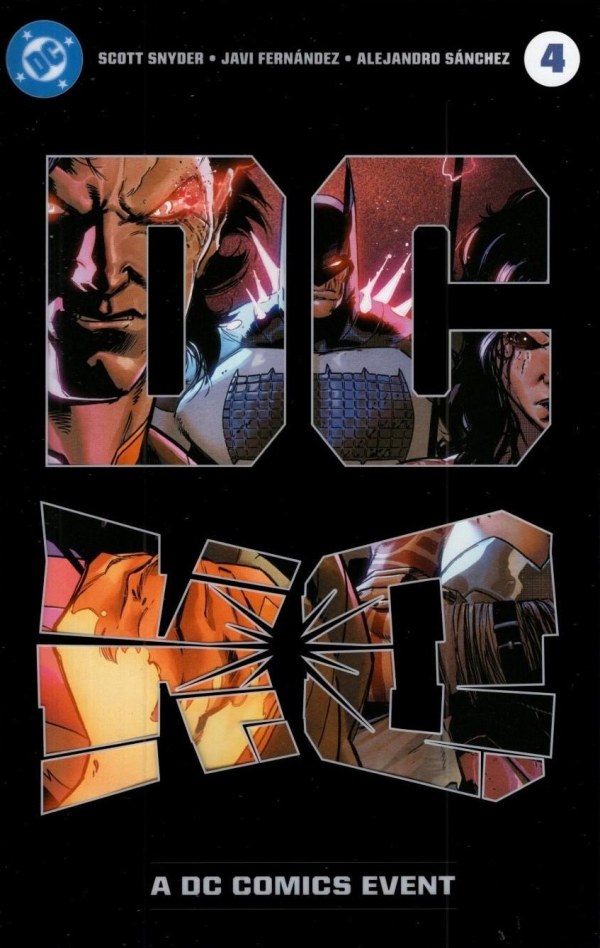
DC KO #4
Title: Trial By Absolute
Writers: Scott Snyder & Joshua Williamson
Art: Javi Fernandez & Xermancio
Main Cover: Javi Fernandez
The Final Four have made their way through all comers, but before they can turn their attention to one another, four new combatants have entered the fray. Tainted by the energy of Darkseid, the combatants will be forced to fight the Absolute Universe versions of Superman, Batman, and Wonder Woman – as well as Booster Gold who has been possessed by Darkseid himself.
This event has promised us one throwdown after another, and there’s no way to argue that it hasn’t lived up to that promise. This issue is perhaps the most high-octane, brutal battle yet. The fight between the four remaining heroes and villains with their Absolute counterparts is scripted and drawn with incredible energy and brutality, but at the same time, Scott Snyder has not skimped at all when it comes to character and story. In fact, there are multiple twists in this issue that catch you off-guard and send the story spinning into new, unexpected directions. At the same time, the twists all fit the characters – a great twist is one that is a surprise without violating what you already know about the world you’re reading, and Snyder pulls that off.
For people who are into Superman (know anybody like that?) seeing “our” Superman face off against the Absolute Kal-El is one of the high points of the issue. Neither character is disrespected or nerfed in respect to the other, but there’s also no room for any doubt as to which of the two is the original. I am slightly disappointed at just how the Absolute characters were used, however. Similar to the surprise guest stars from the Boss Battle one-shot, the Absolute heroes are in and out rather quickly. It’s not even clear as to when, exactly, this story takes place in the Absolute timeline – Superman seems to know Batman here, whereas in their respective comics, they haven’t met yet. Although there’s definite promise here for future brushes between the two worlds, it feels like this encounter will mostly be a footnote for the Absolute characters, even as it sets up the conclusion for the Final Four.
I know I’m being deliberately vague here, by the way – I suppose it’s clear that Superman is one of the Final Four (as it should be) but I’m trying to avoid spelling out who else is in that group in case anyone is trying to remain spoiler-free. Considering just how this one ends, though, I don’t know if I’ll be able to keep that up for the finale. So if you’re reading along with these reviews, I would highly recommend being up-to-date with DC KO when I drop my thoughts on issue five. Whenever that might be.
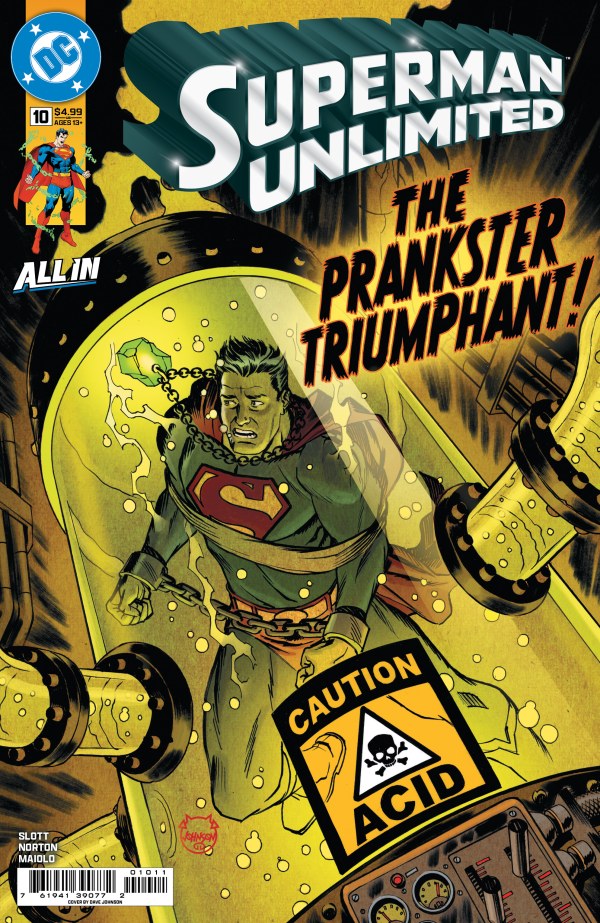
Superman Unlimited #10
Title: Die Laughing Part Two
Writer: Dan Slott
Art: Mike Norton
Main Cover: Dave Johnson
Intergang has set its sights on Metropolis’s new mayor, Perry White, and they’ve contracted the Prankster to take care of the problem. But Oswald Loomis’s nephew is trying to step into his uncle’s role and take over the family business, and the NEW Prankster isn’t quite as funny as his predecessor.
This is a solid issue. There’s something up with this new Prankster – in these two issues he’s appeared we never find out his real name, and there’s no explanation for his bizarre powers, something Uncle Oswald has never had. I feel like this is just part of a coming, larger story, even as these two issues work perfectly well as a couplet. I also like how a big part of the middle of this story isn’t about the power of Superman, but rather the investigative skills of Clark Kent. Not to say that Superman is entirely absent, but we see more Clark than we often do these days, and I appreciate that.
We also get a quick interlude with Jon, who’s been setting up the new Daily Planet office in Smallville, only to get an ominous warning from an unexpected source. Even more so than the Prankster stuff, this is explicitly setup, especially since DC has revealed their “Reign of the Superboys” initiative that’s going through all of the Super-titles after DC KO ends. If you didn’t know, Jonathan is going to take the reigns of this title for an indeterminate amount of time, and it looks like the groundwork is being laid here.
I’m still really digging Mike Norton’s Superman. I love the way his character works, with the kind of strong lines and clean character work that made so many of the Triangle Era artists stand out, and I hope we see more and more Superman from him in the future.
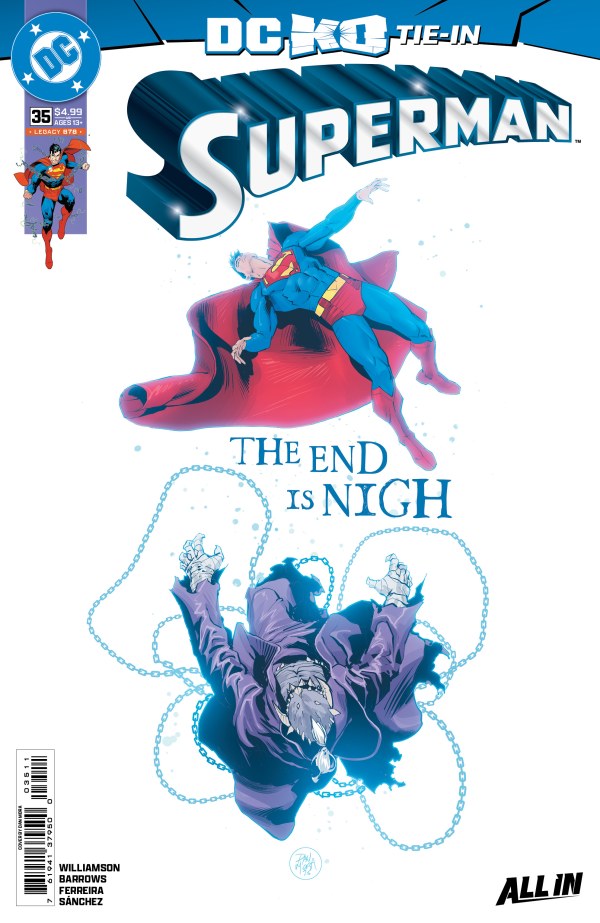
Superman #35
Title: Life Secrets (A DC KO Tie-In)
Writer: Joshua Williamson
Art: Eddy Barrows, Eber Ferreira, Julio Ferreira
Main Cover: Dan Mora
The final instalment of this title’s DC KO storyline runs with the conclusion of issue #4 and leads straight into #5. In fact, I wouldn’t be surprised if at least one of the storylines that’s been going through this book turns out to be crucial to the conclusion of the crossover. But that’s not the one that works best.
We’re following two intertwined threads here. First, the Doomsday/Time Trapper is reeling from the events of issue #4 and trying to gird himself for what must come next. After all, at least part of him is the creature that was created eons ago for the express purpose of destroying Darkseid, and it may be time for that charge to finally come due. Meanwhile, Lois and Superboy-Prime continue their faceoff with Darkseid’s Legion, and it is this latter part that is particularly revelatory.
From the moment he was introduced in this title, we’ve been building a redemption arc for Prime, and it gets center stage in this issue, where he is faced with choices that he’s made before and is given an opportunity to make better choices this time. I’m not in the business of giving out spoilers, but it should be pointed out that when “Reign of the Superboys” takes over the Superman titles next month, DC has revealed that Prime is going to be the start of this title for the time being.
There’s also a great face-off between Lois and Darkseid’s Saturn Girl. Just like prime, this series has hinted that the dark Legion may not be completely beyond hope, and that hope spot is further explored this month. I’m really anxious for the final issue of the crossover to drop…which I guess will be today as you read this. Holy cats, why are you reading this blog instead of DC KO #5? Have you lost your senses?
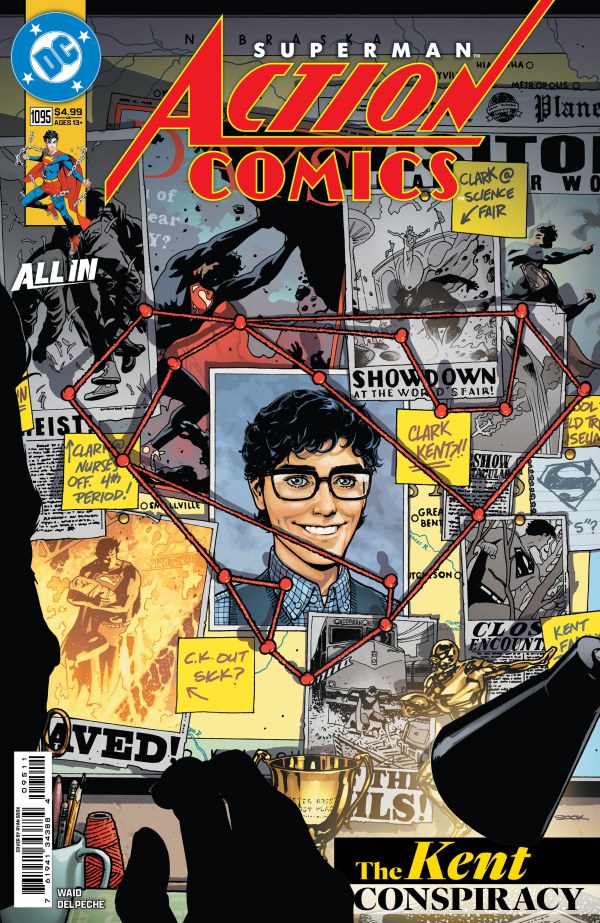
Action Comics #1095
Title: Pressure
Writer: Mark Waid
Art: Patricio Delpeche
Main Cover: Ryan Sook
The adventures of Superboy in Action Comics continue, although Clark actually takes a back seat this issue. Last month, on a camping trip, Pete Ross happened to spy Clark Kent going into action as Superboy. This issue is Pete’s story, as he struggles with this knowledge and wrestles with whether to confront Clark with what he has learned – and ask why his best friend would ever keep such a secret.
I adored this issue. Mark Waid, human comic book encyclopedia that he is, is doing a phenomenal job of mining the classic tales of Superboy to bring the drama to this series. In the Silver Age this was the status quo – Pete knew that Clark was Superboy (even learned it the same way as he did in Waid’s story, if I’m not mistaken) and chose to keep that knowledge to himself. But as was so often the case with those Silver Age tales, there wasn’t an awful lot of thought given to the implications of this sort of thing. How would Pete feel about learning his best friend was keeping such a gargantuan secret? Doesn’t Clark know that he can trust him? Does anybody else know? And why would Pete choose to keep what he’s learned to himself instead of talking to Clark about it?
The answer to that last question is because it was the Silver Age, and if anybody in a Silver Age DC story had the ability to have a rational adult conversation about anything 95 percent of the stories would have ended on the second page. But Waid actually finds a way to justify Pete’s actions, draping his decision in a metaphor for a real-world issue and presenting it in such a way that makes perfect sense and somehow makes all of the characters – Pete, Clark, even Lana Lang – come across as behaving in a mature, emotionally intelligent way. How often could you say that back in the 50s?
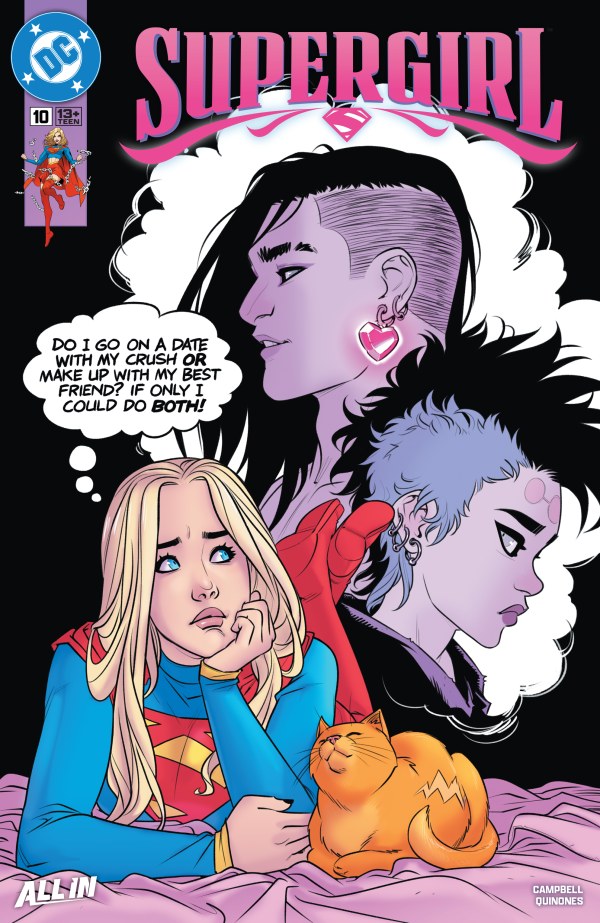
Supergirl #10
Title: My Bloody Valentine
Writer: Sophie Campbell
Art: Joe Quinones
Main Cover: Sophie Campbell
It’s Valentine’s Day, and Kara has a date with the mysterious, long-haired, tattooed boy of her dreams. Her friends Lena and Luna, however, are following along, sensing something is amiss.
After last issue’s slight misstep, this one is more of what I’ve come to enjoy about this series. The “date” is mostly a setup for this issue’s fight scene, but Campbell isn’t having a fight just for the sake of a fight. In the midst of battle we get some good character moments and the ongoing storyline of Kara and her friends (particularly Lena Luthor, in this case) continues nicely. Lena made a mistake in the last issue for which she’s trying to mend fences, and while this issue doesn’t patch everything up in a neat little bow, it also doesn’t cause some insurmountable gap between the friends like books that lean on melodrama are wont to do. Kara and Lena both some some real emotional maturity here, which is particularly funny when juxtaposed against the “date” scene, which works mostly as a parody of gooey Silver Age romance comics tropes.
I have to point out, though, that the recent run of holiday issues is starting to strain credulity a little bit. Literally half the issues of this series have been holiday stories at this point (Halloween, Thanksgiving, Christmas, New Year’s, and now Valentine’s Day) and while comic book time is naturally elastic, it does have its limits. As this issue begins, Lena and Luna are going to visit Kara on Valentine’s Day to try to make up for their screwup at the New Year’s Eve party – so it’s been six weeks since they spoke to one another? Nobody has made any effort to patch things up before now? I’m willing to forgive, because this really is a great book, but I’m crossing my fingers that next issue’s story (part of the “Reign of the Superboys” initiative) won’t be a visit to show us how they celebrate St. Patrick’s Day in Kandor.
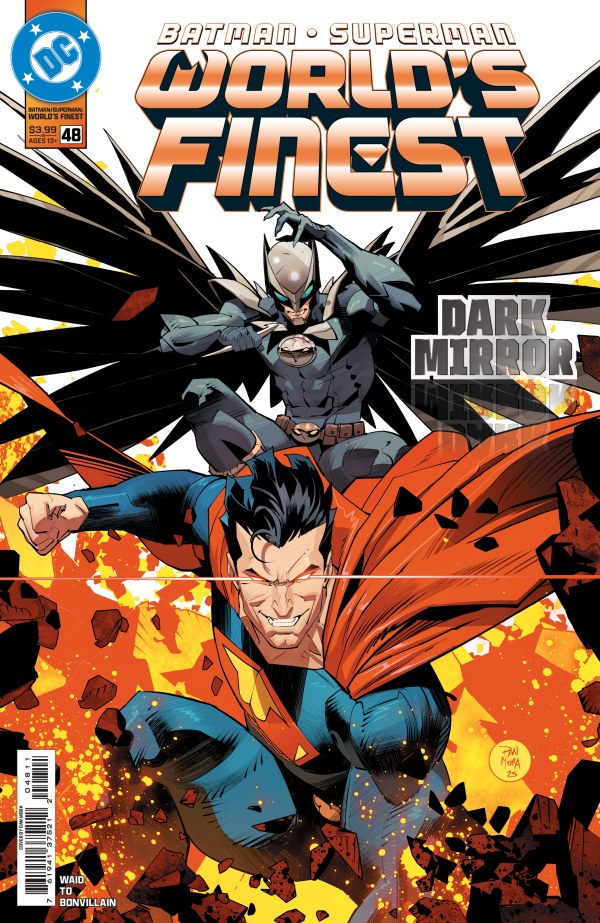
Batman/Superman: World’s Finest #48
Title: Day For Night Part One
Writer: Mark Waid
Art: Marcus To
Main Cover: Dan Mora
Once again, Mark Waid has been let loose in his favorite playground, the DC Universe. In this issue we leave behind our pals Superman and Batman and instead visit their arch Earth-3 counterparts, Ultraman and Owlman, as they begin plans to expand their Crime Syndicate to unprecedented levels, with world conquest as their goal.
Waid is building out Earth-3 quite a bit here, introducing versions of DC heroes that I’m pretty sure have never showed up in a Crime Syndicate story before (although I could potentially be wrong about that – I’m certainly not the walking encyclopedia of comic book knowledge that Waid is). There’s a particularly amusing sequence that really puts the relationship between Owlman and Talon (his Robin analogue) into focus. All of it works up to a nice last-page surprise that seems poised to set up the rest of this arc. As per usual, I’m very excited to see where this is going to go next.
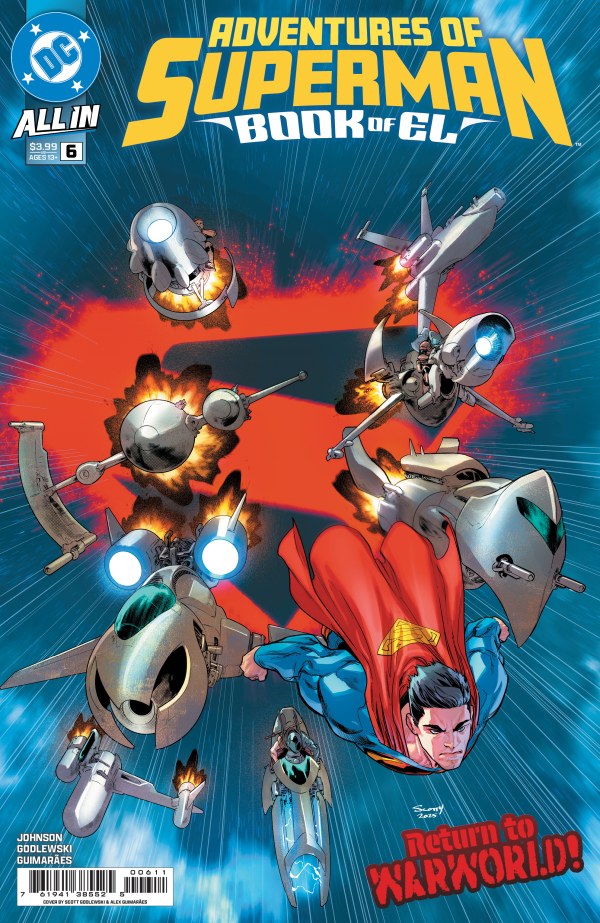
Adventures of Superman: Book of El #6
Title: The Warworld Engines
Writer: Phillip Kennedy Johnson
Art: Scott Godlewski
Main Cover: Scott Godlewski
This issue we at last return to Otho-Ra and Osul-Ra, Superman’s adopted children, who disappeared back in the first issue after Superman was abducted to the future. We also come across another clan wearing Superman-like sigils, while our hero is battered and beaten down.
I’m trying, guys, I REALLY am trying to get interested in this book, but it’s just not working. Having left behind the Green Lantern stuff (although future covers seem to indicate we’re not done with it yet), we’ve gotten back to Superman vs. Warworld, which was an era of Action Comics that, if I’m being honest, bored me stiff. Despite his power, “cosmic” Superman stories rarely work for me. The character is all about heart and how he deals with people, and throwing him into deep space against all-powerful entities and sci-fi clans that think he’s just a legend…it’s too far from the things that make me keep reading Superman comic books. It just isn’t connecting with me, no matter how much I wish it was.
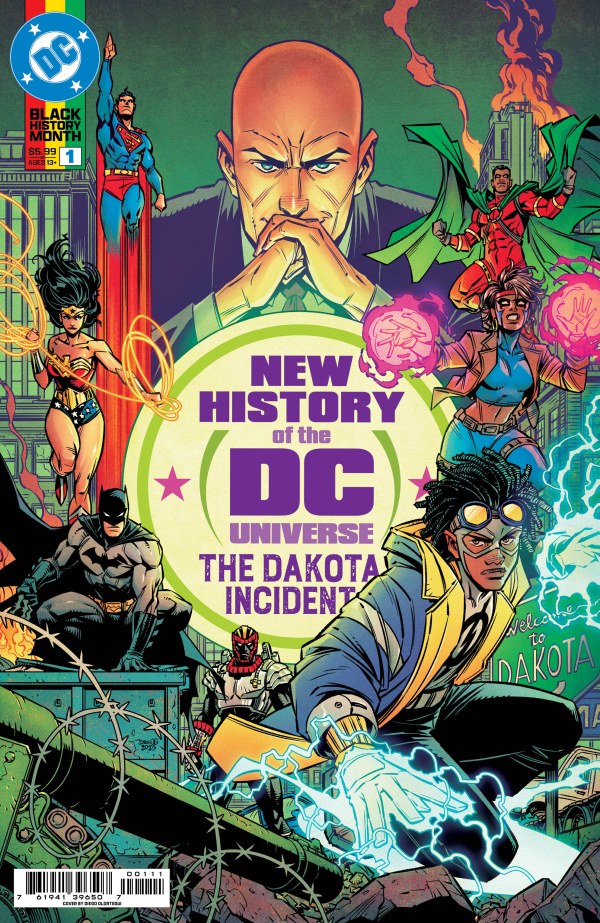
New History of the DC Universe: The Dakota Incident #1
Writers: Joseph P. Illidge, Stephanie Williams, Morgan Hampton, & Nikolas Draper-Ivey
Art: Valentine De Landro, Carlo Pagulayan, Stephen Segovia, Jason Paz, Fico Ossio, & Edwin Galmon
Main Cover: Diego Olortegui
Strictly speaking, I don’t feel obligated to review this book the way I do many of the other Superman appearances. He shows up in this book, but his appearance is brief and it’s not his story. That said, I liked this book quite a lot and I wanted to talk about it and it’s my own blog – dammit – so I’m gonna write about this if I want to.
Spinning out of last year’s fantastic New History of the DC Universe miniseries is this one-shot focusing on the heroes of the Milestone universe. As the previous NHOTDCU explained, the Milestone heroes (versions that are fairly close to their original incarnations from the 90s) have always existed in the current incarnation of the DC Universe, but they all vanished from the public eye after something referred to as the “Dakota Incident.” This issue delves into their history, showing the reader just how they fit into the DCU, and the events of the incident that led to their departure.
I’m impressed at how relatively easily they worked the characters into the DC Universe while still keeping their original stories mostly intact. There is one element that’s added to link the origins of many of the Milestone heroes to the DC Universe proper, but that addition doesn’t really change anything about who they are or how their adventures unfolded back then. The issue also places a heavy emphasis on Static, holding him up as perhaps the most significant of these characters. That makes sense – he’s certainly the most well-known and popular Milestone character among the general public (by virtue of his old cartoon show if nothing else), but it also fits with the character of Virgil Hawkins very well.
For fans of these characters, especially the original versions, this issue serves very well to integrate them into the DC Universe, explain their absence, and – most importantly – set the stage for their return. It’s already been teased in various places, not the least of which is the last page of this issue, and I am very much looking forward to seeing the heroes of Dakota rise again.
Blake M. Petit is a writer, teacher, and dad from Ama, Louisiana. His most recent writing project is the superhero adventure series Other People’s Heroes: Little Stars, volume one of which is now available on Amazon. Don’t forget, you can check out earlier blogs in the Year of Superman/Superman Stuff Archive! Got a request for a future “Superman Stuff”? Drop it in the comments!
It’s time for another roundup of recent Superman comics. This week I’ll be reviewing the Superman and Superman-related releases that were released on Jan 28 and Feb. 6. Let’s get into it!
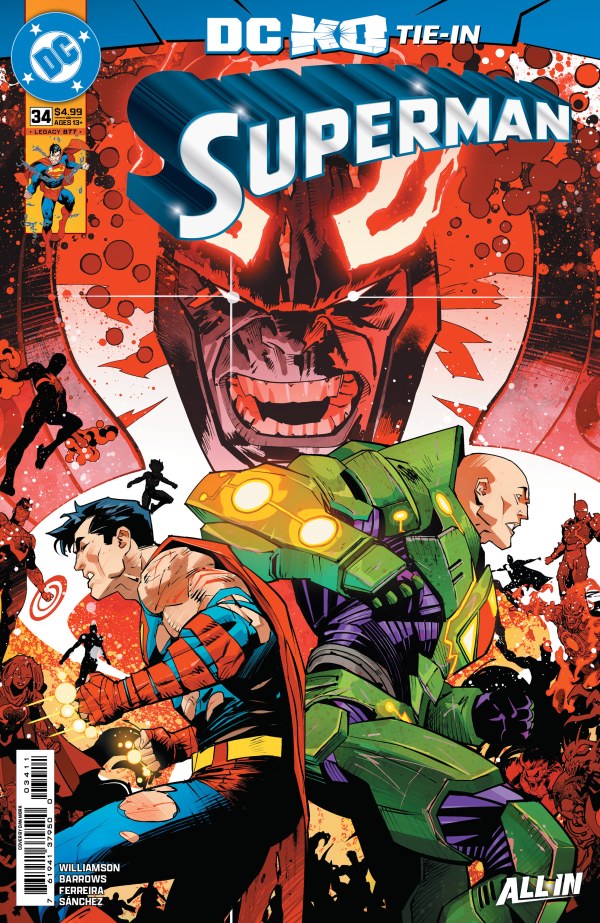
Superman Vol. 6 #34
Title: I, Superman (A DC KO Tie-In)
Writer: Joshua Williamson
Art: Eddy Barrows and Eber Ferreira
Main Cover: Dan Mora
In the arctic, the unusual trio of Lois, Superboy-Prime, and a Superman Robot are fleeing the Fortress of Solitude and the battle with members of Darkseid’s Legion. Meanwhile, the Final Four from the main tournament get a chance to look in on what’s happening back on Earth. It’s a pretty sparse recap, I admit, but the pages are PACKED here with character stuff.
The surprising redemption of Superboy-Prime continues this issue, as he finds himself confronting a Superman Robot that has many of the memories and personality of the original. The contrast between the two is marked and the way that Prime has to reckon with the way the REAL Superman apparently thinks of him…which isn’t what he expected, but is probably exactly what the reader would anticipate. I like Prime’s reactions quite a bit – he’s got an awful lot to cope with here, and for the most part, Williamson is handling it well. He may be going slightly too hard on the fourth wall-breaking dialogue, though. Prime is carrying around knowledge of the fact that he’s in a comic book universe, which is fine, but we don’t want it to go so far as to turn him into Deadpool.
We also spend time with the members of Darkseid’s Legion, who up until this point have come across largely as mindless stormtroopers wearing the faces of our friends. We get a different look here, a reminder that although they’re from a universe corrupted by Darkseid’s Omega Energy, they’re still fundamentally the same people, and perhaps the notion of redemption that Williamson is playing with here isn’t restricted to Prime himself.
I’m all about Eddy Barrows and Eber Ferreira’s artwork – bold, strong, and proud. They’re also pretty good about drawing a Prime that looks like an actual Superboy. Even at his most villainous, it’s important to remember that he’s still a version of Clark Kent, and there have been artists who occasionally forget that.
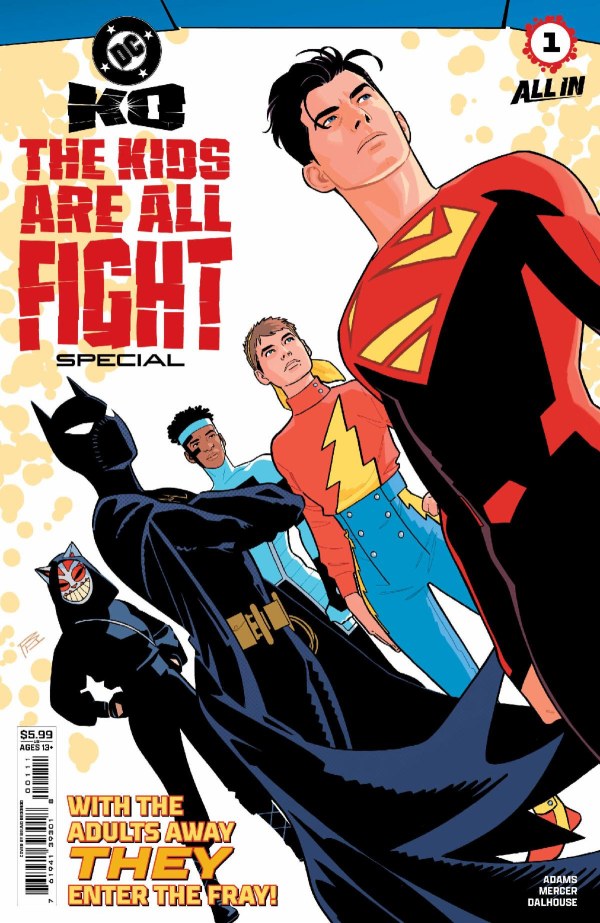
DC KO: The Kids Are All Fight Special #1
Writer: Jeremy Adams
Art: Travis Mercer
Main Cover: Bruno Redondo
The Justice League is strained at the moment, with many of their members caught up in the tournament for the Heart of Apokalips, and most of the others fighting to help evacuate Earth or deal with the dozens of other disasters cropping up all over the place. Jon Kent is given one of the most important duties of all: staying on the Watchtower and keeping an eye on some of the younger heroes, including the Boom, Fairplay, Quiz Kid, and Cheshire Cat. Of course, it would be a pretty short special if the kids just sat around and did what they were told, wouldn’t it? Naturally, they get loose, run into trouble against some of Darkseid’s minions, and Jonathan is forced to call on Cassandra Cain for help.
Jon has been in the last several issues of Titans, working with them as they spearhead the evacuation effort. In March, the book is scheduled to be retitled New Titans with issue #32, and the cover (with several characters in silhouette only) implies heavily that Jon will be a member of the new team. If that’s the case, I’m really quite satisfied with it. The character has been rattling around aimless, for entirely too long, and if making him a member of the Titans actually gives him something to do that makes sense, that’s the best we can hope for. What’s more, I like the group of kids that we see in this issue, the ones that Jon is protecting. I’ve wanted to see more of Boom since she first appeared in the Stargirl: The Lost Children miniseries a few years ago. Fairplay, too, is an interesting character, a very different take on Mr. Terrific that has a lot of promising storytelling avenues. Best of all, there’s a surprise guest-star in this issue that filled me with joy, and no doubt will have the same effect on a lot of other readers. It’s someone we haven’t seen in quite some time, but that DC has been teasing very heavily lately. I’m hoping that this character will stick around in New Titans as well.
Of course, none of that is set in stone. Jon is the only character in this issue whose silhouette appears on that New Titans cover. But covers – especially early solicits – can be deceiving. I don’t expect the heroes we see in this issue to be the new Titans team in its entirety, but I hope that Jon isn’t the only young hero that got a tryout in this issue, because I think there’s a lot to work with here.
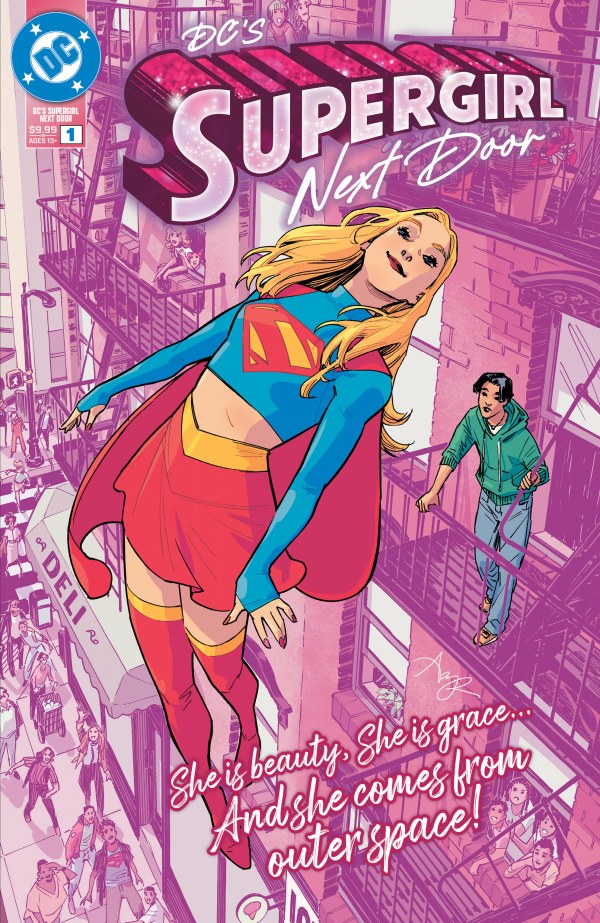
DC’s Supergirl Next Door #1
Note: This is DC’s Valentine’s Day anthology for 2026. There are eight different stories in the book, but I’m only reviewing the Supergirl story.
Title: A Dream of Different Stars
Writer: CRC Payne
Art: Paulina Ganucheau
Main Cover: Amy Reeder
Allen is a new kid in Midvale, struggling to make friends and struggling to fit in. That is, until he meets another new kid in town, Linda Danvers. The two of them form a bond and she opens up to him, revealing just how deeply she misses her old home, and Allen decides to do something to help her.
Short and sweet, but that’s what this story is. It’s a lovely little tale of a couple of foundlings who find solace in one another. CRC Payne is a name I mostly know from her work on DC’s digital comics, such as Batman Family Adventures and Harley Quinn in Paradise. She’s brought the same kind, quiet, reflective tenor she uses in Batman Family Adventures to this story as well, crafting a tale that makes it easy to relate to the characters despite its brevity. Ganucheau’s art has a loose quality to it as well, befitting the more animated style we see in Payne’s other work and fitting very well for this tidy little love story. There’s real charm here that I appreciate.
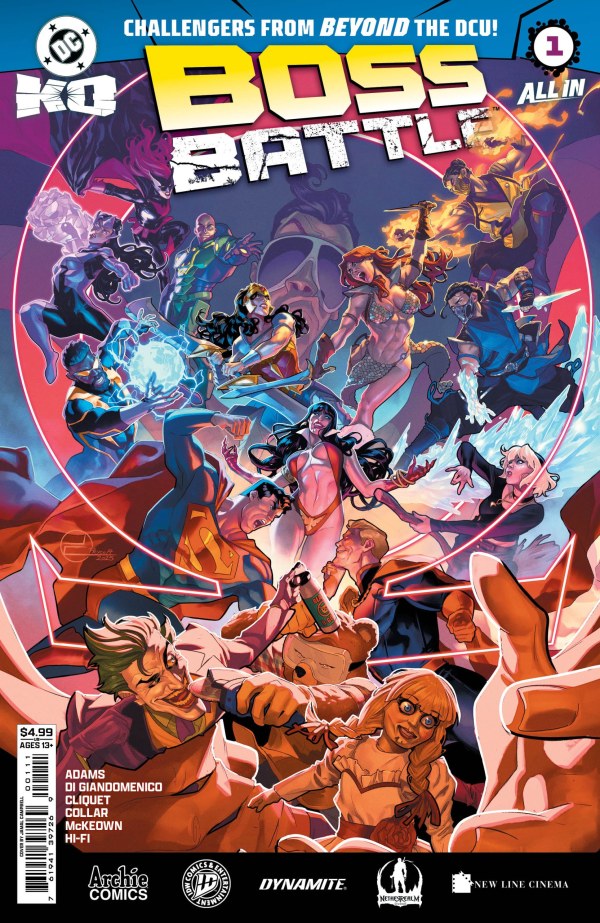
DC KO: Boss Battle #1
Writer: Jeremy Adams
Art: Ronan Cliquet, Carmine Di Giandomenico, Kieran McKeown, Pablo M. Collar
Main Cover: Jamal Campbell
Seconds after the end of DC KO #3, the Final Four in the tournament for the Heart of Apokalips are poised for the battle of their lives, but World Forger manages to “pause” the game. They’re not ready, the need more Omega Energy, so he finds a way to generate some by briefly spending the heroes into neighboring realities to have additional battles and charge up, leading to fights against the wildest opponents yet: Sub-Zero and Scorpion from Mortal Kombat, Samantha Strong from Beneath the Trees Where Nobody Sees, Sabrina the Teenage Witch, Vampirella, Red Sonja, the murderous doll Annabelle, and – in the title fight that people have been wanting to see for YEARS, Superman versus Homelander from Garth Ennis and Darrick Robinson’s The Boys.
During the Year of Superman, I included Homelander in the week I wrote about “Superman gone wrong” – characters who are intended to be dark or even evil versions of the Man of Steel. To me, Homelander is one of the most insidious of those. He is what people who never understand Superman THINK Superman should be like. And knowing that Superman is one of the few superheroes that Ennis actually has respect for, from the minute this book was announced, I was looking forward to seeing our boy Clark finally giving Homelander the beatdown he so richly deserves.
The result is…okay.
Look, the concept of this book is fantastic. It’s utterly insane, and the matchups are crazy. (Joker versus Annabelle, anybody? COME ON!) But it’s just too short. It seems like nearly half the book is taken up just with giving each of the champions borrowed from other universes a page of introduction each, then the fights themselves are over and done with far too quickly. I have never said this before, but this is a crossover spinoff one-shot that probably SHOULD have been a crossover spinoff miniseries.
What’s more, it’s kind of inconsequential. It picks up just as DC KO #3 ends, and the final page promises that the story leaps from this book straight into DC KO #4, and it’s structured in such a way that people who are only reading that main book will feel like they haven’t missed anything. I get why they structured it that way, and I don’t begrudge that, but considering that this book is ultimately just a fun little sidestory rather than required reading (like so many of the books from “All Fight Month” were) just kind of makes me lament the fact that there wasn’t time for a little more fun.
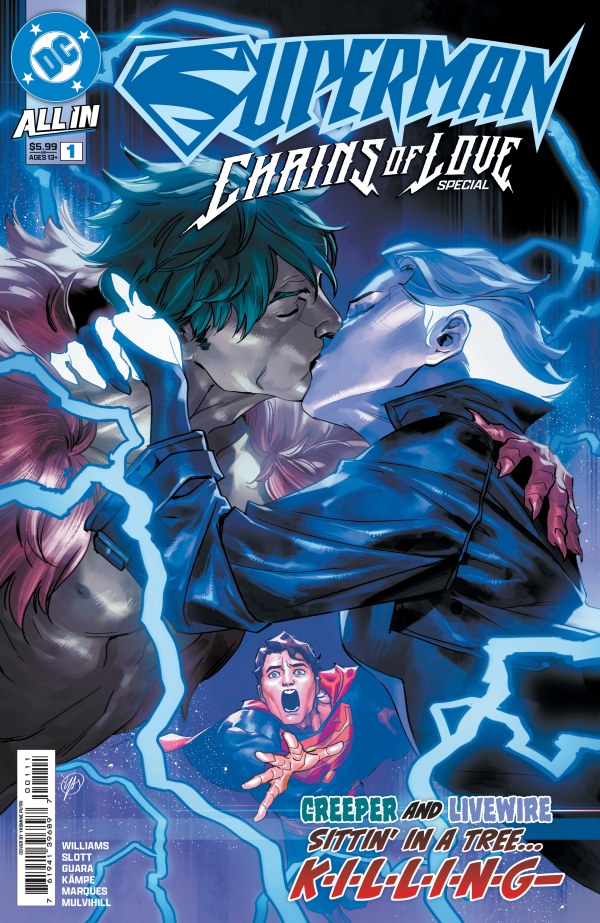
Superman: Chains of Love Special #1
Title: Creepers
Writer: Leah Williams
Art: Ig Guarra
Main Cover: Yasmine Putri
Just in time for Valentine’s Day, we get this one-shot. Livewire is being paroled from prison, but her years away have left her without her audience…until she stumbles into the Creeper, who finds a way to help her climb back to prominence. And then, with love in the air, the sparks fly.
It’s a cute enough story – questions of continuity aside (Livewire says early that she’s “from the 90s,” which feels a little meta), the two characters have an interesting chemistry that actually plays out in an entertaining way. Superman’s presence in the story is minimal however, mostly there for structure in the new environment that Leslie Willis finds herself in. But I guess DC (correctly) assumed that branding this as a Superman special rather than a Creeper/Livewire special would get more readers.
Title: Bill Zarro’s World
Writer: Dan Slott
Art: Rosi Kampe
Dan Slott and Rosi Kampe also come through with a back-up story in this issue. Bill Zarro is a lowly peon working at the Daily Planet. His boss is a jerk, his wife resents him, his kids disdain him…until one day he wakes up on Bizarro World, and everything changes. This is a short story that’s essentially an extended gag piece that builds up to an unusual and amusing punchline. The ending is funny enough to make the story worth recommending.
Absolute Superman #16
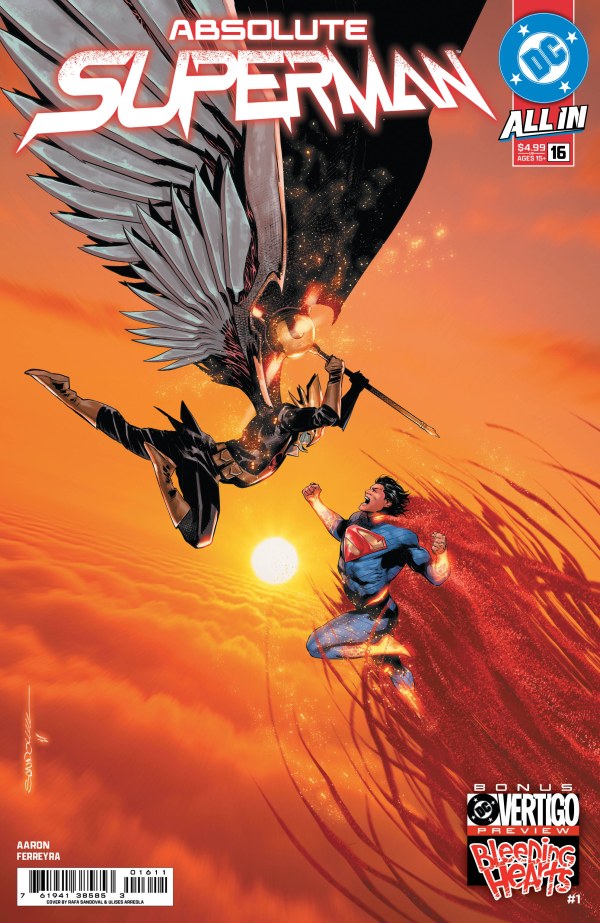
Title: The Never-Ending Begins Part Two: This Universe Will Break Your Heart, Kid
Writer: Jason Aaron
Art: Juan Ferreyra
Main Cover: Rafa Sandoval
This issue brings us the full introduction of a new Absolute Universe hero as Superman is approached by the mysterious Hawkman. This version of Carter Hall has been around for a long time, and initially doesn’t know what to make of this newcomer with all of the powers. We also see Lois as she tries to find a new direction in the wake of her departure from the espionage game, a new version of another classic character, and the recruitment of Lex Luthor continuing unabated.
Here’s something that I haven’t really said before about many of the Absolute comics: this issue is surprisingly funny. The first couple of pages in which Superman and Hawkman meet in midair are punctuated by Kal-El getting distracted by disasters both minor and major and then zipping off to deal with them and leaving Hawkman flapping his wings. The introduction to this new Hawkman works really well. It can be easy to forget that this “young” universe is still a universe, with a history all of its own, and Hawkman feels like a great opportunity to explore that a little bit more.
The Lois story has some humor as well. For a while it didn’t seem as though this book was going to brush much on the traditional Superman status quo at all, but here we’ve got Lois and Jimmy looking into being reporters, the introduction of the Daily Planet, and the debut of one Perry White. Even there, though, we see the influence of Darkseid on this world. The Planet ain’t the grand old dame she is in the main DC Universe, and although Perry has the same sort of grit you’d want from the character, it comes with more grime than one would usually expect. The way this is structured he may be a one-off character, but I really hope that’s not the case. I feel like there’s a lot of potential here, especially in having him interact with Lois.
Even the Lex Luthor scene is darkly comedic. The Absolute Luthor – with a proud shock of red hair and a burly beard, is a man utterly happy and content in his simple like. The difference between him and “our” Lex Luthor is perhaps more striking than any other Absolute character we’ve met yet, which is amusing, but at the same time, seems poised to bring him to a bitter, heartbreaking end.
Or not. Aaron has been surprising me a lot with this book.
Juan Ferreyra handles both the line art and colors for this book, and I really like his work. The flashback scenes, showing some of Carter’s adventures in the 40s, have a nice sort of archaic look to them. In the modern scenes, where he and Kal-El meet, he does this really interesting blur effect to show Superman zipping into action. It’s not wholly unique – I’ve seen similar effects from other artists – but his execution is great. I’m also a big fan of the monster designs from later in the issue, and his battle scenes look stunning.
We’re on the second issue of this new story arc, and it’s honestly shaping up to be my favorite from the series so far. It’s brighter somehow, and while that may be a deviation from the whole ethos of the Absolute Universe, I feel like that’s kind of the point. A Superman – a REAL Superman – should always be the bright spot in his world, no matter how dark the world itself may be.
Blake M. Petit is a writer, teacher, and dad from Ama, Louisiana. His most recent writing project is the superhero adventure series Other People’s Heroes: Little Stars, volume one of which is now available on Amazon. Don’t forget, you can check out earlier blogs in the Year of Superman/Superman Stuff Archive! Got a request for a future “Superman Stuff”? Drop it in the comments!
I don’t want every “Superman Stuff” post to be comic book recaps, hence last week’s post where I talked about the upcoming Spider-Man/Superman and Bizarro: Year None announcements. That said, one of the reasons I wanted to keep this going was so that I could keep talking about the NEW Superman comics as they come out. With that in mind, this week I’m going to give my feelings on some of the Superman-related comics that have been published so far in 2026.
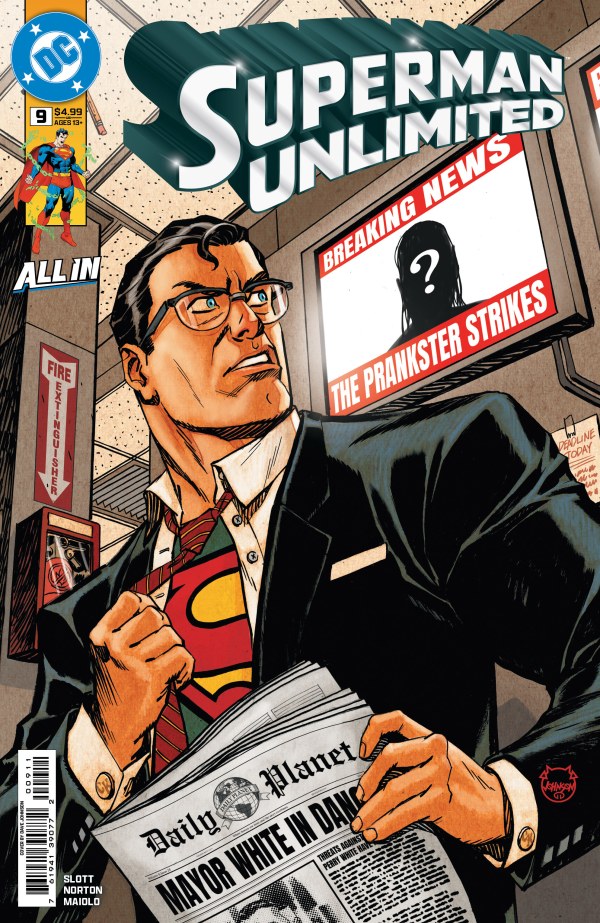
Superman Unlimited#9
Title: Die Laughing Part One
Writer: Dan Slott
Artist: Mike Norton
Main Cover: Dave Johnson
A series of strange deaths strikes Metropolis, and although they could be accidental, there’s something that makes it feel like they’re linked to an old foe of Superman’s. (I realize I’m playing coy with who the villain is, and they name drop him on the cover, so I guess that’s a little pointless.) Meanwhile, Metropolis’s new Mayor Perry White finds himself a target, and at Steelworks, Jon Kent gets an important warning from a very unexpected source.
There is a LOT of stuff going on in this issue. The main plot regarding Perry White is the through-line, but the story of Jon at Steelworks feels like there’s more going on than is readily apparent, and the ongoing story of the massive Kryptonite meteor that’s fallen to Earth is woven in through what happens in the other plots. What’s more, we also get to see a classic foe and a new collaborator show up here in ways that feel like there’s a lot of story to tell. The way this book is packed is honestly reminiscent of the way stories were structured during the much-missed Triangle Era, and as I read this I felt those pangs of regret that I’m going to have to wait a month for this storyline to continue rather than just one week.
Slott does some of the little character bits he’s so good at here. For instance, we see Clark Kent at a press conference by Mayor Perry White where he acts just like he’s asking questions to any random elected official, and Perry humorously reminds him that he doesn’t exactly have to introduce himself. It’s funny, but it also brings up the idea that it’s kind of unethical to send a reporter to cover a press conference when the guy at the podium happens to be godfather of the reporter’s son. Then again, Clark has been reporting on himself for almost 90 years now, so…
Mike Norton steps up for the artwork this issue, and it makes me wish we saw him drawing Superman more often. His lines are clean and bold, very reminiscent of the style we saw from the likes of Dan Jurgens or Jerry Orway back in the day. Having him on this book feels very, very right. I hope we get to see more of his work on Superman in the future.
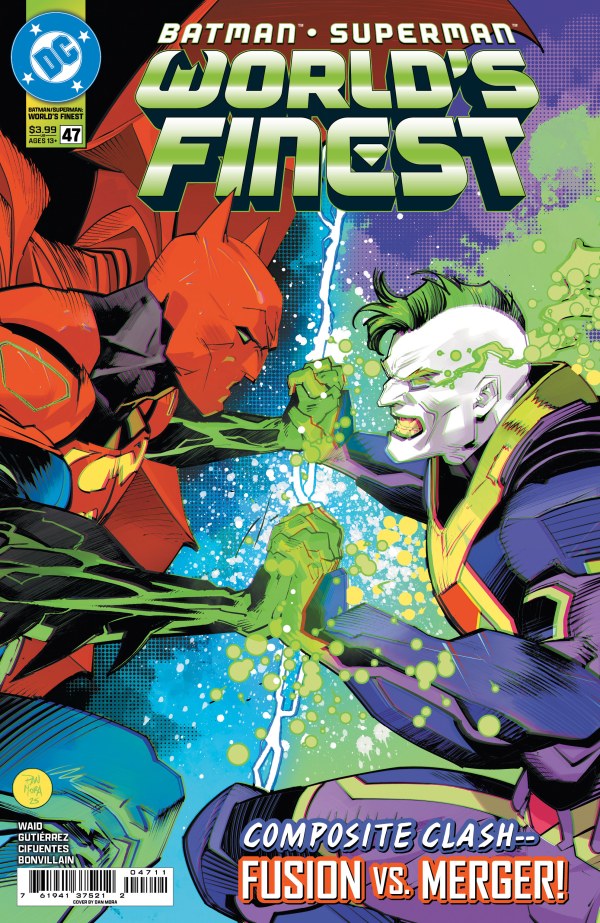
Batman/Superman: World’s Finest #47
Title: The Merger Part Three: Truth and Consequences
Writer: Mark Waid
Pencils: Adrian Gutierrez
Inks: Vicente Cifuentes
Main Cover: Dan Mora
Fusion – the merged form of Superman and Batman – is in battle with Merger, the Lex Luthor/Joker mashup. And if that wasn’t bad enough, Merger has used Hawkman’s Absorbascon to learn the identities of our heroes and transmit that information all over the planet. Fortunately, Fusion has a whole Justice League to back them up.
I’ve loved this book since day one, because Mark Waid is clearly having a lot of fun playing around with all these classic pieces of the DC Universe. World’s Finest is set several years in the past, so when the secret is revealed we get to see some things that wouldn’t happen if this story were set today: a more villainous Poison Ivy going after Alfred, or a Lois Lane who is heartbroken to realize that Superman has been hiding under her nose all this time. Waid writes these moments very well, with compelling character work, especially in the Lois Lane scene.
That said, he’s walking a tightrope here, playing with what they sometimes call “Schmuck Bait.” It’s when a story (particularly in an ongoing franchise) teases a development that you know will not or cannot stick. In this case, we know with 100 percent certainty before the issue even begins that the secrets of Superman and Batman’s respective identities will go back in the box, so that lowers the stakes dramatically. The trick is to use this to milk good character beats that will retain their significance even once the actual plot is reversed. He manages to do that here, and even ends the issue with a new little wrinkle that could be brought back later, either in the pages of this book, or in other DC titles set in the current continuity. Either way, there’s potential there.
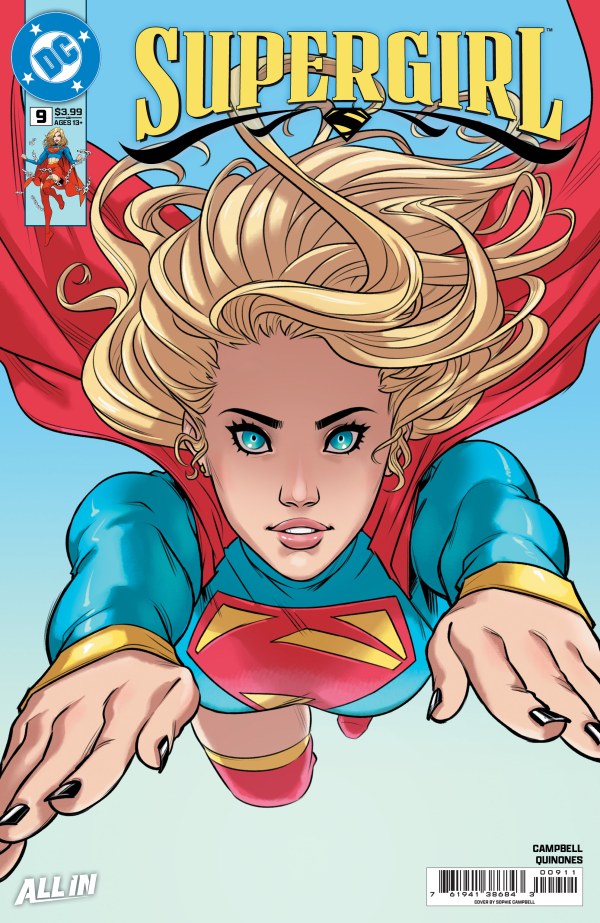
Supergirl Vol. 8 #9
Title: Resolutions
Writer: Sophie Campbell
Art: Joe Quinones
Main Cover: Sophie Campbell
Continuing the holiday kick this book has been on (the last three issues have been Halloween, Thanksgiving, and Christmas stories, respectively), it’s New Year’s Eve in Midvale, and Supergirl’s squad has been invited to a booze-free party to ring the year in. Lesla, unfamiliar with the effects of alcohol in the first place, is a bit disappointed to learn that it wouldn’t have any effect on her Kryptonian physiology. Lena has an idea for how to fix that little problem. Chaos ensues.
I have to admit, I didn’t see this issue coming. The first half comes across as Campbell trying to do an 80s style “very special episode” about the consequences of drinking, which would actually fit very well in what we’ve gotten from this series so far. The second half, however, takes a rather wild left turn when those consequences actually begin to stack. Stuff happens in this issue that drives a severe wedge in the family of friends Supergirl has built up around her, and I frankly didn’t see it coming. What’s more, Kara herself comes across as kind of cold in this issue – outwardly, at least. The reader gets to see her agonizing over the choices she makes and the way that she’s forced to push away her friends, but to those friends themselves she puts on a face of stoicism that’s really unexpected. Particularly in the case of Lesla, who is arguably a victim here, Kara doesn’t show the usual compassion that we get from her. I’ve been a big supporter of this book, but this is the first issue that feels like a misstep.
I’ve got no such complaints about the artwork, however. Campbell’s work on this title is great, but whenever she steps aside, they can bring in Joe Quinones to pinch-hit. I love his take on Kara and the rest of the cast, and I especially would like to see more of his version of Kandor.
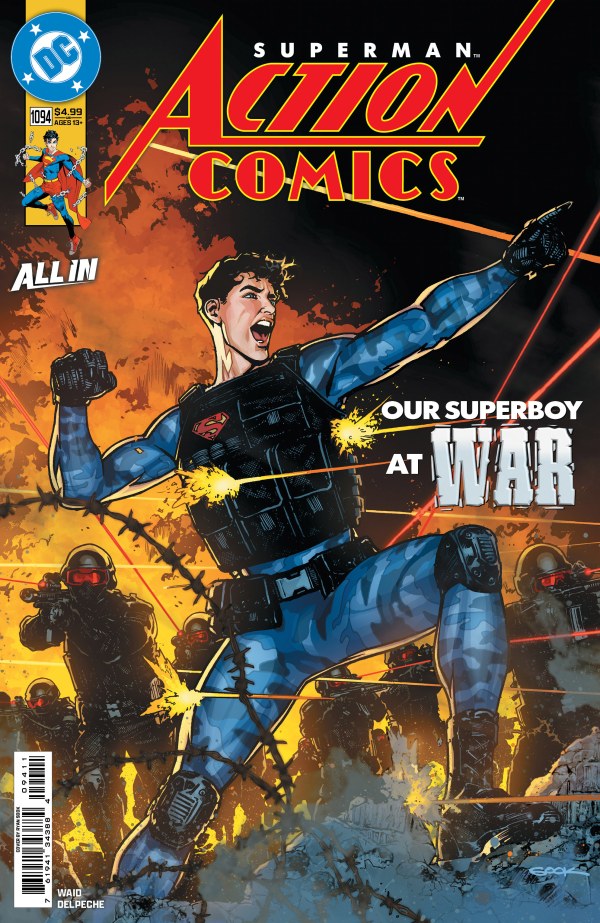
Action Comics#1094
Title: Our Superboy at War
Writer: Mark Waid
Art: Patricio Delpeche
Main Cover: Ryan Sook
This is an interesting one. The main story here is Superboy – in conjunction with his arrangement with General Sam Lane – being summoned to help with a military operation. Although that’s the A-plot, it’s also the least interesting part of the issue to me. That’s not to say that it’s not handled well – Mark Waid taps into the psyche of Clark Kent and has him go through this storyline in a way that feels very accurate for the character. The issue is that it’s very by-the-book. The beats are predictable, as are Clark’s reactions. I suppose that’s the thing about understanding a character really well – sometimes it can make certain stories feel very rote.
The b-plots in this issue are much more interesting to me. In the early part of the book, Clark has a study date (of sorts) with Lana Lang, and we’re teased with a strange animosity her father has for Clark. In the latter part, he goes on a camping trip with Pete Ross and laments the fact that there’s nobody he can share his secrets with. Both of these segments, to me, were far more satisfying than the A-plot. In each case, Waid is using established elements of the two characters to build them out a bit. For instance, Lana’s father being an archaeologist is a long-standing and well-known piece of the lore, but Waid seems to be using it here in a way that feels somewhat menacing, as though that status has a dark secret that’s going to cause trouble down the line. Pete, on the other hand, is famous for being the character who (in the Silver Age) knows that Clark is Superboy, but doesn’t tell anybody – not even Superboy himself. It definitely seems like we’re trending in that direction, but I trust Waid to do more with the concept than previous writers did. In the meantime, it’s really sad to see Clark upset about his big secret and the fact that there’s nobody else that could possibly understand what it’s like to have his kind of power.
Dang, if only he had some friends. If only he had a Legion of them or something.
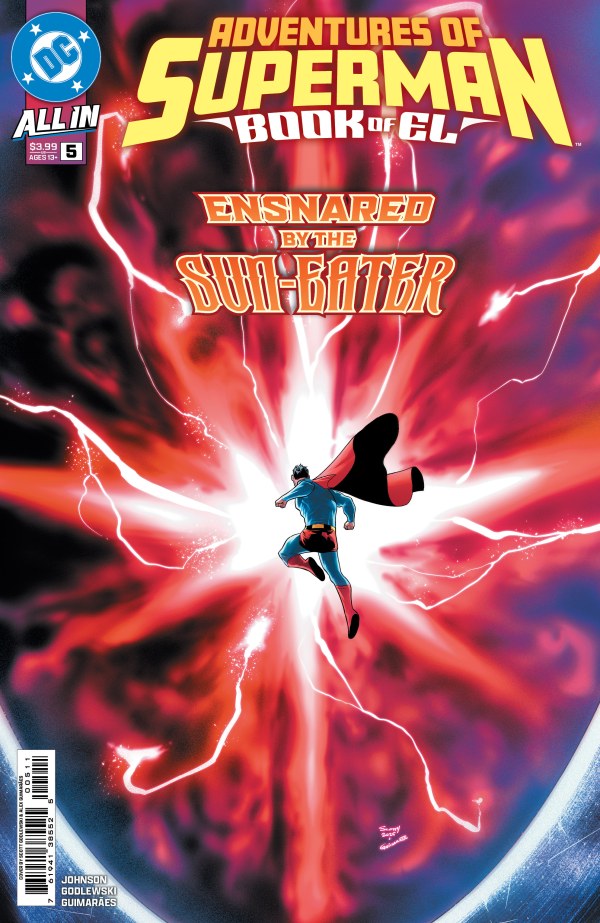
Adventures of Superman: House of El#5
Title: I Am the Lantern in the Dark
Writer: Phillip Kennedy Johnson
Art: Scott Godlewski
Main Cover: Scott Godlewski
A Sun-Eater has been unleashed on Lanternholm, the world that serves as the haven for the Lightborn. Superman and Ronan Kent join the fight alongside Ronan’s sister, Rowan. The Lanternholm stuff has actually been the most interesting part of this series yet to me, and I’m glad to see it take center stage in this issue. The DC Universe, let’s face it, has a LOT of potential futures. Some of them are easily compatible with one another, others require a bit more shoehorning to fit in, and this future in particular is at best going to be relegated to an alternate timeline in which Superman never comes home because – come on, let’s be honest here – we know that Superman is going to come home. It’s another example of that Schmuck Bait I mentioned earlier.
But that’s something that could theoretically be used to the story’s advantage. It is impossible for this future to be the “real” future of the DC Universe, so why not take some wilder, braver swings with it? I’d like to know more about what happened to the Lanterns in this future. I’d like to know more about what happens afterwards, with Rowan’s new status at the end of this issue. I’d read a miniseries about that, I’d read a miniseries about her. I’d be excited for it.
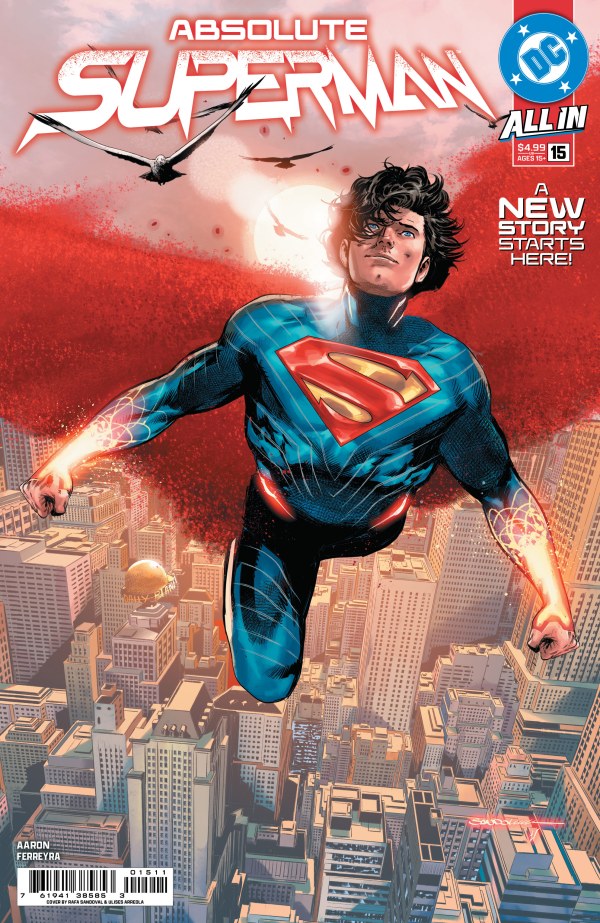
Absolute Superman #15
Title: The Never-Ending Begins Part One: In Blue
Writer: Jason Aaron
Art: Juan Ferreyra
Main Cover: Rafa Sandoval
A new storyline kicks off this issue, although it kicks off in a very low-key way. After the huge win at the end of last issue, Kal-El is trying to settle in, taking over the Kents’ farm and running it the way they would have wanted while, at the same time, operating as Superman around the world. Of course, as the beginning of a new story, new threats are coming in as well, and we see the seeds for a few things planted here.
It’s nice to have something of a breather this issue, as we see Kal-El spending time with a lot of people, exploring his relationships with both Lois Lane AND Lana Lang, and interestingly enough, even Ra’s Al Ghul. There’s shoe leather to be expended here, building on who each of these people is to our new Superman. What I really like, though, is the direction this series is trending. Clark has traded in his Kryptonian suit for a uniform made for him by Martha, a uniform that speaks to a brighter future for the character. The Absolute Universe is one where Darkseid’s ethos reigns supreme and hope is the underdog…but despite that, Superman still acts as a symbol of that hope, and this issue continues to demonstrate that.
We also get the first appearance of the Absolute version of one of Superman’s oldest foes, and he’s taken in a very different direction. The Toyman has gone through several incarnations over the years. This one is different from any of them, but it suits the universe we’re living in and still fits the concept of the character fairly well. We also get a cameo by next issue’s big guest star, Hawkman, and recent comments by Scott Snyder that we’ll see a gathering of heroes in this universe sooner or later feel like they’re inching closer to fruition.
DC KO #3
Title: No Mercy
Writers: Scott Snyder & Joshua Williamson
Art: Javi Fernandez & Xermancio
Main Cover: Javi Fernandez
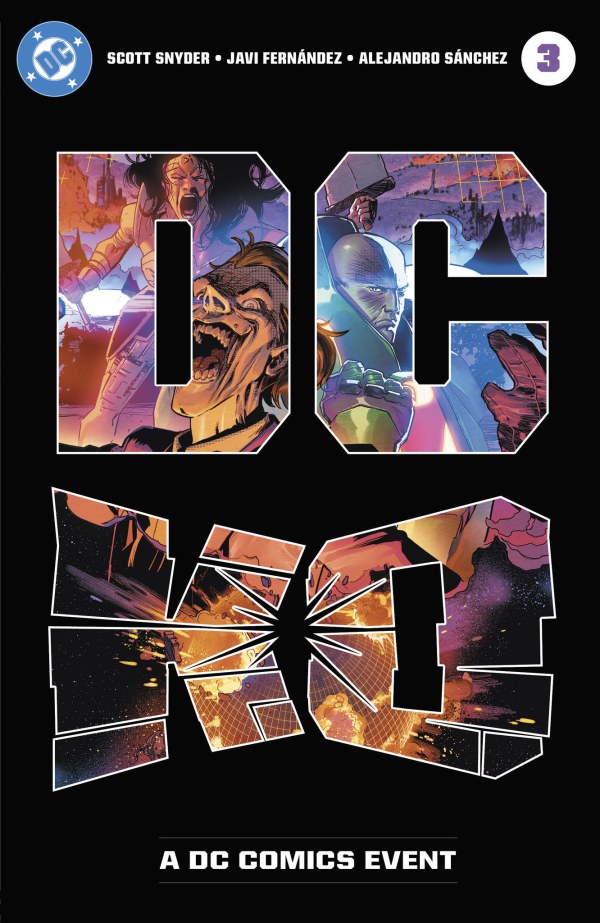
Following December’s “All Fight Month” event, the combatants in the KO tournament have been narrowed down to an “Elite Eight.” The remaining fighters are each given an opportunity to choose a partner to fight alongside in the next battle. However, the one fighter who generated the MOST Omega Energy gets a special prize – their partner may come from ANY level of reality…and that winner is the Joker.
Much as the “All Fight” issues were at their best when used as an examination of character, even the selection of the heroes’ partners serves that same purpose. Some of them are obvious, some of them are understandable, and some of them are baffling. All of them demonstrate something about the character who makes the choice, and it’s writing like that which has elevated DC KO from being just a mindless slugfest into one of the most compelling events the DC Universe has had in ages.
There’s a running commentary from the Heart of Apokalips throughout the story that focuses heavily on Superman as well – what’s going on in his head, how he’s dealing with the battle, how he handles the fact that he’s got to fight, kill, perhaps even use his friends. What’s more, from the beginning the idea has been that it was okay for the heroes to die or to kill in pursuit of winning the tournament, because whoever wins and gets the Omega Energy at the end will have the ability to reset the universe and fix everything. This issue Snyder really starts to explore what that would actually MEAN. Would anyone – even Superman – have the wherewithal to only turn the clock back to before the tournament, or would that temptation to make the world unto what he thinks would be paradise be too tantalizing?
Also, there are a couple of moments in this issue that are gonna make for great action figures.
Blake M. Petit is a writer, teacher, and dad from Ama, Louisiana. His most recent writing project is the superhero adventure series Other People’s Heroes: Little Stars, volume one of which is now available on Amazon. Don’t forget, you can check out earlier blogs in the Year of Superman/Superman Stuff Archive! Got a request for a future “Superman Stuff”? Drop it in the comments!
I’m writing this on Christmas morning, sitting amongst piles of wrapping paper and the mountain of Hot Wheels that Santa Claus brought Eddie, The Muppet Christmas Carol on TV because it’s not time for football yet. But it’s also the first day of the final chapter. After 51 weeks in which I have watched, read, or listened to at least one piece of Superman-related media every single day, no matter what life had in store for me, I’ve only got seven days left to reach the finish line.

I’m going to think of this week as “the best of the rest.” I’m going to try to read and watch some of my favorite or some of the most significant stories remaining on the gargantuan list I started the year with. And make no mistake, that list is still pretty big. I haven’t gotten close to scratching off all of it. So perhaps, just perhaps, when I reach New Year’s Day, my journey with Superman won’t be ending, but merely evolving.
But time for that later. Let’s get started.
And as always, you can check out earlier blogs in the Year of Superman Archive!
Thur., Dec. 25
Comics: Superman Smashes the Klan #1-3, DC Go! Holiday Special #32

Notes: A few weeks ago I listened to the radio serial “Superman Versus the Clan of the Fiery Cross.” In 2019, writer Gene Luen Yang and artist Gurihiru loosely adapted that storyline into a three-issue miniseries, Superman Smashes the Klan, that kept the skeleton of the original story, but added some new elements that really made for one of those evergreen graphic novels that will be read for a very long time.
Set in the days after World War II, the story kicks off with a Golden Age-style Superman polishing off a leftover Nazi calling himself Atom Man. The fight is tougher than it should be, as Atom Man is powered by a glowing green crystal that Superman has encountered before, that makes him weak and sick. We soon discover that this is a very young Superman who does not yet know the truth of his alien origins. Something is nagging at him, and he sees an odd vision of himself in the mirror looking like a creature from outer space. Meanwhile the Lee family – Dr. Lee, his wife, and their children Tommy and Roberta – is moving from the Chinatown section of Metropolis to the city proper because Dr. Lee is starting a new job as Chief Bacteriologist of the Metropolis Health Department. Their new neighbor, Jimmy Olsen, stops by to introduce himself and invite them to the Unity House Community Center baseball practice.
The story follows the plot of the radio show fairly well, but it adds in elements that weren’t present on the air. Superman learns in the course of this story that he’s an alien himself, giving an added dimension to the story of the Lees and their struggle to find acceptance in Metropolis. We’ve also got an original character, Tommy’s sister Roberta, who wasn’t in the original story but takes on a large part of the narrative. As the daughter of a Bacteriologist, Roberta is a bit of a germophobe, which only serves to enhance her existing awkward nature, making it much more difficult for her to acclimate to her new home. I like this angle a lot. Having Tommy fit in as a typical all-American boy worked well for the radio show. You didn’t even know that he WAS Chinese for the first few episodes, making the angle of the Klan come across as a surprise to the listener. But in a comic book, there’s no way to make that kind of thing a surprise. While Tommy is still that kid who everyone loves and blends in with the Unity House baseball team easily, Roberta gives us a character to depict the alienation that someone – especially a kid – can feel in this sort of situation. The idea in the original was just to point out how foolish the likes of the Klan were, and that’s all to the good, but Gene Luen Yang (himself a creator of Asian descent) brings a whole new dimension to the story by emphasizing the struggle of an immigrant family through Roberta’s perspective. Not to make it sound like she’s some damsel in distress, mind you. Roberta is Superman’s deuteragonist in this story. She overcomes her anxiety to help her brother, realizing very quickly that Chuck Riggs is involved with the Klan and using her knowledge to race to Tommy’s rescue. She also inspires Chuck’s change of heart much earlier than happens in the radio serial.
Tommy, on the other hand, perhaps tries a little TOO hard to fit in, leaning on his ethnicity in ways he didn’t in the original radio story. Once he becomes part of the Unity House baseball team he keeps dropping jokes about being Chinese (“Confucius says” references, for example), using what makes him different to enhance his popularity. Although he’s a good-natured kid, his insistence on drawing attention to being Chinese bothers his sister almost as much as the people who insult them.
Superman himself has yet another perspective on the immigrant experience. He knows he was adopted, and we see flashbacks of Jonathan showing him a strange device that was in the ship that brought him to Smallville, but it spoke a language they were never able to translate. He’s even gone so far as to mentally suppress some of his more fanciful powers, making for a nice explanation for why he goes from “leaping tall buildings” to outright flight.
Another addition to the story is the Atom Man subplot. After Superman captures Atom Man in the beginning, we see periodically that he’s not in police custody, but being studied by the Metropolis Health Department, a study that Dr. Lee clearly has misgivings about. Lois Lane – who had almost no presence in the original radio story – takes the lead on this one, cracking open the story about the “Health Department” which turns out to be a private enterprise conducting dubious research. Naturally, this turns out to dovetail with the story of the Klan in a rather unexpected way. This is one point I’m a little unsure about. Making the Klan a more high-tech organization, with “loftier” ideals than the simple bigotry of the original works for this version of the story, to be certain, but I’m not sure if it undermines the original point at all. Perhaps smarter people than I can answer that one.
The is a fantastic story – a bold, proud tale that does far more than simply adapt the original radio drama. Indeed, it ties the story of Tommy and Roberta Lee in with the core concept of Superman, making who they are as integral to the series as who he is. I can’t recommend this one highly enough.
Fri., Dec. 26
TV Episodes: Superman and Lois Season 4, Episodes 6-10
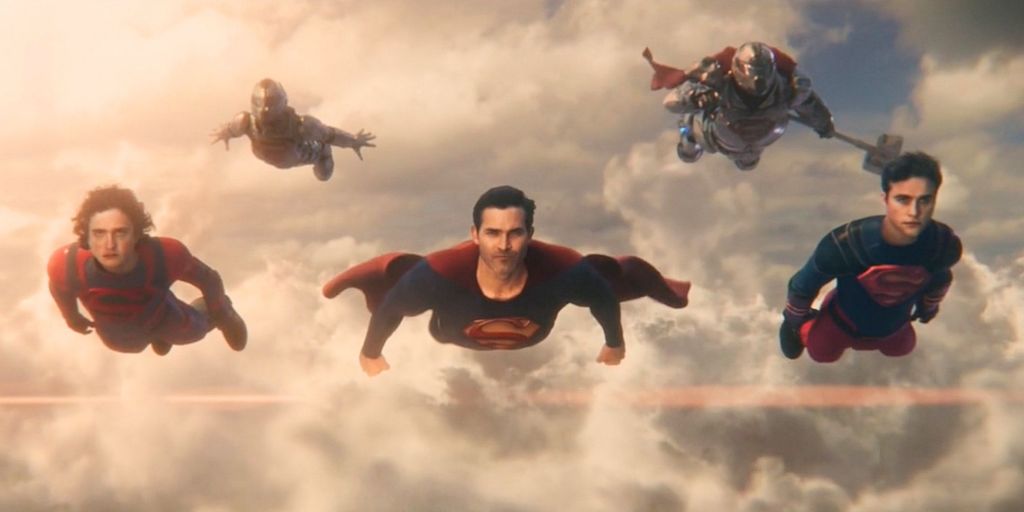
Notes: With my wife working and my son having a mountain of toys to play with and college football to watch, I decided that the day after Christmas was the time to finally finish the last season of Superman and Lois. I’m not going to to a play-by-play on these last five episodes, so let’s assume that you’ve watched these episodes that I’m watching for the first time, and I’m going to discuss my feelings about them as I watch.
In episode 6, we see Lex trying to tighten his grip on Smallville by buying up property and bribing the citizens, but they hold firm and resist – mostly because Clark wants them to do so. It’s a wonderful series of scenes in which Clark realizes something that viewers figured out several episodes ago: after seeing Lois and the boys run to Superman’s side after he was killed by Doomsday, the entire town of Smallville now knows that he’s really Superman. And best of all, every single one of them is willing to keep the secret and cover his back. It’s a great story beat, and actually one I’ve thought about several times over the years. Considering everything that he did for the town of Smallville, especially in those continuities where he had a career as Superboy, it would be utterly absurd if there weren’t a lot of people who deduced the truth. The fact that they keep the secret speaks to an inherent goodness in them, a loyalty to the hero who has saved them time and again. Plus, when we see him trying desperately to put the cat back in the bag, convincing people that he’s NOT Superman, it’s hilarious.
Of course, there’s gotta be some drama, and the fact of his identity leaking out predictably causes some problems – kids who are resentful of Jonathan and Jordan, an antagonist from an earlier season that comes back and causes trouble. The scene where someone takes a shot at him in a diner, forcing him to reveal himself, is just glorious, and it leads to the secret being revealed to the world. When that happened in the comics I hated it, because I knew this was a genie that had to go back in the bottle and we’d seen it before. But here, when it happens on a TV series that only has three episodes left, it’s an opportunity to tell a story that hasn’t been told with Superman before, and the creators nailed it.
Beyond that, of course, another big arc in this season is the fact that Clark now has Sam Lane’s heart, and it’s reducing his powers, causing him to age. At the same time, Luthor is planning his final revenge with the combination of a new super-suit (stolen from John Henry and beefed up with Kryptonite) and the return of his Doomsday monster. It all collides in the final episode, “It Went By So Fast,” a title which I can only assume was a meta way for the writers to indicate the fact that they didn’t really want the show to end. I get it, too – this last half-season, lower on the soap opera dramatics and higher on the Superman stuff, was really fantastic, and it’s leaving me wanting more.
They’ve done the Doomsday battle before in live action – in Smallville, in Batman V. Superman, and even before in this series…This is probably the best one I’ve ever seen. With Clark on the ropes, seeing Jonathan and Jordan step up to fight hits me in that parenting place that seems to dominate how I interpret stories these days. John Henry and Lana joining the fight as well shows how big Superman has become, how this world is rising up to meet him. He may have lost a step thanks to his heart transplant, but he’s also inspired another generation of heroes, meaning he doesn’t have to do it alone.
And that’s just act ONE of the finale.
While Clark is chucking Doomsday into the sun, back on Earth Lex attacks the twins and Lois goes after him directly. As she shouts at him to stop attacking everyone around her when she’s the one he really wants, she yells the most Lois Lane line I’ve ever heard: “I am not afraid of you, but you’ve always been TERRIFIED of me,” then nails his warsuit with a mine. It’s not enough to stop him, but it slows him down enough for Clark to make it back to Earth and really start the final battle. It’s an epic, airborne spectacle that ends, inevitably, with Luthor taken down.
And now we’re only HALFWAY through the episode.
Next we get a time skip to about year later with Lana’s wedding to John Henry Irons (an event that would happen a few months later in the comics as well). Kyle and Chrissy are expecting a second child, and Kyle and Lana have reconciled into what appears to be a sincere friendship. Jordan and Sarah, similarly, seem to have finally buried the hatchet, and John Henry spends a tender moment with Natalie as Lois gets an important text about Lex’s future behind bars.
In the final act, we get a voiceover from Clark about how Sam’s heart allowed him to live another 32 years, and how he wanted to leave behind a legacy, making the world a better place. Clark, along with the twins, John Henry, Natasha, even Bruno Mannheim, begin to make real change. Using the influence of Superman and Lois Lane, they start a foundation that accomplishes good throughout the world. The twins each marry and have kids of their own, and we get a nice scene of Grandma and Grandpa Lois and Clark (in admittedly dubious aging makeup). But eventually, Lois’s cancer returns, and Clark is left alone. He lasts for several more years before Sam Lane’s heart that had beat in his chest for so long finally gives out, passing away quietly with his sons next to him.
Clark sits up, young again, seeing his own body behind him. He embraces his sons – young again – and sees his grandchildren. He finds Luthor, of all people, sitting at his kitchen table, and offers him forgiveness…says goodbye to his friends one at a time, and in the end he sees a vision of Lois, waiting, to take him into the light.
Here’s the thing: the story of Superman doesn’t end. It just – it doesn’t. Five years from now, ten years, a hundred years from now, there will and should be new stories of Superman being told.
But if Superman DID end…this is the right way to do it. An ending that is happy in the life he and Lois get to lead, despite the fact that this life – like all those of mortals – must end. And the fact that a Superman left behind a better world than he arrived on in that spacecraft from Krypton. In the comic books, they can’t really do a story in which Superman changes the entire world this way, because they still need something to tell stories about next month and next year. But here, with a television series coming to an end and, with it, closing off the stories of that universe, they have the freedom to show what Superman is REALLY capable of. This season has been a buildup, showing how Superman inspires those around him – not only his own children or friends, but the people of Smallville who were willing to stand up for him, and the people of a world that grows to do the same. The ending of this episode is a tearjerker, but it’s left with a beautiful message of hope that is entirely appropriate for Superman.
But it’s not only hope. Superman is about hope, yes. But the thesis of this series is true as well: “[Love is] the thing that makes life worth living.” It’s what makes the story of Lois and Clark so powerful, in all its many iterations. A man from another world, a woman who represents the best of ours, and how they come together…this is a story worth telling.
Comics: DC Go! Holiday Special #41
Sat. Dec. 27
Comics: DC Go! Holiday Special #43 (Cameo), Detective Comics #1103, Superman: The Kryptonite Spectrum #5, Superman Unlimited #8, Action Comics #1093, Superman Vol. 6 #33, Absolute Superman #14, Batman/Superman: World’s Finest #46, Supergirl Vol. 8 #8, Justice League Unlimited Vol. 2 #14, Justice League Red #4 (Power Girl), Justice League Vs. Godzilla Vs. Kong 2 #5
Notes: For the final time (this year), I’m going to do a roundup of recent Superman-related comics, starting – oddly enough – with Detective Comics #1103. One of the first comics I read this year, back in the first week of January, was an issue of Tom Taylor’s Detective that showed Superman helping Bruce through an existential crisis. This actually serves as a nice bookend, with Bruce teaming up with Lois to help with an investigation. Superman appears briefly, but most of the issue is concerned with Lois showing off how dang capable she is, and how much respect Bruce has for her. It’s the middle of an ongoing storyline, so it’s probably not something most people would read on its own, but it’s worth mentioning because it’s a great Lois guest appearance.
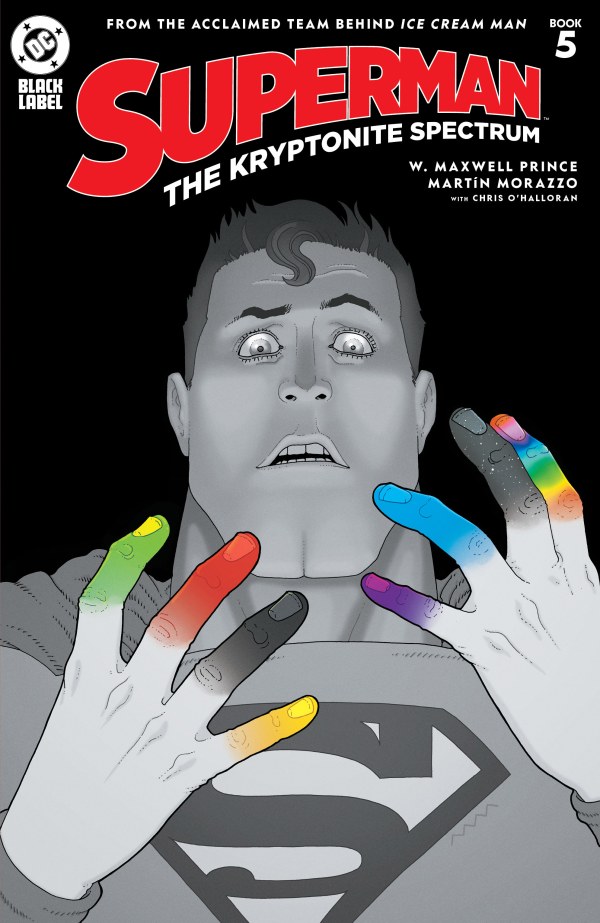
The final issue of Superman: The Kryptonite Spectrum wraps up W. Maxwell Prince and Martin Morazzo’s celebration of the Man of Steel in dynamite fashion. Lex Luthor has engineered a new Kryptonite Man, powered by the entire spectrum of the remnants of Superman’s home, and the battle between the two of them sends Superman on a spiral that leaves him questioning the very nature of the universe itself. Prince’s story leans heavily on metafiction, concentrating on Superman as a story and weaponizing that part of the character’s nature. The finale is entirely unexpected, but in its own way, as sincere a love letter to Superman as the likes of All Star Superman was – in fact, Prince and Morazzo lean heavily on Morrison and Quitely’s story here, and they do so in a way that’s both loving and triumphant. This is hands-down the miniseries of the year.
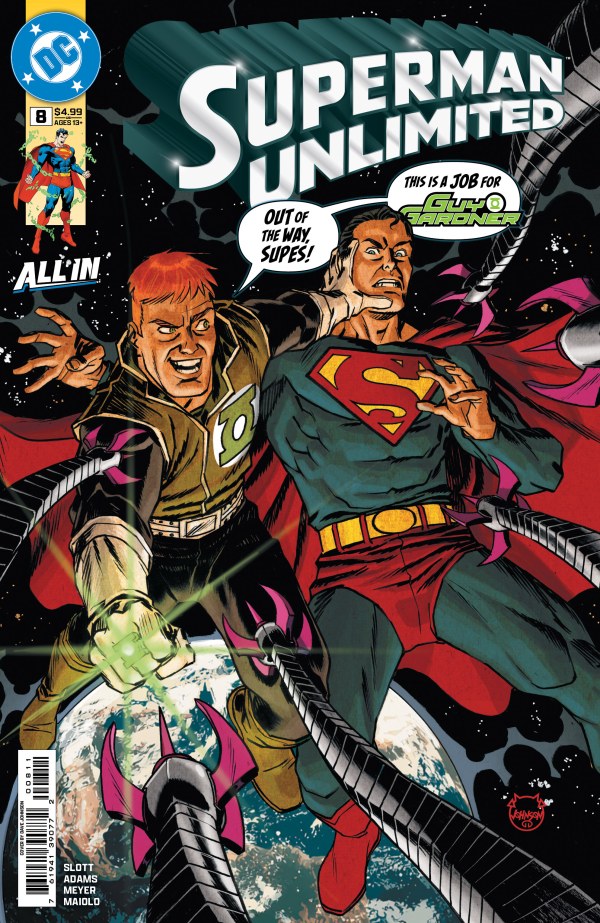
Superman Unlimited #8 gives us another of the one-off stories that this series has been doing so well. The influx of Kryptonite on Earth has changed a lot of things, including energy sources, and an experimental space flight is planning to make faster-than-light travel a commercial enterprise on Earth. With Lois Lane as a passenger on the maiden voyage, the Justice League assigns Guy Gardner to escort the flight in case something should happen. And wouldn’t you know it? Something happens. I have no doubt that Guy’s appearance in this issue is at least partially due to his guest-starring role in this summer’s big movie, but at the same time, it’s done exceptionally well. Guy is such a fun character – a rude, insufferable boor that is in every way diametrically the opposite of Superman…except for the fact that they’re both true heroes at heart. Seeing them together, both clashing and cooperating, pretty much always makes for a good time, and this issue is no exception.
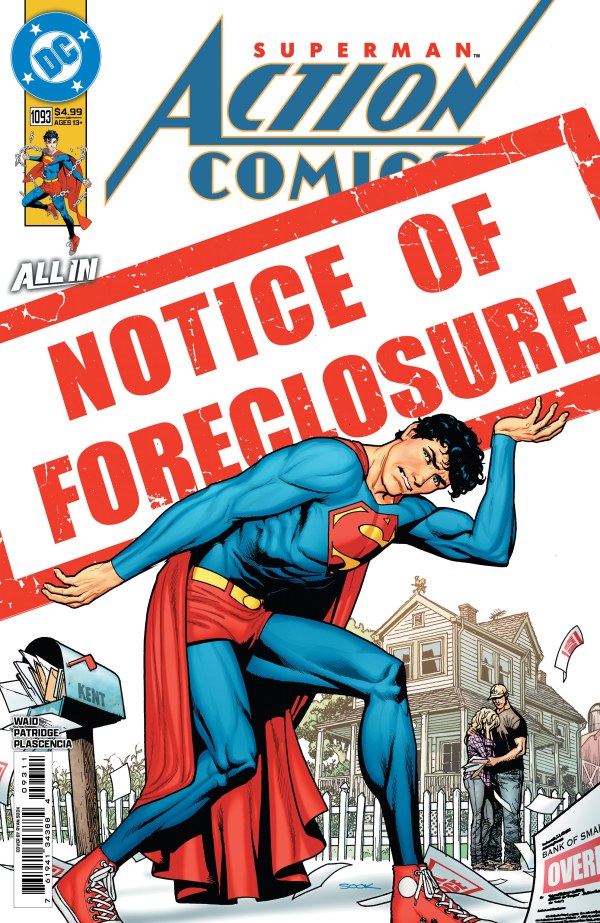
Action Comics #1093 is another one-off story, this time Mark Waid telling a Superboy tale that shows an event that’s fundamental to Superman’s moral core. Dozens of farmers throughout Smallville are given notices of foreclosure on their farms at the same time. The new owner of the bank assures them that if there’s an “error” they’ll figure it out, but the time it would take to do so would ruin every farm in Smallville. When Superboy contemplates using his power to “find” the money to save the town, it becomes a battle of wills between Clark and his parents, who think that using his powers for personal gain – even to save the town – isn’t the way to go. I’m sure that everyone who’s ever read a Superman comic has fantasized about having the power to hunt down undiscovered gold or some other get rich quick scheme, and Waid does a good job with the Kents of painting a picture of why such a thing should be above a Superman. I still have to confess that I’d probably go dig up the gold if I had Superboy’s powers, but in my defense, nobody has ever called me Earth’s greatest hero.
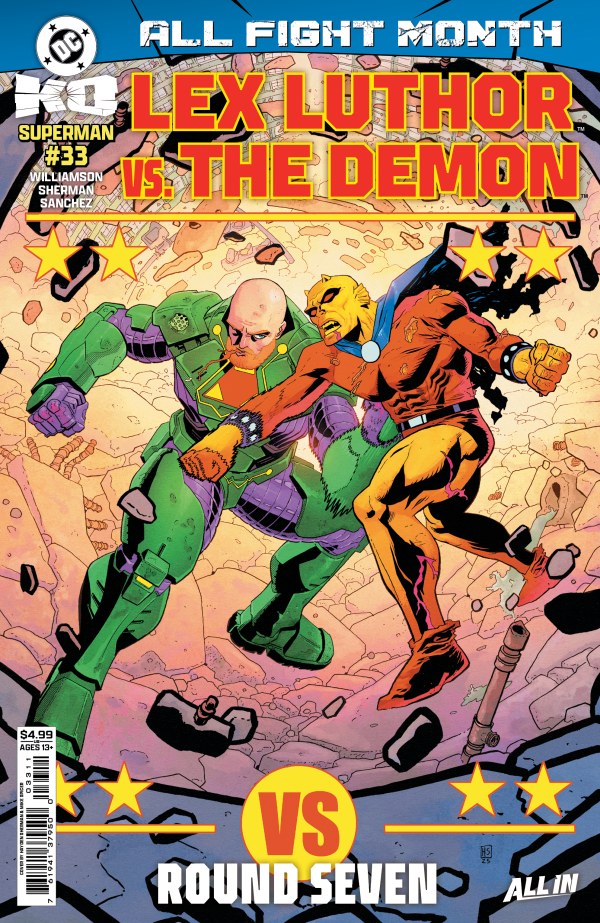
DC KO’s “All Fight Month” continues with Superman #33, with the unlikely battle between Lex Luthor and Etrigan the Demon. Throughout the month I’ve been impressed at just how well these battles have transcended being mere slugfests. Oh, there’s fightin’ a-plenty, but each of them has gone beyond that to telling a story that digs into the heart of the characters involved. We see who they are, why they do what they do, and what makes them worthy of the Omega Heart, even if it’s only in their own mind. Joshua Williamson taps into the blackness in Lex’s heart and simultaneously shines a light on him. By the end of the issue, you almost (aaaaalmost) want to root for him in his fight with the Demon, because damned if he doesn’t convince you that he’s earned the win. We also continue the storyline with Superboy-Prime and Lois, whose Superwoman powers have returned, in the Fortress of Solitude. Recent announcements about the state of the Superman titles after KO ends have made these pages a bit more relevant than we’d realized, and although I hate the fact that they keep spoiling things in the solicits, I’m very curious to see what’s coming next to this title.

Absolute Superman #14 ends the current storyline with an epic battle between Kal-El and Ra’s Al Ghul for the heart of Smallville. As the two of them go at it, we see Lois facing off against the Peacemakers and Sol’s internal battle with Brainiac, all of which come to an amazing crescendo in this issue. Without going into a blow-by-blow, the ending of this one is probably the most hopeful thing I’ve seen yet in the Absolute Universe as a whole, although as suits this world tainted by Darkseid’s energy, the victory is bittersweet and not without a price. In many ways, it clears the table for this series, and it will be very interesting to see where the story goes from here.

World’s Finest #46 continues the story of Lex Luthor and the Joker, fused into a single being and armed with the power of a device that gives them the sum total of all knowledge in the human race. Superman and Batman, naturally, have to step up and stop them, this time getting a little extra help from Green Lantern to juice them up in a way he’s done once before. The issue ends on a cliffhanger, and it’s a pretty good one, except for the fact that it suffers a bit from Prequelitis. Admittedly, even in the present day what happens at the end would likely be wiped out by the next issue, but when you’re dealing with a series set in the past, there’s really zero tension with the “shocking” ending. It’s still a great, fun story, though.
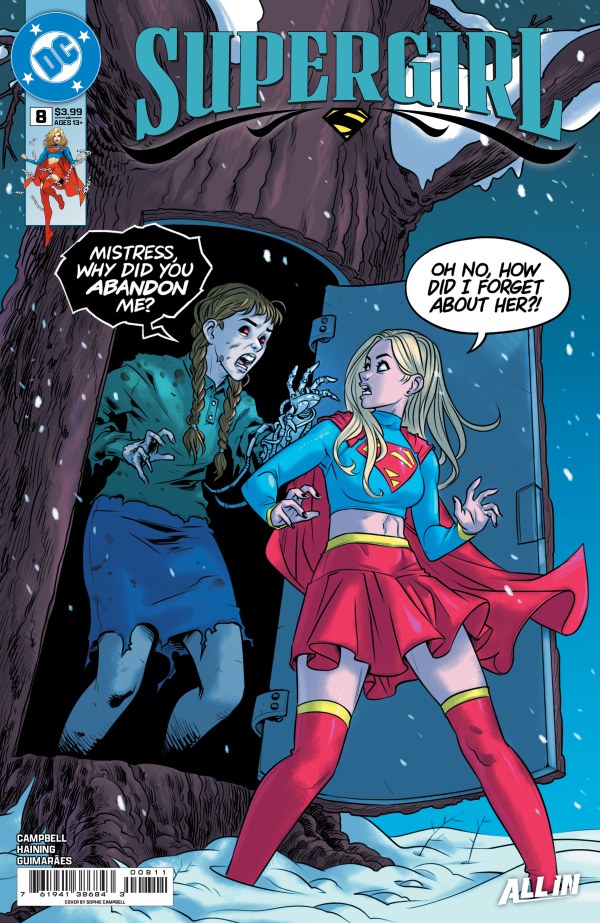
I’m going to end my tour of new comics with Supergirl #8. It’s Christmas in Midvale, but Supergirl isn’t feeling merry. The holidays, with their emphasis on family, always make her remember everything she lost in the destruction of Argo City. Still, the Danvers and Lesla-Lar do their best to cheer her up, even as they get a strange visitor from the past that Supergirl has neglected for far too long. Sophie Campbell’s Supergirl is probably my favorite new comic book title of the year, but this issue is a little atypical. While the series is usually very bright and uplifting, this issue is somewhat darker and more bittersweet, particularly for a Christmas story. That said, it works really well. Sophie takes Kara’s pain and shapes it into a valuable lesson for Lesla-Lar, whose journey to becoming a superhero is an important component of this title. The story is told well and propels the characters forward, while still giving us a little Christmas cheer in the process.
This is most likely the last I’ll talk about newly-released comics in the Year of Superman, and it’s bittersweet for me too. I’d be lying if I said I wasn’t looking forward to taking a break on January 1st, but at the same time, I’ve enjoyed pontificating about these new issues as they come out. It’s one of the main reasons I’m thinking about how to continue this blog into the new year.
Yeah, I’m teasing that again. Sue me.
Sun. Dec. 28
Comics: Superman: Space Age #1-3
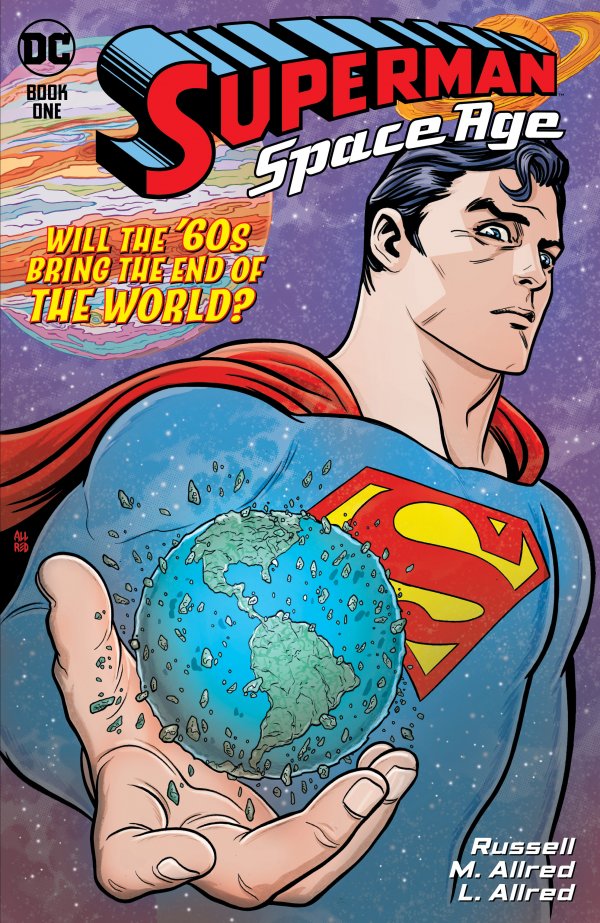
Notes: Continuing the theme of “Endings,” today I’ve decided to revisit the three-issue Space Age miniseries by Mark Russell and Michael Allred from 2022. Published as a Black Label series, like many of them, it really feels more like an Elseworlds. It’s set in a universe where Superman rises to prominence in the 1960s, with a Clark Kent that’s spurred to go out and find ways to save the world following the assassination of John F. Kennedy. Before he puts on his costume for the first time, though, he encounters a strange man called the Pariah, who warns him that the world will end in approximately twenty years. Pariah claims to have accidentally unleashed a great evil called the Anti-Monitor, an ancient being whose goal is to bring order to the Multiverse by destroying every positive-matter universe until only his own Antimatter universe remains. He tries to dismiss the Pariah as one of the “kranks” he’s assigned to cover as a Daily Planet cub reporter, but something about him sticks with Clark and he’s unable to shake it. On the other hand, he’s sometimes skeptical that the world will even last 20 years, as the arms race is intensifying and made worse by a false flag attack on Coast City orchestrated by Lex Luthor. The cataclysm turns out to bring heroes out of the woodwork: Batman captures Luthor, Abin Sur passes his ring on to Hal Jordan, Themiscyra sends Diana to the UN as an ambassador, and Superman makes his true debut disposing of American missiles before they can annihilate the Soviet Union. Book one ends with these four coming together at a new Hall of Justice.
In book two, we jump ahead to the 70s, where Superman is well-established, and the world is at peace following a nuclear disarmament treaty. But an interview with Lois leaves him questioning whether he’s doing all he can, and a similar disagreement drives a wedge in the Justice League. It’s a bad time for it too, as Green Lantern warns of the impending approach of a cosmic threat called Brainiac and, at the same time, a Superman from an alternate universe where all human life has been rendered extinct. It’s not all bad news, though – Clark is promoted to an editor’s desk at the Planet, Lois breaks Watergate, the two of them fall in love and she confesses that she knows he’s Superman just before he tells her. They even have time to get married and have a son before Brainiac arrives on Earth. But he’s not there to destroy the world, only to take its greatest resource before the Anti-Monitor can destroy it himself, hoping to use that resource in his battle against the Multiversal destroyer. That resource, as it turns out, is Kal-El of Krypton. The League drives Brainiac off the planet, but at the cost of Green Lantern’s life.
The final book in the trilogy takes us into the 80s where Clark finds Pariah again, who is impressed by his years of heroism, but still sees the end as inevitable. With less than two years before the Anti-Monitor arrives, the Brainiacs again ask Superman to join their fight, and this time, he considers it – but when a heart attack fells Johnathan Kent, he changes path, dedicating himself to saving the human race by eradicating disease by scanning their DNA. It turns out to be a ploy to record their genetic code. When the Anti-Monitor destroys the world, Superman makes for the Brainiacs’ portal, but instead of going into it he pushes through a crystal encoded with the DNA of every human he could collect, sending them to the empty world populated by the other Superman. He returns to his family just before the end, where on the other world the other Superman restores the human race on a new home.
In terms of “ending stories,” I kind of have mixed feelings about this one. On the one hand, it’s excellently done. The writing and storytelling are top-notch and the characters, even in the Elseworlds setting, still feel mostly true to the heroes we know and love. And I’ll pretty much always be on-board for artwork by Mike Allred, whose unique style is one of my favorites of all time. On the other hand, there’s an impending sense of doom that spreads across the entire thing. There are other dark “final” Superman stories, like Kingdom Come or Whatever Happened to the Man of Tomorrow?, but in both those cases we journey through the darkness with Superman and ultimately end in a place of hope. This one has a sense of nihilism that doesn’t quite befit the character. Even the ending, where the other Superman brings back humanity (starting, naturally, with Lois Lane), leaves us with the feeling that it’s only buying time. After all, the Anti-Monitor is still out there, the final battle has yet to be fought, let alone won.
The series raises some interesting questions as the different Leaguers look on things with different perspectives. Green Arrow views the world through the perspective of the “Trolley Problem,” whereas Batman’s point of view is that he just saves whoever he can, knowing he can’t save everyone. Superman, as fits the character, refuses to accept that, and is determined to find a way to save everyone even if doing so seems impossible. It’s a noble point of view that works in the regular DCU, but Russell shines a light on how unrealistic that perspective actually is. If I was looking for something realistic, though, I don’t think I’d be reading Superman in the first place. Superman is an ideal, and ideals don’t have to be realistic. They’re something to strive for, even if you know they can never really fall into your grasp, and that’s how Superman works best.
So is Space Age a good story? Yes. Absolutely. Without a doubt.
I don’t think it will ever be one of my favorites, though.
Mon., Dec. 29
Comics: DC Go! Holiday Special #47 (Supergirl), Doomsday Clock #1-12
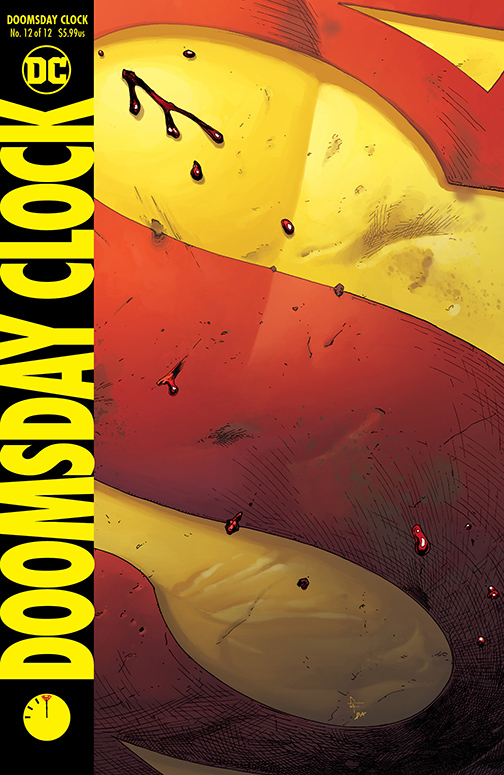
Notes: This is a controversial book, DC’s sequel to Watchmen which brings those characters into conflict with the heroes of the DC Universe, but I’m including it here for an important reason. In the end, this is very much a story about Superman. The first issue shows us the state of the world – since Ozymandias’s scheme was revealed by Rorschach’s journal, he has become the most wanted fugitive on the planet and the world has crept closer and closer to the very nuclear annihilation he was hoping to avoid. A new Rorschach has arisen, this time working with Ozymandias, who has a tumor growing in his skull. The two of them hope to find the only person in their universe with the power to change anything – Dr. Manhattan. Meanwhile, in another universe, Clark Kent wakes up from a nightmare, a horrible vision of the car crash that killed Jonathan and Martha Kent when he was only a teenager. It’s the first nightmare he’s ever had.
Ozymandias and Rorschach ally themselves with a pair of criminals – Marionette and Mime – who are seeking their missing son. They trace Dr. Manhattan to the DC Universe, where people are in upheaval following the popularization of the “Supermen Theory,” which posits the idea that the reason so many of Earth’s metahumans are American is because they have been deliberately created by the government since Superman’s first appearance. Faith in superheroes is eroding, with the only one who still has the public trust being Superman himself.
Over the course of these twelve issues Geoff Johns and Gary Frank delve into the nature of the DC Universe itself, starting with the notion (from DC Rebirth) that it was Dr. Manhattan who was responsible for the New 52 reboot in the first place. Turns out, it’s more complicated than that. Manhattan did toy with the fabric of the universe, but the reason it was possible for him to do so is because the “Prime” DC Universe – the one that’s called Earth-0 these days – isn’t actually part of the multiverse as we know it. Manhattan calls it the “Metaverse” (take that, Mark Zuckerberg) because it’s a core reality that the others are all reflective of. In the Metaverse, Superman made his first appearance in 1938 and inspired the heroes of the Justice Society. Then reality snapped, moving Superman’s appearance to 1956. The JSA still existed, but now Clark Kent had an early career as Superboy, inspired BY the JSA, and it was that Superboy that in turn inspired the Legion of Super-Heroes 1000 years in the future. Another snap popped Superman’s first appearance to 1986, and–
–are you seeing the pattern here?
The idea is this: Superman is the center of the Metaverse. As time goes forward, his existence is the constant, and as such, the universe is in a constant state of change. But every time the universe shifts, the previous iteration is preserved in a different world in the Multiverse. The original Golden Age Superman’s world is Earth-2. Another was preserved as Earth-1985. The version Manhattan created is Earth-52, and so forth. Eventually, Superman’s timeline will catch up with the Legion a millennium in the future, and when that happens, the ideals of Superman will become universal, and create a lasting peace.
Man, that’s a nice thought, isn’t it?
This book – much like the original Watchmen – suffered from a lot of delays before it could be finished, and many of the larger concepts have been ignored since then. I don’t think the concept of the Metaverse has been explored since this book, for instance, and by its very nature it makes sense that they wouldn’t bring it up all that often. On the other hand, this book also established that Martin Stein was part of a government conspiracy to create superheroes, and Firestorm was the result of that, something that I’m almost positive has not come up again. But that’s the beauty of this book – it provides a framework that can be used to explain away virtually any discrepancy or change in continuity. That thing you remember that the heroes didn’t? It happened in a previous iteration of the Metaverse, and it’s still canon out there in the Multiverse…somewhere.
If you’re the kind of person who considers Watchmen sacrosanct, I can understand why you wouldn’t like this book. It does, in a way, undermine the conclusion of that story by answering the intentionally vague question of what would become of Rorschach’s journals, and (perhaps even more blasphemous) it allows for that world to have a happy ending. But as good as Watchmen is, I have no objection to the notion of returning to that universe. The HBO miniseries did it in excellent fashion. I like this one too, if for no other reason than because it confirms something very important: Superman is the most important hero in the entire universe.
Shoot, guys. I could have told you that.
Tues. Dec. 30
Graphic Novel: It’s a Bird
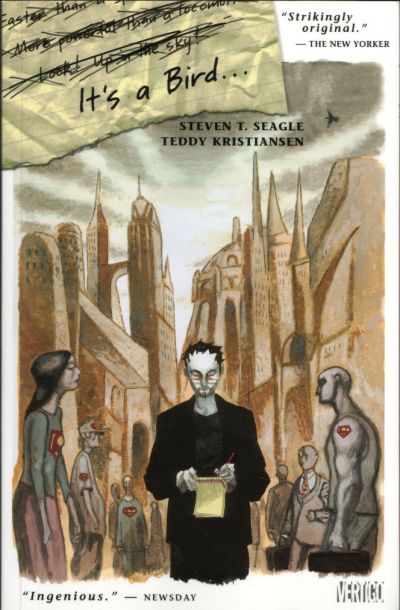
Notes: As with Doomsday Clock yesterday, I want to spend these last few days of the year with stories about Superman and about what he means. That quest led me back to It’s a Bird, the unique 2004 Vertigo graphic novel by Steven T. Seagle and Teddy Kristiansen. It’s perhaps the most unusual Superman story of them all in that Superman isn’t actually in it.
The story, which is semi-autobiographical, starts with five-year-old Steve waiting in a hospital as his grandmother languishes. To placate him and his brother, their father brings them a Superman comic…after which, Steve swiftly rejects comics, as they remind him too much of the hospital, making it all the more ironic that he would grow up to write them. When an adult Steve is offered the job of writing Superman by his editor, he rejects it, unable to find the character relatable.
The story is mostly about Steve trying to find his way into the Superman, and along the way he takes some interesting detours. His father goes missing, and fears of the disease that took his grandmother come back. Meanwhile, everyone he talks to about getting offered Superman is ecstatic for him and dumbfounded that he doesn’t want the job. These two threads are intercut with pages of Steve’s own musings on Superman, on who the character is and what he means – or at least, what he’s supposed to mean – as he tries to find something about the character that he can make believable in the real world.
The interlacing storylines, of course, come together in the end, because such things always happen in fiction even if they almost never do in real life. His father’s disappearance turns out to be related to the death of Steve’s grandmother all those years ago, and in confronting his father and the disease that haunts his family, Steve starts to find a way in to Superman.
It’s a good story, a powerful one, but it’s one whose inherent premise is one I somewhat disagree with. Steve’s quest is to find a way to make Superman “real.” I don’t think that’s necessary. Superman isn’t part of our real world any more than Mickey Mouse or Bugs Bunny or the food replicators on Star Trek. That doesn’t mean that he isn’t important, though, or that there’s nothing to be learned from them. In a lot of ways, I think the very fact of Superman’s fanciful nature is perhaps the most important thing about him.
Just as the story is very atypical for a Superman comic (such as it is), so is Teddy Kristiansen’s artwork. Kristiansen’s style is an odd halfway point between sketches and realism, in some ways making me think of Art Spiegleman…which is appropriate enough, as this book echoes Maus in various ways. Both stories are autobiographical, and with a frame narrative about the author struggling to relate to their fathers. In Maus, of course, the ghost that hangs between Art and his father is the spectre of the holocaust, while in this graphic novel it’s the shadow of the Huntington’s Disease that follows Steve’s family.
The book, of course, is specifically described as “semi-autobiographical.” Not really knowing much about Seagle himself, I wouldn’t presume to declare which parts are true and which ones aren’t, but regardless of any plot elements I tend to believe that all of the emotion in this book is genuine. The concerns, the fears, the anxieties that “Steve” expresses are almost certainly part of Seagle’s own psyche. Writers tend to do that, after all.
This is the Superman book for people who don’t understand Superman. I don’t know if, in the end, it will actually help them figure the character out – at least, not the way that I understand him – but it will at the very least help them find a path through someone else asking the same questions, and that’s a journey very much worth reading.
Comics: Harley Quinn X Elvira #3 (Power Girl guest appearance), Justice League Red #5 (Team Member Power Girl), Justice League Vs. Godzilla Vs. Kong 2 #6 (Team Member)
Wed. Dec. 31
Comics: Superman #247, Kamandi: The Last Boy on Earth #29
Notes: Well glory be, here it is. 365 days later, and the journey I started back on January 1 with Action Comics #1 is about to end…or at least, to evolve. I’ll talk more about that (say it with me) later, but for now, it’s time for the final Superman reads of the year. I thought hard about what to read today. In the early part of the year I’d planned to end it with a classic “last” Superman story, like Whatever Happened to the Man of Tomorrow? or Kingdom Come, but I decided to add those when I did the week of comics that influenced James Gunn’s Superman. So how else to end it? I ultimately decided to go with two comic books about what Superman is, because that’s where this entire journey has led me anyway.
First is Superman #247, the Elliot S! Maggin/Curt Swan classic “Must There Be a Superman?” Like many of the stories I’ve read this year, I encountered this one for the first time when it was published in DC’s classic Greatest Superman Stories Ever Told collection. Let’s talk about why it qualifies.
The story begins with Superman taking on a special task for the Guardians of the Universe – a pod full of deadly spores on a path to Earth, and as the spores are yellow the Green Lanterns are helpless to stop it. Superman creates an artificial planet to draw the spores away safely, but is injured in the process, rescued by Green Lantern Katma Tui and brought back to Oa to heal. As Superman is healing, the Guardians take advantage of his unconscious state to plant a notion in his mind that his influence on Earth may be impeding human progress. (If this had been the “Year of Green Lantern,” you would have found me discussing a LOT of stories that drive home an important point: the Guardians are pompous assholes.) When Superman wakes up, the Guardians give him a tour of Oa, continually dropping comments about him contributing to a “Cultural Lag” on Earth, and sending him home with the notion that if he steps back, Earth will be better off.
As he returns to Earth, he stumbles on a child migrant worker being abused by his employer. Rescuing him, the child – Manuel – brings Superman back to his community where the residents begin begging him to help solve all their problems, such as fixing their crumbling houses. Superman refuses, saying that they need to know how to care for themselves, but an earthquake strikes just seconds later, destroying their homes. Superman blunts the quake and rebuilds their houses, but tries to convince them that they need to know how to care for themselves because no one – even Superman – can do anything. He returns to Metropolis only to get word of a cruise ship endangered by a waterspout, which he rushes off to save, even as the Guardians watch from afar.
Looking back at this story now, I feel like this was Maggin’s way of responding to people who asked why Superman didn’t just sweep in and fix all the problems in the world. After all, with his power, why couldn’t he just solve hunger, homelessness, war, famine, disease, and so forth? From a narrative standpoint, of course, the answer is obvious: if Superman were to do all these things, what stories would be left to tell? It would literally be the end of Superman, as a going storytelling concern. But what about in-universe? How do you explain it to a kid like Manuel, who’s getting beaten up by a man who basically controls his entire life? The answer is something that people who know Superman could have told you from the beginning: even with the best of intentions, having someone (like Superman) doing everything for them would hold them back, leave them unable to act or take care of themselves. It kind of reminds me of all those stupid ads begging me to use Google AI to write an email or a Facebook post as if I haven’t been perfectly capable of doing that for my entire life.
Superman is there to take care of the things that we can’t. As far as the things we CAN take care of…we shouldn’t expect him to do it all for us. But that doesn’t mean we can’t take inspiration from him.
“Inspiration” is the theme of the final comic I’m going to read in this year of Superman, Jack Kirby’s Kamandi: The Last Boy on Earth #29. Kamandi, for the uninitiated, was a series about a post-apocalyptic world in which the human race is all but extinct, and the world is populated by anthropomorphized animals. In this issue Kamandi, one of the few remaining humans, finds the “Tablet of Revelation,” an ancient carving that prophesies the “return of the Mighty One,” a great warrior of the past. When the apes see Kamandi’s friend Ben Boxer, they believe him to be the returned “Mighty One.” One of the apes, Zuma, tries to engage him in combat, but the elder says that the Mighty One can only be revealed by demonstrating his powers against overwhelming odds. A catapult hurls claimants through the sky to prove that they can fly higher than the tallest building, an enormous boulder called the “Daily Planet” awaits the man who can move it, and so forth. Ben’s mutant powers convince some of the apes he’s the Mighty One, but a battle breaks out when they pledge to take him to his suit. In the fight, they come across a very familiar blue costume with a cape and a brilliant scarlet S-shield. Zuma tries to claim the costume, but perishes in battle as Kamandi defends the suit, saying “I know who owns it! I know that somewhere he’s still alive!” The suit is left, waiting until the true Mighty One returns.
This comic was released in 1975, some 30 years before the idea of the S-symbol standing for “hope” was put in place, but it’s hard not to think of it as you read this story. Kamandi’s faith that Superman is still out there is the sort of thing you’d expect, it feels like an appropriate place for the legend. The future of the DC Universe has been rewritten dozens of times, of course, with many of the various possibilities showing an immortal Superman, a legacy of heroes that lasts a millennia, or both. This feels like part of that, like the hero himself has left something behind with the promise that more is to come.
And that “promise of more to come” feels an appropriate place for me to stop.
Almost.
Movie: Superman (2025)

Notes: The first movie I watched this year was the original Christopher Reeve Superman from 1978. I’m going to end the year by revisiting the movie that inspired me to start this journey in the first place, James Gunn’s Superman. I’m not going to write it up again – Heavens knows you can find that on my original review. But I’m going to watch and enjoy.
One year later, and I have succeeded. I have watched, read, or listened to at least one thing starring or about Superman or a member of his family for an entire year. I’m actually quite stunned that I made it.
And I’ve still got so much to say.
But not yet. Come back Friday, friends, for my final thoughts on this year-long Odyssey, and my explanation of where I’m going from here.
Happy New Year.
Blake M. Petitis a writer, teacher, and dad from Ama, Louisiana. His most recent writing project is the superhero adventure series Other People’s Heroes: Little Stars, volume one of which is now available on Amazon.
Superman is often credited as being the “first superhero,” and as big a Superman fan as I am, I don’t know if I can necessarily agree with that. Admittedly, the word “superhero” didn’t exist before him, and there’s little doubt that the term borrowed the superlative from his name specifically, but when you think of the things that MAKE a superhero, there are definitely earlier examples. I started the year, if you’ll recall, reading Philip Wylie’s novel Gladiator, which many believe was an influence on Superman himself and definitely had several of the elements we attribute to Superman: superhuman powers that he kept a secret, which he attempted to use to do good (at least sometimes). Other elements, like the costume or the secret identity, could be found in characters that were around pre-Superman as well, such as Zorro or the Phantom. By most definitions of the term, there are a lot of characters prior to Action Comics #1 that you can rightly call a superhero.
That said, Superman is the character that first brought together most of these elements, and that started establishing “superhero” as a specific genre. Prior to Superman, and even after him for a while, characters that fit the bill of a superhero were considered an extension of other genres – adventure, science fiction, westerns, and so forth. In fact, I think that’s the reason that even now, you can select virtually any genre of storytelling and find an example of a superhero story that crosses over with it.
Once Superman was there, though, he became THE big name in the genre, and as such, he quickly became imitated. Some imitators just took the bare bones of the concept (costume, secret identity) and did something totally different with them, like Batman or Captain America. Later imitators would start to copy his powers and appearance with characters like the original Captain Marvel. Eventually, once the superhero genre was firmly established, we reached a point where kids who grew up reading them started to do their own twists on it, giving us characters that don’t even PRETEND they’re not a version of Superman. Sometimes they’re created for one-off stories or parodies, as in The Pro. Other times they’re populating an entire world of characters that pay tribute to earlier heroes, as we’ll see in a few of the books I read this week. In any case, these are the characters that we’re going to focus on this week: those heroes who are…almost Superman.
And as always, you can check out earlier blogs in the Year of Superman Archive!
Wed., Nov. 5
Comics: Invincible #1, Astro City #1
Notes: I’m going to kick off this week with two of my favorites. First up, Robert Kirkman’s Invincible. The first issue starts off with a bang – a young man in a black, blue, and yellow uniform flying through the air carrying someone with a bomb strapped to his chest. He throws the man into the air and the bomb explodes, killing the bearer (something, it should be noted, that Superman would never do) and the young hero expresses slight exasperation at his lot in life. Then the “how did we get here” flashback kicks in, introducing us (in the bathroom) to high schooler Mark Grayson. He’s going about his day, getting ready for school, attending class, going to work at a burger joint – when he accidentally hurls a sack of garbage into the stratosphere. He smiles and says “It’s about time.” Mark’s father, Nolan, is secretly Omni-Man, one of Earth’s mightiest heroes, and after years of waiting for it to happen Mark has finally inherited his dad’s powers. At school, Mark is unable to contain himself when he sees a kid getting bullied and steps in, nearly putting the assailant through a locker. Although the principal understands his actions, he cautions Mark not to get into fights with people so much bigger than him. “You’re not invincible,” he says.
He’s wrong, of course, and later on a bank robbery introduces Mark Grayson to the world with his new costume and his new name.
I’ve read the entire Invincible series, but I’m only dabbling in the first issue today (because there’s not time to read 143 of them). That said, like I did with Irredeemable in “Superman Gone Wrong” week, I’m going to talk about the broad scope of the series, complete with spoilers. If you’re watching the TV show and aren’t familiar with the comics, you may want to skip down to the next comic I’m reading today.
Invincible is an interesting way to start off this week. On the surface, of course, we’ve got Omni-Man, the obvious Superman analogue in Mark’s world, and it feels in this first issue that we’re reading about what it would be like to be the son of Superman. (This was in a pre-Jon Kent world.) In a few issues that’s all turned on its head with the big reveal of the series: Omni-Man, like Superman, is an alien hero sent to Earth. Unlike Superman, though, he is the point man for an invasion force, sent ahead to prepare Earth to one day be conquered by his people, the Viltrumites. When he learns about this, Mark turns on his father and, following a particularly graphic battle, Nolan flees Earth.
For a time, I considered using this book for “Superman Gone Wrong” week, since Nolan seems to fit that template perfectly. I decided to use it here instead, though, for two reasons. First, later in the series Nolan goes through a redemption arc, wins back his son’s trust, and joins him in the defense of Earth against their own people. And it’s a testament to the talent of Robert Kirkman that the redemption arc lands – eventually, the reader comes around to accepting Nolan as one of the good guys again, despite some of the terrible things he does early in the series.
The other reason I saved it for this week is because Omni-Man, although the clear Superman analogue, isn’t the actual star of the series, Invincible is. And Invincible is a different sort of character: Superman-like powers but with a tone that’s more evocative of Spider-Man. At least, that’s how it is at the beginning of the series. As it goes on, he sort of grows out of that template and becomes his own kind of thing, a character very different from either of his respective “parents,” and one of the few characters in modern times to break into the mainstream, thanks to that series on Prime Video.
And the show is very good, don’t get me wrong. But as is so often the case, I like the book better.
The other character I’m going to get into comes from one of my favorite series, from the first issue of that series, and from one of the finest comic books I’ve ever read: the Samaritan from the first issue of Kurt Busiek’s Astro City.

Coming off the wild success of Marvels, in which he and artist Alex Ross showed the Marvel Universe through the eyes of a bystander, Busiek launched Astro City in 1995. The idea this time is that the main character of the title is the city itself, a fully-realized world populated with superheroes and villains, many of whom are quite similar to those that we are familiar with. However, there’s no single anchor character – every issue or arc shifts perspective. Sometimes the main character is a hero, sometimes a villain, sometimes a loved one or a victim or a bystander. You never know quite what you’re going to get in any given issue of the book, and for that reason among any others, it’s one of my favorite comic book series of all time, and I eagerly anticipate its promised return.
The first issue, “In Dreams,” introduces us to the Samaritan, and it does so in a simple “day in the life” format. The Samaritan is woken up by an emergency alert early in the morning, popping him out of a dream in which he is flying. He suits up and rushes off to use his considerable powers to prevent a tidal wave in the Philippines from destroying a city, a trip that takes him 6.2 seconds from his hometown. As the day goes on, we see him take care of other assorted disasters, thwart assorted crimes and supervillain schemes, and have a meeting with the Honor Guard (if Samaritan is the Superman of this world, the Honor Guard is the Justice League or Avengers equivalent). We see him at work, as a fact-checker and proofreader for a magazine rather than a reporter. We also get a recap of his origin: he was sent back in time from a dying Earth to prevent the tragedy that led to its sad current state – the destruction of the space shuttle Challenger. In saving the world, the future he came from no longer existed, and he resigned himself to staying in the modern day and acting as one of Astro City’s superheroes. We see his life, and we see how incredibly lonely he is.
Throughout the issue, Busiek seeds little bits and pieces that begin to build the world of Astro City. We meet assorted other heroes and villains, get references to others. We learn that Honor Guard member MPH has an extraterrestrial nervous system for some reason, and learn a little of the story of a villain called the Living Nightmare. All of these little things make the world feel more lived in, and a lot of these little elements would pay off in later stories over the years.
The other thing that happens is that as Samaritan zips from each scene to the next, he keeps a running tally of how much time it takes to fly from one place to another. When he gets home that night, he calculates a total of 56 seconds of flight time for the day, “the best since March.” And then he goes back to sleep and resumes his dream of flight.
There are a lot of stories about Superman (or his copycats) that focus on the loneliness of the character, about how alienating it would be to be the last of your kind, to live in a world where there’s nobody else quite like you. That’s a legitimate take, of course. But too often, I find that stories that use this approach do so at the expense of Superman’s humanity. They treat him as an alien first, and to me, that misses the core of the character. Busiek’s Samaritan leans on the loneliness, but does so in a remarkably, beautifully human way. The story is sweet and sad and perfect, and it’s kept me a fan of the series ever since.
Both Invincible and Astro City are available in massive compendium editions (called “Metrobooks” in the case of Astro City) from Image Comics. If you’ve never read them, do it. There are few comics out there – besides Superman, of course – that I can give a higher recommendation to.
Thur., Nov. 6
Comics: Icon #1-3, New Adventures of Superboy #36, Blue Devil #4 (Guest Appearance), Justice League of America #37, DC KO: Knightfight #1 (Cameo)

Notes: When Milestone Comics was launched in 1993, an entire imprint of DC featuring characters and creators that were predominantly people of color, it was a pretty big deal. It shifted assumptions and preconceptions about how comics work and opened up the world of comics to audiences that would never have been interested before. Of course, like most storytelling experiments, it wouldn’t have worked if the stories being told weren’t actually GOOD. Fortunately, they were. And my favorite of the original line – this should surprise virtually no one – was Icon by Dwayne McDuffie and M.D. Bright.
The story opens in outer space in the year 1839, but in deep space, as we see an alien escape a doomed ship in an escape pod. The ship crashes to Earth and the alien shifts his form to imitate an infant form of the first Earth creature it encounters – who happens to be a slave in the American south. The alien takes the form of a human baby and is taken in by the woman who found him.
Time skips ahead to 1993, where the alien has been living on Earth for a century and a half under the guise of Augustus Freeman and his various similarly-named ancestors. Now living as Augustus IV, he’s become a highly successful lawyer in the city of Dakota, but finds himself dwelling on a recent encounter with a teenage girl. Raquel Ervin got drawn into some criminal activities with friends of hers who tried to rob Freeman’s house. When they ran into the man himself, he flew after them, shrugging off their bullets and warning them never to commit another crime. Raquel was astonished by what she saw and returned to Freeman later, urging him to use his powers to help people. She even designed a uniform for him and insisted she make him her sidekick, calling the two of them “Icon and Rocket.” Her words sway Freeman, and he gives her a belt to give her force field-based powers. They test out their new paradigm by responding to the news of a situation at city hall. Unfortunately, the cops don’t see a pair of heroes show up – just a strange pair of African-Americans in weird costumes, and they place them under arrest.
In issue two we get more information as to the situation: the mayor of Dakota has been taken hostage, and the cops were there to handle the situation, but the building is full of men with guns. The cops, with a unit called SHRED (Special Heavy-Equipment Rapid Emergency Deployment) are there to take the bad guys down, and they DON’T want help. Icon attempts to comply with the police request and explain themselves, but Rocket begins fighting the cops. Ico is stuck in the unenviable position of preventing Rocket from hurting the police and vice-versa. Once he gets Rocket to safety, he surrenders himself to the police to quell the situation, but he’s forced back into action by an explosion in city hall. He and Rocket save some of the police, then make it into City Hall where they learn that the man holding the Mayor hostage is one of the “Bang Babies,” people given powers by a strange gas during a recent event in some of the other Milestone titles, and he turns himself into a monster.
In issue three, Icon and Rocket face the monster – calling himself Payback, whose claws are capable of cutting Icon’s skin. Payback flees into the sewers and Rocket follows while Icon, injured, stays behind to clean up the rest of the human gunmen. He catches up to Rocket and Payback in time to hear the latter plead his case, how the mayor used the tear gas to prove she was “tough on crime” but wound up mutating innocent people. Icon promises that if he turns himself in, he will see to it that there’s an investigation into the “Big Bang” incident, and the people responsible will be held accountable. Bringing Payback in convinces the authorities that Icon and Rocket are on their side. At the end of the issue, though, he tells Rocket that she’s going to have to work from the sidelines for a while – with his super-senses he’s discovered something that she has not: Raquel is pregnant.
Such a great title. Amazing, unique characters and beautiful art made Icon stand out from other books on the stands, even from other Milestone titles. But that’s one of the things that made Milestone great – each title had a different perspective and point of view. Icon wasn’t like Static wasn’t like Hardware wasn’t like Blood Syndicate, and that was all to the good. What I particularly like about this title is the bait-and-switch, though. Icon is the title character. He’s the obvious Superman analogue. His powers, origin, and costume are all deliberately evocative of the man of steel. But it’s Raquel who’s actually the protagonist of this comic. She’s the main point-of-view character, she’s the one who starts Augustus on his journey, she’s the one who makes everything happen. And in fact, in the most recent iteration of the Milestone universe, they finally shared billing on their title: Icon and Rocket.
Like many of the books I’ve read so far this week (and it’s only Day Two) I find myself wanting to go back and read more. Maybe 2026 will have to be the Year of Characters Who Are An Awful Lot LIKE Superman.
Fri. Nov. 7
Comics: Love and Capes #1, DC Vs. Vampires: World War V #12 (Supergirl, Steel Appearance)
Notes: I don’t know if I’ve mentioned it lately, but I am a geek lucky enough to be married to another geek. My wife doesn’t share all of my geekdoms, nor I hers, and where there IS overlap they’re usually at different levels (she’s more into Star Wars, for instance, whereas I prefer Star Trek, but we watch ‘em both together). All that is to say that, as she isn’t AS big into comics as I am, she never lets me forget that she’s the one who first introduced me to Thom Zahler’s Love and Capes.
Mark Spencer is the Crusader, the big, strong, flying guy with the cape. He hangs out with a shadowy avenger of the night called Darkblade. He used to date a powerful warrior woman called Amazonia. And as we soon learn in issue #1 of this delightful series, he’s head-over-heels in love with a perfectly ordinary bookstore owner named Abby Tennyson. In this issue, Mark decides to tell his girlfriend that he loves her, but also, share with her the secret of his dual identity.
And thus begins the series that Zahler refers to as “a heroically super situation comedy.” Love and Capes is the superhero romcom you never knew you needed. While Abby isn’t exactly a Lois Lane, Mark is clearly his world’s Superman (down to the glasses he wears to protect his identity), and this first issue explores a lot of the questions that would naturally arise in any such a pairing. Once Abby learns his secret we see her struggle (and fail) to keep her sister from finding out, feel her bristle with insecurity when she learns that Mark and Amazonia used to date, and sit with her on the couch in quiet horror as she watches the Crusader fighting a supervillain on TV, realizing that she’s never seen him bleed before.
The wonderful thing about Love and Capes is just how naturally Zahler weaves the superhero story in with the kind of real life drama (and comedy) that comes in any relationship. Over the course of this series we see Abby deal with all sorts of things that would naturally come along with being a superhero’s girlfriend – evil doppelgangers, time-travel, meeting the rest of the superhero team and so forth. We also see Mark deal with simple, common relationship stuff, like trying to find time for one another when one of you is a workaholic, blending your friend groups, and ultimately (spoiler warning here) the challenges of marriage and parenthood.
Interestingly, Zahler leans away from the superheroics of the universe. Sure, we see Mark using his powers all the time, but we virtually never see any superhero fights or adventures, merely the aftermath, as the relationship between Mark and Abby is what’s actually important. That gives this series a perspective that completely sets it apart from every other not-quite-Superman on the market.
It’s only fair to admit that I’m an enormous fan of this book. In fact, for the Mark and Abby’s nuptials in issue #13, I took advantage of a “wedding” package Zahler made available to fans to get yourself drawn onto the wedding scene on the cover, so if you’ve got that issue, you can actually find me with (my then-girlfriend, now wife) Erin attending Mark and Abby’s wedding. What’s more, Zahler and I have struck up a friendly acquaintance over the years, and he even name-dropped me as the owner of a po-boy shop in New Orleans in his series Cupid’s Arrows. I say this not to brad, but to be quite clear that am not unbiased in my praise for this series.
But I hope you believe me when I tell you that I would be just as effusive a fan even if it weren’t for any personal connections we have. It’s just a sweet, lovely book, and every so often when he brings out a new miniseries or special, I’m as gleeful to pick it up as I was the first time.
Sat., Nov. 8
Comics: Adventures of Superman: Book of El #3, Absolute Superman #13
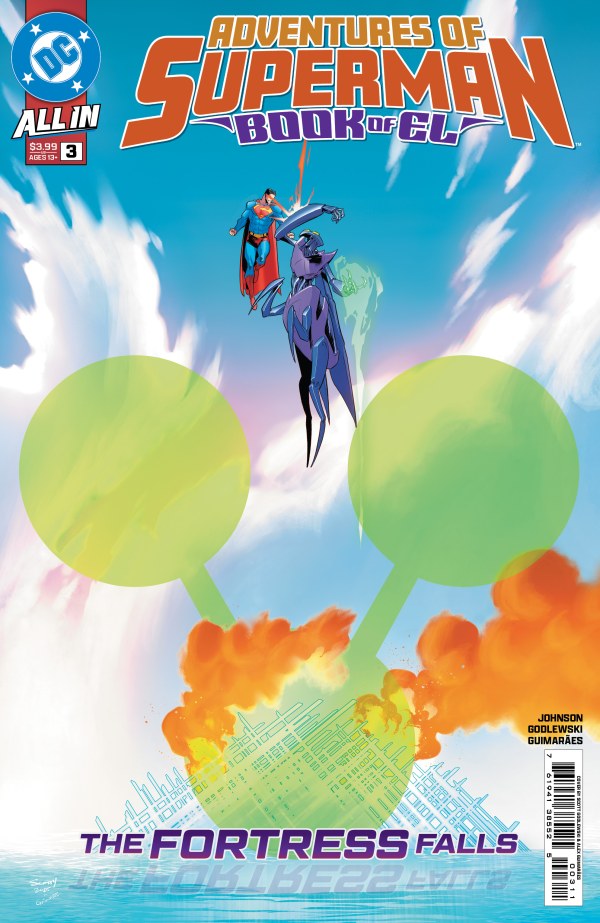
Notes: I’m going to hit this week’s new Superman comics today – only two of them, but they still count. And I’m starting with the third issue of Adventures of Superman: Book of El. Trapped in a future that believed him to be lost, Superman and his last descendant, Ronan Kent, return to the Fortress of Solitude to find a way home. Unfortunately, Brainiac’s legion is on his trail, and determined to keep him in this distant future instead of allowing him to go home and prevent this world from happening. There’s also a nice reveal at the end, a hope spot that’s subverted and sets the stage for the rest of this miniseries.
Reading this book is a little frustrating to me. I should like it. I honestly should. There are tons of little elements that work well – a time machine that looks like it was dropped out of H.G. Welles, a giant turtle Jimmy Olsen…and Phillip Kennedy Johnson completely understands the characterization of Superman. There’s a point where he tells Ronan “As long as you wear that symbol, your strength doesn’t belong to you. It belongs to those who NEED you.”
And yet somehow…I’m just not engaged. I think it’s the nature of the project – Superman is stuck in a future where he was lost. He wants to go home to prevent that future from happening. And since we know that DC isn’t going to allow him to stay in the future forever, his successful return is a foregone conclusion. It doesn’t matter how high the stakes get, in the end, it still feels so inconsequential. At least in an Elseworlds story you know that the consequences for THAT universe are real. I don’t get that here, and that’s dulling my enjoyment considerably.
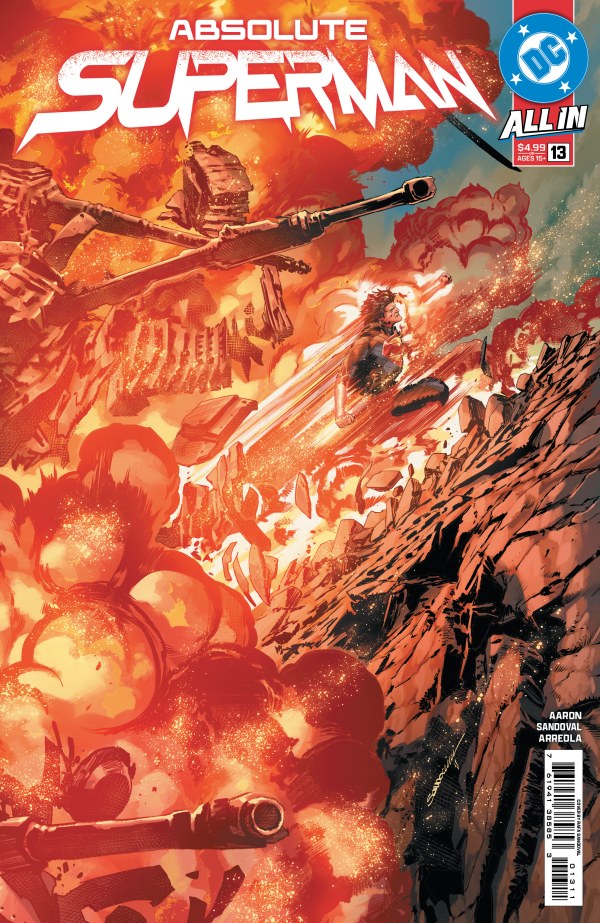
Absolute Superman, on the other hand, not only feels like the consequences are real, but also that – in this Absolute universe – virtually anything can happen. As Lazarus begins its attack on Smallville, Kal-El orders Sol to override its original programming to protect him and, instead, expend its energy becoming a shield surrounding Smallville. But the resources of Lazarus and its Peacemakers are too much, even for Kal-El, and the small town is overrun. As he struggles against their forces for weeks, Lois and Jimmy try to broadcast the truth about what’s happening in Kansas to the rest of the world.
Most of the issue bounces around non-linearly from the beginning of the war to the “present,” six weeks later, showing different conflicts and encounters both on and off the battlefield. Jimmy and Lois reflect on how the appearance of Kal-El is what made them turn against Lazarus, which is just one of the things I really like about this issue. The thesis of the Absolute Universe is that this is a world fueled by Darkseid, where “hope” is always the underdog…and yet this is where the hope shines through. Kal-El, Superman, even in this dark world is held up as a beacon. There’s a scene where he confronts someone who – well, did him wrong, let’s just say – and for a moment you wonder just where Jason Aaron is going to take the scene, but in the end, he does the Superman thing. And I just love it.
Feature Film: The Iron Giant (1999)

Notes: Anyone who loves The Iron Giant knows already why I’m watching it for this week’s theme. Anyone who hasn’t seen it – I envy the fact that you’ll get to experience this for the first time. Because of all the stories that do NOT actually feature Superman, there is none that more fully captures the Superman ethos than Brad Bird’s 1999 animated masterpiece.
In 1957 Maine, a lonely boy named Hogarth finds an enormous robot alone in the woods. Hogarth befriends the Giant, who has a dent in his head that seems to have damaged his programming, leaving it with no memory of its origin or purpose. Hogarth begins to teach the Giant about humanity, playing games with it and showing him his comic book collection – including classic issues of Action Comics, and the robot finds a role model. But the military, naturally, is searching for the Giant as well, fearful of what it may represent. An agent named Kent Mansley tracks him down, but is unable to convince his superiors that the threat is real.
Playing with the Giant, Hogarth points a toy gun at him, temporarily causing his original programming to kick back in and it reveals him to be a weapon of some sort of alien civilization. Broken-hearted at learning the truth about itself, the Robot flees, and Hogarth follows. When a pair of boys fall off a roof in town, the Robot reveals itself and saves their lives. The town watches him in awe, but Mansley and the army turn back around to combat the threat. They open fire on him in the middle of the town while he’s holding Hogarth, and he flees. Each attack continues to bring his programming to the surface, but he fights against it until they hit him with a missile, blasting him from the sky. Hogarth is knocked unconscious in the crash and the Giant’s programming takes over, turning on the army and attacking with the full force of his weaponry. Mansley convinces the general to target the Giant with a nuclear weapon, then in his panic hijacks a walkie-talkie to order a strike that will wipe the small town and all its innocent citizens off the map. But the Giant overcomes his original programming, remembering the lessons Hogarth taught him. In the end, he makes a decision that proves him not only worthy of the “S,” but that – like Superman himself – his alien origins are irrelevant. His soul may be among the most human of us all.
I can’t tell you how many times I’ve watched this movie, but I can tell you how many times I’ve watched it without crying, and that number is zero. Director Brad Bird, who would go on to much greater acclaim at Pixar with movies like The Incredibles and Ratatouille, uses the era of the Red Scare as a backdrop here. It’s a shorthand to amplify the fears of the townspeople of the Giant, making the concerns put on display a bit more justifiable and somewhat removing the need for a more traditional antagonist. To be certain, the military in this movie are the ones who are acting against the Giant, even threatening his life, but none of them are doing it from a place of evil. Mistrust, misunderstanding, sometimes even arrogance, but everyone who tries to destroy the Giant does so out of a sincere belief that he’s dangerous. Mansley is the most villainous character, lying to the general, telling him that the Giant has killed Hogarth (as far as he knows, the Giant is merely CARRYING Hogarth) in order to get them to continue their attack, and generally being a jerk. Even he, though, sincerely believes that this giant alien robot is dangerous, and it’s hard to disagree with the logic behind that fear. Honestly, it’s not even like they’re wrong – had his original programming not been subverted when he came to Earth, it seems quite likely that he WOULD have laid waste to the entire planet. So yeah, this is one time where the antagonists kinda have a point.
That said, what makes this work so beautifully is the way the Giant grows beyond what he was originally built for. Anyone who’s seen this movie can remember two lines from Vin Diesel (voicing the Giant in his most lifelike performance outside of Groot). One, when Hogarth tries to make him the bad guy in his game, is the adamant declaration: “I AM NOT A GUN.” The other comes at the end, as he makes the choice to sacrifice himself for the lives of the people below him – not only Hogarth, but the very ones who chased and attacked him. As he takes to the air to save them all, he closes his eyes and smiles and whispers the name he has chosen for himself: “Superman.”
There’s another line that echoes in the film: “You are what you choose to be.” Harry Connick Jr.’s character says it to Hogarth, and later Hogarth says it to the Giant. Then, 26 years later, Jonathan Kent says something very similar in James Gunn’s Superman. It may be a coincidence, but only in that two storytellers who intimately understand the Man of Steel chose to use the same sentiment to get that idea across.
I don’t like pop culture gatekeepers. I don’t think anybody has the right to dictate what a “real” fan is to anybody else. That said, I find it very difficult to conceive of anybody who truly understands Superman without being utterly in love with this movie. It’s one of the greatest superhero movies ever made.
TV Show: Superman and Lois Season 3, Ep. 2, “Uncontrollable Forces”
Sun, Nov. 9
Comics: Supreme #1-6
Notes: The works of Rob Liefeld can sometimes be…well…divisive. And to be perfectly blunt, I’ve never been a fan. But this summer, I happened to come across the first six issues of Liefeld’s Superman pastiche, Supreme, while rummaging in a dollar bin in a comic shop in Mississippi. Knowing that “Almost Superman” was on the docket for later in the year, I decided it would be worth the six bucks to get a taste of it. Now I know that most people say that the best Supreme stuff came later, when Alan Moore wrote the title, and would probably suggest it’s more beneficial to read THAT run than Liefeld’s original. To those people, I simply say: the Moore stuff wasn’t in the dollar bin.
Liefeld shared both the writing and art chores with Brian Murray for this book, which oddly enough is labelled as “Volume Two” even though, as far as I can tell, there was never a “Volume One.” In “Second Coming,” Liefeld’s premiere superhero team Youngblood is summoned to outer space when a strange figure approaches Earth. He claims to be Supreme, a hero who apparently vanished 50 years ago, and after a very 90s scuffle, they accept him as who he claims to be and return him to Earth. Although offered a place with Youngblood, he leaves and returns to orbit, looking down on Earth and crying. Issue two begins with Supreme lamenting the loss of the heroes he fought with 50 years prior and looking down at the heroes that exist on Earth now: Youngblood, Spawn, Savage Dragon, Cyberforce, WildC.A.T.S (it’s a “Who’s Who” of early Image). He’s upset that the heroes of today seem to be created and funded by corporations (this is clearly NOT true of Spawn), then drops in to a prison to murder somebody named Grizlock. Grizlock seems to be his arch-enemy, his “Lex Luthor” if you will, who killed Supreme’s equivalents of Jimmy and Lois some 50 years prior. Before he can get his revenge, he winds up fighting some superhumans called Heavy Mettle who appear from that magical space between panels, because nothing else makes sense. After several pages of Supreme battling characters that I could swear were designed to deliberately lose a bet, they convince him to hear out their boss, Jason Temple, explaining why Grizlock should get to live.
At this point, friends, I’m going to give up on the play-by-play, because any attempt to continue with that exercise would be to imply that anything that happens in this comic book series makes the slightest bit of sense. I read six issues of this nonsense, and here’s what I can tell you: Supreme spends several issues fighting some guy called “Khrome.” Yes. “Khrome.” Who apparently was formerly his ally, but now they’re trying to kill each other, because it was the 90s. Khrome is as boring and generic a villain as you can imagine, which means he fits in with the rest of this comic book like a jigsaw puzzle with a picture of a dog peeing on a fire hydrant. Every character is dull and generic, with designs that look like somebody spilled a box of Lego minifigs and assembled the pieces entirely at random. The names and powers are forgettable, and the motivations are nonexistent. It’s a lot of punching and blowing things up at the expense of anything resembling a plot or characterization.
My intention, this week, has always been to compare the kinda-Supermen to the real deal, but there’s not even enough of Supreme to do that. He seems sad to have lost people in his past, but his callous disregard for the lives of the bystanders to his pointless battles defies anything that could be considered Superman-like. There simply isn’t anything THERE. This is one of the worst things I’ve ever read, and I don’t just mean in comics. This is the first time I’ve ever read the letter column of an old comic book and felt the urge to seek out the people who wrote in and praised the book to ask them if they ever sought out the psychiatric help they so clearly deserved.
From what I can tell, Alan Moore’s run on this comic started with issue #41. It is a testament to the money-printing machine that was the earliest years of Image Comics that this book ever even made it that far, because it was an utter, absolute, incomprehensible mess.
All that said, it’s still better than anything AI could make.
Mon., Nov. 10
Comic: Big Bang Comics #2, Mr. Majestic #1, Jon Kent: This Internship is My Kryptonite #18, Infinity, Inc. #6 (Team Member Power Girl)
Notes: Today I’m going to move on to a series that’s as delightful as Supreme was frustrating: Big Bang Comics. Big Bang is a publishing imprint created by a revolving group of writers and artists who have crafted a shared world that pays tribute to all eras of comic books. Their universe is populated by thinly-veiled homages to the all-stars of DC and Marvel Comics, with stories set in – and emulating the styles of — the Golden, Silver, Bronze, and Modern ages of comics. There are legacy heroes and names passed down from one generation to another, and in the 30 years of its publication they have played host to numerous ongoings, specials, and miniseries featuring their assorted heroes, such as the Knight Watchman (their Batman analogue) and the Round Table of America (no points for guessing what that might be). They were originally published by Caliber Press, then had a nice run at Image Comics. These days, they self-publish, and new installments are still released a few times a year.
To represent this world I’m digging into 1994’s Big Bang Comics #2, the first comic with a story starring their Superman representative, Ultiman. (This issue also contains stories of their Flash substitute the Blitz, and the Human Sub, who’s kind of a mashup of Aquaman/Sub-Mariner and Bulletman, but Ultiman is what we’re going to focus on.) Writer Gary Carlson and artists Jon Schuler and Don Simpson craft this Golden Age-style tale of Ultiman, “the Ultimate Human Being,” as he battles the “Sub-Oteurs.” The Nazis, it seems, have developed a drilling craft with the ability to tunnel underground, which they are using to attack freight trains delivering supplies for the war effort. When he hears about the attack, Ultiman (who apparently sits around his house in full uniform listening to a radio with his emblem on it) leaps into action from his home in Empire City. Just as Golden Age Superman couldn’t fly, Ultiman hitches a ride on the outside of a passenger plane that takes him to the scene of the attack, then rushes to save miners trapped in a nearby cave-in. Rescuing the miners, he discovers an odd tunnel with tank treads on the ground, following it to the German “submarine” that’s attacking a dam. Ultiman uses a car and his “thermal vision” to seal the cracks in the dam, then sets out to tackle the Sub-Oteurs. He captures the Nazis and sends the empty sub on a trajectory to drill straight to the center of the Earth.
This is an almost flawless representation of the Golden Age of comics. All it would take is redrawing Ultiman and maybe adding a page of him as Clark Kent hanging out around the Daily Planet and it would be virtually indistinguishable from the real thing. That’s the charm of Big Bang, the way they so lovingly recreate the worlds of classic comics. This isn’t a parody or a satire, nor is it a deconstruction. It’s just a new world that mimics the classics.
Later Big Bang stories would develop Ultiman’s world much more, giving him a secret identity and an origin, related characters, and even using the multiple Earths concept to have two Ultimen (those of Earth-A and Earth-B) come into contact with one another. I wish there was some sort of omnibus of the entire universe, but alas, no such thing yet exists. Still, if Gary Carlson or anybody at Big Bang is listening, there are at least some of us who would be really happy if here was an easy guide to buying and reading the entire universe, even digitally. (The new stuff is available digitally, I should mention, it’s the older stuff that’s harder to find.)
The most important takeaway here is that if you’re trying to find classic stories in the style of Superman from various ages (or Batman or Captain America or any of a dozen others), Big Bang Comics has what you’re looking for.

Moving on, let’s look at Mr. Majestic #1, from Wildstorm Comics. Wildstorm began at Image Comics before Jim Lee sold the company to DC and became one of its executives, and it was at DC that their one of their Superman analogues, Mr. Majestic, got his first miniseries. (The other analogue would be Apollo of The Authority, but Majestic is more “classically” Superman.) As Wildstorm became more integrated into the DC multiverse, Majestic met Superman several times and even temporarily took his place in Metropolis during one of those periods when Superman went missing for one reason or another. I’m going to look at the first issue of his first series for today’s entry.
Written by Joe Casey and Brian Holguin with art by frequent Superman artist Ed McGuinness, “Cosmology” begins at some point earlier in the 20th Century with the alien hero Mr. Majestic in space, taking care of the sort of extraterrestrial menace that superheroes have to take care of, before returning home to his secret lair inside of Mt. Rushmore. With the help of a boy genius named Desmond, Majestic determines the probe he fought in space was engaged in the task of mapping Earth’s solar system in exquisite detail, for a purpose that he fears goes even beyond a simple alien invasion…something, he says, that is likely to occur within a century. He gathers a braintrust and begins making preparations, spending decades seeking a way to somehow hide the entire solar system, ultimately deciding upon moving various heavenly bodies and altering the appearance of others in a sort of camouflage. In the end, the thing the probe was summoning arrives, and Majestic can only watch to see if his decades of effort have been worth it.
I very much enjoyed this one. Majestic is like Superman in a lot of ways, not only in his power set, but in his sheer determination to protect Earth, which comes across very much as a Superman sort of thing to do. And while the editors of DC Comics would never have approved a story where Superman sets himself forth on a single task that lasts for decades (at least not without some sort of timey-wimey reset button at the end), it’s very much the kind of thing he WOULD do if he deemed it necessary. This first issue of Mr. Majestic is a perfectly encapsulated standalone story that showcases a Silver Age style problem and response with a Modern Age execution. Like Astro City and Icon, I’m left wanting to continue and read more of his adventures.
Tues., Nov. 11
Comics: Squadron Supreme #1, Justice League of America #38 (Team Member), Superman’s Girl Friend Lois Lane #15

Notes: To close out this week, I wanted to end with arguably the most successful otherworld Superman in comics – Marvel’s Hyperion of the Squadron Supreme. The Squadron was first introduced in the pages of Avengers in a story by comics legend Roy Thomas, who reportedly just wanted to do a story in which the Avengers fought the Justice League. This was before the era of crossovers though (and even once that era arrived it still took over two decades for JLA/Avengers to come out), so Thomas had the Avengers cross over to another universe where they met the Squadron, a team of characters who were an awful lot LIKE the JLA. Nighthawk was their Batman, Power Princess was Wonder Woman, Golden Archer was Green Arrow, and so forth. Their leader, Hyperion, was in reality Mark Milton, the final member of his universe’s race of Eternals, which obviously calls into question the name of the species.
Anyway, the struggle I had with this was figuring out which story to read for Hyperion. In most of their appearances, the Squadron has usually appeared as a team, with little focus on solo stories for the individual members. There was eventually a Hyperion miniseries or two, but those were part of the Supreme Power line, which was essentially the Ultimate version of the Squadron, and honestly not the one I’m interested in. After a bit of prevarication I decided to go with the first issue of the legendary Squadron Supreme limited series from 1985, which is almost certainly the best story ever told with these characters, even if it isn’t Hyperion’s story specifically.
Squadron Supreme #1, by Mark Gruenwald and Bob Hall, opens in a very Supermanly way: Hyperion in outer space, struggling to prevent the collapse of the Squadron’s satellite headquarters as it’s falling to Earth, and ultimately steering it to the ocean where it won’t hurt anyone. He meets up with his fellow Squadron members, Amphibian (Aquaman), Dr. Spectrum (Green Lantern), and the unfortunately-named Whizzer (the Flash) to bring it from the ocean and find a resting place for it. The destruction of their satellite turns out to be symbolic – the entire world has crumbled around the Squadron in recent years, and things on their Earth are getting worse and worse. We see the other Squadroners dealing with things like riots, blackouts, and a refinery on the brink of an explosion. How could things have gone so wrong?
The next few pages give us the recap. Nighthawk, in his secret identity of Kyle Richmond, had decided that he could do greater good in politics, running first for congress, then president. And it was President Kyle Richmond who was taken over by an alien invader called the Overmind, who then proceeded to take control of the rest of the Squadron – save Hyperion – and use them to conquer the world. Hyperion, with the help of “other heroes” (notably some he brought over from Marvel’s Earth-616) defeated the Overmind, but the world is still in dire straits after what happened to it. Hyperion reflects on the human parents who raised him, and how they taught him to use his powers for good, but not to interfere too much in the development of humanity. His parents, Hyperion decides, were wrong. At his urging, the Squadron decides that the only way to clean up their mess is to take control and do it themselves – in other words, superheroes taking over the world. All of the Squadron agree to his proposal, except for Amphibian and Nighthawk, and Nighthawk quits in protest.
A series of vignettes shows each of the Squadroners reconnecting with their civilian loved ones – in the case of Hyperion, letting down his Lois Lane analogue by telling her he “used to masquerade” as Mark Milton, he’s abandoning his human identity, and he’s sorry about leading her on for all those years. The next day, Richmond resigns as president and, moments later, Hyperion steps up and announces his plan for the Squadron to save the world by taking it over themselves. They ask the people of Earth to give them one year to conquer “hunger, poverty, war, crime, disease, pollution, and oppression,” and swear to voluntarily give up power if they cannot do so in 12 months. Then together, the Squadron removes their masks and promises a “new age of trust and friendship and unity for all the Earth!”
Spoiler alert: it didn’t go that well.
Coming out in the mid-80s as it did, Squadron Supreme is often overshadowed by the likes of Watchmen and The Dark Knight Returns in the conversation about great deconstructions of the superhero genre, but I’ve always felt like it belonged right on that same tier next to them. In fact, in some ways I think it’s even more reflective of what superhero comics actually WERE at the time. Watchmen was an alternate history and Dark Knight was set in the future, but Squadron Supreme was in the here and now (or at least the now) and showed what the consequences in the modern world would be of having a superhero team that actually followed through on the logical fear that critics of the genre have about superheroes – what if they just decided to take over?
Hyperion comes off as much colder than Superman here. His ideals are similar, but the way he dismisses his human parents and the woman who apparently loved him (who I’m pretty sure never shows up again in this series, although it’s been some time since I read the entire thing) is very harsh. Even in the Silver Age, when Superman treated Clark Kent as a disposable disguise, even when he would put Lois Lane through ridiculous turmoil in order to “teach her a lesson,” it came from a place of genuinely wanting to make her better, with at least a token effort made to protect her feelings. Hyperion has no such concerns for Lonni, and in fact, shows far more emotion about the defection of Nighthawk, who even crafts a bullet out of Hyperion’s local equivalent of Kryptonite, but can’t bring himself to pull the trigger
This is a great look at a different type of world, and it’s one that would come back and be relevant to the Marvel Universe again many times and in many ways over the years. Plus, it’s just an excellent story.
It was a fun week, guys. I’ve taken a look at a lot of cool, interesting variations on the Superman theme, and I also read six issues of Supreme. But as great as many of these stories are and as interesting as the faux Supermen have been, I’m going to be happy tomorrow to get back to the original, because when you get right down to it, there’s nothing like the real thing.
The Iron Giant comes close, though.
Blake M. Petit is a writer, teacher, and dad from Ama, Louisiana. His most recent writing project is the superhero adventure series Other People’s Heroes: Little Stars, volume one of which is now available on Amazon. You can subscribe to his newsletter by clicking right here. You can join in the Kryptonian Konversation every day in the Year of Superman Facebook Group!
As you may know if you read my other blogs and watch my videos, I love Halloween. I love the last three months of the year, really, it’s the best part of the year and sometimes just waiting for it to happen is what makes me happy. And even here in the Year of Superman, I’ve got plans for October that will allow me to dip into the darkness, starting today with VILLAIN DEBUT WEEK. For the next seven days, I’ll be looking at the first appearances of some of Superman’s greatest – or at least most memorable – foes. And I gotta tell you, putting this together wasn’t as easy as you might think. As great a hero as Superman is, his rogues’ gallery doesn’t have as deep a bench as Batman, Spider-Man, or the Flash. What’s more, I’ve already covered the first appearances of several of his villains this year – Darkseid, Metallo, Doomsday, and the Cyborg Superman have all had their origins show up already. Others, like Conduit, had a long, protracted first storyline that I didn’t want to devote that much time to this week. Still more, also like Conduit, flamed brightly, but briefly, and then faded to obscurity. That said, I’ve picked what I think are enough memorable baddies to fill out the week, and I’m going to cover them in chronological order of first appearance.
And as always, you can check out earlier blogs in the Year of Superman Archive!
Wed., Oct. 1
Comics: Action Comics #13 & 14, 23
Notes: I’m gonna start off Villains Origin Week with the first supervillain Superman ever fought, followed by the character who is now revered as his greatest enemy. We’ll begin in Action Comics #13 from 1939 – the first appearance of the Ultra-Humanite.

The story starts pretty simply – Clark Kent is taking a cab to work at the Daily Star when he gets rammed by another taxi. He discovers that there’s a cab company exercising a protection racket against the other cabbies in town, trying to force them to sign up. After Superman busts Reynolds, the guy in charge of the racket, Reynolds is freed from a police transport. Superman takes off after him, chasing him to a cabin in the woods where his balding boss awaits. He introduces himself as the Ultra-Humanite and declares that a scientific experiment has given him the “most agile brain” on Earth, which he intends to use for world domination.
World domination, as we all know, frequently begins by muscling cab drivers for a percentage of their fare.
The Ultra-Humanite jolts Superman into unconsciousness with enough electricity to kill “five hundred men.” The waylaid hero is strapped to a board and driven into a circular saw, but the blade splinters on Superman’s skull and sends shrapnel around the room, one of the fragments piercing Reynold’s throat and killing him instantly (a pretty rare death indirectly caused by Superman). When Superman regains consciousness, the Ultra-Humanite flees in an airplane. Superman leaps into the air and smashes the plane’s propeller, sending it plummeting to the ground. When Superman examines the wreckage, there is no trace of the villain.
Wow, what a different story than the Superman we see today.
Not only is Superman far more cavalier about things like Reynolds’ death (even if it isn’t Superman’s fault), but he’s far more reckless when he causes the plane to crash. As for the Ultra-Humanite himself, he’s a far cry from the villain he would become. His schtick these days is his ability to leapfrog his mind from one body to another, with readers being most familiar with the albino gorilla body he uses most of the time these days. Not only is there no trace of his mental abilities, even his claim of having the “most agile” brain in the world doesn’t really hold up to much scrutiny here, as he doesn’t appear to have any greater intelligence than any other villain Superman had faced up to that point. He returns in issue #14, having escaped his death and once again nearly getting Superman in a deathtrap, but Superman got away again. I don’t know if Jerry Siegel – who wrote these stories – was deliberately trying to position the Ultra-Humanite as Superman’s greatest foe, but a lot of the elements inherent in this version of the character would soon be swapped with another, far more memorable villain.
Because Action Comics #23 gave us the first appearance of Lex Luthor.

In a story that definitely feels like it inspired James Gunn at least a lil’ bit, Superman discovers evidence that a war between two nations is being spurred on by the machinations of a mysterious profiteer named Luthor. When Clark Kent goes public with this knowledge, Luthor goes on the attack. Although not as drastic as the change between the embryonic Ultra-Humanite and his later form, this early Luthor is much different than the one we would grow to know and love to hate. His first name is never mentioned, and he comes across as more of a war criminal than the mad scientist or ruthless businessman he would later evolve into. He also has his famous red hair in this one. The story goes that when Luthor was brought back in a later story, the artist looked at this original for reference and mixed up Lex with his bald-headed flunky, changing the course of comic book history. It’s amazing, though, how time changes all these characters. Looking back at this original story, one could hardly believe this character would grow into one of the greatest supervillains of all time.
Thur., Oct. 2
Comics: Action Comics #51, 64, Superman #30, Taste of Justice #13
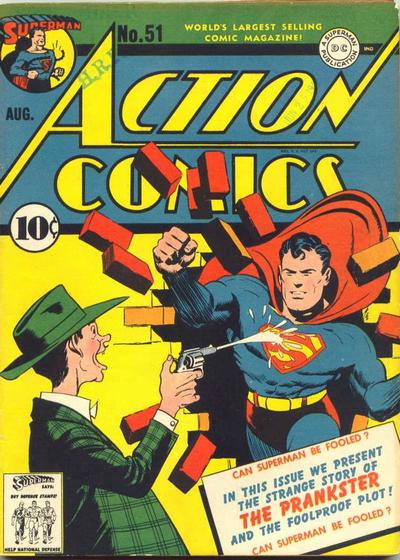
Notes: When I made my list of which villains I intended to include in this Villains Origins week, I decided I would go through that list chronologically. Upon doing so, though, I noticed an interesting pattern. The villains in Superman’s life – obviously unintentionally – seem to have been introduced in themed phases. Yesterday, Luthor and the Ultra-Humanite gave us the evil genius era. Today, in the early 1940s, we’re going to visit a trio of villains that all happen to fall under the category of what I’d call “pests” rather than legitimate threats. These are crooks who all are more of a nuisance than actually evil, out to have a little fun and sow a little chaos – although that doesn’t mean that, in later (and darker) eras of comics they weren’t used for more malicious purposes. I’m talking, of course, about the Prankster, the Toyman, and everybody’s favorite fifth dimensional imp, Mr. Mxyzptlk.
Prankster turns up first, in Action #51 from 1942. The story begins with Superman foiling an old-fashioned bank robbery, but the crooks narrowly escape to meet up with their boss – a goofy, big-eared, buck-toothed crook in a bad suit that calls himself the Prankster. He embarks upon another robbery loaded with the kind of jokes that kids think are funny – a handkerchief that stains your face with black ink, guns that shoot corks or water instead of bullets, and so forth. He even leaves a ticking bag at the scene of a crime, a bomb that the police are terrified to approach. Of course, Lois Lane has no such fear, marching right past Metropolis’s finest to open up the bag and cause a harmless noise-making explosion in a bag full of money. The Prankster’s goons are baffled by why their boss is leaving money BEHIND at the scene of their crimes, but keep going along with it. At the scene of their third crime Superman rounds up the gang and the cops charge Prankster with robbery and assault with a deadly weapon – both charges which are swiftly dropped when the Prankster reveals that his gun only shoots toy parachutes and that, far from stealing from his victim, he has GIVEN him $30,000.
I have to admit, I’ve never wanted so badly to be a crime victim as I have while reading this story.
Prankster keeps going with his bizarre scheme, giving away thousands of dollars time and again, before finally showing up at the Metropolis National Bank. The bank manager, thinking he’s in for a windfall of his own, opens up the vault for the Prankster, who proceeds to relieve him of millions of dollars in currency and jewels, far more than he’s given away. Superman goes after him, saving Lois (because of course she got herself kidnapped) and fighting a variety of traps before the Prankster himself is seemingly killed in a cave-in. Superman was a hell of a lot less curious about the apparent deaths of his foes in those days. But to the credit of the writer, this time they don’t even PRETEND the villain is really dead – in the last two panels we see the Prankster hiding in his cave and planning his next scheme.
Of the three nuisance villains we’re reading about today, I have to admit, I’ve always found the Prankster the least interesting. He’s like the Riddler without the smarts or the Joker without the charisma. That said, I’ve never read his first appearance before, and I’m surprised. His scheme is actually pretty clever, and he also comes across more menacing than I expected, killing one of his own goons in a trap because the man dared question him. He became less and less interesting over time, I guess, but for a Golden Age villain origin, this is solid.

About a year after the Prankster’s debut, the Toyman showed up for the first time in Action #64. Lois and Clark are walking through the park when an automated Superman doll runs past them. Clark catches it and returns it to the creator, a goofy looking dude in a Little Lord Fauntleroy getup calling himself the Toyman. Impressed at his work, Lois asks if she could write an article about him and his shop. Lois doesn’t know, of course, that not all of his toys are so benign. Toyman sends a troop of toy soldiers into a bank (never trust your money in a Metropolis bank) where they expel knockout gas, allowing him to loot the cash drawers, getting away on a flying pogo stick. For his next trick, Toyman uses a toy fire truck to start a fire at an expensive apartment building, leaving him free to rob the penthouse at the top as Superman is busy rescuing people from the flames. He even sends a letter to the Daily Planet to brag about his third crime, using a toy truck to blow up a bridge while his men in scuba gear empty a real armored car that fell into the water. Superman catches the divers, but Lois is caught (OF COURSE SHE IS) by the Toyman and his toy battleship. Superman ultimately tracks him to his hideout using his super-senses, and Clark shows up to untie Lois – but not before he beats her to writing up the story of the Toyman for the newspaper.
I really like the last bit, where Clark gets the better of Lois for once. As for Toyman himself, this is a character who’s been reinvented many times. At least three different characters (one of them a hero) have used the name, and the original Winslow Schott has been at turns a child-hating creep, a child-loving creep, and a third stage that made him – in the 90s – one of the darkest foes Superman ever fought. We’ll get to that story later this month.

In 1944, Superman #30 gave us the debut of the character we would come to know as Mr. Mxyzptlk, although it’s spelled “Mxyztplk” here, and the spelling changed later. I wanted to make sure I was clear about that – I’d hate for anybody to get confused. It all begins when a little man wearing a derby hat walks in front of a speeding truck and is seemingly killed. The paramedics can’t budge him, though, and he shocks the hell out of them by sitting up and encouraging them to try harder before stealing their ambulance, driving it straight up the side of the building, and making it explode. He next appears in a museum, loudly interrupting the unveiling of a new sculpture by howling for his friend “McGurk.” After disrupting the show, the sculpture is unveiled and comes to life, following the imp away. Superman finally chases down the little goober, but he vanishes. He continues to pop up in and around Metropolis causing chaos for several pages before slowing down long enough to tell Superman that he’s from another dimension and he thought using his powers in ours would be fun for a little while once he learned the magic words that could transport him back and forth. Superman deftly tricks him into saying the word that sends him home (“Klptzyxm,” natch) and he vanishes, but not before one last prank. Clark comes back to the Daily Planet to find that, rather than Clark’s story about Mxy’s pranks, he published a story mocking Lois Lane’s new hat.
This is a funny story, with great visuals and sight gags that click with this embryonic Mxyzptlk. There are even lots of little background jokes to populate the pages, like a kid telling his mom he wants to grow up to be like Superman only to be admonished that he has to eat his vegetables. It’s a great intro and no wonder that the imp was brought back time and again. He’s gone through a lot of incarnations as well. Sometimes he’s more malevolent, sometimes he’s more childlike, occasionally he even comes across as wanting to be Superman’s friend. Whatever the case, though, having him around is always amusing.
Fri. Oct. 3
Comics: Action Comics #242, Superboy #68
Notes: By the 50s, the era of the super-nuisance seemed to have passed, and the next batch of memorable villains to join Superman’s rogues gallery were of a more sci-fi bent: the alien Brainiac, the quasi-clone Bizarro and the cyborg Metallo. Metallo, coincidentally, made his first appearance in Action Comics #252, which I covered here several months ago, as it happens to be the same issue as the first appearance of Supergirl. But today I’ll look at Brainiac and Bizarro.
In Action #242, Brainiac comes to Earth to shrink its greatest cities and steal them to repopulate his own home planet, which was wiped out by a plague. After getting Paris and New York, Superman waits in Metropolis for his home town to be stolen as a way onto Brainiac’s ship. On board, the tiny Superman another city that was stolen: a city from his homeworld of Krypton – but upon entering the bottle, he loses his powers under the stimulated Kryptonian environment. He seeks help from a scientist named Kimda who happens to be his father Jor-El’s college roommate (I know that sounds like a joke, but I swear to God, that’s exactly what happened). Outside the bottle, Brainiac goes into suspended animation for his trip back home and Superman manages to escape the bottle. Using Kimda’s findings, Superman restores the cities of Earth, but then discovers that ray has only enough charge left for one more enlargement – either Superman or the Kryptonian city. Although he plans to restore the city, Kimda intervenes and turns the ray on, making Superman grow so that Earth would not be deprived of its greatest hero. Brainiac’s ship continues on its way while Superman brings the city to his Fortress of Solitude with a vow to find some way to restore it someday.
This is such a weird story to me. Brainiac has changed so much over the years that you almost wouldn’t recognize him – he’s usually painted as far more menacing and malevolent these days, and later incarnations would identify him as an artificial intelligence that occasionally uses flesh and blood bodies. Kandor itself would get massive development over the years – in fact, until I started to write this recap I didn’t even notice that the city was never identified by name in the original story, it was just “a Kryptonian city.” It’s really weird and fascinating to look back on these things, elements of Superman’s lore that would go on to become so important, and see how humbly they began.
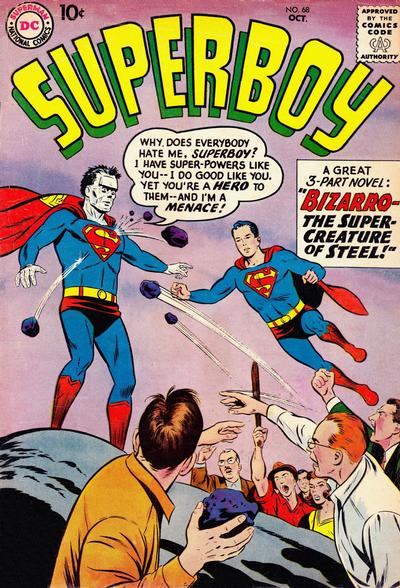
Bizarro first showed up in Superboy #58 later that same year. When one of Smallville’s seemingly infinite number of scientists asks Superboy to help him test a new “duplicator ray” he’s invented, he accidentally strikes Superboy with the beam and creates a “non-living” duplicate with a strange faceted skin and a feeble mind, but all of Superboy’s powers. Dubbed “Bizarro” the creature stumbles around Smallville for a while trying and failing to fit in, finally making friends with a young woman named Melissa who isn’t terrified of his appearance. The dim Bizarro, however, doesn’t realize that the girl is blind. When Bizarro decides to seek her out at Smallville High, Clark is forced to do some secretive super-feats to prevent the creature’s bumbling from accidentally killing half the class.
Superboy finds a chunk of Kryptonite and tries to use it to stop Bizarro, but it has no effect. He uses a marionette of Melissa to lure Bizarro to a military range, where the army fails to destroy the creature with heavy artillery. (Really, Clark, the creature obviously has all your powers, what were you thinking?) Bizarro returns to the real Melissa, where he discovers that she’s blind, and only his friend because she can’t see his real face. At the same time, Superboy learns that the irradiated pieces of the original duplicator ray have a Kryptonite-like effect on Bizarro. He approaches the creature with a piece of the metal and Bizarro hurls himself into it, exploding into a rain of dust. Somehow, the vibrations of his explosion trigger Melissa’s optic nerve and restore her sight, leaving her to wish she had seen the “kind face” of the creature who sacrificed himself for her.
This story goes to great lengths to remind us that Bizarro isn’t alive, over and over again, despite all evidence to the contrary. Doesn’t matter that he moves and thinks and has feelings and willingly sacrifices himself for the betterment of his only friend. None of those things are evidence of LIFE. After all, if he WERE alive, that would make Superboy a murderer, which probably would have been frowned upon. But alive or not, this Bizarro already carries a lot of the elements that the character would embody later, including his backwards thinking and speaking. He was brought back a year later, when the experiment that created Bizarro was duplicated on the adult Superman, creating a second Bizarro. This one would ironically go on to dub himself “Bizarro #1” when he created a whole planet of duplicates of himself and the Bizarro culture became fleshed out. John Byrne would also bring back the idea of Bizarro sacrificing himself to restore sight to a blind girl – this time Lucy Lane – when he rebooted the character in Man of Steel. The blueprint was there from the beginning, but it’s been greatly expanded over time.
Sat., Oct. 4
Comics: Superboy #83, Adventure Comics #283, Justice League: The Omega Act Special #1, Absolute Evil #1

Notes: The next point we reached with the introduction of memorable villains seems to have brought us to an era of threats from home – specifically, Krypton. Superboy #83 brought us the debut of the Kryptonite Kid, who first appears to Superboy in a dream. The Kid, with a body (and a dog) made of Kryptonite vexes the sleeping Superboy. Even more baffling, Superboy soon figures out that Krypto is having the same dreams as he is. The dreams come true when they encounter the Kid at a playground. The Kid chases Superboy, demonstrating his ability to transform things into Kryptonite with a touch – a playground slide first, then the lead culvert Superboy tries to use for cover. The Kid warns Superboy and Krypto that they have to leave Earth or he’ll kill them, then flees the scene. After a few more encounters, one of which winds up with Smallville High School itself turning into Kryptonite, the Kid reveals his secret origin. Turns out he was an inmate at a prison in space who volunteered for an experiment in exchange for the commuting of his sentence. He wound up with the ability to turn things into Kryptonite and decided to use it to attack Superboy. (Projecting himself into Krypto and Clark’s dreams are evidently a natural ability of his alien race.) Just when it seems that Superboy’s down for the count, the Kid is zapped away by – of all people – the young imp Mxyzptlk. After all if Superboy dies, there’ll be no one left for him to play with.
What a bizarre story. The origin is pretty generic, and in the end Superboy has no hand in saving himself – the only reason he survives is because Mxy didn’t want him to die. It’s also interesting to note that, by this point, things had been retconned so that Clark first encountered Mxyzptlk as a kid in Smallville rather than an adult in Metropolis. Kryptonite Kid wasn’t the most memorable of villains, but he did pop in to vex Superboy several more times, and at least once after they were adults. But there would be other villains who picked up the name Kryptonite Man later and made it more fearsome.

Clark was also Superboy in Adventure Comics, where he met perhaps the second greatest enemy he’d ever have, after Luthor himself: General Zod. It begins when a box falls to Earth in Smallville with Kryptonese writing on it. Superboy reads the inscription to learn that the box contains several weapons that were deemed too dangerous to leave lying around Krypton, so they shot them into space on a trajectory that would eventually cause them to fall onto a far less developed planet, because for all their scientific advancement and planetary harmony, the Kryptonians were kinda dumb. Among these devices, which Superboy learns were created by his own father, Jor-El (there were approximately seven people on Krypton when it exploded and they all were connected to the Els), is the infamous Phantom Zone projector. Superboy learns the history of the device, including how General Zod was banished into the Zone when he tried to stage a revolt on Krypton with an army of Bizarro-like duplicates of himself. The device is activated when a lizard steps on the button and turns Superboy into a Phantom, because — and I cannot reiterate this enough — Kryptonians were kinda dumb. The Phantom Superboy is forced to zip around Smallville – invisible and intangible – trying to find some way to get somebody to turn the device on and restore him. He finally gets a message to Jonathan Kent, using his super-brain to transmit a message to an electric typewriter. This works because earlier in the issue Lana Lang theorized it would. That’s the only reason.
Zod’s appearance in this issue is minimal, appearing only in the flashback that shows how the Phantom Zone projector works. Both he and the Phantom Zone would come back and become much more defined, although Zod himself was fairly unimpressive until the late Terrence Stamp played him in the first two Superman movies, elevating him to the A-list of Superman villains. Most versions of Zod in the comics since then have been based on the Stamp version of the character. The Phantom Zone, too, would be dramatically changed from merely turning the victim into a phantom into being a portal to a literal other dimension. There was a lot of refinement to this concept before it became what it is today.

I also grabbed this week’s new Superman comics today, including a pair of one-shots that are connected to the larger story of the DC Universe. The prelude to DC KO is presented in Justice League: The Omega Act Special. Superman has brought the lost Booster Gold back to the League, but he and the Doomsday/Time Trapper – along with the Flash – take a quick trip through time to discover what really happened when Darkseid died in the DC All-In Special. The upcoming conflict with the Absolute Universe is about to change everything, but Booster has been changed as well. And in addition to Booster, we get flashbacks to Krypton’s past when Lara (Superman’s mother) and Ursa (Zod’s wife) made a discovery that might change everything we know about a certain member of our cast. I’m really excited to see where this story is going.
Absolute Evil #1 is the a one-shot special celebrating the first anniversary of DC’s Absolute line, focusing (naturally) on the villains. Hector Hammond is summoned to a summit that includes Veronica Cale, Ra’s Al Ghul, and the humorless creature this universe calls Joker. Cale reveals how – in this universe – certain forces have operated to prevent the rise of costumed heroes, either through violence or temptation. We’re given glimpses of the would-be heroes of this world’s Golden Age and what happened to them, as well as an understanding of what these terribly powerful people have planned now that things have changed and superhumans are beginning to appear that are beyond their ability to control. The issue has a pretty decent recap of the broad strokes of the Absolute Universe to date, for those who maybe want to play catch-up, and there’s a pretty startling final page that leaves me scratching my chin and wondering where they’re planning to go with all this.
Sun., Oct. 5
Comics: Absolute Superman #12, Adventures of Superman: Book of El #2

Notes: I had a lot on my plate on this Sunday, so I’m going to hop in real quick and read the other two new Superman comics from this week, starting with Absolute Superman #12. “The Battle of Kansas” begins as Kal-El retreats to the one place on Earth he’s ever felt safe: Smallville. Lois and Jimmy have the same idea, seeking refuge in a diner where a face the readers will recognize immediately confronts them about their association with Lazarus. We also get some flashbacks to fill in a bit of Kal-El’s time on Earth, even as Ra’s Al Ghul prepares his revenge on the alien who dared to defy him. This may be my favorite issue of this series to date, with a real look at character and a bit of the flavor of hope we expect from a Superman story. The whole thesis of the Absolute universe is that “hope” is the underdog, and the whole world runs on darkness and conflict as befits a world spawned by the power of Darkseid. But even in a world this dark, this issue shows us how the light of this character shines through, and it feels really good.
I feel less good about Book of El #2. Superman is in the distant future with his descendant, Ronan Kent, seeking a way home. Meanwhile, the world has been taken over by one of his greatest foes. This issue explores that a little bit, but in a way that I frankly find irritating. Some science fiction writers have people in the future talk exactly like people do today, even though logically we know that’s not right. Language changes and evolves, and people from 1000 from now won’t talk exactly as we do any more than we talk like people from 1000 years ago. So other writers conjure up a “future speak” to address the issue. Sometimes it works, sometimes it doesn’t, and when it doesn’t it can come across as REALLY annoying. Realistic or not, sometimes it’s better to just keep the language simple.
Oct. 6
Comics: Action Comics #340, Superman #323, 324, DC Comics Presents #27, 28
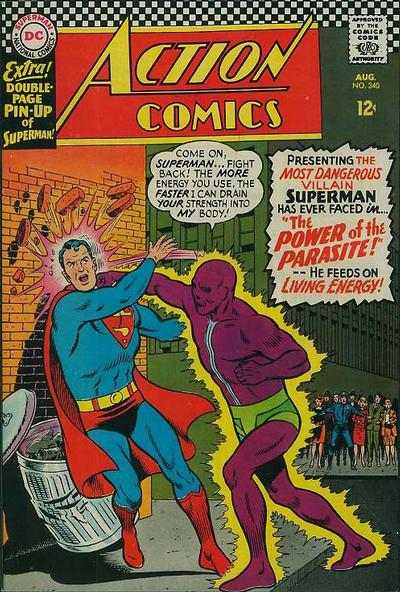
Notes: Back to Villains Week. The Parasite was the next significant Superman villain to show up, in Action Comics #340 from 1966. Like many of the villains we’ve talked about this week, he’s gone through a lot of changes over the years, and several people have used the name (although the powers haven’t changed significantly). Let’s see what kind of tomfoolery the original got up to.
The story, by the late Jim Shooter, kicks off hard, with the opening narration declaring that the Parasite was “the most powerful foe Superman has ever faced!” And in this pre-Darkseid, pre-Doomsday world, that may not be hyperbole. The story starts with Superman helping out in a government science lab, conducting experiments with radioactive elements that would kill an ordinary person. When the facility’s janitor Jensen, is tapped to dispose of the waste from the experiment, he remembers a rumor he heard that sometimes labs ship their payroll inside of containers marked “radioactive waste” to fool criminals. Instead, he proves that criminals are fools by opening up the container and exposing himself to the toxic material. Jensen’s skin turns purple and deformed and he collapses, as if all his energy has been spent. When one of the scientists finds him, Jensen finds himself absorbing not only the man’s energy, but also his scientific knowledge. He fights his way to freedom, absorbing the strength and minds of everyone he comes across. Although the energy he absorbs doesn’t last long, he begins to plan a new life as a human Parasite.
He later picks up a little of Superman’s energy as the Man of Steel flies past his hideout, and he gets the idea to hunt him down. When he feels an enormous surge of energy coming from Clark Kent, the Parasite figures out a secret that Luthor and Brainiac had been struggling with for decades. When Superman tries to stop him from robbing a bank, the Parasite defeats him with his own power and threatens to expose his secret identity if Superman refuses to fight him to the finish. He’s shocked that, no matter how much power he drains from Superman, he still keeps getting up and he keeps absorbing more and more until finally his mortal body is overloaded by Superman’s power and he explodes.
We’ve talked before about how unimaginative people complain that Superman’s powers make him “boring,” but it IS true that it’s hard to come up with a suitable physical threat for him. Like Kryptonite Kid, this was an effort to do so. But like Kryptonite Kid, in the end, Superman’s victory is a passive one. He survives not because of anything he DOES, but because the Parasite simply bites off more than he can chew. The Parasite would become a recurring foe for Superman over the decades, and although he remained dangerous, they also started to play up the fact that he wasn’t all that smart, and subsequent victories gave Superman a bit more agency. Still, it’s kind of disappointing that their first tete-a-tete ended the way it did.
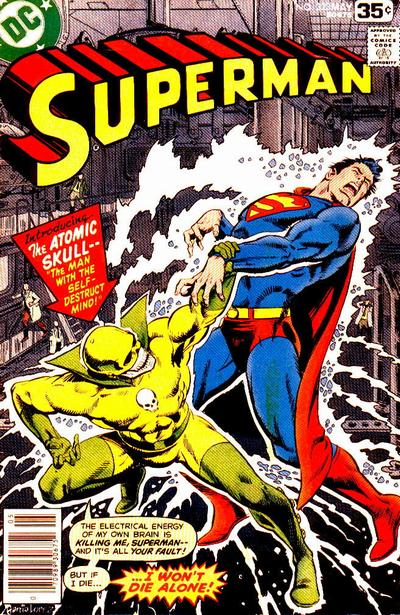
Next we jump ahead to 1978 and the first appearance of the Atomic Skull in Superman #323. Although the Skull has never quite cracked into the ranks of Superman’s A-list villains, he’s a B- (or, if I’m being honest, maybe C)-lister that I’ve always had a fondness for. Of course, I remember him better in his vastly different post-Crisis version that showed up in early issues of Superman: The Man of Steel. The original Skull appears in “The Man With the Self-Destruct Mind” by Martin Pasko and Curt Swan, and shows up on page one destroying a Superman statue and vowing to kill the real thing. Superman, meanwhile, is in space – he’s wearing a suit of lead armor trying to investigate a sudden preponderance of Kryptonite that’s been falling to Earth lately and coming into the possession of a group called the Skull Crime Organization. He soon discovers that “Krypton-Two,” a planet he once made out of chunks of Kryptonite, has somehow been destroyed and is showering Earth with Green K once again. The Skulls, meanwhile, kidnap a STAR Laps scientist and reveal that their craft is powered by their leader, the Atomic Skull, whose brain is creating miniature nuclear reactions. Furthermore, he is unmasked as former STAR Labs scientist Albert Michaels. (Michaels, it turns out, had made previous appearances as the leader of the Skulls – this is his first appearance with his new powers and costume.) As it turns out, Michaels has a rare nervous disorder that short-circuits his brain’s electrical impulses. A treatment for his condition only made it worse – not only does he still have seizures, but they are accompanied by energy bursts that are killing him, and he hates Superman because he’s jailed the only scientists (mad, I presume) who could have saved him. His plan involves loading up a rocket with the Kryptonite that’s falling to Earth and detonating it in the atmosphere, blanketing the planet with enough Kryptonite particles to remove Superman’s powers no matter where he is on the globe. And on the last page he plays his trump card – holding Superman at bay with the powers of Titano, the Super-Ape as he sends the rocket to blow up.
Part two of the story picks up in Superman #324, as Titano hits Superman with the rays of his Kryptonite vision. Superman manages to neutralize the ape by wrapping lead around its eyes, then takes out the Atomic Skull by redirecting one of his own energy-bursts. This leaves him with the problem of what to do with the Kryptonite missile, which he can’t approach to stop without exposing himself to fatal doses of Kryptonite. Titano comes after him again and, with his X-Ray vision, Superman determines that the Skull is controlling the ape via a device implanted in his brain. He manages to corral the ape and then use the Supermobile (God, I love the stupid, ridiculous Supermobile) to vacuum up the Kryptonite from the atmosphere.

I appreciate that they were trying to up the ante for the villains at Superman at this point. The late 70s and early 80s are really, for me, one of the dullest periods in the character’s history, with few memorable stories or characters appearing. The Skull is an exception. He’s a little generic – the mad scientist with atomic powers – but the idea that the powers are slowly killing him gives it a little more weight. I don’t think they did that much with the idea, though, and it’s been largely dropped from future versions of the character. Now, especially, where his head is encased in atomic fire, people write him off as a Ghost Rider knock-off. There’s more to it there, and I think the right writer could really make him into a top-level threat.

In 1980, Len Wein and Jim Starlin gave us DC Comics Presents #27. This issue of the Superman team-up book paired him off with the Martian Manhunter and gave us the first appearance of the world-conquering Mongul. Superman is alone in Clark’s apartment when he receives a message from outer space – a yellow-skinned alien who reveals that he has kidnapped three of Clark’s colleagues – Jimmy Olsen, Lois Lane, and Steve Lombard – and threatens them if Superman refuses to retrieve for him a crystal key that is being held on the fifth planet in the Cygnus system. At this period, the Martian Manhunter has left Earth, establishing a “new Mars” on Cygnus’s FOURTH planet, and when Superman approaches the crypt where the key is being kept, J’onn shows up and tells him that the world is off-limits. J’onn tells Superman that the key must remain where it is or countless worlds will be in jeopardy. The key is the only thing that will allow someone to get past the defenses of an ancient and incredibly powerful satellite called Warworld, and thus it may be the most dangerous object in the universe. Although Superman sympathizes, the two friends come to blows. Each of them attacks the other with their weakness (Kryptonite for Superman, fire for J’onn), and ultimately Superman retrieves the key. When Mongul arrives, though, he refuses to turn it over. J’onn saves the hostages, but Mongul manages to get the key and escapes.
There’s good and bad in this issue. On the plus side, Mongul is a great villain. He’s the most fully-formed of all the villains I’ve read about this week, the one who is most like who he becomes from the very beginning. He’s cold, manipulative, and ambitious, all qualities that make him one of the greats. On the other hand, I really dislike the way Wein paints Superman and J’onn. The two of them have been friends forever at this point – the fact that they went straight to fighting instead of trying to work together to find a way out of this dilemma does a disservice to them both.
The story continued in the next issue, when Superman recruits Supergirl to help him track Mongul to Warworld. (Why J’onn didn’t come along, considering how important he considered the key to be, is a mystery.) They find the planet and are dazzled by the enormity of it, but Superman manages to defeat Mongul by outlasting him – he reasons that the aliens that created the satellite died one by one because the control helmet was too much for them and that it would eventually wear Mongul out, and he’s right. It does make one wonder, though, why the hell the aliens would make their entire weapon fueled by a device that would not only cause their own extinction, but do so in what seems to be a matter of minutes. Who the hell ever thought THAT was a good idea? Even in the real world, it takes us much longer to destroy ourselves.
Tues., Oct. 7
Comics: Action Comics #595, 645, Justice League of America #31
Notes: You may have noticed something about the villains I’ve covered so far this week. I know my wife certainly has. They’ve all been men. I refuse to take the blame for this. It’s not my fault that for five decades, the writers of Superman never seemed to come up with an interesting continuing female villain. I think part of it is the idea that you can’t have Superman punch out a lady – it’s not a good look for the strongest man in the world to punch out a woman. In fact, go back and look at any early Justice League issue where the team fights a villain GROUP – there’s always one female villain so that Wonder Woman has somebody to fight.

But eventually, it seems, people decided to address that, and in my chronological journey through Superman’s rogues’ gallery, the last three significant villains I’m going to talk about all happen to be female.. We’re going to start with Action Comics #595 and the first appearance of the Silver Banshee. This was part of the John Byrne era, coming out in 1987 during the period when Action Comics was the Superman team-up book. This particular issue, though, didn’t divulge who Superman’s guest-star was on the cover, leaving a string of question marks where the second hero’s name usually went. It’s a striking cover nonetheless – a stark black-and-white villain with a skeletal face standing over Superman’s dead body while his spirit comes at her from behind. That’s a book that’ll get your attention.
The story starts with the Banshee walking through Metropolis, invading bookstores where she casually touches bystanders, drains their life force, and leaves them dead. And when Superman arrives, she does the same to him. The world is stunned by the hero’s sudden loss and he’s placed in state in a glass casket for a memorial as the Banshee escapes. At the funeral, though, everyone witnesses Superman’s ghost rise from his body and take off after the Banshee. Jimmy, meanwhile, has tracked her down to yet another bookstore. She’s about to touch him when Superman’s ghost appears and engages her, shocking her when she realizes she can’t hurt him anymore. The Banshee unleashes her scream, trying to destroy Superman, but winds up exploding. (Superman villains used to explode a LOT.) Jimmy is pulled from the debris by a LIVING Superman, and watches in astonishment as the ghost Superman transforms into J’onn J’onzz, making his second appearance in Villains Week! Give the man a box of Chockos! On the last page we get an explanation for everything – the Banshee’s ability to kill was based on her knowing her victim’s identity (because magic), so she was helpless against the shapeshifter. Jimmy also figured out that she was targeting bookstores that had recently received a shipment of books from a certain castle in Ireland. That, of course, is the sort of thing that comes back later.
The Silver Banshee has always been one of the most memorable new villains from this period. She’s got a phenomenal look, first of all – a really unique appearance that’s totally unlike any of Superman’s other villains. Also, considering how everyone remembers his vulnerability to magic, it’s surprising that he doesn’t have more enemies for whom magic is their usual shtick. Later stories would flesh out the character more, revealing a tragic backstory and making her more sympathetic. In recent years she’s wavered between villain and antihero, and she’s even (in her human form) dated Jimmy Olsen. In fact, I think she still is – Jimmy’s been a little out of focus in the comics lately, they really should address that. Anyway, the point is, she’s a good character.

Maxima, the warrior queen from the planet Almerac, made her first appearance in Action Comics #645 by Roger Stern and George Perez. I’ve written about Maxima in the Year of Superman many times, of course. She was a member of the Justice League during the Doomsday storyline, broke bad again in the electric era, and she’s had a smattering of other appearances over the last ten months. Today, though, we’re going to see where she came from in the first place.
The story begins with a stunning redhead strutting the streets of Metropolis and being accosted by a few gang members, one of whom quickly (and fatally) learns that pulling a knife on her isn’t a good idea. Maxima, along with an attendant named Sazu, is looking for Superman, and winds up at the Daily Planet office after being told he has connections there. Superman isn’t in attendance, though, and after leaving the entire staff in a trance, she leaves. Clark shows up, fresh from a fight with the Parasite in Starman’s comic (Stern was writing both books and liked to tie them together), shows up and snaps them out of it. They tell him about their attacker and he finds her pretty easily, as she’s now at City Hall holding the mayor hostage. When he arrives, she puts him under mental assault as a means of testing him. She’s testing Superman’s “worthiness” and finds him acceptable, but Sazu revolts. She claims that Superman is “unworthy” and unleashes her own mental powers against Maxima, who…explodes.
No, really.
Sazu is taken into custody and Superman is left confused, but the last page clues the reader in to the fact that the Maxima who blew up was just a simulacrum. The real Maxima is in outer space and now, dang it, she’s gonna have to come to Earth herself to make Superman hers.
And she did show up again, and several times after that, as her motivation was revealed: she was seeking a consort of superior bloodline with which to procreate and extend the line of the Royal Family of Almerac. As villain motivations go, it’s a lot more flattering than wanting to destroy him because he thinks it’s Superman’s fault that he went bald. It’s also interesting how the gender roles are inverted here. When you consider the revelation about Kal-El’s parents in James Gunn’s movie, it’s not all that different, but it’s definitely more controversial. Part of that, of course, is because Jor-El is usually portrayed more benevolently, but even were it a brand new character I think people would have found it more insidious than they did when Maxima shows up wanting pretty much the same thing. There’s probably a whole dissertation that could be written about the differences here, but that’s somewhat above my pay grade. At any rate, it makes Maxima one of the more memorable villains of the era, and she’s had the kind of longevity that it wouldn’t be surprising at all to see her show up in a new movie or TV show. There’s something interesting about this character that’s fun in a cheesy sci-fi sort of way.
TV Episode: Superman: The Animated Series Season 2, Episode 5, “Livewire”

Notes: The last villain we’re going to discuss on this avenue of animosity did not make her first appearance in comics, but rather on TV. No doubt trying to duplicate the smash hit they had when they created Harley Quinn on Batman: The Animated Series, the producers of the Superman cartoon introduced this new female foe in 1997, an electrical harpy called Livewire. Although she hasn’t QUITE had the degree of cultural penetration that Harley has (and to be fair, who HAS?), she, too, made the leap to comic books and has crossed swords with Superman occasionally ever since.
In “Livewire” we’re introduced to Leslie Willis (voiced by Lori Petty), a radio shock jock who’s riding a ratings high she’s getting off of trash-talking Superman. She goes through with her show’s anniversary celebration in Centennial Park despite a thunderstorm pouring down on them, and suffers the consequences when lightning overloads her equipment. Superman tries to shield her, but Leslie is bombarded by electricity, bleaching her skin white and her hair blue. When she wakes up in the hospital, she discovers she’s developed electrical powers, including the ability to control electronic devices, and attempts to hold the city of Metropolis hostage. She attacks the city’s hydroelectric plant, where Superman comes in to hold her off. After a pitched battle, Livewire blasts a hole in the dam and is washed over with water, causing her to EXPLODE!!!
Just kidding.
No, she stays in one piece, but the water DOES short-circuit her powers, allowing Superman to repair the damage to the power plant and bring her in. When we last see her, a radio voiceover tells us that Lex Luthor has volunteered (through the goodness of his heart, of course) to pay for her treatments, but the image we have of her strapped into a chair with wires all over her seem to indicate that she isn’t receiving the best of care.
I like Livewire, not just because Superman could use more female villains, but because she’s got a unique attitude. She’s not jealous of Superman’s popularity. She’s not out to prove that she’s more powerful than he is. She doesn’t want to outsmart him or outthink him, and she CERTAINLY doesn’t want to have his babies. Nope, Livewire is just a jerk, a loudmouthed radio asshole like Howard Stern, only more lifelike, and that’s an entertaining dynamic to play.
This first week of October was a fun one, but it’s just the beginning. Like I said, I intend to spend this month peering into the dark side (not to be confused with the Darkseid) of the Man of Steel, and I mean it. Come back next week for my discussion of Superman’s Darkest Hours.
Blake M. Petit is a writer, teacher, and dad from Ama, Louisiana. His most recent writing project is the superhero adventure series Other People’s Heroes: Little Stars, volume one of which is now available on Amazon. You can subscribe to his newsletter by clicking right here. You can join in the Kryptonian Konversation every day in the Year of Superman Facebook Group!
After last week’s extended wind-up, this week it’s time to do a deep dive into the era of Electric Blue Superman. I’ve honestly got no idea how far into the run I’ll get in the next seven days, but I intended to have a good time finding out.
Before I get into it, though, some fun news hit today. James Gunn hopped on social media earlier with a post of image by Jim Lee: Superman (in the David Corenswet costume) and Lex Luthor in his power armor. Along with the image came the caption, “Man of Tomorrow. July 9, 2027.” This is pretty exciting. We knew he was working on the next movie already, but this is far more information than I thought we would possibly get before next year. We’ve got what seems to be a title, and maybe even a hint of the plot, with Lex in his armor. Obviously, I’m pumped.

But I gotta tell you this story. I got a message right before lunch and, being in class at the time, I obviously couldn’t stop to look at my phone. When the lunch bell rang, the students left the room and I checked to see that Mark had shared this image. I got excited, I replied, and then I stepped out into the hall. Not 90 seconds after I got Mark’s message, a student ran up to me – not even a student I teach, just one who knows me – who wanted to know if I had seen James Gunn’s announcement yet.
I have a brand, don’t I?
And as always, you can check out earlier blogs in the Year of Superman Archive!
Wed., Sept. 3
Comics: Adventures of Superman #546, Action Comics #733, Superman: The Man of Steel #68, Superman Vol. 2 #124

Notes: In Adventures of Superman #546, Lois Lane has her first meeting with her new and improved husband. As glad as she is to see him okay, he’s just as angry when he sees that the Daily Planet’s inflammatory new columnist Dirk Armstrong has painted him as a menace…mostly because Clark thinks he was right. When word comes in that Dirk’s blind daughter, Ashbury, has been kidnapped, Superman races to search for her, only to get sidetracked when he’s attacked by his old foe Metallo, who wants to try his hand at facing the new Superman. Don’t worry about the kidnapping victim, though – Ashbury is rescued by Scorn, who she briefly mistakes for Superman. Liking the role of hero, Scorn puts on Superman’s old symbol as his own.
In Action #733, Superman just manages to escape from Metallo’s clutches by switching to his human form, but winds up injured in the process. Hoping to gain more control over his new powers he seeks out someone who has similar experience: the energy-hero called the Ray. After a few tips, Metallo rises again, and Superman figures out some new tricks to take him down. This is an interesting issue – Ray only appears on a few pages, despite getting a nice “guest-starring” credit and half the cover. But what he does here isn’t insignificant, helping Superman start to figure out his powers and even theorizing that the reason he has no powers in his human form is because he subconsciously is imitating humans as he sees them. I like the fact that Superman isn’t above going to a younger hero for help when he needs it, even one as relatively inexperienced as the Ray. It’s the sort of thing that works well as a character beat, showing how even-tempered and nuanced he is.
The battle with Metallo continues in Man of Steel #68, and courtesy of Jimmy Olsen, it gets a lot harder. At this period, Jimmy was working as a TV reporter for WGBS news instead of his traditional photographer gig, and desperate to stay on top of the ratings heap, he starts covering the Metallo fight and explaining Superman’s new powers based on information he got from Professor Hamilton. Metallo is monitoring the TV broadcast, though, and using Jimmy’s broadcast to change his tactics. Superman manages to beat him, but winds up spinning into space, having absorbed far too much energy.
After ending Man of Steel #68, Dan Jurgens makes the rather odd choice to begin Superman #124 after the crisis has been resolved, with Lois and Clark discussing how the Planet’s publisher, Franklin Stern, is angry over his frequent absences lately. Then Clark dives into a flashback in which he’s saved from dissipating into energy in outer space by the timely intervention of one of Jurgens’ favorite creations, Booster Gold. The rescue fries the armor Booster has been wearing for some time, though – actually, ever since his original super-suit was destroyed in battle with Doomsday. Superman brings Booster to Hamilton, who uses the leftover weave from Superman’s containment suit and combines it with the remaining future technology Booster brought back from the future with him, giving him a new suit that’s a bit more in line with his classic one. I love when you see stuff like this – Jurgens clearly wasn’t happy with how the writers that followed him on Justice League America changed Booster’s armor and used this opportunity to fix it a little bit.
This issue gives us a lot of advancement on several subplots as well. Jimmy kind of patches up his relationship with Lois and Clark, ashamed of how his broadcast had endangered Superman, just in time for Perry White to storm into the Planet office and announce that his cancer is in remission and demand his job back. In Kandor, the town’s rulers find evidence that the bottled city – which is actually out of phase in another dimension – is on the verge of destruction. And Scorn is drawn to Lois and Clark’s apartment, where he finds one of Clark’s old costumes.
Reading these issues this way, one after another, following the story for long periods of time, is really making me feel nostalgic for the Triangle Era in a way that not even the Death of Superman. I love having this quick progression of story, so unlike a typical monthly comic book story. Even right now, when the Superman comics are really good, this is a different feeling. It’s a feeling I like.
Ah, I wish we could get it back.
Thur., Sept. 4
Comics: Adventures of Superman #547, Action Comics #734, Superman: The Man of Steel #69, Superman Vol. 2 #125, Secret Six Vol. 5 (Super-Son)
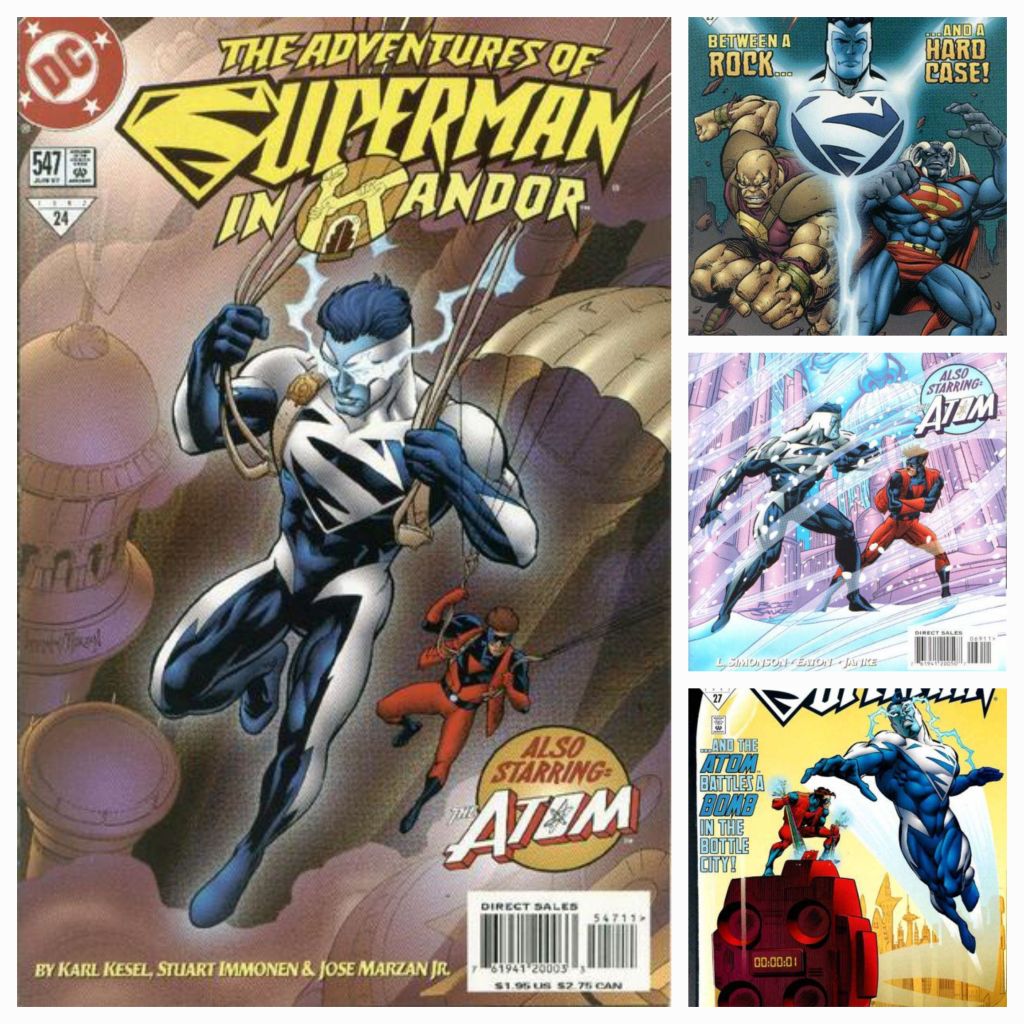
Notes: Still adjusting to his new powers, in Adventures #547, Superman is alerted to the crisis in Kandor and decides to reach out to a hero with experience in size manipulation: the Atom. At this point, though, Ray Palmer had gone through an even more radical transformation than Superman, having been reduced in age to a teenager. He was currently the leader of a new, very different version of the Teen Titans in a book written and drawn by our old pal Dan Jurgens. Still, despite having a teenager’s body and attitude, he retained his memories, and as a former Justice Leaguer, jumps at the chance to work with one of the big guns. Hamilton journeys to the Fortress with the two heroes, and Superman and the Atom dive down into Kandor. Scorn, meanwhile, is wandering around Metropolis stalking Ashbury and carrying around the Superman costume he took from Clark’s apartment, seemingly trying to decide what he wants his path to be now that he’s free of Kandor.
Action #734 picks up with Ashbury reuniting with Scorn, although the blind girl is still under the misapprehension that he’s Superman. At that same time Rock – a villain Superman caught a few months back – breaks out. With Superman and the Atom in Kandor, though, Scorn takes care of Rock by himself, to the confusion of the SCU, who sees this horned, blue brute wearing Superman’s old costume. In Kandor, Superman and the Atom fight off some of the city’s peacekeepers who are still loyal to their original captor, Tolos, and a group of dissidents manage to attack the city’s environmental generator. The city is beginning to freeze, but that’s not even the real issue. They’ve got one hour to get the generator back online before everyone in Kandor suffocates to death.
In Man of Steel #69, Superman, the Atom, and a telekinetic local named Faern try to get to the generator to start it up again. But the generator is bombed, and in the explosion, Tolos is revealed to be alive and hiding in Faern’s body. He escapes and takes over Superman, which I’m sure you can imagine is inconvenient for everyone. Outside of Kandor, Scorn has crashed at Ashbury’s apartment, with the blind girl finally figuring out that he’s not actually Superman, but she befriends him anyway. When her dad shows up, though, he thinks Scorn is a menace and Scorn, not realizing Dirk is Ash’s father, leaps from the window with her in his arms. Perry White demands that Planet staff get to the bottom of the Scorn situation, and still more questions about Clark’s attendance issue are raised.
I bring up that last point mostly because I think it’s an interesting note for the character. One of the reasons for Clark choosing the job of a reporter is usually the notion that it will allow him to be absent frequently to act as Superman under the guise of “covering a story.” That might work if he’s gone for a few hours, but as we’ve seen in these books lately, his other job sometimes has to take him away for days, weeks, even months at a time. The excuses he (and later, Lois) come up with to explain his disappearances often strain credulity and are frequently lampshaded these days. All of this is just to say that things like this are why I like the interpretation of the characters that say Perry White knows – or at least strongly suspects – that Clark is Superman, because otherwise he’d never put up with this.
The Kandor story wraps up in Superman #125. Tolos, controlling Superman’s body, frees himself from Kandor and attacks Hamilton, who’s been holding vigil over the bottled city. But Hamilton manages to science Tolos out, sending them both – separately – back into the bottle. Superman manages to trick Tolos, trapping him in the “glass” of the bottle, which is actually an energy barrier containing the city in its pocket dimension. Reuniting with the Atom, the two heroes manage to fix the machines that maintain the city’s environment, and the story ends with Superman swearing to the people of Kandor to find a way and a place to release them from the bottle and set them free.
It sounds awfully familiar, actually.
The first extended team-up between Energy Superman and the Atom is an interesting glimpse at the characters and the time. Superman is still learning the ropes of his energy form, but he’s still essentially the same person at his core. The Atom, on the other hand, has his memories and powers intact, but the brashness and eagerness of a teenager. Almost every other page in these four issues includes a reference to him hoping to impress Superman enough that he’ll score an invitation into the newly-formed (at the time) Justice League. The story flows together the way the Triangle Era did, and although this version of Kandor has been excised from continuity, there’s some interesting stuff going on. I especially like Scorn – a character who looks like a monster but decides that, if he’s gonna be stuck on Earth, there are worse things to be than Superman. He’s not wrong.
Fri., Sept. 5
Comics: Adventures of Superman #548, Action Comics #735, Superman: The Man of Steel #70
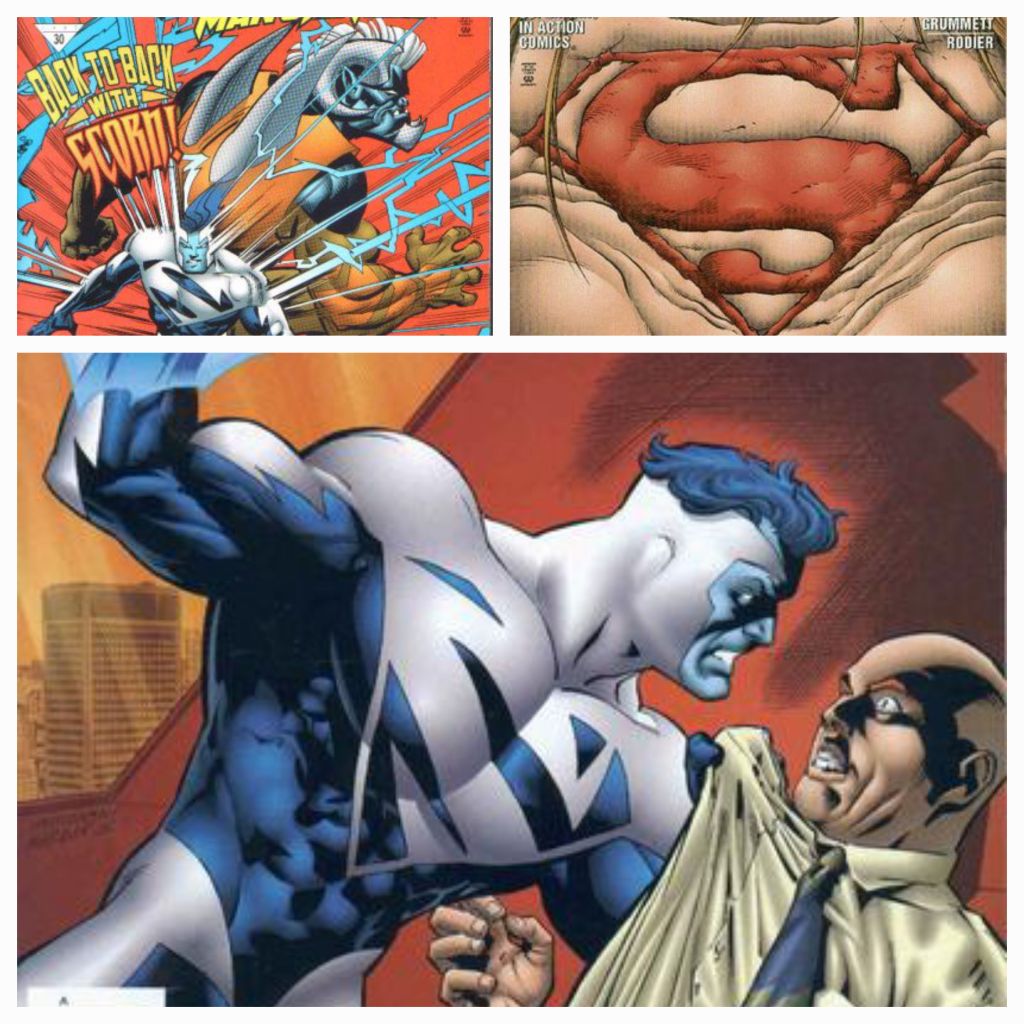
Notes: In an epilogue to last month’s adventure, Kandor is shifting its allegiance from Tolos to Superman. In fact, his shield (the current, electric blue one) is showing up as a graffiti tag on city walls. Superman tells the Atom he’d be willing to recommend the Atom to rejoin the League, but suggests he could be of more use leading the Teen Titans, which he decides to take as a challenge. Clark returns to the Planet and tries to excuse his absence by saying he was hunting down the story on the new Superman, to which Perry replies, “Which one?” But while working on the story, Lois drops a bomb on Clark that he hadn’t been made aware of before: that the electronic fabric in his new suit was supplied by Lex Luthor. He rushes to LexCorp Tower, suspecting Lex of being involved with his power change as he’s tried tampering with them in the past, but leaves when Erica fakes a problem with her pregnancy. And in a moment that’s chilling to any long-time DC fan, the Phantom Stranger pops in to tell Clark that there’s some great disturbance in the universe, something that may or may not be connected to Superman’s new powers. And the fact that he’s not sure should be pretty scary to anyone.
(Wait — has anyone told Booster Gold that HIS suit has LexCorp tech too?)
Action #735 brings us the return of Saviour, a delusional serial killer who wants to “punish” liars and fakes, and who doesn’t believe that Superman actually returned from the dead and is dedicated to killing the “imposter” using his name. Ashbury, meanwhile, has found a hiding place for Scorn in the abandoned pool at her school. When Scorn hears Saviour on the radio calling Superman out, he is determined to help. Superman’s new energy powers allow him to find a way to cancel out Saviour’s energy, taking him out, but he manages to slip away and vow revenge.
In Man of Steel #70 Superman and Scorn part as friends, but not before Superman tells the alien he has to bring Ashbury – a 17-year-old girl – back to her father. Although Ash protests, Scorn trusts Superman’s judgment, and she finally acquiesces upon learning her absence is taking its toll on Dirk’s health. WGBS, meanwhile, airs Jimmy’s interview with Hamilton about Superman’s new powers, despite the fact that it gave Metallo an edge in the fight, and this time Saviour picks up on it. With his reality-warming, he starts to mimic Superman’s new powers to get his attention. Scorn and even Bibbo get in on it, with Bibbo snatching a crib sheet Saviour wrote to keep track of what he learned about Superman’s powers. Superman and Scorn beat Saviour, but Jimmy’s relationship with his friends is damaged even further.
Jimmy could rarely catch a break during the Triangle Era. A running theme seemed to be him making a foolish mistake and then having one consequence after another stacked up on him like an enormous Dagwood Sandwich of Suck. It honestly could get a little tiresome after a while. These days we don’t see him quite as often as I’d like, but when we do, it’s usually more in the vein of the weirdness magnet that Matt Fraction (and, to a lesser degree, James Gunn) used him as. I prefer that.
Sat. Sept. 6
Comic Books: Adventures of Superman: Book of El #1, Absolute Superman #11, Justice League Vs. Godzilla Vs. Kong 2 #4
Notes: I’m taking a break today from the electric saga to pick into this week’s new Superman titles, starting with Adventures of Superman: Book of El #1.
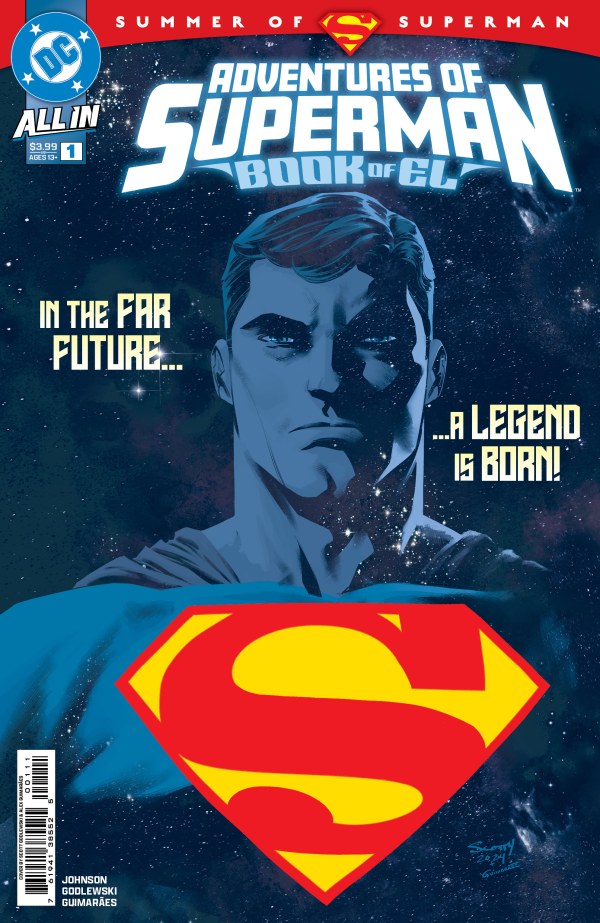
This new miniseries is written by Phillip Kennedy Johnson as sort of the conclusion to his run on the Super-titles that followed Brian Michael Bendis’s run and lasted into the Dawn of DC era before he stepped aside. I had mixed feelings about his run. Coming off of the (ahem) previous writer it was inevitable that it would be an improvement, and there were certainly things about Johnson’s run that I enjoyed, but I ultimately got turned off. In this period, Johnson wrote about a Superman that was depowered on Warworld, and for most of that run, it was the only regular comic featuring Clark Kent. (The Superman title was sidelined and replaced with Jon Kent as Superman: Son of Kal-El.) I got burned out on Warworld eventually. Towards the end of the run I realized what the problem was – it was simply too long. A solid year of Superman on another planet and separated from Lois, Metropolis, and all the other elements that make Superman so great just didn’t work for me. In the Triangle Era they could have gotten away with it because a twelve-issue storyline would still only last three months, but 12 was too much. I greatly preferred the final section of Johnson’s run, after Superman returned to Earth and Action Comics became kind of a Superman Family title.
All that said, let’s look at what Book of El gives us. The story starts on a lazy day in Smallville, with the Kent family all together: Lois and Clark, Jonathan and Martha, Jon, and the adopted twins from Johnson’s run, Otho-Ra and Osul-Ra, who have ostensibly been living with Lois and Clark this whole time but who even the good writers of the modern Superman titles consistently forget about. Their idyllic afternoon is shattered by an attack by Kryl-Ux, an enemy from Warworld, leading an invasion force and – seemingly – hurling Superman into the future. On the last few pages Clark encounters Ronan Kent, a descendent of his from Johnson’s Future State comics, and the knowledge that he disappeared from Earth hundreds of years ago.
I really do like the way Johnson writes the whole Kent family together. He gives each character a voice that fits them, and his Lois and Clark interactions (so infrequent during his Warworld storyline) are excellent. The revelation at the end takes all the air out of the tires, though. Clark is missing for centuries? Presumed dead? And the invasion of Earth is successful? The whole thing may as well end with a big banner that says “THIS STORY WILL BE RESET AND THIS FUTURE WILL NOT HAPPEN.” By the end of this miniseries, I have absolutely ZERO doubt, something will happen that will eliminate the future of Ronan Kent from being a potential future. That doesn’t mean the story can’t still be good, but it excises the whole thing from consequence in continuity, and that hurts.

In Absolute Superman #11, Kal-El is in the clutches of Brainiac, who is forcing him to experience hundreds of torturous simulations of the final days of Krypton with the intention of brainwashing him into becoming a tool for Ra’s Al Ghul. Despite some early success, though, Kal-El begins to resist the reprogramming. Meanwhile, Lois and Jimmy are captives of Talia, and find a very unexpected rescuer coming to their aid. This series is progressing a little slowly, to be honest, but this issue is solid. There’s a lot of action and great stuff with Kal-El and Brainiac, and I particularly like the way Jason Aaron is playing with [REDACTED] when that particular character comes to the rescue. Good stuff here.
Finally, we have Justice League Vs. Godzilla Vs. Kong 2 #4. The League is trying to recruit Godzilla to help with the current situation, but something in the other realm where Godzilla resides is preventing the Kryptonians from fully processing the solar radiation that powers them. To even the score, Mr. Terrific whips up a device that will temporarily make Superman kaiju-size…but at the same time, reduce his intellect to a point where he’s operating on pure instinct. That’s right: it’s Godzilla vs. Kaiju-Superman!
And somebody decided to go with a cover of a few random League members facing a water monster that doesn’t even appear in this issue. I swear, boneheaded movies like this are the reason I should be put in charge of comic books.
Sun., Sept. 7
Comic Books: Superman Vol. 2 #126, Adventures of Superman #549, Action Comics #736, Superman: The Man of Steel #71, Superman Vol. 2 #127

Notes: It’s back to the electric era today, starting with Superman #126, in which our new electrified hero faces his Dark Knight buddy. Lex Luthor is planning his legal defense for his…well, trillions of crimes. But his scheme is to argue that he was somehow influenced by the Kryptonite ring that gave him cancer. Despite the fact that it might help Luthor, Mr. Truth and Justice Superman has no choice but to go to Batman and retrieve the ring. He returns it after some tests or run – or so he thinks. Luthor had one of his “scientists” pull a fast one, replacing the ring with a duplicate. Superman and Batman don’t know that the ring in the Batcave is a fake…but Luthor doesn’t know that Kryptonite no longer affects Superman in his energy form.
There’s an awful lot going on in this issue. In addition to the main plot I just recapped, there’s a great sequence where Superman saves the city from a plane crash, having to figure out how to use his new powers to do something that would have been relatively simple for the “old” Superman. Scorn is also convinced to abandon the Superman costume he’s been wearing and forge a name for himself. There’s good stuff there, but the actual Superman/Batman meeting is kind of a letdown. I would have hoped Batman would have more to say about Clark’s transformation, as this is presumably the first time they’ve encountered each other since it happened, but Batman barely seems to notice. It feels like those early Byrne issues where the two were tense rivals at best. Granted, they weren’t yet Superbesties again at this period, but as teammates in Grant Morrison’s Justice League, I would have expected them to be a bit more cordial to one another.
Adventures of Superman #549 stars with Superman forced to do something he didn’t need to do when he had hearing and vision powers: go on patrol. Instead of stumbling on Intergang, though, he winds up in the middle of a rumble between the Newsboy Legion and the Dingbats of Danger Street. No, really, those are actual comic book characters. Jimmy, meanwhile, is struggling to find some credibility after his recent struggles. He decides to check in on Lois and Clark, but arrives just as Intergang firebombs their building as a warning to Lois to back off. Superman evacuates the building, but is then forced to go back in as a powerless Clark to protect his identity. After spending the night in the hospital suffering from smoke inhalation, he goes to Professor Hamilton to ask if he’s discovered a way to restore his powers to normal, but Hamilton gives him the shocking news that this change seems to be permanent. Also at the end, Superman brings in yet another obscure group of DC kid characters to settle the issue between the Newsboys and the Dingbats, and Jimmy decides he’s going to resurrect his career by making one of the stupidest decisions he’s ever made in his entire life, and keep in mind that this is a man who once married a gorilla.
Action Comics #736: The mysterious shadowy figure who recently assembled a Superman Revenge Squad starts assembling…well…a new Superman Revenge Squad. He busts Barrage out of prison, then recruits Rock and the Parasite to his cause, with a promise of more to come. Clark, meanwhile, is depressed over the revelation that the change to his powers will be permanent. He heads to Pennsylvania on assignment for the Planet, only to get trapped in a coal mine collapse with a bunch of miners. The old Superman could get them out in moments, of course, but if he were to fire up his new electrical powers, he runs the risk of igniting the coal dust in the air and killing them all. This is the kind of story that they do every so often to prove that Superman is more than his powers – he’s actually got a brain, too. Clark finds a way to save everybody without his powers, because that’s what Superman does, no matter what costume he’s wearing.
Man of Steel #71 picks up on the Jimmy Olsen Bonehead Show. After the incident at the apartment, Jimmy is convinced he’s figured out Superman’s secret identity, and the rest of the crew at WBGS news is trying to convince him to pursue and report it. But at the same time Bibbo, who punched Jimmy out a few issues ago for his LAST boneheaded move, gets back in the boxing ring and wins, then surrenders his title as penance for hitting Jimmy. Somehow this is enough to cause a moral quandary in a man who should have NO moral quandary about the question of WHETHER OR NOT TO RUIN THE LIFE OF HIS BEST FRIEND, JAMES BARTHOLOMEW OLSEN, WHAT IN THE NAME OF NERON ARE YOU THINKING?
Ahem.
Also, the mysterious recruiter picks up a new villain, an electrical woman named Baud, to join his new Revenge Squad, and his identity is revealed as…Morgan Edge. It’s not the most dramatic reveal, honestly, but it tracks. He sends them to fight Superman, because that’s what he does.
And in Superman #127, Superman narrowly escapes the Revenge Squad as they start to fight amongst themselves. Superman lets the Parasite take out the other three, then bounces in and reverses things on his magenta rival, defeating him by using his new powers to suck the excess energy from him and leaving him helpless. Then, Lois and Clark get a visit from Jimmy, who asks their advice on whether he should pursue the story of the century, even if it will get someone “really mad at him.” Clark, being Clark, tells him that the truth is the most important thing, and Jimmy leaves renewed in his determination to blow Superman’s secret identity, because they are really writing him as unforgivably stupid at this point in the series. Honestly, I’d forgotten about all this. Jimmy. James. Jimothy. What the hell, dude?
Mon., Sept. 8
Comics: Adventures of Superman #550, Action Comics #737, Superman: The Man of Tomorrow #9, Jon Kent: This Internship is My Kryptonite #7, Justice League of America #28
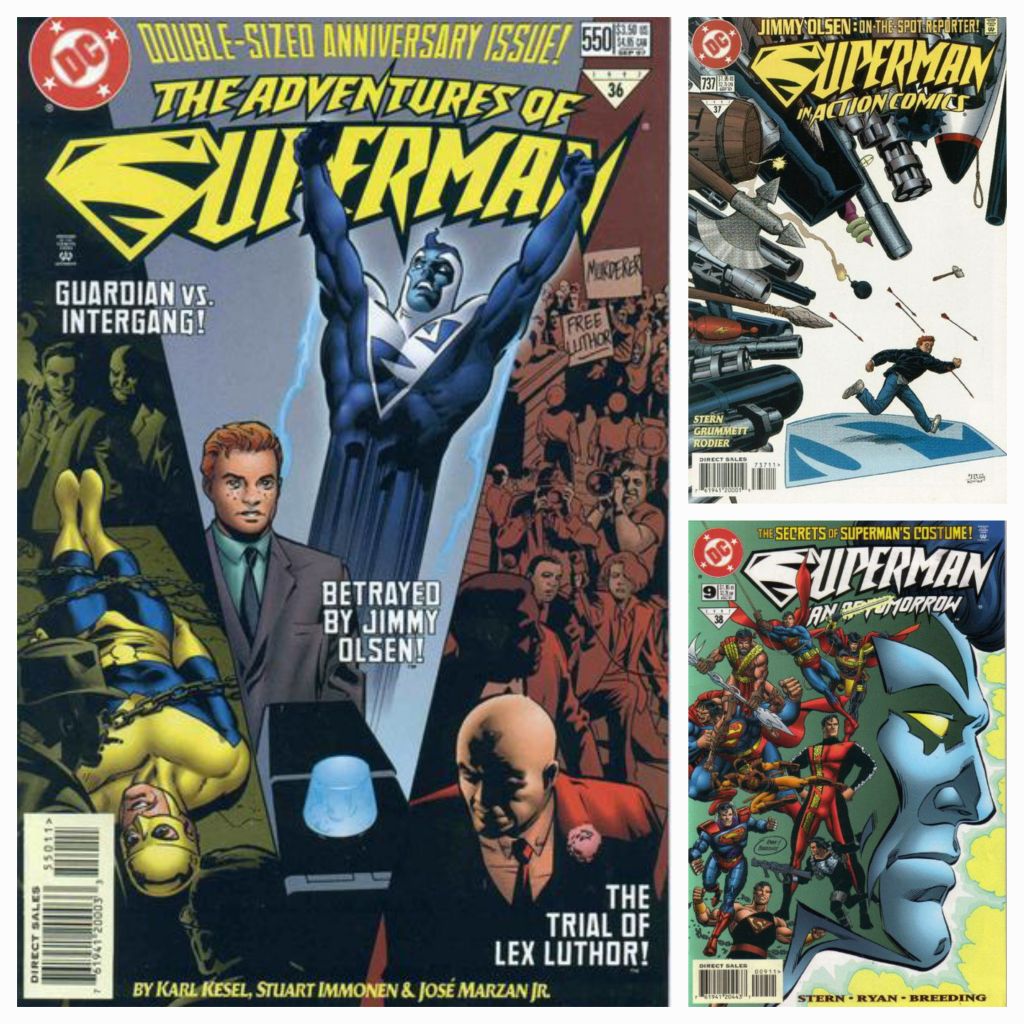
Notes: Jimmy’s giant bonehead extravaganza comes to a head in the “double-sized anniversary issue” Adventures of Superman #550. As he prepares his news special in which he plans to reveal Superman’s identity, he tries to justify it in his head by saying that, without his hearing and vision powers to alert him to danger, Superman’s identity being public would make it SO MUCH EASIER for people to come to him for help, displaying the kind of mental gymnastics that wouldn’t be associated with Superman again until Zack Snyder fans started to desperately try to pretend that the James Gunn movie wasn’t successful. Jimmy invites Lois and Clark to the taping of his special, along with two other guests: former football pro Johnny Dakota and Newstime magazine publisher Collin Thornton, both of whom also happen to live in the same building as our happy couple. Lois storms out of taping as Jimmy reveals what’s up his slave, but Clark instead gives Jimmy a kind but firm dressing-down about how Superman wouldn’t do anything to hurt anybody. The speech doesn’t fall on deaf ears, but Jimmy realizes it’s too late to back down now, and so on live TV he announces that Superman’s secret identity is…NOBODY!
Okay, he did the right thing in the end, but Jimmy B. Olsen comes across – both in-universe and to the reader – as one of the dumbest characters in the entire DCU.
Predictably, he gets fired from WGBS and he decides to take a little time off, even keeping the truth about Superman’s secret to himself…that Superman is really, of course, Collin Thornton.
I dislike this take on Jimmy so, SO much. I’ve talked before about how I prefer it when characters are played to the top of their intelligence, and this is as far from that as it could possibly go. Not only does Jimmy completely miss every clue that Clark is, in fact Superman, a fact that even a child could infer from the speech Clark gives him in this issue, but his emotional intelligence would have that same child look at him in disgust. One of my favorite bits of the new movie is the scene in the end, where Perry White and Jimmy Olsen quip about how long Lois and Superman have been hooking up. The scene can be read one of two ways: either they know Lois is involved with their biggest headline, OR they know that Lois is involved with Clark and that Clark happens to be Superman. There’s been quite a lot of chatter online about this, and personally, I prefer the latter interpretation, much for the same reason that I believe that James Gordon knows that Batman is really Bruce Wayne – he’s just too smart NOT to have figured it out, but he knows it’s best to keep it to himself. THAT’s the Perry and Jimmy I want to read about.
Not this assclown.
But as it turns out, the dumbification of Jimmy Olsen wasn’t over yet. Action Comics #737 picks up the thread, as (in an issue by guest writer Mark Waid) Olsen is attacked by Intergang, who isn’t buying his claim that Superman has no secret identity, and they’re ready to get the truth out of him. Jimmy just barely manages to escape – in only his boxers, which only serves to deepen his public humiliation when he’s picked up by the police. It just gets worse when the people who bail him out turn out not to be family or friends, but the same Intergang agents who were after him before. Meanwhile, at Lex Luthor’s trial, Lex’s lawyer argues that Lex, while dying of Kryptonite radiation, was saved by one of his research team, but lay comatose for months, only coming out of it shortly before the Final Night crisis. The real criminal was his clone, “Lex Luthor Jr.” (which is technically true, if you ignore the fact that Junior was just Lex’s brain in a younger body). The real kicker, though, is when the defense actually produces the clone – now aging, infirm, and raging in court. The judge, reluctantly, allows Lex to go free.
There are a couple of good bits in this one, even as Jimmy continues to act like a bonehead. First, after Lex’s trial, a snide and confident Lex Luthor informs his lawyer that everything he just said in court was bupkis, he was indeed the one responsible for the “clone’s” crimes, and he’s about to go launch a plan to destroy the Justice League which the attorney can’t tell anyone about due to attorney/client privilege. It’s just the kind of utterly arrogant thing that makes Lex such a delicious villain, and Waid sells it nicely. Another good bit is at the end, when a desperate Jimmy turns to Bibbo for help. The same Bibbo who punched Jimmy out for his jackass behavior not that long ago comes to his aid because, in his own words, “We’re both pals o’ Superman, and dat’s a pretty solid brotherhood.”
The world needs more Bibbo Bibbowski in it.
A quick note about the next book I’m going to be reading, Superman: The Man of Tomorrow #9. During the “Triangle Era” we had four monthly Superman comics, which equaled 48 issues of Superman a year. As you may have heard, though, years actually have about 52 weeks. Comic books come out on Wednesday, and roughly four times a year you get a month with five Wednesdays in it instead of four. DC decided to fill in these gap weeks with Man of Tomorrow, a bonus title that only appeared in these missing Wednesdays. It was a fun idea, but they rarely added anything substantial to the ongoing storyline (I suppose DC knew that even with a triangle on the cover some people would skip it) and eventually it was phased out in lieu of DC’s “fifth week” events, where they’d fill Wednesday #5 with a series of themed one-shots like Girlfrenzy or New Year’s Evil.
Anyhoo, Man of Tomorrow #9 is kind of the perfect expression of this series. It’s a one-off story in which Jonathan and Martha – talking about their son’s recent transformation – run down all of the other trials and tribulations he’s faced over the years. The book is really nothing but a condensed history lesson of all the main storylines that had happened to the character in the decade since John Byrne’s Man of Steel reboot, which is kind of an odd choice for a book they’re afraid would only be purchased by the most intrepid of readers, because they would be far more likely than the casuals to already know all of this stuff. The cover is pretty misleading too, with a banner that proclaims “The Secrets of Superman’s Costume!” Spoiler alert: there are absolutely no secrets in this book, just a parade of Superman’s history with a visual focus – courtesy of artists Paul Ryan and Brett Breeding – on the assorted different costumes and appearances Superman had over the years. We got glimpses of pretty much everything, from the armor he wore during Krisis of the Krimson Kryptonite to the circus strongman getup from Time and Time Again to the battle suit Mother Box gave him in Superman/Doomsday: Hunter/Prey. In fact, if I were a toy manufacturer looking to do a really comprehensive line of figures featuring every different getup Superman ever wore, this book would be a pretty valuable resource for this time period. As a story it’s cute, but kind of a throwaway.
Tues., Sept. 9
Short Film: Superman 75

Notes: My original plan for today was to read the Superman annuals that featured ol’ Electric Blue, but September 9th turned out to be one of those days that just gets away from you. I had my hands full with various things, and by the time I’m writing this at nearly 7:30 pm, I haven’t had a chance to indulge in any Superman content. It’s time to play one of the little “emergency cards” I had planned out at the beginning of the year – a quickie I could sneak in on a day like this one, when time is of the essence and I might not have another chance to keep my streak alive. Today I chose Superman 75, a two-minute animated short directed by Zack Snyder and Bruce Timm to celebrate Superman’s 75th anniversary back in 2013.
Say what you will about Snyder (and at some point, before the year ends, I intend to do so), but this short really does show a respect for the character of Superman. In two minutes, Snyder and Timm craft a wonderful little visual retrospective of Superman’s 75-year history, which I still can’t believe was already 12 years ago. I hope DC has some plans in place for year 90, it’s going to be here before they know it.
Anyway, over the two minutes of the short – which is mostly set to the classic John Williams score — we start off with an extreme close-up of the S-shield from the cover of Action Comics #1, which then springs to life and then begins evolving through the various ages of the character. At turn, we see glimpses of the Fleisher Superman, some Golden Age comics, George Reeves, the proliferation of new heroes and villains that joined Superman in the Silver Age, a glimpse of the Super Friends, a dip into the 70s when Superman boxed Muhammad Ali, the death and return, the electric era, the Animated Series, Smallville, Kingdom Come, and the New 52 (WHEW!) before the short finally wraps with a glimpse of Henry Cavill in that first promo shot we ever saw of him, where Superman was standing in the rubble of what looked like a bank vault. For the last segment the music shifts to the Hans Zimmer score, paying what I still think was a suitable tribute to the character as he was at the time.
I’ve watched this cartoon probably a half-dozen times since it was first released, and I enjoy it every single time. It’s a nice visual history of my favorite hero, and it’s the sort of thing I’d like to see them revisit and update every so often. But when I watched it on my laptop this time, something interesting happened. My son, Eddie, heard the now-familiar strains of the John Williams music coming from the computer and asked what I was watching. So I had him sit on the couch next to me so we could watch it together. As we went through the short I briefly informed him which eras we were passing through, and he thrilled at the appearance of Krypto during the Silver Age segment. Of course he did – we all love Krypto. If James Gunn throws Beppo into the Man of Tomorrow movie, I’ll show this short to Eddie again and he’ll go wild over that.
Assuming I have a little more time tomorrow, I’ll get around to those annuals, and then continue on my journey through Superman’s electrical era. Until then, friends!
Blake M. Petit is a writer, teacher, and dad from Ama, Louisiana. His most recent writing project is the superhero adventure series Other People’s Heroes: Little Stars, volume one of which is now available on Amazon. You can subscribe to his newsletter by clicking right here. You can join in the Kryptonian Konversation every day in the Year of Superman Facebook Group!
I spent last week dipping my toes into the DC Vs. Marvel crossover, as well as the first wave of Amalgam Comics titles. But I’m not done yet: I’ve still got over half the huge Amalgam Age Omnibus to get through, including two sequel miniseries and the second wave of Amalgam Comics. Not only that, but after a few weeks where the beginning of the school year has kept me busy, I finally get a chance to sit down and catch up on more recent Superman comics. Oh yeah – and Peacemaker season two drops this week, and while I don’t expect to see Superman to show up, James Gunn has promised that the story of this season follow on from the film, so there’s a pretty good chance I’ll have some thoughts to share about that. Let’s begin, shall we?
And as always, you can check out earlier blogs in the Year of Superman Archive!
Wed., Aug. 20
Comics: DC/Marvel: All-Access #1-4
Notes: I’m going to say something that may be controversial here. I actually like the follow-up miniseries, like DC/Marvel: All-Access, better than the DC Vs. Marvel event itself. DC Vs. Marvel was a fun experiment, but the plot was really just a flimsy excuse to show off fights between the characters and frame the Amalgam specials. All-Access, on the other hand, has an actual STORY to it, and I appreciate that. Written by Ron Marz with art by Butch Guice, whom you may remember passed away earlier this year, All-Access starts out with Axel Asher, the man who straddles the line between the Marvel and DC Universes as Access. A psychic flash warns him that Venom has somehow hopped universes, and if anyone from either universe stays in the other one for too long it could cause the worlds to fuse into the Amalgam Universe again, so the cosmic hall monitor has to get to work. He comes across Venom in Metropolis, where he’s throwing down with Superman, and so Access decides to get some backup by calling in someone who knows what Venom’s deal is: Peter Parker, the Amazing Spider-Man.
This is all in the first issue of the miniseries, by the way, which almost works very well as a standalone Superman/Spider-Man team-up. There’s no gratuitous hero-on-hero fighting here, just two good men teaming up to take down one bad one, and Marz plays them both perfectly. Re-reading this issue is where I started to realize that this is kind of what I had hoped DC Vs. Marvel would have been all along.
Superman doesn’t show up again until the last page of issue #3, but in the meantime, Jubilee convinces Access to take her back to the DC Universe because when she and Robin were supposed to be fighting each other, they kind of fell in love. (To this day, it’s probably the best relationship Tim Drake has ever had.) Their reunion is interrupted by an encounter with Two-Face, then again when the Scorpion appears, once again mysteriously having been pulled from the other universe. Access recruits Batman to help him solve the mystery of the “crossovers,” and Batman suggests that they track down the man who, in the combined universe, was supposed to be its defender: Dr. Stephen Strange. Batman approaches Strange, suspecting that he’s causing the crossovers somehow, and Jubilee calls in the X-Men to hold him off. Issue three ends with Access once again calling in the cavalry, bringing in the rest of the Justice League.
Issue four is X-Men vs. JLA, at least at first. Things change when Access discovers that Dr. Strangefate has been hiding in Strange’s subconscious ever since the merger and used him to cause the crossovers in an attempt to restore the Amalgam Universe. He fuses Wonder Woman and Storm once again into their Amalgam counterpart, Amazon, but when he realizes he doesn’t have the right parts to put together anyone else, he starts creating NEW Amalgams: Superman and Bishop! Iceman and Aquaman! Jean Grey and the Martian Manhunter! Things get wild!
The story ends with a nice little promise, the Amalgam Universe restored as a sort of pocket universe where Strangefate is locked away, and the Marvel and DC Universes get to remain separate. But this miniseries was so much fun, seeing the characters actually interact in ways that didn’t go straight to the fisticuffs. The Robin/Jubilee stuff in particular was fantastic, and I loved seeing Superman and Spider-Man working together again.
It’ll never happen, but I’d love to see a longer Access series, say a 12-issue event in which he’s trying to solve some sort of mystery that encompasses both worlds. And I’d love if, during this year, he appears not only in his own series, but in the ongoing comics of both companies, bringing surprise guest stars with him. But seeing as how the original plan was for DC Vs. Marvel to end with She-Hulk and Martian Manhunter swapping universes for a year until that plan was nixed by the lawyers, it’s doubtful that anything like that could happen. It’s not like the world has gotten LESS litigious since 1996, after all.
Thur., Aug 21
Comic Books: Super-Soldier: Man of War #1

Notes: A year after DC Vs. Marvel, a second wave of 12 Amalgam one-shots were released, six of them continuing adventures of the characters from the first, six of them with all-new Amalgamations. What’s interesting is that even the books that carried over didn’t continue the STORIES from the original. Some of them were unrelated stories, some made brief reference to the previous, and some went REALLY wild, like Dark Claw Adventures giving us an adventure of the Amalgamated Batman/Wolverine combo in a Batman: The Animated Series style. For our first visit with the Super family, Super-Soldier: Man of War dipped back in time to give us an adventure of the character from World War II. Mark Waid and Dave Gibbons reunite for this story, which kicks off with Super-Soldier at a meeting of the All-Star Winners Squadron. But he’s only there long enough for us to notice some new Amalagams (such as the Human Torch/Green Lantern mashup Human Lantern) before it’s off to join Jimmy Olsen for a special undercover Daily Planet assignment overseas.
On the ship to Europe, Clark and Jimmy make the acquaintance of Sgt. Rock and the Howling Commandos, and Clark is later chagrined to find that Winston Churchill has fallen for the do-gooder act of his arch-nemesis, Lex Luthor, husband of Lois Lane. In a way, Luthor’s involvement actually makes this a prequel to the previous story, as the issue ends with him unveiling the plans for the Ultra-Metallo that Super-Soldier fought the first time we read one of his adventures. Kinda makes you wonder why it took Luthor 50 years to get it together.
As before, Waid and Gibbons do a great job lacing together the Superman and Captain America characters, this time bringing in the World War II-era heroes of Easy Company and the Howlers as well. Peggy Carter, for instance, shows up here as a member of the French Resistance (although I couldn’t figure out which member of Easy Company she was supposed to be mashed up with). The appearance of Major Zemo and his War Wheel pushes this over the top – silly and gleeful. These Amalgam books, when done well, are just an enormous amount of fun. Is it too much to hope that the new DC/Marvel crossover books that are about to come out will open the door for the return of this mixed-up universe?
Fri., Aug 22

Last night was the premiere of Peacemaker season 2. I thought that meant I would be able to watch it when I got home from work, but apparently, it dropped at 8 p.m. EST, by which time my sports fanatic son was engrossed in a preseason game between two teams that nobody in our house has any personal connection to. But that was okay, I figured that I would just watch it the next day. I guess that was pretty stupid of me, though, to assume that I could wait a whole 20 hours and not have anything spoiled for me. Before the game was even over, though, posts were appearing on social media that spoiled something that really pissed me off. You see, season one was made BEFORE James Gunn was given the job of revamping the DCU, and was intended as part of the previous iteration of the DC Extended Universe. With the new DCU that began in Creature Commandos and continued into Superman, though, there were questions as to which parts of the season were still canon. Gunn has been exploring that in the official podcast for the show, but there was a moment in the finale that they were going to have to work a little bit to reconcile.
Naturally, looking at Facebook last night, I was spammed with different pages that I don’t even follow sharing a screenshot that ruined a pretty amusing moment. How dare I assume that people wouldn’t make it into a headline? It had been an entire 180 minutes since the show dropped! What are they, made of stone?
Here’s the rule: If you’re posting spoilers about a show on the day it airs, you’re an asshole. That goes for individuals as well as all of those pages that I have since blocked.
By the time you read this it will have been nearly a week since that episode, and I STILL wouldn’t talk about it without giving you a warning. So in the next paragraph I’m going to spoil a few things about the end of Peacemaker season one and the beginning of season two. If you haven’t watched them and want to remain pure, skip ahead to Saturday.
TV Show: Peacemaker Season 2, Episode 1: “The Ties that Grind.”
Season one of Peacemaker ended with the titular hero and his team, the 11th Street Kids, saving the world from an invasion of alien butterflies. It’s more impressive than it sounds. But in the battle, Emelia Harcourt was nearly killed. Towards the end of the episode, Peacemaker is carrying her to safety when, lo and behold, the Justice League appeared – too late to do any good. The League, in this case, included silhouettes of Superman and Wonder Woman, as well as Jason Momoa as Aquaman and Ezra Miller as the Flash. It was a funny scene, but as that Justice League doesn’t exist, that scene clearly was no longer canon.
Gunn promised to explain it away and he did at the very beginning of the episode, in the “Previously on…” montage, where the League was replaced by the Justice GANG from the movie. The silhouettes of Superman, Mr. Terrific, and Supergirl all appeared, as well as a quick and the cameos have been replaced by Isabela Merced’s Hawkgirl and Nathan Fillion’s Guy Gardner. It was a funny bit. But I bet it would have been funnier if not for the asshats on the internet posting it the night before I got to watch it.
Fillion and Merced appear later in the episode as well, alongside Sean Gunn as Maxwell Lord allowing Peacemaker to audition for the Justice Gang. Watching the episode, it’s clear why DC put out the digital version of Superman last week – there are a lot of things in this show that build directly on that movie, although it’s still Peacemaker’s story of course. Rick Flagg shows up, worried about another dimensional rift like the “Luthor Incident” that happened this summer. Besides the connections to Superman, the show also starts trickling in new characters, like a surprising cameo by White Rabbit and references to the likes of the Ultra-Humanite and Captain Triumph. Rick Flagg is even working with Sasha Bordeaux, a supporting character from Greg Rucka’s Batman comics. Gunn seems to be using this season of Peacemaker to lay in chunks of the history of the DCU that Superman only hinted at, and I’m really quite excited by that.
Look, it’s not a HUGE Superman link, and it’s DEFINITELY not a show I’m gonna watch with my seven-year-old like the movie, but this show is starting to look like it’s going to be part of the fundamental fabric of the new DCU, and that would make it worth watching even if it WEREN’T really good.
Comics: Jon Kent: This Internship is My Kryptonite #5
Sat., Aug 23
Comic Books: Superman: The Kryptonite Spectrum #1, Superman Unlimited #4, Supergirl Vol. 8 #4

Notes: The beginning of a new school year traditionally keeps me busy, and today was the first time I’ve made it in to pick up my new comics in a few weeks. As such, I’ve got a hefty nine Superman or Superman-related comics sitting in my stack, waiting to read and discuss, including the much-anticipated Superman: The Kryptonite Spectrum #1. This Black Label series is by W. Maxwell Prince and Martin Morazzo, the creative team behind Image Comics’ incredible existential horror series Ice Cream Man. That’s the only thing of theirs that I’ve read before, however, and while I’m a big fan, I’ve been curious ever since this was announced as to just how their sensibilities would translate over to the Man of Steel.
As it turns out, they translate wonderfully.
In this story, Superman discovers four new strains of Kryptonite beyond the usual colors we’re aware of, and recruits Batman to help him experiment with them and find out what they do. The first, a Purple K, distorts Superman’s perception of time – something that is especially concerning as Lex Luthor chooses just that minute to unleash Solomon Grundy in Metropolis.
It would be fair for someone to question whether a creative team best known for a cosmic mind-tripping horror comic would be an appropriate choice for a Superman story, but Prince and Morazzo acquit themselves right away. The Kryptonite Spectrum isn’t a horror story by any stretch, but when Superman’s concept of linear time is skewed, we get a story that drifts into the kind of psychological twists that make Ice Cream Man so compelling while skipping the actual terror. Prince uses this conceit to play with the reader’s concept of time as well, and the script even twists Superman’s interactions with his friends, with a few scenes with Lois Lane dipping into the very real anxieties that Ice Cream Man so frequently mines for pure horror. Here, though, rather than terror, Prince uses them for character drama, displaying things about the relationships between the characters that feel very true, very human. This may not have the “Elseworlds” label, but the story clearly isn’t set in the mainstream DC Universe, with Superman and Lois’s relationship framed in a way that doesn’t fit that world, but feels quite appropriate for the story that Prince and Morazzo are telling. This is a great first issue of a very different kind of Superman story, and I enjoyed it heartily.
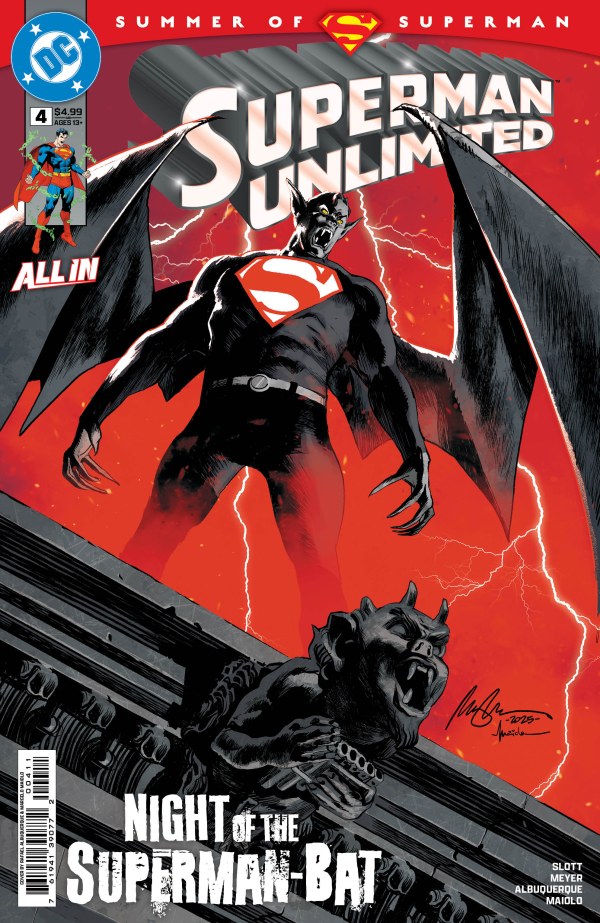
Dan Slott and Rafael Albuquerque are back with Superman Unlimited #4. With the Daily Planet expanding to a global operation, Jimmy Olsen has been tasked with helping set up their Gotham City office. While he’s in town, he and his ape city sidekick Tee-Nah run across Man-Bat and wind up summoning Superman for help. What they don’t know, though, is that this is a new Man-Bat, one who can transmit its curse via a bite…and a chance encounter with all the Kryptonite on Earth these days has left Superman just vulnerable enough to get nipped. Soon it’s Robin and the Birds of Prey vs. Superman-Bat!
This book is really turning out to be just what I wanted. There’s an ongoing storyline – that of the Kryptonite meteor that fell to Earth and the consequences of that – however, each issue feels like it’s telling a complete and self-contained story. The A-plot, the “Superman-Bat” thing, is done in one and it’s over. The background story of the Kryptonite and the expanded operations of the Planet continue. Although it’s a single monthly comic, in a lot of ways it feels like the structure of the glorious “Triangle Era” of the Superman comics, and I love it for that. Slott also works in some nice tidbits regarding Superman’s interaction with the Batman family, which – coming right on the heels of having read The Kryptonite Spectrum #1 – makes it feel as if DC is using the month of August to make sure everyone remembers that Superman and Batman are best buds. Which, of course, I approve of wholeheartedly.
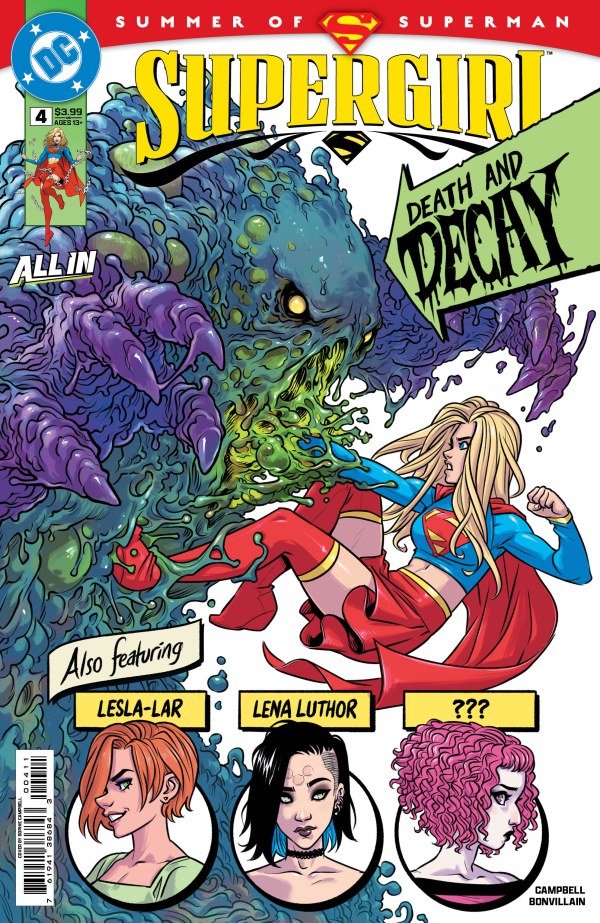
Supergirl #4 continues Sophie Campbell’s new(ish) take on the Woman of Tomorrow. Having defeated her doppelganger Lesla-Lar last issue, this issue Supergirl takes her back to Kandor where she does something her cousin would most certainly approve of wholeheartedly: she goes to bat for her. Supergirl argues that Lesla has the drive to become a real hero, if only given the proper guidance, and volunteers to take that task upon herself. That’s the very beginning of the issue – afterwards we see Lesla make earnest attempts to prove her worth, leading up to a strange but entertaining encounter at a Goth club where she makes a mistake in judgment that winds up having the Supergirl squad face the forces of Decay.
I just adore Campbell’s take on Supergirl. This issue in particular feels so true to the character – she comes off as someone who has demons in her past but, having largely conquered them, is sworn to help other people do the same. And following Lesla in this issue just magnifies that fact, demonstrating the effect that just being in proximity of someone like Supergirl can have on a soul that’s not truly evil, but merely lost. It’s such a good look for her and for the entire Superman family, and Campbell is nailing it in a delightful way. I also appreciate how Campbell is mining Supergirl’s past – the “new” villain, Decay, is a new version of an obscure character from Supergirl’s ‘80s series who, to the best of my knowledge, hasn’t reappeared since then. She knows this character’s history and she’s using it to her best advantage, which makes for a really rewarding read.
Sun., Aug. 24
Comics: Krypto: The Last Dog of Krypton #3, Action Comics #1089, Justice League Red #1
Notes: After a busy Sunday of groceries, shoe shopping, making my weekly LitReel and, of course, a required stop at Spirit Halloween, it’s nearly 7 pm before I have a chance to sit down and read anything. Fortunately, I’ve still got six more new Superman-related books to dig into. Let’s see how many I get to this evening.

Krypto: The Last Dog of Krypton #3 is first. Wandering alone after abandoning Lex Luthor, Krypto is stumbling through the woods when he comes across a little girl who’s as lost as he is. Roaming through the freezing woods, Krypto takes it upon himself to take care of the child, and in the process, proves just what a good boy he really is.
The first two issues of this miniseries blew me away. This one… DAMN it, Ryan North. Three issues in a row – THREE ISSUES IN A ROW – and you’ve got me in tears reading about KRYPTO THE SUPERDOG.
Honestly, if you’re not reading this comic book I don’t know what even is wrong with you.

Action Comics #1089 may not have me sobbing over the adventures of a dog, but that doesn’t mean it’s not good. Last issue, young Clark Kent was surprised when his history teacher showed up on his doorstep and revealed that he knew Clark was Superboy. This issue, Mr. Blake has a reveal of his own and, frankly, I’m kind of irritated with myself for not picking up on who he was in the first place. Mark Waid is being Mark Waid here, tapping on his seemingly infinite awareness of the DC Universe to bring back a character who hasn’t been seen in a while and recontextualizing him in the world of Superboy’s Smallville. I can’t get much more specific without spoiling anything here, and in case you haven’t read the issue yet, I don’t want to do that But Waid is doing really interesting stuff in this issue.
My one complaint is actually the cover by Ryan Sook. It’s a great piece of art – evocative and certainly sure to get a reader’s attention…only it doesn’t seem to actually fit anything in the story. I hate when comic book covers are dull, generic pin-ups, but it may be even worse when the cover is of a scene that doesn’t even appear in the book.

The last book I squeeze in before I’m alerted by my child that he’s hungry and he has expectations of something called “dinner” is the first issue of the latest DC All-In era Justice League spinoff, Justice League Red. Ever since the Justice League re-formed, Red Tornado has been serving as the computer intelligence running the operations for the team. This issue, Power Girl and Green Lantern Simon Baz get a red alert on their League ID cards that summon them to a satellite Red Tornado built without the knowledge of the rest of the League. His computer mind has been running millions of simulations and has determined that the new League is somehow going to lead to a catastrophe on Earth, and he needs a few trusted members to handle secret tasks the rest of the League cannot learn about in order to stop it.
Writer Saladin Ahmed is taking an interesting path in this book. The story leads us to believe that Red Tornado is unstable, and that all of these predictions and algorithms he’s run are unreliable. Even as Power Girl and Simon carry out their first mission, they’re skeptical as to whether they’re doing the right thing and whether they can trust their robot teammate. But to play that hand so early, to make it seem from the very beginning that Red Tornado may be going off the rails…it feels kind of like a feint to me. I’m willing to bet that we’re going to find out along the way that things are even worse than believing Red Tornado is wrong: we’re going to find out that somehow, he’s RIGHT. Interesting set-up, and I look forward to seeing where this goes.
Mon. Aug. 25
Comics: Absolute Superman #10, Batman/Superman: World’s Finest #42, Justice League Vs. Godzilla Vs. Kong 2 #3
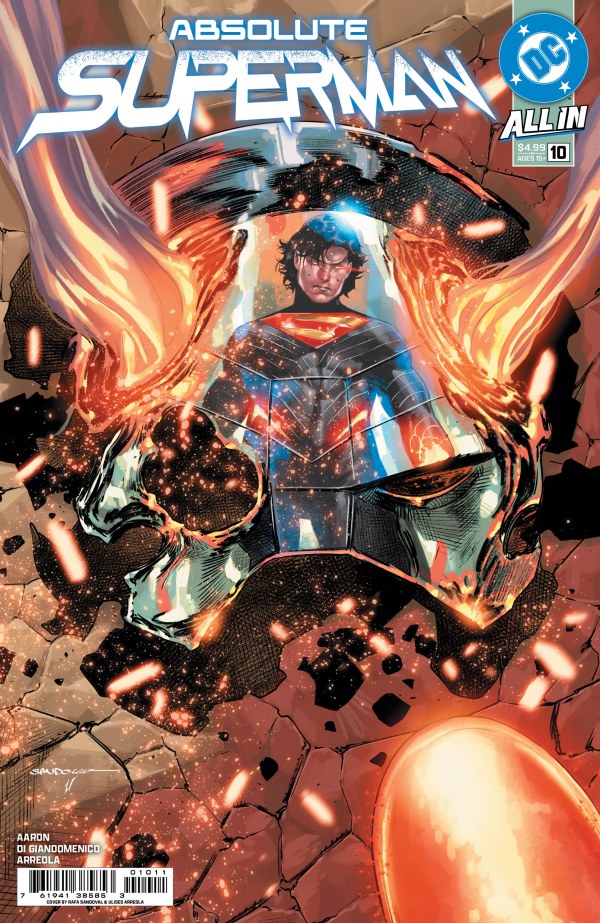
Notes: Time to wrap up my catch-up weekend (plus one day) with the final three Superman-related comics from my visit to the comic shop. I’m kicking it off with Absolute Superman #10. The battle continues between the Omega Men and Ra’s Al Ghul’s Peacemakers, with Peacemaker Smith on the front line in the hunt for Kal-El. With a Kryptonite bullet in Smith’s gun, Kal-El is faced with a decision, and a reflection onto a hard choice his father once made brings about a surprising result.
The conceit of the Absolute comics is that this is an entire universe tainted by Darkseid, where hope is the eternal underdog and the sort of values that characterize the traditional DC heroes are absent. This issue, Kal-El is faced with the kind of choice that Superman inevitably comes down to at some point in his career, and it’s a testament to Jason Aaron’s writing that, right up until the choice is made, I’m not entirely certain which way I think he’s going to go.
I like the way the Absolute world plays with characters as well. Concepts like the Omega Men, Peacemaker, and especially Ra’s Al Ghul are not traditional elements of the Superman corner of the DC Universe, but they work in the story we’re getting here. Overall, it’s a good chapter in this saga.

In World’s Finest #42, Superman and the Dynamic Duo have been summoned to Bizarro World to help with a plague. The Bizarros (including Bizarro Superman #1 and Batzarro) who are infected find their minds realigned to a more Earth-like way of thinking. Such a danger can’t be allowed to spread, so they’ve turned to our heroes to save them…but together, they find that the danger may be greater than even the plague seemed to be.
Mark Waid is doing some really interesting things with the Bizarros here. He plays with the notion of how science and physics don’t really allow for something like a square planet and what the consequences of such a world would be. At the same time, he tackles the Bizarro philosophy of things being “backwards” as well, in a way that makes me feel slightly abashed for my criticism of the Bizarro story in the recent Kal-El-Fornia Love summer special. There’s also a great moment for Batman here – Robin (understandably) questions why it would be such a bad thing if the Bizarros all had their minds reversed to what we think of as “normal.” Batman’s response is a little unexpected, at least until he gives his reasoning, displaying a depth of compassion that Batman isn’t often given credit for. It’s a good look on Bruce.

I finally get to the end of the new Superman titles (less than 48 hours before this week’s comics go on sale) with Justice League Vs. Godzilla Vs. Kong 2 #3. At the center of the Earth, Superman and Lex Luthor are forced into an uneasy alliance as they come across a herd of giant gorillas. (A herd? A pride? What are a group of gorillas called? I should probably look that up.) On the surface, meanwhile, Supergirl and Wonder Woman get to work liberating a Monarch base being held captive by Task Force X, and Harley Quinn gets involved in a rather…unique therapy session.
Obviously, I love crossovers, and seeing the League facing off against the Kaiju of the Legendary Monsterverse is a lot of fun. I particularly like bringing in the Suicide Squad as an alternative antagonist in this story. But it’s the sort of thing that’s a little hard to hold in your head from month to month. Waiting for the trade isn’t a practice I care for, but this is probably a situation where the story will read better in collected form than issue-to-issue. Once it’s over, I’ll have to re-read the whole thing in a lump.
Tues., Aug. 26
Comics: Spider-Boy Team-Up #1, Unlimited Access #1-4

Notes: We’re going to end our journey through the Amalgam Universe and the DC/Marvel Omnibus today with Spider-Boy Team-Up #1, and the subsequent Unlimited Access miniseries. The final one-shot, written by Roger Stern and Karl Kesel (cleverly Amalgamated into R.K. Sternsel) with art by Jose Ladronn, features the return of the Arach-kid with a special guest appearance by his pals in the Legion of Galactic Guardians 2099, and that in and of itself should tell you that at this point they were going WILD with the Amalgamations. At Cadmus, as preparations are made for the Kid’s upcoming nuptials to Mary Jane Watson, aka the Insect Queen, the Kid is plucked from the timestream and brought to the far-flung future, where the Legion is about to elect a new leader. Will it be Vance Cosmic? Martinex 5? Cannonfire? Multiple Mai–you know what, there’s too many, I’m not going to list them all. But it’s pretty interesting to note that there are so many Legionnaires that there aren’t enough Guardians to Amalgamate them all (or at least, there weren’t at the time) so they wind up mashing together with virtually any Marvel character that fits: Dream Girl and Destiny made up Dream Date, Matter-Eater Lad and the Trapster made Paste-Eater Pete, and my personal favorite, Bouncing Boy and Speedball mashed into Bouncing Ball. Unfortunately, Spider-Boy’s time displacement is causing stress on the time stream, and he winds up falling into different time periods, meeting different incarnations of the Legion.
The book turns out to be a real celebration and gentle parody of the Legion, poking some lighthearted fun at the various reboots the team has undergone over the years, a topic with which I have some passing familiarity. Even Ladronn’s artwork works really well, emulating the different styles of Keith Giffen’s Five Years Later era just as neatly as he does the Chris Sprouse-inspired Reboot Legion. The ending is a really nice touch, tying together the “2099” part of the melding with the only Legionnaire that it could possibly have been. Even divorced from the rest of the Amalgam comics, Spider-Boy was a glorious, joyful, wild experiment. Man, I hope the upcoming facsimile edition is just a precursor of things to come.
The last gasp – both for the Amalgams and for the Access concept of Marvel/DC Crossovers, came in the 1998 miniseries Unlimited Access by Karl Kesel and Pat Olliffe. The story starts with Access, the “Cosmic Hall Monitor,” popping back to his home in Marvel’s New York after sorting out a recent encounter between Spider-Man and Batman. Kesel implies here that this particular crossover had Access looking on from the background trying to keep things straight. As a concept, it actually would work to explain EVERY Marvel/DC crossover – Access, or someone like him, keeping an eye on temporary fusions between the worlds, which the respective heroes forget after the fact. If they decided to run with it that way.
Access has to untangle the appearance of Mantis – one of Darkseid’s lesser goons – in battle with Spider-Man, a fight that gets escalated when Juggernaut and Wonder Woman wind up in the mix. Things get even crazier when he takes Diana home only to find himself tangled in a fight between a still-savage Hulk and Green Lantern Hal Jordan…who is DEAD.
Superman doesn’t actually show up in the first few issues of this miniseries, so I’ll cut to the chase: as it turns out, Access doesn’t just bounce back and forth between universes, but discovers he can bounce back and forth in TIME as well, allowing him to meet the different versions of the Marvel and DC heroes from any point in the timestream (including the “Days of Future Past” X-Men from the distant year 2012). He’s also got the ability to create Amalgams, merging characters from the two worlds into one, which comes in handy when it turns out he’s being tracked by Darkseid, who wants his ability to traverse the worlds. By issue three, Amazing Grace has hypnotized the original Avengers and Justice League into battling each other, and Access decides to reach out for the only hero who stands a chance of fixing this mess: big blue himself, Superman. And I mean Superman during his electric blue era. It takes literally seconds for Superman to jolt everyone back to their senses, then he and Captain America mobilize the two teams to fight off Darkseid’s invasion of the Marvel Earth. But the crazy just keeps coming with the Brotherhood of Evil Mutants, the original X-Men, and a group of teen heroes who – just months later – would wind up getting their own title as Young Justice.
By issue four, Darkseid and Magneto are teaming up to take over the world (this is early Magneto, when he was still into that kind of thing) and the heroes decide to combine their powers – literally – into a single strikeforce of Amalgams. Black Canary and Jean Grey: Jean Black! Giant-Man and Green Lantern: Green Goliath! Captain America and Captain Marvel Jr.: Captain America Jr.! I know, I didn’t write it. And of course, Superman and Thor are fused together as Thor-El.
The fun part here is seeing these new Amalgams throw out casual references to help the reader to understand what they’re like in their own minds: Captain America Jr. possessing the “wisdom of Lincoln,” for example, or Thor-El referencing the Valhalla Zone. The series, and the history of Access, end with him accepting the truth about himself, beating Darkseid, and swearing to prevent a future he doesn’t want to experience.
Reading this story again now, there’s so much potential left in this concept, and thanks to the nature of Access’s powers, there’s no reason that Marvel and DC couldn’t pick up on it again at any time. With new crossovers (finally) on the horizon between the two of them, the chance is right there. I don’t know if they’ll take it – I certainly hope so.
But for now, at least, our journey with Superman and the heroes of other worlds has come to an end. And I think it’s time to rededicate myself to stories focused around Clark Kent himself. That in mind, next week, I’m going to embark upon my re-read of the longest Superman saga I’ll have yet tackled for the Year of Superman blog. See you then!
Blake M. Petit is a writer, teacher, and dad from Ama, Louisiana. His most recent writing project is the superhero adventure series Other People’s Heroes: Little Stars, volume one of which is now available on Amazon. You can subscribe to his newsletter by clicking right here. You can join in the Kryptonian Konversation every day in the Year of Superman Facebook Group!
If you ask Joe Public what team Superman is a member of, pretty much everyone will bring up the Justice League. And they’re not wrong – Superman is a vital member of the League, and honestly, it doesn’t really feel like the JLA without the trinity of Superman, Batman, and Wonder Woman. (I love the Giffen/DeMatteis run, don’t get me wrong, but that’s the JLI.) But the thing is, the Justice League isn’t the FIRST team Clark Kent was a member of. And in truth, as far as his development as a character, I don’t think it’s even the most important. This week we’re going to look at the young people he inspired and who, in turn, helped shape him into the hero he is. Superman would still be Superman if he’d never joined the Justice League…but he’s not really the hero he is without the Legion of Super-Heroes.
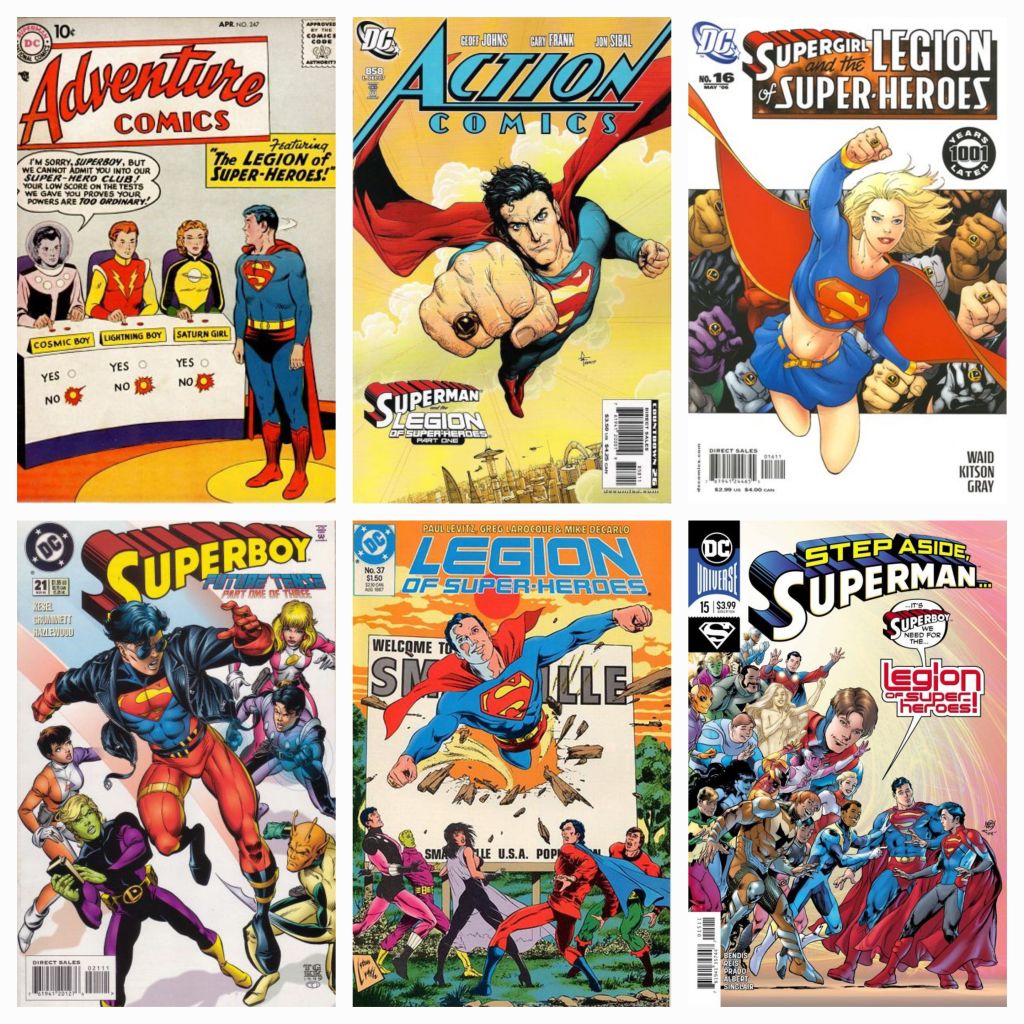
And the same goes for Superboy. And Supergirl. And Jonathan Kent, too. Because of reboot after reboot, there have been a lot of versions of the Legion over the years, and Clark, Conner, Kara, and Jon have each had their own incarnation. This week I’ll try to peek at each of them, talk about why the Legion matters so much to Superman, and discuss the best (and worst) of the 31st Century’s greatest heroes.
The Legion is kind of complicated these days, thanks to DC’s constant rebooting of their timeline. If you aren’t already familiar with them and you’re looking for a little clarification, I wrote about their convoluted history in this Geek Punditry blog a couple of months ago. Please, go check it out.
And as always, you can check out earlier blogs in the Year of Superman Archive!
Wed., June 4
Comics: Adventure Comics #247, Action Comics #276, Absolute Superman #8, Justice League Vs. Godzilla Vs. Kong 2 #1
Notes: The Legion made its first appearance in Adventure Comics #247, during the period in which the headline character of that anthology series was Superboy. In this issue, beneath a Curt Swan cover that has become one of those legendary covers that gets “Homaged” again and again, Clark Kent is on the streets of Smallville when he is addressed as Superboy by a mysterious teenager he’s never met before. He switches to his other identity and zooms off, only to be met by another teenager calling him Clark, then a third. Horrified at first that his identity has been revealed, he is relieved when the teens tell him their secret: they are time-travelers. In their future, they are members of a club for superheroes inspired by the legendary exploits of Superboy, and they have come back in time to invite him to join. They bring him to the future, where he sees that Smallville has become a bustling…well…metropolis – but only by the standards of HIS time. In their time, it’s still considered a tiny community. The teens (Cosmic Boy, Saturn Girl, and Lightning Boy) put Superboy through a series of initiation tests, but each time he is distracted by a disaster that requires his attention. At first, he thinks he’s failed, but the heroes reveal that the disasters he stopped were of their own doing, and it was just an initiation stunt. Superboy joins the team and goes home, but joining them in the future soon becomes a recurring part of his adventures.
Like so many of the other characters I’ve looked at this year, this early version of the Legion feels terribly incomplete. Heck, it’s not even called the Legion of Super-Heroes yet, just the “Super-Hero Club.” The three founders are all there, but Lightning Boy would soon change his name to Lightning Lad, and all three would quickly adopt new uniforms that didn’t sport their full names across the chest like a Ben Cooper Halloween costume. The exact time period from which they hail vacillated over the next several stories before it finally, firmly, was set at 1,000 years in the future. And although only the three founders take active part in this first issue, we see other generic teens that I assume are intended to be other Legionnaires, including one that – in the digital version on DC Universe Infinite – appears to be re-colored to suggest that it’s Brainiac 5. But that’s kind of pointless, since we’ll see his first appearance shortly.
There isn’t a ton of meat in this first appearance, but I guess the idea of Superboy having actual peers was too good, so they not only brought them back, but soon added Supergirl to the mix, even though she and Superboy were separated by about 20 years of time. But hey, it’s time travel, that’s not really an issue. The first time she encountered the Legion, she was rejected because she was suffering from Red Kryptonite exposure, which seems pretty mean when you consider they darn well should have known that Red K only lasts for 24 hours. But in Action Comics #276, she got her next chance.
This issue begins similar to Clark’s first encounter with the Legion. Linda Lee is walking around Midvale, lamenting the fact that she’s got no super-powered friends to hang out with. (I feel compelled to point out that this was 1961, and even the most embryonic form of the Teen Titans wouldn’t first appear until 1964, but isn’t it weird that they never had Supergirl join until the Matrix version in the 90s?) To her surprise, she’s soon approached by three girls with powers: one wearing a mask, one that can move through solid objects, and another who can split into three bodies. The girl with the mask removes it to reveal that she’s Saturn Girl, one of the members of the Legion Supergirl met before. If you need an explanation for why she bothered with the mask, the only answer I have is that in the Silver Age nobody was ever straightforward about ANYTHING. The girls – Saturn Girl, Phantom Girl, and Triplicate Girl – take her to the future for a second shot at joining the Legion, this time alongside fellow prospective members Sun Boy, Bouncing Boy, and Brainiac 5. She is shocked at first to find that a descendant of one of her cousin’s greatest enemies is trying to be a hero, but is won over by his tender affection towards her. Supergirl is given a time-traveling membership like the one Superboy had, while Brainiac becomes a permanent member. Then, for absolutely no reason, she has a brief encounter in Atlantis, which only serves to lead up to a final panel where Linda remarks on the fact that she may not have a boyfriend in Midvale, but there’s an alien 1,000 years in the future AND a merman in Atlantis crushing on her, so it ain’t so bad.
Abysmal epilogue sequence aside, this is an interesting issue. It introduces not one, but FIVE significant Legionnaires (both Bouncing Boy and Sun Boy joined the team by the next time they turned up), and gives Supergirl a peer group like her cousin – in fact, the SAME one as her cousin. And just in case you’re worried about any timey-wimey problems arising from the fact that Superboy and Supergirl were members of the same team, they found ways to play with it. They established, for instance, that Saturn Girl placed a telepathic block on each of them, so that when they returned to their respective time periods, they would lose any memories they’d gained that would be relevant to their own future. Practically, this meant that Superboy only remembered that one day his superpowered cousin would come to Earth when he was actually in the future. They also usually avoided having both of them appear in a Legion story at the same time, so it didn’t come up too often.
Over the years, they would each bond with the Legion, and this is where I really think this group becomes important. The JLA is Superman’s team, sure, and he is close to several of them. Superman, Batman, and Wonder Woman in particular are called the DC “Trinity,” and their friendship is important, the stuff of legend.
But those are the friends he has as an adult. The Legion are his childhood friends, and that’s important. That’s special. As we learned from stories such as Stand By Me and The Sandlot, the friends we have when we’re young are a fundamental part of shaping who we are as adults. And there’s been more than one story that demonstrates just how important the Legion of Super-Heroes is to making Superboy become the Superman of legend.
At least, until Man of Steel in 1986 upended everything by that declaring that Clark Kent had never had a career as Superboy. That change in the timeline would have catastrophic consequences for the Legion of Super-Heroes.
But I’ll read about that tomorrow. For now, why not join me in a look at the two Superman-related comics that hit the shops this week?
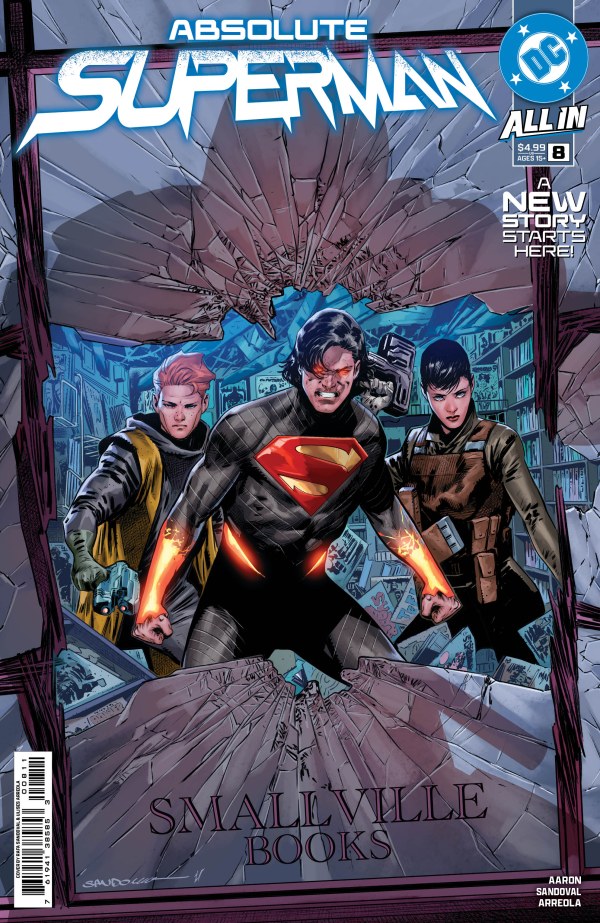
Absolute Superman #8 begins the second story arc of the series. Visiting Martha Kent in Smallville, Kal-El is approached by Lois Lane…unfortunately, she’s followed by the rest of Lazarus, the Peacemakers, the Omega Men, and – oh yeah – a sniper with Kryptonite bullets. Jason Aaron keeps mixing up the DC Universe here, taking familiar pieces and putting them in unfamiliar positions, like plucking a Lego brick from a castle set and using it to build a spaceship. It’s a fun exercise, though, and I keep enjoying the stuff they’re doing.
We also get the first issue of Justice League Vs. Godzilla Vs. Kong 2. Picking up a few years after the end of the previous miniseries, it’s Barry Allen’s wedding day! Unfortunately, he still hasn’t told Iris his secret identity. As the League tries to coax him into doing so, Amanda Waller reactivates Task Force X to deal with a resurgence of Titans (not the Teen ones – that’s what they call Kaiju in the Legendary Monsterverse). I love these crossovers, and I think it’s very interesting that, for the next few months at least, Godzilla is going to feature in comics from no less than THREE American publishers: the Monsterverse version here, the Toho version fighting the Marvel Universe over there, and all the wild iterations in the regular Godzilla comics from IDW Publishing.
Thur., June 5
Comics: Legion of Super-Heroes Vol. 3 #37, Superman Vol. 2 #8, Action Comics #591, Legion of Super-Heroes Vol. 3 #48, Secret Six Vol. 5 #3 (Super Son)

Notes: I’ve written at length about John Byrne’s Man of Steel in 1986 and how that reboot changed the Superman mythos. But one aspect I haven’t talked about that much is the Legion. As a team who not only had Superboy and Supergirl as members, but whose entire existence was INSPIRED by Superboy, after DC changed their continuity to declare that Superboy and Supergirl never existed, how could they explain the Legion? The solution came in this four-part story from 1987, beginning in Legion of Super-Heroes Vol. 3 #37.
Cosmic Boy, having recently returned from a visit to the 20th century (in his own self-titled miniseries) reports that the past has been altered, and the Legion has to investigate. A time storm hurls them to the past, to a Smallville populated by Superboy – a time that Cosmic Boy has reported no longer exists. Arriving in Smallville, the team splits in half – one group making contact with Superboy, the others staying with the time bubble. Superboy ambushes the team, though, trapping them in a stasis-beam. When Pete Ross (an honorary Legionnaire) warns the others what Superboy has done, they attempt to flee. And in the distant future, the Legion’s old enemy the Time Trapper revels in the chaos he is sewing. Part two comes in Superman #8, set in the “present day” of 1987, where we begin with John Byrne’s Clark Kent using his powers to help Lana fix up the farm she is returning to after years away. His super-senses detect a time bubble with four super-powered teenagers appearing across Smallville, and they get into one of those required “heroes fight heroes over a misunderstanding” situations before Brainiac 5 calls an end to hostilities. Brainy tells Superman about their history with Superboy, a history he has no memory of, and as they prepare to seek answers, Superboy appears and captures the five of them in his stasis ray.
Action Comics #591 gives us part three of the story: Superboy is being forced to attack his friends by the Time Trapper, who reveals that Superboy’s entire existence is part of a trap laid for the Legion. Over the centuries, stories of Superman’s legend had been changed, making the Legion believe in a “Superboy” era that never existed. When they first decided to time travel and meet Superboy (back in Adventures #247), the Trapper created an entire pocket universe that matched their skewed legends of Clark Kent. It was THIS Superboy that the Legion befriended, who joined them, and who they visited every time they traveled to the past. But unable to betray his friends, Superboy altered the stasis beam so Superman would escape and chase them, ultimately landing in the pocket universe. Superboy and the Legion reconcile and go to the future, returning Superman to his own universe – but this wouldn’t be his last encounter with the Pocket Universe.
We’ll get to that some other week.
The story ends tragically in Legion #38. As Superboy and the Legion confront the Time Trapper, he reveals that one of his machines has protected the Pocket Universe from the multiversal devastation that happened in Crisis on Infinite Earths. In the skies above Smallville, Superboy sacrifices his life to save his universe from destruction. The Legion brings his body back to the 30th century to mourn…with an eye towards revenge against the Time Trapper once and for all.
Paul Levitz, longtime Legion writer, had a tough task here. Remove Superboy from the board, recognize that the “real” Superman was never Superboy and never a member of the Legion, but do so in a way that was still respectful to the Legion’s history. I think he did as good a job as anybody possibly could. The “Pocket Universe” conceit manages to keep every story where Superboy, Supergirl, or the Super-Pets encountered the Legion canonical, even if they’re only canon to the Legion and not the rest of the DC Universe. Furthermore, even though Superboy may never have been “real” in the first place, Levitz gave him a sendoff worthy of the Man of Steel that he would never grow up to be — sacrificing himself to save his world is the kind of thing members of the House of El do. Kara did it in the Crisis, The Post-Crisis Superman would do it on the streets of Metropolis a few years later. Self-sacrifice is hardwired in the DNA of the Superman family, and this story demonstrated that nicely.
Which makes it a little frustrating that six years later, Zero Hour would throw it all out the window.
Fri., June 6
Comics: “Future Tense” storyline: Superboy Vol. 3 #21, Legion of Super-Heroes Vol. 4 #74, Legionnaires #31; The Legion #25-33, Legion Secret Files 3003, Teen Titans Vol. 3 #16, Teen Titans/Legion Special

Notes: The Crisis was intended to streamline the DC Multiverse, and while it was largely successful, there were loose ends that just…dangled. It caused problems for a while, and in 1993 Dan Jurgens tried to close off those issues in Zero Hour: A Crisis in Time. It was a good story, and one of the changes it wrought was a reboot of the Legion of Super-Heroes. As Man of Steel did for Superman, the Legion reboot started the characters over from page one – they were teens again, the names and costumes were made a little less “Silver Age-y” (Lightning Lad, for instance, became Live Wire, Triplicate Girl became Triad, and so forth), and in this continuity, the Legion was inspired generally by the heroes of the past, and not Superboy or Superman specifically. Our new Superboy, the one we met in “Reign of the Supermen,” had his own title by now, and first encountered the Legion in a three-part story called “Future Tense” from 1995.
The Legion travels back in time to rescue Valor, a rebooted version of their own Mon-El (it’s a long story) that Superboy had encountered a few issues ago in his title. After the requisite “fight over a misunderstanding” happens, Superboy tells the Legion how Valor had nearly died from lead poisoning until he entered a “zone where time stands still,” because there was NO way they would be allowed to call it the “Phantom Zone.” Brainiac 5 tries to reopen the zone until, frustrated by the technology of the time, he warps all of them – Superboy included – back to their home in the 30th century. Things get more complicated when Superboy accidentally lets it slip that Valor – who, in the past millennia, has become a religious figure – is returning, causing a massive upheaval among the millions of Valorites across the galaxy. The Legion makes it look as though their attempt to rescue Valor fails, getting his devotees to back off, then rescue him for real in private before sending Superboy home.
This story was pretty emblematic of both the Legion and Superboy of the time. They’re young and they’re highly emotional. In this version, for instance, Triad’s three different bodies each have different parts of her personality, and one of her immediately gets the hots for Superboy. Superboy, meanwhile, was in his hotheaded stage, and certain members of the Legion took severe umbrage to that, specifically Leviathan (this incarnation’s version of Colossal Boy) and Brainiac 5 himself. Still, he does manage to prove his worth, and at the end of the three issues Cosmic Boy (whose name did NOT get updated) makes him an honorary member of the Legion. The kid and the team would encounter each other occasionally over the next few years, through assorted time travel shenanigans, but we wouldn’t see Superboy as a full member until 2003.
At this point, both the Legion and Superboy had gone through some dark times, the former having its series restarted as just The Legion, and the latter having his series cancelled and being jutted over into Teen Titans. So it was surprising to see him show up on the cover to The Legion #25, wearing a classic Superman costume rather than his own uniform, no less. The story was a bit different – after an issue largely spent recapping their recent tragedies and stacking the new status quo, they found Superboy drifting inexplicably through space. This kicks off the six-part “Foundations” storyline, in which Superboy and the Legion face off against Darkseid and wind up meeting a time-tossed Clark Kent, still a teenager, before he ever put on a superhero costume. It’s a great story, really, although it is HEAVILY mired in the stuff that had happened in the Legion in the last few years, and it would probably be unadvisable to read on its own – I feel like it would be really confusing to anyone who wasn’t familiar with “Legion of the Damned” or the stories that followed it.
The important thing is that it showed Superboy maturing, becoming a better person and a better hero, and that’s all to the good. Superboy stuck around with the team for the rest of the run, which was all well and good…except that he was also appearing concurrently in Teen Titans with no explanation. After Legion ended with issue #38, we got a two-part story wrapping everything up. In Teen Titans #16, Conner is having lunch with Cassie (Wonder Girl) when he’s plucked up by the Stargate that sent him to the 31st Century. He reappears a moment later, now wearing his Legion uniform, telling Cassie that he needs the Titans to help save the future. So his entire tenure in the Legion, presumably, takes place between those two panels: pencil that in, continuity nerds. Anyway, they’re attacked by the Persuader, and Superboy brings the Titans to the 31st Century, where the Fatal Five have created a Legion of their own to attack Earth: an army of Fatal Fives from throughout the multiverse. Fortunately, Brainiac 5 has a plan, but it requires the work of TWO speedsters: the Legion’s XS and her cousin, Bart Allen, aka Kid Flash. They manage to defeat the Five, but the Legion is lost in the timestream, all except for Shikkari, who finds herself in another world, where the Legion is…different.
Yep. Time for another reboot.
This iteration of the Legion lasted 10 years, and it’s the first one I ever read as a regular reader. As such, I have great affection for it. The stories were solid, with a classic flavor that still felt modern, and the art was wonderful. I was really sorry to see it end, but I’m glad that when it went, at least there was a member of the House of El standing with them in what looked – at the time – like their final moments. But we would see this Legion again.
Just not yet.
Sat., June 7
Graphic Novel: Supergirl and the Legion of Super-Heroes: Strange Visitor From Another Century (Collects Legion of Super-Heroes Vol. 5 #14, Supergirl and the Legion of Super-Heroes #16-19)
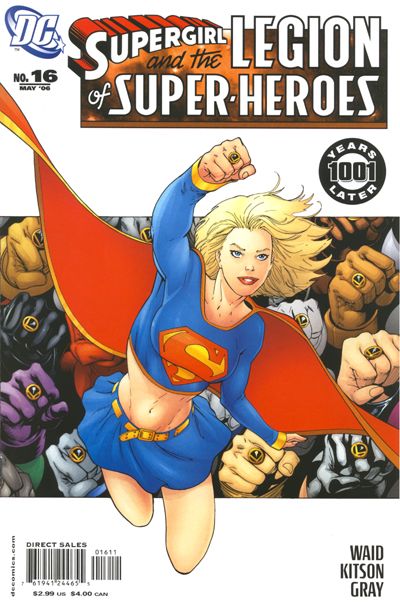
Notes: The “Threeboot” Legion that followed the Titans/Legion special was an interesting beast. Written by Mark Waid, with art by Barry Kitson, this newest iteration gave us a Legion inspired by stories of the heroes of the past that much of the population believed to be mere legends – nobody really BELIEVED that the likes of Superman, Batman, or Wonder Woman had ever existed. Society had grown increasingly distant and oppressive – people stayed home, alone, communicating electronically but rarely seeing one another in person. What’s more, the youth of the galaxy were particularly downtrodden, with free thinking suppressed to make sure everyone conformed. In this universe, the Legion were a group of super-powered teens who rejected this system. They adopted costumes and code-names inspired by the heroes of the past and started a movement, with other young people from across the galaxy joining them.
The volume I read today picks up after their first few adventures, where they’ve proven their worth and the United Planets has reluctantly deputized them as a peacekeeping force. As the Legion licks their wounds from a recent loss, things are tossed into upheaval when a young woman professing to be the legendary Supergirl appears. Much of the galaxy believes that she’s a hoax, because they think Supergirl is a fictional character. As for Supergirl herself, this is the Kara Zor-El who climbed out of a rocket in Gotham Harbor only a few months ago (by her reckoning, but not much longer in real time). Between her adventures with her cousin, Batman, and Wonder Woman, the devastation of the Crisis, and now finding herself 1000 years in the future, the trauma has begun to affect her mind and she believes that everything that has happened to her – including her existence in the Legion’s time – is a dream, and that any minute she’s going to wake up back on Krypton.
Waid had already created a world for the Legion dissimilar from the previous two, and this was a Supergirl that was different from any other Superman family member who’d ever joined the Legion. Despite that, though, it all worked. While the WORLD was different, the Legionnaires were staunchly themselves: Cosmic Boy was the consummate leader, Lightning Lad was impulsive, Brainiac 5 an arrogant jerk who was mainly tolerated because he actually WAS the smartest one in the room as opposed to just somebody who thought he was. There were some revisions, of course – previous iterations of Shrinking Violet had often been quiet and timid, but Waid reimagined her as the ass-kicking master of espionage that somebody with her power set would logically have the ability to be.
Meanwhile, we’ve got this traumatized Supergirl floating around with this crew, somebody who doesn’t believe that anything happening around her is actually real. Which makes it all the more impressive, I think, that she continues to act every inch the hero. She saves lives, stops disasters, fights villains, even though she believes that it’s all a dream and that nothing around her will have any consequences. Perhaps it’s the level of her consciousness that knows it’s NOT a delusion, perhaps it’s just that Kara Zor-El can’t help but help people no matter the circumstances. Whatever it is, it made for a unique dynamic. Supergirl stayed with the book for a couple of years, going home in issue #36, and the series itself ended at issue #50.
But even before this version of the Legion went away, we got glimpses of what was next.
Sun., June 8
Graphic Novel: Superman and the Legion of Super-Heroes, collects Action Comics #858-863

Notes: I don’t mind telling you that Geoff Johns is one of my favorite comic book writers. His strengths, as I think he proved with his tenures on Flash and Green Lantern, come when he takes the framework of the past and expands upon them. He’s the writer, for instance, who used the existence of Sinestro’s yellow ring to extrapolate an entire Sinestro Corps, and from there, a different corps of Lanterns for each color of the spectrum. His runs on Superman have been short, but what he did with the six issues of “Superman and the Legion of Super-Heroes” from 2007 and 2008 is one of my favorite examples of his work. Although it was running concurrently with the Supergirl and the Legion series, in this storyline Johns brought back something that had been lost from Superman’s past, much as earlier writers had brought back Krypto, the Phantom Zone, and Supergirl: he was restoring Superman’s history with the Legion.
Johns and artist Gary Frank, who would reunite in 2009 for Superman: Secret Origin, kick things off with a bang. Superman is contacted by a probe from the future sent by Brainiac 5 reactivate suppressed memories of his past with the Legion. Suddenly, Superman remembers meeting the Legion founders, being invited to join the team, and losing contact with them after the Crisis. (I know there have been a LOT of Crises in the DCU – typically they’re referring to the original Crisis on Infinite Earths when they use the definite article, i.e. THE Crisis.) The probe brings him to the future where things have gone horribly wrong: Something has turned the sun red, diminishing Superman’s powers. Earth is being run by a xenophobic “Justice League” led by a fascist calling himself Earth-Man that has made the Legion, with its many alien members, outlaws. Oh yes – and Brainiac 5, the Legionnaire who brought Superman to the future, is missing. Earth-Man, as it turns out, is a Legion reject who can absorb powers from others. He built a following claiming that Superman was a human, not an alien, and in fact was staunchly opposed to the presence of aliens on Earth. He’s been capturing the non-human Legionnaires and stealing their powers in his quest for conquest.
Superman and the few remaining Legionnaires manage to escape Earth and track Brainiac 5 to his homeworld of Colu, the only planet in the galaxy more xenophobic than Earth. They gather Brainy and a few others, including the Legion of Substitute Heroes, and together launch an assault on the Justice League on Earth, where they learn that Earth-Man has been using the captive Sun Boy to make our sun red, weakening Superman. In the climactic battle, a powerless Superman faces an Earth-Man with the power of the entire Legion flowing through him…but there’s one thing that Superman has that Earth-Man never will.
His friends.
I cannot express enough how much I love this story. There are plenty of stories of Superboy with the Legion, and those are great, but this is one of the few stories of the Legion fighting with an adult Superman, and that’s a dynamic I want to see more of. (Recent hints in the current Superman comic books are giving me hopes that we’ll see more of that soon, but I digress.) Like I said earlier this week, Superman with the Legion is a group of friends. The tone feels more like the Titans than the Justice League, a found family standing together rather than a group of disparate heroes united for a common cause. That “found family” trope is always something that resonates with me, and I love seeing Superman as a part of it.
It’s also good to see a story that makes its points without preaching or turning into a polemic. There’s a definite message here, with Earth-Man’s hatred of anyone not from Earth, but that message is secondary to the story. Not that Johns and Frank were subtle about it – Earth-Man’s costume is as close to a Nazi uniform as you can get without actually applying swastikas, and his real name is the egregiously German Kirt Niedrigh, juuuuuuuuuust in case we didn’t get what they were going for. But parallels to World War II aside, the story also has a point to make about being an outsider. Bringing the Subs in makes it even better, having them act as a foil for Earth-Man – they were rejected from the Legion just as he was, but rather than turning into monsters, they used their disappointment as fuel to become something good.
There are plenty of questions raised by this story, of course. First of all, which Legion is this, exactly? It’s an older Legion: despite still having words like “Boy,” “Lad,” Kid,” and “Girl” in their code-names, they all appear to be roughly the same age as Superman. But the costumes and past they share with Clark seem to indicate this is a continuity that continued the characters from some point prior to the controversial “Five Years Later” era (which was the final era of the original Legion before the reboot in 1993, beginning between their second and third encounters with the time-traveling Superman in Time and Time Again). If that’s them, how are they coexisting with Supergirl’s Legion, which I remind you, was being published in their own series at this point? Who, or what, was the “real” Legion of Super-Heroes?
To answer that question, DC again turned to Geoff Johns, in what is my single favorite Legion story of all time.
Mon., June 9
Comics: Final Crisis: Legion of 3 Worlds #1-5

Notes: In 2008, Geoff Johns and George Perez teamed up for this five-issue miniseries. While ostensibly a spin-off of Grant Morrison’s Final Crisis event, it really has nothing to do with the larger storyline of that series and can be read independently of it. I still may get to the main Final Crisis story at some point, since the conclusion is pretty Superman-centric, but for today I’m just going to focus on this Legion story.
Superboy-Prime, insane survivor of Earth-Prime (see Crisis on Infinite Earths and Infinite Crisis for the full backstory if you don’t already know it) is plucked by the Time Trapper and hurled to the Legion’s time period. Finding the Superman Museum in Smallville, Prime is horrified to discover that he’s only a footnote in Superman’s Hall of Villains, and even worse, is pushed further over the edge by the veneration of Conner Kent, the Superboy that Prime murdered in Infinite Crisis. In Metropolis, meanwhile, the United Planets is turning against the Legion, whose members are in disarray. Brainiac 5 has been stripped of his Brainiac title by his home planet, Mon-El is suffering from the lead poisoning that plagues all Daxamites, and Sun Boy’s powers haven’t returned since his torture at the hands of Earth-Man. Things get progressively worse as Prime springs all of the Legion’s enemies from prison, creating an entire Legion of Super-Villains. The real Legion brings Superman back to their time to aid them, and Brainiac 5 reveals his plan: fight a Legion with a TRUE Legion – by summoning the Legions of two other worlds in the multiverse.
Brainy uses the Crystal Ball that the Justice League and Justice Society used for their very first team-up in the Silver Age to summon the other two Legions – the Reboot Legion that Conner had been a member of, and the Threeboot Legion that had welcomed Kara. Superman and the assembled Legions battle Prime’s army as Brainy enacts Stage Two of his plan: assembling all the electrical-powered Legionnaires to charge up XS and use her to pull her cousin, the presumed-dead Bart Allen, from the Speed Force to rejoin them as Kid Flash. Finally, the Brainiacs use Time Travel to implement Phase Three of their plan: a version of Starman in the 21st century robs a certain grave and transports its inhabitant to the Antarctic. A thousand years later, the Brainiacs unearth the body, which has been slowly healing and rebuilding for a millennia in the same Kryptonian device that brought Superman back after his battle with Doomsday. The final piece to restore him is a hair from one of his genetic donors – Lex Luthor (taken, naturally, from a point in the past BEFORE he went bald). After a thousand years, Conner Kent lives again.
The battle rages on two fronts – Superboy, Kid Flash and the Legions versus Prime in the Arctic, Superman and the original founders versus the Time Trapper in deep space. It turns out the two battles are really one: this iteration of the Trapper is a future version of Superboy-Prime himself. But for all his power, all his anger, in the final battle, the Legion lives.
Ever since Man of Steel, the Legion’s continuity had become a mess, with two reboots failing to make things simpler, since their interactions with the heroes of the present kept contradicting each other. Legion of 3 Worlds finally solved the problem by establishing that each of the three Legions was from a different world of the Multiverse. The original Legion, the one that Clark had been a member of in his youth, was from the future of DC’s main universe. The Reboot Legion, Conner’s Legion, was from Earth-247, a world that had been destroyed in a Crisis, but not one of the ones that was restored when the Multiverse was brought back. And Kara’s Threeboot Legion, amazingly, was from the future of Earth-Prime, the world where all of the DC Comics heroes exist as fictional characters. All those times in Waid’s run when people had insisted to the Legion that the ancient stories about Superman and the Justice League weren’t real? In their universe, they were right.
So not only was the Legion clarified in a way that made sense, but Johns used it to bring back two of the Teen Titans he’d written in an immensely satisfying way, and even used this miniseries as a springboard for the return of the Green Lantern Corps in the 31st century. The Legion was finally clear, established in a way that made sense, and ready for action. And it was done in a way that made all three Legions legitimate and viable, and set each of them up so that they could be used in different ways across the tales of the DC Multiverse. He even managed to codify the importance of the Legion in Superman’s history, explicitly stating (via R.J. Brande) that it was his interactions with Cosmic Boy, Saturn Girl, and Lightning Lad that taught young Clark Kent what it meant to be a hero, and that he would in turn become the inspiration for heroes for the next 1,000 years. It was the perfect fix and the perfect fit.
Why, DC? WHY THE HELL DID YOU DECIDE TO REBOOT THEM YET AGAIN???
Tue., June 10
Comics: Superman Vol. 5 #14, 15
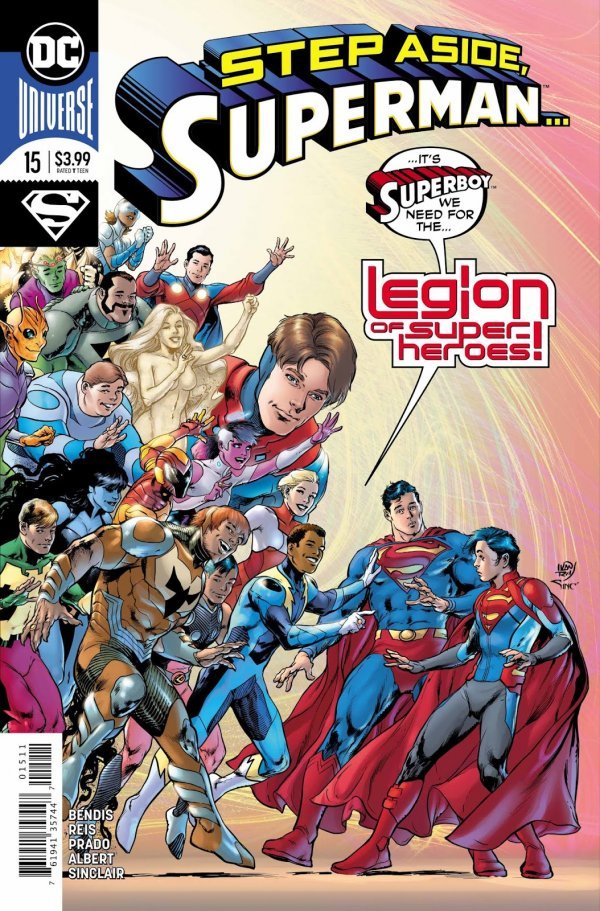
Notes: A few years post-Final Crisis, as we all know, DC rebooted their entire universe in the New 52 relaunch, including both Superman and the Legion. Once again, Superman was divorced from the roots of the Legion, but other than that, the Legion was one of the properties that was relatively unchanged. But it didn’t set sales on fire, either, and the New 52 version was quietly cancelled after two years. After that, their appearances became sporadic for a while until 2018, when Marvel superstar Brian Michael Bendis was hired by DC to take over the Superman comics.
I’m going to be blunt, guys, I’m not typically a fan of Bendis’s work. I don’t want to spend all day explaining the reasons why, but I don’t think I’ll need to, as my Legion-specific criticisms will make it clear. The biggest issue I had with his run was his treatment of Jon Kent. Lois and Clark’s son had been around in comics for a few years, and was about 10 years old. The stories of Clark raising his son were magnificent. They were fresh, they were original, they were something that we rarely saw in comics: an adult superhero teaching his child what it means to BE a hero is a dynamic that, somehow, had gone almost ignored in the 80 years that the superhero genre had been around. So when Bendis took over, of course, the first thing he did was have Jon fall into a spacehole with his grandfather and come out as a teenager.
It’s more complicated than that, but the gist of it was that sweet and joyful Jon was now an angst-filled teenage superhero, of which we have thousands, and like most teenage superheroes his stories quickly began to drift towards “adults screw everything up, but kids MY age know better.” It’s a tired, stale trope that we’ve seen a billion times. But there is one good thing I can say about Bendis’s Superman comics: compared to his work on Legion of Super-Heroes, his Superman looks like Watchmen.
It started in issue #14 of his Superman run, the tail end of a story arc about Superman, Supergirl, and Superboy teaming up with General Zod to capture an alien who has responsible for the destruction of Krypton. At the end of the story, the Kryptonians are brought before a coalition of alien races who were caught up in their battle, and Jon says something along the lines of, “On Earth, we have a thing called the United Nations…” Then, after his dad gives a brief speech about working together, a time portal opens. And the new, re-re-rebooted Legion of Super-Heroes spills out of it and offers Jon membership because he just invented the United Planets by saying ten words that point out something that already exists, and thus he’s the most important historical figure of the past 1,000 years.
I’m getting a headache.
In issue #15 of Superman, the word of Jon’s AMAAAAAZING insight starts to spread. Adam Strange even says “I can’t believe I’ve been out here this entire time and I didn’t think of it.” (Neither can anyone else, Adam – didn’t you ever watch Star Trek? For that matter, are we really supposed to believe that NOBODY had ever thought of this idea before in the ENTIRE GALAXY?) Then the Legion offers to take Jon to the future with them, because he’s so smart and awesome and cool and they wanna be friends with them. He winds up going and joins them for Bendis’s 12-issue Legion series which…I should read it again today. In the interest of fairness, I should read it again for this blog, but I just can’t bring myself to do it. It…it just wasn’t the Legion.
Yeah, the character names were mostly the same. So were the powers. And they were in the 31st century. But everything that makes the Legion entertaining was entirely absent. The characterizations were…I can’t even say they were WRONG, they were GONE. The members of this team had no life, no personality, other than being ASTONISHED that the GREAT JONATHAN KENT WAS THERE. It was like reading about Jon and the Legion of Sycophants. That’s another Bendisian trait, by the way – he introduces a younger version of the hero, then all of the other characters walk around and talk about how much better the new version is than the old one. (If you think I’m exaggerating, I offer the following as evidence: Miles Morales, Ironheart, and the teenage X-Men who were brought forward in time because Beast thought their adult versions sucked.) It was in full force here, with the Legion telling us how Jon – not Clark – would be remembered as THE Superman, as THE character who saved the galaxy. And I’m sorry, if you’re going to make a claim like that, you gotta convince me of it.
There were also a ton of arbitrary changes that drove me crazy, such as making Mon-El a Kryptonian descendant of Superman rather than a Daxamite like he’s been for his entire existence. And as usual, Bendis included his own characters (which is fair) like a new version of Dr. Fate (oooookay) and a Gold Lantern whose powers and history were ill-defined and didn’t really seem to add anything to the story. I made it through the 12 issues of his run, but when he closed it off with a six-issue Justice League Vs. the Legion of Super-Heroes miniseries I couldn’t even bring myself to buy the comics, reading it instead when it came to DC Universe Infinite and still feeling as though I’d overpaid.
Since that miniseries ended, again, the Legion has returned to sporadic appearances. Some of them have reflected the Bendis Legion, but others evoke Legions of the past. Mark Waid himself went on the record recently to tell us that DC has plans for the Legion that he thinks will make everyone happy, and we’ve already seen glimpses of that in the DC All In Special and (appropriately) the Superman titles. We’ve been promised that Superman #29 (coming out in August) will feature Superman and a “mysterious ally” searching for the lost Legion of Super-Heroes. I’m anxious and I’m optimistic. For the most part, DC’s “All In” titles have been very satisfying, and if the new Legion (whatever it is) has Mark Waid’s stamp of approval, that gives me reason to hope. Because the Legion, at its best, is not JUST a team of heroes from the future. It’s about hope for the future, just as much as Superman is. And it’s a fundamental part of who and what Superman is. It’s one of the greatest concepts in comics, and it deserves to be treated as such.
So here’s hoping that, whatever begins in August, it ends with a story that leaves us all ready to slip on our flight rings, thrust our fists into the air, and join with a battle cry that will echo back ten centuries:

But you know, I can’t end it here. I can’t conclude my look at one of my favorite pieces of the entire Superman mythology with a discussion of their worst version. So how about a little bonus? Let’s join hands, hop in Brainiac 5’s Time Bubble, and zip back to 2006 so we can watch the first episode of the Legion of Super-Heroes animated series together, shall we?
TV Episode: Legion of Super-Heroes Season 1, Episode 1: “Man of Tomorrow”

Notes: Young Clark Kent is about to leave home. He’s packing up and heading away from Smallville to go to Metropolis, where he’s got a job as a copy boy at the Daily Planet. On the night before he’s supposed to head to the big city, though, he’s approached by a group of super-powered teenagers from the future, teens who know about the powers he’s kept hidden his entire life. He won’t miss a thing, they promise, they can return him to the moment he left – and tantalized by the idea of not having to hide himself, he goes with them. Arriving in the future, he discovers that they need his help combatting their foes, the Fatal Five. In the end, Clark takes the costume he learns he’ll have someday and, as Superman, joins the Legion.
I love this cartoon. It’s the purest expression of my favorite thing about the Legion, namely that it helps shape Clark Kent into Superman while, at the same time, being inspired BY Superman. It’s a bit more literal in this version than others – the Clark that joins this Legion hasn’t ever really been in a fight and hasn’t learned how to use all of his powers yet. The Legion has plenty to teach him, and over the first season of the show, we see him grow and blossom. The second season takes place after a time skip, returning to the future after a few years away. It was an interesting retool, but ultimately the show only lasted for those two seasons. If you love the Legion like I do, though, it’s well worth seeking them out and watching them.
After all, we Legionnaires need SOMETHING to keep us occupied between now and August.
Blake M. Petit is a writer, teacher, and dad from Ama, Louisiana. His most recent writing project is the superhero adventure series Other People’s Heroes: Little Stars, volume one of which is now available on Amazon. You can join in the Kryptonian Konversation every day in the Year of Superman Facebook Group!
 Blake M. Petit