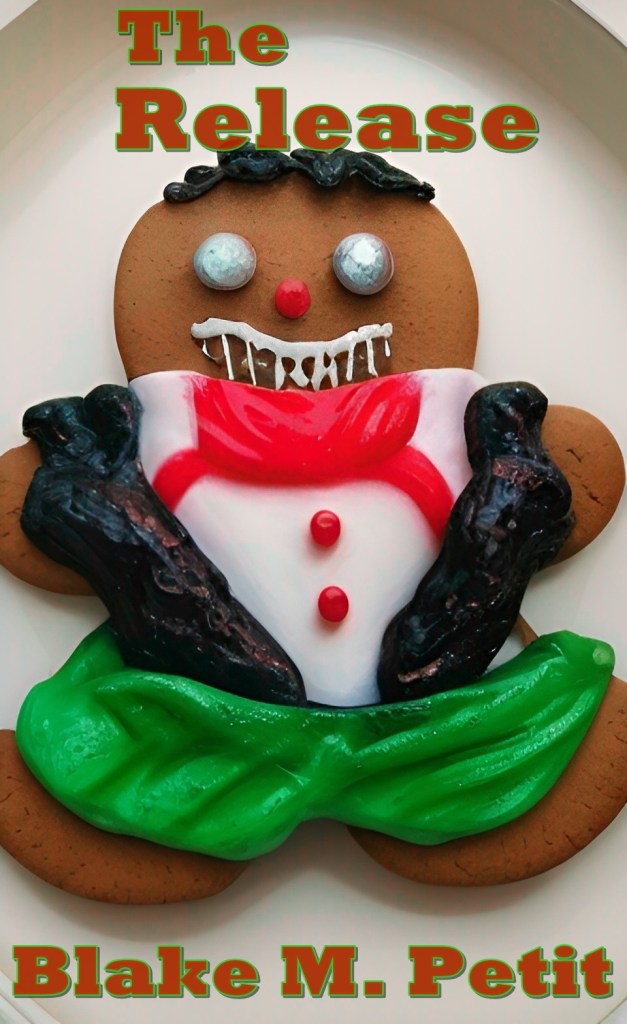
A little star falling to Earth…

I woke up to a strange world this morning. Strange to me at least. It’s a world that hasn’t existed since June of 2021. It’s a world where I did not get up and start thinking about what was going to happen next in Other People’s Heroes: Little Stars.

I guess I should back up a little bit. Several years ago, I had an idea. In and of itself, there is nothing special or unusual about this. This is what people who want to use AI to write or make art will never understand. This is what you simply can’t explain to someone who finds out you’re a writer and says, “Oh yeah? I got an idea. How about I tell it to you and you write it and we’ll split a bazillion dollars?” It doesn’t work that way. The ideas are the easy part. It’s doing something with them that counts.

And the period in which this idea came to me was, frankly, the most fallow period of my life in terms of productivity. For reasons I have gone into multiple times and don’t feel like rehashing now, I had an extended period where nothing was working, from a writing standpoint. Even in that barren era, the ideas were there. I had dozens of them that I started working on and simply abandoned because I couldn’t find any traction. Many of them clung to the themes of parents and their children – sometimes from the parents’ perspective, sometimes from that of the child, sometimes from someone in the middle generation dealing with both at the same time. I liked a lot of the ideas. It was the doing something at which I was failing.

Then an idea came to me for a new story in my Siegel City series. This one would not feature Copycat or any of the previous heroes as main characters (although Copycat would grow to more prominence in the story than I originally intended, it is still not HIS story) but a whole new generation of young heroes…plus one young woman who was desperately trying NOT to be a hero. The trouble with this particular idea was that…well…the Siegel City yarns were all novels and short stories, but this was neither. This was a longer tale, something that would be comprised of multiple mini story arcs that would build together into a larger tapestry before finally colliding in a grand finale. It was less like a novel and more like seasons of a television series or a longform comic book. I would have loved to turn it into a comic book, honestly. That’s my most fervent dream.. I even wrote most of the first issue for such an enterprise. But then it died off, as I am largely a one-man operation. It is possible, if not profitable, to write and publish novels and short stories on your own. But it is far more difficult to do so with comic books. I don’t have a publisher and I can’t draw anything so much as a stick figure, and even those look hideously malformed, so producing a comic book as a solo endeavor was out of the question. (Whenever I tell people this, someone inevitably points out how many friends I have who ARE professional comic book artists, and I reply that yes, they are PROFESSIONALS, and as such deserve to be paid for their work, which isn’t really possible for a guy on a public school teacher’s salary.) 

And so I pushed the story aside, thinking it would join a dozen others in this fallow period as a “nice idea, but didn’t go anywhere.”

In spring of 2021, though, the evil empire called Amazon actually kind of saved me. Amazon was launching a new platform called Kindle Vella, in which writers could serialize stories a chapter (or “episode,” as they called it) at a time. That…actually sounded pretty good. I would have the ability to do a longform story without having to pace it like a novel. I could do my arcs. I could take breaks in between, if necessary. And the chapters, as a constraint of the platform, could be no longer than 5000 words. Even in this awful, rudderless time, I thought, I could do 5000 words a week.

And so I did. In June of 2021, I dropped the first three episodes of what had become Other People’s Heroes: Little Stars. It was the story of Andeana Vargas, a high school senior whose mother, Carmelita, was secretly the world-famous and universally-beloved superhero called Shooting Star. Everyone who knew her mom’s secret also knew Andi, and expected her to grow up to be a hero herself, even though Andi had no intention of doing so. Then, at the end of that third chapter (this was important, because on Vella the first three chapters are free, so ya gotta have a hook), a video is leaked to the press that shows Andi’s mother removing her mask and revealing her true name to the world. Where did the video come from? Who made it? And what were they going to do now that their greatest secret was no secret at all?

This past Sunday afternoon, while the Detroit Lions were winning their way to their first NFC Championship game in three decades, I was doing something that was, frankly, much more remarkable: I finished writing Little Stars. The final two installments will both drop on Wednesday, because the final episode isn’t really a chapter in and of itself but more of an epilogue, and I didn’t think it would be fair to make people wait a week for it after the climax of the story. When I began, I thought the story would take maybe a year to get out of me. Of course, when I started writing the original Other People’s Heroes, I thought it would be a short story, too.

Shows what I know.

Two and a half years of my creative life went into this story, and while the journey isn’t quite over for me (more on that in a minute), I think this is a milestone worth sitting back and appreciating. I never thought it would take this long. I never thought it would be this long. But the final word count for all 119 episodes is a little over 400,000 words. That’s more than most people read in two and a half years, let alone write. For you non-writers who may be asking how many pages that is, it doesn’t matter. Page count is a little useless for a writer. It can change from one edition to the next, change because of page size or font size, and it’s impossible to keep track that way. It’s the number of words that matter to us, because word count is constant unless you revise. For comparison, for my own edification, I looked up the word counts of some of the most famous doorstoppers of literary history.

WAR AND PEACE: 587,287 
LORD OF THE RINGS (All three volumes combined): 579,459
LES MISERABLES: 545,925 
THE STAND (Uncut): 467,812
GONE WITH THE WIND: 418,053 
OTHER PEOPLE’S HEROES: LITTLE STARS: 409,206

I didn’t set out to write my Lord of the Rings, and of course I have no intention of comparing myself to Professor Tolkien (Little Stars, for instance, has considerably less food blogging), but just in terms of how much crap we’ve dumped on the page, I’ve actually chiseled out a spot among the giants here. And I feel like I’ve come out revitalized. I’ve done several short stories in the time since I started Little Stars. I started my weekly Geek Punditry columns right here. I feel like I can create again, and the memory of that time in which I couldn’t chases me like a wild bear I need to escape. I don’t want to go there again.

So the question is…what now?

Well, first I drop the end of the story on Wednesday, and I really hope you’ll all be there for it. This is something that clearly means a lot to me, and I hope I stick the landing. But after that, maybe a little break, and then the revision work will begin for the next iteration of Little Stars.

The thing is, guys, as grateful as I am that the Kindle Vella platform exists and allowed me to crawl out of that nonproductive pit of despair I was trapped in, it didn’t work out that well. Amazon was trying to capture the periodical audience that enjoys apps like Wattpad, but I don’t think it’s carried over like they hoped. Part of that is my own pitiful efforts at self-promotion, of course. I am the worst person on the planet in terms of promoting myself because my paralytic imposter syndrome makes me feel like a snake oil salesman if I try to tell anybody I’ve done something good. But another part is that I don’t think Amazon has done a good enough job selling people on the platform. The “token” system seems to confuse a lot of people, and for some inexplicable reason, when Vella launched it was only available on iOS devices – you couldn’t even read Amazon Kindle Vella stories on an Amazon Kindle. Thankfully they’ve fixed that problem and branched out to Kindle and Android, but the stories on Vella are STILL, last time I checked, unavailable outside of the United States. I didn’t know how many international readers I actually HAD until I started posting about Little Stars and got messages from people asking when it would be available in Australia or the UK. The answer to that, by the way, is, “Soon, I hope.”

So while I like the creative challenge of Vella, I don’t think I would do it again, at least not without some major changes to the platform. What does that mean for Little Stars? It means it’s time for me to revise and reformat. Even though the story wasn’t planned as novels, I’ve figured out what I think are the best places to break it down into three acts, three installments…a trilogy, in other words. I thought briefly about just putting out one ginormous mama-jama book with the entire thing in it, but some wise friends convinced me that the trilogy route was much better. Alexis Braud, if you’re reading this, thank you for pointing out that a 400,000 word book just doesn’t fit comfortably in a purse or bookbag. (There is, however, still just enough of a narcissist in me that I may do a custom printing of that mama-jama edition just so I can put it on my own bookshelf and admire the chunkiness of it all.) 

With this new version, there will have to be some changes to make it fit. So after a little bit of a break I’m going to start revising. I don’t intend to make any massive changes to the story itself, but I will probably tweak the details, fix any continuity snarls that I can find, tighten the story up, and hopefully improve the characters and themes that evolved as I went along. When it’s over, while the Vella version will remain, the novel version will be the “official” history of Andeana Vargas as far as Siegel City canon is concerned, and in any discrepancies between the two, the books will be triumphant.

And then?

I have other ideas, of course. I think I made it abundantly clear that ideas are easy. And two of them are fighting it out right now, both of which are stories I worked on in the past and can’t quite get rid of, which I think is a good sign that they deserve revisiting. One of them is a science fiction epic, a story about two sisters trying to hunt down an inheritance left for them on a distant planet known as Earth. This would technically be a YA novel (or series, if I’m being honest), although I currently have no plans for a love triangle involving a bland, Mary Sue protagonist and a pair of bland, interchangeable heartthrobs. No, this is a story about sisters. And their parents, to some small degree, because I really can’t escape that. But mostly the sisters.

The other story I’m considering would bring me back to Siegel City right away. It’s the story of the oft-discussed but mysteriously missing STAT. I mentioned a few weeks ago that I based STAT on an old City of Heroes character of mine and that I had a whole backstory of his that I wanted to put in a book some day. This is the book I’m talking about. I even found myself working in more frequent references to STAT and dropping some Easter Eggs in the final act of Little Stars, little story seeds that would grow in this hypothetical novel. And yes, once again, this would be a story about parents and children. It’s just THERE.

Or maybe I’ll wake up tomorrow with a totally different idea that I can’t help but get started on. I really don’t know.

But the gap between my last novel, The Pyrite War, and the beginning of Little Stars was nine years. Sure, in that time I kept producing my Christmas stories, a couple of novellas, and my humor book Everything You Need to Know to Survive English Class, but the narrative gap was simply too long. I don’t want that to ever happen again.

So on Wednesday, please enjoy the grand finale of Other People’s Heroes: Little Stars. And then keep coming back to see what I’m working on next. Hopefully you’ll be as surprised by it as I will.

One last note – a special and very sincere thank you to Lew Beitz. Lew and I are moderators on the Comic Book Collecting page on Facebook, and over the last couple of years he’s become not only a friend, but the best darn Beta reader I could ask for. And he may be the only person on Earth who loves Keriyon Hall more than I do. That’s saying something. 

Ghosts of Christmas Stories Past 2019: I Can Explain

2019 was the year my little Christmas tradition almost ended. 2017 was the hardest year of my life – that was the year that I lost my mother AND the year my son was born. My entire life was thrown into chaos, and in all that chaos, all my creative juices sort of evaporated. I managed to squeeze out the monthly chapters of Santa’s Odyssey that brought us from Christmas of 2017 to New Year’s Day of 2019. 

And then after that…nothing. Santa’s Odyssey drained what little fuel I had left in the tank, and for a long time, although I tried desperately to get a story started again, nothing I tried gained any traction. When Christmas approached that year, I resigned myself to the fact that this was the year my little tradition would finally die.

But then, a few days before the deadline, an idea came to me, and I got back in the saddle. “I Can Explain” is the shortest of my short stories, and probably not the best, but it kept me going at a point where I wasn’t sure if anything would. And it drew on what was going on in my world, which gives it a certain sincerity. And although I didn’t have any real creative output for the next year and a half (it wouldn’t be until 2021, when I found my way to Other People’s Heroes: Little Stars, that I actually found the will to write long-term again), if I hadn’t finished this story I may never have written the story for 2020, which turned out to be one of my favorites. So for that reason, I’m really glad that this story exists.

Christmas 2019: I Can Explain

Coming in December: The Ghosts of Christmas Short Stories Past!

I am a nerd for Christmas.

Ask anybody, I’ve been a huge fan of the entire Christmas season for as long as I can remember. I love the music, I love the movies, I love the TV specials, and lord knows I love the food. I love the stories, too – tales of redemption and hope, ghosts and angels…there’s something that makes any story a little more precious when it’s part of the Christmas season.

Way back in 2000, a year that was before any of the students in my current 12th grade class were even born, I learned an interesting bit of information about my favorite Christmas movie, It’s a Wonderful Life. The tale of George Bailey and Clarence the Angel, the beautiful story of a man who is given the gift of seeing a world where he never existed, did not actually begin life as a movie. The movie was a loose adaptation of the short story “The Greatest Gift,” a story that was written by Philip Van Doren Stern in 1943 and given to friends as a Christmas card after being unable to find a publisher for it. The story was passed around and eventually made its way to Hollywood, where Frank Capra and James Stewart transformed it into one of the most iconic films of the season. The thing that stuck with me, though? The notion of a short story as a Christmas card.

The idea lodged in my brain, inescapable, and it took root. I decided to do something similar that year, writing a short story that included characters from the novel I was working on, a weird little thing about superheroes that was, at the time, called Capes and Masks before I finally settled on the marginally-superior title Other People’s Heroes. The story featured two side characters from that novel and was set on the Christmas immediately before the events of the book. I was pleased with the story, I sent it out, and when I published the revised version of the novel several years later I included the story, “Lonely Miracle,” as a sort of special feature in the back.

The thing is, that first story wouldn’t sit still, and in 2001 I sat down and wrote a second story, this one directly inspired by Capra’s film. In 2002 I did it again. Then again. And here we are, 23 years later, and I have never failed to put a new story into the world every Christmas.

This year, I’ve decided it would be nice to dig back into the archives and once again share all these ghosts of Christmas stories past. Starting tomorrow, I’ll be re-presenting most of those stories to you, every day except Wednesday (because on Wednesdays the only thing you need to worry about reading will be the newest installment of Other People’s Heroes: Little Stars). I’ll once again share every short story with you, free of charge. That will make 20 of the 24 Christmases – the other four Christmases are accounted for with the three short Christmas novels I’ve written. I’ll give you those links now, since two of them are on Amazon.

First was A Long November, from Christmas 2005 (which also happened to be my first year attempting National Novel Writing Month). Duncan Marks is just like you: sick and tired of Christmas getting earlier and earlier every year. And just when you thought it couldn’t get worse, Duncan finds himself targeted by a strange pixie intent on rescuing his Christmas spirit – on the DAY AFTER HALLOWEEN. A Long November is available as an eBook collection from Amazon, which also happens to include several other of my earliest Christmas stories, the ones I’ll be sharing here for the next few weeks. 

The second short novel was from 2013, a tale called Making Santa: Advent. Nicholas Grace is one of 200 men abducted by a bizarre alien race called the Yool, aliens who are testing their captives…training them for a very important task: to become the most famous figure in history. One of these men will become the new Santa Claus. Like A Long November, Making Santa: Advent is available as an Amazon eBook. This story, you may notice, has a few sequel hooks…I had thoughts at the time of doing a series with these characters. It hasn’t materialized yet, but never say never.

The third longer work is Santa’s Odyssey, an experiment that began on Christmas 2017 and lasted until Christmas 2018, counting as the story for both of those two Christmases. In this story, as Santa returns to the North Pole on Christmas Eve he is attacked by a coalition of angry holiday icons who feel his holiday has gotten out of control. Over the next year, Santa is forced to see the task of each of the other major holidays. This was a challenging story to write, turning out a chapter every month as the year progressed and covering two Christmases. It’s never been put out for sale, but you can download the PDF of it for free right here.

And with those three stories up front, the stage is set. Come back tomorrow for the first of these Ghosts of Blake’s Christmas Stories past, one every day (except Wednesdays) until we reach Dec. 23, when this year’s all-new story will make its debut! Hope you enjoy this trip through my development as a writer, guys. Merry Christmas! 

And in case you missed any of the stories, they’ll be indexed right here!

Geek Punditry #45: Lower Decks is Higher Trek

I don’t know if I’ve ever mentioned it in this column before, but I’m a bit of a Star Trek fan. I know, I hide it well, but it’s the truth. I love the characters, I love the worlds, I love the alien races and the starships. If I had a holodeck like they have on the USS Enterprise, I would just use it to pretend I was a crewmember on the USS Enterprise

“Computer, put me in the Famke Janssen episode.”

There have been many iterations of Trek over the years, of course, some that I’ve connected with more than others, but most of them have had something that draws me back and keeps me engaged. Never has there been a version of Star Trek that didn’t at LEAST make me say, “Okay, I’ll give it a shot.” But that’s not true of everyone. There are some folks out there, some alleged fans, who had that attitude when the franchise crept tentatively from the extended television hiatus that it underwent after Star Trek: Enterprise went off the air in 2005. Trek returned in 2017 with the launch of a new series, Discovery, and the promise of two more shows: Star Trek: Picard, and Star Trek: Lower Decks. Without delving too deeply into the ups and downs of the first two shows, it’s the third one that seemed to be dismissed by most fans. Lower Decks, you see, was not only an animated series, was not only a comedy, but it was created by Mike McMahan, a writer whose previous credentials included shows like Drawn Together, South Park, and Rick and Morty. And no matter what your feelings may be on those particular shows, it would be difficult to argue that someone who claimed those as his pedigree would be the right choice for a new iteration of Star Trek. 

But people who said the guy who created Pickle Rick was bad for Star Trek have NEVER been so wrong. Lower Decks turned out to be a sincere love letter to the franchise, a show that was steeped in the lore and history of Trek, a show that used humor to enhance the story and characters rather than as a substitute for them. Truth be told, of all the versions of “NuTrek” that we’ve gotten since the franchise was brought back to life, it is Lower Decks that is my favorite, Lower Decks that has stolen my heart, Lower Decks that is most dedicated to the finest tradition of Star Trek, even with the bleeped-out swear words and occasional pixelated area covering an ensign’s nether regions. If you dismissed Lower Decks because it’s “just a cartoon,” then buckle up, because I’m about to tell you what you’ve been missing out on. I’ll try not to spoil every story beat from the first four seasons, but it’ll be impossible to talk about what makes the show so great without some spoilers, so from here on out, read at your own risk.

Spoiler #1: Boimler is Keyser Soze

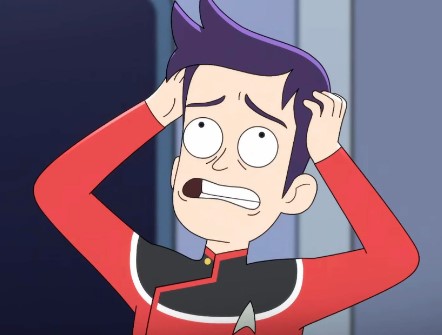
McMahan originally sold the show as being about the least-important crew on one of Starfleet’s least-important ships. The Cerritos is the sort of vessel that comes in after a flagship like Enterprise establishes first contact with an alien race, then does all the dull administrative work that would inevitably come along with such a mission. “Second Contact” is important, you see, but not sexy, and the same would seem to be true for the crew that mans the vessel. Rather than focusing on Captain Carol Freeman (Dawnn Lewis) and her senior staff, the show’s stars are four ensigns who get the crappiest jobs available: the wild and self-destructive Beckett Mariner (Tawny Newsome), high-strung rule-follower Bradward Boimler (Jack Quaid), science nerd cyborg Sam Rutherford (Eugene Cordero), and newly-minted and extremely eager Orion science officer D’Vana Tendi (Noel Wells). The first season introduces the characters and lets us learn a bit more about them, and in that first season there’s a lot of fun to be had. There are a lot of gags derived from classic Star Trek bits like the crew succumbing to an alien virus, parasites controlling crew members, and bizarre medical conditions happening as the result of upgrades to the ship’s transporter system. It was as if the writers had watched hundreds of hours of Trek and decided to do the funny version of some of the franchise’s most time-honored bits. There have been many, many times while watching this show that I’ve laughed so hard at a gag that my wife – who hasn’t watched nearly as much classic Trek as me – has hit pause and asked me to explain the reference. 

Every time I start laughing like Kayshon, she glares at me like Mariner.

It was also great for bringing in actors from the old shows. Over the four seasons of the show we’ve seen actors from The Next Generation, Deep Space Nine and Voyager all show up to reprise their characters, which is perfectly in keeping as Lower Decks takes place right after that era of Trek ended. We’ve seen William Riker and Deanna Troy (Jonathan Frakes and Marina Sirtis) on Riker’s ship Titan, we visited with Kira Nerys and Quark (Nana Visitor and Armin Shimmerman) on Deep Space Nine, and Tom Paris (Robert Duncan MacNeill) made a stop where Boimler geeked out and tried to get him to sign one of his Voyager collector’s plates. 

Oh yeah – that’s something else the show does extremely well. The characters are Star Trek fans like us. Not in a fourth wall breaking way, it doesn’t go quite that far, but they’re all as aware of the heroes and the legendary ships of Starfleet as we are. They know the stories that we’ve spent decades watching because they’ve studied the logs the stars of those respective series recorded at the beginning of each episode, and they have their favorite characters. Mariner is an Uhura fangirl, Boimler once dressed as Christopher Pike for Halloween, and Tendi – upon learning that Dr. T’Ana was recommending she train as a science officer – excitedly asked, “Like Jadzia Dax?” (Lower Decks, never missing a chance for a joke, has T’Ana say she doesn’t know who the hell Tendi is talking about, she was thinking more like Spock.)

The show was fun. Callbacks to obscure aliens or worlds was fun. Bringing in elements from the original Star Trek: The Animated Series was FUN. But somewhere in the show’s second season, it became much more than just “fun.”

Pictured: “Fun”

Once the characters and the tone of the show were established, the stories started to get more intense and we began to see a larger tapestry build up around the stalwart crew of the Cerritos. The Pakleds – a goofy race of space scavengers from a single episode of The Next Generation – not only returned to the franchise but were upgraded to a legitimate threat without becoming any less funny. We began to see hints that the sweet, kindhearted Sam Rutherford had a darker past that even HE didn’t seem to know about. We saw Tendi struggle to get out of the shadow of her race’s reputation of piracy, while at the same time being determined to fight against the bigoted notion that ALL Orions were pirates. The show was touching on larger, deeper themes much the way that classic Trek always did. If there’s one problem with efforts of modern Trek to replicate the socially-conscious tone of the franchise it’s that they will often beat you in the face with a theme instead of weaving into the story. (Discovery in particular is bad about this.) In this regard Lower Decks is better about capturing the feel of the universe of Gene Roddenberry than any of the other shows of the modern era.

But that’s not all. The show doesn’t only bring in themes in a classic sci-fi fashion, they also started to use stories that felt like old-school Trek, not just because they’re recycling aliens or plot devices, but because they’re finding new ways to tell the stories that feel perfectly in keeping with the versions of Star Trek that I grew up with. For example, in the season two finale, the Cerritos is assisting the USS Archimedes (captained by Sonya Gomez, another short-lived TNG character redeemed by this show), when the “more important” ship is disabled by a plasma wave and is in danger of falling into the gravity well of a planet. The only way Cerritos can get through the wave to save them is to detach the outer hull and fly defenseless through an asteroid field. This is NOT the stuff of comedy, this is the kind of badass space adventure that Trek in the 90s would have done if it wouldn’t have cost too much to do it in live action. The rescue sequence is intense, thrilling, and full of magnificent moments for our crew to demonstrate their worth. Boimler risks his life on an underwater mission to help detach the last piece of hull (it’s in the long-discussed but never-before-seen Cetacean Ops section of the ship). Rutherford’s cybernetic implants nearly cause a disaster because he’s been making triple backup files of all his memories after losing his memories of his “best friend” Tendi in a previous episode. Every single beat feels like it was pulled from a season of the old-school Star Trek…and then made funny on top of being made awesome.

Let’s see Janeway do THAT.

When a comedy series runs for a long time, one of two things tends to happen. Some shows just get progressively sillier than they already were. Take The Simpsons, for example. In the golden era of that show, Homer Simpson was a dimwitted but basically good-hearted cartoon dad. Now, three decades in, he’s become a character so ridiculously inept that the only possible explanation for his continued survival is the highly forgiving nature of cartoon physics and biology.

The other possibility is that the show grows and matures. That doesn’t mean it stops being funny, but that the characters transcend the stereotypes they were in their embryonic forms and become truly developed and compelling creatures. By the end of season four, there can be no doubt that this is what’s happening to Lower Decks.  

The two sweetest characters on the show, Rutherford and Tendi, each has a darkness to overcome. Rutherford had to face his earlier self – a bitter, nasty version of himself he didn’t even remember existed – and fight to remain the man he wants to be. Tendi, on the other hand, has had to learn to embrace the darkness of her Orion heritage rather than try to pretend it doesn’t exist, reconciling with her family and using her past as a tool to help save the day in the season four finale…but not without paying a steep cost that will certainly help propel the show into season five. (Tendi and Rutherford, by the way, have a “will they/won’t they” relationship that is utterly delightful. Rather than the antagonistic form such relationships often take, their friendship is so innocent and charming that neither of them seems to entertain the notion of anything else happening, while at the same time demonstrating so clearly that both of them have deeper feelings than friendship. Watching them dance around their attraction is one of the most rewarding and, simultaneously, most frustrating parts of the show.) 

Shipping is kinda dumb. Unless it’s for these two.

Bradward Boimler, as we were introduced to him in the first episode, was the overeager and terribly anxious young ensign who was desperate to do anything to move up the ranks. He was something of a sycophant, once even lying about being from Earth’s moon in an effort to ingratiate himself with the ship’s first officer, Jack Ransom (Jerry O’Connell). At the end of season four he’s gained confidence and learned to trust more in his friends than in regulations. He even gets a chance, in the season finale, to temporarily serve as CAPTAIN of the Cerritos, and he acquits himself – as any Klingon could tell you – with honor. At the end of season one Boimler is given a chance to serve on Riker’s Titan and jumps at it, something that made perfect sense for the character at the time. If that same offer were made to him at the end of season four? I don’t believe for a second he would leave the Cerritos behind again.

Brave as Kirk, wise as Picard, steadfast as Sisko…

And then there’s Beckett Mariner. From the beginning of episode one she seems to be the most stereotypical of the crew – she’s got a bad attitude, a distaste for authority, and it’s implied that she’s been around much longer than the other ensigns, constantly sabotaging her own career and getting busted down in rank. At the end of episode one we even learn that the only reason she’s even on the Cerritos is that Captain Freeman is her mother, and the only one left in the fleet who’ll give her a chance.

Holy crap, does Mariner grow.

“I promise, we won’t let them waste your character like they did Crusher and Troi.”

Over four seasons we watch as she builds bonds of loyalty with the other ensigns and restores her relationship with Freeman. Her attempts to sink her career are themselves sunk when it turns out that her superior officer, Ransom, has true faith in her and won’t allow her to ruin her life any further. And then, towards the end of season four, we actually learn why she’s been so self-destructive. She’s been suffering from years of survivor’s guilt over the death of a friend, someone who died as an ensign, and who she doesn’t want to surpass. The realization is made all the more powerful when we realize the friend in question is also OUR friend, TNG character Sito Jaxa, who only appeared in two episodes but left a powerful impact before her tragic death in the episode…wait, lemme look it up…

Aw, you clever goose, Mike McMahan. Sito died in the Star Trek: The Next Generation episode “Lower Decks.”

You know what? I bet they did that on purpose.

With the way each of these characters has grown and evolved, even being promoted from ensigns to Junior Grade Lieutenants this season, it has become increasingly clear that Mike McMahan lied to everybody when he said that this was the show about the least-important crew members on the least-important ship in the fleet. Far from it – this show is about people able to start from nothing, find their purpose, find themselves, find each other, and become more than they ever imagined, even if nobody else in the galaxy believes they have what it takes. The least important officers? Oh no. This series is the origin story of the next legendary Star Trek crew. 

And yet, in all that, the show has never stopped being funny as hell.

If you decided to not watch Lower Decks because it was a cartoon or a comedy, all I can say, my friends, is that you were wrong to do so. If you watched an episode and said it wasn’t for you, can I recommend you jump ahead to the season one finale and give it a try? Because that’s when the show really begins finding itself and starts the transformation into the sublime work of storytelling that it actually is. 

Lower Decks isn’t “good for a Star Trek parody.” It’s not even “good Star Trek.”

It’s GREAT Star Trek.

And I’ll follow the heroes of the Cerritos – I BELIEVE in the heroes of the Cerritos – with all the passion and fervor that I devoted to the Enterprise or station Deep Space Nine. 

McMahan caused a little bit of a stir a few weeks ago when he said on Twitter that the show’s future is not secured past the upcoming season five, and fans panicked with the belief that it was being canceled. He had to come back a few days later and clarify: he wasn’t saying he’s been told the show is on the chopping block, just that he doesn’t KNOW yet if it will be renewed beyond season five. But the best way to keep it going, in this age of streaming, is to keep watching it and keep talking about it on social media, because the guys with the checkbooks actually do pay attention to that sort of thing. So check it out and let Paramount+ know how much you love it.

It’s already prospering. Now let’s help it live long.

CERRITOS STRONG!

Blake M. Petit is a writer, teacher, and dad from Ama, Louisiana. His current writing project is the superhero adventure series Other People’s Heroes: Little Stars, a new episode of which is available every Wednesday on Amazon’s Kindle Vella platform. 2800 words about this show and he didn’t even get around to talking about what a great addition T’Lyn was in season four. 

Geek Punditry #15: How Lucy Gave Us the Arc

A few weeks ago I wrote about how, for a lot of people, familiar TV shows, books, and movies, act as a kind of pop culture comfort food, something that calms, soothes, and entertains you almost as much as a visit with an old friend. We rewatch these shows because the familiarity does us good and makes us happy, and that’s what makes Pluto TV the best app around, in my opinion. Pluto TV gives you (free) access to hundreds of channels that provide you with this sort of entertainment. There are channels dedicated to old sitcoms, channels dedicated to old gameshows, an entire channel that shows reruns of The Carol Burnett Show, another that gives you a steady stream of Mystery Science Theater 3000, one that’s all RiffTrax, and two separate channels dedicated to repeats of the various Star Trek series. My son specifically asks to watch “Nick Jr. on Pluto TV” as opposed to asking for a particular show, and as that has weaned him away from YouTube I’m not complaining in the slightest. There are also channels for news, sports, music, movies, cartoons, and (for my wife) true crime shows and documentaries. It’s honestly an app that has something for everyone. 

I swear they’re not paying me to say this. I just really like it.

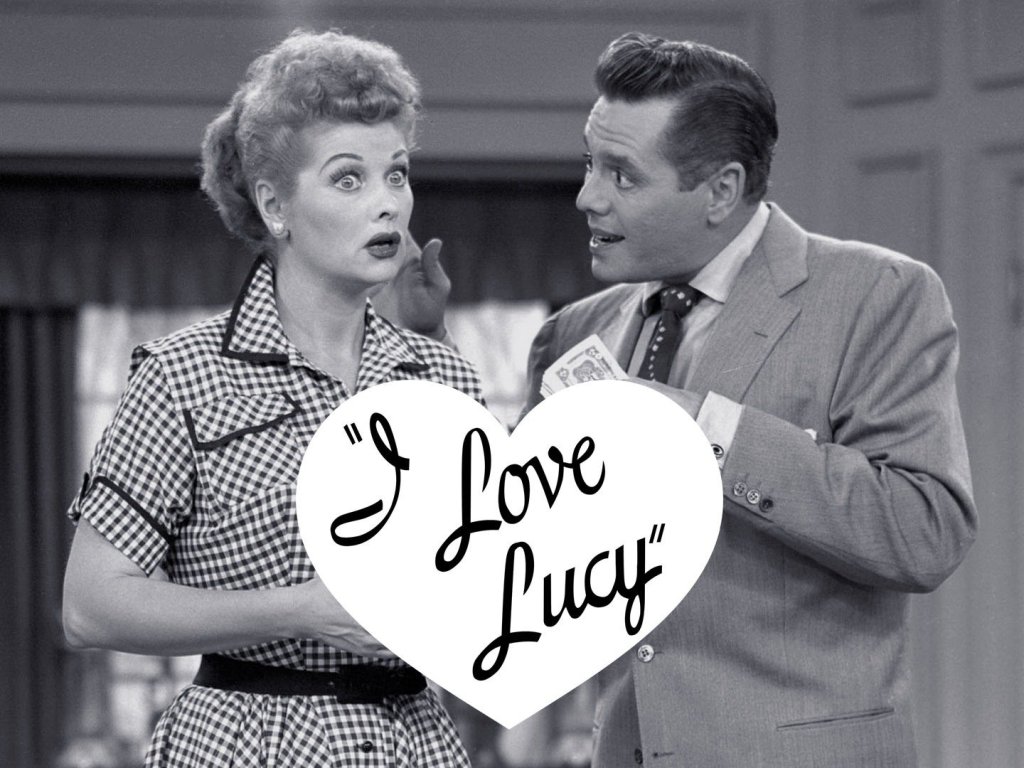
But most pertinently to this week’s Geek Punditry, there’s a channel that only shows episodes of I Love Lucy, the timeless sitcom about the love between Lucy and Ricky Ricardo and the barely-disguised loathing of their best friends, Fred and Ethel Mertz. To my surprise, once we added the Lucy channel to our regular Pluto TV rotation, I learned that my wife had not watched this show growing up, so for her, it’s all new. It’s given me a good excuse to voraciously rewatch the show and, since Pluto shows the entire series in order, it’s also allowed me to notice something that hadn’t occurred to me before.  I don’t need to remind anyone what a groundbreaking, legendary series this was, about how it literally invented the rerun, how it pioneered the three-camera setup used by many sitcoms ever since, or about how Lucille Ball was simply one of the funniest human beings ever to walk the Earth. But what I didn’t realize until recently is that Lucy and Desi also apparently invented – or at least codified – one of the primary elements of television that exists today: the story arc.

“Luuuuuucy…are you breaking new ground in televised entertainment AGAIN?”

These days, of course, arcs are commonplace, and no longer the purview of only soap operas. Babylon 5 is largely responsible for bringing the technique to science fiction, blazing a trail that shows like Star Trek: Deep Space Nine began to follow a few years later. Then Lost premiered in 2004, probably the first mega-hit to run with an ongoing storyline, and since then almost any drama that isn’t a police procedural (and many that are) has followed suit. 

Comedies were a different breed, though. A “sitcom” is literally a “situation comedy,” and changing up the situation was a big no-no. In the past TV comedies existed in a state of permanent status quo, where anything that changed in the story had to be changed back by the end of the episode. If it was a show about a nuclear family, that family stayed nuclear. If it was a show about a workplace, the people employed at that workplace stayed constant. Nobody ever moved away without moving right home again, nobody in the main cast ever got married or divorced, and if somebody lost their job, they had to regain it in 30 minutes or less. There’s a single episode of The Honeymooners where Ralph is laid off but they forgot to put him back behind the wheel of the bus before the episode ended. They simply ignored it the next week and moved on as if nothing had happened, but it was so shocking that it became a punchline in an episode of Family Guy decades later.

“When I catch the guy who forgot to gimme my job back, BANG! ZOOM!”

Now I could be wrong. I’m not a TV historian, and I know that things like radio dramas and soap operas had arc-based stories for some time, but when it comes to primetime shows, especially comedies, I feel like this is another area where Lucy broke new ground. Over the six seasons of the show, I count no less than six storylines that can legitimately be described as “arcs” (which, for ease of discussion, I will hereby define as a story thread or change to the status quo that carries through multiple episodes before resolution). The first was a matter of necessity: when Lucille Ball was pregnant during the second season of the show, they decided to incorporate it into the story rather than disguise it like so many shows have done before and since. (It was not, however, the first TV show to depict a pregnancy, as is often erroneously reported. A mostly-forgotten show called Mary Kay and Johnny actually beat them to the punch by a full four years, and they did it for the same reason that Lucy did.) Lucy’s pregnancy was announced in season 2, episode 10 and the baby was born in episode 16, with the five episodes in-between pretty much all dealing with the pregnancy as that episode’s major plot point.

Before and, for a time, after the birth of Little Ricky, I Love Lucy was mostly content with the one-off stories that were sitcom staples. In season 4, however, things changed with an absolutely massive arc in which the cast uprooted and went to Hollywood. It started in season 4, episode 6, when Ricky had a screen test with a movie producer. The next couple of episodes dealt with him waiting to hear back about the test, getting an offer to do a movie, planning a trip to Hollywood with the Mertzes for some reason, and several episodes of buying a car, fixing up the car, and driving from New York to California before finally arriving in Hollywood in episode 17. The cast stayed in California for the remainder of the 30-episode season, not returning home to New York until episode 6 of season 5. The arc was in many ways an excuse to bring in a bunch of celebrity guest stars like John Wayne and Harpo Marx, but it was still an unprecedented change to a series of this nature.

“Do you really think they’ll watch five episodes of us driving?”
“Of course they will, Nintendo hasn’t been invented yet.”

They didn’t stay home very long, though. In episode 10 of season 5, Ricky’s band is given an opportunity to tour Europe, and after a few episodes of getting a passport and (again) planning a trip with the Mertzes, they set off on a cruise ship in episode 13 and then continued traveling the continent for the remainder of the season’s 26 episodes. 

Season 6, the final season of the show in its original form, brought with it two more arcs. The first one, once again, was based on travel, with episodes 6-9 centered around a vacation to Miami and to Cuba to meet Ricky’s relatives (with the Mertzes). The final arc is a little harder to define, but it’s there. In episode 15, Lucy decides she’s tired of city life and wants to move to the country. Cue several episodes about buying a house, moving, and settling down in their new home, along with the Mertzes, proving that Bert and Ernie’s was not television’s first codependent relationship. Episode 20 is about the Ricardos and Mertzes trying (hilariously) to start up an egg farm, and that’s where I declare the “arc” over, as the remainder of the season’s (and series’) 27 episodes didn’t really deal with the move anymore, but the fact that they were new in town did still turn up as a plot point more than once.

No other show at the time had ever done so many extended storylines, especially nothing as long as the Hollywood arc, and it was a long time before such things were handled the same way. While changes in the status quo began to be allowed, they still often took the form of a single episode where a change was made and a new status quo took over: the move of the Laverne and Shirley characters to California, Richie joining the Army and leaving Happy Days, and of course, the infamous introduction of Cousin Oliver on The Brady Bunch are good examples of this. Changes were happening, but they were done so quickly that it was almost like a whole new show took over after an episode rather than the sort of slow burn that Lucy and Desi pulled off.

No matter how mad you are about what happened on your favorite show, remember, it could be worse.

Comedies now embrace arcs as well. The Office, for example, started off with the unrequited love between Jim and Pam, which was the sort of thing that sitcoms had always done, but then they did something shocking in season three and (gasp) REQUITED it. So they needed new arcs. They had the “Michael Scott Paper Company” storyline, the Sabre arc, the Dwight/Angela/Andy love triangle, and assorted other storylines of varying length and quality. Most other successful sitcoms these days bring in arcs after a while, if not built in to the DNA of the series from the very beginning. But as I sit there with Pluto TV showing me Lucy spending two episodes ruining and then trying to fix John Wayne’s footprints in wet cement in the middle of their year-long brush with Hollywood, I am in awe of the people who blazed the trail for everyone else.

Blake M. Petit is a writer, teacher, and dad from Ama, Louisiana. His current writing project is the superhero adventure series Other People’s Heroes: Little Stars, a new episode of which is available every Wednesday on Amazon’s Kindle Vella platform. He didn’t even touch on the Pluto channels for Doctor Who, Top Gear, or The Price is Right, because how much awesome can you realistically handle in one column? 

Geek Punditry #13: What IS Geek Punditry, Anyway?

In the first week of January, I challenged myself to carve out a little time, once a week, to write something in this new “Geek Punditry” space I created. I’ve been using the term for years, calling myself a “Geek Pundit” in various online bios because I thought it was a clever phrase that, to the best of my knowledge, nobody else was using. (But to be honest, I never really looked, either. I could be wrong.) But as we finish up the first quarter of 2023 (motto: No, it’s not getting any better), it occurred to me that I never quite explained what I mean by Geek Punditry. What is this space about? What qualifies something for this kind of discussion? And most importantly, why should you care?

Would you listen to this man?

I’ll answer the last question first: you shouldn’t. Not unless you want to, that is, and that’s what makes my task challenging. A pundit, by definition, is an expert on a given topic that is called upon to present opinions on the subject. So clearly, as a title, it’s ridiculous, and that’s why I like it. It’s a title that sounds slightly pretentious, but hopefully is silly enough to communicate the fact that I’m trying to mock pretention rather than indulge in it. I don’t consider myself an expert on anything, but I think a lot about everything, and putting those thoughts down helps me to declutter my horrifically unorganized mind. As for the second part, “called upon to present opinions”…what is there to say? I’m well aware of the fact that nobody is asking me what I think of anything. I’m the living embodiment of those memes that start with “Nobody: [Blank space]. Nobody at all: [Blank Space],” and then a picture of SpongeBob blurting out something about Squidward. And since nobody has any compelling reason to give a damn what I have to say, the burden falls upon me to make what I have to say interesting. If you’ve read this far, I flatter myself by assuming that I at least haven’t bored you silly yet.

So back to the first part of the question: what does “Geek Punditry” mean? In simple terms, it’s talking and opining about geeky things. It’s not a new concept, of course, but there’s another term that’s been used pretty much since the invention of art: critical analysis. It’s about the discussion and dissection of art of all kinds, and it’s an ancient art all its own. I have no doubt that the first time some caveman picked up a stick and drew a picture of a saber-toothed tiger in the dirt, some other guy scoffed at it and kicked it aside so as to indicate that his blind 32-year-old great grandmother could draw a better tiger than him. The first guy then began to wildly gesticulate, which the second guy took as him being angry over the analysis. The second guy then laughed and communicated, through grunts and hoots, “What, can’t you take a joke?” Then he laughed a little more and then the first guy took a swing at him, at which point, both of them were eaten by the tiger that the first guy was trying to warn the second guy about in the first place. Which brings me to one of the central rules of MY version of Geek Punditry: Being critical is one thing, but being mean about it is just stupid.

“Did you see what Ug calls a buffalo? I’m gonna discover fire so I can tell him to go die in one.”

That’s not to say one can’t have a negative opinion, of course. It’s almost impossible to have any kind of intelligent analysis without criticism of some kind. But there’s no reason to be a dick about it. If you have ever – to give a totally hypothetical example that could never, ever happen in real life – bullied an actress on social media to the point where she deletes her account, I don’t care how bad the movie may be, you’re the bad guy. If you’ve ever threatened violence against someone because they wrote something you didn’t like, you’re the bad guy. If you’ve ever harassed, threatened, or wished violence against somebody because they’re married to/the parent of/the child or/the dog groomer of a celebrity that you have some sort of personal grudge against – and I cannot believe I have to say this – you are the bad guy. If your posts include the words “cancer” or “kill yourself,” I don’t even want to know you.

But those are just the most obvious examples of people being awful human beings and attempting to shield themselves by calling it “criticism.” There are other forms that are less obvious and far more insidious, and most of these fall under the general category of “clickbait.” How many times have you seen some online “think piece” that explains in great detail why a movie or TV show that you enjoyed as a child is actually awful, terrible, and something you should be ashamed of yourself for ever indulging in? I saw three of them today before I even got dressed to go to work. What the hell is the point of that?

“Today on Buzzfeed: 12 Muppets who totally would have given Mengele asylum in Brazil.”

Well, the point is obvious, actually, it’s about getting clicks. Websites like that run off of advertising, and every time you click on a link their ads generate some fraction of a cent, so it’s in their best interest to write things that will make you click. And the sad truth , my friends, is many people are far more likely to click on something if they find it infuriating. Otherwise, there would be absolutely no point to publishing these things. This is not to say that everything we loved when we were younger was perfect. A lot of us look on the movies and TV shows of our youth through rose-colored glasses, and more than once I have gone back to something I used to watch over and over as a child only to realize, as an adult, that it ain’t that great. But most of it is also harmless, something that has been largely left in the past and gives people fond memories, so why dredge it up just to upset people about something that previously brought them joy? The advantage I have here, I suppose, is that I have absolutely no expectation of making money off this blog, so I have no incentive to piss people off solely in the name of getting them here. I’d rather talk about the things that I love with other people that love them too.

The sad state of modern criticism both depresses and fascinates me, because people have been making a living as critics for a very long time. In high school, we used to go to the library and use these massive encyclopedia-sized sets of books of literary criticism for use in research papers and annotated bibliographies. These volumes contained thousands of articles published in journals over a couple of hundred years of writers writing about writing that other writers had written. It was full of analysis of every significant writer from Chaucer to Faulker. There was stuff both about and by the likes of Edgar Allan Poe and Mark Twain. There were entire spinoff volumes devoted specifically to writers of science fiction. And one can only imagine how many such articles were left uncollected because either the critic or the object of their criticism had faded into obscurity. Doesn’t that sound amazing? If ever there was evidence that I was born in the wrong century, it’s the existence of these books. 

Then there are film critics, which is probably the form of criticism that most of us are more familiar with. Guys like Siskel and Ebert made their names not by trashing everything they didn’t like (although they were not above doing that from time to time) but by explaining their opinions in a concise, intelligent way. I loved their TV show back in the day, I looked forward to watching it almost as much as I looked forward to watching the movies themselves. It’s because of them, as much as anything else, that I try my damndest to explain what I like or dislike about something, and why I try not to offer an opinion on something I haven’t seen or read personally. As a policy, the majority of social media would find this position baffling. 

I included this bit mostly so I could draw your attention to the hilarious Newsradio joke about these guys.

And when it comes to critical analysis, let us not forget the man with the mutton chops, Isaac Asimov. The good professor wrote or contributed to over 500 books in his lifetime, or roughly two and a half Stephen Kings. Most people today know him as a science fiction writer who also wrote about science or a scientist who also wrote science fiction. But he also wrote mystery novels. He wrote a guide to the Bible. He wrote jokebooks in which he broke down and analyzed the jokes, breaking the cardinal rule of not explaining why something is funny, and yet doing so in an entertaining fashion. He wrote one of the most intriguing guides to Shakespeare I’ve ever read! My wife found Asimov’s Guide to Shakespeare on eBay for me years ago because she’s awesome (there’s some advice, young people – if you plan to get married, marry someone awesome) and it’s actually making me a better teacher. Asimov not only explains his personal feelings about the plays, but also provides some interesting and, in some cases, essential context that makes it a lot easier to understand the more perplexing moments in the bard’s work. For example, I could never adequately explain to my students why it was so easy for Claudius to take his brother’s throne even though Hamlet quite clearly was old enough to become king. It never quite made sense to me, either. Asimov explains: at the time in which the play was set, succession did not automatically go from father to son, but rather a new king was selected from the members of the royal family. Claudius (with a little help from Polonius) managed to convince the nobles that he was the best choice before Hamlet could get his Danish butt back in the country, no doubt furious that televised campaign ads wouldn’t be invented until the 20th century. Now I know, and it’s because of the greatest Geek Pundit of all time. If Western Civilization has ever produced a bigger Geek than Isaac Asimov, I don’t know who it is. And I say that with the utmost respect.

This is what I was going for in that first picture, actually.

As with so many things, though, the digital revolution has largely eroded the ability to actually make a living with criticism of any kind. The number of full-time film and book critics has dwindled dramatically as newspapers and magazines go out of business, and while any of them can easily make a home for themselves on the web, the internet isn’t paying out for that sort of thing in a substantial way. The advent of AI-generated content is only making it worse. If you’re the type of person who sees a website as a revenue generator first and a place for intelligent discourse second (and placing it second is being extremely generous for most of these sites), it doesn’t make sense to pay an intelligent critic for well-constructed criticism. Just whip up an algorithm that can turn out a 10-point listicle that attacks someone’s childhood and BAM! You’re rolling in microtransactions. You’re the Scrooge McDuck of awfulness.

What happens at the “Inside the Magic” website office every time you click on an article about 37 ways to get a venereal disease in the Disney parks.

Here’s why I do this, folks. I like things. And I like liking things. And I like discussing the things I like. That’s why I wrote for Comixtreme for years, that’s why I hosted a podcast until parenthood took away both my time and my ability to have a single room in the house quiet enough to record. And that’s why I’m here now. I’ve come to realize that discussing these things, analyzing these things…it makes me happy. It gives me a place to channel all those thoughts that otherwise barge into my skull at 2 a.m. It gives me somewhere to share all of my ideas about these things that I love without randomly having to turn to my wife in the middle of the grocery store and explain the entire history of Firestorm because something on a box of Rice Krispies made me think of the first time he fought Killer Frost. This column isn’t just me babbling narcissistically. This is my therapy.

Except for my wife and son, I don’t know if there’s anything I enjoy more than talking about things that I enjoy. It’s why I go to comic shops and conventions, why Free Comic Book Day is the best day of the year, why seeing a movie with friends is better than watching it on my phone. It’s why I’m here.

And if you enjoy that sort of thing too, you’re my kind of people. Pull up a chair, I’m happy to have you. It’s just a shame that, in the world we’ve got today, the table feels so empty sometimes. 

Blake M. Petit is a writer, teacher, and dad from Ama, Louisiana. His current writing project is the superhero adventure series Other People’s Heroes: Little Stars, a new episode of which is available every Wednesday on Amazon’s Kindle Vella platform. He apologizes in advance if any of the ads that WordPress places on this site fall under the categories of awfulness he mentioned in the column, and he strongly encourages you not to click on anything. Except for his aforementioned Amazon links.

Geek Punditry #12: Nothing New Under the Sun

One of the most common criticisms of modern movies is that there aren’t any new ideas. People point to the nearly endless stream of sequels, prequels, remakes, and franchises as evidence that Hollywood has run out of creative juice, as if there’s somehow nothing original in seventeen movies about a robot that can turn into a jet ski. There are two problems with this, though. First, it’s not really true. There are thousands of scripts circulating in the movie industry at any given time – each year a “Blacklist” is released of the best unproduced scripts currently making the rounds, and some of them eventually find a studio or a director to take them on. The problem isn’t that original stories aren’t out there, it’s that the people holding the strings of the purses are afraid to spend money on them. You can take a chance on that period drama about a coal miner who discovers a secret that will topple a kingdom, or you can make the ninth installment of an action franchise that you know is going to make at least $200 million even if it’s terrible. I’m not saying I agree with this decision, mind you, but I certainly understand it.

Nothing original my shiny hiney.

The other problem with this complaint is the assumption that this is a recent phenomenon, that it’s only in the last few years that this mythical well of creativity has run dry. What happened to those great epic films of the past based on totally original ideas? Things like Jaws or The Wizard of Oz or The Ten Commandments? You know, things that were made from whole cloth. It’s nonsense, of course. People have been borrowing stories since the first story was told. And you know what? That’s okay.

I took a quick glance at IMDB’s top 100 narrative films and counted at least 40 movies that I know are based on books, plays, real life, or are sequels – and those are just the ones I’m aware of. I’m sure that there are more, but I don’t have time to read the trivia on all of them. This also doesn’t count those films that aren’t “official” adaptations, but borrow liberally from earlier stories (such as Star Wars taking elements from Buck Rogers and Hidden Fortress). A large chunk of our most acclaimed cinema is taken from other sources. And there’s nothing wrong with that. William Shakespeare himself “borrowed” from everybody. The histories, obviously, aren’t original ideas, but beyond that we have Romeo and Juliet based on an Italian poem, Othello was lifted from a collection of short stories, and Hamlet was a straight-up ripoff of The Lion King

Rosencrantz and Guildenstern are fed.

No, seriously, it’s based on an old Danish myth about a young man who has to seek revenge after his father is murdered by his uncle. There were, in fact, several versions of this story going back hundreds of years before Shakespeare cherry-picked his favorite parts of each of them, added a ghost, wrote the song “Hakuna Matata,” and BAM! made it the most famous play in the English language. 

Something else to consider is that as vast as the well of human creativity is, we’ve been exploring it for a really long time, and there aren’t a whole lot of corners left to excavate. Back in 1895, Georges Polti published his list of “The Thirty-Six Dramatic Situations,” in which he outlined what he believed was every possible plot that any writer can use. Granted, these 36 plots are incredibly simplistic (abduction, revolt, enmity of kin, Godzilla Vs. Mechagodzilla, etc.), but I first read about these plots in a writing book nearly 20 years ago and since then I’ve never come across a story that didn’t fit at least one of them, not even Space Jam. The point, then, is not to come up with an entirely original idea, because that seems to be virtually impossible. The point is to find the story you want to tell, and then tell your version in an entertaining and satisfying way. 

Too many writers get hung up on being original and freeze. A long time ago I had a friend read a story I wrote only to panic when she asked me when was the last time I read The Chronicles of Narnia. It had been years, but upon reflection I realized I used a device remarkably similar to an element from the Narnia novel The Magician’s Nephew. I hadn’t done it intentionally – I hadn’t read the book since elementary school and I had very little memory of it – but the device was so similar I have to concede that I was drawing on it subconsciously. Another time a friend of mine asked me if I’d heard of Rick Riordan’s Percy Jackson series, and because I trusted his recommendation, I picked up the first book. I loved it and I also got sick to my stomach, because the conceit of the Greek Gods in modern times was something I had been working on in a novel of my own that pretty much died on the vine. I obviously wasn’t stealing that idea, because at the time I had never read Percy before, but the knowledge that there was such a popular book out there that used some of the same ideas slaughtered my enthusiasm for the project. In retrospect, that was a mistake. The take I was planning really wasn’t at all similar to Camp Half-Blood, the only real similarity was that it was contemporary mythological characters, but I was so shaken that I lost the thread of that story and was never able to find it again. 

“Hello, literature police? I’d like to report a murder…of my hopes and dreams.”

Rather than abandoning a story with old roots, a writer should cultivate those roots and find a new way to grow. Stan Lee famously combined Frankenstein and Dr. Jekyll and Mr. Hyde to create the Incredible Hulk, after all. Kevin Williamson and Wes Craven bought stock in decades of slasher movies to give birth to the Scream franchise. George Lucas drew on Uncle Scrooge comics by Carl Barks when he conceived of Raiders of the Lost Ark. (I know that sounds like the kind of thing I would make a joke about, but it’s not. That one’s a straight-up fact.)

Let’s go back to Shakespeare. Everyone knows Disney borrowed from Hamlet when they made The Lion King, but that’s only the tip of the iceberg. Romeo and Juliet inspired West Side Story, MacBeth became Kurasowa’s Throne of Blood, The Taming of the Shrew became Ten Things I Hate About You. As of this writing, William Shakespeare is credited as a writer for 1746 projects on IMDB. That’s nearly 2000 movies and TV shows, stories told in mediums that were not invented until he had been dead for almost three centuries. (He’s also credited once under “music department” and a baffling SIX times as “additional crew.” I could click on those links for clarification, but I kind of prefer my headcanon, in which he was involved in craft services on the set of The Human Centipede.) 

What’s more, those 1746 credits are only the films that specifically list him as a writer, not those that borrow from him without applying the credit, nor does it account for the thousands of stories that use his work outside of the realms of film and television. I did college and community theater for many years and one the best shows I was ever in was The Complete Works of William Shakespeare [Abridged], a gut-busting comedy featuring three actors trying to perform parts of all 36 of Shakespeare’s plays in one evening. Then just yesterday I got Ryan North’s book To Be Nor Not to Be, in which he retells Hamlet as a Choose-Your-Own-Adventure story. I’ve read it through once so far, choosing the “original” path of the play before I branch out and test the wackier versions, but even the “original” is really funny. (North also seems to have a much greater fondness for Rosencrantz and Guildenstern than most people, treating them in a way that’s very much at odds with Tom Stoppard, who himself used Shakespeare for the basis of his play Rosencrantz and Guildenstern Are Dead, which in turn inspired the epic drama Bubble Guppies.)

“To suffer the slings of outrageous fortune, turn to page 32. To suffer the arrows, turn to page 19.”

A lot of writers wear their influences on their sleeves. Stephen King – who you should realize by now is a perennial favorite of mine – used Robert Browning’s poem “Childe Roland to the Dark Tower Came” as the launching pad for his own The Dark Tower, the series he calls his “magnum opus.” The series has feelers and roots in dozens of his own novels and short stories, but also in the works of other creators. Along the way he sprinkled in a visit to Oz, a riddle game that feels like Twisted Tolkien Theatre, robots stolen from Marvel Comics, and nuggets of Harry Potter to fill in the gaps. King, in turn, has inspired many other writers, among them his own sons Joe Hill and Owen King and the entire writing staff of the TV show Lost.

Mythology is another popular source to “borrow” stories from, which is why I tried to do it myself before Rick Riordan inadvertently kicked my teeth in. The Odyssey, for example, has been retold multiple times: the Coen brothers transplanted it into turn-of-the 20th Century Mississippi for their film O Brother, Where Art Thou?, DC Comics used it as the basis of the Adam Strange/Starfire/Animal Man section of their year-long experimental series 52, and a few years ago some schmuck from Louisiana replaced Odysseus with Santa Claus and tried telling his own version of the story

“My name? Nobody-El.”

DC is actually returning to the Homeric well beginning this week with a series called Superman: Lost. In the first issue of this 10-issue series by writer Christopher Priest and artist Carlo Pagulayan, Clark Kent and Lois Lane are hanging out at home one evening when he’s summoned away by the Justice League to deal with an emergency. He comes back only minutes later, but now he seems to be in a state of shock. After a few panels of Lois trying to figure out what’s happened, Clark drops the bomb that – from his perspective – he’s actually been gone for 20 years. The first issue is excellent, and I’m very much looking forward to the rest of the story to see why he’s been gone so long, what timey-wimey ball of phlebotinum is going to be applied to bring him back to the present, and how much is borrowed directly from The Odyssey. Priest is a writer whose work I’ve enjoyed for a long time, so I’ve got plenty of faith going in.

The point is, originality is not the be-all and end-all of storytelling. True, it’s always great to be genuinely surprised, but that doesn’t mean that there’s not room for good movies, TV shows, or books that have a familiar flavor. If you don’t like something, fine, that’s your prerogative, but if the only thing wrong with it is that you feel like you’ve seen it before, try to decide if it has other merits before you dismiss it entirely. You may find something worth experiencing after all. 

And if not, just go watch something original and brand-new. Like The Last of Us. Or Wednesday. Or that new show Night Court. Or…

Blake M. Petit is a writer, teacher, and dad from Ama, Louisiana. His current writing project is the superhero adventure series Other People’s Heroes: Little Stars, a new episode of which is available every Wednesday on Amazon’s Kindle Vella platform. Please do not mistake this “originality isn’t everything” position as an endorsement of plagiarism or, even worse, using AI to write a story. Both of these are crimes for which you should receive, at minimum, a toilet that won’t stop running all night long even after you take off the top of the tank and stick your hand in the water to try to adjust it. That’s what you’ve got coming to you. Jerk.  

Geek Punditry #11: Write What You Know

“Write what you know.”

It’s the first piece of advice anyone gives someone who is trying to write, and like so many pieces of common homespun wisdom, it’s kinda useless when you really start to think about it. The intent behind this, of course, is to urge writers to focus their energy on topics or stories with which they have a personal connection, which makes sense because that’s always the writing you’re going to be the most passionate about. But far too many people take the phrase literally, which is the reason as soon as someone says, “so the book is about a writer from Maine,” you don’t need to hear anything else to know that they’re talking about Stephen King.

The main character of 97 novels published since breakfast.

The thing that makes King popular, though, is not that so many of his protagonists share his profession and home turf, but that so many of his protagonists ring true as characters, as real people, and smart-ass critics like the guy who wrote the preceding paragraph miss that all the time. King himself may never have been a prison guard like Paul Edgecomb (The Green Mile), a prison inmate like Andy Dufresne (Rita Hayworth and the Shawshank Redemption), or a retired Army special forces operative like Dale Barbara (Under the Dome), but the feelings and emotions that drive those characters are all things that anyone can relate to. Edgecomb is a guy who is forced to confront the fact that the job he’s about to do may not be right, Dufresne is an innocent man trapped in a system that doesn’t believe in him, Barbara is someone who just wants to leave his violent life in the past but is not allowed to do so. The core of his characters is realistic, and that’s what makes his work resonate with people.

If everyone took “write what you know” literally, there would be no science fiction in the world, no fantasy, and all the horror would be of the gruesome true crime subset. Other fiction, “literary” fiction (a term I’ve always found distasteful, as the intent seems to be to divide fiction into “the real stuff” and “everything else”) would still exist, but much of it would be unfathomably boring, because while it’s true that everyone is the hero of their own story, a large number of those stories left unadorned would be of little interest to anyone else. As much as all writers like to believe they’re Hemingway, basing their fiction on their two-fisted, hard-drinkin’ lifestyle, writing is often a very solitary craft, where you sit in a room with your instrument of choice (a computer, a typewriter, a hammer and chisel) and metaphorically slash your wrists and let it flow on to the page. If the only things that came out in my writing were from my actual life, there would be an awful lot of chapters of a character watching Star Trek and wondering if that new marshmallow Peep flavored Pepsi is any good, which is something my wife Erin assures me nobody wants to read about.

“He popped the tab and lifted the can to his mouth, nostrils tantalized by the lotus-like aroma of gelatinous sucrose.”

When someone is “writing what they know,” what they should be doing is mining their own experience to figure out what they have to say, then determining the most interesting way to say it. I’ll use myself as an example because I know how it works for me and because it gives me an excuse to plug my ongoing serial novel Other People’s Heroes: Little Stars, a new chapter of which appears every Wednesday on Amazon’s Kindle Vella platform. (See, that’s literally writing what I know. Dull, isn’t it?) Little Stars is about a young woman whose mother is the world’s most beloved superhero, and about how her life gets turned upside-down when Mom’s secret identity is revealed to the world. Believe it or not, none of these are things that have ever happened to me. However, the core of the story is about a relationship between a mother and her child.

This is where the “true” comes from.

In 2017, two things happened to my family in a matter of ten days. First, my mother unexpectedly passed away, then my wife found out she was pregnant. This caused what I called at the time a tornado of emotion. Either one of these events is a cause for complete upheaval in a person’s life. Dealing with them both at once was a maelstrom that nobody could have prepared for, and my creative output was throttled as a result. It took some time before I could figure out how to write again, and even longer (summer of 2021) before anything I began writing gained any traction and grew into something lasting, specifically Little Stars. That said, once I started to get ideas again, I began to unintentionally follow a pattern. I’ve got two other partially-formed ideas that I intend to get around to when Little Stars is over: one is about a father whose children are taken by a mysterious force, and the other is about a pair of sisters who run away from their parents when they discover a secret about their late, beloved grandmother. (There’s a lot more going on in these stories, of course, I’m not just ripping off Taken, but these are the relevant parts.) I also wrote my annual Christmas stories, including a novella with a major subplot about a divorced dad reconnecting with his son and another Christmas short about a vampire hanging out with Santa Claus in an effort to get back to his daughter. I didn’t mean to do it, and I did it several times before I realized the pattern, but my work these days is very heavily focused on stories about parents and their children. And it would be pretty damn disingenuous if I didn’t admit that this is probably because I’m still trying to work through the emotion of losing a parent and becoming a parent almost at the same time.

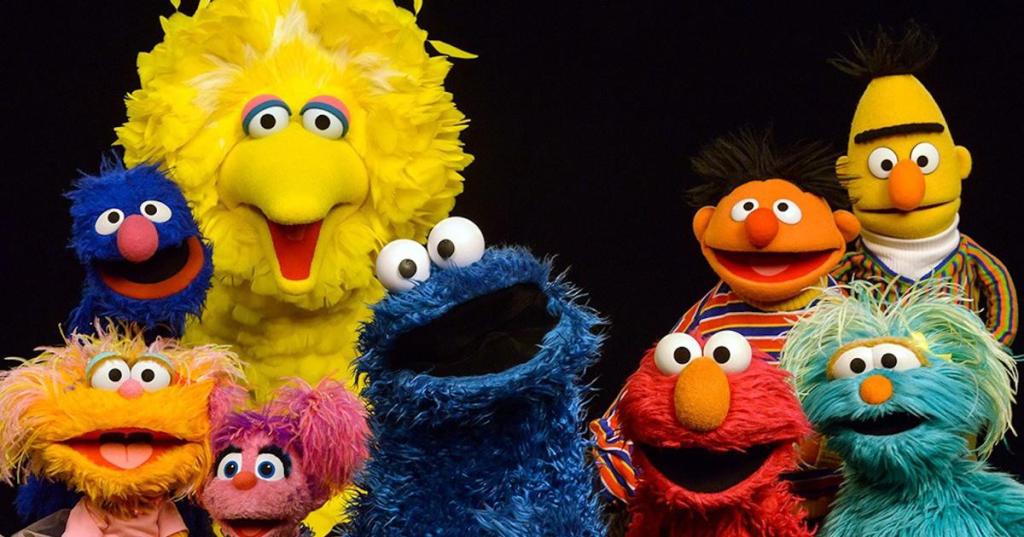
But that’s okay, because that’s what “writing what you know” – if done correctly – is really good for. For the audience, art is entertainment or education. If you’re really good, like Jim Henson and Joan Ganz Cooney, it can be both. But for the artist, art is therapy. It’s how we choose to understand ourselves and try to make sense of a world that seems dead-set against making any sense on its own. The joke about Stephen King is that his stories are all about writers from Maine, but people forget about how many stories connect to other parts of his life: outcast children (It), issues from fatherhood (The Shining), or substance abuse problems (line up any of his books from the 80s and throw a dart). This is what great writers do. F. Scott Fitzgerald was writing about the world around him when he created The Great Gatsby. Mark Twain based the hometown of Tom Sawyer and Huck Finn on his own childhood. Stan Lee really got bitten by that radioactive spider that one time.

100 percent historically accurate.

We’re so used to “write what you know” as a metaphor that when someone does it literally but does it really well, it’s a gut punch. For example, the movie The Big Sick was written by married couple Emily V. Gordon and Kumail Nanjiani, and it’s about a real-life incident in which Emily — very early in their relationship — fell into a coma due to a mysterious illness, creating an unexpected bond between Kumail and her family. It’s funny, deeply emotional, and a great showcase for Nanjiani as an actor. More importantly, though, it hit every nerve in my brain in a way I never could have anticipated.

I know you’re expecting a joke here, but I deeply loved this movie and you should watch it twice.

As with any movie “based on a true story” there are elements added for drama or comedy or to make a more coherent story (real life is rarely that coherent), but you could tell while watching it how true and real the heart of that film is. It also happened to come out in the aforementioned 2017, a few months after my personal turmoil began, and I found myself sitting in a movie theater next to my pregnant wife weeping like a starving infant. Not because the movie was tragic (when the coma victim is one of the co-writers of the movie, you can’t go in expecting a Nicholas Sparks ending), but because at that moment it was delivering the message I needed: that the world is hard and chaotic and awful sometimes, but it’s still possible for things to turn out okay in the end. A movie that’s 100 percent fictional could have delivered the same message, of course, but knowing that much of it was true made it hit much, much harder.

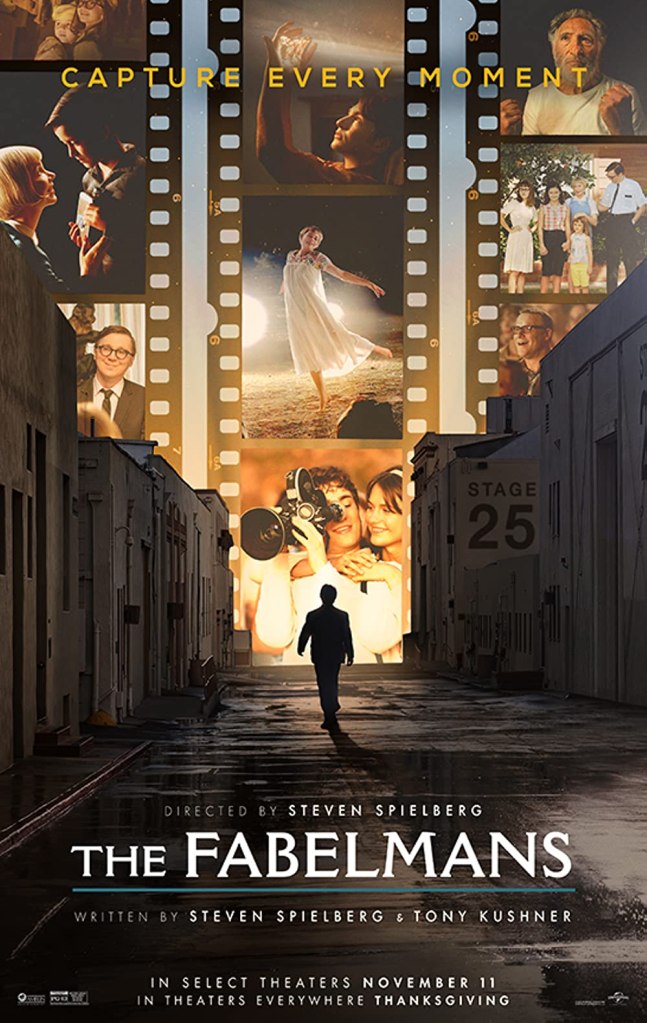
The other film I want to talk about here, a more recent one, is The Fabelmans. Steven Spielberg is a polarizing figure – movie fans often consider him one of the greatest filmmakers who ever lived, whereas movie snobs dismiss his work because it’s popular, as though that somehow disqualifies it from being good. The Fabelmans is clearly his most personal story, a movie about a young man who uncovers a family secret that rips him apart, and how he uses movies and filmmaking to cope.

A love story about a boy and his camera.

This one feels more “fictionalized” than The Big Sick, of course. Spielberg directs the film, but Nanjiani actually played himself, Spielberg didn’t use real names, and the decades of distance from the real events no doubt necessitated him conjuring up much of it out of whole cloth, but again, it’s a film with a real emotion in its soul. Reportedly, the relationship between Sam Fabelman’s parents is a reflection of Spielberg’s own, and if that’s true I have to applaud the man for his willingness to bleed on screen. The story that’s told is somewhat raw and heartbreaking, not the sort of family secret that many people could ever bring themselves to talk about, and yet he put it on a thousand movie screens and got a Best Picture nomination. Is it my favorite Spielberg movie? No. But I think it’s his most authentic, his most emotionally honest, and I truly love it for that. Plus the final scene of the film – based on a story that Spielberg has talked about in interviews in the past – is a lovely little way to cap off the story of a boy who had a rough time of it, winking just a little at the camera to assure the audience that he turned out okay in the end.

So for the writers out here, my message is not to write what you know. Write what’s real inside, what you’re really feeling, put it on the page. Dress it up however you want, of course, whether that means an alien or an undead slasher or a superhero or just a kid in Arizona, but figure out what’s real in that story. That’s what you share with us. That’s how you get to be great.

It’s easier to recognize greatness than achieve it, naturally, but I really am trying.

Blake M. Petit is a writer, teacher, and dad from Ama, Louisiana. His current writing project is the superhero adventure series Other People’s Heroes: Little Stars, a new episode of which is available every Wednesday on Amazon’s Kindle Vella platform. How many times can he post that link before it’s considered gauche? Ah, who cares?

The Best Superhero Books Outside of Graphic Novels

Not long ago, I was contacted by the editors of Shepherd.com and asked if I would be interested in contributing a list. It’s a cool site where authors curate short suggested reading lists in various categories, and based on my current (and best-known) works, I asked if they’d be interested in my picks for five great books that feature superheroes OUTSIDE of their typical home in the world of the graphic novel. Take a few minutes and look at my recommendations, then poke around the site to see some of the other great lists they’ve collected!

Shepherd.com: The Best Superhero Books Outside of Graphic Novels

Christmas 2022: The Release

Christmas is here again, friends, and those of you who have been with me for a while knew this was coming: my annual Christmas short story! Stories aren’t always easy. You need both a WHAT and a WHY for the story to make sense, and I’ve found that a great number of weak stories nail the WHAT without giving enough time to the WHY. I came up with the WHAT for this story about three weeks ago, but I struggled with it until last week, when the WHY finally came to me and made it all make sense.

This story features the return of some friends from previous Christmas stories, but you don’t need to have read them to enjoy it. It stands on its own, with a protagonist that’s quite unlike any of my previous Yuletide yarns.

And I don’t usually do this with my Christmas stories, but I’m going to do it this year. 2022 was rough on a lot of people, and the last few months in particular have really weighed me down. Without getting into details, it’s been one thing after another that just started to feel crushing after a while, and without my wife, Erin, I don’t know how I would have made it. So “The Release” is dedicated to her.

Merry Christmas, all.

THE RELEASE

He needed to get out. It had been years of loneliness, isolation, and frustration, but he had grown accustomed to it. It was something he had learned to live with. But something was calling him this year, something was urging him, and he knew he was almost out of time. He needed to get out.  

There was not much to be said for his confinement. It was long and dark, it was solitary, and he was fed sporadically with stock that clearly was the product of livestock, cattle…not the premium nutrients he craved so deeply. From beyond the walls of his cell he could see glimpses of the light – brief glimpses, quick ones that seared his eyes and made him want to scurry back into the darkness like vermin. He resisted the urge, though – he was not vermin, he was not filth. He was the apex predator on this planet, even if his captors refused to recognize that fact. It was, he supposed, the fact that he was so far above them that had kept him here for so long. For the first few years of his captivity he had fought – attacked the jailers, tried to break free from his cell at any opportunity. But the cattle were resourceful, he had to admit that, and they were ready for any move he made. 

It took years before it finally occurred to him that the only escape may be to simply give them what they wanted…to cooperate. To be a good little boy.

A clanging came from outside his cell and he heard the guard bellow: “Suit up, inmate! We’re opening the cell door in two minutes!”

A garment bag appeared in the slot beneath the door, the suit within probably the same one he wore in September when transferred to this facility. Typically he wore it only twice a year, during the September and March transfers, but this year was different. This year he had behaved exceptionally well. This year he had been granted his work release, a chance to be allowed out of this infernal land of perpetual daylight and go somewhere his kind could flourish – into a night that extended as long as necessary. He took the suit from the bag and pulled it on: a full black bodysuit that covered him from head to toe in thick, impermeable fabric through which no light could penetrate, not even here. Across the chest, in white letters, the initials of his captors: CPC. Over his eyes were a pair of polarized lenses to filter out the deadly rays of the sun and still permit him the ability to see. Beneath the lenses, the portion of the mask that covered his mouth was reinforced with Kevlar. Not even his teeth would be able to slash their way through. The suit was one piece, but there was another item in the bag as well: his handcuffs. He knew those were coming, but was not particularly glad to see them. 

“Put it on, inmate!”

But he did. Because he had planned this too long, waited too patiently to lose his opportunity now. He picked up the handcuffs and clamped them first on his left wrist, then the right. Then, finally prepared, the door to his cell opened to the blazing white waste outside. 

Even through the polarized lenses, his eyes stung at the light. He squinted, tried to adjust. Before his capture he had gone ages without seeing sunlight directly. To see it even twice a year had been a drastic change, but the light to which he was exposed was so brilliant as to be almost blinding.

“Can you see me, Al?” the guard asked. His neck twitched at the nickname, but he had resigned himself to be cooperative. 

“I can see you.”

“Walk slowly. Follow me.”

He stepped out of the cell into the unfathomable glare of light. The facility was to his back, but his cell opened directly to the outside, another security measure. He did not feel the bitter wind the way the human guards would, were it not for their heavily insulated suits, which themselves served as further protection against him should he ever attempt escape. Not that he would, of course. Where would he go? The concept still frightened him a bit, if he was being honest with himself: a place where the sun did not set for six months, here at the bottom of the world. And in March, they would take him from his cell here in Antarctica and bring him north once more, to its equivalent facility at that pole, forever chasing the perpetual daylight. The Coalition for Paranormal Containment had finally found the perfect prison for his people, the perfect way to contain a vampire.

“Alrighty, Al,” the guard said. “You’re gonna be on your best behavior, right?” Beneath his heavy clothing he wasn’t sure which one it was – Barnes? Avery? His voice was muffled and the wind cut across his ears, making identifying his voice as impossible as his face. It didn’t matter. They were all the same, he told himself, convinced himself. All cattle. 

“Of course, guardsman,” he said. “I have fully reformed, and I embrace the opportunity to demonstrate my contrition.” 

“Whatever,” the guard said. He was led around the facility to the helipad, where the vehicle that was to take him to his work release was waiting. The pilot, he presumed, was sitting in the craft, green and red clothing draped loosely around his body in a manner that looked positively chilly. If the little man felt the biting cold, he didn’t show it. He smiled at their approach.

“Is this the lucky fella?” he said.

“Yes sir,” the guard said. Clearing his throat, he recited the necessary doctrine to officiate transfer of authority. “The Coalition for Paranormal Containment, as of zero hundred hours, December 21, officially remands Inmate #5261897 to the authority of North Pole Operations, Inc., for a period of time not to exceed five days, standard time, internally variable based on the temporal adjustments necessary to the task required.”

“On behalf of North Pole Operations, I accept custody,” the little man said. 

He looked back at the inmate. “Now be nice, Al. He knows if you have.” Clapping him on the shoulder and chuckling, the human guard turned and rushed back towards the facility, and the inmate looked down at his wrists.

“Wait! My handcuffs–”

“Don’t worry about that.” The little man grabbed the cuffs and jerked them just a little, causing them to fall onto the ice at their feet. “You’re not going to be needing them the next few days, bud.” He hopped into the craft and gestured to the seat next to him. “Hop in, Al.”

“The name is Alastair,” the inmate snarled. “Address me with the proper respect, small human.”

“First of all, not a human. The name is Binky,” said the little man. “Head of security, and the only reason you’re not in your cell right now. So unless you want to march back there, do me a favor, lighten up, and climb in.”

“In that?”

“I know she doesn’t look like much, but the boss’s model is getting its final tune-up for Christmas. And I know the engines are a little scrawny, but they’re in training. May take over the big job someday. And it’s only the two of us, not a mountain of toys, so I think they can handle the weight.”

“No, I meant–”

“Meant what?”

Alastair looked at the craft that sat on the helipad – a miniature sleigh, red paint scratched and dented, the brass runners oiled but otherwise looking like they had seen better days. As for the “engines” – the three reindeer lashed to the front of the sleigh stamped their hooves and looked back at him impatiently.” 

“Nothing,” he said. “I meant nothing.”

“Great, then. Hop aboard, Al. We’ve got to get clear to the other end of the planet, lickety-split.” 

*   *   *

Alastair had made the journey between North and South Poles seventeen times now, every six months, and he was used to the long and frustrating transit between the two of them. The Coalition’s aircraft tended to take a long, circuitous route that mostly went down over the Pacific Ocean, with stops to refuel on mid-sea platforms near the respective coasts of Japan and Australia, but that kept them out of any heavily-used trade routes or over any populated areas that could catch a glimpse of the plane. Sometimes that meant staying on the refueling platform while they waited for ships or other aircraft to make their own passage. The journey had taken anywhere from 36 hours to a full week in the past, depending on a series of factors.

The sleigh Binky piloted got him to the other side of the world in less than twelve seconds.

At first he wasn’t even certain anything had happened. Binky cracked the whip and the reindeer began to rush across the ice. He felt the sleigh lift, felt a sensation of rising in the air, and then there was a rush he couldn’t explain followed by a feeling of moving down. In that blink of an eye, the world around him swirled from dazzling sunlight to the pitch of midnight. 

As the sleigh skidded to a stop on another ice-covered field, Binky looked over at him. “You can take the mask off now. There won’t be any sunlight here for another three months.”

“I thought you had some sort of facility here,” Alastair said. “This is just empty Arctic waste.”

Binky chortled. “Trust me, Al. Take the mask off.”

He swallowed the urge to lunge at the little man, to rip his throat out and drink the sweet elixir within, both sustenance for himself and punishment for his continued insistence at diminishing his name. But he had his goals, and killing Binky the Elf would not accomplish them. He unzipped the neck of his mask and pulled it away from his head.

Again, he was blinded.

Where seconds ago there had been nothing but a dark waste of ice, the world was now brilliant and beautiful. A huge settlement appeared – homes and workshops, walking paths decorated with candy canes and gingerbread men, a gargantuan Christmas tree that towered over everything and, in the distance beyond the tree, an enormous mansion covered in garland and tinsel. He almost fell back into the sleigh, as startled as he was by the sudden appearance of the town, and he instinctively covered his face to protect himself from the light.

“It’s all artificial light,” Binky said. “Fire, electricity, stardust…it’s not sunlight. You’re fine.”

“It’s so bright,” he said. “I haven’t seen anything this bright in…”

“A long time.”

“Where did this come from? It wasn’t here a moment ago.”

“Look through your mask again.”

He was hesitant to comply with the little man’s orders, but he did so. When he raised the mask and looked through the light-killing lenses, he again saw only ice and night sky. Taking the lenses away from his eyes, the village returned.

“Our facility cannot be detected by any technological means. We put that safeguard in place because of satellites and telescopes, but it works on any device that’s used to capture an image. Guess that includes your little lenses there.”

“Remarkable.”

“My pal Duffy invented it. I’ll have to tell him you said so. Come on. I’ll take you to meet the big guy.”

Binky started walking down the path, dodging rushing elves with packages, carts of toys, rolls of wrapping paper, and other various effluvia of the holiday season. None of them seemed to pay attention to him at all – they simply had too much to do. Binky led him to the steps of the mansion, a place that looked even larger up close, and pulled open a set of twenty-foot doors with candy cane handles and a reindeer-face door knocker. As they stepped inside beneath a three-foot ball of mistletoe, Alastair saw that inside was even more chaotic than the town square. Dozens of elves rushed around with clipboards and charts, some with electronic tablets, one carrying a doll shouting that somebody better figure out why this darn thing wasn’t urinating or there would be serious trouble coming their way. Everyone had a task, a job. He supposed it made sense. This was the busy season.

Binky took him up an ornate flight of stairs to a wooden door with OFFICE carved into it beneath a wooden bas relief of holly and poinsettia. He gave the door a perfunctory knock before popping it open and looking inside.

“He’s here boss.”

“Excellent. Bring him in.”

Binky stepped aside and waved Alastair through the door. On the other side was a smaller room than he would have expected, the walls painted green and adorned with portraits and photographs of an older couple in red and white clothing. There were schematics everywhere, plans for constructing toys of all kinds. There were maps of the globe with routes marked in red, scratched out, amended, and scratched out again. There was a scroll – an absolutely gargantuan scroll – that tapered off at the end with what appeared to be a series of names. And sitting at the desk was the man from the pictures, wearing a pair of green trousers and a yellow shirt covered in polka dots, a pair of simple brown suspenders crossing his chest and holding up his pants. He had a pen in one hand, a mug of hot cocoa in the other, and a pair of reading glasses sat obediently on the end of his nose. 

“Hello, Alastair,” said Santa Claus. “I’m so glad that you’ve decided to try to get back on the nice list.”

“I don’t know if I’d go quite that far,” Alastair said. “This is a work release opportunity. I’m here to prove I’m not dangerous to humans anymore.”

“Are you now?” Santa looked down at a clipboard in front of him. “Alastair Bonaventure, born 1842. Always on the nice list until 1867, which is when…” Santa looked up at him, his eyes falling on Alastair’s neck. “Well, you know what happened, don’t you?”

He froze for a second, not knowing what to say. Born 1842, exactly what it said on his documents for the CPC. And the nice list…well, that was the history of Alastair Bonaventure. 

Honestly, he wasn’t even sure he had expected to get this far. He had his plan, but if this man was really who he said he was, he would know, wouldn’t he? Know his plan, know his desperation, know that he was biding his time in this work release situation until he saw an opportunity to escape and then–

“Hey, Al? The boss asked a question.”

He blinked back to the present. “Yes. I know what happened.”

“In custody of the CPC for the last eight and a half years, captured while attempting to devour a nun in Milan, Italy. Now Alastair, was that right?”

“I was hungry, Santa. Everyone has to eat. Even vampires.”

“Yes, I suppose so. Well, we’ve got a little more than two days before takeoff. Binky is going to acquaint you with all of our security procedures and regulations. He’s going to be your commanding officer while you’re in our custody, but since we’ll be working together on Christmas Eve, I wanted to welcome you here to the Pole in person.” He held out a chubby hand and Alastair took it for a respectable amount of time before withdrawing it again. “Any questions before you get started?”

“I…”

“Go ahead, son, spit it out.”

“I didn’t believe them at first, when they told me about this particular work release assignment. It seemed…”

“You didn’t believe in Santa Claus? Too silly? Too incomprehensible for the rational mind?”

“I’m a vampire, sir. From the day I was bitten, I realized that the world is full of things that rational people don’t believe in. No, it’s not that.”

“What then?”

“I was told you needed security for your rounds this year. Protection.”

“That’s why you’re here, yes.”

“Okay, but…why? You’re Santa Claus. Who would want to attack you?”

Santa nodded. “The world is a dangerous place, Alastair. I’m here to make it a little nicer and for some reason, there are creatures out there who just hate that idea. Binky will explain the rest.”

“All right, then. I suppose we should get to work.”

“Now that’s the attitude we want to hear in these parts. Alastair, I think we’ll get along just fine.”

*   *   *

The hours raced by, as those in the holiday season always tended to do. Alastair spent most of his time at the Pole in Binky’s company, in preparation. Some of the time was used going over routes and procedures, learning the logistics of how Claus zoomed from one spot to another, if not the actual means of propulsion. The same went for the details of his rapid activities inside the homes of the children he meant to visit and the way he would leap from one spot to another in the blink of an eye.

“It’s gonna seem like it’s going really fast and taking forever at the same time,” Binky said. “We move like lightning, you have to understand, but there are still literally millions of homes to visit all over the planet. Time is on our side, thanks to a little magical shenanigans the boss is privy to, but you’re still going to think it seems like an extraordinarily long night.”

“Will it be?”

“For you and me. For anyone who’s on the sleigh. Except for maybe the boss, I’m honestly not sure what it feels like to him. But for everyone on the outside, it’ll be the standard 24 hours a day.”

The logistics were only a small part of Alastair’s tutorial, however. The rest of it was a crash course on the various creatures that existed across the globe, and how to deal with them. 

“If we’re attacked by a golem?” Binky asked.

“Wipe the command word from its forehead or take the scroll from its mouth.”

“A mummy?”

“Their bodies are very dry – fire is the most effective deterrent.”

“Zombies?”

“Cut off the head or destroy the brain.”

“Werewolf?”

“Christmas isn’t a full moon this year so it’s unlikely we’ll encounter one, but silver weapons are best.”

“Evil Kaiju?”

“Hold it off until a good Kaiju can arrive to fight him.”

“Vampire?”

Alastair raised his eyebrow, but answered the question. “Since the night will be a long one, evading it until daylight is not an option. Stake through the heart is simplest. You can also remove the head and bury it backwards with garlic in its mouth, but if it comes to that somebody else is going to have to do it, because I won’t.”

“You don’t like Italian food, huh?”

He asked a few more times about the reason for his enlistment. After thousands of years of Santa making his Christmas rounds, why was he suddenly in need of protection? It made no sense, and Binky’s answer only raised more questions.

“A few years back, some misguided people went after the boss right when we were finishing up his rounds. They learned the error of their ways, but when word got out about what happened the legit evil types in the world decided they would try it on their own. Elves are nimble, Al, but we weren’t made for fighting. Well. Not North Pole elves, anyway, but I’ve got some cousins in–”

“Your point, Binky?”

“Point is, eventually the boss decided we needed to be ready for anything. And if there’s anything we’ve learned from the movies, it’s that the best way to fight a monster is with another monster.”

It made a kind of logical sense, Alastair had to admit. And he had certainly seen his share of battle over the decades. It was his history as much as his record of good behavior that had made his name turn up when this assignment was offered. Still…

“There are good monsters in this world, though. Benevolent ghosts. Sea creatures who rescue sailors. That fellow that Shelley wrote about.”

“So why didn’t we call on one of them?”

“It’s a fair question.”

“It’s Christmas, Al. You’re gonna be more powerful than any of them tonight.”

‘Why on Earth would Christmas make me more powerful?”

“Because on Christmas, the smart money is on somebody in need of redemption.”

Redemption? Alastair had never thought of it that way. He was a monster, of course, by human standards. He had feasted on mortals, enthralled others. He may not have relished it, but it was the way of his kind. Did humans need redemption for feasting on cows or using dogs to help them hunt? 

And what’s more, the other thing that weighed on him was far worse, something for which he didn’t believe redemption was even possible. But it was still something that had to be addressed. And addressing that very old business was going to be the crux of his journey this Christmas Eve.

*   *   *

As morning dawned on December the 24th (metaphorically, of course – the sky was still black as pitch here at the North Pole), preparations went into high gear. The flow of presents and parcels into the launch bay had reached a frenzy, and he occasionally caught himself wondering what some of the packages contained: a game, a doll, a bicycle, a baseball glove? It had been a very long time, but Alastair had been a child once, and although the sundries may have changed, the spirit of longing was no doubt the same as it had been two centuries ago. 

The one thing that did surprise him was the outfit Binky provided him with when he approached the sleigh. It was woven from a weighty black fabric that covered everything up to his neck. Instead of a mask, a helmet accompanied the suit, but other than that it was almost identical to the one that he wore during his prison transfers. “I don’t understand,” he told Binky. “I thought this trip took place exclusively during the night.”

“It does. That suit isn’t for protection against sunlight.”

“Then what is it supposed to protect me from?”

“Everything else.”

He turned the fabric over in his hands, felt its weight, and had to question Binky’s point. It was heavy, to be sure, but relatively thin. “Is this supposed to stop blades? Or bullets?”

“Rated for both, yep. Not to mention fire, claws, teeth, and unicorn horn.”

“And what?”

Binky laughed. “Just wanted to make sure you’re paying attention. Naw, the chance of a unicorn attack is…well, it’s relatively low.”

He patted the sides of the costume, pointing to a series of latches and snaps. “Cargo pouches,” he said. “Loaded up with knives, wooden stakes, and assorted other things that may come in handy if there’s an attack. Don’t worry, I left out the Holy Water. Don’t want to chance the bottle breaking and dripping on our bodyguard, do we?”

He waved Alastair into a dressing room where he pulled himself into the costume, cradling the helmet under his arm when he marched out into the frigid hangar. The sleigh was moored at the end of a long runway, and elves were strapping down an octet of reindeer to the front while another legion of them harnessed a gargantuan sack in the bed. It was enormous – he and Santa both could fit inside the thing with room for an elf or two left over – but at the same time, was it really large enough to carry the gifts of an entire world? It was not, Alastair decided, but in the last few days he had encountered enough “North Pole Magic” to chalk it up to another instance of that. The sack was larger on the inside, and that’s all there was to it. 

“Quite a sight isn’t it?” Santa stepped out onto the runway, putting a hand on Alastair’s shoulder.  “We’ve gone to quite a lot of trouble to make sure it lives up to expectations.”

“I thought everyone was supposed to be asleep when you were on duty.”

“Everyone is supposed to be asleep. How better to guarantee that a few of them stay up and spread the word every year?” Santa bellowed, a hefty “Ho! Ho! Ho!” that felt like it rolled out of a cartoon, and climbed into the sleigh. Binky bounded in after him, and indicated the empty spot on the seat next to him.

“Alrighty, Al. Time to get this show on the road.” 

Bristling, the vampire took a seat on the sleigh next to Binky, then started looking around. “Where are the seat belts?” he said. “The harness? Isn’t there some way to–”

“NOW DASHER! NOW DANCER! NOW PRANCER AND VIXEN!”

Alastair hadn’t really known fear for a very long time. Real fear, true mortal fear, was alien to his kind, and he had grown accustomed to the idea that any damage he incurred would heal in time. But as the fat man’s throat boomed with “ON COMET! ON CUPID! ON DONDER AND BLITZEN!” he suddenly felt its grip. He had known, intellectually, what was going to happen. He knew the reindeer would run, the sleigh would be pulled behind them, and that they would fly around the world at astonishing speeds. He had not known that there would be nothing to keep him on the seat except his clenched buttocks.

As soon as “BLITZEN!” escaped Santa’s lips, the sleigh lurched forward, Alastair plastered to the back of his seat. The hangar sped past him, the sconces on the walls rushing by and vanishing in seconds, replaced by the midnight black of the sky. He saw stars for a moment, then he saw streaks of light. The staggered light of distant suns was not usually intense enough to cause discomfort for his kind, but as they turned into beams in the sky he felt fear once again. Somewhere from below his throat a chilled howl escaped and he closed his eyes, shrieking.

When the shrieks ended, he realized that the quiet night was filled by another sound: Binky’s laughter.

“Open your eyes, Prince of Darkness,” he said.

Alastair did, preparing to see the stars racing past, the relief of the Earth below appearing on the horizon and evaporating just as fast behind them, the clouds parting for them and transforming into streaks in their wake.

He was not prepared to see the sleigh at a dead stop, the reindeer casually digging their hooves into the roof beneath them. There was a chimney nearby, and snow on the shingles, the rails of the sled cutting through and leaving trails behind them. 

“Are you alright there, Alastair?” Santa asked.

“I…How…”

“Wonderful. Let’s get to work.”

*   *   *

The first few stops were uneventful. They landed somewhere, the three of them whisked out of the sleigh down into a home, and Alastair watched as Santa and Binky went to work. This happened several times, in fact, before it started to dawn on him that thinking of it as a “few” stops had suddenly become relative. How many homes had they gone into already? Dozens? Hundreds? He was relatively certain they were in the same country their first stop had brought them, but he was not entirely certain what country that was.

What’s more, moving from house to house happened like lightning, but watching Santa and Binky lay out their gifts did not. He was conscious and aware the entire time, standing around like a shopping center security guard, with the closest thing to an intruder being the occasional dog that yipped at them or cat peering out from beneath the Christmas Tree. 

After a few stops, Santa held out a plate to Alastair. “Cookie?” he asked.

“Not to my taste.”

“Of course. Perhaps you’ll like the U.K. better – they leave me mincemeat pies over there.”

It was a habit of this Santa Claus, he realized, this conversation, this small talk. Santa was the sort of person who never met a silence he didn’t feel the need to fill with words, ironic considering the stealthy nature of his work. Alastair’s wife had been the same way, the sort who always needed to be talking about something, and–

He forced the thought aside as Santa signaled for him to join them by the fireplace. It was the standard procedure: he and Binky flanked Santa as the fat man put a finger aside his nose, then they were whisked up through the chimney and back onto the roof. Something else that had occurred to Alastair after a while was that not every roof had a chimney when they returned to the sleigh. What’s more, every roof they landed on was covered in snow, even if the air outside was in the 60s and there wasn’t another flake in sight. All of it: the chimney, the fireplaces, the snow…they were all manifestations of Santa’s own talents. How powerful was he?

“Tonight, I’m as powerful as I need to be,” Santa said.

“What? But–”

“You didn’t say anything, you just thought it. I know. Tonight I know everything, Alastair.” He smiled and his eye twinkled. “I know everything.”

If Alastair’s blood was still warm, the emphasis in the fat man’s voice would have cooled it. 

*   *   *

Alastair wasn’t certain how many stops it took before it happened, but he was sure the first sign of trouble came in Australia. As Santa laid out gifts for three children – a pair of swim fins for the oldest, stuffed animals that looked like blue dogs for the two younger – Alastair caught notice of a shuffling motion from the fireplace. He’d grown accustomed to small disturbances like pets or motorized vacuum cleaner, and they’d had more than one close call with children who were up late in anticipation or parents who were up late assembling toys. This was different, though. This time, the stonework on the fireplace itself seemed to be peering at them.

He nudged Binky, then tossed his head gently in the direction of the fireplace. Binky looked quickly and got the picture.

“Rock Troll,” he whispered.

It was like he’d given the assassin a cue.

The top layer of stone on the fireplace leapt up, arms appearing in the masonry, and reached out towards Santa Claus. Alastair assessed his options, but it didn’t take long. Allowing the troll to take Claus would be counter-productive. He was too far away, he still needed the fat man to get him where he was going. Besides, he had agreed to do a job, and he had never been the sort to welch on that.

As Claus continued to casually lay down the tracks for a train set around the Christmas tree, Alastair put himself in front of the troll, catching it by the wrists. The troll was strong, incredibly so, and for a moment he was afraid that he had already overstepped his capabilities…but the way the troll moved gave him his cue. The troll did not move like a normal animal, bones attached to tendons attached to flesh. With the troll, it was as if each component of his body was a separate stone, held together by nothing more than a little magic and a lot of stubbornness. As the troll tried to grab at Alastair’s throat, he kicked his leg out and, with his own vampire’s strength, dislodged the stone that made up the monster’s left knee.

“And a new football for Jamie,” Santa said, oblivious to the chaos behind him.

With his knee gone, the troll fell to his side and Alastair moved into action. He went for the joints first – elbows, wrists, the other knee – and pulled away the stones that represented those vital components of the rock troll’s anatomy. With those gone, the troll began to try to flip and flail on the ground, howling in some language that sounded eldritch and childlike at the same time. Alastair grabbed at the thing’s neck, but the troll jerked its head down and crushed his left hand. As he shouted in the surprise pain, he shot out his right hand and grabbed the monster’s jaw, yanking it off the rest of its skull. 

With that, the fight seemed to go out of the creature, but its eyes stayed open as Alastair continued disassembling its body and hurling the stones away. When finally there was nothing left but the cranium, he looked back at his companions. Santa carefully slid a candy cane into each of the three hanging stockings, while Binky gathered up the stones he’d tossed around and reassembled them in their customary places in the fireplace.

“A little help would have been nice,” he snarled.

“What for?” Binky said. “You seemed to have it covered.”

“Here.” Santa held a thermos out to Alastair, who waved it away. 

“I don’t need any of your hot chocolate.”

“It’s not chocolate,” Santa said. “It’s for your hand.”

He looked down at his left hand – crushed, the bones splintered, a thin trickle of the dark ichor that passed for vampire blood trailing down his arm…then he looked at the thermos. There was only one thing that could heal him, but…

“Just drink it,” Santa said, removing the lid from the thermos and holding it out again. Alastair took the thermos and took a deep sniff, his lungs filling with a warm smell of copper.

“A little AB negative,” Santa said. “That should get you patched together again.”

“How did you–”

“Alastair, really. Do I need to show you my resume?”

Chastened, Alastair lifted the thermos to his lips and drank. The warmth flowed into his body – it was one of the few things that made him feel warm these days, really – and he felt the bones in his hand snap back into place, the shredded fibers of his muscle knitting together, and the skin resealing itself as if being pulled by a zipper. 

“Well done,” Santa Claus said, sincerely. “Just try a little harder to keep it down next time, eh?”

*   *   *

House after house, country after country, the three of them moved through the night faster than Alastair would have believed possible – yet at the same time, the night seemed endless. How long had he been on this journey, relatively speaking? Days? Weeks? Time didn’t seem to apply anymore. By the time they arrived in England, even the battle with the rock troll in Australia felt like a distant memory, like something that had happened years ago to someone else entirely. 

His memories before the journey began, however, were as fresh and crisp as they ever were…even the ones from decades past. When Santa began laying out a plastic fashion doll for a small British girl, an image pricked at Alastair’s mind. These “fashion” dolls…what had been wrong with the baby dolls or rag dolls of days gone by? Somewhere in the depths of his mind he saw a brown-eyed little girl on Christmas morning pulling green tissue paper away from such a doll, a simple thing made of scrap fabric, but hand-sewn with greater love than these mass produced carbon copy playthings would ever know.

“Somethin’ wrong with the doll, Al?” Binky said, noticing his staring.

“I’m just thinking about how much toys have changed since…”

“Since what?”

“Since I was…young.”

“Hey, you’re talking to a guy that’s got six or seven hundred years on you. I know what you’re talking about. When I first started working for the boss we mostly delivered clay marbles and oranges. Now I don’t even know what half this stuff is.” He tucked away a video game console and looked back at Santa. “Are we done, boss?”

“Just about. I’ll just have a nip of this sherry and–”

Santa reached out for the glass of sherry, the traditional gift for Father Christmas in the UK, Alasair had learned, and lifted it to his lips. As he did so, though, Alastair saw a slender trail of thread attached to the glass. He knocked the glass from Santa’s hand, but somewhere a click announced that the glass’s trigger had already been tripped. A closet door opened up and from within stumbled a shuffling, moaning trinity of creatures with empty eyes, gray and lifeless skin, and bared teeth. They moaned as they reached their hands out and stumbled towards Father Christmas himself.

“Zombies?” Binky said. “Someone actually set up a zombie trap?”

Alastair had no hesitation at this point. In the endless night with Santa he’d already fought a troll, a banshee, a small pack of gremlins, and uncounted ghosts who seemed to take to the Christmas air the way Alastair himself took to darkness. He was beyond surprise. 

Dispatching the zombies was quick work. It always was – the only real threat a zombie brought came in numbers, and three was too small for Alastair to even flinch. He drew a knife from one of the cargo pockets in his uniform and drove it into the forehead of the first zombie, pushing it in up to the hilt. The ghoul stumbled and twitched, and Alastair gave his knife a twist to be certain the damage was done. As the zombie fell to the ground, Alastair pulled his blade free and turned to repeat the process on the next zombie.

“Doin’ good, Al,” Binky said. 

“Binky! Behind you!”

Binky turned at Alastair’s words, only barely missing the teeth of a fourth creature that had come from another room. The house was full of the beasts, Alastair said, and as he killed the third of them he realized he was in for a more substantial battle than he had experienced previously.

Binky pulled a gun from his pocket and held it up to the zombie that had stumbled out behind him. It made no sense – it was a toy gun, with orange plastic and a series of LED lights blinking along the casing. Even when he pulled the trigger, it was accompanied by a canned “ZAP!” noise that Alastair was certain thousands of toys over the years had emanated. But along with the fake sound effect, a glimmering spiral of light twirled from the barrel and into the zombie’s head. It zipped through its head, punching a hole between its eyes and bursting from the other side like a corkscrew. The creature fell back even as a crash came from upstairs.

“I’ve got this one,” Santa said, placing a finger aside of his nose. When Alastair had seen him do that previously, the three of them had all been whisked up into the fireplace. This time, only Santa vanished, but the swirl of glitter that accompanied his disappearance went not into the chimney, but down the hall and up a flight of stairs.

“What’s he doing?” Alastair asked.

“Taking care of someone who just went to the top of the naughty list.”

The ceiling cracked above them and Alastair pulled Binky back as it creaked and snapped, falling down into the room. The Christmas tree was knocked to the floor, a heavy piece of ceiling landing on it. On that piece, Santa Claus was still on his feet, holding up a tiny man with a white lab coat, wild eyes beneath a thick pair of glasses.

“If there are zombies,” Santa said, “You’ll usually find a cause. Evil sorcerer, alien invader…or this one. The good old-fashioned mad scientist.”

“Willing to ruin Christmas for the whole world just so you can have the bragging rights of saying you got Santa Claus, huh?” Binky leapt up into the man’s face. He kicked and flailed, but Santa shook him into submission. Binky grabbed the lapels of the lab coat and pulled himself up to look the man in the eye.

“Okay, Sparky, you’re going to tell me what you did with the family that lives here. And if you tell me they’re zombies, I’m shoving a holly branch so far up your you-know-what that you’re gonna convert to Judaism just so you never risk seeing me again!”

His hand shaking, the mad scientist pointed at the floor, then at a door across the room. Alastair opened the door up to reveal a flight of stairs heading downwards. “The cellar,” he said. He ran down to find five people tied up, their lips covered with duct tape, wailing. Two adults, three children…they matched the photographs in the living room upstairs. The smallest child, a little girl no more than seven years old, looked up at him with eyes turned to glass by tears. 

“Children,” he hissed. “There were children.”

He didn’t remember bolting back into the room. He didn’t recall jerking the man in the lab coat from Santa’s grasp and shoving him against the wall. He barely remembered putting his hand around the man’s throat and pulling aside his shirt, revealing a pink, pulsating stretch of neck. He did recall later, though, the way he felt his fangs extend in the front of his mouth, and how badly he felt the thirst at that moment.

“You would endanger children. Terrify children just because you hate Santa Claus?” He pulled his lips up, his fangs exposed to the air. He saw their reflection in the man’s glasses. The man saw them too.

“No! Let me go! Put me down!”

Every part of Alastair wanted to rip this man’s throat out. It went beyond the thirst – this creature was vile, was despicable, deserved none of the comforts of light or family that humans were allowed to enjoy. And he was ready to end the man’s life, as he had so many before…until a gloved hand fell on his shoulder.

“You saw what he did, Santa,” Alastair said.

Santa said nothing.

Alastair put the man down. 

“Binky?”

“Already got the CPC on the phone, boss. They’ll be here to clean up in minutes.”

Altastair felt the rage subside, pushed down the urge to rend flesh with his own teeth, and looked at Santa. “The family?”

“They’ll be all right. The CPC has certain ‘techniques’ to make sure they won’t remember this, except perhaps as the Christmas the whole family had some bad dreams.” 

“They’ll clean up the mess, too,” Binky said. “We should get going, boss. We’re behind schedule.”

“Are you certain you want to continue on, Alastair? You could stay here, rejoin the CPC now, if this has been too much.”

“I’m fine. Come on. Let’s go.”

“You did well here.”

Despite himself, Alastair felt a tiny well of pride at Santa’s praise. “You did well yourself. Makes me wonder why you even needed me.”

“Hey, the Big Guy can’t take care of everything,” Binky said. “Come on. Let’s go.”

*   *   *

There was no snow on the ground in Nebraska when Santa’s sleigh landed on the roof of the Pratt house, but as he had grown to expect, the snow appeared beneath the runners of the sled of its own accord. The house was large, but modest – not particularly ornate or fancy in and of itself. But the decorations! It was one of the most dazzling displays Alastair had seen since they left the North Pole, and they had quite literally seen them all. A thirty-foot Christmas tree made of an aluminum pole and strings of lights was the centerpiece. Surrounding it on all sides were inflatables, blow molds, wooden cutouts, animatronic figures, and every other conceivable permutation of Christmas decoration. And each and every one of them was in the shape of or paying homage to the man driving the sleigh.

“Gracious, Claus,” Alastair said. “This must be your biggest fan’s house.”

“It’s definitely in the top three. Come on.” He climbed from the sleigh and strode towards the chimney, Binky behind him. Alastair looked back at the sleigh, where Santa’s sack was still at rest.

“Wait! You forgot the presents!”

“No children at this home, Alastair,” Santa said. “I’m just here to pay a quick visit to a very old friend.”

The light of the decorations was so great that Alastair would almost have believed it was daytime, the brilliance of the sun somehow rising up from below rather than down from the sky. It was so bright, in fact, that he didn’t notice at first that a shadow had moved across the moon.

The first attack hit Alastair in the back, knocking him down to the rooftop and popping off his helmet, which rolled off the edge into a bush below. Someone grabbed at his collar, pulling it back and exposing his skin beneath. He felt a stabbing in his neck, one that felt horribly familiar, then it immediately retracted and a voice behind him began hacking and spitting. 

“You’re one of us?” the voice shouted.

Alastair shoved himself backwards, flipping the person on his back away and onto the rooftop. He rolled and leapt at the same time, landing on his feet and looking down at the vampire beneath him. It was a young man – at least, he looked young, but such things were deceiving when it came to the Nosferatu – and he looked up at Alastair with black trickles of blood at the sides of his mouth. “What are you doing with him?” the vampire asked.

As answer, Alastair pulled a wooden stake from a cargo pouch. He moved faster than even the other vampire could react, leaping forward and driving it straight into his undead heart. They locked eyes for a minute, the younger one clawed at Alastair’s face, and he toppled over. It wasn’t like the movies, where he turned to dust and evaporated. Only one thing could do that, and on Santa Claus’s endless nighttime journey, sunlight was not a commodity they could rely upon.

He looked up to see that the vampire that landed on his back was not alone. Santa grappled with one, while Binky had pulled a toy bow and arrow from his pouch and was using it to fire wooden bolts into the hearts of a trio that had assaulted him. 

“Santa, look out!” Alastair pulled another stake and jumped, driving it into the vampire that was on top of Santa Claus. As it fell away, another came from the sky, hacking at the fat man.

“We knew you’d be here, Claus,” she hissed at him. “Didn’t know that you’d have a human-lover with you. Why are you helping this old fool? You should be with us.”

Should he? They were in Nebraska now. Could they get him where he needed to go before the sun rose? It wasn’t impossible. He wasn’t sure what time it technically was here, but vampires could travel quickly. And if they couldn’t, they must have somewhere to hide during the daytime. It could work. It could–

She turned to Santa, her mouth open, and bent towards his neck. Alastair didn’t even hesitate to send his next stake right into her back. When she rolled off, shrieking at him, he pulled it out and sent it through the front of her body, right into her heart.

Santa looked at Alastair, grinning. “Nice list,” he said.

Alastair looked around – a half-dozen vampires all lay dead at their feet, but there were at least as many still crawling across the rooftop, charging towards them. In the sky, black shapes seemed to indicate even more were coming. For a moment, he felt a pang of regret. He hadn’t taken this job out of any sort of affection, but the idea of Santa Claus perishing in such a way was horrible. He wished he could do something else. He wished he had been better prepared. He wished–

A pair of massive hands jammed his helmet back on his head and shoved him into the sled. “Get down!” boomed a voice the size of a mountain, and Alastair did. He covered his head with his black-clad arms, and couldn’t see any of what happened next, but the sounds made it easy for him to imagine what was going on. There was an electrical sound, like a generator roaring to life. Afterwards, shrieks, then sizzles. Those lasted a while – probably not as long as it seemed, but like everything else this night it seemed as though it went on for a very long time. 

Then the generator died, the big hands patted him on the shoulder. “You can look up now, my friend,” said a voice that was terribly old, but somehow, still gentle and kind. He looked up to see an enormous man, one of the tallest people he’d ever seen in his interminable life, smiling down at him.

“I’m prepared for every eventuality,” he said. “Solar lights. They replicate the UV rays of the sun, which apparently is the wavelength that proves cataclysmic to your kind.”

He was right. The vampires were gone from the roof, even the ones he and Binky had staked before their new friend had turned on the UV lights. In their places were piles of dust, each of which was slowly being eroded by the wind. 

“Who are you?” Alastair asked.

“James Pratt, at your service.” He held out a hand and Alastair took it, trying very hard not to notice the intricate scars that traced his wrist, so similar to the ones across his face. They were stitches, Alastair realized. Very old stitches, but stitches indeed were what held Mr. James Pratt of Bellevue, Nebraska in one piece. His skin was a strange color, somewhere between light green and gray, with a texture that seemed to indicate death itself had long since gripped this man. There were no bolts on the side of his neck (any why would there be, Alastair knew such things were a conjuration of the movies), and the Santa hat upon his head prevented him from seeing the exact shape of his skull, but there was no mistaking just whose home they were visiting here, over two hundred years since his creation.

“You’re…you’re–”

“You’re very welcome,” Pratt said. 

Pratt ushered them into his home where he and Santa Claus each raised a glass of milk and toasted one another. In his life Alastair had seen all manner of creatures, all sorts of monsters. He had seen humans killed in brutal ways, creatures from realms undreamt of by humanity, the horrible emptiness of the void itself. Nothing compared to the sight of Santa Claus sharing a glass of milk with the kindly giant of Bellevue. 

He held his tongue until Pratt had returned to his bed and the three of them returned to the sleigh. “Santa,” Alastair said, “That was…I mean – was that who I think it was?”

“That was my friend James Pratt,” Santa Claus said. “A good man who enjoys the company of the few people in this world older than he is.”

“But he’s–”

“A man who made mistakes in his past, and wishes to leave his past behind him. You understand that, don’t you Alastair?”

The way he punctuated his name made Alastair clamp his mouth shut. What was he saying? Did he know? 

Of course he knew, he was Santa Claus, you don’t keep a secret from Santa Claus.

But if he knew, why hadn’t he said anything before now?

The question weighed on his mind as they lifted into the sky, leaving James Pratt of Bellevue, Nebraska in Alastair’s past.

*   *   *

California, at last. And northern California at that. His goal was a city called Redding, but he tried to decide if it would be wise to abandon the sleigh while they were there. It would be too obvious to look there. Perhaps he should wait – let Claus take him further south and backtrack. Would Sacramento be too far?

The sleigh landed on a rooftop and the now-familiar explosion of snow appeared beneath them. Binky and Santa exchanged a look, and Santa nodded. 

“Ready, Alastair?”

“As always, Santa.” For now. But not, he knew, for much longer. With a wave of Santa’s hand, the chimney appeared on the roof of a home that normally had none, and the three of them whipped downwards.

The room was dim, dimmer than most. Most of the homes they had visited had some form of decoration – a tree, of course, or lights, or candles. Very few had been totally dark, but this one was close. The tree was a small one, less than 18 inches, sitting atop a kitchen counter. Beneath it, dangling from the counter were a series of Christmas cards: photographs of children, greetings for the new year. Next to them, a series of what looked like get-well cards.

There were photographs as well, and even in the darkness, he could see them. There were families there – dozens of smiling people, and in one frame they stood around an elderly woman with bright eyes. 

Familiar eyes.

“Where are we?” he said.

“Your last stop,” Santa said.

“Last stop? What about the rest of the state? What about Alaska and Hawaii? What about–”

Your last stop, Al.” Santa pointed at the photos, and Alastair’s eyes traced them. They showed the same family in various permutations. Different groups of children with their spouses and their own children…even grandchildren. Many of them had the same eyes as the old woman in the first photograph.

“Whose home is this?” Alastair asked. “There aren’t any children here. I don’t see any stockings or toys or–”

He saw the picture on the mantle, a photograph of a young girl decades past. A girl with brown hair and brown eyes, those same eyes that looked out at him from the elderly woman in the other photos. In this one, she lay with her head against the chest of a man who looked to be in his thirties, smiling, beaming down at her. Alastair knew the face. Except for the smile, it was a face he carried with him every day.

“It was hard, wasn’t it, Allen?”

“What did you call me?”

“I’m not the CPC. Allen Bernard. Originally of Corpus Cristi, Texas. Married. One child. Always on the good list. Until 1956, when…well. You know what happened.” His eyes fell on Al’s neck, and the vampire felt his own hands tracing the spot where a pair of fangs had ended his mortal life decades ago.

“It was hard, wasn’t it?” Santa said again.

“What was?”

“Leaving them. Leaving your girls, leaving them behind.”

“I had to. Santa, I couldn’t control myself. I needed to drink, and they–”

“Were too convenient. You needed to learn control.” Santa smiled, a mixture of sadness and understanding. “You’ve learned, Allen.” 

“Do you mean to tell me that this…this house…”

“Her name isn’t Bernard anymore. It hasn’t been for decades. But her first name hasn’t changed.”

Vampires didn’t cry. It was something he had learned somewhat early, something about the tear ducts no longer functioning in the bodies of the dead. But Allen felt a heaving in his chest that hadn’t been there for years. “She’s sick, isn’t she?” he said. Santa nodded. “I could feel it. I knew. I had to–”

“Had to find some way out before it was too late. I know.” He looked over at Binky. “Ready?”

“But what about the CPC?”

“Oh, we’ll let them know what happened. How you valiantly gave your life in defense of the personification of Christmas. Your slate will be wiped clean.”

“Do you think they’ll believe that?”

He beamed, and this time the smile was full of nothing but light.

“They believe it every year, Allen.”

Binky put a small package wrapped in tissue paper into Allen’s hands. “Here ya go, Allen.”

Shaking, the vampire looked at the elf.

“Call me Al,” he said.

Santa raised his finger to his nose, and they were gone.

The man who was once Allen Bernard (and now was again) tore away the tissue paper to reveal a simple doll, one made of rags, lovingly stitched. It was exactly the way he remembered it, each scrap and stitch like the one his wife had put into the doll she made over 70 years ago. He was one of the undead, but as he walked down the hallway into the bedroom of a sleeping old woman, he was shaking.

“Francis?” he whispered. “Francis?”

In her sleep, the woman turned over. Her eyes fluttered and her hand reached out. He took it. It was old, liver spots along the back of it, wrinkled with the toil and memory of a lifetime she had gone through without him. He held the hand as he had so long ago and kneeled by the bed, tucking the doll under her arm and peering at her beautiful face..

Without opening her eyes, the woman in the bed whispered at him. “Is that you?” she asked.

“It’s me, baby,” he said. “It’s me. Daddy’s home.”

Blake M. Petit is a writer, teacher, and dad from Ama, Louisiana. His current writing project is the superhero adventure series Other People’s Heroes: Little Stars, a new episode of which is available every Wednesday on Amazon’s Kindle Vella platform. Special thanks to Lew Beitz and Amber Foret for help beta reading and copy editing this year’s story. That’s how you get on the nice list, folks.